EP3090821B1 - Method for preparing neodymium-iron-boron magnet by utilizing waste material - Google Patents
Method for preparing neodymium-iron-boron magnet by utilizing waste material Download PDFInfo
- Publication number
- EP3090821B1 EP3090821B1 EP15862136.7A EP15862136A EP3090821B1 EP 3090821 B1 EP3090821 B1 EP 3090821B1 EP 15862136 A EP15862136 A EP 15862136A EP 3090821 B1 EP3090821 B1 EP 3090821B1
- Authority
- EP
- European Patent Office
- Prior art keywords
- powders
- ndfeb
- sludge
- pretreatment
- sintered
- Prior art date
- Legal status (The legal status is an assumption and is not a legal conclusion. Google has not performed a legal analysis and makes no representation as to the accuracy of the status listed.)
- Active
Links
Images

Classifications
-
- C—CHEMISTRY; METALLURGY
- C22—METALLURGY; FERROUS OR NON-FERROUS ALLOYS; TREATMENT OF ALLOYS OR NON-FERROUS METALS
- C22C—ALLOYS
- C22C38/00—Ferrous alloys, e.g. steel alloys
- C22C38/60—Ferrous alloys, e.g. steel alloys containing lead, selenium, tellurium, or antimony, or more than 0.04% by weight of sulfur
-
- B—PERFORMING OPERATIONS; TRANSPORTING
- B22—CASTING; POWDER METALLURGY
- B22F—WORKING METALLIC POWDER; MANUFACTURE OF ARTICLES FROM METALLIC POWDER; MAKING METALLIC POWDER; APPARATUS OR DEVICES SPECIALLY ADAPTED FOR METALLIC POWDER
- B22F8/00—Manufacture of articles from scrap or waste metal particles
-
- B—PERFORMING OPERATIONS; TRANSPORTING
- B22—CASTING; POWDER METALLURGY
- B22F—WORKING METALLIC POWDER; MANUFACTURE OF ARTICLES FROM METALLIC POWDER; MAKING METALLIC POWDER; APPARATUS OR DEVICES SPECIALLY ADAPTED FOR METALLIC POWDER
- B22F1/00—Metallic powder; Treatment of metallic powder, e.g. to facilitate working or to improve properties
-
- B—PERFORMING OPERATIONS; TRANSPORTING
- B22—CASTING; POWDER METALLURGY
- B22F—WORKING METALLIC POWDER; MANUFACTURE OF ARTICLES FROM METALLIC POWDER; MAKING METALLIC POWDER; APPARATUS OR DEVICES SPECIALLY ADAPTED FOR METALLIC POWDER
- B22F3/00—Manufacture of workpieces or articles from metallic powder characterised by the manner of compacting or sintering; Apparatus specially adapted therefor ; Presses and furnaces
- B22F3/02—Compacting only
- B22F3/087—Compacting only using high energy impulses, e.g. magnetic field impulses
-
- B—PERFORMING OPERATIONS; TRANSPORTING
- B22—CASTING; POWDER METALLURGY
- B22F—WORKING METALLIC POWDER; MANUFACTURE OF ARTICLES FROM METALLIC POWDER; MAKING METALLIC POWDER; APPARATUS OR DEVICES SPECIALLY ADAPTED FOR METALLIC POWDER
- B22F3/00—Manufacture of workpieces or articles from metallic powder characterised by the manner of compacting or sintering; Apparatus specially adapted therefor ; Presses and furnaces
- B22F3/10—Sintering only
-
- B—PERFORMING OPERATIONS; TRANSPORTING
- B22—CASTING; POWDER METALLURGY
- B22F—WORKING METALLIC POWDER; MANUFACTURE OF ARTICLES FROM METALLIC POWDER; MAKING METALLIC POWDER; APPARATUS OR DEVICES SPECIALLY ADAPTED FOR METALLIC POWDER
- B22F3/00—Manufacture of workpieces or articles from metallic powder characterised by the manner of compacting or sintering; Apparatus specially adapted therefor ; Presses and furnaces
- B22F3/12—Both compacting and sintering
- B22F3/16—Both compacting and sintering in successive or repeated steps
-
- B—PERFORMING OPERATIONS; TRANSPORTING
- B22—CASTING; POWDER METALLURGY
- B22F—WORKING METALLIC POWDER; MANUFACTURE OF ARTICLES FROM METALLIC POWDER; MAKING METALLIC POWDER; APPARATUS OR DEVICES SPECIALLY ADAPTED FOR METALLIC POWDER
- B22F5/00—Manufacture of workpieces or articles from metallic powder characterised by the special shape of the product
-
- B—PERFORMING OPERATIONS; TRANSPORTING
- B22—CASTING; POWDER METALLURGY
- B22F—WORKING METALLIC POWDER; MANUFACTURE OF ARTICLES FROM METALLIC POWDER; MAKING METALLIC POWDER; APPARATUS OR DEVICES SPECIALLY ADAPTED FOR METALLIC POWDER
- B22F9/00—Making metallic powder or suspensions thereof
- B22F9/02—Making metallic powder or suspensions thereof using physical processes
- B22F9/04—Making metallic powder or suspensions thereof using physical processes starting from solid material, e.g. by crushing, grinding or milling
-
- B—PERFORMING OPERATIONS; TRANSPORTING
- B22—CASTING; POWDER METALLURGY
- B22F—WORKING METALLIC POWDER; MANUFACTURE OF ARTICLES FROM METALLIC POWDER; MAKING METALLIC POWDER; APPARATUS OR DEVICES SPECIALLY ADAPTED FOR METALLIC POWDER
- B22F9/00—Making metallic powder or suspensions thereof
- B22F9/16—Making metallic powder or suspensions thereof using chemical processes
- B22F9/30—Making metallic powder or suspensions thereof using chemical processes with decomposition of metal compounds, e.g. by pyrolysis
-
- C—CHEMISTRY; METALLURGY
- C21—METALLURGY OF IRON
- C21B—MANUFACTURE OF IRON OR STEEL
- C21B15/00—Other processes for the manufacture of iron from iron compounds
-
- C—CHEMISTRY; METALLURGY
- C22—METALLURGY; FERROUS OR NON-FERROUS ALLOYS; TREATMENT OF ALLOYS OR NON-FERROUS METALS
- C22C—ALLOYS
- C22C33/00—Making ferrous alloys
- C22C33/02—Making ferrous alloys by powder metallurgy
- C22C33/0235—Starting from compounds, e.g. oxides
-
- C—CHEMISTRY; METALLURGY
- C22—METALLURGY; FERROUS OR NON-FERROUS ALLOYS; TREATMENT OF ALLOYS OR NON-FERROUS METALS
- C22C—ALLOYS
- C22C33/00—Making ferrous alloys
- C22C33/02—Making ferrous alloys by powder metallurgy
- C22C33/0257—Making ferrous alloys by powder metallurgy characterised by the range of the alloying elements
- C22C33/0264—Making ferrous alloys by powder metallurgy characterised by the range of the alloying elements the maximum content of each alloying element not exceeding 5%
-
- C—CHEMISTRY; METALLURGY
- C22—METALLURGY; FERROUS OR NON-FERROUS ALLOYS; TREATMENT OF ALLOYS OR NON-FERROUS METALS
- C22C—ALLOYS
- C22C33/00—Making ferrous alloys
- C22C33/02—Making ferrous alloys by powder metallurgy
- C22C33/0257—Making ferrous alloys by powder metallurgy characterised by the range of the alloying elements
- C22C33/0278—Making ferrous alloys by powder metallurgy characterised by the range of the alloying elements with at least one alloying element having a minimum content above 5%
-
- C—CHEMISTRY; METALLURGY
- C22—METALLURGY; FERROUS OR NON-FERROUS ALLOYS; TREATMENT OF ALLOYS OR NON-FERROUS METALS
- C22C—ALLOYS
- C22C38/00—Ferrous alloys, e.g. steel alloys
- C22C38/002—Ferrous alloys, e.g. steel alloys containing In, Mg, or other elements not provided for in one single group C22C38/001 - C22C38/60
-
- C—CHEMISTRY; METALLURGY
- C22—METALLURGY; FERROUS OR NON-FERROUS ALLOYS; TREATMENT OF ALLOYS OR NON-FERROUS METALS
- C22C—ALLOYS
- C22C38/00—Ferrous alloys, e.g. steel alloys
- C22C38/005—Ferrous alloys, e.g. steel alloys containing rare earths, i.e. Sc, Y, Lanthanides
-
- C—CHEMISTRY; METALLURGY
- C22—METALLURGY; FERROUS OR NON-FERROUS ALLOYS; TREATMENT OF ALLOYS OR NON-FERROUS METALS
- C22C—ALLOYS
- C22C38/00—Ferrous alloys, e.g. steel alloys
- C22C38/008—Ferrous alloys, e.g. steel alloys containing tin
-
- C—CHEMISTRY; METALLURGY
- C22—METALLURGY; FERROUS OR NON-FERROUS ALLOYS; TREATMENT OF ALLOYS OR NON-FERROUS METALS
- C22C—ALLOYS
- C22C38/00—Ferrous alloys, e.g. steel alloys
- C22C38/02—Ferrous alloys, e.g. steel alloys containing silicon
-
- C—CHEMISTRY; METALLURGY
- C22—METALLURGY; FERROUS OR NON-FERROUS ALLOYS; TREATMENT OF ALLOYS OR NON-FERROUS METALS
- C22C—ALLOYS
- C22C38/00—Ferrous alloys, e.g. steel alloys
- C22C38/06—Ferrous alloys, e.g. steel alloys containing aluminium
-
- C—CHEMISTRY; METALLURGY
- C22—METALLURGY; FERROUS OR NON-FERROUS ALLOYS; TREATMENT OF ALLOYS OR NON-FERROUS METALS
- C22C—ALLOYS
- C22C38/00—Ferrous alloys, e.g. steel alloys
- C22C38/10—Ferrous alloys, e.g. steel alloys containing cobalt
-
- C—CHEMISTRY; METALLURGY
- C22—METALLURGY; FERROUS OR NON-FERROUS ALLOYS; TREATMENT OF ALLOYS OR NON-FERROUS METALS
- C22C—ALLOYS
- C22C38/00—Ferrous alloys, e.g. steel alloys
- C22C38/12—Ferrous alloys, e.g. steel alloys containing tungsten, tantalum, molybdenum, vanadium, or niobium
-
- C—CHEMISTRY; METALLURGY
- C22—METALLURGY; FERROUS OR NON-FERROUS ALLOYS; TREATMENT OF ALLOYS OR NON-FERROUS METALS
- C22C—ALLOYS
- C22C38/00—Ferrous alloys, e.g. steel alloys
- C22C38/14—Ferrous alloys, e.g. steel alloys containing titanium or zirconium
-
- C—CHEMISTRY; METALLURGY
- C22—METALLURGY; FERROUS OR NON-FERROUS ALLOYS; TREATMENT OF ALLOYS OR NON-FERROUS METALS
- C22C—ALLOYS
- C22C38/00—Ferrous alloys, e.g. steel alloys
- C22C38/16—Ferrous alloys, e.g. steel alloys containing copper
-
- H—ELECTRICITY
- H01—ELECTRIC ELEMENTS
- H01F—MAGNETS; INDUCTANCES; TRANSFORMERS; SELECTION OF MATERIALS FOR THEIR MAGNETIC PROPERTIES
- H01F1/00—Magnets or magnetic bodies characterised by the magnetic materials therefor; Selection of materials for their magnetic properties
- H01F1/01—Magnets or magnetic bodies characterised by the magnetic materials therefor; Selection of materials for their magnetic properties of inorganic materials
- H01F1/03—Magnets or magnetic bodies characterised by the magnetic materials therefor; Selection of materials for their magnetic properties of inorganic materials characterised by their coercivity
- H01F1/032—Magnets or magnetic bodies characterised by the magnetic materials therefor; Selection of materials for their magnetic properties of inorganic materials characterised by their coercivity of hard-magnetic materials
- H01F1/04—Magnets or magnetic bodies characterised by the magnetic materials therefor; Selection of materials for their magnetic properties of inorganic materials characterised by their coercivity of hard-magnetic materials metals or alloys
- H01F1/047—Alloys characterised by their composition
- H01F1/053—Alloys characterised by their composition containing rare earth metals
- H01F1/0536—Alloys characterised by their composition containing rare earth metals sintered
-
- H—ELECTRICITY
- H01—ELECTRIC ELEMENTS
- H01F—MAGNETS; INDUCTANCES; TRANSFORMERS; SELECTION OF MATERIALS FOR THEIR MAGNETIC PROPERTIES
- H01F1/00—Magnets or magnetic bodies characterised by the magnetic materials therefor; Selection of materials for their magnetic properties
- H01F1/01—Magnets or magnetic bodies characterised by the magnetic materials therefor; Selection of materials for their magnetic properties of inorganic materials
- H01F1/03—Magnets or magnetic bodies characterised by the magnetic materials therefor; Selection of materials for their magnetic properties of inorganic materials characterised by their coercivity
- H01F1/032—Magnets or magnetic bodies characterised by the magnetic materials therefor; Selection of materials for their magnetic properties of inorganic materials characterised by their coercivity of hard-magnetic materials
- H01F1/04—Magnets or magnetic bodies characterised by the magnetic materials therefor; Selection of materials for their magnetic properties of inorganic materials characterised by their coercivity of hard-magnetic materials metals or alloys
- H01F1/047—Alloys characterised by their composition
- H01F1/053—Alloys characterised by their composition containing rare earth metals
- H01F1/055—Alloys characterised by their composition containing rare earth metals and magnetic transition metals, e.g. SmCo5
- H01F1/057—Alloys characterised by their composition containing rare earth metals and magnetic transition metals, e.g. SmCo5 and IIIa elements, e.g. Nd2Fe14B
- H01F1/0571—Alloys characterised by their composition containing rare earth metals and magnetic transition metals, e.g. SmCo5 and IIIa elements, e.g. Nd2Fe14B in the form of particles, e.g. rapid quenched powders or ribbon flakes
- H01F1/0575—Alloys characterised by their composition containing rare earth metals and magnetic transition metals, e.g. SmCo5 and IIIa elements, e.g. Nd2Fe14B in the form of particles, e.g. rapid quenched powders or ribbon flakes pressed, sintered or bonded together
- H01F1/0577—Alloys characterised by their composition containing rare earth metals and magnetic transition metals, e.g. SmCo5 and IIIa elements, e.g. Nd2Fe14B in the form of particles, e.g. rapid quenched powders or ribbon flakes pressed, sintered or bonded together sintered
-
- H—ELECTRICITY
- H01—ELECTRIC ELEMENTS
- H01F—MAGNETS; INDUCTANCES; TRANSFORMERS; SELECTION OF MATERIALS FOR THEIR MAGNETIC PROPERTIES
- H01F41/00—Apparatus or processes specially adapted for manufacturing or assembling magnets, inductances or transformers; Apparatus or processes specially adapted for manufacturing materials characterised by their magnetic properties
- H01F41/02—Apparatus or processes specially adapted for manufacturing or assembling magnets, inductances or transformers; Apparatus or processes specially adapted for manufacturing materials characterised by their magnetic properties for manufacturing cores, coils, or magnets
- H01F41/0253—Apparatus or processes specially adapted for manufacturing or assembling magnets, inductances or transformers; Apparatus or processes specially adapted for manufacturing materials characterised by their magnetic properties for manufacturing cores, coils, or magnets for manufacturing permanent magnets
-
- H—ELECTRICITY
- H01—ELECTRIC ELEMENTS
- H01F—MAGNETS; INDUCTANCES; TRANSFORMERS; SELECTION OF MATERIALS FOR THEIR MAGNETIC PROPERTIES
- H01F41/00—Apparatus or processes specially adapted for manufacturing or assembling magnets, inductances or transformers; Apparatus or processes specially adapted for manufacturing materials characterised by their magnetic properties
- H01F41/02—Apparatus or processes specially adapted for manufacturing or assembling magnets, inductances or transformers; Apparatus or processes specially adapted for manufacturing materials characterised by their magnetic properties for manufacturing cores, coils, or magnets
- H01F41/0253—Apparatus or processes specially adapted for manufacturing or assembling magnets, inductances or transformers; Apparatus or processes specially adapted for manufacturing materials characterised by their magnetic properties for manufacturing cores, coils, or magnets for manufacturing permanent magnets
- H01F41/0266—Moulding; Pressing
-
- H—ELECTRICITY
- H01—ELECTRIC ELEMENTS
- H01F—MAGNETS; INDUCTANCES; TRANSFORMERS; SELECTION OF MATERIALS FOR THEIR MAGNETIC PROPERTIES
- H01F41/00—Apparatus or processes specially adapted for manufacturing or assembling magnets, inductances or transformers; Apparatus or processes specially adapted for manufacturing materials characterised by their magnetic properties
- H01F41/02—Apparatus or processes specially adapted for manufacturing or assembling magnets, inductances or transformers; Apparatus or processes specially adapted for manufacturing materials characterised by their magnetic properties for manufacturing cores, coils, or magnets
- H01F41/0253—Apparatus or processes specially adapted for manufacturing or assembling magnets, inductances or transformers; Apparatus or processes specially adapted for manufacturing materials characterised by their magnetic properties for manufacturing cores, coils, or magnets for manufacturing permanent magnets
- H01F41/0273—Imparting anisotropy
-
- B—PERFORMING OPERATIONS; TRANSPORTING
- B22—CASTING; POWDER METALLURGY
- B22F—WORKING METALLIC POWDER; MANUFACTURE OF ARTICLES FROM METALLIC POWDER; MAKING METALLIC POWDER; APPARATUS OR DEVICES SPECIALLY ADAPTED FOR METALLIC POWDER
- B22F9/00—Making metallic powder or suspensions thereof
- B22F2009/001—Making metallic powder or suspensions thereof from scrap particles
-
- B—PERFORMING OPERATIONS; TRANSPORTING
- B22—CASTING; POWDER METALLURGY
- B22F—WORKING METALLIC POWDER; MANUFACTURE OF ARTICLES FROM METALLIC POWDER; MAKING METALLIC POWDER; APPARATUS OR DEVICES SPECIALLY ADAPTED FOR METALLIC POWDER
- B22F2301/00—Metallic composition of the powder or its coating
- B22F2301/35—Iron
- B22F2301/355—Rare Earth - Fe intermetallic alloys
-
- B—PERFORMING OPERATIONS; TRANSPORTING
- B22—CASTING; POWDER METALLURGY
- B22F—WORKING METALLIC POWDER; MANUFACTURE OF ARTICLES FROM METALLIC POWDER; MAKING METALLIC POWDER; APPARATUS OR DEVICES SPECIALLY ADAPTED FOR METALLIC POWDER
- B22F2303/00—Functional details of metal or compound in the powder or product
- B22F2303/01—Main component
-
- B—PERFORMING OPERATIONS; TRANSPORTING
- B22—CASTING; POWDER METALLURGY
- B22F—WORKING METALLIC POWDER; MANUFACTURE OF ARTICLES FROM METALLIC POWDER; MAKING METALLIC POWDER; APPARATUS OR DEVICES SPECIALLY ADAPTED FOR METALLIC POWDER
- B22F2303/00—Functional details of metal or compound in the powder or product
- B22F2303/15—Intermetallic
-
- B—PERFORMING OPERATIONS; TRANSPORTING
- B22—CASTING; POWDER METALLURGY
- B22F—WORKING METALLIC POWDER; MANUFACTURE OF ARTICLES FROM METALLIC POWDER; MAKING METALLIC POWDER; APPARATUS OR DEVICES SPECIALLY ADAPTED FOR METALLIC POWDER
- B22F2303/00—Functional details of metal or compound in the powder or product
- B22F2303/45—Part of a final mixture to be processed further
-
- B—PERFORMING OPERATIONS; TRANSPORTING
- B22—CASTING; POWDER METALLURGY
- B22F—WORKING METALLIC POWDER; MANUFACTURE OF ARTICLES FROM METALLIC POWDER; MAKING METALLIC POWDER; APPARATUS OR DEVICES SPECIALLY ADAPTED FOR METALLIC POWDER
- B22F2304/00—Physical aspects of the powder
- B22F2304/10—Micron size particles, i.e. above 1 micrometer up to 500 micrometer
-
- B—PERFORMING OPERATIONS; TRANSPORTING
- B22—CASTING; POWDER METALLURGY
- B22F—WORKING METALLIC POWDER; MANUFACTURE OF ARTICLES FROM METALLIC POWDER; MAKING METALLIC POWDER; APPARATUS OR DEVICES SPECIALLY ADAPTED FOR METALLIC POWDER
- B22F2998/00—Supplementary information concerning processes or compositions relating to powder metallurgy
- B22F2998/10—Processes characterised by the sequence of their steps
-
- B—PERFORMING OPERATIONS; TRANSPORTING
- B22—CASTING; POWDER METALLURGY
- B22F—WORKING METALLIC POWDER; MANUFACTURE OF ARTICLES FROM METALLIC POWDER; MAKING METALLIC POWDER; APPARATUS OR DEVICES SPECIALLY ADAPTED FOR METALLIC POWDER
- B22F2999/00—Aspects linked to processes or compositions used in powder metallurgy
-
- C—CHEMISTRY; METALLURGY
- C22—METALLURGY; FERROUS OR NON-FERROUS ALLOYS; TREATMENT OF ALLOYS OR NON-FERROUS METALS
- C22C—ALLOYS
- C22C2202/00—Physical properties
- C22C2202/02—Magnetic
-
- Y—GENERAL TAGGING OF NEW TECHNOLOGICAL DEVELOPMENTS; GENERAL TAGGING OF CROSS-SECTIONAL TECHNOLOGIES SPANNING OVER SEVERAL SECTIONS OF THE IPC; TECHNICAL SUBJECTS COVERED BY FORMER USPC CROSS-REFERENCE ART COLLECTIONS [XRACs] AND DIGESTS
- Y02—TECHNOLOGIES OR APPLICATIONS FOR MITIGATION OR ADAPTATION AGAINST CLIMATE CHANGE
- Y02W—CLIMATE CHANGE MITIGATION TECHNOLOGIES RELATED TO WASTEWATER TREATMENT OR WASTE MANAGEMENT
- Y02W30/00—Technologies for solid waste management
- Y02W30/50—Reuse, recycling or recovery technologies
Definitions
- This present disclosure relates to a recycling technology field of NdFeB sludge, and more particularly to short process preparation technology of sintered NdFeB magnets from NdFeB sludge.
- NdFeB magnetic materials Compared to other magnetic materials, NdFeB magnetic materials have excellent magnetic and mechanical properties. Therefore, they have been applied in many fields, such as electronic information, household appliances, medical treatment, aerospace, and especially in the new green energy fields of energy conservation vehicles and wind power. These wide application fields also bring the rapid increase in annual output of NdFeB magnets. Consequently, the NdFeB wastes, including the scraps and sludge that are generated during the manufacture processes, are about 30 wt. % of the as-sintered materials. China, for example, as the largest manufacturer of NdFeB magnets, had an annual output of about 94 thousand tons in 2013, which accounted for 91% of the global output.
- possible routes to recycle scraps of sintered NdFeB magnets are: (1) Hydrogen decrepitation to get powders, followed by coating with rare earth rich powders, alignment, and bonding or hot pressing into bulk magnets; (2) Hydrogenation, disproportionation, desorption, recombination (HDDR) process to obtain high coercivity powders for bonding or hot pressing; (3) Milling, alignment, and vacuum sintering into bulk magnets; (4) The powders could be blended with other fresh powders and processed by one of the ways above, but the magnetic properties would drop accordingly.
- NdFeB rare earth permanent magnet sludge waste is currently a hydrometallurgical process.
- These processes are comprised of the following: acid dissolution-precipitation process, complex salt conversion process, hydrochloric acid dissolved superior process, and full extraction processes.
- Acid dissolution-precipitation process This process belongs to relatively primitive methods. Main procedures include oxidizing roasting, acid decomposition, precipitation, burning to achieve rare earth oxides, subsequently electrolyzing rare earth fluoride to prepare pure metal. The recovery rate of rare earth oxides in batch production is low.
- Hydrochloric acid dissolved superior process This process is divided into oxide roasting, decomposition and purification, extraction and separation, and sedimentation burning.
- Sulfuric acid complex salt precipitation process This process typically includes the following steps: sulfuric acid dissolution, complex salt precipitation of rare earths, alkali conversion, hydrochloric acid dissolution, extraction and separation, precipitation, and burning to obtain rare earth oxides.
- Complex salt conversion process could separate Nd 2 O 3 and non-rare earth (Fe, Al, etc.). By this method, the purity of rare earth oxides could reach 93%.
- CN 104 036 949 A discloses a method for using bulk sintered neodymium iron boron (NdFeB) machining waste to prepare a high-coercivity regenerated NdFeB magnet and belongs to the technical field of magnetic materials.
- CN 103 882 234 A discloses a method for preparing regenerated neodymium iron boron magnetic powder by using neodymium iron boron oily sludge, and belongs to the technical field of recovering and recycling of the neodymium iron boron oily sludge.
- CN 104 190 943 A discloses a method for recycling sintered neodymium-iron-boron waste materials.
- Ram S. describes synthesis, magnetic properties and formalism of magnetic properties of high-quality refined Nd2Fe14B powders for permanent magnet devices ( Journal of Materials Science (1997), 32(15); 4133-4148 ).
- the present invention overcomes the disadvantages in the existing technology and fabricates sintered NdFeB magnets with good magnetic properties by optimizing and adjusting the process.
- Waste NdFeB sludge was chosen as the raw materials.
- the recycled NdFeB powders were prepared by calcium reduction-diffusion reaction followed by rinsing. During the rinsing process, calcium oxide and non-magnetic materials were effectively separated by ultrasonic treatment in a magnetic field.
- the reduction process can also be improved by using CaH 2 . Doping with Nd 2 O 3 powders was beneficial in obtaining NdFeB powders with high performance.
- the recycled NdFeB powders with particle sizes of about 10 ⁇ m could significantly reduce energy consumption during the ball milling powders.
- the maximum magnetic energy product of recycled sintered NdFeB magnets by rare earth hydride nanoparticles doping was 35.26 MGOe, similar to those of current sintered NdFeB products.
- the invention has innovations of short process (NdFeB sludge as raw materials is directly fabricated into NdFeB powders and sintered magnets), high efficiency (the recycled magnets have good magnetic properties), environmental protection (preparation process does not produce waste acid, waste liquid and waste gas).
- the present invention comprises the following steps: water bath distillation of sludge, ultrasonic cleaning, calcium reduction and diffusion, ultrasonic rinsing in the magnetic field, drying, powders mixing and sintering:
- step (5) were hydrogenated neodymium, hydrogenated praseodymium, hydrogenated dysprosium, or hydrogenated terbium.
- the present invention chose NdFeB sludge as raw materials, and realized the recycling of NdFeB sludge.
- the preparation process did not produce waste acid, waste liquid and waste gas.
- the efficient and environmentally friendly process was short, therefore significantly reducing the fabrication cost of NdFeB magnets.
- the pretreatment sludge was directly prepared into NdFeB powders. The process took advantage of all valuable elements in the NdFeB sludge, and avoided the secondary waste during the recycling of sludge.
- the obtained NdFeB powders with particle sizes of about 10 ⁇ m facilitated the subsequent processing, which significantly reduced the energy consumption during the ball milling process.
- the recycled sintered magnets exhibited good maximum energy product [(BH) max ] of 35.26 MGOe.
- a NdFeB sludge of 30 ml with distilled water of 450 ml in a flask was distilled by rotary evaporator placed in a water bath under vacuum conditions. The procedure started from 30 °C to 80 °C with increments of 5 °C in the intervals of 5 min until the internal liquid had evaporated. The operation was repeated for 3 times. As a result, 26.42 g of distilled powders were obtained. The distillation powders were washed for 3 times by 52 ml of acetone in an ultrasonic vessel, and then were cleaned twice by ethanol in the ultrasonic vessel for 10 min. After removing the liquid, the wet powders were dried in vacuum at 50 °C to obtain the pretreatment powders.
- the XRD pattern and XRF results of the pretreatment powders are shown in FIG. 1 and TAB. 1, respectively. It was concluded that the pretreatment powders were mainly composed of Fe 3 O 4 , Nd(CO 3 )(OH) 4 •xH 2 O, Fe2Nd and Fe2B.
- Nd 2 O 3 was added to make sure that the amount of rare earth was 40 wt. % of mixed powders including pretreatment powders, Nd 2 O 3 and FeB; FeB was added to make sure that the amount of B in the mixed powders was same as that in the RE 2 Fe 14 B compound;
- the quantity of CaH 2 was 1.2 times as large as the mixed powders;
- the quantity of CaO was 50 wt. % of CaH 2 .
- the mixed powders were grinded homogeneously, wrapped in tantalum foil, and placed in a tube furnace.
- Reduction diffusion reaction was carried out at 1160 °C for 150 min in inert gas. After cooling to room temperature, the reducing product was grinded, ultrasonically rinsed for 3 times with 15% glycerol aqueous solution in a magnetic field of 0.5 T, then rinsed with water until the pH value of the supernatant reached 9.3, and finally was washed by ethanol and ether for 15 min, respectively. After rinsing, the product was dried in vacuum of 10 -3 Pa at 400 °C for 120 min to obtain the recycled NdFeB powders with particle sizes of about 10 ⁇ m. The XRD patterns of the recycled NdFeB powders are shown in FIG. 2 .
- the recycled NdFeB powders were mainly composed of Nd 2 Fe 14 B and a small amount of NdFe 4 B 4 phase.
- the resulting recycled NdFeB powders were milled to about 5 ⁇ m, doped by hydrogenated neodymium nanoparticles of 15 wt. %, and mixed evenly; subsequently pressed and aligned in a magnetic field to obtain the compact.
- the green compact was first dehydrogenated at 900 °C for 120 min, and then sintered at 1100 °C for 180 min, finally annealed at 900 °C for 180 min and 480 °C for 120 min, respectively.
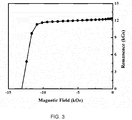
- the recycled sintered magnets exhibited good magnetic properties with the remanence (B r ) of 12.36 kGs, the coercivity (H ci ) of 13.12 kOe, and maximum energy product [(BH) max ] of 35.26 MGOe, as shown in FIG. 3 .
- a NdFeB sludge of 30 ml with distilled water of 450 ml in a flask was distilled by rotary evaporator placed in a water bath under vacuum conditions. The procedure started from 30 °C to 80 °C with increments of 5 °C in intervals of 8 min until the internal liquid had evaporated. The operation was repeated for 2 times. As a result, 25.64 g of distilled powders were obtained. The distillation powders were washed for 3 times by 51 ml of acetone in an ultrasonic vessel, and then were cleaned for 1 time by ethanol in the ultrasonic vessel for 12 min. After removing the liquid, the wet powders were dried in vacuum at 50 °C to obtain the pretreatment powders. The XRF results of the pretreatment powders are shown in TAB. 2.
- Nd 2 O 3 was added to make sure that the amount of rare earth was 40 wt. % of mixed powders including the pretreatment powders, Nd 2 O 3 and FeB; FeB was added to make sure that the amount of B in mixed powders was in excess of 5 wt. % of that in the RE 2 Fe 14 B compound;
- the quantity of CaH 2 was 1.25 times as large as the mixed powders;
- the quantity of CaO was 50 wt. % of CaH 2 .
- the mixed powders were grinded homogeneously, wrapped in tantalum foil, and placed in a tube furnace.
- Reduction diffusion reaction was carried out at 1180 °C for 110 min in inert gas. After cooling to room temperature, the reducing product was grinded, ultrasonically rinsed for 3 times with 15% glycerol aqueous solution in a magnetic field of 0.3 T, then rinsed with water until the pH value of the supernatant reached 10, and finally was washed by ethanol and ether for 15 min, respectively. After rinsing, the product was dried in vacuum of 10 -3 Pa at 400 °C for 120 min to obtain the recycled NdFeB powders with particle sizes of about 10 ⁇ m.
- the resulting recycled NdFeB powders were milled down to about 3 ⁇ m, doped by hydrogenated praseodymium nanoparticles of 10 wt. %, and mixed evenly; subsequently pressed and aligned in a magnetic field to obtain the compact.
- the green compact was first dehydrogenated at 950 °C for 100 min, and then sintered at 1050 °C for 240 min, finally annealed at 850 °C for 120 min and 450 °C for 180 min, respectively.
- the recycled sintered magnets exhibited good magnetic properties with remanence (B r ) of 12.32 kGs, coercivity (H ci ) of 12.08 kOe, and maximum energy product [(BH) max ] of 35.45 MGOe.
- a NdFeB sludge of 30 ml with distilled water of 450 ml in a flask was distilled by rotary evaporator placed in a water bath under vacuum conditions. The procedure started from 30 °C to 80 °C with increments of 5 °C in intervals of 10 min until the internal liquid had evaporated. The operation was repeated for 3 times. As a result, 25.26 g of distilled powders were obtained. The distillation powders were washed 3 times by 50.5 ml of acetone in an ultrasonic vessel, and then were cleaned for 2 times by ethanol in the ultrasonic vessel for 15 min. After removing the liquid, the wet powders were dried in vacuum at 50 °C to obtain the pretreatment powders. The XRF results of the pretreatment powders were shown in TAB. 3.
- Nd 2 O 3 was added to make sure that the amount of rare earth was 40 wt. % of the mixed powders including the pretreatment powders, Nd 2 O 3 and FeB; FeB was added to make sure that the amount of B in mixed powders was in excess of 8 wt. % of that in the RE 2 Fe 14 B compound;
- the quantity of CaH 2 was 1.3 times as large as in the mixed powders;
- the quantity of CaO was 50 wt. % of CaH 2 .
- the mixed powders were grinded homogeneously, wrapped in tantalum foil, and placed in a tube furnace.
- Reduction diffusion reaction was carried out at 1240 °C for 60 min in inert gas. After cooling to room temperature, the reducing product was grinded, ultrasonically rinsed for 3 times in a 15% glycerol aqueous solution in a magnetic field of 0.1 T, then rinsed with water until the pH value of supernatant reached 8, and finally was washed by ethanol and ether for 15 min, respectively. After rinsing, the product was dried in a vacuum of 10 -3 Pa at 400 °C for 120 min to obtain the recycled NdFeB powders with particle sizes of about 10 ⁇ m.
- the resulting recycled NdFeB powders were milled down to 4 ⁇ m, doped by hydrogenated dysprosium nanoparticles of 20 wt. %, and mixed evenly; subsequently pressed and aligned in a magnetic field to obtain the compact.
- the green compact was first dehydrogenated at 1000 °C for 30 min, then sintered 1150 °C for 120 min, and finally annealed at 950 °C for 60 min and 550 °C for 60min, respectively.
- the recycled sintered magnets exhibited good magnetic properties with remanence (B r ) of 11.15 kGs, coercivity (H ci ) of 18.36 kOe, and maximum energy product [(BH) max ] of 31.66 MGOe.
- a NdFeB sludge of 30 ml with distilled water of 450 ml in a flask was distilled by rotary evaporator in water bath under vacuum conditions. The procedure started from 30 °C to 80 °C with increments of 5 °C in intervals of 10 min until the internal liquid had evaporated. The operation was repeated for 2 times. As a result, 25.64 g of distilled powders were obtained. The distilled powders were washed for 4 times by 51 ml of acetone in an ultrasonic vessel, and then cleaned for 2 times by ethanol in the ultrasonic vessel for 15 min. After removing the liquid, the wet powders were dried in vacuum at 50 °C to obtain the pretreatment powders. The XRF results of the pretreatment powders are shown in TAB. 4.
- Nd 2 O 3 was added to make sure that the amount of rare earth was 40 wt. % of the mixed powders including the pretreatment powders, Nd 2 O 3 and FeB; FeB was added to make sure that the amount of B in mixed powders was in excess of 10 wt. % of that in the RE 2 Fe 14 B compound;
- the quantity of CaH 2 was 1.2 times as large as the mixed powders;
- the quantity of CaO was 50 wt. % of CaH 2 .
- the mixed powders were grinded homogeneously, wrapped in tantalum foil, and placed in a tube furnace.
- Reduction diffusion reaction was carried out at 1200 °C for 100 min in inert gas. After cooling to room temperature, the reducing product was grinded, ultrasonically rinsed for 3 times with 15% glycerol aqueous solution in a magnetic field of 0.1 T, then rinsed with water until the pH value of supernatant reached 9, and finally was washed by ethanol and ether for 15 min, respectively. After rinsing, the product was dried in a vacuum of 10 -3 Pa at 400 °C for 120 min to obtain the recycled NdFeB powders with particle sizes of about 10 ⁇ m. The resulting recycled NdFeB powders were milled down to 4 ⁇ m, doped by hydrogenated terbium nanoparticles of 10 wt.
- the green compact was first dehydrogenated at 1000 °C for 60 min, and then sintered at 1100 °C for 180 min, and finally annealed at 900 °C for 180 min and 480 °C for 120 min, respectively.
- the recycled sintered magnets exhibited good magnetic properties with remanence (B r ) of 11.68 kGs, coercivity (H ci ) of 20.65 kOe, and maximum energy product [(BH) max ] of 32.25 MGOe.
Landscapes
- Chemical & Material Sciences (AREA)
- Engineering & Computer Science (AREA)
- Mechanical Engineering (AREA)
- Materials Engineering (AREA)
- Metallurgy (AREA)
- Organic Chemistry (AREA)
- Power Engineering (AREA)
- Manufacturing & Machinery (AREA)
- Inorganic Chemistry (AREA)
- Crystallography & Structural Chemistry (AREA)
- Chemical Kinetics & Catalysis (AREA)
- General Chemical & Material Sciences (AREA)
- Hard Magnetic Materials (AREA)
- Powder Metallurgy (AREA)
- Manufacture Of Metal Powder And Suspensions Thereof (AREA)
- General Life Sciences & Earth Sciences (AREA)
- Geology (AREA)
- Environmental & Geological Engineering (AREA)
- Life Sciences & Earth Sciences (AREA)
- Manufacturing Cores, Coils, And Magnets (AREA)
- Processing Of Solid Wastes (AREA)
Description
- This present disclosure relates to a recycling technology field of NdFeB sludge, and more particularly to short process preparation technology of sintered NdFeB magnets from NdFeB sludge.
- Compared to other magnetic materials, NdFeB magnetic materials have excellent magnetic and mechanical properties. Therefore, they have been applied in many fields, such as electronic information, household appliances, medical treatment, aerospace, and especially in the new green energy fields of energy conservation vehicles and wind power. These wide application fields also bring the rapid increase in annual output of NdFeB magnets. Consequently, the NdFeB wastes, including the scraps and sludge that are generated during the manufacture processes, are about 30 wt. % of the as-sintered materials. China, for example, as the largest manufacturer of NdFeB magnets, had an annual output of about 94 thousand tons in 2013, which accounted for 91% of the global output. At the same time, about 20-30 thousand tons of NdFeB raw materials were formed into sludge during the production process. With the development of global environmental legislation, as well as the requirement of resources protection and sustainable development, the recycling of waste NdFeB materials has become very important. As the price of rare-earth metals and the fabrication costs have increased over the years, the green and efficient recycling of waste NdFeB materials could not only protect the environment and save resources, but also bring substantial economic and social benefits.
- At the present time, possible routes to recycle scraps of sintered NdFeB magnets are: (1) Hydrogen decrepitation to get powders, followed by coating with rare earth rich powders, alignment, and bonding or hot pressing into bulk magnets; (2) Hydrogenation, disproportionation, desorption, recombination (HDDR) process to obtain high coercivity powders for bonding or hot pressing; (3) Milling, alignment, and vacuum sintering into bulk magnets; (4) The powders could be blended with other fresh powders and processed by one of the ways above, but the magnetic properties would drop accordingly.
- On the other hand, the recycle technology of NdFeB rare earth permanent magnet sludge waste is currently a hydrometallurgical process. These processes are comprised of the following: acid dissolution-precipitation process, complex salt conversion process, hydrochloric acid dissolved superior process, and full extraction processes. Various methods are briefly compared as follows: (1) Acid dissolution-precipitation process: This process belongs to relatively primitive methods. Main procedures include oxidizing roasting, acid decomposition, precipitation, burning to achieve rare earth oxides, subsequently electrolyzing rare earth fluoride to prepare pure metal. The recovery rate of rare earth oxides in batch production is low. (2) Hydrochloric acid dissolved superior process: This process is divided into oxide roasting, decomposition and purification, extraction and separation, and sedimentation burning. The recovery rate of rare earth is more than 95%, the purity of Dy2O3 is 99%, and the purity of Pr2O3 is 98% by this method. Furthermore, the raffinate can achieve precipitate of rare earth carbonate polymorphs which can meet customers' demands. (3) Sulfuric acid complex salt precipitation process: This process typically includes the following steps: sulfuric acid dissolution, complex salt precipitation of rare earths, alkali conversion, hydrochloric acid dissolution, extraction and separation, precipitation, and burning to obtain rare earth oxides. Complex salt conversion process could separate Nd2O3 and non-rare earth (Fe, Al, etc.). By this method, the purity of rare earth oxides could reach 93%. The recovery rate of Nd2O3 in final product is high (up to 85.53%), and the purity of Nd2O3 and Dy2O3 is 99%. Therefore, this process is widely used in the industry nowadays. (4) Full extraction process. Full solvent extraction processes of NdFeB waste are: extraction of iron by N503, extraction of rare earth by P507, separation of neodymium and dysprosium, further purification of cobalt. After 60 levels segment extraction test, Nd2O3 with 99% purity, Dy2O3 with 98% purity, and cobalt carbonate product with 99% purity are achieved. However, this process needs more steps and a longer production cycle. The final products of above process are rare earth oxide or metal, and the above-mentioned processes have common disadvantages of long flow, generation of a large amount of waste acid that pollutes the environment.
- To solve these problems, China patent (Application No.
201410101544.7 -
CN 104 036 949 A discloses a method for using bulk sintered neodymium iron boron (NdFeB) machining waste to prepare a high-coercivity regenerated NdFeB magnet and belongs to the technical field of magnetic materials.CN 103 882 234 A discloses a method for preparing regenerated neodymium iron boron magnetic powder by using neodymium iron boron oily sludge, and belongs to the technical field of recovering and recycling of the neodymium iron boron oily sludge.CN 104 190 943 A discloses a method for recycling sintered neodymium-iron-boron waste materials. Ram S. describes synthesis, magnetic properties and formalism of magnetic properties of high-quality refined Nd2Fe14B powders for permanent magnet devices (Journal of Materials Science (1997), 32(15); 4133-4148). - The present invention overcomes the disadvantages in the existing technology and fabricates sintered NdFeB magnets with good magnetic properties by optimizing and adjusting the process. Waste NdFeB sludge was chosen as the raw materials. After the organic impurities were removed by distillation and ultrasonic cleaning, the recycled NdFeB powders were prepared by calcium reduction-diffusion reaction followed by rinsing. During the rinsing process, calcium oxide and non-magnetic materials were effectively separated by ultrasonic treatment in a magnetic field. The reduction process can also be improved by using CaH2. Doping with Nd2O3 powders was beneficial in obtaining NdFeB powders with high performance. The recycled NdFeB powders with particle sizes of about 10 µm could significantly reduce energy consumption during the ball milling powders. The maximum magnetic energy product of recycled sintered NdFeB magnets by rare earth hydride nanoparticles doping was 35.26 MGOe, similar to those of current sintered NdFeB products. The invention has innovations of short process (NdFeB sludge as raw materials is directly fabricated into NdFeB powders and sintered magnets), high efficiency (the recycled magnets have good magnetic properties), environmental protection (preparation process does not produce waste acid, waste liquid and waste gas).
- The present invention comprises the following steps: water bath distillation of sludge, ultrasonic cleaning, calcium reduction and diffusion, ultrasonic rinsing in the magnetic field, drying, powders mixing and sintering:
- (1) Water bath distillation of sludge: Distilled water was added into the sludge with an optimized volume ratio of 1:15 between sludge and distilled water and stirred. Subsequently, water bath distillation with stepwise increasing temperature in vacuum was carried out to obtain the powders. The optimized procedure started from 30 °C to 80 °C with increments of 5 °C in the intervals of 5-10 min until the internal liquid had evaporated. The operation was repeated for 3 times.
- (2) Ultrasonic cleaning for sludge: The distillation powders after the step (1) were washed for 3 times by acetone in an ultrasonic vessel, followed by ultrasonic cleaning in ethanol. After removal of the liquid, the wet powders were dried (e.g. under vacuum conditions at 50 °C) to obtain the pretreatment powders. The optimized ratio of powders, acetone and ethanol was 5 g, 10 ml and 10 ml, respectively.
- (3) Calcium reduction-diffusion: The pretreatment powders after the step (2), with an appropriate amount of Nd2O3, FeB, and CaH2 as the reactant, as well as CaO as a dispersant, were carried out using the calcium reduction diffusion reaction, wherein the pretreatment powders after step (2) were analyzed by x-ray fluorescence (XRF). Based on XRF results and calculation in accordance with RE2Fe14B stoichiometric ratio, Nd2O3, FeB, CaH2 and CaO powders should be added before reaction. Nd2O3 was added to make sure that the amount of rare earth was 40 wt. % of in mixed powders of pretreatment powders, Nd2O3, and FeB; FeB was added to make sure that the amount of B in mixed powders of pretreatment powders, Nd2O3, and FeB was in excess 0-10 wt. % of that in RE2Fe14B compound (i.e., the amount of B in the mixed powders of pretreatment powders, Nd2O3, and FeB was in excess 0-10 wt. % of that in RE2Fe14B compound. For example, the weight percentage of B in RE2Fe14B was x wt. %, the weight percentage of B in mixed powders of pretreatment powders, Nd2O3, and FeB was x-(x+10) wt. %); The quantity of CaH2 was 1.2-1.3 times as large as in the mixed powders; The quantity of CaO was 50 wt. % of CaH2. Reduction diffusion reaction was carried out in 1160-1240 °C for 60-150 min in inert gas.
- (4) Rinsing and drying: The reducing product after the step (3) was grinded, ultrasonically rinsed in a glass container in a magnetic field, and then dried. The reducing product was ultrasonically rinsed for 3 times with 15% glycerol aqueous solution in magnetic field of 0.1-0.5 T, then rinsed with water until the pH value of the supernatant reached 8-10, and finally was washed by ethanol and ether for 15 min, respectively. After rinsing, the product was dried in a vacuum of 10-3 Pa at 400 °C for 120 min to obtain the recycled NdFeB powders with particle sizes of about 10 µm. The optimized for each rinsing time was 15 min.
- (5) Mixing powders and sintering: The resulting recycled NdFeB powders after the step (4) were milled to 3-5 µm, doped by rare earth hydride nanoparticles of 10-20 wt. %, and mixed; subsequently pressed and aligned in a magnetic field to get the green compact. The green compact was first dehydrogenated at 900-1000 °C for 30-180 min, and then sintered at 1050-1150 °C for 120-240 min, finally annealed at 850-950 °C for 60-180 min and 450-550 °C for 60-180 min, respectively. Thus the recycled sintered magnets were obtained.
- The above-mentioned hydrides in step (5) were hydrogenated neodymium, hydrogenated praseodymium, hydrogenated dysprosium, or hydrogenated terbium.
- The present invention chose NdFeB sludge as raw materials, and realized the recycling of NdFeB sludge. The preparation process did not produce waste acid, waste liquid and waste gas. The efficient and environmentally friendly process was short, therefore significantly reducing the fabrication cost of NdFeB magnets. The pretreatment sludge was directly prepared into NdFeB powders. The process took advantage of all valuable elements in the NdFeB sludge, and avoided the secondary waste during the recycling of sludge. After removing the calcium oxide by using magnetic ultrasonic rinse, the obtained NdFeB powders with particle sizes of about 10 µm facilitated the subsequent processing, which significantly reduced the energy consumption during the ball milling process. The recycled sintered magnets exhibited good maximum energy product [(BH)max] of 35.26 MGOe.
-
-
FIG.1 shows the x-ray diffraction (XRD) pattern of the pretreatment sludge powders. -
FIG.2 shows the XRD pattern of the recycled NdFeB powders. -
FIG.3 shows the demagnetization curve of the recycled sintered NdFeB magnets. - The following examples describe this disclosure.
- A NdFeB sludge of 30 ml with distilled water of 450 ml in a flask was distilled by rotary evaporator placed in a water bath under vacuum conditions. The procedure started from 30 °C to 80 °C with increments of 5 °C in the intervals of 5 min until the internal liquid had evaporated. The operation was repeated for 3 times. As a result, 26.42 g of distilled powders were obtained. The distillation powders were washed for 3 times by 52 ml of acetone in an ultrasonic vessel, and then were cleaned twice by ethanol in the ultrasonic vessel for 10 min. After removing the liquid, the wet powders were dried in vacuum at 50 °C to obtain the pretreatment powders. The XRD pattern and XRF results of the pretreatment powders are shown in
FIG. 1 and TAB. 1, respectively. It was concluded that the pretreatment powders were mainly composed of Fe3O4, Nd(CO3)(OH)4•xH2O, Fe2Nd and Fe2B. - Based on the elemental content, shown in TAB. 1, and calculations in accordance with RE2Fe14B stoichiometric ratio, Nd2O3 was added to make sure that the amount of rare earth was 40 wt. % of mixed powders including pretreatment powders, Nd2O3 and FeB; FeB was added to make sure that the amount of B in the mixed powders was same as that in the RE2Fe14B compound; The quantity of CaH2 was 1.2 times as large as the mixed powders; The quantity of CaO was 50 wt. % of CaH2. The mixed powders were grinded homogeneously, wrapped in tantalum foil, and placed in a tube furnace. Reduction diffusion reaction was carried out at 1160 °C for 150 min in inert gas. After cooling to room temperature, the reducing product was grinded, ultrasonically rinsed for 3 times with 15% glycerol aqueous solution in a magnetic field of 0.5 T, then rinsed with water until the pH value of the supernatant reached 9.3, and finally was washed by ethanol and ether for 15 min, respectively. After rinsing, the product was dried in vacuum of 10-3 Pa at 400 °C for 120 min to obtain the recycled NdFeB powders with particle sizes of about 10 µm. The XRD patterns of the recycled NdFeB powders are shown in
FIG. 2 . The recycled NdFeB powders were mainly composed of Nd2Fe14B and a small amount of NdFe4B4 phase. The resulting recycled NdFeB powders were milled to about 5 µm, doped by hydrogenated neodymium nanoparticles of 15 wt. %, and mixed evenly; subsequently pressed and aligned in a magnetic field to obtain the compact. The green compact was first dehydrogenated at 900 °C for 120 min, and then sintered at 1100 °C for 180 min, finally annealed at 900 °C for 180 min and 480 °C for 120 min, respectively. The recycled sintered magnets exhibited good magnetic properties with the remanence (Br) of 12.36 kGs, the coercivity (Hci) of 13.12 kOe, and maximum energy product [(BH)max] of 35.26 MGOe, as shown inFIG. 3 . - A NdFeB sludge of 30 ml with distilled water of 450 ml in a flask was distilled by rotary evaporator placed in a water bath under vacuum conditions. The procedure started from 30 °C to 80 °C with increments of 5 °C in intervals of 8 min until the internal liquid had evaporated. The operation was repeated for 2 times. As a result, 25.64 g of distilled powders were obtained. The distillation powders were washed for 3 times by 51 ml of acetone in an ultrasonic vessel, and then were cleaned for 1 time by ethanol in the ultrasonic vessel for 12 min. After removing the liquid, the wet powders were dried in vacuum at 50 °C to obtain the pretreatment powders. The XRF results of the pretreatment powders are shown in TAB. 2.
- Based on the elemental content, shown in TAB. 2, and calculations in accordance with RE2Fe14B stoichiometric ratio, Nd2O3 was added to make sure that the amount of rare earth was 40 wt. % of mixed powders including the pretreatment powders, Nd2O3 and FeB; FeB was added to make sure that the amount of B in mixed powders was in excess of 5 wt. % of that in the RE2Fe14B compound; The quantity of CaH2 was 1.25 times as large as the mixed powders; The quantity of CaO was 50 wt. % of CaH2. The mixed powders were grinded homogeneously, wrapped in tantalum foil, and placed in a tube furnace. Reduction diffusion reaction was carried out at 1180 °C for 110 min in inert gas. After cooling to room temperature, the reducing product was grinded, ultrasonically rinsed for 3 times with 15% glycerol aqueous solution in a magnetic field of 0.3 T, then rinsed with water until the pH value of the supernatant reached 10, and finally was washed by ethanol and ether for 15 min, respectively. After rinsing, the product was dried in vacuum of 10-3 Pa at 400 °C for 120 min to obtain the recycled NdFeB powders with particle sizes of about 10 µm. The resulting recycled NdFeB powders were milled down to about 3 µm, doped by hydrogenated praseodymium nanoparticles of 10 wt. %, and mixed evenly; subsequently pressed and aligned in a magnetic field to obtain the compact. The green compact was first dehydrogenated at 950 °C for 100 min, and then sintered at 1050 °C for 240 min, finally annealed at 850 °C for 120 min and 450 °C for 180 min, respectively. The recycled sintered magnets exhibited good magnetic properties with remanence (Br) of 12.32 kGs, coercivity (Hci) of 12.08 kOe, and maximum energy product [(BH)max] of 35.45 MGOe.
- A NdFeB sludge of 30 ml with distilled water of 450 ml in a flask was distilled by rotary evaporator placed in a water bath under vacuum conditions. The procedure started from 30 °C to 80 °C with increments of 5 °C in intervals of 10 min until the internal liquid had evaporated. The operation was repeated for 3 times. As a result, 25.26 g of distilled powders were obtained. The distillation powders were washed 3 times by 50.5 ml of acetone in an ultrasonic vessel, and then were cleaned for 2 times by ethanol in the ultrasonic vessel for 15 min. After removing the liquid, the wet powders were dried in vacuum at 50 °C to obtain the pretreatment powders. The XRF results of the pretreatment powders were shown in TAB. 3.
- Based on the elemental content, shown in TAB. 3, and calculations in accordance with RE2Fe14B stoichiometric ratio, Nd2O3 was added to make sure that the amount of rare earth was 40 wt. % of the mixed powders including the pretreatment powders, Nd2O3 and FeB; FeB was added to make sure that the amount of B in mixed powders was in excess of 8 wt. % of that in the RE2Fe14B compound; The quantity of CaH2 was 1.3 times as large as in the mixed powders; The quantity of CaO was 50 wt. % of CaH2. The mixed powders were grinded homogeneously, wrapped in tantalum foil, and placed in a tube furnace. Reduction diffusion reaction was carried out at 1240 °C for 60 min in inert gas. After cooling to room temperature, the reducing product was grinded, ultrasonically rinsed for 3 times in a 15% glycerol aqueous solution in a magnetic field of 0.1 T, then rinsed with water until the pH value of supernatant reached 8, and finally was washed by ethanol and ether for 15 min, respectively. After rinsing, the product was dried in a vacuum of 10-3 Pa at 400 °C for 120 min to obtain the recycled NdFeB powders with particle sizes of about 10 µm. The resulting recycled NdFeB powders were milled down to 4 µm, doped by hydrogenated dysprosium nanoparticles of 20 wt. %, and mixed evenly; subsequently pressed and aligned in a magnetic field to obtain the compact. The green compact was first dehydrogenated at 1000 °C for 30 min, then sintered 1150 °C for 120 min, and finally annealed at 950 °C for 60 min and 550 °C for 60min, respectively. The recycled sintered magnets exhibited good magnetic properties with remanence (Br) of 11.15 kGs, coercivity (Hci) of 18.36 kOe, and maximum energy product [(BH)max] of 31.66 MGOe.
- A NdFeB sludge of 30 ml with distilled water of 450 ml in a flask was distilled by rotary evaporator in water bath under vacuum conditions. The procedure started from 30 °C to 80 °C with increments of 5 °C in intervals of 10 min until the internal liquid had evaporated. The operation was repeated for 2 times. As a result, 25.64 g of distilled powders were obtained. The distilled powders were washed for 4 times by 51 ml of acetone in an ultrasonic vessel, and then cleaned for 2 times by ethanol in the ultrasonic vessel for 15 min. After removing the liquid, the wet powders were dried in vacuum at 50 °C to obtain the pretreatment powders. The XRF results of the pretreatment powders are shown in TAB. 4.
- Based on the elemental content, shown in TAB. 4, and calculations in accordance with RE2Fe14B stoichiometric ratio, Nd2O3 was added to make sure that the amount of rare earth was 40 wt. % of the mixed powders including the pretreatment powders, Nd2O3 and FeB; FeB was added to make sure that the amount of B in mixed powders was in excess of 10 wt. % of that in the RE2Fe14B compound; The quantity of CaH2 was 1.2 times as large as the mixed powders; The quantity of CaO was 50 wt. % of CaH2. The mixed powders were grinded homogeneously, wrapped in tantalum foil, and placed in a tube furnace. Reduction diffusion reaction was carried out at 1200 °C for 100 min in inert gas. After cooling to room temperature, the reducing product was grinded, ultrasonically rinsed for 3 times with 15% glycerol aqueous solution in a magnetic field of 0.1 T, then rinsed with water until the pH value of supernatant reached 9, and finally was washed by ethanol and ether for 15 min, respectively. After rinsing, the product was dried in a vacuum of 10-3 Pa at 400 °C for 120 min to obtain the recycled NdFeB powders with particle sizes of about 10 µm. The resulting recycled NdFeB powders were milled down to 4 µm, doped by hydrogenated terbium nanoparticles of 10 wt. %, and mixed evenly; subsequently pressed and aligned in a magnetic field to get the compact. The green compact was first dehydrogenated at 1000 °C for 60 min, and then sintered at 1100 °C for 180 min, and finally annealed at 900 °C for 180 min and 480 °C for 120 min, respectively. The recycled sintered magnets exhibited good magnetic properties with remanence (Br) of 11.68 kGs, coercivity (Hci) of 20.65 kOe, and maximum energy product [(BH)max] of 32.25 MGOe.
TAB.1 XRF results of the pretreatment powders (Example 1) Element Content Cwt.%) Element Content (wt.%) Fe 67.3135 Al 0.2339 Nd 20.6406 Si 0.2044 Pr 6.4564 Nb 0.1916 Dy 2.5889 Ga 0.1667 Co 1.1343 S 0.0656 Na 0.3221 Zr 0.0531 Ho 0.2905 Ca 0.053 Cu 0.2837 W 0.0018 TAB.2 XRF results of the pretreatment powders (Example 2) Element Content Cwt.%) Element Content (wt.%) Fe 67.7794 Al 0.2209 Nd 20.5665 Nb 0.1953 Pr 6.5391 Ga 0.1781 Dy 2.4912 Si 0.1389 Co 1.1563 Ca 0.0609 Cu 0.3022 Zr 0.0441 Ho 0.2975 S 0.0296 TAB.3 XRF results of the pretreatment powders (Example 3) Element Content Cwt.%) Element Content (wt.%) Fe 66.9291 Al 0.2381 Nd 20.6427 Si 0.2093 Pr 6.5183 Nb 0.1873 Dy 2.4626 Ga 0.1598 Co 1.1642 Ca 0.0567 Tb 0.7997 Zr 0.0544 Ho 0.2820 S 0.0256 Cu 0.2702 TAB.4 XRF results of the pretreatment powders (Example 4) Element Content Cwt.%) Element Content (wt.%) Fe 66.3840 Ho 0.2898 Nd 20.9083 Si 0.2554 Pr 6.6052 Al 0.2425 Dy 2.5265 Nb 0.1867 Co 1.1398 Ga 0.1781 Tb 0.8582 Ca 0.0611 Cu 0.3107 Zr 0.0538
Claims (6)
- A process preparation technology of sintered NdFeB magnets from NdFeB sludge. The method of the present invention comprises the following steps: water bath distillation of sludge, ultrasonic cleaning, calcium reduction and diffusion, ultrasonic rinsing in a magnetic field, drying, powders mixing and sintering:(1) Water bath distillation of sludge: Distilled water was added into the sludge and stirred. Subsequently, water bath distillation with stepwise increasing temperature in vacuum was carried out until the internal liquid had evaporated to obtain the powders. The operation was repeated for 3 times;(2) Ultrasonic cleaning for sludge: The distillation powders after step (1) were washed for 3 times by acetone in an ultrasonic vessel, followed by cleaning by ethanol in the ultrasonic vessel. After removing the liquid, the wet powders were dried to get the pretreatment powders;(3) Calcium reduction-diffusion: The pretreatment powders after step (2) with appropriate amounts of Nd2O3, FeB, and CaH2 as the reactant, and CaO as a dispersant were used in the calcium reduction diffusion reaction; wherein the pretreatment powders after step (2) were analyzed by x-ray fluorescence (XRF). Based on XRF results and calculations in accordance with RE2Fe14B stoichiometric ratio, Nd2O3 was added to make sure that the amount of rare earth was 40 wt. % of the mixed powders of pretreatment powders, Nd2O3 and FeB; FeB was added to make sure that the amount of B in mixed powders of pretreatment powders, Nd2O3 and FeB was in excess 0-10 wt. % of that in the RE2Fe14B compound; The quantity of CaH2 was 1.2-1.3 times as large as the mixed powders; The quantity of CaO was 50 wt. % of CaH2, and wherein the reduction diffusion reaction condition was carried out at 1160-1240 °C for 60-150 min in inert gas;(4) Rinsing and drying: The reducing product after step (3) was grinded, ultrasonically rinsed in a glass container in a magnetic field, and then dried;(5) Mixing powders and sintering: the resulting recycled NdFeB powders after step (4) were milled down to 3-5 µm, doped by rare earth hydride nanoparticles of 10-20 wt. %, and mixed; subsequently pressed and aligned in a magnetic field to obtain the compact. The green compact was first dehydrogenated at 900-1000 °C for 30-180 min, and then sintered at 1050-1150 °C for 120-240 min, and finally annealed at 850-950 °C for 60-180 min and 450-550 °C for 60-180 min, respectively. The recycled sintered magnets were thus obtained.
- A process preparation technology of sintered NdFeB magnets from the NdFeB sludge as described in claim 1, stated that the optimized volume ratio of 1:15 between sludge and distilled water, water bath distillation with stepwise increase in temperature in vacuum was carried out to obtain the powders. The optimized procedure started from 30 °C to 80 °C with increments of 5 °C in intervals of 5-10 min until the internal liquid had evaporated. The operation was repeated for 3 times.
- A process preparation technology of sintered NdFeB magnets from the NdFeB sludge as described in claim 1, stated that the optimized ratio of powders, acetone and ethanol was 5 g, 10 ml and 10 ml, respectively.
- A process preparation technology of sintered NdFeB magnets from the NdFeB sludge as described in claim 1, stated that the reducing product was ultrasonically rinsed for 3 times with 15% glycerol aqueous solution in a magnetic field of 0.1-0.5 T and, then rinsed with water until the pH value of supernatant reached 8-10, and finally was washed by ethanol and ether for 15 min, respectively. After rinsing, the product was dried in a vacuum of 10-3 Pa at 400 °C for 120 min to obtain the recycled NdFeB powders with particle sizes of about 10 µm.
- A process preparation technology of sintered NdFeB magnets from the NdFeB sludge as described in claim 4, stated that the optimized every rinsing time was 15 min.
- A process preparation technology of sintered NdFeB magnets from the NdFeB sludge as described in claim 1, stated that the hydrides were hydrogenated neodymium, hydrogenated praseodymium, hydrogenated dysprosium, or hydrogenated terbium.
Applications Claiming Priority (2)
| Application Number | Priority Date | Filing Date | Title |
|---|---|---|---|
| CN201510101336.1A CN104690270B (en) | 2015-03-08 | 2015-03-08 | A kind of Short flow method utilizing sintered NdFeB greasy filth waste material to prepare performance Nd Fe B sintered magnet |
| PCT/CN2015/077938 WO2016141625A1 (en) | 2015-03-08 | 2015-04-30 | Method for preparing neodymium-iron-boron magnet by utilizing waste material and neodymium-iron-boron magnet |
Publications (3)
| Publication Number | Publication Date |
|---|---|
| EP3090821A1 EP3090821A1 (en) | 2016-11-09 |
| EP3090821A4 EP3090821A4 (en) | 2017-03-22 |
| EP3090821B1 true EP3090821B1 (en) | 2017-11-15 |
Family
ID=53338032
Family Applications (1)
| Application Number | Title | Priority Date | Filing Date |
|---|---|---|---|
| EP15862136.7A Active EP3090821B1 (en) | 2015-03-08 | 2015-04-30 | Method for preparing neodymium-iron-boron magnet by utilizing waste material |
Country Status (4)
| Country | Link |
|---|---|
| US (1) | US9728310B2 (en) |
| EP (1) | EP3090821B1 (en) |
| CN (1) | CN104690270B (en) |
| WO (1) | WO2016141625A1 (en) |
Families Citing this family (30)
| Publication number | Priority date | Publication date | Assignee | Title |
|---|---|---|---|---|
| CN106319575B (en) * | 2016-11-02 | 2018-04-17 | 江西理工大学 | A kind of method of neodymium iron boron greasy filth waste material electrolytic preparation Nd Fe B alloys |
| CN106498166B (en) * | 2016-11-02 | 2018-04-17 | 江西理工大学 | A kind of method of neodymium iron boron greasy filth waste material redox full constituent recycling |
| KR102100759B1 (en) | 2016-11-08 | 2020-04-14 | 주식회사 엘지화학 | Manufacturing method of metal powder and metal powder |
| US20180173229A1 (en) * | 2016-12-15 | 2018-06-21 | Dura Operating, Llc | Method and system for performing advanced driver assistance system functions using beyond line-of-sight situational awareness |
| US9890442B1 (en) * | 2017-03-17 | 2018-02-13 | King Saud University | Method of preparing a metal matrix nanocomposite |
| CN108359798A (en) * | 2017-06-03 | 2018-08-03 | 江西离子型稀土工程技术研究有限公司 | A method of rapidly and efficiently recycling neodymium iron boron waste material |
| CN107424700B (en) * | 2017-08-30 | 2019-03-22 | 北京工业大学 | Method for preparing regenerated sintered NdFeB magnet by double-sided grinding of NdFeB sludge waste |
| KR102093491B1 (en) | 2017-11-28 | 2020-03-25 | 주식회사 엘지화학 | Manufacturing method of sintered magnet and sintered magnet |
| CN108305772B (en) * | 2017-12-25 | 2019-10-29 | 宁波韵升股份有限公司 | A kind of method of Sintered NdFeB magnet grain boundary decision |
| CN108188152B (en) * | 2017-12-30 | 2020-09-25 | 北京工业大学 | Method for removing carbon and oxygen in waste rapidly quenched bonded neodymium iron boron magnetic powder |
| CN108188151B (en) * | 2017-12-30 | 2020-09-25 | 北京工业大学 | A method for removing carbon and oxygen in waste HDDR bonded NdFeB magnetic powder |
| CN110090964A (en) * | 2018-01-28 | 2019-08-06 | 蒋盼盼 | A kind of method that the waste recovery of rare-earth Nd-Fe-B coating recycles |
| EP3660174B1 (en) * | 2018-11-27 | 2021-10-27 | Institut "Jozef Stefan" | A method for recovery of nd2fe14b grains from bulk sintered nd-fe-b magnets and/or magnet scraps by electrochemical etching |
| CN109852809A (en) * | 2019-04-10 | 2019-06-07 | 江苏集萃安泰创明先进能源材料研究院有限公司 | A kind of short route recycles the method for neodymium iron boron alloy powder and the preparation method of recycled sinter magnet from neodymium iron boron greasy filth waste material |
| CN110157916B (en) * | 2019-06-26 | 2020-11-03 | 北京工业大学 | Low-cost method for preparing high-performance anisotropic neodymium iron boron magnetic powder by using neodymium iron boron oil-based slice oil sludge |
| KR102600123B1 (en) * | 2019-10-16 | 2023-11-07 | 주식회사 엘지화학 | Manufacturing method of sintered magnet |
| DE102020214335A1 (en) * | 2020-11-13 | 2022-05-19 | Mimplus Technologies Gmbh & Co. Kg | Process for producing a permanent magnet from a magnetic starting material |
| CN112359211B (en) * | 2020-11-16 | 2022-12-02 | 江苏集萃安泰创明先进能源材料研究院有限公司 | Waste amorphous nanocrystalline iron core recycling and reusing method and amorphous nanocrystalline powder core |
| CN112837921A (en) * | 2021-01-06 | 2021-05-25 | 陈凯华 | Method for dysprosium penetration of neodymium iron boron magnet |
| CN112877541B (en) * | 2021-01-11 | 2022-09-20 | 中国科学院过程工程研究所 | A kind of recycled alloy prepared based on NdFeB sludge and preparation method thereof |
| JP7556327B2 (en) * | 2021-05-18 | 2024-09-26 | 住友金属鉱山株式会社 | Method for producing rare earth transition metal alloy powder |
| CN113652538B (en) * | 2021-07-15 | 2023-02-24 | 江西理工大学 | Method for separating and recycling rare earth and iron from neodymium iron boron oil sludge |
| CN113652550B (en) * | 2021-07-15 | 2023-02-21 | 江西理工大学 | A method for comprehensive recovery of rare earth and iron from NdFeB oil sludge |
| CN114068120A (en) * | 2021-11-16 | 2022-02-18 | 江西金力永磁科技股份有限公司 | A kind of neodymium iron boron magnet prepared by using waste sintered magnet and method of preparing neodymium iron boron magnet by using waste |
| CN114317974B (en) * | 2021-12-22 | 2025-02-21 | 内蒙古大学 | A pretreatment method for NdFeB oil sludge waste |
| CN115011793A (en) * | 2022-06-01 | 2022-09-06 | 吉水金诚新材料加工有限公司 | Low temperature oxidation process and its low temperature oxidation kiln |
| CN115116688B (en) * | 2022-08-26 | 2022-12-27 | 山西汇镪磁性材料制作有限公司 | Resource-saving low-cost neodymium iron boron magnet material and processing technology |
| CN115449627B (en) * | 2022-10-13 | 2023-12-12 | 中国科学院赣江创新研究院 | Method for oxidizing roasting neodymium iron boron waste |
| CN117428202B (en) * | 2023-11-01 | 2026-01-09 | 中国科学院江西稀土研究院 | A method for preparing regenerated magnetic powder using a salting-reduction diffusion process and its application. |
| CN119237754B (en) * | 2024-09-29 | 2025-10-28 | 武汉钢铁有限公司 | Method for preparing reduced iron powder by using cold-rolled oil sludge |
Family Cites Families (20)
| Publication number | Priority date | Publication date | Assignee | Title |
|---|---|---|---|---|
| US3748193A (en) * | 1971-08-16 | 1973-07-24 | Gen Electric | Rare earth intermetallic compounds by a calcium hydride reduction diffusion process |
| US3878000A (en) * | 1974-06-03 | 1975-04-15 | Gen Electric | Recovery of cobalt-rare earth alloy particles by hydration-disintegration in a magnetic field |
| JPS60162750A (en) * | 1984-02-01 | 1985-08-24 | Nippon Gakki Seizo Kk | Rare earth magnet and its production |
| US5091020A (en) * | 1990-11-20 | 1992-02-25 | Crucible Materials Corporation | Method and particle mixture for making rare earth element, iron and boron permanent sintered magnets |
| US5183494A (en) * | 1991-04-23 | 1993-02-02 | Industrial Technology Research Instiute | Process for manufacturing rare earth-iron-boron permanent magnet alloy powders |
| CN1044648C (en) * | 1997-05-22 | 1999-08-11 | 南开大学 | Preparation of NdFeB Permanent Magnetic Alloy by Co-precipitation Reduction Diffusion |
| JP2002356724A (en) * | 2001-03-30 | 2002-12-13 | Sumitomo Metal Ind Ltd | Rare earth magnet alloy slag regeneration method and rare earth magnet alloy production method |
| CN102211192B (en) * | 2011-06-09 | 2012-12-26 | 天津一阳磁性材料有限责任公司 | Method for preparing high-performance neodymium iron boron by using secondary recycled materials |
| CN102912112A (en) * | 2012-10-20 | 2013-02-06 | 北京工业大学 | Method for pre-processing neodymium iron boron wire cutting waste oil sludge |
| CN103117143B (en) * | 2013-01-25 | 2016-06-29 | 宁波同创强磁材料有限公司 | A kind of neodymium iron boron magnetic body of neodymium iron boron nickel plating waste material sintering |
| CN103160682B (en) * | 2013-02-19 | 2014-12-31 | 北京工业大学 | Preprocessing method of preparing neodymium iron boron alloy by using neodymium iron boron linear-cutting oil sludge |
| WO2014205002A2 (en) * | 2013-06-17 | 2014-12-24 | Miha Zakotnik | Magnet recycling to create nd-fe-b magnets with improved or restored magnetic performance |
| CN103317146B (en) * | 2013-07-09 | 2015-09-30 | 中国石油大学(华东) | Hydro-thermal method prepares the method for NdFeB magnetic powder |
| CN103343233B (en) * | 2013-07-19 | 2015-10-28 | 北京工业大学 | A kind of neodymium iron boron greasy filth reclaims the method for neodymium iron |
| CN103343235B (en) * | 2013-07-19 | 2015-03-25 | 北京工业大学 | Method for recovering neodymium and iron from neodymium iron boron oil sludge through two-step co-precipitation |
| CN103667715B (en) * | 2013-12-17 | 2016-05-18 | 北京工业大学 | A kind of at C2H2O4Under-OH system, from neodymium iron boron greasy filth, reclaim the method for neodymium, praseodymium, dysprosium, cobalt, iron simultaneously |
| CN103882234B (en) * | 2014-03-18 | 2015-12-30 | 北京工业大学 | A kind of method neodymium iron boron greasy filth being prepared into regeneration NdFeB magnetic powder |
| CN104036947A (en) * | 2014-06-11 | 2014-09-10 | 北京工业大学 | Method for manufacturing high-coercivity regenerated sintered neodymium-iron-boron magnet by waste permanent-magnet motor magnet steel |
| CN104036949A (en) * | 2014-06-11 | 2014-09-10 | 北京工业大学 | Method for using bulk sintered neodymium iron boron (NdFeB) machining waste to prepare high-performance regenerated NdFeB magnet |
| CN104190943B (en) * | 2014-08-04 | 2016-04-06 | 中磁科技股份有限公司 | A kind of method that sintered NdFeB waste recovery utilizes |
-
2015
- 2015-03-08 CN CN201510101336.1A patent/CN104690270B/en active Active
- 2015-04-30 WO PCT/CN2015/077938 patent/WO2016141625A1/en not_active Ceased
- 2015-04-30 EP EP15862136.7A patent/EP3090821B1/en active Active
-
2016
- 2016-04-19 US US15/133,042 patent/US9728310B2/en active Active
Non-Patent Citations (1)
| Title |
|---|
| None * |
Also Published As
| Publication number | Publication date |
|---|---|
| EP3090821A1 (en) | 2016-11-09 |
| US20160260530A1 (en) | 2016-09-08 |
| EP3090821A4 (en) | 2017-03-22 |
| CN104690270A (en) | 2015-06-10 |
| WO2016141625A1 (en) | 2016-09-15 |
| CN104690270B (en) | 2016-11-09 |
| US9728310B2 (en) | 2017-08-08 |
Similar Documents
| Publication | Publication Date | Title |
|---|---|---|
| US9728310B2 (en) | Short-process method for preparing sintered NdFeB magnets with high magnetic properties recycling from NdFeB sludge | |
| CN104690277B (en) | A kind of method utilizing vat blue RS technology to reclaim neodymium iron boron greasy filth | |
| CN106971802A (en) | A kind of recycled sinter Nd-Fe-B permanent magnetic preparation | |
| CN103117143B (en) | A kind of neodymium iron boron magnetic body of neodymium iron boron nickel plating waste material sintering | |
| CN107610860A (en) | A kind of method that centreless mill processing neodymium iron boron greasy filth waste material prepares recycled sinter magnet | |
| CN103866127A (en) | Method for preparing neodymium iron boron through regenerating waste material containing neodymium, iron and boron | |
| CN107146674B (en) | From the cerium-rich rare earth permanent magnet and its production method of heat treatment | |
| CN111383833A (en) | Grain boundary diffusion method for rare earth neodymium iron boron magnet | |
| CN104681268A (en) | Processing method for improving coercive force of sintered neodymium-iron-boron magnet | |
| CN108281246B (en) | High-performance sintered neodymium-iron-boron magnet and preparation method thereof | |
| CN107958760B (en) | Rare earth permanent magnetic material and preparation method thereof | |
| CN109852809A (en) | A kind of short route recycles the method for neodymium iron boron alloy powder and the preparation method of recycled sinter magnet from neodymium iron boron greasy filth waste material | |
| Cong et al. | Short-process recycling of Nd-Fe-B sintered magnet sludge wastes: Challenges and approaches | |
| CN104036945A (en) | Method for manufacturing high-temperature stable regenerated sintered neodymium-iron-boron magnet by waste permanent-magnet motor magnet steel | |
| CN104036947A (en) | Method for manufacturing high-coercivity regenerated sintered neodymium-iron-boron magnet by waste permanent-magnet motor magnet steel | |
| CN108777204B (en) | Preparation method of samarium-iron-nitrogen permanent magnet powder | |
| CN107424700A (en) | The method for preparing recycled sinter neodymium iron boron magnetic body using two-sided mill processing neodymium iron boron greasy filth waste material | |
| CN105632749B (en) | A kind of preparation method of high-performance anisotropy Nanocomposite magnet | |
| CN106847457A (en) | A kind of rare-earth permanent magnet and the method for preparing rare-earth permanent magnet | |
| CN109338113B (en) | Method for recycling neodymium iron boron trepanning oil sludge waste by Ca-chloride reduction diffusion technology | |
| CN105489333A (en) | Rare earth permanent magnet material utilizing recycled waste materials and preparation method | |
| CN103000324A (en) | Sintered rare earth permanent magnetic material and preparation method thereof | |
| CN112331474B (en) | Recycling method of neodymium iron boron block waste | |
| CN101599330A (en) | Nd-Fe-B magnetic material and production method | |
| CN112216463A (en) | Method for improving corrosion resistance of neodymium iron boron waste recovered magnet |
Legal Events
| Date | Code | Title | Description |
|---|---|---|---|
| PUAI | Public reference made under article 153(3) epc to a published international application that has entered the european phase |
Free format text: ORIGINAL CODE: 0009012 |
|
| 17P | Request for examination filed |
Effective date: 20160531 |
|
| AK | Designated contracting states |
Kind code of ref document: A1 Designated state(s): AL AT BE BG CH CY CZ DE DK EE ES FI FR GB GR HR HU IE IS IT LI LT LU LV MC MK MT NL NO PL PT RO RS SE SI SK SM TR |
|
| AX | Request for extension of the european patent |
Extension state: BA ME |
|
| A4 | Supplementary search report drawn up and despatched |
Effective date: 20170221 |
|
| RIC1 | Information provided on ipc code assigned before grant |
Ipc: C22C 38/00 20060101ALN20170215BHEP Ipc: H01F 1/08 20060101ALN20170215BHEP Ipc: B22F 3/16 20060101AFI20170215BHEP Ipc: B22F 9/00 20060101ALN20170215BHEP Ipc: B22F 8/00 20060101ALI20170215BHEP Ipc: H01F 1/057 20060101ALI20170215BHEP Ipc: H01F 41/02 20060101ALN20170215BHEP Ipc: H01F 1/06 20060101ALN20170215BHEP |
|
| 17Q | First examination report despatched |
Effective date: 20170530 |
|
| GRAP | Despatch of communication of intention to grant a patent |
Free format text: ORIGINAL CODE: EPIDOSNIGR1 |
|
| RIC1 | Information provided on ipc code assigned before grant |
Ipc: H01F 1/057 20060101ALI20170726BHEP Ipc: H01F 41/02 20060101ALN20170726BHEP Ipc: B22F 9/00 20060101ALN20170726BHEP Ipc: C22C 38/00 20060101ALN20170726BHEP Ipc: H01F 1/08 20060101ALN20170726BHEP Ipc: B22F 8/00 20060101ALI20170726BHEP Ipc: B22F 3/16 20060101AFI20170726BHEP Ipc: H01F 1/06 20060101ALN20170726BHEP |
|
| RIC1 | Information provided on ipc code assigned before grant |
Ipc: B22F 9/00 20060101ALN20170801BHEP Ipc: H01F 1/057 20060101ALI20170801BHEP Ipc: B22F 8/00 20060101ALI20170801BHEP Ipc: B22F 3/16 20060101AFI20170801BHEP Ipc: H01F 1/06 20060101ALN20170801BHEP Ipc: H01F 1/08 20060101ALN20170801BHEP Ipc: H01F 41/02 20060101ALN20170801BHEP Ipc: C22C 38/00 20060101ALN20170801BHEP |
|
| DAV | Request for validation of the european patent (deleted) | ||
| DAX | Request for extension of the european patent (deleted) | ||
| INTG | Intention to grant announced |
Effective date: 20170817 |
|
| RIN1 | Information on inventor provided before grant (corrected) |
Inventor name: YUE, MING Inventor name: LI, XIANGTAO Inventor name: ZHANG, DONGTAO Inventor name: LI, MENG Inventor name: LIU, WEIQIANG |
|
| RIN1 | Information on inventor provided before grant (corrected) |
Inventor name: HUANG, XIULIAN Inventor name: YI, XIAOFEI Inventor name: CHEN, JINGWU Inventor name: LIU, WEIQIANG Inventor name: YUE, MING Inventor name: YIN, XIAOWEN Inventor name: ZHANG, DONGTAO Inventor name: LI, MENG Inventor name: LIU, MIN Inventor name: LI, XIANTAO |
|
| GRAS | Grant fee paid |
Free format text: ORIGINAL CODE: EPIDOSNIGR3 |
|
| GRAA | (expected) grant |
Free format text: ORIGINAL CODE: 0009210 |
|
| AK | Designated contracting states |
Kind code of ref document: B1 Designated state(s): AL AT BE BG CH CY CZ DE DK EE ES FI FR GB GR HR HU IE IS IT LI LT LU LV MC MK MT NL NO PL PT RO RS SE SI SK SM TR |
|
| REG | Reference to a national code |
Ref country code: CH Ref legal event code: EP Ref country code: GB Ref legal event code: FG4D Ref country code: AT Ref legal event code: REF Ref document number: 945771 Country of ref document: AT Kind code of ref document: T Effective date: 20171115 |
|
| REG | Reference to a national code |
Ref country code: IE Ref legal event code: FG4D |
|
| REG | Reference to a national code |
Ref country code: DE Ref legal event code: R096 Ref document number: 602015006077 Country of ref document: DE |
|
| REG | Reference to a national code |
Ref country code: NL Ref legal event code: MP Effective date: 20171115 |
|
| REG | Reference to a national code |
Ref country code: LT Ref legal event code: MG4D |
|
| REG | Reference to a national code |
Ref country code: AT Ref legal event code: MK05 Ref document number: 945771 Country of ref document: AT Kind code of ref document: T Effective date: 20171115 |
|
| PG25 | Lapsed in a contracting state [announced via postgrant information from national office to epo] |
Ref country code: FI Free format text: LAPSE BECAUSE OF FAILURE TO SUBMIT A TRANSLATION OF THE DESCRIPTION OR TO PAY THE FEE WITHIN THE PRESCRIBED TIME-LIMIT Effective date: 20171115 Ref country code: NO Free format text: LAPSE BECAUSE OF FAILURE TO SUBMIT A TRANSLATION OF THE DESCRIPTION OR TO PAY THE FEE WITHIN THE PRESCRIBED TIME-LIMIT Effective date: 20180215 Ref country code: LT Free format text: LAPSE BECAUSE OF FAILURE TO SUBMIT A TRANSLATION OF THE DESCRIPTION OR TO PAY THE FEE WITHIN THE PRESCRIBED TIME-LIMIT Effective date: 20171115 Ref country code: NL Free format text: LAPSE BECAUSE OF FAILURE TO SUBMIT A TRANSLATION OF THE DESCRIPTION OR TO PAY THE FEE WITHIN THE PRESCRIBED TIME-LIMIT Effective date: 20171115 Ref country code: ES Free format text: LAPSE BECAUSE OF FAILURE TO SUBMIT A TRANSLATION OF THE DESCRIPTION OR TO PAY THE FEE WITHIN THE PRESCRIBED TIME-LIMIT Effective date: 20171115 Ref country code: SE Free format text: LAPSE BECAUSE OF FAILURE TO SUBMIT A TRANSLATION OF THE DESCRIPTION OR TO PAY THE FEE WITHIN THE PRESCRIBED TIME-LIMIT Effective date: 20171115 |
|
| PG25 | Lapsed in a contracting state [announced via postgrant information from national office to epo] |
Ref country code: HR Free format text: LAPSE BECAUSE OF FAILURE TO SUBMIT A TRANSLATION OF THE DESCRIPTION OR TO PAY THE FEE WITHIN THE PRESCRIBED TIME-LIMIT Effective date: 20171115 Ref country code: LV Free format text: LAPSE BECAUSE OF FAILURE TO SUBMIT A TRANSLATION OF THE DESCRIPTION OR TO PAY THE FEE WITHIN THE PRESCRIBED TIME-LIMIT Effective date: 20171115 Ref country code: BG Free format text: LAPSE BECAUSE OF FAILURE TO SUBMIT A TRANSLATION OF THE DESCRIPTION OR TO PAY THE FEE WITHIN THE PRESCRIBED TIME-LIMIT Effective date: 20180215 Ref country code: RS Free format text: LAPSE BECAUSE OF FAILURE TO SUBMIT A TRANSLATION OF THE DESCRIPTION OR TO PAY THE FEE WITHIN THE PRESCRIBED TIME-LIMIT Effective date: 20171115 Ref country code: GR Free format text: LAPSE BECAUSE OF FAILURE TO SUBMIT A TRANSLATION OF THE DESCRIPTION OR TO PAY THE FEE WITHIN THE PRESCRIBED TIME-LIMIT Effective date: 20180216 Ref country code: AT Free format text: LAPSE BECAUSE OF FAILURE TO SUBMIT A TRANSLATION OF THE DESCRIPTION OR TO PAY THE FEE WITHIN THE PRESCRIBED TIME-LIMIT Effective date: 20171115 |
|
| PG25 | Lapsed in a contracting state [announced via postgrant information from national office to epo] |
Ref country code: CY Free format text: LAPSE BECAUSE OF FAILURE TO SUBMIT A TRANSLATION OF THE DESCRIPTION OR TO PAY THE FEE WITHIN THE PRESCRIBED TIME-LIMIT Effective date: 20171115 Ref country code: EE Free format text: LAPSE BECAUSE OF FAILURE TO SUBMIT A TRANSLATION OF THE DESCRIPTION OR TO PAY THE FEE WITHIN THE PRESCRIBED TIME-LIMIT Effective date: 20171115 Ref country code: DK Free format text: LAPSE BECAUSE OF FAILURE TO SUBMIT A TRANSLATION OF THE DESCRIPTION OR TO PAY THE FEE WITHIN THE PRESCRIBED TIME-LIMIT Effective date: 20171115 Ref country code: SK Free format text: LAPSE BECAUSE OF FAILURE TO SUBMIT A TRANSLATION OF THE DESCRIPTION OR TO PAY THE FEE WITHIN THE PRESCRIBED TIME-LIMIT Effective date: 20171115 Ref country code: CZ Free format text: LAPSE BECAUSE OF FAILURE TO SUBMIT A TRANSLATION OF THE DESCRIPTION OR TO PAY THE FEE WITHIN THE PRESCRIBED TIME-LIMIT Effective date: 20171115 |
|
| REG | Reference to a national code |
Ref country code: DE Ref legal event code: R097 Ref document number: 602015006077 Country of ref document: DE |
|
| PG25 | Lapsed in a contracting state [announced via postgrant information from national office to epo] |
Ref country code: IT Free format text: LAPSE BECAUSE OF FAILURE TO SUBMIT A TRANSLATION OF THE DESCRIPTION OR TO PAY THE FEE WITHIN THE PRESCRIBED TIME-LIMIT Effective date: 20171115 Ref country code: SM Free format text: LAPSE BECAUSE OF FAILURE TO SUBMIT A TRANSLATION OF THE DESCRIPTION OR TO PAY THE FEE WITHIN THE PRESCRIBED TIME-LIMIT Effective date: 20171115 Ref country code: PL Free format text: LAPSE BECAUSE OF FAILURE TO SUBMIT A TRANSLATION OF THE DESCRIPTION OR TO PAY THE FEE WITHIN THE PRESCRIBED TIME-LIMIT Effective date: 20171115 Ref country code: RO Free format text: LAPSE BECAUSE OF FAILURE TO SUBMIT A TRANSLATION OF THE DESCRIPTION OR TO PAY THE FEE WITHIN THE PRESCRIBED TIME-LIMIT Effective date: 20171115 |
|
| PLBE | No opposition filed within time limit |
Free format text: ORIGINAL CODE: 0009261 |
|
| STAA | Information on the status of an ep patent application or granted ep patent |
Free format text: STATUS: NO OPPOSITION FILED WITHIN TIME LIMIT |
|
| 26N | No opposition filed |
Effective date: 20180817 |
|
| PG25 | Lapsed in a contracting state [announced via postgrant information from national office to epo] |
Ref country code: MC Free format text: LAPSE BECAUSE OF FAILURE TO SUBMIT A TRANSLATION OF THE DESCRIPTION OR TO PAY THE FEE WITHIN THE PRESCRIBED TIME-LIMIT Effective date: 20171115 Ref country code: SI Free format text: LAPSE BECAUSE OF FAILURE TO SUBMIT A TRANSLATION OF THE DESCRIPTION OR TO PAY THE FEE WITHIN THE PRESCRIBED TIME-LIMIT Effective date: 20171115 |
|
| REG | Reference to a national code |
Ref country code: CH Ref legal event code: PL |
|
| REG | Reference to a national code |
Ref country code: BE Ref legal event code: MM Effective date: 20180430 |
|
| REG | Reference to a national code |
Ref country code: IE Ref legal event code: MM4A |
|
| PG25 | Lapsed in a contracting state [announced via postgrant information from national office to epo] |
Ref country code: LU Free format text: LAPSE BECAUSE OF NON-PAYMENT OF DUE FEES Effective date: 20180430 |
|
| PG25 | Lapsed in a contracting state [announced via postgrant information from national office to epo] |
Ref country code: LI Free format text: LAPSE BECAUSE OF NON-PAYMENT OF DUE FEES Effective date: 20180430 Ref country code: BE Free format text: LAPSE BECAUSE OF NON-PAYMENT OF DUE FEES Effective date: 20180430 Ref country code: CH Free format text: LAPSE BECAUSE OF NON-PAYMENT OF DUE FEES Effective date: 20180430 |
|
| PG25 | Lapsed in a contracting state [announced via postgrant information from national office to epo] |
Ref country code: FR Free format text: LAPSE BECAUSE OF NON-PAYMENT OF DUE FEES Effective date: 20180430 Ref country code: IE Free format text: LAPSE BECAUSE OF NON-PAYMENT OF DUE FEES Effective date: 20180430 |
|
| GBPC | Gb: european patent ceased through non-payment of renewal fee |
Effective date: 20190430 |
|
| PG25 | Lapsed in a contracting state [announced via postgrant information from national office to epo] |
Ref country code: MT Free format text: LAPSE BECAUSE OF NON-PAYMENT OF DUE FEES Effective date: 20180430 Ref country code: GB Free format text: LAPSE BECAUSE OF NON-PAYMENT OF DUE FEES Effective date: 20190430 |
|
| PG25 | Lapsed in a contracting state [announced via postgrant information from national office to epo] |
Ref country code: TR Free format text: LAPSE BECAUSE OF FAILURE TO SUBMIT A TRANSLATION OF THE DESCRIPTION OR TO PAY THE FEE WITHIN THE PRESCRIBED TIME-LIMIT Effective date: 20171115 |
|
| PG25 | Lapsed in a contracting state [announced via postgrant information from national office to epo] |
Ref country code: PT Free format text: LAPSE BECAUSE OF FAILURE TO SUBMIT A TRANSLATION OF THE DESCRIPTION OR TO PAY THE FEE WITHIN THE PRESCRIBED TIME-LIMIT Effective date: 20171115 |
|
| PG25 | Lapsed in a contracting state [announced via postgrant information from national office to epo] |
Ref country code: MK Free format text: LAPSE BECAUSE OF NON-PAYMENT OF DUE FEES Effective date: 20171115 Ref country code: HU Free format text: LAPSE BECAUSE OF FAILURE TO SUBMIT A TRANSLATION OF THE DESCRIPTION OR TO PAY THE FEE WITHIN THE PRESCRIBED TIME-LIMIT; INVALID AB INITIO Effective date: 20150430 |
|
| PG25 | Lapsed in a contracting state [announced via postgrant information from national office to epo] |
Ref country code: AL Free format text: LAPSE BECAUSE OF FAILURE TO SUBMIT A TRANSLATION OF THE DESCRIPTION OR TO PAY THE FEE WITHIN THE PRESCRIBED TIME-LIMIT Effective date: 20171115 Ref country code: IS Free format text: LAPSE BECAUSE OF FAILURE TO SUBMIT A TRANSLATION OF THE DESCRIPTION OR TO PAY THE FEE WITHIN THE PRESCRIBED TIME-LIMIT Effective date: 20180315 |
|
| REG | Reference to a national code |
Ref country code: DE Ref legal event code: R082 Ref document number: 602015006077 Country of ref document: DE Representative=s name: SUN, YIMING, M.SC. DIPL. SC. POL. UNIV., DE |
|
| PGFP | Annual fee paid to national office [announced via postgrant information from national office to epo] |
Ref country code: DE Payment date: 20250328 Year of fee payment: 11 |