EP3088489A1 - Liquid-crystal composition and liquid-crystal display element - Google Patents
Liquid-crystal composition and liquid-crystal display element Download PDFInfo
- Publication number
- EP3088489A1 EP3088489A1 EP14875611.7A EP14875611A EP3088489A1 EP 3088489 A1 EP3088489 A1 EP 3088489A1 EP 14875611 A EP14875611 A EP 14875611A EP 3088489 A1 EP3088489 A1 EP 3088489A1
- Authority
- EP
- European Patent Office
- Prior art keywords
- carbons
- liquid crystal
- compound
- phenylene
- component
- Prior art date
- Legal status (The legal status is an assumption and is not a legal conclusion. Google has not performed a legal analysis and makes no representation as to the accuracy of the status listed.)
- Granted
Links
- 239000000203 mixture Substances 0.000 title claims abstract description 180
- 239000004973 liquid crystal related substance Substances 0.000 title claims abstract description 123
- 150000001875 compounds Chemical class 0.000 claims abstract description 294
- 230000003287 optical effect Effects 0.000 claims abstract description 24
- 229910052731 fluorine Inorganic materials 0.000 claims description 217
- -1 1,4-phenylene, 2-fluoro-1,4-phenylene, 2,3-difluoro-1,4-phenylene, 2,5-difluoro-1,4-phenylene, 2,6-difluoro-1,4-phenylene, 2,3,5-trifluoro-1,4-phenylene, pyrimidine-2,5-diyl Chemical group 0.000 claims description 81
- UFHFLCQGNIYNRP-UHFFFAOYSA-N Hydrogen Chemical compound [H][H] UFHFLCQGNIYNRP-UHFFFAOYSA-N 0.000 claims description 60
- 239000001257 hydrogen Substances 0.000 claims description 60
- 229910052739 hydrogen Inorganic materials 0.000 claims description 60
- 229910052736 halogen Inorganic materials 0.000 claims description 52
- 150000002367 halogens Chemical class 0.000 claims description 52
- 125000000217 alkyl group Chemical group 0.000 claims description 50
- 125000003342 alkenyl group Chemical group 0.000 claims description 41
- 125000003545 alkoxy group Chemical group 0.000 claims description 35
- 239000011737 fluorine Substances 0.000 claims description 25
- PXGOKWXKJXAPGV-UHFFFAOYSA-N Fluorine Chemical compound FF PXGOKWXKJXAPGV-UHFFFAOYSA-N 0.000 claims description 20
- 125000004955 1,4-cyclohexylene group Chemical group [H]C1([H])C([H])([H])C([H])([*:1])C([H])([H])C([H])([H])C1([H])[*:2] 0.000 claims description 18
- ZAMOUSCENKQFHK-UHFFFAOYSA-N Chlorine atom Chemical group [Cl] ZAMOUSCENKQFHK-UHFFFAOYSA-N 0.000 claims description 13
- 239000000460 chlorine Chemical group 0.000 claims description 13
- 229910052801 chlorine Inorganic materials 0.000 claims description 13
- 125000005701 difluoromethyleneoxy group Chemical group FC(F)([*:1])O[*:2] 0.000 claims description 13
- 125000003302 alkenyloxy group Chemical group 0.000 claims description 12
- 125000001140 1,4-phenylene group Chemical group [H]C1=C([H])C([*:2])=C([H])C([H])=C1[*:1] 0.000 claims description 9
- 125000005714 2,5- (1,3-dioxanylene) group Chemical group [H]C1([H])OC([H])([*:1])OC([H])([H])C1([H])[*:2] 0.000 claims description 7
- 125000001153 fluoro group Chemical group F* 0.000 claims description 5
- 239000011159 matrix material Substances 0.000 claims description 5
- 125000005699 methyleneoxy group Chemical group [H]C([H])([*:1])O[*:2] 0.000 claims description 4
- 125000005453 2,5-difluoro-1,4-phenylene group Chemical group [H]C1=C([*:1])C(F)=C([H])C([*:2])=C1F 0.000 claims description 3
- VGGSQFUCUMXWEO-UHFFFAOYSA-N Ethene Chemical compound C=C VGGSQFUCUMXWEO-UHFFFAOYSA-N 0.000 claims description 3
- 239000005977 Ethylene Substances 0.000 claims description 3
- 125000005708 carbonyloxy group Chemical group [*:2]OC([*:1])=O 0.000 claims description 3
- 230000004044 response Effects 0.000 abstract description 11
- 230000001965 increasing effect Effects 0.000 description 26
- 230000003247 decreasing effect Effects 0.000 description 25
- 238000000034 method Methods 0.000 description 25
- 238000005259 measurement Methods 0.000 description 23
- TYZNCUASDJPXMP-UHFFFAOYSA-N 4-[4-(4-ethylcyclohexyl)phenyl]-1,2-difluorobenzene Chemical compound C1CC(CC)CCC1C1=CC=C(C=2C=C(F)C(F)=CC=2)C=C1 TYZNCUASDJPXMP-UHFFFAOYSA-N 0.000 description 22
- 0 *C(CC1)COC1C(CC1)CCC1C(*1)(Oc2c1c(*)c(C(Oc1cc(*)c(*)c(*)c1)(F)F)c(*)c2)F Chemical compound *C(CC1)COC1C(CC1)CCC1C(*1)(Oc2c1c(*)c(C(Oc1cc(*)c(*)c(*)c1)(F)F)c(*)c2)F 0.000 description 17
- 125000000876 trifluoromethoxy group Chemical group FC(F)(F)O* 0.000 description 16
- 238000006116 polymerization reaction Methods 0.000 description 10
- 238000002834 transmittance Methods 0.000 description 10
- 239000000654 additive Substances 0.000 description 9
- 230000000694 effects Effects 0.000 description 9
- 239000011521 glass Substances 0.000 description 9
- 230000000996 additive effect Effects 0.000 description 8
- 239000003963 antioxidant agent Substances 0.000 description 8
- 230000003078 antioxidant effect Effects 0.000 description 8
- 239000003112 inhibitor Substances 0.000 description 8
- 239000000758 substrate Substances 0.000 description 8
- 239000010408 film Substances 0.000 description 7
- 239000002518 antifoaming agent Substances 0.000 description 6
- 230000007423 decrease Effects 0.000 description 6
- 239000000975 dye Substances 0.000 description 6
- 229920000642 polymer Polymers 0.000 description 6
- KOFASFPAZGQDKP-UHFFFAOYSA-N 2-[difluoro-(3,4,5-trifluorophenoxy)methyl]-1,3-difluoro-5-[2-fluoro-4-(4-pentylphenyl)phenyl]benzene Chemical compound C1=CC(CCCCC)=CC=C1C1=CC=C(C=2C=C(F)C(=C(F)C=2)C(F)(F)OC=2C=C(F)C(F)=C(F)C=2)C(F)=C1 KOFASFPAZGQDKP-UHFFFAOYSA-N 0.000 description 5
- 230000000052 comparative effect Effects 0.000 description 5
- 125000001495 ethyl group Chemical group [H]C([H])([H])C([H])([H])* 0.000 description 5
- 239000007789 gas Substances 0.000 description 5
- 238000002156 mixing Methods 0.000 description 5
- 239000003505 polymerization initiator Substances 0.000 description 5
- 125000002023 trifluoromethyl group Chemical group FC(F)(F)* 0.000 description 5
- 229940124543 ultraviolet light absorber Drugs 0.000 description 5
- 239000006097 ultraviolet radiation absorber Substances 0.000 description 5
- 230000008901 benefit Effects 0.000 description 4
- 230000008859 change Effects 0.000 description 4
- 239000003999 initiator Substances 0.000 description 4
- 230000002459 sustained effect Effects 0.000 description 4
- 125000006017 1-propenyl group Chemical group 0.000 description 3
- 125000005449 2-fluoro-1,4-phenylene group Chemical group [H]C1=C([*:2])C([H])=C(F)C([*:1])=C1[H] 0.000 description 3
- 239000004990 Smectic liquid crystal Substances 0.000 description 3
- 239000013078 crystal Substances 0.000 description 3
- 238000005516 engineering process Methods 0.000 description 3
- NWVVVBRKAWDGAB-UHFFFAOYSA-N hydroquinone methyl ether Natural products COC1=CC=C(O)C=C1 NWVVVBRKAWDGAB-UHFFFAOYSA-N 0.000 description 3
- VLKZOEOYAKHREP-UHFFFAOYSA-N n-Hexane Chemical compound CCCCCC VLKZOEOYAKHREP-UHFFFAOYSA-N 0.000 description 3
- 125000001436 propyl group Chemical group [H]C([*])([H])C([H])([H])C([H])([H])[H] 0.000 description 3
- 125000000391 vinyl group Chemical group [H]C([*])=C([H])[H] 0.000 description 3
- 229920002554 vinyl polymer Polymers 0.000 description 3
- 125000004973 1-butenyl group Chemical group C(=CCC)* 0.000 description 2
- HNEGJTWNOOWEMH-UHFFFAOYSA-N 1-fluoropropane Chemical group [CH2]CCF HNEGJTWNOOWEMH-UHFFFAOYSA-N 0.000 description 2
- 125000006039 1-hexenyl group Chemical group 0.000 description 2
- 125000006023 1-pentenyl group Chemical group 0.000 description 2
- 125000004974 2-butenyl group Chemical group C(C=CC)* 0.000 description 2
- 125000004777 2-fluoroethyl group Chemical group [H]C([H])(F)C([H])([H])* 0.000 description 2
- 125000006040 2-hexenyl group Chemical group 0.000 description 2
- 125000006024 2-pentenyl group Chemical group 0.000 description 2
- 125000004975 3-butenyl group Chemical group C(CC=C)* 0.000 description 2
- 125000006041 3-hexenyl group Chemical group 0.000 description 2
- QUJIDNSQCMTYNG-UHFFFAOYSA-N 5-[4-(4-butylphenyl)-2-fluorophenyl]-2-[difluoro-(3,4,5-trifluorophenoxy)methyl]-1,3-difluorobenzene Chemical compound C1=CC(CCCC)=CC=C1C1=CC=C(C=2C=C(F)C(=C(F)C=2)C(F)(F)OC=2C=C(F)C(F)=C(F)C=2)C(F)=C1 QUJIDNSQCMTYNG-UHFFFAOYSA-N 0.000 description 2
- CSCPPACGZOOCGX-UHFFFAOYSA-N Acetone Chemical compound CC(C)=O CSCPPACGZOOCGX-UHFFFAOYSA-N 0.000 description 2
- HEDRZPFGACZZDS-UHFFFAOYSA-N Chloroform Chemical compound ClC(Cl)Cl HEDRZPFGACZZDS-UHFFFAOYSA-N 0.000 description 2
- QIGBRXMKCJKVMJ-UHFFFAOYSA-N Hydroquinone Chemical compound OC1=CC=C(O)C=C1 QIGBRXMKCJKVMJ-UHFFFAOYSA-N 0.000 description 2
- 238000005481 NMR spectroscopy Methods 0.000 description 2
- 239000004642 Polyimide Substances 0.000 description 2
- HEDRZPFGACZZDS-MICDWDOJSA-N Trichloro(2H)methane Chemical compound [2H]C(Cl)(Cl)Cl HEDRZPFGACZZDS-MICDWDOJSA-N 0.000 description 2
- 238000009825 accumulation Methods 0.000 description 2
- 125000000484 butyl group Chemical group [H]C([*])([H])C([H])([H])C([H])([H])C([H])([H])[H] 0.000 description 2
- 238000004364 calculation method Methods 0.000 description 2
- 238000013213 extrapolation Methods 0.000 description 2
- 238000010438 heat treatment Methods 0.000 description 2
- 125000003187 heptyl group Chemical group [H]C([*])([H])C([H])([H])C([H])([H])C([H])([H])C([H])([H])C([H])([H])C([H])([H])[H] 0.000 description 2
- 229910052751 metal Inorganic materials 0.000 description 2
- 239000002184 metal Substances 0.000 description 2
- 125000001147 pentyl group Chemical group C(CCCC)* 0.000 description 2
- 229920001721 polyimide Polymers 0.000 description 2
- 239000000047 product Substances 0.000 description 2
- 239000000126 substance Substances 0.000 description 2
- 238000003786 synthesis reaction Methods 0.000 description 2
- 230000002194 synthesizing effect Effects 0.000 description 2
- 238000010189 synthetic method Methods 0.000 description 2
- 239000010409 thin film Substances 0.000 description 2
- CNHDIAIOKMXOLK-UHFFFAOYSA-N toluquinol Chemical compound CC1=CC(O)=CC=C1O CNHDIAIOKMXOLK-UHFFFAOYSA-N 0.000 description 2
- 230000008016 vaporization Effects 0.000 description 2
- QNODIIQQMGDSEF-UHFFFAOYSA-N (1-hydroxycyclohexyl)-phenylmethanone Chemical compound C=1C=CC=CC=1C(=O)C1(O)CCCCC1 QNODIIQQMGDSEF-UHFFFAOYSA-N 0.000 description 1
- ZKJNETINGMOHJG-GGWOSOGESA-N (e)-1-[(e)-prop-1-enoxy]prop-1-ene Chemical compound C\C=C\O\C=C\C ZKJNETINGMOHJG-GGWOSOGESA-N 0.000 description 1
- 150000005208 1,4-dihydroxybenzenes Chemical class 0.000 description 1
- WJFKNYWRSNBZNX-UHFFFAOYSA-N 10H-phenothiazine Chemical compound C1=CC=C2NC3=CC=CC=C3SC2=C1 WJFKNYWRSNBZNX-UHFFFAOYSA-N 0.000 description 1
- 238000004293 19F NMR spectroscopy Methods 0.000 description 1
- 238000005160 1H NMR spectroscopy Methods 0.000 description 1
- KWVGIHKZDCUPEU-UHFFFAOYSA-N 2,2-dimethoxy-2-phenylacetophenone Chemical compound C=1C=CC=CC=1C(OC)(OC)C(=O)C1=CC=CC=C1 KWVGIHKZDCUPEU-UHFFFAOYSA-N 0.000 description 1
- 125000005450 2,3-difluoro-1,4-phenylene group Chemical group [H]C1=C([*:2])C(F)=C(F)C([*:1])=C1[H] 0.000 description 1
- JECYNCQXXKQDJN-UHFFFAOYSA-N 2-(2-methylhexan-2-yloxymethyl)oxirane Chemical compound CCCCC(C)(C)OCC1CO1 JECYNCQXXKQDJN-UHFFFAOYSA-N 0.000 description 1
- QPAZOFORCJMYGG-WLGLDCGKSA-N 2-dhbb Chemical compound C12=CC(O)=C(O)C=C2[C@@H]2C[C@@H](N)[C@H]1C2 QPAZOFORCJMYGG-WLGLDCGKSA-N 0.000 description 1
- XMLYCEVDHLAQEL-UHFFFAOYSA-N 2-hydroxy-2-methyl-1-phenylpropan-1-one Chemical compound CC(C)(O)C(=O)C1=CC=CC=C1 XMLYCEVDHLAQEL-UHFFFAOYSA-N 0.000 description 1
- 125000003903 2-propenyl group Chemical group [H]C([*])([H])C([H])=C([H])[H] 0.000 description 1
- MZWDAEVXPZRJTQ-WUXMJOGZSA-N 4-[(e)-(4-fluorophenyl)methylideneamino]-3-methyl-1h-1,2,4-triazole-5-thione Chemical compound CC1=NNC(=S)N1\N=C\C1=CC=C(F)C=C1 MZWDAEVXPZRJTQ-WUXMJOGZSA-N 0.000 description 1
- 125000006042 4-hexenyl group Chemical group 0.000 description 1
- XESZUVZBAMCAEJ-UHFFFAOYSA-N 4-tert-butylcatechol Chemical compound CC(C)(C)C1=CC=C(O)C(O)=C1 XESZUVZBAMCAEJ-UHFFFAOYSA-N 0.000 description 1
- 125000006043 5-hexenyl group Chemical group 0.000 description 1
- NIXOWILDQLNWCW-UHFFFAOYSA-M Acrylate Chemical compound [O-]C(=O)C=C NIXOWILDQLNWCW-UHFFFAOYSA-M 0.000 description 1
- 239000004593 Epoxy Substances 0.000 description 1
- 230000005526 G1 to G0 transition Effects 0.000 description 1
- CERQOIWHTDAKMF-UHFFFAOYSA-M Methacrylate Chemical compound CC(=C)C([O-])=O CERQOIWHTDAKMF-UHFFFAOYSA-M 0.000 description 1
- 101100366940 Mus musculus Stom gene Proteins 0.000 description 1
- 101100020289 Xenopus laevis koza gene Proteins 0.000 description 1
- 239000006096 absorbing agent Substances 0.000 description 1
- 150000001252 acrylic acid derivatives Chemical class 0.000 description 1
- 239000000853 adhesive Substances 0.000 description 1
- 230000001070 adhesive effect Effects 0.000 description 1
- 125000005672 alkyl ethenyl alkyl group Chemical group 0.000 description 1
- 125000005742 alkyl ethenyl group Chemical group 0.000 description 1
- 150000001412 amines Chemical class 0.000 description 1
- 229910021417 amorphous silicon Inorganic materials 0.000 description 1
- 239000001000 anthraquinone dye Substances 0.000 description 1
- 239000000987 azo dye Substances 0.000 description 1
- 150000001558 benzoic acid derivatives Chemical class 0.000 description 1
- 150000008366 benzophenones Chemical class 0.000 description 1
- 230000015572 biosynthetic process Effects 0.000 description 1
- 239000012159 carrier gas Substances 0.000 description 1
- 238000004587 chromatography analysis Methods 0.000 description 1
- 239000011903 deuterated solvents Substances 0.000 description 1
- 125000005675 difluoroethenyl group Chemical group [H]C(*)=C(F)F 0.000 description 1
- 238000007865 diluting Methods 0.000 description 1
- 125000000118 dimethyl group Chemical group [H]C([H])([H])* 0.000 description 1
- 239000004205 dimethyl polysiloxane Substances 0.000 description 1
- 235000013870 dimethyl polysiloxane Nutrition 0.000 description 1
- 125000005670 ethenylalkyl group Chemical group 0.000 description 1
- 125000001301 ethoxy group Chemical group [H]C([H])([H])C([H])([H])O* 0.000 description 1
- 125000004216 fluoromethyl group Chemical group [H]C([H])(F)* 0.000 description 1
- 239000006260 foam Substances 0.000 description 1
- 239000001307 helium Substances 0.000 description 1
- 229910052734 helium Inorganic materials 0.000 description 1
- SWQJXJOGLNCZEY-UHFFFAOYSA-N helium atom Chemical compound [He] SWQJXJOGLNCZEY-UHFFFAOYSA-N 0.000 description 1
- 125000005446 heptyloxy group Chemical group [H]C([H])([H])C([H])([H])C([H])([H])C([H])([H])C([H])([H])C([H])([H])C([H])([H])O* 0.000 description 1
- 125000004051 hexyl group Chemical group [H]C([H])([H])C([H])([H])C([H])([H])C([H])([H])C([H])([H])C([H])([H])* 0.000 description 1
- 230000001939 inductive effect Effects 0.000 description 1
- 239000012212 insulator Substances 0.000 description 1
- 239000004611 light stabiliser Substances 0.000 description 1
- 125000005647 linker group Chemical group 0.000 description 1
- 239000007788 liquid Substances 0.000 description 1
- 230000014759 maintenance of location Effects 0.000 description 1
- 238000004519 manufacturing process Methods 0.000 description 1
- 238000002844 melting Methods 0.000 description 1
- 230000008018 melting Effects 0.000 description 1
- QSHDDOUJBYECFT-UHFFFAOYSA-N mercury Chemical compound [Hg] QSHDDOUJBYECFT-UHFFFAOYSA-N 0.000 description 1
- 229910052753 mercury Inorganic materials 0.000 description 1
- 150000002734 metacrylic acid derivatives Chemical class 0.000 description 1
- 125000000956 methoxy group Chemical group [H]C([H])([H])O* 0.000 description 1
- 125000001160 methoxycarbonyl group Chemical group [H]C([H])([H])OC(*)=O 0.000 description 1
- 125000002496 methyl group Chemical group [H]C([H])([H])* 0.000 description 1
- 238000000655 nuclear magnetic resonance spectrum Methods 0.000 description 1
- 125000002347 octyl group Chemical group [H]C([*])([H])C([H])([H])C([H])([H])C([H])([H])C([H])([H])C([H])([H])C([H])([H])C([H])([H])[H] 0.000 description 1
- 238000006053 organic reaction Methods 0.000 description 1
- AHHWIHXENZJRFG-UHFFFAOYSA-N oxetane Chemical compound C1COC1 AHHWIHXENZJRFG-UHFFFAOYSA-N 0.000 description 1
- UCUUFSAXZMGPGH-UHFFFAOYSA-N penta-1,4-dien-3-one Chemical compound C=CC(=O)C=C UCUUFSAXZMGPGH-UHFFFAOYSA-N 0.000 description 1
- 229950000688 phenothiazine Drugs 0.000 description 1
- 229920000435 poly(dimethylsiloxane) Polymers 0.000 description 1
- 229920003216 poly(methylphenylsiloxane) Polymers 0.000 description 1
- 239000002244 precipitate Substances 0.000 description 1
- 238000010526 radical polymerization reaction Methods 0.000 description 1
- 230000009467 reduction Effects 0.000 description 1
- 239000000523 sample Substances 0.000 description 1
- 238000000926 separation method Methods 0.000 description 1
- 229910052710 silicon Inorganic materials 0.000 description 1
- 239000010703 silicon Substances 0.000 description 1
- 229920002545 silicone oil Polymers 0.000 description 1
- 239000002904 solvent Substances 0.000 description 1
- 239000003381 stabilizer Substances 0.000 description 1
- 230000003068 static effect Effects 0.000 description 1
- CZDYPVPMEAXLPK-UHFFFAOYSA-N tetramethylsilane Chemical compound C[Si](C)(C)C CZDYPVPMEAXLPK-UHFFFAOYSA-N 0.000 description 1
- 229920001187 thermosetting polymer Polymers 0.000 description 1
- 230000001052 transient effect Effects 0.000 description 1
- CYRMSUTZVYGINF-UHFFFAOYSA-N trichlorofluoromethane Chemical compound FC(Cl)(Cl)Cl CYRMSUTZVYGINF-UHFFFAOYSA-N 0.000 description 1
Classifications
-
- C—CHEMISTRY; METALLURGY
- C09—DYES; PAINTS; POLISHES; NATURAL RESINS; ADHESIVES; COMPOSITIONS NOT OTHERWISE PROVIDED FOR; APPLICATIONS OF MATERIALS NOT OTHERWISE PROVIDED FOR
- C09K—MATERIALS FOR MISCELLANEOUS APPLICATIONS, NOT PROVIDED FOR ELSEWHERE
- C09K19/00—Liquid crystal materials
- C09K19/04—Liquid crystal materials characterised by the chemical structure of the liquid crystal components, e.g. by a specific unit
- C09K19/06—Non-steroidal liquid crystal compounds
- C09K19/34—Non-steroidal liquid crystal compounds containing at least one heterocyclic ring
- C09K19/3402—Non-steroidal liquid crystal compounds containing at least one heterocyclic ring having oxygen as hetero atom
-
- C—CHEMISTRY; METALLURGY
- C09—DYES; PAINTS; POLISHES; NATURAL RESINS; ADHESIVES; COMPOSITIONS NOT OTHERWISE PROVIDED FOR; APPLICATIONS OF MATERIALS NOT OTHERWISE PROVIDED FOR
- C09K—MATERIALS FOR MISCELLANEOUS APPLICATIONS, NOT PROVIDED FOR ELSEWHERE
- C09K19/00—Liquid crystal materials
- C09K19/02—Liquid crystal materials characterised by optical, electrical or physical properties of the components, in general
- C09K19/0208—Twisted Nematic (T.N.); Super Twisted Nematic (S.T.N.); Optical Mode Interference (O.M.I.)
-
- C—CHEMISTRY; METALLURGY
- C09—DYES; PAINTS; POLISHES; NATURAL RESINS; ADHESIVES; COMPOSITIONS NOT OTHERWISE PROVIDED FOR; APPLICATIONS OF MATERIALS NOT OTHERWISE PROVIDED FOR
- C09K—MATERIALS FOR MISCELLANEOUS APPLICATIONS, NOT PROVIDED FOR ELSEWHERE
- C09K19/00—Liquid crystal materials
- C09K19/02—Liquid crystal materials characterised by optical, electrical or physical properties of the components, in general
- C09K19/0216—Super Birefringence Effect (S.B.E.); Electrically Controlled Birefringence (E.C.B.)
-
- C—CHEMISTRY; METALLURGY
- C09—DYES; PAINTS; POLISHES; NATURAL RESINS; ADHESIVES; COMPOSITIONS NOT OTHERWISE PROVIDED FOR; APPLICATIONS OF MATERIALS NOT OTHERWISE PROVIDED FOR
- C09K—MATERIALS FOR MISCELLANEOUS APPLICATIONS, NOT PROVIDED FOR ELSEWHERE
- C09K19/00—Liquid crystal materials
- C09K19/04—Liquid crystal materials characterised by the chemical structure of the liquid crystal components, e.g. by a specific unit
- C09K19/06—Non-steroidal liquid crystal compounds
- C09K19/08—Non-steroidal liquid crystal compounds containing at least two non-condensed rings
- C09K19/10—Non-steroidal liquid crystal compounds containing at least two non-condensed rings containing at least two benzene rings
- C09K19/20—Non-steroidal liquid crystal compounds containing at least two non-condensed rings containing at least two benzene rings linked by a chain containing carbon and oxygen atoms as chain links, e.g. esters or ethers
-
- C—CHEMISTRY; METALLURGY
- C09—DYES; PAINTS; POLISHES; NATURAL RESINS; ADHESIVES; COMPOSITIONS NOT OTHERWISE PROVIDED FOR; APPLICATIONS OF MATERIALS NOT OTHERWISE PROVIDED FOR
- C09K—MATERIALS FOR MISCELLANEOUS APPLICATIONS, NOT PROVIDED FOR ELSEWHERE
- C09K19/00—Liquid crystal materials
- C09K19/04—Liquid crystal materials characterised by the chemical structure of the liquid crystal components, e.g. by a specific unit
- C09K19/06—Non-steroidal liquid crystal compounds
- C09K19/08—Non-steroidal liquid crystal compounds containing at least two non-condensed rings
- C09K19/30—Non-steroidal liquid crystal compounds containing at least two non-condensed rings containing saturated or unsaturated non-aromatic rings, e.g. cyclohexane rings
- C09K19/3001—Cyclohexane rings
- C09K19/3066—Cyclohexane rings in which the rings are linked by a chain containing carbon and oxygen atoms, e.g. esters or ethers
-
- C—CHEMISTRY; METALLURGY
- C09—DYES; PAINTS; POLISHES; NATURAL RESINS; ADHESIVES; COMPOSITIONS NOT OTHERWISE PROVIDED FOR; APPLICATIONS OF MATERIALS NOT OTHERWISE PROVIDED FOR
- C09K—MATERIALS FOR MISCELLANEOUS APPLICATIONS, NOT PROVIDED FOR ELSEWHERE
- C09K19/00—Liquid crystal materials
- C09K19/04—Liquid crystal materials characterised by the chemical structure of the liquid crystal components, e.g. by a specific unit
- C09K2019/0444—Liquid crystal materials characterised by the chemical structure of the liquid crystal components, e.g. by a specific unit characterized by a linking chain between rings or ring systems, a bridging chain between extensive mesogenic moieties or an end chain group
- C09K2019/0466—Liquid crystal materials characterised by the chemical structure of the liquid crystal components, e.g. by a specific unit characterized by a linking chain between rings or ring systems, a bridging chain between extensive mesogenic moieties or an end chain group the linking chain being a -CF2O- chain
-
- C—CHEMISTRY; METALLURGY
- C09—DYES; PAINTS; POLISHES; NATURAL RESINS; ADHESIVES; COMPOSITIONS NOT OTHERWISE PROVIDED FOR; APPLICATIONS OF MATERIALS NOT OTHERWISE PROVIDED FOR
- C09K—MATERIALS FOR MISCELLANEOUS APPLICATIONS, NOT PROVIDED FOR ELSEWHERE
- C09K19/00—Liquid crystal materials
- C09K19/04—Liquid crystal materials characterised by the chemical structure of the liquid crystal components, e.g. by a specific unit
- C09K19/06—Non-steroidal liquid crystal compounds
- C09K19/08—Non-steroidal liquid crystal compounds containing at least two non-condensed rings
- C09K19/30—Non-steroidal liquid crystal compounds containing at least two non-condensed rings containing saturated or unsaturated non-aromatic rings, e.g. cyclohexane rings
- C09K19/3001—Cyclohexane rings
- C09K19/3003—Compounds containing at least two rings in which the different rings are directly linked (covalent bond)
- C09K2019/3004—Cy-Cy
-
- C—CHEMISTRY; METALLURGY
- C09—DYES; PAINTS; POLISHES; NATURAL RESINS; ADHESIVES; COMPOSITIONS NOT OTHERWISE PROVIDED FOR; APPLICATIONS OF MATERIALS NOT OTHERWISE PROVIDED FOR
- C09K—MATERIALS FOR MISCELLANEOUS APPLICATIONS, NOT PROVIDED FOR ELSEWHERE
- C09K19/00—Liquid crystal materials
- C09K19/04—Liquid crystal materials characterised by the chemical structure of the liquid crystal components, e.g. by a specific unit
- C09K19/06—Non-steroidal liquid crystal compounds
- C09K19/08—Non-steroidal liquid crystal compounds containing at least two non-condensed rings
- C09K19/30—Non-steroidal liquid crystal compounds containing at least two non-condensed rings containing saturated or unsaturated non-aromatic rings, e.g. cyclohexane rings
- C09K19/3001—Cyclohexane rings
- C09K19/3003—Compounds containing at least two rings in which the different rings are directly linked (covalent bond)
- C09K2019/3021—Cy-Ph-Ph-Cy
-
- C—CHEMISTRY; METALLURGY
- C09—DYES; PAINTS; POLISHES; NATURAL RESINS; ADHESIVES; COMPOSITIONS NOT OTHERWISE PROVIDED FOR; APPLICATIONS OF MATERIALS NOT OTHERWISE PROVIDED FOR
- C09K—MATERIALS FOR MISCELLANEOUS APPLICATIONS, NOT PROVIDED FOR ELSEWHERE
- C09K19/00—Liquid crystal materials
- C09K19/04—Liquid crystal materials characterised by the chemical structure of the liquid crystal components, e.g. by a specific unit
- C09K19/06—Non-steroidal liquid crystal compounds
- C09K19/08—Non-steroidal liquid crystal compounds containing at least two non-condensed rings
- C09K19/30—Non-steroidal liquid crystal compounds containing at least two non-condensed rings containing saturated or unsaturated non-aromatic rings, e.g. cyclohexane rings
- C09K19/3001—Cyclohexane rings
- C09K19/3003—Compounds containing at least two rings in which the different rings are directly linked (covalent bond)
- C09K2019/3025—Cy-Ph-Ph-Ph
-
- C—CHEMISTRY; METALLURGY
- C09—DYES; PAINTS; POLISHES; NATURAL RESINS; ADHESIVES; COMPOSITIONS NOT OTHERWISE PROVIDED FOR; APPLICATIONS OF MATERIALS NOT OTHERWISE PROVIDED FOR
- C09K—MATERIALS FOR MISCELLANEOUS APPLICATIONS, NOT PROVIDED FOR ELSEWHERE
- C09K19/00—Liquid crystal materials
- C09K19/04—Liquid crystal materials characterised by the chemical structure of the liquid crystal components, e.g. by a specific unit
- C09K19/06—Non-steroidal liquid crystal compounds
- C09K19/08—Non-steroidal liquid crystal compounds containing at least two non-condensed rings
- C09K19/30—Non-steroidal liquid crystal compounds containing at least two non-condensed rings containing saturated or unsaturated non-aromatic rings, e.g. cyclohexane rings
- C09K19/3001—Cyclohexane rings
- C09K19/3066—Cyclohexane rings in which the rings are linked by a chain containing carbon and oxygen atoms, e.g. esters or ethers
- C09K19/3068—Cyclohexane rings in which the rings are linked by a chain containing carbon and oxygen atoms, e.g. esters or ethers chain containing -COO- or -OCO- groups
- C09K2019/3071—Cy-Cy-COO-Cy
-
- C—CHEMISTRY; METALLURGY
- C09—DYES; PAINTS; POLISHES; NATURAL RESINS; ADHESIVES; COMPOSITIONS NOT OTHERWISE PROVIDED FOR; APPLICATIONS OF MATERIALS NOT OTHERWISE PROVIDED FOR
- C09K—MATERIALS FOR MISCELLANEOUS APPLICATIONS, NOT PROVIDED FOR ELSEWHERE
- C09K19/00—Liquid crystal materials
- C09K19/04—Liquid crystal materials characterised by the chemical structure of the liquid crystal components, e.g. by a specific unit
- C09K19/06—Non-steroidal liquid crystal compounds
- C09K19/08—Non-steroidal liquid crystal compounds containing at least two non-condensed rings
- C09K19/30—Non-steroidal liquid crystal compounds containing at least two non-condensed rings containing saturated or unsaturated non-aromatic rings, e.g. cyclohexane rings
- C09K19/3001—Cyclohexane rings
- C09K19/3066—Cyclohexane rings in which the rings are linked by a chain containing carbon and oxygen atoms, e.g. esters or ethers
- C09K19/3068—Cyclohexane rings in which the rings are linked by a chain containing carbon and oxygen atoms, e.g. esters or ethers chain containing -COO- or -OCO- groups
- C09K2019/3078—Cy-Cy-COO-Ph-Cy
-
- C—CHEMISTRY; METALLURGY
- C09—DYES; PAINTS; POLISHES; NATURAL RESINS; ADHESIVES; COMPOSITIONS NOT OTHERWISE PROVIDED FOR; APPLICATIONS OF MATERIALS NOT OTHERWISE PROVIDED FOR
- C09K—MATERIALS FOR MISCELLANEOUS APPLICATIONS, NOT PROVIDED FOR ELSEWHERE
- C09K19/00—Liquid crystal materials
- C09K19/04—Liquid crystal materials characterised by the chemical structure of the liquid crystal components, e.g. by a specific unit
- C09K19/06—Non-steroidal liquid crystal compounds
- C09K19/34—Non-steroidal liquid crystal compounds containing at least one heterocyclic ring
- C09K19/3402—Non-steroidal liquid crystal compounds containing at least one heterocyclic ring having oxygen as hetero atom
- C09K2019/3422—Non-steroidal liquid crystal compounds containing at least one heterocyclic ring having oxygen as hetero atom the heterocyclic ring being a six-membered ring
Definitions
- the invention relates to a liquid crystal composition, a liquid crystal display device including the composition, and so forth.
- the invention relates to a liquid crystal composition having a positive dielectric anisotropy, and an active matrix (AM) device that includes the liquid crystal composition and has a mode such as a TN mode, an OCB mode, an IPS mode, an FFS mode or an FPA mode.
- AM active matrix
- a classification based on an operating mode for liquid crystal molecules includes a phase change (PC) mode, a twisted nematic (TN) mode, a super twisted nematic (STN) mode, an electrically controlled birefringence (ECB) mode, an optically compensated bend (OCB) mode, an in-plane switching (IPS) mode, a vertical alignment (VA) mode, a fringe field switching (FFS) mode and a field-induced photo-reactive alignment (FPA) mode.
- a classification based on a driving mode in the device includes a passive matrix (PM) and an active matrix (AM). The PM is classified into static and multiplex and so forth.
- the AM is classified into a thin film transistor (TFT), a metal insulator metal (MIM) and so forth.
- TFT thin film transistor
- MIM metal insulator metal
- the TFT is further classified into amorphous silicon and polycrystal silicon.
- the latter is classified into a high temperature type and a low temperature type based on a production process.
- a classification based on a light source includes a reflective type utilizing natural light, a transmissive type utilizing backlight and a transflective type utilizing both the natural light and the backlight.
- the liquid crystal display device includes a liquid crystal composition having a nematic phase.
- the composition has suitable characteristics.
- An AM device having good characteristics can be obtained by improving characteristics of the composition.
- Table 1 summarizes a relationship of the characteristics between two aspects. The characteristics of the composition will be further described based on a commercially available AM device.
- a temperature range of the nematic phase relates to a temperature range in which the device can be used.
- a preferred maximum temperature of the nematic phase is about 70°C or higher, and a preferred minimum temperature of the nematic phase is about -10°C or lower.
- Viscosity of the liquid crystal composition relates to a response time of the device. A short response time is preferred for displaying moving images on the device. A shorter response time even by one millisecond is desirable.
- a small viscosity of the composition is preferred.
- a small viscosity at a low temperature is further preferred.
- An elastic constant of the composition relates to a contrast of the device. In order to increase the contrast of the device, a large elastic constant in the composition is further preferred. Table 1 Characteristics of Composition and AM Device No.
- Characteristics of Composition Characteristics of AM Device 1 Wide temperature range of a nematic phase Wide usable temperature range 2 Small viscosity 1) Short response time 3 Suitable optical anisotropy Large contrast ratio 4 Large positive or negative dielectric anisotropy Low threshold voltage and small electric power consumption Large contrast ratio 5 Large specific resistance Large voltage holding ratio and large contrast ratio 6 High stability to ultraviolet light and heat Long service life 7 Large elastic constant Large contrast ratio and short response time 1) A liquid crystal composition can be injected into a liquid crystal display device in a short time.
- An optical anisotropy of the composition relates to a contrast ratio in the device.
- a large optical anisotropy or a small optical anisotropy more specifically, a suitable optical anisotropy is required.
- a product ( ⁇ n ⁇ d) of the optical anisotropy ( ⁇ n) of the composition and a cell gap (d) in the device is designed so as to maximize the contrast ratio.
- a suitable value of the product depends on a type of the operating mode. In a device having a mode such as TN, a suitable value is about 0.45 micrometer. In the above case, a composition having the large optical anisotropy is preferred for a device having a small cell gap.
- a large dielectric anisotropy in the composition contributes to a low threshold voltage, a small electric power consumption and a large contrast ratio in the device. Accordingly, the large dielectric anisotropy is preferred.
- a large specific resistance in the composition contributes to a large voltage holding ratio and the large contrast ratio in the device. Accordingly, a composition having the large specific resistance at room temperature and also at a temperature close to the maximum temperature of the nematic phase in an initial stage is preferred. The composition having the large specific resistance at room temperature and also at a temperature close to the maximum temperature of the nematic phase after the device has been used for a long period of time is preferred. Stability of the composition to ultraviolet light and heat relates to a service life of the liquid crystal display device. In the cases where the stability is high, the device has a long service life. Such characteristics are preferred for an AM device used in a liquid crystal projector, a liquid crystal television and so forth.
- a composition having a positive dielectric anisotropy is used in an AM device having the TN mode.
- a composition having a negative dielectric anisotropy is used in an AM device having the IPS mode or the FFS mode.
- a composition having the positive or negative dielectric anisotropy is used in an AM device having the IPS mode or the FFS mode.
- PSA polymer sustained alignment
- a composition having the positive or negative dielectric anisotropy is used in an AM device having the polymer sustained alignment (PSA) mode. Examples of the liquid crystal compositions having a positive dielectric anisotropy are disclosed in Patent literature Nos. 1 to 3 described below.
- One of aims of the invention is to provide a liquid crystal composition satisfying at least one of characteristics such as a high maximum temperature of a nematic phase, a low minimum temperature of the nematic phase, a small viscosity, a suitable optical anisotropy, a large dielectric anisotropy, a large specific resistance, a high stability to ultraviolet light, a high stability to heat and a large elastic constant.
- Another aim is to provide a liquid crystal composition having a suitable balance regarding at least two of the characteristics.
- Another aim is to provide a liquid crystal display device including such a composition.
- Another aim is to provide an AM device having characteristics such as a short response time, a large voltage holding ratio, a low threshold voltage, a large contrast ratio and a long service life.
- the invention concerns a liquid crystal composition that has a nematic phase and contains at least one compound selected from the group of compounds represented by formula (1) as a first component, and at least one compound selected from the group of compounds represented by formula (2) as a second component, and a liquid crystal display device including the composition: wherein, in formula (1) and formula (2), R 1 is alkyl having 1 to 12 carbons, alkoxy having 1 to 12 carbons or alkenyl having 2 to 12 carbons; R 2 and R 3 are independently alkyl having 1 to 12 carbons, alkoxy having 1 to 12 carbons, alkenyl having 2 to 12 carbons, alkyl having 1 to 12 carbons in which at least one piece of hydrogen is replaced by halogen, or alkenyl having 2 to 12 carbons in which at least one piece of hydrogen is replaced by halogen; ring A and ring B are independently 1,4-cyclohexylene, 1,4-phenylene, 2-fluoro-1,4-phenylene, 2,3-difluoro-1,4-phen
- An advantage of the invention is a liquid crystal composition satisfying at least one of characteristics such as a high maximum temperature of a nematic phase, a low minimum temperature of the nematic phase, a small viscosity, a suitable optical anisotropy, a large dielectric anisotropy, a large specific resistance, a high stability to ultraviolet light, a high stability to heat and a large elastic constant.
- Another advantage is a liquid crystal composition having a suitable balance regarding at least two of the characteristics.
- Another advantage is a liquid crystal display device including such a composition.
- Another advantage is an AM device having characteristics such as a short response time, a large voltage holding ratio, a low threshold voltage, a large contrast ratio and a long service life.
- liquid crystal composition and “liquid crystal display device” may be occasionally abbreviated as “composition” and “device,” respectively.
- “Liquid crystal display device” is a generic term for a liquid crystal display panel and a liquid crystal display module.
- Liquid crystal compound is a generic term for a compound having a liquid crystal phase such as a nematic phase and a smectic phase, and a compound having no liquid crystal phase but to be mixed with a composition for the purpose of adjusting characteristics such as a temperature range of the nematic phase, viscosity and a dielectric anisotropy.
- the compound has a six-membered ring such as 1,4-cyclohexylene and 1,4-phenylene, and has rod-like molecular structure.
- Polymerizable compound is a compound to be added for the purpose of forming a polymer in the composition. At least one compound selected from the group of compounds represented by formula (1) may be occasionally abbreviated as “compound (1).”
- Compound (1) means one compound or two or more compounds represented by formula (1). A same rule applies also to any other compound represented by any other formula.
- An expression “at least one piece of” in the context of "replaced by” means that not only a position but also the number thereof can be selected without restriction.
- the liquid crystal composition is prepared by mixing a plurality of liquid crystal compounds.
- a proportion (content) of the liquid crystal compounds is expressed in terms of weight percent (% by weight) based on the weight of the liquid crystal composition.
- An additive such as an optically active compound, an antioxidant, an ultraviolet light absorber, a dye, an antifoaming agent, the polymerizable compound, a polymerization initiator and a polymerization inhibitor is added to the composition when necessary.
- a proportion (content) of the additive is expressed in terms of weight percent (% by weight) based on the weight of the liquid crystal composition in a manner similar to the proportion of the liquid crystal compound. Weight parts per million (ppm) may be occasionally used.
- a proportion of the polymerization initiator and the polymerization inhibitor is exceptionally expressed based on the weight of the polymerizable compound.
- An expression “maximum temperature of the nematic phase” may be occasionally abbreviated as “maximum temperature.”
- An expression “minimum temperature of the nematic phase” may be occasionally abbreviated as “minimum temperature.”
- An expression “having a large specific resistance” means that the composition has a large specific resistance at room temperature and also at a temperature close to the maximum temperature of the nematic phase in an initial stage, and the composition has the large specific resistance at room temperature and also at a temperature close to the maximum temperature of the nematic phase even after the device has been used for a long period of time.
- An expression "having a large voltage holding ratio” means that the device has a large voltage holding ratio at room temperature and also at a temperature close to the maximum temperature of the nematic phase in the initial stage, and the device has the large voltage holding ratio at room temperature and also at a temperature close to the maximum temperature of the nematic phase even after the device has been used for the long period of time.
- an expression "at least one piece of 'A' may be replaced by 'B'" means that the number of 'A' is arbitrary. When the number of 'A' is 1, a position of 'A' is arbitrary, and also when the number of 'A' is 2 or more, positions thereof can be selected without restriction. A same rule applies also to an expression "at least one piece of 'A' is replaced by 'B'.”
- a symbol of terminal group R 1 is used for a plurality of compounds in chemical formulas of component compounds.
- two groups represented by two pieces of arbitrary R 1 may be identical or different.
- R 1 of compound (1) is ethyl and R 1 of compound (1-1) is ethyl.
- R 1 of compound (1) is ethyl and R 1 of compound (1-1) is propyl.
- a same rule applies also to a symbol of R 4 , X 1 or the like.
- formula (1) when m is 2, two of rings A exist.
- two rings represented by two of rings A may be identical or different.
- a same rule applies also to two of arbitrary rings A when m is larger than 2.
- a same rule applies also to a symbol of Z 1 , ring B or the like.
- 2-fluoro-1,4-phenylene means two divalent groups described below.
- fluorine may be leftward (L) or rightward (R).
- L leftward
- R rightward
- a same rule applies also to a divalent group of asymmetrical ring such as tetrahydropyran-2,5-diyl.
- the invention includes the items described below.
- the invention further includes the following items: (a) the composition, further containing at least one of additives such as an optically active compound, an antioxidant, an ultraviolet light absorber, a dye, an antifoaming agent, a polymerizable compound, a polymerization initiator or a polymerization inhibitor; (b) an AM device including the composition; (c) the composition further containing a polymerizable compound, and a polymer sustained alignment (PSA) mode AM device including the composition; (d) a polymer sustained alignment (PSA) mode AM device, wherein the device includes the composition, and a polymerizable compound in the composition is polymerized; (e) a device including the composition and having the PC mode, the TN mode, the STN mode, the ECB mode, the OCB mode, the IPS mode, the FFS mode or the FPA mode; (f) a transmissive device including the composition; (g) use of the composition as the composition having the nematic phase; and (h) use as an optically active composition
- composition of the invention will be described in the following order. First, a constitution of the component compounds in the composition will be described. Second, main characteristics of the component compounds and main effects of the compounds on the composition will be described. Third, a combination of components in the composition, a preferred proportion of the components and the basis thereof will be described. Fourth, a preferred embodiment of the component compounds will be described. Fifth, a preferred component compounds will be described. Sixth, an additive that may be added to the composition will be described. Seventh, methods for synthesizing the component compounds will be described. Last, an application of the composition will be described.
- composition A may further contain any other liquid crystal compound, an additive or the like in addition to the compound selected from compound (1), compound (2), compound (3), compound (4) and compound (5).
- An expression "any other liquid crystal compound” means a liquid crystal compound different from compound (1), compound (2), compound (3), compound (4) and compound (5).
- Such a compound is mixed with the composition for the purpose of further adjusting the characteristics.
- the additive is the optically active compound, the antioxidant, the ultraviolet light absorber, the dye, the antifoaming agent, the polymerizable compound, the polymerization initiator, the polymerization inhibitor or the like.
- Composition B consists essentially of liquid crystal compounds selected from compound (1), compound (2), compound (3), compound (4) and compound (5).
- An expression “essentially” means that the composition may contain the additive, but contains no any other liquid crystal compound.
- Composition B has a smaller number of components than composition A has.
- Composition B is preferred to composition A in view of cost reduction.
- Composition A is preferred to composition B in view of possibility of further adjusting the characteristics by mixing any other liquid crystal compound.
- Compound (1) increases the dielectric anisotropy.
- Compound (2) decreases the viscosity.
- Compound (3) increases the maximum temperature or decreases a minimum temperature.
- Compound (4) decreases the minimum temperature and increases the dielectric anisotropy.
- Compound (5) increases a dielectric constant in a minor axis direction.
- the combination of components in the composition includes a combination of the first component and the second component, a combination of the first component, the second component and the third component, a combination of the first component, the second component and the fourth component, a combination of the first component, the second component, the third component and the fourth component, a combination of the first component, the second component and the fifth component, a combination of the first component, the second component, the third component and the fifth component, a combination of the first component, the second component, the fourth component and the fifth component, or a combination of the first component, the second component, the third component, the fourth component and the fifth component.
- a preferred combination of components in the composition includes a combination of the first component, the second component and the third component, or a combination of the first component, the second component, the third component and the fourth component.
- a preferred proportion of the first component is about 3% by weight or more for increasing the dielectric anisotropy, and about 40% by weight or less for decreasing the minimum temperature or decreasing the viscosity.
- a further preferred proportion is in the range of about 5% by weight to about 35% by weight.
- a particularly preferred proportion is in the range of about 5% by weight to about 30% by weight.
- a preferred proportion of the second component is about 10% by weight or more for decreasing the viscosity, and about 60% by weight or less for increasing the dielectric anisotropy.
- a further preferred proportion is in the range of about 20% by weight to about 55% by weight.
- a particularly preferred proportion is in the range of about 25% by weight to about 50% by weight.
- a preferred proportion of the third component is about 10% by weight or more for increasing the maximum temperature or decreasing the viscosity, and about 55% by weight or less for increasing the dielectric anisotropy.
- a further preferred proportion is in the range of about 10% by weight to about 50% by weight.
- a particularly preferred proportion is in the range of about 10% by weight to about 45% by weight.
- a preferred proportion of the fourth component is about 3% by weight or more for increasing the dielectric anisotropy, and about 50% by weight or less for decreasing the minimum temperature.
- a further preferred proportion is in the range of about 3% by weight to about 45% by weight.
- a particularly preferred proportion is in the range of about 3% by weight to about 40% by weight.
- a preferred proportion of the fifth component is about 3% by weight or more for increasing the dielectric anisotropy, and about 25% by weight or less for decreasing the minimum temperature.
- a further preferred proportion is in the range of about 5% by weight to about 20% by weight.
- a particularly preferred proportion is in the range of about 5% by weight to about 15% by weight.
- R 1 and R 6 are independently alkyl having 1 to 12 carbons, alkoxy having 1 to 12 carbons, or alkenyl having 2 to 12 carbons.
- Preferred R 1 or R 6 is alkyl having 1 to 12 carbons for increasing the stability to ultraviolet light or heat.
- R 2 , R 3 , R 4 and R 5 are independently alkyl having 1 to 12 carbons, alkoxy having 1 to 12 carbons, alkenyl having 2 to 12 carbons, alkyl having 1 to 12 carbons in which at least one piece of hydrogen is replaced by halogen, or alkenyl having 2 to 12 carbons in which at least one piece of hydrogen is replaced by halogen.
- R 2 , R 3 , R 4 or R 5 is alkyl having 1 to 12 carbons for increasing the stability to ultraviolet light or heat and so forth, and alkenyl having 2 to 12 carbons for decreasing the minimum temperature or decreasing the viscosity.
- R 7 and R 8 are independently alkyl having 1 to 12 carbons, alkoxy having 1 to 12 carbons, alkenyl having 2 to 12 carbons, alkenyloxy having 2 to 12 carbons, or alkyl having 1 to 12 carbons in which at least one piece of hydrogen is replaced by halogen.
- Preferred R 7 or R 8 is alkyl having 1 to 12 carbons for increasing the stability, and alkoxy having 1 to 12 carbons for increasing the dielectric anisotropy.
- Preferred halogen is fluorine or chlorine, and further preferred halogen is fluorine.
- Preferred alkyl is methyl, ethyl, propyl, butyl, pentyl, hexyl, heptyl or octyl. Further preferred alkyl is ethyl, propyl, butyl, pentyl or heptyl for decreasing the viscosity.
- alky in which at least one piece of hydrogen is replaced by halogen include fluoromethyl, 2-fluoroethyl, 3-fluoropropyl, 4-fluorobutyl, 5-fluoropentyl, 6-fluorohexyl, 7-fluoroheptyl or 8-fluorooctyl. Further preferred examples include 2-fluoroethyl, 3-fluoropropyl, 4-fluorobutyl or 5-fluoropentyl for increasing the dielectric anisotropy.
- Preferred alkoxy is methoxy, ethoxy, propoxy, butoxy, pentyloxy, hexyloxy or heptyloxy. Further preferred alkoxy is methoxy or ethoxy for decreasing the viscosity.
- Preferred alkenyl is vinyl, 1-propenyl, 2-propenyl, 1-butenyl, 2-butenyl, 3-butenyl, 1-pentenyl, 2-pentenyl, 3-pentenyl, 4-pentenyl, 1-hexenyl, 2-hexenyl, 3-hexenyl, 4-hexenyl or 5-hexenyl.
- Further preferred alkenyl is vinyl, 1-propenyl, 3-butenyl or 3-pentenyl for decreasing the viscosity.
- Trans is preferred in alkenyl such as 1-propenyl, 1-butenyl, 1-pentenyl, 1-hexenyl, 3-pentenyl and 3-hexenyl for decreasing the viscosity, for instance.
- Cis is preferred in alkenyl such as 2-butenyl, 2-pentenyl and 2-hexenyl.
- straight-chain alkenyl is preferred to branched-chain alkenyl.
- alkenyl in which at least one piece of hydrogen is replaced by halogen include 2,2-difluorovinyl, 3,3-difluoro-2-propenyl, 4,4-difluoro-3-butenyl, 5,5-difluoro-4-pentenyl or 6,6-difluoro-5-hexenyl. Further preferred examples include 2,2-difluorovinyl or 4,4-difluoro-3-butenyl for decreasing the viscosity.
- m and j are independently 0, 1, 2 or 3, and a sum of m and j is 2 or 3.
- Preferred m is 1 or 2 for increasing the maximum temperature.
- Preferred j is 0 or 1 for decreasing the minimum temperature.
- n is 1, 2 or 3.
- Preferred n is 2 for decreasing the minimum temperature.
- p is 1, 2, 3 or 4.
- Preferred p is 2 for decreasing the minimum temperature, and 3 for increasing the dielectric anisotropy.
- e is 1, 2 or 3, f is 0 or 1, and a sum of e and f is 3 or less.
- Preferred e is 1 for decreasing the viscosity, and 2 or 3 for increasing the maximum temperature.
- Preferred f is 0 for decreasing the viscosity, and 1 for decreasing the minimum temperature.
- Z 1 and Z 2 are independently a single bond, ethylene, vinylene, methyleneoxy, carbonyloxy or difluoromethyleneoxy, and at least one of m pieces of Z 1 or j pieces of Z 2 is difluoromethyleneoxy.
- Preferred Z 1 or Z 2 is a single bond for decreasing the viscosity, and difluoromethyleneoxy for increasing the dielectric anisotropy.
- Z 3 is a single bond, ethylene or carbonyloxy. Preferred Z 3 is a single bond for decreasing the viscosity.
- Z 4 is a single bond, ethylene, carbonyloxy or difluoromethyleneoxy.
- Preferred Z 4 is difluoromethyleneoxy for increasing the dielectric anisotropy.
- Z 5 and Z 6 are independently a single bond, ethylene, carbonyloxy or methyleneoxy. Preferred Z 5 or Z 6 is a single bond for decreasing the viscosity, and methyleneoxy for increasing the dielectric anisotropy.
- Ring A and ring B are independently 1,4-cyclohexylene, 1,4-phenylene, 2-fluoro-1,4-phenylene, 2,3-difluoro-1,4-phenylene, 2,5-difluoro-1,4-phenylene, 2,6-difluoro-1,4-phenylene, 2,3,5-trifluoro-1,4-phenylene, pyrimidine-2,5-diyl, 1,3-dioxane-2,5-diyl, tetrahydropyran-2,5-diyl or naphthalene-2,6-diyl.
- Preferred ring A or ring B is 1,4-phenylene or 2-fluoro-1, 4-phenylene for increasing the optical anisotropy.
- Ring C and ring D are independently 1,4-cyclohexylene, 1,4-phenylene, 2-fluoro-1,4-phenylene or 2,5-difluoro-1,4-phenylene, and ring D is 1,4-phenylene when n is 1.
- Preferred ring C or ring D is 1,4-cyclohexylene for decreasing the viscosity, or 1,4-phenylene for increasing the optical anisotropy.
- Ring E is 1,4-cyclohexylene, 1,4-phenylene, 2-fluoro-1,4-phenylene, 2,3-difluoro-1,4-phenylene, 2,6-difluoro-1,4-phenylene, pyrimidine-2,5-diyl, 1,3-dioxane-2,5-diyl or tetrahydropyran-2,5-diyl.
- Preferred ring E is 1,4-phenylene or 2-fluoro-1,4-phenylene for increasing the optical anisotropy.
- Ring F and ring I are independently 1,4-cyclohexylene, 1,4-cyclohexenylene, 1,4-phenylene, 1,4-phenylene in which at least one piece of hydrogen is replaced by fluorine or chlorine, or tetrahydropyran-2,5-diyl.
- Preferred examples of "1, 4-phenylene in which at least one piece of hydrogen is replaced by fluorine or chlorine” include 2-fluoro-1,4-phenylene, 2,3-difluoro-1,4-phenylene or2-chloro-3-fluoro-1,4-phenylene.
- Preferred ring F or ring I is 1,4-cyclohexylene for decreasing the viscosity, tetrahydropyran-2,5-diyl for increasing the dielectric anisotropy, and 1,4-phenylene for increasing the optical anisotropy.
- Ring G is 2,3-difluoro-1,4-phenylene, 2-chloro-3-fluoro-1,4-phenylene, 2,3-difluoro-5-methyl-1,4-phenylene, 3,4,5-trifluoronaphthalene-2,6-diyl or 7,8-difluorochroman-2,6-diyl.
- Preferred ring G is 2,3-difluoro-1,4-phenylene for increasing the dielectric anisotropy.
- trans is preferred to cis for increasing the maximum temperature.
- Tetrahydropyran-2,5-diyl includes: preferably
- X 1 , X 2 , X 3 , X 4 , X 5 , X 6 , X 7 , X 8 , X 9 , X 10 , X 11 , X 12 , X 13 , X 14 , X 15 , X 16 , X 17 , X 18 and X 19 are independently hydrogen or fluorine.
- Preferred X 1 , X 2 , X 3 , X 4 , X 5 , X 6 , X 5 , X 8 , X 5 , X 10 , X 11 , X 12 , X 13 , X 14 , X 15 , X 16 , X 17 , X 18 or X 19 is fluorine for increasing the dielectric anisotropy.
- Y 1 and Y 2 are independently fluorine, chlorine, alkyl having 1 to 12 carbons in which at least one piece of hydrogen is replaced by halogen, alkoxy having 1 to 12 carbons in which at least one piece of hydrogen is replaced by halogen, or alkenyloxy having 2 to 12 carbons in which at least one piece of hydrogen is replaced by halogen.
- Preferred Y 1 or Y 2 is fluorine for decreasing the minimum temperature.
- Preferred example of alky in which at least one piece of hydrogen is replaced by halogen includes trifluoromethyl.
- Preferred example of alkoxy in which at least one piece of hydrogen is replaced by halogen includes trifluoromethoxy.
- Preferred example of alkenyloxy in which at least one piece of hydrogen is replaced by halogen includes trifluorovinyloxy.
- Preferred compound (1) includes compound (1-1) to compound (1-28) described in item 2.
- at least one of the first components preferably includes compound (1-4), compound (1-6), compound (1-7), compound (1-9), compound (1-10), compound (1-8), compound (1-12), compound (1-14), compound (1-15), compound (1-17), compound (1-18), compound (1-20), compound (1-23), compound (1-25), compound (1-27) or compound (1-28).
- At least two of the first component preferably includes a combination of compound (1-4) and compound (1-6), a combination of compound (1-4) and compound (1-10), a combination of compound (1-7) and compound (1-15), a combination of compound (1-7) and compound (1-18), a combination of compound (1-15) and compound (1-18), a combination of compound (1-18) and compound (1-23), or a combination of compound (1-18) and compound (1-23).
- Preferred compound (3) includes compound (3-1) to compound (3-12) described in item 5.
- at least one of the third components preferably includes compound (3-2), compound (3-4), compound (3-5), compound (3-6), compound (3-9) or compound (3-12).
- At least two of the third component preferably includes a combination of compound (3-2) and compound (3-4), a combination of compound (3-2) and compound (3-5), or a combination of compound (3-2) and compound (3-6).
- Preferred compound (4) includes compound (4-1) to compound (4-34) described in item 8.
- at least one of the fourth components preferably includes compound (4-4), compound (4-12), compound (4-14), compound (4-15), compound (4-17), compound (4-18), compound (4-23), compound (4-27), compound (4-28) or compound (4-29).
- At least two of the fourth component preferably includes a combination of compound (4-12) and compound (4-15), a combination of compound (4-14) and compound (4-27), a combination of compound (4-18) and compound (4-24), a combination of compound (4-18) and compound (4-28), a combination of compound (4-24) and compound (4-28), or a combination of compound (4-28) and compound (4-29).
- Preferred compound (5) includes compound (5-1) to compound (5-19) described in item 11.
- at least one of the fifth components preferably includes compound (5-1), compound (5-3), compound (5-4), compound (5-6), compound (5-8) or compound (5-13).
- At least two of the fifth component preferably includes a combination of compound (5-1) and compound (5-6), a combination of compound (5-1) and compound (5-13), a combination of compound (5-3) and compound (5-6), a combination of compound (5-3) and compound (5-13), a combination of compound (5-4) and compound (5-6), or a combination of compound (5-4) and compound (5-8).
- Such an additive includes the optically active compound, the antioxidant, the ultraviolet light absorber, the dye, the antifoaming agent, the polymerizable compound, the polymerization initiator, the polymerization inhibitor or the like.
- the optically active compound is added to the composition for inducing a helical structure in a liquid crystal to give a twist angle. Examples of such a compound include compound (6-1) to compound (6-5).
- a preferred proportion of the optically active compound is about 5% by weight or less.
- a further preferred proportion is in the range of about 0.01% by weight to about 2% by weight.
- the antioxidant is added to the composition for preventing a decrease in the specific resistance caused by heating in air, or for maintaining a large voltage holding ratio at room temperature and also at the temperature close to the maximum temperature after the device has been used for a long period of time.
- Preferred examples of the antioxidant include compound (7) where t is an integer from 1 to 9 or the like.
- preferred t is 1, 3, 5, 7 or 9. Further preferred t is 7.
- Compound (7) where t is 7 is effective for maintaining the large voltage holding ratio at room temperature and also at the temperature close to the maximum temperature even after the device has been used for a long period of time because the compound (7) has a small volatility.
- a preferred proportion of the antioxidant is about 50 ppm or more for achieving an effect thereof, and about 600 ppm or less for avoiding a decrease in the maximum temperature or an increase in the minimum temperature.
- a further preferred proportion is in the range of about 100 ppm to about 300 ppm.
- Preferred examples of the ultraviolet light absorber include a benzophenone derivative, a benzoate derivative and a triazole derivative.
- a light stabilizer such as an amine having steric hindrance is also preferred.
- a preferred proportion of the absorber or the stabilizer is about 50 ppm or more for achieving an effect thereof, and about 10,000 ppm or less for avoiding the decrease in the maximum temperature or avoiding the increase in the minimum temperature.
- a further preferred proportion is in the range of about 100 ppm to about 10,000 ppm.
- a dichroic dye such as an azo dye or an anthraquinone dye is added to the composition for the purpose of adapting the composition to a device having a guest host (GH) mode.
- a preferred proportion of the dye is in the range of about 0.01% by weight to about 10% by weight.
- the antifoaming agent such as dimethyl silicone oil or methyl phenyl silicone oil is added to the composition for preventing foam formation.
- a preferred proportion of the antifoaming agent is about 1 ppm or more for achieving an effect thereof, and about 1,000 ppm or less for avoiding a poor display.
- a further preferred proportion is in the range of about 1 ppm to about 500 ppm.
- the polymerizable compound is added to the composition for the purpose of adapting the composition to a device having the polymer sustained alignment (PSA) mode.
- Preferred examples of polymerizable compounds include a compound having a polymerizable group such as acrylate, methacrylate, a vinyl compound, a vinyloxy compound, propenyl ether, an epoxy compound (oxirane, oxetane) and vinyl ketone. Further preferred examples include an acrylate derivative or a methacrylate derivative.
- a preferred proportion of the polymerizable compound is about 0.05% by weight or more for achieving an effect thereof, and about 10% or less for avoiding a poor display. A further preferred proportion is in the range of about 0.1% by weight to about 2% by weight.
- the polymerizable compound is polymerized by irradiation with ultraviolet light.
- the polymerizable compound may be polymerized in the presence of an initiator such as a photopolymerization initiator.
- an initiator such as a photopolymerization initiator.
- suitable conditions for polymerization, suitable types of the initiator and suitable amounts thereof are known to those skilled in the art and are described in literature.
- Irgacure 651 registered trademark; BASF
- Irgacure 184 registered trademark; BASF
- Darocure 1173 registered trademark; BASF
- a preferred proportion of the photopolymerization initiator is in the range of about 0.1% by weight to about 5% by weight based on the total weight of the polymerizable compound.
- a further preferred proportion is in the range of about 1% by weight to about 3% by weight based thereon.
- the polymerization inhibitor may be added thereto for preventing polymerization.
- the polymerizable compound is ordinarily added to the composition without removing the polymerization inhibitor.
- the polymerization inhibitor include hydroquinone and a hydroquinone derivative such as methylhydroquinone, 4-tert-butylcatechol, 4-methoxyphenol or phenothiazine.
- the compounds can be prepared according to known methods. Examples of the synthetic methods are described.
- Compound (1) is prepared by a method described in JP 2013-14575 A .
- Compound (2) is prepared by a method described in JP S59-176221 A .
- Compound (3-12) is prepared by a method described in JP H2-237949 A .
- Compound (4-2) and compound (4-8) are prepared by a method described in JP H2-233626 A .
- Compound (5-1) and compound (5-6) are prepared by a method described in JP H2-503441 A .
- the antioxidant is commercially available.
- a compound where t in formula (7) is 1 can be obtained from Sigma-Aldrich Corporation.
- a compound where t in compound (7) is 7 or the like can be prepared according to a method described in US 3660505 B .
- Any compounds whose synthetic methods are not described can be prepared according to methods described in books such as Organic Syntheses (John Wiley & Sons, Inc. ), Organic Reactions (John Wiley & Sons, Inc. ), Comprehensive Organic Synthesis (Pergamon Press ) and New Experimental Chemistry Course (Shin Jikken Kagaku Koza in Japanese) (Maruzen Co., Ltd. ).
- the composition is prepared according to publicly known methods using the thus obtained compounds. For example, the component compounds are mixed and dissolved in each other by heating.
- the composition of the invention mainly has a minimum temperature of about -10°C or lower, a maximum temperature of about 70°C or higher, and an optical anisotropy in the range of about 0.07 to about 0.20.
- a device including the composition has the large voltage holding ratio.
- the composition is suitable for use in the AM device.
- the composition is particularly suitable for use in a transmissive AM device.
- the composition having an optical anisotropy in the range of about 0.08 to about 0.25 may be prepared by controlling the proportion of the component compounds or by mixing any other liquid crystal compound, and further the composition having an optical anisotropy in the range of about 0.10 to about 0.30 may be prepared.
- the composition can be used as the composition having the nematic phase, and as the optically active composition by adding the optically active compound.
- the composition can be used for the AM device.
- the composition can also be used for a PM device.
- the composition can also be used for the AM device and the PM device each having a mode such as the PC mode, the TN mode, the STN mode, the ECB mode, the OCB mode, the IPS mode, the FFS mode, the VA mode and the FPA mode.
- Use for the AM device having the TN mode, the OCB mode, the IPS mode or the FFS mode is particularly preferred.
- alignment of liquid crystal molecules when no voltage is applied may be parallel or vertical to a glass substrate.
- the device may be of a reflective type, a transmissive type or a transflective type. Use for the transmissive device is preferred.
- the composition can also be used for a nematic curvilinear aligned phase (NCAP) device prepared by microencapsulating the composition, or for a polymer dispersed (PD) device in which a three-dimensional network-polymer is formed in the composition.
- NCAP nematic curvilinear aligned phase
- PD polymer dispersed
- the invention will be described in greater detail by way of Examples. However, the invention is not limited by the Examples.
- the invention includes a mixture of a composition in Example 1 and a composition in Example 2.
- the invention also includes a mixture in which at least two compositions in Examples are mixed.
- the thus prepared compound was identified by methods such as an NMR analysis. Characteristics of the compound and the composition were measured by methods described below.
- NMR analysis For measurement, DRX-500 made by Bruker BioSpin Corporation was used. In 1 H-NMR measurement, a sample was dissolved in a deuterated solvent such as CDCl 3 , and measurement was carried out under conditions of room temperature, 500 MH Z and 16 times of accumulation. Tetramethylsilane (TMS) was used as an internal standard. In 19 F-NMR measurement, CFCl 3 was used as an internal standard, and measurement was carried out under conditions of 24 times of accumulation.
- a deuterated solvent such as CDCl 3
- TMS Tetramethylsilane
- CFCl 3 was used as an internal standard, and measurement was carried out under conditions of 24 times of accumulation.
- s, d, t, q, quin, sex and m stand for a singlet, a doublet, a triplet, a quartet, a quintet, a sextet and a multiplet, and br being broad, respectively.
- GC-14B Gas Chromatograph made by Shimadzu Corporation was used for measurement.
- a carrier gas was helium (2 mL per minute).
- a sample vaporizing chamber and a detector (FID) were set to 280°C and 300°C, respectively.
- a capillary column DB-1 (length 30 m, bore 0.32 mm, film thickness 0.25 ⁇ m; dimethylpolysiloxane as a stationary phase, non-polar) made by Agilent Technologies, Inc. was used for separation of component compounds. After the column was kept at 200°C for 2 minutes, the column was heated to 280°C at a rate of 5°C per minute.
- a sample was prepared in an acetone solution (0.1% by weight), and then 1 microliter of the solution was injected into the sample vaporizing chamber.
- a recorder was C-R5A Chromatopac made by Shimadzu Corporation or the equivalent thereof. The resulting gas chromatogram showed a retention time of a peak and a peak area corresponding to each of the component compounds.
- capillary columns may also be used for separating component compounds: HP-1 (length 30 m, bore 0.32 mm, film thickness 0.25 ⁇ m) made by Agilent Technologies, Inc., Rtx-1 (length 30 m, bore 0.32 mm, film thickness 0.25 ⁇ m) made by Restek Corporation and BP-1 (length 30 m, bore 0.32 mm, film thickness 0.25 ⁇ m) made by SGE International Pty. Ltd.
- HP-1 length 30 m, bore 0.32 mm, film thickness 0.25 ⁇ m
- Rtx-1 length 30 m, bore 0.32 mm, film thickness 0.25 ⁇ m
- BP-1 length 30 m, bore 0.32 mm, film thickness 0.25 ⁇ m
- a capillary column CBP1-M50-025 length 50 m, bore 0.25 mm, film thickness 0.25 ⁇ m
- Shimadzu Corporation may also be used for the purpose of avoiding an overlap of peaks of the compounds.
- a proportion of liquid crystal compounds contained in the composition may be calculated by the method as described below.
- the mixture of liquid crystal compounds is detected by gas chromatograph (FID).
- An area ratio of each peak in the gas chromatogram corresponds to the ratio (weight ratio) of the liquid crystal compound.
- a correction coefficient of each of the liquid crystal compounds may be regarded as 1 (one). Accordingly, the ratio (% by weight) of the liquid crystal compound is calculated from the area ratio of each peak.
- a ratio of the compound to the base liquid crystal was changed step by step in the order of (10% by weight : 90% by weight), (5% by weight : 95% by weight) and (1% by weight : 99% by weight). Values of maximum temperature, optical anisotropy, viscosity and dielectric anisotropy with regard to the compound were determined according to the extrapolation method.
- a base liquid crystal described below was used. A proportion of the component compound was expressed in terms of weight percent (% by weight).
- Measuring method Measurement of characteristics was carried out by the methods described below. Most of the measuring methods are applied as described in the Standard of the Japan Electronics and Information Technology Industries Association (hereinafter abbreviated as JEITA) (JEITA EIAJ ED-2521B) discussed and established by JEITA, or modified thereon. No thin film transistor (TFT) was attached to a TN device used for measurement.
- JEITA Japan Electronics and Information Technology Industries Association
- Example 39 (Use Example 28) was selected from the compositions disclosed in WO 1996-11897 A . The basis thereof is that the composition contains compound (4), and has the smallest viscosity ( ⁇ ). Components and characteristics of the composition were as described below. 3-HBXB(F,F)-F (4) 3% 5-HBXB(F,F)-F (4) 8% 3-HBXB-OCF3 (4) 5% 2-HBB(F)-F (4) 8% 3-HBB(F)-F (4) 8% 5-HBB(F)-F (4) 16% 5-HB-F (4) 6% 7-HB-F (4) 6% 5-HHB-OCF3 (4) 8% 3-H2HB-OCF3 (4) 8% 5-H2HB-OCF3 (4) 8% 3-HH2B-OCF3 (4) 8% 5-HH2B-OCF3 (4) 8% 5-HH2B-OCF3 (4) 8% 5-HH2B-OCF3 (4) 8% 5-HH2B-OCF3 (4) 8% 5-
- Example 12 was selected from the compositions disclosed in JP 2013-14575 A .
- the basis thereof is that the composition contains compound (1-1), compound (1-7), compound (3-10), compound (3-11) and compound (4), and has the smallest viscosity ( ⁇ ).
- the components and characteristics of the composition were as described below.
- the bulk viscosity ( ⁇ ) of the composition in Comparative Example 1 and Comparative Example 2 were 15.9 and 16.6 mPa ⁇ s, respectively.
- the bulk viscosity of the composition in Example 1 to Example 10 were in the range of 10.1 to 14.8 mPa ⁇ s.
- the composition in the Examples had a smaller bulk viscosity in comparison with the composition in Comparative Examples. Accordingly, the liquid crystal composition of the invention is concluded to have superb characteristics.
- a liquid crystal composition of the invention satisfies at least one of characteristics such as a high maximum temperature, a low minimum temperature, a small viscosity, a suitable optical anisotropy, a large dielectric anisotropy, a large specific resistance, a large elastic constant, a high stability to ultraviolet light, a high stability to heat and the large elastic constant, or has a suitable balance regarding at least two of the characteristics.
- a liquid crystal display device including the composition has a short response time, a large voltage holding ratio, a large contrast ratio, a long service life and so forth, and thus can be used for a liquid crystal projector, a liquid crystal television and so forth.
Landscapes
- Chemical & Material Sciences (AREA)
- Crystallography & Structural Chemistry (AREA)
- Engineering & Computer Science (AREA)
- Materials Engineering (AREA)
- Organic Chemistry (AREA)
- Physics & Mathematics (AREA)
- Nonlinear Science (AREA)
- Liquid Crystal Substances (AREA)
- Mathematical Physics (AREA)
- General Physics & Mathematics (AREA)
- Optics & Photonics (AREA)
Abstract
Description
- The invention relates to a liquid crystal composition, a liquid crystal display device including the composition, and so forth. In particular, the invention relates to a liquid crystal composition having a positive dielectric anisotropy, and an active matrix (AM) device that includes the liquid crystal composition and has a mode such as a TN mode, an OCB mode, an IPS mode, an FFS mode or an FPA mode.
- In a liquid crystal display device, a classification based on an operating mode for liquid crystal molecules includes a phase change (PC) mode, a twisted nematic (TN) mode, a super twisted nematic (STN) mode, an electrically controlled birefringence (ECB) mode, an optically compensated bend (OCB) mode, an in-plane switching (IPS) mode, a vertical alignment (VA) mode, a fringe field switching (FFS) mode and a field-induced photo-reactive alignment (FPA) mode. A classification based on a driving mode in the device includes a passive matrix (PM) and an active matrix (AM). The PM is classified into static and multiplex and so forth. The AM is classified into a thin film transistor (TFT), a metal insulator metal (MIM) and so forth. The TFT is further classified into amorphous silicon and polycrystal silicon. The latter is classified into a high temperature type and a low temperature type based on a production process. A classification based on a light source includes a reflective type utilizing natural light, a transmissive type utilizing backlight and a transflective type utilizing both the natural light and the backlight.
- The liquid crystal display device includes a liquid crystal composition having a nematic phase. The composition has suitable characteristics. An AM device having good characteristics can be obtained by improving characteristics of the composition. Table 1 below summarizes a relationship of the characteristics between two aspects. The characteristics of the composition will be further described based on a commercially available AM device. A temperature range of the nematic phase relates to a temperature range in which the device can be used. A preferred maximum temperature of the nematic phase is about 70°C or higher, and a preferred minimum temperature of the nematic phase is about -10°C or lower. Viscosity of the liquid crystal composition relates to a response time of the device. A short response time is preferred for displaying moving images on the device. A shorter response time even by one millisecond is desirable. Accordingly, a small viscosity of the composition is preferred. A small viscosity at a low temperature is further preferred. An elastic constant of the composition relates to a contrast of the device. In order to increase the contrast of the device, a large elastic constant in the composition is further preferred.
Table 1 Characteristics of Composition and AM Device No. Characteristics of Composition Characteristics of AM Device 1 Wide temperature range of a nematic phase Wide usable temperature range 2 Small viscosity1) Short response time 3 Suitable optical anisotropy Large contrast ratio 4 Large positive or negative dielectric anisotropy Low threshold voltage and small electric power consumption Large contrast ratio 5 Large specific resistance Large voltage holding ratio and large contrast ratio 6 High stability to ultraviolet light and heat Long service life 7 Large elastic constant Large contrast ratio and short response time 1) A liquid crystal composition can be injected into a liquid crystal display device in a short time. - An optical anisotropy of the composition relates to a contrast ratio in the device. According to a mode of the device, a large optical anisotropy or a small optical anisotropy, more specifically, a suitable optical anisotropy is required. A product (Δn × d) of the optical anisotropy (Δn) of the composition and a cell gap (d) in the device is designed so as to maximize the contrast ratio. A suitable value of the product depends on a type of the operating mode. In a device having a mode such as TN, a suitable value is about 0.45 micrometer. In the above case, a composition having the large optical anisotropy is preferred for a device having a small cell gap. A large dielectric anisotropy in the composition contributes to a low threshold voltage, a small electric power consumption and a large contrast ratio in the device. Accordingly, the large dielectric anisotropy is preferred. A large specific resistance in the composition contributes to a large voltage holding ratio and the large contrast ratio in the device. Accordingly, a composition having the large specific resistance at room temperature and also at a temperature close to the maximum temperature of the nematic phase in an initial stage is preferred. The composition having the large specific resistance at room temperature and also at a temperature close to the maximum temperature of the nematic phase after the device has been used for a long period of time is preferred. Stability of the composition to ultraviolet light and heat relates to a service life of the liquid crystal display device. In the cases where the stability is high, the device has a long service life. Such characteristics are preferred for an AM device used in a liquid crystal projector, a liquid crystal television and so forth.
- A composition having a positive dielectric anisotropy is used in an AM device having the TN mode. In an AM device having the VA mode, a composition having a negative dielectric anisotropy is used. A composition having the positive or negative dielectric anisotropy is used in an AM device having the IPS mode or the FFS mode. In an AM device having the polymer sustained alignment (PSA) mode, a composition having the positive or negative dielectric anisotropy is used. Examples of the liquid crystal compositions having a positive dielectric anisotropy are disclosed in Patent literature Nos. 1 to 3 described below.
-
- Patent literature No. 1:
WO 1996-11897 A - Patent literature No. 2:
JP 2008-15286 A - Patent literature No. 3:
JP 2013-14575 A - One of aims of the invention is to provide a liquid crystal composition satisfying at least one of characteristics such as a high maximum temperature of a nematic phase, a low minimum temperature of the nematic phase, a small viscosity, a suitable optical anisotropy, a large dielectric anisotropy, a large specific resistance, a high stability to ultraviolet light, a high stability to heat and a large elastic constant. Another aim is to provide a liquid crystal composition having a suitable balance regarding at least two of the characteristics. Another aim is to provide a liquid crystal display device including such a composition. Another aim is to provide an AM device having characteristics such as a short response time, a large voltage holding ratio, a low threshold voltage, a large contrast ratio and a long service life.
- The invention concerns a liquid crystal composition that has a nematic phase and contains at least one compound selected from the group of compounds represented by formula (1) as a first component, and at least one compound selected from the group of compounds represented by formula (2) as a second component, and a liquid crystal display device including the composition:


- An advantage of the invention is a liquid crystal composition satisfying at least one of characteristics such as a high maximum temperature of a nematic phase, a low minimum temperature of the nematic phase, a small viscosity, a suitable optical anisotropy, a large dielectric anisotropy, a large specific resistance, a high stability to ultraviolet light, a high stability to heat and a large elastic constant. Another advantage is a liquid crystal composition having a suitable balance regarding at least two of the characteristics. Another advantage is a liquid crystal display device including such a composition. Another advantage is an AM device having characteristics such as a short response time, a large voltage holding ratio, a low threshold voltage, a large contrast ratio and a long service life.
- Usage of terms herein is as described below. Terms "liquid crystal composition" and "liquid crystal display device" may be occasionally abbreviated as "composition" and "device," respectively. "Liquid crystal display device" is a generic term for a liquid crystal display panel and a liquid crystal display module. "Liquid crystal compound" is a generic term for a compound having a liquid crystal phase such as a nematic phase and a smectic phase, and a compound having no liquid crystal phase but to be mixed with a composition for the purpose of adjusting characteristics such as a temperature range of the nematic phase, viscosity and a dielectric anisotropy. The compound has a six-membered ring such as 1,4-cyclohexylene and 1,4-phenylene, and has rod-like molecular structure. "Polymerizable compound" is a compound to be added for the purpose of forming a polymer in the composition. At least one compound selected from the group of compounds represented by formula (1) may be occasionally abbreviated as "compound (1)." "Compound (1)" means one compound or two or more compounds represented by formula (1). A same rule applies also to any other compound represented by any other formula. An expression "at least one piece of" in the context of "replaced by" means that not only a position but also the number thereof can be selected without restriction.
- The liquid crystal composition is prepared by mixing a plurality of liquid crystal compounds. A proportion (content) of the liquid crystal compounds is expressed in terms of weight percent (% by weight) based on the weight of the liquid crystal composition. An additive such as an optically active compound, an antioxidant, an ultraviolet light absorber, a dye, an antifoaming agent, the polymerizable compound, a polymerization initiator and a polymerization inhibitor is added to the composition when necessary. A proportion (content) of the additive is expressed in terms of weight percent (% by weight) based on the weight of the liquid crystal composition in a manner similar to the proportion of the liquid crystal compound. Weight parts per million (ppm) may be occasionally used. A proportion of the polymerization initiator and the polymerization inhibitor is exceptionally expressed based on the weight of the polymerizable compound.
- An expression "maximum temperature of the nematic phase" may be occasionally abbreviated as "maximum temperature." An expression "minimum temperature of the nematic phase" may be occasionally abbreviated as "minimum temperature." An expression "having a large specific resistance" means that the composition has a large specific resistance at room temperature and also at a temperature close to the maximum temperature of the nematic phase in an initial stage, and the composition has the large specific resistance at room temperature and also at a temperature close to the maximum temperature of the nematic phase even after the device has been used for a long period of time. An expression "having a large voltage holding ratio" means that the device has a large voltage holding ratio at room temperature and also at a temperature close to the maximum temperature of the nematic phase in the initial stage, and the device has the large voltage holding ratio at room temperature and also at a temperature close to the maximum temperature of the nematic phase even after the device has been used for the long period of time.
- An expression "at least one piece of 'A' may be replaced by 'B'" means that the number of 'A' is arbitrary. When the number of 'A' is 1, a position of 'A' is arbitrary, and also when the number of 'A' is 2 or more, positions thereof can be selected without restriction. A same rule applies also to an expression "at least one piece of 'A' is replaced by 'B'."
- A symbol of terminal group R1 is used for a plurality of compounds in chemical formulas of component compounds. In the compounds, two groups represented by two pieces of arbitrary R1 may be identical or different. In one case, for example, R1 of compound (1) is ethyl and R1 of compound (1-1) is ethyl. In another case, for example, R1 of compound (1) is ethyl and R1 of compound (1-1) is propyl. A same rule applies also to a symbol of R4, X1 or the like. In formula (1), when m is 2, two of rings A exist. In the compound, two rings represented by two of rings A may be identical or different. A same rule applies also to two of arbitrary rings A when m is larger than 2. A same rule applies also to a symbol of Z1, ring B or the like.
- Then, 2-fluoro-1,4-phenylene means two divalent groups described below. In a chemical formula, fluorine may be leftward (L) or rightward (R). A same rule applies also to a divalent group of asymmetrical ring such as tetrahydropyran-2,5-diyl.

- The invention includes the items described below.
- Item 1. A liquid crystal composition that has a nematic phase and contains at least one compound selected from the group of compounds represented by formula (1) as a first component, and at least one compound selected from the group of compounds represented by formula (2) as a second component:


- Item 2. The liquid crystal composition according to item 1, containing at least one compound selected from the group of compounds represented by formulas (1-1) to (1-28) as the first component:


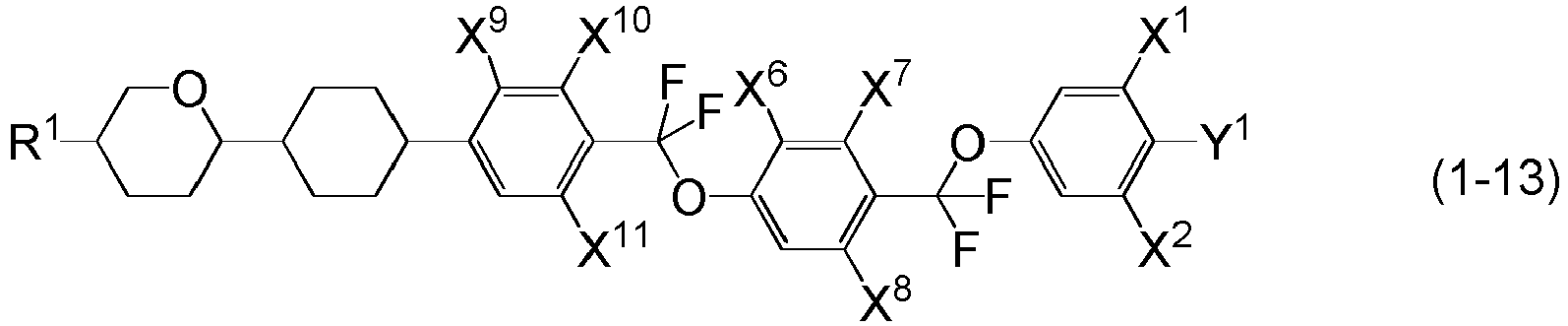


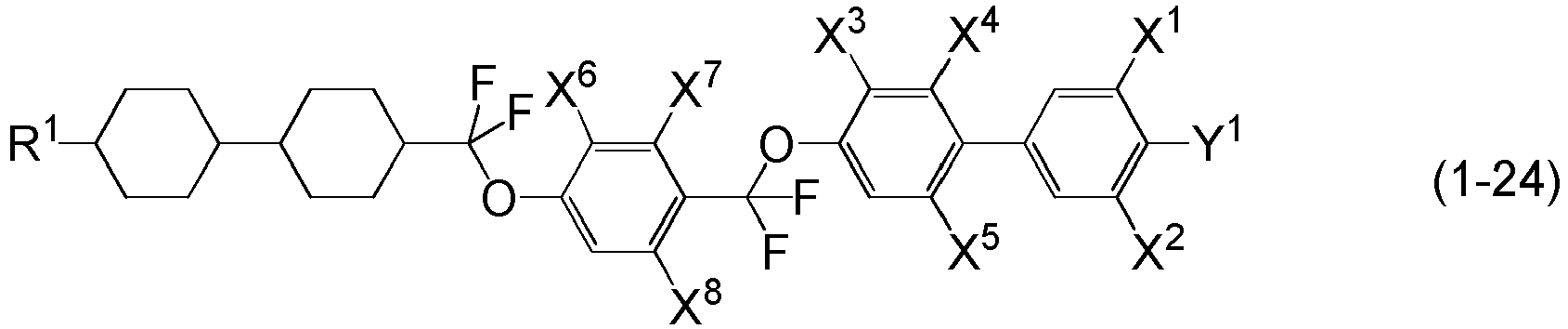
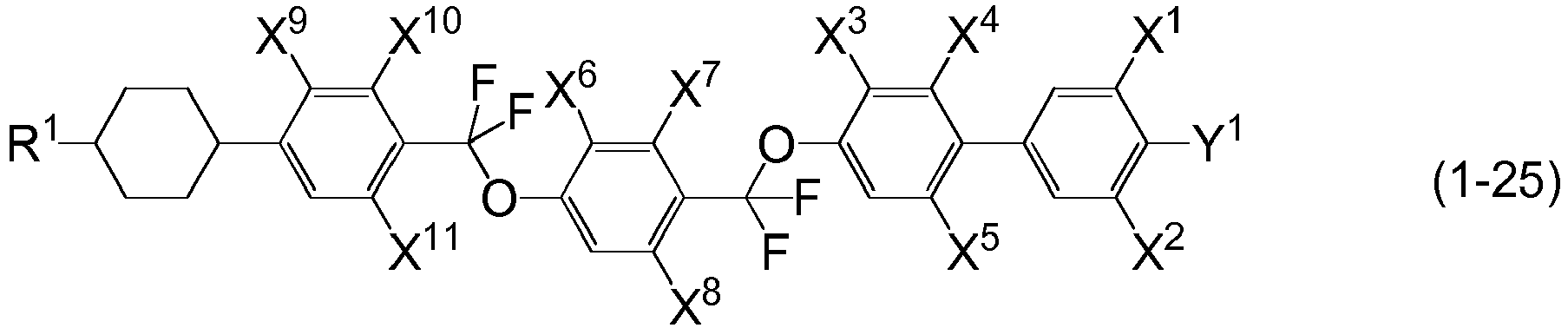

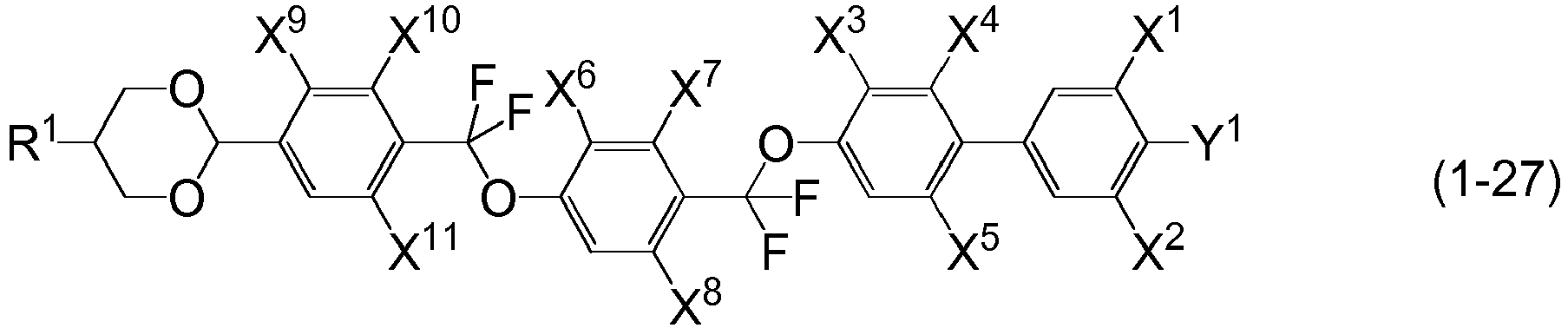

- Item 3. The liquid crystal composition according to item 1 or 2, wherein a proportion of the first component is in the range of 3% by weight to 40% by weight, and a proportion of the second component is in the range of 10% by weight to 60% by weight, based on the weight of the liquid crystal composition.
- Item 4. The liquid crystal composition according to any one of items 1 to 3, further containing at least one compound selected from the group of compounds represented by formula (3) as a third component:

- Item 5. The liquid crystal composition according to any one of items 1 to 4, containing at least one compound selected from the group of compounds represented by formulas (3-1) to (3-12) as the third component:


- Item 6. The liquid crystal composition according to item 4 or 5, wherein a proportion of the third component is in the range of 10% by weight to 55% by weight based on the weight of the liquid crystal composition.
- Item 7. The liquid crystal composition according to any one of items 1 to 6, further containing at least one compound selected from the group of compounds represented by formula (4) as a fourth component:

- Item 8. The liquid crystal composition according to any one of items 1 to 7, containing at least one compound selected from the group of compounds represented by formulas (4-1) to (4-34) as the fourth component:







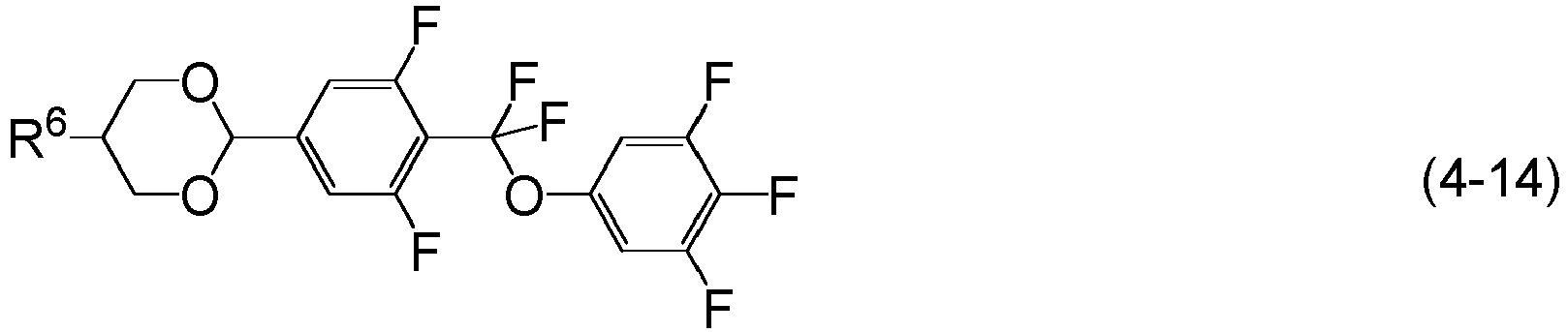


- Item 9. The liquid crystal composition according to item 7 or 8, wherein a proportion of the fourth component is in the range of 3% by weight to 50% by weight based on the weight of the liquid crystal composition.
- Item 10. The liquid crystal composition according to any one of items 1 to 9, containing at least one compound selected from the group of compounds represented by formula (5) as a fifth component:

- Item 11. The liquid crystal composition according to any one of items 1 to 10, containing at least one compound selected from the group of compounds represented by formulas (5-1) to (5-19) as the fifth component:







- Item 12. The liquid crystal composition according to item 10 or 11, wherein a proportion of the fifth component is in the range of 3% by weight to 25% by weight based on the weight of the liquid crystal composition.
- Item 13. The liquid crystal composition according to any one of items 1 to 12, wherein a maximum temperature of a nematic phase is 70°C or higher, an optical anisotropy (measured at 25°C) at a wavelength of 589 nanometers is 0.07 or more and a dielectric anisotropy (measured at 25°C) at a frequency of 1 kHz is 2 or more.
- Item 14. A liquid crystal display device, including the liquid crystal composition according to any one of items 1 to 13.
- Item 15. The liquid crystal display device according to item 14, wherein an operating mode in the liquid crystal display device includes a TN mode, an ECB mode, an OCB mode, an IPS mode, an FFS mode or an FPA mode, and a driving mode in the liquid crystal display device includes an active matrix mode.
- Item 16. Use of the liquid crystal composition according to any one of items 1 to 13 in a liquid crystal display device.
- The invention further includes the following items: (a) the composition, further containing at least one of additives such as an optically active compound, an antioxidant, an ultraviolet light absorber, a dye, an antifoaming agent, a polymerizable compound, a polymerization initiator or a polymerization inhibitor; (b) an AM device including the composition; (c) the composition further containing a polymerizable compound, and a polymer sustained alignment (PSA) mode AM device including the composition; (d) a polymer sustained alignment (PSA) mode AM device, wherein the device includes the composition, and a polymerizable compound in the composition is polymerized; (e) a device including the composition and having the PC mode, the TN mode, the STN mode, the ECB mode, the OCB mode, the IPS mode, the FFS mode or the FPA mode; (f) a transmissive device including the composition; (g) use of the composition as the composition having the nematic phase; and (h) use as an optically active composition by adding the optically active compound to the composition.
- The composition of the invention will be described in the following order. First, a constitution of the component compounds in the composition will be described. Second, main characteristics of the component compounds and main effects of the compounds on the composition will be described. Third, a combination of components in the composition, a preferred proportion of the components and the basis thereof will be described. Fourth, a preferred embodiment of the component compounds will be described. Fifth, a preferred component compounds will be described. Sixth, an additive that may be added to the composition will be described. Seventh, methods for synthesizing the component compounds will be described. Last, an application of the composition will be described.
- First, the constitution of the component compounds in the composition will be described. The composition of the invention is classified into composition A and composition B. Composition A may further contain any other liquid crystal compound, an additive or the like in addition to the compound selected from compound (1), compound (2), compound (3), compound (4) and compound (5). An expression "any other liquid crystal compound" means a liquid crystal compound different from compound (1), compound (2), compound (3), compound (4) and compound (5). Such a compound is mixed with the composition for the purpose of further adjusting the characteristics. The additive is the optically active compound, the antioxidant, the ultraviolet light absorber, the dye, the antifoaming agent, the polymerizable compound, the polymerization initiator, the polymerization inhibitor or the like.
- Composition B consists essentially of liquid crystal compounds selected from compound (1), compound (2), compound (3), compound (4) and compound (5). An expression "essentially" means that the composition may contain the additive, but contains no any other liquid crystal compound. Composition B has a smaller number of components than composition A has. Composition B is preferred to composition A in view of cost reduction.
Composition A is preferred to composition B in view of possibility of further adjusting the characteristics by mixing any other liquid crystal compound. - Second, the main characteristics of the component compounds and the main effects of the compounds on the characteristics of the composition will be described. The main characteristics of the component compounds are summarized in Table 2 on the basis of advantageous effects of the invention. In Table 2, a symbol L stands for "large" or "high," a symbol M stands for "medium" and a symbol S stands for "small" or "low." The symbols L, M and S represent a classification based on a qualitative comparison among the component compounds, and 0 (zero) means "a value is zero" or "a value close to zero."
Table 2 Characteristics of Compounds Compounds Compound (1) Compound (2) Compound (3) Compound (4) Compound (5) Maximum temperature M to L M S to L S to L S to M Viscosity M to L S StoM M to L M Optical anisotropy M to L S M to L M to L M to L Dielectric anisotropy M to L 0 0 S to L M to L1) Specific resistance L L L L L 1) A value of dielectric anisotropy is negative, and the symbol shows magnitude of an absolute value. - Upon mixing the component compounds with the composition, the main effects of the component compounds on the characteristics of the composition are as described below. Compound (1) increases the dielectric anisotropy. Compound (2) decreases the viscosity. Compound (3) increases the maximum temperature or decreases a minimum temperature. Compound (4) decreases the minimum temperature and increases the dielectric anisotropy. Compound (5) increases a dielectric constant in a minor axis direction.
- Third, the combination of components in the composition, the preferred proportion of the component compounds and the basis thereof will be described. The combination of components in the composition includes a combination of the first component and the second component, a combination of the first component, the second component and the third component, a combination of the first component, the second component and the fourth component, a combination of the first component, the second component, the third component and the fourth component, a combination of the first component, the second component and the fifth component, a combination of the first component, the second component, the third component and the fifth component, a combination of the first component, the second component, the fourth component and the fifth component, or a combination of the first component, the second component, the third component, the fourth component and the fifth component. A preferred combination of components in the composition includes a combination of the first component, the second component and the third component, or a combination of the first component, the second component, the third component and the fourth component.
- A preferred proportion of the first component is about 3% by weight or more for increasing the dielectric anisotropy, and about 40% by weight or less for decreasing the minimum temperature or decreasing the viscosity. A further preferred proportion is in the range of about 5% by weight to about 35% by weight. A particularly preferred proportion is in the range of about 5% by weight to about 30% by weight.
- A preferred proportion of the second component is about 10% by weight or more for decreasing the viscosity, and about 60% by weight or less for increasing the dielectric anisotropy. A further preferred proportion is in the range of about 20% by weight to about 55% by weight. A particularly preferred proportion is in the range of about 25% by weight to about 50% by weight.
- A preferred proportion of the third component is about 10% by weight or more for increasing the maximum temperature or decreasing the viscosity, and about 55% by weight or less for increasing the dielectric anisotropy. A further preferred proportion is in the range of about 10% by weight to about 50% by weight. A particularly preferred proportion is in the range of about 10% by weight to about 45% by weight.
- A preferred proportion of the fourth component is about 3% by weight or more for increasing the dielectric anisotropy, and about 50% by weight or less for decreasing the minimum temperature. A further preferred proportion is in the range of about 3% by weight to about 45% by weight. A particularly preferred proportion is in the range of about 3% by weight to about 40% by weight.
- A preferred proportion of the fifth component is about 3% by weight or more for increasing the dielectric anisotropy, and about 25% by weight or less for decreasing the minimum temperature. A further preferred proportion is in the range of about 5% by weight to about 20% by weight. A particularly preferred proportion is in the range of about 5% by weight to about 15% by weight.
- Fourth, the preferred embodiment of the component compounds will be described. R1 and R6 are independently alkyl having 1 to 12 carbons, alkoxy having 1 to 12 carbons, or alkenyl having 2 to 12 carbons. Preferred R1 or R6 is alkyl having 1 to 12 carbons for increasing the stability to ultraviolet light or heat. R2, R3, R4 and R5 are independently alkyl having 1 to 12 carbons, alkoxy having 1 to 12 carbons, alkenyl having 2 to 12 carbons, alkyl having 1 to 12 carbons in which at least one piece of hydrogen is replaced by halogen, or alkenyl having 2 to 12 carbons in which at least one piece of hydrogen is replaced by halogen. Preferred R2, R3, R4 or R5 is alkyl having 1 to 12 carbons for increasing the stability to ultraviolet light or heat and so forth, and alkenyl having 2 to 12 carbons for decreasing the minimum temperature or decreasing the viscosity. R7 and R8 are independently alkyl having 1 to 12 carbons, alkoxy having 1 to 12 carbons, alkenyl having 2 to 12 carbons, alkenyloxy having 2 to 12 carbons, or alkyl having 1 to 12 carbons in which at least one piece of hydrogen is replaced by halogen. Preferred R7 or R8 is alkyl having 1 to 12 carbons for increasing the stability, and alkoxy having 1 to 12 carbons for increasing the dielectric anisotropy. Preferred halogen is fluorine or chlorine, and further preferred halogen is fluorine.
- Preferred alkyl is methyl, ethyl, propyl, butyl, pentyl, hexyl, heptyl or octyl. Further preferred alkyl is ethyl, propyl, butyl, pentyl or heptyl for decreasing the viscosity.
- Preferred examples of alky in which at least one piece of hydrogen is replaced by halogen include fluoromethyl, 2-fluoroethyl, 3-fluoropropyl, 4-fluorobutyl, 5-fluoropentyl, 6-fluorohexyl, 7-fluoroheptyl or 8-fluorooctyl. Further preferred examples include 2-fluoroethyl, 3-fluoropropyl, 4-fluorobutyl or 5-fluoropentyl for increasing the dielectric anisotropy.
- Preferred alkoxy is methoxy, ethoxy, propoxy, butoxy, pentyloxy, hexyloxy or heptyloxy. Further preferred alkoxy is methoxy or ethoxy for decreasing the viscosity.
- Preferred alkenyl is vinyl, 1-propenyl, 2-propenyl, 1-butenyl, 2-butenyl, 3-butenyl, 1-pentenyl, 2-pentenyl, 3-pentenyl, 4-pentenyl, 1-hexenyl, 2-hexenyl, 3-hexenyl, 4-hexenyl or 5-hexenyl. Further preferred alkenyl is vinyl, 1-propenyl, 3-butenyl or 3-pentenyl for decreasing the viscosity. A preferred configuration of -CH=CH- in the alkenyl depends on a position of a double bond. Trans is preferred in alkenyl such as 1-propenyl, 1-butenyl, 1-pentenyl, 1-hexenyl, 3-pentenyl and 3-hexenyl for decreasing the viscosity, for instance. Cis is preferred in alkenyl such as 2-butenyl, 2-pentenyl and 2-hexenyl. In the alkenyl, straight-chain alkenyl is preferred to branched-chain alkenyl.
- Preferred examples of alkenyl in which at least one piece of hydrogen is replaced by halogen include 2,2-difluorovinyl, 3,3-difluoro-2-propenyl, 4,4-difluoro-3-butenyl, 5,5-difluoro-4-pentenyl or 6,6-difluoro-5-hexenyl. Further preferred examples include 2,2-difluorovinyl or 4,4-difluoro-3-butenyl for decreasing the viscosity.
- Then, m and j are independently 0, 1, 2 or 3, and a sum of m and j is 2 or 3. Preferred m is 1 or 2 for increasing the maximum temperature. Preferred j is 0 or 1 for decreasing the minimum temperature. Then, n is 1, 2 or 3. Preferred n is 2 for decreasing the minimum temperature. Then, p is 1, 2, 3 or 4. Preferred p is 2 for decreasing the minimum temperature, and 3 for increasing the dielectric anisotropy. Then, e is 1, 2 or 3, f is 0 or 1, and a sum of e and f is 3 or less. Preferred e is 1 for decreasing the viscosity, and 2 or 3 for increasing the maximum temperature. Preferred f is 0 for decreasing the viscosity, and 1 for decreasing the minimum temperature.
- Z1 and Z2 are independently a single bond, ethylene, vinylene, methyleneoxy, carbonyloxy or difluoromethyleneoxy, and at least one of m pieces of Z1 or j pieces of Z2 is difluoromethyleneoxy. Preferred Z1 or Z2 is a single bond for decreasing the viscosity, and difluoromethyleneoxy for increasing the dielectric anisotropy. Z3 is a single bond, ethylene or carbonyloxy. Preferred Z3 is a single bond for decreasing the viscosity. Z4 is a single bond, ethylene, carbonyloxy or difluoromethyleneoxy. Preferred Z4 is difluoromethyleneoxy for increasing the dielectric anisotropy. Z5 and Z6 are independently a single bond, ethylene, carbonyloxy or methyleneoxy. Preferred Z5 or Z6 is a single bond for decreasing the viscosity, and methyleneoxy for increasing the dielectric anisotropy.
- Ring A and ring B are independently 1,4-cyclohexylene, 1,4-phenylene, 2-fluoro-1,4-phenylene, 2,3-difluoro-1,4-phenylene, 2,5-difluoro-1,4-phenylene, 2,6-difluoro-1,4-phenylene, 2,3,5-trifluoro-1,4-phenylene, pyrimidine-2,5-diyl, 1,3-dioxane-2,5-diyl, tetrahydropyran-2,5-diyl or naphthalene-2,6-diyl. Preferred ring A or ring B is 1,4-phenylene or 2-fluoro-1, 4-phenylene for increasing the optical anisotropy. Ring C and ring D are independently 1,4-cyclohexylene, 1,4-phenylene, 2-fluoro-1,4-phenylene or 2,5-difluoro-1,4-phenylene, and ring D is 1,4-phenylene when n is 1. Preferred ring C or ring D is 1,4-cyclohexylene for decreasing the viscosity, or 1,4-phenylene for increasing the optical anisotropy. Ring E is 1,4-cyclohexylene, 1,4-phenylene, 2-fluoro-1,4-phenylene, 2,3-difluoro-1,4-phenylene, 2,6-difluoro-1,4-phenylene, pyrimidine-2,5-diyl, 1,3-dioxane-2,5-diyl or tetrahydropyran-2,5-diyl. Preferred ring E is 1,4-phenylene or 2-fluoro-1,4-phenylene for increasing the optical anisotropy. Ring F and ring I are independently 1,4-cyclohexylene, 1,4-cyclohexenylene, 1,4-phenylene, 1,4-phenylene in which at least one piece of hydrogen is replaced by fluorine or chlorine, or tetrahydropyran-2,5-diyl. Preferred examples of "1, 4-phenylene in which at least one piece of hydrogen is replaced by fluorine or chlorine" include 2-fluoro-1,4-phenylene, 2,3-difluoro-1,4-phenylene or2-chloro-3-fluoro-1,4-phenylene. Preferred ring F or ring I is 1,4-cyclohexylene for decreasing the viscosity, tetrahydropyran-2,5-diyl for increasing the dielectric anisotropy, and 1,4-phenylene for increasing the optical anisotropy. Ring G is 2,3-difluoro-1,4-phenylene, 2-chloro-3-fluoro-1,4-phenylene, 2,3-difluoro-5-methyl-1,4-phenylene, 3,4,5-trifluoronaphthalene-2,6-diyl or 7,8-difluorochroman-2,6-diyl. Preferred ring G is 2,3-difluoro-1,4-phenylene for increasing the dielectric anisotropy. With regard to the configuration of 1,4-cyclohexylene, trans is preferred to cis for increasing the maximum temperature. Tetrahydropyran-2,5-diyl includes:


- X1, X2, X3, X4, X5, X6, X7, X8, X9, X10, X11, X12, X13, X14, X15, X16, X17, X18 and X19 are independently hydrogen or fluorine. Preferred X1, X2, X3, X4, X5, X6, X5, X8, X5, X10, X11, X12, X13, X14, X15, X16, X17, X18 or X19 is fluorine for increasing the dielectric anisotropy.
- Y1 and Y2 are independently fluorine, chlorine, alkyl having 1 to 12 carbons in which at least one piece of hydrogen is replaced by halogen, alkoxy having 1 to 12 carbons in which at least one piece of hydrogen is replaced by halogen, or alkenyloxy having 2 to 12 carbons in which at least one piece of hydrogen is replaced by halogen. Preferred Y1 or Y2 is fluorine for decreasing the minimum temperature.
- Preferred example of alky in which at least one piece of hydrogen is replaced by halogen includes trifluoromethyl. Preferred example of alkoxy in which at least one piece of hydrogen is replaced by halogen includes trifluoromethoxy. Preferred example of alkenyloxy in which at least one piece of hydrogen is replaced by halogen includes trifluorovinyloxy.
- Fifth, the preferred component compounds will be described. Preferred compound (1) includes compound (1-1) to compound (1-28) described in item 2. In the compounds, at least one of the first components preferably includes compound (1-4), compound (1-6), compound (1-7), compound (1-9), compound (1-10), compound (1-8), compound (1-12), compound (1-14), compound (1-15), compound (1-17), compound (1-18), compound (1-20), compound (1-23), compound (1-25), compound (1-27) or compound (1-28). At least two of the first component preferably includes a combination of compound (1-4) and compound (1-6), a combination of compound (1-4) and compound (1-10), a combination of compound (1-7) and compound (1-15), a combination of compound (1-7) and compound (1-18), a combination of compound (1-15) and compound (1-18), a combination of compound (1-18) and compound (1-23), or a combination of compound (1-18) and compound (1-23).
- Preferred compound (3) includes compound (3-1) to compound (3-12) described in item 5. In the compounds, at least one of the third components preferably includes compound (3-2), compound (3-4), compound (3-5), compound (3-6), compound (3-9) or compound (3-12). At least two of the third component preferably includes a combination of compound (3-2) and compound (3-4), a combination of compound (3-2) and compound (3-5), or a combination of compound (3-2) and compound (3-6).
- Preferred compound (4) includes compound (4-1) to compound (4-34) described in item 8. In the compounds, at least one of the fourth components preferably includes compound (4-4), compound (4-12), compound (4-14), compound (4-15), compound (4-17), compound (4-18), compound (4-23), compound (4-27), compound (4-28) or compound (4-29). At least two of the fourth component preferably includes a combination of compound (4-12) and compound (4-15), a combination of compound (4-14) and compound (4-27), a combination of compound (4-18) and compound (4-24), a combination of compound (4-18) and compound (4-28), a combination of compound (4-24) and compound (4-28), or a combination of compound (4-28) and compound (4-29).
- Preferred compound (5) includes compound (5-1) to compound (5-19) described in item 11. In the compounds, at least one of the fifth components preferably includes compound (5-1), compound (5-3), compound (5-4), compound (5-6), compound (5-8) or compound (5-13). At least two of the fifth component preferably includes a combination of compound (5-1) and compound (5-6), a combination of compound (5-1) and compound (5-13), a combination of compound (5-3) and compound (5-6), a combination of compound (5-3) and compound (5-13), a combination of compound (5-4) and compound (5-6), or a combination of compound (5-4) and compound (5-8).
- Sixth, the additive that may be added to the composition will be described. Such an additive includes the optically active compound, the antioxidant, the ultraviolet light absorber, the dye, the antifoaming agent, the polymerizable compound, the polymerization initiator, the polymerization inhibitor or the like. The optically active compound is added to the composition for inducing a helical structure in a liquid crystal to give a twist angle. Examples of such a compound include compound (6-1) to compound (6-5). A preferred proportion of the optically active compound is about 5% by weight or less. A further preferred proportion is in the range of about 0.01% by weight to about 2% by weight.


- The antioxidant is added to the composition for preventing a decrease in the specific resistance caused by heating in air, or for maintaining a large voltage holding ratio at room temperature and also at the temperature close to the maximum temperature after the device has been used for a long period of time. Preferred examples of the antioxidant include compound (7) where t is an integer from 1 to 9 or the like.
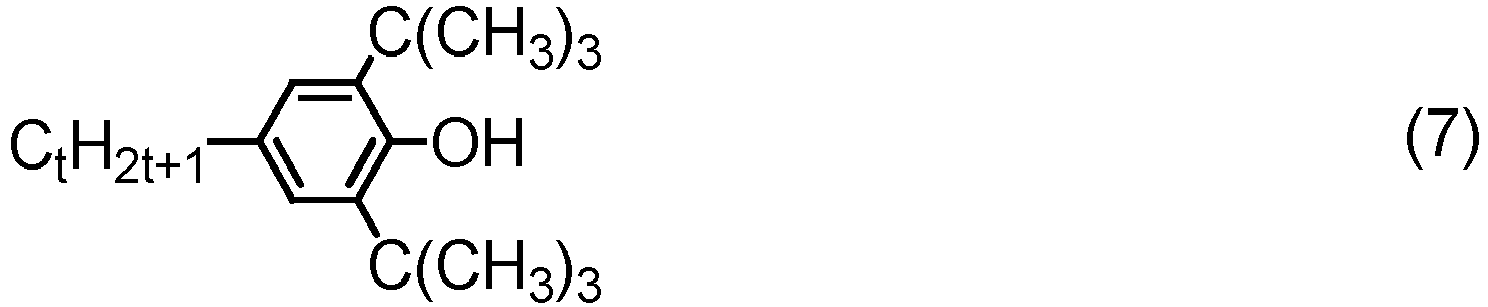
- In compound (7), preferred t is 1, 3, 5, 7 or 9. Further preferred t is 7. Compound (7) where t is 7 is effective for maintaining the large voltage holding ratio at room temperature and also at the temperature close to the maximum temperature even after the device has been used for a long period of time because the compound (7) has a small volatility. A preferred proportion of the antioxidant is about 50 ppm or more for achieving an effect thereof, and about 600 ppm or less for avoiding a decrease in the maximum temperature or an increase in the minimum temperature. A further preferred proportion is in the range of about 100 ppm to about 300 ppm.
- Preferred examples of the ultraviolet light absorber include a benzophenone derivative, a benzoate derivative and a triazole derivative. A light stabilizer such as an amine having steric hindrance is also preferred. A preferred proportion of the absorber or the stabilizer is about 50 ppm or more for achieving an effect thereof, and about 10,000 ppm or less for avoiding the decrease in the maximum temperature or avoiding the increase in the minimum temperature. A further preferred proportion is in the range of about 100 ppm to about 10,000 ppm.
- A dichroic dye such as an azo dye or an anthraquinone dye is added to the composition for the purpose of adapting the composition to a device having a guest host (GH) mode. A preferred proportion of the dye is in the range of about 0.01% by weight to about 10% by weight. The antifoaming agent such as dimethyl silicone oil or methyl phenyl silicone oil is added to the composition for preventing foam formation. A preferred proportion of the antifoaming agent is about 1 ppm or more for achieving an effect thereof, and about 1,000 ppm or less for avoiding a poor display. A further preferred proportion is in the range of about 1 ppm to about 500 ppm.
- The polymerizable compound is added to the composition for the purpose of adapting the composition to a device having the polymer sustained alignment (PSA) mode. Preferred examples of polymerizable compounds include a compound having a polymerizable group such as acrylate, methacrylate, a vinyl compound, a vinyloxy compound, propenyl ether, an epoxy compound (oxirane, oxetane) and vinyl ketone. Further preferred examples include an acrylate derivative or a methacrylate derivative. A preferred proportion of the polymerizable compound is about 0.05% by weight or more for achieving an effect thereof, and about 10% or less for avoiding a poor display. A further preferred proportion is in the range of about 0.1% by weight to about 2% by weight. The polymerizable compound is polymerized by irradiation with ultraviolet light. The polymerizable compound may be polymerized in the presence of an initiator such as a photopolymerization initiator. Suitable conditions for polymerization, suitable types of the initiator and suitable amounts thereof are known to those skilled in the art and are described in literature. For example, Irgacure 651 (registered trademark; BASF), Irgacure 184 (registered trademark; BASF) or Darocure 1173 (registered trademark; BASF), each being a photoinitiator, is suitable for radical polymerization. A preferred proportion of the photopolymerization initiator is in the range of about 0.1% by weight to about 5% by weight based on the total weight of the polymerizable compound. A further preferred proportion is in the range of about 1% by weight to about 3% by weight based thereon.
- Upon storing the polymerizable compound, the polymerization inhibitor may be added thereto for preventing polymerization. The polymerizable compound is ordinarily added to the composition without removing the polymerization inhibitor. Examples of the polymerization inhibitor include hydroquinone and a hydroquinone derivative such as methylhydroquinone, 4-tert-butylcatechol, 4-methoxyphenol or phenothiazine.
- Seventh, the methods for synthesizing the component compounds will be described. The compounds can be prepared according to known methods. Examples of the synthetic methods are described. Compound (1) is prepared by a method described in
JP 2013-14575 A JP S59-176221 A JP H2-237949 A JP H2-233626 A JP H2-503441 A US 3660505 B . - Any compounds whose synthetic methods are not described can be prepared according to methods described in books such as Organic Syntheses (John Wiley & Sons, Inc.), Organic Reactions (John Wiley & Sons, Inc.), Comprehensive Organic Synthesis (Pergamon Press) and New Experimental Chemistry Course (Shin Jikken Kagaku Koza in Japanese) (Maruzen Co., Ltd.). The composition is prepared according to publicly known methods using the thus obtained compounds. For example, the component compounds are mixed and dissolved in each other by heating.
- Last, the application of the composition will be described. The composition of the invention mainly has a minimum temperature of about -10°C or lower, a maximum temperature of about 70°C or higher, and an optical anisotropy in the range of about 0.07 to about 0.20. A device including the composition has the large voltage holding ratio. The composition is suitable for use in the AM device. The composition is particularly suitable for use in a transmissive AM device. The composition having an optical anisotropy in the range of about 0.08 to about 0.25 may be prepared by controlling the proportion of the component compounds or by mixing any other liquid crystal compound, and further the composition having an optical anisotropy in the range of about 0.10 to about 0.30 may be prepared. The composition can be used as the composition having the nematic phase, and as the optically active composition by adding the optically active compound.
- The composition can be used for the AM device. The composition can also be used for a PM device. The composition can also be used for the AM device and the PM device each having a mode such as the PC mode, the TN mode, the STN mode, the ECB mode, the OCB mode, the IPS mode, the FFS mode, the VA mode and the FPA mode. Use for the AM device having the TN mode, the OCB mode, the IPS mode or the FFS mode is particularly preferred. In the AM device having the IPS mode or the FFS mode, alignment of liquid crystal molecules when no voltage is applied may be parallel or vertical to a glass substrate. The device may be of a reflective type, a transmissive type or a transflective type. Use for the transmissive device is preferred. Use for an amorphous silicon-TFT device or a polycrystal silicon-TFT device is allowed. The composition can also be used for a nematic curvilinear aligned phase (NCAP) device prepared by microencapsulating the composition, or for a polymer dispersed (PD) device in which a three-dimensional network-polymer is formed in the composition.
- The invention will be described in greater detail by way of Examples. However, the invention is not limited by the Examples. The invention includes a mixture of a composition in Example 1 and a composition in Example 2. The invention also includes a mixture in which at least two compositions in Examples are mixed. The thus prepared compound was identified by methods such as an NMR analysis. Characteristics of the compound and the composition were measured by methods described below.
- NMR analysis: For measurement, DRX-500 made by Bruker BioSpin Corporation was used. In 1H-NMR measurement, a sample was dissolved in a deuterated solvent such as CDCl3, and measurement was carried out under conditions of room temperature, 500 MHZ and 16 times of accumulation. Tetramethylsilane (TMS) was used as an internal standard. In 19F-NMR measurement, CFCl3 was used as an internal standard, and measurement was carried out under conditions of 24 times of accumulation. In explaining nuclear magnetic resonance spectra obtained, s, d, t, q, quin, sex and m stand for a singlet, a doublet, a triplet, a quartet, a quintet, a sextet and a multiplet, and br being broad, respectively.
- Gas chromatographic analysis: GC-14B Gas Chromatograph made by Shimadzu Corporation was used for measurement. A carrier gas was helium (2 mL per minute). A sample vaporizing chamber and a detector (FID) were set to 280°C and 300°C, respectively. A capillary column DB-1 (length 30 m, bore 0.32 mm, film thickness 0.25 µm; dimethylpolysiloxane as a stationary phase, non-polar) made by Agilent Technologies, Inc. was used for separation of component compounds. After the column was kept at 200°C for 2 minutes, the column was heated to 280°C at a rate of 5°C per minute. A sample was prepared in an acetone solution (0.1% by weight), and then 1 microliter of the solution was injected into the sample vaporizing chamber. A recorder was C-R5A Chromatopac made by Shimadzu Corporation or the equivalent thereof. The resulting gas chromatogram showed a retention time of a peak and a peak area corresponding to each of the component compounds.
- As a solvent for diluting the sample, chloroform, hexane or the like may also be used. The following capillary columns may also be used for separating component compounds: HP-1 (length 30 m, bore 0.32 mm, film thickness 0.25 µm) made by Agilent Technologies, Inc., Rtx-1 (length 30 m, bore 0.32 mm, film thickness 0.25 µm) made by Restek Corporation and BP-1 (length 30 m, bore 0.32 mm, film thickness 0.25 µm) made by SGE International Pty. Ltd. A capillary column CBP1-M50-025 (length 50 m, bore 0.25 mm, film thickness 0.25 µm) made by Shimadzu Corporation may also be used for the purpose of avoiding an overlap of peaks of the compounds.
- A proportion of liquid crystal compounds contained in the composition may be calculated by the method as described below. The mixture of liquid crystal compounds is detected by gas chromatograph (FID). An area ratio of each peak in the gas chromatogram corresponds to the ratio (weight ratio) of the liquid crystal compound. When the capillary columns described above were used, a correction coefficient of each of the liquid crystal compounds may be regarded as 1 (one). Accordingly, the ratio (% by weight) of the liquid crystal compound is calculated from the area ratio of each peak.
- Sample for measurement: When characteristics of a composition was measured, the composition was used as a sample as was. Upon measuring characteristics of a compound, a sample for measurement was prepared by mixing the compound (15% by weight) with a base liquid crystal (85% by weight). Values of characteristics of the compound were calculated, according to an extrapolation method, using values obtained by measurement. (Extrapolated value) = {(measured value of a sample for measurement) - 0.85 × (measured value of a base liquid crystal)} / 0.15. When a smectic phase (or crystals) precipitates at the ratio thereof at 25°C, a ratio of the compound to the base liquid crystal was changed step by step in the order of (10% by weight : 90% by weight), (5% by weight : 95% by weight) and (1% by weight : 99% by weight). Values of maximum temperature, optical anisotropy, viscosity and dielectric anisotropy with regard to the compound were determined according to the extrapolation method.
- A base liquid crystal described below was used. A proportion of the component compound was expressed in terms of weight percent (% by weight).


- Measuring method: Measurement of characteristics was carried out by the methods described below. Most of the measuring methods are applied as described in the Standard of the Japan Electronics and Information Technology Industries Association (hereinafter abbreviated as JEITA) (JEITA EIAJ ED-2521B) discussed and established by JEITA, or modified thereon. No thin film transistor (TFT) was attached to a TN device used for measurement.
- (1) Maximum temperature of nematic phase (NI; °C) : A sample was placed on a hot plate in a melting point apparatus equipped with a polarizing microscope, and heated at a rate of 1°C per minute. Temperature when part of the sample began to change from a nematic phase to an isotropic liquid was measured.
- (2) Minimum temperature of nematic phase (Tc; °C): Samples each having a nematic phase were put in glass vials and kept in freezers at temperatures of 0°C, -10°C, -20°C, -30°C and -40°C for 10 days, and then liquid crystal phases were observed. For example, when the sample maintained the nematic phase at -20°C and changed to crystals or a smectic phase at -30°C, Tc of the sample was expressed as Tc < -20°C.
- (3) Viscosity (bulk viscosity; η; measured at 20°C; mPa·s) : A cone-plate (E type) rotational viscometer made by Tokyo Keiki, Inc. was used for measurement.
- (4) Viscosity (rotational viscosity; γ1; measured at 25°C; mPa·s): Measurement was carried out according to a method described in M. Imai et al., Molecular Crystals and Liquid Crystals, Vol. 259, p. 37 (1995). A sample was put in a TN device in which a twist angle was 0 degrees and a distance (cell gap) between two glass substrates was 5 micrometers. Voltage was applied stepwise to the device in the range of 16 V to 19.5 V at an increment of 0.5 V. After a period of 0.2 second with no voltage application, voltage was applied repeatedly under conditions of only one rectangular wave (rectangular pulse; 0.2 second) and no voltage application (2 seconds). A peak current and a peak time of a transient current generated by the applied voltage were measured. A value of rotational viscosity was obtained from the measured values and a calculation equation (8) described on page 40 of the paper presented by M. Imai et al. A value of a dielectric anisotropy required for the calculation was determined using the device by which the rotational viscosity was measured and by the method described below.
- (5) Optical anisotropy (refractive index anisotropy; Δn; measured at 25°C): Measurement was carried out by an Abbe refractometer with a polarizing plate mounted on an ocular, using light at a wavelength of 589 nanometers. A surface of a main prism was rubbed in one direction, and then a sample was added dropwise onto the main prism. A refractive index (n∥) was measured when a direction of polarized light was parallel to a direction of rubbing. A refractive index (n⊥) was measured when the direction of polarized light was perpendicular to the direction of rubbing. A value of optical anisotropy was calculated from an equation:

- (6) Dielectric anisotropy (Δε; measured at 25°C): A sample was put in a TN device in which a distance (cell gap) between two glass substrates was 9 micrometers and a twist angle was 80 degrees. Sine waves (10 V, 1 kHz) were applied to the device, and after 2 seconds, a dielectric constant (ε∥) in a major axis direction of the liquid crystal molecules was measured. Sine waves (0.5 V, 1 kHz) were applied to the device, and after 2 seconds, a dielectric constant (ε⊥) in a minor axis direction of the liquid crystal molecules was measured. A value of dielectric anisotropy was calculated from an equation: Δε = ε∥ - ε⊥.
- (7) Threshold voltage (Vth; measured at 25°C; V) : An LCD-5100 luminance meter made by Otsuka Electronics Co., Ltd. was used for measurement. A light source was a halogen lamp. A sample was put in a normally white mode TN device in which a distance (cell gap) between two glass substrates was 0.45/Δn (µm) and a twist angle was 80 degrees. A voltage (32 Hz, rectangular waves) to be applied to the device was stepwise increased from 0 V to 10 V at an increment of 0.02 V. On the occasion, the device was irradiated with light from a direction perpendicular to the device, and an amount of light transmitted through the device was measured. A voltage-transmittance curve was prepared, in which the maximum amount of light corresponds to 100% transmittance and the minimum amount of light corresponds to 0% transmittance. A threshold voltage is expressed in terms of a voltage at 90% transmittance.
- (8) Voltage holding ratio (VHR-1; measured at 25°C; %): A TN device used for measurement had a polyimide alignment film, and a distance (cell gap) between two glass substrates was 5 micrometers. A sample was put in the device, and the device was sealed with an ultraviolet-curable adhesive. A pulse voltage (60 microseconds at 5 V) was applied to the TN device and the device was charged. A decaying voltage was measured for 16.7 milliseconds with a high-speed voltmeter, and area A between a voltage curve and a horizontal axis in a unit cycle was determined. Area B is an area without decay. A voltage holding ratio is expressed in terms of a percentage of area A to area B.
- (9) Voltage holding ratio (VHR-2; measured at 80°C; %): A voltage holding ratio was measured according to procedures identical with the procedures described above except that measurement was carried out at 80°C in place of 25°C. The thus obtained value was expressed in terms of VHR-2.
- (10) Voltage holding ratio (VHR-3; measured at 25°C; %): Stability to ultraviolet light was evaluated by measuring a voltage holding ratio after a device was irradiated with ultraviolet light. A TN device used for measurement had a polyimide alignment film and a cell gap was 5 micrometers. A sample was injected into the device, and then the device was irradiated with light for 20 minutes. A light source was an ultra high-pressure mercury lamp USH-500D (made by Ushio, Inc.), and a distance between the device and the light source was 20 centimeters. In measurement of VHR-3, a decaying voltage was measured for 16.7 milliseconds. A composition having large VHR-3 has a large stability to ultraviolet light. A value of VHR-3 is preferably 90% or more, and further preferably, 95% or more.
- (11) Voltage holding ratio (VHR-4; measured at 25°C; %): Stability to heat was evaluated by measuring a voltage holding ratio after a TN device into which a sample was injected was heated in a constant-temperature bath at 80°C for 500 hours. In measurement of VHR-4, a decaying voltage was measured for 16.7 milliseconds. A composition having large VHR-4 has a large stability to heat.
- (12) Response time (τ; measured at 25°C; ms): An LCD-5100 luminance meter made by Otsuka Electronics Co., Ltd. was used for measurement. A light source was a halogen lamp. A low-pass filter was set at 5 kHz. A sample was put in a normally white mode TN device in which a distance (cell gap) between two glass substrates was 5.0 micrometers and a twist angle was 80 degrees. A voltage (rectangular waves; 60 Hz, 5 V, 0.5 second) was applied to the device. On the occasion, the device was irradiated with light from a direction perpendicular to the device, and an amount of light transmitted through the device was measured, in which the maximum amount of light corresponds to 100% transmittance, and the minimum amount of light corresponds to 0% transmittance. A rise time (τr; millisecond) was expressed in terms of time required for a change from 90% transmittance to 10% transmittance. A fall time (τf; millisecond) was expressed in terms of time required for a change from 10% transmittance to 90% transmittance. A response time was represented by a sum of the rise time and the fall time thus obtained.
- (13) Elastic constant (K; measured at 25°C; pN) : HP4284A LCR Meter made by Yokogawa-Hewlett-Packard Co. was used for measurement. A sample was put in a horizontal alignment device in which a distance (cell gap) between two glass substrates was 20 micrometers. An electric charge of 0 V to 20 V was applied to the device, and electrostatic capacity and applied voltage were measured. The measured values of electrostatic capacity (C) and applied voltage (V) were fitted to equation (2.98) and equation (2.101) on page 75 of "Liquid Crystal Device Handbook" (Ekisho Debaisu Handobukku in Japanese; The Nikkan Kogyo Shimbun, Ltd.) and values of K11 and K33 were obtained from equation (2.99). Next, K22 was calculated using the previously determined values of K11 and K33 in formula (3.18) on page 171. Elastic constant K was expressed in terms of a mean value of the thus determined K11, K22 and K33.
- (14) Specific resistance (p; measured at 25°C; Ωcm): Into a vessel equipped with electrodes, 1.0 milliliter of a sample was injected. A direct current voltage (10V) was applied to the vessel, and a direct current after 10 seconds was measured. Specific resistance was calculated from the following equation:

- (15) Helical pitch (P; measured at room temperature; µm): A helical pitch was measured according to a wedge method. Refer to page 196 in "Handbook of Liquid Crystals (Ekisho Binran in Japanese)" (issued in 2000, Maruzen Co., Ltd.). A sample was injected into a wedge cell and left to stand at room temperature for 2 hours, and then a gap (d2 - d1) between disclination lines was observed by a polarizing microscope (trade name: MM40/60 Series, Nikon Corporation). A helical pitch (P) was calculated according to the following equation in which an angle of the wedge cell was expressed as θ:

- (16) Dielectric constant (ε⊥; measured at 25°C) in a minor axis direction: A sample was put in a TN device in which a distance (cell gap) between two glass substrates was 9 micrometers and a twist angle was 80 degrees. Sine waves (0.5 V, 1 kHz) were applied to the device, and after 2 seconds, a dielectric constant (ε⊥) in a minor axis direction of the liquid crystal molecules was measured.
- The compounds described in Examples were described using symbols according to definitions in Table 3 below. In Table 3, the configuration of 1,4-cyclohexylene is trans. A parenthesized number next to a symbolized compound in Examples corresponds to the number of the compound. A symbol (-) means any other liquid crystal compound. A ratio (percentage) of the liquid crystal compound is expressed in terms of weight percent (% by weight) based on the weight of the liquid crystal composition. Values of the characteristics of the composition were summarized in the last part.
Table 3 Method for Description of Compounds using Symbols R-(A1)-Z1-·····-Zn-(An)-R' 1) Left-terminal Group R- Symbol 4) Ring Structure -An- Symbol CnH2n+1- n- 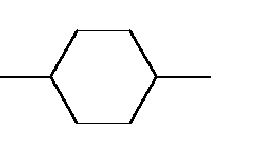
H CnH2n+1 O- nO- CmH2m+1OCnH2n - mOn- 
Dh CH2=CH- V- CnH2n+1-CH=CH- nV- CH2=CH-CnH2n- Vn- 
dh CmH2m+1-CH=CH-CnH2n - mVn- CF2=CH- VFF- 
B CF2=CH-CnH2n- VFFn- F-CnH2n- Fn- 2) Right-terminal Group -R' Symbol 
B(F) -CnH2n+1 -n -OCnH2n+1 -On 
B(2F) -CH=CH2 -V -CH=CH-CnH2n+1 -Vn -CnH2n-CH=CH2 -nV 
B(F,F) -CnH2n-CH=CH-CmH2m+1 -nVm -CH=CF2 -VFF -COOCH3 -EMe 
B(2F,5F) -F -F -CI -CL -OCF3 -OCF3 -CF3 -CF3 
G -CN -C -CF2OCF3 -XCF3 3) Bonding Group -Zn- Symbol 
Py -C2H4- 2 -COO- E -CH=CH- V 
B(2F,3F) -C≡C- T -CF2O- X -CH2O- 10 5) Examples of Description Example 1. 3-HH-V1 Example 2. 3-BB(F)B(F,F)-F 

Example 3. 4-BB(F)B(F,F)XB(F,F)-F Example 4. 5-GB(F,F)XB(F)-XCF3 

- Example 39 (Use Example 28) was selected from the compositions disclosed in
WO 1996-11897 A 3-HBXB(F,F)-F (4) 3% 5-HBXB(F,F)-F (4) 8% 3-HBXB-OCF3 (4) 5% 2-HBB(F)-F (4) 8% 3-HBB(F)-F (4) 8% 5-HBB(F)-F (4) 16% 5-HB-F (4) 6% 7-HB-F (4) 6% 5-HHB-OCF3 (4) 8% 3-H2HB-OCF3 (4) 8% 5-H2HB-OCF3 (4) 8% 3-HH2B-OCF3 (4) 8% 5-HH2B-OCF3 (4) 8% NI = 84.9°C;
Δn = 0.101;
Δε = 5.5;
Vth = 2.12 V;
η = 16.6 mPa·s. - Example 12 was selected from the compositions disclosed in
JP 2013-14575 A 3-HHXBXB(F,F)-F (1-1) 3% 3-BB(F)XBXB(F,F)-F (1-7) 3% 5-HB-F (4) 12% 6-HB-F (4) 9% 7-HB-F (4) 7% 2-HHB-OCF3 (4) 7% 3-HHB-OCF3 (4) 7% 4-HHB-OCF3 (4) 7% 5-HHB-OCF3 (4) 5% 3-HH2B-OCF3 (4) 4% 5-HH2B-OCF3 (4) 4% 3-HHB(F,F)-OHCF2 (4) 4% 3-HHB(F,F)-OCF3 (4) 5% 3-HH2B(F)-F (4) 3% 3-HBB(F)-F (4) 7% 5-HBB(F)-F (4) 7% 5-HBBH-3 (3-10) 3% 3-HB(F)BH-3 (3-11) 3% NI = 87.2°C;
Δn = 0.092;
Δε = 5.5;
Vth = 2.21 V;
η = 15.9 mPa·s. -
3-BB(F)XBXB(F,F)-F (1-7) 3% 3-BB(F)XB(F,F)XB(F,F)-F (1-7) 3% 3-HB(F,F)XB(F)B(F,F)XB(F,F)-F (1-20) 2% 3-HH-V (2) 39% 3-HH-V1 (2) 4% V-HHB-1 (3-4) 11% V2-HHB-1 (3-4) 4% 1-BB(F)B-2V (3-6) 2% 3-BB(F,F)XB(F,F)-F (4-18) 15% 3-HBBXB(F,F)-F (4-23) 9% 3-HBB(F,F)XB(F,F)-F (4-24) 8% NI = 80.7°C;
Tc < -20°C;
Δn = 0.102;
Δε = 7.3;
Vth = 1.52
V; η = 13.4 mPa·s. -
3-HHXB(F,F)XB(F,F)-F (1-1) 3% 3-BBXBXB(F,F)-F (1-7) 4% 3-HXB(F)XB(F)B(F,F)-F (1-8) 3% 5-BB(F,F)XB(F)B(F,F)XB(F,F)-F (1-23) 4% 3-HH-V (2) 30% 3-HH-V1 (2) 10% 3-HB-O2 (3-1) 5% 3-HHEH-3 (3-3) 4% 3-HHEH-5 (3-3) 4% V-HHB-1 (3-4) 7% V2-HHB-1 (3-4) 4% 3-HHXB(F,F)-F (4-4) 7% 3-HGB(F,F)-F (4-6) 5% 5-HGB(F,F)-F (4-6) 4% 3-BB(F,F)XB(F,F)-F (4-18) 4% 3-GBB(F)B(F,F)-F (4-22) 2% NI = 87.4°C;
Tc < -20°C;
Δn = 0.086;
Δε = 4.8;
Vth = 1.90 V;
η = 13.9 mPa·s. -
3-HHXBXB(F,F)-F (1-1) 4% 3-GHXB(F,F)XB(F,F)-F (1-3) 3% 5-HBBXB(F,F)XB(F,F)-F (1-15) 3% 3-HB(F,F)XB(F)B(F,F)XB(F,F)-F (1-20) 4% 3-B(F)B(F,F)XB(F,F)XB(F)B(F,F)-F (1-28) 4% 3-HH-V (2) 31% 3-HH-V1 (2) 14% VFF-HHB-1 (3-4) 5% VFF2-HHB-1 (3-4) 5% 3-HBB-2 (3-5) 4% 5-B(F)BB-2 (3-7) 3% 5-HBB(F)B-3 (3-12) 3% 5-HXB(F,F)-F (4-1) 5% 3-HHB(F,F)-F (4-2) 3% 5-HHB(F,F)-F (4-2) 3% 3-HBEB(F,F)-F (4-10) 3% 3-BB(2F,3F)BXB(F,F)-F (4-34) 3% NI = 90.6°C;
Tc < -20°C;
Δn = 0.100;
Δε = 5.8;
Vth = 1.81 V;
η = 14.0 mPa·s. -
3-BB(F)XBXB(F,F)-F (1-7) 4% 4-HHB(F)XB(F,F)XB(F)-F (1-10) 3% 5-HHB(F)XB(F,F)XB(F)-F (1-10) 3% 3-BXBBXB(F,F)-F (1) 4% 3-HH-O1 (2) 5% 3-HH-V (2) 29% 3-HH-V1 (2) 8% V2-BB-1 (3-2) 8% V-HHB-1 (3-4) 7% V2-HHB-1 (3-4) 3% 2-BB(F)B-3 (3-6) 5% 2-BB(F)B-5 (3-6) 3% 3-HB(F)HH-2 (3-8) 5% 3-HHEB(F,F)-F (4-3) 4% 3-GB(F)B(F)-F (4-11) 5% 3-GB(F)B(F,F)-F (4-12) 4% NI = 86.6°C;
Tc < -20°C;
Δn = 0.104;
Δε = 2.7;
Vth = 2.10 V;
η = 13.2 mPa·s. -
3-dhHXB(F,F)XB(F,F)-F (1-2) 3% 5-HBXB(F,F)XB(F,F)-F (1-4) 3% 5-HBBXB(F,F)XB(F,F)-F (1-15) 4% 3-B(F)B(F,F)XB(F,F)XB(F)B(F,F)-F (1-28) 3% 2-HH-3 (2) 5% 3-HH-V (2) 29% 4-HH-V1 (2) 4% 5-HH-V (2) 4% 1-BB-3 (3-2) 8% 3-HHB-O1 (3-4) 5% 3-HHB-1 (3-4) 4% 3-HHB-3 (3-4) 4% 1-BB(F)B-2V (3-6) 4% 3-BB(F)B-2V (3-6) 5% 3-HHEBH-5 (3-9) 3% 3-HHXB(F,F)-CF3 (4-5) 4% 5-GHB(F,F)-F (4-7) 3% 3-BB(2F,3F)-O2 (5-4) 5% NI = 85.2°C;
Tc < -20°C;
Δn = 0.106;
Δε = 2.4;
Vth = 2.14 V;
η = 13.2 mPa·s. -
3-HHXBXB(F,F)-F (1-1) 2% 4-HHXBXB(F,F)-F (1-1) 3% 4-HXB(F)XB(F)B(F,F)-F (1-8) 3% 5-HXB(F)XB(F)B(F,F)-F (1-8) 3% 3-HB(F,F)XB(F)B(F,F)XB(F,F)-F (1-20) 3% 4-HB(F,F)XB(F)B(F,F)XB(F,F)-F (1-20) 3% 3-HB(F,F)XB(F,F)XB(F)B(F,F)-F (1-25) 3% 3-HH-V (2) 15% 3-HH-VFF (2) 20% 5-HH-VFF (2) 5% 7-HB-1 (3-1) 4% 1V2-BB-1 (3-2) 4% V-HHB-1 (3-4) 9% V2-HHB-1 (3-4) 7% 3-HBB(F,F)-F (4-8) 3% 5-HBB(F,F)-F (4-8) 3% 2-HBEB(F,F)-F (4-10) 3% 3-BB(F)B(F,F)-F (4-15) 4% 1O1-HBBH-5 (-) 3% NI = 83.7°C;
Tc < -20°C;
Δn = 0.103;
Δε = 6.3;
Vth = 1.63 V;
η = 14.5 mPa·s. -
3-HHXB(F,F)XB(F,F)-F (1-1) 3% 3-BB(F)XBXB(F,F)-F (1-7) 3% 3-BBXBXB(F,F)-F (1-7) 3% 3-dhB(F,F)B(F,F)XB(F)XB(F,F)-F (1-16) 3% 3-HH-V (2) 33% 1V2-HH-1 (2) 5% 1V2-HH-3 (2) 3% V-HHB-1 (3-4) 11% V2-HHB-1 (3-4) 8% 5-HBBH-3 (3-10) 3% 5-HB(F)BH-3 (3-11) 3% 3-HB(F)B(F,F)-F (4-9) 4% V-HB(F)B(F,F)-F (4-9) 5% 3-GB(F,F)XB(F)-F (4-13) 4% 3-GB(F,F)XB(F,F)-F (4-14) 4% 3-HBBXB(F,F)-F (4-23) 5%
NI = 90.0°C;
Tc < -20°C;
Δn = 0.095;
Δε = 5.6;
Vth = 1.83 V;
η = 14.8 mPa·s. -
3-GB(F)XB(F,F)XB(F,F)-F (1-6) 3% 3-BBXBXB(F,F)-F (1-7) 3% 3-HB(F,F)XB(F)B(F,F)XB(F,F)-F (1-20) 3% 3-HH-V (2) 28% 3-HH-V1 (2) 8% F3-HH-V (2) 3% V2-BB-1 (3-2) 8% VFF-HHB-1 (3-4) 5% V-HHB-1 (3-4) 5% V2-HHB-1 (3-4) 5% V-HBB-2 (3-5) 6% 1-BB(F)B-2V (3-6) 4% 2-BB(F)B-2V (3-6) 5% 3-BB(F)B(F,F)-CF3 (4-16) 3% 3-BBXB(F,F)-F (4-17) 5% 3-GB(F)B(F)B(F)-F (4-21) 3% 5-HBB(F,F)XB(F,F)-F (4-24) 3% NI = 88.0°C;
Tc < -20°C;
Δn = 0.123;
Δε = 4.5;
Vth = 1.94 V;
η = 11.0 mPa·s. -
3-dhBXB(F,F)XB(F,F)-F (1-5) 4% 3-HXB(F)XB(F)B(F,F)-F (1-8) 4% 5-HHXB(F)B(F)XB(F,F)-F (1-19) 3% 3-HB(F,F)XB(F)B(F,F)XB(F,F)-F (1-20) 3% 3-HH-V (2) 30% 3-HH-V1 (2) 10% F3-HH-V1 (2) 5% 1V2-BB-1 (3-2) 9% V-HHB-1 (3-4) 7% V2-HHB-1 (3-4) 6% V-HBB-3 (3-5) 3% 3-GB(F)B(F,F)XB(F,F)-F (4-27) 3% 3-BB(F)B(F,F)XB(F,F)-F (4-28) 3% V-HHB(2F,3F)-O2 (5-6) 5% 3-HBB(2F,3F)-O2 (5-13) 5% NI = 93.9°C;
Tc < -20°C;
Δn = 0.106;
Δε = 2.9;
Vth = 2.09 V;
η = 13.8 mPa·s. -
3-HHXBXB(F,F)-F (1-1) 4% 3-BB(F)XB(F,F)XB(F,F)-F (1-7) 3% 3-BXBXBB(F,F)-F (1-9) 3% 5-GB(F)B(F,F)XB(F)XB(F,F)-F (1-17) 3% 3-HH-V (2) 26% 3-HH-V1 (2) 8% 4-HH-V (2) 10% 5-HB-O2 (3-1) 4% 7-HB-1 (3-1) 5% 1-BB(F)B-2V (3-6) 3% 3-BB(F)B-2V (3-6) 5% 3-HHEBH-4 (3-9) 3% 3-BB(F,F)XB(F,F)-F (4-18) 6% 3-HHBB(F,F)-F (4-19) 3% 5-HHBB(F,F)-F (4-19) 3% 3-HHB(F)B(F,F)-F (4-20) 3% 3-HBBXB(F,F)-F (4-23) 4% 3-BB(2F,3F)XB(F,F)-F (4-31) 4% NI = 85.4°C;
Tc < -20°C;
Δn = 0.102;
Δε = 4.8;
Vth = 1.91 V;
η = 14.8 mPa·s. -
3-HHXB(F,F)XB(F,F)-F (1-1) 4% 3-HHXBXB(F,F)-F (1-1) 4% 3-BB(F)XBXB(F,F)-F (1-7) 3% 5-HBBXB(F,F)XB(F,F)-F (1-15) 3% 3-HH-V (2) 30% 3-HH-V1 (2) 10% V-HHB-1 (3-4) 10% V2-HHB-1 (3-4) 8% 1-BB(F)B-2V (3-6) 4% 2-BB(F)B-2V (3-6) 3% 3-BB(F)B-2V (3-6) 4% 3-BB(F,F)XB(F,F)-F (4-18) 8% 4-GB(F)B(F,F)XB(F)-F (4-26) 4% 3-BB(F,F)XB(F)B(F,F)-F (4-29) 5% NI = 94.7°C;
Tc < -20°C;
Δn = 0.117;
Δε = 5.5;
Vth = 1.85 V;
η = 10.1 mPa·s. -
3-BB(F)XB(F,F)XB(F,F)-F (1-7) 4% 5-HBBXB(F)XB(F,F)-F (1-15) 4% 3-HB(F,F)XB(F)B(F,F)XB(F,F)-F (1-20) 3% 5-HB(F,F)XB(F)B(F,F)XB(F,F)-F (1-20) 2% 3-HH-V (2) 20% 3-HH-V1 (2) 15% 4-HH-V (2) 5% V2-BB-1 (3-2) 6% 3-HHB-1 (3-4) 6% V-HHB-1 (3-4) 8% V2-HHB-1 (3-4) 6% 2-BB(F)B-3 (3-6) 6% 2-BB(F)B-5 (3-6) 6% 5-BB(F)B(F,F)XB(F,F)-F (4-28) 3% 3-B(2F,3F)BXB(F,F)-F (4-32) 3% 3-HB(2F,3F)BXB(F,F)-F (4-33) 3% NI = 93.5°C;
Tc < -20°C;
Δn = 0.117;
Δε = 3.5;
Vth = 2.05 V;
η = 12.0 mPa·s. -
3-BXBXBB(F,F)-F (1-9) 2% 5-BXBXBB(F,F)-F (1-9) 3% 5-BB(F)B(F,F)XB(F)XB(F,F)-F (1-18) 3% 3-HB(F,F)XB(F)B(F,F)XB(F,F)-F (1-20) 2% 4-HB(F,F)XB(F)B(F,F)XB(F,F)-F (1-20) 3% 5-HB(F,F)XB(F)B(F,F)XB(F,F)-F (1-20) 3% 3-HH-V (2) 34% 3-HH-V1 (2) 11% V2-BB-1 (3-2) 6% V-HHB-1 (3-4) 10% V2-HHB-1 (3-4) 7% V-HBB-2 (3-5) 8% 3-BB(F)B-2V (3-6) 5% 5-BB(F)B(F,F)XB(F)B(F,F)-F (4-30) 3% NI = 94.1°C;
Tc < -20°C;
Δn = 0.114;
Δε = 4.2;
Vth = 1.97 V;
η = 10.8 mPa·s. -
3-dhHXB(F,F)XB(F,F)-F (1-2) 3% 4-HB(F,F)XB(F)B(F,F)XB(F,F)-F (1-20) 2% 5-HB(F,F)XB(F)B(F,F)XB(F,F)-F (1-20) 3% 5-BB(F,F)XB(F)B(F,F)XB(F,F)-F (1-23) 4% 2-HH-3 (2) 12% 4-HH-V (2) 12% 4-HH-V1 (2) 3% 5-HH-V (2) 10% 1-BB-3 (3-2) 4% 1-BB-5 (3-2) 6% V-HHB-1 (3-4) 11% V2-HHB-1 (3-4) 8% 5-HBB(F)B-2 (3-12) 3% 3-BB(F,F)XB(F,F)-F (4-18) 9% 3-HBBXB(F,F)-F (4-23) 6% 4-BB(F)B(F,F)XB(F,F)-F (4-28) 4% NI = 79.5°C;
Tc < -20°C;
Δn = 0.105;
Δε = 7.0;
Vth = 1.55 V;
η = 14.8 mPa·s. -
3-dhBXB(F,F)XB(F,F)-F (1-5) 4% 3-HXB(F)XB(F)B(F,F)-F (1-8) 4% 5-HHXB(F)B(F)XB(F,F)-F (1-19) 3% 3-HB(F,F)XB(F)B(F,F)XB(F,F)-F (1-20) 3% 3-HH-V (2) 32% 3-HH-V1 (2) 8% F3-HH-V1 (2) 5% 1V2-BB-1 (3-2) 6% V-HHB-1 (3-4) 9% V2-HHB-1 (3-4) 7% V-HBB-3 (3-5) 3% 2-dhBB(F,F)XB(F,F)-F (4-25) 3% 3-BB(F)B(F,F)XB(F,F)-F (4-28) 3% 3-HHB(2F,3F)-O2 (5-6) 5% 3-HBB(2F,3F)-O2 (5-13) 5% NI = 96.7°C;
Tc < -20°C;
Δn = 0.104;
Δε = 2.5;
Vth = 2.12 V;
η = 14.7 mPa·s. - The bulk viscosity (η) of the composition in Comparative Example 1 and Comparative Example 2 were 15.9 and 16.6 mPa·s, respectively. On the other hand, the bulk viscosity of the composition in Example 1 to Example 10 were in the range of 10.1 to 14.8 mPa·s. Thus, the composition in the Examples had a smaller bulk viscosity in comparison with the composition in Comparative Examples. Accordingly, the liquid crystal composition of the invention is concluded to have superb characteristics.
- A liquid crystal composition of the invention satisfies at least one of characteristics such as a high maximum temperature, a low minimum temperature, a small viscosity, a suitable optical anisotropy, a large dielectric anisotropy, a large specific resistance, a large elastic constant, a high stability to ultraviolet light, a high stability to heat and the large elastic constant, or has a suitable balance regarding at least two of the characteristics. A liquid crystal display device including the composition has a short response time, a large voltage holding ratio, a large contrast ratio, a long service life and so forth, and thus can be used for a liquid crystal projector, a liquid crystal television and so forth.
Claims (16)
- A liquid crystal composition that has a nematic phase and contains at least one compound selected from the group of compounds represented by formula (1) as a first component, and at least one compound selected from the group of compounds represented by formula (2) as a second component:


- The liquid crystal composition according to claim 1, containing at least one compound selected from the group of compounds represented by formulas (1-1) to (1-28) as the first component:


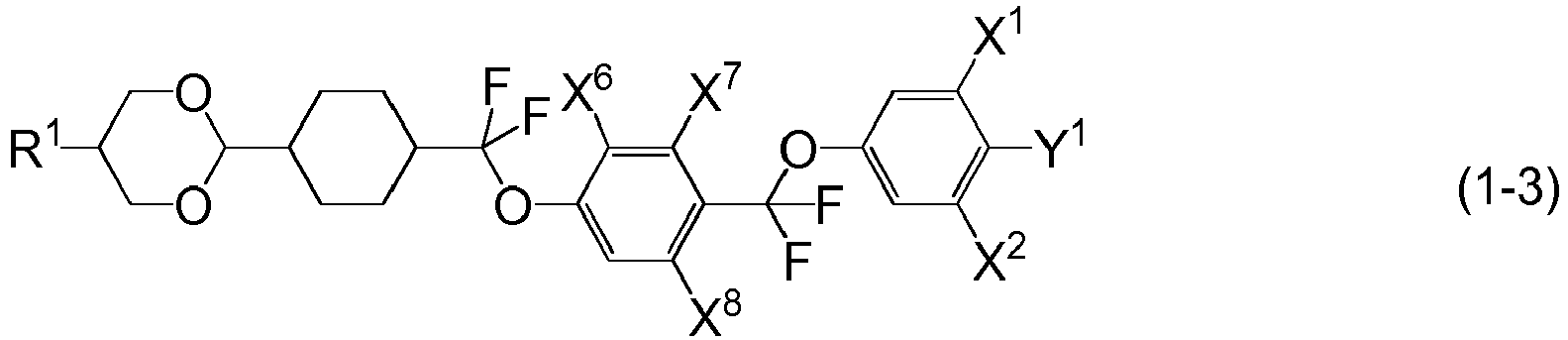
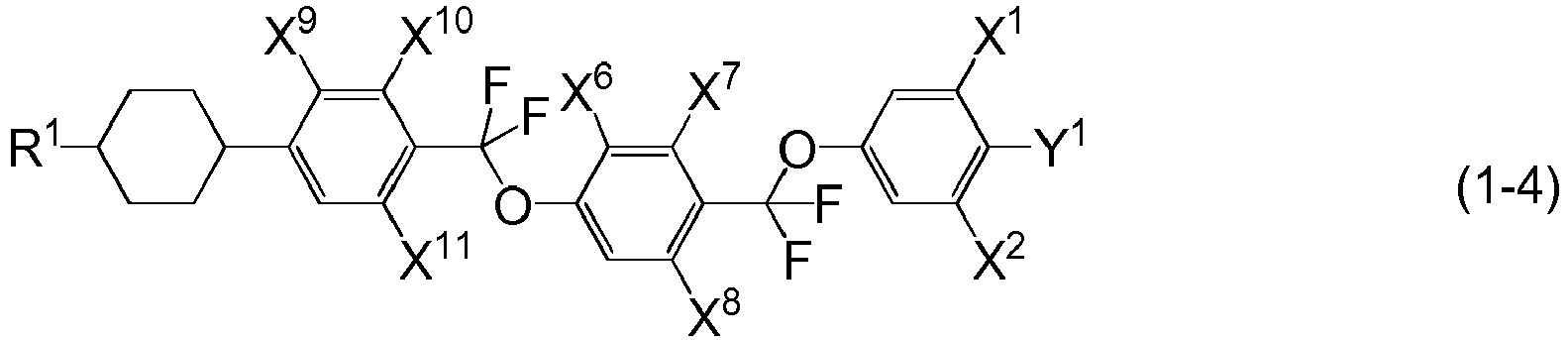


- The liquid crystal composition according to claim 1 or 2, wherein a proportion of the first component is in the range of 3% by weight to 40% by weight, and a proportion of the second component is in the range of 10% by weight to 60% by weight, based on the weight of the liquid crystal composition.
- The liquid crystal composition according to any one of claims 1 to 3, further containing at least one compound selected from the group of compounds represented by formula (3) as a third component:

- The liquid crystal composition according to any one of claims 1 to 4, containing at least one compound selected from the group of compounds represented by formulas (3-1) to (3-12) as the third component:



- The liquid crystal composition according to claim 4 or 5, wherein a proportion of the third component is in the range of 10% by weight to 55% by weight based on the weight of the liquid crystal composition.
- The liquid crystal composition according to any one of claims 1 to 6, further containing at least one compound selected from the group of compounds represented by formula (4) as a fourth component:

- The liquid crystal composition according to any one of claims 1 to 7, containing at least one compound selected from the group of compounds represented by formulas (4-1) to (4-34) as the fourth component:



















- The liquid crystal composition according to claim 7 or 8, wherein a proportion of the fourth component is in the range of 3% by weight to 50% by weight based on the weight of the liquid crystal composition.
- The liquid crystal composition according to any one of claims 1 to 9, containing at least one compound selected from the group of compounds represented by formula (5) as a fifth component:

- The liquid crystal composition according to any one of claims 1 to 10, containing at least one compound selected from the group of compounds represented by formulas (5-1) to (5-19) as the fifth component:







- The liquid crystal composition according to claim 10 or 11, wherein a proportion of the fifth component is in the range of 3% by weight to 25% by weight based on the weight of the liquid crystal composition.
- The liquid crystal composition according to any one of claims 1 to 12, wherein a maximum temperature of a nematic phase is 70°C or higher, an optical anisotropy (measured at 25°C) at a wavelength of 589 nanometers is 0.07 or more and a dielectric anisotropy (measured at 25°C) at a frequency of 1 kHz is 2 or more.
- A liquid crystal display device, including the liquid crystal composition according to any one of claims 1 to 13.
- The liquid crystal display device according to claim 14, wherein an operating mode in the liquid crystal display device includes a TN mode, an ECB mode, an OCB mode, an IPS mode, an FFS mode or an FPA mode, and a driving mode in the liquid crystal display device includes an active matrix mode.
- Use of the liquid crystal composition according to any one of claims 1 to 13 in a liquid crystal display device.
Applications Claiming Priority (2)
| Application Number | Priority Date | Filing Date | Title |
|---|---|---|---|
| JP2013269611 | 2013-12-26 | ||
| PCT/JP2014/076879 WO2015098233A1 (en) | 2013-12-26 | 2014-10-08 | Liquid-crystal composition and liquid-crystal display element |
Publications (3)
| Publication Number | Publication Date |
|---|---|
| EP3088489A1 true EP3088489A1 (en) | 2016-11-02 |
| EP3088489A4 EP3088489A4 (en) | 2017-07-12 |
| EP3088489B1 EP3088489B1 (en) | 2018-06-27 |
Family
ID=53478113
Family Applications (1)
| Application Number | Title | Priority Date | Filing Date |
|---|---|---|---|
| EP14875611.7A Not-in-force EP3088489B1 (en) | 2013-12-26 | 2014-10-08 | Liquid-crystal composition and liquid-crystal display device |
Country Status (7)
| Country | Link |
|---|---|
| US (1) | US10174253B2 (en) |
| EP (1) | EP3088489B1 (en) |
| JP (1) | JPWO2015098233A1 (en) |
| KR (1) | KR20160102392A (en) |
| CN (1) | CN105793392A (en) |
| TW (1) | TWI633175B (en) |
| WO (1) | WO2015098233A1 (en) |
Families Citing this family (8)
| Publication number | Priority date | Publication date | Assignee | Title |
|---|---|---|---|---|
| JP6319315B2 (en) * | 2013-08-28 | 2018-05-09 | Jnc株式会社 | Liquid crystal composition and liquid crystal display element |
| KR20170117395A (en) * | 2015-02-17 | 2017-10-23 | 제이엔씨 주식회사 | A compound having an alkoxy group or an alkoxyalkyl group and a saturated 6-membered ring, a liquid crystal composition and a liquid crystal display element |
| JP2017132847A (en) * | 2016-01-26 | 2017-08-03 | Jnc株式会社 | Liquid crystal composition and liquid crystal display element |
| JP6717022B2 (en) * | 2016-04-15 | 2020-07-01 | Jnc株式会社 | Liquid crystal composition and liquid crystal display device |
| CN108603119B (en) * | 2016-04-20 | 2024-11-05 | 石家庄诚志永华显示材料有限公司 | Composition and liquid crystal display element using the same |
| CN108219802B (en) * | 2016-12-14 | 2021-11-02 | 江苏和成显示科技有限公司 | Liquid crystal composition and application thereof |
| CN108148602A (en) * | 2018-02-09 | 2018-06-12 | 烟台显华化工科技有限公司 | A kind of liquid-crystal composition and its application |
| TWI814958B (en) * | 2019-04-24 | 2023-09-11 | 日商捷恩智股份有限公司 | Liquid crystal compositions and their uses, and liquid crystal display elements |
Family Cites Families (17)
| Publication number | Priority date | Publication date | Assignee | Title |
|---|---|---|---|---|
| US3660505A (en) | 1969-08-27 | 1972-05-02 | Exxon Research Engineering Co | Hindered alkenyl phenols from quinone methide |
| JPS59176221A (en) | 1983-03-16 | 1984-10-05 | メルク・パテント・ゲゼルシヤフト・ミツト・ベシユレンクテル・ハフツング | Alkenyl compound |
| DE3807872A1 (en) | 1988-03-10 | 1989-09-21 | Merck Patent Gmbh | DIFLUORBENZENE DERIVATIVES |
| JPH072656B2 (en) | 1988-07-05 | 1995-01-18 | セイコーエプソン株式会社 | Liquid crystal compound |
| JP2696557B2 (en) | 1989-03-07 | 1998-01-14 | チッソ株式会社 | Trifluorobenzene derivative |
| TW343232B (en) | 1994-10-13 | 1998-10-21 | Chisso Corp | Difluorooxymethane derivative and liquid crystal composition |
| DE10061790A1 (en) * | 2000-12-12 | 2002-06-13 | Merck Patent Gmbh | Liquid crystalline compounds |
| US7105708B2 (en) | 2000-12-12 | 2006-09-12 | Merck Patentgesellschaft | Method for producing compounds having a CF2O bridge |
| JP4489734B2 (en) | 2006-07-07 | 2010-06-23 | 株式会社 日立ディスプレイズ | Liquid crystal display |
| JP2009292729A (en) | 2007-02-28 | 2009-12-17 | Chisso Corp | Pentacyclic liquid crystal compound having cf2o-bonding group, liquid crystal composition and liquid crystal display element |
| DE102008024866A1 (en) | 2007-12-21 | 2009-06-25 | Merck Patent Gmbh | Liquid crystalline medium |
| US8475888B2 (en) * | 2008-10-21 | 2013-07-02 | Jnc Corporation | Five-ring liquid crystal compound having a nitrogen-containing heterocyclic ring, liquid crystal composition and liquid crystal display device |
| JP5564833B2 (en) * | 2009-05-27 | 2014-08-06 | Jnc株式会社 | Liquid crystal composition and liquid crystal display element |
| JP5544849B2 (en) | 2009-12-01 | 2014-07-09 | Jnc株式会社 | Liquid crystal composition and liquid crystal display element |
| JP6019728B2 (en) | 2011-06-08 | 2016-11-02 | Jnc株式会社 | Tetracyclic compound having a plurality of CF2O bonding groups, liquid crystal composition, and liquid crystal display device |
| GB201301786D0 (en) | 2012-02-15 | 2013-03-20 | Merck Patent Gmbh | Liquid-crystalline medium |
| JP5962164B2 (en) * | 2012-04-17 | 2016-08-03 | Jnc株式会社 | Tricyclic compound having a plurality of CF2O bonding groups, liquid crystal composition, and liquid crystal display device |
-
2014
- 2014-10-08 JP JP2015554619A patent/JPWO2015098233A1/en active Pending
- 2014-10-08 EP EP14875611.7A patent/EP3088489B1/en not_active Not-in-force
- 2014-10-08 WO PCT/JP2014/076879 patent/WO2015098233A1/en not_active Ceased
- 2014-10-08 CN CN201480065714.9A patent/CN105793392A/en active Pending
- 2014-10-08 KR KR1020167012713A patent/KR20160102392A/en not_active Withdrawn
- 2014-10-08 US US15/038,475 patent/US10174253B2/en not_active Expired - Fee Related
- 2014-10-15 TW TW103135598A patent/TWI633175B/en not_active IP Right Cessation
Also Published As
| Publication number | Publication date |
|---|---|
| TW201525110A (en) | 2015-07-01 |
| TWI633175B (en) | 2018-08-21 |
| WO2015098233A1 (en) | 2015-07-02 |
| JPWO2015098233A1 (en) | 2017-03-23 |
| KR20160102392A (en) | 2016-08-30 |
| US20160298032A1 (en) | 2016-10-13 |
| US10174253B2 (en) | 2019-01-08 |
| CN105793392A (en) | 2016-07-20 |
| EP3088489A4 (en) | 2017-07-12 |
| EP3088489B1 (en) | 2018-06-27 |
Similar Documents
| Publication | Publication Date | Title |
|---|---|---|
| EP3061802B1 (en) | Liquid crystal composition and liquid crystal display device | |
| EP3006541B1 (en) | Liquid crystal composition and liquid crystal display | |
| EP3088489B1 (en) | Liquid-crystal composition and liquid-crystal display device | |
| JP6358034B2 (en) | Liquid crystal composition and liquid crystal display element | |
| US9920247B2 (en) | Liquid crystal composition and liquid crystal display device | |
| US9181483B2 (en) | Liquid crystal composition and liquid crystal display device | |
| JP6699555B2 (en) | Liquid crystal composition and liquid crystal display device | |
| US10144871B2 (en) | Liquid crystal composition and liquid crystal display device | |
| EP3018185A1 (en) | Liquid crystal composition and liquid crystal display element | |
| US10442991B2 (en) | Liquid crystal composition and liquid crystal display device | |
| US10208248B2 (en) | Liquid crystal composition and liquid crystal display device | |
| EP3434750B1 (en) | Liquid-crystal composition and liquid-crystal display element | |
| US9896624B2 (en) | Liquid crystal composition and liquid crystal display device | |
| US10294424B2 (en) | Liquid crystal composition and liquid crystal display device | |
| EP3275972B1 (en) | Liquid crystal composition and liquid crystal display element | |
| US20180119013A1 (en) | Liquid crystal composition and liquid crystal display device | |
| US10351774B2 (en) | Liquid crystal composition and liquid crystal display device |
Legal Events
| Date | Code | Title | Description |
|---|---|---|---|
| PUAI | Public reference made under article 153(3) epc to a published international application that has entered the european phase |
Free format text: ORIGINAL CODE: 0009012 |
|
| 17P | Request for examination filed |
Effective date: 20160512 |
|
| AK | Designated contracting states |
Kind code of ref document: A1 Designated state(s): AL AT BE BG CH CY CZ DE DK EE ES FI FR GB GR HR HU IE IS IT LI LT LU LV MC MK MT NL NO PL PT RO RS SE SI SK SM TR |
|
| AX | Request for extension of the european patent |
Extension state: BA ME |
|
| DAX | Request for extension of the european patent (deleted) | ||
| A4 | Supplementary search report drawn up and despatched |
Effective date: 20170613 |
|
| RIC1 | Information provided on ipc code assigned before grant |
Ipc: C09K 19/02 20060101ALI20170607BHEP Ipc: C09K 19/34 20060101ALI20170607BHEP Ipc: G02F 1/13 20060101ALI20170607BHEP Ipc: C09K 19/04 20060101ALI20170607BHEP Ipc: C09K 19/42 20060101AFI20170607BHEP Ipc: C09K 19/30 20060101ALI20170607BHEP Ipc: C09K 19/12 20060101ALI20170607BHEP Ipc: C09K 19/14 20060101ALI20170607BHEP Ipc: C09K 19/20 20060101ALI20170607BHEP |
|
| GRAP | Despatch of communication of intention to grant a patent |
Free format text: ORIGINAL CODE: EPIDOSNIGR1 |
|
| STAA | Information on the status of an ep patent application or granted ep patent |
Free format text: STATUS: GRANT OF PATENT IS INTENDED |
|
| INTG | Intention to grant announced |
Effective date: 20180215 |
|
| RIN1 | Information on inventor provided before grant (corrected) |
Inventor name: FURUSATO, YOSHIMASA Inventor name: SAITO, MASAYUKI |
|
| GRAS | Grant fee paid |
Free format text: ORIGINAL CODE: EPIDOSNIGR3 |
|
| GRAA | (expected) grant |
Free format text: ORIGINAL CODE: 0009210 |
|
| STAA | Information on the status of an ep patent application or granted ep patent |
Free format text: STATUS: THE PATENT HAS BEEN GRANTED |
|
| AK | Designated contracting states |
Kind code of ref document: B1 Designated state(s): AL AT BE BG CH CY CZ DE DK EE ES FI FR GB GR HR HU IE IS IT LI LT LU LV MC MK MT NL NO PL PT RO RS SE SI SK SM TR |
|
| REG | Reference to a national code |
Ref country code: GB Ref legal event code: FG4D |
|
| REG | Reference to a national code |
Ref country code: AT Ref legal event code: REF Ref document number: 1012336 Country of ref document: AT Kind code of ref document: T Effective date: 20180715 |
|
| REG | Reference to a national code |
Ref country code: IE Ref legal event code: FG4D |
|
| REG | Reference to a national code |
Ref country code: DE Ref legal event code: R096 Ref document number: 602014027715 Country of ref document: DE |
|
| PG25 | Lapsed in a contracting state [announced via postgrant information from national office to epo] |
Ref country code: SE Free format text: LAPSE BECAUSE OF FAILURE TO SUBMIT A TRANSLATION OF THE DESCRIPTION OR TO PAY THE FEE WITHIN THE PRESCRIBED TIME-LIMIT Effective date: 20180627 Ref country code: LT Free format text: LAPSE BECAUSE OF FAILURE TO SUBMIT A TRANSLATION OF THE DESCRIPTION OR TO PAY THE FEE WITHIN THE PRESCRIBED TIME-LIMIT Effective date: 20180627 Ref country code: FI Free format text: LAPSE BECAUSE OF FAILURE TO SUBMIT A TRANSLATION OF THE DESCRIPTION OR TO PAY THE FEE WITHIN THE PRESCRIBED TIME-LIMIT Effective date: 20180627 Ref country code: NO Free format text: LAPSE BECAUSE OF FAILURE TO SUBMIT A TRANSLATION OF THE DESCRIPTION OR TO PAY THE FEE WITHIN THE PRESCRIBED TIME-LIMIT Effective date: 20180927 Ref country code: BG Free format text: LAPSE BECAUSE OF FAILURE TO SUBMIT A TRANSLATION OF THE DESCRIPTION OR TO PAY THE FEE WITHIN THE PRESCRIBED TIME-LIMIT Effective date: 20180927 |
|
| REG | Reference to a national code |
Ref country code: NL Ref legal event code: MP Effective date: 20180627 |
|
| REG | Reference to a national code |
Ref country code: LT Ref legal event code: MG4D |
|
| PG25 | Lapsed in a contracting state [announced via postgrant information from national office to epo] |
Ref country code: RS Free format text: LAPSE BECAUSE OF FAILURE TO SUBMIT A TRANSLATION OF THE DESCRIPTION OR TO PAY THE FEE WITHIN THE PRESCRIBED TIME-LIMIT Effective date: 20180627 Ref country code: LV Free format text: LAPSE BECAUSE OF FAILURE TO SUBMIT A TRANSLATION OF THE DESCRIPTION OR TO PAY THE FEE WITHIN THE PRESCRIBED TIME-LIMIT Effective date: 20180627 Ref country code: GR Free format text: LAPSE BECAUSE OF FAILURE TO SUBMIT A TRANSLATION OF THE DESCRIPTION OR TO PAY THE FEE WITHIN THE PRESCRIBED TIME-LIMIT Effective date: 20180928 Ref country code: HR Free format text: LAPSE BECAUSE OF FAILURE TO SUBMIT A TRANSLATION OF THE DESCRIPTION OR TO PAY THE FEE WITHIN THE PRESCRIBED TIME-LIMIT Effective date: 20180627 |
|
| REG | Reference to a national code |
Ref country code: AT Ref legal event code: MK05 Ref document number: 1012336 Country of ref document: AT Kind code of ref document: T Effective date: 20180627 |
|
| PG25 | Lapsed in a contracting state [announced via postgrant information from national office to epo] |
Ref country code: NL Free format text: LAPSE BECAUSE OF FAILURE TO SUBMIT A TRANSLATION OF THE DESCRIPTION OR TO PAY THE FEE WITHIN THE PRESCRIBED TIME-LIMIT Effective date: 20180627 |
|
| PG25 | Lapsed in a contracting state [announced via postgrant information from national office to epo] |
Ref country code: SK Free format text: LAPSE BECAUSE OF FAILURE TO SUBMIT A TRANSLATION OF THE DESCRIPTION OR TO PAY THE FEE WITHIN THE PRESCRIBED TIME-LIMIT Effective date: 20180627 Ref country code: PL Free format text: LAPSE BECAUSE OF FAILURE TO SUBMIT A TRANSLATION OF THE DESCRIPTION OR TO PAY THE FEE WITHIN THE PRESCRIBED TIME-LIMIT Effective date: 20180627 Ref country code: IS Free format text: LAPSE BECAUSE OF FAILURE TO SUBMIT A TRANSLATION OF THE DESCRIPTION OR TO PAY THE FEE WITHIN THE PRESCRIBED TIME-LIMIT Effective date: 20181027 Ref country code: AT Free format text: LAPSE BECAUSE OF FAILURE TO SUBMIT A TRANSLATION OF THE DESCRIPTION OR TO PAY THE FEE WITHIN THE PRESCRIBED TIME-LIMIT Effective date: 20180627 Ref country code: EE Free format text: LAPSE BECAUSE OF FAILURE TO SUBMIT A TRANSLATION OF THE DESCRIPTION OR TO PAY THE FEE WITHIN THE PRESCRIBED TIME-LIMIT Effective date: 20180627 Ref country code: RO Free format text: LAPSE BECAUSE OF FAILURE TO SUBMIT A TRANSLATION OF THE DESCRIPTION OR TO PAY THE FEE WITHIN THE PRESCRIBED TIME-LIMIT Effective date: 20180627 Ref country code: CZ Free format text: LAPSE BECAUSE OF FAILURE TO SUBMIT A TRANSLATION OF THE DESCRIPTION OR TO PAY THE FEE WITHIN THE PRESCRIBED TIME-LIMIT Effective date: 20180627 |
|
| PG25 | Lapsed in a contracting state [announced via postgrant information from national office to epo] |
Ref country code: IT Free format text: LAPSE BECAUSE OF FAILURE TO SUBMIT A TRANSLATION OF THE DESCRIPTION OR TO PAY THE FEE WITHIN THE PRESCRIBED TIME-LIMIT Effective date: 20180627 Ref country code: SM Free format text: LAPSE BECAUSE OF FAILURE TO SUBMIT A TRANSLATION OF THE DESCRIPTION OR TO PAY THE FEE WITHIN THE PRESCRIBED TIME-LIMIT Effective date: 20180627 Ref country code: ES Free format text: LAPSE BECAUSE OF FAILURE TO SUBMIT A TRANSLATION OF THE DESCRIPTION OR TO PAY THE FEE WITHIN THE PRESCRIBED TIME-LIMIT Effective date: 20180627 |
|
| REG | Reference to a national code |
Ref country code: DE Ref legal event code: R097 Ref document number: 602014027715 Country of ref document: DE |
|
| PLBE | No opposition filed within time limit |
Free format text: ORIGINAL CODE: 0009261 |
|
| STAA | Information on the status of an ep patent application or granted ep patent |
Free format text: STATUS: NO OPPOSITION FILED WITHIN TIME LIMIT |
|
| PG25 | Lapsed in a contracting state [announced via postgrant information from national office to epo] |
Ref country code: DK Free format text: LAPSE BECAUSE OF FAILURE TO SUBMIT A TRANSLATION OF THE DESCRIPTION OR TO PAY THE FEE WITHIN THE PRESCRIBED TIME-LIMIT Effective date: 20180627 |
|
| REG | Reference to a national code |
Ref country code: CH Ref legal event code: PL |
|
| 26N | No opposition filed |
Effective date: 20190328 |
|
| GBPC | Gb: european patent ceased through non-payment of renewal fee |
Effective date: 20181008 |
|
| REG | Reference to a national code |
Ref country code: BE Ref legal event code: MM Effective date: 20181031 |
|
| PG25 | Lapsed in a contracting state [announced via postgrant information from national office to epo] |
Ref country code: LU Free format text: LAPSE BECAUSE OF NON-PAYMENT OF DUE FEES Effective date: 20181008 Ref country code: MC Free format text: LAPSE BECAUSE OF FAILURE TO SUBMIT A TRANSLATION OF THE DESCRIPTION OR TO PAY THE FEE WITHIN THE PRESCRIBED TIME-LIMIT Effective date: 20180627 |
|
| REG | Reference to a national code |
Ref country code: IE Ref legal event code: MM4A |
|
| PG25 | Lapsed in a contracting state [announced via postgrant information from national office to epo] |
Ref country code: SI Free format text: LAPSE BECAUSE OF FAILURE TO SUBMIT A TRANSLATION OF THE DESCRIPTION OR TO PAY THE FEE WITHIN THE PRESCRIBED TIME-LIMIT Effective date: 20180627 Ref country code: LI Free format text: LAPSE BECAUSE OF NON-PAYMENT OF DUE FEES Effective date: 20181031 Ref country code: CH Free format text: LAPSE BECAUSE OF NON-PAYMENT OF DUE FEES Effective date: 20181031 Ref country code: FR Free format text: LAPSE BECAUSE OF NON-PAYMENT OF DUE FEES Effective date: 20181031 Ref country code: BE Free format text: LAPSE BECAUSE OF NON-PAYMENT OF DUE FEES Effective date: 20181031 |
|
| PG25 | Lapsed in a contracting state [announced via postgrant information from national office to epo] |
Ref country code: IE Free format text: LAPSE BECAUSE OF NON-PAYMENT OF DUE FEES Effective date: 20181008 Ref country code: GB Free format text: LAPSE BECAUSE OF NON-PAYMENT OF DUE FEES Effective date: 20181008 |
|
| PG25 | Lapsed in a contracting state [announced via postgrant information from national office to epo] |
Ref country code: AL Free format text: LAPSE BECAUSE OF FAILURE TO SUBMIT A TRANSLATION OF THE DESCRIPTION OR TO PAY THE FEE WITHIN THE PRESCRIBED TIME-LIMIT Effective date: 20180627 |
|
| PG25 | Lapsed in a contracting state [announced via postgrant information from national office to epo] |
Ref country code: MT Free format text: LAPSE BECAUSE OF NON-PAYMENT OF DUE FEES Effective date: 20181008 |
|
| PGFP | Annual fee paid to national office [announced via postgrant information from national office to epo] |
Ref country code: DE Payment date: 20190924 Year of fee payment: 6 |
|
| PG25 | Lapsed in a contracting state [announced via postgrant information from national office to epo] |
Ref country code: TR Free format text: LAPSE BECAUSE OF FAILURE TO SUBMIT A TRANSLATION OF THE DESCRIPTION OR TO PAY THE FEE WITHIN THE PRESCRIBED TIME-LIMIT Effective date: 20180627 |
|
| PG25 | Lapsed in a contracting state [announced via postgrant information from national office to epo] |
Ref country code: PT Free format text: LAPSE BECAUSE OF FAILURE TO SUBMIT A TRANSLATION OF THE DESCRIPTION OR TO PAY THE FEE WITHIN THE PRESCRIBED TIME-LIMIT Effective date: 20180627 |
|
| PG25 | Lapsed in a contracting state [announced via postgrant information from national office to epo] |
Ref country code: HU Free format text: LAPSE BECAUSE OF FAILURE TO SUBMIT A TRANSLATION OF THE DESCRIPTION OR TO PAY THE FEE WITHIN THE PRESCRIBED TIME-LIMIT; INVALID AB INITIO Effective date: 20141008 Ref country code: CY Free format text: LAPSE BECAUSE OF FAILURE TO SUBMIT A TRANSLATION OF THE DESCRIPTION OR TO PAY THE FEE WITHIN THE PRESCRIBED TIME-LIMIT Effective date: 20180627 Ref country code: MK Free format text: LAPSE BECAUSE OF NON-PAYMENT OF DUE FEES Effective date: 20180627 |
|
| REG | Reference to a national code |
Ref country code: DE Ref legal event code: R119 Ref document number: 602014027715 Country of ref document: DE |
|
| PG25 | Lapsed in a contracting state [announced via postgrant information from national office to epo] |
Ref country code: DE Free format text: LAPSE BECAUSE OF NON-PAYMENT OF DUE FEES Effective date: 20210501 |