EP3087915A1 - Method and system for noise cleaning of photoplethysmogram signals for estimating blood pressure - Google Patents
Method and system for noise cleaning of photoplethysmogram signals for estimating blood pressure Download PDFInfo
- Publication number
- EP3087915A1 EP3087915A1 EP16160276.8A EP16160276A EP3087915A1 EP 3087915 A1 EP3087915 A1 EP 3087915A1 EP 16160276 A EP16160276 A EP 16160276A EP 3087915 A1 EP3087915 A1 EP 3087915A1
- Authority
- EP
- European Patent Office
- Prior art keywords
- photoplethysmogram
- photoplethysmogram signals
- signals
- extracted
- module
- Prior art date
- Legal status (The legal status is an assumption and is not a legal conclusion. Google has not performed a legal analysis and makes no representation as to the accuracy of the status listed.)
- Granted
Links
Images



Classifications
-
- A—HUMAN NECESSITIES
- A61—MEDICAL OR VETERINARY SCIENCE; HYGIENE
- A61B—DIAGNOSIS; SURGERY; IDENTIFICATION
- A61B5/00—Measuring for diagnostic purposes; Identification of persons
- A61B5/02—Detecting, measuring or recording for evaluating the cardiovascular system, e.g. pulse, heart rate, blood pressure or blood flow
- A61B5/021—Measuring pressure in heart or blood vessels
- A61B5/022—Measuring pressure in heart or blood vessels by applying pressure to close blood vessels, e.g. against the skin; Ophthalmodynamometers
- A61B5/0225—Measuring pressure in heart or blood vessels by applying pressure to close blood vessels, e.g. against the skin; Ophthalmodynamometers the pressure being controlled by electric signals, e.g. derived from Korotkoff sounds
- A61B5/02255—Measuring pressure in heart or blood vessels by applying pressure to close blood vessels, e.g. against the skin; Ophthalmodynamometers the pressure being controlled by electric signals, e.g. derived from Korotkoff sounds the pressure being controlled by plethysmographic signals, e.g. derived from optical sensors
-
- A—HUMAN NECESSITIES
- A61—MEDICAL OR VETERINARY SCIENCE; HYGIENE
- A61B—DIAGNOSIS; SURGERY; IDENTIFICATION
- A61B5/00—Measuring for diagnostic purposes; Identification of persons
- A61B5/0059—Measuring for diagnostic purposes; Identification of persons using light, e.g. diagnosis by transillumination, diascopy, fluorescence
-
- A—HUMAN NECESSITIES
- A61—MEDICAL OR VETERINARY SCIENCE; HYGIENE
- A61B—DIAGNOSIS; SURGERY; IDENTIFICATION
- A61B5/00—Measuring for diagnostic purposes; Identification of persons
- A61B5/0059—Measuring for diagnostic purposes; Identification of persons using light, e.g. diagnosis by transillumination, diascopy, fluorescence
- A61B5/0077—Devices for viewing the surface of the body, e.g. camera, magnifying lens
-
- A—HUMAN NECESSITIES
- A61—MEDICAL OR VETERINARY SCIENCE; HYGIENE
- A61B—DIAGNOSIS; SURGERY; IDENTIFICATION
- A61B5/00—Measuring for diagnostic purposes; Identification of persons
- A61B5/02—Detecting, measuring or recording for evaluating the cardiovascular system, e.g. pulse, heart rate, blood pressure or blood flow
- A61B5/021—Measuring pressure in heart or blood vessels
-
- A—HUMAN NECESSITIES
- A61—MEDICAL OR VETERINARY SCIENCE; HYGIENE
- A61B—DIAGNOSIS; SURGERY; IDENTIFICATION
- A61B5/00—Measuring for diagnostic purposes; Identification of persons
- A61B5/02—Detecting, measuring or recording for evaluating the cardiovascular system, e.g. pulse, heart rate, blood pressure or blood flow
- A61B5/021—Measuring pressure in heart or blood vessels
- A61B5/02108—Measuring pressure in heart or blood vessels from analysis of pulse wave characteristics
- A61B5/02116—Measuring pressure in heart or blood vessels from analysis of pulse wave characteristics of pulse wave amplitude
-
- A—HUMAN NECESSITIES
- A61—MEDICAL OR VETERINARY SCIENCE; HYGIENE
- A61B—DIAGNOSIS; SURGERY; IDENTIFICATION
- A61B5/00—Measuring for diagnostic purposes; Identification of persons
- A61B5/145—Measuring characteristics of blood in vivo, e.g. gas concentration or pH-value ; Measuring characteristics of body fluids or tissues, e.g. interstitial fluid or cerebral tissue
- A61B5/1455—Measuring characteristics of blood in vivo, e.g. gas concentration or pH-value ; Measuring characteristics of body fluids or tissues, e.g. interstitial fluid or cerebral tissue using optical sensors, e.g. spectral photometrical oximeters
- A61B5/14551—Measuring characteristics of blood in vivo, e.g. gas concentration or pH-value ; Measuring characteristics of body fluids or tissues, e.g. interstitial fluid or cerebral tissue using optical sensors, e.g. spectral photometrical oximeters for measuring blood gases
-
- A—HUMAN NECESSITIES
- A61—MEDICAL OR VETERINARY SCIENCE; HYGIENE
- A61B—DIAGNOSIS; SURGERY; IDENTIFICATION
- A61B5/00—Measuring for diagnostic purposes; Identification of persons
- A61B5/72—Signal processing specially adapted for physiological signals or for diagnostic purposes
-
- A—HUMAN NECESSITIES
- A61—MEDICAL OR VETERINARY SCIENCE; HYGIENE
- A61B—DIAGNOSIS; SURGERY; IDENTIFICATION
- A61B5/00—Measuring for diagnostic purposes; Identification of persons
- A61B5/72—Signal processing specially adapted for physiological signals or for diagnostic purposes
- A61B5/7203—Signal processing specially adapted for physiological signals or for diagnostic purposes for noise prevention, reduction or removal
-
- A—HUMAN NECESSITIES
- A61—MEDICAL OR VETERINARY SCIENCE; HYGIENE
- A61B—DIAGNOSIS; SURGERY; IDENTIFICATION
- A61B5/00—Measuring for diagnostic purposes; Identification of persons
- A61B5/72—Signal processing specially adapted for physiological signals or for diagnostic purposes
- A61B5/7225—Details of analogue processing, e.g. isolation amplifier, gain or sensitivity adjustment, filtering, baseline or drift compensation
-
- A—HUMAN NECESSITIES
- A61—MEDICAL OR VETERINARY SCIENCE; HYGIENE
- A61B—DIAGNOSIS; SURGERY; IDENTIFICATION
- A61B5/00—Measuring for diagnostic purposes; Identification of persons
- A61B5/72—Signal processing specially adapted for physiological signals or for diagnostic purposes
- A61B5/7235—Details of waveform analysis
-
- A—HUMAN NECESSITIES
- A61—MEDICAL OR VETERINARY SCIENCE; HYGIENE
- A61B—DIAGNOSIS; SURGERY; IDENTIFICATION
- A61B5/00—Measuring for diagnostic purposes; Identification of persons
- A61B5/72—Signal processing specially adapted for physiological signals or for diagnostic purposes
- A61B5/7235—Details of waveform analysis
- A61B5/7246—Details of waveform analysis using correlation, e.g. template matching or determination of similarity
-
- A—HUMAN NECESSITIES
- A61—MEDICAL OR VETERINARY SCIENCE; HYGIENE
- A61B—DIAGNOSIS; SURGERY; IDENTIFICATION
- A61B5/00—Measuring for diagnostic purposes; Identification of persons
- A61B5/72—Signal processing specially adapted for physiological signals or for diagnostic purposes
- A61B5/7271—Specific aspects of physiological measurement analysis
- A61B5/7278—Artificial waveform generation or derivation, e.g. synthesizing signals from measured signals
-
- G—PHYSICS
- G06—COMPUTING OR CALCULATING; COUNTING
- G06T—IMAGE DATA PROCESSING OR GENERATION, IN GENERAL
- G06T5/00—Image enhancement or restoration
- G06T5/20—Image enhancement or restoration using local operators
-
- G—PHYSICS
- G06—COMPUTING OR CALCULATING; COUNTING
- G06T—IMAGE DATA PROCESSING OR GENERATION, IN GENERAL
- G06T5/00—Image enhancement or restoration
- G06T5/70—Denoising; Smoothing
-
- G—PHYSICS
- G06—COMPUTING OR CALCULATING; COUNTING
- G06T—IMAGE DATA PROCESSING OR GENERATION, IN GENERAL
- G06T7/00—Image analysis
- G06T7/0002—Inspection of images, e.g. flaw detection
- G06T7/0012—Biomedical image inspection
-
- H—ELECTRICITY
- H04—ELECTRIC COMMUNICATION TECHNIQUE
- H04L—TRANSMISSION OF DIGITAL INFORMATION, e.g. TELEGRAPHIC COMMUNICATION
- H04L67/00—Network arrangements or protocols for supporting network services or applications
- H04L67/01—Protocols
- H04L67/12—Protocols specially adapted for proprietary or special-purpose networking environments, e.g. medical networks, sensor networks, networks in vehicles or remote metering networks
-
- H—ELECTRICITY
- H04—ELECTRIC COMMUNICATION TECHNIQUE
- H04M—TELEPHONIC COMMUNICATION
- H04M1/00—Substation equipment, e.g. for use by subscribers
- H04M1/02—Constructional features of telephone sets
- H04M1/0202—Portable telephone sets, e.g. cordless phones, mobile phones or bar type handsets
-
- H—ELECTRICITY
- H04—ELECTRIC COMMUNICATION TECHNIQUE
- H04M—TELEPHONIC COMMUNICATION
- H04M1/00—Substation equipment, e.g. for use by subscribers
- H04M1/02—Constructional features of telephone sets
- H04M1/0202—Portable telephone sets, e.g. cordless phones, mobile phones or bar type handsets
- H04M1/026—Details of the structure or mounting of specific components
-
- A—HUMAN NECESSITIES
- A61—MEDICAL OR VETERINARY SCIENCE; HYGIENE
- A61B—DIAGNOSIS; SURGERY; IDENTIFICATION
- A61B5/00—Measuring for diagnostic purposes; Identification of persons
- A61B5/02—Detecting, measuring or recording for evaluating the cardiovascular system, e.g. pulse, heart rate, blood pressure or blood flow
- A61B5/024—Measuring pulse rate or heart rate
- A61B5/02438—Measuring pulse rate or heart rate with portable devices, e.g. worn by the patient
-
- A—HUMAN NECESSITIES
- A61—MEDICAL OR VETERINARY SCIENCE; HYGIENE
- A61B—DIAGNOSIS; SURGERY; IDENTIFICATION
- A61B5/00—Measuring for diagnostic purposes; Identification of persons
- A61B5/68—Arrangements of detecting, measuring or recording means, e.g. sensors, in relation to patient
- A61B5/6887—Arrangements of detecting, measuring or recording means, e.g. sensors, in relation to patient mounted on external non-worn devices, e.g. non-medical devices
- A61B5/6898—Portable consumer electronic devices, e.g. music players, telephones, tablet computers
-
- A—HUMAN NECESSITIES
- A61—MEDICAL OR VETERINARY SCIENCE; HYGIENE
- A61B—DIAGNOSIS; SURGERY; IDENTIFICATION
- A61B5/00—Measuring for diagnostic purposes; Identification of persons
- A61B5/72—Signal processing specially adapted for physiological signals or for diagnostic purposes
- A61B5/7235—Details of waveform analysis
- A61B5/7264—Classification of physiological signals or data, e.g. using neural networks, statistical classifiers, expert systems or fuzzy systems
-
- G—PHYSICS
- G06—COMPUTING OR CALCULATING; COUNTING
- G06T—IMAGE DATA PROCESSING OR GENERATION, IN GENERAL
- G06T2207/00—Indexing scheme for image analysis or image enhancement
- G06T2207/10—Image acquisition modality
- G06T2207/10016—Video; Image sequence
-
- G—PHYSICS
- G06—COMPUTING OR CALCULATING; COUNTING
- G06T—IMAGE DATA PROCESSING OR GENERATION, IN GENERAL
- G06T2207/00—Indexing scheme for image analysis or image enhancement
- G06T2207/20—Special algorithmic details
- G06T2207/20172—Image enhancement details
- G06T2207/20182—Noise reduction or smoothing in the temporal domain; Spatio-temporal filtering
-
- G—PHYSICS
- G06—COMPUTING OR CALCULATING; COUNTING
- G06T—IMAGE DATA PROCESSING OR GENERATION, IN GENERAL
- G06T2207/00—Indexing scheme for image analysis or image enhancement
- G06T2207/30—Subject of image; Context of image processing
- G06T2207/30004—Biomedical image processing
- G06T2207/30101—Blood vessel; Artery; Vein; Vascular
- G06T2207/30104—Vascular flow; Blood flow; Perfusion
Definitions
- the present application generally relates to biomedical signal processing and more particularly to, a method and system for noise cleaning of photoplethysmogram (PPG) signals captured using a mobile communication device.
- PPG photoplethysmogram
- smart phones of recent time are equipped with a plurality of inbuilt sensors such as accelerometer, microphone and camera.
- Accelerometer and microphone can be employed to measure certain physiological parameters such as breathing rate and heart rate
- smart phone camera may be utilized for estimating several vitals using photoplethysmography, which is a non-invasive technique to measure the instantaneous blood flow in capillaries. Since, capillary blood flow increases during systole and reduces during diastole.
- photoplethysmogram (PPG) signal of a person is periodic in nature, whose fundamental frequency indicates the heart rate.
- the photoplethysmogram (PPG) is further used for measuring several physiological vitals including heart rate, blood pressure, respiratory rate, blood oxygen saturation and certain ECG parameters.
- Prior art literature illustrates a variety of solutions for estimating systolic (Ps) and diastolic (Pd) blood pressure from photoplethysmogram.
- Some of the prior art literature uses a combination of PPG and ECG signal for measuring the pulse transit time to estimate blood pressure.
- photoplethysmogram signal synchronized with a microphone can also be used to serve this purpose. It is important to observe that some of the prior art literature proposes a set of time domain photoplethysmogram features to estimate Ps and Pd using machine learning techniques; an indirect approach of estimating blood pressure could be via the R and C parameters of Windkesel model using photoplethysmogram features.
- photoplethysmogram signals captured using smart phones are noisy in nature. Although they have been successfully used to determine heart rate using frequency domain analysis, further indirect markers like blood pressure require time domain analysis for which the signal needs to be substantially cleaned.
- the existing prior art solution illustrates use of filters for noise cleaning of captured photoplethysmogram signals, which might not be sufficient for detailed noise cleaning and remove the undesired frequency. In turn, such filtering might not be enough to estimate vitals such as blood pressure.
- a method for noise cleaning of photoplethysmogram signals for estimating blood pressure of a user includes extracting photoplethysmogram signals from the user and up sampling the extracted photoplethysmogram signals. Further, the method includes, filtering the up sampled photoplethysmogram signals and then removing uneven baseline drift of each cycle of the up sampled and filtered photoplethysmogram signals.
- the method includes, removing outlier cycles of the photoplethysmogram signals by k-means clustering, modeling remaining cycles of the photoplethysmogram signals after removing outlier cycles with a sum of 2 Gaussian functions and then, extracting time domain features from originally extracted and modeled photoplethysmogram signals for estimating blood pressure of the user.
- a system for noise cleaning of photoplethysmogram signals for estimating blood pressure of a user comprises of an image capturing device coupled with a mobile communication device, an up sampling module, a filtering module, a baseline drift removal module, an outlier removing module, a signal modeling module, and a feature extraction module.
- a non-transitory computer-readable medium having embodied thereon a computer program for executing a method for noise cleaning of photoplethysmogram signals for estimating blood pressure of a user.
- the method includes extracting photoplethysmogram signals from the user and up sampling the extracted photoplethysmogram signals. Further, the method includes, filtering the up sampled photoplethysmogram signals and then removing uneven baseline drift of each cycle of the up sampled and filtered photoplethysmogram signals.
- the method includes, removing outlier cycles of the photoplethysmogram signals by k-means clustering, modeling remaining cycles of the photoplethysmogram signals after removing outlier cycles with a sum of 2 Gaussian functions and then extracting time domain features from extracted and modeled photoplethysmogram signals for estimating blood pressure of the user.
- the present invention enables a method and system for noise cleaning of photoplethysmogram (PPG) signals for estimating blood pressure (BP) of a user.
- PPG photoplethysmogram
- a system (200) for noise cleaning of photoplethysmogram signals for estimating blood pressure of a user comprises of an image capturing device (202) coupled with a mobile communication device (204); an up sampling module (206); a filtering module (208); a baseline drift removal module (210); an outlier removing module (212); a signal modeling module (214); and a feature extraction module (216).
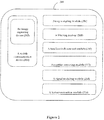
- FIG. 1 is a flow chart illustrating a method for noise cleaning of photoplethysmogram signals for estimating blood pressure of a user.
- the process starts at step 102, photoplethysmogram signals are extracted from the user using the image capturing device (202) coupled with the mobile communication device (204).
- the extracted photoplethysmogram signals are up sampled using the up sampling module (206).
- the up sampled photoplethysmogram signals are filtered using the filtering module (208).
- uneven baseline drift of each cycle of the up sampled and filtered photoplethysmogram signals is removed using the baseline drift removal module (210).
- outlier cycles of the photoplethysmogram signals are removed by k-means clustering using the outlier removing module (212).
- step 112 remaining cycles of the photoplethysmogram signals after removing outlier cycles are modeled with a sum of 2 Gaussian functions using the signal modeling module (214).
- step 114 time domain features are extracted from originally extracted and modeled photoptethysmogram signals using the feature extraction module (216) for estimating blood pressure of the user.
- FIG. 2 is a block diagram illustrating system architecture for noise cleaning of photoplethysmogram signals for estimating blood pressure of a user.
- the image capturing device (202) coupled with the mobile communication device (204) is adapted for extracting photopiethysmogram signals from the user.
- the photoplethysmogram signals are extracted from user's peripheral body parts selected from a group comprising but not limited to finger, ear, and toe. In a specific embodiment, the photoplethysmogram signals are extracted from user's forehead.
- the mobile communication device (204) captures photoplethysmogram signal in reflective mode.
- the mobile communication device (204) is selected from a group comprising of smart phone, mobile phone, laptop, tablet, and personal digital assistant.
- the image capturing device (202) coupled with the mobile communication device (204) is a camera and have a light emitting source for extracting photoplethysmogram signals from the user's peripheral body parts selected from a group comprising but not limited to finger, ear, toe; forehead thereby, obtaining a video sequence of the light, reflected from user's peripheral body parts.
- the periodic nature of photoplethysmogram signal is caused due to varying intensity of redness in the region of interest (ROI) of each video frame.
- ROI region of interest
- Android APIs provide the camera preview information in Y C B C R colorspace. Thus further conversion to RGB domain in real time causes additional computation in the mobile communication device (204) which may reduce the frame rate of the captured video.
- the image capturing device (202) coupled with the mobile communication device (204) is extracting the photoplethysmogram signals in Y domain of Y C B C R color space of a captured video.
- the photoplethysmogram signals are extracted as a time series data wherein signal value of photoplethysmogram at n th frame is represented by mean value of Y component of the n th frame.
- the up sampling module (206) is adapted for up sampling the extracted photoplethysmogram signals.
- the extracted photoplethysmogram signals are up sampled to a uniform sampling rate using linear interpolation.
- the image capturing device (202) coupled with the mobile communication device (204) extracts photoplethysmogram signals from the user's peripheral body parts as a video stream at 30 fps, yielding a very low sampling rate of the extracted photoplethysmogram signal (30 Hz) compared to clinical devices (100 Hz or more).
- Linear interpolation is applied to the extracted photoplethysmogram signals for up sampling of extracted photoplethysmogram signals to a uniform sampling rate.
- the filtering module (208) is adapted for filtering the up sampled photoplethysmogram signals.
- the photoplethysmogram signal contains a slowly varying DC and several high frequency noise components. However, the fundamental frequency lies between 1 to 1.5 Hz based on the heart rate of a person (60-90 bpm).
- the up sampled photoplethysmogram signals are shifted to its zero mean and applied to a 4th order Butterworth band-pass filter having cutoff frequencies of 0.5 Hz and 5 Hz to remove the undesired frequency components.
- FIG 3 is a graphical representation for removing uneven baseline drift of each cycle of the up sampled and filtered photoplethysmogram signals, wherein the shape of a typical photoplethysmogram waveform captured using mobile communication device (204) is too noisy for time domain analysis which can be seen in Figure 3A .
- the baseline drift removal module (210) is adapted for removing uneven baseline drift of each cycle of the up sampled and filtered photoplethysmogram signals.
- photoplethysmogram signal may not have a fixed baseline.
- both ends of a single photoplethysmogram cycle may not often aligned.
- the unequal baseline of photoplethysmogram signal is a major reason for wrong feature calculation.
- F be a vector containing all the k samples in a cycle
- a second vector T forming a line segment between the two endpoints of that cycle is constructed, with k-2 equally spaced values in between, generated using linear interpolation.
- the effect of pre-processing of the photoplethysmogram signals using the up sampling module (206) and the filtering module (208), thereafter baseline removal algorithm on the noisy signal using the baseline drift removal module (210) is shown in Figure 3B , making it cleaner for further analysis.
- the outlier removing module (212) is adapted for removing outlier cycles of the photoplethysmogram signals by k-means clustering.
- the composite feature set includes a combination of features, extracted from each cycle of the original photoplethysmogram signal as well as the modeled photoplethysmogram signal.
- absolute difference from ideal time period is calculate, indicating high value of the ideal time period as a wrongly detected cycle.
- ⁇ T c
- a high value of ⁇ T c indicates a wrongly detected cycle.
- histogram analysis is done for all ⁇ T c to initialize the cluster centroids, followed by 2-Means clustering and estimating of cluster density to remove the outliers. Centroid of the histogram bin having maximum entries is considered as the initial centroid (C1) for one cluster.
- the initial centroid of the other cluster (C2) is the farthest data point from C1.
- K-Means algorithm is used to get the final cluster centroids. Entries corresponding to the centroid with lower Xie-Beni index are considered to be compact and those cycles are used for feature extraction.
- the signal modeling module (214) is adapted for modeling remaining cycles of the photoplethysmogram signals after removing outlier cycles with a sum of 2 Gaussian functions.
- photoplethysmogram signals captured using the mobile communication device (204) are extremely noise-prone and contains several irregularities in shape due to that.
- a mathematical modeling may ensure better signal realization for analysis. Given a set of uniformly spaced single valued data, they can be approximated by a sum of Gaussian functions with some accuracy. According to Figure 3B , photoplethysmogram cycle closely follows a Gaussian shape.
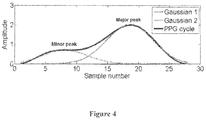
- a typical photoplethysmogram cycle, fitted using a sum of 2 Gaussian curves are shown in Figure 4 .
- the Root Mean Square Error (RMSE) is a popular tool in statistics to measure the goodness of a curve fitting, typically a lower value indicates a better fitting.
- the RMSE between the original cycle and the modeled cycle, fitted with 2 Gaussian curves is found to be 1.5%. Whereas, RMSE for the same cycle, becomes 8.3% and 3.6% respectively, if fitted with a single Gaussian or a Weibull function.
- a second waveform is considered, containing different possible shapes of photoplethysmogram pulse and fit each of them with a sum of 2 Gaussian functions.
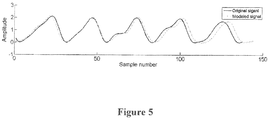
- FIG. 5 is a graphical representation for comparing originally extracted and modeled photoplethysmogram signals. It can be observed that the proposed curve fitting methodology works well for the entire signal.
- the RMSE between the actual and modeled photoplethysmogram signal becomes less than 2.5%, indicating its feasibility to fit any kind of PPG signal with commending accuracy
- the constant parameter a indicates the height of the peak
- b is the position of the center of the peak
- c controls the width of the curve, thus some of these model parameters are used as additional PPG features for analysis.
- the feature extraction module (216) is adapted for extracting time domain features from originally extracted and modeled photoplethysmogram signals for estimating blood pressure of the user.
- the time domain features including systolic time (T s ); diastolic time (T d ); pulse-width at; 33% (B 33 ); 75% (B 75 ) of pulse height (T c ); total pulse width of the original signal, along with Gaussian RMS width; C 1 ; C 2 of the fitted Gaussian curves to create composite feature vector in R 7 feature space; and mode parameters b1 and b2 are extracted from extracted and modeled photoplethysmogram signals for estimating blood pressure of the user using machine learning techniques.
- R and C does not have any mathematical relationship with photoplethysmogram features.
- Artificial Neural Network (ANN) based machine learning approach is used to estimate R and C from photoplethysmogram features.
- the estimation of R and C and consequently blood pressure of the user using photoplethysmogram signals further has training and testing phases.
- FIG. 6A is a block diagram illustrating training phase for estimating blood pressure of a user using photoplethysmogram signals.
- training models are created for R and C, wherein around 100 users with known blood pressure are used for training phase.
- the ground truth blood pressure value (602), systolic (Ps) and diastolic (Pd) blood pressure is known for said users.
- R and C is calculated (604) using ground truth blood pressure value (602) by reversing systolic (Ps) and diastolic (Pd) blood pressure equations.
- the systolic time (Ts), diastolic time (Td) and CO can be measured for said users using respective photoplethysmogram signals (606).
- the training models (610) for R and C are generated by running Artificial Neural Network (ANN) (608) offline and said generated training models for R and C are stored.
- ANN Artificial Neural Network
- FIG. 6B is a block diagram illustrating testing phase for estimating blood pressure of a user using photoplethysmogram signals.
- the testing phase runs on user's mobile communication device (204) in real time for estimating blood pressure of a user using photoplethysmogram signals.
- the generated training models for R and C during training phase are stored in the mobile communication device (204) where the testing phase of the application runs.
- photoplethysmogram signals are extracted from the user.
- the systolic time (Ts), diastolic time (Td) and I o are calculated.
- the R and C are estimated/ predicted (616) for the user from photoplethysmogram features (612) and training models (614).
- systolic (Ps) and diastolic (Pd) blood pressure are calculated (618) using systolic (Ps) and diastolic (Pd) blood pressure equations.
- a computer-readable storage medium refers to any type of physical memory on which information or data readable by a processor may be stored.
- a computer-readable storage medium may store instructions for execution by one or more processors, including instructions for causing the processor(s) to perform steps or stages consistent with the embodiments described herein.
- the term "computer-readable medium” should be understood to include tangible items and exclude carrier waves and transient signals, i.e., be non-transitory. Examples include random access memory (RAM), read-only memory (ROM), volatile memory, nonvolatile memory, hard drives, CD ROMs, DVDs, flash drives, disks, and any other known physical storage media.
Landscapes
- Health & Medical Sciences (AREA)
- Life Sciences & Earth Sciences (AREA)
- Engineering & Computer Science (AREA)
- Physics & Mathematics (AREA)
- General Health & Medical Sciences (AREA)
- Medical Informatics (AREA)
- Public Health (AREA)
- Animal Behavior & Ethology (AREA)
- Veterinary Medicine (AREA)
- Biophysics (AREA)
- Pathology (AREA)
- Biomedical Technology (AREA)
- Heart & Thoracic Surgery (AREA)
- Surgery (AREA)
- Molecular Biology (AREA)
- Signal Processing (AREA)
- Physiology (AREA)
- Computer Vision & Pattern Recognition (AREA)
- Artificial Intelligence (AREA)
- Psychiatry (AREA)
- Cardiology (AREA)
- Vascular Medicine (AREA)
- Theoretical Computer Science (AREA)
- General Physics & Mathematics (AREA)
- Spectroscopy & Molecular Physics (AREA)
- Optics & Photonics (AREA)
- Quality & Reliability (AREA)
- Radiology & Medical Imaging (AREA)
- Nuclear Medicine, Radiotherapy & Molecular Imaging (AREA)
- Computer Networks & Wireless Communication (AREA)
- Ophthalmology & Optometry (AREA)
- Computing Systems (AREA)
- Power Engineering (AREA)
- Multimedia (AREA)
- Evolutionary Computation (AREA)
- Fuzzy Systems (AREA)
- Mathematical Physics (AREA)
- Measuring Pulse, Heart Rate, Blood Pressure Or Blood Flow (AREA)
- Measuring And Recording Apparatus For Diagnosis (AREA)
Abstract
Description
- This patent application claims priority to
India Application No. 1684/MUM/2015, filed on 27th April 2015 - The present application generally relates to biomedical signal processing and more particularly to, a method and system for noise cleaning of photoplethysmogram (PPG) signals captured using a mobile communication device.
- Recent time has witnessed tremendous growth in communication technology worldwide. Consequently, communication devices have started replacing manual human efforts in a big way. Particularly, communication devices such as smart phone and applications embedded therein for physiological sensing are rapidly gaining popularity in both developed and developing nations. Smart phone based physiological sensing applications provides both elderly as well as young adults with an opportunity to monitor numerous physiological vitals regularly at home for indicative and preventive measurements without possessing dedicated clinical devices.
- In order to support various physiological sensing applications, smart phones of recent time are equipped with a plurality of inbuilt sensors such as accelerometer, microphone and camera. Accelerometer and microphone can be employed to measure certain physiological parameters such as breathing rate and heart rate, while smart phone camera may be utilized for estimating several vitals using photoplethysmography, which is a non-invasive technique to measure the instantaneous blood flow in capillaries. Since, capillary blood flow increases during systole and reduces during diastole. Thus, photoplethysmogram (PPG) signal of a person is periodic in nature, whose fundamental frequency indicates the heart rate. The photoplethysmogram (PPG) is further used for measuring several physiological vitals including heart rate, blood pressure, respiratory rate, blood oxygen saturation and certain ECG parameters.
- Prior art literature illustrates a variety of solutions for estimating systolic (Ps) and diastolic (Pd) blood pressure from photoplethysmogram. Some of the prior art literature uses a combination of PPG and ECG signal for measuring the pulse transit time to estimate blood pressure. In another approach, photoplethysmogram signal, synchronized with a microphone can also be used to serve this purpose. It is important to observe that some of the prior art literature proposes a set of time domain photoplethysmogram features to estimate Ps and Pd using machine learning techniques; an indirect approach of estimating blood pressure could be via the R and C parameters of Windkesel model using photoplethysmogram features.
- A majority of existing solutions used for measuring blood pressure using photoplethysmogram can be employed only when they are applied on clean and noise-free photoplethysmogram signal. However, such solution exhibit practical constraints when photoplethysmogram signals are captured using communication devices such as smart phones. Smart phones typically capture video at 30 fps, yielding a very low sampling rate of the extracted photoplethysmogram signal, which is 30 Hz compared to a clinical devices on 100 Hz or more. In addition to that, surrounding lights while capturing photoplethysmogram signals using smart phone also affect the signal quality. A little finger movement or even a variation in finger pressure can largely affect the photoplethysmogram signal quality, thereby the signal in time domain becomes more vulnerable and less reliable. Thus, photoplethysmogram signals captured using smart phones are noisy in nature. Although they have been successfully used to determine heart rate using frequency domain analysis, further indirect markers like blood pressure require time domain analysis for which the signal needs to be substantially cleaned. The existing prior art solution illustrates use of filters for noise cleaning of captured photoplethysmogram signals, which might not be sufficient for detailed noise cleaning and remove the undesired frequency. In turn, such filtering might not be enough to estimate vitals such as blood pressure.
- Thus, in the light of the above mentioned background art, it is evident that, a method and system for noise cleaning of photoplethysmogram signals for estimating blood pressure of a user is desired.
- Embodiments of the present disclosure present technological improvements as solutions to one or more of the above-mentioned technical problems recognized by the inventors in conventional systems. For example, in one embodiment, a method for noise cleaning of photoplethysmogram signals for estimating blood pressure of a user. The method includes extracting photoplethysmogram signals from the user and up sampling the extracted photoplethysmogram signals. Further, the method includes, filtering the up sampled photoplethysmogram signals and then removing uneven baseline drift of each cycle of the up sampled and filtered photoplethysmogram signals. Subsequently, the method includes, removing outlier cycles of the photoplethysmogram signals by k-means clustering, modeling remaining cycles of the photoplethysmogram signals after removing outlier cycles with a sum of 2 Gaussian functions and then, extracting time domain features from originally extracted and modeled photoplethysmogram signals for estimating blood pressure of the user.
- In another embodiment, a system for noise cleaning of photoplethysmogram signals for estimating blood pressure of a user is provided. The system comprises of an image capturing device coupled with a mobile communication device, an up sampling module, a filtering module, a baseline drift removal module, an outlier removing module, a signal modeling module, and a feature extraction module.
- In yet another embodiment, a non-transitory computer-readable medium having embodied thereon a computer program for executing a method for noise cleaning of photoplethysmogram signals for estimating blood pressure of a user is provided. The method includes extracting photoplethysmogram signals from the user and up sampling the extracted photoplethysmogram signals. Further, the method includes, filtering the up sampled photoplethysmogram signals and then removing uneven baseline drift of each cycle of the up sampled and filtered photoplethysmogram signals. Subsequently, the method includes, removing outlier cycles of the photoplethysmogram signals by k-means clustering, modeling remaining cycles of the photoplethysmogram signals after removing outlier cycles with a sum of 2 Gaussian functions and then extracting time domain features from extracted and modeled photoplethysmogram signals for estimating blood pressure of the user.
- It is to be understood that both the foregoing general description and the following detailed description are exemplary and explanatory only and are not restrictive of the invention, as claimed.
- The accompanying drawings, which are incorporated in and constitute a part of this disclosure, illustrate exemplary embodiments and, together with the description, serve to explain the disclosed principles.
-
Figure 1 : shows a flow chart illustrating a method for noise cleaning of photoplethysmogram signals for estimating blood pressure of a user. -
Figure 2 : shows a block diagram illustrating system architecture for noise cleaning of photoplethysmogram signals for estimating blood pressure of a user. -
Figure 3 : shows a graphical representation for removing uneven baseline drift of each cycle of the up sampled and filtered photoplethysmogram signals. -
Figure 4 : shows a graphical representation for modeling remaining cycles of the photoplethysmogram signals after removing outlier cycles with a sum of 2 Gaussian functions. -
Figure 5 : shows a graphical representation for comparing originally extracted and modeled photoplethysmogram signals. -
Figure 6A and Figure 6 B: shows a block diagram illustrating training phase and testing phase for estimating blood pressure of a user using photoplethysmogram signals. - Exemplary embodiments are described with reference to the accompanying drawings. In the figures, the left-most digit(s) of a reference number identifies the figure in which the reference number first appears. Wherever convenient, the same reference numbers are used throughout the drawings to refer to the same or like parts. While examples and features of disclosed principles are described herein, modifications, adaptations, and other implementations are possible without departing from the spirit and scope of the disclosed embodiments. It is intended that the following detailed description be considered as exemplary only, with the true scope and spirit being indicated by the following claims.
- The disclosed embodiments are merely exemplary of the invention, which may be embodied in various forms.
- The present invention enables a method and system for noise cleaning of photoplethysmogram (PPG) signals for estimating blood pressure (BP) of a user.
- In an embodiment of the present invention, a system (200) for noise cleaning of photoplethysmogram signals for estimating blood pressure of a user comprises of an image capturing device (202) coupled with a mobile communication device (204); an up sampling module (206); a filtering module (208); a baseline drift removal module (210); an outlier removing module (212); a signal modeling module (214); and a feature extraction module (216).
- Referring to
Figure 1 is a flow chart illustrating a method for noise cleaning of photoplethysmogram signals for estimating blood pressure of a user. - The process starts at
step 102, photoplethysmogram signals are extracted from the user using the image capturing device (202) coupled with the mobile communication device (204). At thestep 104, the extracted photoplethysmogram signals are up sampled using the up sampling module (206). At thestep 106, the up sampled photoplethysmogram signals are filtered using the filtering module (208). At thestep 108, uneven baseline drift of each cycle of the up sampled and filtered photoplethysmogram signals is removed using the baseline drift removal module (210). At thestep 110, outlier cycles of the photoplethysmogram signals are removed by k-means clustering using the outlier removing module (212). At thestep 112, remaining cycles of the photoplethysmogram signals after removing outlier cycles are modeled with a sum of 2 Gaussian functions using the signal modeling module (214). The process ends at thestep 114, time domain features are extracted from originally extracted and modeled photoptethysmogram signals using the feature extraction module (216) for estimating blood pressure of the user. - Referring to
Figure 2 is a block diagram illustrating system architecture for noise cleaning of photoplethysmogram signals for estimating blood pressure of a user. - In another embodiment of the present invention, the image capturing device (202) coupled with the mobile communication device (204) is adapted for extracting photopiethysmogram signals from the user. The photoplethysmogram signals are extracted from user's peripheral body parts selected from a group comprising but not limited to finger, ear, and toe. In a specific embodiment, the photoplethysmogram signals are extracted from user's forehead. The mobile communication device (204) captures photoplethysmogram signal in reflective mode. The mobile communication device (204) is selected from a group comprising of smart phone, mobile phone, laptop, tablet, and personal digital assistant.
- The image capturing device (202) coupled with the mobile communication device (204) is a camera and have a light emitting source for extracting photoplethysmogram signals from the user's peripheral body parts selected from a group comprising but not limited to finger, ear, toe; forehead thereby, obtaining a video sequence of the light, reflected from user's peripheral body parts. The periodic nature of photoplethysmogram signal is caused due to varying intensity of redness in the region of interest (ROI) of each video frame. However, Android APIs provide the camera preview information in Y CBCR colorspace. Thus further conversion to RGB domain in real time causes additional computation in the mobile communication device (204) which may reduce the frame rate of the captured video. Since the intensity information is carried in the luminescence part of Y CBCR, the image capturing device (202) coupled with the mobile communication device (204) is extracting the photoplethysmogram signals in Y domain of Y CBCR color space of a captured video. The value of photoplethysmogram signal corresponding to (1th frame of a video of WxH resolution is represented by the mean Y value of that frame, as:

- In another embodiment of the present invention, the photoplethysmogram signals are extracted as a time series data wherein signal value of photoplethysmogram at nth frame is represented by mean value of Y component of the nth frame.
- In another embodiment of the present invention, the up sampling module (206) is adapted for up sampling the extracted photoplethysmogram signals. The extracted photoplethysmogram signals are up sampled to a uniform sampling rate using linear interpolation. The image capturing device (202) coupled with the mobile communication device (204) extracts photoplethysmogram signals from the user's peripheral body parts as a video stream at 30 fps, yielding a very low sampling rate of the extracted photoplethysmogram signal (30 Hz) compared to clinical devices (100 Hz or more). Linear interpolation is applied to the extracted photoplethysmogram signals for up sampling of extracted photoplethysmogram signals to a uniform sampling rate.
- In another embodiment of the present invention, the filtering module (208) is adapted for filtering the up sampled photoplethysmogram signals.
- The photoplethysmogram signal contains a slowly varying DC and several high frequency noise components. However, the fundamental frequency lies between 1 to 1.5 Hz based on the heart rate of a person (60-90 bpm). The up sampled photoplethysmogram signals are shifted to its zero mean and applied to a 4th order Butterworth band-pass filter having cutoff frequencies of 0.5 Hz and 5 Hz to remove the undesired frequency components.
- Referring to
Figure 3 is a graphical representation for removing uneven baseline drift of each cycle of the up sampled and filtered photoplethysmogram signals, wherein the shape of a typical photoplethysmogram waveform captured using mobile communication device (204) is too noisy for time domain analysis which can be seen inFigure 3A . - In another embodiment of the present invention, the baseline drift removal module (210) is adapted for removing uneven baseline drift of each cycle of the up sampled and filtered photoplethysmogram signals. According to
Figure 3A , photoplethysmogram signal may not have a fixed baseline. Moreover, both ends of a single photoplethysmogram cycle may not often aligned. The unequal baseline of photoplethysmogram signal is a major reason for wrong feature calculation. For a uniform sampled photoplethysmogram signal; if F be a vector containing all the k samples in a cycle, a second vector T forming a line segment between the two endpoints of that cycle is constructed, with k-2 equally spaced values in between, generated using linear interpolation. The vector F1 = F - T represents the modified cycle with zero baseline. The same is done for all other photoplethysmogram cycles as well. The effect of pre-processing of the photoplethysmogram signals using the up sampling module (206) and the filtering module (208), thereafter baseline removal algorithm on the noisy signal using the baseline drift removal module (210) is shown inFigure 3B , making it cleaner for further analysis. - In another embodiment of the present invention, the outlier removing module (212) is adapted for removing outlier cycles of the photoplethysmogram signals by k-means clustering.
- The composite feature set includes a combination of features, extracted from each cycle of the original photoplethysmogram signal as well as the modeled photoplethysmogram signal. Thus, removal of outlier cycles, caused due to inaccurate detection of troughs is necessary before applying the features to the ANN structures. The outlier cycles of the photoplethysmogram signals are removed by splitting each cycle of the photoplethysmogram signals into a plurality of rectangular overlapping windows of equal size. If the signal is assumed to be stationary, mean of dominant peak locations in all the windows' spectrum indicates its fundamental frequency fc, so ideal time period becomes Tcideal = 1 = fc. Thereby identifying fundamental frequency of the plurality of rectangular overlapping windows. Further, absolute difference from ideal time period is calculate, indicating high value of the ideal time period as a wrongly detected cycle. For all the cycles, absolute difference from ideal time period as ΔTc = |Tc - Tcideal|. A high value of ΔTc indicates a wrongly detected cycle. K-Means clustering (K=2) approach is used to remove such outlier cycles. First, histogram analysis is done for all ΔTc to initialize the cluster centroids, followed by 2-Means clustering and estimating of cluster density to remove the outliers. Centroid of the histogram bin having maximum entries is considered as the initial centroid (C1) for one cluster. The initial centroid of the other cluster (C2) is the farthest data point from C1. K-Means algorithm is used to get the final cluster centroids. Entries corresponding to the centroid with lower Xie-Beni index are considered to be compact and those cycles are used for feature extraction.
- Referring to
Figure 4 a graphical representation for modeling remaining cycles of the photoplethysmogram signals after removing outlier cycles with a sum of 2 Gaussian functions is presented. - In another embodiment of the present invention, the signal modeling module (214) is adapted for modeling remaining cycles of the photoplethysmogram signals after removing outlier cycles with a sum of 2 Gaussian functions. As mentioned earlier, photoplethysmogram signals captured using the mobile communication device (204) are extremely noise-prone and contains several irregularities in shape due to that. Thus, a mathematical modeling may ensure better signal realization for analysis. Given a set of uniformly spaced single valued data, they can be approximated by a sum of Gaussian functions with some accuracy. According to
Figure 3B , photoplethysmogram cycle closely follows a Gaussian shape. However it is asymmetric in nature and contains two peaks, where the major and prominent peak represents the systolic peak and the minor peak represents the diastolic peak. Thus, instead of a single Gaussian, a sum of 2 Gaussian functions may fit the shape with better accuracy. If {xk : k = 1,2 ...N} be a set of equally spaced data points with corresponding photoplethysmogram signal amplitude of {PPGk : k = 1,2 ...N}, then the approximation of PPGk is done with yk, as given in following equation:

- A typical photoplethysmogram cycle, fitted using a sum of 2 Gaussian curves are shown in
Figure 4 . The Root Mean Square Error (RMSE) is a popular tool in statistics to measure the goodness of a curve fitting, typically a lower value indicates a better fitting. The RMSE between the original cycle and the modeled cycle, fitted with 2 Gaussian curves is found to be 1.5%. Whereas, RMSE for the same cycle, becomes 8.3% and 3.6% respectively, if fitted with a single Gaussian or a Weibull function. For more comprehensive performance analysis, a second waveform is considered, containing different possible shapes of photoplethysmogram pulse and fit each of them with a sum of 2 Gaussian functions. - Referring to
Figure 5 is a graphical representation for comparing originally extracted and modeled photoplethysmogram signals. It can be observed that the proposed curve fitting methodology works well for the entire signal. The RMSE between the actual and modeled photoplethysmogram signal becomes less than 2.5%, indicating its feasibility to fit any kind of PPG signal with commending accuracy, The constant parameter a indicates the height of the peak, b is the position of the center of the peak and c controls the width of the curve, thus some of these model parameters are used as additional PPG features for analysis. - In another embodiment of the present invention, the feature extraction module (216) is adapted for extracting time domain features from originally extracted and modeled photoplethysmogram signals for estimating blood pressure of the user. The time domain features including systolic time (Ts); diastolic time (Td); pulse-width at; 33% (B33); 75% (B75) of pulse height (Tc); total pulse width of the original signal, along with Gaussian RMS width; C1; C2 of the fitted Gaussian curves to create composite feature vector in R7 feature space; and mode parameters b1 and b2 are extracted from extracted and modeled photoplethysmogram signals for estimating blood pressure of the user using machine learning techniques.
- In another embodiment of the present invention, according to the following equation:


- Since, R and C does not have any mathematical relationship with photoplethysmogram features. Artificial Neural Network (ANN) based machine learning approach is used to estimate R and C from photoplethysmogram features. The estimation of R and C and consequently blood pressure of the user using photoplethysmogram signals further has training and testing phases.
- Referring to
Figure 6A is a block diagram illustrating training phase for estimating blood pressure of a user using photoplethysmogram signals. - In another embodiment of the present invention, training models are created for R and C, wherein around 100 users with known blood pressure are used for training phase. The ground truth blood pressure value (602), systolic (Ps) and diastolic (Pd) blood pressure is known for said users. R and C is calculated (604) using ground truth blood pressure value (602) by reversing systolic (Ps) and diastolic (Pd) blood pressure equations. The systolic time (Ts), diastolic time (Td) and CO can be measured for said users using respective photoplethysmogram signals (606). The training models (610) for R and C are generated by running Artificial Neural Network (ANN) (608) offline and said generated training models for R and C are stored.
- Referring to
Figure 6B is a block diagram illustrating testing phase for estimating blood pressure of a user using photoplethysmogram signals. - In another embodiment of the present invention, the testing phase runs on user's mobile communication device (204) in real time for estimating blood pressure of a user using photoplethysmogram signals. The generated training models for R and C during training phase are stored in the mobile communication device (204) where the testing phase of the application runs. When a user runs the application on its mobile communication device (204), photoplethysmogram signals are extracted from the user. The systolic time (Ts), diastolic time (Td) and Io are calculated. The R and C are estimated/ predicted (616) for the user from photoplethysmogram features (612) and training models (614). Upon estimating R and C, systolic (Ps) and diastolic (Pd) blood pressure are calculated (618) using systolic (Ps) and diastolic (Pd) blood pressure equations.
- The illustrated steps are set out to explain the exemplary embodiments shown, and it should be anticipated that ongoing technological development will change the manner in which particular functions are performed. These examples are presented herein for purposes of illustration, and not limitation. Further, the boundaries of the functional building blocks have been arbitrarily defined herein for the convenience of the description. Alternative boundaries can be defined so long as the specified functions and relationships thereof are appropriately performed. Alternatives (including equivalents, extensions, variations, deviations, etc., of those described herein) will be apparent to persons skilled in the relevant art(s) based on the teachings contained herein. Such alternatives fall within the scope and spirit of the disclosed embodiments. Also, the words "comprising," "having," "containing," and "including," and other similar forms are intended to be equivalent in meaning and be open ended in that an item or items following any one of these words is not meant to be an exhaustive listing of such item or items, or meant to be limited to only the listed item or items. It must also be noted that as used herein and in the appended claims, the singular forms "a," "an," and "the" include plural references unless the context clearly dictates otherwise.
- Furthermore, one or more computer-readable storage media may be utilized in implementing embodiments consistent with the present disclosure. A computer-readable storage medium refers to any type of physical memory on which information or data readable by a processor may be stored. Thus, a computer-readable storage medium may store instructions for execution by one or more processors, including instructions for causing the processor(s) to perform steps or stages consistent with the embodiments described herein. The term "computer-readable medium" should be understood to include tangible items and exclude carrier waves and transient signals, i.e., be non-transitory. Examples include random access memory (RAM), read-only memory (ROM), volatile memory, nonvolatile memory, hard drives, CD ROMs, DVDs, flash drives, disks, and any other known physical storage media.
- It is intended that the disclosure and examples be considered as exemplary only, with a true scope and spirit of disclosed embodiments being indicated by the following claims.
Claims (15)
- A method for noise cleaning of photoplethysmogram (PPG) signals for estimating blood pressure (BP) of a user; said method comprising:a. extracting photoplethysmogram signals from the user using an image capturing device coupled with a mobile communication device;b. up sampling the extracted photoplethysmogram signals using an up sampling module;c. filtering the up sampled photoplethysmogram signals using a filtering module;d. removing uneven baseline drift of each cycle of the up sampled and filtered photoplethysmogram signals using a baseline drift removal module;e. removing outlier cycles of the photoplethysmogram signals by k-means clustering using an outlier removing module;f. modeling remaining cycles of the photoplethysmogram signals after removing outlier cycles with a sum of 2 Gaussian functions using a signal modeling module; andg. extracting time domain features from originally extracted and modeled photoplethysmogram signals using a feature extraction module for estimating blood pressure of the user.
- The method as claimed in claim 1, wherein the photoplethysmogram signals are extracted from the user using a light emitting source attached to the image capturing device coupled with the mobile communication device, and wherein the image capturing device coupled with the mobile communication device extracts photoplethysmogram signals as a video stream at 30 fps.
- The method as claimed in claim 1, wherein the photoplethysmogram signals are extracted in Y domain of YCBCR color space of a captured video using the image capturing device coupled with the mobile communication device, and wherein the photoplethysmogram signals are extracted as a time series data wherein signal value of photoplethysmogram at nth frame is represented by mean value of Y component of the nth frame.
- The method as claimed in claim I, wherein the extracted photoplethysmogram signals are up sampled using linear interpolation, and wherein, the up sampled photoplethysmogram signals are shifted to its zero mean and applied to a 4th order Butterworth band-pass filter having cutoff frequencies of 0.5 Hz and 5 Hz.
- The method as claimed in claim 1, wherein the uneven baseline drift of each cycle (F) of the up sampled and filtered photoplethysmogram signals of length k is removed by constructing a second vector T forming a line segment of length k, having endpoints of the second vector T same as the endpoints of each cycle F, along with k-2 equal spaced points in between constructed using linear regression, where the vector F1 = F - T representing the modified cycle with zero baseline.
- The method as claimed in claim 1, wherein the outlier cycles of the photoplethysmogram signals are removed by splitting each cycle of the photoplethysmogram signals into a plurality of rectangular overlapping windows of equal size, identifying fundamental frequency of the plurality of rectangular overlapping windows, calculating absolute difference from ideal time period, indicating high value of the ideal time period as a wrongly detected cycle, removing wrongly detected outliers using k-means clustering.
- The method as claimed in claim 1, wherein the time domain features including systolic time; diastolic time; pulse-width at; 33% (B33); 75% (B75) of pulse height; total pulse width of the original signal, along with Gaussian RMS width; C1: C2 of the fitted Gaussian curves; and mode parameters b1 and b2 are extracted from originally extracted and modeled photoplethysmogram signals for estimating blood pressure of the user using machine learning techniques.
- A system for noise cleaning of photoplethysmogram (PPG) signals for estimating blood pressure (BP) of a user; said system comprising:a. an image capturing device coupled with a mobile communication device, adapted for extracting photoplethysmogram signals from the user;b. an up sampling module, adapted for up sampling the extracted photoplethysmogram signals;c. a filtering module, adapted for filtering the up sampled photoplethysmogram signals;d. a baseline drift removal module, adapted for removing uneven baseline drift of each cycle of the up sampled and filtered photoplethysmogram signals;e. an outlier removing module, adapted for removing outlier cycles of the photoplethysmogram signals by k-means clustering;f. a signal modeling module, adapted for modeling remaining cycles of the photoplethysmogram signals after removing outlier cycles with a sum of 2 Gaussian functions; andg. a feature extraction module, adapted for extracting time domain features from originally extracted and modeled photoplethysmogram signals for estimating blood pressure of the user.
- The system as claimed in claim 12, wherein the image capturing device (202) coupled with the mobile communication device is having a light emitting source for extracting photoplethysmogram signals and wherein, the image capturing device coupled with the mobile communication device extracts photoplethysmogram signals as a video stream at 30 fps.
- The system as claimed in claim 12, wherein the image capturing device coupled with the mobile communication device is extracting the photoplethysmogram signals in Y domain of YCBCR color space of a captured video and wherein, photoplethysmogram signals are extracted as a time series data wherein signal value of photoplethysmogram at nth frame is represented by mean value of Y component of the nth frame.
- The system as claimed in claim 12, wherein the extracted photoplethysmogram signals are up sampled using linear interpolation and wherein, the up sampled photoplethysmogram signals are shifted to its zero mean and applied to a 4th order Butterworth band-pass filter having cutoff frequencies of 0.5 Hz and 5 Hz.
- The system as claimed in claim 12, wherein the uneven baseline drift of each cycle (F) of the up sampled and filtered photoplethysmogram signals of length k is removed by constructing a second vector T forming a line segment of length k, having endpoints of the second vector T same as the endpoints of each cycle F, along with k-2 equal spaced points in between constructed using linear regression, where the vector F1 = F - T representing the modified cycle with zero baseline.
- The system as claimed in claim 12, wherein the outlier cycles of the photoplethysmogram signals are removed by splitting each cycle of the photoplethysmogram signals into a plurality of rectangular overlapping windows of equal size, identifying fundamental frequency of the plurality of rectangular overlapping windows, calculating absolute difference from ideal time period, indicating high value of the ideal time period as a wrongly detected cycle, removing wrongly detected outliers using k-means clustering.
- The system as claimed in claim 12, wherein the time domain features including systolic time; diastolic time; pulse-width at; 33% (B33); 75% (B75) of pulse height; total pulse width of the original signal, along with Gaussian RMS width; C1; C2 of the fitted Gaussian curves; and mode parameters b1 and b2 are extracted from originally extracted and modeled photoplethysmogram signals for estimating blood pressure of the user using machine learning techniques.
- A non-transitory computer-readable medium having embodied thereon a computer program for executing a method comprising:a. extracting photoplethysmogram signals from the user using an image capturing device coupled with a mobile communication device;b. up sampling the extracted photoplethysmogram signals using an up sampling module;c. filtering the up sampled photoplethysmogram signals using a filtering module;d. removing uneven baseline drift of each cycle of the up sampled and filtered photoplethysmogram signals using a baseline drift removal module;e. removing outlier cycles of the photoplethysmogram signals by k-means clustering using an outlier removing module;f. modeling remaining cycles of the photoplethysmogram signals after removing outlier cycles with a sum of 2 Gaussian functions using a signal modeling module; andg. extracting time domain features from originally extracted and modeled photoplethysmogram signals using a feature extraction module for estimating blood pressure of the user.
Applications Claiming Priority (1)
| Application Number | Priority Date | Filing Date | Title |
|---|---|---|---|
| IN1684MU2015 | 2015-04-27 |
Publications (2)
| Publication Number | Publication Date |
|---|---|
| EP3087915A1 true EP3087915A1 (en) | 2016-11-02 |
| EP3087915B1 EP3087915B1 (en) | 2022-02-09 |
Family
ID=55650117
Family Applications (1)
| Application Number | Title | Priority Date | Filing Date |
|---|---|---|---|
| EP16160276.8A Active EP3087915B1 (en) | 2015-04-27 | 2016-03-15 | Method and system for noise cleaning of photoplethysmogram signals for estimating blood pressure |
Country Status (7)
| Country | Link |
|---|---|
| US (1) | US9855012B2 (en) |
| EP (1) | EP3087915B1 (en) |
| JP (1) | JP6761265B2 (en) |
| CN (1) | CN106073743B (en) |
| AU (1) | AU2016201690C1 (en) |
| SG (1) | SG10201602109YA (en) |
| ZA (1) | ZA201601864B (en) |
Cited By (5)
| Publication number | Priority date | Publication date | Assignee | Title |
|---|---|---|---|---|
| WO2018220052A1 (en) * | 2017-05-30 | 2018-12-06 | Bioepic Ltd | An apparatus and method |
| TWI649550B (en) * | 2017-11-10 | 2019-02-01 | 秀育企業股份有限公司 | Time-sharing multi-spectral detection device and method |
| EP3473169A1 (en) * | 2017-10-19 | 2019-04-24 | Hill-Rom Services PTE. LTD. | Respiration rate estimation from a photoplethysmography signal |
| CN113197544A (en) * | 2020-01-30 | 2021-08-03 | 三星电子株式会社 | Signal processing apparatus and apparatus for estimating biological information |
| SE2250253A1 (en) * | 2022-02-25 | 2023-08-26 | Detectivio Ab | Non-contact oxygen saturation estimation |
Families Citing this family (36)
| Publication number | Priority date | Publication date | Assignee | Title |
|---|---|---|---|---|
| CA2958003C (en) | 2016-02-19 | 2022-04-05 | Paul Stanley Addison | System and methods for video-based monitoring of vital signs |
| GB2557199B (en) * | 2016-11-30 | 2020-11-04 | Lidco Group Plc | Haemodynamic monitor with improved filtering |
| EP3453321B1 (en) * | 2017-09-06 | 2024-05-22 | Tata Consultancy Services Limited | Non-invasive method and system for estimating blood pressure from photoplethysmogram using statistical post-processing |
| EP3461404A1 (en) * | 2017-09-27 | 2019-04-03 | Koninklijke Philips N.V. | A sensor system and sensing method for use in assessment of circulatory volume |
| US10939824B2 (en) | 2017-11-13 | 2021-03-09 | Covidien Lp | Systems and methods for video-based monitoring of a patient |
| EP3527122A1 (en) * | 2018-02-14 | 2019-08-21 | Koninklijke Philips N.V. | Modelling and extracting information from a photoplethysmography, ppg, signal |
| WO2019135877A1 (en) | 2018-01-08 | 2019-07-11 | Covidien Lp | Systems and methods for video-based non-contact tidal volume monitoring |
| GB201803506D0 (en) * | 2018-03-05 | 2018-04-18 | Univ Oxford Innovation Ltd | Method and apparatus for monitoring a human or animal subject |
| CN109213183A (en) * | 2018-05-31 | 2019-01-15 | 上海大学 | Attacked by noise lower network vision reversible pendulum system stable control method |
| US11547313B2 (en) | 2018-06-15 | 2023-01-10 | Covidien Lp | Systems and methods for video-based patient monitoring during surgery |
| CN112292072A (en) * | 2018-06-22 | 2021-01-29 | 华为技术有限公司 | Apparatus and method for acquiring biological information |
| CN109003247B (en) * | 2018-07-26 | 2021-06-15 | 吉林大学 | A Method of Removing Mixed Noise in Color Image |
| WO2020033613A1 (en) | 2018-08-09 | 2020-02-13 | Covidien Lp | Video-based patient monitoring systems and associated methods for detecting and monitoring breathing |
| KR102170733B1 (en) * | 2018-09-21 | 2020-10-27 | 서울대학교산학협력단 | Method for denoising of periodic vital signal and apparatus thereof |
| US11617520B2 (en) | 2018-12-14 | 2023-04-04 | Covidien Lp | Depth sensing visualization modes for non-contact monitoring |
| US11642087B2 (en) | 2019-01-25 | 2023-05-09 | Samsung Electronics Co., Ltd. | Method and apparatus for pre-processing PPG signal |
| US11315275B2 (en) | 2019-01-28 | 2022-04-26 | Covidien Lp | Edge handling methods for associated depth sensing camera devices, systems, and methods |
| US11484208B2 (en) | 2020-01-31 | 2022-11-01 | Covidien Lp | Attached sensor activation of additionally-streamed physiological parameters from non-contact monitoring systems and associated devices, systems, and methods |
| CN111358455B (en) * | 2020-03-17 | 2022-07-29 | 乐普(北京)医疗器械股份有限公司 | Blood pressure prediction method and device with multiple data sources |
| US12357194B2 (en) | 2020-07-09 | 2025-07-15 | Covidien Lp | Informative display for non-contact patient monitoring |
| CN111967338B (en) * | 2020-07-27 | 2024-03-15 | 广东电网有限责任公司广州供电局 | Method and system for judging partial discharge pulse interference signals based on mean shift clustering algorithm |
| JP6899609B1 (en) * | 2021-03-02 | 2021-07-07 | Ssst株式会社 | Biometric information calculation system and server |
| KR20230062850A (en) * | 2020-09-03 | 2023-05-09 | 에스에스에스티 가부시키가이샤 | Biometric information processing system, server, and data structure |
| US12514468B2 (en) | 2020-12-02 | 2026-01-06 | Covidien Lp | Patient position monitoring methods and systems |
| CN116744842A (en) * | 2020-12-30 | 2023-09-12 | 瓦尔塞尔公司 | Systems, methods and devices for generating blood glucose estimates using real-time photoplethysmography data |
| US12390124B2 (en) | 2021-01-27 | 2025-08-19 | Covidien Lp | Systems and methods for non-contact respiratory monitoring |
| KR102569988B1 (en) | 2021-03-19 | 2023-08-23 | 삼성전자주식회사 | Apparatus and method for estimating blood pressure |
| CN113223697A (en) * | 2021-04-23 | 2021-08-06 | 西北大学 | Remote plethysmography signal detection model construction and detection method, device and application |
| CN113796845B (en) * | 2021-06-10 | 2023-08-04 | 重庆邮电大学 | A driver's heart rate recognition method based on image processing |
| CN113693575A (en) * | 2021-08-06 | 2021-11-26 | 武汉理工大学 | PPG blood pressure detection method based on lightweight neural network |
| US12490904B2 (en) | 2021-10-08 | 2025-12-09 | Covidien Lp | Enhanced image for non-contact monitoring |
| CN114010167A (en) * | 2021-11-25 | 2022-02-08 | 中山大学 | Pulse wave fitting method based on Weibull function |
| CN114259206B (en) * | 2021-12-02 | 2024-03-29 | 萤雪科技(佛山)有限公司 | Pulse wave fitting method, system, computer device and readable storage medium |
| US12482557B2 (en) | 2021-12-09 | 2025-11-25 | Covidien Lp | Systems and methods for improved non-contact patient monitoring of incubated neonates |
| US12374128B2 (en) | 2021-12-21 | 2025-07-29 | Covidien Lp | Non-contact depth sensing monitoring in vehicles |
| CN115381424A (en) * | 2022-09-16 | 2022-11-25 | 洛阳理工学院 | Heart rate detection method based on double-Gaussian function model and linear regression iterative algorithm |
Citations (3)
| Publication number | Priority date | Publication date | Assignee | Title |
|---|---|---|---|---|
| US20080275340A1 (en) * | 2007-05-03 | 2008-11-06 | University Of Washington | Ultrasonic tissue displacement/strain imaging of brain function |
| WO2014022906A1 (en) * | 2012-08-10 | 2014-02-13 | Cnv Systems Ltd. | Mobile device system for measurement of cardiovascular health |
| EP2829223A1 (en) * | 2013-07-26 | 2015-01-28 | Tata Consultancy Services Limited | Monitoring physiological parameters |
Family Cites Families (16)
| Publication number | Priority date | Publication date | Assignee | Title |
|---|---|---|---|---|
| US6740045B2 (en) * | 2001-04-19 | 2004-05-25 | Seiko Epson Corporation | Central blood pressure waveform estimation device and peripheral blood pressure waveform detection device |
| CN100456859C (en) * | 2003-08-22 | 2009-01-28 | 香港中文大学 | Wireless mobile communication device with comprehensive physiological parameter measuring function |
| JP5016718B2 (en) * | 2008-09-01 | 2012-09-05 | 学校法人同志社 | Atherosclerosis evaluation device |
| CA2825331A1 (en) | 2011-01-21 | 2012-07-26 | Worcester Polytechnic Institute | Physiological parameter monitoring with a mobile communication device |
| EP2544125A1 (en) | 2011-07-04 | 2013-01-09 | Sabirmedical, S.L. | Methods and systems for non-invasive measurement of blood pressure |
| US9485345B2 (en) | 2011-09-21 | 2016-11-01 | University Of North Texas | 911 services and vital sign measurement utilizing mobile phone sensors and applications |
| US9195900B2 (en) * | 2011-11-21 | 2015-11-24 | Pixart Imaging Inc. | System and method based on hybrid biometric detection |
| US20140031646A1 (en) | 2012-03-29 | 2014-01-30 | Sergey Yakirevich | Blood pressure estimation using a hand-held device |
| US9241676B2 (en) * | 2012-05-31 | 2016-01-26 | Covidien Lp | Methods and systems for power optimization in a medical device |
| US9662022B2 (en) * | 2013-04-26 | 2017-05-30 | Xerox Corporation | Continuous cardiac signal generation from a video of a subject being monitored for cardiac function |
| CN105473060B (en) * | 2013-08-06 | 2019-12-03 | 皇家飞利浦有限公司 | System and method for extracting physiological information from remotely detected electromagnetic radiation |
| JP6032165B2 (en) * | 2013-09-18 | 2016-11-24 | 株式会社デンソー | Sphygmomanometer |
| US9270825B2 (en) * | 2014-03-18 | 2016-02-23 | Xerox Corporation | Non-contact stress assessment devices |
| US20170202505A1 (en) * | 2014-07-22 | 2017-07-20 | Koninklijke Philips N.V. | Unobtrusive skin tissue hydration determining device and related method |
| CN104323764A (en) * | 2014-10-13 | 2015-02-04 | 天津工业大学 | Human body artery blood pressure measuring method based on smart phone |
| US9955880B2 (en) * | 2014-10-27 | 2018-05-01 | Tata Consultancy Services Limited | Estimating physiological parameters |
-
2016
- 2016-03-15 EP EP16160276.8A patent/EP3087915B1/en active Active
- 2016-03-16 ZA ZA2016/01864A patent/ZA201601864B/en unknown
- 2016-03-17 US US15/073,232 patent/US9855012B2/en active Active - Reinstated
- 2016-03-17 SG SG10201602109YA patent/SG10201602109YA/en unknown
- 2016-03-17 AU AU2016201690A patent/AU2016201690C1/en active Active
- 2016-03-18 CN CN201610158745.XA patent/CN106073743B/en active Active
- 2016-03-18 JP JP2016054788A patent/JP6761265B2/en active Active
Patent Citations (3)
| Publication number | Priority date | Publication date | Assignee | Title |
|---|---|---|---|---|
| US20080275340A1 (en) * | 2007-05-03 | 2008-11-06 | University Of Washington | Ultrasonic tissue displacement/strain imaging of brain function |
| WO2014022906A1 (en) * | 2012-08-10 | 2014-02-13 | Cnv Systems Ltd. | Mobile device system for measurement of cardiovascular health |
| EP2829223A1 (en) * | 2013-07-26 | 2015-01-28 | Tata Consultancy Services Limited | Monitoring physiological parameters |
Non-Patent Citations (2)
| Title |
|---|
| ROHAN BANERJEE ET AL: "Noise cleaning and Gaussian modeling of smart phone photoplethysmogram to improve blood pressure estimation", 2015 IEEE INTERNATIONAL CONFERENCE ON ACOUSTICS, SPEECH AND SIGNAL PROCESSING (ICASSP), BISPP4.1, 19 April 2015 (2015-04-19) - 24 April 2015 (2015-04-24), pages 967 - 971, XP055303772, ISBN: 978-1-4673-6997-8, DOI: 10.1109/ICASSP.2015.7178113 * |
| SCULLY C G ET AL: "Physiological Parameter Monitoring from Optical Recordings With a Mobile Phone", IEEE TRANSACTIONS ON BIOMEDICAL ENGINEERING, IEEE SERVICE CENTER, PISCATAWAY, NJ, USA, vol. 59, no. 2, 1 February 2012 (2012-02-01), pages 303 - 306, XP011408628, ISSN: 0018-9294, DOI: 10.1109/TBME.2011.2163157 * |
Cited By (11)
| Publication number | Priority date | Publication date | Assignee | Title |
|---|---|---|---|---|
| WO2018220052A1 (en) * | 2017-05-30 | 2018-12-06 | Bioepic Ltd | An apparatus and method |
| EP3473169A1 (en) * | 2017-10-19 | 2019-04-24 | Hill-Rom Services PTE. LTD. | Respiration rate estimation from a photoplethysmography signal |
| US10993630B2 (en) | 2017-10-19 | 2021-05-04 | Hill-Rom Services Pte. Ltd. | Respiration rate estimation from a photoplethysmography signal |
| TWI649550B (en) * | 2017-11-10 | 2019-02-01 | 秀育企業股份有限公司 | Time-sharing multi-spectral detection device and method |
| CN113197544A (en) * | 2020-01-30 | 2021-08-03 | 三星电子株式会社 | Signal processing apparatus and apparatus for estimating biological information |
| EP3858229A1 (en) * | 2020-01-30 | 2021-08-04 | Samsung Electronics Co., Ltd. | Signal processing apparatus, and apparatus and method for estimating bio-information |
| KR20210097287A (en) * | 2020-01-30 | 2021-08-09 | 삼성전자주식회사 | Apparatus for processing signal and, apparatus and method for estimating bio-information |
| US11622692B2 (en) | 2020-01-30 | 2023-04-11 | Samsung Electronics Co., Ltd. | Signal processing apparatus, and apparatus and method for estimating bio-information |
| SE2250253A1 (en) * | 2022-02-25 | 2023-08-26 | Detectivio Ab | Non-contact oxygen saturation estimation |
| WO2023163644A1 (en) * | 2022-02-25 | 2023-08-31 | Detectivio Ab | Non-contact oxygen saturation estimation using ambient light |
| SE545755C2 (en) * | 2022-02-25 | 2024-01-02 | Detectivio Ab | Non-contact oxygen saturation estimation |
Also Published As
| Publication number | Publication date |
|---|---|
| SG10201602109YA (en) | 2016-11-29 |
| ZA201601864B (en) | 2017-09-27 |
| AU2016201690B2 (en) | 2020-05-07 |
| CN106073743A (en) | 2016-11-09 |
| AU2016201690C1 (en) | 2020-10-01 |
| EP3087915B1 (en) | 2022-02-09 |
| AU2016201690A1 (en) | 2016-11-10 |
| AU2016201690C8 (en) | 2020-07-02 |
| JP6761265B2 (en) | 2020-09-23 |
| US20160310084A1 (en) | 2016-10-27 |
| JP2016202892A (en) | 2016-12-08 |
| US9855012B2 (en) | 2018-01-02 |
| CN106073743B (en) | 2021-08-06 |
Similar Documents
| Publication | Publication Date | Title |
|---|---|---|
| EP3087915B1 (en) | Method and system for noise cleaning of photoplethysmogram signals for estimating blood pressure | |
| US9795306B2 (en) | Method of estimating blood pressure based on image | |
| CN107028603B (en) | Apparatus and method for detecting diabetes in a human body using pulse palpation signals | |
| EP3453321B1 (en) | Non-invasive method and system for estimating blood pressure from photoplethysmogram using statistical post-processing | |
| Banerjee et al. | Noise cleaning and Gaussian modeling of smart phone photoplethysmogram to improve blood pressure estimation | |
| Bobbia et al. | Remote photoplethysmography based on implicit living skin tissue segmentation | |
| CN114929101A (en) | System and method for physiological measurement based on optical data | |
| CN106793962A (en) | Method and apparatus for continuously estimating human blood-pressure using video image | |
| JP6115263B2 (en) | Pulse wave detection device, pulse wave detection method, and pulse wave detection program | |
| US9320440B2 (en) | Discriminating between atrial fibrillation and sinus rhythm in physiological signals obtained from video | |
| JP6869691B2 (en) | Signal feature extraction method, its device, and computer-readable recording medium | |
| US20200015688A1 (en) | Blood pressure measurement method, device and storage medium | |
| CN112826486A (en) | Heart rate estimation method, device and electronic equipment using the same | |
| WO2017154477A1 (en) | Pulse estimating device, pulse estimating system, and pulse estimating method | |
| Pal et al. | Improved heart rate detection using smart phone | |
| JP6167849B2 (en) | Pulse wave detection device, pulse wave detection method, and pulse wave detection program | |
| CN119184647B (en) | PTT estimation method, system, terminal and medium based on multi-camera equipment | |
| Ben Salah et al. | Contactless heart rate estimation from facial video using skin detection and multi-resolution analysis | |
| JP7074817B2 (en) | Vital data measuring device, vital data measuring method and computer program | |
| WO2025175923A1 (en) | Method and apparatus for blood pressure estimation, electronic device, and storage medium | |
| JP7124974B2 (en) | Blood volume pulse signal detection device, blood volume pulse signal detection method, and program | |
| US20250143623A1 (en) | Method and system of detecting arrythmia | |
| Park et al. | Motion artifact reduction in PPG signals from face: Face tracking & stochastic state space modeling approach | |
| Dautov et al. | On the effect of face detection on heart rate estimation in videoplethysmography | |
| Le et al. | Heart rate estimation based on facial image sequence |
Legal Events
| Date | Code | Title | Description |
|---|---|---|---|
| PUAI | Public reference made under article 153(3) epc to a published international application that has entered the european phase |
Free format text: ORIGINAL CODE: 0009012 |
|
| AK | Designated contracting states |
Kind code of ref document: A1 Designated state(s): AL AT BE BG CH CY CZ DE DK EE ES FI FR GB GR HR HU IE IS IT LI LT LU LV MC MK MT NL NO PL PT RO RS SE SI SK SM TR |
|
| AX | Request for extension of the european patent |
Extension state: BA ME |
|
| RIN1 | Information on inventor provided before grant (corrected) |
Inventor name: GHOSE, AVIK Inventor name: PAL, ARPAN Inventor name: CHOUDHURY, ANIRBAN DUTTA Inventor name: BANERJEE, ROHAN Inventor name: SINHA, ANIRUDDHA |
|
| RIN1 | Information on inventor provided before grant (corrected) |
Inventor name: PAL, ARPAN Inventor name: GHOSE, AVIK Inventor name: CHOUDHURY, ANIRBAN DUTTA Inventor name: SINHA, ANIRUDDHA Inventor name: BANERJEE, ROHAN |
|
| RIN1 | Information on inventor provided before grant (corrected) |
Inventor name: GHOSE, AVIK Inventor name: CHOUDHURY, ANIRBAN DUTTA Inventor name: PAL, ARPAN Inventor name: BANERJEE, ROHAN Inventor name: SINHA, ANIRUDDHA |
|
| 17P | Request for examination filed |
Effective date: 20170502 |
|
| RBV | Designated contracting states (corrected) |
Designated state(s): AL AT BE BG CH CY CZ DE DK EE ES FI FR GB GR HR HU IE IS IT LI LT LU LV MC MK MT NL NO PL PT RO RS SE SI SK SM TR |
|
| STAA | Information on the status of an ep patent application or granted ep patent |
Free format text: STATUS: REQUEST FOR EXAMINATION WAS MADE |
|
| RIN1 | Information on inventor provided before grant (corrected) |
Inventor name: PAL, ARPAN Inventor name: CHOUDHURY, ANIRBAN DUTTA Inventor name: SINHA, ANIRUDDHA Inventor name: BANERJEE, ROHAN Inventor name: GHOSE, AVIK |
|
| RIN1 | Information on inventor provided before grant (corrected) |
Inventor name: PAL, ARPAN Inventor name: BANERJEE, ROHAN Inventor name: GHOSE, AVIK Inventor name: CHOUDHURY, ANIRBAN DUTTA Inventor name: SINHA, ANIRUDDHA |
|
| GRAP | Despatch of communication of intention to grant a patent |
Free format text: ORIGINAL CODE: EPIDOSNIGR1 |
|
| STAA | Information on the status of an ep patent application or granted ep patent |
Free format text: STATUS: GRANT OF PATENT IS INTENDED |
|
| INTG | Intention to grant announced |
Effective date: 20210823 |
|
| GRAS | Grant fee paid |
Free format text: ORIGINAL CODE: EPIDOSNIGR3 |
|
| GRAA | (expected) grant |
Free format text: ORIGINAL CODE: 0009210 |
|
| STAA | Information on the status of an ep patent application or granted ep patent |
Free format text: STATUS: THE PATENT HAS BEEN GRANTED |
|
| AK | Designated contracting states |
Kind code of ref document: B1 Designated state(s): AL AT BE BG CH CY CZ DE DK EE ES FI FR GB GR HR HU IE IS IT LI LT LU LV MC MK MT NL NO PL PT RO RS SE SI SK SM TR |
|
| REG | Reference to a national code |
Ref country code: GB Ref legal event code: FG4D |
|
| REG | Reference to a national code |
Ref country code: CH Ref legal event code: EP Ref country code: AT Ref legal event code: REF Ref document number: 1467005 Country of ref document: AT Kind code of ref document: T Effective date: 20220215 |
|
| REG | Reference to a national code |
Ref country code: IE Ref legal event code: FG4D |
|
| REG | Reference to a national code |
Ref country code: DE Ref legal event code: R096 Ref document number: 602016068906 Country of ref document: DE |
|
| REG | Reference to a national code |
Ref country code: NL Ref legal event code: FP |
|
| REG | Reference to a national code |
Ref country code: LT Ref legal event code: MG9D |
|
| REG | Reference to a national code |
Ref country code: AT Ref legal event code: MK05 Ref document number: 1467005 Country of ref document: AT Kind code of ref document: T Effective date: 20220209 |
|
| PG25 | Lapsed in a contracting state [announced via postgrant information from national office to epo] |
Ref country code: SE Free format text: LAPSE BECAUSE OF FAILURE TO SUBMIT A TRANSLATION OF THE DESCRIPTION OR TO PAY THE FEE WITHIN THE PRESCRIBED TIME-LIMIT Effective date: 20220209 Ref country code: RS Free format text: LAPSE BECAUSE OF FAILURE TO SUBMIT A TRANSLATION OF THE DESCRIPTION OR TO PAY THE FEE WITHIN THE PRESCRIBED TIME-LIMIT Effective date: 20220209 Ref country code: PT Free format text: LAPSE BECAUSE OF FAILURE TO SUBMIT A TRANSLATION OF THE DESCRIPTION OR TO PAY THE FEE WITHIN THE PRESCRIBED TIME-LIMIT Effective date: 20220609 Ref country code: NO Free format text: LAPSE BECAUSE OF FAILURE TO SUBMIT A TRANSLATION OF THE DESCRIPTION OR TO PAY THE FEE WITHIN THE PRESCRIBED TIME-LIMIT Effective date: 20220509 Ref country code: LT Free format text: LAPSE BECAUSE OF FAILURE TO SUBMIT A TRANSLATION OF THE DESCRIPTION OR TO PAY THE FEE WITHIN THE PRESCRIBED TIME-LIMIT Effective date: 20220209 Ref country code: HR Free format text: LAPSE BECAUSE OF FAILURE TO SUBMIT A TRANSLATION OF THE DESCRIPTION OR TO PAY THE FEE WITHIN THE PRESCRIBED TIME-LIMIT Effective date: 20220209 Ref country code: ES Free format text: LAPSE BECAUSE OF FAILURE TO SUBMIT A TRANSLATION OF THE DESCRIPTION OR TO PAY THE FEE WITHIN THE PRESCRIBED TIME-LIMIT Effective date: 20220209 Ref country code: BG Free format text: LAPSE BECAUSE OF FAILURE TO SUBMIT A TRANSLATION OF THE DESCRIPTION OR TO PAY THE FEE WITHIN THE PRESCRIBED TIME-LIMIT Effective date: 20220509 |
|
| PG25 | Lapsed in a contracting state [announced via postgrant information from national office to epo] |
Ref country code: PL Free format text: LAPSE BECAUSE OF FAILURE TO SUBMIT A TRANSLATION OF THE DESCRIPTION OR TO PAY THE FEE WITHIN THE PRESCRIBED TIME-LIMIT Effective date: 20220209 Ref country code: LV Free format text: LAPSE BECAUSE OF FAILURE TO SUBMIT A TRANSLATION OF THE DESCRIPTION OR TO PAY THE FEE WITHIN THE PRESCRIBED TIME-LIMIT Effective date: 20220209 Ref country code: GR Free format text: LAPSE BECAUSE OF FAILURE TO SUBMIT A TRANSLATION OF THE DESCRIPTION OR TO PAY THE FEE WITHIN THE PRESCRIBED TIME-LIMIT Effective date: 20220510 Ref country code: FI Free format text: LAPSE BECAUSE OF FAILURE TO SUBMIT A TRANSLATION OF THE DESCRIPTION OR TO PAY THE FEE WITHIN THE PRESCRIBED TIME-LIMIT Effective date: 20220209 Ref country code: AT Free format text: LAPSE BECAUSE OF FAILURE TO SUBMIT A TRANSLATION OF THE DESCRIPTION OR TO PAY THE FEE WITHIN THE PRESCRIBED TIME-LIMIT Effective date: 20220209 |
|
| PG25 | Lapsed in a contracting state [announced via postgrant information from national office to epo] |
Ref country code: IS Free format text: LAPSE BECAUSE OF FAILURE TO SUBMIT A TRANSLATION OF THE DESCRIPTION OR TO PAY THE FEE WITHIN THE PRESCRIBED TIME-LIMIT Effective date: 20220609 |
|
| PG25 | Lapsed in a contracting state [announced via postgrant information from national office to epo] |
Ref country code: SM Free format text: LAPSE BECAUSE OF FAILURE TO SUBMIT A TRANSLATION OF THE DESCRIPTION OR TO PAY THE FEE WITHIN THE PRESCRIBED TIME-LIMIT Effective date: 20220209 Ref country code: SK Free format text: LAPSE BECAUSE OF FAILURE TO SUBMIT A TRANSLATION OF THE DESCRIPTION OR TO PAY THE FEE WITHIN THE PRESCRIBED TIME-LIMIT Effective date: 20220209 Ref country code: RO Free format text: LAPSE BECAUSE OF FAILURE TO SUBMIT A TRANSLATION OF THE DESCRIPTION OR TO PAY THE FEE WITHIN THE PRESCRIBED TIME-LIMIT Effective date: 20220209 Ref country code: EE Free format text: LAPSE BECAUSE OF FAILURE TO SUBMIT A TRANSLATION OF THE DESCRIPTION OR TO PAY THE FEE WITHIN THE PRESCRIBED TIME-LIMIT Effective date: 20220209 Ref country code: DK Free format text: LAPSE BECAUSE OF FAILURE TO SUBMIT A TRANSLATION OF THE DESCRIPTION OR TO PAY THE FEE WITHIN THE PRESCRIBED TIME-LIMIT Effective date: 20220209 Ref country code: CZ Free format text: LAPSE BECAUSE OF FAILURE TO SUBMIT A TRANSLATION OF THE DESCRIPTION OR TO PAY THE FEE WITHIN THE PRESCRIBED TIME-LIMIT Effective date: 20220209 |
|
| REG | Reference to a national code |
Ref country code: CH Ref legal event code: PL |
|
| REG | Reference to a national code |
Ref country code: DE Ref legal event code: R097 Ref document number: 602016068906 Country of ref document: DE |
|
| PG25 | Lapsed in a contracting state [announced via postgrant information from national office to epo] |
Ref country code: MC Free format text: LAPSE BECAUSE OF FAILURE TO SUBMIT A TRANSLATION OF THE DESCRIPTION OR TO PAY THE FEE WITHIN THE PRESCRIBED TIME-LIMIT Effective date: 20220209 Ref country code: AL Free format text: LAPSE BECAUSE OF FAILURE TO SUBMIT A TRANSLATION OF THE DESCRIPTION OR TO PAY THE FEE WITHIN THE PRESCRIBED TIME-LIMIT Effective date: 20220209 |
|
| REG | Reference to a national code |
Ref country code: BE Ref legal event code: MM Effective date: 20220331 |
|
| PLBE | No opposition filed within time limit |
Free format text: ORIGINAL CODE: 0009261 |
|
| STAA | Information on the status of an ep patent application or granted ep patent |
Free format text: STATUS: NO OPPOSITION FILED WITHIN TIME LIMIT |
|
| 26N | No opposition filed |
Effective date: 20221110 |
|
| PG25 | Lapsed in a contracting state [announced via postgrant information from national office to epo] |
Ref country code: LU Free format text: LAPSE BECAUSE OF NON-PAYMENT OF DUE FEES Effective date: 20220315 Ref country code: LI Free format text: LAPSE BECAUSE OF NON-PAYMENT OF DUE FEES Effective date: 20220331 Ref country code: IE Free format text: LAPSE BECAUSE OF NON-PAYMENT OF DUE FEES Effective date: 20220315 Ref country code: CH Free format text: LAPSE BECAUSE OF NON-PAYMENT OF DUE FEES Effective date: 20220331 |
|
| PG25 | Lapsed in a contracting state [announced via postgrant information from national office to epo] |
Ref country code: SI Free format text: LAPSE BECAUSE OF FAILURE TO SUBMIT A TRANSLATION OF THE DESCRIPTION OR TO PAY THE FEE WITHIN THE PRESCRIBED TIME-LIMIT Effective date: 20220209 Ref country code: BE Free format text: LAPSE BECAUSE OF NON-PAYMENT OF DUE FEES Effective date: 20220331 |
|
| P01 | Opt-out of the competence of the unified patent court (upc) registered |
Effective date: 20230526 |
|
| PG25 | Lapsed in a contracting state [announced via postgrant information from national office to epo] |
Ref country code: IT Free format text: LAPSE BECAUSE OF FAILURE TO SUBMIT A TRANSLATION OF THE DESCRIPTION OR TO PAY THE FEE WITHIN THE PRESCRIBED TIME-LIMIT Effective date: 20220209 |
|
| PG25 | Lapsed in a contracting state [announced via postgrant information from national office to epo] |
Ref country code: HU Free format text: LAPSE BECAUSE OF FAILURE TO SUBMIT A TRANSLATION OF THE DESCRIPTION OR TO PAY THE FEE WITHIN THE PRESCRIBED TIME-LIMIT; INVALID AB INITIO Effective date: 20160315 |
|
| PG25 | Lapsed in a contracting state [announced via postgrant information from national office to epo] |
Ref country code: MK Free format text: LAPSE BECAUSE OF FAILURE TO SUBMIT A TRANSLATION OF THE DESCRIPTION OR TO PAY THE FEE WITHIN THE PRESCRIBED TIME-LIMIT Effective date: 20220209 Ref country code: CY Free format text: LAPSE BECAUSE OF FAILURE TO SUBMIT A TRANSLATION OF THE DESCRIPTION OR TO PAY THE FEE WITHIN THE PRESCRIBED TIME-LIMIT Effective date: 20220209 |
|
| PG25 | Lapsed in a contracting state [announced via postgrant information from national office to epo] |
Ref country code: MT Free format text: LAPSE BECAUSE OF FAILURE TO SUBMIT A TRANSLATION OF THE DESCRIPTION OR TO PAY THE FEE WITHIN THE PRESCRIBED TIME-LIMIT Effective date: 20220209 |
|
| PG25 | Lapsed in a contracting state [announced via postgrant information from national office to epo] |
Ref country code: TR Free format text: LAPSE BECAUSE OF FAILURE TO SUBMIT A TRANSLATION OF THE DESCRIPTION OR TO PAY THE FEE WITHIN THE PRESCRIBED TIME-LIMIT Effective date: 20220209 |
|
| PGFP | Annual fee paid to national office [announced via postgrant information from national office to epo] |
Ref country code: GB Payment date: 20260304 Year of fee payment: 11 |
|
| PGFP | Annual fee paid to national office [announced via postgrant information from national office to epo] |
Ref country code: DE Payment date: 20260320 Year of fee payment: 11 |
|
| PGFP | Annual fee paid to national office [announced via postgrant information from national office to epo] |
Ref country code: NL Payment date: 20260323 Year of fee payment: 11 |
|
| PGFP | Annual fee paid to national office [announced via postgrant information from national office to epo] |
Ref country code: FR Payment date: 20260323 Year of fee payment: 11 |