EP3087299B1 - Leitungsdichtungsanordnung - Google Patents
Leitungsdichtungsanordnung Download PDFInfo
- Publication number
- EP3087299B1 EP3087299B1 EP14875259.5A EP14875259A EP3087299B1 EP 3087299 B1 EP3087299 B1 EP 3087299B1 EP 14875259 A EP14875259 A EP 14875259A EP 3087299 B1 EP3087299 B1 EP 3087299B1
- Authority
- EP
- European Patent Office
- Prior art keywords
- seal
- conduit
- cavity
- outer conduit
- opening
- Prior art date
- Legal status (The legal status is an assumption and is not a legal conclusion. Google has not performed a legal analysis and makes no representation as to the accuracy of the status listed.)
- Active
Links
Images


Classifications
-
- F—MECHANICAL ENGINEERING; LIGHTING; HEATING; WEAPONS; BLASTING
- F16—ENGINEERING ELEMENTS AND UNITS; GENERAL MEASURES FOR PRODUCING AND MAINTAINING EFFECTIVE FUNCTIONING OF MACHINES OR INSTALLATIONS; THERMAL INSULATION IN GENERAL
- F16L—PIPES; JOINTS OR FITTINGS FOR PIPES; SUPPORTS FOR PIPES, CABLES OR PROTECTIVE TUBING; MEANS FOR THERMAL INSULATION IN GENERAL
- F16L5/00—Devices for use where pipes, cables or protective tubing pass through walls or partitions
- F16L5/02—Sealing
-
- F—MECHANICAL ENGINEERING; LIGHTING; HEATING; WEAPONS; BLASTING
- F25—REFRIGERATION OR COOLING; COMBINED HEATING AND REFRIGERATION SYSTEMS; HEAT PUMP SYSTEMS; MANUFACTURE OR STORAGE OF ICE; LIQUEFACTION SOLIDIFICATION OF GASES
- F25J—LIQUEFACTION, SOLIDIFICATION OR SEPARATION OF GASES OR GASEOUS OR LIQUEFIED GASEOUS MIXTURES BY PRESSURE AND COLD TREATMENT OR BY BRINGING THEM INTO THE SUPERCRITICAL STATE
- F25J1/00—Processes or apparatus for liquefying or solidifying gases or gaseous mixtures
- F25J1/02—Processes or apparatus for liquefying or solidifying gases or gaseous mixtures requiring the use of refrigeration, e.g. of helium or hydrogen ; Details and kind of the refrigeration system used; Integration with other units or processes; Controlling aspects of the process
- F25J1/0243—Start-up or control of the process; Details of the apparatus used; Details of the refrigerant compression system used
- F25J1/0257—Construction and layout of liquefaction equipments, e.g. valves, machines
- F25J1/0261—Details of cold box insulation, housing and internal structure
-
- F—MECHANICAL ENGINEERING; LIGHTING; HEATING; WEAPONS; BLASTING
- F25—REFRIGERATION OR COOLING; COMBINED HEATING AND REFRIGERATION SYSTEMS; HEAT PUMP SYSTEMS; MANUFACTURE OR STORAGE OF ICE; LIQUEFACTION SOLIDIFICATION OF GASES
- F25J—LIQUEFACTION, SOLIDIFICATION OR SEPARATION OF GASES OR GASEOUS OR LIQUEFIED GASEOUS MIXTURES BY PRESSURE AND COLD TREATMENT OR BY BRINGING THEM INTO THE SUPERCRITICAL STATE
- F25J3/00—Processes or apparatus for separating the constituents of gaseous or liquefied gaseous mixtures involving the use of liquefaction or solidification
- F25J3/02—Processes or apparatus for separating the constituents of gaseous or liquefied gaseous mixtures involving the use of liquefaction or solidification by rectification, i.e. by continuous interchange of heat and material between a vapour stream and a liquid stream
- F25J3/0295—Start-up or control of the process; Details of the apparatus used, e.g. sieve plates, packings
-
- F—MECHANICAL ENGINEERING; LIGHTING; HEATING; WEAPONS; BLASTING
- F25—REFRIGERATION OR COOLING; COMBINED HEATING AND REFRIGERATION SYSTEMS; HEAT PUMP SYSTEMS; MANUFACTURE OR STORAGE OF ICE; LIQUEFACTION SOLIDIFICATION OF GASES
- F25J—LIQUEFACTION, SOLIDIFICATION OR SEPARATION OF GASES OR GASEOUS OR LIQUEFIED GASEOUS MIXTURES BY PRESSURE AND COLD TREATMENT OR BY BRINGING THEM INTO THE SUPERCRITICAL STATE
- F25J3/00—Processes or apparatus for separating the constituents of gaseous or liquefied gaseous mixtures involving the use of liquefaction or solidification
- F25J3/02—Processes or apparatus for separating the constituents of gaseous or liquefied gaseous mixtures involving the use of liquefaction or solidification by rectification, i.e. by continuous interchange of heat and material between a vapour stream and a liquid stream
- F25J3/04—Processes or apparatus for separating the constituents of gaseous or liquefied gaseous mixtures involving the use of liquefaction or solidification by rectification, i.e. by continuous interchange of heat and material between a vapour stream and a liquid stream for air
- F25J3/04763—Start-up or control of the process; Details of the apparatus used
- F25J3/04866—Construction and layout of air fractionation equipments, e.g. valves, machines
- F25J3/04945—Details of internal structure; insulation and housing of the cold box
-
- F—MECHANICAL ENGINEERING; LIGHTING; HEATING; WEAPONS; BLASTING
- F25—REFRIGERATION OR COOLING; COMBINED HEATING AND REFRIGERATION SYSTEMS; HEAT PUMP SYSTEMS; MANUFACTURE OR STORAGE OF ICE; LIQUEFACTION SOLIDIFICATION OF GASES
- F25J—LIQUEFACTION, SOLIDIFICATION OR SEPARATION OF GASES OR GASEOUS OR LIQUEFIED GASEOUS MIXTURES BY PRESSURE AND COLD TREATMENT OR BY BRINGING THEM INTO THE SUPERCRITICAL STATE
- F25J3/00—Processes or apparatus for separating the constituents of gaseous or liquefied gaseous mixtures involving the use of liquefaction or solidification
- F25J3/06—Processes or apparatus for separating the constituents of gaseous or liquefied gaseous mixtures involving the use of liquefaction or solidification by partial condensation
- F25J3/0695—Start-up or control of the process; Details of the apparatus used
-
- F—MECHANICAL ENGINEERING; LIGHTING; HEATING; WEAPONS; BLASTING
- F16—ENGINEERING ELEMENTS AND UNITS; GENERAL MEASURES FOR PRODUCING AND MAINTAINING EFFECTIVE FUNCTIONING OF MACHINES OR INSTALLATIONS; THERMAL INSULATION IN GENERAL
- F16L—PIPES; JOINTS OR FITTINGS FOR PIPES; SUPPORTS FOR PIPES, CABLES OR PROTECTIVE TUBING; MEANS FOR THERMAL INSULATION IN GENERAL
- F16L2201/00—Special arrangements for pipe couplings
- F16L2201/30—Detecting leaks
-
- F—MECHANICAL ENGINEERING; LIGHTING; HEATING; WEAPONS; BLASTING
- F16—ENGINEERING ELEMENTS AND UNITS; GENERAL MEASURES FOR PRODUCING AND MAINTAINING EFFECTIVE FUNCTIONING OF MACHINES OR INSTALLATIONS; THERMAL INSULATION IN GENERAL
- F16L—PIPES; JOINTS OR FITTINGS FOR PIPES; SUPPORTS FOR PIPES, CABLES OR PROTECTIVE TUBING; MEANS FOR THERMAL INSULATION IN GENERAL
- F16L2201/00—Special arrangements for pipe couplings
- F16L2201/40—Special arrangements for pipe couplings for special environments
-
- F—MECHANICAL ENGINEERING; LIGHTING; HEATING; WEAPONS; BLASTING
- F25—REFRIGERATION OR COOLING; COMBINED HEATING AND REFRIGERATION SYSTEMS; HEAT PUMP SYSTEMS; MANUFACTURE OR STORAGE OF ICE; LIQUEFACTION SOLIDIFICATION OF GASES
- F25J—LIQUEFACTION, SOLIDIFICATION OR SEPARATION OF GASES OR GASEOUS OR LIQUEFIED GASEOUS MIXTURES BY PRESSURE AND COLD TREATMENT OR BY BRINGING THEM INTO THE SUPERCRITICAL STATE
- F25J2290/00—Other details not covered by groups F25J2200/00 - F25J2280/00
- F25J2290/30—Details about heat insulation or cold insulation
-
- F—MECHANICAL ENGINEERING; LIGHTING; HEATING; WEAPONS; BLASTING
- F25—REFRIGERATION OR COOLING; COMBINED HEATING AND REFRIGERATION SYSTEMS; HEAT PUMP SYSTEMS; MANUFACTURE OR STORAGE OF ICE; LIQUEFACTION SOLIDIFICATION OF GASES
- F25J—LIQUEFACTION, SOLIDIFICATION OR SEPARATION OF GASES OR GASEOUS OR LIQUEFIED GASEOUS MIXTURES BY PRESSURE AND COLD TREATMENT OR BY BRINGING THEM INTO THE SUPERCRITICAL STATE
- F25J2290/00—Other details not covered by groups F25J2200/00 - F25J2280/00
- F25J2290/42—Modularity, pre-fabrication of modules, assembling and erection, horizontal layout, i.e. plot plan, and vertical arrangement of parts of the cryogenic unit, e.g. of the cold box
-
- F—MECHANICAL ENGINEERING; LIGHTING; HEATING; WEAPONS; BLASTING
- F25—REFRIGERATION OR COOLING; COMBINED HEATING AND REFRIGERATION SYSTEMS; HEAT PUMP SYSTEMS; MANUFACTURE OR STORAGE OF ICE; LIQUEFACTION SOLIDIFICATION OF GASES
- F25J—LIQUEFACTION, SOLIDIFICATION OR SEPARATION OF GASES OR GASEOUS OR LIQUEFIED GASEOUS MIXTURES BY PRESSURE AND COLD TREATMENT OR BY BRINGING THEM INTO THE SUPERCRITICAL STATE
- F25J2290/00—Other details not covered by groups F25J2200/00 - F25J2280/00
- F25J2290/60—Details about pipelines, i.e. network, for feed or product distribution
-
- F—MECHANICAL ENGINEERING; LIGHTING; HEATING; WEAPONS; BLASTING
- F25—REFRIGERATION OR COOLING; COMBINED HEATING AND REFRIGERATION SYSTEMS; HEAT PUMP SYSTEMS; MANUFACTURE OR STORAGE OF ICE; LIQUEFACTION SOLIDIFICATION OF GASES
- F25J—LIQUEFACTION, SOLIDIFICATION OR SEPARATION OF GASES OR GASEOUS OR LIQUEFIED GASEOUS MIXTURES BY PRESSURE AND COLD TREATMENT OR BY BRINGING THEM INTO THE SUPERCRITICAL STATE
- F25J2290/00—Other details not covered by groups F25J2200/00 - F25J2280/00
- F25J2290/62—Details of storing a fluid in a tank
Definitions
- This invention relates to conduit seals, and in particular, to a conduit seal assembly including first and second seals at opposite ends of a conduit that penetrates a container.
- Gas processing applications for processing liquid gases require cooling of gases into a liquid state for transport.
- Gas processing containers may be land-based or mobile.
- a gas processing container may be used to house gas processing equipment.
- gas processing components and materials such as refrigerating fluids, must be maintained at low temperatures less than 0 degrees Celsius including cryogenic temperatures, defined as temperatures around -150 degrees Celsius and below, to convert the gaseous materials to liquid. Accordingly, an inside of the gas processing container must be made of materials capable of withstanding cryogenic temperatures and operating pressure levels.
- US7772506B2 discloses a conduit seal having an inner and outer seal with a cavity between the seals including sensing apparatus for sensing leaked fluid in the cavity.
- conduit seal assembly comprises:
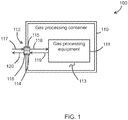
- FIG. 1 illustrates a gas processing system 100 according to an embodiment of the invention.
- the gas processing system 100 includes a gas processing container 110 having stored therein gas processing equipment 111.
- a conduit seal assembly 112 is located in a first wall 110a of the gas processing container 110.
- the gas processing container 110 includes additional walls 110b, 110c, and 110d, as well as end walls that are omitted from FIG. 1 for purposes of description.
- the gas processing container 110 is a cube or a shape having a rectangular cross-section, but embodiments of the invention encompass gas processing containers 110 of any shape, including irregular shapes, spherical shapes, cylindrical shapes, or any other three-dimensional shape capable of defining a chamber 113 to maintain a fluid-tight seal of the chamber 113.
- the gas processing container 110 is configured to maintain a fluid-tight seal while the cavity 113 is at an internal pressure of 500 millibars (mbar) or more. In some embodiments, the gas processing container 110 is configured to maintain an air-tight seal, although embodiments encompass any fluid-tight seal, such as a seal sufficient to withstand a gas purge, such as a nitrogen gas purge, of the cavity 113.
- the conduit seal assembly 112 includes an external conduit 114 a first inner conduit 115 and a second inner conduit 116.
- the inner conduits 115 and 116 are provided by way of example, and embodiments of the invention are not limited to two inner conduits 115 and 116. Instead, embodiments of the invention encompass any number of inner conduits, from zero inner conduits to three or more.
- insulated wiring may extend through the outer conduit 114 without any inner conduit.
- one of the inner conduits 115 and 116 may have wiring pass through an inner channel defined by the conduit 115 or 116, and the conduit 115 or 116 may be filled with a sealant to maintain the seal in the gas processing container 110.
- the outer conduit 114 and inner conduits 115 and 116 may be formed of any material, according to the design requirements of the gas processing system 100.
- the outer conduit 114 and inner conduits 115 and 116 may be made of metals, plastics, polymers and composites.
- one or more of the outer conduit 114 and inner conduits 115 and 116 is made of carbon steel, stainless steel, or a combination of carbon steel and stainless steel.
- the outer conduit 114 is a tube, although embodiments of the invention encompass any structure having openings at the ends to permit conduits, wires, or other structures to pass through a channel defined by the outer conduit 114.
- the inner conduits 115 and 116 may be tubes of any other shape that permits passage of wiring, fluids, or other materials through a channel defined by the inner conduits 115 and 116.
- the first inner conduit 115 receives a fluid from a first transmission path 117 and passes the fluid to the gas processing equipment 111 via a second transmission path 118.
- the gas processing equipment 111 may output the fluid or another fluid via a third transmission path 119, and the second inner conduit 116 may transmit the fluid from the third transmission path 119 outside the gas processing container 110 via a fourth transmission path 120.
- the fluid may include a coolant, a refrigerant, a heating fluid, a lubricant, methane gas, natural gas, liquid natural gas, liquid methane, propane, water, fuel, or any other fluid.
- the first, second, third, and fourth transmission paths 117, 118, 119, and 120 are pipes.
- the first, second, third, and fourth transmission paths 117, 118, 119, and 120 may be wires.
- the wires may pass through the first and second inner conduits 115 and 116.
- the first and second inner conduits are solid conductive materials or coils that are connected to wires, such that the wires do not pass through the first and second inner conduits 115 and 116, but instead the first and second inner conduits 115 and 116 relay power or signals into and out from the gas processing container 110.
- the walls 110a to 110d of the gas processing container 110 are made of materials capable of resisting blasts, extreme high temperatures, and extreme low temperatures.
- the walls 110a to 110d may include an inner wall and an outer wall, the inner walls may be formed of materials capable of resisting extreme cold, such as cryogenic, temperatures, and the outer walls may be formed of materials capable of resisting extreme heat, such as combustion temperatures.
- the outer walls may also be formed of materials capable of resisting one or more of blast pressures and corrosion, such as salt corrosion.
- FIG. 2 illustrates a container penetration region 200, where the conduit seal assembly 210 penetrates the wall 227 of the gas processing container.
- the conduit seal assembly 210 corresponds to the conduit seal assembly 112 of FIG. 1 .
- the conduit seal assembly 210 penetrates the wall 227 and extends onto both sides of the wall 227.
- An insulation layer 228 may be located on an inside surface of the wall 227.
- the conduit seal assembly 210 includes a first section 211 and a second section 212, connected at a flange section 219. The first second 211 and the second section 212 together form an outer conduit 211/212.
- the first section 211 and the second section 212 are co-axial, such that inside surfaces of the first and second sections 211 and 212 are substantially flush and co-planar with each other.
- the first section 211 is made of a first material and the second section 212 is made of a second material.
- the first material may be a material that is resistant to physical shock and corrosion, and the second material may be resistant to cold.
- the first material is carbon steel and the second material is stainless steel.
- the insulation layer 228 has a thickness sufficient to cover the portion of the first section 211 that extends into the gas processing container.
- the conduit seal assembly 210 includes a first seal 213 at a first end of the outer conduit 211/212 and a second seal 214 at a second end of the outer conduit 211/212.
- the first and second seals 213 and 214 and the outer conduit 211/212 define a cavity 216.
- the first and second seals 213 and 214 maintain a fluid-tight seal in the cavity 216.
- the first seal 213 is configured to resist a first range of temperatures and the second seal 214 is configured to resist a second range of temperatures that is lower than the first temperature or range of temperatures.
- the first range of temperatures includes temperatures from around 1500 degrees Celsius and above, and the second range of temperatures includes temperatures from around -150 degrees Celsius and below.
- the first range of temperatures includes a range of temperatures around 1700 degrees Celsius
- the second range of temperatures includes temperatures around -170 degrees Celsius.
- the first seal 213 is configured to resists temperatures corresponding to explosions, flame, or other combustion events
- the second seal is made of a material for resisting cold, such as refrigerated air or gas or other cold fluids, including cryogenic fluids.
- the first seal 213 is further made of a material capable of resisting (or maintaining the fluid-tight seal upon being subjected to) explosive pressures
- the second seal is made of a material capable of resisting (or maintaining the fluid-tight seal upon being subjected to) a pressurized internal chamber.
- the first seal 213 is configured to resist an external pressure of around 1 gauge bar (barg), and the second seal 214 is configured to resists an internal pressure of around 500 mbars.
- the first seal 213 is configured to resist an external pressure (or pressure from an atmosphere outside the gas processing container 110) of 1 gauge bar (barg) or more
- the second seal 214 is configured to resist an internal pressure (or pressure inside the gas processing container 110) of 500 mbars or more.
- the second seal 214 is configured to resist an internal pressure of 500 mbar or more.
- the duration at which the internal pressure is 500 mbar or more is a spike or short-term duration, and the second seal 214 is configured to withstand a sustained internal pressure of around 25 mbar.
- the first and second seals 213 and 214 are arranged inside the outer conduit 211/212, such that the first and second seals 213 and 214 contact the inside surface of the outer conduit 211/212 to form the fluid-tight seal in the cavity 216.
- the first and second seals 213 and 214 are affixed to the inside surface of the outer conduit 211/212 with an adhesive, such as a glue, tape, or any other adhesive.
- the first and second seals 213 and 214 are pre-fabricated articles, such as a disc or annulus, that is positioned inside the outer conduit 211/212.
- the first and second seals 213 and 214 are made up of a material that is applied in a liquid or semi-liquid form and hardens or sets to form the first and second seals 213 and 214.
- the second seal 214 is made up of a non-cross-linked, non-crystalline, monolithic viscous polymer-based material having visco-elastic properties in the expected temperature range of operation.
- the expected temperature range of operation includes cryogenic temperatures of -150 degrees Celsius or less.
- Such materials include visco-elastic sealing pastes, tapes, or pre-fabricated sealing articles.
- the conduit seal assembly 210 includes an inner conduit 215 that extends axially through the cavity 216 of the outer conduit 211/212.
- the first and second seals 213 and 214 form a seal with the inner conduit 215.
- the first and second seals 213 and 214 are made of a flexible material to maintain the fluid-tight seal in the cavity 216 when one or more of the wall 227, the outer conduit 211/212, and the inner conduit 215 bends, shifts, or moves.
- the inner conduit 215 may shift due to externally-applied forces, so that the inner conduit 215 is arranged at an angle with respect to the center axis of the outer conduit 211/212.
- the seals 213 and 214 bend to conform to the arrangement of the inner conduit 215 to maintain the fluid-tight seal in the cavity 216.
- first and second seals 213 and 214 capable of flexing, compressing, and expanding to maintain a fluid-tight seal based on the outer conduit 211/212 bending or shifting.
- a wire 218 passes through the inner conduit 215, and a sealing material 218 fills the space in the inner conduit that surrounds the wire 217 to maintain a fluid-tight seal in the gas processing container.
- a sealing material 218 fills the space in the inner conduit that surrounds the wire 217 to maintain a fluid-tight seal in the gas processing container.
- embodiments of the invention are not limited to conduits that have wires running through them, but also fluids or any other structures.
- the conduit seal assembly 210 also includes an external boot 225 to further seal and protect the first end of the outer conduit 211/212, and an internal boot 226 to further seal and protect the second end of the outer conduit 211/212.
- the external boot 225 may be formed of a flexible material capable of resisting heat and explosive pressures.
- the internal boot 226 may be formed of a flexible material capable of resisting cold and increased internal pressures.
- the internal boot 226 is made of a material that maintains flexibility in a cryogenic temperature range of approximately -150 degrees Celsius or less.
- Example materials include qualified composite fabrics, low density foams, aerogel, or any other type of flexible blanket material.
- the boots 225 and 226 are pre-fabricated articles having substantially bell-shaped outer surfaces, or having surfaces confirming to a shape of the outer conduit 211/212 that are attached to the outer conduit 211/212 after positioning or forming the first and second seals 213 and 214 in the outer conduit 211/212.
- the conduit seal assembly 210 further includes a monitoring assembly 220 to monitor characteristics inside the cavity 216.
- the monitoring assembly 220 includes an outlet 221 to bleed atmosphere from inside the cavity 216, a sensor 222, a valve 223, and a venting conduit 224 to vent fluid from inside the cavity 216.
- the sensor 222 may be any type of sensor, including a temperature sensor, a pressure sensor, a strain sensor, an optical sensor, or any other type of sensor.
- the sensor 222 is located outside the chamber 113 defined by the gas processing container 110 of FIG. 1 , and outside the cavity 216 of the outer conduit 211/212.
- the valve 223 may be controlled by the sensor 222, or by a controller, including a processor, that receives sensor data from the sensor 222, analyzes the sensor data, and generates a control signal to control the valve 223 to control the flow of fluid out from the cavity 216.
- monitoring assembly 220 is illustrated with the outlet 221, sensor 222, valve 223 and venting conduit 224, embodiments of the invention encompass any configuration of a monitoring assembly, including only a sensor that is located on an outside surface of the outer conduit 211/212, inside the cavity 216, or extending into the cavity 216 from outside the outer conduit 211/212. In other words, embodiments of the invention encompass a monitoring unit having the valve 223 and venting conduit 224 omitted.
- the monitoring assembly 220 is located on or in the first section 211 of the outer conduit 211/212.
- embodiments of the invention are not limited to this configuration.
- the senor 222 may be a temperature sensor and the presence of a leak in the cavity 216 may be detected by sensing a decrease in temperature in the fluid entering the outlet 221 from the cavity 216, indicating the leaking of fluid into the cavity 216 from the chamber 113 defined by the gas processing container 110 of FIG. 1 . Conversely, an increase in temperature in the cavity 216 may indicate a leaking of a fluid through the first seal 213 from an atmosphere outside the cavity 216. While a few examples of sensors have been provided, embodiments of the invention encompass any sensor capable of sensing a characteristic inside the chamber 216 for any purpose.
- FIG. 3 illustrates a container penetration region 300 according to another embodiment.
- the container penetration region 300 is similar to the container penetration region 200 of FIG. 2 , except instead of being formed of two sections 211 and 212, the conduit seal assembly 310 includes an outer conduit 311 formed of only one segment.
- the entire outer conduit 311 is formed of a cold-resistant material, such as stainless steel.
Landscapes
- Engineering & Computer Science (AREA)
- General Engineering & Computer Science (AREA)
- Mechanical Engineering (AREA)
- Physics & Mathematics (AREA)
- Thermal Sciences (AREA)
- Filling Or Discharging Of Gas Storage Vessels (AREA)
- Gasket Seals (AREA)
Claims (3)
- Leitungsdichtungsanordnung, umfassend:eine äußere Leitung (211, 212) mit einem ersten Ende mit einer ersten Öffnung und einem zweiten Ende gegenüber dem ersten Ende, mit einer zweiten Öffnung;eine erste Dichtung (213) in der ersten Öffnung, um einer ersten Temperatur zu widerstehen;eine zweite Dichtung (214) in der zweiten Öffnung, um einer zweiten Temperatur zu widerstehen, wobei die ersten und zweiten Dichtungen einen Hohlraum (216) definieren und eine luftdichte Dichtung des Hohlraums liefern;
undeine den Hohlraum überwachende Anordnung (220), die konfiguriert ist, um ein Merkmal in dem Hohlraum zu erfassen, wie das Erfassen einer Leckage in dem Hohlraum, wobei die den Hohlraum überwachende Anordnung wahlweise einen in dem Hohlraum angeordneten Sensor einschließt, wobei die den Hohlraum überwachende Anordnung sich wahlweise durch eine Wand der äußeren Leitung erstreckt;dadurch gekennzeichnet, dass:die erste Dichtung (213) zum Widerstehen einer Temperatur von ungefähr 1000 Grad Celsius besteht;die zweite Dichtung (214) aus einem nicht vernetztem, nicht kristallinen, monolithischen zähflüssigen, auf Polymer beruhenden Material mit visko-elastischen Eigenschaften in einem erwarteten Temperaturbetriebsbereich von -170 Grad Celsius bis -150 Grad Celsius hergestellt ist; undein äußerer Balg (225) vorgesehen ist, um das erste Ende der äußeren Leitung weiter abzudichten und zu schützen, und ein weiterer innerer Balg (226) vorgesehen ist, um das zweite Ende der äußeren Leitung weiter abzudichten und zu schützen. - Leitungsdichtungsanordnung nach Anspruch 1, weiter umfassend eine innere Leitung (215), die sich durch die erste Öffnung und die zweite Öffnung erstreckt, wobei die ersten und zweiten Dichtungen (213, 214) die innere Leitung umgeben, um die luftdichte Dichtung zu erhalten.
- Leitungsdichtungsanordnung nach Anspruch 1, wobei die äußere Leitung (211, 212) ein erstes Teil und ein zweites Teil einschließt, das axial mit dem ersten Teil ausgerichtet ist, so dass die ersten und zweiten Teile zusammen äußere Wände des Hohlraums definieren, wobei das erste Teil Edelstahl umfasst und das zweite Teil eines von Kohlenstoff und Edelstahl umfasst.
Applications Claiming Priority (2)
| Application Number | Priority Date | Filing Date | Title |
|---|---|---|---|
| US201361921126P | 2013-12-27 | 2013-12-27 | |
| PCT/US2014/069765 WO2015100024A2 (en) | 2013-12-27 | 2014-12-11 | Conduit seal assembly |
Publications (3)
| Publication Number | Publication Date |
|---|---|
| EP3087299A2 EP3087299A2 (de) | 2016-11-02 |
| EP3087299A4 EP3087299A4 (de) | 2017-03-22 |
| EP3087299B1 true EP3087299B1 (de) | 2018-06-06 |
Family
ID=56979731
Family Applications (1)
| Application Number | Title | Priority Date | Filing Date |
|---|---|---|---|
| EP14875259.5A Active EP3087299B1 (de) | 2013-12-27 | 2014-12-11 | Leitungsdichtungsanordnung |
Country Status (2)
| Country | Link |
|---|---|
| EP (1) | EP3087299B1 (de) |
| ES (1) | ES2678946T3 (de) |
Cited By (1)
| Publication number | Priority date | Publication date | Assignee | Title |
|---|---|---|---|---|
| WO2025087943A1 (de) * | 2023-10-24 | 2025-05-01 | R. Stahl Schaltgeräte GmbH | Gasabführvorrichtung für eine elektrische leitung sowie system mit einer solchen gasabführvorrichtung |
Family Cites Families (4)
| Publication number | Priority date | Publication date | Assignee | Title |
|---|---|---|---|---|
| US4658847A (en) * | 1985-07-09 | 1987-04-21 | The Fluorocarbon Company | Bimetallic C-ring seal |
| GB2217871A (en) * | 1988-04-28 | 1989-11-01 | Stc Plc | Optical fibre seals in walls of a chamber |
| US7425381B2 (en) * | 2003-01-13 | 2008-09-16 | Hewlett-Packard Development Company, L.P. | High temperature seal |
| EP1675241A1 (de) * | 2004-12-23 | 2006-06-28 | MAN Turbomaschinen AG Schweiz | Fluiddichte Leitungsdurchführung |
-
2014
- 2014-12-11 ES ES14875259.5T patent/ES2678946T3/es active Active
- 2014-12-11 EP EP14875259.5A patent/EP3087299B1/de active Active
Non-Patent Citations (1)
| Title |
|---|
| None * |
Cited By (1)
| Publication number | Priority date | Publication date | Assignee | Title |
|---|---|---|---|---|
| WO2025087943A1 (de) * | 2023-10-24 | 2025-05-01 | R. Stahl Schaltgeräte GmbH | Gasabführvorrichtung für eine elektrische leitung sowie system mit einer solchen gasabführvorrichtung |
Also Published As
| Publication number | Publication date |
|---|---|
| EP3087299A2 (de) | 2016-11-02 |
| ES2678946T3 (es) | 2018-08-21 |
| EP3087299A4 (de) | 2017-03-22 |
Similar Documents
| Publication | Publication Date | Title |
|---|---|---|
| US20200132228A1 (en) | Conduit seal assembly | |
| US3942331A (en) | Cryogenic tank | |
| KR101959400B1 (ko) | 파이프를 포함하는 탱크 벽 | |
| US8807382B1 (en) | Storage system having flexible vacuum jacket | |
| CN104755827B (zh) | 用于容纳承压寒冷液体的密封绝缘容器 | |
| US20090014163A1 (en) | Temperature Controlled Pipe Systems And Methods | |
| KR102111473B1 (ko) | 진공 단열 배관 | |
| KR20040019044A (ko) | 튜브 본체를 단열시키기 위한 시스템 | |
| US7305837B2 (en) | Cryogenic piping system | |
| RU2379643C2 (ru) | Система для контроля герметичности эвакуированного пространства | |
| EP3087299B1 (de) | Leitungsdichtungsanordnung | |
| EP1784608A2 (de) | Tieftemperaturpipeline-konfigurierungen und verfahren | |
| US3360001A (en) | Vacuum jacketed pipe line and joint construction therefor | |
| US11655809B2 (en) | Cryogenic pump flange | |
| RU2686646C1 (ru) | Криогенный трубопровод | |
| US10113682B2 (en) | Method and device for thermally insulating a piece of equipment | |
| CN212407990U (zh) | 用于高低温复合型设备的保温结构及高低温复合型设备 | |
| US20080265564A1 (en) | Multi-chamber vacuum insulated pipe systems and methods | |
| KR102499089B1 (ko) | 극저온 가스용 플랜지 결합부의 단열구조 | |
| CN113819316A (zh) | 高真空型整体吸附式绝热双壁管 | |
| RU2841448C9 (ru) | Криогенная трубопроводная система | |
| Fesmire | Layered thermal insulation systems for industrial and commercial applications | |
| CN117570356A (zh) | 一种液氢储氢瓶壳体轻量化结构及制造方法 | |
| WO2024241280A1 (en) | A hazardous fluid isolation system | |
| EP1907205A1 (de) | Mehrlagiger schlauch zum befördern eines kühlfluids |
Legal Events
| Date | Code | Title | Description |
|---|---|---|---|
| PUAI | Public reference made under article 153(3) epc to a published international application that has entered the european phase |
Free format text: ORIGINAL CODE: 0009012 |
|
| 17P | Request for examination filed |
Effective date: 20160704 |
|
| AK | Designated contracting states |
Kind code of ref document: A2 Designated state(s): AL AT BE BG CH CY CZ DE DK EE ES FI FR GB GR HR HU IE IS IT LI LT LU LV MC MK MT NL NO PL PT RO RS SE SI SK SM TR |
|
| AX | Request for extension of the european patent |
Extension state: BA ME |
|
| A4 | Supplementary search report drawn up and despatched |
Effective date: 20170217 |
|
| RIC1 | Information provided on ipc code assigned before grant |
Ipc: F16L 5/02 20060101AFI20170213BHEP Ipc: F25J 3/06 20060101ALI20170213BHEP Ipc: F25J 3/04 20060101ALI20170213BHEP Ipc: F25J 1/02 20060101ALI20170213BHEP Ipc: F25J 3/02 20060101ALI20170213BHEP |
|
| STAA | Information on the status of an ep patent application or granted ep patent |
Free format text: STATUS: EXAMINATION IS IN PROGRESS |
|
| 17Q | First examination report despatched |
Effective date: 20170327 |
|
| GRAP | Despatch of communication of intention to grant a patent |
Free format text: ORIGINAL CODE: EPIDOSNIGR1 |
|
| STAA | Information on the status of an ep patent application or granted ep patent |
Free format text: STATUS: GRANT OF PATENT IS INTENDED |
|
| INTG | Intention to grant announced |
Effective date: 20180126 |
|
| GRAS | Grant fee paid |
Free format text: ORIGINAL CODE: EPIDOSNIGR3 |
|
| GRAA | (expected) grant |
Free format text: ORIGINAL CODE: 0009210 |
|
| STAA | Information on the status of an ep patent application or granted ep patent |
Free format text: STATUS: THE PATENT HAS BEEN GRANTED |
|
| AK | Designated contracting states |
Kind code of ref document: B1 Designated state(s): AL AT BE BG CH CY CZ DE DK EE ES FI FR GB GR HR HU IE IS IT LI LT LU LV MC MK MT NL NO PL PT RO RS SE SI SK SM TR |
|
| AX | Request for extension of the european patent |
Extension state: BA ME |
|
| REG | Reference to a national code |
Ref country code: GB Ref legal event code: FG4D |
|
| REG | Reference to a national code |
Ref country code: CH Ref legal event code: EP Ref country code: AT Ref legal event code: REF Ref document number: 1006464 Country of ref document: AT Kind code of ref document: T Effective date: 20180615 |
|
| REG | Reference to a national code |
Ref country code: IE Ref legal event code: FG4D |
|
| REG | Reference to a national code |
Ref country code: DE Ref legal event code: R096 Ref document number: 602014026825 Country of ref document: DE |
|
| REG | Reference to a national code |
Ref country code: ES Ref legal event code: FG2A Ref document number: 2678946 Country of ref document: ES Kind code of ref document: T3 Effective date: 20180821 |
|
| REG | Reference to a national code |
Ref country code: NL Ref legal event code: MP Effective date: 20180606 |
|
| REG | Reference to a national code |
Ref country code: LT Ref legal event code: MG4D |
|
| PG25 | Lapsed in a contracting state [announced via postgrant information from national office to epo] |
Ref country code: CY Free format text: LAPSE BECAUSE OF FAILURE TO SUBMIT A TRANSLATION OF THE DESCRIPTION OR TO PAY THE FEE WITHIN THE PRESCRIBED TIME-LIMIT Effective date: 20180606 Ref country code: LT Free format text: LAPSE BECAUSE OF FAILURE TO SUBMIT A TRANSLATION OF THE DESCRIPTION OR TO PAY THE FEE WITHIN THE PRESCRIBED TIME-LIMIT Effective date: 20180606 Ref country code: FI Free format text: LAPSE BECAUSE OF FAILURE TO SUBMIT A TRANSLATION OF THE DESCRIPTION OR TO PAY THE FEE WITHIN THE PRESCRIBED TIME-LIMIT Effective date: 20180606 Ref country code: BG Free format text: LAPSE BECAUSE OF FAILURE TO SUBMIT A TRANSLATION OF THE DESCRIPTION OR TO PAY THE FEE WITHIN THE PRESCRIBED TIME-LIMIT Effective date: 20180906 Ref country code: NO Free format text: LAPSE BECAUSE OF FAILURE TO SUBMIT A TRANSLATION OF THE DESCRIPTION OR TO PAY THE FEE WITHIN THE PRESCRIBED TIME-LIMIT Effective date: 20180906 Ref country code: SE Free format text: LAPSE BECAUSE OF FAILURE TO SUBMIT A TRANSLATION OF THE DESCRIPTION OR TO PAY THE FEE WITHIN THE PRESCRIBED TIME-LIMIT Effective date: 20180606 |
|
| PG25 | Lapsed in a contracting state [announced via postgrant information from national office to epo] |
Ref country code: HR Free format text: LAPSE BECAUSE OF FAILURE TO SUBMIT A TRANSLATION OF THE DESCRIPTION OR TO PAY THE FEE WITHIN THE PRESCRIBED TIME-LIMIT Effective date: 20180606 Ref country code: RS Free format text: LAPSE BECAUSE OF FAILURE TO SUBMIT A TRANSLATION OF THE DESCRIPTION OR TO PAY THE FEE WITHIN THE PRESCRIBED TIME-LIMIT Effective date: 20180606 Ref country code: LV Free format text: LAPSE BECAUSE OF FAILURE TO SUBMIT A TRANSLATION OF THE DESCRIPTION OR TO PAY THE FEE WITHIN THE PRESCRIBED TIME-LIMIT Effective date: 20180606 Ref country code: GR Free format text: LAPSE BECAUSE OF FAILURE TO SUBMIT A TRANSLATION OF THE DESCRIPTION OR TO PAY THE FEE WITHIN THE PRESCRIBED TIME-LIMIT Effective date: 20180907 |
|
| REG | Reference to a national code |
Ref country code: AT Ref legal event code: MK05 Ref document number: 1006464 Country of ref document: AT Kind code of ref document: T Effective date: 20180606 |
|
| PG25 | Lapsed in a contracting state [announced via postgrant information from national office to epo] |
Ref country code: NL Free format text: LAPSE BECAUSE OF FAILURE TO SUBMIT A TRANSLATION OF THE DESCRIPTION OR TO PAY THE FEE WITHIN THE PRESCRIBED TIME-LIMIT Effective date: 20180606 |
|
| PG25 | Lapsed in a contracting state [announced via postgrant information from national office to epo] |
Ref country code: AT Free format text: LAPSE BECAUSE OF FAILURE TO SUBMIT A TRANSLATION OF THE DESCRIPTION OR TO PAY THE FEE WITHIN THE PRESCRIBED TIME-LIMIT Effective date: 20180606 Ref country code: PL Free format text: LAPSE BECAUSE OF FAILURE TO SUBMIT A TRANSLATION OF THE DESCRIPTION OR TO PAY THE FEE WITHIN THE PRESCRIBED TIME-LIMIT Effective date: 20180606 Ref country code: RO Free format text: LAPSE BECAUSE OF FAILURE TO SUBMIT A TRANSLATION OF THE DESCRIPTION OR TO PAY THE FEE WITHIN THE PRESCRIBED TIME-LIMIT Effective date: 20180606 Ref country code: SK Free format text: LAPSE BECAUSE OF FAILURE TO SUBMIT A TRANSLATION OF THE DESCRIPTION OR TO PAY THE FEE WITHIN THE PRESCRIBED TIME-LIMIT Effective date: 20180606 Ref country code: CZ Free format text: LAPSE BECAUSE OF FAILURE TO SUBMIT A TRANSLATION OF THE DESCRIPTION OR TO PAY THE FEE WITHIN THE PRESCRIBED TIME-LIMIT Effective date: 20180606 Ref country code: IS Free format text: LAPSE BECAUSE OF FAILURE TO SUBMIT A TRANSLATION OF THE DESCRIPTION OR TO PAY THE FEE WITHIN THE PRESCRIBED TIME-LIMIT Effective date: 20181006 Ref country code: EE Free format text: LAPSE BECAUSE OF FAILURE TO SUBMIT A TRANSLATION OF THE DESCRIPTION OR TO PAY THE FEE WITHIN THE PRESCRIBED TIME-LIMIT Effective date: 20180606 |
|
| PG25 | Lapsed in a contracting state [announced via postgrant information from national office to epo] |
Ref country code: SM Free format text: LAPSE BECAUSE OF FAILURE TO SUBMIT A TRANSLATION OF THE DESCRIPTION OR TO PAY THE FEE WITHIN THE PRESCRIBED TIME-LIMIT Effective date: 20180606 |
|
| REG | Reference to a national code |
Ref country code: DE Ref legal event code: R097 Ref document number: 602014026825 Country of ref document: DE |
|
| PLBE | No opposition filed within time limit |
Free format text: ORIGINAL CODE: 0009261 |
|
| STAA | Information on the status of an ep patent application or granted ep patent |
Free format text: STATUS: NO OPPOSITION FILED WITHIN TIME LIMIT |
|
| RAP2 | Party data changed (patent owner data changed or rights of a patent transferred) |
Owner name: CONOCOPHILLIPS COMPANY |
|
| 26N | No opposition filed |
Effective date: 20190307 |
|
| PG25 | Lapsed in a contracting state [announced via postgrant information from national office to epo] |
Ref country code: SI Free format text: LAPSE BECAUSE OF FAILURE TO SUBMIT A TRANSLATION OF THE DESCRIPTION OR TO PAY THE FEE WITHIN THE PRESCRIBED TIME-LIMIT Effective date: 20180606 Ref country code: DK Free format text: LAPSE BECAUSE OF FAILURE TO SUBMIT A TRANSLATION OF THE DESCRIPTION OR TO PAY THE FEE WITHIN THE PRESCRIBED TIME-LIMIT Effective date: 20180606 |
|
| REG | Reference to a national code |
Ref country code: CH Ref legal event code: PL |
|
| GBPC | Gb: european patent ceased through non-payment of renewal fee |
Effective date: 20181211 |
|
| PG25 | Lapsed in a contracting state [announced via postgrant information from national office to epo] |
Ref country code: LU Free format text: LAPSE BECAUSE OF NON-PAYMENT OF DUE FEES Effective date: 20181211 Ref country code: MC Free format text: LAPSE BECAUSE OF FAILURE TO SUBMIT A TRANSLATION OF THE DESCRIPTION OR TO PAY THE FEE WITHIN THE PRESCRIBED TIME-LIMIT Effective date: 20180606 |
|
| REG | Reference to a national code |
Ref country code: IE Ref legal event code: MM4A |
|
| REG | Reference to a national code |
Ref country code: BE Ref legal event code: MM Effective date: 20181231 |
|
| PG25 | Lapsed in a contracting state [announced via postgrant information from national office to epo] |
Ref country code: IE Free format text: LAPSE BECAUSE OF NON-PAYMENT OF DUE FEES Effective date: 20181211 |
|
| PG25 | Lapsed in a contracting state [announced via postgrant information from national office to epo] |
Ref country code: BE Free format text: LAPSE BECAUSE OF NON-PAYMENT OF DUE FEES Effective date: 20181231 Ref country code: AL Free format text: LAPSE BECAUSE OF FAILURE TO SUBMIT A TRANSLATION OF THE DESCRIPTION OR TO PAY THE FEE WITHIN THE PRESCRIBED TIME-LIMIT Effective date: 20180606 |
|
| PG25 | Lapsed in a contracting state [announced via postgrant information from national office to epo] |
Ref country code: GB Free format text: LAPSE BECAUSE OF NON-PAYMENT OF DUE FEES Effective date: 20181211 Ref country code: LI Free format text: LAPSE BECAUSE OF NON-PAYMENT OF DUE FEES Effective date: 20181231 Ref country code: CH Free format text: LAPSE BECAUSE OF NON-PAYMENT OF DUE FEES Effective date: 20181231 |
|
| PG25 | Lapsed in a contracting state [announced via postgrant information from national office to epo] |
Ref country code: MT Free format text: LAPSE BECAUSE OF NON-PAYMENT OF DUE FEES Effective date: 20181211 |
|
| PG25 | Lapsed in a contracting state [announced via postgrant information from national office to epo] |
Ref country code: TR Free format text: LAPSE BECAUSE OF FAILURE TO SUBMIT A TRANSLATION OF THE DESCRIPTION OR TO PAY THE FEE WITHIN THE PRESCRIBED TIME-LIMIT Effective date: 20180606 |
|
| PG25 | Lapsed in a contracting state [announced via postgrant information from national office to epo] |
Ref country code: PT Free format text: LAPSE BECAUSE OF FAILURE TO SUBMIT A TRANSLATION OF THE DESCRIPTION OR TO PAY THE FEE WITHIN THE PRESCRIBED TIME-LIMIT Effective date: 20180606 |
|
| PG25 | Lapsed in a contracting state [announced via postgrant information from national office to epo] |
Ref country code: HU Free format text: LAPSE BECAUSE OF FAILURE TO SUBMIT A TRANSLATION OF THE DESCRIPTION OR TO PAY THE FEE WITHIN THE PRESCRIBED TIME-LIMIT; INVALID AB INITIO Effective date: 20141211 Ref country code: MK Free format text: LAPSE BECAUSE OF NON-PAYMENT OF DUE FEES Effective date: 20180606 |
|
| PGFP | Annual fee paid to national office [announced via postgrant information from national office to epo] |
Ref country code: DE Payment date: 20251126 Year of fee payment: 12 |
|
| PGFP | Annual fee paid to national office [announced via postgrant information from national office to epo] |
Ref country code: IT Payment date: 20251119 Year of fee payment: 12 |
|
| PGFP | Annual fee paid to national office [announced via postgrant information from national office to epo] |
Ref country code: FR Payment date: 20251120 Year of fee payment: 12 |
|
| PGFP | Annual fee paid to national office [announced via postgrant information from national office to epo] |
Ref country code: ES Payment date: 20260102 Year of fee payment: 12 |