EP3087069B1 - Compounds useful as ccr9 modulators - Google Patents
Compounds useful as ccr9 modulators Download PDFInfo
- Publication number
- EP3087069B1 EP3087069B1 EP14820864.8A EP14820864A EP3087069B1 EP 3087069 B1 EP3087069 B1 EP 3087069B1 EP 14820864 A EP14820864 A EP 14820864A EP 3087069 B1 EP3087069 B1 EP 3087069B1
- Authority
- EP
- European Patent Office
- Prior art keywords
- compound
- solvate
- salt
- optionally substituted
- formula
- Prior art date
- Legal status (The legal status is an assumption and is not a legal conclusion. Google has not performed a legal analysis and makes no representation as to the accuracy of the status listed.)
- Active
Links
- 150000001875 compounds Chemical class 0.000 title claims description 443
- 150000003839 salts Chemical class 0.000 claims description 93
- -1 acetylphenyl Chemical group 0.000 claims description 84
- 239000012453 solvate Substances 0.000 claims description 83
- 229910052739 hydrogen Inorganic materials 0.000 claims description 58
- 239000001257 hydrogen Substances 0.000 claims description 57
- 239000000203 mixture Substances 0.000 claims description 56
- 102100022718 Atypical chemokine receptor 2 Human genes 0.000 claims description 46
- 101000678892 Homo sapiens Atypical chemokine receptor 2 Proteins 0.000 claims description 46
- 101000716070 Homo sapiens C-C chemokine receptor type 9 Proteins 0.000 claims description 45
- 125000005843 halogen group Chemical group 0.000 claims description 37
- 125000002496 methyl group Chemical group [H]C([H])([H])* 0.000 claims description 37
- 208000037265 diseases, disorders, signs and symptoms Diseases 0.000 claims description 34
- 150000002431 hydrogen Chemical group 0.000 claims description 34
- 238000000034 method Methods 0.000 claims description 33
- 201000010099 disease Diseases 0.000 claims description 29
- ILVXOBCQQYKLDS-UHFFFAOYSA-N pyridine N-oxide Chemical compound [O-][N+]1=CC=CC=C1 ILVXOBCQQYKLDS-UHFFFAOYSA-N 0.000 claims description 28
- 125000001072 heteroaryl group Chemical group 0.000 claims description 26
- 125000004076 pyridyl group Chemical group 0.000 claims description 26
- YBBRCQOCSYXUOC-UHFFFAOYSA-N sulfuryl dichloride Chemical compound ClS(Cl)(=O)=O YBBRCQOCSYXUOC-UHFFFAOYSA-N 0.000 claims description 25
- 229940124530 sulfonamide Drugs 0.000 claims description 23
- 125000003226 pyrazolyl group Chemical group 0.000 claims description 19
- 150000003456 sulfonamides Chemical class 0.000 claims description 19
- 125000003107 substituted aryl group Chemical group 0.000 claims description 18
- XFXPMWWXUTWYJX-UHFFFAOYSA-N Cyanide Chemical compound N#[C-] XFXPMWWXUTWYJX-UHFFFAOYSA-N 0.000 claims description 17
- 238000011282 treatment Methods 0.000 claims description 17
- 125000002023 trifluoromethyl group Chemical group FC(F)(F)* 0.000 claims description 17
- UFHFLCQGNIYNRP-UHFFFAOYSA-N Hydrogen Chemical compound [H][H] UFHFLCQGNIYNRP-UHFFFAOYSA-N 0.000 claims description 16
- 125000004093 cyano group Chemical group *C#N 0.000 claims description 16
- 125000002883 imidazolyl group Chemical group 0.000 claims description 16
- 125000000999 tert-butyl group Chemical group [H]C([H])([H])C(*)(C([H])([H])[H])C([H])([H])[H] 0.000 claims description 16
- 208000011231 Crohn disease Diseases 0.000 claims description 14
- 229910052760 oxygen Inorganic materials 0.000 claims description 14
- CFZKDDTWZYUZKS-UHFFFAOYSA-N picoline N-oxide Chemical compound CC1=CC=CC=[N+]1[O-] CFZKDDTWZYUZKS-UHFFFAOYSA-N 0.000 claims description 14
- 230000004913 activation Effects 0.000 claims description 13
- 125000001309 chloro group Chemical group Cl* 0.000 claims description 13
- VIORKJSXLUIEHX-UHFFFAOYSA-N 2-ethoxy-1-oxidopyridin-1-ium Chemical compound CCOC1=CC=CC=[N+]1[O-] VIORKJSXLUIEHX-UHFFFAOYSA-N 0.000 claims description 12
- NYWWLAGHUMTSBB-UHFFFAOYSA-N 2-methoxy-1-oxidopyridin-1-ium Chemical compound COC1=CC=CC=[N+]1[O-] NYWWLAGHUMTSBB-UHFFFAOYSA-N 0.000 claims description 12
- 125000006384 methylpyridyl group Chemical group 0.000 claims description 12
- 125000001544 thienyl group Chemical group 0.000 claims description 12
- 125000000484 butyl group Chemical group [H]C([*])([H])C([H])([H])C([H])([H])C([H])([H])[H] 0.000 claims description 11
- 125000001495 ethyl group Chemical group [H]C([H])([H])C([H])([H])* 0.000 claims description 11
- 125000001153 fluoro group Chemical group F* 0.000 claims description 11
- 125000001424 substituent group Chemical group 0.000 claims description 11
- 230000002265 prevention Effects 0.000 claims description 10
- 125000001997 phenyl group Chemical group [H]C1=C([H])C([H])=C(*)C([H])=C1[H] 0.000 claims description 9
- 206010009900 Colitis ulcerative Diseases 0.000 claims description 8
- 201000006704 Ulcerative Colitis Diseases 0.000 claims description 8
- 125000004802 cyanophenyl group Chemical group 0.000 claims description 8
- CMPVUVUNJQERIT-UHFFFAOYSA-N tertiary sulfonamide Natural products CC(C)CC1=NC=CS1 CMPVUVUNJQERIT-UHFFFAOYSA-N 0.000 claims description 8
- 125000000876 trifluoromethoxy group Chemical group FC(F)(F)O* 0.000 claims description 8
- GQBONCZDJQXPLV-UHFFFAOYSA-N 4-aminoisoindole-1,3-dione Chemical compound NC1=CC=CC2=C1C(=O)NC2=O GQBONCZDJQXPLV-UHFFFAOYSA-N 0.000 claims description 7
- 208000026278 immune system disease Diseases 0.000 claims description 7
- 125000001449 isopropyl group Chemical group [H]C([H])([H])C([H])(*)C([H])([H])[H] 0.000 claims description 7
- 125000000956 methoxy group Chemical group [H]C([H])([H])O* 0.000 claims description 7
- 125000000714 pyrimidinyl group Chemical group 0.000 claims description 7
- 208000027866 inflammatory disease Diseases 0.000 claims description 6
- 125000002971 oxazolyl group Chemical group 0.000 claims description 6
- 229910052799 carbon Inorganic materials 0.000 claims description 5
- 125000000842 isoxazolyl group Chemical group 0.000 claims description 5
- XKJCHHZQLQNZHY-UHFFFAOYSA-N phthalimide Chemical compound C1=CC=C2C(=O)NC(=O)C2=C1 XKJCHHZQLQNZHY-UHFFFAOYSA-N 0.000 claims description 5
- 125000006273 (C1-C3) alkyl group Chemical group 0.000 claims description 4
- 125000006272 (C3-C7) cycloalkyl group Chemical group 0.000 claims description 4
- 150000008064 anhydrides Chemical class 0.000 claims description 4
- 125000001559 cyclopropyl group Chemical group [H]C1([H])C([H])([H])C1([H])* 0.000 claims description 4
- 125000004786 difluoromethoxy group Chemical group [H]C(F)(F)O* 0.000 claims description 4
- 238000002360 preparation method Methods 0.000 claims description 4
- 150000003141 primary amines Chemical class 0.000 claims description 4
- 125000000168 pyrrolyl group Chemical group 0.000 claims description 4
- 238000002560 therapeutic procedure Methods 0.000 claims description 4
- 125000004438 haloalkoxy group Chemical group 0.000 claims description 3
- 125000001188 haloalkyl group Chemical group 0.000 claims description 3
- 125000004170 methylsulfonyl group Chemical group [H]C([H])([H])S(*)(=O)=O 0.000 claims description 3
- 125000000449 nitro group Chemical group [O-][N+](*)=O 0.000 claims description 3
- 230000008569 process Effects 0.000 claims description 3
- 125000001436 propyl group Chemical group [H]C([*])([H])C([H])([H])C([H])([H])[H] 0.000 claims description 3
- 125000000335 thiazolyl group Chemical group 0.000 claims description 3
- 125000006583 (C1-C3) haloalkyl group Chemical group 0.000 claims description 2
- 125000006274 (C1-C3)alkoxy group Chemical group 0.000 claims description 2
- 125000004191 (C1-C6) alkoxy group Chemical group 0.000 claims description 2
- 125000004169 (C1-C6) alkyl group Chemical group 0.000 claims description 2
- 229910052736 halogen Inorganic materials 0.000 claims description 2
- 150000002367 halogens Chemical class 0.000 claims description 2
- 125000003253 isopropoxy group Chemical group [H]C([H])([H])C([H])(O*)C([H])([H])[H] 0.000 claims description 2
- 125000002572 propoxy group Chemical group [*]OC([H])([H])C(C([H])([H])[H])([H])[H] 0.000 claims description 2
- 125000005346 substituted cycloalkyl group Chemical group 0.000 claims description 2
- 125000000565 sulfonamide group Chemical group 0.000 claims 3
- 125000000467 secondary amino group Chemical class [H]N([*:1])[*:2] 0.000 claims 2
- IAZDPXIOMUYVGZ-WFGJKAKNSA-N Dimethyl sulfoxide Chemical compound [2H]C([2H])([2H])S(=O)C([2H])([2H])[2H] IAZDPXIOMUYVGZ-WFGJKAKNSA-N 0.000 description 638
- 238000005160 1H NMR spectroscopy Methods 0.000 description 360
- XEKOWRVHYACXOJ-UHFFFAOYSA-N Ethyl acetate Chemical compound CCOC(C)=O XEKOWRVHYACXOJ-UHFFFAOYSA-N 0.000 description 294
- QTBSBXVTEAMEQO-UHFFFAOYSA-N Acetic acid Chemical compound CC(O)=O QTBSBXVTEAMEQO-UHFFFAOYSA-N 0.000 description 258
- 239000011541 reaction mixture Substances 0.000 description 190
- 239000000243 solution Substances 0.000 description 173
- 230000002829 reductive effect Effects 0.000 description 154
- 230000015572 biosynthetic process Effects 0.000 description 142
- 238000003786 synthesis reaction Methods 0.000 description 142
- YMWUJEATGCHHMB-UHFFFAOYSA-N Dichloromethane Chemical compound ClCCl YMWUJEATGCHHMB-UHFFFAOYSA-N 0.000 description 123
- LFQSCWFLJHTTHZ-UHFFFAOYSA-N Ethanol Chemical compound CCO LFQSCWFLJHTTHZ-UHFFFAOYSA-N 0.000 description 101
- 239000007787 solid Substances 0.000 description 92
- VLKZOEOYAKHREP-UHFFFAOYSA-N n-Hexane Chemical compound CCCCCC VLKZOEOYAKHREP-UHFFFAOYSA-N 0.000 description 87
- 239000007832 Na2SO4 Substances 0.000 description 80
- PMZURENOXWZQFD-UHFFFAOYSA-L Sodium Sulfate Chemical compound [Na+].[Na+].[O-]S([O-])(=O)=O PMZURENOXWZQFD-UHFFFAOYSA-L 0.000 description 80
- 229910052938 sodium sulfate Inorganic materials 0.000 description 80
- XLYOFNOQVPJJNP-UHFFFAOYSA-N water Substances O XLYOFNOQVPJJNP-UHFFFAOYSA-N 0.000 description 77
- JUJWROOIHBZHMG-UHFFFAOYSA-N Pyridine Chemical compound C1=CC=NC=C1 JUJWROOIHBZHMG-UHFFFAOYSA-N 0.000 description 62
- 239000012044 organic layer Substances 0.000 description 61
- 239000012267 brine Substances 0.000 description 49
- HPALAKNZSZLMCH-UHFFFAOYSA-M sodium;chloride;hydrate Chemical compound O.[Na+].[Cl-] HPALAKNZSZLMCH-UHFFFAOYSA-M 0.000 description 49
- OKKJLVBELUTLKV-UHFFFAOYSA-N Methanol Chemical compound OC OKKJLVBELUTLKV-UHFFFAOYSA-N 0.000 description 45
- UIIMBOGNXHQVGW-UHFFFAOYSA-M Sodium bicarbonate Chemical compound [Na+].OC([O-])=O UIIMBOGNXHQVGW-UHFFFAOYSA-M 0.000 description 42
- 239000010410 layer Substances 0.000 description 42
- 239000012043 crude product Substances 0.000 description 39
- 238000004440 column chromatography Methods 0.000 description 31
- 239000003960 organic solvent Substances 0.000 description 31
- UMJSCPRVCHMLSP-UHFFFAOYSA-N pyridine Natural products COC1=CC=CN=C1 UMJSCPRVCHMLSP-UHFFFAOYSA-N 0.000 description 31
- 0 *c1cc(S(Nc(cccc2C(N3c4cnccc4)=O)c2C3=O)(=O)=O)ccc1 Chemical compound *c1cc(S(Nc(cccc2C(N3c4cnccc4)=O)c2C3=O)(=O)=O)ccc1 0.000 description 30
- YEZADZMMVHWFIY-UHFFFAOYSA-N 4-tert-butylbenzenesulfonyl chloride Chemical compound CC(C)(C)C1=CC=C(S(Cl)(=O)=O)C=C1 YEZADZMMVHWFIY-UHFFFAOYSA-N 0.000 description 28
- 208000022559 Inflammatory bowel disease Diseases 0.000 description 28
- VYPSYNLAJGMNEJ-UHFFFAOYSA-N Silicium dioxide Chemical compound O=[Si]=O VYPSYNLAJGMNEJ-UHFFFAOYSA-N 0.000 description 28
- WEVYAHXRMPXWCK-UHFFFAOYSA-N Acetonitrile Chemical compound CC#N WEVYAHXRMPXWCK-UHFFFAOYSA-N 0.000 description 24
- VHYFNPMBLIVWCW-UHFFFAOYSA-N 4-Dimethylaminopyridine Chemical compound CN(C)C1=CC=NC=C1 VHYFNPMBLIVWCW-UHFFFAOYSA-N 0.000 description 22
- KHBQMWCZKVMBLN-UHFFFAOYSA-N Benzenesulfonamide Chemical compound NS(=O)(=O)C1=CC=CC=C1 KHBQMWCZKVMBLN-UHFFFAOYSA-N 0.000 description 22
- XEEYBQQBJWHFJM-UHFFFAOYSA-N Iron Chemical compound [Fe] XEEYBQQBJWHFJM-UHFFFAOYSA-N 0.000 description 22
- 238000006243 chemical reaction Methods 0.000 description 22
- 210000004027 cell Anatomy 0.000 description 21
- 229910000030 sodium bicarbonate Inorganic materials 0.000 description 21
- 235000017557 sodium bicarbonate Nutrition 0.000 description 21
- 102100021933 C-C motif chemokine 25 Human genes 0.000 description 20
- 238000003556 assay Methods 0.000 description 17
- 239000000463 material Substances 0.000 description 17
- 239000013058 crude material Substances 0.000 description 16
- 239000002904 solvent Substances 0.000 description 16
- HEDRZPFGACZZDS-MICDWDOJSA-N Trichloro(2H)methane Chemical compound [2H]C(Cl)(Cl)Cl HEDRZPFGACZZDS-MICDWDOJSA-N 0.000 description 15
- 230000003197 catalytic effect Effects 0.000 description 15
- FPGGTKZVZWFYPV-UHFFFAOYSA-M tetrabutylammonium fluoride Chemical compound [F-].CCCC[N+](CCCC)(CCCC)CCCC FPGGTKZVZWFYPV-UHFFFAOYSA-M 0.000 description 14
- 239000012299 nitrogen atmosphere Substances 0.000 description 13
- 229940002612 prodrug Drugs 0.000 description 13
- 239000000651 prodrug Substances 0.000 description 13
- 238000000746 purification Methods 0.000 description 13
- HEDRZPFGACZZDS-UHFFFAOYSA-N Chloroform Chemical compound ClC(Cl)Cl HEDRZPFGACZZDS-UHFFFAOYSA-N 0.000 description 12
- HEMHJVSKTPXQMS-UHFFFAOYSA-M Sodium hydroxide Chemical compound [OH-].[Na+] HEMHJVSKTPXQMS-UHFFFAOYSA-M 0.000 description 12
- 229960000549 4-dimethylaminophenol Drugs 0.000 description 11
- 238000003756 stirring Methods 0.000 description 11
- 101710112540 C-C motif chemokine 25 Proteins 0.000 description 10
- 102000009410 Chemokine receptor Human genes 0.000 description 10
- 108050000299 Chemokine receptor Proteins 0.000 description 10
- 101000897486 Homo sapiens C-C motif chemokine 25 Proteins 0.000 description 10
- 210000001744 T-lymphocyte Anatomy 0.000 description 10
- 125000004432 carbon atom Chemical group C* 0.000 description 10
- 238000010992 reflux Methods 0.000 description 10
- MCEXUAAIHWIJTE-UHFFFAOYSA-N 4-tert-butyl-N-[7-chloro-2-[(3-cyanophenyl)methyl]-1,3-dioxoisoindol-4-yl]benzenesulfonamide Chemical compound CC(C)(C)C1=CC=C(C=C1)S(=O)(=O)NC1=CC=C(Cl)C2=C1C(=O)N(CC1=CC(=CC=C1)C#N)C2=O MCEXUAAIHWIJTE-UHFFFAOYSA-N 0.000 description 9
- WFDIJRYMOXRFFG-UHFFFAOYSA-N Acetic anhydride Chemical compound CC(=O)OC(C)=O WFDIJRYMOXRFFG-UHFFFAOYSA-N 0.000 description 9
- OYPRJOBELJOOCE-UHFFFAOYSA-N Calcium Chemical compound [Ca] OYPRJOBELJOOCE-UHFFFAOYSA-N 0.000 description 9
- 239000000556 agonist Substances 0.000 description 9
- 229910052791 calcium Inorganic materials 0.000 description 9
- 239000011575 calcium Substances 0.000 description 9
- 238000001816 cooling Methods 0.000 description 9
- 230000000694 effects Effects 0.000 description 9
- 230000001965 increasing effect Effects 0.000 description 9
- NHQDETIJWKXCTC-UHFFFAOYSA-N 3-chloroperbenzoic acid Chemical compound OOC(=O)C1=CC=CC(Cl)=C1 NHQDETIJWKXCTC-UHFFFAOYSA-N 0.000 description 8
- PBURDMGHFQZXSM-UHFFFAOYSA-N 4-tert-butyl-N-[7-chloro-1,3-dioxo-2-(pyridin-3-ylmethyl)isoindol-4-yl]benzenesulfonamide Chemical compound CC(C)(C)C1=CC=C(C=C1)S(=O)(=O)NC1=CC=C(Cl)C2=C1C(=O)N(CC1=CC=CN=C1)C2=O PBURDMGHFQZXSM-UHFFFAOYSA-N 0.000 description 8
- 206010028980 Neoplasm Diseases 0.000 description 8
- QAOWNCQODCNURD-UHFFFAOYSA-N Sulfuric acid Chemical compound OS(O)(=O)=O QAOWNCQODCNURD-UHFFFAOYSA-N 0.000 description 8
- 150000001412 amines Chemical class 0.000 description 8
- 239000005557 antagonist Substances 0.000 description 8
- 150000002148 esters Chemical class 0.000 description 8
- 229910052731 fluorine Inorganic materials 0.000 description 8
- 125000004435 hydrogen atom Chemical group [H]* 0.000 description 8
- 230000002757 inflammatory effect Effects 0.000 description 8
- RXGOKEYFCXLXEW-UHFFFAOYSA-N 4-tert-butyl-N-[7-chloro-2-(2-methylpyridin-3-yl)-1,3-dioxoisoindol-4-yl]benzenesulfonamide Chemical compound CC1=NC=CC=C1N1C(=O)C2=C(C1=O)C(NS(=O)(=O)C1=CC=C(C=C1)C(C)(C)C)=CC=C2Cl RXGOKEYFCXLXEW-UHFFFAOYSA-N 0.000 description 7
- JRWROCIMSDXGOZ-UHFFFAOYSA-N 4-tert-butyl-n-[4-chloro-2-(1-oxidopyridin-1-ium-4-carbonyl)phenyl]benzenesulfonamide Chemical compound C1=CC(C(C)(C)C)=CC=C1S(=O)(=O)NC1=CC=C(Cl)C=C1C(=O)C1=CC=[N+]([O-])C=C1 JRWROCIMSDXGOZ-UHFFFAOYSA-N 0.000 description 7
- NLXLAEXVIDQMFP-UHFFFAOYSA-N Ammonia chloride Chemical compound [NH4+].[Cl-] NLXLAEXVIDQMFP-UHFFFAOYSA-N 0.000 description 7
- 108010012236 Chemokines Proteins 0.000 description 7
- 102000019034 Chemokines Human genes 0.000 description 7
- KDLHZDBZIXYQEI-UHFFFAOYSA-N Palladium Chemical compound [Pd] KDLHZDBZIXYQEI-UHFFFAOYSA-N 0.000 description 7
- 239000000725 suspension Substances 0.000 description 7
- VIBUDRDFECIPOM-UHFFFAOYSA-N 4-tert-butyl-N-[2-[1-(4-tert-butylphenyl)sulfonylpyrazol-4-yl]-7-chloro-1,3-dioxoisoindol-4-yl]benzenesulfonamide Chemical compound CC(C)(C)C1=CC=C(C=C1)S(=O)(=O)NC1=CC=C(Cl)C2=C1C(=O)N(C1=CN(N=C1)S(=O)(=O)C1=CC=C(C=C1)C(C)(C)C)C2=O VIBUDRDFECIPOM-UHFFFAOYSA-N 0.000 description 6
- IJGRMHOSHXDMSA-UHFFFAOYSA-N Atomic nitrogen Chemical compound N#N IJGRMHOSHXDMSA-UHFFFAOYSA-N 0.000 description 6
- RTZKZFJDLAIYFH-UHFFFAOYSA-N Diethyl ether Chemical compound CCOCC RTZKZFJDLAIYFH-UHFFFAOYSA-N 0.000 description 6
- 239000002253 acid Substances 0.000 description 6
- 125000003118 aryl group Chemical group 0.000 description 6
- 239000012131 assay buffer Substances 0.000 description 6
- 201000011510 cancer Diseases 0.000 description 6
- 239000002775 capsule Substances 0.000 description 6
- 239000000460 chlorine Substances 0.000 description 6
- 229910052801 chlorine Inorganic materials 0.000 description 6
- 239000002552 dosage form Substances 0.000 description 6
- 239000003814 drug Substances 0.000 description 6
- 125000005842 heteroatom Chemical group 0.000 description 6
- 102000005962 receptors Human genes 0.000 description 6
- 108020003175 receptors Proteins 0.000 description 6
- 238000001665 trituration Methods 0.000 description 6
- FXIBFBGQYAPGLP-UHFFFAOYSA-N 2-pyridin-3-ylpropan-2-amine Chemical compound CC(C)(N)C1=CC=CN=C1 FXIBFBGQYAPGLP-UHFFFAOYSA-N 0.000 description 5
- RSMBWEDUZBENPT-UHFFFAOYSA-N 4-tert-butyl-N-(7-methyl-1,3-dioxo-2-pyridin-3-ylisoindol-4-yl)benzenesulfonamide Chemical compound C(C)(C)(C)C1=CC=C(C=C1)S(=O)(=O)NC1=C2C(N(C(C2=C(C=C1)C)=O)C=1C=NC=CC1)=O RSMBWEDUZBENPT-UHFFFAOYSA-N 0.000 description 5
- 208000024893 Acute lymphoblastic leukemia Diseases 0.000 description 5
- 208000014697 Acute lymphocytic leukaemia Diseases 0.000 description 5
- 102000004900 CC chemokine receptor 9 Human genes 0.000 description 5
- 108090001026 CC chemokine receptor 9 Proteins 0.000 description 5
- 239000004480 active ingredient Substances 0.000 description 5
- 125000003178 carboxy group Chemical group [H]OC(*)=O 0.000 description 5
- 238000009472 formulation Methods 0.000 description 5
- 238000001727 in vivo Methods 0.000 description 5
- 239000008194 pharmaceutical composition Substances 0.000 description 5
- 239000003826 tablet Substances 0.000 description 5
- 238000012360 testing method Methods 0.000 description 5
- TXUICONDJPYNPY-UHFFFAOYSA-N (1,10,13-trimethyl-3-oxo-4,5,6,7,8,9,11,12,14,15,16,17-dodecahydrocyclopenta[a]phenanthren-17-yl) heptanoate Chemical compound C1CC2CC(=O)C=C(C)C2(C)C2C1C1CCC(OC(=O)CCCCCC)C1(C)CC2 TXUICONDJPYNPY-UHFFFAOYSA-N 0.000 description 4
- XNCZRQGVYNPCCU-UHFFFAOYSA-N 4-tert-butyl-N-[7-chloro-2-(5-methylpyridin-3-yl)-1,3-dioxoisoindol-4-yl]benzenesulfonamide Chemical compound CC1=CN=CC(=C1)N1C(=O)C2=C(C1=O)C(NS(=O)(=O)C1=CC=C(C=C1)C(C)(C)C)=CC=C2Cl XNCZRQGVYNPCCU-UHFFFAOYSA-N 0.000 description 4
- PMYSEHLCMXBHQJ-UHFFFAOYSA-N 4-tert-butyl-N-[7-methyl-2-(1-oxidopyridin-1-ium-3-yl)-1,3-dioxoisoindol-4-yl]benzenesulfonamide Chemical compound CC1=CC=C(NS(=O)(=O)C2=CC=C(C=C2)C(C)(C)C)C2=C1C(=O)N(C2=O)C1=CC=C[N+]([O-])=C1 PMYSEHLCMXBHQJ-UHFFFAOYSA-N 0.000 description 4
- 208000027496 Behcet disease Diseases 0.000 description 4
- 108091003079 Bovine Serum Albumin Proteins 0.000 description 4
- ZAMOUSCENKQFHK-UHFFFAOYSA-N Chlorine atom Chemical compound [Cl] ZAMOUSCENKQFHK-UHFFFAOYSA-N 0.000 description 4
- OUVXYXNWSVIOSJ-UHFFFAOYSA-N Fluo-4 Chemical compound CC1=CC=C(N(CC(O)=O)CC(O)=O)C(OCCOC=2C(=CC=C(C=2)C2=C3C=C(F)C(=O)C=C3OC3=CC(O)=C(F)C=C32)N(CC(O)=O)CC(O)=O)=C1 OUVXYXNWSVIOSJ-UHFFFAOYSA-N 0.000 description 4
- YCKRFDGAMUMZLT-UHFFFAOYSA-N Fluorine atom Chemical compound [F] YCKRFDGAMUMZLT-UHFFFAOYSA-N 0.000 description 4
- 206010061218 Inflammation Diseases 0.000 description 4
- 206010059176 Juvenile idiopathic arthritis Diseases 0.000 description 4
- 241001465754 Metazoa Species 0.000 description 4
- 101000650578 Salmonella phage P22 Regulatory protein C3 Proteins 0.000 description 4
- KEAYESYHFKHZAL-UHFFFAOYSA-N Sodium Chemical compound [Na] KEAYESYHFKHZAL-UHFFFAOYSA-N 0.000 description 4
- 229910021626 Tin(II) chloride Inorganic materials 0.000 description 4
- 101001040920 Triticum aestivum Alpha-amylase inhibitor 0.28 Proteins 0.000 description 4
- 239000002585 base Substances 0.000 description 4
- 230000009286 beneficial effect Effects 0.000 description 4
- 229940098773 bovine serum albumin Drugs 0.000 description 4
- 239000000969 carrier Substances 0.000 description 4
- 230000035605 chemotaxis Effects 0.000 description 4
- 229940079593 drug Drugs 0.000 description 4
- 239000011737 fluorine Substances 0.000 description 4
- 208000006454 hepatitis Diseases 0.000 description 4
- 230000004054 inflammatory process Effects 0.000 description 4
- 230000003993 interaction Effects 0.000 description 4
- 230000003834 intracellular effect Effects 0.000 description 4
- 230000000155 isotopic effect Effects 0.000 description 4
- 239000003446 ligand Substances 0.000 description 4
- 208000019423 liver disease Diseases 0.000 description 4
- HQKMJHAJHXVSDF-UHFFFAOYSA-L magnesium stearate Chemical compound [Mg+2].CCCCCCCCCCCCCCCCCC([O-])=O.CCCCCCCCCCCCCCCCCC([O-])=O HQKMJHAJHXVSDF-UHFFFAOYSA-L 0.000 description 4
- 229910052757 nitrogen Inorganic materials 0.000 description 4
- 239000004031 partial agonist Substances 0.000 description 4
- 239000000843 powder Substances 0.000 description 4
- 239000002243 precursor Substances 0.000 description 4
- 238000002953 preparative HPLC Methods 0.000 description 4
- 238000012746 preparative thin layer chromatography Methods 0.000 description 4
- DBABZHXKTCFAPX-UHFFFAOYSA-N probenecid Chemical compound CCCN(CCC)S(=O)(=O)C1=CC=C(C(O)=O)C=C1 DBABZHXKTCFAPX-UHFFFAOYSA-N 0.000 description 4
- 229960003081 probenecid Drugs 0.000 description 4
- 239000000047 product Substances 0.000 description 4
- 150000003222 pyridines Chemical class 0.000 description 4
- 150000003335 secondary amines Chemical class 0.000 description 4
- 239000012312 sodium hydride Substances 0.000 description 4
- 229910000104 sodium hydride Inorganic materials 0.000 description 4
- 239000001119 stannous chloride Substances 0.000 description 4
- 235000011150 stannous chloride Nutrition 0.000 description 4
- 208000008732 thymoma Diseases 0.000 description 4
- 210000001541 thymus gland Anatomy 0.000 description 4
- 229950007805 vercirnon Drugs 0.000 description 4
- 125000004178 (C1-C4) alkyl group Chemical group 0.000 description 3
- 125000000229 (C1-C4)alkoxy group Chemical group 0.000 description 3
- KZPYGQFFRCFCPP-UHFFFAOYSA-N 1,1'-bis(diphenylphosphino)ferrocene Chemical compound [Fe+2].C1=CC=C[C-]1P(C=1C=CC=CC=1)C1=CC=CC=C1.C1=CC=C[C-]1P(C=1C=CC=CC=1)C1=CC=CC=C1 KZPYGQFFRCFCPP-UHFFFAOYSA-N 0.000 description 3
- AXINVSXSGNSVLV-UHFFFAOYSA-N 1h-pyrazol-4-amine Chemical compound NC=1C=NNC=1 AXINVSXSGNSVLV-UHFFFAOYSA-N 0.000 description 3
- ZSFPJJJRNUZCEV-UHFFFAOYSA-N 2-methylpyridin-3-amine Chemical compound CC1=NC=CC=C1N ZSFPJJJRNUZCEV-UHFFFAOYSA-N 0.000 description 3
- QFUNCNMKEINNGS-UHFFFAOYSA-N 3-chloro-6-nitrophthalic acid Chemical compound [N+](=O)([O-])C1=C(C(C(=O)O)=C(C=C1)Cl)C(=O)O QFUNCNMKEINNGS-UHFFFAOYSA-N 0.000 description 3
- IYYNQQNLPDEAGU-UHFFFAOYSA-N 4-chloro-7-nitro-2-benzofuran-1,3-dione Chemical compound [O-][N+](=O)C1=C2C(=O)OC(=O)C2=C(Cl)C=C1 IYYNQQNLPDEAGU-UHFFFAOYSA-N 0.000 description 3
- OGJSNZSJOJMCBV-UHFFFAOYSA-N 4-tert-butyl-N-(1,3-dioxo-2-pyridin-3-ylisoindol-4-yl)benzenesulfonamide Chemical compound O=C1N(C(C2=C(C=CC=C12)NS(=O)(=O)C1=CC=C(C=C1)C(C)(C)C)=O)C=1C=NC=CC1 OGJSNZSJOJMCBV-UHFFFAOYSA-N 0.000 description 3
- DLUSNEPJGLJSNU-UHFFFAOYSA-N 4-tert-butyl-N-(7-cyclopropyl-1,3-dioxo-2-pyridin-3-ylisoindol-4-yl)benzenesulfonamide Chemical compound CC(C)(C)C1=CC=C(C=C1)S(=O)(=O)NC1=CC=C(C2CC2)C2=C1C(=O)N(C2=O)C1=CC=CN=C1 DLUSNEPJGLJSNU-UHFFFAOYSA-N 0.000 description 3
- KXGAWSSGLKDFQD-UHFFFAOYSA-N 4-tert-butyl-N-[2-(3-cyanophenyl)-1,3-dioxoisoindol-4-yl]benzenesulfonamide Chemical compound CC(C)(C)C1=CC=C(C=C1)S(=O)(=O)NC1=CC=CC2=C1C(=O)N(C2=O)C1=CC(=CC=C1)C#N KXGAWSSGLKDFQD-UHFFFAOYSA-N 0.000 description 3
- HVFHVNJBOUTROJ-UHFFFAOYSA-N 4-tert-butyl-N-[2-[(3-cyanophenyl)methyl]-1,3-dioxoisoindol-4-yl]benzenesulfonamide Chemical compound CC(C)(C)C1=CC=C(C=C1)S(=O)(=O)NC1=CC=CC2=C1C(=O)N(CC1=CC(=CC=C1)C#N)C2=O HVFHVNJBOUTROJ-UHFFFAOYSA-N 0.000 description 3
- SSYHMOFXMJATHB-UHFFFAOYSA-N 4-tert-butyl-N-[7-chloro-1,3-dioxo-2-(1H-pyrazol-4-yl)isoindol-4-yl]benzenesulfonamide Chemical compound CC(C)(C)C1=CC=C(C=C1)S(=O)(=O)NC1=CC=C(Cl)C2=C1C(=O)N(C1=CNN=C1)C2=O SSYHMOFXMJATHB-UHFFFAOYSA-N 0.000 description 3
- IXDDRQLZQFTDEL-UHFFFAOYSA-N 4-tert-butyl-N-[7-chloro-1,3-dioxo-2-(2-oxo-1H-pyridin-3-yl)isoindol-4-yl]benzenesulfonamide Chemical compound CC(C)(C)C1=CC=C(C=C1)S(=O)(=O)NC1=CC=C(Cl)C2=C1C(=O)N(C2=O)C1=CC=CNC1=O IXDDRQLZQFTDEL-UHFFFAOYSA-N 0.000 description 3
- LFWUQIUUSRLIKR-UHFFFAOYSA-N 4-tert-butyl-N-[7-chloro-1,3-dioxo-2-(2-pyridin-3-ylpropan-2-yl)isoindol-4-yl]benzenesulfonamide Chemical compound CC(C)(C)C1=CC=C(C=C1)S(=O)(=O)NC1=CC=C(Cl)C2=C1C(=O)N(C2=O)C(C)(C)C1=CC=CN=C1 LFWUQIUUSRLIKR-UHFFFAOYSA-N 0.000 description 3
- OQDSZPDFULVICP-UHFFFAOYSA-N 4-tert-butyl-N-[7-chloro-2-(1-methylimidazol-4-yl)-1,3-dioxoisoindol-4-yl]benzenesulfonamide Chemical compound CN1C=NC(=C1)N1C(=O)C2=C(C1=O)C(NS(=O)(=O)C1=CC=C(C=C1)C(C)(C)C)=CC=C2Cl OQDSZPDFULVICP-UHFFFAOYSA-N 0.000 description 3
- LJAZXZJKTNHUQR-UHFFFAOYSA-N 4-tert-butyl-N-[7-chloro-2-(1-oxidopyridin-1-ium-3-yl)-1,3-dioxoisoindol-4-yl]benzenesulfonamide Chemical compound CC(C)(C)C1=CC=C(C=C1)S(=O)(=O)NC1=CC=C(Cl)C2=C1C(=O)N(C2=O)C1=CC=C[N+]([O-])=C1 LJAZXZJKTNHUQR-UHFFFAOYSA-N 0.000 description 3
- OLWQXIGYACNEIS-UHFFFAOYSA-N 4-tert-butyl-N-[7-chloro-2-(5-methoxypyridin-3-yl)-1,3-dioxoisoindol-4-yl]benzenesulfonamide Chemical compound COC1=CN=CC(=C1)N1C(=O)C2=C(C1=O)C(NS(=O)(=O)C1=CC=C(C=C1)C(C)(C)C)=CC=C2Cl OLWQXIGYACNEIS-UHFFFAOYSA-N 0.000 description 3
- NYFMBNUDUROXPI-UHFFFAOYSA-N 4-tert-butyl-N-[7-chloro-2-[(1-oxidopyridin-1-ium-3-yl)methyl]-1,3-dioxoisoindol-4-yl]benzenesulfonamide Chemical compound C(C)(C)(C)C1=CC=C(C=C1)S(=O)(=O)NC1=C2C(N(C(C2=C(C=C1)Cl)=O)CC=1C=[N+](C=CC=1)[O-])=O NYFMBNUDUROXPI-UHFFFAOYSA-N 0.000 description 3
- ALNIWISOFWUGKI-UHFFFAOYSA-N 4-tert-butyl-N-[7-chloro-2-[2-(1-oxidopyridin-1-ium-3-yl)propan-2-yl]-1,3-dioxoisoindol-4-yl]benzenesulfonamide Chemical compound CC(C)(C)C1=CC=C(C=C1)S(=O)(=O)NC1=CC=C(Cl)C2=C1C(=O)N(C2=O)C(C)(C)C1=CC=C[N+]([O-])=C1 ALNIWISOFWUGKI-UHFFFAOYSA-N 0.000 description 3
- IXFCVKMFNPZATB-UHFFFAOYSA-N CC(C)(C)c(cc1)ccc1S(Nc(ccc(Cl)c1C(N2c3cc(C(OC)=O)n[n]3C)=O)c1C2=O)(=O)=O Chemical compound CC(C)(C)c(cc1)ccc1S(Nc(ccc(Cl)c1C(N2c3cc(C(OC)=O)n[n]3C)=O)c1C2=O)(=O)=O IXFCVKMFNPZATB-UHFFFAOYSA-N 0.000 description 3
- BIZCMRZLYLYWDA-UHFFFAOYSA-N CCc(c(OC)cnc1)c1N(C(c1c2c(Cl)ccc1NS(c1ccc(C(C)(C)C)cc1)(=O)=O)=O)C2=O Chemical compound CCc(c(OC)cnc1)c1N(C(c1c2c(Cl)ccc1NS(c1ccc(C(C)(C)C)cc1)(=O)=O)=O)C2=O BIZCMRZLYLYWDA-UHFFFAOYSA-N 0.000 description 3
- YXFVVABEGXRONW-UHFFFAOYSA-N Toluene Chemical compound CC1=CC=CC=C1 YXFVVABEGXRONW-UHFFFAOYSA-N 0.000 description 3
- ZMANZCXQSJIPKH-UHFFFAOYSA-N Triethylamine Chemical compound CCN(CC)CC ZMANZCXQSJIPKH-UHFFFAOYSA-N 0.000 description 3
- DTQVDTLACAAQTR-UHFFFAOYSA-N Trifluoroacetic acid Chemical compound OC(=O)C(F)(F)F DTQVDTLACAAQTR-UHFFFAOYSA-N 0.000 description 3
- 125000002777 acetyl group Chemical group [H]C([H])([H])C(*)=O 0.000 description 3
- 239000000443 aerosol Substances 0.000 description 3
- 125000000217 alkyl group Chemical group 0.000 description 3
- 208000026935 allergic disease Diseases 0.000 description 3
- 239000007864 aqueous solution Substances 0.000 description 3
- 208000006673 asthma Diseases 0.000 description 3
- 230000004071 biological effect Effects 0.000 description 3
- 208000019425 cirrhosis of liver Diseases 0.000 description 3
- KRKNYBCHXYNGOX-UHFFFAOYSA-N citric acid Chemical compound OC(=O)CC(O)(C(O)=O)CC(O)=O KRKNYBCHXYNGOX-UHFFFAOYSA-N 0.000 description 3
- 239000006071 cream Substances 0.000 description 3
- 239000003937 drug carrier Substances 0.000 description 3
- 239000000839 emulsion Substances 0.000 description 3
- 125000002485 formyl group Chemical group [H]C(*)=O 0.000 description 3
- 210000001035 gastrointestinal tract Anatomy 0.000 description 3
- 239000000499 gel Substances 0.000 description 3
- GLVAUDGFNGKCSF-UHFFFAOYSA-N mercaptopurine Chemical compound S=C1NC=NC2=C1NC=N2 GLVAUDGFNGKCSF-UHFFFAOYSA-N 0.000 description 3
- KBOPZPXVLCULAV-UHFFFAOYSA-N mesalamine Chemical compound NC1=CC=C(O)C(C(O)=O)=C1 KBOPZPXVLCULAV-UHFFFAOYSA-N 0.000 description 3
- 229910052751 metal Inorganic materials 0.000 description 3
- 239000002184 metal Substances 0.000 description 3
- 125000002950 monocyclic group Chemical group 0.000 description 3
- 125000002757 morpholinyl group Chemical group 0.000 description 3
- 239000003921 oil Substances 0.000 description 3
- 239000002674 ointment Substances 0.000 description 3
- 230000003647 oxidation Effects 0.000 description 3
- 238000007254 oxidation reaction Methods 0.000 description 3
- 125000003386 piperidinyl group Chemical group 0.000 description 3
- 125000000719 pyrrolidinyl group Chemical group 0.000 description 3
- 239000012047 saturated solution Substances 0.000 description 3
- 239000012258 stirred mixture Substances 0.000 description 3
- 229910052717 sulfur Inorganic materials 0.000 description 3
- 210000001519 tissue Anatomy 0.000 description 3
- FMCAFXHLMUOIGG-IWFBPKFRSA-N (2s)-2-[[(2s)-2-[[(2s)-2-[[(2r)-2-formamido-3-sulfanylpropanoyl]amino]-3-methylbutanoyl]amino]-3-(4-hydroxy-2,5-dimethylphenyl)propanoyl]amino]-4-methylsulfanylbutanoic acid Chemical compound O=CN[C@@H](CS)C(=O)N[C@@H](C(C)C)C(=O)N[C@H](C(=O)N[C@@H](CCSC)C(O)=O)CC1=CC(C)=C(O)C=C1C FMCAFXHLMUOIGG-IWFBPKFRSA-N 0.000 description 2
- 125000004767 (C1-C4) haloalkoxy group Chemical group 0.000 description 2
- 125000001376 1,2,4-triazolyl group Chemical group N1N=C(N=C1)* 0.000 description 2
- RYHBNJHYFVUHQT-UHFFFAOYSA-N 1,4-Dioxane Chemical compound C1COCCO1 RYHBNJHYFVUHQT-UHFFFAOYSA-N 0.000 description 2
- JABBOSBXQIXTPB-UHFFFAOYSA-N 1-methylimidazol-4-amine Chemical compound CN1C=NC(N)=C1 JABBOSBXQIXTPB-UHFFFAOYSA-N 0.000 description 2
- AMQBUZATJXZYBG-UHFFFAOYSA-N 1-tert-butyl-N-(7-chloro-1,3-dioxo-2-pyridin-3-ylisoindol-4-yl)cyclohexa-2,4-diene-1-sulfonamide Chemical compound C(C)(C)(C)C1(CC=CC=C1)S(=O)(=O)NC1=C2C(N(C(C2=C(C=C1)Cl)=O)C=1C=NC=CC=1)=O AMQBUZATJXZYBG-UHFFFAOYSA-N 0.000 description 2
- HZAXFHJVJLSVMW-UHFFFAOYSA-N 2-Aminoethan-1-ol Chemical compound NCCO HZAXFHJVJLSVMW-UHFFFAOYSA-N 0.000 description 2
- JKMHFZQWWAIEOD-UHFFFAOYSA-N 2-[4-(2-hydroxyethyl)piperazin-1-yl]ethanesulfonic acid Chemical compound OCC[NH+]1CCN(CCS([O-])(=O)=O)CC1 JKMHFZQWWAIEOD-UHFFFAOYSA-N 0.000 description 2
- VVCMGAUPZIKYTH-VGHSCWAPSA-N 2-acetyloxybenzoic acid;[(2s,3r)-4-(dimethylamino)-3-methyl-1,2-diphenylbutan-2-yl] propanoate;1,3,7-trimethylpurine-2,6-dione Chemical compound CC(=O)OC1=CC=CC=C1C(O)=O.CN1C(=O)N(C)C(=O)C2=C1N=CN2C.C([C@](OC(=O)CC)([C@H](C)CN(C)C)C=1C=CC=CC=1)C1=CC=CC=C1 VVCMGAUPZIKYTH-VGHSCWAPSA-N 0.000 description 2
- ICSNLGPSRYBMBD-UHFFFAOYSA-N 2-aminopyridine Chemical compound NC1=CC=CC=N1 ICSNLGPSRYBMBD-UHFFFAOYSA-N 0.000 description 2
- YXFAOWYMDGUFIQ-UHFFFAOYSA-N 2-methoxypyridin-3-amine Chemical compound COC1=NC=CC=C1N YXFAOWYMDGUFIQ-UHFFFAOYSA-N 0.000 description 2
- ICXIVBYQRNOIJJ-UHFFFAOYSA-N 2-tert-butylbenzenesulfonyl chloride Chemical compound CC(C)(C)C1=CC=CC=C1S(Cl)(=O)=O ICXIVBYQRNOIJJ-UHFFFAOYSA-N 0.000 description 2
- KVTHKBVTZVBAQI-UHFFFAOYSA-N 3-(4-amino-1,3-dioxoisoindol-2-yl)benzonitrile Chemical compound O=C1C=2C(N)=CC=CC=2C(=O)N1C1=CC=CC(C#N)=C1 KVTHKBVTZVBAQI-UHFFFAOYSA-N 0.000 description 2
- PQHTWPDHJPHDSL-UHFFFAOYSA-N 3-(4-nitro-1,3-dioxoisoindol-2-yl)benzonitrile Chemical compound [O-][N+](=O)C1=CC=CC2=C1C(=O)N(C2=O)C1=CC=CC(=C1)C#N PQHTWPDHJPHDSL-UHFFFAOYSA-N 0.000 description 2
- WUKDNWQWIZTPRR-UHFFFAOYSA-N 3-[(4-amino-7-chloro-1,3-dioxoisoindol-2-yl)methyl]benzonitrile Chemical compound NC1=CC=C(Cl)C2=C1C(=O)N(CC1=CC=CC(=C1)C#N)C2=O WUKDNWQWIZTPRR-UHFFFAOYSA-N 0.000 description 2
- LWHXYXABTDTZGI-UHFFFAOYSA-N 3-[4-[(4-tert-butylphenyl)sulfonylamino]-7-chloro-1,3-dioxoisoindol-2-yl]pyridine-2-carboxylic acid Chemical compound CC(C)(C)C1=CC=C(C=C1)S(=O)(=O)NC1=CC=C(Cl)C2=C1C(=O)N(C2=O)C1=C(N=CC=C1)C(O)=O LWHXYXABTDTZGI-UHFFFAOYSA-N 0.000 description 2
- NJXPYZHXZZCTNI-UHFFFAOYSA-N 3-aminobenzonitrile Chemical compound NC1=CC=CC(C#N)=C1 NJXPYZHXZZCTNI-UHFFFAOYSA-N 0.000 description 2
- CUYKNJBYIJFRCU-UHFFFAOYSA-N 3-aminopyridine Chemical compound NC1=CC=CN=C1 CUYKNJBYIJFRCU-UHFFFAOYSA-N 0.000 description 2
- VBHYJGRXHCYJLH-UHFFFAOYSA-N 4-amino-7-chloro-2-(5-methoxypyridin-3-yl)isoindole-1,3-dione Chemical compound COC1=CN=CC(=C1)N1C(=O)C2=C(C1=O)C(Cl)=CC=C2N VBHYJGRXHCYJLH-UHFFFAOYSA-N 0.000 description 2
- LOYILRPFRBCPHZ-UHFFFAOYSA-N 4-amino-7-chloro-2-(oxan-4-yl)isoindole-1,3-dione Chemical compound NC1=CC=C(Cl)C2=C1C(=O)N(C1CCOCC1)C2=O LOYILRPFRBCPHZ-UHFFFAOYSA-N 0.000 description 2
- ZEOGVHASCNLJAQ-UHFFFAOYSA-N 4-tert-butyl-N-(7-chloro-1,3-dioxo-2-pyridin-3-ylisoindol-4-yl)benzenesulfonamide Chemical compound CC(C)(C)C1=CC=C(C=C1)S(=O)(=O)NC1=CC=C(Cl)C2=C1C(=O)N(C2=O)C1=CC=CN=C1 ZEOGVHASCNLJAQ-UHFFFAOYSA-N 0.000 description 2
- ULQNFTDICJMQAO-UHFFFAOYSA-N 4-tert-butyl-N-[1,3-dioxo-2-(pyridin-3-ylmethyl)isoindol-4-yl]benzenesulfonamide Chemical compound C(C)(C)(C)C1=CC=C(C=C1)S(=O)(=O)NC1=C2C(N(C(C2=CC=C1)=O)CC=1C=NC=CC1)=O ULQNFTDICJMQAO-UHFFFAOYSA-N 0.000 description 2
- GFSNBOJIVAEWJJ-UHFFFAOYSA-N 4-tert-butyl-N-[7-chloro-1,3-dioxo-2-(2-pyridin-3-ylethyl)isoindol-4-yl]benzenesulfonamide Chemical compound CC(C)(C)C1=CC=C(C=C1)S(=O)(=O)NC1=CC=C(Cl)C2=C1C(=O)N(CCC1=CC=CN=C1)C2=O GFSNBOJIVAEWJJ-UHFFFAOYSA-N 0.000 description 2
- XBUQVASDCSGASE-UHFFFAOYSA-N 4-tert-butyl-N-[7-chloro-1,3-dioxo-2-[3-(trifluoromethyl)phenyl]isoindol-4-yl]benzenesulfonamide Chemical compound CC(C)(C)C1=CC=C(C=C1)S(=O)(=O)NC1=CC=C(Cl)C2=C1C(=O)N(C2=O)C1=CC(=CC=C1)C(F)(F)F XBUQVASDCSGASE-UHFFFAOYSA-N 0.000 description 2
- SEZYEWZALINSCW-UHFFFAOYSA-N 4-tert-butyl-N-[7-chloro-2-(2-methyl-1-oxidopyridin-1-ium-3-yl)-1,3-dioxoisoindol-4-yl]benzenesulfonamide Chemical compound C(C)(C)(C)C1=CC=C(C=C1)S(=O)(=O)NC1=C2C(N(C(C2=C(C=C1)Cl)=O)C=1C(=[N+](C=CC1)[O-])C)=O SEZYEWZALINSCW-UHFFFAOYSA-N 0.000 description 2
- WZKFFPWMXJUKDH-UHFFFAOYSA-N 4-tert-butyl-N-[7-chloro-2-(3-cyanophenyl)-1,3-dioxoisoindol-4-yl]benzenesulfonamide Chemical compound C(C)(C)(C)C1=CC=C(C=C1)S(=O)(=O)NC1=C2C(N(C(C2=C(C=C1)Cl)=O)C1=CC(=CC=C1)C#N)=O WZKFFPWMXJUKDH-UHFFFAOYSA-N 0.000 description 2
- ICKFPXZPTBZBLU-UHFFFAOYSA-N 4-tert-butyl-N-[7-chloro-2-(5-chloropyridin-3-yl)-1,3-dioxoisoindol-4-yl]benzenesulfonamide Chemical compound CC(C)(C)C1=CC=C(C=C1)S(=O)(=O)NC1=CC=C(Cl)C2=C1C(=O)N(C2=O)C1=CC(Cl)=CN=C1 ICKFPXZPTBZBLU-UHFFFAOYSA-N 0.000 description 2
- FDNHELFSRJUTAS-UHFFFAOYSA-N 4-tert-butyl-N-[7-chloro-2-(6-methoxypyridin-3-yl)-1,3-dioxoisoindol-4-yl]benzenesulfonamide Chemical compound COC1=CC=C(C=N1)N1C(=O)C2=C(C1=O)C(NS(=O)(=O)C1=CC=C(C=C1)C(C)(C)C)=CC=C2Cl FDNHELFSRJUTAS-UHFFFAOYSA-N 0.000 description 2
- DDFAJLUNULZDLH-UHFFFAOYSA-N 4-tert-butyl-N-[7-chloro-2-(oxan-4-yl)-1,3-dioxoisoindol-4-yl]benzenesulfonamide Chemical compound CC(C)(C)C1=CC=C(C=C1)S(=O)(=O)NC1=CC=C(Cl)C2=C1C(=O)N(C1CCOCC1)C2=O DDFAJLUNULZDLH-UHFFFAOYSA-N 0.000 description 2
- JMMXZIYQKGSYIR-UHFFFAOYSA-N 4-tert-butyl-N-[7-chloro-2-[(3-methoxyphenyl)methyl]-1,3-dioxoisoindol-4-yl]benzenesulfonamide Chemical compound COC1=CC=CC(CN2C(=O)C3=C(C2=O)C(NS(=O)(=O)C2=CC=C(C=C2)C(C)(C)C)=CC=C3Cl)=C1 JMMXZIYQKGSYIR-UHFFFAOYSA-N 0.000 description 2
- XDATXHDEEODLAP-UHFFFAOYSA-N 4-tert-butyl-N-[7-chloro-2-[2-(1-oxidopyridin-1-ium-3-yl)ethyl]-1,3-dioxoisoindol-4-yl]benzenesulfonamide Chemical compound CC(C)(C)C1=CC=C(C=C1)S(=O)(=O)NC1=CC=C(Cl)C2=C1C(=O)N(CCC1=CC=C[N+]([O-])=C1)C2=O XDATXHDEEODLAP-UHFFFAOYSA-N 0.000 description 2
- WABKHGUEMLWJDV-UHFFFAOYSA-N 4-tert-butyl-N-[7-cyano-1,3-dioxo-2-(pyridin-3-ylmethyl)isoindol-4-yl]benzenesulfonamide Chemical compound CC(C)(C)C1=CC=C(C=C1)S(=O)(=O)NC1=CC=C(C#N)C2=C1C(=O)N(CC1=CC=CN=C1)C2=O WABKHGUEMLWJDV-UHFFFAOYSA-N 0.000 description 2
- YCPUSNOOJSHFAC-UHFFFAOYSA-N 4-tert-butyl-N-[7-cyano-2-[(3-cyanophenyl)methyl]-1,3-dioxoisoindol-4-yl]benzenesulfonamide Chemical compound C(C)(C)(C)C1=CC=C(C=C1)S(=O)(=O)NC1=C2C(N(C(C2=C(C=C1)C#N)=O)CC1=CC(=CC=C1)C#N)=O YCPUSNOOJSHFAC-UHFFFAOYSA-N 0.000 description 2
- GUBGYTABKSRVRQ-XLOQQCSPSA-N Alpha-Lactose Chemical compound O[C@@H]1[C@@H](O)[C@@H](O)[C@@H](CO)O[C@H]1O[C@@H]1[C@@H](CO)O[C@H](O)[C@H](O)[C@H]1O GUBGYTABKSRVRQ-XLOQQCSPSA-N 0.000 description 2
- QGZKDVFQNNGYKY-UHFFFAOYSA-N Ammonia Chemical compound N QGZKDVFQNNGYKY-UHFFFAOYSA-N 0.000 description 2
- USFZMSVCRYTOJT-UHFFFAOYSA-N Ammonium acetate Chemical compound N.CC(O)=O USFZMSVCRYTOJT-UHFFFAOYSA-N 0.000 description 2
- 239000005695 Ammonium acetate Substances 0.000 description 2
- XKRFYHLGVUSROY-UHFFFAOYSA-N Argon Chemical compound [Ar] XKRFYHLGVUSROY-UHFFFAOYSA-N 0.000 description 2
- WKBOTKDWSSQWDR-UHFFFAOYSA-N Bromine atom Chemical compound [Br] WKBOTKDWSSQWDR-UHFFFAOYSA-N 0.000 description 2
- RYFJGVVCSIBIPZ-UHFFFAOYSA-N CC(C)(C)c(cc1)ccc1S(Nc(c(C(N1c2cccnc2F)=O)c2C1=O)ccc2Cl)(=O)=O Chemical compound CC(C)(C)c(cc1)ccc1S(Nc(c(C(N1c2cccnc2F)=O)c2C1=O)ccc2Cl)(=O)=O RYFJGVVCSIBIPZ-UHFFFAOYSA-N 0.000 description 2
- VMMAWFKRIBKUDV-UHFFFAOYSA-N CC(C)(C)c(cc1)ccc1S(Nc(c(C(N1c2cncnc2)=O)c2C1=O)ccc2Cl)(=O)=O Chemical compound CC(C)(C)c(cc1)ccc1S(Nc(c(C(N1c2cncnc2)=O)c2C1=O)ccc2Cl)(=O)=O VMMAWFKRIBKUDV-UHFFFAOYSA-N 0.000 description 2
- CHYFIQZVZRUBRE-UHFFFAOYSA-N CC(C)(C)c(cc1)ccc1S(Nc(c(C(N1c2nnccc2)=O)c2C1=O)ccc2Cl)(=O)=O Chemical compound CC(C)(C)c(cc1)ccc1S(Nc(c(C(N1c2nnccc2)=O)c2C1=O)ccc2Cl)(=O)=O CHYFIQZVZRUBRE-UHFFFAOYSA-N 0.000 description 2
- FBYHZDYQUSWEDB-UHFFFAOYSA-N CC(C)(C)c(cc1)ccc1S(Nc(ccc(Cl)c1C(N2c3cnc[s]3)=O)c1C2=O)(=O)=O Chemical compound CC(C)(C)c(cc1)ccc1S(Nc(ccc(Cl)c1C(N2c3cnc[s]3)=O)c1C2=O)(=O)=O FBYHZDYQUSWEDB-UHFFFAOYSA-N 0.000 description 2
- FPWQJSQHTKFIOF-UHFFFAOYSA-N CC(C)c(cc1)ccc1S(Nc(c(C(N1c2cc(C)cnc2)=O)c2C1=O)ccc2Cl)(=O)=O Chemical compound CC(C)c(cc1)ccc1S(Nc(c(C(N1c2cc(C)cnc2)=O)c2C1=O)ccc2Cl)(=O)=O FPWQJSQHTKFIOF-UHFFFAOYSA-N 0.000 description 2
- XQJOTVYWKASUDE-UHFFFAOYSA-N CC(C)c(cc1)ccc1S(Nc(ccc(Cl)c1C(N2Cc3cccnc3)=O)c1C2=O)(=O)=O Chemical compound CC(C)c(cc1)ccc1S(Nc(ccc(Cl)c1C(N2Cc3cccnc3)=O)c1C2=O)(=O)=O XQJOTVYWKASUDE-UHFFFAOYSA-N 0.000 description 2
- IEPZHXLMXZJGGX-UHFFFAOYSA-N CC(C)c(cc1)ccc1S(Nc(ccc(Cl)c1C(N2c3cc(C#N)ccc3)=O)c1C2=O)(=O)=O Chemical compound CC(C)c(cc1)ccc1S(Nc(ccc(Cl)c1C(N2c3cc(C#N)ccc3)=O)c1C2=O)(=O)=O IEPZHXLMXZJGGX-UHFFFAOYSA-N 0.000 description 2
- FZOVFWKUGVPGLX-UHFFFAOYSA-N CC(Cc1cnccc1)N(C(c(c1c(cc2)Cl)c2NS(c2ccc(C(C)(C)C)cc2)(=O)=O)=O)C1=O Chemical compound CC(Cc1cnccc1)N(C(c(c1c(cc2)Cl)c2NS(c2ccc(C(C)(C)C)cc2)(=O)=O)=O)C1=O FZOVFWKUGVPGLX-UHFFFAOYSA-N 0.000 description 2
- FAUNQPROUUJKMO-UHFFFAOYSA-N COc1cncc(N(C(c2c3c(Cl)ccc2NS(c(cc2)cc(C(F)(F)F)c2F)(=O)=O)=O)C3=O)c1 Chemical compound COc1cncc(N(C(c2c3c(Cl)ccc2NS(c(cc2)cc(C(F)(F)F)c2F)(=O)=O)=O)C3=O)c1 FAUNQPROUUJKMO-UHFFFAOYSA-N 0.000 description 2
- AMKHFIWXLMJWAJ-UHFFFAOYSA-N Cc(ccc(NS(c1ccc(C(F)(F)F)cc1)(=O)=O)c1C(N2Cc3cccnc3)=O)c1C2=O Chemical compound Cc(ccc(NS(c1ccc(C(F)(F)F)cc1)(=O)=O)c1C(N2Cc3cccnc3)=O)c1C2=O AMKHFIWXLMJWAJ-UHFFFAOYSA-N 0.000 description 2
- 206010009895 Colitis ischaemic Diseases 0.000 description 2
- 206010056979 Colitis microscopic Diseases 0.000 description 2
- 201000004624 Dermatitis Diseases 0.000 description 2
- 208000004232 Enteritis Diseases 0.000 description 2
- 208000004262 Food Hypersensitivity Diseases 0.000 description 2
- 108091006027 G proteins Proteins 0.000 description 2
- 102000030782 GTP binding Human genes 0.000 description 2
- 108091000058 GTP-Binding Proteins 0.000 description 2
- PEDCQBHIVMGVHV-UHFFFAOYSA-N Glycerine Chemical compound OCC(O)CO PEDCQBHIVMGVHV-UHFFFAOYSA-N 0.000 description 2
- 239000007995 HEPES buffer Substances 0.000 description 2
- 239000012981 Hank's balanced salt solution Substances 0.000 description 2
- VEXZGXHMUGYJMC-UHFFFAOYSA-N Hydrochloric acid Chemical compound Cl VEXZGXHMUGYJMC-UHFFFAOYSA-N 0.000 description 2
- DGAQECJNVWCQMB-PUAWFVPOSA-M Ilexoside XXIX Chemical compound C[C@@H]1CC[C@@]2(CC[C@@]3(C(=CC[C@H]4[C@]3(CC[C@@H]5[C@@]4(CC[C@@H](C5(C)C)OS(=O)(=O)[O-])C)C)[C@@H]2[C@]1(C)O)C)C(=O)O[C@H]6[C@@H]([C@H]([C@@H]([C@H](O6)CO)O)O)O.[Na+] DGAQECJNVWCQMB-PUAWFVPOSA-M 0.000 description 2
- GUBGYTABKSRVRQ-QKKXKWKRSA-N Lactose Natural products OC[C@H]1O[C@@H](O[C@H]2[C@H](O)[C@@H](O)C(O)O[C@@H]2CO)[C@H](O)[C@@H](O)[C@H]1O GUBGYTABKSRVRQ-QKKXKWKRSA-N 0.000 description 2
- 241000124008 Mammalia Species 0.000 description 2
- 206010027476 Metastases Diseases 0.000 description 2
- BZLVMXJERCGZMT-UHFFFAOYSA-N Methyl tert-butyl ether Chemical compound COC(C)(C)C BZLVMXJERCGZMT-UHFFFAOYSA-N 0.000 description 2
- YNAVUWVOSKDBBP-UHFFFAOYSA-N Morpholine Chemical compound C1COCCN1 YNAVUWVOSKDBBP-UHFFFAOYSA-N 0.000 description 2
- FXHOOIRPVKKKFG-UHFFFAOYSA-N N,N-Dimethylacetamide Chemical compound CN(C)C(C)=O FXHOOIRPVKKKFG-UHFFFAOYSA-N 0.000 description 2
- GLWALWHKZBKIEE-UHFFFAOYSA-N N-[1,3-dioxo-2-(pyridin-4-ylmethyl)isoindol-4-yl]-4-(1,3-oxazol-5-yl)benzenesulfonamide Chemical compound O=C1N(C(C2=C(C=CC=C12)NS(=O)(=O)C1=CC=C(C=C1)C1=CN=CO1)=O)CC1=CC=NC=C1 GLWALWHKZBKIEE-UHFFFAOYSA-N 0.000 description 2
- KFAGPWFHLKVYDR-UHFFFAOYSA-N N-[2-(4-acetylphenyl)-1,3-dioxoisoindol-4-yl]-4-tert-butylbenzenesulfonamide Chemical compound CC(=O)C1=CC=C(C=C1)N1C(=O)C2=C(C1=O)C(NS(=O)(=O)C1=CC=C(C=C1)C(C)(C)C)=CC=C2 KFAGPWFHLKVYDR-UHFFFAOYSA-N 0.000 description 2
- SCWKVAPLYMQSFT-UHFFFAOYSA-N N-[2-(4-cyanophenyl)-1,3-dioxoisoindol-4-yl]-4-(1,3-oxazol-5-yl)benzenesulfonamide Chemical compound O=C1N(C(=O)C2=C1C=CC=C2NS(=O)(=O)C1=CC=C(C=C1)C1=CN=CO1)C1=CC=C(C=C1)C#N SCWKVAPLYMQSFT-UHFFFAOYSA-N 0.000 description 2
- POFVJRKJJBFPII-UHFFFAOYSA-N N-cyclopentyl-5-[2-[[5-[(4-ethylpiperazin-1-yl)methyl]pyridin-2-yl]amino]-5-fluoropyrimidin-4-yl]-4-methyl-1,3-thiazol-2-amine Chemical compound C1(CCCC1)NC=1SC(=C(N=1)C)C1=NC(=NC=C1F)NC1=NC=C(C=C1)CN1CCN(CC1)CC POFVJRKJJBFPII-UHFFFAOYSA-N 0.000 description 2
- UFWIBTONFRDIAS-UHFFFAOYSA-N Naphthalene Chemical group C1=CC=CC2=CC=CC=C21 UFWIBTONFRDIAS-UHFFFAOYSA-N 0.000 description 2
- GRYLNZFGIOXLOG-UHFFFAOYSA-N Nitric acid Chemical compound O[N+]([O-])=O GRYLNZFGIOXLOG-UHFFFAOYSA-N 0.000 description 2
- JCXJVPUVTGWSNB-UHFFFAOYSA-N Nitrogen dioxide Chemical compound O=[N]=O JCXJVPUVTGWSNB-UHFFFAOYSA-N 0.000 description 2
- WJAZDOFINFEPCC-UHFFFAOYSA-N O=C(c(c1c(cc2)Cl)c2NS(c(cc2)cc(C(F)(F)F)c2F)(=O)=O)N(Cc2cccnc2)C1=O Chemical compound O=C(c(c1c(cc2)Cl)c2NS(c(cc2)cc(C(F)(F)F)c2F)(=O)=O)N(Cc2cccnc2)C1=O WJAZDOFINFEPCC-UHFFFAOYSA-N 0.000 description 2
- MEJFUUGDZKSZMH-UHFFFAOYSA-N O=C(c(c1c(cc2)Cl)c2NS(c2ccc(C(F)(F)F)cc2)(=O)=O)N(Cc2cccnc2)C1=O Chemical compound O=C(c(c1c(cc2)Cl)c2NS(c2ccc(C(F)(F)F)cc2)(=O)=O)N(Cc2cccnc2)C1=O MEJFUUGDZKSZMH-UHFFFAOYSA-N 0.000 description 2
- FJTHRIAAHNKDOJ-UHFFFAOYSA-N O=C(c1c(C2=O)c(Cl)ccc1NS(c(cc1)cc(C(F)(F)F)c1F)(=O)=O)N2c1cc(C(F)(F)F)ccc1 Chemical compound O=C(c1c(C2=O)c(Cl)ccc1NS(c(cc1)cc(C(F)(F)F)c1F)(=O)=O)N2c1cc(C(F)(F)F)ccc1 FJTHRIAAHNKDOJ-UHFFFAOYSA-N 0.000 description 2
- JVTUAKYASFFLST-UHFFFAOYSA-N O=C(c1c(C2=O)c(NS(c(cc3)cc(C(F)(F)F)c3Cl)(=O)=O)ccc1)N2c1cnccc1 Chemical compound O=C(c1c(C2=O)c(NS(c(cc3)cc(C(F)(F)F)c3Cl)(=O)=O)ccc1)N2c1cnccc1 JVTUAKYASFFLST-UHFFFAOYSA-N 0.000 description 2
- ORVAWXZESJNJFJ-UHFFFAOYSA-N O=C(c1c2c(NS(c3c(C(F)(F)F)cccc3)(=O)=O)ccc1)N(Cc1cccnc1)C2=O Chemical compound O=C(c1c2c(NS(c3c(C(F)(F)F)cccc3)(=O)=O)ccc1)N(Cc1cccnc1)C2=O ORVAWXZESJNJFJ-UHFFFAOYSA-N 0.000 description 2
- SEAHNBOILLVGTO-UHFFFAOYSA-N O=C(c1cccc(NS(c(cc2)cc(C(F)(F)F)c2F)(=O)=O)c1C1=O)N1c1cnccc1 Chemical compound O=C(c1cccc(NS(c(cc2)cc(C(F)(F)F)c2F)(=O)=O)c1C1=O)N1c1cnccc1 SEAHNBOILLVGTO-UHFFFAOYSA-N 0.000 description 2
- JPPRQSHACNAISW-UHFFFAOYSA-N O=C(c1cccc(NS(c2ccc(C(F)(F)F)cc2)(=O)=O)c11)N(Cc2cnccc2)C1=O Chemical compound O=C(c1cccc(NS(c2ccc(C(F)(F)F)cc2)(=O)=O)c11)N(Cc2cnccc2)C1=O JPPRQSHACNAISW-UHFFFAOYSA-N 0.000 description 2
- NBIIXXVUZAFLBC-UHFFFAOYSA-N Phosphoric acid Chemical compound OP(O)(O)=O NBIIXXVUZAFLBC-UHFFFAOYSA-N 0.000 description 2
- GLUUGHFHXGJENI-UHFFFAOYSA-N Piperazine Chemical compound C1CNCCN1 GLUUGHFHXGJENI-UHFFFAOYSA-N 0.000 description 2
- NQRYJNQNLNOLGT-UHFFFAOYSA-N Piperidine Chemical compound C1CCNCC1 NQRYJNQNLNOLGT-UHFFFAOYSA-N 0.000 description 2
- ZLMJMSJWJFRBEC-UHFFFAOYSA-N Potassium Chemical compound [K] ZLMJMSJWJFRBEC-UHFFFAOYSA-N 0.000 description 2
- 208000006664 Precursor Cell Lymphoblastic Leukemia-Lymphoma Diseases 0.000 description 2
- 239000007868 Raney catalyst Substances 0.000 description 2
- 229910000564 Raney nickel Inorganic materials 0.000 description 2
- NPXOKRUENSOPAO-UHFFFAOYSA-N Raney nickel Chemical compound [Al].[Ni] NPXOKRUENSOPAO-UHFFFAOYSA-N 0.000 description 2
- 206010039710 Scleroderma Diseases 0.000 description 2
- CDBYLPFSWZWCQE-UHFFFAOYSA-L Sodium Carbonate Chemical compound [Na+].[Na+].[O-]C([O-])=O CDBYLPFSWZWCQE-UHFFFAOYSA-L 0.000 description 2
- FAPWRFPIFSIZLT-UHFFFAOYSA-M Sodium chloride Chemical compound [Na+].[Cl-] FAPWRFPIFSIZLT-UHFFFAOYSA-M 0.000 description 2
- 229920002472 Starch Polymers 0.000 description 2
- CZMRCDWAGMRECN-UGDNZRGBSA-N Sucrose Chemical compound O[C@H]1[C@H](O)[C@@H](CO)O[C@@]1(CO)O[C@@H]1[C@H](O)[C@@H](O)[C@H](O)[C@@H](CO)O1 CZMRCDWAGMRECN-UGDNZRGBSA-N 0.000 description 2
- 229930006000 Sucrose Natural products 0.000 description 2
- 201000009365 Thymic carcinoma Diseases 0.000 description 2
- 230000002159 abnormal effect Effects 0.000 description 2
- 239000000853 adhesive Substances 0.000 description 2
- 230000001070 adhesive effect Effects 0.000 description 2
- 239000002671 adjuvant Substances 0.000 description 2
- 229910052783 alkali metal Inorganic materials 0.000 description 2
- 229910052784 alkaline earth metal Inorganic materials 0.000 description 2
- 235000019257 ammonium acetate Nutrition 0.000 description 2
- 229940043376 ammonium acetate Drugs 0.000 description 2
- 238000004458 analytical method Methods 0.000 description 2
- 125000004421 aryl sulphonamide group Chemical group 0.000 description 2
- JFDZBHWFFUWGJE-UHFFFAOYSA-N benzonitrile Substances N#CC1=CC=CC=C1 JFDZBHWFFUWGJE-UHFFFAOYSA-N 0.000 description 2
- 230000037396 body weight Effects 0.000 description 2
- RYYVLZVUVIJVGH-UHFFFAOYSA-N caffeine Chemical compound CN1C(=O)N(C)C(=O)C2=C1N=CN2C RYYVLZVUVIJVGH-UHFFFAOYSA-N 0.000 description 2
- 230000003185 calcium uptake Effects 0.000 description 2
- 238000004364 calculation method Methods 0.000 description 2
- 239000003054 catalyst Substances 0.000 description 2
- 235000010980 cellulose Nutrition 0.000 description 2
- 229920002678 cellulose Polymers 0.000 description 2
- VYLVYHXQOHJDJL-UHFFFAOYSA-K cerium trichloride Chemical compound Cl[Ce](Cl)Cl VYLVYHXQOHJDJL-UHFFFAOYSA-K 0.000 description 2
- 239000003153 chemical reaction reagent Substances 0.000 description 2
- 239000003795 chemical substances by application Substances 0.000 description 2
- 239000003073 chemokine receptor CCR9 antagonist Substances 0.000 description 2
- 230000001684 chronic effect Effects 0.000 description 2
- 208000037976 chronic inflammation Diseases 0.000 description 2
- 208000008609 collagenous colitis Diseases 0.000 description 2
- 125000000753 cycloalkyl group Chemical group 0.000 description 2
- 238000011161 development Methods 0.000 description 2
- ZUOUZKKEUPVFJK-UHFFFAOYSA-N diphenyl Chemical group C1=CC=CC=C1C1=CC=CC=C1 ZUOUZKKEUPVFJK-UHFFFAOYSA-N 0.000 description 2
- 239000006185 dispersion Substances 0.000 description 2
- 201000008243 diversion colitis Diseases 0.000 description 2
- 231100000673 dose–response relationship Toxicity 0.000 description 2
- 238000000132 electrospray ionisation Methods 0.000 description 2
- SCCQEWJCYYBLSE-UHFFFAOYSA-N ethyl 3-[4-[(4-tert-butylphenyl)sulfonylamino]-7-chloro-1,3-dioxoisoindol-2-yl]pyridine-2-carboxylate Chemical compound CCOC(=O)C1=C(C=CC=N1)N1C(=O)C2=C(C1=O)C(NS(=O)(=O)C1=CC=C(C=C1)C(C)(C)C)=CC=C2Cl SCCQEWJCYYBLSE-UHFFFAOYSA-N 0.000 description 2
- 238000002474 experimental method Methods 0.000 description 2
- 238000003818 flash chromatography Methods 0.000 description 2
- 235000020932 food allergy Nutrition 0.000 description 2
- 239000007903 gelatin capsule Substances 0.000 description 2
- KWIUHFFTVRNATP-UHFFFAOYSA-N glycine betaine Chemical compound C[N+](C)(C)CC([O-])=O KWIUHFFTVRNATP-UHFFFAOYSA-N 0.000 description 2
- 239000008187 granular material Substances 0.000 description 2
- 231100000283 hepatitis Toxicity 0.000 description 2
- 150000002430 hydrocarbons Chemical class 0.000 description 2
- 230000009610 hypersensitivity Effects 0.000 description 2
- 208000009326 ileitis Diseases 0.000 description 2
- 210000000987 immune system Anatomy 0.000 description 2
- 208000027138 indeterminate colitis Diseases 0.000 description 2
- 238000001802 infusion Methods 0.000 description 2
- 238000002347 injection Methods 0.000 description 2
- 239000007924 injection Substances 0.000 description 2
- 230000000968 intestinal effect Effects 0.000 description 2
- 210000000936 intestine Anatomy 0.000 description 2
- INQOMBQAUSQDDS-UHFFFAOYSA-N iodomethane Chemical compound IC INQOMBQAUSQDDS-UHFFFAOYSA-N 0.000 description 2
- 239000008101 lactose Substances 0.000 description 2
- 210000000265 leukocyte Anatomy 0.000 description 2
- 239000007788 liquid Substances 0.000 description 2
- 208000018191 liver inflammation Diseases 0.000 description 2
- 208000004341 lymphocytic colitis Diseases 0.000 description 2
- 210000002540 macrophage Anatomy 0.000 description 2
- 235000019359 magnesium stearate Nutrition 0.000 description 2
- 230000001404 mediated effect Effects 0.000 description 2
- 239000012528 membrane Substances 0.000 description 2
- 229960001428 mercaptopurine Drugs 0.000 description 2
- 229960004963 mesalazine Drugs 0.000 description 2
- 239000002207 metabolite Substances 0.000 description 2
- 230000009401 metastasis Effects 0.000 description 2
- FLQISQKRVXPTTE-UHFFFAOYSA-N methyl 3-[4-[(4-tert-butylphenyl)sulfonylamino]-7-chloro-1,3-dioxoisoindol-2-yl]thiophene-2-carboxylate Chemical compound COC(=O)C1=C(C=CS1)N1C(=O)C2=C(C1=O)C(NS(=O)(=O)C1=CC=C(C=C1)C(C)(C)C)=CC=C2Cl FLQISQKRVXPTTE-UHFFFAOYSA-N 0.000 description 2
- TWEQNZZOOFKOER-UHFFFAOYSA-N methyl 3-aminothiophene-2-carboxylate Chemical compound COC(=O)C=1SC=CC=1N TWEQNZZOOFKOER-UHFFFAOYSA-N 0.000 description 2
- 229910017604 nitric acid Inorganic materials 0.000 description 2
- AHVQYHFYQWKUKB-UHFFFAOYSA-N oxan-4-amine Chemical compound NC1CCOCC1 AHVQYHFYQWKUKB-UHFFFAOYSA-N 0.000 description 2
- SIOXPEMLGUPBBT-UHFFFAOYSA-N picolinic acid Chemical compound OC(=O)C1=CC=CC=N1 SIOXPEMLGUPBBT-UHFFFAOYSA-N 0.000 description 2
- 239000006187 pill Substances 0.000 description 2
- BASFCYQUMIYNBI-UHFFFAOYSA-N platinum Chemical compound [Pt] BASFCYQUMIYNBI-UHFFFAOYSA-N 0.000 description 2
- 229910052700 potassium Inorganic materials 0.000 description 2
- 239000011591 potassium Substances 0.000 description 2
- BWHMMNNQKKPAPP-UHFFFAOYSA-L potassium carbonate Chemical compound [K+].[K+].[O-]C([O-])=O BWHMMNNQKKPAPP-UHFFFAOYSA-L 0.000 description 2
- FGIUAXJPYTZDNR-UHFFFAOYSA-N potassium nitrate Chemical compound [K+].[O-][N+]([O-])=O FGIUAXJPYTZDNR-UHFFFAOYSA-N 0.000 description 2
- 239000012286 potassium permanganate Substances 0.000 description 2
- 238000000159 protein binding assay Methods 0.000 description 2
- 125000002098 pyridazinyl group Chemical group 0.000 description 2
- 230000009467 reduction Effects 0.000 description 2
- 238000012552 review Methods 0.000 description 2
- 206010039073 rheumatoid arthritis Diseases 0.000 description 2
- 125000006413 ring segment Chemical group 0.000 description 2
- 239000011734 sodium Substances 0.000 description 2
- 229910052708 sodium Inorganic materials 0.000 description 2
- KSAVQLQVUXSOCR-UHFFFAOYSA-M sodium lauroyl sarcosinate Chemical compound [Na+].CCCCCCCCCCCC(=O)N(C)CC([O-])=O KSAVQLQVUXSOCR-UHFFFAOYSA-M 0.000 description 2
- 239000008107 starch Substances 0.000 description 2
- 235000019698 starch Nutrition 0.000 description 2
- 230000000638 stimulation Effects 0.000 description 2
- 238000006467 substitution reaction Methods 0.000 description 2
- 239000005720 sucrose Substances 0.000 description 2
- 125000003831 tetrazolyl group Chemical group 0.000 description 2
- YAPQBXQYLJRXSA-UHFFFAOYSA-N theobromine Chemical compound CN1C(=O)NC(=O)C2=C1N=CN2C YAPQBXQYLJRXSA-UHFFFAOYSA-N 0.000 description 2
- 230000001225 therapeutic effect Effects 0.000 description 2
- 238000004809 thin layer chromatography Methods 0.000 description 2
- 238000011200 topical administration Methods 0.000 description 2
- 230000000699 topical effect Effects 0.000 description 2
- 125000005270 trialkylamine group Chemical group 0.000 description 2
- GETQZCLCWQTVFV-UHFFFAOYSA-N trimethylamine Chemical compound CN(C)C GETQZCLCWQTVFV-UHFFFAOYSA-N 0.000 description 2
- YFTHZRPMJXBUME-UHFFFAOYSA-N tripropylamine Chemical compound CCCN(CCC)CCC YFTHZRPMJXBUME-UHFFFAOYSA-N 0.000 description 2
- 239000011701 zinc Substances 0.000 description 2
- CYPYTURSJDMMMP-WVCUSYJESA-N (1e,4e)-1,5-diphenylpenta-1,4-dien-3-one;palladium Chemical compound [Pd].[Pd].C=1C=CC=CC=1\C=C\C(=O)\C=C\C1=CC=CC=C1.C=1C=CC=CC=1\C=C\C(=O)\C=C\C1=CC=CC=C1.C=1C=CC=CC=1\C=C\C(=O)\C=C\C1=CC=CC=C1 CYPYTURSJDMMMP-WVCUSYJESA-N 0.000 description 1
- ABJSOROVZZKJGI-OCYUSGCXSA-N (1r,2r,4r)-2-(4-bromophenyl)-n-[(4-chlorophenyl)-(2-fluoropyridin-4-yl)methyl]-4-morpholin-4-ylcyclohexane-1-carboxamide Chemical compound C1=NC(F)=CC(C(NC(=O)[C@H]2[C@@H](C[C@@H](CC2)N2CCOCC2)C=2C=CC(Br)=CC=2)C=2C=CC(Cl)=CC=2)=C1 ABJSOROVZZKJGI-OCYUSGCXSA-N 0.000 description 1
- GHYOCDFICYLMRF-UTIIJYGPSA-N (2S,3R)-N-[(2S)-3-(cyclopenten-1-yl)-1-[(2R)-2-methyloxiran-2-yl]-1-oxopropan-2-yl]-3-hydroxy-3-(4-methoxyphenyl)-2-[[(2S)-2-[(2-morpholin-4-ylacetyl)amino]propanoyl]amino]propanamide Chemical compound C1(=CCCC1)C[C@@H](C(=O)[C@@]1(OC1)C)NC([C@H]([C@@H](C1=CC=C(C=C1)OC)O)NC([C@H](C)NC(CN1CCOCC1)=O)=O)=O GHYOCDFICYLMRF-UTIIJYGPSA-N 0.000 description 1
- IUSARDYWEPUTPN-OZBXUNDUSA-N (2r)-n-[(2s,3r)-4-[[(4s)-6-(2,2-dimethylpropyl)spiro[3,4-dihydropyrano[2,3-b]pyridine-2,1'-cyclobutane]-4-yl]amino]-3-hydroxy-1-[3-(1,3-thiazol-2-yl)phenyl]butan-2-yl]-2-methoxypropanamide Chemical compound C([C@H](NC(=O)[C@@H](C)OC)[C@H](O)CN[C@@H]1C2=CC(CC(C)(C)C)=CN=C2OC2(CCC2)C1)C(C=1)=CC=CC=1C1=NC=CS1 IUSARDYWEPUTPN-OZBXUNDUSA-N 0.000 description 1
- FMCAFXHLMUOIGG-JTJHWIPRSA-N (2s)-2-[[(2r)-2-[[(2s)-2-[[(2r)-2-formamido-3-sulfanylpropanoyl]amino]-3-methylbutanoyl]amino]-3-(4-hydroxy-2,5-dimethylphenyl)propanoyl]amino]-4-methylsulfanylbutanoic acid Chemical compound O=CN[C@@H](CS)C(=O)N[C@@H](C(C)C)C(=O)N[C@@H](C(=O)N[C@@H](CCSC)C(O)=O)CC1=CC(C)=C(O)C=C1C FMCAFXHLMUOIGG-JTJHWIPRSA-N 0.000 description 1
- STBLNCCBQMHSRC-BATDWUPUSA-N (2s)-n-[(3s,4s)-5-acetyl-7-cyano-4-methyl-1-[(2-methylnaphthalen-1-yl)methyl]-2-oxo-3,4-dihydro-1,5-benzodiazepin-3-yl]-2-(methylamino)propanamide Chemical compound O=C1[C@@H](NC(=O)[C@H](C)NC)[C@H](C)N(C(C)=O)C2=CC(C#N)=CC=C2N1CC1=C(C)C=CC2=CC=CC=C12 STBLNCCBQMHSRC-BATDWUPUSA-N 0.000 description 1
- GRRIMVWABNHKBX-UHFFFAOYSA-N (3-methoxyphenyl)methanamine Chemical compound COC1=CC=CC(CN)=C1 GRRIMVWABNHKBX-UHFFFAOYSA-N 0.000 description 1
- HSCOLDQJZRZQMV-UHFFFAOYSA-N 1-Methyl-4-nitroimidazole Chemical compound CN1C=NC([N+]([O-])=O)=C1 HSCOLDQJZRZQMV-UHFFFAOYSA-N 0.000 description 1
- QXGAUZFLOGJAGH-UHFFFAOYSA-N 2-(4-acetylphenyl)-4-aminoisoindole-1,3-dione Chemical compound CC(=O)C1=CC=C(C=C1)N1C(=O)C2=C(C1=O)C(N)=CC=C2 QXGAUZFLOGJAGH-UHFFFAOYSA-N 0.000 description 1
- KXPUVYNCPXMIGF-UHFFFAOYSA-N 2-(4-acetylphenyl)-4-nitroisoindole-1,3-dione Chemical compound C1=CC(C(=O)C)=CC=C1N1C(=O)C2=C([N+]([O-])=O)C=CC=C2C1=O KXPUVYNCPXMIGF-UHFFFAOYSA-N 0.000 description 1
- PYRKKGOKRMZEIT-UHFFFAOYSA-N 2-[6-(2-cyclopropylethoxy)-9-(2-hydroxy-2-methylpropyl)-1h-phenanthro[9,10-d]imidazol-2-yl]-5-fluorobenzene-1,3-dicarbonitrile Chemical compound C1=C2C3=CC(CC(C)(O)C)=CC=C3C=3NC(C=4C(=CC(F)=CC=4C#N)C#N)=NC=3C2=CC=C1OCCC1CC1 PYRKKGOKRMZEIT-UHFFFAOYSA-N 0.000 description 1
- NPRYCHLHHVWLQZ-TURQNECASA-N 2-amino-9-[(2R,3S,4S,5R)-4-fluoro-3-hydroxy-5-(hydroxymethyl)oxolan-2-yl]-7-prop-2-ynylpurin-8-one Chemical compound NC1=NC=C2N(C(N(C2=N1)[C@@H]1O[C@@H]([C@H]([C@H]1O)F)CO)=O)CC#C NPRYCHLHHVWLQZ-TURQNECASA-N 0.000 description 1
- NAHHNSMHYCLMON-UHFFFAOYSA-N 2-pyridin-3-ylethanamine Chemical compound NCCC1=CC=CN=C1 NAHHNSMHYCLMON-UHFFFAOYSA-N 0.000 description 1
- ASLPIZCBTIGIQZ-UHFFFAOYSA-N 3-(4-amino-7-chloro-1,3-dioxoisoindol-2-yl)benzonitrile Chemical compound NC1=CC=C(Cl)C2=C1C(=O)N(C2=O)C1=CC=CC(=C1)C#N ASLPIZCBTIGIQZ-UHFFFAOYSA-N 0.000 description 1
- TZSJHWTZMXKPFC-UHFFFAOYSA-N 3-(4-chloro-7-nitro-1,3-dioxoisoindol-2-yl)benzonitrile Chemical compound [O-][N+](=O)C1=CC=C(Cl)C2=C1C(=O)N(C2=O)C1=CC=CC(=C1)C#N TZSJHWTZMXKPFC-UHFFFAOYSA-N 0.000 description 1
- XFKPORAVEUOIRF-UHFFFAOYSA-N 3-(aminomethyl)benzonitrile Chemical compound NCC1=CC=CC(C#N)=C1 XFKPORAVEUOIRF-UHFFFAOYSA-N 0.000 description 1
- SKMKJBYBPYBDMN-RYUDHWBXSA-N 3-(difluoromethoxy)-5-[2-(3,3-difluoropyrrolidin-1-yl)-6-[(1s,4s)-2-oxa-5-azabicyclo[2.2.1]heptan-5-yl]pyrimidin-4-yl]pyridin-2-amine Chemical compound C1=C(OC(F)F)C(N)=NC=C1C1=CC(N2[C@H]3C[C@H](OC3)C2)=NC(N2CC(F)(F)CC2)=N1 SKMKJBYBPYBDMN-RYUDHWBXSA-N 0.000 description 1
- VIUDTWATMPPKEL-UHFFFAOYSA-N 3-(trifluoromethyl)aniline Chemical compound NC1=CC=CC(C(F)(F)F)=C1 VIUDTWATMPPKEL-UHFFFAOYSA-N 0.000 description 1
- PLVUFLCBWARDOY-UHFFFAOYSA-N 3-[(4-amino-1,3-dioxoisoindol-2-yl)methyl]benzonitrile Chemical compound O=C1C=2C(N)=CC=CC=2C(=O)N1CC1=CC=CC(C#N)=C1 PLVUFLCBWARDOY-UHFFFAOYSA-N 0.000 description 1
- XWBIITIBZBZNMJ-UHFFFAOYSA-N 3-[(4-chloro-7-nitro-1,3-dioxoisoindol-2-yl)methyl]benzonitrile Chemical compound [O-][N+](=O)C1=CC=C(Cl)C2=C1C(=O)N(CC1=CC=CC(=C1)C#N)C2=O XWBIITIBZBZNMJ-UHFFFAOYSA-N 0.000 description 1
- FJAGRXIXYUXMBE-UHFFFAOYSA-N 3-[(4-nitro-1,3-dioxoisoindol-2-yl)methyl]benzonitrile Chemical compound O=C1C=2C([N+](=O)[O-])=CC=CC=2C(=O)N1CC1=CC=CC(C#N)=C1 FJAGRXIXYUXMBE-UHFFFAOYSA-N 0.000 description 1
- BGAJNPLDJJBRHK-UHFFFAOYSA-N 3-[2-[5-(3-chloro-4-propan-2-yloxyphenyl)-1,3,4-thiadiazol-2-yl]-3-methyl-6,7-dihydro-4h-pyrazolo[4,3-c]pyridin-5-yl]propanoic acid Chemical compound C1=C(Cl)C(OC(C)C)=CC=C1C1=NN=C(N2C(=C3CN(CCC(O)=O)CCC3=N2)C)S1 BGAJNPLDJJBRHK-UHFFFAOYSA-N 0.000 description 1
- BKFXSOCDAQACQM-UHFFFAOYSA-N 3-chlorophthalic acid Chemical compound OC(=O)C1=CC=CC(Cl)=C1C(O)=O BKFXSOCDAQACQM-UHFFFAOYSA-N 0.000 description 1
- HGJGYSATHSDSST-UHFFFAOYSA-N 3-cyclopropyl-6-nitrophthalic acid Chemical compound C1(CC1)C1=C(C(C(=O)O)=C(C=C1)[N+](=O)[O-])C(=O)O HGJGYSATHSDSST-UHFFFAOYSA-N 0.000 description 1
- GZPHSAQLYPIAIN-UHFFFAOYSA-N 3-pyridinecarbonitrile Chemical compound N#CC1=CC=CN=C1 GZPHSAQLYPIAIN-UHFFFAOYSA-N 0.000 description 1
- CAGQWGBEEJVXTG-UHFFFAOYSA-N 4-amino-2-(pyridin-3-ylmethyl)isoindole-1,3-dione Chemical compound O=C1C=2C(N)=CC=CC=2C(=O)N1CC1=CC=CN=C1 CAGQWGBEEJVXTG-UHFFFAOYSA-N 0.000 description 1
- CZAYAOYAQGQCKS-UHFFFAOYSA-N 4-amino-2-(pyridin-4-ylmethyl)isoindole-1,3-dione Chemical compound O=C1C=2C(N)=CC=CC=2C(=O)N1CC1=CC=NC=C1 CZAYAOYAQGQCKS-UHFFFAOYSA-N 0.000 description 1
- AGBXRDPKLYDTGN-UHFFFAOYSA-N 4-amino-2-pyridin-3-ylisoindole-1,3-dione Chemical compound O=C1C=2C(N)=CC=CC=2C(=O)N1C1=CC=CN=C1 AGBXRDPKLYDTGN-UHFFFAOYSA-N 0.000 description 1
- HOAXZMOQSPVCPK-UHFFFAOYSA-N 4-amino-7-chloro-2-(1-methylimidazol-4-yl)isoindole-1,3-dione Chemical compound CN1C=NC(=C1)N1C(=O)C2=C(C1=O)C(Cl)=CC=C2N HOAXZMOQSPVCPK-UHFFFAOYSA-N 0.000 description 1
- ATUSGZORFXRFMA-UHFFFAOYSA-N 4-amino-7-chloro-2-(1H-pyrazol-4-yl)isoindole-1,3-dione Chemical compound NC1=CC=C(Cl)C2=C1C(=O)N(C1=CNN=C1)C2=O ATUSGZORFXRFMA-UHFFFAOYSA-N 0.000 description 1
- KGGLYRCNHMKPNG-UHFFFAOYSA-N 4-amino-7-chloro-2-(2-methylpyridin-3-yl)isoindole-1,3-dione Chemical compound CC1=NC=CC=C1N1C(=O)C2=C(C1=O)C(Cl)=CC=C2N KGGLYRCNHMKPNG-UHFFFAOYSA-N 0.000 description 1
- TXZQZHLZTLCLOJ-UHFFFAOYSA-N 4-amino-7-chloro-2-(2-oxo-1H-pyridin-3-yl)isoindole-1,3-dione Chemical compound NC1=CC=C(Cl)C2=C1C(=O)N(C2=O)C1=CC=CNC1=O TXZQZHLZTLCLOJ-UHFFFAOYSA-N 0.000 description 1
- IVYRFNCHGYRCEB-UHFFFAOYSA-N 4-amino-7-chloro-2-(2-pyridin-3-ylethyl)isoindole-1,3-dione Chemical compound NC1=CC=C(Cl)C2=C1C(=O)N(CCC1=CC=CN=C1)C2=O IVYRFNCHGYRCEB-UHFFFAOYSA-N 0.000 description 1
- RZTJLKYIPCFQMU-UHFFFAOYSA-N 4-amino-7-chloro-2-(5-chloropyridin-3-yl)isoindole-1,3-dione Chemical compound NC1=CC=C(Cl)C2=C1C(=O)N(C2=O)C1=CC(Cl)=CN=C1 RZTJLKYIPCFQMU-UHFFFAOYSA-N 0.000 description 1
- LATBROSEWZTWCY-UHFFFAOYSA-N 4-amino-7-chloro-2-(5-fluoropyridin-3-yl)isoindole-1,3-dione Chemical compound NC1=CC=C(Cl)C2=C1C(=O)N(C2=O)C1=CC(F)=CN=C1 LATBROSEWZTWCY-UHFFFAOYSA-N 0.000 description 1
- WPPNBSAWELFUCU-UHFFFAOYSA-N 4-amino-7-chloro-2-(5-methylpyridin-3-yl)isoindole-1,3-dione Chemical compound CC1=CN=CC(=C1)N1C(=O)C2=C(C1=O)C(Cl)=CC=C2N WPPNBSAWELFUCU-UHFFFAOYSA-N 0.000 description 1
- AHFVNDUJHPNWTK-UHFFFAOYSA-N 4-amino-7-chloro-2-(6-methoxypyridin-3-yl)isoindole-1,3-dione Chemical compound COC1=CC=C(C=N1)N1C(=O)C2=C(C1=O)C(Cl)=CC=C2N AHFVNDUJHPNWTK-UHFFFAOYSA-N 0.000 description 1
- XOZUHYGEFYGQCD-UHFFFAOYSA-N 4-amino-7-chloro-2-(pyridin-3-ylmethyl)isoindole-1,3-dione Chemical compound NC1=CC=C(Cl)C2=C1C(=O)N(CC1=CC=CN=C1)C2=O XOZUHYGEFYGQCD-UHFFFAOYSA-N 0.000 description 1
- PTHKCXCYDOKSGT-UHFFFAOYSA-N 4-amino-7-chloro-2-[(3-methoxyphenyl)methyl]isoindole-1,3-dione Chemical compound COC1=CC=CC(CN2C(=O)C3=C(C2=O)C(Cl)=CC=C3N)=C1 PTHKCXCYDOKSGT-UHFFFAOYSA-N 0.000 description 1
- JMVJJBAUMZFUQY-UHFFFAOYSA-N 4-amino-7-chloro-2-[3-(trifluoromethyl)phenyl]isoindole-1,3-dione Chemical compound NC1=CC=C(Cl)C2=C1C(=O)N(C2=O)C1=CC(=CC=C1)C(F)(F)F JMVJJBAUMZFUQY-UHFFFAOYSA-N 0.000 description 1
- APCASFSOASNPIZ-UHFFFAOYSA-N 4-amino-7-chloro-2-pyridin-3-ylisoindole-1,3-dione Chemical compound NC1=CC=C(Cl)C2=C1C(=O)N(C2=O)C1=CC=CN=C1 APCASFSOASNPIZ-UHFFFAOYSA-N 0.000 description 1
- YUXLVWUPFPOQCT-UHFFFAOYSA-N 4-amino-7-cyclopropyl-2-pyridin-3-ylisoindole-1,3-dione Chemical compound NC1=CC=C(C2CC2)C2=C1C(=O)N(C2=O)C1=CC=CN=C1 YUXLVWUPFPOQCT-UHFFFAOYSA-N 0.000 description 1
- CEXBMEQUIPALLE-UHFFFAOYSA-N 4-amino-7-methyl-2-pyridin-3-ylisoindole-1,3-dione Chemical compound CC1=CC=C(N)C2=C1C(=O)N(C2=O)C1=CC=CN=C1 CEXBMEQUIPALLE-UHFFFAOYSA-N 0.000 description 1
- SMAIXTQCOARCJX-UHFFFAOYSA-N 4-chloro-2-(1-methylimidazol-4-yl)-7-nitroisoindole-1,3-dione Chemical compound ClC1=C2C(N(C(C2=C(C=C1)[N+](=O)[O-])=O)C=1N=CN(C=1)C)=O SMAIXTQCOARCJX-UHFFFAOYSA-N 0.000 description 1
- AKAQFJHBWLHUTF-UHFFFAOYSA-N 4-chloro-2-(2-methylpyridin-3-yl)-7-nitroisoindole-1,3-dione Chemical compound CC1=NC=CC=C1N1C(=O)C2=C(C1=O)C(=CC=C2Cl)[N+]([O-])=O AKAQFJHBWLHUTF-UHFFFAOYSA-N 0.000 description 1
- DNOXKDVGZFIRPJ-UHFFFAOYSA-N 4-chloro-2-(5-chloropyridin-3-yl)-7-nitroisoindole-1,3-dione Chemical compound [O-][N+](=O)C1=CC=C(Cl)C2=C1C(=O)N(C2=O)C1=CC(Cl)=CN=C1 DNOXKDVGZFIRPJ-UHFFFAOYSA-N 0.000 description 1
- KSEOCPNKJPPOMU-UHFFFAOYSA-N 4-chloro-2-(5-fluoropyridin-3-yl)-7-nitroisoindole-1,3-dione Chemical compound [O-][N+](=O)C1=CC=C(Cl)C2=C1C(=O)N(C2=O)C1=CC(F)=CN=C1 KSEOCPNKJPPOMU-UHFFFAOYSA-N 0.000 description 1
- UVSLLPKQNAOTIH-UHFFFAOYSA-N 4-chloro-2-(5-methoxypyridin-3-yl)-7-nitroisoindole-1,3-dione Chemical compound ClC1=C2C(N(C(C2=C(C=C1)[N+](=O)[O-])=O)C=1C=NC=C(C=1)OC)=O UVSLLPKQNAOTIH-UHFFFAOYSA-N 0.000 description 1
- CIAFPJCVPKVGHH-UHFFFAOYSA-N 4-chloro-2-(5-methylpyridin-3-yl)-7-nitroisoindole-1,3-dione Chemical compound CC1=CN=CC(=C1)N1C(=O)C2=C(C1=O)C(=CC=C2Cl)[N+]([O-])=O CIAFPJCVPKVGHH-UHFFFAOYSA-N 0.000 description 1
- DGYYZBMEKZYJKR-UHFFFAOYSA-N 4-chloro-2-(6-methoxypyridin-3-yl)-7-nitroisoindole-1,3-dione Chemical compound COC1=CC=C(C=N1)N1C(=O)C2=C(C1=O)C(=CC=C2Cl)[N+]([O-])=O DGYYZBMEKZYJKR-UHFFFAOYSA-N 0.000 description 1
- XMKLEMHMXIMXRJ-UHFFFAOYSA-N 4-chloro-2-[(3-methoxyphenyl)methyl]-7-nitroisoindole-1,3-dione Chemical compound COC1=CC=CC(CN2C(=O)C3=C(C2=O)C(=CC=C3Cl)[N+]([O-])=O)=C1 XMKLEMHMXIMXRJ-UHFFFAOYSA-N 0.000 description 1
- PRSGYMFYJWLDEF-UHFFFAOYSA-N 4-chloro-7-nitro-2-(1H-pyrazol-4-yl)isoindole-1,3-dione Chemical compound [O-][N+](=O)C1=CC=C(Cl)C2=C1C(=O)N(C1=CNN=C1)C2=O PRSGYMFYJWLDEF-UHFFFAOYSA-N 0.000 description 1
- UKGHLZQKCHHKJB-UHFFFAOYSA-N 4-chloro-7-nitro-2-(2-oxo-1H-pyridin-3-yl)isoindole-1,3-dione Chemical compound [O-][N+](=O)C1=CC=C(Cl)C2=C1C(=O)N(C2=O)C1=CC=CNC1=O UKGHLZQKCHHKJB-UHFFFAOYSA-N 0.000 description 1
- WSXTYSOWEDSLNV-UHFFFAOYSA-N 4-chloro-7-nitro-2-(2-pyridin-3-ylethyl)isoindole-1,3-dione Chemical compound [O-][N+](=O)C1=CC=C(Cl)C2=C1C(=O)N(CCC1=CC=CN=C1)C2=O WSXTYSOWEDSLNV-UHFFFAOYSA-N 0.000 description 1
- KSAZEYTZEWBLBG-UHFFFAOYSA-N 4-chloro-7-nitro-2-(2-pyridin-3-ylpropan-2-yl)isoindole-1,3-dione Chemical compound CC(C)(N1C(=O)C2=C(C1=O)C(=CC=C2Cl)[N+]([O-])=O)C1=CC=CN=C1 KSAZEYTZEWBLBG-UHFFFAOYSA-N 0.000 description 1
- ZFURMNMJDZAKLR-UHFFFAOYSA-N 4-chloro-7-nitro-2-(oxan-4-yl)isoindole-1,3-dione Chemical compound [O-][N+](=O)C1=CC=C(Cl)C2=C1C(=O)N(C1CCOCC1)C2=O ZFURMNMJDZAKLR-UHFFFAOYSA-N 0.000 description 1
- UPXWSJSOXOTUCX-UHFFFAOYSA-N 4-chloro-7-nitro-2-(pyridin-3-ylmethyl)isoindole-1,3-dione Chemical compound [O-][N+](=O)C1=CC=C(Cl)C2=C1C(=O)N(CC1=CC=CN=C1)C2=O UPXWSJSOXOTUCX-UHFFFAOYSA-N 0.000 description 1
- JSNCWAHHXAMEGI-UHFFFAOYSA-N 4-chloro-7-nitro-2-[3-(trifluoromethyl)phenyl]isoindole-1,3-dione Chemical compound [O-][N+](=O)C1=CC=C(Cl)C2=C1C(=O)N(C2=O)C1=CC(=CC=C1)C(F)(F)F JSNCWAHHXAMEGI-UHFFFAOYSA-N 0.000 description 1
- ZUTZWIYHMABPGD-UHFFFAOYSA-N 4-chloro-7-nitro-2-pyridin-3-ylisoindole-1,3-dione Chemical compound [O-][N+](=O)C1=CC=C(Cl)C2=C1C(=O)N(C2=O)C1=CC=CN=C1 ZUTZWIYHMABPGD-UHFFFAOYSA-N 0.000 description 1
- ZZUNGVOJQAMCHY-UHFFFAOYSA-N 4-cyclopropyl-7-nitro-2-benzofuran-1,3-dione Chemical compound [O-][N+](=O)C1=C2C(=O)OC(=O)C2=C(C=C1)C1CC1 ZZUNGVOJQAMCHY-UHFFFAOYSA-N 0.000 description 1
- YANNHCBOCAIREH-UHFFFAOYSA-N 4-cyclopropyl-7-nitro-2-pyridin-3-ylisoindole-1,3-dione Chemical compound [O-][N+](=O)C1=CC=C(C2CC2)C2=C1C(=O)N(C2=O)C1=CC=CN=C1 YANNHCBOCAIREH-UHFFFAOYSA-N 0.000 description 1
- KFCXRQLUDQDEDX-UHFFFAOYSA-N 4-methyl-2-pyridin-3-ylisoindole-1,3-dione Chemical compound CC1=CC=CC2=C1C(=O)N(C2=O)C1=CC=CN=C1 KFCXRQLUDQDEDX-UHFFFAOYSA-N 0.000 description 1
- BXDFEIKPHMFCEA-UHFFFAOYSA-N 4-methyl-7-nitro-2-pyridin-3-ylisoindole-1,3-dione Chemical compound CC1=CC=C(C2=C1C(=O)N(C2=O)C1=CC=CN=C1)[N+]([O-])=O BXDFEIKPHMFCEA-UHFFFAOYSA-N 0.000 description 1
- XVBVPXQEMMWLKI-UHFFFAOYSA-N 4-nitro-2-(pyridin-3-ylmethyl)isoindole-1,3-dione Chemical compound O=C1C=2C([N+](=O)[O-])=CC=CC=2C(=O)N1CC1=CC=CN=C1 XVBVPXQEMMWLKI-UHFFFAOYSA-N 0.000 description 1
- UJXOCWQVSBTNDX-UHFFFAOYSA-N 4-nitro-2-(pyridin-4-ylmethyl)isoindole-1,3-dione Chemical compound [O-][N+](=O)C1=C2C(=O)N(CC3=CC=NC=C3)C(=O)C2=CC=C1 UJXOCWQVSBTNDX-UHFFFAOYSA-N 0.000 description 1
- QKVCZIRQPPOYKW-UHFFFAOYSA-N 4-nitro-2-pyridin-3-ylisoindole-1,3-dione Chemical compound O=C1C=2C([N+](=O)[O-])=CC=CC=2C(=O)N1C1=CC=CN=C1 QKVCZIRQPPOYKW-UHFFFAOYSA-N 0.000 description 1
- QUWPWHPUHMTJME-UHFFFAOYSA-N 4-tert-butyl-N-[7-chloro-2-(5-fluoropyridin-3-yl)-1,3-dioxoisoindol-4-yl]-N-methylbenzenesulfonamide Chemical compound C(C)(C)(C)C1=CC=C(C=C1)S(=O)(=O)N(C1=C2C(N(C(C2=C(C=C1)Cl)=O)C=1C=NC=C(C=1)F)=O)C QUWPWHPUHMTJME-UHFFFAOYSA-N 0.000 description 1
- PHYQWXOVNVUKPX-UHFFFAOYSA-N 4-tert-butyl-N-[7-chloro-2-(5-fluoropyridin-3-yl)-1,3-dioxoisoindol-4-yl]benzenesulfonamide Chemical compound CC(C)(C)C1=CC=C(C=C1)S(=O)(=O)NC1=CC=C(Cl)C2=C1C(=O)N(C2=O)C1=CC(F)=CN=C1 PHYQWXOVNVUKPX-UHFFFAOYSA-N 0.000 description 1
- BOSKYOHJDJKAGA-UHFFFAOYSA-N 4-tert-butyl-N-[7-chloro-2-(5-methoxy-1-oxidopyridin-1-ium-3-yl)-1,3-dioxoisoindol-4-yl]benzenesulfonamide Chemical compound COC1=C[N+]([O-])=CC(=C1)N1C(=O)C2=C(C1=O)C(NS(=O)(=O)C1=CC=C(C=C1)C(C)(C)C)=CC=C2Cl BOSKYOHJDJKAGA-UHFFFAOYSA-N 0.000 description 1
- ZHMASVAJFJFFLS-UHFFFAOYSA-N 5-chloropyridin-3-amine Chemical compound NC1=CN=CC(Cl)=C1 ZHMASVAJFJFFLS-UHFFFAOYSA-N 0.000 description 1
- ZIGPHZOGECKLGO-UHFFFAOYSA-N 5-ethoxypyridin-3-amine Chemical compound CCOC1=CN=CC(N)=C1 ZIGPHZOGECKLGO-UHFFFAOYSA-N 0.000 description 1
- ZRORIJXOWXYPMO-UHFFFAOYSA-N 5-fluoropyridin-3-amine Chemical compound NC1=CN=CC(F)=C1 ZRORIJXOWXYPMO-UHFFFAOYSA-N 0.000 description 1
- CTQPCFFQBYXOAJ-UHFFFAOYSA-N 5-methoxypyridin-3-amine Chemical compound COC1=CN=CC(N)=C1 CTQPCFFQBYXOAJ-UHFFFAOYSA-N 0.000 description 1
- JXUWZXFVCBODAN-UHFFFAOYSA-N 5-methylpyridin-3-amine Chemical compound CC1=CN=CC(N)=C1 JXUWZXFVCBODAN-UHFFFAOYSA-N 0.000 description 1
- VYDWQPKRHOGLPA-UHFFFAOYSA-N 5-nitroimidazole Chemical compound [O-][N+](=O)C1=CN=CN1 VYDWQPKRHOGLPA-UHFFFAOYSA-N 0.000 description 1
- XVMSFILGAMDHEY-UHFFFAOYSA-N 6-(4-aminophenyl)sulfonylpyridin-3-amine Chemical compound C1=CC(N)=CC=C1S(=O)(=O)C1=CC=C(N)C=N1 XVMSFILGAMDHEY-UHFFFAOYSA-N 0.000 description 1
- GDUANFXPOZTYKS-UHFFFAOYSA-N 6-bromo-8-[(2,6-difluoro-4-methoxybenzoyl)amino]-4-oxochromene-2-carboxylic acid Chemical compound FC1=CC(OC)=CC(F)=C1C(=O)NC1=CC(Br)=CC2=C1OC(C(O)=O)=CC2=O GDUANFXPOZTYKS-UHFFFAOYSA-N 0.000 description 1
- UUVDJIWRSIJEBS-UHFFFAOYSA-N 6-methoxypyridin-3-amine Chemical compound COC1=CC=C(N)C=N1 UUVDJIWRSIJEBS-UHFFFAOYSA-N 0.000 description 1
- HBAQYPYDRFILMT-UHFFFAOYSA-N 8-[3-(1-cyclopropylpyrazol-4-yl)-1H-pyrazolo[4,3-d]pyrimidin-5-yl]-3-methyl-3,8-diazabicyclo[3.2.1]octan-2-one Chemical class C1(CC1)N1N=CC(=C1)C1=NNC2=C1N=C(N=C2)N1C2C(N(CC1CC2)C)=O HBAQYPYDRFILMT-UHFFFAOYSA-N 0.000 description 1
- 208000004998 Abdominal Pain Diseases 0.000 description 1
- 206010058284 Allergy to arthropod sting Diseases 0.000 description 1
- 208000024827 Alzheimer disease Diseases 0.000 description 1
- 206010002198 Anaphylactic reaction Diseases 0.000 description 1
- 206010002556 Ankylosing Spondylitis Diseases 0.000 description 1
- 239000004475 Arginine Substances 0.000 description 1
- 201000001320 Atherosclerosis Diseases 0.000 description 1
- 102100022716 Atypical chemokine receptor 3 Human genes 0.000 description 1
- 208000023275 Autoimmune disease Diseases 0.000 description 1
- LSNNMFCWUKXFEE-UHFFFAOYSA-M Bisulfite Chemical compound OS([O-])=O LSNNMFCWUKXFEE-UHFFFAOYSA-M 0.000 description 1
- VOVIALXJUBGFJZ-KWVAZRHASA-N Budesonide Chemical compound C1CC2=CC(=O)C=C[C@]2(C)[C@@H]2[C@@H]1[C@@H]1C[C@H]3OC(CCC)O[C@@]3(C(=O)CO)[C@@]1(C)C[C@@H]2O VOVIALXJUBGFJZ-KWVAZRHASA-N 0.000 description 1
- JQUCWIWWWKZNCS-LESHARBVSA-N C(C1=CC=CC=C1)(=O)NC=1SC[C@H]2[C@@](N1)(CO[C@H](C2)C)C=2SC=C(N2)NC(=O)C2=NC=C(C=C2)OC(F)F Chemical compound C(C1=CC=CC=C1)(=O)NC=1SC[C@H]2[C@@](N1)(CO[C@H](C2)C)C=2SC=C(N2)NC(=O)C2=NC=C(C=C2)OC(F)F JQUCWIWWWKZNCS-LESHARBVSA-N 0.000 description 1
- 102100031172 C-C chemokine receptor type 1 Human genes 0.000 description 1
- 101710149814 C-C chemokine receptor type 1 Proteins 0.000 description 1
- 102100031151 C-C chemokine receptor type 2 Human genes 0.000 description 1
- 101710149815 C-C chemokine receptor type 2 Proteins 0.000 description 1
- 102100024167 C-C chemokine receptor type 3 Human genes 0.000 description 1
- 101710149862 C-C chemokine receptor type 3 Proteins 0.000 description 1
- 102100037853 C-C chemokine receptor type 4 Human genes 0.000 description 1
- 101710149863 C-C chemokine receptor type 4 Proteins 0.000 description 1
- 102100035875 C-C chemokine receptor type 5 Human genes 0.000 description 1
- 101710149870 C-C chemokine receptor type 5 Proteins 0.000 description 1
- 102100036301 C-C chemokine receptor type 7 Human genes 0.000 description 1
- 102100036305 C-C chemokine receptor type 8 Human genes 0.000 description 1
- 102100025074 C-C chemokine receptor-like 2 Human genes 0.000 description 1
- 102100036166 C-X-C chemokine receptor type 1 Human genes 0.000 description 1
- 102100028989 C-X-C chemokine receptor type 2 Human genes 0.000 description 1
- 102100028990 C-X-C chemokine receptor type 3 Human genes 0.000 description 1
- 102100031650 C-X-C chemokine receptor type 4 Human genes 0.000 description 1
- 102100031658 C-X-C chemokine receptor type 5 Human genes 0.000 description 1
- 102100025618 C-X-C chemokine receptor type 6 Human genes 0.000 description 1
- ZRQCAERCRKKMBM-UHFFFAOYSA-N C=S(c1ccc(C(F)(F)F)cc1)(Nc(cccc1C(C=C2CC(C3)C=CC=C3C#N)=O)c1C2=O)=O Chemical compound C=S(c1ccc(C(F)(F)F)cc1)(Nc(cccc1C(C=C2CC(C3)C=CC=C3C#N)=O)c1C2=O)=O ZRQCAERCRKKMBM-UHFFFAOYSA-N 0.000 description 1
- NQENBFHLTRPUJG-UHFFFAOYSA-O CC(C)(C)C(CC1)=CC=C1S(Nc(c(C(N1c(cc(C)c(OC)c2)[n+]2O)=O)c2C1=O)ccc2Cl)(=O)=O Chemical compound CC(C)(C)C(CC1)=CC=C1S(Nc(c(C(N1c(cc(C)c(OC)c2)[n+]2O)=O)c2C1=O)ccc2Cl)(=O)=O NQENBFHLTRPUJG-UHFFFAOYSA-O 0.000 description 1
- WTAXLYALWNHCLY-UHFFFAOYSA-N CC(C)(C)C(CC1C2)C=C2C1S=O Chemical compound CC(C)(C)C(CC1C2)C=C2C1S=O WTAXLYALWNHCLY-UHFFFAOYSA-N 0.000 description 1
- SZJFEBMXSXBVRD-UHFFFAOYSA-N CC(C)(C)c(cc1)ccc1S(Cl)=O Chemical compound CC(C)(C)c(cc1)ccc1S(Cl)=O SZJFEBMXSXBVRD-UHFFFAOYSA-N 0.000 description 1
- JNEJYWAOFXWUGI-UHFFFAOYSA-N CC(C)(C)c(cc1)ccc1S(Nc(c(C(N1C2CCNCC2)=O)c2C1=O)ccc2Cl)(=O)=O Chemical compound CC(C)(C)c(cc1)ccc1S(Nc(c(C(N1C2CCNCC2)=O)c2C1=O)ccc2Cl)(=O)=O JNEJYWAOFXWUGI-UHFFFAOYSA-N 0.000 description 1
- OGMCPTJZXHGKRX-UHFFFAOYSA-N CC(C)(C)c(cc1)ccc1S(Nc(c(C(N1C2CCOCC2)=O)c2C1=O)ccc2C#N)(=O)=O Chemical compound CC(C)(C)c(cc1)ccc1S(Nc(c(C(N1C2CCOCC2)=O)c2C1=O)ccc2C#N)(=O)=O OGMCPTJZXHGKRX-UHFFFAOYSA-N 0.000 description 1
- IDBJTGZNIIEUMT-UHFFFAOYSA-O CC(C)(C)c(cc1)ccc1S(Nc(c(C(N1c(c[n+](cc2)O)c2OC)=O)c2C1=O)ccc2Cl)(=O)=O Chemical compound CC(C)(C)c(cc1)ccc1S(Nc(c(C(N1c(c[n+](cc2)O)c2OC)=O)c2C1=O)ccc2Cl)(=O)=O IDBJTGZNIIEUMT-UHFFFAOYSA-O 0.000 description 1
- MESPTAOQFYLRRU-UHFFFAOYSA-N CC(C)(C)c(cc1)ccc1S(Nc(c(C(N1c(cc2)ncc2F)=O)c2C1=O)ccc2Cl)=O Chemical compound CC(C)(C)c(cc1)ccc1S(Nc(c(C(N1c(cc2)ncc2F)=O)c2C1=O)ccc2Cl)=O MESPTAOQFYLRRU-UHFFFAOYSA-N 0.000 description 1
- ORBFVZSLJGUQFB-UHFFFAOYSA-N CC(C)(C)c(cc1)ccc1S(Nc(c(C(N1c(cn2)ccc2F)=O)c2C1=O)ccc2Cl)(=O)=O Chemical compound CC(C)(C)c(cc1)ccc1S(Nc(c(C(N1c(cn2)ccc2F)=O)c2C1=O)ccc2Cl)(=O)=O ORBFVZSLJGUQFB-UHFFFAOYSA-N 0.000 description 1
- MDBCWNGBKQRVCQ-UHFFFAOYSA-N CC(C)(C)c(cc1)ccc1S(Nc(c(C(N1c(nccc2)c2OC)=O)c2C1=O)ccc2Cl)(=O)=O Chemical compound CC(C)(C)c(cc1)ccc1S(Nc(c(C(N1c(nccc2)c2OC)=O)c2C1=O)ccc2Cl)(=O)=O MDBCWNGBKQRVCQ-UHFFFAOYSA-N 0.000 description 1
- OYXRYYGTACIRAJ-UHFFFAOYSA-N CC(C)(C)c(cc1)ccc1S(Nc(c(C(N1c2c(C#N)ncc(C)c2)=O)c2C1=O)ccc2Cl)(=O)=O Chemical compound CC(C)(C)c(cc1)ccc1S(Nc(c(C(N1c2c(C#N)ncc(C)c2)=O)c2C1=O)ccc2Cl)(=O)=O OYXRYYGTACIRAJ-UHFFFAOYSA-N 0.000 description 1
- TWZOXNSRXIMJRZ-UHFFFAOYSA-N CC(C)(C)c(cc1)ccc1S(Nc(c(C(N1c2c[n](C)nc2C(O)=O)=O)c2C1=O)ccc2Cl)(=O)=O Chemical compound CC(C)(C)c(cc1)ccc1S(Nc(c(C(N1c2c[n](C)nc2C(O)=O)=O)c2C1=O)ccc2Cl)(=O)=O TWZOXNSRXIMJRZ-UHFFFAOYSA-N 0.000 description 1
- PZMQLIASRUDGIO-UHFFFAOYSA-N CC(C)(C)c(cc1)ccc1S(Nc(c(C(N1c2cc(C)cnc2OC)=O)c2C1=O)ccc2Cl)(=O)=O Chemical compound CC(C)(C)c(cc1)ccc1S(Nc(c(C(N1c2cc(C)cnc2OC)=O)c2C1=O)ccc2Cl)(=O)=O PZMQLIASRUDGIO-UHFFFAOYSA-N 0.000 description 1
- NFHVYNFJOCLHKH-UHFFFAOYSA-N CC(C)(C)c(cc1)ccc1S(Nc(c(C(N1c2cc(OC)cnc2)=O)c2C1=O)ccc2C#N)(=O)=O Chemical compound CC(C)(C)c(cc1)ccc1S(Nc(c(C(N1c2cc(OC)cnc2)=O)c2C1=O)ccc2C#N)(=O)=O NFHVYNFJOCLHKH-UHFFFAOYSA-N 0.000 description 1
- RIWANELWTATHPF-UHFFFAOYSA-N CC(C)(C)c(cc1)ccc1S(Nc(c(C(N1c2ccc(C)cn2)=O)c2C1=O)ccc2Cl)(=O)=O Chemical compound CC(C)(C)c(cc1)ccc1S(Nc(c(C(N1c2ccc(C)cn2)=O)c2C1=O)ccc2Cl)(=O)=O RIWANELWTATHPF-UHFFFAOYSA-N 0.000 description 1
- DRYUNSZHASHODY-UHFFFAOYSA-O CC(C)(C)c(cc1)ccc1S(Nc(c(C(N1c2ccc[n+](O)c2OC)=O)c2C1=O)ccc2Cl)(=O)=O Chemical compound CC(C)(C)c(cc1)ccc1S(Nc(c(C(N1c2ccc[n+](O)c2OC)=O)c2C1=O)ccc2Cl)(=O)=O DRYUNSZHASHODY-UHFFFAOYSA-O 0.000 description 1
- ZEIPWEQLZCJIIN-UHFFFAOYSA-N CC(C)(C)c(cc1)ccc1S(Nc(c(C(N1c2n[n](C)c(C(OC)=O)c2)=O)c2C1=O)ccc2Cl)(=O)=O Chemical compound CC(C)(C)c(cc1)ccc1S(Nc(c(C(N1c2n[n](C)c(C(OC)=O)c2)=O)c2C1=O)ccc2Cl)(=O)=O ZEIPWEQLZCJIIN-UHFFFAOYSA-N 0.000 description 1
- LEDGCAKUHPVEOE-UHFFFAOYSA-N CC(C)(C)c(cc1)ccc1S(Nc(c(C(N1c2n[n](C)cn2)=O)c2C1=O)ccc2Cl)(=O)=O Chemical compound CC(C)(C)c(cc1)ccc1S(Nc(c(C(N1c2n[n](C)cn2)=O)c2C1=O)ccc2Cl)(=O)=O LEDGCAKUHPVEOE-UHFFFAOYSA-N 0.000 description 1
- ZSBHKBLVXGKBDB-UHFFFAOYSA-N CC(C)(C)c(cc1)ccc1S(Nc(c(C(N1c2nnc(C)cc2)=O)c2C1=O)ccc2Cl)(=O)=O Chemical compound CC(C)(C)c(cc1)ccc1S(Nc(c(C(N1c2nnc(C)cc2)=O)c2C1=O)ccc2Cl)(=O)=O ZSBHKBLVXGKBDB-UHFFFAOYSA-N 0.000 description 1
- RMJCEGLNPZWTPU-UHFFFAOYSA-N CC(C)(C)c(cc1)ccc1S(Nc(ccc(C)c1C(N2Cc3cccnc3)=O)c1C2=O)(=O)=O Chemical compound CC(C)(C)c(cc1)ccc1S(Nc(ccc(C)c1C(N2Cc3cccnc3)=O)c1C2=O)(=O)=O RMJCEGLNPZWTPU-UHFFFAOYSA-N 0.000 description 1
- HGUDDFMHTQEGNP-UHFFFAOYSA-N CC(C)(C)c(cc1)ccc1S(Nc(ccc(Cl)c1C(N2CC3=CC=CNC3=O)=O)c1C2=O)(=O)=O Chemical compound CC(C)(C)c(cc1)ccc1S(Nc(ccc(Cl)c1C(N2CC3=CC=CNC3=O)=O)c1C2=O)(=O)=O HGUDDFMHTQEGNP-UHFFFAOYSA-N 0.000 description 1
- BOUNJYFUTIBUER-UHFFFAOYSA-N CC(C)(C)c(cc1)ccc1S(Nc(ccc(Cl)c1C(N2Cc(c(F)ccc3)[n]3(O)=C)=O)c1C2=O)(=O)=O Chemical compound CC(C)(C)c(cc1)ccc1S(Nc(ccc(Cl)c1C(N2Cc(c(F)ccc3)[n]3(O)=C)=O)c1C2=O)(=O)=O BOUNJYFUTIBUER-UHFFFAOYSA-N 0.000 description 1
- CEDZGYPMDYRFHD-UHFFFAOYSA-N CC(C)(C)c(cc1)ccc1S(Nc(ccc(Cl)c1C(N2Cc(cccn3)c3OC)=O)c1C2=O)(=O)=O Chemical compound CC(C)(C)c(cc1)ccc1S(Nc(ccc(Cl)c1C(N2Cc(cccn3)c3OC)=O)c1C2=O)(=O)=O CEDZGYPMDYRFHD-UHFFFAOYSA-N 0.000 description 1
- QZEYEMNGBILLOX-UHFFFAOYSA-O CC(C)(C)c(cc1)ccc1S(Nc(ccc(Cl)c1C(N2Cc3cc(C#N)c[n+](O)c3)=O)c1C2=O)(=O)=O Chemical compound CC(C)(C)c(cc1)ccc1S(Nc(ccc(Cl)c1C(N2Cc3cc(C#N)c[n+](O)c3)=O)c1C2=O)(=O)=O QZEYEMNGBILLOX-UHFFFAOYSA-O 0.000 description 1
- IKZBBAKCTUNNHS-UHFFFAOYSA-N CC(C)(C)c(cc1)ccc1S(Nc(ccc(Cl)c1C(N2Cc3ccc(C)cn3)=O)c1C2=O)(=O)=O Chemical compound CC(C)(C)c(cc1)ccc1S(Nc(ccc(Cl)c1C(N2Cc3ccc(C)cn3)=O)c1C2=O)(=O)=O IKZBBAKCTUNNHS-UHFFFAOYSA-N 0.000 description 1
- SQHSMUVOTXRBID-UHFFFAOYSA-N CC(C)(C)c(cc1)ccc1S(Nc(ccc(Cl)c1C(N2Cc3ccc(C)nc3OC)=O)c1C2=O)(=O)=O Chemical compound CC(C)(C)c(cc1)ccc1S(Nc(ccc(Cl)c1C(N2Cc3ccc(C)nc3OC)=O)c1C2=O)(=O)=O SQHSMUVOTXRBID-UHFFFAOYSA-N 0.000 description 1
- WIKNSWJHSVLYSO-UHFFFAOYSA-N CC(C)(C)c(cc1)ccc1S(Nc(ccc(Cl)c1C(N2Cc3cccc(C)n3)=O)c1C2=O)(=O)=O Chemical compound CC(C)(C)c(cc1)ccc1S(Nc(ccc(Cl)c1C(N2Cc3cccc(C)n3)=O)c1C2=O)(=O)=O WIKNSWJHSVLYSO-UHFFFAOYSA-N 0.000 description 1
- KLUADTZIWNDFBB-UHFFFAOYSA-N CC(C)(C)c(cc1)ccc1S(Nc(ccc(Cl)c1C(N2Cc3ccnc(OC)c3)=O)c1C2=O)(=O)=O Chemical compound CC(C)(C)c(cc1)ccc1S(Nc(ccc(Cl)c1C(N2Cc3ccnc(OC)c3)=O)c1C2=O)(=O)=O KLUADTZIWNDFBB-UHFFFAOYSA-N 0.000 description 1
- AVAAVCBMOXEYBW-UHFFFAOYSA-N CC(C)(C)c(cc1)ccc1S(Nc(ccc(Cl)c1C(N2Cc3n[n](C)cc3)=O)c1C2=O)(=O)=O Chemical compound CC(C)(C)c(cc1)ccc1S(Nc(ccc(Cl)c1C(N2Cc3n[n](C)cc3)=O)c1C2=O)(=O)=O AVAAVCBMOXEYBW-UHFFFAOYSA-N 0.000 description 1
- HJFREMUHBHKZEU-UHFFFAOYSA-N CC(C)(C)c(cc1)ccc1S(Nc(ccc(Cl)c1C(N2c(c(C)n3)ccc3OC)=O)c1C2=O)(=O)=O Chemical compound CC(C)(C)c(cc1)ccc1S(Nc(ccc(Cl)c1C(N2c(c(C)n3)ccc3OC)=O)c1C2=O)(=O)=O HJFREMUHBHKZEU-UHFFFAOYSA-N 0.000 description 1
- VXFHVTAKFRWYQX-UHFFFAOYSA-N CC(C)(C)c(cc1)ccc1S(Nc(ccc(Cl)c1C(N2c(cc3)c(C)nc3O)=O)c1C2=O)(=O)=O Chemical compound CC(C)(C)c(cc1)ccc1S(Nc(ccc(Cl)c1C(N2c(cc3)c(C)nc3O)=O)c1C2=O)(=O)=O VXFHVTAKFRWYQX-UHFFFAOYSA-N 0.000 description 1
- AZUKMNXKSLGMJP-UHFFFAOYSA-N CC(C)(C)c(cc1)ccc1S(Nc(ccc(Cl)c1C(N2c3c(C)[n+]([O-])cc(C)c3)=O)c1C2=O)(=O)=O Chemical compound CC(C)(C)c(cc1)ccc1S(Nc(ccc(Cl)c1C(N2c3c(C)[n+]([O-])cc(C)c3)=O)c1C2=O)(=O)=O AZUKMNXKSLGMJP-UHFFFAOYSA-N 0.000 description 1
- MMQRLLCEGIOVQB-UHFFFAOYSA-N CC(C)(C)c(cc1)ccc1S(Nc(ccc(Cl)c1C(N2c3cccc(C)n3)=O)c1C2=O)(=O)=O Chemical compound CC(C)(C)c(cc1)ccc1S(Nc(ccc(Cl)c1C(N2c3cccc(C)n3)=O)c1C2=O)(=O)=O MMQRLLCEGIOVQB-UHFFFAOYSA-N 0.000 description 1
- RRQMGWQVGJXFOR-UHFFFAOYSA-N CC(C)(C)c(cc1)ccc1S(Nc(ccc(Cl)c1C(N2c3ncc(C)[s]3)=O)c1C2=O)(=O)=O Chemical compound CC(C)(C)c(cc1)ccc1S(Nc(ccc(Cl)c1C(N2c3ncc(C)[s]3)=O)c1C2=O)(=O)=O RRQMGWQVGJXFOR-UHFFFAOYSA-N 0.000 description 1
- DIGXGJJSJSHBSC-UHFFFAOYSA-N CC(C)(C)c(cc1)ccc1S(Nc(ccc(Cl)c1C(N2c3nccc(C)n3)=O)c1C2=O)(=O)=O Chemical compound CC(C)(C)c(cc1)ccc1S(Nc(ccc(Cl)c1C(N2c3nccc(C)n3)=O)c1C2=O)(=O)=O DIGXGJJSJSHBSC-UHFFFAOYSA-N 0.000 description 1
- VWNXKGXTIQGXAN-UHFFFAOYSA-N CC(C)(C)c(cc1)ccc1[S](Nc(c(C(N1c2c(C)ncc(C)c2)=O)c2C1=O)ccc2Cl)(=C)(=O)=O Chemical compound CC(C)(C)c(cc1)ccc1[S](Nc(c(C(N1c2c(C)ncc(C)c2)=O)c2C1=O)ccc2Cl)(=C)(=O)=O VWNXKGXTIQGXAN-UHFFFAOYSA-N 0.000 description 1
- QCWXDVFBZVHKLV-UHFFFAOYSA-N CC(C)(C)c1ccc(C)cc1 Chemical compound CC(C)(C)c1ccc(C)cc1 QCWXDVFBZVHKLV-UHFFFAOYSA-N 0.000 description 1
- DVMZZZKTMBSZAO-UHFFFAOYSA-N CC(C)(C)c1ccc(C[IH]c(ccc(C)c2C(N3Cc4c(C)ccnc4)O)c2C3=O)cc1 Chemical compound CC(C)(C)c1ccc(C[IH]c(ccc(C)c2C(N3Cc4c(C)ccnc4)O)c2C3=O)cc1 DVMZZZKTMBSZAO-UHFFFAOYSA-N 0.000 description 1
- ZOCVZAJYIJKMDI-UHFFFAOYSA-N CC(C)(CC(CC(c1c2c(NS(c3ccc(C(C)(C)C#N)cc3)(=O)=O)ccc1Cl)=O)C2=O)c1cnccc1 Chemical compound CC(C)(CC(CC(c1c2c(NS(c3ccc(C(C)(C)C#N)cc3)(=O)=O)ccc1Cl)=O)C2=O)c1cnccc1 ZOCVZAJYIJKMDI-UHFFFAOYSA-N 0.000 description 1
- IGKNLISRGNEWDH-UHFFFAOYSA-N CC(C)(c(cc1)ccc1S(Nc(c(CCC=O)c1C(Nc2cccnc2)=O)ccc1Cl)(=O)=O)C#N Chemical compound CC(C)(c(cc1)ccc1S(Nc(c(CCC=O)c1C(Nc2cccnc2)=O)ccc1Cl)(=O)=O)C#N IGKNLISRGNEWDH-UHFFFAOYSA-N 0.000 description 1
- UORZZMDJOCZLJK-UHFFFAOYSA-N CC(C)(c(cc1)ccc1S(Nc(ccc(Cl)c1C(N2Cc3cccc(C#N)c3)=O)c1C2=O)(=O)=O)C#N Chemical compound CC(C)(c(cc1)ccc1S(Nc(ccc(Cl)c1C(N2Cc3cccc(C#N)c3)=O)c1C2=O)(=O)=O)C#N UORZZMDJOCZLJK-UHFFFAOYSA-N 0.000 description 1
- ISDLSHFTYCQWSW-UHFFFAOYSA-N CC(C)c(cc1)ccc1S(Nc(c(C(N1c2cncnc2)=O)c2C1=O)ccc2Cl)(=O)=O Chemical compound CC(C)c(cc1)ccc1S(Nc(c(C(N1c2cncnc2)=O)c2C1=O)ccc2Cl)(=O)=O ISDLSHFTYCQWSW-UHFFFAOYSA-N 0.000 description 1
- SQQPPNROBPZUEC-UHFFFAOYSA-N CC(CC=C1)(C(C(N2c3cnccc3)=O)=C1NS(c(cc1)ccc1OC(F)(F)F)(=O)=O)C2=O Chemical compound CC(CC=C1)(C(C(N2c3cnccc3)=O)=C1NS(c(cc1)ccc1OC(F)(F)F)(=O)=O)C2=O SQQPPNROBPZUEC-UHFFFAOYSA-N 0.000 description 1
- HVMDFLKCMNWLDJ-UHFFFAOYSA-N CC1C=NC=C(CN(C(c(c2c(cc3)Cl)c3NS(c3ccc(C(C)(C)C)cc3)(=O)=O)=O)C2=O)C1 Chemical compound CC1C=NC=C(CN(C(c(c2c(cc3)Cl)c3NS(c3ccc(C(C)(C)C)cc3)(=O)=O)=O)C2=O)C1 HVMDFLKCMNWLDJ-UHFFFAOYSA-N 0.000 description 1
- KLBAXORWYSHYTO-UHFFFAOYSA-N CCOc(ccnc1)c1N(C(c(c1c(cc2)Cl)c2NS(c2ccc(C(C)(C)C)cc2)(=O)=O)=O)C1=O Chemical compound CCOc(ccnc1)c1N(C(c(c1c(cc2)Cl)c2NS(c2ccc(C(C)(C)C)cc2)(=O)=O)=O)C1=O KLBAXORWYSHYTO-UHFFFAOYSA-N 0.000 description 1
- OFQJAJZMAHAACX-UHFFFAOYSA-N CCOc1cccc(N(C(c2c3c(Cl)ccc2NS(c2ccc(C(C)(C)C)cc2)(=O)=O)=O)C3=O)n1 Chemical compound CCOc1cccc(N(C(c2c3c(Cl)ccc2NS(c2ccc(C(C)(C)C)cc2)(=O)=O)=O)C3=O)n1 OFQJAJZMAHAACX-UHFFFAOYSA-N 0.000 description 1
- 101150041968 CDC13 gene Proteins 0.000 description 1
- CTDAMHFPUXFGCK-UHFFFAOYSA-N COc(c(C(N1c2cccnc2)=O)c2C1=O)ccc2NS(c1ccc(C(F)(F)F)cc1)(=O)=O Chemical compound COc(c(C(N1c2cccnc2)=O)c2C1=O)ccc2NS(c1ccc(C(F)(F)F)cc1)(=O)=O CTDAMHFPUXFGCK-UHFFFAOYSA-N 0.000 description 1
- CNGGYLAZTQMDDF-UHFFFAOYSA-N COc(ccc(NS(c(cc1)cc(C(F)(F)F)c1Cl)(=O)=O)c1C(N2Cc3cccnc3)=O)c1C2=O Chemical compound COc(ccc(NS(c(cc1)cc(C(F)(F)F)c1Cl)(=O)=O)c1C(N2Cc3cccnc3)=O)c1C2=O CNGGYLAZTQMDDF-UHFFFAOYSA-N 0.000 description 1
- DRSHXJFUUPIBHX-UHFFFAOYSA-N COc1ccc(cc1)N1N=CC2C=NC(Nc3cc(OC)c(OC)c(OCCCN4CCN(C)CC4)c3)=NC12 Chemical compound COc1ccc(cc1)N1N=CC2C=NC(Nc3cc(OC)c(OC)c(OCCCN4CCN(C)CC4)c3)=NC12 DRSHXJFUUPIBHX-UHFFFAOYSA-N 0.000 description 1
- UYTDJEUWECUTEA-UHFFFAOYSA-N COc1cccc(S(Nc(c(C(N2c3cccnc3)=O)c3C2=O)ccc3Cl)(=O)=O)c1 Chemical compound COc1cccc(S(Nc(c(C(N2c3cccnc3)=O)c3C2=O)ccc3Cl)(=O)=O)c1 UYTDJEUWECUTEA-UHFFFAOYSA-N 0.000 description 1
- HEKDOPDYOLQSRV-UHFFFAOYSA-N COc1cccc(S(Nc(cccc2C(N3Cc4cccnc4)=O)c2C3=O)(=O)=O)c1 Chemical compound COc1cccc(S(Nc(cccc2C(N3Cc4cccnc4)=O)c2C3=O)(=O)=O)c1 HEKDOPDYOLQSRV-UHFFFAOYSA-N 0.000 description 1
- 108090000835 CX3C Chemokine Receptor 1 Proteins 0.000 description 1
- 102100039196 CX3C chemokine receptor 1 Human genes 0.000 description 1
- OKTJSMMVPCPJKN-UHFFFAOYSA-N Carbon Chemical compound [C] OKTJSMMVPCPJKN-UHFFFAOYSA-N 0.000 description 1
- 239000004215 Carbon black (E152) Substances 0.000 description 1
- XIONJPTVVMTFJE-UHFFFAOYSA-N Cc(cccc1)c1S(Nc(cccc1C(N2Cc3cccnc3)=O)c1C2=O)(=O)=O Chemical compound Cc(cccc1)c1S(Nc(cccc1C(N2Cc3cccnc3)=O)c1C2=O)(=O)=O XIONJPTVVMTFJE-UHFFFAOYSA-N 0.000 description 1
- 102000000844 Cell Surface Receptors Human genes 0.000 description 1
- 108010001857 Cell Surface Receptors Proteins 0.000 description 1
- LZZYPRNAOMGNLH-UHFFFAOYSA-M Cetrimonium bromide Chemical compound [Br-].CCCCCCCCCCCCCCCC[N+](C)(C)C LZZYPRNAOMGNLH-UHFFFAOYSA-M 0.000 description 1
- 102100031011 Chemerin-like receptor 1 Human genes 0.000 description 1
- 102100035294 Chemokine XC receptor 1 Human genes 0.000 description 1
- 229940122444 Chemokine receptor antagonist Drugs 0.000 description 1
- VEXZGXHMUGYJMC-UHFFFAOYSA-M Chloride anion Chemical compound [Cl-] VEXZGXHMUGYJMC-UHFFFAOYSA-M 0.000 description 1
- KZBUYRJDOAKODT-UHFFFAOYSA-N Chlorine Chemical compound ClCl KZBUYRJDOAKODT-UHFFFAOYSA-N 0.000 description 1
- 206010008609 Cholangitis sclerosing Diseases 0.000 description 1
- 208000006545 Chronic Obstructive Pulmonary Disease Diseases 0.000 description 1
- KRKNYBCHXYNGOX-UHFFFAOYSA-K Citrate Chemical compound [O-]C(=O)CC(O)(CC([O-])=O)C([O-])=O KRKNYBCHXYNGOX-UHFFFAOYSA-K 0.000 description 1
- 229940126639 Compound 33 Drugs 0.000 description 1
- 206010010744 Conjunctivitis allergic Diseases 0.000 description 1
- PMATZTZNYRCHOR-CGLBZJNRSA-N Cyclosporin A Chemical compound CC[C@@H]1NC(=O)[C@H]([C@H](O)[C@H](C)C\C=C\C)N(C)C(=O)[C@H](C(C)C)N(C)C(=O)[C@H](CC(C)C)N(C)C(=O)[C@H](CC(C)C)N(C)C(=O)[C@@H](C)NC(=O)[C@H](C)NC(=O)[C@H](CC(C)C)N(C)C(=O)[C@H](C(C)C)NC(=O)[C@H](CC(C)C)N(C)C(=O)CN(C)C1=O PMATZTZNYRCHOR-CGLBZJNRSA-N 0.000 description 1
- 229930105110 Cyclosporin A Natural products 0.000 description 1
- 108010036949 Cyclosporine Proteins 0.000 description 1
- FBPFZTCFMRRESA-KVTDHHQDSA-N D-Mannitol Chemical compound OC[C@@H](O)[C@@H](O)[C@H](O)[C@H](O)CO FBPFZTCFMRRESA-KVTDHHQDSA-N 0.000 description 1
- KDXKERNSBIXSRK-RXMQYKEDSA-N D-lysine Chemical compound NCCCC[C@@H](N)C(O)=O KDXKERNSBIXSRK-RXMQYKEDSA-N 0.000 description 1
- 206010012438 Dermatitis atopic Diseases 0.000 description 1
- 206010012442 Dermatitis contact Diseases 0.000 description 1
- FEWJPZIEWOKRBE-JCYAYHJZSA-N Dextrotartaric acid Chemical compound OC(=O)[C@H](O)[C@@H](O)C(O)=O FEWJPZIEWOKRBE-JCYAYHJZSA-N 0.000 description 1
- 206010012735 Diarrhoea Diseases 0.000 description 1
- 206010013700 Drug hypersensitivity Diseases 0.000 description 1
- 241000792859 Enema Species 0.000 description 1
- 102000004190 Enzymes Human genes 0.000 description 1
- 108090000790 Enzymes Proteins 0.000 description 1
- PIICEJLVQHRZGT-UHFFFAOYSA-N Ethylenediamine Chemical compound NCCN PIICEJLVQHRZGT-UHFFFAOYSA-N 0.000 description 1
- 206010015866 Extravasation Diseases 0.000 description 1
- 241000027294 Fusi Species 0.000 description 1
- 108010010803 Gelatin Proteins 0.000 description 1
- 206010018364 Glomerulonephritis Diseases 0.000 description 1
- WQZGKKKJIJFFOK-GASJEMHNSA-N Glucose Natural products OC[C@H]1OC(O)[C@H](O)[C@@H](O)[C@@H]1O WQZGKKKJIJFFOK-GASJEMHNSA-N 0.000 description 1
- 201000005569 Gout Diseases 0.000 description 1
- 241000282412 Homo Species 0.000 description 1
- 101000678890 Homo sapiens Atypical chemokine receptor 3 Proteins 0.000 description 1
- 101000777558 Homo sapiens C-C chemokine receptor type 10 Proteins 0.000 description 1
- 101000716068 Homo sapiens C-C chemokine receptor type 6 Proteins 0.000 description 1
- 101000716065 Homo sapiens C-C chemokine receptor type 7 Proteins 0.000 description 1
- 101000716063 Homo sapiens C-C chemokine receptor type 8 Proteins 0.000 description 1
- 101000947174 Homo sapiens C-X-C chemokine receptor type 1 Proteins 0.000 description 1
- 101000916050 Homo sapiens C-X-C chemokine receptor type 3 Proteins 0.000 description 1
- 101000922348 Homo sapiens C-X-C chemokine receptor type 4 Proteins 0.000 description 1
- 101000922405 Homo sapiens C-X-C chemokine receptor type 5 Proteins 0.000 description 1
- 101000856683 Homo sapiens C-X-C chemokine receptor type 6 Proteins 0.000 description 1
- 101000919756 Homo sapiens Chemerin-like receptor 1 Proteins 0.000 description 1
- 101000804783 Homo sapiens Chemokine XC receptor 1 Proteins 0.000 description 1
- CPELXLSAUQHCOX-UHFFFAOYSA-N Hydrogen bromide Chemical compound Br CPELXLSAUQHCOX-UHFFFAOYSA-N 0.000 description 1
- 206010020751 Hypersensitivity Diseases 0.000 description 1
- 108010018951 Interleukin-8B Receptors Proteins 0.000 description 1
- LPHGQDQBBGAPDZ-UHFFFAOYSA-N Isocaffeine Natural products CN1C(=O)N(C)C(=O)C2=C1N(C)C=N2 LPHGQDQBBGAPDZ-UHFFFAOYSA-N 0.000 description 1
- UETNIIAIRMUTSM-UHFFFAOYSA-N Jacareubin Natural products CC1(C)OC2=CC3Oc4c(O)c(O)ccc4C(=O)C3C(=C2C=C1)O UETNIIAIRMUTSM-UHFFFAOYSA-N 0.000 description 1
- ODKSFYDXXFIFQN-BYPYZUCNSA-P L-argininium(2+) Chemical compound NC(=[NH2+])NCCC[C@H]([NH3+])C(O)=O ODKSFYDXXFIFQN-BYPYZUCNSA-P 0.000 description 1
- HNDVDQJCIGZPNO-YFKPBYRVSA-N L-histidine Chemical compound OC(=O)[C@@H](N)CC1=CN=CN1 HNDVDQJCIGZPNO-YFKPBYRVSA-N 0.000 description 1
- KDXKERNSBIXSRK-YFKPBYRVSA-N L-lysine Chemical compound NCCCC[C@H](N)C(O)=O KDXKERNSBIXSRK-YFKPBYRVSA-N 0.000 description 1
- FBOZXECLQNJBKD-ZDUSSCGKSA-N L-methotrexate Chemical compound C=1N=C2N=C(N)N=C(N)C2=NC=1CN(C)C1=CC=C(C(=O)N[C@@H](CCC(O)=O)C(O)=O)C=C1 FBOZXECLQNJBKD-ZDUSSCGKSA-N 0.000 description 1
- 208000019693 Lung disease Diseases 0.000 description 1
- KDXKERNSBIXSRK-UHFFFAOYSA-N Lysine Natural products NCCCCC(N)C(O)=O KDXKERNSBIXSRK-UHFFFAOYSA-N 0.000 description 1
- 239000004472 Lysine Substances 0.000 description 1
- FYYHWMGAXLPEAU-UHFFFAOYSA-N Magnesium Chemical compound [Mg] FYYHWMGAXLPEAU-UHFFFAOYSA-N 0.000 description 1
- 229930195725 Mannitol Natural products 0.000 description 1
- 201000009906 Meningitis Diseases 0.000 description 1
- FQISKWAFAHGMGT-SGJOWKDISA-M Methylprednisolone sodium succinate Chemical compound [Na+].C([C@@]12C)=CC(=O)C=C1[C@@H](C)C[C@@H]1[C@@H]2[C@@H](O)C[C@]2(C)[C@@](O)(C(=O)COC(=O)CCC([O-])=O)CC[C@H]21 FQISKWAFAHGMGT-SGJOWKDISA-M 0.000 description 1
- 229920000168 Microcrystalline cellulose Polymers 0.000 description 1
- 241000699666 Mus <mouse, genus> Species 0.000 description 1
- 201000002481 Myositis Diseases 0.000 description 1
- KAIPQLGNCNBDPR-UHFFFAOYSA-N N#Cc(cc1)ccc1S(Nc(c(C(N1c2cccnc2)=O)c2C1=O)ccc2Cl)(=O)=O Chemical compound N#Cc(cc1)ccc1S(Nc(c(C(N1c2cccnc2)=O)c2C1=O)ccc2Cl)(=O)=O KAIPQLGNCNBDPR-UHFFFAOYSA-N 0.000 description 1
- RKXZUCVXDGTHFV-UHFFFAOYSA-N N#Cc1cc(CN(C(c(c2c(cc3)Cl)c3NS(c(cc3)cc(C(F)(F)F)c3F)(=O)=O)=O)C2=O)ccc1 Chemical compound N#Cc1cc(CN(C(c(c2c(cc3)Cl)c3NS(c(cc3)cc(C(F)(F)F)c3F)(=O)=O)=O)C2=O)ccc1 RKXZUCVXDGTHFV-UHFFFAOYSA-N 0.000 description 1
- CENSISQPKHCZOZ-UHFFFAOYSA-N N#Cc1cc(CN(Cc(c2c(cc3)Cl)c3[N+]([O-])=O)C2=O)ccc1 Chemical compound N#Cc1cc(CN(Cc(c2c(cc3)Cl)c3[N+]([O-])=O)C2=O)ccc1 CENSISQPKHCZOZ-UHFFFAOYSA-N 0.000 description 1
- IFZHPMSVDYSSQK-UHFFFAOYSA-N N#Cc1cccc(N(C(c2c3c(Cl)ccc2NS(c(cc2)ccc2OC(F)(F)F)(=O)=O)=O)C3=O)c1 Chemical compound N#Cc1cccc(N(C(c2c3c(Cl)ccc2NS(c(cc2)ccc2OC(F)(F)F)(=O)=O)=O)C3=O)c1 IFZHPMSVDYSSQK-UHFFFAOYSA-N 0.000 description 1
- MVOZFSAAQICJAU-UHFFFAOYSA-N N#Cc1cccc(N(C(c2c3c(NS(c(cc4)cc(C(F)(F)F)c4Cl)(=O)=O)ccc2)=O)C3=O)c1 Chemical compound N#Cc1cccc(N(C(c2c3c(NS(c(cc4)cc(C(F)(F)F)c4Cl)(=O)=O)ccc2)=O)C3=O)c1 MVOZFSAAQICJAU-UHFFFAOYSA-N 0.000 description 1
- UEEJHVSXFDXPFK-UHFFFAOYSA-N N-dimethylaminoethanol Chemical compound CN(C)CCO UEEJHVSXFDXPFK-UHFFFAOYSA-N 0.000 description 1
- 238000005481 NMR spectroscopy Methods 0.000 description 1
- PUQAHFGWHYKRER-UHFFFAOYSA-N Nc(c(C(N1c2cnc[s]2)=O)c2C1=N)ccc2Cl Chemical compound Nc(c(C(N1c2cnc[s]2)=O)c2C1=N)ccc2Cl PUQAHFGWHYKRER-UHFFFAOYSA-N 0.000 description 1
- CGBZHLKGHSNVMU-UHFFFAOYSA-N O=C(c(c1c(cc2)Cl)c2NS(c(cc2)ccc2OC(F)(F)F)(=O)=O)N(Cc2cccnc2)C1=O Chemical compound O=C(c(c1c(cc2)Cl)c2NS(c(cc2)ccc2OC(F)(F)F)(=O)=O)N(Cc2cccnc2)C1=O CGBZHLKGHSNVMU-UHFFFAOYSA-N 0.000 description 1
- ULUUPDVDPMXQSL-UHFFFAOYSA-N O=C(c(c1c(cc2)Cl)c2NS(c(cc2C(F)(F)F)ccc2Cl)(=O)=O)N(Cc2cnccc2)C1=O Chemical compound O=C(c(c1c(cc2)Cl)c2NS(c(cc2C(F)(F)F)ccc2Cl)(=O)=O)N(Cc2cnccc2)C1=O ULUUPDVDPMXQSL-UHFFFAOYSA-N 0.000 description 1
- BZMZXJRLGOZMFV-UHFFFAOYSA-N O=C(c1c(C2=O)c(Cl)ccc1NS(c(cc1)ccc1OC(F)(F)F)(=O)=O)N2c1cccnc1 Chemical compound O=C(c1c(C2=O)c(Cl)ccc1NS(c(cc1)ccc1OC(F)(F)F)(=O)=O)N2c1cccnc1 BZMZXJRLGOZMFV-UHFFFAOYSA-N 0.000 description 1
- YUKCAMQMETUWBB-UHFFFAOYSA-N O=C(c1c(C2=O)c(Cl)ccc1NS(c1ccc(C(F)(F)F)cc1)(=O)=O)N2c1cccnc1 Chemical compound O=C(c1c(C2=O)c(Cl)ccc1NS(c1ccc(C(F)(F)F)cc1)(=O)=O)N2c1cccnc1 YUKCAMQMETUWBB-UHFFFAOYSA-N 0.000 description 1
- JJLMUIWUCRPFSK-UHFFFAOYSA-N O=C(c1c(C2=O)c(NS(C(CC3)=CC(C(F)(F)F)=C3Cl)(=O)=O)ccc1)N2c1cnccc1 Chemical compound O=C(c1c(C2=O)c(NS(C(CC3)=CC(C(F)(F)F)=C3Cl)(=O)=O)ccc1)N2c1cnccc1 JJLMUIWUCRPFSK-UHFFFAOYSA-N 0.000 description 1
- PMOPFDGBZQLYEN-UHFFFAOYSA-N O=C(c1c(C2=O)c(NS(c3ccc(C(F)(F)F)cc3)(=O)=O)ccc1C1CC1)N2c1cccnc1 Chemical compound O=C(c1c(C2=O)c(NS(c3ccc(C(F)(F)F)cc3)(=O)=O)ccc1C1CC1)N2c1cccnc1 PMOPFDGBZQLYEN-UHFFFAOYSA-N 0.000 description 1
- CYTCBYNLWKLCAZ-UHFFFAOYSA-N O=C(c1c(C2=O)c(NS(c3cccc(C(F)(F)F)c3)(=O)=O)ccc1)N2c1cnccc1 Chemical compound O=C(c1c(C2=O)c(NS(c3cccc(C(F)(F)F)c3)(=O)=O)ccc1)N2c1cnccc1 CYTCBYNLWKLCAZ-UHFFFAOYSA-N 0.000 description 1
- ICZRWFFLNJXZJA-UHFFFAOYSA-N O=C(c1c2c(NS(c(cc3)ccc3Cl)(=O)=O)ccc1)N(Cc1cnccc1)C2=O Chemical compound O=C(c1c2c(NS(c(cc3)ccc3Cl)(=O)=O)ccc1)N(Cc1cnccc1)C2=O ICZRWFFLNJXZJA-UHFFFAOYSA-N 0.000 description 1
- XHFVZMCMQQFJII-UHFFFAOYSA-N O=C(c1cccc(NS(c(cc2)cc(C(F)(F)F)c2F)(=O)=O)c11)N(Cc2cnccc2)C1=O Chemical compound O=C(c1cccc(NS(c(cc2)cc(C(F)(F)F)c2F)(=O)=O)c11)N(Cc2cnccc2)C1=O XHFVZMCMQQFJII-UHFFFAOYSA-N 0.000 description 1
- DSOMQCLDJLUIJP-UHFFFAOYSA-N O=C(c1cccc(NS(c(cc2)ccc2OC(F)(F)F)(=O)=O)c11)N(Cc2cccnc2)C1=O Chemical compound O=C(c1cccc(NS(c(cc2)ccc2OC(F)(F)F)(=O)=O)c11)N(Cc2cccnc2)C1=O DSOMQCLDJLUIJP-UHFFFAOYSA-N 0.000 description 1
- HFOOODLZZDXYPY-UHFFFAOYSA-N O=C(c1cccc(NS(c(cccc2)c2OC(F)(F)F)(=O)=O)c11)N(Cc2cccnc2)C1=O Chemical compound O=C(c1cccc(NS(c(cccc2)c2OC(F)(F)F)(=O)=O)c11)N(Cc2cccnc2)C1=O HFOOODLZZDXYPY-UHFFFAOYSA-N 0.000 description 1
- 208000005141 Otitis Diseases 0.000 description 1
- 239000002202 Polyethylene glycol Substances 0.000 description 1
- 208000007048 Polymyalgia Rheumatica Diseases 0.000 description 1
- 208000003251 Pruritus Diseases 0.000 description 1
- 201000004681 Psoriasis Diseases 0.000 description 1
- 201000001263 Psoriatic Arthritis Diseases 0.000 description 1
- 208000036824 Psoriatic arthropathy Diseases 0.000 description 1
- 206010037660 Pyrexia Diseases 0.000 description 1
- 206010039085 Rhinitis allergic Diseases 0.000 description 1
- WINXNKPZLFISPD-UHFFFAOYSA-M Saccharin sodium Chemical compound [Na+].C1=CC=C2C(=O)[N-]S(=O)(=O)C2=C1 WINXNKPZLFISPD-UHFFFAOYSA-M 0.000 description 1
- 206010040047 Sepsis Diseases 0.000 description 1
- PNUZDKCDAWUEGK-CYZMBNFOSA-N Sitafloxacin Chemical compound C([C@H]1N)N(C=2C(=C3C(C(C(C(O)=O)=CN3[C@H]3[C@H](C3)F)=O)=CC=2F)Cl)CC11CC1 PNUZDKCDAWUEGK-CYZMBNFOSA-N 0.000 description 1
- UIIMBOGNXHQVGW-DEQYMQKBSA-M Sodium bicarbonate-14C Chemical compound [Na+].O[14C]([O-])=O UIIMBOGNXHQVGW-DEQYMQKBSA-M 0.000 description 1
- 208000006045 Spondylarthropathies Diseases 0.000 description 1
- ATJFFYVFTNAWJD-UHFFFAOYSA-N Tin Chemical compound [Sn] ATJFFYVFTNAWJD-UHFFFAOYSA-N 0.000 description 1
- 206010052779 Transplant rejections Diseases 0.000 description 1
- 206010067584 Type 1 diabetes mellitus Diseases 0.000 description 1
- 208000025865 Ulcer Diseases 0.000 description 1
- 208000024780 Urticaria Diseases 0.000 description 1
- 206010046914 Vaginal infection Diseases 0.000 description 1
- 201000008100 Vaginitis Diseases 0.000 description 1
- 206010047115 Vasculitis Diseases 0.000 description 1
- HCHKCACWOHOZIP-UHFFFAOYSA-N Zinc Chemical compound [Zn] HCHKCACWOHOZIP-UHFFFAOYSA-N 0.000 description 1
- ROFZMKDROVBLNY-UHFFFAOYSA-N [O-][N+](c(cccc1C(O2)=O)c1C2=O)=O Chemical compound [O-][N+](c(cccc1C(O2)=O)c1C2=O)=O ROFZMKDROVBLNY-UHFFFAOYSA-N 0.000 description 1
- SMNRFWMNPDABKZ-WVALLCKVSA-N [[(2R,3S,4R,5S)-5-(2,6-dioxo-3H-pyridin-3-yl)-3,4-dihydroxyoxolan-2-yl]methoxy-hydroxyphosphoryl] [[[(2R,3S,4S,5R,6R)-4-fluoro-3,5-dihydroxy-6-(hydroxymethyl)oxan-2-yl]oxy-hydroxyphosphoryl]oxy-hydroxyphosphoryl] hydrogen phosphate Chemical compound OC[C@H]1O[C@H](OP(O)(=O)OP(O)(=O)OP(O)(=O)OP(O)(=O)OC[C@H]2O[C@H]([C@H](O)[C@@H]2O)C2C=CC(=O)NC2=O)[C@H](O)[C@@H](F)[C@@H]1O SMNRFWMNPDABKZ-WVALLCKVSA-N 0.000 description 1
- TUCNEACPLKLKNU-UHFFFAOYSA-N acetyl Chemical compound C[C]=O TUCNEACPLKLKNU-UHFFFAOYSA-N 0.000 description 1
- 230000001154 acute effect Effects 0.000 description 1
- QBYJBZPUGVGKQQ-SJJAEHHWSA-N aldrin Chemical compound C1[C@H]2C=C[C@@H]1[C@H]1[C@@](C3(Cl)Cl)(Cl)C(Cl)=C(Cl)[C@@]3(Cl)[C@H]12 QBYJBZPUGVGKQQ-SJJAEHHWSA-N 0.000 description 1
- 150000001340 alkali metals Chemical class 0.000 description 1
- 125000003545 alkoxy group Chemical group 0.000 description 1
- 150000001350 alkyl halides Chemical class 0.000 description 1
- 201000009961 allergic asthma Diseases 0.000 description 1
- 208000002205 allergic conjunctivitis Diseases 0.000 description 1
- 208000002029 allergic contact dermatitis Diseases 0.000 description 1
- 201000010105 allergic rhinitis Diseases 0.000 description 1
- 201000010435 allergic urticaria Diseases 0.000 description 1
- PNEYBMLMFCGWSK-UHFFFAOYSA-N aluminium oxide Inorganic materials [O-2].[O-2].[O-2].[Al+3].[Al+3] PNEYBMLMFCGWSK-UHFFFAOYSA-N 0.000 description 1
- 150000001413 amino acids Chemical class 0.000 description 1
- 125000003277 amino group Chemical group 0.000 description 1
- 229910021529 ammonia Inorganic materials 0.000 description 1
- 235000019270 ammonium chloride Nutrition 0.000 description 1
- 208000003455 anaphylaxis Diseases 0.000 description 1
- 238000010171 animal model Methods 0.000 description 1
- 210000000436 anus Anatomy 0.000 description 1
- 239000000010 aprotic solvent Substances 0.000 description 1
- ODKSFYDXXFIFQN-UHFFFAOYSA-N arginine Natural products OC(=O)C(N)CCCNC(N)=N ODKSFYDXXFIFQN-UHFFFAOYSA-N 0.000 description 1
- 229960003121 arginine Drugs 0.000 description 1
- 229910052786 argon Inorganic materials 0.000 description 1
- 239000012300 argon atmosphere Substances 0.000 description 1
- 125000002029 aromatic hydrocarbon group Chemical group 0.000 description 1
- 125000004429 atom Chemical group 0.000 description 1
- 208000024998 atopic conjunctivitis Diseases 0.000 description 1
- 201000008937 atopic dermatitis Diseases 0.000 description 1
- 208000010668 atopic eczema Diseases 0.000 description 1
- LMEKQMALGUDUQG-UHFFFAOYSA-N azathioprine Chemical compound CN1C=NC([N+]([O-])=O)=C1SC1=NC=NC2=C1NC=N2 LMEKQMALGUDUQG-UHFFFAOYSA-N 0.000 description 1
- 229960002170 azathioprine Drugs 0.000 description 1
- 210000003719 b-lymphocyte Anatomy 0.000 description 1
- 210000003651 basophil Anatomy 0.000 description 1
- WQZGKKKJIJFFOK-VFUOTHLCSA-N beta-D-glucose Chemical compound OC[C@H]1O[C@@H](O)[C@H](O)[C@@H](O)[C@@H]1O WQZGKKKJIJFFOK-VFUOTHLCSA-N 0.000 description 1
- 229960003237 betaine Drugs 0.000 description 1
- 230000005540 biological transmission Effects 0.000 description 1
- 229960000074 biopharmaceutical Drugs 0.000 description 1
- 239000004305 biphenyl Chemical group 0.000 description 1
- 235000010290 biphenyl Nutrition 0.000 description 1
- 230000000903 blocking effect Effects 0.000 description 1
- 210000001124 body fluid Anatomy 0.000 description 1
- 239000010839 body fluid Substances 0.000 description 1
- GDTBXPJZTBHREO-UHFFFAOYSA-N bromine Substances BrBr GDTBXPJZTBHREO-UHFFFAOYSA-N 0.000 description 1
- 229910052794 bromium Inorganic materials 0.000 description 1
- 229960004436 budesonide Drugs 0.000 description 1
- 229960001948 caffeine Drugs 0.000 description 1
- VJEONQKOZGKCAK-UHFFFAOYSA-N caffeine Natural products CN1C(=O)N(C)C(=O)C2=C1C=CN2C VJEONQKOZGKCAK-UHFFFAOYSA-N 0.000 description 1
- 150000001732 carboxylic acid derivatives Chemical class 0.000 description 1
- 125000002057 carboxymethyl group Chemical group [H]OC(=O)C([H])([H])[*] 0.000 description 1
- 230000015556 catabolic process Effects 0.000 description 1
- 238000004113 cell culture Methods 0.000 description 1
- 230000036755 cellular response Effects 0.000 description 1
- 239000001913 cellulose Substances 0.000 description 1
- 229960003115 certolizumab pegol Drugs 0.000 description 1
- 239000003638 chemical reducing agent Substances 0.000 description 1
- 239000002559 chemokine receptor antagonist Substances 0.000 description 1
- OEYIOHPDSNJKLS-UHFFFAOYSA-N choline Chemical compound C[N+](C)(C)CCO OEYIOHPDSNJKLS-UHFFFAOYSA-N 0.000 description 1
- 229960001231 choline Drugs 0.000 description 1
- 238000004587 chromatography analysis Methods 0.000 description 1
- 230000006020 chronic inflammation Effects 0.000 description 1
- 208000037893 chronic inflammatory disorder Diseases 0.000 description 1
- 239000011248 coating agent Substances 0.000 description 1
- 238000000576 coating method Methods 0.000 description 1
- 206010009887 colitis Diseases 0.000 description 1
- 210000001072 colon Anatomy 0.000 description 1
- 238000004040 coloring Methods 0.000 description 1
- 229940125904 compound 1 Drugs 0.000 description 1
- 229940125797 compound 12 Drugs 0.000 description 1
- 229940125878 compound 36 Drugs 0.000 description 1
- 229940125807 compound 37 Drugs 0.000 description 1
- 239000003246 corticosteroid Substances 0.000 description 1
- 229960001334 corticosteroids Drugs 0.000 description 1
- 230000008878 coupling Effects 0.000 description 1
- 238000010168 coupling process Methods 0.000 description 1
- 238000005859 coupling reaction Methods 0.000 description 1
- WLVKDFJTYKELLQ-UHFFFAOYSA-N cyclopropylboronic acid Chemical compound OB(O)C1CC1 WLVKDFJTYKELLQ-UHFFFAOYSA-N 0.000 description 1
- 230000001086 cytosolic effect Effects 0.000 description 1
- 230000006378 damage Effects 0.000 description 1
- 230000003247 decreasing effect Effects 0.000 description 1
- 230000006735 deficit Effects 0.000 description 1
- 238000006731 degradation reaction Methods 0.000 description 1
- 239000003405 delayed action preparation Substances 0.000 description 1
- 230000003111 delayed effect Effects 0.000 description 1
- 210000004443 dendritic cell Anatomy 0.000 description 1
- 230000001066 destructive effect Effects 0.000 description 1
- 239000003599 detergent Substances 0.000 description 1
- HPNMFZURTQLUMO-UHFFFAOYSA-N diethylamine Chemical compound CCNCC HPNMFZURTQLUMO-UHFFFAOYSA-N 0.000 description 1
- IJKVHSBPTUYDLN-UHFFFAOYSA-N dihydroxy(oxo)silane Chemical compound O[Si](O)=O IJKVHSBPTUYDLN-UHFFFAOYSA-N 0.000 description 1
- 238000010790 dilution Methods 0.000 description 1
- 239000012895 dilution Substances 0.000 description 1
- RVXWSRCJPABTEO-UHFFFAOYSA-N dimethyl 3-cyclopropyl-6-nitrobenzene-1,2-dicarboxylate Chemical compound C1(CC1)C1=C(C(C(=O)OC)=C(C=C1)[N+](=O)[O-])C(=O)OC RVXWSRCJPABTEO-UHFFFAOYSA-N 0.000 description 1
- 208000035475 disorder Diseases 0.000 description 1
- 239000008298 dragée Substances 0.000 description 1
- 239000006196 drop Substances 0.000 description 1
- 238000009510 drug design Methods 0.000 description 1
- 239000000428 dust Substances 0.000 description 1
- 208000019258 ear infection Diseases 0.000 description 1
- 230000002500 effect on skin Effects 0.000 description 1
- 239000003995 emulsifying agent Substances 0.000 description 1
- 238000005538 encapsulation Methods 0.000 description 1
- 206010014599 encephalitis Diseases 0.000 description 1
- 239000007920 enema Substances 0.000 description 1
- 229940095399 enema Drugs 0.000 description 1
- 210000003979 eosinophil Anatomy 0.000 description 1
- ZKQFHRVKCYFVCN-UHFFFAOYSA-N ethoxyethane;hexane Chemical compound CCOCC.CCCCCC ZKQFHRVKCYFVCN-UHFFFAOYSA-N 0.000 description 1
- NLRZVFIPSMSPAZ-UHFFFAOYSA-N ethyl 3-(4-amino-7-chloro-1,3-dioxoisoindol-2-yl)pyridine-2-carboxylate Chemical compound CCOC(=O)C1=C(C=CC=N1)N1C(=O)C2=C(C1=O)C(Cl)=CC=C2N NLRZVFIPSMSPAZ-UHFFFAOYSA-N 0.000 description 1
- NYWJBRZTHNQRJN-UHFFFAOYSA-N ethyl 3-(4-chloro-7-nitro-1,3-dioxoisoindol-2-yl)pyridine-2-carboxylate Chemical compound CCOC(=O)C1=C(C=CC=N1)N1C(=O)C2=C(C1=O)C(=CC=C2Cl)[N+]([O-])=O NYWJBRZTHNQRJN-UHFFFAOYSA-N 0.000 description 1
- FKDRDUIRSZRBSN-UHFFFAOYSA-N ethyl 3-aminopyridine-2-carboxylate Chemical compound CCOC(=O)C1=NC=CC=C1N FKDRDUIRSZRBSN-UHFFFAOYSA-N 0.000 description 1
- 125000000816 ethylene group Chemical group [H]C([H])([*:1])C([H])([H])[*:2] 0.000 description 1
- 230000001747 exhibiting effect Effects 0.000 description 1
- 230000036251 extravasation Effects 0.000 description 1
- 230000004761 fibrosis Effects 0.000 description 1
- 239000000706 filtrate Substances 0.000 description 1
- 238000001914 filtration Methods 0.000 description 1
- 239000010419 fine particle Substances 0.000 description 1
- 239000006260 foam Substances 0.000 description 1
- 239000008273 gelatin Substances 0.000 description 1
- 229920000159 gelatin Polymers 0.000 description 1
- 235000019322 gelatine Nutrition 0.000 description 1
- 235000011852 gelatine desserts Nutrition 0.000 description 1
- 239000008103 glucose Substances 0.000 description 1
- 235000001727 glucose Nutrition 0.000 description 1
- 235000011187 glycerol Nutrition 0.000 description 1
- 210000003714 granulocyte Anatomy 0.000 description 1
- 230000035876 healing Effects 0.000 description 1
- 125000004404 heteroalkyl group Chemical group 0.000 description 1
- 125000000623 heterocyclic group Chemical group 0.000 description 1
- 125000000592 heterocycloalkyl group Chemical group 0.000 description 1
- HNDVDQJCIGZPNO-UHFFFAOYSA-N histidine Natural products OC(=O)C(N)CC1=CN=CN1 HNDVDQJCIGZPNO-UHFFFAOYSA-N 0.000 description 1
- 229960002885 histidine Drugs 0.000 description 1
- 230000013632 homeostatic process Effects 0.000 description 1
- XGIHQYAWBCFNPY-AZOCGYLKSA-N hydrabamine Chemical compound C([C@@H]12)CC3=CC(C(C)C)=CC=C3[C@@]2(C)CCC[C@@]1(C)CNCCNC[C@@]1(C)[C@@H]2CCC3=CC(C(C)C)=CC=C3[C@@]2(C)CCC1 XGIHQYAWBCFNPY-AZOCGYLKSA-N 0.000 description 1
- 229930195733 hydrocarbon Natural products 0.000 description 1
- 238000005984 hydrogenation reaction Methods 0.000 description 1
- 230000007062 hydrolysis Effects 0.000 description 1
- 238000006460 hydrolysis reaction Methods 0.000 description 1
- XLYOFNOQVPJJNP-UHFFFAOYSA-M hydroxide Chemical compound [OH-] XLYOFNOQVPJJNP-UHFFFAOYSA-M 0.000 description 1
- 125000002887 hydroxy group Chemical group [H]O* 0.000 description 1
- 238000003384 imaging method Methods 0.000 description 1
- 230000036737 immune function Effects 0.000 description 1
- 230000028993 immune response Effects 0.000 description 1
- 229960003444 immunosuppressant agent Drugs 0.000 description 1
- 239000003018 immunosuppressive agent Substances 0.000 description 1
- 238000000338 in vitro Methods 0.000 description 1
- 230000006698 induction Effects 0.000 description 1
- 230000001939 inductive effect Effects 0.000 description 1
- 230000008595 infiltration Effects 0.000 description 1
- 238000001764 infiltration Methods 0.000 description 1
- 230000004968 inflammatory condition Effects 0.000 description 1
- 230000028709 inflammatory response Effects 0.000 description 1
- 229960000598 infliximab Drugs 0.000 description 1
- 102000006495 integrins Human genes 0.000 description 1
- 108010044426 integrins Proteins 0.000 description 1
- 210000004347 intestinal mucosa Anatomy 0.000 description 1
- 238000007918 intramuscular administration Methods 0.000 description 1
- 238000001990 intravenous administration Methods 0.000 description 1
- PNDPGZBMCMUPRI-UHFFFAOYSA-N iodine Chemical compound II PNDPGZBMCMUPRI-UHFFFAOYSA-N 0.000 description 1
- 230000002427 irreversible effect Effects 0.000 description 1
- JJWLVOIRVHMVIS-UHFFFAOYSA-N isopropylamine Chemical compound CC(C)N JJWLVOIRVHMVIS-UHFFFAOYSA-N 0.000 description 1
- 125000002183 isoquinolinyl group Chemical group C1(=NC=CC2=CC=CC=C12)* 0.000 description 1
- 201000002215 juvenile rheumatoid arthritis Diseases 0.000 description 1
- 238000011813 knockout mouse model Methods 0.000 description 1
- 230000000670 limiting effect Effects 0.000 description 1
- 238000004895 liquid chromatography mass spectrometry Methods 0.000 description 1
- 239000012669 liquid formulation Substances 0.000 description 1
- 210000004185 liver Anatomy 0.000 description 1
- 230000007774 longterm Effects 0.000 description 1
- 239000007937 lozenge Substances 0.000 description 1
- 229960003646 lysine Drugs 0.000 description 1
- 229910052749 magnesium Inorganic materials 0.000 description 1
- 239000011777 magnesium Substances 0.000 description 1
- ZLNQQNXFFQJAID-UHFFFAOYSA-L magnesium carbonate Chemical compound [Mg+2].[O-]C([O-])=O ZLNQQNXFFQJAID-UHFFFAOYSA-L 0.000 description 1
- 239000001095 magnesium carbonate Substances 0.000 description 1
- 229910000021 magnesium carbonate Inorganic materials 0.000 description 1
- 159000000003 magnesium salts Chemical class 0.000 description 1
- 238000012423 maintenance Methods 0.000 description 1
- 150000002688 maleic acid derivatives Chemical class 0.000 description 1
- 239000000594 mannitol Substances 0.000 description 1
- 235000010355 mannitol Nutrition 0.000 description 1
- 238000004519 manufacturing process Methods 0.000 description 1
- 230000035800 maturation Effects 0.000 description 1
- 230000007721 medicinal effect Effects 0.000 description 1
- 229910000000 metal hydroxide Inorganic materials 0.000 description 1
- 150000004692 metal hydroxides Chemical class 0.000 description 1
- 229960000485 methotrexate Drugs 0.000 description 1
- 125000004184 methoxymethyl group Chemical group [H]C([H])([H])OC([H])([H])* 0.000 description 1
- AGJSNMGHAVDLRQ-HUUJSLGLSA-N methyl (2s)-2-[[(2r)-2-[[(2s)-2-[[(2r)-2-amino-3-sulfanylpropanoyl]amino]-3-methylbutanoyl]amino]-3-(4-hydroxy-2,3-dimethylphenyl)propanoyl]amino]-4-methylsulfanylbutanoate Chemical compound SC[C@H](N)C(=O)N[C@@H](C(C)C)C(=O)N[C@@H](C(=O)N[C@@H](CCSC)C(=O)OC)CC1=CC=C(O)C(C)=C1C AGJSNMGHAVDLRQ-HUUJSLGLSA-N 0.000 description 1
- AGJSNMGHAVDLRQ-IWFBPKFRSA-N methyl (2s)-2-[[(2s)-2-[[(2s)-2-[[(2r)-2-amino-3-sulfanylpropanoyl]amino]-3-methylbutanoyl]amino]-3-(4-hydroxy-2,3-dimethylphenyl)propanoyl]amino]-4-methylsulfanylbutanoate Chemical compound SC[C@H](N)C(=O)N[C@@H](C(C)C)C(=O)N[C@H](C(=O)N[C@@H](CCSC)C(=O)OC)CC1=CC=C(O)C(C)=C1C AGJSNMGHAVDLRQ-IWFBPKFRSA-N 0.000 description 1
- HXXORTNKOAZGAG-UHFFFAOYSA-N methyl 3-(4-chloro-7-nitro-1,3-dioxoisoindol-2-yl)thiophene-2-carboxylate Chemical compound COC(=O)C1=C(C=CS1)N1C(=O)C2=C(C1=O)C(=CC=C2Cl)[N+]([O-])=O HXXORTNKOAZGAG-UHFFFAOYSA-N 0.000 description 1
- DVSDBMFJEQPWNO-UHFFFAOYSA-N methyllithium Chemical compound C[Li] DVSDBMFJEQPWNO-UHFFFAOYSA-N 0.000 description 1
- 229960004584 methylprednisolone Drugs 0.000 description 1
- 239000008108 microcrystalline cellulose Substances 0.000 description 1
- 235000019813 microcrystalline cellulose Nutrition 0.000 description 1
- 229940016286 microcrystalline cellulose Drugs 0.000 description 1
- 238000010232 migration assay Methods 0.000 description 1
- 210000001616 monocyte Anatomy 0.000 description 1
- PSHKMPUSSFXUIA-UHFFFAOYSA-N n,n-dimethylpyridin-2-amine Chemical compound CN(C)C1=CC=CC=N1 PSHKMPUSSFXUIA-UHFFFAOYSA-N 0.000 description 1
- YGBMCLDVRUGXOV-UHFFFAOYSA-N n-[6-[6-chloro-5-[(4-fluorophenyl)sulfonylamino]pyridin-3-yl]-1,3-benzothiazol-2-yl]acetamide Chemical compound C1=C2SC(NC(=O)C)=NC2=CC=C1C(C=1)=CN=C(Cl)C=1NS(=O)(=O)C1=CC=C(F)C=C1 YGBMCLDVRUGXOV-UHFFFAOYSA-N 0.000 description 1
- 229960005027 natalizumab Drugs 0.000 description 1
- 210000000822 natural killer cell Anatomy 0.000 description 1
- 201000008383 nephritis Diseases 0.000 description 1
- 230000004770 neurodegeneration Effects 0.000 description 1
- 208000015122 neurodegenerative disease Diseases 0.000 description 1
- 230000007935 neutral effect Effects 0.000 description 1
- 230000003472 neutralizing effect Effects 0.000 description 1
- 210000000440 neutrophil Anatomy 0.000 description 1
- 239000002547 new drug Substances 0.000 description 1
- FEMOMIGRRWSMCU-UHFFFAOYSA-N ninhydrin Chemical compound C1=CC=C2C(=O)C(O)(O)C(=O)C2=C1 FEMOMIGRRWSMCU-UHFFFAOYSA-N 0.000 description 1
- 125000004433 nitrogen atom Chemical group N* 0.000 description 1
- 206010053219 non-alcoholic steatohepatitis Diseases 0.000 description 1
- 150000002894 organic compounds Chemical class 0.000 description 1
- 201000008482 osteoarthritis Diseases 0.000 description 1
- 239000007800 oxidant agent Substances 0.000 description 1
- 230000020477 pH reduction Effects 0.000 description 1
- 239000006072 paste Substances 0.000 description 1
- 230000008506 pathogenesis Effects 0.000 description 1
- 239000008188 pellet Substances 0.000 description 1
- 239000002831 pharmacologic agent Substances 0.000 description 1
- SIOXPEMLGUPBBT-UHFFFAOYSA-M picolinate Chemical compound [O-]C(=O)C1=CC=CC=N1 SIOXPEMLGUPBBT-UHFFFAOYSA-M 0.000 description 1
- 229940081066 picolinic acid Drugs 0.000 description 1
- 229910052697 platinum Inorganic materials 0.000 description 1
- 208000030428 polyarticular arthritis Diseases 0.000 description 1
- 229920001223 polyethylene glycol Polymers 0.000 description 1
- 230000030503 positive regulation of chemotaxis Effects 0.000 description 1
- 230000025726 positive regulation of exocytosis Effects 0.000 description 1
- 229910000027 potassium carbonate Inorganic materials 0.000 description 1
- 229960004618 prednisone Drugs 0.000 description 1
- XOFYZVNMUHMLCC-ZPOLXVRWSA-N prednisone Chemical compound O=C1C=C[C@]2(C)[C@H]3C(=O)C[C@](C)([C@@](CC4)(O)C(=O)CO)[C@@H]4[C@@H]3CCC2=C1 XOFYZVNMUHMLCC-ZPOLXVRWSA-N 0.000 description 1
- 239000003755 preservative agent Substances 0.000 description 1
- 230000002335 preservative effect Effects 0.000 description 1
- 201000000742 primary sclerosing cholangitis Diseases 0.000 description 1
- MFDFERRIHVXMIY-UHFFFAOYSA-N procaine Chemical compound CCN(CC)CCOC(=O)C1=CC=C(N)C=C1 MFDFERRIHVXMIY-UHFFFAOYSA-N 0.000 description 1
- 229960004919 procaine Drugs 0.000 description 1
- 230000001737 promoting effect Effects 0.000 description 1
- 230000000069 prophylactic effect Effects 0.000 description 1
- 125000006239 protecting group Chemical group 0.000 description 1
- 102000004169 proteins and genes Human genes 0.000 description 1
- 108090000623 proteins and genes Proteins 0.000 description 1
- 238000000425 proton nuclear magnetic resonance spectrum Methods 0.000 description 1
- 150000003212 purines Chemical class 0.000 description 1
- 125000003373 pyrazinyl group Chemical group 0.000 description 1
- HDOUGSFASVGDCS-UHFFFAOYSA-N pyridin-3-ylmethanamine Chemical compound NCC1=CC=CN=C1 HDOUGSFASVGDCS-UHFFFAOYSA-N 0.000 description 1
- 125000005494 pyridonyl group Chemical group 0.000 description 1
- 125000002943 quinolinyl group Chemical group N1=C(C=CC2=CC=CC=C12)* 0.000 description 1
- 210000000664 rectum Anatomy 0.000 description 1
- 238000011160 research Methods 0.000 description 1
- 230000019254 respiratory burst Effects 0.000 description 1
- 230000000241 respiratory effect Effects 0.000 description 1
- 239000000523 sample Substances 0.000 description 1
- 201000000306 sarcoidosis Diseases 0.000 description 1
- 229920006395 saturated elastomer Polymers 0.000 description 1
- 229930195734 saturated hydrocarbon Natural products 0.000 description 1
- 208000010157 sclerosing cholangitis Diseases 0.000 description 1
- 238000012216 screening Methods 0.000 description 1
- 230000011664 signaling Effects 0.000 description 1
- 239000000741 silica gel Substances 0.000 description 1
- 229910002027 silica gel Inorganic materials 0.000 description 1
- 150000004760 silicates Chemical class 0.000 description 1
- 201000009890 sinusitis Diseases 0.000 description 1
- 208000017520 skin disease Diseases 0.000 description 1
- 150000003384 small molecules Chemical class 0.000 description 1
- 229910000029 sodium carbonate Inorganic materials 0.000 description 1
- 239000011780 sodium chloride Substances 0.000 description 1
- 159000000000 sodium salts Chemical class 0.000 description 1
- NKNHYMXTVRJZBC-YBZPVFAISA-M sodium;(z)-[(6e)-6-(4-tert-butylphenyl)sulfonylimino-3-chlorocyclohexa-2,4-dien-1-ylidene]-(1-oxidopyridin-1-ium-4-yl)methanolate Chemical compound [Na+].C1=CC(C(C)(C)C)=CC=C1S(=O)(=O)\N=C(/C=CC(Cl)=C/1)\C\1=C(/[O-])C1=CC=[N+]([O-])C=C1 NKNHYMXTVRJZBC-YBZPVFAISA-M 0.000 description 1
- 201000005671 spondyloarthropathy Diseases 0.000 description 1
- 239000007921 spray Substances 0.000 description 1
- 239000007858 starting material Substances 0.000 description 1
- 238000007920 subcutaneous administration Methods 0.000 description 1
- 239000000126 substance Substances 0.000 description 1
- NCEXYHBECQHGNR-QZQOTICOSA-N sulfasalazine Chemical compound C1=C(O)C(C(=O)O)=CC(\N=N\C=2C=CC(=CC=2)S(=O)(=O)NC=2N=CC=CC=2)=C1 NCEXYHBECQHGNR-QZQOTICOSA-N 0.000 description 1
- 229960001940 sulfasalazine Drugs 0.000 description 1
- NCEXYHBECQHGNR-UHFFFAOYSA-N sulfasalazine Natural products C1=C(O)C(C(=O)O)=CC(N=NC=2C=CC(=CC=2)S(=O)(=O)NC=2N=CC=CC=2)=C1 NCEXYHBECQHGNR-UHFFFAOYSA-N 0.000 description 1
- 239000001117 sulphuric acid Substances 0.000 description 1
- 235000011149 sulphuric acid Nutrition 0.000 description 1
- 239000000829 suppository Substances 0.000 description 1
- 239000000375 suspending agent Substances 0.000 description 1
- 238000013268 sustained release Methods 0.000 description 1
- 239000012730 sustained-release form Substances 0.000 description 1
- 208000024891 symptom Diseases 0.000 description 1
- 239000006188 syrup Substances 0.000 description 1
- 235000020357 syrup Nutrition 0.000 description 1
- 201000000596 systemic lupus erythematosus Diseases 0.000 description 1
- 239000000454 talc Substances 0.000 description 1
- 235000012222 talc Nutrition 0.000 description 1
- 229910052623 talc Inorganic materials 0.000 description 1
- 230000008685 targeting Effects 0.000 description 1
- 229940095064 tartrate Drugs 0.000 description 1
- DOMXUEMWDBAQBQ-WEVVVXLNSA-N terbinafine Chemical compound C1=CC=C2C(CN(C\C=C\C#CC(C)(C)C)C)=CC=CC2=C1 DOMXUEMWDBAQBQ-WEVVVXLNSA-N 0.000 description 1
- 150000003512 tertiary amines Chemical class 0.000 description 1
- CZDYPVPMEAXLPK-UHFFFAOYSA-N tetramethylsilane Chemical compound C[Si](C)(C)C CZDYPVPMEAXLPK-UHFFFAOYSA-N 0.000 description 1
- WROMPOXWARCANT-UHFFFAOYSA-N tfa trifluoroacetic acid Chemical compound OC(=O)C(F)(F)F.OC(=O)C(F)(F)F WROMPOXWARCANT-UHFFFAOYSA-N 0.000 description 1
- 229960004559 theobromine Drugs 0.000 description 1
- 230000000451 tissue damage Effects 0.000 description 1
- 231100000827 tissue damage Toxicity 0.000 description 1
- JOXIMZWYDAKGHI-UHFFFAOYSA-N toluene-4-sulfonic acid Chemical compound CC1=CC=C(S(O)(=O)=O)C=C1 JOXIMZWYDAKGHI-UHFFFAOYSA-N 0.000 description 1
- 230000037317 transdermal delivery Effects 0.000 description 1
- 230000001052 transient effect Effects 0.000 description 1
- 208000001072 type 2 diabetes mellitus Diseases 0.000 description 1
- 230000036269 ulceration Effects 0.000 description 1
- 230000003827 upregulation Effects 0.000 description 1
- 235000012431 wafers Nutrition 0.000 description 1
- 238000005406 washing Methods 0.000 description 1
- 239000008215 water for injection Substances 0.000 description 1
- GTLDTDOJJJZVBW-UHFFFAOYSA-N zinc cyanide Chemical compound [Zn+2].N#[C-].N#[C-] GTLDTDOJJJZVBW-UHFFFAOYSA-N 0.000 description 1
Classifications
-
- C—CHEMISTRY; METALLURGY
- C07—ORGANIC CHEMISTRY
- C07D—HETEROCYCLIC COMPOUNDS
- C07D209/00—Heterocyclic compounds containing five-membered rings, condensed with other rings, with one nitrogen atom as the only ring hetero atom
- C07D209/02—Heterocyclic compounds containing five-membered rings, condensed with other rings, with one nitrogen atom as the only ring hetero atom condensed with one carbocyclic ring
- C07D209/44—Iso-indoles; Hydrogenated iso-indoles
- C07D209/50—Iso-indoles; Hydrogenated iso-indoles with oxygen and nitrogen atoms in positions 1 and 3
-
- A—HUMAN NECESSITIES
- A61—MEDICAL OR VETERINARY SCIENCE; HYGIENE
- A61P—SPECIFIC THERAPEUTIC ACTIVITY OF CHEMICAL COMPOUNDS OR MEDICINAL PREPARATIONS
- A61P1/00—Drugs for disorders of the alimentary tract or the digestive system
- A61P1/04—Drugs for disorders of the alimentary tract or the digestive system for ulcers, gastritis or reflux esophagitis, e.g. antacids, inhibitors of acid secretion, mucosal protectants
-
- A—HUMAN NECESSITIES
- A61—MEDICAL OR VETERINARY SCIENCE; HYGIENE
- A61P—SPECIFIC THERAPEUTIC ACTIVITY OF CHEMICAL COMPOUNDS OR MEDICINAL PREPARATIONS
- A61P29/00—Non-central analgesic, antipyretic or antiinflammatory agents, e.g. antirheumatic agents; Non-steroidal antiinflammatory drugs [NSAID]
-
- A—HUMAN NECESSITIES
- A61—MEDICAL OR VETERINARY SCIENCE; HYGIENE
- A61P—SPECIFIC THERAPEUTIC ACTIVITY OF CHEMICAL COMPOUNDS OR MEDICINAL PREPARATIONS
- A61P37/00—Drugs for immunological or allergic disorders
- A61P37/02—Immunomodulators
-
- A—HUMAN NECESSITIES
- A61—MEDICAL OR VETERINARY SCIENCE; HYGIENE
- A61P—SPECIFIC THERAPEUTIC ACTIVITY OF CHEMICAL COMPOUNDS OR MEDICINAL PREPARATIONS
- A61P43/00—Drugs for specific purposes, not provided for in groups A61P1/00-A61P41/00
-
- C—CHEMISTRY; METALLURGY
- C07—ORGANIC CHEMISTRY
- C07D—HETEROCYCLIC COMPOUNDS
- C07D401/00—Heterocyclic compounds containing two or more hetero rings, having nitrogen atoms as the only ring hetero atoms, at least one ring being a six-membered ring with only one nitrogen atom
- C07D401/02—Heterocyclic compounds containing two or more hetero rings, having nitrogen atoms as the only ring hetero atoms, at least one ring being a six-membered ring with only one nitrogen atom containing two hetero rings
- C07D401/04—Heterocyclic compounds containing two or more hetero rings, having nitrogen atoms as the only ring hetero atoms, at least one ring being a six-membered ring with only one nitrogen atom containing two hetero rings directly linked by a ring-member-to-ring-member bond
-
- C—CHEMISTRY; METALLURGY
- C07—ORGANIC CHEMISTRY
- C07D—HETEROCYCLIC COMPOUNDS
- C07D401/00—Heterocyclic compounds containing two or more hetero rings, having nitrogen atoms as the only ring hetero atoms, at least one ring being a six-membered ring with only one nitrogen atom
- C07D401/02—Heterocyclic compounds containing two or more hetero rings, having nitrogen atoms as the only ring hetero atoms, at least one ring being a six-membered ring with only one nitrogen atom containing two hetero rings
- C07D401/06—Heterocyclic compounds containing two or more hetero rings, having nitrogen atoms as the only ring hetero atoms, at least one ring being a six-membered ring with only one nitrogen atom containing two hetero rings linked by a carbon chain containing only aliphatic carbon atoms
-
- C—CHEMISTRY; METALLURGY
- C07—ORGANIC CHEMISTRY
- C07D—HETEROCYCLIC COMPOUNDS
- C07D403/00—Heterocyclic compounds containing two or more hetero rings, having nitrogen atoms as the only ring hetero atoms, not provided for by group C07D401/00
- C07D403/02—Heterocyclic compounds containing two or more hetero rings, having nitrogen atoms as the only ring hetero atoms, not provided for by group C07D401/00 containing two hetero rings
- C07D403/04—Heterocyclic compounds containing two or more hetero rings, having nitrogen atoms as the only ring hetero atoms, not provided for by group C07D401/00 containing two hetero rings directly linked by a ring-member-to-ring-member bond
-
- C—CHEMISTRY; METALLURGY
- C07—ORGANIC CHEMISTRY
- C07D—HETEROCYCLIC COMPOUNDS
- C07D403/00—Heterocyclic compounds containing two or more hetero rings, having nitrogen atoms as the only ring hetero atoms, not provided for by group C07D401/00
- C07D403/02—Heterocyclic compounds containing two or more hetero rings, having nitrogen atoms as the only ring hetero atoms, not provided for by group C07D401/00 containing two hetero rings
- C07D403/06—Heterocyclic compounds containing two or more hetero rings, having nitrogen atoms as the only ring hetero atoms, not provided for by group C07D401/00 containing two hetero rings linked by a carbon chain containing only aliphatic carbon atoms
-
- C—CHEMISTRY; METALLURGY
- C07—ORGANIC CHEMISTRY
- C07D—HETEROCYCLIC COMPOUNDS
- C07D405/00—Heterocyclic compounds containing both one or more hetero rings having oxygen atoms as the only ring hetero atoms, and one or more rings having nitrogen as the only ring hetero atom
- C07D405/02—Heterocyclic compounds containing both one or more hetero rings having oxygen atoms as the only ring hetero atoms, and one or more rings having nitrogen as the only ring hetero atom containing two hetero rings
- C07D405/04—Heterocyclic compounds containing both one or more hetero rings having oxygen atoms as the only ring hetero atoms, and one or more rings having nitrogen as the only ring hetero atom containing two hetero rings directly linked by a ring-member-to-ring-member bond
-
- C—CHEMISTRY; METALLURGY
- C07—ORGANIC CHEMISTRY
- C07D—HETEROCYCLIC COMPOUNDS
- C07D409/00—Heterocyclic compounds containing two or more hetero rings, at least one ring having sulfur atoms as the only ring hetero atoms
- C07D409/02—Heterocyclic compounds containing two or more hetero rings, at least one ring having sulfur atoms as the only ring hetero atoms containing two hetero rings
- C07D409/04—Heterocyclic compounds containing two or more hetero rings, at least one ring having sulfur atoms as the only ring hetero atoms containing two hetero rings directly linked by a ring-member-to-ring-member bond
-
- C—CHEMISTRY; METALLURGY
- C07—ORGANIC CHEMISTRY
- C07D—HETEROCYCLIC COMPOUNDS
- C07D413/00—Heterocyclic compounds containing two or more hetero rings, at least one ring having nitrogen and oxygen atoms as the only ring hetero atoms
- C07D413/02—Heterocyclic compounds containing two or more hetero rings, at least one ring having nitrogen and oxygen atoms as the only ring hetero atoms containing two hetero rings
- C07D413/12—Heterocyclic compounds containing two or more hetero rings, at least one ring having nitrogen and oxygen atoms as the only ring hetero atoms containing two hetero rings linked by a chain containing hetero atoms as chain links
-
- C—CHEMISTRY; METALLURGY
- C07—ORGANIC CHEMISTRY
- C07D—HETEROCYCLIC COMPOUNDS
- C07D413/00—Heterocyclic compounds containing two or more hetero rings, at least one ring having nitrogen and oxygen atoms as the only ring hetero atoms
- C07D413/14—Heterocyclic compounds containing two or more hetero rings, at least one ring having nitrogen and oxygen atoms as the only ring hetero atoms containing three or more hetero rings
-
- C—CHEMISTRY; METALLURGY
- C07—ORGANIC CHEMISTRY
- C07D—HETEROCYCLIC COMPOUNDS
- C07D417/00—Heterocyclic compounds containing two or more hetero rings, at least one ring having nitrogen and sulfur atoms as the only ring hetero atoms, not provided for by group C07D415/00
- C07D417/02—Heterocyclic compounds containing two or more hetero rings, at least one ring having nitrogen and sulfur atoms as the only ring hetero atoms, not provided for by group C07D415/00 containing two hetero rings
- C07D417/04—Heterocyclic compounds containing two or more hetero rings, at least one ring having nitrogen and sulfur atoms as the only ring hetero atoms, not provided for by group C07D415/00 containing two hetero rings directly linked by a ring-member-to-ring-member bond
Definitions
- the present invention relates to compounds useful as CCR9 modulators, to compositions containing them, to methods of making them, and to compounds for use in therapy.
- the present invention relates to compounds capable of modulating the function of the CCR9 receptor by acting as partial agonists, antagonists or inverse agonists.
- Such compounds may be useful to treat, prevent or ameliorate a disease or condition associated with CCR9 activation, including inflammatory and immune disorder diseases or conditions such as inflammatory bowel diseases (IBD).
- IBD inflammatory bowel diseases
- Chemokines are a family of structurally related small proteins released from a variety of different cells within the body (reviewed in Vinader et al, 2012, Future Med Chem, 4(7): 845-52 ). The name derives from their primary ability to induce chemotaxis and thereby attract multiple cells of the immune system to sites of inflammation or as a part of normal immune function homeostasis. Examples of the types of cells attracted by chemokines include monocytes, T and B lymphocytes, dendritic cells, natural killer cells, eosinophils, basophils and neutrophils.
- Chemokines in addition to their primary role in inducing chemotaxis, are also able to cause activation of leukocytes at the site of inflammation - for example, but not limited to, causing degranulation of granulocytes, generation of super-oxide anions (oxidative burst) and up-regulation of integrins to cause extravasation.
- Chemokines initiate their biological activity through binding to and activation of cell surface receptors - chemokine receptors.
- Chemokine receptors belong to the G-coupled protein receptor (GPCR), 7-trans-membrane (7-TM) superfamily - comprising an extracellular N-terminus with 7 helical trans-membrane domains and an intracellular C-terminus.
- GPCR G-coupled protein receptor
- 7-TM 7-trans-membrane
- chemokines are considered to bind to their receptors in the 7-TM region - this binding leading to activation of the receptor and resulting in G-protein activation (and
- CCR9 is a chemokine receptor shown to be expressed on circulating T lymphocytes ( Zabel et al, 1999, J Exp Med, 190:1241-56 ) and, in contrast to the majority of human chemokine receptors, CCR9 currently has only a single ligand identified: CCL25, otherwise known as thymus-expressed chemokine (TECK) ( Zabalos et al, 1999, J Immunol, 162: 5671-5 ).
- TECK thymus-expressed chemokine
- CCR9+ CD4 and CD8 T lymphocytes are increased in disease alongside an increased expression of CCL25 that correlates with disease severity ( Papadakis et al, 2001, Gastroenterology, 121(2): 246-54 ). Indeed, disruption of the CCR9/CCL25 interaction by antibody and small molecule antagonists of CCR9 has been demonstrated to be effective in preventing the inflammation observed in small animal models of IBD ( Rivera-Nieves et al, 2006, Gastroenterology, 131(5): 1518-29 and Walters et al, 2010, J Pharmacol Exp Ther, 335(1):61-9 ).
- CCR9/CCL25 axis in liver inflammation and fibrosis where increased expression of CCL25 has been observed in the inflamed liver of primary sclerosing cholangitis patients along with a concomitant increase in the numbers of CCR9+ T lymphocytes ( Eksteen et al, 2004, J Exp Med, 200(11):1511-7 ).
- CCR9+ macrophages have also been observed in in vivo models of liver disease and their function proven with CCL25 neutralising antibodies and CCR9-knockout mice exhibiting a reduction in CCR9+ macrophage number, hepatitis and liver fibrosis ( Nakamoto et al, 2012, Gastroenterol, 142:366-76 and Chu et al, 2012, 63rd Annual Meeting of the American Association for the Study of Liver Diseases, abstract 1209 ). Therefore, modulation of the function of CCR9 represents an attractive target for the treatment of inflammatory, immune disorder and other conditions and diseases associated with CCR9 activation, including IBD and liver disease.
- CCR9 In addition to inflammatory conditions, there is increasing evidence for the role of CCR9 in cancer. Certain types of cancer are caused by T lymphocytes expressing CCR9. For example, in thymoma and thymic carcinoma (where cancer cells are found in the thymus), the developing T lymphocytes (thymocytes) are known to express high levels of CCR9 and CCL25 is highly expressed in the thymus itself. In the thymus, there is evidence that the CCR9/CCL25 interaction is important for thymocyte maturation ( Svensson et al, 2008, J Leukoc Biol, 83(1): 156-64 ).
- T lymphocytes from acute lymphocytic leukaemia (ALL) patients express high levels of CCR9 ( Qiuping et al, 2003, Cancer Res, 63(19): 6469-77 ). While the role for chemokine receptors is not clear in the pathogenesis of cancer, recent work has indicated that chemokine receptors, including CCR9, are important in metastasis of tumours - with a potential therapeutic role suggested for chemokine receptor antagonists ( Fusi et al, 2012, J Transl Med, 10:52 ). Therefore, blocking the CCR9/CCL25 interaction may help to prevent or treat cancer expansion and/or metastasis.
- ALL acute lymphocytic leukaemia
- IBD Inflammatory bowel diseases
- Inflammatory bowel diseases are chronic inflammatory disorders of the gastrointestinal tract in which tissue damage and inflammation lead to long-term, often irreversible impairment of the structure and function of the gastrointestinal tract ( Bouma and Strober, 2003, Nat Rev Immunol, 3(7):521-533 ).
- Inflammatory bowel diseases may include collagenous colitis, lymphocytic colitis, ischaemic colitis, diversion colitis, Behçet's disease (also known as Behçet's syndrome), indeterminate colitis, ileitis and enteritis but Crohn's disease and ulcerative colitis are the most common forms of IBD.
- Crohn's disease and ulcerative colitis both involve chronic inflammation and ulceration in the intestines, the result of an abnormal immune response.
- Chronic and abnormal activation of the immune system leads to tissue destruction in both diseases, although ulcerative colitis is generally limited to the rectum and colon, whereas Crohn's disease (also known as regional ileitis) extends deeper in the intestinal wall and can involve the entire digestive tract, from the mouth to the anus.
- the primary goal when treating a patient with IBD is to control active disease until a state of remission is obtained; the secondary goal is to maintain this state of remission ( Kamm, 2004, Aliment Pharmacol Ther, 20(4):102 ).
- Most treatments for IBD are either medical or surgical (typically only used after all medical options have failed).
- 5-aminosalicylic acid such as sulfasalazine, mesalamine, and olsazine
- immunosuppressants such as azathioprine, 6-mercaptopurine (6-MP), cyclosporine A and methotrexate
- corticosteroids such as prednisone, methylprednisolone and budesonide
- infliximab an anti-TNFa antibody
- biologics such as adilumumab, certolizumab and natalizumab.
- None of the currently available drugs provides a cure, although they can help to control disease by suppressing destructive immune processes, promoting healing of intestinal tissues and relieving symptoms (diarrhoea, abdominal pain and fever).
- IBD intracranial pressure
- Treatment of IBD includes control or amelioration of the active disease, maintenance of remission and prevention of recurrence.
- Vercirnon N- ⁇ 4-chloro-2-[(1-oxidopyridin-4-yl)carbonyl]phenyl ⁇ -4-(1,1-dimethylethyl)-benzenesulfonamide, also known as Vercirnon or GSK1605786 ( CAS Registry number 698394-73-9 ), and Vercirnon sodium. Vercirnon was taken into Phase III clinical development for the treatment of patients with moderate-to-severe Crohn's disease. Vercirnon is the compound claimed in US patent number 6,939, 885 (Chemocentryx) and is described as an antagonist of the CCR9 receptor.
- CCR9 antagonists that may be useful for the treatment of CCR9-mediated diseases such as inflammatory and immune disorder conditions and diseases; for example, see the following Chemocentryx patent applications, WO2004/046092 which includes vercirnon, WO2004/085384 , WO2005/112916 , WO2005/112925 , WO2005/113513 , WO2008/008374 , WO2008/008375 , WO2008/008431 , WO2008/010934 , WO2009/038847 ; also WO2003/099773 (Millennium Pharmaceuticals), WO2007/071441 (Novartis) and US2010/0029753 (Pfizer).
- CCR9 -modulating compounds are known and some are being developed for medical uses (see, for example, the review of CCR9 and IBD by Koenecke and Forster, 2009, Expert Opin Ther Targets, 13 (3):297-306 , or the review of CCR antagonists by Proudfoot, 2010, Expert Opin Investig Drugs, 19(3): 345-55 ).
- Different classes of compounds may have different degrees of potency and selectivity for modulating CCR9.
- the compounds of the invention may have improved potency and/or beneficial activity profiles and/or beneficial selectivity profiles and/or increased efficacy and/or improved safety profiles (such as reduced side effects) and/or improved pharmacokinetic properties. Some of the preferred compounds may show selectivity for CCR9 over other receptors, such as other chemokine receptors.
- Such compounds may be useful to treat, prevent or ameliorate a disease or condition associated with CCR9 activation, including inflammatory and immune disorder diseases or conditions such as inflammatory bowel diseases (IBD).
- IBD inflammatory bowel diseases
- the present invention provides a compound of Formula (I) or a salt or solvate thereof, including a solvate of such a salt: in which:
- the compounds of the invention may contain one or more asymmetrically substituted carbon atoms.
- the presence of one or more of these asymmetric centres (chiral centres) in a compound of Formula (I) can give rise to stereoisomers, and in each case the invention is to be understood to extend to all such stereoisomers, including enantiomers and diastereomers, and mixtures thereof (including racemic mixtures thereof).
- tautomers exist in the compounds of Formula (I), we disclose all individual tautomeric forms and combinations of these as individual specific embodiments of the invention.
- H may be in any isotopic form, including 1 H, 2 H(D), and 3 H(T); C may be in any isotopic form, including 12 C, 13 C, and 14 C; O may be in any isotopic form, including 16 O and 18 O; and the like.
- each of the R 3 and R 4 groups may be attached at any suitable position.
- An R 3 group may be para, meta or ortho to the sulfonamide, especially para or meta, and most preferably para.
- R 3 is most preferably para to the sulfonamide.
- An R 4 group may be para, meta or ortho to the sulfonamide, especially para or meta, and most preferably para.
- m is 1, then R 4 is preferably meta or para to the sulfonamide, and most preferably para to the sulfonamide; and when m is 2, then most preferably one R 4 group is meta to the sulfonamide and the other R 4 group is para to the sulfonamide.
- prodrug means a compound which, upon administration to the recipient, has very low activity or is inactive in its administered state but is capable of providing (directly or indirectly) an active compound or an active metabolite thereof. A prodrug is converted within the body into its active form which has medical effects.
- the compounds as defined above are useful as CCR9 modulators and in particular as partial agonists, antagonists or inverse agonists of CCR9. Such compounds may be useful to treat, prevent or ameliorate a disease or condition associated with CCR9 activation, including inflammatory and immune disorder diseases or conditions. Such diseases or conditions include inflammatory bowel diseases (IBD). In particular, the compounds as defined above may be useful to treat, prevent or ameliorate Crohn's disease and/or ulcerative colitis, and most particularly Crohn's disease.
- IBD inflammatory bowel diseases
- the present invention provides a compound of Formula (I) as defined above or a salt or solvate thereof, including a solvate of such a salt, per se.
- the present invention provides a compound of Formula (I) as defined above or a pharmaceutically acceptable salt or solvate thereof, including a solvate of such a salt, per se.
- the present invention provides a compound of Formula (I) or a pharmaceutically acceptable salt thereof, per se.
- the invention also provides a composition comprising a compound of Formula (I) or a salt or solvate thereof, including a solvate of such a salt, together with an acceptable carrier.
- the invention provides a pharmaceutical composition comprising a compound of Formula (I) or a salt or solvate thereof, including a solvate of such a salt, together with a pharmaceutically acceptable carrier.
- the invention further provides a compound according to the invention for use in therapy, specifically, for use in the treatment, prevention or amelioration of a disease or condition associated with CCR9 activation, including inflammatory and immune disorder diseases or conditions.
- diseases or conditions include: (1) Inflammatory bowel diseases (IBD) such as Crohn's disease, ulcerative colitis, collagenous colitis, lymphocytic colitis, ischaemic colitis, diversion colitis, Behçet's disease, indeterminate colitis, ileitis and enteritis; (2) allergic diseases such as systemic anaphylaxis or hypersensitivity responses, drug allergies, insect sting allergies and food allergies; (3) immune-mediated food allergies such as Coeliac (Celiac) disease; (4) autoimmune diseases, such as rheumatoid arthritis, fibromyalagia, scleroderma, ankylosing spondylitis, juvenile RA, Still's disease, polyarticular juvenile RA, pauciarticular juvenile RA, polymyalgia rhe
- the invention provides a compound according to the invention for use to treat, prevent or ameliorate Crohn's disease and/or ulcerative colitis, and most particularly Crohn's disease.
- the invention further provides a compound of the invention for use in the treatment, prevention or amelioration of diseases or conditions as mentioned above; the use of a compound of the invention for the manufacture of a medicament for the treatment, prevention or amelioration of diseases or conditions as mentioned above; and a compound for use in a method of treating, preventing or ameliorating a disease or condition as mentioned above in a subject, which comprises administering an effective amount of a compound or a composition according to the invention to said subject.
- the subject to be treated according to the present invention is typically a mammal.
- the mammal is generally a human but may for example be a commercially reared animal or a companion animal.
- a compound of Formula (I) may also be used as an intermediate in a method to synthesise another chemical compound, including but not limited to another compound of Formula (I); as a reagent in an analytical method; as a research tool - for example, as a comparator compound in an assay, or during compound screening to assist in identifying and/or profiling a compound with similar or differing activity in the test conditions applied, or as a control in cell based, in vitro and/or in vivo test assays.
- Preferred compounds of Formula (I) include those wherein any one or more of the following apply:
- C 1-4 alkyl such as methyl, ethyl
- C 1-4 alkoxy such as -O-methyl, -O-ethyl
- COC 1-4 alkyl such as -(CO)-methyl
- COC 1-4 alkoxy such as -
- R 2 may be optionally substituted pyridyl (including pyridyl; pyridyl substituted by methoxy, ethoxy, methyl or cyano; pyridine N-oxide; pyridine N-oxide substituted by methoxy, ethoxy, methyl or cyano).
- pyridyl including pyridyl; pyridyl substituted by methoxy, ethoxy, methyl or cyano
- pyridine N-oxide pyridine N-oxide substituted by methoxy, ethoxy, methyl or cyano
- each substituent may be ortho, meta or para to the point of attachment to X.
- R 2 is an optionally substituted heteroaryl
- each substituent may be ortho, meta or para to the point of attachment to X, or may be attached to a heteroatom.
- Example compounds of Formula (I) include compounds wherein X is a direct bond. Further example compounds of Formula (I) include compounds wherein X is CH 2 .
- examples of preferred XR 2 include those shown below plus XR 2 groups wherein the aryl or heteroaryl groups shown below are further optionally substituted:
- R 4 is A (ie q 1 is 0 and B is A)
- R 4 is a C 3-7 heterocycloalkyl containing one heteroatom (N) or two heteroatoms (N plus O or N, where the second N may be substituted with methyl).
- N heteroatom
- A may be pyrrolidinyl, piperidinyl, or morpholinyl.
- the group A is attached through any of its carbon or nitrogen atoms, for example as follows:
- Preferred compounds of Formula (I) include those wherein:
- Particularly preferred compounds of Formula (I) include those wherein:
- particularly preferred compounds of Formula (I) are those wherein R 1 is hydrogen, X is a direct bond or CH2, R 2 is a substituted pyridyl (particularly pyridine N-oxide or methyl-pyridine N-oxide), n is 1, R 3 is halo (particularly chloro), or cyano, m is 1, and R 4 is butyl (particularly tert-butyl).
- compounds of Formula (I) are those wherein R 1 is hydrogen, X is a direct bond or CH 2 , R 2 is a substituted pyridyl (particularly pyridine N-oxide or methyl-pyridine N-oxide), n is 1, R 3 is halo (particularly chloro), m is 1, and R 4 is butyl (particularly tert -butyl).
- Specific compounds of the invention include the compounds of Formula (I) listed in Table 1, and any salt or solvate thereof, including a solvate of such a salt: Table 1: Compound number Structure 1 2 3 4 5 6 7 8 9 10 11 12 13 14 15 16 17 18 19 20 21 22 23 24 25 26 27 28 29 30 31 32 33 34 35 36 37 38 39 40 41 42 43 44 45 46 47 48 49 50 51 52 53 54 55 56 57 58 59 60 61 62 63 64 65 66 67 68 69 70 71 72 73 74 75 76 77 78 79 80 81 82 83 84 85 86 87 88 89 90 91 92 93 94 95 96 97 98 99 100 101 102 103 104 105 106 107 108 109 110 111 112 113 114 115 116 117 118 119 120 121 122 123 124 125 126 127 128 129 130 131 132 133 134 135 136 138 139 140 141
- the compound of Formula (I) may be used as such, or in the form of a salt or solvate thereof, including a solvate of such a salt.
- a salt or solvate is one which is pharmaceutically acceptable.
- Suitable salts of the compound of Formula (I) include metal salts, for example alkali metal or alkaline earth metal salts, for example sodium, potassium, calcium and magnesium salts; or salts with ammonia, primary, secondary or tertiary amines, or amino acids, for example mono-, di- or tri-alkylamines, hydroxyalkylamines, and nitrogen-containing heterocyclic compounds, for example isopropylamine, trimethylamine, diethylamine, tri(i-propyl)amine, tri(n-propyl)amine, ethanolamine, 2-dimethylaminoethanol, lysine, histidine, arginine, choline, caffeine, glucamine, procaine, hydrabamine, betaine, ethylenediamine, N-alkylglucamines, theobromine, purines, piperazine, piperidine, morpholine, n-alkyl piperidines, etc; or salts such as trifluoroacetic acid (TF
- pharmaceutically acceptable salts of a compound of Formula (I) include acid addition salts such as hydrochloride, hydrobromide, citrate, tartrate and maleate salts and salts formed with phosphoric and sulfuric acid.
- suitable pharmaceutically acceptable salts are base salts such as an alkali metal salt for example sodium or potassium, an alkaline earth metal salt for example calcium or magnesium, or organic amine salt for example triethylamine.
- the compound of Formula (I) or its salt or solvate (including a solvate of such a salt) may itself act as a prodrug, or may be converted into a prodrug by known methods.
- a further aspect of the disclosure describes a prodrug of the compound of Formula (I) or its salt or solvate (including a solvate of such a salt).
- Pharmaceutically acceptable prodrugs are described in T. Higuchi and V. Stella (Prodrugs as novel delivery systems, vol 14 of the ACS Symposium Series ), and in Edward B. Roche, ed. (Bioreversible carriers in drug design, American Pharm Assoc and Pergamon Press, 1987 ).
- a prodrug is a compound having a group that is cleavable from the molecule to generate a biologically active form.
- the prodrug may be converted within the body into an active form or an active metabolite or residue thereof, due to the presence of particular enzymes or conditions that cleave the prodrug molecule.
- the cleavable group within the prodrug may be linked by any suitable bond, such as an ester bond or an amide bond (derived from any suitable amine, for example a mono-, di- or tri-alkylamine, or any of the amines mentioned above).
- the prodrug may be an in vivo hydrolysable ester, such as an ester of a CO 2 H group present in the compound of Formula (I) with any suitable alcohol, for example a C 1-6 alkanol.
- it may be an ester of any -OH group present in the compound of Formula (I) with any suitable acid, for example any carboxylic or sulfonic acid.
- Prodrugs that are in vivo hydrolysable esters of a compound of Formula (I) are pharmaceutically acceptable esters that hydrolyse in the human body to produce the parent compound. Such esters can be identified by administering, for example intravenously, to a test animal, the compound under test and subsequently examining the test animal's body fluids.
- Suitable in vivo hydrolysable esters for carboxy include methoxymethyl and for hydroxy include formyl and acetyl, especially acetyl.
- the present invention also provides a process for the preparation of a compound of Formula (I), which comprises reacting an anhydride (A) with a primary amine (B) to produce a phthalimide (C), reducing the nitro group in the phthalimide (C) to form an aminophthalimide (D), then:
- the anhydride A may be reacted with a primary amine of formula B in a solvent such as acetic acid, at an elevated temperature, in order to produce phthalimide C.
- a solvent such as acetic acid
- the nitro group in this molecule is reduced to an amino group using a variety of possible reducing agents including stannous chloride in ethanol, iron powder in acetic acid or by hydrogenation utilizing metal catalysts such as Raney nickel, platinum IV oxide or palladium on carbon.
- the aminophthalimide of formula D may either be converted to the secondary sulfonamide F which may then, if desired, be derivatised to the tertiary sulfonamide H or it may first be converted to the secondary amine G, before conversion to the tertiary sulfonamide H. Conversion of the compounds of formula D or G to the compounds of formula F or H respectively may be achieved by the use of a sulfonyl chloride E.
- This reagent is either used with a base such as pyridine in the presence or absence of a catalytic quantity of an agent such as dimethylaminopyridine and using a solvent such as dichloromethane, or by the use of sodium hydride as base in a dipolar aprotic solvent such as DMF prior to addition of the sulfonyl chloride.
- Conversion of the compounds of formula D or F to the compounds of formula G or H respectively may be achieved by the use of a base such as sodium hydride followed by the appropriate alkyl halide.
- R 2 is a pyridine N-oxide
- this may be prepared most conveniently from the corresponding pyridine as a final step by treating the pyridine with an oxidizing agent such as meta-chloroperoxybenzoic acid in a solvent such as dichloromethane.
- an intermediate compound to synthesise a compound of Formula (I) include the intermediate compounds I-CVI disclosed in the Examples herein and listed in Table 2.
- a resulting compound of the invention may be converted into any other compound of the invention by methods analogous to known methods.
- a resulting compound of Formula (I) may be converted into a salt or solvate thereof; the oxidation state of an atom in a heterocyclic ring may be increased or decreased by oxidation or reduction using known methods; an ester may be converted to the corresponding acid by hydrolysis (eg using an aqueous hydroxide such as NaOH) or an acid maybe converted to a corresponding metal salt (eg using an aqueous metal hydroxide, such as NaOH to produce the sodium salt).
- protecting groups may be used and removed as desired.
- R 1 , R 2 , R 3 and R 4 can also represent appropriately protected forms of these groups.
- the amount of the compound of the invention which is required to achieve a therapeutic effect will, of course, depend upon whether the effect is prophylactic or curative, and will vary with the route of administration, the subject under treatment, and the form of disease being treated. It is generally preferable to use the lowest dose that achieves the desired effect.
- the compound of the invention may generally be administered at a dose of from 0.1 to 1500 mg/kg per day, preferably 0.1 to 500 mg/kg per day, typically from 0.5 to 20 mg/kg/day, for example about 3 mg/kg/day.
- Unit dose forms may conveniently contain an amount of compound of the invention which is effective at such dosage or as a multiple of the same, for example units containing 5 mg to 500 mg, usually around 10 mg to 200 mg.
- a pharmaceutical composition of this invention may be administered to humans so that, for example, a daily dose of 0.5 to 20 mg/kg body weight (and preferably of 0.5 to 3 mg/kg body weight) is received.
- This daily dose may be given in divided doses as necessary, the precise amount of the compound received and the route of administration depending on the weight, age and sex of the patient being treated and on the particular disease or condition being treated according to principles known in the art.
- unit dosage forms may contain about 1 mg to 500 mg of a compound of Formula (I).
- a unit dosage form containing up to 10 mg/kg may be given twice per day, such as 1.5 mg/kg twice per day or 5 mg/kg twice per day or 10 mg/kg twice per day.
- the compound of the present invention may be administered one or more times per day, for example, two or three times per day, or even more often, for example, four or five times per day.
- the compounds of this invention may be administered in standard manner for the disease or condition that it is desired to treat.
- the compounds of this invention may be formulated by means known in the art into the required form. While it is possible for the active ingredient to be administered alone, it is preferable for it to be present in a suitable composition formulated as required.
- suitable formulations according to the invention include those suitable for oral (including sub-lingual), parenteral (including subcutaneous, intradermal, intramuscular, intravenous, and intraarticular), nasal, inhalation, topical (including dermal, buccal, and sublingual), vaginal and rectal administration. The most suitable route may depend upon, for example, the nature and stage of the condition and disorder of the recipient.
- the compounds can be formulated as liquids or solids.
- Forms suitable for oral administration include for example tablets, capsules, pills, lozenges, granulates, dragees, wafers, aqueous or oily solutions, suspensions, syrups, or emulsions.
- Forms suitable for parenteral use include for example sterile aqueous or oily solutions or suspensions or sterile emulsions or infusions.
- Forms suitable for nasal administration include for example drops, sprays and aerosols.
- Forms suitable for inhalation include for example finely divided powders, aerosols, fine particle dusts or mists which may be generated by means of various types of metered dose pressurized aerosols, nebulizers or insufflators.
- compositions suitable for topical administration to the skin include, for example, gels, creams, ointments, emulsions, pastes, foams or adhesive patches.
- the composition may be in a form suitable for intravaginal administration.
- Forms suitable for rectal administration include suppositories, rectal capsules and enema solutions.
- Forms suitable for transdermal administration generally comprise an adjuvant that enhances the transdermal delivery of the compound of the invention.
- Suitable adjuvants are known in the art.
- a pharmaceutical composition of the present invention may be in unit dosage form. Suitable oral unit dosage forms include those mentioned above.
- unit dosage forms include, for example, vials and ampoules.
- Unit dosage forms for topical administration to the skin include blister packs or sachets, each blister or sachet containing a unit dose of, for example, a gel, cream or ointment, for example, as described above.
- a metered dosing device may be provided, for example, a pump device, for dosing a predetermined volume of a topical composition, for example, a cream, ointment or gel.
- a preparation may provide delayed or sustained release, for example a depot preparation or an adhesive patch.
- Preferred formulations are those suitable for oral administration, for example in the form of tablets, capsules, pills or the like, or in the form of solutions suitable for injection such as in water for injections BP or aqueous sodium chloride.
- suitable carriers include pharmaceutical grade starch, mannitol, lactose, magnesium stearate, sodium saccharin, talcum, cellulose, glucose, sucrose, (or other sugar), magnesium carbonate, gelatin, oil, alcohol, detergents, emulsifiers or water (preferably sterile).
- a liquid formulation will generally consist of a suspension or solution of the compound or physiologically acceptable salt in a suitable aqueous or non-aqueous liquid carrier(s), for example water, ethanol, glycerine, polyethylene glycol or an oil.
- a suitable aqueous or non-aqueous liquid carrier(s) for example water, ethanol, glycerine, polyethylene glycol or an oil.
- the formulation may also contain a suspending agent, preservative, flavouring or colouring agent.
- a composition in the form of a tablet can be prepared using any suitable pharmaceutical carrier(s) routinely used for preparing solid formulations.
- suitable pharmaceutical carrier(s) include magnesium stearate, starch, lactose, sucrose and microcrystalline cellulose.
- a composition in the form of a capsule can be prepared using routine encapsulation procedures.
- powders, granules or pellets containing the active ingredient can be prepared using standard carriers and then filled into a hard gelatin capsule; alternatively, a dispersion or suspension can be prepared using any suitable pharmaceutical carrier(s), for example aqueous gums, celluloses, silicates or oils and the dispersion or suspension then filled into a soft gelatin capsule.
- compositions for oral administration may be designed to protect the active ingredient against degradation as it passes through the alimentary tract, for example by an outer coating of the formulation on a tablet or capsule.
- composition is in unit dose form such as a tablet or capsule.
- the pharmaceutical composition of this invention may also contain, or be co-administered (simultaneously or sequentially) with, one or more pharmacological agents of value in treating one or more diseases or conditions referred to hereinabove.
- pharmaceutical compositions as described above may also comprise one or more further active ingredients in addition to a compound of the invention, for example, a further active ingredient with efficacy in the treatment or prevention of IBD or of conditions associated with IBD.
- the compounds of the invention are compounds which modulate at least one function or characteristic of mammalian CCR9, for example, a human CCR9 protein.
- the ability of a compound to modulate the function of CCR9 can be demonstrated in a binding assay (such as a ligand binding or agonist binding assay), a migration assay, a signaling assay (such as activation of a mammalian G protein, induction of rapid and transient increase in the concentration of cytosolic free calcium) and/or cellular response assay (such as stimulation of chemotaxis, exocytosis or inflammatory mediator release by leukocytes).
- a binding assay such as a ligand binding or agonist binding assay
- a migration assay such as a signaling assay (such as activation of a mammalian G protein, induction of rapid and transient increase in the concentration of cytosolic free calcium)
- a signaling assay such as activation of a mammalian G protein, induction of
- compounds of the invention may be evaluated in one or more of the following assays: (1) human CCR9 FLIPR assay using recombinant cell lines expressing human CCR9 or MOLT-4 cells (for example, identifying active compounds as those having K i ⁇ 10 ⁇ M, preferred compounds as those having K i ⁇ 1 ⁇ M, and most preferred compounds as those having a Ki ⁇ 500 nM); (2) chemotaxis assay using MOLT-4 cells (for example, identifying active compounds as those having K i ⁇ 10 ⁇ M, preferred compounds as those having K i ⁇ 1 ⁇ M, and most preferred compounds as those having a K i ⁇ 500 nM); (3) chemotaxis assay using mouse and rat thymocytes (for example, identifying active compounds as those having K i ⁇ 1 ⁇ M, preferred compounds as those having K i ⁇ 500 nM, and most preferred compounds as those having a K i ⁇ 500 nM).
- the compounds of the invention are CCR9 modulators, in particular they are partial agonists, antagonists or inverse agonists of CCR9.
- Each of the above indications for the compounds of the Formula (I) represents an independent and particular embodiment of the invention.
- some of the preferred compounds of the invention may show selective CCR9 modulation for any one of the above indications relative to modulating activity against any other particular receptor, including any other particular chemokine receptor (for example, CCR1, CCR2, CCR3, CCR4, CCR5, CCR6, CCR7, CCR8, CCR10, CXCR1, CXCR2, CXCR3, CXCR4, CXCR5, CXCR6, CXCR7, CX3CR1, XCR1, ChemR23 or CMKLR1); by way of non-limiting example they may show 100-1000 fold selectivity for CCR9 over activity against any other particular chemokine receptor.
- Analytical TLC was performed on Merck silica gel 60 F 254 aluminium-backed plates. Compounds were visualised by UV light and/or stained either with iodine, potassium permanganate or ninhydrin solution. Flash column chromatography was performed on silica gel (100-200 M) or flash chromatography. 1 H-NMR spectra were recorded on a Bruker Avance-400 MHz spectrometer with a BBO (Broad Band Observe) and BBFO (Broad Band Fluorine Observe) probe. Chemical shifts (d) are expressed in parts per million (ppm) downfield by reference to tetramethylsilane as the internal standard.
- Method 1 consisted of the following: Acquity BEH C-18 column 2.10 mm x 100 mm, 1.70 ⁇ m. Mobile phase; A, 5 mM ammonium acetate in water; B, acetonitrile; gradient, 90% A to 10% A in 8 min with 10 min run time and a flow rate of 0.3 mL/ min.
- Method 2 consisted of the following: Acquity HSS-T3 column 2.10 mm x 100 mm, 1.8 ⁇ m. Mobile phase; A, 0.1% TFA in water; B, acetonitrile; gradient, 90% A to 10% A in 8 min with 10 min run time and a flow rate of 0.3 mL/ min.
- Method 3 consisted of the following: Zorbax HD C18 column 2.10 mm x 50 mm, 1.8 ⁇ m. Mobile phase; A, 0.01% acetic acid in 95% water and methanol; B, 0.01% acetic acid in 5% water and methanol; gradient, 100% A to 100% B in 4 min with 5 min run time and a flow rate of 0.3 mL/ min.
- reaction mixture was concentrated and diluted with ethyl acetate. Washed an organic layer with water, dried over anhydrous Na 2 SO 4 , filtered and the organic solvent was evaporated under reduced pressure to obtain the crude compound which was purified by column chromatography using 40% ethyl acetate in hexane to afford the title compound, 4-(tert-butyl)-N-(7-chloro-2-(5-chloropyridin-3-yl)-1,3-dioxoisoindolin-4-yl)benzenesulfonamide as a yellow solid ( 83 ; 0.11 g, 23% yield).
- the reaction mixture was diluted with a saturated aqueous solution of ammonium acetate solution and the stirring continued for a further 1 h at room temperature.
- the reaction mixture was filtered through a celite bed, concentrated and diluted with water.
- the resulting aqueous layer was extracted with ethyl acetate and the organic layer was dried (anhydrous Na 2 SO 4 ), filtered and evaporated under reduced pressure to obtain the crude compound 2-(pyridin-3-yl)propan-2-amine ( XLVI ; 2.0 g crude).
- MS (M+1): 137 The crude material was carried forward to the next step without purification.
- reaction mixture was concentrated and diluted with ethyl acetate, which was washed with water, dried over anhydrous Na 2 SO 4 , filtered and evaporated under reduced pressure to leave the crude compound which was purified by column chromatography using 40% ethyl acetate in hexane to afford the title compound methyl 3-(4-((4-(tert-butyl)phenyl)sulfonamido)-7-chloro-1,3-dioxoisoindolin-2-yl)thiophene-2-carboxylate as a off white solid ( 155 ; 0.13 g, 24.3% yield).
- a calcium flux assay was used to determine the ability of the compounds to interfere with the binding between CCR9 and its chemokine ligand (TECK) in Chem1-hCCR9 overexpressing cells.
- hCCR9 overexpressing cells were seeded (25,000 cells/well) into black Poly-D-Lysine coated clear bottom 96-well plates (BD Biosciences, Cat # 356640) and incubated overnight at 37°C/5% CO 2 in a humidified incubator. Media was aspirated and cells washed twice with 100 ⁇ L assay buffer (1x HBSS, 20 mM HEPES) containing 2.5 mM Probenecid.
- a 0.3x Fluo-4 NW calcium dye was prepared in assay buffer containing 5 mM Probenecid and stored in the dark.
- Each well was loaded with 100 ⁇ L of 0.3x Fluo-4 NW calcium dye and incubated at 37°C/ 5% CO 2 for 60 minutes and then at room temperature for 30 minutes.
- a half-log serially diluted concentration response curve was prepared at a 3x final assay concentration for each compound (10 ⁇ M - 0.1 nM final assay concentration) and 50 ⁇ L of the compound then transferred to the cells (150 ⁇ L final volume) for 60 minutes prior to stimulation (30 minutes at 37°C/5% CO 2 and 30 minutes at room temperature).
- TECK was diluted to 4x its EC 80 in assay buffer (containing 0.1% [w/v] bovine serum albumin [BSA]) and 50 ⁇ L dispensed through the fluorometric imaging plate reader (FLIPR) instrument to stimulate the cells (200 ⁇ L final volume). The increase in intracellular calcium levels was measured with the FLIPR instrument.
- FLIPR fluorometric imaging plate reader
- the potency of the compound as a CCR9 antagonist was calculated as an IC 50 using GraphPad Prism software (variable slope four parameter).
- the Ki of the compound was determined from the IC 50 values using the following equation. Ki calculation: IC 50 /1+ (Agonist (TECK) conc.
- MOLT4 cells a human T-cell line
- MOLT4 cells a human T-cell line
- MOLT4 cells were seeded (100,000 cells/well) in corning cell culture plates (Cat # 3603) in assay buffer (1x HBSS, 20mM HEPES) containing 2.5 mM Probenecid. The plate was centrifuged at 1200 rpm for 3 minutes and incubated at 37°C/5% CO 2 for 2 hours.
- a 0.3x Fluo-4 NW calcium dye was prepared in assay buffer containing 5 mM Probenecid and stored in the dark.
- TECK was diluted to 5x its EC 50 in assay buffer (containing 0.1% [w/v] bovine serum albumin [BSA]) and 25 ⁇ L dispensed through the FLIPR instrument to stimulate the cells (125 ⁇ L final volume).
- the increased in intracellular calcium levels was measured with the FLIPR instrument.
- the potency of the compound as CCR9 antagonist was calculated as an IC 50 using GraphPad Prism software (variable slope four parameter).
- the Ki of the compound was determined from the IC 50 values using the following equation. Ki calculation: IC 50 /1+ (Agonist (TECK) conc.
Landscapes
- Chemical & Material Sciences (AREA)
- Organic Chemistry (AREA)
- Health & Medical Sciences (AREA)
- Pharmacology & Pharmacy (AREA)
- Animal Behavior & Ethology (AREA)
- Chemical Kinetics & Catalysis (AREA)
- General Chemical & Material Sciences (AREA)
- Medicinal Chemistry (AREA)
- Nuclear Medicine, Radiotherapy & Molecular Imaging (AREA)
- Veterinary Medicine (AREA)
- Public Health (AREA)
- Life Sciences & Earth Sciences (AREA)
- General Health & Medical Sciences (AREA)
- Bioinformatics & Cheminformatics (AREA)
- Engineering & Computer Science (AREA)
- Immunology (AREA)
- Pain & Pain Management (AREA)
- Rheumatology (AREA)
- Pharmaceuticals Containing Other Organic And Inorganic Compounds (AREA)
- Indole Compounds (AREA)
- Plural Heterocyclic Compounds (AREA)
Description
- The present invention relates to compounds useful as CCR9 modulators, to compositions containing them, to methods of making them, and to compounds for use in therapy. In particular, the present invention relates to compounds capable of modulating the function of the CCR9 receptor by acting as partial agonists, antagonists or inverse agonists. Such compounds may be useful to treat, prevent or ameliorate a disease or condition associated with CCR9 activation, including inflammatory and immune disorder diseases or conditions such as inflammatory bowel diseases (IBD).
- Chemokines are a family of structurally related small proteins released from a variety of different cells within the body (reviewed in Vinader et al, 2012, Future Med Chem, 4(7): 845-52). The name derives from their primary ability to induce chemotaxis and thereby attract multiple cells of the immune system to sites of inflammation or as a part of normal immune function homeostasis. Examples of the types of cells attracted by chemokines include monocytes, T and B lymphocytes, dendritic cells, natural killer cells, eosinophils, basophils and neutrophils. Chemokines, in addition to their primary role in inducing chemotaxis, are also able to cause activation of leukocytes at the site of inflammation - for example, but not limited to, causing degranulation of granulocytes, generation of super-oxide anions (oxidative burst) and up-regulation of integrins to cause extravasation. Chemokines initiate their biological activity through binding to and activation of cell surface receptors - chemokine receptors. Chemokine receptors belong to the G-coupled protein receptor (GPCR), 7-trans-membrane (7-TM) superfamily - comprising an extracellular N-terminus with 7 helical trans-membrane domains and an intracellular C-terminus. Traditionally, chemokines are considered to bind to their receptors in the 7-TM region - this binding leading to activation of the receptor and resulting in G-protein activation (and subsequent secondary messenger transmission) by the intracellular portion of the receptor.
- CCR9 is a chemokine receptor shown to be expressed on circulating T lymphocytes (Zabel et al, 1999, J Exp Med, 190:1241-56) and, in contrast to the majority of human chemokine receptors, CCR9 currently has only a single ligand identified: CCL25, otherwise known as thymus-expressed chemokine (TECK) (Zabalos et al, 1999, J Immunol, 162: 5671-5). As CCL25 expression is limited to intestinal epithelium and the thymus (Kunkel et al, 2000, J Exp Med, 192(5): 761-8), this interaction has been demonstrated to be the key chemokine receptor involved in targeting of T lymphocytes to the intestine (Papadakis et al, 2000, J Immunol, 165(9): 5069-76). The infiltration of T lymphocytes into tissues has been implicated in a broad range of diseases, including, but not limited to, such diseases as asthma, rheumatoid arthritis and inflammatory bowel disease (IBD). Specific to IBD, it has been observed that CCR9+ CD4 and CD8 T lymphocytes are increased in disease alongside an increased expression of CCL25 that correlates with disease severity (Papadakis et al, 2001, Gastroenterology, 121(2): 246-54). Indeed, disruption of the CCR9/CCL25 interaction by antibody and small molecule antagonists of CCR9 has been demonstrated to be effective in preventing the inflammation observed in small animal models of IBD (Rivera-Nieves et al, 2006, Gastroenterology, 131(5): 1518-29 and Walters et al, 2010, J Pharmacol Exp Ther, 335(1):61-9). In addition to the IBD specific role for CCR9, recent data also implicates the CCR9/CCL25 axis in liver inflammation and fibrosis where increased expression of CCL25 has been observed in the inflamed liver of primary sclerosing cholangitis patients along with a concomitant increase in the numbers of CCR9+ T lymphocytes (Eksteen et al, 2004, J Exp Med, 200(11):1511-7). CCR9+ macrophages have also been observed in in vivo models of liver disease and their function proven with CCL25 neutralising antibodies and CCR9-knockout mice exhibiting a reduction in CCR9+ macrophage number, hepatitis and liver fibrosis (Nakamoto et al, 2012, Gastroenterol, 142:366-76 and Chu et al, 2012, 63rd Annual Meeting of the American Association for the Study of Liver Diseases, abstract 1209). Therefore, modulation of the function of CCR9 represents an attractive target for the treatment of inflammatory, immune disorder and other conditions and diseases associated with CCR9 activation, including IBD and liver disease.
- In addition to inflammatory conditions, there is increasing evidence for the role of CCR9 in cancer. Certain types of cancer are caused by T lymphocytes expressing CCR9. For example, in thymoma and thymic carcinoma (where cancer cells are found in the thymus), the developing T lymphocytes (thymocytes) are known to express high levels of CCR9 and CCL25 is highly expressed in the thymus itself. In the thymus, there is evidence that the CCR9/CCL25 interaction is important for thymocyte maturation (Svensson et al, 2008, J Leukoc Biol, 83(1): 156-64). In another example, T lymphocytes from acute lymphocytic leukaemia (ALL) patients express high levels of CCR9 (Qiuping et al, 2003, Cancer Res, 63(19): 6469-77). While the role for chemokine receptors is not clear in the pathogenesis of cancer, recent work has indicated that chemokine receptors, including CCR9, are important in metastasis of tumours - with a potential therapeutic role suggested for chemokine receptor antagonists (Fusi et al, 2012, J Transl Med, 10:52). Therefore, blocking the CCR9/CCL25 interaction may help to prevent or treat cancer expansion and/or metastasis.
- Inflammatory bowel diseases (IBD) are chronic inflammatory disorders of the gastrointestinal tract in which tissue damage and inflammation lead to long-term, often irreversible impairment of the structure and function of the gastrointestinal tract (Bouma and Strober, 2003, Nat Rev Immunol, 3(7):521-533). Inflammatory bowel diseases may include collagenous colitis, lymphocytic colitis, ischaemic colitis, diversion colitis, Behçet's disease (also known as Behçet's syndrome), indeterminate colitis, ileitis and enteritis but Crohn's disease and ulcerative colitis are the most common forms of IBD. Crohn's disease and ulcerative colitis both involve chronic inflammation and ulceration in the intestines, the result of an abnormal immune response. Chronic and abnormal activation of the immune system leads to tissue destruction in both diseases, although ulcerative colitis is generally limited to the rectum and colon, whereas Crohn's disease (also known as regional ileitis) extends deeper in the intestinal wall and can involve the entire digestive tract, from the mouth to the anus.
- Up to one million Americans have inflammatory bowel disease, according to an estimate by the Crohn's and Colitis Foundation of America. The incidence of IBD is highest in Western countries. In North America and Europe, both ulcerative colitis and Crohn's disease have an estimated prevalence of 10-20 cases per 100,000 populations (Bouma and Strober, 2003).
- The primary goal when treating a patient with IBD is to control active disease until a state of remission is obtained; the secondary goal is to maintain this state of remission (Kamm, 2004, Aliment Pharmacol Ther, 20(4):102). Most treatments for IBD are either medical or surgical (typically only used after all medical options have failed). Some of the more common drugs used to treat IBD include 5-aminosalicylic acid (5-ASA) compounds (such as sulfasalazine, mesalamine, and olsazine), immunosuppressants (such as azathioprine, 6-mercaptopurine (6-MP), cyclosporine A and methotrexate), corticosteroids (such as prednisone, methylprednisolone and budesonide), infliximab (an anti-TNFa antibody) and other biologics (such as adilumumab, certolizumab and natalizumab). None of the currently available drugs provides a cure, although they can help to control disease by suppressing destructive immune processes, promoting healing of intestinal tissues and relieving symptoms (diarrhoea, abdominal pain and fever).
- There is a need to develop alternative drugs for the treatment of IBD, with increased efficacy and/or improved safety profile (such as reduced side effects) and/or improved pharmacokinetic properties. Treatment of IBD includes control or amelioration of the active disease, maintenance of remission and prevention of recurrence.
- Various new drugs have been in development, including the aryl sulfonamide compound N-{4-chloro-2-[(1-oxidopyridin-4-yl)carbonyl]phenyl}-4-(1,1-dimethylethyl)-benzenesulfonamide, also known as Vercirnon or GSK1605786 (CAS Registry number 698394-73-9), and Vercirnon sodium. Vercirnon was taken into Phase III clinical development for the treatment of patients with moderate-to-severe Crohn's disease. Vercirnon is the compound claimed in
US patent number 6,939, 885 (Chemocentryx) and is described as an antagonist of the CCR9 receptor. Various other aryl sulfonamide compounds have also been disclosed as CCR9 antagonists that may be useful for the treatment of CCR9-mediated diseases such as inflammatory and immune disorder conditions and diseases; for example, see the following Chemocentryx patent applications,WO2004/046092 which includes vercirnon,WO2004/085384 ,WO2005/112916 ,WO2005/112925 ,WO2005/113513 ,WO2008/008374 ,WO2008/008375 ,WO2008/008431 ,WO2008/010934 ,WO2009/038847 ; alsoWO2003/099773 (Millennium Pharmaceuticals),WO2007/071441 (Novartis) andUS2010/0029753 (Pfizer). - Thus a number of CCR9 -modulating compounds are known and some are being developed for medical uses (see, for example, the review of CCR9 and IBD by Koenecke and Forster, 2009, Expert Opin Ther Targets, 13 (3):297-306, or the review of CCR antagonists by Proudfoot, 2010, Expert Opin Investig Drugs, 19(3): 345-55). Different classes of compounds may have different degrees of potency and selectivity for modulating CCR9. There is a need to develop alternative CCR9 modulators with improved potency and/or beneficial activity profiles and/or beneficial selectivity profiles and/or increased efficacy and/or improved safety profiles (such as reduced side effects) and/or improved pharmacokinetic properties.
- We now provide a new class of compounds that are useful as CCR9 modulators and in particular as partial agonists, antagonists or inverse agonists of CCR9. The compounds of the invention may have improved potency and/or beneficial activity profiles and/or beneficial selectivity profiles and/or increased efficacy and/or improved safety profiles (such as reduced side effects) and/or improved pharmacokinetic properties. Some of the preferred compounds may show selectivity for CCR9 over other receptors, such as other chemokine receptors.
- Such compounds may be useful to treat, prevent or ameliorate a disease or condition associated with CCR9 activation, including inflammatory and immune disorder diseases or conditions such as inflammatory bowel diseases (IBD).
- The present invention provides a compound of Formula (I) or a salt or solvate thereof, including a solvate of such a salt:

- R1 is selected from hydrogen, methyl, and ethyl;
- X is selected from a direct bond and (CR5R6)p;
- p is 1,2,3,4, or 5;
- each R5 is independently selected from hydrogen, methyl, and fluoro;
- each R6 is independently selected from hydrogen, methyl, and fluoro;
- R2 is selected from optionally substituted aryl, optionally substituted heteroaryl, and optionally substituted C3-7heterocycloalkyl;
- each R3 is independently selected from halo, cyano (CN), C1-6alkyl, methanesulfonyl (SO2CH3), C1-6alkoxy, haloalkyl, haloalkoxy, and C3-7cycloalkyl;
- n is 0, 1 or 2;
- each R4 is Zq1B;
- m is 0, 1, 2 or 3;
- q1 is 0, 1, 2, 3, 4, 5 or 6;
- each Z is independently selected from CR7 R8,O, C=O, SO2, and NR9;
- each R7 is independently selected from hydrogen, methyl, ethyl, and halo;
- each R8 is independently selected from hydrogen, methyl, ethyl, and halo;
- each R9 is independently selected from hydrogen, methyl, and ethyl;
- each B is independently selected from hydrogen, halo, cyano (CN), optionally substituted aryl, optionally substituted heteroaryl, optionally substituted cycloalkyl, and A;
- A is

- Q is selected from CH2, O, NH, and NCH3;
- x is 0, 1, 2, 3 or 4, and y is 1, 2, 3, 4 or 5, the total of x and y being greater or equal to 1 and less than or equal to 5 (1 ≤ x+y ≤ 5).
- It will be appreciated that the compounds of the invention may contain one or more asymmetrically substituted carbon atoms. The presence of one or more of these asymmetric centres (chiral centres) in a compound of Formula (I) can give rise to stereoisomers, and in each case the invention is to be understood to extend to all such stereoisomers, including enantiomers and diastereomers, and mixtures thereof (including racemic mixtures thereof). Where tautomers exist in the compounds of Formula (I), we disclose all individual tautomeric forms and combinations of these as individual specific embodiments of the invention.
- In addition, the invention is to be understood to extend to all isomers which are compounds with one or more isotopic substitutions. For example, H may be in any isotopic form, including 1H, 2H(D), and 3H(T); C may be in any isotopic form, including 12C, 13C, and 14C; O may be in any isotopic form, including 16O and 18O; and the like.
- It will be appreciated that the particular groups or substituents, the number of groups or substituents, and the position of substitution in compounds of Formula (I) are selected so as to avoid sterically undesirable combinations.
- When present, each of the R3 and R4 groups may be attached at any suitable position. An R3 group may be para, meta or ortho to the sulfonamide, especially para or meta, and most preferably para. For example, when n is 1 then R3 is most preferably para to the sulfonamide. An R4 group may be para, meta or ortho to the sulfonamide, especially para or meta, and most preferably para. For example, when m is 1, then R4 is preferably meta or para to the sulfonamide, and most preferably para to the sulfonamide; and when m is 2, then most preferably one R4 group is meta to the sulfonamide and the other R4 group is para to the sulfonamide.
- Except where otherwise stated, throughout this specification and claims, any of the following groups present in a compound of the invention or in an intermediate used for the preparation of a compound of the invention, is as defined below:
- an alkyl group is any branched or unbranched (straight chain) hydrocarbon, and may for example contain from 1 to 7 carbon atoms, especially from 1 to 6 carbon atoms;
- a cycloalkyl group is any monocyclic saturated hydrocarbon ring structure, and may for example contain from 3 to 7 carbon atoms, especially 3, 4, 5 or 6 carbon atoms;
- a heteroalkyl group is any alkyl group wherein any one or more carbon atoms is replaced by a heteroatom independently selected from N, O, S;
- a heterocycloalkyl group is any cycloalkyl group wherein any one or more carbon atoms is replaced by a heteroatom independently selected from N, O, S;
- an aryl group is any polyunsaturated, aromatic hydrocarbon group having a single ring or multiple rings which are fused together or linked covalently; aryl groups with up to 10 carbon atoms are preferred, particularly a monocyclic aryl group having 6 carbon atoms; examples of aryl groups include phenyl, biphenyl and naphthalene;
- a heteroaryl group is any aryl group wherein any one or more ring carbon atoms is replaced by a heteroatom independently selected from N, O, S; heteroaryl groups with 5 to 10 ring atoms are preferred, particularly a monocyclic heteroaryl group having 5 or 6 ring atoms; examples of heteroaryl groups include pyridyl, pyrazolyl, pyridazinyl, pyrrolyl, oxazolyl, quinolinyl and isoquinolinyl;
- a halo group is any halogen atom, and may for example be fluorine (F), chlorine (C1) or bromine (Br), and especially fluorine or chlorine;
- a haloalkyl group is any alkyl group substituted with one or more halogen atoms, particularly 1, 2 or 3 halogen atoms, especially fluorine or chlorine;
- an alkoxy group is any Oalkyl group, especially OC1-6alkyl;
- a haloalkoxy group is any Ohaloalkyl group, especially OC1-6haloalkyl.
- Except where otherwise stated, throughout this specification and claims, the phrase "optionally substituted" means unsubstituted or substituted by up to three groups ("optional substituents") independently selected from OH, =O or O-, NO2, CF3, CN, halo (such as Cl or F), CHO, CO2H, C3-7cycloalkyl, C1-4alkyl (such as methyl), C1-4alkoxy (such as -O-methyl, -O-ethyl), COC1-4alkyl (such as -(CO)-methyl), COC1-4alkoxy (such as -(CO)-O-methyl), and C1-4haloalkoxy.
- Except where otherwise stated, throughout this specification and claims, the term "prodrug" means a compound which, upon administration to the recipient, has very low activity or is inactive in its administered state but is capable of providing (directly or indirectly) an active compound or an active metabolite thereof. A prodrug is converted within the body into its active form which has medical effects.
- The compounds as defined above are useful as CCR9 modulators and in particular as partial agonists, antagonists or inverse agonists of CCR9. Such compounds may be useful to treat, prevent or ameliorate a disease or condition associated with CCR9 activation, including inflammatory and immune disorder diseases or conditions. Such diseases or conditions include inflammatory bowel diseases (IBD). In particular, the compounds as defined above may be useful to treat, prevent or ameliorate Crohn's disease and/or ulcerative colitis, and most particularly Crohn's disease.
- The compounds as defined above are novel. Accordingly, the present invention provides a compound of Formula (I) as defined above or a salt or solvate thereof, including a solvate of such a salt, per se. In particular, the present invention provides a compound of Formula (I) as defined above or a pharmaceutically acceptable salt or solvate thereof, including a solvate of such a salt, per se. Most particularly, the present invention provides a compound of Formula (I) or a pharmaceutically acceptable salt thereof, per se.
- In order to use a compound of Formula (I) or a salt or solvate thereof for therapy, it is normally formulated in accordance with standard practice as a composition.
- Thus the invention also provides a composition comprising a compound of Formula (I) or a salt or solvate thereof, including a solvate of such a salt, together with an acceptable carrier. In particular, the invention provides a pharmaceutical composition comprising a compound of Formula (I) or a salt or solvate thereof, including a solvate of such a salt, together with a pharmaceutically acceptable carrier.
- The invention further provides a compound according to the invention for use in therapy, specifically, for use in the treatment, prevention or amelioration of a disease or condition associated with CCR9 activation, including inflammatory and immune disorder diseases or conditions. Such diseases or conditions include: (1) Inflammatory bowel diseases (IBD) such as Crohn's disease, ulcerative colitis, collagenous colitis, lymphocytic colitis, ischaemic colitis, diversion colitis, Behçet's disease, indeterminate colitis, ileitis and enteritis; (2) allergic diseases such as systemic anaphylaxis or hypersensitivity responses, drug allergies, insect sting allergies and food allergies; (3) immune-mediated food allergies such as Coeliac (Celiac) disease; (4) autoimmune diseases, such as rheumatoid arthritis, fibromyalagia, scleroderma, ankylosing spondylitis, juvenile RA, Still's disease, polyarticular juvenile RA, pauciarticular juvenile RA, polymyalgia rheumatica, psoriatic arthritis, osteoarthritis, polyarticular arthritis, multiple scerlosis, systemic lupus erythematosus, type I diabetes, type II diabetes, glomerulonephritis, and the like; (5) psoriasis and inflammatory dermatoses such as dermatitis, eczema, atopic dermatitis, allergic contact dermatitis, urticaria and pruritus; (6) asthma and respiratory allergic diseases such as allergic asthma, allergic rhinitis, hypersensitivity lung diseases and the like; (7) vaginitis; (8) vasculitis; (9) spondyloarthropathies; (10) scleroderma; (11) graft rejection (including allograft rejection); (12) graft-v-host disease (including both acute and chronic); (13) other diseases in which undesired inflammatory responses are to be inhibited, such as atherosclerosis, myositis, neurodegenerative diseases (such as Alzheimer's disease), encephalitis, meningitis, liver diseases (such as liver inflammation, liver fibrosis, hepatitis, NASH), nephritis, sepsis, sarcoidosis, allergic conjunctivitis, otitis, chronic obstructive pulmonary disease, sinusitis, Behçet's disease and gout; (14) cancers, such as thymoma and thymic carcinoma, and acute lymphocytic leukemia (ALL, also known as acute lymphoblastic leukemia).
- In particular, the invention provides a compound according to the invention for use to treat, prevent or ameliorate Crohn's disease and/or ulcerative colitis, and most particularly Crohn's disease.
- The invention further provides a compound of the invention for use in the treatment, prevention or amelioration of diseases or conditions as mentioned above; the use of a compound of the invention for the manufacture of a medicament for the treatment, prevention or amelioration of diseases or conditions as mentioned above; and a compound for use in a method of treating, preventing or ameliorating a disease or condition as mentioned above in a subject, which comprises administering an effective amount of a compound or a composition according to the invention to said subject. The subject to be treated according to the present invention is typically a mammal. The mammal is generally a human but may for example be a commercially reared animal or a companion animal.
- A compound of Formula (I) may also be used as an intermediate in a method to synthesise another chemical compound, including but not limited to another compound of Formula (I); as a reagent in an analytical method; as a research tool - for example, as a comparator compound in an assay, or during compound screening to assist in identifying and/or profiling a compound with similar or differing activity in the test conditions applied, or as a control in cell based, in vitro and/or in vivo test assays.
- Preferred compounds of Formula (I) include those wherein any one or more of the following apply:
- R1 is hydrogen; and/or
- X is selected from a direct bond, CH2, and CH2CH2; especially X is selected from a direct bond and CH2; and/or
- p is 1,2, or 3; especially p is 1 or 2; more especially p is 1; and/or
- R2 is selected from optionally substituted aryl, optionally substituted heteroaryl (particularly C5-6heteroaryl), and optionally substituted C3-7heterocycloalkyl; especially R2 is selected from optionally substituted aryl and optionally substituted heteroaryl; more especially R2 is selected from optionally substituted phenyl, optionally substituted pyridyl, optionally substituted thiophenyl, optionally substituted pyrazolyl, optionally substituted pyridonyl, optionally substituted pyrimidinyl, optionally substituted pyrazinyl, optionally substituted pyridazinyl, optionally substituted imidazolyl, optionally substituted thiazolyl, optionally substituted tetrazolyl, and optionally substituted 1,2,4-triazolyl, including pyridyl, thiophenyl, pyrazolyl, pyrimidinyl, imidazolyl, thiazolyl, tetrazolyl, and 1,2,4-triazolyl; most especially R2 is selected from optionally substituted phenyl, optionally substituted pyridyl, optionally substituted thiophenyl, optionally substituted pyrazolyl, and optionally substituted imidazolyl; preferred optional substituents are selected from OH, =O, O-, CF3, CN, halo (such as Cl or F), CO2H, C1-4alkyl, C1-4alkoxy, COC1-4alkyl (such as acetyl, CH3CO), and COC1-4alkoxy, especially optional substituents are selected from OH, O-, cyano (CN), methyl, ethyl, -O-methyl, -O-ethyl, -(CO)-O-methyl, and -(CO)-O-ethyl; most preferably R2 is selected from cyanophenyl, acetylphenyl, methoxy-phenyl, pyridine N-oxide, methyl-pyridine N-oxide, methoxy-pyridine N-oxide, ethoxy pyridine N-oxide, pyridyl, methoxy-pyridyl, ethoxy-pyridyl, methyl-pyridyl, cyano-pyridyl, thiophenyl, carboxy-thiophenyl, carboxymethyl-thiophenyl, pyrazolyl, methyl-pyrazolyl, imidazolyl, and methyl-imidazolyl; particularly R2 is pyridyl, methyl-pyridyl, methoxy-pyridyl, ethoxy-pyridyl, pyridine N-oxide, methyl-pyridine N-oxide, methoxy-pyridine N-oxide or ethoxy-pyridine N-oxide; and/or
- each R3 is independently selected from halo, cyano, C1-3alkyl, C1-3alkoxy, C1-3haloalkyl, and cyclopropyl; especially each R3 is independently selected from chloro, cyano, methyl, methoxy (CH3O), propoxy particularly isopropoxy (Oisopropyl), trifluoromethyl, and cyclopropyl; especially R3 is chloro or cyano; most especially R3 is chloro; and/or
- n is 0 or 1; especially n is 1; when n is 1, then the R3 group is preferably para to the sulfonamide; and/or
- R4 is Zq1B and q1 is 0, each B is independently selected from halo, CN, optionally substituted aryl, optionally substituted heteroaryl, and A; especially each B is independently selected from halo, optionally substituted C5-6heteroaryl (particularly unsubstituted C5-6heteroaryl), C5-6heterocycloalkyl (where B is A, and the total of x and y is 3 or 4); more especially each B is independently selected from chloro, fluoro, pyridyl, pyrazolyl, oxazolyl, isoxazolyl, imidazolyl, pyrrolyl, C5-6heterocycloalkyl (where B is A, the total of x and y is 3 or 4, and Q is CH2 or O); most especially each B is independently selected from chloro (particularly 4-chloro), fluoro, cyano, pyridyl, pyrazolyl, oxazolyl, isoxazolyl, imidazolyl, pyrrolidinyl, piperidinyl, morpholinyl; particularly each B is independently selected from chloro (particularly 4-chloro), fluoro, cyano, oxazolyl; and/or
- R4 is Zq1B and q1 is 1,2 or 3, each Z is independently selected from C1-3alkyl, each B is independently selected from halo, CN, optionally substituted aryl, optionally substituted heteroaryl, and A; especially each B is independently selected from halo, optionally substituted C5-6heteroaryl (particularly unsubstituted C5-6heteroaryl), C5-6heterocycloalkyl (where B is A, and the total of x and y is 3 or 4); more especially each B is independently selected from chloro, pyridyl, pyrazolyl, oxazolyl, isoxazolyl, imidazolyl, pyrrolyl, C5-6heterocycloalkyl (where B is A, the total of x and y is 3 or 4, and Q is CH2 or O); most especially each B is independently selected from chloro, pyridyl, pyrazolyl, oxazolyl, isoxazolyl, imidazolyl, pyrrolidinyl, piperidinyl, morpholinyl; and/or
- R 4 is Zq1B and q1 is 1, 2, 3, 4, 5, or 6, particularly q1 is 1,2, or 4 (most particularly 1 or 2), each Z is independently selected from CR7 R8, O, C=O, and SO2 (particularly CR7 R8 and O), each R7 is independently selected from hydrogen, methyl, and halo, each R8 is independently selected from hydrogen, methyl, and halo, B is selected from hydrogen, halo, and cyano (particularly hydrogen and halo); especially each R4 is independently selected from butyl (particularly tert-butyl), propyl (particularly iso-propyl), methyl, COCH3, C(CH3)(CH3)CN, trifluoromethyl, trifluoromethoxy, difluoromethoxy, methoxy; more especially each R4 is independently selected from butyl (particularly tert-butyl), propyl (particularly iso-propyl), trifluoromethyl, and trifluoromethoxy; most especially each R4 is independently selected from butyl (particularly tert-butyl); and/or
- m is 1 or 2; especially m is 1; when m is 1, then R4 is preferably meta or para to the sulfonamide, and most preferably para to the sulfonamide; and when m is 2, then most preferably one R4 group is meta to the sulfonamide and the other R4 group is para to the sulfonamide; for example when m is 1, R4 may be tert-butyl, iso-propyl, trifluoromethyl, trifluoromethoxy, difluoromethoxy, or methoxy (especially R4 may be tert-butyl or trifluoromethoxy); for example when m is 2, the two R4 groups may be trifluoromethyl and chloro or the two R4 groups may be trifluoromethyl and fluoro or the two R4 groups may be trifluoromethyl and difluoromethoxy.
- Examples of particularly preferred compounds of Formula (I) include those wherein:
- R1 is hydrogen; and
- X is selected from a direct bond and CH2; and
- R2 is selected from optionally substituted pyridyl, optionally substituted phenyl, optionally substituted pyrazolyl, optionally substituted imidazolyl, and optionally substituted thiophenyl (wherein optional substituents are selected from O-, OCH3, OC2H5, CH3, carboxy, carboxymethyl and CN); and
- n is 1 and R3 is chloro or cyano, particularly chloro; and
- m is 1 and R4 is tert-butyl.
- In preferred compounds of the invention, optionally substituted groups are those that are unsubstituted or substituted by one or two groups independently selected from OH, =O or O-, NO2, CF3, CN, halo (such as Cl or F), CHO, CO2H, C3-7cycloalkyl, C1-4alkyl (such as methyl, ethyl), C1-4alkoxy (such as -O-methyl, -O-ethyl), COC1-4alkyl (such as -(CO)-methyl), COC1-4alkoxy (such as -(CO)-O-methyl, -(CO)-O-ethyl,), and C1-4haloalkoxy. For example, R2 may be optionally substituted pyridyl (including pyridyl; pyridyl substituted by methoxy, ethoxy, methyl or cyano; pyridine N-oxide; pyridine N-oxide substituted by methoxy, ethoxy, methyl or cyano). When R2 is an optionally substituted aryl, each substituent may be ortho, meta or para to the point of attachment to X. When R2 is an optionally substituted heteroaryl, each substituent may be ortho, meta or para to the point of attachment to X, or may be attached to a heteroatom.
- Example compounds of Formula (I) include compounds wherein X is a direct bond. Further example compounds of Formula (I) include compounds wherein X is CH2.
For compounds of Formula (I), examples of preferred XR2 include those shown below plus XR2 groups wherein the aryl or heteroaryl groups shown below are further optionally substituted:

- For compounds of Formula (I), when R4 is A (ie q1 is 0 and B is A), R4 is a C3-7heterocycloalkyl containing one heteroatom (N) or two heteroatoms (N plus O or N, where the second N may be substituted with methyl). For example, A may be pyrrolidinyl, piperidinyl, or morpholinyl. The group A is attached through any of its carbon or nitrogen atoms, for example as follows:

- Preferred compounds of Formula (I) include those wherein:
- R1 is hydrogen; and
- X is CH2; and
- R2 is an optionally substituted heteroaryl, particularly unsubstituted heteroaryl, most particularly pyridyl; and
- n is 0 (so there is no R3 group present); and
- m is 1; and
- R4 is trifluoromethoxy.
- Examples of such compounds are shown below:


- Other preferred compounds of Formula (I) include those wherein:
- R1 is hydrogen; and
- X is a direct bond; and
- R2 is selected from optionally substituted aryl (particularly optionally substituted phenyl) and optionally substituted heteroaryl; for example, R2 is selected from cyanophenyl, acetylphenyl, pyridyl, methyl-pyridyl, methoxy-pyridyl, ethoxy-pyridyl, pyridine N-oxide, methyl-pyridine N-oxide, methoxy-pyridine N-oxide and ethoxy-pyridine N-oxide, thiophenyl, pyrazolyl, pyrimidinyl, and imidazolyl; preferably R2 is selected from cyanophenyl, acetylphenyl, pyridyl, methyl-pyridyl, methoxy-pyridyl, ethoxy-pyridyl, pyridine N-oxide, methyl-pyridine N-oxide, methoxy-pyridine N-oxide and ethoxy-pyridine N-oxide; most preferably R2 is selected from pyridyl, methyl-pyridyl, methoxy-pyridyl, ethoxy-pyridyl, pyridine N-oxide, methyl-pyridine N-oxide, methoxy-pyridine N-oxide and ethoxy-pyridine N-oxide; and
- n is 0 (so there is no R3 group present); and
- m is 2; and
- one R4 group is halo (particularly chloro or fluoro), and the other R4 group is trifluoromethyl.
- Examples of such compounds are shown below:


- Other preferred compounds of Formula (I) include those wherein:
- R1 is hydrogen; and
- X is a direct bond; and
- R2 is selected from optionally substituted aryl (particularly optionally substituted phenyl) and optionally substituted heteroaryl; for example, R2 is selected from cyanophenyl, acetylphenyl, pyridyl, methyl-pyridyl, methoxy-pyridyl, ethoxy-pyridyl, pyridine N-oxide, methyl-pyridine N-oxide, methoxy-pyridine N-oxide and ethoxy-pyridine N-oxide, thiophenyl, pyrazolyl, pyrimidinyl, and imidazolyl; preferably R2 is selected from cyanophenyl, acetylphenyl, pyridyl, methyl-pyridyl, methoxy-pyridyl, ethoxy-pyridyl, pyridine N-oxide, methyl-pyridine N-oxide, methoxy-pyridine N-oxide and ethoxy-pyridine N-oxide; most preferably R2 is selected from pyridyl, methyl-pyridyl, methoxy-pyridyl, ethoxy-pyridyl, pyridine N-oxide, methyl-pyridine N-oxide, methoxy-pyridine N-oxide and ethoxy-pyridine N-oxide; and
- n is 0 (so there is no R3 group present); and
- m is 1; and
- R4 is butyl (particularly tert-butyl), trifluoromethyl, trifluoromethoxy, or difluoromethoxy; preferably R4 is butyl (particularly tert-butyl), or trifluoromethoxy.
- Examples of such compounds are shown below:


- Particularly preferred compounds of Formula (I) include those wherein:
- R1 is hydrogen; and
- X is a direct bond or CH2; and
- R2 is selected from optionally substituted aryl (particularly optionally substituted phenyl) and optionally substituted heteroaryl (particularly optionally substituted pyridyl, optionally substituted thiophenyl, optionally substituted pyrazolyl, optionally substituted pyrimidinyl, and optionally substituted imidazolyl); for example, R2 is selected from cyanophenyl, acetylphenyl, pyridyl, methyl-pyridyl, methoxy-pyridyl, ethoxy-pyridyl, pyridine N-oxide, methyl-pyridine N-oxide, methoxy-pyridine N-oxide, ethoxy-pyridine N-oxide, thiophenyl, pyrazolyl, pyrimidinyl, and methyl-imidazolyl; preferably R2 is selected from cyanophenyl, pyridyl, methyl-pyridyl, methoxy-pyridyl, ethoxy-pyridyl, pyridine N-oxide, methyl-pyridine N-oxide, methoxy-pyridine N-oxide, ethoxy-pyridine N-oxide, pyrazolyl, and methyl-imidazolyl; most preferably R2 is pyridyl, methyl-pyridyl, methoxy-pyridyl, ethoxy-pyridyl, pyridine N-oxide, methyl-pyridine N-oxide, methoxy-pyridine N-oxide and ethoxy-pyridine N-oxide; and
- n is 1; and
- R3 is halo (particularly chloro), or cyano; and
- m is 1; and
- R4 is butyl, particularly tert-butyl.
- Examples of such compounds are shown below:


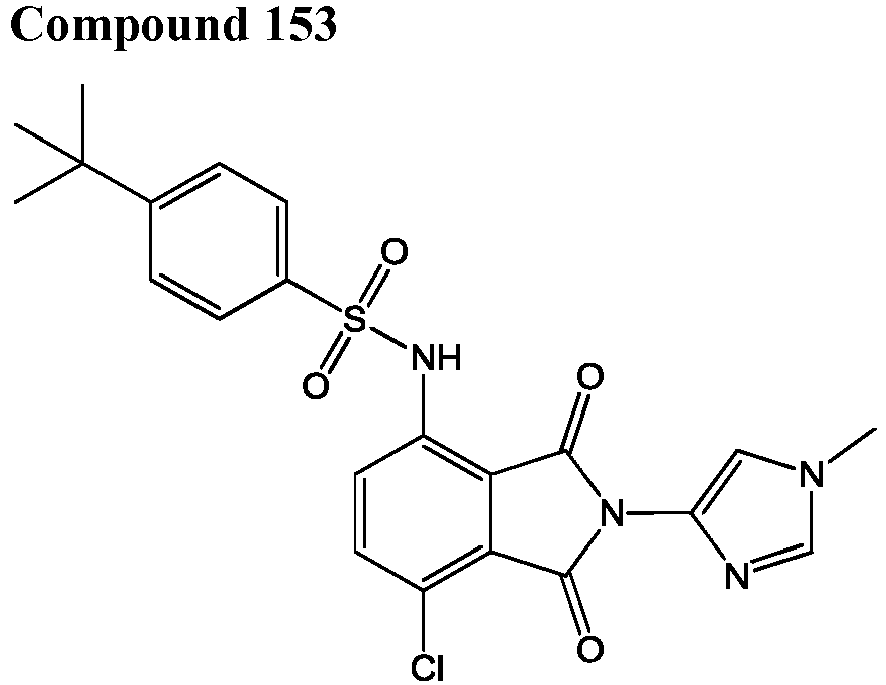


- For example, particularly preferred compounds of Formula (I) are those wherein R1 is hydrogen, X is a direct bond or CH2, R2 is a substituted pyridyl (particularly pyridine N-oxide or methyl-pyridine N-oxide), n is 1, R3 is halo (particularly chloro), or cyano, m is 1, and R4 is butyl (particularly tert-butyl). In particular, compounds of Formula (I) are those wherein R1 is hydrogen, X is a direct bond or CH2, R2 is a substituted pyridyl (particularly pyridine N-oxide or methyl-pyridine N-oxide), n is 1, R3 is halo (particularly chloro), m is 1, and R4 is butyl (particularly tert-butyl).
- It will be appreciated that, in the compounds described above:
- R4 is trifluoromethoxy when R4 is Zq1B, q1 is 2, the first Z group is O, the second Z group is CR7 R8, and each of R7 , R8 and B is fluoro;
- R4 is trifluoromethyl when R4 is Zq1B, q1 is 1, Z is CR7 R8, and each of R7 , R8 and B is fluoro;
- R4 is tert-butyl when R4 is Zq1B, q1 is 2, the first Z group is CR7 R8 where each of R7 and R8 is methyl, the second Z group is CR7 Rg where each of R7 and R8 is hydrogen, and B is hydrogen;
- R4 is isopropyl when R4 is Zq1B, q1 is 1, the Z group is CR7R8 where each of R7 and R8 is methyl, and B is hydrogen; or R4 is isopropyl when R4 is Zq1B, q1 is 2, the first Z group is CR7R8 where one of R7 and R8 is methyl and the other is H, the second Z group is CR7R8 where each of R7 and R8 is hydrogen, and B is hydrogen;
- R4 is methyl when R4 is Zq1B, q1 is 1, the Z group is CR7R8 where each of R7 and R8 is hydrogen, and B is hydrogen;
- R4 is difluoromethoxy when R4 is Zq1B, q1 is 2, the first Z group is O, the second Z group is CR7 R8, one of R7, R8 and B is hydrogen, and two of R7 , R8 and B arc fluoro;
- R4 is methoxy when R4 is Zq1B, q1 is 2, the first Z group is O, the second Z group is CR7R8 where each of R7 and R8 is hydrogen, and B is hydrogen;
- R4 is carboxy-methyl, (CO)CH3 when R4 is Zq1B, q1 is 2, the first Z group is CO, the second Z group is CR7R8 where each of R7 and R8 is hydrogen, and B is hydrogen,
- R4 is methyl sulfonyl, SO2CH3 when R4 is Zq1B, q1 is 2, the first Z group is SO2, the second Z group is CR7R8 where each of R7 and R8 is hydrogen, and B is hydrogen;
- R4 is (CH2)3OCH3 when R4 is Zq1B, q1 is 5, each of the first three Z groups and the fifth Z group is CR7R8 where each of R7 and R8 is hydrogen, the fourth Z group is O, and B is hydrogen;
- R4 is C(CH3)(CH3)CN when R4 is Zq1B, q1 is 1, the Z group is CR7R8 where each of R7 and R8 is methyl, and B is cyano.
- Specific compounds of the invention include the compounds of Formula (I) listed in Table 1, and any salt or solvate thereof, including a solvate of such a salt:
Table 1: Compound number Structure 1 
2 
3 
4 
5 
6 
7 
8 
9 
10 
11 
12 
13 
14 
15 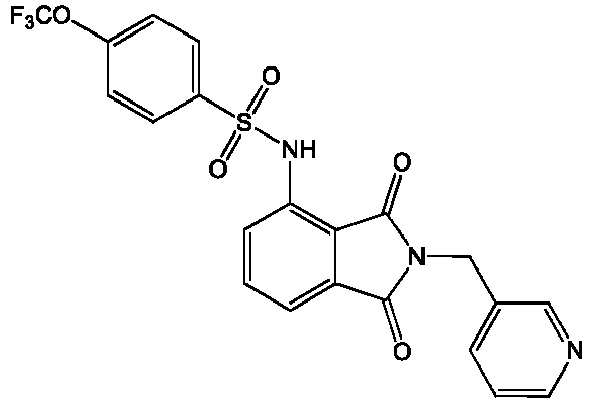
16 
17 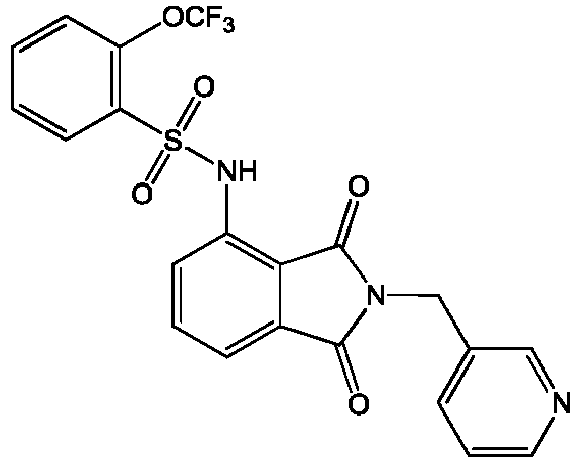
18 
19 
20 
21 
22 
23 
24 
25 
26 
27 
28 
29 
30 
31 
32 
33 
34 
35 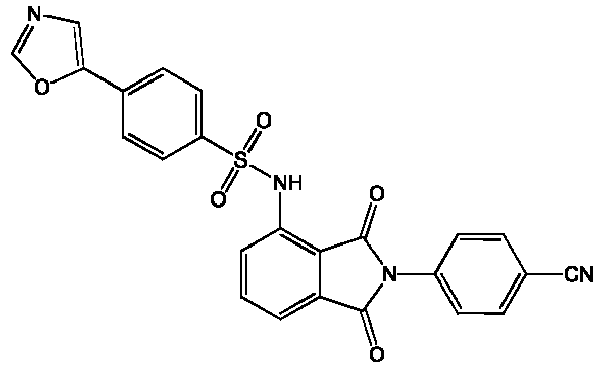
36 
37 
38 
39 
40 
41 
42 
43 
44 
45 
46 
47 
48 
49 
50 
51 
52 
53 
54 
55 
56 
57 
58 
59 
60 
61 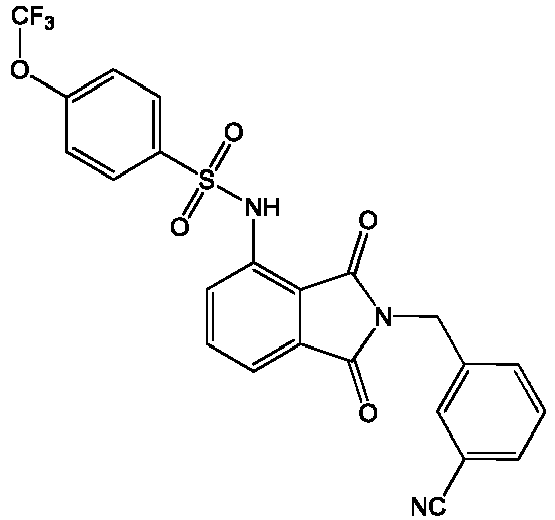
62 
63 
64 
65 
66 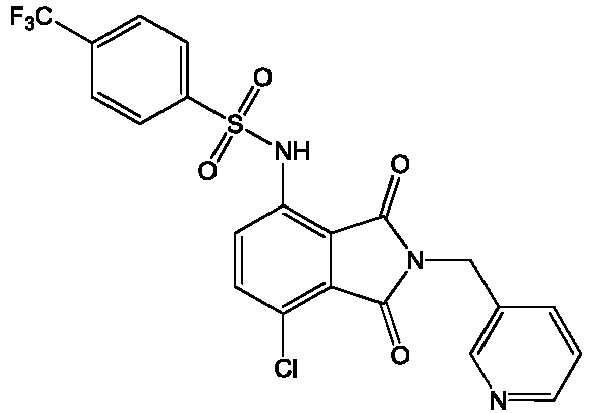
67 
68 
69 
70 
71 
72 
73 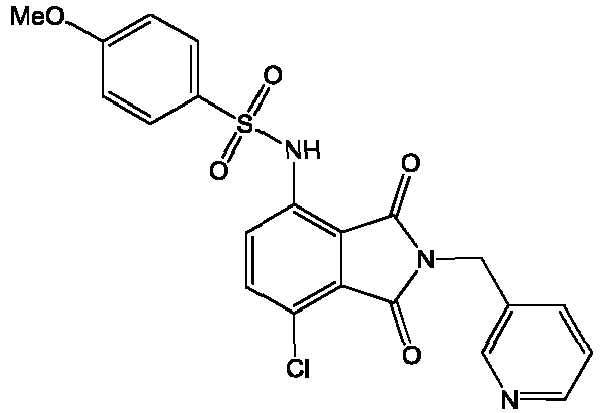
74 
75 
76 
77 
78 
79 
80 
81 
82 
83 
84 
85 
86 
87 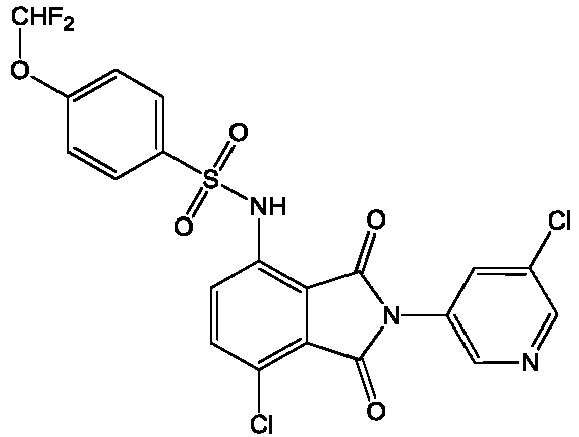
88 
89 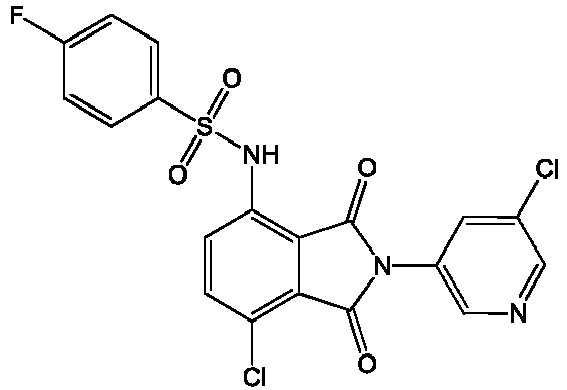
90 
91 
92 
93 
94 
95 
96 
97 
98 
99 
100 
101 
102 
103 
104 
105 
106 
107 
108 
109 
110 
111 
112 
113 
114 
115 
116 
117 
118 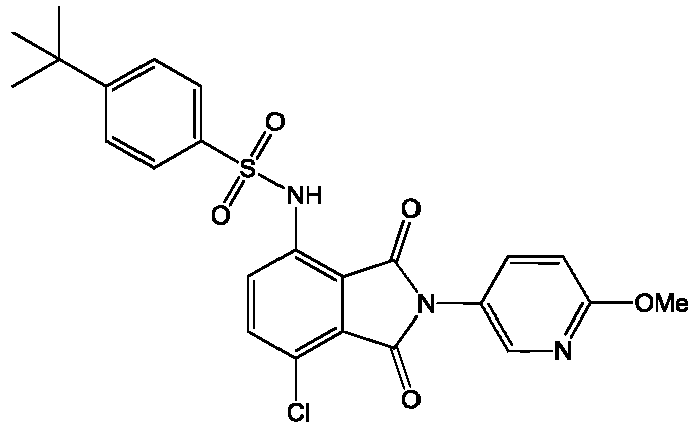
119 
120 
121 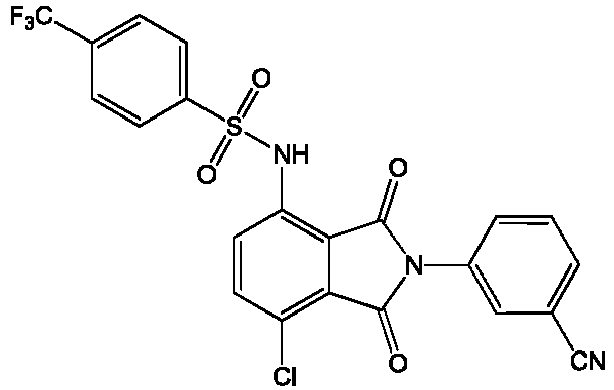
122 
123 
124 
125 
126 
127 
128 
129 
130 
131 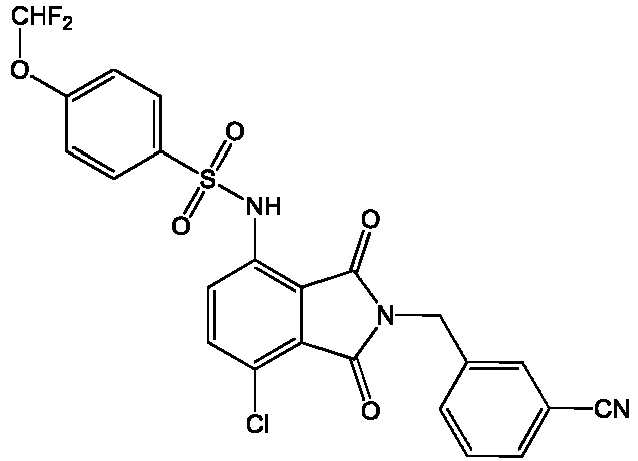
132 
133 
134 
135 
136 
137 
138 
139 
140 
141 
142 
143 
144 
145 
146 
147 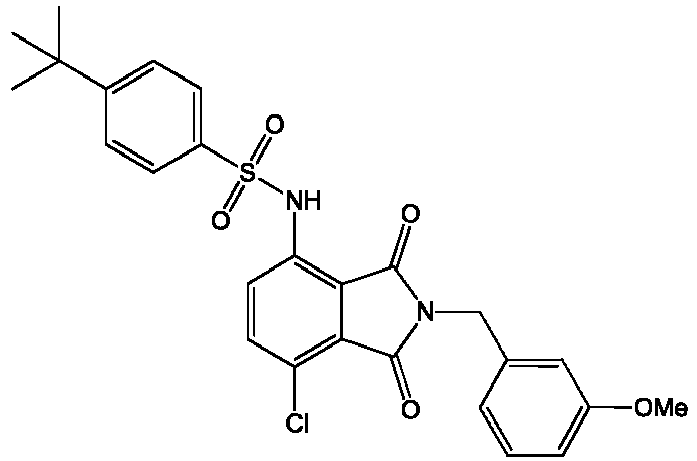
148 
149 
150 
151 
152 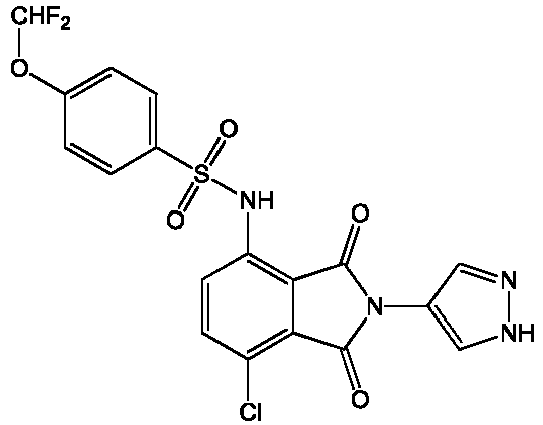
153 
154 
155 
156 
157 
158 
159 
160 
161 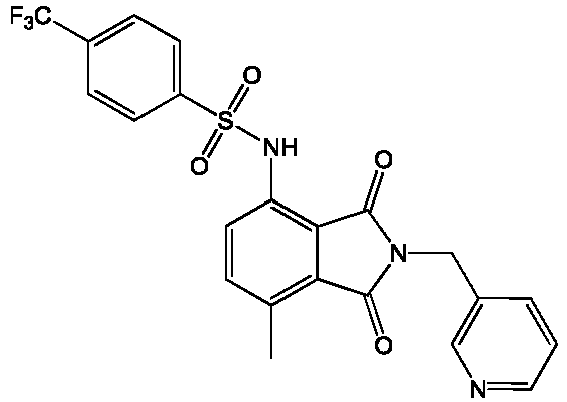
162 
163 
164 
165 
166 
167 
168 
169 
170 
171 
172 
173 
174 
175 
176 
177 
178 
179 
180 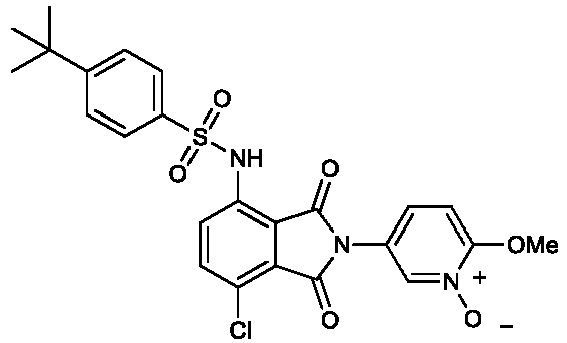
181 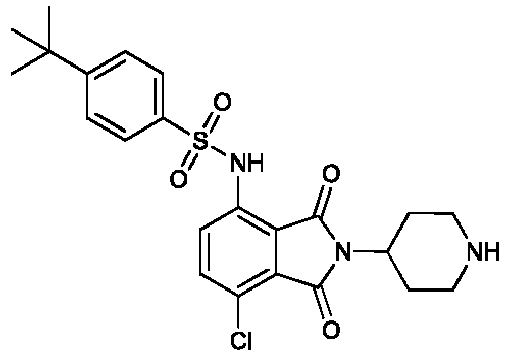
182 
183 
184 
185 
186 
187 
188 
189 
190 
191 
192 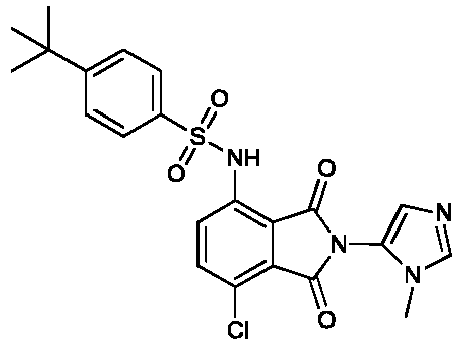
193 
194 
195 
196 
197 
198 
199 
200 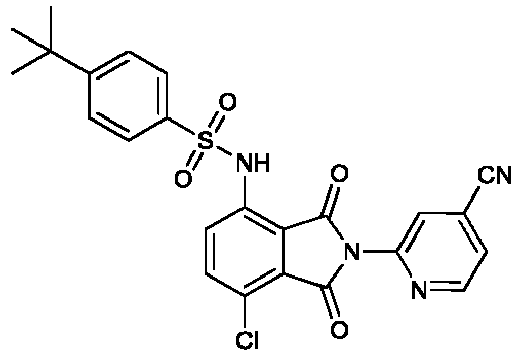
201 
202 
203 
204 
205 
206 
207 
208 
209 
210 
211 
212 
213 
214 
215 
216 
217 
218 
219 
220 
221 
222 
223 
224 
225 
226 
227 
228 
229 
230 
231 
232 
233 
234 
235 
236 
237 
238 
239 
240 
241 
242 
243 
244 
245 
246 
247 
248 
249 
250 
251 
252 
253 
254 
255 
256 
257 
258 
259 
260 
261 
262 
263 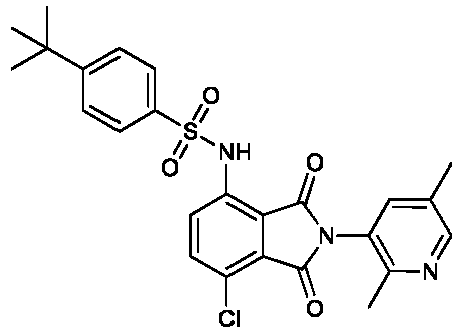
264 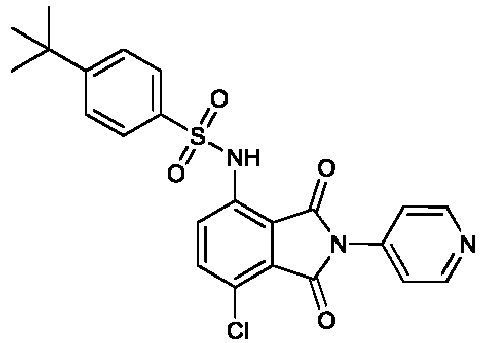
265 
266 
267 
268 
269 
270 
271 
272 
273 
274 
275 
276 
277 
278 
279 
280 
281 
282 
283 
284 
285 
286 
287 
288 
289 
290 
291 
292 
- The compound of Formula (I) may be used as such, or in the form of a salt or solvate thereof, including a solvate of such a salt. Preferably a salt or solvate is one which is pharmaceutically acceptable.
- Suitable salts of the compound of Formula (I) include metal salts, for example alkali metal or alkaline earth metal salts, for example sodium, potassium, calcium and magnesium salts; or salts with ammonia, primary, secondary or tertiary amines, or amino acids, for example mono-, di- or tri-alkylamines, hydroxyalkylamines, and nitrogen-containing heterocyclic compounds, for example isopropylamine, trimethylamine, diethylamine, tri(i-propyl)amine, tri(n-propyl)amine, ethanolamine, 2-dimethylaminoethanol, lysine, histidine, arginine, choline, caffeine, glucamine, procaine, hydrabamine, betaine, ethylenediamine, N-alkylglucamines, theobromine, purines, piperazine, piperidine, morpholine, n-alkyl piperidines, etc; or salts such as trifluoroacetic acid (TFA) salt. For example, pharmaceutically acceptable salts of a compound of Formula (I) include acid addition salts such as hydrochloride, hydrobromide, citrate, tartrate and maleate salts and salts formed with phosphoric and sulfuric acid. In another aspect suitable pharmaceutically acceptable salts are base salts such as an alkali metal salt for example sodium or potassium, an alkaline earth metal salt for example calcium or magnesium, or organic amine salt for example triethylamine.
- Many organic compounds can form complexes with solvents in which they are reacted or from which they are precipitated or crystallized. These complexes are known as solvates. For example, a complex with water is known as a hydrate. Such solvates form part of the invention.
- The compound of Formula (I) or its salt or solvate (including a solvate of such a salt) may itself act as a prodrug, or may be converted into a prodrug by known methods. A further aspect of the disclosure describes a prodrug of the compound of Formula (I) or its salt or solvate (including a solvate of such a salt). Pharmaceutically acceptable prodrugs are described in T. Higuchi and V. Stella (Prodrugs as novel delivery systems, vol 14 of the ACS Symposium Series), and in Edward B. Roche, ed. (Bioreversible carriers in drug design, American Pharm Assoc and Pergamon Press, 1987).
- In one embodiment, a prodrug is a compound having a group that is cleavable from the molecule to generate a biologically active form. Thus the prodrug may be converted within the body into an active form or an active metabolite or residue thereof, due to the presence of particular enzymes or conditions that cleave the prodrug molecule. The cleavable group within the prodrug may be linked by any suitable bond, such as an ester bond or an amide bond (derived from any suitable amine, for example a mono-, di- or tri-alkylamine, or any of the amines mentioned above). For example, the prodrug may be an in vivo hydrolysable ester, such as an ester of a CO2H group present in the compound of Formula (I) with any suitable alcohol, for example a C1-6alkanol. Alternatively, it may be an ester of any -OH group present in the compound of Formula (I) with any suitable acid, for example any carboxylic or sulfonic acid. Prodrugs that are in vivo hydrolysable esters of a compound of Formula (I) are pharmaceutically acceptable esters that hydrolyse in the human body to produce the parent compound. Such esters can be identified by administering, for example intravenously, to a test animal, the compound under test and subsequently examining the test animal's body fluids. Suitable in vivo hydrolysable esters for carboxy include methoxymethyl and for hydroxy include formyl and acetyl, especially acetyl.
- The present invention also provides a process for the preparation of a compound of Formula (I), which comprises reacting an anhydride (A) with a primary amine (B) to produce a phthalimide (C), reducing the nitro group in the phthalimide (C) to form an aminophthalimide (D), then:
- (i) converting the aminophthalimide (D) to a secondary sulfonamide (F) using a sulfonyl chloride (E), and optionally derivatising the secondary sulfonamide (F) to a tertiary sulfonamide (H); or
- (ii) converting the aminophthalimide (D) to a secondary amine (G), and converting the secondary amine (G) to a tertiary sulfonamide (H) using a sulfonyl chloride (E); and
- (iii) optionally adding appropriate substituents to an R2 , R3 , or R4 group of the secondary sulfonamide (F) or of the tertiary sulfonamide (H);
- The anhydride A may be reacted with a primary amine of formula B in a solvent such as acetic acid, at an elevated temperature, in order to produce phthalimide C. The nitro group in this molecule is reduced to an amino group using a variety of possible reducing agents including stannous chloride in ethanol, iron powder in acetic acid or by hydrogenation utilizing metal catalysts such as Raney nickel, platinum IV oxide or palladium on carbon.
- The aminophthalimide of formula D may either be converted to the secondary sulfonamide F which may then, if desired, be derivatised to the tertiary sulfonamide H or it may first be converted to the secondary amine G, before conversion to the tertiary sulfonamide H. Conversion of the compounds of formula D or G to the compounds of formula F or H respectively may be achieved by the use of a sulfonyl chloride E. This reagent is either used with a base such as pyridine in the presence or absence of a catalytic quantity of an agent such as dimethylaminopyridine and using a solvent such as dichloromethane, or by the use of sodium hydride as base in a dipolar aprotic solvent such as DMF prior to addition of the sulfonyl chloride. Conversion of the compounds of formula D or F to the compounds of formula G or H respectively may be achieved by the use of a base such as sodium hydride followed by the appropriate alkyl halide. In the event that R2 is a pyridine N-oxide, this may be prepared most conveniently from the corresponding pyridine as a final step by treating the pyridine with an oxidizing agent such as meta-chloroperoxybenzoic acid in a solvent such as dichloromethane.
- It will be appreciated that many of the relevant starting materials are commercially available or may be made by any convenient method as described in the literature or known to the skilled chemist or described in the Examples herein. For example, compounds of the Formula A

- In a further aspect of the disclosure, there is provided an intermediate compound for use in the synthesis of a compound of Formula (I). There is further provided the use of an intermediate compound to synthesise a compound of Formula (I). Such intermediate compounds include the intermediate compounds I-CVI disclosed in the Examples herein and listed in Table 2.
Table 2: Intermediate compound number Disclosed in Example number I 1-6, 8 II 1, 26, 27 III 1 IV 1 V 1, 2, 4, 6-9, 11-30 VI 2,9 VII 2 VIII 2 IX 3 X 3 XI 3 XII 3, 5 XIII 4 XIV 4 XV 4 XVI 5 XVII 5 XVIII 5 XIX 6, 18 XX 6 XXI 6 XXII 7 XXIII 7 XXIV 7, 27 XXV 7, 9, 11-25, 28-30 XXVI 7 XXVII 7, 19 XXVIII 8 XXIX 8 XXX 8 XXXI 9 XXXII 9 XXXIII 11 XXXIV 11 XXXV 11 XXXVI 12 XXXVII 12 XXXVIII 12 XXXIX 13 XL 13 XLI 13 XLII 14 XLIII 14 XLIV 14 XLV 15 XLVI 15 XLVII 15 XLVIII 15 XLIX 16 L 16 LI 16 LII 17 LIII 17 LIV 17 LV 18 LVI 18 LVII 19 LVIII 19 LIX 20 LX 20 LXI 20 LXII 21 LXIII 21 LXIV 21 LXV 22 LXVI 22 LXVII 22 LXVIII 22 LXIX 23 LXX 23 LXXI 23 LXXII 23 LXXIII 23 LXXIV 24 LXXV 24 LXXVI 24 LXXVII 25 LXXVIII 25 LXXIX 25 LXXX 26 LXXXI 26 LXXXII 26 LXXXIII 26 LXXXV 27 LXXXVI 27 LXXXVII 27 LXXXVIII 27 LXXXIX 27 XC 27 XCI 27 XCII 28 XCIII 28 XCIV 28 XCV 28 XCVI 28 XCVII 29 XCVIII 29 XCIX 29 CC 29 CI 29 CII 30 CIII 30 CIV 30 CV 30 CVI 30 - A resulting compound of the invention may be converted into any other compound of the invention by methods analogous to known methods. For example: a resulting compound of Formula (I) may be converted into a salt or solvate thereof; the oxidation state of an atom in a heterocyclic ring may be increased or decreased by oxidation or reduction using known methods; an ester may be converted to the corresponding acid by hydrolysis (eg using an aqueous hydroxide such as NaOH) or an acid maybe converted to a corresponding metal salt (eg using an aqueous metal hydroxide, such as NaOH to produce the sodium salt). During synthesis of any compound of the invention, protecting groups may be used and removed as desired. Thus in the Scheme above, as well as corresponding to the definitions in Formula I, R1 , R2 , R3 and R4 can also represent appropriately protected forms of these groups.
- The amount of the compound of the invention which is required to achieve a therapeutic effect will, of course, depend upon whether the effect is prophylactic or curative, and will vary with the route of administration, the subject under treatment, and the form of disease being treated. It is generally preferable to use the lowest dose that achieves the desired effect. The compound of the invention may generally be administered at a dose of from 0.1 to 1500 mg/kg per day, preferably 0.1 to 500 mg/kg per day, typically from 0.5 to 20 mg/kg/day, for example about 3 mg/kg/day. Unit dose forms may conveniently contain an amount of compound of the invention which is effective at such dosage or as a multiple of the same, for example units containing 5 mg to 500 mg, usually around 10 mg to 200 mg.
- For example, a pharmaceutical composition of this invention may be administered to humans so that, for example, a daily dose of 0.5 to 20 mg/kg body weight (and preferably of 0.5 to 3 mg/kg body weight) is received. This daily dose may be given in divided doses as necessary, the precise amount of the compound received and the route of administration depending on the weight, age and sex of the patient being treated and on the particular disease or condition being treated according to principles known in the art. Typically unit dosage forms may contain about 1 mg to 500 mg of a compound of Formula (I). For example, a unit dosage form containing up to 10 mg/kg may be given twice per day, such as 1.5 mg/kg twice per day or 5 mg/kg twice per day or 10 mg/kg twice per day.
- The compound of the present invention may be administered one or more times per day, for example, two or three times per day, or even more often, for example, four or five times per day.
- The compounds of this invention may be administered in standard manner for the disease or condition that it is desired to treat. For these purposes the compounds of this invention may be formulated by means known in the art into the required form. While it is possible for the active ingredient to be administered alone, it is preferable for it to be present in a suitable composition formulated as required. Suitable formulations according to the invention include those suitable for oral (including sub-lingual), parenteral (including subcutaneous, intradermal, intramuscular, intravenous, and intraarticular), nasal, inhalation, topical (including dermal, buccal, and sublingual), vaginal and rectal administration. The most suitable route may depend upon, for example, the nature and stage of the condition and disorder of the recipient.
- For oral administration, the compounds can be formulated as liquids or solids. Forms suitable for oral administration include for example tablets, capsules, pills, lozenges, granulates, dragees, wafers, aqueous or oily solutions, suspensions, syrups, or emulsions.
- Forms suitable for parenteral use include for example sterile aqueous or oily solutions or suspensions or sterile emulsions or infusions.
- Forms suitable for nasal administration include for example drops, sprays and aerosols.
- Forms suitable for inhalation include for example finely divided powders, aerosols, fine particle dusts or mists which may be generated by means of various types of metered dose pressurized aerosols, nebulizers or insufflators.
- Forms suitable for topical administration to the skin include, for example, gels, creams, ointments, emulsions, pastes, foams or adhesive patches. For female patients, the composition may be in a form suitable for intravaginal administration.
- Forms suitable for rectal administration include suppositories, rectal capsules and enema solutions.
- Forms suitable for transdermal administration generally comprise an adjuvant that enhances the transdermal delivery of the compound of the invention. Suitable adjuvants are known in the art.
- A pharmaceutical composition of the present invention may be in unit dosage form. Suitable oral unit dosage forms include those mentioned above. For administration by injection or infusion unit dosage forms include, for example, vials and ampoules. Unit dosage forms for topical administration to the skin include blister packs or sachets, each blister or sachet containing a unit dose of, for example, a gel, cream or ointment, for example, as described above. A metered dosing device may be provided, for example, a pump device, for dosing a predetermined volume of a topical composition, for example, a cream, ointment or gel. A preparation may provide delayed or sustained release, for example a depot preparation or an adhesive patch.
- Preferred formulations are those suitable for oral administration, for example in the form of tablets, capsules, pills or the like, or in the form of solutions suitable for injection such as in water for injections BP or aqueous sodium chloride.
- To make a composition according to the invention, suitable carriers are well known in the art and include pharmaceutical grade starch, mannitol, lactose, magnesium stearate, sodium saccharin, talcum, cellulose, glucose, sucrose, (or other sugar), magnesium carbonate, gelatin, oil, alcohol, detergents, emulsifiers or water (preferably sterile).
- A liquid formulation will generally consist of a suspension or solution of the compound or physiologically acceptable salt in a suitable aqueous or non-aqueous liquid carrier(s), for example water, ethanol, glycerine, polyethylene glycol or an oil. The formulation may also contain a suspending agent, preservative, flavouring or colouring agent.
- A composition in the form of a tablet can be prepared using any suitable pharmaceutical carrier(s) routinely used for preparing solid formulations. Examples of such carriers include magnesium stearate, starch, lactose, sucrose and microcrystalline cellulose.
- A composition in the form of a capsule can be prepared using routine encapsulation procedures. For example, powders, granules or pellets containing the active ingredient can be prepared using standard carriers and then filled into a hard gelatin capsule; alternatively, a dispersion or suspension can be prepared using any suitable pharmaceutical carrier(s), for example aqueous gums, celluloses, silicates or oils and the dispersion or suspension then filled into a soft gelatin capsule.
- Compositions for oral administration may be designed to protect the active ingredient against degradation as it passes through the alimentary tract, for example by an outer coating of the formulation on a tablet or capsule.
- Conveniently the composition is in unit dose form such as a tablet or capsule.
- In addition to the compounds of the present invention, the pharmaceutical composition of this invention may also contain, or be co-administered (simultaneously or sequentially) with, one or more pharmacological agents of value in treating one or more diseases or conditions referred to hereinabove. For example, pharmaceutical compositions as described above may also comprise one or more further active ingredients in addition to a compound of the invention, for example, a further active ingredient with efficacy in the treatment or prevention of IBD or of conditions associated with IBD.
- The compounds of the invention are compounds which modulate at least one function or characteristic of mammalian CCR9, for example, a human CCR9 protein. The ability of a compound to modulate the function of CCR9 can be demonstrated in a binding assay (such as a ligand binding or agonist binding assay), a migration assay, a signaling assay (such as activation of a mammalian G protein, induction of rapid and transient increase in the concentration of cytosolic free calcium) and/or cellular response assay (such as stimulation of chemotaxis, exocytosis or inflammatory mediator release by leukocytes). In particular, compounds of the invention may be evaluated in one or more of the following assays: (1) human CCR9 FLIPR assay using recombinant cell lines expressing human CCR9 or MOLT-4 cells (for example, identifying active compounds as those having Ki ≤10 µM, preferred compounds as those having Ki ≤1µM, and most preferred compounds as those having a Ki ≤ 500 nM); (2) chemotaxis assay using MOLT-4 cells (for example, identifying active compounds as those having Ki ≤10 µM, preferred compounds as those having Ki ≤1 µM, and most preferred compounds as those having a Ki ≤ 500 nM); (3) chemotaxis assay using mouse and rat thymocytes (for example, identifying active compounds as those having Ki ≤1 µM, preferred compounds as those having Ki ≤500 nM, and most preferred compounds as those having a Ki ≤ 500 nM).
- As previously outlined the compounds of the invention are CCR9 modulators, in particular they are partial agonists, antagonists or inverse agonists of CCR9. Each of the above indications for the compounds of the Formula (I) represents an independent and particular embodiment of the invention. Whilst we do not wish to be bound by theoretical considerations, some of the preferred compounds of the invention may show selective CCR9 modulation for any one of the above indications relative to modulating activity against any other particular receptor, including any other particular chemokine receptor (for example, CCR1, CCR2, CCR3, CCR4, CCR5, CCR6, CCR7, CCR8, CCR10, CXCR1, CXCR2, CXCR3, CXCR4, CXCR5, CXCR6, CXCR7, CX3CR1, XCR1, ChemR23 or CMKLR1); by way of non-limiting example they may show 100-1000 fold selectivity for CCR9 over activity against any other particular chemokine receptor.
- The invention will now be illustrated but not limited by the following Examples. Each exemplified compound represents a particular and independent aspect of the invention. Where optically active centres exist in the compounds of Formula (I), we disclose all individual optically active forms and combinations of these as individual specific embodiments of the invention, as well as their corresponding racemates.
- Analytical TLC was performed on Merck silica gel 60 F254 aluminium-backed plates. Compounds were visualised by UV light and/or stained either with iodine, potassium permanganate or ninhydrin solution. Flash column chromatography was performed on silica gel (100-200 M) or flash chromatography. 1H-NMR spectra were recorded on a Bruker Avance-400 MHz spectrometer with a BBO (Broad Band Observe) and BBFO (Broad Band Fluorine Observe) probe. Chemical shifts (d) are expressed in parts per million (ppm) downfield by reference to tetramethylsilane as the internal standard. Splitting patterns are designated as s (singlet), d (doublet), t (triplet), q (quartet), m (multiplet) and bs (broad singlet). Coupling constants (J) are given in hertz (Hz). LC-MS analyses were performed on either an Acquity BEH C-18 column (2.10 × 100 mm, 1.70 µm) or on a Acquity HSS-T3 column (2.10 × 100 mm, 1.80 µm) or Zorbax HD C18 (2.1 × 50 mm, 1.8 µm) using the Electrospray Ionisation (ESI) technique. Purity assessment for final compounds was based on the following 3 LCMS methods. Method 1 consisted of the following: Acquity BEH C-18 column 2.10 mm x 100 mm, 1.70 µm. Mobile phase; A, 5 mM ammonium acetate in water; B, acetonitrile; gradient, 90% A to 10% A in 8 min with 10 min run time and a flow rate of 0.3 mL/ min. Method 2 consisted of the following: Acquity HSS-T3 column 2.10 mm x 100 mm, 1.8 µm. Mobile phase; A, 0.1% TFA in water; B, acetonitrile; gradient, 90% A to 10% A in 8 min with 10 min run time and a flow rate of 0.3 mL/ min. Method 3 consisted of the following: Zorbax HD C18 column 2.10 mm x 50 mm, 1.8 µm. Mobile phase; A, 0.01% acetic acid in 95% water and methanol; B, 0.01% acetic acid in 5% water and methanol; gradient, 100% A to 100% B in 4 min with 5 min run time and a flow rate of 0.3 mL/ min.
-

- To a stirred solution of I (2.0 g, 10.36 mmol) in acetic acid (28 mL) was added compound II (0.37 g, 3.88 mmol) and the reaction mixture heated to a reflux for 18 hours. The reaction was cooled to room temperature and the acetic acid was removed under reduced pressure to obtain a crude product. This material was suspended in ethanol (5 mL), cooled and filtered to leave crude 4-nitro-2-(pyridin-3-yl)isoindoline-1,3-dione as a white solid (III; 2.5 g). MS (M+1): 270.1. This was used without further purification in the next step.
- To a solution of crude III (2.0 g) in methanol (100 mL) under nitrogen atmosphere was added 10% Pd/C (0.1 g). The reaction mixture was purged with hydrogen and stirred under hydrogen balloon pressure for 18 hours at room temperature, whereupon the reaction mixture was filtered through a celite bed under a nitrogen atmosphere and the solvent evaporated under reduced pressure to afford crude compound, 4-amino-2-(pyridin-3-yl) isoindoline-1, 3-dione, as a yellow solid (IV; 0.8 g,). MS (M+1): 240.1. The crude was carried forward to next step without purification.
- A mixture of crude IV (100 mg) and pyridine (2 mL) was cooled to 0°C. tert-Butylbenzenesulfonyl chloride V (274 mg, 1.18 mmol) was added and the mixture stirred for 24 hours at room temperature. The reaction mixture was concentrated and to the residue obtained was added a saturated solution of ammonium chloride and extracted with dichloromethane. The organic layer was washed with brine solution & dried over anhydrous Na2SO4. This was filtered and the organic solvent was evaporated under reduced pressure to obtain crude compound. The crude material was purified using preparative TLC with 100% ethyl acetate as mobile phase to obtain 4-tert-butylphenylsulfonic acid (1,3-dioxo-2-(pyridin-3-yl)-2,3-dihydro-1H-isoindol-4-yl)-amide as a light yellow solid (1; 30 mg). 1H NMR (400 MHz, DMSO-d6): δ 11.28 (bs, 1H), 8.59-8.56 (m, 2H), 7.83 (d, J = 8.0 Hz, 2H), 7.76 (d, J = 8.0 Hz, 2H), 7.54-7.58 (m, 4H), 7.43 (bs, 1H), 1.24 (s, 9H). MS (M-1): 434.2. (LCMS purity 98.14%, Rt = 6.12 min (1)).
- The following compounds were prepared in a similar manner using the appropriate sulfonyl chloride in the final step:
CPD number Structure LCMS (M+1) Purity (LCMS) 1H NMR 2 
422.2 97.89 %, Rt = 2.51 min (3) 1H NMR (400 MHz, DMSO-d6): δ 11.28 (bs, 1H), 8.58 (t, J = 4.8 Hz, 2H), 7.84 (d, J = 8.0 Hz, 2H), 7.78 (d, J = 8.0 Hz, 2H), 7.58-7.44 (m, 5H), 2.94-2.91 (m, 1H), 1.16 (d, 6H). 3 
445.2 (M-1) 99.99 %, Rt = 1.54 min (3) 1H NMR (400 MHz, DMSO-d6): δ 8.56 (s, 1H), 8.52 (d, J = 3.6 Hz, 2H), 8.45 (s, 1H), 7.86-7.72 (m, 6H), 7.51-7.48 (m, 2H), 7.31 (s, 1H), 7.07 (d, J = 7.6 Hz, 1H). 4 
448.1 99.99%, Rt = 2.32 min (3) 1H NMR (400 MHz, CDCl3): δ 8.74 (s, 1H), 8.63 (d, J = 4.4 Hz, 1H), 8.15 (s, 1H), 8.07 (d, J = 8.0 Hz, 1H), 7.87 (t, J = 8.0 Hz, 2H), 7.80 (d, J = 8.4 Hz, 1H), 7.68 (t, J = 7.2 Hz, 2H), 7.53 (d, J = 8.0 Hz, 1H), 7.45 (q, J = 4.8 Hz, 1H). 5 
464.1 99.99 %, Rt = 2.37 min (3) 1H NMR (400 MHz, DMSO-d6): δ 11.42 (s, 1H), 8.59 (m, 2H), 8.0 (d, J = 8.8 Hz, 2H), 7.88 (d, J = 8.4 Hz, 1H), 7.84 (d, J = 8.0 Hz, 1H), 7.60 (d, J = 7.2 Hz, 3H), 7.54 (m, 2H). 6 
448.1 97.23 %, Rt = 2.29 min (3) 1H NMR (400 MHz, DMSO-d6): δ 11.51 (s, 1H), 8.60 (s, 1H), 8.58 (d, J = 4.4 Hz, 1H), 8.08 (d, J = 8.4 Hz, 2H), 8.00 (d, J = 8.4 Hz, 2H), 7.89 (d, J = 8.0 Hz, 1H), 7.84 (d, J = 8.4 Hz, 1H) 7.61 (1H, s), 7.56 (2H, m). 7 
482.0 98.48 %, Rt = 2.46 min (3) 1H NMR (400 MHz, DMSO-d6): δ 11.47 (bs, 1H), 8.60 (s, 1H), 8.59 (d, J = 4.4 Hz, 1H), 8.22 (s, 1H), 8.11 (d, J = 7.6 Hz, 1H), 7.97 (d, J = 8.4 Hz, 1H), 7.89 (d, J = 7.6 Hz, 1H), 7.85 (d, J = 8.0 Hz, 1H), 7.56 (m, 3H). 8 
466.1 96.15 %, Rt = 5.52 min (1) 1H NMR (400 MHz, DMSO-d6): δ 10.62 (bs, 1H), 8.64-8.60 (m, 2H), 8.42-8.42 (m, 1H), 8.37-8.34 (m, 1H), 7.86-7.78 (m, 3H), 7.76-7.73 (m, 1H), 7.65-7.63 (m, 1H), 7.61-7.58 (m, 1H). 9 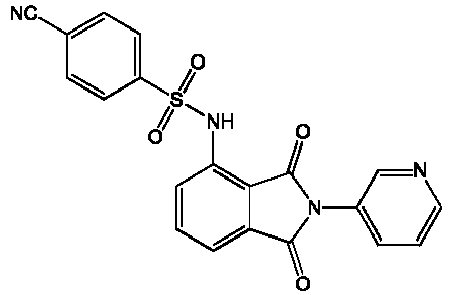
405.1 98.98 %, Rt = 5.39 min (1) 1H NMR (400 MHz, DMSO-d6): δ 10.53 (bs, 1H), 8.63-8.60 (m, 2H), 8.14-8.08 (m, 4H), 7.86-7.83 (m, 1H), 7.81-7.79 (m, 1H), 7.72-7.70 (m, 1H), 7.61-7.57 (m, 2H). 10 
398.05 96.25% Rt = 5.04 min (1) 1H NMR (400MHz, DMSO-d6): δ 10.15 (bs, 1H), 8.62 (s, 2H), 8.09-8.07 (m, 2H), 7.87-7.79 (m, 2H), 7.68-7.66 (m, 3H), 7.48-7.44 (m, 2 H) 11 
414.11 97.56% Rt = 5.19 min (1) 1H NMR (400MHz, DMSO-d6): δ 10.24 (bs, 1H), 8.63-8.62 (m, 2H), 8.00-7.98 (d, J = 8.8 Hz, 2H), 7.87-7.80 (m, 2H), 7.71-7.69 (m, 3H), 7.64-7.58 (m, 2 H). -

- To a stirred solution of compound I (500 mg, 2.59 mmol) in acetic acid (7 mL) was added compound VI (420 mg, 3.88 mmol) and heated to a reflux for 18 hours. The reaction mixture was cooled to room temperature and the acetic acid was removed under reduced pressure to obtain a crude product. This material was suspended in ethanol (5 mL), cooled and filtered to obtain 4-nitro-2-(pyridin-3-ylmethyl)-isoindole-1,3-dione as a yellow solid (VII; 400 mg). 1H NMR (400 MHz, CDCl3): δ 8.57 (1H, s), 8.46 (d, J = 4.0 Hz, 1H), 8.27 (d, J = 8.0 Hz, 1H), 8.17 (d, J = 7.2 Hz, 1H), 8.04 (t, J = 7.8 Hz, 1H), 7.74 (d, J = 8.0 Hz, 1H), 7.31-7.36 (m, 1H), 4.81 (s, 2H).
- To a solution of VII (400 mg) in methanol (80 mL) under nitrogen atmosphere was added 10% Pd/C (100 mg). The reaction mixture was purged with hydrogen and stirred under hydrogen balloon pressure for 18 hours at room temperature and then filtered through a celite bed under a nitrogen atmosphere and evaporated under reduced pressure to afford compound 4-amino-2-(pyridin-3-ylmethyl)-isoindole-1,3-dione as a yellow solid (VIII; 380 mg). MS (M+1): 254.5
- To a mixture of compound VIII (50 mg, 0.19 mmol) in dichloromethane (2 mL) was added pyridine (2 mL) and this solution was cooled to 0°C, compound V (96 mg, 0.39 mmol) was added and the solution was stirred for 24 hours at room temperature. The reaction mixture was concentrated under reduced pressure and diluted with saturated ammonium chloride solution and extracted with dichloromethane (2 x 10 mL). The organic layer was washed with brine solution, dried over anhydrous Na2SO4 and evaporated under reduced pressure to afford the crude compound which was purified by preparative HPLC to obtain 4-(tert-butyl)-N-(1,3-dioxo-2-(pyridin-3-ylmethyl)isoindolin-4-yl)benzene sulfonamide as a white solid (12; 50 mg, 56.8 % yield). 1H NMR (400 MHz, DMSO-d6): δ 9.82 (bs, 1H), 8.58 (s, 1H), 8.51 (d, J = 4.0 Hz, 1H), 7.89 (d, J = 8.8 Hz, 2H), 7.71-7.78 (m, 2H), 7.59 (d, J = 8.4 Hz, 3H), 7.54 (d, J = 7.2 Hz, 1H), 7.39-7.42 (m, 1H), 4.76 (s, 2H), 1.24 (s, 9H). MS (M+1): 450.2. (LCMS Purity 98.25%, Rt = 2.56 min (3)).
- The following compounds were prepared in a similar manner using the appropriate sulfonyl chloride in the final step:
Cmpd number Structure LCMS (M+1) Purity (LCMS) 1H NMR 13 
461.7 99.18 %, Rt = 1.99 min (3) 1H NMR (400 MHz, DMSO-d6): δ 8.90 (bs, 1H), 8.67 (s, 1H), 8.56 (d, J = 4.8 Hz, 1H), 7.96 (d, J = 8.0 Hz, 3H), 7.89 (d, J = 8.0 Hz, 1H), 7.77 (d, J = 8.0 Hz, 1H), 7.74 (d, J = 8.8 Hz, 2H), 7.63 (t, J = 11.4 Hz, 1H), 7.50 (d, J = 8.8 Hz, 2H), 7.29-7.32 (m, 1H), 4.79 (s, 2H). 14 
450.23 98.65 %, Rt = 5.67 min (1) 1H NMR (400 MHz, DMSO-d6): δ 9.97 (s, 1H), 8.49 (s, 1H), 7.78-7.71 (m, 3H), 7.69-7.59 (m, 4H), 7.49-7.45 (t, J = 7.8 Hz, 1H), 7.38-7.35 (m, 1H), 4.70 (s, 2H), 1.15 (s, 9H). 15 
478.11 99.03 %, Rt = 5.72 min (1) 1H NMR (400 MHz, DMSO-d6): δ 10.26 (bs, 1H), 8.54 (s, 1H), 8.49 (s, 1H), 8.07-8.05 (d, J = 8.4 Hz, 2H), 7.77-7.75 (m, 1H), 7.67-7.55 (m, 5H), 7.36-7.33 (m, 1H), 4.73 (s, 2H). 16 
478.14 96.82 %, Rt = 5.40 min (1) 1H NMR (400 MHz, DMSO-d6): δ 10.41 (bs, 1H), 8.51-8.49 (m, 2H), 7.92-7.90 (m, 1H), 7.81 (s, 1H), 7.78-7.74 (m, 1H), 7.72-7.68 (m, 1H), 7.66-7.62 (m, 3H), 7.58-7.56 (m, 2H), 7.38-7.34 (m, 1H), 4.71 (s, 2H). 17 
478.11 98.56 %, Rt = 5.74 min (1) 1H NMR (400 MHz, DMSO-d6): δ 9.98 (bs, 1H), 8.52-8.50 (m, 2H), 8.08-8.06 (d, J = 7.2 Hz, 1H), 7.78-7.72 (m, 2H), 7.67-7.51 (m, 5H), 7.38-7.35 (m, 1H), 4.74 (s, 2H). 18 
480.10 98.37 %, Rt = 5.36 min (1) 1H NMR (400 MHz, DMSO-d6): δ 10.55 (bs, 1H), 8.53 (s, 1H), 8.49-8.48 (d, J = 4.0 Hz, 1H), 8.31-8.30 (d, J = 6.4 Hz, 1H), 8.25-8.23 (m, 1H), 8.75-7.55 (m, 5H), 7.36-7.33 (m, 1H), 4.72 (s, 2H). 19 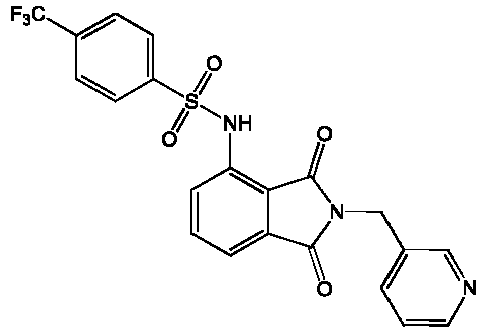
462.12 98.71 %, Rt = 5.40 min (1) 1H NMR (400 MHz, DMSO-d6): δ 10.43 (bs, 1H), 8.54 (s, 1H), 8.49-8.48 (d, J = 4.4 Hz, 1H), 8.14-8.12 (d, J = 8.4 Hz, 2H), 7.97-7.95 (d, J = 8.4 Hz, 2H), 7.77-7.73 (t, J = 7.8 Hz, 1H), 7.64 (m, 2H), 7.55-7.53 (d, J = 8.4 Hz, 1H), 7.36-7.33 (m, 1H), 4.73 (s, 2H). 20 
493.92 (M-1) 99.70 %, Rt = 5.50 min (1) NMR (400 MHz, DMSO-d6): δ 10.38 (bs, 1H), 8.54 (s, 1H), 8.49-8.48 (d, J = 3.2 Hz, 1H), 8.38 (s, 1H), 8.17-8.15 (d, J = 8.8 Hz, 1H), 7.96-7.92 (m, 1H), 7.78-7.74 (m, 1H), 7.65-7.63 (m, 2H), 7.56-7.54 (m, 1H), 7.36-7.34 (m, 1H), 4.72 (s, 2H). 21 
421.98 (M-1) 99.44 %, Rt = 5.50 min (1) 1H NMR (400 MHz, DMSO-d6): δ 9.74 (bs, 1H), 8.54 (s, 1H), 8.49-8.48 (d, J = 3.2 Hz, 1H), 7.89-7.87 (d, J = 8.8 Hz, 2H), 7.74-7.70 (m, 1H), 7.68-7.66 (m, 1H), 7.60-7.53 (m, 2H), 7.36-7.33 (m, 1H), 7.08-7.06 (d, J = 8.8 Hz, 2H), 4.74 (s, 2H), 3.80 (s, 3H). 22 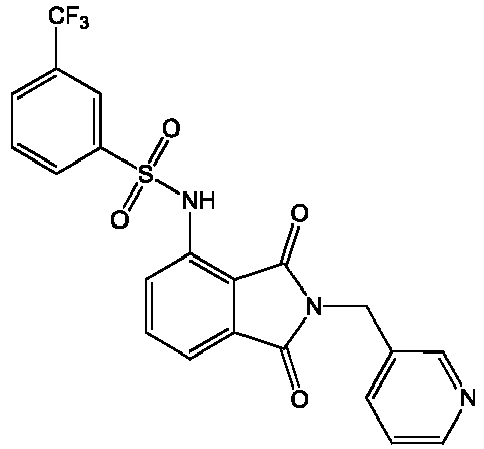
462.09 98.44 %, Rt = 5.50 min (1) 1H NMR (400 MHz, DMSO-d6): δ 10.48 (bs, 1H), 8.50 (s, 1H), 8.49-8.48 (d, J = 1.2 Hz, 1H), 8.20 (s, 1H), 8.18-8.16 (d, J = 8.0 Hz, 1H), 8.02-8.0 (d, J = 8.0 Hz, 1H), 7.81-7.74 (m, 2H), 7.64-7.61 (m, 2H), 7.58-7.56 (d, J = 8.0 Hz, 1H), 7.38-7.34 (m, 1H),4.71 (s, 2H). 23 
408.11 99.78 %, Rt = 5.82 min (1) 1H NMR (400 MHz, DMSO-d6): δ 9.78 (bs, 1H), 8.54 (s, 1H), 8.49-8.48 (d, J = 4.0 Hz, 1H), 7.94-7.92 (d, J = 8.4 Hz, 1H), 7.73-7.67 (m, 2H), 7.61-7.53 (m, 3H), 7.45-7.37 (m, 3H), 4.74 (s, 2H), 2.62 (s, 3H). 24 
436.09 98.38 %, Rt = 4.93 min (1) 1H NMR (400 MHz, DMSO-d6): δ 10.29 (bs, 1H), 8.51-8.48 (m, 2H), 8.10-8.04 (m, 4H), 7.76-7.72 (m, 1H), 7.66-7.64 (m, 1H), 7.61-7.55 (m, 2H), 7.35-7.32 (m, 1H), 4.73 (s, 2H), 2.60 (s, 3H). 25 
419.10 99.19 %, Rt = 4.92 min (1) 1H NMR (400 MHz, DMSO-d6): δ 10.52 (bs, 1H), 8.53 (s, 1H), 8.50-8.49 (m, 1H), 8.09-8.04 (m, 4H), 7.77-7.73 (m, 1H), 7.64-7.62 (m, 2H), 7.55-7.53 (d, J = 8.0 Hz, 1H), 7.38-7.35 (m, 1H), 4.73 (s, 2H). 26 
462.13 99.39 %, Rt = 5.66 min (1) 1H NMR (400 MHz, DMSO-d6): δ 10.04 (bs, 1H), 8.54-8.50 (m, 2H), 8.22-8.21 (d, J = 9.6 Hz, 1H), 8.03-8.02 (d, J = 9.6 Hz, 1H), 7.88-7.84 (m, 2H), 7.77-7.73 (m, 1H), 7.68-7.66 (m, 1H), 7.61-7.57 (m, 2H), 7.38-7.35 (m, 1H), 4.74 (s, 2H). 27 
408.08 99.19%, Rt = 5.93 min (1) 1H NMR (400 MHz, DMSO-d6): δ 9.85 (bs, 1H), 8.53 (s, 1H), 8.49 (m, 1H), 7.83-7.81 (d, J = 8.4 Hz, 2H), 7.74-7.67 (m, 2H), 7.58-7.54 (m, 2H), 7.37-7.34 (m, 3H), 4.74 (s, 2H), 2.34 (s, 3H). 28 
424.09 99.19 %, Rt = 5.60 min (1) 1H NMR (400 MHz, DMSO-d6): δ 10.06 (bs, 1H), 8.54 (s, 1H), 8.50-8.49 (m, 1H), 7.75-7.71 (m, 1H), 7.67-7.65 (m, 1H), 7.58-7.55 (m, 2H), 7.49-7.45 (m, 3H), 7.38-7.35 (m, 1H), 7.21-7.19 (m, 1H), 4.74 (s, 2H), 3.76 (s, 3H). 29 
460.18 99.36 %, Rt = 5.34 min (1) 1H NMR (400 MHz, DMSO-d6): δ 10.05 (bs, 1H), 8.64 (s, 1H), 8.58-8.57 (d, J = 4.0 Hz, 1H), 8.03-8.01 (d, J = 8.8 Hz, 2H), 7.90-7.88 (m, 1H), 7.76-7.72 (t, J = 7.8 Hz, 1H), 7.60-7.09 (m, 6H), 4.80 (s, 2H). 30 
412.20 98.72% Rt = 5.19 min (1) 1H NMR (400MHz, DMSO-d6): δ 10.08 (bs, 1H), 8.54 (s, 1H), 8.49 (m, 1H), 7.99 (m, 2H), 7.76-7.72 (t, J = 7.6 Hz 1H), 7.66-7.63 (d, J = 8.4 Hz, 1H), 7.60-7.56 (m, 2H), 7.42-7.35 (m, 3 H), 4.73 (s, 2 H). 31 
428.08 98.83% Rt = 5.41 min (1) 1H NMR (400MHz, DMSO-d6): δ 10.19 (bs, 1H), 8.55 (s, 1H), 8.49 (s, 1H), 7.94-7.90 (d, J = 8.8 Hz, 2H), 7.76-7.72 (m, 1H), 7.66-7.64 (m, 3H), 7.61-7.59 (m, 1H), 7.56-7.54 (m, 1H), 7.38-7.34 (m, 1H), 4.74 (s, 2H). -

- To a stirred solution of compound I (500 mg, 2.59 mmol) in acetic acid (7 mL) was added compound IX (419 mg, 3.88 mmol) and the reaction heated to a reflux for 18 hours. The reaction mixture was cooled to room temperature and the acetic acid removed under reduced pressure to obtain a crude product which was purified by suspension in ethanol (5 mL), cooling and filtration to obtain 4-nitro-2-pyridin-4-ylmethyl-isoindole-1,3-dione as a yellow solid (X; 400 mg). 1H NMR (400 MHz, DMSO-d6): δ 8.49 (d, J = 5.6 Hz, 2H), 8.29 (d, J = 8.4 Hz, 1H), 8.25 (t, J = 8.0 Hz, 1H), 8.19 (d, J = 8.0 Hz, 1H), 7.34 (d, J = 5.2 Hz, 2H), 4.80 (s, 2H).
- To a solution of compound X (400 mg) in acetic acid (10 mL) was added iron powder (40 mg) and the reaction mixture was stirred for 1 hour at room temperature. The acetic acid was removed under reduced pressure to obtain a crude product. The reaction mixture was diluted with water and extracted with dichloromethane. The organic layer was washed with brine solution, dried over anhydrous Na2SO4 and evaporated under reduced pressure to afford 4-amino-2-pyridin-4-ylmethyl-isoindole-1,3-dione as a light brown solid (XI; 250mg,). MS (M+1): 254.1
- To a mixture of sodium hydride (19 mg, 0.78 mmol) in DMF (2 mL) at 0°C was added compound XI (50 mg, 0.19 mmol) and this was stirred for 15 minutes at 0°C. To the reaction mixture was further added compound XII (144 mg, 0.59 mmol) and this was stirred for 15 minutes at 0°C and then allowed to warm to room temperature with constant stirring for 18 hours. The reaction mixture was diluted with water and extracted with dichloromethane. The organic layer was washed with brine solution, dried over anhydrous Na2SO4 and evaporated under reduced pressure to obtain the crude compound which was purified by preparative TLC using 100% ethyl acetate as mobile phase to afford N-(1,3-dioxo-2-(pyridin-4-ylmethyl)isoindolin-4-yl)-4-(oxazol-5-yl)benzenesulfonamide as a white solid (32; 20 mg, 22.2% yield). 1H NMR (400 MHz, CDCl3): δ 8.89 (bs, 1H), 8.55 (d, J = 5.6 Hz, 2H), 7.97 (d, J = 6.8 Hz, 3H), 7.90 (d, J = 8.4 Hz, 1H), 7.74 (d, J = 8.4 Hz, 2H), 7.64 (t, J = 7.8 Hz, 1H), 7.51-7.48 (m, 2H), 7.25-7.22 (m, 2H), 4.75 (s, 2H). MS (M+1) 461.1 (LCMS Purity 98.57%, Rt = 2.39 min (3)).
-

- To a stirred solution of compound I (500 mg, 2.59 mmol) in acetic acid (7 mL) was added compound XIII (525 mg, 3.88 mmol) and the reaction mixture was heated to a reflux for 18 hours. The reaction mixture was cooled to room temperature and acetic acid was removed under reduced pressure to obtain crude product. This was suspended in ethanol (5 mL), cooled and filtered to get pure compound 2-(4-acetyl-phenyl)-4-nitro-isoindoline-1,3-dione as a yellow solid (XIV; 400 mg). 1H NMR (400 MHz, DMSO-d6): δ 8.34 (d, J = 8.0 Hz, 1H), 8.26 (d, J = 7.6 Hz, 1H), 8.13-8.09 (m, 3H), 7.61 (d, J = 8.4 Hz, 2H), 2.62 (s, 3H)
- To a solution of compound XIV (400 mg) in acetic acid (30 mL) was added iron powder (50 mg) and the reaction mixture was stirred for 1 hour at room temperature. The acetic acid was removed under reduced pressure to obtain the crude product. The reaction mixture was diluted with water and extracted with dichloromethane. The organic layer was washed with brine solution, dried over anhydrous Na2SO4 and the organic solvent was evaporated under reduced pressure to afford 2-(4-acetyl-phenyl)-4-amino-isoindoline-1,3-dione as a yellow solid (XV; 250 mg). MS (M+1): 281.1
- To a stirred mixture of compound XV (100 mg, 0.418 mmol) in dichloromethane (2 mL) was added pyridine (2 mL) at 0°C, followed by compound V (200 mg, 1.25 mmol). The reaction mixture was stirred for 24 hours at room temperature. The reaction mixture was concentrated under reduced pressure and diluted using saturated ammonium chloride solution and extracted with dichloromethane. The organic layer was washed with brine solution, dried over anhydrous Na2SO4 and the organic solvent was evaporated under reduced pressure to obtain crude compound. Crude material was purified by preparative TLC using 100% ethyl acetate as mobile phase to afford N-(2-(4-acetylphenyl)-1,3-dioxoisoindolin-4-yl)-4-(tert-butyl)benzenesulfonamide as a yellow solid (33; 20 mg, 8.4 % yield). 1H NMR (400 MHz, DMSO-d6): δ 9.85 (bs, 1H), 8.07 (d, J = 8.4 Hz, 2H), 7.90 (d, J = 8.4 Hz, 2H), 7.76 (bs, 1H), 7.67 (d, J = 8.4 Hz, 1H), 7.61-7.54 (m, 5H), 2.61 (s, 3H), 1.26 (s, 9H). MS (M+1) 477.2. (LCMS Purity 98.71%, Rt = 2.80 min (3)).
- The following compound was also prepared using a similar method and the appropriate sulfonyl chloride in the final step:
Cmpd number Structure LCMS (M+1) Purity (LCMS) 1H NMR 34 
488.1 97.89 %, Rt = 2.39 min (3) 1H NMR (400 MHz, CDCl3): δ 8.08 (d, J = 8.0 Hz, 2H), 8.01-7.99 (m, 4H), 7.79-7.79 (m, 3H), 7.61-7.54 (m, 3H), 7.49 (s, 1H), 2.64 (s, 3H). -

- To a stirred solution of compound I (500 mg, 2.59 mmol) in acetic acid (7 mL) was added compound XVI (458 mg, 3.88 mmol) and the reaction heated to reflux for 18 hours. The reaction mixture was cooled to room temperature and acetic acid was removed under reduced pressure to obtain the crude product. This material was suspended in ethanol (5 mL), cooled and filtered to leave 4-(4-nitro-1,3-dioxo-1,3-dihydro-isoindolin-2-yl)-benzonitrile as a yellow solid (XVII; 400 mg). 1H NMR (400 MHz, DMSO-d6): δ 7.67 (d, J = 8.4 Hz, 2H), 8.07 (d, J = 8.4 Hz, 2H), 8.12 (t, J = 8.0 Hz, 1H), 8.27 (d, J = 6.8 Hz, 1H), 8.35 (d, J = 8.0 Hz, 1H).
- To a solution of compound XVII (400 mg) in acetic acid (10 mL) was added iron powder (100 mg) and the reaction mixture was stirred for 1 hour at room temperature. Acetic acid was removed under reduced pressure to obtain a crude product. The reaction mixture was diluted with water and extracted with dichloromethane. The organic layer was washed with brine solution, dried over anhydrous Na2SO4 and the organic solvent was evaporated under reduced pressure to afford 4-(4-amino-1,3-dioxo-1,3-dihydro-isoindolin-2-yl)-benzonitrile as a yellow solid (XVIII; 300 mg). 1H NMR (400 MHz, DMSO-d6): δ 6.59 (s, 2H, s), 7.05 (t, J = 8.0 Hz, 2H), 7.50 (d, J = 7.6 Hz, 1H), 7.66 (d, J = 8.4 Hz, 2H), 7.97 (d, J = 8.4 Hz, 2H). MS (M+1) 264.07
- To a mixture of compound XVIII (100 mg, 0.418 mmol) in dichloromethane (2 mL) was added pyridine (2 mL) at 0°C and then compound XII (200 mg, 1.25 mmol) was introduced. The reaction mixture was stirred for 24 hours at room temperature. This was concentrated under reduced pressure and diluted using saturated ammonium chloride solution and extracted with dichloromethane. The organic layer was washed with brine solution, dried over anhydrous Na2SO4 and evaporated under reduced pressure to obtain the crude compound. This was purified by preparative TLC using 100% ethyl acetate as mobile phase to afford N-(2-(4-cyanophenyl)-1,3-dioxoisoindolin-4-yl)-4-(oxazol-5-yl)benzenesulfonamide as a white solid (35; 60 mg, 33% yield). 1H NMR (400 MHz, DMSO-d6): δ 10.09 (s, 1H). 8.51 (s, 1H), 7.96-8.04 (m, 4H), 7.86-7.91 (m, 3H), 7.70-7.74 (m, 1H), 7.62 (t, J = 7.6 Hz, 3H), 7.54-7.56 (m, 1H). MS (M+1) 471.1. (LCMS Purity 99.08%, Rt = 2.45 min (3)).
- The following compound was also prepared using a similar method and the appropriate sulfonyl chloride in the final step:
Cmpd number Structure LCMS (M+1) Purity (LCMS) 1H NMR 36 
460.1 98.07 %, Rt = 2.66 min (3) 1H NMR (400 MHz, DMSO-d6): δ 9.0 (bs, 1H), 7.98 (d, J = 8.0 Hz, 1H), 7.86 (d, J = 8.0 Hz, 2H), 7.79 (d, J = 8.0 Hz, 2H), 7.69-7.73 (m, 1H), 7.62 (d, J = 12.0 Hz, 2H), 7.58 (d, J = 8.0 Hz, 1H), 7.51 (d, J = 8.0 Hz, 2H), 1.30 (s, 9H). -

- To a stirred solution of compound I (3 g, 15.54 mmol) in acetic acid (40 mL) was added compound XIX (2.7 g, 23.3 mmol) and the reaction heated to a reflux for 18 hours. The reaction mixture was cooled to room temperature and acetic acid was removed under reduced pressure to obtain a crude product. This was suspended in ethanol, cooled and filtered to afford 3-(4-nitro-1,3-dioxoisoindolin-2-yl)benzonitrile as an off white solid (XX; 3.3 g; 73% yield). 1H NMR (400 MHz, DMSO-d6): δ 8.38-8.36 (d, J = 8.0 Hz, 1H), 8.31-8.29 (d, J = 7.6 Hz, 1H), 8.17-8.13 (t, J = 8.0 Hz, 1H), 7.9 (m, 2H), 7.78 (m, 2H).
- To a stirred solution of compound XX (3.3 g, 11.26 mmol) in ethanol (70 mL) was added tin II chloride powder (27 g, 123 mmol) and the reaction mixture was heated to a reflux for 18 hours. The ethanol was concentrated under reduced pressure to obtain a crude product. The reaction mixture was diluted with water and a saturated solution with sodium bicarbonate and extracted with ethyl acetate. The organic layer was washed with brine solution, dried over anhydrous Na2SO4 and evaporated under reduced pressure to afford 3-(4-amino-1,3-dioxoisoindolin-2-yl)benzonitrile as a yellow solid (XXI; 3 g). MS (M-1): 262.11
- To a mixture of compound XXI (150 mg, 0.57 mmol) in pyridine (2 mL) was added 4-tert butylbenzenesulfonyl chloride (V; 264 mg, 1.14 mmol). The reaction mixture was stirred for 2 hours at 100°C. The reaction mixture was cooled and concentrated under reduced pressure and diluted using saturated ammonium chloride solution, which was extracted with dichloromethane. The organic layer was washed with brine solution, dried over anhydrous Na2SO4 and evaporated under reduced pressure to obtain the crude compound, which was purified by column chromatography using 25% ethyl acetate in hexane to afford 4-(tert-butyl)-N-(2-(3-cyanophenyl)-1,3-dioxoisoindolin-4-yl)benzenesulfonamide as an off white solid (37; 130 mg, 50% yield). 1H NMR (400 MHz, DMSO-d6): δ 9.91 (bs, 1H), 7.94-7.90 (m, 4H), 7.80-7.62 (m, 7H), 1.27 (s, 9H). MS (M-1) 458.24 (LCMS Purity 96.81%, Rt = 6.39 min (1)).
- The following compounds were also prepared using a similar method and the appropriate sulfonyl chloride in the final step:
Cmpd number Structure LCMS (M-1) Purity (LCMS) 1H NMR 38 
468.12 96.14 %, Rt = 5.66 min (1) 1H NMR (400 MHz, DMSO-d6): δ 10.12 (bs, 1H), 8.08-8.05 (d, J = 8.4 Hz, 2H), 7.94-7.90 (m, 2H), 7.81-7.76 (m, 3H), 7.66-7.64 (m, 2H), 7.39-7.22 (m, 3H). 39 
470.14 99.73 %, Rt = 5.55 min (1) 1H NMR (400 MHz, DMSO-d6): δ 10.50 (bs, 1H), 8.16-8.14 (d, J = 8.0 Hz, 2H), 8.0-7.98 (d, J = 8.0 Hz, 2H), 7.94-7.92 (m, 1H), 7.86 (s, 1H), 7.82-7.78 (m, 1H), 7.66-7.75 (m, 2H), 7.69-7.68 (m, 1H), 7.64-7.61 (m, 1H). 40 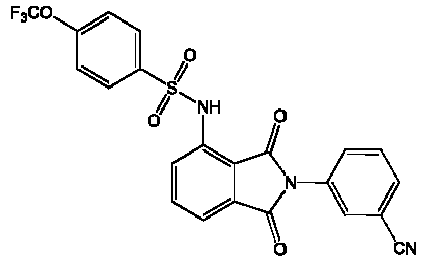
485.64 98.61 %, Rt = 5.93 min (1) 1H NMR (400 MHz, DMSO-d6): δ 10.29 (bs, 1H), 8.12-8.09 (m, 2H), 7.93 (m, 1H), 7.87-7.83 (m, 2H), 7.76-7.72 (m, 3H), 7.66-7.60 (m, 3H). 41 
504.24 97.96 %, Rt = 5.73 min (1) 1H NMR (400 MHz, DMSO-d6): δ 10.71 (bs, 1H), 8.42 (s, 1H), 8.21-8.19 (d, J = 6.8 Hz, 1H), 8.0-7.98 (d, J = 8.4 Hz, 1H), 7.93 (m, 1H), 7.87-7.83 (m, 2H), 7.77 (m, 3H), 7.64-7.62 (d, J = 8.4 Hz, 1H). 42 
488.09 99.86 %, Rt = 5.66 min (1) 1H NMR (400 MHz, DMSO-d6): δ 10.62 (bs, 1H), 8.43-8.42 (m, 1H), 8.35-8.33 (m, 1H), 7.95-7.93 (m, 1H), 7.86-7.76 (m, 5H), 7.73-7.71 (m, 1H), 7.65-7.63 (m, 1H). -

- To a stirred solution of compound XXII (10.0 g, 71.4 mmol) in water (125 mL) was added a catalytic amount of cetyl trimethylammonium bromide (0.01 g) and potassium permanganate (45.1 g, 280 mmol). The reaction mixture was heated to a reflux for 5 days. The reaction mass was filtered through a sintered funnel, whereupon the aqueous solution was acidified to pH 1. The aqueous solution was extracted with ethyl acetate. The organic layer was separated, dried using anhydrous Na2SO4 and concentrated to afford 3-chlorophthalic acid as a yellow solid (XXIII; 5 g, 35% yield). 1H NMR (400 MHz, DMSO-d6): δ 13.37 (bs, 2H), 7.90-7.88 (dd, J = 7.6 Hz, 1H), 7.77-7.75 (d, J = 7.6 Hz, 1H) 7.56-7.52 (t, J = 7.8 Hz, 1H). MS (M-1): 198.96
- Compound XXIII (5.0 g, 25.1 mmol) was added to a 1:2 solution of nitric acid and sulfuric acid (9 mL) at 0°C. The reaction mixture was stirred at room temperature for 3.5 hours. The reaction mixture was then cooled to 0°C and crushed ice was added. The solid which precipitated out was filtered to afford 3-chloro-6-nitrophthalic acid as a yellow solid (XXIV; 5 g, 80% yield). 1H NMR (400 MHz, DMSO-d6): δ 8.16-8.13 (d, J = 8.8 Hz, 1H), 7.93-7.91 (d, J = 8.8 Hz, 1H). MS (M-1): 244.06
- A stirred solution of compound XXIV (5.0 g; 20.3 mmol) in acetic anhydride (60 mL) was heated at 120°C for 12 hours. The reaction mixture was cooled and diluted with water. The aqueous layer was extracted with ethyl acetate. The organic layer was washed with brine, dried over anhydrous Na2SO4 and concentrated to afford 4-chloro-7-nitroisobenzofuran-1,3-dione as a yellow solid (XXV; 5 g).
- To a stirred solution of compound XXV (5.0 g, 21.1 mmol) in acetic acid (62 mL) was added 2-aminopyridine (3.4 g, 34 mmol) and the reaction mixture heated at a reflux for 18 hours. The reaction mixture was cooled to room temperature and the acetic acid removed under reduced pressure to obtain crude product 4-chloro-7-nitro-2-(pyridin-3-yl)isoindoline-1,3-dione as a yellow solid (XXVI; 4.5 g,). MS (M+1): 304.02, which was used directly in the next step.
- To a solution of compound XXVI (4.5 g) in ethanol (100 mL) under nitrogen atmosphere was added Raney nickel. The reaction mixture was purged with hydrogen and stirred under hydrogen balloon pressure for 6 hours at room temperature. The reaction mass was filtered through a celite bed under a nitrogen atmosphere and the solvent evaporated under reduced pressure to afford compound 4-amino-7-chloro-2-(pyridin-3-yl)isoindoline-1,3-dione as a yellow solid (XXVII; 1.3 g). 1H NMR (400 MHz, DMSO-d6): δ 8.65 (s, 1H), 8.61-8.59 (d, J = 4.8 Hz, 1H), 7.90-7.87 (d, J= 4.8 Hz, 1H), 7.59-7.56 (m, 1H), 7.50-7.48 (m, 1H), 7.08-7.04 (m, 1H), 6.74-6.60 (m, 2H). MS (M+1): 274.04
- A mixture of compound XXVII (300 mg, 1.09 mmol) and pyridine (3 mL) was cooled to 0°C and tert-butylbenzenesulfonyl chloride V (1.01 g, 4.1 mmol) was added together with a catalytic quantity of DMAP. The reaction mixture was stirred for 24 hours at 125°C. The reaction mixture was concentrated and to the resultant residue water was added and extracted with dichloromethane. The organic layer was washed with brine solution, dried over anhydrous Na2SO4, filtered and the organic solvent was evaporated under reduced pressure to obtain the crude compound. This was purified by preparative HPLC to afford 4-(tert-butyl)-N-(7-chloro-1,3-dioxo-2-(pyridin-3-yl)isoindolin-4-yl)benzenesulfonamide as a light yellow solid (43; 10 mg,). 1H NMR (400 MHz, DMSO-d6): δ 10.0 (bs, 1H), 8.60 (m, 2H), 7.86-7.83 (m, 3H), 7.66-7.64 (m, 2H), 7.59-7.56 (m, 3H), 1.27 (s, 9H). MS (M+1): 470.2 (LCMS Purity 97.52%, Rt = 6.17 min (1)).
- To a stirred solution of 1-(tert-butyl)-N-(7-chloro-1,3-dioxo-2-(pyridin-3-yl)isoindolin-4-yl)benzenesulfonamide (43; 0.16 g, 0.34 mmol) in dichloromethane (5 mL), was added metachloroperoxybenzoic acid (0.059 g, 0.34 mmol). The reaction was stirred at room temperature for 8 hours whereupon the solvent was concentrated under reduced pressure and the residue diluted with water. The aqueous layer was extracted with dichloromethane. The combined organic layers were washed sequentially with sodium bicarbonate and brine, then dried over anhydrous Na2SO4, filtered and concentrated under vacuum to leave the crude compound which was triturated with hexane ether (1:1) mixture followed by prep TLC purification using 5% methanol in dichloromethane to afford 3-(4-(4-(tert-butyl)phenylsulfonamido)-7-chloro-1,3-dioxoisoindolin-2-yl)pyridine 1-oxide (44; 0.060 g, 36% yield). 1H NMR (400 MHz, DMSO-d6): δ 10.06 (bs, 1H), 8.33-8.31 (m, 2H), 7.94-7.92 (m, 2H), 7.83-7.81 (m, 1H), 7.69-7.57 (m, 4H), 7.45-7.43 (d, J = 8.0 Hz, 1H), 1.27 (s, 9H). MS (M+1): 486.14. (LCMS purity 96.97%, Rt = 5.34 min (1)).
- The following compounds were prepared in a similar manner using the appropriate sulfonyl chloride in the penultimate step. This resulted either in the final pyridine compounds, which if required could also be converted into the corresponding pyridine N-oxides using mCPBA:
Cmpd number Structure LCMS (M+1) Purity (LCMS) 1H NMR 45 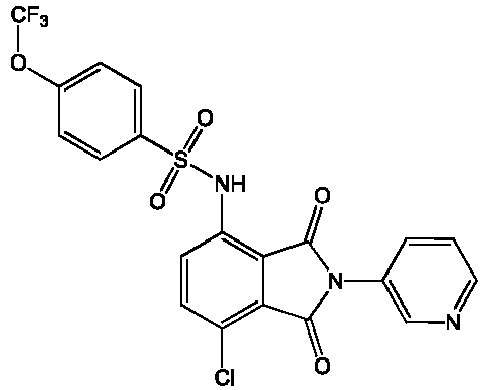
498.07 97.70% Rt = 5.54 min (1) 1H NMR (400MHz, DMSO-d6): δ 10.37 (bs, 1H), 8.64-8.63 (d, J = 4 Hz, 1H), 8.59 (s, 1H), 8.11-8.09 (d, J = 8.8 Hz, 2H), 7.85-7.83 (d, J = 8.8 Hz, 2H), 7.65-7.58 (m, 4H). 46 
514.11 98.81% Rt = 4.87 (1) 1H NMR (400MHz, DMSO-d6): δ 10.43 (bs, 1H), 8.32-8.31 (m, 2H), 8.11-8.09 (d, J = 8.8 Hz, 2H), 7.90-7.80 (m, 1H), 7.65-7.57 (m, 4H), 7.43-7.41 (d, J = 8 Hz, 1H) 47 
482.08 99.65% Rt = 5.25 min (1) 1H NMR (400MHz, DMSO-d6): δ 10.52 (bs, 1H), 8.63-8.62 (d, J = 3.6 Hz, 1H), 8.58-8.57 (d, J = 2 Hz, 1H), 8.14-8.12 (d, J = 8 Hz, 2H), 7.98-7.96 (d, J = 8 Hz, 2H), 7.83-7.81 (d, J = 8 Hz, 1H), 7.77-7.74 (m, 1H), 7.62-7.57 (m, 2H). 48 
516.06 97.50 % Rt = 5.48 min (1) 1H NMR (400MHz, DMSO-d6): δ 10.79 (bs, 1H), 8.64-8.63 (d, J = 3.2 Hz, 1H), 8.58 (s, 1H), 8.42 (s, 1H), 8.21-8.19 (d, J = 6.8 Hz, 1H), 7.99-7.97 (d, J = 8.4 Hz, 1H), 7.83-7.81 (d, J = 8.4 Hz, 2H), 7.63-7.58 (m, 2H). 49 
480.81 97.92 % Rt = 4.76 min (1) 1H NMR (400MHz, DMSO-d6): δ 10.22 (bs, 1H), 8.63-8.62 (d, J = 3.6 Hz, 1H), 8.60-8.59 (d, J = 2 Hz, 1H), 8.56 (s, 1 H), 8.07-8.05 (d, J = 8.4 Hz, 2H), 7.96-7.92 (m, 3H), 7.84-7.81 (m, 2H), 7.67-7.65 (d, J = 8.8 Hz, 1H), 7.59-7.56 (m, 1H). 50 
444.09 98.76 % Rt = 5.25 min (1) 1H NMR (400MHz, DMSO-d6): δ 10.17 (bs, 1H), 8.65-8.62 (m, 2H), 7.88-7.80 (m, 2H), 7.64-7.51 (m, 5H), 7.27-7.25 (d, J = 8 Hz, 1H), 3.80 (s, 3H). 51 
432.03 98.57 % Rt = 5.05 min (1) 1H NMR (400MHz, DMSO-d6): δ 10.20 (bs, 1H), 8.64-8.63 (d, J = 3.2 Hz, 1H), 8.61 (s, 1H), 8.05 (m, 2H), 7.86-7.80 (m, 2H), 7.65-7.60 (m, 2H), 7.49-7.44 (m, 2H). 52 
480.04 99.23 % Rt = 5.22 min (1) 1H NMR (400MHz, DMSO-d6): δ 10.17 (bs, 1H), 8.64-8.61 (m, 2H), 8.06-8.04 (d, J = 9.2 Hz, 2H), 7.86-7.80 (m, 2H), 7.66-7.64 (d, J = 8.8 Hz, 1H), 7.59 (m, 1H), 7.40-7.37 (m, 3H). 53 
439.11 98.42 % Rt = 4.66 min (1) 1H NMR (400MHz, DMSO-d6): δ 10.63 (bs, 1H), 8.65-8.63 (d, J = 4.8Hz, 1H), 8.60-8.59 (d, J = 2 Hz, 1H), 8.11 (m, 4H), 7.84-7.81 (m, 2H), 7.62-7.58 (m, 2H). 54 
444.16 98.28 % Rt = 5.39 min (1) 1H NMR (400MHz, DMSO- d6-): δ 9.86 (bs, 1H), 8.64-8.62 (m, 2H), 7.94-7.92 (d, J = 8.8 Hz, 2H), 7.87-7.85 (d, J = 7.6 Hz, 1H), 7.82-7.79 (d, J = 9.2 Hz, 1H), 7.68-7.66 (d, J = 8.8 Hz, 1H), 7.61-7.58 (m, 1H), 7.13-7.11 (d, J = 8.4 Hz, 2H), 3.82 (s, 3H), 55 
500.09 99.79 %, Rt = 5.28 min (1) 1H NMR (400MHz, DMSO-d6): δ 10.72 (bs, 1H), 8.64-8.63 (d, J = 3.6 Hz, 1H), 8.59 (s, 1H), 8.43-8.42 (d, J = 5.3 Hz, 1H), 8.34-8.33 (m, 1H), 7.84-7.76 (m, 3H) 7.64-7.58 (m, 2H). 56 
481.03 99.41 %, Rt = 5.27min (1) 1H NMR (400MHz, DMSO-d6): δ 10.41 (bs, 1H), 8.64-8.60 (m, 2H), 8.06-8.04 (d, J = 8.4 Hz, 2H), 7.83-7.82 (m, 2H), 7.78-7.76 (d, J = 8.4 Hz, 2H), 7.67-7.65 (m, 1H), 7.60-7.58 (m, 1H), 1.68 (s, 6H). 57 
456.35 99.36 %, Rt = 5.94 min (1) 1H NMR (400MHz, DMSO-d6): δ 10.0 (bs, 1H), 8.64-8.63 (d, J = 4.0 Hz, 1H), 8.61 (s, 1H), 7.93-7.91 (d, J = 8.4 Hz, 2H), 7.86-7.82 (m, 2H), 7.69-7.67 (d, J = 8.8 Hz, 1H), 7.60-7.58 (m, 1H), 7.51-7.49 (d, J = 8.4 Hz, 2H), 3.01-2.94 (m, 1H), 1.19-1.18 (d, J = 6.8 Hz, 6H). 58 
497.36 95.01 %, Rt = 4.52 min (1) 1H NMR (400MHz, DMSO-d6): δ 10.30 (bs, 1H), 8.32-8.31 (m, 2H), 8.07-8.04 (d, J = 8.4 Hz, 2H), 7.84-7.82 (d, J = 8.4 Hz, 1H), 7.78-7.76 (d, J = 8.4 Hz, 2H), 7.67-7.65 (d, J = 9.2 Hz, 1H), 7.61-7.57 (m, 1H), 7.44-7.42 (d, J = 8.0 Hz, 1H), 1.69 (s, 6H). -

- To a stirred solution of compound I (0.5 g, 2.59 mmol) in acetic acid (10 mL) was added compound XXVIII (0.51 g, 3.88 mmol) and the reaction heated at 100°C for 18 h. The reaction mixture was cooled to room temperature and acetic acid was removed under reduced pressure to obtain a crude product. This was suspended in ethanol, cooled and filtered to afford 3-((4-nitro-1,3-dioxoisoindolin-2-yl)methyl)benzonitrile as an off white solid (XXIX; 0.4 g; 55% yield). 1H NMR (400MHz, DMSO-d6): δ 8.31-8.29 (d, J = 8 Hz, 1H), 8.20-8.18 (d, J = 7.2 Hz, 1H), 8.08-8.05 (t, J = 7.6 Hz, 1H), 7.85 (s, 1H), 7.76-7.70 (m, 2H), 7.57-7.53 (t, J = 7.6 Hz, 1H), 4.84 (s, 2H). MS (M+1): 308.00.
- To a stirred solution of compound XXIX (0.4 g, 1.30 mmol) in ethanol (70 mL) was added stannous chloride powder (0.87 g, 3.9 mmol) and the reaction mixture was heated to a reflux for 18h. The ethanol was concentrated under reduced pressure to obtain a crude product. The reaction mixture was diluted with water and a saturated solution of sodium bicarbonate and the aqueous layer extracted with ethyl acetate. The organic layer was washed with brine solution, dried over anhydrous Na2SO4 and evaporated under reduced pressure to afford crude 3-((4-amino-1,3-dioxoisoindolin-2-yl)methyl)benzonitrile as a yellow solid (XXX; 0.25 g). MS (M-1): 276.09 which was used in the next step without further purification.
- To a mixture of compound XXX (0.25 g, 0.902 mmol) in pyridine (4 mL) was added 4-tert butylbenzenesulfonyl chloride (V; 0.73 g, 3.15 mmol). The reaction mixture was stirred for 12 h at 100°C. The reaction mixture was cooled and concentrated under reduced pressure and diluted using saturated ammonium chloride solution, which was extracted with dichloromethane. The organic layer was washed with brine solution, dried over anhydrous Na2SO4 and evaporated under reduced pressure to obtain the crude compound, which was purified by column chromatography using 25% ethyl acetate in hexane to afford 4-(tert-butyl)-N-(2-(3-cyanobenzyl)-1,3-dioxoisoindolin-4-yl)benzenesulfonamide as a white solid (59; 0.08 g, 31% yield). 1H NMR (400MHz, DMSO-d6): δ 9.88 (bs, 1H), 7.94-7.92 (d, J= 7.2 Hz, 2H), 7.81-7.74 (m, 3H), 7.64-7.54 (m, 6H), 4.77 (s, 2 H), 1.26 (s, 9H). MS (M-1): 472.10 (LCMS purity 98.28%, Rt= 6.77 min) (1).
- The following compounds were also prepared using a similar method and the appropriate sulfonyl chloride in the final step:
Cpd Structure LCMS (M-1) Purity (LCMS) 1H NMR 60 
484.06 98.76%, Rt = 5.90 min (1) 1H NMR (400MHz, DMSO-d6): δ 10.42 (bs, 1H), 8.16-8.14 (d, J = 8 Hz, 2H), 7.98-7.96 (d, J = 8.0 Hz, 2H), 7.92 (s, 1H), 7.76-7.74 (d, J = 6.4 Hz 2H), 7.63-7.60 (m, 2H), 7.57-7.52 (m, 2H), 4.75 (s, 2H). 61 
500.15 98.23% Rt = 6.18 min (1) 1H NMR (400MHz, DMSO-d6): δ 10.22 (bs, 1H), 8.08-8.06 (d, J = 8.8 Hz, 2H), 7.78-7.73 (m, 3H), 7.62-7.52 (m, 6H), 4.75 (s, 2 H). 62 
502.09 99.15% Rt = 5.85 min (1) 1H NMR (400MHz, DMSO-d6): δ 10.53 (bs, 1H), 8.34-8.33 (d, J=5.6 Hz, 1H), 8.27-8.26 (m, 1H), 7.78-7.68 (m, 4H), 7.65-7.52 (m, 4H), 4.74 (s, 2 H). 63 
434.12 99.65% Rt = 5.92 min (1) 1H NMR (400MHz, DMSO-d6): δ 10.07 (bs, 1H), 8.02-7.99 (m, 2H), 7.78-7.73 (m, 3H), 7.61-7.52 (m, 4H), 7.43-7.39 (t, J = 8.4 Hz, 2H), 4.76 (s, 2 H). -
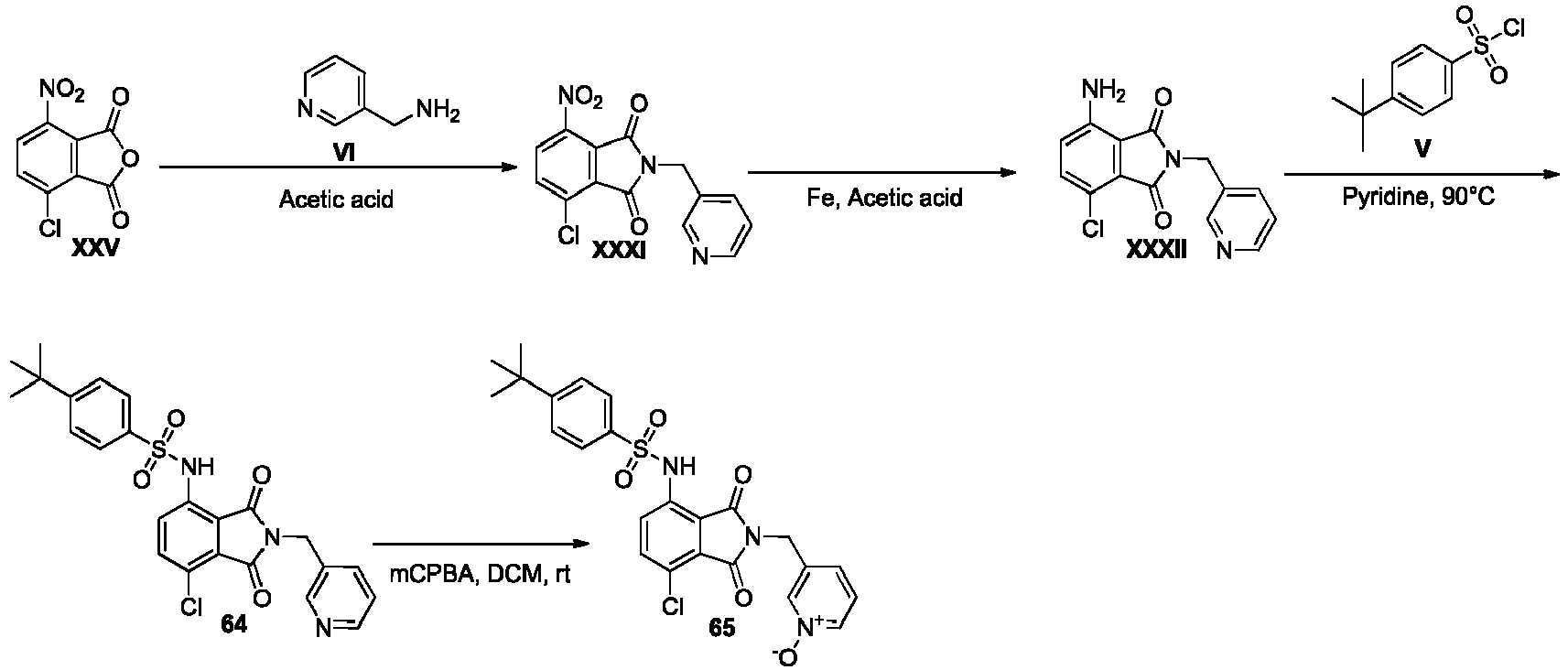
- To a stirred solution of compound XXV (5.0 g, 21.1 mmol) in acetic acid (44 mL) was added pyridin-3-ylmethanamine (VI, 7.2 g, 66 mmol) and the reaction mixture heated at 100°C for 18 h. The reaction mixture was cooled to room temperature and the acetic acid removed under reduced pressure to obtain the crude product which was washed with ethyl acetate to afford 4-chloro-7-nitro-2-(pyridin-3-ylmethyl)isoindoline-1,3-dione as a yellow solid (XXXI; 2 g, 28% yield). 1H NMR (400MHz, DMSO-d6): δ 8.80 (s, 1H), 8.72-8.69 (m, 1H), 8.29-8.27 (d, J = 8.4 Hz, 1H), 8.23 (m, 1H), 8.13-8.10 (d, J = 8.4 Hz, 1H), 7.74 (m, 1H), 4.91 (s, 2H). MS (M+1): 317.8 (LCMS Purity 94.26%).
- To a solution of compound XXXI (2 g, 6 mmol) in acetic acid (30 mL) was added portion wise iron powder (0.5 g, 18 mmol). The reaction mixture was stirred for 5 h at room temperature. The reaction mixture was concentrated under reduced pressure. The crude mass was neutralized with sodium bicarbonate solution with the resulting aqueous layer being extracted with ethyl acetate. The organic solvent was dried, filtered and evaporated under reduced pressure to obtain the crude compound. The crude material was further purified by trituration using acetonitrile and ethyl acetate to afford compound 4-amino-7-chloro-2-(pyridin-3-ylmethyl)isoindoline-1,3-dione as a brown solid (XXXII; 1.2 g, 70% yield). 1H NMR (400MHz, DMSO-d6): δ 8.55 (s, 1H), 8.48 (m, 1H), 7.70-7.68 (d, J= 7.6 Hz, 1H), 7.42-7.40 (d, J = 8.4 Hz, 1H), 7.35 (m, 1H), 7.0-6.98 (d, J = 8.8 Hz, 1H), 6.63 (bs, 2H), 4.72 (s, 2H). MS (M+1): 288.12.
- A mixture of compound XXXII (400 mg, 1.39 mmol) and pyridine (5 mL) was cooled to 0°C and 4-tert-butylbenzenesulfonyl chloride (V, 0.82 g, 3.53 mmol) was added. The reaction mixture was stirred for 12 h at 80°C. The reaction mixture was concentrated and to the resultant residue, water was added and extracted with dichloromethane. The organic layer was washed with brine solution, dried over anhydrous Na2SO4, filtered and then evaporated under reduced pressure to obtain the crude compound which was purified by column chromatography using 2% methanol in dichloromethane to afford 4-(tert-butyl)-N-(7-chloro-1,3-dioxo-2-(pyridin-3-ylmethyl)isoindolin-4-yl)benzenesulfonamide as a white solid (64; 0.08 g, 11.8% yield). 1H NMR (400MHz, DMSO-d6): δ 9.92 (bs, 1H), 8.57 (s, 1H), 8.50 (s, 1H),7.92-7.90 (d, J = 8 Hz, 2H), 7.75-7.73 (d, J = 9.2 Hz, 2H), 7.62-7.58 (m, 3H), 7.38-7.35 (m, 1H), 4.74 (s, 2H), 1.26 (s, 9H). MS (M+1): 484.10. (LCMS purity 97.90%, Rt = 6.38 min(1)).
- To a stirred solution of 4-(tert-butyl)-N-(7-chloro-1,3-dioxo-2-(pyridin-3-ylmethyl)isoindolin-4-yl)benzenesulfonamide (64; 0.065 g, 0.14 mmol) in dichloromethane (5 mL), was added meta-chloroperoxybenzoic acid (0.04 g, 0.14 mmol). The reaction was stirred at RT for 8 h whereupon the solvent was concentrated under reduced pressure and the residue diluted with water. The aqueous layer was extracted with dichloromethane. The combined organic layers were washed sequentially with sodium bicarbonate and brine, then dried over anhydrous Na2SO4, filtered and concentrated under vacuum to leave the crude compound which was purified by column chromatography using 2% methanol in dichloromethane to afford 3-((4-(4-(tert-butyl)phenylsulfonamido)-7-chloro-1,3-dioxoisoindolin-2-yl)methyl)pyridine 1-oxide (65; 0.012 g, 14% yield). 1H NMR (400MHz, DMSO-d6): δ 9.93 (bs, 1H), 8.26 (s, 1H), 8.14-8.12 (d, J= 6 Hz, 1H), 7.93-7.91 (d, J= 8 Hz, 2H),7.75-7.73 (d, J= 8.4 Hz, 1H), 7.63-7.58 (m, 3H), 7.38-7.34 (t, J = 6.8 Hz, 1H), 7.29-7.27(d, J = 9.2 Hz, 1H), 4.69 (s, 2H), 1.26 (s, 9H). MS (M+1): 500.12. (LCMS purity 98.73%, Rt = 5.47 min(1)).
- The following compounds were prepared in a similar manner and using the appropriate sulfonyl chloride in the penultimate step. This resulted either in the final pyridine compounds, which if required could also be converted into the corresponding pyridine N-oxides using mCPBA:
CPD. Structure LCMS (M+1) Purity (LCMS) 1H NMR 66 
495.92 99.53 % Rt = 5.29 min (1) 1H NMR (400MHz, DMSO- d6): δ 10.48 (bs, 1H), 8.55 (s, 1H), 8.49-8.48 (d, J = 3.6 Hz, 1H), 8.13-8.11 (d, J = 8.4 Hz, 2H), 7.97-7.95 (d, J = 8.4 Hz, 2H), 7.76-7.31 (d, J = 9.2 Hz, 1H), 7.69-7.67 (d, J = 8 Hz, 1H), 7.55-7.53 (d, J = 8.8 Hz, 1H), 7.36-7.33 (m, 1H), 4.71 (s, 2H). 67 
511.92 98.75 % Rt = 5.48 min (1) 1H NMR (400MHz, DMSO- d6): δ 10.30 (bs, 1H), 8.59 (s, 1H), 8.53-8.52 (d, J = 4.4 Hz, 1H), 8.07-8.05 (d, J = 8.4 Hz, 2H), 7.77-7.75 (d, J = 8.4 Hz, 2H),7.58-7.55 (m, 3H), 7.43-7.40 (m, 1H), 4.74 (s, 2H). 68 
494.12 99.65 % Rt = 5.38 min (1) 1H NMR (400MHz, DMSO- d6): δ 10.10 (bs, 1H), 8.54 (s, 1H), 8.49-8.48 (d, J = 3.6 Hz, 1H), 8.01-7.99 (d, J = 8.8 Hz, 2H), 7.75-7.68 (m, 2H), 7.57-7.55 (d, J = 8.8 Hz, 1H), 7.39-7.21 (m, 4H), 4.73 (s, 2H). 69 
512.14 96.68 % Rt = 4.76 min (1) 1H NMR (400MHz, DMSO- d6): δ 8.19 (s, 1H), 8.12-8.11 (d, J = 6 Hz, 1H), 7.99-7.97 (d, J = 8 Hz, 2H), 7.78-7.76 (d, J = 8.4 Hz, 2H), 7.48-7.46 (d, J = 9.2 Hz, 1H), 7.36-7.32 (m, 1H), 7.25-7.23 (d, J = 9.2 Hz, 1H), 7.20-7.18 (d, J = 8 Hz, 1H), 4.62 (s, 2H). 70 
528.13 99.02 % Rt = 4.89 min (1) 1H NMR (400MHz, DMSO- d6): δ 8.21 (s, 1H), 8.13-8.11 (d, J = 6 Hz, 1H), 7.97-7.95 (d, J = 8.4 Hz, 2H), 7.51-7.45 (m, 4H), 7.37-7.33 (m, 1H), 7.22-7.20 (d, J = 7.6 Hz, 1H), 4.64 (s, 2H). 71 
530.14 99.40 %, Rt = 5.42 min (1) 1H NMR (400MHz, DMSO-d6): δ 10.69 (bs, 1H), 8.55 (s, 1H), 8.50-8.49 (d, J = 3.2 Hz, 1H), 8.36 (s, 1H), 8.17-8.15 (d, J = 8 Hz, 1H), 7.93-7.91 (d, J = 8 Hz 1H), 7.74-7.72 (d, J = 8 Hz, 1H) 7.68-7.66 (d, J = 8Hz, 1H), 7.55-7.53 (d, J = 8 Hz, 1H), 7.38 (t, J = 8 Hz, 1H), 4.71 (s 2H). 72 
514.23 99.24 %, Rt = 5.27 min (1) 1H NMR (400MHz, DMSO-d6): δ 10.53 (bs, 1H), 8.54 (s, 1H), 8.50-8.49 (d, J = 4.0 Hz, 1H), 8.34-8.33 (d, J = 6.0 Hz, 1H), 8.26-8.24 (m, 1H), 7.75-7.66 (m, 3H), 7.57-7.55 (d, J = 8.8 Hz, 1H), 7.37-7.34 (m, 1H), 4.71 (s, 2H). 73 
456.19 (M-1) 98.76 %, Rt = 5.46 min (1) 1H NMR (400MHz, DMSO-d6): δ 9.80 (bs, 1H), 8.55-8.49 (m, 2H), 7.89-7.87 (m, 2H), 7.73-7.68 (m, 2H), 759-7.57 (d, J = 8.8 Hz, 1H) 7.36-7.35 (d, J = 4.8 Hz, 1H), 7.09-7.07 (d, J = 8.0 Hz, 2H), 4.73 (s, 2H), 3.81 (s, 3H). 74 
530.30 97.00 %, Rt = 4.84 min (1) 1H NMR (400MHz, DMSO-d6): δ 10.57 (bs, 1H), 8.24-8.21 (m, 3H), 8.13-8.12 (d, J = 6.4 Hz, 1H), 7.63 (t, J=9.6 Hz, 1H), 7.53-7.51 (m, 2H), 7.34 (t, J = 7.2 Hz, 1H) 7.21-7.19 (d, J = 8.4 Hz, 1H), 4.65 (s, 2H). 75 
546.30 98.08 %, Rt = 5.01 min (1) 1H NMR (400MHz, DMSO-d6): δ 8.19 (m, 2H), 8.12-8.11 (d, J = 5.6, 1H), 8.05-8.03 (d, J = 8.0 Hz, 1H), 7.78-7.76 (d, J = 8 Hz, 1H), 7.50-7.48 (d, J = 8.8 Hz, 1H), 7.36-7.27 (m, 2H) 7.19-7.18 (d, J = 7.2 Hz, 1H), 4.63 (s, 2H). 76 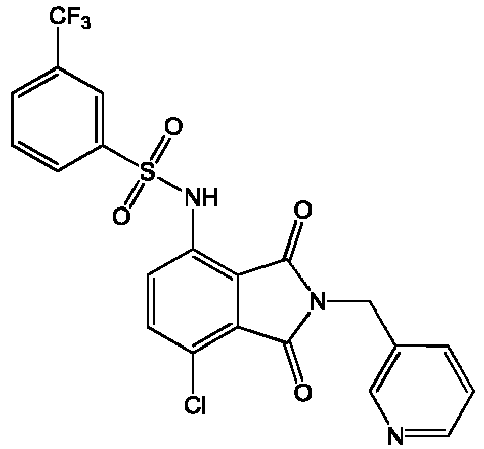
496.04 98.75%, Rt = 5.21 min (1) 1H NMR (400MHz, DMSO-d6): δ 10.62 (bs, 1H), 8.52-8.50 (m, 2H), 8.24 (s, 1H), 8.17-8.15 (d, J = 8.4 Hz, 1H), 8.03-8.01 (d, J = 7.6 Hz, 1H), 7.81-7.74 (m, 2H), 7.66-7.64 (d, J = 7.2 Hz, 1H), 7.56-7.54 (d, J = 8.8 Hz, 1H), 7.38-7.35 (m, 1H), 4.70 (s, 2H). 77 
495.08 98.75%, Rt = 4.83 min (1) 1H NMR (400MHz, DMSO-d6): δ 10.18 (bs, 1H), 8.56 (s, 1H), 8.53 (s, 1H), 8.45-8.44 (d, J = 8.4 Hz, 1H), 8.01-7.99 (d, J = 8.4 Hz, 2H), 7.91-7.89 (m, 3H), 7.76-7.73 (d, J = 8.8 Hz, 1H), 7.66-7.64 (d, J = 8.0 Hz, 1H), 7.59-7.56 (d, J = 8.8 Hz, 1H), 7.30-7.27 (m, 1H), 4.71 (s, 2H). 78 
510.09 (M-1) 97.57 %, Rt = 4.77 min (1) 1H NMR (400MHz, DMSO-d6): δ 10.55 (bs, 1H), 8.27 (s, 1H), 8.21-8.14 (m, 3H), 8.06-8.04 (d, J = 8.4 Hz, 1H), 7.85-7.81 (t, J = 7.6 Hz, 1H), 7.77-7.75 (d, J = 8.8 Hz, 1H), 7.56-7.54 (d, J = 8.8 Hz, 1H), 7.39-7.35 (t, J = 7.6 Hz, 1H), 7.23-7.21 (d, J = 7.2 Hz, 1H), 4.66 (s, 2H). 79 
495.05 99.37%, Rt = 5.45 min (1) 1H NMR (400MHz, DMSO-d6): δ 10.18 (bs, 1H), 8.56 (s, 1H), 8.49 (s, 1H), 8.04-8.02 (d, J = 8.4 Hz, 2H), 7.75-7.71 (m, 4H), 7.58-7.56 (d, J = 8.8 Hz, 1H), 7.37-7.34 (m, 1H), 4.73 (s, 2H), 1.68 (s, 6H). 80 
470.38 99.50 %, Rt = 6.11 min (1) 1H NMR (400MHz, DMSO-d6): δ 9.92 (bs, 1H), 8.55 (s, 1H), 8.49-8.48 (d, J = 4.4 Hz, 1H), 7.90-7.88 (d, J = 8.0 Hz, 2H), 7.74-7.70 (m, 2H), 7.59-7.57 (d, J = 9.2 Hz, 1H), 7.47-7.45 (m, 2H), 7.37-7.34 (m, 1H), 4.73 (s, 2H), 2.98-2.90 (m, 1H), 1.18-1.16 (d, J = 6.8 Hz, 6H). 81 
511.38 99.26 %, Rt = 4.52 min (1) 1H NMR (400MHz, DMSO-d6): δ 10.15 (bs, 1H), 8.26 (s, 1H), 8.14-8.12 (d, J = 6.4 Hz, 1H), 8.06-8.04 (d, J = 8.8 Hz, 2H), 7.76-7.73 (m, 3H), 7.58-7.56 (d, J = 8.8 Hz, 1H), 7.38-7.35 (t, J = 8.0 Hz, 1H), 7.28-7.27 (d, J = 7.6 Hz, 1H), 4.69 (s, 2H), 1.68 (s, 6H). -

- To a stirred solution of 4-(tert-butyl)-N-(7-chloro-1,3-dioxo-2-(pyridin-3-ylmethyl)isoindolin-4-yl)benzenesulfonamide (64; 0.15 g, 0.31 mmol) in dimethylacetamide (4 mL) was added zinc cyanide (0.073 g, 62 mmol) under nitrogen followed by addition of 1,1'-Bis (diphenylphosphino)ferrocene (0.034 g, 0.062 mmol) and Pd2(dba)3 (0.43 g, 0.046 mmol). To the reaction mixture was added zinc dust (0.005 g) and the reaction mixture was purged under nitrogen for 30 minutes. The reaction was heated at 120°C for 2 h in microwave. The reaction mixture was cooled, filtered and concentrated under reduced pressure. The crude residue was purified by column chromatography using 4% methanol in dichloromethane to afford 4-(tert-butyl)-N-(7-cyano-1,3-dioxo-2-(pyridin-3-ylmethyl)isoindolin-4-yl)benzenesulfonamide (82; 0.02 g, 13.6% yield). 1H NMR (400MHz, DMSO-d6): δ 8.70 (s, 1H), 8.61-8.60 (d, J= 4.4 Hz, 1H), 8.11-8.09 (d, J= 8.8 Hz, 1H), 8.03-7.99 (m, 3H), 7.70-7.64 (m, 3H), 7.58-7.55 (m, 1H), 4.84 (s, 2H), 1.27 (s, 9H). MS (M+1): 475.46. (LCMS purity 99.77%, Rt = 5.15 min) (1).
-
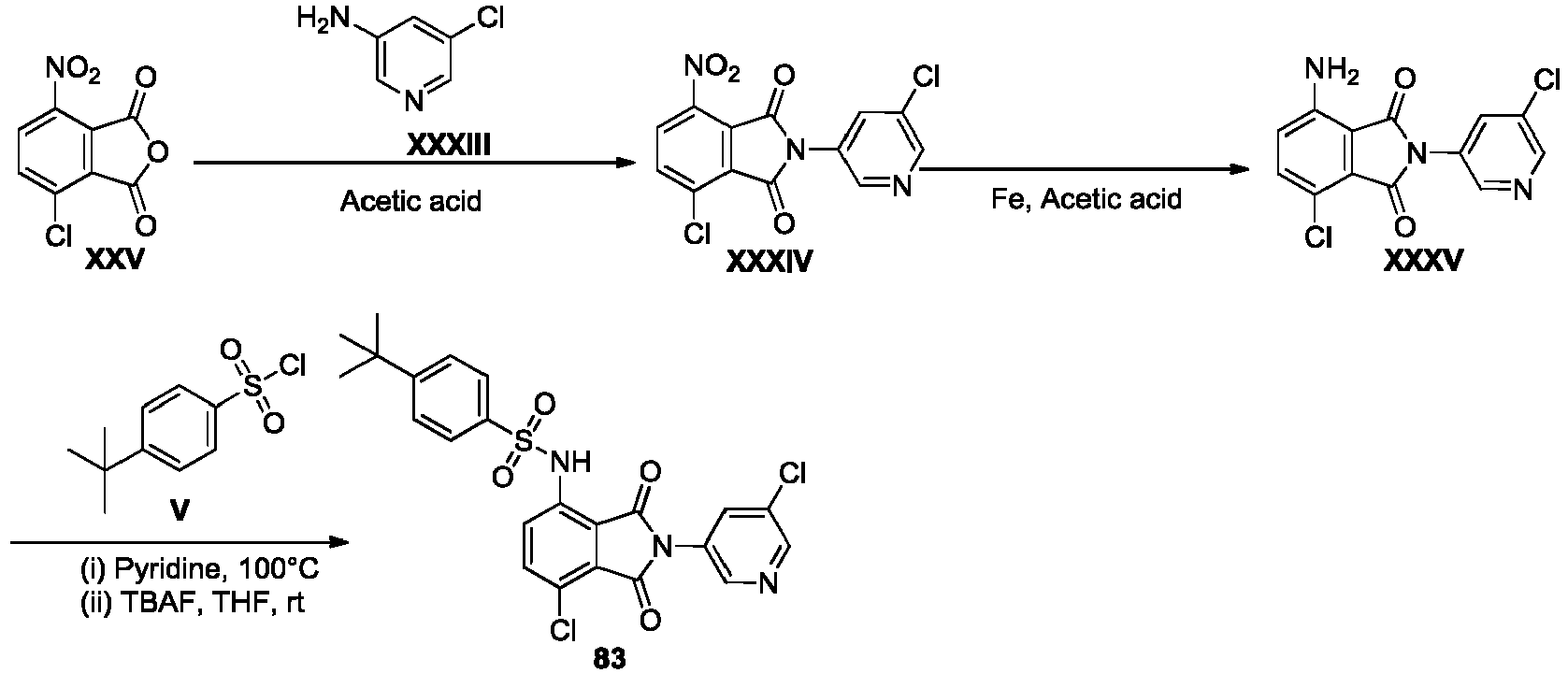
- To a stirred solution of compound XXV (3.0 g, 13.2 mmol) in acetic acid (26 mL) was added 5-chloropyridin-3-amine (XXXIII, 5 g, 39 mmol) and the reaction mixture heated at 100°C for 18 h. The reaction mixture was cooled to room temperature and the acetic acid removed under reduced pressure to obtain the crude product which was washed with ethanol to afford 4-chloro-2-(5-chloropyridin-3-yl)-7-nitroisoindoline-1,3-dione as an off white solid (XXXIV; 4 g, 89% yield). 1H NMR (400MHz, DMSO-d6): δ 8.78 (s, 1H), 8.64 (d, J = 1.6 Hz, 1H), 8.40-8.38 (d, J = 8.8 Hz, 1H), 8.25-8.22 (d, J = 9.2 Hz, 1H), 8.06 (s, 1H).
- To a solution of compound XXXIV (4 g, 11.8 mmol) in acetic acid (200 mL) was added iron powder (1.4 g, 23 mmol) in small portions. The reaction mixture was stirred for 5 h at room temperature and then filtered through a celite bed and concentrated under reduced pressure. The crude mass was neutralized by sodium bicarbonate solution. The aqueous layer was extracted with ethyl acetate, which was dried (anhydrous Na2SO4), filtered and evaporated under reduced pressure to obtain the crude compound. This material was further purified using trituration with acetonitrile and ethyl acetate to afford the compound 4-amino-7-chloro-2-(5-chloropyridin-3-yl)isoindoline-1,3-dione as a yellow solid (XXXV; 3 g, 81% yield). 1H NMR (400MHz, DMSO-d6): δ 8.69-8.66 (m, 2H), 8.10 (s, 1H), 7.52-7.50 (d, J= 8.8 Hz, 1H), 7.09-7.07 (d, J= 9.2 Hz, 1H), 6.78 (bs, 2H). MS (M+1): 307.98 (LCMS Purity 97.9%).
- A mixture of compound XXXV (300 mg, 0.97 mmol) and pyridine (3 mL) was cooled to 0°C and added 4-tert-butylbenzenesulfonyl chloride (V, 0.95 g, 2.9 mmol). The reaction mixture was stirred for 12 h at 100°C. The reaction mixture was concentrated and diluted with water. The reaction mixture was extracted with ethyl acetate. The organic layer was washed with brine solution, dried over anhydrous Na2SO4, filtered and the organic solvent was evaporated under reduced pressure to obtain the crude compound. To the crude compound was added TBAF in THF solution (4 mL) and continued the stirring for 1 h at room temperature. The reaction mixture was concentrated and diluted with ethyl acetate. Washed an organic layer with water, dried over anhydrous Na2SO4, filtered and the organic solvent was evaporated under reduced pressure to obtain the crude compound which was purified by column chromatography using 40% ethyl acetate in hexane to afford the title compound, 4-(tert-butyl)-N-(7-chloro-2-(5-chloropyridin-3-yl)-1,3-dioxoisoindolin-4-yl)benzenesulfonamide as a yellow solid (83; 0.11 g, 23% yield). 1H NMR (400MHz, DMSO-d6): δ 10.06 (bs, 1H), 8.74 (d, J = 2.0 Hz, 1H), 8.61 (d, J = 1.6 Hz, 1H), 8.04 (m, 1H), 7.94-7.91 (d, J = 8.4 Hz, 2H), 7.87-7.84 (d, J = 8.8 Hz, 1H), 7.71-7.69 (d, J = 8.8 Hz, 1H), 7.65-7.63 (d, J = 8.8 Hz, 2H), 1.27 (s, 9H). MS (M+1): 504.07. (LCMS purity 97.67%, Rt = 6.34 min) (1).
- The following compounds were also prepared using a similar method and the appropriate sulfonyl chloride in the final step:
CPD Structure LCMS (M+1) Purity (LCMS) 1H NMR 84 
533.83 95.92 %, Rt = 6.82 min (2) 1H NMR (400MHz, DMSO-d6): δ 10.78 (bs, 1H), 8.75-8.74 (d, J = 2 Hz, 1H), 8.60-8.59 (d, J = 2.0 Hz, 1H), 8.45-8.44 (d, J = 4.4 Hz, 1H), 8.33-8.31 (m, 1H), 8.01-8.00 (m, 1H), 7.85-7.83 (d, J = 8.8 Hz, 1H), 7.80-7.76 (t, J = 9.6 Hz, 1H), 7.65-7.63 (d, J = 8.8 Hz, 1H). 85 
514.11 (M-1) 99.16 %, Rt = 5.78 min (1) 1H NMR (400MHz, DMSO-d6): δ 10.63 (bs, 1H), 8.74-8.73 (d, J = 2.4 Hz, 1H), 8.58-8.57 (d, J = 1.6 Hz, 1H), 8.15-8.13 (d, J = 8 Hz, 2H), 8.00-7.99 (m, 3H), 7.87-7.84 (d, J = 9.2 Hz, 1H), 7.64-7.62 (d, J = 8.8 Hz, 1H). 86 
530.10 (M-1) 99.04 %, Rt = 5.91 min (1) 1H NMR (400MHz, DMSO-d6): δ 10.45 (bs, 1H), 8.74 (s, 1H), 8.59 (s, 1 H), 8.10-8.08 (d, J = 8.4 Hz, 2H), 8.01 (s, 1H), 7.86-7.84 (d, J = 8 Hz, 1H), 7.66-7.60 (m, 3H). 87 
512.05 (M-1) 99.48 %, Rt = 5.63 min (1) 1H NMR (400MHz, DMSO-d6): δ 10.25 (bs, 1H), 8.75-8.74 (d, J = 2.4 Hz, 1H), 8.62-8.61 (d, J = 2 Hz, 1H), 8.07-8.03 (m, 3H), 7.85-7.83 (d, J = 8.8 Hz, 1H), 7.67-7.59 (m, 1H), 7.41-7.23 (m, 3H). 88 
516.17 (M+1) 95.82 %, Rt = 5.56 min (1) 1H NMR (400MHz, DMSO-d6): δ 10.70 (bs, 1H), 8.75-8.74 (d, J = 2.4 Hz, 1H), 8.60-8.59 (d, J = 2 Hz, 1H), 8.39 (s, 1H), 8.28-8.26 (d, J = 8 Hz, 1H), 8.11-8.09 (d, J = 8.4 Hz, 1H), 8.02-8.00 (m, 1H), 7.89-7.83 (m, 2H), 7.64-7.61 (d, J = 9.2 Hz, 1H). 89 
464.09 (M-1) 99.48 %, Rt = 5.50 min (1) 1H NMR (400MHz, DMSO-d6): δ 10.27 (bs, 1H), 8.75-8.74 (d, J = 2 Hz, 1H), 8.62-8.61 (d, J = 1.6 Hz, 1H), 8.08-8.03 (m, 3H), 7.85-7.83 (d, J = 8.8 Hz, 1H), 7.66-7.64 (d, J = 8.8 Hz, 1H), 7.49-7.45 (t, J = 8.8 Hz, 2H). -

- To a stirred solution of compound XXV (2.0 g, 8.8 mmol) in acetic acid (10 mL) was added 5-methoxypyridin-3-amine (XXXVI, 2.7 g, 22 mmol) and the reaction mixture heated at 120°C for 18 h. The reaction mixture was cooled to room temperature and the acetic acid removed under reduced pressure to obtain the crude product which was washed with ethanol to afford 4-chloro-2-(5-methoxypyridin-3-yl)-7-nitroisoindoline-1,3-dione as a brown solid (XXXVII; 2.5 g crude). MS (M+1): 333.84. The crude was carried forward to next step without purification.
- To a solution of compound XXXVII (2.5 g, crude) in acetic acid (10 mL) was added iron powder (2 g) in small portions. The reaction mixture was stirred for 5 h at room temperature. The reaction mixture was filtered through a celite bed and concentrated under reduced pressure. The crude material was neutralized using aqueous sodium bicarbonate solution. The aqueous layer was extracted with ethyl acetate which was dried (anhydrous Na2SO4), filtered and evaporated under reduced pressure to obtain the crude compound. This material was further purified by trituration using acetonitrile and ethyl acetate as solvents to afford compound 4-amino-7-chloro-2-(5-methoxypyridin-3-yl)isoindoline-1,3-dione as a off white solid (XXXVIII; 2 g, 88% yield). 1H NMR (400MHz, DMSO-d6): δ 8.35 (s, 1H), 8.25 (s, 1H), 7.53-7.48 (m, 2H), 7.08 (m, 1H), 6.75 (bs, 2H), 3.85 (s, 3H). MS (M+1): 304.10.
- A mixture of compound XXXVIII (200 mg, 0.66 mmol) and pyridine (3 mL) was cooled to 0°C and 4-tert-butylbenzenesulfonyl chloride (V, 0.46 g, 1.98 mmol) was added together with catalytic DMAP (0.040 g, 0.33 mmol). The reaction mixture was stirred for 12 h at 80°C and then concentrated under vacuum and diluted with water. The aqueous layer was extracted with ethyl acetate which was washed with brine solution, dried over anhydrous Na2SO4, filtered and the organic solvent was evaporated under reduced pressure to obtain the crude compound. To the crude compound was added 1M TBAF in THF solution (2 mL) and the stirring continued for 1 h at room temperature. The reaction mixture was concentrated and diluted with ethyl acetate. This was washed with water, dried over anhydrous Na2SO4, filtered and the organic solvent was evaporated under reduced pressure to obtain the crude compound which was purified by column chromatography using 20% ethyl acetate in hexane to the title compound 4-(tert-butyl)-N-(7-chloro-2-(5-methoxypyridin-3-yl)-1,3-dioxoisoindolin-4-yl)benzenesulfonamide as a yellow solid (90; 0.065 g, 19.7% yield). 1H NMR (400MHz, DMSO-d6): δ 10.03 (bs, 1H), 8.39-8.38 (d, J = 2.4 Hz, 1H), 8.22-8.21 (d, J = 1.6 Hz, 1H), 7.94-7.92 (d, J= 8.4 Hz, 2H), 7.84-7.82 (d, J= 9.2 Hz, 1H), 7.69-7.63 (m, 3H), 7.50-7.48 (m, 1H), 3.85 (s, 3H), 1.25 (s, 9H). MS (M-1): 498.20. (LCMS purity 98.37%, Rt = 6.20 min) (1).
- To a stirred solution of 4-(tert-butyl)-N-(7-chloro-2-(5-methoxypyridin-3-yl)-1,3-dioxoisoindolin-4-yl)benzenesulfonamide (90, 0.1 g, 0.2 mmol) in dichloromethane (4 mL), was added m-chloroperoxybenzoic acid (0.035 g, 0.14 mmol). The reaction was stirred at RT for 5 h whereupon the solvent was concentrated under reduced pressure and the residue diluted with water. The aqueous layer was extracted with dichloromethane. The organic layer was washed sequentially with sodium bicarbonate and brine, then dried over Na2SO4, filtered and concentrated under vacuum to leave the crude compound which was purified by column chromatography using 3% methanol in dichloromethane to afford the title compound 3-(4-(4-(tert-butyl)phenylsulfonamido)-7-chloro-1,3-dioxoisoindolin-2-yl)-5-methoxypyridine 1-oxide (91; 0.05 g, 48% yield). 1H NMR (400MHz, DMSO- d6): δ 10.08 (bs, 1H), 8.20 (s, 1H), 8.01 (s, 1H), 7.94-7.92 (m, 2H), 7.86-7.82 (m, 1H), 7.69-7.63 (m, 3H), 7.15 (s, 1H), 3.85 (s, 3H), 1.27 (s, 9H). MS (M+1): 516.07. (LCMS purity 99.19%, Rt = 5.34 min) (1).
- The following compounds except 103 were prepared in a similar manner and using the appropriate sulfonyl chloride in the penultimate step. This resulted either in the final pyridine compounds, which if required could also be converted into the corresponding pyridine N-oxides using mCPBA. Compound 103 was prepared using 5-ethoxypyridin-3-amine in the first step described:
CPD Structure LCMS (M+1) Purity (LCMS) 1H NMR 92 
510.08 (M-1) 99.35 %, Rt = 5.40 min (1) 1H NMR (400MHz, DMSO-d6): δ 10.53 (bs, 1H), 8.39-8.38 (d, J = 2.4 Hz, 1H), 8.18-8.17 (m, 3H), 8.02-8.00 (d, J = 8.4 Hz, 2H), 7.85-7.83 (d, J = 8.8 Hz, 1H), 7.63-7.61 (d, J = 8.8 Hz, 1H), 7.46-7.45 (s, 1H), 3.85 (s, 3H). 93 
544.08 (M-1) 99.43 %, Rt = 5.58 min (1) 1H NMR (400MHz, DMSO-d6): δ 10.79 (bs, 1H), 8.43 (s, 1H), 8.39-8.38 (d, J = 2.4 Hz, 1H), 8.22-8.19 (m, 2H), 8.00-7.98 (d, J = 8.4 Hz, 1H), 7.84-7.81 (d, J = 8.8 Hz, 1H), 7.63-7.61 (d, J = 8.8 Hz, 1H), 7.46-7.45 (m, 1H), 3.85 (s, 3H). 94 
528.15 99.47 %, Rt = 5.56 min (1) 1H NMR (400MHz, DMSO-d6): δ 10.39 (bs, 1H), 8.39-8.38 (d, J = 2.8 Hz, 1H), 8.20-8.19 (d, J = 1.6 Hz, 1H), 8.11-8.09 (d, J = 8.8 Hz, 2H), 7.85-7.83 (d, J = 8.8 Hz, 1H), 7.65-7.60 (m, 3H), 7.47-7.46 (d, J = 2 Hz, 1H), 3.85 (s, 3H). 95 
530.18 98.00 %, Rt = 5.39 min (1) 1H NMR (400MHz, DMSO-d6): δ 10.69 (bs, 1H), 8.44-8.42 (d, J = 5.2 Hz, 1H), 8.39-8.38 (d, J = 2.8 Hz, 1H), 8.33-8.32 (d, J = 2.8 Hz, 1H), 8.20-8.19 (d, J = 2 Hz, 1H), 7.83-7.76 (m, 2H), 7.64-7.62 (d, J = 8.8 Hz, 1H), 7.47-7.46 (d, J = 2.4 Hz, 1H), 3.85 (s, 3H). 96 
511.06 96.98%, Rt = 4.88 min (1) 1H NMR (400MHz, DMSO-d6): δ 10.24 (bs, 1H), 8.56 (s, 1H), 8.38 (d, J = 2.8 Hz, 1H), 8.20 (d, J = 1.6 Hz, 1H), 8.07-8.05 (d, J = 8.4 Hz, 2H), 7.96-7.92 (m, 3H), 7.83-7.81 (d, J = 8.0 Hz, 1H), 7.66-7.64 (d, J = 8.8 Hz, 1H), 7.46 (m, 1H), 3.84 (s, 3H). 97 
510.06 98.99 %, Rt = 5.33 min (1) 1H NMR (400MHz, DMSO-d6): δ 10.20 (bs, 1H), 8.39 (d, J = 2.8 Hz, 1H), 8.22 (s, 1H), 8.07-8.05 (d, J = 8.8 Hz, 2H), 7.84-7.81 (d, J = 8.8 Hz, 1H), 7.66-7.63 (d, J = 8.8 Hz, 1H), 7.59-7.22 (m, 4H), 3.85 (s, 3H). 98 
545.99 99.31 %, Rt 5.05 min (1) 1H NMR (400MHz, DMSO-d6): δ 10.76 (bs, 1H), 8.38-8.30 (m, 2H), 8.18 (s, 1H), 8.01 (s, 1H), 7.75-7.71 (m, 2H), 7.61-7.59 (m, 1H), 7.14 (s, 1H), 3.85 (s, 3H). 99 
561.97 99.42 %, Rt = 5.23 min (1) 1H NMR (400MHz, DMSO-d6): δ 10.75 (bs, 1H), 8.35 (s, 1H), 8.16 (bs, 2H), 8.02 (s, 1H), 7.92-7.90 (d, J = 8.0 Hz, 1H), 7.66-7.57 (m, 2H), 7.15 (s, 1H), 3.85 (s, 3H). 100 
526.01 99.59 %, Rt = 4.88 min (1) 1H NMR (400MHz, DMSO-d6): δ 10.27 (bs, 1H), 8.18 (s, 1H), 8.03-8.02 (d, J = 5.6 Hz, 3H), 7.77-7.72 (m, 1H), 7.63-7.61 (d, J = 8.8 Hz, 1H), 7.37-7.34 (m, 2H), 7.22-7.09 (m, 2H), 3.85 (s, 3H). 101 
528.03 98.14 %, Rt = 5.96 min (2) 1H NMR (400MHz, DMSO-d6): δ 10.75 (bs, 1H), 8.11 (s, 1H), 8.05 (s, 1H), 8.01-7.99 (d, J = 8.4 Hz, 2H), 7.80-7.78 (d, J = 8.4 Hz, 2H), 7.55-7.53 (d, J = 7.2 Hz, 1H), 7.33-7.30 (d, J = 9.2 Hz, 1H), 7.19 (s, 1H), 3.84 (s, 3H). 102 
544.04 96.39 %, Rt = 6.04 min (2) 1H NMR (400MHz, DMSO-d6): δ 10.46 (bs, 1H), 8.19 (s, 1H), 8.12-8.10 (d, J = 8.8 Hz, 2H), 8.00 (s, 1H), 7.83-7.81 (d, J = 5.2 Hz, 1H), 7.65-7.60 (m, 3H), 7.13 (s, 1H), 3.85 (s, 3 H). 103 
514.47 98.16 %, Rt = 6.28 min (1) 1H NMR (400MHz, DMSO-d6): δ 10.02 (bs, 1H), 8.36 (s, 1H), 8.19 (s, 1H), 7.93-7.91 (m, 2H), 7.84-7.82 (d, J = 8.8 Hz, 1H), 7.69-7.63 (m, 3H), 7.46 (s, 1H), 4.15-4.10 (q, J = 6.8 Hz, 2H), 1.38-1.34 (t, J = 6.8 Hz, 3H), 1.27 (s, 9H). -

- To a stirred solution of compound XXV (2 g, 8.81 mmol) in acetic acid (18 mL) was added 5-methylpyridin-3-amine (XXXIX, 1.43 g, 13.2 mmol). The reaction mixture was heated at 120°C for 12 h. On cooling to room temperature, the acetic acid was removed under reduced pressure to obtain the crude product which was washed with ethanol to afford 4-chloro-2-(5-methylpyridin-3-yl)-7-nitroisoindoline-1,3-dione (XL, 1.8 g, 64.5%). 1H NMR (400MHz, DMSO-d6): δ 8.63 (s, 1H), 8.52 (m, 1H), 8.20-8.16 (m, 1H), 7.86-7.84 (d, J = 8.4 Hz, 1H), 7.70 (m, 1H), 2.3 (s, 3H).
- To a solution of compound XL (1.8 g, 5.67 mmol) in acetic acid (50 mL) was added iron powder (1 g) in small portions. The reaction mixture was stirred for 12 h at room temperature and then filtered through a celite bed and concentrated under reduced pressure. The crude material was neutralized by addition of sodium bicarbonate solution. The aqueous layer was extracted with ethyl acetate, which was dried (anhydrous Na2SO4), filtered and evaporated under reduced pressure to afford compound 4-amino-7-chloro-2-(5-methylpyridin-3-yl)isoindoline-1,3-dione as an off white solid (XLI; 1.4 g, 87.5% yield). 1H NMR (400MHz, DMSO-d6): δ 8.53-8.44 (m, 2H), 7.70 (s, 1H), 7.50-7.47 (d, J = 8.8 Hz, 1H), 7.07-7.05 (d, J = 8.8 Hz, 1H), 6.73 (bs, 2H), 2.36 (s, 3H).
- A mixture of compound XLI (0.3 g, 1.05 mmol) and pyridine (6 mL) was cooled to 0°C and 4-tert-butylbenzenesulfonyl chloride (V, 0.29 g, 1.25 mmol) was added followed by a catalytic quantity of DMAP (0.034 g, 0.42 mmol). The reaction mixture was heated for 15 h at 80°C. The reaction mixture was concentrated and diluted with water. The reaction mixture was extracted with ethyl acetate. An organic layer was washed with brine solution, dried over anhydrous Na2SO4, filtered and the organic solvent was evaporated under reduced pressure to obtain the crude compound. The crude compound was purified by column chromatography using 70% ethyl acetate in hexane to afford 4-(tert-butyl)-N-(7-chloro-2-(5-methylpyridin-3-yl)-1,3-dioxoisoindolin-4-yl)benzenesulfonamide as an off white solid (104; 0.2 g, 39.8% yield). 1H NMR (400MHz, DMSO-d6): δ 9.97 (bs, 1H), 8.49 (s, 1H), 8.40 (s, 1H), 7.93-7.91 (d, J = 8.4 Hz, 2H), 7.84-7.82 (d, J = 9.2 Hz, 1H), 7.69-7.63 (m, 4H), 2.37 (s, 3H), 1.27 (s, 9H). MS (M+1): 484.20. (LCMS purity 96.68%, Rt = 6.22 min (1)).
- The following compound was also prepared using a similar method and the appropriate sulfonyl chloride in the final step:
CPD Structure LCMS (M+1) Purity (LCMS) 1HNMR 105 
470.38 98.96 %, Rt = 6.05 min (1) 1H NMR (400MHz, DMSO-d6): δ 9.97 (bs, 1H), 8.49 (s, 1H), 8.41 (d, J = 2.0 Hz, 1H), 7.93-7.91 (d, J = 8.4 Hz, 2H), 7.84-7.81 (d, J = 8.8 Hz, 1H), 7.69-7.67 (d, J = 8.8 Hz, 2H), 7.51-7.48 (d, J = 8.4 Hz, 2H), 3.0-2.94 (m, 1H), 2.32 (s, 3H), 1.19-1.18 (d, J = 6.8 Hz, 6H). -

- To a stirred solution of compound XXV (0.4g, 1.7 mmol) in acetic acid (4 mL) was added 5-fluoropyridin-3-amine (XLII, 0.39g, 3.5 mmol). The reaction mixture was heated at 120°C for 12 h. The reaction mixture was cooled to room temperature and the acetic acid removed under reduced pressure to obtain the crude product which was washed with ethanol to afford 4-chloro-2-(5-fluoropyridin-3-yl)-7-nitroisoindoline-1,3-dione (XLIII, 0.5 g, 41.6%). MS (M+1): 322.0. (LCMS purity 98.04%).
- To a solution of compound XLIII (0.5 g, 1.56 mmol) in acetic acid (10 mL) was added iron powder (0.5 g) in small portions. The reaction mixture was stirred for 12 h at room temperature. The reaction mixture was filtered through a celite bed and concentrated under reduced pressure. The crude mass was neutralized using aqueous sodium bicarbonate solution, whereupon the aqueous layer was extracted with ethyl acetate which was dried (anhydrous Na2SO4), filtered and evaporated under reduced pressure to obtain the crude compound 4-amino-7-chloro-2-(5-fluoropyridin-3-yl)isoindoline-1,3-dione as a off white solid (XLIV; 0.35 g, 76% yield). MS (M+1): 292.05 which was used without further purification.
- A mixture of compound XLIV (0.35 g, 1.19 mmol) and pyridine (3 mL) was cooled to 0°C and 4-tert-butylbenzenesulfonyl chloride (V, 0.56 g, 2.38 mmol) was added. The reaction mixture was stirred for 12 h at 100°C. The reaction mixture was concentrated, diluted with water and extracted with ethyl acetate. The organic layer was washed with brine solution, dried over anhydrous Na2SO4, filtered and evaporated under reduced pressure to obtain the crude compound. To the crude compound was added 1M TBAF in THF solution (2.4 mL) and this solution was stirred for 1 h at room temperature. The reaction mixture was concentrated and diluted with ethyl acetate. The organic layer was washed with water, dried over anhydrous Na2SO4, filtered and evaporated under reduced pressure to obtain the crude compound which was purified by column chromatography using 50% ethyl acetate in hexane to afford methyl 4-(tert-butyl)-N-(7-chloro-2-(5-fluoropyridin-3-yl)-1,3-dioxoisoindolin-4-yl)benzenesulfonamide as an off white solid (106; 0.13 g, 22.2% yield). 1H NMR (400MHz, DMSO-d6): δ 10.05 (bs, 1H), 8.71 (d, J = 2.4 Hz, 1H), 8.54 (s, 1H), 7.94-7.91 (d, J = 8.4 Hz, 2H), 7.87-7.84 (m, 2H), 7.71-7.68 (d, J = 9.2 Hz, 1H), 7.65-7.63 (d, J = 8.4 Hz, 2H), 1.27 (s, 9H). MS (M+1): 488.07. (LCMS purity 97.48%, Rt = 4.60 min) (1).
-

- Cerium chloride (35.5 g, 144 mmol) was added to dry THF (250 mL). The reaction mixture was stirred at room temperature for 2 h under a nitrogen atmosphere to allow the cerium chloride to form a suspension in the THF solution. This was cooled to -78°C and then a 1.6 M methyl lithium solution in THF (48 mL, 144 mmol) was added. The reaction mixture was stirred for 30 minutes maintaining the same temperature and then a solution of 3-cyanopyridine (XLV, 5 g, 48 mmol) in THF (50 mL) was added through a cannula. The reaction mixture was allowed to warm to room temperature and stirring continued for 12 h. The reaction mixture was diluted with a saturated aqueous solution of ammonium acetate solution and the stirring continued for a further 1 h at room temperature. The reaction mixture was filtered through a celite bed, concentrated and diluted with water. The resulting aqueous layer was extracted with ethyl acetate and the organic layer was dried (anhydrous Na2SO4), filtered and evaporated under reduced pressure to obtain the crude compound 2-(pyridin-3-yl)propan-2-amine (XLVI; 2.0 g crude). MS (M+1): 137. The crude material was carried forward to the next step without purification.
- To a stirred solution of compound XXV (2.0 g, 8.8 mmol) in acetic acid (50 mL) was added 2-(pyridin-3-yl)propan-2-amine (XLVI, 3.6 g, 26 mmol) and the reaction mixture heated at 120°C for 18 h. This was then cooled to room temperature and the acetic acid removed under reduced pressure to obtain the crude product which was washed with ethanol to afford 4-chloro-7-nitro-2-(2-(pyridin-3-yl)propan-2-yl)isoindoline-1,3-dione as a yellow solid (XLVII; 1.5 g crude). The crude compound carried forward to next step. MS (M+1): 346.04.
- To a solution of compound XLVII (1.5 g, crude) in acetic acid (30 mL) was added iron powder (1.5 g) in small portions. The reaction mixture was stirred for 5 h at room temperature and then filtered through a celite bed and concentrated under reduced pressure. The crude mass was neutralized using aqueous sodium bicarbonate solution resulting in an aqueous layer which was extracted with ethyl acetate. The organic layer was dried (anhydrous Na2SO4), filtered and evaporated under reduced pressure to obtain the crude compound. This material was further purified by trituration using acetonitrile and ethyl acetate to afford the compound 4-amino-7-chloro-2-(5-methoxypyridin-3-yl)isoindoline-1,3-dione as a yellow solid (XLVIII; 0.8 g, crude). MS (M+1): 316.
- A mixture of compound XLVIII (0.4 g, crude) and pyridine (4 mL) was cooled to 0°C and 4-tert-butylbenzenesulfonyl chloride (V, 0.88 g, 3.8 mmol) was added followed by a catalytic quantity of DMAP (0.07 g, 0.63 mmol). The reaction mixture was stirred for 12 h at 100°C whereupon the reaction mixture was concentrated at reduced pressure and diluted with water. The aqueous layer was extracted with ethyl acetate. The organic layer was washed with brine solution, dried over anhydrous Na2SO4, filtered and the organic solvent was evaporated under reduced pressure to obtain the crude compound. To the crude compound was added 1M TBAF in THF solution (2 mL) and stirring was continued for 1 h at room temperature. The reaction mixture was concentrated and diluted with ethyl acetate which was with water, dried over anhydrous Na2SO4, filtered and evaporated under reduced pressure to obtain the crude compound which was purified by column chromatography using 35% ethyl acetate in hexane to afford the title compound 4-(tert-butyl)-N-(7-chloro-1,3-dioxo-2-(2-(pyridin-3-yl)propan-2-yl)isoindolin-4-yl)benzenesulfonamide as an off white solid (107; 0.065 g, 10% yield). 1H NMR (400MHz, DMSO-d6): δ 9.80 (bs, 1H), 8.63 (s, 1H), 8.44 (m, 1H), 7.89-7.87 (d, J = 8.40 Hz, 2H), 7.81-7.79 (d, J = 8.40 Hz, 1H), 7.73-7.70 (d, J = 8.40 Hz, 1H), 7.63-7.58 (m, 3H), 7.34-7.31 (m, 1H), 1.89 (s, 6H). 1.27 (s, 9H). MS (M+1): 512.14. (LCMS purity 97.95%, Rt = 4.36 min (1)).
- To a stirred solution of 4-(tert-butyl)-N-(7-chloro-1,3-dioxo-2-(2-(pyridin-3-yl)propan-2-yl)isoindolin-4-yl)benzenesulfonamide (107; 0.060 g, 0.11 mmol) in dichloromethane (3 mL), was added metachloroperoxybenzoic acid (0.020 g, 0.11 mmol). The reaction was stirred at room temperature for 8 h whereupon the solvent was concentrated under reduced pressure and the residue diluted with water. The aqueous layer was extracted with dichloromethane. The combined organic layers were washed sequentially with sodium bicarbonate and brine, then dried over Na2SO4, filtered and concentrated under vacuum to leave the crude compound which was purified by column chromatography using 2% methanol in dichloromethane to afford 3-(2-(4-(4-(tert-butyl)phenylsulfonamido)-7-chloro-1,3-dioxoisoindolin-2-yl)propan-2-yl)pyridine 1-oxide (141; 0.020 g, 32% yield). 1H NMR (400MHz, DMSO-d6): δ 9.81 (bs, 1H), 8.36 (s, 1H), 8.10-8.09 (d, J = 5.6 Hz, 1H), 7.91-7.89 (d, J = 8.4 Hz, 2H), 7.73-7.71 (d, J = 8.8 Hz, 1H), 7.64-7.58 (m, 3H), 7.41-7.32 (m, 2H), 1.85 (s, 6H), 1.27 (s, 9H). MS (M+1): 528.41. (LCMS purity 99.0%, Rt = 6.14 min(1)).
- The following compounds were prepared in a similar manner and using the appropriate sulfonyl chloride in the penultimate step. This resulted either in the final pyridine compounds, which if required could also be converted into the corresponding pyridine N-oxides using mCPBA:
CPD Structure LCMS (M+1) Purity (LCMS) 1H NMR 109 
524.06 97.23%, Rt = 6.07min (1) 1H NMR (400MHz, DMSO-d6): δ 10.31 (bs, 1H), 8.60 (s, 1H), 8.44-8.43 (d, J = 3.6 Hz, 1H), 8.08-8.06 (d, J = 8.4 Hz, 2H), 7.98-7.96 (d, J = 8.40 Hz, 2H). 7.77-7.73 (m, 2H), 7.57-7.54 (d, J = 8.8 Hz, 1H), 7.33-7.30 (m, 1H), 1.85 (s, 6H). 110 
558.01 98.91 %, Rt = 5.92 min (2) 1H NMR (400MHz, DMSO-d6): δ 10.59 (bs, 1H), 8.61 (s, 1H), 8.45-8.44 (d, J = 3.6 Hz, 1H), 8.33 (s, 1H), 8.06-8.04 (d, J = 7.2 Hz, 1H), 7.94-7.92 (d, J = 8.4 Hz, 1H), 7.77-7.73 (m, 2H), 7.57-7.55 (d, J = 8.8 Hz, 1H), 7.35-7.32 (m, 1H), 1.86 (s, 6 H). 111 
540.38 98.48 %, Rt = 6.08 min (1) 1H NMR (400MHz, DMSO-d6): δ 10.15 (bs, 1H), 8.61 (s, 1H), 8.44-8.43 (d, J = 4.4 Hz, 1H), 8.04-8.02 (d, J = 8.8 Hz, 2H), 7.78-7.72 (m, 2 H), 7.59-7.55 (m, 3H), 7.33-7.30 (m, 1H), 1.87 (s, 6H). 112 
523.09 97.12 %, Rt = 5.52 min (2) 1H NMR (400MHz, DMSO-d6): δ 10.00 (bs, 1H), 8.62- (s, 1H), 8.44-8.43 (d, J = 4.0 Hz, 1H), 8.01-7.98 (d, J = 8.4 Hz, 2H), 7.85-7.70 (m, 4H), 7.59-7.57 (d, J = 8.8 Hz, 1H), 7.34-7.31 (m, 1H), 1.89 (s, 6H), 1.69 (s, 6H). 113 
522.36 98.02 %, Rt = 6.0 min (1) 1H NMR (400MHz, DMSO-d6): δ 9.96 (bs, 1H), 8.62 (s, 1H), 8.44-8.43 (d, J = 3.6 Hz, 1H), 7.99-7.97 (d, J = 8.8 Hz, 2H), 7.79-7.77 (d, J = 7.6 Hz, 1H), 7.73-7.71 (d, J = 8.4 Hz, 1H), 7.60-7.55 (m, 1H), 7.41-7.23 (m, 4H), 1.89 (s, 6H). 114 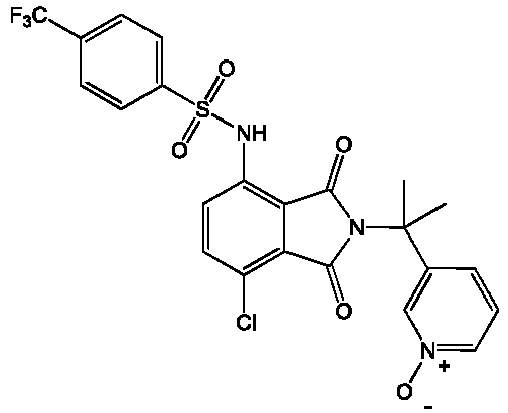
538.26 (M-1) 99.36 %, Rt = 5.18 min (1) 1H NMR (400MHz, DMSO-d6): δ 10.29 (bs, 1H), 8.33 (s, 1H), 8.10-8.08 (m, 3H), 7.99-7.97 (d, J = 8.4 Hz, 2H), 7.75-7.73 (d, J = 8.4 Hz, 1H), 7.57-7.55 (d, J = 8.8 Hz, 1H), 7.36-7.31 (m, 2H), 1.90 (s, 6H). 115 
556.30 97.30 %, Rt = 5.43 min (1) 1H NMR (400MHz, DMSO-d6): δ 10.13 (bs, 1H), 8.35 (s, 1H), 8.10-8.04 (m, 3H), 7.75-7.72 (d, J = 8.8 Hz, 1H), 7.60-7.55 (m, 3H), 7.38-7.32 (m, 2H), 1.82 (s, 6H). -

- To a stirred solution of compound XXV (1.2 g, 5.28 mmol) in acetic acid (20 mL) was added 2-(pyridin-3-yl)ethylamine (XLIX, 0.71 g, 5.81 mmol) and the reaction mixture heated at 120°C for 15 h. The reaction mixture was cooled to room temperature and the acetic acid removed under reduced pressure to obtain the crude product. This was washed with ethanol to afford 4-chloro-7-nitro-2-(2-(pyridin-3-yl)ethyl)isoindoline-1,3-dione as a white solid (L; 1.5 g, 86% yield). The crude compound was carried forward to next step. 1H NMR (400MHz, DMSO-d6): δ 8.45 (s, 1H), 8.26-8.24 (d, J = 8.8 Hz, 1H), 8.09-8.07 (d, J = 8.8 Hz, 1H), 7.71-7.69 (d, J = 7.6 Hz, 1H), 7.33-7.30 (m, 1H), 3.83-3.79 (t, J = 7.6 Hz, 2H), 2.95-2.91 (t, J = 7.6 Hz, 2H). MS (M+1): 332.09 (LCMS Purity 98.15%).
- To a solution of compound L (1 g, 3.01 mmol) in acetic acid (20 mL) was added iron powder (1.5 g) in small portions. The reaction mixture was stirred for 5 h at room temperature. The reaction mixture was filtered through a celite bed and concentrated under reduced pressure. The crude material was neutralized using aqueous sodium bicarbonate solution. The resultant aqueous layer was extracted with ethyl acetate which was dried (anhydrous Na2SO4), filtered and evaporated under reduced pressure to obtain the crude compound. The material was further purified by trituration using acetonitrile and ethyl acetate to afford 4-amino-7-chloro-2-(2-(pyridin-3-yl)ethyl)isoindoline-1,3-dione as a yellow solid (LI; 0.75 g, 82.4% yield). 1H NMR (400MHz, DMSO-d6): δ 8.40-8.38 (m, 2H), 7.64-7.62 (m, 2H), 7.39-7.37 (d, J = 8.8 Hz, 1H), 7.31-7.27 (m, 1H), 6.56 (bs, 2H), 3.77-3.74 (t, J = 7.2 Hz, 2H), 2.93-2.90 (t, J = 6.8 Hz, 2H). MS (M+1): 302.17 (LCMS purity 97.87%).
- A mixture of compound LI (1 g, 3.31 mmol) and pyridine (7 mL) was cooled to 0°C and 4-tert-butylbenzenesulfonyl chloride (V, 2.3 g, 9.89 mmol) was added followed by a catalytic quantity of DMAP (0.040 g, 0.33 mmol). The reaction mixture was stirred for 12 h at 100°C, concentrated and diluted with water. The reaction mixture was extracted with ethyl acetate and the organic layer was washed with brine solution, dried over anhydrous Na2SO4, filtered and evaporated under reduced pressure to obtain the crude compound. To this material was added 1M TBAF in THF solution (2 mL) and the stirring was continued for 1 h at room temperature. The reaction mixture was concentrated and diluted with ethyl acetate. The organic layer was washed with water, dried over anhydrous Na2SO4, filtered and evaporated under reduced pressure to obtain the crude compound which was purified by column chromatography using 20% ethyl acetate in hexane to afford the title compound, 4-(tert-butyl)-N-(7-chloro-1,3-dioxo-2-(2-(pyridin-3-yl)ethyl)isoindolin-4-yl)benzenesulfonamide as a off white solid (116; 0.3 g, 18.75% yield). 1H NMR (400MHz, DMSO-d6): δ 9.91 (bs, 1H), 8.41-8.37 (m, 2H), 7.89-7.86 (d, J = 8.4 Hz, 2H), 7.73-7.71 (d, J = 8.8 Hz, 1H), 7.64-7.58 (m, 4H), 7.30-7.29 (d, J = 5.2 Hz, 1H), 3.77-3.74 (t, J = 6.4 Hz, 2H), 2.90-2.87 (t, J = 6.4 Hz, 2H), 1.26 (s, 9H). MS (M+1): 498.42. (LCMS purity 99.62%, Rt = 6.22 min (1)).
- To a mixture of compound 116 (0.1 g, 0.21 mmol) and dichloromethane (4 mL) was added metachloroperoxybenzoic acid (0.069 g, 0.22 mmol). The reaction was stirred at RT for 5 h whereupon the solvent was concentrated under reduced pressure and the residue diluted with water. The aqueous layer was extracted with dichloromethane. The combined organic layers were washed sequentially with sodium bicarbonate and brine, then dried over Na2SO4, filtered and concentrated under vacuum to leave the crude compound which was purified by column chromatography using 3% methanol in dichloromethane to afford 3-(2-(4-(4-(tert-butyl)phenylsulfonamido)-7-chloro-1,3-dioxoisoindolin-2-yl)ethyl)pyridine 1-oxide as an off white solid (117; 0.016 g, 15.5% yield). 1H NMR (400MHz, DMSO-d6): δ 9.56 (bs, 1H), 8.17 (s, 1H), 8.07-8.05 (d, J = 6.4 Hz, 1H), 7.89-7.87 (m, 2H), 7.73-7.71 (d, J = 8.4 Hz, 1H), 7.64-7.58 (m, 3H), 7.30-7.26 (m, 1H), 7.17-7.15 (m, 1H), 3.78-3.74 (t, J = 6.8 Hz, 2H), 2.85-2.82 (t, J = 6.8 Hz, 2H), 1.27 (s, 9H). MS (M+1): 514.45. (LCMS purity 99.01%).
-

- To a stirred solution of compound XXV (1.5 g, 6.63 mmol) in acetic acid (10 mL) was added 6-methoxypyridin-3-amine (LII, 0.98 g, 7.96 mmol). The reaction mixture was heated at 100°C for 12 h. After cooling to room temperature, the acetic acid removed under reduced pressure to obtain the crude product which was washed with ethanol to afford 4-chloro-2-(6-methoxypyridin-3-yl)-7-nitroisoindoline-1,3-dione (LIII, 1.5 g, 68.18%). MS (M+1): 334.06.
- To a solution of compound LIII (1.5 g, 4.5 mmol) in acetic acid (9 mL) was added iron powder (1.3 g) in small portions. The reaction mixture was stirred for 12 h at room temperature and then filtered through a celite bed and concentrated under reduced pressure. The crude material was neutralized using aqueous sodium bicarbonate solution. The aqueous layer was extracted with ethyl acetate which was dried (anhydrous Na2SO4), filtered and evaporated under reduced pressure to afford 4-amino-7-chloro-2-(6-methoxypyridin-3-yl)isoindoline-1,3-dione as a greenish coloured solid (LIV; 0.8 g, 58.8% yield). 1H NMR (400MHz, DMSO-d6): δ 8.21 (s, 1H), 7.88-7.87 (d, J = 6.4 Hz, 1H), 7.48-7.46 (d, J = 8.8 Hz, 1H), 7.07-7.04 (d, J = 9.2 Hz, 1H), 6.98-6.96 (d, J = 8.8 Hz, 1H), 6.64 (bs, 2H), 3.89 (s, 3H). MS (M+1): 304.14. (LCMS purity 95.16%).
- A mixture of compound LIV (0.55 g, 1.8 mmol) and pyridine (4 mL) was cooled to 0°C and 4-tert-butylbenzenesulfonyl chloride (V, 1.47 g, 6.35 mmol) was added together with a catalytic quantity of DMAP. The reaction mixture was heated for 12 h at 100°C then concentrated and diluted with water. The aqueous layer was extracted with ethyl acetate. The organic layer was washed with brine solution, dried over anhydrous Na2SO4, filtered and the organic solvent was evaporated under reduced pressure to obtain the crude compound. To this material was added 1M TBAF in THF solution (2 mL) and the stirring continued for 1 h at room temperature. The reaction mixture was concentrated and diluted with ethyl acetate. The organic layer was washed with water, dried over anhydrous Na2SO4, filtered and the organic solvent was evaporated under reduced pressure to obtain the crude compound which was purified by column chromatography using 40% ethyl acetate in hexane to afford 4-(tert-butyl)-N-(7-chloro-2-(6-methoxypyridin-3-yl)-1,3-dioxoisoindolin-4-yl)benzenesulfonamide as an off white solid (118; 0.5 g, 55.2% yield). 1H NMR (400MHz, DMSO-d6): δ 9.97 (bs, 1H), 8.19-8.18 (s, 1H), 7.94-7.92 (d, J = 8.8 Hz, 2H), 7.82-7.80 (d, J = 8.8 Hz, 1H), 7.75-7.72 (dd, J = 2.8, 2.4 Hz, 1H), 7.68-7.63 (m, 3H), 7.0-6.98 (d, J = 8.8 Hz, 1H), 3.90 (s, 3H), 1.27 (s, 9H). MS (M+1): 500.44. (LCMS purity 99.12%, Rt = 6.50 min(1)).
- The following compound was also prepared using a similar method and appropriate amine in the first step:
CPD Structure LCMS (M+1) Purity (LCMS) 1HNMR 119 
500.42 99.04%, Rt = 5.91min (1) 1H NMR (400MHz, DMSO-d6): δ 10.09 (bs, 1H), 8.59-8.57 (d, J = 6 Hz, 1H), 8.39 (s, 1H), 7.93-7.91 (m, 2H), 7.85-7.82 (d, J = 8.8 Hz, 1H), 7.67-7.62 (m, 3H). 7.31-7.30 (d, J = 5.6 Hz, 1H), 3.84 (s, 3H), 1.28 (s, 9H). -

- To a stirred solution of compound XXV (3.0 g, 13 mmol) in acetic acid (65 mL) was added 3-aminobenzonitrile (XIX, 4.6 g, 38 mmol) and the reaction mixture was heated at 100°C for 18 h. The reaction mixture was cooled to room temperature and the acetic acid removed under reduced pressure to obtain the crude product 3-(4-chloro-7-nitro-1,3-dioxoisoindolin-2-yl)benzonitrile as a brown solid (LV; 3 g,). MS (M+1): 328.02. The crude material was carried forward to next step without purification.
- To a solution of compound LV (2.5 g, 7.64 mmol) in acetic acid (38 mL) was added iron powder (0.85g, 15 mmol) and the reaction mixture was stirred for 12 h at room temperature. The acetic acid was removed under reduced pressure to obtain a crude product. The reaction mixture was diluted with water and extracted with dichloromethane. The organic layer was washed with brine solution, dried over anhydrous Na2SO4, filtered and evaporated under reduced pressure before being triturated with tert-butylmethylether to obtain crude product 3-(4-amino-7-chloro-1, 3-dioxoisoindolin-2-yl)benzonitrile as a greenish solid (LVI; 2g). MS (M+1) 298.07
- A mixture of compound LVI (0.5g, 1.68 mmol) and pyridine (5 mL) was cooled to 0°C and 4-tert-butylbenzenesulfonyl chloride (V 1.16 g, 5.04 mmol) was added together with a catalytic quantity of DMAP (0.05g, 0.016 mmol). The reaction mixture was stirred for 24h at 80°C. The reaction mixture was concentrated and to the resultant residue, water was added and extracted with ethyl acetate. The organic layer was washed with brine solution, dried over anhydrous Na2SO4, filtered and the organic solvent was evaporated under reduced pressure to obtain the crude compound. This was purified by combiflash chromatography using 18% ethyl acetate in hexane as mobile phase to afford 4-(tert-butyl)-N-(7-chloro-2-(3-cyanophenyl)-1,3-dioxoisoindolin-4-1)benzenesulfonamide as a white solid (120, 0.04 g). 1H NMR (400MHz, DMSO-d6): δ 9.99 (bs, 1H), 7.93-7.91 (m, 3H), 7.88 (m, 1H) 7.85-7.82 (m, 1H) 7.78-7.76 (m, 2H), 7.70-7.68 (m, 1H), 7.65-7.63 (m, 2H), 1.27 (s, 9H). MS (M-1): 492.45 (LCMS Purity 98.22%, Rt = 6.59 min (1)).
- The following compounds were prepared in a similar manner using the appropriate sulfonyl chloride in the final step:
Cpd Structure LCMS (M-1) Purity (LCMS) 1H NMR 121 
504.40 98.92 %, Rt = 5.79 min (1) 1H NMR (400MHz, DMSO-d6): δ 10.63 (bs, 1H), 8.15-8.13 (d, J = 8.4 Hz, 2H), 8.02-8.00 (d, J = 8.4 Hz, 2H), 7.95-7.94 (d, J = 7.2 Hz, 1H), 7.85-7.83 (d, J = 9.2 Hz, 2H) 7.78-7.72 (m, 2H), 7.64-7.62 (d, J = 8.8 Hz, 1H). 122 
520.36 99.01 %, Rt = 5.78 min(1) 1H NMR (400MHz, DMSO-d6): δ 10.38 (bs, 1H), 8.10-8.08 (m, 2H), 7.95-7.94 (m, 1H), 7.85-7.83 (m, 2H), 7.79-7.75 (m, 2H), 7.66-7.60 (m, 3H). 123 
538.31 98.74 %, Rt = 5.77 min (1) 1H NMR (400MHz, DMSO-d6): δ 10.86 (bs, 1H), 8.43 (s, 1H) 8.19-8.17 (d, J = 8.0 Hz, 1H), 8.03-7.91 7.84-7.82 7.77-7.72 (m, 2H), 7.64-7.61 (d, J = 8.8 Hz, 1H). 124 
501.99 99.07%, Rt = 5.68 min (1) 1H NMR (400MHz, DMSO-d6): δ 10.16 (bs, 1H), 8.07-8.04 (d, J = 8.8 Hz, 2H), 7.96-7.94 (dd, J = 2.8, 2.8 Hz, 1H), 7.87 (s, 1H), 7.84-7.82 (d, J = 8.8 Hz, 1H), 7.77-7.76 (d, J = 9.2 Hz, 2H), 7.67-7.64 (d, J = 9.2 Hz, 1H), 7.59-7.22 (m, 3H). 125 
478.30 97.07 %, Rt = 6.30 min (1) 1H NMR (400MHz, DMSO-d6): δ 10.0 (bs, 1H), 7.96-7.91 (m, 3H), 7.88 (d, J = 1.2 Hz, 1H), 7.84-7.82 (d, J = 8.8 Hz, 1H), 7.78-7.77 (m, 2H), 7.69-7.67 (d, J = 8.8 Hz, 1H), 7.51-7.49 (d, J = 8.4 Hz, 2H), 2.99-2.95 (m, 1H), 1.19-1.18 (d, J = 6.8 Hz, 6H). -

- To a stirred solution of compound XXV (3.5 g, 15 mmol) in acetic acid (70 mL) was added 3-(aminomethyl)benzonitrile (XXVII, 6.07 g, 46 mmol) and the reaction mixture heated at 100°C for 18 h. The reaction mixture was cooled to room temperature and the acetic acid removed under reduced pressure to obtain the crude product 3-((4-chloro-7-nitro-1,3-dioxoisoindolin-2-yl)methyl)benzonitrile as a brown solid (LVII; 4.8 g,). 1H NMR (400MHz, DMSO-d6): δ 8.28-8.26 (d, J = 8.4 Hz, 1H), 8.12-8.10 (d, J = 8.4 Hz, 1H), 7.85 (s, 1H), 7.76-7.72 (m, 2H), 7.58-7.54 (t, J = 7.6 Hz, 1H), 4.83(s, 2H). MS (M+1): 342.02.
- To a solution of compound LVII (2.5 g, 7 mmol) in acetic acid (38 mL) was added iron powder (0.85g, 15 mmol) and the reaction mixture was stirred at room temperature for 12h. The acetic acid was removed under reduced pressure to obtain the crude product. The reaction mixture was diluted with water and extracted with dichloromethane. The organic layer was washed with brine solution, dried over anhydrous Na2SO4, filtered and concentrated under reduced pressure. This material was triturated with tert-butylmethylether to obtain the crude product 3-((4-amino-7-chloro-1,3-dioxoisoindolin-2-yl)methyl)benzonitrile as a greenish solid (LVIII; 2g). MS (M+1) 312.
- To a stirred mixture of compound LVIII (0.4 g, 1.28 mmol) in chloroform (10 mL) was added pyridine (3 mL) at 0°C followed by addition of 4-tert-butylbenzenesulfonyl chloride (V, 0.89 g, 3.84 mmol) and a catalytic quantity of DMAP. The reaction mixture was stirred at 80°C for 24h. The reaction mixture was cooled and concentrated at reduced pressure to afford a mixture of the mono and di-substituted sulfonamide product. This was dissolved in THF (15 mL) in presence of 1M TBAF in THF solution (1 mL) and stirred at 90°C for 5 h. The reaction mixture was concentrated at reduced pressure, diluted with water and the aqueous layer was extracted with ethyl acetate. The combined organic layers were washed with brine, dried over Na2SO4, filtered and concentrated to afford the crude compound, which was purified by column chromatography using 20% ethyl acetate in hexane to afford the title compound 4-(tert-butyl)-N-(7-chloro-2-(3-cyanobenzyl)-1,3-dioxoisoindolin-4-yl)benzenesulfonamide (126; 0.04 g;). 1H NMR (400MHz, DMSO-d6): δ 9.94 (bs, 1H), 7.94-7.92 (d, J = 8.4 Hz, 2H), 7.83 (s, 1H), 7.76-7.73 (m, 2H), 7.69-7.67 (m, 1H), 7.63-7.59 (m, 3H), 7.56-7.53 (m, 1H), 4.76 (s, 2H), 1.26 (s, 9H). MS (M-1): 506.40. (LCMS purity 97.23%, Rt = 6.64 min (1)).
- To a stirred solution of compound 126 (0.1 g, 0.19 mmol) in dimethylacetamide (10 mL) was added Zn(CN)2 (0.046 g, 0.39 mmol) and the reaction vessel was purged with argon for 20 min. Then 1,1'-Bis(diphenylphosphino)ferrocene (0.021 g,0.038 mmol), Pd2dba3 (0.026 g, 0.028 mmol) and a catalytic quantity of Zn dust were added. The reaction mixture was stirred at 120°C for 2h in microwave reactor. The reaction mixture was cooled and concentrated at reduced pressure, diluted with water and the aqueous layer was extracted with ethyl acetate. The combined organic layers were washed with brine, dried over Na2SO4, filtered and concentrated to afford the crude compound, which was purified by prep HPLC to obtain 4-(tert-butyl)-N-(7-chloro-2-(3-cyanobenzyl)-1,3-dioxoisoindolin-4-yl)benzenesulfonamide, (127; 0.02g, 20.4% yield). 1H NMR (400MHz, DMSO-d6): δ 8.10-8.07 (d, J = 8.0 Hz, 2H), 7.84 (s, 1H), 7.77-7.76 (d, J = 8.4 Hz, 1H), 7.72-7.62 (m, 5H), 7.57-7.53 (t, J = 8.0 Hz, 1H), 4.79 (s, 2H), 1.27 (s, 9H). MS (M-1): 497.41. (LCMS purity 99.89%, Rt = 5.60 min (1)).
- The following compounds were prepared in a similar manner using the appropriate sulfonyl chloride in the penultimate step:
CPD Structure LCMS (M-1) Purity (LCMS) 1H NMR 128 
518.29 99.64 %, Rt=5.82 min (1) 1H NMR (400MHz, DMSO-d6): δ 10.47 (bs, 1H), 8.14-8.12 (d, J = 8.0 Hz, 2H), 7.97-7.95 (d, J = 8.4 Hz, 2H), 7.80 (s 1H), 7.77-7.54 (m, 2H), 7.64-7.62 (d, J = 8.0 Hz, 1H), 7.56-7.52 (m, 2H), 4.73 (s 2H). 129 
534.31 99.17%, Rt = 6.01 min (1) 1H NMR (400MHz, DMSO-d6): δ 10.29 (bs, 1H), 8.07-8.05 (m, 2H), 7.80-7.75 (m, 3H), 7.65-7.63 (d, J = 7.2 Hz, 1H), 7.58-7.52 (m, 4H), 4.74 (s 2H). 130 
518.04 97.74%, Rt = 5.74 min (1) 1H NMR (400MHz, DMSO-d6): δ 10.52 (bs, 1H), 8.28 (s, 1H), 8.20-8.18 (d, J = 8.0 Hz, 1H), 8.03-8.01 (d, J = 8.0 Hz, 1H), 7.83-7.75 (m, 4H), 7.63-7.53 (m, 3H), 4.72 (s 2H). 131 
515.99 98.72%, Rt = 5.90 min (1) 1H NMR (400MHz, DMSO-d6): δ 10.09 (bs, 1H), 8.04-8.02 (d, J = 8.8 Hz, 2H), 7.82 (s, 1H), 7.76-7.73 (m, 2H), 7.66-7.64 (d, J = 7.6 Hz, 1H), 7.58-7.52 (m, 2H), 7.38-7.20 (m, 3H), 4.75 (s, 2H). 132 
552.16 99.55 %, Rt = 5.89 min (1) 1H NMR (400MHz, DMSO-d6): δ 10.70 (bs, 1H), 8.38 (s, 1H), 8.17-8.15 (d, J = 8.4 Hz, 1H), 7.94-7.92 (d, J = 8.4 Hz, 1H), 7.80-7.74 (m, 3H), 7.64-7.62 (d, J = 7.6 Hz, 1H), 7.56-7.52 (m, 2H), 4.73 (s, 2H). 133 
536.15 99.53 %, Rt = 5.78 min (1) 1H NMR (400MHz, DMSO-d6): δ 10.58 (bs, 1H), 8.36-8.35 (d, J = 5.2 Hz, 1H), 8.25 (s, 1H), 7.79-7.68 (m, 4H), 7.63-7.61 (d, J = 7.6 Hz, 1H), 7.58-7.52 (m, 2H), 4.73 (s, 2H). 134 
517.06 99.03%, Rt = 5.83min (1) 1H NMR (400MHz, DMSO-d6): δ 10.13 (bs, 1H), 8.06-8.04 (m, 2H) 7.83 (s, 1H), 7.76-7.74 (m, 4H). 7.68-7.66 (d, J = 6.8 Hz, 1H) 7.61-7.53 (m, 2H), 4.76 (s, 2H), 1.68 (s, 6H). 135 
517.13 98.84 %, Rt = 5.51 min (1) 1H NMR (400MHz, DMSO-d6): δ 10.15 (bs, 1H), 8.56 (s, 1H), 8.04-8.02 (d, J = 8.4 Hz, 2H), 7.92-7.90 (m, 3H), 7.81 (s, 1H), 7.76-7.71 (t, J = 9.2 Hz, 2H), 7.63-7.57 (m, 2H), 7.52-7.48 (t, J = 7.6 Hz, 1H), 4.74 (s, 2H). -

- To a stirred solution of compound XXV (5 g, 22.12 mmol) in acetic acide (100mL) was added 3-(trifluoromethyl)aniline (LIX, 8.9 g, 55 mmol) and the reaction mixture heated at 100°C for 12 h. The reaction mixture was cooled to room temperature, diluted and triturated with ethanol to afford 4-chloro-7-nitro-2-(3-(trifluoromethyl)phenyl)isoindoline-1,3-dione (LX, 7.5 g, 91.6%). 1H NMR (400MHz, DMSO-d6): δ 8.36 (m, 1H), 8.21 (m, 2H), 7.85 (m, 1H), 7.54 (m, 1H), 7.38 (m, 1H).
- To a solution of compound LX (5 g, 13.5 mmol) in acetic acid (100 mL) was added iron powder (5 g) in small portions. The reaction mixture was stirred for 12 h at room temperature. The reaction mixture was filtered through a celite bed and concentrated under reduced pressure. The crude material was neutralized using aqueous sodium bicarbonate solution. The aqueous layer was extracted with ethyl acetate which was dried (anhydrous Na2SO4), filtered and evaporated under reduced pressure to afford compound 4-amino-7-chloro-2-(3-(trifluoromethyl)phenyl)isoindoline-1,3-dione as a yellow solid (LXI; 4 g, 87% yield). 1H NMR (400MHz, DMSO-d6): δ 7.86 (s, 1H), 7.77 (m, 3H), 7.50-7.48 (d, J = 9.2 Hz, 1H), 7.08-7.05 (d, J = 8.8 Hz, 1H), 6.73 (bs, 2H).
- A mixture of compound LXI (0.3 g, 0.88 mmol) and pyridine (5 mL) was cooled to 0°C and 4-tert-butylbenzenesulfonyl chloride (V, 0.62 g, 2.64 mmol) was added followed by catalytic DMAP (0.053 g, 0.44 mmol). The reaction mixture was heated for 15 h at 100°C. The reaction mixture was concentrated and diluted with water and then extracted with ethyl acetate. The organic layer was washed with brine solution, dried over anhydrous Na2SO4, filtered and the organic solvent was evaporated under reduced pressure to obtain the crude compound. This was purified by column chromatography using 70% ethyl acetate in hexane to afford 4-(tert-butyl)-N-(7-chloro-1,3-dioxo-2-(3-(trifluoromethyl)phenyl)isoindolin-4-yl)benzenesulfon amide as a off white solid (136; 0.25 g, 53% yield). 1H NMR (400MHz, DMSO-d6): δ 9.98 (bs, 1H), 7.94-7.92 (d, J = 8.4 Hz, 2H), 7.84-7.74 (m, 5H), 7.70-7.68 (d, J = 8.8 Hz, 1H), 7.65-7.63 (d, J = 8.4 Hz, 2H), 1.27 (s, 9H). MS (M-1): 535.28. (LCMS purity 99.12%, Rt = 6.84 min (1)).
- The following compounds were also prepared using a similar method and the appropriate amine in the first step and/or sulfonyl chloride in the final step:
CPD Structure LCMS (M-1) Purity (LCMS) 1H NMR 137 
565.23 97.22 %, Rt = 6.06 min(1) 1H NMR (400MHz, DMSO-d6): δ 10.66 (bs, 1H), 8.42-8.41 (d, J = 8.4 Hz, 1H), 8.32-8.29 (m, 1H), 7.84-7.79 (m, 5H), 7.72 (m, 1H), 7.66-7.63 (d, J = 8.8 Hz, 1H). 138 
497.24 99.92% Rt = 6.72 min (1) 1H NMR (400MHz, DMSO-d6): δ 9.92 (bs, 1H), 7.93-7.91 (d, J = 8.0 Hz, 2H), 7.82-7.79 (d, J = 8.8 Hz, 1H), 7.68-7.63 (m, 3H), 7.44-7.41 (t, J = 8.0 Hz, 1H), 7.04-6.94 (m, 3H), 3.77 (s, 3H), 1.27 (s, 9H). 139 
471.38 (M+1) 97.95% Rt = 5.84 min (1) 1H NMR (400MHz, DMSO-d6): δ 10.13 (bs, 1H), 9.26 (s, 1H), 8.91 (s, 2H), 7.94-7.92 (d, J = 8.8 Hz, 2H), 7.87-7.85 (d, J = 8.4 Hz, 1H),7.70- 7.68 (d, J = 8.8 Hz, 1H), 7.65-7.63 (d, J = 8.4 Hz, 2H), 1.27 (s, 9H). 140 
481.28 98.45 %, Rt = 5.13 min (1) 1H NMR (400MHz, DMSO-d6): δ 10.67 (bs, 1H), 9.26 (s, 1H), 8.87 (s, 2H), 8.17-8.15 (d, J = 8.4 Hz, 2H), 8.02-8.0 (d, J = 8.4 Hz, 2H), 7.87-7.85 (d, J = 8.8 Hz, 1H), 7.64-7.62 (d, J = 8.8 Hz, 1H). 141 
457.37 99.37 %, Rt = 5.63 min (1) 1H NMR (400MHz, DMSO-d6): δ 10.10 (bs, 1H), 9.26 (s, 1H), 8.61 (s, 2H), 7.94-7.92 (d, J = 8.0 Hz, 2H), 7.86-7.84 (d, J = 8.8 Hz, 1H), 7.70-7.68 (d, J = 9.2 Hz, 1H), 7.51-7.49 (d, J = 8.4 Hz, 2H), 3.0-2.9 (m, 1H), 1.19-1.18 (d, J = 6.4 Hz, 6H). 142 
473.44 (M+ 1) 98.88% Rt = 6.27 min (1) 1H NMR (400MHz, DMSO-d6): δ 9.93 (bs, 1H), 8.07 (s, 1H), 7.92-7.90 (d, J = 8.4 Hz, 2H), 7.78-7.75 (d, J = 8.8 Hz, 1H), 7.72 (s, 1H), 7.64-7.61 (m, 3H), 3.89 (s, 3H), 1.26 (s, 9H). 143 
485.32 (M+1) 99.61 %, Rt = 5.35 min (1) 1H NMR (400MHz, DMSO-d6): δ 10.45 (bs, 1H), 8.16-8.14 (d, J = 8.0 Hz, 2H), 8.04 (s, 1H), 8.01-7.99 (d, J = 8.0 Hz, 2H), 7.79-7.76 (d, J = 8.8 Hz, 1H), 7.69 (s, 1H), 7.58-7.56 (d, J = 8.8 Hz, 1H), 3.82 (s, 3H). 144 
473.36 (M+1) 99.34% Rt = 5.90 min (1) 1H NMR (400MHz, DMSO-d6): δ 10.04 (bs, 1H), 7.95-7.93 (d, J = 8.4 Hz, 2H), 7.84-7.82 (d, J = 8.8 Hz, 1H), 7.68-7.63 (m, 3H), 7.56 (d, J = 1.6 Hz, 1H), 6.33 (d, J = 1.6 Hz, 1H), 3.68 (s, 3H), 1.27 (s, 9H). 145 
473.43 (M+1) 97.95% Rt = 6.22 min (1) 1H NMR (400MHz, DMSO-d6): δ 9.93 (bs, 1H), 7.91-7.88 (d, J = 8.4 Hz, 2H), 7.81-7.79 (d, J = 8.4 Hz, 2H), 7.62-7.61 (m, 3H), 6.28 (d, J = 1.6 Hz, 1H), 3.87 (s, 3H), 1.27 (s, 9H). 146 
476.39 (M+1) 99.19% Rt = 5.92 min (1) 1H NMR (400MHz, DMSO-d6): δ 10.10 (bs, 1H), 7.93 (d, J = 8.4 Hz, 2H), 7.83-7.80 (m, 3H), 7.68 (d, J = 8.8 Hz, 1H), 7.64-7.62 (d, J = 8.4 Hz, 2H), 1.27 (s, 9H). -

- To a stirred solution of compound XXV (1 g, 4.39 mmol) in acetic acid (10 mL) was added (3-methoxyphenyl)methanamine (LXII, 1.2 g, 8.78 mmol). The reaction mixture was heated at 100°C for 12 h. The reaction mixture was cooled to room temperature and the acetic acid removed under reduced pressure to obtain the crude product. This was washed with ethanol to afford 4-chloro-2-(3-methoxybenzyl)-7-nitroisoindoline-1,3-dione (LXIII, 1 g, 65.7%). 1H NMR (400MHz, DMSO-d6): δ 8.27-8.25 (d, J = 8.8 Hz, 1H), 8.10-8.08 (d, J = 8.4 Hz, 1H), 7.21-7.23 (t, J = 8.0 Hz, 1H), 6.91 (m, 2H), 6.86-6.84 (d, J = 8.0 Hz, 1H), 4.7 (s, 2H), 3.7 (s, 3H).
- To a solution of compound LXIII (0.6 g, 1.72 mmol) in ethanol (80 mL) was added stannous chloride (0.97 g, 4.3 mmol). The reaction mixture was heated at 90°C for 12 h. The reaction mixture was filtered through a celite bed and concentrated under reduced pressure. The crude material was diluted with water which was extracted with ethyl acetate. The organic solvent was evaporated under reduced pressure to afford 4-amino-7-chloro-2-(3-methoxybenzyl)isoindoline-1,3-dione as a yellow solid (LXIV; 0.4 g, 73% yield). 1H NMR (400MHz, DMSO-d6): δ 7.42-7.40 (d, J = 8.8 Hz, 1H), 7.26-7.24 (t, J = 8.4 Hz, 1H), 7.01-6.99 (d, J = 9.2 Hz, 1H), 6.84-6.81 (m, 3H), 6.64 (bs, 2H), 4.65 (s, 2H), 3.72 (s, 3H). MS (M-1): 315.25. (LCMS purity 95.34%).
- A mixture of compound LXIV (0.2 g, 0.63 mmol) in THF (4 mL) was cooled to 0°C and then sodium hydride (0.03g, 1.26 mmol) was added followed by addition of 4-tert-butylbenzenesulfonyl chloride (16, 0.22 g, 0.91 mmol). The reaction mixture was stirred at room temperature for 4 h. The reaction mixture was diluted with water and the aqueous layer was extracted with ethyl acetate. The organic layer was washed with brine solution, dried over anhydrous Na2SO4, filtered and the organic solvent was evaporated under reduced pressure to obtain the crude compound. To this material was added 1M TBAF in THF solution (1 mL) and the stirring continued for 1 h at room temperature. The reaction mixture was concentrated and diluted with ethyl acetate. The organic layer was washed with water, dried over anhydrous Na2SO4, filtered and the organic solvent was evaporated under reduced pressure to obtain the crude compound which was purified by column chromatography using 15% ethyl acetate in hexane. The title compound 4-(tert-butyl)-N-(7-chloro-2-(3-methoxybenzyl)-1,3-dioxoisoindolin-4-yl)benzenesulfonamide was obtained as a yellow solid (147; 0.1 g, 30.8% yield). 1H NMR (400MHz, DMSO-d6): δ 9.95 (bs, 1H), 7.91-7.89 (d, J = 8.0 Hz, 2H), 7.75-7.73 (d, J = 9.2 Hz, 1H), 7.62-7.58 (m, 3H), 7.23-7.21 (t, J = 7.6 Hz, 1H), 6.86-6.84 (m, 3H), 4.66 (s, 2H), 3.72 (s, 3H), 1.26 (s, 9H). MS (M+1): 511.38. (LCMS purity 98.66%, Rt = 6.97 min (1)).
-

- To a stirred solution of compound XXV (2.5 g, 10 mmol) in acetic acid (50 mL) was added 1H-pyrazol-4-amine (LXV; 2.2 g, 20 mmol) and the reaction mixture heated at 100°C for 18 h. The reaction mixture was cooled to room temperature and the acetic acid removed under reduced pressure to obtain crude product. The crude product was washed with ethanol to afford 4-chloro-7-nitro-2-(1H-pyrazol-4-yl)isoindoline-1,3-dione as a yellow solid (LXVI; 2.5 g, 78% yield). 1H NMR (400MHz, DMSO-d6): v 13.18(s, 1H), 8.29-8.27 (d, J = 8 Hz, 1H), 8.13-8.11 (d, J = 8 Hz, 2H), 7.84 (bs, 1H). MS (M+1): 292.93.
- To a solution of compound LXVI (2.5 g, crude) in acetic acid (40 mL) was added iron powder (3 g) in small portions. The reaction mixture was stirred for 12 h at room temperature and filtered through a celite bed before being concentrated under reduced pressure. The crude mass was neutralized by aueous sodium bicarbonate solution. This was extracted with ethyl acetate, which was dried (anhydrous Na2SO4), filtered and evaporated under reduced pressure to obtain the crude compound. This was purified further by trituration using ethanol to afford compound 4-amino-7-chloro-2-(1H-pyrazol-4-yl)isoindoline-1,3-dione as a yellow solid (LXVII; 2 g, 86% yield). 1H NMR (400MHz, DMSO-d6): δ 13.13 (s, 1H), 7.94 (s, 2H), 7.45-7.42 (d, J = 12 Hz, 1H), 7.03-7.01 (d, J = 8.8 Hz, 1H), 6.71 (s, 2H). MS (M+1): 263.1
- To stirred solution of compound LXVII (0.8 g, 3 mmol) in pyridine (50 mL) was added 4-(tert-butyl)benzene-1-sulfonyl chloride (V, 2.83 g, 12.2 mmol) and heated the reaction mixture for 12h at 100°C. The reaction mixture was concentrated and then diluted with water. The aqueous layer was extracted with chloroform, which was washed with brine solution and dried over anhydrous Na2SO4, filtered and evaporated under reduced pressure to obtain crude compound which was partially purified by column chromatography using 50% ethyl acetate in hexane to obtain a mixture of products (4-(tert-butyl)-N-(2-(1-((4-(tert-butyl)phenyl)sulfonyl)-1H-pyrazol-4-yl)-7-chloro-1,3-dioxoisoindolin-4-yl)benzenesulfonamide (LXVII) and material where the sulfonamide bond para to the chloro group had not formed. This mixture was used without further purification.
- To the crude compound LXVII (350 mg), was added 1M TBAF in THF solution (30mL) and the reaction mixture was stirred for 1 h at room temperature. This was diluted with water and extracted with chloroform. The resulting organic layer was washed with brine solution and dried over anhydrous Na2SO4, filtered and then evaporated under reduced pressure to afford crude compound which was purified by column chromatography using 60% ethyl acetate in hexane to afford 4-(tert-butyl)-N-(7-chloro-1,3-dioxo-2-(1H-pyrazol-4-yl)isoindolin-4-yl)benzenesulfonamide as a off white solid. (148, 0.015 g). 1H NMR (400MHz, DMSO-d6): δ 13.14 (bs, 1H), 9.96 (s, 1H), 8.07 (s, 1H), 7.94-7.92 (d, J = 6.8 Hz, 2H), 7.78-7.76 (m, 2H), 7.64-762 (m, 2H), 1.26 (s, 9H). MS (M-1): 457.04. (LCMS purity 97.12%, Rt = 6.12 min (1)).
- The following compounds were also prepared using a similar method and the appropriate sulfonyl chloride in the final step:
CPD Structure LCMS (M+1) Purity (LCMS) 1H NMR 149 
469.33 (M-1) 98.58 %, Rt = 5.06 min (1) 1H NMR (400MHz, DMSO-d6): δ 13.14 (bs, 1H), 10.50 (bs, 1H), 8.15-8.13 (d, J = 8.0 Hz, 2H), 8.06-7.71 (m, 5H), 7.58-7.56 (d, J = 8.8 Hz, 1H). 150 
486.97 99.17 %, Rt = 6.32 min (2) 1H NMR (400MHz, DMSO-d6): δ 13.14 (bs, 1H), 10.31 (bs, 1H), 8.10-8.07 (d, J = 8.8 Hz, 2H), 7.92-7.77 (m, 3H), 7.61-7.58 (m, 3H). 151 
443.33 (M-1) 98.98 %, Rt = 5.78 min (1) 1H NMR (400MHz, DMSO-d6): δ 13.15 (bs, 1H), 9.94 (bs, 1H), 8.07 (bs, 1H), 7.92-7.89 (d, J = 8.4 Hz, 2H), 7.80 (bs, 1H), 7.77-7.75 (d, J = 8.8 Hz, 1H), 7.63-7.61 (d, J = 8.8 Hz, 1H), 7.49-7.47 (d, J = 8.4 Hz, 2H), 2.99-2.92 (m, 1H), 1.18-1.16 (d, J = 7.2 Hz, 6H). 152 
467.25 (M-1) 98.83 %, Rt = 5.09 min (1) 1H NMR (400MHz, DMSO-d6): δ 13.14 (bs, 1H), 10.12 (bs, 1H), 8.05-8.03 (d, J = 8.4 Hz, 2H), 7.84 (m, 1H), 7.77-7.75 (m, 2H), 7.60-7.58 (d, J = 9.2 Hz, 1H), 7.40-7.36 (m, 2H), 7.21 (m, 1H). -
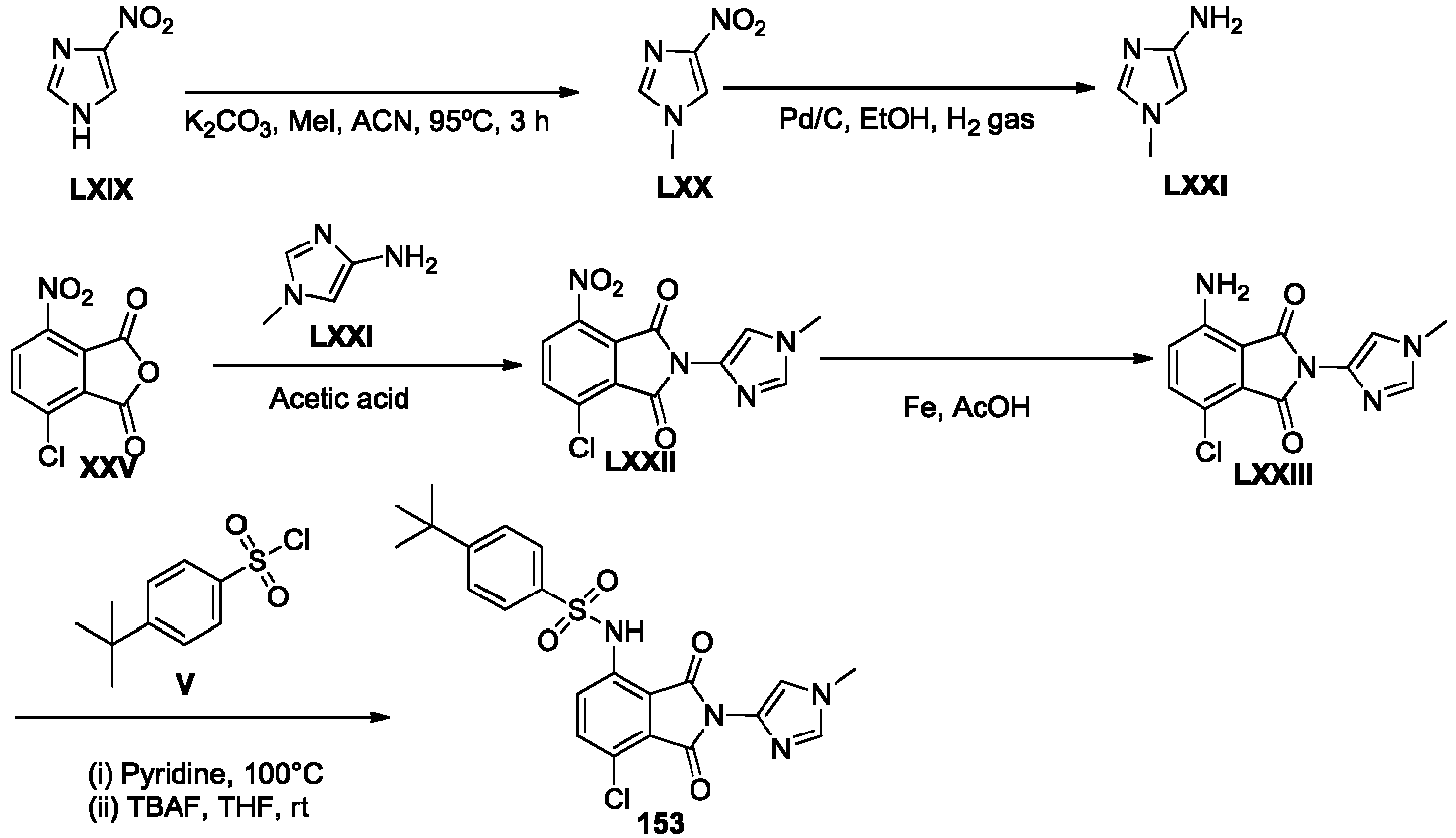
- To stirred solution of 4-nitro-1H-imidazole (LXIX, 5g: 44 mmol) in acetonitrile (20 mL) was added K2CO3 (18.2 g, 137 mmol) at 0°C, followed by addition of methyl iodide (8.9 mL, 57 mmol). The reaction mixture was heated at 95°C for 3h. The reaction mixture was concentrated, filtered through a celite bed and diluted with water. The aqueous layer was extracted with chloroform and the separated organic layer was washed with brine solution and dried over anhydrous Na2SO4 before being filtered and evaporated under reduced pressure to afford 1-methyl-4-nitro-1H-imidazole (LXX, 4g, 71%). 1H NMR (400 MHz, DMSO-d6) δ 8.35 (s, 1H), 7.8 (s, 1H), 3.74 (s, 3H). MS (M+1): 128.
- To a stirred solution of compound LXX (4g, 31 mmol) in ethanol (20 mL) was added 10%Pd-C (catalytic) under nitrogen atmosphere. The reaction mixture was evacuated using high vacuum and stirred in presence of hydrogen gas at balloon pressure at room temperature for 6 h. The reaction mixture was filtered through a celite bed. The organic solvent was evaporated under reduced pressure to afford 1-methyl-1H-imidazol-4-amine (LXXI, 2.5g) MS (M+1) 98. The crude material was carried forward to next step without purification.
- To a stirred solution of compound XXV (3g, 13.2 mmol) in acetic acid (60 mL) was added 1-methyl-1H-imidazol-4-amine (LXXI, 3.2g, 33 mmol). The reaction mixture was heated at 100°C for 12 h. The reaction mixture was cooled to room temperature and the acetic acid removed under reduced pressure to obtain crude product. The crude product was washed with ethanol to afford 4-chloro-2-(1-methyl-1H-imidazol-4-yl)-7-nitroisoindoline-1,3-dione (LXXII, 3 g). MS (M+1): 306.84
- To a solution of compound LXXII (3 g, 98 mmol) in acetic acid (50 mL) was added iron powder (3 g) in small portions. The reaction mixture was stirred for 12 h at room temperature and then filtered through a celite bed and concentrated under reduced pressure. The crude material was neutralized by addition of aqueous sodium bicarbonate solution. The resulting aqueous layer was extracted with ethyl acetate. The layers were separated and the organic layer was dried (anhydrous Na2SO4), filtered and evaporated under reduced pressure to obtain the crude compound. This was purified using a neutral alumina column and 5% methanol in dichloromethane to afford 4-amino-7-chloro-2-(1-methyl-1H-imidazol-4-yl)isoindoline-1,3-dione as a yellow solid (LXXIII; 0.6 g, 22% yield). MS (M+1): 277.04.
- A mixture of compound LXXIII (0.6 g, 2.16 mmol) and pyridine (20 mL) was cooled to 0°C and 4-tert-butylbenzenesulfonyl chloride (V, 1.2 g, 5.5 mmol) was added. The reaction mixture was stirred for 12 h at 100°C and then concentrated and diluted with water whereupon it was extracted with ethyl acetate. The organic layer was washed with brine solution, dried over anhydrous Na2SO4, filtered and the organic solvent evaporated under reduced pressure to obtain the crude compound. To this material was added 1M TBAF in THF solution (25 mL) and the stirring continued for 1 h at room temperature. The reaction mixture was concentrated and diluted with ethyl acetate and the resulting solution was washed with water, dried over anhydrous Na2SO4, filtered and the organic solvent evaporated under reduced pressure to obtain the crude compound which was purified by column chromatography using 60% ethyl acetate in hexane to afford 4-(tert-butyl)-N-(7-chloro-2-(1-methyl-1H-imidazol-4-yl)-1,3-dioxoisoindolin-4-yl)benzenesulfonamide as an off white solid (153; 0.38 g, 37% yield). 1H NMR (400MHz, DMSO-d6): δ 9.93 (bs, 1H), 7.91-7.89 (d, J = 8.0 Hz, 2H), 7.80-7.78 (d, J = 8.4 Hz, 1H), 7.65-7.61 (m, 4H), 7.24 (s, 1H), 3.71 (s, 3H), 1.27 (s, 9 H). MS (M+1): 473.36. (LCMS purity 99.27%, Rt = 5.78 min(2)).
- The following compound was also prepared using a similar method and the appropriate sulfonyl chloride in the final step:
CPD Structure LCMS (M+1) Purity (LCMS) 1HNMR 154 
485.31 97.54 %, Rt = 4.97 min (1) 1H NMR (400MHz, DMSO-d6): δ 10.5 (bs, 1H), 8.15-8.13 (d, J = 8.0 Hz, 2H), 8.0-7.98 (d, J = 8.4 Hz, 2H), 7.81-7.79 (d, J = 8.8 Hz, 1H), 7.66 (s, 1H), 7.60-7.58 (d, J = 8.8 Hz, 1H), 7.21 (s, 1H), 3.71 (s, 3H). -

- To a stirred solution of compound XXV (0.5g, 2.2 mmol) in acetic acid (4.5 mL) was added methyl 3-aminothiophene-2-carboxylate (LXXIV, 0.69g, 4.4 mmol). The reaction mixture was heated at 120°C for 12 h and after cooling to room temperature, the acetic acid was removed under reduced pressure to obtain the crude product. This was triturated with ethanol to afford methyl 3-(4-chloro-7-nitro-1, 3-dioxoisoindolin-2-yl)thiophene-2-carboxylate (LXXV, 0.5 g, crude), which was carried forward to next step without purification.
- To a solution of compound LXXV (0.5 g, crude) in acetic acid (10 mL) was added iron powder (0.5 g) in portions. The reaction mixture was stirred for 12 h at room temperature and then filtered through a celite bed and concentrated under reduced pressure. The crude mass was neutralized using aqueous sodium bicarbonate solution and the aqueous layer was extracted with ethyl acetate. The organic solvent was separated, dried (anhydrous Na2SO4) filtered and evaporated under reduced pressure to obtain the crude compound methyl 3-(4-amino-7-chloro-1,3-dioxoisoindolin-2-yl)thiophene-2-carboxylate as a greenish solid (LXXVI; 0.35 g, 76% yield). 1H NMR (400MHz, DMSO-d6): □ 8.04 (d, J = 3.6 Hz, 1H), 7.50-7.48 (d, J = 4 Hz, 1H), 7.29-7.28 (d, J = 3.6 Hz, 1H), 7.09-7.07 (d, J = 8.4 Hz, 1H), 6.74 (bs, 2H), 3.72 (s, 3H).
- A mixture of compound LXXVI (0.35 g, 1.04 mmol) and pyridine (2 mL) was cooled to 0°C and 4-tert-butylbenzenesulfonyl chloride (V, 0.48 g, 2.08 mmol) was added. The reaction mixture was stirred for 12 h at 100°C and on cooling was concentrated and diluted with water. The aqueous layer was extracted with ethyl acetate which was washed with brine solution, dried over anhydrous Na2SO4, filtered and evaporated under reduced pressure to obtain the crude compound. To the crude material was added TBAF in THF solution (2 mL) and the stirring continued for 1 h at room temperature. The reaction mixture was concentrated and diluted with ethyl acetate, which was washed with water, dried over anhydrous Na2SO4, filtered and evaporated under reduced pressure to leave the crude compound which was purified by column chromatography using 40% ethyl acetate in hexane to afford the title compound methyl 3-(4-((4-(tert-butyl)phenyl)sulfonamido)-7-chloro-1,3-dioxoisoindolin-2-yl)thiophene-2-carboxylate as a off white solid (155; 0.13 g, 24.3% yield). 1H NMR (400MHz, DMSO-d6): δ 10.08 (bs, 1H), 8.08-8.07 (d, J = 5.2 Hz, 1H), 7.92-7.90 (d, J = 8.8 Hz, 2H), 7.86-7.84 (d, J = 8.0 Hz, 1H), 7.70-7.68 (d, J = 9.2 Hz, 1H), 7.64-7.62 (d, J = 8.4 Hz, 2H), 7.25-7.24 (d, J = 4.8 Hz, 1H), 3.70 (s, 3H), 1.27 (s, 9H). MS (M-1): 531.25. (LCMS purity 99.67%, Rt = 6.61 min (1)).
-

- To a stirred solution of compound XXV (1 g, 4.40 mmol) in acetic acid (30 mL) was added tetrahydro-2H-pyran-4-amine (LXXVII, 2 g, 19.7 mmol). The reaction mixture was heated at 120°C for 12 h whereupon it was cooled to room temperature and the acetic acid removed under reduced pressure to obtain crude product. This was triturated with ethanol to afford 4-chloro-7-nitro-2-(tetrahydro-2H-pyran-4-yl)isoindoline-1,3-dione (LXXVIII, 0.7 g). This unpurified material was carried forward to next step without purification.
- To a solution of compound LXXVIII (0.7g, 2.25 mmol) in ethanol (15 mL) was added stannous chloride (1.27 g, 5.6 mmol). The reaction mixture was heated at 90°C for 12 h. The reaction mixture was filtered through a celite bed and concentrated under reduced pressure. The crude mass was diluted with water and the aqueous layer was extracted with ethyl acetate. The organic solvent was dried (anhydrous Na2SO4), filtered and evaporated under reduced pressure to afford 4-amino-7-chloro-2-(tetrahydro-2H-pyran-4-yl)isoindoline-1,3-dione an off-white solid (LXXIX; 0.2 g, 31.7% yield). 1H NMR (400MHz, DMSO-d6): δ 7.40-7.38 (d, J = 8.8 Hz, 1H), 6.99-6.96 (d, J = 8.8 Hz, 1H), 6.60 (bs, 2H), 4.15 (m, 1H), 3.95-3.92 (m, 2H), 3.40-3.37 (m, 2H), 2.34-2.25 (m, 2H), 1.61-1.57 (m, 2H). MS (M-1): 279.20.
- Compound LXXIX (0.16 g, 0.57 mmol) was dissolved in a mixture of chloroform (10 mL) and pyridine (15 mL) was cooled to 0°C and a catalytic quantity of DMAP (0.07 g, 0.057 mmol) was added. To the reaction mixture was further added 4-tert-butylbenzenesulfonyl chloride (V, 0.33 g, 1.43 mmol). The reaction mixture was heated at 100°C for 12 h before being cooled and then diluted with water. The reaction mixture was extracted with ethyl acetate and the organic layer was washed with brine solution, dried over anhydrous Na2SO4, filtered and the organic solvent evaporated under reduced pressure to obtain the crude compound. This material was purified by column chromatography using 20% ethyl acetate in hexane to afford 4-(tert-butyl)-N-(7-chloro-1,3-dioxo-2-(tetrahydro-2H-pyran-4-yl)isoindolin-4-yl)benzenesulfonamide as an off-white solid (156; 0.15 g, 55% yield). 1H NMR (400MHz, DMSO-d6): δ 9.83 (bs, 1H), 7.88-7.86 (d, J = 8.4 Hz, 2H), 7.74-7.72 (d, J = 8.8 Hz, 1H), 7.63-7.59 (m, 3H), 4.13 (m, 1H), 3.94-3.91 (m, 2H), 3.40 (m, 2H), 2.26-2.18 (m, 2H), 1.59-1.57 (m, 2H), 1.30 (s, 9H). MS (M+1): 477.47. (LCMS purity 96.78%, Rt = 6.56 min (1)).
-

- To a stirred solution of compound LXXX (1 g, 0.006 mol) in acetic acid (10 mL) was added pyridin-3-amine (II, 0.56 g, 0.006 mol) and the reaction mixture heated at 100°C for 18 h. This was cooled to room temperature and the acetic acid removed under reduced pressure to obtain the crude product 4-methyl-2-(pyridin-3-yl)isoindoline-1,3-dione as a white solid (LXXXI; 1.1 g,). 1HNMR (400MHz, CDCl3): δ 8.78-8.77 (d, J = 2 Hz, 1H), 8.63 (d, J = 3.6 Hz, 1H), 7.84-7.80 (m, 2H), 7.69-7.65 (t, J = 7.6 Hz, 1H), 7.57-7.55 (d, J = 8 Hz, 1H), 7.47-7.43 (m, 1H), 2.76(s, 3H). MS (M+1): 239.02.
- To a stirred solution of KNO3 (1.9 g, 0.018 mol) in concentrated sulfuric acid (22 mL) at 0°C was added compound LXXXI (0.9 g, 0.003 mol) in sulfuric acid. The reaction mixture was stirred at room temperature for 1 h and then cooled to 0°C before the addition of crushed ice. The aqueous layer was extracted with ethyl acetate which was washed with brine solution, dried over anhydrous Na2SO4 and evaporated under reduced pressure. The solid crude so obtained was purified by column chromatography using 30% ethyl acetate in hexane to afford 4-methyl-7-nitro-2-(pyridin-3-yl)isoindoline-1,3-dione as a white solid (LXXXII; 0.45 g, 45 % yield). 1H NMR (400MHz, CDCl3): δ 8.75 (s, 1H), 8.66-8.65 (d, J = 4 Hz, 1H), 8.03-8.01 (d, J = 8 Hz, 1H), 7.81-7.79 (d, J = 7.6 Hz, 1H), 7.74-7.72 (d, J = 8 Hz, 1H), 7.48-7.45 (m, 1H), 2.86 (s, 3H). MS (M+1): 284.06
- To a stirred solution of LXXXII, (0.45 g, 1.59 mmol) in methanol (15 mL) and ethyl acetate (2 mL) under a nitrogen atmosphere was added 10% Pd-C (0.1 g). The reaction mixture was purged with nitrogen and stirred under hydrogen balloon pressure for 5 h at room temperature. The reaction mixture was filtered through a celite bed under a nitrogen atmosphere and evaporated under reduced pressure to afford crude compound 4-amino-7-methyl-2-(pyridin-3-yl)isoindoline-1,3-dione as a yellow solid (LXXXIII; 0.35 g). 1H NMR (400MHz, DMSO-d6): δ 8.64-8.63 (d, J = 2 Hz, 1H), 8.59-8.58 (d, J = 4 Hz, 1H), 7.88-7.86 (d, J = 8.4 Hz, 1H), 7.57-7.54 (m, 1H), 7.34-7.32 (d, J = 8.4 Hz, 1H), 6.99-6.97 (d, J = 8.4 Hz, 1H), 6.45 (bs, 2H), 2.46 (s, 3H). MS (M+1): 254.02.
- To a stirred mixture of compound LXXXIII (0.12 g, 0.47 mmol) in chloroform (30 mL) was added pyridine (3 mL) at 0°C followed by the addition of 4-tert-butylbenzenesulfonyl chloride (V, 0.22 g, 0.94 mmol). The reaction mixture was stirred at 80°C for 24h. The reaction mixture was concentrated at reduced pressure and diluted with water. The aqueous layer was extracted with ethyl acetate and the combined organic layers were washed with brine, dried over Na2SO4, filtered and concentrated to leave the crude compound, which was purified by column chromatography using 30% ethyl acetate in hexane to afford 4-(tert-butyl)-N-(7-methyl-1,3-dioxo-2-(pyridin-3-yl)isoindolin-4-yl)benzenesulfonamide (157; 0.07 g; 33% yield). 1H NMR (400MHz, DMSO-d6): δ 9.76 (bs, 1H), 8.63-8.59 (m, 2H), 7.89-8.83 (m, 3H), 7.63-7.57 (m, 5H), 2.55 (s, 3 H), 1.26 (s, 9 H). MS (M+1): 450.22. (LCMS purity 99.71%, Rt = 4.26 min (1)).
- To a stirred solution of compound 157 (0.07 g, 0.22 mmol) in dichloromethane (15 mL) was added meta-chloroperoxybenzoic acid (0.057, 0.33 mmol). The reaction mixture was stirred at room temperature for 24 h and then water was added. The layers were separated and the aqueous layer was extracted with ethyl acetate. The organic layer was washed with sodium bicarbonate, dried (anhydrous Na2SO4) and concentrated. The crude mass was triturated with diethyl ether to afford 3-(4-((4-(tert-butyl) phenyl)sulfonamido)-7-methyl-1,3-dioxoisoindolin-2-yl) pyridine 1-oxide (158; 0.05 g; 50% yield). 1H NMR (400MHz, DMSO-d6): δ 9.80 (bs, 1H), 8.34 (s, 1H), 8.30-8.29 (d, J = 6 Hz, 1H), 7.90-7.88 (d, J = 8.4 Hz, 2H), 7.62-7.44 (m, 5H), 7.44-7.42 (d, J = 8 Hz, 1H), 2.54 (s, 3H), 1.26 (s, 9H). MS (M-1): 464.03. (LCMS purity 98.14%, Rt = 5.76 min(1)).
- The following compounds were prepared in a similar manner using the appropriate anhydride and/or amine in the first step and/or sulfonyl chloride instead of 4-tert-butylbenzenesulfonyl chloride V in the penultimate step. Products which are not pyridine N-oxides are not taken through the mCPBA oxidation procedure described in the final step of this example 26
Cpd Structure LCMS (M+1) Purity (LCMS) 1H NMR 159 
462.14 98.48% Rt = 5.83 min (1) 1H NMR (400MHz, DMSO-d6): δ 10.31 (bs, 1H), 8.62-8.61 (d, J = 3.6 Hz, 1H), 8.56-8.55 (d, J = 2 Hz, 1H), 8.12-8.10 (d, J = 8.4 Hz, 2H), 8.00-7.98 (d, J = 8.4 Hz, 2H), 7.81-7.79 (d, J = 8 Hz, 1H), 7.65-7.63 (d, J = 8.8 Hz, 1H), 7.59-7.53 (m, 2H), 2.57 (s, 3H). 160 
464.22 98.68% Rt = 6.62 min (1) 1H NMR (400MHz, DMSO-d6): δ 9.72 (bs, 1H), 8.53.-8.48 (m, 2H), 7.87-7.85 (d, J = 8 Hz, 2H), 7.70-7.68 (d, J = 7.6 Hz, 1H), 7.59-7.57 (d, J = 8 Hz, 2H), 7.52-7.51( m, 2H), 7.35 (m, 1H), 4.72 (s, 2H), 3.32 (s, 3H), 1.25 (s, 9H). 161 
475.86 98.91 % Rt = 5.88 min (1) 1H NMR (400MHz, DMSO-d6): δ 10.25 (bs, 1H), 8.52-8.48 (m, 2H), 8.09-8.07 (d, J = 8 Hz, 2H), 7.95-7.93 (d, J = 8 Hz, 2H), 7.63-7.61 (d, J = 8 Hz, 1H), 7.56-7.54 (d, J = 8.4 Hz, 1H), 7.46-7.44 (d, J = 8.4 Hz, 1H), 7.35-7.32 (m, 1H), 4.69 (s, 2H), 2.57 (s, 3H). 162 
491.94 99.73 % Rt = 6.07 min (1) 1H NMR (400MHz, CDC13): δ 8.91 (s, 1H), 8.66 (s, 1H), 8.54 (bs, 1H), 7.94-7.92 (d, J = 9.2 Hz, 2H), 7.76-7.74 (d, J = 8.8 Hz, 1H), 7.71-7.69 (d, J = 8 Hz, 1H), 7.39-7.37 (d, J = 8.4 Hz, 1H), 7.28-7.22 (m, 2H), 4.75 (s, 2H), 2.56 (s, 3H). 163 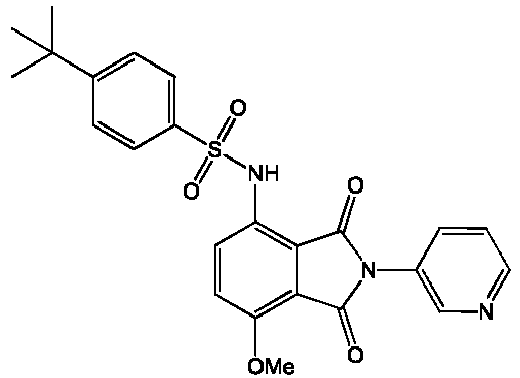
466.20 98.22 % Rt = 6.09 min (1) 1H NMR (400MHz, DMSO- d6-): δ 9.70 (bs, 1H), 8.60-8.59 (d, J = 3.6 Hz, 1H), 8.51 (s, 1H), 7.79-7.74 (m, 3H), 7.68-7.65 (d, J = 9.2 Hz, 1H), 7.60-7.53 (m, 4H), 3.94 (s, 3H), 1.25 (s, 9H). 164 
478.13 99.75 % Rt = 5.42 min (1) 1H NMR (400MHz, DMSO- d6-): δ 10.24 (bs, 1H), 8.60-8.59 (dd, J = 1.6 Hz, 3.2 Hz, 1H), 8.47-8.46 (d, J = 2 Hz, 1H), 7.96 (m, 4H), 7.71-7.69 (m, 1H), 7.63-7.60 (d, J = 9.2 Hz, 1H), 7.55-7.53 (m, 2H), 3.95 (s, 3H). 165 
494.17 97.42 % Rt = 5.63 min (1) 1H NMR (400MHz, DMSO- d6-): δ 10.07 (bs, 1H), 8.63-8.59 (m, 1H), 8.50-8.49 (d, J = 2 Hz, 1H), 7.91-7.90 (d, J = 6.8 Hz, 2H), 7.75-7.73 (m, 1H), 7.64-7.58 (m, 5H), 3.89 (s, 3H). 166 
480.42 99.67 % Rt = 6.24 min (1) 1H NMR (400MHz, DMSO-d6): δ 9.64 (bs, 1H), 8.48 (m, 2H), 7.76-7.74 (d, J = 8.4 Hz, 2H), 7.65-7.63 (d, J = 8.0 Hz, 1H), 7.58-7.54 (m, 3H), 7.46-7.44 (d, J = 9.6 Hz, 1H) 7.35-7.33 (m, 1H) 4.66 (s, 2H), 3.88 (s, 3H), 1.24 (s, 9H). 167 
508.37 98.89 %, Rt = 5.81 min (1) 1H NMR (400MHz, DMSO-d6): δ 9.98 (bs, 1H), 8.47 (s, 2H), 7.88-7.85 (d, J = 8.8 Hz, 2H), 7.56-7.46 (m, 5H), 7.34-7.31 (m, 1H), 4.62 (s, 2H), 3.90 (s, 3H). 168 
491.97 98.77 %, Rt = 5.13 min (2) 1H NMR (400MHz, DMSO-d6): δ 10.18 (bs, 1H), 8.46 (m, 2H), 7.97-7.90 (m, 4H), 7.54-7.52 (m, 2H), 7.48-7.46 (m, 1H), 7.33-7.30 (m, 1H), 4.62 (s, 2H), 3.90 (s, 3H). 169 
526.21 95.53 %, Rt = 5.52 min (1) 1H NMR (400MHz, DMSO-d6): δ 10.38 (bs, 1H), 8.47 (m, 2H), 8.16 (s, 1H),7.92-7.85 (m, 2H), 7.53-7.47 (m, 3H), 7.33 (s, 1H), 4.61 (s, 2H), 3.91 (s, 3H). -

- A stirred solution of 3-chloro-6-nitrophthalic acid (XXIV, 10 g, 36.6 mmol) in DMF (20 mL) was cooled to 0°C and methyl iodide (13 g, 95 mmol) in DMF solution (16 mL) was added. The reaction mixture was heated at 70°C for 12 h and on cooling this was diluted with ice cold water. The aqueous layer was extracted with ethyl acetate and the organic layer was dried over anhydrous Na2SO4, filtered and evaporated under reduced pressure to afford crude compound dimethyl 3-chloro-6-nitrophthalate (LXXXV, 10 g, crude). 1H NMR (400MHz, DMSO-d6): δ 8.08-8.06 (m, 1H), 7.67-7.66 (m, 1H), 3.99 (s, 3H), 3.96 (s, 3H).
- To a stirred solution of compound LXXXV (10 g, 36 mmol) in dioxane (360 mL) was added cyclopropaneboronic acid (LXXXVI, 6.29 g, 73 mmol). This was followed by a solution of sodium carbonate (11.64 g, 109 mmol) in water (75 mL). The reaction was purged under an argon atmosphere for 30 minutes. The catalyst Pd(dppf)Cl2 (5.9 g, 7.3 mmol) was added to the reaction mixture and the mixture was heated at 120°C for 12 h. On cooling the solution was filtered through a celite bed. The dioxane was concentrated under reduced pressure and the crude compound was directly purified by column chromatography using 30% ethyl acetate in hexane to afford dimethyl 3-cyclopropyl-6-nitrophthalate (LXXXVII, 2.1 g, 24.5% yield). 1H NMR (400MHz, CDCl3): δ 8.03-8.01 (d, J = 8.8 Hz, 1H), 7.15-7.13 (d, J = 8.8 Hz, 1H) 3.91 (s, 6H), 2.23 (m, 1H), 1.15-1.13 (m, 2H), 0.82-0.79 (m, 2H).
- To a stirred solution of compound LXXXVII (2.1 g, 7.52 mmol) in DME (5 mL) was added a solution of sodium hydroxide (0.6 g, 15.1 mmol) in water (1 mL). The reaction mixture was heated at 70°C for 48 h. On cooling it was diluted with ice cold water and acidified to pH 2 using 1N HCl solution. The aqueous layer was extracted with ethyl acetate. The organic layer was dried over anhydrous Na2SO4, filtered and evaporated under reduced pressure to afford 3-cyclopropyl-6-nitrophthalic acid (LXXXVIII, 1.5 g, 80% yield). 1H NMR (400MHz, DMSO-d6): δ 13.9 (bs, 2H), 8.00-7.98 (d, J = 8.4 Hz, 1H), 7.25-7.23 (d, J = 8.4 Hz, 1H), 2.2 (m, 1H), 1.15 (m, 2H), 0.84 (m, 2H).
- A stirred solution of compound LXXXVIII (1.5 g; 5.97 mmol) in acetic anhydride (20 mL) was heated at 120°C for 12 h. The reaction mixture was cooled and diluted with water. The aqueous layer was extracted with ethyl acetate. The organic layer was washed with brine, dried over anhydrous Na2SO4, filtered and concentrated to afford 4-cyclopropyl-7-nitroisobenzofuran-1,3-dione as an off-white solid (LXXXIX; 1.2 g, 92.3% yield). MS (M-1): 232.20.
- To a stirred solution of compound LXXXIX (1.2 g, 5.15 mmol) in acetic acid (20 mL) was added pyridin-3-amine (II, 0.91 g, 10.3 mmol). The reaction mixture was heated at 120°C for 12 h. On cooling to room temperature, the acetic acid was removed under reduced pressure to leave the crude product which was triturated with ethanol to afford 4-cyclopropyl-7-nitro-2-(pyridin-3-yl)isoindoline-1,3-dione (XC, 1.2 g, 86%). MS (M-1): 308.99.
- To a solution of compound XC (1.2 g, 3.88 mmol) in acetic acid (10 mL) was added iron powder (1 g) in small portions. The reaction mixture was stirred for 12 h at room temperature and then filtered through a celite bed and concentrated under reduced pressure. The crude mass was neutralized by aqueous sodium bicarbonate solution. The aqueous layer was extracted with ethyl acetate. The organic solvent which was dried over anhydrous Na2SO4, filtered and evaporated under reduced pressure to afford 4-amino-7-cyclopropyl-2-(pyridin-3-yl)isoindoline-1,3-dione as an off white solid (XCI; 1 g, 92% yield). 1H NMR (400MHz, DMSO-d6): δ 8.65 (s, 1H), 8.59-8.58 (d, J = 4.8 Hz, 1H), 7.90-7.88 (d, J = 8.8 Hz, 1H), 7.58-7.55 (m, 1H), 6.98 (m, 2H), 6.44 (bs, 2H), 2.94-2.89 (m, 1H), 1.01-0.97 (m, 2H), 0.77-0.73 (m, 2H).
- A mixture of compound XCI (0.2 g, 0.72 mmol) and pyridine (3 mL) was cooled to 0°C and 4-tert-butylbenzenesulfonyl chloride (V, 0.33 g, 1.43 mmol) was added followed by DMAP (0.047 g, 0.35 mmol). The reaction mixture was heated for 12 h at 100°C. The reaction mixture was concentrated and diluted with water. The reaction mixture was extracted with ethyl acetate. The organic layer was washed with brine solution, dried over anhydrous Na2SO4, filtered and the organic solvent was evaporated under reduced pressure to obtain the crude compound. This was purified by column chromatography using 40% ethyl acetate in hexane to afford 4-(tert-butyl)-N-(7-cyclopropyl-1,3-dioxo-2-(pyridin-3-yl)isoindolin-4-yl)benzenesulfonamide as an off-white solid (170; 0.08 g, 23.52% yield). 1H NMR (400MHz, DMSO-d6): δ 9.76 (bs, 1H), 8.63-8.61 (m, 2H), 7.87-7.85 (m, 3H), 7.63-7.55 (m, 4H), 7.26-7.24 (d, J = 8.8 Hz, 1H), 2.98-2.97 (m, 1H), 1.27 (s, 9H), 1.12 (m, 2H), 0.85 (m, 2H). MS (M+1): 476.11. (LCMS purity 99.32%, Rt = 6.73 min (2)).
- The following compounds were also prepared using a similar method and the appropriate sulfonyl chloride in the final step described. Conversion to the pyridine N-oxide is achieved by treatment of the corresponding pyridine with mCPBA:
Cpd Structure LCMS (M+1) Purity (LCMS) 1H NMR 171 
488.36 99.57 %, Rt = 6.0 min (1) 1H NMR (400MHz, DMSO-d6): δ 10.31 (bs, 1H), 8.62 (s, 1H), 8.57 (m, 1H), 8.09-8.07 (d, J = 8.0 Hz, 2H), 7.99-7.97 (d, J = 8.4 Hz, 2H), 7.82-7.80 (d, J = 8.4 Hz, 1H), 7.59-7.56 (d, J = 8.8 Hz, 1H), 7.50-7.48 (d, J= 8.8 Hz, 1H) 7.25-7.23 (d, J = 8.8 Hz, 1H), 3.01 (m, 1H), 1.13 (m, 2H), 0.86 (m, 2H). 172 
504.38 99.83 %, Rt = 6.20 min (1) 1H NMR (400MHz, DMSO-d6): δ 10.12 (bs, 1H), 8.63-8.59 (m, 2H), 8.04-8.02 (d, J = 8.8 Hz, 2H), 7.84-7.82 (d, J = 8.0 Hz, 1H), 7.60-7.56 (m, 3H), 7.52-7.50 (d, J = 8.8 Hz, 1H), 7.26-7.24 (d, J = 8.8 Hz, 1H), 3.01 (m, 1H), 1.13 (m, 2H), 0.87 (m, 2H). 173 
492.39 96.98 %, Rt = 5.97 min (1) 1H NMR (400MHz, DMSO-d6): δ 9.82 (bs, 1H), 8.36 (s, 1H), 8.30-8.28 (d, J = 6.4 Hz, 1H), 7.85-7.83 (d, J = 8.4 Hz, 2H), 7.59-7.53 (m, 4H), 7.46-7.44 (d, J = 8.4 Hz, 1H), 7.16 (m, 1H), 2.98-2.92 (m, 1H), 1.27 (s, 9H), 1.10 (m, 2H), 0.87 (s, 2H). 174 
518.35 (M-1) 98.51 %, Rt = 5.31 min (1) 1H NMR (400MHz, DMSO-d6): δ 10.19 (bs, 1H), 8.34 (s, 1H), 8.31-8.30 (d, J = 6.4 Hz, 1H), 8.06-8.02 (d, J = 8.8 Hz, 2H), 7.61-7.56 (m, 3H), 7.51-7.49 (d, J = 8.8 Hz, 1H), 7.43-7.41 (d, J = 8.4 Hz, 1H), 7.26-7.24 (d, J = 8.0 Hz, 1H), 2.99 (m, 1H), 1.13-1.12 (m, 2H), 0.86-0.85 (m, 2H). -
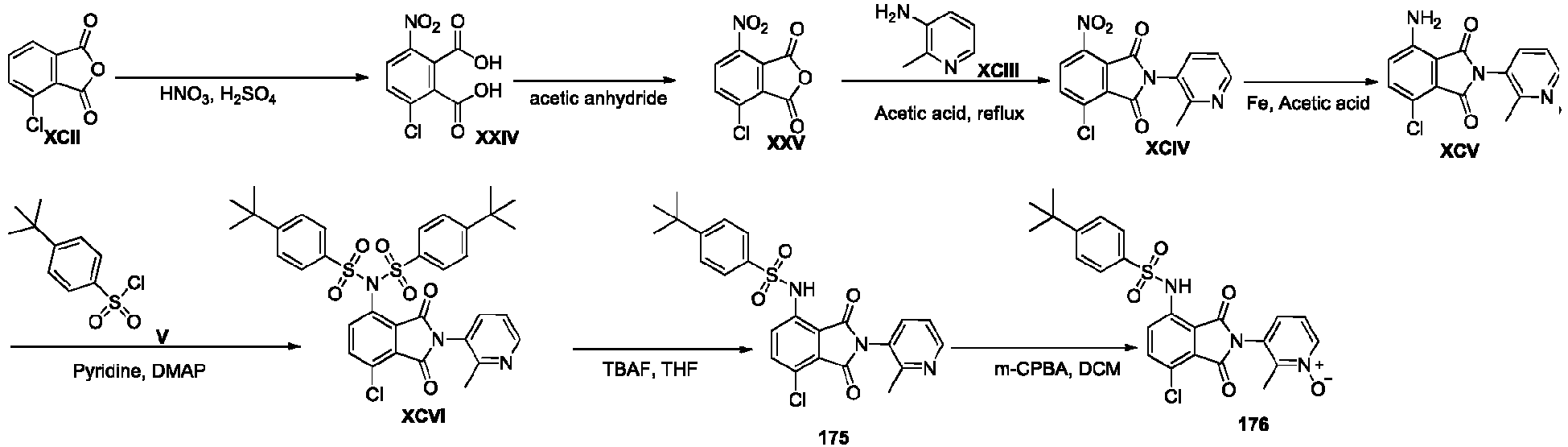
- To a stirred solution of nitric acid and sulphuric acid (172 ml: 439 ml) at 0°C was added portion wise compound XCII (250.0 g, 1.37 mol) and the reaction mixture was stirred at room temperature for 12 h. The reaction mixture was cooled to 0°C followed by addition of crushed ice. The solid which precipitated out was filtered to afford 3-chloro-6-nitrophthalic acid as a white solid (XXIV; 250.0 g; 74% yield). 1H NMR (400MHz, DMSO-d6): δ 14.34 (bs, 2H), 8.16-8.13 (d, J = 8.8 Hz, 1H), 7.93-7.91 (d, J = 8.8 Hz, 1H). MS (M-1): 243.97.
- A stirred solution of compound XXIV (250.0 g, 1.02 mol) in acetic anhydride (3.5 L) was heated at 120°C for 18 h. The reaction mixture was cooled and concentrated under reduced pressure. The crude solid obtained was washed with hexane and triturated with 20% diethyl ether in hexane to afford 4-chloro-7-nitroisobenzofuran-1,3-dione as an off white solid (XXV; 230g; 99% yield). 1H NMR (400MHz, DMSO-d6): δ 8.48-8.46 (d, J = 8.8 Hz, 1H), 8.30-8.27 (d, J = 8.8 Hz, 1H). MS (M+1): 228.01.
- To a stirred solution of compound XXV (230 g, 1.01 mol) in acetic acid (4 L) was added 2-methylpyridin-3-amine (XCIII, 118.15 g, 1.09 mol) and the reaction mixture heated at 120°C for 4 h. The reaction mixture was cooled to room temperature and the acetic acid removed under reduced pressure. The residual material was washed with hexane to obtain a crude product 4-chloro-2-(2-methylpyridin-3-yl)-7-nitroisoindoline-1,3-dione as a yellow solid (XCIV; 300 g,). MS (M+1): 318.09. The crude material was carried forward to next step without purification.
- To a solution of compound XCIV (280 g) in acetic acid (10 L) under a nitrogen atmosphere was added iron powder (280 g). The reaction mixture was stirred for 12 h at room temperature. The reaction mixture was filtered through a celite bed followed which was washed with ethyl acetate and the collected filtrate was evaporated under reduced pressure to afford compound 4-amino-7-chloro-2-(2-methylpyridin-3-yl)isoindoline-1,3-dione as a yellow solid (XCV; 220 g; 86% yield). 1H NMR (400MHz, DMSO-d6): δ 8.55-8.54 (m, 1H), 7.80-7.78 (d, J = 7.6 Hz, 1H), 7.50-7.48 (d, J = 8.8 Hz, 1H), 7.41-7.38 (m, 1H), 7.08-7.06 (d, J = 8.8 Hz, 1H), 6.73 (s, 2H), 2.34 (s, 3H). MS (M+1): 288.19
- A mixture of compound XCV (210 g, 0.731 mol) in pyridine (4 L) was cooled to 0°C and 4-(tert-butyl) benzenesulfonyl chloride (V, 509 g, 2.19 mol) was added. The reaction mixture was stirred at 90°C for 8 h. The reaction mixture was cooled and concentrated under reduced pressure. The reaction mixture was diluted with water and the aqueous layer was extracted with ethyl acetate. The organic layer was separated, washed with brine solution, dried over anhydrous Na2SO4, filtered and the concentrated under reduced pressure to obtain the crude compound XCVI. To the crude compound XCVI, was added 1M TBAF in THF solution (4 L) and the resulting mixture stirred for 3 h at room temperature. The reaction mixture was concentrated at reduced pressure and diluted with ethyl acetate. The organic layer was washed with water, dried over anhydrous Na2SO4, filtered and evaporated under reduced pressure to obtain the crude compound which was purified by column chromatography using 25% ethyl acetate in hexane to afford the title compound, 4-(tert-butyl)-N-(7-chloro-2-(2-methylpyridin-3-yl)-1,3-dioxoisoindolin-4-yl)benzenesulfonamide as an off white solid (175; 240 g, 68 % yield). 1H NMR (400MHz, DMSO-d6): δ 10.00 (bs, 1H), 8.57-8.56 (d, J = 3.6 Hz, 1H),7.92-7.90 (d, J = 8.4 Hz, 2H ), 7.83-7.81 (d, J = 8.8 Hz, 1H), 7.78-7.76 (d, J = 7.2 Hz, 1H), 7.70-7.67 (d, J = 8.8 Hz, 1H), 7.64-7.61 (d, J = 8.4 Hz, 2H), 7.43-7.39 (m, 1H), 2.31 (s, 3H), 1.27 (s, 9H). MS (M+1): 484.03. (LCMS purity 99.02%, Rt = 6.06 min (1)).
- To a stirred solution of 4-(tert-butyl)-N-(7-chloro-2-(2-methylpyridin-3-yl)-1,3-dioxoisoindolin-4-yl)benzenesulfonamide (175; 230 g, 0.475 mol) in dichloromethane (3.4 L), was added m-chloroperoxybenzoic acid (81.97 g, 0.475 mol). The reaction mixture was stirred at RT for 8 h whereupon the solvent was concentrated under reduced pressure and the residue was diluted with water. The aqueous layer was extracted with dichloromethane. The combined organic layers were washed sequentially with sodium bicarbonate and brine, then dried over Na2SO4, filtered and concentrated under vacuum to leave the crude compound, which was purified by column chromatography using 1% methanol in dichloromethane to afford 3-(4-(4-(tert-butyl)phenylsulfonamido)-7-chloro-1,3-dioxoisoindolin-2-yl)-2-methylpyridine 1-oxide as an off white solid (176; 125 g, 53% yield). 1H NMR (400MHz, DMSO-d6): δ 10.04 (bs, 1H), 8.45-8.43 (d, J = 5.6 Hz, 1H), 7.93-7.91 (d, J = 8.4 Hz, 2H), 7.85-7.83 (d, J = 8.8 Hz, 1H), 7.69-7.67 (d, J = 8.8 Hz, 1H), 7.64-7.62 (d, J = 8.8 Hz, 2H),7.47-7.40 (m, 2H), 2.20 (s, 3H), 1.27 (s, 9 H). MS (M+1): 500.28. (LCMS purity 99.45%, Rt = 5.40 min (1)).
- The following compounds were prepared essentially in a similar manner as described above using the appropriate amine instead of 2-methylpyridin-3-amine XCIII. The final step described was only carried out only for those compounds where a pyridine-N-oxide was produced:
S. No. Structure LCMS (M+1) Purity (LCMS) 1HNMR 177 
495.06 99.87% Rt = 5.98 min (1) 1H NMR (400MHz, DMSO-d6): δ 10.09 (bs, 1H), 9.12-9.11 (d, J = 1.6 Hz, 1H), 8.93-8.92 (d, J = 2 Hz, 1H), 8.38-8.09 (m, 1H), 7.94-7.92 (d, J = 8.8 Hz, 1H), 7.71-7.69 (d, J = 8.8 Hz, 1H), 7.65-7.63 (d, J = 8.8 Hz, 2H), 1.27 (s, 9H). 178 
476.00 97.32 % Rt = 6.03 min (1) 1H NMR (400MHz, DMSO-d6): δ 10.12 (bs, 1H), 9.06 (s, 1H), 8.21 (s, 1H), 7.94-7.92 (d, J = 8.8 Hz, 2H), 7.83-7.81 (d, J = 8.8 Hz, 1H), 7.66-7.62 (m, 3 H), 1.26 (s, 9H). 179 
497.92 (M-1) 98.42 % Rt = 6.20 min (1) 1H NMR (400MHz, DMSO-d6): δ 10.20 (bs, 1H), 7.89-7.77 (m, 5H), 7.62-7.60 (d, J = 8.4 Hz, 2H), 7.47-7.46 (d, J = 5.2 Hz, 1H), 1.30 (s, 9H). 180 516.03 97.29 % Rt = 5.15 min (1) 1H NMR (400MHz, DMSO-d6): δ 10.04 (bs, 1H), 8.35-8.34 (d, J = 2 Hz, 1H), 7.94-7.92 (d, J = 8 Hz, 2H), 7.80 (m, 1H), 7.68-7.62 (m, 3H), 7.44-7.43 (d, J = 2 Hz, 1H), 7.37-7.35 (d, J = 8.8 Hz, 1H), 4.03 (s, 3H), 1.27 (s, 9H). 
181 
476.09 99.78 % Rt = 5.79 min (2) 1H NMR (400MHz, DMSO-d6 with TFA): δ 9.65 (bs, 1H), 8.36 (bs, 1H), 7.85-7.83 (d, J = 8.4 Hz, 2H), 7.61 (m, 2H), 7.55-7.53 (d, J = 8.4 Hz, 2H), 4.26 (m, 1H), 3.36 (m, 2H), 3.04 (m, 2H), 2.42 (m, 2 H), 1.83 (m, 2H), 1.21 (s, 9H). 182 
484.06 98.42 % Rt = 6.21 min (1) 1H NMR (400MHz, DMSO-d6): δ9.97 (bs, 1H), 8.46-8.45 (d, J = 2Hz, 1H), 7.93-7.91 (d, J = 8.4 Hz, 2H),7.82-7.80 (d, J = 8.8 Hz, 1H), 7.72-7.62 (m, 4H), 7.44-7.42 (d, J = 8 Hz, 1H), 2.53 (s, 3H), 1.27 (s, 9H). 183 
500.26 99.56 % Rt = 6.40 min (1) 1H NMR (400MHz, DMSO-d6): δ 10.09 (bs, 1H), 8.33-8.31 (m, 1H), 7.94-7.92 (d, J 2H), 7.67-7.63 (m, 3H), 7.21-7.18 (m, 1H), 3.84 (s, 3H), 1.28 (s, 9H). 184 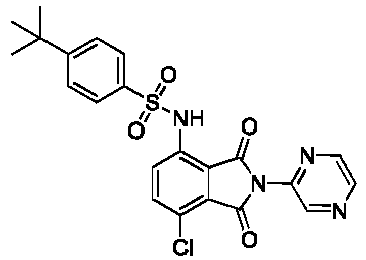
471.03 98.49 % Rt = 5.94 min (1) 1H NMR (400MHz, DMSO-d6): δ 10.09 (bs, 1H), 8.79-8.78 (m, 3H), 7.93-7.91 (d, J = 8.4 Hz, 2H), 7.88-7.85 (d, J = 9.2 Hz, 1H), 7.70-7.68 (d, J = 8.8 Hz, 1H), 7.64-7.62 (d, J = 8.4 Hz, 2H), 1.27 (s, 9H). 185 
484.06 99.08 % Rt = 6.13 min (1) 1H NMR (400MHz, DMSO-d6): δ 10.02 (bs, 1H), 8.53-8.52 (d, J = 5.2 Hz, 1H), 8.47 (s, 1H), 7.92-7.90 (d, J = 8.8 Hz, 2H), 7.85-7.83 (d, J = 8.8 Hz, 1H), 7.70-7.68 (d, J = 8.8 Hz, 1H), 7.64-7.62 (d, J = 8.8 Hz, 2H),7.47-7.46 (d, J = 5.6 Hz, 1H), 2.16 (s, 3H), 1.27 (s, 9H). 186 
490.15 98.26% Rt = 5.83 min (1) 1H NMR (400MHz, DMSO-d6): δ 9.54 (bs, 1H), 7.80-7.81 (d, J = 8 Hz, 2H), 7.55-7.45 (m, 4H), 4.15-4.12 (m, 2 H), 3.40-3.30 (m, 2H), 2.98-2.91 (m, 1H), 2.67 (s, 3H), 2.43-2.40 (m, 2H), 1.84-1.80 (m, 2H), 1.27 (s, 9H). 187 
488.04 98.06% Rt = 6.30 min (1) 1H NMR (400MHz, DMSO-d6): δ 10.03 (bs, 1H), 8.29 (s, 1H), 8.07-8.04 (m, 1H), 7.94-7.92 (d, J = 8.8 Hz, 2H),7.84-7.82 (d, J = 8.4 Hz, 1H), 7.69-7.67 (d, J = 8.8 Hz, 1H), 7.65-7.63 (d, J = 8 Hz, 2H), 7.43-7.40 (m, 1 H), 2H), 1.27 (s, 9H). 188 
500.04 96.11% Rt = 5.29 min (1) 1H NMR (400MHz, DMSO-d6): δ 10.08 (bs, 1H), 8.32 (s, 1H), 8.27-8.25 (d, J = 6.4 Hz, 1H), 7.93-7.91 (d, J = 8.4 Hz, 2H),7.86-7.84 (d, J = 8.8 Hz, 1H), 7.70-7.68 (d, J = 8.8 Hz, 1H), 7.64-7.62 (d, J = 8.4 Hz, 2H), 7.48-7.46 (d, J = 6.4 Hz, 1H), 2.11 (s, 3H), 1.27 (s, 9H). 189 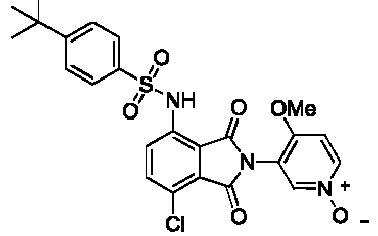
516.28 99.14% Rt = 5.13 min (1) 1H NMR (400MHz, DMSO-d6): δ 10.17 (bs, 1H), 8.35-8.33 (m, 1H), 8.31-8.30 (d, J = 2 Hz, 1H), 7.92-7.90 (d, J = 8 Hz, 2H), 7.80 (m, 1H), 7.66-7.61 (m, 3H), 7.34-7.32 (d, J = 7.2 Hz, 1H), 3.84 (s, 3H), 1.28 (s, 9H). 190 
522.03 (M-1) 99.60% Rt = 6.53 min (1) 1H NMR (400MHz, DMSO-d6): δ 10.0 (bs, 1H), 7.89-7.86 (m, 2H), 7.78 (m, 1H), 7.68-7.60 (m, 1H), 7.61-7.56 (m, 3H), 7.45 (m, 1H), 7.37 (m, 1H), 3.85 (s, 3H), 1.27 (s, 9H). 191 
484.07 99.45% Rt = 6.36 min (1) 1H NMR (400MHz, DMSO-d6): δ 10.00 (bs, 1H), 8.43-8.42 (d, J = 4 Hz, 1H), 7.93-7.90 (d, J = 8.4 Hz, 2H), 7.79-7.75 (m, 2H), 7.63-7.61 (m, 3H), 7.42-7.40 (d, J = 8 Hz, 1H), 7.29-7.26 (m, 1H), 4.84 (s, 2H), 1.27 (s, 9H). 192 
473.05 96.83% Rt = 5.60 min (1) 1H NMR (400MHz, DMSO-d6): δ 10.15 (bs, 1H), 7.93-7.91 (d, J = 8.8 Hz, 2H), 7.82-7.80 (m, 2H), 7.67-7.61 (m, 3H), 6.97 (s, 1H), 3.38 (s, 3H), 1.27 (s, 9H). 193 
487.10 98.75% Rt = 6.89 min (2) 1H NMR (400MHz, DMSO-d6): δ 9.99 (bs, 1H), 7.91-7.89 (d, J = 7.6 Hz, 2H), 7.74-7.72 (d, J = 8.8 Hz, 1H), 7.62-7.58 (m, 4H), 6.11 (s, 1H), 4.62 (s, 2H), 3.73 (s, 3H), 1.26 (s, 9H). 194 
516.27 98.38% Rt = 5.36 min (1) 1H NMR (400MHz, DMSO-d6): δ 10.14 (bs, 1H), 8.42-8.41 (d, J = 6.4 Hz, 1H), 7.93-7.91 (d, J = 8.4 Hz, 2H), 7.85-7.84 (d, J = 7.2 Hz, 1H), 7.69-7.62 (m, 3H), 7.47-7.45 (d, J = 8 Hz, 1H), 7.37 (m, 1H), 3.98 (s, 3H), 1.27 (s, 9H). 195 
509.12 99.14% Rt = 6.92 min (1) 1H NMR (400MHz, DMSO-d6): δ 9.92 (bs, 1H), 8.94 (s, 1H), 8.88 (s, 1H), 8.30 (s, 1H), 7.94-7.92 (d, J = 8.2 Hz, 2H), 7.75-7.73 (d, J = 8.8 Hz, 1H), 7.63-7.59 (m, 3H), 4.82 (s, 2H), 1.26 (s, 9H). 196 
512.11 99.02% Rt = 6.62 min (1) 1H NMR (400MHz, DMSO-d6): δ 9.91 (bs, 1H), 8.35-8.34 (d, J = 4 Hz, 1H), 8.29 (s, 1H), 7.87-7.85 (d, J = 8 Hz, 2H), 7.71-7.68 (d, J = 8.8 Hz, 1H), 7.63-7.61 (d, J = 8 Hz, 2H), 7.58-7.56 (d, J = 8.8 Hz, 1H), 7.53-7.51 (d, J = 8.8 Hz, 1H), 7.24-7.21 (m, 1H), 4.42 (m, 1 H), 3.18-3.12 (m, 1H), 3.05-3.01 (m, 1H), 1.43-1.41 (d, J = 6.8 Hz, 3H), 1.26 (s, 9H). 197 
530.26 99.63% Rt = 5.53 min (1) 1H NMR (400MHz, DMSO-d6): δ 10.08 (bs, 1H), 8.17 (s, 1H), 7.99 (s, 1H), 7.95-7.93 (d, J = 8.4 Hz, 2H), 7.86-7.83 (d, J = 8.8 Hz, 1H), 7.69-7.67 (d, J = 8.8 Hz, 1H), 7.67-7.63 (m, 2H), 7.13-7.12 (m, 1H), 4.15-4.10 (q, J = 7.2 Hz, 6.8 Hz, 2H), 1.35-1.32 (t, 6.8 Hz, 3H), 1.27 (s, 9H). 198 
525.08 98.96% Rt = 6.44 min (2) 1H NMR (400MHz, DMSO-d6): δ 9.91 (bs, 1H), 8.79 (s, 1H), 8.60 (s, 1H), 7.95-7.92 (d, J = 8.4 Hz, 2H), 7.84 (s, 1H), 7.75-7.73 (d, J = 8 Hz, 1H), 7.63-7.59 (m, 3H), 4.73 (s, 2H), 1.27 (s, 9H). 199 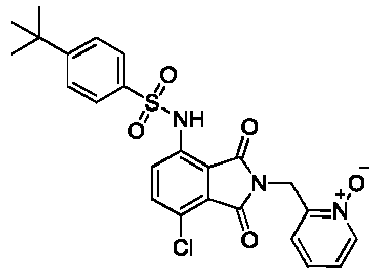
500.04 99.22% Rt = 5.51 min (1) 1H NMR (400MHz, DMSO-d6): δ 9.97 (bs, 1H), 8.34-8.32 (d, J = 6.4 Hz, 1H), 7.95-7.93 (d, J = 8.4 Hz, 2H), 7.78-7.76 (d, J = 8.8 Hz, 1H), 7.64-7.61 (m, 3H), 7.51-7.49 (d, J = 7.2 Hz, 1H),7.42-7.39 (m, 1H), 7.31-7.28 (m, 1H), 4.77 (s, 2H), 1.27 (s, 9H). 200 
495.05 96.34% Rt = 6.17 min (1) 1H NMR (400MHz, DMSO-d6): δ 10.07 (bs, 1H), 8.93-8.91 (d, J = 4.8 Hz, 1H), 8.04-8.03 (d, J = 4.8 Hz, 1H), 7.95-7.90 (m, 3H), 7.87-7.85 (d, J = 8.8 Hz, 1H), 7.70-7.68 (d, J = 8.8 Hz, 1H), 7.64-7.62 (d, J = 8.4 Hz, 2H), 1.27 (s, 9H). 201 
484.08 95.90% Rt = 6.16 min (1) 1H NMR (400MHz, DMSO-d6): δ 9.98 (bs, 1H), 8.51-8.50 (d, J = 5.2 Hz, 2H), 7.93-7.91 (d, J = 8.4 Hz, 2H), 7.77-7.74 (d, J = 8.8 Hz, 1H), 7.63-7.59 (m, 3H), 7.33-7.32 (d, J = 5.2 Hz, 2H), 4.74 (s, 2 H), 1.27 (s, 9H). 202 
500.08 98.26% Rt = 6.27 min (1) 1H NMR (400MHz, DMSO-d6): δ 10.10 (bs, 1H), 8.20-8.19 (d, J = 4 Hz, 1H), 7.91-7.84 (m, 3H), 7.76-7.74 (d, J =8 Hz, 1H), 7.68-7.66 (d, J =8.4 Hz, 1H), 7.64-7.59 (m, 3H), 3.80 (s, 3H), 1.27 (s, 9H). 203 
471.07 99.51% Rt = 5.70 min (1) 1H NMR (400MHz, DMSO-d6): δ 10.10 (bs, 1H), 9.37-9.36 (d, J = 3.6 Hz, 1H), 8.01-7.98 (m, 1H), 7.94-7.92 (d, J =8.4 Hz, 2H), 7.87-7.85 (d, J =8.4 Hz, 2H), 7.71-7.68 (d, J =9.2 Hz, 1H), 7.65-7.63 (d, J =8 Hz, 2H), 1.27 (s, 9H). 204 
485.07 99.82% Rt = 6.20 min (1) 1H NMR (400MHz, DMSO-d6): δ 10.06 (bs, 1H), 8.75-8.74 (m, 2H), 7.92-7.90 (d, J =8.4 Hz, 2H), 7.81-7.79 (d, J =8.8 Hz, 1H), 7.64-7.61 (m, 3H), 7.45-7.42 (m, 1H), 4.94 (s, 2H), 1.27 (s, 9H). 205 
500.08 99.31% Rt = 5.45 min (1) 1H NMR (400MHz, DMSO-d6): δ 10.04 (bs, 1H), 8.37 (s, 1H), 7.94-7.92 (d, J = 8 Hz, 2H), 7.80 (m, 1H), 7.68-7.62 (m, 4H), 7.36-7.34 (d, J = 8 Hz, 1H), 2.40 (s, 3H), 1.27 (s, 9H). 206 
514.05 99.53% Rt = 6.71 min (1) 1H NMR (400MHz, DMSO-d6): δ 9.97 (bs, 1H), 8.16-8.15 (d, J = 2 Hz, 1H), 7.94-7.91 (d, J = 8.4 Hz, 2H), 7.82-7.80 (d, J = 9.2 Hz, 1H), 7.73-7.70 (dd, 6.6 Hz, 2.4 Hz, 1H), 7.68-7.63 (m, 3H), 6.97-6.94 (d, J = 8.4 Hz, 1H), 4.37-4.32 (q, J = 6.8 Hz, 7.2 Hz, 2H), 1.36-1.32 (t, J = 6.8 Hz, 3H), 1.27 (s, 9H). 207 
495.08 99.47% Rt = 6.24 min (1) 1H NMR (400MHz, DMSO-d6): δ 10.07 (bs, 1H), 8.35-8.31 (m, 1H), 8.20-8.18 (d, J = 7.2 Hz, 1H), 7.92-7.90 (d, J = 8.4 Hz, 2H), 7.86-7.84 (d, 8.4 Hz, 2H), 7.70-7.68 (d, J = 8.4 Hz, 1H), 7.64-7.62 (d, J = 8.8 Hz, 2H), 1.27 (s, 9H). 208 
498.38 99.26% Rt = 6.29 min (1) 1H NMR (400MHz, DMSO-d6): δ 9.98 (bs, 1H), 8.41 (s, 1H), 8.35-8.33 (d, J = 5.2 Hz, 1H), 7.91-7.89 (d, J = 8.4 Hz, 2H), 7.74-7.72 (d, J = 9.2 Hz, 1H), 7.62-7.58 (m, 3H), 7.22-7.21 (d, J = 4.8 Hz, 1H), 4.72 (s, 2H), 2.36 (s, 3H), 1.26 (s, 9H). 209 
500.05 95.09% Rt = 5.35 min (1) 1H NMR (400MHz, DMSO-d6): δ 9.94 (bs, 1H), 8.16-8.14 (d, J = 6.8 Hz, 2H), 7.93-7.91 (d, J = 8.4 Hz, 2H), 7.76-7.74 (d, J = 8.8 Hz, 1H), 7.63-7.58 (m, 3H), 7.37-7.35 (d, J = 6.8 Hz, 2H), 4.68 (s, 2H), 1.26 (s, 9H). 210 
530.09 97.07% Rt = 5.28 min (1) 1H NMR (400MHz, DMSO-d6): δ 10.03 (bs, 1H), 8.34-8.33 (d, J = 2 Hz, 1H), 7.95-7.93 (d, J = 8.4 Hz, 2H), 7.83-7.81 (d, J = 8.8 Hz, 1H), 7.68-7.63 (m, 3H), 7.41-7.34 (m, 2H), 4.35-4.30 (q, J = 6.8 Hz, 7.2 Hz, 2H), 1.42-1.39 (t, J = 7.2 Hz, 3H), 1.27 (s, 9H). 211 
516.18 99.11 % Rt = 6.46 min (2) 1H NMR (400MHz, DMSO-d6): δ 10.27 (bs, 1H), 8.16-8.15 (d, J = 6 Hz, 1H), 7.92-7.90 (m, 3H), 7.69-7.57 (m, 4H), 7.35-7.33 (d, J = 8.8 Hz, 1H), 3.87 (s, 3H), 1.28 (s, 9H). 212 
514.05 99.02% Rt = 6.30 min (1) 1H NMR (400MHz, DMSO-d6): δ 9.93 (bs, 1H), 8.40 (s, 1H), 8.34 (s, 1H), 7.93-7.91 (d, J = 8.4 Hz, 2H), 7.76-7.74 (d, J = 9.2 Hz, 1H), 7.70 (m, 1H), 7.63-7.61 (m, 3H), 4.81 (s, 2H), 3.88 (s, 3H), 1.26 (s, 9H). 213 
514.05 98.22% Rt = 5.50 min (1) 1H NMR (400MHz, DMSO-d6): δ 9.93 (bs, 1H), 8.14 (s, 1H), 8.05-8.03 (d, J = 6.8 Hz, 1H), 7.93-7.91 (d, J = 8.8 Hz, 2H), 7.74-7.72 (d, J = 8.8 Hz, 1H), 7.63-7.58 (m, 3H), 7.25-7.23 (d, J = 6.8 Hz, 1H), 4.65 (s, 2H), 2.31 (s, 3H), 1.26 (s, 9H). 214 
500.04 97.63% Rt = 6.33 min (2) 1H NMR (400MHz, DMSO-d6): δ 10.05 (bs, 1H), 8.25 (s, 1H), 8.17 (s, 1H), 7.94-7.92 (d, J = 8.4 Hz, 2H), 7.85-7.83 (d, J = 8.8 Hz, 1H), 7.69-7.67 (d, J = 8.8 Hz, 1H), 7.65-7.63 (d, J = 8.4 Hz, 2H),7.28 (s, 1H), 2.31 (s, 3H), 1.27 (S, 9H). 215 
498.07 99.77% Rt = 6.34 min (1) 1H NMR (400MHz, DMSO-d6): δ 9.94 (bs, 1H), 8.41 (s, 1H), 7.90-7.88 (d, J = 8.8 Hz, 2H), 7.73-7.71 (d, J = 8.8 Hz, 1H), 7.61-7.57 (m, 4H), 7.21-7.19 (d, J = 8 Hz, 1H),4.68 (s, 2H), 2.42 (s, 3H), 1.26 (s, 9H). 216 
485.05 99.04% Rt = 6.0 min (1) 1H NMR (400MHz, DMSO-d6): δ 10.02 (bs, 1H), 8.86-8.84 (d, J = 5.2 Hz, 1H), 7.88-7.86 (m, 3H), 7.69-7.67 (d, J = 9.2 Hz, 1H), 7.62-7.57 (m, 3H), 2.55 (s, 3H), 1.26 (s, 9H). 217 
490.00 96.66% Rt = 4.72 min (2) 1H NMR (400MHz, DMSO-d6): δ 10.08 (bs, 1H), 7.93-7.91 (d, J = 8 Hz, 2H), 7.83-7.81 (d, J = 8.8 Hz, 1H), 7.67-7.62 (m, 3H), 7.52 (s, 1H), 2.45 (s, 3H), 1.27 (s, 9H). 218 
485.97 (M-1) 99.36% Rt = 6.20 min (1) 1H NMR (400MHz, DMSO-d6): δ 10.10 (bs, 1H), 8.39-8.38 (d, J = 2.8 Hz, 1H), 8.12-8.10 (m, 1H), 7.91-7.89 (d, J = 8.4 Hz, 2H), 7.87-7.84 (d, J = 9.2 Hz, 1H),7.72-7.69 (m, 1H), 7.63-7.58 (m, 3H), 1.27 (s, 9H). 219 
488.02 98.21% Rt = 6.27 min (1) 1H NMR (400MHz, DMSO-d6): δ 9.98 (bs, 1H), 8.66 (m, 1H), 8.01-7.74 (m, 4H), 7.69-7.53 (m, 4H), 1.27 (s, 9H). 220 
485.04 99.85% Rt = 6.06 min (1) 1H NMR (400MHz, DMSO-d6): δ 10.07 (bs, 1H), 8.69 (s, 1H), 8.57 (s, 1H), 7.92-7.90 (d, J = 8.4 Hz, 2H), 7.86-7.84 (d, J = 8.4 Hz, 1H), 7.70-7.68 (d, J = 8.4 Hz, 1H), 7.64-7.62 (d, J = 8.4 Hz, 2H), 2.56 (s, 3H), 1.27 (s, 9H). 221 
514.05 98.39% Rt = 5.55 min (1) 1H NMR (400MHz, DMSO-d6): δ 9.91 (bs, 1H), 8.30 (s, 1H), 7.93-7.90 (d, J = 8.4 Hz, 2H), 7.75-7.73 (d, J = 8.8 Hz, 1H), 7.63-7.58 (m, 3H), 7.44-7.42 (d, J = 8 Hz, 1H),7.22-7.20 (d, J = 7.6 Hz, 1H), 4.67 (s, 2H), 2.31 (s, 3H), 1.26 (s, 9H). 222 
470.02 97.71% Rt = 6.12 min (1) 1H NMR (400MHz, DMSO-d6): δ 9.98 (bs, 1H), 8.64-8.63 (d, J = 4.4 Hz, 1H), 8.06-8.02 (m, 1H), 7.93-7.90 (d, J = 8.4 Hz, 2H), 7.84-7.82 (d, J = 9.2 Hz, 1H), 7.69-7.67 (d, J = 8.8 Hz, 1H), 7.64-7.62 (d, J = 8.4 Hz, 2H), 7.55-7.49 (m, 2H), 1.27 (s, 9H). 223 
532.02 92.58% Rt = 7.07 min (2) 1H NMR (400MHz, DMSO-d6): δ 10.17 (bs, 1H), 7.93-7.91 (d, J = 8 Hz, 2H), 7.81-7.77 (d, J = 9.2 Hz, 1H), 7.70-7.67 (d, J = 8.8 Hz, 1H), 7.63-7.61 (d, J = 8 Hz, 2H), 2.67 (s, 3H), 2.57 (s, 3H), 1.27 (s, 9H). 224 
498.07 99.02% Rt = 6.22 min (1) 1H NMR (400MHz, DMSO-d6): δ 9.99 (bs, 1H), 7.92-7.90 (d, J = 8.4 Hz, 2H), 7.83-7.81 (d, J = 8.8 Hz, 1H), 7.69-7.66 (d, J = 9.2 Hz, 1H), 7.64-7.62 (m, 3H),7.26-7.24 (d, J = 8 Hz, 1H), 2.48 (s, 3H), 2.24 (s, 3H), 1.27 (s, 9H). 225 
484.06 97.84% Rt = 6.29 min (1) 1H NMR (400MHz, DMSO-d6): δ 9.97 (bs, 1H), 8.48-8.47 (d, J = 4.8 Hz, 1H), 7.91-7.89 (d, J = 8.4 Hz, 2H), 7.84-7.82 (d, J = 8.4 Hz, 1H), 7.69-7.67 (d, J = 8.8 Hz, 1H), 7.64-7.62 (d, J = 8.4 Hz, 2H), 7.38-7.36 (d, J = 4.8 Hz, 1H), 7.32 (s, 1H), 2.40 (s, 3H), 1.27 (s, 9H). 226 
484.06 99.58% Rt = 6.32 min (1) 1H NMR (400MHz, DMSO-d6): δ 9.97 (bs, 1H), 8.46 (s, 1H), 7.92-7.90 (d, J = 8.4 Hz, 2H), 7.86-7.81 (m, 2H), 7.68-7.66 (d, J = 8.8 Hz, 1H), 7.64-7.62 (d, J = 8.4 Hz, 2H), 7.39-7.36 (d, J = 8 Hz, 1H), 2.38 (s, 3H), 1.27 (s, 9H). 227 
514.06 99.30% Rt = 5.57 min (1) 1H NMR (400MHz, DMSO-d6): δ 10.02 (bs, 1H), 7.93-7.91 (d, J = 8.4 Hz, 2H), 7.84-7.82 (d, J = 8.8 Hz, 1H), 7.68-7.62 (m, 3H), 7.54-7.52 (d, J = 8.4 Hz, 1H), 7.33-7.31 (d, J = 8.8 Hz, 1H), 2.45 (s, 3H), 2.22 (s, 3H) 1.28 (s, 9H). 228 
484.06 99.87% Rt = 6.32 min (1) 1H NMR (400MHz, DMSO-d6): δ 9.98 (bs, 1H), 7.93-7.91 (m, 3H), 7.83-7.81 (d, J = 8.4 Hz, 1H), 7.68-7.66 (d, J = 8.4 Hz, 1H), 7.64-7.62 (d, J = 8.4 Hz, 2H), 7.40-7.39 (d, J = 7.2 Hz, 1H), 7.30-7.28 (d, J = 7.2 Hz, 1H), 2.45 (s, 3H), 1.27 (s, 9H). 229 
500.05 98.18% Rt = 5.50 min (1) 1H NMR (400MHz, DMSO-d6): δ 10.18 (bs, 1H), 8.40 (s, 1H), 7.94-7.92 (d, J = 8.4 Hz, 2H), 7.89-7.86 (d, J = 9.2 Hz, 1H), 7.68-7.62 (m, 4H), 7.37-7.35 (d, J = 8.4 Hz, 1H), 2.33 (s, 3H), 1.28 (s, 9H). 230 
530.06 97.32% Rt = 6.74 min (1) 1H NMR (400MHz, DMSO-d6): δ 10.04 (bs, 1H), 7.94-7.92 (d, J = 8.4 Hz, 2H), 7.83-7.81 (d, J = 8.8 Hz, 1H), 7.68-7.62 (m, 4H), 6.55-6.53 (d, J = 8.4 Hz, 1H), 3.92 (s, 3H), 3.84 (s, 3H), 1.28 (s, 9H). 231 
530.09 97.23% Rt= 5.59 min (1) 1H NMR (400MHz, DMSO-d6): δ 9.91 (bs, 1H), 7.98-7.88 (m, 4H), 7.72-7.54 (m, 4H), 6.97 (s, 1H), 4.64 (s, 2H), 3.79 (s, 3H), 1.27 (s, 9H). 232 
498.00 (M-1) 99.31% Rt = 6.22 min (1) 1H NMR (400MHz, DMSO-d6): δ 10.11 (bs, 1H), 8.19-8.17 (d, J = 5.6 Hz, 1H), 7.93-7.91 (d, J = 8.4 Hz, 2H), 7.86-7.84 (d, J = 8.4 Hz, 1H), 7.70-7.68 (d, J = 8.4 Hz, 1H), 7.64-7.62 (d, J = 8.4 Hz, 2H), 7.30-7.29 (d, J = 5.2 Hz, 1H), 1.27 (s, 9H). 233 
500.05 97.58% Rt = 6.59 min (2) 1H NMR (400MHz, DMSO-d6): δ 10.15 (bs, 1H), 7.93-7.87 (m, 3H), 7.67-7.63 (m, 5H), 7.43 (m, 1H), 2.40 (s, 3H), 1.28 (s, 9H). 234 
473.05 (M-1) 96.42% Rt = 5.83 min (1) 1H NMR (400MHz, DMSO-d6): δ 10.14 (bs, 1H), 7.91-8.85 (m, 3H), 7.69-7.63 (m, 3H), 4.49 (s, 3H), 1.27 (s, 9H). 235 
514.09 99.34% Rt = 4.76 min (2) 1H NMR (400MHz, DMSO-d6): δ9.91 (bs, 1H), 8.13 (s, 1H), 7.90-7.88 (d, J = 8.4 Hz, 2H), 7.76-7.71 (m, 1H), 7.65-7.57 (m, 4H), 6.78-6.76 (d, J = 8.4 Hz, 1H), 4.64 (s, 2H), 3.81 (s, 3H), 1.25 (s, 9H). 236 
485.05 98.73% Rt = 6.64 min (2) 1H NMR (400MHz, DMSO-d6): δ 10.10 (bs, 1H),7.94-7.92 (d, J = 8.4 Hz, 2H), 7.85-7.83 (d, J = 8.4 Hz, 2H), 7.74-7.62 (m, 4H), 2.71 (s, 3H), 1.27 (s, 9H). 237 
514.30 98.28% Rt = 6.52 min (1) 1H NMR (400MHz, DMSO-d6): δ 10.12 (bs, 1H), 8.18-8.16 (d, J = 5.2 Hz, 1H), 7.92-7.89 (d, J = 8.4 Hz, 2H), 7.87-7.85 (d, J = 8.4 Hz, 1H), 7.69-7.67 (d, J = 8.4 Hz, 1H), 7.63-7.61 (d, J = 8.4 Hz, 2H), 7.08-7.07 (d, J = 5.2 Hz, 1H), 3.78 (s, 3H), 2.12 (s, 3 H), 1.27 (s, 9H). 238 
514.29 97.64% Rt = 6.64 min (1) 1H NMR (400MHz, DMSO-d6): δ 9.98 (bs, 1H), 7.92-7.90 (d, J = 8.4 Hz, 2H), 7.83-7.81 (d, J = 8.4 Hz, 1H), 7.68-7.57 (m, 4H), 6.80-6.78 (d, J = 8.4 Hz, 1H), 3.88 (s, 3H), 2.20 (s, 3H), 1.27 (s, 9H). 239 
502.24 98.77% Rt = 6.51 min (1) 1H NMR (400MHz, DMSO-d6): δ 10.07 (bs, 1H), 8.28-8.26 (d, J = 4.4 Hz, 1H), 7.92-7.90 (d, J = 8.4 Hz, 2H), 7.80-7.73 (m, 2H), 7.63-7.70 (m, 3H), 7.43-7.41 (m, 1H), 4.93 (s, 2H), 1.27 (s, 9H). 240 
499.27 99.13% Rt = 6.13 min (1) 1H NMR (400MHz, DMSO-d6): δ 10.04 (bs, 1H), 7.89-7.84 (m, 3H), 7.69-7.67 (d, J = 9.2 Hz, 1H), 7.63-7.61 (d, J = 8 Hz, 2H), 7.45 (s, 1H), 2.50 (s, 6 H), 1.27 (s, 9H). 241 
518.30 97.98% Rt = 5.82 min (1) 1H NMR (400MHz, DMSO-d6): δ 10.00 (bs, 1H), 8.15-8.13 (d, J = 6.4 Hz, 1H),7.86 (m, 2H), 7.70-7.54 (m, 4H), 7.47-7.37 (m, 2H), 4.87 (s, 2H), 1.27 (s, 9H). 242 
514.34 97.43% Rt = 6.21 min (1) 1H NMR (400MHz, DMSO-d6): δ 10.01 (bs, 1H),8.38 (s, 1H), 8.16 (s, 1H),7.91-7.89 (d, J = 8.4 Hz, 2H), 7.83-7.81 (d, J = 8.8 Hz, 1H), 7.69-7.58 (m, 3H), 3.97 (s, 3H),1.97 (s, 3H), 1.27 (s, 9H). 243 
530.29 97.04% Rt = 5.22 min (1) 1H NMR (400MHz, DMSO-d6): δ 10.02 (bs, 1H), 7.91-7.89 (d, J = 8 Hz, 2H), 7.75 (m, 1H), 7.66-7.60 (m, 3H), 7.41-7.39 (d, J = 9.2 Hz, 1H), 7.26-7.23 (d, J = 9.2 Hz, 1H), 4.03 (s, 3H), 2.19 (s, 3H), 1.27 (s, 9H). 244 
484.31 99.45% Rt = 6.03 min (1) 1H NMR (400MHz, DMSO-d6): δ 10.03 (bs, 1H), 8.64 (s, 1H), 8.56-8.55 (d, J = 5.2 Hz, 1H), 7.92-7.90 (d, J = 8.4 Hz, 2H),7.85-7.82 (d, J = 9.2 Hz, 1H), 7.70-7.67 (d, J = 8.8 Hz, 1H),7.64-7.62 (d, J = 8.4 Hz, 2H),7.39-7.37 (d, J = 5.2 Hz, 1H), 2.14 (s, 3H), 1.27 (s, 9H). 245 
530.35 96.18% Rt = 5.53 min (1) 1H NMR (400MHz, DMSO-d6): δ 10.07 (bs, 1H), 8.19 (s, 1H), 8.05 (s, 1H), 7.93-7.91 (d, J = 8.4 Hz, 2H),7.84-7.82 (d, J = 8.4 Hz, 1H), 7.69-7.66 (d, J = 8.8 Hz, 1H),7.64-7.62 (d, J = 8.4 Hz, 2H), 3.91 (s, 3H), 1.92 (s, 3H),1.27 (s, 9H). 246 
542.39 97.64% Rt = 4.87 min (1) 1H NMR (400MHz, DMSO-d6): δ 9.88 (bs, 1H), 7.91-7.88 (d, J = 8.4 Hz, 2H),7.76-7.74 (d, J = 8.4 Hz, 1H), 7.62-7.60 (m, 3H), 7.46-7.45 (d, J = 7.2 Hz, 1H), 6.76-6.74 (d, J = 7.6 Hz, 1H), 4.59 (s, 2H), 4.28-4.22 (q, J = 7.2 Hz, 6.8 Hz, 2H), 2.33 (s, 3H), 1.26 (s, 9H), 1.20-1.17 (t, J = 6.8 Hz, 3H). 247 
514.34 98.46% Rt = 6.71 min (1) 1H NMR (400MHz, DMSO-d6): δ 9.94 (bs, 1H), 8.09 (m, 1H),7.92-7.90 (d, J = 8.4 Hz, 2H), 7.76-7.74 (d, J = 8.4 Hz, 1H), 7.63-7.60 (m, 3H), 7.56-7.55 (d, J = 6.4 Hz, 1H), 6.93-6.90 (m, 1H), 4.62 (s, 2H), 3.88 (s, 3H), 1.26 (s, 9H). 248 
512.32 99.27% Rt = 6.38 min (1) 1H NMR (400MHz, DMSO-d6): δ 9.99 (bs, 1H), 7.91-7.89 (d, J = 8.4 Hz, 2H),7.74-7.72 (d, J = 9.2 Hz, 1H), 7.61-7.58 (m, 3H), 7.48-7.46 (d, J = 7.6 Hz, 1H), 7.03-7.01 (d, J = 8 Hz, 1H), 4.66 (s, 2H), 2.49 (s, 3H), 2.38 (s, 3H), 1.26 (s, 9H). 249 
471.26 96.36% Rt = 5.64 min (1) 1H NMR (400MHz, DMSO-d6): δ 10.09 (bs, 1H), 9.29 (s, 1H), 9.05-9.03 (d, J = 5.6 Hz, 1H), 7.94-7.91 (d, J = 8.4 Hz, 2H),7.87-7.84 (d, J = 8.8 Hz, 1H), 7.70-7.68 (d, J = 8.8 Hz, 1H), 7.65-7.61 (m, 3H), 1.26 (s, 9H). 250 
471.28 99.25% Rt = 5.81 min (1) 1H NMR (400MHz, DMSO-d6): δ 10.06 (bs, 1H), 9.04-9.03 (d, J = 4.8 Hz, 2H), 7.90-7.84 (m, 3H),7.71-7.67 (m, 2H), 7.63-7.61 (d, J = 8.4 Hz, 2H), 1.26 (s, 9H). 251 
498.34 99.72% Rt = 6.52 min (1) 1H NMR (400MHz, DMSO-d6): δ 9.98 (bs, 1H), 8.26 (s, 1H), 7.92-7.90 (d, J = 8.4 Hz, 2H),7.78-7.76 (d, J = 8.8 Hz, 1H), 7.62-7.60 (m, 3H), 7.59-7.57 (d, J = 8 Hz, 1H), 7.30-7.29 (d, J = 7.6 Hz, 1H),4.79 (s, 2H), 2.24 (s, 3H), 1.26 (s, 9H). 252 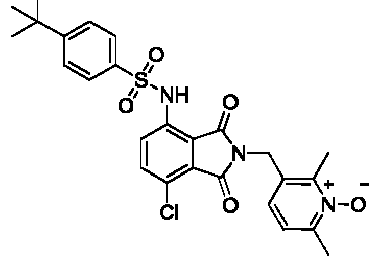
528.35 99.79% Rt = 5.70 min (1) 1H NMR (400MHz, DMSO-d6): δ 9.95 (bs, 1H), 7.92-7.90 (d, J = 8.4 Hz, 2H),7.76-7.73 (d, J = 8.8 Hz, 1H), 7.62-7.58 (m, 3H), 7.30-7.28 (d, J = 8 Hz, 1H), 7.15-7.13 (d, J = 8.4 Hz, 1H), 4.72 (s, 2H), 2.45 (s, 3H), 2.33 (s, 3H), 1.26 (s, 9H). 253 
528.35 99.49% Rt = 5.44 min (1) 1H NMR (400MHz, DMSO-d6): δ 9.92 (bs, 1H), 7.92-7.90 (d, J = 8 Hz, 2H),7.76-7.74 (d, J = 8.8 Hz, 1H), 7.62-7.59 (m, 3H), 7.43-7.42 (d, J = 7.6 Hz, 1H), 6.77-6.75 (d, J = 7.2 Hz, 1H), 4.58 (s, 2H), 3.91 (s, 3H), 2.36 (s, 3H), 1.26 (s, 9H). 254 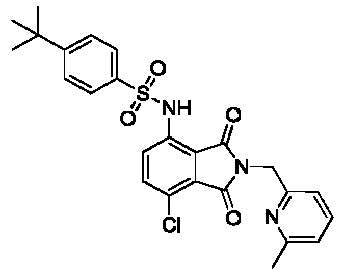
498.32 97.29 % Rt = 6.20 min (2) 1H NMR (400MHz, DMSO-d6): δ 9.90 (bs, 1H), 7.92-7.90 (d, J = 8.4 Hz, 2H), 7.78-7.75 (d, J = 9.2 Hz, 1H), 7.63-7.57 (m, 4H), 7.14-7.13 (d, J = 6 Hz, 2H), 4.76 (s, 2H), 2.37 (s, 3H), 1.26 (s, 9H). 255 
474.34 99.23 % Rt = 5.63 min (1) 1H NMR (400MHz, DMSO-d6): δ 10.02 (bs, 1H), 8.65 (s, 1H), 7.89-7.87 (m, 2H), 7.84-7.82 (m, 1H), 7.68-7.66 (m, 1H), 7.62-7.60 (m, 2H), 3.94 (s, 3H), 1.27 (s, 9H). 256 
509.34 95.40 % Rt = 6.17 min (1) 1H NMR (400MHz, DMSO-d6): δ 10.20 (bs, 1H), 8.75 (s, 1H), 7.99 (s, 1H), 7.93-7.88 (m, 3H), 7.72-7.70 (d, J = 8.9 Hz, 1H), 7.64-7.62 (d, J = 8.5 Hz, 2H), 2.43 (s, 3H), 1.27 (s, 9H). 257 
528.38 97.26 % Rt = 6.46 min (1) 1H NMR (400MHz, DMSO-d6): δ 10.04 (bs, 1H), 8.42 (s, 1H), 8.16 (s, 1H), 7.93-7.91 (d, J = 8.5, 2H), 7.85-7.83 (d, J = 8.9 Hz 1H), 7.69-7.67 (d, J = 8.9 Hz, 1H), 7.64-7.62 (d, J = 8.9 Hz, 2H), 3.98 (s, 3H), 2.43-2.41 (q, J = 8.8 Hz, 2H), 1.27 (s, 9H), 0.97-0.93 (t, J = 7.2 Hz, 3H). 258 
498.36 99.50 % Rt = 6.39 min (1) 1H NMR (400MHz, DMSO-d6): δ 9.95 (bs, 1H), 8.36-8.36 (d, J = 1.6 Hz, 2H), 7.92-7.90 (d, J = 8.6 Hz, 2H), 7.74-7.72 (d, J = 8.9 Hz, 1H), 7.62-7.60 (m, 3H), 7.54 (s, 1H), 4.69 (s, 2H), 2.26 (s, 3H), 1.26 (s, 9H). 259 
514.38 98.04 % Rt = 5.72 min (1) 1H NMR (400MHz, DMSO-d6): δ 9.97 (bs, 1H), 8.23 (s, 1H), 7.91-7.89 (d, J = 7.8 Hz, 2H), 7.70 (s, 1H), 7.61-7.59 (d, J = 7.6 Hz, 3H), 7.35-7.34 (d, J = 6.6 Hz, 1H), 7.15-7.13 (d, J = 7.7 Hz, 1H), 4.73 (s, 2H), 2.24 (s, 3H), 1.27 (s, 9H). 260 
514.38 97.80 % Rt = 6.49 min (1) 1H NMR (400MHz, DMSO-d6): δ 9.94 (bs, 1H), 9.92-7.90 (d, J = 8.4 Hz, 2H), 7.82-7.80 (d, J = 8.8 Hz, 1H), 7.68-7.62 (m, 3H), 7.56-7.54 (s, 1H), 7.32-7.29 (d, J = 8.6 Hz, 1H), 3.89 (s, 3H), 2.36 (s, 3H), 1.27 (s, 9H). 261 
514.38 98.58 % Rt = 6.65min (1) 1H NMR (400MHz, DMSO-d6): δ 10.04 (bs, 1H), 8.14 (s, 1H), 7.93-7.91 (d, J = 8.5 Hz, 2H), 7.84-7.26 (d, J = 8.8 Hz, 1H), 7.67-7.62 (m, 4H), 3.80 (s, 3H), 2.27 (s, 3H), 1.28 (s, 9H), 262 
514.34 99.32 % Rt = 5.55 min (1) 1H NMR (400MHz, DMSO-d6): δ 9.94 (bs, 1H), 8.10 (s, 1H), 8.04 (s, 1H), 7.94-7.92 (d, J = 8.3 Hz, 2H), 7.75-7.73 (d, J = 9.0 Hz, 1H), 7.63-7.58 (m, 3H), 7.14 (s, 1H), 4.64 (s, 2H), 2.20 (s, 3H), 1.26 (s, 9H). 263 
498.35 98.84 % Rt = 6.31 min (1) 1H NMR (400MHz, DMSO-d6): δ 9.99 (bs, 1H), 8.41 (s, 1H), 7.91-7.89 (d, J = 8.4 Hz, 2H), 7.84-7.82 (d, J = 8.9 Hz, 1H), 7.69-7.67 (d, J = 8.9 Hz, 1H), 7.64-7.62 (d, J = 8.5 Hz, 2H), 7.58 (s, 1H), 2.30 (s, 3H), 2.25 (s, 3H), 1.27 (s, 9H) 264 
470.31 99.76 % Rt = 6.01 min (1) 1H NMR (400MHz, DMSO-d6): δ 10.03 (bs, 1H), 8.74-8.73 (d, J = 4.8 Hz, 2H), 7.94-7.92 (d, J = 8.4 Hz, 2H), 7.84-7.82 (d, J = 9.2, 1H), 7.69-7.63 (m, 3H),7.50-7.49 (d, J = 5.2, 2H), 1.27 (s, 9H). 265 
530.35 98.09 % Rt = 5.76 min (1) 1H NMR (400MHz, DMSO-d6): δ 10.14 (bs, 1H), 7.94-7.91 (d, J = 8.5 Hz, 2H), (d, J = 8.9 Hz, 1H), 7.88-7.86 (d, J = 8.9 Hz, 1H), 7.69 (s, 1H), 7.67-7.61 (m, 2H), 7.58 (s, 1H), 7.26-7.23 (d, J = 9 Hz, 1H), 3.95 (s, 3H), 2.30 (s, 3H), 1.28 (s, 9H). 266 
544.37 97.57% Rt = 5.71 min (1) 1H NMR (400MHz, DMSO-d6): δ 10.07 (bs, 1H), 8.22 (s, 1H), 8.09 (s, 1H), 7.94-7.92 (q, J = 8.8 Hz, 2H), 7.84-7.82 (d, J = 9.2 Hz, 1H), 7.69-7.67 (d, J = 9.2 Hz, 1H), 7.64-7.62 (d, J = 8.4 Hz, 2H), 3.92 (s, 3H), 2.41-2.32 (m, 2H), 1.28 (s, 9H), 0.95-0.92 (m, 3H). 267 
514.38 99.27% Rt = 5.49 min (1) 1H NMR (400MHz, DMSO-d6): δ 10.04 (bs, 1H), 8.37 (s, 1H), 7.93-7.91 (d, J = 8.4 Hz, 2H), 7.84-7.82 (d, J = 8.8 Hz, 1H), 7.68-7.66 (d, J = 9.2 Hz, 1H), 7.64-7.62 (d, J = 8.8 Hz, 2H), 7.26 (s, 1H), 2.26 (s, 3H), 2.15 (s, 3H), 1.27 (s, 9H). 268 
514.38 95.83% Rt = 6.47 min (1) 1H NMR (400MHz, DMSO-d6): δ 9.96 (bs, 1H), 8.25 (s, 1H), 7.92-7.90 (d, J = 8.4 Hz, 2H), 7.83-7.81 (d, J = 8.8 Hz, 1H), 7.68-7.62 (m, 3H), 7.29 (s, 1H), 3.96 (s, 3H), 2.22 (s, 3H), 1.27 (s, 9H). 269 
530.33 98.49% Rt = 5.67 min (1) 1H NMR (400MHz, DMSO-d6): δ 10.15 (bs, 1H), 8.30 (s, 1H), 7.94-7.92 (d, J = 8.4 Hz, 2H), 7.89-7.86 (d, J = 9.2 Hz, 1H), 7.69-7.66 (d, J = 8.8 Hz, 1H), 7.65-7.63 (d, J = 8.4 Hz, 2H), 7.49 (s, 1H), 3.91 (s, 3H), 2.18 (s, 3H), 1.28 (s, 9H). 270 
485.31 97.53% Rt = 6.04 min (1) 1H NMR (400MHz, DMSO-d6): δ 10.08 (bs, 1H), 8.74 (d, J = 1.6 Hz, 1H), 8.61 (d, J = 1.6 Hz, 1H), 7.89-7.84 (m, 3H), 7.70-7.67 (d, J = 9.2 Hz, 1H), 7.62-7.60 (d, J = 8.4 Hz, 2H), 2.44 (s, 3H), 1.27 (s, 9H). 271 
514.33 99.57% Rt = 6.15 min (1) 1H NMR (400MHz, DMSO-d6): δ 10.09 (bs, 1H), 8.55-8.54 (d, J = 5.6 Hz, 1H), 8.38 (s, 1H), 7.93-7.91 (d, J = 8.8 Hz, 2H), 7.85-7.83 (d, J = 8.8 Hz, 1H), 7.69-7.67 (d, J = 9.2 Hz, 1H), 7.64-7.62 (d, J = 8.8 Hz, 2H), 7.30-7.28 (d, J = 6.0 Hz, 1H), 4.19-4.14 (q, J = 6.8 Hz, 2H), 1.27 (s, 9H), 1.22-1.18 (t, J = 6.8 Hz, 3H). 272 
500.30 97.44% Rt = 5.33 min (1) 1H NMR (400MHz, DMSO-d6): δ 10.04 (bs, 1H), 8.36 (s, 1H), 8.23-8.22 (d, J = 6.4 Hz, 1H), 7.93-7.91 (d, J = 8.4 Hz, 2H), 7.84-7.81 (d, J = 8.8 Hz, 1H), 7.69-7.67 (d, J = 8.8 Hz, 1H), 7.64-7.52 (d, J = 8.4 Hz, 2H), 7.41-7.40 (d, J = 6.8 Hz, 1H), 2.06 (s, 3H), 1.27 (s, 9H). 273 
514.34 99.73% Rt = 6.60 min (1) 1H NMR (400MHz, DMSO-d6): δ 9.93 (bs, 1H), 8.10-8.08 (d, J = 5.2 Hz, 1H), 7.92-7.90 (m, 2H), 7.76-7.74 (d, J = 8.8 Hz, 1H), 7.62-7.59 (m, 3H), 6.92-6.90 (d, J = 5.2 Hz, 1H), 6.74 (s, 1H), 4.68 (s, 2H), 3.81 (s, 3H), 1.26 (s, 9H). 274 
486.08 99.08% Rt = 5.34 min (1) 1H NMR (400MHz, DMSO-d6): δ 10.18 (bs, 1H), 8.49-8.48 (d, J = 6 Hz, 1H), 7.93-7.87 (m, 3H), 7.74-7.73 (d, J = 7.2 Hz, 1H), 7.69-7.61 (m, 4H), 7.54-7.50 (m, 1H), 1.28 (s, 9H). 275 
485.32 99.59%, Rt = 6.08 min (1) 1H NMR (400MHz, DMSO-d6): δ 10.06 (bs, 1H), 8.64 (s, 1H), 8.63 (s, 1H), 7.93-7.91 (d, J = 8.4 Hz, 2H),7.86-7.84 (d, J = 9.2 Hz, 1H), 7.69-7.67 (d, J = 9.2 Hz, 1H), 7.64-7.62 (d, J = 8.4 Hz, 2H), 2.59 (s, 3H), 1.27 (s, 9H). 276 
488.27 99.27%, Rt = 6.18 min (1) 1H NMR (400MHz, DMSO-d6): δ 10.05 (bs, 1H), 8.71-8.67 (m, 1H), 7.92-7.90 (d, J = 8.4 Hz, 2H), 7.86-7.84 (d, J = 8.8 Hz, 1H), 7.70-7.67 (d, J = 8.8 Hz, 1H), 7.64-7.62 (d, J = 8.4 Hz, 2H), 7.54-7.51 (m, 1H), 7.48-7.45 (m, 1H), 1.27 (s, 9H). - The following compounds were prepared essentially as in the methodology described in Example 10 using Compound 156 as the precursor to Compound 277, Compound 90 as the precursor to Compound 278, Compound 191 as the precursor to Compound 279 and Compound 65 as the precursor to Compound 280.
S. No. Structure LCMS (M+1) Purity (LCMS) 1HNMR 277 
466.10 (M-1) 99.70 % Rt = 5.32 (1) 1H NMR (400MHz, DMSO-d6): δ 10.28 (bs, 1H), 8.07-8.05 (d, J = 7.6 Hz, 1H), 8.01-7.99 (d, J = 8 Hz, 2H), 7.68-7.63 (m, 3H), 4.2 (m, 2 1H), 2.27 (m, 2H), 1.64 (m, 2H), 1.26 (s, 9H). 278 
491.08 96.92% Rt = 5.29 min (1) 1H NMR (400MHz, DMSO-d6): δ 10.48 (bs, 1H), 8.40-8.39 (d, J = 2.4 Hz, 1H), 8.25 (s, 1H), 8.09 (s, 1H), 8.00-7.99 (d, J = 6.8 Hz, 2H), 7.75-7.73 (d, J = 8.4 Hz, 1H), 7.64-7.62 (d, J = 7.6 Hz, 2H),7.54-7.50 (d, J = 14.8 Hz, 1H), 3.86 (s, 3H), 1.28 (s, 9H). 279 
475.12 92.53%, Rt = 5.30 min (1) 1H NMR (400MHz, DMSO-d6): δ 10.49 (bs, 1H), 8.44 (m, 1H), 8.11-8.09 (d, J = 7.2 Hz, 1H), 8.03-8.00 (d, J = 8.4 Hz, 2H), 7.78 (m, 1H), 7.71-7.69 (d, J = 7.6 Hz, 1H), 7.65-7.63 (d, J = 8.4 Hz, 2H),7.46-7.44 (d, J = 7.6 Hz, 1H), 7.30-7.28 (m, 1H), 4.87 (s, 2 H), 1.28 (s, 9H). 280 
491.08 98.67%, Rt = 4.77 min (1) 1H NMR (400MHz, DMSO-d6): δ 10.49 (bs, 1H), 8.28 (s, 1H), 8.14-8.13 (d, J = 6 Hz, 1H), 7.99-7.97 (m, 3H), 7.67-7.61 (m, 3H), 7.39-7.35 (m, 1H), 7.31-7.29 (d, J = 8 Hz, 1H), 4.72 (s, 2 H), 1.27 (s, 9H). -
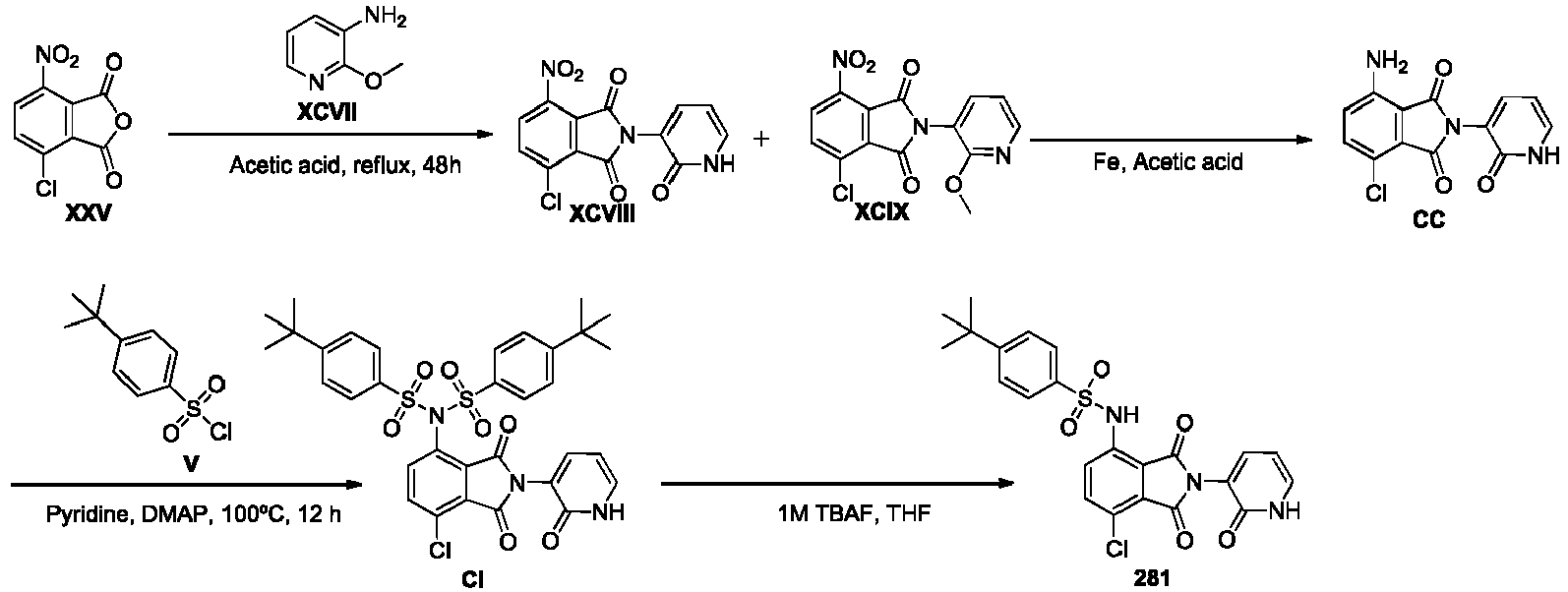
- To a stirred solution of compound XXV (5 g, 0.022 mol) in acetic acid (15 ml) was added 2-methoxypyridin-3-amine (XCVII, 2.18 g, 0.017 mol) and the reaction mixture was heated at 120°C for 48 h. The reaction mixture was cooled to room temperature and the acetic acid was removed under reduced pressure to obtain crude product, a mixture of XCVIII and XCIX. The crude material obtained was triturated with ethanol to provide the desired product, 4-chloro-7-nitro-2-(2-oxo-1,2-dihydropyridin-3-yl)isoindoline-1,3-dione, as a black solid (XCVIII; 2.3 g; 32% yield). 1H NMR (400MHz, DMSO-d6): δ 12.00 (bs, 1H), 8.36-8.34 (d, J = 8.8 Hz, 1H), 8.21-8.19 (d, J = 8.4 Hz, 1H), 7.68-7.65 (dd, J = 2 Hz, 5.2 Hz, 1H), 7.60-7.59 (t, J = 4.4 Hz, 1H), 6.39-7.35 (t, J = 6.8 Hz, 1H). MS (M+1): 319.98
- To a solution of compound XCVIII (4.1g, 0.055 mol) in acetic acid (80 ml) under nitrogen atmosphere was added iron powder (3.5 g). The reaction mixture was stirred at room temperature for 12 h. This was filtered through a celite bed which was washed with ethyl acetate before the solvent was evaporated under reduced pressure to afford 4-amino-7-chloro-2-(2-oxo-1,2-dihydropyridin-3-yl)isoindoline-1,3-dione, as a yellow solid (C; 2.83 g; 76% yield). 1H NMR (400MHz, DMSO-d6): δ 12.17 (bs, 1H), 7.64-7.62 (d, J = 6.8 Hz, 1H), 7.54-7.53 (d, J = 4.4 Hz, 1H), 7.48-7.46 (d, J = 8.8 Hz, 1H), 7.06-7.04 (d, J = 9.2 Hz, 1H), 6.68 (bs, 2H), 6.34-6.31 (t, J = 6.8 Hz, 1H). MS (M+1): 289.97
- A solution of compound CC (2 g, 0.006 mol) in pyridine (40 ml) was stirred and cooled to 0°C. 4-(tert-butyl)benzenesulfonyl chloride (V; 6.41 g, 0.027 mmol) was added. The reaction mixture was stirred at 110°C for 12 h and concentrated under reduced pressure before dilution with water. The resulting aqueous layer was extracted with ethyl acetate. The organic layer was washed successively with brine solution, dried over anhydrous Na2SO4, filtered and the organic solvent was evaporated under reduced pressure to obtain the crude compound CI. To this material was added 1M TBAF in THF solution (22 ml) and the resulting mixture was stirred for 3 h at room temperature. The reaction mixture was concentrated and diluted with ethyl acetate. The organic layer was washed with water, dried over anhydrous Na2SO4, filtered and the organic solvent was evaporated under reduced pressure to obtain the crude compound, which was purified by column chromatography using 45% ethyl acetate in hexane to afford the title compound, 4-(tert-butyl)-N-(7-chloro-1,3-dioxo-2-(2-oxo-1,2-dihydropyridin-3-yl)isoindolin-4-yl)benzenesulfonamide, as an off-white solid (281; 0.34 g, 16 % yield). 1H NMR (400MHz, DMSO-d6): 1H NMR (400MHz, DMSO-d6): δ 12.25 (bs, 1H), 10.02 (bs, 1H),7.93-7.91 (d, J = 8.4 Hz, 2H), 7.83-7.81 (d, J = 8 Hz, 1H), 7.66-7.57 (m, 5H), 6.36-6.33 (t, J = 5.6 Hz, 1H), 1.27 (s, 9H). MS (M+1): 486.19. (LCMS purity 98.45%, RT = 5.50 min)(1).
- The following compounds were prepared in a similar manner as mentioned in above scheme using the appropriate amines in the first step:
S. No. Structure LCMS (M+1) Purity (LCMS) 1HNMR 282 
500.33 99.50% Rt = 5.59 min (1) 1H NMR (400MHz, DMSO-d6): δ 9.95 (bs, 1H), 7.94-7.92 (d, J = 8.8 Hz, 2H), 7.88-7.87 (d, J = 2.4 Hz, 1H), 7.82-7.80 (d, J = 8 Hz, 1H), 7.67-7.63 (m, 3H), 7.45-7.42 (m, 1H), 6.50-6.48 (d, J = 5.6 Hz, 1H), 3.46 (s, 3H), 1.27 (s, 9H). 283 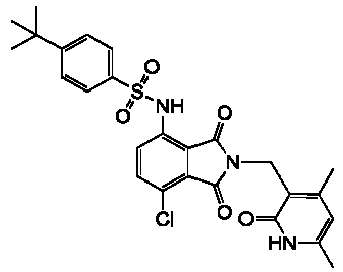
528.31 97.31% Rt = 6.08 min (1) 1H NMR (400MHz, DMSO-d6): δ 11.35 (bs, 1H), 9.93 (bs, 1H), 7.92-7.90 (d, J = 8.4 Hz, 2H),7.71-7.69 (d, J = 8.8 Hz, 1H), 7.62-7.60 (d, J = 8.4 Hz, 2H), 7.56-7.53 (d, J = 8.8 Hz, 1H), 5.84 (s, 1H), 4.51 (s, 2H), 2.19 (s, 3H), 2.08 (s, 3H), 1.27 (s, 9H). 284 
500.31 97.59% Rt = 5.71 min (1) 1H NMR (400MHz, DMSO-d6): δ 11.74 (bs, 1H), 9.94 (bs, 1H), 7.93-7.91 (d, J = 8 Hz, 2H),7.75-7.73 (d, J = 8.8 Hz, 1H), 7.63-7.59 (m, 3H), 7.32-7.27 (m, 2H), 6.12-6.09 (m, 1H), 4.44 (s, 2H), 1.26 (s, 9H). 285 
514.34 96.76 % Rt = 5.83 min (1) 1H NMR (400MHz, DMSO-d6): δ 9.93 (bs, 1H), 7.93-7.91 (d, J = 8.24 Hz, 2H), 7.81-7.79 (d, J = 8.64 Hz, 1H), 7.73 (s, 1H), 7.67-7.63 (m, 3H), 7.32 (s, 1H), 3.47 (s, 3H), 2.02 (s, 3H), 1.27 (s, 9H). -

- To a stirred solution of compound XXV (5 g, 0.02 mol) in acetic acid (15 ml) was added ethyl 3-aminopicolinate (CII, 1.69 g, 0.01 mol) and the reaction mixture was heated at 120°C for 12 h. The reaction mixture was cooled to room temperature and the acetic acid removed under reduced pressure. This was followed by washing with hexane to leave crude product ethyl 3-(4-chloro-7-nitro-1,3-dioxoisoindolin-2-yl)picolinate as an off white solid (CIII) pure enough for use in the next step. 1H NMR (400MHz, DMSO-d6): δ 8.88-8.86 (d, J = 4.4 Hz, 1H), 8.10-8.08 (d, J = 8.4 Hz, 1H), 7.91-7.89 (d, J = 8.8 Hz, 1H), 7.82-7.80 (d, J = 8 Hz, 1H), 7.69-7.66 (m, 1H), 4.40-4.35 (q, J = 7.2 Hz, 6.8 Hz, 2H), 1.37-1.31 (t, J = 6.8 Hz, 3H). MS (M+1): 376.03
- To a solution of crude compound CIII (2.1g, 0.055 mol) in acetic acid (30 ml) under a nitrogen atmosphere was added iron powder (2 g). The reaction mixture was stirred at room temperature for 5 h. The reaction mass was filtered through a celite bed which was washed with ethyl acetate and the solvent was evaporated under reduced pressure to afford ethyl 3-(4-amino-7-chloro-1,3-dioxoisoindolin-2-yl)picolinate as a yellow solid (CIV; 1.8 g; 93% yield). 1H NMR (400MHz, DMSO-d6): δ 8.78-8.76 (m, 1H), 8.07-8.05 (m, 1H), 7.88-7.82 (m, 1H), 7.53-7.50 (d, J = 8.8 Hz, 1H), 7.10-7.08 (d, J = 8.8 Hz, 1H), 6.78 (bs, 2H), 4.20-4.15 (q, J = 7.2 Hz, 6.8 Hz, 2H), 1.10-1.06 (t, J = 7.2 Hz, 3H). MS (M+1): 346.03
- A stirred solution of CIV (1.8 g, 0.005 mol) in pyridine (20 ml) was cooled to 0°C and 4-(tert-butyl) benzenesulfonyl chloride (V, 3.63g, 0.015 mmol) was added. The reaction mixture was stirred at 90°C for 8 h and was then cooled, concentrated and diluted with water. The reaction mixture was extracted with ethyl acetate. The organic layer was washed with brine solution, dried over anhydrous Na2SO4, filtered and the organic solvent was evaporated under reduced pressure to obtain the crude compound CV. To this was added 1M TBAF in THF solution (15 ml) and the resulting solution was stirred for 5 h at room temperature. The reaction mixture was concentrated and diluted with ethyl acetate. The organic layer was washed with water, dried over anhydrous Na2SO4, filtered and evaporated under reduced pressure to obtain the crude compound which was purified by column chromatography using 20% ethyl acetate in hexane to afford the title compound, ethyl 3-(4-((4-(tert-butyl) phenyl) sulfonamido)-7-chloro-1,3-dioxoisoindolin-2-yl)picolinate as an off white solid (286; 1.2 g, 42.8% yield). 1H NMR (400MHz, DMSO-d6): δ 10.16 (bs, 1H), 8.82-8.81 (d, J = 3.6 Hz, 1H), 8.04-8.03 (d, J = 7.6 Hz, 1H), 7.91-7.85 (m, 4H), 7.72-7.70 (d, J = 9.2 Hz, 1H), 7.63-7.61 (d, J = 8.4 Hz, 2H), 4.16 (q, J = 7. 2 Hz, 6.8 Hz, 2H), 1.27 (s, 9H), 0.99-0.95 (t, J = 7.2 Hz, 3H). MS (M+1): 542.10. (LCMS purity 96.98%, RT = 6.11 min) (1).
- To a stirred solution of (286; 0.2 g, 0.37 mmol) in methanol (5 ml), was added a sodium hydroxide (0.04 g, 1.1 mmol) solution in water. The reaction was stirred at room temperature for 0.5 h whereupon the solvent was concentrated under reduced pressure and the residue diluted with water followed by acidification with aqueous citric acid till pH 5. The aqueous layer was extracted with ethyl acetate. The organic layer was washed with brine, dried over Na2SO4, filtered and concentrated under reduced pressure to obtained the crude compound as a mixture of CVI and 287. To a stirred solution of this mixture in toluene (3 ml) was added a catalytic quantity of para-toluene sulfonic acid and the reaction mixture heated at 90°C for 1 h. The reaction mixture was concentrated and then diluted with ethyl acetate. The organic layer was washed with water, dried over anhydrous Na2SO4, filtered and the organic solvent was evaporated under reduced pressure to obtain the crude compound which was purified by preparative HPLC to afford the title compound, 3-(4-((4-(tert-butyl)phenyl)sulfonamido)-7-chloro-1,3-dioxoisoindolin-2-yl)picolinic acid as a white solid (287; 0.05 g, 26.5% yield). 1H NMR (400MHz, DMSO-d6): δ 13.42 (bs, 1H), 10.18 (bs, 1H), 8.80 (m, 1H), 8.02-8.00 (d, J = 8 Hz, 1H), 7.95-7.93 (d, J = 8.4 Hz, 2H), 7.87-7.82 (m, 2H), 7.67-7.63 (m, 3H), 1.27 (s, 9H). MS (M+1): 514.30 (LCMS purity 98.28%).
- The following compounds were prepared in a similar manner as mentioned in above reaction using appropriate amines instead of CII at step-1 with the final step described only used where necessary to generate an acid functionality:
S. No. Structure LCMS (M+1) Purity (LCMS) 1HNMR 288 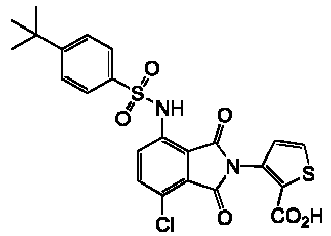
516.98 (M-1) 99.30% Rt = 5.22 min (1) 1H NMR (400MHz, DMSO-d6): δ 13.39 (bs, 1H), 10.08 (bs, 1H), 8.01-7.99 (d, J = 5.6 Hz, 1H), 7.94-7.91 (d, J = 8.8 Hz, 2H), 7.85-7.83 (d, J = 8.8 Hz, 1H), 7.67-7.62 (m, 3H), 7.20-7.19 (d, J = 4.8 Hz, 1H), 1.27 (s, 9H). 289 
517.00 97.90 % Rt = 4.84 min (1) 1H NMR (400MHz, DMSO-d6): δ 12.88 (bs, 1H), 10.08 (bs, 1H), 8.03 (s, 1H), 7.94-7.92 (d, J = 8.8 Hz, 2H), 7.83-7.81 (d, J = 8.8 Hz, 1H), 7.65-7.62 (m, 3H), 3.98 (s, 3H), 1.28 (s, 9H). 290 
558.05 98.01 % Rt = 5.47 min (1) 1H NMR (400MHz, DMSO-d6): δ 10.24 (bs, 1H), 8.53-8.51 (d, J = 6.4 Hz, 1H), 7.93-7.91 (d, J = 8 Hz, 2H), 7.88-7.85 (d, J = 8.4 Hz, 1H), 7.76-7.72 (m, 1H), 7.65-7.59 (m, 4H), 4.18-4.17 (q, J = 6.8 Hz, 7.2 Hz, 2H), 1.28 (s, 9H), 0.97-0.95 (t, J = 6.8 Hz, 3H). 291 
531.05 98.26% Rt = 5.85 min (1) 1H NMR (400MHz, DMSO-d6): δ 10.09 (bs, 1H), 7.95-7.93 (d, J = 8.4 Hz, 2H), 7.86-7.84 (d, J = 8.8 Hz, 1H), 7.70-7.67 (d, J = 8.8 Hz, 1H), 7.65-7.63 (d, J = 8.4 Hz, 2H), 6.83 (s, 1H), 3.82 (s, 3H), 3.80 (s, 3H), 1.28 (s, 9H). 292 
531.07 99.00% Rt = 6.33 min (1) 1H NMR (400MHz, DMSO-d6): δ 9.97 (bs, 1H), 7.91-7.88 (d, J = 8.4 Hz, 2H), 7.84-7.81 (d, J = 9.2 Hz, 1H), 7.68-7.62 (m, 3H), 6.90 (s, 1H), 4.13 (s, 3H), 3.86 (s, 3H), 1.27 (s, 9H). - A calcium flux assay was used to determine the ability of the compounds to interfere with the binding between CCR9 and its chemokine ligand (TECK) in Chem1-hCCR9 overexpressing cells. hCCR9 overexpressing cells were seeded (25,000 cells/well) into black Poly-D-Lysine coated clear bottom 96-well plates (BD Biosciences, Cat # 356640) and incubated overnight at 37°C/5% CO2 in a humidified incubator. Media was aspirated and cells washed twice with 100 µL assay buffer (1x HBSS, 20 mM HEPES) containing 2.5 mM Probenecid. A 0.3x Fluo-4 NW calcium dye was prepared in assay buffer containing 5 mM Probenecid and stored in the dark. Each well was loaded with 100 µL of 0.3x Fluo-4 NW calcium dye and incubated at 37°C/ 5% CO2 for 60 minutes and then at room temperature for 30 minutes. A half-log serially diluted concentration response curve was prepared at a 3x final assay concentration for each compound (10 µM - 0.1 nM final assay concentration) and 50 µL of the compound then transferred to the cells (150 µL final volume) for 60 minutes prior to stimulation (30 minutes at 37°C/5% CO2 and 30 minutes at room temperature). TECK was diluted to 4x its EC80 in assay buffer (containing 0.1% [w/v] bovine serum albumin [BSA]) and 50 µL dispensed through the fluorometric imaging plate reader (FLIPR) instrument to stimulate the cells (200 µL final volume). The increase in intracellular calcium levels was measured with the FLIPR instrument. The potency of the compound as a CCR9 antagonist was calculated as an IC50 using GraphPad Prism software (variable slope four parameter). The Ki of the compound was determined from the IC50 values using the following equation.
Ki calculation: IC50/1+ (Agonist (TECK) conc. used in assay /EC50 of agonist (TECK) generated on day of experiment)Compound number Structure Ki (nM) 1 
1244 6 
5632 43 
42 44 
179 45 
314 47 
309 64 
27 65 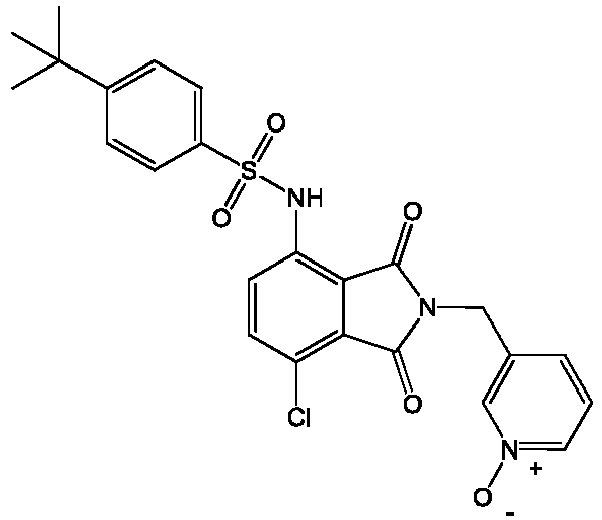
74 66 
269 82 
98 90 
174 103 
242 104 
239 119 
35 120 
90 121 
337 126 
343 128 
447 133 
158 138 
138 144 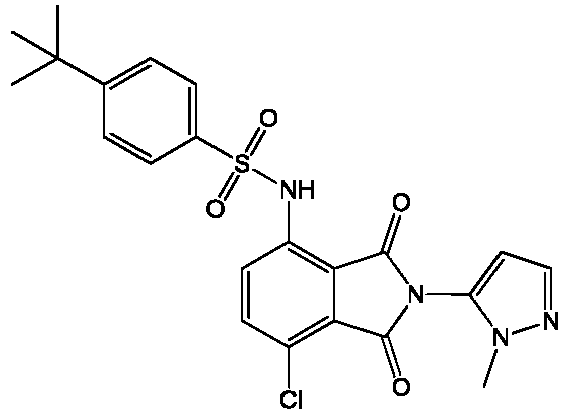
23 145 
73 148 
94 149 
397 153 
43 155 
135 160 
776 175 
12 176 
13 179 
57 182 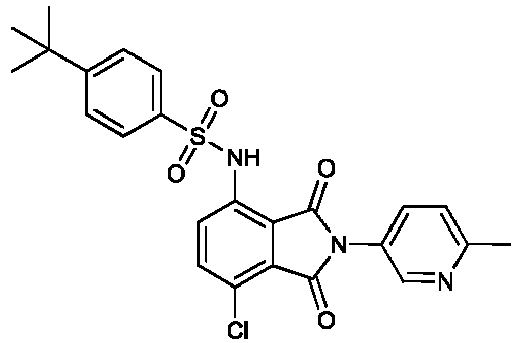
58 183 
3 184 
24 185 
23 188 
89 189 
34 190 
81 191 
33 192 
12 193 
21 194 
6 195 
42 196 
103 197 
40 199 
10 200 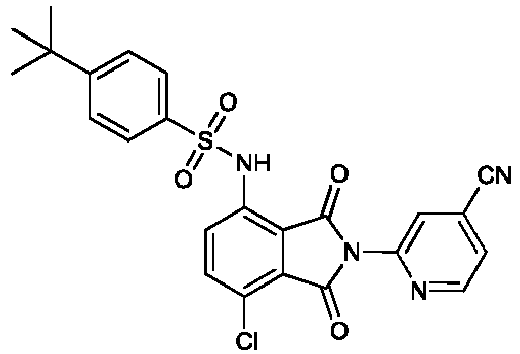
92 201 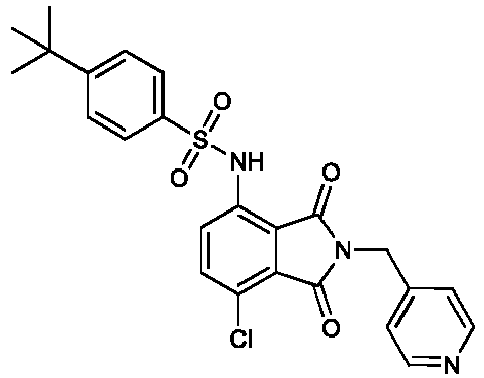
17 202 
49 203 
59 204 
30 207 
36 208 
16 209 
77 211 
61 212 
60 213 
23 214 
53 216 
49 217 
39 218 
26 219 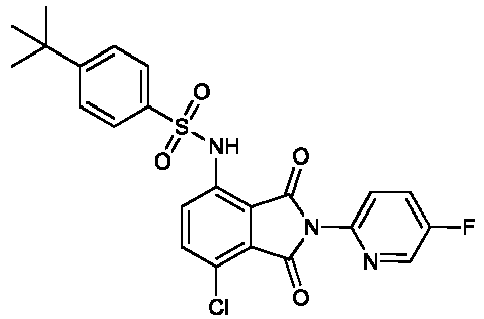
30 220 
42 222 
12 224 
6 225 
51 226 
23 227 
32 228 
6 229 
63 230 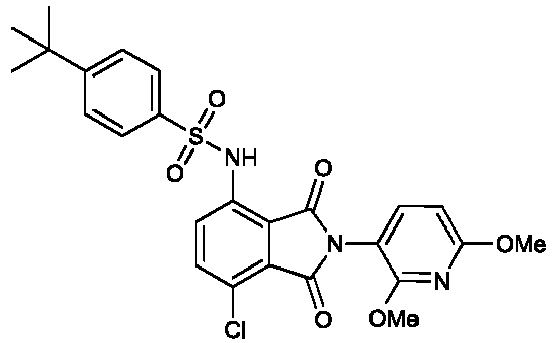
6 231 
89 232 
3 233 
21 234 
43 235 
94 236 
32 237 
9 238 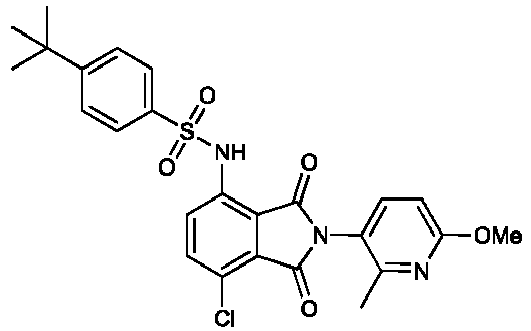
13 239 
23 241 
7 242 
56 243 
115 244 
3 245 
54 247 
51 249 
60 250 
56 251 
148 254 
68 255 
72 256 
18 257 
21 258 
67 259 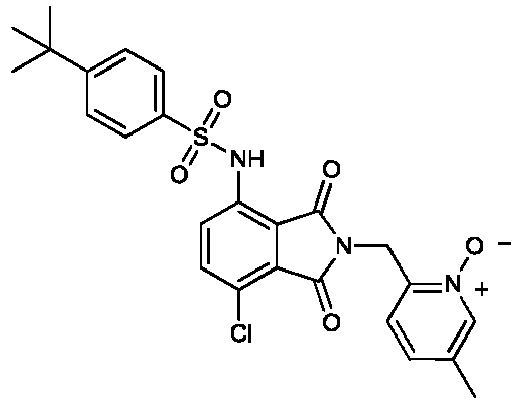
45 260 
22 261 
11 262 
119 263 
25 264 
18 266 
25 267 
59 270 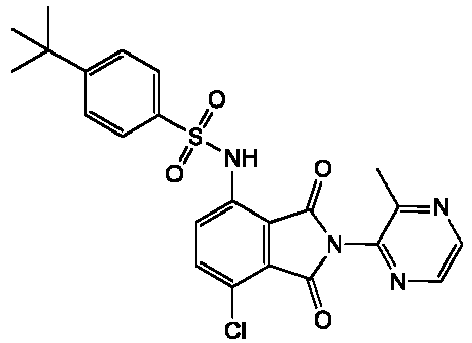
61 271 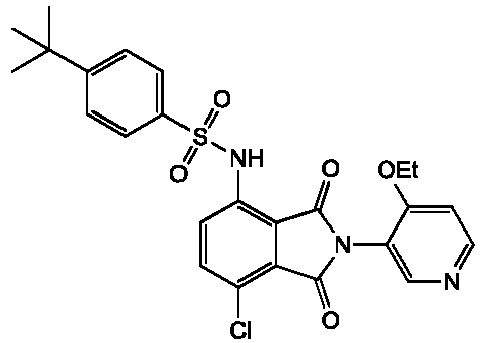
35 272 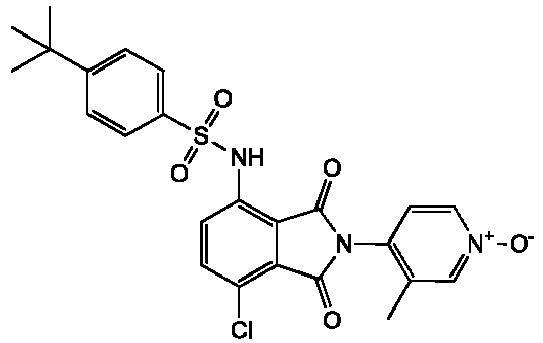
29 274 
50 275 
54 276 
91 278 
17 279 
17 280 
84 281 
4 282 
23 283 
20 284 
12 285 
78 286 
14 287 
10 288 
23 289 
109 290 
14 291 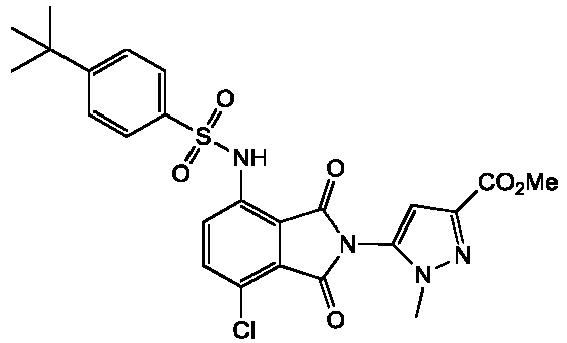
15 292 
16 - A calcium flux assay was used to determine the ability of the compounds to interfere with the binding between CCR9 and its chemokine ligand (TECK) in MOLT4 cells (a human T-cell line). MOLT4 cells were seeded (100,000 cells/well) in corning cell culture plates (Cat # 3603) in assay buffer (1x HBSS, 20mM HEPES) containing 2.5 mM Probenecid. The plate was centrifuged at 1200 rpm for 3 minutes and incubated at 37°C/5% CO2 for 2 hours. A 0.3x Fluo-4 NW calcium dye was prepared in assay buffer containing 5 mM Probenecid and stored in the dark. Each well was loaded with 25 µL of 0.3x Fluo-4 NW calcium dye and incubated at 37°C/ 5% CO2 for 60 minutes and then at room temperature for 30 minutes. A half-log serially diluted concentration response curve was prepared at a 4x concentration for each (10µM - 0.1nM final assay concentration) and 25 µL of the compound then transferred to the cells (100 µL final volume) for 60 minutes prior to stimulation (30 minutes at 37°C/5% CO2 and 30 minutes at room temperature). TECK was diluted to 5x its EC50 in assay buffer (containing 0.1% [w/v] bovine serum albumin [BSA]) and 25 µL dispensed through the FLIPR instrument to stimulate the cells (125 µL final volume). The increased in intracellular calcium levels was measured with the FLIPR instrument. The potency of the compound as CCR9 antagonist was calculated as an IC50 using GraphPad Prism software (variable slope four parameter). The Ki of the compound was determined from the IC50 values using the following equation.
Ki calculation: IC50/1+ (Agonist (TECK) conc. used in assay /EC50 of agonist (TECK) generated on day of experiment)Compound number Structure Ki (nM) 1 
479 4 
2713 5 
123 7 
206 8 
1322 12 
618 14 
1555 19 
758 36 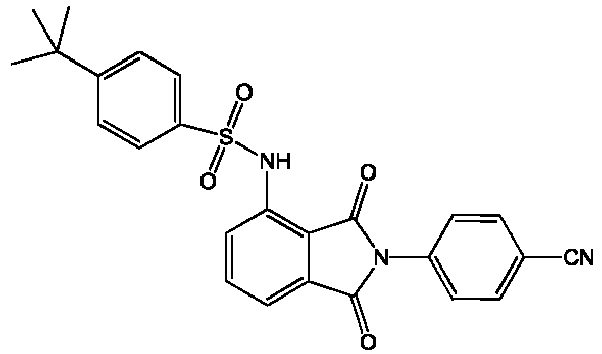
1210 39 
611 40 
1355 41 
167 43 
25 44 
16 45 
52 47 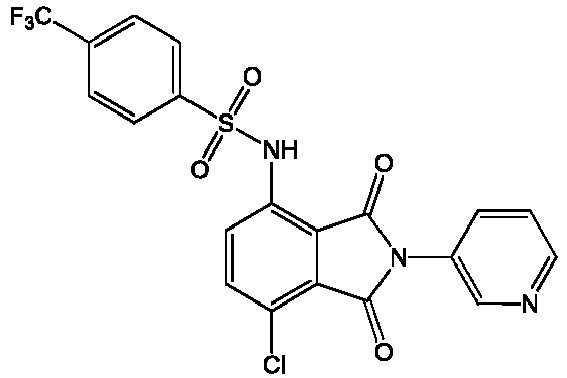
34 48 
171 52 
187 57 
38 64 
22 65 
13 66 
115 79 
33 80 
173 81 
148 82 
19 90 
22 91 
50 92 
255 93 
217 94 
244 103 
128 104 
30 105 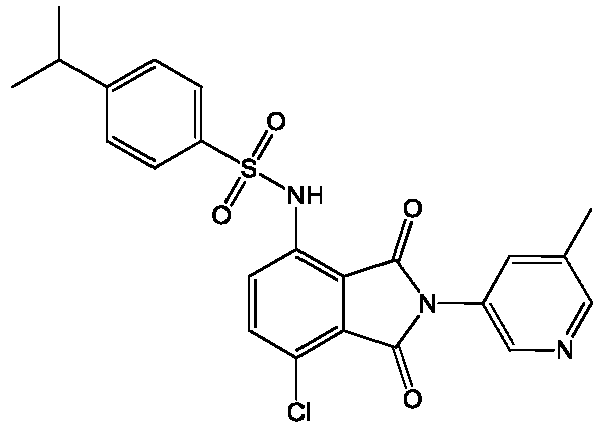
311 107 
318 116 
100 117 
184 118 
78 119 
2 120 
74 121 
192 122 
175 124 
224 125 
243 126 
158 127 
153 128 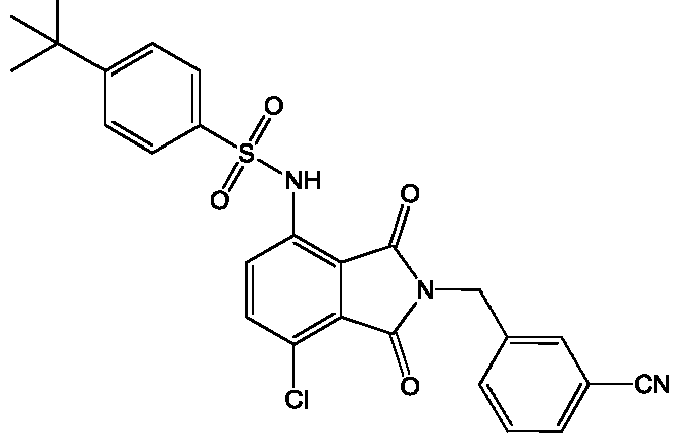
244 132 
252 133 
220 138 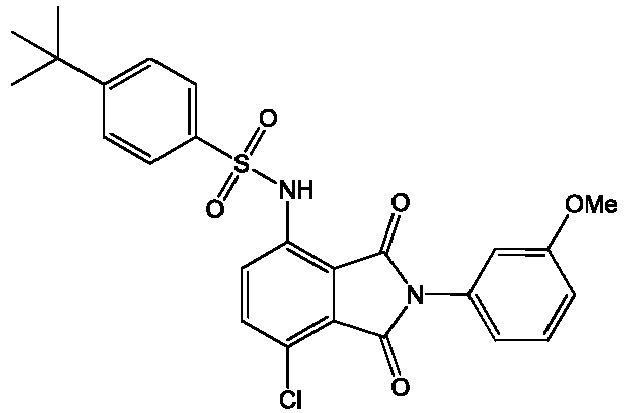
83 140 
216 142 
41 143 
64 144 
3 145 
129 146 
154 148 
36 149 
53 151 
42 152 
245 153 
7 154 
32 155 
44 157 
189 160 
456 161 
568 162 
1000 175 
3 176 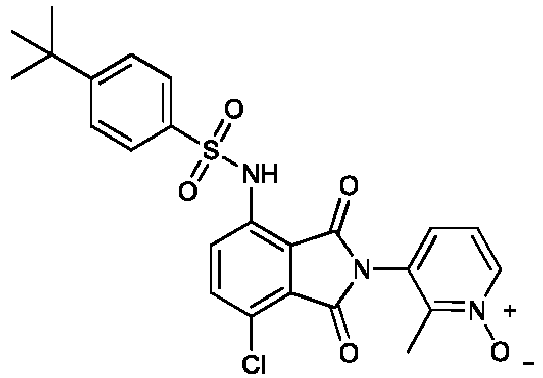
6 177 
73 178 
164 179 
16 180 
78 182 
19 183 
3 184 
16 185 
7 187 
33 188 
15 189 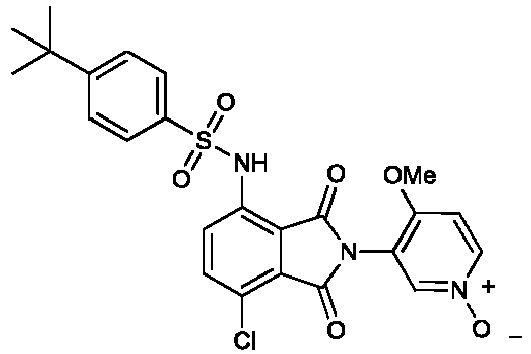
8 190 
24 191 
20 192 
4 193 
16 194 
4 195 
31 196 
46 197 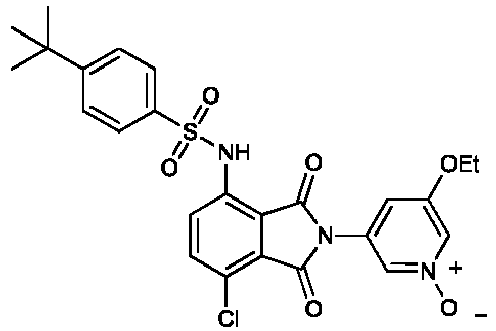
21 198 
76 199 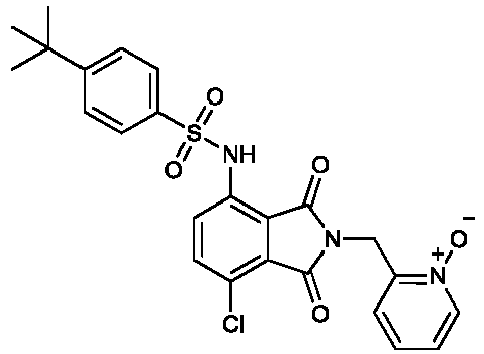
6 200 
45 201 
8 202 
22 203 
38 204 
7 205 
46 207 
30 208 
24 209 
30 210 
44 211 
33 212 
59 213 
12 214 
20 215 
85 216 
23 217 
35 218 
7 219 
10 220 
12 221 
212 222 
6 224 
5 225 
54 226 
21 227 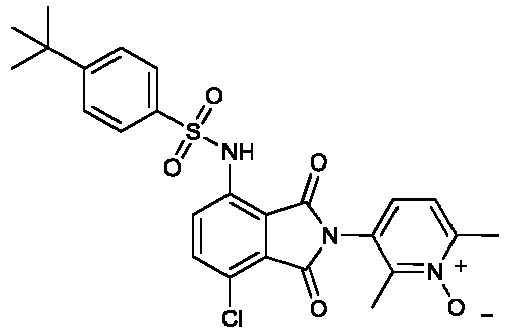
14 228 
5 229 
46 230 
8 231 
50 232 
7 233 
19 234 
45 235 
123 236 
51 237 
28 238 
14 239 
13 240 
84 241 
5 242 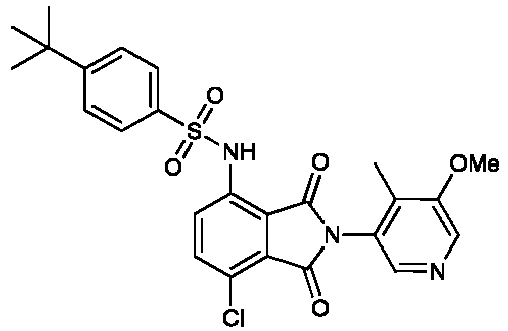
18 243 
34 244 
6 245 
47 246 
125 247 
78 248 
70 249 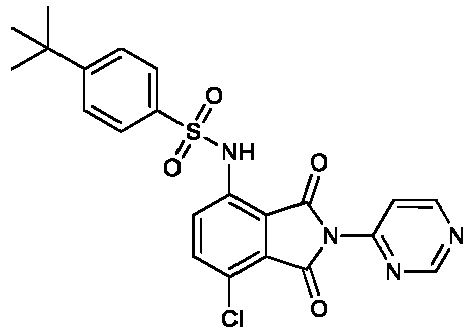
33 250 
23 251 
51 252 
33 253 
41 254 
58 255 
17 256 
18 257 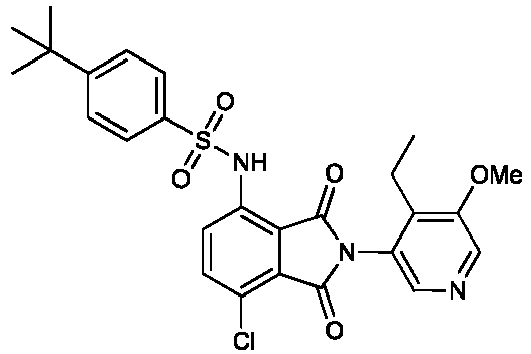
25 258 
23 259 
13 260 
16 261 
16 262 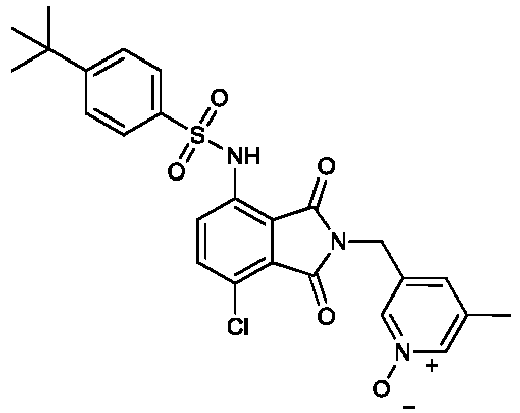
46 263 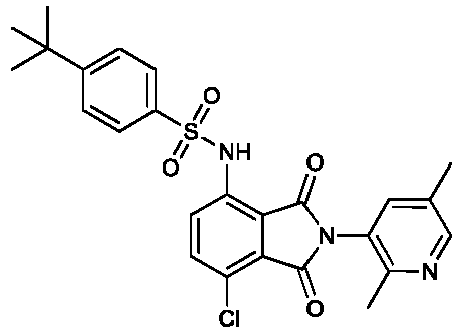
11 264 
11 265 
41 266 
10 267 
27 268 
54 269 
76 270 
23 271 
9 272 
9 273 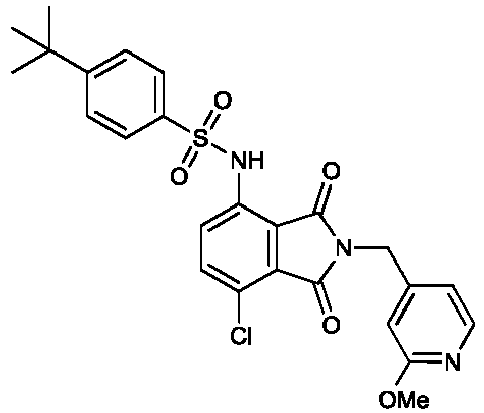
108 274 
34 275 
32 276 
22 277 
28 278 
10 279 
18 280 
37 281 
5 282 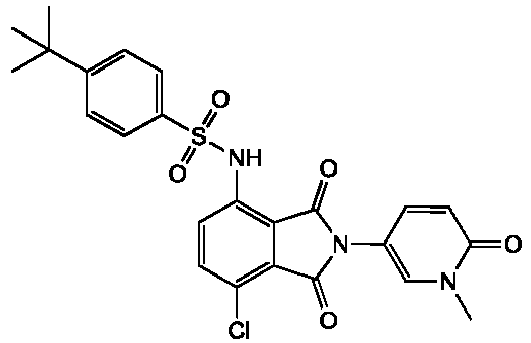
9 283 
15 284 
7 285 
16 286 
10 287 
22 288 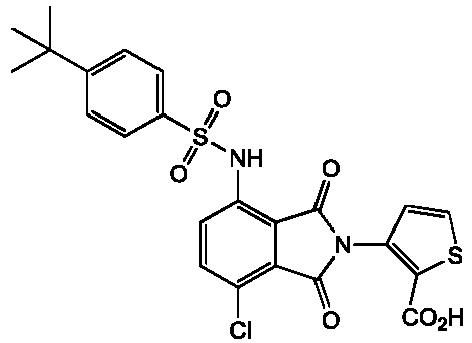
3 289 
104 290 
7 291 
5 292 
11

Claims (32)
- A compound of Formula (I) or a salt or solvate thereof, including a solvate of such a salt:
 R1 is selected from hydrogen, methyl, and ethyl;X is selected from a direct bond and (CR5R6)p;p is 1,2,3,4, or 5;each R5 is independently selected from hydrogen, methyl, and fluoro;each R6 is independently selected from hydrogen, methyl, and fluoro;R2 is selected from optionally substituted aryl, optionally substituted heteroaryl, and optionally substituted C3-7heterocycloalkyl ;each R3 is independently selected from halo, cyano (CN), C1-6alkyl, methanesulfonyl (SO2CH3), C1-6alkoxy, haloalkyl, haloalkoxy, and C3-7cycloalkyl;n is 0, 1 or 2;each R4 is Zq1B;m is 0, 1, 2 or 3;q1 is 0, 1, 2, 3, 4, 5 or 6;each Z is independently selected from CR7 R8, O, C=O, SO2, and NR9;each R7 is independently selected from hydrogen, methyl, ethyl, and halo;each R8 is independently selected from hydrogen, methyl, ethyl, and halo;each R9 is independently selected from hydrogen, methyl, and ethyl;each B is independently selected from hydrogen, halo, CN, optionally substituted aryl, optionally substituted heteroaryl, optionally substituted cycloalkyl, and A;A is
 Q is selected from CH2, O, NH, and NCH3;x is 0, 1, 2, 3 or 4, and y is 1, 2, 3, 4 or 5, the total of x and y being greater or equal to 1 and less than or equal to 5 (1 ≤ x+y ≤ 5).
 - A compound of Formula (I) as claimed in claim 1, or a salt or solvate thereof, including a solvate of such a salt, wherein R1 is hydrogen.
- A compound of Formula (I) as claimed in claim 1 or claim 2, or a salt or solvate thereof, including a solvate of such a salt, wherein X is a direct bond.
- A compound of Formula (I) as claimed in claim 1 or claim 2, or a salt or solvate thereof, including a solvate of such a salt, wherein X is CH2.
- A compound of Formula (I) as claimed in any of the preceding claims, or a salt or solvate thereof, including a solvate of such a salt, wherein R2 is selected from optionally substituted aryl and optionally substituted heteroaryl.
- A compound of Formula (I) as claimed in claim 5, or a salt or solvate thereof, including a solvate of such a salt, wherein R2 is selected from optionally substituted phenyl, optionally substituted pyridyl, optionally substituted thiophenyl, optionally substituted pyrazolyl, optionally substituted pyrimidinyl, optionally substituted imidazolyl, and optionally substituted thiazolyl.
- A compound of Formula (I) as claimed in claim 6, or a salt or solvate thereof, including a solvate of such a salt, wherein R2 is selected from cyanophenyl, acetylphenyl, methoxyphenyl, pyridine N-oxide, methyl-pyridine N-oxide, methoxy-pyridine N-oxide, ethoxy-pyridine N-oxide, pyridyl, methoxy-pyridyl, ethoxy-pyridyl, methyl-pyridyl, cyano-pyridyl, thiophenyl, carboxy-thiophenyl, carboxymethyl-thiophenyl, pyrazolyl, methyl-pyrazolyl, imidazolyl, and methyl-imidazolyl.
- A compound of Formula (I) as claimed in any of the preceding claims, or a salt or solvate thereof, including a solvate of such a salt, wherein each R3 is independently selected from halo, cyano, C1-3alkyl, C1-3alkoxy, C1-3haloalkyl, and cyclopropyl.
- A compound of Formula (I) as claimed in claim 8, or a salt or solvate thereof, including a solvate of such a salt, wherein each R3 is independently selected from chloro, cyano, methyl, methoxy (CH3O), propoxy (including isopropoxy), trifluoromethyl, and cyclopropyl.
- A compound of Formula (I) as claimed in any of the preceding claims, or a salt or solvate thereof, including a solvate of such a salt, wherein n is 0 or 1.
- A compound of Formula (I) as claimed in any of the preceding claims, or a salt or solvate thereof, including a solvate of such a salt, wherein R4 is Zq1B and q1 is 0, and each B is independently selected from halo, CN, optionally substituted aryl, optionally substituted heteroaryl, and A.
- A compound of Formula (I) as claimed in any of the preceding claims, or a salt or solvate thereof, including a solvate of such a salt, wherein R4 is Zq1B and q1 is 1, 2 or 3, each Z is independently selected from C1-3alkyl, and each B is independently selected from halo, CN, optionally substituted aryl, optionally substituted heteroaryl, and A.
- A compound of Formula (I) as claimed in claim 11 or claim 12, or a salt or solvate thereof, including a solvate of such a salt, wherein each B is independently selected from halo, optionally substituted C5-6heteroaryl, and C5-6heterocycloalkyl.
- A compound of Formula (I) as claimed in claim 13, or a salt or solvate thereof, including a solvate of such a salt, wherein each B is independently selected from chloro, fluoro, pyridyl, pyrazolyl, oxazolyl, isoxazolyl, imidazolyl, pyrrolyl, and C5-6heterocycloalkyl.
- A compound of Formula (I) as claimed in any of the preceding claims, or a salt or solvate thereof, including a solvate of such a salt, wherein R4 is Zq1B and q1 is 1, 2, 3, 4, 5, or 6, each Z is independently selected from CR7 R8, O, C=O, and SO2, each R7 is independently selected from hydrogen, methyl, and halo, each R8 is independently selected from hydrogen, methyl, and halo, and B is selected from hydrogen, halo, and cyano.
- A compound of Formula (I) as claimed in claim 15, or a salt or solvate thereof, including a solvate of such a salt, wherein each R4 is independently selected from butyl (including tert-butyl), propyl (including iso-propyl), methyl, COCH3, C(CH3)(CH3)CN, trifluoromethyl, trifluoromethoxy, difluoromethoxy, and methoxy.
- A compound of Formula (I) as claimed in any of the preceding claims, or a salt or solvate thereof, including a solvate of such a salt, wherein m is 1 or 2.
- A compound of Formula (I) as claimed in claim 17, or a salt or solvate thereof, including a solvate of such a salt, wherein m is 1 and R4 is para to the sulfonamide, or m is 2 and one R4 group is meta to the sulfonamide and the other R4 group is para to the sulfonamide.
- A compound of Formula (I) as claimed in claim 1, or a salt or solvate thereof, including a solvate of such a salt, wherein R1 is hydrogen, X is CH2, R2 is an optionally substituted heteroaryl, n is 0, m is 1, and R4 is trifluoromethoxy.
- A compound of Formula (I) as claimed in claim 1, or a salt or solvate thereof, including a solvate of such a salt, wherein R1 is hydrogen, X is a direct bond, R2 is selected from optionally substituted aryl and optionally substituted heteroaryl, n is 0, m is 2, one R4 group is halo and the other R4 group is trifluoromethyl.
- A compound of Formula (I) as claimed in claim 1, or a salt or solvate thereof, including a solvate of such a salt, wherein R1 is hydrogen, X is a direct bond, R 2 is selected from optionally substituted aryl and optionally substituted heteroaryl, n is 0, m is 1, R4 is selected from butyl (including tert-butyl), trifluoromethyl, trifluoromethoxy, and difluoromethoxy.
- A compound of Formula (I) as claimed in claim 1, or a salt or solvate thereof, including a solvate of such a salt, wherein R1 is hydrogen, X is a direct bond or CH2, R2 is selected from optionally substituted aryl and optionally substituted heteroaryl, n is 1, R3 is halo or cyano, m is 1, R4 is butyl (including tert-butyl).
- A compound of Formula (I) as claimed in claim 22, or a salt or solvate thereof, including a solvate of such a salt, wherein R2 is selected from optionally substituted pyridyl, optionally substituted phenyl, optionally substituted pyrazolyl, optionally substituted imidazolyl, and optionally substituted thiophenyl (wherein optional substituents are selected from O-, OCH3, OC2H5, CH3, carboxy, carboxymethyl and CN), R3 is chloro, and R4 is tert-butyl.
- A compound of Formula (I) as claimed in claim 1, or a salt or solvate thereof, including a solvate of such a salt, which is any one of Compounds 1 to 292
Compound number Structure 1 
2 
3 
4 
5 
6 
7 
8 
9 
10 
11 
12 
13 
14 
15 
16 
17 
18 
19 
20 
21 
22 
23 
24 
25 
26 
27 
28 
29 
30 
31 
32 
33 
34 
35 
36 
37 
38 
39 
40 
41 
42 
43 
44 
45 
46 
47 
48 
49 
50 
51 
52 
53 
54 
55 
56 
57 
58 
59 
60 
61 
62 
63 
64 
65 
66 
67 
68 
69 
70 
71 
72 
73 
74 
75 
76 
77 
78 
79 
80 
81 
82 
83 
84 
85 
86 
87 
88 
89 
90 
91 
92 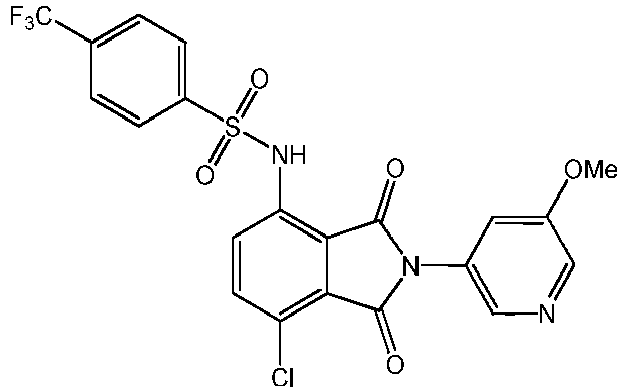
93 
94 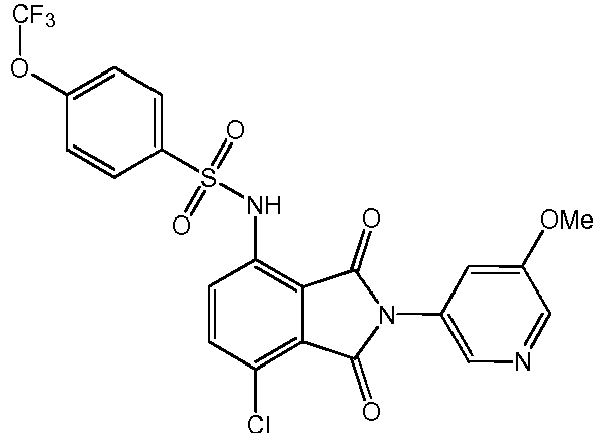
95 
96 
97 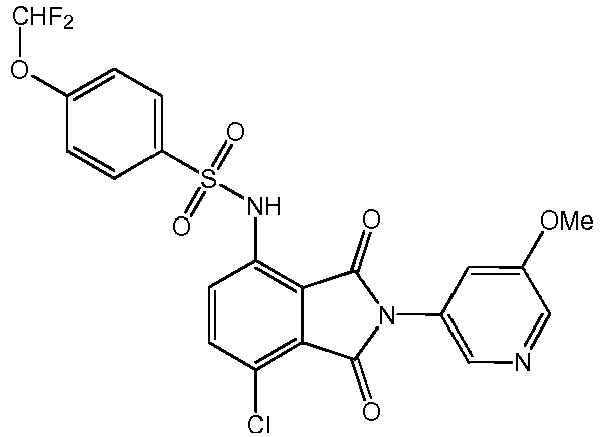
98 
99 
100 
101 
102 
103 
104 
105 
106 
107 
108 
109 
110 
111 
112 
113 
114 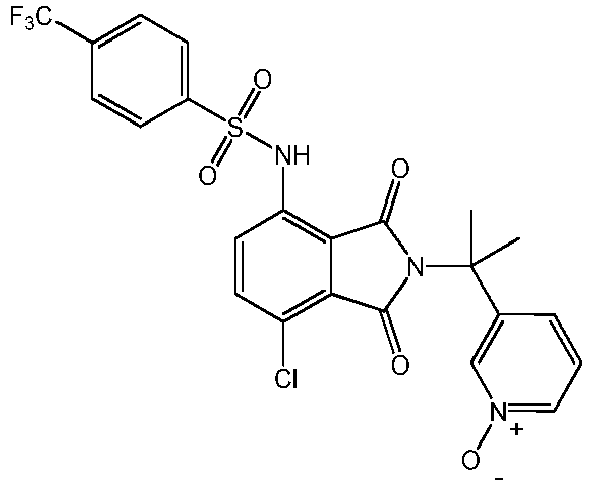
115 
116 
117 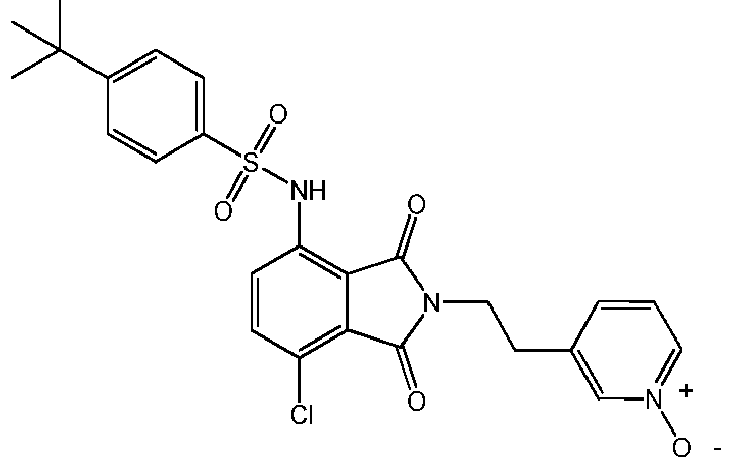
118 
119 
120 
121 
122 
123 
124 
125 
126 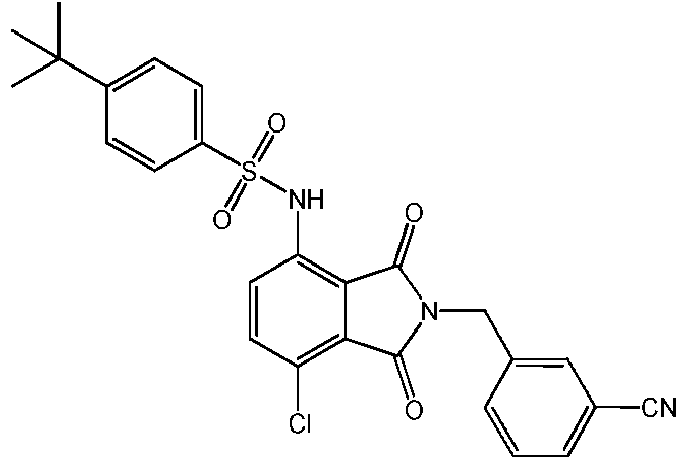
127 
128 
129 
130 
131 
132 
133 
134 
135 
136 
137 
138 
139 
140 
141 
142 
143 
144 
145 
146 
147 
148 
149 
150 
151 
152 
153 
154 
155 
156 
157 
158 
159 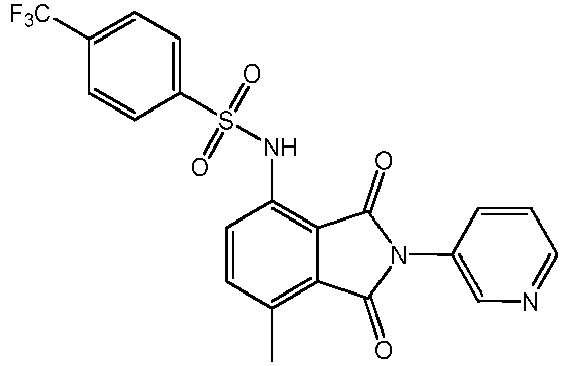
160 
161 
162 
163 
164 
165 
166 
167 
168 
169 
170 
171 
172 
173 
174 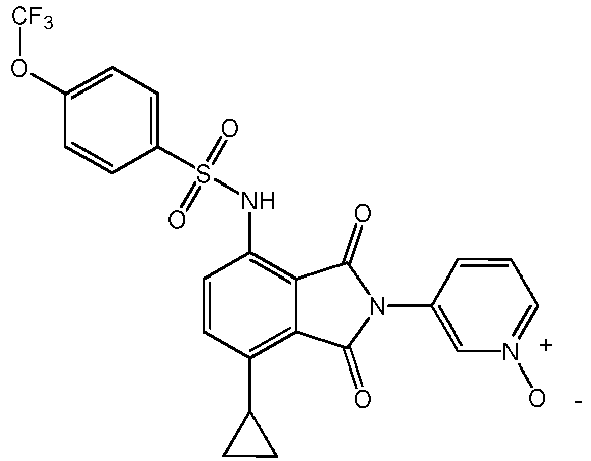
175 
176 
177 
178 
179 
180 
181 
182 
183 
184 
185 
186 
187 
188 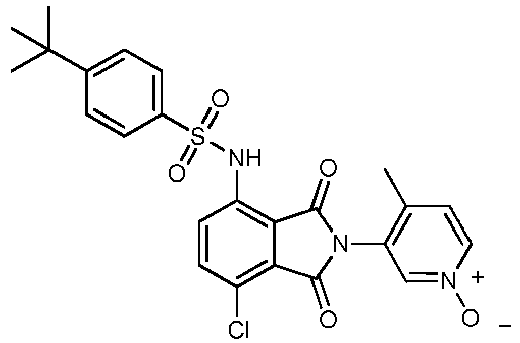
189 
190 
191 
192 
193 
194 
195 
196 
197 
198 
199 
200 
201 
202 
203 
204 
205 
206 
207 
208 
209 
210 
211 
212 
213 
214 
215 
216 
217 
218 
219 
220 
221 
222 
223 
224 
225 
226 
227 
228 
229 
230 
231 
232 
233 
234 
235 
236 
237 
238 
239 
240 
241 
242 
243 
244 
245 
246 
247 
248 
249 
250 
251 
252 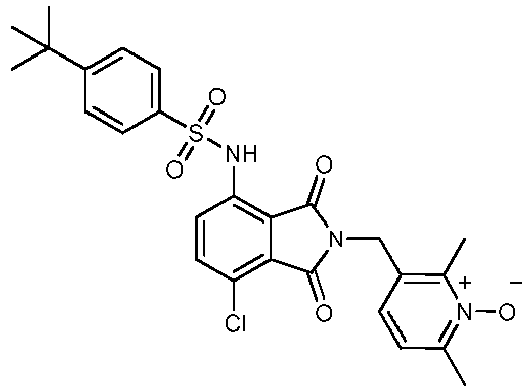
253 
254 
255 
256 
257 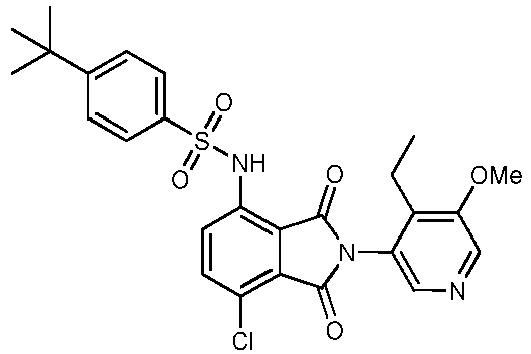
258 
259 
260 
261 
262 
263 
264 
265 
266 
267 
268 
269 
270 
271 
272 
273 
274 
275 
276 
277 
278 
279 
280 
281 
282 
283 
284 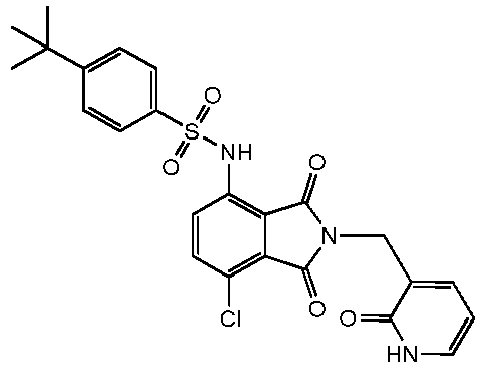
285 
286 
287 
288 
289 
290 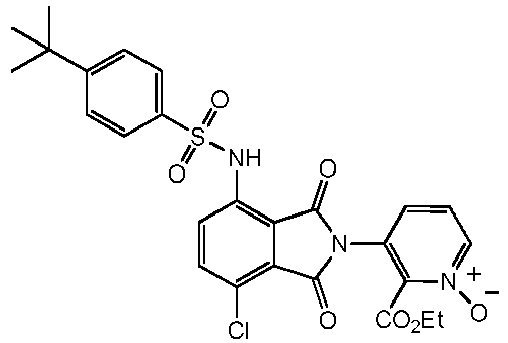
291 
292 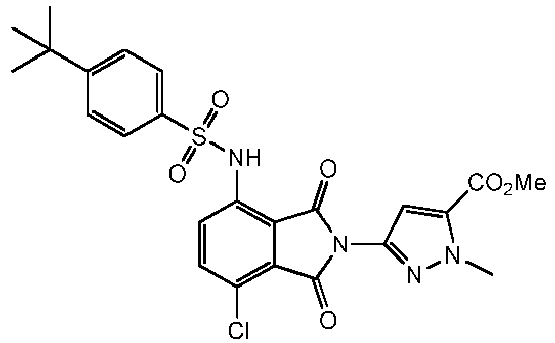
- A compound of Formula (I) as claimed in claim 1, or a salt or solvate thereof, including a solvate of such a salt, for use in therapy.
- A compound of Formula (I) as claimed in claim 25, or a salt or solvate thereof, including a solvate of such a salt, for use in the treatment, prevention or amelioration of a disease or condition associated with CCR9 activation.
- A compound of Formula (I) as claimed in claim 26, or a salt or solvate thereof, including a solvate of such a salt, for use in the treatment, prevention or amelioration of an inflammatory disease or condition, or an immune disorder.
- A compound of Formula (I) as claimed in claim 27, or a salt or solvate thereof, including a solvate of such a salt, for use in the treatment, prevention or amelioration of Crohn's disease or ulcerative colitis.
- A compound of Formula (I) as claimed in claim 28, or a salt or solvate thereof, including a solvate of such a salt, for use in the treatment, prevention or amelioration of Crohn's disease.
- A composition comprising a compound of Formula (I) as claimed in any of claims 1 to 29, or a salt or solvate thereof, including a solvate of such a salt, together with an acceptable carrier.
- A composition as claimed in claim 30 for use in the treatment, prevention or amelioration of a disease or condition associated with CCR9 activation.
- A process for the preparation of a compound of Formula (I) as claimed in claim 1, which comprises reacting an anhydride (A) with a primary amine (B) to produce a phthalimide (C), reducing the nitro group in the phthalimide (C) to form an aminophthalimide (D), then:(i) converting the aminophthalimide (D) to a secondary sulfonamide (F) using a sulfonyl chloride (E), and optionally derivatising the secondary sulfonamide (F) to a tertiary sulfonamide (H); or(ii) converting the aminophthalimide (D) to a secondary amine (G), and converting the secondary amine (G) to a tertiary sulfonamide (H) using a sulfonyl chloride (E); and(iii) optionally adding appropriate substituents to an R2 , R3 , or R4 group of the secondary sulfonamide (F) or of the tertiary sulfonamide (H);as shown in Scheme 1 below, wherein Z is a halogen and (i) R1 , X, R 2, R3 , n, R4 , and m have the meanings given for the compound of Formula (I), and (ii) R1 , R2 , R3 , R4 in intermediate compounds may represent protected forms of these groups:

Applications Claiming Priority (2)
| Application Number | Priority Date | Filing Date | Title |
|---|---|---|---|
| IN5984CH2013 | 2013-12-23 | ||
| PCT/EP2014/078944 WO2015097121A1 (en) | 2013-12-23 | 2014-12-22 | Compounds useful as ccr9 modulators |
Publications (2)
| Publication Number | Publication Date |
|---|---|
| EP3087069A1 EP3087069A1 (en) | 2016-11-02 |
| EP3087069B1 true EP3087069B1 (en) | 2019-01-30 |
Family
ID=52232191
Family Applications (1)
| Application Number | Title | Priority Date | Filing Date |
|---|---|---|---|
| EP14820864.8A Active EP3087069B1 (en) | 2013-12-23 | 2014-12-22 | Compounds useful as ccr9 modulators |
Country Status (5)
| Country | Link |
|---|---|
| US (2) | US9969687B2 (en) |
| EP (1) | EP3087069B1 (en) |
| JP (1) | JP2017501145A (en) |
| AU (1) | AU2014372638A1 (en) |
| WO (1) | WO2015097121A1 (en) |
Families Citing this family (5)
| Publication number | Priority date | Publication date | Assignee | Title |
|---|---|---|---|---|
| WO2015097121A1 (en) | 2013-12-23 | 2015-07-02 | Norgine B.V. | Compounds useful as ccr9 modulators |
| EP4480946A1 (en) | 2017-03-27 | 2024-12-25 | Hydro-Québec | Salts for use in electrolyte compositions or as electrode additives |
| CN116253635B (en) * | 2021-12-12 | 2025-10-10 | 中国科学院大连化学物理研究所 | A preparation method of chlorophthalic acid |
| CN116675684B (en) * | 2023-08-02 | 2023-11-07 | 上海翰森生物医药科技有限公司 | Alkynyl-containing condensed ring derivative antagonist, preparation method and application thereof |
| WO2025260150A1 (en) * | 2024-06-21 | 2025-12-26 | Microbiológica Química E Farmacêutica Ltda. | Novel n-benzyl phthalimides for the treatment of pain. methods of preparation and therapeutic use |
Family Cites Families (42)
| Publication number | Priority date | Publication date | Assignee | Title |
|---|---|---|---|---|
| JPS5340787A (en) | 1976-09-24 | 1978-04-13 | Chugai Pharmaceut Co Ltd | Phthalazine derivatives and their preparation |
| JPS59197037A (en) * | 1983-04-22 | 1984-11-08 | Fuji Photo Film Co Ltd | Method for processing photosensitive silver halide material |
| KR100315837B1 (en) | 1994-06-21 | 2002-02-28 | 고리 히데아끼 | PYRAZOLO[1,5-a]PYRAMIDINE DERIVATIVE |
| EP0912513A1 (en) | 1996-06-28 | 1999-05-06 | Merck & Co., Inc. | Fibrinogen receptor antagonist prodrugs |
| US6191131B1 (en) | 1997-07-23 | 2001-02-20 | Dupont Pharmaceuticals Company | Azolo triazines and pyrimidines |
| US20030045552A1 (en) * | 2000-12-27 | 2003-03-06 | Robarge Michael J. | Isoindole-imide compounds, compositions, and uses thereof |
| US20030114448A1 (en) | 2001-05-31 | 2003-06-19 | Millennium Pharmaceuticals, Inc. | Inhibitors of factor Xa |
| AU2003273179A1 (en) | 2002-05-10 | 2003-12-12 | Bristol-Myers Squibb Company | 1,1-disubstituted cycloalkyl derivatives as factor xa inhibitors |
| ATE365740T1 (en) | 2002-05-10 | 2007-07-15 | Smithkline Beecham Corp | SUBSTITUTED PYRAZOLOPYRIMIDINES |
| EP2399903A1 (en) | 2002-05-24 | 2011-12-28 | Millennium Pharmaceuticals, Inc. | Ccr9 inhibitors and methods of use thereof |
| CA2497544C (en) | 2002-09-04 | 2010-11-02 | Schering Corporation | Pyrazolo[1,5-a]pyrimidines compounds as cyclin dependent kinase inhibitors |
| MXPA05002570A (en) | 2002-09-04 | 2005-09-08 | Schering Corp | Pyrazolopyrimidines as cyclin dependent kinase inhibitors. |
| UA80295C2 (en) | 2002-09-06 | 2007-09-10 | Biogen Inc | Pyrazolopyridines and using the same |
| AU2003298661B2 (en) | 2002-11-18 | 2007-05-10 | Chemocentryx, Inc. | Aryl sulfonamides |
| US7227035B2 (en) | 2002-11-18 | 2007-06-05 | Chemocentryx | Bis-aryl sulfonamides |
| US7420055B2 (en) | 2002-11-18 | 2008-09-02 | Chemocentryx, Inc. | Aryl sulfonamides |
| GB0324792D0 (en) * | 2003-10-23 | 2003-11-26 | Sterix Ltd | Compound |
| CA2566387A1 (en) | 2004-05-12 | 2005-12-01 | Chemocentryx, Inc. | Aryl sulfonamides as chemokine receptor ccr9 antagonists |
| WO2006019768A1 (en) | 2004-07-16 | 2006-02-23 | Schering Corporation | Hydantoin derivatives for the treatment of inflammatory disorders |
| JP2008514608A (en) * | 2004-09-24 | 2008-05-08 | ジヤンセン・フアーマシユーチカ・ナームローゼ・フエンノートシヤツプ | Sulfonamide compounds |
| US7622583B2 (en) | 2005-01-14 | 2009-11-24 | Chemocentryx, Inc. | Heteroaryl sulfonamides and CCR2 |
| US7579360B2 (en) | 2005-06-09 | 2009-08-25 | Bristol-Myers Squibb Company | Triazolopyridine 11-beta hydroxysteroid dehydrogenase type I inhibitors |
| US7572807B2 (en) | 2005-06-09 | 2009-08-11 | Bristol-Myers Squibb Company | Heteroaryl 11-beta-hydroxysteroid dehydrogenase type I inhibitors |
| WO2007029076A1 (en) * | 2005-09-05 | 2007-03-15 | Ranbaxy Laboratories Limited | Isoindole derivatives as antimicrobial agents |
| US20070078136A1 (en) | 2005-09-22 | 2007-04-05 | Bristol-Myers Squibb Company | Fused heterocyclic compounds useful as kinase modulators |
| BRPI0616985B1 (en) | 2005-10-06 | 2021-10-26 | Merck Sharp & Dohme Corp. | PIRAZOLE[1,5-A]PYRIMIDINE COMPOUND, E, USE OF A COMPOUND |
| GB0526445D0 (en) | 2005-12-23 | 2006-02-08 | Novartis Ag | Organic compounds |
| US7939557B2 (en) | 2006-04-20 | 2011-05-10 | Nova Southeastern University | Vascular endothelial receptor specific inhibitors |
| US20100234364A1 (en) | 2006-07-14 | 2010-09-16 | Arindrajit Basak | Ccr2 inhibitors and methods of use thereof |
| ATE496905T1 (en) | 2006-07-14 | 2011-02-15 | Chemocentryx Inc | TRIAZOLYL-PYRIDYL-BENZENESULFONAMIDES AS CCR2 OR CCR9 MODULATORS FOR THE TREATMENT OF ATHEROSCLERosis |
| AU2007275873B2 (en) * | 2006-07-14 | 2012-06-14 | Chemocentryx, Inc. | Triazolyl phenyl benzenesulfonamides |
| WO2008124518A1 (en) | 2007-04-03 | 2008-10-16 | Janssen Pharmaceutica N.V. | Oxo-dihydroisoindole sulfonamide compounds as modulators of the cck2 receptor |
| WO2008134553A1 (en) | 2007-04-26 | 2008-11-06 | Xenon Pharmaceuticals Inc. | Methods of using bicyclic compounds in treating sodium channel-mediated diseases |
| US7776877B2 (en) | 2007-06-22 | 2010-08-17 | Chemocentryx, Inc. | N-(2-(hetaryl)aryl) arylsulfonamides and N-(2-(hetaryl) hetaryl arylsulfonamides |
| US20120121540A1 (en) | 2007-08-10 | 2012-05-17 | Franz Ulrich Schmitz | Certain Nitrogen Containing Bicyclic Chemical Entities For Treating Viral Infections |
| WO2009026248A2 (en) | 2007-08-17 | 2009-02-26 | The Government Of The United States, As Represented By The Secretary Of Health And Human Services, National Institutes Of Health, Office Of Technology Transfer | Hydrazide, amide, phthalimide and phthalhydrazide analogs as inhibitors of retroviral integrase |
| CA2706946A1 (en) | 2007-11-28 | 2009-06-04 | Schering Corporation | 2-fluoropyrazolo[1,5-a]pyrimidines as protein kinase inhibitors |
| AU2009251324A1 (en) | 2008-05-29 | 2009-12-03 | Sirtris Pharmaceuticals, Inc. | Imidazopyridine and related analogs as sirtuin modulators |
| US8178699B2 (en) | 2008-07-30 | 2012-05-15 | Pfizer Inc. | Modulators of CCR9 receptor and methods of use thereof |
| KR20140078719A (en) * | 2011-10-21 | 2014-06-25 | 키에시 파르마슈티시 엣스. 피. 에이. | Derivatives of 1-phenyl-2-pyridinyl alkyl alcohols as phosphodiesterase inhibitors |
| RU2627268C2 (en) * | 2012-02-29 | 2017-08-04 | Хемоцентрикс, Инк. | Aza-aryl-1-h-pyrazol-1-yl-sulphonamides |
| WO2015097121A1 (en) | 2013-12-23 | 2015-07-02 | Norgine B.V. | Compounds useful as ccr9 modulators |
-
2014
- 2014-12-22 WO PCT/EP2014/078944 patent/WO2015097121A1/en not_active Ceased
- 2014-12-22 JP JP2016537020A patent/JP2017501145A/en active Pending
- 2014-12-22 US US15/107,397 patent/US9969687B2/en active Active
- 2014-12-22 AU AU2014372638A patent/AU2014372638A1/en not_active Abandoned
- 2014-12-22 EP EP14820864.8A patent/EP3087069B1/en active Active
-
2018
- 2018-04-13 US US15/953,052 patent/US20180230098A1/en not_active Abandoned
Non-Patent Citations (1)
| Title |
|---|
| BIAN XIAOLI ET AL: "A new series of N2-substituted-5-(p-toluenesulfonylamino)phthalimide analogues as [alpha]-glucosidase inhibitors", BIOORGANIC & MEDICINAL CHEMISTRY LETTERS, PERGAMON, AMSTERDAM, NL, vol. 23, no. 7, 13 February 2013 (2013-02-13), pages 2022 - 2026, XP028997320, ISSN: 0960-894X, DOI: 10.1016/J.BMCL.2013.02.011 * |
Also Published As
| Publication number | Publication date |
|---|---|
| US9969687B2 (en) | 2018-05-15 |
| WO2015097121A9 (en) | 2015-09-03 |
| US20180230098A1 (en) | 2018-08-16 |
| AU2014372638A1 (en) | 2016-06-16 |
| WO2015097121A1 (en) | 2015-07-02 |
| EP3087069A1 (en) | 2016-11-02 |
| JP2017501145A (en) | 2017-01-12 |
| US20170001959A1 (en) | 2017-01-05 |
Similar Documents
| Publication | Publication Date | Title |
|---|---|---|
| EP2164828B1 (en) | Compounds as crth2 and/or pgd2 receptors modulators and their use for treating asthma and allergic inflammation | |
| EP1317443B1 (en) | Chemokine receptor binding heterocyclic compounds | |
| EP2556068B1 (en) | P38 map kinase inhibitors | |
| KR102083693B1 (en) | Pyrazol-1-YL Benzene Sulfonamideas CCR9 Antagonists | |
| KR101458006B1 (en) | Arylamide derivatives as ttx-s blockers | |
| US8648086B2 (en) | 5,6-bicyclic heteroaryl-containing urea compounds as kinase inhibitors | |
| US20180230098A1 (en) | Compounds useful as ccr9 modulators | |
| US20150353538A1 (en) | Compounds and therapeutic uses thereof | |
| KR20220068243A (en) | Phosphodiesterase inhibitors and uses | |
| JP5769700B2 (en) | Nitrogen-containing compounds and pharmaceutical compositions | |
| WO2005040112A1 (en) | Compounds with pgd2 antagonist activity | |
| US20130317027A1 (en) | Compounds and therapeutic uses thereof | |
| WO2010096722A1 (en) | 3-oxo-2, 3-dihydro- [1,2, 4] triazolo [4, 3-a]pyridines as soluble epoxide hydrolase (seh) inhibitors | |
| EA015189B1 (en) | Kinase inhibitors | |
| US20170002011A1 (en) | Benzene sulfonamides as ccr9 inhibitors | |
| TWI912295B (en) | Phd inhibitor compounds, compositions, and methods of use | |
| WO2006032173A1 (en) | Aryl hydrazide compounds and usage in preparation of immunosuppressive agent theirof | |
| RU2277092C2 (en) | Heterocyclic compounds, their using and pharmaceutical composition for treatment of states mediated by cxcr4 and ccr5 | |
| AU2007202607B2 (en) | Substituted Pyridinones as Modulators of p38 MAP Kinase | |
| CN106573921A (en) | Novel imidazolidine-2, 4-dione derivatives | |
| MXPA03002327A (en) | Chemokine receptor binding heterocyclic compounds. |
Legal Events
| Date | Code | Title | Description |
|---|---|---|---|
| PUAI | Public reference made under article 153(3) epc to a published international application that has entered the european phase |
Free format text: ORIGINAL CODE: 0009012 |
|
| 17P | Request for examination filed |
Effective date: 20160713 |
|
| AK | Designated contracting states |
Kind code of ref document: A1 Designated state(s): AL AT BE BG CH CY CZ DE DK EE ES FI FR GB GR HR HU IE IS IT LI LT LU LV MC MK MT NL NO PL PT RO RS SE SI SK SM TR |
|
| AX | Request for extension of the european patent |
Extension state: BA ME |
|
| STAA | Information on the status of an ep patent application or granted ep patent |
Free format text: STATUS: EXAMINATION IS IN PROGRESS |
|
| 17Q | First examination report despatched |
Effective date: 20170808 |
|
| GRAP | Despatch of communication of intention to grant a patent |
Free format text: ORIGINAL CODE: EPIDOSNIGR1 |
|
| STAA | Information on the status of an ep patent application or granted ep patent |
Free format text: STATUS: GRANT OF PATENT IS INTENDED |
|
| RIN1 | Information on inventor provided before grant (corrected) |
Inventor name: ZAINUDDIN, MOHD Inventor name: SURESH, JULURI Inventor name: SAXENA, ROHIT Inventor name: HEWSON, CHRISTOPHER ALEXANDER Inventor name: VENKATESHAPPA, CHANDREGOWDA Inventor name: KALINDJIAN, SARKIS BARRET Inventor name: BAKTHAVATCHALAM, RAJAGOPAL Inventor name: BASU, MANAS KUMAR Inventor name: KULKARNI, BHEEMASHANKAR Inventor name: KADNUR, SANJAY VENKATACHALAPATHI Inventor name: KRISTAM, RAJENDRA Inventor name: BEHERA, AJIT KUMAR Inventor name: DHARSHINIS, AKILA PARVATHY Inventor name: VISWANATHAN, VELLARKAD |
|
| INTG | Intention to grant announced |
Effective date: 20180711 |
|
| RAP1 | Party data changed (applicant data changed or rights of an application transferred) |
Owner name: NORGINE B.V. |
|
| GRAS | Grant fee paid |
Free format text: ORIGINAL CODE: EPIDOSNIGR3 |
|
| RAP1 | Party data changed (applicant data changed or rights of an application transferred) |
Owner name: NORGINE B.V. |
|
| GRAA | (expected) grant |
Free format text: ORIGINAL CODE: 0009210 |
|
| STAA | Information on the status of an ep patent application or granted ep patent |
Free format text: STATUS: THE PATENT HAS BEEN GRANTED |
|
| AK | Designated contracting states |
Kind code of ref document: B1 Designated state(s): AL AT BE BG CH CY CZ DE DK EE ES FI FR GB GR HR HU IE IS IT LI LT LU LV MC MK MT NL NO PL PT RO RS SE SI SK SM TR |
|
| AX | Request for extension of the european patent |
Extension state: BA ME |
|
| REG | Reference to a national code |
Ref country code: GB Ref legal event code: FG4D |
|
| REG | Reference to a national code |
Ref country code: CH Ref legal event code: EP |
|
| REG | Reference to a national code |
Ref country code: AT Ref legal event code: REF Ref document number: 1093156 Country of ref document: AT Kind code of ref document: T Effective date: 20190215 |
|
| REG | Reference to a national code |
Ref country code: IE Ref legal event code: FG4D |
|
| REG | Reference to a national code |
Ref country code: DE Ref legal event code: R096 Ref document number: 602014040489 Country of ref document: DE |
|
| REG | Reference to a national code |
Ref country code: LT Ref legal event code: MG4D |
|
| REG | Reference to a national code |
Ref country code: NL Ref legal event code: MP Effective date: 20190130 |
|
| PG25 | Lapsed in a contracting state [announced via postgrant information from national office to epo] |
Ref country code: ES Free format text: LAPSE BECAUSE OF FAILURE TO SUBMIT A TRANSLATION OF THE DESCRIPTION OR TO PAY THE FEE WITHIN THE PRESCRIBED TIME-LIMIT Effective date: 20190130 Ref country code: NO Free format text: LAPSE BECAUSE OF FAILURE TO SUBMIT A TRANSLATION OF THE DESCRIPTION OR TO PAY THE FEE WITHIN THE PRESCRIBED TIME-LIMIT Effective date: 20190430 Ref country code: PT Free format text: LAPSE BECAUSE OF FAILURE TO SUBMIT A TRANSLATION OF THE DESCRIPTION OR TO PAY THE FEE WITHIN THE PRESCRIBED TIME-LIMIT Effective date: 20190530 Ref country code: PL Free format text: LAPSE BECAUSE OF FAILURE TO SUBMIT A TRANSLATION OF THE DESCRIPTION OR TO PAY THE FEE WITHIN THE PRESCRIBED TIME-LIMIT Effective date: 20190130 Ref country code: LT Free format text: LAPSE BECAUSE OF FAILURE TO SUBMIT A TRANSLATION OF THE DESCRIPTION OR TO PAY THE FEE WITHIN THE PRESCRIBED TIME-LIMIT Effective date: 20190130 Ref country code: SE Free format text: LAPSE BECAUSE OF FAILURE TO SUBMIT A TRANSLATION OF THE DESCRIPTION OR TO PAY THE FEE WITHIN THE PRESCRIBED TIME-LIMIT Effective date: 20190130 Ref country code: NL Free format text: LAPSE BECAUSE OF FAILURE TO SUBMIT A TRANSLATION OF THE DESCRIPTION OR TO PAY THE FEE WITHIN THE PRESCRIBED TIME-LIMIT Effective date: 20190130 Ref country code: FI Free format text: LAPSE BECAUSE OF FAILURE TO SUBMIT A TRANSLATION OF THE DESCRIPTION OR TO PAY THE FEE WITHIN THE PRESCRIBED TIME-LIMIT Effective date: 20190130 |
|
| REG | Reference to a national code |
Ref country code: AT Ref legal event code: MK05 Ref document number: 1093156 Country of ref document: AT Kind code of ref document: T Effective date: 20190130 |
|
| PG25 | Lapsed in a contracting state [announced via postgrant information from national office to epo] |
Ref country code: RS Free format text: LAPSE BECAUSE OF FAILURE TO SUBMIT A TRANSLATION OF THE DESCRIPTION OR TO PAY THE FEE WITHIN THE PRESCRIBED TIME-LIMIT Effective date: 20190130 Ref country code: BG Free format text: LAPSE BECAUSE OF FAILURE TO SUBMIT A TRANSLATION OF THE DESCRIPTION OR TO PAY THE FEE WITHIN THE PRESCRIBED TIME-LIMIT Effective date: 20190430 Ref country code: IS Free format text: LAPSE BECAUSE OF FAILURE TO SUBMIT A TRANSLATION OF THE DESCRIPTION OR TO PAY THE FEE WITHIN THE PRESCRIBED TIME-LIMIT Effective date: 20190530 Ref country code: GR Free format text: LAPSE BECAUSE OF FAILURE TO SUBMIT A TRANSLATION OF THE DESCRIPTION OR TO PAY THE FEE WITHIN THE PRESCRIBED TIME-LIMIT Effective date: 20190501 Ref country code: LV Free format text: LAPSE BECAUSE OF FAILURE TO SUBMIT A TRANSLATION OF THE DESCRIPTION OR TO PAY THE FEE WITHIN THE PRESCRIBED TIME-LIMIT Effective date: 20190130 Ref country code: HR Free format text: LAPSE BECAUSE OF FAILURE TO SUBMIT A TRANSLATION OF THE DESCRIPTION OR TO PAY THE FEE WITHIN THE PRESCRIBED TIME-LIMIT Effective date: 20190130 |
|
| PG25 | Lapsed in a contracting state [announced via postgrant information from national office to epo] |
Ref country code: EE Free format text: LAPSE BECAUSE OF FAILURE TO SUBMIT A TRANSLATION OF THE DESCRIPTION OR TO PAY THE FEE WITHIN THE PRESCRIBED TIME-LIMIT Effective date: 20190130 Ref country code: IT Free format text: LAPSE BECAUSE OF FAILURE TO SUBMIT A TRANSLATION OF THE DESCRIPTION OR TO PAY THE FEE WITHIN THE PRESCRIBED TIME-LIMIT Effective date: 20190130 Ref country code: DK Free format text: LAPSE BECAUSE OF FAILURE TO SUBMIT A TRANSLATION OF THE DESCRIPTION OR TO PAY THE FEE WITHIN THE PRESCRIBED TIME-LIMIT Effective date: 20190130 Ref country code: SK Free format text: LAPSE BECAUSE OF FAILURE TO SUBMIT A TRANSLATION OF THE DESCRIPTION OR TO PAY THE FEE WITHIN THE PRESCRIBED TIME-LIMIT Effective date: 20190130 Ref country code: AL Free format text: LAPSE BECAUSE OF FAILURE TO SUBMIT A TRANSLATION OF THE DESCRIPTION OR TO PAY THE FEE WITHIN THE PRESCRIBED TIME-LIMIT Effective date: 20190130 Ref country code: RO Free format text: LAPSE BECAUSE OF FAILURE TO SUBMIT A TRANSLATION OF THE DESCRIPTION OR TO PAY THE FEE WITHIN THE PRESCRIBED TIME-LIMIT Effective date: 20190130 Ref country code: CZ Free format text: LAPSE BECAUSE OF FAILURE TO SUBMIT A TRANSLATION OF THE DESCRIPTION OR TO PAY THE FEE WITHIN THE PRESCRIBED TIME-LIMIT Effective date: 20190130 |
|
| REG | Reference to a national code |
Ref country code: DE Ref legal event code: R097 Ref document number: 602014040489 Country of ref document: DE |
|
| PG25 | Lapsed in a contracting state [announced via postgrant information from national office to epo] |
Ref country code: SM Free format text: LAPSE BECAUSE OF FAILURE TO SUBMIT A TRANSLATION OF THE DESCRIPTION OR TO PAY THE FEE WITHIN THE PRESCRIBED TIME-LIMIT Effective date: 20190130 |
|
| PLBE | No opposition filed within time limit |
Free format text: ORIGINAL CODE: 0009261 |
|
| STAA | Information on the status of an ep patent application or granted ep patent |
Free format text: STATUS: NO OPPOSITION FILED WITHIN TIME LIMIT |
|
| PG25 | Lapsed in a contracting state [announced via postgrant information from national office to epo] |
Ref country code: AT Free format text: LAPSE BECAUSE OF FAILURE TO SUBMIT A TRANSLATION OF THE DESCRIPTION OR TO PAY THE FEE WITHIN THE PRESCRIBED TIME-LIMIT Effective date: 20190130 |
|
| 26N | No opposition filed |
Effective date: 20191031 |
|
| PG25 | Lapsed in a contracting state [announced via postgrant information from national office to epo] |
Ref country code: SI Free format text: LAPSE BECAUSE OF FAILURE TO SUBMIT A TRANSLATION OF THE DESCRIPTION OR TO PAY THE FEE WITHIN THE PRESCRIBED TIME-LIMIT Effective date: 20190130 |
|
| PG25 | Lapsed in a contracting state [announced via postgrant information from national office to epo] |
Ref country code: TR Free format text: LAPSE BECAUSE OF FAILURE TO SUBMIT A TRANSLATION OF THE DESCRIPTION OR TO PAY THE FEE WITHIN THE PRESCRIBED TIME-LIMIT Effective date: 20190130 |
|
| REG | Reference to a national code |
Ref country code: CH Ref legal event code: PL |
|
| REG | Reference to a national code |
Ref country code: BE Ref legal event code: MM Effective date: 20191231 |
|
| PG25 | Lapsed in a contracting state [announced via postgrant information from national office to epo] |
Ref country code: MC Free format text: LAPSE BECAUSE OF FAILURE TO SUBMIT A TRANSLATION OF THE DESCRIPTION OR TO PAY THE FEE WITHIN THE PRESCRIBED TIME-LIMIT Effective date: 20190130 |
|
| PG25 | Lapsed in a contracting state [announced via postgrant information from national office to epo] |
Ref country code: LU Free format text: LAPSE BECAUSE OF NON-PAYMENT OF DUE FEES Effective date: 20191222 Ref country code: IE Free format text: LAPSE BECAUSE OF NON-PAYMENT OF DUE FEES Effective date: 20191222 |
|
| PG25 | Lapsed in a contracting state [announced via postgrant information from national office to epo] |
Ref country code: BE Free format text: LAPSE BECAUSE OF NON-PAYMENT OF DUE FEES Effective date: 20191231 Ref country code: LI Free format text: LAPSE BECAUSE OF NON-PAYMENT OF DUE FEES Effective date: 20191231 Ref country code: CH Free format text: LAPSE BECAUSE OF NON-PAYMENT OF DUE FEES Effective date: 20191231 |
|
| PG25 | Lapsed in a contracting state [announced via postgrant information from national office to epo] |
Ref country code: CY Free format text: LAPSE BECAUSE OF FAILURE TO SUBMIT A TRANSLATION OF THE DESCRIPTION OR TO PAY THE FEE WITHIN THE PRESCRIBED TIME-LIMIT Effective date: 20190130 |
|
| PG25 | Lapsed in a contracting state [announced via postgrant information from national office to epo] |
Ref country code: MT Free format text: LAPSE BECAUSE OF FAILURE TO SUBMIT A TRANSLATION OF THE DESCRIPTION OR TO PAY THE FEE WITHIN THE PRESCRIBED TIME-LIMIT Effective date: 20190130 Ref country code: HU Free format text: LAPSE BECAUSE OF FAILURE TO SUBMIT A TRANSLATION OF THE DESCRIPTION OR TO PAY THE FEE WITHIN THE PRESCRIBED TIME-LIMIT; INVALID AB INITIO Effective date: 20141222 |
|
| PG25 | Lapsed in a contracting state [announced via postgrant information from national office to epo] |
Ref country code: MK Free format text: LAPSE BECAUSE OF FAILURE TO SUBMIT A TRANSLATION OF THE DESCRIPTION OR TO PAY THE FEE WITHIN THE PRESCRIBED TIME-LIMIT Effective date: 20190130 |
|
| PGFP | Annual fee paid to national office [announced via postgrant information from national office to epo] |
Ref country code: GB Payment date: 20221103 Year of fee payment: 9 Ref country code: FR Payment date: 20221122 Year of fee payment: 9 Ref country code: DE Payment date: 20221025 Year of fee payment: 9 |
|
| P01 | Opt-out of the competence of the unified patent court (upc) registered |
Effective date: 20230507 |
|
| REG | Reference to a national code |
Ref country code: DE Ref legal event code: R119 Ref document number: 602014040489 Country of ref document: DE |
|
| GBPC | Gb: european patent ceased through non-payment of renewal fee |
Effective date: 20231222 |
|
| PG25 | Lapsed in a contracting state [announced via postgrant information from national office to epo] |
Ref country code: DE Free format text: LAPSE BECAUSE OF NON-PAYMENT OF DUE FEES Effective date: 20240702 |
|
| PG25 | Lapsed in a contracting state [announced via postgrant information from national office to epo] |
Ref country code: GB Free format text: LAPSE BECAUSE OF NON-PAYMENT OF DUE FEES Effective date: 20231222 |
|
| PG25 | Lapsed in a contracting state [announced via postgrant information from national office to epo] |
Ref country code: FR Free format text: LAPSE BECAUSE OF NON-PAYMENT OF DUE FEES Effective date: 20231231 |
|
| PG25 | Lapsed in a contracting state [announced via postgrant information from national office to epo] |
Ref country code: GB Free format text: LAPSE BECAUSE OF NON-PAYMENT OF DUE FEES Effective date: 20231222 Ref country code: FR Free format text: LAPSE BECAUSE OF NON-PAYMENT OF DUE FEES Effective date: 20231231 Ref country code: DE Free format text: LAPSE BECAUSE OF NON-PAYMENT OF DUE FEES Effective date: 20240702 |