EP3085669A1 - Lithium complex oxide - Google Patents
Lithium complex oxide Download PDFInfo
- Publication number
- EP3085669A1 EP3085669A1 EP15759084.5A EP15759084A EP3085669A1 EP 3085669 A1 EP3085669 A1 EP 3085669A1 EP 15759084 A EP15759084 A EP 15759084A EP 3085669 A1 EP3085669 A1 EP 3085669A1
- Authority
- EP
- European Patent Office
- Prior art keywords
- complex oxide
- positive electrode
- lithium
- crystal structure
- active material
- Prior art date
- Legal status (The legal status is an assumption and is not a legal conclusion. Google has not performed a legal analysis and makes no representation as to the accuracy of the status listed.)
- Granted
Links
Images





Classifications
-
- H—ELECTRICITY
- H01—ELECTRIC ELEMENTS
- H01M—PROCESSES OR MEANS, e.g. BATTERIES, FOR THE DIRECT CONVERSION OF CHEMICAL ENERGY INTO ELECTRICAL ENERGY
- H01M4/00—Electrodes
- H01M4/02—Electrodes composed of, or comprising, active material
- H01M4/36—Selection of substances as active materials, active masses, active liquids
- H01M4/48—Selection of substances as active materials, active masses, active liquids of inorganic oxides or hydroxides
- H01M4/50—Selection of substances as active materials, active masses, active liquids of inorganic oxides or hydroxides of manganese
- H01M4/505—Selection of substances as active materials, active masses, active liquids of inorganic oxides or hydroxides of manganese of mixed oxides or hydroxides containing manganese for inserting or intercalating light metals, e.g. LiMn2O4 or LiMn2OxFy
-
- C—CHEMISTRY; METALLURGY
- C01—INORGANIC CHEMISTRY
- C01G—COMPOUNDS CONTAINING METALS NOT COVERED BY SUBCLASSES C01D OR C01F
- C01G45/00—Compounds of manganese
- C01G45/12—Complex oxides containing manganese and at least one other metal element
- C01G45/1221—Manganates or manganites with trivalent manganese, tetravalent manganese or mixtures thereof
-
- C—CHEMISTRY; METALLURGY
- C01—INORGANIC CHEMISTRY
- C01G—COMPOUNDS CONTAINING METALS NOT COVERED BY SUBCLASSES C01D OR C01F
- C01G45/00—Compounds of manganese
- C01G45/12—Complex oxides containing manganese and at least one other metal element
- C01G45/1221—Manganates or manganites with trivalent manganese, tetravalent manganese or mixtures thereof
- C01G45/1285—Manganates or manganites with trivalent manganese, tetravalent manganese or mixtures thereof of the type (Mn2O5)n-
-
- C—CHEMISTRY; METALLURGY
- C01—INORGANIC CHEMISTRY
- C01G—COMPOUNDS CONTAINING METALS NOT COVERED BY SUBCLASSES C01D OR C01F
- C01G53/00—Compounds of nickel
- C01G53/40—Complex oxides containing nickel and at least one other metal element
- C01G53/42—Complex oxides containing nickel and at least one other metal element containing alkali metals, e.g. LiNiO2
-
- C—CHEMISTRY; METALLURGY
- C01—INORGANIC CHEMISTRY
- C01G—COMPOUNDS CONTAINING METALS NOT COVERED BY SUBCLASSES C01D OR C01F
- C01G53/00—Compounds of nickel
- C01G53/40—Complex oxides containing nickel and at least one other metal element
- C01G53/42—Complex oxides containing nickel and at least one other metal element containing alkali metals, e.g. LiNiO2
- C01G53/44—Complex oxides containing nickel and at least one other metal element containing alkali metals, e.g. LiNiO2 containing manganese
-
- H—ELECTRICITY
- H01—ELECTRIC ELEMENTS
- H01M—PROCESSES OR MEANS, e.g. BATTERIES, FOR THE DIRECT CONVERSION OF CHEMICAL ENERGY INTO ELECTRICAL ENERGY
- H01M10/00—Secondary cells; Manufacture thereof
- H01M10/05—Accumulators with non-aqueous electrolyte
- H01M10/052—Li-accumulators
- H01M10/0525—Rocking-chair batteries, i.e. batteries with lithium insertion or intercalation in both electrodes; Lithium-ion batteries
-
- H—ELECTRICITY
- H01—ELECTRIC ELEMENTS
- H01M—PROCESSES OR MEANS, e.g. BATTERIES, FOR THE DIRECT CONVERSION OF CHEMICAL ENERGY INTO ELECTRICAL ENERGY
- H01M4/00—Electrodes
- H01M4/02—Electrodes composed of, or comprising, active material
- H01M4/13—Electrodes for accumulators with non-aqueous electrolyte, e.g. for lithium-accumulators; Processes of manufacture thereof
- H01M4/131—Electrodes based on mixed oxides or hydroxides, or on mixtures of oxides or hydroxides, e.g. LiCoOx
-
- H—ELECTRICITY
- H01—ELECTRIC ELEMENTS
- H01M—PROCESSES OR MEANS, e.g. BATTERIES, FOR THE DIRECT CONVERSION OF CHEMICAL ENERGY INTO ELECTRICAL ENERGY
- H01M4/00—Electrodes
- H01M4/02—Electrodes composed of, or comprising, active material
- H01M4/36—Selection of substances as active materials, active masses, active liquids
- H01M4/48—Selection of substances as active materials, active masses, active liquids of inorganic oxides or hydroxides
- H01M4/485—Selection of substances as active materials, active masses, active liquids of inorganic oxides or hydroxides of mixed oxides or hydroxides for inserting or intercalating light metals, e.g. LiTi2O4 or LiTi2OxFy
-
- H—ELECTRICITY
- H01—ELECTRIC ELEMENTS
- H01M—PROCESSES OR MEANS, e.g. BATTERIES, FOR THE DIRECT CONVERSION OF CHEMICAL ENERGY INTO ELECTRICAL ENERGY
- H01M4/00—Electrodes
- H01M4/02—Electrodes composed of, or comprising, active material
- H01M4/36—Selection of substances as active materials, active masses, active liquids
- H01M4/48—Selection of substances as active materials, active masses, active liquids of inorganic oxides or hydroxides
- H01M4/52—Selection of substances as active materials, active masses, active liquids of inorganic oxides or hydroxides of nickel, cobalt or iron
- H01M4/525—Selection of substances as active materials, active masses, active liquids of inorganic oxides or hydroxides of nickel, cobalt or iron of mixed oxides or hydroxides containing iron, cobalt or nickel for inserting or intercalating light metals, e.g. LiNiO2, LiCoO2 or LiCoOxFy
-
- H—ELECTRICITY
- H01—ELECTRIC ELEMENTS
- H01M—PROCESSES OR MEANS, e.g. BATTERIES, FOR THE DIRECT CONVERSION OF CHEMICAL ENERGY INTO ELECTRICAL ENERGY
- H01M4/00—Electrodes
- H01M4/02—Electrodes composed of, or comprising, active material
- H01M4/62—Selection of inactive substances as ingredients for active masses, e.g. binders, fillers
- H01M4/621—Binders
- H01M4/622—Binders being polymers
- H01M4/623—Binders being polymers fluorinated polymers
-
- H—ELECTRICITY
- H01—ELECTRIC ELEMENTS
- H01M—PROCESSES OR MEANS, e.g. BATTERIES, FOR THE DIRECT CONVERSION OF CHEMICAL ENERGY INTO ELECTRICAL ENERGY
- H01M4/00—Electrodes
- H01M4/02—Electrodes composed of, or comprising, active material
- H01M4/62—Selection of inactive substances as ingredients for active masses, e.g. binders, fillers
- H01M4/624—Electric conductive fillers
- H01M4/625—Carbon or graphite
-
- H—ELECTRICITY
- H01—ELECTRIC ELEMENTS
- H01M—PROCESSES OR MEANS, e.g. BATTERIES, FOR THE DIRECT CONVERSION OF CHEMICAL ENERGY INTO ELECTRICAL ENERGY
- H01M4/00—Electrodes
- H01M4/02—Electrodes composed of, or comprising, active material
- H01M4/64—Carriers or collectors
- H01M4/66—Selection of materials
- H01M4/661—Metal or alloys, e.g. alloy coatings
-
- C—CHEMISTRY; METALLURGY
- C01—INORGANIC CHEMISTRY
- C01P—INDEXING SCHEME RELATING TO STRUCTURAL AND PHYSICAL ASPECTS OF SOLID INORGANIC COMPOUNDS
- C01P2002/00—Crystal-structural characteristics
- C01P2002/70—Crystal-structural characteristics defined by measured X-ray, neutron or electron diffraction data
- C01P2002/72—Crystal-structural characteristics defined by measured X-ray, neutron or electron diffraction data by d-values or two theta-values, e.g. as X-ray diagram
-
- C—CHEMISTRY; METALLURGY
- C01—INORGANIC CHEMISTRY
- C01P—INDEXING SCHEME RELATING TO STRUCTURAL AND PHYSICAL ASPECTS OF SOLID INORGANIC COMPOUNDS
- C01P2002/00—Crystal-structural characteristics
- C01P2002/70—Crystal-structural characteristics defined by measured X-ray, neutron or electron diffraction data
- C01P2002/76—Crystal-structural characteristics defined by measured X-ray, neutron or electron diffraction data by a space-group or by other symmetry indications
-
- C—CHEMISTRY; METALLURGY
- C01—INORGANIC CHEMISTRY
- C01P—INDEXING SCHEME RELATING TO STRUCTURAL AND PHYSICAL ASPECTS OF SOLID INORGANIC COMPOUNDS
- C01P2006/00—Physical properties of inorganic compounds
- C01P2006/40—Electric properties
-
- H—ELECTRICITY
- H01—ELECTRIC ELEMENTS
- H01M—PROCESSES OR MEANS, e.g. BATTERIES, FOR THE DIRECT CONVERSION OF CHEMICAL ENERGY INTO ELECTRICAL ENERGY
- H01M4/00—Electrodes
- H01M4/02—Electrodes composed of, or comprising, active material
- H01M2004/026—Electrodes composed of, or comprising, active material characterised by the polarity
- H01M2004/028—Positive electrodes
-
- H—ELECTRICITY
- H01—ELECTRIC ELEMENTS
- H01M—PROCESSES OR MEANS, e.g. BATTERIES, FOR THE DIRECT CONVERSION OF CHEMICAL ENERGY INTO ELECTRICAL ENERGY
- H01M4/00—Electrodes
- H01M4/02—Electrodes composed of, or comprising, active material
- H01M4/04—Processes of manufacture in general
- H01M4/0402—Methods of deposition of the material
- H01M4/0404—Methods of deposition of the material by coating on electrode collectors
-
- H—ELECTRICITY
- H01—ELECTRIC ELEMENTS
- H01M—PROCESSES OR MEANS, e.g. BATTERIES, FOR THE DIRECT CONVERSION OF CHEMICAL ENERGY INTO ELECTRICAL ENERGY
- H01M4/00—Electrodes
- H01M4/02—Electrodes composed of, or comprising, active material
- H01M4/04—Processes of manufacture in general
- H01M4/043—Processes of manufacture in general involving compressing or compaction
-
- H—ELECTRICITY
- H01—ELECTRIC ELEMENTS
- H01M—PROCESSES OR MEANS, e.g. BATTERIES, FOR THE DIRECT CONVERSION OF CHEMICAL ENERGY INTO ELECTRICAL ENERGY
- H01M4/00—Electrodes
- H01M4/02—Electrodes composed of, or comprising, active material
- H01M4/13—Electrodes for accumulators with non-aqueous electrolyte, e.g. for lithium-accumulators; Processes of manufacture thereof
- H01M4/139—Processes of manufacture
- H01M4/1391—Processes of manufacture of electrodes based on mixed oxides or hydroxides, or on mixtures of oxides or hydroxides, e.g. LiCoOx
-
- Y—GENERAL TAGGING OF NEW TECHNOLOGICAL DEVELOPMENTS; GENERAL TAGGING OF CROSS-SECTIONAL TECHNOLOGIES SPANNING OVER SEVERAL SECTIONS OF THE IPC; TECHNICAL SUBJECTS COVERED BY FORMER USPC CROSS-REFERENCE ART COLLECTIONS [XRACs] AND DIGESTS
- Y02—TECHNOLOGIES OR APPLICATIONS FOR MITIGATION OR ADAPTATION AGAINST CLIMATE CHANGE
- Y02E—REDUCTION OF GREENHOUSE GAS [GHG] EMISSIONS, RELATED TO ENERGY GENERATION, TRANSMISSION OR DISTRIBUTION
- Y02E60/00—Enabling technologies; Technologies with a potential or indirect contribution to GHG emissions mitigation
- Y02E60/10—Energy storage using batteries
Definitions
- the present invention relates to a lithium complex oxide, particularly to a lithium complex oxide useful as a positive electrode active material for a non-aqueous electrolyte secondary battery exemplified by a lithium ion secondary battery.
- the positive electrode of lithium ion batteries is typically manufactured by applying a positive electrode material prepared from a mixture of a positive electrode active material, an electricity-conducting material and a binder to a single side or both sides of a current collector such as an aluminum foil, followed by drying and pressing.
- Examples of the typical conventional positive electrode active material for use in lithium ion secondary batteries include a complex oxide of lithium and a transition metal such as LiCoO 2 , LiNiO 2 , and LiMnO 2 having a layer structure and LiMn 2 O 4 having a spinel structure.
- a complex oxide of lithium and a transition metal such as LiCoO 2 , LiNiO 2 , and LiMnO 2 having a layer structure and LiMn 2 O 4 having a spinel structure.
- Various studies have been made to improve the characteristics required for a positive electrode active material such as the capacitance density, the charge and discharge cycle durability and the safety. From the viewpoint of achieving high capacity of lithium ion batteries, studies focusing on molybdenum have been recently performed in addition to the typical transition metals such as Co, Ni, and Mn.
- cathode active materials of Li 2 MoO 3 doped with various different elements achieve improved electrical characteristics and can be used in various secondary batteries such as lithium batteries. And disclosed are complex oxide compounds of Li 2 MoO 3 with a part of molybdenum substituted with a different element M.
- a positive electrode active material that contains a compound represented by Li x M y Mo z O 3 is disclosed, wherein x, y and z satisfy: 0.1 ⁇ x ⁇ 2.3, 0 ⁇ y ⁇ 0.3, and 0.7 ⁇ z ⁇ 1.1; and M represents at least one selected from the group consisting of Ga, Ge, Mg, Zn, Cd, K, Na, Ca, Si, Cu, Sn, B, P, Se, Bi, As, Zr, Cr, Sr, Sc, Y, Ba, a rare earth element, and a mixture thereof.
- Patent Literature 2 discloses a positive electrode active material for a non-aqueous electrolyte secondary battery comprising a lithium complex oxide represented by the following compositional formula (1), the X-ray diffraction chart of the lithium complex oxide including diffraction peaks of a complex oxide of Li and W and/or a complex oxide of Li and Mo, in addition to the main diffraction peaks attributable to a hexagonal crystal structure: Li a Ni b Co c Mn d M e O 2 ...
- Patent Literature 3 use of a lithium-molybdenum oxide represented by Li 2-x MoO 3 as the positive electrode active material for lithium secondary batteries allows the voltage to increase, and thereby lithium secondary batteries having a high energy density can be obtained, wherein x satisfies 0 ⁇ x ⁇ 1, and 2-x indicates that Li 2 MoO 3 is first synthesized, and Li is then electrochemically removed from the Li 2 MoO 3 .
- one of the objects of the present invention is to provide a novel lithium complex oxide that contains molybdenum.
- An aspect of the present invention provides a complex oxide represented by the following compositional formula: Li x M y MO z O wherein M is one or two or more selected from the group consisting of Mn, Ru, Sn, Mg, Al, Ti, V, Cr, Fe, Co, Ni, Cu, and Zn, and x is in the range of 0.60 to 0.75, y is in the range of 0.15 to 0.25, and z is in the range of 0.075 to 0.20.
- the complex oxide has a rock-salt structure with ordering of a part of cations.
- the complex oxide has a Li 5 ReO 6 -type crystal structure, with Re sites substituted with Mo or M, and a part of Li sites substituted with M.
- the complex oxide has a Li 4 MoO 5 -type crystal structure, with a part of Mo sites substituted with M, and a part of Li sites substituted with M.
- the complex oxide has a Li 2 MnO 3 -type crystal structure, with Mn sites substituted with Mo or M, and a part of Li sites substituted with M.
- M is one or two or more selected from the group consisting of Ni, Mn, Fe, and Co.
- Another aspect of the present invention provides a positive electrode for a non-aqueous electrolyte secondary battery, comprising the complex oxide of the present invention as the positive electrode active material.
- Yet another aspect of the present invention provides a non-aqueous electrolyte secondary battery comprising the positive electrode of the present invention.
- a novel molybdenum-containing lithium complex oxide useful as a positive electrode active material for a non-aqueous electrolyte secondary battery can be provided.
- a lithium complex oxide with more improved charge and discharge characteristics than those of Li 4 MoO 5 can be obtained.
- the complex oxide of the present invention is generally represented by the following compositional formula: Li x M y Mo z O wherein M is one or two or more selected from the group consisting of Mn, Ru, Sn, Mg, Al, Ti, V, Cr, Fe, Co, Ni, Cu, and Zn, and x is in the range of 0.60 to 0.75, y is in the range of 0.15 to 0.25, and z is in the range of 0.075 to 0.20.
- x+y+z is required to be in the range.
- the rock-salt type crystal structure can be obtained even with a value of x+y+z of less than 1, in the range down to approximately 0.95, resulting from a deficient amount of cations or an excessive amount of oxygen.
- the rock-salt type crystal structure can be obtained even with a value of x+y+z of more than 1, in the range up to approximately 1.05.
- the complex oxide basically has a composition of lithium molybdate (Li 4/5 Mo 1/5 O) with a part of lithium or molybdenum substituted with another metal element M.
- the metal elements described above are selected as M, for reasons such as battery capacity, safety, and structural stability.
- the M for use is preferably one or two or more selected from the group consisting of Ni, Mn, Fe, and Co, more preferably any one or two selected from the group consisting of Ni and Mn.
- the complex oxide contains impurities other than the intended elements in some cases, the impurities in a total content of 1000 ppm by mass or less have almost no effect on the characteristics. Accordingly, the complex oxide that contains such a trace amount of impurities is within the scope of the present invention.
- x represents a proportion of Li in the metal elements.
- x represents the degree of substitution of Li with M.
- x decreases. With x of less than 0.60, the battery capacity tends to decrease due to reduction in the amount of movable Li, while with x of more than 0.75, the electronic conductivity tends to decrease due to reduction in the amount of M. Accordingly, x is in the range of 0.60 to 0.75.
- the control of x can be performed through the adjustment of the amount of lithium sources in manufacturing of the complex oxides.
- y represents the proportion of M in the metal elements.
- Li 4/5 Mo 1/5 O lithium molybdate
- y the degree of substitution of Li or Mo with M increases.
- y is in the range of 0.15 to 0.25.
- the control of y can be performed through the adjustment of the amount of M sources in manufacturing of the complex oxides.
- z represents the proportion of Mo in the metal elements.
- z represents the degree of substitution of Mo with M.
- z decreases.
- z is in the range of 0.075 to 0.20.
- the control of z can be performed through the adjustment of the amount of Mo sources in manufacturing of the complex oxides.
- the average valence of Mo is 5.7 to 6.0.
- the valence of Mo in lithium molybdate is 6, corresponding to the maximum valence which Mo can take.
- Mo is, therefore, not oxidized any more, causing the problem of difficulty in charge and discharge when used as the positive electrode active material for secondary batteries.
- the complex oxide of the present invention with an average valence of Mo set to approximately 6 as the positive electrode active material, it is therefore conceivable that sufficient charge/discharge characteristics may not be obtained.
- the substitution with a substituent metal element M greatly increases the charge/discharge capacity of lithium molybdate. It is conceivable that the increase is due to the following reasons, though the theory is not intended to limit the invention. The first reason is that the charge/discharge is performed by oxidation/reduction of the substituent metal. The second reason is that the improved conductivity due to the presence of the substituent metal enables the charge/discharge to be performed by oxidation/reduction of oxygen, which is unlikely to occur for the case of Mo alone.
- the average valence of Mo is measured by X-ray photoelectron spectroscopy.
- the composition is determined by quantitative analysis of each of the elements (Li, Ni, Mo, etc.) of the material using ICP (ICP spectrometer).
- the complex oxide of the present invention has a rock-salt structure with ordering of a part of cations in which the mother structure is composed of oxide ions.
- the rock-salt structure of the complex oxide of the present invention may be a Li 5 ReO 6 -type, a Li 4 MoO 5 -type or a Li 2 MnO 3 -type.
- Li 5 ReO 6 has a structure including the same oxygen skeleton as in the rock-salt structure, with Re and Li in an ordered arrangement at a ratio of 1:5 in the 6-coordinated octahedral sites.
- the crystal structure of Li 5 ReO 6 as a rock-salt structure has two (001) planes, with a layered structure including a layer of Li without Re and a layer of Re and Li in an ordered arrangement at an atomic ratio of 1:2 in parallel with the (001) plane (refer to Figure 10 ).
- the term "Li 5 ReO 6 -type crystal structure" indicates a structure in coincidence with the crystal framework, regardless of the lattice constant.
- the term "Li 4 MoO 5 -type crystal structure" indicates a structure in coincidence with the crystal framework, regardless of the lattice constant.
- the term "Li 2 MnO 3 -type crystal structure" includes a structure in coincidence with the crystal framework, regardless of the lattice constant.
- the method for manufacturing a complex oxide of the present invention comprises the steps of: preparing a mixture including a lithium compound, a hexavalent molybdenum compound, and a compound of one or two or more metals selected from the group consisting of Mn, Ru, Sn, Mg, Al, Ti, V, Cr, Fe, Co, Ni, Cu, and Zn at a target metal composition ratio; and firing the mixture.
- lithium compound examples include, but are not limited to, lithium carbonate, lithium hydroxide, lithium oxide, lithium chloride, lithium nitrate, lithium sulfate, lithium hydrogen carbonate, lithium acetate, lithium fluoride, lithium bromide, lithium iodide, and lithium peroxide.
- lithium carbonate and lithium hydroxide are preferred due to high solubility.
- the hexavalent molybdenum compound is used due to high solubility.
- examples thereof include, but are not limited to, molybdenum trioxide (MoO 3 ).
- examples of the manganese compound include, but are not limited to, metallic nickel, nickel oxide, nickel hydroxide, nickel nitrate, nickel carbonate, nickel chloride, nickel iodide, and nickel sulfate.
- examples of the manganese compound include, but are not limited to, metallic manganese, manganese oxide, manganese hydroxide, manganese nitrate, manganese carbonate, manganese chloride, manganese iodide, and manganese sulfate.
- cobalt compound examples include, but are not limited to, metallic cobalt, cobalt oxide, cobalt hydroxide, cobalt nitrate, cobalt carbonate, cobalt chloride, cobalt iodide, and cobalt sulfate.
- metal element M In the case of using other metals, i.e., Ru, Sn, Mg, Al, Ti, V, Cr, Fe, Cu or Zn, as metal element M, the carbonates, nitrates, hydroxides, chlorides, oxides, etc., thereof may be used in the same way.
- other metals i.e., Ru, Sn, Mg, Al, Ti, V, Cr, Fe, Cu or Zn
- the mixing method is described as follows. Examples of the mixing method include, but are not limited to, a method of directly mixing powdery raw materials in a mortar or the like and a method of stirring and mixing raw materials dissolved or suspended in water and/or an organic solvent. The latter method is preferred as more uniform mixing can be achieved.
- a preferred example of the latter method is as follows. First, an aqueous solution of lithium hydroxide is prepared using pure water. The appropriate concentration of lithium hydroxide in the aqueous solution is approximately 5 to 120 g/L, depending on the amount to be mixed. Subsequently, desired amounts of metal compound powder of molybdenum, nickel, cobalt, etc., are fed into the aqueous solution of lithium hydroxide so as to be stirred and mixed.
- an oxidation treatment (firing in an oxidizing atmosphere or the like) is performed under proper conditions to thereby obtain a complex oxide of the present invention. Molding into a desired shape may be performed prior to the oxidation treatment.
- heating is performed such that the material temperature is held at 800 to 1100°C. At a temperature lower than 800°C, Li and other metals are not homogenized, while at a temperature higher than 1100°C, lithium defects increase, resulting in characteristic degradation such as capacity reduction.
- the holding time at the holding temperature is preferably 0.5 to 20 hours. The reasons are that with an excessively short holding time, Li and other metals are not homogenized, while with an excessively long holding time, the specific surface area decreases or lithium defects increase, resulting in characteristic degradation such as capacity reduction.
- Cooling is then performed, while the continuous flow of an oxygen-containing gas such as air and oxygen is preferably maintained during the period from the initiation of heating the raw material mixture, through firing, until cooling to room temperature.
- an oxygen-containing gas such as air and oxygen
- the resulting complex oxide can be used as a positive electrode active material for a non-aqueous electrolyte secondary battery such as a lithium ion battery.
- a positive electrode for a non-aqueous electrolyte secondary battery can be manufactured.
- a positive electrode mixture is prepared by mixing powder of the positive electrode active material of the present invention with a binder such as polyvinylidene fluoride, polytetrafluoroethylene, and a polyamide acrylic resin, and a conducting material such as acetylene black and graphite.
- the mixing method is not particularly limited, and a multiaxial dispersion kneader, a planetary kneader, a ball mill, etc., can be used.
- a non-aqueous electrolyte secondary battery in particular a lithium ion secondary battery, can be manufactured in accordance with a conventional method.
- Each content of the elements in the resulting complex oxide was determined by ICP (SPS3520UV manufactured by SII Nano Technology Inc.), and the complex oxide was confirmed to be Li 4 MoO 5 . Furthermore, the average valence of molybdenum was confirmed to be 6 by the X-ray photoelectron spectroscopy measurement (5600MC manufactured by ULVAC-PHI Inc.) under the following conditions (the same as in the following Test Examples).
- PVDF resin manufactured by Polysciences, Inc.
- an electrochemical cell with a counter electrode of Li foil was prepared for evaluation.
- 1 M-LiPF 6 dissolved in EC/DMC (volume ratio of 1:1) as an electrolytic solution a charge/discharge test was performed at a current density of 10 mA/g.
- the charge/discharge test was performed at room temperature, in the range of 1.0 to 5.0 V.
- the results are shown in Figure 8 .
- the capacity was less than 100 mAh/g even in the first cycle, and reached zero after repeating several cycles. This shows that Li 4 MoO 5 itself is unlikely to manifest a capacity for practical use.
- the resulting sample was powdered in a mortar, and the powder was molded into a pellet, which was then fired by being raised to 1050°C and held thereat in a small furnace for 2 hours under air flow.
- the complex oxide has a crystal structure of Li 5 ReO 6 , with Re 7+ sites substituted with Mo 6+ and a part of Li + sites substituted with Ni 2+ . It can be, therefore, said that the complex oxide has a rock-salt structure with ordering of a part of the cations.
- PVDF resin manufactured by Polysciences, Inc.
- the resulting sample was powdered in a mortar, and the powder was molded into a pellet, which was then fired by being raised to 1050°C and held thereat for 2 hours in a small furnace under air flow.
- the complex oxide has a crystal structure of Li 4 MoO 5 , with a part of Li sites and a part of Mo sites substituted with Mn. Accordingly, it can also be said that the complex oxide has a rock-salt structure with ordering of a part of the cations.
- PVDF resin manufactured by Polysciences, Inc.
- the resulting sample was powdered in a mortar, and the powder was molded into a pellet, which was then fired by being raised to 1050°C and held thereat for 2 hours in a small furnace under air flow.
- the complex oxide has a crystal structure of Li 5 ReO 6 , with Re 7+ sites substituted with Mo 6+ and Li + sites substituted with Ni. Accordingly, it can also be said that the complex oxide has a rock-salt structure with ordering of a part of the cations. Further, Mn may substitute for both of the Li + sites and the Re 7+ sites.
- PVDF resin manufactured by Polysciences, Inc.
- the resulting sample was powdered in a mortar, and the powder was molded into a pellet, which was then fired by being raised to 1050°C and held threat for 2 hours in a small furnace under air flow.
- the resulting sample was powdered in a mortar, and the powder was molded into a pellet, which was then fired by being raised to 1050°C and held thereat for 2 hours in a small furnace under air flow.
- the complex oxides have a crystal structure of Li 5 ReO 6 , with Re 7+ sites substituted with Mo 6+ and Li + sites substituted with Ni. Accordingly, it can also be said that the complex oxides have a rock-salt structure with ordering of a part of the cations. Further, Mn may substitute for both of the Li + sites and the Re 7+ sites.
- PVDF resin manufactured by Polysciences, Inc.
- an electrochemical cell with a counter electrode of Li foil was prepared for evaluation.
- 1 M-LiPF 6 dissolved in EC/DMC (volume ratio of 1:1) as an electrolytic solution a charge/discharge test was performed at a current density of 10 mA/g.
- the charge/discharge test was performed at a temperature of 60°C, in the range of 1.5 to 4.5 V.
- the results are shown in Figure 13 . It is shown that the charging capacity was higher than the theoretical capacity of Ni 2+ /Ni 4+ (151 mAh/g) even after 5 cycles.
Landscapes
- Chemical & Material Sciences (AREA)
- Organic Chemistry (AREA)
- Inorganic Chemistry (AREA)
- Chemical Kinetics & Catalysis (AREA)
- Electrochemistry (AREA)
- General Chemical & Material Sciences (AREA)
- Engineering & Computer Science (AREA)
- Materials Engineering (AREA)
- Manufacturing & Machinery (AREA)
- Battery Electrode And Active Subsutance (AREA)
- Secondary Cells (AREA)
- Inorganic Compounds Of Heavy Metals (AREA)
Abstract
Description
- The present invention relates to a lithium complex oxide, particularly to a lithium complex oxide useful as a positive electrode active material for a non-aqueous electrolyte secondary battery exemplified by a lithium ion secondary battery.
- Demands for lithium ion secondary batteries as batteries for use in consumer electronic equipment such as cellular phones and personal computers and electric vehicles have been rapidly increased, and a large market is prospected. The positive electrode of lithium ion batteries is typically manufactured by applying a positive electrode material prepared from a mixture of a positive electrode active material, an electricity-conducting material and a binder to a single side or both sides of a current collector such as an aluminum foil, followed by drying and pressing.
- Examples of the typical conventional positive electrode active material for use in lithium ion secondary batteries include a complex oxide of lithium and a transition metal such as LiCoO2, LiNiO2, and LiMnO2 having a layer structure and LiMn2O4 having a spinel structure. Various studies have been made to improve the characteristics required for a positive electrode active material such as the capacitance density, the charge and discharge cycle durability and the safety. From the viewpoint of achieving high capacity of lithium ion batteries, studies focusing on molybdenum have been recently performed in addition to the typical transition metals such as Co, Ni, and Mn.
- According to the description in
Japanese Patent Laid Open No. 2010-135325 - In order to provide a positive electrode active material for a non-aqueous electrolyte secondary battery having higher capacity than that of current LiCoO2, excellent in the thermal stability in a charged state, at a low cost, International Publication No.
WO 2002/041419 (Patent Literature 2) discloses a positive electrode active material for a non-aqueous electrolyte secondary battery comprising a lithium complex oxide represented by the following compositional formula (1), the X-ray diffraction chart of the lithium complex oxide including diffraction peaks of a complex oxide of Li and W and/or a complex oxide of Li and Mo, in addition to the main diffraction peaks attributable to a hexagonal crystal structure:
LiaNibCocMndMeO2 ... (1)
wherein M represents one or more selected from W and Mo, and 0.90≤a≤1.15, 0<b<0.99, 0<c≤0.5, 0<d≤0.5, 0<c+d≤0.9, 0.01≤e≤0.1, and b+c+d+e=1. - According to the description in
Japanese Patent No. 2526093 -
- Patent Literature 1:
Japanese Patent Laid Open No. 2010- 135325 - Patent Literature 2: International Publication No.
WO 2002/041419 - Patent Literature 3:
Japanese Patent No. 2526093 - Several lithium complex oxide focused on Mo are thus known. Since Mo is capable of having an oxidation number of up to 6, various lithium complex oxides may be potentially formed. There exists a possibility of obtaining a novel lithium complex oxide usable as a positive electrode active material for a non-aqueous electrolyte secondary battery therefrom. Accordingly, one of the objects of the present invention is to provide a novel lithium complex oxide that contains molybdenum.
- An aspect of the present invention provides a complex oxide represented by the following compositional formula:
LixMyMOzO
wherein M is one or two or more selected from the group consisting of Mn, Ru, Sn, Mg, Al, Ti, V, Cr, Fe, Co, Ni, Cu, and Zn, and x is in the range of 0.60 to 0.75, y is in the range of 0.15 to 0.25, and z is in the range of 0.075 to 0.20. - In an embodiment of the complex oxide of the present invention, the complex oxide has a rock-salt structure with ordering of a part of cations.
- In another embodiment of the complex oxide of the present invention, the complex oxide has a Li5ReO6-type crystal structure, with Re sites substituted with Mo or M, and a part of Li sites substituted with M.
- In yet another embodiment of the complex oxide of the present invention, the complex oxide has a Li4MoO5-type crystal structure, with a part of Mo sites substituted with M, and a part of Li sites substituted with M.
- In yet another embodiment of the complex oxide of the present invention, the complex oxide has a Li2MnO3-type crystal structure, with Mn sites substituted with Mo or M, and a part of Li sites substituted with M.
- In yet another embodiment of the complex oxide of the present invention, the complex oxide satisfies: x+y+z=0.95 to 1.05.
- In yet another embodiment of the complex oxide of the present invention, M is one or two or more selected from the group consisting of Ni, Mn, Fe, and Co.
- Another aspect of the present invention provides a positive electrode for a non-aqueous electrolyte secondary battery, comprising the complex oxide of the present invention as the positive electrode active material.
- Yet another aspect of the present invention provides a non-aqueous electrolyte secondary battery comprising the positive electrode of the present invention.
- According to the invention, a novel molybdenum-containing lithium complex oxide useful as a positive electrode active material for a non-aqueous electrolyte secondary battery can be provided. In the present invention, in particular, being doped with a metal element M for substitution at a predetermined ratio, a lithium complex oxide with more improved charge and discharge characteristics than those of Li4MoO5 can be obtained.
-
- [
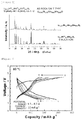
Figure 1] Figure 1 is a comparative chart of the XRD spectra of the complex oxide in Example 1 (Li4/6Ni1/6Mo1/6O) and Li5ReO6 (simulation). - [
Figure 2] Figure 2 is a chart showing charge/discharge curves in a charge/discharge test of an electrochemical cell prepared using the complex oxide in Example 1 as a positive electrode active material. - [
Figure 3] Figure 3 is a comparative chart of the XRD spectra of the complex oxide in Example 2 (Li22/30Mn5/30Mo3/30O) and Li4MoO5 (simulation). - [
Figure 4] Figure 4 is a chart showing charge/discharge curves in a charge/discharge test of an electrochemical cell prepared using the complex oxide in Example 2 as a positive electrode active material. - [
Figure 5] Figure 5 is a comparative chart of the XRD spectra of the complex oxide in Example 3 (Li42/60Ni5/60Mn5/60Mo8/60O) and Li4/3Ni1/3Mo1/3O2 (Simulation). - [
Figure 6] Figure 6 is a chart showing charge/discharge curves in a charge/discharge test of an electrochemical cell prepared using the complex oxide in Example 3 as a positive electrode active material. - [
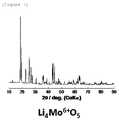
Figure 7] Figure 7 is an XRD spectrum of the complex oxide in Comparative Example 1 (Li4MoO5). - [
Figure 8] Figure 8 is a chart showing charge/discharge curves in a charge/discharge test of an electrochemical cell prepared using the complex oxide in Comparative Example 1 as a positive electrode active material. - [
Figure 9] Figure 9 is a schematic view showing the crystal structure of Li5ReO6. - [
Figure 10] Figure 10 is a schematic view showing a state in which Li and Re are in an ordered arrangement at the (111) plane of the rock-salt structure of Li5ReO6. - [
Figure 11] Figure 11 is a schematic view showing the crystal structure of Li4MoO5. - [
Figure 12] Figure 12 is a comparative chart of the XRD spectra of the complex oxide in Example 4 (Li26/40Ni5/40Mn5/40Mo4/40O) and Li4/3Ni1/3Mo1/3O2 (Simulation). - [
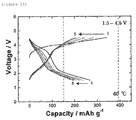
Figure 13] Figure 13 is a chart showing charge/discharge curves in a charge/discharge test of an electrochemical cell prepared using the complex oxide in Example 4 as a positive electrode active material. - [
Figure 14] Figure 14 is a schematic view showing the crystal structure of Li2MnO3. - The complex oxide of the present invention is generally represented by the following compositional formula:
LixMyMozO
wherein M is one or two or more selected from the group consisting of Mn, Ru, Sn, Mg, Al, Ti, V, Cr, Fe, Co, Ni, Cu, and Zn, and x is in the range of 0.60 to 0.75, y is in the range of 0.15 to 0.25, and z is in the range of 0.075 to 0.20. - In an embodiment, the complex oxide of the present invention satisfies: x+y+z=0.95 to 1.05, more preferably x+y+z=1. From the viewpoint of obtaining a rock-salt type crystal structure, x+y+z is required to be in the range. Although x+y+z=1 is ideal in obtaining a rock-salt type single-phase crystal, the rock-salt type crystal structure can be obtained even with a value of x+y+z of less than 1, in the range down to approximately 0.95, resulting from a deficient amount of cations or an excessive amount of oxygen. To the contrary, the rock-salt type crystal structure can be obtained even with a value of x+y+z of more than 1, in the range up to approximately 1.05.
- The complex oxide basically has a composition of lithium molybdate (Li4/5Mo1/5O) with a part of lithium or molybdenum substituted with another metal element M. The metal elements described above are selected as M, for reasons such as battery capacity, safety, and structural stability. In particular, for the reason of manifestation of the capacity, the M for use is preferably one or two or more selected from the group consisting of Ni, Mn, Fe, and Co, more preferably any one or two selected from the group consisting of Ni and Mn.
- Although the complex oxide contains impurities other than the intended elements in some cases, the impurities in a total content of 1000 ppm by mass or less have almost no effect on the characteristics. Accordingly, the complex oxide that contains such a trace amount of impurities is within the scope of the present invention.
- In the formula, x represents a proportion of Li in the metal elements. On the basis of lithium molybdate (Li4/5Mo1/5O), it can be evaluated that x represents the degree of substitution of Li with M. As the degree of substitution with M increases, x decreases. With x of less than 0.60, the battery capacity tends to decrease due to reduction in the amount of movable Li, while with x of more than 0.75, the electronic conductivity tends to decrease due to reduction in the amount of M. Accordingly, x is in the range of 0.60 to 0.75. The control of x can be performed through the adjustment of the amount of lithium sources in manufacturing of the complex oxides.
- In the formula, y represents the proportion of M in the metal elements. On the basis of lithium molybdate (Li4/5Mo1/5O), it is indicated that as the amount of M increases, the degree of substitution of Li or Mo with M increases. With y of less than 0.15, the electronic conductivity tends to decrease due to reduction in the amount of substitution for Li or Mo, while with y of more than 0.25, single crystals including no phase of impurities are unlikely to be obtained. Accordingly, y is in the range of 0.15 to 0.25. The control of y can be performed through the adjustment of the amount of M sources in manufacturing of the complex oxides.
- In the formula, z represents the proportion of Mo in the metal elements. On the basis of lithium molybdate (Li4/5Mo1/5O), it can be evaluated that z represents the degree of substitution of Mo with M. As the degree of substitution with M increases, z decreases. With z of less than 0.075, the effect of the substitution on the increase in capacity is low, while with z of more than 0.20, the electronic conductivity tends to decrease. Accordingly, z is in the range of 0.075 to 0.20. The control of z can be performed through the adjustment of the amount of Mo sources in manufacturing of the complex oxides.
- In an embodiment of the complex oxide of the present invention, the average valence of Mo is 5.7 to 6.0. The valence of Mo in lithium molybdate (Li4/5Mo1/5O) is 6, corresponding to the maximum valence which Mo can take. In lithium molybdate, Mo is, therefore, not oxidized any more, causing the problem of difficulty in charge and discharge when used as the positive electrode active material for secondary batteries.
- In the case of using the complex oxide of the present invention with an average valence of Mo set to approximately 6 as the positive electrode active material, it is therefore conceivable that sufficient charge/discharge characteristics may not be obtained. However, the substitution with a substituent metal element M greatly increases the charge/discharge capacity of lithium molybdate. It is conceivable that the increase is due to the following reasons, though the theory is not intended to limit the invention. The first reason is that the charge/discharge is performed by oxidation/reduction of the substituent metal. The second reason is that the improved conductivity due to the presence of the substituent metal enables the charge/discharge to be performed by oxidation/reduction of oxygen, which is unlikely to occur for the case of Mo alone. In the present invention, the average valence of Mo is measured by X-ray photoelectron spectroscopy.
- In the present invention, the composition is determined by quantitative analysis of each of the elements (Li, Ni, Mo, etc.) of the material using ICP (ICP spectrometer).
- In an embodiment, the complex oxide of the present invention has a rock-salt structure with ordering of a part of cations in which the mother structure is composed of oxide ions. The rock-salt structure of the complex oxide of the present invention may be a Li5ReO6-type, a Li4MoO5-type or a Li2MnO3-type. Although the mechanism to determine the crystal structure is not clear, any one of the crystal structures is selected depending on the substituent metal.
- In an embodiment, the complex oxide of the present invention has a Li5ReO6-type crystal structure with Re sites substituted with Mo or M, and with a part of Li sites substituted with M. It is known that the crystal structure of Li5ReO6 belongs to a space group c2/m (monoclinic system) as shown in
Figure 9 , with lattice constants: a=5.06796 Å, b=8.73158 Å, c=5.02936 Å (T. Betz, R. Hoppe, Z. Anorg. Allg. Chem. 512. 19-33 (1984)). Li5ReO6 has a structure including the same oxygen skeleton as in the rock-salt structure, with Re and Li in an ordered arrangement at a ratio of 1:5 in the 6-coordinated octahedral sites. The crystal structure of Li5ReO6 as a rock-salt structure has two (001) planes, with a layered structure including a layer of Li without Re and a layer of Re and Li in an ordered arrangement at an atomic ratio of 1:2 in parallel with the (001) plane (refer toFigure 10 ). In the present invention, the term "Li5ReO6-type crystal structure" indicates a structure in coincidence with the crystal framework, regardless of the lattice constant. - In an embodiment, the complex oxide of the present invention has a Li4MoO5-type crystal structure with a part of Mo sites substituted with M, and with a part of Li sites substituted with M. It is known that the crystal structure of Li4MoO5 belongs to a space group P-1 as shown in
Figure 11 , with lattice constants: a=5.119 Å, b=7.727 Å, c=5.064 Å (T. Betz, R. Hoppe, Z. Anorg. Allg. Chem. 573. 157-169 (1989)). In the present invention, the term "Li4MoO5-type crystal structure" indicates a structure in coincidence with the crystal framework, regardless of the lattice constant. - In an embodiment, the complex oxide of the present invention has a Li2MnO3-type crystal structure with Mn sites substituted with M or Mo. It is known that the crystal structure of Li2MnO3 belongs to a space group C2/m as shown in
Figure 14 , with lattice constants: a=4.937 Å, b=8.532 Å, c=5.032 Å, and beta=109.46 deg (P. STROBEL AND B. LAMBERT-ANDRON, JOURNAL OF SOLID STATE CHEMISTRY 75, 90-98 (1988)). In the present invention, the term "Li2MnO3-type crystal structure" includes a structure in coincidence with the crystal framework, regardless of the lattice constant. - The method for manufacturing a complex oxide of the present invention is described as follows. In an embodiment of the method for manufacturing a complex oxide of the present invention, comprises the steps of: preparing a mixture including a lithium compound, a hexavalent molybdenum compound, and a compound of one or two or more metals selected from the group consisting of Mn, Ru, Sn, Mg, Al, Ti, V, Cr, Fe, Co, Ni, Cu, and Zn at a target metal composition ratio; and firing the mixture.
- Examples of the lithium compound include, but are not limited to, lithium carbonate, lithium hydroxide, lithium oxide, lithium chloride, lithium nitrate, lithium sulfate, lithium hydrogen carbonate, lithium acetate, lithium fluoride, lithium bromide, lithium iodide, and lithium peroxide. In particular, lithium carbonate and lithium hydroxide are preferred due to high solubility.
- The hexavalent molybdenum compound is used due to high solubility. Examples thereof include, but are not limited to, molybdenum trioxide (MoO3).
- In the case of using nickel as the metal element M, examples of the manganese compound include, but are not limited to, metallic nickel, nickel oxide, nickel hydroxide, nickel nitrate, nickel carbonate, nickel chloride, nickel iodide, and nickel sulfate.
- In the case of using manganese as metallic element M, examples of the manganese compound include, but are not limited to, metallic manganese, manganese oxide, manganese hydroxide, manganese nitrate, manganese carbonate, manganese chloride, manganese iodide, and manganese sulfate.
- In the case of using cobalt as metallic element M, examples of the cobalt compound include, but are not limited to, metallic cobalt, cobalt oxide, cobalt hydroxide, cobalt nitrate, cobalt carbonate, cobalt chloride, cobalt iodide, and cobalt sulfate.
- In the case of using other metals, i.e., Ru, Sn, Mg, Al, Ti, V, Cr, Fe, Cu or Zn, as metal element M, the carbonates, nitrates, hydroxides, chlorides, oxides, etc., thereof may be used in the same way.
- The mixing method is described as follows. Examples of the mixing method include, but are not limited to, a method of directly mixing powdery raw materials in a mortar or the like and a method of stirring and mixing raw materials dissolved or suspended in water and/or an organic solvent. The latter method is preferred as more uniform mixing can be achieved.
- A preferred example of the latter method is as follows. First, an aqueous solution of lithium hydroxide is prepared using pure water. The appropriate concentration of lithium hydroxide in the aqueous solution is approximately 5 to 120 g/L, depending on the amount to be mixed. Subsequently, desired amounts of metal compound powder of molybdenum, nickel, cobalt, etc., are fed into the aqueous solution of lithium hydroxide so as to be stirred and mixed.
- After evaporation of moisture from the resulting aqueous solution or the aqueous dispersion of the raw material mixture, an oxidation treatment (firing in an oxidizing atmosphere or the like) is performed under proper conditions to thereby obtain a complex oxide of the present invention. Molding into a desired shape may be performed prior to the oxidation treatment. In the preferred oxidation treatment, heating is performed such that the material temperature is held at 800 to 1100°C. At a temperature lower than 800°C, Li and other metals are not homogenized, while at a temperature higher than 1100°C, lithium defects increase, resulting in characteristic degradation such as capacity reduction. The holding time at the holding temperature is preferably 0.5 to 20 hours. The reasons are that with an excessively short holding time, Li and other metals are not homogenized, while with an excessively long holding time, the specific surface area decreases or lithium defects increase, resulting in characteristic degradation such as capacity reduction.
- Cooling is then performed, while the continuous flow of an oxygen-containing gas such as air and oxygen is preferably maintained during the period from the initiation of heating the raw material mixture, through firing, until cooling to room temperature. The reason is to prevent oxygen defects and reduction in the oxidation number of molybdenum during the oxidation treatment.
- The resulting complex oxide can be used as a positive electrode active material for a non-aqueous electrolyte secondary battery such as a lithium ion battery. In accordance with known means, a positive electrode for a non-aqueous electrolyte secondary battery can be manufactured. For example, a positive electrode mixture is prepared by mixing powder of the positive electrode active material of the present invention with a binder such as polyvinylidene fluoride, polytetrafluoroethylene, and a polyamide acrylic resin, and a conducting material such as acetylene black and graphite.
- In preparation of a positive electrode mixture, it is important to uniformly mix the respective raw materials from the viewpoint of the manifestation of a battery capacity. The mixing method is not particularly limited, and a multiaxial dispersion kneader, a planetary kneader, a ball mill, etc., can be used.
- Subsequently, the slurry of the positive electrode mixture is applied to a current collector such as aluminum foil, and pressed to make a positive electrode. Furthermore, by using the positive electrode of the present invention, a non-aqueous electrolyte secondary battery, in particular a lithium ion secondary battery, can be manufactured in accordance with a conventional method.
- Hereinafter, Examples are provided for a better understanding of the present invention and the advantages thereof, though the present invention is not limited to these Examples.
- In a mortar, 3.43 g of LiOH·H2O powder (3% excess in weight) and 2.83 g of molybdenum oxide (MoO3) powder were mixed, and the mixture was molded into a pellet, which was then fired by being raised to 1050°C and held thereat for 2 hours in a small furnace under air flow.
- Each content of the elements in the resulting complex oxide was determined by ICP (SPS3520UV manufactured by SII Nano Technology Inc.), and the complex oxide was confirmed to be Li4MoO5. Furthermore, the average valence of molybdenum was confirmed to be 6 by the X-ray photoelectron spectroscopy measurement (5600MC manufactured by ULVAC-PHI Inc.) under the following conditions (the same as in the following Test Examples).
- Ultimate vacuum: in the order of 10-7 Pa
- Excitation source: monochromatized AlKa
- Output: 210 W
- Detection area: 800-µm diameter
- Incident angle: 45 degrees
- Take-off angle: 45 degrees
- Neutralizing gun: used on an as needed basis
- Sputtering conditions: ion species: Ar+, acceleration voltage: 1 to 3 kV
- Using an X-ray diffractometer (MultiFlex, manufactured by Rigaku Corporation) (CuKα radiation) equipped with a high-speed one-dimensional detector (D/teX Ultra, manufactured by Rigaku Corporation), the XRD spectrum of the resulting complex oxide was analyzed under the conditions with an output of 40 kV at 20 mA, a scanning speed of 8°/min, and a sampling width of 0.02°. The results are shown in
Figure 7 . Since the results agreed with the XRD results described in literature (R. Hoppe et al., Z. Anorg. Allg Chem 573 (1989) 157 to 169), it is believed that the complex oxide has a P-1 crystal structure. - The positive electrode active material (the complex oxide synthesized as described above) and acetylene black (manufactured by Wako Pure Chemical Industries, Ltd.) were weighed at a mass ratio of 80:20, and mixed for 24 hours in a dry ball mill (600 rpm). Subsequently, the mixture of the positive electrode active material and acetylene black described above was added to a binder (PVDF resin, manufactured by Polysciences, Inc.) dissolved in an organic solvent (N-methylpyrrolidone), at a mass ratio of (positive electrode active material):(acetylene black):(binder)=72:18:10, to make a slurry. The slurry was applied onto an Al foil, dried, and then pressed to make a positive electrode.
- Subsequently, an electrochemical cell with a counter electrode of Li foil was prepared for evaluation. Using 1 M-LiPF6 dissolved in EC/DMC (volume ratio of 1:1) as an electrolytic solution, a charge/discharge test was performed at a current density of 10 mA/g. The charge/discharge test was performed at room temperature, in the range of 1.0 to 5.0 V. The results are shown in
Figure 8 . The capacity was less than 100 mAh/g even in the first cycle, and reached zero after repeating several cycles. This shows that Li4MoO5 itself is unlikely to manifest a capacity for practical use. - In 60 mL of ion-exchanged water, 0.6700 g of LiOH·H2O (3% excess in weight) was dissolved to prepare 60 mL of an aqueous solution of lithium hydroxide with a concentration of 0.2661 mol/L. Subsequently, 0.5176 g of molybdenum oxide (MoO3) powder was dissolved in the aqueous solution of lithium hydroxide, and 0.4665 g of basic nickel carbonate powder was added thereto, to prepare a suspension with an excess of Li of 3% in weight ratio relative to the molar ratio of Li:Ni:Mo=4:1:1. The suspension was stirred with a hot stirrer, and the moisture was then evaporated.
- The resulting sample was powdered in a mortar, and the powder was molded into a pellet, which was then fired by being raised to 1050°C and held thereat in a small furnace for 2 hours under air flow.
- Each content of the elements in the resulting complex oxide was determined by ICP (SPS3520UV manufactured by SII Nano Technology Inc.), and it was confirmed that the complex oxide has a composition (x, y, z)=(4/6, 1/6, 1/6). Further, the average valence of molybdenum was confirmed to be 6 by the X-ray photoelectron spectroscopy measurement.
- Using an X-ray diffractometer (MultiFlex, manufactured by Rigaku Corporation) (CuKαradiation), the XRD spectrum of the resulting complex oxide was analyzed under the conditions with an output of 40 kV at 20 mA, a scanning speed of 8°/min, and a sampling width of 0.02°. The results are shown in
Figure 1 . In addition, the XRD spectrum of Li5ReO6-type Li4/3Ni1/3Mo1/3O2 (simulation) cited from T. Betz, R. Hoppe, Z. Anorg. Allg. Chem. 512. 19-33 (1984) is also shown inFigure 1 . Although impurities are found in some parts, main peaks are coincident. It is believed that the complex oxide has a crystal structure of Li5ReO6, with Re7+ sites substituted with Mo6+ and a part of Li+ sites substituted with Ni2+. It can be, therefore, said that the complex oxide has a rock-salt structure with ordering of a part of the cations. - The positive electrode active material (the complex oxide synthesized as described above) and acetylene black (manufactured by Wako Pure Chemical Industries, Ltd.) were weighed at a mass ratio of 80:20, and mixed for 24 hours in a dry ball mill (600 rpm). Subsequently, the mixture of the positive electrode active material and acetylene black described above was added to a binder (PVDF resin, manufactured by Polysciences, Inc.) dissolved in an organic solvent (N-methylpyrrolidone), at a mass ratio of (positive electrode active material):(acetylene black):(binder)=72:18:10, to make a slurry. The slurry was applied onto an Al foil, dried, and then pressed to make a positive electrode.
- Subsequently, an electrochemical cell with a counter electrode of Li foil was prepared for evaluation. Using 1 M-LiPF6 dissolved in EC/DMC (volume ratio of 1:1) as an electrolytic solution, a charge/discharge test was performed at a current density of 10 mA/g. The charge/discharge test was performed at room temperature, in the range of 1.5 to 4.5 V. The results are shown in
Figure 2 . It is shown that until the second cycle the capacity exceeded the theoretical capacity of Ni2+/Ni4+ (193 mAh/g). This suggests that O (oxygen) contributed to the oxidation/reduction. Further, even after 10 cycles, a capacity of 100 mAh/g or more was shown in both of charging and discharging. Furthermore, it is shown that the polarization between charge and discharge is small, from the fact that the voltage difference between the charge curve and the discharge curve was small. - In 60 mL of ion-exchanged water, 0.8037 g of LiOH·H2O (3% excess in weight) was dissolved to prepare 60 mL of an aqueous solution of lithium hydroxide with a concentration of 0.3192 mol/L. Subsequently, 0.3617 g of molybdenum oxide (MoO3) powder was dissolved in the aqueous solution of lithium hydroxide, and 0.5175 g of manganese carbonate (MnCO3) powder was added thereto, to prepare a suspension with an excess of Li of 3% in weight ratio relative to the molar ratio of Li:Mn:Mo=22:5:3. The suspension was stirred with a hot stirrer, and the moisture was then evaporated.
- The resulting sample was powdered in a mortar, and the powder was molded into a pellet, which was then fired by being raised to 1050°C and held thereat for 2 hours in a small furnace under air flow.
- Each content of the elements in the resulting complex oxide was determined by ICP (SPS3520UV manufactured by SII Nano Technology Inc.), and it was confirmed that the complex oxide has a composition (x, y, z)=(22/30, 5/30, 3/30). Further, the average valence of molybdenum was confirmed to be 6 by the X-ray photoelectron spectroscopy measurement.
- Using an X-ray diffractometer (MultiFlex, manufactured by Rigaku Corporation) (CuKα radiation), the XRD spectrum of the resulting complex oxide was analyzed under the conditions with an output of 40 kV at 20 mA, a scanning speed of 8°/min, and a sampling width of 0.02°. The results are shown in
Figure 3 . In addition, the XRD spectrum of Li4MoO5 (simulation) cited from T. Betz and R. Hoppe, Z. Anorg. Allg. Chem., 1984, 512, 19 is also shown inFigure 3 . Although impurities are found in some parts, main peaks are coincident. It is believed that the complex oxide has a crystal structure of Li4MoO5, with a part of Li sites and a part of Mo sites substituted with Mn. Accordingly, it can also be said that the complex oxide has a rock-salt structure with ordering of a part of the cations. - The positive electrode active material (the complex oxide synthesized as described above) and acetylene black (manufactured by Wako Pure Chemical Industries, Ltd.) were weighed at a mass ratio of 80:20, and mixed for 12 hours in a dry ball mill (200 rpm). Subsequently, the mixture of the positive electrode active material and acetylene black described above was added to a binder (PVDF resin, manufactured by Polysciences, Inc.) dissolved in an organic solvent (N-methylpyrrolidone), at a mass ratio of (positive electrode active material):(acetylene black):(binder)=72:18:10, to make a slurry. The slurry was applied onto an Al foil, dried, and then pressed to make a positive electrode.
- Subsequently, an electrochemical cell with a counter electrode of Li foil was prepared for evaluation. Using 1 M-LiPF6 dissolved in EC/DMC (volume ratio of 1:1) as an electrolytic solution, a charge/discharge test was performed at a current density of 10 mA/g. The charge/discharge test was performed at room temperature, in the range of 1.5 to 4.8 V. The results are shown in
Figure 4 . The charging capacity in the third cycle rose to 460 mAh/g, which was higher than the initial charging capacity. - In 60 mL of ion-exchanged water, 0.7088 g of LiOH·H2O (3% excess in weight) was dissolved to prepare 60 mL of an aqueous solution of lithium hydroxide with a concentration of 0.2815 mol/L. Subsequently, 0.4455 g of molybdenum oxide (MoO3) powder was added to the aqueous solution of lithium hydroxide, and 0.2391 g of manganese carbonate (MnCO3) powder and 0.2510 g of basic nickel carbonate were further added thereto, to prepare a suspension with an excess of Li of 3% in weight ratio relative to the molar ratio of Li:Ni:Mn:Mo=42:5:5:8. The suspension was stirred with a hot stirrer, and the moisture was then evaporated to dryness.
- The resulting sample was powdered in a mortar, and the powder was molded into a pellet, which was then fired by being raised to 1050°C and held thereat for 2 hours in a small furnace under air flow.
- Each content of the elements in the resulting complex oxide was determined by ICP-MS (SPQ-9100 manufactured by SII Nano Technology Inc.), and it was confirmed that the complex oxide has a composition (x, y, z)=(42/60, 10/60, 8/60). Further, the average valence of molybdenum was confirmed to be 6 by the X-ray photoelectron spectroscopy measurement.
- Using an X-ray diffractometer (MultiFlex, manufactured by Rigaku Corporation) (CuKα radiation), the XRD spectrum of the resulting complex oxide was analyzed under the conditions with an output of 40 kV at 20 mA, a scanning speed of 8°/min, and a sampling width of 0.02°. The results are shown in
Figure 5 . In addition, the XRD spectrum of Li5ReO6-type Li4/3Ni1/3Mo1/3O2 (simulation) cited from T. Betz and R. Hoppe, Z. Anorg. Allg. Chem., 1984, 512, 19., is also shown inFigure 5 . It is believed that the complex oxide has a crystal structure of Li5ReO6, with Re7+ sites substituted with Mo6+ and Li+ sites substituted with Ni. Accordingly, it can also be said that the complex oxide has a rock-salt structure with ordering of a part of the cations. Further, Mn may substitute for both of the Li+ sites and the Re7+ sites. - The positive electrode active material (the complex oxide synthesized as described above) and acetylene black (manufactured by Wako Pure Chemical Industries, Ltd.) were weighed at a mass ratio of 80:20, and mixed for 12 hours in a dry ball mill (200 rpm). Subsequently, the mixture of the positive electrode active material and acetylene black described above was added to a binder (PVDF resin, manufactured by Polysciences, Inc.) dissolved in an organic solvent (N-methylpyrrolidone), at a mass ratio of (positive electrode active material):(acetylene black):(binder)=72:18:10, to make a slurry. The slurry was applied onto an Al foil, dried, and then pressed to make a positive electrode.
- Subsequently, an electrochemical cell with a counter electrode of Li foil was prepared for evaluation. Using 1 M-LiPF6 dissolved in EC/DMC (volume ratio of 1:1) as an electrolytic solution, a charge/discharge test was performed at a current density of 10 mA/g. The charge/discharge test was performed at a temperature of 60°C, in the range of 1.5 to 4.5 V. The results are shown in
Figure 6 . It is shown that the charging capacity was higher than the theoretical capacity of Ni2+/Ni4+ (151 mAh/g) even after 5 cycles. - In 60 mL of ion-exchanged water, 0.64 g of LiOH·H2O (3% excess in weight) was dissolved to prepare an aqueous solution of lithium hydroxide with a concentration of 0.2544 mol/L. Subsequently, 0.3252 g of molybdenum oxide (MoO3) powder was added to the aqueous solution of lithium hydroxide, and 0.3490 g of manganese carbonate (MnCO3) powder and 0.3664 g of basic nickel carbonate were further added thereto, to prepare a suspension with an excess of Li of 3% in weight ratio relative to the molar ratio of Li:Ni:Mn:Mo=26:5:5:4. The suspension was stirred with a hot stirrer, and the moisture was then evaporated.
- The resulting sample was powdered in a mortar, and the powder was molded into a pellet, which was then fired by being raised to 1050°C and held threat for 2 hours in a small furnace under air flow.
- In 60 mL of ion-exchanged water, 0.6840 g of LiOH·H2O (10% excess in weight) was dissolved to prepare 60 mL of an aqueous solution of lithium hydroxide with a concentration of 0.2717 mol/L. Subsequently, 0.3252 g of molybdenum oxide (MoO3) powder was added to the aqueous solution of lithium hydroxide, and 0.3490 g of manganese carbonate (MnCO3) powder and 0.3664 g of basic nickel carbonate were further added thereto, to prepare a suspension with an excess of Li of 10% in weight ratio relative to the molar ratio of Li:Ni:Mn:Mo=26:5:5:4. The suspension was stirred with a hot stirrer, and the moisture was then evaporated.
- The resulting sample was powdered in a mortar, and the powder was molded into a pellet, which was then fired by being raised to 1050°C and held thereat for 2 hours in a small furnace under air flow.
- Each content of the elements in the resulting complex oxides of No. 1 and No. 2 was determined by ICP-MS (SPQ-9100 manufactured by SII Nano Technology Inc.), and it was confirmed that both of the complex oxides have a composition (x, y, z)=(26/40, 10/40, 4/40). Further, the average valence of molybdenum was confirmed to be 6 in both of the complex oxides by the X-ray photoelectron spectroscopy measurement.
- Using an X-ray diffractometer (MultiFlex, manufactured by Rigaku Corporation) (CuKα radiation), each XRD spectrum of the resulting complex oxides of No. 1 and No. 2 was analyzed under the conditions with an output of 40 kV at 20 mA, a scanning speed of 8°/min, and a sampling width of 0.02°. The results are shown in
Figure 12 . In addition, the XRD spectrum of Li5ReO6-type Li4/3Ni1/3Mo1/3O2 (simulation) cited from T. Betz and R. Hoppe, Z. Anorg. Allg. Chem., 1984, 512, 19. is also shown inFigure 12 . It is believed that the complex oxides have a crystal structure of Li5ReO6, with Re7+ sites substituted with Mo6+ and Li+ sites substituted with Ni. Accordingly, it can also be said that the complex oxides have a rock-salt structure with ordering of a part of the cations. Further, Mn may substitute for both of the Li+ sites and the Re7+ sites. - The positive electrode active material (the complex oxide synthesized as described above) of No. 2 and acetylene black (manufactured by Wako Pure Chemical Industries, Ltd.) were weighed at a mass ratio of 80:20, and mixed for 12 hours in a dry ball mill (200 rpm). Subsequently, the mixture of the positive electrode active material and acetylene black described above was added to a binder (PVDF resin, manufactured by Polysciences, Inc.) dissolved in an organic solvent (N-methylpyrrolidone), at a mass ratio of (positive electrode active material):(acetylene black):(binder)=72:18:10, to make a slurry. The slurry was applied onto an Al foil, dried, and then pressed to make a positive electrode.
- Subsequently, an electrochemical cell with a counter electrode of Li foil was prepared for evaluation. Using 1 M-LiPF6 dissolved in EC/DMC (volume ratio of 1:1) as an electrolytic solution, a charge/discharge test was performed at a current density of 10 mA/g. The charge/discharge test was performed at a temperature of 60°C, in the range of 1.5 to 4.5 V. The results are shown in
Figure 13 . It is shown that the charging capacity was higher than the theoretical capacity of Ni2+/Ni4+ (151 mAh/g) even after 5 cycles.
Claims (9)
- A complex oxide represented by the following compositional formula:
LixMyMozO
wherein M is one or two or more selected from the group consisting of Mn, Ru, Sn, Mg, Al, Ti, V, Cr, Fe, Co, Ni, Cu, and Zn, and x is in the range of 0.60 to 0.75, y is in the range of 0.15 to 0.25, and z is in the range of 0.075 to 0.20. - The complex oxide according to claim 1, wherein the complex oxide has a rock-salt structure with ordering of a part of cations.
- The complex oxide according to claim 1 or 2, wherein the complex oxide has a Li5ReO6-type crystal structure with Re sites substituted with Mo or M, and with a part of Li sites substituted with M.
- The complex oxide according to claim 1 or 2, wherein the complex oxide has a Li4MoO5-type crystal structure with a part of Mo sites substituted with M, and with a part of Li sites substituted with M.
- The complex oxide according to claim 1 or 2, wherein the complex oxide has a Li2MnO3-type crystal structure with Mn sites substituted with Mo or M, and with a part of Li sites substituted with M.
- The complex oxide according to any one of claims 1 to 5, satisfying: x+y+z=0.95 to 1.05.
- The complex oxide according to any one of claims 1 to 6, wherein M is one or two or more selected from the group consisting of Ni, Mn, Fe, and Co.
- A positive electrode for a non-aqueous electrolyte secondary battery, comprising the complex oxide according to any one of claims 1 to 7 as a positive electrode active material.
- A non-aqueous electrolyte secondary battery comprising the positive electrode according to claim 8.
Priority Applications (1)
| Application Number | Priority Date | Filing Date | Title |
|---|---|---|---|
| PL15759084T PL3085669T3 (en) | 2014-03-03 | 2015-02-25 | Lithium complex oxide |
Applications Claiming Priority (2)
| Application Number | Priority Date | Filing Date | Title |
|---|---|---|---|
| JP2014040958A JP6117718B2 (en) | 2014-03-03 | 2014-03-03 | Lithium composite oxide |
| PCT/JP2015/055452 WO2015133348A1 (en) | 2014-03-03 | 2015-02-25 | Lithium complex oxide |
Publications (3)
| Publication Number | Publication Date |
|---|---|
| EP3085669A1 true EP3085669A1 (en) | 2016-10-26 |
| EP3085669A4 EP3085669A4 (en) | 2017-08-23 |
| EP3085669B1 EP3085669B1 (en) | 2019-12-11 |
Family
ID=54055157
Family Applications (1)
| Application Number | Title | Priority Date | Filing Date |
|---|---|---|---|
| EP15759084.5A Active EP3085669B1 (en) | 2014-03-03 | 2015-02-25 | Lithium complex oxide |
Country Status (8)
| Country | Link |
|---|---|
| US (1) | US10153487B2 (en) |
| EP (1) | EP3085669B1 (en) |
| JP (1) | JP6117718B2 (en) |
| CN (1) | CN105939968B (en) |
| HU (1) | HUE048017T2 (en) |
| PL (1) | PL3085669T3 (en) |
| TW (1) | TWI575801B (en) |
| WO (1) | WO2015133348A1 (en) |
Cited By (1)
| Publication number | Priority date | Publication date | Assignee | Title |
|---|---|---|---|---|
| EP3286790A4 (en) * | 2015-04-23 | 2018-10-17 | Umicore | Cathode material for a lithium-ion rechargeable battery |
Families Citing this family (6)
| Publication number | Priority date | Publication date | Assignee | Title |
|---|---|---|---|---|
| DE102015217743A1 (en) * | 2015-09-16 | 2017-03-16 | Robert Bosch Gmbh | Active material for a positive electrode of a battery cell, positive electrode and battery cell |
| CN106654184A (en) * | 2015-10-29 | 2017-05-10 | 上海比亚迪有限公司 | Lithium ion battery positive electrode material additive, positive electrode material, positive electrode and battery |
| JP7024386B2 (en) * | 2016-12-26 | 2022-02-24 | 株式会社Gsユアサ | Method for manufacturing negative electrode active material, negative electrode, non-aqueous electrolyte storage element, and non-aqueous electrolyte storage element |
| KR102680029B1 (en) * | 2018-09-20 | 2024-06-28 | 주식회사 엘지에너지솔루션 | Positive electrode active material for lithium secondary battery and manufacturing method thereof |
| CN109509875B (en) * | 2018-11-26 | 2021-09-10 | 合肥国轩高科动力能源有限公司 | High-rate single crystal lithium nickel cobalt manganese oxide cathode material and preparation method thereof |
| CN114958033B (en) * | 2022-04-11 | 2024-01-02 | 厦门稀土材料研究所 | A kind of high near-infrared reflective color pigment and its application |
Family Cites Families (12)
| Publication number | Priority date | Publication date | Assignee | Title |
|---|---|---|---|---|
| JP2526093B2 (en) | 1988-05-20 | 1996-08-21 | 日立マクセル株式会社 | Lithium secondary battery |
| JP3670875B2 (en) | 1999-02-09 | 2005-07-13 | 三洋電機株式会社 | Lithium secondary battery |
| US6811925B2 (en) | 2000-11-20 | 2004-11-02 | Chuo Denki Kogyo Co., Ltd. | Nonaqueous electrolyte secondary cell and a tungsten or molybdenum substituted lithium positive electrode active material |
| EP1511101B1 (en) * | 2003-08-21 | 2015-05-27 | Samsung SDI Co., Ltd. | Negative active material for non-aqueous electrolyte battery, method of preparing same, and non-aqueous electrolyte battery comprising same |
| JP5137301B2 (en) | 2005-09-08 | 2013-02-06 | 三洋電機株式会社 | Nonaqueous electrolyte secondary battery |
| US20070141470A1 (en) * | 2005-12-16 | 2007-06-21 | Kensuke Nakura | Lithium ion secondary battery |
| JP5451228B2 (en) | 2008-07-25 | 2014-03-26 | 三井金属鉱業株式会社 | Lithium transition metal oxide with layer structure |
| KR101578706B1 (en) * | 2008-12-05 | 2015-12-18 | 삼성에스디아이 주식회사 | Cathode and lithium battery employing it |
| KR101202334B1 (en) * | 2010-07-20 | 2012-11-16 | 삼성에스디아이 주식회사 | Positive electrode and Lithium battery comprising the same |
| CN102306779B (en) * | 2011-09-06 | 2014-08-06 | 上海交通大学 | Lithium ion battery positive electrode material lithium-enriched doped lithium molybdate and preparation method thereof |
| WO2014055665A2 (en) * | 2012-10-02 | 2014-04-10 | Massachusetts Institute Of Technology | High-capacity positive electrode active material |
| CN105895905B (en) * | 2015-02-13 | 2021-06-22 | 松下知识产权经营株式会社 | Battery Cathode Materials and Lithium-Ion Batteries |
-
2014
- 2014-03-03 JP JP2014040958A patent/JP6117718B2/en active Active
-
2015
- 2015-02-25 HU HUE15759084A patent/HUE048017T2/en unknown
- 2015-02-25 PL PL15759084T patent/PL3085669T3/en unknown
- 2015-02-25 US US15/111,021 patent/US10153487B2/en active Active
- 2015-02-25 EP EP15759084.5A patent/EP3085669B1/en active Active
- 2015-02-25 CN CN201580005937.0A patent/CN105939968B/en active Active
- 2015-02-25 WO PCT/JP2015/055452 patent/WO2015133348A1/en not_active Ceased
- 2015-03-03 TW TW104106613A patent/TWI575801B/en active
Cited By (2)
| Publication number | Priority date | Publication date | Assignee | Title |
|---|---|---|---|---|
| EP3286790A4 (en) * | 2015-04-23 | 2018-10-17 | Umicore | Cathode material for a lithium-ion rechargeable battery |
| US10910646B2 (en) | 2015-04-23 | 2021-02-02 | Umicore | Cathode material for a lithium-ion rechargeable battery |
Also Published As
| Publication number | Publication date |
|---|---|
| CN105939968A (en) | 2016-09-14 |
| JP6117718B2 (en) | 2017-04-19 |
| JP2015166291A (en) | 2015-09-24 |
| PL3085669T3 (en) | 2020-05-18 |
| TWI575801B (en) | 2017-03-21 |
| EP3085669A4 (en) | 2017-08-23 |
| US20160344026A1 (en) | 2016-11-24 |
| HUE048017T2 (en) | 2020-05-28 |
| US10153487B2 (en) | 2018-12-11 |
| TW201543743A (en) | 2015-11-16 |
| EP3085669B1 (en) | 2019-12-11 |
| WO2015133348A1 (en) | 2015-09-11 |
| CN105939968B (en) | 2018-08-31 |
Similar Documents
| Publication | Publication Date | Title |
|---|---|---|
| Zhu et al. | Single-crystal based studies for correlating the properties and high-voltage performance of Li [Ni x Mn y Co 1− x− y] O 2 cathodes | |
| US7678503B2 (en) | Surface and bulk modified high capacity layered oxide cathodes with low irreversible capacity loss | |
| Chen et al. | Oxygen vacancies in SnO2 surface coating to enhance the activation of layered Li-Rich Li1. 2Mn0. 54Ni0. 13Co0. 13O2 cathode material for Li-ion batteries | |
| Ates et al. | A Li-rich layered cathode material with enhanced structural stability and rate capability for Li-on batteries | |
| Liu et al. | Mg gradient-doped LiNi0. 5Mn1. 5O4 as the cathode material for Li-ion batteries | |
| Kam et al. | Electrochemical and physical properties of Ti-substituted layered nickel manganese cobalt oxide (NMC) cathode materials | |
| Redel et al. | High-performance Li-rich layered transition metal oxide cathode materials for Li-ion batteries | |
| US10290869B2 (en) | Doped lithium-rich layered composite cathode materials | |
| EP3085669B1 (en) | Lithium complex oxide | |
| Hwang et al. | Influence of Mn content on the morphology and electrochemical performance of LiNi 1− x− y Co x Mn y O 2 cathode materials | |
| JP2020068210A (en) | Composite positive electrode active material, positive electrode containing the same, lithium battery and manufacturing method thereof | |
| Tabuchi et al. | Fine Li (4− x)/3 Ti (2− 2x)/3 Fe x O 2 (0.18≤ x≤ 0.67) powder with cubic rock-salt structure as a positive electrode material for rechargeable lithium batteries | |
| CA2976022C (en) | Positive electrode active substance comprising lithium nickel-cobalt-manganese-based composite transition metal layered oxide for non-aqueous electrolyte secondary batteries, and non-aqueous electrolyte secondary battery | |
| Sun et al. | The preparation and electrochemical performance of solid solutions LiCoO2–Li2MnO3 as cathode materials for lithium ion batteries | |
| Ahn et al. | Achieving high capacity and rate capability in layered lithium transition metal oxide cathodes for lithium-ion batteries | |
| Martinez-Cruz et al. | Improving the structural reversibility of LiNiO2 by incorporation of Cu, an electrochemical and in-situ XRD study | |
| Ye et al. | Al, B, and F doped LiNi1/3Co1/3Mn1/3O2 as cathode material of lithium-ion batteries | |
| Wang et al. | High capacity spherical Li [Li0. 24Mn0. 55Co0. 14Ni0. 07] O2 cathode material for lithium ion batteries | |
| KR20170039707A (en) | Cathode compositions for lithium-ion batteries | |
| Baboo et al. | Facile redox synthesis of layered LiNi1/3Co1/3Mn1/3O2 for rechargeable Li-ion batteries | |
| Boyanov et al. | The electrochemical reactivity of the NiP3 skutterudite-type phase with lithium | |
| US11390534B2 (en) | Tungsten trioxide | |
| US20240228324A1 (en) | Compositions and methods for making lithium-transition metal oxide compounds including niobium | |
| Dahiya et al. | Effect of potassium doping on the electrochemical properties of 0.5 Li2MnO3-0.5 LiMn0. 375Ni0. 375Co0. 25O2 cathode | |
| Wang et al. | Surface composition and electrochemical behavior of LiNi1/3Co1/3Mn1/3O2 cathode material with copper additive |
Legal Events
| Date | Code | Title | Description |
|---|---|---|---|
| PUAI | Public reference made under article 153(3) epc to a published international application that has entered the european phase |
Free format text: ORIGINAL CODE: 0009012 |
|
| 17P | Request for examination filed |
Effective date: 20160718 |
|
| AK | Designated contracting states |
Kind code of ref document: A1 Designated state(s): AL AT BE BG CH CY CZ DE DK EE ES FI FR GB GR HR HU IE IS IT LI LT LU LV MC MK MT NL NO PL PT RO RS SE SI SK SM TR |
|
| AX | Request for extension of the european patent |
Extension state: BA ME |
|
| DAX | Request for extension of the european patent (deleted) | ||
| A4 | Supplementary search report drawn up and despatched |
Effective date: 20170726 |
|
| RIC1 | Information provided on ipc code assigned before grant |
Ipc: C01G 53/00 20060101AFI20170720BHEP Ipc: H01M 4/02 20060101ALI20170720BHEP Ipc: H01M 4/485 20100101ALI20170720BHEP Ipc: H01M 4/131 20100101ALI20170720BHEP Ipc: H01M 4/525 20100101ALI20170720BHEP Ipc: H01M 4/04 20060101ALI20170720BHEP Ipc: H01M 4/66 20060101ALI20170720BHEP Ipc: H01M 4/1391 20100101ALI20170720BHEP Ipc: C01G 45/00 20060101ALI20170720BHEP Ipc: C01G 45/12 20060101ALI20170720BHEP Ipc: H01M 4/62 20060101ALI20170720BHEP Ipc: H01M 10/0525 20100101ALI20170720BHEP Ipc: H01M 4/505 20100101ALI20170720BHEP |
|
| STAA | Information on the status of an ep patent application or granted ep patent |
Free format text: STATUS: EXAMINATION IS IN PROGRESS |
|
| 17Q | First examination report despatched |
Effective date: 20180604 |
|
| GRAP | Despatch of communication of intention to grant a patent |
Free format text: ORIGINAL CODE: EPIDOSNIGR1 |
|
| STAA | Information on the status of an ep patent application or granted ep patent |
Free format text: STATUS: GRANT OF PATENT IS INTENDED |
|
| INTG | Intention to grant announced |
Effective date: 20190813 |
|
| GRAS | Grant fee paid |
Free format text: ORIGINAL CODE: EPIDOSNIGR3 |
|
| GRAA | (expected) grant |
Free format text: ORIGINAL CODE: 0009210 |
|
| STAA | Information on the status of an ep patent application or granted ep patent |
Free format text: STATUS: THE PATENT HAS BEEN GRANTED |
|
| AK | Designated contracting states |
Kind code of ref document: B1 Designated state(s): AL AT BE BG CH CY CZ DE DK EE ES FI FR GB GR HR HU IE IS IT LI LT LU LV MC MK MT NL NO PL PT RO RS SE SI SK SM TR |
|
| REG | Reference to a national code |
Ref country code: GB Ref legal event code: FG4D |
|
| REG | Reference to a national code |
Ref country code: CH Ref legal event code: EP |
|
| REG | Reference to a national code |
Ref country code: AT Ref legal event code: REF Ref document number: 1212012 Country of ref document: AT Kind code of ref document: T Effective date: 20191215 |
|
| REG | Reference to a national code |
Ref country code: DE Ref legal event code: R096 Ref document number: 602015043480 Country of ref document: DE |
|
| REG | Reference to a national code |
Ref country code: IE Ref legal event code: FG4D |
|
| REG | Reference to a national code |
Ref country code: NL Ref legal event code: MP Effective date: 20191211 |
|
| REG | Reference to a national code |
Ref country code: LT Ref legal event code: MG4D |
|
| PG25 | Lapsed in a contracting state [announced via postgrant information from national office to epo] |
Ref country code: FI Free format text: LAPSE BECAUSE OF FAILURE TO SUBMIT A TRANSLATION OF THE DESCRIPTION OR TO PAY THE FEE WITHIN THE PRESCRIBED TIME-LIMIT Effective date: 20191211 Ref country code: BG Free format text: LAPSE BECAUSE OF FAILURE TO SUBMIT A TRANSLATION OF THE DESCRIPTION OR TO PAY THE FEE WITHIN THE PRESCRIBED TIME-LIMIT Effective date: 20200311 Ref country code: LT Free format text: LAPSE BECAUSE OF FAILURE TO SUBMIT A TRANSLATION OF THE DESCRIPTION OR TO PAY THE FEE WITHIN THE PRESCRIBED TIME-LIMIT Effective date: 20191211 Ref country code: NO Free format text: LAPSE BECAUSE OF FAILURE TO SUBMIT A TRANSLATION OF THE DESCRIPTION OR TO PAY THE FEE WITHIN THE PRESCRIBED TIME-LIMIT Effective date: 20200311 Ref country code: GR Free format text: LAPSE BECAUSE OF FAILURE TO SUBMIT A TRANSLATION OF THE DESCRIPTION OR TO PAY THE FEE WITHIN THE PRESCRIBED TIME-LIMIT Effective date: 20200312 Ref country code: LV Free format text: LAPSE BECAUSE OF FAILURE TO SUBMIT A TRANSLATION OF THE DESCRIPTION OR TO PAY THE FEE WITHIN THE PRESCRIBED TIME-LIMIT Effective date: 20191211 Ref country code: SE Free format text: LAPSE BECAUSE OF FAILURE TO SUBMIT A TRANSLATION OF THE DESCRIPTION OR TO PAY THE FEE WITHIN THE PRESCRIBED TIME-LIMIT Effective date: 20191211 |
|
| REG | Reference to a national code |
Ref country code: HU Ref legal event code: AG4A Ref document number: E048017 Country of ref document: HU |
|
| PG25 | Lapsed in a contracting state [announced via postgrant information from national office to epo] |
Ref country code: RS Free format text: LAPSE BECAUSE OF FAILURE TO SUBMIT A TRANSLATION OF THE DESCRIPTION OR TO PAY THE FEE WITHIN THE PRESCRIBED TIME-LIMIT Effective date: 20191211 Ref country code: HR Free format text: LAPSE BECAUSE OF FAILURE TO SUBMIT A TRANSLATION OF THE DESCRIPTION OR TO PAY THE FEE WITHIN THE PRESCRIBED TIME-LIMIT Effective date: 20191211 |
|
| PG25 | Lapsed in a contracting state [announced via postgrant information from national office to epo] |
Ref country code: AL Free format text: LAPSE BECAUSE OF FAILURE TO SUBMIT A TRANSLATION OF THE DESCRIPTION OR TO PAY THE FEE WITHIN THE PRESCRIBED TIME-LIMIT Effective date: 20191211 |
|
| PG25 | Lapsed in a contracting state [announced via postgrant information from national office to epo] |
Ref country code: EE Free format text: LAPSE BECAUSE OF FAILURE TO SUBMIT A TRANSLATION OF THE DESCRIPTION OR TO PAY THE FEE WITHIN THE PRESCRIBED TIME-LIMIT Effective date: 20191211 Ref country code: PT Free format text: LAPSE BECAUSE OF FAILURE TO SUBMIT A TRANSLATION OF THE DESCRIPTION OR TO PAY THE FEE WITHIN THE PRESCRIBED TIME-LIMIT Effective date: 20200506 Ref country code: RO Free format text: LAPSE BECAUSE OF FAILURE TO SUBMIT A TRANSLATION OF THE DESCRIPTION OR TO PAY THE FEE WITHIN THE PRESCRIBED TIME-LIMIT Effective date: 20191211 Ref country code: NL Free format text: LAPSE BECAUSE OF FAILURE TO SUBMIT A TRANSLATION OF THE DESCRIPTION OR TO PAY THE FEE WITHIN THE PRESCRIBED TIME-LIMIT Effective date: 20191211 Ref country code: CZ Free format text: LAPSE BECAUSE OF FAILURE TO SUBMIT A TRANSLATION OF THE DESCRIPTION OR TO PAY THE FEE WITHIN THE PRESCRIBED TIME-LIMIT Effective date: 20191211 Ref country code: ES Free format text: LAPSE BECAUSE OF FAILURE TO SUBMIT A TRANSLATION OF THE DESCRIPTION OR TO PAY THE FEE WITHIN THE PRESCRIBED TIME-LIMIT Effective date: 20191211 |
|
| PG25 | Lapsed in a contracting state [announced via postgrant information from national office to epo] |
Ref country code: IS Free format text: LAPSE BECAUSE OF FAILURE TO SUBMIT A TRANSLATION OF THE DESCRIPTION OR TO PAY THE FEE WITHIN THE PRESCRIBED TIME-LIMIT Effective date: 20200411 Ref country code: SM Free format text: LAPSE BECAUSE OF FAILURE TO SUBMIT A TRANSLATION OF THE DESCRIPTION OR TO PAY THE FEE WITHIN THE PRESCRIBED TIME-LIMIT Effective date: 20191211 Ref country code: SK Free format text: LAPSE BECAUSE OF FAILURE TO SUBMIT A TRANSLATION OF THE DESCRIPTION OR TO PAY THE FEE WITHIN THE PRESCRIBED TIME-LIMIT Effective date: 20191211 |
|
| REG | Reference to a national code |
Ref country code: DE Ref legal event code: R097 Ref document number: 602015043480 Country of ref document: DE |
|
| REG | Reference to a national code |
Ref country code: CH Ref legal event code: PL |
|
| REG | Reference to a national code |
Ref country code: AT Ref legal event code: MK05 Ref document number: 1212012 Country of ref document: AT Kind code of ref document: T Effective date: 20191211 |
|
| PLBE | No opposition filed within time limit |
Free format text: ORIGINAL CODE: 0009261 |
|
| STAA | Information on the status of an ep patent application or granted ep patent |
Free format text: STATUS: NO OPPOSITION FILED WITHIN TIME LIMIT |
|
| PG25 | Lapsed in a contracting state [announced via postgrant information from national office to epo] |
Ref country code: LU Free format text: LAPSE BECAUSE OF NON-PAYMENT OF DUE FEES Effective date: 20200225 Ref country code: DK Free format text: LAPSE BECAUSE OF FAILURE TO SUBMIT A TRANSLATION OF THE DESCRIPTION OR TO PAY THE FEE WITHIN THE PRESCRIBED TIME-LIMIT Effective date: 20191211 Ref country code: MC Free format text: LAPSE BECAUSE OF FAILURE TO SUBMIT A TRANSLATION OF THE DESCRIPTION OR TO PAY THE FEE WITHIN THE PRESCRIBED TIME-LIMIT Effective date: 20191211 |
|
| 26N | No opposition filed |
Effective date: 20200914 |
|
| PG25 | Lapsed in a contracting state [announced via postgrant information from national office to epo] |
Ref country code: LI Free format text: LAPSE BECAUSE OF NON-PAYMENT OF DUE FEES Effective date: 20200229 Ref country code: CH Free format text: LAPSE BECAUSE OF NON-PAYMENT OF DUE FEES Effective date: 20200229 Ref country code: SI Free format text: LAPSE BECAUSE OF FAILURE TO SUBMIT A TRANSLATION OF THE DESCRIPTION OR TO PAY THE FEE WITHIN THE PRESCRIBED TIME-LIMIT Effective date: 20191211 Ref country code: AT Free format text: LAPSE BECAUSE OF FAILURE TO SUBMIT A TRANSLATION OF THE DESCRIPTION OR TO PAY THE FEE WITHIN THE PRESCRIBED TIME-LIMIT Effective date: 20191211 |
|
| PG25 | Lapsed in a contracting state [announced via postgrant information from national office to epo] |
Ref country code: IE Free format text: LAPSE BECAUSE OF NON-PAYMENT OF DUE FEES Effective date: 20200225 Ref country code: IT Free format text: LAPSE BECAUSE OF FAILURE TO SUBMIT A TRANSLATION OF THE DESCRIPTION OR TO PAY THE FEE WITHIN THE PRESCRIBED TIME-LIMIT Effective date: 20191211 |
|
| REG | Reference to a national code |
Ref country code: HU Ref legal event code: HC9C Owner name: TOKYO UNIVERSITY OF SCIENCE FOUNDATION, JP Free format text: FORMER OWNER(S): JX NIPPON MINING & METALS CORPORATION, JP Ref country code: HU Ref legal event code: HC9C Owner name: JX NIPPON MINING & METALS CORPORATION, JP Free format text: FORMER OWNER(S): JX NIPPON MINING & METALS CORPORATION, JP |
|
| PG25 | Lapsed in a contracting state [announced via postgrant information from national office to epo] |
Ref country code: TR Free format text: LAPSE BECAUSE OF FAILURE TO SUBMIT A TRANSLATION OF THE DESCRIPTION OR TO PAY THE FEE WITHIN THE PRESCRIBED TIME-LIMIT Effective date: 20191211 Ref country code: MT Free format text: LAPSE BECAUSE OF FAILURE TO SUBMIT A TRANSLATION OF THE DESCRIPTION OR TO PAY THE FEE WITHIN THE PRESCRIBED TIME-LIMIT Effective date: 20191211 Ref country code: CY Free format text: LAPSE BECAUSE OF FAILURE TO SUBMIT A TRANSLATION OF THE DESCRIPTION OR TO PAY THE FEE WITHIN THE PRESCRIBED TIME-LIMIT Effective date: 20191211 |
|
| PG25 | Lapsed in a contracting state [announced via postgrant information from national office to epo] |
Ref country code: MK Free format text: LAPSE BECAUSE OF FAILURE TO SUBMIT A TRANSLATION OF THE DESCRIPTION OR TO PAY THE FEE WITHIN THE PRESCRIBED TIME-LIMIT Effective date: 20191211 |
|
| PGFP | Annual fee paid to national office [announced via postgrant information from national office to epo] |
Ref country code: FR Payment date: 20251231 Year of fee payment: 12 |
|
| PGFP | Annual fee paid to national office [announced via postgrant information from national office to epo] |
Ref country code: PL Payment date: 20251229 Year of fee payment: 12 |
|
| PGFP | Annual fee paid to national office [announced via postgrant information from national office to epo] |
Ref country code: HU Payment date: 20260130 Year of fee payment: 12 |
|
| PGFP | Annual fee paid to national office [announced via postgrant information from national office to epo] |
Ref country code: GB Payment date: 20260106 Year of fee payment: 12 |
|
| PGFP | Annual fee paid to national office [announced via postgrant information from national office to epo] |
Ref country code: DE Payment date: 20260102 Year of fee payment: 12 |
|
| PGFP | Annual fee paid to national office [announced via postgrant information from national office to epo] |
Ref country code: BE Payment date: 20260105 Year of fee payment: 12 |