EP3085196B1 - Réseau cellulaire à plan de commande découplé d'un plan d'utilisateur - Google Patents
Réseau cellulaire à plan de commande découplé d'un plan d'utilisateur Download PDFInfo
- Publication number
- EP3085196B1 EP3085196B1 EP13818744.8A EP13818744A EP3085196B1 EP 3085196 B1 EP3085196 B1 EP 3085196B1 EP 13818744 A EP13818744 A EP 13818744A EP 3085196 B1 EP3085196 B1 EP 3085196B1
- Authority
- EP
- European Patent Office
- Prior art keywords
- coverage area
- user
- transceiver station
- plane
- user equipment
- Prior art date
- Legal status (The legal status is an assumption and is not a legal conclusion. Google has not performed a legal analysis and makes no representation as to the accuracy of the status listed.)
- Active
Links
Images


Classifications
-
- H—ELECTRICITY
- H04—ELECTRIC COMMUNICATION TECHNIQUE
- H04W—WIRELESS COMMUNICATION NETWORKS
- H04W16/00—Network planning, e.g. coverage or traffic planning tools; Network deployment, e.g. resource partitioning or cells structures
- H04W16/24—Cell structures
- H04W16/32—Hierarchical cell structures
-
- H—ELECTRICITY
- H04—ELECTRIC COMMUNICATION TECHNIQUE
- H04L—TRANSMISSION OF DIGITAL INFORMATION, e.g. TELEGRAPHIC COMMUNICATION
- H04L41/00—Arrangements for maintenance, administration or management of data switching networks, e.g. of packet switching networks
- H04L41/06—Management of faults, events, alarms or notifications
-
- H—ELECTRICITY
- H04—ELECTRIC COMMUNICATION TECHNIQUE
- H04W—WIRELESS COMMUNICATION NETWORKS
- H04W24/00—Supervisory, monitoring or testing arrangements
- H04W24/04—Arrangements for maintaining operational condition
-
- H—ELECTRICITY
- H04—ELECTRIC COMMUNICATION TECHNIQUE
- H04W—WIRELESS COMMUNICATION NETWORKS
- H04W72/00—Local resource management
- H04W72/50—Allocation or scheduling criteria for wireless resources
- H04W72/54—Allocation or scheduling criteria for wireless resources based on quality criteria
- H04W72/542—Allocation or scheduling criteria for wireless resources based on quality criteria using measured or perceived quality
-
- H—ELECTRICITY
- H04—ELECTRIC COMMUNICATION TECHNIQUE
- H04W—WIRELESS COMMUNICATION NETWORKS
- H04W88/00—Devices specially adapted for wireless communication networks, e.g. terminals, base stations or access point devices
- H04W88/02—Terminal devices
- H04W88/04—Terminal devices adapted for relaying to or from another terminal or user
Definitions
- the present invention generally relates to wireless communication networks, such as cellular networks.
- 3GPP LTE/LTE-Advanced standard is conceived for allowing data to be high-speed conveyed between a fixed-location transceiver base station or node (e . g ., eNodeB) radiating radio waves over a respective coverage area (cell) and user equipment (e . g ., user terminals, such as cellular phones) within the coverage area.
- a fixed-location transceiver base station or node e . g ., eNodeB
- user equipment e . g ., user terminals, such as cellular phones
- Signaling information it is intended the information exchanged among user equipment and nodes of the cellular networks to ensure that user equipment are correctly linked to the cellular network.
- Signaling information concerns establishment, control and managing of the connection between a user equipment and the network, in contrast to user information, which concerns the actual content data exchanged between the user equipment and the network based on the specific type of service requested by the user equipment.
- the signaling information traffic increasing is caused by several factors, such as for example the "always-on" IP-connectivity required by smartphones, tablets and generally modern mobile devices, the widespread availability of applications for mobile devices ("Apps”) which require very frequent periodic updates, and the growth of machine-to-machine (M2M) devices.
- Apps applications for mobile devices
- M2M machine-to-machine
- a cellular network may be regarded as formed by two sections, referred to as control plane (briefly, "C-plane") and user plane (briefly, "U-plane”).
- the C-plane is the section of the cellular network mainly directed to manage the signaling information traffic
- the U-plane is the section of the cellular network that is mainly directed to manage the user information traffic.
- signaling information traffic (or simply "signaling traffic") and user information traffic (or simply “user traffic”) are usually managed as a single entity.
- the separation between the C-plane and the U-plane mainly occurs at logical level only.
- Each node of these cellular networks regardless of the size of its corresponding coverage area, is configured to manage - within its coverage area and for each user equipment in said coverage area - both signaling and user traffic. Therefore, signaling information and user information may be transmitted/received by a same network node, for example by exploiting different time and/or frequency resources.
- the nodes of a decoupled network may belong to a first category, associated to the C-plane, or to a second category, associated to the U-plane.
- the nodes of the first category also referred to as "C-plane nodes" - usually implemented by the macro nodes of the network - are responsible for the C-plane coverage, and are specialized to manage signaling traffic.
- the nodes of the second category also referred to as "U-plane nodes" - usually implemented by the small nodes of the network - are instead responsible for the U-plane coverage, and are specialized to mainly manage user traffic.
- the coverage area size of each C-plane node is in general larger than the coverage area size of each U-plane node.
- the coverage areas of all the C-plane nodes of the decoupled network cover (with possible overlapping) portions of the territory in which the decoupled network is located.
- U-plane nodes are located within the coverage area of each C-plane node of the decoupled network, with the coverage areas of said U-plane nodes that cover (with possible overlapping) at least portions of the territory covered in turn by the coverage area of the corresponding C-plane node. From now on, when a user equipment is said to be within the coverage area of a C-plane node, it means that said user equipment is under the control of said C-plane node and is capable of exchanging signaling traffic therewith. Similarly, when a user equipment is said to be within the coverage area of a U-plane node, it means that said user equipment is in condition to establish a link to said U-plane node and is capable of exchanging user traffic therewith.
- macro cells should be designed to mainly take care of the C-plane, while small cells having smaller coverage area should be designed to improve system capacity mainly taking care of the U-plane and to keep signaling functions for legacy terminals only.
- EP 2533595 discloses a concept for interference coordination in a heterogeneous network with an apparatus for a mobile transceiver, an apparatus for a macro base station transceiver and an apparatus for a small base station transceiver.
- the mobile transceiver is adapted for communicating with the macro base station transceiver and is interfered by the small base station transceiver.
- the mobile transceiver is associated with the macro base station transceiver.
- the small base station transceiver is configured for denying an association request with the mobile transceiver.
- the apparatus for the mobile transceiver comprises means for measuring a radio signal transmitted by the small base station transceiver to obtain a small cell measurement result and means for providing information on the small cell measurement result to the macro base station transceiver.
- the apparatus for the macro base station transceiver comprises means for receiving information on a small cell measurement result from the mobile transceiver, means for determining a subset of the plurality of radio resources to be restricted for the small base station transceiver based on the information on the small cell measurement result and means for communicating information on the subset of radio resources to the small base station transceiver.
- the apparatus for the small base station transceiver comprises means for obtaining information on a subset of the plurality of radio resources to be restricted for the small base station transceiver from the macro base station transceiver and means for allocating radio resources for data transmission to the mobile transceiver based on the information on the subset of the plurality of radio resources.
- US 6973054 discloses a method in a communication system of transferring control of a user-plane entity from a first control-plane entity to a second control-plane entity.
- the user-plane entity sends a set of identifying parameters to the first control-plane entity, which subsequently sends the set of identifying parameters to the second control-plane entity.
- the second control-plane entity determines if it can control the user-plane entity.
- the second control-plane entity can control the user-plane entity
- the second control-plane entity sends an indication to the user-plane entity that a change in control-plane entities has occurred and that at least some resources of the user-plane entity that were controlled by the first control-plane entity are to be controlled by the second control-plane entity.
- the resources may be allocated to a mobile terminal and the change in control entity may be the result of a change in location of the mobile terminal.
- WO2012004663 discloses a method and an eNB for power saving in a heterogeneous network.
- the eNB serving the overlay capacity boosting cell does not detect any user equipments accessing the overlay capacity boosting cell, it turns off its downlink transmission; when the eNB serving the overlay capacity boosting cell detects that the user equipment is approaching its coverage area, it turns on its downlink transmission.
- the eNB serving the overlay capacity boosting cell has two working state, normal transmitting and receiving state, and receiving state, and the eNB serving the overlay capacity boosting cell autonomously turns on and turns off the downlink transmission according to the detecting results of itself, instead of relying on the intervening or indication from the eNB serving the underlay basic coverage cell, so as to achieve the aim of power saving.
- WO2012166975 discloses a hybrid user equipment and small-node device data offloading architecture.
- the small-node device includes a backhaul link to a telecommunication network and/or the Internet.
- the user equipment can send and receive data through the small-node device using the backhaul link.
- WO 2014/149921 discloses to establish a control plane connection between a user equipment (UE) and a first wireless access network node. Signaling in the control plane connection is used for establishing a plurality of connections between the UE and corresponding additional plurality of wireless access network nodes, to communicate user plane data between the UE and the additional wireless access network nodes.
- UE user equipment
- a C-plane node congestion may occur when the number of user equipment in the coverage area of said node becomes unexpectedly large, or when the signaling traffic generated by said user equipment exceeds the C-plane capacity.
- a C-plane node in a congestion state may not be able to guarantee further signaling traffic increase, manage new incoming user equipment, serve user equipment requiring camping or serve camped user equipment requiring a service, resulting in a denial of service in the coverage area of said C-plane node, or in a portion thereof ( e . g ., in a sector of the coverage area). Since in a decoupled network the coverage area of a C-plane node is relatively large, a denial of service occurrence in a C-plane node may disadvantageously involve a large number of user equipment.
- a C-plane node breakdown may be caused by hardware or software faults in said C-plane node.
- the coverage area - or a portion thereof such as the one corresponding to a sector of the coverage area - of said node may become out of service, causing user equipment in said (portion of) coverage area lacking of signaling coverage.
- user equipment in idle state cannot establish a connection while user equipment in connection state may lose their connection.
- the coverage area of a C-plane node is relatively large, a large number of user equipment may be disadvantageously involved.
- the Applicant has tackled the problem of efficiently and dynamically managing C-plane node malfunctioning in a decoupled network, such as a C-plane node congestion or breakdown.
- the high number of U-plane nodes can be expediently exploited as an auxiliary resource for the C-plane in case of C-plane nodes malfunctioning.
- one or more hybrid nodes are provided, which, when the decoupled network is correctly functioning, operate as typical U-plane nodes, mainly managing user traffic; when instead a C-plane node malfunctioning occurs, creating a "hole" in the C-plane coverage, at least one of said hybrid nodes can be used to substitute or support the functionalities - in terms of signaling management - of the C-plane node wherein the malfunctioning has occurred (hereinafter, simply referred to as "malfunctioning C-plane node”), for covering the hole in the C-plane coverage and thus assuring service continuity.
- the decoupled network 100 comprises a plurality (only one depicted in the figure) of wide coverage transceiver stations, referred to as C-plane nodes 105.
- Each C-plane node 105 is configured to provide radio coverage over a relatively wide geographic area, referred to as coverage area 105A , for allowing user equipment 110 ( e . g ., mobile phones) within the coverage area 105A to exchange signaling traffic with the C-plane node 105.
- each C-plane node 105 may comprise a set of (e.g., three) antennas, each one configured to provide radio coverage over a portion - referred to as sector - of the coverage area 105A.
- Each U-plane node 115(i) is typically configured to provide radio coverage over a relatively small geographic area, referred to as coverage area 115(i)A, for allowing user equipment 110 within the coverage area 115(i)A to exchange user traffic with the U-plane node 115(i).
- the coverage areas 115(i)A of said U-plane nodes 115(i) can cover (with possible overlapping) at least portions of the geographic area covered in turn by the coverage area 105A of the corresponding C-plane node 105.
- Each C-plane node 105 is configured to carry out in its corresponding coverage area 105A several signaling functions, such as beacon, common signaling management, mobility management, and routing of the user traffic toward the U-plane nodes 115(i) located within its coverage area 105A.
- Each C-plane node 105 is also configured to route user traffic to the most suitable U-plane node 115(i) among those in its coverage area 105A to optimize user experience.
- each C-plane node 105 is configured to manage the signaling traffic pertaining to the user equipment 110 within its coverage area 105A, independently of the technology used by the U-plane nodes 115(i) to exchange user traffic data.
- Signaling traffic pertaining to a moving user equipment 110 whose location is crossing the border of the coverage area 105A of a C-plane node 105 is exchanged with an adjacent C-plane node 105 through procedures similar to those of a traditional handover, in this case limited to the signaling traffic.
- the new C-plane node 105 will then route the user traffic to the most suitable U-plane nodes 115(i) among those within its coverage area 105A to optimize user experience.
- Each U-plane node 115(i) is configured to handle in uplink and in downlink the user traffic generated by the user equipment 110 within its coverage area 115(i)A. Additionally, each U-plane node 115(i) may be able to perform very limited signaling functions, such as for example the ones relating to the power management, the sustenance of the traffic link with the user equipments 110 , and/or the acknowledge of messages associated with retransmissions.
- the abovementioned decoupled network 100 is a two-level network, with a first level comprising nodes directed to carry out C-plane managing functions ( i . e ., the C-plane nodes 105 ), and a second level comprising nodes directed to carry out U-plane managing functions ( i . e ., the U-plane nodes 115(i)).
- the decoupled network 100 comprises more than two levels, for example a first level comprising wide coverage area nodes directed to carry out C-plane managing functions, a second level comprising medium coverage area nodes directed to carry out U-plane managing functions, and a third level comprising small coverage area nodes directed to carry out U-plane managing functions.
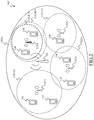
- FIG. 2 schematically illustrates a decoupled cellular network 100' according to an embodiment of the present invention.
- the decoupled network 100' according to an embodiment of the present invention differs from the previously described decoupled network 100 in that one or more of the U-plane nodes 115(i) within the coverage area 105A of each C-plane node 105 - referred to as hybrid nodes and identified in Figure 2 with reference 215(i) - is equipped with software and hardware resources such to make them capable to carry out (also) C-plane managing functions.
- the hybrid nodes 215(i) are equipped with hardware resources similar to those of the C-plane nodes 105 , and/or with reconfigurable software resources, selectively operable to carry out signaling traffic management.
- said software resources may be downloaded by the hybrid node 215(i) from a repository.
- the hybrid nodes 215(i) can be switched between a user modality, in which they act as U-plane nodes for managing user traffic like the U-plane nodes 115(i) in a respective user coverage area 215(i)UA, and a control modality, in which they act at least as C-plane nodes for managing the signaling traffic in a respective control coverage area 215(i)CA so as to temporally substitute or support malfunctioning C-plane nodes 105.
- a user modality in which they act as U-plane nodes for managing user traffic like the U-plane nodes 115(i) in a respective user coverage area 215(i)UA
- a control modality in which they act at least as C-plane nodes for managing the signaling traffic in a respective control coverage area 215(i)CA so as to temporally substitute or support malfunctioning C-plane nodes 105.
- the extent of the user coverage area 215(i)UA of a hybrid node 215(i) when in a user modality generally may be different from the extent of the control coverage area 215(i)CA of the same hybrid node 215(i) when in the control modality.
- the user coverage area 215(i)UA is depicted wider than the control coverage area 215(i)CA, similar considerations apply in case the former is smaller than the latter, or in case the former is equal to the latter.
- the hybrid nodes 215(i) may be dedicated network nodes specifically designed to be switched between the abovementioned user modality and control modality.
- the hybrid nodes 215(i) can be configured to be switched from the user modality to two different control modalities, referred to as complete-control modality and shared-control modality.
- a hybrid node 215(i) When a hybrid node 215(i) is switched to the complete-control modality, it ceases to operate as a U-plane node - thus ceasing to manage user traffic - to operate instead as a C-plane node, for managing signaling traffic only. Since a hybrid node 215(i) that has been switched to the complete-control modality ceases to manage user traffic, the user equipment 110 that were connected to said hybrid node 215(i) for exchanging user traffic before the switching need to be handed over to surrounding U-plane nodes 115(i) by means of known handover procedures.
- a hybrid node 215(i) When a hybrid node 215(i) is switched to the shared-control modality, it operates as a C-plane node for managing signaling traffic, but at the same time it still maintains user traffic managing capabilities. Therefore, handover procedures are not necessarily carried out on user equipment 110 connected to the hybrid node 215(i).
- Figure 3 is a flowchart 300 illustrating in terms of functional blocks the main phases of a procedure for switching a hybrid node 215(i) from the user modality to the control modality (both the complete-control modality and the shared-control modality) and vice versa according to an embodiment of the present invention.
- each C-plane node 105 when correctly operating, is configured to update and use a pertaining activity map, locally or/and remotely stored.
- the activity map of a C-plane node 105 is a data collection, for example arranged in the form of a data structure, comprising a record for each one of the user equipment 110 within its coverage area 105A.
- Each record of the activity map comprises the whole set of information relevant to the management of a respective user equipment 110 , as well as information relating to the operation condition thereof ( i . e ., indicating whether said user equipment 110 is generating traffic or is idle, its capabilities and its service profile).
- the activity maps of all the C-plane nodes 105 are stored in a network element of the decoupled network 100' (e . g ., a network element of the decoupled network 100' performing tasks as, for example, the Mobility Management Entity (MME) in current LTE architecture).
- the activity map may be also stored in the hybrid nodes 215(i) operating as C-plane nodes in control modality.
- the first phase of the procedure (block 310 ) according to an embodiment of the present invention provides for monitoring the decoupled network 100' for detecting any occurrence of C-plane node malfunctioning, identifying whether there is any C-plane node 105 that is under congestion or breakdown.
- a C-plane node malfunctioning may be detected by a control system of the decouple network, such as the O&M (Operation and Maintenance), and/or through user equipment 110 that have lost link with C-plane nodes 105.
- a lack of C-plane link could be detected by user equipment 110 and notified to the O&M through the U-plane.
- the detected C-plane node malfunctioning is a C-plane node congestion, it means that a signaling congestion has occurred, and the malfunctioning C-plane node 105 is no more able to guarantee further signaling traffic increasing, manage incoming new user equipment, serve user equipment requiring camping or serve camped user equipment requiring a service, in its whole coverage area 105A , or in a portion ( e . g ., a sector) thereof.
- the detected C-plane node malfunctioning is a C-plane node breakdown, it means that a hardware or software fault has occurred, and the whole coverage area 105A , or a portion ( e . g ., a sector) thereof of the malfunctioning C-plane node 105 may become out of service.
- the second phase of the procedure (block 315 ) according to an embodiment of the present invention provides for selecting a set of hybrid nodes 215(i) to be switched to the control modality in response to the detected C-plane node malfunctioning for temporally substituting and/or supporting the malfunctioning C-plane node 105.
- the set of hybrid nodes 215(i) can be selected by the malfunctioning C-plane node 105 , or the O&M, among the hybrid nodes 215(i) located in its coverage area 105A .
- the hybrid nodes 215(i) located within said sector are selected; if instead the signaling congestion has occurred in the whole coverage area 105A, all the hybrid nodes 215(i) located within the coverage area 105A may be selected.
- the O&M system selects a set of hybrid nodes 215(i) among those located in the coverage area 105A of the malfunctioning C-plane node 105. In this case as well, the O&M system selects the hybrid nodes 215(i) whose user coverage areas 215(i)UA correspond to the portion(s) of the coverage area 105A that are out of service.
- the O&M system may select only the hybrid nodes 215(i) located within said sector; if instead the whole coverage area 105A is out of service, the O&M system may select all the hybrid nodes 215(i) located within the coverage area 105A.
- the next phase of the procedure comprises providing the selected hybrid nodes 215(i) with configuration data CDATA to be exploited after the switching to the control modality.
- the configuration data CDATA may be provided to the selected hybrid nodes 215(i) either by the malfunctioning C-plane node 105 or by the O&M system.
- the configuration data CDATA are made available to the selected hybrid nodes 215(i) by the O&M system.
- the configuration data CDATA provided to each selected hybrid node 215(i) can comprise:
- the locations (within the coverage area 105A ) of the user equipment 110 that are generating traffic are known, at least from the U-plane point of view, the locations of the user equipment 110 that are in the idle condition need to be determined, to estimate the amount of C-plane resources to be destined to the hybrid node 215(i) , for example, by means of a paging operation specific for this purpose.
- the next phase of the procedure (block 330 ) provides that each selected hybrid node 215(i) carries out a paging operation on the user equipment 110 that are listed in the activity map of the malfunctioning C-plane node 105 as in the idle condition.
- each selected hybrid node 215(i) calculates which subset UESET of the user equipment 110 located within the coverage area 105A of the malfunctioning C-plane node 105 it will have to manage after the switching to the control modality.
- the C-plane resources estimation can be performed by the hybrid node 215(i) during its operation, in such a way to dynamically adapt to the actual situation of the decoupled network 100.
- a hybrid node When a hybrid node is provided with the configuration data CDATA, and after having determined the subset UESET of user equipment 110 to be managed in the control modality, it assumes a "ready-for switching-modality" status, providing, at least initially, a corresponding notification to the O&M (block 350 ).
- Each hybrid node 215(i) in the ready-for-switching-modality status is configured to pre-activate all its hardware and software resources required to actually carry out the switching from the user modality to the control modality. In case at least a portion of the software resources is not directly available, the hybrid nodes 215(i) can download it from a repository.
- the following phase of the procedure according to an embodiment of the present invention (block 360 ) provides that the hybrid nodes 215(i) in the ready-for-switching-modality status actually switch from the user modality to the control modality as soon as a switching command is sent by the O&M.
- each hybrid node 215(i) is configured to switch from the user modality to two different control modalities, i . e ., a complete-control modality, wherein the hybrid node 215(i) ceases to operate as a U-plane node - thus ceasing to manage user traffic - to operate instead as a C-plane node, for managing signaling traffic only, and a shared-control modality, wherein the hybrid node 215(i) operates as a C-plane node for managing signaling traffic, but at the same time it still maintains user traffic managing capabilities.
- the two modalities will be now analyzed.
- a hybrid node 215(i) in the complete-control modality since a hybrid node 215(i) in the complete-control modality is no more able to manage user traffic, before actually switching to the complete-control modality, it starts coordination with neighboring C-plane nodes 105 and hybrid nodes 215(i) already in the control modality in order to steer user equipment 110 within the user coverage area 215(i)UA of said hybrid node 215(i) toward neighboring U-plane nodes 115(i) in order to allow said neighboring U-plane nodes 115(i) to manage user traffic.
- This operation may be performed, as an example, through handovers triggered by a load balancing procedure.
- the hybrid node 215(i) actually switches to the complete-control modality, starting to manage the signaling traffic for the user equipment 110 of the set UESET of user equipment 110 pertaining to such hybrid node 215(i) within a corresponding control coverage area 215(i)CA by exploiting the hardware and software resources previously pre-activated.
- User equipment 110 lacking of C-plane coverage starts a search for a new C-plane coverage by the search procedure and subsequent attach as usual in cellular networks.
- the operations carried out by a hybrid node 215(i) that is switching to a shared-control modality correspond to the ones relating to the complete-control modality, with the exception that user equipment 110 within the user coverage area 215(i)UA of a hybrid node 215(i) that is about to switch to the shared-control modality are not handed over to neighboring U-plane nodes 115(i) for the user traffic management, since a hybrid node 215(i) switched to the shared-control modality is still able to carry out user traffic management.
- a hybrid node 215(i) in the shared-control modality may have a reduced user traffic managing capacity, if the user traffic load exceeds a threshold, according to an embodiment of the present invention a user traffic load balancing procedure may be additionally carried out, still providing for handing over some user equipment 110 toward other U-plane nodes 115(i) for the user traffic managing.
- hybrid node 215(i) continuously updates a corresponding activity map as a normal C-plane node 105.
- the following phase of the procedure (block 370 ) provides for switching back the hybrid nodes 215(i) to the user modality once the C-plane node malfunctioning ( e . g ., congestion or breakdown) ends and the malfunctioning C-plane node 105 restarts to correctly operate.
- the C-plane node malfunctioning e . g ., congestion or breakdown
- the C-plane node 105 sends a notification to the hybrid nodes 215(i) in the control modality through the O&M system. Then, the O&M system instructs said hybrid nodes 215(i) to notify their current activity maps to the C-plane node 105 , and to carry out a signaling handover for re-assigning the management of the signaling traffic for the user equipment 110 to the C-plane node 105. The O&M system then commands the hybrid nodes 215(i) in the control modality to release the hardware and/or software resources. Finally, the O&M system commands the switching, and the hybrid nodes 215(i) in the control modality actually switch back to the user modality.
- the hybrid nodes 215(i) in the control modality actually switch back to the user modality.
- the switch back of some hybrid nodes 215(i) from the control modality to the user modality may be performed as soon as the load condition of the C-plane node 105 allows it; at this point, the C-plane node 105 may carry out a signaling traffic load balancing procedure, by coordinating itself with the remaining hybrid nodes 215(i).
Landscapes
- Engineering & Computer Science (AREA)
- Computer Networks & Wireless Communication (AREA)
- Signal Processing (AREA)
- Quality & Reliability (AREA)
- Mobile Radio Communication Systems (AREA)
Claims (11)
- Réseau cellulaire (100) comprenant une pluralité de stations émettrices-réceptrices à plan de contrôle (105), chacune configurée pour fournir une couverture radio sur une première zone de couverture (105A) pour permettre à un équipement utilisateur (110) à l'intérieur de ladite première zone de couverture (105A) d'échanger un trafic de signalisation avec la station émettrice-réceptrice à plan de contrôle (105),
caractérisé en ce que
pour chaque station émettrice-réceptrice à plan de contrôle (105), le réseau cellulaire (100) comprend, en outre, une ou plusieurs stations émettrices-réceptrices hybrides (215(i)) différente(s) de ladite station émettrice-réceptrice à plan de contrôle (105), et située(s) à l'intérieur de la première zone de couverture correspondante (105A),
et en ce que
chaque station émettrice-réceptrice hybride (215(i)) est configurée pour commuter entre :a) une modalité de fonctionnement utilisateur, dans laquelle ladite station émettrice-réceptrice hybride (215(i)) est configurée pour fournir une couverture radio sur une zone de couverture utilisateur correspondante (215(i)UA) pour permettre à un équipement utilisateur (110) à l'intérieur de ladite zone de couverture utilisateur (215(i)UA) d'échanger un trafic utilisateur avec la station émettrice-réceptrice hybride (215(i)), etb) une modalité de fonctionnement de contrôle, dans laquelle ladite station émettrice-réceptrice hybride (215(i)) est configurée pour fournir une couverture radio sur une zone de couverture de contrôle correspondante (215(i)CA) pour permettre à un équipement utilisateur (110) à l'intérieur de ladite zone de couverture de contrôle (215(i)CA) d'échanger au moins un trafic de signalisation avec la station émettrice-réceptrice hybride (215(i)). - Réseau cellulaire (100) selon la revendication 1, dans lequel ladite modalité de fonctionnement de contrôle comprend une modalité de contrôle complet, une station émettrice-réceptrice hybride (215(i)) dans la modalité de contrôle complet étant configurée pour cesser de fournir une couverture radio sur la zone de couverture utilisateur correspondante (215(i)UA), de manière à cesser de permettre à un équipement utilisateur (110) à l'intérieur de ladite zone de couverture utilisateur (215(i)UA) d'échanger un trafic utilisateur avec la station émettrice-réceptrice hybride (215(i)).
- Réseau cellulaire (100) selon la revendication 1 ou 2, dans lequel ladite modalité de fonctionnement de contrôle comprend une modalité de contrôle partagée, une station émettrice-réceptrice hybride (215(i)) dans la modalité de contrôle partagée étant configurée pour fournir une couverture radio sur la zone de couverture de contrôle correspondante (215(i)CA), pour permettre à un équipement utilisateur (110) à l'intérieur de ladite zone de couverture de contrôle (215(i)CA) d'échanger au moins un trafic de signalisation avec la station émettrice-réceptrice hybride (215(i)), et, dans le même temps, pour fournir une couverture radio sur la zone de couverture utilisateur correspondante (215(i)UA), pour permettre à un équipement utilisateur (110) à l'intérieur de ladite zone de couverture utilisateur (215(i)UA) d'échanger un trafic utilisateur avec la station émettrice-réceptrice hybride (215(i)).
- Réseau cellulaire (100) selon l'une quelconque des revendications précédentes, dans lequel une station émettrice-réceptrice hybride (215(i)), située à l'intérieur de la première zone de couverture (105A) d'une station émettrice-réceptrice à plan de contrôle (105), est configurée pour être commutée dans la modalité de fonctionnement de contrôle, lorsque ladite station émettrice-réceptrice à plan de contrôle (105) est dans un état de dysfonctionnement.
- Réseau cellulaire (100) selon la revendication 4, dans lequel ladite condition de dysfonctionnement comprend une condition d'encombrement en matière de trafic de signalisation à gérer, une station émettrice-réceptrice à plan de contrôle (105) dans une condition d'encombrement n'étant plus en mesure de :- garantir une augmentation du trafic de signalisation supplémentaire,- gérer un nouvel équipement utilisateur entrant (110),- servir un équipement utilisateur (110) exigeant un calage, ou- servir un équipement utilisateur calé (110) exigeant un service,dans au moins une partie de sa première zone de couverture correspondante (105A).
- Réseau cellulaire (100) selon la revendication 4, dans lequel ladite condition de dysfonctionnement comprend une condition d'encombrement en matière de trafic de signalisation à gérer, une station émettrice-réceptrice à plan de contrôle (105) dans une condition d'encombrement n'étant plus en mesure de :- garantir une augmentation du trafic de signalisation supplémentaire,- gérer un nouvel équipement utilisateur entrant (110),- servir un équipement utilisateur (110) exigeant un calage ou- servir un équipement utilisateur calé (110) exigeant un service,dans au moins une partie de sa première zone de couverture correspondante (105A).
- Réseau cellulaire (100) selon l'une quelconque des revendications 4 à 6, dans lequel ladite condition de dysfonctionnement comprend une condition de panne, une station émettrice-réceptrice à plan de contrôle (105) dans une condition de panne étant affectée par un défaut matériel et / ou logiciel de manière à provoquer une mise hors service d'au moins une partie de sa première zone de couverture correspondante (105A).
- Réseau cellulaire (100) selon l'une quelconque des revendications 4 à 7, dans lequel :- chaque station émettrice-réceptrice à plan de contrôle (105) est configurée pour mettre à jour une collecte de données correspondante comprenant, pour chaque équipement utilisateur (110) à l'intérieur de sa première zone de couverture correspondante (105A), des informations relatives à la condition de fonctionnement dudit équipement utilisateur (110), et pour fournir une partie correspondante de ladite collecte de données à des stations émettrices-réceptrices hybrides sélectionnées (215(i)) située à l'intérieur de la première zone de couverture (105A),- avant de se commuter sur la modalité de fonctionnement de contrôle lorsqu'une station émettrice-réceptrice à plan de contrôle (105) se trouve dans une condition de dysfonctionnement, une station émettrice-réceptrice hybride sélectionnée (215(i)), située à l'intérieur de la première zone de couverture (105A) de ladite station émettrice-réceptrice à plan de contrôle (105) dans une condition de dysfonctionnement est configurée pour sélectionner un sous-ensemble d'équipement utilisateur (110) située à l'intérieur de la première zone de couverture (105A) de ladite station émettrice-réceptrice à plan de contrôle (105) dans une condition de dysfonctionnement, sur la base de la partie correspondante de ladite collecte de données reçue de ladite station émettrice-réceptrice à plan de contrôle (105) dans une condition de dysfonctionnement, et- après être commutée sur la modalité de fonctionnement de contrôle, ladite station émettrice-réceptrice hybride sélectionnée (215(i)) est configurée pour échanger au moins un trafic de signalisation avec l'équipement utilisateur (110) dudit sous-ensemble.
- Réseau cellulaire (100) selon l'une quelconque des revendications précédentes, comprenant, en outre, pour chaque station émettrice-réceptrice à plan de contrôle (105) une ou plusieurs station(s) émettrice(s)-réceptrice(s) à plan utilisateur (115(i)) située(s) à l'intérieur de la première zone de couverture correspondante (105A), chaque station émettrice-réceptrice à plan utilisateur (115(i)) étant configurée pour fournir une couverture radio sur une seconde zone de couverture correspondante (115(i)A) pour permettre à un équipement utilisateur (110) à l'intérieur de ladite seconde zone de couverture (115(i)A) d'échanger un trafic utilisateur avec la station émettrice-réceptrice à plan utilisateur (115(i)).
- Réseau cellulaire (100) selon la revendication 9, lorsqu'elle dépend de la revendication 2, dans lequel, avant de se commuter sur la modalité de contrôle complet, une station émettrice-réceptrice hybride (215(i)) est configurée pour lancer une coordination avec des stations émettrices-réceptrices à plan de contrôle voisines (105) et avec des stations émettrices-réceptrices hybrides voisines (215(i)) déjà dans la modalité de fonctionnement de contrôle pour diriger un équipement utilisateur (110) à l'intérieur de la zone de couverture utilisateur (215(i)UA) de ladite station émettrice-réceptrice (215(i)) vers des stations émettrices-réceptrices à plan utilisateur voisines (115(i)) pour permettre auxdites stations émettrices-réceptrices à plan utilisateur voisines (115(i)) d'échanger un trafic utilisateur avec ledit équipement utilisateur (110).
- Réseau cellulaire (100) selon la revendication 9 ou 10, dans lequel ladite une ou lesdites station(s) émettrice(s)-réceptrice(s) (215(i)) est ou sont une ou des stations émettrice(s)-réceptrice(s) à plan utilisateur (115(i)) équipée(s) de ressources matérielles et / ou logicielles pouvant fonctionner sélectivement pour échanger au moins un trafic de signalisation avec un équipement utilisateur (110).
Applications Claiming Priority (1)
| Application Number | Priority Date | Filing Date | Title |
|---|---|---|---|
| PCT/EP2013/077716 WO2015090453A1 (fr) | 2013-12-20 | 2013-12-20 | Réseau cellulaire à plan de commande découplé d'un plan d'utilisateur |
Publications (2)
| Publication Number | Publication Date |
|---|---|
| EP3085196A1 EP3085196A1 (fr) | 2016-10-26 |
| EP3085196B1 true EP3085196B1 (fr) | 2019-08-14 |
Family
ID=49943344
Family Applications (1)
| Application Number | Title | Priority Date | Filing Date |
|---|---|---|---|
| EP13818744.8A Active EP3085196B1 (fr) | 2013-12-20 | 2013-12-20 | Réseau cellulaire à plan de commande découplé d'un plan d'utilisateur |
Country Status (5)
| Country | Link |
|---|---|
| US (1) | US10171359B2 (fr) |
| EP (1) | EP3085196B1 (fr) |
| CN (1) | CN105940761B (fr) |
| BR (1) | BR112016014084A2 (fr) |
| WO (1) | WO2015090453A1 (fr) |
Families Citing this family (2)
| Publication number | Priority date | Publication date | Assignee | Title |
|---|---|---|---|---|
| US9928741B2 (en) * | 2015-02-04 | 2018-03-27 | Here Global B.V. | Traffic adjustment for variable network state |
| CA164757S (en) | 2015-10-07 | 2016-06-21 | Groupe Isolofoam Inc | Insulation panel |
Citations (1)
| Publication number | Priority date | Publication date | Assignee | Title |
|---|---|---|---|---|
| WO2014149921A1 (fr) * | 2013-03-15 | 2014-09-25 | Blackberry Limited | Etablissement de multiples connexions entre un équipement utilisateur et des nœuds de réseau d'accès sans fil |
Family Cites Families (10)
| Publication number | Priority date | Publication date | Assignee | Title |
|---|---|---|---|---|
| US6973054B2 (en) | 2001-01-05 | 2005-12-06 | Telefonaktiebolaget Lm Ericsson (Publ) | Communication management in mobile networks having split control planes and user planes |
| JP2010538576A (ja) | 2007-09-05 | 2010-12-09 | テレフオンアクチーボラゲット エル エム エリクソン(パブル) | 電気通信システムにおけるエネルギー節約方法 |
| US8285291B2 (en) * | 2010-02-02 | 2012-10-09 | Clearwire Ip Holdings Llc | System and method for multimode device handover |
| CN102316561B (zh) | 2010-07-08 | 2015-01-07 | 上海贝尔股份有限公司 | 一种异构网络中的节电方法及其基站 |
| CN103733682A (zh) * | 2011-06-01 | 2014-04-16 | 株式会社Ntt都科摩 | 使用小节点设备的移动通信中的增强的本地接入 |
| EP2533595B1 (fr) | 2011-06-06 | 2017-06-21 | Alcatel Lucent | Appareils et procédés pour une coordination des interférences intercellulaires |
| US9161281B2 (en) * | 2012-06-08 | 2015-10-13 | Blackberry Limited | Method and apparatus for multi-rat transmission |
| US8792941B2 (en) * | 2012-09-13 | 2014-07-29 | Alcatel Lucent | Method and apparatus of virtualized resource sharing in cellular networks |
| EP2959693B1 (fr) * | 2013-02-21 | 2017-11-22 | Altiostar Networks, Inc. | Systèmes et procédés pour coordonner la transmission de paquets de données par détection de type de trame dans une station de base |
| US9537612B2 (en) * | 2013-12-09 | 2017-01-03 | Apple Inc. | Restrictions on transmissions of control plane data with carrier aggregation |
-
2013
- 2013-12-20 WO PCT/EP2013/077716 patent/WO2015090453A1/fr not_active Ceased
- 2013-12-20 BR BR112016014084A patent/BR112016014084A2/pt not_active Application Discontinuation
- 2013-12-20 EP EP13818744.8A patent/EP3085196B1/fr active Active
- 2013-12-20 CN CN201380082019.9A patent/CN105940761B/zh active Active
- 2013-12-20 US US15/106,702 patent/US10171359B2/en active Active
Patent Citations (1)
| Publication number | Priority date | Publication date | Assignee | Title |
|---|---|---|---|---|
| WO2014149921A1 (fr) * | 2013-03-15 | 2014-09-25 | Blackberry Limited | Etablissement de multiples connexions entre un équipement utilisateur et des nœuds de réseau d'accès sans fil |
Also Published As
| Publication number | Publication date |
|---|---|
| BR112016014084A2 (pt) | 2017-08-08 |
| US10171359B2 (en) | 2019-01-01 |
| CN105940761B (zh) | 2019-11-19 |
| CN105940761A (zh) | 2016-09-14 |
| US20160337242A1 (en) | 2016-11-17 |
| WO2015090453A1 (fr) | 2015-06-25 |
| EP3085196A1 (fr) | 2016-10-26 |
Similar Documents
| Publication | Publication Date | Title |
|---|---|---|
| US11950207B2 (en) | Tracking area planning | |
| JP7279773B2 (ja) | 無線端末及びその方法 | |
| EP3477994B1 (fr) | Procédé de transfert intercellulaire, station de base et système de communication | |
| EP3289803B1 (fr) | Création de rapport de mesurage assoupli avec double connectivité du plan de commande | |
| RU2691966C1 (ru) | Система радиосвязи, радиостанция, радиотерминал, способ управления связью и непереходный машиночитаемый носитель | |
| JP5872711B2 (ja) | 移動中継ノードトラッキングエリア設定及び位置更新方法並びに装置 | |
| JP6200412B2 (ja) | 異種システム間のリダイレクション方法及びシステム | |
| US10045266B2 (en) | Scheme for transmitting and receiving information in wireless communication system | |
| EP2950586A1 (fr) | Procédé et appareil de commande de la mobilité pour une cellule ayant une zone de desserte de petites cellules dans un système de communication mobile | |
| CN110958671A (zh) | 通信方法及装置 | |
| CN109905887A (zh) | 用于中继设备的通信方法、设备和计算机可读存储介质 | |
| US9509594B2 (en) | Mobile terminal preparation | |
| KR20190143295A (ko) | 차세대 이동통신 시스템에서 이중연결구조를 고려하여 패킷 중복을 제어하는 방법 및 장치 | |
| KR20250023568A (ko) | 장치, 방법 및 컴퓨터 프로그램 | |
| JP2012156898A (ja) | 通信システム、移動機及び切替制御方法 | |
| EP3536036A1 (fr) | Réactivation améliorée pour une connexion lumineuse | |
| CN116896780A (zh) | 定时提前获取和维持的方法和用户设备 | |
| US10171359B2 (en) | Cellular network with control plane decoupled from user plane | |
| US20130143582A1 (en) | Transmitting radio configuration parameters from a base station to a relay node | |
| CN102970759B (zh) | 小区干扰处理方法及装置 | |
| EP4346320A1 (fr) | Resélection de cellule d'un relais pendant une commutation de chemin | |
| WO2020064095A1 (fr) | Commande de radiomessagerie dans un scénario de réseau non homogène | |
| KR102273370B1 (ko) | 무선 통신 시스템에서 부하 분산을 위한 장치 및 방법 | |
| CN109005566B (zh) | 一种基于锚点的用户为中心多连接移动性设计方法 |
Legal Events
| Date | Code | Title | Description |
|---|---|---|---|
| PUAI | Public reference made under article 153(3) epc to a published international application that has entered the european phase |
Free format text: ORIGINAL CODE: 0009012 |
|
| 17P | Request for examination filed |
Effective date: 20160712 |
|
| AK | Designated contracting states |
Kind code of ref document: A1 Designated state(s): AL AT BE BG CH CY CZ DE DK EE ES FI FR GB GR HR HU IE IS IT LI LT LU LV MC MK MT NL NO PL PT RO RS SE SI SK SM TR |
|
| AX | Request for extension of the european patent |
Extension state: BA ME |
|
| DAX | Request for extension of the european patent (deleted) | ||
| STAA | Information on the status of an ep patent application or granted ep patent |
Free format text: STATUS: EXAMINATION IS IN PROGRESS |
|
| 17Q | First examination report despatched |
Effective date: 20180124 |
|
| RIC1 | Information provided on ipc code assigned before grant |
Ipc: H04W 88/04 20090101ALN20181213BHEP Ipc: H04W 24/04 20090101ALN20181213BHEP Ipc: H04W 88/08 20090101ALN20181213BHEP Ipc: H04W 16/26 20090101ALN20181213BHEP Ipc: H04W 16/32 20090101AFI20181213BHEP Ipc: H04W 16/08 20090101ALN20181213BHEP Ipc: H04L 12/801 20130101ALN20181213BHEP Ipc: H04W 72/08 20090101ALN20181213BHEP Ipc: H04W 16/24 20090101ALN20181213BHEP Ipc: H04L 12/24 20060101ALN20181213BHEP |
|
| RIC1 | Information provided on ipc code assigned before grant |
Ipc: H04W 88/08 20090101ALN20181221BHEP Ipc: H04W 16/08 20090101ALN20181221BHEP Ipc: H04W 16/32 20090101AFI20181221BHEP Ipc: H04W 24/04 20090101ALN20181221BHEP Ipc: H04L 12/801 20130101ALN20181221BHEP Ipc: H04W 16/24 20090101ALN20181221BHEP Ipc: H04W 16/26 20090101ALN20181221BHEP Ipc: H04W 88/04 20090101ALN20181221BHEP Ipc: H04L 12/24 20060101ALN20181221BHEP Ipc: H04W 72/08 20090101ALN20181221BHEP |
|
| GRAP | Despatch of communication of intention to grant a patent |
Free format text: ORIGINAL CODE: EPIDOSNIGR1 |
|
| STAA | Information on the status of an ep patent application or granted ep patent |
Free format text: STATUS: GRANT OF PATENT IS INTENDED |
|
| INTG | Intention to grant announced |
Effective date: 20190201 |
|
| GRAJ | Information related to disapproval of communication of intention to grant by the applicant or resumption of examination proceedings by the epo deleted |
Free format text: ORIGINAL CODE: EPIDOSDIGR1 |
|
| STAA | Information on the status of an ep patent application or granted ep patent |
Free format text: STATUS: EXAMINATION IS IN PROGRESS |
|
| REG | Reference to a national code |
Ref country code: DE Ref legal event code: R079 Ref document number: 602013059253 Country of ref document: DE Free format text: PREVIOUS MAIN CLASS: H04W0088080000 Ipc: H04W0016320000 |
|
| GRAP | Despatch of communication of intention to grant a patent |
Free format text: ORIGINAL CODE: EPIDOSNIGR1 |
|
| STAA | Information on the status of an ep patent application or granted ep patent |
Free format text: STATUS: GRANT OF PATENT IS INTENDED |
|
| INTC | Intention to grant announced (deleted) | ||
| RIC1 | Information provided on ipc code assigned before grant |
Ipc: H04W 16/24 20090101ALN20190409BHEP Ipc: H04L 12/801 20130101ALN20190409BHEP Ipc: H04W 16/08 20090101ALN20190409BHEP Ipc: H04W 88/04 20090101ALN20190409BHEP Ipc: H04W 88/08 20090101ALN20190409BHEP Ipc: H04W 24/04 20090101ALN20190409BHEP Ipc: H04W 16/32 20090101AFI20190409BHEP Ipc: H04W 16/26 20090101ALN20190409BHEP Ipc: H04W 72/08 20090101ALN20190409BHEP Ipc: H04L 12/24 20060101ALN20190409BHEP |
|
| INTG | Intention to grant announced |
Effective date: 20190515 |
|
| GRAS | Grant fee paid |
Free format text: ORIGINAL CODE: EPIDOSNIGR3 |
|
| GRAA | (expected) grant |
Free format text: ORIGINAL CODE: 0009210 |
|
| STAA | Information on the status of an ep patent application or granted ep patent |
Free format text: STATUS: THE PATENT HAS BEEN GRANTED |
|
| AK | Designated contracting states |
Kind code of ref document: B1 Designated state(s): AL AT BE BG CH CY CZ DE DK EE ES FI FR GB GR HR HU IE IS IT LI LT LU LV MC MK MT NL NO PL PT RO RS SE SI SK SM TR |
|
| REG | Reference to a national code |
Ref country code: GB Ref legal event code: FG4D |
|
| REG | Reference to a national code |
Ref country code: CH Ref legal event code: EP Ref country code: AT Ref legal event code: REF Ref document number: 1168502 Country of ref document: AT Kind code of ref document: T Effective date: 20190815 |
|
| REG | Reference to a national code |
Ref country code: IE Ref legal event code: FG4D |
|
| REG | Reference to a national code |
Ref country code: DE Ref legal event code: R096 Ref document number: 602013059253 Country of ref document: DE |
|
| REG | Reference to a national code |
Ref country code: NL Ref legal event code: MP Effective date: 20190814 |
|
| REG | Reference to a national code |
Ref country code: LT Ref legal event code: MG4D |
|
| PG25 | Lapsed in a contracting state [announced via postgrant information from national office to epo] |
Ref country code: FI Free format text: LAPSE BECAUSE OF FAILURE TO SUBMIT A TRANSLATION OF THE DESCRIPTION OR TO PAY THE FEE WITHIN THE PRESCRIBED TIME-LIMIT Effective date: 20190814 Ref country code: NO Free format text: LAPSE BECAUSE OF FAILURE TO SUBMIT A TRANSLATION OF THE DESCRIPTION OR TO PAY THE FEE WITHIN THE PRESCRIBED TIME-LIMIT Effective date: 20191114 Ref country code: SE Free format text: LAPSE BECAUSE OF FAILURE TO SUBMIT A TRANSLATION OF THE DESCRIPTION OR TO PAY THE FEE WITHIN THE PRESCRIBED TIME-LIMIT Effective date: 20190814 Ref country code: BG Free format text: LAPSE BECAUSE OF FAILURE TO SUBMIT A TRANSLATION OF THE DESCRIPTION OR TO PAY THE FEE WITHIN THE PRESCRIBED TIME-LIMIT Effective date: 20191114 Ref country code: NL Free format text: LAPSE BECAUSE OF FAILURE TO SUBMIT A TRANSLATION OF THE DESCRIPTION OR TO PAY THE FEE WITHIN THE PRESCRIBED TIME-LIMIT Effective date: 20190814 Ref country code: HR Free format text: LAPSE BECAUSE OF FAILURE TO SUBMIT A TRANSLATION OF THE DESCRIPTION OR TO PAY THE FEE WITHIN THE PRESCRIBED TIME-LIMIT Effective date: 20190814 Ref country code: LT Free format text: LAPSE BECAUSE OF FAILURE TO SUBMIT A TRANSLATION OF THE DESCRIPTION OR TO PAY THE FEE WITHIN THE PRESCRIBED TIME-LIMIT Effective date: 20190814 Ref country code: PT Free format text: LAPSE BECAUSE OF FAILURE TO SUBMIT A TRANSLATION OF THE DESCRIPTION OR TO PAY THE FEE WITHIN THE PRESCRIBED TIME-LIMIT Effective date: 20191216 |
|
| REG | Reference to a national code |
Ref country code: AT Ref legal event code: MK05 Ref document number: 1168502 Country of ref document: AT Kind code of ref document: T Effective date: 20190814 |
|
| PG25 | Lapsed in a contracting state [announced via postgrant information from national office to epo] |
Ref country code: IS Free format text: LAPSE BECAUSE OF FAILURE TO SUBMIT A TRANSLATION OF THE DESCRIPTION OR TO PAY THE FEE WITHIN THE PRESCRIBED TIME-LIMIT Effective date: 20191214 Ref country code: RS Free format text: LAPSE BECAUSE OF FAILURE TO SUBMIT A TRANSLATION OF THE DESCRIPTION OR TO PAY THE FEE WITHIN THE PRESCRIBED TIME-LIMIT Effective date: 20190814 Ref country code: LV Free format text: LAPSE BECAUSE OF FAILURE TO SUBMIT A TRANSLATION OF THE DESCRIPTION OR TO PAY THE FEE WITHIN THE PRESCRIBED TIME-LIMIT Effective date: 20190814 Ref country code: AL Free format text: LAPSE BECAUSE OF FAILURE TO SUBMIT A TRANSLATION OF THE DESCRIPTION OR TO PAY THE FEE WITHIN THE PRESCRIBED TIME-LIMIT Effective date: 20190814 Ref country code: ES Free format text: LAPSE BECAUSE OF FAILURE TO SUBMIT A TRANSLATION OF THE DESCRIPTION OR TO PAY THE FEE WITHIN THE PRESCRIBED TIME-LIMIT Effective date: 20190814 Ref country code: GR Free format text: LAPSE BECAUSE OF FAILURE TO SUBMIT A TRANSLATION OF THE DESCRIPTION OR TO PAY THE FEE WITHIN THE PRESCRIBED TIME-LIMIT Effective date: 20191115 |
|
| PG25 | Lapsed in a contracting state [announced via postgrant information from national office to epo] |
Ref country code: TR Free format text: LAPSE BECAUSE OF FAILURE TO SUBMIT A TRANSLATION OF THE DESCRIPTION OR TO PAY THE FEE WITHIN THE PRESCRIBED TIME-LIMIT Effective date: 20190814 |
|
| PG25 | Lapsed in a contracting state [announced via postgrant information from national office to epo] |
Ref country code: PL Free format text: LAPSE BECAUSE OF FAILURE TO SUBMIT A TRANSLATION OF THE DESCRIPTION OR TO PAY THE FEE WITHIN THE PRESCRIBED TIME-LIMIT Effective date: 20190814 Ref country code: EE Free format text: LAPSE BECAUSE OF FAILURE TO SUBMIT A TRANSLATION OF THE DESCRIPTION OR TO PAY THE FEE WITHIN THE PRESCRIBED TIME-LIMIT Effective date: 20190814 Ref country code: DK Free format text: LAPSE BECAUSE OF FAILURE TO SUBMIT A TRANSLATION OF THE DESCRIPTION OR TO PAY THE FEE WITHIN THE PRESCRIBED TIME-LIMIT Effective date: 20190814 Ref country code: RO Free format text: LAPSE BECAUSE OF FAILURE TO SUBMIT A TRANSLATION OF THE DESCRIPTION OR TO PAY THE FEE WITHIN THE PRESCRIBED TIME-LIMIT Effective date: 20190814 Ref country code: AT Free format text: LAPSE BECAUSE OF FAILURE TO SUBMIT A TRANSLATION OF THE DESCRIPTION OR TO PAY THE FEE WITHIN THE PRESCRIBED TIME-LIMIT Effective date: 20190814 |
|
| PG25 | Lapsed in a contracting state [announced via postgrant information from national office to epo] |
Ref country code: SK Free format text: LAPSE BECAUSE OF FAILURE TO SUBMIT A TRANSLATION OF THE DESCRIPTION OR TO PAY THE FEE WITHIN THE PRESCRIBED TIME-LIMIT Effective date: 20190814 Ref country code: SM Free format text: LAPSE BECAUSE OF FAILURE TO SUBMIT A TRANSLATION OF THE DESCRIPTION OR TO PAY THE FEE WITHIN THE PRESCRIBED TIME-LIMIT Effective date: 20190814 Ref country code: CZ Free format text: LAPSE BECAUSE OF FAILURE TO SUBMIT A TRANSLATION OF THE DESCRIPTION OR TO PAY THE FEE WITHIN THE PRESCRIBED TIME-LIMIT Effective date: 20190814 Ref country code: IS Free format text: LAPSE BECAUSE OF FAILURE TO SUBMIT A TRANSLATION OF THE DESCRIPTION OR TO PAY THE FEE WITHIN THE PRESCRIBED TIME-LIMIT Effective date: 20200224 |
|
| REG | Reference to a national code |
Ref country code: DE Ref legal event code: R097 Ref document number: 602013059253 Country of ref document: DE |
|
| PLBE | No opposition filed within time limit |
Free format text: ORIGINAL CODE: 0009261 |
|
| STAA | Information on the status of an ep patent application or granted ep patent |
Free format text: STATUS: NO OPPOSITION FILED WITHIN TIME LIMIT |
|
| PG2D | Information on lapse in contracting state deleted |
Ref country code: IS |
|
| REG | Reference to a national code |
Ref country code: CH Ref legal event code: PL |
|
| 26N | No opposition filed |
Effective date: 20200603 |
|
| REG | Reference to a national code |
Ref country code: BE Ref legal event code: MM Effective date: 20191231 |
|
| PG25 | Lapsed in a contracting state [announced via postgrant information from national office to epo] |
Ref country code: SI Free format text: LAPSE BECAUSE OF FAILURE TO SUBMIT A TRANSLATION OF THE DESCRIPTION OR TO PAY THE FEE WITHIN THE PRESCRIBED TIME-LIMIT Effective date: 20190814 Ref country code: MC Free format text: LAPSE BECAUSE OF FAILURE TO SUBMIT A TRANSLATION OF THE DESCRIPTION OR TO PAY THE FEE WITHIN THE PRESCRIBED TIME-LIMIT Effective date: 20190814 |
|
| PG25 | Lapsed in a contracting state [announced via postgrant information from national office to epo] |
Ref country code: LU Free format text: LAPSE BECAUSE OF NON-PAYMENT OF DUE FEES Effective date: 20191220 Ref country code: IE Free format text: LAPSE BECAUSE OF NON-PAYMENT OF DUE FEES Effective date: 20191220 |
|
| PG25 | Lapsed in a contracting state [announced via postgrant information from national office to epo] |
Ref country code: BE Free format text: LAPSE BECAUSE OF NON-PAYMENT OF DUE FEES Effective date: 20191231 Ref country code: CH Free format text: LAPSE BECAUSE OF NON-PAYMENT OF DUE FEES Effective date: 20191231 Ref country code: LI Free format text: LAPSE BECAUSE OF NON-PAYMENT OF DUE FEES Effective date: 20191231 |
|
| PG25 | Lapsed in a contracting state [announced via postgrant information from national office to epo] |
Ref country code: CY Free format text: LAPSE BECAUSE OF FAILURE TO SUBMIT A TRANSLATION OF THE DESCRIPTION OR TO PAY THE FEE WITHIN THE PRESCRIBED TIME-LIMIT Effective date: 20190814 |
|
| PG25 | Lapsed in a contracting state [announced via postgrant information from national office to epo] |
Ref country code: HU Free format text: LAPSE BECAUSE OF FAILURE TO SUBMIT A TRANSLATION OF THE DESCRIPTION OR TO PAY THE FEE WITHIN THE PRESCRIBED TIME-LIMIT; INVALID AB INITIO Effective date: 20131220 Ref country code: MT Free format text: LAPSE BECAUSE OF FAILURE TO SUBMIT A TRANSLATION OF THE DESCRIPTION OR TO PAY THE FEE WITHIN THE PRESCRIBED TIME-LIMIT Effective date: 20190814 |
|
| PG25 | Lapsed in a contracting state [announced via postgrant information from national office to epo] |
Ref country code: MK Free format text: LAPSE BECAUSE OF FAILURE TO SUBMIT A TRANSLATION OF THE DESCRIPTION OR TO PAY THE FEE WITHIN THE PRESCRIBED TIME-LIMIT Effective date: 20190814 |
|
| P01 | Opt-out of the competence of the unified patent court (upc) registered |
Effective date: 20230528 |
|
| P02 | Opt-out of the competence of the unified patent court (upc) changed |
Effective date: 20230601 |
|
| PGFP | Annual fee paid to national office [announced via postgrant information from national office to epo] |
Ref country code: GB Payment date: 20251229 Year of fee payment: 13 |
|
| PGFP | Annual fee paid to national office [announced via postgrant information from national office to epo] |
Ref country code: FR Payment date: 20251222 Year of fee payment: 13 |
|
| PGFP | Annual fee paid to national office [announced via postgrant information from national office to epo] |
Ref country code: DE Payment date: 20251222 Year of fee payment: 13 |
|
| PGFP | Annual fee paid to national office [announced via postgrant information from national office to epo] |
Ref country code: IT Payment date: 20251231 Year of fee payment: 13 |