EP3081318B1 - Gewindehülse - Google Patents
Gewindehülse Download PDFInfo
- Publication number
- EP3081318B1 EP3081318B1 EP16163422.5A EP16163422A EP3081318B1 EP 3081318 B1 EP3081318 B1 EP 3081318B1 EP 16163422 A EP16163422 A EP 16163422A EP 3081318 B1 EP3081318 B1 EP 3081318B1
- Authority
- EP
- European Patent Office
- Prior art keywords
- section
- longitudinal
- insert
- metal
- single piece
- Prior art date
- Legal status (The legal status is an assumption and is not a legal conclusion. Google has not performed a legal analysis and makes no representation as to the accuracy of the status listed.)
- Active
Links
- 239000002184 metal Substances 0.000 claims description 77
- 238000004519 manufacturing process Methods 0.000 claims description 37
- 239000000463 material Substances 0.000 claims description 23
- 238000010079 rubber tapping Methods 0.000 claims description 15
- 238000003825 pressing Methods 0.000 claims description 8
- 230000000903 blocking effect Effects 0.000 claims description 2
- 239000004033 plastic Substances 0.000 description 8
- 229920003023 plastic Polymers 0.000 description 8
- 238000002347 injection Methods 0.000 description 6
- 239000007924 injection Substances 0.000 description 6
- 238000009987 spinning Methods 0.000 description 6
- 208000031968 Cadaver Diseases 0.000 description 5
- 239000000470 constituent Substances 0.000 description 5
- 235000021183 entrée Nutrition 0.000 description 4
- 238000004049 embossing Methods 0.000 description 3
- 230000000149 penetrating effect Effects 0.000 description 3
- 238000005520 cutting process Methods 0.000 description 2
- 238000000605 extraction Methods 0.000 description 2
- 238000000034 method Methods 0.000 description 2
- 238000011084 recovery Methods 0.000 description 2
- 238000009434 installation Methods 0.000 description 1
- 230000014759 maintenance of location Effects 0.000 description 1
- 230000035515 penetration Effects 0.000 description 1
- 230000002093 peripheral effect Effects 0.000 description 1
- 238000009877 rendering Methods 0.000 description 1
- 238000000926 separation method Methods 0.000 description 1
- 239000000243 solution Substances 0.000 description 1
Images




Classifications
-
- B—PERFORMING OPERATIONS; TRANSPORTING
- B21—MECHANICAL METAL-WORKING WITHOUT ESSENTIALLY REMOVING MATERIAL; PUNCHING METAL
- B21D—WORKING OR PROCESSING OF SHEET METAL OR METAL TUBES, RODS OR PROFILES WITHOUT ESSENTIALLY REMOVING MATERIAL; PUNCHING METAL
- B21D41/00—Application of procedures in order to alter the diameter of tube ends
- B21D41/04—Reducing; Closing
- B21D41/045—Closing
-
- F—MECHANICAL ENGINEERING; LIGHTING; HEATING; WEAPONS; BLASTING
- F16—ENGINEERING ELEMENTS AND UNITS; GENERAL MEASURES FOR PRODUCING AND MAINTAINING EFFECTIVE FUNCTIONING OF MACHINES OR INSTALLATIONS; THERMAL INSULATION IN GENERAL
- F16B—DEVICES FOR FASTENING OR SECURING CONSTRUCTIONAL ELEMENTS OR MACHINE PARTS TOGETHER, e.g. NAILS, BOLTS, CIRCLIPS, CLAMPS, CLIPS OR WEDGES; JOINTS OR JOINTING
- F16B37/00—Nuts or like thread-engaging members
-
- F—MECHANICAL ENGINEERING; LIGHTING; HEATING; WEAPONS; BLASTING
- F16—ENGINEERING ELEMENTS AND UNITS; GENERAL MEASURES FOR PRODUCING AND MAINTAINING EFFECTIVE FUNCTIONING OF MACHINES OR INSTALLATIONS; THERMAL INSULATION IN GENERAL
- F16B—DEVICES FOR FASTENING OR SECURING CONSTRUCTIONAL ELEMENTS OR MACHINE PARTS TOGETHER, e.g. NAILS, BOLTS, CIRCLIPS, CLAMPS, CLIPS OR WEDGES; JOINTS OR JOINTING
- F16B37/00—Nuts or like thread-engaging members
- F16B37/12—Nuts or like thread-engaging members with thread-engaging surfaces formed by inserted coil-springs, discs, or the like; Independent pieces of wound wire used as nuts; Threaded inserts for holes
- F16B37/122—Threaded inserts, e.g. "rampa bolts"
Definitions
- the present invention relates to the field of fastening, and more particularly relates to an internally threaded internal threaded insert for receiving a fixing screw, and intended to be overmolded in a part of injected material, plastic for example.
- Such an insert is placed in an injection mold before injection of the material intended to constitute the part (such as plastic).
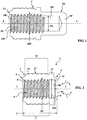
- the first end E1 is pressed against a wall of the mold or plugged on a lug carried in the cavity of the mold to obstruct the inlet port OE and prevent injected material from entering the section internally threaded TFI, which would render out of use the one-piece metal insert (and the part in which it is overmolded).
- the second end E2 being closed by the bottom wall PF, the injected material can not enter the longitudinal passage PL by the second end E2.
- the thread of the internally threaded section TFI is made by tapping with a tap introduced into the longitudinal passage through the inlet port OE.
- a tap introduced into the longitudinal passage through the inlet port OE.
- the clearance section TD avoids a support of the end of the tap against the bottom wall PF. Indeed, in case of such a support, the bottom wall PF would be smashed and no longer close enough the second end, or the tap would break.
- the clearance section TD has a length proportional to the dimensions of the tapping. It increases in practice the total length of the insert one-piece metal overmolding from about 40% to about 80% of the length of the internally threaded section TFI. This makes impossible the manufacture of injected parts thin, except to provide bosses where the inserts metal monobloc overmolded.
- the clearance section TD is smooth internally and has an inner diameter DI less than the threaded diameter DFF internally threaded section TFI.
- a monobloc metal insert with a longitudinal passage through, that is to say opening at both ends of the body.
- the one-piece metal insert can then be devoid of clearance section.
- a stopper is then attached, during a recovery operation, on the second end to seal it, as described in document FR 2 788 316 A1 . If the length of such a monobloc metal insert can be shorter than that of the insert of the figure 1 , its manufacture is more expensive because it requires the separate manufacture of several parts and a subsequent assembly operation. And the problems in case of excessive tightening stroke are not ruled out.
- a problem proposed by the present invention is to design a monobloc metal insert with internally threaded section, provided at one of its ends with an obturator bottom wall, which has a reduced length between the internally threaded section and the bottom wall. and which can be manufactured simply and cheaply.
- the longitudinal passage of the insert is opening at the second end, thus allowing the passage or the passing of a tap during tapping operations. It is therefore not necessary to provide a clearance section, so that the final length of the insert can be reduced.
- the second end is closed by a repoussage of the constituent material of the tubular peripheral wall of the insert, to form a bottom wall closing the second end.
- This closure of the second end does not require the addition of a manufactured part separately.
- a material repoussage resulting in a bottom wall being ultimately a reduced distance from the internally threaded portion, to have at the end of manufacture a reduced total length insert. It is thus possible to provide, between the internally threaded section and the second end, a length that is shorter in length than 40% to 80% of the length of the threaded section.
- plying of the second end by the bottom wall is meant in the present invention an obstruction of the second end which is sufficient to prevent the penetration of injected material in an amount rendering out of use the insert.
- the obstruction can be complete with a continuous bottom wall.
- the obstruction may be only partial, a slight hole may remain substantially in the center of the bottom wall after its manufacture by metal repoussage.
- the hole has dimensions sufficiently small to prevent the injected material penetrates sufficiently to render unusable insert. These dimensions may vary according to the characteristics of the injected material (viscosity in particular) and the injection made (injection pressure in particular).
- the bottom wall according to the invention can thus totally obstruct the second end of the insert and form a continuous bottom wall, or can substantially obstruct the second end of the insert due to the existence of a small hole.
- the internally threaded section may extend from the inlet orifice and toward the second end. This avoids unnecessary elongation of the insert between the internally threaded portion and the first end.
- the longitudinal passage may comprise, between the internally threaded portion and the bottom wall, a smooth section internally of internal diameter greater than the thread-end diameter of the internally threaded section.
- Such a smooth portion internally constitutes a clearance section for the end of a screw penetrating the insert in an excessive stroke.
- the clearance section formed by the internally smooth section may have a shorter length than that of the clearance section TD of the prior art insert illustrated in FIG. figure 1 .
- the insert may comprise a flange on the outer surface of the body.
- This collar makes it possible to effectively oppose an axial extraction force (along the longitudinal axis) of the insert out of the plastic part after overmolding.
- the insert may comprise means for blocking its rotation about the longitudinal axis after overmolding. This limits the risks that the insert can rotate relative to the plastic part, which would hinder the engagement of a screw by screwing into the insert. To do this, it is possible in practice to provide the insert with a non-circular cross-section section on the outer surface of the body.
- a method of manufacturing a one-piece full length metal insert that can be reduced, said method for closing the insert at one of its ends economically.
- the provision of the one-piece metal insert in step 1 can be performed by means of manufacturing on a single machining center, so that its manufacture can be envisaged at low cost.
- the closing operation of the insert at its second end does not require the addition of a manufactured part separately beforehand. And we may provide a backing of material resulting in a bottom wall being ultimately a reduced distance from the internally threaded portion so as to have at the end of manufacture a reduced total length insert. Excessive length between the internally threaded portion and the second end can be avoided.
- the end section may be smooth internally and have an inside diameter greater than the thread-end diameter of the internally threaded section. It is thus possible to provide the insert with a smooth section internally separating the internally threaded section from the bottom wall, said internally smooth section constituting a clearance section for the end of a screw penetrating into the internally threaded section of the insert in an excessive stroke. But this clearance section does not increase as much the total length of the insert as the clearance section TD in the insert of the prior art illustrated in FIG. figure 1 .
- step 2) can be carried out by spinning.
- step 2) can be performed by longitudinal axial pressing of the end portion of the one-piece metal insert against an anvil.
- anvils of different shapes can be used successively in order to gradually fold down the cylindrical wall of the end section radially toward the longitudinal axis.
- Such a manufacturing method allows the manufacture of a one-piece metal insert as described above and can be performed on a single machining center, without recovery operation.
- the insert with a smooth section internally separating the internally threaded section from the bottom wall, said internally smooth section constituting a clearance section for the end of a screw penetrating into the internally threaded section of the insert in an excessive stroke.
- a lateral surface of the metal rod is machined to produce a non-circular cross-section section and / or a collar.
- the flange opposes any effort tending to extract the insert from the injected part, while the non-circular section cross section opposes a rotational drive of the insert relative to the injected part.
- step D) can be carried out by spinning.
- step D) can be performed by longitudinal axial pressing of the free end of the metal rod against an anvil.
- anvils of different shapes can be used successively in order to gradually fold down the cylindrical wall of the end section radially toward the longitudinal axis.
- Each one-piece metal insert 1 comprises a body 2 extending along a longitudinal axis II between a first open end 3 with an inlet orifice 4 and a second end 5.
- a longitudinal passage 6 extends between the first and second ends 3 and 5 and comprises an internally threaded section 7.
- a bottom wall 8 closes the second end 5.
- the bottom wall 8 is made of metal pushed radially towards the longitudinal axis in a movement illustrated by the arrows 9.
- the outer face 8a of the bottom wall is continuous, so that the bottom wall 8 completely closes the second end 5 of the insert 1.
- the bottom wall 8 closes almost completely the second end 5 of the insert 1, the outer face of the bottom wall 8 being discontinuous due to the existence of a small hole 10 in its center after pushing the metal to manufacture the bottom wall 8.
- the small hole 10 communicates the longitudinal passage 6 with the outside through the bottom wall 8. So that the insert 1 of the figure 3 may be used to be overmolded in an injected part, the hole 10 has however a diameter d in the vicinity of the outer face 8a which is small enough to prevent an amount of injected material that can make unusable the internally threaded portion 7 enters into In practice, a diameter of less than or equal to 1 mm has generally been satisfactory.
- the internally threaded section 7 extends directly from the inlet orifice 4 in the direction of the second end 5.
- the internally threaded portion 7 may be preceded by a very short frustoconical section extending from the inlet port 4, said frustoconical section being intended to facilitate the introduction of a screw into the insert 1.
- the longitudinal passage comprises, between the internally threaded portion 7 and the bottom wall 8, a smooth inner portion 11 of internal diameter D11 greater than the threaded diameter D7 of the internally threaded section.
- the internally smooth section 11 constitutes a clearance section for the threaded end of a screw in case of excessive screwing stroke.
- the internally smooth section 11 increases the total length L of the insert 1 to a lesser extent than the clearance section TD of the insert of the prior art illustrated in FIG. figure 1 .
- the insert 1 further comprises, on the outer surface 2a of the body 2, a flange 12 intended to oppose an axial extraction attempt of the insert 1 out of the room after injection.
- the insert 1 also comprises means 13 for locking its rotation about the longitudinal axis I-I after overmoulding relative to the injected part.
- the insert 1 here comprises a section 14 of non-circular cross section on the outer surface 2a of the body 2.
- the section 14 is obtained by knurling.
- the method comprises a step 2) of deforming at least part of the cylindrical wall 800 of the end section 900 by folding it radially towards the longitudinal axis II-II (in a movement illustrated by the arrows 9 ) until closing the second end 500 of the body 200.
- the end section 900 is smooth internally and has an internal diameter D900 greater than the threaded diameter D700 of the internally threaded section 700.
- the embossing of the cylindrical wall 800 of the end section 900 can, according to a first possibility, be achieved by longitudinal axial pressing of the end section 900 against anvils 15 and 16, as illustrated in FIGS. figures 4 and 5 .
- the insert 100 is first pressed axially in the longitudinal direction II-II against the anvil 15 according to the movement illustrated by the arrow 17 ( figure 4 ).
- the anvil 15 has a conical recess 18 of angle A1.
- the insert 100 is in the configuration as illustrated in FIG. figure 5 on which a portion of the cylindrical wall 800 of the end portion 900 has been folded radially towards the longitudinal axis II-II.
- the insert 100 is then pressed axially against the anvil 16 along the longitudinal axis II-II by a movement illustrated by the arrow 19.
- the anvil 16 has a conical recess 20 of angle A2 greater than the angle A1 of the anvil 15 so as to further push the cylindrical wall 800 of the end portion 900 towards the longitudinal axis II-II.
- the insert 100 can be pressed against a last flat-faced anvil enabling the cylindrical wall 800 of the end section 900 to be brought into the configuration illustrated in FIGS. figures 2 or 3 , that is to say by folding at least a portion of the cylindrical wall 800 perpendicularly to the longitudinal axis II-II to close substantially, or completely, the second end 500 of the body 2.
- step 2) is carried out by spinning as illustrated on the figure 6 .
- a part of the cylindrical wall 800 of the end section 900 is folded towards the longitudinal axis II-II by a spinning wheel 21 moving axially according to the movement illustrated by the arrow 22 and radially according to the movement illustrated by the arrow 23 until reaching the configuration illustrated on the figures 2 or 3 wherein a portion of the cylindrical section 800 of the end section 900 is perpendicular to the longitudinal axis II-II and substantially or completely closes the second end 500 of the body 200 forming the bottom wall 8.
- FIGS. figures 2 and 3 On the Figures 7 to 13 is illustrated a second method of manufacturing a monoblock metal insert 1 as illustrated in FIGS. figures 2 and 3 .
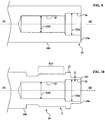
- This second manufacturing method comprises a step A) during which a metal rod 24 extending along a longitudinal axis III-III ( figure 7 ).
- a first blind longitudinal hole 25 is drilled with a first diameter D25 at a free end 24a of the metal rod 24 (FIG. figure 8 ).
- a second longitudinal hole 26 is drilled with a second diameter D26.
- the second diameter D26 is greater than the diameter D7 at the bottom of the tapping thread which is made during a subsequent step illustrated in FIG. figure 11 .
- the lateral surface 24b of the metal rod 24 is then machined to produce the external shape of the body 2 by producing the flange 12 and a blank E14 of the section 14 with a non-circular cross-section ( figure 10 ).
- the non-circular cross-section section 14 is formed by knurling the blank E14 as shown in FIG. figure 11 .
- the first longitudinal hole is tapped over at least a part of its length by introducing a tap into the first longitudinal hole from the free end 24a of the metal rod 24 ( figure 11 ).
- step D) illustrated on the figure 12 at least a portion of the constituent material of the free end 24a of the metal rod 24 is deformably deformed by folding this material radially towards the longitudinal axis III-III until it substantially or completely closes the first longitudinal hole.
- the step D) deformation by deformation can be carried out by longitudinal axial pressing of the free end 24a of the metal rod 24 in an anvil as illustrated in FIGS. figures 4 and 5 .
- the spinning by deformation can be carried out by spinning as illustrated on the figure 6 .
- step D the material constituting the free end 24a of the metal rod 24 is not deformed on a portion P of the second longitudinal hole 26, said portion P being adjacent to the tapping made in step C) .
- the portion P makes it possible to form the smooth portion 11 inside the insert 1 shown in FIGS. figures 2 or 3 .
- the remainder of the metal rod 24, if it has a sufficient length, can be machined again as illustrated on the Figures 8 to 13 to form another monobloc metal insert 1 as illustrated in the figures 2 or 3 .
- the realization of the second longitudinal hole 26 is optional and that, in step D), it is possible to deform at least a portion of the constituent material of the free end of the metal rod 24 which has been threaded. internally.
- the bottom wall 8 will have an inner face 8b marked by the tapping performed in step C). And the bottom wall 8 can be pushed closer to the internally threaded portion 7 of the insert 1.
- the production of the second longitudinal hole 26 is rather advantageous because it simultaneously makes it possible to obtain a smooth section internally 11 clearance for a screw while providing a cylindrical wall PC of reduced thickness E ( figure 11 ) at the free end 24a of the metal rod 24 to facilitate the repoussage of material carried out in step D).
- the second longitudinal hole 26 can be made before the first longitudinal hole. It is only preferable to make the second longitudinal hole 26 before step C) to avoid having to make an unnecessarily long tapping.
Landscapes
- Engineering & Computer Science (AREA)
- General Engineering & Computer Science (AREA)
- Mechanical Engineering (AREA)
- Forging (AREA)
- Dowels (AREA)
Claims (15)
- Einstückiger metallischer Einsatz (1), umfassend:- einen Körper (2), der sich in Richtung einer Längsachse (I-I) zwischen einem ersten Ende (3), das über eine Eintrittsöffnung (4) offen ist, und einem zweiten Ende (5) erstreckt,- einen in Längsrichtung (6) zwischen dem ersten Ende (3) und dem zweiten Ende (5) verlaufenden Durchgang (6) mit einem Innengewindeabschnitt (7),- eine das zweite Ende (5) abschließende Bodenwand (8),dadurch gekennzeichnet, dass die Bodenwand (8) aus einem radial gegen die Längsachse (I-I) getriebenen Metall besteht.
- Einstückiger metallischer Einsatz (1) nach Anspruch 1, dadurch gekennzeichnet, dass sich der Innengewindeabschnitt (7) von der Eintrittsöffnung (4) in Richtung auf das zweite Ende (5) erstreckt.
- Einstückiger metallischer Einsatz (1) nach Anspruch 1 oder 2, dadurch gekennzeichnet, dass der in Längsrichtung verlaufende Durchgang (6) zwischen dem Innengewindeabschnitt (7) und der Bodenwand (8) einen innen glatten Abschnitt (11) hat, dessen Innendurchmesser (D11) größer als der Durchmesser (D7) am Gewindefuß des Innengewindeabschnittes (7) ist.
- Einstückiger metallischer Einsatz (1) nach einem der Ansprüche 1 bis 3, dadurch gekennzeichnet, dass an der Außenseite (2a) des Körpers (2) ein Bund (12) ausgebildet ist.
- Einstückiger metallischer Einsatz (1) nach einem der Ansprüche 1 bis 4, dadurch gekennzeichnet, dass an diesem Mittel (13) ausgebildet sind, die nach der Gussüberformung eine Drehung um die Längsachse (I-I) verhindern.
- Einstückiger metallischer Einsatz (1) nach einem der Ansprüche 1 bis 5, dadurch gekennzeichnet, dass an der Außenseite (2a) des Körpers (2) ein im Querschnitt unrunder Abschnitt (14) ausgebildet ist.
- Verfahren zur Herstellung eines einstückigen metallischen Einsatzes (1), gekennzeichnet durch die folgenden Schritte:1) Bereitstellen eines einstückigen metallischen Einsatzes (100), umfassend:- einen Körper (200), der sich in Richtung einer Längsachse (II-II) zwischen einem ersten Ende (300), das über eine Eintrittsöffnung (400) offen ist, und einem zweiten Ende (500) erstreckt,- einen in Längsrichtung (600) zwischen dem ersten Ende (300) und dem zweiten Ende (500) verlaufenden Durchgang (600) mit einem Innengewindeabschnitt (700),- einen hohlen und offenen Endabschnitt (900) mit einer zylindrischen Wand (800), der den Innengewindeabschnitt (700) von dem ersten, offenen Ende (300) weggerichtet verlängert,2) Deformationsdrücken wenigstens eines Teils der zylindrischen Wand (800) des Endabschnitts (900) durch radiales Umbiegen in Richtung auf die Längsachse (II-II), bis das zweite Ende (500) des Körpers (200) geschlossen ist.
- Verfahren nach Anspruch 7, dadurch gekennzeichnet, dass der Endabschnitt (900) innen glatt ist und einen Innendurchmesser (D900) hat, der größer als der Durchmesser (D700) am Gewindefuß des Innengewindeabschnitts (700) ist.
- Verfahren nach Anspruch 7 oder 8, dadurch gekennzeichnet, dass der zweite Schritt 2) durch Rolldrücken durchgeführt wird.
- Verfahren nach Anspruch 7 oder 8, dadurch gekennzeichnet, dass der zweite Schritt 2) durch axiales Längsdrücken des Endabschnittes (900) des Einsatzes (1) gegen ein Gesenk (15, 16) durchgeführt wird.
- Verfahren zur Herstellung eines einstückigen, metallischen Einsatzes (1), gekennzeichnet durch die folgenden Schritte:A) Bereitstellen einer metallischen Stange (24), die sich in Längsrichtung (III-III) erstreckt,B) Bohren an einem freien Ende (24a) der Stange (24) eines ersten, in Längsrichtung verlaufenden Blindloches (25) mit einem ersten Durchmesser (D25),C) Schneiden eines Innengewindes in das erste Loch (25) bis wenigstens zu einem Teil seiner Länge, wozu von dem freien Ende (24a) der Stange (24) ein Gewindebohrer in das erste Loch (25) eingeführt wird,D) Deformationsdrücken wenigstens eines Teils des Materials, welches das freie Ende (24a) der Stange (24) bildet, so dass dieses in Richtung auf die Längsachse (III-III) radial umgebogen wird, bis das erste, in Längsrichtung verlaufende Loch (25) geschlossen ist,E) Radiales Ablängen der metallischen Stange (24) wenigstens in einer Zone (Z) im Gewindebereich des ersten Loches (25).
- Verfahren nach Anspruch 11, dadurch gekennzeichnet, dass :- vor dem Schritt C) am freien Ende (24a) der metallischen Stange (24) ein zweites, in Längsrichtung verlaufendes Loch (26) mit einem zweiten Durchmesser (D26) gebohrt wird,- der zweite Durchmesser (D26) größer als der Durchmesser (D7) am Gewindefuß des im Schritt C) gebildeten Innengewindeabschnittes ist,- im Schritt D) das das freie Ende der metallischen Stange (24) bildende Material auf einem Teil (P) des zweiten Loches (26) nicht verformt wird, der an die Gewindebildung im Schritt C) angrenzt.
- Verfahren nach Anspruch 11 oder 12, dadurch gekennzeichnet, dass vor dem Schritt D) eine Mantelfläche (24b) der Stange (24) bearbeitet wird, um einen in Querschnitt nicht kreisförmigen Abschnitt (14) und/oder einen Bund (12) auszubilden.
- Verfahren nach einem der Ansprüche 11 bis 13, dadurch gekennzeichnet, dass der Schritt D) durch Rolldrücken ausgeführt wird.
- Verfahren nach einem der Ansprüche 11 bis 13, dadurch gekennzeichnet, dass der Schritt D) durch axiales Längsdrücken des freien Endes (24a) der metallischen Stange (24) gegen ein Gesenk (15, 16) durchgeführt wird.
Applications Claiming Priority (1)
| Application Number | Priority Date | Filing Date | Title |
|---|---|---|---|
| FR1553166A FR3034825B1 (fr) | 2015-04-10 | 2015-04-10 | Insert taraude |
Publications (2)
| Publication Number | Publication Date |
|---|---|
| EP3081318A1 EP3081318A1 (de) | 2016-10-19 |
| EP3081318B1 true EP3081318B1 (de) | 2018-05-16 |
Family
ID=53496790
Family Applications (1)
| Application Number | Title | Priority Date | Filing Date |
|---|---|---|---|
| EP16163422.5A Active EP3081318B1 (de) | 2015-04-10 | 2016-03-31 | Gewindehülse |
Country Status (3)
| Country | Link |
|---|---|
| US (1) | US20160298673A1 (de) |
| EP (1) | EP3081318B1 (de) |
| FR (1) | FR3034825B1 (de) |
Families Citing this family (3)
| Publication number | Priority date | Publication date | Assignee | Title |
|---|---|---|---|---|
| EP4641035A3 (de) * | 2018-02-20 | 2025-12-31 | Ln1 Inc. | Kombinierte anker- und befestigungsanordnung |
| CN110962054B (zh) * | 2018-09-29 | 2021-08-20 | 宁波方太厨具有限公司 | 一种打螺钉工装 |
| DE102019218674A1 (de) * | 2019-12-02 | 2021-06-02 | Ejot Baubefestigungen Gmbh | Buchse mit freigestelltem Gewindeabschnitt zur Aufnahme eines Befestigungselements |
Family Cites Families (6)
| Publication number | Priority date | Publication date | Assignee | Title |
|---|---|---|---|---|
| FR2520455B1 (fr) * | 1982-01-25 | 1985-10-18 | France Etat | Procede et dispositifs d'assemblage d'elements en materiaux composites par des organes filetes |
| IT1280983B1 (it) * | 1995-10-18 | 1998-02-11 | Magneti Marelli Climat Srl | Procedimento per chiudere un'estremita' di un tubo metallico. |
| FR2788316B1 (fr) * | 1999-01-13 | 2001-03-30 | Peugeot Citroen Automobiles Sa | Ecrou borgne pour l'assemblage de deux pieces |
| DE10160185B4 (de) * | 2001-12-07 | 2007-01-18 | Lisa Dräxlmaier GmbH | Verfahren zum Erzeugen einer Befestigungsstruktur für ein Airbagmodul und Innenverkleidungsteilträger |
| US8556560B2 (en) * | 2011-01-24 | 2013-10-15 | Bollhoff Otalu S.A. | Tapped insert to be insert moulded and insert moulding method |
| WO2013177298A1 (en) * | 2012-05-22 | 2013-11-28 | Continental Structural Plastics, Inc. | Compression molding fastener |
-
2015
- 2015-04-10 FR FR1553166A patent/FR3034825B1/fr not_active Expired - Fee Related
-
2016
- 2016-03-31 EP EP16163422.5A patent/EP3081318B1/de active Active
- 2016-04-07 US US15/092,686 patent/US20160298673A1/en not_active Abandoned
Non-Patent Citations (1)
| Title |
|---|
| None * |
Also Published As
| Publication number | Publication date |
|---|---|
| FR3034825A1 (fr) | 2016-10-14 |
| US20160298673A1 (en) | 2016-10-13 |
| EP3081318A1 (de) | 2016-10-19 |
| FR3034825B1 (fr) | 2017-03-31 |
Similar Documents
| Publication | Publication Date | Title |
|---|---|---|
| CA2015037C (fr) | Organe de rivetage aveugle, procede d'assemblage et assemblages obtenus | |
| EP3058158B1 (de) | Selbsteinstellende anschlagspuffervorrichtung | |
| EP0216405B1 (de) | Niet, insbesondere für Schichtmaterialien | |
| CA2718805C (fr) | Procede d'assemblage de materiaux composites et organe de rivetage permettant de le mettre en oeuvre | |
| EP3081318B1 (de) | Gewindehülse | |
| EP3019411B1 (de) | Verschlusskappe aus kunststoff | |
| CH457715A (fr) | Capsule à coquille dure | |
| FR2532015A1 (fr) | Dispositif d'attache a ecrou d'ancrage | |
| EP2552622B1 (de) | Niet und nietsetzvorrichtung | |
| EP2010436B1 (de) | Verschlussverfahren und entsprechende verschlusskappe | |
| EP1941167B1 (de) | Blindniet und verfahren zu dessen entfernung | |
| EP0382638B1 (de) | Blindnietmutter und das Einsetzen in irgendeine Wand | |
| EP0019256B1 (de) | Muffenrohr aus Kugelgraphitguss | |
| FR2701248A1 (fr) | Dispositif de bouchage pour récipient, son procédé de fabrication et récipient équipé d'un tel dispositif. | |
| FR3058485A3 (fr) | Insert, dispositif de fixation comprenant un tel insert, et procedes de fabrication d'un tel dispositif | |
| EP3751154B1 (de) | Gewindeeinsatz für sandwichpaneel, zusammenbauverfahren und entsprechender zusammenbau | |
| CH609942A5 (en) | Cap made of injected synthetic material | |
| EP2428691A1 (de) | Einsatzblindmutter mit verformbarem Auslauf für den Gewindeschneider, und Verfahren zur Herstellung und zum Verformen des Einsatzes | |
| FR2479072A1 (fr) | Element moule comprenant une levre saillante rabattable sans formation de surepaisseur, roulette de meuble realisee a partir de cet element et procede et moule pour sa fabrication | |
| FR2943938A1 (fr) | Procede de moulage d'une piece hybride comprenant au moins deux inserts et installation pour la mise en oeuvre de ce procede | |
| EP2113372A1 (de) | Verbessertes mechanisches Bauteil aus Zweischichtwerkstoff | |
| FR3041941A1 (fr) | Bouchon avec events | |
| WO2004020168A2 (fr) | Procede de fabrication d’une piece en matiere plastique ayant un goulot muni d’un orifice de distribution destine a etre obture par un bouchon | |
| FR3150554A1 (fr) | boulon auto-perceur | |
| FR2975630A1 (fr) | Dispositif de liaison pour moulage ou surmoulage |
Legal Events
| Date | Code | Title | Description |
|---|---|---|---|
| PUAI | Public reference made under article 153(3) epc to a published international application that has entered the european phase |
Free format text: ORIGINAL CODE: 0009012 |
|
| AK | Designated contracting states |
Kind code of ref document: A1 Designated state(s): AL AT BE BG CH CY CZ DE DK EE ES FI FR GB GR HR HU IE IS IT LI LT LU LV MC MK MT NL NO PL PT RO RS SE SI SK SM TR |
|
| AX | Request for extension of the european patent |
Extension state: BA ME |
|
| STAA | Information on the status of an ep patent application or granted ep patent |
Free format text: STATUS: REQUEST FOR EXAMINATION WAS MADE |
|
| 17P | Request for examination filed |
Effective date: 20170404 |
|
| RBV | Designated contracting states (corrected) |
Designated state(s): AL AT BE BG CH CY CZ DE DK EE ES FI FR GB GR HR HU IE IS IT LI LT LU LV MC MK MT NL NO PL PT RO RS SE SI SK SM TR |
|
| GRAP | Despatch of communication of intention to grant a patent |
Free format text: ORIGINAL CODE: EPIDOSNIGR1 |
|
| STAA | Information on the status of an ep patent application or granted ep patent |
Free format text: STATUS: GRANT OF PATENT IS INTENDED |
|
| RIC1 | Information provided on ipc code assigned before grant |
Ipc: B21D 41/04 20060101AFI20171117BHEP Ipc: F16B 37/12 20060101ALI20171117BHEP |
|
| INTG | Intention to grant announced |
Effective date: 20171204 |
|
| GRAS | Grant fee paid |
Free format text: ORIGINAL CODE: EPIDOSNIGR3 |
|
| GRAA | (expected) grant |
Free format text: ORIGINAL CODE: 0009210 |
|
| STAA | Information on the status of an ep patent application or granted ep patent |
Free format text: STATUS: THE PATENT HAS BEEN GRANTED |
|
| AK | Designated contracting states |
Kind code of ref document: B1 Designated state(s): AL AT BE BG CH CY CZ DE DK EE ES FI FR GB GR HR HU IE IS IT LI LT LU LV MC MK MT NL NO PL PT RO RS SE SI SK SM TR |
|
| REG | Reference to a national code |
Ref country code: GB Ref legal event code: FG4D Free format text: NOT ENGLISH |
|
| REG | Reference to a national code |
Ref country code: CH Ref legal event code: EP |
|
| REG | Reference to a national code |
Ref country code: IE Ref legal event code: FG4D Free format text: LANGUAGE OF EP DOCUMENT: FRENCH |
|
| REG | Reference to a national code |
Ref country code: DE Ref legal event code: R096 Ref document number: 602016003057 Country of ref document: DE |
|
| REG | Reference to a national code |
Ref country code: AT Ref legal event code: REF Ref document number: 999064 Country of ref document: AT Kind code of ref document: T Effective date: 20180615 |
|
| REG | Reference to a national code |
Ref country code: NL Ref legal event code: MP Effective date: 20180516 |
|
| REG | Reference to a national code |
Ref country code: LT Ref legal event code: MG4D |
|
| PG25 | Lapsed in a contracting state [announced via postgrant information from national office to epo] |
Ref country code: SE Free format text: LAPSE BECAUSE OF FAILURE TO SUBMIT A TRANSLATION OF THE DESCRIPTION OR TO PAY THE FEE WITHIN THE PRESCRIBED TIME-LIMIT Effective date: 20180516 Ref country code: LT Free format text: LAPSE BECAUSE OF FAILURE TO SUBMIT A TRANSLATION OF THE DESCRIPTION OR TO PAY THE FEE WITHIN THE PRESCRIBED TIME-LIMIT Effective date: 20180516 Ref country code: BG Free format text: LAPSE BECAUSE OF FAILURE TO SUBMIT A TRANSLATION OF THE DESCRIPTION OR TO PAY THE FEE WITHIN THE PRESCRIBED TIME-LIMIT Effective date: 20180816 Ref country code: FI Free format text: LAPSE BECAUSE OF FAILURE TO SUBMIT A TRANSLATION OF THE DESCRIPTION OR TO PAY THE FEE WITHIN THE PRESCRIBED TIME-LIMIT Effective date: 20180516 Ref country code: NO Free format text: LAPSE BECAUSE OF FAILURE TO SUBMIT A TRANSLATION OF THE DESCRIPTION OR TO PAY THE FEE WITHIN THE PRESCRIBED TIME-LIMIT Effective date: 20180816 Ref country code: ES Free format text: LAPSE BECAUSE OF FAILURE TO SUBMIT A TRANSLATION OF THE DESCRIPTION OR TO PAY THE FEE WITHIN THE PRESCRIBED TIME-LIMIT Effective date: 20180516 |
|
| PG25 | Lapsed in a contracting state [announced via postgrant information from national office to epo] |
Ref country code: GR Free format text: LAPSE BECAUSE OF FAILURE TO SUBMIT A TRANSLATION OF THE DESCRIPTION OR TO PAY THE FEE WITHIN THE PRESCRIBED TIME-LIMIT Effective date: 20180817 Ref country code: HR Free format text: LAPSE BECAUSE OF FAILURE TO SUBMIT A TRANSLATION OF THE DESCRIPTION OR TO PAY THE FEE WITHIN THE PRESCRIBED TIME-LIMIT Effective date: 20180516 Ref country code: RS Free format text: LAPSE BECAUSE OF FAILURE TO SUBMIT A TRANSLATION OF THE DESCRIPTION OR TO PAY THE FEE WITHIN THE PRESCRIBED TIME-LIMIT Effective date: 20180516 Ref country code: LV Free format text: LAPSE BECAUSE OF FAILURE TO SUBMIT A TRANSLATION OF THE DESCRIPTION OR TO PAY THE FEE WITHIN THE PRESCRIBED TIME-LIMIT Effective date: 20180516 Ref country code: NL Free format text: LAPSE BECAUSE OF FAILURE TO SUBMIT A TRANSLATION OF THE DESCRIPTION OR TO PAY THE FEE WITHIN THE PRESCRIBED TIME-LIMIT Effective date: 20180516 |
|
| REG | Reference to a national code |
Ref country code: AT Ref legal event code: MK05 Ref document number: 999064 Country of ref document: AT Kind code of ref document: T Effective date: 20180516 |
|
| PG25 | Lapsed in a contracting state [announced via postgrant information from national office to epo] |
Ref country code: CZ Free format text: LAPSE BECAUSE OF FAILURE TO SUBMIT A TRANSLATION OF THE DESCRIPTION OR TO PAY THE FEE WITHIN THE PRESCRIBED TIME-LIMIT Effective date: 20180516 Ref country code: RO Free format text: LAPSE BECAUSE OF FAILURE TO SUBMIT A TRANSLATION OF THE DESCRIPTION OR TO PAY THE FEE WITHIN THE PRESCRIBED TIME-LIMIT Effective date: 20180516 Ref country code: SK Free format text: LAPSE BECAUSE OF FAILURE TO SUBMIT A TRANSLATION OF THE DESCRIPTION OR TO PAY THE FEE WITHIN THE PRESCRIBED TIME-LIMIT Effective date: 20180516 Ref country code: EE Free format text: LAPSE BECAUSE OF FAILURE TO SUBMIT A TRANSLATION OF THE DESCRIPTION OR TO PAY THE FEE WITHIN THE PRESCRIBED TIME-LIMIT Effective date: 20180516 Ref country code: PL Free format text: LAPSE BECAUSE OF FAILURE TO SUBMIT A TRANSLATION OF THE DESCRIPTION OR TO PAY THE FEE WITHIN THE PRESCRIBED TIME-LIMIT Effective date: 20180516 Ref country code: AT Free format text: LAPSE BECAUSE OF FAILURE TO SUBMIT A TRANSLATION OF THE DESCRIPTION OR TO PAY THE FEE WITHIN THE PRESCRIBED TIME-LIMIT Effective date: 20180516 Ref country code: DK Free format text: LAPSE BECAUSE OF FAILURE TO SUBMIT A TRANSLATION OF THE DESCRIPTION OR TO PAY THE FEE WITHIN THE PRESCRIBED TIME-LIMIT Effective date: 20180516 |
|
| REG | Reference to a national code |
Ref country code: DE Ref legal event code: R097 Ref document number: 602016003057 Country of ref document: DE |
|
| PG25 | Lapsed in a contracting state [announced via postgrant information from national office to epo] |
Ref country code: IT Free format text: LAPSE BECAUSE OF FAILURE TO SUBMIT A TRANSLATION OF THE DESCRIPTION OR TO PAY THE FEE WITHIN THE PRESCRIBED TIME-LIMIT Effective date: 20180516 Ref country code: SM Free format text: LAPSE BECAUSE OF FAILURE TO SUBMIT A TRANSLATION OF THE DESCRIPTION OR TO PAY THE FEE WITHIN THE PRESCRIBED TIME-LIMIT Effective date: 20180516 |
|
| PLBE | No opposition filed within time limit |
Free format text: ORIGINAL CODE: 0009261 |
|
| STAA | Information on the status of an ep patent application or granted ep patent |
Free format text: STATUS: NO OPPOSITION FILED WITHIN TIME LIMIT |
|
| 26N | No opposition filed |
Effective date: 20190219 |
|
| PG25 | Lapsed in a contracting state [announced via postgrant information from national office to epo] |
Ref country code: SI Free format text: LAPSE BECAUSE OF FAILURE TO SUBMIT A TRANSLATION OF THE DESCRIPTION OR TO PAY THE FEE WITHIN THE PRESCRIBED TIME-LIMIT Effective date: 20180516 |
|
| PG25 | Lapsed in a contracting state [announced via postgrant information from national office to epo] |
Ref country code: MC Free format text: LAPSE BECAUSE OF FAILURE TO SUBMIT A TRANSLATION OF THE DESCRIPTION OR TO PAY THE FEE WITHIN THE PRESCRIBED TIME-LIMIT Effective date: 20180516 |
|
| REG | Reference to a national code |
Ref country code: CH Ref legal event code: PL |
|
| PG25 | Lapsed in a contracting state [announced via postgrant information from national office to epo] |
Ref country code: LU Free format text: LAPSE BECAUSE OF NON-PAYMENT OF DUE FEES Effective date: 20190331 Ref country code: AL Free format text: LAPSE BECAUSE OF FAILURE TO SUBMIT A TRANSLATION OF THE DESCRIPTION OR TO PAY THE FEE WITHIN THE PRESCRIBED TIME-LIMIT Effective date: 20180516 |
|
| REG | Reference to a national code |
Ref country code: BE Ref legal event code: MM Effective date: 20190331 |
|
| PG25 | Lapsed in a contracting state [announced via postgrant information from national office to epo] |
Ref country code: LI Free format text: LAPSE BECAUSE OF NON-PAYMENT OF DUE FEES Effective date: 20190331 Ref country code: CH Free format text: LAPSE BECAUSE OF NON-PAYMENT OF DUE FEES Effective date: 20190331 Ref country code: IE Free format text: LAPSE BECAUSE OF NON-PAYMENT OF DUE FEES Effective date: 20190331 |
|
| PG25 | Lapsed in a contracting state [announced via postgrant information from national office to epo] |
Ref country code: BE Free format text: LAPSE BECAUSE OF NON-PAYMENT OF DUE FEES Effective date: 20190331 |
|
| PG25 | Lapsed in a contracting state [announced via postgrant information from national office to epo] |
Ref country code: TR Free format text: LAPSE BECAUSE OF FAILURE TO SUBMIT A TRANSLATION OF THE DESCRIPTION OR TO PAY THE FEE WITHIN THE PRESCRIBED TIME-LIMIT Effective date: 20180516 |
|
| PG25 | Lapsed in a contracting state [announced via postgrant information from national office to epo] |
Ref country code: MT Free format text: LAPSE BECAUSE OF FAILURE TO SUBMIT A TRANSLATION OF THE DESCRIPTION OR TO PAY THE FEE WITHIN THE PRESCRIBED TIME-LIMIT Effective date: 20180516 Ref country code: PT Free format text: LAPSE BECAUSE OF FAILURE TO SUBMIT A TRANSLATION OF THE DESCRIPTION OR TO PAY THE FEE WITHIN THE PRESCRIBED TIME-LIMIT Effective date: 20180917 |
|
| REG | Reference to a national code |
Ref country code: DE Ref legal event code: R082 Ref document number: 602016003057 Country of ref document: DE Representative=s name: KUHNEN & WACKER PATENT- UND RECHTSANWALTSBUERO, DE |
|
| GBPC | Gb: european patent ceased through non-payment of renewal fee |
Effective date: 20200331 |
|
| PG25 | Lapsed in a contracting state [announced via postgrant information from national office to epo] |
Ref country code: GB Free format text: LAPSE BECAUSE OF NON-PAYMENT OF DUE FEES Effective date: 20200331 |
|
| PG25 | Lapsed in a contracting state [announced via postgrant information from national office to epo] |
Ref country code: CY Free format text: LAPSE BECAUSE OF FAILURE TO SUBMIT A TRANSLATION OF THE DESCRIPTION OR TO PAY THE FEE WITHIN THE PRESCRIBED TIME-LIMIT Effective date: 20180516 |
|
| PG25 | Lapsed in a contracting state [announced via postgrant information from national office to epo] |
Ref country code: IS Free format text: LAPSE BECAUSE OF FAILURE TO SUBMIT A TRANSLATION OF THE DESCRIPTION OR TO PAY THE FEE WITHIN THE PRESCRIBED TIME-LIMIT Effective date: 20180916 |
|
| PG25 | Lapsed in a contracting state [announced via postgrant information from national office to epo] |
Ref country code: HU Free format text: LAPSE BECAUSE OF FAILURE TO SUBMIT A TRANSLATION OF THE DESCRIPTION OR TO PAY THE FEE WITHIN THE PRESCRIBED TIME-LIMIT; INVALID AB INITIO Effective date: 20160331 |
|
| PG25 | Lapsed in a contracting state [announced via postgrant information from national office to epo] |
Ref country code: MK Free format text: LAPSE BECAUSE OF FAILURE TO SUBMIT A TRANSLATION OF THE DESCRIPTION OR TO PAY THE FEE WITHIN THE PRESCRIBED TIME-LIMIT Effective date: 20180516 |
|
| P01 | Opt-out of the competence of the unified patent court (upc) registered |
Effective date: 20230516 |
|
| PGFP | Annual fee paid to national office [announced via postgrant information from national office to epo] |
Ref country code: FR Payment date: 20241216 Year of fee payment: 10 |
|
| PGFP | Annual fee paid to national office [announced via postgrant information from national office to epo] |
Ref country code: DE Payment date: 20250313 Year of fee payment: 10 |