EP3079189A1 - Quinone compound-graphene composite, preparation method therefor and flexible lithium secondary battery - Google Patents
Quinone compound-graphene composite, preparation method therefor and flexible lithium secondary battery Download PDFInfo
- Publication number
- EP3079189A1 EP3079189A1 EP14876837.7A EP14876837A EP3079189A1 EP 3079189 A1 EP3079189 A1 EP 3079189A1 EP 14876837 A EP14876837 A EP 14876837A EP 3079189 A1 EP3079189 A1 EP 3079189A1
- Authority
- EP
- European Patent Office
- Prior art keywords
- quinone compound
- composite material
- graphene
- quinone
- graphene composite
- Prior art date
- Legal status (The legal status is an assumption and is not a legal conclusion. Google has not performed a legal analysis and makes no representation as to the accuracy of the status listed.)
- Withdrawn
Links
- AZQWKYJCGOJGHM-UHFFFAOYSA-N 1,4-benzoquinone Chemical compound O=C1C=CC(=O)C=C1 AZQWKYJCGOJGHM-UHFFFAOYSA-N 0.000 title claims abstract description 274
- 229910021389 graphene Inorganic materials 0.000 title claims abstract description 152
- 239000002131 composite material Substances 0.000 title claims abstract description 111
- WHXSMMKQMYFTQS-UHFFFAOYSA-N Lithium Chemical compound [Li] WHXSMMKQMYFTQS-UHFFFAOYSA-N 0.000 title claims abstract description 32
- 229910052744 lithium Inorganic materials 0.000 title claims abstract description 32
- 238000002360 preparation method Methods 0.000 title claims abstract description 29
- -1 quinone compound Chemical class 0.000 claims abstract description 112
- OKTJSMMVPCPJKN-UHFFFAOYSA-N Carbon Chemical compound [C] OKTJSMMVPCPJKN-UHFFFAOYSA-N 0.000 claims abstract description 72
- 239000000178 monomer Substances 0.000 claims abstract description 60
- 229920000642 polymer Polymers 0.000 claims abstract description 27
- 239000006182 cathode active material Substances 0.000 claims abstract description 12
- 239000000843 powder Substances 0.000 claims description 41
- PYKYMHQGRFAEBM-UHFFFAOYSA-N anthraquinone Natural products CCC(=O)c1c(O)c2C(=O)C3C(C=CC=C3O)C(=O)c2cc1CC(=O)OC PYKYMHQGRFAEBM-UHFFFAOYSA-N 0.000 claims description 36
- 150000004056 anthraquinones Chemical class 0.000 claims description 36
- 238000000034 method Methods 0.000 claims description 33
- 238000001914 filtration Methods 0.000 claims description 28
- 238000005406 washing Methods 0.000 claims description 28
- YYVYAPXYZVYDHN-UHFFFAOYSA-N 9,10-phenanthroquinone Chemical compound C1=CC=C2C(=O)C(=O)C3=CC=CC=C3C2=C1 YYVYAPXYZVYDHN-UHFFFAOYSA-N 0.000 claims description 27
- 229930192627 Naphthoquinone Natural products 0.000 claims description 27
- 238000006243 chemical reaction Methods 0.000 claims description 27
- 150000002791 naphthoquinones Chemical class 0.000 claims description 27
- XLYOFNOQVPJJNP-UHFFFAOYSA-N water Substances O XLYOFNOQVPJJNP-UHFFFAOYSA-N 0.000 claims description 21
- 125000002924 primary amino group Chemical group [H]N([H])* 0.000 claims description 19
- QAOWNCQODCNURD-UHFFFAOYSA-N sulfuric acid Substances OS(O)(=O)=O QAOWNCQODCNURD-UHFFFAOYSA-N 0.000 claims description 18
- GRYLNZFGIOXLOG-UHFFFAOYSA-N Nitric acid Chemical compound O[N+]([O-])=O GRYLNZFGIOXLOG-UHFFFAOYSA-N 0.000 claims description 17
- 229910017604 nitric acid Inorganic materials 0.000 claims description 17
- 239000002253 acid Substances 0.000 claims description 16
- KMUONIBRACKNSN-UHFFFAOYSA-N potassium dichromate Chemical compound [K+].[K+].[O-][Cr](=O)(=O)O[Cr]([O-])(=O)=O KMUONIBRACKNSN-UHFFFAOYSA-N 0.000 claims description 16
- 238000001291 vacuum drying Methods 0.000 claims description 16
- 239000003792 electrolyte Substances 0.000 claims description 15
- 238000001132 ultrasonic dispersion Methods 0.000 claims description 15
- WEVYAHXRMPXWCK-UHFFFAOYSA-N Acetonitrile Chemical compound CC#N WEVYAHXRMPXWCK-UHFFFAOYSA-N 0.000 claims description 12
- LFQSCWFLJHTTHZ-UHFFFAOYSA-N Ethanol Chemical compound CCO LFQSCWFLJHTTHZ-UHFFFAOYSA-N 0.000 claims description 12
- 238000001035 drying Methods 0.000 claims description 12
- 125000000524 functional group Chemical group 0.000 claims description 12
- 238000006396 nitration reaction Methods 0.000 claims description 11
- 238000006116 polymerization reaction Methods 0.000 claims description 11
- VNWKTOKETHGBQD-UHFFFAOYSA-N methane Chemical compound C VNWKTOKETHGBQD-UHFFFAOYSA-N 0.000 claims description 10
- 238000003756 stirring Methods 0.000 claims description 10
- IJGRMHOSHXDMSA-UHFFFAOYSA-N Atomic nitrogen Chemical compound N#N IJGRMHOSHXDMSA-UHFFFAOYSA-N 0.000 claims description 9
- 125000003178 carboxy group Chemical group [H]OC(*)=O 0.000 claims description 9
- 229910001873 dinitrogen Inorganic materials 0.000 claims description 9
- 238000010992 reflux Methods 0.000 claims description 9
- XKRFYHLGVUSROY-UHFFFAOYSA-N Argon Chemical compound [Ar] XKRFYHLGVUSROY-UHFFFAOYSA-N 0.000 claims description 8
- MHAJPDPJQMAIIY-UHFFFAOYSA-N Hydrogen peroxide Chemical compound OO MHAJPDPJQMAIIY-UHFFFAOYSA-N 0.000 claims description 8
- 239000006183 anode active material Substances 0.000 claims description 8
- VLTRZXGMWDSKGL-UHFFFAOYSA-N perchloric acid Chemical compound OCl(=O)(=O)=O VLTRZXGMWDSKGL-UHFFFAOYSA-N 0.000 claims description 8
- 229920006395 saturated elastomer Polymers 0.000 claims description 8
- 239000000243 solution Substances 0.000 claims description 8
- 239000002904 solvent Substances 0.000 claims description 8
- 229910021393 carbon nanotube Inorganic materials 0.000 claims description 6
- 239000002041 carbon nanotube Substances 0.000 claims description 6
- 235000019441 ethanol Nutrition 0.000 claims description 6
- 239000011259 mixed solution Substances 0.000 claims description 6
- 150000004053 quinones Chemical class 0.000 claims description 5
- 229910052786 argon Inorganic materials 0.000 claims description 4
- 230000006837 decompression Effects 0.000 claims description 4
- 239000007789 gas Substances 0.000 claims description 4
- 230000000379 polymerizing effect Effects 0.000 claims description 4
- RUOJZAUFBMNUDX-UHFFFAOYSA-N propylene carbonate Chemical compound CC1COC(=O)O1 RUOJZAUFBMNUDX-UHFFFAOYSA-N 0.000 claims description 4
- XUIMIQQOPSSXEZ-UHFFFAOYSA-N Silicon Chemical compound [Si] XUIMIQQOPSSXEZ-UHFFFAOYSA-N 0.000 claims description 3
- ATJFFYVFTNAWJD-UHFFFAOYSA-N Tin Chemical compound [Sn] ATJFFYVFTNAWJD-UHFFFAOYSA-N 0.000 claims description 3
- 229910052710 silicon Inorganic materials 0.000 claims description 3
- 239000010703 silicon Substances 0.000 claims description 3
- 238000005303 weighing Methods 0.000 claims description 3
- 239000010406 cathode material Substances 0.000 abstract description 18
- HBBGRARXTFLTSG-UHFFFAOYSA-N Lithium ion Chemical compound [Li+] HBBGRARXTFLTSG-UHFFFAOYSA-N 0.000 description 8
- 125000002915 carbonyl group Chemical group [*:2]C([*:1])=O 0.000 description 8
- 229910001416 lithium ion Inorganic materials 0.000 description 8
- 230000000052 comparative effect Effects 0.000 description 7
- 238000007599 discharging Methods 0.000 description 7
- 239000000126 substance Substances 0.000 description 7
- UFHFLCQGNIYNRP-UHFFFAOYSA-N Hydrogen Chemical compound [H][H] UFHFLCQGNIYNRP-UHFFFAOYSA-N 0.000 description 6
- 239000006258 conductive agent Substances 0.000 description 6
- 239000001257 hydrogen Substances 0.000 description 6
- 229910052739 hydrogen Inorganic materials 0.000 description 6
- 238000004519 manufacturing process Methods 0.000 description 6
- 239000012528 membrane Substances 0.000 description 6
- 125000001997 phenyl group Chemical group [H]C1=C([H])C([H])=C(*)C([H])=C1[H] 0.000 description 6
- 239000011230 binding agent Substances 0.000 description 5
- 239000011888 foil Substances 0.000 description 5
- 229910052979 sodium sulfide Inorganic materials 0.000 description 5
- GRVFOGOEDUUMBP-UHFFFAOYSA-N sodium sulfide (anhydrous) Chemical compound [Na+].[Na+].[S-2] GRVFOGOEDUUMBP-UHFFFAOYSA-N 0.000 description 5
- 239000002033 PVDF binder Substances 0.000 description 4
- PQJKLTRMSHJEEN-UHFFFAOYSA-N anthracene-1,5-dione Chemical compound O=C1C=CC=C2C=C3C(=O)C=CC=C3C=C21 PQJKLTRMSHJEEN-UHFFFAOYSA-N 0.000 description 4
- 125000004122 cyclic group Chemical group 0.000 description 4
- 229910052751 metal Inorganic materials 0.000 description 4
- 239000002184 metal Substances 0.000 description 4
- 229920002981 polyvinylidene fluoride Polymers 0.000 description 4
- 150000004057 1,4-benzoquinones Chemical class 0.000 description 3
- BDAGIHXWWSANSR-UHFFFAOYSA-N Formic acid Chemical compound OC=O BDAGIHXWWSANSR-UHFFFAOYSA-N 0.000 description 3
- 229910002651 NO3 Inorganic materials 0.000 description 3
- NHNBFGGVMKEFGY-UHFFFAOYSA-N Nitrate Chemical compound [O-][N+]([O-])=O NHNBFGGVMKEFGY-UHFFFAOYSA-N 0.000 description 3
- 229910052782 aluminium Inorganic materials 0.000 description 3
- XAGFODPZIPBFFR-UHFFFAOYSA-N aluminium Chemical compound [Al] XAGFODPZIPBFFR-UHFFFAOYSA-N 0.000 description 3
- 238000007112 amidation reaction Methods 0.000 description 3
- 238000005452 bending Methods 0.000 description 3
- 150000007942 carboxylates Chemical class 0.000 description 3
- 238000013329 compounding Methods 0.000 description 3
- 239000012153 distilled water Substances 0.000 description 3
- 230000000694 effects Effects 0.000 description 3
- 238000004146 energy storage Methods 0.000 description 3
- VKYKSIONXSXAKP-UHFFFAOYSA-N hexamethylenetetramine Chemical group C1N(C2)CN3CN1CN2C3 VKYKSIONXSXAKP-UHFFFAOYSA-N 0.000 description 3
- 230000014759 maintenance of location Effects 0.000 description 3
- 229920001021 polysulfide Polymers 0.000 description 3
- 239000005077 polysulfide Substances 0.000 description 3
- 150000008117 polysulfides Polymers 0.000 description 3
- 229920001343 polytetrafluoroethylene Polymers 0.000 description 3
- 239000004810 polytetrafluoroethylene Substances 0.000 description 3
- 238000002604 ultrasonography Methods 0.000 description 3
- XVMVHWDCRFNPQR-UHFFFAOYSA-N 1,5-dinitroanthracene-9,10-dione Chemical compound O=C1C=2C([N+](=O)[O-])=CC=CC=2C(=O)C2=C1C=CC=C2[N+]([O-])=O XVMVHWDCRFNPQR-UHFFFAOYSA-N 0.000 description 2
- RZVHIXYEVGDQDX-UHFFFAOYSA-N 9,10-anthraquinone Chemical group C1=CC=C2C(=O)C3=CC=CC=C3C(=O)C2=C1 RZVHIXYEVGDQDX-UHFFFAOYSA-N 0.000 description 2
- RYGMFSIKBFXOCR-UHFFFAOYSA-N Copper Chemical compound [Cu] RYGMFSIKBFXOCR-UHFFFAOYSA-N 0.000 description 2
- SECXISVLQFMRJM-UHFFFAOYSA-N N-Methylpyrrolidone Chemical compound CN1CCCC1=O SECXISVLQFMRJM-UHFFFAOYSA-N 0.000 description 2
- 239000011149 active material Substances 0.000 description 2
- 238000005576 amination reaction Methods 0.000 description 2
- 239000006256 anode slurry Substances 0.000 description 2
- 239000001768 carboxy methyl cellulose Substances 0.000 description 2
- 239000006257 cathode slurry Substances 0.000 description 2
- 150000001875 compounds Chemical class 0.000 description 2
- 230000006835 compression Effects 0.000 description 2
- 238000007906 compression Methods 0.000 description 2
- 239000011889 copper foil Substances 0.000 description 2
- 238000010586 diagram Methods 0.000 description 2
- 238000003487 electrochemical reaction Methods 0.000 description 2
- 150000002085 enols Chemical class 0.000 description 2
- 239000000463 material Substances 0.000 description 2
- 239000000203 mixture Substances 0.000 description 2
- 239000003960 organic solvent Substances 0.000 description 2
- 125000004430 oxygen atom Chemical group O* 0.000 description 2
- 238000005498 polishing Methods 0.000 description 2
- 229920000767 polyaniline Polymers 0.000 description 2
- 229920000098 polyolefin Polymers 0.000 description 2
- BIGYLAKFCGVRAN-UHFFFAOYSA-N 1,3,4-thiadiazolidine-2,5-dithione Chemical compound S=C1NNC(=S)S1 BIGYLAKFCGVRAN-UHFFFAOYSA-N 0.000 description 1
- VWBVCOPVKXNMMZ-UHFFFAOYSA-N 1,5-diaminoanthracene-9,10-dione Chemical compound O=C1C2=C(N)C=CC=C2C(=O)C2=C1C=CC=C2N VWBVCOPVKXNMMZ-UHFFFAOYSA-N 0.000 description 1
- QGMFGTRLAHCRSP-UHFFFAOYSA-N 2,3-dinitrocyclohexa-2,5-diene-1,4-dione Chemical compound [O-][N+](=O)C1=C([N+]([O-])=O)C(=O)C=CC1=O QGMFGTRLAHCRSP-UHFFFAOYSA-N 0.000 description 1
- 229920000049 Carbon (fiber) Polymers 0.000 description 1
- 229920002134 Carboxymethyl cellulose Polymers 0.000 description 1
- 239000004698 Polyethylene Substances 0.000 description 1
- 239000002202 Polyethylene glycol Substances 0.000 description 1
- 239000004642 Polyimide Substances 0.000 description 1
- 239000004793 Polystyrene Substances 0.000 description 1
- 239000004372 Polyvinyl alcohol Substances 0.000 description 1
- UCKMPCXJQFINFW-UHFFFAOYSA-N Sulphide Chemical compound [S-2] UCKMPCXJQFINFW-UHFFFAOYSA-N 0.000 description 1
- DPXJVFZANSGRMM-UHFFFAOYSA-N acetic acid;2,3,4,5,6-pentahydroxyhexanal;sodium Chemical compound [Na].CC(O)=O.OCC(O)C(O)C(O)C(O)C=O DPXJVFZANSGRMM-UHFFFAOYSA-N 0.000 description 1
- HSFWRNGVRCDJHI-UHFFFAOYSA-N alpha-acetylene Natural products C#C HSFWRNGVRCDJHI-UHFFFAOYSA-N 0.000 description 1
- 150000008064 anhydrides Chemical class 0.000 description 1
- 230000009286 beneficial effect Effects 0.000 description 1
- 230000015572 biosynthetic process Effects 0.000 description 1
- 239000006229 carbon black Substances 0.000 description 1
- 239000004917 carbon fiber Substances 0.000 description 1
- 150000001728 carbonyl compounds Chemical class 0.000 description 1
- 235000010948 carboxy methyl cellulose Nutrition 0.000 description 1
- 239000008112 carboxymethyl-cellulose Substances 0.000 description 1
- 229920001940 conductive polymer Polymers 0.000 description 1
- 239000008367 deionised water Substances 0.000 description 1
- 229910021641 deionized water Inorganic materials 0.000 description 1
- 239000007772 electrode material Substances 0.000 description 1
- 239000005021 flexible packaging material Substances 0.000 description 1
- 229910002804 graphite Inorganic materials 0.000 description 1
- 239000010439 graphite Substances 0.000 description 1
- VRLIPUYDFBXWCH-UHFFFAOYSA-N hydridocarbon(.) Chemical compound [CH] VRLIPUYDFBXWCH-UHFFFAOYSA-N 0.000 description 1
- 238000002156 mixing Methods 0.000 description 1
- 229920000620 organic polymer Polymers 0.000 description 1
- 238000004806 packaging method and process Methods 0.000 description 1
- 239000002245 particle Substances 0.000 description 1
- 239000004033 plastic Substances 0.000 description 1
- 229920003023 plastic Polymers 0.000 description 1
- 229920003229 poly(methyl methacrylate) Polymers 0.000 description 1
- 229920001197 polyacetylene Polymers 0.000 description 1
- 229920001223 polyethylene glycol Polymers 0.000 description 1
- 229920001721 polyimide Polymers 0.000 description 1
- 239000004926 polymethyl methacrylate Substances 0.000 description 1
- 229920000128 polypyrrole Polymers 0.000 description 1
- 229920002223 polystyrene Polymers 0.000 description 1
- 229920000123 polythiophene Polymers 0.000 description 1
- 229920002451 polyvinyl alcohol Polymers 0.000 description 1
- 229920000915 polyvinyl chloride Polymers 0.000 description 1
- 239000004800 polyvinyl chloride Substances 0.000 description 1
- 235000019812 sodium carboxymethyl cellulose Nutrition 0.000 description 1
- 229920001027 sodium carboxymethylcellulose Polymers 0.000 description 1
- 239000007787 solid Substances 0.000 description 1
- 229920003048 styrene butadiene rubber Polymers 0.000 description 1
- 238000003786 synthesis reaction Methods 0.000 description 1
- KKEYFWRCBNTPAC-UHFFFAOYSA-L terephthalate(2-) Chemical compound [O-]C(=O)C1=CC=C(C([O-])=O)C=C1 KKEYFWRCBNTPAC-UHFFFAOYSA-L 0.000 description 1
Images


Classifications
-
- H—ELECTRICITY
- H01—ELECTRIC ELEMENTS
- H01M—PROCESSES OR MEANS, e.g. BATTERIES, FOR THE DIRECT CONVERSION OF CHEMICAL ENERGY INTO ELECTRICAL ENERGY
- H01M4/00—Electrodes
- H01M4/02—Electrodes composed of, or comprising, active material
- H01M4/36—Selection of substances as active materials, active masses, active liquids
- H01M4/60—Selection of substances as active materials, active masses, active liquids of organic compounds
-
- C—CHEMISTRY; METALLURGY
- C01—INORGANIC CHEMISTRY
- C01B—NON-METALLIC ELEMENTS; COMPOUNDS THEREOF; METALLOIDS OR COMPOUNDS THEREOF NOT COVERED BY SUBCLASS C01C
- C01B32/00—Carbon; Compounds thereof
- C01B32/15—Nano-sized carbon materials
- C01B32/182—Graphene
- C01B32/194—After-treatment
-
- C—CHEMISTRY; METALLURGY
- C07—ORGANIC CHEMISTRY
- C07C—ACYCLIC OR CARBOCYCLIC COMPOUNDS
- C07C225/00—Compounds containing amino groups and doubly—bound oxygen atoms bound to the same carbon skeleton, at least one of the doubly—bound oxygen atoms not being part of a —CHO group, e.g. amino ketones
- C07C225/24—Compounds containing amino groups and doubly—bound oxygen atoms bound to the same carbon skeleton, at least one of the doubly—bound oxygen atoms not being part of a —CHO group, e.g. amino ketones the carbon skeleton containing carbon atoms of quinone rings
- C07C225/26—Compounds containing amino groups and doubly—bound oxygen atoms bound to the same carbon skeleton, at least one of the doubly—bound oxygen atoms not being part of a —CHO group, e.g. amino ketones the carbon skeleton containing carbon atoms of quinone rings having amino groups bound to carbon atoms of quinone rings or of condensed ring systems containing quinone rings
- C07C225/28—Compounds containing amino groups and doubly—bound oxygen atoms bound to the same carbon skeleton, at least one of the doubly—bound oxygen atoms not being part of a —CHO group, e.g. amino ketones the carbon skeleton containing carbon atoms of quinone rings having amino groups bound to carbon atoms of quinone rings or of condensed ring systems containing quinone rings of non-condensed quinone rings
-
- H—ELECTRICITY
- H01—ELECTRIC ELEMENTS
- H01M—PROCESSES OR MEANS, e.g. BATTERIES, FOR THE DIRECT CONVERSION OF CHEMICAL ENERGY INTO ELECTRICAL ENERGY
- H01M10/00—Secondary cells; Manufacture thereof
- H01M10/05—Accumulators with non-aqueous electrolyte
- H01M10/052—Li-accumulators
- H01M10/0525—Rocking-chair batteries, i.e. batteries with lithium insertion or intercalation in both electrodes; Lithium-ion batteries
-
- H—ELECTRICITY
- H01—ELECTRIC ELEMENTS
- H01M—PROCESSES OR MEANS, e.g. BATTERIES, FOR THE DIRECT CONVERSION OF CHEMICAL ENERGY INTO ELECTRICAL ENERGY
- H01M10/00—Secondary cells; Manufacture thereof
- H01M10/05—Accumulators with non-aqueous electrolyte
- H01M10/058—Construction or manufacture
- H01M10/0585—Construction or manufacture of accumulators having only flat construction elements, i.e. flat positive electrodes, flat negative electrodes and flat separators
-
- H—ELECTRICITY
- H01—ELECTRIC ELEMENTS
- H01M—PROCESSES OR MEANS, e.g. BATTERIES, FOR THE DIRECT CONVERSION OF CHEMICAL ENERGY INTO ELECTRICAL ENERGY
- H01M4/00—Electrodes
- H01M4/02—Electrodes composed of, or comprising, active material
- H01M4/04—Processes of manufacture in general
- H01M4/0402—Methods of deposition of the material
- H01M4/0404—Methods of deposition of the material by coating on electrode collectors
-
- H—ELECTRICITY
- H01—ELECTRIC ELEMENTS
- H01M—PROCESSES OR MEANS, e.g. BATTERIES, FOR THE DIRECT CONVERSION OF CHEMICAL ENERGY INTO ELECTRICAL ENERGY
- H01M4/00—Electrodes
- H01M4/02—Electrodes composed of, or comprising, active material
- H01M4/04—Processes of manufacture in general
- H01M4/043—Processes of manufacture in general involving compressing or compaction
- H01M4/0433—Molding
-
- H—ELECTRICITY
- H01—ELECTRIC ELEMENTS
- H01M—PROCESSES OR MEANS, e.g. BATTERIES, FOR THE DIRECT CONVERSION OF CHEMICAL ENERGY INTO ELECTRICAL ENERGY
- H01M4/00—Electrodes
- H01M4/02—Electrodes composed of, or comprising, active material
- H01M4/04—Processes of manufacture in general
- H01M4/0471—Processes of manufacture in general involving thermal treatment, e.g. firing, sintering, backing particulate active material, thermal decomposition, pyrolysis
-
- H—ELECTRICITY
- H01—ELECTRIC ELEMENTS
- H01M—PROCESSES OR MEANS, e.g. BATTERIES, FOR THE DIRECT CONVERSION OF CHEMICAL ENERGY INTO ELECTRICAL ENERGY
- H01M4/00—Electrodes
- H01M4/02—Electrodes composed of, or comprising, active material
- H01M4/13—Electrodes for accumulators with non-aqueous electrolyte, e.g. for lithium-accumulators; Processes of manufacture thereof
- H01M4/133—Electrodes based on carbonaceous material, e.g. graphite-intercalation compounds or CFx
-
- H—ELECTRICITY
- H01—ELECTRIC ELEMENTS
- H01M—PROCESSES OR MEANS, e.g. BATTERIES, FOR THE DIRECT CONVERSION OF CHEMICAL ENERGY INTO ELECTRICAL ENERGY
- H01M4/00—Electrodes
- H01M4/02—Electrodes composed of, or comprising, active material
- H01M4/13—Electrodes for accumulators with non-aqueous electrolyte, e.g. for lithium-accumulators; Processes of manufacture thereof
- H01M4/137—Electrodes based on electro-active polymers
-
- H—ELECTRICITY
- H01—ELECTRIC ELEMENTS
- H01M—PROCESSES OR MEANS, e.g. BATTERIES, FOR THE DIRECT CONVERSION OF CHEMICAL ENERGY INTO ELECTRICAL ENERGY
- H01M4/00—Electrodes
- H01M4/02—Electrodes composed of, or comprising, active material
- H01M4/13—Electrodes for accumulators with non-aqueous electrolyte, e.g. for lithium-accumulators; Processes of manufacture thereof
- H01M4/139—Processes of manufacture
- H01M4/1393—Processes of manufacture of electrodes based on carbonaceous material, e.g. graphite-intercalation compounds or CFx
-
- H—ELECTRICITY
- H01—ELECTRIC ELEMENTS
- H01M—PROCESSES OR MEANS, e.g. BATTERIES, FOR THE DIRECT CONVERSION OF CHEMICAL ENERGY INTO ELECTRICAL ENERGY
- H01M4/00—Electrodes
- H01M4/02—Electrodes composed of, or comprising, active material
- H01M4/13—Electrodes for accumulators with non-aqueous electrolyte, e.g. for lithium-accumulators; Processes of manufacture thereof
- H01M4/139—Processes of manufacture
- H01M4/1399—Processes of manufacture of electrodes based on electro-active polymers
-
- H—ELECTRICITY
- H01—ELECTRIC ELEMENTS
- H01M—PROCESSES OR MEANS, e.g. BATTERIES, FOR THE DIRECT CONVERSION OF CHEMICAL ENERGY INTO ELECTRICAL ENERGY
- H01M4/00—Electrodes
- H01M4/02—Electrodes composed of, or comprising, active material
- H01M4/36—Selection of substances as active materials, active masses, active liquids
- H01M4/58—Selection of substances as active materials, active masses, active liquids of inorganic compounds other than oxides or hydroxides, e.g. sulfides, selenides, tellurides, halogenides or LiCoFy; of polyanionic structures, e.g. phosphates, silicates or borates
- H01M4/583—Carbonaceous material, e.g. graphite-intercalation compounds or CFx
- H01M4/587—Carbonaceous material, e.g. graphite-intercalation compounds or CFx for inserting or intercalating light metals
-
- H—ELECTRICITY
- H01—ELECTRIC ELEMENTS
- H01M—PROCESSES OR MEANS, e.g. BATTERIES, FOR THE DIRECT CONVERSION OF CHEMICAL ENERGY INTO ELECTRICAL ENERGY
- H01M4/00—Electrodes
- H01M4/02—Electrodes composed of, or comprising, active material
- H01M4/62—Selection of inactive substances as ingredients for active masses, e.g. binders, fillers
- H01M4/621—Binders
- H01M4/622—Binders being polymers
- H01M4/623—Binders being polymers fluorinated polymers
-
- H—ELECTRICITY
- H01—ELECTRIC ELEMENTS
- H01M—PROCESSES OR MEANS, e.g. BATTERIES, FOR THE DIRECT CONVERSION OF CHEMICAL ENERGY INTO ELECTRICAL ENERGY
- H01M4/00—Electrodes
- H01M4/02—Electrodes composed of, or comprising, active material
- H01M4/62—Selection of inactive substances as ingredients for active masses, e.g. binders, fillers
- H01M4/624—Electric conductive fillers
- H01M4/625—Carbon or graphite
-
- H—ELECTRICITY
- H01—ELECTRIC ELEMENTS
- H01M—PROCESSES OR MEANS, e.g. BATTERIES, FOR THE DIRECT CONVERSION OF CHEMICAL ENERGY INTO ELECTRICAL ENERGY
- H01M4/00—Electrodes
- H01M4/02—Electrodes composed of, or comprising, active material
- H01M4/64—Carriers or collectors
- H01M4/66—Selection of materials
- H01M4/661—Metal or alloys, e.g. alloy coatings
-
- H—ELECTRICITY
- H01—ELECTRIC ELEMENTS
- H01M—PROCESSES OR MEANS, e.g. BATTERIES, FOR THE DIRECT CONVERSION OF CHEMICAL ENERGY INTO ELECTRICAL ENERGY
- H01M50/00—Constructional details or processes of manufacture of the non-active parts of electrochemical cells other than fuel cells, e.g. hybrid cells
- H01M50/40—Separators; Membranes; Diaphragms; Spacing elements inside cells
- H01M50/409—Separators, membranes or diaphragms characterised by the material
- H01M50/411—Organic material
- H01M50/414—Synthetic resins, e.g. thermoplastics or thermosetting resins
-
- H—ELECTRICITY
- H01—ELECTRIC ELEMENTS
- H01M—PROCESSES OR MEANS, e.g. BATTERIES, FOR THE DIRECT CONVERSION OF CHEMICAL ENERGY INTO ELECTRICAL ENERGY
- H01M50/00—Constructional details or processes of manufacture of the non-active parts of electrochemical cells other than fuel cells, e.g. hybrid cells
- H01M50/40—Separators; Membranes; Diaphragms; Spacing elements inside cells
- H01M50/409—Separators, membranes or diaphragms characterised by the material
- H01M50/411—Organic material
- H01M50/414—Synthetic resins, e.g. thermoplastics or thermosetting resins
- H01M50/417—Polyolefins
-
- H—ELECTRICITY
- H01—ELECTRIC ELEMENTS
- H01M—PROCESSES OR MEANS, e.g. BATTERIES, FOR THE DIRECT CONVERSION OF CHEMICAL ENERGY INTO ELECTRICAL ENERGY
- H01M50/00—Constructional details or processes of manufacture of the non-active parts of electrochemical cells other than fuel cells, e.g. hybrid cells
- H01M50/40—Separators; Membranes; Diaphragms; Spacing elements inside cells
- H01M50/409—Separators, membranes or diaphragms characterised by the material
- H01M50/411—Organic material
- H01M50/414—Synthetic resins, e.g. thermoplastics or thermosetting resins
- H01M50/42—Acrylic resins
-
- H—ELECTRICITY
- H01—ELECTRIC ELEMENTS
- H01M—PROCESSES OR MEANS, e.g. BATTERIES, FOR THE DIRECT CONVERSION OF CHEMICAL ENERGY INTO ELECTRICAL ENERGY
- H01M50/00—Constructional details or processes of manufacture of the non-active parts of electrochemical cells other than fuel cells, e.g. hybrid cells
- H01M50/40—Separators; Membranes; Diaphragms; Spacing elements inside cells
- H01M50/409—Separators, membranes or diaphragms characterised by the material
- H01M50/411—Organic material
- H01M50/414—Synthetic resins, e.g. thermoplastics or thermosetting resins
- H01M50/426—Fluorocarbon polymers
-
- H—ELECTRICITY
- H01—ELECTRIC ELEMENTS
- H01M—PROCESSES OR MEANS, e.g. BATTERIES, FOR THE DIRECT CONVERSION OF CHEMICAL ENERGY INTO ELECTRICAL ENERGY
- H01M50/00—Constructional details or processes of manufacture of the non-active parts of electrochemical cells other than fuel cells, e.g. hybrid cells
- H01M50/40—Separators; Membranes; Diaphragms; Spacing elements inside cells
- H01M50/409—Separators, membranes or diaphragms characterised by the material
- H01M50/44—Fibrous material
-
- H—ELECTRICITY
- H01—ELECTRIC ELEMENTS
- H01M—PROCESSES OR MEANS, e.g. BATTERIES, FOR THE DIRECT CONVERSION OF CHEMICAL ENERGY INTO ELECTRICAL ENERGY
- H01M50/00—Constructional details or processes of manufacture of the non-active parts of electrochemical cells other than fuel cells, e.g. hybrid cells
- H01M50/40—Separators; Membranes; Diaphragms; Spacing elements inside cells
- H01M50/409—Separators, membranes or diaphragms characterised by the material
- H01M50/449—Separators, membranes or diaphragms characterised by the material having a layered structure
- H01M50/457—Separators, membranes or diaphragms characterised by the material having a layered structure comprising three or more layers
-
- H—ELECTRICITY
- H01—ELECTRIC ELEMENTS
- H01M—PROCESSES OR MEANS, e.g. BATTERIES, FOR THE DIRECT CONVERSION OF CHEMICAL ENERGY INTO ELECTRICAL ENERGY
- H01M10/00—Secondary cells; Manufacture thereof
- H01M10/05—Accumulators with non-aqueous electrolyte
- H01M10/052—Li-accumulators
-
- H—ELECTRICITY
- H01—ELECTRIC ELEMENTS
- H01M—PROCESSES OR MEANS, e.g. BATTERIES, FOR THE DIRECT CONVERSION OF CHEMICAL ENERGY INTO ELECTRICAL ENERGY
- H01M4/00—Electrodes
- H01M4/02—Electrodes composed of, or comprising, active material
- H01M2004/026—Electrodes composed of, or comprising, active material characterised by the polarity
- H01M2004/027—Negative electrodes
-
- H—ELECTRICITY
- H01—ELECTRIC ELEMENTS
- H01M—PROCESSES OR MEANS, e.g. BATTERIES, FOR THE DIRECT CONVERSION OF CHEMICAL ENERGY INTO ELECTRICAL ENERGY
- H01M4/00—Electrodes
- H01M4/02—Electrodes composed of, or comprising, active material
- H01M2004/026—Electrodes composed of, or comprising, active material characterised by the polarity
- H01M2004/028—Positive electrodes
-
- H—ELECTRICITY
- H01—ELECTRIC ELEMENTS
- H01M—PROCESSES OR MEANS, e.g. BATTERIES, FOR THE DIRECT CONVERSION OF CHEMICAL ENERGY INTO ELECTRICAL ENERGY
- H01M2220/00—Batteries for particular applications
- H01M2220/30—Batteries in portable systems, e.g. mobile phone, laptop
-
- Y—GENERAL TAGGING OF NEW TECHNOLOGICAL DEVELOPMENTS; GENERAL TAGGING OF CROSS-SECTIONAL TECHNOLOGIES SPANNING OVER SEVERAL SECTIONS OF THE IPC; TECHNICAL SUBJECTS COVERED BY FORMER USPC CROSS-REFERENCE ART COLLECTIONS [XRACs] AND DIGESTS
- Y02—TECHNOLOGIES OR APPLICATIONS FOR MITIGATION OR ADAPTATION AGAINST CLIMATE CHANGE
- Y02E—REDUCTION OF GREENHOUSE GAS [GHG] EMISSIONS, RELATED TO ENERGY GENERATION, TRANSMISSION OR DISTRIBUTION
- Y02E60/00—Enabling technologies; Technologies with a potential or indirect contribution to GHG emissions mitigation
- Y02E60/10—Energy storage using batteries
-
- Y—GENERAL TAGGING OF NEW TECHNOLOGICAL DEVELOPMENTS; GENERAL TAGGING OF CROSS-SECTIONAL TECHNOLOGIES SPANNING OVER SEVERAL SECTIONS OF THE IPC; TECHNICAL SUBJECTS COVERED BY FORMER USPC CROSS-REFERENCE ART COLLECTIONS [XRACs] AND DIGESTS
- Y02—TECHNOLOGIES OR APPLICATIONS FOR MITIGATION OR ADAPTATION AGAINST CLIMATE CHANGE
- Y02P—CLIMATE CHANGE MITIGATION TECHNOLOGIES IN THE PRODUCTION OR PROCESSING OF GOODS
- Y02P70/00—Climate change mitigation technologies in the production process for final industrial or consumer products
- Y02P70/50—Manufacturing or production processes characterised by the final manufactured product
Definitions
- a compound or polymer is also applicable to preparing electrode materials of the flexible energy storage device.
- a compound or organic polymer is generally used as organic cathode material of organic lithium ion battery.
- Organic conductive polymer and composite material thereof such as polyaniline, polythiophene, polypyrrole, and polyacetylene
- organic sulfide or polysulfide such as 2,5-dimercapto-thiadiazole, carbyne polysulfide, and polyaniline polysulfide
- oxygenated functional group compound such as quinones and the polymer thereof, and carbonyl compound with anhydride as representative
- the quinone compound-graphene composite material provided by the embodiments of the present invention has high energy density, high flexibility, high conductivity, and high stability.
- the quinone compound has relatively high specific capacity and redox potential; double carbonyl in quinone compound has electrochemical activity point, oxygen atom on each carbonyl obtains one electron during discharging, and lithium ion is intercalated to produce lithium enolate; during charging, lithium ion is deintercalated, carbonyl functional groups are reduced, and lithium ion is intercalated and deintercalated through conversion between structures of carbonyls and enol; the quinone compound exhibits good structural stability in a process of electrochemical reaction,, which contributes to good cycle stability of the quinone compound.
- the graphene has excellent conductivity and flexibility, and can greatly improve conductivity performance and flexibility of the composite material, so that the composite material is applicable to use as cathode material for preparing flexible battery, and has high capacity.
- the quinone compound monomer is any one of benzoquinone, naphthoquinone, anthraquinone, and phenanthraquinone, or the isomer of any one of benzoquinone, naphthoquinone, anthraquinone, and phenanthraquinone.
- the reaction for 5 to 15 h at 50 to 60 °C is performed under conditions of stirring and ultrasonic dispersion.
- the preparation method of quinone compound-graphene composite material further includes the following steps:
- the above is polymerization reaction process of the quinone compound monomer.
- the polymerization reaction happens in amino connected to benzene ring and hydrogen in a para-position of the amino in the quinone compound monomer, and the amino connected to the benzene ring and the hydrogen in a para-position of the amino form the quinone polymer in head-to-tail ligation manner.
- the preparation method of quinone compound-graphene composite material provided by the second aspect of the embodiments of the present invention has simple process, and is easy to implement in industrialized production.
- the embodiments of the present invention provide a preparation method of quinone compound-graphene composite material, including the following steps:
- the volume ratio of concentrated sulfuric acid to concentrated nitric acid preferably is 3:1.
- the embodiments of the present invention provide a flexible lithium secondary battery, including flexible battery housing; flexible cathode, flexible anode, and separator that are located inside the flexible battery housing, and electrolyte injected inside the flexible battery housing, where the separator is disposed between the flexible cathode and the flexible anode, the flexible cathode includes cathode active material which including quinine-compound graphene composite material.
- the quinone compound-graphene composite material includes quinone compound and graphene, where the quinone compound is chemically bonded on the surface of the graphene, and the quinone compound is quinone compound monomer or quinone polymer.
- aminate p-benzoquinone Use nitration reduction method. Specifically, nitrate the p-benzoquinone by mixed acid containing concentrated sulfuric acid and concentrated nitric acid, to obtain dinitro p-benzoquinone; add sodium sulfide to perform reduction, to obtain mixed liquor containing the aminated p-benzoquinone. Filter, wash, and dry the mixed liquor, to obtain aminated p-benzoquinone powder, where a reaction formula of the amination reaction is shown in formula (1):
- step S13 perform amidated compounding: Add the excessive aminated p-benzoquinone powder obtained in step S11 and the carboxylated graphene powder obtained in step S12 to water; expose them to ultrasound for 2 h, to obtain mixed dispersed liquor; and perform reflux on the mixed dispersed liquor for 72 h at 120 °C under protection of nitrogen gas N 2 , to perform amidation reaction (as shown in formula (3)):
- FIG. 2 is flowchart of preparing the polyaminated anthraquinone-graphene composite material according to this embodiment.
- aminate 1,5-anthraquinone Use nitration reduction method. Specifically, nitrate the 1,5-anthraquinone by mixed acid in concentrated sulfuric acid, to obtain 1,5-dinitro anthraquinone; add sodium sulfide to perform reduction, to obtain mixed liquor containing 1,5-diaminated anthraquinone. Filter, wash, and dry the mixed liquor, to obtain 1,5-diaminated anthraquinone powder.
- step S34 perform amidated compounding: Add the excessive 1,5-diaminated anthraquinone powder obtained in step S31 and the carboxylated graphene powder obtained in step S33 to water; expose them to ultrasound for 2 h, to obtain mixed dispersed liquor; and perform reflux on the mixed dispersed liquor for 72 h at 120 °C under protection of nitrogen gas N 2 , to perform amidation reaction (as shown in formula (8)):
- the flexible lithium secondary battery (400) includes flexible battery housing (404); flexible cathode(401), flexible anode (402), and separator (403) that are located inside the flexible battery housing (404), and electrolyte injected inside the flexible battery housing (404), where the separator (403) is disposed between the flexible cathode (401) and the flexible anode (402).
- the p-benzoquinone-graphene composite material obtained in Embodiment 1 is used as cathode active material of the flexible cathode (401), and graphene is used as anode active material of the flexible anode (402).
- Results embodiment To support beneficial effects of the embodiments of the present invention, the effect embodiment is provided below, evaluating the performance of product provided by the embodiments of the present invention.
Landscapes
- Chemical & Material Sciences (AREA)
- Chemical Kinetics & Catalysis (AREA)
- Electrochemistry (AREA)
- General Chemical & Material Sciences (AREA)
- Engineering & Computer Science (AREA)
- Materials Engineering (AREA)
- Manufacturing & Machinery (AREA)
- Organic Chemistry (AREA)
- Inorganic Chemistry (AREA)
- Nanotechnology (AREA)
- Battery Electrode And Active Subsutance (AREA)
- Carbon And Carbon Compounds (AREA)
Abstract
Description
- This application claims priority to Chinese Patent Application No.
201310752362.1 - The present invention relates to the field of energy materials, and in particular, to a quinone compound-graphene composite material, a preparation method thereof, and a flexible lithium secondary battery.
- As people's demands for miniaturization of electronic products are growing, flexible, wearable, and portable electronic products, such as electronic paper, folding display screens, electronic labels, and flexible sensors, has become a future development trend. A flexible energy storage device is formed by flexible electrode, electrolyte, flexible packaging material, and the like, where development of the flexible electrode is a key to the development of the flexible energy storage device.
- A compound or polymer is also applicable to preparing electrode materials of the flexible energy storage device. A compound or organic polymer is generally used as organic cathode material of organic lithium ion battery. Organic conductive polymer and composite material thereof (such as polyaniline, polythiophene, polypyrrole, and polyacetylene), organic sulfide or polysulfide (such as 2,5-dimercapto-thiadiazole, carbyne polysulfide, and polyaniline polysulfide), and oxygenated functional group compound (such as quinones and the polymer thereof, and carbonyl compound with anhydride as representative) are mainly used as organic cathode materials.
- The foregoing organic cathode materials have advantages of high theoretical capacity (400 to 900 mAh/g), cost-effective synthesis, recyclability, mechanical flexibility, and designable molecular height. However, the organic cathode materials generally have low conductivity, poor performance stability as which have to need high electrolyte absorbing and easy to dissolve in electrolyte, and then affected the battery performance of cycle life and power ability which is far poorer than those of a conventional lithium ion battery.
- In view of this, a first aspect of embodiments of the present invention provides a quinone compound-graphene composite material. The composite material has high energy density, high flexibility, high conductivity, and high stability, which solves the problem in the prior art that an organic cathode material has poor conductivity and poor stability. The composite material can be used as cathode material for preparing flexible battery.
- According to the first aspect, the embodiments of the present invention provide a quinone compound-graphene composite material, including quinone compound and graphene, where the quinone compound is chemically bonded on the surface of the graphene, and the quinone compound is quinone compound monomer or quinone polymer.
- The quinone compound-graphene composite material provided by the embodiments of the present invention has high energy density, high flexibility, high conductivity, and high stability. The quinone compound has relatively high specific capacity and redox potential; double carbonyl in quinone compound has electrochemical activity point, oxygen atom on each carbonyl obtains one electron during discharging, and lithium ion is intercalated to produce lithium enolate; during charging, lithium ion is deintercalated, carbonyl functional groups are reduced, and lithium ion is intercalated and deintercalated through conversion between structures of carbonyls and enol; the quinone compound exhibits good structural stability in a process of electrochemical reaction,, which contributes to good cycle stability of the quinone compound. The graphene has excellent conductivity and flexibility, and can greatly improve conductivity performance and flexibility of the composite material, so that the composite material is applicable to use as cathode material for preparing flexible battery, and has high capacity.
- Preferably, the surface of the graphene contains carboxyl functional group, the quinone compound contains amino functional group, and the quinone compound is bonded on the surface of the graphene by amido bond formed by the carboxyl functional group and the amino functional group.
- Preferably, the quinone compound monomer is any one of benzoquinone, naphthoquinone, anthraquinone, and phenanthraquinone, or the isomer of any one of benzoquinone, naphthoquinone, anthraquinone, and phenanthraquinone.
- Preferably, the quinone polymer is polymer formed by any one or more than one of benzoquinone, naphthoquinone, anthraquinone, and phenanthraquinone, or the polymer formed by the isomer of any one of benzoquinone, naphthoquinone, anthraquinone, and phenanthraquinone or formed by the isomers of more than one of benzoquinone, naphthoquinone, anthraquinone, and phenanthraquinone.
- Preferably, the quinone compound accounts for 20 to 80% by weight of the quinone compound-graphene composite material.
- In the quinone compound-graphene composite material provided by the first aspect of the embodiments of the present invention, high conductivity graphene and the quinone compound are chemical compounded. The composite material has high energy density, high flexibility, high conductivity, and high stability, which solves the problem in the prior art that the organic cathode material has poor conductivity and poor stability. The composite material can be used as cathode for preparing flexible battery.
- According to second aspect, the embodiments of the present invention provide a preparation method of quinone compound-graphene composite material, including the following steps:
- aminating quinone compound monomer by nitration reduction method, to obtain mixed liquor containing the aminated quinone compound monomer;
- filtering, washing, and drying the mixed liquor containing the aminated quinone compound monomer, to obtain aminated quinone compound monomer powder;
- adding graphene oxide powder to mixed acid that contains concentrated sulfuric acid and concentrated nitric acid in preset proportion, to react for 5 to 15 h at 50 to 60 °C, and then performing operations of filtration, washing, and vacuum drying, to obtain surface-carboxylated graphene powder;
- adding the aminated quinone compound monomer powder and the surface-carboxylated graphene powder to water or ethyl alcohol, and performing ultrasonic dispersion to obtain mixed dispersed liquor; and
- performing reflux reaction on the mixed dispersed liquor for 48 to 72 h at 100 to 120 °C under protection of nitrogen gas, and after reaction is finished, performing filtration, washing, and drying on the product, to obtain quinone compound monomer-graphene composite material.
- Preferably, the quinone compound monomer is any one of benzoquinone, naphthoquinone, anthraquinone, and phenanthraquinone, or the isomer of any one of benzoquinone, naphthoquinone, anthraquinone, and phenanthraquinone.
- Preferably, the reaction for 5 to 15 h at 50 to 60 °C is performed under conditions of stirring and ultrasonic dispersion.
- Preferably, the preparation method of quinone compound-graphene composite material further includes the following steps:
- weighing out the quinone compound monomer-graphene composite material, perchloric acid, saturated water solution of hydrogen peroxide, and potassium dichromate according to molar ratio of 1:2:2:2, and adding them to acetonitrile solvent, to obtain mixed solution;
- adding saturated water solution of potassium dichromate dropwise to the mixed solution to react for 48 to 72 h at 30 to 50 °C under protection of argon gas, to obtain mixed liquor containing quinone polymer-graphene composite material; and
- performing decompression filtration, washing, and vacuum drying on the mixed liquor containing the quinone polymer-graphene composite material, to obtain powder of the quinone polymer-graphene composite material.
- The quinone compound-graphene composite material preparation method provided by the second aspect of the embodiments of the present invention has simple process, and is easy to implement in industrialized production.
- According to third aspect, the embodiments of the present invention provide a preparation method of quinone compound-graphene composite material, including the following steps:
- aminating quinone compound monomer by nitration reduction method, to obtain mixed liquor containing the aminated quinone compound monomer;
- filtering, washing, and drying the mixed liquor containing the aminated quinone compound monomer, to obtain aminated quinone compound monomer powder;
- adding the aminated quinone compound monomer powder to electrolyte of an organic propylene carbonate solvent, and polymerizing the aminated quinone compound monomer by constant potential polymerization method of three-electrode system, to obtain animated quinone polymer;
- adding graphene oxide powder to mixed acid that contains concentrated sulfuric acid and concentrated nitric acid in preset proportion, to react for 5 to 15 h at 50 to 60 °C, and then performing operations of filtration, washing, and vacuum drying, to obtain surface-carboxylated graphene powder;
- adding the aminated quinone polymer and the carboxylated graphene powder to water or ethyl alcohol, and performing ultrasonic dispersion to obtain mixed dispersed liquor; and
- performing reflux reaction on the mixed dispersed liquor for 48 to 72 h at 100 to 120 °C under protection of nitrogen gas, and after reaction is finished, performing filtration, washing, and drying on the product, to obtain quinone polymer-graphene composite material.
- Preferably, the quinone compound monomer is any one of benzoquinone, naphthoquinone, anthraquinone, and phenanthraquinone, or the isomer of any one of benzoquinone, naphthoquinone, anthraquinone, and phenanthraquinone.
- Preferably, the reaction for 5 to 15 h at 50 to 60 °C is performed under conditions of stirring and ultrasonic dispersion.
- The preparation method of quinone compound-graphene composite material provided by the third aspect of the embodiments of the present invention has simple process, and is easy to implement in industrialized production.
- According to fourth aspect, the embodiments of the present invention provide a flexible lithium secondary battery, including flexible battery housing; flexible cathode, flexible anode cathode, and separator that are located inside the flexible battery housing, and electrolyte injected inside the flexible battery housing, where the separator is disposed between the flexible cathode and the flexible anode, the flexible cathode includes cathode active material which including a quinine-compound graphene composite material. The quinone compound-graphene composite material includes quinone compound and graphene, where the quinone compound is chemically bonded on the surface of the graphene, and the quinone compound is quinone compound monomer or quinone polymer.
- Preferably, the flexible anode includes anode active material, and the anode active material is graphene, carbon nanotube, silicon film, or tin film.
- The flexible lithium secondary battery provided by the fourth aspect of the embodiments of the present invention exhibits high flexibility, high rate performance, high energy density, and high stability, and is applicable to future flexible electronic device.
- In conclusion, in the quinone compound-graphene composite material provided by the first aspect of the embodiments of the present invention, high conductivity graphene and the quinone compound are chemical compounded. The composite material has high energy density, high flexibility, high conductivity, and high stability, which solves the problem in the prior art that organic cathode material has poor conductivity and poor stability. The composite material can be used as cathode material for preparing flexible battery. The preparation methods of quinone compound-graphene composite material provided by the second and third aspects of the embodiments of the present invention have simple process, and are easy to implement in industrialized production. The flexible lithium secondary battery provided by the fourth aspect of the embodiments of the present invention exhibits high flexibility, high rate performance, high energy density, and high stability, and is applicable to future flexible electronic device.
- Advantages of the embodiments of the present invention are partially described below in this specification, and part of these advantages are apparent according to this specification, or may be known by practicing the embodiments of the present invention.
-
-
FIG. 1 is flowchart of preparing p-benzoquinone-graphene composite material according to Embodiment 1 of the present invention; -
FIG. 2 is flowchart of preparing polyaminated anthraquinone-graphene composite material according to Embodiment 2 of the present invention; -
FIG. 3 is flowchart of preparing polyaminated anthraquinone-graphene composite material according to Embodiment 3 of the present invention; and -
FIG. 4 is schematic structural diagram of flexible lithium secondary battery according to an embodiment of the present invention. - The following descriptions are exemplary implementations of embodiments of the present invention. It should be noted that a person of ordinary skill in the art may make several improvements and polishing without departing from the principle of the embodiments of the present invention and the improvements and polishing shall fall within the protection scope of the embodiments of the present invention.
- The following further describes in detail the embodiments of the present invention by multiple embodiments. The embodiments of the present invention are not limited to the following specific embodiments. Implementations can be modified within the scope of the claims to a certain extent.
- A first aspect of the embodiments of the present invention provides a quinone compound-graphene composite material. The composite material has high energy density, high flexibility, high conductivity, and high stability, which solves the problem in the prior art that organic cathode material has poor conductivity and poor stability. The composite material can be used as cathode material for preparing flexible battery.
- According to the first aspect, the embodiments of the present invention provide a quinone compound-graphene composite material, including quinone compound and graphene, where the quinone compound is chemically bonded on the surface of the graphene, and the quinone compound is quinone compound monomer or quinone polymer.
- The quinone compound-graphene composite material provided by the embodiments of the present invention has high energy density, high flexibility, high conductivity, and high stability. The quinone compound has relatively high specific capacity and redox potential; double carbonyl in the quinone compound has electrochemical activity point, oxygen atom on each carbonyl obtains one electron during discharging, and lithium ion is intercalated to produce lithium enolate; during charging, lithium ion is deintercalated, carbonyls are reduced, and lithium ion is intercalated and deintercalated through conversion between structures of carbonyls and enol; in process of electrochemical reaction, the quinone compound exhibits good structural stability, which contributes to good cycle stability of the quinone compound. The graphene has excellent conductivity and flexibility, and can greatly improve conductivity performance and flexibility of the composite material, so that the composite material is applicable to cathode material for preparing flexible battery, and has high capacity.
- Preferably, the surface of the graphene contains carboxyl functional group, the quinone compound contains amino functional group, and the quinone compound is bonded on the surface of the graphene by amido bond formed by the carboxyl functional group and the amino functional group.
- Preferably, the quinone compound monomer is any one of benzoquinone, naphthoquinone, anthraquinone, and phenanthraquinone, or the isomer of any one of benzoquinone, naphthoquinone, anthraquinone, and phenanthraquinone.
- Preferably, the quinone polymer is a polymer formed by any one or more than one of benzoquinone, naphthoquinone, anthraquinone, and phenanthraquinone, or the polymer formed by the isomer of any one of benzoquinone, naphthoquinone, anthraquinone, and phenanthraquinone or formed by isomers of more than one of benzoquinone, naphthoquinone, anthraquinone, and phenanthraquinone.
- Preferably, the quinone compound accounts for 20 to 80% by weight of the quinone compound-graphene composite material.
- The graphene in the quinone compound-graphene composite material according to the embodiments of the present invention is graphene oxide.
- In the quinone compound-graphene composite material provided by the first aspect of the embodiments of the present invention, high conductivity graphene and the quinone compound are chemical compounded. The composite material has high energy density, high flexibility, high conductivity, and high stability, which solves the problem in the prior art that organic cathode material has poor conductivity and poor stability. The composite material can be used as cathode material for preparing flexible battery.
- According to second aspect, the embodiments of the present invention provide a preparation method of quinone compound-graphene composite material, including the following steps:
- aminating quinone compound monomer by nitration reduction method, to obtain mixed liquor containing the aminated quinone compound monomer;
- filtering, washing, and drying the mixed liquor containing the aminated quinone compound monomer, to obtain aminated quinone compound monomer powder;
- adding graphene oxide powder to mixed acid that contains concentrated sulfuric acid and concentrated nitric acid in preset proportion, to react for 5 to 15 h at 50 to 60 °C, and then performing operations of filtration, washing, and vacuum drying, to obtain surface-carboxylated graphene powder;
- adding the aminated quinone compound monomer powder and the surface-carboxylated graphene powder to water or ethyl alcohol, and performing ultrasonic dispersion to obtain mixed dispersed liquor; and
- performing reflux reaction on the mixed dispersed liquor for 48 to 72 h at 100 to 120 °C under protection of nitrogen gas, and after reaction is finished, performing filtration, washing, and drying on the product, to obtain quinone compound monomer-graphene composite material.
- Preferably, the quinone compound monomer is any one of benzoquinone, naphthoquinone, anthraquinone, and phenanthraquinone, or the isomer of any one of benzoquinone, naphthoquinone, anthraquinone, and phenanthraquinone.
- Preferably, the specific operation of aminating quinone compound monomer by nitration reduction method is: aminating the quinone compound monomer by mixed acid containing concentrated sulfuric acid and concentrated nitric acid, to obtain aminated quinone compound monomer, and then performing reduction by sodium sulfide.
- In the mixed acid containing concentrated sulfuric acid and concentrated nitric acid according to the embodiments of the present invention, the volume ratio of concentrated sulfuric acid to concentrated nitric acid preferably is 3:1.
- Preferably, the reaction for 5 to 15 h at 50 to 60 °C is performed under conditions of stirring and ultrasonic dispersion.
- Preferably, the preparation method of quinone compound-graphene composite material further includes the following steps:
- weighing out the quinone compound monomer-graphene composite material, perchloric acid, saturated water solution of hydrogen peroxide, and potassium dichromate according to molar ratio of 1:2:2:2, and adding them to acetonitrile solvent, to obtain a mixed solution;
- adding saturated water solution of potassium dichromate dropwise to the mixed solution to react for 48 to 72 h at 30 to 50 °C under protection of argon gas, to obtain mixed liquor containing quinone polymer-graphene composite material; and
- performing decompression filtration, washing, and vacuum drying on the mixed liquor containing the quinone polymer-graphene composite material, to obtain powder of the quinone polymer-graphene composite material.
- The above is polymerization reaction process of the quinone compound monomer. The polymerization reaction happens in amino connected to benzene ring and hydrogen in a para-position of the amino in the quinone compound monomer, and the amino connected to the benzene ring and the hydrogen in a para-position of the amino form the quinone polymer in head-to-tail ligation manner.
- The preparation method of quinone compound-graphene composite material provided by the second aspect of the embodiments of the present invention has simple process, and is easy to implement in industrialized production.
- According to third aspect, the embodiments of the present invention provide a preparation method of quinone compound-graphene composite material, including the following steps:
- aminating quinone compound monomer by nitration reduction method, to obtain mixed liquor containing the aminated quinone compound monomer;
- filtering, washing, and drying the mixed liquor containing the aminated quinone compound monomer, to obtain aminated quinone compound monomer powder;
- adding the aminated quinone compound monomer powder to electrolyte of organic propylene carbonate solvent, and polymerizing the aminated quinone compound monomer by constant potential polymerization method of three-electrode system, to obtain animated quinone polymer;
- adding graphene oxide powder to mixed acid that contains concentrated sulfuric acid and concentrated nitric acid in preset proportion, to react for 5 to 15 h at 50 to 60 °C, and then performing operations of filtration, washing, and vacuum drying, to obtain surface-carboxylated graphene powder;
- adding the aminated quinone polymer and the carboxylated graphene powder to water or ethyl alcohol, and performing ultrasonic dispersion to obtain mixed dispersed liquor; and
- performing reflux reaction on the mixed dispersed liquor for 48 to 72 h at 100 to 120 °C under protection of nitrogen gas, and after reaction is finished, performing filtration, washing, and drying on the product, to obtain quinone polymer-graphene composite material.
- Preferably, the quinone compound monomer is any one of benzoquinone, naphthoquinone, anthraquinone, and phenanthraquinone, or the isomer of any one of benzoquinone, naphthoquinone, anthraquinone, and phenanthraquinone.
- Preferably, the reaction for 5 to 15 h at 50 to 60 °C is performed under conditions of stirring and ultrasonic dispersion.
- Preferably, the specific operation of aminating quinone compound monomer by nitration reduction method is: aminating the quinone compound monomer by mixed acid containing concentrated sulfuric acid and concentrated nitric acid, to obtain the aminated quinone compound monomer, and then performing reduction by sodium sulfide.
- In the mixed acid containing concentrated sulfuric acid and concentrated nitric acid according to the embodiments of the present invention, the volume ratio of concentrated sulfuric acid to concentrated nitric acid preferably is 3:1.
- In the process of polymerizing the aminated quinone compound monomer to obtain aminated quinone polymer, the polymerization reaction happens in amino connected to benzene ring and hydrogen in para-position of the amino in the quinone compound monomer, and the amino connected to the benzene ring and the hydrogen in para-position of the amino form the quinone polymer in head-to-tail ligation manner.
- The quinone compound-graphene composite material preparation method provided by the third aspect of the embodiments of the present invention has simple process, and is easy to implement in industrialized production.
- According to fourth aspect, the embodiments of the present invention provide a flexible lithium secondary battery, including flexible battery housing; flexible cathode, flexible anode, and separator that are located inside the flexible battery housing, and electrolyte injected inside the flexible battery housing, where the separator is disposed between the flexible cathode and the flexible anode, the flexible cathode includes cathode active material which including quinine-compound graphene composite material. The quinone compound-graphene composite material includes quinone compound and graphene, where the quinone compound is chemically bonded on the surface of the graphene, and the quinone compound is quinone compound monomer or quinone polymer.
- Preferably, the flexible anode includes anode active material, and the anode active material is graphene, carbon nanotube, silicon film, or tin film.
- Preferably, the flexible cathode includes cathode current collector, and the flexible anode includes anode current collector.
- Preferably, the cathode current collector is metal foil current collector or graphene film.
- Preferably, the anode current collector is metal foil current collector or graphene film. The metal foil current collector includes copper foil, aluminum foil, and the like.
- The flexible cathode and the flexible anode each include binder and conductive agent. The binder is any substance that can enable an active material to adhere to particles of the conductive agent, and may be the commonly known binder, such as polyvinylidene fluoride (PVDF), polytetrafluoroethylene (PTFE), sodium carboxymethylcellulose (CMC), or styrene butadiene rubber (SBR). The conductive agent is any substance that can improve conductivity performance of the surface of an active material, and may be the commonly known conductive agent, such as conductive graphite, carbon black, carbon fiber, carbon nanotube, graphene, or metal micro-powder. The electrolyte is not specially limited, and may be the commonly known electrolyte.
- Preferably, the separator is polyolefin separator, polyvinyl alcohol separator, polyvinyl chloride separator, polytetrafluoroethylene separator, polystyrene separator, polyethylene phenol separator, polymethyl methacrylate separator, polyimide separator, or polyethylene glycol terephthalate separator.
- Preferably, the material of the flexible battery housing is aluminum plastic composite film.
- In another exemplary implementation of the present invention, the flexible cathode includes quinone compound-graphene composite material and the flexible lithium secondary battery comprises together with the flexible cathode, the separator, the electrolyte, and the flexible battery housing.
- The flexible lithium secondary battery provided by the fourth aspect of the embodiments of the present invention exhibits high flexibility, high rate performance, high energy density, and high stability, and is applicable to future flexible electronic device.
- In conclusion, in the quinone compound-graphene composite material provided by the first aspect of the embodiments of the present invention, high conductivity graphene and the quinone compound are chemical compounded. The composite material has high energy density, high flexibility, high conductivity, and high stability, which solves the problem in the prior art that organic cathode material has poor conductivity and poor stability. The composite material can be used as cathode material for preparing flexible battery. The quinone compound-graphene composite material preparation methods provided by the second and third aspects of the embodiments of the present invention have simple process, and are easy to implement in industrialized production. The flexible lithium secondary battery provided by the fourth aspect of the embodiments of the present invention exhibits high flexibility, high rate performance, high energy density, and high stability, and is applicable to future flexible electronic device.
- A preparation method of quinone compound-graphene composite material includes the following steps:
- In step S11, aminate p-benzoquinone: Use nitration reduction method. Specifically, nitrate the p-benzoquinone by mixed acid containing concentrated sulfuric acid and concentrated nitric acid, to obtain dinitro p-benzoquinone; add sodium sulfide to perform reduction, to obtain mixed liquor containing the aminated p-benzoquinone. Filter, wash, and dry the mixed liquor, to obtain aminated p-benzoquinone powder, where a reaction formula of the amination reaction is shown in formula (1):

- In step S 12, carboxylate graphene: Add, to graphene oxide powder, mixed acid that contains concentrated sulfuric acid and concentrated nitric acid in the volume ratio of 3:1, to react for 12 h at 60 °C under conditions of stirring and ultrasonic dispersion; and perform filtration by filter membrane, washing by distilled water, and vacuum drying, to obtain carboxylated graphene powder with surface connected to large amount of carboxyl, where the chemical structural formula of the carboxylated graphene is shown in formula (2):

- In step S13, perform amidated compounding: Add the excessive aminated p-benzoquinone powder obtained in step S11 and the carboxylated graphene powder obtained in step S12 to water; expose them to ultrasound for 2 h, to obtain mixed dispersed liquor; and perform reflux on the mixed dispersed liquor for 72 h at 120 °C under protection of nitrogen gas N2, to perform amidation reaction (as shown in formula (3)):

- After the reaction is finished, perform filtration on the product by filter membrane, washing, and vacuum drying at 60 °C, to obtain graphene composite material with surface connected to p-aminated benzoquinone group, that is, p-benzoquinone-graphene composite material.
FIG. 1 is flowchart of preparing the p-benzoquinone-graphene composite material according to this embodiment. - A preparation method of quinone compound-graphene composite material includes the following steps:
- In step S21, aminate 1,5-anthraquinone: Use nitration reduction method. Specifically, nitrate the 1,5-anthraquinone by mixed acid containing concentrated sulfuric acid and concentrated nitric acid, to obtain 1,5-dinitro anthraquinone; add sodium sulfide to perform reduction, to obtain mixed liquor containing 1,5-diaminated anthraquinone. Filter, wash, and dry the mixed liquor, to obtain 1,5-diaminated anthraquinone powder, where the amination reaction formula is shown in formula (4):

- In step S22, carboxylate graphene: Add, to graphene oxide powder, mixed acid that contains concentrated sulfuric acid and concentrated nitric acid in the volume ratio of 3:1, to react for 12 h at 50 °C under conditions of stirring and ultrasonic dispersion; and perform filtration by a filter membrane, perform washing by distilled water, and perform vacuum drying, to obtain carboxylated graphene powder with a surface connected to a large amount of carboxyl.
- In step S23, perform amidated compounding: Add the excessive 1,5-diaminated anthraquinone powder obtained in step S21 and the carboxylated graphene powder obtained in step S22 to water; expose them to ultrasound for 2 h, to obtain mixed dispersed liquor; and perform reflux on the mixed dispersed liquor for 72 h at 120 °C under the protection of nitrogen gas N2, to perform amidation reaction (as shown in formula (5)):

- After the reaction is finished, perform filtration on the product byfilter membrane, washing, and vacuum drying at 60 °C, to obtain graphene composite material with surface connected to p-aminated anthraquinone group, that is, aminated anthraquinone-graphene composite material.
- In step S24, polymerize amino: Weigh out quantitative aminated anthraquinone-graphene, perchloric acid (1 mol/L), hydrogen peroxide (saturated water solution), and potassium dichromate according to molar ratio of 1:2:2:2, and add them to acetonitrile solvent; after mixing them well, add saturated water solution of potassium dichromate slowly and dropwise, and stir them for reaction for 72 h at 35 °C under protection of argon gas; and then perform decompression filtration, washing by deionized water, and vacuum drying for 24 h at 80 °C, to obtain solid powder, that is, polyaminated anthraquinone-graphene composite material. A reaction formula of the amino polymerization reaction is shown in formula (6):

-
FIG. 2 is flowchart of preparing the polyaminated anthraquinone-graphene composite material according to this embodiment. - A preparation method of quinone compound-graphene composite material includes the following steps:
- In step S31, aminate 1,5-anthraquinone: Use nitration reduction method. Specifically, nitrate the 1,5-anthraquinone by mixed acid in concentrated sulfuric acid, to obtain 1,5-dinitro anthraquinone; add sodium sulfide to perform reduction, to obtain mixed liquor containing 1,5-diaminated anthraquinone. Filter, wash, and dry the mixed liquor, to obtain 1,5-diaminated anthraquinone powder.
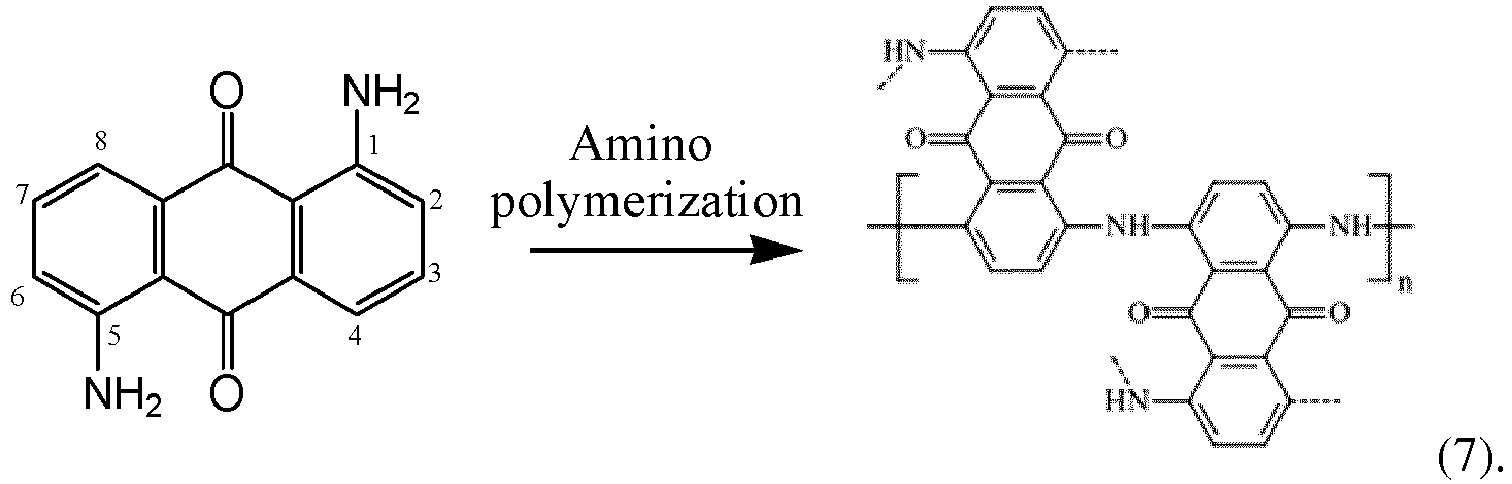
- In step S32, polymerize amino: Add the 1,5-diaminated anthraquinone powder to electrolyte of organic propylene carbonate solvent, and perform polymerization reaction by constant potential polymerization method of three-electrode system, where the polymerization reaction mainly happens in amino connected to benzene ring and hydrogen in para-position of the amino in monomer, and the amino connected to the benzene ring and the hydrogen in para-position of the amino form poly-1,5-diamino anthraquinone macromolecular chain, that is, the 1,5-diaminated anthraquinone, mainly in head-to-tail ligation manner, where a reaction formula of the amino polymerization reaction is shown in formula (7):
- In step S33, carboxylate graphene: Add, to graphene oxide powder, mixed acid that contains concentrated sulfuric acid and concentrated nitric acid in the volume ratio of 3:1, to react for 12 h at 60 °C under conditions of stirring and ultrasonic dispersion; and perform filtration by filter membrane, washing by distilled water, and vacuum drying, to obtain carboxylated graphene powder with surface connected to large amount of carboxyl.
- In step S34, perform amidated compounding: Add the excessive 1,5-diaminated anthraquinone powder obtained in step S31 and the carboxylated graphene powder obtained in step S33 to water; expose them to ultrasound for 2 h, to obtain mixed dispersed liquor; and perform reflux on the mixed dispersed liquor for 72 h at 120 °C under protection of nitrogen gas N2, to perform amidation reaction (as shown in formula (8)):

- After the reaction is finished, perform filtration on the product by filter membrane, washing, and vacuum drying at 60 °C, to obtain graphene composite material with surface connected to p-aminated anthraquinone group, that is, polyaminated anthraquinone-graphene composite material.
FIG. 3 is flowchart of preparing the polyaminated anthraquinone-graphene composite material according to this embodiment. - A schematic structural diagram of a flexible lithium secondary battery is shown in
FIG. 4 . The flexible lithium secondary battery (400) includes flexible battery housing (404); flexible cathode(401), flexible anode (402), and separator (403) that are located inside the flexible battery housing (404), and electrolyte injected inside the flexible battery housing (404), where the separator (403) is disposed between the flexible cathode (401) and the flexible anode (402). The p-benzoquinone-graphene composite material obtained in Embodiment 1 is used as cathode active material of the flexible cathode (401), and graphene is used as anode active material of the flexible anode (402). - Cathode electrode preparation: mix the cathode active material, which is the p-benzoquinone-graphene composite material, with polyvinylidene fluoride which serves as binder and with carbon nanotube which serves as conductive agent; add certain amount of organic solvents N-methyl pyrrolidone, to obtain cathode slurry; and evenly coat onto aluminum foil current collector with the obtained cathode slurry, and perform baking and tablet compression to obtain the cathode electrode.
- Anode electrode preparation: mix the anode active material graphene with polyvinylidene fluoride which serves as binder and with carbon nanotube which serves as conductive agent; add certain amount of organic solvents N-methyl pyrrolidone, to obtain anode slurry; and evenly coat onto copper foil current collector with the obtained anode slurry, and perform baking and tablet compression to obtain the anode electrode.
- The obtained cathode electrode, PP/PE/PP polyolefin separator, and the obtained anode electrode are stacked in sequence and assembled, and after an electrolyte is added, packaging is performed by the flexible battery housing, to obtain the flexible lithium secondary battery which cathode active material is the quinone compound-graphene composite material.
- A flexible lithium secondary battery is provided, where the flexible lithium secondary battery uses the polyaminated anthraquinone-graphene composite material, which is obtained in Embodiment 2, as cathode active material, and is assembled by the method which is the same as the method in Embodiment 4.
- A flexible lithium secondary battery is provided, where the flexible lithium secondary battery uses the polyaminated anthraquinone-graphene composite material, which is obtained in Embodiment 3, as cathode active material, and is assembled by the method which is the same as the method in Embodiment 4.
- A flexible lithium secondary battery is provided, where the flexible lithium secondary battery uses p-benzoquinone as cathode active material and is assembled by the method which is the same as the method in Embodiment 4.
- A flexible lithium secondary battery is provided, where the flexible lithium secondary battery uses polyaminated anthraquinone as cathode active material, and is assembled by the method which is the same as the method in Embodiment 4.
- Results embodiment: To support beneficial effects of the embodiments of the present invention, the effect embodiment is provided below, evaluating the performance of product provided by the embodiments of the present invention.
- Tests of charge-discharge cycles and rate performance are performed bybattery performance tester on the flexible lithium secondary batteries obtained in Embodiment 4 to Embodiment 6 and comparative example 1 and comparative example 2. For the cycle test, voltage range is 1.5 to 3.6 V, and current is 0.2 C; and after 50 cycles, battery capacity is recorded and capacity retention ratio is calculated. For the rate test, voltage range is 1.5 to 3.6 V, and current is 5.0 C; and discharging capacity is recorded and rate discharging ratio is calculated.
- To further test the battery flexibility, the flexible lithium secondary batteries are bended repeatedly for 10 times in the horizontal direction and vertical direction at bending angle of less than or equal to 10 degree, and then the tests of charge-discharge cycles and rate performance are performed, where test conditions are the same as the above. Test results are shown in Table 1:
Table 1: Performance comparison of flexible lithium secondary batteries in the embodiments and comparative examples Cathode discharging capacity (mAh/g) Rate discharging ratio at 5.0C(%) Cyclic capacity retention ratio at 0.2C(%) Rate discharging ratio at 5.0C after bending(%) Cyclic capacity retention ratio at 0.2C after bending(%) Embodiment 4 155.3 80.6% 79.1% 68.4% 71.4% Embodiment 5 231.2 84.1% 78.7% 70.3% 65.6% Embodiment 6 254.6 86.3% 84.2% 71.8% 72.6% Comparative example 1 124.1 54.2% 60.2% 32.4% 38.4% Comparative example 2 201.8 45.8% 57.3% 28.7% 40.2% - The results in Table 1 indicate that: the flexible lithium secondary batteries provided by the embodiments of the present invention deliver good rate performance and cyclic performance, and can continue to maintain good rate performance and cyclic performance after being bended. This is achieved because the flexible lithium secondary batteries provided by the embodiments of the present invention use the quinone compound-graphene composite material as the cathode active material, and the composite material is compounded of high-conductivity graphene and quinone compound, and thereby exhibits high energy density, high flexibility, high conductivity, and high stability, and is well applicable to preparation of flexible battery.
Claims (14)
- A quinone compound-graphene composite material, comprising quinone compound and graphene, wherein the quinone compound is chemically bonded on the surface of the graphene, and the quinone compound is quinone compound monomer or quinone polymer.
- The quinone compound-graphene composite material according to claim 1, wherein the surface of the graphene contains carboxyl functional group, the quinone compound contains amino functional group, and the quinone compound is bonded on the surface of the graphene by amido bond formed by the amino functional group and the carboxyl functional group.
- The quinone compound-graphene composite material according to claim 1 or 2, wherein the quinone compound monomer is any one of benzoquinone, naphthoquinone, anthraquinone, and phenanthraquinone, or the isomer of any one of benzoquinone, naphthoquinone, anthraquinone, and phenanthraquinone.
- The quinone compound-graphene composite material according to claim 1 or 2, wherein the quinone polymer is the polymer formed by any one or more than one of benzoquinone, naphthoquinone, anthraquinone, and phenanthraquinone, or the polymer formed by the isomer of any one of benzoquinone, naphthoquinone, anthraquinone, and phenanthraquinone or formed by isomers of more than one of benzoquinone, naphthoquinone, anthraquinone, and phenanthraquinone.
- The quinone compound-graphene composite material according to claim 1 or 2, wherein the quinone compound accounts for 20 to 80% by weight of the quinone compound-graphene composite material.
- A preparation method of quinone compound-graphene composite material, comprising the following steps:aminating quinone compound monomer by nitration reduction method, to obtain mixed liquor containing the aminated quinone compound monomer;filtering, washing, and drying the mixed liquor containing the aminated quinone compound monomer, to obtain aminated quinone compound monomer powder;adding graphene oxide powder to mixed acid that contains concentrated sulfuric acid and concentrated nitric acid in preset proportion, to react for 5 to 15 h at 50 to 60 °C, and then performing operations of filtration, washing, and vacuum drying, to obtain surface-carboxylated graphene powder;adding the aminated quinone compound monomer powder and the surface-carboxylated graphene powder to water or ethyl alcohol, and performing ultrasonic dispersion to obtain mixed dispersed liquor; andperforming reflux reaction on the mixed dispersed liquor for 48 to 72 h at 100 to 120 °C under protection of nitrogen gas, and after reaction is finished, performing filtration, washing, and drying on the product, to obtain the quinone compound monomer-graphene composite material.
- The quinone compound-graphene composite material preparation method according to claim 6, wherein the quinone compound monomer is any one of benzoquinone, naphthoquinone, anthraquinone, and phenanthraquinone, or the isomer of any one of benzoquinone, naphthoquinone, anthraquinone, and phenanthraquinone.
- The quinone compound-graphene composite material preparation method according to claim 6 or 7, wherein the reaction for 5 to 15 h at 50 to 60 °C is performed under conditions of stirring and ultrasonic dispersion.
- The preparation method of quinone compound-graphene composite material according to claim 6 or 7, further comprising the following steps:weighing out the quinone compound monomer-graphene composite material, perchloric acid, saturated water solution of hydrogen peroxide, and potassium dichromate according to molar ratio of 1:2:2:2, and adding them to acetonitrile solvent, to obtain mixed solution;adding saturated water solution of potassium dichromate dropwise to the mixed solution to react for 48 to 72 h at 30 to 50 °C under protection of argon gas, to obtain mixed liquor containing quinone polymer-graphene composite material; andperforming decompression filtration, washing, and vacuum drying on the mixed liquor containing the quinone polymer-graphene composite material, to obtain the quinone polymer-graphene composite material.
- A preparation method of quinone compound-graphene composite material, comprising the following steps:aminating quinone compound monomer by nitration reduction method, to obtain mixed liquor containing the aminated quinone compound monomer;filtering, washing, and drying the mixed liquor containing the aminated quinone compound monomer, to obtain aminated quinone compound monomer powder;adding the aminated quinone compound monomer powder to electrolyte of organic propylene carbonate solvent, and polymerizing the aminated quinone compound monomer by constant potential polymerization method of three-electrode system, to obtain animated quinone polymer;adding graphene oxide powder to mixed acid that contains concentrated sulfuric acid and concentrated nitric acid in preset proportion, to react for 5 to 15 h at 50 to 60 °C, and then performing operations of filtration, washing, and vacuum drying, to obtain surface-carboxylated graphene powder;adding the aminated quinone polymer and the carboxylated graphene powder to water or ethyl alcohol, and performing ultrasonic dispersion to obtain mixed dispersed liquor; andperforming reflux reaction on the mixed dispersed liquor for 48 to 72 h at 100 to 120 °C under the protection of nitrogen gas, and after the reaction is finished, performing filtration, washing, and drying on the product, to obtain quinone polymer-graphene composite material.
- The quinone compound-graphene composite material preparation method according to claim 10, wherein the quinone compound monomer is any one of benzoquinone, naphthoquinone, anthraquinone, and phenanthraquinone, or the isomer of any one of benzoquinone, naphthoquinone, anthraquinone, and phenanthraquinone.
- The quinone compound-graphene composite material preparation method according to claim 10 or 11, wherein the reaction for 5 to 15 h at 50 to 60°C is performed under conditions of stirring and ultrasonic dispersion.
- A flexible lithium secondary battery, comprising flexible battery housing; flexible cathode, flexible anode, and separator that are located inside the flexible battery housing, and electrolyte injected inside the flexible battery housing, where the separator is disposed between the flexible cathode and the flexible anode, the flexible cathode includes cathode active material which including quinine-compound graphene composite material. The quinone compound-graphene composite material includes quinone compound and graphene, where the quinone compound is chemically bonded on the surface of the graphene, and the quinone compound is quinone compound monomer or quinone polymer.
- The flexible lithium secondary battery according to claim 13, wherein the flexible anode comprises anode active material, and the anode active material is graphene, carbon nanotube, silicon film, or tin film.
Applications Claiming Priority (2)
| Application Number | Priority Date | Filing Date | Title |
|---|---|---|---|
| CN201310752362.1A CN104752727A (en) | 2013-12-31 | 2013-12-31 | Quinone compound-graphene composite material and preparation method thereof as well as flexible lithium secondary battery |
| PCT/CN2014/082200 WO2015101010A1 (en) | 2013-12-31 | 2014-07-15 | Quinone compound-graphene composite, preparation method therefor and flexible lithium secondary battery |
Publications (2)
| Publication Number | Publication Date |
|---|---|
| EP3079189A1 true EP3079189A1 (en) | 2016-10-12 |
| EP3079189A4 EP3079189A4 (en) | 2016-12-07 |
Family
ID=53493126
Family Applications (1)
| Application Number | Title | Priority Date | Filing Date |
|---|---|---|---|
| EP14876837.7A Withdrawn EP3079189A4 (en) | 2013-12-31 | 2014-07-15 | Quinone compound-graphene composite, preparation method therefor and flexible lithium secondary battery |
Country Status (4)
| Country | Link |
|---|---|
| US (1) | US20160308213A1 (en) |
| EP (1) | EP3079189A4 (en) |
| CN (1) | CN104752727A (en) |
| WO (1) | WO2015101010A1 (en) |
Cited By (1)
| Publication number | Priority date | Publication date | Assignee | Title |
|---|---|---|---|---|
| WO2022058099A3 (en) * | 2020-09-18 | 2022-05-27 | Shell Oil Company | Battery supercapacitors hybrid systems |
Families Citing this family (32)
| Publication number | Priority date | Publication date | Assignee | Title |
|---|---|---|---|---|
| CN105047932B (en) * | 2015-08-31 | 2017-10-27 | 张家港智电芳华蓄电研究所有限公司 | A kind of aquo-lithium ion battery quinones negative material and aquo-lithium ion battery |
| CN105047933A (en) * | 2015-08-31 | 2015-11-11 | 张家港智电芳华蓄电研究所有限公司 | Rechargeable quinone-manganese oxide aqueous battery |
| CN106809815B (en) | 2015-11-27 | 2019-10-08 | 中国科学院过程工程研究所 | A kind of carbon quantum dot, its preparation method and application |
| CN107369835B (en) | 2016-05-12 | 2020-12-25 | 华为技术有限公司 | Conductive adhesive for lithium ion battery and preparation method thereof, lithium ion battery electrode plate and preparation method thereof, and lithium ion battery |
| CN105895915B (en) * | 2016-06-23 | 2018-06-26 | 华南师范大学 | A kind of anthraquinone-2-carboxylic acid's lithium/graphene nanometer composite and preparation and application |
| CN106920936B (en) * | 2017-03-29 | 2020-05-12 | 复旦大学 | A high-performance organic lithium ion battery positive electrode material and preparation method thereof |
| CN109411754A (en) * | 2017-08-17 | 2019-03-01 | 江苏中安环能新能源科技有限公司 | A kind of novel full quinone aqueous systems secondary cell |
| RU2659285C1 (en) * | 2017-10-25 | 2018-06-29 | Федеральное государственное бюджетное образовательное учреждение высшего образования "Тамбовский государственный технический университет" (ФГБОУ ВО "ТГТУ") | Sorbent based on modified graphene oxide and method of its production |
| CN108155408B (en) * | 2017-12-26 | 2021-01-19 | 深圳先进技术研究院 | Dual-ion battery and preparation method thereof |
| CN108807893B (en) * | 2018-06-08 | 2021-07-30 | 安徽大学 | A kind of preparation method of 2-aminoanthraquinone modified graphene oxide lithium ion battery anode material |
| CN109037666B (en) * | 2018-08-02 | 2020-08-07 | 盐城市新能源化学储能与动力电源研究中心 | Metal Hydride Graphene Batteries and Graphene Batteries |
| CN109167024A (en) * | 2018-08-03 | 2019-01-08 | 常州大学 | The graphene oxide and preparation method thereof that more carbonyls for electrode material of lithium battery are modified |
| CN109467079B (en) * | 2018-11-19 | 2020-11-24 | 华南理工大学 | A kind of organic functionalized graphene material and its preparation method and application |
| DE102018222385A1 (en) * | 2018-12-20 | 2020-06-25 | Continental Reifen Deutschland Gmbh | Secondary galvanic cell |
| CN109809398B (en) * | 2019-02-01 | 2022-05-24 | 锦州凯美能源有限公司 | Preparation method and application of graphene conductive agent dispersion liquid of high-capacity supercapacitor |
| CN110034279B (en) * | 2019-05-08 | 2020-11-06 | 福州大学 | A kind of preparation method of flexible lithium ion battery negative electrode material |
| KR102931099B1 (en) | 2019-05-31 | 2026-02-25 | 주식회사 엘지에너지솔루션 | Carbon with redox functional group-included polymer layer, sulfur-carbon compositie and lithium secondary batrery comprising the same |
| CN110350201B (en) * | 2019-06-29 | 2022-07-26 | 华南理工大学 | Light high-conductivity graphene current collector for water-based battery and preparation method thereof |
| CN110993895B (en) * | 2019-12-04 | 2022-04-19 | 绍兴文理学院 | Preparation method of Si/graphene composite flexible electrode of lithium ion battery |
| CN111244370A (en) * | 2020-01-15 | 2020-06-05 | 华南师范大学 | Polyamine carbon composite material, slurry, diaphragm, lithium-sulfur battery and preparation method |
| CN111607085A (en) * | 2020-05-27 | 2020-09-01 | 南方科技大学 | An organic material, BDI system and removal of metal ions in water |
| CN111710840B (en) * | 2020-06-04 | 2022-08-12 | 东华大学 | A kind of preparation method of ketone carbonyl bond structure polyimide composite electrode material |
| CN114075346A (en) * | 2020-08-17 | 2022-02-22 | 安徽璜峪电磁技术有限公司 | Preparation method of poly-Schiff base cerium salt hybrid graphene composite foam wave-absorbing material containing quinone structure |
| CN112174191A (en) * | 2020-10-16 | 2021-01-05 | 安徽锦华氧化锌有限公司 | Preparation method of active zinc oxide for improving mechanical property of styrene butadiene rubber |
| CN113036124A (en) * | 2021-02-03 | 2021-06-25 | 新乡学院 | Alizarin MOF/graphene composite electrode material, and preparation method and application thereof |
| CN113604822A (en) * | 2021-08-12 | 2021-11-05 | 浙江工商大学 | Carbon/anthraquinone composite material and its preparation method and application in hydrogen peroxide synthesis |
| CN114573927A (en) * | 2022-01-21 | 2022-06-03 | 安徽大学 | Graphene modified polyvinylidene fluoride based on silver modification and preparation method and application thereof |
| CN115732691A (en) * | 2022-11-15 | 2023-03-03 | 深圳市微粘科技有限公司 | Aqueous conductive slurry for lithium battery and preparation method thereof |
| CN116454278A (en) * | 2023-03-27 | 2023-07-18 | 深圳理工大学(筹) | Organic positive electrode material, preparation method, positive electrode plate, lithium ion capacitor and lithium metal battery |
| CN119050296A (en) * | 2024-03-28 | 2024-11-29 | 深圳市泰科动力系统有限公司 | High specific capacity disulfide polymer positive electrode material, preparation method thereof and battery |
| CN118812847B (en) * | 2024-09-19 | 2024-12-24 | 武汉理工大学三亚科教创新园 | High-capacity and rapid charge storage aromatic organic material, preparation method thereof and deep sea energy storage battery |
| CN119480469A (en) * | 2024-10-15 | 2025-02-18 | 南京航空航天大学 | Preparation method and application of 3D printed quinone compound/graphene composite electrode material |
Family Cites Families (14)
| Publication number | Priority date | Publication date | Assignee | Title |
|---|---|---|---|---|
| AU721291C (en) * | 1996-05-15 | 2003-02-27 | Hyperion Catalysis International, Inc. | Graphitic nanofibers in electrochemical capacitors |
| CN1564348A (en) * | 2004-03-29 | 2005-01-12 | 天津大学 | Secondary lithium cell using aminobenzene-benzoquinone composite polymer as cathode materal and prepn. thereof |
| CN100395279C (en) * | 2005-01-26 | 2008-06-18 | 同济大学 | The preparation method of polydiaminoanthraquinone |
| JP4393527B2 (en) * | 2007-03-08 | 2010-01-06 | パナソニック株式会社 | Electrode active material and power storage device |
| CN101182098B (en) * | 2007-11-30 | 2010-11-03 | 福州大学 | Technology for preparing nano-carbon tube-silica dioxide gel glass |
| CN101381507B (en) * | 2008-10-24 | 2010-10-13 | 南开大学 | Sulfonated mono-layer graphite and polymer compound material and preparation and application thereof |
| WO2012001885A1 (en) * | 2010-06-29 | 2012-01-05 | パナソニック株式会社 | Thin flexible battery |
| DE102010039416A1 (en) * | 2010-08-17 | 2012-02-23 | Varta Micro Innovation Gmbh | Flexible battery electrodes and their manufacture |
| CN102456867B (en) * | 2010-10-19 | 2016-03-16 | 苏州宝时得电动工具有限公司 | Electrode material, positive pole, there is the battery of this positive pole and the preparation method of electrode material |
| JP5753258B2 (en) * | 2011-04-11 | 2015-07-22 | パナソニック株式会社 | Flexible battery and manufacturing method thereof |
| CN103137949B (en) * | 2011-11-30 | 2015-05-06 | 海洋王照明科技股份有限公司 | Lithium salt-graphene derivative composite material and preparation method and application thereof |
| CN102544574B (en) * | 2011-12-30 | 2014-03-05 | 华中科技大学 | Flexible lithium ion battery and packaging method thereof |
| CN103367696A (en) * | 2012-03-29 | 2013-10-23 | 海洋王照明科技股份有限公司 | Anode plate, preparation method thereof and lithium ion battery |
| CN103401008B (en) * | 2013-07-31 | 2016-10-05 | 华南理工大学 | Utilize the method and apparatus that capacitive character anode stores biological power |
-
2013
- 2013-12-31 CN CN201310752362.1A patent/CN104752727A/en active Pending
-
2014
- 2014-07-15 EP EP14876837.7A patent/EP3079189A4/en not_active Withdrawn
- 2014-07-15 WO PCT/CN2014/082200 patent/WO2015101010A1/en not_active Ceased
-
2016
- 2016-06-28 US US15/195,742 patent/US20160308213A1/en not_active Abandoned
Cited By (1)
| Publication number | Priority date | Publication date | Assignee | Title |
|---|---|---|---|---|
| WO2022058099A3 (en) * | 2020-09-18 | 2022-05-27 | Shell Oil Company | Battery supercapacitors hybrid systems |
Also Published As
| Publication number | Publication date |
|---|---|
| US20160308213A1 (en) | 2016-10-20 |
| WO2015101010A1 (en) | 2015-07-09 |
| EP3079189A4 (en) | 2016-12-07 |
| CN104752727A (en) | 2015-07-01 |
Similar Documents
| Publication | Publication Date | Title |
|---|---|---|
| EP3079189A1 (en) | Quinone compound-graphene composite, preparation method therefor and flexible lithium secondary battery | |
| Singu et al. | Polyaniline–nickel oxide nanocomposites for supercapacitor | |
| Feng et al. | Facile synthesis of shape-controlled graphene–polyaniline composites for high performance supercapacitor electrode materials | |
| CN101671478B (en) | Preparation method of carbon nano tube/polyaniline netty compound material | |
| KR101686640B1 (en) | Preparation method for Nitrogen doped graphene having a polymer coating-sulfur complexes, the prepared complexes and lithium-sulfur battery using the same | |
| EP3444881A1 (en) | Conductive adhesive for lithium-ion battery and preparation method therefor, lithium-ion battery electrode plate and preparation method therefor, and lithium-ion battery | |
| Zhu et al. | Promoting polysulfide conversion by V2O3 hollow sphere for enhanced lithium-sulfur battery | |
| JP3125763B2 (en) | Electrode for battery, secondary battery, and method for producing them | |
| Deng et al. | Polyaniline deposition to enhance the specific capacitance of carbon nanotubes for supercapacitors | |
| Amaike et al. | Chemical polymerization of pyrrole with disulfide structure and the application to lithium secondary batteries | |
| WO2012121145A1 (en) | Electrode active material, electrode, and secondary battery | |
| Xu et al. | Stress-dissipated conductive polymer binders for high-stability silicon anode in lithium-ion batteries | |
| Cao et al. | Polypyrrole nanocomposites doped with functional ionic liquids for high performance supercapacitors | |
| Weng et al. | Polymer supported organic catalysts for O2 reduction in Li-O2 batteries | |
| CN108428840A (en) | A kind of preparation method of pure selenium anode lithium selenium cell | |
| CN104871351A (en) | Electricity storage device, electrode used therein, and porous sheet | |
| CN107068989A (en) | A kind of positive electrode for lithium-iodine battery | |
| Tan et al. | Polyaniline nanoparticles grown on the surface of carbon microspheres aggregations for electrochemical supercapacitors | |
| JP2000123825A (en) | High polymer electrode | |
| CN109863633A (en) | Electrochemical device | |
| JP2011171072A (en) | Nonaqueous electrolyte air battery | |
| CN118335897A (en) | Lithium ion battery positive electrode slurry, preparation method thereof, positive electrode plate prepared from lithium ion battery positive electrode slurry and battery | |
| CN103772703B (en) | A kind of preparation method of polyamino anthaquinone class conducting polymer | |
| JP5625897B2 (en) | Non-aqueous air battery | |
| EP2782172B1 (en) | Electrode active material, electrode, and secondary battery |
Legal Events
| Date | Code | Title | Description |
|---|---|---|---|
| PUAI | Public reference made under article 153(3) epc to a published international application that has entered the european phase |
Free format text: ORIGINAL CODE: 0009012 |
|
| 17P | Request for examination filed |
Effective date: 20160706 |
|
| AK | Designated contracting states |
Kind code of ref document: A1 Designated state(s): AL AT BE BG CH CY CZ DE DK EE ES FI FR GB GR HR HU IE IS IT LI LT LU LV MC MK MT NL NO PL PT RO RS SE SI SK SM TR |
|
| AX | Request for extension of the european patent |
Extension state: BA ME |
|
| A4 | Supplementary search report drawn up and despatched |
Effective date: 20161109 |
|
| RIC1 | Information provided on ipc code assigned before grant |
Ipc: H01M 4/1393 20100101ALI20161031BHEP Ipc: H01M 4/133 20100101ALI20161031BHEP Ipc: H01M 4/60 20060101AFI20161031BHEP Ipc: C01B 31/04 20060101ALI20161031BHEP Ipc: H01M 4/137 20100101ALI20161031BHEP Ipc: H01M 4/1399 20100101ALI20161031BHEP Ipc: H01M 4/62 20060101ALI20161031BHEP Ipc: H01M 10/052 20100101ALN20161031BHEP |
|
| DAX | Request for extension of the european patent (deleted) | ||
| STAA | Information on the status of an ep patent application or granted ep patent |
Free format text: STATUS: THE APPLICATION IS DEEMED TO BE WITHDRAWN |
|
| 18D | Application deemed to be withdrawn |
Effective date: 20170607 |