EP3079080A1 - Verfahren und vorrichtung zum parallelen verarbeiten einer gruppenaggregatfunktion - Google Patents
Verfahren und vorrichtung zum parallelen verarbeiten einer gruppenaggregatfunktion Download PDFInfo
- Publication number
- EP3079080A1 EP3079080A1 EP15162603.3A EP15162603A EP3079080A1 EP 3079080 A1 EP3079080 A1 EP 3079080A1 EP 15162603 A EP15162603 A EP 15162603A EP 3079080 A1 EP3079080 A1 EP 3079080A1
- Authority
- EP
- European Patent Office
- Prior art keywords
- data
- clusters
- clustering
- cluster
- processing
- Prior art date
- Legal status (The legal status is an assumption and is not a legal conclusion. Google has not performed a legal analysis and makes no representation as to the accuracy of the status listed.)
- Withdrawn
Links
Images

Classifications
-
- G—PHYSICS
- G06—COMPUTING OR CALCULATING; COUNTING
- G06F—ELECTRIC DIGITAL DATA PROCESSING
- G06F16/00—Information retrieval; Database structures therefor; File system structures therefor
- G06F16/20—Information retrieval; Database structures therefor; File system structures therefor of structured data, e.g. relational data
- G06F16/24—Querying
- G06F16/245—Query processing
- G06F16/2455—Query execution
- G06F16/24553—Query execution of query operations
- G06F16/24554—Unary operations; Data partitioning operations
- G06F16/24556—Aggregation; Duplicate elimination
-
- G—PHYSICS
- G06—COMPUTING OR CALCULATING; COUNTING
- G06F—ELECTRIC DIGITAL DATA PROCESSING
- G06F16/00—Information retrieval; Database structures therefor; File system structures therefor
- G06F16/20—Information retrieval; Database structures therefor; File system structures therefor of structured data, e.g. relational data
- G06F16/24—Querying
- G06F16/245—Query processing
- G06F16/2453—Query optimisation
- G06F16/24532—Query optimisation of parallel queries
Definitions
- the present invention relates to a method and an apparatus for parallel processing a group aggregate function on a set of data.
- the present invention also relates to a computer-readable storage medium comprising instructions for carrying out a method for parallel processing a group aggregate function on a set of data.
- aggregation is a fundamental requirement in all analytical databases. Compared to complete aggregation, aggregation grouped by the values of certain attributes is even more significant. Such operations can be termed as grouped aggregations. Grouped aggregations are expressed in SQL using the GROUP BY clause. Such a statement is used in conjunction with the aggregate functions to group the result-set by one or more columns. The key challenge in the implementation of grouped aggregates is to determine the groups and the rows corresponding to these groups. There are three well-known implementation techniques to determine the groups: Nested Loops, Sorting, and Hashing.
- Pipelining or on-the-fly processing is sometimes used to improve the performance of the queries. Pipelining reduces the latency of a query thereby improves the perceived user experience in some cases.
- Executing group aggregate functions i.e. functions that compute grouped aggregates, is a resource-consuming operation.
- the best case complexity lies in O(n ⁇ log n), where 'n' is the number of records fed to the aggregate.
- Grouped aggregates are by nature materialized. That is to say all the input data for the grouping have to be materialized and only then the results can be produced. This materialized nature of the grouped aggregates makes parallelization of grouped aggregates difficult.
- one object of the present invention is to provide a method, an apparatus, a computer-readable storage medium and a data structure for computing group aggregate functions in a more efficient way.
- a first aspect of the invention provides a computer-implemented method for parallel processing a group aggregate function on a set of data, comprising the steps of:
- Clustering the set of data based on a grouping property of the group aggregate function can be performed such that one or more elements of the set of data which according to the grouping property belong to the same group are assigned to the same cluster of the plurality of clusters.
- the clustering can ensure that elements of the set of data which belong to the same group are assigned to the same cluster.
- a cluster may comprise elements from the set of data that belong to different groups, but elements of one group are not shared between different clusters.
- the clustering is performed such that each cluster is assigned approximately equal numbers of elements of the set of data.
- SIMD single-instruction, multiple-data
- Prior art parallel grouped aggregates use SIMD in limited ways to compute the aggregates.
- SIMD can be used in more phases of the parallel grouped aggregates.
- Columnar stores store each column separately. A notional row is bound by row-ids shared by the column stores. Some of the prior art repartition techniques involve copying of the columns on which grouping is done and also the columns which need to be aggregated. This model does not leverage the storage layout of columnar databases.
- clustering the set of data comprises a step of radix clustering the set of data, in particular radix clustering using the least significant bits of a grouping property of the set of data.
- To perform the clustering using a radix clustering algorithm has the advantage that the clustering can be performed very efficiently, while still ensuring that elements of the set of data that belong to the same group (as determined by the grouping property) are assigned to the same cluster.
- each of the plurality of processing threads is assigned to at least one core of a processor with a plurality of cores. This has the advantage that the computation can be performed efficiently on a multi-core processor.
- the method further comprises an initial step of filtering input data and obtaining the set of data as a result of the filtering.
- the method can be efficiently performed on a larger set of data by first obtaining the relevant subset of data through filtering.
- the filtering step is performed before the clustering step.
- the filtering is performed by partitioning the input data and filtering each partition by a separate worker thread.
- the method can be performed on very large sets of data.
- the same worker thread can perform the filtering and the radix clustering.
- the set of data is organized in columns. This allows for efficient processing on structured data.
- clustering the set of data comprises the steps:
- clustering is performed using only the data relevant for the clustering algorithm. After the clustered grouping column is obtained, the clustered grouping column is expanded with the aggregate columns to obtain the complete cluster.
- the method according to the first aspect of the invention further comprises a step of gathering information about the data of a single cluster. Such data may be necessary for plurality of processing threads to efficiently process the group aggregate function on the plurality of clusters.
- the aggregate function of the group aggregate function is one of summing, averaging, minimum, maximum, or counting. These aggregate functions can be particularly efficiently computed.
- more than one of the plurality of clusters is assigned to a processing thread. For example, if there are more clusters than available processing cores, it can be beneficial that more than one cluster is computed on a given processing core. In this way, embodiments of the invention can implement a combination of parallel and sequential processing of the aggregate function on the plurality of clusters.
- the plurality of processing threads performs group aggregation by hashing, sorting and/or going through a nested loop.
- group aggregation can be performed on each of the clusters in the same way as it would be performed by a single thread on the original set of data - with a speedup that ideally corresponds to the number of processing threads (or the number of clusters, if one processing thread is assigned to each cluster).
- a second aspect of the invention provides an apparatus that is configured to perform the method of the first aspect of the invention.
- an apparatus that is configured to perform the method according to one of the implementations of the first aspect of the invention.
- the apparatus comprises a processor with a plurality of cores, wherein one or more of the processing threads are affined to one of the plurality of cores.
- a multi-core processor provides efficient ways of processing in parallel the plurality of clusters in the plurality of processing threads.
- the apparatus is a computing device with a non-uniform memory access architecture, wherein the computing device is adapted to assign a local cluster to a processing thread if a predetermined percentage of data of the local cluster is present in a local memory of a core to which the processing thread is assigned.
- the clusters are not randomly assigned to processing threads, but each of the clusters is assigned to a processing thread (and corresponding core) that is most suited to process this cluster.
- a third aspect of the invention provides a computer-readable storage medium storing program code, the program code comprising instructions for carrying out the method of the first aspect of the invention, in particular the method of one the implementations of the first aspect of the invention.
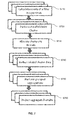
- the method comprises 6 steps, as illustrated in the following.
- FIG. 1 depicts an input table 200, (i.e., 'dimension_tab').
- the input table comprises a plurality of columns: a Row_ID column 201, a PDT_ID column 202, a PDT_Type column 203, a Sales_value column 204, and a Sales_piece column 205.
- a first step S10 the input table is (horizontally) partitioned; there is a worker thread per partition.
- a filter that results from the query selection predicate (the WHERE clause) is applied.
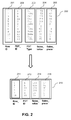
- FIG. 2 illustrates an example of an input table 200 that is filtered according to step S10 shown in FIG. 1 .
- the filtering step yields a materialized results table 210, comprising only those entries from the input table 200, where PDT_Type is set to 'car', that is, the first, third, fourth, fifth, seventh, and ninth rows of the table 200.
- the materialized results table comprises a Row_ID column 211, a PDT_ID column 212, a Sales_value column 214, and a Sales_piece column 215.
- Step S12 radix clustering is applied based on a grouping column of the materialized results table 210.
- Step S12 can be performed with the following sub-steps (not shown in FIG. 1 ):
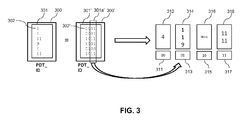
- FIG. 3 illustrates the radix clustering based on the grouping column PDT_ID.
- a local partition 300 comprises the grouping column PDT_ID in decimal representation 301, with elements 302.
- the elements 302 are shown in FIG. 3 on the left in decimal representation. Equivalently, they can be shown in binary representation 302', indicated in FIG. 3 as elements of the grouping column 301' of the local cluster 300' in binary representation.
- Radix clustering is performed on the N least significant bits 301a' of the elements of the grouping column 301' (the "radix bits"). This results in 2 N clusters.
- the clustering is performed such that each cluster is assigned approximately equal numbers of elements of the set of data.
- FIG. 3 shows the cluster IDs 00, 01, 10, 11 next to the cluster elements 312, 314, 316, 318 assigned to these clusters.
- the first cluster corresponds to the least significant bits ⁇ 00' and comprises one element 312 (with PDT_ID 4).
- the second cluster corresponds to the least significant bits '01' and comprises three elements 314 (with PDT_ID 1, 1, and 9).
- the third cluster corresponds to the least significant bits ⁇ 10' and comprises no elements (indicated as NULL element 316).
- the fourth cluster corresponds to the least significant bits '11' and comprises two elements 318 (with PDT_ID 11, 11).
- each processing thread continues by expanding local clusters with aggregate columns, in a one-by-one-way. Then, the aggregation columns are projected in local clusters. Since each thread operates on data existing in its local memory, access to remote memory is avoided, i.e., the projection operation is NUMA-friendly.
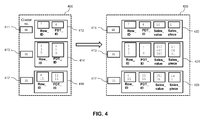
- the diagram in FIG. 4 illustrates the expansion with aggregate columns and the projection operations that are performed by one thread.
- the diagram illustrates the plurality of clusters from FIG. 3 , wherein clusters to which no elements have been assigned during the previous method step, are not considered.
- the plurality of clusters 400 comprises clusters with cluster IDs 411, 413, 415, corresponding to the least significant bits 00, 01, and 11. There is no cluster corresponding to the least significant bits 10, because no elements were assigned to this cluster.
- each cluster Before projecting the aggregation columns, each cluster comprises a set of entries 412, 414, 418 with columns Row_ID and PDT_ID.
- each cluster 422, 424, 428 also comprises columns Sales_value and Sales_piece.
- the filtering step S10 and the clustering step S12 are performed by the same threads 10, 11. In other embodiments, separate threads can perform the filtering on the one hand, and the clustering on the other hand.
- step S14 of the method illustrated in FIG. 1 the clusters are assigned to different threads. Based on the nature of the data distribution, each core can be assigned one or more total clusters to be processed. A core (or a thread affined to a core) can be assigned a cluster if a larger percentage of the cluster's data is present in its local memory. This will reduce remote memory access.
- step S16 of the method illustrated in FIG. 1 information is gathered about the data of a single total cluster.
- a single total cluster is spread across discontinuous memory. This is because each thread individually performed the clustering. A thread which will perform the grouping on a single cluster will need to gather all these cluster data. The gathering is done by the thread obtaining the starting address and the number of items in that address.
- the table data is not copied. Even if a piece of a total cluster is present in the remote node, the access is going to be sequential.
- the data in the local clusters will be stored by different threads at different memory locations.
- the global cluster is formed by consolidating these memory addresses into one data structure.
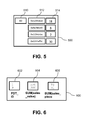
- FIG. 5 illustrates the metadata 500 for one global cluster (the global cluster corresponding to the least significant bits '00').
- the cluster metadata 500 comprise, for each of a plurality of local clusters, the starting address 512 and the number of items 514 found at that starting address. In this way, the local clusters can be consolidated into a global cluster.
- step S18 group aggregation is performed on one cluster.
- the grouping can be done by any method, e.g. hashing, sorting or nested loop.
- the group aggregation can be done in parallel, independently for each total cluster.
- the aggregation is performed by looking up the aggregation column values present in the clustered data.
- FIG. 6 shows a schematic illustration of the grouped aggregate for one cluster (the cluster corresponding to least significant bits '01').
- the first column 602 of the grouped aggregate is the grouping column PDT_ID.
- the second column 604 shows the sum of the aggregate column sales_value corresponding to the IDs in the first column 602.
- the third column 606 comprises the sums of the aggregate column sales_piece corresponding to the IDs in the first column 602.
- step S20 of the method illustrated in FIG. 1 the result set is projected. Once the grouping is done by a thread, it can project out the result values. If further clusters exist, or a higher operator demands more rows, the threads will go to steps S16 and S18.
- the same threads 20, 21 perform the steps of gathering cluster data S16, group aggregating one cluster S18 and projecting the group result S20. In other embodiments of the invention, these steps S16, S18 and S20 are performed by different threads.
- step S22 it is determined whether there are further clusters that have not been processed yet. If so, the method proceeds with step S16 and gathers cluster data for the cluster that has not been processed yet. Once all clusters have been processed, the method ends with step S24.
- FIG. 7 shows a flow chart of a further embodiment of the present invention.
- This embodiment relates to a further method of grouping aggregates in a database management system involving parallel query processing over partitioned data.
- An example query can be expressed with an SQL statement of the form "SELECT A, ... FROM table WHERE ... GROUP BY A".
- the embodiment applies to the execution of the GROUP BY clause.
- the query processor produces, in parallel worker threads, unsorted results written to local memory (a partition) of each thread.
- step S710 for each partition, the results of a filter are calculated.
- each (filtered) partition is radix clustered locally by a dedicated thread.
- step S730 clusters are allocated to the threads in such a way that (a) the data value ranges are calculated to contain approximately equal amounts of data, (b) the data value range partitions are allocated to memory that is local to worker threads.
- each thread gathers all the data related to the cluster allocated to itself to a local memory of the thread.
- step S750 each cluster is group aggregated locally.
- step S760 the result set parts are projected directly from the thread which operated on the cluster.
- steps S720, S730 and S740 can be applied in the in the execution of other SQL statement clauses like GROUP BY on JOIN.
- FIGs. 1 and 7 takes advantage of pipelining of group aggregation by reduced materialization along with taking benefit of hardware parallelization benefits (like SIMD).
- SIMD hardware parallelization benefits
- Most part of the method is executed in parallel threads on horizontal table partitions which results in a high level of parallelism and vectorized processing (SIMD).
- SIMD hardware parallelization benefits
- Radix clustering using SIMD can be used for clustering, which is much faster than complete repartitioning. Clustered groups are created before grouping is started. This improves the response time of the algorithm; the first result set can be pushed out early. Clustered groups creation removes the expensive serial phase of the parallel group-by algorithm.
- radix clustering of a pseudo row-id column can avoid unnecessary row materializations and column projections.
Landscapes
- Engineering & Computer Science (AREA)
- Theoretical Computer Science (AREA)
- Computational Linguistics (AREA)
- Data Mining & Analysis (AREA)
- Databases & Information Systems (AREA)
- Physics & Mathematics (AREA)
- General Engineering & Computer Science (AREA)
- General Physics & Mathematics (AREA)
- Information Retrieval, Db Structures And Fs Structures Therefor (AREA)
Priority Applications (2)
| Application Number | Priority Date | Filing Date | Title |
|---|---|---|---|
| EP15162603.3A EP3079080A1 (de) | 2015-04-07 | 2015-04-07 | Verfahren und vorrichtung zum parallelen verarbeiten einer gruppenaggregatfunktion |
| PCT/CN2015/095794 WO2016161809A1 (en) | 2015-04-07 | 2015-11-27 | Method and apparatus for parallel processing group aggregate function |
Applications Claiming Priority (1)
| Application Number | Priority Date | Filing Date | Title |
|---|---|---|---|
| EP15162603.3A EP3079080A1 (de) | 2015-04-07 | 2015-04-07 | Verfahren und vorrichtung zum parallelen verarbeiten einer gruppenaggregatfunktion |
Publications (1)
| Publication Number | Publication Date |
|---|---|
| EP3079080A1 true EP3079080A1 (de) | 2016-10-12 |
Family
ID=52824088
Family Applications (1)
| Application Number | Title | Priority Date | Filing Date |
|---|---|---|---|
| EP15162603.3A Withdrawn EP3079080A1 (de) | 2015-04-07 | 2015-04-07 | Verfahren und vorrichtung zum parallelen verarbeiten einer gruppenaggregatfunktion |
Country Status (2)
| Country | Link |
|---|---|
| EP (1) | EP3079080A1 (de) |
| WO (1) | WO2016161809A1 (de) |
Cited By (1)
| Publication number | Priority date | Publication date | Assignee | Title |
|---|---|---|---|---|
| CN112506950A (zh) * | 2020-12-10 | 2021-03-16 | 深圳前海微众银行股份有限公司 | 数据聚合处理方法、计算节点、计算集群及存储介质 |
Families Citing this family (1)
| Publication number | Priority date | Publication date | Assignee | Title |
|---|---|---|---|---|
| US10831843B2 (en) | 2017-11-01 | 2020-11-10 | International Business Machines Corporation | Grouping aggregation with filtering aggregation query processing |
Citations (1)
| Publication number | Priority date | Publication date | Assignee | Title |
|---|---|---|---|---|
| US5850547A (en) | 1997-01-08 | 1998-12-15 | Oracle Corporation | Method and apparatus for parallel processing aggregates using intermediate aggregate values |
Family Cites Families (3)
| Publication number | Priority date | Publication date | Assignee | Title |
|---|---|---|---|---|
| US7243098B2 (en) * | 2002-12-19 | 2007-07-10 | International Business Machines Corporation | Method, system, and program for optimizing aggregate processing |
| US8712993B1 (en) * | 2004-06-09 | 2014-04-29 | Teradata Us, Inc. | Horizontal aggregations in a relational database management system |
| CN101944116B (zh) * | 2010-09-20 | 2013-01-16 | 常州伊冉科技有限公司 | 一种数据仓库中复杂多维层次的连接和聚集方法 |
-
2015
- 2015-04-07 EP EP15162603.3A patent/EP3079080A1/de not_active Withdrawn
- 2015-11-27 WO PCT/CN2015/095794 patent/WO2016161809A1/en not_active Ceased
Patent Citations (1)
| Publication number | Priority date | Publication date | Assignee | Title |
|---|---|---|---|---|
| US5850547A (en) | 1997-01-08 | 1998-12-15 | Oracle Corporation | Method and apparatus for parallel processing aggregates using intermediate aggregate values |
Non-Patent Citations (1)
| Title |
|---|
| BEHERA ET AL: "SINCA: Scalable in-memory event aggregation using clustered operators", 28 January 2015 (2015-01-28), pages 1 - 6, XP002751047, Retrieved from the Internet <URL:http://antoni.wolski.fi/pub/Beh15_SSEPM.pdf> [retrieved on 20151118] * |
Cited By (1)
| Publication number | Priority date | Publication date | Assignee | Title |
|---|---|---|---|---|
| CN112506950A (zh) * | 2020-12-10 | 2021-03-16 | 深圳前海微众银行股份有限公司 | 数据聚合处理方法、计算节点、计算集群及存储介质 |
Also Published As
| Publication number | Publication date |
|---|---|
| WO2016161809A1 (en) | 2016-10-13 |
Similar Documents
| Publication | Publication Date | Title |
|---|---|---|
| US9411853B1 (en) | In-memory aggregation system and method of multidimensional data processing for enhancing speed and scalability | |
| US8166022B2 (en) | System, method, and apparatus for parallelizing query optimization | |
| Bajda-Pawlikowski et al. | Efficient processing of data warehousing queries in a split execution environment | |
| US8533181B2 (en) | Partition pruning via query rewrite | |
| Mamoulis et al. | Multiway spatial joins | |
| US7917512B2 (en) | Method for automated design of range partitioned tables for relational databases | |
| Zhu et al. | Looking ahead makes query plans robust: Making the initial case with in-memory star schema data warehouse workloads | |
| Ray et al. | Skew-resistant parallel in-memory spatial join | |
| EP2880566B1 (de) | Verfahren zur vorverarbeitung und verarbeitung einer anfrageoperation auf mehreren datenblöcken in einer vektoraktivierten architektur | |
| Han et al. | Parallelizing query optimization | |
| Sitaridi et al. | Ameliorating memory contention of OLAP operators on GPU processors | |
| Ahmed et al. | Of Snowstorms and Bushy Trees. | |
| US20170083286A1 (en) | Parallel merge sorting | |
| Huang et al. | Integrating frequent pattern clustering and branch-and-bound approaches for data partitioning | |
| Xie et al. | Simba: spatial in-memory big data analysis | |
| EP3079080A1 (de) | Verfahren und vorrichtung zum parallelen verarbeiten einer gruppenaggregatfunktion | |
| Sudhir et al. | Replicated layout for in-memory database systems | |
| Zhou et al. | A hardware-accelerated solution for hierarchical index-based merge-join | |
| US20160117350A1 (en) | Column group selection method and apparatus for efficiently storing data in mixed olap/oltp workload environment | |
| US10437839B2 (en) | Bulk sets for executing database queries | |
| Quirino et al. | fgssjoin: A GPU-based Algorithm for Set Similarity Joins. | |
| Cheng et al. | Efficient query processing on many-core architectures: A case study with intel xeon phi processor | |
| Nguyen et al. | GPU-accelerated VoltDB: A case for indexed nested loop join | |
| Malik et al. | Task scheduling for GPU accelerated hybrid OLAP systems with multi-core support and text-to-integer translation | |
| Mihaylov et al. | Scalable learning to troubleshoot query performance problems |
Legal Events
| Date | Code | Title | Description |
|---|---|---|---|
| PUAI | Public reference made under article 153(3) epc to a published international application that has entered the european phase |
Free format text: ORIGINAL CODE: 0009012 |
|
| AK | Designated contracting states |
Kind code of ref document: A1 Designated state(s): AL AT BE BG CH CY CZ DE DK EE ES FI FR GB GR HR HU IE IS IT LI LT LU LV MC MK MT NL NO PL PT RO RS SE SI SK SM TR |
|
| AX | Request for extension of the european patent |
Extension state: BA ME |
|
| STAA | Information on the status of an ep patent application or granted ep patent |
Free format text: STATUS: THE APPLICATION IS DEEMED TO BE WITHDRAWN |
|
| 18D | Application deemed to be withdrawn |
Effective date: 20170413 |