EP3078757A1 - Scandium chloride and scandium chloride production method - Google Patents
Scandium chloride and scandium chloride production method Download PDFInfo
- Publication number
- EP3078757A1 EP3078757A1 EP15740973.1A EP15740973A EP3078757A1 EP 3078757 A1 EP3078757 A1 EP 3078757A1 EP 15740973 A EP15740973 A EP 15740973A EP 3078757 A1 EP3078757 A1 EP 3078757A1
- Authority
- EP
- European Patent Office
- Prior art keywords
- scandium
- chloride
- chlorine gas
- aluminum
- production method
- Prior art date
- Legal status (The legal status is an assumption and is not a legal conclusion. Google has not performed a legal analysis and makes no representation as to the accuracy of the status listed.)
- Granted
Links
- DVMZCYSFPFUKKE-UHFFFAOYSA-K scandium chloride Chemical compound Cl[Sc](Cl)Cl DVMZCYSFPFUKKE-UHFFFAOYSA-K 0.000 title claims abstract description 42
- 238000004519 manufacturing process Methods 0.000 title claims abstract description 16
- VSCWAEJMTAWNJL-UHFFFAOYSA-K aluminium trichloride Chemical compound Cl[Al](Cl)Cl VSCWAEJMTAWNJL-UHFFFAOYSA-K 0.000 claims abstract description 46
- 229910052706 scandium Inorganic materials 0.000 claims abstract description 45
- SIXSYDAISGFNSX-UHFFFAOYSA-N scandium atom Chemical compound [Sc] SIXSYDAISGFNSX-UHFFFAOYSA-N 0.000 claims abstract description 45
- 238000010438 heat treatment Methods 0.000 claims abstract description 34
- KZBUYRJDOAKODT-UHFFFAOYSA-N Chlorine Chemical compound ClCl KZBUYRJDOAKODT-UHFFFAOYSA-N 0.000 claims abstract description 29
- 238000011084 recovery Methods 0.000 claims abstract description 20
- 238000000034 method Methods 0.000 claims abstract description 19
- XAGFODPZIPBFFR-UHFFFAOYSA-N aluminium Chemical compound [Al] XAGFODPZIPBFFR-UHFFFAOYSA-N 0.000 claims abstract description 18
- HYXGAEYDKFCVMU-UHFFFAOYSA-N scandium oxide Chemical compound O=[Sc]O[Sc]=O HYXGAEYDKFCVMU-UHFFFAOYSA-N 0.000 claims abstract description 18
- 229910052782 aluminium Inorganic materials 0.000 claims abstract description 17
- MUBZPKHOEPUJKR-UHFFFAOYSA-N Oxalic acid Chemical compound OC(=O)C(O)=O MUBZPKHOEPUJKR-UHFFFAOYSA-N 0.000 claims abstract description 15
- VEXZGXHMUGYJMC-UHFFFAOYSA-N Hydrochloric acid Chemical compound Cl VEXZGXHMUGYJMC-UHFFFAOYSA-N 0.000 claims abstract description 12
- IXCSERBJSXMMFS-UHFFFAOYSA-N hydrogen chloride Substances Cl.Cl IXCSERBJSXMMFS-UHFFFAOYSA-N 0.000 claims abstract description 10
- 229910000041 hydrogen chloride Inorganic materials 0.000 claims abstract description 10
- OMMFSGNJZPSNEH-UHFFFAOYSA-H oxalate;scandium(3+) Chemical compound [Sc+3].[Sc+3].[O-]C(=O)C([O-])=O.[O-]C(=O)C([O-])=O.[O-]C(=O)C([O-])=O OMMFSGNJZPSNEH-UHFFFAOYSA-H 0.000 claims abstract description 10
- 229910045601 alloy Inorganic materials 0.000 claims abstract description 9
- 239000000956 alloy Substances 0.000 claims abstract description 9
- 239000007790 solid phase Substances 0.000 claims abstract description 9
- 235000006408 oxalic acid Nutrition 0.000 claims abstract description 5
- UFHFLCQGNIYNRP-UHFFFAOYSA-N Hydrogen Chemical compound [H][H] UFHFLCQGNIYNRP-UHFFFAOYSA-N 0.000 claims abstract description 4
- 230000001590 oxidative effect Effects 0.000 claims description 3
- 229910000542 Sc alloy Inorganic materials 0.000 abstract description 19
- 238000005868 electrolysis reaction Methods 0.000 abstract 1
- 239000007789 gas Substances 0.000 description 11
- 239000010453 quartz Substances 0.000 description 11
- VYPSYNLAJGMNEJ-UHFFFAOYSA-N silicon dioxide Inorganic materials O=[Si]=O VYPSYNLAJGMNEJ-UHFFFAOYSA-N 0.000 description 11
- PNEYBMLMFCGWSK-UHFFFAOYSA-N aluminium oxide Inorganic materials [O-2].[O-2].[O-2].[Al+3].[Al+3] PNEYBMLMFCGWSK-UHFFFAOYSA-N 0.000 description 7
- 238000006243 chemical reaction Methods 0.000 description 6
- 239000012141 concentrate Substances 0.000 description 6
- 239000002994 raw material Substances 0.000 description 6
- 239000000243 solution Substances 0.000 description 6
- IJGRMHOSHXDMSA-UHFFFAOYSA-N Atomic nitrogen Chemical compound N#N IJGRMHOSHXDMSA-UHFFFAOYSA-N 0.000 description 5
- 229920001971 elastomer Polymers 0.000 description 5
- 229920006395 saturated elastomer Polymers 0.000 description 4
- 238000000638 solvent extraction Methods 0.000 description 4
- 239000000126 substance Substances 0.000 description 4
- VEXZGXHMUGYJMC-UHFFFAOYSA-M Chloride anion Chemical compound [Cl-] VEXZGXHMUGYJMC-UHFFFAOYSA-M 0.000 description 3
- 239000000539 dimer Substances 0.000 description 3
- 229910001873 dinitrogen Inorganic materials 0.000 description 3
- 238000003780 insertion Methods 0.000 description 3
- 230000037431 insertion Effects 0.000 description 3
- 239000000463 material Substances 0.000 description 3
- 239000007787 solid Substances 0.000 description 3
- 239000012808 vapor phase Substances 0.000 description 3
- 238000005660 chlorination reaction Methods 0.000 description 2
- 238000005516 engineering process Methods 0.000 description 2
- 238000009413 insulation Methods 0.000 description 2
- 238000002844 melting Methods 0.000 description 2
- 230000008018 melting Effects 0.000 description 2
- 229910000480 nickel oxide Inorganic materials 0.000 description 2
- GNRSAWUEBMWBQH-UHFFFAOYSA-N oxonickel Chemical compound [Ni]=O GNRSAWUEBMWBQH-UHFFFAOYSA-N 0.000 description 2
- 230000008016 vaporization Effects 0.000 description 2
- OYPRJOBELJOOCE-UHFFFAOYSA-N Calcium Chemical compound [Ca] OYPRJOBELJOOCE-UHFFFAOYSA-N 0.000 description 1
- ZAMOUSCENKQFHK-UHFFFAOYSA-N Chlorine atom Chemical compound [Cl] ZAMOUSCENKQFHK-UHFFFAOYSA-N 0.000 description 1
- HCHKCACWOHOZIP-UHFFFAOYSA-N Zinc Chemical compound [Zn] HCHKCACWOHOZIP-UHFFFAOYSA-N 0.000 description 1
- 239000002253 acid Substances 0.000 description 1
- LUKDNTKUBVKBMZ-UHFFFAOYSA-N aluminum scandium Chemical compound [Al].[Sc] LUKDNTKUBVKBMZ-UHFFFAOYSA-N 0.000 description 1
- 239000007864 aqueous solution Substances 0.000 description 1
- 239000006227 byproduct Substances 0.000 description 1
- 238000001354 calcination Methods 0.000 description 1
- 229910052791 calcium Inorganic materials 0.000 description 1
- 239000011575 calcium Substances 0.000 description 1
- 239000000460 chlorine Substances 0.000 description 1
- 229910052801 chlorine Inorganic materials 0.000 description 1
- 150000001805 chlorine compounds Chemical class 0.000 description 1
- 238000001816 cooling Methods 0.000 description 1
- 230000007797 corrosion Effects 0.000 description 1
- 238000005260 corrosion Methods 0.000 description 1
- 238000007865 diluting Methods 0.000 description 1
- 230000000694 effects Effects 0.000 description 1
- 238000005342 ion exchange Methods 0.000 description 1
- 238000004949 mass spectrometry Methods 0.000 description 1
- 229910052751 metal Inorganic materials 0.000 description 1
- 239000002184 metal Substances 0.000 description 1
- 150000002739 metals Chemical class 0.000 description 1
- 238000012986 modification Methods 0.000 description 1
- 230000004048 modification Effects 0.000 description 1
- 230000007935 neutral effect Effects 0.000 description 1
- 229910052757 nitrogen Inorganic materials 0.000 description 1
- 238000001556 precipitation Methods 0.000 description 1
- 230000035484 reaction time Effects 0.000 description 1
- 238000004064 recycling Methods 0.000 description 1
- 150000003325 scandium Chemical class 0.000 description 1
- 238000000926 separation method Methods 0.000 description 1
- 230000035939 shock Effects 0.000 description 1
- 239000002904 solvent Substances 0.000 description 1
- XLYOFNOQVPJJNP-UHFFFAOYSA-N water Substances O XLYOFNOQVPJJNP-UHFFFAOYSA-N 0.000 description 1
- 229910052725 zinc Inorganic materials 0.000 description 1
- 239000011701 zinc Substances 0.000 description 1
Images
Classifications
-
- C—CHEMISTRY; METALLURGY
- C01—INORGANIC CHEMISTRY
- C01F—COMPOUNDS OF THE METALS BERYLLIUM, MAGNESIUM, ALUMINIUM, CALCIUM, STRONTIUM, BARIUM, RADIUM, THORIUM, OR OF THE RARE-EARTH METALS
- C01F17/00—Compounds of rare earth metals
- C01F17/20—Compounds containing only rare earth metals as the metal element
- C01F17/253—Halides
- C01F17/271—Chlorides
-
- C—CHEMISTRY; METALLURGY
- C01—INORGANIC CHEMISTRY
- C01F—COMPOUNDS OF THE METALS BERYLLIUM, MAGNESIUM, ALUMINIUM, CALCIUM, STRONTIUM, BARIUM, RADIUM, THORIUM, OR OF THE RARE-EARTH METALS
- C01F17/00—Compounds of rare earth metals
- C01F17/20—Compounds containing only rare earth metals as the metal element
- C01F17/206—Compounds containing only rare earth metals as the metal element oxide or hydroxide being the only anion
- C01F17/212—Scandium oxides or hydroxides
-
- C—CHEMISTRY; METALLURGY
- C25—ELECTROLYTIC OR ELECTROPHORETIC PROCESSES; APPARATUS THEREFOR
- C25B—ELECTROLYTIC OR ELECTROPHORETIC PROCESSES FOR THE PRODUCTION OF COMPOUNDS OR NON-METALS; APPARATUS THEREFOR
- C25B1/00—Electrolytic production of inorganic compounds or non-metals
- C25B1/01—Products
- C25B1/24—Halogens or compounds thereof
- C25B1/26—Chlorine; Compounds thereof
Definitions
- the present invention relates to a scandium chloride and scandium oxide production method, and in more detail, relates to a method of recovering a scandium concentrate from an alloy containing scandium and aluminum.
- Aluminum scandium alloys containing aluminum and scandium have a characteristic of being light weight and high strength, and in addition to sports articles, have been used in fields requiring shock resistance. Additionally, in the future, applications as a structural material for aircraft, electric vehicles, high-speed rail, etc. are also expected. However, since the production volume of scandium is very small, scandium is extremely high cost. For this reason, it is not easy to broadly apply scandium industrially.
- the present invention has been made in order to sole the above such problems, and an object thereof is to efficiently separate from Al-Sc alloy into aluminum and scandium.
- the present inventors found that the above-mentioned object could be achieved by heating an Al-Sc alloy to 300°C to 700°C under a chlorine gas atmosphere, thereby arriving at completion of the present invention.
- the present invention provides the following matters.
- a first aspect of the present invention is a scandium chloride production method including: a heating step of heating an alloy containing scandium and aluminum to 300°C to 700°C under a chlorine gas atmosphere; and a scandium chloride recovery step of recovering scandium chloride from a solid phase, after the heating step.
- the scandium chloride production method as described in the first aspect further includes: a hydrogen chloride generation step of bringing hydrogen gas into contact with aluminum chloride obtained from the heating step to generate hydrogen chloride; and a chlorine gas generation step of generating chlorine gas by electrolyzing the hydrogen chloride, in which the chlorine gas used in the heating step contains chlorine gas obtained from the chlorine gas generation step.
- a third aspect of the present invention is a scandium oxide production method including: a scandium oxide recovery step of recovering scandium oxide by dissolving the scandium chloride recovered by the method as described in the first or second aspect to obtain a scandium solution, followed by adding oxalic acid to the scandium solution to make scandium oxalate, and oxidizing the scandium oxalate.
- the scandium chloride production method includes: a heating step of heating an alloy containing scandium and aluminum to 300°C to 700°C in a chloride gas atmosphere, and a scandium chloride recovery step of, after this heating step, recovering scandium chloride from the solid phase.
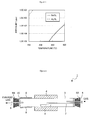
- FIG. 1 is a vapor pressure curve between a dimer of aluminum chloride (Al 2 Cl 6 ) and scandium chloride (ScCl 3 ).
- the saturated vapor pressure is a value calculated based on the Antoine equation.
- the saturated vapor pressure of aluminum chloride is high even at relative low temperature and is at least 1 atm even at 200°C; whereas, the saturated vapor pressure of scandium chloride is on the order of 10 -4 even at 700°C, and hardly volatilizes under atmospheric pressure.
- the present invention was made employing the property of the saturated vapor pressures greatly differing between aluminum chloride and scandium chloride.
- Al is removed by vaporizing as a dimer of aluminum chloride (Al 2 Cl 6 ) by the chlorination reaction.
- Sc remains as is without vaporizing as scandium chloride (ScCl 3 ).
- by heating the Al-Sc alloy to a predetermined temperature under a chlorine gas atmosphere it is possible to separate the Al-Sc alloy into aluminum chloride as the vapor phase and scandium chloride as the solid phase.
- the heating temperature is believed to be sufficient if 200°C to 800°C; however, when considering the reaction time, recovery rate, etc., the heating temperature is preferably 300°C to 700°C. If the heating temperature is no higher than 300°C, even if the Al-Sc alloy could be gas-solid separated into aluminum chloride and scandium chloride, it would not be preferable because time would be required in the chlorination reaction, and thus the efficiency would be poor. On the other hand, if the heating temperature exceeds 700°C, it is not preferable because the scandium chloride may partially vaporize and the recovery rate would decrease. In addition, it is not preferable in the point of the corrosion rate of the reaction apparatus increasing due to chlorine, and thus requiring the selection of high-cost apparatus materials.
- the heating time is preferably at least 20 minutes to no more than 90 minutes, and is more preferably at least 50 minutes to no more than 70 minutes. If the heating time is shorter than 20 minutes, it is not preferable because there will be a possibility of not being able to satisfactorily gas-solid separate the Al-Sc alloy into aluminum chloride and scandium chloride. If longer than 90 minutes, it is not preferable in the point of the cost of gas-solid separating possibly becoming high cost.
- the recovery step is a step of recovering scandium chloride from the solid phase after the heating step.
- it is possible to not only recover scandium chloride from the solid phase, but also to recover aluminum chloride from the vapor phase. Additionally, by bringing hydrogen gas into contact with the aluminum chloride, it is not only possible to recover high-purity aluminum metal from the Al-Sc alloy, but also obtain chlorine gas by electrolyzing hydrogen chloride, which is a byproduct, whereby this chlorine gas can be reused as the chlorine gas used in the above-mentioned heating step.
- the scandium oxide production method of the present invention includes a scandium oxide recovery step of dissolving the scandium chloride recovered by the above-mentioned ⁇ Scandium Chloride Production Method> to obtain a scandium solution, followed by adding oxalic acid to the scandium solution to make scandium oxalate, and oxidizing this scandium oxalate to recover scandium oxide.
- Patent Document 2 can be exemplified as a technique for recovering scandium oxide from the raw material, it is first necessary to subject the raw material to solvent extraction due to the proportion of scandium contained in the raw material at first being very low.
- the scandium chloride recovered by the present invention since it is unnecessary to solvent extract the raw material, and the raw material is a chloride, it is possible to dissolve with simply water. Subsequently, oxalic acid is added to the scandium aqueous solution to make scandium oxalate, and this scandium oxalate is oxidized, whereby it can be recovered as scandium oxide.
- FIG. 2 is a schematic drawing illustrating the configuration of the reaction apparatus 1 used in the present examples.
- the reaction apparatus 1 includes: an alumina plate 2 on which the Al-Sc alloy that is the sample is placed; a quartz furnace core tube 3 that keeps the sample in a chlorine gas atmosphere; a horizontal electric furnace 4 that heats this quartz furnace core tube 3; rubber stoppers 5A, 5B that seal both ends of the quartz furnace core tube 3; a gas supply unit 6 that supplies gas to the inside of the quartz furnace core tube 3 through a tube insertion part (not illustrated) provided in the rubber stopper 5A on the inlet side; a thermocouple 7 inserted inside of the quartz furnace core tube 3 through a thermocouple insertion part (not illustrated) provided in the rubber stopper 5A on the inlet side; an aluminum chloride recovery unit 8 that is provided on the outlet side, and recovers the vaporized aluminum chloride by watercooling; a gas exhaust unit 10 that exhausts the vapor that is inside of the quartz furnace core tube 3 through a tube insertion part (not
- the gas supplied through the gas supply unit 6 was switched again from chlorine gas to nitrogen gas, as well as shutting off the power source of the horizontal electric furnace 4, and cooling the sample inside of the horizontal electric furnace 4. After the sample reached room temperature, the sample remaining on the alumina plate 2, and the adhered substance recovered from the aluminum chloride recovery unit 8 were retrieved.
- the sample remaining on the alumina plate 2 and the adhered substance recovered from the aluminum chloride recovery unit 8 were respectively dissolved, and mass spectroscopy was performed using an ICP mass spectrometer. As a result thereof, the scandium quality of the sample remaining on the alumina plate 2 was 27.5 wt%. This corresponds to 92% by ScCl 3 conversion.
- the scandium quality of the adhered substance recovered in the aluminum chloride recovery unit 8 was less than 0.5 wt%. Based on this, almost the entire amount of adhered substance is considered to be a chloride of aluminum.
Landscapes
- Chemical & Material Sciences (AREA)
- Organic Chemistry (AREA)
- Life Sciences & Earth Sciences (AREA)
- Geology (AREA)
- Inorganic Chemistry (AREA)
- Manufacture And Refinement Of Metals (AREA)
- Processing Of Solid Wastes (AREA)
- Compounds Of Alkaline-Earth Elements, Aluminum Or Rare-Earth Metals (AREA)
- Electrolytic Production Of Non-Metals, Compounds, Apparatuses Therefor (AREA)
Abstract
Description
- The present invention relates to a scandium chloride and scandium oxide production method, and in more detail, relates to a method of recovering a scandium concentrate from an alloy containing scandium and aluminum.
- Aluminum scandium alloys containing aluminum and scandium (hereinafter also referred to as "Al-Sc alloy") have a characteristic of being light weight and high strength, and in addition to sports articles, have been used in fields requiring shock resistance. Additionally, in the future, applications as a structural material for aircraft, electric vehicles, high-speed rail, etc. are also expected. However, since the production volume of scandium is very small, scandium is extremely high cost. For this reason, it is not easy to broadly apply scandium industrially.
- In recent years, the technology for recovering scandium that accompanies nickel oxide ore in a very small amount has progressed, and it is becoming possible to stably obtain larger amounts of scandium than before. However, to recover scandium from nickel oxide ore, since multiple processes such as ion exchange, solvent extraction, neutral precipitation and calcination are required, the matter of scandium being high cost does not change even if using this technology.
- However, since scandium is easily oxidized but has a high melting point, it is not possible to obtain Al-Sc alloy by simply melting scandium and aluminum. Therefore, generally a technique has been adopted to add, to molten aluminum, scandium oxide while reducing with metals such as calcium to obtain a master alloy having a scandium quality on the order of 1-2%, and then diluting this with aluminum to obtain the intended Al-Sc alloy. In addition, it has also been proposed to produce a scandium master alloy with halogenated scandium as the raw material (refer to Patent Document 1). As a first technique for separating scandium from Al-Sc alloy, it has been considered to perform a process in the reverse direction to the process described in Patent Document 1.
- In addition, as a second technique, a method of recovering high-purity scandium oxide using solvent extraction from a hydrochloric acid solution containing scandium has been proposed (refer to Patent Document 2).
- Patent Document 1:
Japanese Unexamined Patent Application, Publication No. 2003-171724 - Patent Document 2:
Japanese Unexamined Patent Application Publication No. H09-291320 - However, the matter of performing a process in the reverse direction to the first technique, i.e. the process described in Patent Document 1, is not easy to practically realize from the viewpoint of industrial facilities and cost. In addition, with the second technique, dissolving scandium in an acid solution is not easy, and labor and cost is required in passing through the step of solvent extraction. Additionally, not only scandium and aluminum, but various components including zinc are often contained in alloys, and there is also a problem in requiring labor in the separation of these various elements. In this way, an Al-Sc alloy recycling technique, i.e. method of efficiently separating from Al-Sc alloy into aluminum and scandium, has yet to be found.
- The present invention has been made in order to sole the above such problems, and an object thereof is to efficiently separate from Al-Sc alloy into aluminum and scandium.
- As a result of accumulating intensive research to solve the above-mentioned problems, the present inventors found that the above-mentioned object could be achieved by heating an Al-Sc alloy to 300°C to 700°C under a chlorine gas atmosphere, thereby arriving at completion of the present invention.
- More specifically, the present invention provides the following matters.
- A first aspect of the present invention is a scandium chloride production method including: a heating step of heating an alloy containing scandium and aluminum to 300°C to 700°C under a chlorine gas atmosphere; and a scandium chloride recovery step of recovering scandium chloride from a solid phase, after the heating step.
- In addition, according to a second aspect of the present invention, the scandium chloride production method as described in the first aspect further includes: a hydrogen chloride generation step of bringing hydrogen gas into contact with aluminum chloride obtained from the heating step to generate hydrogen chloride; and a chlorine gas generation step of generating chlorine gas by electrolyzing the hydrogen chloride, in which the chlorine gas used in the heating step contains chlorine gas obtained from the chlorine gas generation step.
- Furthermore, a third aspect of the present invention is a scandium oxide production method including: a scandium oxide recovery step of recovering scandium oxide by dissolving the scandium chloride recovered by the method as described in the first or second aspect to obtain a scandium solution, followed by adding oxalic acid to the scandium solution to make scandium oxalate, and oxidizing the scandium oxalate.
- According to the present invention, it is possible to efficiently recover scandium from an Al-Sc alloy.
-
-
FIG. 1 shows a vapor pressure curve between the dimer of aluminum chloride (Al2Cl6) and scandium chloride (ScCl3); and -
FIG. 2 is a schematic view showing an example of a reaction apparatus 1. - Hereinafter, a specific embodiment of the present invention will be explained in detail; however, the present invention is not to be limited in any way to the following embodiment, and can be realized by applying appropriate modifications within the scope of the object of the present invention. It should be noted that places where explanation would be redundant, the explanation may be omitted as appropriate, but is not to limit the gist of the invention.
- The scandium chloride production method according to the present invention includes: a heating step of heating an alloy containing scandium and aluminum to 300°C to 700°C in a chloride gas atmosphere, and a scandium chloride recovery step of, after this heating step, recovering scandium chloride from the solid phase.
- Aluminum and scandium both become chlorides in a high-temperature chlorine gas atmosphere.
-
FIG. 1 is a vapor pressure curve between a dimer of aluminum chloride (Al2Cl6) and scandium chloride (ScCl3). The saturated vapor pressure is a value calculated based on the Antoine equation. - According to the vapor pressure curve of
FIG. 1 , it is found that the saturated vapor pressure of aluminum chloride is high even at relative low temperature and is at least 1 atm even at 200°C; whereas, the saturated vapor pressure of scandium chloride is on the order of 10-4 even at 700°C, and hardly volatilizes under atmospheric pressure. - The present invention was made employing the property of the saturated vapor pressures greatly differing between aluminum chloride and scandium chloride. When heating the Al-Sc alloy to 200°C to 800°C under a chlorine gas atmosphere, Al is removed by vaporizing as a dimer of aluminum chloride (Al2Cl6) by the chlorination reaction. On the other hand, Sc remains as is without vaporizing as scandium chloride (ScCl3). For this reason, by heating the Al-Sc alloy to a predetermined temperature under a chlorine gas atmosphere, it is possible to separate the Al-Sc alloy into aluminum chloride as the vapor phase and scandium chloride as the solid phase.
- When considering only separating into aluminum chloride as the vapor phase and scandium chloride as the solid phase, the heating temperature is believed to be sufficient if 200°C to 800°C; however, when considering the reaction time, recovery rate, etc., the heating temperature is preferably 300°C to 700°C. If the heating temperature is no higher than 300°C, even if the Al-Sc alloy could be gas-solid separated into aluminum chloride and scandium chloride, it would not be preferable because time would be required in the chlorination reaction, and thus the efficiency would be poor. On the other hand, if the heating temperature exceeds 700°C, it is not preferable because the scandium chloride may partially vaporize and the recovery rate would decrease. In addition, it is not preferable in the point of the corrosion rate of the reaction apparatus increasing due to chlorine, and thus requiring the selection of high-cost apparatus materials.
- The heating time (time maintaining at 200°C to 800°C) is preferably at least 20 minutes to no more than 90 minutes, and is more preferably at least 50 minutes to no more than 70 minutes. If the heating time is shorter than 20 minutes, it is not preferable because there will be a possibility of not being able to satisfactorily gas-solid separate the Al-Sc alloy into aluminum chloride and scandium chloride. If longer than 90 minutes, it is not preferable in the point of the cost of gas-solid separating possibly becoming high cost.
- The recovery step is a step of recovering scandium chloride from the solid phase after the heating step. In the recovery step, it is possible to not only recover scandium chloride from the solid phase, but also to recover aluminum chloride from the vapor phase. Additionally, by bringing hydrogen gas into contact with the aluminum chloride, it is not only possible to recover high-purity aluminum metal from the Al-Sc alloy, but also obtain chlorine gas by electrolyzing hydrogen chloride, which is a byproduct, whereby this chlorine gas can be reused as the chlorine gas used in the above-mentioned heating step.
- In addition, by providing the scandium chloride obtained in the recovery step to the above-mentioned heating step again, it is possible to further raise the purity of scandium contained in the recovered material.
- The scandium oxide production method of the present invention includes a scandium oxide recovery step of dissolving the scandium chloride recovered by the above-mentioned <Scandium Chloride Production Method> to obtain a scandium solution, followed by adding oxalic acid to the scandium solution to make scandium oxalate, and oxidizing this scandium oxalate to recover scandium oxide.
- When considering the usefulness upon reusing scandium concentrate, stability upon storing scandium concentrate, labor, etc., it is more preferable to store scandium concentrate in the form of scandium oxide than storing in the form of scandium chloride.
- Although the above-mentioned technique described in
Patent Document 2 can be exemplified as a technique for recovering scandium oxide from the raw material, it is first necessary to subject the raw material to solvent extraction due to the proportion of scandium contained in the raw material at first being very low. However, if using the scandium chloride recovered by the present invention, since it is unnecessary to solvent extract the raw material, and the raw material is a chloride, it is possible to dissolve with simply water. Subsequently, oxalic acid is added to the scandium aqueous solution to make scandium oxalate, and this scandium oxalate is oxidized, whereby it can be recovered as scandium oxide. - Hereinafter, the present invention will be explained in further detail by way of examples; however, the present invention is not to be subjected to any limitations in these descriptions.
-
FIG. 2 is a schematic drawing illustrating the configuration of the reaction apparatus 1 used in the present examples. The reaction apparatus 1 includes: analumina plate 2 on which the Al-Sc alloy that is the sample is placed; a quartzfurnace core tube 3 that keeps the sample in a chlorine gas atmosphere; a horizontalelectric furnace 4 that heats this quartzfurnace core tube 3;rubber stoppers furnace core tube 3; agas supply unit 6 that supplies gas to the inside of the quartzfurnace core tube 3 through a tube insertion part (not illustrated) provided in therubber stopper 5A on the inlet side; athermocouple 7 inserted inside of the quartzfurnace core tube 3 through a thermocouple insertion part (not illustrated) provided in therubber stopper 5A on the inlet side; an aluminumchloride recovery unit 8 that is provided on the outlet side, and recovers the vaporized aluminum chloride by watercooling; agas exhaust unit 10 that exhausts the vapor that is inside of the quartzfurnace core tube 3 through a tube insertion part (not illustrated) provided to therubber stopper 5B on the outlet side; and an insulation board 11 that maintains the adiabicity of the inside of the quartzfurnace core tube 3. - On a 99%
purity alumina plate 2, 50 g of scrap Al-Sc alloy with Sc quality of 1 wt% was placed, and thisalumina plate 2 was set in the horizontalelectric furnace 4 that can adjust the atmosphere using the quartzfurnace core tube 3 of the structure shown inFIG. 2 . In order to keep the atmosphere inside of the quartzfurnace core tube 3 inert, high-purify nitrogen gas was flowed from a compressed gas cylinder through thegas supply unit 6 to substitute the atmosphere inside of the quartzfurnace core tube 3, followed by heating until the inside of the horizontalelectric furnace 4 reached 500°C while continuing the flow of nitrogen gas, switching the gas from nitrogen to chlorine gas while maintaining at 500°C, and holding for 60 minutes while flowing at a rate of 0.5 L/min. - Subsequently, the gas supplied through the
gas supply unit 6 was switched again from chlorine gas to nitrogen gas, as well as shutting off the power source of the horizontalelectric furnace 4, and cooling the sample inside of the horizontalelectric furnace 4. After the sample reached room temperature, the sample remaining on thealumina plate 2, and the adhered substance recovered from the aluminumchloride recovery unit 8 were retrieved. - The sample remaining on the
alumina plate 2 and the adhered substance recovered from the aluminumchloride recovery unit 8 were respectively dissolved, and mass spectroscopy was performed using an ICP mass spectrometer. As a result thereof, the scandium quality of the sample remaining on thealumina plate 2 was 27.5 wt%. This corresponds to 92% by ScCl3 conversion. - On the other hand, the scandium quality of the adhered substance recovered in the aluminum
chloride recovery unit 8 was less than 0.5 wt%. Based on this, almost the entire amount of adhered substance is considered to be a chloride of aluminum. - Based on the present Example, it was confirmed that it is possible to separate into a high-purity scandium concentrate and aluminum concentrate by passing through a heating step of heating an alloy containing scandium and aluminum to 300°C to 700°C under a chlorine gas atmosphere, and a scandium chloride recovery step of recovering scandium chloride from the solid phase after this heating step.
-
- 1
- reaction apparatus
- 2
- alumina plate
- 3
- quartz furnace core tube
- 4
- horizontal electric furnace
- 5A, 5B
- rubber stopper
- 6
- gas supply unit
- 7
- thermocouple
- 8
- aluminum chloride recovery unit
- 9
- gas exhaust unit
- 10
- insulation board
Claims (3)
- A scandium chloride production method comprising:a heating step of heating an alloy containing scandium and aluminum to 300°C to 700°C under a chlorine gas atmosphere; anda scandium chloride recovery step of recovering scandium chloride from a solid phase, after the heating step.
- The scandium chloride production method according to claim 1, further comprising:a hydrogen chloride generation step of bringing hydrogen gas into contact with aluminum chloride obtained from the heating step to generate hydrogen chloride; anda chlorine gas generation step of generating chlorine gas by electrolyzing the hydrogen chloride,wherein the chlorine gas used in the heating step contains chlorine gas obtained from the chlorine gas generation step.
- A scandium oxide production method comprising: a scandium oxide recovery step of recovering scandium oxide by dissolving the scandium chloride recovered by the method according to claim 1 or 2 to obtain a scandium solution, followed by adding oxalic acid to the scandium solution to make scandium oxalate, and oxidizing the scandium oxalate.
Applications Claiming Priority (2)
| Application Number | Priority Date | Filing Date | Title |
|---|---|---|---|
| JP2014012665A JP5884840B2 (en) | 2014-01-27 | 2014-01-27 | Method for producing scandium chloride and scandium oxide |
| PCT/JP2015/051826 WO2015111696A1 (en) | 2014-01-27 | 2015-01-23 | Scandium chloride and scandium chloride production method |
Publications (3)
| Publication Number | Publication Date |
|---|---|
| EP3078757A1 true EP3078757A1 (en) | 2016-10-12 |
| EP3078757A4 EP3078757A4 (en) | 2016-11-16 |
| EP3078757B1 EP3078757B1 (en) | 2019-08-28 |
Family
ID=53681493
Family Applications (1)
| Application Number | Title | Priority Date | Filing Date |
|---|---|---|---|
| EP15740973.1A Active EP3078757B1 (en) | 2014-01-27 | 2015-01-23 | Scandium chloride and scandium chloride production method |
Country Status (3)
| Country | Link |
|---|---|
| EP (1) | EP3078757B1 (en) |
| JP (1) | JP5884840B2 (en) |
| WO (1) | WO2015111696A1 (en) |
Families Citing this family (2)
| Publication number | Priority date | Publication date | Assignee | Title |
|---|---|---|---|---|
| JP6891723B2 (en) * | 2016-08-30 | 2021-06-18 | 住友金属鉱山株式会社 | Method for producing scandium compound, scandium compound |
| CN121494043A (en) * | 2025-12-29 | 2026-02-10 | 天津包钢稀土研究院有限责任公司 | A method for preparing ultra-dry anhydrous scandium chloride |
Family Cites Families (10)
| Publication number | Priority date | Publication date | Assignee | Title |
|---|---|---|---|---|
| US2874039A (en) * | 1954-06-17 | 1959-02-17 | Pechiney Prod Chimiques Sa | Extraction of scandium from its ores |
| US3235376A (en) * | 1962-03-20 | 1966-02-15 | Aluminium Lab Ltd | Procedure and apparatus for subhalide refining of aluminum |
| US5039336A (en) * | 1988-12-30 | 1991-08-13 | Westinghouse Electric Corp. | Recovery of scandium, yttrium and lanthanides from zircon sand |
| JPH05171304A (en) * | 1991-12-19 | 1993-07-09 | Kobe Steel Ltd | Method for recovering useful metals from aluminum alloys |
| JP3428292B2 (en) * | 1996-04-26 | 2003-07-22 | 大平洋金属株式会社 | Sc metal recovery method |
| JP4224532B2 (en) | 2001-12-07 | 2009-02-18 | 青森県 | Method for producing Al-Sc master alloy and Al-Sc master alloy obtained by the method |
| JP5094031B2 (en) * | 2006-03-23 | 2012-12-12 | 大平洋金属株式会社 | Method for producing scandium-containing alloy |
| JP2012041588A (en) * | 2010-08-17 | 2012-03-01 | Akita Univ | Separation method and separation system for rare earth element by chloride volatilization method |
| CN102021343A (en) * | 2010-10-13 | 2011-04-20 | 赣州鑫磊稀土新材料有限公司 | Method for separating and recovering scandium oxide from aluminum-scandium alloy smelting waste |
| US20120207656A1 (en) * | 2011-02-11 | 2012-08-16 | Emc Metals Corporation | System and Method for Recovery of Scandium Values From Scandium-Containing Ores |
-
2014
- 2014-01-27 JP JP2014012665A patent/JP5884840B2/en active Active
-
2015
- 2015-01-23 EP EP15740973.1A patent/EP3078757B1/en active Active
- 2015-01-23 WO PCT/JP2015/051826 patent/WO2015111696A1/en not_active Ceased
Also Published As
| Publication number | Publication date |
|---|---|
| JP2015140444A (en) | 2015-08-03 |
| WO2015111696A1 (en) | 2015-07-30 |
| JP5884840B2 (en) | 2016-03-15 |
| EP3078757B1 (en) | 2019-08-28 |
| EP3078757A4 (en) | 2016-11-16 |
Similar Documents
| Publication | Publication Date | Title |
|---|---|---|
| AU2021201139B2 (en) | Methods for treating lithium-containing materials | |
| KR102289555B1 (en) | Method and apparatus for producing metal by elecrolytic reduction | |
| CN110387474B (en) | Method for treating electrolytic slag generated in process of producing aluminum-scandium alloy by molten salt electrolysis method | |
| KR102795319B1 (en) | Method for producing fine metal powder from metal compound | |
| KR20230115993A (en) | How to recover and purify lithium | |
| JP5018156B2 (en) | Method for producing polycrystalline silicon | |
| JP5935098B2 (en) | Zinc production method | |
| EP3078757B1 (en) | Scandium chloride and scandium chloride production method | |
| CN105637105A (en) | Zinc production method using electric furnace dust as raw material | |
| PH12018501703B1 (en) | Method for recovering scandium | |
| EP3081671B1 (en) | Scandium concentrate production method | |
| EP3081670B1 (en) | Scandium concentrate production method | |
| US6790428B2 (en) | Process for the reduction or elimination of NH3/HF byproduct in the manufacture of nitrogen trifluoride | |
| TW201348136A (en) | Method and apparatus for producing fluorine gas | |
| US10221075B1 (en) | Synthesis of ammonia from hydrogen sulfide | |
| CN105274562A (en) | Aluminum and silicon electrolytic separation method for aluminum-silicon alloy | |
| EP2527477A1 (en) | Efficient method for collection of platinum-group element from copper-iron scrap | |
| JP2012072480A (en) | Method for selectively recovering indium from mixture of indium and tin | |
| US20090104111A1 (en) | Carbonate Thermochemical Cycle for the Production of Hydrogen | |
| RU2285662C2 (en) | METHOD OF SEDIMENTATION OF THE ELEMENTARY SELENIUM FROM THE ACID SOLUTIONS CONTAINING Se(VI) | |
| TWI651273B (en) | 钌 and 铱 recycling composition, and 回收 and 回收 recycling method | |
| EP3081659B1 (en) | Scandium concentrate recovery method | |
| JP5100166B2 (en) | High purity metal and method for producing the same | |
| HK40102767A (en) | Method for recycling electrode materials of a lithium battery | |
| JP2009242153A (en) | Method of producing silicon |
Legal Events
| Date | Code | Title | Description |
|---|---|---|---|
| PUAI | Public reference made under article 153(3) epc to a published international application that has entered the european phase |
Free format text: ORIGINAL CODE: 0009012 |
|
| 17P | Request for examination filed |
Effective date: 20160706 |
|
| AK | Designated contracting states |
Kind code of ref document: A1 Designated state(s): AL AT BE BG CH CY CZ DE DK EE ES FI FR GB GR HR HU IE IS IT LI LT LU LV MC MK MT NL NO PL PT RO RS SE SI SK SM TR |
|
| AX | Request for extension of the european patent |
Extension state: BA ME |
|
| A4 | Supplementary search report drawn up and despatched |
Effective date: 20161014 |
|
| RIC1 | Information provided on ipc code assigned before grant |
Ipc: C01F 17/00 20060101ALI20161010BHEP Ipc: C25B 1/26 20060101ALI20161010BHEP Ipc: C22B 21/00 20060101ALI20161010BHEP Ipc: C22B 59/00 20060101AFI20161010BHEP Ipc: B09B 3/00 20060101ALI20161010BHEP Ipc: C22B 7/00 20060101ALI20161010BHEP |
|
| DAX | Request for extension of the european patent (deleted) | ||
| GRAP | Despatch of communication of intention to grant a patent |
Free format text: ORIGINAL CODE: EPIDOSNIGR1 |
|
| STAA | Information on the status of an ep patent application or granted ep patent |
Free format text: STATUS: GRANT OF PATENT IS INTENDED |
|
| INTG | Intention to grant announced |
Effective date: 20181011 |
|
| GRAJ | Information related to disapproval of communication of intention to grant by the applicant or resumption of examination proceedings by the epo deleted |
Free format text: ORIGINAL CODE: EPIDOSDIGR1 |
|
| STAA | Information on the status of an ep patent application or granted ep patent |
Free format text: STATUS: REQUEST FOR EXAMINATION WAS MADE |
|
| GRAS | Grant fee paid |
Free format text: ORIGINAL CODE: EPIDOSNIGR3 |
|
| STAA | Information on the status of an ep patent application or granted ep patent |
Free format text: STATUS: GRANT OF PATENT IS INTENDED |
|
| INTC | Intention to grant announced (deleted) | ||
| GRAP | Despatch of communication of intention to grant a patent |
Free format text: ORIGINAL CODE: EPIDOSNIGR1 |
|
| INTG | Intention to grant announced |
Effective date: 20190329 |
|
| GRAA | (expected) grant |
Free format text: ORIGINAL CODE: 0009210 |
|
| STAA | Information on the status of an ep patent application or granted ep patent |
Free format text: STATUS: THE PATENT HAS BEEN GRANTED |
|
| AK | Designated contracting states |
Kind code of ref document: B1 Designated state(s): AL AT BE BG CH CY CZ DE DK EE ES FI FR GB GR HR HU IE IS IT LI LT LU LV MC MK MT NL NO PL PT RO RS SE SI SK SM TR |
|
| REG | Reference to a national code |
Ref country code: GB Ref legal event code: FG4D |
|
| REG | Reference to a national code |
Ref country code: CH Ref legal event code: EP |
|
| REG | Reference to a national code |
Ref country code: AT Ref legal event code: REF Ref document number: 1172484 Country of ref document: AT Kind code of ref document: T Effective date: 20190915 |
|
| REG | Reference to a national code |
Ref country code: IE Ref legal event code: FG4D |
|
| REG | Reference to a national code |
Ref country code: DE Ref legal event code: R096 Ref document number: 602015036720 Country of ref document: DE |
|
| REG | Reference to a national code |
Ref country code: NL Ref legal event code: MP Effective date: 20190828 |
|
| REG | Reference to a national code |
Ref country code: LT Ref legal event code: MG4D |
|
| PG25 | Lapsed in a contracting state [announced via postgrant information from national office to epo] |
Ref country code: PT Free format text: LAPSE BECAUSE OF FAILURE TO SUBMIT A TRANSLATION OF THE DESCRIPTION OR TO PAY THE FEE WITHIN THE PRESCRIBED TIME-LIMIT Effective date: 20191230 Ref country code: HR Free format text: LAPSE BECAUSE OF FAILURE TO SUBMIT A TRANSLATION OF THE DESCRIPTION OR TO PAY THE FEE WITHIN THE PRESCRIBED TIME-LIMIT Effective date: 20190828 Ref country code: NO Free format text: LAPSE BECAUSE OF FAILURE TO SUBMIT A TRANSLATION OF THE DESCRIPTION OR TO PAY THE FEE WITHIN THE PRESCRIBED TIME-LIMIT Effective date: 20191128 Ref country code: SE Free format text: LAPSE BECAUSE OF FAILURE TO SUBMIT A TRANSLATION OF THE DESCRIPTION OR TO PAY THE FEE WITHIN THE PRESCRIBED TIME-LIMIT Effective date: 20190828 Ref country code: FI Free format text: LAPSE BECAUSE OF FAILURE TO SUBMIT A TRANSLATION OF THE DESCRIPTION OR TO PAY THE FEE WITHIN THE PRESCRIBED TIME-LIMIT Effective date: 20190828 Ref country code: BG Free format text: LAPSE BECAUSE OF FAILURE TO SUBMIT A TRANSLATION OF THE DESCRIPTION OR TO PAY THE FEE WITHIN THE PRESCRIBED TIME-LIMIT Effective date: 20191128 Ref country code: LT Free format text: LAPSE BECAUSE OF FAILURE TO SUBMIT A TRANSLATION OF THE DESCRIPTION OR TO PAY THE FEE WITHIN THE PRESCRIBED TIME-LIMIT Effective date: 20190828 Ref country code: NL Free format text: LAPSE BECAUSE OF FAILURE TO SUBMIT A TRANSLATION OF THE DESCRIPTION OR TO PAY THE FEE WITHIN THE PRESCRIBED TIME-LIMIT Effective date: 20190828 |
|
| PG25 | Lapsed in a contracting state [announced via postgrant information from national office to epo] |
Ref country code: IS Free format text: LAPSE BECAUSE OF FAILURE TO SUBMIT A TRANSLATION OF THE DESCRIPTION OR TO PAY THE FEE WITHIN THE PRESCRIBED TIME-LIMIT Effective date: 20191228 Ref country code: RS Free format text: LAPSE BECAUSE OF FAILURE TO SUBMIT A TRANSLATION OF THE DESCRIPTION OR TO PAY THE FEE WITHIN THE PRESCRIBED TIME-LIMIT Effective date: 20190828 Ref country code: LV Free format text: LAPSE BECAUSE OF FAILURE TO SUBMIT A TRANSLATION OF THE DESCRIPTION OR TO PAY THE FEE WITHIN THE PRESCRIBED TIME-LIMIT Effective date: 20190828 Ref country code: AL Free format text: LAPSE BECAUSE OF FAILURE TO SUBMIT A TRANSLATION OF THE DESCRIPTION OR TO PAY THE FEE WITHIN THE PRESCRIBED TIME-LIMIT Effective date: 20190828 Ref country code: ES Free format text: LAPSE BECAUSE OF FAILURE TO SUBMIT A TRANSLATION OF THE DESCRIPTION OR TO PAY THE FEE WITHIN THE PRESCRIBED TIME-LIMIT Effective date: 20190828 Ref country code: GR Free format text: LAPSE BECAUSE OF FAILURE TO SUBMIT A TRANSLATION OF THE DESCRIPTION OR TO PAY THE FEE WITHIN THE PRESCRIBED TIME-LIMIT Effective date: 20191129 |
|
| REG | Reference to a national code |
Ref country code: AT Ref legal event code: MK05 Ref document number: 1172484 Country of ref document: AT Kind code of ref document: T Effective date: 20190828 |
|
| PG25 | Lapsed in a contracting state [announced via postgrant information from national office to epo] |
Ref country code: TR Free format text: LAPSE BECAUSE OF FAILURE TO SUBMIT A TRANSLATION OF THE DESCRIPTION OR TO PAY THE FEE WITHIN THE PRESCRIBED TIME-LIMIT Effective date: 20190828 |
|
| PG25 | Lapsed in a contracting state [announced via postgrant information from national office to epo] |
Ref country code: DK Free format text: LAPSE BECAUSE OF FAILURE TO SUBMIT A TRANSLATION OF THE DESCRIPTION OR TO PAY THE FEE WITHIN THE PRESCRIBED TIME-LIMIT Effective date: 20190828 Ref country code: PL Free format text: LAPSE BECAUSE OF FAILURE TO SUBMIT A TRANSLATION OF THE DESCRIPTION OR TO PAY THE FEE WITHIN THE PRESCRIBED TIME-LIMIT Effective date: 20190828 Ref country code: RO Free format text: LAPSE BECAUSE OF FAILURE TO SUBMIT A TRANSLATION OF THE DESCRIPTION OR TO PAY THE FEE WITHIN THE PRESCRIBED TIME-LIMIT Effective date: 20190828 Ref country code: EE Free format text: LAPSE BECAUSE OF FAILURE TO SUBMIT A TRANSLATION OF THE DESCRIPTION OR TO PAY THE FEE WITHIN THE PRESCRIBED TIME-LIMIT Effective date: 20190828 Ref country code: AT Free format text: LAPSE BECAUSE OF FAILURE TO SUBMIT A TRANSLATION OF THE DESCRIPTION OR TO PAY THE FEE WITHIN THE PRESCRIBED TIME-LIMIT Effective date: 20190828 Ref country code: IT Free format text: LAPSE BECAUSE OF FAILURE TO SUBMIT A TRANSLATION OF THE DESCRIPTION OR TO PAY THE FEE WITHIN THE PRESCRIBED TIME-LIMIT Effective date: 20190828 |
|
| PG25 | Lapsed in a contracting state [announced via postgrant information from national office to epo] |
Ref country code: SM Free format text: LAPSE BECAUSE OF FAILURE TO SUBMIT A TRANSLATION OF THE DESCRIPTION OR TO PAY THE FEE WITHIN THE PRESCRIBED TIME-LIMIT Effective date: 20190828 Ref country code: CZ Free format text: LAPSE BECAUSE OF FAILURE TO SUBMIT A TRANSLATION OF THE DESCRIPTION OR TO PAY THE FEE WITHIN THE PRESCRIBED TIME-LIMIT Effective date: 20190828 Ref country code: IS Free format text: LAPSE BECAUSE OF FAILURE TO SUBMIT A TRANSLATION OF THE DESCRIPTION OR TO PAY THE FEE WITHIN THE PRESCRIBED TIME-LIMIT Effective date: 20200224 Ref country code: SK Free format text: LAPSE BECAUSE OF FAILURE TO SUBMIT A TRANSLATION OF THE DESCRIPTION OR TO PAY THE FEE WITHIN THE PRESCRIBED TIME-LIMIT Effective date: 20190828 |
|
| REG | Reference to a national code |
Ref country code: DE Ref legal event code: R097 Ref document number: 602015036720 Country of ref document: DE |
|
| PLBE | No opposition filed within time limit |
Free format text: ORIGINAL CODE: 0009261 |
|
| STAA | Information on the status of an ep patent application or granted ep patent |
Free format text: STATUS: NO OPPOSITION FILED WITHIN TIME LIMIT |
|
| PG2D | Information on lapse in contracting state deleted |
Ref country code: IS |
|
| REG | Reference to a national code |
Ref country code: DE Ref legal event code: R119 Ref document number: 602015036720 Country of ref document: DE |
|
| 26N | No opposition filed |
Effective date: 20200603 |
|
| PG25 | Lapsed in a contracting state [announced via postgrant information from national office to epo] |
Ref country code: MC Free format text: LAPSE BECAUSE OF FAILURE TO SUBMIT A TRANSLATION OF THE DESCRIPTION OR TO PAY THE FEE WITHIN THE PRESCRIBED TIME-LIMIT Effective date: 20190828 Ref country code: SI Free format text: LAPSE BECAUSE OF FAILURE TO SUBMIT A TRANSLATION OF THE DESCRIPTION OR TO PAY THE FEE WITHIN THE PRESCRIBED TIME-LIMIT Effective date: 20190828 |
|
| REG | Reference to a national code |
Ref country code: CH Ref legal event code: PL |
|
| REG | Reference to a national code |
Ref country code: BE Ref legal event code: MM Effective date: 20200131 |
|
| PG25 | Lapsed in a contracting state [announced via postgrant information from national office to epo] |
Ref country code: DE Free format text: LAPSE BECAUSE OF NON-PAYMENT OF DUE FEES Effective date: 20200801 Ref country code: LU Free format text: LAPSE BECAUSE OF NON-PAYMENT OF DUE FEES Effective date: 20200123 |
|
| PG25 | Lapsed in a contracting state [announced via postgrant information from national office to epo] |
Ref country code: CH Free format text: LAPSE BECAUSE OF NON-PAYMENT OF DUE FEES Effective date: 20200131 Ref country code: LI Free format text: LAPSE BECAUSE OF NON-PAYMENT OF DUE FEES Effective date: 20200131 Ref country code: BE Free format text: LAPSE BECAUSE OF NON-PAYMENT OF DUE FEES Effective date: 20200131 |
|
| PG25 | Lapsed in a contracting state [announced via postgrant information from national office to epo] |
Ref country code: IE Free format text: LAPSE BECAUSE OF NON-PAYMENT OF DUE FEES Effective date: 20200123 |
|
| PGFP | Annual fee paid to national office [announced via postgrant information from national office to epo] |
Ref country code: GB Payment date: 20211206 Year of fee payment: 8 Ref country code: FR Payment date: 20211217 Year of fee payment: 8 |
|
| PG25 | Lapsed in a contracting state [announced via postgrant information from national office to epo] |
Ref country code: MT Free format text: LAPSE BECAUSE OF FAILURE TO SUBMIT A TRANSLATION OF THE DESCRIPTION OR TO PAY THE FEE WITHIN THE PRESCRIBED TIME-LIMIT Effective date: 20190828 Ref country code: CY Free format text: LAPSE BECAUSE OF FAILURE TO SUBMIT A TRANSLATION OF THE DESCRIPTION OR TO PAY THE FEE WITHIN THE PRESCRIBED TIME-LIMIT Effective date: 20190828 |
|
| PG25 | Lapsed in a contracting state [announced via postgrant information from national office to epo] |
Ref country code: MK Free format text: LAPSE BECAUSE OF FAILURE TO SUBMIT A TRANSLATION OF THE DESCRIPTION OR TO PAY THE FEE WITHIN THE PRESCRIBED TIME-LIMIT Effective date: 20190828 |
|
| GBPC | Gb: european patent ceased through non-payment of renewal fee |
Effective date: 20230123 |
|
| PG25 | Lapsed in a contracting state [announced via postgrant information from national office to epo] |
Ref country code: GB Free format text: LAPSE BECAUSE OF NON-PAYMENT OF DUE FEES Effective date: 20230123 |
|
| PG25 | Lapsed in a contracting state [announced via postgrant information from national office to epo] |
Ref country code: FR Free format text: LAPSE BECAUSE OF NON-PAYMENT OF DUE FEES Effective date: 20230131 |