EP3077928B1 - Systeme und verfahren zur modellierung von objektnetzwerken - Google Patents
Systeme und verfahren zur modellierung von objektnetzwerken Download PDFInfo
- Publication number
- EP3077928B1 EP3077928B1 EP14867565.5A EP14867565A EP3077928B1 EP 3077928 B1 EP3077928 B1 EP 3077928B1 EP 14867565 A EP14867565 A EP 14867565A EP 3077928 B1 EP3077928 B1 EP 3077928B1
- Authority
- EP
- European Patent Office
- Prior art keywords
- representative
- vector
- int
- objects
- probe
- Prior art date
- Legal status (The legal status is an assumption and is not a legal conclusion. Google has not performed a legal analysis and makes no representation as to the accuracy of the status listed.)
- Active
Links
Images















Classifications
-
- G—PHYSICS
- G06—COMPUTING OR CALCULATING; COUNTING
- G06F—ELECTRIC DIGITAL DATA PROCESSING
- G06F16/00—Information retrieval; Database structures therefor; File system structures therefor
- G06F16/20—Information retrieval; Database structures therefor; File system structures therefor of structured data, e.g. relational data
- G06F16/24—Querying
- G06F16/245—Query processing
- G06F16/2457—Query processing with adaptation to user needs
- G06F16/24578—Query processing with adaptation to user needs using ranking
-
- G—PHYSICS
- G06—COMPUTING OR CALCULATING; COUNTING
- G06F—ELECTRIC DIGITAL DATA PROCESSING
- G06F16/00—Information retrieval; Database structures therefor; File system structures therefor
- G06F16/90—Details of database functions independent of the retrieved data types
- G06F16/903—Querying
-
- G—PHYSICS
- G06—COMPUTING OR CALCULATING; COUNTING
- G06F—ELECTRIC DIGITAL DATA PROCESSING
- G06F16/00—Information retrieval; Database structures therefor; File system structures therefor
- G06F16/20—Information retrieval; Database structures therefor; File system structures therefor of structured data, e.g. relational data
- G06F16/24—Querying
-
- G—PHYSICS
- G06—COMPUTING OR CALCULATING; COUNTING
- G06F—ELECTRIC DIGITAL DATA PROCESSING
- G06F17/00—Digital computing or data processing equipment or methods, specially adapted for specific functions
- G06F17/10—Complex mathematical operations
- G06F17/16—Matrix or vector computation, e.g. matrix-matrix or matrix-vector multiplication, matrix factorization
-
- G—PHYSICS
- G06—COMPUTING OR CALCULATING; COUNTING
- G06N—COMPUTING ARRANGEMENTS BASED ON SPECIFIC COMPUTATIONAL MODELS
- G06N5/00—Computing arrangements using knowledge-based models
Definitions
- the technical field relates generally to association based information retrieval and, more particularly, to systems and methods for modeling associations between objects within an object network.
- Information systems that discover and explore associations between entities described by underlying data abound into today's information based economies. Examples of these information systems include data warehouses, business intelligence systems, search engines, and the like. Many of these systems utilize commercial data base management systems, such as ORACLE 12c available from Oracle Corporation of Redwood City, California. Other systems, such as the GOOGLE search engine available from Google Inc. of Mountain View, California utilize proprietary data base systems, such as BigTable and Spanner.
- various CPUs now exist that are capable of implementing the 64-bit version of the x86 instruction set (also known as x64).
- these x64 computing systems include vastly larger sets of addressable memory as compared to conventional computing systems.
- 512-bit extensions to the 256-bit Advanced Vector Extensions SIMD (Single Instruction Multiple Data) instructions for x86 instruction set architecture will be available in the coming year(s).
- SIMD Single Instruction Multiple Data
- One example of such 512-bit extensions that is eagerly anticipated is the AVX-512 extensions proposed by Intel in July 2013.
- conventional information systems are ill equipped to leverage the parallel processing capabilities that will be available with, for example, the AVX- 512 extensions and processors configured to execute the same.
- GPGPUs General Purpose Graphics Processing Units
- GPGPUs General Purpose Graphics Processing Units
- EP 2 130 953 A2 relates to an image management system for searching image data.
- WO 2013/044295 A1 relates to a system for linking hash code to a portion of an image. Identifying similar objects to a probe object in US 2010/179933 involves generating external vectors from the objects, generating internal vectors from the external vectors and generating fingerprints from the internal vectors.
- Some embodiments implement a Simarray Vector Intelligence Network that includes a data-to-data associative object clustering network with approximate match capabilities.
- objects Simarray objects
- Some embodiments are memory-based for high performance operation.
- Object durability is facilitated via disk write-through of all data-modifying operations. Similarity matching is accomplished through a combination of vector fingerprinting, dimension indexing, and vector space model filtration functions.
- Object networks are formed explicitly by applying pre-existing, external connectivity information, and implicitly through similarity analysis of objects or clusters of objects.
- references to "or” may be construed as inclusive so that any terms described using “or” may indicate any of a single, more than one, and all of the described terms.
- the term usage in the incorporated references is supplementary to that of this document; for irreconcilable inconsistencies, the term usage in this document controls.
- aspects and functions described herein may be implemented as specialized hardware or software components executing in one or more computer systems.
- computer systems There are many examples of computer systems that are currently in use. These examples include, among others, network appliances, personal computers, workstations, mainframes, networked clients, servers, media servers, application servers, database servers, and web servers.
- Other examples of computer systems may include mobile computing devices, such as cellular phones and personal digital assistants, and network equipment, such as load balancers, routers, and switches.
- aspects may be located on a single computer system or may be distributed among a plurality of computer systems connected to one or more communications networks.
- aspects, functions, and processes may be distributed among one or more computer systems configured to provide a service to one or more client computers, or to perform an overall task as part of a distributed system. Additionally, aspects may be performed on a client-server or multi-tier system that includes components distributed among one or more server systems that perform various functions. Consequently, embodiments are not limited to executing on any particular system or group of systems. Further, aspects, functions, and processes may be implemented in software, hardware or firmware, or any combination thereof. Thus, aspects, functions, and processes may be implemented within methods, acts, systems, system elements and components using a variety of hardware and software configurations, and examples are not limited to any particular distributed architecture, network, or communication protocol.
- the distributed computer system includes one or more computer systems that exchange information. More specifically, the distributed computer system includes computer systems 102, 104, and 106. As shown, the computer systems 102, 104, and 106 are interconnected by, and may exchange data through, a communication network 108.
- the network 108 may include any communication network through which computer systems may exchange data.
- the computer systems 102, 104, and 106 and the network 108 may use various methods, protocols and standards, including, among others, Fibre Channel, Token Ring, Ethernet, Wireless Ethernet, Bluetooth, IP, IPV6, TCP/IP, UDP, DTN, HTTP, FTP, SNMP, SMS, MMS, SS7, JSON, SOAP, CORBA, REST, and Web Services.
- the computer systems 102, 104, and 106 may transmit data via the network 108 using a variety of security measures including, for example, SSL or VPN technologies. While the distributed computer system illustrates three networked computer systems, the distributed computer system is not so limited and may include any number of computer systems and computing devices, networked using any medium and communication protocol.
- the computer system 102 includes a processor 110, a memory 112, an interconnection element 114, an interface 116 and data storage element 118.
- the processor 110 performs a series of instructions that result in manipulated data.
- the processor 110 may be any type of processor, multiprocessor or controller.
- the techniques and systems disclosed herein may involve the use of multiple processors, wherein each processor may have one or more cores.
- Example processors may include a commercially available processor such as an Intel Xeon, Itanium, Core, Celeron, or Pentium processor; an AMD Opteron processor; an Apple A4 or A5 processor; a Sun UltraSPARC processor; an IBM Power5+ processor; an IBM mainframe chip; or a quantum computer.
- the processor may be GPGPU.
- the processor may be a processor configured to execute the AVX-512 extensions discussed above.
- the processor 110 is connected to other system components, including one or more memory devices 112, by the interconnection element 114.
- the memory 112 stores programs (e.g., sequences of instructions coded to be executable by the processor 110) and data during operation of the computer system 102.
- the memory 112 may be a relatively high performance, volatile, random access memory such as a dynamic random access memory (“DRAM") or static memory (“SRAM").
- DRAM dynamic random access memory
- SRAM static memory
- the memory 112 may include any device for storing data, such as a disk drive or other nonvolatile storage device.
- Various examples may organize the memory 112 into particularized and, in some cases, unique structures to perform the functions disclosed herein. These data structures may be sized and organized to store values for particular data and types of data.
- the interconnection element 114 may include any communication coupling between system components such as one or more physical busses in conformance with specialized or standard computing bus technologies such as IDE, SCSI, PCI and InfiniBand.
- the interconnection element 114 enables communications, including instructions and data, to be exchanged between system components of the computer system 102.
- the computer system 102 also includes one or more interface devices 116 such as input devices, output devices and combination input/output devices.
- Interface devices may receive input or provide output. More particularly, output devices may render information for external presentation.
- Input devices may accept information from external sources. Examples of interface devices include keyboards, mouse devices, trackballs, microphones, touch screens, printing devices, display screens, speakers, network interface cards, etc.
- Interface devices allow the computer system 102 to exchange information and to communicate with external entities, such as users and other systems.
- the data storage element 118 includes a computer readable and writeable nonvolatile, or non-transitory, data storage medium in which instructions are stored that define a program or other object that is executed by the processor 110.
- the data storage element 118 also may include information that is recorded, on or in, the medium, and that is processed by the processor 110 during execution of the program. More specifically, the information may be stored in one or more data structures specifically configured to conserve storage space or increase data exchange performance.
- the instructions may be persistently stored as encoded signals, and the instructions may cause the processor 110 to perform any of the functions described herein.
- the medium may, for example, be optical disk, magnetic disk or flash memory, among others.
- the processor 110 or some other controller causes data to be read from the nonvolatile recording medium into another memory, such as the memory 112, that allows for faster access to the information by the processor 110 than does the storage medium included in the data storage element 118.
- the memory may be located in the data storage element 118 or in the memory 112, however, the processor 110 manipulates the data within the memory, and then copies the data to the storage medium associated with the data storage element 118 after processing is completed.
- a variety of components may manage data movement between the storage medium and other memory elements and examples are not limited to particular data management components. Further, examples are not limited to a particular memory system or data storage system.
- the computer system 102 is shown by way of example as one type of computer system upon which various aspects and functions may be practiced, aspects and functions are not limited to being implemented on the computer system 102 as shown in FIG. 1 .
- Various aspects and functions may be practiced on one or more computers having a different architectures or components than that shown in FIG. 1 .
- the computer system 102 may include specially programmed, special-purpose hardware, such as an application-specific integrated circuit ("ASIC") tailored to perform a particular operation disclosed herein.
- ASIC application-specific integrated circuit
- another example may perform the same function using a grid of several general-purpose computing devices running MAC OS System X with Motorola PowerPC processors and several specialized computing devices running proprietary hardware and operating systems.
- the computer system 102 may be a computer system including an operating system that manages at least a portion of the hardware elements included in the computer system 102.
- a processor or controller such as the processor 110, executes an operating system.
- Examples of a particular operating system that may be executed include a Windows- based operating system, such as, Windows NT, Windows 2000 (Windows ME), Windows XP, Windows Vista or Windows 7 operating systems, available from the Microsoft Corporation, a MAC OS System X operating system or an iOS operating system available from Apple Computer, one of many Linux-based operating system distributions, for example, the Enterprise Linux operating system available from Red Hat Inc., a Solaris operating system available from Oracle Corporation, or a UNIX operating systems available from various sources. Many other operating systems may be used, and examples are not limited to any particular operating system.
- the processor 110 and operating system together define a computer platform for which application programs in high-level programming languages are written.
- These component applications may be executable, intermediate, bytecode or interpreted code which communicates over a communication network, for example, the Internet, using a communication protocol, for example, TCP/IP.
- aspects may be implemented using an object-oriented programming language, such as .Net, SmallTalk, Java, C++, Ada, C# (C-Sharp), Python, or JavaScript.
- object-oriented programming languages such as .Net, SmallTalk, Java, C++, Ada, C# (C-Sharp), Python, or JavaScript.
- Other object-oriented programming languages may also be used.
- functional, scripting, or logical programming languages may be used.
- various aspects and functions may be implemented in a non-programmed environment.
- documents created in HTML, XML or other formats when viewed in a window of a browser program, can render aspects of a graphical-user interface or perform other functions.
- various examples may be implemented as programmed or non-programmed elements, or any combination thereof.
- a web page may be implemented using HTML while a data object called from within the web page may be written in C++.
- the examples are not limited to a specific programming language and any suitable programming language could be used.
- the functional components disclosed herein may include a wide variety of elements (e.g., specialized hardware, executable code, data structures or objects) that are configured to perform the functions described herein.
- the components disclosed herein may read parameters that affect the functions performed by the components. These parameters may be physically stored in any form of suitable memory including volatile memory (such as RAM) or nonvolatile memory (such as a magnetic hard drive). In addition, the parameters may be logically stored in a propriety data structure (such as a database or file defined by a user mode application) or in a commonly shared data structure (such as an application registry that is defined by an operating system). In addition, some examples provide for both system and user interfaces that allow external entities to modify the parameters and thereby configure the behavior of the components.
- FIG. 2 illustrates one of these embodiments, an object modeling system.
- FIG. 2 includes an object network modeler 202, a vectorizer 204, external object data store 206, and an application 208.
- the object network modeler 202 includes an object manager 210, an index manager 212, an object store 214, an index store 216, and a query engine 218.
- the object network modeler 202, vectorizer 204, external object data store 206, and the application 208 may be implemented using one or more computer systems, such as the computer system described above with reference to FIG. 1 . As illustrated in FIG.
- connections 220 may include any communication device through which computer components may exchange information.
- the connections 220 may include local bus connections, LAN connections, application program interfaces, sockets, and other data communication devices that facilitate information flow between computer components.
- the application 208 is configured to interface with the object network modeler 202 to explore relationships between objects described by the external object data store 206.
- Examples of the application 208 include applications that derive value from identifying and exploring associations between objects, such as thesauri, dictionaries, encyclopedias, data mining systems, business intelligence systems, and internet search engines, among other systems.
- the application 208 interfaces with the object network modeler 202 via an interface exposed by the object network modeler 202, such as an application program interface (API). Via the API, the application 208 transmits various messages to the object network modeler 202. These messages may include requests for the object network modeler 202 to populate a set of data structures, such as the data structures described further below with reference to FIG.
- API application program interface
- the messages may also include requests for the object network modeler 202 to execute queries against these data structures.
- the object network modeler 202 is configured to process these API messages in response to receiving them. In this way, the object network modeler 202 supports the operation of the application 208 by creating, maintaining, and querying object networks as described further below.
- the external object data store 206 includes information descriptive of external objects targeted for analysis by the application 208. Examples of these external objects include words, concepts, persons, products, and documents, among other objects.
- the external object data store 206 may be implemented in the form of any logical construction capable of storing information on a computer readable medium including flat files, indexed files, hierarchical databases, relational databases or object oriented databases.
- the vectorizer 204 generates vectors from the raw data stored in the external object data store, which is a process known in the art as vectorization.
- the vectors generated by the vectorizer 204 include information descriptive of the external objects.
- a good vectorizer is able to extract key features from the raw data, thereby creating a sparse vector in high dimensional space.
- a common type of vectorizer is one that extracts keywords and important phrases (ngrams) from a piece of free text.
- Other vectorizers can generate vectors that represent images, media, or any other form of information as a set of features.
- the object manager 210 is configured to create, update, and delete objects processed by the object network modeler 202.
- the object manager 210 receives external vectors from the vectorizer 204, encodes the external vectors as internal vectors, summarizes the internal vectors into fingerprints and uses this information to maintain the object store 214.
- the object manager 210 executes these actions in response to receiving a message requesting the actions.
- the object manager may receive such a message from the application 208, the vectorizer 204, a configuration file, or from some other source. Examples of the processes that the object manager 210 is configured to perform are described further.
- the index manager 212 is configured to create, update, and delete indices stored in the index store 216. In these embodiments, the index manager 212 builds and updates indices in real-time as objects are stored or modified in the object store 214. Examples of the processes performed and the data manipulated by the index manager 212 are described further below.
- the object store 214 is configured to store objects created and manipulated by the object manager 210.
- the object store 214 includes data structures specially tailored to minimize memory fragmentation and maximize performance. Examples of the structures and data included in the object store 214 are described further below.
- the index store 216 is configured to store indices created and manipulated by the index manager 212.
- the index store 216 includes data structures specially tailored to minimize memory fragmentation and maximize performance. Examples of the structures and data included in the index store 216 are described further below.
- the query engine 218 is configured to process query process messages that include query requests. These query messages may include information descriptive of one or more probe objects for which associated objects are sought. In response to receiving a query message, the query engine 218 processes the query message. Examples of the processes and data manipulated by the query engine 218 are described further below.
- the object manager is configured to implement an object network.
- This object network may include one or more objects that represent real-world entities such as a documents, persons, products, web-pages, etc.
- Each of the objects within the object network may include a set of attributes that describe a real-world entity represented by the object. Table 1 lists several examples of these attributes: TABLE 1 Attribute Description Comment OBID Unique identifier allowing direct retrieval of object via the object index. Multiple manifestations of the same object share the same OBID but have different SUBIDs. SUBID Outbound reference to another object allowing retrieval of referenced to object via the object index and retrieval of inbound referrers via the reverse index. May be NULL.
- An object with no outbound reference may be referred to herein as TERMINAL.
- An object with one or more outbound references is a DIRECTED object.
- FINGERPRINT FP
- a locality sensitive hash of VECTOR This is a dimensionality reduced bitvector derived from the object's feature set (VECTOR.) Allows for high performance similarity search via the permutation indices. Dense vector in 64-dimensional, binary space.
- CARDINALITY A counter reflecting the number of inbound references to an object from other objects.
- BLOB Any additional metadata to associate with object in the form of arbitrary binary information of any size up to 2GB per object. May be NULL.
- BLOB semantics apply to higher level application layers only.
- the object manager associates objects with one another within an object network via, for example, SUBID references.
- the object manager traverses objects within the object network via, for example, an object index and a reverse index.
- the object manager may associate objects in at least two distinct ways: (i) explicitly from links derived from real-world, (e.g., by leveraging previously established relationships) and (ii) implicitly from "nature of object" via similarity analysis.
- the object manager may create an object network associating object A ( A ) with object B ( B ) by instantiating two objects with the following attributes: Object A Object B OBID A OBID B SUBID B SUBID NULL
- the object manager creates a minimal representation for A being explicitly associated with B due to external, prior knowledge as: Object A Object B OBID A OBID B SUBID B SUBID NULL LNK EXPL LNK NULL
- the object manager records implicit or dual associations in a similar manner (e.g., using a LNK attribute).
- discovery of implicit or dual associations requires similarity analysis using vectors and fingerprints, as described above.
- the object manager may create a minimal representation of A being implicitly associated with B due to approximate matching of object features as: Object A Object B OBID A OBID B SUBID B SUBID NULL LNK EXPL LNK NULL VECTOR [x,y,z,....] VECTOR [x,y, «] FP 11001010... FP 11011010].
- the object manager may create a minimal representation of A being implicitly and explicitly associated with B as: Object A Object B OBID A OBID B SUBID B SUBID NULL LNK BOTH LNK NULL VECTOR [x,y,z,....] VECTOR [x,y, hence] FP 11001010... FP 11011010;
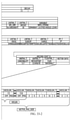
- FIG. 3 further illustrates examples of object associations that the object manager is configured to create based on relationships between the objects. As illustrated in FIG. 3 , these associations include a uni-directional implicit association, a uni-directional explicit association, a uni-directional explicit and implicit association, a bi-directional implicit association, a bi-directional explicit association, a bi-directional explicit and implicit association, and a NULL association. FIG. 3 illustrates each of these associations using both a graphical representations and object tables, as shown.
- the object manager is configured to instantiate objects having vector types (VECs).
- VECs vector types
- FIG. 4 illustrates examples of these vector types.
- vector types include a standard vector type, a centroid vector type, and a NULL vector type.
- FIG. 4 illustrates each of these vector types using both a graphical representations and object tables, as shown.
- FIG. 5 illustrates one example of an object network that may be created and managed by the object manager.
- the object network includes centroid objects CA, CB, and CD.
- CA is also a TERMINAL object and includes no associations with other objects.
- CB includes an explicit, bi-directional association with CD and CD includes an explicit, bi-directional association with CB.
- each of the objects A1, A2, and A3 is a standard vector object including an implicit, uni-directional association with CA.
- A3 further includes an implicit, uni-directional association with B3, a dual, bi-directional association with B2, and an explicit, uni-directional association with N1.
- N1 is a NULL vector object that includes explicit, uni-directional associations with N2 and N3.
- Both N2 and N3 are NULL vector, TERMINAL objects.
- Each of the objects B1, B2, B3, and B4 is a standard vector object that includes an implicit, uni-directional association with CB.
- each of the objects D1, D2, D3, D4, D5, and D6 is a standard vector object that includes an implicit, uni-directional association with CB.
- D6 also includes an explicit, uni-directional association with N4, a dual, uni-directional association with N5, and an implicit, uni-directional association with N6.
- N4 is a NULL vector, TERMINAL object.
- Both of N5 and N6 are standard vector, TERMINAL objects.
- the object manager is configured to maintain centroid objects that represent a group or cluster of other objects.
- a vector of a centroid object is a function of the vectors of the objects linked to the centroid object via uni-directional or bi-directional associations.
- the vector of a centroid may include the dimensions of the objects linked to the centroid (up to the truncation limit) sorted by average magnitude).
- the object manager may expose a cluster interface through which the object manager receives clustering messages from the other components. These clustering messages may include instructions to create a centroid, attach an object to a centroid, or detach an object from a centroid, among other clustering instructions.
- the object manager is configured to execute clustering instructions included within clustering messages received via the cluster interface. For example, in at least one embodiment, the object manager is configured to respond to a clustering message requesting creation of a centroid. This type of clustering message may include metadata descriptive of the centroid (e.g., group ID, name, etc.). In response to receiving this type of clustering message, the object manager instantiates a NULL vector centroid object to which objects may be attached. In addition, in these embodiments, the object manager is configured to automatically maintain the vector and cardinality counts of the centroid (inbound references to the centroid) as objects are attached or detached in real time in response to clustering messages.
- the object manager is configured to execute clustering instructions included within clustering messages received via the cluster interface. For example, in at least one embodiment, the object manager is configured to respond to a clustering message requesting creation of a centroid. This type of clustering message may include metadata descriptive of the centroid (e.g., group ID, name, etc.). In response to receiving this type of cluster
- FIGS. 6-8 illustrate a clustering process that the object manager is configured to execute in some embodiments.
- the clustering process attaches a new object with no links to a centroid within an existing object network, such as the object network illustrated in FIG. 6 , where associations are implicitly defined based on object contents (e.g., document text).
- the clustering process includes acts of submitting a query based on the new object, receiving results for the query, identifying the centroid, and attaching the new object to the centroid.
- the existing object network includes centroid C and objects A1, A2, and A3..
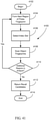
- FIG. 42 illustrates a flow diagram of a process for attaching an object to a centroid in line with the process shown in FIGS. 6-8 .
- the object manager begins the clustering process 4200 at 4202.
- act 4204 the object manager submits a query message to the query engine.
- the query message may include a threshold similarity metric and the vector of the new object (e.g., the object A4 illustrated in FIG. 7 ), or a portion thereof.
- the query engine executes a vector query based on the query message and returns a results message including query results that identify one or more objects (e.g., the object A2 illustrate in FIG. 8 ) that meet the threshold similarity metric.
- the object manager receives the results message.
- the object manager identifies a centroid (e.g., the object C illustrated in FIG. 8 ) linked directly or indirectly to an object identified in the query results as being similar (e.g. the most similar) to the new object.
- the object manager identifies the centroid by traversing the object network from the object identified as being similar (e.g., the object A2 ) until the centroid is reached.
- the object manager attaches new object to the identified centroid by updating the attributes of the new object and the information included in the various indexes.
- the object manager also updates the cardinality and vector of the centroid based on the existence and vector of the new object.
- the object manager ends the clustering process 4200 at 4212.
- executing a clustering process in accord with the clustering process 4200 may create large clusters with elements that have little content in common and where, consequently, the centroid is relatively distant from linked objects.
- components that interact with the object manager may be configured to monitor the allowed spread within a cluster (e.g., by tracking one or more spread metrics that indicate the amount of spread), and re-cluster a cluster into smaller clusters to limit the amount of spread where the spread metrics transgress (e.g., exceed) a spread threshold.
- the object manager is configured to process clustering messages that request explicit associations between objects.
- This type of clustering message may include information identifying the objects to be explicitly linked and the type of association to be established (e.g., a uni-directional association or a bi-directional association).
- the object manager adjusts the attributes of the identified objects and the indexes to implement the requested association.
- sets of clusters are created by associating centroids with other centroids.
- a cluster of web pages may be associated with another cluster of web pages thereby creating a super-cluster where sub-clusters are implicitly linked internally and explicitly linked to other sub-clusters.
- the object manager is configured to explicitly or implicitly associate a centroid in response to detect one or more conditions.
- the object manager is configured to associate a first centroid with a second centroid in response to detecting that more than a threshold number of objects linked to the first centroid have explicit associations with objects linked to the second centroid. It is appreciated that, in some embodiments, the object manager is configured to represent weaker relationships by simply associating individual objects linked to centroids, rather than associating the centroids themselves.
- FIG. 9 illustrates one example of a super-cluster in which centroid C A includes an explicit, bi-directional association with centroid C B and centroid C B includes an explicit, bi-directional association with C A .
- FIG. 10 illustrates another example of a super-cluster in which the sub-cluster with the centroid C A is loosely linked with the sub-cluster with the centroid C D via an explicit, uni-directional association to D2 included in A3.
- the query engine determines that the probe object is similar to any of the objects A1, A2, A3, or A4
- the query engine will also test for similarity between the probe object and each of objects B1, B2, and B3 because of the explicit bi-directional link between C A and C B .
- the query engine determines that the probe object is similar to A3
- the query engine will also test for similarity between the probe object and D1, D2, and D3.
- FIG. 11 illustrates another example of an object network produced by the object manager.
- each object within the object network is a NULL vector object that lists its cardinality within parenthesis.
- P1 has a cardinality of 0
- P12 has a cardinality of 1.
- the object manager internally maintains a manifestation for each outbound association of an object.
- object P3 has four internal manifestations (P31, P32, P33, and P34) each with optional meta-data serving as "anchor-text" for the outbound association, optional association strength based on a range of factors, and optional overall rank relative to other objects.
- components interacting with the object manager execute multi-hop association analysis by analyzing a target object's inbound associations, the objects linked to the target object via the inbound associations, the inbound associations of those objects, etc., with arbitrary depth determined by the component interacting with the object manager.
- the object manager is configured to traverse the object network both forwards and backwards using the object and reverse indices.
- a goal of an application may be to enhance relevancy ranking in a search engine. Modeling the link graph of indexed pages up-front in the object network modeler enables the application to enhance the search engine with link information.
- the application may consult the pre-loaded object network modeler in real-time to extract information about the page's position and importance in the network using arbitrarily complex forwards/backwards analysis, as well as any static page rank or anchor-text from inbound referrers to index alongside with the page's original text.
- the query engine is configured to execute fuzzy matching based on a vector space model.
- the object manager is configured to receive external vectors from the vectorizer and generate internal vectors based on these received external vectors. By generating internal vectors, the object manager realizes the several benefits including data processing efficiency, storage efficiency, and uniformity. For example, where the vectorizer is applied to free text it will output external vectors with dimensions (features) that are strings of arbitrary length. To achieve uniformity and efficiency the object manager encodes the vector as described further below.
- An external vector may contain any number of elements. Each element n , may include a feature n , which is data describing the object from which it was derived and may be of any size, and weight n , which is any real, positive number denoting the importance of feature n relative to other features.
- the object manager converts V ext to an internal form V int through feature hashing, weight normalization and length quantization.
- the object manager may store any number of elements in an internal vector, up to an implementation-specific truncation limit m.
- the object manager is configured to truncate, discard and does not include within V int any ( feature n , weight n ) where n > m.
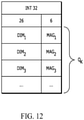
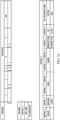
- the object manager stores V int internally as an array of 32-bit integers, each representing one element using 26 bits for dim n and 6 bits for mag n , as illustrated in FIG. 12 .
- the object manager is configured to quantize the internal array size Q k as a function of the number of (nonzero) elements in V int .
- the object manager is configured to allocate the array holding V int from the k-th vector allocator and sets trailing elements (i.e., elements with no corresponding feature in the external vector) set to zero.
- trailing elements i.e., elements with no corresponding feature in the external vector
- the set of vector allocators A is quantized to avoid the overhead of having a separate allocator for every possible vector size n ( V int ) ⁇ m, balanced with the need to minimize the number of wasted trailing zero-elements when n ( V int ) ⁇ Q k .
- the object manager selects the smallest allocator A k to generate an array with sufficient capacity to store an internal vector.
- the set of allocator sizes Q is a configurable parameter that is tunable at compile-time or run-time to accommodate one or more applications, such as the application 208 described above with reference to FIG. 2 .
- FIGS. 13 and 39 illustrate, in concert, a conversion process for creating V int from V ext , executed by the object manager according to some embodiments.
- FIG. 39 is a flow diagram illustrating a vector encoding process 3900 that includes acts of receiving an external vector, selecting a vector allocator, generating internal representations, normalizing weights, and quantizing lengths.
- the conversion process 3900 begins at 3902.
- the object manager receives an external vector for processing.
- the external vector may be transmitted from the vectorizer.
- the external vector may include a set of elements ⁇ feature 1 ,... feature n ⁇ where each element includes a feature and a weight.
- the object manager allocates an internal vector array to store V int .
- the object manager analyzes the external vector to determine its size and selects a vector allocator (illustrated as A k of FIG. 13 ) such that Q k ⁇ n (V ext ), Q k ⁇ m.
- the object manger allocates a new internal vector array using A k (see “Internal vector V int " in FIG. 13 ).
- the object manager creates an internal representation of each feature included in the external vector.
- hash() is fast and produces uniformly distributed integers of a predetermined size (e.g., 26 bits).
- the object manager normalizes the weights of the internal representations created in act 3908.
- V ext being pre-normalized to represent the maximum possible feature weight as a known quantity, such as 1.0.
- the object manager quantizes the length of V int .
- the feature vector V ext is not required to be stored within the object network modeler 202, but may be included as part of object meta-data.
- the internal vector V int is stored in the object that the vector describes as a pointer to the int32 array returned by allocator A k .
- Multiple manifestations O 1 , O 2 , O 3 , ... of the same object O may share the same vector instance by referencing the same array in memory.
- the object manager is configured to, upon a deletion of a manifestation, determine whether additional manifestations reference the array and, if not, de-allocate the array.
- the object manager may decrement the reference count during deletion of an object manifestation. Further, where the reference count equals zero, the object manager may de-allocate the array.
- aliasing may occur even within a limited feature vocabulary that is orders of magnitude less diverse than the vector space of the object model, due to a phenomenon commonly known as the birthday problem.
- dimension aliasing may lead to occasional false positives when comparing vectors, impacting overall precision.
- the performance advantages of compact internal vectors outweigh the disadvantages of sporadic false positives.
- some embodiments include an object manager configure to store V ext along the object as meta-data for filtering (anti-aliasing) as described further below.
- the angle ⁇ represents spatial alignment, as illustrate in FIG. 14 , and does not account for differences in length between A and B. This approach is referred to as Cosine similarity and may be applied to any number of dimensions.
- the Jaccard index for two sets A and B is defined as the intersection/union ratio and measures the overlap between vector dimensions; the more overlap the higher the similarity.
- the query engine is configured to combine the two into a composite measure helps counteract undesirable idiosyncratic behavior in one or the other.
- Some embodiments utilize direct dimension indices on the internal vector for the first M elements.
- the query engine guarantees recall for vectors sharing at least one dimension among the top M elements.
- configuring direct dimension indexing for all elements has a performance impact due to the O( n 2 ) nature of this approach. Embodiments address this issue using fingerprinting, which is described further below.
- the object network modeler is configured to address the curse of dimensionality for vector comparison using a dimensionality reduction technique referred to as fingerprinting based on locality sensitive hashing ( LSH ).
- LSH locality sensitive hashing
- the object network modeler uses an approach where several independent LSH fragments are joined together to form a single fingerprint, referred to herein as "F-LSH.”
- the object network modeler components such as the object manager and the query engine, are configured to execute matching processes using various combinations of the F- LSH fragments.
- each fingerprint as a whole is an efficient "storage unit"- or bit vector V fp W bits wide.
- the object manager generates fingerprints that fit into an even multiple of words on the target machine architecture and are therefore both compact and fast to manipulate with a minimal number of machine instructions.
- V int is a sparse vector in high-dimensional space
- V fp is a dense vector in W dimensions with sub-regions (fragments) that are combined by object network modeler components to form indexing keys. Equations 8 and 9 express respective sizes of V int and V fp .
- Object network modeler components are configured to compare fingerprints to determine differences between internal vectors represented by the fingerprints. Notably, while these embodiments use hamming distance between fingerprints for performance optimization, these embodiments do not use hamming distance directly as a similarity measure. The hamming distance of two binary numbers is the number of bit positions with opposite values.
- object network modeler components manifest an appreciation that at least one property of F-LSH fingerprints (as implemented by the object network modeler) that makes the fingerprints suitable for vector indexing is that moderate difference between internal vectors result in localized (clustered) modification of bits in their corresponding fingerprints. Small changes in vector Vint result in small and localized changes in fingerprint V fp . Stated another way, if the difference between V int and V' int is small (a few dimensions) then the difference between V fp and V' fp will be a few bits of opposite value occurring within one or more (but not all) fingerprint fragments.
- the index manager uses this property to create a set of permutation indices on V fp by shuffling and re-combining individual fragments of V fp into smaller sub-sets, referred to herein as significant regions, for use as direct lookup keys into a set of tables.
- P j denotes a fragment
- R i denotes a significant region
- T i denotes the permutation index (lookup table) using R i as key.
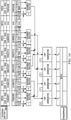
- the object manager is configured to generate one or more fragments of a fingerprint V fp of an internal vector V int by executing a fingerprint generation process 4000 illustrated by FIGS. 16-17 and 40 .
- the internal vector V int is shown at the top of FIG. 16 .
- the fingerprint generation process 4000 is configured to generate fingerprints having 4 fragments, although embodiments disclosed herein are not limited to a particular number of fragments.
- An example fingerprint is shown generally at the bottom of FIG. 16 .
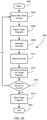
- the fingerprint generation process 4000 includes acts of selecting a next, unprocessed element of the internal vector, selecting a target fragment of the fingerprint being generated, generating a summary of dimension information within the selected element, weighting the summary, combining the summary with previous summaries, determining whether additional, unprocessed elements of the internal vector exist, and storing the combined summary as the target fragment.
- the fingerprint generation process 4000 begins in 4002.
- a next, unprocessed element of the internal vector is selected.
- a target fragment of the fingerprint being generated is selected.
- the object manager selects the target fragment by analyzing dimension information stored in the selected element.
- FIG. 16 illustrates the process for transforming V int to V fp using different parts of dim n as 1) a bit pattern for LSH generation and 2) fragment routing.
- the object manager may use the upper 8 bits of the dimension dim n to select a fragment P j of V fp to be affected by the lower bits b of dim n .
- the resulting bit pattern P j may be computed, in one example, using a cumulative hashing function that combines the individual bit patterns, weighted by mag n , from all Lower b ( dim n ).
- a summary of the selected element is generated.
- the object manager generates the summary by calculating a hash value of dimension information stored in the selected element. For example, the object manager may calculate a hash value for the lower b bits of dim n , where b equals the number of bits in the target fragment.
- the summary is weighted.
- the object manager weights the summary according to the magnitude stored in the selected element. For example, the object manager may calculate a weighting factor as a percentage of a maximum magnitude represent by the stored magnitude of the selected element.
- the weighted summary is combined with previous weighted summaries. The acts 4012 and 4014 are illustrated within FIG. 16 .
- act 4016 it is determined whether additional, unprocessed elements of the internal vector exist. If so, the fingerprint generation process returns to the act 4004. Otherwise, the fingerprint generation stores the combined weighted summaries as the target fragment (any of P1 - P4 in FIG. 16 ) in act 4018.
- the fingerprint generation process 4000 ends at 4020.
- FIG. 17 illustrates an example of acts 4004 through 4016.
- an LSH generator executed by the object manager determines a final bit pattern by bit-wise "voting" of the individual bit patterns from all contributing vector dimensions, where the weight of each individual "vote” is equal to the vector element's magnitude.
- three vector elements ⁇ (10010,20) ,(11001,15), (00011,10) ⁇ are combined to form the final pattern 10011.
- the third vector element were 111 11 instead of 00011 the final pattern would be 11011 instead of 10011 (i.e., a single bit difference in LSH value as a result of a different vector element).
- FIG. 18 summarizes the transformation from original object through the three phases of dimensionality reduction implemented within the object network modeler 202.
- the object manager implicitly associates objects as a function of the similarity of vectors associated with the objects.
- the decision to link two objects based on similarity can configured using a variety of configurable parameters including dynamic thresholds and a mix of rules.
- the rules may analyze characteristics of the potentially matching objects such as their attributes, their rank, cardinality, cluster size, cluster spread, using dynamic thresholds, etc.
- the object manager is configured to link objects where Inequality 11 is satisfied: " vectors A and B are similar if Sim A B ⁇ threshold "
- the techniques and systems described herein also allow for more complex decision schemes, taking into account other attributes of the matching objects, their rank, cardinality, cluster size, cluster spread, using dynamic thresholds, etc.
- FIG. 18 is a sequence diagram illustrating a data reduction process in line with the foregoing teachings. More specifically, FIG. 18 illustrates one exemplary method for transforming an object to various representations (e.g., one or more external vectors, one or more internal vectors, and a fingerprint comprising one or more fragments).
- various representations e.g., one or more external vectors, one or more internal vectors, and a fingerprint comprising one or more fragments.
- the database system and techniques described herein are designed, in part, to optimize the foregoing type of query, thus overcoming many of the above-noted constraints associated with conventional database systems. Specifically, the database system and techniques described herein are designed to achieve (1) maximum recall; (2) maximum precision; (3) minimum query latency; and (4) maximum query volume (throughput).
- true positives are expected results to a query that are included within the result of the query.
- False positives are query results that are not expected results.
- the systems and techniques described herein are designed such that a query returns something while keeping both recall and precision as high as possible.
- "expected" may be designed as follows: If Sim ( Q, V ) ⁇ then we expect V to be returned from a query for Q , otherwise not.
- the query engine is configured to execute a query process that is divided into four stages. These stages include an encoding phase, a recall phase, a precision phase, and an anti-aliasing phase.
- the encoding phase first converts a probe object (Q) to a feature vector Q ext an internal vector Q int and a fingerprint Q fp .
- the query engine's execution of the recall phase is designed to gather as many true positive candidates as possible, as quickly as possible, while minimizing false negatives and limiting false positives.
- the query engine's execution of the precision phase is designed to eliminate most false positives produced during the recall phase.
- the query engine's execution of the antialiasing phase is designed to eliminate any remaining false positives produced during the precision phase.
- the query engine is configured to maximize recall and precision by utilizing the vector encoding and fingerprinting processes described above with reference to FIGS. 12 , 13 , 16 , and 17 , applied as illustrated in FIG. 18 .
- FIG. 19 illustrates a query process that includes acts of an encoding phase 1, a recall phase 2, a precision phase 3, and an anti-aliasing phase 4. Each of these phases is described further below.
- the query engine prepares, from Probe object (refer to as "Q" in FIG. 19 ), a feature vector Q ext , an internal vector Q int and a fingerprint Q fp for use during matching and filtering.
- the query engine matches fingerprint Q fp against all stored ⁇ V fp ⁇ using permutation indices for high performance and reasonably good prevention of false negatives.
- the query engine applies a hamming distance threshold for higher performance and (likely) reduction of false positives.
- the query engine may also match internal vector Q int against all stored ⁇ V int ⁇ using as many direct dimension indices as can be tolerated (i.e., using the direct dimension indices created by the index manager) while still meeting performance requirements to minimize the number of false negatives.
- the query engine returns a merged and de-duplicated set of candidates from all indices.
- the query engine applies, for all candidates ⁇ V int ⁇ returned from recall phase, vector similarity criterion Sim (Q int ⁇ V int ⁇ ) ⁇ ⁇ to filter out most false positives. False positives may still slip through due to dimension aliasing caused by, for example, the 26-bit hashing function and "birthday problem" discussed earlier.
- the query engine retrieves object meta-data ⁇ V ext ⁇ and applies vector similarity criterion Sim (Q ext , ⁇ V ext ⁇ ) ⁇ ⁇ to filter out all false positive results returned from the precision phase.
- This phase may require V ext to be included as "blob" meta-data with all stored objects and may require higher storage demands, higher disk I/O, and higher query latency.
- FIG. 19 illustrates operation of a query engine at a high level.
- the object network modeler supports query engine multi-threading, allowing several queries to be processed in parallel using many CPU (or GPU) cores simultaneously. Some components support unlimited parallel execution (no shared resources), while others that require resource locking work on subparts of the query "conveyor belt'-style (pipelined approach.) In some embodiments, the latter applies to the permutation and dimension indices.
- Configurations with a higher number of indices benefit directly from multi-core machine architectures with high CPU count.
- Execution can also be scaled to multiple machines, each hosting a subset of the total set of permutation and dimension indices.
- a multi-machine setup benefits from allowing true simultaneous index lookup across many (or all) configured indices for the same query, at the expense of requiring an additional merge/dedupe step for candidates using a dispatcher component (not shown.)
- embodiments disclosed herein are configured to execute a recall phase during query execution.
- the query engine references a combination of permutation indices and dimension indices to achieve this purpose.
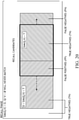
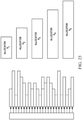
- FIG. 20 graphically illustrates the candidates produced in the recall phase.
- the nature of the query engine's recall mechanism is one of "casting a net," which means the recall candidate box in the figure is extended both to the right and left in an effort to minimize false negatives.
- the left extension into false positive territory is always much smaller than the set of true negatives, ensuring a manageable set of result candidates for the subsequent precision phase.
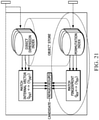
- the query engine is configured to implement quick and highly scalable object lookup by fingerprint during the query recall phase through the permutation indices, as illustrated in FIG. 21 .
- the object manager As described above within the Fingerprinting section, for a given configuration ( F,f R ), the object manager generates a fingerprint divided into F fragments that are shuffled and re-combined to build indexing keys of f R fragments each.
- N Comb ( F, f R ).
- the key made up of selected subset of fragments is referred to herein as significant region R i where i ⁇ ⁇ 1,2,3, ..., N ⁇ .
- the query engine is configured to gather candidate objects during the recall phase for permutation index T i as illustrated in FIGS. 22 and 23 .
- permutation index T i is a large, but a simple hash-like structure with row-level locking, enabling simultaneous reads and writes with minimal chance of contention. All permutation indices exist in memory (RAM) at run-time.
- a recall process 4200 includes acts of forming a next region of a probe fingerprint, selecting an index slot array corresponding to the formed region, scanning object fingerprints included in the index slot array, determining whether additional, unprocessed regions of the probe fingerprint exist, and returning recall candidates.
- the recall process 4200 begins at 4202.
- FIG. 22 refers to the probe fingerprint Q fp as and refers to the formed region as the combination of P 1 and P 4 .
- the query engine forms a significant region R i from a subset of bits of the probe object's fingerprint Q fp .
- the number of bits d in R i dictates the required length 2 d of permutation index T i .
- Each index line in T i is a structure containing a pointer to a variable-length index slot array, plus various book-keeping data and locks.
- Indexing key R i directly identifies an index line in T i .
- Each slot in the index slot array holds a pointer to an object and that object's fingerprint V fp All objects in the index slot array have fingerprints V fp with identical significant region R i .
- an index line is selected based on the index line identified by the region formed in act 4204. This act is illustrated in FIG. 22 .
- the query engine selects the identified index line.
- an index slot array identified by a pointer in the selected index line is scanned. This act is also illustrated in FIG. 22 .
- the query engine scans the index slot array identified by the pointer in the selected index line.
- the index slot array may be scanned slot by slot from beginning to end picking out slots whose fingerprint differs in at most h bit positions, i.e. hamming_distance (Q fp , V fp ) ⁇ h.
- the query engine adds each object with fingerprint V fp that is within the configured hamming distance h of Q fp to an array of recall candidates, thus forming the query result from the permutation index recall phase.
- the objects are added as pointers within the array of recall candidates. This act is also illustrated in FIG. 22 .
- act 4210 it is determined whether additional, unprocessed regions of the probe fingerprint remain. If so, the recall process 4200 returns to the act 4204. Otherwise, the recall process 4200 returns the array of recall candidate in act 4212. The recall process ends at 4214.
- objects themselves reside in the object store.
- the object network modeler when deployed across multiple machines there is one object store per machine. All indices T ' ⁇ T per machine share the same object store by referencing objects through pointers.
- the index manager maintains a copy of fingerprint V fp in each index slot (V fp also exists in the object) for computational efficiency.
- an index slot array is a contiguous piece of memory that may be fetched from main memory only once and may fit in L1 cache for the duration of the linear scan, thereby avoiding dereferencing every object pointer to access the object's fingerprint.
- scanning down an index slot array is very efficient, requiring just a few instructions in a tight loop accessing fast L1 memory and registers only.
- the query engine executes computation of hamming distance in two instructions only: bitwise XOR followed by intrinsic POPCNT, which is part of the x86 micro-architecture. Any time the query engine finds an index slot to have V fp within hamming distance h of Q fp the slot's object pointer is appended to the recall phase query result.
- the index manager executes specialized allocators that have been implemented to support constant, dynamic expansion and reduction of index slot arrays with maximum efficiency and minimum amount of memory fragmentation.
- permutation index T i is structured in accord with the simplified illustration in FIG. 23 , with index slot arrays of varying size residing off of the main table.
- the index manager exchanges an existing index slot array for a larger or smaller array by checking out a new array from the larger or smaller allocator, copying fingerprints and object pointers from the existing array to the new one, defragmenting as necessary, and then providing the old array back to its allocator for recycling.
- the query engine is configured to implement quick and highly scalable object lookup by direct dimension index during the query recall phase through the dimension indices, as illustrated in FIG. 24 .
- the direct dimension index is implemented using the same index structure as the permutation index. However, rather than processing several vector dimensions and rolling them into a fingerprint fragment as done for the permutation index, the dimension index uses individual vector dimension dim n as an indexing and lookup key.
- the query engine identifies V int using dimension dim n .
- a given object network modeler configuration may include zero or more dimension indices depending on performance needs and level of guaranteed recall required.
- the query engine compares the M first dimensions of Q int against the M first dimensions of V int meaning all, dim n' ⁇ Q int ' n ⁇ ⁇ 1 ... M ⁇ are matched against dim n' ⁇ V int ' n ⁇ ⁇ 1 ... M ⁇ requiring M 2 lookup operations. Because query execution time for direct dimension indices grows quadratically with M it is beneficial to keep M as low as possible.
- the index manager may set M as high as needed, up to the maximum number of vector dimensions in use for V int for 100% recall. In some embodiments, it is therefore possible to extend the recall candidate box illustrated in FIG. 20 all the way to the right, eliminating all false negatives, albeit at a performance cost.
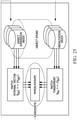
- the query engine is configured to merge recall candidates indentified via the permutation and direct dimension indices, as illustrated in FIG. 25 .
- All permutation indices T i ⁇ T and dimension indices D i ⁇ D provide independent indexing and lookup of all objects in the object store. As such, an object A will be indexed by different "views" (significant regions) of V fp into T and by different dimensions of V int into D. Since the query engine repeats a query Q for all T and D it is entirely possible for object A to be found in several (or all) indices. Therefore, the recall phase is not complete until the query engine merges and de-duplicates the individual sets of candidates from all indices, such that any candidate object occurs exactly once in the final set of candidates.
- the query engine is configured to traverse and place all result candidates from all indices into a de-duplication hash.
- Several statically allocated de-duplication hashes are available to allow multi-threaded execution, and hashes exist in different sizes to accommodate any result set in the most computationally efficient manner. These embodiments keep most activity in the innermost CPU caches for the current thread while minimizing cache-invalidation for other threads. Further, in these embodiments, the query engine returns a merged and de-duplicated set of candidates as the final result of the query recall phase.
- embodiments disclosed herein are configured to execute a precision phase during query execution.
- the query engine executes the precision phase.
- the precision phase filters out all false positives, except those masked by dimension aliasing in V int .
- the query engine identifies and removes false positives by calculating Equation 11 for the probe object and each object that remains in the set of recall candidates.
- the precision phase is illustrated in FIG. 26 .
- embodiments disclosed herein are configured to execute an anti-aliasing phase during query execution.
- the query engine executes the anti-aliasing phase.
- Sim (Q int , V int ⁇ ) ⁇ does not imply Sim (Q ext , V ext ) ⁇ ⁇ .
- the query engine may be configured to apply the anti-aliasing phase before returning the final query result to an application that requires absolute precision.
- Anti-aliasing is performed by applying the filter Sim (Q ext , V ext ) ⁇ ⁇ to the result produced in the precision phase, as illustrated in FIG. 27 .
- the query engine requires that V ext be included as object meta-data to enable anti-aliasing.
- V denote the full set of indexed vectors
- C denote the set of candidates produced in the recall phase using permutation indices and dimension indices.
- ⁇ depends on the nature of indexed vectors V and typically varies from query to query.
- Q int' V ) denote the probability of false negatives given query Q int against a particular set of vectors V. Then ⁇ ⁇ ⁇ guarantees zero false negatives and ⁇ ⁇ ⁇ - ⁇ guarantees one or more false negatives. In the space between ⁇ and ⁇ - ⁇ it is possible, but not certain, for a query to suffer from false negatives.
- Q int , V ⁇ 0 , ⁇ ⁇ ⁇ ⁇ ⁇ , ⁇ > ⁇ > ⁇ ⁇ ⁇ 1 , ⁇ ⁇ ⁇ ⁇ ⁇ ⁇
- R i contain enough bits for efficient lookup (i.e. the length of the average index slot array requiring linear scan is minimized)
- V fp we reduce y, i.e., we can specify a smaller similarity threshold without running a risk of false negatives.
- ⁇ and ⁇ ( r ) are improved indirectly, they are not the primary target when expanding the permutation index.
- permutation index T can grow very large due to Comb ( F, f R ) requiring more parallel computation and memory resources to achieve lower ⁇ with high query performance.
- the same recall characteristics may also be achievable though dimension index D alone at a lower resource (hardware) cost, but with inferior query performance.
- This configuration obviously has superior recall characteristics ( ⁇ ⁇ 0), but is also extremely inefficient unless the number of configured dimensions forV int is small. (For systems with small V int , indexing exclusively via D may indeed be the optimal solution.)
- R a V ext ⁇ R a
- Extracting V ext from aliased result R a involves a secondary lookup mechanism using the meta-store. Extracting V ext from R a , is resource intensive because V ext must be retrieved from disk, whereas V int , is readily available since V resides in memory. As such, retrieving V ext is likely to be much more expensive than the actual application of filter Sim ( Q ext, V ext ) ⁇ ⁇ .
- the object network modeler described herein makes aggressive use of memory for object association and similarity matching. To achieve high performance, all indexes may exist entirely in memory as hybrid hash/linear lookup tables, with on-demand disk flushing to speed up initialization upon future system startup. All components of the object network modeler are created with the assumption, in one example, of a 64-bit target platform and enterprise-grade server capacities. (The required amount of memory is also quickly becoming available in consumer-grade hardware.).
- the object store 214 stores information descriptive of objects within an object network. Examples of this information include object attributes, vectors, and meta-data.
- the object store 214 resides in memory using disk mirroring for durability. In other embodiments, the object store 214 resides in both volatile and non-volatile memory, and thus is not limited to a particular type of memory.
- the meta-store component may reside on disk only.
- the object network modeler 202 is configured to synchronize the in-memory object store 214 and its disk-based shadow copy using data write-through techniques. In these embodiments, the object store 214 is optimized for performance using commit logs and streamed disk caching of operation batches.
- a minimal deployment of the object network modeler includes the object store 214, the object index and the reverse index. Each of these components is described in detail below.
- FIG. 29 illustrates the data components utilized by an object network modeler, such as the object network modeler 202 described above with reference to FIG. 2 , according to some embodiments.
- the data components in FIG. 29 include an object index, a reverse index, one or more permutation indices, one or more dimension indices, an object store, a plurality of index slot array allocators, and a plurality of vector allocators.
- the object store includes one or more objects and a meta-store.
- the one or more objects each include one or more vectors. Each of the one or more vectors includes one or more features.
- the object index, the reverse index, the one or more permutation indices, and the one or more dimension indices correspond to the index store 216 described above with reference to FIG. 2 .
- the object network modeler is configured to make aggressive use of memory for object association and similarity matching. For example, in these embodiments, the object network modeler achieves high performance by allocating all indices in memory as hybrid hash/linear lookup tables, with on-demand disk flushing to speed up initialization upon startup. In some embodiments, all components of object network modeler are configured for a 64-bit target platform and enterprise-grade server capacities, although the embodiments are not limited to a particular target platform or server.
- both the object index 200 and the reverse index 202 are memory-based.
- a deployment of the object network modeler need not be configured for similarity matching, in which case the implicit object association feature is unavailable. However, most deployment scenarios will include some form of similarity matching using the one or more permutation indices 204 or the one or more direct dimension indices 206.
- the object network modeler and more particularly an index manager, such as the index manager 212 described above with reference to FIG. 2
- an index store such as the index store 216 described above with reference to FIG. 2
- each index in the index store uses similar indexing and lookup mechanisms.
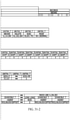
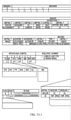
- the linerail structure forms the base each index in the index store. Table 2 list attributes of the linerail structure according to some embodiments: TABLE 2 Type Name Description Int id Table identifier 0,1,2,... used for sets of tables (perm.
- simindex_mode_t mode Mode enumeration permutation (1), dimension (2), object (4), reverse (8) perm_t perm Permutation descriptor. Defines lookup key and table length.
- CS_LOCK vlock State variable mutex Brief whole-table lock for acquiring indexline lock.
- CS LOCK wbusy Exclusive write mutex for singleton semaphore per indexline
- indexline_t [64] size_hist Histogram for slot count in each indexline (log 2 buckets)
- the linerail structure provides table identification, table mode, bookkeeping, and locking support.
- the perm attribute defines how the object network modeler forms a table lookup key from a lookup handle, which depends on the table mode.
- the permutation descriptor which is defined in Table 3 below, specifies how object network modeler components that interact with the indices, such as the index manager or the query engine identify bits within a handle and reassemble the bits into an index key mapping to one of the index records.
- the object network modeler components rearrange fragments of V fp into an index key.
- the lookup table base which is defined in Table 4 below, is an array of indexline structures of length nrows.
- the object network modeler components select the indexline to operate on that is indicated by the index key.
- the index manager maintains book-keeping attributes concerning the entire set of indexlines in the linerail structure and maintains the attributes held in the indexline structure, which govern the usage of an individual indexslot array. So, in these embodiments, the linerail's nobj attribute is thus the sum of the nobj attributes in all indexlines, and the linerail's nslots attribute the sum of the sz attributes in all indexlines.
- the object network modeler components e.g. threads executing aspects of the object network modeler, such as the index manager or the query engine
- the object network modeler components are configured to implement table locking to allow maximum parallelism in a multi-core execution environment.
- multiple threads are allowed to access the same linerail simultaneously.
- the mutex and condition instances are shared for the entire linerail, while individual indexlines hold information about the particular activity currently in progress for that indexline.
- indexlines can either be read from or written to, but not both.
- multiple threads can read the same indexline simultaneously, while only a single thread can write to an indexline.
- the object network modeler components are configured to allow read operations on indexslot array arr to proceed as long as no other thread is writing to arr or waiting to write to arr. If necessary, the object network modeler components delay a read operation until a concurrent write operation completes by first performing a fast check of wreq, and if wreq is non-zero, block on the now-locked wbusy lock. Normally wreq is zero and no blocking on wbusy is needed. Atomic access to all state variables, including the secondary wbusy lock, is ensured via vlock. When a read operation is allowed to proceed, the indexline's rcnt is incremented by one. Multiple readers are allowed, up to a maximum of 65535.
- the object network modeler components are configured to, upon completion of a read operation, decrement the indexline's rcnt by one. If rcnt reaches zero the object network modeler component detecting this condition is configured to broadcast the rzero event to other object network modeler components (e.g., another thread waiting to write), thereby notifying the waiting component that it may proceed with its operation. Atomic access to indexline's rcnt is ensured via linerail's vlock.
- the object network modeler components (such as a thread executing the index manager) are configured to allow write operations on indexslot array arr to proceed as long as no other thread is writing to arr or waiting to write to arr. If necessary, the object network modeler components delay a write operation until another concurrent write operation completes.
- the indexline's wreq is incremented by one and the linerail's wbusycnt is also incremented by one.
- wreq and wbusycnt are both singleton semaphores, and therefore, there can be only one simultaneous write operation per indexline and per linerail.
- the wbusy lock is acquired and the indexline's rent verified to be zero. Atomic access to all state variables is ensured via linerail's vlock. If at this point rent is non-zero, the writing object network modeler component (e.g., thread) is put to sleep until the last of the current readers have completed. No new read operations are allowed to proceed because the writing object network modeler component holds wbusy lock. The last thread to complete its read sets rcnt to zero and the detecting object network modeler component broadcasts the rzero event to the sleeping write object network modeler component, which then wake ups and proceeds with the write operation.
- the writing object network modeler component e.g., thread
- the writing object network modeler components Upon completion of a write operation the writing object network modeler components decrement indexline's wreq and linerail's wbusycnt and release indexline's wbusy lock. Atomic access is ensured with linerail's vlock. At this point, the object network modeler components have released its exclusive access and all other operations in other object network modeler components may proceed.
- the arr indexslot array is guaranteed to remain consistent until released by the object network modeler component.
- the object network modeler component performs lookup by scanning arr linearly starting at rdx and ending just before wdx.
- the object network modeler components are configured to execute a read operation as described below, depending on linerail's mode.
- the object network modeler component interprets the indexslot as a hamslot structure, which is described in Table 5 below.
- the object network modeler component visits all slots in the hamslot array arr sequentially starting at rdx and ending just before wdx. If the slot's object pointer is NULL, indicating the slot has been deleted, the object network modeler component skips the slot. Otherwise the object network modeler component compares the slot's fingerprint to the probe fingerprint. If the probe fingerprint's hamming distance to the slot's fingerprint is within the configured threshold, object network modeler component appends the slot's object pointer to a result array of recall candidates. TABLE 5 Type Name Description FP_t fp 64-bit fingerprint for approximate match (within hamming distance) object_t* object Pointer to object in the objectstore
- the object network modeler component interprets the indexslot as a dimslot structure, which is described in Table 6 below. During performance of the read operation, the object network modeler component visits all slots in the dimslot array arr sequentially starting at rdx and ending just before wdx. If the slot's object pointer is NULL, indicating the slot has been deleted, the object network modeler component skips the slot. Otherwise the object network modeler component compares the slot's dimension handle to the probe dimension handle. If the two conform to a predefined relationship (e.g. they are equal), object network modeler component appends the slot's object pointer to a result array of recall candidates. TABLE 6 Type Name Description uint64_t key Vector dimension n for the n th dimension index. (only 26 LSB used.) object t* object Pointer to object in the objectstore
- the object network modeler component interprets the indexslot as an objslot structure, which is described in Table 7 below. During performance of the read operation, the object network modeler component visits all slots in the objslot array arr sequentially starting at rdx and ending just before wdx. If the slot's object pointer is NULL, indicating the slot has been deleted, the object network modeler component skips the slot. Otherwise, the object network modeler component executes one of the following processes:
- the object network modeler component interprets the indexslot as an objslot structure, which is described in Table 8 below. During performance of the read operation, the object network modeler component visits all slots in the obj slot array arr sequentially starting at rdx and ending just before wdx. If the slot's object pointer is NULL, indicating the slot has been deleted, the object network modeler component skips the slot. Otherwise, the object network modeler component compares the obj slot's sub-object ID handle obid_H to the probe SUBID' s upper 64 bits. If object network modeler component determines that the two conform to a predetermined relationship (e.g.
- the arr indexslot array is guaranteed not to be read by other threads, allowing a write operation to complete without the risk of inconsistent lookups to occur.
- the object network modeler component executes a write operation of an object into the index by storing an object pointer and an object ID handle of the object in the indexslot at wdx.
- the object ID handle depends on the table mode, as described above for indexline lookup operations.
- the object network modeler component if wdx references a slot beyond the end of indexslot array, the object network modeler component allocates a larger array using one of the index slot array allocators (see FIG. 29 ). Next, according to these embodiments, the object network modeler component copies the old array into the new array while also performing defragmentation as necessary. The object network modeler component then de-allocates the old array. In some embodiments, the object network modeler component also maintains and updates book-keeping attributes in the indexline and the linerail as necessary.
- the arr indexslot array is guaranteed not to be read by other threads, allowing a delete operation to complete without the risk of inconsistent lookups to occur.
- the object network modeler component executes a delete operation of an object from the index by scanning the indexslot array starting at rdx until the object pointer of the object to be deleted matches one in the indexslot array. Further, in these embodiments, if the object to be deleted is found, the object network modeler component sets the indexslot's object ID handle to zero and the object pointer to NULL.
- the delete operation is complete once a matching object has been found and deleted. Sequential scan stops when wdx is reached, meaning the referenced object is not indexed and no action is performed.
- the object network modeler component also maintains and updates book-keeping attributes in the indexline and the linerail as necessary.
- the object network modeler component if the number of active objects in the indexslot array falls below a threshold, the object network modeler component allocates a smaller array using one of the index slot array allocators. Next, according to these embodiments, the object network modeler component copies the old array into the new array while also performing defragmentation as necessary. The object network modeler component then de-allocates the old array.
- the object network modeler is configured to operate using various indices entirely in memory. To allow for quick system re-start after a shutdown all indices may be written to files on disk.
- the file format is shown in FIG. 31 . As illustrated, an index file has two main parts: an index header and one or more index records.
- the index header is divided into three parts: index parameters, index key permutation masks and shifts, and indexslot array allocator descriptor.
- the index parameters mirror many of the linerail parameters, omitting run-time only attributes such as locks, semaphores and pointers, and adding consistency markers such as API version (api_ver) and operation counter (opcnt.)
- the index key permutation masks and shifts 404 mirror those of the linerail's perm attribute.
- the array allocator descriptor holds information about run-time memory requirements for this linerail. This information enables the object network modeler to pre-allocate the exact amount of memory needed on startup to optimize performance and minimize fragmentation.
- the index records are a direct reflection of the indexslot array in each indexline for the linerail.
- only active objects are stored, with an object counter for each indicating the number of active objects per indexline.
- an object is represented by two numbers in the idxrecbuf structure: object store's block number where the object exists and block offset to the slot in the block containing the object.
- the object reference is valid only if the index header's opcnt matches the object store's opcnt. If upon startup these do not match, the object network modeler is rejects the index file and rebuilds the index file from the object store, which results in a slower startup.
- FIG. 32 illustrates data components included within an object store, such as the object store 214 described above with reference to FIG. 2 .
- the object store is arranged as a root structure objectstore _ t , which is described below in Table 9, that references a set of object blocks objblock_ t , which is described below in Table 10.
- the object store has a fixed maximum object capacity and one-to-one relationship with a partition file on disk.
- the object store can include to 65,536 object blocks, each with a fixed capacity of 262,144 objects for a total theoretical capacity of about 17 billion objects.
- other embodiments may have differing capacities and embodiments are not limited to a particular fixed or variable capacity.
- an object manager such as the object manager 210 described above with reference to FIG. 2 , is configured to dynamically grow and shrink the object store in increments of one objblock as appropriate.
- an objblock has a fixed, pre-allocated set of object slots that become activated as object data is ingested into the object network modeler 202. When the current block being written to is full, the next block may become the write block and may be created if not already pre-allocated.
- the object manager implements an object permission system to allow an object network modeler, such as the object network modeler 202 described above with reference to FIG. 2 , to maintain segmented data sets.
- an object network modeler such as the object network modeler 202 described above with reference to FIG. 2 .
- the indexing and lookup process described below within the Indices section automatically filters objects by a segment attribute based on the current indexing/lookup collection context.
- the objects array in objblock is a large set of pre-allocated objects of type object_t, which is described below in Table 11. These objects are the Simarray objects discussed throughout the present disclosure.
- objects inserted into the object store are written to the memory-based objblock and to a block data file on disk.
- the block data file format is shown in FIG. 33 .
- the block data file format includes a header followed by one or more records storing object data.
- the object manager writes new objects to disk as they are created in memory.
- the object manager either secures modified objects to disk immediately (the default), or defers securing for batch-updates to disk in response to receiving an explicit commit command.
- the object manager streams the modified objects into a continuously rotating change log. In this way, the object manager ensures sequential disk writes most of the time (for improved performance) with occasional batch updates of the object block data parts on disk.
- objects can optionally contain arbitrary "BLOB" meta-data, i.e. any binary data up to 2GB.
- meta-data is not stored in memory. Rather, in these embodiments, the meta-data is stored in a meta-data file associated with the object block file. Therefore, in these embodiments, a block data partition therefore has two files: the objblock data file and the meta-data file.
- a component of the object network modeler such as a query engine (e.g., the query engine 218 described above with reference to FIG. 2 ) or the object manager, stores and accesses meta-data corresponding to an object using the metaoffset attribute of the object.
- a query engine e.g., the query engine 218 described above with reference to FIG. 2
- the object manager stores and accesses meta-data corresponding to an object using the metaoffset attribute of the object.
- metaoffset when metaoffset is zero, no meta-data exists for the object.
- metadata when metadata is non-zero, the metaoffset attribute interpreted by the object network modeler component as an offset into the meta-data file where the meta-data record for the object is located.
- a meta-data record includes a fixed set of standard meta-attributes identifying the object (if needed for recovery), followed by a variable byte array holding the actual meta-data.
- FIG. 34 illustrates the format of a meta-data file according to one embodiment.
- meta-data file when meta-data is accessed by a lookup operation, such as by the query engine, the meta-data file will first be opened (if not already open) and the file pointer positioned at metaoffset bytes from the start. Data is then read from file and returned.
- the performance overhead of using meta-data depends on disk I/O sub-system speed.
- some embodiments of the object network modeler implement custom memory allocators for V int vector data used on objects and indexslot arrays used in linerails.
- High level diagrams for vector allocators (such as the one or more vector allocators described above with reference to FIG. 29 ) and index allocators (such as the one or more index allocators described above with reference to FIG. 29 ) are shown in FIGS. 35 and 36 , respectively.
- the allocators are configured to pre-allocating blocks of memory suitable for vectors and for indexslot arrays. In these embodiments, only a selected set of sizes are supported for each allocator type. However, embodiments are not limited to the particular sizes expressly recited herein.
- the object manager when representing internal vectors V int the object manager will quantize the vector size to fit in the smallest possible vector array using the minimal allocator A k as described in the Vector Encoding section herein.
- the object manager would use the 6th allocator to allocate V int with capacity 32, leaving 5 unused elements at the end.
- the amount of average wasted space has been balanced with the benefits of having a small set of fixed sized allocators to optimize performance and minimize fragmentation with the associated memory management overhead.
- the index manager is configured to allocate indexslot arrays used for indexing objects as part of the linerail structures from a set of indexslot allocators. Indexslot arrays grow and shrink dynamically with normal operation of the object network modeler. If a generic allocator (e.g. malloc / free ) were used by the index manager, the effects of memory fragmentation would be detrimental to efficient operation. Instead, the index manager uses custom application-specific allocators. In this way, the index manager creates and maintains large memory blocks that are fine tuned for a specific purpose.
- a generic allocator e.g. malloc / free
- indexslot allocators supporting indexslot arrays of the following sizes: 2, 12, 48, 104, 171, 245, 324, 408, 494, 584, 676, 770, 865, 963, 1062, 1163, 1265, 1368, 1472, 1577, 1683, 1790, 1898, 2007, 2117, 2228, 2339, 2451, 2563, 2676, 2790, 2905, 3020, 3135, 3252, 3368, 3485, 3603, 3721, 3840, 3959, 4078, 4198, 4319, 4440, 4561, 4682, 4804.
- the index manager uses the next-higher allocator to replace the old array with a new array. For example, if the current array was allocated using the "12" allocator and the 13 th element must be written, then the index manager will utilize the "48" allocator to provide a new indexslot array to replace to old one referenced from the indexline structure. The index manager copies the old array's data into the new array, and defragments the data if necessary. The index manager then de-allocates the old array by making it available to the "12" allocator for future use. Note that no malloc or free is used in this process.
- the index manager removes objects from an index the old array will be replaced with a smaller one whenever possible.
- the allocators themselves will expand and shrink as necessary in large block at rare intervals. This may require infrequent calls to malloc and free, but in very large chunks. Memory fragmentation is thus minimized.
- Allocators that have not yet been utilized by to provide an indexslot array or vector take up no space, aside from a very small number of meta-attributes used for book-keeping. For example, if no indexslot arrays in any linerails are larger than 48 slots, all the allocators above 48 will be empty and not take up any pre-allocated space.
- the indexslot array may grow larger than the largest allocator ("4804). This can happen in situations where the hash values of input data are not evenly distributed. Dimension indexing is prone to this behavior if some vector dimensions occur at a disproportional frequency compared with others.
- a vectorizer such as the vectorizer 204 described above with reference to FIG. 2 , with aggressive IDF normalization may be desirable in such cases.
- some embodiments of the object network modeler allow indexslot arrays of any size.
- the index manager uses malloc and free to allocate memory for indexslot arrays that are too large for a standard index allocator.
- lookup performance may be impacted when oversized arrays are used.
- the index manager record and provide indexslot allocator profile statistics to guide optimization in these situations.
- the object network modeler is configured to represent large external objects (e.g. documents) as a set of features is an efficient way to normalize information through dimensionality reduction.
- large external objects e.g. documents
- the object network modeler may be used to model text documents as objects.
- representing a complete book as a feature vector may be difficult for the vectorizer.
- the object network modeler may represent objects from various "points of view" using multiple vectors. In this way, object network modeler is able to associate objects based on partial matching between selected aspects of objects.
- FIG. 37 shows four vectors representing a document.
- the vectors can be combined into a centroid for matching other objects, or used individually.
- the object network modeler allows the application to use any combination of vector matching criteria to form networks.
- Objects may be represented as multiple vectors where each vector is based on different types of information. Some other examples include:
- GPU Graphics Processing Unit
- GPUs are well suited for performing an operation on many pieces of data simultaneously. This is accomplished by packing many "slimmed down" cores into the GPU, each of which can perform independent operations simultaneously. Furthermore, each of these cores contains multiple ALUs (arithmetic logic units), allowing a core to apply an operation to multiple pieces of data in a single clock cycle. This functionality is called SIMD (single instruction multiple data) processing.
- SIMD single instruction multiple data
- the fetch/decode block handles dispersing an identical operation to all ALUs.
- Each ALU refers to its local context block to get the data that the operation should be performed on.
- the results are then written to an output buffer, which may not necessarily be located in the local context block (it could be located in the shared context data block).
- a GPU contains multiple cores and the process described above may be performed on each of them.
- the number of concurrent operations that a GPU can perform is generally defined by multiplying core count and ALU per core count.
- the object network modeler may be implemented using one or more general purpose GPUs.
- the following operations may be enhanced vector encoding, fingerprint generation, fingerprint comparison, and Cosine similarity computation.
- embodiments executing on a GPU may implement a wider fingerprint, allowing for more resolution per dimension.
- feature hashing and weight normalization operations can be offloaded to the GPU in batches, taking advantage of the fact that each hash is an independent operation.
- thousands of hashes can be computed simultaneously using the GPU, which should result in a considerable speed improvement when indexing large data sets.
- fingerprint generation thousands of fingerprint fragment generation operations can be performed simultaneously using a GPU.
- data indexing throughput should improve considerably.
- fingerprint comparison instead of performing linear table scans, hamming distance computations can be performed in batches on a GPU.
- Cosine similarity computation dot products can be computed in batches on a GPU.
- fingerprints are 64 bits wide so they can be processed efficiently by x86-64 CPUs.
- the system may be able to process wider fingerprints. Since GPUs are very good at processing data in parallel, a wider fingerprint (say 128 bits) can be broken up into smaller pieces (32/64 bits, depending on the GPU architecture) that can be processed as part of a batch job. In this way, a wider fingerprint can be processed in the same time it would take to process a 64-bit fingerprint.
- a wider fingerprint allows for more fragments, which in turn translates to increased robustness towards changes in input vector V int .
Landscapes
- Engineering & Computer Science (AREA)
- Theoretical Computer Science (AREA)
- Physics & Mathematics (AREA)
- General Physics & Mathematics (AREA)
- Data Mining & Analysis (AREA)
- Databases & Information Systems (AREA)
- General Engineering & Computer Science (AREA)
- Computational Linguistics (AREA)
- Mathematical Physics (AREA)
- Mathematical Analysis (AREA)
- Computing Systems (AREA)
- Mathematical Optimization (AREA)
- Computational Mathematics (AREA)
- Pure & Applied Mathematics (AREA)
- Software Systems (AREA)
- Algebra (AREA)
- Artificial Intelligence (AREA)
- Evolutionary Computation (AREA)
- Information Retrieval, Db Structures And Fs Structures Therefor (AREA)
- Collating Specific Patterns (AREA)
- Image Analysis (AREA)
Claims (6)
- Rechensystem (102) zum Identifizieren von Objekten innerhalb eines Objektnetzwerks, die einer Abfrage ausreichend ähnlich sind, die von einer Anwendung (208) empfangen wird, wobei das Rechensystem (102) Folgendes umfasst:einen Speicher (112), der ausführbare Anweisungen umfasst; undeinen Prozessor (110), der mit dem Speicher wirkverbunden ist, wobei der Prozessor eine Architektur aufweist, die ein Wort verwendet, wobei der Prozessor konfiguriert ist, um die ausführbaren Anweisungen auszuführen, um ein Verfahren herbeizuführen, das Folgendes umfasst:Erhalten eines Probe-Objekts (Q), das die Abfrage darstellt;Erzeugen eines externen Vektors (Qext), der das Probe-Objekt (Q) darstellt, durch einen Vektorisierer (204);Umwandeln des externen Vektors (Qext), der das Probe-Objekt (Q) darstellt, in einen internen Vektor (Qint), der das Probe-Objekt (Q) darstellt, durch Merkmal-Hashing, Gewichtungsnormalisierung und Längenquantisierung;Erzeugen eines Fingerabdrucks (Qfp), der das Probe-Objekt darstellt, basierend auf dem internen Vektor (Qint), der das Probe-Objekt (Q) darstellt, wobei jeder interne Vektor (Qint), der das Probe-Objekt (Q) darstellt, mehrere Dimensionen umfasst, und wobei jede Dimension der mehreren Dimensionen mit einer jeweiligen Größe verknüpft ist, und wobei die Erzeugung Folgendes beinhaltet:für den internen Vektor (Qint), der das Probe-Objekt darstellt, Erzeugen mehrerer Fingerabdruckfragmente (Pj), die den internen Vektor (Qint) darstellen, wobei jedes Fingerabdruckfragment (Pj) der mehreren Fingerabdruckfragmente (Pj) basierend auf einer Kombination von Zusammenfassungen mehrerer Dimensionen des internen Vektors (Qint) und jeweiligen Größen erzeugt wird, die mit jeder der mehreren Dimensionen des internen Vektors (Qint) verknüpft sind; undAggregieren der mehreren erzeugten Fingerabdruckfragmente (Pj), um den Fingerabdruck (Qfp) zu erzeugen, der das Probe-Objekt darstellt, wobei der erzeugte Fingerabdruck (Qfp) eine reduzierte Dimensionalität relativ zu dem internen Vektor (Qint) aufweist, der das Probe-Objekt darstellt, wobei der Fingerabdruck erzeugt wird, um in ein gerades Vielfaches von Wörtern auf der Architektur des Prozessors zu passen;Durchführen des folgenden Vergleichs, um einen ersten Satz von Kandidatenobjekten zu identifizieren:
Vergleichen des Fingerabdrucks (Qfp), der das Probe-Objekt (Q) darstellt, mit mehreren Fingerabdrücken (Vfp), die mehrere Objekte innerhalb des Objektnetzwerks darstellen, wobei das Vergleichen des Fingerabdrucks (Qfp), der das Probe-Objekt darstellt, mit den mehreren Fingerabdrücken (VfP), die die mehreren Objekte innerhalb des Objektnetzwerks darstellen, Folgendes umfasst: Berechnen jeweiliger Hamming-Abstände zwischen dem Fingerabdruck (Qfp), der das Probe-Objekt darstellt, und jedem der Fingerabdrücke (Vfp), die die mehreren Objekte innerhalb des Objektnetzwerks darstellen; und Identifizieren, als den ersten Satz von Kandidatenobjekten, derjenigen Objekte der mehreren Objekte, deren Fingerabdrücke (Vfp) innerhalb eines vordefinierten Hamming-Abstands von dem Fingerabdruck (Qfp) sind, der das Probe-Objekt darstellt;Berechnen von ersten jeweiligen Ähnlichkeitsmetriken zwischen dem Probe-Objekt (Q) und jedem der Objekte in dem ersten Satz von Kandidatenobjekten durch Vergleichen des internen Vektors (Qint), der das Probe-Objekt (Q) darstellt, mit einem entsprechenden internen Vektor (Vint), der jedes Objekt in dem ersten Satz von Kandidatenobjekten darstellt, wobei die erste Ähnlichkeitsmetrik die Kosinus-Ähnlichkeit zwischen oder den Jaccard-Index von oder eine Kombination der Kosinus-Ähnlichkeit und des Jaccard-Index von dem internen Vektor (Qint), der das Probe-Objekt (Q) darstellt, und dem entsprechenden internen Vektor (Vint) umfasst, der das Objekt in dem ersten Satz von Kandidatenobjekten darstellt; undErzeugen eines zweiten Satzes von Kandidatenobjekten basierend auf dem ersten Satz von Kandidatenobjekten, wobei der zweite Satz von Kandidatenobjekten nur diejenigen Objekte beinhaltet, deren erste Ähnlichkeitsmetriken einen ersten vordefinierten Schwellenwert überschreiten und wobei dadurch deren interne Vektoren (Vint) als dem internen Vektor (Qint) ähnlich definiert werden, der das Probe-Objekt darstellt;Berechnen jeweiliger zweiter Ähnlichkeitsmetriken zwischen dem Probe-Objekt (Q) und jedem der Objekte in dem zweiten Satz von Kandidatenobjekten durch Vergleichen des externen Vektors (Qext) , der das Probe-Objekt (Q) darstellt, mit einem entsprechenden externen Vektor (Vext), der jedes Objekt in dem zweiten Satz von Kandidatenobjekten darstellt; und Erzeugen eines dritten Satzes von Kandidatenobjekten basierend auf dem zweiten Satz von Kandidatenobjekten, wobei der dritte Satz von Kandidatenobjekten nur diejenigen Objekte beinhaltet, deren zweite Ähnlichkeitsmetriken einen zweiten vordefinierten Schwellenwert überschreiten, und wobei die zweite Ähnlichkeitsmetrik die Kosinus-Ähnlichkeit zwischen oder den Jaccard-Index von oder eine Kombination der Kosinus-Ähnlichkeit zwischen und des Jaccard-Index von dem externen Vektor, der das Probe-Objekt (Q) darstellt, und dem entsprechenden externen Vektors umfasst, der das Objekt in dem zweiten Satz von Kandidatenobjekten darstellt; undZurückgeben des dritten Satzes von Kandidatenobjekten an die Anwendung (208). - Rechensystem (102) nach Anspruch 1, wobei der erste vordefinierte Schwellenwert und der zweite vordefinierte Schwellenwert gleich sind.
- Rechensystem (102) nach Anspruch 1, wobei das Identifizieren des ersten Satzes von Kandidatenobjekten ferner das Vergleichen des internen Vektors (Qint), der das Probe-Objekt (Q) darstellt, mit mehreren internen Vektoren (Vint) umfasst, die die mehreren Objekte innerhalb des Objektnetzwerks darstellen; wobei jeder interne Vektor (Vint) mehrere Dimensionen umfasst, und wobei das Vergleichen des internen Vektors (Qint), der das Probe-Objekt (Q) darstellt, mit den mehreren internen Vektoren (Vint), die die mehreren Objekte innerhalb des Objektnetzes darstellen, Folgendes umfasst:
für den internen Vektor (Qint), der das Probe-Objekt (Q) darstellt, Vergleichen einer vordefinierten Anzahl von Dimensionen des internen Vektors (Qint), der das Probe-Objekt (Q) darstellt, mit entsprechenden Dimensionen der mehreren internen Vektoren (Vint), die die mehreren Objekte innerhalb des Objektnetzwerks darstellen. - Rechensystem (102) nach Anspruch 1, wobei der Prozessor (110) konfiguriert ist, um die ausführbaren Anweisungen auszuführen, um das Verfahren herbeizuführen, wobei das Verfahren ferner Folgendes umfasst:
Entfernen, aus dem ersten Satz von Kandidatenobjekten, beliebiger doppelter Instanzen von Objekten innerhalb des ersten Satzes von Kandidatenobjekten derart, dass es nur eine einzige Instanz jedes Objekts innerhalb des ersten Satzes von Kandidatenobjekten gibt. - Rechensystem (102) nach Anspruch 1, wobei der externe Vektor (Qext), der das Probe-Objekt darstellt, mehrere Merkmale umfasst, die das Probe-Objekt (Q) beschreiben, und wobei jedes Merkmal der mehreren Merkmale mit einer jeweiligen Gewichtung verknüpft ist.
- Rechensystem (102) nach Anspruch 5, wobei das Erzeugen des internen Vektors (Qint), der das Probe-Objekt (Q) darstellt, basierend auf dem externen Vektor (Qext), der das Probe-Objekt (Q) darstellt, Folgendes umfasst:Anwenden einer Hashing-Funktion auf jedes Merkmal der mehreren Merkmale des externen Vektors (Qext), der das Probe-Objekt (Q) darstellt;Anwenden einer Skalierungsfunktion und/oder einer Normalisierungsfunktion auf jede Gewichtung, die mit jedem Merkmal der mehreren Merkmale des externen Vektors (Qext) verknüpft ist, der das Probe-Objekt (Q) darstellt; undwobei der interne Vektor (Qint), der das Probe-Objekt (Q) darstellt, in einer festgelegten Anzahl von Bits dargestellt wird, und wobei der entsprechende externe Vektor (Qext), der das Probe-Objekt (Q) darstellt, in einer variablen Anzahl von Bits dargestellt wird.
Applications Claiming Priority (3)
| Application Number | Priority Date | Filing Date | Title |
|---|---|---|---|
| US201361910799P | 2013-12-02 | 2013-12-02 | |
| US14/557,248 US9141676B2 (en) | 2013-12-02 | 2014-12-01 | Systems and methods of modeling object networks |
| PCT/US2014/068191 WO2015084864A1 (en) | 2013-12-02 | 2014-12-02 | Systems and methods of modeling object networks |
Publications (3)
| Publication Number | Publication Date |
|---|---|
| EP3077928A1 EP3077928A1 (de) | 2016-10-12 |
| EP3077928A4 EP3077928A4 (de) | 2017-05-31 |
| EP3077928B1 true EP3077928B1 (de) | 2022-02-23 |
Family
ID=53265483
Family Applications (1)
| Application Number | Title | Priority Date | Filing Date |
|---|---|---|---|
| EP14867565.5A Active EP3077928B1 (de) | 2013-12-02 | 2014-12-02 | Systeme und verfahren zur modellierung von objektnetzwerken |
Country Status (5)
| Country | Link |
|---|---|
| US (2) | US9141676B2 (de) |
| EP (1) | EP3077928B1 (de) |
| JP (2) | JP6449886B2 (de) |
| ES (1) | ES2909440T3 (de) |
| WO (1) | WO2015084864A1 (de) |
Families Citing this family (64)
| Publication number | Priority date | Publication date | Assignee | Title |
|---|---|---|---|---|
| US9996573B1 (en) * | 2014-03-21 | 2018-06-12 | Amazon Technologies, Inc. | Distributed system capacity dial-up |
| US11086521B2 (en) | 2015-01-20 | 2021-08-10 | Ultrata, Llc | Object memory data flow instruction execution |
| EP3248106A4 (de) | 2015-01-20 | 2018-09-12 | Ultrata LLC | Verteilter index für fehlertolerante objektspeichermatrix |
| CN107660283B (zh) | 2015-04-03 | 2021-12-28 | 甲骨文国际公司 | 用于在日志分析系统中实现日志解析器的方法和系统 |
| US11727025B2 (en) | 2015-04-03 | 2023-08-15 | Oracle International Corporation | Method and system for implementing a log parser in a log analytics system |
| US11226975B2 (en) * | 2015-04-03 | 2022-01-18 | Oracle International Corporation | Method and system for implementing machine learning classifications |
| US9886210B2 (en) | 2015-06-09 | 2018-02-06 | Ultrata, Llc | Infinite memory fabric hardware implementation with router |
| US9971542B2 (en) | 2015-06-09 | 2018-05-15 | Ultrata, Llc | Infinite memory fabric streams and APIs |
| US10698628B2 (en) | 2015-06-09 | 2020-06-30 | Ultrata, Llc | Infinite memory fabric hardware implementation with memory |
| WO2017019883A1 (en) * | 2015-07-30 | 2017-02-02 | Algebraix Data Corp. | Locality-sensitive hashing for algebraic expressions |
| TWI551984B (zh) * | 2015-09-23 | 2016-10-01 | 國立交通大學 | 自動化探針建構系統及其方法 |
| JP6434162B2 (ja) * | 2015-10-28 | 2018-12-05 | 株式会社東芝 | データ管理システム、データ管理方法およびプログラム |
| KR102395991B1 (ko) * | 2015-10-29 | 2022-05-10 | 삼성전자주식회사 | 터치-지문 복합 센서를 포함하는 전자 기기 |
| US10235063B2 (en) | 2015-12-08 | 2019-03-19 | Ultrata, Llc | Memory fabric operations and coherency using fault tolerant objects |
| US10241676B2 (en) | 2015-12-08 | 2019-03-26 | Ultrata, Llc | Memory fabric software implementation |
| CN108885604B (zh) | 2015-12-08 | 2022-04-12 | 乌尔特拉塔有限责任公司 | 存储器结构软件实现方案 |
| CN115061971A (zh) | 2015-12-08 | 2022-09-16 | 乌尔特拉塔有限责任公司 | 使用容错对象的存储器结构操作和一致性 |
| US10223358B2 (en) * | 2016-03-07 | 2019-03-05 | Gracenote, Inc. | Selecting balanced clusters of descriptive vectors |
| US10380162B2 (en) * | 2016-10-26 | 2019-08-13 | Accenture Global Solutions Limited | Item to vector based categorization |
| US10460203B2 (en) * | 2016-10-31 | 2019-10-29 | Salesforce.Com, Inc. | Jaccard similarity estimation of weighted samples: scaling and randomized rounding sample selection with circular smearing |
| CN108875463B (zh) * | 2017-05-16 | 2022-08-12 | 富士通株式会社 | 多视角向量处理方法和设备 |
| US11361401B2 (en) | 2017-07-20 | 2022-06-14 | University Of South Florida | GPU-based data join |
| CN108362662B (zh) * | 2018-02-12 | 2020-01-14 | 山东大学 | 近红外光谱相似度计算方法、装置和物质定性分析系统 |
| US11314598B2 (en) * | 2018-04-27 | 2022-04-26 | EMC IP Holding Company LLC | Method for approximating similarity between objects |
| US10481817B2 (en) * | 2018-06-28 | 2019-11-19 | Intel Corporation | Methods and apparatus to optimize dynamic memory assignments in multi-tiered memory systems |
| US11681944B2 (en) | 2018-08-09 | 2023-06-20 | Oracle International Corporation | System and method to generate a labeled dataset for training an entity detection system |
| US10977250B1 (en) * | 2018-09-11 | 2021-04-13 | Intuit, Inc. | Responding to similarity queries using vector dimensionality reduction |
| US11347740B2 (en) * | 2018-10-11 | 2022-05-31 | Varada Ltd. | Managed query execution platform, and methods thereof |
| US20210256067A1 (en) * | 2018-11-18 | 2021-08-19 | Lester Frederick Nelson | Database engine for amorphous data sets |
| US11277424B2 (en) * | 2019-03-08 | 2022-03-15 | Cisco Technology, Inc. | Anomaly detection for a networking device based on monitoring related sets of counters |
| US11082757B2 (en) | 2019-03-25 | 2021-08-03 | Rovi Guides, Inc. | Systems and methods for creating customized content |
| US11195554B2 (en) | 2019-03-25 | 2021-12-07 | Rovi Guides, Inc. | Systems and methods for creating customized content |
| US11226905B2 (en) | 2019-04-01 | 2022-01-18 | Nutanix, Inc. | System and method for mapping objects to regions |
| US11809382B2 (en) | 2019-04-01 | 2023-11-07 | Nutanix, Inc. | System and method for supporting versioned objects |
| US11562016B2 (en) | 2019-06-26 | 2023-01-24 | Rovi Guides, Inc. | Systems and methods for generating supplemental content for media content |
| GB201909252D0 (en) * | 2019-06-27 | 2019-08-14 | Serendipity Ai Ltd | Digital works processing |
| US11256863B2 (en) | 2019-07-19 | 2022-02-22 | Rovi Guides, Inc. | Systems and methods for generating content for a screenplay |
| US11145029B2 (en) | 2019-07-25 | 2021-10-12 | Rovi Guides, Inc. | Automated regeneration of low quality content to high quality content |
| JP7350587B2 (ja) * | 2019-09-20 | 2023-09-26 | 株式会社東芝 | 能動学習装置、能動学習方法及びプログラム |
| US11314705B2 (en) * | 2019-10-30 | 2022-04-26 | EMC IP Holding Company LLC | Opportunistic partial deduplication |
| US11704334B2 (en) | 2019-12-06 | 2023-07-18 | Nutanix, Inc. | System and method for hyperconvergence at the datacenter |
| US11609777B2 (en) | 2020-02-19 | 2023-03-21 | Nutanix, Inc. | System and method for multi-cluster storage |
| US11604827B2 (en) | 2020-02-21 | 2023-03-14 | Rovi Guides, Inc. | Systems and methods for generating improved content based on matching mappings |
| US11222070B2 (en) * | 2020-02-27 | 2022-01-11 | Oracle International Corporation | Vectorized hash tables |
| US20210334284A1 (en) | 2020-04-28 | 2021-10-28 | Nutanix, Inc. | System and method of querying objects on demand |
| US11487787B2 (en) | 2020-05-29 | 2022-11-01 | Nutanix, Inc. | System and method for near-synchronous replication for object store |
| US11704318B1 (en) * | 2020-06-12 | 2023-07-18 | A9.Com, Inc. | Micro-partitioning based search |
| JP7416665B2 (ja) * | 2020-06-12 | 2024-01-17 | 株式会社日立製作所 | 対話システム、及び対話システムの制御方法 |
| US12001872B2 (en) | 2020-10-14 | 2024-06-04 | Nutanix, Inc. | Object tiering from local store to cloud store |
| US11900164B2 (en) | 2020-11-24 | 2024-02-13 | Nutanix, Inc. | Intelligent query planning for metric gateway |
| US11822370B2 (en) | 2020-11-26 | 2023-11-21 | Nutanix, Inc. | Concurrent multiprotocol access to an object storage system |
| CN112486922B (zh) * | 2020-12-02 | 2022-12-06 | 中国人民解放军战略支援部队信息工程大学 | 基于结构链逆向的内存碎片文件重建方法及系统 |
| US12307279B2 (en) | 2021-02-01 | 2025-05-20 | Nutanix, Inc. | System and method of VM recovery on S3 compatible object storage |
| US12080433B2 (en) * | 2021-02-10 | 2024-09-03 | International Business Machines Corporation | Healthcare application insight compilation sensitivity |
| US12561391B2 (en) * | 2021-04-02 | 2026-02-24 | Relativity Oda Llc | Methods and systems for presenting user interfaces to render multiple documents |
| CN113030012B (zh) * | 2021-04-02 | 2022-05-17 | 山东大学 | 基于多级偏最小二乘算法的光谱分析方法及系统 |
| US20220385488A1 (en) | 2021-05-31 | 2022-12-01 | Nutanix, Inc. | System and method for reconciling consumption data |
| US20240169424A1 (en) * | 2021-06-25 | 2024-05-23 | Rakuten Group, Inc. | Credit determination system, credit determination method and program |
| US11899572B2 (en) | 2021-09-09 | 2024-02-13 | Nutanix, Inc. | Systems and methods for transparent swap-space virtualization |
| US12032857B2 (en) | 2021-11-22 | 2024-07-09 | Nutanix, Inc. | System and method for shallow copy |
| CN114330873A (zh) * | 2021-12-27 | 2022-04-12 | 深圳前海微众银行股份有限公司 | 模型预测处理方法、装置、设备及存储介质 |
| US12174808B2 (en) | 2023-02-02 | 2024-12-24 | Bank Of America Corporation | Reducing a number of units in a data population based on predefined constraints |
| US12315220B2 (en) * | 2023-06-27 | 2025-05-27 | Clearview Ai, Inc. | Methods and systems for indexing embedding vectors representing disjoint classes at above-billion scale for fast high-recall retrieval |
| TWI892650B (zh) * | 2024-05-17 | 2025-08-01 | 瑞昱半導體股份有限公司 | 記憶體控制電路及其控制方法 |
Family Cites Families (16)
| Publication number | Priority date | Publication date | Assignee | Title |
|---|---|---|---|---|
| US20040006559A1 (en) | 2002-05-29 | 2004-01-08 | Gange David M. | System, apparatus, and method for user tunable and selectable searching of a database using a weigthted quantized feature vector |
| JP2006503351A (ja) | 2002-09-20 | 2006-01-26 | ボード オブ リージェンツ ユニバーシティ オブ テキサス システム | 情報の発見と関係分析のためのコンピュータプログラム製品、システム及び方法 |
| JP2007519986A (ja) * | 2003-11-18 | 2007-07-19 | コーニンクレッカ フィリップス エレクトロニクス エヌ ヴィ | 導出されたフィンガープリントのマッチングによるデータオブジェクトのマッチング |
| WO2005096180A1 (ja) * | 2004-03-31 | 2005-10-13 | Pioneer Corporation | 画像検索方法、装置及びプログラムを記録した記録媒体 |
| US20080270373A1 (en) * | 2004-05-28 | 2008-10-30 | Koninklijke Philips Electronics, N.V. | Method and Apparatus for Content Item Signature Matching |
| AU2006255181A1 (en) * | 2005-06-06 | 2006-12-14 | The Regents Of The University Of California | Relationship networks |
| JP2009053743A (ja) * | 2007-08-23 | 2009-03-12 | Kyushu Institute Of Technology | 文書類似性導出装置、文書類似性導出方法、及び、文書類似性導出プログラム |
| WO2009100093A1 (en) * | 2008-02-05 | 2009-08-13 | Dolby Laboratories Licensing Corporation | Associating information with media content |
| WO2009124002A1 (en) * | 2008-03-31 | 2009-10-08 | Dolby Laboratories Licensing Corporation | Distributed media fingerprint repositories |
| TW201000693A (en) | 2008-06-05 | 2010-01-01 | Sumco Corp | Epitaxial silicon wafer and method for producing the same |
| US8233722B2 (en) * | 2008-06-27 | 2012-07-31 | Palo Alto Research Center Incorporated | Method and system for finding a document image in a document collection using localized two-dimensional visual fingerprints |
| US8341095B2 (en) * | 2009-01-12 | 2012-12-25 | Nec Laboratories America, Inc. | Supervised semantic indexing and its extensions |
| CN102414683B (zh) * | 2009-05-08 | 2014-05-21 | 杜比实验室特许公司 | 基于媒体内容的分类来存储和检索从媒体内容中导出的指纹 |
| US8635211B2 (en) * | 2009-06-11 | 2014-01-21 | Dolby Laboratories Licensing Corporation | Trend analysis in content identification based on fingerprinting |
| JP5552023B2 (ja) * | 2010-10-27 | 2014-07-16 | インターナショナル・ビジネス・マシーンズ・コーポレーション | クラスタリング・システム、方法及びプログラム |
| AU2011226985B2 (en) * | 2011-09-30 | 2014-05-01 | Canon Kabushiki Kaisha | Image retrieval method |
-
2014
- 2014-12-01 US US14/557,248 patent/US9141676B2/en active Active
- 2014-12-02 EP EP14867565.5A patent/EP3077928B1/de active Active
- 2014-12-02 WO PCT/US2014/068191 patent/WO2015084864A1/en not_active Ceased
- 2014-12-02 JP JP2016536843A patent/JP6449886B2/ja active Active
- 2014-12-02 ES ES14867565T patent/ES2909440T3/es active Active
-
2015
- 2015-06-04 US US14/730,964 patent/US9405806B2/en active Active
-
2018
- 2018-12-06 JP JP2018228806A patent/JP6662990B2/ja active Active
Also Published As
| Publication number | Publication date |
|---|---|
| WO2015084864A1 (en) | 2015-06-11 |
| US9141676B2 (en) | 2015-09-22 |
| US20150269168A1 (en) | 2015-09-24 |
| JP2017505937A (ja) | 2017-02-23 |
| US9405806B2 (en) | 2016-08-02 |
| EP3077928A1 (de) | 2016-10-12 |
| JP2019053772A (ja) | 2019-04-04 |
| JP6449886B2 (ja) | 2019-01-09 |
| JP6662990B2 (ja) | 2020-03-11 |
| US20150154192A1 (en) | 2015-06-04 |
| EP3077928A4 (de) | 2017-05-31 |
| ES2909440T3 (es) | 2022-05-06 |
Similar Documents
| Publication | Publication Date | Title |
|---|---|---|
| US9405806B2 (en) | Systems and methods of modeling object networks | |
| Wang et al. | Milvus: A purpose-built vector data management system | |
| JP6639420B2 (ja) | フラッシュ最適化データ・レイアウトのための方法、フラッシュ最適化記憶のための装置、およびコンピュータ・プログラム | |
| US10579661B2 (en) | System and method for machine learning and classifying data | |
| US10649997B2 (en) | Method, system and computer program product for performing numeric searches related to biometric information, for finding a matching biometric identifier in a biometric database | |
| US10474690B2 (en) | Disjunctive rule mining with finite automaton hardware | |
| Böhm et al. | High performance clustering based on the similarity join | |
| US9104726B2 (en) | Columnar databases | |
| Matsui et al. | Reconfigurable inverted index | |
| Tang et al. | Efficient processing of hamming-distance-based similarity-search queries over mapreduce | |
| US12393634B1 (en) | Scalable graph-based vector storage and search in distributed storage systems | |
| CN118964686A (zh) | 向量检索方法、装置、设备和存储介质 | |
| CN116547647A (zh) | 检索装置和检索方法 | |
| Shen et al. | An adaptive and dynamic dimensionality reduction method for high-dimensional indexing | |
| US12536186B1 (en) | Implementing vector index build and search using query operators | |
| Zhang et al. | Hashfile: An efficient index structure for multimedia data | |
| Sheng et al. | New results on two-dimensional orthogonal range aggregation in external memory | |
| Cathey et al. | Exploiting parallelism to support scalable hierarchical clustering | |
| Spalding-Jamieson et al. | Scalable k-means clustering for large k via seeded approximate nearest-neighbor search | |
| Lawson et al. | EMPRESS: accelerating scientific discovery through descriptive metadata management | |
| Amsaleg | A database perspective on large scale high-dimensional indexing | |
| WO2017019883A1 (en) | Locality-sensitive hashing for algebraic expressions | |
| Peng et al. | A High-Performance Scientific Database Supporting In-situ Data Query and Accessing | |
| US12591560B2 (en) | Vector lifecycle management in distributed storage systems | |
| Xiao et al. | A multi‐feature‐based intelligent redundancy elimination scheme for cloud‐assisted health systems |
Legal Events
| Date | Code | Title | Description |
|---|---|---|---|
| PUAI | Public reference made under article 153(3) epc to a published international application that has entered the european phase |
Free format text: ORIGINAL CODE: 0009012 |
|
| 17P | Request for examination filed |
Effective date: 20160704 |
|
| AK | Designated contracting states |
Kind code of ref document: A1 Designated state(s): AL AT BE BG CH CY CZ DE DK EE ES FI FR GB GR HR HU IE IS IT LI LT LU LV MC MK MT NL NO PL PT RO RS SE SI SK SM TR |
|
| AX | Request for extension of the european patent |
Extension state: BA ME |
|
| RAP1 | Party data changed (applicant data changed or rights of an application transferred) |
Owner name: RAKUTEN USA, INC. |
|
| DAX | Request for extension of the european patent (deleted) | ||
| A4 | Supplementary search report drawn up and despatched |
Effective date: 20170502 |
|
| RIC1 | Information provided on ipc code assigned before grant |
Ipc: G06F 17/30 20060101AFI20170424BHEP |
|
| STAA | Information on the status of an ep patent application or granted ep patent |
Free format text: STATUS: REQUEST FOR EXAMINATION WAS MADE |
|
| STAA | Information on the status of an ep patent application or granted ep patent |
Free format text: STATUS: EXAMINATION IS IN PROGRESS |
|
| 17Q | First examination report despatched |
Effective date: 20191219 |
|
| RAP1 | Party data changed (applicant data changed or rights of an application transferred) |
Owner name: RAKUTEN, INC. |
|
| RAP3 | Party data changed (applicant data changed or rights of an application transferred) |
Owner name: RAKUTEN GROUP, INC. |
|
| REG | Reference to a national code |
Ref country code: DE Ref legal event code: R079 Ref document number: 602014082618 Country of ref document: DE Free format text: PREVIOUS MAIN CLASS: G06F0017300000 Ipc: G06F0016903000 |
|
| GRAP | Despatch of communication of intention to grant a patent |
Free format text: ORIGINAL CODE: EPIDOSNIGR1 |
|
| STAA | Information on the status of an ep patent application or granted ep patent |
Free format text: STATUS: GRANT OF PATENT IS INTENDED |
|
| RIC1 | Information provided on ipc code assigned before grant |
Ipc: G06F 16/903 20190101AFI20210910BHEP |
|
| INTG | Intention to grant announced |
Effective date: 20210927 |
|
| GRAS | Grant fee paid |
Free format text: ORIGINAL CODE: EPIDOSNIGR3 |
|
| GRAA | (expected) grant |
Free format text: ORIGINAL CODE: 0009210 |
|
| STAA | Information on the status of an ep patent application or granted ep patent |
Free format text: STATUS: THE PATENT HAS BEEN GRANTED |
|
| AK | Designated contracting states |
Kind code of ref document: B1 Designated state(s): AL AT BE BG CH CY CZ DE DK EE ES FI FR GB GR HR HU IE IS IT LI LT LU LV MC MK MT NL NO PL PT RO RS SE SI SK SM TR |
|
| REG | Reference to a national code |
Ref country code: GB Ref legal event code: FG4D |
|
| REG | Reference to a national code |
Ref country code: CH Ref legal event code: EP |
|
| REG | Reference to a national code |
Ref country code: AT Ref legal event code: REF Ref document number: 1471002 Country of ref document: AT Kind code of ref document: T Effective date: 20220315 |
|
| REG | Reference to a national code |
Ref country code: IE Ref legal event code: FG4D |
|
| REG | Reference to a national code |
Ref country code: DE Ref legal event code: R096 Ref document number: 602014082618 Country of ref document: DE |
|
| REG | Reference to a national code |
Ref country code: ES Ref legal event code: FG2A Ref document number: 2909440 Country of ref document: ES Kind code of ref document: T3 Effective date: 20220506 |
|
| REG | Reference to a national code |
Ref country code: LT Ref legal event code: MG9D |
|
| REG | Reference to a national code |
Ref country code: NL Ref legal event code: MP Effective date: 20220223 |
|
| PG25 | Lapsed in a contracting state [announced via postgrant information from national office to epo] |
Ref country code: SE Free format text: LAPSE BECAUSE OF FAILURE TO SUBMIT A TRANSLATION OF THE DESCRIPTION OR TO PAY THE FEE WITHIN THE PRESCRIBED TIME-LIMIT Effective date: 20220223 Ref country code: RS Free format text: LAPSE BECAUSE OF FAILURE TO SUBMIT A TRANSLATION OF THE DESCRIPTION OR TO PAY THE FEE WITHIN THE PRESCRIBED TIME-LIMIT Effective date: 20220223 Ref country code: PT Free format text: LAPSE BECAUSE OF FAILURE TO SUBMIT A TRANSLATION OF THE DESCRIPTION OR TO PAY THE FEE WITHIN THE PRESCRIBED TIME-LIMIT Effective date: 20220623 Ref country code: NO Free format text: LAPSE BECAUSE OF FAILURE TO SUBMIT A TRANSLATION OF THE DESCRIPTION OR TO PAY THE FEE WITHIN THE PRESCRIBED TIME-LIMIT Effective date: 20220523 Ref country code: NL Free format text: LAPSE BECAUSE OF FAILURE TO SUBMIT A TRANSLATION OF THE DESCRIPTION OR TO PAY THE FEE WITHIN THE PRESCRIBED TIME-LIMIT Effective date: 20220223 Ref country code: LT Free format text: LAPSE BECAUSE OF FAILURE TO SUBMIT A TRANSLATION OF THE DESCRIPTION OR TO PAY THE FEE WITHIN THE PRESCRIBED TIME-LIMIT Effective date: 20220223 Ref country code: HR Free format text: LAPSE BECAUSE OF FAILURE TO SUBMIT A TRANSLATION OF THE DESCRIPTION OR TO PAY THE FEE WITHIN THE PRESCRIBED TIME-LIMIT Effective date: 20220223 Ref country code: BG Free format text: LAPSE BECAUSE OF FAILURE TO SUBMIT A TRANSLATION OF THE DESCRIPTION OR TO PAY THE FEE WITHIN THE PRESCRIBED TIME-LIMIT Effective date: 20220523 |
|
| PG25 | Lapsed in a contracting state [announced via postgrant information from national office to epo] |
Ref country code: PL Free format text: LAPSE BECAUSE OF FAILURE TO SUBMIT A TRANSLATION OF THE DESCRIPTION OR TO PAY THE FEE WITHIN THE PRESCRIBED TIME-LIMIT Effective date: 20220223 Ref country code: LV Free format text: LAPSE BECAUSE OF FAILURE TO SUBMIT A TRANSLATION OF THE DESCRIPTION OR TO PAY THE FEE WITHIN THE PRESCRIBED TIME-LIMIT Effective date: 20220223 Ref country code: GR Free format text: LAPSE BECAUSE OF FAILURE TO SUBMIT A TRANSLATION OF THE DESCRIPTION OR TO PAY THE FEE WITHIN THE PRESCRIBED TIME-LIMIT Effective date: 20220524 Ref country code: FI Free format text: LAPSE BECAUSE OF FAILURE TO SUBMIT A TRANSLATION OF THE DESCRIPTION OR TO PAY THE FEE WITHIN THE PRESCRIBED TIME-LIMIT Effective date: 20220223 |
|
| PG25 | Lapsed in a contracting state [announced via postgrant information from national office to epo] |
Ref country code: IS Free format text: LAPSE BECAUSE OF FAILURE TO SUBMIT A TRANSLATION OF THE DESCRIPTION OR TO PAY THE FEE WITHIN THE PRESCRIBED TIME-LIMIT Effective date: 20220623 |
|
| PG25 | Lapsed in a contracting state [announced via postgrant information from national office to epo] |
Ref country code: SM Free format text: LAPSE BECAUSE OF FAILURE TO SUBMIT A TRANSLATION OF THE DESCRIPTION OR TO PAY THE FEE WITHIN THE PRESCRIBED TIME-LIMIT Effective date: 20220223 Ref country code: SK Free format text: LAPSE BECAUSE OF FAILURE TO SUBMIT A TRANSLATION OF THE DESCRIPTION OR TO PAY THE FEE WITHIN THE PRESCRIBED TIME-LIMIT Effective date: 20220223 Ref country code: RO Free format text: LAPSE BECAUSE OF FAILURE TO SUBMIT A TRANSLATION OF THE DESCRIPTION OR TO PAY THE FEE WITHIN THE PRESCRIBED TIME-LIMIT Effective date: 20220223 Ref country code: EE Free format text: LAPSE BECAUSE OF FAILURE TO SUBMIT A TRANSLATION OF THE DESCRIPTION OR TO PAY THE FEE WITHIN THE PRESCRIBED TIME-LIMIT Effective date: 20220223 Ref country code: DK Free format text: LAPSE BECAUSE OF FAILURE TO SUBMIT A TRANSLATION OF THE DESCRIPTION OR TO PAY THE FEE WITHIN THE PRESCRIBED TIME-LIMIT Effective date: 20220223 Ref country code: CZ Free format text: LAPSE BECAUSE OF FAILURE TO SUBMIT A TRANSLATION OF THE DESCRIPTION OR TO PAY THE FEE WITHIN THE PRESCRIBED TIME-LIMIT Effective date: 20220223 |
|
| REG | Reference to a national code |
Ref country code: DE Ref legal event code: R097 Ref document number: 602014082618 Country of ref document: DE |
|
| PG25 | Lapsed in a contracting state [announced via postgrant information from national office to epo] |
Ref country code: AL Free format text: LAPSE BECAUSE OF FAILURE TO SUBMIT A TRANSLATION OF THE DESCRIPTION OR TO PAY THE FEE WITHIN THE PRESCRIBED TIME-LIMIT Effective date: 20220223 |
|
| PLBE | No opposition filed within time limit |
Free format text: ORIGINAL CODE: 0009261 |
|
| STAA | Information on the status of an ep patent application or granted ep patent |
Free format text: STATUS: NO OPPOSITION FILED WITHIN TIME LIMIT |
|
| 26N | No opposition filed |
Effective date: 20221124 |
|
| PG25 | Lapsed in a contracting state [announced via postgrant information from national office to epo] |
Ref country code: SI Free format text: LAPSE BECAUSE OF FAILURE TO SUBMIT A TRANSLATION OF THE DESCRIPTION OR TO PAY THE FEE WITHIN THE PRESCRIBED TIME-LIMIT Effective date: 20220223 |
|
| REG | Reference to a national code |
Ref country code: AT Ref legal event code: UEP Ref document number: 1471002 Country of ref document: AT Kind code of ref document: T Effective date: 20220223 |
|
| PG25 | Lapsed in a contracting state [announced via postgrant information from national office to epo] |
Ref country code: IT Free format text: LAPSE BECAUSE OF FAILURE TO SUBMIT A TRANSLATION OF THE DESCRIPTION OR TO PAY THE FEE WITHIN THE PRESCRIBED TIME-LIMIT Effective date: 20220223 |
|
| REG | Reference to a national code |
Ref country code: CH Ref legal event code: PL |
|
| REG | Reference to a national code |
Ref country code: BE Ref legal event code: MM Effective date: 20221231 |
|
| PG25 | Lapsed in a contracting state [announced via postgrant information from national office to epo] |
Ref country code: LU Free format text: LAPSE BECAUSE OF NON-PAYMENT OF DUE FEES Effective date: 20221202 |
|
| PG25 | Lapsed in a contracting state [announced via postgrant information from national office to epo] |
Ref country code: LI Free format text: LAPSE BECAUSE OF NON-PAYMENT OF DUE FEES Effective date: 20221231 Ref country code: IE Free format text: LAPSE BECAUSE OF NON-PAYMENT OF DUE FEES Effective date: 20221202 Ref country code: CH Free format text: LAPSE BECAUSE OF NON-PAYMENT OF DUE FEES Effective date: 20221231 |
|
| PG25 | Lapsed in a contracting state [announced via postgrant information from national office to epo] |
Ref country code: BE Free format text: LAPSE BECAUSE OF NON-PAYMENT OF DUE FEES Effective date: 20221231 |
|
| PG25 | Lapsed in a contracting state [announced via postgrant information from national office to epo] |
Ref country code: HU Free format text: LAPSE BECAUSE OF FAILURE TO SUBMIT A TRANSLATION OF THE DESCRIPTION OR TO PAY THE FEE WITHIN THE PRESCRIBED TIME-LIMIT; INVALID AB INITIO Effective date: 20141202 |
|
| PG25 | Lapsed in a contracting state [announced via postgrant information from national office to epo] |
Ref country code: CY Free format text: LAPSE BECAUSE OF FAILURE TO SUBMIT A TRANSLATION OF THE DESCRIPTION OR TO PAY THE FEE WITHIN THE PRESCRIBED TIME-LIMIT Effective date: 20220223 |
|
| PG25 | Lapsed in a contracting state [announced via postgrant information from national office to epo] |
Ref country code: MK Free format text: LAPSE BECAUSE OF FAILURE TO SUBMIT A TRANSLATION OF THE DESCRIPTION OR TO PAY THE FEE WITHIN THE PRESCRIBED TIME-LIMIT Effective date: 20220223 |
|
| PG25 | Lapsed in a contracting state [announced via postgrant information from national office to epo] |
Ref country code: MC Free format text: LAPSE BECAUSE OF FAILURE TO SUBMIT A TRANSLATION OF THE DESCRIPTION OR TO PAY THE FEE WITHIN THE PRESCRIBED TIME-LIMIT Effective date: 20220223 |
|
| PG25 | Lapsed in a contracting state [announced via postgrant information from national office to epo] |
Ref country code: TR Free format text: LAPSE BECAUSE OF FAILURE TO SUBMIT A TRANSLATION OF THE DESCRIPTION OR TO PAY THE FEE WITHIN THE PRESCRIBED TIME-LIMIT Effective date: 20220223 Ref country code: MC Free format text: LAPSE BECAUSE OF FAILURE TO SUBMIT A TRANSLATION OF THE DESCRIPTION OR TO PAY THE FEE WITHIN THE PRESCRIBED TIME-LIMIT Effective date: 20220223 |
|
| PG25 | Lapsed in a contracting state [announced via postgrant information from national office to epo] |
Ref country code: MT Free format text: LAPSE BECAUSE OF FAILURE TO SUBMIT A TRANSLATION OF THE DESCRIPTION OR TO PAY THE FEE WITHIN THE PRESCRIBED TIME-LIMIT Effective date: 20220223 |
|
| PGFP | Annual fee paid to national office [announced via postgrant information from national office to epo] |
Ref country code: DE Payment date: 20251126 Year of fee payment: 12 |
|
| PGFP | Annual fee paid to national office [announced via postgrant information from national office to epo] |
Ref country code: GB Payment date: 20251119 Year of fee payment: 12 |
|
| PGFP | Annual fee paid to national office [announced via postgrant information from national office to epo] |
Ref country code: AT Payment date: 20251121 Year of fee payment: 12 |
|
| PGFP | Annual fee paid to national office [announced via postgrant information from national office to epo] |
Ref country code: FR Payment date: 20251120 Year of fee payment: 12 |
|
| PGFP | Annual fee paid to national office [announced via postgrant information from national office to epo] |
Ref country code: ES Payment date: 20260102 Year of fee payment: 12 |