EP3077516B1 - Genetische transformation von bifidobakterien - Google Patents
Genetische transformation von bifidobakterien Download PDFInfo
- Publication number
- EP3077516B1 EP3077516B1 EP13840184.9A EP13840184A EP3077516B1 EP 3077516 B1 EP3077516 B1 EP 3077516B1 EP 13840184 A EP13840184 A EP 13840184A EP 3077516 B1 EP3077516 B1 EP 3077516B1
- Authority
- EP
- European Patent Office
- Prior art keywords
- strain
- lactis
- animalis subsp
- bifidobacterium animalis
- bifidobacterium
- Prior art date
- Legal status (The legal status is an assumption and is not a legal conclusion. Google has not performed a legal analysis and makes no representation as to the accuracy of the status listed.)
- Active
Links
Images




Classifications
-
- C—CHEMISTRY; METALLURGY
- C12—BIOCHEMISTRY; BEER; SPIRITS; WINE; VINEGAR; MICROBIOLOGY; ENZYMOLOGY; MUTATION OR GENETIC ENGINEERING
- C12N—MICROORGANISMS OR ENZYMES; COMPOSITIONS THEREOF; PROPAGATING, PRESERVING, OR MAINTAINING MICROORGANISMS; MUTATION OR GENETIC ENGINEERING; CULTURE MEDIA
- C12N15/00—Mutation or genetic engineering; DNA or RNA concerning genetic engineering, vectors, e.g. plasmids, or their isolation, preparation or purification; Use of hosts therefor
- C12N15/09—Recombinant DNA-technology
- C12N15/63—Introduction of foreign genetic material using vectors; Vectors; Use of hosts therefor; Regulation of expression
- C12N15/74—Vectors or expression systems specially adapted for prokaryotic hosts other than E. coli, e.g. Lactobacillus, Micromonospora
- C12N15/746—Vectors or expression systems specially adapted for prokaryotic hosts other than E. coli, e.g. Lactobacillus, Micromonospora for lactic acid bacteria (Streptococcus; Lactococcus; Lactobacillus; Pediococcus; Enterococcus; Leuconostoc; Propionibacterium; Bifidobacterium; Sporolactobacillus)
-
- C—CHEMISTRY; METALLURGY
- C12—BIOCHEMISTRY; BEER; SPIRITS; WINE; VINEGAR; MICROBIOLOGY; ENZYMOLOGY; MUTATION OR GENETIC ENGINEERING
- C12N—MICROORGANISMS OR ENZYMES; COMPOSITIONS THEREOF; PROPAGATING, PRESERVING, OR MAINTAINING MICROORGANISMS; MUTATION OR GENETIC ENGINEERING; CULTURE MEDIA
- C12N1/00—Microorganisms; Compositions thereof; Processes of propagating, maintaining or preserving microorganisms or compositions thereof; Processes of preparing or isolating a composition containing a microorganism; Culture media therefor
- C12N1/20—Bacteria; Culture media therefor
-
- C—CHEMISTRY; METALLURGY
- C12—BIOCHEMISTRY; BEER; SPIRITS; WINE; VINEGAR; MICROBIOLOGY; ENZYMOLOGY; MUTATION OR GENETIC ENGINEERING
- C12N—MICROORGANISMS OR ENZYMES; COMPOSITIONS THEREOF; PROPAGATING, PRESERVING, OR MAINTAINING MICROORGANISMS; MUTATION OR GENETIC ENGINEERING; CULTURE MEDIA
- C12N9/00—Enzymes; Proenzymes; Compositions thereof; Processes for preparing, activating, inhibiting, separating or purifying enzymes
- C12N9/10—Transferases (2.)
- C12N9/1003—Transferases (2.) transferring one-carbon groups (2.1)
- C12N9/1007—Methyltransferases (general) (2.1.1.)
-
- C—CHEMISTRY; METALLURGY
- C12—BIOCHEMISTRY; BEER; SPIRITS; WINE; VINEGAR; MICROBIOLOGY; ENZYMOLOGY; MUTATION OR GENETIC ENGINEERING
- C12Y—ENZYMES
- C12Y201/00—Transferases transferring one-carbon groups (2.1)
- C12Y201/01—Methyltransferases (2.1.1)
Definitions
- the present invention relates to methods and means for genetically transforming a Bifidobacterium strain.
- Bifidobacteria are Gram-positive bacteria. They are mainly found in the gastrointestinal tract of mammals, in particular humans. Species of the genus Bifidobacterium have increased industrial potential because of their health-associated benefits. They are widely used as probiotic organisms in a vast array of compositions for preventing or treating many intestinal disorders. Certain members of the Bifidobacterium genus are used for the preparation of fermented milk products. By way of example, Bifidobacterium animalis subsp.
- lactis CNCM 1-2494 deposited according to the Budapest Treaty with the CNCM on June 20, 2000 (also known under the code DN-173 010 and first disclosed in International Application WO 02/02800 ) was described as a glycosylation modulator of the gastro-intestinal cell surface.
- R-M restriction-modification
- MTases methyltransferases
- REases restriction enzymes
- REases The classification of REases is based on their subunit composition, co-factor requirement, recognition sequence structure and the cleavage site relative to the recognition sequence.
- Type I R-M systems consist of three different subunits, HsdM, HsdR and HsdS that are responsible for modification, restriction and specificity of sequence recognition, respectively.
- Type I REases require ATP, Mg 2+ and AdoMet for activity. In general they interact with two asymmetrical bi-partite recognition sites, translocate the DNA in an ATP hydrolysis-dependent manner and cut the DNA distal to the recognition sites, approximately half-way between two sites ( Murray N.E., 2002, Microbiology 148:3-20 ).
- Type IV R-M systems are specified by either one of two structural genes encoding an endonuclease with a specificity for methylated, hydroxymethylated or glucosyl-hydroxymethylated bases in the target DNA molecule.
- Dominguez et al. (2013, Microbiology. 159:328-38 ) developed a conjugation system to transfer genetic material between E. coli and Bifidobacterium species.
- Dominguez W. et al. created an E. coli-Bifidobacterium shuttle vector, namely pDOJHR-WD2, based on plasmid RP4. This vector was transferred from E. coli into strains representing four Bifidobacterium species, namely B. bifidum, B. breve, B. longum subsp. longum and infantis, and B. animalis subsp. lactis.
- R-M restriction-modification
- BanLI methyltransferase a first type II R-M system, referred to as BanLI methyltransferase, that encodes a novel methylase and restriction endonuclease, recognizing the nucleotide sequence (A/G)TCAGG
- BanLII methyltransferase a second type II R-M system that is an isoschizomer of AvaII, referred to as BanLII methyltransferase, recognizing the nucleotide sequence GG(A/T)CC.
- the inventors have cloned the methylase-encoding genes for each R-M system on the low copy number plasmid pWSK29 ( Wang R.F. and Kushner S.R., 1991, Gene, 100:195-199 ) either singly or together. They have observed that expression of the B. animalis subsp. lactis CNCM 1-2494 methylases in E. coli protects plasmid DNA from restriction with BanLI and BanLII.
- the present description provides a method for genetically transforming a Bifidobacterium strain comprising the following steps:
- steps i) and ii) can be carried out in any order or simultaneously.
- step i) is replaced by a step of providing an E. coli or Gram-positive bacterium strain transformed either with a recombinant vector DNA comprising a gene encoding a BanLI methyltransferase from a Bifidobacterium and a recombinant vector DNA comprising a gene encoding a BanLII methyltransferase strain from a Bifidobacterium, or with a recombinant vector DNA comprising both a gene encoding a BanLI methyltransferase from a Bifidobacterium and a gene encoding a BanLII methyltransferase from a Bifidobacterium.
- the present invention relates to a method for genetically transforming a strain of the species Bifidobacterium animalis subsp. lactis , comprising the following steps:
- steps i) and ii) can be carried out in any order or simultaneously.
- the present invention also relates to a method for genetically transforming a strain of the species Bifidobacterium animalis subsp. lactis comprising the following steps:
- the amino acid sequence of the BanLI methyltransferase has at least 60% identity, or by order of increasing preference at least 65%, 70%, 75%, 80%, 85%, 90%, 95%, 96%, 97%, 98%, 99% or 100% identity, with the amino acid sequence SEQ ID NO: 1 ( B. animalis subsp.
- lactis CNCM I-2494 BanLI methyltransferase and/or the amino acid sequence of the BanLII methyltransferase has at least 55% identity, or by order of increasing preference at least 60%, 65%, 70%, 75%, 80%, 85%, 90%, 95%, 96%, 97%, 98%, 99% or 100% identity, with the amino acid sequence SEQ ID NO: 3 ( B. animalis subsp. lactis CNCM I-2494 BanLII methyltransferase).
- BanLI methyltransferase is a methyltranferase that methylates the internal adenine base of the nucleotide sequence RTCAGG (wherein R represents A or G).
- BanLII methyltransferase is an isoschizomer of the known AvaII methyltransferase (M.AvaII) from Anabaena variabilis , i . e ., it methylates the same internal cytosine base of the nucleotide sequence GGWCC (wherein W represents A or T) as M.AvaII.
- BanLI methyltransferase and/or BanLII methyltransferase are from a Bifidobacterium strain of the same Bifidobacterium species as the Bifidobacterium strain to be targeted for genetic transformation in step ii).
- BanLI methyltransferase and/or BanLII methyltransferase are from the Bifidobacterium strain to be targeted for genetic transformation in step ii).
- BanLI methyltransferase and BanLII methyltransferase are from a B. animalis strain, preferably a B. animalis subsp lactis strain, more preferably from B. animalis subsp. lactis CNCM 1-2494 (respectively SEQ ID NO: 1 and 3).
- recombinant DNA vector comprising a gene encoding a methyltransferase enzyme and capable of replicating in an E. coli or Gram-positive bacterium strain.
- These recombinant DNA vectors generally comprise an antibiotic resistance gene, such as an ampicillin or streptomycin resistance gene, a cloning site a replication origin from an E. coli ( e.g. , ColEI ori ) and/or a Gram-positive bacterial plasmid and the gene encoding the methyltransferase enzyme, including appropriate sequences to allow expression of the methyltransferase.
- Methods for preparing a recombinant shuttle vector DNA comprising a DNA sequence of interest to introduce in a Bifidobacterium strain, and capable of replicating both in an E. coli or a Gram-positive bacteria strain and in a Bifidobacterium strain are known in the art (see e.g., Cronin et al., 2007; Alvarez-Mart ⁇ n et al., 2007; O'Connell Motherway et al., 2009; Kim et al., 2010 and Yasui et al., 2008 all cited above; Patent Application EP 1 829 963 ).
- These recombinant shuttle vectors generally comprise an antibiotic resistance gene, such as a tetracycline or chloramphenicol resistance gene, a cloning site and two replication origins including a replication origin from E. coli ( e.g., ColEI ori ) or from a Gram-positive bacterium strain and a replication origin from a Bifidobacterium strain ( e.g., repB from B. longum ).
- an antibiotic resistance gene such as a tetracycline or chloramphenicol resistance gene
- a cloning site and two replication origins including a replication origin from E. coli ( e.g., ColEI ori ) or from a Gram-positive bacterium strain and a replication origin from a Bifidobacterium strain (e.g., repB from B. longum ).
- the DNA sequence of interest to introduce in a Bifidobacterium strain may, for example, encode proteins that have immuno modulator or anti-tumor properties.
- Genetic transformation methods include electroporation ( i . e ., electrotransformation), transduction, heat shock and protoplast fusion, preferably electroporation.
- the transformation steps are carried out by electroporation, transduction, heat shock or protoplast fusion.
- the Bifidobacterium strain is cultivated prior to transformation ( e . g ., electroporation) and/or resuspended after the transformation in an appropriate medium at a temperature comprised between 36°C and 43°C, preferably between 41°C and 43°C, more preferably at 42°C.
- Said appropriate medium is advantageously a MRS (Man, Rogosa and Sharpes) medium optionally supplemented with cysteine and/or a carbohydrate.
- MRS Man, Rogosa and Sharpes
- Said appropriate medium is preferably a MRS medium supplemented with cysteine and a carbohydrate.
- the carbohydrate can be a xylo-oligosaccharide, lactose, raffinose, stachyose or maltose, preferably maltose.
- said MRS medium is a modified MRS medium comprising or consisting of peptone from casein, meat extract, yeast extract, dipotassium hydrogen phosphate (K 2 HPO 4 ), potassium dihydrogen phosphate (KH 2 PO 4 ), pyruvic acid, polysorbate 80, tri-ammonium citrate, magnesium sulfate hydrate (MgSO 4 .7H 2 O), manganese sulfate hydrate (MnSO 4 .4H 2 O), cysteine-HCl and ferrous sulfate hydrate (FeSO 4 .7H 2 O), that is supplemented with cysteine and maltose.
- MgSO 4 .7H 2 O magnesium sulfate hydrate
- MnSO 4 .4H 2 O manganese sulfate hydrate
- cysteine-HCl and ferrous sulfate hydrate FeSO 4 .7H 2 O
- the modified MRS medium is the medium described in Table 2 below, supplemented with 0.05% cysteine and 1% maltose.
- the Bifidobacterium strain is cultivated and/or resuspended in the appropriate medium anaerobically.
- the Bifidobacterium animalis subsp. lactis strain is cultivated and/or resuspended in the appropriate medium at a temperature comprised between 36°C and 46°C, preferably between 41°C and 43°C, more preferably at 42°C.
- the present invention also relates to an isolated recombinant expression cassette, characterized in that it comprises a polynucleotide sequence encoding a BanLI methyltransferase enzyme having at least 60% identity with the amino acid sequence SEQ ID NO: 1 and methylates the adenine base at position 4 of the nucleotide sequence RTCAGG, and/or a polynucleotide sequence encoding a BanLII methyltransferase enzyme having at least 55% identity with the amino acid sequence SEQ ID NO: 3 and that has at least 55% identity with the amino acid sequence SEQ ID NO: 3 and methylates the cytosine base at position 4 of the nucleotide sequence GGWCC, under control of a promoter functional in a E. coli bacterium.
- the present invention also relates to a recombinant vector capable of replicating in a E. coli bacterium, characterized in that it comprises a recombinant expression cassette according to the invention.
- the present invention also relates to a transformed Escherichia coli characterized in that it contains a recombinant vector according to the invention.
- the present description also provides a method for genetically transforming a Bifidobacterium cell comprising the steps of cultivating the Bifidobacterium cell in a first appropriate medium, preparing the competent Bifidobacterium cells for transformation, transforming the competent Bifidobacterium cells and resuspending the Bifidobacterium cells in a second appropriate medium, wherein the first appropriate medium and/or the second appropriate medium is a MRS medium supplemented with cysteine and maltose.
- the transformation method includes electroporation, transduction, heat shock and protoplast fusion, preferably electroporation.
- the method for genetically transforming a Bifidobacterium cell comprises the steps of cultivating the Bifidobacterium cell in a first appropriate medium, preparing the electrocompetent cell, electrotransforming the electrocompetent Bifidobacterium cell and resuspending the Bifidobacterium cell in a second appropriate medium, wherein the first appropriate medium and/or the second appropriate medium is a MRS medium supplemented with cysteine and maltose.
- the MRS medium is a modified MRS medium as defined above.
- the Bifidobacterium strain is cultivated and/or resuspended in the appropriate medium anaerobically.
- the Bifidobacterium strain is cultivated and/or resuspended in the appropriate medium at a temperature comprised between 36°C and 46°C, preferably between 41°C and 43°C, more preferably at 42°C.
- the method for genetically transforming a Bifidobacterium cell comprises the steps of:
- Said modified Rogosa medium can be the medium described in Table 2 below.
- the Bifidobacterium strain transformed according to the methods of the invention can be any strain of the genus Bifidobacterium, such as a strain of the species B. adolescentis, B. animalis , B. bifidum, B. breve, B. dentium, B. infantis, B. longum, B. pseudolongum or B. thermophilum.
- the Bifidobacterium strain is a B. animalis strain more preferably a B. animalis subsp. lactis strain and the most preferably the strain B. animalis subsp. lactis CNCM 1-2494.
- the present description also provides a modified MRS medium comprising or consisting of peptone from casein, meat extract, yeast extract, dipotassium hydrogen phosphate (K 2 HPO 4 ), potassium dihydrogen phosphate (KH 2 PO 4 ), pyruvic acid, polysorbate 80, tri-ammonium citrate, magnesium sulfate hydrate (MgSO 4 .7H 2 O), manganese sulfate hydrate (MnSO 4 .4H 2 O), cysteine-HCl, ferrous sulfate hydrate (FeSO 4 .7H 2 O), cysteine and maltose.
- a modified MRS medium comprising or consisting of peptone from casein, meat extract, yeast extract, dipotassium hydrogen phosphate (K 2 HPO 4 ), potassium dihydrogen phosphate (KH 2 PO 4 ), pyruvic acid, polysorbate 80, tri-ammonium citrate, magnesium sulfate hydrate (MgSO 4 .7H 2
- the modified MRS medium is the medium described in Table 2 below, that is supplemented with 0.05% cysteine and 1% maltose.
- the present description also provides the use of a modified MRS medium according to the present invention for cultivating a bacterium, preferably a Bifidobacterium strain (e . g ., a strain of the species B. adolescentis, B. animalis , B. bifidum, B. breve, B. infantis, B. longum, B. pseudolongum or B. thermophilum), more preferably a B. animalis strain, and most preferably a B. animalis subsp lactis strain, such as the strain B. animalis subsp. lactis CNCM 1-2494.
- a Bifidobacterium strain e . g ., a strain of the species B. adolescentis, B. animalis , B. bifidum, B. breve, B. infantis, B. longum, B. pseudolongum or B. thermophilum
- B. animalis strain e. g ., a
- the present description also provides an isolated recombinant expression cassette, comprising a polynucleotide sequence encoding an BanLI methyltransferase having at least 60% identity, or by order of increasing preference at least 65%, 70%, 75%, 80%, 85%, 90%, 95%, 96%, 97%, 98%, 99% or 100% identity, with the amino acid sequence SEQ ID NO: 1 (M.BanLI) and/or a polynucleotide sequence encoding a BanLII methyltransferase having at least 55% identity, or by order of increasing preference at least 60%, 65%, 70%, 75%, 80%, 85%, 90%, 95%, 96%, 97%, 98%, 99% or 100% identity with the amino acid sequence SEQ ID NO:3 (M.BanLII), under control of a promoter functional in a bacterium.
- the present description also provides a recombinant vector comprising a recombinant expression cassette according to the present invention.
- the present description also provides a transformed Escherichia coli or Gram-positive bacterium strain, preferably a transformed E. coli strain, containing a recombinant vector according to the present invention.
- the present description also provides an isolated cDNA encoding the BanLI methyltransferase, having the nucleotide sequence SEQ ID NO:2.
- the present description also provides an isolated cDNA encoding the BanLII methyltransferase, having the nucleotide sequence SEQ ID NO: 4.
- the present description also provides an isolated methyltransferase (BanLI) having the amino acid sequence SEQ ID NO: 1.
- the present description also provides an isolated methyltransferase (BanLII) having the amino acid sequence SEQ ID NO:3.
- EXAMPLE 1 GENETIC TRANSFORMATION OF BIFIDOBACTERIUM ANIMALIS SUBSP. LACTIS CNCM I-2494
- DNA fragments encompassing the coding sequences of BanLI methyltransferase and BanLII methyltransferase were generated by PCR amplification from chromosomal DNA of B. animalis subsp. lactis CNCM 1-2494 using PFU Ultra DNA polymerase and primer combinations BanLIF and BanLIR or BanLIIF and BanLIIR (see Table 1 below).
- Each forward primer contained the sequence of a ribosome binding site to facilitate translation of each mRNA.
- PstI and HindIII sites were incorporated into the forward and reverse primers, respectively to facilitate ligation to similarly digested pNZ44 ( McGrath S. et al., 2001, Appl Environ Microbiol. 67:608-616 ).
- Ligations were electroporated into L. lactis NZ9000 ( Kuipers O.P. et al., 1993, Eur J Biochem. 216:281-291 ; Kuipers O.P. et al., 1998, J Biotechnol. 64:15-21 ) and transformants selected based on chloramphenicol resistance.
- the presence and integrity of the cloned insert was confirmed by restriction analysis followed by sequencing of the BanLI insert.
- the BanLI-encoding sequence, together with the constitutive p44 lactococcal promoter, specified by pNZ44, were amplified by PCR from a representative pNZ44-BanLI plasmid using the primer pair BanLIF1 and BanLIR (see Table 1).
- the resultant fragment was restricted with BglII and HindIII and ligated to the compatible BamHI and HindIII sites on pWSK29 ( Wang R.F. and Kushner S.R., 1991, Gene, 100:195-199 ).
- pWSK29-M.BanLII M.AvaII
- M.BanLII-encoding sequence was transcriptionally fused to the lac promoter on pWSK29.
- the amplified fragment was restricted with Xbal and PstI and ligated to similarly digested pWSK29.
- Each ligation was transformed into E. coli XllBlue.
- the plasmid content of a number of Amp r transformants was screened by restriction analysis and the integrity of positively identified clones was verified by sequencing.
- the resultant plasmids were designated pWSK29-M.BanLI and pWSK29-M.BanLII.
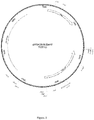
- plasmid pWSK29-M.BanLI-M.BanLII (see Figure 3 ), which expresses two of the identified B. animalis subsp. lactis CNCM 1-2494 methyltransferases
- the DNA fragment encompassing p44-M.BanLI was amplified from pWSK29-M.BanLI by PCR using primer combinations BanLIF2 and BanLIR2 (see Table 1), both of which had SalI restriction sites incorporated at their 5' ends.
- the resulting amplicon was digested with SalI, and ligated into similarly digested pWSK29-M.BanLII.
- the resulting ligation mixture was introduced into E. coli XllBlue by electrotransformation and transformants selected based on ampicillin resistance.
- the plasmid content of a number of Amp r transformants was screened by restriction analysis and the integrity of positively identified clones was verified by sequencing.
- spectinomycin resistance gene together with its own promoter were amplified from pMG36 ( van de Guchte M. et al., 1989, Appl Environ Microbiol. 55:224-8 ) carrying a spectinomycin resistant marker (pMG36S), using the primer combinations SpecF and SpecR (see Table 1) that harbor SacI sites at their 5' end or SpecF1 and SpecR1 (see Table 1) that contain EcoRI and HindIII sites, respectively.
- the 1117 bp amplicon was digested with either SacI or a combination of EcoRI and HinDIII and ligated to similarly digested pAM5 (Alvarez-Martin et al.
- pDM1 the tet r cassette of pAM5 was replaced with the spectinomycin resistance cassette, while pDM2 is pDG7 harbouring the spectinomycin cassette cloned in the unique EcoRI and HinDIII sites.
- DM-MRS 48 ml of DM-MRS (see Table 2 below) supplemented with 0.05% cysteine and 1% maltose was inoculated with 2 ml of an overnight culture of B. animalis subsp. lactis CNCM 1-2494 and incubated anaerobically at 42°C (DM-MRS is autoclaved at 121°C for 15 min. Prior to inoculation DM-MRS is supplemented with cysteine HCL 0.05% and maltose 1%. Table 2 : Composition of DM-MRS broth g/L Difco Proteose Peptone No.
- the bacterial cells were collected by centrifugation at 6,500 g for 10 min at 4°C, and the pellet washed twice with chilled sucrose citrate buffer (1 mM citrate [pH 5.8], 0.5 M sucrose). The cells were subsequently suspended in 300 ⁇ l of chilled sucrose citrate buffer. Fifty microliters of the cell suspension was used for each electrotransformation, the cells and plasmid DNA were mixed and held on ice prior to the pulse at 25 ⁇ F, 200 ohms and 2 kV. After transformation, the cells were suspended in 1ml of DM-MRS supplemented with cysteine and maltose and incubated for 3 hours at 42°C. Serial dilutions were plated on RCA supplemented with maltose and containing the appropriate antibiotic and incubated at 42°C for 24-36h at which point transformant colonies were visible.
- DM-MRS DM-MRS supplemented with cysteine and maltose
- EXAMPLE 2 DEVELOPMENT OF A GROWTH MEDIUM FOR GROWING A BIFIDOBACTERIUM STRAIN
- DM-MRS modified MRS medium
- This medium allows B. animalis subsp. lactis CNCM 1-2494 be reproducibly subcultured in the presence of 1% maltose and 0.05% cysteine over five consecutive subcultures ( Figure 7 ).
- This medium further allows growth that is entirely dependent on the supplementation of maltose as the sole carbon and energy source of the strain.
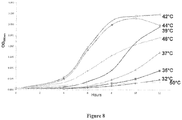
- the temperature of 42°C is an optimum temperature for growing B. animalis subsp. lactis CNCM 1-2494 in DM-MRS (see Figure 8 ).
Landscapes
- Health & Medical Sciences (AREA)
- Life Sciences & Earth Sciences (AREA)
- Chemical & Material Sciences (AREA)
- Genetics & Genomics (AREA)
- Engineering & Computer Science (AREA)
- Organic Chemistry (AREA)
- Bioinformatics & Cheminformatics (AREA)
- Zoology (AREA)
- Wood Science & Technology (AREA)
- Biotechnology (AREA)
- General Engineering & Computer Science (AREA)
- Biomedical Technology (AREA)
- Biochemistry (AREA)
- General Health & Medical Sciences (AREA)
- Microbiology (AREA)
- Molecular Biology (AREA)
- Medicinal Chemistry (AREA)
- Plant Pathology (AREA)
- Biophysics (AREA)
- Physics & Mathematics (AREA)
- Tropical Medicine & Parasitology (AREA)
- Virology (AREA)
- Micro-Organisms Or Cultivation Processes Thereof (AREA)
Claims (13)
- Verfahren zum genetischen Transformieren eines Stammes der Art Bifidobacterium animalis, Unterart lactis, umfassend die folgenden Schritte:i) Transformieren eines Escherichia coli-Stammes entweder:- mit einer rekombinanten Vektor-DNA, umfassend ein Gen, das ein BanLI-Methyltransferase-Enzym aus einem Bifidobacterium animalis, Unterart lactis, codiert, das zu mindestens 60 % mit der Aminosäuresequenz SEQ ID NO: 1 identisch ist, und die Adeninbase an Position 4 der Nukleotidsequenz RTCAGG methyliert, und einer rekombinanten Vektor-DNA, umfassend ein Gen, das ein BanLII-Methyltransferase-Enzym aus einem Bifidobacterium animalis, Unterart lactis, codiert, das zu mindestens 55 % mit der Aminosäuresequenz SEQ ID NO: 3 identisch ist und die Cytosinbase an Position 4 der Nukleotidsequenz GGWCC methyliert, oder- mit einer rekombinanten Vektor-DNA, umfassend beide, ein Gen, welches das BanLI-Methyltransferase-Enzym aus einem Bifidobacterium animalis, Unterart lactis, codiert, und ein Gen, welches das BanLII-Methyltransferase-Enzym aus einem Bifidobacterium animalis, Unterart lactis, codiert,wobei die rekombinanten Vektoren-DNA dazu fähig sind, sich in dem E. coli-Stamm zu vervielfältigen,ii) Transformieren des E. coli-Stammes aus Schritt i) mit einer rekombinanten Shuttle-Vektor-DNA, umfassend eine DNA-Sequenz von Interesse zum Einschleusen in einen Stamm von Bifidobacterium animalis, Unterart lactis, wobei die Shuttle-Vektor-DNA dazu fähig ist, sich in dem E. coli-Stamm aus Schritt i) und dem Stamm von Bifidobacterium animalis, Unterart lactis, der für die genetische Transformation vorgesehen ist, zu vervielfältigen,iii) Kultivieren des in Schritt ii) erhaltenen transformierten E. coli-Stammes,iv) Extrahieren der Shuttle-Vektor-DNA aus dem transformierten E. coli-Stamm,v) Transformieren, vorzugsweise Elektrotransformieren, eines Stammes von Bifidobacterium animalis, Unterart lactis, mit der in Schritt iv) erhaltenen Shuttle-Vektor-DNA,vi) Rückgewinnen des transformierten Stammes von Bifidobacterium animalis, Unterart lactis, aus Schritt v).
- Verfahren nach Anspruch 1, dadurch gekennzeichnet, dass die Schritte i) und ii) in einer beliebigen Reihenfolge oder gleichzeitig durchgeführt werden.
- Verfahren zum genetischen Transformieren eines Stammes der Art Bifidobacterium animalis, Unterart lactis, umfassend die folgenden Schritte:(i) Bereitstellen eines E. coli-Stammes, der mit Folgendem transformiert wird:- mit einer rekombinanten Vektor-DNA, umfassend ein Gen, das ein BanLI-Methyltransferase-Enzym aus einem Bifidobacterium animalis, Unterart lactis, codiert, das zu mindestens 60 % mit der Aminosäuresequenz SEQ ID NO: 1 identisch ist und die Adeninbase an Position 4 der Nukleotidsequenz RTCAGG methyliert, und einer rekombinanten Vektor-DNA, umfassend ein Gen, das ein BanLII-Methyltransferase-Enzym aus einem Bifidobacterium animalis, Unterart lactis, codiert, das zu mindestens 55 % mit der Aminosäuresequenz SEQ ID NO: 3 identisch ist und die Cytosinbase an Position 4 der Nukleotidsequenz GGWCC methyliert, oder- mit einer rekombinanten Vektor-DNA, umfassend beide, ein Gen, welches das BanLI-Methyltransferase-Enzym aus einem Bifidobacterium animalis, Unterart lactis, codiert, und ein Gen, welches das BanLII-Methyltransferase-Enzym aus einem Bifidobacterium animalis, Unterart lactis, codiert,ii) Transformieren des E. coli-Stammes aus Schritt i) mit einer rekombinanten Shuttle-Vektor-DNA, umfassend eine DNA-Sequenz von Interesse zum Einschleusen in einen Stamm von Bifidobacterium animalis, Unterart lactis, wobei die Shuttle-Vektor-DNA dazu fähig ist, sich in dem E. coli-Stamm aus Schritt i) und dem Stamm von Bifidobacterium animalis, Unterart lactis, der für die genetische Transformation vorgesehen ist, zu vervielfältigen,iii) Kultivieren des in Schritt ii) erhaltenen transformierten E. coli-Stammes,iv) Extrahieren der Shuttle-Vektor-DNA aus dem transformierten E. coli-Stamm,v) Transformieren, vorzugsweise Elektrotransformieren, eines Stammes von Bifidobacterium animalis, Unterart lactis, mit der erhaltenen Shuttle-Vektor-DNA aus Schritt iv),vi) Rückgewinnen des transformierten Stammes von Bifidobacterium animalis, Unterart lactis, aus Schritt v).
- Verfahren nach einem der Ansprüche 1 bis 3, dadurch gekennzeichnet, dass die BanLI-Methyltransferase und/oder die BanLII-Methyltransferase aus dem Stamm von Bifidobacterium animalis, Unterart lactis, der für die genetische Transformation vorgesehen ist, stammen.
- Verfahren nach einem der Ansprüche 1 bis 4, dadurch gekennzeichnet, dass der Stamm von Bifidobacterium animalis, Unterart lactis, vor der Transformation kultiviert wird und/oder nach der Transformation in einem geeigneten Medium bei einer Temperatur zwischen 36 °C und 46 °C, vorzugsweise zwischen 41 °C und 43 °C, noch bevorzugter bei 42 °C, erneut suspendiert wird.
- Verfahren nach Anspruch 5, dadurch gekennzeichnet, dass das geeignete Medium ein MRS-Medium ist, das optional mit Cystein und/oder einem Kohlenhydrat, vorzugsweise Maltose, ergänzt wird.
- Verfahren nach einem der Ansprüche 1 bis 6, dadurch gekennzeichnet, dass die Transformationsschritte durch Elektroporation, Transduktion, Hitzeschock oder Protoplastenfusion durchgeführt werden.
- Verfahren nach einem der Ansprüche 6 bis 7, dadurch gekennzeichnet, dass das MRS-Medium eine modifiziertes MRS-Medium ist, umfassend oder bestehend aus Pepton von Casein, Fleischextrakt, Hefeextrakt, Dikaliumhydrogenphosphat (K2HPO4), Kaliumdihydrogenphosphat (KH2PO4), Brenztraubensäure, Polysorbat 80, Triammoniumcitrat, Magnesiumsulfathydrat (MgSO4.7H2O), Mangansulfathydrat (MnSO4.4H2O), Cystein-HCl und Eisensulfathydrat (FeSO4.7H2O), ergänzt mit Cystein und Maltose.
- Verfahren nach einem der Ansprüche 5 bis 8, dadurch gekennzeichnet, dass der Stamm von Bifidobacterium animalis, Unterart lactis, anaerob kultiviert und/oder in einem geeigneten Medium erneut suspendiert wird.
- Verfahren nach einem der Ansprüche 5 bis 9, dadurch gekennzeichnet, dass der Stamm von Bifidobacterium animalis, Unterart lactis, vor der Transformation kultiviert wird und/oder nach der Transformation in dem geeigneten Medium bei einer Temperatur zwischen 36 °C und 46 °C, vorzugsweise zwischen 41 °C und 43 °C, noch bevorzugter bei 42 °C, erneut suspendiert wird.
- Isolierte rekombinante Expressionskassette, dadurch gekennzeichnet, dass sie Folgendes umfasst: eine Polynukleotidsequenz, die ein BanLI-Methyltransferase-Enzym codiert, das zu mindestens 60 % mit der Aminosäuresequenz SEQ ID NO: 1 identisch ist und die Adeninbase an Position 4 der Nukleotidsequenz RTCAGG methyliert, und/oder eine Polynukleotidsequenz, die ein BanLII-Methyltransferase-Enzym codiert, das zu mindestens 55 % mit der Aminosäuresequenz SEQ ID NO: 3 identisch ist und die Cytosinbase an Position 4 der Nukleotidsequenz GGWCC methyliert, unter Kontrolle eines in einem E. coli-Bakterium funktionellen Promotors.
- Rekombinanter Vektor, der dazu fähig ist, sich in einem E. coli-Bakterium zu vervielfältigen, dadurch gekennzeichnet, dass er eine rekombinante Expressionskassette nach Anspruch 11 umfasst.
- Transformierte Escherichia coli, dadurch gekennzeichnet, dass sie einen rekombinanten Vektor wie in Anspruch 12 definiert enthält.
Applications Claiming Priority (1)
| Application Number | Priority Date | Filing Date | Title |
|---|---|---|---|
| PCT/IB2013/002951 WO2015082949A1 (en) | 2013-12-02 | 2013-12-02 | Genetic transformation of bifidobacteria |
Publications (2)
| Publication Number | Publication Date |
|---|---|
| EP3077516A1 EP3077516A1 (de) | 2016-10-12 |
| EP3077516B1 true EP3077516B1 (de) | 2019-01-02 |
Family
ID=50382485
Family Applications (1)
| Application Number | Title | Priority Date | Filing Date |
|---|---|---|---|
| EP13840184.9A Active EP3077516B1 (de) | 2013-12-02 | 2013-12-02 | Genetische transformation von bifidobakterien |
Country Status (3)
| Country | Link |
|---|---|
| US (1) | US10184127B2 (de) |
| EP (1) | EP3077516B1 (de) |
| WO (1) | WO2015082949A1 (de) |
-
2013
- 2013-12-02 US US15/101,078 patent/US10184127B2/en active Active
- 2013-12-02 EP EP13840184.9A patent/EP3077516B1/de active Active
- 2013-12-02 WO PCT/IB2013/002951 patent/WO2015082949A1/en not_active Ceased
Non-Patent Citations (1)
| Title |
|---|
| C. MILANI ET AL: "Comparative Genomics of Bifidobacterium animalis subsp. lactis Reveals a Strict Monophyletic Bifidobacterial Taxon", APPLIED AND ENVIRONMENTAL MICROBIOLOGY, vol. 79, no. 14, 3 May 2013 (2013-05-03), US, pages 4304 - 4315, XP055462437, ISSN: 0099-2240, DOI: 10.1128/AEM.00984-13 * |
Also Published As
| Publication number | Publication date |
|---|---|
| US10184127B2 (en) | 2019-01-22 |
| WO2015082949A1 (en) | 2015-06-11 |
| EP3077516A1 (de) | 2016-10-12 |
| US20160304885A1 (en) | 2016-10-20 |
Similar Documents
| Publication | Publication Date | Title |
|---|---|---|
| Lee et al. | Sequence analysis of two cryptic plasmids from Bifidobacterium longum DJO10A and construction of a shuttle cloning vector | |
| EP3555320B1 (de) | Verfahren und stamm | |
| Van Waasbergen et al. | Genetic analysis of the marine manganese-oxidizing Bacillus sp. strain SG-1: protoplast transformation, Tn917 mutagenesis, and identification of chromosomal loci involved in manganese oxidation | |
| Davis et al. | Development of a transformation and gene reporter system for group II, non-proteolytic Clostridium botulinum type B strains | |
| Chen et al. | Characterization of pMC11, a plasmid with dual origins of replication isolated from Lactobacillus casei MCJ and construction of shuttle vectors with each replicon | |
| KR101613897B1 (ko) | 담즙산에 의해 발현이 유도되는 프로모터를 포함하는 셔틀벡터 및 이를 포함하는 조성물 | |
| US10184127B2 (en) | Genetic transformation of bifidobacteria | |
| EP0965643B1 (de) | Mobile genetische Elemente als Werkzeuge zur genetischen Modifikation von L. delbrueckii oder L. helveticus | |
| WO1994001574A1 (fr) | Procede d'integration d'un gene dans un chromosome de l'espece lactobacillus delbrueckii, et produit de cette integration genique | |
| JP6017514B2 (ja) | 細胞内におけるdna増幅方法 | |
| Sudhamani et al. | Characterisation of pSMA23, a 3.5 kbp plasmid of Lactobacillus casei, and application for heterologous expression in Lactobacillus | |
| Jechlinger et al. | Cold-sensitive E-lysis systems | |
| US20220064588A1 (en) | Phage resistant lactic acid bacteria | |
| Fernández et al. | A novel genetic label for detection of specific probiotic lactic acid bacteria | |
| US10801031B2 (en) | Shuttle vector, prokaryotic host cells, kit, and method for producing proteins | |
| Bustos et al. | Genetic characterization and gene expression of bile salt hydrolase (bsh) from Lactobacillus reuteri CRL 1098, a probiotic strain | |
| Jeong et al. | Improvement of fibrinolytic activity of Bacillus subtilis 168 by integration of a fibrinolytic gene into the chromosome | |
| KR100953104B1 (ko) | 류코노스톡에서 유래된 신규 플라스미드 및 이를 포함하는셔틀 벡터 | |
| Davis et al. | Gene cloning in clostridia | |
| GB2544957A (en) | Modifying bacteriophage | |
| Rossi et al. | Genetic modification of Lactobacillus plantarum by heterologous gene integration in a not functional region of the chromosome | |
| Li et al. | Development of an antibiotic-free plasmid selection system based on thymine auxotrophy in Lactococcus lactis | |
| Thompson et al. | Electrotransformation of Lactobacillus plantarum using linearized plasmid DNA | |
| Jakubauskas et al. | Bioinformatic and partial functional analysis of pEspA and pEspB, two plasmids from Exiguobacterium arabatum sp. nov. RFL1109 | |
| Bustos | Font de Valdez G, Raya R, Taranto MP (2016) Genetic characterization and gene expression of bile salt hydrolase (bsh) from Lactobacillus reuteri CRL 1098, a probiotic strain |
Legal Events
| Date | Code | Title | Description |
|---|---|---|---|
| PUAI | Public reference made under article 153(3) epc to a published international application that has entered the european phase |
Free format text: ORIGINAL CODE: 0009012 |
|
| 17P | Request for examination filed |
Effective date: 20160629 |
|
| AK | Designated contracting states |
Kind code of ref document: A1 Designated state(s): AL AT BE BG CH CY CZ DE DK EE ES FI FR GB GR HR HU IE IS IT LI LT LU LV MC MK MT NL NO PL PT RO RS SE SI SK SM TR |
|
| AX | Request for extension of the european patent |
Extension state: BA ME |
|
| DAX | Request for extension of the european patent (deleted) | ||
| STAA | Information on the status of an ep patent application or granted ep patent |
Free format text: STATUS: EXAMINATION IS IN PROGRESS |
|
| 17Q | First examination report despatched |
Effective date: 20170607 |
|
| GRAP | Despatch of communication of intention to grant a patent |
Free format text: ORIGINAL CODE: EPIDOSNIGR1 |
|
| STAA | Information on the status of an ep patent application or granted ep patent |
Free format text: STATUS: GRANT OF PATENT IS INTENDED |
|
| INTG | Intention to grant announced |
Effective date: 20180720 |
|
| GRAS | Grant fee paid |
Free format text: ORIGINAL CODE: EPIDOSNIGR3 |
|
| GRAA | (expected) grant |
Free format text: ORIGINAL CODE: 0009210 |
|
| STAA | Information on the status of an ep patent application or granted ep patent |
Free format text: STATUS: THE PATENT HAS BEEN GRANTED |
|
| AK | Designated contracting states |
Kind code of ref document: B1 Designated state(s): AL AT BE BG CH CY CZ DE DK EE ES FI FR GB GR HR HU IE IS IT LI LT LU LV MC MK MT NL NO PL PT RO RS SE SI SK SM TR |
|
| REG | Reference to a national code |
Ref country code: GB Ref legal event code: FG4D |
|
| REG | Reference to a national code |
Ref country code: CH Ref legal event code: EP Ref country code: AT Ref legal event code: REF Ref document number: 1084418 Country of ref document: AT Kind code of ref document: T Effective date: 20190115 |
|
| REG | Reference to a national code |
Ref country code: IE Ref legal event code: FG4D |
|
| REG | Reference to a national code |
Ref country code: DE Ref legal event code: R096 Ref document number: 602013049338 Country of ref document: DE |
|
| REG | Reference to a national code |
Ref country code: NL Ref legal event code: FP |
|
| REG | Reference to a national code |
Ref country code: LT Ref legal event code: MG4D |
|
| REG | Reference to a national code |
Ref country code: CH Ref legal event code: NV Representative=s name: VALIPAT S.A. C/O BOVARD SA NEUCHATEL, CH |
|
| REG | Reference to a national code |
Ref country code: AT Ref legal event code: MK05 Ref document number: 1084418 Country of ref document: AT Kind code of ref document: T Effective date: 20190102 |
|
| RAP2 | Party data changed (patent owner data changed or rights of a patent transferred) |
Owner name: COMPAGNIE GERVAIS DANONE |
|
| REG | Reference to a national code |
Ref country code: NL Ref legal event code: PD Owner name: COMPAGNIE GERVAIS DANONE; FR Free format text: DETAILS ASSIGNMENT: CHANGE OF OWNER(S), ASSIGNMENT; FORMER OWNER NAME: UNIVERSITY COLLEGE CORK, NATIONAL UNIVERSITY OF IRELAND CORK Effective date: 20190627 |
|
| PG25 | Lapsed in a contracting state [announced via postgrant information from national office to epo] |
Ref country code: ES Free format text: LAPSE BECAUSE OF FAILURE TO SUBMIT A TRANSLATION OF THE DESCRIPTION OR TO PAY THE FEE WITHIN THE PRESCRIBED TIME-LIMIT Effective date: 20190102 Ref country code: LT Free format text: LAPSE BECAUSE OF FAILURE TO SUBMIT A TRANSLATION OF THE DESCRIPTION OR TO PAY THE FEE WITHIN THE PRESCRIBED TIME-LIMIT Effective date: 20190102 Ref country code: PL Free format text: LAPSE BECAUSE OF FAILURE TO SUBMIT A TRANSLATION OF THE DESCRIPTION OR TO PAY THE FEE WITHIN THE PRESCRIBED TIME-LIMIT Effective date: 20190102 Ref country code: FI Free format text: LAPSE BECAUSE OF FAILURE TO SUBMIT A TRANSLATION OF THE DESCRIPTION OR TO PAY THE FEE WITHIN THE PRESCRIBED TIME-LIMIT Effective date: 20190102 Ref country code: NO Free format text: LAPSE BECAUSE OF FAILURE TO SUBMIT A TRANSLATION OF THE DESCRIPTION OR TO PAY THE FEE WITHIN THE PRESCRIBED TIME-LIMIT Effective date: 20190402 Ref country code: SE Free format text: LAPSE BECAUSE OF FAILURE TO SUBMIT A TRANSLATION OF THE DESCRIPTION OR TO PAY THE FEE WITHIN THE PRESCRIBED TIME-LIMIT Effective date: 20190102 Ref country code: PT Free format text: LAPSE BECAUSE OF FAILURE TO SUBMIT A TRANSLATION OF THE DESCRIPTION OR TO PAY THE FEE WITHIN THE PRESCRIBED TIME-LIMIT Effective date: 20190502 |
|
| PG25 | Lapsed in a contracting state [announced via postgrant information from national office to epo] |
Ref country code: GR Free format text: LAPSE BECAUSE OF FAILURE TO SUBMIT A TRANSLATION OF THE DESCRIPTION OR TO PAY THE FEE WITHIN THE PRESCRIBED TIME-LIMIT Effective date: 20190403 Ref country code: HR Free format text: LAPSE BECAUSE OF FAILURE TO SUBMIT A TRANSLATION OF THE DESCRIPTION OR TO PAY THE FEE WITHIN THE PRESCRIBED TIME-LIMIT Effective date: 20190102 Ref country code: IS Free format text: LAPSE BECAUSE OF FAILURE TO SUBMIT A TRANSLATION OF THE DESCRIPTION OR TO PAY THE FEE WITHIN THE PRESCRIBED TIME-LIMIT Effective date: 20190502 Ref country code: LV Free format text: LAPSE BECAUSE OF FAILURE TO SUBMIT A TRANSLATION OF THE DESCRIPTION OR TO PAY THE FEE WITHIN THE PRESCRIBED TIME-LIMIT Effective date: 20190102 Ref country code: BG Free format text: LAPSE BECAUSE OF FAILURE TO SUBMIT A TRANSLATION OF THE DESCRIPTION OR TO PAY THE FEE WITHIN THE PRESCRIBED TIME-LIMIT Effective date: 20190402 Ref country code: RS Free format text: LAPSE BECAUSE OF FAILURE TO SUBMIT A TRANSLATION OF THE DESCRIPTION OR TO PAY THE FEE WITHIN THE PRESCRIBED TIME-LIMIT Effective date: 20190102 |
|
| REG | Reference to a national code |
Ref country code: DE Ref legal event code: R097 Ref document number: 602013049338 Country of ref document: DE |
|
| PG25 | Lapsed in a contracting state [announced via postgrant information from national office to epo] |
Ref country code: RO Free format text: LAPSE BECAUSE OF FAILURE TO SUBMIT A TRANSLATION OF THE DESCRIPTION OR TO PAY THE FEE WITHIN THE PRESCRIBED TIME-LIMIT Effective date: 20190102 Ref country code: SK Free format text: LAPSE BECAUSE OF FAILURE TO SUBMIT A TRANSLATION OF THE DESCRIPTION OR TO PAY THE FEE WITHIN THE PRESCRIBED TIME-LIMIT Effective date: 20190102 Ref country code: CZ Free format text: LAPSE BECAUSE OF FAILURE TO SUBMIT A TRANSLATION OF THE DESCRIPTION OR TO PAY THE FEE WITHIN THE PRESCRIBED TIME-LIMIT Effective date: 20190102 Ref country code: AL Free format text: LAPSE BECAUSE OF FAILURE TO SUBMIT A TRANSLATION OF THE DESCRIPTION OR TO PAY THE FEE WITHIN THE PRESCRIBED TIME-LIMIT Effective date: 20190102 Ref country code: DK Free format text: LAPSE BECAUSE OF FAILURE TO SUBMIT A TRANSLATION OF THE DESCRIPTION OR TO PAY THE FEE WITHIN THE PRESCRIBED TIME-LIMIT Effective date: 20190102 Ref country code: AT Free format text: LAPSE BECAUSE OF FAILURE TO SUBMIT A TRANSLATION OF THE DESCRIPTION OR TO PAY THE FEE WITHIN THE PRESCRIBED TIME-LIMIT Effective date: 20190102 Ref country code: EE Free format text: LAPSE BECAUSE OF FAILURE TO SUBMIT A TRANSLATION OF THE DESCRIPTION OR TO PAY THE FEE WITHIN THE PRESCRIBED TIME-LIMIT Effective date: 20190102 Ref country code: IT Free format text: LAPSE BECAUSE OF FAILURE TO SUBMIT A TRANSLATION OF THE DESCRIPTION OR TO PAY THE FEE WITHIN THE PRESCRIBED TIME-LIMIT Effective date: 20190102 |
|
| PLBE | No opposition filed within time limit |
Free format text: ORIGINAL CODE: 0009261 |
|
| STAA | Information on the status of an ep patent application or granted ep patent |
Free format text: STATUS: NO OPPOSITION FILED WITHIN TIME LIMIT |
|
| PG25 | Lapsed in a contracting state [announced via postgrant information from national office to epo] |
Ref country code: SM Free format text: LAPSE BECAUSE OF FAILURE TO SUBMIT A TRANSLATION OF THE DESCRIPTION OR TO PAY THE FEE WITHIN THE PRESCRIBED TIME-LIMIT Effective date: 20190102 |
|
| 26N | No opposition filed |
Effective date: 20191003 |
|
| PG25 | Lapsed in a contracting state [announced via postgrant information from national office to epo] |
Ref country code: SI Free format text: LAPSE BECAUSE OF FAILURE TO SUBMIT A TRANSLATION OF THE DESCRIPTION OR TO PAY THE FEE WITHIN THE PRESCRIBED TIME-LIMIT Effective date: 20190102 |
|
| PG25 | Lapsed in a contracting state [announced via postgrant information from national office to epo] |
Ref country code: TR Free format text: LAPSE BECAUSE OF FAILURE TO SUBMIT A TRANSLATION OF THE DESCRIPTION OR TO PAY THE FEE WITHIN THE PRESCRIBED TIME-LIMIT Effective date: 20190102 |
|
| REG | Reference to a national code |
Ref country code: BE Ref legal event code: MM Effective date: 20191231 |
|
| PG25 | Lapsed in a contracting state [announced via postgrant information from national office to epo] |
Ref country code: MC Free format text: LAPSE BECAUSE OF FAILURE TO SUBMIT A TRANSLATION OF THE DESCRIPTION OR TO PAY THE FEE WITHIN THE PRESCRIBED TIME-LIMIT Effective date: 20190102 |
|
| PG25 | Lapsed in a contracting state [announced via postgrant information from national office to epo] |
Ref country code: IE Free format text: LAPSE BECAUSE OF NON-PAYMENT OF DUE FEES Effective date: 20191202 Ref country code: LU Free format text: LAPSE BECAUSE OF NON-PAYMENT OF DUE FEES Effective date: 20191202 |
|
| PG25 | Lapsed in a contracting state [announced via postgrant information from national office to epo] |
Ref country code: BE Free format text: LAPSE BECAUSE OF NON-PAYMENT OF DUE FEES Effective date: 20191231 |
|
| PG25 | Lapsed in a contracting state [announced via postgrant information from national office to epo] |
Ref country code: CY Free format text: LAPSE BECAUSE OF FAILURE TO SUBMIT A TRANSLATION OF THE DESCRIPTION OR TO PAY THE FEE WITHIN THE PRESCRIBED TIME-LIMIT Effective date: 20190102 |
|
| PG25 | Lapsed in a contracting state [announced via postgrant information from national office to epo] |
Ref country code: MT Free format text: LAPSE BECAUSE OF FAILURE TO SUBMIT A TRANSLATION OF THE DESCRIPTION OR TO PAY THE FEE WITHIN THE PRESCRIBED TIME-LIMIT Effective date: 20190102 Ref country code: HU Free format text: LAPSE BECAUSE OF FAILURE TO SUBMIT A TRANSLATION OF THE DESCRIPTION OR TO PAY THE FEE WITHIN THE PRESCRIBED TIME-LIMIT; INVALID AB INITIO Effective date: 20131202 |
|
| PG25 | Lapsed in a contracting state [announced via postgrant information from national office to epo] |
Ref country code: MK Free format text: LAPSE BECAUSE OF FAILURE TO SUBMIT A TRANSLATION OF THE DESCRIPTION OR TO PAY THE FEE WITHIN THE PRESCRIBED TIME-LIMIT Effective date: 20190102 |
|
| P01 | Opt-out of the competence of the unified patent court (upc) registered |
Effective date: 20230516 |
|
| REG | Reference to a national code |
Ref country code: CH Ref legal event code: U11 Free format text: ST27 STATUS EVENT CODE: U-0-0-U10-U11 (AS PROVIDED BY THE NATIONAL OFFICE) Effective date: 20260101 |
|
| PGFP | Annual fee paid to national office [announced via postgrant information from national office to epo] |
Ref country code: DE Payment date: 20251211 Year of fee payment: 13 |
|
| PGFP | Annual fee paid to national office [announced via postgrant information from national office to epo] |
Ref country code: GB Payment date: 20251219 Year of fee payment: 13 |
|
| PGFP | Annual fee paid to national office [announced via postgrant information from national office to epo] |
Ref country code: FR Payment date: 20251119 Year of fee payment: 13 Ref country code: NL Payment date: 20251219 Year of fee payment: 13 |
|
| PGFP | Annual fee paid to national office [announced via postgrant information from national office to epo] |
Ref country code: CH Payment date: 20260101 Year of fee payment: 13 |