EP3076704A1 - Wireless communication apparatus, wireless communication computer program, and wireless communication method - Google Patents
Wireless communication apparatus, wireless communication computer program, and wireless communication method Download PDFInfo
- Publication number
- EP3076704A1 EP3076704A1 EP16159255.5A EP16159255A EP3076704A1 EP 3076704 A1 EP3076704 A1 EP 3076704A1 EP 16159255 A EP16159255 A EP 16159255A EP 3076704 A1 EP3076704 A1 EP 3076704A1
- Authority
- EP
- European Patent Office
- Prior art keywords
- download
- wireless communication
- download process
- timeout
- data
- Prior art date
- Legal status (The legal status is an assumption and is not a legal conclusion. Google has not performed a legal analysis and makes no representation as to the accuracy of the status listed.)
- Withdrawn
Links
Images


Classifications
-
- H—ELECTRICITY
- H04—ELECTRIC COMMUNICATION TECHNIQUE
- H04W—WIRELESS COMMUNICATION NETWORKS
- H04W76/00—Connection management
- H04W76/10—Connection setup
- H04W76/15—Setup of multiple wireless link connections
-
- H—ELECTRICITY
- H04—ELECTRIC COMMUNICATION TECHNIQUE
- H04L—TRANSMISSION OF DIGITAL INFORMATION, e.g. TELEGRAPHIC COMMUNICATION
- H04L67/00—Network arrangements or protocols for supporting network services or applications
- H04L67/50—Network services
- H04L67/56—Provisioning of proxy services
- H04L67/567—Integrating service provisioning from a plurality of service providers
-
- H—ELECTRICITY
- H04—ELECTRIC COMMUNICATION TECHNIQUE
- H04L—TRANSMISSION OF DIGITAL INFORMATION, e.g. TELEGRAPHIC COMMUNICATION
- H04L69/00—Network arrangements, protocols or services independent of the application payload and not provided for in the other groups of this subclass
- H04L69/28—Timers or timing mechanisms used in protocols
-
- H—ELECTRICITY
- H04—ELECTRIC COMMUNICATION TECHNIQUE
- H04W—WIRELESS COMMUNICATION NETWORKS
- H04W28/00—Network traffic management; Network resource management
- H04W28/02—Traffic management, e.g. flow control or congestion control
-
- H—ELECTRICITY
- H04—ELECTRIC COMMUNICATION TECHNIQUE
- H04L—TRANSMISSION OF DIGITAL INFORMATION, e.g. TELEGRAPHIC COMMUNICATION
- H04L43/00—Arrangements for monitoring or testing data switching networks
- H04L43/08—Monitoring or testing based on specific metrics, e.g. QoS, energy consumption or environmental parameters
- H04L43/0876—Network utilisation, e.g. volume of load or congestion level
- H04L43/0888—Throughput
-
- H—ELECTRICITY
- H04—ELECTRIC COMMUNICATION TECHNIQUE
- H04L—TRANSMISSION OF DIGITAL INFORMATION, e.g. TELEGRAPHIC COMMUNICATION
- H04L67/00—Network arrangements or protocols for supporting network services or applications
- H04L67/50—Network services
- H04L67/56—Provisioning of proxy services
- H04L67/563—Data redirection of data network streams
-
- H—ELECTRICITY
- H04—ELECTRIC COMMUNICATION TECHNIQUE
- H04L—TRANSMISSION OF DIGITAL INFORMATION, e.g. TELEGRAPHIC COMMUNICATION
- H04L67/00—Network arrangements or protocols for supporting network services or applications
- H04L67/50—Network services
- H04L67/56—Provisioning of proxy services
- H04L67/59—Providing operational support to end devices by off-loading in the network or by emulation, e.g. when they are unavailable
-
- H—ELECTRICITY
- H04—ELECTRIC COMMUNICATION TECHNIQUE
- H04W—WIRELESS COMMUNICATION NETWORKS
- H04W76/00—Connection management
- H04W76/20—Manipulation of established connections
Definitions
- the embodiment discussed herein is related to a wireless communication apparatus, a wireless communication computer program, and a wireless communication method.
- Patent Document 1 International Publication Pamphlet No. WO 2009/142059
- the throughput may decrease and the download may be timed out without being completed.
- the download is timed out, according to a method by which the data is downloaded without being divided into sections, the download is resumed starting with a continuation of the data that had been downloaded before the timeout.
- the download is resumed starting with a continuation of the section of data continuous from the head among the sections of data that had been downloaded, and the other sections of data that are not continuous from the head are discarded.
- some data is discarded when the timeout occurs due to the deterioration in the communication quality. Consequently, the efficiency of the download is lower than when using a method by which the data is downloaded without being divided into sections.
- a wireless communication apparatus includes: a communicating unit that performs one selected from between a first download process that downloads data through a wireless communication by dividing the data into sections while using a plurality of threads and a second download process that downloads the data while using a single thread; a measuring unit that measures communication quality of the wireless communication; a judging unit that, when a deterioration in the communication quality is measured during the first download process, judges whether or not it is possible to complete the download in all of the plurality of threads before a timeout; and a controlling unit that, when it is determined to be impossible to complete the download in all of the plurality of threads before the timeout, switches the first download process into the second download process.
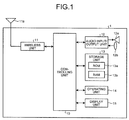
- FIG. 1 is a block diagram illustrating a hardware configuration of a wireless communication apparatus 1 according to an embodiment.
- the wireless communication apparatus 1 includes a controlling unit 10, a wireless unit 11, an audio input/output unit 12, a storage unit 13, an operating unit 14, and a display unit 15.
- the wireless communication apparatus 1 may be a personal computer, a smartphone, a tablet-type terminal, or the like.
- the controlling unit 10 is a processing unit that controls processes in the entirety of the wireless communication apparatus 1.
- the controlling unit 10 reads a computer program (hereinafter, "program") from the storage unit 13 and executes processes.
- program a computer program
- the controlling unit 10 realizes the functional configuration illustrated in FIG. 2 and performs the processes explained with reference to FIG. 3 and so forth, by executing the processes.
- the wireless unit 11 wirelessly communicates with another mobile apparatus or a base station apparatus, by using an antenna 11a. More specifically, the wireless unit 11 wirelessly communicates with another mobile apparatus or a base station apparatus by using a communication method such as a Long Term Evolution (LTE) communication method or a Wireless Fidelity (WiFi; a registered trademark) communication method.
- LTE Long Term Evolution
- WiFi Wireless Fidelity
- the present embodiment is described as the wireless unit 11 performing the communication via a communication carrier by using the LTE communication method, it is also acceptable to improve the communication speed of the wireless communication by using a plurality of communication methods at the same time.
- the audio input/output unit 12 outputs audio that is input thereto from the controlling unit 10, through a speaker 12a. Further, the audio input/output unit 12 collects audio through a microphone 12b and outputs the collected audio to the controlling unit 10.
- the storage unit 13 is a storage device such as a memory, a hard disk, or the like.
- the storage unit 13 includes, for example, a Read-Only Memory (ROM) 13a and a Random Access Memory (RAM) 13b.
- the ROM 13a stores therein the program executed by the controlling unit 10 and various types of data.
- the RAM 13b provides a working space used when the controlling unit 10 executes the program. More specifically, the RAM 13b stores therein processing results, various types of tables, and the like generated by the program executed by the controlling unit 10 and the like.
- the operating unit 14 is configured by using a keyboard, a touch panel and/or the like, receives various types of inputs from a user, and outputs the received inputs to the controlling unit 10.
- the display unit 15 is configured by using a liquid crystal display device or the like and displays various type of information under the control of the controlling unit 10.
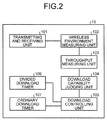
- FIG. 2 is a block diagram illustrating a functional configuration of the controlling unit 10.
- the controlling unit 10 includes a transmitting and receiving unit 101, a wireless environment measuring unit 102, a throughput measuring unit 103, a download capability judging unit 104, a download controlling unit 105, a divided download timer 106, and an ordinary download timer 107.
- These elements in the functional configuration are realized as a result of the controlling unit 10 executing the processes.
- the elements in the functional configuration input and output signals and data among one another, in one or both directions.
- the transmitting and receiving unit 101 transmits and receives data via the wireless unit 11. More specifically, under control of the download controlling unit 105, the transmitting and receiving unit 101 downloads data from another device (e.g., a server apparatus provided in a communication network such as the Internet) to which a connection is made via a wireless communication performed by the wireless unit 11.
- the download performed on the data by the transmitting and receiving unit 101 may be a divided download process or an ordinary download process.
- the divided download process is a method by which content data to be downloaded is divided into sections, so that the divided sections are downloaded in parallel to one another.
- the divided sections of content data are downloaded in parallel to one another while using a plurality of threads. For example, during the divided download process, data positions that are positioned apart from one another in the content data are each used as a download start position of a different one of the threads, so that the threads each perform a download in parallel to one another.
- the ordinary download process is a method by which content data to be downloaded is sequentially downloaded starting from the head position thereof, while using a single thread.
- the transmitting and receiving unit 101 downloads the content data to be downloaded, by performing one selected from between the ordinary download process and the divided download process.
- the transmitting and receiving unit 101 may perform one selected from between the divided download process and the ordinary download process, on each of the separated sections. For example, when downloading a piece of 100-megabyte data, the transmitting and receiving unit 101 may separate the data into sections of 10 megabytes from the head thereof and may perform one selected from between the divided download process and the ordinary download process on each of the sections.
- the wireless environment measuring unit 102 measures wireless environment of the wireless unit 11 through which the data is transmitted and received by the transmitting and receiving unit 101.
- the wireless environment may be any type of information as long as the quality of the communication line (communication line quality) through which the data is transmitted and received is indicated.
- the communication line quality may be indicated by a Received Signal Strength Indication (RSSI) value, a Signal-to-Noise Ratio (SNR) value, or the like of the wireless communication performed by the wireless unit 11.
- the wireless environment measuring unit 102 calculates an RSSI value and/or a SNR value by measuring the signal strength or the like of the wireless communication performed by the wireless unit 11, so as to measure the wireless environment of the wireless unit 11.
- the throughput measuring unit 103 measures a throughput of the data transmitted and received by the wireless communication apparatus 1 through the transmitting and receiving unit 101. It is possible to measure the throughput by counting the number of packets and the number of bytes transmitted and received by the transmitting and receiving unit 101. For example, while the transmitting and receiving unit 101 downloads data, it is possible to measure the throughput during the download, by counting the number of packets and the number of bytes that are received.
- the download capability judging unit 104 judges whether or not it is possible to complete the data download performed by the transmitting and receiving unit 101 before a timeout of the download. For example, the download capability judging unit 104 judges whether or not it is possible to complete the download before the timeout, on the basis of the data size (the data amount) of the data that has not yet been downloaded, the remaining time period before the timeout of the download, and the throughput value measured by the throughput measuring unit 103.
- the download capability judging unit 104 judges whether or not it is possible to complete the divided download process before the timeout, when a deterioration in the communication quality of the wireless unit 11 is detected on the basis of the measured result obtained by the wireless environment measuring unit 102 or the throughput measuring unit 103.
- the download capability judging unit 104 obtains how much time is remaining before the divided download process is timed out, on the basis of a timer value of the divided download timer 106. Subsequently, the download capability judging unit 104 obtains the throughput value measured by the throughput measuring unit 103 and the data size of the data that has not yet been downloaded.
- the download capability judging unit 104 calculates an expected time period indicating how long it is expected to take to complete the download, on the basis of the measured throughput value and the data size of the data that has not yet been downloaded. Further, the download capability judging unit 104 judges whether or not it is possible to complete the divided download process before the timeout, by judging whether or not the calculated expected time period is shorter than the remaining time period before the timeout.
- the download controlling unit 105 controls the execution of the ordinary download process or the divided download process performed by the transmitting and receiving unit 101. For example, the download controlling unit 105 causes the transmitting and receiving unit 101 to perform the divided download process. Further, when the download capability judging unit 104 has determined, during the execution of the divided download process, that it is impossible to complete the divided download process before the timeout, the download controlling unit 105 switches the divided download process into the ordinary download process. After having switched the divided download process into the ordinary download process, the download controlling unit 105 keeps the download performed continuously as the ordinary download process, so as to have the download of the content data completed.
- the divided download timer 106 is a timer that clocks the timeout of the download during the divided download process. For example, when the divided download process is performed by the transmitting and receiving unit 101, the download controlling unit 105 causes the divided download timer 106 to start clocking the time after the divided download process is started. After that, when the download has not been completed within a predetermined time period, the download is timed out, and the download controlling unit 105 first suspends the download performed by the transmitting and receiving unit 101, before causing the download to start again.
- the ordinary download timer 107 is a timer that clocks a timeout for a download when the ordinary download process is performed. For example, when the ordinary download process is performed by the transmitting and receiving unit 101, the download controlling unit 105 causes the ordinary download timer 107 to start clocking the time after the ordinary download process is started. After that, when the download has not been completed within a predetermined time period, the download is timed out, and the download controlling unit 105 first suspends the download performed by the transmitting and receiving unit 101, before causing the download to start again.
- mutually-different timer values may be set on the basis of a numerical value indicating the total amount of data to be downloaded, the amount of each of the pieces of data to be downloaded in parallel to one another, or the like.
- the value of X may be set to increase in stages in accordance with an increase in the total amount of data to be downloaded.
- the increment for the increase in the value X of the divided download timer 106 is arranged to be smaller than the increment for the increase in the value X of the ordinary download timer 107.
- FIG. 3 is a flowchart illustrating an operation of the wireless communication apparatus 1 according to the embodiment. More specifically, FIG. 3 is a flowchart illustrating an example of the operation performed when data is downloaded after the wireless communication apparatus 1 specifies content data to be downloaded that is stored in a server apparatus or the like.
- the download controlling unit 105 causes the transmitting and receiving unit 101 to start a divided download process (step S1) and causes the divided download timer 106 to start (start clocking) (step S2).
- start clocking start clocking
- the wireless environment measuring unit 102 measures the wireless environment of the wireless unit 11 and calculates the communication line quality (e.g., an RSSI value) (step S3).
- the throughput measuring unit 103 calculates a throughput during the download, by counting the number of packets and the number of bytes transmitted and received by the transmitting and receiving unit 101 (step S4).
- the processes at steps S3 and S4 are regularly performed (e.g., at intervals of 500 msec) during the divided download process, after the divided download process is started.
- the download capability judging unit 104 judges whether or not a communication line restriction that decreases the communication speed of the communication line via the wireless unit 11 has occurred, on the basis of the communication line quality and the throughput obtained at steps S3 and S4 (step S5). More specifically, when the value indicating the communication line quality (e.g., the RSSI value) is equal to or larger than a predetermined value, while the throughput is equal to or lower than a predetermined value, the download capability judging unit 104 determines that a communication line restriction to suppress the communication speed has occurred, due to communication control exercised on the communication carrier side.
- the value indicating the communication line quality e.g., the RSSI value
- step S5 When no communication line restriction has occurred (step S5: No), the download controlling unit 105 keeps the divided download process performed continuously by the transmitting and receiving unit 101 (step S6), and the process returns to step S3.
- the communication speed is not suppressed by communication control exercised on the communication carrier side.
- the divided download process is expected to be able to download the data at a high speed. Consequently, it is possible to download the data efficiently by keeping the divided download process performed continuously.
- step S7 the download capability judging unit 104 judges whether or not it is possible to complete the divided download process performed by the transmitting and receiving unit 101 before a timeout. More specifically, the download capability judging unit 104 judges whether or not it is possible to complete the divided download process before the timeout, on the basis of the remaining time period of the divided download timer 106, the measured throughput value, and the size of the data that has not yet been downloaded.
- the download controlling unit 105 keeps the divided download process performed continuously by the transmitting and receiving unit 101 (step S8).
- the divided download process keeps being performed continuously on the sections currently being downloaded.
- the download controlling unit 105 judges whether there is any section data from the content data that has not yet been downloaded (step S9). For example, when a large volume of data is downloaded while being separated into sections from the head thereof, the download controlling unit 105 judges, at step S9, whether there is any section that has not yet been downloaded.
- step S9: No the download controlling unit 105 determines that the download is completed and ends the process.
- step S9: Yes the download controlling unit 105 causes the download performed by the transmitting and receiving unit 101 to transition into an ordinary download process (step S10). Accordingly, the transmitting and receiving unit 101 downloads the remaining section data, by performing an ordinary download process (step S11).
- the divided download process is not expected to be able to download the data at a high speed. Accordingly, by downloading the remaining section data by performing the ordinary download process, it is possible to download the data efficiently without causing wasteful overhead from multiple threads.
- step S7 When it is determined to be impossible to complete the divided download process before the timeout (step S7: No), the download controlling unit 105 disconnects the socket for the communication of the current download, so as to suspend the divided download process performed by the transmitting and receiving unit 101 (step S12). Subsequently, the download controlling unit 105 causes the transmitting and receiving unit 101 to start an ordinary download process (step S13). Accordingly, as for the data remaining after the point in time at which the download was suspended, the transmitting and receiving unit 101 downloads the data by performing the ordinary download process (step S11).
- FIG. 4 is a flowchart illustrating another operation of the wireless communication apparatus 1 according to the embodiment and is a flowchart to explain a modification example of the operation illustrated in FIG. 3 .
- the download capability judging unit 104 judges whether or not a deterioration in the communication quality has occurred in the wireless communication performed by the wireless unit 11, on the basis of the communication line quality or the throughput obtained at steps S3 and S4 (step S5a).
- the download capability judging unit 104 determines that a deterioration in the communication quality has occurred.
- the download capability judging unit 104 determines that a deterioration in the communication quality has occurred.
- the judgment on the deterioration in the communication quality may be made by using at least one selected from between the communication line quality and the throughput.
- step S5a When no deterioration has occurred in the communication quality (step S5a: No), the download controlling unit 105 keeps the divided download process performed continuously by the transmitting and receiving unit 101 (step S6), and the process returns to step S3.
- step S6 When no deterioration has occurred in the communication quality, it is presumed that the communication speed has not decreased. The divided download process is therefore expected to be able to download the data at a high speed. Consequently, it is possible to download the data efficiently, by keeping the divided download process performed continuously.
- step S5a When a deterioration in the communication quality has occurred (step S5a: Yes), because it is presumed that the communication speed has decreased and because the divided download process is not expected to be able to download the data at a high speed, the download capability judging unit 104 performs the process at step S7 and thereafter described above. With these arrangements, even when the deterioration has occurred in the communication quality during the divided download process, it is possible to download the data efficiently, by switching the divided download process into the ordinary download process.
- FIG. 5 is a drawing for explaining an example of a divided download process.
- a divided download process is performed while using eight threads (step S100).
- step S102 when a timeout occurs according to the divided download timer 106, the pieces of data in the sections that are not continuous from the head are discarded (step S103).
- step S104 the download is suspended for a predetermined period of time (e.g., five minutes) (step S104).
- the download is resumed, starting with a continuation of the data continuous from the head (step S105).
- the download is started from the beginning. Consequently, when the download is continued even after the download is timed out due to a deterioration in the communication quality or the like, the efficiency of the download is lowered because some data is discarded every time a timeout occurs.
- the download capability judging unit 104 included in the wireless communication apparatus 1 judges whether it is possible to complete the download before the timeout of the divided download process. Further, when it is determined to be impossible to complete the download before the timeout of the divided download process, the download controlling unit 105 switches the divided download process into the ordinary download process. For this reason, when the divided download process is timed out due to a deterioration in the communication quality or the like, the wireless communication apparatus 1 is able to realize an efficient download by switching the divided download process, which is expected to degrade the download efficiency, to the ordinary download process.
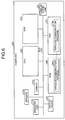
- FIG. 6 is a drawing for explaining an example of a computer that executes a wireless communication program 270a.
- a computer 200 includes an operating unit 210a, a speaker 210b, a camera 210c, a display device 220, and a communicating unit 230. Further, the computer 200 includes a Central Processing Unit (CPU) 250, a ROM 260, a Hard Disk Drive (HDD) 270, and a RAM 280. These functional units 210 to 280 are connected together via a bus 240.
- CPU Central Processing Unit
- ROM 260 Read Only Disk Drive
- HDD Hard Disk Drive
- the HDD 270 stores therein, in advance, the wireless communication program 270a that realizes the same functions as those of the transmitting and receiving unit 101, the wireless environment measuring unit 102, the throughput measuring unit 103, the download capability judging unit 104, the download controlling unit 105, the divided download timer 106, and the ordinary download timer 107 described in the embodiments above.
- the wireless communication program 270a may be integrated or separated as appropriate, similarly to the constituent elements such as the transmitting and receiving unit 101, the wireless environment measuring unit 102, the throughput measuring unit 103, the download capability judging unit 104, the download controlling unit 105, the divided download timer 106, and the ordinary download timer 107.
- all of the data does not necessarily have to be stored in the HDD 270 at all times. It is acceptable to arrange only the data needed in each process to be stored in the HDD 270.
- the CPU 250 reads the wireless communication program 270a from the HDD 270 and loads the read program into the RAM 280.
- the wireless communication program 270a functions as a wireless communication process 280a.
- the wireless communication process 280a loads, as appropriate, various types of data read from the HDD 270 into such a region of the RAM 280 that is assigned thereto and executes various types of processes on the basis of the various types of loaded data.
- the wireless communication process 280a includes processes performed by the transmitting and receiving unit 101, the wireless environment measuring unit 102, the throughput measuring unit 103, the download capability judging unit 104, the download controlling unit 105, the divided download timer 106, and the ordinary download timer 107.
- all of the processing units do not necessarily have to be in operation in the CPU 250 at all times. It is acceptable to arrange only the processing units needed in each process to be virtually realized.
- the wireless communication program 270a described above does not necessarily have to be stored in the HDD 270 or the ROM 260 from the beginning.
- a "portable physical medium” such as a flexible disk, a so-called Floppy Disk (FD), a Compact Disk Read-Only Memory (CD-ROM), a Digital Versatile Disk (DVD), a magneto-optical disk, an Integrated Circuit (IC) card, or the like, that can be inserted into the computer 200.
- the computer 200 may obtain and execute the programs from any of the portable physical media.
- a public circuit the Internet, a Local Area Network (LAN), a Wide Area Network (WAN), or the like.
- LAN Local Area Network
- WAN Wide Area Network
- the invention also provides a computer program or a computer program product for carrying out any of the methods described herein, and a computer readable medium having stored thereon a program for carrying out any of the methods described herein.
- a computer program embodying the invention may be stored on a computer-readable medium, or it could, for example, be in the form of a signal such as a downloadable data signal provided from an Internet website, or it could be in any other form.
Landscapes
- Engineering & Computer Science (AREA)
- Computer Networks & Wireless Communication (AREA)
- Signal Processing (AREA)
- Computer Security & Cryptography (AREA)
- Mobile Radio Communication Systems (AREA)
Abstract
Description
- The embodiment discussed herein is related to a wireless communication apparatus, a wireless communication computer program, and a wireless communication method.
- In recent years, various techniques have been developed in the field of wireless communications, in order to efficiently utilize limited wireless resources between mobile stations and base stations. Examples of such techniques include a divided download method by which data is divided into sections so that the divided sections can be downloaded at the same time. According to the divided download method, communication resources are efficiently utilized by downloading the divided sections of data at the same time. Compared to other methods by which data is downloaded without being divided into sections, the divided download method is able to realize a data communication at a higher speed.
Patent Document 1: International Publication Pamphlet No.WO 2009/142059 - According to the conventional technique described above, however, a problem arises where, when a deterioration has occurred in the communication quality during the download of the data, the progress of the download is worse than when using a method by which the data is downloaded without being divided into sections.
- For example, when a deterioration in the communication quality has occurred during the download of the data due to a degradation of the communication environment or a restriction imposed on the communication volume, the throughput may decrease and the download may be timed out without being completed. When the download is timed out, according to a method by which the data is downloaded without being divided into sections, the download is resumed starting with a continuation of the data that had been downloaded before the timeout. In contrast, when the divided download method is used, the download is resumed starting with a continuation of the section of data continuous from the head among the sections of data that had been downloaded, and the other sections of data that are not continuous from the head are discarded. As explained herein, according to the divided download method, some data is discarded when the timeout occurs due to the deterioration in the communication quality. Consequently, the efficiency of the download is lower than when using a method by which the data is downloaded without being divided into sections.
- Accordingly, it is desirable to provide a wireless communication apparatus, a wireless communication computer program, and a wireless communication method that are able to download data efficiently.
- The invention is defined by the claims, to which reference should now be made.
- According to an aspect of an embodiment, a wireless communication apparatus includes: a communicating unit that performs one selected from between a first download process that downloads data through a wireless communication by dividing the data into sections while using a plurality of threads and a second download process that downloads the data while using a single thread; a measuring unit that measures communication quality of the wireless communication; a judging unit that, when a deterioration in the communication quality is measured during the first download process, judges whether or not it is possible to complete the download in all of the plurality of threads before a timeout; and a controlling unit that, when it is determined to be impossible to complete the download in all of the plurality of threads before the timeout, switches the first download process into the second download process.
- Embodiments of the invention are set out, by way of example only, with reference to the following drawings, in which:
-
FIG. 1 is a block diagram illustrating a hardware configuration of a wireless communication apparatus according to an embodiment; -
FIG. 2 is a block diagram illustrating a functional configuration of a controlling unit; -
FIG. 3 is a flowchart illustrating an operation of the wireless communication apparatus according to the embodiment; -
FIG. 4 is a flowchart illustrating another operation of the wireless communication apparatus according to the embodiment; -
FIG. 5 is a drawing for explaining an example of a divided download process; and -
FIG. 6 is a drawing for explaining an example of a computer that executes a wireless communication computer program. - Preferred embodiments of the present invention will be explained with reference to accompanying drawings. In the description of the embodiments, some of the elements that have mutually-the same functions will be referred to by using the same reference characters, and duplicate explanations thereof will be omitted. Further, the wireless communication apparatus, the wireless communication program, and the wireless communication method explained in the embodiments below are merely examples and are not intended to limit possible embodiments. Further, it is also acceptable to combine any of the embodiments described below as appropriate, as long as no conflict arises therebetween.
-
FIG. 1 is a block diagram illustrating a hardware configuration of awireless communication apparatus 1 according to an embodiment. As illustrated inFIG. 1 , thewireless communication apparatus 1 includes a controlling unit 10, awireless unit 11, an audio input/output unit 12, astorage unit 13, anoperating unit 14, and adisplay unit 15. For example, thewireless communication apparatus 1 may be a personal computer, a smartphone, a tablet-type terminal, or the like. - The controlling unit 10 is a processing unit that controls processes in the entirety of the
wireless communication apparatus 1. The controlling unit 10 reads a computer program (hereinafter, "program") from thestorage unit 13 and executes processes. For example, the controlling unit 10 realizes the functional configuration illustrated inFIG. 2 and performs the processes explained with reference toFIG. 3 and so forth, by executing the processes. - Under the control of the controlling unit 10, the
wireless unit 11 wirelessly communicates with another mobile apparatus or a base station apparatus, by using anantenna 11a. More specifically, thewireless unit 11 wirelessly communicates with another mobile apparatus or a base station apparatus by using a communication method such as a Long Term Evolution (LTE) communication method or a Wireless Fidelity (WiFi; a registered trademark) communication method. Although the present embodiment is described as thewireless unit 11 performing the communication via a communication carrier by using the LTE communication method, it is also acceptable to improve the communication speed of the wireless communication by using a plurality of communication methods at the same time. - The audio input/
output unit 12 outputs audio that is input thereto from the controlling unit 10, through aspeaker 12a. Further, the audio input/output unit 12 collects audio through amicrophone 12b and outputs the collected audio to the controlling unit 10. - The
storage unit 13 is a storage device such as a memory, a hard disk, or the like. Thestorage unit 13 includes, for example, a Read-Only Memory (ROM) 13a and a Random Access Memory (RAM) 13b. TheROM 13a stores therein the program executed by the controlling unit 10 and various types of data. TheRAM 13b provides a working space used when the controlling unit 10 executes the program. More specifically, theRAM 13b stores therein processing results, various types of tables, and the like generated by the program executed by the controlling unit 10 and the like. - The
operating unit 14 is configured by using a keyboard, a touch panel and/or the like, receives various types of inputs from a user, and outputs the received inputs to the controlling unit 10. Thedisplay unit 15 is configured by using a liquid crystal display device or the like and displays various type of information under the control of the controlling unit 10. -
FIG. 2 is a block diagram illustrating a functional configuration of the controlling unit 10. As illustrated inFIG. 2 , the controlling unit 10 includes a transmitting and receivingunit 101, a wirelessenvironment measuring unit 102, athroughput measuring unit 103, a downloadcapability judging unit 104, adownload controlling unit 105, a divideddownload timer 106, and anordinary download timer 107. These elements in the functional configuration are realized as a result of the controlling unit 10 executing the processes. The elements in the functional configuration input and output signals and data among one another, in one or both directions. - The transmitting and receiving
unit 101 transmits and receives data via thewireless unit 11. More specifically, under control of thedownload controlling unit 105, the transmitting and receivingunit 101 downloads data from another device (e.g., a server apparatus provided in a communication network such as the Internet) to which a connection is made via a wireless communication performed by thewireless unit 11. The download performed on the data by the transmitting and receivingunit 101 may be a divided download process or an ordinary download process. - The divided download process is a method by which content data to be downloaded is divided into sections, so that the divided sections are downloaded in parallel to one another. The divided sections of content data are downloaded in parallel to one another while using a plurality of threads. For example, during the divided download process, data positions that are positioned apart from one another in the content data are each used as a download start position of a different one of the threads, so that the threads each perform a download in parallel to one another.
- The ordinary download process is a method by which content data to be downloaded is sequentially downloaded starting from the head position thereof, while using a single thread. Under the control of the
download controlling unit 105, the transmitting and receivingunit 101 downloads the content data to be downloaded, by performing one selected from between the ordinary download process and the divided download process. - Further, when downloading a large volume of data by separating the data starting from the head thereof, the transmitting and receiving
unit 101 may perform one selected from between the divided download process and the ordinary download process, on each of the separated sections. For example, when downloading a piece of 100-megabyte data, the transmitting and receivingunit 101 may separate the data into sections of 10 megabytes from the head thereof and may perform one selected from between the divided download process and the ordinary download process on each of the sections. - The wireless
environment measuring unit 102 measures wireless environment of thewireless unit 11 through which the data is transmitted and received by the transmitting and receivingunit 101. The wireless environment may be any type of information as long as the quality of the communication line (communication line quality) through which the data is transmitted and received is indicated. For example, the communication line quality may be indicated by a Received Signal Strength Indication (RSSI) value, a Signal-to-Noise Ratio (SNR) value, or the like of the wireless communication performed by thewireless unit 11. The wirelessenvironment measuring unit 102 calculates an RSSI value and/or a SNR value by measuring the signal strength or the like of the wireless communication performed by thewireless unit 11, so as to measure the wireless environment of thewireless unit 11. - The
throughput measuring unit 103 measures a throughput of the data transmitted and received by thewireless communication apparatus 1 through the transmitting and receivingunit 101. It is possible to measure the throughput by counting the number of packets and the number of bytes transmitted and received by the transmitting and receivingunit 101. For example, while the transmitting and receivingunit 101 downloads data, it is possible to measure the throughput during the download, by counting the number of packets and the number of bytes that are received. - The download
capability judging unit 104 judges whether or not it is possible to complete the data download performed by the transmitting and receivingunit 101 before a timeout of the download. For example, the downloadcapability judging unit 104 judges whether or not it is possible to complete the download before the timeout, on the basis of the data size (the data amount) of the data that has not yet been downloaded, the remaining time period before the timeout of the download, and the throughput value measured by thethroughput measuring unit 103. - More specifically, during a divided download process, the download
capability judging unit 104 judges whether or not it is possible to complete the divided download process before the timeout, when a deterioration in the communication quality of thewireless unit 11 is detected on the basis of the measured result obtained by the wirelessenvironment measuring unit 102 or thethroughput measuring unit 103. - For example, let us discuss an example in which, while the transmitting and receiving
unit 101 is performing a divided download process, a deterioration in the communication quality is detected on the basis of the measured result obtained by the wirelessenvironment measuring unit 102 or the throughput measuring unit 103 (details will be explained later). In that situation, the downloadcapability judging unit 104 obtains how much time is remaining before the divided download process is timed out, on the basis of a timer value of the divideddownload timer 106. Subsequently, the downloadcapability judging unit 104 obtains the throughput value measured by thethroughput measuring unit 103 and the data size of the data that has not yet been downloaded. After that, the downloadcapability judging unit 104 calculates an expected time period indicating how long it is expected to take to complete the download, on the basis of the measured throughput value and the data size of the data that has not yet been downloaded. Further, the downloadcapability judging unit 104 judges whether or not it is possible to complete the divided download process before the timeout, by judging whether or not the calculated expected time period is shorter than the remaining time period before the timeout. - The
download controlling unit 105 controls the execution of the ordinary download process or the divided download process performed by the transmitting and receivingunit 101. For example, thedownload controlling unit 105 causes the transmitting and receivingunit 101 to perform the divided download process. Further, when the downloadcapability judging unit 104 has determined, during the execution of the divided download process, that it is impossible to complete the divided download process before the timeout, thedownload controlling unit 105 switches the divided download process into the ordinary download process. After having switched the divided download process into the ordinary download process, thedownload controlling unit 105 keeps the download performed continuously as the ordinary download process, so as to have the download of the content data completed. - The divided
download timer 106 is a timer that clocks the timeout of the download during the divided download process. For example, when the divided download process is performed by the transmitting and receivingunit 101, thedownload controlling unit 105 causes the divideddownload timer 106 to start clocking the time after the divided download process is started. After that, when the download has not been completed within a predetermined time period, the download is timed out, and thedownload controlling unit 105 first suspends the download performed by the transmitting and receivingunit 101, before causing the download to start again. - The
ordinary download timer 107 is a timer that clocks a timeout for a download when the ordinary download process is performed. For example, when the ordinary download process is performed by the transmitting and receivingunit 101, thedownload controlling unit 105 causes theordinary download timer 107 to start clocking the time after the ordinary download process is started. After that, when the download has not been completed within a predetermined time period, the download is timed out, and thedownload controlling unit 105 first suspends the download performed by the transmitting and receivingunit 101, before causing the download to start again. - The timer values of the divided
download timer 106 and theordinary download timer 107 are managed as, for example, X seconds (e.g., twelve seconds) x the number of times of retry attempts Y (e.g., five times). For example, when the timer value is set as X=12 (seconds) and Y=5 (times), when the download has not been completed within twelve seconds, the retry attempt is made five times before the download is timed out. Thus, the time period from the start of the download to the timeout is 60 seconds. - As for the timer values of the divided
download timer 106 and theordinary download timer 107, mutually-different timer values may be set on the basis of a numerical value indicating the total amount of data to be downloaded, the amount of each of the pieces of data to be downloaded in parallel to one another, or the like. For example, the value of X may be set to increase in stages in accordance with an increase in the total amount of data to be downloaded. In that situation, because it is assumed that the divided download process takes a shorter period of time than the ordinary download process, the increment for the increase in the value X of the divideddownload timer 106 is arranged to be smaller than the increment for the increase in the value X of theordinary download timer 107. As explained herein, it is acceptable to set the mutually-different timer values for the timeout of the divided download process and the timeout of the ordinary download process, in correspondence with the mutually-different download methods. -
FIG. 3 is a flowchart illustrating an operation of thewireless communication apparatus 1 according to the embodiment. More specifically,FIG. 3 is a flowchart illustrating an example of the operation performed when data is downloaded after thewireless communication apparatus 1 specifies content data to be downloaded that is stored in a server apparatus or the like. - As illustrated in
FIG. 3 , when a process is started, thedownload controlling unit 105 causes the transmitting and receivingunit 101 to start a divided download process (step S1) and causes the divideddownload timer 106 to start (start clocking) (step S2). In this situation, it is acceptable to have the divided download process started at the beginning of the download of the content data. Alternatively, it is also acceptable to have an ordinary download process started at the beginning, so as to have a divided download process started some time during the download. - After the divided download process is started, the wireless
environment measuring unit 102 measures the wireless environment of thewireless unit 11 and calculates the communication line quality (e.g., an RSSI value) (step S3). Subsequently, thethroughput measuring unit 103 calculates a throughput during the download, by counting the number of packets and the number of bytes transmitted and received by the transmitting and receiving unit 101 (step S4). The processes at steps S3 and S4 are regularly performed (e.g., at intervals of 500 msec) during the divided download process, after the divided download process is started. - After that, the download
capability judging unit 104 judges whether or not a communication line restriction that decreases the communication speed of the communication line via thewireless unit 11 has occurred, on the basis of the communication line quality and the throughput obtained at steps S3 and S4 (step S5). More specifically, when the value indicating the communication line quality (e.g., the RSSI value) is equal to or larger than a predetermined value, while the throughput is equal to or lower than a predetermined value, the downloadcapability judging unit 104 determines that a communication line restriction to suppress the communication speed has occurred, due to communication control exercised on the communication carrier side. - When no communication line restriction has occurred (step S5: No), the
download controlling unit 105 keeps the divided download process performed continuously by the transmitting and receiving unit 101 (step S6), and the process returns to step S3. When no communication line restriction has occurred, the communication speed is not suppressed by communication control exercised on the communication carrier side. Thus, because the throughput has not been lowered, the divided download process is expected to be able to download the data at a high speed. Consequently, it is possible to download the data efficiently by keeping the divided download process performed continuously. - When a communication line restriction has occurred (step S5: Yes), the download
capability judging unit 104 judges whether or not it is possible to complete the divided download process performed by the transmitting and receivingunit 101 before a timeout (step S7). More specifically, the downloadcapability judging unit 104 judges whether or not it is possible to complete the divided download process before the timeout, on the basis of the remaining time period of the divideddownload timer 106, the measured throughput value, and the size of the data that has not yet been downloaded. - When it has been determined that it is possible to complete the divided download process before the timeout (step S7: Yes), the
download controlling unit 105 keeps the divided download process performed continuously by the transmitting and receiving unit 101 (step S8). As a result, for example, when a large volume of data is downloaded while being separated into sections from the head thereof, the divided download process keeps being performed continuously on the sections currently being downloaded. - Subsequently, the
download controlling unit 105 judges whether there is any section data from the content data that has not yet been downloaded (step S9). For example, when a large volume of data is downloaded while being separated into sections from the head thereof, thedownload controlling unit 105 judges, at step S9, whether there is any section that has not yet been downloaded. - When there is no section data that has not yet been downloaded (step S9: No) the
download controlling unit 105 determines that the download is completed and ends the process. On the contrary, when there is section data that has not yet been downloaded (step S9: Yes), thedownload controlling unit 105 causes the download performed by the transmitting and receivingunit 101 to transition into an ordinary download process (step S10). Accordingly, the transmitting and receivingunit 101 downloads the remaining section data, by performing an ordinary download process (step S11). - When a communication line restriction has occurred and the throughput is decreased, the divided download process is not expected to be able to download the data at a high speed. Accordingly, by downloading the remaining section data by performing the ordinary download process, it is possible to download the data efficiently without causing wasteful overhead from multiple threads.
- When it is determined to be impossible to complete the divided download process before the timeout (step S7: No), the
download controlling unit 105 disconnects the socket for the communication of the current download, so as to suspend the divided download process performed by the transmitting and receiving unit 101 (step S12). Subsequently, thedownload controlling unit 105 causes the transmitting and receivingunit 101 to start an ordinary download process (step S13). Accordingly, as for the data remaining after the point in time at which the download was suspended, the transmitting and receivingunit 101 downloads the data by performing the ordinary download process (step S11). - As explained above, when it is determined to be impossible to complete the divided download process before the timeout, it is possible to download the data efficiently by switching the divided download process into the ordinary download process promptly without waiting for the timeout of the divided download process.
-
FIG. 4 is a flowchart illustrating another operation of thewireless communication apparatus 1 according to the embodiment and is a flowchart to explain a modification example of the operation illustrated inFIG. 3 . - As illustrated in
FIG. 4 , according to the present modification example, the downloadcapability judging unit 104 judges whether or not a deterioration in the communication quality has occurred in the wireless communication performed by thewireless unit 11, on the basis of the communication line quality or the throughput obtained at steps S3 and S4 (step S5a). - For example, when a value indicating the communication line quality (e.g., the RSSI value) is equal to or smaller than a predetermined value, the download
capability judging unit 104 determines that a deterioration in the communication quality has occurred. Similarly, when the throughput is equal to or lower than a predetermined value, the downloadcapability judging unit 104 determines that a deterioration in the communication quality has occurred. The judgment on the deterioration in the communication quality may be made by using at least one selected from between the communication line quality and the throughput. - When no deterioration has occurred in the communication quality (step S5a: No), the
download controlling unit 105 keeps the divided download process performed continuously by the transmitting and receiving unit 101 (step S6), and the process returns to step S3. When no deterioration has occurred in the communication quality, it is presumed that the communication speed has not decreased. The divided download process is therefore expected to be able to download the data at a high speed. Consequently, it is possible to download the data efficiently, by keeping the divided download process performed continuously. - When a deterioration in the communication quality has occurred (step S5a: Yes), because it is presumed that the communication speed has decreased and because the divided download process is not expected to be able to download the data at a high speed, the download
capability judging unit 104 performs the process at step S7 and thereafter described above. With these arrangements, even when the deterioration has occurred in the communication quality during the divided download process, it is possible to download the data efficiently, by switching the divided download process into the ordinary download process. -
FIG. 5 is a drawing for explaining an example of a divided download process. In the example illustrated inFIG. 5 , with respect to data D10, which is data to be downloaded, a divided download process is performed while using eight threads (step S100). During the divided download process (step S102), when a timeout occurs according to the divideddownload timer 106, the pieces of data in the sections that are not continuous from the head are discarded (step S103). Subsequently, the data in the section continuous from the head is determined to be valid, and the download is suspended for a predetermined period of time (e.g., five minutes) (step S104). After that, when the divided download process is continued, the download is resumed, starting with a continuation of the data continuous from the head (step S105). As for the sections that are not continuous from the head, the download is started from the beginning. Consequently, when the download is continued even after the download is timed out due to a deterioration in the communication quality or the like, the efficiency of the download is lowered because some data is discarded every time a timeout occurs. - In contrast, when a deterioration in the communication quality is measured during a divided download process, the download
capability judging unit 104 included in thewireless communication apparatus 1 judges whether it is possible to complete the download before the timeout of the divided download process. Further, when it is determined to be impossible to complete the download before the timeout of the divided download process, thedownload controlling unit 105 switches the divided download process into the ordinary download process. For this reason, when the divided download process is timed out due to a deterioration in the communication quality or the like, thewireless communication apparatus 1 is able to realize an efficient download by switching the divided download process, which is expected to degrade the download efficiency, to the ordinary download process. - The constituent elements of the apparatuses illustrated in the drawings do not necessarily have to physically be configured as indicated in the drawings. In other words, the specific modes of distribution and integration of the apparatuses are not limited to those illustrated in the drawings. It is acceptable to functionally or physically distribute or integrate all or a part of the apparatuses in any arbitrary units, depending on various loads and the status of use.
- Further, the various types of processes described in the embodiments above may be realized by causing a computer such as a personal computer or a workstation to execute a program prepared in advance. Accordingly, an example of a computer that executes a wireless communication program having the same functions as those described in the embodiments above will be explained below, with reference to
FIG. 6 . -
FIG. 6 is a drawing for explaining an example of a computer that executes awireless communication program 270a. As illustrated inFIG. 6 , acomputer 200 includes anoperating unit 210a, aspeaker 210b, acamera 210c, adisplay device 220, and a communicatingunit 230. Further, thecomputer 200 includes a Central Processing Unit (CPU) 250, aROM 260, a Hard Disk Drive (HDD) 270, and aRAM 280. Thesefunctional units 210 to 280 are connected together via abus 240. - The
HDD 270 stores therein, in advance, thewireless communication program 270a that realizes the same functions as those of the transmitting and receivingunit 101, the wirelessenvironment measuring unit 102, thethroughput measuring unit 103, the downloadcapability judging unit 104, thedownload controlling unit 105, the divideddownload timer 106, and theordinary download timer 107 described in the embodiments above. Thewireless communication program 270a may be integrated or separated as appropriate, similarly to the constituent elements such as the transmitting and receivingunit 101, the wirelessenvironment measuring unit 102, thethroughput measuring unit 103, the downloadcapability judging unit 104, thedownload controlling unit 105, the divideddownload timer 106, and theordinary download timer 107. For example, as for the data stored in theHDD 270, all of the data does not necessarily have to be stored in theHDD 270 at all times. It is acceptable to arrange only the data needed in each process to be stored in theHDD 270. - In the
computer 200, theCPU 250 reads thewireless communication program 270a from theHDD 270 and loads the read program into theRAM 280. As a result, thewireless communication program 270a functions as awireless communication process 280a. Thewireless communication process 280a loads, as appropriate, various types of data read from theHDD 270 into such a region of theRAM 280 that is assigned thereto and executes various types of processes on the basis of the various types of loaded data. In this situation, thewireless communication process 280a includes processes performed by the transmitting and receivingunit 101, the wirelessenvironment measuring unit 102, thethroughput measuring unit 103, the downloadcapability judging unit 104, thedownload controlling unit 105, the divideddownload timer 106, and theordinary download timer 107. Further, as for the processing units that are virtually realized in theCPU 250, all of the processing units do not necessarily have to be in operation in theCPU 250 at all times. It is acceptable to arrange only the processing units needed in each process to be virtually realized. - Further, the
wireless communication program 270a described above does not necessarily have to be stored in theHDD 270 or theROM 260 from the beginning. For example, it is acceptable to store programs in a "portable physical medium" such as a flexible disk, a so-called Floppy Disk (FD), a Compact Disk Read-Only Memory (CD-ROM), a Digital Versatile Disk (DVD), a magneto-optical disk, an Integrated Circuit (IC) card, or the like, that can be inserted into thecomputer 200. Further, thecomputer 200 may obtain and execute the programs from any of the portable physical media. Alternatively, it is also acceptable to store the programs in another computer or a server apparatus that is connected to thecomputer 200 via a public circuit, the Internet, a Local Area Network (LAN), a Wide Area Network (WAN), or the like, so that thecomputer 200 obtains and executes the programs from the stored location. - According to at least one aspect of the embodiments of the present disclosure, it is possible to download the data efficiently.
- In any of the above aspects, the various features may be implemented in hardware, or as software modules running on one or more processors. Features of one aspect may be applied to any of the other aspects.
- The invention also provides a computer program or a computer program product for carrying out any of the methods described herein, and a computer readable medium having stored thereon a program for carrying out any of the methods described herein. A computer program embodying the invention may be stored on a computer-readable medium, or it could, for example, be in the form of a signal such as a downloadable data signal provided from an Internet website, or it could be in any other form.
Claims (15)
- A wireless communication apparatus comprising:a communicating unit(101) that performs one selected from between a first download process that downloads data through a wireless communication by dividing the data into sections while using a plurality of threads and a second download process that downloads the data while using a single thread;a measuring unit(102,103) that measures communication quality of the wireless communication;a judging unit(104) that, when a deterioration in the communication quality is measured during the first download process, judges whether or not it is possible to complete the download in all of the plurality of threads before a timeout of the download; anda controlling unit(105) that, when it is determined to be impossible to complete the download in all of the plurality of threads before the timeout, switches the first download process into the second download process.
- The wireless communication apparatus according to claim 1, wherein, when the deterioration in the communication quality is measured during the first download process, the judging unit(104) judges, on a basis of a remaining time period before the timeout, whether or not it is possible to complete the download in all of the plurality of threads within the remaining time period.
- The wireless communication apparatus according to claim 1 or 2, wherein a timer value of a timer clocking the timeout is different for the first download process and for the second download process.
- The wireless communication apparatus according to any of claims 1 to 3, wherein
the measuring unit(102,103) measures a value indicating at least one selected from between communication line quality and a throughput of the wireless communication, and
when the value indicating at least one selected from between the communication line quality and the throughput and being measured during the first download process is equal to or smaller than a predetermined value, the judging unit(104) judges whether or not it is possible to complete the download in all of the plurality of threads before the timeout of the download. - The wireless communication apparatus according to any of claims 1 to 4, wherein
the measuring unit(102,103) measures a value indicating communication line quality of the wireless communication and a value indicating a throughput of the wireless communication, and
when the value indicating the communication line quality and being measured during the first download process is equal to or larger than a predetermined value while the measured value indicating the throughput is equal to or smaller than a predetermined value, the judging unit(104) judges whether or not it is possible to complete the download in all of the plurality of threads before the timeout of the download. - A wireless communication computer program (270a) that causes a computer to execute a process comprising:performing one selected from between a first download process that downloads data through a wireless communication by dividing the data into sections while using a plurality of threads and a second download process that downloads the data while using a single thread;measuring communication quality of the wireless communication;judging, when a deterioration in the communication quality is measured during the first download process, whether or not it is possible to complete the download in all of the plurality of threads before a timeout of the download; andswitching the first download process into the second download process, when it is determined to be impossible to complete the download in all of the plurality of threads before the timeout.
- The wireless communication computer program (270a) according to claim 6, wherein, when the deterioration in the communication quality is measured during the first download process, the judging includes judging on a basis of a remaining time period before the timeout, whether or not it is possible to complete the download in all of the plurality of threads within the remaining time period.
- The wireless communication computer program (270a) according to claim 6 or 7, wherein a timer value of a timer clocking the timeout is different for the first download process and for the second download process.
- The wireless communication computer program (270a) according to any of claims 6 to 8, wherein
the measuring includes measuring a value indicating at least one selected from between communication line quality and a throughput of the wireless communication, and
when the value indicating at least one selected from between the communication line quality and the throughput and being measured during the first download process is equal to or smaller than a predetermined value, the judging includes judging whether or not it is possible to complete the download in all of the plurality of threads before the timeout of the download. - The wireless communication computer program (270a) according to any of claims 6 to 9, wherein
the measuring includes measuring a value indicating communication line quality of the wireless communication and a value indicating a throughput of the wireless communication, and
when the value indicating the communication line quality and being measured during the first download process is equal to or larger than a predetermined value while the measured value indicating the throughput is equal to or smaller than a predetermined value, the judging includes judging whether or not it is possible to complete the download in all of the plurality of threads before the timeout of the download. - A wireless communication method comprising:performing one selected from between a first download process that downloads data through a wireless communication by dividing the data into sections while using a plurality of threads and a second download process that downloads the data while using a single thread;measuring communication quality of the wireless communication;judging, when a deterioration in the communication quality is measured during the first download process, whether or not it is possible to complete the download in all of the plurality of threads before a timeout of the download; andswitching the first download process into the second download process, when it is determined to be impossible to complete the download in all of the plurality of threads before the timeout.
- The wireless communication method according to claim 11, wherein, when the deterioration in the communication quality is measured during the first download process, the judging includes judging on a basis of a remaining time period before the timeout, whether or not it is possible to complete the download in all of the plurality of threads within the remaining time period.
- The wireless communication method according to claim 11 or 12, wherein a timer value of a timer clocking the timeout is different for the first download process and for the second download process.
- The wireless communication method according to any of claims 11 to 13, wherein
the measuring includes measuring a value indicating at least one selected from between communication line quality and a throughput of the wireless communication, and
when the value indicating at least one selected from between the communication line quality and the throughput and being measured during the first download process is equal to or smaller than a predetermined value, the judging includes judging whether or not it is possible to complete the download in all of the plurality of threads before the timeout of the download. - The wireless communication method according to any of claims 11 to 14, wherein
the measuring includes measuring a value indicating communication line quality of the wireless communication and a value indicating a throughput of the wireless communication, and
when the value indicating the communication line quality and being measured during the first download process is equal to or larger than a predetermined value while the measured value indicating the throughput is equal to or smaller than a predetermined value, the judging includes judging whether or not it is possible to complete the download in all of the plurality of threads before the timeout of the download.
Applications Claiming Priority (1)
| Application Number | Priority Date | Filing Date | Title |
|---|---|---|---|
| JP2015076343A JP6485173B2 (en) | 2015-04-02 | 2015-04-02 | Wireless communication apparatus, wireless communication program, and wireless communication method |
Publications (1)
| Publication Number | Publication Date |
|---|---|
| EP3076704A1 true EP3076704A1 (en) | 2016-10-05 |
Family
ID=55527323
Family Applications (1)
| Application Number | Title | Priority Date | Filing Date |
|---|---|---|---|
| EP16159255.5A Withdrawn EP3076704A1 (en) | 2015-04-02 | 2016-03-08 | Wireless communication apparatus, wireless communication computer program, and wireless communication method |
Country Status (3)
| Country | Link |
|---|---|
| US (1) | US10448442B2 (en) |
| EP (1) | EP3076704A1 (en) |
| JP (1) | JP6485173B2 (en) |
Families Citing this family (2)
| Publication number | Priority date | Publication date | Assignee | Title |
|---|---|---|---|---|
| JP7195802B2 (en) * | 2018-07-31 | 2022-12-26 | キヤノン株式会社 | Information processing method, information processing system, and communication device |
| US11570496B2 (en) * | 2020-12-03 | 2023-01-31 | Hulu, LLC | Concurrent downloading of video |
Citations (4)
| Publication number | Priority date | Publication date | Assignee | Title |
|---|---|---|---|---|
| EP1901499A1 (en) * | 2006-09-14 | 2008-03-19 | Fujitsu Ltd. | Mobile communication system and communication method thereof |
| WO2009142059A1 (en) | 2008-05-20 | 2009-11-26 | シャープ株式会社 | Electronic data transmission/reception system |
| WO2014060927A2 (en) * | 2012-10-18 | 2014-04-24 | Giraffic Technologies Ltd. | A congestion control method for dynamically maximizing communication link throughput |
| US20140143431A1 (en) * | 2012-11-21 | 2014-05-22 | Netflix, Inc. | Multi-cdn digital content streaming |
Family Cites Families (7)
| Publication number | Priority date | Publication date | Assignee | Title |
|---|---|---|---|---|
| JP2008205765A (en) * | 2007-02-20 | 2008-09-04 | Sumitomo Electric Ind Ltd | Wireless communication system, wireless communication device, IP router device, and traffic signal controller |
| JP2009246881A (en) * | 2008-03-31 | 2009-10-22 | Toshiba Corp | Content receiving apparatus |
| EP2350854B1 (en) * | 2008-10-17 | 2018-12-05 | Ericsson AB | Method and apparatus for efficient http data streaming |
| US9304823B2 (en) * | 2012-07-17 | 2016-04-05 | Adobe Systems Incorporated | Method and apparatus for optimizing download operations |
| EP2904756B1 (en) * | 2012-10-01 | 2018-05-09 | Telefonaktiebolaget LM Ericsson (publ) | Apparatus and method relating to the streaming of content to one or more user devices |
| CN103237049A (en) * | 2013-03-18 | 2013-08-07 | 北京易华录信息技术股份有限公司 | File transfer method and device |
| JP6135393B2 (en) * | 2013-08-20 | 2017-05-31 | Kddi株式会社 | COMMUNICATION DEVICE, PROGRAM, AND COMMUNICATION METHOD |
-
2015
- 2015-04-02 JP JP2015076343A patent/JP6485173B2/en active Active
-
2016
- 2016-03-08 EP EP16159255.5A patent/EP3076704A1/en not_active Withdrawn
- 2016-03-24 US US15/079,553 patent/US10448442B2/en active Active
Patent Citations (4)
| Publication number | Priority date | Publication date | Assignee | Title |
|---|---|---|---|---|
| EP1901499A1 (en) * | 2006-09-14 | 2008-03-19 | Fujitsu Ltd. | Mobile communication system and communication method thereof |
| WO2009142059A1 (en) | 2008-05-20 | 2009-11-26 | シャープ株式会社 | Electronic data transmission/reception system |
| WO2014060927A2 (en) * | 2012-10-18 | 2014-04-24 | Giraffic Technologies Ltd. | A congestion control method for dynamically maximizing communication link throughput |
| US20140143431A1 (en) * | 2012-11-21 | 2014-05-22 | Netflix, Inc. | Multi-cdn digital content streaming |
Also Published As
| Publication number | Publication date |
|---|---|
| US20160295474A1 (en) | 2016-10-06 |
| US10448442B2 (en) | 2019-10-15 |
| JP2016197790A (en) | 2016-11-24 |
| JP6485173B2 (en) | 2019-03-20 |
Similar Documents
| Publication | Publication Date | Title |
|---|---|---|
| EP4401386A1 (en) | Network carrying out distributed unit scaling and operation method thereof | |
| EP2840839B1 (en) | Multimode terminal and multimode terminal resident network selection method and device | |
| CN106559806B (en) | Dual-channel data transmission method and device, network node and mobile terminal | |
| EP3565196A1 (en) | Flow control method, device, cu, du and storage medium | |
| CN111045816A (en) | Performance optimization method and related device | |
| EP2942984A1 (en) | Method, base station and user equipment for data transmission and acquisition | |
| CN104412642B (en) | Device, method and storage medium for supporting idle mode load balancing | |
| CN111757498A (en) | Method and device for monitoring PDCCH | |
| CN104105137A (en) | Wireless internetwork load balancing method, apparatus and system | |
| EP3076704A1 (en) | Wireless communication apparatus, wireless communication computer program, and wireless communication method | |
| CN103516856A (en) | Method and apparatus for information combination | |
| CN112596768B (en) | Equipment update method and device, storage medium, electronic device | |
| WO2015131683A1 (en) | Inter-carrier load adjustment method, device and system | |
| CN108012294B (en) | Network switching method and device | |
| EP2931000A1 (en) | Wireless communication apparatus, wireless communication method, and wireless communication program | |
| CN115622992A (en) | File downloading method, device, equipment and medium based on Wi-Fi direct connection | |
| CN106304223B (en) | Network mode switching method, device and system | |
| US9844088B2 (en) | Download method and wireless communication device | |
| CN106332227A (en) | Search method and device | |
| CN105101308A (en) | Radio frequency channel switching method and device | |
| US8531965B2 (en) | Message processing method and system | |
| EP3223560A1 (en) | Communication system, communication device, communication method, and recording medium | |
| CN106714258B (en) | Channel switching method and device | |
| CN112105011B (en) | Multi-card communication parameter sharing method and device, SIM card and multi-card terminal | |
| CN111130668A (en) | Method, device and base station for processing uplink service |
Legal Events
| Date | Code | Title | Description |
|---|---|---|---|
| PUAI | Public reference made under article 153(3) epc to a published international application that has entered the european phase |
Free format text: ORIGINAL CODE: 0009012 |
|
| AK | Designated contracting states |
Kind code of ref document: A1 Designated state(s): AL AT BE BG CH CY CZ DE DK EE ES FI FR GB GR HR HU IE IS IT LI LT LU LV MC MK MT NL NO PL PT RO RS SE SI SK SM TR |
|
| AX | Request for extension of the european patent |
Extension state: BA ME |
|
| STAA | Information on the status of an ep patent application or granted ep patent |
Free format text: STATUS: REQUEST FOR EXAMINATION WAS MADE |
|
| 17P | Request for examination filed |
Effective date: 20170131 |
|
| RBV | Designated contracting states (corrected) |
Designated state(s): AL AT BE BG CH CY CZ DE DK EE ES FI FR GB GR HR HU IE IS IT LI LT LU LV MC MK MT NL NO PL PT RO RS SE SI SK SM TR |
|
| STAA | Information on the status of an ep patent application or granted ep patent |
Free format text: STATUS: EXAMINATION IS IN PROGRESS |
|
| 17Q | First examination report despatched |
Effective date: 20180205 |
|
| RAP1 | Party data changed (applicant data changed or rights of an application transferred) |
Owner name: FUJITSU CONNECTED TECHNOLOGIES LIMITED |
|
| GRAP | Despatch of communication of intention to grant a patent |
Free format text: ORIGINAL CODE: EPIDOSNIGR1 |
|
| STAA | Information on the status of an ep patent application or granted ep patent |
Free format text: STATUS: GRANT OF PATENT IS INTENDED |
|
| RIC1 | Information provided on ipc code assigned before grant |
Ipc: H04W 28/02 20090101ALI20190402BHEP Ipc: H04W 28/00 20090101AFI20190402BHEP Ipc: H04L 29/08 20060101ALI20190402BHEP Ipc: H04L 12/26 20060101ALN20190402BHEP Ipc: H04W 76/15 20180101ALI20190402BHEP Ipc: H04W 72/00 20090101ALI20190402BHEP Ipc: H04L 29/06 20060101ALI20190402BHEP |
|
| RIC1 | Information provided on ipc code assigned before grant |
Ipc: H04W 72/00 20090101ALI20190416BHEP Ipc: H04L 29/06 20060101ALI20190416BHEP Ipc: H04L 12/26 20060101ALN20190416BHEP Ipc: H04W 28/00 20090101AFI20190416BHEP Ipc: H04L 29/08 20060101ALI20190416BHEP Ipc: H04W 76/15 20180101ALI20190416BHEP Ipc: H04W 28/02 20090101ALI20190416BHEP |
|
| INTG | Intention to grant announced |
Effective date: 20190503 |
|
| STAA | Information on the status of an ep patent application or granted ep patent |
Free format text: STATUS: THE APPLICATION IS DEEMED TO BE WITHDRAWN |
|
| 18D | Application deemed to be withdrawn |
Effective date: 20190914 |