EP3075815A1 - Light stabilizer composition and resin composition containing same - Google Patents
Light stabilizer composition and resin composition containing same Download PDFInfo
- Publication number
- EP3075815A1 EP3075815A1 EP14865751.3A EP14865751A EP3075815A1 EP 3075815 A1 EP3075815 A1 EP 3075815A1 EP 14865751 A EP14865751 A EP 14865751A EP 3075815 A1 EP3075815 A1 EP 3075815A1
- Authority
- EP
- European Patent Office
- Prior art keywords
- silica
- light stabilizer
- mass
- butyl
- parts
- Prior art date
- Legal status (The legal status is an assumption and is not a legal conclusion. Google has not performed a legal analysis and makes no representation as to the accuracy of the status listed.)
- Granted
Links
- 0 *c1cc(C(O*)=O)cc(*)c1O Chemical compound *c1cc(C(O*)=O)cc(*)c1O 0.000 description 4
Classifications
-
- C—CHEMISTRY; METALLURGY
- C08—ORGANIC MACROMOLECULAR COMPOUNDS; THEIR PREPARATION OR CHEMICAL WORKING-UP; COMPOSITIONS BASED THEREON
- C08K—Use of inorganic or non-macromolecular organic substances as compounding ingredients
- C08K5/00—Use of organic ingredients
- C08K5/0008—Organic ingredients according to more than one of the "one dot" groups of C08K5/01 - C08K5/59
- C08K5/005—Stabilisers against oxidation, heat, light, ozone
-
- C—CHEMISTRY; METALLURGY
- C08—ORGANIC MACROMOLECULAR COMPOUNDS; THEIR PREPARATION OR CHEMICAL WORKING-UP; COMPOSITIONS BASED THEREON
- C08K—Use of inorganic or non-macromolecular organic substances as compounding ingredients
- C08K9/00—Use of pretreated ingredients
- C08K9/12—Adsorbed ingredients, e.g. ingredients on carriers
-
- C—CHEMISTRY; METALLURGY
- C08—ORGANIC MACROMOLECULAR COMPOUNDS; THEIR PREPARATION OR CHEMICAL WORKING-UP; COMPOSITIONS BASED THEREON
- C08K—Use of inorganic or non-macromolecular organic substances as compounding ingredients
- C08K3/00—Use of inorganic substances as compounding ingredients
- C08K3/34—Silicon-containing compounds
-
- C—CHEMISTRY; METALLURGY
- C08—ORGANIC MACROMOLECULAR COMPOUNDS; THEIR PREPARATION OR CHEMICAL WORKING-UP; COMPOSITIONS BASED THEREON
- C08K—Use of inorganic or non-macromolecular organic substances as compounding ingredients
- C08K3/00—Use of inorganic substances as compounding ingredients
- C08K3/34—Silicon-containing compounds
- C08K3/36—Silica
-
- C—CHEMISTRY; METALLURGY
- C08—ORGANIC MACROMOLECULAR COMPOUNDS; THEIR PREPARATION OR CHEMICAL WORKING-UP; COMPOSITIONS BASED THEREON
- C08K—Use of inorganic or non-macromolecular organic substances as compounding ingredients
- C08K5/00—Use of organic ingredients
- C08K5/04—Oxygen-containing compounds
- C08K5/10—Esters; Ether-esters
- C08K5/101—Esters; Ether-esters of monocarboxylic acids
- C08K5/105—Esters; Ether-esters of monocarboxylic acids with phenols
-
- C—CHEMISTRY; METALLURGY
- C08—ORGANIC MACROMOLECULAR COMPOUNDS; THEIR PREPARATION OR CHEMICAL WORKING-UP; COMPOSITIONS BASED THEREON
- C08K—Use of inorganic or non-macromolecular organic substances as compounding ingredients
- C08K5/00—Use of organic ingredients
- C08K5/04—Oxygen-containing compounds
- C08K5/13—Phenols; Phenolates
- C08K5/134—Phenols containing ester groups
-
- C—CHEMISTRY; METALLURGY
- C08—ORGANIC MACROMOLECULAR COMPOUNDS; THEIR PREPARATION OR CHEMICAL WORKING-UP; COMPOSITIONS BASED THEREON
- C08K—Use of inorganic or non-macromolecular organic substances as compounding ingredients
- C08K5/00—Use of organic ingredients
- C08K5/16—Nitrogen-containing compounds
- C08K5/34—Heterocyclic compounds having nitrogen in the ring
- C08K5/3412—Heterocyclic compounds having nitrogen in the ring having one nitrogen atom in the ring
- C08K5/3432—Six-membered rings
-
- C—CHEMISTRY; METALLURGY
- C08—ORGANIC MACROMOLECULAR COMPOUNDS; THEIR PREPARATION OR CHEMICAL WORKING-UP; COMPOSITIONS BASED THEREON
- C08K—Use of inorganic or non-macromolecular organic substances as compounding ingredients
- C08K5/00—Use of organic ingredients
- C08K5/16—Nitrogen-containing compounds
- C08K5/34—Heterocyclic compounds having nitrogen in the ring
- C08K5/3412—Heterocyclic compounds having nitrogen in the ring having one nitrogen atom in the ring
- C08K5/3432—Six-membered rings
- C08K5/3435—Piperidines
-
- C—CHEMISTRY; METALLURGY
- C08—ORGANIC MACROMOLECULAR COMPOUNDS; THEIR PREPARATION OR CHEMICAL WORKING-UP; COMPOSITIONS BASED THEREON
- C08L—COMPOSITIONS OF MACROMOLECULAR COMPOUNDS
- C08L101/00—Compositions of unspecified macromolecular compounds
-
- C—CHEMISTRY; METALLURGY
- C08—ORGANIC MACROMOLECULAR COMPOUNDS; THEIR PREPARATION OR CHEMICAL WORKING-UP; COMPOSITIONS BASED THEREON
- C08L—COMPOSITIONS OF MACROMOLECULAR COMPOUNDS
- C08L23/00—Compositions of homopolymers or copolymers of unsaturated aliphatic hydrocarbons having only one carbon-to-carbon double bond; Compositions of derivatives of such polymers
- C08L23/02—Compositions of homopolymers or copolymers of unsaturated aliphatic hydrocarbons having only one carbon-to-carbon double bond; Compositions of derivatives of such polymers not modified by chemical after-treatment
- C08L23/10—Homopolymers or copolymers of propene
- C08L23/12—Polypropene
-
- C—CHEMISTRY; METALLURGY
- C08—ORGANIC MACROMOLECULAR COMPOUNDS; THEIR PREPARATION OR CHEMICAL WORKING-UP; COMPOSITIONS BASED THEREON
- C08L—COMPOSITIONS OF MACROMOLECULAR COMPOUNDS
- C08L23/00—Compositions of homopolymers or copolymers of unsaturated aliphatic hydrocarbons having only one carbon-to-carbon double bond; Compositions of derivatives of such polymers
- C08L23/02—Compositions of homopolymers or copolymers of unsaturated aliphatic hydrocarbons having only one carbon-to-carbon double bond; Compositions of derivatives of such polymers not modified by chemical after-treatment
- C08L23/16—Ethylene-propylene or ethylene-propylene-diene copolymers
Definitions
- This invention relates to a light stabilizer composition that can be used to advantage in vehicle parts, such as instrument panels, bumpers, upholstery, and so on. More particularly, it relates to a light stabilizer composition containing highly hydrated silica impregnated with a hindered amine compound and a resin composition containing the same.
- polyolefin resins do not withstand long-term use on account of light deterioration, it is a generally followed practice to incorporate an ultraviolet absorber or a hindered amine compound to polyolefin resins to stabilize them for an extended period of time of use.
- a compound used as a light stabilizer it is generally preferred for a compound used as a light stabilizer to have a high melting point so as to avoid plasticizing the resin to which it is added and being vaporized from the resin.
- a light stabilizer having an increased molecular weight is restrained from moving in a resin, tending to exhibit lessened stabilization effects.
- a hindered amine compound obtained by the reaction between a 2,2,6,6-tetramethylpiperidinol and a fatty acid is, while having a low melting point, capable of imparting excellent weatherability.
- the weatherability effect does not last long due to its volatility from the resin.
- the hindered amine compound has a handling problem because of its liability to become liquid due to the low molecular weight and liability to have a tacky surface.
- Patent Document
- An object of the invention is to provide a light stabilizer composition containing a hindered amine compound obtained by the reaction between a 2,2,6,6-tetramethylpiperidinol and a carbonic ester and having improved handling properties.
- the inventors have found that the above object is accomplished by infiltrating the hindered amine compound into silica having a specific water content.
- the invention provides a light stabilizer composition
- a light stabilizer composition comprising (A) 100 parts by mass of silica having a water content of 2 to 7 wt% impregnated with (B) 10 to 300 parts by mass of a hindered amine compound represented by general formula (1): wherein R 1 represents a hydrogen atom, a hydroxyl group, an alkyl group having 1 to 30 carbon atoms, a hydroxyalkyl group, an alkoxy group, a hydroxyalkoxy group, or an oxy radical; and R 2 represents an alkyl group having 1 to 30 carbon atoms, an alkenyl group having 2 to 30 carbon atoms, or a group represented by general formula (2): wherein R 3 has the same meaning as R 1 .
- the silica as component (A) has a particle size of 0.1 to 100 ⁇ m.
- the light stabilizer composition of the invention preferably further comprises (C) 5 to 500 parts by mass of a benzoate light stabilizer represented by general formula (3): wherein R 4 and R 5 each independently represent a hydrogen atom, an alkyl group having 1 to 12 carbon atoms, or an arylakyl group having 7 to 30 carbon atoms; and R 6 represents an alkyl group having 8 to 30 carbon atoms.
- a benzoate light stabilizer represented by general formula (3): wherein R 4 and R 5 each independently represent a hydrogen atom, an alkyl group having 1 to 12 carbon atoms, or an arylakyl group having 7 to 30 carbon atoms; and R 6 represents an alkyl group having 8 to 30 carbon atoms.
- the invention also provides a resin composition comprising 100 parts by mass of a resin and 0.01 to 1 part by mass of the light stabilizer composition.
- the resin is a polyolefin resin.
- the invention also provides a vehicle part obtained by molding the resin composition.
- the invention provides a light stabilizer composition having excellent handling properties and capable of imparting high weatherability to resins.
- the invention also provides a highly weatherable resin composition obtained by incorporating the light stabilizer composition of the invention into a resin.
- the resin composition is suited to make vehicle parts.
- Silica includes naturally-occurring products and synthetic products, any of which can be crystalline or amorphous.
- naturally-occurring crystalline silica are quartz, crystal, and siliceous sand.
- naturally-occurring amorphous silica are diatomaceous earth and acid clay.
- synthetic amorphous silica include dry processed silica, wet processed silica, and silica gel. With considerations given to inexpensiveness and avoidance of hindrance to the performance of other resin additives, neutral silica with a pH of about 6 to 8 is preferred.
- the silica (A) that can be used in the invention has a water content of 2 to 7 wt%. With a water content less than 2 wt%, the inorganic matter of the powder is electrified to agglomerate, making the composition difficult to handle. If the water content is more than 7 wt%, a resin composition, e.g., a polyolefin resin composition containing it can foam when molded.
- the water content of silica is easy to control by conditioning in an environment with an adjusted humidity. The water content is also adjustable by spraying water or by drying in vacuo or using a heat source.
- the average particle size of the silica (A) preferably ranges 0.1 to 100 ⁇ m, more preferably 0.3 to 50 ⁇ m, even more preferably 0.5 to 30 ⁇ m, while varying according to the use of the molded product of the resin composition. With an average particle size exceeding the above range, the silica can have reduced dispersibility in a resin to impair the resin physical properties. Silica with an average particle size smaller than that range is liable to generate dust to contaminate the working environment.
- the silica (A) for use in the invention is not particularly limited by the method of preparation, and silica synthesized by any known method may be used.
- processes for silica synthesis include (a) burning silicon tetrachloride in an oxygen or hydrogen flame, (b) processing a by-product from metallosilicon production, (c) neutralization of sodium silicate with a mineral acid (e.g., sulfuric acid or hydrochloric acid), and (d) hydrolysis of an alkoxysilane.
- a mineral acid e.g., sulfuric acid or hydrochloric acid
- silica (A) examples include, but are not limited to, Mizukasil P-78D from Mizusawa Industrial Chemicals, Ltd., Carplex #80 from DSL. Japan Co., Ltd., Sipernat 22S from Evonik, and Nipgel KP and Nipgel NS both from Tosoh Silica Corp.
- the hindered amine compound that can be used in the invention as component (B) is represented by general formula (1). It is obtained by the reaction between a 2,2,6,6-tetramethylpiperidinol and a carbonic ester.
- examples of the C1-C30 alkyl group as represented by R 1 and R 2 include methyl, ethyl, propyl, isopropyl, butyl, isobutyl, sec-butyl, tert-butyl, pentyl, sec-pentyl, tert-pentyl, hexyl, heptyl, octyl, isooctyl, 2-ethylhexyl, tert-octyl, nonyl, isononyl, decyl, undecyl, dodecyl, tridecyl, tetradecyl, pentadecyl, hexadecyl, heptadecyl, and octadecyl.
- R 1 and R 2 may be the same or different.
- Examples of the C1-C30 hydroxyalkyl group as represented by R 1 in formula (1) include the above enumerated alkyl groups substituted with a hydroxyl group, e.g., hydroxyethyl, 2-hydroxypropyl, and 3-hydroxypropyl.
- Examples of the C1-C30 alkoxy group as represented by R 1 in formula (1) include those corresponding to the above enumerated alkyl groups, e.g., methoxy, ethoxy, propoxy, isopropoxy, butoxy, octyloxy, and 2-ethylhexyloxy.
- Examples of the C1-C30 hydroxyalkoxy group as represented by R 1 in formula (1) include those corresponding to the above recited alkyl groups, e.g., hydroxyethoxy, 2-hydroxypropoxy, 3-hydroxypropoxy, 4-hydroxybutoxy, 2-hydroxy-2-methylpropoxy, and 6-hydroxyhexyloxy.
- Examples of the C2-C30 alkyl group as represented by R 2 in formula (1) include vinyl, propenyl, butenyl, hexenyl, and oleyl.
- the position of the double bond may be the ⁇ -position, the ⁇ -position, or any position therebetween.
- a compound number with the term "mixed alkyl” indicates a mixture of hindered amine compounds of general formula (1) wherein R 1 is a C15-C17 alkyl group (Compound Nos. 7 and 8) or R 1 is a C15-C19 alkyl group (Compound No. 9).
- hindered amine compounds of general formula (1) preferred are those in which R 1 is hydrogen or methyl, and R 2 is C8-C26 mixed alkyl.
- the hindered amine compound of general formula (1) is synthesized by the reaction of a combination of a fatty acid having a desired number of carbon atoms and an alcohol having a 2,2,6,6-tetramethylpiperidinol structure.
- the reaction may be a direction esterification reaction between an acid and an alcohol, a reaction between an acid halide and an alcohol, or an interesterification reaction.
- the resulting reaction product may be purified by an appropriately selected method, such as distillation, recrystallization, filtration, or adsorption.
- the light stabilizer composition of the invention comprises (A) 100 parts by mass of the silica impregnated with (B) 10 to 300 parts, preferably 30 to 200 parts, more preferably 60 to 120 parts, by mass of the hindered amine compound of general formula (1).
- the benzoate light stabilizer that can be used in the invention as component (C) is a compound represented by general formula (3): wherein R 4 and R 5 each independently represent a hydrogen atom, an alkyl group having 1 to 12 carbon atoms, or an arylakyl group having 7 to 30 carbon atoms; and R 6 represents an alkyl group having 8 to 30 carbon atoms.
- Examples of the C1-C12 alkyl as represented by R 4 and R 5 in general formula (3) include methyl, ethyl, propyl, isopropyl, butyl, sec-butyl, tert-butyl, pentyl, hexyl, octyl, and cycloalkyl, e.g., cyclopentyl and cyclohexyl.
- Examples of the C7-C30 arylalkyl as represented by R 4 and R 5 in general formula (3) include benzyl, phenylethyl, and 1-methyl-1-phenylethyl.
- Examples of the C8-C30 alkyl as represented by R 6 in general formula (3) include octyl, nonyl, decyl, undecyl, dodecyl, tridecyl, tetradecyl, pentadecyl, hexadecyl, and octadecyl.
- benzoate light stabilizer of general formula (3) include, but are not limited to, the following compounds UV-1 to UV-4:
- the benzoate light stabilizer (C) of formula (3) is preferably present in the light stabilizer composition of the invention in an amount of 5 to 500 parts by mass, more preferably 10 to 300 parts by mass, per 100 parts by mass of the silica (A).
- the ratio of the benzoate light stabilizer of formula (3) to the hindered amine compound of formula (1) in the light stabilizer composition of the invention is preferably 1/4 to 3/1. At a ratio smaller than 1/4, the synergetic effect expected of the combined use of the hindered amine compound and the benzoate light stabilizer may not be obtained. At a ratio greater than 3/1, the hindered amine compound can fail to exhibit its light stabilizing performance.
- the light stabilizing composition of the invention contains components other than components (A) to (C), it is preferred that the total amount of the other components be within 200 parts by mass per 100 parts by mass of the silica (A).
- the compound of formula (3) is not particularly limited by the method of synthesis. It is prepared through commonly employed organic synthesis processes.
- the compound of formula (3) may be obtained by direct esterification reaction between an acid and an alcohol, reaction between an acid halide and an alcohol, or interesterification reaction.
- the resulting product may be purified by an appropriately selected method, such as distillation, recrystallization, reprecipitation, filtration, or adsorption.
- the hindered amine compound (B) represented by formula (1) is infiltrated into the silica (A) by the following impregnation methods 1. to 6., which are for illustrative purposes only but not for limitation.
- the hindered amine compound of formula (1) as component (B) may be in the form of a mixture with the benzoate light stabilizer of formula (3) as component (C).
- infiltrate or "impregnate” means to infiltrate a liquid into the voids of a solid (to impregnate a solid with a liquid) or to cause fine solid particles to be sorbed (absorbed and/or adsorbed) onto/into the voids of a solid.
- the impregnation of the silica (A) with the hindered amine compound (B) of formula (1) is preferably as uniform as possible.
- the silica is preferably cleaned or surfaced-treated beforehand to facilitate infiltration of the hindered amine compound.
- the impregnation may be carried out in vacuo so as to evacuate air from the voids of the silica.
- the apparatus for preparing the light stabilizer composition of the invention is not particularly limited. Various types of mixers, stirring mixers, rolling mixers, and the like may be used.
- the apparatus may be equipped with a heater, a cooler, a pressure reducing unit, a stirrer, a starting material recovery mechanism, an inert gas supply, and so on.
- the impregnation may be performed batchwise, semibatchwise, or continuously.
- the mixing ratio of the hindered amine (B) of formula (1) to the silica (B) is preferably 30/70 or higher, more preferably 50/50 or higher, by weight, while varying depending on the oil absorption of the silica.
- the mixing ratio is smaller than 30/70, the proportion of inorganic matter in a resin composition containing the light stabilizer composition may be too large to ignore the adverse influences of the inorganic matter on the resin physical properties.
- thermoplastic resins thermosetting resins, crystalline resins, amorphous resins, biodegradable resins, non-biodegradable resins, synthetic resins, naturally-occurring resins, general-purpose resins, engineering resins, polymer alloys, and so on.
- thermoplastic resins to be stabilized examples include ⁇ -olefin polymers and copolymers, such as polypropylene, low-density polyethylene, linear low-density polyethylene, high-density polyethylene, polybutene-1, poly-3-methylpentene, poly-4-methylpentene, and ethylene-propylene copolymers; copolymers of the ⁇ -olefin listed above and a polyunsaturated compound (e.g., a conjugated or non-conjugated diene), acrylic acid, methacrylic acid, a vinyl acetate, and so on; linear polyesters or acid-modified polyesters, such as polyethylene terephthalate, polyethylene terephthalate isophthalate, polyethylene terephthalate p-hydroxybenzoate, and polybutylene terephthalate; biodegradable resins, such as aliphatic polyesters; liquid crystal polyesters; polyamides, such as polycaprolactam and polyhexamethylene
- elastomers such as isoprene rubber, butadiene rubber, butadiene-styrene copolymer rubber, butadiene-acrylonitrile copolymer rubber, acrylonitrile-butadiene-styrene copolymer rubber; ethylene- ⁇ -olefin (e.g., propylene or butene-1) copolymer rubbers and ethylene- ⁇ -olefin-non-conjugated diene (e.g., ethylidene norbornene or cyclopentadiene) terpolymer rubbers; and silicone resins.
- the resins described, inclusive of elastomers and rubbers may be used in the form of their alloys or blends.
- the stabilizing effect of the light stabilizer composition on these resins may vary depending on various factors, such as stereoregularity, specific gravity, the kind of a polymerization catalyst, the catalyst polymerization, whether or not the polymerization catalyst has been removed, crystallinity, polymerization conditions such as temperature and pressure, type of crystals, the size of crystal lamellae determined by X-ray small angle scattering, the aspect ratio of crystals, solubility in aromatic or aliphatic solvents, solution viscosity, melt viscosity, average molecular weight, molecular weight distribution, and the number of peaks of the molecular weight distribution curve of the resins, and, in the case of copolymers, whether the structure is block or random and the copolymerization ratio of monomers. Be that as it may, the light stabilizer composition of the invention is effectively applicable to any resin selected.
- polyolefin resins in that the effect of the invention is pronounced on polyolefin resins.
- polyolefin resins include homo- and copolymers of ⁇ -olefins, such as polypropylene, low-density polyethylene, linear low-density polyethylene, high-density polyethylene, polybutene-1, poly-3-methylpentene, poly-4-methylpentene, and ethyl-propylene copolymers.
- the manner of incorporating the light stabilizer composition of the invention into the resin is not particularly restricted, and any known compounding technique may be used.
- the light stabilizer composition may be added to the polymerization system for the preparation of the resin before, during, or after the polymerization reaction.
- the light stabilizer composition may be mixed with powder or pellets of the resin to be stabilized in, e.g., a Henschel mixer and kneaded in a processing device such as an extruder, or the light stabilizer composition is masterbatched and added to the resin.
- the processing device to be used, processing temperature, cooling conditions after processing, and the like are not particularly limited. These conditions are chosen appropriately so as to provide a resin composition with physical properties suited for an intended use.
- the light stabilizer composition of the invention may be once formed, either alone or in combination with other additives, into granules to be added to the resin.
- the light stabilizer composition of the invention is incorporated into a resin in an amount of 0.01 to 1 part by mass, preferably 0.02 to 0.5 parts by mass, per 100 parts by mass of the resin. When used in a smaller amount, a required stabilizing effect may not be obtained. When added in a larger amount, the light stabilizer can bleed out from a resin molded product.
- various compounding additives may be added when the light stabilizer composition of the invention is added to a resin.
- compounding additives include phenol antioxidants, phosphorus antioxidants, thioether antioxidants, UV absorbers, hindered amine compounds other than those of general formula (1), nucleating agents, flame retardants, flame retardant aids, lubricants, fillers, metal soaps, hydrotalcite compounds, antistatics, pigments, and dyes.
- phenol antioxidants examples include 2,6-di-t-butyl-4-ethylphenol, 2-t-butyl-4,6-dimethylphenol, styrenated phenol, 2,2'-methylenebis(4-ethyl-6-t-butylphenol), 2,2'-thiobis(6-t-butyl-4-methylphenol), 2,2'-thiodiethylene-bis[3-(3,5-di-t-butyl-4-hydroxyphenyl)propionate], 2-methyl-4,6-bis(octylsulfanylmethyl)phenol, 2,2'-isobutylidenebis(4,6-dimethylphenol), isooctyl-3-(3,5-di-t-butyl-4-hydroxyphenyl)propionate, N,N'-hexane-1,6-diylbis[3-(3,5-di-t-butyl-4-hydroxyphenyl)propionamide, 2,2'-o
- Examples of the phosphorus antioxidants include triphenyl phosphite, diisooctyl phosphite, heptakis triphosphite, triisodecyl phosphite, diphenyl isooctyl phosphite, diisooctyl phenyl phosphite, diphenyl tridecyl phosphite, triisooctyl phosphite, trilauryl phosphite, diphenyl phosphite, tris(dipropylene glycol)phosphite, diisodecyl pentaerythritol diphosphite, dioleyl hydrogen phosphite, trilauryl trithiophosphite, bis(tridecyl) phosphite, tris(isodecyl) phosphite, tris(tridecyl
- thioether antioxidants examples include tetrakis[methylene-3-(laurylthio)propionate]methane, bis(methyl-4-[3-n-alkyl(C12/C14)thiopropionyloxy]-5-t-butylphenyl) sulfide, ditridecyl-3,3'-thiodipropionate, dilauryl-3,3'-thiodipropionate, dimyristyl 3,3'-thiodipropionate, distearyl-3,3'-thiodipropionate, lauryl/stearyl thiodipropionate, 4,4'-thiobis(6-t-butyl-m-cresol), 2,2'-thiobis(6-t-butyl-p-cresol), and distearyl disulfide.
- UV absorbers examples include 2-hydroxybenzophenones, such as 2,4-dihydroxybenzophenone, 2-hydroxy-4-methoxybenzophenone, 2-hydroxy-4-octoxybenzophenone, and 5,5'-methylenebis(2-hydroxy-4-methoxybenzophenone); 2-(2-hydroxyphenyl)benzotriazoles, such as 2-(2-hydroxy-5-methylphenyl)benzotriazole, 2-(2-hydroxy-5-tert-octylphenyl)benzotriazole, 2-(2-hydroxy-3,5-di-tert-butylphenyl)-5-chlorobenzotriazole, 2-(2-hydroxy-3-tert-butyl-5-methylphenyl)-5-chlorobenzotriazole, 2-(2-hydroxy-3,5-dicumylphenyl)benzotriazole, 2,2'-methylenebis(4-t-octyl-6-benzotriazolylphenol), a polyethylene glycol ester of 2-(2-hydroxy2-
- Examples of useful hindered amine compounds other than the compounds of general formula (1) include 2,2,6,6-tetramethyl-4-piperidyl benzoate, bis(2,2,6,6-tetramethyl-4-piperidyl) sebacate, bis(1,2,2,6,6-pentamethyl-4-piperidyl) sebacate, tetrakis(2,2,6,6-tetramethyl-4-piperidyl butanetetracarboxylate, tetrakis(1,2,2,6,6-pentamethyl-4-piperidyl butanetetracarboxylate, bis(2,2,6,6-tetramethyl-4-piperidyl)-di(tridecyl)-1,2,3,4-butanetetracarboxylate, bis(1,2,2,6,6-pentamethyl-4-piperidyl)-di(tridecyl)-1,2,3,4-butanetetracarboxylate, bis(1,2,2,6,6-pentamethyl-4-piperidyl
- nucleating agents examples include metal carboxylates, such as sodium benzoate, aluminum 4-tert-butylbenzoate, sodium adipate, and disodium bicyclo[2.2.1]heptane-2,3-dicaboxylate; phosphoric ester metal salts, such as sodium bis(4-tert-butylphenyl) phosphate, sodium 2,2'-methylenebis(4,6-di-tert-butylphenyl) phosphate, and lithium 2,2'-methylenebis(4,6-di-tert-butylphenyl) phosphate; polyhydric alcohol derivatives, such as dibenzylidene sorbitol, bis(methylbenzylidene) sorbitol, bis(3,4-dimethylbenzylidene) sorbitol, bis(p-ethylbenzylidene)sorbitol, and bis(dimethylbenzylidene) sorbitol; and amide compounds, such as N,N
- phosphorus flame retardants include aromatic phosphoric esters, such as triphenyl phosphate, tricresyl phosphate, trixylenyl phosphate, cresyldiphenyl phosphate, cresyl-2,6-dixylenyl phosphate, resorcinol bis(diphenylphosphate), (1-methylethylidene)-4,1-phenylenetetraphenyl diphosphate, 1,3-phenylenetetrakis(2,6-dimethylphenyl) phosphate, ADEKA STAB FP-500 (available from ADEKA Corp.), ADEKA STAB FP-600 (available from ADEKA Corp.), ADEKA STAB FP-800 (available from ADEKA Corp.); phosphonic esters, such as divinyl phenylphosphonate, diallyl phenylphosphonate, and (1-butenyl)phenylphosphonate; phosphinic esters, such as trip
- Examples of the metal hydroxides include magnesium hydroxide and aluminum hydroxide.
- Examples of the bromine flame retardants include brominated bisphenol A epoxy resins, brominated phenol novolak epoxy resins, hexabromobenzene, pentabromotoluene, ethylenebis(pentabromophenyl), ethylenebis(tetrabromophthalimide), 1,2-dibromo-4-(1,2-dibromoethyl)cyclohexane, tetrabromocyclooctane, hexabromocyclododecane, bis(tribromophenoxy)ethane, brominated polyphenylene ether, brominated polystyrene, 2,4,6-tris(tribromophenoxy)-1,3,5-triazine, tribromophenylmaleimide, tribromophenyl acrylate, tribromophenyl methacrylate, tetrabrom
- the lubricant is used with a view to impart lubricity to the surface of molded products so as to protect from scratches.
- useful lubricants include unsaturated fatty acid amides, such as oleamide and erucamide, and saturated fatty acid amides, such as behenamide and stearamide. These lubricants may be used either alone or in combination of two or more thereof.
- the fillers include talc, mica, calcium carbonate, calcium oxide, calcium hydroxide, magnesium carbonate, magnesium hydroxide, magnesium oxide, magnesium sulfate, aluminum hydroxide, barium sulfate, glass powder, glass fiber, clay, dolomite, silica, alumina, potassium titanate whisker, wollastonite, and fibrous magnesium oxysulfate.
- the filler to be used is selected appropriately according to the particle size (or diameter, length, and aspect ratio of fibrous fillers). If desired, the filler may be surface-treated.
- the hydrotalcite compounds are complex salt compounds composed of magnesium, aluminum, hydroxyl groups, a carbonic group, and optionally crystallization water, which naturally occur or are synthesized.
- the hydrotalcite compounds may have part of magnesium or aluminum displaced with other metals, such as alkali metals and zinc, or may have the hydroxyl group or carbonic group displaced with other anionic group.
- Examples of such hydrotalcite compounds include those represented by general formula (4) below having part of the metal displaced with an alkali metal and Al-Li-based hydrotalcite compounds represented by general formula (5) below.
- Part of the carbonate anion in the hydrotalcite compound may be displaced with other anions.
- the hydrotalcite compound may be coated with a higher fatty acid (e.g., stearic acid), a higher fatty acid metal salt (e.g., alkali metal oleate), an organic sulfonic acid metal salt (e.g., alkali metal dodecylbenzenesulfonate), a higher fatty acid amide, a higher fatty acid ester, or a wax.
- a higher fatty acid e.g., stearic acid
- a higher fatty acid metal salt e.g., alkali metal oleate
- an organic sulfonic acid metal salt e.g., alkali metal dodecylbenzenesulfonate
- a higher fatty acid amide e.g., a higher fatty acid ester, or a wax.
- the hydrotalcite compound may be either naturally-occurring or synthetic. Useful processes for the synthesis are described, e.g., in JP 46-2280B , JP 50-30039B , JP 51-29129B , JP 3-36839B , JP 61-174270A , and JP 5-179052A .
- the hydrotalcite compounds may be used irrespective of their crystal structure, crystal grain size, and the like.
- antistatics examples include cationic antistatics, such as fatty acid quaternary ammonium ion salts and quaternary polyamine salts; anionic antistatics, such as higher alcohol phosphoric ester salts, higher alcohol EO adducts, polyethylene glycol fatty acid esters, anionic alkylsulfonates, higher alcohol sulfuric ester salts, higher alcohol ethylene oxide-added sulfuric ester salts, and higher alcohol ethylene oxide-added phosphoric ester salts; nonionic antistatics, such as polyhydric alcohol fatty acid esters, polyglycol phosphoric esters, and polyoxyethylene alkyl allyl ethers; and amphoteric antistatics, such as amphoteric alkyl betaines, e.g., alkyl dimethylaminoacetic acid betaine, and amphoteric imidazoline surfactants. These antistatics may be used either individually or in combination of two or more thereof.
- a polyolefin resin composition may contain 0.001 to 10 parts by mass of a phenol antioxidant, 0.001 to 10 parts by mass of a phosphorus antioxidant, 0.001 to 10 parts by mass of a thioether antioxidant, 0.001 to 10 parts by mass of an UV absorber, 0.001 to 10 parts by mass of a hindered amine compound, 1 to 50 parts by mass of a flame retardant, 0.03 to 2 parts by mass of a lubricant, 0.03 to 2 parts by mass of a hydrotalcite compound, and 0.03 to 2 parts by mass of a hydrotalcite compound, and 0.03 to 2 parts by mass per 100 parts by mass of a polyolefin resin.
- the resin composition of the invention is suitably used to make vehicle parts, such as interior and exterior trim, body panels, plastic window glazing, and so on of automobiles, industrial vehicles, personal vehicles, self-propelled vehicles, trains, and the like.
- vehicle parts such as interior and exterior trim, body panels, plastic window glazing, and so on of automobiles, industrial vehicles, personal vehicles, self-propelled vehicles, trains, and the like.
- the resin composition of the invention may be used as a resin base or a protective film for these parts.
- vehicle exterior parts examples include door moldings, door mirror frames, hubcaps, spoilers, bumpers, winker lenses, pillar garnishes, rear finishers, and headlight covers.
- vehicle interior parts examples include instrument panels, console boxes, meter covers, door lock bezels, steering wheels, power window switch bases, center clusters, dash boards, and hoods.
- vehicle body panels examples include front wings, front and rear doors, roofs, hoods, trunk lids, and hatchback doors.
- plastic window glazing examples include sun roofs, windshields, front and rear door windows, rear quarter windows, and rear door quarter windows.
- the hindered amine compound shown in Tables 1 and 2 was stirred in an FM mixer (FM-20, from Nippon Coke Engineering Co., Ltd.) at 40°C for 20 minutes. After making sure that the hindered amine compound melted, silica was added thereto in a hindered amine compound to silica weight ratio of 30/70, 40/60, and 50/50 under atmospheric pressure to prepare light stabilizer compositions having varied mixing ratios.
- FM-20 FM-20, from Nippon Coke Engineering Co., Ltd.
- the resulting light stabilizer compositions were evaluated for the following properties.
- Each light stabilizer composition was put in a beaker and stirred by drawing circles with a glass rod on the bottom of the beaker. The state of the composition was then observed with the naked eye and rated according to the following scheme:
- a powdery composition has good handling properties and is relatively easy to disperse uniformly in a resin.
- a lumpy or pasty composition can have poor dispersibility in a resin and therefore not only fail to impart sufficient weatherability to the resin but also adversely affect the appearance of molded products.
- Ease of mixing silica and the hindered amine compound was evaluated by observing the resulting light stabilizer composition with the naked eye. Ease of mixing was rated as follows.
- Example 1-1 A test specimen was made in the same manner as in Example 2-1, except that the light stabilizer composition (0.1 parts by mass) of Example 1-1 was not used.
- a test specimen was made in the same manner as in Example 2-1, except for replacing the light stabilizer composition of Example 1-1 with 0.1 parts by mass of a light stabilizer composition having the same composition as that of Example 1-1 but prepared without impregnating the silica with the hindered amine compound.
- the specimen prepared above was exposed to light in a weathering instrument at 83°C with rain (sprinkled with ion-exchanged water for 6 hours per day). The specimen was taken out of the weathering instrument for every 120 hours and evaluated for weatherability in terms of gloss retention. After measuring the gloss, the specimen was immediately returned to the weathering instrument to resume the weatherability test.
- Example 2-2 Light Stabilizer Composition Kind Example 1-1 - the same composition as in Example 1-1 Amount (part by mass) 0.1 - 0.1 Impregnation of Silica yes control no 120 hrs 86.0 84.0 92.2 240 hrs 87.2 86.0 91.7 360 hrs 86.4 88.0 92.5 480 hrs 87.9 87.0 98.0 600 hrs 94.9 93.4 106.5 720 hrs 96.4 94.9 110.8 Gloss Retention 840 hrs 91.8 94.9 106.0 960 hrs 94.7 70.2 105.0 1080 hrs 93.9 50.8 107.8 1200 hrs 96.1 10.1 111.8 1320 hrs 93.9 - 104.5 1440 hrs 98.1 - 61.9 1560 hrs 96.6 - 41.9 1680 hrs 88.4 - 22.3
- Example 2-1 The comparison between Example 2-1 and Comparative Example 2-2 gave confirmation that the light stabilizer composition of the invention in which silica is impregnated with the hindered amine compound exhibits excellent stabilizing effect.
- the high gloss retention indicates that surface blooming of a molded product due to bleeding of the hindered amine compound is prevented. Therefore, the resin composition according to the invention is suitable for the production of vehicle parts the appearance of which is of importance, especially vehicle interior trim.
Landscapes
- Chemical & Material Sciences (AREA)
- Health & Medical Sciences (AREA)
- Chemical Kinetics & Catalysis (AREA)
- Medicinal Chemistry (AREA)
- Polymers & Plastics (AREA)
- Organic Chemistry (AREA)
- Compositions Of Macromolecular Compounds (AREA)
- Anti-Oxidant Or Stabilizer Compositions (AREA)
Abstract
Description
- This invention relates to a light stabilizer composition that can be used to advantage in vehicle parts, such as instrument panels, bumpers, upholstery, and so on. More particularly, it relates to a light stabilizer composition containing highly hydrated silica impregnated with a hindered amine compound and a resin composition containing the same.
- Because polyolefin resins do not withstand long-term use on account of light deterioration, it is a generally followed practice to incorporate an ultraviolet absorber or a hindered amine compound to polyolefin resins to stabilize them for an extended period of time of use.
- It is generally preferred for a compound used as a light stabilizer to have a high melting point so as to avoid plasticizing the resin to which it is added and being vaporized from the resin. However, a light stabilizer having an increased molecular weight is restrained from moving in a resin, tending to exhibit lessened stabilization effects.
- A hindered amine compound obtained by the reaction between a 2,2,6,6-tetramethylpiperidinol and a fatty acid is, while having a low melting point, capable of imparting excellent weatherability. When it is added to a polyolefin resin, however, the weatherability effect does not last long due to its volatility from the resin. In addition to this, the hindered amine compound has a handling problem because of its liability to become liquid due to the low molecular weight and liability to have a tacky surface.
- Approaches for improving handling properties of a liquid or low-melting additive so far proposed include a masterbatching method proposed in Patent Document 1, a microencapsulation method proposed in Patent Document 2, and a method in which an additive is infiltrated into an inorganic powder having an oil absorption of 150 ml/100 g or more that is disclosed in Patent Document 3.
- Patent Document:
-
- Patent Document 1:
JP 2003-41008A - Patent Document 2:
US 5837759 - Patent Document 3:
US 2009/0088513 - However, there is a still-unsolved technical problem with the masterbatching method that a hindered amine compound if incorporated in a high concentration bleeds out to make the surface of the master bath tacky and, therefore, the concentration of the hindered amine cannot help but be held down. The microencapsulation method is costly. Acceleration of crystallization is effective in improving handling properties over an amorphous substance but inapplicable to liquids. Furthermore, when the crystallized compound has a low melting temperature, an anticaking effect is low only to provide insufficient improving effect on handling properties. The method described in Patent Document 3 uses a highly alkaline powder as a medium to be impregnated with a liquid resin additive. In some cases, however, an alkaline powder colors other resin additives, especially a phenol antioxidant. An embodiment in which an aluminum silicate compound is used as a medium is also disclosed, but an aluminum silicate compound is relatively expensive and is of low industrial utility.
- An object of the invention is to provide a light stabilizer composition containing a hindered amine compound obtained by the reaction between a 2,2,6,6-tetramethylpiperidinol and a carbonic ester and having improved handling properties.
- As a result of extensive investigations with intent to solve the problem, the inventors have found that the above object is accomplished by infiltrating the hindered amine compound into silica having a specific water content.
- The invention provides a light stabilizer composition comprising (A) 100 parts by mass of silica having a water content of 2 to 7 wt% impregnated with (B) 10 to 300 parts by mass of a hindered amine compound represented by general formula (1):


- In a preferred embodiment of the light stabilizer composition of the invention, the silica as component (A) has a particle size of 0.1 to 100 µm.
- The light stabilizer composition of the invention preferably further comprises (C) 5 to 500 parts by mass of a benzoate light stabilizer represented by general formula (3):

- The invention also provides a resin composition comprising 100 parts by mass of a resin and 0.01 to 1 part by mass of the light stabilizer composition.
- In a preferred embodiment of the resin composition of the invention, the resin is a polyolefin resin.
- The invention also provides a vehicle part obtained by molding the resin composition.
- The invention provides a light stabilizer composition having excellent handling properties and capable of imparting high weatherability to resins.
- The invention also provides a highly weatherable resin composition obtained by incorporating the light stabilizer composition of the invention into a resin. The resin composition is suited to make vehicle parts.
- The invention will be described in detail.
- Silica includes naturally-occurring products and synthetic products, any of which can be crystalline or amorphous. Examples of naturally-occurring crystalline silica are quartz, crystal, and siliceous sand. Examples of naturally-occurring amorphous silica are diatomaceous earth and acid clay. Examples of synthetic amorphous silica include dry processed silica, wet processed silica, and silica gel. With considerations given to inexpensiveness and avoidance of hindrance to the performance of other resin additives, neutral silica with a pH of about 6 to 8 is preferred.
- The silica (A) that can be used in the invention has a water content of 2 to 7 wt%. With a water content less than 2 wt%, the inorganic matter of the powder is electrified to agglomerate, making the composition difficult to handle. If the water content is more than 7 wt%, a resin composition, e.g., a polyolefin resin composition containing it can foam when molded. The water content of silica is easy to control by conditioning in an environment with an adjusted humidity. The water content is also adjustable by spraying water or by drying in vacuo or using a heat source.
- The average particle size of the silica (A) preferably ranges 0.1 to 100 µm, more preferably 0.3 to 50 µm, even more preferably 0.5 to 30 µm, while varying according to the use of the molded product of the resin composition. With an average particle size exceeding the above range, the silica can have reduced dispersibility in a resin to impair the resin physical properties. Silica with an average particle size smaller than that range is liable to generate dust to contaminate the working environment.
- The silica (A) for use in the invention is not particularly limited by the method of preparation, and silica synthesized by any known method may be used. Examples of processes for silica synthesis include (a) burning silicon tetrachloride in an oxygen or hydrogen flame, (b) processing a by-product from metallosilicon production, (c) neutralization of sodium silicate with a mineral acid (e.g., sulfuric acid or hydrochloric acid), and (d) hydrolysis of an alkoxysilane. Various silica species different in particle size, surface structure, porosity, and so forth are obtained through selected reaction conditions.
- Examples of suitable commercially available products for use as silica (A) include, but are not limited to, Mizukasil P-78D from Mizusawa Industrial Chemicals, Ltd., Carplex #80 from DSL. Japan Co., Ltd., Sipernat 22S from Evonik, and Nipgel KP and Nipgel NS both from Tosoh Silica Corp.
- The hindered amine compound that can be used in the invention as component (B) is represented by general formula (1). It is obtained by the reaction between a 2,2,6,6-tetramethylpiperidinol and a carbonic ester.
- In general formula (1), examples of the C1-C30 alkyl group as represented by R1 and R2 include methyl, ethyl, propyl, isopropyl, butyl, isobutyl, sec-butyl, tert-butyl, pentyl, sec-pentyl, tert-pentyl, hexyl, heptyl, octyl, isooctyl, 2-ethylhexyl, tert-octyl, nonyl, isononyl, decyl, undecyl, dodecyl, tridecyl, tetradecyl, pentadecyl, hexadecyl, heptadecyl, and octadecyl. R1 and R2 may be the same or different.
- Examples of the C1-C30 hydroxyalkyl group as represented by R1 in formula (1) include the above enumerated alkyl groups substituted with a hydroxyl group, e.g., hydroxyethyl, 2-hydroxypropyl, and 3-hydroxypropyl.
- Examples of the C1-C30 alkoxy group as represented by R1 in formula (1) include those corresponding to the above enumerated alkyl groups, e.g., methoxy, ethoxy, propoxy, isopropoxy, butoxy, octyloxy, and 2-ethylhexyloxy.
- Examples of the C1-C30 hydroxyalkoxy group as represented by R1 in formula (1) include those corresponding to the above recited alkyl groups, e.g., hydroxyethoxy, 2-hydroxypropoxy, 3-hydroxypropoxy, 4-hydroxybutoxy, 2-hydroxy-2-methylpropoxy, and 6-hydroxyhexyloxy.
- Examples of the C2-C30 alkyl group as represented by R2 in formula (1) include vinyl, propenyl, butenyl, hexenyl, and oleyl. The position of the double bond may be the α-position, the ω-position, or any position therebetween.
- Specific examples of the compound represented by general formula (1) that can be used in the invention include, but are not limited to, compound Nos. 1 through 9 shown below. A compound number with the term "mixed alkyl" indicates a mixture of hindered amine compounds of general formula (1) wherein R1 is a C15-C17 alkyl group (Compound Nos. 7 and 8) or R1 is a C15-C19 alkyl group (Compound No. 9).


- Of the hindered amine compounds of general formula (1) preferred are those in which R1 is hydrogen or methyl, and R2 is C8-C26 mixed alkyl.
- The hindered amine compound of general formula (1) is synthesized by the reaction of a combination of a fatty acid having a desired number of carbon atoms and an alcohol having a 2,2,6,6-tetramethylpiperidinol structure. For example, the reaction may be a direction esterification reaction between an acid and an alcohol, a reaction between an acid halide and an alcohol, or an interesterification reaction. The resulting reaction product may be purified by an appropriately selected method, such as distillation, recrystallization, filtration, or adsorption.
- The light stabilizer composition of the invention comprises (A) 100 parts by mass of the silica impregnated with (B) 10 to 300 parts, preferably 30 to 200 parts, more preferably 60 to 120 parts, by mass of the hindered amine compound of general formula (1).
- The benzoate light stabilizer that can be used in the invention as component (C) is a compound represented by general formula (3):

- Examples of the C1-C12 alkyl as represented by R4 and R5 in general formula (3) include methyl, ethyl, propyl, isopropyl, butyl, sec-butyl, tert-butyl, pentyl, hexyl, octyl, and cycloalkyl, e.g., cyclopentyl and cyclohexyl.
- Examples of the C7-C30 arylalkyl as represented by R4 and R5 in general formula (3) include benzyl, phenylethyl, and 1-methyl-1-phenylethyl.
- Examples of the C8-C30 alkyl as represented by R6 in general formula (3) include octyl, nonyl, decyl, undecyl, dodecyl, tridecyl, tetradecyl, pentadecyl, hexadecyl, and octadecyl.
- Specific examples of the benzoate light stabilizer of general formula (3) include, but are not limited to, the following compounds UV-1 to UV-4:


- The benzoate light stabilizer (C) of formula (3) is preferably present in the light stabilizer composition of the invention in an amount of 5 to 500 parts by mass, more preferably 10 to 300 parts by mass, per 100 parts by mass of the silica (A).
- The ratio of the benzoate light stabilizer of formula (3) to the hindered amine compound of formula (1) in the light stabilizer composition of the invention is preferably 1/4 to 3/1. At a ratio smaller than 1/4, the synergetic effect expected of the combined use of the hindered amine compound and the benzoate light stabilizer may not be obtained. At a ratio greater than 3/1, the hindered amine compound can fail to exhibit its light stabilizing performance.
- When the light stabilizing composition of the invention contains components other than components (A) to (C), it is preferred that the total amount of the other components be within 200 parts by mass per 100 parts by mass of the silica (A).
- The compound of formula (3) is not particularly limited by the method of synthesis. It is prepared through commonly employed organic synthesis processes. For example, the compound of formula (3) may be obtained by direct esterification reaction between an acid and an alcohol, reaction between an acid halide and an alcohol, or interesterification reaction. The resulting product may be purified by an appropriately selected method, such as distillation, recrystallization, reprecipitation, filtration, or adsorption.
- The hindered amine compound (B) represented by formula (1) is infiltrated into the silica (A) by the following impregnation methods 1. to 6., which are for illustrative purposes only but not for limitation.
- 1. A method including providing a liquid hindered amine compound, which has been liquefied by heating if needed, mixing the liquid hindered amine compound with silica under atmospheric pressure or in vacuo.
- 2. A method including mixing a solid hindered amine compound with silica to cause the solid hindered amine compound to be sorbed onto/into the silica.
- 3. A method including dissolving a hindered amine compound in a solvent, mixing the solution with silica to impregnate the silica with the solution, and removing the solvent by evaporation.
- 4. A method including attaching a hindered amine compound to the surface of silica and applying a pressure to cause the hindered amine compound to migrate into and be adsorbed onto the inside of the voids of the silica.
- 5. A method including vaporizing a hindered amine compound and causing the vapor to be adsorbed onto the silica.
- 6. A method including synthesizing a hindered amine compound in the presence of silica to obtain the hindered amine compound as infiltrated into the silica.
- The hindered amine compound of formula (1) as component (B) may be in the form of a mixture with the benzoate light stabilizer of formula (3) as component (C). As used therein, the terminology "infiltrate" or "impregnate" means to infiltrate a liquid into the voids of a solid (to impregnate a solid with a liquid) or to cause fine solid particles to be sorbed (absorbed and/or adsorbed) onto/into the voids of a solid.
- The impregnation of the silica (A) with the hindered amine compound (B) of formula (1) is preferably as uniform as possible. The silica is preferably cleaned or surfaced-treated beforehand to facilitate infiltration of the hindered amine compound. The impregnation may be carried out in vacuo so as to evacuate air from the voids of the silica.
- The apparatus for preparing the light stabilizer composition of the invention is not particularly limited. Various types of mixers, stirring mixers, rolling mixers, and the like may be used. The apparatus may be equipped with a heater, a cooler, a pressure reducing unit, a stirrer, a starting material recovery mechanism, an inert gas supply, and so on.
- The impregnation may be performed batchwise, semibatchwise, or continuously.
- In preparing the light stabilizer composition of the invention, the mixing ratio of the hindered amine (B) of formula (1) to the silica (B) is preferably 30/70 or higher, more preferably 50/50 or higher, by weight, while varying depending on the oil absorption of the silica. When the mixing ratio is smaller than 30/70, the proportion of inorganic matter in a resin composition containing the light stabilizer composition may be too large to ignore the adverse influences of the inorganic matter on the resin physical properties.
- Any kind of resins can be stabilized with the light stabilizing composition of the invention, including thermoplastic resins, thermosetting resins, crystalline resins, amorphous resins, biodegradable resins, non-biodegradable resins, synthetic resins, naturally-occurring resins, general-purpose resins, engineering resins, polymer alloys, and so on. Examples of the thermoplastic resins to be stabilized include α-olefin polymers and copolymers, such as polypropylene, low-density polyethylene, linear low-density polyethylene, high-density polyethylene, polybutene-1, poly-3-methylpentene, poly-4-methylpentene, and ethylene-propylene copolymers; copolymers of the α-olefin listed above and a polyunsaturated compound (e.g., a conjugated or non-conjugated diene), acrylic acid, methacrylic acid, a vinyl acetate, and so on; linear polyesters or acid-modified polyesters, such as polyethylene terephthalate, polyethylene terephthalate isophthalate, polyethylene terephthalate p-hydroxybenzoate, and polybutylene terephthalate; biodegradable resins, such as aliphatic polyesters; liquid crystal polyesters; polyamides, such as polycaprolactam and polyhexamethylene adipamide; liquid crystal polyamides; polyimides; polystyrene; copolymers of styrene and/or α-methylstyrene and other monomers (e.g., maleic anhydride, phenylmaleimide, methyl methacrylate, butadiene, and acrylonitrile), such as acrylonitrile-styrene copolymer (AS) resins, acrylonitrile-butadiene-styrene copolymer (ABS) resins, methyl methacrylate-butadiene-styrene copolymer (MBS) resins, and heat resistant ABS resins); halogen-containing resins, such as polyvinyl chloride, polyvinylidene chloride, chlorinated polyethylene, chlorinated polypropylene, polyvinylidene fluoride, chlorinated rubber, vinyl chloride-vinyl acetate copolymers, vinyl chloride-ethylene copolymers, vinyl chloride-vinylidene chloride copolymers, vinyl chloride-vinylidene chloride-vinyl acetate terpolymers, vinyl chloride-acrylic ester copolymers, vinyl chloride-maleic ester copolymers, and vinyl chloride-cyclohexylmaleimide copolymers; polymers of (meth)acrylic esters, such as methyl (meth)acrylate, ethyl (meth)acrylate, and octyl (meth)acrylate; polyether ketones, polyvinyl acetate, polyvinyl formal, polyvinyl butyral, polyvinyl alcohol, linear or branched polycarbonates, petroleum resins, chromane resins, polyphenylene oxide, polyphenylene sulfide, thermoplastic polyurethane, and cellulosic resins; thermosetting resins, such as epoxy resins, phenol resins, urea resins, melamine resins, unsaturated polyester resins, and thermosetting polyurethane; naturally-occurring resins, such as natural rubber, biological aliphatic polyesters (e.g., poly(3-hydroxybutyrate)), biological aliphatic polyamides, starch, cellulose, chitin, chitosan, gluten, and gelatin; general-purpose resins, engineering resins, and polymer alloys. The term "polymer alloy" as used herein means a multi-component polymer, which may be a block copolymer or a polymer blend obtained by mixing or otherwise.
- Further included in the resins are elastomers, α-olefin elastomers, such as isoprene rubber, butadiene rubber, butadiene-styrene copolymer rubber, butadiene-acrylonitrile copolymer rubber, acrylonitrile-butadiene-styrene copolymer rubber; ethylene-α-olefin (e.g., propylene or butene-1) copolymer rubbers and ethylene-α-olefin-non-conjugated diene (e.g., ethylidene norbornene or cyclopentadiene) terpolymer rubbers; and silicone resins. The resins described, inclusive of elastomers and rubbers, may be used in the form of their alloys or blends.
- The stabilizing effect of the light stabilizer composition on these resins may vary depending on various factors, such as stereoregularity, specific gravity, the kind of a polymerization catalyst, the catalyst polymerization, whether or not the polymerization catalyst has been removed, crystallinity, polymerization conditions such as temperature and pressure, type of crystals, the size of crystal lamellae determined by X-ray small angle scattering, the aspect ratio of crystals, solubility in aromatic or aliphatic solvents, solution viscosity, melt viscosity, average molecular weight, molecular weight distribution, and the number of peaks of the molecular weight distribution curve of the resins, and, in the case of copolymers, whether the structure is block or random and the copolymerization ratio of monomers. Be that as it may, the light stabilizer composition of the invention is effectively applicable to any resin selected.
- Among the above resins preferred are polyolefin resins in that the effect of the invention is pronounced on polyolefin resins. Examples of polyolefin resins include homo- and copolymers of α-olefins, such as polypropylene, low-density polyethylene, linear low-density polyethylene, high-density polyethylene, polybutene-1, poly-3-methylpentene, poly-4-methylpentene, and ethyl-propylene copolymers.
- The manner of incorporating the light stabilizer composition of the invention into the resin is not particularly restricted, and any known compounding technique may be used. For instance, the light stabilizer composition may be added to the polymerization system for the preparation of the resin before, during, or after the polymerization reaction. In the case when the light stabilizer composition is added after the polymerization reaction, it may be mixed with powder or pellets of the resin to be stabilized in, e.g., a Henschel mixer and kneaded in a processing device such as an extruder, or the light stabilizer composition is masterbatched and added to the resin. The processing device to be used, processing temperature, cooling conditions after processing, and the like are not particularly limited. These conditions are chosen appropriately so as to provide a resin composition with physical properties suited for an intended use. The light stabilizer composition of the invention may be once formed, either alone or in combination with other additives, into granules to be added to the resin.
- The light stabilizer composition of the invention is incorporated into a resin in an amount of 0.01 to 1 part by mass, preferably 0.02 to 0.5 parts by mass, per 100 parts by mass of the resin. When used in a smaller amount, a required stabilizing effect may not be obtained. When added in a larger amount, the light stabilizer can bleed out from a resin molded product.
- If desired, various compounding additives may be added when the light stabilizer composition of the invention is added to a resin. Examples of such compounding additives include phenol antioxidants, phosphorus antioxidants, thioether antioxidants, UV absorbers, hindered amine compounds other than those of general formula (1), nucleating agents, flame retardants, flame retardant aids, lubricants, fillers, metal soaps, hydrotalcite compounds, antistatics, pigments, and dyes.
- Examples of the phenol antioxidants include 2,6-di-t-butyl-4-ethylphenol, 2-t-butyl-4,6-dimethylphenol, styrenated phenol, 2,2'-methylenebis(4-ethyl-6-t-butylphenol), 2,2'-thiobis(6-t-butyl-4-methylphenol), 2,2'-thiodiethylene-bis[3-(3,5-di-t-butyl-4-hydroxyphenyl)propionate], 2-methyl-4,6-bis(octylsulfanylmethyl)phenol, 2,2'-isobutylidenebis(4,6-dimethylphenol), isooctyl-3-(3,5-di-t-butyl-4-hydroxyphenyl)propionate, N,N'-hexane-1,6-diylbis[3-(3,5-di-t-butyl-4-hydroxyphenyl)propionamide, 2,2'-oxamidebis[ethyl-3-(3,5-di-t-butyl-4-hydroxyphenyl)propionate], 2-ethylhexyl-3-(3',5'-di-t-butyl-4'-hydroxyphenyl)propionate, 2,2'-ethylene-bis(4,6-di-t-butylphenol), 3,5-bis(1,1-dimethylethyl)-4-hydroxybenzene propanoic acid C13-15 alkyl esters, 2,5-di-t-amylhydroquinone, hindered phenol polymer (AO.OH998, manufactured by ADEKA Palmarole SAS), 2,2'-methylenebis[6-(1-methylcyclohexyl)-p-cresol], 2-t-butyl-6-(3-t-butyl-2-hydroxy-5-methylbenzyl)-4-methylphenyl acrylate, 2-[1-(2-hydroxy-3,5-di-t-pentylphenyl)ethyl]-4,6-di-t-pentylphenyl acrylate, 6-[3-(3-t-butyl-4-hydroxy-5-methyl)propoxy]-2,4,8,10-tetra-t-butylbenz[d,f][1,3,2]-diox aphosphepin, hexamethylenebis[3-(3,5-di-t-butyl-4-hydroxyphenyl)propionate, calcium bis[monoethyl(3,5-di-t-butyl-4-hydroxybenzyl)phosphonate], a reaction product between 5,7-bis(1,1-dimethylethyl)-3-hydroxy-2(3H)-benzofuranone and o-xylene, 2,6-di-t-butyl-4-(4,6-bis(octylthio)-1,3,5-triazin-2-ylamino)phenol, DL-α-tocopherol (vitamin E), 2,6-bis(α-methylbenzyl)-4-methylphenol, bis[3,3-bis(4'-hydroxy-3'-t-butylphenyl)butanoic acid] glycol ester, 2,6-di-t-butyl-p-cresol, 2,6-diphenyl-4-octadecyloxyphenol, stearyl (3,5-di-t-butyl-4-hydroxyphenyl)propionate, distearyl(3,5-di-t-butyl-4-hydroxybenzyl) phosphonate, tridecyl-3,5-di-t-butyl-4-hydroxybenzylthioacetate, thiodiethylenebis[(3,5-di-t-butyl-4-hydroxyphenyl)propionate],
4,4'-thiobis(6-t-butyl-m-cresol),
2-octylthio-4,6-di(3,5-di-t-butyl-4-hydroxyphenoxy)-s-triazine, 2,2'-methylenebis(4-methyl-6-t-butylphenol), bis[3,3-bis(4-hydroxy-3-t-butylphenyl)butyric acid] glycol ester, 4,4'-butylidenebis(2,6-di-t-butylphenol), 4,4'-butylidene-bis(6-t-butyl-3-methylphenol), 2,2'-ethylidenebis(4,6-di-t-butylphenol), 1,1,3-tris(2-methyl-4-hydroxy-5-t-butylphenyl)butane, bis[2-t-butyl-4-methyl-6-(2-hydroxy-3-t-butyl-5-methylbenzyl)phenyl] terephthalate, 1,3,5-tris(2,6-dimethyl-3-hydroxy-4-t-butylbenzyl) isocyanurate, 1,3,5-tris(3,5-di-t-butyl-4-hydroxybenzyl) isocyanurate, 1,3,5-tris(3,5-di-t-butyl-4-hydroxybenzyl)-2,4,6-trimethylbenzene, 1,3,5-tris[(3,5-di-t-butyl-4-hydroxyphenyl)propionyloxyethyl] isocyanurate, tetrakis[methylene-3-(3',5'-di-t-butyl-4'-hydroxyphenyl)propionate]methane, 2-t-butyl-4-methyl-6-(2-acryloyloxy-3-t-butyl-5-methylbenzyl)phenol, 3,9-bis[2-(3-t-butyl-4-hydroxy-5-methylhydrocinnamoyloxy)-1,1-dimethylethyl]-2,4,8, 10-tetraoxaspiro[5.5]undecane, triethylene glycol bis[(β-(3-t-butyl-4-hydroxy-5-methylphenyl)propionate], and 3-(3,5-dialkyl-4-hydroxyphenyl)propionic acid derivatives, such as stearyl-3-(3,5-di-tert-butyl-4-hydroxyphenyl)propionamide, palmityl-3-(3,5-di-tert-butyl-4-hydroxyphenyl)propionamide, myristyl-3-(3,5-di-tert-butyl-4-hydroxyphenyl)propionamide, and lauryl-3-(3,5-di-tert-butyl-4-hydroxyphenyl)propionamide. - Examples of the phosphorus antioxidants include triphenyl phosphite, diisooctyl phosphite, heptakis triphosphite, triisodecyl phosphite, diphenyl isooctyl phosphite, diisooctyl phenyl phosphite, diphenyl tridecyl phosphite, triisooctyl phosphite, trilauryl phosphite, diphenyl phosphite, tris(dipropylene glycol)phosphite, diisodecyl pentaerythritol diphosphite, dioleyl hydrogen phosphite, trilauryl trithiophosphite, bis(tridecyl) phosphite, tris(isodecyl) phosphite, tris(tridecyl) phosphite, diphenyldecyl phosphite, dinonylphenyl-bis(nonylphenyl) phosphite, poly(dipropylene glycol) phenyl phosphite, tetraphenyldipropylene glycol diphosphite, trisnonylphenyl phosphite, tris(2,4-di-t-butylphenyl) phosphite, tris(2,4-di-t-butyl-5-methylphenyl) phosphite, tris[2-t-butyl-4-(3-t-butyl-4-hydroxy-5-methylphenylthio)-5-methylphenyl] phosphite, tridecyl phosphite, octyldiphenyl phosphite, di(decyl) monophenyl phosphite, distearyl pentaerythritol diphosphite, a mixture of distearyl pentaerythritol and calcium stearate, alkyl(C10) bisphenol-A phosphite, di(tridecyl)pentaerythritol diphosphite, di(nonylphenyl) pentaerythritol diphosphite, bis(2,4-di-t-butylphenyl) pentaerythritol diphosphite, bis(2,6-di-t-butyl-4-methylphenyl) pentaerythritol diphosphite, bis(2,4,6-tri-t-butylphenyl) pentaerythritol diphosphite, bis(2,4-dicumylphenyl) pentaerythritol diphosphite, tetraphenyl-tetra(tridecyl)pentaerythritol tetraphosphite, bis(2,4-di-t-butyl-6-methylphenyl)ethyl phosphite, tetra(tridecyl)isopropylidenediphenol diphosphite, tetra(tridecyl)-4,4'-n-butylidenebis(2-t-butyl-5-methylphenol) diphosphite, hexa(tridecyl)-1,1,3-tris(2-methyl-4-hydroxy-5-t-butylphenyl)butane triphosphite, tetrakis(2,4-di-t-butylphenyl)biphenylene diphosphonite, 9,10-dihydro-9-oxa-10-phosphaphenanthrene-10-oxide, (1-methyl-1-propanyl-3-ylidene)-tris(1,1-dimethylethyl)-5-methyl-4,1-phenylene)hexatr idecyl phosphite, 2,2'-methylenebis(4,6-t-butylphenyl)-2-ethylhexyl phosphite, 2,2'-methylenebis(4,6-di-t-butylphenyl)octadecyl phosphite, 2,2'-ethylidenebis(4,6-di-t-butylphenyl) fluorophosphite, 4,4'-butylidenebis(3-methyl-6-t-butylphenylditridecyl) phosphite, tris(2-[(2,4,8,10-tetrakis-t-butyldibenzo[d,f][1,3,2]dioxaphosphepin-6-yl)oxy]ethyl)ami ne, 3,9-bis(4-nonylphenoxy)-2,4,8,10-tetraoxa-3,9-diphosphaspiro[5,5]undecane, 2,4,6-tri-t-butylphenyl-2-butyl-2-ethyl-1,3-propanediol phosphite, and poly-4,4'-isopropylidenediphenol C12-15 alcohol phosphites.
- Examples of the above-described thioether antioxidants include tetrakis[methylene-3-(laurylthio)propionate]methane, bis(methyl-4-[3-n-alkyl(C12/C14)thiopropionyloxy]-5-t-butylphenyl) sulfide, ditridecyl-3,3'-thiodipropionate, dilauryl-3,3'-thiodipropionate, dimyristyl 3,3'-thiodipropionate, distearyl-3,3'-thiodipropionate, lauryl/stearyl thiodipropionate, 4,4'-thiobis(6-t-butyl-m-cresol), 2,2'-thiobis(6-t-butyl-p-cresol), and distearyl disulfide.
- Examples of the UV absorbers include 2-hydroxybenzophenones, such as 2,4-dihydroxybenzophenone, 2-hydroxy-4-methoxybenzophenone, 2-hydroxy-4-octoxybenzophenone, and 5,5'-methylenebis(2-hydroxy-4-methoxybenzophenone);
2-(2-hydroxyphenyl)benzotriazoles, such as 2-(2-hydroxy-5-methylphenyl)benzotriazole,
2-(2-hydroxy-5-tert-octylphenyl)benzotriazole,
2-(2-hydroxy-3,5-di-tert-butylphenyl)-5-chlorobenzotriazole,
2-(2-hydroxy-3-tert-butyl-5-methylphenyl)-5-chlorobenzotriazole, 2-(2-hydroxy-3,5-dicumylphenyl)benzotriazole,
2,2'-methylenebis(4-t-octyl-6-benzotriazolylphenol), a polyethylene glycol ester of 2-(2-hydroxy-3-t-butyl-5-carboxyphenyl)benzotriazole,
2-[2-hydroxy-3-(2-acryloyloxyethyl)-5-methylphenyl]benzotriazole,
2-[2-hydroxy-3-(2-methacryloyloxyethyl)-5-t-butylphenyl]benzotriazole,
2-[2-hydroxy-3-(2-methacryloyloxyethyl)-5-t-octylphenyl]benzotriazole,
2-[2-hydroxy-3-(2-methacryloyloxyethyl)-5-t-butylphenyl]-5-chlorobenzotriazole,
2-[2-hydroxy-5-(2-methacryloyloxyethyl)phenyl]benzotriazole,
2-[2-hydroxy-3-t-butyl-5-(2-methacryloyloxyethyl)phenyl]benzotriazole,
2-[2-hydroxy-3-t-amyl-5-(2-methacryloyloxyethyl)phenyl]benzotriazole,
2-[2-hydroxy-3-t-butyl-5-(3-methacryloyloxypropyl)phenyl]-5-chlorobenzotriazole,
2-[2-hydroxy-4-(2-methacryloyloxymethyl)phenyl]benzotriazole,
2-[2-hydroxy-4-(3-methacryloyloxy-2-hydroxypropyl)phenyl]benzotriazole, and 2-[2-hydroxy-4-(3-methacryloyloxypropyl)phenyl]benzotriazole; 2-(2-hydroxyphenyl)-4,6-diaryl-1,3,5-triazines, such as 2-(2-hydroxy-4-methoxyphenyl)-4,6-diphenyl-1,3,5-triazine, 2-(2-hydroxy-4-hexyloxyphenyl)-4,6-diphenyl-1,3,5-triazine, 2-(2-hydroxy-4-octoxyphenyl)-4,6-bis(2,4-dimethylphenyl)-1,3,5-triazine, 2-[2-hydroxy-4-(3-C12 to 13 mixed alkoxy-2-hydroxypropoxy)phenyl]-4,6-bis(2,4-dimethylphenyl)-1,3,5-triazine, 2-[2-hydroxy-4-(2-acryloyloxyethoxy)phenyl]-4,6-bis(4-methylphenyl)-1,3,5-triazine, 2-(2,4-dihydroxy-3-allylphenyl)-4,6-bis(2,4-dimethylphenyl)-1,3,5-triazine, and 2,4,6-tris(2-hydroxy-3-methyl-4-hexyloxyphenyl)-1,3,5-triazine; benzoates, such as phenyl salicylate, resorcinol monobenzoate, 2,4-di-t-butylphenyl-3,5-di-t-butyl-4-hydroxybenzoate, octyl (3,5-di-t-butyl-4-hydroxy)benzoate, dodecyl(3,5-di-t-butyl-4-hydroxy)benzoate, tetradecyl(3,5-di-t-butyl-4-hydroxy)benzoate,
hexadecyl(3,5-di-t-butyl-4-hydroxy)benzoate,
octadecyl(3,5-di-t-butyl-4-hydroxy)benzoate, and behenyl(3,5-di-t-butyl-4-hydroxy)benzoate; substituted oxanilides, such as 2-ethyl-2'-ethoxyoxanilide and 2-ethoxy-4'-dodecyloxanilide; cyanoacrylates, such as ethyl-α-cyano-β,β-diphenylacrylate and methyl-2-cyano-3-methyl-3-(p-methoxyphenyl)acrylate; and various metal salts and chelates, particularly salts and chelates of nickel and chromium. - Examples of useful hindered amine compounds other than the compounds of general formula (1) include 2,2,6,6-tetramethyl-4-piperidyl benzoate, bis(2,2,6,6-tetramethyl-4-piperidyl) sebacate, bis(1,2,2,6,6-pentamethyl-4-piperidyl) sebacate, tetrakis(2,2,6,6-tetramethyl-4-piperidyl butanetetracarboxylate, tetrakis(1,2,2,6,6-pentamethyl-4-piperidyl butanetetracarboxylate, bis(2,2,6,6-tetramethyl-4-piperidyl)-di(tridecyl)-1,2,3,4-butanetetracarboxylate, bis(1,2,2,6,6-pentamethyl-4-piperidyl)-di(tridecyl)-1,2,3,4-butanetetracarboxylate, bis(1,2,2,6,6-pentamethyl-4-piperidyl)-2-butyl-2-(3,5-di-t-butyl-4-hydroxybenzyl) malonate, 1-(2-hydroxyethyl)-2,2,6,6-tetramethyl-4-piperidinol/diethyl succinate polycondensates, 1,6-bis(2,2,6,6-tetramethyl-4-piperidylamino)hexane/dibromoethane polycondensate, 1,6-bis(2,2,6,6-tetramethyl-4-piperidylamino)hexane/2,4-dichloro-6-morpholino-s-triazi ne polycondensates, 1,6-bis(2,2,6,6-tetramethyl-4-piperidylamino)hexane/2,4-dichloro-6-t-octylamino-s-tria zine polycondensates, 1,5,8,12-tetrakis[2,4-bis(N-butyl-N-(2,2,6,6-tetramethyl-4-piperidyl)amino)-s-triazin-6-yl]-1,5,8,12-tetraazadodecane, 1,5,8,12-tetrakis[2,4-bis(N-butyl-N-(1,2,2,6,6-pentamethyl-4-piperidyl)amino)-s-triazin -6-yl]-1,5,8,12-tetraazadodecane, 1,6,11-tris[2,4-bis(N-butyl-N-(2,2,6,6-tetramethyl-4-piperidyl)amino)-s-triazin-6-yl-ami noundecane, 1,6,11-tris[2,4-bis(N-butyl-N-(1,2,2,6,6-pentamethyl-4-piperidyl)amino)-s-triazin-6-yl-a minoundecane.
- Examples of the nucleating agents include metal carboxylates, such as sodium benzoate, aluminum 4-tert-butylbenzoate, sodium adipate, and disodium bicyclo[2.2.1]heptane-2,3-dicaboxylate; phosphoric ester metal salts, such as sodium bis(4-tert-butylphenyl) phosphate, sodium 2,2'-methylenebis(4,6-di-tert-butylphenyl) phosphate, and lithium 2,2'-methylenebis(4,6-di-tert-butylphenyl) phosphate; polyhydric alcohol derivatives, such as dibenzylidene sorbitol, bis(methylbenzylidene) sorbitol, bis(3,4-dimethylbenzylidene) sorbitol, bis(p-ethylbenzylidene)sorbitol, and bis(dimethylbenzylidene) sorbitol; and amide compounds, such as N,N',N"-tris[2-methylcyclohexyl]-1,2,3-propanetricarboxamide, N,N',N"-tricyclohexyl-1,3,5-benzenetricarboxamide, N,N'-dicyclohexylnaphthalenedicarboxamide, and 1,3,5-tri(dimethylisopropylamino)benzene.
- Examples of the phosphorus flame retardants include aromatic phosphoric esters, such as triphenyl phosphate, tricresyl phosphate, trixylenyl phosphate, cresyldiphenyl phosphate, cresyl-2,6-dixylenyl phosphate, resorcinol bis(diphenylphosphate), (1-methylethylidene)-4,1-phenylenetetraphenyl diphosphate, 1,3-phenylenetetrakis(2,6-dimethylphenyl) phosphate, ADEKA STAB FP-500 (available from ADEKA Corp.), ADEKA STAB FP-600 (available from ADEKA Corp.), ADEKA STAB FP-800 (available from ADEKA Corp.); phosphonic esters, such as divinyl phenylphosphonate, diallyl phenylphosphonate, and (1-butenyl)phenylphosphonate; phosphinic esters, such as phenyl diphenylphosphinate, methyl diphenylphosphinate, and 9,10-dihydro-9-oxa-10-phosphaphenanthlene-10-oxide derivatives; phosphazene compounds, such as bis(2-allylphenoxy)phosphazene and dicresylphosphazene; melamine phosphate, melamine pyrophosphate, melamine polyphosphate, melam polyphosphate, ammonium polyphosphate, piperazine phosphate, piperazine pyrophosphate, piperazine polyphosphate, phosphorus-containing vinylbenzyl compounds, and red phosphorus. Examples of the metal hydroxides include magnesium hydroxide and aluminum hydroxide. Examples of the bromine flame retardants include brominated bisphenol A epoxy resins, brominated phenol novolak epoxy resins, hexabromobenzene, pentabromotoluene, ethylenebis(pentabromophenyl), ethylenebis(tetrabromophthalimide), 1,2-dibromo-4-(1,2-dibromoethyl)cyclohexane, tetrabromocyclooctane, hexabromocyclododecane, bis(tribromophenoxy)ethane, brominated polyphenylene ether, brominated polystyrene, 2,4,6-tris(tribromophenoxy)-1,3,5-triazine, tribromophenylmaleimide, tribromophenyl acrylate, tribromophenyl methacrylate, tetrabromobisphenol A dimethacrylate, pentabromobenzyl acrylate, and brominated styrene. The flame retardant is preferably used in combination with an anti-drip agent, such as a fluororesin, or a flame retardant aid, such as a polyhydric alcohol or hydrotalcite.
- The lubricant is used with a view to impart lubricity to the surface of molded products so as to protect from scratches. Examples of useful lubricants include unsaturated fatty acid amides, such as oleamide and erucamide, and saturated fatty acid amides, such as behenamide and stearamide. These lubricants may be used either alone or in combination of two or more thereof.
- Examples of the fillers include talc, mica, calcium carbonate, calcium oxide, calcium hydroxide, magnesium carbonate, magnesium hydroxide, magnesium oxide, magnesium sulfate, aluminum hydroxide, barium sulfate, glass powder, glass fiber, clay, dolomite, silica, alumina, potassium titanate whisker, wollastonite, and fibrous magnesium oxysulfate. The filler to be used is selected appropriately according to the particle size (or diameter, length, and aspect ratio of fibrous fillers). If desired, the filler may be surface-treated.
- The hydrotalcite compounds are complex salt compounds composed of magnesium, aluminum, hydroxyl groups, a carbonic group, and optionally crystallization water, which naturally occur or are synthesized. The hydrotalcite compounds may have part of magnesium or aluminum displaced with other metals, such as alkali metals and zinc, or may have the hydroxyl group or carbonic group displaced with other anionic group. Examples of such hydrotalcite compounds include those represented by general formula (4) below having part of the metal displaced with an alkali metal and Al-Li-based hydrotalcite compounds represented by general formula (5) below.
[Chem.7]
Mgx1Zn x2 Al2 (OH) 2(x1+x2)+4 (CO3 ) • PH2O (4)
wherein x1 and x2 are numbers satisfying the relationships: 0 ≤ x2/x1 <10 and 2 ≤ x1 + x2 ≤ 20; and p is 0 or a positive number.
[Chem.8]
[Li 1/3 Al 2/3(OH)2]•[Aq- 1/3 q•pH2O] (5)
wherein Aq- is a q-valent anion; and p is 0 or a positive number. - Part of the carbonate anion in the hydrotalcite compound may be displaced with other anions.
- Water of crystallization of the hydrotalcite compound may be removed. The hydrotalcite compound may be coated with a higher fatty acid (e.g., stearic acid), a higher fatty acid metal salt (e.g., alkali metal oleate), an organic sulfonic acid metal salt (e.g., alkali metal dodecylbenzenesulfonate), a higher fatty acid amide, a higher fatty acid ester, or a wax.
- The hydrotalcite compound may be either naturally-occurring or synthetic. Useful processes for the synthesis are described, e.g., in
JP 46-2280B JP 50-30039B JP 51-29129B JP 3-36839B JP 61-174270A JP 5-179052A - Examples of the antistatics include cationic antistatics, such as fatty acid quaternary ammonium ion salts and quaternary polyamine salts; anionic antistatics, such as higher alcohol phosphoric ester salts, higher alcohol EO adducts, polyethylene glycol fatty acid esters, anionic alkylsulfonates, higher alcohol sulfuric ester salts, higher alcohol ethylene oxide-added sulfuric ester salts, and higher alcohol ethylene oxide-added phosphoric ester salts; nonionic antistatics, such as polyhydric alcohol fatty acid esters, polyglycol phosphoric esters, and polyoxyethylene alkyl allyl ethers; and amphoteric antistatics, such as amphoteric alkyl betaines, e.g., alkyl dimethylaminoacetic acid betaine, and amphoteric imidazoline surfactants. These antistatics may be used either individually or in combination of two or more thereof.
- The amount of each additive to be added to the resin composition of the invention is decided within a range of from the minimum necessary to produce the intended effect to an amount above which no substantial increase of the intended effect is obtained. In a preferred embodiment, a polyolefin resin composition, for example, may contain 0.001 to 10 parts by mass of a phenol antioxidant, 0.001 to 10 parts by mass of a phosphorus antioxidant, 0.001 to 10 parts by mass of a thioether antioxidant, 0.001 to 10 parts by mass of an UV absorber, 0.001 to 10 parts by mass of a hindered amine compound, 1 to 50 parts by mass of a flame retardant, 0.03 to 2 parts by mass of a lubricant, 0.03 to 2 parts by mass of a hydrotalcite compound, and 0.03 to 2 parts by mass of a hydrotalcite compound, and 0.03 to 2 parts by mass per 100 parts by mass of a polyolefin resin.
- The resin composition of the invention is suitably used to make vehicle parts, such as interior and exterior trim, body panels, plastic window glazing, and so on of automobiles, industrial vehicles, personal vehicles, self-propelled vehicles, trains, and the like. The resin composition of the invention may be used as a resin base or a protective film for these parts.
- Examples of the vehicle exterior parts include door moldings, door mirror frames, hubcaps, spoilers, bumpers, winker lenses, pillar garnishes, rear finishers, and headlight covers.
- Examples of the vehicle interior parts include instrument panels, console boxes, meter covers, door lock bezels, steering wheels, power window switch bases, center clusters, dash boards, and hoods.
- Examples of the vehicle body panels include front wings, front and rear doors, roofs, hoods, trunk lids, and hatchback doors.
- Examples of the plastic window glazing include sun roofs, windshields, front and rear door windows, rear quarter windows, and rear door quarter windows.
- The invention will now be illustrated with reference to Examples and Comparative Examples, but it should be understood that the invention is not construed as being limited thereto.
- The hindered amine compound shown in Tables 1 and 2 was stirred in an FM mixer (FM-20, from Nippon Coke Engineering Co., Ltd.) at 40°C for 20 minutes. After making sure that the hindered amine compound melted, silica was added thereto in a hindered amine compound to silica weight ratio of 30/70, 40/60, and 50/50 under atmospheric pressure to prepare light stabilizer compositions having varied mixing ratios.
- The resulting light stabilizer compositions were evaluated for the following properties.
- Each light stabilizer composition was put in a beaker and stirred by drawing circles with a glass rod on the bottom of the beaker. The state of the composition was then observed with the naked eye and rated according to the following scheme:
- AA = free-flowing powder
- A = moist powder
- B = lumps with low stickiness
- C = sticky paste
- A powdery composition has good handling properties and is relatively easy to disperse uniformly in a resin. A lumpy or pasty composition can have poor dispersibility in a resin and therefore not only fail to impart sufficient weatherability to the resin but also adversely affect the appearance of molded products.
- When silica and the hindered amine compound were put in the FM mixer, static electrification of silica was observed with the naked eye and rated as follows.
- A = Silica was put in the FM mixer with no problem.
- B = Silica was difficult to put in the FM mixer because it adhered to the inner wall of the mixer due to electrification.
- C = Silica scattered around the FM mixer due to electrification.
- Ease of mixing silica and the hindered amine compound was evaluated by observing the resulting light stabilizer composition with the naked eye. Ease of mixing was rated as follows.
- A = Silica was found to have inseparably absorbed the hindered amine compound.
- B = Silica and the hindered amine compound were separate from each other.
- It is seen from the results of Comparative Examples 1-1 to 1-4 that, when the water content of silica was out of the range of from 2 to 7 wt%, the light stabilizer compositions have the problem of handling. In contrast, the light stabilizer compositions of the invention prepared by using silica having a water content adjusted to 2 to 7 wt% exhibit excellent handling properties.
- parts by mass of talc P-4 (from Nippon Talc Co., Ltd.) as a filler, 0.05 parts by mass of tetrakis(3-(3,5-di-t-butyl-4-hydroxyphenyl)propionyloxymethyl)methane as a phenol antioxidant, 0.05 parts by mass of tris(2,4-di-t-butylphenyl) phosphite as a phosphorus antioxidant, 0.05 parts by mass of calcium stearate, 3 parts by mass of a beige masterbatch PPCM700V-118 (from Tokyo Printing Ink Mfg Co., Ltd.) as a pigment, and 0.1 parts by mass of the light stabilizer composition of Example 1-1 as shown in Table 3 were mixed well and melt-kneaded at a resin temperature of 230°C and pelletized using a twin-screw extruder while allowing gas to escape. The extruded pellets were injection molded at 230°C to make a test specimen measuring 60 mm × 20 mm × 2 mm.
- A test specimen was made in the same manner as in Example 2-1, except that the light stabilizer composition (0.1 parts by mass) of Example 1-1 was not used.
- A test specimen was made in the same manner as in Example 2-1, except for replacing the light stabilizer composition of Example 1-1 with 0.1 parts by mass of a light stabilizer composition having the same composition as that of Example 1-1 but prepared without impregnating the silica with the hindered amine compound.
- The specimen prepared above was exposed to light in a weathering instrument at 83°C with rain (sprinkled with ion-exchanged water for 6 hours per day). The specimen was taken out of the weathering instrument for every 120 hours and evaluated for weatherability in terms of gloss retention. After measuring the gloss, the specimen was immediately returned to the weathering instrument to resume the weatherability test.
- The gloss of the specimen was measured at an angle of 60° using a glossmeter VG-2000 from Nippon Denshoku Industries Co., Ltd. to calculate a gloss retention (a percentage of the gloss after weathering test to the initial gloss). The results obtained are shown in Table 3.
Table 3 Example 2-1 Compara. Example 2-1 Compara. Example 2-2 Light Stabilizer Composition Kind Example 1-1 - the same composition as in Example 1-1 Amount (part by mass) 0.1 - 0.1 Impregnation of Silica yes control no 120 hrs 86.0 84.0 92.2 240 hrs 87.2 86.0 91.7 360 hrs 86.4 88.0 92.5 480 hrs 87.9 87.0 98.0 600 hrs 94.9 93.4 106.5 720 hrs 96.4 94.9 110.8 Gloss Retention 840 hrs 91.8 94.9 106.0 960 hrs 94.7 70.2 105.0 1080 hrs 93.9 50.8 107.8 1200 hrs 96.1 10.1 111.8 1320 hrs 93.9 - 104.5 1440 hrs 98.1 - 61.9 1560 hrs 96.6 - 41.9 1680 hrs 88.4 - 22.3 - In Comparative Example 2-1, because the deterioration of the surface of the specimen after 1320 hour exposure was so severe that the evaluation thereafter was cancelled.
- The comparison between Example 2-1 and Comparative Example 2-2 gave confirmation that the light stabilizer composition of the invention in which silica is impregnated with the hindered amine compound exhibits excellent stabilizing effect. The high gloss retention indicates that surface blooming of a molded product due to bleeding of the hindered amine compound is prevented. Therefore, the resin composition according to the invention is suitable for the production of vehicle parts the appearance of which is of importance, especially vehicle interior trim.
| Example | ||||||||
| 1-1 | 1-2 | 1-3 | 1-4 | 1-5 | 1-6 | 1-7 | ||
| (A)Hindered Amine Compound | compound No. 1 | compound No. 1 | compound No. 1 | compound No. 8 | compound No. 8 | compound No. 5 | compound No. 1 | |
| (B)Silica | Compound | silica A | silica B | silica C | silica A | silica B | silica A | silica D-2 |
| Water Content | 6.60% | 6.00% | 3.50% | 6.60% | 6.00% | 6.60% | 5.00% | |
| (A)/(B) = 30/70 (by wt) | State | AA | AA | AA | AA | AA | AA | AA |
| Antistatic Properties | A | A | A | A | A | A | A | |
| Ease of Mixing | A | A | A | A | A | A | A | |
| (A)/(B) = 40/60 (by wt) | State | AA | AA | AA | AA | AA | AA | AA |
| Antistatic Properties | A | A | A | A | A | A | A | |
| Ease of Mixing | A | A | A | A | A | A | A | |
| (A)/(B) 50/50 (by wt) | State | AA | AA | AA | AA | AA | AA | AA |
| Antistatic Properties | A | A | A | A | A | A | A | |
| Ease of Mixing | A | A | A | A | A | A | A | |
| silica A: CARPLEX #80 (wet processed silica; water content: 6.6%; volume average particle size: 15.0 µm; available from DSL Japan Co., Ltd.) Silica B: SIPERNAT 22 (wet processed silica; water content: 6.0%; volume average particle size: 11.5 µm; available from Evonik Industries AG) Silica C: Mizukasil P-78D (wet processed silica; water content: 3.5%; volume average particle size: 12 µm; available from Mizusawa Industrial Chemicals, Ltd.) Silica D: CARPLEX CS-7 (wet processed silica; water content: 1.0%; volume average particle size: 3.0 µm; available from DSL Japan) Silica D-2: Silica D having a water content adjusted to 5.0% by the addition of water. |
| Comparative Example | |||||
| 1-1 | 1-2 | 1-3 | 1-4 | ||
| (A)Hindered Amine Compound | compound No. 1 | compound No. 1 | compound No. 8 | compound No. 8 | |
| (B)Silica | Compound | silica D | silica E | silica D | silica E |
| Water Content | 1.00% | 0.60% | 1.00% | 0.60% | |
| (A)/(B) = 30/70 (by wt) | State | AA | B | AA | B |
| Antistatic Properties | B | C | B | C | |
| Ease of Mixing | A | C | A | C | |
| (A)/(B) = 40/60 (by wt) | State | AA | B | AA | B |
| Antistatic Properties | B | C | B | C | |
| Ease of Mixing | A | C | A | C | |
| (A)/(B) = 50/50 (by wt) | State | AA | B | AA | B |
| Antistatic Properties | B | C | B | C | |
| Ease of Mixing | A | C | A | C | |
| Silica E: AEROSIL R974 (dry processed silica; water content: 0.6%; volume average particle size: 0.016 µm; available from Evonik Industries) |
Claims (6)
- A light stabilizer composition comprising (A) 100 parts by mass of silica having a water content of 2 to 7 wt% impregnated with (B) 10 to 300 parts by mass of a hindered amine compound represented by general formula (1):
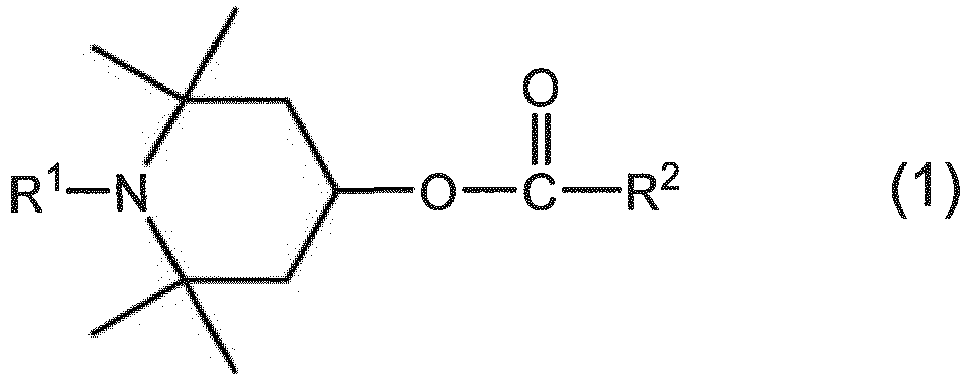

- The light stabilizer composition according to claim 1, wherein the silica as component (A) has a volume average particle size of 0.1 to 100 µm.
- The light stabilizer composition according to claim 1 or 2, further comprising (C) 5 to 500 parts by mass of a benzoate light stabilizer represented by general formula (3):

- A resin composition comprising 100 parts by mass of a resin and 0.01 to 1 part by mass of the light stabilizer composition according to any one of claims 1 to 3.
- The resin composition according to claim 4, wherein the resin is a polyolefin resin.
- A vehicle part obtained by molding the resin composition according to claim 4 or 5.
Applications Claiming Priority (2)
| Application Number | Priority Date | Filing Date | Title |
|---|---|---|---|
| JP2013244183 | 2013-11-26 | ||
| PCT/JP2014/079718 WO2015079896A1 (en) | 2013-11-26 | 2014-11-10 | Light stabilizer composition and resin composition containing same |
Publications (3)
| Publication Number | Publication Date |
|---|---|
| EP3075815A1 true EP3075815A1 (en) | 2016-10-05 |
| EP3075815A4 EP3075815A4 (en) | 2017-09-13 |
| EP3075815B1 EP3075815B1 (en) | 2019-10-09 |
Family
ID=53198844
Family Applications (1)
| Application Number | Title | Priority Date | Filing Date |
|---|---|---|---|
| EP14865751.3A Active EP3075815B1 (en) | 2013-11-26 | 2014-11-10 | Light stabilizer composition and resin composition containing same |
Country Status (9)
| Country | Link |
|---|---|
| US (1) | US20160237241A1 (en) |
| EP (1) | EP3075815B1 (en) |
| JP (1) | JP6570449B2 (en) |
| KR (1) | KR102242620B1 (en) |
| CN (1) | CN105612241B (en) |
| BR (1) | BR112016007012B1 (en) |
| ES (1) | ES2754475T3 (en) |
| TW (1) | TWI630199B (en) |
| WO (1) | WO2015079896A1 (en) |
Cited By (1)
| Publication number | Priority date | Publication date | Assignee | Title |
|---|---|---|---|---|
| EP4509580A4 (en) * | 2022-04-13 | 2026-03-25 | Adeka Corp | LIGHT STABILIZER COMPOSITION, METHOD FOR PRODUCEING A RESIN COMPOSITION, METHOD FOR IMPROVING BLOCKING RESISTANCE AND PREVENTED AMINE COMPOSITION THEREBY |
Families Citing this family (6)
| Publication number | Priority date | Publication date | Assignee | Title |
|---|---|---|---|---|
| WO2016159103A1 (en) * | 2015-03-30 | 2016-10-06 | 株式会社Adeka | Photostabilizer master batch and method for manufacturing same |
| JP6630461B1 (en) * | 2019-08-09 | 2020-01-15 | 株式会社Adeka | Agricultural film, agricultural film-forming resin composition, and plant growing method using the same |
| WO2022075445A1 (en) * | 2020-10-08 | 2022-04-14 | 株式会社Adeka | Polyolefin resin composition, molded article using same, and method for producing polyolefin resin composition |
| JPWO2022075442A1 (en) * | 2020-10-08 | 2022-04-14 | ||
| CN112646152B (en) * | 2020-12-10 | 2023-04-28 | 利安隆凯亚(河北)新材料有限公司 | Preparation method of hindered amine light stabilizer |
| CN112877072A (en) * | 2021-01-14 | 2021-06-01 | 柴松锋 | Long-acting agriculture and forestry water-retaining agent and preparation method thereof |
Family Cites Families (18)
| Publication number | Priority date | Publication date | Assignee | Title |
|---|---|---|---|---|
| JPS5030039B1 (en) | 1967-07-17 | 1975-09-27 | ||
| JPS5129129B1 (en) | 1970-12-31 | 1976-08-24 | ||
| JPS61115089A (en) | 1984-11-09 | 1986-06-02 | Mizusawa Ind Chem Ltd | Compound hydroxide, production thereof, and stabilizer for chlorine-containing polymer |
| JPH062280B2 (en) | 1984-12-28 | 1994-01-12 | 大同特殊鋼株式会社 | Melt processing method |
| JPS61174270A (en) | 1985-01-29 | 1986-08-05 | Kyowa Chem Ind Co Ltd | Rust-inhibiting or discoloration-resistant synthetic resin composition and agent |
| JPH072858B2 (en) | 1991-12-27 | 1995-01-18 | 水澤化学工業株式会社 | Stabilizer for resin |
| JP2775146B2 (en) * | 1994-09-21 | 1998-07-16 | 小島プレス工業株式会社 | Shock absorbing structure for vehicles |
| DE19501053A1 (en) * | 1995-01-16 | 1996-07-18 | Basf Ag | Stabilizer mixture of chroman derivatives and inert organic solvents and microcapsules containing this stabilizer mixture |
| TW416970B (en) * | 1995-05-31 | 2001-01-01 | Ciba Sc Holding Ag | Carrier-bound light stabilizers and antioxidants as fillers and stabilizers |
| GB2332678B (en) * | 1997-12-23 | 2000-09-27 | Ciba Sc Holding Ag | Stabilizer mixtures containing a sterically hindered amine |
| JP2001123022A (en) * | 1999-10-25 | 2001-05-08 | Japan Polychem Corp | Resin composition for beverage container and beverage container prepared by molding this |
| JP2003041008A (en) | 2001-07-27 | 2003-02-13 | Jsr Corp | Master Badge |
| DE10112441A1 (en) * | 2001-03-15 | 2002-09-19 | Degussa | Silica by precipitation with a constant alkali number and its use |
| JP2004001499A (en) * | 2002-04-26 | 2004-01-08 | Sumitomo Chem Co Ltd | Glass fiber reinforced polypropylene resin pellets and vehicle front structure obtained therefrom |
| JP2004155942A (en) | 2002-11-07 | 2004-06-03 | Nissan Motor Co Ltd | Resin composition and method for producing the same, and molded article and automobile parts using the same |
| JP4362071B2 (en) * | 2004-01-07 | 2009-11-11 | オカモト株式会社 | Flame-retardant polyolefin sheet for vehicle interior materials |
| JP5524449B2 (en) | 2004-10-25 | 2014-06-18 | チバ ホールディング インコーポレーテッド | Functional nanoparticles |
| US20090088513A1 (en) * | 2005-06-29 | 2009-04-02 | Adeka Corporation | Resin additive composition and resin composition |
-
2014
- 2014-11-10 BR BR112016007012-7A patent/BR112016007012B1/en active IP Right Grant
- 2014-11-10 US US15/026,767 patent/US20160237241A1/en not_active Abandoned
- 2014-11-10 WO PCT/JP2014/079718 patent/WO2015079896A1/en not_active Ceased
- 2014-11-10 CN CN201480055538.0A patent/CN105612241B/en active Active
- 2014-11-10 JP JP2015550633A patent/JP6570449B2/en active Active
- 2014-11-10 KR KR1020167009087A patent/KR102242620B1/en active Active
- 2014-11-10 ES ES14865751T patent/ES2754475T3/en active Active
- 2014-11-10 EP EP14865751.3A patent/EP3075815B1/en active Active
- 2014-11-21 TW TW103140517A patent/TWI630199B/en active
Cited By (1)
| Publication number | Priority date | Publication date | Assignee | Title |
|---|---|---|---|---|
| EP4509580A4 (en) * | 2022-04-13 | 2026-03-25 | Adeka Corp | LIGHT STABILIZER COMPOSITION, METHOD FOR PRODUCEING A RESIN COMPOSITION, METHOD FOR IMPROVING BLOCKING RESISTANCE AND PREVENTED AMINE COMPOSITION THEREBY |
Also Published As
| Publication number | Publication date |
|---|---|
| EP3075815B1 (en) | 2019-10-09 |
| CN105612241A (en) | 2016-05-25 |
| CN105612241B (en) | 2018-09-25 |
| KR102242620B1 (en) | 2021-04-21 |
| BR112016007012A2 (en) | 2017-08-01 |
| KR20160090792A (en) | 2016-08-01 |
| US20160237241A1 (en) | 2016-08-18 |
| JP6570449B2 (en) | 2019-09-04 |
| TW201527280A (en) | 2015-07-16 |
| BR112016007012B1 (en) | 2022-02-01 |
| ES2754475T3 (en) | 2020-04-17 |
| TWI630199B (en) | 2018-07-21 |
| EP3075815A4 (en) | 2017-09-13 |
| JPWO2015079896A1 (en) | 2017-03-16 |
| WO2015079896A1 (en) | 2015-06-04 |
Similar Documents
| Publication | Publication Date | Title |
|---|---|---|
| EP3075815B1 (en) | Light stabilizer composition and resin composition containing same | |
| US12139590B2 (en) | Resin additive composition and synthetic resin composition using same | |
| EP2810976B1 (en) | Resin additive masterbatch | |
| EP2980129B1 (en) | Resin additive masterbatch and polyolefin resin composition to which said resin additive masterbatch has been admixed | |
| EP2873686B1 (en) | Mixed pellet | |
| US20090088513A1 (en) | Resin additive composition and resin composition | |
| US10246563B2 (en) | Photostabilizer master batch and method for manufacturing same | |
| BR112017021065B1 (en) | MASTERBATCH OF PHOTOSTABILIZER AND METHOD FOR MANUFACTURING IT |
Legal Events
| Date | Code | Title | Description |
|---|---|---|---|
| PUAI | Public reference made under article 153(3) epc to a published international application that has entered the european phase |
Free format text: ORIGINAL CODE: 0009012 |
|
| 17P | Request for examination filed |
Effective date: 20160405 |
|
| AK | Designated contracting states |
Kind code of ref document: A1 Designated state(s): AL AT BE BG CH CY CZ DE DK EE ES FI FR GB GR HR HU IE IS IT LI LT LU LV MC MK MT NL NO PL PT RO RS SE SI SK SM TR |
|
| AX | Request for extension of the european patent |
Extension state: BA ME |
|
| DAX | Request for extension of the european patent (deleted) | ||
| R17P | Request for examination filed (corrected) |
Effective date: 20160405 |
|
| STAA | Information on the status of an ep patent application or granted ep patent |
Free format text: STATUS: REQUEST FOR EXAMINATION WAS MADE |
|
| A4 | Supplementary search report drawn up and despatched |
Effective date: 20170811 |
|
| RIC1 | Information provided on ipc code assigned before grant |
Ipc: C08K 9/12 20060101AFI20170807BHEP Ipc: C08K 3/36 20060101ALI20170807BHEP Ipc: C08L 23/02 20060101ALI20170807BHEP |
|
| REG | Reference to a national code |
Ref country code: DE Ref legal event code: R079 Ref document number: 602014055059 Country of ref document: DE Free format text: PREVIOUS MAIN CLASS: C09K0015200000 Ipc: C08K0009120000 |
|
| GRAP | Despatch of communication of intention to grant a patent |
Free format text: ORIGINAL CODE: EPIDOSNIGR1 |
|
| STAA | Information on the status of an ep patent application or granted ep patent |
Free format text: STATUS: GRANT OF PATENT IS INTENDED |
|
| RIC1 | Information provided on ipc code assigned before grant |
Ipc: C08K 5/3435 20060101ALI20190212BHEP Ipc: C08K 3/36 20060101ALI20190212BHEP Ipc: C08K 9/12 20060101AFI20190212BHEP Ipc: C08L 23/02 20060101ALI20190212BHEP |
|
| INTG | Intention to grant announced |
Effective date: 20190304 |
|
| GRAS | Grant fee paid |
Free format text: ORIGINAL CODE: EPIDOSNIGR3 |
|
| GRAJ | Information related to disapproval of communication of intention to grant by the applicant or resumption of examination proceedings by the epo deleted |
Free format text: ORIGINAL CODE: EPIDOSDIGR1 |
|
| GRAL | Information related to payment of fee for publishing/printing deleted |
Free format text: ORIGINAL CODE: EPIDOSDIGR3 |
|
| STAA | Information on the status of an ep patent application or granted ep patent |
Free format text: STATUS: REQUEST FOR EXAMINATION WAS MADE |
|
| INTC | Intention to grant announced (deleted) | ||
| GRAR | Information related to intention to grant a patent recorded |
Free format text: ORIGINAL CODE: EPIDOSNIGR71 |
|
| STAA | Information on the status of an ep patent application or granted ep patent |
Free format text: STATUS: GRANT OF PATENT IS INTENDED |
|
| GRAA | (expected) grant |
Free format text: ORIGINAL CODE: 0009210 |
|
| STAA | Information on the status of an ep patent application or granted ep patent |
Free format text: STATUS: THE PATENT HAS BEEN GRANTED |
|
| INTG | Intention to grant announced |
Effective date: 20190828 |
|
| AK | Designated contracting states |
Kind code of ref document: B1 Designated state(s): AL AT BE BG CH CY CZ DE DK EE ES FI FR GB GR HR HU IE IS IT LI LT LU LV MC MK MT NL NO PL PT RO RS SE SI SK SM TR |
|
| REG | Reference to a national code |
Ref country code: GB Ref legal event code: FG4D |
|
| REG | Reference to a national code |
Ref country code: CH Ref legal event code: EP |
|
| REG | Reference to a national code |
Ref country code: IE Ref legal event code: FG4D |
|
| REG | Reference to a national code |
Ref country code: DE Ref legal event code: R096 Ref document number: 602014055059 Country of ref document: DE |
|
| REG | Reference to a national code |
Ref country code: AT Ref legal event code: REF Ref document number: 1188744 Country of ref document: AT Kind code of ref document: T Effective date: 20191115 |
|
| REG | Reference to a national code |
Ref country code: NL Ref legal event code: MP Effective date: 20191009 |
|
| REG | Reference to a national code |
Ref country code: LT Ref legal event code: MG4D |
|
| REG | Reference to a national code |
Ref country code: AT Ref legal event code: MK05 Ref document number: 1188744 Country of ref document: AT Kind code of ref document: T Effective date: 20191009 |
|
| REG | Reference to a national code |
Ref country code: ES Ref legal event code: FG2A Ref document number: 2754475 Country of ref document: ES Kind code of ref document: T3 Effective date: 20200417 |
|
| PG25 | Lapsed in a contracting state [announced via postgrant information from national office to epo] |
Ref country code: PT Free format text: LAPSE BECAUSE OF FAILURE TO SUBMIT A TRANSLATION OF THE DESCRIPTION OR TO PAY THE FEE WITHIN THE PRESCRIBED TIME-LIMIT Effective date: 20200210 Ref country code: GR Free format text: LAPSE BECAUSE OF FAILURE TO SUBMIT A TRANSLATION OF THE DESCRIPTION OR TO PAY THE FEE WITHIN THE PRESCRIBED TIME-LIMIT Effective date: 20200110 Ref country code: NL Free format text: LAPSE BECAUSE OF FAILURE TO SUBMIT A TRANSLATION OF THE DESCRIPTION OR TO PAY THE FEE WITHIN THE PRESCRIBED TIME-LIMIT Effective date: 20191009 Ref country code: AT Free format text: LAPSE BECAUSE OF FAILURE TO SUBMIT A TRANSLATION OF THE DESCRIPTION OR TO PAY THE FEE WITHIN THE PRESCRIBED TIME-LIMIT Effective date: 20191009 Ref country code: BG Free format text: LAPSE BECAUSE OF FAILURE TO SUBMIT A TRANSLATION OF THE DESCRIPTION OR TO PAY THE FEE WITHIN THE PRESCRIBED TIME-LIMIT Effective date: 20200109 Ref country code: NO Free format text: LAPSE BECAUSE OF FAILURE TO SUBMIT A TRANSLATION OF THE DESCRIPTION OR TO PAY THE FEE WITHIN THE PRESCRIBED TIME-LIMIT Effective date: 20200109 Ref country code: LT Free format text: LAPSE BECAUSE OF FAILURE TO SUBMIT A TRANSLATION OF THE DESCRIPTION OR TO PAY THE FEE WITHIN THE PRESCRIBED TIME-LIMIT Effective date: 20191009 Ref country code: FI Free format text: LAPSE BECAUSE OF FAILURE TO SUBMIT A TRANSLATION OF THE DESCRIPTION OR TO PAY THE FEE WITHIN THE PRESCRIBED TIME-LIMIT Effective date: 20191009 Ref country code: LV Free format text: LAPSE BECAUSE OF FAILURE TO SUBMIT A TRANSLATION OF THE DESCRIPTION OR TO PAY THE FEE WITHIN THE PRESCRIBED TIME-LIMIT Effective date: 20191009 Ref country code: SE Free format text: LAPSE BECAUSE OF FAILURE TO SUBMIT A TRANSLATION OF THE DESCRIPTION OR TO PAY THE FEE WITHIN THE PRESCRIBED TIME-LIMIT Effective date: 20191009 Ref country code: PL Free format text: LAPSE BECAUSE OF FAILURE TO SUBMIT A TRANSLATION OF THE DESCRIPTION OR TO PAY THE FEE WITHIN THE PRESCRIBED TIME-LIMIT Effective date: 20191009 |
|
| PGFP | Annual fee paid to national office [announced via postgrant information from national office to epo] |
Ref country code: IT Payment date: 20200129 Year of fee payment: 6 |
|
| PG25 | Lapsed in a contracting state [announced via postgrant information from national office to epo] |
Ref country code: HR Free format text: LAPSE BECAUSE OF FAILURE TO SUBMIT A TRANSLATION OF THE DESCRIPTION OR TO PAY THE FEE WITHIN THE PRESCRIBED TIME-LIMIT Effective date: 20191009 Ref country code: RS Free format text: LAPSE BECAUSE OF FAILURE TO SUBMIT A TRANSLATION OF THE DESCRIPTION OR TO PAY THE FEE WITHIN THE PRESCRIBED TIME-LIMIT Effective date: 20191009 Ref country code: IS Free format text: LAPSE BECAUSE OF FAILURE TO SUBMIT A TRANSLATION OF THE DESCRIPTION OR TO PAY THE FEE WITHIN THE PRESCRIBED TIME-LIMIT Effective date: 20200224 |
|
| PG25 | Lapsed in a contracting state [announced via postgrant information from national office to epo] |
Ref country code: AL Free format text: LAPSE BECAUSE OF FAILURE TO SUBMIT A TRANSLATION OF THE DESCRIPTION OR TO PAY THE FEE WITHIN THE PRESCRIBED TIME-LIMIT Effective date: 20191009 |
|
| REG | Reference to a national code |
Ref country code: CH Ref legal event code: PL |
|
| REG | Reference to a national code |
Ref country code: DE Ref legal event code: R097 Ref document number: 602014055059 Country of ref document: DE |
|
| PG2D | Information on lapse in contracting state deleted |
Ref country code: IS |
|
| PG25 | Lapsed in a contracting state [announced via postgrant information from national office to epo] |
Ref country code: RO Free format text: LAPSE BECAUSE OF FAILURE TO SUBMIT A TRANSLATION OF THE DESCRIPTION OR TO PAY THE FEE WITHIN THE PRESCRIBED TIME-LIMIT Effective date: 20191009 Ref country code: CZ Free format text: LAPSE BECAUSE OF FAILURE TO SUBMIT A TRANSLATION OF THE DESCRIPTION OR TO PAY THE FEE WITHIN THE PRESCRIBED TIME-LIMIT Effective date: 20191009 Ref country code: MC Free format text: LAPSE BECAUSE OF FAILURE TO SUBMIT A TRANSLATION OF THE DESCRIPTION OR TO PAY THE FEE WITHIN THE PRESCRIBED TIME-LIMIT Effective date: 20191009 Ref country code: LI Free format text: LAPSE BECAUSE OF NON-PAYMENT OF DUE FEES Effective date: 20191130 Ref country code: LU Free format text: LAPSE BECAUSE OF NON-PAYMENT OF DUE FEES Effective date: 20191110 Ref country code: CH Free format text: LAPSE BECAUSE OF NON-PAYMENT OF DUE FEES Effective date: 20191130 Ref country code: DK Free format text: LAPSE BECAUSE OF FAILURE TO SUBMIT A TRANSLATION OF THE DESCRIPTION OR TO PAY THE FEE WITHIN THE PRESCRIBED TIME-LIMIT Effective date: 20191009 Ref country code: EE Free format text: LAPSE BECAUSE OF FAILURE TO SUBMIT A TRANSLATION OF THE DESCRIPTION OR TO PAY THE FEE WITHIN THE PRESCRIBED TIME-LIMIT Effective date: 20191009 Ref country code: IS Free format text: LAPSE BECAUSE OF FAILURE TO SUBMIT A TRANSLATION OF THE DESCRIPTION OR TO PAY THE FEE WITHIN THE PRESCRIBED TIME-LIMIT Effective date: 20200209 |
|
| PLBE | No opposition filed within time limit |
Free format text: ORIGINAL CODE: 0009261 |
|
| STAA | Information on the status of an ep patent application or granted ep patent |
Free format text: STATUS: NO OPPOSITION FILED WITHIN TIME LIMIT |
|
| REG | Reference to a national code |
Ref country code: BE Ref legal event code: MM Effective date: 20191130 |
|
| PG25 | Lapsed in a contracting state [announced via postgrant information from national office to epo] |
Ref country code: SK Free format text: LAPSE BECAUSE OF FAILURE TO SUBMIT A TRANSLATION OF THE DESCRIPTION OR TO PAY THE FEE WITHIN THE PRESCRIBED TIME-LIMIT Effective date: 20191009 Ref country code: SM Free format text: LAPSE BECAUSE OF FAILURE TO SUBMIT A TRANSLATION OF THE DESCRIPTION OR TO PAY THE FEE WITHIN THE PRESCRIBED TIME-LIMIT Effective date: 20191009 |
|
| 26N | No opposition filed |
Effective date: 20200710 |
|
| GBPC | Gb: european patent ceased through non-payment of renewal fee |
Effective date: 20200109 |
|
| PG25 | Lapsed in a contracting state [announced via postgrant information from national office to epo] |
Ref country code: FR Free format text: LAPSE BECAUSE OF NON-PAYMENT OF DUE FEES Effective date: 20191209 Ref country code: IE Free format text: LAPSE BECAUSE OF NON-PAYMENT OF DUE FEES Effective date: 20191110 Ref country code: GB Free format text: LAPSE BECAUSE OF NON-PAYMENT OF DUE FEES Effective date: 20200109 |
|
| PG25 | Lapsed in a contracting state [announced via postgrant information from national office to epo] |
Ref country code: SI Free format text: LAPSE BECAUSE OF FAILURE TO SUBMIT A TRANSLATION OF THE DESCRIPTION OR TO PAY THE FEE WITHIN THE PRESCRIBED TIME-LIMIT Effective date: 20191009 Ref country code: BE Free format text: LAPSE BECAUSE OF NON-PAYMENT OF DUE FEES Effective date: 20191130 |
|
| PG25 | Lapsed in a contracting state [announced via postgrant information from national office to epo] |
Ref country code: CY Free format text: LAPSE BECAUSE OF FAILURE TO SUBMIT A TRANSLATION OF THE DESCRIPTION OR TO PAY THE FEE WITHIN THE PRESCRIBED TIME-LIMIT Effective date: 20191009 |
|
| PG25 | Lapsed in a contracting state [announced via postgrant information from national office to epo] |
Ref country code: HU Free format text: LAPSE BECAUSE OF FAILURE TO SUBMIT A TRANSLATION OF THE DESCRIPTION OR TO PAY THE FEE WITHIN THE PRESCRIBED TIME-LIMIT; INVALID AB INITIO Effective date: 20141110 Ref country code: MT Free format text: LAPSE BECAUSE OF FAILURE TO SUBMIT A TRANSLATION OF THE DESCRIPTION OR TO PAY THE FEE WITHIN THE PRESCRIBED TIME-LIMIT Effective date: 20191009 |
|
| PG25 | Lapsed in a contracting state [announced via postgrant information from national office to epo] |
Ref country code: IT Free format text: LAPSE BECAUSE OF NON-PAYMENT OF DUE FEES Effective date: 20201110 |
|
| PG25 | Lapsed in a contracting state [announced via postgrant information from national office to epo] |
Ref country code: TR Free format text: LAPSE BECAUSE OF FAILURE TO SUBMIT A TRANSLATION OF THE DESCRIPTION OR TO PAY THE FEE WITHIN THE PRESCRIBED TIME-LIMIT Effective date: 20191009 |
|
| PG25 | Lapsed in a contracting state [announced via postgrant information from national office to epo] |
Ref country code: MK Free format text: LAPSE BECAUSE OF FAILURE TO SUBMIT A TRANSLATION OF THE DESCRIPTION OR TO PAY THE FEE WITHIN THE PRESCRIBED TIME-LIMIT Effective date: 20191009 |
|
| P01 | Opt-out of the competence of the unified patent court (upc) registered |
Effective date: 20230522 |
|
| PGFP | Annual fee paid to national office [announced via postgrant information from national office to epo] |
Ref country code: DE Payment date: 20251119 Year of fee payment: 12 |
|
| PGFP | Annual fee paid to national office [announced via postgrant information from national office to epo] |
Ref country code: ES Payment date: 20251229 Year of fee payment: 12 |