EP3075680A1 - Resealable flexible package and method of using the same - Google Patents
Resealable flexible package and method of using the same Download PDFInfo
- Publication number
- EP3075680A1 EP3075680A1 EP16163438.1A EP16163438A EP3075680A1 EP 3075680 A1 EP3075680 A1 EP 3075680A1 EP 16163438 A EP16163438 A EP 16163438A EP 3075680 A1 EP3075680 A1 EP 3075680A1
- Authority
- EP
- European Patent Office
- Prior art keywords
- adhesive
- state
- package
- panel
- flexible
- Prior art date
- Legal status (The legal status is an assumption and is not a legal conclusion. Google has not performed a legal analysis and makes no representation as to the accuracy of the status listed.)
- Granted
Links
Images







Classifications
-
- B—PERFORMING OPERATIONS; TRANSPORTING
- B65—CONVEYING; PACKING; STORING; HANDLING THIN OR FILAMENTARY MATERIAL
- B65D—CONTAINERS FOR STORAGE OR TRANSPORT OF ARTICLES OR MATERIALS, e.g. BAGS, BARRELS, BOTTLES, BOXES, CANS, CARTONS, CRATES, DRUMS, JARS, TANKS, HOPPERS, FORWARDING CONTAINERS; ACCESSORIES, CLOSURES, OR FITTINGS THEREFOR; PACKAGING ELEMENTS; PACKAGES
- B65D33/00—Details of, or accessories for, sacks or bags
- B65D33/16—End- or aperture-closing arrangements or devices
- B65D33/18—End- or aperture-closing arrangements or devices using adhesive applied to integral parts, e.g. to flaps
- B65D33/20—End- or aperture-closing arrangements or devices using adhesive applied to integral parts, e.g. to flaps using pressure-sensitive adhesive
-
- B—PERFORMING OPERATIONS; TRANSPORTING
- B65—CONVEYING; PACKING; STORING; HANDLING THIN OR FILAMENTARY MATERIAL
- B65D—CONTAINERS FOR STORAGE OR TRANSPORT OF ARTICLES OR MATERIALS, e.g. BAGS, BARRELS, BOTTLES, BOXES, CANS, CARTONS, CRATES, DRUMS, JARS, TANKS, HOPPERS, FORWARDING CONTAINERS; ACCESSORIES, CLOSURES, OR FITTINGS THEREFOR; PACKAGING ELEMENTS; PACKAGES
- B65D77/00—Packages formed by enclosing articles or materials in preformed containers, e.g. boxes, cartons, sacks or bags
- B65D77/10—Container closures formed after filling
- B65D77/14—Container closures formed after filling by flattening and subsequently folding or rolling the mouth portion
-
- B—PERFORMING OPERATIONS; TRANSPORTING
- B32—LAYERED PRODUCTS
- B32B—LAYERED PRODUCTS, i.e. PRODUCTS BUILT-UP OF STRATA OF FLAT OR NON-FLAT, e.g. CELLULAR OR HONEYCOMB, FORM
- B32B37/00—Methods or apparatus for laminating, e.g. by curing or by ultrasonic bonding
- B32B37/12—Methods or apparatus for laminating, e.g. by curing or by ultrasonic bonding characterised by using adhesives
-
- B—PERFORMING OPERATIONS; TRANSPORTING
- B32—LAYERED PRODUCTS
- B32B—LAYERED PRODUCTS, i.e. PRODUCTS BUILT-UP OF STRATA OF FLAT OR NON-FLAT, e.g. CELLULAR OR HONEYCOMB, FORM
- B32B38/00—Ancillary operations in connection with laminating processes
- B32B38/10—Removing layers, or parts of layers, mechanically or chemically
-
- B—PERFORMING OPERATIONS; TRANSPORTING
- B32—LAYERED PRODUCTS
- B32B—LAYERED PRODUCTS, i.e. PRODUCTS BUILT-UP OF STRATA OF FLAT OR NON-FLAT, e.g. CELLULAR OR HONEYCOMB, FORM
- B32B2439/00—Containers; Receptacles
-
- B—PERFORMING OPERATIONS; TRANSPORTING
- B65—CONVEYING; PACKING; STORING; HANDLING THIN OR FILAMENTARY MATERIAL
- B65D—CONTAINERS FOR STORAGE OR TRANSPORT OF ARTICLES OR MATERIALS, e.g. BAGS, BARRELS, BOTTLES, BOXES, CANS, CARTONS, CRATES, DRUMS, JARS, TANKS, HOPPERS, FORWARDING CONTAINERS; ACCESSORIES, CLOSURES, OR FITTINGS THEREFOR; PACKAGING ELEMENTS; PACKAGES
- B65D2575/00—Packages comprising articles or materials partially or wholly enclosed in strips, sheets, blanks, tubes or webs of flexible sheet material, e.g. in folded wrappers
- B65D2575/52—Details
- B65D2575/58—Opening or contents-removing devices added or incorporated during package manufacture
- B65D2575/586—Opening or contents-removing devices added or incorporated during package manufacture with means for reclosing
Definitions
- Today's conventional flexible packaging is usually used to protect, store, ship, display and/or sell certain low cost perishable goods such as food (e.g., dry snacks, cereals, certain vegetables, etc.).
- Such conventional flexible packaging is usually formed by a single layer, single-ply, or mono-web material. Once opened by the consumer, such conventional packaging cannot be reclosed.
- the consumer must improvise by, for example, rolling the open end of the conventional flexible package onto itself to create a partial seal that provides some protection for the goods remaining within.
- the rolled portion of the conventional package often gradually becomes undone (e.g., unrolled), which can cause the goods to be damaged, spoil, become stale, etc.
- Some types of conventional flexible packaging are formed by a multiple layer, multi-ply, or multi-web material and include mechanical mechanisms, such as zip locks or slide locks, to reseal the conventional flexible package.
- Such multi-ply materials and mechanical reseal mechanisms are typically used in higher cost conventional flexible packaging for higher cost perishable goods (e.g., cookies, nuts, cold cuts, cheese, freezable items, etc.).
- multi-ply conventional flexible packaging sometimes includes a non-mechanical reseal mechanism that uses a temporary adhesive on an inside surface of the conventional package, instead of or in addition to the mechanical reseal mechanism, that enables the multi-ply conventional flexible package to be resealed after opening.
- Such reseal mechanisms usually include tearing-off and/or discarding a portion of the conventional package (e.g., often in the form of litter) to enable the conventional package to be resealed, which can harm the environment.
- the higher resale price of such perishable goods can usually tolerate the added expense of higher cost multi-ply conventional flexible packaging that includes the mechanical reseal or non-mechanical reseal mechanisms.
- multi-ply conventional flexible packaging that includes the mechanical reseal or non-mechanical reseal mechanisms, are usually cost prohibitive for use in packaging lower cost goods that use single-ply conventional flexible packaging.
- a flexible package may include a first panel and a second panel that are formed by a flexible material.
- the first panel may be attached to the second panel to form an interior cavity, between the first panel and second panel, in which content is stored.
- the flexible package may also include an adhesive that is attached to a first exterior surface of the first panel, or a second exterior surface of the second panel.
- the adhesive may have a first state and a second state.
- the first state may preclude the adhesive from bonding with the flexible material to prevent the package, once opened, from being reclosed or resealed by the adhesive in the first state.
- the second state when activated, may enable the adhesive to bond with the flexible material to permit the package, once opened, to be reclosed or resealed by the adhesive in the second state.
- a resealable flexible package may include a first panel and a second panel that are formed by a flexible material.
- the first panel may be attached to the second panel to form an interior cavity, between the first panel and second panel, in which content is stored.
- a pressure sensitive adhesive may be attached to a first surface of the first panel or a second surface of the second panel.
- the pressure sensitive adhesive may have a first state and a second state.
- the first state may preclude the pressure sensitive adhesive from bonding with the flexible material to prevent the resealable flexible package, once opened, from being reclosed or resealed by the pressure sensitive adhesive in the first state.
- the second state when activated, may enable the pressure sensitive adhesive to bond with the flexible material to permit the resealable flexible package, once opened, to be reclosed or resealed by the pressure sensitive adhesive in the second state.
- a method of resealing a flexible package may include opening the flexible package to access content stored within the flexible package.
- the flexible package may be formed by a polymer and may include an adhesive on an exterior surface of a first portion of the flexible package.
- the adhesive may be in an inactive state that precludes the adhesive from bonding with a second, different portion of the flexible package or a different flexible package.
- the method may also include causing the adhesive to change from the inactive state to an active state.
- the active state may enable the adhesive to bond with the flexible package.
- the method may further include creating one or more folds in the second portion of the flexible package; and causing the second portion of the package, in which the one or more folds are created, to bond with the adhesive, in the active state, to close the flexible package.
- a flexible package may comprise:
- the adhesive may correspond to a pressure sensitive adhesive or a cohesive.
- the adhesive in the first state, may further include: a first layer of an adhesive material, and a second layer of a material that covers the first layer to prevent the first layer from bonding with the flexible material.
- the second layer may be peeled away to expose the first layer causing the adhesive to change from the first state to the second state.
- the second layer may be water soluble to enable the material to be dissolved or wiped away exposing the first layer when the adhesive is in the second state.
- the flexible material may correspond to a monoweb polymer.
- the flexible material may correspond to a multiweb polymer.
- the flexible package may further comprise: a seal, between the first panel the second panel, on which the adhesive is attached, the flexible package being enabled to be opened when the seal is broken, and the adhesive enabling the flexible package to be reclosed when the adhesive is in the second state.
- a resealable flexible package may comprise:
- the pressure sensitive adhesive in the first state, may further include a layer of a material that covers the pressure sensitive adhesive to prevent the pressure sensitive adhesive from bonding with the flexible material.
- the layer of material may be peeled away to expose the pressure sensitive adhesive enabling the pressure sensitive adhesive to bond with the flexible material to reclose or reseal the resealable flexible package.
- the layer of material may be water soluble to enable the layer of material to be dissolved or wiped away exposing the pressure sensitive adhesive and causing the pressure sensitive adhesive to change from the first state to the second state.
- the pressure sensitive adhesive in the second state, may enable the resealable flexible package, once opened, to be reclosed by creating one or more folds in an open end of the resealable flexible package and causing the one or more folds to make contact with the pressure sensitive adhesive to reclose or reseal the resealable flexible package.
- the resealable flexible package may further comprise: a seal, between the first panel the second panel, on which the pressure sensitive adhesive is attached, the resealable flexible package being opened when the seal is broken, and the resealable flexible package being enabled to be reclosed when the pressure sensitive adhesive is in the second state.
- a method of resealing a flexible package may comprise: opening the flexible package to access content stored within the flexible package, the flexible package being formed by a polymer and including an adhesive on an exterior surface of a first portion of the flexible package, the adhesive being in an inactive state that precludes the adhesive from bonding with a second, different portion of the flexible package or a different flexible package; causing the adhesive to change from the inactive state to an active state, the active state enabling the adhesive to bond with the flexible package; creating one or more folds in the second portion of the flexible package; and causing the second portion of the package, in which the one or more folds are created, to bond with the adhesive, in the active state, to close the flexible package.
- Causing the adhesive to change from the inactive state to the active state may further comprise: heating the adhesive to cause the adhesive to change from the inactive state to the active state.
- Heating the adhesive may include: causing a temperature, of the adhesive, to increase to a threshold associated with the glass transition temperature of the adhesive.
- Causing the adhesive to change from the inactive state to the active state may further comprise: roughening the adhesive to cause the adhesive to change from the inactive state to the active state.
- the adhesive may be formed by an adhesive material and a material that covers the adhesive material when the adhesive is in the inactive state, and where causing the adhesive to change from the inactive state to the active state may include: dissolving the material to expose all or a portion of the adhesive material causing the adhesive to change from the inactive state to the active state.
- Dissolving the material further may include at least one of: applying, to the adhesive, a solvent to cause the material to dissolve in a manner that exposes the adhesive material, or wiping the adhesive with an article that applies the solvent and removes the material to expose the adhesive material.
- the solvent may correspond to water.
- the adhesive may be formed by an adhesive material and a material that covers the adhesive material when the adhesive is in the inactive state, and where causing the adhesive to change from the inactive state to the active state may include: peeling all or a portion of the material, from the adhesive, to expose all or a portion of the adhesive material.
- a particular portion, of the material may remain attached to the adhesive or the flexible package.
- the adhesive may be formed by an adhesive material and a material that covers the adhesive material when the adhesive is in the inactive state, and where causing the adhesive to change from the inactive state to the active state may include: applying friction to remove all or a portion of the material, from the adhesive, to expose all or a portion of the adhesive material.
- FIGS. 1 - 8E are attached thereto and incorporated herein by this reference. The following detailed description refers to the accompanying Figs. 1 - 8E .
- the same reference numbers in different figures may identify the same or similar elements.
- An apparatus, system, method, technology, and/or technique, described herein, may include an improved flexible package of one or more plies (hereinafter, a "flexible package"), to store low cost content (e.g., snacks, cereal, vegetables, etc.), that can be resealed after opening using an activated non-mechanical resealable attached to all or a portion of the flexible package.
- a flexible package to store low cost content (e.g., snacks, cereal, vegetables, etc.)
- low cost content e.g., snacks, cereal, vegetables, etc.
- a non-mechanical resealable may include any type of temporary adhesive or temporary cohesive that has a first state that is inert, not sticky, and not tacky (hereinafter, "inert state”) and a second state that, once activated, causes the adhesive to become active, sticky and/or tacky (hereinafter, "active state”).
- the temporary adhesive may include a pressure sensitive adhesive ("PSA"), a cohesive, and/or some other material that enables a portion of a flexible package to bond and/or seal repeatedly to such temporary adhesive and/or cohesive, and to unbond and/or unsealed repeatedly without damaging, tearing, or destroying the flexible package or temporary adhesive.
- PSA pressure sensitive adhesive
- Activating the non-mechanical resealable, from the inert state to the active state may, by way of non-limiting examples, include roughening, rubbing, and/or scoring the adhesive (e.g., with a utensil, such as a finger, fingernail, coin, emery board, fork, knife, steel wool, etc.); heating the adhesive to a temperature at, above, or near a glass transition temperature of the adhesive; dissolving to the soluble outer layer (e.g., by applying water or another solvent) or otherwise using an article (e.g., wiping with a wet or damp sponge, cloth, etc.) to remove a soluble protective outer layer that covers an active adhesive; peeling or otherwise removing all or a portion of a protective outer layer that covers an active adhesive; etc.
- a utensil such as a finger, fingernail, coin, emery board, fork, knife, steel wool, etc.
- heating the adhesive to a temperature at, above
- the flexible package may be manufactured using a conventional mono-web and/or single-ply material, and a conventional manufacturing process, such that the non-mechanical resealable may be attached to, or integrated within, the flexible package in a manner that does not change, or add steps or complexity to the conventional manufacturing process.
- Fig. 1 is a diagram of an example flexible package 100 (hereinafter, "package 100") according to an implementation described herein.
- package 100 may be formed by a flexible material that is suitable for storing, shipping, and/or displaying perishable and/or non-perishable goods in a manner that is air tight and water tight.
- a flexible material may include polyethylene (PE), polypropylene (PP), polystyrene (PS), polyamide (PA), nylon, textile, paper, or any combination thereof (hereinafter, "flexible material”) that is suitable for storing and shipping perishable or non-perishable goods.
- package 100 is described herein as being formed by a mono web and/or single-ply material, in other implementations, package 100 need not be so limited.
- package 100 could also, or alternatively, be formed by a multi-ply material of one or more of the materials described above.
- Package 100 may include a front panel 110, a back panel 112, a top seal 114, a bottom seal 116, a right side panel 118-1, a left side panel 118-2 (sometimes referred to individually as “side panel 118" and together as “side panels 118"), and/or one or more non-mechanical resealable patches 150-1 and 150-2 (hereafter, each a "patch 150" and together, “patches 150").
- package 100 may include additional components, fewer components, different components, or differently arranged components than illustrated in Fig. 1 .
- an edge and/or perimeter of front panel 110 may be attached and/or sealed to an edge and/or perimeter of back panel 112, without any right side panel 118 and/or left side panel 118, to form an airtight and/or watertight interior cavity between front panel 110 and back panel 112 in which perishable and/or non-perishable content may be stored.
- one or more of the components of package 100 may perform one or more functions described as being performed by another one or more of the components of package 100.
- Front panel 110, back panel 112, and/or side panels 118 may be formed by a flexible material of sufficient strength and flexibility to enable package 100 to store perishable and non-perishable content and/or to permit such content to be shipped, displayed, sold, and/or removed from an opening in package 100 once opened.
- Front panel 110 may be attached and/or sealed to side panels 118 (e.g., at one or more sides of Front panel 110).
- Back panel 112 may be attached and/or sealed to side panels 118 (e.g., at one or more sides of back panel 110).
- An upper portion of front panel 110 may be permanently and/or temporarily attached, sealed, bonded, welded, etc. to an upper portion of back panel 112 to form top seal 114.
- a lower portion of front panel 110 may be permanently and/or temporarily attached, sealed, bonded, welded, etc. to a lower portion of back panel 112 to form bottom seal 116.
- package 100 may form an air tight and/or water tight interior cavity in which perishable and/or non-perishable content can be stored, based on the top seal 114, bottom seal 116, the seals between side panels 118 and front panel 110, and the seals between side panels 118 and back panel 112.
- front panel 110, side panels 118, and/or back panel 112 may be formed as a continuous material.
- front panel 110 and side panels 118 may be one piece of material such that seals are not necessary between front panel 110 and side panels 118.
- back panel 112 and side panels 118 may be one piece of material such that seals are not necessary between back panel 112 and side panels 118.
- front panel 110, side panels 118, and back panel 112 may be formed from one piece of material (e.g., sleeve, cylinder).
- Patch 150 may be formed by a temporary adhesive or cohesive that is attached to all or a portion of front panel 110 (e.g., shown as the shaded and rounded rectangle labeled 150-1) back panel 112 (e.g., shown as the dashed rounded rectangle labeled 150-2), top seal 114 (e.g., not shown in Fig. 1 ), bottom seal 116 (e.g., not shown in Fig. 1 ), or side panel 118 (e.g., not shown in Fig. 1 ).
- front panel 110 e.g., shown as the shaded and rounded rectangle labeled 150-1
- back panel 112 e.g., shown as the dashed rounded rectangle labeled 150-2
- top seal 114 e.g., not shown in Fig. 1
- bottom seal 116 e.g., not shown in Fig. 1
- side panel 118 e.g., not shown in Fig. 1
- patch 150 when activated, patch 150 may enable package 100, once opened, to be temporarily resealed and/or reclosed to protect contents stored therein from spoiling, becoming stale, or otherwise being damaged and/or destroyed. Additionally, or alternatively, patch 150, when activated, may enable package 100 to be repeatedly resealed and reopened in a manner that does not tear and/or destroy the material on which patch 150 is formed.
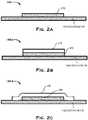
- Figs. 2A - 2C are diagrams of example non-mechanical patches 150-1, 150-2 and 150-3, respectively, of package 100 identified in Fig. 1 .
- patch 150-1 may include a temporary adhesive 200 (hereinafter, "adhesive 200") that is attached to package 100 (e.g., front panel 110, back panel 112, top seal 114, bottom seal 116, side panel 118, etc.).
- Adhesive 200 may be a temporary adhesive, such as a PSA (e.g., an acrylic-based PSA, a styrene block copolymer (“SBC”) PSA, etc.).
- Adhesive 200 may be in the form of a patch, tape, etc.
- adhesive 200 may be printed and/or sprayed on package 100 and allowed to dry and/or cure to a solid form that is in an inert state (e.g., non-sticky, non-tacky, etc.) prior to being activated in a manner described below with respect to Fig. 3A .
- patch 150-2 may include adhesive 200, as described above in Fig. 2A , that is bonded and/or attached, on a first surface of adhesive 200, to package 100 (e.g., front panel 110, back panel 112, top seal 114, bottom seal 116, side panel 118, etc.), as well as an activation layer 210 that is attached to a second surface, of adhesive 200, that is opposite the first surface of adhesive 200.
- adhesive 200 as described above in Fig. 2A , that is bonded and/or attached, on a first surface of adhesive 200, to package 100 (e.g., front panel 110, back panel 112, top seal 114, bottom seal 116, side panel 118, etc.), as well as an activation layer 210 that is attached to a second surface, of adhesive 200, that is opposite the first surface of adhesive 200.
- Adhesive 200 in this non-limiting example, may be in an active state (e.g., sticky, tacky, etc.), but kept “inert” by activation layer 210 to prevent adhesive 200 from undesirable bonding with adjacent packages 100 (e.g., during shipping, display, etc.) and/or collecting debris (e.g., during packaging, shipping, prior to sale, etc.).
- active state e.g., sticky, tacky, etc.
- debris e.g., during packaging, shipping, prior to sale, etc.
- Activation layer 210 may, for example, be formed by a material that can dissolve in the presence of a solvent (e.g., by applying, spraying, immersing, etc. with water or some other solvent); can be wiped away or removed with a wet or damp cloth or sponge (e.g., a water soluble film, compound, polymer, etc.); can be rubbed or scraped away (e.g., such as a water-based scratch of material, Buna-N rubber, photopolymer coating, wax-based coating, silicon-coating, etc.); and/or can be peeled away (but not removed entirely) to expose all or a portion of adhesive 200 in an active state.
- a solvent e.g., by applying, spraying, immersing, etc. with water or some other solvent
- a wet or damp cloth or sponge e.g., a water soluble film, compound, polymer, etc.
- can be rubbed or scraped away e.g., such as a
- Activation layer 210 may also, or alternatively, be formed as a patch or tape that is temporarily bonded and/or attached to all or a portion of the second surface adhesive 200.
- activation layer 210 may be printed and/or sprayed on adhesive 200 and allowed to dry and/or cure to a solid form.
- activation layer 210 may be attached and/or bonded to adhesive 200 and the combination of adhesive 200 and activation layer 210 by be attached and/or bonded to package 100 (e.g., front panel 110, back panel 112, side panel 118, top seal 114, bottom seal 116, etc.).
- Patch 150-2 may be activated to cause activation layer 210 to dissolve and/or otherwise be removed from adhesive 200 in a manner described below with respect to Fig. 3B .
- patch 150-3 may include adhesive 200 and activation layer 210, as described above with respect to Fig. 2B , except that activation layer 210 may extend beyond one or more edges of adhesive 200 (e.g., in the active state), such that a portion of activation layer 210 makes contact with, is attached to and/or bonds with package 100 (e.g., front panel 110, back panel 112, top seal 114, bottom seal 116, side panel 118, etc.).
- package 100 e.g., front panel 110, back panel 112, top seal 114, bottom seal 116, side panel 118, etc.
- activation layer 210 may be removed, from adhesive 200, by dissolving in the presence of a solvent (e.g., by applying, spraying, immersing with water or some other solvent); wiping with a damp cloth or sponge (e.g., a water soluble film, compound, polymer, etc.); rubbing or scraping away (e.g., an overlaquer, surface printed ink, etc. with low adhesion properties allowing activation layer to be scratched away); and/or by peeling away (but not completely removing or detaching) activation layer 210 to expose all or a portion of adhesive 200 in an active state.
- Patch 150-3 may be activated by causing activation layer 210 to dissolve and/or otherwise be removed from adhesive 200 in a manner described below with respect to Fig. 3C .
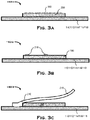
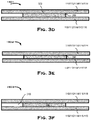
- Figs. 3A - 3F are diagrams of the example patches 150-1, 150-2 and 150-3, respectively, of Figs. 2A-2C after being activated according to an implementation described herein.
- patch 150-1 may be activated, by a user or consumer of package 100, by roughening, scratching, rubbing, or scraping the second surface, of adhesive 200 (e.g., using an abrasive utensil such as a finger, finger nail, emery board, fork, knife, steel wool, etc.), to create a bonding surface 300, associated with adhesive 200, that is sticky, tacky and/or otherwise able to bond to another portion of package 100.
- an abrasive utensil such as a finger, finger nail, emery board, fork, knife, steel wool, etc.
- Bonding surface 300 may be the result of adhesive 200 changing from the inert state to the active state by increasing the surface area of the second surface, which may increase a measure of stickiness, tackiness, adhesive qualities, and/or bond strength of adhesive 200. Additionally, or alternatively, patch 150-1 may be activated by heating the second surface, of adhesive 200 (e.g., with friction by rubbing, with hot water, with hot air using a hair dryer, etc.), to create bonding surface 300. Bonding surface 300 may enable adhesive 200 to adhere to another portion of package 100 (e.g., front panel 110, back panel 112, top seal 114, bottom seal 116, side panel 118, etc.) as shown in Fig. 3D . Thus, the active state, of adhesive 200 (e.g., now with bonding surface 300), may enable a user to reclose package 100 in a manner to be described in greater detail below with respect to Figs. 4 and 5 .
- the active state, of adhesive 200 e.g., now with bonding surface 300
- patch 150-2 may be activated, by a user or consumer of package 100, by removing activation layer 210 from adhesive 200.
- the user may remove activation layer 210 by applying, spraying, immersing activation layer 210 in a solvent (e.g., such as water, etc.) to cause activation layer 210 to dissolve and/or flow away from adhesive 200.
- a solvent e.g., such as water, etc.
- the user may use an article to remove all or a portion of activation layer 210 by wiping activation layer 210 (e.g., with a wet or damp sponge or cloth that holds a solvent) to expose adhesive 200.
- the user may peel back all or a portion of activation layer 210 to expose all or a portion of adhesive 200 without removing activation layer 210 completely from package 100.
- adhesive 200 may already be in the active state (e.g., tacky, sticky, etc.) to enable adhesive 200 to adhere and/or bond to another portion of package 100 (e.g., front panel 110, back panel 112, top seal 114, bottom seal 116, side panel 118, etc.) in the manner shown in Fig. 3E .
- the active state, of adhesive 200 e.g., now with activation layer 210 removed or peeled back
- adhesive 200, of patch 150-3 may be activated, in a manner similar to that described above with respect to Fig. 3B , when a user or consumer, of package 100, removes activation layer 210 from adhesive 200.
- the user may remove activation layer 210 by peeling activation layer 210 from the second surface of adhesive 200 exposing all or a portion of adhesive 200 in the active state.
- activation layer 210 may be peeled back, by the user, while at least a portion, of activation layer 210, remains bonded to package 100 (e.g., front panel 110, back panel 112, top seal 114, bottom seal 116, side panel 118, etc.)
- Other methods of removing activation layer 210 may also, or alternatively, be used (e.g., spraying a solvent, wiping with a wet or damp sponge, etc.).
- adhesive 200 may already be in the active state (e.g., tacky, sticky, etc.) to enable adhesive 200 to adhere to another portion of package 100 (e.g., front panel 110, back panel 112, top seal 114, bottom seal 116, side panel 118, etc.) in the manner shown in Fig. 3F .
- the active state of adhesive 200 e.g., now with activation layer 210 removed or peeled back
- Fig. 4 is a diagram of flexible package 100 after being opened and resealed using a patch 150 on the exterior surface of package 100.
- package 100 may include patch 150 on front panel 110 (e.g., shown as the dotted rounded rectangle 150).
- Package 100 may, for example, be opened by separating front panel 110 from back panel 112 at top seal 114 to create an opening 400, into package 100, via which contents, within package 100, may be accessed.
- the user may activate patch 150 in a manner similar to that described with respect to Figs. 3A - 3F . In this example, the user may make a fold 420 in package 100 to reclose and/or reseal package 100.
- the user may fold a top portion 410, of package 100, at fold 420, over onto a bottom portion 430 of package 100. More particularly, the user may cause an upper portion of front panel 110, associated with top portion 410 of package 100, to make contact with patch 150 and/or a lower portion of front panel 110 associated with bottom portion 430 of package 100. When top portion 410 makes contact with patch 150, the upper portion of front panel 110 may bond with patch 150. Such bonding with patch 150 may maintain fold 420 thereby reclosing and/or resealing package 100.
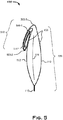
- Fig. 5 is a diagram of a side view of package 100 that has been resealed using multiple folds and patch 150 on the exterior surface of package 100.
- package 100 may include patch 150 on front panel 110 and back panel 112.
- Package 100 may, in a manner similar to that described above, with respect to Fig. 4 , be opened by separating front panel 110 from back panel 112 at top seal 114 to create an opening 400 (not shown in Fig. 5 ), into package 100, via which contents, within package 100, may be accessed.
- the user may, for example, activate patch 150, associated with back panel 112, in a manner similar to that described with respect to Figs. 3A - 3F .
- the user may make two or more folds in package 100 to reclose and/or reseal package 100.
- the user may create a first fold 500-1 near the top of package 100 (e.g., by rolling seal 114, back panel 112 and front panel 110 over onto back panel 112).
- the user may, in a similar manner, make one or more additional folds 500 (e.g., shown as 500-2 and 500-3) in a top portion 510 of package 100, such that the first fold 500-1 is encircled inside of additional folds 500 and the top portion of package (e.g., in proximity of top seal 114).
- the user may cause the top portion 510 including an upper portion of back panel 112, associated with top portion 510, to make contact with patch 150 located on a lower portion of back panel 112, associated with a bottom portion 520 of package 100.
- the upper portion of back panel 112 may bond with patch 150 which may maintain folds 500-1 - 500-3 and thereby reclosing and/or resealing package 100.
- Figs. 6A - 6C are diagrams of example flexible packages 600 - 650, respectively, with a variety of configurations of patches 150 attached thereto.
- flexible package 600 (hereinafter, “package 600") may include one or more components and/or features, described above with respect to package 100 of Fig. 1 , as well as a collection of generally horizontally-oriented patches 150 (hereinafter, collectively, “horizontal patches 150" and, individually, “horizontal patch 150”) located on front panel 110 and/or back panel 112.
- Each horizontal patch 150 may be of a different size, area and/or dimension.
- Each horizontal patch 150 may also, or alternatively, be attached to package 600 at a different and/or discrete location to enable package 600 to be reclosed and/or resealed using the different and/or discrete locations, and/or different sizes, areas, and/or dimensions of horizontal patches 150.
- the user may reclose and/or reseal package 600 using one or more of the upper-most horizontal patches 150 in a manner similar to that described above with respect to Figs. 4 and/or 5.
- the user may reclose and/or reseal package 600 using one or more of the middle and/or lower-most horizontal patches 150 in a manner similar to that described above with respect to Figs. 4 and/or 5.
- the user may reclose and/or reseal package 600 using one or more horizontal patches 150 that are at progressively lower locations on package 600.
- package 600 may be reclosed and/or resealed in a manner similar to that described above with respect to Figs. 4 and 5 , as well as by causing an upper horizontal patch 150 to come into contact with a lower horizontal patch 150 to enable adhesive 200, associated with the upper horizontal patch 150, to bond with adhesive 200 associated with a lower horizontal patch 150.
- flexible package 625 may include one or more components and/or features described above with respect to package 100 of Fig. 1 , as well as a generally vertically-oriented patch 150 (hereinafter, “vertical patch 150") located on front panel 110 and/or back panel 112.
- Vertical patch 150 may be of different sizes, areas, shapes and/or dimensions.
- Vertical patch 150 may also, or alternatively, be attached, to package 625, at different locations to enable package 625 to be reclosed and/or resealed over a continuous range of vertical locations that correspond to the length, of vertical patch 150, in a vertical dimension relative to package 625.
- package 625 may be reclosed and/or resealed in a manner similar to that described above with respect to Figs. 4 and 5 , as well as by causing an upper portion of vertical patch 150 to come into contact with a lower portion of vertical patch 150 to enable adhesive 2100, associated with the upper portion, to bond with adhesive 200 associated with the lower portion of vertical patch 150.
- flexible package 650 may include one or more components and/or features described above with respect to package 100 of Fig. 1 , as well as a combination of vertical patches 150, horizontal patches 150, and/or patches 150 associated with an orientation that is neither vertical nor horizontal (hereinafter “diagonal patch 150") located on front panel 110, back panel 112, and/or side panel 118 (e.g., shown as the parallelogram-shaped diagonal patch 150 on side panel 118 in Fig. 6C ).
- diagonal patch 150 located on front panel 110, back panel 112, and/or side panel 118 (e.g., shown as the parallelogram-shaped diagonal patch 150 on side panel 118 in Fig. 6C ).
- vertical patch 150, horizontal patch 150, or diagonal patch 150 may be formed according to any shape (e.g., triangular, trapezoidal, parallelogram, circular, elliptical, pentagonal, irregular, etc.).
- Package 650 may be reclosed and/or resealed in a manner similar to that described above with respect to Figs. 4 - 6B .
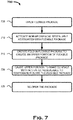
- Fig. 7 is a flowchart of an example process 700 for opening a flexible package, activating patch 150 attached to an exterior surface thereof and resealing the flexible package using the activated non-mechanical resealable.
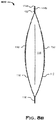
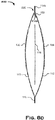
- Figs. 8A - 8E are diagrams of example flexible packages 800 (hereinafter, "package 800") that may include patch 150 that can be used to reclose and/or reseal package 800 after opening. All or a portion of process 700, of Fig. 7 , will be described below with reference to package 800 of Figs. 8A - 8E .
- process 700 may include opening a flexible package (BLOCK 700) and activating a non-mechanical resealable associated with the flexible package (BLOCK 710).
- a user may open a low cost flexible package, such as that shown in Fig. 8A , by causing front panel 110 to separate from back panel 112 (e.g., by grasping and pulling apart front panel 110 from back panel 112) to create an opening via top seal 114.
- package 800 may include one or more components and/or features described above with respect to package 100 of Fig. 1 and/or any of packages 600- 650 of Figs.
- one or more patches 150 may be attached to an exterior surface of front panel 110 and/or a first surface 114a of top seal 114 that corresponds to an upper-most portion of front panel 110.
- one or more patches 150 may be attached to an exterior surface of back panel 112 and/or a second surface 114b, of top seal 114, that corresponds to an upper-most portion of back panel 112.
- package 800 may include additional components, fewer components, different components, or differently arranged components than illustrated in Figs. 8A - 8E .
- front panel 110 may be directly connected and/or sealed to back panel 112 without any right side panel 118 and/or left side panel 120.
- one or more of the components of package 800 may perform one or more functions described as being performed by another one or more of the components of package 800.
- the user may grasp front panel 110 and back panel 112 and may pull front panel 110 apart from back panel 112, in generally opposite directions, break top seal 114 (e.g., by causing first surface 114a to separate from second surface 114b). As illustrated in Fig. 8C , separating first surface 114a from second surface 114b may create an opening 810, in package 800, via which content, stored within package 800, may be accessed and/or removed.
- the user may, in a manner similar to that described above with respect to Figs. 3A - 3C , activate patch 150 to enable package 800 to be temporarily reclosed and/or resealed.
- patch 150 does not include an activation layer 210 (e.g., patch 150-1 of Figs. 2A and 3A )
- the user may, in a non-limiting example, activate patch 150 by roughening, scratching, rubbing, and/or scraping a second, outer surface, of adhesive 200 (e.g., using an abrasive utensil such as a finger, finger nail, coin, emery board, fork, knife, steel wool, etc.), to create bonding surface 300 associated with adhesive 200.
- an abrasive utensil such as a finger, finger nail, coin, emery board, fork, knife, steel wool, etc.
- Bonding surface 300 may be sticky, tacky and/or otherwise able to bond to another portion of package 800. Additionally, or alternatively, the user may activate patch 150 by heating the second, outer surface of adhesive 200 (e.g., with friction by rubbing, with hot water, with hot air using a hair dryer, etc.), to create bonding surface 300. The amount of heating, applied to adhesive 200, may cause a temperature, of the second surface of adhesive 200, to increase to within a certain amount of a glass transition temperature (e.g., T G ), of adhesive 200 (e.g., +/- 1%, 5%, 10%, etc. of T G ), to enable adhesive 200 to become sticky, tacky, and/or otherwise adhere to another portion of package 800.
- T G glass transition temperature
- patch 150 include an activation layer 210 that covers adhesive 200 (e.g., patch 150-2 and/or 150-3 of Figs. 2B and 3B and/or Figs. 2C and 3C , respectively)
- the user may, in a non-limiting example, activate patch 150 by removing activation layer 210 to expose adhesive 200 that is in an active state (e.g., sticky, tacky, and/or otherwise able to bond with package 800).
- an active state e.g., sticky, tacky, and/or otherwise able to bond with package 800.
- Such removal, of activation layer 210 may be performed by applying, spraying, and/or immersing activation layer 210 in a solvent (e.g., such as water, etc.) to cause activation layer 210 to dissolve and/or flow away from adhesive 200.
- a solvent e.g., such as water, etc.
- the user may remove all or a portion of activation layer 210 by wiping activation layer 210 with a wet or damp sponge or cloth to expose adhesive 200. Additionally, or alternatively, the user may peel back all or a portion of activation layer 210 to expose all or a portion of adhesive 200 without removing activation layer 210 completely from package 800.
- the active state, of adhesive 200 may enable a user to temporarily reclose and/or reseal package 800.
- process 700 may include creating a fold, in the flexible package, to form an upper portion of the flexible package (BLOCK 715) and causing the upper portion to make contact with the activated non-mechanical resealable to temporarily close the flexible package (BLOCK 720).
- the user may create a fold (e.g., similar to fold 420 of Fig.
- package 800 in package 800, to enable an upper portion of package 800 to be folded back, onto itself, to cause the upper portion of front panel 110 (or back panel 112) to adhere to and/or bond with one or more activated patches 150 on front panel 110 (or back panel 112) to temporarily reclose and/or reseal package 800.
- the user may create two or more folds (e.g., similar to folds 500 of Fig.
- package 800 in package 800, to enable an upper portion of package 800 to be folded back, onto itself, to cause an upper portion of front panel 110 (or back panel 112) to adhere to and/or bond with one or more activated patches 150 on front panel 110 (or back panel 112) to temporarily reclose and/or reseal package 800.
- the user may fold first surface 114a, associated with front panel 110, into opening 810 to cause patch 150, attached to first surface 114a, to make contact and/or bond with an interior surface of back panel 112.
- Causing patch 150 to make contact and/or bond with the interior surface of back panel 112 may create a temporary seal 820.
- Temporary seal 820 may enable package 800 to be temporarily closed and/or sealed to protect content, within package 800, from becoming spoiled and/or damaged.
- Temporary seal 820 may also, or alternatively, enable package 800 to be reopened without damaging, tearing, and/or destroying patch 150 and/or any portion of package 800 (e.g., front panel 110, back panel 112, top seal 114, bottom seal 116, side panel 118, etc.).
- the user may fold second surface 114b into opening 810 to cause patch 150 to make contact and/or bond with an interior surface of front panel 110.
- Causing patch 150 to make contact and/or bond with the interior surface of front panel 110 may create temporary seal 820 that enables package 800 to be temporarily reclosed and/or resealed.
- the user may fold first surface 114a and second surface 114b into opening 810, and may cause patch 150 to make contact and/or bond with second surface 114b. Causing patch 150 to make contact and/or bond with second surface 114b may create temporary seal 830 that enables package 800 to be temporarily reclosed and/or resealed. Patch 150 may, alternatively, be attached to second surface 114b instead of first surface 114a. In this non-limiting example, the user may fold first surface 114a and second surface 114b into opening 810, and may cause patch 150 to make contact and/or bond with first surface 114a.
- Causing patch 150 to make contact and/or bond with first surface 114a may create temporary seal 830 that enables package 800 to be temporarily reclosed and/or resealed.
- a respective patch 150 may be attached to each of first service 114a and second surface 114b.
- the user may fold first surface 114a and second surface 114b into opening 810, and may cause each respective patch 150 to make contact and/or bond with each other.
- Causing each respective patch 150 to make contact and/or bond with each other may create temporary seal 830 that enables package 800 to be temporarily reclosed and/or resealed.
- process 700 may include re-opening the flexible package (BLOCK 725).
- the user may grasp front panel 110 and back panel 112 and may pull front panel 110 apart from back panel 112, in generally opposite directions, to break temporary seal 820.
- Breaking temporary seal 820 may include breaking the bond, caused by patch 150, between first surface 114a and second surface 114b to enable first surface 114a and second surface 114b to become separated without damaging, tearing, and/or destroying patch 150 and/or any portion of package 800. Separating first surface 114a from second surface 114b may create opening 810, in package 800, via which content, stored within package 800, may be accessed and/or removed.
- Package 800 may be reclosed and/or resealed in the manner described above in process 700.
- non-dependent blocks of process 700 may be performed in parallel, and/or other steps, not-shown, may be included.
- the steps of opening, activating and folding may be performed in a different order.
- non-dependent blocks may be performed in parallel.
Landscapes
- Engineering & Computer Science (AREA)
- Mechanical Engineering (AREA)
- Packages (AREA)
Abstract
Description
- Today's conventional flexible packaging is usually used to protect, store, ship, display and/or sell certain low cost perishable goods such as food (e.g., dry snacks, cereals, certain vegetables, etc.). Such conventional flexible packaging is usually formed by a single layer, single-ply, or mono-web material. Once opened by the consumer, such conventional packaging cannot be reclosed. Thus, to prevent premature spoilage or waste of the goods remaining in the package, the consumer must improvise by, for example, rolling the open end of the conventional flexible package onto itself to create a partial seal that provides some protection for the goods remaining within. Unfortunately, the rolled portion of the conventional package often gradually becomes undone (e.g., unrolled), which can cause the goods to be damaged, spoil, become stale, etc.
- Some types of conventional flexible packaging are formed by a multiple layer, multi-ply, or multi-web material and include mechanical mechanisms, such as zip locks or slide locks, to reseal the conventional flexible package. Such multi-ply materials and mechanical reseal mechanisms are typically used in higher cost conventional flexible packaging for higher cost perishable goods (e.g., cookies, nuts, cold cuts, cheese, freezable items, etc.). Similarly, such multi-ply conventional flexible packaging sometimes includes a non-mechanical reseal mechanism that uses a temporary adhesive on an inside surface of the conventional package, instead of or in addition to the mechanical reseal mechanism, that enables the multi-ply conventional flexible package to be resealed after opening. Such reseal mechanisms usually include tearing-off and/or discarding a portion of the conventional package (e.g., often in the form of litter) to enable the conventional package to be resealed, which can harm the environment. The higher resale price of such perishable goods can usually tolerate the added expense of higher cost multi-ply conventional flexible packaging that includes the mechanical reseal or non-mechanical reseal mechanisms. However, multi-ply conventional flexible packaging, that includes the mechanical reseal or non-mechanical reseal mechanisms, are usually cost prohibitive for use in packaging lower cost goods that use single-ply conventional flexible packaging.
- According to first aspect, there is provided a flexible package according to the appended claims.
- According to a second aspect, there is provided a method according to the appended claims.
- According to an implementation, described here, a flexible package may include a first panel and a second panel that are formed by a flexible material. The first panel may be attached to the second panel to form an interior cavity, between the first panel and second panel, in which content is stored. The flexible package may also include an adhesive that is attached to a first exterior surface of the first panel, or a second exterior surface of the second panel. The adhesive may have a first state and a second state. The first state may preclude the adhesive from bonding with the flexible material to prevent the package, once opened, from being reclosed or resealed by the adhesive in the first state. The second state, when activated, may enable the adhesive to bond with the flexible material to permit the package, once opened, to be reclosed or resealed by the adhesive in the second state.
- According to another implementation, a resealable flexible package may include a first panel and a second panel that are formed by a flexible material. The first panel may be attached to the second panel to form an interior cavity, between the first panel and second panel, in which content is stored. A pressure sensitive adhesive may be attached to a first surface of the first panel or a second surface of the second panel. The pressure sensitive adhesive may have a first state and a second state. The first state may preclude the pressure sensitive adhesive from bonding with the flexible material to prevent the resealable flexible package, once opened, from being reclosed or resealed by the pressure sensitive adhesive in the first state. The second state, when activated, may enable the pressure sensitive adhesive to bond with the flexible material to permit the resealable flexible package, once opened, to be reclosed or resealed by the pressure sensitive adhesive in the second state.
- According to a further implementation, a method of resealing a flexible package may include opening the flexible package to access content stored within the flexible package. The flexible package may be formed by a polymer and may include an adhesive on an exterior surface of a first portion of the flexible package. The adhesive may be in an inactive state that precludes the adhesive from bonding with a second, different portion of the flexible package or a different flexible package. The method may also include causing the adhesive to change from the inactive state to an active state. The active state may enable the adhesive to bond with the flexible package. The method may further include creating one or more folds in the second portion of the flexible package; and causing the second portion of the package, in which the one or more folds are created, to bond with the adhesive, in the active state, to close the flexible package.
- According to another implementation, a flexible package may comprise:
- a first panel and a second panel that are formed by a flexible material, the first panel being attached to the second panel to form an interior cavity, between the first panel and second panel, in which content is stored; and an adhesive that is attached to a first exterior surface of the first panel or a second exterior surface of the second panel, the adhesive having a first state and a second state, the first state precludes the adhesive from bonding with the flexible material to prevent the package, once opened, from being reclosed or resealed by the adhesive in the first state, and the second state, when activated, enables the adhesive to bond with the flexible material to permit the package, once opened, to be reclosed or resealed by the adhesive in the second state.
- The adhesive may correspond to a pressure sensitive adhesive or a cohesive.
- The adhesive, in the first state, may further include: a first layer of an adhesive material, and a second layer of a material that covers the first layer to prevent the first layer from bonding with the flexible material.
- The second layer may be peeled away to expose the first layer causing the adhesive to change from the first state to the second state.
- The second layer may be water soluble to enable the material to be dissolved or wiped away exposing the first layer when the adhesive is in the second state.
- The flexible material may correspond to a monoweb polymer.
- The flexible material may correspond to a multiweb polymer.
- The flexible package may further comprise: a seal, between the first panel the second panel, on which the adhesive is attached, the flexible package being enabled to be opened when the seal is broken, and the adhesive enabling the flexible package to be reclosed when the adhesive is in the second state.
- According to another implementation, a resealable flexible package may comprise:
- a first panel and a second panel that are formed by a flexible material, the first panel being attached to the second panel to form an interior cavity, between the first panel and second panel, in which content is stored; and a pressure sensitive adhesive that is attached to a first surface of the first panel or a second surface of the second panel, the pressure sensitive adhesive having a first state and a second state, the first state precludes the pressure sensitive adhesive from bonding with the flexible material to prevent the resealable flexible package, once opened, from being reclosed or resealed by the pressure sensitive adhesive in the first state, and the second state, when activated, enables the pressure sensitive adhesive to bond with the flexible material to permit the resealable flexible package, once opened, to be reclosed or resealed by the pressure sensitive adhesive in the second state.
- The pressure sensitive adhesive, in the first state, may further include a layer of a material that covers the pressure sensitive adhesive to prevent the pressure sensitive adhesive from bonding with the flexible material.
- The layer of material may be peeled away to expose the pressure sensitive adhesive enabling the pressure sensitive adhesive to bond with the flexible material to reclose or reseal the resealable flexible package.
- The layer of material may be water soluble to enable the layer of material to be dissolved or wiped away exposing the pressure sensitive adhesive and causing the pressure sensitive adhesive to change from the first state to the second state.
- The pressure sensitive adhesive, in the second state, may enable the resealable flexible package, once opened, to be reclosed by creating one or more folds in an open end of the resealable flexible package and causing the one or more folds to make contact with the pressure sensitive adhesive to reclose or reseal the resealable flexible package.
- The resealable flexible package may further comprise: a seal, between the first panel the second panel, on which the pressure sensitive adhesive is attached, the resealable flexible package being opened when the seal is broken, and the resealable flexible package being enabled to be reclosed when the pressure sensitive adhesive is in the second state.
- According to another implementation, a method of resealing a flexible package may comprise: opening the flexible package to access content stored within the flexible package, the flexible package being formed by a polymer and including an adhesive on an exterior surface of a first portion of the flexible package, the adhesive being in an inactive state that precludes the adhesive from bonding with a second, different portion of the flexible package or a different flexible package; causing the adhesive to change from the inactive state to an active state, the active state enabling the adhesive to bond with the flexible package; creating one or more folds in the second portion of the flexible package; and causing the second portion of the package, in which the one or more folds are created, to bond with the adhesive, in the active state, to close the flexible package.
- Causing the adhesive to change from the inactive state to the active state may further comprise: heating the adhesive to cause the adhesive to change from the inactive state to the active state.
- Heating the adhesive may include: causing a temperature, of the adhesive, to increase to a threshold associated with the glass transition temperature of the adhesive.
- Causing the adhesive to change from the inactive state to the active state may further comprise: roughening the adhesive to cause the adhesive to change from the inactive state to the active state.
- The adhesive may be formed by an adhesive material and a material that covers the adhesive material when the adhesive is in the inactive state, and where causing the adhesive to change from the inactive state to the active state may include: dissolving the material to expose all or a portion of the adhesive material causing the adhesive to change from the inactive state to the active state.
- Dissolving the material further may include at least one of: applying, to the adhesive, a solvent to cause the material to dissolve in a manner that exposes the adhesive material, or wiping the adhesive with an article that applies the solvent and removes the material to expose the adhesive material.
- The solvent may correspond to water.
- The adhesive may be formed by an adhesive material and a material that covers the adhesive material when the adhesive is in the inactive state, and where causing the adhesive to change from the inactive state to the active state may include: peeling all or a portion of the material, from the adhesive, to expose all or a portion of the adhesive material.
- A particular portion, of the material, may remain attached to the adhesive or the flexible package.
- The adhesive may be formed by an adhesive material and a material that covers the adhesive material when the adhesive is in the inactive state, and where causing the adhesive to change from the inactive state to the active state may include: applying friction to remove all or a portion of the material, from the adhesive, to expose all or a portion of the adhesive material.
- It should be understood that the features defined above or below may be utilised, either alone or in combination with any other defined feature.
-
-
Fig. 1 is a diagram of an example flexible package according to an implementation described herein; -
Figs. 2A-2C are diagrams of an example non-mechanical resealable component of the flexible package identified inFig. 1 ; -
Figs. 3A-3F are diagrams of the example non-mechanical resealable components ofFigs. 2A-2C after being activated according to an implementation described herein; -
Fig. 4 is a diagram of a flexible package after being opened and resealed using an activated non-mechanical resealable on the exterior surface of the package; -
Fig. 5 is a diagram of a side view of a flexible package that has been resealed using an activated non-mechanical resealable on the exterior surface of the package; -
Figs. 6A - 6C are diagrams of example flexible packages with a variety of configurations of non-mechanical resealable components attached thereto; -
Fig. 7 is a flowchart of an example process for opening a flexible package, activating the non-mechanical resealable attached to an exterior surface thereof and resealing the flexible package using the activated non-mechanical resealable; and -
Figs. 8A - 8E are diagrams of an example flexible package with a non-mechanical resealable that can be used to reseal the flexible package after opening. -
Figs. 1 - 8E are attached thereto and incorporated herein by this reference. The following detailed description refers to the accompanyingFigs. 1 - 8E . The same reference numbers in different figures may identify the same or similar elements. - An apparatus, system, method, technology, and/or technique, described herein, may include an improved flexible package of one or more plies (hereinafter, a "flexible package"), to store low cost content (e.g., snacks, cereal, vegetables, etc.), that can be resealed after opening using an activated non-mechanical resealable attached to all or a portion of the flexible package.
- A non-mechanical resealable may include any type of temporary adhesive or temporary cohesive that has a first state that is inert, not sticky, and not tacky (hereinafter, "inert state") and a second state that, once activated, causes the adhesive to become active, sticky and/or tacky (hereinafter, "active state"). The temporary adhesive may include a pressure sensitive adhesive ("PSA"), a cohesive, and/or some other material that enables a portion of a flexible package to bond and/or seal repeatedly to such temporary adhesive and/or cohesive, and to unbond and/or unsealed repeatedly without damaging, tearing, or destroying the flexible package or temporary adhesive.
- Activating the non-mechanical resealable, from the inert state to the active state, may, by way of non-limiting examples, include roughening, rubbing, and/or scoring the adhesive (e.g., with a utensil, such as a finger, fingernail, coin, emery board, fork, knife, steel wool, etc.); heating the adhesive to a temperature at, above, or near a glass transition temperature of the adhesive; dissolving to the soluble outer layer (e.g., by applying water or another solvent) or otherwise using an article (e.g., wiping with a wet or damp sponge, cloth, etc.) to remove a soluble protective outer layer that covers an active adhesive; peeling or otherwise removing all or a portion of a protective outer layer that covers an active adhesive; etc.
- To avoid increasing the cost relative to a conventional flexible package, the flexible package, described herein, may be manufactured using a conventional mono-web and/or single-ply material, and a conventional manufacturing process, such that the non-mechanical resealable may be attached to, or integrated within, the flexible package in a manner that does not change, or add steps or complexity to the conventional manufacturing process.
-
Fig. 1 is a diagram of an example flexible package 100 (hereinafter, "package 100") according to an implementation described herein. As illustrated inFig. 1 ,package 100 may be formed by a flexible material that is suitable for storing, shipping, and/or displaying perishable and/or non-perishable goods in a manner that is air tight and water tight. By way of a non-limiting example, such a flexible material may include polyethylene (PE), polypropylene (PP), polystyrene (PS), polyamide (PA), nylon, textile, paper, or any combination thereof (hereinafter, "flexible material") that is suitable for storing and shipping perishable or non-perishable goods. Whilepackage 100 is described herein as being formed by a mono web and/or single-ply material, in other implementations,package 100 need not be so limited. For example,package 100 could also, or alternatively, be formed by a multi-ply material of one or more of the materials described above. -
Package 100 may include afront panel 110, aback panel 112, atop seal 114, abottom seal 116, a right side panel 118-1, a left side panel 118-2 (sometimes referred to individually as "side panel 118" and together as "side panels 118"), and/or one or more non-mechanical resealable patches 150-1 and 150-2 (hereafter, each a "patch 150" and together, "patches 150"). - The number of components, illustrated in
Fig. 1 , is provided for explanatory purposes only and is not intended to be so limited. Additionally, or alternatively,package 100 may include additional components, fewer components, different components, or differently arranged components than illustrated inFig. 1 . For example, an edge and/or perimeter offront panel 110 may be attached and/or sealed to an edge and/or perimeter ofback panel 112, without anyright side panel 118 and/orleft side panel 118, to form an airtight and/or watertight interior cavity betweenfront panel 110 andback panel 112 in which perishable and/or non-perishable content may be stored. Also, in some implementations, one or more of the components ofpackage 100 may perform one or more functions described as being performed by another one or more of the components ofpackage 100. -
Front panel 110,back panel 112, and/orside panels 118 may be formed by a flexible material of sufficient strength and flexibility to enablepackage 100 to store perishable and non-perishable content and/or to permit such content to be shipped, displayed, sold, and/or removed from an opening inpackage 100 once opened.Front panel 110 may be attached and/or sealed to side panels 118 (e.g., at one or more sides of Front panel 110).Back panel 112 may be attached and/or sealed to side panels 118 (e.g., at one or more sides of back panel 110). An upper portion offront panel 110 may be permanently and/or temporarily attached, sealed, bonded, welded, etc. to an upper portion ofback panel 112 to formtop seal 114. A lower portion offront panel 110 may be permanently and/or temporarily attached, sealed, bonded, welded, etc. to a lower portion ofback panel 112 to formbottom seal 116. Thus,package 100 may form an air tight and/or water tight interior cavity in which perishable and/or non-perishable content can be stored, based on thetop seal 114,bottom seal 116, the seals betweenside panels 118 andfront panel 110, and the seals betweenside panels 118 andback panel 112. - Additionally, or alternatively, in other implementations, all or a portion of
front panel 110,side panels 118, and/orback panel 112 may be formed as a continuous material. For example,front panel 110 andside panels 118 may be one piece of material such that seals are not necessary betweenfront panel 110 andside panels 118. In another implementation,back panel 112 andside panels 118 may be one piece of material such that seals are not necessary betweenback panel 112 andside panels 118. In a further implementation,front panel 110,side panels 118, andback panel 112 may be formed from one piece of material (e.g., sleeve, cylinder). -
Patch 150 may be formed by a temporary adhesive or cohesive that is attached to all or a portion of front panel 110 (e.g., shown as the shaded and rounded rectangle labeled 150-1) back panel 112 (e.g., shown as the dashed rounded rectangle labeled 150-2), top seal 114 (e.g., not shown inFig. 1 ), bottom seal 116 (e.g., not shown inFig. 1 ), or side panel 118 (e.g., not shown inFig. 1 ). In a manner to be described below with respect toFigs. 2A - 3C , when activated,patch 150 may enablepackage 100, once opened, to be temporarily resealed and/or reclosed to protect contents stored therein from spoiling, becoming stale, or otherwise being damaged and/or destroyed. Additionally, or alternatively,patch 150, when activated, may enablepackage 100 to be repeatedly resealed and reopened in a manner that does not tear and/or destroy the material on whichpatch 150 is formed. -
Figs. 2A - 2C are diagrams of example non-mechanical patches 150-1, 150-2 and 150-3, respectively, ofpackage 100 identified inFig. 1 . As shown inFig. 2A , patch 150-1 may include a temporary adhesive 200 (hereinafter, "adhesive 200") that is attached to package 100 (e.g.,front panel 110,back panel 112,top seal 114,bottom seal 116,side panel 118, etc.). Adhesive 200 may be a temporary adhesive, such as a PSA (e.g., an acrylic-based PSA, a styrene block copolymer ("SBC") PSA, etc.). Adhesive 200 may be in the form of a patch, tape, etc. that is permanently bonded and/or attached, on a first surface of adhesive 200, tofront panel 110 and/orback panel 112. In a non-limiting example, adhesive 200 may be printed and/or sprayed onpackage 100 and allowed to dry and/or cure to a solid form that is in an inert state (e.g., non-sticky, non-tacky, etc.) prior to being activated in a manner described below with respect toFig. 3A . - As shown in
Fig. 2B , patch 150-2 may include adhesive 200, as described above inFig. 2A , that is bonded and/or attached, on a first surface of adhesive 200, to package 100 (e.g.,front panel 110,back panel 112,top seal 114,bottom seal 116,side panel 118, etc.), as well as anactivation layer 210 that is attached to a second surface, of adhesive 200, that is opposite the first surface ofadhesive 200.Adhesive 200, in this non-limiting example, may be in an active state (e.g., sticky, tacky, etc.), but kept "inert" byactivation layer 210 to prevent adhesive 200 from undesirable bonding with adjacent packages 100 (e.g., during shipping, display, etc.) and/or collecting debris (e.g., during packaging, shipping, prior to sale, etc.). -
Activation layer 210 may, for example, be formed by a material that can dissolve in the presence of a solvent (e.g., by applying, spraying, immersing, etc. with water or some other solvent); can be wiped away or removed with a wet or damp cloth or sponge (e.g., a water soluble film, compound, polymer, etc.); can be rubbed or scraped away (e.g., such as a water-based scratch of material, Buna-N rubber, photopolymer coating, wax-based coating, silicon-coating, etc.); and/or can be peeled away (but not removed entirely) to expose all or a portion of adhesive 200 in an active state.Activation layer 210 may also, or alternatively, be formed as a patch or tape that is temporarily bonded and/or attached to all or a portion of thesecond surface adhesive 200. In a non-limiting example,activation layer 210 may be printed and/or sprayed on adhesive 200 and allowed to dry and/or cure to a solid form. Additionally, or alternatively,activation layer 210 may be attached and/or bonded to adhesive 200 and the combination of adhesive 200 andactivation layer 210 by be attached and/or bonded to package 100 (e.g.,front panel 110,back panel 112,side panel 118,top seal 114,bottom seal 116, etc.). Patch 150-2 may be activated to causeactivation layer 210 to dissolve and/or otherwise be removed from adhesive 200 in a manner described below with respect toFig. 3B . - As shown in
Fig. 2C , patch 150-3 may include adhesive 200 andactivation layer 210, as described above with respect toFig. 2B , except thatactivation layer 210 may extend beyond one or more edges of adhesive 200 (e.g., in the active state), such that a portion ofactivation layer 210 makes contact with, is attached to and/or bonds with package 100 (e.g.,front panel 110,back panel 112,top seal 114,bottom seal 116,side panel 118, etc.). In a manner similar to that described above,activation layer 210 may be removed, from adhesive 200, by dissolving in the presence of a solvent (e.g., by applying, spraying, immersing with water or some other solvent); wiping with a damp cloth or sponge (e.g., a water soluble film, compound, polymer, etc.); rubbing or scraping away (e.g., an overlaquer, surface printed ink, etc. with low adhesion properties allowing activation layer to be scratched away); and/or by peeling away (but not completely removing or detaching)activation layer 210 to expose all or a portion of adhesive 200 in an active state. Patch 150-3 may be activated by causingactivation layer 210 to dissolve and/or otherwise be removed from adhesive 200 in a manner described below with respect toFig. 3C . -
Figs. 3A - 3F are diagrams of the example patches 150-1, 150-2 and 150-3, respectively, ofFigs. 2A-2C after being activated according to an implementation described herein. As shown inFig. 3A , patch 150-1 may be activated, by a user or consumer ofpackage 100, by roughening, scratching, rubbing, or scraping the second surface, of adhesive 200 (e.g., using an abrasive utensil such as a finger, finger nail, emery board, fork, knife, steel wool, etc.), to create abonding surface 300, associated with adhesive 200, that is sticky, tacky and/or otherwise able to bond to another portion ofpackage 100.Bonding surface 300 may be the result of adhesive 200 changing from the inert state to the active state by increasing the surface area of the second surface, which may increase a measure of stickiness, tackiness, adhesive qualities, and/or bond strength ofadhesive 200. Additionally, or alternatively, patch 150-1 may be activated by heating the second surface, of adhesive 200 (e.g., with friction by rubbing, with hot water, with hot air using a hair dryer, etc.), to createbonding surface 300.Bonding surface 300 may enable adhesive 200 to adhere to another portion of package 100 (e.g.,front panel 110,back panel 112,top seal 114,bottom seal 116,side panel 118, etc.) as shown inFig. 3D . Thus, the active state, of adhesive 200 (e.g., now with bonding surface 300), may enable a user to reclosepackage 100 in a manner to be described in greater detail below with respect toFigs. 4 and5 . - As shown in
Fig. 3B , patch 150-2 may be activated, by a user or consumer ofpackage 100, by removingactivation layer 210 from adhesive 200. In a manner similar to that described above with respect toFig. 2B , the user may removeactivation layer 210 by applying, spraying, immersingactivation layer 210 in a solvent (e.g., such as water, etc.) to causeactivation layer 210 to dissolve and/or flow away from adhesive 200. Additionally, or alternatively, the user may use an article to remove all or a portion ofactivation layer 210 by wiping activation layer 210 (e.g., with a wet or damp sponge or cloth that holds a solvent) to expose adhesive 200. Additionally, or alternatively, the user may peel back all or a portion ofactivation layer 210 to expose all or a portion of adhesive 200 without removingactivation layer 210 completely frompackage 100. In this example, adhesive 200 may already be in the active state (e.g., tacky, sticky, etc.) to enable adhesive 200 to adhere and/or bond to another portion of package 100 (e.g.,front panel 110,back panel 112,top seal 114,bottom seal 116,side panel 118, etc.) in the manner shown inFig. 3E . Thus, the active state, of adhesive 200 (e.g., now withactivation layer 210 removed or peeled back), may enable a user to reclosepackage 100 in a manner to be described in greater detail below with respect toFigs. 4 and5 . - As shown in
Fig. 3C , adhesive 200, of patch 150-3, may be activated, in a manner similar to that described above with respect toFig. 3B , when a user or consumer, ofpackage 100, removesactivation layer 210 from adhesive 200. In a manner similar to that described above with respect toFig. 3B , the user may removeactivation layer 210 by peelingactivation layer 210 from the second surface of adhesive 200 exposing all or a portion of adhesive 200 in the active state. In this example,activation layer 210 may be peeled back, by the user, while at least a portion, ofactivation layer 210, remains bonded to package 100 (e.g.,front panel 110,back panel 112,top seal 114,bottom seal 116,side panel 118, etc.) Other methods of removingactivation layer 210 may also, or alternatively, be used (e.g., spraying a solvent, wiping with a wet or damp sponge, etc.). In this example, adhesive 200 may already be in the active state (e.g., tacky, sticky, etc.) to enable adhesive 200 to adhere to another portion of package 100 (e.g.,front panel 110,back panel 112,top seal 114,bottom seal 116,side panel 118, etc.) in the manner shown inFig. 3F . Thus, the active state of adhesive 200 (e.g., now withactivation layer 210 removed or peeled back) may enable a user to reclosepackage 100 in a manner to be described in greater detail below with respect toFigs. 4 and5 . -
Fig. 4 is a diagram offlexible package 100 after being opened and resealed using apatch 150 on the exterior surface ofpackage 100. As shown inFig. 4 ,package 100 may includepatch 150 on front panel 110 (e.g., shown as the dotted rounded rectangle 150).Package 100 may, for example, be opened by separatingfront panel 110 fromback panel 112 attop seal 114 to create anopening 400, intopackage 100, via which contents, withinpackage 100, may be accessed. To reclose or resealpackage 100, the user may activatepatch 150 in a manner similar to that described with respect toFigs. 3A - 3F . In this example, the user may make afold 420 inpackage 100 to reclose and/or resealpackage 100. - In a non-limiting example, the user may fold a
top portion 410, ofpackage 100, atfold 420, over onto abottom portion 430 ofpackage 100. More particularly, the user may cause an upper portion offront panel 110, associated withtop portion 410 ofpackage 100, to make contact withpatch 150 and/or a lower portion offront panel 110 associated withbottom portion 430 ofpackage 100. Whentop portion 410 makes contact withpatch 150, the upper portion offront panel 110 may bond withpatch 150. Such bonding withpatch 150 may maintain fold 420 thereby reclosing and/or resealingpackage 100. -
Fig. 5 is a diagram of a side view ofpackage 100 that has been resealed using multiple folds and patch 150 on the exterior surface ofpackage 100. As shown inFig. 4 ,package 100 may includepatch 150 onfront panel 110 andback panel 112.Package 100 may, in a manner similar to that described above, with respect toFig. 4 , be opened by separatingfront panel 110 fromback panel 112 attop seal 114 to create an opening 400 (not shown inFig. 5 ), intopackage 100, via which contents, withinpackage 100, may be accessed. To reclose or resealpackage 100, the user may, for example, activatepatch 150, associated withback panel 112, in a manner similar to that described with respect toFigs. 3A - 3F . In this example, the user may make two or more folds inpackage 100 to reclose and/or resealpackage 100. - In a non-limiting example, the user may create a first fold 500-1 near the top of package 100 (e.g., by rolling
seal 114,back panel 112 andfront panel 110 over onto back panel 112). The user may, in a similar manner, make one or more additional folds 500 (e.g., shown as 500-2 and 500-3) in atop portion 510 ofpackage 100, such that the first fold 500-1 is encircled inside of additional folds 500 and the top portion of package (e.g., in proximity of top seal 114). Additionally, or alternatively, the user may cause thetop portion 510 including an upper portion ofback panel 112, associated withtop portion 510, to make contact withpatch 150 located on a lower portion ofback panel 112, associated with abottom portion 520 ofpackage 100. Whentop portion 510 makes contact withpatch 150, the upper portion ofback panel 112 may bond withpatch 150 which may maintain folds 500-1 - 500-3 and thereby reclosing and/or resealingpackage 100. -
Figs. 6A - 6C are diagrams of example flexible packages 600 - 650, respectively, with a variety of configurations ofpatches 150 attached thereto. As shown inFig. 6A , flexible package 600 (hereinafter, "package 600") may include one or more components and/or features, described above with respect to package 100 ofFig. 1 , as well as a collection of generally horizontally-oriented patches 150 (hereinafter, collectively, "horizontal patches 150" and, individually, "horizontal patch 150") located onfront panel 110 and/orback panel 112. Eachhorizontal patch 150 may be of a different size, area and/or dimension. Eachhorizontal patch 150 may also, or alternatively, be attached to package 600 at a different and/or discrete location to enablepackage 600 to be reclosed and/or resealed using the different and/or discrete locations, and/or different sizes, areas, and/or dimensions ofhorizontal patches 150. In a non-limiting example, whenpackage 600 is opened and reclosed after none, or a small portion, of the contents are removed, the user may reclose and/or resealpackage 600 using one or more of the upper-mosthorizontal patches 150 in a manner similar to that described above with respect toFigs. 4 and/or 5. When a greater portion of the contents are removed, the user may reclose and/or resealpackage 600 using one or more of the middle and/or lower-mosthorizontal patches 150 in a manner similar to that described above with respect toFigs. 4 and/or 5. As the amount of contents are removed frompackage 600, the user may reclose and/or resealpackage 600 using one or morehorizontal patches 150 that are at progressively lower locations onpackage 600. In another non-limiting example,package 600 may be reclosed and/or resealed in a manner similar to that described above with respect toFigs. 4 and5 , as well as by causing an upperhorizontal patch 150 to come into contact with a lowerhorizontal patch 150 to enable adhesive 200, associated with the upperhorizontal patch 150, to bond with adhesive 200 associated with a lowerhorizontal patch 150. - As shown in
Fig. 6B , flexible package 625 (hereinafter, "package 625") may include one or more components and/or features described above with respect to package 100 ofFig. 1 , as well as a generally vertically-oriented patch 150 (hereinafter, "vertical patch 150") located onfront panel 110 and/orback panel 112.Vertical patch 150 may be of different sizes, areas, shapes and/or dimensions.Vertical patch 150 may also, or alternatively, be attached, to package 625, at different locations to enablepackage 625 to be reclosed and/or resealed over a continuous range of vertical locations that correspond to the length, ofvertical patch 150, in a vertical dimension relative to package 625. In a non-limiting example, as an increasing amount of content is removed over time, frompackage 625, the user may reclose and/or resealpackage 625, in a manner similar to that described above with respect toFigs. 4 and5 , over continuously lower vertical locations, ofpackage 625, usingvertical patch 150. In another non-limiting example,package 625 may be reclosed and/or resealed in a manner similar to that described above with respect toFigs. 4 and5 , as well as by causing an upper portion ofvertical patch 150 to come into contact with a lower portion ofvertical patch 150 to enable adhesive 2100, associated with the upper portion, to bond with adhesive 200 associated with the lower portion ofvertical patch 150. - As shown in
Fig. 6C , flexible package 650 (hereinafter, "package 650") may include one or more components and/or features described above with respect to package 100 ofFig. 1 , as well as a combination ofvertical patches 150,horizontal patches 150, and/orpatches 150 associated with an orientation that is neither vertical nor horizontal (hereinafter "diagonal patch 150") located onfront panel 110,back panel 112, and/or side panel 118 (e.g., shown as the parallelogram-shapeddiagonal patch 150 onside panel 118 inFig. 6C ). Additionally, or alternatively,vertical patch 150,horizontal patch 150, ordiagonal patch 150 may be formed according to any shape (e.g., triangular, trapezoidal, parallelogram, circular, elliptical, pentagonal, irregular, etc.).Package 650 may be reclosed and/or resealed in a manner similar to that described above with respect toFigs. 4 - 6B . -
Fig. 7 is a flowchart of anexample process 700 for opening a flexible package, activatingpatch 150 attached to an exterior surface thereof and resealing the flexible package using the activated non-mechanical resealable.Figs. 8A - 8E are diagrams of example flexible packages 800 (hereinafter, "package 800") that may includepatch 150 that can be used to reclose and/or resealpackage 800 after opening. All or a portion ofprocess 700, ofFig. 7 , will be described below with reference to package 800 ofFigs. 8A - 8E . - As shown in
Fig. 7 ,process 700 may include opening a flexible package (BLOCK 700) and activating a non-mechanical resealable associated with the flexible package (BLOCK 710). For example, a user may open a low cost flexible package, such as that shown inFig. 8A , by causingfront panel 110 to separate from back panel 112 (e.g., by grasping and pulling apartfront panel 110 from back panel 112) to create an opening viatop seal 114. As shown inFigs. 8A and8B ,package 800 may include one or more components and/or features described above with respect to package 100 ofFig. 1 and/or any of packages 600- 650 ofFigs. 6A - 6C , such as, for example,front panel 110,back panel 112,top seal 114,bottom seal 116, one ormore side panels 118, and/or one ormore patches 150. In this non-limiting example, one ormore patches 150 may be attached to an exterior surface offront panel 110 and/or afirst surface 114a oftop seal 114 that corresponds to an upper-most portion offront panel 110. Although not shown inFigs. 8A or8B , in another non-limiting example, one ormore patches 150 may be attached to an exterior surface ofback panel 112 and/or asecond surface 114b, oftop seal 114, that corresponds to an upper-most portion ofback panel 112. - The number of components, illustrated in
Figs. 8A - 8E , is provided for explanatory purposes only and is not intended to be so limited. Additionally, or alternatively,package 800 may include additional components, fewer components, different components, or differently arranged components than illustrated inFigs. 8A - 8E . For example,front panel 110 may be directly connected and/or sealed to backpanel 112 without anyright side panel 118 and/or left side panel 120. Also, in some implementations, one or more of the components ofpackage 800 may perform one or more functions described as being performed by another one or more of the components ofpackage 800. - The user may grasp
front panel 110 andback panel 112 and may pullfront panel 110 apart fromback panel 112, in generally opposite directions, break top seal 114 (e.g., by causingfirst surface 114a to separate fromsecond surface 114b). As illustrated inFig. 8C , separatingfirst surface 114a fromsecond surface 114b may create anopening 810, inpackage 800, via which content, stored withinpackage 800, may be accessed and/or removed. - The user may, in a manner similar to that described above with respect to
Figs. 3A - 3C , activatepatch 150 to enablepackage 800 to be temporarily reclosed and/or resealed. In the event that patch 150 does not include an activation layer 210 (e.g., patch 150-1 ofFigs. 2A and3A ), the user may, in a non-limiting example, activatepatch 150 by roughening, scratching, rubbing, and/or scraping a second, outer surface, of adhesive 200 (e.g., using an abrasive utensil such as a finger, finger nail, coin, emery board, fork, knife, steel wool, etc.), to createbonding surface 300 associated withadhesive 200.Bonding surface 300 may be sticky, tacky and/or otherwise able to bond to another portion ofpackage 800. Additionally, or alternatively, the user may activatepatch 150 by heating the second, outer surface of adhesive 200 (e.g., with friction by rubbing, with hot water, with hot air using a hair dryer, etc.), to createbonding surface 300. The amount of heating, applied to adhesive 200, may cause a temperature, of the second surface of adhesive 200, to increase to within a certain amount of a glass transition temperature (e.g., TG), of adhesive 200 (e.g., +/- 1%, 5%, 10%, etc. of TG), to enable adhesive 200 to become sticky, tacky, and/or otherwise adhere to another portion ofpackage 800. - In the event that patch 150 include an
activation layer 210 that covers adhesive 200 (e.g., patch 150-2 and/or 150-3 ofFigs. 2B and3B and/orFigs. 2C and3C , respectively), the user may, in a non-limiting example, activatepatch 150 by removingactivation layer 210 to expose adhesive 200 that is in an active state (e.g., sticky, tacky, and/or otherwise able to bond with package 800). Such removal, ofactivation layer 210, may be performed by applying, spraying, and/or immersingactivation layer 210 in a solvent (e.g., such as water, etc.) to causeactivation layer 210 to dissolve and/or flow away from adhesive 200. Additionally, or alternatively, the user may remove all or a portion ofactivation layer 210 by wipingactivation layer 210 with a wet or damp sponge or cloth to expose adhesive 200. Additionally, or alternatively, the user may peel back all or a portion ofactivation layer 210 to expose all or a portion of adhesive 200 without removingactivation layer 210 completely frompackage 800. Thus, the active state, of adhesive 200, may enable a user to temporarily reclose and/or resealpackage 800. - As also shown in
Fig. 7 ,process 700 may include creating a fold, in the flexible package, to form an upper portion of the flexible package (BLOCK 715) and causing the upper portion to make contact with the activated non-mechanical resealable to temporarily close the flexible package (BLOCK 720). For example, in a manner similar to that described above with respect toFig. 4 , the user may create a fold (e.g., similar to fold 420 ofFig. 4 ), inpackage 800, to enable an upper portion ofpackage 800 to be folded back, onto itself, to cause the upper portion of front panel 110 (or back panel 112) to adhere to and/or bond with one or more activatedpatches 150 on front panel 110 (or back panel 112) to temporarily reclose and/or resealpackage 800. In another non-limiting example and in a manner similar to that described with respect toFig. 5 , the user may create two or more folds (e.g., similar to folds 500 ofFig. 5 ), inpackage 800, to enable an upper portion ofpackage 800 to be folded back, onto itself, to cause an upper portion of front panel 110 (or back panel 112) to adhere to and/or bond with one or more activatedpatches 150 on front panel 110 (or back panel 112) to temporarily reclose and/or resealpackage 800. - In another non-limiting example, as illustrated in
Fig. 8D , the user may foldfirst surface 114a, associated withfront panel 110, into opening 810 to causepatch 150, attached tofirst surface 114a, to make contact and/or bond with an interior surface ofback panel 112. Causingpatch 150 to make contact and/or bond with the interior surface ofback panel 112 may create atemporary seal 820.Temporary seal 820 may enablepackage 800 to be temporarily closed and/or sealed to protect content, withinpackage 800, from becoming spoiled and/or damaged.Temporary seal 820 may also, or alternatively, enablepackage 800 to be reopened without damaging, tearing, and/or destroyingpatch 150 and/or any portion of package 800 (e.g.,front panel 110,back panel 112,top seal 114,bottom seal 116,side panel 118, etc.). - Similarly, although not shown in
Figs. 8A - 8D , in the event that patch 150 is attached tosecond surface 114b, associated withback panel 112, the user may foldsecond surface 114b intoopening 810 to causepatch 150 to make contact and/or bond with an interior surface offront panel 110. Causingpatch 150 to make contact and/or bond with the interior surface offront panel 110 may createtemporary seal 820 that enablespackage 800 to be temporarily reclosed and/or resealed. - Additionally, or alternatively, as illustrated in
Fig. 8E , the user may foldfirst surface 114a andsecond surface 114b intoopening 810, and may causepatch 150 to make contact and/or bond withsecond surface 114b. Causingpatch 150 to make contact and/or bond withsecond surface 114b may createtemporary seal 830 that enablespackage 800 to be temporarily reclosed and/or resealed.Patch 150 may, alternatively, be attached tosecond surface 114b instead offirst surface 114a. In this non-limiting example, the user may foldfirst surface 114a andsecond surface 114b intoopening 810, and may causepatch 150 to make contact and/or bond withfirst surface 114a. Causingpatch 150 to make contact and/or bond withfirst surface 114a may createtemporary seal 830 that enablespackage 800 to be temporarily reclosed and/or resealed. Alternatively, arespective patch 150 may be attached to each offirst service 114a andsecond surface 114b. In this non-limiting example, the user may foldfirst surface 114a andsecond surface 114b intoopening 810, and may cause eachrespective patch 150 to make contact and/or bond with each other. Causing eachrespective patch 150 to make contact and/or bond with each other may createtemporary seal 830 that enablespackage 800 to be temporarily reclosed and/or resealed. - As further shown in
Fig. 7 ,process 700 may include re-opening the flexible package (BLOCK 725). For example, the user may graspfront panel 110 andback panel 112 and may pullfront panel 110 apart fromback panel 112, in generally opposite directions, to breaktemporary seal 820. Breakingtemporary seal 820 may include breaking the bond, caused bypatch 150, betweenfirst surface 114a andsecond surface 114b to enablefirst surface 114a andsecond surface 114b to become separated without damaging, tearing, and/or destroyingpatch 150 and/or any portion ofpackage 800. Separatingfirst surface 114a fromsecond surface 114b may create opening 810, inpackage 800, via which content, stored withinpackage 800, may be accessed and/or removed.Package 800 may be reclosed and/or resealed in the manner described above inprocess 700. - The order and timing of the steps of
process 700, ofFig. 7 , are not intended to be limiting and may be modified in other implementations. Additionally, or alternatively, non-dependent blocks ofprocess 700 may be performed in parallel, and/or other steps, not-shown, may be included. For example, the steps of opening, activating and folding may be performed in a different order. Further, non-dependent blocks may be performed in parallel. - The foregoing description provides illustration and description, but is not intended to be exhaustive or to limit the implementations to the precise form disclosed. Modifications and variations are possible in light of the above disclosure or may be acquired from practice of the embodiments.
- It will be apparent that the apparatus, systems, methods, technologies and/or techniques, as described above, may be implemented in many different forms of hardware and/or materials in the implementations described herein and illustrated in the figures. The actual or specialized hardware and/or materials used to implement these the apparatus, systems, methods, technologies and/or techniques is not limiting of the embodiments - it being understood that hardware and/or materials can be designed to implement the apparatus, systems, methods, technologies and/or techniques based on the description herein.
- It should be emphasized that the terms "comprises" / "comprising" when used in this specification are taken to specify the presence of stated features, integers, steps or components but does not preclude the presence or addition of one or more other features, integers, steps, components or groups thereof.
- Even though particular combinations of features are recited in the claims and/or disclosed in the specification, these combinations are not intended to limit the disclosure of the embodiments. In fact, many of these features may be combined in ways not specifically recited in the claims and/or disclosed in the specification. Although each dependent claim listed below may directly depend on only one other claim, the disclosure of the embodiments includes each dependent claim in combination with every other claim in the claim set.
- No element, act, or instruction used in the present application should be construed as critical or essential to the embodiments unless explicitly described as such. Also, as used herein, the article "a" and "an" are intended to include one or more items and may be used interchangeably with "one" or "more." Where only one item is intended, the term "one" or similar language is used. Further, the phrase "based on" is intended to mean "based, at least in part, on" unless explicitly stated otherwise.
Claims (15)
- A flexible package comprising:a first panel and a second panel that are formed by a flexible material, the first panel being attached to the second panel to form an interior cavity, between the first panel and second panel, in which content is stored; andan adhesive that is attached to a first surface of the first panel or a second surface of the second panel, the adhesive having a first state and a second state,the first state precludes the adhesive from bonding with the flexible material to prevent the package, once opened, from being reclosed or resealed by the adhesive in the first state, andthe second state, when activated, enables the adhesive to bond with the flexible material to permit the package, once opened, to be reclosed or resealed by the adhesive in the second state.
- The flexible package of claim 1, where at least one of: (a) the adhesive is attached to a first exterior surface of the first panel or a second exterior surface of the second panel; and (b) the adhesive corresponds to a pressure sensitive adhesive or a cohesive.
- The flexible package of claim 1 or 2, where at least one of: (a) the adhesive, in the first state, further includes:a first layer of an adhesive material, anda second layer of a material that covers the first layer to prevent the first layer from bonding with the flexible material;(b) the adhesive, in the first state, further includes:a first layer of an adhesive material, anda second layer of a material that covers the first layer to prevent the first layer from bonding with the flexible material, and
the second layer can be peeled away to expose the first layer causing the adhesive to change from the first state to the second state; and(c) the adhesive, in the first state, further includes:a first layer of an adhesive material, and
a second layer of a material that covers the first layer to prevent the first layer from bonding with the flexible material, and the second layer is water soluble to enable the material to be dissolved or wiped away exposing the first layer when the adhesive is in the second state. - The flexible package of any preceding claim, where at least one of: (a) the flexible material corresponds to a monoweb polymer; and (b) the flexible material corresponds to a multiweb polymer.
- The flexible package of any preceding claim, further comprising:a seal, between the first panel the second panel, on which the adhesive is attached,the flexible package being enabled to be opened when the seal is broken, andthe adhesive enabling the flexible package to be reclosed when the adhesive is in the second state.
- The flexible package of any preceding claim, wherein the package is resealable and wherein the adhesive is pressure sensitive.
- The resealable flexible package of claim 6, where at least one of: (a) the pressure sensitive adhesive, in the first state, further includes a layer of a material that covers the pressure sensitive adhesive to prevent the pressure sensitive adhesive from bonding with the flexible material;(b) the pressure sensitive adhesive, in the first state, further includes a layer of a material that covers the pressure sensitive adhesive to prevent the pressure sensitive adhesive from bonding with the flexible material and where the layer of material can be peeled away to expose the pressure sensitive adhesive enabling the pressure sensitive adhesive to bond with the flexible material to reclose or reseal the resealable flexible package; and(c) the pressure sensitive adhesive, in the first state, further includes a layer of a material that covers the pressure sensitive adhesive to prevent the pressure sensitive adhesive from bonding with the flexible material and where the layer of material is water soluble to enable the layer of material to be dissolved or wiped away exposing the pressure sensitive adhesive and causing the pressure sensitive adhesive to change from the first state to the second state.
- The resealable flexible package of claim 6 or 7, where the pressure sensitive adhesive, in the second state, enables the resealable flexible package, once opened, to be reclosed by creating one or more folds in an open end of the resealable flexible package and causing the one or more folds to make contact with the pressure sensitive adhesive to reclose or reseal the resealable flexible package.
- The resealable flexible package of claim 6, 7 or 8, further comprising:a seal, between the first panel the second panel, on which the pressure sensitive adhesive is attached,the resealable flexible package being opened when the seal is broken, andthe resealable flexible package being enabled to be reclosed when the pressure sensitive adhesive is in the second state.
- A method of resealing a flexible package, the method comprising:opening the flexible package to access content stored within the flexible package, the flexible package being formed by a polymer and including an adhesive on an exterior surface of a first portion of the flexible package,the adhesive being in an inactive state that precludes the adhesive from bonding with a second, different portion of the flexible package or a different flexible package;causing the adhesive to change from the inactive state to an active state, the active state enabling the adhesive to bond with the flexible package;creating one or more folds in the second portion of the flexible package; andcausing the second portion of the package, in which the one or more folds are created, to bond with the adhesive, in the active state, to close the flexible package.
- The method of claim 10, where at least one of: (a) causing the adhesive to change from the inactive state to the active state further comprises:heating the adhesive to cause the adhesive to change from the inactive state to the active state; and(b) causing the adhesive to change from the inactive state to the active state further comprises:heating the adhesive to cause the adhesive to change from the inactive state to the active state and where heating the adhesive includes:causing a temperature, of the adhesive, to increase to a threshold associated with the glass transition temperature of the adhesive.
- The method of claim 10 or 11, where at least one of: (a) causing the adhesive to change from the inactive state to the active state further comprises:roughening the adhesive to cause the adhesive to change from the inactive state to the active state; and(b) where the adhesive is formed by an adhesive material and a material that covers the adhesive material when the adhesive is in the inactive state, andwhere causing the adhesive to change from the inactive state to the active state includes:applying friction to remove all or a portion of the material, from the adhesive, to expose all or a portion of the adhesive material.
- The method of claim 10, 11 or 12, where at least one of: (a) the adhesive is formed by an adhesive material and a material that covers the adhesive material when the adhesive is in the inactive state, and
where causing the adhesive to change from the inactive state to the active state includes:dissolving the material to expose all or a portion of the adhesive material causing the adhesive to change from the inactive state to the active state; andwhere causing the adhesive to change from the inactive state to the active state includes:(b) the adhesive is formed by an adhesive material and a material that covers the adhesive material when the adhesive is in the inactive state, anddissolving the material to expose all or a portion of the adhesive material causing the adhesive to change from the inactive state to the active state, andwhere dissolving the material further includes at least one of:applying, to the adhesive, a solvent to cause the material to dissolve in a manner that exposes the adhesive material, orwiping the adhesive with an article that applies the solvent and removes the material to expose the adhesive material. - The method of claim 13, where the solvent corresponds to water.
- The method of any one of claims 10 to 14, where at least one of: (a) the adhesive is formed by an adhesive material and a material that covers the adhesive material when the adhesive is in the inactive state, and
where causing the adhesive to change from the inactive state to the active state includes:peeling all or a portion of the material, from the adhesive, to expose all or a portion of the adhesive material; andwhere causing the adhesive to change from the inactive state to the active state includes:(b) the adhesive is formed by an adhesive material and a material that covers the adhesive material when the adhesive is in the inactive state, andpeeling all or a portion of the material, from the adhesive, to expose all or a portion of the adhesive material, and where a particular portion, of the material, remains attached to the adhesive or the flexible package.
Applications Claiming Priority (1)
| Application Number | Priority Date | Filing Date | Title |
|---|---|---|---|
| US14/676,390 US10138026B2 (en) | 2015-04-01 | 2015-04-01 | Resealable flexible package and method of using the same |
Publications (2)
| Publication Number | Publication Date |
|---|---|
| EP3075680A1 true EP3075680A1 (en) | 2016-10-05 |
| EP3075680B1 EP3075680B1 (en) | 2018-05-09 |
Family
ID=55661292
Family Applications (1)
| Application Number | Title | Priority Date | Filing Date |
|---|---|---|---|
| EP16163438.1A Active EP3075680B1 (en) | 2015-04-01 | 2016-03-31 | Resealable flexible package and method of using the same |
Country Status (4)
| Country | Link |
|---|---|
| US (1) | US10138026B2 (en) |
| EP (1) | EP3075680B1 (en) |
| CA (1) | CA2925682C (en) |
| ES (1) | ES2682120T3 (en) |
Cited By (3)
| Publication number | Priority date | Publication date | Assignee | Title |
|---|---|---|---|---|
| WO2019170947A1 (en) * | 2018-03-07 | 2019-09-12 | All The Hearts, S.L. | Description |
| WO2019170948A1 (en) * | 2018-03-07 | 2019-09-12 | All The Hearts, S.L. | Repositionable scratch label for provisional concealment of graphic and/or alphanumerical elements |
| US20250276839A1 (en) * | 2024-03-04 | 2025-09-04 | Christopher Telman | Bag Closure System |
Families Citing this family (9)
| Publication number | Priority date | Publication date | Assignee | Title |
|---|---|---|---|---|
| US20130145731A1 (en) * | 2011-12-07 | 2013-06-13 | Ecolab Usa Inc. | Apparatus and method for configuring and opening product packaging |
| US10150600B2 (en) | 2014-10-01 | 2018-12-11 | Sonoco Development, Inc. | Container structure with a built-in opening and reclosing feature |
| US9928757B2 (en) | 2015-05-21 | 2018-03-27 | Sonoco Development, Inc. | Flexible laminate for packaging with integrated peelable portion |
| US11203477B2 (en) | 2015-10-30 | 2021-12-21 | Sonoco Development, Inc. | Integrated package opening feature |
| US11623806B2 (en) | 2017-02-27 | 2023-04-11 | Sonoco Development, Inc. | Resealable flexible packaging |
| US10351294B2 (en) | 2017-07-21 | 2019-07-16 | Sonoco Development, Inc. | Tamper evident hybrid resealable container |
| US11225355B2 (en) | 2017-11-08 | 2022-01-18 | Sonoco Development, Inc. | Membrane lid with integrated peelable portion |
| US11186406B2 (en) | 2018-04-03 | 2021-11-30 | Southern Champion Tray L.P. | Tamper evident locking folded box |
| ES2837598T3 (en) * | 2018-08-28 | 2021-06-30 | Papier Mettler Kg | Bag, in particular shipping bag for used coffee capsules, procedure for collecting and recycling used coffee capsules and use of the bags for collecting and shipping used coffee capsules |
Citations (4)
| Publication number | Priority date | Publication date | Assignee | Title |
|---|---|---|---|---|
| GB2147564A (en) * | 1983-10-06 | 1985-05-15 | Ici Plc | Reusable packaging enclosure |
| DE8903067U1 (en) * | 1989-03-13 | 1989-06-08 | Rovema - Verpackungsmaschinen GmbH, 6301 Fernwald | Resealable tubular bag packaging |
| US5044776A (en) * | 1990-04-27 | 1991-09-03 | Morgan Adhesives Company | Resealable closure system |
| US20140376836A1 (en) * | 2013-06-24 | 2014-12-25 | C-P CONVERTERS, INC. d/b/a C-P FLEXIBLE PACKAGING | Re-sealable packaging |
Family Cites Families (159)
| Publication number | Priority date | Publication date | Assignee | Title |
|---|---|---|---|---|
| US3127087A (en) | 1964-03-31 | Tearable sheet construction | ||
| US1827636A (en) | 1929-03-07 | 1931-10-13 | Charles H Ames | Means for sealing packages |
| US2131575A (en) * | 1937-10-28 | 1938-09-27 | Eaton Paper Corp | Envelope |
| US2861735A (en) * | 1956-06-04 | 1958-11-25 | William G Faltin | Bag-like receptacle |
| US2952395A (en) | 1957-10-21 | 1960-09-13 | Arthur T Spees | Tear tape |
| US2991001A (en) * | 1959-04-06 | 1961-07-04 | William L Hughes | Resealable container |
| US3239097A (en) | 1963-03-05 | 1966-03-08 | Kimberly Clark Co | Dispensing carton for interfolded tissues |
| GB1063862A (en) * | 1963-07-08 | 1967-03-30 | Eric William Platt | Process for manufacturing a flexible re-sealable container |
| US3266965A (en) | 1964-03-26 | 1966-08-16 | Arthur T Spees | Method of making a tearable laminated sheet material |
| US3259303A (en) | 1964-10-02 | 1966-07-05 | Dow Chemical Co | Resealable flexible container |
| US3335939A (en) | 1965-12-27 | 1967-08-15 | Scientific Atlanta | Resealable package closure |
| FR1514374A (en) | 1967-01-13 | 1968-02-23 | Giraudet Cartonnages S A G | Tamper-evident closure device for cardboard boxes |
| US3942640A (en) | 1972-07-07 | 1976-03-09 | Hellstrom Harold R | Tear-away blister package |
| US3946872A (en) | 1974-09-27 | 1976-03-30 | Alcan Aluminum Corporation | Sealable and sterilizable package |
| JPS5334991Y2 (en) * | 1975-09-27 | 1978-08-28 | ||
| US4066600A (en) * | 1975-11-17 | 1978-01-03 | Minnesota Mining And Manufacturing Company | Friction-activatable adhesive and articles thereof |
| US4185754A (en) | 1976-03-19 | 1980-01-29 | Nice-Pak Products, Inc. | Collapsible recloseable dispenser packet with two part resealable closure |
| GB1587525A (en) * | 1977-10-06 | 1981-04-08 | Avery International Corp | Adhesive products having protective backings possessing embrittled zones and their manufacture |
| US4345393A (en) | 1977-09-26 | 1982-08-24 | General Foods Corporation | Peelable on-package coupon and method for making same |
| US4280653A (en) | 1979-10-01 | 1981-07-28 | Boise Cascade Corporation | Composite container including a peelable membrane closure member, and method |
| US4353460A (en) | 1980-08-18 | 1982-10-12 | Kahn & Kahn Plastics (Proprietary) Limited | Pouch for arms and ammunition |
| US4372460A (en) | 1981-05-18 | 1983-02-08 | Minnesota Mining And Manufacturing Company | Oil-resistant closure system |
| US4381848A (en) | 1981-07-01 | 1983-05-03 | Reynolds Metals Company | Membrane closure structure |
| US4464158A (en) * | 1982-04-27 | 1984-08-07 | Kardon Donald R | Method of making tamperproof bag closure |
| US4452842A (en) | 1982-05-19 | 1984-06-05 | Borges Gary G | Laminated lidding material |
| US4584201A (en) * | 1984-02-17 | 1986-04-22 | Borden, Inc. | Resealable package, method of making and use |
| US4502599A (en) | 1984-04-02 | 1985-03-05 | Minnesota Mining And Manufacturing Company | Package and method of packaging resealable plastic bags |
| US4531668A (en) | 1984-06-06 | 1985-07-30 | Westvaco Corporation | Ovenable carton with removable lid |
| JPS6122779U (en) | 1984-07-14 | 1986-02-10 | 利宗 増井 | tissue paper storage box |
| US4679693A (en) | 1986-05-14 | 1987-07-14 | Harold Forman | Label resealing container |
| US4838429A (en) | 1986-10-10 | 1989-06-13 | Baxter International Inc. | Flexible thermoplastic pouches having easy-open tear strip means and apparatus for making same |
| US4738365A (en) | 1987-04-27 | 1988-04-19 | Ridgway Packaging Corp. | Frozen food container |
| US4785940A (en) * | 1987-07-02 | 1988-11-22 | Minnesota Mining And Manufacturing Company | Flexible bag with a pressure sensitive adhesive closure strip |
| US4871265A (en) * | 1988-05-18 | 1989-10-03 | Minnesota Mining & Manufacturing Company | Resealable bag |
| US4846504A (en) | 1988-08-30 | 1989-07-11 | Avery International Corporation | Secure on-pack promotional coupons |
| US4913560A (en) * | 1989-03-08 | 1990-04-03 | Mobil Oil Corporation | Stretchy sticky tape bag tie closure |
| ATE116620T1 (en) | 1990-10-01 | 1995-01-15 | Nestle Sa | FOOD PACKAGING. |
| IT220730Z2 (en) | 1990-11-27 | 1993-11-08 | Faricerca Spa | CONTAINER-DISTRIBUTOR, ESPECIALLY FOR WIPED TOWELS AND SIMILAR PRODUCTS, EQUIPPED WITH A PERFECTLY CLOSED ELEMENT. |
| US5123535A (en) * | 1991-01-24 | 1992-06-23 | Minnesota Mining And Manufacturing Company | Sterile holder for x-ray cassettes |
| US5265794A (en) | 1992-01-10 | 1993-11-30 | Rexham Corporation | Tamper evident folding carton |
| US5415910A (en) | 1992-10-19 | 1995-05-16 | International Paper Company | Container liner for dough products |
| US5571358A (en) | 1993-07-23 | 1996-11-05 | The Wessel Company, Inc. | Multiple-ply label and method for producing a multiple-ply label |
| US5484167A (en) | 1993-09-13 | 1996-01-16 | The Clorox Company | Label having integrally formed differential release coupon and method of making |
| US5832145A (en) | 1994-04-15 | 1998-11-03 | Dowbrands L.P. | Adhesive closure for flexible bag |
| GB9408371D0 (en) | 1994-04-21 | 1994-06-15 | Novabox Ltd | A box |
| IT1273180B (en) * | 1994-05-05 | 1997-07-07 | Sales Spa | OPENING AND CLOSING DEVICE FOR FLEXIBLE CONTAINERS AND CONTAINER EQUIPPED WITH SUCH DEVICE |
| US5569515A (en) * | 1994-09-12 | 1996-10-29 | Moore Business Forms, Inc. | Printable linerless label and method for making same |
| US5507428A (en) | 1995-01-27 | 1996-04-16 | Why Wrap? Incorporated | Self-locking box |
| WO1996025333A1 (en) | 1995-02-14 | 1996-08-22 | Dividella Ag | Folding box with tamperproof closure |
| SE515816C2 (en) | 1995-07-03 | 2001-10-15 | Tetra Laval Holdings & Finance | Ways of heating and pressure heat preserving a sealed and goods-filled parallelepipedic package |
| EA000263B1 (en) | 1995-11-16 | 1999-02-25 | Карапак Брейнтраст Нв | Liquid-tight container and process for conditioning a liquid in said container |
| US5910348A (en) * | 1996-12-06 | 1999-06-08 | Mcdonnell Douglas Corporation | Separator film |
| DE19653891C1 (en) | 1996-12-21 | 1998-06-10 | Schreiner Etiketten | Seal or seal label |
| US5846619A (en) | 1997-02-06 | 1998-12-08 | Sonoco Products Company | Polymeric liner ply for tubular containers and methods and apparatus for manufacturing same |
| US5979748A (en) | 1997-02-06 | 1999-11-09 | Sonoco Development, Inc. | Tubular container with a heat seal having an inner and outer bead and method of manufacturing said container |
| US6264098B1 (en) | 1997-02-06 | 2001-07-24 | Sonoco Development, Inc. | Tubular container with a heat seal having non-symmetrical inner and outer beads |
| US5947368A (en) | 1997-05-02 | 1999-09-07 | Fold-Pak Corporation | Folding carton and blank with reclosure means |
| US5833368A (en) | 1997-06-12 | 1998-11-10 | Kraft Foods, Inc. | Pull tab opening system for beverage container |
| US5871096A (en) | 1997-10-08 | 1999-02-16 | Seville Flexpack Corporation | Concealed promotional message flexible packaging and method of making same |
| US6047488A (en) | 1997-11-10 | 2000-04-11 | General Mills, Inc. | Peel out portions incorporated in paper labels |
| US5902045A (en) * | 1997-11-26 | 1999-05-11 | The Kendall Company Lp | Reclosable bag assembly with suspension tab |
| IT1296883B1 (en) | 1997-12-18 | 1999-08-02 | Safta Spa | FOLDABLE PACKAGING SYSTEM AND RELATED MANUFACTURING PROCEDURES |
| US6991375B2 (en) | 1998-11-06 | 2006-01-31 | Velcro Industries B.V. | Reclosable packaging |
| US6383592B1 (en) | 1998-12-14 | 2002-05-07 | Sonoco Development, Inc. | Bag laminate with a removable sticker portion |
| US6413604B1 (en) | 1999-03-11 | 2002-07-02 | Ampersand Label, Inc. | Multiple layer labels and methods |
| US6206570B1 (en) | 1999-03-18 | 2001-03-27 | Packaging Dynamics, L.L.C. | Flexible container with improved printable and removable section |
| US6041929A (en) | 1999-03-26 | 2000-03-28 | Sonoco Development, Inc. | Film bag with hidden indicia |
| US6270004B1 (en) | 1999-08-30 | 2001-08-07 | Sonoco Development, Inc. | Tubular composite containers having unsupported film liners and methods and apparatus for making same |
| US6196450B1 (en) | 1999-09-02 | 2001-03-06 | Sonoco Development, Inc. | Easy-open composite container with a membrane-type closure |
| US6234386B1 (en) | 1999-10-11 | 2001-05-22 | Sonoco Development, Inc. | Container with heat seal surface having a substantially planar portion |
| US6302321B1 (en) | 1999-10-11 | 2001-10-16 | Sonoco Development, Inc. | Sealant layer for container lid |
| US6544613B1 (en) | 1999-11-08 | 2003-04-08 | Sonoco Development, Inc. | Composite container and method of heat sealing composite containers |
| US6428867B1 (en) | 1999-12-14 | 2002-08-06 | Prime Label & Screen, Inc. | Resealable tamper indicating label flap including printer indicia |
| US6589622B1 (en) | 1999-12-14 | 2003-07-08 | Prime Label & Screen, Inc. | Resealable label flap including tamper evident tab |
| FR2807402B1 (en) | 2000-04-07 | 2002-10-31 | Alsacienne Aluminium | LID FOR CONTAINER WITH PELING OPENING, COMPRISING A GRIP TAPE DELIMITED BY A CUT |
| CZ297794B6 (en) | 2000-05-04 | 2007-03-28 | Teich Aktiengesellschaft | Thermally-sealable multilayer film of reclosable containers and use thereof |
| US6620275B1 (en) | 2000-06-21 | 2003-09-16 | Edwards Associates Communications, Inc. | Laminated resealable booklets on labels and related methods of manufacture |
| US6460720B1 (en) | 2000-08-03 | 2002-10-08 | Creative Foods, Llc | Container with improved lid seal and lid sealing method |
| US6328203B1 (en) | 2001-05-04 | 2001-12-11 | International Paper Company | Opening feature for beverage container |
| US6660353B2 (en) | 2001-07-11 | 2003-12-09 | Schreiner Gmbh & Co. Kg | Label for labelling of preferably cylindrical containers |
| US7144635B2 (en) | 2001-09-13 | 2006-12-05 | Meadwestvaco Corporation | Tear resistant heat sealable packaging structure |
| JP4146340B2 (en) | 2001-09-24 | 2008-09-10 | デュポン テイジン フィルムズ ユー.エス.リミテッド パートナーシップ | Multilayer polymer film for packaging food for oven heating |
| US6698928B2 (en) | 2001-12-21 | 2004-03-02 | Kimberly-Clark Worldwide, Inc. | Flexible packages having reusable pull-tab openers |
| US20050078890A1 (en) | 2001-12-26 | 2005-04-14 | Kenjiro Abe | Easy-to-unseal packaging bag |
| US20030178429A1 (en) | 2002-03-21 | 2003-09-25 | Sonoco Development, Inc. | Container having collapsible liner |
| US6746743B2 (en) | 2002-10-03 | 2004-06-08 | Frito-Lay North America, Inc. | Multi-layer flexible package with removable section |
| US6890112B2 (en) | 2002-10-07 | 2005-05-10 | Paxar Americas, Inc. | Method and system for handling a linerless label web |
| US20040064983A1 (en) | 2002-10-07 | 2004-04-08 | Joseph Maria Hanna | Distribution of promotional indicia on lids, covers or closures |
| US20040079763A1 (en) | 2002-10-29 | 2004-04-29 | Powell Cindy Hagood | Duplex storage pouch |
| US7344744B2 (en) | 2003-04-16 | 2008-03-18 | Kraft Foods Holdings, Inc. | Resealable food container with tamper-evident indicator |
| US6857561B2 (en) | 2003-05-12 | 2005-02-22 | Sonoco Development, Inc. | Composite container with membrane and bead closure system |
| US7189300B2 (en) | 2003-10-14 | 2007-03-13 | Frito-Lay North America, Inc. | Flexible film packaging having removable strip |
| ATE376526T1 (en) | 2003-11-26 | 2007-11-15 | Procter & Gamble | PACKAGING HAVING A DISPENSING OPENING FORMED FROM OVERLAPPING AREAS OF MULTI-LAYER PACKAGING MATERIAL |
| US7758938B2 (en) | 2004-01-09 | 2010-07-20 | Avery Dennison Corporation | Label assembly and method of using the same to label articles durably yet removably |
| US7228961B2 (en) | 2004-05-04 | 2007-06-12 | R.J. Reynolds Tobacco Company | Packaged article with tear-away label portion |
| US7717620B2 (en) | 2004-06-11 | 2010-05-18 | Sonoco Development, Inc. | Flexible packaging structure with a built-in opening and reclose feature, and method for making same |
| US20050286817A1 (en) | 2004-06-28 | 2005-12-29 | Hall Bruce N | Storage bag |
| US20060138207A1 (en) | 2004-08-23 | 2006-06-29 | Andrew Levine | Knock-down, folded, flip-top cigarette box with pop-out tab |
| US7228968B1 (en) | 2004-09-16 | 2007-06-12 | Starliner, Llc | Stick-on, flexible, peel and seal package dispenser |
| JP4932149B2 (en) | 2004-10-20 | 2012-05-16 | 大日本印刷株式会社 | Liquid paper container |
| US7422782B2 (en) | 2005-02-01 | 2008-09-09 | Curwood, Inc. | Peelable/resealable packaging film |
| US20060198986A1 (en) | 2005-03-01 | 2006-09-07 | Keckeisen Michael S | Multilayer packaging with peelable coupon |
| AP2007004271A0 (en) * | 2005-05-11 | 2007-12-31 | Arrow Coated Products Ltd | Self adhesive material with a water soluble protective layer |
| US7686513B2 (en) | 2005-06-03 | 2010-03-30 | Frito-Lay North America, Inc. | Multi-layer flexible package with removable section |
| US20070051790A1 (en) | 2005-09-08 | 2007-03-08 | Smith Stephen A | Drinking cup with game piece |
| JP4088653B2 (en) | 2005-09-29 | 2008-05-21 | 憲司 中村 | Wet sheet packaging |
| US7608317B2 (en) | 2006-02-28 | 2009-10-27 | Milprint, Inc. | Multilayer packaging with peelable coupon |
| US8740052B2 (en) | 2006-04-07 | 2014-06-03 | Sonoco Development, Inc. | Membrane closure for container |
| US8308363B2 (en) | 2006-05-23 | 2012-11-13 | Kraft Foods Global Brands Llc | Package integrity indicator for container closure |
| MX2008016020A (en) | 2006-06-14 | 2009-01-15 | Glad Products Co | Seasoning bag. |
| US8091323B2 (en) | 2006-12-22 | 2012-01-10 | Kraft Foods Global Brands Llc | Resealable film structure |
| US8114451B2 (en) | 2006-12-27 | 2012-02-14 | Kraft Foods Global Brands Llc | Resealable closure with package integrity feature |
| WO2008086389A2 (en) | 2007-01-10 | 2008-07-17 | Avery Dennison Corporation | Recloseable package |
| US20080233339A1 (en) | 2007-03-23 | 2008-09-25 | Thorstensen-Woll Robert William | Laminated container seal with removal tab bound by adhesive |
| US8408792B2 (en) | 2007-03-30 | 2013-04-02 | Kraft Foods Global Brands Llc | Package integrity indicating closure |
| US20080272016A1 (en) | 2007-05-03 | 2008-11-06 | Bruce Anderson | Food container having an integrated napkin housing |
| US20100288760A1 (en) * | 2007-05-30 | 2010-11-18 | Mcgrew Gordon | Envelope package container for confections |
| US8051979B2 (en) | 2007-06-28 | 2011-11-08 | Philip Morris Usa Inc. | Innovative packaging for consumer product |
| EP2183106B1 (en) | 2007-08-24 | 2016-10-12 | Selig Sealing Products, Inc. | Multi-purpose covering for hygienically covering a container top |
| DE102008000232A1 (en) | 2008-02-04 | 2009-08-06 | Voco Gmbh | Packaging for storing a flowable, pasty or powdery substance and method for storing and applying the substance |
| US9975290B2 (en) | 2008-03-06 | 2018-05-22 | Sonoco Development, Inc. | Flexible packaging structure with built-in tamper-evidence features and method for making same |
| US20100098355A1 (en) | 2008-10-20 | 2010-04-22 | Jansen Mark E | Bag having a closure assembly |
| US20100111453A1 (en) | 2008-10-31 | 2010-05-06 | Frito-Lay North America, Inc. | Two Side Cut Reseal With Pressure Sensitive Adhesive and the Method for Making Same |
| US20100147724A1 (en) | 2008-12-12 | 2010-06-17 | Ujjaini Mitra-Shah | Tamper indicator for reclosable packages |
| US8241193B2 (en) | 2008-12-22 | 2012-08-14 | Coating Excellence International Llc | Method and apparatus for bag closure and sealing |
| PL2239203T3 (en) | 2009-04-06 | 2012-08-31 | Edelmann Carl Gmbh | Holding box with non-sealed original fastener |
| US7955678B2 (en) * | 2009-05-26 | 2011-06-07 | Wausau Coated Products, Inc. | Heat-activated pressure-sensitive labels |
| US20110038569A1 (en) * | 2009-08-13 | 2011-02-17 | Scott Huffer | Easy-open resealable package |
| US8646975B2 (en) | 2009-08-14 | 2014-02-11 | Cryovac, Inc. | Easy open and reclosable package with discrete tape and die-cut web |
| US8257533B2 (en) | 2009-08-28 | 2012-09-04 | Russ Kirk Loftin | Box with improved resealable cover and process of making the same |
| CN102596567B (en) | 2009-09-11 | 2016-02-24 | 艾利丹尼森公司 | For the resealable laminated material of heat seal packaging |
| US8814430B2 (en) | 2010-02-23 | 2014-08-26 | Kraft Foods R&D, Inc. | Food package having opening feature |
| CN102985334A (en) | 2010-05-18 | 2013-03-20 | 卡夫食品环球品牌有限责任公司 | Easy open flexible film packaging products and methods of manufacture |
| BR112012029073A2 (en) | 2010-05-18 | 2016-08-16 | Kraft Foods Global Brands Llc | resealable flexible packaging and manufacturing methods |
| EP2544894B1 (en) | 2010-09-13 | 2020-10-28 | Avery Dennison Corporation | Resealable laminate for heat sealed packaging |
| CN103517855B (en) | 2011-03-17 | 2016-03-16 | 洲际大品牌有限责任公司 | The packaged in flexible film product of reclosable and manufacture method |
| EP2508445A1 (en) | 2011-04-08 | 2012-10-10 | Elag Verpackungen AG | Packaging bag with tear open container |
| US10081473B2 (en) | 2011-04-08 | 2018-09-25 | Ampac Holdings, Llc | Packaging container with pull tab |
| MX351951B (en) | 2011-04-11 | 2017-10-31 | Polytex Fibers Corp | A bag and a method of manufacturing a bag. |
| GB2491646B (en) | 2011-06-10 | 2015-07-01 | Paragon Labels Ltd | A label,closure structure and method |
| US9499309B2 (en) * | 2011-07-28 | 2016-11-22 | Intercontinental Great Brands Llc | Reclosable packaging using a low-tack adhesive fastener |
| US20130089280A1 (en) | 2011-10-06 | 2013-04-11 | Inteplast Group, Ltd. | Sealable Bag |
| US9422080B2 (en) | 2012-05-22 | 2016-08-23 | LaserSharp FlexPak Services, LLC | Process to manufacture peel-reclose packaging film using laser scoring and pressure sensitive labels |
| US20140000219A1 (en) | 2012-06-29 | 2014-01-02 | Paul Pezzoli | Resealable packaging container with interior mounted pressure sensitive coated collar |
| US8746490B2 (en) | 2012-11-06 | 2014-06-10 | Sonoco Development, Inc. | Resealable package film |
| WO2014152479A2 (en) | 2013-03-15 | 2014-09-25 | Mars, Incorporated | Package with resealable opening |
| WO2014186571A1 (en) | 2013-05-15 | 2014-11-20 | The University Of Akron | Benzoxazole-based materials for vulcanization accelerator applications |
| US9096346B2 (en) | 2013-08-07 | 2015-08-04 | Sonoco Development, Inc. | Flexible package structure with a press-and-pull opening feature |
| US10689172B2 (en) | 2013-12-06 | 2020-06-23 | Sonoco Development, Inc. | Peel-away shaker can and can membrane |
| US20150297005A1 (en) | 2014-04-17 | 2015-10-22 | Rich Janor | Beverage Cup With Peel-Off Lid |
| US9586724B2 (en) | 2014-06-10 | 2017-03-07 | Cryovac, Inc. | Easy open and reclosable gusseted package with die-cut web and reclosure mechanism |
| US9611069B2 (en) | 2014-07-10 | 2017-04-04 | Sonoco Development, Inc. | Composite container with peelable membrane |
| US10150600B2 (en) | 2014-10-01 | 2018-12-11 | Sonoco Development, Inc. | Container structure with a built-in opening and reclosing feature |
| US9718585B2 (en) | 2014-11-12 | 2017-08-01 | Sonoco Development, Inc. | Package integrity feature for packaging |
| US9725100B2 (en) | 2014-12-10 | 2017-08-08 | Aero Transportation Products, Inc. | Hatch cover mounted latch for a railcar |
| US20160227835A1 (en) | 2015-02-06 | 2016-08-11 | R.J. Reynolds Tobacco Company | Container with tamper evident portion |
| ES2870492T3 (en) | 2015-02-13 | 2021-10-27 | Sonoco Dev Inc | Improved package integrity for resealable packages |
| US9928757B2 (en) | 2015-05-21 | 2018-03-27 | Sonoco Development, Inc. | Flexible laminate for packaging with integrated peelable portion |
| US11203477B2 (en) | 2015-10-30 | 2021-12-21 | Sonoco Development, Inc. | Integrated package opening feature |
-
2015
- 2015-04-01 US US14/676,390 patent/US10138026B2/en active Active
-
2016
- 2016-03-31 EP EP16163438.1A patent/EP3075680B1/en active Active
- 2016-03-31 ES ES16163438.1T patent/ES2682120T3/en active Active
- 2016-03-31 CA CA2925682A patent/CA2925682C/en active Active
Patent Citations (4)
| Publication number | Priority date | Publication date | Assignee | Title |
|---|---|---|---|---|
| GB2147564A (en) * | 1983-10-06 | 1985-05-15 | Ici Plc | Reusable packaging enclosure |
| DE8903067U1 (en) * | 1989-03-13 | 1989-06-08 | Rovema - Verpackungsmaschinen GmbH, 6301 Fernwald | Resealable tubular bag packaging |
| US5044776A (en) * | 1990-04-27 | 1991-09-03 | Morgan Adhesives Company | Resealable closure system |
| US20140376836A1 (en) * | 2013-06-24 | 2014-12-25 | C-P CONVERTERS, INC. d/b/a C-P FLEXIBLE PACKAGING | Re-sealable packaging |
Cited By (3)
| Publication number | Priority date | Publication date | Assignee | Title |
|---|---|---|---|---|
| WO2019170947A1 (en) * | 2018-03-07 | 2019-09-12 | All The Hearts, S.L. | Description |
| WO2019170948A1 (en) * | 2018-03-07 | 2019-09-12 | All The Hearts, S.L. | Repositionable scratch label for provisional concealment of graphic and/or alphanumerical elements |
| US20250276839A1 (en) * | 2024-03-04 | 2025-09-04 | Christopher Telman | Bag Closure System |
Also Published As
| Publication number | Publication date |
|---|---|
| US20160288960A1 (en) | 2016-10-06 |
| EP3075680B1 (en) | 2018-05-09 |
| ES2682120T3 (en) | 2018-09-18 |
| CA2925682C (en) | 2023-09-26 |
| US10138026B2 (en) | 2018-11-27 |
| CA2925682A1 (en) | 2016-10-01 |
Similar Documents
| Publication | Publication Date | Title |
|---|---|---|
| CA2925682C (en) | Resealable flexible package and method of using the same | |
| CA2153078C (en) | Label for reclosable packages | |
| JP2007314248A (en) | Tamper-evident resealable closure | |
| US20180354695A1 (en) | Resealable container for consumer articles with improved moisture control | |
| US20120033903A1 (en) | Paper bag | |
| US11999548B2 (en) | Reclosable flap device | |
| JPH0836362A (en) | Self-adhesive label for packed product that can be sealed again and manufacture thereof | |
| US7776418B2 (en) | Package closure device | |
| EP2874893B1 (en) | Reclosable bag and methods of forming and using same | |
| CA3246107A1 (en) | Linerless labels | |
| EP2484263A1 (en) | A flat pack of solvent impregnated wipes | |
| DK200600258U3 (en) | Packaging, food product packaged in a packaging as well as machine for making a packaging material or for packaging a food product and packaging material made thereby | |
| JP2000062810A (en) | Packaging bag | |
| HK40030957A (en) | Reclosable flap device | |
| HK40033128A (en) | Reclosable flap device | |
| JP2008044632A (en) | Tack label for sealing | |
| HK1236172A1 (en) | Reclosable flap device | |
| HK1243047B (en) | Reclosable flap device | |
| HK1243047A1 (en) | Reclosable flap device | |
| JPH0711207A (en) | Adhesive tape |
Legal Events
| Date | Code | Title | Description |
|---|---|---|---|
| PUAI | Public reference made under article 153(3) epc to a published international application that has entered the european phase |
Free format text: ORIGINAL CODE: 0009012 |
|
| AK | Designated contracting states |
Kind code of ref document: A1 Designated state(s): AL AT BE BG CH CY CZ DE DK EE ES FI FR GB GR HR HU IE IS IT LI LT LU LV MC MK MT NL NO PL PT RO RS SE SI SK SM TR |
|
| AX | Request for extension of the european patent |
Extension state: BA ME |
|
| STAA | Information on the status of an ep patent application or granted ep patent |
Free format text: STATUS: REQUEST FOR EXAMINATION WAS MADE |
|
| 17P | Request for examination filed |
Effective date: 20170405 |
|
| RBV | Designated contracting states (corrected) |
Designated state(s): AL AT BE BG CH CY CZ DE DK EE ES FI FR GB GR HR HU IE IS IT LI LT LU LV MC MK MT NL NO PL PT RO RS SE SI SK SM TR |
|
| RIC1 | Information provided on ipc code assigned before grant |
Ipc: B65D 77/14 20060101AFI20170613BHEP |
|
| RIN1 | Information on inventor provided before grant (corrected) |
Inventor name: BRANYON, JACOB DONALD PRUE |
|
| GRAP | Despatch of communication of intention to grant a patent |
Free format text: ORIGINAL CODE: EPIDOSNIGR1 |
|
| STAA | Information on the status of an ep patent application or granted ep patent |
Free format text: STATUS: GRANT OF PATENT IS INTENDED |
|
| INTG | Intention to grant announced |
Effective date: 20170816 |
|
| GRAS | Grant fee paid |
Free format text: ORIGINAL CODE: EPIDOSNIGR3 |
|
| GRAJ | Information related to disapproval of communication of intention to grant by the applicant or resumption of examination proceedings by the epo deleted |
Free format text: ORIGINAL CODE: EPIDOSDIGR1 |
|
| GRAL | Information related to payment of fee for publishing/printing deleted |
Free format text: ORIGINAL CODE: EPIDOSDIGR3 |
|
| STAA | Information on the status of an ep patent application or granted ep patent |
Free format text: STATUS: REQUEST FOR EXAMINATION WAS MADE |
|
| STAA | Information on the status of an ep patent application or granted ep patent |
Free format text: STATUS: EXAMINATION IS IN PROGRESS |
|
| INTC | Intention to grant announced (deleted) | ||
| 17Q | First examination report despatched |
Effective date: 20171130 |
|
| GRAP | Despatch of communication of intention to grant a patent |
Free format text: ORIGINAL CODE: EPIDOSNIGR1 |
|
| STAA | Information on the status of an ep patent application or granted ep patent |
Free format text: STATUS: GRANT OF PATENT IS INTENDED |
|
| INTG | Intention to grant announced |
Effective date: 20180226 |
|
| GRAA | (expected) grant |
Free format text: ORIGINAL CODE: 0009210 |
|
| STAA | Information on the status of an ep patent application or granted ep patent |
Free format text: STATUS: THE PATENT HAS BEEN GRANTED |
|
| AK | Designated contracting states |
Kind code of ref document: B1 Designated state(s): AL AT BE BG CH CY CZ DE DK EE ES FI FR GB GR HR HU IE IS IT LI LT LU LV MC MK MT NL NO PL PT RO RS SE SI SK SM TR |
|
| REG | Reference to a national code |
Ref country code: GB Ref legal event code: FG4D |
|
| REG | Reference to a national code |
Ref country code: CH Ref legal event code: EP Ref country code: AT Ref legal event code: REF Ref document number: 997394 Country of ref document: AT Kind code of ref document: T Effective date: 20180515 |
|
| REG | Reference to a national code |
Ref country code: IE Ref legal event code: FG4D |
|
| REG | Reference to a national code |
Ref country code: DE Ref legal event code: R096 Ref document number: 602016002861 Country of ref document: DE |
|
| REG | Reference to a national code |
Ref country code: NL Ref legal event code: MP Effective date: 20180509 |
|
| REG | Reference to a national code |
Ref country code: ES Ref legal event code: FG2A Ref document number: 2682120 Country of ref document: ES Kind code of ref document: T3 Effective date: 20180918 |
|
| REG | Reference to a national code |
Ref country code: LT Ref legal event code: MG4D |
|
| PG25 | Lapsed in a contracting state [announced via postgrant information from national office to epo] |
Ref country code: FI Free format text: LAPSE BECAUSE OF FAILURE TO SUBMIT A TRANSLATION OF THE DESCRIPTION OR TO PAY THE FEE WITHIN THE PRESCRIBED TIME-LIMIT Effective date: 20180509 Ref country code: LT Free format text: LAPSE BECAUSE OF FAILURE TO SUBMIT A TRANSLATION OF THE DESCRIPTION OR TO PAY THE FEE WITHIN THE PRESCRIBED TIME-LIMIT Effective date: 20180509 Ref country code: BG Free format text: LAPSE BECAUSE OF FAILURE TO SUBMIT A TRANSLATION OF THE DESCRIPTION OR TO PAY THE FEE WITHIN THE PRESCRIBED TIME-LIMIT Effective date: 20180809 Ref country code: SE Free format text: LAPSE BECAUSE OF FAILURE TO SUBMIT A TRANSLATION OF THE DESCRIPTION OR TO PAY THE FEE WITHIN THE PRESCRIBED TIME-LIMIT Effective date: 20180509 Ref country code: NO Free format text: LAPSE BECAUSE OF FAILURE TO SUBMIT A TRANSLATION OF THE DESCRIPTION OR TO PAY THE FEE WITHIN THE PRESCRIBED TIME-LIMIT Effective date: 20180809 |
|
| PG25 | Lapsed in a contracting state [announced via postgrant information from national office to epo] |
Ref country code: RS Free format text: LAPSE BECAUSE OF FAILURE TO SUBMIT A TRANSLATION OF THE DESCRIPTION OR TO PAY THE FEE WITHIN THE PRESCRIBED TIME-LIMIT Effective date: 20180509 Ref country code: HR Free format text: LAPSE BECAUSE OF FAILURE TO SUBMIT A TRANSLATION OF THE DESCRIPTION OR TO PAY THE FEE WITHIN THE PRESCRIBED TIME-LIMIT Effective date: 20180509 Ref country code: LV Free format text: LAPSE BECAUSE OF FAILURE TO SUBMIT A TRANSLATION OF THE DESCRIPTION OR TO PAY THE FEE WITHIN THE PRESCRIBED TIME-LIMIT Effective date: 20180509 Ref country code: GR Free format text: LAPSE BECAUSE OF FAILURE TO SUBMIT A TRANSLATION OF THE DESCRIPTION OR TO PAY THE FEE WITHIN THE PRESCRIBED TIME-LIMIT Effective date: 20180810 Ref country code: NL Free format text: LAPSE BECAUSE OF FAILURE TO SUBMIT A TRANSLATION OF THE DESCRIPTION OR TO PAY THE FEE WITHIN THE PRESCRIBED TIME-LIMIT Effective date: 20180509 |
|
| REG | Reference to a national code |
Ref country code: AT Ref legal event code: MK05 Ref document number: 997394 Country of ref document: AT Kind code of ref document: T Effective date: 20180509 |
|
| PG25 | Lapsed in a contracting state [announced via postgrant information from national office to epo] |
Ref country code: CZ Free format text: LAPSE BECAUSE OF FAILURE TO SUBMIT A TRANSLATION OF THE DESCRIPTION OR TO PAY THE FEE WITHIN THE PRESCRIBED TIME-LIMIT Effective date: 20180509 Ref country code: SK Free format text: LAPSE BECAUSE OF FAILURE TO SUBMIT A TRANSLATION OF THE DESCRIPTION OR TO PAY THE FEE WITHIN THE PRESCRIBED TIME-LIMIT Effective date: 20180509 Ref country code: RO Free format text: LAPSE BECAUSE OF FAILURE TO SUBMIT A TRANSLATION OF THE DESCRIPTION OR TO PAY THE FEE WITHIN THE PRESCRIBED TIME-LIMIT Effective date: 20180509 Ref country code: PL Free format text: LAPSE BECAUSE OF FAILURE TO SUBMIT A TRANSLATION OF THE DESCRIPTION OR TO PAY THE FEE WITHIN THE PRESCRIBED TIME-LIMIT Effective date: 20180509 Ref country code: AT Free format text: LAPSE BECAUSE OF FAILURE TO SUBMIT A TRANSLATION OF THE DESCRIPTION OR TO PAY THE FEE WITHIN THE PRESCRIBED TIME-LIMIT Effective date: 20180509 Ref country code: EE Free format text: LAPSE BECAUSE OF FAILURE TO SUBMIT A TRANSLATION OF THE DESCRIPTION OR TO PAY THE FEE WITHIN THE PRESCRIBED TIME-LIMIT Effective date: 20180509 Ref country code: DK Free format text: LAPSE BECAUSE OF FAILURE TO SUBMIT A TRANSLATION OF THE DESCRIPTION OR TO PAY THE FEE WITHIN THE PRESCRIBED TIME-LIMIT Effective date: 20180509 |
|
| REG | Reference to a national code |
Ref country code: DE Ref legal event code: R097 Ref document number: 602016002861 Country of ref document: DE |
|
| PG25 | Lapsed in a contracting state [announced via postgrant information from national office to epo] |
Ref country code: SM Free format text: LAPSE BECAUSE OF FAILURE TO SUBMIT A TRANSLATION OF THE DESCRIPTION OR TO PAY THE FEE WITHIN THE PRESCRIBED TIME-LIMIT Effective date: 20180509 |
|
| PLBE | No opposition filed within time limit |
Free format text: ORIGINAL CODE: 0009261 |
|
| STAA | Information on the status of an ep patent application or granted ep patent |
Free format text: STATUS: NO OPPOSITION FILED WITHIN TIME LIMIT |
|
| 26N | No opposition filed |
Effective date: 20190212 |
|
| PG25 | Lapsed in a contracting state [announced via postgrant information from national office to epo] |
Ref country code: SI Free format text: LAPSE BECAUSE OF FAILURE TO SUBMIT A TRANSLATION OF THE DESCRIPTION OR TO PAY THE FEE WITHIN THE PRESCRIBED TIME-LIMIT Effective date: 20180509 |
|
| PG25 | Lapsed in a contracting state [announced via postgrant information from national office to epo] |
Ref country code: MC Free format text: LAPSE BECAUSE OF FAILURE TO SUBMIT A TRANSLATION OF THE DESCRIPTION OR TO PAY THE FEE WITHIN THE PRESCRIBED TIME-LIMIT Effective date: 20180509 |
|
| REG | Reference to a national code |
Ref country code: CH Ref legal event code: PL |
|
| PG25 | Lapsed in a contracting state [announced via postgrant information from national office to epo] |
Ref country code: AL Free format text: LAPSE BECAUSE OF FAILURE TO SUBMIT A TRANSLATION OF THE DESCRIPTION OR TO PAY THE FEE WITHIN THE PRESCRIBED TIME-LIMIT Effective date: 20180509 Ref country code: LU Free format text: LAPSE BECAUSE OF NON-PAYMENT OF DUE FEES Effective date: 20190331 |
|
| REG | Reference to a national code |
Ref country code: BE Ref legal event code: MM Effective date: 20190331 |
|
| PG25 | Lapsed in a contracting state [announced via postgrant information from national office to epo] |
Ref country code: LI Free format text: LAPSE BECAUSE OF NON-PAYMENT OF DUE FEES Effective date: 20190331 Ref country code: CH Free format text: LAPSE BECAUSE OF NON-PAYMENT OF DUE FEES Effective date: 20190331 Ref country code: IE Free format text: LAPSE BECAUSE OF NON-PAYMENT OF DUE FEES Effective date: 20190331 |
|
| PG25 | Lapsed in a contracting state [announced via postgrant information from national office to epo] |
Ref country code: BE Free format text: LAPSE BECAUSE OF NON-PAYMENT OF DUE FEES Effective date: 20190331 |
|
| PG25 | Lapsed in a contracting state [announced via postgrant information from national office to epo] |
Ref country code: TR Free format text: LAPSE BECAUSE OF FAILURE TO SUBMIT A TRANSLATION OF THE DESCRIPTION OR TO PAY THE FEE WITHIN THE PRESCRIBED TIME-LIMIT Effective date: 20180509 |
|
| PG25 | Lapsed in a contracting state [announced via postgrant information from national office to epo] |
Ref country code: MT Free format text: LAPSE BECAUSE OF NON-PAYMENT OF DUE FEES Effective date: 20190331 Ref country code: PT Free format text: LAPSE BECAUSE OF FAILURE TO SUBMIT A TRANSLATION OF THE DESCRIPTION OR TO PAY THE FEE WITHIN THE PRESCRIBED TIME-LIMIT Effective date: 20180910 |
|
| PG25 | Lapsed in a contracting state [announced via postgrant information from national office to epo] |
Ref country code: CY Free format text: LAPSE BECAUSE OF FAILURE TO SUBMIT A TRANSLATION OF THE DESCRIPTION OR TO PAY THE FEE WITHIN THE PRESCRIBED TIME-LIMIT Effective date: 20180509 |
|
| PG25 | Lapsed in a contracting state [announced via postgrant information from national office to epo] |
Ref country code: IS Free format text: LAPSE BECAUSE OF FAILURE TO SUBMIT A TRANSLATION OF THE DESCRIPTION OR TO PAY THE FEE WITHIN THE PRESCRIBED TIME-LIMIT Effective date: 20180909 |
|
| PG25 | Lapsed in a contracting state [announced via postgrant information from national office to epo] |
Ref country code: HU Free format text: LAPSE BECAUSE OF FAILURE TO SUBMIT A TRANSLATION OF THE DESCRIPTION OR TO PAY THE FEE WITHIN THE PRESCRIBED TIME-LIMIT; INVALID AB INITIO Effective date: 20160331 |
|
| PG25 | Lapsed in a contracting state [announced via postgrant information from national office to epo] |
Ref country code: MK Free format text: LAPSE BECAUSE OF FAILURE TO SUBMIT A TRANSLATION OF THE DESCRIPTION OR TO PAY THE FEE WITHIN THE PRESCRIBED TIME-LIMIT Effective date: 20180509 |
|
| P01 | Opt-out of the competence of the unified patent court (upc) registered |
Effective date: 20230526 |
|
| PGFP | Annual fee paid to national office [announced via postgrant information from national office to epo] |
Ref country code: ES Payment date: 20250401 Year of fee payment: 10 |
|
| REG | Reference to a national code |
Ref country code: GB Ref legal event code: 732E Free format text: REGISTERED BETWEEN 20251211 AND 20251217 |
|
| REG | Reference to a national code |
Ref country code: DE Ref legal event code: R081 Ref document number: 602016002861 Country of ref document: DE Owner name: TOPPAN PACKAGING AMERICAS HOLDINGS, INC., CHAR, US Free format text: FORMER OWNER: SONOCO DEVELOPMENT, INC., HARTSVILLE, S.C., US |
|
| PGFP | Annual fee paid to national office [announced via postgrant information from national office to epo] |
Ref country code: GB Payment date: 20260327 Year of fee payment: 11 |
|
| PGFP | Annual fee paid to national office [announced via postgrant information from national office to epo] |
Ref country code: DE Payment date: 20260327 Year of fee payment: 11 |
|
| PGFP | Annual fee paid to national office [announced via postgrant information from national office to epo] |
Ref country code: IT Payment date: 20260319 Year of fee payment: 11 |
|
| PGFP | Annual fee paid to national office [announced via postgrant information from national office to epo] |
Ref country code: FR Payment date: 20260325 Year of fee payment: 11 |