EP3073056A1 - Wire seal - Google Patents
Wire seal Download PDFInfo
- Publication number
- EP3073056A1 EP3073056A1 EP15160744.7A EP15160744A EP3073056A1 EP 3073056 A1 EP3073056 A1 EP 3073056A1 EP 15160744 A EP15160744 A EP 15160744A EP 3073056 A1 EP3073056 A1 EP 3073056A1
- Authority
- EP
- European Patent Office
- Prior art keywords
- wire
- core
- seal
- pack
- plate
- Prior art date
- Legal status (The legal status is an assumption and is not a legal conclusion. Google has not performed a legal analysis and makes no representation as to the accuracy of the status listed.)
- Granted
Links
Images

Classifications
-
- F—MECHANICAL ENGINEERING; LIGHTING; HEATING; WEAPONS; BLASTING
- F01—MACHINES OR ENGINES IN GENERAL; ENGINE PLANTS IN GENERAL; STEAM ENGINES
- F01D—NON-POSITIVE DISPLACEMENT MACHINES OR ENGINES, e.g. STEAM TURBINES
- F01D9/00—Stators
- F01D9/02—Nozzles; Nozzle boxes; Stator blades; Guide conduits, e.g. individual nozzles
- F01D9/023—Transition ducts between combustor cans and first stage of the turbine in gas-turbine engines; their cooling or sealings
-
- F—MECHANICAL ENGINEERING; LIGHTING; HEATING; WEAPONS; BLASTING
- F01—MACHINES OR ENGINES IN GENERAL; ENGINE PLANTS IN GENERAL; STEAM ENGINES
- F01D—NON-POSITIVE DISPLACEMENT MACHINES OR ENGINES, e.g. STEAM TURBINES
- F01D11/00—Preventing or minimising internal leakage of working-fluid, e.g. between stages
-
- F—MECHANICAL ENGINEERING; LIGHTING; HEATING; WEAPONS; BLASTING
- F01—MACHINES OR ENGINES IN GENERAL; ENGINE PLANTS IN GENERAL; STEAM ENGINES
- F01D—NON-POSITIVE DISPLACEMENT MACHINES OR ENGINES, e.g. STEAM TURBINES
- F01D11/00—Preventing or minimising internal leakage of working-fluid, e.g. between stages
- F01D11/005—Sealing means between non relatively rotating elements
-
- F—MECHANICAL ENGINEERING; LIGHTING; HEATING; WEAPONS; BLASTING
- F01—MACHINES OR ENGINES IN GENERAL; ENGINE PLANTS IN GENERAL; STEAM ENGINES
- F01D—NON-POSITIVE DISPLACEMENT MACHINES OR ENGINES, e.g. STEAM TURBINES
- F01D9/00—Stators
- F01D9/02—Nozzles; Nozzle boxes; Stator blades; Guide conduits, e.g. individual nozzles
- F01D9/04—Nozzles; Nozzle boxes; Stator blades; Guide conduits, e.g. individual nozzles forming ring or sector
- F01D9/041—Nozzles; Nozzle boxes; Stator blades; Guide conduits, e.g. individual nozzles forming ring or sector using blades
-
- F—MECHANICAL ENGINEERING; LIGHTING; HEATING; WEAPONS; BLASTING
- F02—COMBUSTION ENGINES; HOT-GAS OR COMBUSTION-PRODUCT ENGINE PLANTS
- F02C—GAS-TURBINE PLANTS; AIR INTAKES FOR JET-PROPULSION PLANTS; CONTROLLING FUEL SUPPLY IN AIR-BREATHING JET-PROPULSION PLANTS
- F02C7/00—Features, components parts, details or accessories, not provided for in, or of interest apart form groups F02C1/00 - F02C6/00; Air intakes for jet-propulsion plants
- F02C7/28—Arrangement of seals
-
- F—MECHANICAL ENGINEERING; LIGHTING; HEATING; WEAPONS; BLASTING
- F02—COMBUSTION ENGINES; HOT-GAS OR COMBUSTION-PRODUCT ENGINE PLANTS
- F02K—JET-PROPULSION PLANTS
- F02K9/00—Rocket-engine plants, i.e. plants carrying both fuel and oxidant therefor; Control thereof
- F02K9/08—Rocket-engine plants, i.e. plants carrying both fuel and oxidant therefor; Control thereof using solid propellants
- F02K9/32—Constructional parts; Details not otherwise provided for
- F02K9/34—Casings; Combustion chambers; Liners thereof
- F02K9/343—Joints, connections, seals therefor
-
- F—MECHANICAL ENGINEERING; LIGHTING; HEATING; WEAPONS; BLASTING
- F23—COMBUSTION APPARATUS; COMBUSTION PROCESSES
- F23R—GENERATING COMBUSTION PRODUCTS OF HIGH PRESSURE OR HIGH VELOCITY, e.g. GAS-TURBINE COMBUSTION CHAMBERS
- F23R3/00—Continuous combustion chambers using liquid or gaseous fuel
- F23R3/42—Continuous combustion chambers using liquid or gaseous fuel characterised by the arrangement or form of the flame tubes or combustion chambers
- F23R3/60—Support structures; Attaching or mounting means
-
- F—MECHANICAL ENGINEERING; LIGHTING; HEATING; WEAPONS; BLASTING
- F05—INDEXING SCHEMES RELATING TO ENGINES OR PUMPS IN VARIOUS SUBCLASSES OF CLASSES F01-F04
- F05D—INDEXING SCHEME FOR ASPECTS RELATING TO NON-POSITIVE-DISPLACEMENT MACHINES OR ENGINES, GAS-TURBINES OR JET-PROPULSION PLANTS
- F05D2220/00—Application
- F05D2220/30—Application in turbines
- F05D2220/32—Application in turbines in gas turbines
-
- F—MECHANICAL ENGINEERING; LIGHTING; HEATING; WEAPONS; BLASTING
- F05—INDEXING SCHEMES RELATING TO ENGINES OR PUMPS IN VARIOUS SUBCLASSES OF CLASSES F01-F04
- F05D—INDEXING SCHEME FOR ASPECTS RELATING TO NON-POSITIVE-DISPLACEMENT MACHINES OR ENGINES, GAS-TURBINES OR JET-PROPULSION PLANTS
- F05D2240/00—Components
- F05D2240/55—Seals
-
- F—MECHANICAL ENGINEERING; LIGHTING; HEATING; WEAPONS; BLASTING
- F05—INDEXING SCHEMES RELATING TO ENGINES OR PUMPS IN VARIOUS SUBCLASSES OF CLASSES F01-F04
- F05D—INDEXING SCHEME FOR ASPECTS RELATING TO NON-POSITIVE-DISPLACEMENT MACHINES OR ENGINES, GAS-TURBINES OR JET-PROPULSION PLANTS
- F05D2240/00—Components
- F05D2240/55—Seals
- F05D2240/57—Leaf seals
Definitions
- the present disclosure relates to wire seals, and particularly to wire seals for sealing a gap between a picture frame and a first vane of a gas turbine.
- a first aspect of the invention provides a wire seal for sealing a gap between two components of a gas turbine, the wire seal comprising a first core and a second core spaced apart from one another, a wire pack extending around the first core and the second core, and a fastener for securing the wire pack to the first core and the second core, wherein the wire seal is curved.
- the plate can provide extra sealing in addition to the wire pack, for example if a gap opens in the wire pack during use.
- the wire pack can help protect the plate, thereby increasing the lifetime of the plate in a high temperature environment.
- the wire seal can cope with the large relative axial and radial movements of the picture frame and first vane (first turbine vane).
- the wire seal comprises a plate with a first face, a second face, a first edge comprising the first core, a second edge comprising the second core and two end edges, wherein the first edge is opposite the second edge, wherein the wire pack extends around the first face, the first edge, the second face and the second edge of the plate, and wherein the fastener secures the wire pack around the plate.
- the plate can improve the seal.
- the fastener comprises a first clamp for securing the wire pack to the first core and a second clamp for securing the wire pack to the second core.
- the fastener comprises at least one end piece attached at each end first core and the second core, to hold the wire pack in place adjacent to the first core and the second core. In one embodiment, the fastener extends around the wire pack from the first core to the second core, to hold the wire pack in place adjacent to the plate.
- the wire seal comprises a first core wire attached to the first edge and a second core wire attached to the second edge. In one embodiment, the wire seal is a conical wire seal. In one embodiment, the first core is a first core wire and the second core is a second core wire.
- a second aspect of the invention provides a gas turbine comprising a wire seal as described above.
- the gas turbine comprises a combustor and a first vane separated by a gap, and wherein the wire seal is arranged to seal the gap. Leakage reduction through this gap can thereby be achieved.
- the combustor comprises a picture frame and wherein the gap is between the first vane and the picture frame.
- the gas turbine comprises a socket in the picture frame, and wherein the wire seal is seated in the socket. This can hold the wire seal in place.
- a third aspect of the invention provides a method of manufacturing a wire seal for sealing a gap between two components of a gas turbine, the wire seal comprising a first core and a second core spaced apart from one another, a wire pack extending around the first core and the second core, and a fastener for securing the wire pack to the first core and the second core, wherein the wire seal is curved, comprising the steps of placing the wire pack around the plate and fastening the wire pack to the plate with the fastener.
- the wire pack is made of wire and is placed around the first core and the second core by winding the wire repeatedly around the first core and the second core.
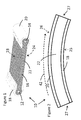
- Figure 1 shows a wire seal 10 comprising a first core wire 12, a second core wire 14, a plate 16, a first clamp 18, a second clamp 20 and a wire pack 22.
- the first core wire 12 is attached to one edge (a first edge) of the plate 16 and the second core wire 14 is attached to the opposite edge (a second edge) of the plate 16.
- the wire pack 22 extends around the first and second core wires 12, 14 and the plate 16.
- the wire pack is held in place by a fastener, in this case the first and second clamps 18, 20.
- the first clamp extends around the portion of the wire pack closest to the first core wire, with the second clamp arranged in the same way close to the second core wire.
- the effective width (the width including the plate/core wires) of the cross-section of the wire pack 22 perpendicular to the plate 16 is greater at the core wires 12, 14 than in the main portion of the wire pack 22 at the plate 16.
- Figure 2 shows a top view of the wire seal 10 in Figure 1 .
- Figure 2 shows the curvature of the wire seal 10.
- Figure 3 shows a cross-section of the wire seal 10 in a gas turbine.
- the gas turbine comprises a first vane 30, a picture frame 32 and a bulkhead 34.
- the bulkhead 34 may be an integral part of the picture frame 32 or a separate component attached to the picture frame 32, as is shown in Figure 3 .
- the wire seal 10 extends across a gap 36 between the first vane 30 and the picture frame 32/bulkhead 34.
- the first clamp 18 of the wire seal 10 contacts the first vane 30, and the second clamp 20 of the wire seal 10 fits within a socket 38 in the bulkhead 34 (or in the picture frame 32).
- a plurality of picture frames are arranged around the longitudinal axis of the gas turbine in a ring, with the picture frames typically being attached to sequential liners (combustor linings) and the sequential liners typically surrounding can combustors.
- the picture frames generally all intersect a plane perpendicular to the gas turbine longitudinal axis.
- the wire seal discussed in this application can be applied on either the inner or outer diameters of the picture frames (the edge of the picture frames closest to the gas turbine longitudinal axis). This can allow for single vane/blade assembly and/or disassembly during manufacture, maintenance and repair.
- the gas turbine is shown during a heating phase.
- the gas turbine is shown in a running phase during normal operation, and in Figure 5 , the gas turbine is shown in a forced cool down phase.
- the first vane 30 moves relative to the picture frame 32, varying the shape and width of the gap 36.
- the movement of the first vane 30 relative to the picture frame 32 includes both axial and radial movement relative to the gas turbine longitudinal axis (also the wire seal longitudinal axis, in wire seal longitudinal direction 40). It is this movement that the wire seal 10 can be designed to withstand, maintaining a seal across the gap 36.
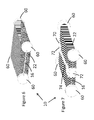
- Figure 6 shows an alternative wire seal 10.
- this wire seal comprises a plate 16 and a wire pack 22, but does not comprise first and second core wires.
- core wires could be added to this embodiment.
- the embodiment of Figure 6 comprises a fastener that differs from the fastener shown in Figure 1 .
- four end pieces 60 are provided as a fastener. These end pieces are attached to the four corners of the plate 16 and, as with the clamps shown in Figure 1 , the end pieces 60 are arranged to hold the wire pack 22 on the plate 16.
- the plate 16 extends beyond the wire pack 22 at the sides to provide a surface for attachment of the clamps, although this is not essential.
- slots are provided in the end pieces in which the plate is placed, and these slots are also optional. Providing a larger contact surface for the end pieces 60 on the plate 16 can allow for a better join between the end pieces 60 and the plate 16.
- Figure 7 shows another alternative wire seal 10.
- four end pieces 60 are provided.
- a further fastener in the form of a central clamp is provided across the wire seal 10, extending across the wire seal 10 from one end edge of the plate to the other end edge, with the central clamp extending in the same direction as the first edge and the second edge.
- the central clamp comprises two central clamp end pieces 72 and at least one connecting bar 74.
- the first and second core wires 12, 14 are first attached to the plate 16.
- the wire pack 22 is then placed around the first and second core wires 12, 14 and the plate 16, for example by wrapping a wire repeatedly around the first and second core wires 12, 14 and the plate 16 to create the wire pack 16.
- one end of it may be attached, for example by welding, to one of the first and second core wires 12, 14 and/or the plate 16.
- the first and second clamps 18, 20 are attached.
- wire that makes up the wire pack 22 is described above as being attached to another part of the wire seal before being wrapped around the plate, but one or both ends of the wire may be attached either before or after the wire is wrapped around the plate.
- the plate 16 is first attached to the end pieces 60 and the wire pack 22 is then placed around the plate 16, for example by wrapping a wire repeatedly around the plate 16.
- the end pieces 60 may alternatively be attached after the wire pack 22 is placed around the plate 16.
- the same method of manufacture for the embodiment in Figure 6 can again be used, with the addition of adding a central clamp.
- the central clamp can be added in two ways. Firstly, the central clamp can be made in pieces and joined together once it is in place around the wire pack 22, in which case the central clamp can be attached at any time after the wire pack 22 is in place. Secondly, the central clamp can be made as a single piece (or made in pieces and then assembled before attachment to the wire pack) and then slid onto the wire pack from the first edge (or from the second edge, in the case of a straight wire seal).
- the central clamp must be attached after the wire pack 22 is in place and before the end pieces have been attached, in embodiments such as that of Figure 7 where the end pieces have a diameter larger than the effective width of the wire pack at the point on the wire pack where the central clamp is attached (as explained in more detail below).
- the wire seal 10 is described above as sealing the gap between a picture frame and a first vane of a gas turbine, but more generally the wire seal may also seal the gap between two components, for example between the first vane and another part of the combustor such as the combustor lining.
- the components to be sealed would normally both be static (static-to-static sealing).
- the wire seal 10 may be straight as shown in the small portions shown in Figures 1 , 6 and 7 , or may be curved in a circumferential direction (relative to the wire seal longitudinal axis), as shown in Figure 2 .
- a curved wire seal is preferable for the wire seals used in a gas turbine as described in Figures 3 to 5 .
- the wire seal may also be a full ring. Generally though, multiple wire seals will be used in a ring.
- 20 wire seals are placed around a 360° annular joint, each extending 15° around the gas turbine circumference in the circumferential direction 42.
- Each picture frame around the gas turbine circumference preferably has at least one wire seal on the inner diameter (inner platform), as this can help enable single vane/blade assembly/disassembly.
- the wire seal can be annular.
- the wire seal describes (a section of) a ring in which the first edge and the second edge are at the same distance from the gas turbine longitudinal axis (wire seal longitudinal axis); that is, the radius of curvature of the first edge and the second edge are the same.
- a radial wire seal could also be used, in which the second edge is further from the gas turbine longitudinal axis than the first edge and in the same plane perpendicular to the gas turbine longitudinal axis direction.
- the wire seal is a conical wire seal.
- the conical wire seal has a second edge that is further from the gas turbine longitudinal axis than the first edge and in a different plane perpendicular to the gas turbine longitudinal axis direction.
- a cone is a three-dimensional geometric shape that tapers smoothly from a flat base; the base may be circular or may be another shape.
- a conical wire seal is conical frustum, being in the shape of the surface of the frustum of a cone (i.e. a section of the cone not including the apex, also known as a truncated cone), in contrast to an annular wire seal in which the wire seal follows the shape of the surface of a cylinder.
- the first and second core wires 12, 14 are optional, and one or both may be omitted, such as in the embodiments in Figures 6 and 7 .
- one of both of the core wires of the embodiment of Figure 1 may be omitted, and one or two core wires may be added to the embodiments of Figure 6 and Figure 7 .
- one or two core wires may be included as an integral part of plate 16, or may simply be the first edge 25 and second edge 26 of the plate 16 respectively.
- the two core wires preferably have the same diameter, but may also have different diameters.
- the plate 16 has a first face 23, a second face 24 and four edges 25, 26, 27. Of these four edges, the wire pack 22 extends around a first edge 25 and a second edge 26, the first edge 25 and the second edge 26 being opposite one another. In Figure 1 , the first edge 25 and the second edge 26 are adjacent to the first core wire 12 and the second core wire 14 respectively. Two end edges 27 complete the plate 16, and it is one of these end edges 27 that is visible in Figures 1 , 6 and 7 . Typically, the first edge and the second edge are longer than the two end edges. Typically, the two end edges are the same length.
- the second edge is (slightly) longer than the first edge and the radius of curvature of the second edge is (slightly) larger than the radius of curvature of the first edge.
- the plate 16 may be a solid sheet or may be a mesh.
- the first core and the second core are part of the plate, at the first and second edges respectively.
- First and second core wires may additionally be attached to the first and second cores respectively in such cases.
- the plate is optional and may be omitted in some embodiments. When no plate is present, the first and second cores correspond to the first and second core wires.
- the plate is preferably thinner than the diameter of the first and second core wires, but in some embodiments the plate may be the same width as or wider than the diameter of the first and second core wires.
- the plate and the first and second core wires are described as separate components in the examples described above, but they may be one integrated component.
- the core wires may also be omitted entirely, as in the embodiments of Figures 6 and 7 .
- the attachment between the first and second core wires and the plate 16 can be a physical attachment such as a weld.
- a slot can be provided in the first and second core wires, and the plate is arranged in the slot. If a slot is provided, a physical attachment between the first and second core wires and the plate is optional, as the wire pack can hold the first and second core wires and the plate together.
- the wire pack 22 may be made up of one or more wires repeatedly wound around the plate (and the first and second core wires in embodiments with core wires). Alternative wire packs are also possible; for example, a mesh or a chain could be wound around instead of a wire.
- the wire pack wire, mesh, chain or the like is typically attached at each end to stop it from unravelling, and can be attached to any appropriate part of the wire seal, for example a fastener, the plate or another part of the wire pack.
- the wire pack is held on to the plate by a fastener or fasteners. Without appropriate fastening, the wire pack can unravel and/or slide off the end edges of the plate, and the clamps are designed to restrict the movement of the wire pack relative to the plate.
- the wire pack can also be fastened directly to the plate and/or to the clamps.
- the first and second clamps 18, 20 can vary in shape but are each typically designed to encircle an end edge of the plate.
- the first and second clamps may be made as a spring so that the first and second clamps are in tension and are pushing on the wire pack to keep the wire pack against the plate. This can also help ensure that the first and second clamps do not slip off the wire pack, and may be particularly useful in cases without core wires.
- the first and second clamps could be attached to one another by one or more connecting bars extending across the surface of the wire pack (in the direction perpendicular to the first and second edges of the plate), in a similar manner to the connecting bar 74 between the central clamp end pieces 72 in the embodiment of Figure 7 .
- the first and second clamps can also be attached to the wire pack or the plates.
- the first and second clamps are shown in Figure 1 with a rounded cross-section in a plane perpendicular to the first and second edges of the plate, but the clamp could also have a square or rectangular cross-section, similar to the shape of the central clamp end piece 72.
- the end pieces 60 in the wire seal of Figure 6 are cylindrical with circular faces, but clamps of a different shape could be provided, such as square- or hexagonal-faced clamps. Two or more of the clamps could also be connected together; for example, the two end pieces at either end of one end edge of the plate could be connected or could be a single plate extending along part or all of the extent of the end edge.
- the end pieces can be attached to the first and second core wires and/or the plate.
- the first and second core wires may extend beyond the end edges of the plate, in which case holes would be provided in the end pieces to connect with the first and second core wires. This could provide a better join between the first and second core wires and the end pieces.
- the end pieces may additionally be attached to the wire pack.
- the diameter of the end pieces in the wire seals of Figures 6 and 7 is larger than the width of the wire pack (in the direction perpendicular to the plane of the plate).
- the diameter of the end pieces may be the same as the width of the wire pack.
- the diameter of the end pieces may even be slightly smaller than the width of the wire pack, as long as the diameter of the end pieces is sufficient to hold the wire pack on to the plate.
- the diameter of the different end pieces may vary; for example, the two end pieces adjacent to the first edge of the plate could be smaller in diameter than the two end pieces adjacent to the second edge of the plate.
- the first vane of the gas turbine may comprise one or more slots to accommodate the shape of fasteners such as end pieces 60. This can improve the seal and can also ensure that the wire seal remains in the correct place in the gap.
- the fastener contacts the first vane and/or the bulkhead/picture frame, and in other embodiments the wire pack contacts the first vane and/or the bulkhead/picture frame.
- the central clamp 70 may be one integral part, or may be two or more parts.
- the central clamp 70 is three connected parts, namely two central clamp end pieces 72 and one connecting bar 74.
- the connecting bar is narrower than the central clamp end pieces (in the direction across the seal perpendicular to the first and second edges of the plate) in the embodiment of Figure 7 , but could be the same width or wider than the central clamp end pieces.
- the T-clamp could have more than two central clamp end pieces and/or more than one connecting bar. Subsequent connecting bars could be on the same face of the wire seal as the first connecting bar and/or on the opposite face (i.e. on the face that is not shown in Figure 7 ).
- the T-clamp could be used without any other form of fastener, or in combination with another fastener.
- the point of the T-clamp is generally to hold the wire pack on the plate, both so that the wire pack does not slide off the end edges and also so that the wires making up the wire pack are kept close to the faces of the plate 16. This stops the wire pack from expanding or bending away from the plate.
- the picture frame 32, bulkhead 34 and first vane 30 may all vary in shape compared to the embodiments shown above, and the design can depend on variables such as the shape of the wire seal and the relative motion of the picture frame/bulkhead and the first vane.
- the socket 38 in the picture frame/bulkhead is optional, and in some embodiments is not necessary.
- a socket could alternatively be provided in the first vane to hold the wire seal in place.
- Sockets could also be provided on both the first vane and the picture frame/bulkhead.
- Other connecting components could also be provided to pivotally attach the wire seal to the first vane or the picture frame/bulkhead.
- the gap is also purged with a cooling fluid such as cooling air, and there can therefore be a higher pressure on the side of the wire seal further from the hot gas path than on the side of the seal closer to the hot gas path. This pressure differential could hold the seal in place, and can also improve the quality of the seal.
- a cooling fluid such as cooling air
- wire seals described herein are preferably for sealing gaps between two stationary parts, rather than gaps between a rotor and a stator.
Landscapes
- Engineering & Computer Science (AREA)
- Mechanical Engineering (AREA)
- General Engineering & Computer Science (AREA)
- Chemical & Material Sciences (AREA)
- Combustion & Propulsion (AREA)
- Gasket Seals (AREA)
- Turbine Rotor Nozzle Sealing (AREA)
Abstract
Description
- The present disclosure relates to wire seals, and particularly to wire seals for sealing a gap between a picture frame and a first vane of a gas turbine.
- In a gas turbine, there is a sealing interface between combustor outlet and the first vane of the turbine. Movement of the two parts relative to one another can be considerable, and a gap must be left between the parts to avoid contact. The gap is generally purged with cooling air. It has been appreciated that it would be advantageous to improve the design around this gap to, for example, reduce the cooling air requirements.
- The invention is defined in the appended independent claims to which reference should now be made. Advantageous features of the invention are set forth in the dependent claims.
- A first aspect of the invention provides a wire seal for sealing a gap between two components of a gas turbine, the wire seal comprising a first core and a second core spaced apart from one another, a wire pack extending around the first core and the second core, and a fastener for securing the wire pack to the first core and the second core, wherein the wire seal is curved. The plate can provide extra sealing in addition to the wire pack, for example if a gap opens in the wire pack during use. The wire pack can help protect the plate, thereby increasing the lifetime of the plate in a high temperature environment. The wire seal can cope with the large relative axial and radial movements of the picture frame and first vane (first turbine vane).
- In one embodiment, the wire seal comprises a plate with a first face, a second face, a first edge comprising the first core, a second edge comprising the second core and two end edges, wherein the first edge is opposite the second edge, wherein the wire pack extends around the first face, the first edge, the second face and the second edge of the plate, and wherein the fastener secures the wire pack around the plate. The plate can improve the seal.
- In one embodiment, the fastener comprises a first clamp for securing the wire pack to the first core and a second clamp for securing the wire pack to the second core.
- In one embodiment, the fastener comprises at least one end piece attached at each end first core and the second core, to hold the wire pack in place adjacent to the first core and the second core. In one embodiment, the fastener extends around the wire pack from the first core to the second core, to hold the wire pack in place adjacent to the plate. In one embodiment, the wire seal comprises a first core wire attached to the first edge and a second core wire attached to the second edge. In one embodiment, the wire seal is a conical wire seal. In one embodiment, the first core is a first core wire and the second core is a second core wire.
- A second aspect of the invention provides a gas turbine comprising a wire seal as described above. In one embodiment, the gas turbine comprises a combustor and a first vane separated by a gap, and wherein the wire seal is arranged to seal the gap. Leakage reduction through this gap can thereby be achieved. In one embodiment, the combustor comprises a picture frame and wherein the gap is between the first vane and the picture frame. In one embodiment, the gas turbine comprises a socket in the picture frame, and wherein the wire seal is seated in the socket. This can hold the wire seal in place.
- A third aspect of the invention provides a method of manufacturing a wire seal for sealing a gap between two components of a gas turbine, the wire seal comprising a first core and a second core spaced apart from one another, a wire pack extending around the first core and the second core, and a fastener for securing the wire pack to the first core and the second core, wherein the wire seal is curved, comprising the steps of placing the wire pack around the plate and fastening the wire pack to the plate with the fastener. In one embodiment, the wire pack is made of wire and is placed around the first core and the second core by winding the wire repeatedly around the first core and the second core.
- An embodiment of the invention will now be described by way of example only and with reference to the accompanying drawings in which:
- Figure 1
- shows a perspective view of a wire seal;
- Figure 2
- shows a schematic top view of the wire seal of
Figure 1 ; - Figures 3, 4 and 5
- show cross-sections of part of a gas turbine comprising a wire seal, during different phases in gas turbine operation;
- Figure 6
- shows a perspective view of another wire seal; and
- Figure 7
- shows a perspective view of a further wire seal.
-
Figure 1 shows awire seal 10 comprising afirst core wire 12, asecond core wire 14, aplate 16, afirst clamp 18, asecond clamp 20 and awire pack 22. - The
first core wire 12 is attached to one edge (a first edge) of theplate 16 and thesecond core wire 14 is attached to the opposite edge (a second edge) of theplate 16. Thewire pack 22 extends around the first andsecond core wires plate 16. The wire pack is held in place by a fastener, in this case the first andsecond clamps wire pack 22 perpendicular to theplate 16 is greater at thecore wires wire pack 22 at theplate 16. -
Figure 2 shows a top view of thewire seal 10 inFigure 1 . In contrast toFigure 1 , where only a short portion of seal is shown and curvature is not shown,Figure 2 shows the curvature of thewire seal 10. -
Figure 3 shows a cross-section of thewire seal 10 in a gas turbine. The gas turbine comprises afirst vane 30, apicture frame 32 and abulkhead 34. Thebulkhead 34 may be an integral part of thepicture frame 32 or a separate component attached to thepicture frame 32, as is shown inFigure 3 . Thewire seal 10 extends across agap 36 between thefirst vane 30 and thepicture frame 32/bulkhead 34. Thefirst clamp 18 of thewire seal 10 contacts thefirst vane 30, and thesecond clamp 20 of thewire seal 10 fits within asocket 38 in the bulkhead 34 (or in the picture frame 32). - In a gas turbine, a plurality of picture frames (sequential liner outlets) are arranged around the longitudinal axis of the gas turbine in a ring, with the picture frames typically being attached to sequential liners (combustor linings) and the sequential liners typically surrounding can combustors. The picture frames generally all intersect a plane perpendicular to the gas turbine longitudinal axis. The wire seal discussed in this application can be applied on either the inner or outer diameters of the picture frames (the edge of the picture frames closest to the gas turbine longitudinal axis). This can allow for single vane/blade assembly and/or disassembly during manufacture, maintenance and repair.
- In
Figure 3 , the gas turbine is shown during a heating phase. InFigure 4 , the gas turbine is shown in a running phase during normal operation, and inFigure 5 , the gas turbine is shown in a forced cool down phase. During the different phases, thefirst vane 30 moves relative to thepicture frame 32, varying the shape and width of thegap 36. The movement of thefirst vane 30 relative to thepicture frame 32 includes both axial and radial movement relative to the gas turbine longitudinal axis (also the wire seal longitudinal axis, in wire seal longitudinal direction 40). It is this movement that thewire seal 10 can be designed to withstand, maintaining a seal across thegap 36. -
Figure 6 shows analternative wire seal 10. As with the wire seal ofFigure 1 , this wire seal comprises aplate 16 and awire pack 22, but does not comprise first and second core wires. Optionally, core wires could be added to this embodiment. The embodiment ofFigure 6 comprises a fastener that differs from the fastener shown inFigure 1 . In the embodiment ofFigure 6 , fourend pieces 60 are provided as a fastener. These end pieces are attached to the four corners of theplate 16 and, as with the clamps shown inFigure 1 , theend pieces 60 are arranged to hold thewire pack 22 on theplate 16. Theplate 16 extends beyond thewire pack 22 at the sides to provide a surface for attachment of the clamps, although this is not essential. Similarly, slots are provided in the end pieces in which the plate is placed, and these slots are also optional. Providing a larger contact surface for theend pieces 60 on theplate 16 can allow for a better join between theend pieces 60 and theplate 16. -
Figure 7 shows anotheralternative wire seal 10. As inFigure 6 , fourend pieces 60 are provided. In addition to theend pieces 60, a further fastener in the form of a central clamp is provided across thewire seal 10, extending across thewire seal 10 from one end edge of the plate to the other end edge, with the central clamp extending in the same direction as the first edge and the second edge. The central clamp comprises two centralclamp end pieces 72 and at least one connectingbar 74. - In a method of manufacturing a
wire seal 10 as shown inFigure 1 , the first andsecond core wires plate 16. Thewire pack 22 is then placed around the first andsecond core wires plate 16, for example by wrapping a wire repeatedly around the first andsecond core wires plate 16 to create thewire pack 16. Before the wire is wrapped around, one end of it may be attached, for example by welding, to one of the first andsecond core wires plate 16. After thewire pack 22 is in place, the first andsecond clamps - The wire that makes up the
wire pack 22 is described above as being attached to another part of the wire seal before being wrapped around the plate, but one or both ends of the wire may be attached either before or after the wire is wrapped around the plate. - To manufacture the
wire seal 10 as shown inFigure 6 , theplate 16 is first attached to theend pieces 60 and thewire pack 22 is then placed around theplate 16, for example by wrapping a wire repeatedly around theplate 16. Theend pieces 60 may alternatively be attached after thewire pack 22 is placed around theplate 16. - To manufacture the
wire seal 10 as shown inFigure 7 , the same method of manufacture for the embodiment inFigure 6 can again be used, with the addition of adding a central clamp. The central clamp can be added in two ways. Firstly, the central clamp can be made in pieces and joined together once it is in place around thewire pack 22, in which case the central clamp can be attached at any time after thewire pack 22 is in place. Secondly, the central clamp can be made as a single piece (or made in pieces and then assembled before attachment to the wire pack) and then slid onto the wire pack from the first edge (or from the second edge, in the case of a straight wire seal). In this case, the central clamp must be attached after thewire pack 22 is in place and before the end pieces have been attached, in embodiments such as that ofFigure 7 where the end pieces have a diameter larger than the effective width of the wire pack at the point on the wire pack where the central clamp is attached (as explained in more detail below). - The
wire seal 10 is described above as sealing the gap between a picture frame and a first vane of a gas turbine, but more generally the wire seal may also seal the gap between two components, for example between the first vane and another part of the combustor such as the combustor lining. The components to be sealed would normally both be static (static-to-static sealing). - The
wire seal 10 may be straight as shown in the small portions shown inFigures 1 ,6 and 7 , or may be curved in a circumferential direction (relative to the wire seal longitudinal axis), as shown inFigure 2 . A curved wire seal is preferable for the wire seals used in a gas turbine as described inFigures 3 to 5 . The wire seal may also be a full ring. Generally though, multiple wire seals will be used in a ring. In one example, 20 wire seals are placed around a 360° annular joint, each extending 15° around the gas turbine circumference in thecircumferential direction 42. Each picture frame around the gas turbine circumference preferably has at least one wire seal on the inner diameter (inner platform), as this can help enable single vane/blade assembly/disassembly. - The wire seal can be annular. In the case of an annular wire seal, the wire seal describes (a section of) a ring in which the first edge and the second edge are at the same distance from the gas turbine longitudinal axis (wire seal longitudinal axis); that is, the radius of curvature of the first edge and the second edge are the same. A radial wire seal could also be used, in which the second edge is further from the gas turbine longitudinal axis than the first edge and in the same plane perpendicular to the gas turbine longitudinal axis direction.
- Preferably though, the wire seal is a conical wire seal. The conical wire seal has a second edge that is further from the gas turbine longitudinal axis than the first edge and in a different plane perpendicular to the gas turbine longitudinal axis direction.
- For completeness, it is noted that a cone is a three-dimensional geometric shape that tapers smoothly from a flat base; the base may be circular or may be another shape. Mathematically, a conical wire seal is conical frustum, being in the shape of the surface of the frustum of a cone (i.e. a section of the cone not including the apex, also known as a truncated cone), in contrast to an annular wire seal in which the wire seal follows the shape of the surface of a cylinder.
- The first and
second core wires Figures 6 and 7 . For example, one of both of the core wires of the embodiment ofFigure 1 may be omitted, and one or two core wires may be added to the embodiments ofFigure 6 and Figure 7 . Alternatively, one or two core wires may be included as an integral part ofplate 16, or may simply be thefirst edge 25 andsecond edge 26 of theplate 16 respectively. The two core wires preferably have the same diameter, but may also have different diameters. - Although most of the
plate 16 is not directly visible in the Figures, theplate 16 can be described in more detail as follows, with reference toFigures 1 and 2 . Theplate 16 has afirst face 23, asecond face 24 and fouredges wire pack 22 extends around afirst edge 25 and asecond edge 26, thefirst edge 25 and thesecond edge 26 being opposite one another. InFigure 1 , thefirst edge 25 and thesecond edge 26 are adjacent to thefirst core wire 12 and thesecond core wire 14 respectively. Two end edges 27 complete theplate 16, and it is one of these end edges 27 that is visible inFigures 1 ,6 and 7 . Typically, the first edge and the second edge are longer than the two end edges. Typically, the two end edges are the same length. Typically, in the case of a wire seal extending in a circumferential direction (relative to the wire seal longitudinal axis), the second edge is (slightly) longer than the first edge and the radius of curvature of the second edge is (slightly) larger than the radius of curvature of the first edge. Theplate 16 may be a solid sheet or may be a mesh. In embodiments with a plate, the first core and the second core are part of the plate, at the first and second edges respectively. First and second core wires may additionally be attached to the first and second cores respectively in such cases. The plate is optional and may be omitted in some embodiments. When no plate is present, the first and second cores correspond to the first and second core wires. - In embodiments comprising core wires, the plate is preferably thinner than the diameter of the first and second core wires, but in some embodiments the plate may be the same width as or wider than the diameter of the first and second core wires. The plate and the first and second core wires are described as separate components in the examples described above, but they may be one integrated component. The core wires may also be omitted entirely, as in the embodiments of
Figures 6 and 7 . - The attachment between the first and second core wires and the
plate 16 can be a physical attachment such as a weld. Alternatively or additionally, a slot can be provided in the first and second core wires, and the plate is arranged in the slot. If a slot is provided, a physical attachment between the first and second core wires and the plate is optional, as the wire pack can hold the first and second core wires and the plate together. - The
wire pack 22 may be made up of one or more wires repeatedly wound around the plate (and the first and second core wires in embodiments with core wires). Alternative wire packs are also possible; for example, a mesh or a chain could be wound around instead of a wire. The wire pack wire, mesh, chain or the like is typically attached at each end to stop it from unravelling, and can be attached to any appropriate part of the wire seal, for example a fastener, the plate or another part of the wire pack. - The wire pack is held on to the plate by a fastener or fasteners. Without appropriate fastening, the wire pack can unravel and/or slide off the end edges of the plate, and the clamps are designed to restrict the movement of the wire pack relative to the plate. The wire pack can also be fastened directly to the plate and/or to the clamps.
- Various fasteners are described in this application, but other types of fastener and modifications to the described fasteners are possible. Any combination of the described fasteners is also possible in addition to those combinations already described. For example, the fasteners of the wire seals of
Figures 1 and6 could both be used on the same wire seal, to improve the clamping of the wire pack. - The first and
second clamps bar 74 between the centralclamp end pieces 72 in the embodiment ofFigure 7 . The first and second clamps can also be attached to the wire pack or the plates. The first and second clamps are shown inFigure 1 with a rounded cross-section in a plane perpendicular to the first and second edges of the plate, but the clamp could also have a square or rectangular cross-section, similar to the shape of the centralclamp end piece 72. - The
end pieces 60 in the wire seal ofFigure 6 are cylindrical with circular faces, but clamps of a different shape could be provided, such as square- or hexagonal-faced clamps. Two or more of the clamps could also be connected together; for example, the two end pieces at either end of one end edge of the plate could be connected or could be a single plate extending along part or all of the extent of the end edge. - In embodiments with first and second core wires, the end pieces can be attached to the first and second core wires and/or the plate. The first and second core wires may extend beyond the end edges of the plate, in which case holes would be provided in the end pieces to connect with the first and second core wires. This could provide a better join between the first and second core wires and the end pieces. The end pieces may additionally be attached to the wire pack.
- The diameter of the end pieces in the wire seals of
Figures 6 and 7 is larger than the width of the wire pack (in the direction perpendicular to the plane of the plate). Alternatively, the diameter of the end pieces may be the same as the width of the wire pack. In some embodiments the diameter of the end pieces may even be slightly smaller than the width of the wire pack, as long as the diameter of the end pieces is sufficient to hold the wire pack on to the plate. The diameter of the different end pieces may vary; for example, the two end pieces adjacent to the first edge of the plate could be smaller in diameter than the two end pieces adjacent to the second edge of the plate. - The first vane of the gas turbine may comprise one or more slots to accommodate the shape of fasteners such as
end pieces 60. This can improve the seal and can also ensure that the wire seal remains in the correct place in the gap. In some of the embodiments the fastener contacts the first vane and/or the bulkhead/picture frame, and in other embodiments the wire pack contacts the first vane and/or the bulkhead/picture frame. - The
central clamp 70 may be one integral part, or may be two or more parts. In the embodiment ofFigure 7 , thecentral clamp 70 is three connected parts, namely two centralclamp end pieces 72 and one connectingbar 74. Various other central clamp arrangements are possible. For example, the connecting bar is narrower than the central clamp end pieces (in the direction across the seal perpendicular to the first and second edges of the plate) in the embodiment ofFigure 7 , but could be the same width or wider than the central clamp end pieces. The T-clamp could have more than two central clamp end pieces and/or more than one connecting bar. Subsequent connecting bars could be on the same face of the wire seal as the first connecting bar and/or on the opposite face (i.e. on the face that is not shown inFigure 7 ). The T-clamp could be used without any other form of fastener, or in combination with another fastener. The point of the T-clamp is generally to hold the wire pack on the plate, both so that the wire pack does not slide off the end edges and also so that the wires making up the wire pack are kept close to the faces of theplate 16. This stops the wire pack from expanding or bending away from the plate. - The
picture frame 32,bulkhead 34 andfirst vane 30 may all vary in shape compared to the embodiments shown above, and the design can depend on variables such as the shape of the wire seal and the relative motion of the picture frame/bulkhead and the first vane. - The
socket 38 in the picture frame/bulkhead is optional, and in some embodiments is not necessary. For example, a socket could alternatively be provided in the first vane to hold the wire seal in place. Sockets could also be provided on both the first vane and the picture frame/bulkhead. Other connecting components could also be provided to pivotally attach the wire seal to the first vane or the picture frame/bulkhead. - Typically, the gap is also purged with a cooling fluid such as cooling air, and there can therefore be a higher pressure on the side of the wire seal further from the hot gas path than on the side of the seal closer to the hot gas path. This pressure differential could hold the seal in place, and can also improve the quality of the seal.
- The wire seals described herein are preferably for sealing gaps between two stationary parts, rather than gaps between a rotor and a stator.
- Various modifications to the embodiments described are possible and will occur to those skilled in the art without departing from the invention which is defined by the following claims.
-
- 10
- wire seal
- 12
- first core wire
- 14
- second cord wire
- 16
- plate
- 18
- first clamp
- 20
- second clamp
- 22
- wire pack
- 23
- first face
- 24
- second face
- 25
- first edge
- 26
- second edge
- 27
- end edge
- 30
- first vane
- 32
- picture frame
- 34
- bulkhead
- 36
- gap
- 38
- socket
- 40
- wire seal longitudinal direction (gas turbine longitudinal direction)
- 42
- circumferential direction
- 60
- end piece
- 70
- central clamp
- 72
- central clamp end piece
- 74
- connecting bar
Claims (14)
- A wire seal (10) for sealing a gap (36) between two components of a gas turbine, the wire seal (10) comprising- a first core (12, 25) and a second core (14, 26) spaced apart from one another,- a wire pack (22) extending around the first core and the second core, and- a fastener for securing the wire pack to the first core and the second core, wherein the wire seal (10) is curved.
- The wire seal (10) of claim 1, comprising a plate with a first face (23), a second face (24), a first edge (25) comprising the first core, a second edge (26) comprising the second core and two end edges (27), wherein the first edge (25) is opposite the second edge (26),- wherein the wire pack (22) extends around the first face (23), the first edge (25), the second face and the second edge (26) of the plate (16), and- wherein the fastener (18, 20, 60, 70) secures the wire pack (22) around the plate (16).
- The wire seal (10) of claim 1, wherein the fastener comprises a first clamp (18) for securing the wire pack (22) to the first core and a second clamp (20) for securing the wire pack (22) to the second core.
- The wire seal (10) of claim 1, wherein the fastener comprises at least one end piece (60) attached at each end of the first core and the second core, to hold the wire pack (22) in place adjacent to the first core and the second core.
- The wire seal (10) of claim 1, wherein the fastener extends around the wire pack (22) from the first core to the second core, to hold the wire pack (22) in place adjacent to the plate (16).
- The wire seal of any of claims 2 to 5, comprising a first core wire (12) attached to the first edge (25) and a second core wire (14) attached to the second edge (26).
- The wire seal (10) of any of claims 1 to 0, wherein the wire seal (10) is a conical wire seal.
- The wire seal (10) of claim 1, wherein the first core is a first core wire (12) and the second core is a second core wire (14).
- A gas turbine comprising the wire seal (10) of any of claims 1 to 8.
- The gas turbine of claim 9, comprising a combustor and a first vane (30) separated by a gap (36), and wherein the wire seal (10) is arranged to seal the gap (36).
- The gas turbine of claim 10, wherein the combustor comprises a picture frame (32) and wherein the gap (36) is between the first vane (30) and the picture frame (32).
- The gas turbine of claim 10, comprising a socket (38) in the picture frame (32), and wherein the wire seal (10) is seated in the socket (38).
- A method of manufacturing a wire seal (10) for sealing a gap (36) between two components of a gas turbine, the wire seal (10) comprising a first core (12, 25) and a second core (14, 26) spaced apart from one another, a wire pack (22) extending around the first core and the second core, and a fastener for securing the wire pack to the first core and the second core, wherein the wire seal (10) is curved , comprising the steps of placing the wire pack (22) around the plate (16) and fastening the wire pack (22) to the plate (16) with the fastener (18, 20, 60, 70).
- The method of claim 13, in which the wire pack (22) is made of wire and is placed around the first core and the second core by winding the wire repeatedly around the first core and the second core.
Priority Applications (5)
| Application Number | Priority Date | Filing Date | Title |
|---|---|---|---|
| EP15160744.7A EP3073056B1 (en) | 2015-03-25 | 2015-03-25 | Wire seal |
| US15/078,297 US20160281516A1 (en) | 2015-03-25 | 2016-03-23 | Wire seal |
| KR1020160035219A KR20160115791A (en) | 2015-03-25 | 2016-03-24 | Wire seal |
| CN201610261111.7A CN106089319B (en) | 2015-03-25 | 2016-03-24 | Wire seal |
| JP2016061808A JP2016183673A (en) | 2015-03-25 | 2016-03-25 | Wire seal |
Applications Claiming Priority (1)
| Application Number | Priority Date | Filing Date | Title |
|---|---|---|---|
| EP15160744.7A EP3073056B1 (en) | 2015-03-25 | 2015-03-25 | Wire seal |
Publications (2)
| Publication Number | Publication Date |
|---|---|
| EP3073056A1 true EP3073056A1 (en) | 2016-09-28 |
| EP3073056B1 EP3073056B1 (en) | 2018-01-03 |
Family
ID=52875464
Family Applications (1)
| Application Number | Title | Priority Date | Filing Date |
|---|---|---|---|
| EP15160744.7A Active EP3073056B1 (en) | 2015-03-25 | 2015-03-25 | Wire seal |
Country Status (5)
| Country | Link |
|---|---|
| US (1) | US20160281516A1 (en) |
| EP (1) | EP3073056B1 (en) |
| JP (1) | JP2016183673A (en) |
| KR (1) | KR20160115791A (en) |
| CN (1) | CN106089319B (en) |
Cited By (3)
| Publication number | Priority date | Publication date | Assignee | Title |
|---|---|---|---|---|
| FR3100560A1 (en) * | 2019-09-06 | 2021-03-12 | Safran Aircraft Engines | Set for a turbomachine turbine |
| EP4023856A1 (en) * | 2020-12-29 | 2022-07-06 | General Electric Company | Turbomachine with magnetic sealing arrangement |
| RU235885U1 (en) * | 2024-11-14 | 2025-07-17 | Публичное Акционерное Общество "Одк-Сатурн" | The connection unit of the inner wall of the combustion chamber flame tube with the inner wall of the nozzle apparatus bushing of a gas turbine engine |
Families Citing this family (3)
| Publication number | Priority date | Publication date | Assignee | Title |
|---|---|---|---|---|
| US9988919B2 (en) * | 2014-10-24 | 2018-06-05 | United Technologies Corporation | Dual compliant seal |
| US11085315B2 (en) | 2019-07-09 | 2021-08-10 | General Electric Company | Turbine engine with a seal |
| WO2022055686A2 (en) * | 2020-09-02 | 2022-03-17 | Siemens Energy Global GmbH & Co. KG | Sacrificial plate in membrane slot for an exit ring |
Citations (4)
| Publication number | Priority date | Publication date | Assignee | Title |
|---|---|---|---|---|
| US5104286A (en) * | 1991-02-08 | 1992-04-14 | Westinghouse Electric Corp. | Recirculation seal for a gas turbine exhaust diffuser |
| US5129783A (en) * | 1989-09-22 | 1992-07-14 | Rolls-Royce Plc | Gas turbine engines |
| EP1808578A1 (en) * | 2006-01-12 | 2007-07-18 | Rolls-Royce plc | A sealing arrangement |
| DE102007062681A1 (en) * | 2007-12-24 | 2009-06-25 | Man Turbo Ag | Sealing segment and sealing segment arrangement |
Family Cites Families (2)
| Publication number | Priority date | Publication date | Assignee | Title |
|---|---|---|---|---|
| US20120211943A1 (en) * | 2011-02-22 | 2012-08-23 | General Electric Company | Sealing device and method for providing a seal in a turbine system |
| US20130170960A1 (en) * | 2012-01-04 | 2013-07-04 | General Electric Company | Turbine assembly and method for reducing fluid flow between turbine components |
-
2015
- 2015-03-25 EP EP15160744.7A patent/EP3073056B1/en active Active
-
2016
- 2016-03-23 US US15/078,297 patent/US20160281516A1/en not_active Abandoned
- 2016-03-24 CN CN201610261111.7A patent/CN106089319B/en active Active
- 2016-03-24 KR KR1020160035219A patent/KR20160115791A/en not_active Withdrawn
- 2016-03-25 JP JP2016061808A patent/JP2016183673A/en active Pending
Patent Citations (4)
| Publication number | Priority date | Publication date | Assignee | Title |
|---|---|---|---|---|
| US5129783A (en) * | 1989-09-22 | 1992-07-14 | Rolls-Royce Plc | Gas turbine engines |
| US5104286A (en) * | 1991-02-08 | 1992-04-14 | Westinghouse Electric Corp. | Recirculation seal for a gas turbine exhaust diffuser |
| EP1808578A1 (en) * | 2006-01-12 | 2007-07-18 | Rolls-Royce plc | A sealing arrangement |
| DE102007062681A1 (en) * | 2007-12-24 | 2009-06-25 | Man Turbo Ag | Sealing segment and sealing segment arrangement |
Cited By (3)
| Publication number | Priority date | Publication date | Assignee | Title |
|---|---|---|---|---|
| FR3100560A1 (en) * | 2019-09-06 | 2021-03-12 | Safran Aircraft Engines | Set for a turbomachine turbine |
| EP4023856A1 (en) * | 2020-12-29 | 2022-07-06 | General Electric Company | Turbomachine with magnetic sealing arrangement |
| RU235885U1 (en) * | 2024-11-14 | 2025-07-17 | Публичное Акционерное Общество "Одк-Сатурн" | The connection unit of the inner wall of the combustion chamber flame tube with the inner wall of the nozzle apparatus bushing of a gas turbine engine |
Also Published As
| Publication number | Publication date |
|---|---|
| US20160281516A1 (en) | 2016-09-29 |
| CN106089319A (en) | 2016-11-09 |
| CN106089319B (en) | 2021-02-02 |
| EP3073056B1 (en) | 2018-01-03 |
| JP2016183673A (en) | 2016-10-20 |
| KR20160115791A (en) | 2016-10-06 |
Similar Documents
| Publication | Publication Date | Title |
|---|---|---|
| US20160281516A1 (en) | Wire seal | |
| EP3061918B1 (en) | Tapered gas turbine segment seals | |
| EP2961939B1 (en) | Assembly for sealing a gap between components of a turbine engine | |
| US8573603B2 (en) | Split ring seal with spring element | |
| CA2702591C (en) | Bearing support | |
| US9127559B2 (en) | Diaphragm for turbomachines and method of manufacture | |
| JP2009115085A (en) | 1st stage nozzle vs. transition piece seal | |
| JP5964032B2 (en) | Self-aligning flow splitter for steam turbines. | |
| JP2012092829A (en) | Seal apparatus | |
| US9808889B2 (en) | Gas turbine including sealing band and anti-rotation device | |
| US9951871B2 (en) | Brush seal assembly | |
| US10662814B2 (en) | Stator shroud systems | |
| US10502322B2 (en) | Split type brush seal device, brush seal pieces, and method of assembling split type brush seal device | |
| JP6083717B2 (en) | Seal mechanism | |
| EP2955422B1 (en) | Brush seal assembly | |
| EP3032149B1 (en) | Sealing device, rotating machine, and method for manufacturing sealing device | |
| JP2014125986A (en) | Seal device, and rotary machine using the same | |
| JP2004060658A (en) | Seal for horizontal joint of steam turbine packing casing and method of forming the seal | |
| JP4507877B2 (en) | Steam turbine | |
| JP5449976B2 (en) | Shaft seal device, turbine device, and shaft seal device gap adjusting method | |
| CN206626020U (en) | Stationary blade segment and axial fluid machine with the same | |
| KR101633546B1 (en) | Brush seal assembly | |
| JP4610949B2 (en) | Sealing device | |
| CN112771247B (en) | Improved turbine engine stator | |
| EP3091191A1 (en) | Sealing arrangement for a steam turbine |
Legal Events
| Date | Code | Title | Description |
|---|---|---|---|
| PUAI | Public reference made under article 153(3) epc to a published international application that has entered the european phase |
Free format text: ORIGINAL CODE: 0009012 |
|
| AK | Designated contracting states |
Kind code of ref document: A1 Designated state(s): AL AT BE BG CH CY CZ DE DK EE ES FI FR GB GR HR HU IE IS IT LI LT LU LV MC MK MT NL NO PL PT RO RS SE SI SK SM TR |
|
| AX | Request for extension of the european patent |
Extension state: BA ME |
|
| 17P | Request for examination filed |
Effective date: 20170328 |
|
| RBV | Designated contracting states (corrected) |
Designated state(s): AL AT BE BG CH CY CZ DE DK EE ES FI FR GB GR HR HU IE IS IT LI LT LU LV MC MK MT NL NO PL PT RO RS SE SI SK SM TR |
|
| GRAP | Despatch of communication of intention to grant a patent |
Free format text: ORIGINAL CODE: EPIDOSNIGR1 |
|
| RAP1 | Party data changed (applicant data changed or rights of an application transferred) |
Owner name: ANSALDO ENERGIA IP UK LIMITED |
|
| RIC1 | Information provided on ipc code assigned before grant |
Ipc: F01D 11/00 20060101AFI20170503BHEP Ipc: F02K 9/34 20060101ALI20170503BHEP |
|
| INTG | Intention to grant announced |
Effective date: 20170523 |
|
| GRAJ | Information related to disapproval of communication of intention to grant by the applicant or resumption of examination proceedings by the epo deleted |
Free format text: ORIGINAL CODE: EPIDOSDIGR1 |
|
| INTC | Intention to grant announced (deleted) | ||
| GRAJ | Information related to disapproval of communication of intention to grant by the applicant or resumption of examination proceedings by the epo deleted |
Free format text: ORIGINAL CODE: EPIDOSDIGR1 |
|
| GRAR | Information related to intention to grant a patent recorded |
Free format text: ORIGINAL CODE: EPIDOSNIGR71 |
|
| GRAS | Grant fee paid |
Free format text: ORIGINAL CODE: EPIDOSNIGR3 |
|
| GRAA | (expected) grant |
Free format text: ORIGINAL CODE: 0009210 |
|
| AK | Designated contracting states |
Kind code of ref document: B1 Designated state(s): AL AT BE BG CH CY CZ DE DK EE ES FI FR GB GR HR HU IE IS IT LI LT LU LV MC MK MT NL NO PL PT RO RS SE SI SK SM TR |
|
| INTG | Intention to grant announced |
Effective date: 20171124 |
|
| REG | Reference to a national code |
Ref country code: GB Ref legal event code: FG4D |
|
| REG | Reference to a national code |
Ref country code: CH Ref legal event code: EP Ref country code: AT Ref legal event code: REF Ref document number: 960469 Country of ref document: AT Kind code of ref document: T Effective date: 20180115 |
|
| REG | Reference to a national code |
Ref country code: IE Ref legal event code: FG4D |
|
| REG | Reference to a national code |
Ref country code: DE Ref legal event code: R096 Ref document number: 602015007089 Country of ref document: DE |
|
| REG | Reference to a national code |
Ref country code: NL Ref legal event code: MP Effective date: 20180103 |
|
| REG | Reference to a national code |
Ref country code: LT Ref legal event code: MG4D |
|
| REG | Reference to a national code |
Ref country code: AT Ref legal event code: MK05 Ref document number: 960469 Country of ref document: AT Kind code of ref document: T Effective date: 20180103 |
|
| PG25 | Lapsed in a contracting state [announced via postgrant information from national office to epo] |
Ref country code: NL Free format text: LAPSE BECAUSE OF FAILURE TO SUBMIT A TRANSLATION OF THE DESCRIPTION OR TO PAY THE FEE WITHIN THE PRESCRIBED TIME-LIMIT Effective date: 20180103 |
|
| PG25 | Lapsed in a contracting state [announced via postgrant information from national office to epo] |
Ref country code: ES Free format text: LAPSE BECAUSE OF FAILURE TO SUBMIT A TRANSLATION OF THE DESCRIPTION OR TO PAY THE FEE WITHIN THE PRESCRIBED TIME-LIMIT Effective date: 20180103 Ref country code: HR Free format text: LAPSE BECAUSE OF FAILURE TO SUBMIT A TRANSLATION OF THE DESCRIPTION OR TO PAY THE FEE WITHIN THE PRESCRIBED TIME-LIMIT Effective date: 20180103 Ref country code: NO Free format text: LAPSE BECAUSE OF FAILURE TO SUBMIT A TRANSLATION OF THE DESCRIPTION OR TO PAY THE FEE WITHIN THE PRESCRIBED TIME-LIMIT Effective date: 20180403 Ref country code: FI Free format text: LAPSE BECAUSE OF FAILURE TO SUBMIT A TRANSLATION OF THE DESCRIPTION OR TO PAY THE FEE WITHIN THE PRESCRIBED TIME-LIMIT Effective date: 20180103 Ref country code: LT Free format text: LAPSE BECAUSE OF FAILURE TO SUBMIT A TRANSLATION OF THE DESCRIPTION OR TO PAY THE FEE WITHIN THE PRESCRIBED TIME-LIMIT Effective date: 20180103 Ref country code: CY Free format text: LAPSE BECAUSE OF FAILURE TO SUBMIT A TRANSLATION OF THE DESCRIPTION OR TO PAY THE FEE WITHIN THE PRESCRIBED TIME-LIMIT Effective date: 20180103 |
|
| PG25 | Lapsed in a contracting state [announced via postgrant information from national office to epo] |
Ref country code: IS Free format text: LAPSE BECAUSE OF FAILURE TO SUBMIT A TRANSLATION OF THE DESCRIPTION OR TO PAY THE FEE WITHIN THE PRESCRIBED TIME-LIMIT Effective date: 20180503 Ref country code: SE Free format text: LAPSE BECAUSE OF FAILURE TO SUBMIT A TRANSLATION OF THE DESCRIPTION OR TO PAY THE FEE WITHIN THE PRESCRIBED TIME-LIMIT Effective date: 20180103 Ref country code: PL Free format text: LAPSE BECAUSE OF FAILURE TO SUBMIT A TRANSLATION OF THE DESCRIPTION OR TO PAY THE FEE WITHIN THE PRESCRIBED TIME-LIMIT Effective date: 20180103 Ref country code: LV Free format text: LAPSE BECAUSE OF FAILURE TO SUBMIT A TRANSLATION OF THE DESCRIPTION OR TO PAY THE FEE WITHIN THE PRESCRIBED TIME-LIMIT Effective date: 20180103 Ref country code: GR Free format text: LAPSE BECAUSE OF FAILURE TO SUBMIT A TRANSLATION OF THE DESCRIPTION OR TO PAY THE FEE WITHIN THE PRESCRIBED TIME-LIMIT Effective date: 20180404 Ref country code: BG Free format text: LAPSE BECAUSE OF FAILURE TO SUBMIT A TRANSLATION OF THE DESCRIPTION OR TO PAY THE FEE WITHIN THE PRESCRIBED TIME-LIMIT Effective date: 20180403 Ref country code: RS Free format text: LAPSE BECAUSE OF FAILURE TO SUBMIT A TRANSLATION OF THE DESCRIPTION OR TO PAY THE FEE WITHIN THE PRESCRIBED TIME-LIMIT Effective date: 20180103 Ref country code: AT Free format text: LAPSE BECAUSE OF FAILURE TO SUBMIT A TRANSLATION OF THE DESCRIPTION OR TO PAY THE FEE WITHIN THE PRESCRIBED TIME-LIMIT Effective date: 20180103 |
|
| REG | Reference to a national code |
Ref country code: DE Ref legal event code: R097 Ref document number: 602015007089 Country of ref document: DE |
|
| PG25 | Lapsed in a contracting state [announced via postgrant information from national office to epo] |
Ref country code: RO Free format text: LAPSE BECAUSE OF FAILURE TO SUBMIT A TRANSLATION OF THE DESCRIPTION OR TO PAY THE FEE WITHIN THE PRESCRIBED TIME-LIMIT Effective date: 20180103 Ref country code: AL Free format text: LAPSE BECAUSE OF FAILURE TO SUBMIT A TRANSLATION OF THE DESCRIPTION OR TO PAY THE FEE WITHIN THE PRESCRIBED TIME-LIMIT Effective date: 20180103 Ref country code: EE Free format text: LAPSE BECAUSE OF FAILURE TO SUBMIT A TRANSLATION OF THE DESCRIPTION OR TO PAY THE FEE WITHIN THE PRESCRIBED TIME-LIMIT Effective date: 20180103 |
|
| REG | Reference to a national code |
Ref country code: CH Ref legal event code: PL |
|
| PLBE | No opposition filed within time limit |
Free format text: ORIGINAL CODE: 0009261 |
|
| STAA | Information on the status of an ep patent application or granted ep patent |
Free format text: STATUS: NO OPPOSITION FILED WITHIN TIME LIMIT |
|
| PG25 | Lapsed in a contracting state [announced via postgrant information from national office to epo] |
Ref country code: SM Free format text: LAPSE BECAUSE OF FAILURE TO SUBMIT A TRANSLATION OF THE DESCRIPTION OR TO PAY THE FEE WITHIN THE PRESCRIBED TIME-LIMIT Effective date: 20180103 Ref country code: CZ Free format text: LAPSE BECAUSE OF FAILURE TO SUBMIT A TRANSLATION OF THE DESCRIPTION OR TO PAY THE FEE WITHIN THE PRESCRIBED TIME-LIMIT Effective date: 20180103 Ref country code: MC Free format text: LAPSE BECAUSE OF FAILURE TO SUBMIT A TRANSLATION OF THE DESCRIPTION OR TO PAY THE FEE WITHIN THE PRESCRIBED TIME-LIMIT Effective date: 20180103 Ref country code: SK Free format text: LAPSE BECAUSE OF FAILURE TO SUBMIT A TRANSLATION OF THE DESCRIPTION OR TO PAY THE FEE WITHIN THE PRESCRIBED TIME-LIMIT Effective date: 20180103 Ref country code: DK Free format text: LAPSE BECAUSE OF FAILURE TO SUBMIT A TRANSLATION OF THE DESCRIPTION OR TO PAY THE FEE WITHIN THE PRESCRIBED TIME-LIMIT Effective date: 20180103 |
|
| REG | Reference to a national code |
Ref country code: BE Ref legal event code: MM Effective date: 20180331 |
|
| 26N | No opposition filed |
Effective date: 20181005 |
|
| REG | Reference to a national code |
Ref country code: IE Ref legal event code: MM4A |
|
| PG25 | Lapsed in a contracting state [announced via postgrant information from national office to epo] |
Ref country code: LU Free format text: LAPSE BECAUSE OF NON-PAYMENT OF DUE FEES Effective date: 20180325 |
|
| PG25 | Lapsed in a contracting state [announced via postgrant information from national office to epo] |
Ref country code: IE Free format text: LAPSE BECAUSE OF NON-PAYMENT OF DUE FEES Effective date: 20180325 |
|
| PG25 | Lapsed in a contracting state [announced via postgrant information from national office to epo] |
Ref country code: BE Free format text: LAPSE BECAUSE OF NON-PAYMENT OF DUE FEES Effective date: 20180331 Ref country code: CH Free format text: LAPSE BECAUSE OF NON-PAYMENT OF DUE FEES Effective date: 20180331 Ref country code: LI Free format text: LAPSE BECAUSE OF NON-PAYMENT OF DUE FEES Effective date: 20180331 Ref country code: SI Free format text: LAPSE BECAUSE OF FAILURE TO SUBMIT A TRANSLATION OF THE DESCRIPTION OR TO PAY THE FEE WITHIN THE PRESCRIBED TIME-LIMIT Effective date: 20180103 |
|
| PG25 | Lapsed in a contracting state [announced via postgrant information from national office to epo] |
Ref country code: FR Free format text: LAPSE BECAUSE OF NON-PAYMENT OF DUE FEES Effective date: 20180331 |
|
| PG25 | Lapsed in a contracting state [announced via postgrant information from national office to epo] |
Ref country code: MT Free format text: LAPSE BECAUSE OF NON-PAYMENT OF DUE FEES Effective date: 20180325 |
|
| PG25 | Lapsed in a contracting state [announced via postgrant information from national office to epo] |
Ref country code: TR Free format text: LAPSE BECAUSE OF FAILURE TO SUBMIT A TRANSLATION OF THE DESCRIPTION OR TO PAY THE FEE WITHIN THE PRESCRIBED TIME-LIMIT Effective date: 20180103 |
|
| PG25 | Lapsed in a contracting state [announced via postgrant information from national office to epo] |
Ref country code: PT Free format text: LAPSE BECAUSE OF FAILURE TO SUBMIT A TRANSLATION OF THE DESCRIPTION OR TO PAY THE FEE WITHIN THE PRESCRIBED TIME-LIMIT Effective date: 20180103 |
|
| PG25 | Lapsed in a contracting state [announced via postgrant information from national office to epo] |
Ref country code: MK Free format text: LAPSE BECAUSE OF NON-PAYMENT OF DUE FEES Effective date: 20180103 Ref country code: HU Free format text: LAPSE BECAUSE OF FAILURE TO SUBMIT A TRANSLATION OF THE DESCRIPTION OR TO PAY THE FEE WITHIN THE PRESCRIBED TIME-LIMIT; INVALID AB INITIO Effective date: 20150325 |
|
| P01 | Opt-out of the competence of the unified patent court (upc) registered |
Effective date: 20240430 |
|
| PGFP | Annual fee paid to national office [announced via postgrant information from national office to epo] |
Ref country code: IT Payment date: 20250331 Year of fee payment: 11 |
|
| PGFP | Annual fee paid to national office [announced via postgrant information from national office to epo] |
Ref country code: GB Payment date: 20260324 Year of fee payment: 12 |
|
| PGFP | Annual fee paid to national office [announced via postgrant information from national office to epo] |
Ref country code: DE Payment date: 20260320 Year of fee payment: 12 |