EP3072970A1 - Polyporus squamosus-derived recombinant lectin specific for sialic acid linkage - Google Patents
Polyporus squamosus-derived recombinant lectin specific for sialic acid linkage Download PDFInfo
- Publication number
- EP3072970A1 EP3072970A1 EP14861999.2A EP14861999A EP3072970A1 EP 3072970 A1 EP3072970 A1 EP 3072970A1 EP 14861999 A EP14861999 A EP 14861999A EP 3072970 A1 EP3072970 A1 EP 3072970A1
- Authority
- EP
- European Patent Office
- Prior art keywords
- sialic acid
- lectin
- recombinant
- alpha
- recombinant lectin
- Prior art date
- Legal status (The legal status is an assumption and is not a legal conclusion. Google has not performed a legal analysis and makes no representation as to the accuracy of the status listed.)
- Granted
Links
- 108090001090 Lectins Proteins 0.000 title claims abstract description 193
- 102000004856 Lectins Human genes 0.000 title claims abstract description 191
- 239000002523 lectin Substances 0.000 title claims abstract description 147
- SQVRNKJHWKZAKO-UHFFFAOYSA-N beta-N-Acetyl-D-neuraminic acid Natural products CC(=O)NC1C(O)CC(O)(C(O)=O)OC1C(O)C(O)CO SQVRNKJHWKZAKO-UHFFFAOYSA-N 0.000 title claims abstract description 98
- SQVRNKJHWKZAKO-OQPLDHBCSA-N sialic acid Chemical compound CC(=O)N[C@@H]1[C@@H](O)C[C@@](O)(C(O)=O)OC1[C@H](O)[C@H](O)CO SQVRNKJHWKZAKO-OQPLDHBCSA-N 0.000 title claims abstract description 88
- 241000222642 Polyporus squamosus Species 0.000 title abstract description 23
- 230000027455 binding Effects 0.000 claims abstract description 53
- 235000000346 sugar Nutrition 0.000 claims abstract description 48
- 241000588724 Escherichia coli Species 0.000 claims abstract description 38
- 108090000288 Glycoproteins Proteins 0.000 claims abstract description 28
- 102000003886 Glycoproteins Human genes 0.000 claims abstract description 28
- 229920001542 oligosaccharide Polymers 0.000 claims abstract description 21
- 150000002482 oligosaccharides Chemical class 0.000 claims abstract description 21
- 229930186217 Glycolipid Natural products 0.000 claims abstract description 20
- 239000002243 precursor Substances 0.000 claims abstract description 19
- 108010015899 Glycopeptides Proteins 0.000 claims abstract description 18
- 102000002068 Glycopeptides Human genes 0.000 claims abstract description 18
- 241000235058 Komagataella pastoris Species 0.000 claims abstract description 14
- 108090000623 proteins and genes Proteins 0.000 claims description 79
- 238000000034 method Methods 0.000 claims description 48
- 102000004169 proteins and genes Human genes 0.000 claims description 41
- 240000004808 Saccharomyces cerevisiae Species 0.000 claims description 32
- 210000004027 cell Anatomy 0.000 claims description 30
- 108091033319 polynucleotide Proteins 0.000 claims description 29
- 239000002157 polynucleotide Substances 0.000 claims description 29
- 102000040430 polynucleotide Human genes 0.000 claims description 29
- 238000005259 measurement Methods 0.000 claims description 22
- 239000013604 expression vector Substances 0.000 claims description 20
- 229920001184 polypeptide Polymers 0.000 claims description 18
- 108090000765 processed proteins & peptides Proteins 0.000 claims description 18
- 102000004196 processed proteins & peptides Human genes 0.000 claims description 18
- 241000894006 Bacteria Species 0.000 claims description 17
- 125000003275 alpha amino acid group Chemical group 0.000 claims description 16
- 238000011002 quantification Methods 0.000 claims description 16
- 241000700605 Viruses Species 0.000 claims description 15
- FDJKUWYYUZCUJX-KVNVFURPSA-N N-glycolylneuraminic acid Chemical compound OC[C@H](O)[C@H](O)[C@@H]1O[C@](O)(C(O)=O)C[C@H](O)[C@H]1NC(=O)CO FDJKUWYYUZCUJX-KVNVFURPSA-N 0.000 claims description 12
- CERZMXAJYMMUDR-UHFFFAOYSA-N neuraminic acid Natural products NC1C(O)CC(O)(C(O)=O)OC1C(O)C(O)CO CERZMXAJYMMUDR-UHFFFAOYSA-N 0.000 claims description 12
- 238000012258 culturing Methods 0.000 claims description 11
- 239000002773 nucleotide Substances 0.000 claims description 11
- 125000003729 nucleotide group Chemical group 0.000 claims description 11
- SQVRNKJHWKZAKO-LUWBGTNYSA-N N-acetylneuraminic acid Chemical compound CC(=O)N[C@@H]1[C@@H](O)CC(O)(C(O)=O)O[C@H]1[C@H](O)[C@H](O)CO SQVRNKJHWKZAKO-LUWBGTNYSA-N 0.000 claims description 10
- 229940060155 neuac Drugs 0.000 claims description 10
- WQZGKKKJIJFFOK-GASJEMHNSA-N Glucose Chemical group OC[C@H]1OC(O)[C@H](O)[C@@H](O)[C@@H]1O WQZGKKKJIJFFOK-GASJEMHNSA-N 0.000 claims description 9
- 230000001580 bacterial effect Effects 0.000 claims description 7
- 238000012544 monitoring process Methods 0.000 claims description 6
- 238000012360 testing method Methods 0.000 claims description 6
- 241000235648 Pichia Species 0.000 claims description 5
- 125000000487 histidyl group Chemical group [H]N([H])C(C(=O)O*)C([H])([H])C1=C([H])N([H])C([H])=N1 0.000 claims description 4
- 108010076504 Protein Sorting Signals Proteins 0.000 claims description 3
- 210000004899 c-terminal region Anatomy 0.000 claims description 3
- 241000222120 Candida <Saccharomycetales> Species 0.000 claims description 2
- 240000001817 Cereus hexagonus Species 0.000 claims description 2
- 241000235649 Kluyveromyces Species 0.000 claims description 2
- 241000186779 Listeria monocytogenes Species 0.000 claims description 2
- 241000235070 Saccharomyces Species 0.000 claims description 2
- 241000607142 Salmonella Species 0.000 claims description 2
- 241001138501 Salmonella enterica Species 0.000 claims description 2
- 241000191967 Staphylococcus aureus Species 0.000 claims description 2
- 241000607447 Yersinia enterocolitica Species 0.000 claims description 2
- 230000003248 secreting effect Effects 0.000 claims description 2
- 229940098232 yersinia enterocolitica Drugs 0.000 claims description 2
- 238000004519 manufacturing process Methods 0.000 abstract description 7
- 239000000203 mixture Substances 0.000 abstract description 7
- 239000004480 active ingredient Substances 0.000 abstract description 5
- 235000018102 proteins Nutrition 0.000 description 38
- WQZGKKKJIJFFOK-FPRJBGLDSA-N beta-D-galactose Chemical compound OC[C@H]1O[C@@H](O)[C@H](O)[C@@H](O)[C@H]1O WQZGKKKJIJFFOK-FPRJBGLDSA-N 0.000 description 26
- 150000004676 glycans Chemical group 0.000 description 15
- 125000005629 sialic acid group Chemical group 0.000 description 15
- 239000000872 buffer Substances 0.000 description 13
- 239000000243 solution Substances 0.000 description 13
- OKKJLVBELUTLKV-UHFFFAOYSA-N Methanol Chemical compound OC OKKJLVBELUTLKV-UHFFFAOYSA-N 0.000 description 12
- 108060002885 fetuin Proteins 0.000 description 12
- 102000013361 fetuin Human genes 0.000 description 12
- RAXXELZNTBOGNW-UHFFFAOYSA-N imidazole Natural products C1=CNC=N1 RAXXELZNTBOGNW-UHFFFAOYSA-N 0.000 description 12
- 238000003752 polymerase chain reaction Methods 0.000 description 12
- 238000002415 sodium dodecyl sulfate polyacrylamide gel electrophoresis Methods 0.000 description 12
- OVRNDRQMDRJTHS-KEWYIRBNSA-N N-acetyl-D-galactosamine Chemical compound CC(=O)N[C@H]1C(O)O[C@H](CO)[C@H](O)[C@@H]1O OVRNDRQMDRJTHS-KEWYIRBNSA-N 0.000 description 11
- MBLBDJOUHNCFQT-UHFFFAOYSA-N N-acetyl-D-galactosamine Natural products CC(=O)NC(C=O)C(O)C(O)C(O)CO MBLBDJOUHNCFQT-UHFFFAOYSA-N 0.000 description 11
- 238000000746 purification Methods 0.000 description 11
- OVRNDRQMDRJTHS-UHFFFAOYSA-N N-acelyl-D-glucosamine Natural products CC(=O)NC1C(O)OC(CO)C(O)C1O OVRNDRQMDRJTHS-UHFFFAOYSA-N 0.000 description 10
- OVRNDRQMDRJTHS-RTRLPJTCSA-N N-acetyl-D-glucosamine Chemical compound CC(=O)N[C@H]1C(O)O[C@H](CO)[C@@H](O)[C@@H]1O OVRNDRQMDRJTHS-RTRLPJTCSA-N 0.000 description 10
- FAPWRFPIFSIZLT-UHFFFAOYSA-M Sodium chloride Chemical compound [Na+].[Cl-] FAPWRFPIFSIZLT-UHFFFAOYSA-M 0.000 description 10
- 239000013612 plasmid Substances 0.000 description 10
- MBLBDJOUHNCFQT-LXGUWJNJSA-N N-acetylglucosamine Natural products CC(=O)N[C@@H](C=O)[C@@H](O)[C@H](O)[C@H](O)CO MBLBDJOUHNCFQT-LXGUWJNJSA-N 0.000 description 9
- 102000007056 Recombinant Fusion Proteins Human genes 0.000 description 9
- 108010008281 Recombinant Fusion Proteins Proteins 0.000 description 9
- 108020004705 Codon Proteins 0.000 description 8
- 238000004440 column chromatography Methods 0.000 description 8
- 239000012528 membrane Substances 0.000 description 8
- QKNYBSVHEMOAJP-UHFFFAOYSA-N 2-amino-2-(hydroxymethyl)propane-1,3-diol;hydron;chloride Chemical compound Cl.OCC(N)(CO)CO QKNYBSVHEMOAJP-UHFFFAOYSA-N 0.000 description 7
- 238000005119 centrifugation Methods 0.000 description 7
- PEDCQBHIVMGVHV-UHFFFAOYSA-N glycerol group Chemical group OCC(O)CO PEDCQBHIVMGVHV-UHFFFAOYSA-N 0.000 description 7
- 239000002953 phosphate buffered saline Substances 0.000 description 7
- 239000000047 product Substances 0.000 description 7
- LOKCTEFSRHRXRJ-UHFFFAOYSA-I dipotassium trisodium dihydrogen phosphate hydrogen phosphate dichloride Chemical compound P(=O)(O)(O)[O-].[K+].P(=O)(O)([O-])[O-].[Na+].[Na+].[Cl-].[K+].[Cl-].[Na+] LOKCTEFSRHRXRJ-UHFFFAOYSA-I 0.000 description 6
- 239000001963 growth medium Substances 0.000 description 6
- 238000011160 research Methods 0.000 description 6
- 239000006228 supernatant Substances 0.000 description 6
- 235000019750 Crude protein Nutrition 0.000 description 5
- 238000010367 cloning Methods 0.000 description 5
- 238000010586 diagram Methods 0.000 description 5
- 239000012460 protein solution Substances 0.000 description 5
- 239000000523 sample Substances 0.000 description 5
- 239000011780 sodium chloride Substances 0.000 description 5
- 239000000126 substance Substances 0.000 description 5
- 210000005253 yeast cell Anatomy 0.000 description 5
- YBJHBAHKTGYVGT-ZKWXMUAHSA-N (+)-Biotin Chemical compound N1C(=O)N[C@@H]2[C@H](CCCCC(=O)O)SC[C@@H]21 YBJHBAHKTGYVGT-ZKWXMUAHSA-N 0.000 description 4
- SGHZXLIDFTYFHQ-UHFFFAOYSA-L Brilliant Blue Chemical compound [Na+].[Na+].C=1C=C(C(=C2C=CC(C=C2)=[N+](CC)CC=2C=C(C=CC=2)S([O-])(=O)=O)C=2C(=CC=CC=2)S([O-])(=O)=O)C=CC=1N(CC)CC1=CC=CC(S([O-])(=O)=O)=C1 SGHZXLIDFTYFHQ-UHFFFAOYSA-L 0.000 description 4
- 238000004458 analytical method Methods 0.000 description 4
- OPTASPLRGRRNAP-UHFFFAOYSA-N cytosine Chemical compound NC=1C=CNC(=O)N=1 OPTASPLRGRRNAP-UHFFFAOYSA-N 0.000 description 4
- 238000004925 denaturation Methods 0.000 description 4
- 230000036425 denaturation Effects 0.000 description 4
- 238000001514 detection method Methods 0.000 description 4
- 239000012634 fragment Substances 0.000 description 4
- UYTPUPDQBNUYGX-UHFFFAOYSA-N guanine Chemical compound O=C1NC(N)=NC2=C1N=CN2 UYTPUPDQBNUYGX-UHFFFAOYSA-N 0.000 description 4
- 239000002609 medium Substances 0.000 description 4
- 238000005457 optimization Methods 0.000 description 4
- 239000002244 precipitate Substances 0.000 description 4
- 108091008146 restriction endonucleases Proteins 0.000 description 4
- 238000000926 separation method Methods 0.000 description 4
- 238000010186 staining Methods 0.000 description 4
- 239000013598 vector Substances 0.000 description 4
- 108091032973 (ribonucleotides)n+m Proteins 0.000 description 3
- TXCIAUNLDRJGJZ-UHFFFAOYSA-N CMP-N-acetyl neuraminic acid Natural products O1C(C(O)C(O)CO)C(NC(=O)C)C(O)CC1(C(O)=O)OP(O)(=O)OCC1C(O)C(O)C(N2C(N=C(N)C=C2)=O)O1 TXCIAUNLDRJGJZ-UHFFFAOYSA-N 0.000 description 3
- TXCIAUNLDRJGJZ-BILDWYJOSA-N CMP-N-acetyl-beta-neuraminic acid Chemical compound O1[C@@H]([C@H](O)[C@H](O)CO)[C@H](NC(=O)C)[C@@H](O)C[C@]1(C(O)=O)OP(O)(=O)OC[C@@H]1[C@@H](O)[C@@H](O)[C@H](N2C(N=C(N)C=C2)=O)O1 TXCIAUNLDRJGJZ-BILDWYJOSA-N 0.000 description 3
- OKTJSMMVPCPJKN-UHFFFAOYSA-N Carbon Chemical compound [C] OKTJSMMVPCPJKN-UHFFFAOYSA-N 0.000 description 3
- 125000000539 amino acid group Chemical group 0.000 description 3
- BFNBIHQBYMNNAN-UHFFFAOYSA-N ammonium sulfate Chemical compound N.N.OS(O)(=O)=O BFNBIHQBYMNNAN-UHFFFAOYSA-N 0.000 description 3
- 229910052921 ammonium sulfate Inorganic materials 0.000 description 3
- 230000003321 amplification Effects 0.000 description 3
- 229910052799 carbon Inorganic materials 0.000 description 3
- 238000006243 chemical reaction Methods 0.000 description 3
- 238000003199 nucleic acid amplification method Methods 0.000 description 3
- CERZMXAJYMMUDR-QBTAGHCHSA-N 5-amino-3,5-dideoxy-D-glycero-D-galacto-non-2-ulopyranosonic acid Chemical compound N[C@@H]1[C@@H](O)CC(O)(C(O)=O)O[C@H]1[C@H](O)[C@H](O)CO CERZMXAJYMMUDR-QBTAGHCHSA-N 0.000 description 2
- 108091003079 Bovine Serum Albumin Proteins 0.000 description 2
- SHZGCJCMOBCMKK-UHFFFAOYSA-N D-mannomethylose Natural products CC1OC(O)C(O)C(O)C1O SHZGCJCMOBCMKK-UHFFFAOYSA-N 0.000 description 2
- WQZGKKKJIJFFOK-QTVWNMPRSA-N D-mannopyranose Chemical compound OC[C@H]1OC(O)[C@@H](O)[C@@H](O)[C@@H]1O WQZGKKKJIJFFOK-QTVWNMPRSA-N 0.000 description 2
- 238000001712 DNA sequencing Methods 0.000 description 2
- 108090000790 Enzymes Proteins 0.000 description 2
- 102000004190 Enzymes Human genes 0.000 description 2
- 241000620209 Escherichia coli DH5[alpha] Species 0.000 description 2
- SHZGCJCMOBCMKK-DHVFOXMCSA-N L-fucopyranose Chemical compound C[C@@H]1OC(O)[C@@H](O)[C@H](O)[C@@H]1O SHZGCJCMOBCMKK-DHVFOXMCSA-N 0.000 description 2
- 241001521394 Maackia amurensis Species 0.000 description 2
- 230000004988 N-glycosylation Effects 0.000 description 2
- NBIIXXVUZAFLBC-UHFFFAOYSA-N Phosphoric acid Chemical compound OP(O)(O)=O NBIIXXVUZAFLBC-UHFFFAOYSA-N 0.000 description 2
- 240000006028 Sambucus nigra Species 0.000 description 2
- 235000003142 Sambucus nigra Nutrition 0.000 description 2
- 241000723792 Tobacco etch virus Species 0.000 description 2
- 238000001042 affinity chromatography Methods 0.000 description 2
- 239000011543 agarose gel Substances 0.000 description 2
- 235000001014 amino acid Nutrition 0.000 description 2
- 150000001413 amino acids Chemical class 0.000 description 2
- 235000011130 ammonium sulphate Nutrition 0.000 description 2
- 238000000137 annealing Methods 0.000 description 2
- 108010044715 asialofetuin Proteins 0.000 description 2
- 229960002685 biotin Drugs 0.000 description 2
- 235000020958 biotin Nutrition 0.000 description 2
- 239000011616 biotin Substances 0.000 description 2
- 230000006287 biotinylation Effects 0.000 description 2
- 238000007413 biotinylation Methods 0.000 description 2
- 239000012888 bovine serum Substances 0.000 description 2
- 229940098773 bovine serum albumin Drugs 0.000 description 2
- 229940041514 candida albicans extract Drugs 0.000 description 2
- 239000013592 cell lysate Substances 0.000 description 2
- 239000013599 cloning vector Substances 0.000 description 2
- 239000002299 complementary DNA Substances 0.000 description 2
- 238000012790 confirmation Methods 0.000 description 2
- 238000010276 construction Methods 0.000 description 2
- 229940104302 cytosine Drugs 0.000 description 2
- 238000000502 dialysis Methods 0.000 description 2
- 239000012153 distilled water Substances 0.000 description 2
- 235000008995 european elder Nutrition 0.000 description 2
- 238000002474 experimental method Methods 0.000 description 2
- 229940005740 hexametaphosphate Drugs 0.000 description 2
- 235000014304 histidine Nutrition 0.000 description 2
- BPHPUYQFMNQIOC-NXRLNHOXSA-N isopropyl beta-D-thiogalactopyranoside Chemical compound CC(C)S[C@@H]1O[C@H](CO)[C@H](O)[C@H](O)[C@H]1O BPHPUYQFMNQIOC-NXRLNHOXSA-N 0.000 description 2
- 230000001404 mediated effect Effects 0.000 description 2
- 229910021645 metal ion Inorganic materials 0.000 description 2
- 244000005700 microbiome Species 0.000 description 2
- 230000004048 modification Effects 0.000 description 2
- 238000012986 modification Methods 0.000 description 2
- 239000013642 negative control Substances 0.000 description 2
- 244000052769 pathogen Species 0.000 description 2
- 230000001717 pathogenic effect Effects 0.000 description 2
- 230000009450 sialylation Effects 0.000 description 2
- 238000013518 transcription Methods 0.000 description 2
- 230000035897 transcription Effects 0.000 description 2
- 238000013519 translation Methods 0.000 description 2
- XLYOFNOQVPJJNP-UHFFFAOYSA-N water Chemical compound O XLYOFNOQVPJJNP-UHFFFAOYSA-N 0.000 description 2
- 239000012138 yeast extract Substances 0.000 description 2
- HVCOBJNICQPDBP-UHFFFAOYSA-N 3-[3-[3,5-dihydroxy-6-methyl-4-(3,4,5-trihydroxy-6-methyloxan-2-yl)oxyoxan-2-yl]oxydecanoyloxy]decanoic acid;hydrate Chemical compound O.OC1C(OC(CC(=O)OC(CCCCCCC)CC(O)=O)CCCCCCC)OC(C)C(O)C1OC1C(O)C(O)C(O)C(C)O1 HVCOBJNICQPDBP-UHFFFAOYSA-N 0.000 description 1
- 235000001674 Agaricus brunnescens Nutrition 0.000 description 1
- VHUUQVKOLVNVRT-UHFFFAOYSA-N Ammonium hydroxide Chemical compound [NH4+].[OH-] VHUUQVKOLVNVRT-UHFFFAOYSA-N 0.000 description 1
- 108010023063 Bacto-peptone Proteins 0.000 description 1
- PNNNRSAQSRJVSB-SLPGGIOYSA-N Fucose Natural products C[C@H](O)[C@@H](O)[C@H](O)[C@H](O)C=O PNNNRSAQSRJVSB-SLPGGIOYSA-N 0.000 description 1
- 108010001336 Horseradish Peroxidase Proteins 0.000 description 1
- 206010061218 Inflammation Diseases 0.000 description 1
- 241000239220 Limulus polyphemus Species 0.000 description 1
- 229910021380 Manganese Chloride Inorganic materials 0.000 description 1
- GLFNIEUTAYBVOC-UHFFFAOYSA-L Manganese chloride Chemical compound Cl[Mn]Cl GLFNIEUTAYBVOC-UHFFFAOYSA-L 0.000 description 1
- 241001465754 Metazoa Species 0.000 description 1
- OVRNDRQMDRJTHS-FMDGEEDCSA-N N-acetyl-beta-D-glucosamine Chemical compound CC(=O)N[C@H]1[C@H](O)O[C@H](CO)[C@@H](O)[C@@H]1O OVRNDRQMDRJTHS-FMDGEEDCSA-N 0.000 description 1
- SUHQNCLNRUAGOO-UHFFFAOYSA-N N-glycoloyl-neuraminic acid Natural products OCC(O)C(O)C(O)C(NC(=O)CO)C(O)CC(=O)C(O)=O SUHQNCLNRUAGOO-UHFFFAOYSA-N 0.000 description 1
- FDJKUWYYUZCUJX-UHFFFAOYSA-N N-glycolyl-beta-neuraminic acid Natural products OCC(O)C(O)C1OC(O)(C(O)=O)CC(O)C1NC(=O)CO FDJKUWYYUZCUJX-UHFFFAOYSA-N 0.000 description 1
- 238000005481 NMR spectroscopy Methods 0.000 description 1
- 206010028980 Neoplasm Diseases 0.000 description 1
- -1 Neu5Ac α(2 Chemical class 0.000 description 1
- 239000000020 Nitrocellulose Substances 0.000 description 1
- 108091005804 Peptidases Proteins 0.000 description 1
- 239000004365 Protease Substances 0.000 description 1
- 102100037486 Reverse transcriptase/ribonuclease H Human genes 0.000 description 1
- 235000004443 Ricinus communis Nutrition 0.000 description 1
- 240000000528 Ricinus communis Species 0.000 description 1
- 229920004890 Triton X-100 Polymers 0.000 description 1
- 239000013504 Triton X-100 Substances 0.000 description 1
- 239000002253 acid Substances 0.000 description 1
- 238000005273 aeration Methods 0.000 description 1
- 229910000147 aluminium phosphate Inorganic materials 0.000 description 1
- 235000011114 ammonium hydroxide Nutrition 0.000 description 1
- 229910052925 anhydrite Inorganic materials 0.000 description 1
- 239000003242 anti bacterial agent Substances 0.000 description 1
- 230000001745 anti-biotin effect Effects 0.000 description 1
- 229940088710 antibiotic agent Drugs 0.000 description 1
- 239000012620 biological material Substances 0.000 description 1
- 239000012472 biological sample Substances 0.000 description 1
- 230000015572 biosynthetic process Effects 0.000 description 1
- OSGAYBCDTDRGGQ-UHFFFAOYSA-L calcium sulfate Chemical compound [Ca+2].[O-]S([O-])(=O)=O OSGAYBCDTDRGGQ-UHFFFAOYSA-L 0.000 description 1
- 201000011510 cancer Diseases 0.000 description 1
- 239000002775 capsule Substances 0.000 description 1
- 102000023852 carbohydrate binding proteins Human genes 0.000 description 1
- 108091008400 carbohydrate binding proteins Proteins 0.000 description 1
- 125000003178 carboxy group Chemical group [H]OC(*)=O 0.000 description 1
- 230000003197 catalytic effect Effects 0.000 description 1
- 230000008568 cell cell communication Effects 0.000 description 1
- 230000008614 cellular interaction Effects 0.000 description 1
- 239000007795 chemical reaction product Substances 0.000 description 1
- 230000021615 conjugation Effects 0.000 description 1
- 238000011109 contamination Methods 0.000 description 1
- 239000000287 crude extract Substances 0.000 description 1
- 238000011161 development Methods 0.000 description 1
- 239000008121 dextrose Substances 0.000 description 1
- 230000000694 effects Effects 0.000 description 1
- 238000001962 electrophoresis Methods 0.000 description 1
- 230000008030 elimination Effects 0.000 description 1
- 238000003379 elimination reaction Methods 0.000 description 1
- 238000010828 elution Methods 0.000 description 1
- 230000002255 enzymatic effect Effects 0.000 description 1
- 238000006911 enzymatic reaction Methods 0.000 description 1
- 229910052564 epsomite Inorganic materials 0.000 description 1
- 239000000284 extract Substances 0.000 description 1
- 229930182830 galactose Natural products 0.000 description 1
- 239000000499 gel Substances 0.000 description 1
- 239000008103 glucose Substances 0.000 description 1
- 125000002887 hydroxy group Chemical group [H]O* 0.000 description 1
- 230000028993 immune response Effects 0.000 description 1
- 238000000338 in vitro Methods 0.000 description 1
- 238000011534 incubation Methods 0.000 description 1
- 208000015181 infectious disease Diseases 0.000 description 1
- 230000004054 inflammatory process Effects 0.000 description 1
- 206010022000 influenza Diseases 0.000 description 1
- 238000002347 injection Methods 0.000 description 1
- 239000007924 injection Substances 0.000 description 1
- 230000003834 intracellular effect Effects 0.000 description 1
- 238000005342 ion exchange Methods 0.000 description 1
- 239000011565 manganese chloride Substances 0.000 description 1
- 239000000178 monomer Substances 0.000 description 1
- 229950006780 n-acetylglucosamine Drugs 0.000 description 1
- 229920001220 nitrocellulos Polymers 0.000 description 1
- 230000009871 nonspecific binding Effects 0.000 description 1
- 230000007110 pathogen host interaction Effects 0.000 description 1
- NBIIXXVUZAFLBC-UHFFFAOYSA-K phosphate Chemical compound [O-]P([O-])([O-])=O NBIIXXVUZAFLBC-UHFFFAOYSA-K 0.000 description 1
- 229920000136 polysorbate Polymers 0.000 description 1
- OTYBMLCTZGSZBG-UHFFFAOYSA-L potassium sulfate Chemical compound [K+].[K+].[O-]S([O-])(=O)=O OTYBMLCTZGSZBG-UHFFFAOYSA-L 0.000 description 1
- 229910052939 potassium sulfate Inorganic materials 0.000 description 1
- 238000002360 preparation method Methods 0.000 description 1
- 238000003908 quality control method Methods 0.000 description 1
- 238000012216 screening Methods 0.000 description 1
- 108010061514 sialic acid receptor Proteins 0.000 description 1
- 239000007790 solid phase Substances 0.000 description 1
- 238000000527 sonication Methods 0.000 description 1
- 230000006641 stabilisation Effects 0.000 description 1
- 238000011105 stabilization Methods 0.000 description 1
- 239000000758 substrate Substances 0.000 description 1
- 150000008163 sugars Chemical class 0.000 description 1
- 230000031068 symbiosis, encompassing mutualism through parasitism Effects 0.000 description 1
- 238000003786 synthesis reaction Methods 0.000 description 1
- 230000002194 synthesizing effect Effects 0.000 description 1
- 235000013619 trace mineral Nutrition 0.000 description 1
- 239000011573 trace mineral Substances 0.000 description 1
- 238000012546 transfer Methods 0.000 description 1
- 239000007222 ypd medium Substances 0.000 description 1
Images


Classifications
-
- G—PHYSICS
- G01—MEASURING; TESTING
- G01N—INVESTIGATING OR ANALYSING MATERIALS BY DETERMINING THEIR CHEMICAL OR PHYSICAL PROPERTIES
- G01N33/00—Investigating or analysing materials by specific methods not covered by groups G01N1/00 - G01N31/00
- G01N33/48—Biological material, e.g. blood, urine; Haemocytometers
- G01N33/50—Chemical analysis of biological material, e.g. blood, urine; Testing involving biospecific ligand binding methods; Immunological testing
- G01N33/53—Immunoassay; Biospecific binding assay; Materials therefor
- G01N33/5308—Immunoassay; Biospecific binding assay; Materials therefor for analytes not provided for elsewhere, e.g. nucleic acids, uric acid, worms, mites
-
- C—CHEMISTRY; METALLURGY
- C07—ORGANIC CHEMISTRY
- C07K—PEPTIDES
- C07K14/00—Peptides having more than 20 amino acids; Gastrins; Somatostatins; Melanotropins; Derivatives thereof
- C07K14/37—Peptides having more than 20 amino acids; Gastrins; Somatostatins; Melanotropins; Derivatives thereof from fungi
- C07K14/375—Peptides having more than 20 amino acids; Gastrins; Somatostatins; Melanotropins; Derivatives thereof from fungi from Basidiomycetes
-
- C—CHEMISTRY; METALLURGY
- C12—BIOCHEMISTRY; BEER; SPIRITS; WINE; VINEGAR; MICROBIOLOGY; ENZYMOLOGY; MUTATION OR GENETIC ENGINEERING
- C12N—MICROORGANISMS OR ENZYMES; COMPOSITIONS THEREOF; PROPAGATING, PRESERVING, OR MAINTAINING MICROORGANISMS; MUTATION OR GENETIC ENGINEERING; CULTURE MEDIA
- C12N15/00—Mutation or genetic engineering; DNA or RNA concerning genetic engineering, vectors, e.g. plasmids, or their isolation, preparation or purification; Use of hosts therefor
- C12N15/09—Recombinant DNA-technology
- C12N15/63—Introduction of foreign genetic material using vectors; Vectors; Use of hosts therefor; Regulation of expression
- C12N15/74—Vectors or expression systems specially adapted for prokaryotic hosts other than E. coli, e.g. Lactobacillus, Micromonospora
-
- C—CHEMISTRY; METALLURGY
- C07—ORGANIC CHEMISTRY
- C07K—PEPTIDES
- C07K14/00—Peptides having more than 20 amino acids; Gastrins; Somatostatins; Melanotropins; Derivatives thereof
- C07K14/415—Peptides having more than 20 amino acids; Gastrins; Somatostatins; Melanotropins; Derivatives thereof from plants
- C07K14/42—Lectins, e.g. concanavalin, phytohaemagglutinin
-
- C—CHEMISTRY; METALLURGY
- C12—BIOCHEMISTRY; BEER; SPIRITS; WINE; VINEGAR; MICROBIOLOGY; ENZYMOLOGY; MUTATION OR GENETIC ENGINEERING
- C12N—MICROORGANISMS OR ENZYMES; COMPOSITIONS THEREOF; PROPAGATING, PRESERVING, OR MAINTAINING MICROORGANISMS; MUTATION OR GENETIC ENGINEERING; CULTURE MEDIA
- C12N15/00—Mutation or genetic engineering; DNA or RNA concerning genetic engineering, vectors, e.g. plasmids, or their isolation, preparation or purification; Use of hosts therefor
- C12N15/09—Recombinant DNA-technology
- C12N15/63—Introduction of foreign genetic material using vectors; Vectors; Use of hosts therefor; Regulation of expression
- C12N15/79—Vectors or expression systems specially adapted for eukaryotic hosts
- C12N15/80—Vectors or expression systems specially adapted for eukaryotic hosts for fungi
- C12N15/81—Vectors or expression systems specially adapted for eukaryotic hosts for fungi for yeasts
-
- G—PHYSICS
- G01—MEASURING; TESTING
- G01N—INVESTIGATING OR ANALYSING MATERIALS BY DETERMINING THEIR CHEMICAL OR PHYSICAL PROPERTIES
- G01N33/00—Investigating or analysing materials by specific methods not covered by groups G01N1/00 - G01N31/00
- G01N33/48—Biological material, e.g. blood, urine; Haemocytometers
- G01N33/50—Chemical analysis of biological material, e.g. blood, urine; Testing involving biospecific ligand binding methods; Immunological testing
- G01N33/53—Immunoassay; Biospecific binding assay; Materials therefor
- G01N33/569—Immunoassay; Biospecific binding assay; Materials therefor for microorganisms, e.g. protozoa, bacteria, viruses
- G01N33/56911—Bacteria
-
- G—PHYSICS
- G01—MEASURING; TESTING
- G01N—INVESTIGATING OR ANALYSING MATERIALS BY DETERMINING THEIR CHEMICAL OR PHYSICAL PROPERTIES
- G01N33/00—Investigating or analysing materials by specific methods not covered by groups G01N1/00 - G01N31/00
- G01N33/48—Biological material, e.g. blood, urine; Haemocytometers
- G01N33/50—Chemical analysis of biological material, e.g. blood, urine; Testing involving biospecific ligand binding methods; Immunological testing
- G01N33/53—Immunoassay; Biospecific binding assay; Materials therefor
- G01N33/569—Immunoassay; Biospecific binding assay; Materials therefor for microorganisms, e.g. protozoa, bacteria, viruses
- G01N33/56983—Viruses
-
- C—CHEMISTRY; METALLURGY
- C12—BIOCHEMISTRY; BEER; SPIRITS; WINE; VINEGAR; MICROBIOLOGY; ENZYMOLOGY; MUTATION OR GENETIC ENGINEERING
- C12R—INDEXING SCHEME ASSOCIATED WITH SUBCLASSES C12C - C12Q, RELATING TO MICROORGANISMS
- C12R2001/00—Microorganisms ; Processes using microorganisms
- C12R2001/01—Bacteria or Actinomycetales ; using bacteria or Actinomycetales
- C12R2001/185—Escherichia
- C12R2001/19—Escherichia coli
-
- G—PHYSICS
- G01—MEASURING; TESTING
- G01N—INVESTIGATING OR ANALYSING MATERIALS BY DETERMINING THEIR CHEMICAL OR PHYSICAL PROPERTIES
- G01N2400/00—Assays, e.g. immunoassays or enzyme assays, involving carbohydrates
-
- G—PHYSICS
- G01—MEASURING; TESTING
- G01N—INVESTIGATING OR ANALYSING MATERIALS BY DETERMINING THEIR CHEMICAL OR PHYSICAL PROPERTIES
- G01N2469/00—Immunoassays for the detection of microorganisms
- G01N2469/10—Detection of antigens from microorganism in sample from host
-
- Y—GENERAL TAGGING OF NEW TECHNOLOGICAL DEVELOPMENTS; GENERAL TAGGING OF CROSS-SECTIONAL TECHNOLOGIES SPANNING OVER SEVERAL SECTIONS OF THE IPC; TECHNICAL SUBJECTS COVERED BY FORMER USPC CROSS-REFERENCE ART COLLECTIONS [XRACs] AND DIGESTS
- Y10—TECHNICAL SUBJECTS COVERED BY FORMER USPC
- Y10S—TECHNICAL SUBJECTS COVERED BY FORMER USPC CROSS-REFERENCE ART COLLECTIONS [XRACs] AND DIGESTS
- Y10S435/00—Chemistry: molecular biology and microbiology
- Y10S435/8215—Microorganisms
- Y10S435/822—Microorganisms using bacteria or actinomycetales
- Y10S435/848—Escherichia
- Y10S435/849—Escherichia coli
Definitions
- the present invention also provides a polynucleotide composed of the nucleotide sequence represented by SEQ. ID. NO: 5.
- the present invention also provides the recombinant lectin binding specifically to alpha(2,6) sialic acid prepared by the method above.
- the present invention also provides the lectin binding specifically to the sugar chain structure selected from the group consisting of the followings:
- the final recombinant plasmid prepared by the method above was named 'pET-PSL1b 8xHis' ( Figure 1 ).
- the gene cloned into the expression vector was 909 bp (SEQ. ID. NO: 5) that could encode the recombinant lectin protein produced in E. coli and was encoding the amino acid sequence comprising total 302 amino acid residues represented by SEQ. ID. NO: 6 and had 8 histidines at C-terminal, by which the recombinant lectin protein could be easily separated through immobilized metal ion affinity chromatography (IMAC) column.
- IMAC immobilized metal ion affinity chromatography
- Example ⁇ 4-1> the cells obtained by the same manner as described in Example ⁇ 4-1> were washed with 50 mM Tris-HCl buffer (pH 7.6) three times. The cells were then lysed by sonication for 15 minutes in the same buffer. To eliminate unbroken cells and insoluble proteins from the cell lysate, centrifugation was performed at 10,000 rpm for 30 minutes. And the resultant cell residues precipitated in there were eliminated. The cell lysate was loaded in HisTrapTM FF column (0.7 ⁇ 2.5 cm) equilibrated with 50 mM Tris-HCl buffer (pH 8.0) containing 10 mM imidazole and 0.25 M NaCl using Amersham-Pharmacia FPLC system (GE-Healthcare, USA).
- the column was washed with the same buffer of 20 times the column volume.
- the recombinant lectin was eluted with imidazole gradient from 10 mM to 500 mM in 50 mM tris-HCl buffer (pH 8.0) containing 0.25 M NaCl. At this time, the flow rate was 1 ml per minute and the fraction size was 0.5 mL per fraction tube.
- the protein eluted from the fractions displaying the peaks was concentrated by using Amicon ® Ultra Centrifugal filter 10K.
- the recombinant yeast strain constructed by the method described in Example 3 was pre-cultured in YPD medium (Yeast extract 10 g/L, Bactopeptone 20 g/L, Dextrose 20 g/L) at 30 °C for at least 24 hours.
- the recombinant yeast strain pre-culture solution was inoculated in 1.5 L of main culture medium at the ratio of 1:100 (v/v).
- the crude protein solution was loaded in HisTrapTM FF column (0.7 ⁇ 2.5 cm) equilibrated with 50 mM Tris-HCl buffer (pH 8.0) containing 10 mM imidazole and 0.25 M NaCl using Amersham-Pharmacia FPLC system (GE-Healthcare, USA).
- the column was washed with the same buffer at the volume of 20 times the volume of the solution.
- the recombinant lectin was eluted with imidazole gradient from 10 mM to 500 mM in 50 mM tris-HCl buffer (pH 8.0) containing 0.25 M NaCl. At this time, the elution rate was 1 ml per minute and the fraction size was 0.5 mL per fraction tube.
- the protein eluted from the fractions displaying the peaks was concentrated by using Amicon ® Ultra Centrifugal filter 10K.
Landscapes
- Health & Medical Sciences (AREA)
- Life Sciences & Earth Sciences (AREA)
- Chemical & Material Sciences (AREA)
- Engineering & Computer Science (AREA)
- Molecular Biology (AREA)
- Organic Chemistry (AREA)
- Genetics & Genomics (AREA)
- Biomedical Technology (AREA)
- Immunology (AREA)
- Biochemistry (AREA)
- General Health & Medical Sciences (AREA)
- Medicinal Chemistry (AREA)
- Biotechnology (AREA)
- Hematology (AREA)
- Urology & Nephrology (AREA)
- Biophysics (AREA)
- Microbiology (AREA)
- Physics & Mathematics (AREA)
- Mycology (AREA)
- Proteomics, Peptides & Aminoacids (AREA)
- Gastroenterology & Hepatology (AREA)
- Bioinformatics & Cheminformatics (AREA)
- Wood Science & Technology (AREA)
- Zoology (AREA)
- General Engineering & Computer Science (AREA)
- General Physics & Mathematics (AREA)
- Analytical Chemistry (AREA)
- Virology (AREA)
- Food Science & Technology (AREA)
- Tropical Medicine & Parasitology (AREA)
- Pathology (AREA)
- Cell Biology (AREA)
- Plant Pathology (AREA)
- Botany (AREA)
- Micro-Organisms Or Cultivation Processes Thereof (AREA)
- Peptides Or Proteins (AREA)
- Preparation Of Compounds By Using Micro-Organisms (AREA)
- Measuring Or Testing Involving Enzymes Or Micro-Organisms (AREA)
Abstract
Description
- The present invention relates to a gene encoding a lectin specifically binding to sialoglycoconjugates, which is originated from the mushroom Polyporus squamosus, an active lectin protein obtained by expressing the said gene in a heterologous host, a recombinant transformant producing the said protein, and a method for measuring the biological material including glycoproteins, glycopeptides, glycolipids, sugar precursors, or oligosaccharides containing sialic acid moieties.
- Sialic acid (Neuraminic acid; Neu5Ac) is the alpha-ketoaldonic acid containing 9 carbons, which is a sugar found in the non-reduced end of a glycoconjugate such as glycoprotein, glycolipid, and oligosaccharide. Again, sialic acid is a sugar existing at the end of a glycoconjugate. Up to date, approximately 80 kinds of glycoconjugates bound with sialic acid have been identified in the natural world. Sialic acid plays an important role in biological phenomenon in cells, for example cell/cell interaction, functioning as a precursor determining the intracellular signal, and stabilization of a glycoprotein, etc. In particular, endogenous sialic acid is known as one of the glycans that is recognized first after the infection of a pathogen (Sasisekharan and Myette, 2003, Am. Sci. 91, 432; Vimr and Lichtensteiger, 2002, Trends Microbiol. 10, 254). Sialic acid on the cell surface is also known as a component forming a poly-oligosaccharide in the form of a capsule for cell protection or involved in immune privilege even in the pathogen itself (Vimr et al., 2004, Microbiol. Mol. Biol. Rev. 68, 132). The chemical structure of sialic acid is very complicated, which is composed of the carboxyl group connected to anomeric site of the second carbon and the glycerol structure found in deoxy of the third carbon and the sixth carbon. In the sialoglycoconjugate structure, the sialic acid is linked to other sugars via alpha(2,3)-, alpha(2,6)-, alpha(2,8)-, and alpha(2,9)-linkage. In addition the hydroxyl residue of sialic acid sugar is substituted with O-acetyl, O-phosphate, O-sulfate, O-methyl, and N-glycosyl group, resulting in producing a more complicated chemical structure such as transformants with N-glycolylneuraminic acid (NeuGc). Because of such a complicated chemical structure, it is very difficult to measure glycoconjugates containing sialic acid accurately. Due to the advanced new analysis techniques based on mass spectrometer and nuclear magnetic resonance spectrometer, etc, the analysis of a glycan structure containing sialic acid is more accurately achieved than before. However, there is still a problem to solve such as the lack of the amount of a biological sample and the complexity in the preparation of a sample for the analysis (Cohen and Varki, 2010, OMICS 14, 455; Alley et al. 2013, Chem. Rev. 113, 2668).
- To measure the complicated structure of a sialic acid conjugated glycans, lectins have been applied to detect glycan structures (Vanderschaeghe et al., 2010, Biol. Chem. 391, 149; Hsu and Mahal, 2009, Curr. Opin. Chem. Biol. 13, 427). Lectins are multivalent carbohydrate binding proteins that display neither catalytic activity nor antibody like characteristics. Lectin, found in a wide range of living things from microorganisms to higher animals, is one of the proteins that can bind to sugar chains, which is involved in various life phenomena including protein quality control, host-pathogen interaction, cell-cell communication, inflammation, immune response, cancer progression, and development, by binding specifically to glycans (Lam and Ng, 2011. Appl. Microbiol. Biotechnol. 89, 45). Lectin was first isolated from Ricinus communis by the Russian scientist Sillmark in the late 19th century. Since then, 40 kinds of lectins including Concanavlain A (ConA) have been identified, studied, and used in various fields. Those lectins identified so far are extracted and purified from various natural bioresources, which are used to detect sialic acid (Neu5Ac, Neuraminic acid), galactose (Gal), N-acetylglucosamine (N-GlcNAc), fucose (Fuc), mannose (Man), and glucose (Glc) (Lehmann et al., 2006, Cell. Mol. Life Sci. 63, 1331; Singh et al., 2010 Crit. Rev. Biotechnol. 30, 99; Kajiwara et al., 2010, Microbes Environ. 25, 152).
- However, due to the variety of structures of glycoconjugates having alpha and beta linkages and the variety of possible monomer combinations in glycoconjugates or side-chain modifications, hundreds or thousands of different glycan structures are possible theoretically. However the limited number of identified lectins are available for detection of a variety of glycan structures. In particular, Maackia amurensis (MAA), Sambucus nigra (SNA), and Limulus polyphemus lectin can be used for detection of sialic acid (Neu5Ac) containing glycan structures but the lectin could not accurately distinguish α2,3-, α2,6-, and α2,8- linkages, the chemical specificity of sialic acid sugar chain, due to isolectin contamination in the extracted lectin proteins. Besides, the lectin sometimes recognizes specifically Gal and GalNAc binding to sialic acid, leading to non-specific signal because of the non-specific binding. Therefore, it has been requested to develop a novel sialic acid specific lectin with elimination of isolectin interference.
- The lectin of the present invention was isolated and purified from Polyporus squamosus fruiting body by using β-galactosyl-Synsorb column and DEAE-Sephacel ion exchange column, which was approximately 28 kDa and bound specifically to Neu5Ac-α(2,6)-Gal-β(1,4)-Glc/GlcNAc sugar chain (Mo et al., 2000, J. Biol. Chem. 275, 10623). The cDNA sequence obtained from Polyporus squamosus by RACE (rapid amplification of cDNA ends) using the degenerated primers constructed based on the partial amino acid sequence of the corresponding lectin was the protein encoding two isolectins PSL1a and PSL1b having 858 bp and 876 bp long sequences respectively. These are presumed to be the proteins in the sizes of 31.04 kDa and 31.998 kDa theoretically (Tateno et al. 2004, Biochem. J. 382, 667). The nucleotide sequence encoding PSL1a lectin is expressed in E. coli and isolated/purified as an active recombinant protein, whose characteristics have been disclosed. Recently the three-dimensional protein structure of PSL1a lectin was identified as the human-type influenza receptor Neu5Acα(2,6)Galβ(1,4)GlcNAc (Tateno et al. 2004, Biochem. J. 382, 667; Kadirvelraj et al., 2011, Glycobiology 21, 973). However, the characteristics of the nucleotide sequence encoding PSL1b lectin cannot be identified yet since it is generated as an inactive protein in E. coli (Tateno et al. 2004, Biochem. J. 382, 667).
- The present inventors tried to obtain Polyporus squamosus-derived isolectin PSL1b from a heterologous host as an active recombinant protein that binds specifically to sialic acid. As a result, the inventors chemically synthesized the polynucleotide encoding isolectin PSL1b lectin protein and at last obtained a novel active recombinant lectin protein from the heterologous host system such as E. coli and yeast. The present inventors further confirmed that the constructed novel recombinant lectin protein can be used to measure the proteins having different sugar chain structures such as glycoproteins, glycolipids, and oligosaccharides containing sialic acid moieties, to monitor microorganisms, and to explain various life phenomena mediated by glycoconjugates, leading to the completion of the invention.
- It is an object of the present invention to provide a recombinant lectin binding specifically to sialic acid having alpha(2,6)-linkage. To obtain the active recombinant lectin protein from E. coli or yeast, the present invention provides a polynucleotide represented by SEQ. ID. NO: 1 encoding the chemically synthesized lectin protein above.
- It is another object of the present invention to provide a polypeptide represented by SEQ. ID. NO: 2 transcribed and translated from the polynucleotide above.
- It is also an object of the present invention to provide an expression vector containing the polynucleotide above.
- It is further an object of the present invention to provide a transformant transfected with the expression vector above.
- It is also an object of the present invention to provide a method for preparing the recombinant lectin specifically binding to sialic acid having alpha(2,6)-linkage.
- It is also an object of the present invention to provide a method for purifying the recombinant lectin protein from the transformant above.
- In addition, the present invention provides a method for using the recombinant lectin for lectin blotting in order to measure the glycoprotein containing sialic acid moieties.
- To achieve the above objects, the present invention provides a polynucleotide composed of the nucleotide sequence represented by SEQ. ID. NO: 1 encoding lectin binding specifically to alpha(2,6) sialic acid.
- The present invention also provides a polypeptide composed of the amino acid sequence represented by SEQ. ID. NO: 2.
- The present invention also provides an expression vector comprising the polynucleotide above.
- The present invention also provides a transformant transfected by the expression vector above.
- The present invention also provides a bacterial transformant transfected by the expression vector above.
- The present invention also provides a method for preparing the recombinant lectin binding specifically to alpha(2,6) sialic acid comprising the following steps:
- a) culturing the bacterial transformant above; and
- b) separating and purifying the recombinant lectin binding specifically to alpha(2,6) sialic acid from the culture product of step (a).
- The present invention also provides a recombinant lectin binding specifically to alpha(2,6) sialic acid prepared by the method above.
- The present invention also provides a polynucleotide composed of the nucleotide sequence represented by SEQ. ID. NO: 5.
- The present invention also provides a polypeptide composed of the amino acid sequence represented by SEQ. ID. NO: 6.
- The present invention also provides a yeast transformant transfected with the expression vector above.
- The present invention also provides a method for preparing the recombinant lectin binding specifically to alpha(2,6)sialic acid which comprises the following steps:
- (a) culturing the yeast transformant; and
- (b) separating and purifying the recombinant lectin binding specifically to alpha(2,6) sialic acid from the culture product of step (a).
- The present invention also provides a recombinant lectin binding specifically to alpha(2,6)sialic acid prepared by the method above.
- The present invention also provides a polynucleotide composed of the nucleotide sequence represented by SEQ. ID. NO: 9.
- The present invention also provides a polypeptide composed of the amino acid sequence represented by SEQ. ID. NO: 10.
- The present invention also provides a recombinant Escherichia coli strain deposited under the deposit number KCTC12507BP that can produce the recombinant lectin PSL1b protein binding specifically to alpha(2,6)sialic acid containing glycoconjugates.
- The present invention also provides a recombinant yeast (Pichia pastoris) strain deposited under the deposit number KCTC12500BP that can produce the recombinant lectin PSL1b protein binding specifically to alpha(2,6)sialic acid containing glycoconjugates.
- The present invention also provides a method for preparing the recombinant lectin binding specifically to alpha(2,6)sialic acid comprising the following steps:
- (a) culturing the strain above; and
- (b) separating and purifying the recombinant lectin from the culture product of step (a).
- The present invention also provides a recombinant lectin binding specifically to alpha(2,6)sialic acid prepared by the method above.
- The present invention also provides a kit for the measurement or quantification of glycoproteins, glycopeptides, glycolipids, sugar precursors, or oligosaccharides having alpha(2,6)sialic acid moieties using the recombinant lectin of the invention.
- The present invention also provides a kit for the monitoring, measurement or quantification of the cell lines, bacteria, or viruses having sialic acid sugar chains comprising alpha(2,6)sialic acid on the surface thereof using the recombinant lectin of the invention.
- The present invention also provides a method for the measurement or quantification of the sialylated glycoconjugates composed of the glycoproteins, glycopeptides, glycolipids, sugar precursors, or oligosaccharides having sialic acid moieties, which comprises the following steps:
- (a) contacting the test sample to the recombinant lectin of the invention; and
- (b) analyzing the glycoproteins, glycopeptides, glycolipids, sugar precursors, or oligosaccharides binding to the lectin above.
- The present invention also provides a method for the measurement or quantification of the cell lines, bacteria, or viruses having sialic acid moieties, which comprises the following steps:
- (a) contacting the test sample to the recombinant lectin of the invention; and
- (b) analyzing the cells, bacteria, or viruses binding to the lectin above.
- The present invention also provides a use of the kit for the measurement or quantification of the glycoproteins, glycopeptides, glycolipids, sugar precursors, or oligosaccharides having alpha(2,6)sialic acid using the recombinant lectin of the invention.
- The present invention also provides a use of the kit for the monitoring, measurement or quantification of the cell lines, bacteria, or viruses having sialoglycoconjugates comprising alpha(2,6)sialic acid on the surface thereof using the recombinant lectin of the invention.
- The present invention relates to the Polyporus squamosus-derived isolectin PSL1b active recombinant lectin protein binding specifically to glycoconjuages containing alpha(2,6) sialic acid moieties. The present invention provides a method for producing the Polyporus squamosus-derived PSL1b recombinant lectin, which specifically binds to sialic acid containing glycoconjugates, from an Escherichia coli PSL1b strain (deposit number: KCTC12507BP) or a Pichia pastoris PSL1b strain (deposit number: KCTC12500BP) and the lectin produced thereby. The recombinant lectin of the present invention can be effectively used for the measurement of glycoproteins, glycopeptides, glycolipids, sugar precursors, or oligosaccharides having sialic acid moieties and as an active ingredient of the composition or the kit for the measurement or detection of the cell lines, bacteria, and viruses having sialoglycoconjugates.
- The application of the preferred embodiments of the present invention is best understood with reference to the accompanying drawings, wherein:
-
Figure 1 is a schematic diagram illustrating the plasmid pET-PSL1b 8xHis for expressing the recombinant lectin PSL1b in E. coli, which the PSL1b coding gene has been chemically synthesized and its lectin protein originated from Polyporus squamosus is able to bind specifically alpha(2,6) sialic acid. -
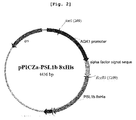
Figure 2 is a schematic diagram illustrating the plasmid pPICZα-PSL1b 8xHis for expressing the recombinant lectin PSL1b in yeast, which the PSL1b coding gene has been chemically synthesized and its lectin protein originated from Polyporus squamosus is able to bind specifically alpha(2,6) sialic acid. -
Figure 3 is a diagram illustrating the recombinant lectin produced in E. coli, confirmed by SDS-PAGE. -
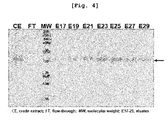
Figure 4 is a diagram illustrating the recombinant lectin produced in yeast, confirmed by SDS-PAGE. -
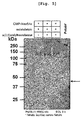
Figure 5 is a diagram illustrating the result of lectin blotting presenting the measurement of alpha(2,6) sialic acid of the sialylated glycoprotein added with sialic acid on the asialofetuin mediated by α(2,6)-sialyltransferase by using the recombinant lectin PSL1b. - Hereinafter, the present invention is described in detail.
- The present invention provides a polynucleotide composed of the nucleotide sequence represented by SEQ. ID. NO: 1 encoding lectin binding specifically to alpha(2,6) sialic acid.
- The present invention also provides a polypeptide composed of the amino acid sequence represented by SEQ. ID. NO: 2.
- The present invention also provides an expression vector comprising the polynucleotide above.
- The present invention also provides a transformant transfected by the expression vector above.
- The present invention also provides a bacterial transformant transfected by the expression vector above.
- The bacteria above are preferably selected from the group consisting of Staphylococcus aureus, E. coli, B. cereus, Salmonella typimurium, Salmonella choleraesuis, Yersinia enterocolitica, and Listeria monocytogenes, and among these E. coli is more preferred.
- In a preferred embodiment of the present invention, the present inventors screened gene sequence candidates by using query sequences provided by National Center for Biotechnology Information (NCBI, accession no. AB120707) in order to produce the Polyporus squamosus-derived recombinant lectin protein. Based on the sequences screened by the present inventors, the polynucleotide in 879 bp containing guanine and cytosine 44.7% via codon optimization and RNA secondary structure optimization was chemically synthesized at DNA 2.0 Co (USA) in order to induce the optimum expression of the target gene in the heterologous host system. The polynucleotide sequence synthesized in the present invention and the polypeptide produced from the same by transcription and translation are represented by SEQ. ID. NO: 1 and SEQ. ID. NO: 2 respectively. Changes in the wild type gene encoding the Polyporus squamosus-derived lectin PSL1b and in the chemically synthesized gene were presented (see Table 1). In addition, changes of their DNA codons corresponding with specific amino acids was presented (see Table 2). Based on the polynucleotide gene information confirmed before, the primers represented by SEQ. ID. NO: 3 and SEQ. ID. NO: 4 were constructed in order to clone the lectin protein in the E. coli expression vector (see Table 3). Escherichia coli BL21-CodonPlus(DE3)-RIL was transfected with the recombinant plasmid pET-PSL1b 8xHis (see
Figure 1 ) whose gene sequence had been identified in order to produce the recombinant PSL1b protein therein. The recombinant strain Escherichia coli PSL1b expressing the recombinant lectin PSL1b of the invention was deposited at Korean Collection for Type Cultures (KCTC), Korea Research Institute of Bioscience and Biotechnology (KRIBB), on November 1, 2013 (KCTC12507BP). Based on the polynucleotide gene information identified above, the primers represented by SEQ. ID. NO: 7 and SEQ. ID. NO: 8 were constructed in order to clone the lectin protein in the yeast expression vector (see Table 4). Pichia pastoris X-33 was transfected with the recombinant plasmid pPICZα-PSL1b 8xHis (seeFigure 2 ) whose gene sequence had been identified in order to produce the recombinant lectin PSL1b therein. The recombinant strain Pichia pastoris PSL1b expressing the recombinant lectin PSL1b of the invention was deposited at Korean Collection for Type Cultures (KCTC), Korea Research Institute of Bioscience and Biotechnology (KRIBB), on October 7, 2013 (KCTC12500BP). After culturing the recombinant E. coli of the invention, target cells were obtained from the culture medium by centrifugation. To separate the recombinant lectin from the collected cells, HisTrap™ FF column chromatography was performed. As a result, the recombinant lectin was eluted. To purify the recombinant lectin eluted above, Superose 12 column chromatography was performed and as a result, proteins in different sizes were eluted. The eluted proteins were concentrated by using Amicon®Ultra Centrifugal filter 10K. The crude extract for the recombinant lectin purification obtained above proceeded to SDS-PAGE, followed by Coommassie Brilliant Blue staining. The purity and the molecular weight of the purified lectin protein were analyzed by using Precision Plus Protein™ Standards (Bio-Rad, USA) as the standard proteins. As a result, the size of the purified recombinant PSL1b protein separated from E. coli was confirmed to be about 32 kDa (seeFigure 3 ). In addition, in order to purify the recombinant lectin from yeast, the transfected recombinant yeast strain constructed by the method of the invention described above was cultured and the culture solution was collected. To separate yeast cells and the culture medium from the yeast culture solution, centrifugation was performed. The precipitate was eliminated and the supernatant was obtained. To purify the recombinant lectin from the crude enzyme solution above, HisTrap™ FF column chromatography was performed. As a result, the recombinant lectin was eluted. The eluted proteins were concentrated by using Amicon®Ultra Centrifugal filter 10K. The crude protein solution obtained above proceeded to SDS-PAGE, followed by Coommassie Brilliant Blue staining. The purity and the size of the purified lectin protein were analyzed by using Precision Plus Protein™ Standards (Bio-Rad, USA) as the standard proteins. As a result, the size of the recombinant PSL1b protein separated and purified from yeast was about 40 kDa, which was a little larger than that of the protein separated from E. coli. The increase of the size was presumed because of the potential 3 N-linked glycosylations containing the corresponding lectin sequence (seeFigure 4 ). To investigate the selective binding of the protein separated above, lectin blotting was performed. As a result, lectin blot signal was observed in the basic structure of N-linked glycan structure such as Neu5Ac α(2,6)Galβ(1,4)GlcNAc and in the fetuin containing O-linked glycan structure such as Neu5Ac α(2,6)Galβ, Neu5Ac α(2,6)Galβ(1,3) GalNA, Neu5Ac α(2,6)[Galβ(1,3)]GalNA, Neu5Acα(2,6)Galβ(1,3) [Neu5Ac α(2,6)]GalNAc], Neu5Acα(2,6)Galβ(1,3) [Neu5Ac α(2,6)Galβ(1,4)GlcNAcβ(1,6)]GalNAc. However, any signal on the lectin-blotting membrane was not observed in the non-sialylated fetuin, the negative control, which contains Galβ(1,4)GlcNAc for N-linked glycan and Galβ, Galβ(1,3) GalNA, [Galβ(1,3)]GalNA, Galβ(1,3) [Galβ(1,4)GlcNAcβ(1,6)]GalNAc for O-linked glycans, and the fetuin containing alpha(2,3) sialic acid (bovine serum fetuin) (seeFigure 5 ), either. - Therefore, the present invention relates to the active recombinant lectin protein of the Polyporus squamosus-derived isolectin PSL1b binding specifically to glycoconjugates containing alpha(2,6)-linked sialic acid moieties. The present invention provides a method for producing the Polyporus squamosus-derived PSL1b recombinant lectin, which specifically binds to sialic acid containing glycoconjugates, from an Escherichia coli PSL1b strain (deposit number: KCTC12507BP) or a Pichia pastoris PSL1b strain (deposit number: KCTC12500BP) and the lectin produced thereby. The recombinant lectin of the present invention can be effectively used for the measurement of glycoproteins, glycopeptides, glycolipids, sugar precursors, or oligosaccharides having sialic acid moieties and as an active ingredient of the composition or the kit for the measurement or detection of the cell lines, bacteria, and viruses having sialoglycoconjugates.
- The present invention also provides a method for preparing the recombinant lectin binding specifically to alpha(2,6) sialic acid, comprising the following steps:
- (a) culturing the bacterial transformant of the invention; and
- (b) separating and purifying the recombinant lectin from the culture product of step (a).
- The present invention also provides a method for preparing the recombinant lectin binding specifically to alpha(2,6) sialic acid, comprising the following steps:
- (a) culturing the bacterial transformant above; and
- (b) separating and purifying the recombinant lectin from the culture product of step (a).
- The present invention also provides the recombinant lectin binding specifically to alpha(2,6) sialic acid prepared by the method above.
- The present invention also provides a polynucleotide composed of the nucleotide sequence represented by SEQ. ID. NO: 5.
- The present invention also provides a polypeptide composed of the amino acid sequence represented by SEQ. ID. NO: 6.
- The polypeptide above preferably includes 8 histidine residues at C-terminal of the total amino acid sequence, but not always limited thereto.
- The present invention also provides a yeast transformant transfected with the expression vector above.
- The yeast herein is preferably selected from the group consisting of Pichia, Saccharomyces, Kluyveromyces, Yallowia, Hansenula, and Candida, and Pichia is more preferred.
- The present invention also provides a method for preparing the recombinant lectin binding specifically to alpha(2,6) sialic acid, comprising the following steps:
- (a) culturing the yeast transformant above; and
- (b) separating and purifying the recombinant lectin from the culture product of step (a).
- The present invention also provides the recombinant lectin binding specifically to alpha(2,6) sialic acid prepared by the method above.
- The present invention also provides a polynucleotide composed of the nucleotide sequence represented by SEQ. ID. NO: 9.
- The present invention also provides a polypeptide composed of the amino acid sequence represented by SEQ. ID. NO: 10.
- The polypeptide above preferably includes the signal sequence for the secretory expression at N-terminal in the total amino acid sequence, but not always limited thereto.
- The present invention also provides a recombinant Escherichia coli strain deposited under the deposit number KCTC12507BP that can produce the recombinant lectin PSL1b protein binding specifically to alpha(2,6)sialic acid containing glycoconjugates.
- The present invention also provides a recombinant yeast (Pichia pastoris) strain deposited under the deposit number KCTC12500BP that can produce the recombinant lectin PSL1b protein binding specifically to alpha(2,6)sialic acid containing glycoconjugates.
- The present invention also provides a method for preparing the recombinant lectin binding specifically to alpha(2,6)sialic acid comprising the following steps:
- (a) culturing the strain above; and
- (b) separating and purifying the recombinant lectin from the culture product of step (a).
- The present invention also provides the recombinant lectin binding specifically to alpha(2,6)sialic acid prepared by the method above.
- The present invention also provides the lectin binding specifically to the sugar chain structure selected from the group consisting of the followings:
- sialylated glycan wherein NeuAc or NeuGc(α2→6) is added to Gal or Glc residue;
- sialylated glycan wherein NeuAc or NeuGc(α2→6) is added to Gal(β1→4)Glc or Glc(β1→4)Glc residue;
- sialylated glycan wherein NeuAc or NeuGc(α2→6) is added to Gal(β1→4)GlcNAc or Gal(β1→3)GlcNAc residue;
- sialylated glycan wherein NeuAc or NeuGc(α2→6) is added to Gal(β1→3)[αFuc(1→4)]GlcNAc residue; and
- sialylated glycan wherein NeuAc or NeuGc(α2→6) is added to Gal(β1→4)[αFuc(1→3)]GlcNAc.
- The present invention also provides a kit for the measurement or quantification of glycoproteins, glycopeptides, glycolipids, sugar precursors, or oligosaccharides having alpha(2,6)sialic acid moieties using the recombinant lectin of the invention.
- The present invention also provides the recombinant lectin PSL1b protein binding selectively to alpha(2,6)sialic acid containing glycoconjugates and having the size of 30 kDa ∼ 60 kDa, which has been separated and purified by the method of the invention.
- The present invention also provides a kit for the monitoring, measurement or quantification of the cell lines, bacteria, or viruses having sialoglycoconjugates comprising alpha(2,6)sialic acid on the surface thereof using the recombinant lectin of the invention.
- The present invention also provides a use of the kit for the measurement or quantification of the glycoproteins, glycopeptides, glycolipids, sugar precursors, or oligosaccharides having alpha(2,6)sialic acid containing glycoconjugates using the recombinant lectin of the invention.
- The present invention also provides a use of the kit for the monitoring, measurement or quantification of the cell lines, bacteria, or viruses having sialoglycoconjugates comprising alpha(2,6)sialic acid on the surface thereof using the recombinant lectin of the invention.
- The present invention also provides a method for the measurement or quantification of the sialylated glycoconjugates composed of the glycoproteins, glycopeptides, glycolipids, sugar precursors, or oligosaccharides having sialic acid moieties, which comprises the following steps:
- (a) contacting the test sample to the recombinant lectin of the invention; and
- (b) analyzing the glycoproteins, glycopeptides, glycolipids, sugar precursors, or oligosaccharides binding to the lectin above.
- The present invention also provides a method for the measurement or quantification of the cell lines, bacteria, or viruses having sialic acid sugar chains, which comprises the following steps:
- (a) contacting the test sample to the recombinant lectin of the invention; and
- (b) analyzing the cells, bacteria, or viruses binding to the lectin above.
- The Escherichia coli PSL1b strain (Deposit No: KCTC12507BP) or Pichia pastoris PSL1b strain (Deposit No: KCTC12500BP) of the present invention can produce efficiently the Polyporus squamosus-derived PSL1b recombinant lectin binding specifically to sialic acid containing glycoconjugates, so that the strain of the invention can be effectively used as an active ingredient of a composition or a kit for measuring or detecting glycoproteins, glycopeptides, glycolipids, sugar precursors, or oligosaccharides having sialic acid moieties.
- Practical and presently preferred embodiments of the present invention are illustrative as shown in the following Examples.
- However, it will be appreciated that those skilled in the art, on consideration of this disclosure, may make modifications and improvements within the spirit and scope of the present invention.
- To produce the Polyporus squamosus-derived recombinant lectin protein, the following experiment was performed.
- Particularly, the gene information about the Polyporus squamosus-derived lectin was obtained by screening all the similar sequences by using query sequence of National center for Biotechnology Information (NCBI, accession no. AB120707). Based on the sequences screened by the present inventors, the polynucleotide in 879 bp containing guanine and cytosine 44.7% via codon optimization and RNA secondary structure optimization was chemically synthesized at DNA 2.0 Co (USA) in order to induce the optimum expression of the target gene in the heterologous host system. The polynucleotide sequence synthesized in the present invention and the polypeptide produced from the same by transcription and translation are represented by SEQ. ID. NO: 1 and SEQ. ID. NO: 2 respectively. The physical and chemical changes in the wild type gene encoding Polyporus squamosus-derived lectin PSL1b and in the chemically synthesized gene are shown in Table 1. The codon changes are presented in Table 2.
[Table 1] Content Wild type gene Chemically synthesized gene Size of polynucleotide (bp) 879 879 Gene identity (%) 100 77 Translated amino acid (a.a.) 293 293 GC content (%) 53.23 44.70 Stability of RNA 2nd structure (ΔG°, kcal/mol) -423.8 -338.4 [Table 2] Codon Content (%) Codon Content (%) Codon Content (%) Codon Content (%) Wild type Synthesized type Wild type Synthesized type Wild type Synthesized type Wild type Synthesized type TTT 1.70 2.38 TCT 1.02 1.36 TAT 1.36 2.04 TGT 0.00 0.68 TTC 3.41 2.73 TCC 1.02 1.70 TAC 3.07 2.38 TGC 1.02 0.34 TTA 0.00 0.68 TCA 0.34 1.36 TAA 0.00 0.00 TGA 0.34 0.34 TTG 0.68 2.04 TCG 0.34 0.68 TAG 0.00 0.00 TGG 3.41 3.41 CTT 0.68 0.68 CCT 1.36 1.02 CAT 1.02 1.36 CGT 1.36 0.68 CTC 2.04 0.00 CCC 0.68 0.34 CAC 1.70 1.36 CGC 1.02 0.00 CTA 0.00 0.34 CCA 0.00 1.02 CAA 1.02 2.38 CGA 0.34 0.34 CTG 1.36 1.02 CCG 0.34 0.00 CAG 2.73 1.36 CGG 0.34 0.00 ATT 1.70 2.04 ACT 1.36 3.75 AAT 3.75 3.75 AGT 0.68 0.68 ATC 2.38 2.38 ACC 5.46 1.36 AAC 2.38 2.38 AGC 2.73 0.68 ATA 1.02 0.68 ACA 1.02 2.73 AAA 1.36 2.04 AGA 0.34 2.04 ATG 2.38 2.38 ACG 0.68 0.68 AAG 2.38 1.70 AGG 0.68 0.68 GTT 1.70 2.38 GCT 2.73 5.11 GAT 3.75 3.41 GGT 2.38 6.48 GTC 2.38 1.36 GCC 3.07 1.70 GAC 2.73 3.07 GGC 4.43 1.02 GTA 0.34 0.68 GCA 2.04 3.07 GAA 1.70 1.36 GGA 2.38 3.41 GTG 1.36 1.36 GCG 2.04 0.00 GAG 1.02 1.36 GGG 1.70 0.00 - Polymerase chain reaction (PCR) was performed to produce the Polyporus squamosus-derived recombinant lectin protein in from E. coli.
- Particularly, primers were constructed for the cloning of the lectin protein of Example 1 into the E. coli expression vector based on the gene information of the polynucleotide identified by the method of Example 1. As shown in Table 3, the constructed primers are represented by SEQ. ID. NO: 3 and SEQ. ID. NO: 4. Polymerase chain reaction (PCR) was performed by using the chemically synthesized polynucleotide as a template. PCR conditions for the amplification of the 897 gene encoding the said lectin gene were as follows: denaturation at 94 °C for 30 seconds, annealing at 52 °C for 30 seconds, extension at 72°C for 1
minute 20 seconds, 35 cycles from denaturation to extension. The amplified gene was purified with DNA purification kit (QIAGEN PCR purification kit, Valencia, CA, USA). The purified gene and the vector pET39b (Novagen, USA) for the cloning of a corresponding gene in E. coli were treated with proper restriction enzymes and the gene fragment treated with the restriction enzymes was separated on agarose gel, followed by purification using the same purification kit as the above. The purified gene fragment was ligated with the cloning vector pET39b, and E. coli DH5α was transfected with the vector. Plasmid was separated from the transfected E. coli, followed by DNA sequencing (Genotech, Daejeon, Korea). The final recombinant plasmid prepared by the method above was named 'pET-PSL1b 8xHis' (Figure 1 ). The gene cloned into the expression vector was 909 bp (SEQ. ID. NO: 5) that could encode the recombinant lectin protein produced in E. coli and was encoding the amino acid sequence comprising total 302 amino acid residues represented by SEQ. ID. NO: 6 and had 8 histidines at C-terminal, by which the recombinant lectin protein could be easily separated through immobilized metal ion affinity chromatography (IMAC) column. The recombinant plasmid pET-PSL1b 8xHis whose gene sequence had been identified was introduced in E. coli BL21-CodonPlus(DE3)-RIL to produce the recombinant lectin PSL1b protein. The recombinant strain Escherichia coli PSL1b expressing the recombinant lectin PSL1b was deposited at Korean Collection for Type Cultures (KCTC), Korea Research Institute of Bioscience and Biotechnology (KRIBB), on November 1, 2013 (KCTC12507BP).[Table 3] SEQ. ID. NO Sequence SEQ. ID. NO: 3 5'-TTTTTTTTCATATGAGTTTCGAGGGACATGGAATCTAC-3' SEQ. ID. NO: 4 5'-TTAACTCGAGGAACAATCCAAAATATGCTTTATAAC-3' - Polymerase chain reaction (PCR) was performed to produce the Polyporus squamosus-derived recombinant lectin protein from yeast.
- Particularly, primers were constructed for the cloning of the lectin protein of Example 1 into the yeast expression vector based on the gene information of the polynucleotide identified by the method of Example 1. As shown in Table 4, the constructed primers are represented by SEQ. ID. NO: 7 and SEQ. ID. NO: 8. Polymerase chain reaction (PCR) was performed by using the chemically synthesized polynucleotide as a template. PCR conditions for the amplification of the 915 bp gene encoding the said lectin gene were as follows: denaturation at 94 °C for 30 seconds, annealing at 52 °C for 30 seconds, extension at 72 °C for 1 minute, 40 cycles from denaturation to extension. The amplified gene was purified with DNA purification kit (QIAGEN PCR purification kit, Valencia, CA, USA). The purified gene and the vector pPICZα (Invitrogen, Carlsbad, CA, USA) for the cloning of a corresponding gene in yeast (Pichia pastoris) were treated with proper restriction enzymes and the gene fragment treated with the restriction enzymes was separated on agarose gel, followed by purification using the same purification kit as the above. The purified gene fragment was ligated with the cloning vector pPICZα, and E. coli DH5α was transfected with the vector. Plasmid was separated from the transfected E. coli, followed by DNA sequencing (Genotech, Daejeon, Korea). The final recombinant plasmid prepared by the method above was named 'pPIC2α-PSL1b 8xHis' (
Figure 2 ). The 1,173 bp long sequence (SEQ. ID. NO: 9) encoding the recombinant lectin protein produced in yeast (Pichia pastoris) via cloning in the expression vector above was encoding the amino acid sequence (SEQ. ID. NO: 10) comprising total 390 amino acid residues represented by SEQ. ID. NO: 8 and had signal peptide comprising 89 amino acid residues at its N-terminus regions and had 8 histidines at its C-terminus regions, by which the recombinant lectin protein could be easily separated through immobilized metal ion affinity chromatography (IMAC) column. The recombinant plasmid pPIC2α-PSL1b 8xHis whose gene sequence had been identified was introduced in Pichia pastoris X-33 to produce the recombinant lectin PSL1b protein. The recombinant strain Pichia pastoris PSL1b expressing the recombinant lectin PSL1b was deposited at Korean Collection for Type Cultures (KCTC), Korea Research Institute of Bioscience and Biotechnology (KRIBB), on October 7, 2013 (KCTC12500BP).[Table 4] SEQ. ID. NO Sequence Pp_PS1b-F (SEQ. ID. NO: 7) 5'-AGAATTCTCTTTCGAGGGACATGGAATCTAC-3' Pp_PSL1b-R (SEQ. ID. NO: 8) 
- The recombinant E. coli constructed by the method described in Example 2 was pre-cultured in Luria-Bertani (LB) medium (trypton 10 g/L, yeast extract 5 g/L, NaCl 10 g/L) containing antibiotics at 37 °C for at least 10 hours. The pre-culture solution of the recombinant E. coli was inoculated in LB medium at the volume of 1/100, followed by culture at 37 °C until OD600 reached 0.6 ∼ 0.8. To induce the expression of the recombinant PSL1b lectin, isopropyl-βD-thiogalactopyranoside (IPTG) was added thereto at the final concentration of 1.0 mM, followed by further culture at 30 °C for 6 hours. The cells were collected from the culture solution by centrifugation.
- To separate the recombinant lectin from the cells obtained by the method described in Example <4-1>, HisTrap™ FF column chromatography was performed.
- Particularly, the cells obtained by the same manner as described in Example <4-1> were washed with 50 mM Tris-HCl buffer (pH 7.6) three times. The cells were then lysed by sonication for 15 minutes in the same buffer. To eliminate unbroken cells and insoluble proteins from the cell lysate, centrifugation was performed at 10,000 rpm for 30 minutes. And the resultant cell residues precipitated in there were eliminated. The cell lysate was loaded in HisTrap™ FF column (0.7×2.5 cm) equilibrated with 50 mM Tris-HCl buffer (pH 8.0) containing 10 mM imidazole and 0.25 M NaCl using Amersham-Pharmacia FPLC system (GE-Healthcare, USA). The column was washed with the same buffer of 20 times the column volume. The recombinant lectin was eluted with imidazole gradient from 10 mM to 500 mM in 50 mM tris-HCl buffer (pH 8.0) containing 0.25 M NaCl. At this time, the flow rate was 1 ml per minute and the fraction size was 0.5 mL per fraction tube. The protein eluted from the fractions displaying the peaks was concentrated by using Amicon®Ultra Centrifugal filter 10K.
- To separate the recombinant protein separated by using HisTrap™ FF column by the method described in Example <4-2> with more purity, Superose 12 column chromatography was performed.
- Particularly, the recombinant protein separated by the method described in Example <4-2> was loaded in Superose 12 column (1.0×30 cm) (GE-Healthcare, USA) equilibrated with 50 mM Tris-HCl buffer (pH 8.0). Protein was eluted according to the size using the same buffer (1 ml/min). The protein eluted from the fractions displaying the peaks was concentrated by using Amicon®Ultra Centrifugal filter 10K.
- To confirm the recombinant protein separated by the method of Example <4-3> with more purity, SDS-PAGE was performed.
- Particularly, the crude enzyme solution obtained by the method of Example <4-3> was separated by SDS-PAGE, followed by staining with Coommassie Brilliant Blue. The purity and size of the purified lectin protein was analyzed by using Precision Plus Protein™ Standards (Bio-Rad, USA) as the standard proteins.
- As a result, as shown in
Figure 3 , the size of the recombinant PSL1b protein separated and purified from E. coli was about 32 kDa (Figure 3 ). - The recombinant yeast strain constructed by the method described in Example 3 was pre-cultured in YPD medium (Yeast extract 10 g/L, Bactopeptone 20 g/L, Dextrose 20 g/L) at 30 °C for at least 24 hours. The recombinant yeast strain pre-culture solution was inoculated in 1.5 L of main culture medium at the ratio of 1:100 (v/v). The composition of the main culture medium was as follows (per 1 liter): 50 mL glycerol, 833 mL distilled water, 0.9 g CaSO4, 14.67 g K2SO4, 11.67 g MgSO4·7H2O, 9 g (NH4)2SO4, 167 mL Hexametaphosphate solution (150g hexametaphosphate per 1 L distilled water), and 4 mL trace element solution. Main culture was performed in 2 liter Jar fermentor (Jar fermentor, Kobiotech, Korea). The yeast was cultured at the aeration rate of 0.3 vvm, 1,000 rpm, pH 4.8 ∼ 6.4, 30 °C. pH was controlled during the culture with 10% (v/v) phosphoric acid solution and ammonia water. The yeast cells were cultured until the glycerol content in the culture medium reached up to 5 g/L. Then, 5 ml of methanol was fed thereto in order to induce the expression of the lectin protein. The methanol content in the medium was monitored at a regular interval. 1 g/L, the equivalent amount of methanol was added. 48 hours after the first methanol injection, the culture solution was collected.
- To separate the yeast cells and the culture medium from the yeast culture solution prepared by the method described in Example <5-1>, centrifugation was performed.
- Particularly, centrifugation was performed using SUPRA 22K centrifuge (Hanil Science Inc., Korea) equipped with A1000S-4S rotor at 4 °C, 7,000 rpm for 30 minutes. The precipitated yeast cells were discarded and the supernatant was obtained. The obtained supernatant was stirred, during which ammonium sulfate in the solid phase was slowly added thereto until the concentration reached 80% (saturation concentration). The supernatant added with ammonium sulfate was stirred at 4 °C for at least 12 hours. Then, centrifugation was performed at 4 °C, 7,000 rpm for 1 hour. The supernatant was eliminated and the precipitate was obtained. The precipitate was dissolved in 50 mM Tris-HCl buffer (pH 8.0), which was loaded in Slide-A-Lyzer®dialysis Cassette (Thermo Scientific, Rockford, USA). The crude protein solution containing the recombinant protein was dialyzed in 5 L of the same buffer as the above. After 12 hours of dialysis, the crude protein solution was centrifuged using SUPRA 22K centrifuge (Hanil Science Inc., Korea) equipped with A500S-6N rotor at 4 °C, 12,000 rpm for 30 minutes. The precipitate was eliminated and the supernatant was obtained.
- To separate the recombinant lectin from the crude protein solution obtained by the method described in Example <5-2>, the following experiment was performed.
- Particularly, the crude protein solution was loaded in HisTrap™ FF column (0.7×2.5 cm) equilibrated with 50 mM Tris-HCl buffer (pH 8.0) containing 10 mM imidazole and 0.25 M NaCl using Amersham-Pharmacia FPLC system (GE-Healthcare, USA). The column was washed with the same buffer at the volume of 20 times the volume of the solution. The recombinant lectin was eluted with imidazole gradient from 10 mM to 500 mM in 50 mM tris-HCl buffer (pH 8.0) containing 0.25 M NaCl. At this time, the elution rate was 1 ml per minute and the fraction size was 0.5 mL per fraction tube. The protein eluted from the fractions displaying the peaks was concentrated by using Amicon®Ultra Centrifugal filter 10K.
- To confirm the purified lectins in the fraction pools obtained by the method of Example <5-3>, SDS-PAGE was performed.
- Particularly, the purified lectins in the fraction pools obtained by the method of Example <5-3> was separated by SDS-PAGE, followed by staining with Coommassie Brilliant Blue. The purity and the molecular weight of the purified lectin protein was analyzed by using Precision Plus Protein™ Standards (Bio-Rad, USA) as the standard proteins.
- As a result, as shown in
Figure 4 , the size of the recombinant PSL1b protein separated and purified from yeast above was about 40 kDa, which was a little bigger than the size of the recombinant PSL1b protein separated and purified from E. coli. The size difference was assumed due to the potential three N-linked glycosylation sites included in the corresponding lectin sequence. - Lectin blotting was performed to investigate the selective binding force of the protein separated by the method of Example <5-4>.
- Particularly, lectin blotting was performed with the glycoprotein wherein sialylation was completed by the reaction between non-sialylated glycoprotein not added with sialic acid sugar chains and CMP-N-acetylneuraminic acid (CMP-Neu5Ac) in the presence of α(2,6)-sialyltransferase. For in vitro sialylation, the cell extract expressing α(2,6)-sialyltransferase was mixed with 1 mg/mL of the sialic acid receptor non-sialylated fetuin (asialofetuin) as a glycoprotein substrate, 0.5 mg/mL of the sialic acid donor CMP-Neu5Ac, 10 mM MnCl2, 1% Triton X-100, and 0.02 unit TEV (Tobacco Etch Virus) protease in PBS (phosphate buffered saline), followed by reaction at 25 °C for 6 ∼ 12 hours. After the enzymatic sialyation, the sialylated glycoprotein was analyzed by lectin blotting to confirm the addition of sialic acid. Each enzyme reaction product respectively containing non-sialylated fetuin or sialylated fetuin was mixed with 5×Laemmli buffer, which was then heated for 10 minutes. The fetuin samples were separated by 8% SDS-PAGE electrophoresis. The proteins separated on the SDS-PAGE gel were transferred on a nitrocellulose membrane at 15 V for 1 hour by using Trans-Blot SD Semi-Dry Transfer Cell (Bio-Rad, USA). The protein-transferred membrane was washed with phosphate buffered saline (PBS) and then incubated in PBS containing 3% bovine serum albumin (BSA) for 1 hour. The membrane was washed again with PBS containing 0.5% Tween (PBST) 3 times and then loaded in 3% BSA-PBS containing 1 mg/ml of the biotin-conjugated recombinant PSL1b lectin protein prepared above, followed by culture at room temperature for 4 hours. The biotinylation conjugation of the recombinant PSL1b lectin protein was performed by using Antibody Biotinylation Kit (Genomine, Korea). After incubation of the membrane with the biotin-conjugated lectin, the membrane was washed with PBST 6 times for 10 minutes, followed by reaction with 0.2 mg/mL of horseradish peroxidase(HRP)-conjugated anti-biotin antibody (1:500, Sigma-Aldrich) for 1 hour. The membrane was washed with PBST 6 times for 10 minutes by the same manner as described above. At last, the sialylated protein was detected by ECL kit (GE Healthcare, USA).
- As a result, as shown in
Figure 5 , lectin blot signal was observed in the basic structure of N-linked glycan such as Neu5Ac α(2, 6) Galβ(1,4)GlcNAc and in the fetuin containing O-linked glycans such as Neu5Ac α(2,6)Galβ, Neu5Ac α(2,6)Galβ(1,3) GalNAc, Neu5Ac α(2,6)[Galβ(1,3)]GalNAc, Neu5Acα(2,6)Galβ(1,3) [Neu5Ac α(2,6)]GalNAc], Neu5Acα(2,6)Galβ(1,3) [Neu5Ac α(2,6)Galβ(1,4)GlcNAcβ(1,6)]GalNAc. However, any signal on the lectin blotting membrane was not observed in the non-sialylated fetuin, the negative control, which contains Galβ(1,4)GlcNAc for N-linked glycan andGalβ, Galβ(1,3)GalNAc, [Galβ(1, 3)]GalNAc, Galβ(1,3) [Galβ(1,4)GlcNAcβ(1,6)]GalNAc for O-linked glycans, and the fetuin containing alpha(2,3) sialic acid (bovine serum fetuin) (Figure 5 ). - The present invention relates to a method for producing, separating, and purifying the recombinant lectin as an active protein comprising the steps of synthesizing the polynucleotide encoding PSL1b lectin protein; and introducing the synthetic polynucleotide gene in a heterologous host to construct the recombinant strains Escherichia coli PSL1b (KCTC12507B) and Pichia pastoris PSL1b (KCTC12500BP) in order to produce the PSL1b lectin as a recombinant protein that binds specifically to alpha(2,6)-linked sialic acid. The recombinant protein of the present invention can be effectively used as an active ingredient of a composition or a kit for measuring or detecting glycoproteins, glycopeptides, glycolipids, sugar precursors, or oligosaccharides having sialic acid moieties containing the recombinant lectin specifically binding to alpha(2,6)-linked sialic acid, or a composition or a kit for measuring or detecting cell lines, bacteria, and viruses having sialoglycoconjugates containing the recombinant lectin specifically binding to alpha(2,6)-linked sialic acid.
-
- Depositary Authority: Korea Research Institute of Bioscience and Biotechnology
- Deposit Number: KCTC12507BP
- Deposit Day: 20131101
- Depositary Authority: Korea Research Institute of Bioscience and Biotechnology
- Deposit Number: KCTC12500BP
- Deposit Day: 20131007
- Those skilled in the art will appreciate that the conceptions and specific embodiments disclosed in the foregoing description may be readily utilized as a basis for modifying or designing other embodiments for carrying out the same purposes of the present invention. Those skilled in the art will also appreciate that such equivalent embodiments do not depart from the spirit and scope of the invention as set forth in the appended Claims.


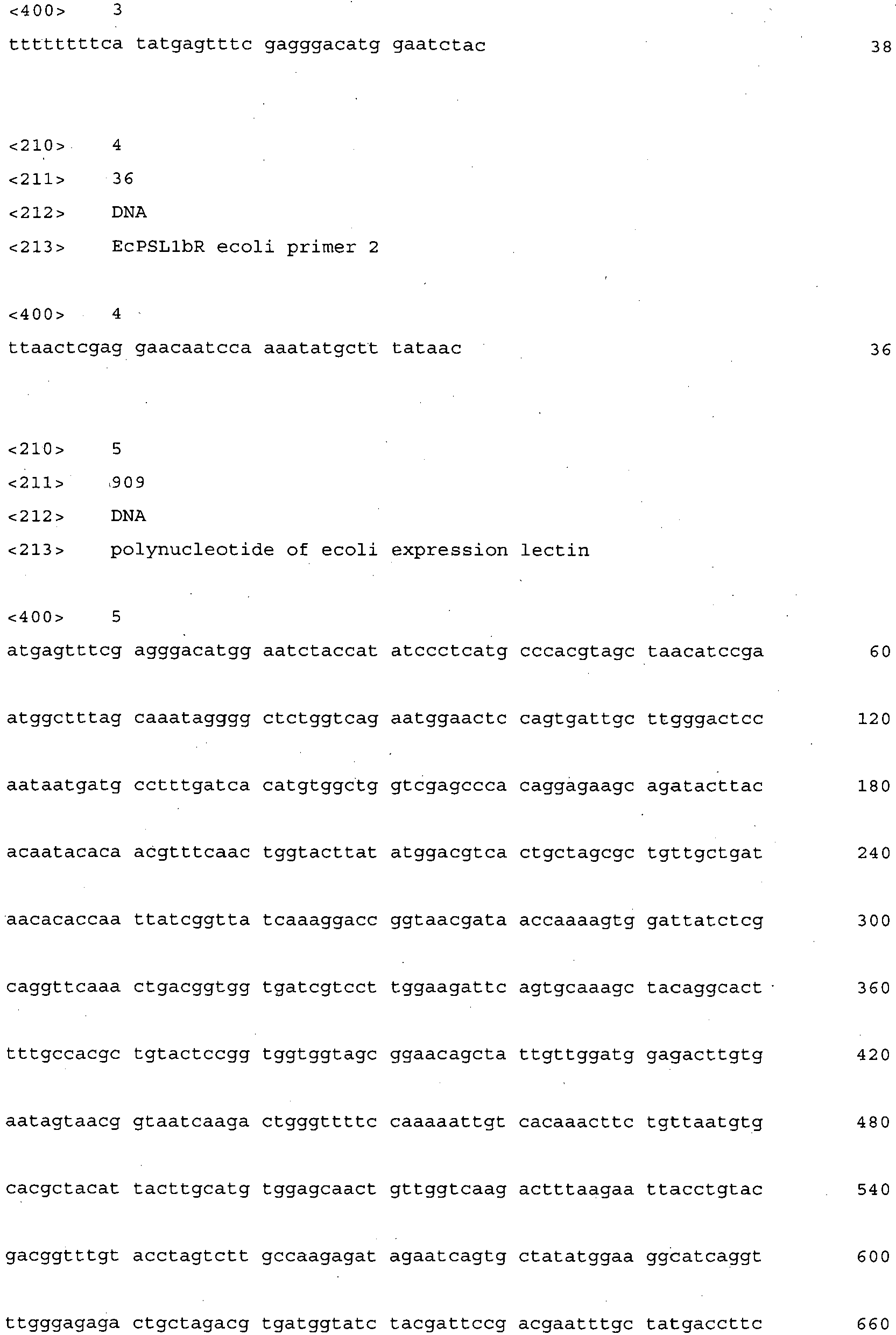


Claims (29)
- A polynucleotide composed of the nucleotide sequence represented by SEQ. ID. NO: 1 encoding the lectin binding specifically to alpha(2,6) sialic acid.
- A polypeptide composed of the amino acid sequence represented by SEQ. ID. NO: 2.
- An expression vector comprising the polynucleotide of claim 1.
- A transformant transfected with the expression vector of claim 3.
- A bacterial transformant transfected with the expression vector of claim 3.
- The transformant according to claim 5, wherein the bacteria are selected from the group consisting of Staphylococcus aureus, E. coli, B. cereus, Salmonella typimurium, Salmonella choleraesuis, Yersinia enterocolitica, and Listeria monocytogenes.
- A method for preparing the recombinant lectin binding specifically to alpha(2,6) sialic acid comprising the following steps:a) culturing the bacterial transformant of claim 5; andb) separating and purifying the recombinant lectin binding specifically to alpha(2,6) sialic acid from the culture product of step (a).
- A recombinant lectin binding specifically to alpha(2,6) sialic acid prepared by the method of claim 7.
- A polynucleotide composed of the nucleotide sequence represented by SEQ. ID. NO: 5.
- A polypeptide composed of the amino acid sequence represented by SEQ. ID. NO: 6.
- The polypeptide according to claim 10, wherein the polypeptide contains 8 histidine residues at C-terminal of the total amino acid sequence.
- A yeast transformant transfected with the expression vector of claim 3.
- The transformant according to claim 12, wherein the yeast is selected from the group consisting of Pichia, Saccharomyces, Kluyveromyces, Yallowia, Hansenula, and Candida.
- A method for preparing the recombinant lectin binding specifically to alpha(2,6) sialic acid comprising the following steps:a) culturing the yeast transformant of claim 12; andb) separating and purifying the recombinant lectin binding specifically to alpha(2,6) sialic acid from the culture product of step (a).
- A recombinant lectin binding specifically to alpha(2,6) sialic acid prepared by the method of claim 14.
- A polynucleotide composed of the nucleotide sequence represented by SEQ. ID. NO: 9.
- A polypeptide composed of the amino acid sequence represented by SEQ. ID. NO: 10.
- The polypeptide according to claim 17, wherein the polypeptide contains the signal sequence for the secretory expression at N-terminal in the total amino acid sequence.
- A recombinant Escherichia coli strain deposited under the deposit number KCTC12507BP that can produce the recombinant lectin PSL1b protein binding specifically to alpha(2,6)sialic acid sugar chain.
- A recombinant yeast (Pichia pastoris) strain deposited under the deposit number KCTC12500BP that can produce the recombinant lectin PSL1b protein binding specifically to alpha(2,6)sialic acid sugar chain.
- A method for preparing the recombinant lectin binding specifically to alpha(2,6)sialic acid comprising the following steps:(a) culturing the strain of claim 19 or claim 20; and(b) separating and purifying the recombinant lectin from the culture product of step (a).
- A recombinant lectin binding specifically to alpha(2,6)sialic acid prepared by the method of claim 21.
- The lectin according to claim 8, claim 10, claim 15, claim 17, or claim 22, wherein the recombinant lectin is bound specifically to the sugar chain structure selected from the group consisting of the followings:sialylated sugar chain wherein NeuAc or NeuGc(α2→6) is added to Gal or Glc residue;sialylated sugar chain wherein NeuAc or NeuGc(α2→6) is added to Gal(β1→4)Glc or Glc(β1→4)Glc residue;sialylated sugar chain wherein NeuAc or NeuGc(α2→6) is added to Gal(β1→4)GlcNac or Gal(β1→3)GlcNac residue;sialylated sugar chain wherein NeuAc or NeuGc(α2→6) is added to Gal(β1→3)[αFuc(1→4)]GlcNac residue; andsialylated sugar chain wherein NeuAc or NeuGc(α2→6) is added to Gal(β1→4)[αFuc(1→3)]GlcNac.
- A kit for measuring or detecting glycoproteins, glycopeptides, glycolipids, sugar precursors, or oligosaccharides having alpha(2,6) sialic acid sugar chains, using the recombinant lectin of claim 8, claim 10, claim 15, claim 17, or claim 22.
- A kit for monitoring, measuring, or quantifying cell lines, bacteria, or viruses having sialic acid sugar chains containing alpha(2,6) sialic acid sugar chains on the surface thereof, using the recombinant lectin of claim 8, claim 10, claim 15, claim 17, or claim 22.
- A method for the measurement or quantification of the sialylated conjugate composed of the glycoproteins, glycopeptides, glycolipids, sugar precursors, or oligosaccharides having sialic acid sugar chains, which comprises the following steps:(a) contacting the test sample to the recombinant lectin of claim 8, claim 10, claim 15, claim 17, or claim 22; and(b) analyzing the glycoproteins, glycopeptides, glycolipids, sugar precursors, or oligosaccharides binding to the lectin above.
- A method for the measurement or quantification of the cell lines, bacteria, or viruses having sialic acid sugar chains, which comprises the following steps:(a) contacting the test sample to the recombinant lectin of claim 8, claim 10, claim 15, claim 17, or claim 22; and(b) analyzing the cells, bacteria, or viruses binding to the lectin above.
- A use of the kit for the measurement or quantification of the glycoproteins, glycopeptides, glycolipids, sugar precursors, or oligosaccharides having alpha(2,6)sialic acid sugar chains using the recombinant lectin of claim 8, claim 10, claim 15, claim 17, or claim 22.
- A kit for the monitoring, measurement or quantification of the cell lines, bacteria, or viruses having sialic acid sugar chains comprising alpha(2,6)sialic acid on the surface thereof using the recombinant lectin of claim 8, claim 10, claim 15, claim 17, or claim 22.
Applications Claiming Priority (2)
| Application Number | Priority Date | Filing Date | Title |
|---|---|---|---|
| KR1020130140154A KR101673195B1 (en) | 2013-11-18 | 2013-11-18 | The Recombinant Sialic Acid-Specific Binding Lectin, PSL1b, from the Mushroom Polyporus squamosus |
| PCT/KR2014/010973 WO2015072785A1 (en) | 2013-11-18 | 2014-11-14 | Polyporus squamosus-derived recombinant lectin specific for sialic acid linkage |
Publications (3)
| Publication Number | Publication Date |
|---|---|
| EP3072970A1 true EP3072970A1 (en) | 2016-09-28 |
| EP3072970A4 EP3072970A4 (en) | 2016-09-28 |
| EP3072970B1 EP3072970B1 (en) | 2019-03-27 |
Family
ID=53057654
Family Applications (1)
| Application Number | Title | Priority Date | Filing Date |
|---|---|---|---|
| EP14861999.2A Not-in-force EP3072970B1 (en) | 2013-11-18 | 2014-11-14 | Polyporus squamosus-derived recombinant lectin specific for sialic acid linkage |
Country Status (5)
| Country | Link |
|---|---|
| US (1) | US10281460B2 (en) |
| EP (1) | EP3072970B1 (en) |
| JP (1) | JP6262345B2 (en) |
| KR (1) | KR101673195B1 (en) |
| WO (1) | WO2015072785A1 (en) |
Families Citing this family (2)
| Publication number | Priority date | Publication date | Assignee | Title |
|---|---|---|---|---|
| KR101842226B1 (en) * | 2015-11-25 | 2018-03-26 | 한국생명공학연구원 | Mushroom Hericium erinaceus lectin specifically binding to core 1 O-linked glycan and uses thereof |
| KR101871802B1 (en) * | 2017-12-21 | 2018-06-28 | 한국생명공학연구원 | Mushroom Stereum hirsutum lectin specifically binding to polyfucosylated N-linked glycan and uses thereof |
Family Cites Families (6)
| Publication number | Priority date | Publication date | Assignee | Title |
|---|---|---|---|---|
| US5330897A (en) * | 1989-04-27 | 1994-07-19 | South Alabama Medical Science Foundation | Sialic acid binding lectin of protozoan origin |
| DE69329333D1 (en) * | 1992-03-20 | 2000-10-05 | Cor Therapeutics Inc | INHIBITION OF FACTOR X BY GLYCOSYLATION |
| DE19819846B4 (en) * | 1998-05-05 | 2016-11-24 | Deutsches Krebsforschungszentrum Stiftung des öffentlichen Rechts | Multivalent antibody constructs |
| US20040091503A1 (en) * | 2002-08-20 | 2004-05-13 | Genitrix, Llc | Lectin compositions and methods for modulating an immune response to an antigen |
| WO2006091942A2 (en) * | 2005-02-24 | 2006-08-31 | Lifescan, Inc. | Methods of expressing, purifying and characterizing concanavalin a, mutants thereof, and sensors including the same |
| KR101054672B1 (en) * | 2008-06-12 | 2011-08-08 | 중앙대학교 산학협력단 | Method for analyzing sugar chain terminal sialic acid content of recombinant glycoprotein |
-
2013
- 2013-11-18 KR KR1020130140154A patent/KR101673195B1/en active Active
-
2014
- 2014-11-14 EP EP14861999.2A patent/EP3072970B1/en not_active Not-in-force
- 2014-11-14 WO PCT/KR2014/010973 patent/WO2015072785A1/en not_active Ceased
- 2014-11-14 US US15/037,637 patent/US10281460B2/en active Active
- 2014-11-14 JP JP2016531684A patent/JP6262345B2/en not_active Expired - Fee Related
Also Published As
| Publication number | Publication date |
|---|---|
| EP3072970B1 (en) | 2019-03-27 |
| JP6262345B2 (en) | 2018-01-17 |
| KR101673195B1 (en) | 2016-11-07 |
| US10281460B2 (en) | 2019-05-07 |
| JP2016537980A (en) | 2016-12-08 |
| EP3072970A4 (en) | 2016-09-28 |
| US20160290997A1 (en) | 2016-10-06 |
| WO2015072785A1 (en) | 2015-05-21 |
| KR20150057167A (en) | 2015-05-28 |
Similar Documents
| Publication | Publication Date | Title |
|---|---|---|
| RU2642307C2 (en) | New fucosyltransferases and their application | |
| KR20210107736A (en) | Method for preparing 3-fucosyllactose and lactose converting α-1,3-fucosyltransferase enzyme | |
| ES3013132T3 (en) | Mutated fucosidase | |
| JP5975577B2 (en) | Method for producing sialic acid-containing sugar chain | |
| Sugiyama et al. | Introduction of H-antigens into oligosaccharides and sugar chains of glycoproteins using highly efficient 1, 2-α-l-fucosynthase | |
| WO2020040257A1 (en) | METHOD FOR SYNTHESIZING ENZYME FOR β-GLYCOSIDE OF LACTO-N-BIOSE I OR GALACTO-N-BIOSE USING MODIFIED PHOSPHORYLASE | |
| EP3072970B1 (en) | Polyporus squamosus-derived recombinant lectin specific for sialic acid linkage | |
| US10150799B2 (en) | Sialic acid-specific binding affinity lectin from the mushroom Hericium erinaceum | |
| US20230183766A1 (en) | Bacterial strains and method for producing oligosaccharides | |
| EP3307882B1 (en) | Mutated photobacterium transsialidases | |
| KR101457514B1 (en) | Sialyltransferase of Halocynthia rorentzi and a method for synthesis of sialoglycoconjugates using it | |
| KR101842226B1 (en) | Mushroom Hericium erinaceus lectin specifically binding to core 1 O-linked glycan and uses thereof | |
| EP4277984A1 (en) | Extracellular production of glycosylated products | |
| JP6830576B2 (en) | Endo M mutant and method for producing N-linked sugar chain-containing compound or N-linked sugar chain-containing protein | |
| KR102922337B1 (en) | Method for preparing trisaccharide | |
| JP4781851B2 (en) | Novel carbohydrate hydrolase that hydrolyzes αN-acetylglucosaminyl linkage | |
| JP5917913B2 (en) | Improved methods for carbohydrate-related enzymes | |
| JP2023107687A (en) | α-galactosidase and its use | |
| JP5951199B2 (en) | Polypeptide that specifically binds to the sugar chain of gastrointestinal mucin | |
| Kajiwara et al. | A CMP-N-acetylneuraminic acid synthetase purified from a marine bacterium, Photobacterium leiognathi JT-SHIZ-145 | |
| Lim | Synthesis of O-Linked Glycopeptides Using Enzymatic Catalysis | |
| JP2021177713A (en) | Nucleic acid encoding protein having deaminoneuraminic acid-specific sialidase activity and use thereof | |
| WO2015072786A1 (en) | Hericium erinaceum-derived lectin specific for sialic acid linkage |
Legal Events
| Date | Code | Title | Description |
|---|---|---|---|
| PUAI | Public reference made under article 153(3) epc to a published international application that has entered the european phase |
Free format text: ORIGINAL CODE: 0009012 |
|
| 17P | Request for examination filed |
Effective date: 20160620 |
|
| A4 | Supplementary search report drawn up and despatched |
Effective date: 20160823 |
|
| AK | Designated contracting states |
Kind code of ref document: A1 Designated state(s): AL AT BE BG CH CY CZ DE DK EE ES FI FR GB GR HR HU IE IS IT LI LT LU LV MC MK MT NL NO PL PT RO RS SE SI SK SM TR |
|
| AX | Request for extension of the european patent |
Extension state: BA ME |
|
| DAX | Request for extension of the european patent (deleted) | ||
| STAA | Information on the status of an ep patent application or granted ep patent |
Free format text: STATUS: EXAMINATION IS IN PROGRESS |
|
| 17Q | First examination report despatched |
Effective date: 20170428 |
|
| REG | Reference to a national code |
Ref country code: DE Ref legal event code: R079 Ref document number: 602014043809 Country of ref document: DE Free format text: PREVIOUS MAIN CLASS: C12N0015310000 Ipc: C07K0014375000 |
|
| GRAP | Despatch of communication of intention to grant a patent |
Free format text: ORIGINAL CODE: EPIDOSNIGR1 |
|
| STAA | Information on the status of an ep patent application or granted ep patent |
Free format text: STATUS: GRANT OF PATENT IS INTENDED |
|
| RIC1 | Information provided on ipc code assigned before grant |
Ipc: C07K 14/375 20060101AFI20181015BHEP |
|
| INTG | Intention to grant announced |
Effective date: 20181119 |
|
| GRAS | Grant fee paid |
Free format text: ORIGINAL CODE: EPIDOSNIGR3 |
|
| GRAA | (expected) grant |
Free format text: ORIGINAL CODE: 0009210 |
|
| STAA | Information on the status of an ep patent application or granted ep patent |
Free format text: STATUS: THE PATENT HAS BEEN GRANTED |
|
| AK | Designated contracting states |
Kind code of ref document: B1 Designated state(s): AL AT BE BG CH CY CZ DE DK EE ES FI FR GB GR HR HU IE IS IT LI LT LU LV MC MK MT NL NO PL PT RO RS SE SI SK SM TR |
|
| REG | Reference to a national code |
Ref country code: GB Ref legal event code: FG4D |
|
| REG | Reference to a national code |
Ref country code: CH Ref legal event code: EP |
|
| REG | Reference to a national code |
Ref country code: AT Ref legal event code: REF Ref document number: 1112937 Country of ref document: AT Kind code of ref document: T Effective date: 20190415 |
|
| REG | Reference to a national code |
Ref country code: IE Ref legal event code: FG4D |
|
| REG | Reference to a national code |
Ref country code: DE Ref legal event code: R096 Ref document number: 602014043809 Country of ref document: DE |
|
| PG25 | Lapsed in a contracting state [announced via postgrant information from national office to epo] |
Ref country code: LT Free format text: LAPSE BECAUSE OF FAILURE TO SUBMIT A TRANSLATION OF THE DESCRIPTION OR TO PAY THE FEE WITHIN THE PRESCRIBED TIME-LIMIT Effective date: 20190327 Ref country code: NO Free format text: LAPSE BECAUSE OF FAILURE TO SUBMIT A TRANSLATION OF THE DESCRIPTION OR TO PAY THE FEE WITHIN THE PRESCRIBED TIME-LIMIT Effective date: 20190627 Ref country code: SE Free format text: LAPSE BECAUSE OF FAILURE TO SUBMIT A TRANSLATION OF THE DESCRIPTION OR TO PAY THE FEE WITHIN THE PRESCRIBED TIME-LIMIT Effective date: 20190327 Ref country code: FI Free format text: LAPSE BECAUSE OF FAILURE TO SUBMIT A TRANSLATION OF THE DESCRIPTION OR TO PAY THE FEE WITHIN THE PRESCRIBED TIME-LIMIT Effective date: 20190327 |
|
| REG | Reference to a national code |
Ref country code: NL Ref legal event code: MP Effective date: 20190327 |
|
| PG25 | Lapsed in a contracting state [announced via postgrant information from national office to epo] |
Ref country code: GR Free format text: LAPSE BECAUSE OF FAILURE TO SUBMIT A TRANSLATION OF THE DESCRIPTION OR TO PAY THE FEE WITHIN THE PRESCRIBED TIME-LIMIT Effective date: 20190628 Ref country code: RS Free format text: LAPSE BECAUSE OF FAILURE TO SUBMIT A TRANSLATION OF THE DESCRIPTION OR TO PAY THE FEE WITHIN THE PRESCRIBED TIME-LIMIT Effective date: 20190327 Ref country code: BG Free format text: LAPSE BECAUSE OF FAILURE TO SUBMIT A TRANSLATION OF THE DESCRIPTION OR TO PAY THE FEE WITHIN THE PRESCRIBED TIME-LIMIT Effective date: 20190627 Ref country code: LV Free format text: LAPSE BECAUSE OF FAILURE TO SUBMIT A TRANSLATION OF THE DESCRIPTION OR TO PAY THE FEE WITHIN THE PRESCRIBED TIME-LIMIT Effective date: 20190327 Ref country code: HR Free format text: LAPSE BECAUSE OF FAILURE TO SUBMIT A TRANSLATION OF THE DESCRIPTION OR TO PAY THE FEE WITHIN THE PRESCRIBED TIME-LIMIT Effective date: 20190327 Ref country code: NL Free format text: LAPSE BECAUSE OF FAILURE TO SUBMIT A TRANSLATION OF THE DESCRIPTION OR TO PAY THE FEE WITHIN THE PRESCRIBED TIME-LIMIT Effective date: 20190327 |
|
| REG | Reference to a national code |
Ref country code: AT Ref legal event code: MK05 Ref document number: 1112937 Country of ref document: AT Kind code of ref document: T Effective date: 20190327 |
|
| PG25 | Lapsed in a contracting state [announced via postgrant information from national office to epo] |
Ref country code: SK Free format text: LAPSE BECAUSE OF FAILURE TO SUBMIT A TRANSLATION OF THE DESCRIPTION OR TO PAY THE FEE WITHIN THE PRESCRIBED TIME-LIMIT Effective date: 20190327 Ref country code: RO Free format text: LAPSE BECAUSE OF FAILURE TO SUBMIT A TRANSLATION OF THE DESCRIPTION OR TO PAY THE FEE WITHIN THE PRESCRIBED TIME-LIMIT Effective date: 20190327 Ref country code: IT Free format text: LAPSE BECAUSE OF FAILURE TO SUBMIT A TRANSLATION OF THE DESCRIPTION OR TO PAY THE FEE WITHIN THE PRESCRIBED TIME-LIMIT Effective date: 20190327 Ref country code: CZ Free format text: LAPSE BECAUSE OF FAILURE TO SUBMIT A TRANSLATION OF THE DESCRIPTION OR TO PAY THE FEE WITHIN THE PRESCRIBED TIME-LIMIT Effective date: 20190327 Ref country code: AL Free format text: LAPSE BECAUSE OF FAILURE TO SUBMIT A TRANSLATION OF THE DESCRIPTION OR TO PAY THE FEE WITHIN THE PRESCRIBED TIME-LIMIT Effective date: 20190327 Ref country code: PT Free format text: LAPSE BECAUSE OF FAILURE TO SUBMIT A TRANSLATION OF THE DESCRIPTION OR TO PAY THE FEE WITHIN THE PRESCRIBED TIME-LIMIT Effective date: 20190727 Ref country code: ES Free format text: LAPSE BECAUSE OF FAILURE TO SUBMIT A TRANSLATION OF THE DESCRIPTION OR TO PAY THE FEE WITHIN THE PRESCRIBED TIME-LIMIT Effective date: 20190327 Ref country code: EE Free format text: LAPSE BECAUSE OF FAILURE TO SUBMIT A TRANSLATION OF THE DESCRIPTION OR TO PAY THE FEE WITHIN THE PRESCRIBED TIME-LIMIT Effective date: 20190327 |
|
| PG25 | Lapsed in a contracting state [announced via postgrant information from national office to epo] |
Ref country code: SM Free format text: LAPSE BECAUSE OF FAILURE TO SUBMIT A TRANSLATION OF THE DESCRIPTION OR TO PAY THE FEE WITHIN THE PRESCRIBED TIME-LIMIT Effective date: 20190327 Ref country code: PL Free format text: LAPSE BECAUSE OF FAILURE TO SUBMIT A TRANSLATION OF THE DESCRIPTION OR TO PAY THE FEE WITHIN THE PRESCRIBED TIME-LIMIT Effective date: 20190327 |
|
| PG25 | Lapsed in a contracting state [announced via postgrant information from national office to epo] |
Ref country code: IS Free format text: LAPSE BECAUSE OF FAILURE TO SUBMIT A TRANSLATION OF THE DESCRIPTION OR TO PAY THE FEE WITHIN THE PRESCRIBED TIME-LIMIT Effective date: 20190727 Ref country code: AT Free format text: LAPSE BECAUSE OF FAILURE TO SUBMIT A TRANSLATION OF THE DESCRIPTION OR TO PAY THE FEE WITHIN THE PRESCRIBED TIME-LIMIT Effective date: 20190327 |
|
| REG | Reference to a national code |
Ref country code: DE Ref legal event code: R097 Ref document number: 602014043809 Country of ref document: DE |
|
| PG25 | Lapsed in a contracting state [announced via postgrant information from national office to epo] |
Ref country code: DK Free format text: LAPSE BECAUSE OF FAILURE TO SUBMIT A TRANSLATION OF THE DESCRIPTION OR TO PAY THE FEE WITHIN THE PRESCRIBED TIME-LIMIT Effective date: 20190327 |
|
| PLBE | No opposition filed within time limit |
Free format text: ORIGINAL CODE: 0009261 |
|
| STAA | Information on the status of an ep patent application or granted ep patent |
Free format text: STATUS: NO OPPOSITION FILED WITHIN TIME LIMIT |
|
| PG25 | Lapsed in a contracting state [announced via postgrant information from national office to epo] |
Ref country code: SI Free format text: LAPSE BECAUSE OF FAILURE TO SUBMIT A TRANSLATION OF THE DESCRIPTION OR TO PAY THE FEE WITHIN THE PRESCRIBED TIME-LIMIT Effective date: 20190327 |
|
| 26N | No opposition filed |
Effective date: 20200103 |
|
| PG25 | Lapsed in a contracting state [announced via postgrant information from national office to epo] |
Ref country code: TR Free format text: LAPSE BECAUSE OF FAILURE TO SUBMIT A TRANSLATION OF THE DESCRIPTION OR TO PAY THE FEE WITHIN THE PRESCRIBED TIME-LIMIT Effective date: 20190327 |
|
| REG | Reference to a national code |
Ref country code: CH Ref legal event code: PL |
|
| PG25 | Lapsed in a contracting state [announced via postgrant information from national office to epo] |
Ref country code: MC Free format text: LAPSE BECAUSE OF FAILURE TO SUBMIT A TRANSLATION OF THE DESCRIPTION OR TO PAY THE FEE WITHIN THE PRESCRIBED TIME-LIMIT Effective date: 20190327 Ref country code: LI Free format text: LAPSE BECAUSE OF NON-PAYMENT OF DUE FEES Effective date: 20191130 Ref country code: LU Free format text: LAPSE BECAUSE OF NON-PAYMENT OF DUE FEES Effective date: 20191114 Ref country code: CH Free format text: LAPSE BECAUSE OF NON-PAYMENT OF DUE FEES Effective date: 20191130 |
|
| REG | Reference to a national code |
Ref country code: BE Ref legal event code: MM Effective date: 20191130 |
|
| GBPC | Gb: european patent ceased through non-payment of renewal fee |
Effective date: 20191114 |
|
| PG25 | Lapsed in a contracting state [announced via postgrant information from national office to epo] |
Ref country code: GB Free format text: LAPSE BECAUSE OF NON-PAYMENT OF DUE FEES Effective date: 20191114 Ref country code: IE Free format text: LAPSE BECAUSE OF NON-PAYMENT OF DUE FEES Effective date: 20191114 |
|
| PG25 | Lapsed in a contracting state [announced via postgrant information from national office to epo] |
Ref country code: BE Free format text: LAPSE BECAUSE OF NON-PAYMENT OF DUE FEES Effective date: 20191130 |
|
| PG25 | Lapsed in a contracting state [announced via postgrant information from national office to epo] |
Ref country code: CY Free format text: LAPSE BECAUSE OF FAILURE TO SUBMIT A TRANSLATION OF THE DESCRIPTION OR TO PAY THE FEE WITHIN THE PRESCRIBED TIME-LIMIT Effective date: 20190327 |
|
| PG25 | Lapsed in a contracting state [announced via postgrant information from national office to epo] |
Ref country code: HU Free format text: LAPSE BECAUSE OF FAILURE TO SUBMIT A TRANSLATION OF THE DESCRIPTION OR TO PAY THE FEE WITHIN THE PRESCRIBED TIME-LIMIT; INVALID AB INITIO Effective date: 20141114 Ref country code: MT Free format text: LAPSE BECAUSE OF FAILURE TO SUBMIT A TRANSLATION OF THE DESCRIPTION OR TO PAY THE FEE WITHIN THE PRESCRIBED TIME-LIMIT Effective date: 20190327 |
|
| PG25 | Lapsed in a contracting state [announced via postgrant information from national office to epo] |
Ref country code: MK Free format text: LAPSE BECAUSE OF FAILURE TO SUBMIT A TRANSLATION OF THE DESCRIPTION OR TO PAY THE FEE WITHIN THE PRESCRIBED TIME-LIMIT Effective date: 20190327 |
|
| PGFP | Annual fee paid to national office [announced via postgrant information from national office to epo] |
Ref country code: FR Payment date: 20221010 Year of fee payment: 9 |
|
| PGFP | Annual fee paid to national office [announced via postgrant information from national office to epo] |
Ref country code: DE Payment date: 20220930 Year of fee payment: 9 |
|
| REG | Reference to a national code |
Ref country code: DE Ref legal event code: R119 Ref document number: 602014043809 Country of ref document: DE |
|
| PG25 | Lapsed in a contracting state [announced via postgrant information from national office to epo] |
Ref country code: DE Free format text: LAPSE BECAUSE OF NON-PAYMENT OF DUE FEES Effective date: 20240601 |
|
| PG25 | Lapsed in a contracting state [announced via postgrant information from national office to epo] |
Ref country code: FR Free format text: LAPSE BECAUSE OF NON-PAYMENT OF DUE FEES Effective date: 20231130 |
|
| PG25 | Lapsed in a contracting state [announced via postgrant information from national office to epo] |
Ref country code: FR Free format text: LAPSE BECAUSE OF NON-PAYMENT OF DUE FEES Effective date: 20231130 Ref country code: DE Free format text: LAPSE BECAUSE OF NON-PAYMENT OF DUE FEES Effective date: 20240601 |