EP3072897A1 - Spiroketal derivatives and use thereof as diabetic medicine - Google Patents
Spiroketal derivatives and use thereof as diabetic medicine Download PDFInfo
- Publication number
- EP3072897A1 EP3072897A1 EP16161071.2A EP16161071A EP3072897A1 EP 3072897 A1 EP3072897 A1 EP 3072897A1 EP 16161071 A EP16161071 A EP 16161071A EP 3072897 A1 EP3072897 A1 EP 3072897A1
- Authority
- EP
- European Patent Office
- Prior art keywords
- group
- substituted
- phenyl
- hydroxymethyl
- glucopyranose
- Prior art date
- Legal status (The legal status is an assumption and is not a legal conclusion. Google has not performed a legal analysis and makes no representation as to the accuracy of the status listed.)
- Granted
Links
- 0 CC(CCC(**)C(C[Al]I)CC1)C1C1(OC)OC(C*)C(*)C(*)C1* Chemical compound CC(CCC(**)C(C[Al]I)CC1)C1C1(OC)OC(C*)C(*)C(*)C1* 0.000 description 3
- LZCNJVARSSWCOW-YGDVPRPESA-N C=C([C@](C([C@H]1O)=O)(OC2)OC(CO)[C@H]1O)/C2=C\C=C\Cc(cc1)ccc1O[C@H]1COCC1 Chemical compound C=C([C@](C([C@H]1O)=O)(OC2)OC(CO)[C@H]1O)/C2=C\C=C\Cc(cc1)ccc1O[C@H]1COCC1 LZCNJVARSSWCOW-YGDVPRPESA-N 0.000 description 1
- LNHMOCGEOINYQZ-DZFOVBJMSA-N CO[C@H]([C@@H](CO)O[C@@]1([C@@H]2O)OCc3c1cc(Cc(cc1)ccc1S(C)(=C)=O)cc3)C2O Chemical compound CO[C@H]([C@@H](CO)O[C@@]1([C@@H]2O)OCc3c1cc(Cc(cc1)ccc1S(C)(=C)=O)cc3)C2O LNHMOCGEOINYQZ-DZFOVBJMSA-N 0.000 description 1
- KZKBLARESDUARJ-DSBNJHONSA-N CSc1ccc(Cc2cc([C@@](CC3)([C@@H]([C@H]4O)O)OC(CO)[C@H]4O)c3cc2)cc1 Chemical compound CSc1ccc(Cc2cc([C@@](CC3)([C@@H]([C@H]4O)O)OC(CO)[C@H]4O)c3cc2)cc1 KZKBLARESDUARJ-DSBNJHONSA-N 0.000 description 1
- KOXGZXLPSJIAFK-LFGUQSLTSA-N OC[C@H]([C@H](C([C@H]1O)=O)O)O[C@]11OCc2c1cc(Cc1cccc(O)c1)cc2 Chemical compound OC[C@H]([C@H](C([C@H]1O)=O)O)O[C@]11OCc2c1cc(Cc1cccc(O)c1)cc2 KOXGZXLPSJIAFK-LFGUQSLTSA-N 0.000 description 1
Classifications
-
- C—CHEMISTRY; METALLURGY
- C07—ORGANIC CHEMISTRY
- C07D—HETEROCYCLIC COMPOUNDS
- C07D311/00—Heterocyclic compounds containing six-membered rings having one oxygen atom as the only hetero atom, condensed with other rings
- C07D311/96—Heterocyclic compounds containing six-membered rings having one oxygen atom as the only hetero atom, condensed with other rings spiro-condensed with carbocyclic rings or ring systems
-
- A—HUMAN NECESSITIES
- A61—MEDICAL OR VETERINARY SCIENCE; HYGIENE
- A61K—PREPARATIONS FOR MEDICAL, DENTAL OR TOILETRY PURPOSES
- A61K31/00—Medicinal preparations containing organic active ingredients
- A61K31/70—Carbohydrates; Sugars; Derivatives thereof
- A61K31/7042—Compounds having saccharide radicals and heterocyclic rings
- A61K31/7048—Compounds having saccharide radicals and heterocyclic rings having oxygen as a ring hetero atom, e.g. leucoglucosan, hesperidin, erythromycin, nystatin, digitoxin or digoxin
-
- A—HUMAN NECESSITIES
- A61—MEDICAL OR VETERINARY SCIENCE; HYGIENE
- A61P—SPECIFIC THERAPEUTIC ACTIVITY OF CHEMICAL COMPOUNDS OR MEDICINAL PREPARATIONS
- A61P3/00—Drugs for disorders of the metabolism
-
- A—HUMAN NECESSITIES
- A61—MEDICAL OR VETERINARY SCIENCE; HYGIENE
- A61P—SPECIFIC THERAPEUTIC ACTIVITY OF CHEMICAL COMPOUNDS OR MEDICINAL PREPARATIONS
- A61P3/00—Drugs for disorders of the metabolism
- A61P3/04—Anorexiants; Antiobesity agents
-
- A—HUMAN NECESSITIES
- A61—MEDICAL OR VETERINARY SCIENCE; HYGIENE
- A61P—SPECIFIC THERAPEUTIC ACTIVITY OF CHEMICAL COMPOUNDS OR MEDICINAL PREPARATIONS
- A61P3/00—Drugs for disorders of the metabolism
- A61P3/08—Drugs for disorders of the metabolism for glucose homeostasis
- A61P3/10—Drugs for disorders of the metabolism for glucose homeostasis for hyperglycaemia, e.g. antidiabetics
-
- A—HUMAN NECESSITIES
- A61—MEDICAL OR VETERINARY SCIENCE; HYGIENE
- A61P—SPECIFIC THERAPEUTIC ACTIVITY OF CHEMICAL COMPOUNDS OR MEDICINAL PREPARATIONS
- A61P43/00—Drugs for specific purposes, not provided for in groups A61P1/00-A61P41/00
-
- C—CHEMISTRY; METALLURGY
- C07—ORGANIC CHEMISTRY
- C07D—HETEROCYCLIC COMPOUNDS
- C07D491/00—Heterocyclic compounds containing in the condensed ring system both one or more rings having oxygen atoms as the only ring hetero atoms and one or more rings having nitrogen atoms as the only ring hetero atoms, not provided for by groups C07D451/00 - C07D459/00, C07D463/00, C07D477/00 or C07D489/00
- C07D491/12—Heterocyclic compounds containing in the condensed ring system both one or more rings having oxygen atoms as the only ring hetero atoms and one or more rings having nitrogen atoms as the only ring hetero atoms, not provided for by groups C07D451/00 - C07D459/00, C07D463/00, C07D477/00 or C07D489/00 in which the condensed system contains three hetero rings
- C07D491/14—Ortho-condensed systems
- C07D491/153—Ortho-condensed systems the condensed system containing two rings with oxygen as ring hetero atom and one ring with nitrogen as ring hetero atom
-
- C—CHEMISTRY; METALLURGY
- C07—ORGANIC CHEMISTRY
- C07D—HETEROCYCLIC COMPOUNDS
- C07D493/00—Heterocyclic compounds containing oxygen atoms as the only ring hetero atoms in the condensed system
- C07D493/02—Heterocyclic compounds containing oxygen atoms as the only ring hetero atoms in the condensed system in which the condensed system contains two hetero rings
- C07D493/10—Spiro-condensed systems
-
- C—CHEMISTRY; METALLURGY
- C07—ORGANIC CHEMISTRY
- C07H—SUGARS; DERIVATIVES THEREOF; NUCLEOSIDES; NUCLEOTIDES; NUCLEIC ACIDS
- C07H19/00—Compounds containing a hetero ring sharing one ring hetero atom with a saccharide radical; Nucleosides; Mononucleotides; Anhydro-derivatives thereof
- C07H19/01—Compounds containing a hetero ring sharing one ring hetero atom with a saccharide radical; Nucleosides; Mononucleotides; Anhydro-derivatives thereof sharing oxygen
Definitions
- the present invention relates to pharmaceutically useful spiroketal derivatives, prodrugs thereof and pharmaceutically acceptable salts thereof.
- the present invention relates to spiroketal derivatives and prodrugs thereof and salts thereof, which are useful as prophylactic or therapeutic agents for hyperglycemia-induced diseases such as diabetes including insulin-dependent diabetes mellitus (type I diabetes) and non-insulin-dependent diabetes mellitus (type II diabetes), diabetic complications and obesity, because of their ability to inhibit Na + -glucose cotransporter 2 (SGLT2).
- Phloridzin a naturally-occurring glucose derivative, is reported to produce a hypoglycemic effect by inhibiting sodium-dependent glucose cotransporter 2 (SGLT2) present at the S1 site of renal proximal tubules resulting in inhibiting excessive glucose reabsorption in the kidney and in accelerating the glucose excretion (see Nonpatent Document 1).
- SGLT2 sodium-dependent glucose cotransporter 2
- Patent Document 1 JP 2000-080041 A
- Patent Document 2 International Publication No. WO01/068660
- Patent Document 3 International Publication No. WO04/007517
- phloridzin and the compounds disclosed in these patent applications have a problem in that, when administered orally, they are readily hydrolyzed by the action of glycosidase or the like present in the small intestine, and hence rapidly lose their pharmacological effects.
- phloridzin its aglycon phloretin is reported to strongly inhibit sugar transporters of the facilitated diffusion type.
- phloretin produces an adverse effect of reducing intracerebral glucose levels when intravenously administered to rats (see, e.g., Nonpatent Document 2).
- An object of the present invention is to provide a spiroketal derivative having pharmaceutically preferred properties.
- the present invention aims to provide a spiroketal derivative having a hypoglycemic effect and further having pharmaceutically preferred properties such as prolonged efficacy, metabolic stability or safety.
- Another object of the present invention is to provide a pharmaceutical composition used for prevention or treatment of hyperglycemia-induced diseases such as diabetes including insulin-dependent diabetes mellitus (type I diabetes) and non-insulin-dependent diabetes mellitus (type II diabetes), diabetic complications and obesity.
- Ar 1 is preferably a benzene ring or a thiophene ring (each of which may be substituted with one or more Rb).
- m is preferably 1
- n is preferably 1.
- Ar 1 has a substituent -(CH 2 ) m -A on its ring atom that is 2 atoms apart from the ring atom directly attached to the substituted glucitol group.
- a substituent -(CH 2 ) m -A on its ring atom that is 2 atoms apart from the ring atom directly attached to the substituted glucitol group.
- Ar 1 when Ar 1 is a benzene ring, a meta-substituted form is preferred; when Ar 1 is a pyridine ring, a 2,4-substituted, 3,5-substituted or 2,6-substituted form is preferred.
- Ar 1 is a thiophene ring, a 2,5-substituted or 3,5-substituted form is preferred.
- the substituted glucitol group and the substituent -(CH 2 ) m -A may be attached to a ring nitrogen atom.
- a pharmaceutical composition for use as an Na + -glucose cotransporter inhibitor which comprises a compound of the above Formula (I) or (Ia) or a prodrug thereof, or a pharmaceutically acceptable salt thereof.
- a pharmaceutical composition for use in preventing or treating diabetes e.g., insulin-dependent diabetes mellitus (type I diabetes) or non-insulin-dependent diabetes mellitus (type II diabetes)
- diabetes e.g., insulin-dependent diabetes mellitus (type I diabetes) or non-insulin-dependent diabetes mellitus (type II diabetes)
- hyperglycemia e.g., diabetic complications induced thereby, or obesity
- diabetes e.g., insulin-dependent diabetes mellitus (type I diabetes) or non-insulin-dependent diabetes mellitus (type II diabetes)
- hyperglycemia e.g., diabetic complications induced thereby, or obesity
- a method for preventing or treating diabetes e.g., insulin-dependent diabetes mellitus (type I diabetes) or non-insulin-dependent diabetes mellitus (type II diabetes)
- diabetes e.g., insulin-dependent diabetes mellitus (type I diabetes) or non-insulin-dependent diabetes mellitus (type II diabetes)
- hyperglycemia-induced diabetic complications or obesity which comprises administering to a patient a therapeutically effective amount of a compound of the above Formula (I) or (Ia) or a prodrug thereof, or a pharmaceutically acceptable salt thereof.
- groups defined as R 1 , R 2 , R 3 and R 4 include, for example, a hydrogen atom, a C 1 -C 6 alkyl group, a C 1 -C 6 alkoxy-C 1 -C 6 alkyl group, a C 7 -C 14 aralkyl group, a C 1 -C 6 alkylcarbonyl group, a C 7 -C 14 aralkylcarbonyl group, a C 1 -C 6 alkoxycarbonyl group, and a C 7 -C 14 aralkyloxycarbonyl group.
- These groups may be substituted with one or more substituents which are each independently selected from a halogen atom, a hydroxyl group, a C 1 -C 6 alkoxy group, a C 1 -C 6 alkylcarbonyl group, a carboxyl group, an amino group and a substituted amino group, preferably each independently selected from a hydrogen atom and a C 1 -C 6 alkylcarbonyl group.
- a hydrogen atom is particularly preferred as R 1 , R 2 , R 3 and R 4 .
- Ar 1 may be substituted with the same or different 1 to 4 substituents, for example, which are each independently selected from a halogen atom; a hydroxyl group; a C 1 -C 6 alkyl group, a C 3 -C 8 cycloalkyl group, a C 1 -C 6 alkoxy group and a C 1 -C 6 alkylthio group (these 4 groups may be substituted with 1 to 4 substituents selected from a halogen atom, a hydroxyl group and an amino group); a methylenedioxy group; a cyano group; a C 1 -C 6 alkylsulfonyl group; a C 1 -C 6 alkylsulfonylamino group; a nitro group; a carboxyl group; a substituted amino group; and a 4- to 6-membered heterocyclyl group.
- substituents for example, which are each independently selected from a halogen atom; a hydroxyl group;
- the aromatic carbocyclic ring preferably refers to an aromatic carbocyclic ring containing 5 to 6 carbon atoms, including a benzene ring.
- the aromatic heterocyclic ring preferably refers to a 5- to 6-membered aromatic heterocyclic group, including a pyrrole ring, a thiophene ring, a furan ring, a pyridine ring, a thiazole ring, an isothiazole ring, a pyrazole ring, an indazole ring, an oxazole ring, an isoxazole ring, an imidazole ring, a triazole ring, a pyrimidine ring, a uridine ring, a pyrazine ring and a pyridazine ring.
- Ar 1 is preferably a benzene ring, a pyrrole ring, a thiophene ring, a furan ring or a pyrazole ring, and more preferably a benzene ring, a thiophene ring or a pyrazole ring.
- A may be substituted with the same or different 1 to 3 substituents, for example, which are each independently selected from a halogen atom; a hydroxyl group; a C 1 -C 6 alkyl group, a C 3 -C 8 cycloalkyl group, a C 1 -C 6 alkyloxy group and a C 1 -C 6 alkylthio group (these 4 groups may be substituted with 1 to 4 substituents which are each independently selected from a halogen atom or a hydroxyl group or an amino group); a methylenedioxy group; a cyano group; a C 1 -C 6 alkylsulfonyl group; a C 1 -C 6 alkylsulfonylamino group; a nitro group; a carboxyl group; a substituted amino group; a 5- or 6-membered heteroaryl group; and a 4- to 6-membered heterocyclyl group.
- substituents for example, which are each independently
- Groups defined as A include, for example, a phenyl group, a naphthyl group, an azulenyl group, a pyrrolyl group, an indolyl group, a pyridyl group, a quinolinyl group, an isoquinolinyl group, a thienyl group, a benzothienyl group, a furyl group, a benzofuranyl group, a thiazolyl group, a benzothiazolyl group, an isothiazolyl group, a benzoisothiazolyl group, a pyrazolyl group, an indazolyl group, an oxazolyl group, a benzoxazolyl group, an isoxazolyl group, a benzoisoxazolyl group, an imidazolyl group, a benzoimidazolyl group, a triazolyl group, a benzotriazolyl group, a
- C 1 -C 6 alkyl group refers to a linear or branched alkyl group containing 1 to 6 carbon atoms. Examples include methyl, ethyl, n-propyl, i-propyl, n-butyl, s-butyl, i-butyl, t-butyl, n-pentyl, 3-methylbutyl, 2-methylbutyl, 1-methylbutyl, 1-ethylpropyl, n-hexyl, 4-methylpentyl, 3-methylpentyl, 2-methylpentyl, 1-methylpentyl, 3-ethylbutyl and 2-ethylbutyl.
- Preferred C 1 -C 6 alkyl groups are, for example, linear or branched alkyl groups containing 1 to 3 carbon atoms, with methyl and ethyl being particularly preferred.
- C 2 -C 6 alkenyl group refers to a linear or branched alkenyl group containing 2 to 6 carbon atoms. Examples include ethenyl (vinyl), 1-propenyl, 2-propenyl (allyl), propen-2-yl and 3-butenyl (homoallyl).
- C 2 -C 6 alkynyl group refers to a linear or branched alkynyl group containing 2 to 6 carbon atoms. Examples include ethynyl, 1-propynyl, 2-propynyl, 1-butynyl, 2-butynyl and 3-butynyl.
- C 3 -C 8 cycloalkyl group refers to a cyclic alkyl group containing 3 to 8 carbon atoms. Examples include cyclopropyl, cyclobutyl, cyclopentyl, cyclohexyl, cycloheptyl and cyclooctyl.
- C 1 -C 6 alkoxy group refers to an alkyloxy group whose alkyl moiety is a linear or branched alkyl group containing 1 to 6 carbon atoms. Examples include methoxy, ethoxy, n-propoxy, i-propoxy, n-butoxy, s-butoxy, i-butoxy, t-butoxy, n-pentoxy, 3-methylbutoxy, 2-methylbutoxy, 1-methylbutoxy, 1-ethylpropoxy, n-hexyloxy, 4-methylpentoxy, 3-methylpentoxy, 2-methylpentoxy, 1-methylpentoxy and 3-ethylbutoxy.
- C 7 -C 14 aralkyl group refers to an arylalkyl group containing 7 to 14 carbon atoms, which contains an aryl group. Examples include benzyl, 1-phenethyl, 2-phenethyl, 1-naphthylmethyl and 2-naphthylmethyl.
- C 7 -C 14 aralkyloxy group refers to an arylalkyloxy group containing 7 to 14 carbon atoms, which contains the already-defined aralkyl group. Examples include benzyloxy, 1-phenethyloxy, 2-phenethyloxy, 1-naphthylmethyloxy and 2-naphthylmethyloxy.
- aryl group refers to an aryl group having an aromatic hydrocarbon ring containing 6 to 10 carbon atoms. Examples include phenyl, 1-naphthyl and 2-naphthyl.
- heteroaryl group refers to a 5- to 10-membered aromatic heterocyclic group containing one or more heteroatoms independently selected from an oxygen atom, a nitrogen atom and a sulfur atom.
- heteroatoms independently selected from an oxygen atom, a nitrogen atom and a sulfur atom. Examples include furyl, thienyl, pyrrolyl, imidazolyl, pyrazolyl, oxazolyl, isoxazolyl, thiazolyl, isothiazolyl, oxadiazolyl, thiadiazolyl, triazolyl, tetrazolyl, pyridinyl, pyrimidinyl, pyrazinyl, pyridazinyl, indolyl, quinolinyl and isoquinolinyl.
- Preferred heteroaryl groups are 5- to 6-membered cyclic heteroaryl groups such as a furyl group, a pyrazolyl group, a thienyl group and a pyridinyl group, with a thienyl group being particularly preferred.
- aryloxy group refers to an aryloxy group whose aryl moiety is the already-defined aromatic hydrocarbon group containing 6 to 10 carbon atoms. Examples include phenoxy, 1-naphthoxy and 2-naphthoxy.
- heteroaryloxy group refers to a heteroaryloxy group whose heteroaryl moiety is the already-defined 5- to 10-membered aromatic heterocyclic group containing one or more heteroatoms selected from an oxygen atom, a nitrogen atom and a sulfur atom.
- Examples include furyloxy, thienyloxy, pyrrolyloxy, imidazolyloxy, pyrazolyloxy, oxazolyloxy, isoxazolyloxy, thiazolyloxy, isothiazolyloxy, oxadiazolyloxy, thiadiazolyloxy, triazolyloxy, tetrazolyloxy, pyridinyloxy, pyrimidinyloxy, pyrazinyloxy, pyridazinyloxy, indolyloxy, quinolinyloxy and isoquinolinyloxy.
- Preferred heteroaryloxy groups are 5- to 6-membered heteroaryloxy groups.
- C 1 -C 6 alkylamino group refers to an alkylamino group whose alkyl moiety is a linear or branched alkyl group containing 1 to 6 carbon atoms. Examples include methylamino, ethylamino, n-propylamino, i-propylamino, n-butylamino, s-butylamino, i-butylamino, t-butylamino, n-pentylamino, 3-methylbutylamino, 2-methylbutylamino, 1-methylbutylamino, 1-ethylpropylamino, n-hexylamino, 4-methylpentylamino, 3-methylpentylamino, 2-methylpentylamino, 1-methylpentylamino, 3-ethylbutylamino and 2-ethylbutylamino.
- di-(C 1 -C 6 alkyl)amino group refers to a dialkylamino group whose two alkyl moieties are the same or different linear or branched alkyl groups containing 1 to 6 carbon atoms.
- Examples of the "di-'(C 1 -C 6 alkyl)amino group" include dimethylamino, diethylamino, di-n-propylamino, di-i-propylamino, di-n-butylamino, methyl-n-butylamino, methyl-s-butylamino, methyl-i-butylamino, methyl-t-butylamino, ethyl-n-butylamino, ethyl-s-butylamino, ethyl-i-butylamino and ethyl-t-butylamino.
- C 1 -C 6 alkylthio group refers to an alkylthio group whose alkyl moiety is a linear or branched alkyl group containing 1 to 6 carbon atoms. Examples include methylthio, ethylthio, n-propylthio, i-propylthio, n-butylthio, s-butylthio, i-butylthio, t-butylthio, n-pentylthio, 3-methylbutylthio, 2-methylbutylthio, 1-methylbutylthio, 1-ethylpropylthio, n-hexylthio, 4-methylpentylthio, 3-methylpentylthio, 2-methylpentylthio, 1-methylpentylthio, 3-ethylbutylthio and 2-ethylbutylthio.
- C 1 -C 6 alkylsulfinyl group refers to an alkylsulfinyl group (-SO-R) whose alkyl moiety is a linear or branched alkyl group containing 1 to 6 carbon atoms.
- Examples include methylsulfinyl, ethylsulfinyl, n-propylsulfinyl, i-propylsulfinyl, n-butylsulfinyl, s-butylsulfinyl, i-butylsulfinyl, t-butylsulfinyl, n-pentylsulfinyl, 3-methylbutylsulfinyl, 2-methylbutylsulfinyl, 1-methylbutylsulfinyl, 1-ethylpropylsulfinyl, n-hexylsulfinyl, 4-methylpentylsulfinyl, 3-methylpentylsulfinyl, 2-methylpentylsulfinyl, 1-methylpentylsulfinyl, 3-ethylbutylsulfinyl and 2-ethylbuty
- C 1 -C 6 alkylsulfonyl group refers to an alkylsulfonyl group whose alkyl moiety is a linear or branched alkyl group containing 1 to 6 carbon atoms.
- Examples include methylsulfonyl, ethylsulfonyl, n-propylsulfonyl, i-propylsulfonyl, n-butylsulfonyl, s-butylsulfonyl, i-butylsulfonyl, t-butylsulfonyl, n-pentylsulfonyl, 3-methylbutylsulfonyl, 2-methylbutylsulfonyl, 1-methylbutylsulfonyl, 1-ethylpropylsulfonyl, n-hexylsulfonyl, 4-methylpentylsulfonyl, 3-methylpentylsulfonyl, 2-methylpentylsulfonyl, 1-methylpentylsulfonyl, 3-ethylbutylsulfonyl and 2-ethylbuty
- Examples of a C 1 -C 6 alkylcarbonyl group include an acetyloxy group, a propionyl group, a butyryl group and a pivaloyl group, with an acetyl group being particularly preferred.
- Examples of a C 7 -C 14 aralkylcarbonyl group include a benzylcarbonyl group and a naphthylmethylcarbonyl group, with a benzylcarbonyl group being preferred.
- Examples of a C 1 -C 6 alkoxycarbonyl group include a methoxycarbonyl group and an ethoxycarbonyl group, with a methoxycarbonyl group being preferred.
- Examples of a C 7 -C 14 aralkyloxycarbonyl group include a benzyloxycarbonyl group and a naphthylmethyloxycarbonyl group, with a benzyloxycarbonyl group being preferred.
- halogen atom encompasses a fluorine atom, a chlorine atom, a bromine atom, an iodine atom and the like.
- the term "4- to 7-membered heterocyclic ring” refers to a heterocyclic ring which may be completely saturated or partially or completely unsaturated and which contains one nitrogen atom and may further contain one or more heteroatoms independently selected from an oxygen atom, a nitrogen atom and a sulfur atom. Examples include azetidine, pyrrolidine, piperidine and morpholine, with piperidine being particularly preferred.
- aromatic carbocyclic ring refers to a 6- to 10-membered aromatic carbocyclic ring. Examples include a benzene ring and a naphthalene ring.
- aromatic heterocyclic ring refers to a 5- to 6-membered aromatic heterocyclic ring containing one or more heteroatoms independently selected from an oxygen atom, a nitrogen atom and a sulfur atom.
- examples include a pyrrole ring, an indole ring, a thiophene ring, a benzothiophene ring, a furan ring, a benzofuran ring, a pyridine ring, a quinoline ring, an isoquinoline ring, a thiazole ring, a benzothiazole ring, an isothiazole ring, a benzoisothiazole ring, a pyrazole ring, an indazole ring, an oxazole ring, a benzoxazole ring, an isoxazole ring, a benzoisoxazole ring, an imidazole ring, a benzoimidazole
- substituted amino group encompasses -NReRf, wherein Re represents a hydrogen atom, a C 1 -C 6 alkyl group, a C 1 -C 6 alkylcarbonyl group, carbamoyl or a C 1 -C 6 alkoxycarbonyl group; and Rf represents a hydrogen atom or a C 1 -C 6 alkyl group, or Re and Rf may form a 4- to 7-membered heterocyclic ring together with the nitrogen atom to which they are attached, and the like.
- C 1 -C 3 alkylenedioxy group refers to a divalent group represented by the formula -O-(C 1 -C 3 alkylene)-O-. Examples include a methylenedioxy group, an ethylenedioxy group and a dimethylmethylenedioxy group.
- heterocyclyl group refers to a 4- to 7-membered heterocyclic group which may be completely saturated or partially or completely unsaturated and which contains one or more heteroatoms independently selected from an oxygen atom, a nitrogen atom and a sulfur atom.
- Examples include azetidinyl, pyrrolidinyl, piperidinyl, piperazinyl, pyrrolyl, imidazolyl, imidazolinyl, pyrazolyl, pyrazolinyl, oxazolinyl, morpholinyl, thiomorpholinyl, pyridinyl, pyrazinyl, pyrimidinyl, pyridazinyl, hexamethyleneimino, furyl, tetrahydrofuryl, thienyl, tetrahydrothienyl, dioxolanyl, oxathiolanyl and dioxanyl.
- Such a heterocyclic group may be substituted at any substitutable position on its carbon or nitrogen atom(s).
- heterocyclyloxy group refers to an oxy group attached to a 4- to 7-membered heterocyclic ring which may be completely saturated or partially or completely unsaturated and which contains one or more heteroatoms independently selected from an oxygen atom, a nitrogen atom and a sulfur atom.
- Examples include azetidinyloxy, pyrrolidinyloxy, piperidinyloxy, piperazinyloxy, pyrrolyloxy, imidazolyloxy, imidazolinyloxy, pyrazolyloxy, pyrazolinyloxy, oxazolinyloxy, morpholinyloxy, thiomorpholinyloxy, pyridinyloxy, pyrazinyloxy, pyrimidinyloxy, pyridazinyloxy, hexamethyleneiminoxy, furyloxy, tetrahydrofuryloxy, thienyloxy, tetrahydrothienyloxy, dioxolanyloxy, oxathiolanyloxy and dioxanyloxy.
- Such a heterocyclic group may be substituted at any substitutable position on its carbon or nitrogen atom(s).
- the compound of the present invention also includes mixtures or isolated forms of various stereoisomers such as tautomers and optical isomers.
- the compound of the present invention may form an acid addition salt.
- the compound of the present invention may also form a salt with a base.
- a salt include acid addition salts with mineral acids (e.g., hydrochloric acid, hydrobromic acid, hydroiodic acid, sulfuric acid, nitric acid, phosphoric acid), with organic acids (e.g., formic acid, acetic acid, propionic acid, oxalic acid, malonic acid, succinic acid, fumaric acid, maleic acid, lactic acid, malic acid, tartaric acid, citric acid, methanesulfonic acid, ethanesulfonic acid) and with acidic amino acids (e.g., aspartic acid, glutamic acid).
- mineral acids e.g., hydrochloric acid, hydrobromic acid, hydroiodic acid, sulfuric acid, nitric acid, phosphoric acid
- organic acids e.g., formic acid, acetic acid, propionic acid,
- examples of a salt formed with a base include salts with inorganic bases (e.g., sodium, potassium, magnesium, calcium, aluminum), salts with organic bases (e.g., methylamine, ethylamine, ethanolamine), salts with basic amino acids (e.g., lysine, ornithine), as well as ammonium salts.
- inorganic bases e.g., sodium, potassium, magnesium, calcium, aluminum
- salts with organic bases e.g., methylamine, ethylamine, ethanolamine
- salts with basic amino acids e.g., lysine, ornithine
- the compound of the present invention also includes hydrates, various pharmaceutically acceptable solvates and polymorphic crystalline forms, etc.
- the compound of the present invention is not limited to the compounds shown in the Example section described later, and it encompasses all spiroketal derivatives of the above Formula (I) and their pharmaceutically acceptable salts.
- the present invention also encompasses so-called prodrugs, i.e., compounds that are metabolized in vivo into compounds of the above Formula (I) or their pharmaceutically acceptable salts.
- prodrug-forming groups for the compound of the present invention include those found in Prog. Med. vol. 5, pp. 2157-2161 (1985 ) and " Iyakuhin no Kaihatsu (Development of Pharmaceuticals)" vol. 7 (Molecular Design), pp. 163-198, published in 1990 by Hirokawa Publishing Co., Japan .
- the compound of the present invention can be prepared by applying various known synthesis methods, depending on its characteristics based on the skeletal structure or the type of substituent. In some cases, depending on the type of functional group, it is technically preferable to protect this functional group with a suitable protecting group at the stage of starting material or at an intermediate stage. In this case, the protecting group can be removed in the subsequent step to obtain a desired compound. For example, a hydroxyl group or a carboxyl group can be given as a functional group required to be protected during the production process. Protecting groups for these groups include those found in " Protective Groups in Organic Synthesis" 2nd edition, written by Greene and Wuts . The type of protecting group to be used, as well as reaction conditions for introduction and removal of the protecting group may be selected as appropriate based on known techniques such as shown in the above document.
- the compound of the present invention has inhibitory activity against sodium-dependent glucose cotransporter 2 (SGLT2) involved in glucose reabsorption in the kidney ( J. Clin. Invest., vol. 93, p. 397, 1994 ). Inhibition of SGLT2 prevents sugar reabsorption and removes excess sugar from the body to thereby produce a therapeutic effect on diabetes and an improving effect on insulin resistance through correction of hyperglycemia without applying any load to pancreatic ⁇ cells.
- SGLT2 sodium-dependent glucose cotransporter 2
- a pharmaceutical preparation for preventing or treating diseases or conditions which can be ameliorated by inhibition of SGLT2 activity e.g., diabetes, diabetes-related diseases and diabetic complications.
- diabetes encompasses type I diabetes, type II diabetes, and other types of diabetes with specific etiology.
- diabetes-related diseases includes, for example, obesity, hyperinsulinemia, abnormal carbohydrate metabolism, hyperlipidemia, hypercholesterolemia, hypertriglyceridemia, abnormal lipid metabolism, hypertension, congestive heart failure, edema, hyperuricemia and gout.
- diabetes complications include both acute complications and chronic complications.
- acute complications include hyperglycemia (e.g., ketoacidosis), infections (e.g., skin, soft tissue, biliary system, respiratory system and urinary tract infections), etc.
- chronic complications include microangiopathy (e.g., nephropathy, retinopathy), arteriosclerosis (e.g., atherosclerosis, heart infarction, brain infarction, lower extremity arterial occlusion), neuropathy (e.g., sensory nerves, motor nerves, autonomic nerves), foot gangrene, etc.
- Major diabetic complications include diabetic retinopathy, diabetic nephropathy and diabetic neuropathy.
- the compound of the present invention may also be used in combination with any therapeutic agent for diabetes, diabetic complications, hyperlipidemia or hypertension, which depends on a different mechanism of action other than inhibition of SGLT2 activity.
- the compound of the present invention can be expected to produce an additive effect on these diseases, which is greater than either one alone.
- insulin sensitizers e.g., PPAR ⁇ agonists, PPAR ⁇ / ⁇ agonists, PPAR ⁇ agonists, PPAR ⁇ / ⁇ / ⁇ agonists
- glycosidase inhibitors biguanides, insulin secretagogues, insulin formulations, glucagon receptor antagonists, insulin receptor kinase stimulators, tripeptidyl peptidase II inhibitors, dipeptidyl peptidase IV inhibitors, protein tyrosine phosphatase-1B inhibitors, glycogen phosphorylase inhibitors, glucose-6-phosphatase inhibitors, gluconeogenesis inhibitors, fructose-bisphosphatase inhibitors, pyruvate dehydrogenase inhibitors, glucokinase activators, D-chiroinositol, glycogen synthase kinase-3 inhibitors, glucagon-like peptide
- insulin sensitizers e.g., PPAR ⁇ agonists, PP
- Illustrative examples of a therapeutic agent for diabetes or diabetic complications are as follows.
- Biguanides include metformin hydrochloride and phenformin.
- Insulin secretagogues include those of the sulfonylurea type such as glyburide (glibenclamide), glypizide, gliclazide and chlorpropamide, as well as those of the non-sulfonylurea type such as nateglinide, repaglinide and mitiglinide.
- glyburide glibenclamide
- glypizide glypizide
- gliclazide gliclazide
- chlorpropamide as well as those of the non-sulfonylurea type such as nateglinide, repaglinide and mitiglinide.
- “Insulin formulations” encompass both recombinantly produced human insulin and animal-derived insulin. Such formulations can be divided into three groups depending on the length of their duration: fast-acting formulations (e.g., human insulin, human neutral insulin); intermediate-acting formulations (e.g., insulin-human isophane insulin aqueous suspension, human neutral insulin-human isophane insulin aqueous suspension, human insulin zinc aqueous suspension, insulin zinc aqueous suspension); and long-acting formulations (e.g., human crystalline insulin zinc suspension).
- fast-acting formulations e.g., human insulin, human neutral insulin
- intermediate-acting formulations e.g., insulin-human isophane insulin aqueous suspension, human neutral insulin-human isophane insulin aqueous suspension, human insulin zinc aqueous suspension, insulin zinc aqueous suspension
- long-acting formulations e.g., human crystalline insulin zinc suspension.
- Glycosidase inhibitors include acarbose, voglibose and miglitol.
- Insulin sensitizers include PPAR ⁇ agonists such as troglitazone, pioglitazone and rosiglitazone, PPAR ⁇ / ⁇ dual agonists such as MK-767 (KRP-297), tesaglitazar, LM4156, LY510929, DRF-4823 and TY-51501, as well as PPAR ⁇ agonists such as GW-501516.
- PPAR ⁇ agonists such as troglitazone, pioglitazone and rosiglitazone
- PPAR ⁇ / ⁇ dual agonists such as MK-767 (KRP-297), tesaglitazar, LM4156, LY510929, DRF-4823 and TY-51501, as well as PPAR ⁇ agonists such as GW-501516.
- Tripeptidyl peptidase II inhibitors include UCL-139.
- a "therapeutic agent for hyperlipidemia or hypertension” available for combination use include, for example, hydroxymethylglutaryl coenzyme A reductase inhibitors, fibrate compounds, ⁇ 3 -adrenergic receptor agonists, AMPK activators, acyl-coenzyme A:cholesterol acyltransferase inhibitors, probucol, thyroid hormone receptor agonists, cholesterol absorption inhibitors, lipase inhibitors, microsomal triglyceride transfer protein inhibitors, lipoxygenase inhibitors, carnitine palmitoyl transferase inhibitors, squalene synthase inhibitors, low-density lipoprotein receptor promoters, nicotinic acid derivatives, bile acid binding resins, sodium-dependent bile acid transporter inhibitors, cholesterol ester transport protein inhibitors, angiotensin-converting enzyme inhibitors, angiotensin II receptor antagonists, endothelin-converting enzyme inhibitors, endothelin
- a therapeutic agent for hyperlipidemia or hypertension is as follows.
- Haldroxymethylglutaryl coenzyme A reductase inhibitors include fluvastatin, lovastatin, pravastatin, cerivastatin and pitavastatin.
- Fiber compounds include bezafibrate, beclobrate and binifibrate.
- Squalene synthase inhibitors include TAK-475 and ⁇ -phosphonosulfonate derivatives (United States Patent No. 5712396 ).
- Acyl-coenzyme A:cholesterol acyltransferase inhibitors include CI-1011, NTE-122, FCE-27677, RP-73163, MCC-147 and DPU-129.
- Low-density lipoprotein receptor promoters include MD-700 and LY-295427.
- MTP inhibitors include compounds as described in, e.g., United States Patent Nos. 5739135 , 5712279 and 5760246 .
- adrenaline/noradrenaline agonists e.g., mazindol, ephedrine
- serotonin agonists selective serotonin reuptake inhibitors such as fluvoxamine
- adrenaline/serotonin agonists e.g., sibutramine
- melanocortin 4 receptor (MC4R) agonists e.g., ⁇ -melanocyte-concentrating hormones ( ⁇ -MCH), leptin, as well as cocaine-and amphetamine-regulated transcripts (CART).
- thyroid hormone receptor agonists include liothyronine sodium and levothyroxine sodium.
- “Cholesterol absorption inhibitors” include ezetimibe.
- Lipase inhibitors include orlistat.
- “Carnitine palmitoyl transferase inhibitors” include etomoxir.
- Natural acid derivatives include nicotinic acid, nicotinamide, nicomol and nicorandil.
- Binder acid binding resins include cholestyramine, colestilan and colesevelam hydrochloride.
- Angiotensin-converting enzyme inhibitors include captoril, enalapril maleate, alacepril and cilazapril.
- Angiotensin II receptor antagonists include candesartan cilexetil, losartan potassium and eprosartan mesylate.
- Endothelin-converting enzyme inhibitors include CGS-31447 and CGS-35066.
- Endothelin receptor antagonists include L-749805, TBC-3214 and BMS-182874.
- the compound of the present invention in combination with at least one drug selected from the group consisting of an insulin sensitizer (e.g., a PPAR ⁇ agonist, a PPAR ⁇ / ⁇ agonist, a PPAR ⁇ agonist, a PPAR ⁇ / ⁇ / ⁇ agonist), a glycosidase inhibitor, a biguanide, an insulin secretagogue, an insulin formulation and a dipeptidyl peptidase IV inhibitor.
- an insulin sensitizer e.g., a PPAR ⁇ agonist, a PPAR ⁇ / ⁇ agonist, a PPAR ⁇ agonist, a PPAR ⁇ / ⁇ / ⁇ agonist
- the compound of the present invention in combination with at least one drug selected from the group consisting of a hydroxymethylglutaryl coenzyme A reductase inhibitor, a fibrate compound, a squalene synthase inhibitor, an acyl-coenzyme A:cholesterol acyltransferase inhibitor, a low-density lipoprotein receptor promoter, a microsomal triglyceride transfer protein inhibitor and an anorectic.
- a drug selected from the group consisting of a hydroxymethylglutaryl coenzyme A reductase inhibitor, a fibrate compound, a squalene synthase inhibitor, an acyl-coenzyme A:cholesterol acyltransferase inhibitor, a low-density lipoprotein receptor promoter, a microsomal triglyceride transfer protein inhibitor and an anorectic.
- the pharmaceutical preparation of the present invention can be administered systemically or topically via oral route or parenteral (e.g., intrarectal, subcutaneous, intramuscular, intravenous, percutaneous) route.
- parenteral e.g., intrarectal, subcutaneous, intramuscular, intravenous, percutaneous
- the compound of the present invention may be formulated into any desired dosage form selected from solid compositions, liquid compositions and other compositions, as appropriate for the intended purpose.
- the pharmaceutical preparation of the present invention can be prepared by blending the compound of the present invention with pharmaceutically acceptable carrier(s). More specifically, the compound of the present invention may be supplemented with commonly used excipients, extenders, binders, disintegrating agents, coating agents, sugar-coating agents, pH adjusters, solubilizers, aqueous or non-aqueous solvents and so on, and then formulated using standard techniques into tablets, pills, capsules, granules, powders, solutions, emulsions, suspensions, injections, etc.
- excipients and extenders include, for example, lactose, magnesium stearate, starch, talc, gelatin, agar, pectin, gum arabic, olive oil, sesame oil, cacao butter, ethylene glycol and other commonly used materials.
- the compound of the present invention may be modified to form an inclusion compound with, e.g., ⁇ -, ⁇ - or ⁇ -cyclodextrin or methylated cyclodextrin before being formulated.
- the dose of the compound of present invention will vary depending on the disease or symptom to be treated, body weight, age, sex, the route of administration, etc.
- the adult dose is preferably 0.1 to 1000 mg/kg body weight/day, more preferably 0.1 to 200 mg/kg body weight/day, given as a single dose or in divided doses.
- the compound of the present invention can be synthesized, for example, as shown in the production schemes below.
- a protecting group P e.g., a trityl group, a tert-butyldimethylsilyl group or a tetrahydropyranyl group, preferably a group removable by the action of an acid
- the resulting Compound (III) is treated with an alkyllithium (e.g., n-butyllithium, sec-butyllithium) and reacted with Compound (IV) to obtain Compound (V).
- an alkyllithium e.g., n-butyllithium, sec-butyllithium
- Compound (V) is then treated with an acid (e.g., trifluoroacetic acid or boron trifluoride-diethyl ether complex) and converted into Compound (VI), followed by treatment with an oxidizing agent (e.g., Dess-Martin reagent, TPAP-NMO, DMSO-acetic anhydride) to obtain Compound (VII).
- an oxidizing agent e.g., Dess-Martin reagent, TPAP-NMO, DMSO-acetic anhydride
- This compound is converted into Compound (VIII) by treatment with a metal reagent such as a Grignard reagent, followed by debenzylation, e.g., through catalytic hydrogenation in the presence of a palladium catalyst or a technique using a Lewis acid (boron tribromide, boron trichloride, boron trichloride-dimethylsulfide complex, boron trifluoride-diethyl ether complex plus ethanethiol, boron trifluoride-diethyl ether complex plus dimethylsulfide) to prepare the compound of the present invention.
- a metal reagent such as a Grignard reagent
- debenzylation e.g., through catalytic hydrogenation in the presence of a palladium catalyst or a technique using a Lewis acid (boron tribromide, boron trichloride, boron trichloride-dimethylsulfide complex, boron tri
- the compound of the present invention can also be prepared as shown in the following Scheme 2: wherein R 11 and R 12 have the same meaning as defined above for substituents on Ar 1 , A is as defined above, X 1 represents a halogen atom, and X 2 represents a halogen atom or B(OR 13 ) 3 , wherein R 13 represents hydrogen or lower alkyl.
- Compound (VI) is treated with an appropriate halogenating agent (e.g., N-bromosuccimide, carbon tetrabromide).
- an appropriate halogenating agent e.g., N-bromosuccimide, carbon tetrabromide.
- the resulting Compound (IX) is then reacted with Compound (X) in the presence of an appropriate palladium catalyst to obtain Compound (XI), followed by debenzylation, e.g., through catalytic hydrogenation in the presence of a palladium catalyst or a technique using a Lewis acid (boron tribromide, boron trichloride, boron trichloride-dimethylsulfide complex, boron trifluoride-diethyl ether complex plus ethanethiol, boron trifluoride-diethyl ether complex plus dimethylsulfide) to prepare the compound of the present invention.
- a Lewis acid boron tribromide,
- the compound of the present invention can also be prepared as shown in Scheme 3. wherein R 11 and R 12 have the same meaning as defined above for substituents on Ar 1 , R 13 represents lower alkyl, A is as defined above, P represents a protecting group for a hydroxyl group, and X 1 represents a halogen atom.
- Compound (XII) is protected with an appropriate protecting group P (e.g., a trityl group, a tert-butyldimethylsilyl group, a tetrahydropyranyl group), the resulting Compound (XIII) is treated with an appropriate alkyllithium (e.g., n-butyllithium, sec-butyllithium) and reacted with Compound (IV) to derive Compound (XIV).
- P e.g., a trityl group, a tert-butyldimethylsilyl group, a tetrahydropyranyl group
- Compound (XIV) is then treated with an acid (e.g., trifluoroacetic acid or boron trifluoride-diethyl ether complex) to derive Compound (XV), followed by treatment with a hexaalkylditin in the presence of an appropriate palladium catalyst to obtain Compound (XVI).
- an appropriate palladium catalyst Compound (XVI) is then treated with Compound (XVII) to derive Compound (XI), followed by deprotection to synthesize the compound of the present invention.
- the compound of the present invention can also be prepared as shown in the following Scheme 4: wherein R 11 and R 12 have the same meaning as defined above for substituents on Ar 1 , A is as defined above, P represents a protecting group for a hydroxyl group, and X represents a halogen atom.
- Compound (XVIII) is brominated with an appropriate brominating agent (e.g., bromine, N-bromosuccimide) and its hydroxyl group is protected with an appropriate protecting group P (e.g., a trityl group, a tert-butyldimethylsilyl group, a tetrahydropyranyl group), followed by using a Grignard reagent or the like to obtain Adduct (XXI).
- an appropriate brominating agent e.g., bromine, N-bromosuccimide
- an appropriate protecting group P e.g., a trityl group, a tert-butyldimethylsilyl group, a tetrahydropyranyl group
- the resulting hydroxyl group is removed by being treated with a silane reagent (e.g., triethylsilane) in the presence of an acid (e.g., trifluoroacetic acid or boron trifluoride-diethyl ether complex) to derive Compound (XXII). If necessary, the hydroxyl group is protected again to give Compound (XXIII).
- a silane reagent e.g., triethylsilane
- an acid e.g., trifluoroacetic acid or boron trifluoride-diethyl ether complex
- Compound (VI) is debenzylated, e.g., through catalytic hydrogenation in the presence of a palladium catalyst or a technique using a Lewis acid (boron tribromide, boron trichloride, boron trichloride-dimethylsulfide complex, boron trifluoride-diethyl ether complex plus ethanethiol, boron trifluoride-diethyl ether complex plus dimethylsulfide), and the resulting Compound (XXV) is treated in an appropriate solvent (e.g., dimethyl sulfoxide, dimethylformamide) with a halogenating agent (e.g., trimethylsilyl chloride, trimethylsilyl bromide) to obtain Compound (XXVI).
- a halogenating agent e.g., trimethylsilyl chloride, trimethylsilyl bromide
- the compound of the present invention can also be prepared as shown in the following Scheme 6: wherein R 13 represents an ester group, Ar 1 , L, m, p and A are as defined above, P represents a protecting group for a hydroxyl group, and X 1 represents a halogen atom.
- Compound (XXIX) is reacted with a nucleophilic reagent (e.g., phenol, benzyl alcohol, thiophenol, aniline, benzylamine) in the presence of a base (e.g., potassium carbonate) to obtain Compound (XXX), followed by ester reduction and protection of the resulting hydroxyl group to obtain Compound (XXXII).
- a nucleophilic reagent e.g., phenol, benzyl alcohol, thiophenol, aniline, benzylamine
- a base e.g., potassium carbonate
- the conversion of Compound (XXXII) into Compound (XXXIV) is performed in the same manner as shown in Scheme 4 for the conversion of Compound (XXIII) into Compound (XI).
- Compound (XXXIV) may be deprotected to prepare the compound of the present invention.
- the compound of the present invention can also be prepared as shown in the following Scheme 7: wherein R 11 has the same meaning as defined above for substituents on Ar 1 , G represents -O-, -S- or -NP- , P represents a protecting group for an amino group, A is as defined above, and X 1 represents a halogen atom.
- Compound (XXXV) is treated with a Grignard reagent or the like to give Compound (XXXVI), followed by using a reducing agent such as triethylsilane to obtain Compound (XXXVII).
- This compound is treated with a base such as LDA and then treated with oxirane to obtain Compound (XXXVIII), followed by protection of the hydroxyl group to obtain Compound (XXXIX).
- the conversion of Compound (XXXIX) into Compound (XXXX) is performed in the same manner as shown in Scheme 4 for the conversion of Compound (XXIII) into Compound (XI).
- Compound (XXXXI) may be deprotected to prepare the compound of the present invention.
- the compound of the present invention can also be prepared as shown in the following Scheme 8: wherein R 11 has the same meaning as defined above for substituents on Ar 1 , A is as defined above, X 1 represents a halogen atom, and P represents a protective group for a hydroxyl group.
- Compound (XXXXIII) which is prepared by a coupling reaction using Compound (XXXXII), is cyclized and deprotected in the presence of an acid such as p-toluenesulfonic acid to give Compound (XXXXIV).
- the resulting compound is treated with a halogenating agent (for example trimethylsilyl chloride, trimethylsilyl bromide and the like) in an appropriate solvent (for example dimethylsulfoxide, dimethylformamide and the like) to give Compound (XXXXV).
- a halogenating agent for example trimethylsilyl chloride, trimethylsilyl bromide and the like
- an appropriate solvent for example dimethylsulfoxide, dimethylformamide and the like
- the resulting compound is reacted with boronic acid (for example, phenylboronic acid and the like) in the presence of a palladium catalyst (for example palladium acetate, DPPF and the like) to give Compound (XXXXVI).
- boronic acid for example, phenylboronic acid and the like
- a palladium catalyst for example palladium acetate, DPPF and the like
- N-methylmorpholine (0.74 ml, 6.70 mmol)
- 4-dimethylaminopyridine 41 mg, 0.34 mmol
- acetic anhydride (0.32 ml, 3.35 mmol) were added sequentially and the mixture was stirred on ice for 1 hour and 10 minutes.
- the reaction mixture was extracted with ethyl acetate (10 ml). The organic layer was washed with water (1.5 ml) and saturated aqueous sodium chloride (1 ml), dried over sodium sulfate, and then concentrated under reduced pressure.
- Example 10 1,1-Anhydro-1-C-[5-(4-hydroxyphenyl)methyl-2-(hydroxymethyl)phenyl]-2,3,4,6-tetra-O-acetyl- ⁇ -D-glucopyranose synthesized in Example 10 (185 mg, 0.341 mmol) was dissolved in anhydrous methylene chloride (5.0 ml). To this solution, under a nitrogen stream, pyridine (0.083 ml , 1.02 mmol) was added at room temperature, and trifluoromethanesulfonic acid anhydride (0.086 ml, 0.511 mmol) was further added dropwise. The reaction mixture was stirred for 2 hours at room temperature.
- Example 10 Using 1,1-anhydro-1-C-[5-(4-hydroxyphenyl)methyl-2-(hydroxymethyl)phenyl]-2,3,4,6-tetra-O-acetyl- ⁇ -D-glucopyranose synthesized in Example 10 and appropriate reagents, the same procedure as used in Example 9 was repeated to give the titled compound.
- Tables 1-1 and 1-2 show the structural formulae of the compounds prepared in the above examples.
- the compounds listed in Tables 1-3 to 1-8 can also be readily prepared in the same manner as shown in the above examples or production schemes with or without minor modifications obvious to those skilled in the art.
- Human SGLT1 cDNA was amplified by PCR with a cDNA library derived from human small intestine (Clontech) as a template, synthetic DNA primers and KOD+ DNA Polymerase (Toyobo Co., Ltd., Japan).
- the amplified cDNA was inserted into pcRII-Topo vector by using a Topo TA Cloning Dual Promoter kit (Invitrogen).
- E. coli competent cells (Invitrogen, TOP10) were transformed with the plasmid vector, cultured in LB medium containing ampicillin (50 mg/L) to grow ampicillin-resistant clones.
- the plasmid vector containing human SGLT1 cDNA was purified from the clone in a standard manner (see Maniatis et al., Molecular Cloning ).
- Human SGLT1 cDNA added restriction enzyme recognition sites ( Eco RI at 5'- end, Hind III at 3'-end) was amplified by PCR with the plasmid vector as a template, synthetic DNA primers containing an additional restriction enzyme recognition site, and KOD+ DNA Polymerase.
- This amplified cDNA was digested with Eco RI and Hind III and ligated into expression vector pcDNA3.1(-) (Invitrogen) digested with Eco RI and Hind III by a Rapid DNA Ligation kit (Roche Diagonostics).
- E. coli competent cells (Invitrogen, DH5a) were transformed with the ligated expression vector and grown in ampicillin-containing LB medium.
- Human SGLT1 expression vector was purified from the ampicillin-resistant clone
- Human SGLT2 cDNA was amplified by PCR with a cDNA library derived from human kidney (Clontech) as a template, synthetic DNA primers and KOD+ DNA Polymerase. The amplified cDNA was inserted into pcRII-Topo vector by using a Topo TA Cloning Dual Promoter kit. E. coli competent cells (TPO10) were transformed with the plasmid vector, cultured in LB medium containing ampicillin (50 mg/L) to grow ampicillin-resistant clones. The plasmid vector containing human SGLT2 cDNA was purified from the clone in a standard manner.
- Human SGLT2 cDNA added restriction enzyme recognition sites ( Xho I at 5'-end, Hind III at 3'-end) was amplified by PCR with the plasmid vector as a template, synthetic DNA primers containing an additional restriction enzyme recognition site and KOD+ DNA Polymerase. This amplified cDNA was digested with Xho I and Hind III, and ligated into expression vector pcDNA3.1(-) digested with Xho I and Hind III by using a Rapid DNA Ligation kit. E. coli competent cells (DH5 ⁇ ) were transformed with the ligated expression vector and grown in ampicillin-containing LB medium. Human SGLT2 expression vector was purified from the ampicillin-resistant clone in a standard manner.
- the human SGLT1 expression vector or the human SGLT2 expression vector was digested with the restriction enzyme Pvu I and transfected into CHO-Kl cells with FuGENE (Roche Diagonostics). After the transfection, the cells were cultured at 37°C in the presence of 5% CO 2 for about 3 weeks in DMEM medium (Gibco) containing penicillin (50 U/mL. SIGMA), streptomycin (50 mg/L, SIGMA), geneticin (200 mg/L, Nacalai Tesque, Inc., Japan) and 20% fetal bovine serum to obtain geneticin-resistant clones. Among these clones, clones stably expressing human SGLT1 or human SGLT2 were selected by the evaluating the sodium-dependent uptake activity of sugar (methyl- ⁇ -D-glucopyranoside).
- Cell lines stably expressing human SGLT1 or human SGLT2 CHO were seeded in 96-well culture plates at a density of 30000 to 40000 cells/well and cultured for 4 to 6 days.
- the medium in these plates was removed and replaced by 150 ⁇ L/well pretreatment buffer (i.e., a buffer containing 140 mM choline chloride, 2 mM potassium chloride, 1 mM calcium chloride, 1 mM magnesium chloride, 10 mM 2-[4-(2-hydroxyethyl)-1-piperazinyl]ethanesulfonic acid and tris(hydroxymethyl)aminomethane, pH 7.4), and the plates were incubated at 37°C for 20 minutes.
- 150 ⁇ L/well pretreatment buffer i.e., a buffer containing 140 mM choline chloride, 2 mM potassium chloride, 1 mM calcium chloride, 1 mM magnesium chloride, 10 mM 2-[4-(2-hydroxyethyl
- the pretreatment buffer in the plates was removed, replaced by 50 ⁇ L/well fresh pretreatment buffer, and the plates were incubated at 37°C for 20 minutes.
- Methyl- ⁇ -D-(U- 14 C)glucopyranoside (6.3 mL, Amersham Pharmacia Biotech, 200 mCi/L) was added to and mixed with 100 mL buffer (i.e., a buffer containing 140 mM sodium chloride, 2 mM potassium chloride, 1 mM calcium chloride, 1 mM magnesium chloride, 1 mM methyl- ⁇ -D-glucopyranoside, 10 mM [4-(2-hydroxyethyl)-1-piperazinyl]ethanesulfonic acid and tris(hydroxymethyl)aminomethane, pH 7.4), which was used as uptake buffer.
- buffer i.e., a buffer containing 140 mM sodium chloride, 2 mM potassium chloride, 1 mM calcium chloride, 1 mM magnesium chloride
- Test compounds were dissolved into uptake buffer and these test compound solutions were used for evaluating inhibitory activity. Uptake buffer without a test compound was used as a control solution. Moreover, for use in measuring baseline uptake in the absence of sodium, sodium-free solution was prepared in the same manner to contain 140 mM choline chloride instead of sodium chloride. The pretreatment buffer was removed from each well of the plates and replaced by 35 ⁇ L/well test compound solutions, control solution or sodium-free solution, and the plates were incubated at 37°C for 45 minutes.
- washing buffer i.e., a buffer containing 140 mM choline chloride, 2 mM potassium chloride, 1 mM calcium chloride, 1 mM magnesium chloride, 10 mM methyl- ⁇ -D-glucopyranoside, 10 mM 2-[4-(2-hydroxyethyl)-1-piperazinyl]ethanesulfonic acid and tris(hydroxymethyl)aminomethane, pH 7.4.
- the washing buffer was removed immediately. This washing procedure was repeated once again, and a cell lysis solution (1 M sodium hydroxide, 0.1% sodium lauryl sulfate) was added in a volume of 30 ⁇ L per well to solubilize the cells.
- the present invention enables the provision of spiroketal compounds, prodrugs thereof or pharmaceutically acceptable salts thereof, which have an excellent inhibitory effect on SGLT2 activity.
- the compounds of the present invention are also effective as prophylactic or therapeutic agents for diabetes, diabetes-related disease or diabetic complications.
Landscapes
- Chemical & Material Sciences (AREA)
- Organic Chemistry (AREA)
- Health & Medical Sciences (AREA)
- Life Sciences & Earth Sciences (AREA)
- General Health & Medical Sciences (AREA)
- Engineering & Computer Science (AREA)
- Medicinal Chemistry (AREA)
- Public Health (AREA)
- Veterinary Medicine (AREA)
- Pharmacology & Pharmacy (AREA)
- Animal Behavior & Ethology (AREA)
- Molecular Biology (AREA)
- Diabetes (AREA)
- Nuclear Medicine, Radiotherapy & Molecular Imaging (AREA)
- Biochemistry (AREA)
- Bioinformatics & Cheminformatics (AREA)
- Chemical Kinetics & Catalysis (AREA)
- Genetics & Genomics (AREA)
- General Chemical & Material Sciences (AREA)
- Biotechnology (AREA)
- Obesity (AREA)
- Hematology (AREA)
- Epidemiology (AREA)
- Endocrinology (AREA)
- Emergency Medicine (AREA)
- Child & Adolescent Psychology (AREA)
- Pharmaceuticals Containing Other Organic And Inorganic Compounds (AREA)
- Saccharide Compounds (AREA)
- Medicines Containing Plant Substances (AREA)
- Nitrogen Condensed Heterocyclic Rings (AREA)
Abstract

Description
- The present invention relates to pharmaceutically useful spiroketal derivatives, prodrugs thereof and pharmaceutically acceptable salts thereof. Particularly, the present invention relates to spiroketal derivatives and prodrugs thereof and salts thereof, which are useful as prophylactic or therapeutic agents for hyperglycemia-induced diseases such as diabetes including insulin-dependent diabetes mellitus (type I diabetes) and non-insulin-dependent diabetes mellitus (type II diabetes), diabetic complications and obesity, because of their ability to inhibit Na+-glucose cotransporter 2 (SGLT2).
- In recent years, the number of diabetic patients has increased due to westernized diets and a chronic lack of exercise, etc. In diabetic patients, chronic hyperglycemia causes reductions in both insulin secretion and insulin sensitivity, which in turn will cause elevation of blood glucose levels and lead to exacerbation of symptoms. Drugs conventionally used as therapeutic agents for diabetes include biguanides, sulfonylureas, glycosidase inhibitors and insulin-resistance improving agents. However, adverse side effects of these drugs have been reported; for example, lactic acidosis for biguanides, hypoglycemia for sulfonylureas, and diarrhea for glycosidase inhibitors. It is now strongly desired to develop therapeutic agents for diabetes that depend on a new mechanism of action which is different from those conventionally proposed.
- Phloridzin, a naturally-occurring glucose derivative, is reported to produce a hypoglycemic effect by inhibiting sodium-dependent glucose cotransporter 2 (SGLT2) present at the S1 site of renal proximal tubules resulting in inhibiting excessive glucose reabsorption in the kidney and in accelerating the glucose excretion (see Nonpatent Document 1). Until now, an increasing number of studies have been conducted to develop therapeutic agents for diabetes that depend on SGLT2 inhibition.
- For example, compounds used as SGLT2 inhibitors are reported in
JP 2000-080041 A WO01/068660 WO04/007517 - For these reasons, attempts have been made to convert these compounds into their prodrug forms with the aim of avoiding such digestion problems and improving absorption efficiency. However, although it is desired that prodrugs when administered are precisely metabolized into active compounds in or near their target organs, stable effects are often difficult to achieve due to the action of various metabolic enzymes present in the body and large variations among individuals. Other attempts have also been made to replace glycosidic linkages in these compounds by carbon-carbon linkages (see Patent Documents 4 to 8). However, there still remains a demand for further improvements in their pharmaceutical properties, including activity and metabolic stability.
- Patent Document 1:
- Japanese Patent Publication
2000-080041 A - Patent Document 2:
- International Publication No.
WO01/068660 - Patent Document 3:
- International Publication No.
WO04/007517 - Patent Document 4:
-
US Patent Publication 2001/041674 A - Patent Document 5:
-
US Patent Publication 2002/137903 A - Patent Document 6:
- International Publication No.
WO01/027128 - Patent Document 7:
- International Publication No.
WO02/083066 - Patent Document 8:
- International Publication No.
WO04/013118 - Non-patent Document 1:
- J. Clin. Invest., 93, 397 (1994)
- Non-patent Document 2:
- Stroke, 14, 388 (1983)
- An object of the present invention is to provide a spiroketal derivative having pharmaceutically preferred properties. Particularly, the present invention aims to provide a spiroketal derivative having a hypoglycemic effect and further having pharmaceutically preferred properties such as prolonged efficacy, metabolic stability or safety. Another object of the present invention is to provide a pharmaceutical composition used for prevention or treatment of hyperglycemia-induced diseases such as diabetes including insulin-dependent diabetes mellitus (type I diabetes) and non-insulin-dependent diabetes mellitus (type II diabetes), diabetic complications and obesity.
- As a result of extensive and intensive efforts made to achieve the objects stated above, the inventors of the present invention have found that a spiroketal derivative of Formula (I) has excellent inhibitory activity against SGLT2. This finding led to the completion of the present invention.
- Namely, according to one aspect of the present invention, there is provided a compound of Formula (I):

- wherein R1, R2, R3 and R4 are each independently selected from a hydrogen atom, a C1-C6 alkyl group which may be substituted with one or more Ra, a C7-C14 aralkyl group which may be substituted with one or more Rb, and -C(=O)Rx;
- Rx represents a C1-C6 alkyl group which may be substituted with one or more Ra, an aryl group which may be substituted with one or more Rb, a heteroaryl group which may be substituted with one or more Rb, a C1-C6 alkoxy group which may be substituted with one or more Ra, or -NReRf;
- Ar1 represents an aromatic carbocyclic ring which may be substituted with one or more Rb, or an aromatic heterocyclic ring which may be substituted with one or more Rb;
- Q represents -(CH2)m-(L)p- or -(L)p-(CH2)m-;
- m represents an integer selected from 0 to 2, n represents an integer selected from 1 and 2, and p represents an integer selected from 0 and 1;
- L represents -O-, -S- or -NR5-,
- R5 is selected from a hydrogen atom, a C1-C6 alkyl group which may be substituted with one or more Ra, and -C(=O)Rx;
- A represents an aryl group which may be substituted with one or more Rb or a heteroaryl group which may be substituted with one or more Rb, wherein the aryl group or the heteroaryl group may form a condensed ring together with the aromatic carbocyclic ring or the aromatic heterocyclic ring;
- Ra is independently selected from a halogen atom, a hydroxyl group, a cyano group, a nitro group, a carboxyl group, a C1-C6 alkoxy group which may be substituted with one or more Rc, an aryl group which may be substituted with one or more Rd, an aryloxy group which may be substituted with one or more Rd, a heteroaryl group which may be substituted with one or more Rd, a heteroaryloxy group which may be substituted with one or more Rd, a mercapto group, a C1-C6 alkylthio group which may be substituted with one or more Rc, a C1-C6 alkylsulfinyl group which may be substituted with one or more Rc, a C1-C6 alkylsulfonyl group which may be substituted with one or more Rc, -NRfRg, a C1-C6 alkoxycarbonyl group which may be substituted with one or more Rc, and a C1-C6 alkylcarbonyl group which may be substituted with one or more Rc;
- Rb is independently selected from a C1-C6 alkyl group which may be substituted with one or more Rc, a C3-C8 cycloalkyl group which may be substituted with one or more Rc, a C2-C6 alkenyl group which may be substituted with one or more Rc, a C2-C6 alkynyl group which may be substituted with one or more Rc, a C7-C14 aralkyl group which may be substituted with one or more Rd, a halogen atom, a hydroxyl group, a cyano group, a nitro group, a carboxyl group, a C1-C6 alkoxy group which may be substituted with one or more Rc, an aryl group which may be substituted with one or more Rd, an aryloxy group which may be substituted with one or more Rd, a heteroaryl group which may be substituted with one or more Rd, a heteroaryloxy group which may be substituted with one or more Rd, a mercapto group, a C1-C6 alkylthio group which may be substituted with one or more Rc, a C1-C6 alkylsulfinyl group which may be substituted with one or more Rc, a C1-C6 alkylsulfonyl group which may be substituted with one or more Rc, -NRfRg, a C1-C6 alkylcarbonyl group which may be substituted with one or more Rc, a C1-C6 alkoxycarbonyl group which may be substituted with one or more Rc, a C1-C3 alkylenedioxy group, a heterocyclyl group, and a heterocyclyloxy group;
- Rc is independently selected from a halogen atom, a hydroxyl group, a cyano group, a nitro group, a carboxyl group, a C1-C6 alkoxy group, an aryl group which may be substituted with one or more Rd, an aryloxy group which may be substituted with one or more Rd, a heteroaryl group which may be substituted with one or more Rd, a heteroaryloxy group which may be substituted with one or more Rd, an amino group, a C1-C6 alkylamino group, and a di-(C1-C6 alkyl)amino group;
- Rd is independently selected from a C1-C6 alkyl group which may be substituted with one or more halogen atoms, a C7-C14 aralkyl group, a halogen atom, a hydroxyl group, a cyano group, a nitro group, an amino group, a C1-C6 alkylamino group, and a di-(C1-C6 alkyl)amino group;
- Re represents a hydrogen atom, a C1-C6 alkyl group which may be substituted with one or more Rc, an aryl group which may be substituted with one or more Rd, or a heteroaryl group which may be substituted with one or more Rd;
- Rf represents a hydrogen atom or a C1-C6 alkyl group which may be substituted with one or more Rc; and
- Rg represents a hydrogen atom, a C1-C6 alkyl group which may be substituted with Rc, a C1-C6 alkylcarbonyl group which may be substituted with one or more Rc, an aryl group which may be substituted with one or more Rd, a heteroaryl group which may be substituted with one or more Rd, a carbamoyl group, a C1-C6 alkoxycarbonyl group which may be substituted with one or more Rc, or a C1-C6 alkylsulfonyl group which may be substituted with one or more Rc, or
- Re and Rf, or Rf and Rg may form a 4- to 7-membered heterocyclic ring together with the nitrogen atom to which they are attached,
- or a prodrug thereof, or a pharmaceutically acceptable salt thereof.
- According to another aspect of the present invention, there is provided a compound of Formula (Ia):

- wherein Ar1, Q, n, R1, R2, R3, R4 and A are as defined above,
- or a prodrug thereof, or a pharmaceutically acceptable salt thereof.
- In the present invention, Ar1 is preferably a benzene ring or a thiophene ring (each of which may be substituted with one or more Rb). Likewise, m is preferably 1, and n is preferably 1. Moreover, R1, R2 R3 and R4 are each independently selected from a hydrogen atom and -C(=O)Rx, and Rx is preferably a C1-C6 alkyl group which may be substituted with one or more Ra, or a C1-C6 alkoxy group which may be substituted with one or more Ra.
- In a preferred substitution mode, Ar1 has a substituent -(CH2)m-A on its ring atom that is 2 atoms apart from the ring atom directly attached to the substituted glucitol group. For example, when Ar1 is a benzene ring, a meta-substituted form is preferred; when Ar1 is a pyridine ring, a 2,4-substituted, 3,5-substituted or 2,6-substituted form is preferred. Alternatively, when Ar1 is a thiophene ring, a 2,5-substituted or 3,5-substituted form is preferred. The substituted glucitol group and the substituent -(CH2)m-A may be attached to a ring nitrogen atom.
- According to yet another aspect of the present invention, there is provided a compound of Formula (Ib) :

- wherein n represents an integer selected from 1 and 2;
- Ar1 represents an aromatic carbocyclic ring which may be substituted with one or more Rb, or an aromatic heterocyclic ring which may be substituted with one or more Rb;
- W represents -O-Z or a halogen atom;
- Z represents a hydrogen atom, an acyl group or a benzyl group;
- P1, P2, P3 and P4 are each independently selected from a hydrogen atom, an acyl group or a benzyl group; and Rb is as defined above. This compound is useful, for example, as a synthetic intermediate for the compound of the present invention represented by Formula (I). As used herein, the term "acyl group" is a common name for groups represented by RCO- and encompasses a formyl group, a C1-C6 alkylcarbonyl group (e.g., an acetyl group, a propionyl group), an arylcarbonyl group (e.g., a benzoyl group, a naphthoyl group), a C7-C14 aralkylcarbonyl group (e.g., a benzylcarbonyl group) and so on.
- According to yet another aspect of the present invention, there is provided a pharmaceutical composition for use as an Na+-glucose cotransporter inhibitor, which comprises a compound of the above Formula (I) or (Ia) or a prodrug thereof, or a pharmaceutically acceptable salt thereof.
- According to yet another aspect of the present invention, there is provided a pharmaceutical composition for use in preventing or treating diabetes (e.g., insulin-dependent diabetes mellitus (type I diabetes) or non-insulin-dependent diabetes mellitus (type II diabetes)) or hyperglycemia, diabetic complications induced thereby, or obesity, which comprises a compound of the above Formula (I) or (Ia) or a prodrug thereof, or a pharmaceutically acceptable salt thereof.
- According to yet another aspect of the present invention, there is provided a method for preventing or treating diabetes (e.g., insulin-dependent diabetes mellitus (type I diabetes) or non-insulin-dependent diabetes mellitus (type II diabetes)), hyperglycemia-induced diabetic complications or obesity, which comprises administering to a patient a therapeutically effective amount of a compound of the above Formula (I) or (Ia) or a prodrug thereof, or a pharmaceutically acceptable salt thereof.
- In the above Formulae (I) and (Ia), groups defined as R1, R2, R3 and R4 include, for example, a hydrogen atom, a C1-C6 alkyl group, a C1-C6 alkoxy-C1-C6 alkyl group, a C7-C14 aralkyl group, a C1-C6 alkylcarbonyl group, a C7-C14 aralkylcarbonyl group, a C1-C6 alkoxycarbonyl group, and a C7-C14 aralkyloxycarbonyl group. These groups may be substituted with one or more substituents which are each independently selected from a halogen atom, a hydroxyl group, a C1-C6 alkoxy group, a C1-C6 alkylcarbonyl group, a carboxyl group, an amino group and a substituted amino group, preferably each independently selected from a hydrogen atom and a C1-C6 alkylcarbonyl group. A hydrogen atom is particularly preferred as R1, R2, R3 and R4.
- In the above Formulae (I) and (Ia), Ar1 may be substituted with the same or different 1 to 4 substituents, for example, which are each independently selected from a halogen atom; a hydroxyl group; a C1-C6 alkyl group, a C3-C8 cycloalkyl group, a C1-C6 alkoxy group and a C1-C6 alkylthio group (these 4 groups may be substituted with 1 to 4 substituents selected from a halogen atom, a hydroxyl group and an amino group); a methylenedioxy group; a cyano group; a C1-C6 alkylsulfonyl group; a C1-C6 alkylsulfonylamino group; a nitro group; a carboxyl group; a substituted amino group; and a 4- to 6-membered heterocyclyl group.
- Among the groups defined as Ar1, the aromatic carbocyclic ring preferably refers to an aromatic carbocyclic ring containing 5 to 6 carbon atoms, including a benzene ring. The aromatic heterocyclic ring preferably refers to a 5- to 6-membered aromatic heterocyclic group, including a pyrrole ring, a thiophene ring, a furan ring, a pyridine ring, a thiazole ring, an isothiazole ring, a pyrazole ring, an indazole ring, an oxazole ring, an isoxazole ring, an imidazole ring, a triazole ring, a pyrimidine ring, a uridine ring, a pyrazine ring and a pyridazine ring. Among them, Ar1 is preferably a benzene ring, a pyrrole ring, a thiophene ring, a furan ring or a pyrazole ring, and more preferably a benzene ring, a thiophene ring or a pyrazole ring.
- In the above Formulae (I) and (Ia), A may be substituted with the same or different 1 to 3 substituents, for example, which are each independently selected from a halogen atom; a hydroxyl group; a C1-C6 alkyl group, a C3-C8 cycloalkyl group, a C1-C6 alkyloxy group and a C1-C6 alkylthio group (these 4 groups may be substituted with 1 to 4 substituents which are each independently selected from a halogen atom or a hydroxyl group or an amino group); a methylenedioxy group; a cyano group; a C1-C6 alkylsulfonyl group; a C1-C6 alkylsulfonylamino group; a nitro group; a carboxyl group; a substituted amino group; a 5- or 6-membered heteroaryl group; and a 4- to 6-membered heterocyclyl group.
- Groups defined as A include, for example, a phenyl group, a naphthyl group, an azulenyl group, a pyrrolyl group, an indolyl group, a pyridyl group, a quinolinyl group, an isoquinolinyl group, a thienyl group, a benzothienyl group, a furyl group, a benzofuranyl group, a thiazolyl group, a benzothiazolyl group, an isothiazolyl group, a benzoisothiazolyl group, a pyrazolyl group, an indazolyl group, an oxazolyl group, a benzoxazolyl group, an isoxazolyl group, a benzoisoxazolyl group, an imidazolyl group, a benzoimidazolyl group, a triazolyl group, a benzotriazolyl group, a pyrimidinyl group, a uridyl group, a pyrazinyl group, a pyridazinyl group, an imidazopyridyl group, a triazolopyridyl group and a pyrrolopyridyl group. Preferred are a phenyl group, a naphthyl group, a thienyl group, a benzothienyl group, a furyl group and a benzofuranyl group, and more preferred are a phenyl group, a thienyl group and a benzothienyl group.
- As used herein, the term "C1-C6 alkyl group" refers to a linear or branched alkyl group containing 1 to 6 carbon atoms. Examples include methyl, ethyl, n-propyl, i-propyl, n-butyl, s-butyl, i-butyl, t-butyl, n-pentyl, 3-methylbutyl, 2-methylbutyl, 1-methylbutyl, 1-ethylpropyl, n-hexyl, 4-methylpentyl, 3-methylpentyl, 2-methylpentyl, 1-methylpentyl, 3-ethylbutyl and 2-ethylbutyl. Preferred C1-C6 alkyl groups are, for example, linear or branched alkyl groups containing 1 to 3 carbon atoms, with methyl and ethyl being particularly preferred.
- As used herein, the term "C2-C6 alkenyl group" refers to a linear or branched alkenyl group containing 2 to 6 carbon atoms. Examples include ethenyl (vinyl), 1-propenyl, 2-propenyl (allyl), propen-2-yl and 3-butenyl (homoallyl).
- As used herein, the term "C2-C6 alkynyl group." refers to a linear or branched alkynyl group containing 2 to 6 carbon atoms. Examples include ethynyl, 1-propynyl, 2-propynyl, 1-butynyl, 2-butynyl and 3-butynyl.
- As used herein, the term "C3-C8 cycloalkyl group" refers to a cyclic alkyl group containing 3 to 8 carbon atoms. Examples include cyclopropyl, cyclobutyl, cyclopentyl, cyclohexyl, cycloheptyl and cyclooctyl.
- As used herein, the term "C1-C6 alkoxy group" refers to an alkyloxy group whose alkyl moiety is a linear or branched alkyl group containing 1 to 6 carbon atoms. Examples include methoxy, ethoxy, n-propoxy, i-propoxy, n-butoxy, s-butoxy, i-butoxy, t-butoxy, n-pentoxy, 3-methylbutoxy, 2-methylbutoxy, 1-methylbutoxy, 1-ethylpropoxy, n-hexyloxy, 4-methylpentoxy, 3-methylpentoxy, 2-methylpentoxy, 1-methylpentoxy and 3-ethylbutoxy.
- As used herein, the term "C7-C14 aralkyl group" refers to an arylalkyl group containing 7 to 14 carbon atoms, which contains an aryl group. Examples include benzyl, 1-phenethyl, 2-phenethyl, 1-naphthylmethyl and 2-naphthylmethyl.
- As used herein, the term "C7-C14 aralkyloxy group" refers to an arylalkyloxy group containing 7 to 14 carbon atoms, which contains the already-defined aralkyl group. Examples include benzyloxy, 1-phenethyloxy, 2-phenethyloxy, 1-naphthylmethyloxy and 2-naphthylmethyloxy.
- As used herein, the term "aryl group" refers to an aryl group having an aromatic hydrocarbon ring containing 6 to 10 carbon atoms. Examples include phenyl, 1-naphthyl and 2-naphthyl.
- As used herein, the term "heteroaryl group" refers to a 5- to 10-membered aromatic heterocyclic group containing one or more heteroatoms independently selected from an oxygen atom, a nitrogen atom and a sulfur atom. Examples include furyl, thienyl, pyrrolyl, imidazolyl, pyrazolyl, oxazolyl, isoxazolyl, thiazolyl, isothiazolyl, oxadiazolyl, thiadiazolyl, triazolyl, tetrazolyl, pyridinyl, pyrimidinyl, pyrazinyl, pyridazinyl, indolyl, quinolinyl and isoquinolinyl. Preferred heteroaryl groups are 5- to 6-membered cyclic heteroaryl groups such as a furyl group, a pyrazolyl group, a thienyl group and a pyridinyl group, with a thienyl group being particularly preferred.
- As used herein, the term "aryloxy group" refers to an aryloxy group whose aryl moiety is the already-defined aromatic hydrocarbon group containing 6 to 10 carbon atoms. Examples include phenoxy, 1-naphthoxy and 2-naphthoxy.
- As used herein, the term "heteroaryloxy group" refers to a heteroaryloxy group whose heteroaryl moiety is the already-defined 5- to 10-membered aromatic heterocyclic group containing one or more heteroatoms selected from an oxygen atom, a nitrogen atom and a sulfur atom. Examples include furyloxy, thienyloxy, pyrrolyloxy, imidazolyloxy, pyrazolyloxy, oxazolyloxy, isoxazolyloxy, thiazolyloxy, isothiazolyloxy, oxadiazolyloxy, thiadiazolyloxy, triazolyloxy, tetrazolyloxy, pyridinyloxy, pyrimidinyloxy, pyrazinyloxy, pyridazinyloxy, indolyloxy, quinolinyloxy and isoquinolinyloxy. Preferred heteroaryloxy groups are 5- to 6-membered heteroaryloxy groups.
- As used herein, the term "C1-C6 alkylamino group" refers to an alkylamino group whose alkyl moiety is a linear or branched alkyl group containing 1 to 6 carbon atoms. Examples include methylamino, ethylamino, n-propylamino, i-propylamino, n-butylamino, s-butylamino, i-butylamino, t-butylamino, n-pentylamino, 3-methylbutylamino, 2-methylbutylamino, 1-methylbutylamino, 1-ethylpropylamino, n-hexylamino, 4-methylpentylamino, 3-methylpentylamino, 2-methylpentylamino, 1-methylpentylamino, 3-ethylbutylamino and 2-ethylbutylamino.
- As used herein, the term "di-(C1-C6 alkyl)amino group" refers to a dialkylamino group whose two alkyl moieties are the same or different linear or branched alkyl groups containing 1 to 6 carbon atoms. Examples of the "di-'(C1-C6 alkyl)amino group" include dimethylamino, diethylamino, di-n-propylamino, di-i-propylamino, di-n-butylamino, methyl-n-butylamino, methyl-s-butylamino, methyl-i-butylamino, methyl-t-butylamino, ethyl-n-butylamino, ethyl-s-butylamino, ethyl-i-butylamino and ethyl-t-butylamino.
- As used herein, the term "C1-C6 alkylthio group" refers to an alkylthio group whose alkyl moiety is a linear or branched alkyl group containing 1 to 6 carbon atoms. Examples include methylthio, ethylthio, n-propylthio, i-propylthio, n-butylthio, s-butylthio, i-butylthio, t-butylthio, n-pentylthio, 3-methylbutylthio, 2-methylbutylthio, 1-methylbutylthio, 1-ethylpropylthio, n-hexylthio, 4-methylpentylthio, 3-methylpentylthio, 2-methylpentylthio, 1-methylpentylthio, 3-ethylbutylthio and 2-ethylbutylthio.
- As used herein, the term "C1-C6 alkylsulfinyl group" refers to an alkylsulfinyl group (-SO-R) whose alkyl moiety is a linear or branched alkyl group containing 1 to 6 carbon atoms. Examples include methylsulfinyl, ethylsulfinyl, n-propylsulfinyl, i-propylsulfinyl, n-butylsulfinyl, s-butylsulfinyl, i-butylsulfinyl, t-butylsulfinyl, n-pentylsulfinyl, 3-methylbutylsulfinyl, 2-methylbutylsulfinyl, 1-methylbutylsulfinyl, 1-ethylpropylsulfinyl, n-hexylsulfinyl, 4-methylpentylsulfinyl, 3-methylpentylsulfinyl, 2-methylpentylsulfinyl, 1-methylpentylsulfinyl, 3-ethylbutylsulfinyl and 2-ethylbutylsulfinyl.
- As used herein, the term "C1-C6 alkylsulfonyl group" refers to an alkylsulfonyl group whose alkyl moiety is a linear or branched alkyl group containing 1 to 6 carbon atoms. Examples include methylsulfonyl, ethylsulfonyl, n-propylsulfonyl, i-propylsulfonyl, n-butylsulfonyl, s-butylsulfonyl, i-butylsulfonyl, t-butylsulfonyl, n-pentylsulfonyl, 3-methylbutylsulfonyl, 2-methylbutylsulfonyl, 1-methylbutylsulfonyl, 1-ethylpropylsulfonyl, n-hexylsulfonyl, 4-methylpentylsulfonyl, 3-methylpentylsulfonyl, 2-methylpentylsulfonyl, 1-methylpentylsulfonyl, 3-ethylbutylsulfonyl and 2-ethylbutylsulfonyl.
- As used herein, "-C(=O)-Rx" encompasses a C1-C6 alkylcarbonyl group, a C7-C14 aralkylcarbonyl group, a C1-C6 alkoxycarbonyl group, a C7-C14 aralkyloxycarbonyl group and the like. Examples of a C1-C6 alkylcarbonyl group include an acetyloxy group, a propionyl group, a butyryl group and a pivaloyl group, with an acetyl group being particularly preferred. Examples of a C7-C14 aralkylcarbonyl group include a benzylcarbonyl group and a naphthylmethylcarbonyl group, with a benzylcarbonyl group being preferred.
- Examples of a C1-C6 alkoxycarbonyl group include a methoxycarbonyl group and an ethoxycarbonyl group, with a methoxycarbonyl group being preferred. Examples of a C7-C14 aralkyloxycarbonyl group include a benzyloxycarbonyl group and a naphthylmethyloxycarbonyl group, with a benzyloxycarbonyl group being preferred.
- As used herein, the term "halogen atom" encompasses a fluorine atom, a chlorine atom, a bromine atom, an iodine atom and the like.
- As used herein, the term "4- to 7-membered heterocyclic ring" refers to a heterocyclic ring which may be completely saturated or partially or completely unsaturated and which contains one nitrogen atom and may further contain one or more heteroatoms independently selected from an oxygen atom, a nitrogen atom and a sulfur atom. Examples include azetidine, pyrrolidine, piperidine and morpholine, with piperidine being particularly preferred.
- As used herein, the term "aromatic carbocyclic ring" refers to a 6- to 10-membered aromatic carbocyclic ring. Examples include a benzene ring and a naphthalene ring.
- As used herein, the term "aromatic heterocyclic ring" refers to a 5- to 6-membered aromatic heterocyclic ring containing one or more heteroatoms independently selected from an oxygen atom, a nitrogen atom and a sulfur atom. Examples include a pyrrole ring, an indole ring, a thiophene ring, a benzothiophene ring, a furan ring, a benzofuran ring, a pyridine ring, a quinoline ring, an isoquinoline ring, a thiazole ring, a benzothiazole ring, an isothiazole ring, a benzoisothiazole ring, a pyrazole ring, an indazole ring, an oxazole ring, a benzoxazole ring, an isoxazole ring, a benzoisoxazole ring, an imidazole ring, a benzoimidazole ring, a triazole ring, a benzotriazole ring, a pyrimidine ring, a uridine ring, a pyrazine ring and a pyridazine ring.
- As used herein, the term "substituted amino group" encompasses -NReRf, wherein Re represents a hydrogen atom, a C1-C6 alkyl group, a C1-C6 alkylcarbonyl group, carbamoyl or a C1-C6 alkoxycarbonyl group; and Rf represents a hydrogen atom or a C1-C6 alkyl group, or Re and Rf may form a 4- to 7-membered heterocyclic ring together with the nitrogen atom to which they are attached, and the like.
- As used herein, the term C1-C3 alkylenedioxy group" refers to a divalent group represented by the formula -O-(C1-C3 alkylene)-O-. Examples include a methylenedioxy group, an ethylenedioxy group and a dimethylmethylenedioxy group.
- As used herein, the term "heterocyclyl group" refers to a 4- to 7-membered heterocyclic group which may be completely saturated or partially or completely unsaturated and which contains one or more heteroatoms independently selected from an oxygen atom, a nitrogen atom and a sulfur atom. Examples include azetidinyl, pyrrolidinyl, piperidinyl, piperazinyl, pyrrolyl, imidazolyl, imidazolinyl, pyrazolyl, pyrazolinyl, oxazolinyl, morpholinyl, thiomorpholinyl, pyridinyl, pyrazinyl, pyrimidinyl, pyridazinyl, hexamethyleneimino, furyl, tetrahydrofuryl, thienyl, tetrahydrothienyl, dioxolanyl, oxathiolanyl and dioxanyl. Such a heterocyclic group may be substituted at any substitutable position on its carbon or nitrogen atom(s).
- As used herein, the term "heterocyclyloxy group" refers to an oxy group attached to a 4- to 7-membered heterocyclic ring which may be completely saturated or partially or completely unsaturated and which contains one or more heteroatoms independently selected from an oxygen atom, a nitrogen atom and a sulfur atom. Examples include azetidinyloxy, pyrrolidinyloxy, piperidinyloxy, piperazinyloxy, pyrrolyloxy, imidazolyloxy, imidazolinyloxy, pyrazolyloxy, pyrazolinyloxy, oxazolinyloxy, morpholinyloxy, thiomorpholinyloxy, pyridinyloxy, pyrazinyloxy, pyrimidinyloxy, pyridazinyloxy, hexamethyleneiminoxy, furyloxy, tetrahydrofuryloxy, thienyloxy, tetrahydrothienyloxy, dioxolanyloxy, oxathiolanyloxy and dioxanyloxy. Such a heterocyclic group may be substituted at any substitutable position on its carbon or nitrogen atom(s).
- The compound of the present invention also includes mixtures or isolated forms of various stereoisomers such as tautomers and optical isomers.
- In some cases, the compound of the present invention may form an acid addition salt. Depending on the type of substituent, the compound of the present invention may also form a salt with a base. Specific examples of such a salt include acid addition salts with mineral acids (e.g., hydrochloric acid, hydrobromic acid, hydroiodic acid, sulfuric acid, nitric acid, phosphoric acid), with organic acids (e.g., formic acid, acetic acid, propionic acid, oxalic acid, malonic acid, succinic acid, fumaric acid, maleic acid, lactic acid, malic acid, tartaric acid, citric acid, methanesulfonic acid, ethanesulfonic acid) and with acidic amino acids (e.g., aspartic acid, glutamic acid). Likewise, examples of a salt formed with a base include salts with inorganic bases (e.g., sodium, potassium, magnesium, calcium, aluminum), salts with organic bases (e.g., methylamine, ethylamine, ethanolamine), salts with basic amino acids (e.g., lysine, ornithine), as well as ammonium salts.
- Moreover, the compound of the present invention also includes hydrates, various pharmaceutically acceptable solvates and polymorphic crystalline forms, etc.
- It should be noted that the compound of the present invention is not limited to the compounds shown in the Example section described later, and it encompasses all spiroketal derivatives of the above Formula (I) and their pharmaceutically acceptable salts.
- Moreover, the present invention also encompasses so-called prodrugs, i.e., compounds that are metabolized in vivo into compounds of the above Formula (I) or their pharmaceutically acceptable salts. Examples of prodrug-forming groups for the compound of the present invention include those found in Prog. Med. vol. 5, pp. 2157-2161 (1985) and "Iyakuhin no Kaihatsu (Development of Pharmaceuticals)" vol. 7 (Molecular Design), pp. 163-198, published in 1990 by Hirokawa Publishing Co., Japan.
- The compound of the present invention can be prepared by applying various known synthesis methods, depending on its characteristics based on the skeletal structure or the type of substituent. In some cases, depending on the type of functional group, it is technically preferable to protect this functional group with a suitable protecting group at the stage of starting material or at an intermediate stage. In this case, the protecting group can be removed in the subsequent step to obtain a desired compound. For example, a hydroxyl group or a carboxyl group can be given as a functional group required to be protected during the production process. Protecting groups for these groups include those found in "Protective Groups in Organic Synthesis" 2nd edition, written by Greene and Wuts. The type of protecting group to be used, as well as reaction conditions for introduction and removal of the protecting group may be selected as appropriate based on known techniques such as shown in the above document.
- The compound of the present invention has inhibitory activity against sodium-dependent glucose cotransporter 2 (SGLT2) involved in glucose reabsorption in the kidney (J. Clin. Invest., vol. 93, p. 397, 1994). Inhibition of SGLT2 prevents sugar reabsorption and removes excess sugar from the body to thereby produce a therapeutic effect on diabetes and an improving effect on insulin resistance through correction of hyperglycemia without applying any load to pancreatic β cells.
- Thus, according to one aspect of the present invention, there is provided a pharmaceutical preparation for preventing or treating diseases or conditions which can be ameliorated by inhibition of SGLT2 activity, e.g., diabetes, diabetes-related diseases and diabetic complications.
- As used herein, the term "diabetes" encompasses type I diabetes, type II diabetes, and other types of diabetes with specific etiology. Likewise, the term "diabetes-related diseases" includes, for example, obesity, hyperinsulinemia, abnormal carbohydrate metabolism, hyperlipidemia, hypercholesterolemia, hypertriglyceridemia, abnormal lipid metabolism, hypertension, congestive heart failure, edema, hyperuricemia and gout.
- As used herein, the term "diabetic complications" include both acute complications and chronic complications. Examples of "acute complications" include hyperglycemia (e.g., ketoacidosis), infections (e.g., skin, soft tissue, biliary system, respiratory system and urinary tract infections), etc. Examples of "chronic complications" include microangiopathy (e.g., nephropathy, retinopathy), arteriosclerosis (e.g., atherosclerosis, heart infarction, brain infarction, lower extremity arterial occlusion), neuropathy (e.g., sensory nerves, motor nerves, autonomic nerves), foot gangrene, etc. Major diabetic complications include diabetic retinopathy, diabetic nephropathy and diabetic neuropathy.
- The compound of the present invention may also be used in combination with any therapeutic agent for diabetes, diabetic complications, hyperlipidemia or hypertension, which depends on a different mechanism of action other than inhibition of SGLT2 activity. When combined with other drugs, the compound of the present invention can be expected to produce an additive effect on these diseases, which is greater than either one alone.
- Examples of a "therapeutic agent for diabetes or diabetic complications" available for combination use include, for example, insulin sensitizers (e.g., PPARγ agonists, PPARα/γ agonists, PPARδ agonists, PPARα/γ/δ agonists), glycosidase inhibitors, biguanides, insulin secretagogues, insulin formulations, glucagon receptor antagonists, insulin receptor kinase stimulators, tripeptidyl peptidase II inhibitors, dipeptidyl peptidase IV inhibitors, protein tyrosine phosphatase-1B inhibitors, glycogen phosphorylase inhibitors, glucose-6-phosphatase inhibitors, gluconeogenesis inhibitors, fructose-bisphosphatase inhibitors, pyruvate dehydrogenase inhibitors, glucokinase activators, D-chiroinositol, glycogen synthase kinase-3 inhibitors, glucagon-like peptide-1, glucagon-like peptide-1 analogs, glucagon-like peptide-1 agonists, amylin, amylin analogs, amylin agonists, glucocorticoid receptor antagonists, 11β-hydroxysteroid dehydrogenase inhibitors, aldose reductase inhibitors, protein kinase C inhibitors, γ-aminobutyric acid receptor antagonists, sodium channel antagonists, transcription factor NF-κB inhibitors, IKKβ inhibitors, lipid peroxidase inhibitors, N-acetylated-α-linked-acid-dipeptidase inhibitors, insulin-like growth factor-I, platelet-derived growth factors (PDGF), platelet-derived growth factor (PDGF) analogs, epidermal growth factors (EGF), nerve growth factors, carnitine derivatives, uridine, 5-hydroxy-1-methylhydantoin, EGB-761, bimoclomol, sulodexide, Y-128 and TAR-428.
- Illustrative examples of a therapeutic agent for diabetes or diabetic complications are as follows.
- "Biguanides" include metformin hydrochloride and phenformin.
- "Insulin secretagogues" include those of the sulfonylurea type such as glyburide (glibenclamide), glypizide, gliclazide and chlorpropamide, as well as those of the non-sulfonylurea type such as nateglinide, repaglinide and mitiglinide.
- "Insulin formulations" encompass both recombinantly produced human insulin and animal-derived insulin. Such formulations can be divided into three groups depending on the length of their duration: fast-acting formulations (e.g., human insulin, human neutral insulin); intermediate-acting formulations (e.g., insulin-human isophane insulin aqueous suspension, human neutral insulin-human isophane insulin aqueous suspension, human insulin zinc aqueous suspension, insulin zinc aqueous suspension); and long-acting formulations (e.g., human crystalline insulin zinc suspension).
- "Glycosidase inhibitors" include acarbose, voglibose and miglitol.
- "Insulin sensitizers" include PPARγ agonists such as troglitazone, pioglitazone and rosiglitazone, PPARα/γ dual agonists such as MK-767 (KRP-297), tesaglitazar, LM4156, LY510929, DRF-4823 and TY-51501, as well as PPARδ agonists such as GW-501516.
- "Tripeptidyl peptidase II inhibitors" include UCL-139.
- "Dipeptidyl peptidase IV inhibitors" include NVP-DPP728A, LAF-237, MK-0431, P32/98 and TSL-225.
- "Aldose reductase inhibitors" include ascorbyl gamolenate, tolrestat, epalrestat, fidarestat, sorbinil, ponalrestat, risarestat and zenarestat.
- "γ-Aminobutyric acid receptor antagonists" include topiramate.
- "Sodium channel antagonists" include mexiletine hydrochloride.
- transcription factor NF-κB inhibitors" include dexlipotam.
- "Lipid peroxidase inhibitors" include tirilazad mesylate.
- "N-Acetylated-α-linked-acid-dipeptidase
- inhibitors" include GPI-5693.
- "Carnitine derivatives" include carnitine and levacecarnine hydrochloride.
- Examples of a "therapeutic agent for hyperlipidemia or hypertension" available for combination use include, for example, hydroxymethylglutaryl coenzyme A reductase inhibitors, fibrate compounds, β3-adrenergic receptor agonists, AMPK activators, acyl-coenzyme A:cholesterol acyltransferase inhibitors, probucol, thyroid hormone receptor agonists, cholesterol absorption inhibitors, lipase inhibitors, microsomal triglyceride transfer protein inhibitors, lipoxygenase inhibitors, carnitine palmitoyl transferase inhibitors, squalene synthase inhibitors, low-density lipoprotein receptor promoters, nicotinic acid derivatives, bile acid binding resins, sodium-dependent bile acid transporter inhibitors, cholesterol ester transport protein inhibitors, angiotensin-converting enzyme inhibitors, angiotensin II receptor antagonists, endothelin-converting enzyme inhibitors, endothelin receptor antagonists, diuretics, calcium antagonists, vasodilator antihypertensives, sympatholytic agents, central-acting antihypertensives, α2-adrenergic receptor agonists, antiplatelet agents, uric acid production inhibitors, uric acid excretion stimulators, urine alkalizers, anorectics, ACE inhibitors, adiponectin receptor agonists, GPR40 agonists and GPR40 antagonists.
- Illustrative examples of a therapeutic agent for hyperlipidemia or hypertension are as follows.
- "Hydroxymethylglutaryl coenzyme A reductase inhibitors" include fluvastatin, lovastatin, pravastatin, cerivastatin and pitavastatin.
- "Fibrate compounds" include bezafibrate, beclobrate and binifibrate.
- "Squalene synthase inhibitors" include TAK-475 and α-phosphonosulfonate derivatives (United States Patent No.
5712396 ). - "Acyl-coenzyme A:cholesterol acyltransferase inhibitors" include CI-1011, NTE-122, FCE-27677, RP-73163, MCC-147 and DPU-129.
- "Low-density lipoprotein receptor promoters" include MD-700 and LY-295427.
-
- "Anorectics" include adrenaline/noradrenaline agonists (e.g., mazindol, ephedrine), serotonin agonists (selective serotonin reuptake inhibitors such as fluvoxamine), adrenaline/serotonin agonists (e.g., sibutramine), melanocortin 4 receptor (MC4R) agonists, α-melanocyte-concentrating hormones (α-MCH), leptin, as well as cocaine-and amphetamine-regulated transcripts (CART).
- "Thyroid hormone receptor agonists" include liothyronine sodium and levothyroxine sodium.
- "Cholesterol absorption inhibitors" include ezetimibe.
- "Lipase inhibitors" include orlistat.
- "Carnitine palmitoyl transferase inhibitors" include etomoxir.
- "Nicotinic acid derivatives" include nicotinic acid, nicotinamide, nicomol and nicorandil.
- "Bile acid binding resins" include cholestyramine, colestilan and colesevelam hydrochloride.
- "Angiotensin-converting enzyme inhibitors" include captoril, enalapril maleate, alacepril and cilazapril.
- "Angiotensin II receptor antagonists" include candesartan cilexetil, losartan potassium and eprosartan mesylate.
- "Endothelin-converting enzyme inhibitors" include CGS-31447 and CGS-35066.
- "Endothelin receptor antagonists" include L-749805, TBC-3214 and BMS-182874.
- By way of example, in treating diabetes or the like, it would be preferable to use the compound of the present invention in combination with at least one drug selected from the group consisting of an insulin sensitizer (e.g., a PPARγ agonist, a PPARα/γ agonist, a PPARδ agonist, a PPARα/γ/δ agonist), a glycosidase inhibitor, a biguanide, an insulin secretagogue, an insulin formulation and a dipeptidyl peptidase IV inhibitor.
- Alternatively, it would be preferable to use the compound of the present invention in combination with at least one drug selected from the group consisting of a hydroxymethylglutaryl coenzyme A reductase inhibitor, a fibrate compound, a squalene synthase inhibitor, an acyl-coenzyme A:cholesterol acyltransferase inhibitor, a low-density lipoprotein receptor promoter, a microsomal triglyceride transfer protein inhibitor and an anorectic.
- The pharmaceutical preparation of the present invention can be administered systemically or topically via oral route or parenteral (e.g., intrarectal, subcutaneous, intramuscular, intravenous, percutaneous) route.
- For use as a pharmaceutical preparation, the compound of the present invention may be formulated into any desired dosage form selected from solid compositions, liquid compositions and other compositions, as appropriate for the intended purpose. The pharmaceutical preparation of the present invention can be prepared by blending the compound of the present invention with pharmaceutically acceptable carrier(s). More specifically, the compound of the present invention may be supplemented with commonly used excipients, extenders, binders, disintegrating agents, coating agents, sugar-coating agents, pH adjusters, solubilizers, aqueous or non-aqueous solvents and so on, and then formulated using standard techniques into tablets, pills, capsules, granules, powders, solutions, emulsions, suspensions, injections, etc. Examples of excipients and extenders include, for example, lactose, magnesium stearate, starch, talc, gelatin, agar, pectin, gum arabic, olive oil, sesame oil, cacao butter, ethylene glycol and other commonly used materials.
- Also, the compound of the present invention may be modified to form an inclusion compound with, e.g., α-, β- or γ-cyclodextrin or methylated cyclodextrin before being formulated.
- The dose of the compound of present invention will vary depending on the disease or symptom to be treated, body weight, age, sex, the route of administration, etc. The adult dose is preferably 0.1 to 1000 mg/kg body weight/day, more preferably 0.1 to 200 mg/kg body weight/day, given as a single dose or in divided doses.
- The compound of the present invention can be synthesized, for example, as shown in the production schemes below.
- The compound of the present invention can be synthesized as shown in Scheme 1:

- More specifically, after Compound (II) is protected with a protecting group P (e.g., a trityl group, a tert-butyldimethylsilyl group or a tetrahydropyranyl group, preferably a group removable by the action of an acid), the resulting Compound (III) is treated with an alkyllithium (e.g., n-butyllithium, sec-butyllithium) and reacted with Compound (IV) to obtain Compound (V). In the presence or absence of a silane reagent (e.g., triethylsilane), Compound (V) is then treated with an acid (e.g., trifluoroacetic acid or boron trifluoride-diethyl ether complex) and converted into Compound (VI), followed by treatment with an oxidizing agent (e.g., Dess-Martin reagent, TPAP-NMO, DMSO-acetic anhydride) to obtain Compound (VII). This compound is converted into Compound (VIII) by treatment with a metal reagent such as a Grignard reagent, followed by debenzylation, e.g., through catalytic hydrogenation in the presence of a palladium catalyst or a technique using a Lewis acid (boron tribromide, boron trichloride, boron trichloride-dimethylsulfide complex, boron trifluoride-diethyl ether complex plus ethanethiol, boron trifluoride-diethyl ether complex plus dimethylsulfide) to prepare the compound of the present invention. It should be noted that Compounds (II) and (IV) can be synthesized as described, for example, in J. Org. Chem., vol. 29, p. 2034, 1964 and Carbohydr. Res., vol. 260, p. 243, 1994, respectively.
- The compound of the present invention can also be prepared as shown in the following Scheme 2:

- More specifically, Compound (VI) is treated with an appropriate halogenating agent (e.g., N-bromosuccimide, carbon tetrabromide). The resulting Compound (IX) is then reacted with Compound (X) in the presence of an appropriate palladium catalyst to obtain Compound (XI), followed by debenzylation, e.g., through catalytic hydrogenation in the presence of a palladium catalyst or a technique using a Lewis acid (boron tribromide, boron trichloride, boron trichloride-dimethylsulfide complex, boron trifluoride-diethyl ether complex plus ethanethiol, boron trifluoride-diethyl ether complex plus dimethylsulfide) to prepare the compound of the present invention.
- The compound of the present invention can also be prepared as shown in Scheme 3.

- More specifically, after the hydroxyl group of Compound (XII) is protected with an appropriate protecting group P (e.g., a trityl group, a tert-butyldimethylsilyl group, a tetrahydropyranyl group), the resulting Compound (XIII) is treated with an appropriate alkyllithium (e.g., n-butyllithium, sec-butyllithium) and reacted with Compound (IV) to derive Compound (XIV). In the presence or absence of a silane reagent (e.g., triethylsilane), Compound (XIV) is then treated with an acid (e.g., trifluoroacetic acid or boron trifluoride-diethyl ether complex) to derive Compound (XV), followed by treatment with a hexaalkylditin in the presence of an appropriate palladium catalyst to obtain Compound (XVI). In the presence of an appropriate palladium catalyst, Compound (XVI) is then treated with Compound (XVII) to derive Compound (XI), followed by deprotection to synthesize the compound of the present invention.
- The compound of the present invention can also be prepared as shown in the following Scheme 4:

- Compound (XVIII) is brominated with an appropriate brominating agent (e.g., bromine, N-bromosuccimide) and its hydroxyl group is protected with an appropriate protecting group P (e.g., a trityl group, a tert-butyldimethylsilyl group, a tetrahydropyranyl group), followed by using a Grignard reagent or the like to obtain Adduct (XXI). The resulting hydroxyl group is removed by being treated with a silane reagent (e.g., triethylsilane) in the presence of an acid (e.g., trifluoroacetic acid or boron trifluoride-diethyl ether complex) to derive Compound (XXII). If necessary, the hydroxyl group is protected again to give Compound (XXIII). The reaction between Compounds (IV) and (XXIII) is performed in the same manner as shown in Scheme 3 for the reaction between Compounds (IV) and (XIII). The conversion of Compound (XXIV) into Compound (XI) is performed in the same manner as shown in Scheme 3 for the conversion of Compound (XIV) into Compound (XV).
- The compound of the present invention can also be prepared as shown in the following Scheme 5:

- Compound (VI) is debenzylated, e.g., through catalytic hydrogenation in the presence of a palladium catalyst or a technique using a Lewis acid (boron tribromide, boron trichloride, boron trichloride-dimethylsulfide complex, boron trifluoride-diethyl ether complex plus ethanethiol, boron trifluoride-diethyl ether complex plus dimethylsulfide), and the resulting Compound (XXV) is treated in an appropriate solvent (e.g., dimethyl sulfoxide, dimethylformamide) with a halogenating agent (e.g., trimethylsilyl chloride, trimethylsilyl bromide) to obtain Compound (XXVI). After each hydroxyl group is further protected with an appropriate protecting group (e.g., an acetyl group, a tert-butyldimethylsilyl group), the resulting Compound (XXVII) is reacted with boronic acid (e.g., phenylboronic acid) in the presence of an appropriate palladium catalyst (e.g., palladium acetate, DPPF), or alternatively, reacted with a Grignard reagent in the presence or absence of copper chloride, or alternatively, reacted with a nucleophilic reagent (e.g., phenol, aniline, thiophenol) in the presence of a base (e.g., potassium carbonate) to obtain Compound (XXVIII). This compound may be deprotected to prepare the compound of the present invention.
- The compound of the present invention can also be prepared as shown in the following Scheme 6:

- In a solvent (e.g., dimethylformamide), Compound (XXIX) is reacted with a nucleophilic reagent (e.g., phenol, benzyl alcohol, thiophenol, aniline, benzylamine) in the presence of a base (e.g., potassium carbonate) to obtain Compound (XXX), followed by ester reduction and protection of the resulting hydroxyl group to obtain Compound (XXXII). The conversion of Compound (XXXII) into Compound (XXXIV) is performed in the same manner as shown in Scheme 4 for the conversion of Compound (XXIII) into Compound (XI). Compound (XXXIV) may be deprotected to prepare the compound of the present invention.
- The compound of the present invention can also be prepared as shown in the following Scheme 7:

- Compound (XXXV) is treated with a Grignard reagent or the like to give Compound (XXXVI), followed by using a reducing agent such as triethylsilane to obtain Compound (XXXVII). This compound is treated with a base such as LDA and then treated with oxirane to obtain Compound (XXXVIII), followed by protection of the hydroxyl group to obtain Compound (XXXIX). The conversion of Compound (XXXIX) into Compound (XXXX) is performed in the same manner as shown in Scheme 4 for the conversion of Compound (XXIII) into Compound (XI). Compound (XXXXI) may be deprotected to prepare the compound of the present invention.
- The compound of the present invention can also be prepared as shown in the following Scheme 8:

- Compound (XXXXIII), which is prepared by a coupling reaction using Compound (XXXXII), is cyclized and deprotected in the presence of an acid such as p-toluenesulfonic acid to give Compound (XXXXIV). The resulting compound is treated with a halogenating agent (for example trimethylsilyl chloride, trimethylsilyl bromide and the like) in an appropriate solvent (for example dimethylsulfoxide, dimethylformamide and the like) to give Compound (XXXXV). Thereafter, the resulting compound is reacted with boronic acid (for example, phenylboronic acid and the like) in the presence of a palladium catalyst (for example palladium acetate, DPPF and the like) to give Compound (XXXXVI). By deprotection of the resulting compound, the compound of the present invention may be produced.
- How to prepare the compound of the present invention is not limited to the embodiments illustrated above. For example, the compound of the present invention can also be synthesized through any combination of the steps included in Schemes 1 to 8.
- The present invention will be further described in more detail by way of the following examples and test examples, which are not intended to limit the scope of the invention.
- In the following examples, individual symbols are as defined below:
- NMR: nuclear magnetic resonance spectrum (TMS internal standard), MS: mass spectrometry, and HPLC: high performance liquid chromatography.
- NMR, MS and HPLC were measured using the following instruments.
- NMR: JEOL JNM-EX-270 (270 MHz) or Brucker ARX300 (300 MHz) or Varian Mercury 300 (300 MHz) or JEOL JNM-ECP400 (400 MHz)
- MS: Thermo Finigan LCQ or Waters micromass ZQ or Q-micro Triple Quadrupole Mass Spectrometer
- HPLC: Waters 2690/2996 (detector)
- Under a nitrogen stream, to a solution of 2-bromo-terephthalic acid (5.0 g, 20.4 mmol) in THF (50 ml), a THF solution of BH3 (1.09 M, 74.9 ml) was added dropwise at 0°C and the mixture was stirred at room temperature for 4 hours. After addition of THF-water (1:1) to this solution, the reaction mixture was extracted with ethyl acetate. The organic layer was dried over anhydrous magnesium sulfate and then evaporated under reduced pressure to remove the solvent. The resulting residue was purified by silica gel column chromatography (developing solution = ethyl acetate:n-hexane (1:2)) to give the titled compound (4.1 g, 92%).
1H-NMR (DMSO-d6) δ: 4.48 (4H, t, J=5.1Hz), 5.27 (1H, t, J=6Hz), 5.37 (1H, t, J=5.7Hz), 7.31 (1H, d, J=7.8Hz), 7.45-7.49 (2H, m)
MS (ESI+): 240 [M+Na]+ - Under a nitrogen stream, to a solution of trityl chloride (11.58 g, 41.6 mmol) and (2-bromo-4-hydroxymethylphenyl)methanol (4.1 g, 18.9 mmol) in DMF (12 ml), triethylamine (5.8 ml, 41.6 mmol) and DMAP (369.2 mg, 3.02 mmol) were added and the mixture was stirred for 18 hours at room temperature. The reaction mixture was evaporated under reduced pressure to remove the solvent and then extracted with methylene chloride. The organic layer was washed with water and saturated aqueous sodium chloride, dried over anhydrous magnesium sulfate, and then evaporated under reduced pressure to remove the solvent. The resulting residue was purified by silica gel column chromatography (developing solution = ethyl acetate:n-hexane (1:2)) to give the titled compound (2.4 g, 18%).
1H-NMR (CDCl3) δ: 4.20 (4H, d, J=18Hz), 7.22-7.34 (21H, m), 7.47-7.53 (12H, m) - Under a nitrogen stream, to a solution of 2-bromo-1,4-bis(trityloxymethyl)benzene (255.3 mg, 0.36 mmol) in toluene (1.5 ml), a cyclohexane solution of sec-butyllithium (0.99 M, 367 µl, 0.36 mmol) was added dropwise at room temperature and the solution was stirred for 30 minutes. This solution was added dropwise at -78°C to a solution of 3,4,5-trisbenzyloxy-6-(benzyloxymethyl)tetrahydropyran-2-one (140 mg, 0.26 mmol) in toluene (1.5 ml) and the mixture was stirred at the same temperature for 30 minutes. After addition of water, the reaction mixture was extracted with ethyl acetate. The organic layer was washed with saturated aqueous sodium chloride, dried over anhydrous magnesium sulfate, and then evaporated under reduced pressure to remove the solvent. The resulting residue was purified by silica gel column chromatography (developing solution = ethyl acetate:n-hexane (1:5)) to give the titled compound (242 mg, 80%).
1H-NMR (CDCl3) δ: 3.34 (1H, t, J=9.3Hz), 3.46-3.51 (3H, m), 3.78 (1H, d, J=10.8Hz), 3.92 (1H, t, J=9.3Hz), 4.00-4.05 (1H, m), 4.08-4.16 (3H, m), 4.31 (2H, s), 4.41 (1H, d, J=12.3Hz), 4.49-4.58 (2H, m), 4.77-4.84 (3H, m), 6.75 (2H, d, J=7.2Hz), 6.95 (2H, t, J=7.2Hz), 7.02-7.07 (1H, m), 7.11-7.32 (35H, m), 7.47-7.59 (12H, m), 7.69 (1H, d, J=7.5Hz)
MS (ESI+): 1184 [M+Na]+ - Under a nitrogen stream, to a solution of 3,4,5-trisbenzyloxy-6-benzyloxymethyl-2-(2,5-bis(trityloxymethyl)phenyl)tetrahydropyran-2-ol (242 mg, 0.21 mmol) in acetonitrile (3 ml), triethylsilane (36 µl, 0.23 mmol) and boron trifluoride diethyl ether complex (29 µl, 0.23 mmol) were added at -40°C and the mixture was stirred at the same temperature for 1 hour. After stirring at 0°C for an additional 1 hour, water was added and the reaction mixture was extracted with methylene chloride. The organic layer was washed with saturated aqueous sodium chloride, dried over anhydrous magnesium sulfate, and then evaporated under reduced pressure to remove the solvent. The resulting residue was purified by silica gel column chromatography (developing solution = ethyl acetate:n-hexane (1:4)) to give the titled compound (77.5 mg, 56%).
1H-NMR (CDCl3) δ: 3.62-3.71 (1H, d, J=11.1Hz), 3.77-3.92 (3H, m), 4.07-4.18 (3H, m), 4.40-4.63 (6H, m), 4.83-4.95 (3H, m), 5.17 (2H, s), 6.75 (2H, s), 7.06-7.31 (25H, m)
MS (ESI+) : 681 [M+Na]+ - Under a nitrogen stream, to a solution of 1,1-anhydro-1-C-[2,5-bis-(hydroxymethyl)phenyl]-2,3,4,6-tetra-O-benzyl-β-D-glucopyranose (77.5 mg, 0.12 mmol) in methylene chloride (1.5 ml), Dess-Martin periodinane reagent (74.8 mg, 0.18 mmol) was added at room temperature and the mixture was stirred for 30 minutes. After addition of water, the reaction mixture was extracted with methylene chloride. The organic layer was washed with saturated aqueous sodium chloride, dried over anhydrous magnesium sulfate, and then evaporated under reduced pressure to remove the solvent. The resulting residue was purified by silica gel column chromatography (developing solution = ethyl acetate:n-hexane (1:4)) to give the titled compound (25.2 mg, 33%).
1H-NMR (CDCl3) δ: 3.66 (1H, d, J=10.8Hz), 3.76-3.95 (3H, m), 4.08-4.11 (1H, m), 4.15-4.27 (2H, m), 4.47 (2H, dd, J=12, 21.3Hz), 4.65 (2H, d, J=10.8Hz), 4.88 (1H, d, J=10.8Hz), 4.95 (2H, s), 5.24 (2H, s), 6.77 (2H, d, J=6.9Hz), 7.03-7.15 (3H, m), 7.19-7.41 (18H, m), 7.53 (1H, s), 7.87 (1H, d, J=7.8Hz), 9.85 (1H, s)
MS (ESI+) : 679 [M+Na]+ - Under a nitrogen stream, to a solution of 1,1-anhydro-1-C-[5-formyl-2-(hydroxymethyl)phenyl]-2,3,4,6-tetra-O-benzyl-β-D-glucopyranose (25.2 mg, 0.038 mmol) in diethyl ether (0.3 ml), a THF solution of 4-ethylphenylmagnesium bromide (0.5 M, 153 µl, 0.077 mmol) was added at 0°C and the mixture was stirred for 3 days at room temperature. After addition of water, the reaction mixture was extracted with ethyl acetate. The organic layer was washed with saturated aqueous sodium chloride, dried over anhydrous magnesium sulfate, and then evaporated under reduced pressure to remove the solvent. The resulting residue was purified by silica gel column chromatography (developing solution = ethyl acetate:n-hexane (1:4)) to give the titled compound (23.3 mg, 80%).
1H-NMR (CDCl3) δ: 1.13 (3H, t, J=7.5Hz), 2.53 (2H, q, J=7.2Hz, J=7.8Hz), 3.63 (1H, d, J=9.9Hz), 3.78-3.90 (3H, m), 4.08-4.11 (2H. m), 4,43-4.64 (4H, m), 4.89 (3H, d, J=10.2Hz), 5.17 (2H, s), 5.81 (1H, s), 6.67 (2H, s), 7.00-7.47 (25H, m) - Under a nitrogen stream, to a solution of 1,1-anhydro-1-C-[5-(4-ethylphenyl)hydroxymethyl-2-(hydroxymethyl)phenyl]-2,3,4,6-tetra-O-benzyl-β-D-glucopyranose (23.3 mg, 0.031 mmol) in acetonitrile (1 ml), triethylsilane (5.8 µl, 0.037 mmol) and boron trifluoride diethyl ether complex (3.8 µl, 0.031 mmol) were added at -40°C and the mixture was stirred at the same temperature for 2 hours. After addition of water, the reaction mixture was extracted with methylene chloride. The organic layer was washed with saturated aqueous sodium chloride, dried over anhydrous magnesium sulfate, and then evaporated under reduced pressure to remove the solvent. The resulting residue was purified by silica gel column chromatography (developing solution = ethyl acetate:n-hexane (1:10)) to give the titled compound (18.9 mg, 83%).
1H-NMR (CDCl3) δ: 1.15 (3H, t, J=7.5Hz), 2.55 (2H, q, J=7.2, 7.8Hz), 3.63 (1H, d, J=9.3Hz), 3.77-3.81 (1H, dd, J=3.6, 3.9Hz), 3.83 (1H, s), 3.86 (1H, s), 3.95 (2H, s), 4.00 (1H, d, J=10.8Hz), 4.06-4.11 (2H, m), 4.47 (2H, d, J=12Hz), 4.60 (2H, d, J=12.3Hz), 4.64 (1H, s), 4.84 (1H, d, J=3Hz), 4.89 (2H, d, J=4.8Hz), 5.17 (2H, dd, J=5.1, 12.3Hz), 6.71 (2H, d, J=6.3Hz), 6.96-7.31 (25H, m)
MS (ESI+): 769 [M+Na]+ - To a solution of 1,1-anhydro-1-C-[5-(4-ethylphenyl)-methyl-2-(hydroxymethyl)phenyl]-2,3,4,6-tetra-O-benzyl-β-D-glucopyranose (18.9 mg, 0.025 mmol) in methanol (1 ml) and ethyl acetate (1 ml), 10% palladium catalyst (2 mg) was added. Under a hydrogen atmosphere, the reaction mixture was stirred for 5 hours at room temperature and then filtered to remove the catalyst. After distilling off the solvent under reduced pressure, the resulting residue was purified by silica gel column chromatography (developing solution = methylene chloride:methanol (10:1)) to give the titled compound (9.8 mg, 99%).
1H-NMR (CD3OD) δ: 1.19 (3H, t, J=7.5Hz), 2.57 (2H, q, J=7.5, 7.8Hz), 3.41-3.47 (1H, m), 3.64 (1H, dd, J=6Hz), 3.73-3.83 (4H, m), 3.95 (2H, s), 5.11 (2H, dd, J=7.8, 12.3Hz), 7.06-7.12 (4H, m), 7.16-7.23 (3H, m)
MS (ESI+) : 387[M+1]+
HPLC retention time: 11.4 minutes -
- Column: YMC-Pack ODS-A 6.0 x 150 mm, 5 µm
- Mobile phase: 20 minute gradient from 0.1% TFA/MeCN (5%) + 0.1% TFA/H2O (95%) to 0.1% TFA/MeCN (100%), followed by 5 minute elution under the same conditions (0.1% TFA/MeCN (100%))
- Flow rate: 1.5 ml/minute
- Column temperature: room temperature
- Detection conditions: total plot summed over the entire wavelength range of 230 to 400 nm
- Under a nitrogen stream, to a solution of benzothiophene (51.8 mg, 0.386 mmol) in THF (750 µl), a hexane solution of n-butyllithium (2.71 M, 130 µl, 0.352 mmol) was added dropwise at -78°C and the mixture was stirred for 10 minutes. After stirring at room temperature for 30 minutes, the reaction mixture was cooled to -78°C, and a solution of 1,1-anhydro-1-C-[5-formyl-2-(hydroxymethyl)phenyl]-2,3,4,6-tetra-O-benzyl-β-D-glucopyranose (207 mg, 0.315 mmol) in THF (450 µl) was added dropwise thereto. After stirring at room temperature for 1 hour, saturated aqueous ammonium chloride was added and the reaction mixture was extracted with ethyl acetate. The organic layer was washed with saturated aqueous sodium chloride, dried over anhydrous magnesium sulfate, and then evaporated under reduced pressure to remove the solvent. The resulting residue was purified by silica gel chromatography (developing solution = ethyl acetate : n-hexane (1:3)) to give the titled compound (266 mg) as a diastereomer mixture in quantitative yield.
1H-NMR (CDCl3) δ : 2.45 (0.6H, d, J=3.8Hz), 2.56 (0.4H, d, J=4.0Hz), 3.61-3.69 (1H, m), 3.75-3.87 (2H, m), 3.90 (1H, dd, J=9.6, 9.6Hz), 4.05-4.18 (3H, m), 4.41-4.65 (4H, m), 4.84-4.95 (3H, m), 5.21 (2H, s), 6.08 (0.4H, d, J=3.8Hz), 6.11 (0.6H, d, J=4.0Hz), 6.68-6.76 (2H, m), 7.00-7.40 (21H, m), 7.40-7.70 (5H, m) - Under a nitrogen stream, to a solution of 1,1-anhydro-1-C-[5-(2-benzothiophenyl)-hydroxymethyl-2-(hydroxymethyl)phenyl]-2,3,4,6-tetra-O-benzyl-β-D-glucopyranose (249 mg, 0.315 mmol) in acetonitrile (3 ml), triethylsilane (60 µl, 0.376 mmol) and boron trifluoride diethyl ether complex (42 µl, 0.331 mmol) were added at - 40°C and the mixture was stirred at the same temperature for 2 hours. After addition of saturated aqueous potassium carbonate, the reaction mixture was extracted with ethyl acetate. The organic layer was washed with saturated aqueous sodium chloride, dried over anhydrous magnesium sulfate, and then evaporated under reduced pressure to remove the solvent. The resulting residue was purified by silica gel chromatography (developing solution = ethyl acetate:n-hexane (1:4)) to give the titled compound (103 mg, 42%) as a diastereomer mixture.
1H-NMR (CDCl3) δ : 3.66 (1H, dd, J=1.8, 11.1Hz), 3.80 (1H, dd, J=3.7, 11.2Hz), 3.84 (1H, dd, J=9.5, 9.5Hz), 3.88 (1H, d, J=9.5Hz), 4.05-4.15 (3H, m), 4.21 (1H, d, J=16.0Hz), 4.25 (1H, d, J=16.0Hz), 4.46 (1H, d, J=12.2Hz), 4.49 (1H, d, J=10.7Hz), 4.58 (1H, d, J=12.2Hz), 4.61 (1H, d, J=10.7Hz), 4.83-4.95 (3H, m), 5.18 (1H, d, J=12.7Hz), 5.19 (1H, d, J=12.5Hz), 6.74 (1H, dd, J=8.2, 1.7Hz), 6.93 (1H, s), 7.06-7.36 (23H, m), 7.50 (1H, dd, J=7.2, 1.4Hz), 7.61 (1H, d, J=7.9Hz) - Under a nitrogen stream, to a solution of 1,1-anhydro-1-C-[5-(2-benzothiophenyl)methyl-2-(hydroxymethyl)phenyl]-2,3,4,6-tetra-O-benzyl-β-D-glucopyranose (30.7 mg, 0.0396 mmol) and pentamethylbenzene (60.6 mg, 0.409 mmol) in dichloromethane (2 ml), a 1.0 M dichloromethane solution of boron trichloride (400 µl, 0.400 mmol) was added at - 78°C and the mixture was stirred at the same temperature for 1 hour. After addition of methanol, the reaction mixture was warmed to room temperature and evaporated under reduced pressure to remove the solvent. The resulting residue was purified by thin-layer chromatography (developing solution = methanol:dichloromethane (1:10)) to give the titled compound (10.4 mg, 63.8%).
1H-NMR (CD3OD) δ : 3.44 (1H, ddd, J=9.0, 5.3, 3.5Hz), 3.65 (1H, dd, J=11.6, 5.3Hz), 3.72-3.86 (4H, m), 4.27 (2H, s), 5.10 (1H, d, J=12.7Hz), 5.14 (1H, d, J=12.7Hz), 7.07 (1H, s), 7.18-7.37 (5H, m), 7.66 (1H, dd, J=1.5, 7.0Hz), 7.72 (1H, d, J=8.1Hz)
MS (ESI+) : 414 [M]+
HPLC retention time: 12.3 minutes -
- Column: YMC-Pack ODS-A 6.0 x 150 mm, 5 µm
- Mobile phase: 20 minute gradient from 0.1% TFA/MeCN (5%) + 0.1% TFA/H2O (95%) to 0.1% TFA/MeCN (100%), followed by 5 minute elution under the same conditions (0.1% TFA/MeCN (100%))
- Flow rate: 1.5 ml/minute
- Column temperature: room temperature
- Detection conditions: total plot summed over the entire wavelength range of 230 to 400 nm
- Under a nitrogen stream, to a solution of 1,1-anhydro-1-C-[5-formyl-2-(hydroxymethyl)phenyl]-2,3,4,6-tetra-O-benzyl-β-D-glucopyranose (2.01 g, 3.06 mmol) in diethyl ether (24 ml), a THF solution of 4-methoxyphenylmagnesium bromide (0.5 M, 12.24 ml, 6.12 mmol) was added at 0°C and the mixture was stirred for 2 hours and 30 minutes at room temperature. After addition of water, the reaction mixture was extracted with ethyl acetate. The organic layer was washed with saturated aqueous sodium chloride, dried over anhydrous magnesium sulfate, and then evaporated under reduced pressure to remove the solvent. The resulting residue was purified by silica gel column chromatography (developing solution = ethyl acetate:n-hexane (1:4)) to give the titled compound (2.15 g, 92%).
1H-NMR (CDCl3) δ : 3.63 (1H, d, J=9.9Hz), 3.69 (3H, s), 3.78-3.90 (3H, m), 4.08-4.11 (2H, m), 4.43-4.64 (4H, m), 4.89 (3H, d, 3=10.2Hz), 5.17 (2H, s), 5.81 (1H, s), 6.67 (2H, m), 7.06-7.48 (25H, m) - Under a nitrogen stream, to a solution of 1,1-anhydro-1-C-[5-(4-methoxyphenyl)hydroxymethyl-2-(hydroxymethyl)phenyl]-2,3,4,6-tetra-O-benzyl-β-D-glucopyranose (270 mg, 0.353 mmol) in methylene chloride (2.7 ml), triethylsilane (281 µl, 1.764 mmol) and boron trifluoride diethyl ether complex (47 µl, 0.37 mmol) were added at - 40°C and the mixture was stirred at the same temperature for 15 minutes. After addition of water, the reaction mixture was extracted with methylene chloride. The organic layer was washed with saturated aqueous sodium chloride, dried over anhydrous magnesium sulfate, and then evaporated under reduced pressure to remove the solvent. The resulting residue was purified by silica gel column chromatography (developing solution = ethyl acetate:n-hexane (1:10)) to give the titled compound (260 mg, 90%).
1H-NMR (CDCl3) δ : 3.63 (1H, d, J=9.3Hz), 3.69 (3H, s), 3.77-3.81 (1H, dd, J=3.9, 3.6Hz), 3.83 (1H, s), 3.86 (1H, s), 3.92 (2H, s), 3.99 (1H, d, J=10.8Hz), 4.06-4.14 (2H, m), 4.47 (2H, d, J=12Hz), 4.56 (1H, s), 4.61 (2H, d, J=12.3Hz), 4.84 (1H, d, J=3Hz), 4.89 (2H, d, J=4.8Hz), 5.16 (2H, dd, J=12.3, 5.1Hz), 6.60-6.70 (4H, m), 6.98 (2H, d, J=6.3Hz), 7.07-7.31 (21H, m) - To a solution of 1,1-anhydro-1-C-[5-(4-methoxyphenyl)methyl-2-(hydroxymethyl)phenyl]-2,3,4,6-tetra-O-benzyl-β-D-glucopyranose (280 mg, 0.381 mmol) in methanol (1 ml) and ethyl acetate (1 ml), 10% palladium catalyst (28.7 mg) was added and 2N-HCl (15.2 µl) was further added. Under a hydrogen atmosphere, the reaction mixture was stirred for 45 minutes at room temperature and then filtered to remove the catalyst. After distilling off the solvent under reduced pressure, the resulting residue was purified by silica gel column chromatography (developing solution = methylene chloride:methanol (10:1)) to give the titled compound (114 mg, 98%).
1H-NMR (CD3OD) δ : 3.36-3.42 (1H, m), 3.60 (1H, dd, J=6Hz), 3.70 (3H, s), 3.71-3.79 (4H, m), 3.88 (2H, s), 5.02 (2H, dd, J=12.3, 7.8Hz), 6.74-6.78 (2H, m), 6.79-7.08 (2H, m), 7.12-7.18 (3H, m)
MS (ESI+) : 388 [M]+
HPLC retention time: 9.62 minutes -
- Column: YMC-Pack ODS-A 6.0 x 150 mm, 5 µm
- Mobile phase: 20 minute gradient from 0.1% TFA/MeCN (5%) + 0.1% TFA/H2O (95%) to 0.1% TFA/MeCN (100%), followed by 5 minute elution under the same conditions (0.1% TFA/MeCN (100%))
- Flow rate: 1.5 ml/minute
- Column temperature: room temperature
- Detection conditions: total plot summed over the entire wavelength range of 230 to 400 nm
- Under a nitrogen stream, a solution of 4-bromoisopropylbenzene (27.20 g, 136.62 mmol) in THF (242 ml) was cooled to - 78°C, and a hexane solution of n-butyllithium (2.67 M, 54.37 ml) was added dropwise thereto. The reaction mixture was stirred at the same temperature for 1.5 hours. A solution of 1,1-anhydro-1-C-[5-formyl-2-(hydroxymethyl)phenyl]-2,3,4,6-tetra-O-benzyl-β-D-glucopyranose (56.08 g, 85.39 mmol) in THF (232 ml) was added dropwise and the mixture was stirred at - 78°C for 1.5 hours. Saturated aqueous ammonium chloride was added to stop the reaction. The reaction mixture was extracted with ethyl acetate. The organic layer was washed with saturated aqueous sodium chloride, dried over anhydrous magnesium sulfate, and then evaporated under reduced pressure to remove the solvent. The resulting residue was purified by silica gel column chromatography (developing solution = ethyl acetate:n-hexane (1:3)) to give the titled compound (57.78 g, 87%) as a diastereomer mixture.
1H-NMR (CDCl3) δ : 1.14 (6H, d, J=6.9Hz), 2.08 (0.6H, d, J=3.3Hz), 2.15 (0.4H, d, J=3.6Hz), 2.75-2.81 (1H, m), 3.63-3.67 (1H, m), 3.76-4.15 (6H, m), 4.42-4.64 (4H, m), 4.84-4.94 (3H, m), 5.12-5.22 (2H, m), 5.80-5.84 (1H, m), 6.64-6.68 (2H, s), 7.02-7.49 (25H, m) - Under a nitrogen stream, to 1,1-anhydro-1-C-[5-(4-isopropylphenyl)hydroxymethyl-2-(hydroxymethyl)phenyl]-2,3,4,6-tetra-O-benzyl-β-D-glucopyranose (2.186 g, 2.81 mmol) in dichloromethane (28 ml), triethylsilane (2.24 ml, 14.02 mmol) and boron trifluoride diethyl ether complex (0.38 ml, 3.00 mmol) were added at - 40°C and the mixture was stirred at the same temperature for 1.5 hours. After addition of saturated aqueous potassium carbonate, the reaction mixture was extracted with methylene chloride. The organic layer was washed with saturated aqueous sodium chloride, dried over anhydrous magnesium sulfate, and then evaporated under reduced pressure to remove the solvent. The resulting residue was purified by silica gel column chromatography (developing solution = ethyl acetate:n-hexane (1:5)) to give the titled compound (1.81 g, 85%).
1H-NMR (CDCl3) δ : 1.16 (6H, dd, J=6.9, 0.8Hz), 2.77-2.81 (1H, m), 3.65 (1H, dd, J=11.0, 1.6Hz), 3.78-3.87 (3H, m), 3.95-4.01 (3H, m), 4.06-4.15 (2H, m), 4.45 (2H, d, J=12.1Hz), 4.56-4.63 (2H, m), 4.64 (1H, s), 4.85-4.94 (3H, m), 5.15 (2H, dd, J=17.6, 12.4Hz), 6.68-6.71 (2H, m), 7.00-7.31 (25H, m) - To a solution of 1,1-anhydro-1-C-[5-(4-isopropylphenyl)methyl-2-(hydroxymethyl)phenyl]-2,3,4,6-tetra-O-benzyl-β-D-glucopyranose (1.78 g, 2.34 mmol) in methanol (11 ml) and ethyl acetate (11 ml), 10% palladium catalyst (0.22 g) was added. Under a hydrogen atmosphere, the reaction mixture was stirred for 1 hour at room temperature and then filtered to remove the catalyst. After distilling off the solvent under reduced pressure, the resulting residue was purified by silica gel column chromatography (developing solution = methylene chloride:methanol (10:1)) to give the titled compound (0.75 g, 80%).
1H-NMR (CD3OD) δ : 1.21 (6H, d, J=6.9Hz), 2.82-2.86 (1H, m), 3.43-3.47 (1H, m), 3.64 (1H, dd, J=12.1, 5.8Hz), 3.74-3.81 (4H, m), 3.95 (2H, s), 5.11 (2H, dd, J=19.5, 12.4Hz), 7.11 (4H, s), 7.16-7.22 (3H, m)
MS (ESI+) : 401 [M+1]+
HPLC retention time: 12.1 minutes -
- Column: YMC-Pack ODS-A 6.0 x 150 mm, 5 µm
- Mobile phase: 20 minute gradient from 0.1% TFA/MeCN (5%) + 0.1% TFA/H2O (95%) to 0.1% TFA/MeCN (100%), followed by 5 minute elution under the same conditions (0.1% TFA/MeCN (100%))
- Flow rate : 1.5 ml/minute
- Column temperature: room temperature
- Detection conditions: total plot summed over the entire wavelength range of 230 to 400 nm
- Under a nitrogen stream, to a suspension of magnesium (0.27 g, 11.11 mmol) and 4-bromocyclopropylbenzene (2.00 g, 10.15 mmol) in ether (21 ml), 1,2-dibromoethane (0.014 ml, 0.16 mmol) was added. The reaction mixture was stirred at room temperature for 1.5 hours and then cooled to 0°C, followed by dropwise addition of a solution of 1,1-anhydro-1-C-[5-formyl-2-(hydroxymethyl)phenyl]-2,3,4,6-tetra-O-benzyl-β-D-glucopyranose (5.10 g, 7.77 mmol) in ether (21 ml). After stirring at 0°C for 1 hour, saturated aqueous ammonium chloride was added to stop the reaction. The reaction mixture was extracted twice with ether. The organic layer was washed with saturated aqueous sodium chloride, dried over anhydrous magnesium sulfate, and then evaporated under reduced pressure to remove the solvent. The resulting residue was purified by silica gel chromatography (developing solution = n-hexane : acetone (3:1)) to give the titled compound (5.18 g, 86%)) .
1H-HMR (CDCl3) δ : 0.55-0.59 (2H, m), 0.86-0.92 (2H, m), 1.75-1.82 (1H, m), 2.12 (1H, d, J=3.6Hz), 3.62-4.15 (7H, m), 4.43-4.64 (4H, m), 4.86-4.90 (3H, m), 5.12-5.21 (2H, m), 5.78-5.88 (1H, m), 6.65-6.69 (1H, m), 6.85-7.41 (26H, m) - Under a nitrogen stream, to 1,1-anhydro-1-C-[5-(4-cyclopropylphenyl)hydroxymethyl-2-(hydroxymethyl)phenyl]-2,3,4,6-tetra-O-benzyl-β-D-glucopyranose (5.16 g, 6.66 mmol) in dichloromethane (67 ml), triethylsilane (5.30 ml, 33.18 mmol) and boron trifluoride diethyl ether complex (0.91 ml, 7.18 mmol) were added at -40°C and the mixture was stirred at the same temperature for 1.5 hours. After addition of saturated aqueous potassium carbonate, the reaction mixture was extracted with methylene chloride. The organic layer was washed with saturated aqueous sodium chloride, dried over anhydrous magnesium sulfate, and then evaporated under reduced pressure to remove the solvent. The resulting residue was purified by silica gel column chromatography (developing solution = ethyl acetate:n-hexane (1:4)) to give the titled compound (4.27 g, 85%).
1H-NMR (CDCl3) δ : 0.56-0.58 (2H, m), 0.86-0.90 (2H, m), 1.74-1.84 (1H, m), 3.63-3.67 (1H, m), 3.77-3.86 (3H, m), 3.94 (2H, s), 3.99 (1H, d, J=10.4Hz), 4.07-4.14 (2H, m), 4.45 (2H, d, J=12.1Hz), 4.56-4.63 (2H, m), 4.85-4.90 (3H, m), 5.11-5.20 (2H, m), 6.68-6.71 (2H, m), 6.83-6.86 (2H, m), 6.97 (2H, d, J=8.2Hz), 7.09-7.31 (21H, m) - Under a nitrogen stream, to a solution of 1,1-anhydro-1-C-[5-(4-cyclopropylphenyl)methyl-2-(hydroxymethyl)phenyl]-2,3,4,6-tetra-O-benzyl-β-D-glucopyranose (2.55 g, 3.36 mmol) and pentamethylbenzene (4.99 g, 33.66 mmol) in dichloromethane (185 ml), a 1.0 M dichloromethane solution of boron trichloride (33.26 ml, 33.26 mmol) was added at - 78°C and the mixture was stirred at the same temperature for 2 hours. After addition of methanol (185 ml), the reaction mixture was warmed to room temperature and evaporated under reduced pressure to remove the solvent. The resulting residue was purified by thin-layer chromatography (developing solution = methanol:dichloromethane (1:10)) to give the titled compound (0.67 g, 50%).
1H-NMR (CD3OD) δ : 0.59-0.64 (2H, m), 0.87-0.94 (2H, m), 1.82-1.87 (1H, m), 3.40-3.47 (1H, m), 3.61 (1H, dd, J=12.1, 5.8Hz), 3.74-3.83 (4H, m), 3.94 (2H, s), 5.09 (2H, dd, J=20.3, 12.4Hz), 6.94-6.97 (2H, m), 7.05-7.08 (2H, m), 7.19 (3H, m)
MS (ESI+) : 398 [M]+
HPLC retention time: 11.4 minutes -
- Column: YMC-Pack ODS-A 6.0 x 150 mm, 5 µm
- Mobile phase: 20 minute gradient from 0.1% TFA/MeCN (5%) + 0.1% TFA/H2O (95%) to 0.1% TFA/MeCN (100%), followed by 5 minute elution under the same conditions (0.1% TFA/MeCN (100%))
- Flow rate: 1.5 ml/minute
- Column temperature: room temperature
- Detection conditions: total plot summed over the entire wavelength range of 230 to 400 nm
- 1,1-Anhydro-1-C-[5-(4-cyclopropylphenyl)-methyl-2-(hydroxymethyl)phenyl]-2,3,4,6-tetra-O-benzyl-β-D-glucopyranose obtained in Example 5 (1.68 g, 2.21 mmol) was dissolved in methanol (10 ml) and ethyl acetate (10 ml). To this solution, 10% palladium catalyst (0.21 g) was added. Under a hydrogen atmosphere, the reaction mixture was stirred for 1.5 hours at room temperature and then filtered to remove the catalyst. After distilling off the solvent under reduced pressure, the resulting residue was purified by silica gel column chromatography (developing solution = methylene chloride:methanol (10:1)) to give the titled compound (0.65 g, 73%).
1H-NMR (CD3OD) δ : 0.92 (3H, t, J=7.4Hz), 1.57-1.64 (2H, m), 2.50-2.55 (2H, m), 3.43-3.49 (1H, m), 3.65 (1H, dd, J=11.8, 5.5Hz), 3.75-3.85 (4H, m), 3.95 (2H, s), 5.09 (2H, dd, J=19.2, 12.4Hz), 7.04-7.22 (7H, m)
MS (ESI+): 401 [M+1]+
HPLC retention time: 12.3 minutes -
- Column: YMC-Pack ODS-A 6.0 x 150 mm, 5 µm
- Mobile phase: 20 minute gradient from 0.1% TFA/MeCN (5%) + 0.1% TFA/H2O (95%) to 0.1% TFA/MeCN (100%), followed by 5 minute elution under the same conditions (0.1% TFA/MeCN (100%))
- Flow rate: 1.5 ml/minute
- Column temperature: room temperature
- Detection conditions : total plot summed over the entire wavelength range of 230 to 400 nm
- To a solution of 2-bromo-4-fluoro-benzoic acid methyl ester (488 mg, 2.09 mmol) in anhydrous DMF (15 ml), 4-ethylphenol (256 mg, 2.09 mmol) and potassium carbonate (289 mg, 2.09 mmol) were added at room temperature, followed by stirring under a nitrogen atmosphere for 16 hours at 160°C. The reaction mixture was cooled and, after addition of saturated aqueous ammonium chloride, was then extracted with ethyl acetate. The organic layer was washed with saturated aqueous sodium chloride and dried over sodium sulfate. After filtration, the solvent was distilled off under reduced pressure and the resulting residue was purified by silica gel column chromatography (developing solution = ethyl acetate : n-hexane (1:20)) to give the titled compound (455 mg, 65%).
1H-NMR (CDCl3) δ : 1.26 (3H, t, J=7.6Hz), 2.67 (2H, q, J=7.6Hz), 3.90 (3H, s), 6.88-6.93 (1H, m), 6.94-7.01 (2H, m), 7.19-7.26 (3H, m), 7.83 (1H, d, J=8.7Hz) - Under a nitrogen stream, to a solution of 2-bromo-4-(ethylphenoxy)-benzoic acid methyl ester (90 mg, 0.269 mmol) in anhydrous toluene (2 ml), a toluene solution of DIBAL (1M, 0.537 ml, 0.537 mmol) was added dropwise at - 78°C. The reaction mixture was stirred at - 78°C for 1.5 hours and at room temperature for 1.5 hours. The reaction mixture was cooled again to - 78°C, followed by addition of 1N hydrochloric acid (0.2 ml) and ether (3.5 ml). The reaction mixture was extracted with ethyl acetate. The organic layer was washed with saturated aqueous sodium chloride and dried over sodium sulfate. After filtration, the solvent was distilled off under reduced pressure and the resulting residue was purified by silica gel column chromatography (developing solution = ethyl acetate:n-hexane (1:5)) to give the titled compound (78 mg, 94%).
1H-NMR (CDCl3) δ : 1.25 (3H, t, J=7.6Hz), 2.65 (2H, q, J=7.6Hz), 4.71 (2H, s), 6.91-6.97 (3H, m), 7.15-7.21 (3H, m), 7.39 (1H, d, J=8.4Hz) - Under a nitrogen stream, to a solution of [2-bromo-4-(4-ethylphenoxy)phenyl]methanol (493 mg, 1.61 mmol) in a mixture of anhydrous DMF (5 ml) and methylene chloride (5 ml), trityl chloride (492 mg, 1.77 mmol), triethylamine (0.247 ml, 1.77 mmol) and 4-dimethylaminopyridine (50 mg) were added. The reaction mixture was stirred at room temperature for 12 hours. After addition of water, the reaction mixture was extracted with ethyl acetate. The organic layer was washed with saturated aqueous sodium chloride and dried over sodium sulfate. After filtration, the solvent was distilled off under reduced pressure and the resulting residue was purified by silica gel column chromatography (developing solution = ethyl acetate:n-hexane (1:9)) to give the titled compound (880 mg, 99%).
1H-NMR (CDCl3) δ : 1.25 (3H, t, J=7.6Hz), 2.65 (2H, q, J=7.6Hz), 4.19 (2H, s), 6.91-7.34 (15H, m), 7.49-7.53 (6H, m), 7.64-7.68 (1H, m) - Under a nitrogen stream, to a solution of (2-trityloxymethyl)-5-(4-ethylphenoxy)phenyl bromide (766 mg, 1.39 mmol) in anhydrous THF (15 ml), a hexane solution of n-butyllithium (1.6 M, 0.92 ml, 1.47 mmol) was added dropwise at - 78°C and the mixture was stirred for 15 minutes. To this solution was added a solution of 3,4,5-trisbenzyloxy-6-(benzyloxymethyl)tetrahydropyran-2-one (751 mg, 1.39 mmol) in anhydrous THF (1.5 ml) dropwise at - 78°C and the resulting solution was stirred at the same temperature for 10 minutes. After addition of saturated aqueous ammonium chloride, the reaction mixture was extracted with ethyl acetate. The organic layer was washed with saturated aqueous sodium chloride, dried over anhydrous sodium sulfate, and then evaporated under reduced pressure to remove the solvent. The resulting residue was purified by silica gel column chromatography (developing solution = ethyl acetate:n-hexane (1:7)) to give the titled compound (615 mg, 43%).
1H-NMR (CDCl3) 8:1.22 (3H, t, J=7.6Hz), 2.62 (2H, q, J=7.6Hz), 3.30-3.59 (4H, m), 3.80-4.05 (3H, m), 4.25-4.39 (5H, m), 4.46-4.62 (2H, m), 4.72-4.85 (3H, m), 6.80-7.59 (42H, m) - Under a nitrogen stream, to a solution of 3,4,5-tris-benzyloxy-6-benzyloxymethyl-2-[5-(4-ethylphenoxy)-2-trityloxymethylphenyl]tetrahydropyran-2-ol (547 mg, 0.54 mmol) in methylene chloride (10 ml), triethylsilane (0.095 ml, 0.60 mmol) and TFA (0.046 ml, 0.60 mmol) were added at 0°C, followed by stirring at room temperature for 2 hours. After addition of saturated aqueous potassium carbonate, the reaction mixture was extracted with methylene chloride. The organic layer was washed with saturated aqueous sodium chloride, dried over anhydrous sodium sulfate, and then evaporated under reduced pressure to remove the solvent. The resulting residue was purified by silica gel column chromatography (developing solution = ethyl acetate:n-hexane (1:4)) to give the titled compound (405 mg, 99%).
1H-NMR (CDCl3) δ : 1.22 (3H, t, J=7.6Hz), 2.62 (2H, q, J=7.6Hz), 3.59-3.87 (4H, m), 4.04-4.21 (3H, m), 4.41-4.68 (4H, m), 4.81-4.95 (3H, m), 5.11-5.24 (2H, m), 6.77-6.91 (4H, m), 6.95 (1H, d, J=1.9Hz), 7.01-7.36 (22H, m)
MS (ESI+): 772 [M+Na]+ - To a solution of 1,1-anhydro-1-C-[5-(4-ethylphenoxy)-2-(hydroxymethyl)phenyl]-2,3,4,6-tetra-O-benzyl-β-D-glucopyranose (429 mg, 0.57 mmol) in a mixture of ethyl acetate (12 ml) and methanol (12 ml), 10% palladium catalyst (400 mg) was added. Under a hydrogen atmosphere, the reaction mixture was stirred for 12 hours at room temperature and then filtered to remove the catalyst. After distilling off the solvent under reduced pressure, the resulting residue was purified by silica gel column chromatography (developing solution = methylene chloride:methanol (10:1)) to give the titled compound (195 mg, 88%).
1H-NMR (CD3OD) δ : 1.23 (3H, t, J=7.6Hz) 2.63 (2H, q, J=7.6Hz), 3.40-3.46 (1H, m), 3.63-3.85 (5H, m), 5.10 (2H, m), 6.87-7.03 (4H, m), 7.14-7.28 (3H, m)
MS (ESI+): 411 [M+Na]+ - Under a nitrogen stream, to a solution of 4-bromo-2-thiophenecarboxaldehyde (10.0 g, 52.3 mmol) in anhydrous THF (100 ml), a hexane solution of n-butyllithium (1.6 M, 34.35 ml, 55.0 mmol) was added dropwise at - 78°C over 5 minutes. After stirring at the same temperature for 10 minutes, a solution of 1-bromo-4-ethylbenzene (10.2 g, 55.0 mmol) in THF (50 ml) was added dropwise. The reaction mixture was stirred at -78°C for 2 hours and, after addition of saturated aqueous ammonium chloride, was then extracted with ethyl acetate. The organic layer was washed with saturated aqueous sodium chloride, dried over anhydrous magnesium sulfate, and then evaporated under reduced pressure to remove the solvent. The resulting residue was purified by silica gel column chromatography (developing solution = ethyl acetate:n-hexane (1:10)) to give the titled compound (7.1 g, 45%).
1H-NMR (CDCl3) δ : 1.24 (3H, t, J=7.5Hz), 2.42 (1H, s), 2.65 (2H, q, J=7.5Hz), 5.93 (1H, s), 6.76 (1H, s), 7.14 (1H, s), 7.20 (2H, d, J=8.1Hz), 7.32 (2H, d, J=8.1Hz) - Under a nitrogen stream, to a solution of (4-bromo-thiophen-2-yl)-(4-ethyl-phenyl)-methanol (7.10 g, 23.9 mmol) in methylene chloride (70 ml), triethylsilane (4.6 ml, 28.7 mmol) and boron trifluoride diethyl ether complex (3.33 ml, 26.3 mmol) were added at 0°C, followed by stirring at room temperature for 2 hours. After addition of 50% methanol-water (1 ml), the reaction mixture was extracted with methylene chloride. The organic layer was washed with saturated aqueous sodium chloride, dried over anhydrous magnesium sulfate, and then evaporated under reduced pressure to remove the solvent. The resulting residue was purified by silica gel column chromatography (developing solution = ethyl acetate:n-hexane (1:50)) to give the titled compound (3.4 g, 51%).
1H-NMR (CDCl3) δ : 1.23 (3H, t, J=7.5Hz), 2.63 (2H, q, J=7.5Hz), 4.06 (2H, s), 6.70 (1H, s), 7.02 (1H, s), 7.14 (4H, s) - Under a nitrogen stream, to 4-bromo-2-((4-ethylphenyl)methyl)thiophene (2.80 g, 10.0 mmol) in anhydrous THF (40 ml), LDA (2.0 M, 5.50 ml, 11.0 ml) was added dropwise at -78°C over 5 minutes. After the reaction mixture was stirred at 0°C for 30 minutes, a THF solution of ethylene oxide (10 ml) was added dropwise at - 78°C. The reaction mixture was warmed to room temperature and stirred for 3 hours. After addition of water, the reaction mixture was extracted with ether. The organic layer was washed with saturated aqueous sodium chloride, dried over anhydrous sodium sulfate, and then evaporated under reduced pressure to remove the solvent. The resulting residue was purified by silica gel column chromatography (developing solution = ethyl acetate:n-hexane (1:9)) to give the titled compound (2.55 g, 78%).
1H-NMR (CDCl3) δ : 1.23 (3H, t, J=7.5Hz), 1.60 (1H, s), 2.63 (2H, q, J=7.5Hz), 2.96 (2H, t, J=6.3Hz), 3.80 (2H, t, J=6.3Hz), 4.00 (2H, s), 6.62 (1H, s), 7.14 (4H, s) - Under a nitrogen stream, to a solution of 2-[3-bromo-5-((4-ethylphenyl)methyl)thiophen-2-yl]-ethanol (2.55 g, 7.84 mmol) in a mixture of anhydrous DMF (15 ml) and methylene chloride (15 ml), trityl chloride (3.29 g, 11.8 mmol) was added. To this solution, triethylamine (1.64 ml, 11.8 mmol) and 4-dimethylaminopyridine (77 mg, 0.63 mmol) were added at 0°C. The reaction mixture was stirred at 40°C for 4 hours. After addition of water, the reaction mixture was extracted with methylene chloride. The organic layer was washed with saturated aqueous sodium chloride and dried over sodium sulfate. After filtration, the solvent was distilled off under reduced pressure and the resulting residue was purified by silica gel column chromatography (developing solution = ethyl acetate:n-hexane (1:20)) to give the titled compound (3.60 g, 81%).
1H-NMR (CDCl3) δ : 1.22 (3H, t, J=7.5Hz), 2.62 (2H, q, J=7.5Hz), 2.96 (2H, t, J=6.3Hz), 3.26 (2H, t, J=6.3Hz), 4.00 (2H, s), 6.60 (1H, s), 7.12 (4H, s), 7.12-7.27 (9H, m), 7.37-7.40 (6H, m) - Under a nitrogen stream, to a solution of 3-bromo-5-((4-ethylphenyl)methyl)-2-(2-trityloxyethyl)thiophene (1.45 g, 2.55 mmol) in anhydrous THF (40 ml), a hexane solution of n-butyllithium (1.6 M, 1.76 ml, 2.81 mmol) was added dropwise at - 78°C and the mixture was stirred for 15 minutes. To this solution was added a solution of 3,4,5-trisbenzyloxy-6-(benzyloxymethyl)tetrahydropyran-2-one (1.50 g, 2.81 mmol) in anhydrous THF (10 ml) dropwise at -78°C and the resulting solution was stirred at the same temperature for 10 minutes. After addition of saturated aqueous ammonium chloride, the reaction mixture was extracted with ethyl acetate. The organic layer was washed with saturated aqueous sodium chloride, dried over anhydrous magnesium sulfate, and then evaporated under reduced pressure to remove the solvent. The resulting residue was purified by silica gel column chromatography (developing solution = ethyl acetate:n-hexane (1:20)) to give the titled compound (1.70 g, 65%).
1H-NMR (CDCl3) δ : 1.22 (3H, t, J=4.5Hz), 2.56 (1H, d, J=9.3Hz), 2.62 (2H, q, J=4.5Hz), 3.26-3.31 (2H, m), 3.39 (1H, d, J=6.0Hz), 3.47 (1H, d, J=5.4Hz), 3.75-4.08 (8H, m), 4.48 (2H, t, J=7.5Hz), 4.60 (1H, d, J=7.2Hz), 4.66 (1H, d, J=6.6Hz), 4.87 (2H, q, J=3.3Hz), 4.95 (1H, d, J=6.6Hz), 5.25 (1H, s), 6.84 (1H, s), 7.02-7.31 (39H, m)
MS (ESI+): 1049 [M+Na]+ - Under a nitrogen stream, to a solution of 3,4,5-tris-benzyloxy-6-benzyloxymethyl-2-[5-(4-ethyl-benzyl)-2-(2-trityloxy-ethyl)-thiophen-3-yl]-tetrahydropyran-2-ol (1.70 g, 1.68 mmol) in methylene chloride (60 ml), triethylsilane (0.30 ml, 1.85 mmol) and diethyl ether complex (0.234 ml, 1.85 mmol) were added at 0°C, followed by stirring at room temperature for 2 hours. After addition of saturated aqueous potassium carbonate, the reaction mixture was extracted with methylene chloride. The organic layer was washed with saturated aqueous sodium chloride, dried over anhydrous magnesium sulfate, and then evaporated under reduced pressure to remove the solvent. The resulting residue was purified by silica gel column chromatography (developing solution = ethyl acetate:n-hexane (1:9)) to give the titled compound (1.14 g, 84%).
1H-NMR (CDCl3) δ : 1.19 (3H, t, J=4.5Hz), 2.56-2.59 (3H, m), 3.02-3.09 (1H, m), 3.69 (1H, d, J=6.0Hz), 3.75-3.81 (3H, m), 3.95-4.12 (6H, m), 4.18 (1H, d, J=7.3Hz), 4.50 (2H, dd, J=6.9, 9.0Hz), 4.60 (2H, m), 4.86 (2H, d, J=5.4Hz), 4.93 (1H, d, J=6.6Hz), 6.62 (1H, s), 6.88 (2H, d, J=3.9Hz), 7.03 (2H, d, J=4.8Hz), 7.08 (2H, d, J=4.8Hz), 7.16-7.33 (18H, m) MS (ESI+) : 789 [M+Na]+ - Under a nitrogen stream, to a solution of 1,1-anhydro-1-C-[5-(4-ethylphenyl)methyl-2-(2-hydroxyethyl)thiophen-3-yl]-2,3,4,6-tetra-O-benzyl-β-D-glucopyranose (1.14 g, 1.46 mmol) in anhydrous methylene chloride (50 ml), pentamethylbenzene (3.25 g, 21.9 mmol) was added at - 78°C. Boron trichloride (14.6 ml, 14.6 mmol) was further added, followed by stirring at - 78°C for 2 hours. After addition of methanol, the solvent was distilled off under reduced pressure and the resulting residue was purified by silica gel column chromatography (developing solution = methylene chloride:methanol (20:1)) to give the titled compound (350 mg, 59%).
1H-NMR (CD3OD) δ : 1.20 (3H, t, J=7.5Hz), 2.52-2.64 (3H, m), 2.93-3.03 (1H, m), 3.34-3.37 (1H, m), 3.61-3.83 (5H, m), 3.96-4.05 (4H, m), 6.67 (1H, s), 7.09-7.15 (4H, m)
MS (ESI+) : 407 [M+1]+ - 1,1-Anhydro-1-C-[2,5-bis-(hydroxymethyl)phenyl]-2,3,4,6-tetra-O-benzyl-β-D-glucopyranose synthesized in Example 1 (0.59 g, 0.90 mmol) and pentamethylbenzene (1.33 g, 8.95 mmol) were dissolved in dichloromethane (48 ml). To this solution, under a nitrogen stream, a 1.0 M dichloromethane solution of boron trichloride (8.95 ml, 8.95 mmol) was added at - 78°C and the mixture was stirred at the same temperature for 2 hours. After addition of methanol (48 ml), the reaction mixture was warmed to room temperature and evaporated under reduced pressure to remove the solvent. The resulting residue was purified by thin-layer chromatography (developing solution = methanol:dichloromethane (1:6)) to give the titled compound (0.18 g, 67%).
1H-NMR (CD3OD) δ : 3.47-3.50 (1H, m), 3.63-3.69 (1H, m), 3.75-3.85 (4H, m), 4.63 (2H, s), 5.13 (2H, dd, J=12.6, 19.5Hz), 7.23-7.37 (3H, m)
MS (ESI+) : 299 [M+1]+ - Under a nitrogen stream, to a solution of 1,1-anhydro-1-C-[2,5-bis(hydroxymethyl)phenyl]-β-D-glucopyranose (100 mg, 0.34 mmol) in DMSO (0.19 ml, 2.68 mmol), chlorotrimethylsilane (114 µl, 0.91 mmol) was added dropwise at room temperature and the mixture was stirred at the same temperature for 1.5 hours. To the crude product obtained by distilling off volatile components, N-methylmorpholine (0.74 ml, 6.70 mmol), 4-dimethylaminopyridine (41 mg, 0.34 mmol) and acetic anhydride (0.32 ml, 3.35 mmol) were added sequentially and the mixture was stirred on ice for 1 hour and 10 minutes. After addition of saturated aqueous sodium chloride (1 ml) and water (1 ml), the reaction mixture was extracted with ethyl acetate (10 ml). The organic layer was washed with water (1.5 ml) and saturated aqueous sodium chloride (1 ml), dried over sodium sulfate, and then concentrated under reduced pressure. The resulting residue was purified by flash column chromatography (developing solution = ethyl acetate:n-hexane (1:2.5)) to give the titled compound (122.9 mg, 76%).
1H-NMR (CDCl3) δ : 1.74 (3H, s), 2.01 (3H, s), 2.05 (1H, s), 2.08 (3H, s), 3.99-4.08 (1H, m), 4.24-4.37 (2H, m), 4.61 (2H, s), 5.12-5.34 (3H, m), 5.56-5.67 (2H, m), 7.22-7.28 (1H, m), 7.38-7.47 (2H, m) - Under a nitrogen stream, to a solution of 1,1-anhydro-1-C-[5-chloromethyl-2-(hydroxymethyl)phenyl]-2,3,4,6-tetra-O-acetyl-β-D-glucopyranose (250 mg, 0.516 mmol) in toluene (2.5 ml), triphenylphosphine (20.3 mg, 0.078 mmol), palladium acetate (8.7 mg, 0.039 mmol), 4-biphenylboronic acid (204 mg, 1.03 mmol) and potassium phosphate (219 mg, 1.03 mmol) were added. The reaction mixture was heated to 80°C and stirred for 15 hours. After addition of water and ethyl acetate, the reaction mixture was washed with saturated aqueous sodium chloride. The organic layer was dried over magnesium sulfate, filtered and then evaporated under reduced pressure to remove the solvent. The residue was purified by flash column chromatography (developing solution = ethyl acetate:hexane (1:2)) to give the titled compound (280 mg, 90%).
1H-NMR (CDCl3) δ : 1.71 (3H, s), 2.00 (3H, s), 2.05 (3H, s), 2.06 (3H, s), 4.04 (2H, s), 4.25-4.36 (2H, m), 5.17 (2H, dd, J=12.5, 25.8Hz), 5.26-5.33 (2H, m), 5.58-5.63 (2H, m), 7.15-7.34 (6H, m), 7.39-7.44 (2H, m), 7.51-7.58 (4H, m) - To a solution of 1,1-anhydro-1-C-[5-(4-biphenyl)-methyl-2-(hydroxymethyl)phenyl]-2,3,4,6-tetra-O-acetyl-β-D-glucopyranose (280 mg, 0.465 mmol) in methanol (3.0 ml), potassium carbonate (45 mg, 0.326 mmol) was added and the mixture was stirred at room temperature for 1 hour. After addition of water, the reaction mixture was extracted with ethyl acetate. The organic layer was washed with saturated aqueous sodium chloride and dried over magnesium sulfate. After filtration, the solvent was concentrated under reduced pressure. The resulting residue was purified by flash column chromatography (developing solution = methanol:methylene chloride (1:15)) to give the titled compound (84 mg, 42%).
1H-NMR (CD3OD) δ : 3.40-3.51 (1H, m), 3.63-3.69 (1H, m), 3.75-3.84 (4H, m), 4.04 (2H, s), 5.11 (2H, m), 7.20-7.31 (6H, m), 7.37-7.42 (2H, m), 7.50-7.58 (4H, m)
MS (ESI+): 457 [M+Na]+ - Using 1,1-anhydro-1-C-[5-chloromethyl-2-(hydroxymethyl)phenyl]-2,3,4,6-tetra-O-acetyl-β-D-glucopyranose and appropriate reagents, the same procedure as used in Example 9 was repeated to give the titled compound.
1H-NMR (CDCl3) δ : 1.70 (3H, s), 2.00 (3H, s), 2.05 (3H, s), 2.07 (3H, s), 3.94 (2H, s), 4.01-4.09 (1H, m), 4.23-4.36 (2H, m), 5.04 (2H, s), 5.15 (2H, dd, J=12.6, 25.9Hz), 5.24-5.33 (1H, m), 5.53-5.66 (2H, m), 6.85-6.94 (2H, m), 7.03-7.47 (10H, m)
MS (ESI+): 655 [M+Na]+ - To a solution of 1,1-anhydro-1-C-[5-(4-berzyloxyphenyl)methyl-2-(hydroxymethyl)phenyl]-2,3,4,6-tetra-O-acetyl-β-D-glucopyranose (250 mg, 0.57 mmol) in a mixture of THF (7 ml) and methanol (7 ml), 10% palladium catalyst (200 mg) was added. Under a hydrogen atmosphere, the reaction mixture was stirred at 35°C for 12 hours and then filtered to remove the catalyst. After distilling off the solvent under reduced pressure, the resulting residue was purified by silica gel column chromatography (developing solution = ethyl acetate:n-hexane (1:1)) to give the titled compound (193 mg, 90%).
1H-NMR (CDCl3) δ : 1.70 (3H, s), 2.00 (3H, s), 2.05 (3H, s), 2.07 (3H, s), 3.93 (2H, s), 4.01-4.09 (1H, m), 4.23-4.36 (2H, m), 4.65 (1H, s), 5.15 (2H, dd, J=12.2, 25.9Hz), 5.24-5.33 (1H, m), 5.53-5.66 (2H, m), 6.72-6.78 (2H, m), 6.98-7.05 (2H, m), 7.11-7.24 (3H, m)
MS (ESI+) : 565 [M+Na]+ - To a solution of 1,1-anhydro-1-C-[5-(4-hydroxyphenyl)methyl-2-(hydroxymethyl)phenyl]-2,3,4,6-tetra-O-acetyl-β-D-glucopyranose (190 mg, 0.35 mmol) in DMF (3 ml), (R)-p-toluenesulfonic acid tetrahydrofuran-3-yl ester (102 mg, 0.42 mmol) and cesium carbonate (137 mg, 0.42 mmol) were added and the mixture was stirred at room temperature for 12 hours. After addition of water, the reaction mixture was extracted with ethyl acetate. The organic layer was washed with saturated aqueous sodium chloride and dried over sodium sulfate. After filtration, the solvent was concentrated under reduced pressure. The resulting residue was purified by flash column chromatography (developing solution = ethyl acetate:n-hexane (1:2)) to give the titled compound (170 mg, 79%).
1H-NMR (CDCl3) δ : 1.71 (3H, s), 2.00 (3H, s), 2.04 (3H, s), 2.07 (3H, s), 2.12-2.21 (2H, m), 3.84-4.08 (7H, m), 4.22-4.36 (2H, m), 4.85-4.93 (1H, m), 5.16 (2H, dd, J=12.5, 25.7Hz), 5.24-5.33 (1H, m), 5.53-5.66 (2H, m), 6.74-6.81 (2H, m), 7.01-7.10 (2H, m), 7.11-7.19 (2H, m), 7.23 (1H, s)
MS (ESI+) : 635 [M+Na]+ - Using 1,1-anhydro-1-C-[5-(4-((S)-tetrahydrofuran-3-yloxy)phenyl)-methyl-2-(hydroxymethyl)phenyl]-2,3,4,6-tetra-O-acetyl-β-D-glucopyranose and appropriate reagents, the same procedure as used in Example 9 was repeated to give the titled compound.
1H-NMR (CD3OD) δ : 2.00-2.28 (2H, m), 3.39-3.49 (1H, m), 3.60-3.98 (11H, m), 4.92-5.00 (1H, m), 5.10 (2H, m), 6.76-6.84 (2H, m), 7.08-7.15 (2H, m), 7.17-7.25 (3H, m)
MS (ESI+) : 467 [M+Na]+ - Using 1,1-anhydro-1-C-[5-chloromethyl-2-(hydroxymethyl)phenyl]-2,3,4,6-tetra-a-acetyl-β-D-glucopyranose and appropriate reagents, the same procedure as used in Example 10 was repeated to give the titled compound.
1H-NMR (CD3OD) δ : 2.01-2.29 (2H, m), 3.39-3.49 (1H, m), 3.60-4.01 (11H, m), 4.92-5.00 (1H, m), 5.10 (2H, m), 6.77-6.84 (2H, m), 7.08-7.16 (2H, m), 7.17-7.25 (3H, m)
MS (ESI+) : 467 [M+Na]+ - 1,1-Anhydro-1-C-[5-(4-hydroxyphenyl)methyl-2-(hydroxymethyl)phenyl]-2,3,4,6-tetra-O-acetyl-β-D-glucopyranose synthesized in Example 10 (185 mg, 0.341 mmol) was dissolved in anhydrous methylene chloride (5.0 ml). To this solution, under a nitrogen stream, pyridine (0.083 ml , 1.02 mmol) was added at room temperature, and trifluoromethanesulfonic acid anhydride (0.086 ml, 0.511 mmol) was further added dropwise. The reaction mixture was stirred for 2 hours at room temperature. After distilling off the solvent under reduced pressure, the resulting residue was purified by flash column chromatography (developing solution = ethyl acetate:n-hexane (1:1)) to give the titled compound (217 mg, 94%).
1H-NMR (CDCl3) δ : 1.70 (3H, s), 2.00 (3H, s), 2.05 (3H, s), 2.07 (3H, s), 3.97-4.15 (3H, m), 4.23-4.37 (2H, m), 5.17 (2H, dd, J=12.6, 25.9Hz), 5.24-5.33 (1H, m), 5.54-5.66 (2H, m), 7.13-7.33 (7H, m) - Under a nitrogen stream, 1,1-Anhydro-1-C-[5-(4-trifluoromethanesulfonyloxyphenyl)methyl-2-(hydroxymethyl)phenyl]-2,3,4,6-tetra-O-acetyl-β-D-glucopyranose (212 mg, 0.314 mmol), trimethylsilylacetylene (0.089 ml, 0.628 mmol), triethylamine (0.2 ml, 1.44 mmol) and dichlorobis(triphenylphosphine)palladium (11.0 mg, 0.016 mmol) were mixed. To this mixture, anhydrous DMF (3 ml) was added and the mixture was stirred at 90°C for 4 hours. The reaction mixture was diluted with water and extracted with ethyl acetate. The organic layer was washed with saturated aqueous sodium chloride and dried over sodium sulfate. After filtration, the solvent was concentrated under reduced pressure. The resulting residue was purified by flash column chromatography (developing solution = ethyl acetate:n-hexane (1:2)) to give the titled compound (95 mg, 48%).
1H-NMR (CDCl3) δ: 0.23 (9H, s), 1.70 (3H, s), 2.00 (3H, s), 2.05 (3H, s), 2.07 (3H, s), 3.93-4.08 (3H, m), 4.23-4.37 (2H, m), 5.16 (2H, dd, J=12.6, 25.2Hz), 5.24-5.33 (1H, m), 5.51-5.66 (2H, m), 7.04-7.18 (4H, m), 7.22 (1H, s), 7.35-7.42 (2H, m) - Using 1,1-anhydro-1-C-[5-(4-trimethylsilanylethynylphenyl)methyl-2-(hydroxymethyl)phenyl]-2,3,4,6-tetra-O-acetyl-β-D-glucopyranose and appropriate reagents, the same procedure as used in Example 9 was repeated to give the titled compound.
1H-NMR (CD3OD) δ: 3.40 (1H, s), 3.41-3.49 (1H, m), 3.62-3.70 (1H, m), 3.72-3.85 (4H, m), 4.01 (2H, s), 5.11 (2H, m), 7.17-7.25 (5H, m), 7.34-7.40 (2H, m)
MS (ESI+) : 383 [M+1]+ - Using 1,1-anhydro-1-C-[5-(4-hydroxyphenyl)methyl-2-(hydroxymethyl)phenyl]-2,3,4,6-tetra-O-acetyl-β-D-glucopyranose synthesized in Example 10 and appropriate reagents, the same procedure as used in Example 9 was repeated to give the titled compound.
1H-NMR (CD3OD) δ: 3.39-3.52 (1H, m), 3.61-3.71 (1H, m), 3.72-3.85 (4H, m), 3.90 (2H, s), 5.10 (2H, m), 6.64-6.74 (2H, m), 6.97-7.06 (2H, m), 7.15-7.25 (3H, m)
MS (ESI+) : 397 [M+Na]+ - Under a nitrogen stream, to a solution of 1-(4-bromophenyl)-1H-pyrazole (995 mg, 4.46 mmol) in anhydrous THF (12 ml), a hexane solution of n-butyllithium (1.6 M, 2.79 ml, 4.46 mmol) was added dropwise at - 78°C. After stirring at the same temperature for 1 hour, this solution was added dropwise at - 78°C to a solution of trimethyl borate (1.07 ml, 9.37 mmol) in anhydrous THF (8 ml). After stirring at the same temperature for 1 hour, the reaction mixture was stirred at room temperature for one day and a night. After addition of saturated aqueous ammonium chloride, the reaction mixture was extracted with ethyl acetate. The organic layer was washed with saturated aqueous sodium chloride and dried over magnesium sulfate. After filtration, the solvent was concentrated under reduced pressure. The resulting residue was purified by flash column chromatography (developing solution = methylene chloride:methanol (50:1)) to give the titled compound (314 mg, 37%).
1H-NMR (CDCl3) δ: 6.45-6.50 (1H, m), 7.52-7.64 (4H, m), 7.72 (1H, d, J=1.5Hz), 7.89 (1H, d, J=2.3Hz)
MS (ESI+) : 189 [M+1]+ - Using 4-pyrazol-1-yl-phenylboronic acid, 1,1-anhydro-1-C-[5-chloromethyl-2-(hydroxymethyl)phenyl]-2,3,4,6-tetra-O-acetyl-β-D-glucopyranose and appropriate reagents, the same procedure as used in Example 9 was repeated to give the titled compound.
1H-NMR (CD3OD) : 3.40-3.52 (1H, m), 3.61-3.70 (1H, m), 3.72-3.85 (4H, m), 4.05 (2H, s), 5.11 (2H, dd, J=12.6, 19.8Hz), 6.46-6.52 (1H, m), 7.19-7.39 (5H, m), 7.59-7.72 (3H, m), 8.12-8.17 (1H, m)
MS (ESI+) : 425 [M+1]+ - Under a nitrogen stream, to a solution of 1,1-anhydro-1-C-[5-chloromethyl-2-(hydroxymethyl)phenyl]-2,3,4,6-tetra-O-acetyl-β-D-glucopyranose (200 mg, 0.41 mmol) in anhydrous THF (1.0 ml), a THF solution of lithium tetrachlorocuprate (0.1 M, 0.124 ml, 0.012 mmol) and N-methylpyrrolidinone (0.16 ml, 1.64 mmol) were added dropwise at room temperature. A THF solution of 4-methoxybenzylmagnesium bromide (0.25 M, 1.72 ml) was added dropwise over 5 minutes at room temperature. The reaction mixture was stirred at room temperature for one day and a night. After addition of 2N hydrochloric acid (2 ml), the reaction mixture was extracted with ethyl acetate. The organic layer was washed with saturated aqueous sodium chloride and dried over magnesium sulfate. After filtration, the solvent was concentrated under reduced pressure. The resulting residue was purified by flash column chromatography (developing solution = ethyl acetate:n-hexane (2:3)) to give the titled compound (13 mg, 6%).
1H-NMR (CDCl3) δ: 1.73 (3H, s), 2.01 (3H, s), 2.05 (3H, s), 2.08 (3H, s), 2.80-2.95 (4H, m), 3.79 (3H, s), 4.01-4.07 (1H, m), 4.27-4.37 (2H, m), 5.13 (1H, d, J=12.3Hz), 5.21 (1H, d, J=12.3Hz), 5.27-5.34 (1H, m), 5.57-5.67 (2H, m), 6.80 (2H, d, J=8.6Hz), 7.07 (2H, d, J=8.6Hz), 7.14 (2H, s), 7.25-7.26 (1H, m) - Using 1,1-anhydro-1-C-[5-(4-methoxyphenyl)ethyl-2-(hydroxymethyl)phenyl]-2,3,4,6-tetra-O-acetyl-β-D-glucopyranose and appropriate reagents, the same procedure as used in Example 9 was repeated to give the titled compound.
1H-NMR (CD3OD): 2.70-2.90 (4H, m), 3.38-3.44 (1H, m), 3.57-3.78 (8H, m), 5.02 (1H, d, J=12.3Hz), 5.07 (1H, d, J=12.3Hz), 6.74 (2H, d, J=8.7Hz), 7.03 (2H, d, J=8.7Hz), 7.10 (2H, m), 7.15 (1H, s)
MS (ESI+) : 402 [M]+ - Tables 1-1 and 1-2 show the structural formulae of the compounds prepared in the above examples. The compounds listed in Tables 1-3 to 1-8 can also be readily prepared in the same manner as shown in the above examples or production schemes with or without minor modifications obvious to those skilled in the art.
- [Table 1-1]
Table 1-1 Example 1 
Example 6 
Example 2 
Example 7 
Example 3 
Example 8 
Example 4 
Example 9 
Example 5 
Example 10 
- [Table 1-2]
Table 1-2 Example 11 
Example 12 
Example 13 
Example 14 
Example 15 
- [Table 1-3]
Table 1-3 Example 16 
1H-NMR (CD3OD) δ : 2.28 (3H, s), 3.41-3.50 (1H, m), 3.62-3.68 (1H, m), 3.75-3.83 (4H, m), 3.95 (2H, s), 5.10(2H, m), 7.04-7.10 (4H, m), 7.17-7.22 (3H, m) MS (ESI+): 395 [M+Na]+ Example 17 
1H-NMR (CD3OD) δ : 2.08 (3H, s), 3.44-3.51 (1H, m), 3.63-3.69 (1H, m), 3.75-3.84(4H,m), 3.98 (2H, s), 5.10 (2H, m), 6.96 (1H, d, J=7.6Hz), 7.17-7.25 (4H, m), 7.36-7.38 (2H, m) MS (ESI+): 438 [M+Na]+ Example 18 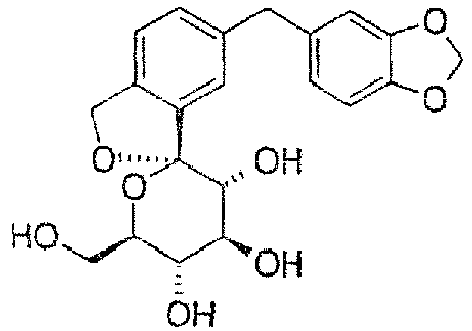
1H-NMR (CD3OD) δ: 3.40-3.50 (1H, m), 3.62-3.68 (1H, m), 3.74-3.84 (4H, m), 3.91(2H, s), 5.10 (2H, m), 5.87(2H, s), 6.67-6.70 (3H, m), 7.21(3H, s) MS (ESI+) : 425 [M+Na]+ Example 19 
1H-NMR (CD3OD) δ: 3.37-3.50 (1H, m), 3.62-3.68 (1H, m), 3.74-3.84 (4H, m), 4.10 (2H, s), 5.11 (2H, m), 7.24 (3H, s), 7.41 (2H, d, J=8.1Hz), 7.62 (2H, d, J=8.1Hz) MS (ESI+): 406 [M+Na]+ Example 20 
1H-NMR (CD3OD) δ: 3.40-3.51 (1H, m), 3.63-3.69 (1H, m), 3.73-3.84 (4H, m), 3.99 (2H, s), 5.11 (2H, m), 7.13-7.17 (1H, m), 7.24 (3H, s), 7.36-7.41 (2H, m) MS (ESI+): 449 [M+Na]+ - [Table 1-4]
Table 1-4 Example 21 
1H-NMR (CD3OD) δ: 1.35 (3H, t, J=6.9Hz), 3.39-3.49 (1H, m), 3.61-3.69 (1H, m), 3.72-3.85 (4H, m), 3.93 (2H, s), 3.99 (2H, q, J=6.9Hz), 5.10 (2H, m), 6.77-6.83 (2H, m), 7.07-7.14 (2H, m), 7.20 (3H, m) MS (ESI+): 403 [M+1]+ Example 22 
1H-NMR (CD3OD) δ: 3.39-3.50 (1H, m), 3.61-3.71 (1H, m), 3.71-3.85 (4H, m), 4.10 (2H, s), 5.11 (2H, m), 7.25 (3H, m), 7.37-7.45 (2H, m), 7.52-7.60 (2H, m) MS (ESI+): 427 [M+1]+ Example 23 
1H-NMR (CD3OD) δ: 3.40-3.50 (1H, m), 3.62-3.70 (1H, m), 3.73-3.35 (4H, m), 4.03 (2H, s), 5.11 (2H, m), 7.11-7.36 (7H, m) MS (ESI+): 443 [M+1]+ Example 24 
1H-NMR (CD3OD) δ: 2.43(3H, s), 3.38-3.50 (1H, m), 3.62-3.68 (1H, m), 3.72-3.85 (4H, m), 3.96 (2H, s), 5.10 (2H, m), 7.12-7.25 (7H, m) MS (ESI+): 405 [M+1]+ Example 25 
1H-NMR (CD3OD) δ: 3.38-3.51 (1H, m), 3.58-3.70 (1H, m), 3.71-3.85 (4H,m), 3.99 (2H, s), 5.11 (2H, m), 7.15-7.29 (7H, m) MS (ESI+): 393 [M+1]+ - [Table 1-5]
Table 1-5 Example 26 
1H-NMR (CD3OD) δ: 3.39-3.49 (1H, m), 3.59-3.70 (1H, m), 3.71-3.86 (4H, m), 4.17 (2H, s), 5.12 (2H, m), 7.20-7.49 (6H, m), 7.68 (1H, s), 7.71-7.83 (3H, m) MS (ESI+): 431 [M+Na]+ Example 27 
1H-NMR (CD3OD) δ: 3.40-3.48 (1H, m), 3.60-3.70 (1H, m), 3.72-3.86 (4H, m), 4.00(2H, s), 4.56 (2H, s), 5.11 (2H, m), 7.15-7.32 (7H, m) MS (ESI+): 411 [M+Na]+ Example 28 
1H-NMR (CD3OD) δ: 3.39-3.48 (1H, m), 3.62-3.68 (1H, m), 3.75-3.84 (4H, m), 3.99 (2H, s) , 5.11 (2H, m), 6.97 (2H, t, J=8.8Hz), 7.19-7.23 (5H, m) MS (ESI+): 399 [M+Na]+ Example 29 
1H-NMR (CD3OD) δ: 2.25 (3H,s), 3.40-3.46 (1H, dd, J=9.8, 8.7Hz), 3.61-3.67 (1H, m), 3.70-3.84 (4H, m), 4.03 (2H, s), 5.10 (2H, m), 7.12-7.20 (7H, m) MS (ESI+): 395 [M+Na]+ Example 30 
1H-NMR (CD3OD) δ: 2.27 (3H, s), 3.42-3.48 (1H, m), 3.62-3.68 (1H, m), 3.75-3.85 (4H, m), 3.95 (2H, s), 5.10(2H, m), 6.99 (3H, t, J=7.1Hz), 7.10-7.22 (4H, m) MS (ESI+): 373 [M+1]+ - [Table 1-6]
Table 1-6 Example 31 
1H-NMR (CD3OD) δ: 3.42-3.48 (1H, m), 3.62-3.68 (1H, m), 3.76-3.79 (4H, m), 3.96 (2H, s), 5.03 (2H, s), 5.11 (2H, m), 6.83-7.22 (3H, m), 6.83-7.22 (4H, m), 7.28-7.41 (5H, m) MS (ESI+): 465 [M+1]+ Example 32 
1H-NMR (CD3OD) δ: 3.42-3.48 (1H, m), 3.62-3.68 (1H, m), 3.76-3.84 (4H, m), 4.00 (2H, s), 5.10 (2H, m), 6.84-6.94 (2H, m), 7.22-7.26 (4H, m) MS (ESI+): 395 [M+1]+ Example 33 
1H-NMR (CD3OD) δ: 2.83 (1H, d, J=6.5Hz), 2.92 (1H, d, J=6.5Hz), 3.34-3.41 (1H, m), 3.55-3.62 (1H, m), 3.69-3.77 (4H, m), 3.91 (2H, s), 4.41 (1H, d, J=6.5Hz), 4.58 (1H, d, J=6.5Hz), 5.04(2H, d, J=6.5Hz), 7.09-7.15(7H, m) MS (ESI+): 405 [M]+ Example 34 
1H-NMR (CD3OD) δ: 3.40-3.51 (1H, m), 3.62-3.68 (1H, m), 3.74-3.84 (4H, m), 4.06(2H, s), 5.11 (2H, m), 7.19-7.27 (3H, m), 7.32-7.36 (1H, m), 7.67-7.71 (1H, m), 8.35-8.37 (1H, m), 8.44 (1H, d, J=1.7Hz) MS (ESI+): 360 [M+1]+ Example 35 
1H-NMR (CD3OD) δ: 3.08 (3H, s), 3.41-3.48 (1H, m), 3.62-3.68 (1H, m), 3.74-3.80 (4H,m), 4.13 (2H, s), 5.11 (2H,m), 7.22-7.27 (3H, m), 7.49 (2H, d, J=8.3Hz), 7.85 (2H, d, J=8.4Hz) MS (ESI+): 437 [M+1]+ - [Table 1-7]
Table 1-7 Example 36 
1H-NMR (CD3OD) δ: 3.40-3.51 (1H,m), 3.63-3.69 (1H,m), 3.75-3.85 (4H,m), 4.07 (2H,s), 5.12 (2H,m), 7.26-7.31 (5H,m), 8.40 (2H, d, J=5.8Hz) MS(ESI+): 360 [M+1]+ Example 37 
1H-NMR (CD3OD) δ: 3.40-3.50 (1H, m), 3.63-3.68 (1H, m), 3.74-3.84 (4H, m), 4.13 (2H,s), 5.12 (2H, m), 6.12 (1H, s), 6.89-7.02 (2H, m), 7.22-7.24 (2H, m), 7.31-7.34 (2H, m), 7.40 (1H, d, J=7.5Hz) MS(ESI+): 398 [M+1]+ Example 38 
1H-NMR (CD3OD) δ: 3.39-3.46 (1H, m), 3.60-3.66 (1H, m), 3.72-3.82 (4H, m), 3.89(2H, s), 5.07 (2H, m), 6.56-6.67 (3H, m), 7.01-7.06 (1H, m), 7.18-7.20 (3H, m) MS (ESI+): 397 [M+Na]+ Example 39 
1H-NMR (CD3OD) δ: 3.42-3.48 (1H, m), 3.62-3.68(1H, m), 3.74-3.84 (4H, m), 3.98(2H, s), 5.05-5.18 (3H, m), 5.70 (1H, dd, J=17.6, 1.1Hz), 6.68 (1H, dd, J=17.6, 11.0Hz), 7.15-7.23 (5H, m), 7.32 (2H, d, J=8.2Hz) MS (ESI+): 407 [M+Na]+ Example 40 
1H-NMR (CD3OD) δ: 3.49-3.56 (1H, m), 3.69-3.75 (1H, m), 3.81-3.91 (4H, m), 3.93 (3H, s), 4.13 (s, 2H), 5.17 (2H, m), 7.26-7.31 (3H, m), 7.39 (2H, d, J=8.2Hz), 7.98 (2H, d, J=8.4Hz) MS (ESI+): 439 [M+Na]+ - [Table 1-8]
Table 1-8 Example 41 
1H-NMR (CD3OD) δ: 3.42-3.51 (1H, m), 3.62-3.68 (1H, m), 3.75-3.84 (4H, m), 4.08 (2H, s), 5.06-5.17 (2H, m), 7.21-7.27 (3H, m), 7.33 (2H, d, J=8.2Hz), 7.93 (2H, d, J=8.2Hz) MS (ESI+): 425 [M+Na]+ Example 42 
1H-NMR (CD3OD) δ:3.08 (2H, td, J=17.5, 4.6Hz), 3.39-3.50 (1H, m), 3.59-3.85 (5H, m), 3.99 (2H, s), 5.11 (2H, m), 5.95 (1H, tt, J=56.5, 4.6Hz), 7.11-7.34 (7H, m) MS (ESI+): 423[M+1]+ Example 43 
1H-NMR (CDCl3) δ: 1.17 (3H, t, J=7.63Hz), 2.20(3H, s), 2.54 (1H, brs), 2.56 (2H, q, J=7.63Hz), 3.19 (1H, d, J=7.25Hz), 3.66-4.00 (8H, m), 4.25 (1H, brs), 4.54 (1H, s), 5.02 (2H, dd,J=12.69, 17.93Hz), 6.97 (1H,s), 7.00 (4H, dd, J=8.01, 12.97Hz), 7.14 (1H, s) MS (ESI+): 423 [M+Na] Example 44 
1H-NMR (CD3OD) δ: 3.36-3.47 (3H, m), 3.64 (1H, dd, J=5.8, 12.1Hz), 3.74-3.83 (4H, m), 4.01 (2H, s), 5.05-5.16 (2H, m), 7.18-7.23 (7H, m) MS (ESI+): 441 [M+1]+ Example 45 
- [Table 1-9]
Table 1-9 Example 46 
1H-NMR (CD3OD) δ: 2.56 (3H, s), 3.41-3.47 (1H, m), 3.64 (1H, dd, J=5.8, 12.1Hz), 3.73-3.83 (4H, m), 4.08 (2H, s), 5.10 (2H, dd, J=12.6, 19.8Hz), 7.22-7.25 (3H, m), 7.33-7.36 (2H, m), 7.87-7.91 (2H, m) MS (ESI+): 401 [M+1]+ Example 47 
1H-NMR (CD3OD) δ: 1.41 (3H, d, J=6.59Hz), 3.40-3.47 (1H, m), 3.61-3.67 (1H, m), 3.74-3.83 (4H, m), 3.98 (2H, s), 4.74-4.81 (1H, m), 5.04-5.15 (2H, m), 7.15-7.27 (7H, m) MS (ESI+): 425[M+Na]+ - Human SGLT1 cDNA was amplified by PCR with a cDNA library derived from human small intestine (Clontech) as a template, synthetic DNA primers and KOD+ DNA Polymerase (Toyobo Co., Ltd., Japan). The amplified cDNA was inserted into pcRII-Topo vector by using a Topo TA Cloning Dual Promoter kit (Invitrogen). E. coli competent cells (Invitrogen, TOP10) were transformed with the plasmid vector, cultured in LB medium containing ampicillin (50 mg/L) to grow ampicillin-resistant clones. The plasmid vector containing human SGLT1 cDNA was purified from the clone in a standard manner (see Maniatis et al., Molecular Cloning). Human SGLT1 cDNA added restriction enzyme recognition sites (Eco RI at 5'- end, Hind III at 3'-end) was amplified by PCR with the plasmid vector as a template, synthetic DNA primers containing an additional restriction enzyme recognition site, and KOD+ DNA Polymerase. This amplified cDNA was digested with Eco RI and Hind III and ligated into expression vector pcDNA3.1(-) (Invitrogen) digested with Eco RI and Hind III by a Rapid DNA Ligation kit (Roche Diagonostics). E. coli competent cells (Invitrogen, DH5a) were transformed with the ligated expression vector and grown in ampicillin-containing LB medium. Human SGLT1 expression vector was purified from the ampicillin-resistant clone in a standard manner.
- Human SGLT2 cDNA was amplified by PCR with a cDNA library derived from human kidney (Clontech) as a template, synthetic DNA primers and KOD+ DNA Polymerase. The amplified cDNA was inserted into pcRII-Topo vector by using a Topo TA Cloning Dual Promoter kit. E. coli competent cells (TPO10) were transformed with the plasmid vector, cultured in LB medium containing ampicillin (50 mg/L) to grow ampicillin-resistant clones. The plasmid vector containing human SGLT2 cDNA was purified from the clone in a standard manner. Human SGLT2 cDNA added restriction enzyme recognition sites (Xho I at 5'-end, Hind III at 3'-end) was amplified by PCR with the plasmid vector as a template, synthetic DNA primers containing an additional restriction enzyme recognition site and KOD+ DNA Polymerase. This amplified cDNA was digested with Xho I and Hind III, and ligated into expression vector pcDNA3.1(-) digested with Xho I and Hind III by using a Rapid DNA Ligation kit. E. coli competent cells (DH5α) were transformed with the ligated expression vector and grown in ampicillin-containing LB medium. Human SGLT2 expression vector was purified from the ampicillin-resistant clone in a standard manner.
- The human SGLT1 expression vector or the human SGLT2 expression vector was digested with the restriction enzyme Pvu I and transfected into CHO-Kl cells with FuGENE (Roche Diagonostics). After the transfection, the cells were cultured at 37°C in the presence of 5% CO2 for about 3 weeks in DMEM medium (Gibco) containing penicillin (50 U/mL. SIGMA), streptomycin (50 mg/L, SIGMA), geneticin (200 mg/L, Nacalai Tesque, Inc., Japan) and 20% fetal bovine serum to obtain geneticin-resistant clones. Among these clones, clones stably expressing human SGLT1 or human SGLT2 were selected by the evaluating the sodium-dependent uptake activity of sugar (methyl-α-D-glucopyranoside).
- Cell lines stably expressing human SGLT1 or human SGLT2 CHO were seeded in 96-well culture plates at a density of 30000 to 40000 cells/well and cultured for 4 to 6 days. The medium in these plates was removed and replaced by 150 µL/well pretreatment buffer (i.e., a buffer containing 140 mM choline chloride, 2 mM potassium chloride, 1 mM calcium chloride, 1 mM magnesium chloride, 10 mM 2-[4-(2-hydroxyethyl)-1-piperazinyl]ethanesulfonic acid and tris(hydroxymethyl)aminomethane, pH 7.4), and the plates were incubated at 37°C for 20 minutes. The pretreatment buffer in the plates was removed, replaced by 50 µL/well fresh pretreatment buffer, and the plates were incubated at 37°C for 20 minutes. Methyl-α-D-(U-14C)glucopyranoside (6.3 mL, Amersham Pharmacia Biotech, 200 mCi/L) was added to and mixed with 100 mL buffer (i.e., a buffer containing 140 mM sodium chloride, 2 mM potassium chloride, 1 mM calcium chloride, 1 mM magnesium chloride, 1 mM methyl-α-D-glucopyranoside, 10 mM [4-(2-hydroxyethyl)-1-piperazinyl]ethanesulfonic acid and tris(hydroxymethyl)aminomethane, pH 7.4), which was used as uptake buffer. Test compounds were dissolved into uptake buffer and these test compound solutions were used for evaluating inhibitory activity. Uptake buffer without a test compound was used as a control solution. Moreover, for use in measuring baseline uptake in the absence of sodium, sodium-free solution was prepared in the same manner to contain 140 mM choline chloride instead of sodium chloride. The pretreatment buffer was removed from each well of the plates and replaced by 35 µL/well test compound solutions, control solution or sodium-free solution, and the plates were incubated at 37°C for 45 minutes. The solutions were removed and replaced by 300 µL/well washing buffer (i.e., a buffer containing 140 mM choline chloride, 2 mM potassium chloride, 1 mM calcium chloride, 1 mM magnesium chloride, 10 mM methyl-α-D-glucopyranoside, 10 mM 2-[4-(2-hydroxyethyl)-1-piperazinyl]ethanesulfonic acid and tris(hydroxymethyl)aminomethane, pH 7.4). The washing buffer was removed immediately. This washing procedure was repeated once again, and a cell lysis solution (1 M sodium hydroxide, 0.1% sodium lauryl sulfate) was added in a volume of 30 µL per well to solubilize the cells. 2 M hydrochloric acid (15 µL) was added to the cell lysate in each well, and 40 µL of the resulting solution was transferred to a LumaPlate (Packard). The LumaPlate were left overnight at room temperature to evaporate the solvent. The samples on the plate were measured for their radioactivity with a TopCount NXT(Packard). Assuming that the value obtained by subtracting the baseline uptake level from the uptake level of the control sample was set to 100%, the concentration required for a test compounds to cause 50% inhibition of the uptake level (IC50 value) were calculated from the concentration-dependent inhibition curve using ELfit ver.3. As a result, the compounds of the present invention were found to show a remarkable inhibitory effect on SGLT2. The following table shows the IC50 values of representative compounds of the present invention, as measured for SGLT2 inhibition.
- [Table 2]
Table 2 Test compound IC50 (nM) Example 1 4.2 Example 2 4.0 Example 4 5.0 - The present invention enables the provision of spiroketal compounds, prodrugs thereof or pharmaceutically acceptable salts thereof, which have an excellent inhibitory effect on SGLT2 activity. The compounds of the present invention are also effective as prophylactic or therapeutic agents for diabetes, diabetes-related disease or diabetic complications.
Claims (15)
- A compound of Formula (I):
 wherein R1, R2, R3 and R4 are each independently selected from a hydrogen atom, a C1-C6 alkyl group which may be substituted with one or more Ra, a C7-C14 aralkyl group which may be substituted with one or more Rb, and -C(=O)Rx;Rx represents a C1-C6 alkyl group which may be substituted with one or more Ra, an aryl group which may be substituted with one or more Rb, a heteroaryl group which may be substituted with one or more Rb, a C1-C6 alkoxy group which may be substituted with one or more Ra, or -NReRf;Ar1 represents an aromatic carbocyclic ring which may be substituted with one or more Rb, or an aromatic heterocyclic ring which may be substituted with one or more Rb;Q represents -(CH2)m-(L)p- or -(L)p-(CH2)m-;m represents an integer selected from 0 to 2, n represents an integer selected from 1 and 2, and p represents an integer selected from 0 and 1;L represents -O-, -S- or -NR5-,R5 is selected from a hydrogen atom, a C1-C6 alkyl group which may be substituted with one or more Ra, and -C(=O)Rx;A represents an aryl group which may be substituted with one or more Rb or a heteroaryl group which may be substituted with one or more Rb, wherein the aryl group or the heteroaryl group may form a condensed ring together with the aromatic carbocyclic ring or the aromatic heterocyclic ring;Ra is independently selected from a halogen atom, a hydroxyl group, a cyano group, a nitro group, a carboxyl group, a C1-C6 alkoxy group which may be substituted with one or more Rc, an aryl group which may be substituted with one or more Rd, an aryloxy group which may be substituted with one or more Rd, a heteroaryl group which may be substituted with one or more Rd, a heteroaryloxy group which may be substituted with one or more Rd, a mercapto group, a C1-C6 alkylthio group which may be substituted with one or more Rc, a C1-C6 alkylsulfinyl group which may be substituted with one or more Rc, a C1-C6 alkylsulfonyl group which may be substituted with one or more Rc, -NRfRg, a C1-C6 alkoxycarbonyl group which may be substituted with one or more Rc, and a C1-C6 alkylcarbonyl group which may be substituted with one or more Rc;Rb is independently selected from a C1-C6 alkyl group which may be substituted with one or more Rc, a C3-C8 cycloalkyl group which may be substituted with one or more Rc, a C2-C6 alkenyl group which may be substituted with one or more Rc, a C2-C6 alkynyl group which may be substituted with one or more Rc, a C7-C14 aralkyl group which may be substituted with one or more Rd, a halogen atom, a hydroxyl group, a cyano group, a nitro group, a carboxyl group, a C1-C6 alkoxy group which may be substituted with one or more Rc, an aryl group which may be substituted with one or more Rd, an aryloxy group which may be substituted with one or more Rd, a heteroaryl group which may be substituted with one or more Rd, a heteroaryloxy group which may be substituted with one or more Rd, a mercapto group, a C1-C6 alkylthio group which may be substituted with one or more Rc, a C1-C6 alkylsulfinyl group which may be substituted with one or more Rc, a C1-C6 alkylsulfonyl group which may be substituted with one or more Rc, -NRfRg, a C1-C6 alkylcarbonyl group which may be substituted with one or more Rc, a C1-C6 alkoxycarbonyl group which may be substituted with one or more Rc, a C1-C3 alkylenedioxy group, a heterocyclyl group, and a heterocyclyloxy group;Rc is independently selected from a halogen atom, a hydroxyl group, a cyano group, a nitro group, a carboxyl group, a C1-C6 alkoxy group, an aryl group which may be substituted with one or more Rd, an aryloxy group which may be substituted with one or more Rd, a heteroaryl group which may be substituted with one or more Rd, a heteroaryloxy group which may be substituted with one or more Rd, an amino group, a C1-C6 alkylamino group, and a di-(C1-C6 alkyl)amino group;Rd is independently selected from a C1-C6 alkyl group which may be substituted with one or more halogen atoms, a C7-C14 aralkyl group, a halogen atom, a hydroxyl group, a cyano group, a nitro group, an amino group, a C1-C6 alkylamino group, and a di-(C1-C6 alkyl)amino group;Re represents a hydrogen atom, a C1-C6 alkyl group which may be substituted with one or more Rc, an aryl group which may be substituted with one or more Rd, or a heteroaryl group which may be substituted with one or more Rd;Rf represents a hydrogen atom or a C1-C6 alkyl group which may be substituted with one or more Rc; andRg represents a hydrogen atom, a C1-C6 alkyl group which may be substituted with Rc, a C1-C6 alkylcarbonyl group which may be substituted with one or more Rc, an aryl group which may be substituted with one or more Rd, a heteroaryl group which may be substituted with one or more Rd, a carbamoyl group, a C1-C6 alkoxycarbonyl group which may be substituted with one or more Rc, or a C1-C6 alkylsulfonyl group which may be substituted with one or more Rc, or,Re and Rf, or Rf and Rg may form a 4- to 7-membered heterocyclic ring together with the nitrogen atom to which they are attached,or a prodrug thereof, or a pharmaceutically acceptable salt thereof.
 - The compound according to claim 1, wherein R1, R2, R3 and R4 are each independently selected from a hydrogen atom and -C(=O)Rx, and Rx is a C1-C6 alkyl group which may be substituted with one or more Ra or a C1-C6 alkoxy group which may be substituted with one or more Ra, or a prodrug thereof, or a pharmaceutically acceptable salt thereof.
- The compound according to claim 1, wherein R1, R2, R3 and R4 are each a hydrogen atom, or a prodrug thereof, or a pharmaceutically acceptable salt thereof.
- The compound according to any one of claims 1 to 3, wherein Ar1 is a phenylene group or a thienylene group, each of which may be substituted with one or more Rb, or a prodrug thereof, or a pharmaceutically acceptable salt thereof.
- The compound according to any one of claims 1 to 4, wherein m is 1 and p is 0, or a prodrug thereof, or a pharmaceutically acceptable salt thereof.
- The compound according to any one of claims 1 to 4, wherein n is 1, or a prodrug thereof, or a pharmaceutically acceptable salt thereof.
- The compound according to any one of claims 1 to 6, wherein Ar1 has the substituent -Q-A on its ring atom that is 2 atoms apart from the ring atom directly attached to the substituted glucitol group, or a prodrug thereof, or a pharmaceutically acceptable salt thereof.
- The compound according to any one of claims 1 to 7, which is represented by Formula (Ia):

- A compound selected from:1,1-anhydro-1-C-[5-(4-ethylphenyl)methyl-2-(hydroxymethyl)phenyl]-β-D-glucopyranose,1,1-anhydra-1-c-[5-(2-benzothiaphenyl)methyl-2-(hydroxymethyl)phenyl]-β-D-glucopyranose,1,1-anhydro-1-c-[5-(4-methoxyphenyl)methyl-2-(hydroxymethyl)phenyl]-β-D-glucopyranose,1,1-anhydro-1-c-[5-(4-isopropylphenyl)methyl-2-(hydroxymethyl)phenyl]-β-D-glucopyranose,1,1-anhydro-1-c-[5-(4-cyclopropylphenyl)methyl-2-(hydroxymethyl)phenyl] -β-D-glucopyranose1,1-anhydro-1-c-[5-(4-n-propylphenyl)methyl-2-(hydroxymethyl)phenyl]-β-D-glucopyranose,1,1-anhydro-1-c-[5-(4-ethylphenyloxy)-2-(hydroxymethyl)phenyl]-β-D-glucopyranose,1,1-anhydro-1-c-[5-(4-ethylphenyl)methyl-2-(2-hydroxyethyl)thiophen-3-yl]-β-D-glucopyranose,1,1-anhydro-1-c-[5-(4-biphenyl)methyl-2-hydroxymethyl]phenyl]-β-D-glucopyranose,1,1-anhydro-1-C-[5-(4-((S)-tetrahydrofuran-3-yloxy)phenyl)methyl-2-(hydroxymethyl)phenyl]-β-D-glucopyranose,1,1-anhydro-1-c-[5-(4-((R)-tetrahydrafuran-3-yloxy)phenyl)methyl-2-(hydroxymethyl)phenyl]-β-D-glucopyranose,1,1-anhydro-1-c-[5-(4-ethynylphenyl)methyl-2-(hydroxymethyl)phenyl]-β-D-glucopyranose,1,1-anhydro-1-c-[5-(4-hydroxyphenyl)methyl-2-(hydroxymethyl)phenyl]-β-D-glucopyranose,1,1-anhydro-1-C-[5-(4-pyrazol-1-ylphenyl)methyl-2-(hydroxymethyl)phenyl]-β-D-glucopyranose,1,1-anhydro-1-c-[5-(4-methoxyphenyl)ethyl-2-(hydroxymethyl)phenyl]-β-D-glucopyranose,1,1-anhydro-1-c-[5-(4-methylphenyl)methyl-2-(hydroxymethyl)phenyl]-β-D-glucopyranose,1,1-anhydro-1-c-[5-(3-acetamidophenyl)methyl-2-(hydroxymethyl)phenyl]-β-D-glucopyranose,1,1-anhydro-1-c-[5-(3,4-methylenedioxyphenyl)methyl-2-(hydroxymethyl)phenyl]-β-D-glucopyranose,1,1-anhydro-1-c-[5-(4-cyanophenyl)methyl-2-(hydroxymethyl)phenyl]-β-D-glucopyranose,1,1-anhydro-1-c-[5-(3,4-dichlorophenyl)methyl-2-(hydroxymethyl)phenyl]-β-D-glucopyranose,1,1-anhydro-1-C-[5-(4-ethoxyphenyl)methyl-2-(hydroxymethyl)phenyl]-β-D-glucopyranose,1,1-anhydro-1-C-[5-(4-trifluoromethylphenyl)methyl-2-(hydroxymethyl)phenyl]-β-D-glucopyranose,1,1-anhydro-1-C-[5-(4-trifluoroaromethoxyphenyl)methyl-2-(hydroxymethyl)phenyl]-β-D-glucopyranose,1,1-anhydro-1-C-[5-(4-methylsulfanylphenyl)methyl-2-(hydroxymethyl)phenyl]-β-D-glucopyranose,1,1-anhydro-1-C-[5-(4-chlorophenyl)methyl-2-(hydroxymethyl)phenyl]-β-D-glucopyranose,1,1-anhydro-1-C-[5-(naphthalen-2-yl)methyl-2-(hydroxymethyl)phenyl]-β-D-glucopyranose,1,1-anhydro-1-C-[5-(4-hydroxymethylphenyl)methyl-2-(hydroxymethyl)phenyl]-β-D-glucopyranose,1,1-anhydro-1-C-[5-(4-fluorophenyl)methyl-2-(hydroxymethyl)phenyl]-β-D-glucopyranose,1,1-anhydro-1-C-[5-(2-methylphenyl)methyl-2-(hydroxymethyl)phenyl]-β-D-glucopyranose,1,1-anhydro-1-C-[5-(3-methylphenyl)methyl-2-(hydroxymethyl)phenyl]-β-D-glucopyranose,1,1-anhydro-1-C-[5-(3-benzyloxyphenyl)methyl-2-(hydroxymethyl)phenyl]-β-D-glucopyranose,1,1-anhydro-1-C-[5-(2,4-difluorophenyl)methyl-2-(hydroxymethyl)phenyl]-β-D-glucopyranose,1,1-anhyaro-2-C-[5-(4-(2-fluoroethyl)phenyl)methyl-2-(hydroxymethyl)phenyl]-β-D-glucopyranose,1,1-anhydro-1-C-[5-(pyridin-3-yl)methyl-2-(hydroxymethyl)phenyl]-β-D-glucopyranose,1,1-anhydro-1-C-[5-(4-methanesulfonylphenyl)methyl-2-(hydroxymethyl)phenyl]-β-D-glucopyranose,1,1-anhydro-1-C-[5-(pyridin-4-yl)methyl-2-(hydroxymethyl)phenyl]-β-D-glucopyranose,1,1-anhydro-1-C-[5-(1H-indol-2-yl)methyl-2-(hydroxymethyl)phenyl]-β-D-glucopyranose,1,1-anhydro-1-C-[5-(3-hydroxyphenyl)methyl-2-(hydroxymethyl)phenyl]-β-D-glucopyranose,1,1-anhydro-1-C-[5-(4-vinylphenyl)methyl-2-(hydroxymethyl)phenyl]-β-D-glucopyranose,1,1-anhydro-1-C-[5-(4-methoxycarbonylphenyl)methyl-2-(hydroxymethyl)phenyl]-β-D-glucopyranose,1,1-anhydro-1-C-[5-(4-carboxyphenyl)methyl-2-(hydroxymethyl)phenyl]-β-D-glucopyranose, and1,1-anhydro-1-C-[5-(4-(2,2-difluoroethyl)phenyl)methyl-2-(hydroxymethyl)phenyl]-β-D-glucopyranose,1,1-anhydro-1-C-[5-(4-ethylphenyl)methyl-2-(hydroxymethyl)-4-methylphenyl]-β-D-glucopyranose,1,1-anhydro-1-C-[5-(4-(2,2,2-trifluoroethyl)phenyl)methyl-2-(hydroxymethyl)phenyl]-β-D-glucopyranose,1,1-anhydro-1-C-[5-(4-ethylphenyl)methyl-2-(hydroxymethyl)pyrazin-3-yl]-β-D-glucopyranose,1,1-4nhydro-1-C-[5-(4-acetylphenyl)methyl-2-(hydroxymethyl)phenyl]-β-D-glucopyranose, and1,1-anhydro-1-C-[5-(4-(1-hydroxyethyl)phenyl)methyl-2-(hydroxymethyl)phenyl]-β-D-glucopyranose,
or a prodrug thereof, or a pharmaceutically acceptable salt thereof. - A compound of Formula (Ib):
 wherein n represents an integer selected from 1 and 2;Ar1 represents an aromatic carbocyclic ring which may be substituted with one or more Rb, or an aromatic heterocyclic ring which may be substituted with one or more Rb;W represents -O-Z or a halogen atom;Z represents a hydrogen atom, an acyl group or a benzyl group;P1, P2, P3 and P4 are each independently selected from a hydrogen atom, an acyl group or a benzyl group; andRb is as defined in claim 1.
 - A pharmaceutical composition comprising a compound according to any one of claims 1 to 9, or a prodrug thereof, or a pharmaceutically acceptable salt thereof.
- A compound according to any one of claims 1 to 9, or a prodrug thereof, or a pharmaceutically acceptable salt thereof for use as an Na+-glucose cotransporter inhibitor.
- A compound according to any one of claims 1 to 9, or a prodrug thereof, or a pharmaceutically acceptable salt thereof for use in preventing or treating diabetes, hyperglycemia, diabetic complications induced thereby, or obesity.
- A compound according to any one of claims 1 to 9, or a prodrug thereof, or a pharmaceutically acceptable salt thereof for use in preventing or treating diabetes, hyperglycemia-induced diabetic complications or obesity.
- The compound according to claim 13 or 14, wherein diabetes is insulin-dependent diabetes mellitus (type I diabetes) or non-insulin-dependent diabetes mellitus (type II diabetes).
Applications Claiming Priority (4)
| Application Number | Priority Date | Filing Date | Title |
|---|---|---|---|
| JP2005020901 | 2005-01-28 | ||
| JP2005176690 | 2005-06-16 | ||
| PCT/JP2006/301284 WO2006080421A1 (en) | 2005-01-28 | 2006-01-27 | Spiroketal derivative and use thereof as diabetic medicine |
| EP06712450.3A EP1852439B1 (en) | 2005-01-28 | 2006-01-27 | Spiroketal derivative and use thereof as diabetic medicine |
Related Parent Applications (1)
| Application Number | Title | Priority Date | Filing Date |
|---|---|---|---|
| EP06712450.3A Division EP1852439B1 (en) | 2005-01-28 | 2006-01-27 | Spiroketal derivative and use thereof as diabetic medicine |
Publications (2)
| Publication Number | Publication Date |
|---|---|
| EP3072897A1 true EP3072897A1 (en) | 2016-09-28 |
| EP3072897B1 EP3072897B1 (en) | 2019-06-26 |
Family
ID=36740445
Family Applications (2)
| Application Number | Title | Priority Date | Filing Date |
|---|---|---|---|
| EP16161071.2A Expired - Lifetime EP3072897B1 (en) | 2005-01-28 | 2006-01-27 | Spiroketal derivatives and use thereof as diabetic medicine |
| EP06712450.3A Expired - Lifetime EP1852439B1 (en) | 2005-01-28 | 2006-01-27 | Spiroketal derivative and use thereof as diabetic medicine |
Family Applications After (1)
| Application Number | Title | Priority Date | Filing Date |
|---|---|---|---|
| EP06712450.3A Expired - Lifetime EP1852439B1 (en) | 2005-01-28 | 2006-01-27 | Spiroketal derivative and use thereof as diabetic medicine |
Country Status (23)
| Country | Link |
|---|---|
| US (1) | US7767651B2 (en) |
| EP (2) | EP3072897B1 (en) |
| JP (1) | JP4093587B2 (en) |
| KR (2) | KR101322980B1 (en) |
| AR (1) | AR054612A1 (en) |
| AU (1) | AU2006209523B2 (en) |
| BR (1) | BRPI0606367B1 (en) |
| CA (1) | CA2596235C (en) |
| CR (1) | CR9314A (en) |
| DK (1) | DK1852439T3 (en) |
| ES (1) | ES2567439T3 (en) |
| HR (1) | HRP20160333T1 (en) |
| HU (1) | HUE027078T2 (en) |
| IL (1) | IL184838A (en) |
| MA (1) | MA29272B1 (en) |
| MY (1) | MY140528A (en) |
| NO (1) | NO341263B1 (en) |
| NZ (1) | NZ556343A (en) |
| PL (1) | PL1852439T3 (en) |
| RU (1) | RU2416617C2 (en) |
| SI (1) | SI1852439T1 (en) |
| TW (1) | TW200637869A (en) |
| WO (1) | WO2006080421A1 (en) |
Families Citing this family (49)
| Publication number | Priority date | Publication date | Assignee | Title |
|---|---|---|---|---|
| TWI335218B (en) * | 2003-02-19 | 2011-01-01 | Panion & Bf Biotech Inc | Ferric organic compounds, uses thereof and methods of making same |
| PE20080251A1 (en) | 2006-05-04 | 2008-04-25 | Boehringer Ingelheim Int | USES OF DPP IV INHIBITORS |
| WO2007140191A2 (en) | 2006-05-23 | 2007-12-06 | Theracos, Inc. | Glucose transport inhibitors and methods of use |
| TWI403516B (en) * | 2006-07-27 | 2013-08-01 | Chugai Pharmaceutical Co Ltd | To replace spirocyclic alcohol derivatives, and its use as a therapeutic agent for diabetes |
| TWI432446B (en) * | 2006-07-27 | 2014-04-01 | Chugai Pharmaceutical Co Ltd | Fused ring spiroketal derivative and use thereof as anti-diabetic drug |
| BRPI0719523A2 (en) | 2006-10-13 | 2015-06-16 | Chugai Pharmaceutical Co Ltd | Thioglycosis spirocetal derivative and its use as a therapeutic agent for diabetes |
| US7795228B2 (en) | 2006-12-28 | 2010-09-14 | Theracos, Inc. | Spiroheterocyclic glycosides and methods of use |
| PE20090938A1 (en) | 2007-08-16 | 2009-08-08 | Boehringer Ingelheim Int | PHARMACEUTICAL COMPOSITION INCLUDING A BENZENE DERIVATIVE SUBSTITUTED WITH GLUCOPYRANOSIL |
| AU2008288770B2 (en) | 2007-08-23 | 2014-06-12 | Theracosbio, Llc | Benzylbenzene derivatives and methods of use |
| UA101004C2 (en) | 2007-12-13 | 2013-02-25 | Теракос, Инк. | Derivatives of benzylphenylcyclohexane and use thereof |
| EP2291189B1 (en) | 2008-05-22 | 2014-10-01 | AstraZeneca AB | Method for treating hyperuricemia employing an sglt2 inhibitor and composition containing same |
| TW201011043A (en) | 2008-06-20 | 2010-03-16 | Chugai Pharmaceutical Co Ltd | Crystal of spiroketal derivatives and process for preparation of spiroketal derivatives |
| MX2011001855A (en) | 2008-08-22 | 2011-03-24 | Theracos Inc | Processes for the preparation of sglt2 inhibitors. |
| ES2380408T3 (en) * | 2008-08-28 | 2012-05-11 | Pfizer Inc. | Dioxa-bicyclo derivatives [3.2.1] octane-2,3,4-triol |
| MX339194B (en) | 2009-02-13 | 2016-05-16 | Boehringer Ingelheim Int | Pharmaceutical composition comprising a sglt2 inhibitor, a dpp-iv inhibitor and optionally a further antidiabetic agent and uses thereof. |
| US8669380B2 (en) | 2009-11-02 | 2014-03-11 | Pfizer Inc. | Dioxa-bicyclo[3.2.1]octane-2,3,4-triol derivatives |
| CN102656177B (en) * | 2009-12-18 | 2016-01-27 | 中外制药株式会社 | The preparation method of spiroketal derivative |
| JP2013523819A (en) | 2010-04-06 | 2013-06-17 | アリーナ ファーマシューティカルズ, インコーポレイテッド | GPR119 receptor modulators and treatment of disorders related thereto |
| WO2011153712A1 (en) | 2010-06-12 | 2011-12-15 | Theracos, Inc. | Crystalline form of benzylbenzene sglt2 inhibitor |
| CN103221410B (en) | 2010-09-22 | 2017-09-15 | 艾尼纳制药公司 | GPR119 receptor modulators and treatment of disorders associated therewith |
| WO2012041898A1 (en) | 2010-09-29 | 2012-04-05 | Celon Pharma Sp. Z O.O. | Combination of sglt2 inhibitor and a sugar compound for the treatment of diabetes |
| JP6294665B2 (en) * | 2011-02-25 | 2018-03-14 | 中外製薬株式会社 | Crystals of spiroketal derivatives |
| AR085689A1 (en) | 2011-03-07 | 2013-10-23 | Boehringer Ingelheim Int | PHARMACEUTICAL COMPOSITIONS OF METFORMIN, LINAGLIPTINE AND AN SGLT-2 INHIBITOR |
| US20140018371A1 (en) | 2011-04-01 | 2014-01-16 | Arena Pharmaceuticals, Inc. | Modulators Of The GPR119 Receptor And The Treatment Of Disorders Related Thereto |
| WO2012145361A1 (en) | 2011-04-19 | 2012-10-26 | Arena Pharmaceuticals, Inc. | Modulators of the gpr119 receptor and the treatment of disorders related thereto |
| WO2012145604A1 (en) | 2011-04-22 | 2012-10-26 | Arena Pharmaceuticals, Inc. | Modulators of the gpr119 receptor and the treatment of disorders related thereto |
| WO2012145603A1 (en) | 2011-04-22 | 2012-10-26 | Arena Pharmaceuticals, Inc. | Modulators of the gpr119 receptor and the treatment of disorders related thereto |
| WO2012170702A1 (en) | 2011-06-08 | 2012-12-13 | Arena Pharmaceuticals, Inc. | Modulators of the gpr119 receptor and the treatment of disorders related thereto |
| WO2013055910A1 (en) | 2011-10-12 | 2013-04-18 | Arena Pharmaceuticals, Inc. | Modulators of the gpr119 receptor and the treatment of disorders related thereto |
| US9555001B2 (en) | 2012-03-07 | 2017-01-31 | Boehringer Ingelheim International Gmbh | Pharmaceutical composition and uses thereof |
| WO2013151033A1 (en) * | 2012-04-03 | 2013-10-10 | 第一三共株式会社 | C-glycoside derivative having a spiro ring |
| WO2013152476A1 (en) | 2012-04-10 | 2013-10-17 | Theracos, Inc. | Process for the preparation of benzylbenzene sglt2 inhibitors |
| WO2014074668A1 (en) | 2012-11-08 | 2014-05-15 | Arena Pharmaceuticals, Inc. | Modulators of gpr119 and the treatment of disorders related thereto |
| WO2015051484A1 (en) | 2013-10-12 | 2015-04-16 | Theracos, Inc. | Preparation of hydroxy-benzylbenzene derivatives |
| CA2934832C (en) | 2013-12-27 | 2022-03-15 | Chugai Seiyaku Kabushiki Kaisha | Solid preparations containing tofogliflozin and process of producing the same |
| US10346562B2 (en) * | 2014-08-21 | 2019-07-09 | Dassault Systèmes Canada Inc. | Automated curvature modeling of polygonal lines |
| CN106317068A (en) * | 2015-06-23 | 2017-01-11 | 中国科学院上海药物研究所 | C, O-spiro aryl glycoside compound and preparation and application thereof |
| CA3041169A1 (en) | 2016-10-19 | 2018-04-26 | Boehringer Ingelheim International Gmbh | Combinations comprising an ssao/vap-1 inhibitor and a sglt2 inhibitor, uses thereof |
| EP3569250B1 (en) | 2017-01-11 | 2025-04-30 | Kowa Company, Ltd. | Pemafibrate in combination with a sglt2 inhibitor for the prophylactic or therapeutic treatment of liver diseases nonalcoholic fatty liver disease |
| US20210113561A1 (en) | 2018-04-17 | 2021-04-22 | Boehringer Ingelheim International Gmbh | Pharmaceutical composition, methods for treating and uses thereof |
| JOP20210009A1 (en) | 2018-07-19 | 2021-01-12 | Astrazeneca Ab | Methods of treating hfpef employing dapagliflozin and compositions comprising the same |
| WO2020039394A1 (en) | 2018-08-24 | 2020-02-27 | Novartis Ag | New drug combinations |
| CA3112510A1 (en) | 2018-10-29 | 2020-05-07 | Boehringer Ingelheim International Gmbh | Pyridinyl sulfonamide derivatives, pharmaceutical compositions and uses thereof |
| JP7425793B2 (en) | 2018-10-29 | 2024-01-31 | ベーリンガー インゲルハイム インターナショナル ゲゼルシャフト ミット ベシュレンクテル ハフツング | Pyridinylsulfonamide derivatives, pharmaceutical compositions and uses thereof |
| EP4114385A1 (en) | 2020-03-06 | 2023-01-11 | Vertex Pharmaceuticals Incorporated | Methods of treating apol-1 dependent focal segmental glomerulosclerosis |
| JP2023536009A (en) | 2020-07-27 | 2023-08-23 | アストラゼネカ・アクチエボラーグ | Methods of treating chronic kidney disease with dapagliflozin |
| WO2022208172A1 (en) | 2021-04-01 | 2022-10-06 | Astrazeneca Uk Limited | Systems and methods for managing prediabetes with a gliflozin sodium-glucose cotransport 2 inhibitor pharmaceutical composition |
| WO2023144722A1 (en) | 2022-01-26 | 2023-08-03 | Astrazeneca Ab | Dapagliflozin for use in the treatment of prediabetes or reducing the risk of developing type 2 diabetes |
| IL329013A (en) | 2023-12-15 | 2026-08-01 | Astrazeneca Ireland Ltd | Sglt2 inhibitors and baxdrostat for treating chronic kidney disease and hypertension |
Citations (11)
| Publication number | Priority date | Publication date | Assignee | Title |
|---|---|---|---|---|
| US5712396A (en) | 1992-10-28 | 1998-01-27 | Magnin; David R. | α-phosphonosulfonate squalene synthetase inhibitors |
| US5712279A (en) | 1995-02-21 | 1998-01-27 | Bristol-Myers Squibb Company | Inhibitors of microsomal triglyceride transfer protein and method |
| US5760246A (en) | 1996-12-17 | 1998-06-02 | Biller; Scott A. | Conformationally restricted aromatic inhibitors of microsomal triglyceride transfer protein and method |
| JP2000080041A (en) | 1998-03-09 | 2000-03-21 | Tanabe Seiyaku Co Ltd | Pharmaceutical composition |
| WO2001027128A1 (en) | 1999-10-12 | 2001-04-19 | Bristol-Myers Squibb Company | C-aryl glucoside sglt2 inhibitors |
| WO2001068660A1 (en) | 2000-03-17 | 2001-09-20 | Kissei Pharmaceutical Co., Ltd. | Glucopyranosyloxy benzylbenzene derivatives, medicinal compositions containing the same and intermediates for the preparation of the derivatives |
| US20010041674A1 (en) | 2000-02-02 | 2001-11-15 | Kotobujki Pharmaceutical Co., Ltd. | C-glycosides and preparation of thereof as antidiabetic agents |
| US20020137903A1 (en) | 1999-10-12 | 2002-09-26 | Bruce Ellsworth | C-aryl glucoside SGLT2 inhibitors and method |
| WO2002083066A2 (en) | 2001-04-11 | 2002-10-24 | Bristol-Myers Squibb Company | Amino acid complexes of c-aryl glucosides for treatment of diabetes and method |
| WO2004007517A1 (en) | 2002-07-11 | 2004-01-22 | Aventis Pharma Deutschland Gmbh | Novel thiophenylglycoside derivatives, methods for production thereof, medicaments comprising said compounds and use thereof |
| WO2004013118A1 (en) | 2002-08-05 | 2004-02-12 | Yamanouchi Pharmaceutical Co., Ltd. | Azulene derivatives and salts thereof |
Family Cites Families (61)
| Publication number | Priority date | Publication date | Assignee | Title |
|---|---|---|---|---|
| US5247076A (en) * | 1991-09-09 | 1993-09-21 | Merck & Co., Inc. | Imidazolidyl macrolides having immunosuppressive activity |
| JP2762903B2 (en) | 1992-11-12 | 1998-06-11 | 田辺製薬株式会社 | Dihydrochalcone derivative and method for producing the same |
| CA2102591C (en) | 1992-11-12 | 2000-12-26 | Kenji Tsujihara | Hypoglycemic agent |
| US5830873A (en) | 1994-05-11 | 1998-11-03 | Tanabe Seiyaku Co., Ltd. | Propiophenone derivative and a process for preparing the same |
| JP2814950B2 (en) | 1994-05-11 | 1998-10-27 | 田辺製薬株式会社 | Hypoglycemic agent |
| JP3034192B2 (en) | 1995-11-07 | 2000-04-17 | 田辺製薬株式会社 | Propiophenone derivatives and their production |
| JP3065235B2 (en) | 1995-11-07 | 2000-07-17 | 田辺製薬株式会社 | Propiophenone derivatives and their production |
| JP3006513B2 (en) | 1995-11-07 | 2000-02-07 | 田辺製薬株式会社 | Pharmaceutical composition |
| ATE216704T1 (en) | 1996-12-26 | 2002-05-15 | Tanabe Seiyaku Co | PROPIOPHENONE DERIVATIVES AND METHOD FOR THE PRODUCTION THEREOF |
| JP3055135B2 (en) | 1996-12-26 | 2000-06-26 | 田辺製薬株式会社 | Propiophenone derivative and method for producing the same |
| EP1213296B1 (en) | 1999-08-31 | 2004-04-14 | Kissei Pharmaceutical Co., Ltd. | Glucopyranosyloxypyrazole derivatives, medicinal compositions containing the same and intermediates in the production thereof |
| US6284906B1 (en) | 1999-10-12 | 2001-09-04 | University Of Southern California | Cyclotrisiloxanes, new siloxane polymers and their preparation |
| US6683056B2 (en) | 2000-03-30 | 2004-01-27 | Bristol-Myers Squibb Company | O-aryl glucoside SGLT2 inhibitors and method |
| US6555519B2 (en) | 2000-03-30 | 2003-04-29 | Bristol-Myers Squibb Company | O-glucosylated benzamide SGLT2 inhibitors and method |
| JP3798375B2 (en) | 2000-09-29 | 2006-07-19 | キッセイ薬品工業株式会社 | Glucopyranosyloxybenzylbenzene derivative and pharmaceutical composition containing the same |
| WO2002036602A1 (en) | 2000-11-02 | 2002-05-10 | Ajinomoto Co., Inc. | Novel pyrazole derivatives and diabetes remedies containing the same |
| WO2002044192A1 (en) | 2000-11-30 | 2002-06-06 | Kissei Pharmaceutical Co., Ltd. | Glucopyranosyloxybenzyl benzene derivatives, medicinal compositions containing the same and intermediates in the production thereof |
| SK287786B6 (en) | 2000-12-28 | 2011-09-05 | Kissei Pharmaceutical Co., Ltd. | Glucopyranosyloxypyrazole derivatives and use thereof in medicines |
| TWI255817B (en) | 2001-02-14 | 2006-06-01 | Kissei Pharmaceutical | Glucopyranosyloxybenzylbenzene derivatives and medicinal use thereof |
| EP1364957B1 (en) | 2001-02-26 | 2008-12-31 | Kissei Pharmaceutical Co., Ltd. | Glycopyranosyloxypyrazole derivatives and medicinal use thereof |
| WO2002068440A1 (en) | 2001-02-27 | 2002-09-06 | Kissei Pharmaceutical Co., Ltd. | Glycopyranosyloxypyrazole derivatives and medicinal use thereof |
| US6936590B2 (en) | 2001-03-13 | 2005-08-30 | Bristol Myers Squibb Company | C-aryl glucoside SGLT2 inhibitors and method |
| EP1389621A4 (en) | 2001-04-27 | 2005-05-11 | Ajinomoto Kk | N-substituted pyrazolyl-o-glycoside derivatives and remedial agent for diabetes containing the same |
| CA2448741C (en) | 2001-05-30 | 2010-06-22 | Kissei Pharmaceutical Co., Ltd. | Glucopyranosyloxypyrazole derivative, medicinal composition containing the same, medicinal use thereof, and intermediate therefor |
| US7271153B2 (en) | 2001-06-20 | 2007-09-18 | Kissei Pharmaceutical Co., Ltd. | Nitrogenous heterocyclic derivatives, medicinal compositions containing the same, medicinal uses thereof, and intermediates therefor |
| JP4115105B2 (en) | 2001-07-02 | 2008-07-09 | 協和醗酵工業株式会社 | Pyrazole derivative |
| WO2003011880A1 (en) | 2001-07-31 | 2003-02-13 | Kissei Pharmaceutical Co., Ltd. | Glucopyrano syloxybenzyl benzene derivative, medicinal composition containing the same, medicinal use thereof, and intermediate for production thereof |
| US20030087843A1 (en) | 2001-09-05 | 2003-05-08 | Washburn William N. | O-pyrazole glucoside SGLT2 inhibitors and method of use |
| CA2484306A1 (en) | 2002-04-26 | 2003-11-06 | Katsumi Maezono | Prophylactic and therapeutic agent of diabetes mellitus |
| MXPA05000725A (en) | 2002-08-09 | 2005-04-08 | Taisho Pharma Co Ltd | PROCESS FOR SELECTIVE PRODUCTION OF ARYL 5-THIO-beta-D- ALDOHEXOPYRANOSIDES. |
| DE10258007B4 (en) | 2002-12-12 | 2006-02-09 | Sanofi-Aventis Deutschland Gmbh | Aromatic fluoroglycoside derivatives, medicaments containing these compounds and methods for the preparation of these medicaments |
| DE10258008B4 (en) | 2002-12-12 | 2006-02-02 | Sanofi-Aventis Deutschland Gmbh | Heterocyclic fluoroglycoside derivatives, medicaments containing these compounds and methods of making these medicaments |
| AU2003289440A1 (en) | 2002-12-25 | 2004-07-22 | Kissei Pharmaceutical Co., Ltd. | Nitrogen-containing heterocycic derivatives, medicinal compositions containing the same and medicinal use thereof |
| PL378324A1 (en) | 2003-01-03 | 2006-03-20 | Bristol-Myers Squibb Company | Methods of producing c-aryl glucoside sglt2 inhibitors |
| ATE510834T1 (en) | 2003-03-14 | 2011-06-15 | Astellas Pharma Inc | C-GLYCOSIDE DERIVATIVES FOR TREATING DIABETES |
| JP2004300102A (en) | 2003-03-31 | 2004-10-28 | Kissei Pharmaceut Co Ltd | Condensed heterocyclic derivative, pharmaceutical composition containing the same and its pharmaceutical application |
| WO2004089966A1 (en) | 2003-04-01 | 2004-10-21 | Taisho Pharmaceutical Co., Ltd. | METHOD FOR SELECTIVE PREPARATION OF HETEROARYL 5-THIO- β-D-ALDOHEXOPYRANOSIDE |
| AU2003902263A0 (en) | 2003-05-12 | 2003-05-29 | Fujisawa Pharmaceutical Co., Ltd. | Monosaccharide compounds |
| JP2004359630A (en) | 2003-06-06 | 2004-12-24 | Yamanouchi Pharmaceut Co Ltd | Difluorodiphenylmethane derivatives and their salts |
| WO2004113359A1 (en) | 2003-06-20 | 2004-12-29 | Kissei Pharmaceutical Co., Ltd. | Pyrazole derivative, drug composition containing the same and production intermediate therefor |
| EP1679965A4 (en) | 2003-08-01 | 2009-05-27 | Janssen Pharmaceutica Nv | SUBSTITUTED FUSED HETEROCYCLIC C-GLYCOSIDES |
| UA86042C2 (en) | 2003-08-01 | 2009-03-25 | Янссен Фармацевтика Н.В. | Substituted indazole-o-glucosides |
| WO2005012243A2 (en) | 2003-08-01 | 2005-02-10 | Janssen Pharmaceutica N.V. | Substituted indole-o-glucosides |
| AU2004261663A1 (en) | 2003-08-01 | 2005-02-10 | Janssen Pharmaceutica N.V. | Substituted benzimidazole-, benztriazole-, and benzimidazolone-O-glucosides |
| CN104109155A (en) | 2003-08-01 | 2014-10-22 | 田边三菱制药株式会社 | Novel compounds |
| CA2549017A1 (en) | 2003-08-01 | 2005-02-10 | Mona Patel | Substituted indazole-o-glucosides |
| CA2539032A1 (en) | 2003-08-26 | 2005-03-10 | Boehringer Ingelheim International Gmbh | Glucopyranosyloxy-pirazoles, drugs containing said compounds the use and production method thereof |
| EP1687410A4 (en) | 2003-10-07 | 2008-04-09 | Isis Pharmaceuticals Inc | ANTISENSE OLIGONUCLEOTIDES OPTIMIZED TO TARGET THE KIDNEY |
| US20050191653A1 (en) | 2003-11-03 | 2005-09-01 | Freier Susan M. | Modulation of SGLT2 expression |
| DE10361133A1 (en) | 2003-12-22 | 2005-07-21 | Boehringer Ingelheim Pharma Gmbh & Co. Kg | Glucopyranosyloxy-substituted aromatics, medicaments containing these compounds, their use and processes for their preparation |
| JP2005247834A (en) | 2004-02-04 | 2005-09-15 | Taisho Pharmaceut Co Ltd | Sodium-dependent glucose transporter 2 activity inhibitor |
| AU2005219779B2 (en) | 2004-03-04 | 2011-04-14 | Kissei Pharmaceutical Co., Ltd. | Fused heterocycle derivative, medicinal composition containing the same, and medicinal use thereof |
| CA2557320C (en) | 2004-03-04 | 2013-02-05 | Kissei Pharmaceutical Co., Ltd. | Fused heterocyclic derivatives for prevention or treatment of hyperglycemia |
| AU2005219776B2 (en) | 2004-03-04 | 2010-07-08 | Kissei Pharmaceutical Co., Ltd. | Nitrogenous fused-ring derivatives, medicinal compositions containing the derivatives, and use thereof as drugs |
| EA011158B1 (en) | 2004-03-16 | 2009-02-27 | Бёрингер Ингельхайм Интернациональ Гмбх | GLUCOPIRANOZE-SUBSTITUTED BENZENE DERIVATIVES CONTAINING THESE COMPOUNDS MEDICINES, THEIR APPLICATION AND METHOD FOR THEIR PRODUCTION |
| WO2005095373A1 (en) | 2004-03-31 | 2005-10-13 | Kissei Pharmaceutical Co., Ltd. | Naphthalene derivative, medicinal composition containing the same, and medicinal use thereof |
| US20070185197A1 (en) | 2004-03-31 | 2007-08-09 | Hideki Fujikura | Phenol derivative, medicinal composition containing the same, and medicinal use thereof |
| WO2005095372A1 (en) | 2004-03-31 | 2005-10-13 | Kissei Pharmaceutical Co., Ltd. | Naphthalene derivative, medicinal composition containing the same, and medicinal use thereof |
| DE102004028241B4 (en) | 2004-06-11 | 2007-09-13 | Sanofi-Aventis Deutschland Gmbh | New fluoroglycoside derivatives of pyrazoles, medicines containing these compounds and manufacture of these medicines |
| US7393836B2 (en) | 2004-07-06 | 2008-07-01 | Boehringer Ingelheim International Gmbh | D-xylopyranosyl-substituted phenyl derivatives, medicaments containing such compounds, their use and process for their manufacture |
| DE102004034690A1 (en) | 2004-07-17 | 2006-02-02 | Boehringer Ingelheim Pharma Gmbh & Co. Kg | Methylidene-D-xylopyranosyl and oxo-D-xylopyranosyl-substituted phenyls, medicaments containing these compounds, their use and processes for their preparation |
-
2006
- 2006-01-25 TW TW095102876A patent/TW200637869A/en unknown
- 2006-01-26 MY MYPI20060375A patent/MY140528A/en unknown
- 2006-01-27 JP JP2007500586A patent/JP4093587B2/en not_active Expired - Lifetime
- 2006-01-27 SI SI200632049A patent/SI1852439T1/en unknown
- 2006-01-27 BR BRPI0606367-5A patent/BRPI0606367B1/en not_active IP Right Cessation
- 2006-01-27 KR KR1020077019678A patent/KR101322980B1/en not_active Expired - Fee Related
- 2006-01-27 AR ARP060100301A patent/AR054612A1/en not_active Application Discontinuation
- 2006-01-27 AU AU2006209523A patent/AU2006209523B2/en not_active Ceased
- 2006-01-27 CA CA2596235A patent/CA2596235C/en not_active Expired - Lifetime
- 2006-01-27 HU HUE06712450A patent/HUE027078T2/en unknown
- 2006-01-27 HR HRP20160333TT patent/HRP20160333T1/en unknown
- 2006-01-27 ES ES06712450.3T patent/ES2567439T3/en not_active Expired - Lifetime
- 2006-01-27 WO PCT/JP2006/301284 patent/WO2006080421A1/en not_active Ceased
- 2006-01-27 DK DK06712450.3T patent/DK1852439T3/en active
- 2006-01-27 KR KR1020137020138A patent/KR20130102648A/en not_active Ceased
- 2006-01-27 EP EP16161071.2A patent/EP3072897B1/en not_active Expired - Lifetime
- 2006-01-27 EP EP06712450.3A patent/EP1852439B1/en not_active Expired - Lifetime
- 2006-01-27 US US11/815,074 patent/US7767651B2/en active Active
- 2006-01-27 PL PL06712450.3T patent/PL1852439T3/en unknown
- 2006-01-27 RU RU2007132448/04A patent/RU2416617C2/en active
- 2006-01-27 NZ NZ556343A patent/NZ556343A/en not_active IP Right Cessation
-
2007
- 2007-07-25 IL IL184838A patent/IL184838A/en active IP Right Grant
- 2007-08-15 CR CR9314A patent/CR9314A/en unknown
- 2007-08-23 NO NO20074310A patent/NO341263B1/en unknown
- 2007-08-28 MA MA30168A patent/MA29272B1/en unknown
Patent Citations (12)
| Publication number | Priority date | Publication date | Assignee | Title |
|---|---|---|---|---|
| US5712396A (en) | 1992-10-28 | 1998-01-27 | Magnin; David R. | α-phosphonosulfonate squalene synthetase inhibitors |
| US5739135A (en) | 1993-09-03 | 1998-04-14 | Bristol-Myers Squibb Company | Inhibitors of microsomal triglyceride transfer protein and method |
| US5712279A (en) | 1995-02-21 | 1998-01-27 | Bristol-Myers Squibb Company | Inhibitors of microsomal triglyceride transfer protein and method |
| US5760246A (en) | 1996-12-17 | 1998-06-02 | Biller; Scott A. | Conformationally restricted aromatic inhibitors of microsomal triglyceride transfer protein and method |
| JP2000080041A (en) | 1998-03-09 | 2000-03-21 | Tanabe Seiyaku Co Ltd | Pharmaceutical composition |
| WO2001027128A1 (en) | 1999-10-12 | 2001-04-19 | Bristol-Myers Squibb Company | C-aryl glucoside sglt2 inhibitors |
| US20020137903A1 (en) | 1999-10-12 | 2002-09-26 | Bruce Ellsworth | C-aryl glucoside SGLT2 inhibitors and method |
| US20010041674A1 (en) | 2000-02-02 | 2001-11-15 | Kotobujki Pharmaceutical Co., Ltd. | C-glycosides and preparation of thereof as antidiabetic agents |
| WO2001068660A1 (en) | 2000-03-17 | 2001-09-20 | Kissei Pharmaceutical Co., Ltd. | Glucopyranosyloxy benzylbenzene derivatives, medicinal compositions containing the same and intermediates for the preparation of the derivatives |
| WO2002083066A2 (en) | 2001-04-11 | 2002-10-24 | Bristol-Myers Squibb Company | Amino acid complexes of c-aryl glucosides for treatment of diabetes and method |
| WO2004007517A1 (en) | 2002-07-11 | 2004-01-22 | Aventis Pharma Deutschland Gmbh | Novel thiophenylglycoside derivatives, methods for production thereof, medicaments comprising said compounds and use thereof |
| WO2004013118A1 (en) | 2002-08-05 | 2004-02-12 | Yamanouchi Pharmaceutical Co., Ltd. | Azulene derivatives and salts thereof |
Non-Patent Citations (9)
| Title |
|---|
| CARBOHYDR. RES., vol. 260, 1994, pages 243 |
| DANISHEFSKY S ET AL: "A fully synthetic route to the papulacandins. Stereospecific spiroacetalization of a C-1-arylated methylglycoside", CARBOHYDRATE RESEARCH, PERGAMON, GB, vol. 171, 1 January 1987 (1987-01-01), pages 317 - 327, XP003001274, ISSN: 0008-6215, DOI: 10.1016/S0008-6215(00)90895-4 * |
| GREENE; WUTS: "Protective Groups in Organic Synthesis 2nd edition,", . |
| IYAK.UH: "Kaihatsu (Development of Pharmaceuticals)"", vol. 7, 1990, HIROKAWA PUBLISHING CO., article "Molecular Design", pages: 163 - 198 |
| J. CLIN. INVEST., vol. 93, 1994, pages 397 |
| J. ORG. CHEM., vol. 29, 1964, pages 2034 |
| MANIATIS ET AL., MOLECULAR CLONING |
| PROG. MED., vol. 5, 1985, pages 2157 - 2161 |
| STROKE, vol. 14, 1983, pages 388 |
Also Published As
Similar Documents
| Publication | Publication Date | Title |
|---|---|---|
| EP3072897B1 (en) | Spiroketal derivatives and use thereof as diabetic medicine | |
| US8207134B2 (en) | Fused ring spiroketal derivative and use thereof as anti-diabetic drug | |
| US7943748B2 (en) | Glucitol derivative, prodrug thereof and salt thereof, and therapeutic agent containing the same for diabetes | |
| EP1783110A1 (en) | Novel cyclohexane derivative, prodrug thereof and salt thereof, and therapeutic agent containing the same for diabetes | |
| EP2072522A1 (en) | Thioglucose spiroketal derivative and use thereof as therapeutic agent for diabetes | |
| CN101111508B (en) | Spiroketal derivatives and their use as therapeutic drugs for diabetes | |
| HK1111999B (en) | Spiroketal derivative and use thereof as diabetic medicine | |
| HK1130064A (en) | Fused ring spiroketal derivative and use thereof as drug for treating diabetes | |
| MX2007008489A (en) | Spiroketal derivative and use thereof as diabetic medicine. |
Legal Events
| Date | Code | Title | Description |
|---|---|---|---|
| PUAI | Public reference made under article 153(3) epc to a published international application that has entered the european phase |
Free format text: ORIGINAL CODE: 0009012 |
|
| 17P | Request for examination filed |
Effective date: 20160318 |
|
| AC | Divisional application: reference to earlier application |
Ref document number: 1852439 Country of ref document: EP Kind code of ref document: P |
|
| AK | Designated contracting states |
Kind code of ref document: A1 Designated state(s): AT BE BG CH CY CZ DE DK EE ES FI FR GB GR HU IE IS IT LI LT LU LV MC NL PL PT RO SE SI SK TR |
|
| AX | Request for extension of the european patent |
Extension state: AL BA HR MK YU |
|
| STAA | Information on the status of an ep patent application or granted ep patent |
Free format text: STATUS: EXAMINATION IS IN PROGRESS |
|
| 17Q | First examination report despatched |
Effective date: 20180319 |
|
| GRAP | Despatch of communication of intention to grant a patent |
Free format text: ORIGINAL CODE: EPIDOSNIGR1 |
|
| STAA | Information on the status of an ep patent application or granted ep patent |
Free format text: STATUS: GRANT OF PATENT IS INTENDED |
|
| INTG | Intention to grant announced |
Effective date: 20181214 |
|
| GRAJ | Information related to disapproval of communication of intention to grant by the applicant or resumption of examination proceedings by the epo deleted |
Free format text: ORIGINAL CODE: EPIDOSDIGR1 |
|
| STAA | Information on the status of an ep patent application or granted ep patent |
Free format text: STATUS: EXAMINATION IS IN PROGRESS |
|
| GRAR | Information related to intention to grant a patent recorded |
Free format text: ORIGINAL CODE: EPIDOSNIGR71 |
|
| GRAS | Grant fee paid |
Free format text: ORIGINAL CODE: EPIDOSNIGR3 |
|
| STAA | Information on the status of an ep patent application or granted ep patent |
Free format text: STATUS: GRANT OF PATENT IS INTENDED |
|
| GRAA | (expected) grant |
Free format text: ORIGINAL CODE: 0009210 |
|
| STAA | Information on the status of an ep patent application or granted ep patent |
Free format text: STATUS: THE PATENT HAS BEEN GRANTED |
|
| INTC | Intention to grant announced (deleted) | ||
| INTG | Intention to grant announced |
Effective date: 20190516 |
|
| AC | Divisional application: reference to earlier application |
Ref document number: 1852439 Country of ref document: EP Kind code of ref document: P |
|
| AK | Designated contracting states |
Kind code of ref document: B1 Designated state(s): AT BE BG CH CY CZ DE DK EE ES FI FR GB GR HU IE IS IT LI LT LU LV MC NL PL PT RO SE SI SK TR |
|
| AX | Request for extension of the european patent |
Extension state: AL BA HR MK YU |
|
| REG | Reference to a national code |
Ref country code: GB Ref legal event code: FG4D |
|
| REG | Reference to a national code |
Ref country code: CH Ref legal event code: EP |
|
| REG | Reference to a national code |
Ref country code: DE Ref legal event code: R096 Ref document number: 602006058232 Country of ref document: DE |
|
| REG | Reference to a national code |
Ref country code: AT Ref legal event code: REF Ref document number: 1148155 Country of ref document: AT Kind code of ref document: T Effective date: 20190715 |
|
| REG | Reference to a national code |
Ref country code: IE Ref legal event code: FG4D |
|
| REG | Reference to a national code |
Ref country code: NL Ref legal event code: MP Effective date: 20190626 |
|
| PG25 | Lapsed in a contracting state [announced via postgrant information from national office to epo] |
Ref country code: FI Free format text: LAPSE BECAUSE OF FAILURE TO SUBMIT A TRANSLATION OF THE DESCRIPTION OR TO PAY THE FEE WITHIN THE PRESCRIBED TIME-LIMIT Effective date: 20190626 Ref country code: LT Free format text: LAPSE BECAUSE OF FAILURE TO SUBMIT A TRANSLATION OF THE DESCRIPTION OR TO PAY THE FEE WITHIN THE PRESCRIBED TIME-LIMIT Effective date: 20190626 Ref country code: SE Free format text: LAPSE BECAUSE OF FAILURE TO SUBMIT A TRANSLATION OF THE DESCRIPTION OR TO PAY THE FEE WITHIN THE PRESCRIBED TIME-LIMIT Effective date: 20190626 |
|
| REG | Reference to a national code |
Ref country code: LT Ref legal event code: MG4D |
|
| PG25 | Lapsed in a contracting state [announced via postgrant information from national office to epo] |
Ref country code: LV Free format text: LAPSE BECAUSE OF FAILURE TO SUBMIT A TRANSLATION OF THE DESCRIPTION OR TO PAY THE FEE WITHIN THE PRESCRIBED TIME-LIMIT Effective date: 20190626 Ref country code: GR Free format text: LAPSE BECAUSE OF FAILURE TO SUBMIT A TRANSLATION OF THE DESCRIPTION OR TO PAY THE FEE WITHIN THE PRESCRIBED TIME-LIMIT Effective date: 20190927 Ref country code: BG Free format text: LAPSE BECAUSE OF FAILURE TO SUBMIT A TRANSLATION OF THE DESCRIPTION OR TO PAY THE FEE WITHIN THE PRESCRIBED TIME-LIMIT Effective date: 20190926 |
|
| REG | Reference to a national code |
Ref country code: AT Ref legal event code: MK05 Ref document number: 1148155 Country of ref document: AT Kind code of ref document: T Effective date: 20190626 |
|
| PG25 | Lapsed in a contracting state [announced via postgrant information from national office to epo] |
Ref country code: PT Free format text: LAPSE BECAUSE OF FAILURE TO SUBMIT A TRANSLATION OF THE DESCRIPTION OR TO PAY THE FEE WITHIN THE PRESCRIBED TIME-LIMIT Effective date: 20191028 Ref country code: AT Free format text: LAPSE BECAUSE OF FAILURE TO SUBMIT A TRANSLATION OF THE DESCRIPTION OR TO PAY THE FEE WITHIN THE PRESCRIBED TIME-LIMIT Effective date: 20190626 Ref country code: CZ Free format text: LAPSE BECAUSE OF FAILURE TO SUBMIT A TRANSLATION OF THE DESCRIPTION OR TO PAY THE FEE WITHIN THE PRESCRIBED TIME-LIMIT Effective date: 20190626 Ref country code: NL Free format text: LAPSE BECAUSE OF FAILURE TO SUBMIT A TRANSLATION OF THE DESCRIPTION OR TO PAY THE FEE WITHIN THE PRESCRIBED TIME-LIMIT Effective date: 20190626 Ref country code: SK Free format text: LAPSE BECAUSE OF FAILURE TO SUBMIT A TRANSLATION OF THE DESCRIPTION OR TO PAY THE FEE WITHIN THE PRESCRIBED TIME-LIMIT Effective date: 20190626 Ref country code: RO Free format text: LAPSE BECAUSE OF FAILURE TO SUBMIT A TRANSLATION OF THE DESCRIPTION OR TO PAY THE FEE WITHIN THE PRESCRIBED TIME-LIMIT Effective date: 20190626 Ref country code: EE Free format text: LAPSE BECAUSE OF FAILURE TO SUBMIT A TRANSLATION OF THE DESCRIPTION OR TO PAY THE FEE WITHIN THE PRESCRIBED TIME-LIMIT Effective date: 20190626 |
|
| PG25 | Lapsed in a contracting state [announced via postgrant information from national office to epo] |
Ref country code: ES Free format text: LAPSE BECAUSE OF FAILURE TO SUBMIT A TRANSLATION OF THE DESCRIPTION OR TO PAY THE FEE WITHIN THE PRESCRIBED TIME-LIMIT Effective date: 20190626 Ref country code: IS Free format text: LAPSE BECAUSE OF FAILURE TO SUBMIT A TRANSLATION OF THE DESCRIPTION OR TO PAY THE FEE WITHIN THE PRESCRIBED TIME-LIMIT Effective date: 20191026 Ref country code: IT Free format text: LAPSE BECAUSE OF FAILURE TO SUBMIT A TRANSLATION OF THE DESCRIPTION OR TO PAY THE FEE WITHIN THE PRESCRIBED TIME-LIMIT Effective date: 20190626 |
|
| PG25 | Lapsed in a contracting state [announced via postgrant information from national office to epo] |
Ref country code: TR Free format text: LAPSE BECAUSE OF FAILURE TO SUBMIT A TRANSLATION OF THE DESCRIPTION OR TO PAY THE FEE WITHIN THE PRESCRIBED TIME-LIMIT Effective date: 20190626 |
|
| PG25 | Lapsed in a contracting state [announced via postgrant information from national office to epo] |
Ref country code: DK Free format text: LAPSE BECAUSE OF FAILURE TO SUBMIT A TRANSLATION OF THE DESCRIPTION OR TO PAY THE FEE WITHIN THE PRESCRIBED TIME-LIMIT Effective date: 20190626 Ref country code: PL Free format text: LAPSE BECAUSE OF FAILURE TO SUBMIT A TRANSLATION OF THE DESCRIPTION OR TO PAY THE FEE WITHIN THE PRESCRIBED TIME-LIMIT Effective date: 20190626 |
|
| PG25 | Lapsed in a contracting state [announced via postgrant information from national office to epo] |
Ref country code: IS Free format text: LAPSE BECAUSE OF FAILURE TO SUBMIT A TRANSLATION OF THE DESCRIPTION OR TO PAY THE FEE WITHIN THE PRESCRIBED TIME-LIMIT Effective date: 20200224 |
|
| REG | Reference to a national code |
Ref country code: DE Ref legal event code: R097 Ref document number: 602006058232 Country of ref document: DE |
|
| PLBE | No opposition filed within time limit |
Free format text: ORIGINAL CODE: 0009261 |
|
| STAA | Information on the status of an ep patent application or granted ep patent |
Free format text: STATUS: NO OPPOSITION FILED WITHIN TIME LIMIT |
|
| PG2D | Information on lapse in contracting state deleted |
Ref country code: IS |
|
| 26N | No opposition filed |
Effective date: 20200603 |
|
| PG25 | Lapsed in a contracting state [announced via postgrant information from national office to epo] |
Ref country code: SI Free format text: LAPSE BECAUSE OF FAILURE TO SUBMIT A TRANSLATION OF THE DESCRIPTION OR TO PAY THE FEE WITHIN THE PRESCRIBED TIME-LIMIT Effective date: 20190626 Ref country code: MC Free format text: LAPSE BECAUSE OF FAILURE TO SUBMIT A TRANSLATION OF THE DESCRIPTION OR TO PAY THE FEE WITHIN THE PRESCRIBED TIME-LIMIT Effective date: 20190626 |
|
| REG | Reference to a national code |
Ref country code: CH Ref legal event code: PL |
|
| REG | Reference to a national code |
Ref country code: BE Ref legal event code: MM Effective date: 20200131 |
|
| PG25 | Lapsed in a contracting state [announced via postgrant information from national office to epo] |
Ref country code: LU Free format text: LAPSE BECAUSE OF NON-PAYMENT OF DUE FEES Effective date: 20200127 |
|
| PG25 | Lapsed in a contracting state [announced via postgrant information from national office to epo] |
Ref country code: BE Free format text: LAPSE BECAUSE OF NON-PAYMENT OF DUE FEES Effective date: 20200131 Ref country code: CH Free format text: LAPSE BECAUSE OF NON-PAYMENT OF DUE FEES Effective date: 20200131 Ref country code: LI Free format text: LAPSE BECAUSE OF NON-PAYMENT OF DUE FEES Effective date: 20200131 |
|
| PG25 | Lapsed in a contracting state [announced via postgrant information from national office to epo] |
Ref country code: IE Free format text: LAPSE BECAUSE OF NON-PAYMENT OF DUE FEES Effective date: 20200127 |
|
| PG25 | Lapsed in a contracting state [announced via postgrant information from national office to epo] |
Ref country code: CY Free format text: LAPSE BECAUSE OF FAILURE TO SUBMIT A TRANSLATION OF THE DESCRIPTION OR TO PAY THE FEE WITHIN THE PRESCRIBED TIME-LIMIT Effective date: 20190626 |
|
| P01 | Opt-out of the competence of the unified patent court (upc) registered |
Effective date: 20230515 |
|
| PGFP | Annual fee paid to national office [announced via postgrant information from national office to epo] |
Ref country code: GB Payment date: 20241205 Year of fee payment: 20 |
|
| PGFP | Annual fee paid to national office [announced via postgrant information from national office to epo] |
Ref country code: FR Payment date: 20241209 Year of fee payment: 20 |
|
| PGFP | Annual fee paid to national office [announced via postgrant information from national office to epo] |
Ref country code: DE Payment date: 20241203 Year of fee payment: 20 |
|
| REG | Reference to a national code |
Ref country code: DE Ref legal event code: R071 Ref document number: 602006058232 Country of ref document: DE |
|
| REG | Reference to a national code |
Ref country code: GB Ref legal event code: PE20 Expiry date: 20260126 |