EP3072590A1 - Hydrogen oxidation catalyst - Google Patents
Hydrogen oxidation catalyst Download PDFInfo
- Publication number
- EP3072590A1 EP3072590A1 EP14863878.6A EP14863878A EP3072590A1 EP 3072590 A1 EP3072590 A1 EP 3072590A1 EP 14863878 A EP14863878 A EP 14863878A EP 3072590 A1 EP3072590 A1 EP 3072590A1
- Authority
- EP
- European Patent Office
- Prior art keywords
- complex
- hydrogen
- group
- solution
- independently
- Prior art date
- Legal status (The legal status is an assumption and is not a legal conclusion. Google has not performed a legal analysis and makes no representation as to the accuracy of the status listed.)
- Granted
Links
- 0 **C1C*(*)(*2)*N(C3)*(C4)(N*)N2C4C3C1 Chemical compound **C1C*(*)(*2)*N(C3)*(C4)(N*)N2C4C3C1 0.000 description 4
Images
Classifications
-
- C—CHEMISTRY; METALLURGY
- C07—ORGANIC CHEMISTRY
- C07F—ACYCLIC, CARBOCYCLIC OR HETEROCYCLIC COMPOUNDS CONTAINING ELEMENTS OTHER THAN CARBON, HYDROGEN, HALOGEN, OXYGEN, NITROGEN, SULFUR, SELENIUM OR TELLURIUM
- C07F17/00—Metallocenes
- C07F17/02—Metallocenes of metals of Groups 8, 9 or 10 of the Periodic Table
-
- B—PERFORMING OPERATIONS; TRANSPORTING
- B01—PHYSICAL OR CHEMICAL PROCESSES OR APPARATUS IN GENERAL
- B01J—CHEMICAL OR PHYSICAL PROCESSES, e.g. CATALYSIS OR COLLOID CHEMISTRY; THEIR RELEVANT APPARATUS
- B01J31/00—Catalysts comprising hydrides, coordination complexes or organic compounds
- B01J31/16—Catalysts comprising hydrides, coordination complexes or organic compounds containing coordination complexes
- B01J31/22—Organic complexes
-
- C—CHEMISTRY; METALLURGY
- C07—ORGANIC CHEMISTRY
- C07C—ACYCLIC OR CARBOCYCLIC COMPOUNDS
- C07C309/00—Sulfonic acids; Halides, esters, or anhydrides thereof
- C07C309/01—Sulfonic acids
- C07C309/02—Sulfonic acids having sulfo groups bound to acyclic carbon atoms
- C07C309/03—Sulfonic acids having sulfo groups bound to acyclic carbon atoms of an acyclic saturated carbon skeleton
- C07C309/06—Sulfonic acids having sulfo groups bound to acyclic carbon atoms of an acyclic saturated carbon skeleton containing halogen atoms, or nitro or nitroso groups bound to the carbon skeleton
-
- H—ELECTRICITY
- H01—ELECTRIC ELEMENTS
- H01M—PROCESSES OR MEANS, e.g. BATTERIES, FOR THE DIRECT CONVERSION OF CHEMICAL ENERGY INTO ELECTRICAL ENERGY
- H01M4/00—Electrodes
- H01M4/86—Inert electrodes with catalytic activity, e.g. for fuel cells
- H01M4/90—Selection of catalytic material
- H01M4/9008—Organic or organo-metallic compounds
-
- H—ELECTRICITY
- H01—ELECTRIC ELEMENTS
- H01M—PROCESSES OR MEANS, e.g. BATTERIES, FOR THE DIRECT CONVERSION OF CHEMICAL ENERGY INTO ELECTRICAL ENERGY
- H01M8/00—Fuel cells; Manufacture thereof
- H01M8/20—Indirect fuel cells, e.g. fuel cells with redox couple being irreversible
-
- H—ELECTRICITY
- H01—ELECTRIC ELEMENTS
- H01M—PROCESSES OR MEANS, e.g. BATTERIES, FOR THE DIRECT CONVERSION OF CHEMICAL ENERGY INTO ELECTRICAL ENERGY
- H01M4/00—Electrodes
- H01M4/86—Inert electrodes with catalytic activity, e.g. for fuel cells
- H01M2004/8678—Inert electrodes with catalytic activity, e.g. for fuel cells characterised by the polarity
- H01M2004/8684—Negative electrodes
-
- H—ELECTRICITY
- H01—ELECTRIC ELEMENTS
- H01M—PROCESSES OR MEANS, e.g. BATTERIES, FOR THE DIRECT CONVERSION OF CHEMICAL ENERGY INTO ELECTRICAL ENERGY
- H01M8/00—Fuel cells; Manufacture thereof
- H01M8/10—Fuel cells with solid electrolytes
- H01M8/1007—Fuel cells with solid electrolytes with both reactants being gaseous or vaporised
-
- H—ELECTRICITY
- H01—ELECTRIC ELEMENTS
- H01M—PROCESSES OR MEANS, e.g. BATTERIES, FOR THE DIRECT CONVERSION OF CHEMICAL ENERGY INTO ELECTRICAL ENERGY
- H01M8/00—Fuel cells; Manufacture thereof
- H01M8/18—Regenerative fuel cells, e.g. redox flow batteries or secondary fuel cells
- H01M8/184—Regeneration by electrochemical means
- H01M8/188—Regeneration by electrochemical means by recharging of redox couples containing fluids; Redox flow type batteries
-
- Y—GENERAL TAGGING OF NEW TECHNOLOGICAL DEVELOPMENTS; GENERAL TAGGING OF CROSS-SECTIONAL TECHNOLOGIES SPANNING OVER SEVERAL SECTIONS OF THE IPC; TECHNICAL SUBJECTS COVERED BY FORMER USPC CROSS-REFERENCE ART COLLECTIONS [XRACs] AND DIGESTS
- Y02—TECHNOLOGIES OR APPLICATIONS FOR MITIGATION OR ADAPTATION AGAINST CLIMATE CHANGE
- Y02E—REDUCTION OF GREENHOUSE GAS [GHG] EMISSIONS, RELATED TO ENERGY GENERATION, TRANSMISSION OR DISTRIBUTION
- Y02E60/00—Enabling technologies; Technologies with a potential or indirect contribution to GHG emissions mitigation
- Y02E60/30—Hydrogen technology
- Y02E60/50—Fuel cells
Definitions
- the present invention relates to a hydrogen oxidation catalyst that does not contain platinum.
- Platinum catalyst is widely used as fuel cell anode catalyst (Patent Literature 1). Platinum catalyst has excellent hydrogen oxidizing ability. However, since platinum, which is a raw material therefor, is expensive and rare, there is a demand for less expensive hydrogen oxidation catalyst, as fuel cell anode catalyst.
- Non-Patent Literature 1 in which a thiolate-bridged ruthenium dinuclear complex is used for propargyl alcohol reduction.
- Patent Literature 1 Japanese Patent Application Laid-Open No. 2009-289681
- Non-Patent Literature 1 Organometallics 2010, 29, 5994-6001
- the present invention was achieved in light of such a circumstance that low-cost hydrogen oxidation methods have been sought.
- the object of the present invention is to provide a hydrogen oxidation catalyst that does not contain platinum.
- the hydrogen oxidation catalyst of the present invention is a dinuclear transition metal complex having a chemical structure represented by the following general formula (1) or (2): wherein, in the general formulae (1) and (2), M 1 and M 2 are each independently Fe or Ru; Ar 1 and Ar 2 are each independently a cyclopentadienyl group or a pentamethylcyclopentadienyl group; Ar 3 and Ar 4 are each independently a divalent aromatic hydrocarbon group having 6 to 12 carbon atoms; and Ar 5 is a monovalent aromatic hydrocarbon group having 6 to 12 carbon atoms, and in the general formula (2), R 1 and R 2 are each independently a hydrogen atom or a monovalent aliphatic hydrocarbon group having 1 to 3 carbon atoms.
- any of the dinuclear transition metal complexes represented by the general formulae (1) and (2) has excellent hydrogen oxidizing ability; therefore, a highly-efficient, hydrogen oxidation catalyst reaction can be realized without the use of platinum.
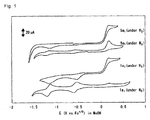
- Fig. 1 is a graph showing cyclic voltammograms of a complex 1a 1 and a hydride complex 5a 1 under hydrogen atmosphere or nitrogen atmosphere, the voltammograms being arranged side by side.
- the hydrogen oxidation catalyst of the present invention is a dinuclear transition metal complex having a chemical structure represented by the following general formula (1) or (2): wherein, in the general formulae (1) and (2), M 1 and M 2 are each independently Fe or Ru; Ar 1 and Ar 2 are each independently a cyclopentadienyl group or a pentamethylcyclopentadienyl group; Ar 3 and Ar 4 are each independently a divalent aromatic hydrocarbon group having 6 to 12 carbon atoms; and Ar 5 is a monovalent aromatic hydrocarbon group having 6 to 12 carbon atoms, and in the general formula (2), R 1 and R 2 are each independently a hydrogen atom or a monovalent aliphatic hydrocarbon group having 1 to 3 carbon atoms.
- any of the divalent cation complex represented by the general formula (1) (hereinafter it may be referred to as complex 1) and the divalent cation complex represented by the general formula (2) (hereinafter it may be referred to as complex 2) is a complex that contains two transition metal atoms.
- the complex 2 has the same chemical structure as the complex 1, except that a ligand R 1 OR 2 is coordinated to M 2 , which is a transition metal element.
- any of the complexes 1 and 2 has the transition metal elements M 1 and M 2 .
- These M 1 and M 2 are each independently iron or ruthenium.
- both M 1 and M 2 can be ruthenium; M 1 can be iron and M 2 can be ruthenium; M 1 can be ruthenium and M 2 can be iron; or both M 1 and M 2 can be iron.
- it is preferred that both M 1 and M 2 are ruthenium, or that M 1 is iron and M 2 is ruthenium. It is more preferred that both M 1 and M 2 are ruthenium. It is considered that the use of a ruthenium or iron element that is likely to form a molecular hydrogen complex which is expected to be a key intermediate of reaction, has a positive effect on hydrogen oxidation reaction.
- transition metal elements M 1 and M 2 are bound to each other by a single bond; moreover, they have two cross-linked structures by a sulfur atom. In addition, a phosphorus atom is coordinated to the transition metal element M 1 .
- the complexes 1 and 2 have aromatic hydrocarbon groups Ar 1 to Ar 5 .
- Ar 1 and Ar 2 are directly coordinated to M 1 or M 2 and are each independently a cyclopentadienyl group (Cp) or a pentamethylcyclopentadienyl group (Cp*).
- both Ar 1 and Ar 2 can be pentamethylcyclopentadienyl groups; Ar 1 can be a cyclopentadienyl group and Ar 2 can be a pentamethylcyclopentadienyl group; Ar 1 can be a pentamethylcyclopentadienyl group and Ar 2 can be a cyclopentadienyl group; or both Ar 1 and Ar 2 can be cyclopentadienyl groups.
- both Ar 1 and Ar 2 are pentamethylcyclopentadienyl groups.
- Cyclopentadienyl groups and pentamethylcyclopentadienyl groups serve effectively as electron donating groups, with respect to core metal (coordination metal). Moreover, they are effective in stabilizing core metal-containing complexes.
- Ar 3 and Ar 4 are divalent aromatic hydrocarbon groups having 6 to 12 carbon atoms.
- Ar 3 and Ar 4 can be groups that are the same as or different from each other.
- Ar 3 and Ar 4 are not particularly limited, as long as they are arylene groups having the same number of carbon atoms as above. Examples thereof include phenylene group (-C 6 H 4 -), tolylene group (-C 6 H 3 CH 3 -), naphthylene group (-C 10 H 6 -) and biphenylene group (-C 12 H 8 -). Among them, phenylene group is preferred, and 1,2-phenylene group is more preferred.
- Ar 5 is a monovalent aromatic hydrocarbon group having 6 to 12 carbon atoms.
- Ar 5 is not particularly limited, as long as it is an aryl group having 6 to 12 carbon atoms. Examples thereof include phenyl group (-C 6 H 5 ), tolyl group (-C 6 H 4 CH 3 ), benzyl group (-CH 2 C 6 H 5 ), xylyl group (-C 6 H 3 (CH 3 ) 2 ), mesityl group (-C 6 H 2 (CH 3 ) 3 ), naphthyl group (-C 10 H 7 ) and biphenyl group (-C 12 H 9 ). Among them, phenyl group, tolyl group, xylyl group and mesityl group are preferred, and phenyl group is more preferred.
- R 1 and R 2 are a hydrogen atom or a monovalent aliphatic hydrocarbon group having 1 to 3 carbon atoms. That is, the ligand R 1 OR 2 is water, alcohol or ether.
- R 1 and R 2 can be groups that are the same as or different from each other.
- R 1 and R 2 include hydrogen atom, methyl group, ethyl group, n-propyl group and i-propyl group. Among them, hydrogen atom and methyl group are preferred. It is more preferred that both R 1 and R 2 are hydrogen atoms, that is, the ligand R 1 OR 2 is water (H 2 O).
- the hydrogen oxidation catalyst of the present invention can appropriately have an anion.
- trifluoromethanesulfonic acid anion is preferred.
- Non-Patent Literature 1 Organometallics 2010, 29, 5994-6001 .
- a typical example of the method for producing the hydrogen oxidation catalyst of the present invention is a production method based on a two-step reaction, as described in Non-Patent Literature 1.
- the first step of the production method is the synthesis of a mononuclear complex [Ar 1 M 1 ⁇ Ar 5 P(Ar 3 S)(Ar 4 S) ⁇ ] in which the transition metal element M 1 is contained (a complex 4 in the following formula (3)).
- a phosphorus sulfur ligand Ar 5 P(Ar 3 SH)(Ar 4 SH) (a compound 3 in the following formula (3)) is exposed to the action of base.
- the phosphorus sulfur ligand is reacted with a metal complex that contains Ar 1 M 1 ([Ar 1 M 1 ] in the formula (3)), thereby synthesizing [Ar 1 M 1 ⁇ Ar 5 P(Ar 3 S)(Ar 4 S) ⁇ ].
- the hydrogen oxidation method using the hydrogen oxidation catalyst of the present invention is not particularly limited. Examples thereof include a method in which the hydrogen oxidation catalyst of the present invention is dissolved in a solvent to obtain a solution, and the solution is oxidized by bubbling hydrogen thereinto.
- the condition of the hydrogen oxidation method using the hydrogen oxidation catalyst of the present invention is not particularly limited. Examples thereof include a condition in which hydrogen pressure is set to 0.01 to 100 atm, and 0.01 to 10 mmol of the hydrogen oxidation catalyst of the present invention is used.
- the hydrogen oxidation catalyst of the present invention is widely applicable to all the technology fields which require hydrogen oxidation.
- Examples of the applications of the hydrogen oxidation catalyst of the present invention include an anode catalyst for fuel cells in which hydrogen is used as fuel, and an anode catalyst for redox flow batteries.
- the hydrogen oxidation catalyst having high catalytic efficiency and being less expensive than conventional platinum catalysts, like the present invention is useful as a cost minimization technique.
- the hydrogen oxidation catalyst production method used below is based on the method for producing compounds 4a, 4b and 4c described in the above-mentioned Non-Patent Literature 1 ( Organometallics 2010, 29, 5994-6001 ).
- n-butyllithium (1.57 M hexane solution, 2.60 mL, 4.08 mmol) was added to 20 mL of a THF solution of [PhP(C 6 H 4 -o-SH) 2 ] (653 mg, 2.00 mmol).
- a yellow solution thus obtained was added to 10 mL of a THF dispersion of [Cp*RuCl( ⁇ -Cl)] 2 (609 mg, 0.991 mmol).
- a mixture thus obtained was stirred for 18 hours at room temperature.
- a violet solution thus obtained was concentrated and dried, thereby obtaining a violet solid.
- n-butyllithium (1.65 M hexane solution, 0.60 mL, 0.990 mmol) was added to 15 mL of a THF solution of [PhP(C 6 H 4 -o-SH) 2 ] (163 mg, 0.498 mmol).
- a yellow solution thus obtained was added to 10 mL of a THF solution of [CpRu(NCMe) 3 ]PF 6 (219 mg, 0.504 mmol).
- a red-brown solution thus obtained was stirred for 18 hours at room temperature. The stirred solution was oxidized with air for three hours, thereby obtaining an orange-brown solution.
- n-butyllithium (1.57 M hexane solution, 1.28 mL, 2.01 mmol) was added to 20 mL of a THF solution of [PhP(C 6 H 4 -o-SH) 2 ] (326 mg, 1.00 mmol).
- a yellow solution thus obtained was moved to a container containing 10 mL of a THF solution of [Cp*FeCl(tmeda)] (343 mg, 1.00 mmol).
- a mixture thus obtained was stirred for 18 hours at room temperature. After the stirring, a black-green solution thus obtained was exposed to air and vigorously stirred for one hour. The color of the solution quickly changed to violet.
- a product thus obtained was purified by passing the product through a silica gel pad, using methylene chloride as a mobile phase. By recrystallization using methylene chloride-hexane, a violet needle crystal ([Cp*Fe ⁇ PhP(C 6 H 4 -o-S) 2 ⁇ ]) was obtained (382 mg, 0.741 mmol, 74%).
- Anal. Calcd for C 28 H 28 FePS 2 C, 65.24; H, 5.48. Found: C, 65.13; H, 5.43.
- a hydrogen oxidation reaction was developed using the hydrogen oxidation catalyst of Example 1 ([Cp*Ru ⁇ PhP(C 6 H 4 -o-S) 2 ⁇ RuCp*](OTf) 2 ; hereinafter it may be referred to as complex 1a 1 ).
- [Cp 2 Fe]OTf was used as an oxidant.
- the complex 1a 1 was dissolved in methylene chloride-d 2 to obtain a solution. Hydrogen gas was bubbled into the solution. As a result, almost no change was observed in the solution.
- the hydride complex 5a 1 is produced by exposing a methanol solution of the complex 1a 1 to hydrogen. It is considered that in this reaction, the methanol itself serves as base. As shown in the following formula (12), a yellow-brown powder was obtained by adding one equivalent of KO t Bu to a methanol solution of the hydride complex 5a 1 obtained, reacting the mixture for 20 minutes, and then drying the resultant. The yellow-brown powder contained about 80% of the hydride complex 5a 1 and about 20% of the complex 1a 1 .
- n Bu 4 NClO 4 was used as supporting electrolyte since n Bu 4 NBF 4 , etc., could not be used.
- the platinum quasi-reference electrode (Pt-QRE) was used since Ag/AgNO 3 -MeCN, Ag/AgCl-KClaq, etc., which are generally used as working electrode, could not be used.
- ferrocene was added as internal standard, and the oxidation-reduction potential of ferrocene was used as standard potential.
- Fig. 1 is a graph showing cyclic voltammograms of the complex 1a 1 and the hydride complex 5a 1 under hydrogen atmosphere or nitrogen atmosphere, the voltammograms being arranged side by side.
- the cyclic voltammogram of the complex 1a 1 in the methanol and under the nitrogen atmosphere showed a reversible one-electron reduction wave at -587 mV (vs. Fc/Fc + ) and -1180 mV (vs. Fc/Fc + ).
- the second voltammogram from the bottom in Fig. 1 an irreversible oxidation wave appeared at +173 mV (vs. Fc/Fc + ). It is considered that the oxidation wave is assigned to the oxidation process of the hydride complex 5a 1 .
- a complex 1a (divalent cation) corresponds to the cationic moiety of the complex 1a 1
- a complex 5a monovalent cation corresponds to the cationic moiety of the hydride complex 5a 1 .
- the oxidation wave on the cyclic voltammogram of the complex 1a 1 under the nitrogen atmosphere shows that the hydride complex 5a 1 was produced by the reaction of a two-electron reduction species in the complex 1a 1 with methanol-derived protons or a small amount of water-derived protons.
- the following formula (15) shows a predictable reduction process from the complex 1a (divalent cation) to the complex 5a (monovalent cation).
- the complex 1a becomes a complex 6a (two-electron reduction species) by two-electron reduction, and the complex 6a is oxidized by protons to be the complex 5a.
- the two-electron reduction species of the complex 1a 1 no longer exists in the electrode vicinity.
- the oxidation process of the two-electron reduction species does not appear as an oxidation wave, as shown in the cyclic voltammogram of the complex 1a 1 under the hydrogen atmosphere.
Landscapes
- Chemical & Material Sciences (AREA)
- Organic Chemistry (AREA)
- Chemical Kinetics & Catalysis (AREA)
- Engineering & Computer Science (AREA)
- Electrochemistry (AREA)
- General Chemical & Material Sciences (AREA)
- Materials Engineering (AREA)
- Life Sciences & Earth Sciences (AREA)
- Manufacturing & Machinery (AREA)
- Sustainable Development (AREA)
- Sustainable Energy (AREA)
- Inorganic Chemistry (AREA)
- Catalysts (AREA)
Abstract
Description
- The present invention relates to a hydrogen oxidation catalyst that does not contain platinum.
- Platinum catalyst is widely used as fuel cell anode catalyst (Patent Literature 1). Platinum catalyst has excellent hydrogen oxidizing ability. However, since platinum, which is a raw material therefor, is expensive and rare, there is a demand for less expensive hydrogen oxidation catalyst, as fuel cell anode catalyst.
- Meanwhile, an example if described in
Non-Patent Literature 1, in which a thiolate-bridged ruthenium dinuclear complex is used for propargyl alcohol reduction. - Patent Literature 1: Japanese Patent Application Laid-Open No.
2009-289681 - Non-Patent Literature 1: Organometallics 2010, 29, 5994-6001
- There has been considerable research on hydrogen oxidation catalysts that have excellent hydrogen oxidizing ability and are inexpensive. However, practical examples of hydrogen oxidation catalysts that do not contain platinum, are not found yet.
- The present invention was achieved in light of such a circumstance that low-cost hydrogen oxidation methods have been sought. The object of the present invention is to provide a hydrogen oxidation catalyst that does not contain platinum.
- The hydrogen oxidation catalyst of the present invention is a dinuclear transition metal complex having a chemical structure represented by the following general formula (1) or (2):


- According to the present invention, any of the dinuclear transition metal complexes represented by the general formulae (1) and (2) has excellent hydrogen oxidizing ability; therefore, a highly-efficient, hydrogen oxidation catalyst reaction can be realized without the use of platinum.
-
Fig. 1 is a graph showing cyclic voltammograms of a complex 1a1 and a hydride complex 5a1 under hydrogen atmosphere or nitrogen atmosphere, the voltammograms being arranged side by side. - The hydrogen oxidation catalyst of the present invention is a dinuclear transition metal complex having a chemical structure represented by the following general formula (1) or (2):


- Any of the divalent cation complex represented by the general formula (1) (hereinafter it may be referred to as complex 1) and the divalent cation complex represented by the general formula (2) (hereinafter it may be referred to as complex 2) is a complex that contains two transition metal atoms. The complex 2 has the same chemical structure as the complex 1, except that a ligand R1OR2 is coordinated to M2, which is a transition metal element.
- Hereinafter, the chemical structure which is common to the
complexes - Any of the
complexes - The transition metal elements M1 and M2 are bound to each other by a single bond; moreover, they have two cross-linked structures by a sulfur atom. In addition, a phosphorus atom is coordinated to the transition metal element M1.
- The
complexes - Ar3 and Ar4 are divalent aromatic hydrocarbon groups having 6 to 12 carbon atoms. Ar3 and Ar4 can be groups that are the same as or different from each other.
- Ar3 and Ar4 are not particularly limited, as long as they are arylene groups having the same number of carbon atoms as above. Examples thereof include phenylene group (-C6H4-), tolylene group (-C6H3CH3-), naphthylene group (-C10H6-) and biphenylene group (-C12H8-). Among them, phenylene group is preferred, and 1,2-phenylene group is more preferred.
- Ar5 is a monovalent aromatic hydrocarbon group having 6 to 12 carbon atoms. Ar5 is not particularly limited, as long as it is an aryl group having 6 to 12 carbon atoms. Examples thereof include phenyl group (-C6H5), tolyl group (-C6H4CH3), benzyl group (-CH2C6H5), xylyl group (-C6H3(CH3)2), mesityl group (-C6H2(CH3)3), naphthyl group (-C10H7) and biphenyl group (-C12H9). Among them, phenyl group, tolyl group, xylyl group and mesityl group are preferred, and phenyl group is more preferred.
- Hereinafter, the ligand R1OR2 in the
complex 2 will be described. - In the general formula (2), R1 and R2 are a hydrogen atom or a monovalent aliphatic hydrocarbon group having 1 to 3 carbon atoms. That is, the ligand R1OR2 is water, alcohol or ether.
- R1 and R2 can be groups that are the same as or different from each other. Examples of R1 and R2 include hydrogen atom, methyl group, ethyl group, n-propyl group and i-propyl group. Among them, hydrogen atom and methyl group are preferred. It is more preferred that both R1 and R2 are hydrogen atoms, that is, the ligand R1OR2 is water (H2O).
- The hydrogen oxidation catalyst of the present invention can appropriately have an anion. Examples of the anion include trifluoromethanesulfonic acid anion (CF3SO3 -), hexafluorophosphoric acid anion (PF6 -), tetrafluoroboric acid anion (BF4 -), and tetrakis[3,5-bis(trifluoromethyl)phenyl]boric acid anion (-B(C6H3(CF3)2)4=-BArF 4). Among these anions, trifluoromethanesulfonic acid anion is preferred.
- As for the method for producing the hydrogen oxidation catalyst of the present invention, an example is described in the above-mentioned Non-Patent Literature 1 (Organometallics 2010, 29, 5994-6001).
- A typical example of the method for producing the hydrogen oxidation catalyst of the present invention is a production method based on a two-step reaction, as described in Non-Patent
Literature 1. - The first step of the production method is the synthesis of a mononuclear complex [Ar1M1{Ar5P(Ar3S)(Ar4S)}] in which the transition metal element M1 is contained (a complex 4 in the following formula (3)). First, as shown in the following formula (3), a phosphorus sulfur ligand Ar5P(Ar3SH)(Ar4SH) (a compound 3 in the following formula (3)) is exposed to the action of base. Then, the phosphorus sulfur ligand is reacted with a metal complex that contains Ar1M1 ([Ar1M1] in the formula (3)), thereby synthesizing [Ar1M1{Ar5P(Ar3S)(Ar4S)}].

- In the second step of the production method, as shown in the following formula (4), [Ar1M1{Ar5P(Ar3S)(Ar4S)}] (the complex 4) is mixed and reacted with a metal complex that contains Ar2M2 ([Ar2M2] in the following formula (4)), thereby obtaining the
target complex 
- As will be shown below under "Examples", the estimated reaction mechanism of the hydrogen oxidation catalyst reaction developed by the hydrogen oxidation catalyst of the present invention, is as shown in the following formula (5).
- As shown in the following formula (5), by the reaction of the complex 1 (divalent cation) with hydrogen, a complex 5 (monovalent cation) is produced with the production of one equivalent of protons. By the oxidation of the complex 5, the complex 1 is regained with the production of another one equivalent of protons. Detailed analysis of the reaction mechanism will be described below under "Examples".
- In the case of the complex 2, it is predicted that after the complex 2 becomes the complex 5 through the desorption of the ligand R1OR2 from the complex 2 and the coordination of hydrogen (H2) to the metal M2, a similar catalyst cycle to the following formula (5) proceeds:

- The hydrogen oxidation method using the hydrogen oxidation catalyst of the present invention is not particularly limited. Examples thereof include a method in which the hydrogen oxidation catalyst of the present invention is dissolved in a solvent to obtain a solution, and the solution is oxidized by bubbling hydrogen thereinto.
- The condition of the hydrogen oxidation method using the hydrogen oxidation catalyst of the present invention, is not particularly limited. Examples thereof include a condition in which hydrogen pressure is set to 0.01 to 100 atm, and 0.01 to 10 mmol of the hydrogen oxidation catalyst of the present invention is used.
- The hydrogen oxidation catalyst of the present invention is widely applicable to all the technology fields which require hydrogen oxidation. Examples of the applications of the hydrogen oxidation catalyst of the present invention, include an anode catalyst for fuel cells in which hydrogen is used as fuel, and an anode catalyst for redox flow batteries. Especially in redox flow batteries, which have been growing in size, the hydrogen oxidation catalyst having high catalytic efficiency and being less expensive than conventional platinum catalysts, like the present invention, is useful as a cost minimization technique.
- Hereinafter, the present invention will be described in more detail, by way of examples and comparative examples. The scope of the present invention is not limited to the examples.
- The hydrogen oxidation catalyst production method used below is based on the method for producing compounds 4a, 4b and 4c described in the above-mentioned Non-Patent Literature 1 (Organometallics 2010, 29, 5994-6001).
- First, under a temperature condition of 0°C, n-butyllithium (1.57 M hexane solution, 2.60 mL, 4.08 mmol) was added to 20 mL of a THF solution of [PhP(C6H4-o-SH)2] (653 mg, 2.00 mmol). Fifteen minutes after the addition, at room temperature, a yellow solution thus obtained was added to 10 mL of a THF dispersion of [Cp*RuCl(µ-Cl)]2 (609 mg, 0.991 mmol). A mixture thus obtained was stirred for 18 hours at room temperature. A violet solution thus obtained was concentrated and dried, thereby obtaining a violet solid. By recrystallization using methylene-chloridehexane, a violet needle crystal ([Cp*Ru{PhP(C6H4-o-S)2}]·0.5CH2Cl2) was obtained (916 mg, 1.52 mmol, 77%). Anal. Calcd for C28H28PRuS2: C, 59.98; H, 5.03. Found: C, 60.24; H, 4.84.

- A mixture of the above-mentioned [Cp*Ru{PhP(C6H4-o-S)2}] (114 mg, 0.203 mmol) and 10 mL of a methylene chloride solution of [Cp*RuCI(µ-Cl)]2 (60.4 mg, 0.0983 mmol) was mixed for 20 hours at room temperature. To a solution thus obtained, silver trifluoromethanesulfonate (AgOTf, 113 mg, 0.438 mmol) was added. A mixture thus obtained was further stirred for one hour at room temperature. A reaction mixture thus obtained was filtered and concentrated. In addition, by a first recrystallization using ethanol-ether and a second recrystallization using methylene chloride-hexane, a crystalline solid ([Cp*Ru{PhP(C6H9-o-S)2}RuCp*(OTf)2·0.5CH2Cl2) was obtained (186 mg, 0.164 mmol, 83%). 1HNMR (CD2Cl2): δ8.45 (dd, J=8 and 2Hz, 2H), 7.92-7.83 (m, 2H), 7.69-7.45 (m, 7H), 6.84-6.75 (m, 2H), 1.70 (d, J=2Hz, 15H), 1.48 (s, 15H).
31P{1H}NMR(CD2Cl2) : δ94.8 (s).
Anal. Calcd for C40.5H44ClF6O6PRu2S4([Cp*Ru{PhP (C6H4-o-S)2}RuCp*](OTf)2·0.5CH2Cl2): C, 42.76; H, 3.90. Found: C, 42.89; H, 3.74.
- First, under a temperature condition of 0°C, n-butyllithium (1.65 M hexane solution, 0.60 mL, 0.990 mmol) was added to 15 mL of a THF solution of [PhP(C6H4-o-SH)2] (163 mg, 0.498 mmol). Thirty minutes after the addition, at room temperature, a yellow solution thus obtained was added to 10 mL of a THF solution of [CpRu(NCMe)3]PF6 (219 mg, 0.504 mmol). A red-brown solution thus obtained was stirred for 18 hours at room temperature. The stirred solution was oxidized with air for three hours, thereby obtaining an orange-brown solution. The orange-brown solution was concentrated under a reduced pressure condition. A product thus obtained was purified by passing the product through a silica gel pad, using methylene chloride as a mobile phase. By recrystallization using THF-hexane, a black rectangular crystal ([CpRu{PhP(C6H4-o-S)2}]·0.5C6H14) was obtained (182 mg, 0.341 mmol, 68%).
Anal. Calcd for C23H18PRuS2: C, 56.31; H, 3.70. Found: C, 56.13; H, 3.89.
- A mixture of the above-mentioned [CpRu{PhP(C6H9-o-S)2}] (50.0 mg, 0.102 mmol) and 5 mL of a methylene chloride solution of [Cp*RuCl(µ-Cl)]2 (30.0 mg, 0.0488 mmol) was mixed for 20 hours at room temperature. To a solution thus obtained, silver trifluoromethanesulfonate (AgOTf, 55.6 mg, 0.216 mmol) was added. A mixture thus obtained was further stirred for one hour at room temperature. A reaction mixture thus obtained was filtered and concentrated. In addition, by recrystallization using methylene chloride-hexane, a green crystalline solid ([CpRu{PhP(C6H4-o-S)2}RuCp*(OH2)](OTf)2·0.5CH2Cl2) was obtained (87.4 mg, 0.0805 mmol, 82%).
1HNMR (CD2Cl2): δ7.94 (dd, J=8 and 2Hz, 2H), 7.68-7.45 (m, 9H), 7.23 (dd, J=13 and 7Hz, 2H), 5.37 (s, 5H), 1.77 (s, 15H). 31P{1H}NMR(CD2Cl2): δ103.1 (s).
Anal. Calcd for C35.5H36ClF6O7PRu2S4([CpRu{PhP(C6H4-o-S)2}RuCp*(OHz)](OTf)2·0.5CH2Cl2): C, 39.28; H, 3.34. Found: C, 39.20; H, 3.27.
- First, under a temperature condition of 0°C, n-butyllithium (1.57 M hexane solution, 1.28 mL, 2.01 mmol) was added to 20 mL of a THF solution of [PhP(C6H4-o-SH)2] (326 mg, 1.00 mmol). Fifteen minutes after the addition, a yellow solution thus obtained was moved to a container containing 10 mL of a THF solution of [Cp*FeCl(tmeda)] (343 mg, 1.00 mmol). A mixture thus obtained was stirred for 18 hours at room temperature. After the stirring, a black-green solution thus obtained was exposed to air and vigorously stirred for one hour. The color of the solution quickly changed to violet. A product thus obtained was purified by passing the product through a silica gel pad, using methylene chloride as a mobile phase. By recrystallization using methylene chloride-hexane, a violet needle crystal ([Cp*Fe{PhP(C6H4-o-S)2}]) was obtained (382 mg, 0.741 mmol, 74%).
Anal. Calcd for C28H28FePS2: C, 65.24; H, 5.48. Found: C, 65.13; H, 5.43.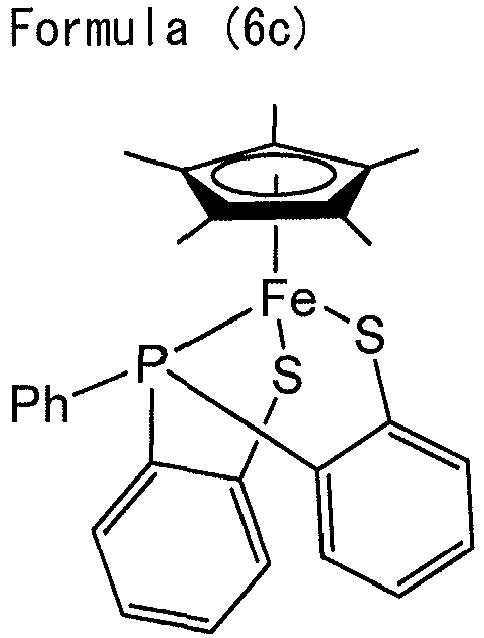
- A mixture of the above-mentioned [Cp*Fe{PhP(C6H4-o-S)2}] (111 mg, 0.216 mmol) and 10 mL of a methylene chloride solution of [Cp*RuCl(µ-Cl)]2 (61.0 mg, 0.0993 mmol) was mixed for 20 hours at room temperature. To a solution thus obtained, silver trifluoromethanesulfonate (AgOTf, 110 mg, 0.428 mmol) was added. A mixture thus obtained was further stirred for one hour at room temperature. A reaction mixture thus obtained was filtered and concentrated. In addition, by a first recrystallization using ethanol-ether and a second crystallization using methylene chloride-hexane, a green crystalline solid ([Cp*Fe{PhP(C6H4-o-S)2}RuCp*] (OTf)2·0.5CH2Cl2) was obtained (167 mg, 0.153 mmol, 77%). 1HNMR (CD2Cl2): δ8.47 (dd, J=8 and 2Hz, 2H), 7.92-7.8 (m, 2H), 7.67-7.40 (m, 7H), 6.80-6.69 (m, 2H), 1.60 (s, 15H), 1.45 (s, 15H).
31P{1H}NMR (CD2Cl2): δ110.9 (s).
Anal. Calcd for C40.5H44ClF6FeO6PRuS4([Cp*Fe{PhP(C6H4-o-S)2}RuCp*](OTf)2·0.5CH2Cl2): C, 44.53, H, 4.06. Found: C, 44.55; H, 3.88.
- A hydrogen oxidation reaction was developed using the hydrogen oxidation catalyst of Example 1 ([Cp*Ru{PhP(C6H4-o-S)2}RuCp*](OTf)2; hereinafter it may be referred to as complex 1a1). [Cp2Fe]OTf was used as an oxidant.
- First, as shown in the following formula (7), [Cp2Fe]OTf (0.4 mmol) and the complex 1a1 (5 mol%) were dissolved in 5 mL of water. Under a room temperature condition, an aqueous solution thus obtained was reacted by supplying one atmosphere of hydrogen for 20 hours to the solution. As a result, with respect to [Cp2Fe]OTf (0.4 mmol), HOTf and Cp2Fe were obtained at yields of 86% and 87%, respectively. The raw material [Cp2Fe]OTf was not obtained.
- Next, as shown in the following formula (8), under a room temperature condition, an aqueous solution of a mixture of [Cp2Fe]OTf (0.4 mmol) and the complex 1a1 (5 mol%) was reacted by supplying one atmosphere of nitrogen for 20 hours to the solution. A solution thus obtained was still dark blue, which is a color that is derived the raw material [Cp2Fe]OTf, even after 20 hours. A precipitate thus obtained was extracted with hexane; therefore, Cp2Fe was obtained at a yield of 18%. After the extraction with hexane, an aqueous phase thus obtained was washed with dichloromethane and then subjected to UV measurement to quantitate the raw material [Cp2Fe]OTf. As a result, a raw material collection rate of 62% was obtained. HOTf was not obtained.
- Then, as shown in the following formula (9), under a room temperature condition, an aqueous solution of [Cp2Fe]OTf (0.4 mmol) was reacted by supplying one atmosphere of hydrogen for 20 hours to the solution. As a result, with respect to [Cp2Fe]OTf (0.4 mmol), Cp2Fe was obtained at a yield of 19%, and a raw material collection rate of 57% was obtained. HOTf was not obtained.


- From the above results, it is clear that under any reaction condition, [Cp2Fe]OTf is partially decomposed and Cp2Fe (ferrocene) is obtained. However, from the result that [Cp2Fe]OTf was absolutely consumed under the reaction condition of the formula (7), it was confirmed that oxidation reaction of hydrogen molecules is catalytically promoted by the complex 1a1. The aqueous solution of [Cp2Fe]OTf was still dark blue, even after it was left to stand for about one month, and [Cp2Fe]OTf was not absolutely decomposed.
- Next, to obtain information on ruthenium species which are produced under hydrogen atmosphere, an NMR experiment was carried out.
- First, as shown in the following formula (10), the complex 1a1 was dissolved in methylene chloride-d2 to obtain a solution. Hydrogen gas was bubbled into the solution. As a result, almost no change was observed in the solution.
- Next, as shown in the following formula (11), the complex 1a1 (one equivalent) and lutidine (base, 5 equivalent) were dissolved in methylene chloride-d2 to obtain a solution. Hydrogen gas was bubbled into the solution. As a result, the color of a reaction solution thus obtained changed from green to orange-brown in several minutes.
- As a result of measuring the 1HNMR of the reaction solution, the peak which is assigned to the complex 1a1 disappeared absolutely, and only the peak which is assigned to a hydride complex 5a1 was observed. In the 1HNMR of the hydride complex 5a1, the peak which is characteristic of hydride ligand (-H-) appears in a high magnetic field of -16.4 ppm. No dihydrogen complex intermediate was obtained, in which hydrogen (H2) is coordinated to ruthenium.
- Meanwhile, it was found that the hydride complex 5a1 is produced by exposing a methanol solution of the complex 1a1 to hydrogen. It is considered that in this reaction, the methanol itself serves as base. As shown in the following formula (12), a yellow-brown powder was obtained by adding one equivalent of KOtBu to a methanol solution of the hydride complex 5a1 obtained, reacting the mixture for 20 minutes, and then drying the resultant. The yellow-brown powder contained about 80% of the hydride complex 5a1 and about 20% of the complex 1a1.

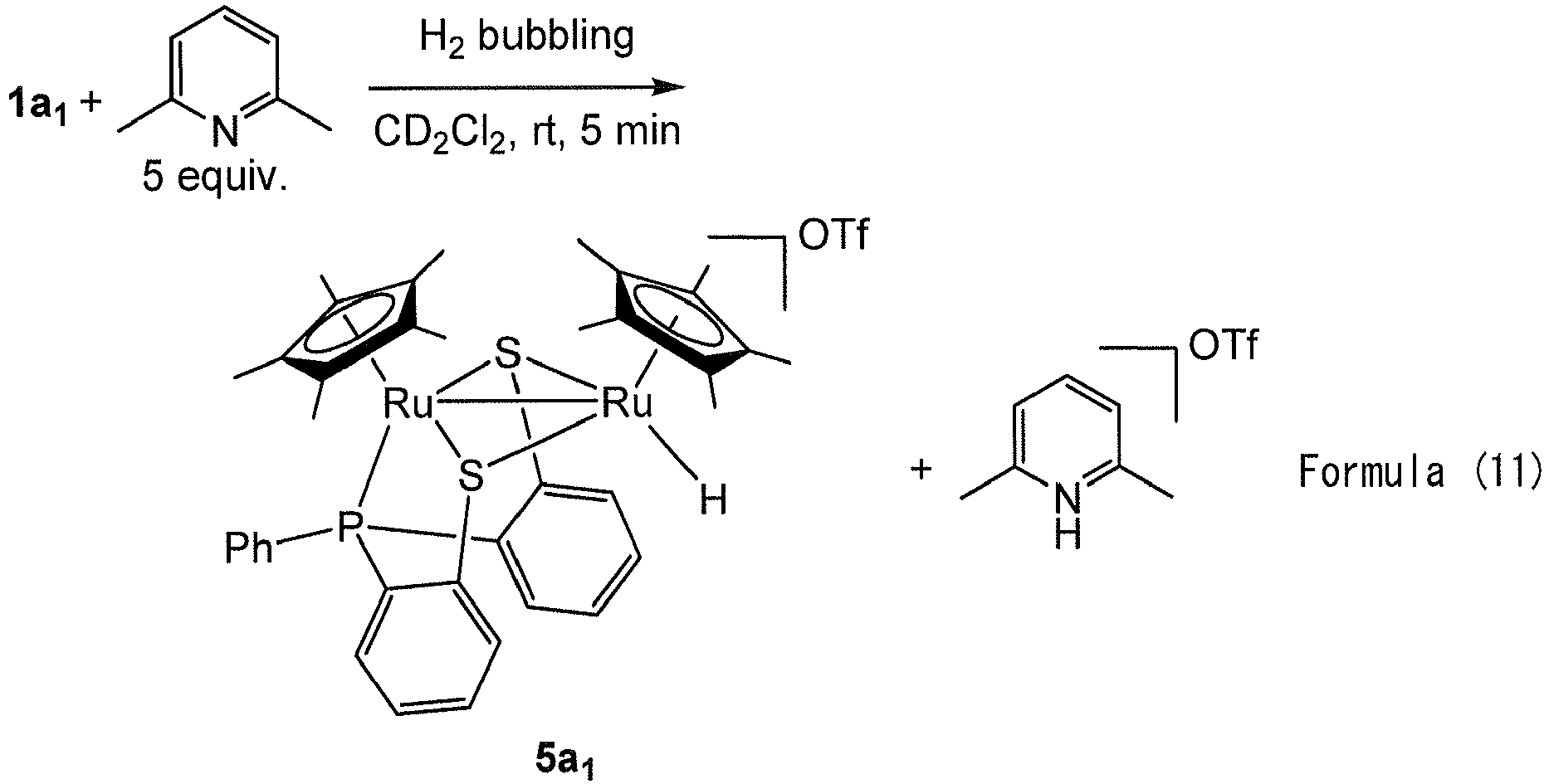

- The methylene chloride-d2 was removed from the reacted solution shown in the above formula (11). As a result of drying the solution, a solid thus obtained became a mixture that contains the complex 1a1 as a main component. From this result, it is clear that the reaction shown in the formula (11) is an equilibrium reaction (the following formula (13)). Also in acetone-d6, almost the same result as the formulae (10) and (11) was obtained.
- From the formulae (10) to (12), it is clear that the hydride complex 5a1 is produced by exposing the complex 1a1 to hydrogen. In the formulae (10) to (12), particularly no reaction proceeds after the production of the hydride complex 5a1. Therefore, the next step in the catalyst reaction is considered to be the oxidation reaction of the hydride complex 5a1 (the following formula (14)).
1a1 + H2 ⇄ 5a1 + HOTf Formula (13)
5a1 + HOTf → 1a1 + H2 Formula (14)
- Next, to clarify the oxidation-reduction behavior of the complex 1a1 and the hydride complex 5a1, cyclic voltammetry (CV) was carried out. Details of the measurement cell and measurement conditions used for the CV are as follows.
-
- Working electrode: Glassy carbon electrode
- Reference electrode: Platinum quasi-reference electrode (Pt-QRE)
- Counter electrode: Platinum electrode
- Sample solution: Methanol solution of the complex 1a1 or the hydride complex 5a1 (nBu4NClO4 and ferrocene were added as supporting electrolyte and internal standard, respectively)
- Measurement device: Potentiostat/galvanostat (Solatron)
- Potential sweep rate: 50 mV/sec
- Potential sweep range: -1.7 to 0.7 V (vs. Fc/Fc+)
- Measurement temperature: 25°C
- Measurement atmosphere: Nitrogen atmosphere or hydrogen atmosphere
- It is known that the complex 1a1 quickly reacts with coordinating solvents such as acetonitrile, halide ions, etc. Accordingly, these coordinating solvents and halide ions cannot be used for CV. nBu4NClO4 was used as supporting electrolyte since nBu4NBF4, etc., could not be used. Also, the platinum quasi-reference electrode (Pt-QRE) was used since Ag/AgNO3-MeCN, Ag/AgCl-KClaq, etc., which are generally used as working electrode, could not be used. Also, ferrocene was added as internal standard, and the oxidation-reduction potential of ferrocene was used as standard potential.
- The complex 1a1 was dissolved in methanol. Also, the hydride complex 5a1 (actually, a mixture containing about 20% of the complex 1a1) was dissolved in methanol. CV was carried on each solution, under hydrogen atmosphere or nitrogen atmosphere.
Fig. 1 is a graph showing cyclic voltammograms of the complex 1a1 and the hydride complex 5a1 under hydrogen atmosphere or nitrogen atmosphere, the voltammograms being arranged side by side. - The cyclic voltammogram of the complex 1a1 in the methanol and under the nitrogen atmosphere (the first voltammogram from the bottom in
Fig. 1 ) showed a reversible one-electron reduction wave at -587 mV (vs. Fc/Fc+) and -1180 mV (vs. Fc/Fc+). Meanwhile, in the cyclic voltammogram of the complex 1a1 in the methanol and under the hydrogen atmosphere (the second voltammogram from the bottom inFig. 1 ), an irreversible oxidation wave appeared at +173 mV (vs. Fc/Fc+). It is considered that the oxidation wave is assigned to the oxidation process of the hydride complex 5a1. - In the cyclic voltammogram of the hydride complex 5a1 in the methanol and under the nitrogen atmosphere (the second voltammogram from the top in
Fig. 1 ), an irreversible oxidation wave appeared at +173 mV (vs. Fc/Fc+). Two small reduction waves observed in the cyclic voltammogram (at -587 mV (vs. Fc/Fc+) and -1180 mV (vs. Fc/Fc+)) are assigned to the complex 1a1 contained in the sample. Meanwhile, in the cyclic voltammogram of the hydride complex 5a1 in the methanol and under the hydrogen atmosphere (the first voltammogram from the top inFig. 1 ), the current value of the oxidation wave appearing at +173 mV (vs. Fc/Fc+) is higher than the current value of the oxidation wave under the nitrogen atmosphere. By comparing these two cyclic voltammograms of the hydride complex 5a1, it was electrochemically proven that the hydride complex 5a1 is catalytically reactive with hydrogen. - As the result of considering the evaluation results of the above (1) to (3), the estimated reaction mechanism of the catalyst reaction is as shown in the following formula (5a). In the following formula (5a), a complex 1a (divalent cation) corresponds to the cationic moiety of the complex 1a1, and a complex 5a (monovalent cation) corresponds to the cationic moiety of the hydride complex 5a1.
- As shown in the following formula (5a), by the reaction of the complex 1a with hydrogen, the complex 5a is produced with the production of one equivalent of protons. By the oxidation of the complex 5a, the complex 1a is regained with the production of another one equivalent of protons.

- In the cyclic voltammogram of the complex 1a1 under the nitrogen atmosphere (the first voltammogram from the bottom in
Fig. 1 ), an irreversible small oxidation wave is observed at +173 mV (vs. Fc/Fc+). This corresponds to the oxidation wave appearing at +173 mV (vs. Fc/Fc+) in the cyclic voltammogram of the hydride complex 5a1 (the first and second voltammograms from the top inFig. 1 ). It is expected that the oxidation wave on the cyclic voltammogram of the complex 1a1 under the nitrogen atmosphere, shows that the hydride complex 5a1 was produced by the reaction of a two-electron reduction species in the complex 1a1 with methanol-derived protons or a small amount of water-derived protons. - The following formula (15) shows a predictable reduction process from the complex 1a (divalent cation) to the complex 5a (monovalent cation). According to the following formula (15), the complex 1a becomes a complex 6a (two-electron reduction species) by two-electron reduction, and the complex 6a is oxidized by protons to be the complex 5a.
- By the following formula (15), that the two reduction waves (at -587 mV (vs. Fc/Fc+) and -1180 mV (vs. Fc/Fc+)) in the cyclic voltammogram of the complex 1a1 under the hydrogen atmosphere (the second voltammogram from the bottom in
Fig. 1 ) become irreversible, can be explained. In the methanol and under the hydrogen atmosphere, the hydride complex 5a1 is produced from the complex 1a1, and one equivalent of protons are produced. According to the following formula (15), the two-electron reduction species of the complex 1a1 captures a lot of the protons present in the methanol and quickly becomes the hydride complex 5a1, accordingly. Therefore, the two-electron reduction species of the complex 1a1 no longer exists in the electrode vicinity. As a result, it is considered that the oxidation process of the two-electron reduction species does not appear as an oxidation wave, as shown in the cyclic voltammogram of the complex 1a1 under the hydrogen atmosphere.
- In light of both the formula (13) and the formula (15), it is considered that by the use of the hydrogen oxidation catalyst of the present invention, proton reduction reaction in which protons are catalytically reduced to remove hydrogen, is made possible.
Claims (1)
- A hydrogen oxidation catalyst,
wherein the hydrogen oxidation catalyst is a dinuclear transition metal complex having a chemical structure represented by the following general formula (1) or (2):

Applications Claiming Priority (2)
| Application Number | Priority Date | Filing Date | Title |
|---|---|---|---|
| JP2013239924A JP5876457B2 (en) | 2013-11-20 | 2013-11-20 | Hydrogen oxidation catalyst |
| PCT/JP2014/077333 WO2015076038A1 (en) | 2013-11-20 | 2014-10-14 | Hydrogen oxidation catalyst |
Publications (3)
| Publication Number | Publication Date |
|---|---|
| EP3072590A1 true EP3072590A1 (en) | 2016-09-28 |
| EP3072590A4 EP3072590A4 (en) | 2016-11-30 |
| EP3072590B1 EP3072590B1 (en) | 2017-10-04 |
Family
ID=53179308
Family Applications (1)
| Application Number | Title | Priority Date | Filing Date |
|---|---|---|---|
| EP14863878.6A Not-in-force EP3072590B1 (en) | 2013-11-20 | 2014-10-14 | Hydrogen oxidation catalyst |
Country Status (4)
| Country | Link |
|---|---|
| US (1) | US9840529B2 (en) |
| EP (1) | EP3072590B1 (en) |
| JP (1) | JP5876457B2 (en) |
| WO (1) | WO2015076038A1 (en) |
Families Citing this family (1)
| Publication number | Priority date | Publication date | Assignee | Title |
|---|---|---|---|---|
| JP6538580B2 (en) * | 2016-02-04 | 2019-07-03 | トヨタ自動車株式会社 | Hydrogen oxidation catalyst |
Family Cites Families (3)
| Publication number | Priority date | Publication date | Assignee | Title |
|---|---|---|---|---|
| JP2004296425A (en) * | 2003-03-07 | 2004-10-21 | Toyota Motor Corp | Hydrogen oxidation catalyst and fuel cell electrode |
| JP4853757B2 (en) * | 2005-03-08 | 2012-01-11 | 国立大学法人京都大学 | Optically active sulfur-bridged dinuclear ruthenium complex, method for producing the same, method for producing optically active compound using such a catalyst, and novel optically active compound |
| JP2009289681A (en) | 2008-05-30 | 2009-12-10 | Toyota Motor Corp | Method of cleaning fuel cell |
-
2013
- 2013-11-20 JP JP2013239924A patent/JP5876457B2/en not_active Expired - Fee Related
-
2014
- 2014-10-14 US US15/037,824 patent/US9840529B2/en not_active Expired - Fee Related
- 2014-10-14 WO PCT/JP2014/077333 patent/WO2015076038A1/en not_active Ceased
- 2014-10-14 EP EP14863878.6A patent/EP3072590B1/en not_active Not-in-force
Also Published As
| Publication number | Publication date |
|---|---|
| WO2015076038A1 (en) | 2015-05-28 |
| EP3072590A4 (en) | 2016-11-30 |
| JP5876457B2 (en) | 2016-03-02 |
| US9840529B2 (en) | 2017-12-12 |
| US20160289254A1 (en) | 2016-10-06 |
| EP3072590B1 (en) | 2017-10-04 |
| JP2015098005A (en) | 2015-05-28 |
Similar Documents
| Publication | Publication Date | Title |
|---|---|---|
| Rodríguez et al. | Synthesis, structure, and redox and catalytic properties of a new family of ruthenium complexes containing the tridentate bpea ligand | |
| Camp et al. | Multielectron redox chemistry of lanthanide Schiff-base complexes | |
| EP2123638B1 (en) | Metal complex | |
| Govindaswamy et al. | Mono and dinuclear rhodium, iridium and ruthenium complexes containing chelating 2, 2′-bipyrimidine ligands: synthesis, molecular structure, electrochemistry and catalytic properties | |
| Burdinski et al. | Encapsulation by a chromium (III)-containing bicyclic ligand cage. Synthesis, structures, and physical properties of heterometal complexes CrIIIMCrIII [M=(H+) 2, Li (I), Mg (II), Cu (II), Ni (II), Ni (IV), Co (III), Fe (II), Fe (III), Mn (II)] | |
| Chandrasekhar et al. | Coordination polymers containing ferrocene backbone. Synthesis, structure and electrochemistry | |
| Ouennoughi et al. | A novel ferrocenic copper (II) complex Salen-like, derived from 5-chloromethyl-2-hydroxyacetophenone and N-ferrocenmethylaniline: Design, spectral approach and solvent effect towards electrochemical behavior of Fc+/Fc redox couple | |
| Durgaprasad et al. | Synthesis, structural characterization and electrochemical studies of [Fe2 (μ-L)(CO) 6] and [Fe2 (μ-L)(CO) 5 (PPh3)](L= pyrazine-2, 3-dithiolate, quinoxaline-2, 3-dithiolate and pyrido [2, 3-b] pyrazine-2, 3-dithiolate): Towards modeling the active site of [FeFe]–Hydrogenase | |
| Fahim et al. | A novel ruthenium (VI) benzylidene carbene complex: Synthesis, crystal structure, hirshfeld surface, electrochemical behavior, and DFT insights | |
| US10016748B2 (en) | Iron-sulfur complex and method for producing hydrogen using the same as catalyst | |
| Sun et al. | N, N′-Bis (3-methoxysalicylidene) propane-1, 2-diamine mononuclear 4f and heterodinuclear Cu-4f complexes: Synthesis, crystal structure and electrochemical properties | |
| Miyazato et al. | Redox Behavior and Catalytic Oxidation Reactions of Alcohols by a New Ruthenium (III)–Dioxolene–Amine Complex of Bis (2-pyridylmethyl)-2-aminoethylamine | |
| EP3072590B1 (en) | Hydrogen oxidation catalyst | |
| Kumar et al. | Structures, preparation and catalytic activity of ruthenium cyclopentadienyl complexes based on pyridyl-phosphine ligand | |
| Reyes-Mata et al. | Calix [8] arene-based Ni (II) complexes for electrocatalytic CO2 reduction | |
| von Eschwege et al. | Chemical and electrochemical oxidation and reduction of dithizone | |
| Gao et al. | Electrocatalytic reduction of protons to hydrogen by a copper complex of the pentadentate ligand Dmphen-DPA in a nonaqueous electrolyte | |
| CN111788001B (en) | Method for decomposing ammonia and ruthenium complex | |
| Shin et al. | S-Alkylation-induced redox reactions leading to reversible sulfur− sulfur coupling in a pentamethylcyclopentadienyl ruthenium (III) thiolate-thioether system | |
| Veronese et al. | Dinuclear rhenium pyridazine complexes containing bridging chalcogenide anions: synthesis, characterization and computational study | |
| Sellmann et al. | Syntheses, Structures and Reactivity of Electron‐Rich Fe and Ru Complexes with the New Pentadentate Ligand Et2NpyS4− H2 {4‐(Diethylamino) 2, 6‐bis [(2‐mercaptophenyl) thiomethyl] pyridine} | |
| Bag et al. | The access of {NiIV (OH) 2} intermediate in Ni (II) mediated oxygen atom transfer to coordinated Phosphine: Combined experimental and computational studies | |
| Tang et al. | Synthesis and properties of an unexpected trinuclear copper (I) complex supported by diphenylphosphinomethane | |
| Xu et al. | Synthesis and characterization of diiron dithiolate complexes containing a quinoxaline bridge | |
| Ng et al. | (Indenyl) ruthenium Complexes Containing 1, 1′‐Bis (diphenylphosphanyl) ferrocene (dppf) and Thiolato Ligands: Synthesis, X‐ray Structure Analysis, Electrochemistry and Magnetic Studies |
Legal Events
| Date | Code | Title | Description |
|---|---|---|---|
| PUAI | Public reference made under article 153(3) epc to a published international application that has entered the european phase |
Free format text: ORIGINAL CODE: 0009012 |
|
| 17P | Request for examination filed |
Effective date: 20160511 |
|
| AK | Designated contracting states |
Kind code of ref document: A1 Designated state(s): AL AT BE BG CH CY CZ DE DK EE ES FI FR GB GR HR HU IE IS IT LI LT LU LV MC MK MT NL NO PL PT RO RS SE SI SK SM TR |
|
| AX | Request for extension of the european patent |
Extension state: BA ME |
|
| A4 | Supplementary search report drawn up and despatched |
Effective date: 20161031 |
|
| RIC1 | Information provided on ipc code assigned before grant |
Ipc: C07F 17/02 20060101ALI20161025BHEP Ipc: B01J 31/22 20060101AFI20161025BHEP Ipc: C07F 15/00 20060101ALI20161025BHEP |
|
| DAX | Request for extension of the european patent (deleted) | ||
| GRAP | Despatch of communication of intention to grant a patent |
Free format text: ORIGINAL CODE: EPIDOSNIGR1 |
|
| INTG | Intention to grant announced |
Effective date: 20170526 |
|
| GRAS | Grant fee paid |
Free format text: ORIGINAL CODE: EPIDOSNIGR3 |
|
| GRAA | (expected) grant |
Free format text: ORIGINAL CODE: 0009210 |
|
| AK | Designated contracting states |
Kind code of ref document: B1 Designated state(s): AL AT BE BG CH CY CZ DE DK EE ES FI FR GB GR HR HU IE IS IT LI LT LU LV MC MK MT NL NO PL PT RO RS SE SI SK SM TR |
|
| REG | Reference to a national code |
Ref country code: GB Ref legal event code: FG4D |
|
| REG | Reference to a national code |
Ref country code: CH Ref legal event code: EP |
|
| REG | Reference to a national code |
Ref country code: AT Ref legal event code: REF Ref document number: 933495 Country of ref document: AT Kind code of ref document: T Effective date: 20171015 |
|
| REG | Reference to a national code |
Ref country code: IE Ref legal event code: FG4D |
|
| REG | Reference to a national code |
Ref country code: DE Ref legal event code: R096 Ref document number: 602014015546 Country of ref document: DE |
|
| REG | Reference to a national code |
Ref country code: NL Ref legal event code: MP Effective date: 20171004 |
|
| REG | Reference to a national code |
Ref country code: LT Ref legal event code: MG4D |
|
| REG | Reference to a national code |
Ref country code: AT Ref legal event code: MK05 Ref document number: 933495 Country of ref document: AT Kind code of ref document: T Effective date: 20171004 |
|
| PG25 | Lapsed in a contracting state [announced via postgrant information from national office to epo] |
Ref country code: NL Free format text: LAPSE BECAUSE OF FAILURE TO SUBMIT A TRANSLATION OF THE DESCRIPTION OR TO PAY THE FEE WITHIN THE PRESCRIBED TIME-LIMIT Effective date: 20171004 |
|
| PG25 | Lapsed in a contracting state [announced via postgrant information from national office to epo] |
Ref country code: NO Free format text: LAPSE BECAUSE OF FAILURE TO SUBMIT A TRANSLATION OF THE DESCRIPTION OR TO PAY THE FEE WITHIN THE PRESCRIBED TIME-LIMIT Effective date: 20180104 Ref country code: SE Free format text: LAPSE BECAUSE OF FAILURE TO SUBMIT A TRANSLATION OF THE DESCRIPTION OR TO PAY THE FEE WITHIN THE PRESCRIBED TIME-LIMIT Effective date: 20171004 Ref country code: FI Free format text: LAPSE BECAUSE OF FAILURE TO SUBMIT A TRANSLATION OF THE DESCRIPTION OR TO PAY THE FEE WITHIN THE PRESCRIBED TIME-LIMIT Effective date: 20171004 Ref country code: LT Free format text: LAPSE BECAUSE OF FAILURE TO SUBMIT A TRANSLATION OF THE DESCRIPTION OR TO PAY THE FEE WITHIN THE PRESCRIBED TIME-LIMIT Effective date: 20171004 Ref country code: ES Free format text: LAPSE BECAUSE OF FAILURE TO SUBMIT A TRANSLATION OF THE DESCRIPTION OR TO PAY THE FEE WITHIN THE PRESCRIBED TIME-LIMIT Effective date: 20171004 |
|
| PG25 | Lapsed in a contracting state [announced via postgrant information from national office to epo] |
Ref country code: AT Free format text: LAPSE BECAUSE OF FAILURE TO SUBMIT A TRANSLATION OF THE DESCRIPTION OR TO PAY THE FEE WITHIN THE PRESCRIBED TIME-LIMIT Effective date: 20171004 Ref country code: RS Free format text: LAPSE BECAUSE OF FAILURE TO SUBMIT A TRANSLATION OF THE DESCRIPTION OR TO PAY THE FEE WITHIN THE PRESCRIBED TIME-LIMIT Effective date: 20171004 Ref country code: LV Free format text: LAPSE BECAUSE OF FAILURE TO SUBMIT A TRANSLATION OF THE DESCRIPTION OR TO PAY THE FEE WITHIN THE PRESCRIBED TIME-LIMIT Effective date: 20171004 Ref country code: IS Free format text: LAPSE BECAUSE OF FAILURE TO SUBMIT A TRANSLATION OF THE DESCRIPTION OR TO PAY THE FEE WITHIN THE PRESCRIBED TIME-LIMIT Effective date: 20180204 Ref country code: GR Free format text: LAPSE BECAUSE OF FAILURE TO SUBMIT A TRANSLATION OF THE DESCRIPTION OR TO PAY THE FEE WITHIN THE PRESCRIBED TIME-LIMIT Effective date: 20180105 Ref country code: BG Free format text: LAPSE BECAUSE OF FAILURE TO SUBMIT A TRANSLATION OF THE DESCRIPTION OR TO PAY THE FEE WITHIN THE PRESCRIBED TIME-LIMIT Effective date: 20180104 Ref country code: HR Free format text: LAPSE BECAUSE OF FAILURE TO SUBMIT A TRANSLATION OF THE DESCRIPTION OR TO PAY THE FEE WITHIN THE PRESCRIBED TIME-LIMIT Effective date: 20171004 |
|
| REG | Reference to a national code |
Ref country code: CH Ref legal event code: PL |
|
| REG | Reference to a national code |
Ref country code: DE Ref legal event code: R097 Ref document number: 602014015546 Country of ref document: DE |
|
| REG | Reference to a national code |
Ref country code: IE Ref legal event code: MM4A |
|
| REG | Reference to a national code |
Ref country code: DE Ref legal event code: R084 Ref document number: 602014015546 Country of ref document: DE |
|
| PG25 | Lapsed in a contracting state [announced via postgrant information from national office to epo] |
Ref country code: MC Free format text: LAPSE BECAUSE OF FAILURE TO SUBMIT A TRANSLATION OF THE DESCRIPTION OR TO PAY THE FEE WITHIN THE PRESCRIBED TIME-LIMIT Effective date: 20171004 Ref country code: DK Free format text: LAPSE BECAUSE OF FAILURE TO SUBMIT A TRANSLATION OF THE DESCRIPTION OR TO PAY THE FEE WITHIN THE PRESCRIBED TIME-LIMIT Effective date: 20171004 Ref country code: SK Free format text: LAPSE BECAUSE OF FAILURE TO SUBMIT A TRANSLATION OF THE DESCRIPTION OR TO PAY THE FEE WITHIN THE PRESCRIBED TIME-LIMIT Effective date: 20171004 Ref country code: EE Free format text: LAPSE BECAUSE OF FAILURE TO SUBMIT A TRANSLATION OF THE DESCRIPTION OR TO PAY THE FEE WITHIN THE PRESCRIBED TIME-LIMIT Effective date: 20171004 Ref country code: LI Free format text: LAPSE BECAUSE OF NON-PAYMENT OF DUE FEES Effective date: 20171031 Ref country code: LU Free format text: LAPSE BECAUSE OF NON-PAYMENT OF DUE FEES Effective date: 20171014 Ref country code: CZ Free format text: LAPSE BECAUSE OF FAILURE TO SUBMIT A TRANSLATION OF THE DESCRIPTION OR TO PAY THE FEE WITHIN THE PRESCRIBED TIME-LIMIT Effective date: 20171004 Ref country code: CH Free format text: LAPSE BECAUSE OF NON-PAYMENT OF DUE FEES Effective date: 20171031 |
|
| PLBE | No opposition filed within time limit |
Free format text: ORIGINAL CODE: 0009261 |
|
| STAA | Information on the status of an ep patent application or granted ep patent |
Free format text: STATUS: NO OPPOSITION FILED WITHIN TIME LIMIT |
|
| REG | Reference to a national code |
Ref country code: GB Ref legal event code: 746 Effective date: 20180719 |
|
| REG | Reference to a national code |
Ref country code: BE Ref legal event code: MM Effective date: 20171031 |
|
| PG25 | Lapsed in a contracting state [announced via postgrant information from national office to epo] |
Ref country code: IT Free format text: LAPSE BECAUSE OF FAILURE TO SUBMIT A TRANSLATION OF THE DESCRIPTION OR TO PAY THE FEE WITHIN THE PRESCRIBED TIME-LIMIT Effective date: 20171004 Ref country code: SM Free format text: LAPSE BECAUSE OF FAILURE TO SUBMIT A TRANSLATION OF THE DESCRIPTION OR TO PAY THE FEE WITHIN THE PRESCRIBED TIME-LIMIT Effective date: 20171004 Ref country code: PL Free format text: LAPSE BECAUSE OF FAILURE TO SUBMIT A TRANSLATION OF THE DESCRIPTION OR TO PAY THE FEE WITHIN THE PRESCRIBED TIME-LIMIT Effective date: 20171004 Ref country code: RO Free format text: LAPSE BECAUSE OF FAILURE TO SUBMIT A TRANSLATION OF THE DESCRIPTION OR TO PAY THE FEE WITHIN THE PRESCRIBED TIME-LIMIT Effective date: 20171004 Ref country code: BE Free format text: LAPSE BECAUSE OF NON-PAYMENT OF DUE FEES Effective date: 20171031 |
|
| REG | Reference to a national code |
Ref country code: FR Ref legal event code: ST Effective date: 20180727 |
|
| 26N | No opposition filed |
Effective date: 20180705 |
|
| PG25 | Lapsed in a contracting state [announced via postgrant information from national office to epo] |
Ref country code: MT Free format text: LAPSE BECAUSE OF NON-PAYMENT OF DUE FEES Effective date: 20171014 |
|
| PG25 | Lapsed in a contracting state [announced via postgrant information from national office to epo] |
Ref country code: FR Free format text: LAPSE BECAUSE OF NON-PAYMENT OF DUE FEES Effective date: 20171204 Ref country code: IE Free format text: LAPSE BECAUSE OF NON-PAYMENT OF DUE FEES Effective date: 20171014 |
|
| PG25 | Lapsed in a contracting state [announced via postgrant information from national office to epo] |
Ref country code: SI Free format text: LAPSE BECAUSE OF FAILURE TO SUBMIT A TRANSLATION OF THE DESCRIPTION OR TO PAY THE FEE WITHIN THE PRESCRIBED TIME-LIMIT Effective date: 20171004 |
|
| PG25 | Lapsed in a contracting state [announced via postgrant information from national office to epo] |
Ref country code: HU Free format text: LAPSE BECAUSE OF FAILURE TO SUBMIT A TRANSLATION OF THE DESCRIPTION OR TO PAY THE FEE WITHIN THE PRESCRIBED TIME-LIMIT; INVALID AB INITIO Effective date: 20141014 |
|
| PG25 | Lapsed in a contracting state [announced via postgrant information from national office to epo] |
Ref country code: CY Free format text: LAPSE BECAUSE OF FAILURE TO SUBMIT A TRANSLATION OF THE DESCRIPTION OR TO PAY THE FEE WITHIN THE PRESCRIBED TIME-LIMIT Effective date: 20171004 |
|
| PG25 | Lapsed in a contracting state [announced via postgrant information from national office to epo] |
Ref country code: MK Free format text: LAPSE BECAUSE OF FAILURE TO SUBMIT A TRANSLATION OF THE DESCRIPTION OR TO PAY THE FEE WITHIN THE PRESCRIBED TIME-LIMIT Effective date: 20171004 |
|
| PG25 | Lapsed in a contracting state [announced via postgrant information from national office to epo] |
Ref country code: TR Free format text: LAPSE BECAUSE OF FAILURE TO SUBMIT A TRANSLATION OF THE DESCRIPTION OR TO PAY THE FEE WITHIN THE PRESCRIBED TIME-LIMIT Effective date: 20171004 |
|
| PG25 | Lapsed in a contracting state [announced via postgrant information from national office to epo] |
Ref country code: PT Free format text: LAPSE BECAUSE OF FAILURE TO SUBMIT A TRANSLATION OF THE DESCRIPTION OR TO PAY THE FEE WITHIN THE PRESCRIBED TIME-LIMIT Effective date: 20171004 |
|
| PG25 | Lapsed in a contracting state [announced via postgrant information from national office to epo] |
Ref country code: AL Free format text: LAPSE BECAUSE OF FAILURE TO SUBMIT A TRANSLATION OF THE DESCRIPTION OR TO PAY THE FEE WITHIN THE PRESCRIBED TIME-LIMIT Effective date: 20171004 |
|
| PGFP | Annual fee paid to national office [announced via postgrant information from national office to epo] |
Ref country code: GB Payment date: 20220901 Year of fee payment: 9 |
|
| PGFP | Annual fee paid to national office [announced via postgrant information from national office to epo] |
Ref country code: DE Payment date: 20220831 Year of fee payment: 9 |
|
| REG | Reference to a national code |
Ref country code: DE Ref legal event code: R119 Ref document number: 602014015546 Country of ref document: DE |
|
| GBPC | Gb: european patent ceased through non-payment of renewal fee |
Effective date: 20231014 |
|
| PG25 | Lapsed in a contracting state [announced via postgrant information from national office to epo] |
Ref country code: GB Free format text: LAPSE BECAUSE OF NON-PAYMENT OF DUE FEES Effective date: 20231014 |
|
| PG25 | Lapsed in a contracting state [announced via postgrant information from national office to epo] |
Ref country code: GB Free format text: LAPSE BECAUSE OF NON-PAYMENT OF DUE FEES Effective date: 20231014 Ref country code: DE Free format text: LAPSE BECAUSE OF NON-PAYMENT OF DUE FEES Effective date: 20240501 |