EP3072562B1 - Magnetic game apparatus and method - Google Patents
Magnetic game apparatus and method Download PDFInfo
- Publication number
- EP3072562B1 EP3072562B1 EP16161184.3A EP16161184A EP3072562B1 EP 3072562 B1 EP3072562 B1 EP 3072562B1 EP 16161184 A EP16161184 A EP 16161184A EP 3072562 B1 EP3072562 B1 EP 3072562B1
- Authority
- EP
- European Patent Office
- Prior art keywords
- magnetic
- game
- bells
- ferromagnetic
- magnet
- Prior art date
- Legal status (The legal status is an assumption and is not a legal conclusion. Google has not performed a legal analysis and makes no representation as to the accuracy of the status listed.)
- Active
Links
Images




Classifications
-
- A—HUMAN NECESSITIES
- A63—SPORTS; GAMES; AMUSEMENTS
- A63F—CARD, BOARD, OR ROULETTE GAMES; INDOOR GAMES USING SMALL MOVING PLAYING BODIES; VIDEO GAMES; GAMES NOT OTHERWISE PROVIDED FOR
- A63F9/00—Games not otherwise provided for
- A63F9/30—Capturing games for grabbing or trapping objects, e.g. fishing games
- A63F9/305—Fishing games
-
- A—HUMAN NECESSITIES
- A63—SPORTS; GAMES; AMUSEMENTS
- A63F—CARD, BOARD, OR ROULETTE GAMES; INDOOR GAMES USING SMALL MOVING PLAYING BODIES; VIDEO GAMES; GAMES NOT OTHERWISE PROVIDED FOR
- A63F9/00—Games not otherwise provided for
- A63F9/30—Capturing games for grabbing or trapping objects, e.g. fishing games
-
- A—HUMAN NECESSITIES
- A63—SPORTS; GAMES; AMUSEMENTS
- A63F—CARD, BOARD, OR ROULETTE GAMES; INDOOR GAMES USING SMALL MOVING PLAYING BODIES; VIDEO GAMES; GAMES NOT OTHERWISE PROVIDED FOR
- A63F9/00—Games not otherwise provided for
- A63F9/34—Games using magnetically moved or magnetically held pieces, not provided for in other subgroups of group A63F9/00
-
- A—HUMAN NECESSITIES
- A63—SPORTS; GAMES; AMUSEMENTS
- A63F—CARD, BOARD, OR ROULETTE GAMES; INDOOR GAMES USING SMALL MOVING PLAYING BODIES; VIDEO GAMES; GAMES NOT OTHERWISE PROVIDED FOR
- A63F11/00—Game accessories of general use
- A63F11/0002—Dispensing or collecting devices for tokens or chips
- A63F2011/0004—Bags
Definitions
- This disclosure relates to games and in particular to a game that incorporates a magnetic member intended for picking up other items.
- Games using magnets are available in a wide variety of forms, including games where players pick up game pieces without directly using their hands.
- a "Magnetic Card Pick-up Game and Apparatus" is disclosed in U.S. patent number 5,722,663 to Avigal et al. , wherein a player uses a magnet tied to an elastic cable to pick up magnetic cards.
- Magnetic games can exercise the manual dexterity of the players. Magnetic games may also be used to educate players, particularly young children, about the principles of magnetism and the physics of magnetic fields.
- One example of a magnetic game can be found in DE19842699 .
- game apparatus which includes a playing surface, a magnetic pickup apparatus and a plurality of ferromagnetic game pieces.
- the magnetic pickup apparatus has at least two spaced-apart game piece pickup regions wherein each pickup region incorporates a magnet having field strength differing than the field strength of the magnet associated with other pickup points.
- the magnetic pickup apparatus is capable of being manipulated by a user to magnetically pick up a ferromagnetic object using any one of the incorporated magnets.
- the ferromagnetic game pieces are provisioned having different colour, size and/or weight characteristics and are sized and weighted to be picked up from the playing surface by each of at least two spaced-apart game piece pickup regions on the magnetic pickup apparatus.
- the magnetic pickup apparatus can be a wand having first and second opposing ends, the game piece pickup regions being located at the first and second opposing ends, respectively.
- the ferromagnetic game pieces can be organized into multiple groups based on a first characteristic, with each group being organized into a series, wherein at least two of the members of each series have different weights.
- the game apparatus can include a container sized to at least store the magnetic pickup apparatus and the plurality of ferromagnetic game pieces.
- the container can provide a defined playing surface upon which the ferromagnetic game pieces may be disposed for pickup by a user utilizing the magnetic pickup apparatus.
- the container can be a pouch formed from flexible material.
- a method of game play utilizing a magnetic pickup apparatus and a plurality of ferromagnetic game pieces, wherein the magnetic pickup apparatus has at least two spaced-apart game piece pickup regions, wherein each pickup region incorporates a magnet having field strength differing than the field strength of the magnet associated with other pickup points, wherein the magnetic pickup apparatus is capable of being manipulated by a user to magnetically pick up a ferromagnetic object using any one of the incorporated magnets, and wherein the plurality of ferromagnetic game pieces are organized into multiple groups based on a first characteristic, each group being organized into a series, wherein at least two of the members of each said series have different weights.
- the method includes: depositing the game pieces onto a defined playing area, wherein the number and size of the ferromagnetic game pieces relative to the size of said playing area are such that there would be a reasonable likelihood of many of the ferromagnetic game pieces clumping together if the ferromagnetic game pieces were to be randomly deposited on the defined playing area; and playing a game with multiple players, where each player is assigned to a group of the ferromagnetic game pieces corresponding to a particular one of the ferromagnetic game piece characteristics, and the player's objective is to pick up only the assigned ferromagnetic game pieces.
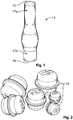
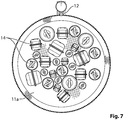
- the set of elements of the illustrated embodiment includes a magnetic pickup apparatus such as a bottle-shaped magnetic "wand" 13 (see Fig. 1 ), a plurality of ferromagnetic game pieces such as coloured ferromagnetic bells 14 of various sizes, weights, and colours (see Fig. 2 ), and an optional container such as a pouch 11 (see Fig. 5 ), which, in some embodiments, also can serve as a playing surface 11a (see Fig. 4 ).
- a magnetic pickup apparatus such as a bottle-shaped magnetic "wand” 13 (see Fig. 1 )
- a plurality of ferromagnetic game pieces such as coloured ferromagnetic bells 14 of various sizes, weights, and colours
- an optional container such as a pouch 11 (see Fig. 5 ), which, in some embodiments, also can serve as a playing surface 11a (see Fig. 4 ).
- players can take turns using the magnetic wand 13 to attempt to pick up a "string" of bells 14 of a single colour from the playing surface 11a according to detailed rules of play.
- the pouch 11 can be semicircular and, when opened, is a circular piece of flexible material having a releasable fastener such as zipper 12 about its perimeter.
- the zipper 12 permits the opposing halves of the pouch 11 to be releasably attached to one another to thereby provide a closable pouch, or container, for the magnetic wand 13 and the plurality of coloured ferromagnetic bells 14, as shown in Figure 6 .
- the pouch 11 is made of a flexible foam material with decorative fabric attached to both sides.
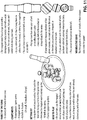
- the pouch 11 also serves as a playing surface 11a, as shown in Figure 7 .
- the pouch 11 When opened, the pouch 11 has a circular, mat-like shape that provisions the playing surface 11a.
- the pouch 11 When the zipper 12 is engaged and in closed position, the pouch 11 has a semi-circular, pocket-like shape and can function as a container for the game components.
- the pouch 11 may be omitted in its entirety or replaced, for example, with a plastic dished member with a flat bottom interior surface to hold the bells 14, or with any other suitable member.
- the magnetic wand 13 of the illustrated embodiment has a bottle-like shape, a first end such as top end 15, and a second end such as bottom end 16, with the wand 13 asymmetrically tapering towards the ends.
- the first and second ends 15 and 16 of the wand 13 are circular and have different diameters, as shown in Figure 8 .
- the bottom end 16 has a larger diameter than the top end 15.
- the surfaces of the first and second ends 15 and 16 are slightly and smoothly rounded, or curved outwardly, from the ends 15 and 16 of the wand 13.
- Magnets are incorporated into the wand such as magnets 17a and 17b located in each end 15 and 16 of the wand 13.
- Magnet 17a which is weaker than magnet 17b, is located inside and adjacent the first end 15 of the wand 3.
- Magnet 17b which is stronger than magnet 17a, is located inside and adjacent the bottom end 16 of the wand 13.
- the stronger magnet 17b generates a stronger magnetic field than the weaker magnet 17a.
- the magnets 17 are permanent magnets.
- the wand 13 can have three or more magnets 17 each having a different magnetic strength.
- a three-pointed wand may be used instead of the two-ended wand 13, wherein each of the three points of the wand has a magnet 17 having a strength that differs from the strengths of the other magnets 17.
- the plurality of coloured ferromagnetic bells 14 are generally spherical and hollow, with a hard pellet (not shown) loosely contained therein.
- One or more apertures 18 in the walls of the bells 14 permit the sound made by the pellet to emanate from the bells 14.
- Bells of this type are sometimes referred to as sleigh bells or jingle bells.
- the bells 14 are made of a ferromagnetic material, such as nickel, iron, or another magnetic material or alloy.
- a plurality of bells 14 are provided in various sizes, weights, and colours, with an equal number of bells 14 of each size, weight, and colour.
- each colour having two large bells, having a diameter of 2.6 cm at the midpoint; three medium bells, having a diameter of 2.0 cm at the midpoint; and five small bells, having a diameter of 1.3 cm at the midpoint.
- the ferromagnetic game pieces can have different colour, size and/or weight characteristics.
- the magnetic targets can be organized into multiple groups based on a first characteristic, such as colour or shape.
- the magnetic targets could have one of a predefined number of shapes such as round, square, heart, cross, etc.
- Each said group can be further organized into a series, wherein at least two of the members of each series have different weights.
- the series of heart shaped targets could include four members, having small, medium, medium and large weights, respectively.
- One method of game play involves a player attempting to selectively pick up bells 14 of a single colour from the plurality of bells 14 located on the playing surface 11a, using one end of the wand 13.
- the player places a plurality of bells 14 on the playing surface 11a, as shown in Figure 7 .
- the number of different colours of bells 14 may be selected, based on the number of players.
- the number and size of the bells 14 relative to the size of the playing surface 11a are such that there would be a reasonable likelihood of many bells 14 clumping together if they were to be randomly deposited onto the playing surface 11a. This increases the likelihood of magnetic interference, making the game more interesting.
- the player decides whether to use the weaker magnet 17a or the stronger magnet 17b and selects the desired magnet 7.
- the player may select the weaker magnet 17a by grasping the wand 13 by the bottom end 16, as shown in Figure 8 , or may select the stronger magnet 17b by grasping the wand 13 by the top end 15, as shown in Figure 9 .
- Using the stronger magnet 17b provides the player with a stronger magnetic field, which exerts a stronger attraction on the bells 14, thereby permitting the player to pick up more weight, for example, a long "string" of bells 14, as shown in Figure 10 .
- the weaker magnet 17a provides the player with a weaker magnetic field, which exerts a weaker attraction on the bells 14, thereby permitting the player to pick up bells 14 with greater precision. For example, a player may select the weaker magnet 17a to pick up a bell 14 of his or her colour, which is surrounded by bells 14 of another colour. Alternatively, a player may select the stronger magnet 17b to pick up a number of bells 14 of his or her colour, which are grouped together and isolated from bells 14 of another colour.
- the player may set these bells 14 aside. Alternatively, the player may attempt to pick up additional bells 14. If the player picks up bells 14 of more than one colour, the player immediately returns all bells 14 picked up that turn to the playing surface 11a. At any time after picking up one or more bells 14 the player may stop the turn and set aside the bells 14 picked up that turn, so long as bells 14 of only a single colour have been picked up that turn.
- the next player can then grasps the wand 13 and attempts to pick up bells 4 of his or her colour, as above.
- the players take turns until one of them has picked up all of the bells 4 of his or her colour.
- the game may be played by one or more players, using one playing surface 11a, one wand 13, and a plurality of bells 14 of different colours.
- the number of players is equal to the number of different colours of bells 14.
- Figure 11 shows a pamphlet detailing specific rules of play governing how players take turns and the results required to win the game. Alternative rules are also possible.
Landscapes
- Engineering & Computer Science (AREA)
- Multimedia (AREA)
- Toys (AREA)
Description
- This disclosure relates to games and in particular to a game that incorporates a magnetic member intended for picking up other items.
- Games using magnets are available in a wide variety of forms, including games where players pick up game pieces without directly using their hands. For example, a "Magnetic Card Pick-up Game and Apparatus" is disclosed in
U.S. patent number 5,722,663 to Avigal et al. , wherein a player uses a magnet tied to an elastic cable to pick up magnetic cards. - Magnetic games can exercise the manual dexterity of the players. Magnetic games may also be used to educate players, particularly young children, about the principles of magnetism and the physics of magnetic fields. One example of a magnetic game can be found in
DE19842699 . - According to one aspect, game apparatus is provided which includes a playing surface, a magnetic pickup apparatus and a plurality of ferromagnetic game pieces. The magnetic pickup apparatus has at least two spaced-apart game piece pickup regions wherein each pickup region incorporates a magnet having field strength differing than the field strength of the magnet associated with other pickup points. The magnetic pickup apparatus is capable of being manipulated by a user to magnetically pick up a ferromagnetic object using any one of the incorporated magnets. The ferromagnetic game pieces are provisioned having different colour, size and/or weight characteristics and are sized and weighted to be picked up from the playing surface by each of at least two spaced-apart game piece pickup regions on the magnetic pickup apparatus.
- The magnetic pickup apparatus can be a wand having first and second opposing ends, the game piece pickup regions being located at the first and second opposing ends, respectively.
- The ferromagnetic game pieces can be organized into multiple groups based on a first characteristic, with each group being organized into a series, wherein at least two of the members of each series have different weights.
- The game apparatus can include a container sized to at least store the magnetic pickup apparatus and the plurality of ferromagnetic game pieces. The container can provide a defined playing surface upon which the ferromagnetic game pieces may be disposed for pickup by a user utilizing the magnetic pickup apparatus. The container can be a pouch formed from flexible material.
- There is also provided, not in accordance with the present invention, a method of game play utilizing a magnetic pickup apparatus and a plurality of ferromagnetic game pieces, wherein the magnetic pickup apparatus has at least two spaced-apart game piece pickup regions, wherein each pickup region incorporates a magnet having field strength differing than the field strength of the magnet associated with other pickup points, wherein the magnetic pickup apparatus is capable of being manipulated by a user to magnetically pick up a ferromagnetic object using any one of the incorporated magnets, and wherein the plurality of ferromagnetic game pieces are organized into multiple groups based on a first characteristic, each group being organized into a series, wherein at least two of the members of each said series have different weights. The method includes: depositing the game pieces onto a defined playing area, wherein the number and size of the ferromagnetic game pieces relative to
the size of said playing area are such that there would be a reasonable likelihood of many of the ferromagnetic game pieces clumping together if the ferromagnetic game pieces were to be randomly deposited on the defined playing area; and playing a game with multiple players, where each player is assigned to a group of the ferromagnetic game pieces corresponding to a particular one of the ferromagnetic game piece characteristics, and the player's objective is to pick up only the assigned ferromagnetic game pieces. - The foregoing and other aspects of the invention will be more readily appreciated having reference to the drawings, wherein:
-
Figure 1 is a front view of a magnetic wand, which is an element of a first embodiment of a magnetic game apparatus. -
Figure 2 is a perspective view of ferromagnetic bells of various sizes, weights, and colours; the bells constituting additional elements of the first embodiment. -
Figure 3A is a side view of a series of bells of the same colour, having different sizes and weights. -
Figure 3B is a top view of the series of bells shown inFigure 3A . -
Figure 4 is a top view of a playing surface, which is another element of the first embodiment. -
Figure 5 is a side view of a pouch, which can provide the playing surface shown inFigure 4 . -
Figure 6 is a perspective view of the pouch, partially opened, showing the magnetic wand and bells contained therein. -
Figure 7 is a top view of the pouch, fully opened, flattened for use as the playing surface and having various bells located thereon. -
Figure 8 is a view of the magnetic wand being grasped in a first orientation. -
Figure 9 is view of the magnetic wand being grasped in a second orientation, opposite the first orientation. -
Figure 10 is a view of the magnetic wand being grasped by a user to pick up a "string" of bells. -
Figure 11 is a diagram of a pamphlet detailing rules of play for a method playing a game using the apparatus of the first embodiment. - The drawings show an embodiment of a set of elements for a game (the "illustrated embodiment"). As will be discussed in greater detail below, the invention is broader in scope than the illustrated embodiment and thus the illustrated embodiment should be understood only as an example of the invention, which is defined by the scope of the appended claims.
- The set of elements of the illustrated embodiment includes a magnetic pickup apparatus such as a bottle-shaped magnetic "wand" 13 (see
Fig. 1 ), a plurality of ferromagnetic game pieces such as colouredferromagnetic bells 14 of various sizes, weights, and colours (seeFig. 2 ), and an optional container such as a pouch 11 (seeFig. 5 ), which, in some embodiments, also can serve as aplaying surface 11a (seeFig. 4 ). - In one potential method of play, players can take turns using the
magnetic wand 13 to attempt to pick up a "string" ofbells 14 of a single colour from theplaying surface 11a according to detailed rules of play. - As shown in
Figures 4 and5 , thepouch 11 can be semicircular and, when opened, is a circular piece of flexible material having a releasable fastener such aszipper 12 about its perimeter. Thezipper 12 permits the opposing halves of thepouch 11 to be releasably attached to one another to thereby provide a closable pouch, or container, for themagnetic wand 13 and the plurality of colouredferromagnetic bells 14, as shown inFigure 6 . Preferably, thepouch 11 is made of a flexible foam material with decorative fabric attached to both sides. - The
pouch 11 also serves as aplaying surface 11a, as shown inFigure 7 . When opened, thepouch 11 has a circular, mat-like shape that provisions the playingsurface 11a. When thezipper 12 is engaged and in closed position, thepouch 11 has a semi-circular, pocket-like shape and can function as a container for the game components. - In alternative embodiments, the
pouch 11 may be omitted in its entirety or replaced, for example, with a plastic dished member with a flat bottom interior surface to hold thebells 14, or with any other suitable member. - As shown in
Figure 1 , themagnetic wand 13 of the illustrated embodiment has a bottle-like shape, a first end such astop end 15, and a second end such asbottom end 16, with thewand 13 asymmetrically tapering towards the ends. The first andsecond ends wand 13 are circular and have different diameters, as shown inFigure 8 . Thebottom end 16 has a larger diameter than thetop end 15. The surfaces of the first andsecond ends ends wand 13. - Magnets are incorporated into the wand such as
magnets end wand 13.Magnet 17a, which is weaker thanmagnet 17b, is located inside and adjacent thefirst end 15 of the wand 3.Magnet 17b, which is stronger thanmagnet 17a, is located inside and adjacent thebottom end 16 of thewand 13. Thestronger magnet 17b generates a stronger magnetic field than theweaker magnet 17a. Preferably, the magnets 17 are permanent magnets. - In alternative embodiments, the
wand 13 can have three or more magnets 17 each having a different magnetic strength. For example, a three-pointed wand may be used instead of the two-ended wand 13, wherein each of the three points of the wand has a magnet 17 having a strength that differs from the strengths of the other magnets 17. - As shown in
Figures 2 and3 , the plurality of colouredferromagnetic bells 14 are generally spherical and hollow, with a hard pellet (not shown) loosely contained therein. One or more apertures 18 in the walls of thebells 14 permit the sound made by the pellet to emanate from thebells 14. Bells of this type are sometimes referred to as sleigh bells or jingle bells. Thebells 14 are made of a ferromagnetic material, such as nickel, iron, or another magnetic material or alloy. Preferably, a plurality ofbells 14 are provided in various sizes, weights, and colours, with an equal number ofbells 14 of each size, weight, and colour. For example, four different colours ofbells 14 may be provided, each colour having two large bells, having a diameter of 2.6 cm at the midpoint; three medium bells, having a diameter of 2.0 cm at the midpoint; and five small bells, having a diameter of 1.3 cm at the midpoint. - In alternative embodiments, other arrangements of ferromagnetic game pieces or targets are possible. Generally speaking, the ferromagnetic game pieces can have different colour, size and/or weight characteristics. For the purposes of game play whose objective is to pick up at least one and preferably a string of magnetic targets, the magnetic targets can be organized into multiple groups based on a first characteristic, such as colour or shape. For example, the magnetic targets could have one of a predefined number of shapes such as round, square, heart, cross, etc. Each said group can be further organized into a series, wherein at least two of the members of each series have different weights. Thus, for example, the series of heart shaped targets could include four members, having small, medium, medium and large weights, respectively.
- One method of game play involves a player attempting to selectively pick up
bells 14 of a single colour from the plurality ofbells 14 located on the playingsurface 11a, using one end of thewand 13. First, the player places a plurality ofbells 14 on the playingsurface 11a, as shown inFigure 7 . The number of different colours ofbells 14 may be selected, based on the number of players. Preferably, the number and size of thebells 14 relative to the size of the playingsurface 11a are such that there would be a reasonable likelihood ofmany bells 14 clumping together if they were to be randomly deposited onto the playingsurface 11a. This increases the likelihood of magnetic interference, making the game more interesting. - Before attempting to pick up any
bells 14, the player decides whether to use theweaker magnet 17a or thestronger magnet 17b and selects the desired magnet 7. The player may select theweaker magnet 17a by grasping thewand 13 by thebottom end 16, as shown inFigure 8 , or may select thestronger magnet 17b by grasping thewand 13 by thetop end 15, as shown inFigure 9 . Using thestronger magnet 17b provides the player with a stronger magnetic field, which exerts a stronger attraction on thebells 14, thereby permitting the player to pick up more weight, for example, a long "string" ofbells 14, as shown inFigure 10 . Using theweaker magnet 17a provides the player with a weaker magnetic field, which exerts a weaker attraction on thebells 14, thereby permitting the player to pick upbells 14 with greater precision. For example, a player may select theweaker magnet 17a to pick up abell 14 of his or her colour, which is surrounded bybells 14 of another colour. Alternatively, a player may select thestronger magnet 17b to pick up a number ofbells 14 of his or her colour, which are grouped together and isolated frombells 14 of another colour. - Once one or
more bells 14 of a single colour have been picked up using thewand 13, the player may set thesebells 14 aside. Alternatively, the player may attempt to pick upadditional bells 14. If the player picks upbells 14 of more than one colour, the player immediately returns allbells 14 picked up that turn to the playingsurface 11a. At any time after picking up one ormore bells 14 the player may stop the turn and set aside thebells 14 picked up that turn, so long asbells 14 of only a single colour have been picked up that turn. - The next player can then grasps the
wand 13 and attempts to pick upbells 4 of his or her colour, as above. The players take turns until one of them has picked up all of thebells 4 of his or her colour. - The game may be played by one or more players, using one
playing surface 11a, onewand 13, and a plurality ofbells 14 of different colours. Preferably, the number of players is equal to the number of different colours ofbells 14. -
Figure 11 shows a pamphlet detailing specific rules of play governing how players take turns and the results required to win the game. Alternative rules are also possible. - The embodiments are described herein illustratively and are not meant to limit the scope of the invention as claimed. Variations of the foregoing embodiments will be evident to a person of ordinary skill and are intended by the inventor to be encompassed by the appended claims.
Claims (5)
- A set of elements for a game, comprising:a playing surface (11a);a magnetic pickup apparatus having at least two spaced-apart game piece pickup regions, wherein each pickup region incorporates a magnet (17) having field strength differing than the field strength of the magnet (17) associated with other pickup regions, said magnetic pickup apparatus capable of being manipulated by a user to magnetically pick up a ferromagnetic object using any one of said incorporated magnets (17); anda plurality of ferromagnetic game pieces, characterized in that the plurality of ferromagnetic game pieces have different colour, size and/or weight characteristics that are sized and weighted to be picked up from the playing surface (11a) by the magnet associated with each of the at least two spaced-apart game piece pickup regions on the magnetic pickup apparatus.
- A set of elements according to claim 1, wherein the magnetic pickup apparatus is a wand (13) having first and second opposing ends (15, 16), and wherein said game piece pickup regions are located at said first and second opposing ends (15, 16), respectively.
- A set of elements according to claim 1, wherein said plurality of ferromagnetic game pieces are organized into multiple groups based on a first characteristic, each said group being organized into a series, wherein at least two of the members of each said series have different weights.
- A set of elements according to claim 1, including a container sized to at least store said magnetic game pickup apparatus and said plurality of ferromagnetic game pieces, said container providing the playing surface (11a) upon which said ferromagnetic game pieces may be disposed for pickup by a user utilizing said magnetic pickup apparatus.
- A set of elements according to claim 4, wherein said container is a pouch (11) formed from flexible material.
Priority Applications (1)
| Application Number | Priority Date | Filing Date | Title |
|---|---|---|---|
| PL16161184T PL3072562T3 (en) | 2015-03-25 | 2016-03-18 | Magnetic game apparatus and method |
Applications Claiming Priority (1)
| Application Number | Priority Date | Filing Date | Title |
|---|---|---|---|
| US201562137864P | 2015-03-25 | 2015-03-25 |
Publications (3)
| Publication Number | Publication Date |
|---|---|
| EP3072562A2 EP3072562A2 (en) | 2016-09-28 |
| EP3072562A3 EP3072562A3 (en) | 2016-10-19 |
| EP3072562B1 true EP3072562B1 (en) | 2019-04-03 |
Family
ID=55650147
Family Applications (1)
| Application Number | Title | Priority Date | Filing Date |
|---|---|---|---|
| EP16161184.3A Active EP3072562B1 (en) | 2015-03-25 | 2016-03-18 | Magnetic game apparatus and method |
Country Status (4)
| Country | Link |
|---|---|
| US (1) | US20160287983A1 (en) |
| EP (1) | EP3072562B1 (en) |
| ES (1) | ES2733710T3 (en) |
| PL (1) | PL3072562T3 (en) |
Family Cites Families (22)
| Publication number | Priority date | Publication date | Assignee | Title |
|---|---|---|---|---|
| US2657059A (en) * | 1951-09-14 | 1953-10-27 | Selig Pearl | Magnetic lot selecting device |
| US3249357A (en) * | 1963-03-20 | 1966-05-03 | Luchland Company | Magnetic game of skill |
| US3409302A (en) * | 1965-05-10 | 1968-11-05 | Harrison Billy Jack | Doodlebug fishing game |
| US3684288A (en) * | 1970-08-06 | 1972-08-15 | John M Grace | Board game apparatus |
| US3830498A (en) * | 1972-02-17 | 1974-08-20 | A Lauzon | Bifurcated magnetic sphere with resilient tether |
| US3811681A (en) * | 1972-12-15 | 1974-05-21 | D Sprouse | Game with magnetic extraction of counters |
| US3965613A (en) * | 1975-02-12 | 1976-06-29 | Saunders Jack L | Magnetic toy |
| US4165075A (en) * | 1977-06-30 | 1979-08-21 | Fair Equipment Company, Inc. | Fishing game device |
| US4172597A (en) * | 1978-05-11 | 1979-10-30 | Regale Enterprises | Magnetic pick-up device and marker |
| US4234185A (en) * | 1978-06-08 | 1980-11-18 | Alsip Bruce F | Strategy and perception game |
| US4395043A (en) * | 1981-02-20 | 1983-07-26 | Keystone Bingo Products, Inc. | Game chip |
| US4575091A (en) * | 1984-10-01 | 1986-03-11 | Boomer Mark J | Word game of magnetizable letters for children |
| US4977941A (en) * | 1990-03-19 | 1990-12-18 | Henderson Esther L | Bingo bag with self-supporting vertical wall |
| US5085434A (en) * | 1990-11-01 | 1992-02-04 | Soto Ii Luis A | Magnetic indicator device |
| US5114146A (en) * | 1991-06-24 | 1992-05-19 | Booker Ernest R | Apparatus and method for random selection of indicia |
| AU1967095A (en) | 1994-02-17 | 1995-09-04 | Surgical Accessories, Inc. | Fastener and tensioner for bone securing cable |
| US5810640A (en) * | 1995-03-17 | 1998-09-22 | General Research And Device Corporation | Magnetic gel toy and method for making |
| GB2309916A (en) * | 1996-02-09 | 1997-08-13 | Marcus Christopher Simpson | Apparatus for games |
| DE19842699C2 (en) * | 1998-09-18 | 2002-02-07 | Michael Splitgerber | Pocket-sized board game |
| US8118306B2 (en) * | 2008-03-26 | 2012-02-21 | Denise Kean | Therapy games |
| US8757628B1 (en) * | 2011-12-08 | 2014-06-24 | Rick Baker | Ball capture game assembly |
| KR101247330B1 (en) * | 2012-04-12 | 2013-03-26 | 정혁 | Screen fishing equipment |
-
2016
- 2016-03-18 EP EP16161184.3A patent/EP3072562B1/en active Active
- 2016-03-18 ES ES16161184T patent/ES2733710T3/en active Active
- 2016-03-18 PL PL16161184T patent/PL3072562T3/en unknown
- 2016-03-22 US US15/077,696 patent/US20160287983A1/en not_active Abandoned
Non-Patent Citations (1)
| Title |
|---|
| None * |
Also Published As
| Publication number | Publication date |
|---|---|
| PL3072562T3 (en) | 2019-09-30 |
| ES2733710T3 (en) | 2019-12-02 |
| EP3072562A3 (en) | 2016-10-19 |
| EP3072562A2 (en) | 2016-09-28 |
| US20160287983A1 (en) | 2016-10-06 |
Similar Documents
| Publication | Publication Date | Title |
|---|---|---|
| US5566949A (en) | Tethered ball game device | |
| US20110074109A1 (en) | Ring toss game and equipment therefor | |
| EP3582867B1 (en) | Spin and catch game | |
| US11638867B2 (en) | Simulated soccer game device and method | |
| US3249357A (en) | Magnetic game of skill | |
| Sahay | Traditional children’s games of Bihar | |
| EP3131650B1 (en) | Article moveable between two positions and a method of combining two or more of the same | |
| EP3072562A2 (en) | Magnetic game apparatus and method | |
| US5683083A (en) | Top game and method of playing same | |
| US5722663A (en) | Magnetic card pick-up game and apparatus | |
| US20220347536A1 (en) | A hand implement for improving hand-eye coordination | |
| US10967247B1 (en) | Game utilizing magnetic forces | |
| Ghosh | Traditional sports and games culture around West Bengal | |
| US3830498A (en) | Bifurcated magnetic sphere with resilient tether | |
| US4575091A (en) | Word game of magnetizable letters for children | |
| EP2781243B1 (en) | Board game instrument for learning | |
| US5382027A (en) | Simulated dough tossing game | |
| US20150375099A1 (en) | Hand/eye coordination therapy game | |
| US20140346735A1 (en) | Spinning Ball Game Apparatus and Game Play | |
| US20120200040A1 (en) | Toy and promotional element | |
| US20040102290A1 (en) | Juggling tool for training and enhanced performance | |
| KR101745175B1 (en) | Combine Sport Game Instruments for Yut Playing And Method of Yut Playing | |
| US20250025767A1 (en) | Toy for spinning cards onto a play area to introduce randomization and accompanying trading card game | |
| Oleksandra | HISTORY AND STAGE METHOD OF JUGGLING WITH HULA HOOPS | |
| JP2024164776A (en) | Magnetic balls and games |
Legal Events
| Date | Code | Title | Description |
|---|---|---|---|
| PUAI | Public reference made under article 153(3) epc to a published international application that has entered the european phase |
Free format text: ORIGINAL CODE: 0009012 |
|
| PUAL | Search report despatched |
Free format text: ORIGINAL CODE: 0009013 |
|
| AK | Designated contracting states |
Kind code of ref document: A2 Designated state(s): AL AT BE BG CH CY CZ DE DK EE ES FI FR GB GR HR HU IE IS IT LI LT LU LV MC MK MT NL NO PL PT RO RS SE SI SK SM TR |
|
| AX | Request for extension of the european patent |
Extension state: BA ME |
|
| AK | Designated contracting states |
Kind code of ref document: A3 Designated state(s): AL AT BE BG CH CY CZ DE DK EE ES FI FR GB GR HR HU IE IS IT LI LT LU LV MC MK MT NL NO PL PT RO RS SE SI SK SM TR |
|
| AX | Request for extension of the european patent |
Extension state: BA ME |
|
| RIC1 | Information provided on ipc code assigned before grant |
Ipc: A63F 9/30 20060101AFI20160909BHEP Ipc: A63F 9/34 20060101ALI20160909BHEP Ipc: A63F 11/00 20060101ALN20160909BHEP |
|
| STAA | Information on the status of an ep patent application or granted ep patent |
Free format text: STATUS: REQUEST FOR EXAMINATION WAS MADE |
|
| 17P | Request for examination filed |
Effective date: 20170418 |
|
| RBV | Designated contracting states (corrected) |
Designated state(s): AL AT BE BG CH CY CZ DE DK EE ES FI FR GB GR HR HU IE IS IT LI LT LU LV MC MK MT NL NO PL PT RO RS SE SI SK SM TR |
|
| RAP1 | Party data changed (applicant data changed or rights of an application transferred) |
Owner name: SPIN MASTER LTD. |
|
| GRAP | Despatch of communication of intention to grant a patent |
Free format text: ORIGINAL CODE: EPIDOSNIGR1 |
|
| STAA | Information on the status of an ep patent application or granted ep patent |
Free format text: STATUS: GRANT OF PATENT IS INTENDED |
|
| RIC1 | Information provided on ipc code assigned before grant |
Ipc: A63F 11/00 20060101ALN20181106BHEP Ipc: A63F 9/30 20060101AFI20181106BHEP Ipc: A63F 9/34 20060101ALI20181106BHEP |
|
| INTG | Intention to grant announced |
Effective date: 20181205 |
|
| GRAS | Grant fee paid |
Free format text: ORIGINAL CODE: EPIDOSNIGR3 |
|
| GRAA | (expected) grant |
Free format text: ORIGINAL CODE: 0009210 |
|
| STAA | Information on the status of an ep patent application or granted ep patent |
Free format text: STATUS: THE PATENT HAS BEEN GRANTED |
|
| AK | Designated contracting states |
Kind code of ref document: B1 Designated state(s): AL AT BE BG CH CY CZ DE DK EE ES FI FR GB GR HR HU IE IS IT LI LT LU LV MC MK MT NL NO PL PT RO RS SE SI SK SM TR |
|
| REG | Reference to a national code |
Ref country code: GB Ref legal event code: FG4D |
|
| REG | Reference to a national code |
Ref country code: CH Ref legal event code: EP Ref country code: AT Ref legal event code: REF Ref document number: 1115020 Country of ref document: AT Kind code of ref document: T Effective date: 20190415 |
|
| REG | Reference to a national code |
Ref country code: DE Ref legal event code: R096 Ref document number: 602016011751 Country of ref document: DE |
|
| REG | Reference to a national code |
Ref country code: IE Ref legal event code: FG4D |
|
| REG | Reference to a national code |
Ref country code: NL Ref legal event code: MP Effective date: 20190403 |
|
| REG | Reference to a national code |
Ref country code: LT Ref legal event code: MG4D |
|
| REG | Reference to a national code |
Ref country code: AT Ref legal event code: MK05 Ref document number: 1115020 Country of ref document: AT Kind code of ref document: T Effective date: 20190403 |
|
| PG25 | Lapsed in a contracting state [announced via postgrant information from national office to epo] |
Ref country code: NL Free format text: LAPSE BECAUSE OF FAILURE TO SUBMIT A TRANSLATION OF THE DESCRIPTION OR TO PAY THE FEE WITHIN THE PRESCRIBED TIME-LIMIT Effective date: 20190403 |
|
| PG25 | Lapsed in a contracting state [announced via postgrant information from national office to epo] |
Ref country code: SE Free format text: LAPSE BECAUSE OF FAILURE TO SUBMIT A TRANSLATION OF THE DESCRIPTION OR TO PAY THE FEE WITHIN THE PRESCRIBED TIME-LIMIT Effective date: 20190403 Ref country code: HR Free format text: LAPSE BECAUSE OF FAILURE TO SUBMIT A TRANSLATION OF THE DESCRIPTION OR TO PAY THE FEE WITHIN THE PRESCRIBED TIME-LIMIT Effective date: 20190403 Ref country code: AL Free format text: LAPSE BECAUSE OF FAILURE TO SUBMIT A TRANSLATION OF THE DESCRIPTION OR TO PAY THE FEE WITHIN THE PRESCRIBED TIME-LIMIT Effective date: 20190403 Ref country code: PT Free format text: LAPSE BECAUSE OF FAILURE TO SUBMIT A TRANSLATION OF THE DESCRIPTION OR TO PAY THE FEE WITHIN THE PRESCRIBED TIME-LIMIT Effective date: 20190803 Ref country code: FI Free format text: LAPSE BECAUSE OF FAILURE TO SUBMIT A TRANSLATION OF THE DESCRIPTION OR TO PAY THE FEE WITHIN THE PRESCRIBED TIME-LIMIT Effective date: 20190403 Ref country code: NO Free format text: LAPSE BECAUSE OF FAILURE TO SUBMIT A TRANSLATION OF THE DESCRIPTION OR TO PAY THE FEE WITHIN THE PRESCRIBED TIME-LIMIT Effective date: 20190703 Ref country code: CZ Free format text: LAPSE BECAUSE OF FAILURE TO SUBMIT A TRANSLATION OF THE DESCRIPTION OR TO PAY THE FEE WITHIN THE PRESCRIBED TIME-LIMIT Effective date: 20190403 Ref country code: LT Free format text: LAPSE BECAUSE OF FAILURE TO SUBMIT A TRANSLATION OF THE DESCRIPTION OR TO PAY THE FEE WITHIN THE PRESCRIBED TIME-LIMIT Effective date: 20190403 |
|
| PG25 | Lapsed in a contracting state [announced via postgrant information from national office to epo] |
Ref country code: BG Free format text: LAPSE BECAUSE OF FAILURE TO SUBMIT A TRANSLATION OF THE DESCRIPTION OR TO PAY THE FEE WITHIN THE PRESCRIBED TIME-LIMIT Effective date: 20190703 Ref country code: RS Free format text: LAPSE BECAUSE OF FAILURE TO SUBMIT A TRANSLATION OF THE DESCRIPTION OR TO PAY THE FEE WITHIN THE PRESCRIBED TIME-LIMIT Effective date: 20190403 Ref country code: LV Free format text: LAPSE BECAUSE OF FAILURE TO SUBMIT A TRANSLATION OF THE DESCRIPTION OR TO PAY THE FEE WITHIN THE PRESCRIBED TIME-LIMIT Effective date: 20190403 Ref country code: GR Free format text: LAPSE BECAUSE OF FAILURE TO SUBMIT A TRANSLATION OF THE DESCRIPTION OR TO PAY THE FEE WITHIN THE PRESCRIBED TIME-LIMIT Effective date: 20190704 |
|
| REG | Reference to a national code |
Ref country code: ES Ref legal event code: FG2A Ref document number: 2733710 Country of ref document: ES Kind code of ref document: T3 Effective date: 20191202 |
|
| PG25 | Lapsed in a contracting state [announced via postgrant information from national office to epo] |
Ref country code: IS Free format text: LAPSE BECAUSE OF FAILURE TO SUBMIT A TRANSLATION OF THE DESCRIPTION OR TO PAY THE FEE WITHIN THE PRESCRIBED TIME-LIMIT Effective date: 20190803 Ref country code: AT Free format text: LAPSE BECAUSE OF FAILURE TO SUBMIT A TRANSLATION OF THE DESCRIPTION OR TO PAY THE FEE WITHIN THE PRESCRIBED TIME-LIMIT Effective date: 20190403 |
|
| REG | Reference to a national code |
Ref country code: DE Ref legal event code: R097 Ref document number: 602016011751 Country of ref document: DE |
|
| PG25 | Lapsed in a contracting state [announced via postgrant information from national office to epo] |
Ref country code: DK Free format text: LAPSE BECAUSE OF FAILURE TO SUBMIT A TRANSLATION OF THE DESCRIPTION OR TO PAY THE FEE WITHIN THE PRESCRIBED TIME-LIMIT Effective date: 20190403 Ref country code: EE Free format text: LAPSE BECAUSE OF FAILURE TO SUBMIT A TRANSLATION OF THE DESCRIPTION OR TO PAY THE FEE WITHIN THE PRESCRIBED TIME-LIMIT Effective date: 20190403 Ref country code: SK Free format text: LAPSE BECAUSE OF FAILURE TO SUBMIT A TRANSLATION OF THE DESCRIPTION OR TO PAY THE FEE WITHIN THE PRESCRIBED TIME-LIMIT Effective date: 20190403 Ref country code: RO Free format text: LAPSE BECAUSE OF FAILURE TO SUBMIT A TRANSLATION OF THE DESCRIPTION OR TO PAY THE FEE WITHIN THE PRESCRIBED TIME-LIMIT Effective date: 20190403 |
|
| PLBE | No opposition filed within time limit |
Free format text: ORIGINAL CODE: 0009261 |
|
| STAA | Information on the status of an ep patent application or granted ep patent |
Free format text: STATUS: NO OPPOSITION FILED WITHIN TIME LIMIT |
|
| PG25 | Lapsed in a contracting state [announced via postgrant information from national office to epo] |
Ref country code: SM Free format text: LAPSE BECAUSE OF FAILURE TO SUBMIT A TRANSLATION OF THE DESCRIPTION OR TO PAY THE FEE WITHIN THE PRESCRIBED TIME-LIMIT Effective date: 20190403 |
|
| 26N | No opposition filed |
Effective date: 20200106 |
|
| PG25 | Lapsed in a contracting state [announced via postgrant information from national office to epo] |
Ref country code: TR Free format text: LAPSE BECAUSE OF FAILURE TO SUBMIT A TRANSLATION OF THE DESCRIPTION OR TO PAY THE FEE WITHIN THE PRESCRIBED TIME-LIMIT Effective date: 20190403 |
|
| PG25 | Lapsed in a contracting state [announced via postgrant information from national office to epo] |
Ref country code: SI Free format text: LAPSE BECAUSE OF FAILURE TO SUBMIT A TRANSLATION OF THE DESCRIPTION OR TO PAY THE FEE WITHIN THE PRESCRIBED TIME-LIMIT Effective date: 20190403 |
|
| PG25 | Lapsed in a contracting state [announced via postgrant information from national office to epo] |
Ref country code: MC Free format text: LAPSE BECAUSE OF FAILURE TO SUBMIT A TRANSLATION OF THE DESCRIPTION OR TO PAY THE FEE WITHIN THE PRESCRIBED TIME-LIMIT Effective date: 20190403 |
|
| REG | Reference to a national code |
Ref country code: CH Ref legal event code: PL |
|
| REG | Reference to a national code |
Ref country code: BE Ref legal event code: MM Effective date: 20200331 |
|
| PG25 | Lapsed in a contracting state [announced via postgrant information from national office to epo] |
Ref country code: LU Free format text: LAPSE BECAUSE OF NON-PAYMENT OF DUE FEES Effective date: 20200318 |
|
| PG25 | Lapsed in a contracting state [announced via postgrant information from national office to epo] |
Ref country code: IE Free format text: LAPSE BECAUSE OF NON-PAYMENT OF DUE FEES Effective date: 20200318 Ref country code: CH Free format text: LAPSE BECAUSE OF NON-PAYMENT OF DUE FEES Effective date: 20200331 Ref country code: LI Free format text: LAPSE BECAUSE OF NON-PAYMENT OF DUE FEES Effective date: 20200331 |
|
| PG25 | Lapsed in a contracting state [announced via postgrant information from national office to epo] |
Ref country code: BE Free format text: LAPSE BECAUSE OF NON-PAYMENT OF DUE FEES Effective date: 20200331 |
|
| PG25 | Lapsed in a contracting state [announced via postgrant information from national office to epo] |
Ref country code: MT Free format text: LAPSE BECAUSE OF FAILURE TO SUBMIT A TRANSLATION OF THE DESCRIPTION OR TO PAY THE FEE WITHIN THE PRESCRIBED TIME-LIMIT Effective date: 20190403 Ref country code: CY Free format text: LAPSE BECAUSE OF FAILURE TO SUBMIT A TRANSLATION OF THE DESCRIPTION OR TO PAY THE FEE WITHIN THE PRESCRIBED TIME-LIMIT Effective date: 20190403 |
|
| PG25 | Lapsed in a contracting state [announced via postgrant information from national office to epo] |
Ref country code: MK Free format text: LAPSE BECAUSE OF FAILURE TO SUBMIT A TRANSLATION OF THE DESCRIPTION OR TO PAY THE FEE WITHIN THE PRESCRIBED TIME-LIMIT Effective date: 20190403 |
|
| P01 | Opt-out of the competence of the unified patent court (upc) registered |
Effective date: 20230602 |
|
| PGFP | Annual fee paid to national office [announced via postgrant information from national office to epo] |
Ref country code: ES Payment date: 20250401 Year of fee payment: 10 |
|
| PGFP | Annual fee paid to national office [announced via postgrant information from national office to epo] |
Ref country code: GB Payment date: 20260219 Year of fee payment: 11 |
|
| PGFP | Annual fee paid to national office [announced via postgrant information from national office to epo] |
Ref country code: DE Payment date: 20260226 Year of fee payment: 11 |
|
| PGFP | Annual fee paid to national office [announced via postgrant information from national office to epo] |
Ref country code: IT Payment date: 20260212 Year of fee payment: 11 |
|
| PGFP | Annual fee paid to national office [announced via postgrant information from national office to epo] |
Ref country code: FR Payment date: 20260219 Year of fee payment: 11 |
|
| PGFP | Annual fee paid to national office [announced via postgrant information from national office to epo] |
Ref country code: PL Payment date: 20260305 Year of fee payment: 11 |