EP3071648B1 - Thermoplastic polyurethane foamed articles comprising a thermoplastic polyurethane composition and an epoxy, functional styrene acrylic copolymer - Google Patents
Thermoplastic polyurethane foamed articles comprising a thermoplastic polyurethane composition and an epoxy, functional styrene acrylic copolymer Download PDFInfo
- Publication number
- EP3071648B1 EP3071648B1 EP14812067.8A EP14812067A EP3071648B1 EP 3071648 B1 EP3071648 B1 EP 3071648B1 EP 14812067 A EP14812067 A EP 14812067A EP 3071648 B1 EP3071648 B1 EP 3071648B1
- Authority
- EP
- European Patent Office
- Prior art keywords
- thermoplastic polyurethane
- epoxy
- foamed article
- bubbles
- acrylic copolymer
- Prior art date
- Legal status (The legal status is an assumption and is not a legal conclusion. Google has not performed a legal analysis and makes no representation as to the accuracy of the status listed.)
- Active
Links
- 229920002803 thermoplastic polyurethane Polymers 0.000 title claims description 205
- 239000004433 Thermoplastic polyurethane Substances 0.000 title claims description 198
- 239000000203 mixture Substances 0.000 title claims description 111
- 229920001909 styrene-acrylic polymer Polymers 0.000 title claims description 48
- 239000004593 Epoxy Substances 0.000 title 1
- 239000004604 Blowing Agent Substances 0.000 claims description 38
- 239000012948 isocyanate Substances 0.000 claims description 24
- 150000002513 isocyanates Chemical class 0.000 claims description 24
- 229920005862 polyol Polymers 0.000 claims description 21
- 150000003077 polyols Chemical class 0.000 claims description 21
- 238000000034 method Methods 0.000 claims description 18
- 238000005187 foaming Methods 0.000 claims description 11
- 239000004721 Polyphenylene oxide Substances 0.000 claims description 9
- 229920000570 polyether Polymers 0.000 claims description 9
- 150000002009 diols Chemical class 0.000 claims description 8
- 239000007795 chemical reaction product Substances 0.000 claims description 5
- 238000002844 melting Methods 0.000 claims description 5
- 230000008018 melting Effects 0.000 claims description 5
- 150000001875 compounds Chemical class 0.000 claims description 4
- 229920005906 polyester polyol Polymers 0.000 claims description 4
- PAPBSGBWRJIAAV-UHFFFAOYSA-N ε-Caprolactone Chemical compound O=C1CCCCCO1 PAPBSGBWRJIAAV-UHFFFAOYSA-N 0.000 claims description 3
- 238000002156 mixing Methods 0.000 claims description 2
- 238000012360 testing method Methods 0.000 description 27
- DNIAPMSPPWPWGF-UHFFFAOYSA-N Propylene glycol Chemical compound CC(O)CO DNIAPMSPPWPWGF-UHFFFAOYSA-N 0.000 description 14
- PEDCQBHIVMGVHV-UHFFFAOYSA-N Glycerine Chemical compound OCC(O)CO PEDCQBHIVMGVHV-UHFFFAOYSA-N 0.000 description 12
- 239000007789 gas Substances 0.000 description 11
- -1 phenyl diamine Chemical class 0.000 description 11
- LYCAIKOWRPUZTN-UHFFFAOYSA-N Ethylene glycol Chemical compound OCCO LYCAIKOWRPUZTN-UHFFFAOYSA-N 0.000 description 9
- MTHSVFCYNBDYFN-UHFFFAOYSA-N diethylene glycol Chemical compound OCCOCCO MTHSVFCYNBDYFN-UHFFFAOYSA-N 0.000 description 9
- 239000011148 porous material Substances 0.000 description 9
- 238000012545 processing Methods 0.000 description 9
- CURLTUGMZLYLDI-UHFFFAOYSA-N Carbon dioxide Chemical compound O=C=O CURLTUGMZLYLDI-UHFFFAOYSA-N 0.000 description 8
- 239000004970 Chain extender Substances 0.000 description 8
- 229920005692 JONCRYL® Polymers 0.000 description 8
- 239000002666 chemical blowing agent Substances 0.000 description 8
- 238000001878 scanning electron micrograph Methods 0.000 description 8
- 238000010438 heat treatment Methods 0.000 description 7
- 238000001746 injection moulding Methods 0.000 description 7
- 229920000642 polymer Polymers 0.000 description 7
- RTZKZFJDLAIYFH-UHFFFAOYSA-N Diethyl ether Chemical compound CCOCC RTZKZFJDLAIYFH-UHFFFAOYSA-N 0.000 description 6
- 238000006243 chemical reaction Methods 0.000 description 6
- 229920001577 copolymer Polymers 0.000 description 6
- 238000009826 distribution Methods 0.000 description 6
- 239000007788 liquid Substances 0.000 description 6
- 238000005259 measurement Methods 0.000 description 6
- 229920006347 Elastollan Polymers 0.000 description 5
- AWMVMTVKBNGEAK-UHFFFAOYSA-N Styrene oxide Chemical compound C1OC1C1=CC=CC=C1 AWMVMTVKBNGEAK-UHFFFAOYSA-N 0.000 description 5
- WYURNTSHIVDZCO-UHFFFAOYSA-N Tetrahydrofuran Chemical compound C1CCOC1 WYURNTSHIVDZCO-UHFFFAOYSA-N 0.000 description 5
- 239000002253 acid Substances 0.000 description 5
- 229920001400 block copolymer Polymers 0.000 description 5
- 238000002347 injection Methods 0.000 description 5
- 239000007924 injection Substances 0.000 description 5
- 239000000463 material Substances 0.000 description 5
- KKEYFWRCBNTPAC-UHFFFAOYSA-N Terephthalic acid Chemical compound OC(=O)C1=CC=C(C(O)=O)C=C1 KKEYFWRCBNTPAC-UHFFFAOYSA-N 0.000 description 4
- 239000001569 carbon dioxide Substances 0.000 description 4
- 229910002092 carbon dioxide Inorganic materials 0.000 description 4
- 239000003623 enhancer Substances 0.000 description 4
- 239000006260 foam Substances 0.000 description 4
- 125000004435 hydrogen atom Chemical group [H]* 0.000 description 4
- XNGIFLGASWRNHJ-UHFFFAOYSA-N phthalic acid Chemical compound OC(=O)C1=CC=CC=C1C(O)=O XNGIFLGASWRNHJ-UHFFFAOYSA-N 0.000 description 4
- YPFDHNVEDLHUCE-UHFFFAOYSA-N propane-1,3-diol Chemical compound OCCCO YPFDHNVEDLHUCE-UHFFFAOYSA-N 0.000 description 4
- GHMLBKRAJCXXBS-UHFFFAOYSA-N resorcinol Chemical compound OC1=CC=CC(O)=C1 GHMLBKRAJCXXBS-UHFFFAOYSA-N 0.000 description 4
- 239000000126 substance Substances 0.000 description 4
- 229920001169 thermoplastic Polymers 0.000 description 4
- 239000004416 thermosoftening plastic Substances 0.000 description 4
- 150000004072 triols Chemical class 0.000 description 4
- XLYOFNOQVPJJNP-UHFFFAOYSA-N water Substances O XLYOFNOQVPJJNP-UHFFFAOYSA-N 0.000 description 4
- UPMLOUAZCHDJJD-UHFFFAOYSA-N 4,4'-Diphenylmethane Diisocyanate Chemical compound C1=CC(N=C=O)=CC=C1CC1=CC=C(N=C=O)C=C1 UPMLOUAZCHDJJD-UHFFFAOYSA-N 0.000 description 3
- KWYUFKZDYYNOTN-UHFFFAOYSA-M Potassium hydroxide Chemical compound [OH-].[K+] KWYUFKZDYYNOTN-UHFFFAOYSA-M 0.000 description 3
- OFOBLEOULBTSOW-UHFFFAOYSA-N Propanedioic acid Natural products OC(=O)CC(O)=O OFOBLEOULBTSOW-UHFFFAOYSA-N 0.000 description 3
- GOOHAUXETOMSMM-UHFFFAOYSA-N Propylene oxide Chemical compound CC1CO1 GOOHAUXETOMSMM-UHFFFAOYSA-N 0.000 description 3
- ZJCCRDAZUWHFQH-UHFFFAOYSA-N Trimethylolpropane Chemical compound CCC(CO)(CO)CO ZJCCRDAZUWHFQH-UHFFFAOYSA-N 0.000 description 3
- 150000001412 amines Chemical class 0.000 description 3
- WERYXYBDKMZEQL-UHFFFAOYSA-N butane-1,4-diol Chemical compound OCCCCO WERYXYBDKMZEQL-UHFFFAOYSA-N 0.000 description 3
- KRKNYBCHXYNGOX-UHFFFAOYSA-N citric acid Chemical compound OC(=O)CC(O)(C(O)=O)CC(O)=O KRKNYBCHXYNGOX-UHFFFAOYSA-N 0.000 description 3
- 150000002334 glycols Chemical class 0.000 description 3
- 239000003999 initiator Substances 0.000 description 3
- 150000002924 oxiranes Chemical group 0.000 description 3
- WXZMFSXDPGVJKK-UHFFFAOYSA-N pentaerythritol Chemical compound OCC(CO)(CO)CO WXZMFSXDPGVJKK-UHFFFAOYSA-N 0.000 description 3
- KLDXJTOLSGUMSJ-UNTFVMJOSA-N (3s,3ar,6s,6ar)-2,3,3a,5,6,6a-hexahydrofuro[3,2-b]furan-3,6-diol Chemical compound O[C@H]1CO[C@@H]2[C@@H](O)CO[C@@H]21 KLDXJTOLSGUMSJ-UNTFVMJOSA-N 0.000 description 2
- ZWVMLYRJXORSEP-UHFFFAOYSA-N 1,2,6-Hexanetriol Chemical compound OCCCCC(O)CO ZWVMLYRJXORSEP-UHFFFAOYSA-N 0.000 description 2
- ALQLPWJFHRMHIU-UHFFFAOYSA-N 1,4-diisocyanatobenzene Chemical compound O=C=NC1=CC=C(N=C=O)C=C1 ALQLPWJFHRMHIU-UHFFFAOYSA-N 0.000 description 2
- PISLZQACAJMAIO-UHFFFAOYSA-N 2,4-diethyl-6-methylbenzene-1,3-diamine Chemical compound CCC1=CC(C)=C(N)C(CC)=C1N PISLZQACAJMAIO-UHFFFAOYSA-N 0.000 description 2
- HZAXFHJVJLSVMW-UHFFFAOYSA-N 2-Aminoethan-1-ol Chemical compound NCCO HZAXFHJVJLSVMW-UHFFFAOYSA-N 0.000 description 2
- REIDAMBAPLIATC-UHFFFAOYSA-N 4-methoxycarbonylbenzoic acid Chemical compound COC(=O)C1=CC=C(C(O)=O)C=C1 REIDAMBAPLIATC-UHFFFAOYSA-N 0.000 description 2
- QGZKDVFQNNGYKY-UHFFFAOYSA-N Ammonia Chemical compound N QGZKDVFQNNGYKY-UHFFFAOYSA-N 0.000 description 2
- IJGRMHOSHXDMSA-UHFFFAOYSA-N Atomic nitrogen Chemical compound N#N IJGRMHOSHXDMSA-UHFFFAOYSA-N 0.000 description 2
- PIICEJLVQHRZGT-UHFFFAOYSA-N Ethylenediamine Chemical compound NCCN PIICEJLVQHRZGT-UHFFFAOYSA-N 0.000 description 2
- VZCYOOQTPOCHFL-OWOJBTEDSA-N Fumaric acid Chemical compound OC(=O)\C=C\C(O)=O VZCYOOQTPOCHFL-OWOJBTEDSA-N 0.000 description 2
- QIGBRXMKCJKVMJ-UHFFFAOYSA-N Hydroquinone Chemical compound OC1=CC=C(O)C=C1 QIGBRXMKCJKVMJ-UHFFFAOYSA-N 0.000 description 2
- 239000004594 Masterbatch (MB) Substances 0.000 description 2
- 229930040373 Paraformaldehyde Natural products 0.000 description 2
- GSEJCLTVZPLZKY-UHFFFAOYSA-N Triethanolamine Chemical compound OCCN(CCO)CCO GSEJCLTVZPLZKY-UHFFFAOYSA-N 0.000 description 2
- 150000007513 acids Chemical class 0.000 description 2
- WNLRTRBMVRJNCN-UHFFFAOYSA-N adipic acid Chemical compound OC(=O)CCCCC(O)=O WNLRTRBMVRJNCN-UHFFFAOYSA-N 0.000 description 2
- IISBACLAFKSPIT-UHFFFAOYSA-N bisphenol A Chemical compound C=1C=C(O)C=CC=1C(C)(C)C1=CC=C(O)C=C1 IISBACLAFKSPIT-UHFFFAOYSA-N 0.000 description 2
- WTEOIRVLGSZEPR-UHFFFAOYSA-N boron trifluoride Chemical compound FB(F)F WTEOIRVLGSZEPR-UHFFFAOYSA-N 0.000 description 2
- CDQSJQSWAWPGKG-UHFFFAOYSA-N butane-1,1-diol Chemical compound CCCC(O)O CDQSJQSWAWPGKG-UHFFFAOYSA-N 0.000 description 2
- 230000003247 decreasing effect Effects 0.000 description 2
- ZBCBWPMODOFKDW-UHFFFAOYSA-N diethanolamine Chemical compound OCCNCCO ZBCBWPMODOFKDW-UHFFFAOYSA-N 0.000 description 2
- 150000002148 esters Chemical class 0.000 description 2
- 239000005038 ethylene vinyl acetate Substances 0.000 description 2
- RRAMGCGOFNQTLD-UHFFFAOYSA-N hexamethylene diisocyanate Chemical compound O=C=NCCCCCCN=C=O RRAMGCGOFNQTLD-UHFFFAOYSA-N 0.000 description 2
- NAQMVNRVTILPCV-UHFFFAOYSA-N hexane-1,6-diamine Chemical compound NCCCCCCN NAQMVNRVTILPCV-UHFFFAOYSA-N 0.000 description 2
- 229920005669 high impact polystyrene Polymers 0.000 description 2
- 239000004797 high-impact polystyrene Substances 0.000 description 2
- 238000003384 imaging method Methods 0.000 description 2
- QQVIHTHCMHWDBS-UHFFFAOYSA-N isophthalic acid Chemical compound OC(=O)C1=CC=CC(C(O)=O)=C1 QQVIHTHCMHWDBS-UHFFFAOYSA-N 0.000 description 2
- 239000011159 matrix material Substances 0.000 description 2
- 229920012128 methyl methacrylate acrylonitrile butadiene styrene Polymers 0.000 description 2
- SLCVBVWXLSEKPL-UHFFFAOYSA-N neopentyl glycol Chemical compound OCC(C)(C)CO SLCVBVWXLSEKPL-UHFFFAOYSA-N 0.000 description 2
- WLJVNTCWHIRURA-UHFFFAOYSA-N pimelic acid Chemical compound OC(=O)CCCCCC(O)=O WLJVNTCWHIRURA-UHFFFAOYSA-N 0.000 description 2
- 238000005498 polishing Methods 0.000 description 2
- 229920001707 polybutylene terephthalate Polymers 0.000 description 2
- 238000006116 polymerization reaction Methods 0.000 description 2
- 229920006324 polyoxymethylene Polymers 0.000 description 2
- 229920001451 polypropylene glycol Polymers 0.000 description 2
- 229920005604 random copolymer Polymers 0.000 description 2
- CXMXRPHRNRROMY-UHFFFAOYSA-N sebacic acid Chemical compound OC(=O)CCCCCCCCC(O)=O CXMXRPHRNRROMY-UHFFFAOYSA-N 0.000 description 2
- KDYFGRWQOYBRFD-UHFFFAOYSA-N succinic acid Chemical compound OC(=O)CCC(O)=O KDYFGRWQOYBRFD-UHFFFAOYSA-N 0.000 description 2
- 150000005846 sugar alcohols Polymers 0.000 description 2
- YLQBMQCUIZJEEH-UHFFFAOYSA-N tetrahydrofuran Natural products C=1C=COC=1 YLQBMQCUIZJEEH-UHFFFAOYSA-N 0.000 description 2
- DVKJHBMWWAPEIU-UHFFFAOYSA-N toluene 2,4-diisocyanate Chemical compound CC1=CC=C(N=C=O)C=C1N=C=O DVKJHBMWWAPEIU-UHFFFAOYSA-N 0.000 description 2
- VZCYOOQTPOCHFL-UHFFFAOYSA-N trans-butenedioic acid Natural products OC(=O)C=CC(O)=O VZCYOOQTPOCHFL-UHFFFAOYSA-N 0.000 description 2
- KQTIIICEAUMSDG-UHFFFAOYSA-N tricarballylic acid Chemical compound OC(=O)CC(C(O)=O)CC(O)=O KQTIIICEAUMSDG-UHFFFAOYSA-N 0.000 description 2
- ARCGXLSVLAOJQL-UHFFFAOYSA-N trimellitic acid Chemical compound OC(=O)C1=CC=C(C(O)=O)C(C(O)=O)=C1 ARCGXLSVLAOJQL-UHFFFAOYSA-N 0.000 description 2
- 150000004670 unsaturated fatty acids Chemical class 0.000 description 2
- 235000021122 unsaturated fatty acids Nutrition 0.000 description 2
- 230000000007 visual effect Effects 0.000 description 2
- MUTGBJKUEZFXGO-OLQVQODUSA-N (3as,7ar)-3a,4,5,6,7,7a-hexahydro-2-benzofuran-1,3-dione Chemical compound C1CCC[C@@H]2C(=O)OC(=O)[C@@H]21 MUTGBJKUEZFXGO-OLQVQODUSA-N 0.000 description 1
- KMOUUZVZFBCRAM-OLQVQODUSA-N (3as,7ar)-3a,4,7,7a-tetrahydro-2-benzofuran-1,3-dione Chemical compound C1C=CC[C@@H]2C(=O)OC(=O)[C@@H]21 KMOUUZVZFBCRAM-OLQVQODUSA-N 0.000 description 1
- 239000001124 (E)-prop-1-ene-1,2,3-tricarboxylic acid Substances 0.000 description 1
- DHPWGEOXBYBHOY-YPKPFQOOSA-N (z)-2-dodecylbut-2-enedioic acid Chemical compound CCCCCCCCCCCC\C(C(O)=O)=C\C(O)=O DHPWGEOXBYBHOY-YPKPFQOOSA-N 0.000 description 1
- SBJCUZQNHOLYMD-UHFFFAOYSA-N 1,5-Naphthalene diisocyanate Chemical compound C1=CC=C2C(N=C=O)=CC=CC2=C1N=C=O SBJCUZQNHOLYMD-UHFFFAOYSA-N 0.000 description 1
- 229940008841 1,6-hexamethylene diisocyanate Drugs 0.000 description 1
- DQEYHUFUKKXECK-UHFFFAOYSA-N 1-chloropentane-1,1-diol Chemical compound CCCCC(O)(O)Cl DQEYHUFUKKXECK-UHFFFAOYSA-N 0.000 description 1
- RTBFRGCFXZNCOE-UHFFFAOYSA-N 1-methylsulfonylpiperidin-4-one Chemical compound CS(=O)(=O)N1CCC(=O)CC1 RTBFRGCFXZNCOE-UHFFFAOYSA-N 0.000 description 1
- VOZKAJLKRJDJLL-UHFFFAOYSA-N 2,4-diaminotoluene Chemical compound CC1=CC=C(N)C=C1N VOZKAJLKRJDJLL-UHFFFAOYSA-N 0.000 description 1
- KXSKAZFMTGADIV-UHFFFAOYSA-N 2-[3-(2-hydroxyethoxy)propoxy]ethanol Chemical compound OCCOCCCOCCO KXSKAZFMTGADIV-UHFFFAOYSA-N 0.000 description 1
- ODJQKYXPKWQWNK-UHFFFAOYSA-N 3,3'-Thiobispropanoic acid Chemical compound OC(=O)CCSCCC(O)=O ODJQKYXPKWQWNK-UHFFFAOYSA-N 0.000 description 1
- WZHHYIOUKQNLQM-UHFFFAOYSA-N 3,4,5,6-tetrachlorophthalic acid Chemical compound OC(=O)C1=C(Cl)C(Cl)=C(Cl)C(Cl)=C1C(O)=O WZHHYIOUKQNLQM-UHFFFAOYSA-N 0.000 description 1
- RNLHGQLZWXBQNY-UHFFFAOYSA-N 3-(aminomethyl)-3,5,5-trimethylcyclohexan-1-amine Chemical compound CC1(C)CC(N)CC(C)(CN)C1 RNLHGQLZWXBQNY-UHFFFAOYSA-N 0.000 description 1
- WOLDGRMJJURITM-UHFFFAOYSA-N 3-[2-(2h-oxazin-3-yl)phenyl]-2h-oxazine Chemical compound N1OC=CC=C1C1=CC=CC=C1C1=CC=CON1 WOLDGRMJJURITM-UHFFFAOYSA-N 0.000 description 1
- LOSWWGJGSSQDKH-UHFFFAOYSA-N 3-ethoxypropane-1,2-diol Chemical compound CCOCC(O)CO LOSWWGJGSSQDKH-UHFFFAOYSA-N 0.000 description 1
- MMGUXQAEAJHTCS-UHFFFAOYSA-N 3-methylcyclohexa-3,5-diene-1,2-dicarboxylic acid Chemical compound CC1=CC=CC(C(O)=O)C1C(O)=O MMGUXQAEAJHTCS-UHFFFAOYSA-N 0.000 description 1
- PFPSOZSOSPOAPX-UHFFFAOYSA-N 7-(7-oxoazepane-2-carbonyl)azepan-2-one Chemical compound C1CCCC(=O)NC1C(=O)C1CCCCC(=O)N1 PFPSOZSOSPOAPX-UHFFFAOYSA-N 0.000 description 1
- KNDQHSIWLOJIGP-UHFFFAOYSA-N 826-62-0 Chemical compound C1C2C3C(=O)OC(=O)C3C1C=C2 KNDQHSIWLOJIGP-UHFFFAOYSA-N 0.000 description 1
- 229910015900 BF3 Inorganic materials 0.000 description 1
- BVKZGUZCCUSVTD-UHFFFAOYSA-M Bicarbonate Chemical compound OC([O-])=O BVKZGUZCCUSVTD-UHFFFAOYSA-M 0.000 description 1
- OKTJSMMVPCPJKN-UHFFFAOYSA-N Carbon Chemical compound [C] OKTJSMMVPCPJKN-UHFFFAOYSA-N 0.000 description 1
- 239000004971 Cross linker Substances 0.000 description 1
- 239000004805 Cyclohexane-1,2-dicarboxylic acid Substances 0.000 description 1
- BRLQWZUYTZBJKN-UHFFFAOYSA-N Epichlorohydrin Chemical compound ClCC1CO1 BRLQWZUYTZBJKN-UHFFFAOYSA-N 0.000 description 1
- VGGSQFUCUMXWEO-UHFFFAOYSA-N Ethene Chemical compound C=C VGGSQFUCUMXWEO-UHFFFAOYSA-N 0.000 description 1
- 239000005977 Ethylene Substances 0.000 description 1
- IAYPIBMASNFSPL-UHFFFAOYSA-N Ethylene oxide Chemical compound C1CO1 IAYPIBMASNFSPL-UHFFFAOYSA-N 0.000 description 1
- WQZGKKKJIJFFOK-GASJEMHNSA-N Glucose Natural products OC[C@H]1OC(O)[C@H](O)[C@@H](O)[C@@H]1O WQZGKKKJIJFFOK-GASJEMHNSA-N 0.000 description 1
- 239000005057 Hexamethylene diisocyanate Substances 0.000 description 1
- KLDXJTOLSGUMSJ-JGWLITMVSA-N Isosorbide Chemical compound O[C@@H]1CO[C@@H]2[C@@H](O)CO[C@@H]21 KLDXJTOLSGUMSJ-JGWLITMVSA-N 0.000 description 1
- ALQSHHUCVQOPAS-UHFFFAOYSA-N Pentane-1,5-diol Chemical compound OCCCCCO ALQSHHUCVQOPAS-UHFFFAOYSA-N 0.000 description 1
- LGRFSURHDFAFJT-UHFFFAOYSA-N Phthalic anhydride Natural products C1=CC=C2C(=O)OC(=O)C2=C1 LGRFSURHDFAFJT-UHFFFAOYSA-N 0.000 description 1
- 239000004698 Polyethylene Substances 0.000 description 1
- 239000004743 Polypropylene Substances 0.000 description 1
- 239000004793 Polystyrene Substances 0.000 description 1
- PPBRXRYQALVLMV-UHFFFAOYSA-N Styrene Natural products C=CC1=CC=CC=C1 PPBRXRYQALVLMV-UHFFFAOYSA-N 0.000 description 1
- YIMQCDZDWXUDCA-UHFFFAOYSA-N [4-(hydroxymethyl)cyclohexyl]methanol Chemical compound OCC1CCC(CO)CC1 YIMQCDZDWXUDCA-UHFFFAOYSA-N 0.000 description 1
- 238000005299 abrasion Methods 0.000 description 1
- 150000008065 acid anhydrides Chemical class 0.000 description 1
- 229940091181 aconitic acid Drugs 0.000 description 1
- 239000004676 acrylonitrile butadiene styrene Substances 0.000 description 1
- 239000000853 adhesive Substances 0.000 description 1
- 230000001070 adhesive effect Effects 0.000 description 1
- 239000001361 adipic acid Substances 0.000 description 1
- 235000011037 adipic acid Nutrition 0.000 description 1
- 150000001298 alcohols Chemical class 0.000 description 1
- 125000001931 aliphatic group Chemical group 0.000 description 1
- 125000002947 alkylene group Chemical group 0.000 description 1
- XAGFODPZIPBFFR-UHFFFAOYSA-N aluminium Chemical compound [Al] XAGFODPZIPBFFR-UHFFFAOYSA-N 0.000 description 1
- 229910052782 aluminium Inorganic materials 0.000 description 1
- 229910021529 ammonia Inorganic materials 0.000 description 1
- JFCQEDHGNNZCLN-UHFFFAOYSA-N anhydrous glutaric acid Natural products OC(=O)CCCC(O)=O JFCQEDHGNNZCLN-UHFFFAOYSA-N 0.000 description 1
- 239000003963 antioxidant agent Substances 0.000 description 1
- 125000003118 aryl group Chemical group 0.000 description 1
- FYXKZNLBZKRYSS-UHFFFAOYSA-N benzene-1,2-dicarbonyl chloride Chemical compound ClC(=O)C1=CC=CC=C1C(Cl)=O FYXKZNLBZKRYSS-UHFFFAOYSA-N 0.000 description 1
- WQZGKKKJIJFFOK-VFUOTHLCSA-N beta-D-glucose Chemical compound OC[C@H]1O[C@@H](O)[C@H](O)[C@@H](O)[C@@H]1O WQZGKKKJIJFFOK-VFUOTHLCSA-N 0.000 description 1
- 230000015572 biosynthetic process Effects 0.000 description 1
- BZDKYAZTCWRUDZ-UHFFFAOYSA-N buta-1,3-diene;methyl 2-methylprop-2-enoate;prop-2-enenitrile;styrene Chemical compound C=CC=C.C=CC#N.COC(=O)C(C)=C.C=CC1=CC=CC=C1 BZDKYAZTCWRUDZ-UHFFFAOYSA-N 0.000 description 1
- OWBTYPJTUOEWEK-UHFFFAOYSA-N butane-2,3-diol Chemical compound CC(O)C(C)O OWBTYPJTUOEWEK-UHFFFAOYSA-N 0.000 description 1
- JHIWVOJDXOSYLW-UHFFFAOYSA-N butyl 2,2-difluorocyclopropane-1-carboxylate Chemical compound CCCCOC(=O)C1CC1(F)F JHIWVOJDXOSYLW-UHFFFAOYSA-N 0.000 description 1
- 229910052799 carbon Inorganic materials 0.000 description 1
- 239000003054 catalyst Substances 0.000 description 1
- 239000003795 chemical substances by application Substances 0.000 description 1
- 150000001805 chlorine compounds Chemical class 0.000 description 1
- GTZCVFVGUGFEME-IWQZZHSRSA-N cis-aconitic acid Chemical compound OC(=O)C\C(C(O)=O)=C\C(O)=O GTZCVFVGUGFEME-IWQZZHSRSA-N 0.000 description 1
- 239000011248 coating agent Substances 0.000 description 1
- 238000000576 coating method Methods 0.000 description 1
- 239000003086 colorant Substances 0.000 description 1
- 230000000052 comparative effect Effects 0.000 description 1
- 230000006835 compression Effects 0.000 description 1
- 238000007906 compression Methods 0.000 description 1
- 238000009833 condensation Methods 0.000 description 1
- 230000005494 condensation Effects 0.000 description 1
- 238000010924 continuous production Methods 0.000 description 1
- 238000001816 cooling Methods 0.000 description 1
- 238000004132 cross linking Methods 0.000 description 1
- CTZCDPNOAJATOH-UHFFFAOYSA-N cyclohexa-1,4-diene-1,2-dicarboxylic acid Chemical compound OC(=O)C1=C(C(O)=O)CC=CC1 CTZCDPNOAJATOH-UHFFFAOYSA-N 0.000 description 1
- YMHQVDAATAEZLO-UHFFFAOYSA-N cyclohexane-1,1-diamine Chemical compound NC1(N)CCCCC1 YMHQVDAATAEZLO-UHFFFAOYSA-N 0.000 description 1
- QSAWQNUELGIYBC-UHFFFAOYSA-N cyclohexane-1,2-dicarboxylic acid Chemical compound OC(=O)C1CCCCC1C(O)=O QSAWQNUELGIYBC-UHFFFAOYSA-N 0.000 description 1
- VEIOBOXBGYWJIT-UHFFFAOYSA-N cyclohexane;methanol Chemical compound OC.OC.C1CCCCC1 VEIOBOXBGYWJIT-UHFFFAOYSA-N 0.000 description 1
- 238000013461 design Methods 0.000 description 1
- 239000008121 dextrose Substances 0.000 description 1
- GPLRAVKSCUXZTP-UHFFFAOYSA-N diglycerol Chemical compound OCC(O)COCC(O)CO GPLRAVKSCUXZTP-UHFFFAOYSA-N 0.000 description 1
- LVTYICIALWPMFW-UHFFFAOYSA-N diisopropanolamine Chemical compound CC(O)CNCC(C)O LVTYICIALWPMFW-UHFFFAOYSA-N 0.000 description 1
- 229940043276 diisopropanolamine Drugs 0.000 description 1
- ZZTCPWRAHWXWCH-UHFFFAOYSA-N diphenylmethanediamine Chemical compound C=1C=CC=CC=1C(N)(N)C1=CC=CC=C1 ZZTCPWRAHWXWCH-UHFFFAOYSA-N 0.000 description 1
- SZXQTJUDPRGNJN-UHFFFAOYSA-N dipropylene glycol Chemical compound OCCCOCCCO SZXQTJUDPRGNJN-UHFFFAOYSA-N 0.000 description 1
- GTZOYNFRVVHLDZ-UHFFFAOYSA-N dodecane-1,1-diol Chemical compound CCCCCCCCCCCC(O)O GTZOYNFRVVHLDZ-UHFFFAOYSA-N 0.000 description 1
- 229920001971 elastomer Polymers 0.000 description 1
- 238000010894 electron beam technology Methods 0.000 description 1
- 238000011156 evaluation Methods 0.000 description 1
- 238000001704 evaporation Methods 0.000 description 1
- 230000008020 evaporation Effects 0.000 description 1
- 230000005284 excitation Effects 0.000 description 1
- 238000001125 extrusion Methods 0.000 description 1
- 239000000945 filler Substances 0.000 description 1
- 239000003063 flame retardant Substances 0.000 description 1
- 239000012530 fluid Substances 0.000 description 1
- 239000004088 foaming agent Substances 0.000 description 1
- 239000001530 fumaric acid Substances 0.000 description 1
- 229920001002 functional polymer Polymers 0.000 description 1
- PCHJSUWPFVWCPO-UHFFFAOYSA-N gold Chemical compound [Au] PCHJSUWPFVWCPO-UHFFFAOYSA-N 0.000 description 1
- 239000010931 gold Substances 0.000 description 1
- 229910052737 gold Inorganic materials 0.000 description 1
- ACCCMOQWYVYDOT-UHFFFAOYSA-N hexane-1,1-diol Chemical compound CCCCCC(O)O ACCCMOQWYVYDOT-UHFFFAOYSA-N 0.000 description 1
- WJSATVJYSKVUGV-UHFFFAOYSA-N hexane-1,3,5-triol Chemical compound CC(O)CC(O)CCO WJSATVJYSKVUGV-UHFFFAOYSA-N 0.000 description 1
- XXMIOPMDWAUFGU-UHFFFAOYSA-N hexane-1,6-diol Chemical compound OCCCCCCO XXMIOPMDWAUFGU-UHFFFAOYSA-N 0.000 description 1
- SAMYCKUDTNLASP-UHFFFAOYSA-N hexane-2,2-diol Chemical compound CCCCC(C)(O)O SAMYCKUDTNLASP-UHFFFAOYSA-N 0.000 description 1
- 238000007373 indentation Methods 0.000 description 1
- 239000004615 ingredient Substances 0.000 description 1
- NIMLQBUJDJZYEJ-UHFFFAOYSA-N isophorone diisocyanate Chemical compound CC1(C)CC(N=C=O)CC(C)(CN=C=O)C1 NIMLQBUJDJZYEJ-UHFFFAOYSA-N 0.000 description 1
- 229960002479 isosorbide Drugs 0.000 description 1
- 239000004611 light stabiliser Substances 0.000 description 1
- 239000000314 lubricant Substances 0.000 description 1
- VZCYOOQTPOCHFL-UPHRSURJSA-N maleic acid Chemical compound OC(=O)\C=C/C(O)=O VZCYOOQTPOCHFL-UPHRSURJSA-N 0.000 description 1
- 239000011976 maleic acid Substances 0.000 description 1
- 239000000155 melt Substances 0.000 description 1
- OJURWUUOVGOHJZ-UHFFFAOYSA-N methyl 2-[(2-acetyloxyphenyl)methyl-[2-[(2-acetyloxyphenyl)methyl-(2-methoxy-2-oxoethyl)amino]ethyl]amino]acetate Chemical compound C=1C=CC=C(OC(C)=O)C=1CN(CC(=O)OC)CCN(CC(=O)OC)CC1=CC=CC=C1OC(C)=O OJURWUUOVGOHJZ-UHFFFAOYSA-N 0.000 description 1
- 239000003607 modifier Substances 0.000 description 1
- QBYNWJVTTUAPCT-UHFFFAOYSA-N n,n'-bis(2-chlorophenyl)methanediamine Chemical compound ClC1=CC=CC=C1NCNC1=CC=CC=C1Cl QBYNWJVTTUAPCT-UHFFFAOYSA-N 0.000 description 1
- MQXZIFFLHHSLOY-UHFFFAOYSA-N n,n'-dipropyl-n,n'-bis(2-propylphenyl)methanediamine Chemical compound C=1C=CC=C(CCC)C=1N(CCC)CN(CCC)C1=CC=CC=C1CCC MQXZIFFLHHSLOY-UHFFFAOYSA-N 0.000 description 1
- 229910052757 nitrogen Inorganic materials 0.000 description 1
- SHDJPKGVCIPPSC-UHFFFAOYSA-N octane-1,4,6-triol Chemical compound CCC(O)CC(O)CCCO SHDJPKGVCIPPSC-UHFFFAOYSA-N 0.000 description 1
- OEIJHBUUFURJLI-UHFFFAOYSA-N octane-1,8-diol Chemical compound OCCCCCCCCO OEIJHBUUFURJLI-UHFFFAOYSA-N 0.000 description 1
- 125000006353 oxyethylene group Chemical group 0.000 description 1
- 230000035515 penetration Effects 0.000 description 1
- UWJJYHHHVWZFEP-UHFFFAOYSA-N pentane-1,1-diol Chemical compound CCCCC(O)O UWJJYHHHVWZFEP-UHFFFAOYSA-N 0.000 description 1
- 230000000704 physical effect Effects 0.000 description 1
- 230000036314 physical performance Effects 0.000 description 1
- 239000004014 plasticizer Substances 0.000 description 1
- 229920001748 polybutylene Polymers 0.000 description 1
- 229920001610 polycaprolactone Polymers 0.000 description 1
- 239000004632 polycaprolactone Substances 0.000 description 1
- 229920000728 polyester Polymers 0.000 description 1
- 229920000573 polyethylene Polymers 0.000 description 1
- 229920001223 polyethylene glycol Polymers 0.000 description 1
- 229920001155 polypropylene Polymers 0.000 description 1
- 229920002223 polystyrene Polymers 0.000 description 1
- 230000003014 reinforcing effect Effects 0.000 description 1
- 238000005096 rolling process Methods 0.000 description 1
- 238000004544 sputter deposition Methods 0.000 description 1
- 239000007858 starting material Substances 0.000 description 1
- 239000001384 succinic acid Substances 0.000 description 1
- 239000004094 surface-active agent Substances 0.000 description 1
- AUHHYELHRWCWEZ-UHFFFAOYSA-N tetrachlorophthalic anhydride Chemical compound ClC1=C(Cl)C(Cl)=C2C(=O)OC(=O)C2=C1Cl AUHHYELHRWCWEZ-UHFFFAOYSA-N 0.000 description 1
- GTZCVFVGUGFEME-UHFFFAOYSA-N trans-aconitic acid Natural products OC(=O)CC(C(O)=O)=CC(O)=O GTZCVFVGUGFEME-UHFFFAOYSA-N 0.000 description 1
- ZIBGPFATKBEMQZ-UHFFFAOYSA-N triethylene glycol Chemical compound OCCOCCOCCO ZIBGPFATKBEMQZ-UHFFFAOYSA-N 0.000 description 1
- QXJQHYBHAIHNGG-UHFFFAOYSA-N trimethylolethane Chemical compound OCC(C)(CO)CO QXJQHYBHAIHNGG-UHFFFAOYSA-N 0.000 description 1
- 239000001993 wax Substances 0.000 description 1
Images




Classifications
-
- C—CHEMISTRY; METALLURGY
- C08—ORGANIC MACROMOLECULAR COMPOUNDS; THEIR PREPARATION OR CHEMICAL WORKING-UP; COMPOSITIONS BASED THEREON
- C08J—WORKING-UP; GENERAL PROCESSES OF COMPOUNDING; AFTER-TREATMENT NOT COVERED BY SUBCLASSES C08B, C08C, C08F, C08G or C08H
- C08J9/00—Working-up of macromolecular substances to porous or cellular articles or materials; After-treatment thereof
- C08J9/0061—Working-up of macromolecular substances to porous or cellular articles or materials; After-treatment thereof characterized by the use of several polymeric components
-
- C—CHEMISTRY; METALLURGY
- C08—ORGANIC MACROMOLECULAR COMPOUNDS; THEIR PREPARATION OR CHEMICAL WORKING-UP; COMPOSITIONS BASED THEREON
- C08G—MACROMOLECULAR COMPOUNDS OBTAINED OTHERWISE THAN BY REACTIONS ONLY INVOLVING UNSATURATED CARBON-TO-CARBON BONDS
- C08G18/00—Polymeric products of isocyanates or isothiocyanates
- C08G18/06—Polymeric products of isocyanates or isothiocyanates with compounds having active hydrogen
- C08G18/28—Polymeric products of isocyanates or isothiocyanates with compounds having active hydrogen characterised by the compounds used containing active hydrogen
- C08G18/40—High-molecular-weight compounds
- C08G18/42—Polycondensates having carboxylic or carbonic ester groups in the main chain
- C08G18/4266—Polycondensates having carboxylic or carbonic ester groups in the main chain prepared from hydroxycarboxylic acids and/or lactones
- C08G18/4269—Lactones
- C08G18/4277—Caprolactone and/or substituted caprolactone
-
- C—CHEMISTRY; METALLURGY
- C08—ORGANIC MACROMOLECULAR COMPOUNDS; THEIR PREPARATION OR CHEMICAL WORKING-UP; COMPOSITIONS BASED THEREON
- C08G—MACROMOLECULAR COMPOUNDS OBTAINED OTHERWISE THAN BY REACTIONS ONLY INVOLVING UNSATURATED CARBON-TO-CARBON BONDS
- C08G18/00—Polymeric products of isocyanates or isothiocyanates
- C08G18/06—Polymeric products of isocyanates or isothiocyanates with compounds having active hydrogen
- C08G18/28—Polymeric products of isocyanates or isothiocyanates with compounds having active hydrogen characterised by the compounds used containing active hydrogen
- C08G18/40—High-molecular-weight compounds
- C08G18/48—Polyethers
-
- C—CHEMISTRY; METALLURGY
- C08—ORGANIC MACROMOLECULAR COMPOUNDS; THEIR PREPARATION OR CHEMICAL WORKING-UP; COMPOSITIONS BASED THEREON
- C08J—WORKING-UP; GENERAL PROCESSES OF COMPOUNDING; AFTER-TREATMENT NOT COVERED BY SUBCLASSES C08B, C08C, C08F, C08G or C08H
- C08J9/00—Working-up of macromolecular substances to porous or cellular articles or materials; After-treatment thereof
- C08J9/04—Working-up of macromolecular substances to porous or cellular articles or materials; After-treatment thereof using blowing gases generated by a previously added blowing agent
-
- C—CHEMISTRY; METALLURGY
- C08—ORGANIC MACROMOLECULAR COMPOUNDS; THEIR PREPARATION OR CHEMICAL WORKING-UP; COMPOSITIONS BASED THEREON
- C08J—WORKING-UP; GENERAL PROCESSES OF COMPOUNDING; AFTER-TREATMENT NOT COVERED BY SUBCLASSES C08B, C08C, C08F, C08G or C08H
- C08J9/00—Working-up of macromolecular substances to porous or cellular articles or materials; After-treatment thereof
- C08J9/16—Making expandable particles
-
- C—CHEMISTRY; METALLURGY
- C08—ORGANIC MACROMOLECULAR COMPOUNDS; THEIR PREPARATION OR CHEMICAL WORKING-UP; COMPOSITIONS BASED THEREON
- C08J—WORKING-UP; GENERAL PROCESSES OF COMPOUNDING; AFTER-TREATMENT NOT COVERED BY SUBCLASSES C08B, C08C, C08F, C08G or C08H
- C08J9/00—Working-up of macromolecular substances to porous or cellular articles or materials; After-treatment thereof
- C08J9/22—After-treatment of expandable particles; Forming foamed products
-
- C—CHEMISTRY; METALLURGY
- C08—ORGANIC MACROMOLECULAR COMPOUNDS; THEIR PREPARATION OR CHEMICAL WORKING-UP; COMPOSITIONS BASED THEREON
- C08L—COMPOSITIONS OF MACROMOLECULAR COMPOUNDS
- C08L53/00—Compositions of block copolymers containing at least one sequence of a polymer obtained by reactions only involving carbon-to-carbon unsaturated bonds; Compositions of derivatives of such polymers
- C08L53/02—Compositions of block copolymers containing at least one sequence of a polymer obtained by reactions only involving carbon-to-carbon unsaturated bonds; Compositions of derivatives of such polymers of vinyl-aromatic monomers and conjugated dienes
- C08L53/025—Compositions of block copolymers containing at least one sequence of a polymer obtained by reactions only involving carbon-to-carbon unsaturated bonds; Compositions of derivatives of such polymers of vinyl-aromatic monomers and conjugated dienes modified
-
- C—CHEMISTRY; METALLURGY
- C08—ORGANIC MACROMOLECULAR COMPOUNDS; THEIR PREPARATION OR CHEMICAL WORKING-UP; COMPOSITIONS BASED THEREON
- C08L—COMPOSITIONS OF MACROMOLECULAR COMPOUNDS
- C08L75/00—Compositions of polyureas or polyurethanes; Compositions of derivatives of such polymers
- C08L75/04—Polyurethanes
-
- C—CHEMISTRY; METALLURGY
- C08—ORGANIC MACROMOLECULAR COMPOUNDS; THEIR PREPARATION OR CHEMICAL WORKING-UP; COMPOSITIONS BASED THEREON
- C08L—COMPOSITIONS OF MACROMOLECULAR COMPOUNDS
- C08L75/00—Compositions of polyureas or polyurethanes; Compositions of derivatives of such polymers
- C08L75/04—Polyurethanes
- C08L75/08—Polyurethanes from polyethers
-
- C—CHEMISTRY; METALLURGY
- C08—ORGANIC MACROMOLECULAR COMPOUNDS; THEIR PREPARATION OR CHEMICAL WORKING-UP; COMPOSITIONS BASED THEREON
- C08G—MACROMOLECULAR COMPOUNDS OBTAINED OTHERWISE THAN BY REACTIONS ONLY INVOLVING UNSATURATED CARBON-TO-CARBON BONDS
- C08G2101/00—Manufacture of cellular products
-
- C—CHEMISTRY; METALLURGY
- C08—ORGANIC MACROMOLECULAR COMPOUNDS; THEIR PREPARATION OR CHEMICAL WORKING-UP; COMPOSITIONS BASED THEREON
- C08G—MACROMOLECULAR COMPOUNDS OBTAINED OTHERWISE THAN BY REACTIONS ONLY INVOLVING UNSATURATED CARBON-TO-CARBON BONDS
- C08G2110/00—Foam properties
- C08G2110/0041—Foam properties having specified density
-
- C—CHEMISTRY; METALLURGY
- C08—ORGANIC MACROMOLECULAR COMPOUNDS; THEIR PREPARATION OR CHEMICAL WORKING-UP; COMPOSITIONS BASED THEREON
- C08J—WORKING-UP; GENERAL PROCESSES OF COMPOUNDING; AFTER-TREATMENT NOT COVERED BY SUBCLASSES C08B, C08C, C08F, C08G or C08H
- C08J2201/00—Foams characterised by the foaming process
- C08J2201/02—Foams characterised by the foaming process characterised by mechanical pre- or post-treatments
- C08J2201/022—Foams characterised by the foaming process characterised by mechanical pre- or post-treatments premixing or pre-blending a part of the components of a foamable composition, e.g. premixing the polyol with the blowing agent, surfactant and catalyst and only adding the isocyanate at the time of foaming
-
- C—CHEMISTRY; METALLURGY
- C08—ORGANIC MACROMOLECULAR COMPOUNDS; THEIR PREPARATION OR CHEMICAL WORKING-UP; COMPOSITIONS BASED THEREON
- C08J—WORKING-UP; GENERAL PROCESSES OF COMPOUNDING; AFTER-TREATMENT NOT COVERED BY SUBCLASSES C08B, C08C, C08F, C08G or C08H
- C08J2205/00—Foams characterised by their properties
- C08J2205/04—Foams characterised by their properties characterised by the foam pores
- C08J2205/044—Micropores, i.e. average diameter being between 0,1 micrometer and 0,1 millimeter
-
- C—CHEMISTRY; METALLURGY
- C08—ORGANIC MACROMOLECULAR COMPOUNDS; THEIR PREPARATION OR CHEMICAL WORKING-UP; COMPOSITIONS BASED THEREON
- C08J—WORKING-UP; GENERAL PROCESSES OF COMPOUNDING; AFTER-TREATMENT NOT COVERED BY SUBCLASSES C08B, C08C, C08F, C08G or C08H
- C08J2300/00—Characterised by the use of unspecified polymers
- C08J2300/22—Thermoplastic resins
-
- C—CHEMISTRY; METALLURGY
- C08—ORGANIC MACROMOLECULAR COMPOUNDS; THEIR PREPARATION OR CHEMICAL WORKING-UP; COMPOSITIONS BASED THEREON
- C08J—WORKING-UP; GENERAL PROCESSES OF COMPOUNDING; AFTER-TREATMENT NOT COVERED BY SUBCLASSES C08B, C08C, C08F, C08G or C08H
- C08J2375/00—Characterised by the use of polyureas or polyurethanes; Derivatives of such polymers
- C08J2375/04—Polyurethanes
-
- C—CHEMISTRY; METALLURGY
- C08—ORGANIC MACROMOLECULAR COMPOUNDS; THEIR PREPARATION OR CHEMICAL WORKING-UP; COMPOSITIONS BASED THEREON
- C08J—WORKING-UP; GENERAL PROCESSES OF COMPOUNDING; AFTER-TREATMENT NOT COVERED BY SUBCLASSES C08B, C08C, C08F, C08G or C08H
- C08J2375/00—Characterised by the use of polyureas or polyurethanes; Derivatives of such polymers
- C08J2375/04—Polyurethanes
- C08J2375/08—Polyurethanes from polyethers
-
- C—CHEMISTRY; METALLURGY
- C08—ORGANIC MACROMOLECULAR COMPOUNDS; THEIR PREPARATION OR CHEMICAL WORKING-UP; COMPOSITIONS BASED THEREON
- C08J—WORKING-UP; GENERAL PROCESSES OF COMPOUNDING; AFTER-TREATMENT NOT COVERED BY SUBCLASSES C08B, C08C, C08F, C08G or C08H
- C08J2425/00—Characterised by the use of homopolymers or copolymers of compounds having one or more unsaturated aliphatic radicals, each having only one carbon-to-carbon double bond, and at least one being terminated by an aromatic carbocyclic ring; Derivatives of such polymers
- C08J2425/02—Homopolymers or copolymers of hydrocarbons
- C08J2425/04—Homopolymers or copolymers of styrene
- C08J2425/08—Copolymers of styrene
-
- C—CHEMISTRY; METALLURGY
- C08—ORGANIC MACROMOLECULAR COMPOUNDS; THEIR PREPARATION OR CHEMICAL WORKING-UP; COMPOSITIONS BASED THEREON
- C08J—WORKING-UP; GENERAL PROCESSES OF COMPOUNDING; AFTER-TREATMENT NOT COVERED BY SUBCLASSES C08B, C08C, C08F, C08G or C08H
- C08J2425/00—Characterised by the use of homopolymers or copolymers of compounds having one or more unsaturated aliphatic radicals, each having only one carbon-to-carbon double bond, and at least one being terminated by an aromatic carbocyclic ring; Derivatives of such polymers
- C08J2425/02—Homopolymers or copolymers of hydrocarbons
- C08J2425/04—Homopolymers or copolymers of styrene
- C08J2425/14—Homopolymers or copolymers of styrene with unsaturated esters
-
- C—CHEMISTRY; METALLURGY
- C08—ORGANIC MACROMOLECULAR COMPOUNDS; THEIR PREPARATION OR CHEMICAL WORKING-UP; COMPOSITIONS BASED THEREON
- C08L—COMPOSITIONS OF MACROMOLECULAR COMPOUNDS
- C08L2203/00—Applications
- C08L2203/14—Applications used for foams
-
- C—CHEMISTRY; METALLURGY
- C08—ORGANIC MACROMOLECULAR COMPOUNDS; THEIR PREPARATION OR CHEMICAL WORKING-UP; COMPOSITIONS BASED THEREON
- C08L—COMPOSITIONS OF MACROMOLECULAR COMPOUNDS
- C08L2207/00—Properties characterising the ingredient of the composition
- C08L2207/04—Thermoplastic elastomer
Definitions
- the subject invention generally relates to foamed thermoplastic polyurethane foamed articles, and more particularly to thermoplastic polyurethane articles comprising a thermoplastic polyurethane composition and an epoxy- functional styrene acrylic copolymer.
- thermoplastic polyurethane (TPU) compositions is a challenge due to the need for good melt strength to maintain bubbles and due to the flowability of TPU composition during the foaming process.
- the bubbles can collapse as the TPU foam expands upon depressurization, leading to thermoplastic polyurethane foamed articles having high densities and substandard part quality.
- US 2003/220061 A1 discloses a polishing pad for chemical mechanical polishing comprising a porous foam with an average pore size of about 50 ⁇ m or less, wherein about 75% or more of the pores have a pore size within about 20 ⁇ m or less of the average pore size.
- the porous foam based on TPU is prepared via an extrusion process in which supercritical fluid carbon dioxide is formed, blended with the polymer melt and subsequently extruded to form a porous foam sheet.
- US 2011/257285 A1 discloses a thermally expandable and curable material containing at least one epoxide prepolymer, at least one heat-activated curing agent for the prepolymer, at least one foaming agent, at least one thermoplastic polyurethane or isocyanate and at least one block copolymer.
- the thermally expandable and curable material can be used for stiffening or reinforcing components.
- thermoplastic polyurethane foamed articles having reduced bubble collapse and associated improved part quality.
- the subject invention provides a thermoplastic polyurethane foamed article comprising a thermoplastic polyurethane composition and an epoxy-functional styrene acrylic copolymer foamed in the presence of a blowing agent.
- the thermoplastic polyurethane foamed article has a plurality of bubbles distributed throughout the thermoplastic polyurethane foamed article and has an average diameter of the plurality of bubbles that ranges from 50 to 120 ⁇ m with at least 75% of the plurality of bubbles having a diameter of less than 200 ⁇ m.
- thermoplastic polyurethane composition of the thermoplastic polyurethane foamed article has a durometer hardness ranging from 30A to 75D and the epoxy-functional styrene acrylic copolymer is present in an amount ranging from 0.1 to 5% of the total combined weight of the thermoplastic polyurethane composition and the epoxy-functional styrene acrylic copolymer.
- the present invention also provides a method for forming the thermoplastic polyurethane foamed article comprising mixing the epoxy-functional styrene acrylic copolymer with the thermoplastic polyurethane composition; melting the mixture of the thermoplastic polyurethane composition and the epoxy-functional styrene acrylic copolymer, and foaming the melted mixture in the presence of the blowing agent.
- thermoplastic polyurethane foamed articles in accordance with the present invention have reduced voids and a more consistent and uniform bubble size and distribution throughout the formed article at a decreased density, and hence improved part quality, as compared with thermoplastic polyurethane foamed articles formed from the same thermoplastic polyurethane composition, under the same processing conditions, but lacking the epoxy-functional styrene acrylic copolymer.
- the subject invention generally relates to thermoplastic polyurethane foamed articles having reduced bubble collapse.
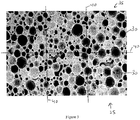
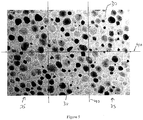
- thermoplastic polyurethane foamed article 25 of the present invention as represented by Samples 1C, IF, 2B and 2E of the Examples (see Figures 2 , 3 , 5 and 6 ), define a three dimensional structure having a plurality of interconnected sections 35 that further define an exterior region and an interior region.
- the interconnected sections 35 are three dimensional in nature and can have any predefined length, width, height or shape, and are thus not confined to the illustrations of Figures 1-6 provided herein. Each of the interconnected sections 35 shares a border 40 with the next adjacent interconnected section 35.
- the thermoplastic polyurethane foamed article 25 includes a plurality of bubbles 30 distributed throughout the thermoplastic polyurethane foamed article 25. More preferably, the plurality of bubbles 30 are distributed throughout each of the interconnected sections 35 of the three dimensional structure.
- the plurality of bubbles 30 may generally be referred to as being evenly distributed throughout the thermoplastic polyurethane foamed article 25 within each of the interconnected sections 35, and wherein there are relatively few or no voids resulting from bubble collapse within any of those interconnected sections 35 of the three-dimensional structure of the article 25.
- Figures 1 and 4 illustrate thermoplastic foamed articles not formed in accordance with the present invention that each include a number of voids 50 contained within one or more of the interconnected sections 35.
- the term “evenly”, as in “evenly distributed”, defines wherein a similar number of the plurality of bubbles 30 are located within each of the interconnected sections 35.
- the term “evenly distributed” is not intended to mean that each interconnected section 35 includes the same number of bubbles 30, nor that the plurality of bubbles 30 within any or all of the interconnected sections are the same size or precisely spaced relative to one another.
- thermoplastic polyurethane foamed article 25 As noted above, Figures 2 , 3 , 5 and 6 illustrate four exemplary, non-limiting examples of thermoplastic polyurethane foamed articles 25 formed in accordance with the present invention having a plurality of bubbles 30 evenly distributed throughout each of the interconnected sections 35 and having little or no bubble collapse ( i . e ., the substantial absence or absence of voids).
- thermoplastic polyurethane foamed article of the present invention comprises a thermoplastic polyurethane composition and an epoxy-functional styrene acrylic copolymer foamed in the presence of a blowing agent.
- thermoplastic polyurethane refers to a multi-phase block copolymer created when a polyaddition reaction occurs between an isocyanate and an isocyanate-reactive component.
- TPUs are generally known as being soft and processable when heated, hard when cooled, and capable of being reprocessed multiple times without losing structural integrity.
- thermoplastic polyurethane compositions are made from an isocyanate-reactive component and generally an equivalent amount of an isocyanate. Stated another way, the thermoplastic polyurethane compositions are the reaction product of the isocyanate-reactive component and the isocyanate.
- the isocyanate-reactive component includes a polyol.
- the polyol is generally a polyether polyol or a polyester polyol or caprolactone or combinations thereof.
- TPUs formed from polyether polyols are generally be referred to as polyether TPUs.
- TPUs formed from polyester polyols are generally be referred to as polyester TPUs, while TPUs formed from caprolactone are generally be referred to as polycaprolactone TPUs.
- the isocyanate-reactive component typically also includes a chain extender such as a diol.
- a chain extender such as a diol.
- the thermoplastic polyurethane compositions of the present invention are typically the reaction product of the polyol, the chain extender and the isocyanate.
- thermoplastic polyurethane composition formed from the reaction product of the polyol, the chain extender and the isocyanate includes linear polymeric chains in block-structures. Such chains contain low polarity segments which are rather long (called soft segments), alternating with shorter, high polarity segments (called hard segments). Both types of segments are linked together by covalent bonds, so that the segments actually form block-copolymers.
- soft segments formed via the reaction of the polyol and the isocyanate, provide flexibility to the TPU.
- the selection and relative proportions of the polyol, the chain extender, and the isocyanate impact the physical properties of the resultant thermoplastic polyurethane composition and any foamed article formed therefrom in terms of hardness, tensile strength, tear strength, compression set, abrasion resistance, and shrinkage and other properties such as chemical resistance.
- one or more isocyanates can be reacted with the isocyanate-reactive component to form the thermoplastic polyurethane composition.
- the isocyanate is not limited to any particular genus of isocyanate, e.g. the isocyanate can include monomeric isocyanate, polymeric isocyanate, and mixtures thereof.
- the isocyanate can include prepolymers, e.g. polyols reacted with excess isocyanate.
- the isocyanate comprises methylene diphenyldiisocyanate (MDI), such as 2,4'-MDI and 4,4'-MDI.
- MDI methylene diphenyldiisocyanate
- the isocyanate may comprise toluene diisocyanate (TDI) (such as 2,4'-TDI or 2, 6'-TDI), 1,5-naphthalene diisocyanate (NDI), p -phenylene diisocyanate (PPDI), 1,6-hexamethylene diisocyanate (HDI), cyclohexyl diisocyanate (CHDI), isophorone diisocyanate (IPDI),4,4-dicyclohexylmethane diisocyanate (HMDI), and any combination thereof.
- TDI toluene diisocyanate
- NDI 1,5-naphthalene diisocyanate
- PPDI p -phenylene diisocyanate
- HDI 1,6-hexamethylene diisocyanate
- CHDI cyclohexyl diisocyanate
- IPDI isophorone diisocyanate
- HMDI 4,4-dicyclohe
- Polyether polyols that are used to produce the thermoplastic polyurethane compositions of the present invention may be made, for example, by reacting an alkylene oxide, such as propylene oxide, with a strong base such as potassium hydroxide, optionally in the presence of water, glycols and the like.
- polyether polyols which can be utilized include, but are not limited to, those which are produced by polymerization of tetrahydrofuran or epoxides such as epichlorohydrin, ethylene oxide, propylene oxide, butylene oxide, styrene oxide, for example in the presence of Lewis catalysts such as boron trifluoride or other suitable initiator compounds, or by the addition of epoxides, optionally mixed or in succession, onto starter components with reactive hydrogen atoms such as water, alcohols, ammonia, or amines.
- tetrahydrofuran or epoxides such as epichlorohydrin, ethylene oxide, propylene oxide, butylene oxide, styrene oxide
- Lewis catalysts such as boron trifluoride or other suitable initiator compounds
- epoxides optionally mixed or in succession, onto starter components with reactive hydrogen atoms such as water, alcohols, ammonia, or amines.
- Suitable initiator compounds contain a plurality of active hydrogen atoms, and include, but are not limited to, water, butanediol, ethylene glycol, propylene glycol (PG), diethylene glycol, triethylene glycol, dipropylene glycol, ethanolamine, diethanolamine, triethanolamine, toluene diamine, diethyl toluene diamine, phenyl diamine, diphenylmethane diamine, ethylene diamine, cyclohexane diamine, cyclohexane dimethanol, resorcinol, bisphenol A, glycerol, trimethylolpropane, 1,2,6-hexanetriol, pentaerythritol, and combinations thereof.
- active hydrogen atoms include, but are not limited to, water, butanediol, ethylene glycol, propylene glycol (PG), diethylene glycol, triethylene glycol, dipropylene glycol, ethanolamine, diethanolamine, triethanol
- suitable polyether polyols include polyether diols and triols, such as polyoxypropylene diols and triols and poly(oxyethylene-oxypropylene)diols and triols obtained by the simultaneous or sequential addition of ethylene and propylene oxides to di- or tri-functional initiators. Copolymers having oxyethylene contents of from about 5 to about 90% by weight, based on the weight of the polyol component, of which the polyols may be block copolymers, random/block copolymers or random copolymers, can also be used.
- Yet other suitable polyether polyols include polytetramethylene glycols obtained by the polymerization of tetrahydrofuran.
- the polyester polyols that may be used to form the thermoplastic polyurethane compositions may be formed, for example, from the condensation of one or more polyhydric alcohols with one or more polycarboxylic acids.
- suitable polyhydric alcohols include, but are not limited, to the following: ethylene glycol, propylene glycol such as 1,2-propylene glycol and 1,3-propylene glycol, glycerol; pentaerythritol; trimethylolpropane; 1,4,6-octanetriol; butanediol; pentanediol; hexanediol; dodecanediol; octanediol; chloropentanediol, glycerol monallyl ether; glycerol monoethyl ether, diethylene glycol; 2-ethylhexanediol-1,4; cyclohexanediol-1,4; 1,2,
- polycarboxylic acids include the following: phthalic acid; isophthalic acid; terephthalic acid; tetrachlorophthalic acid; maleic acid; dodecylmaleic acid; octadecenylmaleic acid; fumaric acid; aconitic acid; trimellitic acid; tricarballylic acid; 3,3'-thiodipropionic acid; succinic acid; adipic acid; malonic acid, glutaric acid, pimelic acid, sebacic acid, cyclohexane-1,2-dicarboxylic acid; 1,4-cyclohexadiene-1,2-dicarboxylic acid; 3-methyl-3,5-cyclohexadiene-1,2-dicarboxylic acid and the corresponding acid anhydrides such as tetrahydrophthalic anhydride, hexahydrophthalic anhydride, tetrachlorophthalic anhydride, endomethylenetetrahydrophthalic anhydride
- the chain extender used to form the thermoplastic polyurethane composition according to the present invention suitably comprises compounds having 2 or more active hydrogens and molecular weights ranging from 60 g/mol to 400 g/mol, such as from 60 g/mol to 200 g/mol.
- Suitable chain extenders having 2 or more active hydrogens include, for example, polyols such as 1,4-butanediol, ethylene glycol, diethylene glycol, propylene glycol, 1,4-butylene glycol, 1,5-pentylene glycol, methylpentanediol, 1,6-hexylene glycol, neopentyl glycol, trimethylolpropane, hydroquinone ether alkoxylate, resorcinol ether alkoxylate, glycerol, pentaerythritol, diglycerol, dextrose, and a 1,4:3,6 dianhydrohexitol such as isomannide; isosorbide and isoidide; aliphatic polyhydric amines such as ethylenediamine, hexamethylenediamine, and isophorone diamine; and aromatic polyhydric amines such as methylene-bis(2-chloroaniline), methylenebis
- the chain extender is a diol, such as the one or more diols from the list as provided above. If higher functional polyols, such as triols, are included in the reaction product, they are typically introduced in combination with the diols as provided above and in low relative amounts to limit crosslinking and prevent the resultant thermoplastic polyurethane composition from becoming too brittle.
- thermoplastic polyurethane compositions that are utilized in the present invention have a durometer hardness ranging from a Shore A hardness of 30 to a Shore D hardness of 75, such as from a Shore A hardness of 50 to a Shore D hardness of 60, such as from a Shore A hardness of 70 to a Shore D hardness of 90.
- the "Shore hardness" of the thermoplastic polyurethane composition refers to an empirical measurement used to test the composition's resistance to indentation or penetration under a defined force. Shore A measurements are typically performed upon more flexible types of thermoplastic polyurethane compositions, while Shore D measurements refer to more rigid grades. On both scales, the measurements range from zero to 100 with zero being very soft and 100 very hard. The measurements are performed using a durometer in accordance with the standards provided in ASTM D2240.
- each of the components comprising the isocyanate-reactive component, as well as the structure of the isocyanates, as noted above, may vary in relative amount so long as the thermoplastic polyurethane composition formed therefrom achieves a durometer hardness ranging from a Shore A hardness of 30 to a Shore D hardness of 75.
- thermoplastic polyurethane compositions of the present invention having a durometer hardness ranging from a Shore A hardness of 30 to a Shore D hardness of 75 that may be used in the present invention include those commercially available from BASF Corporation of Florham Park, New Jersey and sold under the trade name Elastollan®.
- the blowing agent of the present invention may be a physical blowing agent, a chemical blowing agent, or a combination of a physical blowing agent and chemical blowing agent.
- the terminology "physical blowing agent” refers to blowing agents that do not chemically react with the isocyanate and/or the isocyanate-reactive component of the thermoplastic polyurethane composition.
- the physical blowing agent can be a gas or liquid.
- the physical blowing agent can also be a gas that is trapped within a thermoplastic shell, wherein the gas expands under heat which causes the shell to grow.
- the thermoplastic shell in certain embodiments, may comprise a styrenic polymer.
- the physical blowing agent may be introduced via a masterbatch containing both the physical blowing agent and a polymer matrix composition such as ethylene vinyl acetate (EVA) or a thermoplastic polyurethane composition that is the same or different from the thermoplastic polyurethane compositions as described above.
- a polymer matrix composition such as ethylene vinyl acetate (EVA) or a thermoplastic polyurethane composition that is the same or different from the thermoplastic polyurethane compositions as described above.
- EVA ethylene vinyl acetate
- thermoplastic polyurethane composition that is the same or different from the thermoplastic polyurethane compositions as described above.
- the physical blowing agent concentration in the masterbatch is between 25 and 75 parts by weight based upon the 100 parts by weight of the combination of the physical blowing agent and the polymer matrix composition.
- the liquid physical blowing agent in certain embodiments, evaporates into a gas when heated, and typically returns to a liquid when cooled.
- the liquid physical blowing agent is a liquefied gas such as liquefied carbon dioxide or liquid nitrogen.
- the liquefied gas is incorporated directly into the thermoplastic polyurethane composition after it is melted, as described further below.
- the blowing agent is typically introduced to the thermoplastic polyurethane composition in an amount of from about 0.125 to about 15 parts by weight, such as from 4 to 6 parts by weight, based on 100 parts by weight of the combined weight of the polyol present in the isocyanate-reactive component and the blowing agent.
- chemical blowing agent refers to blowing agents which chemically react to release a gas for foaming.
- the chemical blowing agent chemically reacts with the isocyanate and/or the isocyanate-reactive component of the thermoplastic polyurethane composition.
- a chemical blowing agent is water, which reacts with the isocyanate to create carbon dioxide.
- Other non-limiting examples of chemical blowing agents include citric acid or hydrogen carbonate which can also create carbon dioxide.
- the chemical blowing agent is typically introduced to the thermoplastic polyurethane composition in an amount such that, after reaction, the resultant blowing agent comprises from about 0.125 to about 15 parts by weight, such as from 4 to 6 parts by weight, based on 100 parts by weight of the combined weight of the polyol present in the isocyanate-reactive component and the blowing agent.
- the thermoplastic polyurethane compositions also include an epoxy-functional styrene acrylic copolymer present in an amount up to 5% of the total combined weight of the thermoplastic polyurethane composition and the epoxy-functional styrene acrylic copolymer. More preferably, the epoxy-functional styrene acrylic copolymer is present in an amount from 0.1 to 5%, such as from 0.1 to 3%, such as from 1 to 3%, of the total combined weight of the thermoplastic polyurethane composition and the epoxy-functional styrene acrylic copolymer.
- the inclusion of the epoxy-functional styrene acrylic copolymer included an amount up to 5% of the total combined weight of the thermoplastic polyurethane composition and the epoxy-functional styrene acrylic copolymer, increases the bubble strength of the thermoplastic polyurethane composition prior to foaming.
- thermoplastic polyurethane foamed article when the thermoplastic polyurethane composition is foamed in accordance with the present invention by depressuring the thermoplastic polyurethane in the presence of the blowing agent, as described in further detail below, the resultant thermoplastic polyurethane foamed article has reduced bubble collapse, and hence increased bubble uniformity and bubble size (in terms of diameter), as compared with thermoplastic polyurethane foamed article formed in the same manner from the same thermoplastic polyurethane composition but lacking the epoxy-functional styrene acrylic copolymer.
- Non-limiting exemplary epoxy-functional styrene acrylic copolymers that may be used in the present invention include those commercially available from BASF Corporation of Florham Park, New Jersey and sold under the trade name Joncryl®.
- Two exemplary, non-limiting epoxy-functional styrene acrylic copolymers are Joncryl 4300® and Joncryl 4370®.
- Additional optional components may also be added to the thermoplastic polyurethane composition prior to foaming the thermoplastic polyurethane composition to form the thermoplastic polyurethane foamed article.
- additional components include, but are not limited to, waxes, lubricants, ultraviolet light stabilizers, antioxidants, compatibilizers, surfactants, friction modifiers, fillers, crosslinkers, plasticizers, flame retardants, colorants, or any combination thereof.
- polymers may be blended or otherwise incorporated or introduced with the thermoplastic polyurethane composition and melted to form the foamed thermoplastic foamed article as described above.
- polymers include, but are not limited to, polyethylene, polypropylene, polystyrene including high-impact polystyrene (HIPS), methyl-methacrylate-acrylonitrile-butadiene-styrene (MABS), acrylonitrile-butadiene-styrene (ABS), polyoxymethylene (POM), polybutylene terephthalate (PBT), ethylene vinyl acetate (EVA), or recycled tire rubber.
- HIPS high-impact polystyrene
- MABS methyl-methacrylate-acrylonitrile-butadiene-styrene
- ABS acrylonitrile-butadiene-styrene
- POM polyoxymethylene
- PBT polybutylene terephthalate
- EVA ethylene vinyl acetate
- melt strength enhancers that are different than the epoxy-functional styrene acrylic copolymers described above may also be included in the thermoplastic polyurethane composition, such as thermoplastic polyurethane melt strength enhancers including, but not limited to, carbonylbiscaprolactam, phenylenebisoxazine, and phenylenebisoxaxoline.
- thermoplastic polyurethane melt strength enhancers including, but not limited to, carbonylbiscaprolactam, phenylenebisoxazine, and phenylenebisoxaxoline.
- Non-limiting commercially available exemplary thermoplastic polyurethane melt strength enhancer that may be used in conjunction epoxy-functional styrene acrylic copolymers include X-Flex MB 2905 and X-Flex MB 2909, both commercially available from BASF Corporation of Florham Park, New Jersey.
- other forms of epoxy-functional polymers that are different than the epoxy-functional styrene acrylic copolymers
- the present invention also discloses a method for forming a thermoplastic polyurethane foamed article from the thermoplastic polyurethane composition.
- the thermoplastic polyurethane foamed article is formed by melting the thermoplastic polyurethane composition in the presence of the blowing agent and the epoxy-functional styrene acrylic copolymer and then foaming the melted thermoplastic polyurethane composition in the presence of the blowing agent.
- the melting step is such that the blowing agent impregnates the melted thermoplastic polyurethane composition, causing bubbles to form therein.
- the epoxy-functional styrene acrylic copolymer is believed to increase the strength of the bubbles formed in this process.
- thermoplastic polyurethane foamed article The melted thermoplastic polyurethane composition is then foamed in the presence of the blowing agent to form the thermoplastic polyurethane foamed article.
- the foaming of the melted thermoplastic polyurethane composition is the result of a pressure drop, or depressurization, of melted thermoplastic polyurethane composition, which causes thermoplastic polyurethane composition to expand and form the thermoplastic polyurethane foamed article
- thermoplastic polyurethane foamed article may be cured by heating the article for a period of time sufficient to cure the thermoplastic polyurethane foamed article.
- the thermoplastic polyurethane foamed article is allowed to remain at ambient temperatures for a period of time sufficient to achieve ambient cure of the thermoplastic polyurethane foamed article.
- thermoplastic polyurethane foamed article of the present invention the thermoplastic polyurethane composition, the epoxy-functional styrene acrylic copolymer and blowing agent and other optional ingredients, as described above, are introduced into a processing device, such as an extruder, and preferably a single screw extruder.
- the processing device is heated to a temperature sufficient to melt the thermoplastic polyurethane composition, and, in the case of an extruder, the melted material is compressed and mixed. Further, in the case of an extruder, the melting may occur in stages in multiple heating zones.
- Gas formed from the evaporation of the liquid physical blowing agent during the heating process, or from the chemical reaction of the chemical blowing agent in the heating process, or otherwise generated or present from the blowing agent is impregnated within the melted thermoplastic polyurethane composition to form bubbles as a result of the pressure increase associated with the heating step.
- thermoplastic polyurethane foamed article is formed by releasing the melted thermoplastic polyurethane composition from the reaction vessel.
- the pressure drop, or depressurization, associated with releasing the melted thermoplastic polyurethane composition from the processing device (having a higher pressure) causes the bubbled thermoplastic polyurethane composition to expand and form the thermoplastic polyurethane foamed article.
- the thermoplastic polyurethane foamed article is produced by releasing the melted thermoplastic polyurethane composition impregnated with the gas from the blowing agent through a die opening in the extruder and onto a rolling conveyor belt.
- the size of the die opening and speed of the conveyor, as well as the force applied to push the melted thermoplastic polyurethane composition through the die opening can be controlled to determine the thickness of the thermoplastic polyurethane foamed article formed. This is known to those of ordinary skill in the foaming art as a continuous process for forming the thermoplastic polyurethane foamed article.
- thermoplastic polyurethane foamed article is produced by releasing the melted thermoplastic polyurethane composition impregnated with the gas from the blowing agent into the injection molding apparatus having an internal cavity of a predetermined size.
- the pressure drop within the mold cavity causes the thermoplastic polyurethane composition impregnated with gas to expand to fill the mold cavity.
- the injection molding apparatus is opened, releasing the thermoplastic polyurethane foamed article.
- the thermoplastic polyurethane foamed article may be cured by introducing the article to a heating device, such as an oven, and heating the article for a period of time sufficient to cure the thermoplastic polyurethane foamed article.
- a heating device such as an oven
- the thermoplastic polyurethane foamed article is allowed to remain at ambient temperatures for a period of time sufficient to achieve ambient cure of the thermoplastic polyurethane foamed article.
- thermoplastic polyurethane foamed article produced in accordance with the methods as described above, have an average diameter of the plurality of bubbles that ranges from 50 to 120 ⁇ m, such as from 60 to 115 ⁇ m.
- the resultant thermoplastic polyurethane foamed articles in accordance with the present invention are formed wherein at least 75% of the bubbles of the plurality have a diameter of less than 200 ⁇ m. In certain of these embodiments, the resultant thermoplastic polyurethane foamed articles in accordance with the present invention are formed wherein at least 80%, or wherein at least 90%, of the bubbles of the plurality have a diameter of less than 200 ⁇ m.
- the resultant thermoplastic polyurethane foamed articles in accordance with the present invention are formed wherein virtually all of the bubbles of the plurality have a diameter of less than 500 ⁇ m. In certain of these embodiments, the resultant thermoplastic polyurethane foamed articles in accordance with the present invention are formed wherein at least 20% of the bubbles of the plurality have a diameter of less than 100 ⁇ m
- the resultant thermoplastic polyurethane foamed article also have a density ranging from 0.15 to 0.8 g/cm 3 (measured at 25 °C), such as from 0.2 to 0.65 g/cm 3 , such as from 0.25 to 0.5 g/cm 3 .
- the addition of the epoxy-functional styrene acrylic copolymer in levels from 0.1 to 5% based upon the total combined weight of the epoxy-functional styrene acrylic copolymer and thermoplastic polyurethane composition, is believed to enhance the melt strength for the thermoplastic polyurethane composition in order to achieve good bubble strength during the foaming process with chemical and/or physical blowing agents.
- Thermoplastic polyurethane foamed articles including the epoxy-functional styrene acrylic copolymer have reduced voids throughout the formed article, and a more consistent and uniform bubble size and distribution throughout the formed article at a decreased density, and hence improved part quality, as compared with thermoplastic polyurethane foamed articles formed from the same thermoplastic polyurethane composition, under the same processing conditions, but lacking the epoxy-functional styrene acrylic copolymer.
- the addition of the epoxy-functional styrene acrylic copolymer in levels from 0.1 to 5% based upon the total combined weight of the epoxy-functional styrene acrylic copolymer and thermoplastic polyurethane composition allows the thermoplastic polyurethane composition to be processed at high temperatures where the thermoplastic polyurethane composition can flow and fill a mold or cavity while still maintaining good bubble integrity.
- thermoplastic polyurethane foamed article test panels formed from the thermoplastic polyurethane composition of the present invention, were evaluated versus thermoplastic polyurethane foamed article test panels having the same dimensions and formed from the same or similar thermoplastic polyurethane starting compositions but without the epoxy-acrylic styrene copolymer.
- Tables 1 and 2 below provide the compositions for the various thermoplastic polyurethane compositions that were evaluated: Table 1: Test Thermoplastic Polyurethane Composition used to form Test Panels 1-1H Material/Composition 1 1A 1AA 1B 1C 1D 1E 1F 1G 1H Elastollan® 1180A10 1 100% 100% 100% 100% 100% 100% 100% 100% 100% 100% 100% 100% 100% 100% 100% 100% 100% 100% 100% 100% 100% 100% 100% 100% 100% 100% 100% 100% 100% 100% 100% 100% 100% 100% 100% 100% 100% 100% 100% 100% 100% 100% 100% 100% 100% 100% 100% 100% 100% 100% 100% 100% 100% 100% 100% 100% 100% 100% 100% 100% 100% 100% 100% 100% 100% 100% 100% 100% 100% 100% 100% 100% 100% 100% 100% 100% 100% 100% 100% 100% 100% 100% 100% 100% 100% 100% 100% 100% 100% 100% 100% 100% 100% 100% 100% 100% 100% 100% 100% 100% 100% 100% 100% 100% 100% 100% 100% 100% 100% 100% 100% 100% 100% 100% 100% 100% 100% 100% 100% 100% 100% 100% 100% 100% 100% 100% 100% 100% 100% 100% 100% 100% 100% 100% 100% 100% 100% 100% 100% 100% 100% 100% 100% 100% 100% 100% 100% 100% 100% 100% 100% 100% 100% 100% 100% 100% 100% 100% 100% 100% 100% 100% 100% 100% 100% 100% 100%
- the TPU foamed test panels 1-1H and 2-2E were formed from these respective compositions by first introducing each of the components of the thermoplastic polyurethane composition as described in Tables 1 and 2 above (i.e., the test composition) into a Kloeckner FM 160 injection molding machine, which includes an extruder portion, set to the following temperature profile and processing conditions (Zones 1-4 are provided in degrees Celsius):
- thermoplastic polyurethane composition After introduction, the components of the respective thermoplastic polyurethane composition were mixed and melted within the extruder portion of the Kloeckner FM 160 injection molding machine in the presence of the physical blowing agents. The components of the respective thermoplastic polyurethane composition were processed according to the temperature and pressure profile above to form a melted thermoplastic polyurethane composition having a plurality of bubbles dispersed therewithin. The melted and mixed thermoplastic polyurethane composition was then injected into the interior of the injection mold portion of the Kloeckner FM 160 injection molding machine having a predefined interior size and shape (here 4 inches by 6 inches), with the pressure decrease associated with the injection process causing the thermoplastic polyurethane composition to expand to fill the interior of the injection mold portion to form a foamed test panel.
- a predefined interior size and shape here 4 inches by 6 inches
- the foamed test panel was held in the interior of the injection mold portion for 20 to 40 seconds at 70-176 °F (40-80 °C). The mold was opened, and the foamed test panel of approximately 4 inches by 6 inches, at a thickness of approximately 0.4 inches, was removed.
- test Panel Visible Observations of Test Panel 1 Many visible voids due to bubbles collapsing especially in the middle of the test panel. Large bubble distribution which was difficult to measure due to bubbles collapsing, breaking and uneven shape.
- each of the foamed test panels visually observed as in Table 4 was also evaluated for aspect ratio, length, width, diameter, and number of cells according to the following procedure.
- a small cube cut out of the test panel was cut with a razor blade to produce a cross-section with a flat surface for imaging.
- the cube was fixed onto an aluminum SEM (Scanning Electron Micrograph) sample stub using a carbon adhesive pad, and was given a light gold coating to reduce surface charging in the electron beam of the scanning electron microscope. (Hummer® 10.2 Sputtering System, Anatech Ltd., In DC Plate Mode, 2400 volts, 3-4 minutes).
- Backscattered imaging (which produces contrast based on differences in atomic number (Z) with higher-Z elements appearing brighter) was also utilized.
- the 50X images were adjusted for brightness and contrast using Adobe® Photoshop® software, version 6.0.1 Copyright ⁇ 1989-2001 Adobe Systems Inc. and were then processed using Image-Pro® P-L-U-S software, version 5.1.0.20, Copyright ⁇ 1993-2004, Media Cybernetics, to produce a grayscale, binary image with a black background.
- the adjusted, processed images were processed a second time using Adobe® Photoshop to remove any white pixels inside pore boundaries and to fill gaps in pore boundaries. This produced an image with black pores against a white background. The pores were counted and measured using Image-Pro® software using calibrated measuring tools. The measurement data was exported to a template for generation of statistics and bar graph showing pore length distribution. (Microsoft® Excel 2000).
- Table 5 Measured Test Results of Test Panels Sample Roundness* Length ( ⁇ m) Width ( ⁇ m) Diameter ( ⁇ m) #Cells # > 100 ⁇ m # > 200 ⁇ m # > 500 ⁇ m 1 Unable to determine bubble size due to bubbles collapsing and due to uneven bubbles shape for bubbles that are still intact. 1A Unable to determine bubble size due to bubbles collapsing and due to uneven bubbles shape for bubbles that are still intact. 1AA Unable to determine bubble size due to bubbles collapsing and due to uneven bubbles shape for bubbles that are still intact.
- thermoplastic polyurethane foamed test panels wherein the plurality of bubbles have an average diameter ranging from 50 to 120 ⁇ m with at least 75% of the bubbles having a diameter of less than 200 ⁇ m.
- test panels prepared from the same thermoplastic polyurethane compositions under the same processing conditions, but lacking the epoxy-styrene acrylic copolymer present in an amount ranging from 0.1 to 5 % of the total combined weight of the thermoplastic polyurethane composition and the epoxy-functional styrene acrylic copolymer produced thermoplastic polyurethane foamed test panels having voids or large variations in the bubble size and distribution, resulting in poorer part quality.
Landscapes
- Chemical & Material Sciences (AREA)
- Health & Medical Sciences (AREA)
- Chemical Kinetics & Catalysis (AREA)
- Medicinal Chemistry (AREA)
- Polymers & Plastics (AREA)
- Organic Chemistry (AREA)
- Engineering & Computer Science (AREA)
- Materials Engineering (AREA)
- Manufacture Of Porous Articles, And Recovery And Treatment Of Waste Products (AREA)
- Compositions Of Macromolecular Compounds (AREA)
Description
- The subject invention generally relates to foamed thermoplastic polyurethane foamed articles, and more particularly to thermoplastic polyurethane articles comprising a thermoplastic polyurethane composition and an epoxy- functional styrene acrylic copolymer.
- Foaming thermoplastic polyurethane (TPU) compositions is a challenge due to the need for good melt strength to maintain bubbles and due to the flowability of TPU composition during the foaming process. In many instances, the bubbles can collapse as the TPU foam expands upon depressurization, leading to thermoplastic polyurethane foamed articles having high densities and substandard part quality.
-
US 2003/220061 A1 discloses a polishing pad for chemical mechanical polishing comprising a porous foam with an average pore size of about 50 µm or less, wherein about 75% or more of the pores have a pore size within about 20 µm or less of the average pore size. The porous foam based on TPU is prepared via an extrusion process in which supercritical fluid carbon dioxide is formed, blended with the polymer melt and subsequently extruded to form a porous foam sheet. -
US 2011/257285 A1 discloses a thermally expandable and curable material containing at least one epoxide prepolymer, at least one heat-activated curing agent for the prepolymer, at least one foaming agent, at least one thermoplastic polyurethane or isocyanate and at least one block copolymer. The thermally expandable and curable material can be used for stiffening or reinforcing components. - As such, there is a need for thermoplastic polyurethane foamed articles having reduced bubble collapse and associated improved part quality.
- The subject invention provides a thermoplastic polyurethane foamed article comprising a thermoplastic polyurethane composition and an epoxy-functional styrene acrylic copolymer foamed in the presence of a blowing agent. The thermoplastic polyurethane foamed article has a plurality of bubbles distributed throughout the thermoplastic polyurethane foamed article and has an average diameter of the plurality of bubbles that ranges from 50 to 120 µm with at least 75% of the plurality of bubbles having a diameter of less than 200 µm.
- The thermoplastic polyurethane composition of the thermoplastic polyurethane foamed article has a durometer hardness ranging from 30A to 75D and the epoxy-functional styrene acrylic copolymer is present in an amount ranging from 0.1 to 5% of the total combined weight of the thermoplastic polyurethane composition and the epoxy-functional styrene acrylic copolymer.
- The present invention also provides a method for forming the thermoplastic polyurethane foamed article comprising mixing the epoxy-functional styrene acrylic copolymer with the thermoplastic polyurethane composition; melting the mixture of the thermoplastic polyurethane composition and the epoxy-functional styrene acrylic copolymer, and foaming the melted mixture in the presence of the blowing agent.
- The thermoplastic polyurethane foamed articles in accordance with the present invention have reduced voids and a more consistent and uniform bubble size and distribution throughout the formed article at a decreased density, and hence improved part quality, as compared with thermoplastic polyurethane foamed articles formed from the same thermoplastic polyurethane composition, under the same processing conditions, but lacking the epoxy-functional styrene acrylic copolymer.
- Other advantages of the present invention will be readily appreciated, as the same becomes better understood by reference to the following detailed description, when considered in connection with the accompanying drawings.
-
Figure 1 a scanning electron micrograph, at 50 times magnification, of the thermoplastic polyurethane article of Sample 1 of the Examples. -
Figure 2 is a scanning electron micrograph, at 50 times magnification, of the thermoplastic polyurethane article of Sample 1C of the Examples. -
Figure 3 scanning electron micrograph, at 50 times magnification, of the thermoplastic polyurethane article of Sample 1F of the Examples. -
Figure 4 scanning electron micrograph, at 50 times magnification, of the thermoplastic polyurethane article of Sample 2 of the Examples. -
Figure 5 scanning electron micrograph, at 50 times magnification, of the thermoplastic polyurethane article of Sample 2B of the Examples. -
Figure 6 scanning electron micrograph, at 50 times magnification, of the thermoplastic polyurethane article of Sample 2E of the Examples. - The subject invention generally relates to thermoplastic polyurethane foamed articles having reduced bubble collapse.
- The thermoplastic polyurethane foamed
article 25 of the present invention, as represented by Samples 1C, IF, 2B and 2E of the Examples (seeFigures 2 ,3 ,5 and6 ), define a three dimensional structure having a plurality of interconnectedsections 35 that further define an exterior region and an interior region. Theinterconnected sections 35 are three dimensional in nature and can have any predefined length, width, height or shape, and are thus not confined to the illustrations ofFigures 1-6 provided herein. Each of the interconnectedsections 35 shares aborder 40 with the next adjacent interconnectedsection 35. The thermoplastic polyurethanefoamed article 25 includes a plurality ofbubbles 30 distributed throughout the thermoplastic polyurethane foamedarticle 25. More preferably, the plurality ofbubbles 30 are distributed throughout each of theinterconnected sections 35 of the three dimensional structure. - The term "distributed", in the context of "having a plurality of
bubbles 30 distributed throughout the thermoplastic polyurethane foamedarticle 25", refers to the relative location of the plurality ofbubbles 30 contained within the three-dimensional structure of the thermoplastic polyurethanefoamed article 25. The term "throughout" as in "distributed throughout" therefore refers to wherein at least one or more of the plurality ofbubbles 30 are located within each of the respectiveinterconnected sections 35 of the three-dimensional structure of the thermoplastic polyurethane foamedarticle 25. Stated another way, there are nointerconnected sections 35 of the three-dimensional structure of the thermoplastic polyurethane foamedarticle 25 that do not include at least one or more of thebubbles 30 of the plurality. - Further, the plurality of
bubbles 30 may generally be referred to as being evenly distributed throughout the thermoplastic polyurethane foamedarticle 25 within each of theinterconnected sections 35, and wherein there are relatively few or no voids resulting from bubble collapse within any of those interconnectedsections 35 of the three-dimensional structure of thearticle 25. For comparative purposes,Figures 1 and4 illustrate thermoplastic foamed articles not formed in accordance with the present invention that each include a number ofvoids 50 contained within one or more of theinterconnected sections 35. The term "evenly", as in "evenly distributed", defines wherein a similar number of the plurality ofbubbles 30 are located within each of theinterconnected sections 35. The term "evenly distributed" is not intended to mean that eachinterconnected section 35 includes the same number ofbubbles 30, nor that the plurality ofbubbles 30 within any or all of the interconnected sections are the same size or precisely spaced relative to one another. - Little or no bubble collapse, as defined herein, refers to the absence or substantial absence of large voids within the three-dimensional structure of the thermoplastic polyurethane foamed
article 25, such as within any of theinterconnected sections 35, which result from the collapse of the formedbubbles 30 during the formation of the thermoplastic polyurethane foamedarticle 25. As noted above,Figures 2 ,3 ,5 and6 illustrate four exemplary, non-limiting examples of thermoplastic polyurethane foamedarticles 25 formed in accordance with the present invention having a plurality ofbubbles 30 evenly distributed throughout each of the interconnectedsections 35 and having little or no bubble collapse (i.e., the substantial absence or absence of voids). - The thermoplastic polyurethane foamed article of the present invention comprises a thermoplastic polyurethane composition and an epoxy-functional styrene acrylic copolymer foamed in the presence of a blowing agent.
- The term "thermoplastic polyurethane" (TPU), as used with respect to "thermoplastic polyurethane composition" and "thermoplastic polyurethane foamed article", refers to a multi-phase block copolymer created when a polyaddition reaction occurs between an isocyanate and an isocyanate-reactive component. TPUs are generally known as being soft and processable when heated, hard when cooled, and capable of being reprocessed multiple times without losing structural integrity.
- Typical thermoplastic polyurethane compositions are made from an isocyanate-reactive component and generally an equivalent amount of an isocyanate. Stated another way, the thermoplastic polyurethane compositions are the reaction product of the isocyanate-reactive component and the isocyanate.
- The isocyanate-reactive component includes a polyol. The polyol is generally a polyether polyol or a polyester polyol or caprolactone or combinations thereof. TPUs formed from polyether polyols are generally be referred to as polyether TPUs. Similarly, TPUs formed from polyester polyols are generally be referred to as polyester TPUs, while TPUs formed from caprolactone are generally be referred to as polycaprolactone TPUs.
- In addition to the polyol, the isocyanate-reactive component typically also includes a chain extender such as a diol. Stated another way, the thermoplastic polyurethane compositions of the present invention are typically the reaction product of the polyol, the chain extender and the isocyanate.
- The thermoplastic polyurethane composition formed from the reaction product of the polyol, the chain extender and the isocyanate includes linear polymeric chains in block-structures. Such chains contain low polarity segments which are rather long (called soft segments), alternating with shorter, high polarity segments (called hard segments). Both types of segments are linked together by covalent bonds, so that the segments actually form block-copolymers. The soft segments, formed via the reaction of the polyol and the isocyanate, provide flexibility to the TPU. The hard segments, formed via the reaction of the chain extender and the isocyanate, provide the TPU with toughness and other physical performance properties. The selection and relative proportions of the polyol, the chain extender, and the isocyanate impact the physical properties of the resultant thermoplastic polyurethane composition and any foamed article formed therefrom in terms of hardness, tensile strength, tear strength, compression set, abrasion resistance, and shrinkage and other properties such as chemical resistance.
- It is to be appreciated that one or more isocyanates can be reacted with the isocyanate-reactive component to form the thermoplastic polyurethane composition. It is also to be appreciated that the isocyanate is not limited to any particular genus of isocyanate, e.g. the isocyanate can include monomeric isocyanate, polymeric isocyanate, and mixtures thereof. In addition, the isocyanate can include prepolymers, e.g. polyols reacted with excess isocyanate. Typically, the isocyanate comprises methylene diphenyldiisocyanate (MDI), such as 2,4'-MDI and 4,4'-MDI. Alternatively, the isocyanate may comprise toluene diisocyanate (TDI) (such as 2,4'-TDI or 2, 6'-TDI), 1,5-naphthalene diisocyanate (NDI), p-phenylene diisocyanate (PPDI), 1,6-hexamethylene diisocyanate (HDI), cyclohexyl diisocyanate (CHDI), isophorone diisocyanate (IPDI),4,4-dicyclohexylmethane diisocyanate (HMDI), and any combination thereof.
- Polyether polyols that are used to produce the thermoplastic polyurethane compositions of the present invention may be made, for example, by reacting an alkylene oxide, such as propylene oxide, with a strong base such as potassium hydroxide, optionally in the presence of water, glycols and the like. Other polyether polyols which can be utilized include, but are not limited to, those which are produced by polymerization of tetrahydrofuran or epoxides such as epichlorohydrin, ethylene oxide, propylene oxide, butylene oxide, styrene oxide, for example in the presence of Lewis catalysts such as boron trifluoride or other suitable initiator compounds, or by the addition of epoxides, optionally mixed or in succession, onto starter components with reactive hydrogen atoms such as water, alcohols, ammonia, or amines. Suitable initiator compounds contain a plurality of active hydrogen atoms, and include, but are not limited to, water, butanediol, ethylene glycol, propylene glycol (PG), diethylene glycol, triethylene glycol, dipropylene glycol, ethanolamine, diethanolamine, triethanolamine, toluene diamine, diethyl toluene diamine, phenyl diamine, diphenylmethane diamine, ethylene diamine, cyclohexane diamine, cyclohexane dimethanol, resorcinol, bisphenol A, glycerol, trimethylolpropane, 1,2,6-hexanetriol, pentaerythritol, and combinations thereof.
- Other suitable polyether polyols include polyether diols and triols, such as polyoxypropylene diols and triols and poly(oxyethylene-oxypropylene)diols and triols obtained by the simultaneous or sequential addition of ethylene and propylene oxides to di- or tri-functional initiators. Copolymers having oxyethylene contents of from about 5 to about 90% by weight, based on the weight of the polyol component, of which the polyols may be block copolymers, random/block copolymers or random copolymers, can also be used. Yet other suitable polyether polyols include polytetramethylene glycols obtained by the polymerization of tetrahydrofuran.
- The polyester polyols that may be used to form the thermoplastic polyurethane compositions may be formed, for example, from the condensation of one or more polyhydric alcohols with one or more polycarboxylic acids. Examples of suitable polyhydric alcohols include, but are not limited, to the following: ethylene glycol, propylene glycol such as 1,2-propylene glycol and 1,3-propylene glycol, glycerol; pentaerythritol; trimethylolpropane; 1,4,6-octanetriol; butanediol; pentanediol; hexanediol; dodecanediol; octanediol; chloropentanediol, glycerol monallyl ether; glycerol monoethyl ether, diethylene glycol; 2-ethylhexanediol-1,4; cyclohexanediol-1,4; 1,2,6-hexanetriol; 1,3,5-hexanetriol; 1,3-bis-(2-hydroxyethoxy) propane, 1,4- and 2,3-butylene glycol, neopentyl glycol, 1,4-bis-(hydroxymethyl)cyclohexane, trimethylolethane, together with di-, tri-, tetra-, and higher polyethylene glycols, di- and higher polypropylene glycols, together with di- and higher polybutylene glycols, and the like. Examples of polycarboxylic acids include the following: phthalic acid; isophthalic acid; terephthalic acid; tetrachlorophthalic acid; maleic acid; dodecylmaleic acid; octadecenylmaleic acid; fumaric acid; aconitic acid; trimellitic acid; tricarballylic acid; 3,3'-thiodipropionic acid; succinic acid; adipic acid; malonic acid, glutaric acid, pimelic acid, sebacic acid, cyclohexane-1,2-dicarboxylic acid; 1,4-cyclohexadiene-1,2-dicarboxylic acid; 3-methyl-3,5-cyclohexadiene-1,2-dicarboxylic acid and the corresponding acid anhydrides such as tetrahydrophthalic anhydride, hexahydrophthalic anhydride, tetrachlorophthalic anhydride, endomethylenetetrahydrophthalic anhydride, acid chlorides and acid esters such as phthalic anhydride, phthaloyl chloride and the dimethyl ester of phthalic acid, dimerized and trimerized unsaturated fatty acids, optionally mixed with monomeric unsaturated fatty acids, terephthalic acid monomethyl ester and terephthalic acid monoglycol ester.
- The chain extender used to form the thermoplastic polyurethane composition according to the present invention suitably comprises compounds having 2 or more active hydrogens and molecular weights ranging from 60 g/mol to 400 g/mol, such as from 60 g/mol to 200 g/mol. Suitable chain extenders having 2 or more active hydrogens include, for example, polyols such as 1,4-butanediol, ethylene glycol, diethylene glycol, propylene glycol, 1,4-butylene glycol, 1,5-pentylene glycol, methylpentanediol, 1,6-hexylene glycol, neopentyl glycol, trimethylolpropane, hydroquinone ether alkoxylate, resorcinol ether alkoxylate, glycerol, pentaerythritol, diglycerol, dextrose, and a 1,4:3,6 dianhydrohexitol such as isomannide; isosorbide and isoidide; aliphatic polyhydric amines such as ethylenediamine, hexamethylenediamine, and isophorone diamine; and aromatic polyhydric amines such as methylene-bis(2-chloroaniline), methylenebis(dipropylaniline), diethyl-toluenediamine, trimethylene glycol di-p-aminobenzoate; alkanolamines such as diethanolamine, triethanolamine and diisopropanolamine.
- In certain embodiments, the chain extender is a diol, such as the one or more diols from the list as provided above. If higher functional polyols, such as triols, are included in the reaction product, they are typically introduced in combination with the diols as provided above and in low relative amounts to limit crosslinking and prevent the resultant thermoplastic polyurethane composition from becoming too brittle.
- The thermoplastic polyurethane compositions that are utilized in the present invention have a durometer hardness ranging from a Shore A hardness of 30 to a Shore D hardness of 75, such as from a Shore A hardness of 50 to a Shore D hardness of 60, such as from a Shore A hardness of 70 to a Shore D hardness of 90. The "Shore hardness" of the thermoplastic polyurethane composition refers to an empirical measurement used to test the composition's resistance to indentation or penetration under a defined force. Shore A measurements are typically performed upon more flexible types of thermoplastic polyurethane compositions, while Shore D measurements refer to more rigid grades. On both scales, the measurements range from zero to 100 with zero being very soft and 100 very hard. The measurements are performed using a durometer in accordance with the standards provided in ASTM D2240.
- The relative amounts and chemical structures of each of the components comprising the isocyanate-reactive component, as well as the structure of the isocyanates, as noted above, may vary in relative amount so long as the thermoplastic polyurethane composition formed therefrom achieves a durometer hardness ranging from a Shore A hardness of 30 to a Shore D hardness of 75.
- Suitable thermoplastic polyurethane compositions of the present invention having a durometer hardness ranging from a Shore A hardness of 30 to a Shore D hardness of 75 that may be used in the present invention include those commercially available from BASF Corporation of Florham Park, New Jersey and sold under the trade name Elastollan®.
- The blowing agent of the present invention may be a physical blowing agent, a chemical blowing agent, or a combination of a physical blowing agent and chemical blowing agent.
- The terminology "physical blowing agent" refers to blowing agents that do not chemically react with the isocyanate and/or the isocyanate-reactive component of the thermoplastic polyurethane composition. The physical blowing agent can be a gas or liquid.
- In certain embodiments, the physical blowing agent can also be a gas that is trapped within a thermoplastic shell, wherein the gas expands under heat which causes the shell to grow. The thermoplastic shell, in certain embodiments, may comprise a styrenic polymer.
- In certain embodiments, the physical blowing agent may be introduced via a masterbatch containing both the physical blowing agent and a polymer matrix composition such as ethylene vinyl acetate (EVA) or a thermoplastic polyurethane composition that is the same or different from the thermoplastic polyurethane compositions as described above. In these embodiments, the physical blowing agent concentration in the masterbatch is between 25 and 75 parts by weight based upon the 100 parts by weight of the combination of the physical blowing agent and the polymer matrix composition.
- The liquid physical blowing agent, in certain embodiments, evaporates into a gas when heated, and typically returns to a liquid when cooled. In certain embodiments, the liquid physical blowing agent is a liquefied gas such as liquefied carbon dioxide or liquid nitrogen. In certain embodiments, the liquefied gas is incorporated directly into the thermoplastic polyurethane composition after it is melted, as described further below.
- The blowing agent is typically introduced to the thermoplastic polyurethane composition in an amount of from about 0.125 to about 15 parts by weight, such as from 4 to 6 parts by weight, based on 100 parts by weight of the combined weight of the polyol present in the isocyanate-reactive component and the blowing agent.
- The terminology "chemical blowing agent" refers to blowing agents which chemically react to release a gas for foaming. In certain embodiments, the chemical blowing agent chemically reacts with the isocyanate and/or the isocyanate-reactive component of the thermoplastic polyurethane composition. One specific, non-limiting example of a chemical blowing agent is water, which reacts with the isocyanate to create carbon dioxide. Other non-limiting examples of chemical blowing agents include citric acid or hydrogen carbonate which can also create carbon dioxide.
- The chemical blowing agent is typically introduced to the thermoplastic polyurethane composition in an amount such that, after reaction, the resultant blowing agent comprises from about 0.125 to about 15 parts by weight, such as from 4 to 6 parts by weight, based on 100 parts by weight of the combined weight of the polyol present in the isocyanate-reactive component and the blowing agent.
- The thermoplastic polyurethane compositions also include an epoxy-functional styrene acrylic copolymer present in an amount up to 5% of the total combined weight of the thermoplastic polyurethane composition and the epoxy-functional styrene acrylic copolymer. More preferably, the epoxy-functional styrene acrylic copolymer is present in an amount from 0.1 to 5%, such as from 0.1 to 3%, such as from 1 to 3%, of the total combined weight of the thermoplastic polyurethane composition and the epoxy-functional styrene acrylic copolymer.
- Without intending to be bound by any theory, the inclusion of the epoxy-functional styrene acrylic copolymer, included an amount up to 5% of the total combined weight of the thermoplastic polyurethane composition and the epoxy-functional styrene acrylic copolymer, increases the bubble strength of the thermoplastic polyurethane composition prior to foaming. Thus, when the thermoplastic polyurethane composition is foamed in accordance with the present invention by depressuring the thermoplastic polyurethane in the presence of the blowing agent, as described in further detail below, the resultant thermoplastic polyurethane foamed article has reduced bubble collapse, and hence increased bubble uniformity and bubble size (in terms of diameter), as compared with thermoplastic polyurethane foamed article formed in the same manner from the same thermoplastic polyurethane composition but lacking the epoxy-functional styrene acrylic copolymer.
- Non-limiting exemplary epoxy-functional styrene acrylic copolymers that may be used in the present invention include those commercially available from BASF Corporation of Florham Park, New Jersey and sold under the trade name Joncryl®. Two exemplary, non-limiting epoxy-functional styrene acrylic copolymers are Joncryl 4300® and Joncryl 4370®.
- Additional optional components may also be added to the thermoplastic polyurethane composition prior to foaming the thermoplastic polyurethane composition to form the thermoplastic polyurethane foamed article. Such additional components include, but are not limited to, waxes, lubricants, ultraviolet light stabilizers, antioxidants, compatibilizers, surfactants, friction modifiers, fillers, crosslinkers, plasticizers, flame retardants, colorants, or any combination thereof.
- In addition, other polymers may be blended or otherwise incorporated or introduced with the thermoplastic polyurethane composition and melted to form the foamed thermoplastic foamed article as described above. Such polymers include, but are not limited to, polyethylene, polypropylene, polystyrene including high-impact polystyrene (HIPS), methyl-methacrylate-acrylonitrile-butadiene-styrene (MABS), acrylonitrile-butadiene-styrene (ABS), polyoxymethylene (POM), polybutylene terephthalate (PBT), ethylene vinyl acetate (EVA), or recycled tire rubber.
- Still further, other melt strength enhancers that are different than the epoxy-functional styrene acrylic copolymers described above may also be included in the thermoplastic polyurethane composition, such as thermoplastic polyurethane melt strength enhancers including, but not limited to, carbonylbiscaprolactam, phenylenebisoxazine, and phenylenebisoxaxoline. Non-limiting commercially available exemplary thermoplastic polyurethane melt strength enhancer that may be used in conjunction epoxy-functional styrene acrylic copolymers include X-Flex MB 2905 and X-Flex MB 2909, both commercially available from BASF Corporation of Florham Park, New Jersey. In addition, other forms of epoxy-functional polymers that are different than the epoxy-functional styrene acrylic copolymers and sold under the Joncryl® tradename may also be included in the thermoplastic polyurethane composition.
- The present invention also discloses a method for forming a thermoplastic polyurethane foamed article from the thermoplastic polyurethane composition. Specifically, the thermoplastic polyurethane foamed article is formed by melting the thermoplastic polyurethane composition in the presence of the blowing agent and the epoxy-functional styrene acrylic copolymer and then foaming the melted thermoplastic polyurethane composition in the presence of the blowing agent. The melting step is such that the blowing agent impregnates the melted thermoplastic polyurethane composition, causing bubbles to form therein. The epoxy-functional styrene acrylic copolymer is believed to increase the strength of the bubbles formed in this process. The melted thermoplastic polyurethane composition is then foamed in the presence of the blowing agent to form the thermoplastic polyurethane foamed article. The foaming of the melted thermoplastic polyurethane composition is the result of a pressure drop, or depressurization, of melted thermoplastic polyurethane composition, which causes thermoplastic polyurethane composition to expand and form the thermoplastic polyurethane foamed article
- Next, optionally, the thermoplastic polyurethane foamed article may be cured by heating the article for a period of time sufficient to cure the thermoplastic polyurethane foamed article. Alternatively, the thermoplastic polyurethane foamed article is allowed to remain at ambient temperatures for a period of time sufficient to achieve ambient cure of the thermoplastic polyurethane foamed article.
- In one preferred method for forming the thermoplastic polyurethane foamed article of the present invention, the thermoplastic polyurethane composition, the epoxy-functional styrene acrylic copolymer and blowing agent and other optional ingredients, as described above, are introduced into a processing device, such as an extruder, and preferably a single screw extruder. The processing device is heated to a temperature sufficient to melt the thermoplastic polyurethane composition, and, in the case of an extruder, the melted material is compressed and mixed. Further, in the case of an extruder, the melting may occur in stages in multiple heating zones. Gas formed from the evaporation of the liquid physical blowing agent during the heating process, or from the chemical reaction of the chemical blowing agent in the heating process, or otherwise generated or present from the blowing agent is impregnated within the melted thermoplastic polyurethane composition to form bubbles as a result of the pressure increase associated with the heating step.
- Next, the thermoplastic polyurethane foamed article is formed by releasing the melted thermoplastic polyurethane composition from the reaction vessel. The pressure drop, or depressurization, associated with releasing the melted thermoplastic polyurethane composition from the processing device (having a higher pressure) causes the bubbled thermoplastic polyurethane composition to expand and form the thermoplastic polyurethane foamed article.
- In certain embodiments, wherein an extruder is used to melt the thermoplastic polyurethane composition, the thermoplastic polyurethane foamed article is produced by releasing the melted thermoplastic polyurethane composition impregnated with the gas from the blowing agent through a die opening in the extruder and onto a rolling conveyor belt. The size of the die opening and speed of the conveyor, as well as the force applied to push the melted thermoplastic polyurethane composition through the die opening (as controlled by the die geometry and draw down ratio), can be controlled to determine the thickness of the thermoplastic polyurethane foamed article formed. This is known to those of ordinary skill in the foaming art as a continuous process for forming the thermoplastic polyurethane foamed article.
- Alternatively, wherein an extruder is used to melt the thermoplastic polyurethane composition in conjunction with an injection molding apparatus, the thermoplastic polyurethane foamed article is produced by releasing the melted thermoplastic polyurethane composition impregnated with the gas from the blowing agent into the injection molding apparatus having an internal cavity of a predetermined size. The pressure drop within the mold cavity causes the thermoplastic polyurethane composition impregnated with gas to expand to fill the mold cavity. After a period of time, the injection molding apparatus is opened, releasing the thermoplastic polyurethane foamed article.
- Next, optionally, the thermoplastic polyurethane foamed article may be cured by introducing the article to a heating device, such as an oven, and heating the article for a period of time sufficient to cure the thermoplastic polyurethane foamed article. Alternatively, the thermoplastic polyurethane foamed article is allowed to remain at ambient temperatures for a period of time sufficient to achieve ambient cure of the thermoplastic polyurethane foamed article.
- The resultant thermoplastic polyurethane foamed article, produced in accordance with the methods as described above, have an average diameter of the plurality of bubbles that ranges from 50 to 120 µm, such as from 60 to 115 µm.
- In addition, the resultant thermoplastic polyurethane foamed articles in accordance with the present invention are formed wherein at least 75% of the bubbles of the plurality have a diameter of less than 200 µm. In certain of these embodiments, the resultant thermoplastic polyurethane foamed articles in accordance with the present invention are formed wherein at least 80%, or wherein at least 90%, of the bubbles of the plurality have a diameter of less than 200 µm.
- In certain of these embodiments, the resultant thermoplastic polyurethane foamed articles in accordance with the present invention are formed wherein virtually all of the bubbles of the plurality have a diameter of less than 500 µm. In certain of these embodiments, the resultant thermoplastic polyurethane foamed articles in accordance with the present invention are formed wherein at least 20% of the bubbles of the plurality have a diameter of less than 100 µm
- The resultant thermoplastic polyurethane foamed article, produced in accordance with the methods as described above, also have a density ranging from 0.15 to 0.8 g/cm3 (measured at 25 °C), such as from 0.2 to 0.65 g/cm3, such as from 0.25 to 0.5 g/cm3.
- Still further, as noted above, the addition of the epoxy-functional styrene acrylic copolymer, in levels from 0.1 to 5% based upon the total combined weight of the epoxy-functional styrene acrylic copolymer and thermoplastic polyurethane composition, is believed to enhance the melt strength for the thermoplastic polyurethane composition in order to achieve good bubble strength during the foaming process with chemical and/or physical blowing agents. Thermoplastic polyurethane foamed articles including the epoxy-functional styrene acrylic copolymer have reduced voids throughout the formed article, and a more consistent and uniform bubble size and distribution throughout the formed article at a decreased density, and hence improved part quality, as compared with thermoplastic polyurethane foamed articles formed from the same thermoplastic polyurethane composition, under the same processing conditions, but lacking the epoxy-functional styrene acrylic copolymer.
- In addition, the addition of the epoxy-functional styrene acrylic copolymer, in levels from 0.1 to 5% based upon the total combined weight of the epoxy-functional styrene acrylic copolymer and thermoplastic polyurethane composition allows the thermoplastic polyurethane composition to be processed at high temperatures where the thermoplastic polyurethane composition can flow and fill a mold or cavity while still maintaining good bubble integrity.
- Thermoplastic polyurethane foamed article test panels, formed from the thermoplastic polyurethane composition of the present invention, were evaluated versus thermoplastic polyurethane foamed article test panels having the same dimensions and formed from the same or similar thermoplastic polyurethane starting compositions but without the epoxy-acrylic styrene copolymer.
- Tables 1 and 2 below provide the compositions for the various thermoplastic polyurethane compositions that were evaluated:
Table 1: Test Thermoplastic Polyurethane Composition used to form Test Panels 1-1H Material/Composition 1 1A 1AA 1B 1C 1D 1E 1F 1G 1H Elastollan® 1180A101 100% 100% 100% 100% 100% 100% 100% 100% 100% 100% Elastollan® SP92132 X-Flex MB 29053 5% 2.5% Joncryl ADR43004 3% Joncryl ADR43705 3% 3% 5% 3% 3% 3% Konz V28936 5% 5% 5% 5% 5% 7.5% 7.5% 5% 8% 7% Konz V28947 5% 2% 7% Thermoplastic polyurethane commercially available from BASF Corporation of Florham, Park, New Jersey.
2 Thermoplastic polyurethane commercially available from BASF Corporation of Florham, Park, New Jersey.
3 Thermoplastic polyurethane melt strength enhancer commercially available from BASF Corporation of Florham, Park, New Jersey.
4 Epoxy-styrene acrylic copolymer commercially available from BASF Corporation of Florham, Park, New Jersey.
5 Epoxy-styrene acrylic copolymer commercially available from BASF Corporation of Florham, Park, New Jersey.
6 Physical blowing agent commercially available from BASF Corporation of Florham, Park, New Jersey.
7 Physical blowing agent commercially available from BASF Corporation of Florham, Park, New Jersey.Table 2 - Test Thermoplastic Polyurethane Composition used to form Test Panels 2-2E Material/Composition 2 2A 2AA 2B 2C 2D 2E Elastollan® 1180A101 Elastollan® SP92132 100% 100% 100% 100% 100% 100% 100% X-Flex MB 29053 2.5% 2.5% Joncryl ADR 43004 3% Joncryl ADR 43705 3% 5% 3% Konz V28936 5% 5% 10% 5% 5% 5% 5% Konz V28947 5% - The TPU foamed test panels 1-1H and 2-2E were formed from these respective compositions by first introducing each of the components of the thermoplastic polyurethane composition as described in Tables 1 and 2 above (i.e., the test composition) into a Kloeckner FM 160 injection molding machine, which includes an extruder portion, set to the following temperature profile and processing conditions (Zones 1-4 are provided in degrees Celsius):
-
- Type: Kloeckner FM 160
- Clamping Force: 160 t Screw:
special TPU design - Special feature: hydraulic shut-off nozzle
- After introduction, the components of the respective thermoplastic polyurethane composition were mixed and melted within the extruder portion of the Kloeckner FM 160 injection molding machine in the presence of the physical blowing agents. The components of the respective thermoplastic polyurethane composition were processed according to the temperature and pressure profile above to form a melted thermoplastic polyurethane composition having a plurality of bubbles dispersed therewithin. The melted and mixed thermoplastic polyurethane composition was then injected into the interior of the injection mold portion of the Kloeckner FM 160 injection molding machine having a predefined interior size and shape (here 4 inches by 6 inches), with the pressure decrease associated with the injection process causing the thermoplastic polyurethane composition to expand to fill the interior of the injection mold portion to form a foamed test panel. The foamed test panel was held in the interior of the injection mold portion for 20 to 40 seconds at 70-176 °F (40-80 °C). The mold was opened, and the foamed test panel of approximately 4 inches by 6 inches, at a thickness of approximately 0.4 inches, was removed.
- The foamed test panels was left at ambient temperature for a period of 1 to 7 days prior to evaluation, wherein the panels were evaluated visually for appearance, with the visual observations summarized in Table 4:
Table 4: Visible Observation of TestPanels Test Panel Visible Observations of Test Panel 1 Many visible voids due to bubbles collapsing especially in the middle of the test panel. Large bubble distribution which was difficult to measure due to bubbles collapsing, breaking and uneven shape. 1A Some voids 1AA Some voids 1B Some visiblevoids 1C No voids, bubbles are homogenously distributed through the foamed test sample 1D Some visiblevoids 1E Some visiblevoids 1F No visible voids 1G Some visiblevoids 1H Some visiblevoids 2 Many visible voids due to bubbles collapsing especially in the middle of the test panel. Large bubble distribution which was difficult to measure due to bubbles collapsing, breaking and uneven shape. 2B No voids, bubbles are homogenously distributed through the foamed test panel. 2C Very few voids 2D Few voids under skin 2E Few voids under skin - In addition, each of the foamed test panels visually observed as in Table 4 was also evaluated for aspect ratio, length, width, diameter, and number of cells according to the following procedure. First, a small cube cut out of the test panel was cut with a razor blade to produce a cross-section with a flat surface for imaging. The cube was fixed onto an aluminum SEM (Scanning Electron Micrograph) sample stub using a carbon adhesive pad, and was given a light gold coating to reduce surface charging in the electron beam of the scanning electron microscope. (Hummer® 10.2 Sputtering System, Anatech Ltd., In DC Plate Mode, 2400 volts, 3-4 minutes).
- Images of the cross-section of the respective cube of each of the test panels were captured at 50X magnification using a Zeiss EVO MA 15 Scanning Electron Microscope (Carl Zeiss SMT) operated at 20 KeV excitation voltage in the variable pressure mode. Samples 1, 1C, IF, 2, 2B and 2E, as shown in
Figures 1-6 , respectively, illustrate the cross-sectional images described and evaluated and also confirm the visual observations summarized for these respective samples as summarized in Table 4 above. - Backscattered imaging (which produces contrast based on differences in atomic number (Z) with higher-Z elements appearing brighter) was also utilized. The 50X images were adjusted for brightness and contrast using Adobe® Photoshop® software, version 6.0.1 Copyright© 1989-2001 Adobe Systems Inc. and were then processed using Image-Pro® P-L-U-S software, version 5.1.0.20, Copyright© 1993-2004, Media Cybernetics, to produce a grayscale, binary image with a black background.
- The adjusted, processed images were processed a second time using Adobe® Photoshop to remove any white pixels inside pore boundaries and to fill gaps in pore boundaries. This produced an image with black pores against a white background. The pores were counted and measured using Image-Pro® software using calibrated measuring tools. The measurement data was exported to a template for generation of statistics and bar graph showing pore length distribution. (Microsoft® Excel 2000). The results are summarized in Table 5 below:
Table 5: Measured Test Results of Test Panels Sample Roundness* Length (µm) Width (µm) Diameter (µm) #Cells # > 100 µm # > 200 µm # > 500 µm 1 Unable to determine bubble size due to bubbles collapsing and due to uneven bubbles shape for bubbles that are still intact. 1A Unable to determine bubble size due to bubbles collapsing and due to uneven bubbles shape for bubbles that are still intact. 1AA Unable to determine bubble size due to bubbles collapsing and due to uneven bubbles shape for bubbles that are still intact. 1C 1.31 143 98 115 446 246 77 0 1D 1.38 145 90 111 346 148 79 1 1E 1.30 87 61 70 491 141 15 0 1F 1.18 80 68 71 608 180 12 0 1G 1.26 95 75 82 360 117 22 0 1H 1.21 72 59 63 488 102 7 0 2 Unable to determine bubble size due to bubbles collapsing and due to uneven bubbles shape for bubbles that are still intact. 2A Unable to determine bubble size due to bubbles collapsing and due to uneven bubbles shape for bubbles that are still intact. 2B 1.16 104 84 91 445 215 13 0 2C 1.24 119 84 98 423 223 31 0 2D1 1.24 125 90 103 407 249 28 0 2E 1.15 73 63 65 413 95 8 0 *Roundness = perimeter 2 (pi)(area)/4 - As Tables 4 and 5 and the associated
Figures 1-6 confirm, the inclusion of an epoxy-styrene acrylic copolymer, present in an amount ranging from 0.1 to 5% of the total combined weight of the thermoplastic polyurethane composition and the epoxy-functional styrene acrylic copolymer, produced thermoplastic polyurethane foamed test panels wherein the plurality of bubbles have an average diameter ranging from 50 to 120 µm with at least 75% of the bubbles having a diameter of less than 200 µm. Conversely, test panels prepared from the same thermoplastic polyurethane compositions under the same processing conditions, but lacking the epoxy-styrene acrylic copolymer present in an amount ranging from 0.1 to 5 % of the total combined weight of the thermoplastic polyurethane composition and the epoxy-functional styrene acrylic copolymer, produced thermoplastic polyurethane foamed test panels having voids or large variations in the bubble size and distribution, resulting in poorer part quality.
| Processing Conditions | |
| Zone 1 | 100 |
| Zone 2 | 160 |
| Zone 3 | 185 |
| Zone 4 | 195 |
| T melt (C) | 180 |
| T mold (C) | 40 |
| Injection Speed (mm/s) | 120 |
| Pressure (bar) | 68 |
| Cooling time (sec) | 180 |
Claims (15)
- A thermoplastic polyurethane foamed article comprising:a thermoplastic polyurethane composition and an epoxy-functional styrene acrylic copolymer foamed in the presence of a blowing agent, the thermoplastic polyurethane composition having a durometer hardness measured in accordance with ASTM D2240 ranging from a Shore A hardness of 30 to a Shore D hardness 75, and the epoxy-functional styrene acrylic copolymer present in an amount ranging from 0.1 to 5% of the total combined weight of the thermoplastic polyurethane composition and the epoxy-functional styrene acrylic copolymer;the thermoplastic polyurethane foamed article defining a plurality of bubbles distributed throughout the thermoplastic polyurethane foamed article, the bubbles of the plurality having an average diameter ranging from 50 to 120 µm with at least 75% of the bubbles of the plurality having a diameter of less than 200 µm.
- The thermoplastic polyurethane foamed article according to claim 1, wherein the epoxy-functional styrene acrylic copolymer is present in an amount from 0.1 to 3% of the total combined weight of the thermoplastic polyurethane composition and the epoxy-functional styrene acrylic copolymer.
- The thermoplastic polyurethane foamed article according to claim 1 or claim 2, wherein the thermoplastic polyurethane composition has a durometer hardness measured in accordance with ASTM D2240_ranging from a Shore A hardness of 50 to a Shore D hardness of 60.
- The thermoplastic polyurethane foamed article according to any one of claims 1 to 3, wherein the bubbles of the plurality have an average diameter ranging from 65 to 115 µm.
- The thermoplastic polyurethane foamed article according to any one of claims 1 to 4, wherein the thermoplastic polyurethane composition comprises the reaction product of an isocyanate, a diol and at least one compound selected from a polyether polyol, a polyester polyol, a caprolactone and combinations thereof.
- The thermoplastic polyurethane foamed article according to any one of claims 1 to 5, wherein the thermoplastic polyurethane foamed article has a density ranging from 0.15 to 0.8 g/cm3 at 25 °C.
- The thermoplastic polyurethane foamed article according to any one of claims 1 to 6, wherein the bubbles of the plurality are evenly distributed throughout the thermoplastic polyurethane foamed article with little or no bubble collapse.
- The thermoplastic polyurethane foamed article according to any one of claims 1 to 7 defining a three-dimensional structure having a plurality of interconnected sections wherein the bubbles of the plurality are distributed within each of the plurality of interconnected sections with little or no bubble collapse.
- A method for forming a thermoplastic polyurethane foamed article comprising:mixing an epoxy-functional styrene acrylic copolymer and a thermoplastic polyurethane composition having a durometer hardness measured in accordance with ASTM D2240_ranging from 30A to 75D, wherein the epoxy-functional styrene acrylic copolymer is present in an amount from 0.1 to 5% of the total combined weight of the thermoplastic polyurethane composition and the epoxy-functional styrene acrylic copolymer;melting the mixture of the thermoplastic polyurethane composition and the epoxy-functional styrene acrylic copolymer in the presence of a blowing agent; andfoaming the melted mixture of the thermoplastic polyurethane composition and the epoxy-functional styrene acrylic copolymer in the presence of the blowing agent to form the thermoplastic polyurethane foamed article defining a plurality of bubbles, the bubbles of the plurality having an average diameter ranging from 50 to 120 µm with at least 75% of the bubbles of the plurality having a diameter less than 200 µm.
- The method according to claim 9, wherein the epoxy- functional styrene acrylic copolymer comprises from 0.1 to 3% of the total combined weight of the thermoplastic polyurethane composition and the epoxy-functional styrene acrylic copolymer.
- The method according to claim 9 or claim 10, wherein the thermoplastic polyurethane composition has a durometer hardness measured in accordance with ASTM D2240 ranging from a Shore A hardness of 30 to a Shore D hardness of75.
- The method according to any one of claims 9 to 11, wherein the bubbles of the plurality have an average bubble size ranging from 65 to 115µm.
- The method according to any one of claims 9 to 12, wherein the thermoplastic polyurethane foamed article has a density ranging from 0.15 to 0.8 g/cm3 at 25 °C.
- The method according to anyone of claims 9 to 13, wherein the thermoplastic polyurethane foamed article defines a three-dimensional structure having a plurality of interconnected sections wherein the bubbles of the plurality are distributed within each of the plurality of interconnected sections with little or no bubble collapse.
- A thermoplastic polyurethane foamed article formed in accordance with the method of any one of claims 9 to 14.
Priority Applications (1)
| Application Number | Priority Date | Filing Date | Title |
|---|---|---|---|
| PL14812067T PL3071648T3 (en) | 2013-11-20 | 2014-11-20 | Thermoplastic polyurethane foamed articles comprising a thermoplastic polyurethane composition and an epoxy, functional styrene acrylic copolymer |
Applications Claiming Priority (2)
| Application Number | Priority Date | Filing Date | Title |
|---|---|---|---|
| US201361906603P | 2013-11-20 | 2013-11-20 | |
| PCT/US2014/066550 WO2015077415A1 (en) | 2013-11-20 | 2014-11-20 | Thermoplastic polyurethane foamed articles comprising a thermoplastic polyurethane composition and an epoxy, functional styrene acrylic copolymer |
Publications (2)
| Publication Number | Publication Date |
|---|---|
| EP3071648A1 EP3071648A1 (en) | 2016-09-28 |
| EP3071648B1 true EP3071648B1 (en) | 2019-01-09 |
Family
ID=52023657
Family Applications (1)
| Application Number | Title | Priority Date | Filing Date |
|---|---|---|---|
| EP14812067.8A Active EP3071648B1 (en) | 2013-11-20 | 2014-11-20 | Thermoplastic polyurethane foamed articles comprising a thermoplastic polyurethane composition and an epoxy, functional styrene acrylic copolymer |
Country Status (8)
| Country | Link |
|---|---|
| US (1) | US9879125B2 (en) |
| EP (1) | EP3071648B1 (en) |
| JP (1) | JP6116762B2 (en) |
| KR (1) | KR101760226B1 (en) |
| CN (1) | CN105745280B (en) |
| ES (1) | ES2718374T3 (en) |
| PL (1) | PL3071648T3 (en) |
| WO (1) | WO2015077415A1 (en) |
Families Citing this family (6)
| Publication number | Priority date | Publication date | Assignee | Title |
|---|---|---|---|---|
| US9371245B2 (en) | 2006-10-12 | 2016-06-21 | Bruce D. Burrows | Drainless reverse osmosis water purification system |
| US10183874B2 (en) | 2013-12-18 | 2019-01-22 | Ds Services Of America, Inc. | Water purification system with active vibration |
| JP7207266B2 (en) | 2019-11-05 | 2023-01-18 | 株式会社島津製作所 | Mass spectrometer |
| CN115038572B (en) | 2020-01-29 | 2025-04-01 | 惠普发展公司,有限责任合伙企业 | 3D printing using carboxamide-containing compounds |
| CN112341593B (en) * | 2020-10-17 | 2022-09-02 | 浙江禾欣科技有限公司 | Water-based surface layer polyurethane resin for automobile leather and preparation method thereof |
| CN112933584A (en) * | 2021-02-23 | 2021-06-11 | 江西汇贤聚氨酯有限公司 | Skateboard wheel with high resilience, high comfort and high wear resistance and processing method thereof |
Family Cites Families (12)
| Publication number | Priority date | Publication date | Assignee | Title |
|---|---|---|---|---|
| US4749743A (en) * | 1986-10-06 | 1988-06-07 | Ppg Industries, Inc. | Epoxy-functional polyurethanes and high solids thermosetting coating compositions thereof |
| AUPP750598A0 (en) * | 1998-12-04 | 1999-01-07 | Cromiac International Pte Ltd | Thermoplastic rubber composition |
| US6979701B2 (en) | 2000-12-08 | 2005-12-27 | Kuraray Co., Ltd. | Thermoplastic polyurethane foam, process for production thereof and polishing pads made of the foam |
| DK1470175T3 (en) | 2002-02-01 | 2007-05-21 | Clariant Int Ltd | Oligomeric chain extenders for the treatment, finishing and recycling of condensation polymers, synthesis, compositions and applications |
| US6913517B2 (en) * | 2002-05-23 | 2005-07-05 | Cabot Microelectronics Corporation | Microporous polishing pads |
| US20040147678A1 (en) | 2003-01-29 | 2004-07-29 | Clariant International, Ltd. | Solid concentrate composition for polymeric chain extension |
| AU2005252376A1 (en) * | 2004-06-05 | 2005-12-22 | Akzo Nobel Coatings International B.V. | Adhesion promoter for plastics |
| US20060258831A1 (en) | 2005-05-10 | 2006-11-16 | Nigel Barksby | High molecular weight thermoplastic polyurethanes made from polyols having high secondary hydroxyl content |
| JP5223303B2 (en) | 2007-11-14 | 2013-06-26 | 東レ株式会社 | Profile extrusion molding |
| DE102008053518A1 (en) * | 2008-10-28 | 2010-06-02 | Henkel Ag & Co. Kgaa | Epoxy-based structural foam with improved toughness |
| WO2010099055A2 (en) | 2009-02-27 | 2010-09-02 | Fmc Corporation | Peracid oil-field viscosity breaker and method |
| FR2963353B1 (en) | 2010-07-30 | 2012-08-17 | Hutchinson | CELLULAR ELASTOMER COMPOSITION FOR INSERT FOR SUPPORTING WHEEL BANDING, INSERT COMPRISING SUCH COMPOSITION AND ASSEMBLY ASSEMBLING THE SAME. |
-
2014
- 2014-11-20 ES ES14812067T patent/ES2718374T3/en active Active
- 2014-11-20 US US15/037,490 patent/US9879125B2/en not_active Expired - Fee Related
- 2014-11-20 CN CN201480063268.8A patent/CN105745280B/en active Active
- 2014-11-20 WO PCT/US2014/066550 patent/WO2015077415A1/en not_active Ceased
- 2014-11-20 JP JP2016533145A patent/JP6116762B2/en not_active Expired - Fee Related
- 2014-11-20 EP EP14812067.8A patent/EP3071648B1/en active Active
- 2014-11-20 KR KR1020167015863A patent/KR101760226B1/en not_active Expired - Fee Related
- 2014-11-20 PL PL14812067T patent/PL3071648T3/en unknown
Non-Patent Citations (1)
| Title |
|---|
| None * |
Also Published As
| Publication number | Publication date |
|---|---|
| WO2015077415A1 (en) | 2015-05-28 |
| KR20160079118A (en) | 2016-07-05 |
| EP3071648A1 (en) | 2016-09-28 |
| ES2718374T3 (en) | 2019-07-01 |
| JP2016537472A (en) | 2016-12-01 |
| PL3071648T3 (en) | 2019-07-31 |
| KR101760226B1 (en) | 2017-07-20 |
| CN105745280B (en) | 2019-03-15 |
| US9879125B2 (en) | 2018-01-30 |
| CN105745280A (en) | 2016-07-06 |
| US20160280875A1 (en) | 2016-09-29 |
| JP6116762B2 (en) | 2017-04-19 |
Similar Documents
| Publication | Publication Date | Title |
|---|---|---|
| US9879125B2 (en) | Thermoplastic polyurethane foamed articles comprising a thermoplastic polyurethane composition and an epoxy, functional styrene acrylic copolymer | |
| HK1044346B (en) | Foamed thermoplastic polyurethanes | |
| KR20020064348A (en) | Foam of thermoplastic urethane elastomer composition and process for producing the foam | |
| JP6106523B2 (en) | Method for producing polyurethane foam for cosmetic application | |
| MXPA02006301A (en) | Gas assisted injection moulding. | |
| KR102013108B1 (en) | Manufacturing method for form mat with cuttable type, and form mat with cutting type manufactured by the same | |
| KR101726700B1 (en) | Thermoplastic polyurethane with cross-linking sites and Cross-linking foam method using the same | |
| JP7707441B2 (en) | Foamed article and method for producing same | |
| KR102181054B1 (en) | Foamable polymer alloy composition, crosslinked foam thereof, and preparing method of crosslinked foam | |
| CN104520346A (en) | Process for preparing rigid polymer foam | |
| US20070105970A1 (en) | Energy absorbing flexible foam | |
| DE112017005249T5 (en) | Process for retarding curing in polyurethane and compositions and articles made therefrom | |
| JP2022515854A (en) | Effervescent particles made of aromatic polyester-polyurethane multi-block copolymer | |
| JP2026512926A (en) | A foam comprising thermoplastic polyurethane and a copolymer having polyamide blocks and polyether blocks. | |
| US20230087981A1 (en) | Tpu for inmold assembly of an outer shoe sole on etpu | |
| JP2024546949A (en) | Bead foam based on PDI | |
| EP3581599A1 (en) | Thiocarbonate-containing pur/pir rigid foams and polyurethanes obtained therefrom | |
| TW202112863A (en) | Novel bead foams | |
| US20240400856A1 (en) | Thermoplastic elastomer powders, preparing process thereof and method of preparing 3d article | |
| US11478995B2 (en) | Process for the production of composite materials at low temperatures | |
| WO2025103732A1 (en) | Thermoplastic polyurethane powder blend for additive manufacturing | |
| EP4596620A1 (en) | Vinyl chloride resin composition, vinyl chloride resin molded article, and laminate | |
| WO2026027837A1 (en) | Thermoplastic polymer that can be used for producing a foam | |
| KR20220129224A (en) | Elastically cured microfoam and manufacturing method thereof | |
| MXPA01007554A (en) | Foamed thermoplastic polyurethanes |
Legal Events
| Date | Code | Title | Description |
|---|---|---|---|
| PUAI | Public reference made under article 153(3) epc to a published international application that has entered the european phase |
Free format text: ORIGINAL CODE: 0009012 |
|
| 17P | Request for examination filed |
Effective date: 20160620 |
|
| AK | Designated contracting states |
Kind code of ref document: A1 Designated state(s): AL AT BE BG CH CY CZ DE DK EE ES FI FR GB GR HR HU IE IS IT LI LT LU LV MC MK MT NL NO PL PT RO RS SE SI SK SM TR |
|
| AX | Request for extension of the european patent |
Extension state: BA ME |
|
| RIN1 | Information on inventor provided before grant (corrected) |
Inventor name: BILGES, GUIDO Inventor name: SCHOLZ, GUENTER Inventor name: MANITIU, MIHAI Inventor name: CHEN, DIANJUN Inventor name: MARTIN, BRAD |
|
| STAA | Information on the status of an ep patent application or granted ep patent |
Free format text: STATUS: EXAMINATION IS IN PROGRESS |
|
| 17Q | First examination report despatched |
Effective date: 20161024 |
|
| DAX | Request for extension of the european patent (deleted) | ||
| GRAP | Despatch of communication of intention to grant a patent |
Free format text: ORIGINAL CODE: EPIDOSNIGR1 |
|
| STAA | Information on the status of an ep patent application or granted ep patent |
Free format text: STATUS: GRANT OF PATENT IS INTENDED |
|
| RIC1 | Information provided on ipc code assigned before grant |
Ipc: C08L 75/08 20060101ALI20180613BHEP Ipc: C08G 101/00 20060101ALI20180613BHEP Ipc: C08J 9/00 20060101ALI20180613BHEP Ipc: C08L 75/04 20060101AFI20180613BHEP |
|
| INTG | Intention to grant announced |
Effective date: 20180704 |
|
| GRAS | Grant fee paid |
Free format text: ORIGINAL CODE: EPIDOSNIGR3 |
|
| GRAA | (expected) grant |
Free format text: ORIGINAL CODE: 0009210 |
|
| STAA | Information on the status of an ep patent application or granted ep patent |
Free format text: STATUS: THE PATENT HAS BEEN GRANTED |
|
| AK | Designated contracting states |
Kind code of ref document: B1 Designated state(s): AL AT BE BG CH CY CZ DE DK EE ES FI FR GB GR HR HU IE IS IT LI LT LU LV MC MK MT NL NO PL PT RO RS SE SI SK SM TR |
|
| REG | Reference to a national code |
Ref country code: GB Ref legal event code: FG4D |
|
| REG | Reference to a national code |
Ref country code: CH Ref legal event code: EP Ref country code: AT Ref legal event code: REF Ref document number: 1087231 Country of ref document: AT Kind code of ref document: T Effective date: 20190115 |
|
| REG | Reference to a national code |
Ref country code: IE Ref legal event code: FG4D |
|
| REG | Reference to a national code |
Ref country code: DE Ref legal event code: R096 Ref document number: 602014039694 Country of ref document: DE |
|
| REG | Reference to a national code |
Ref country code: NL Ref legal event code: MP Effective date: 20190109 |
|
| REG | Reference to a national code |
Ref country code: LT Ref legal event code: MG4D |
|
| PG25 | Lapsed in a contracting state [announced via postgrant information from national office to epo] |
Ref country code: NL Free format text: LAPSE BECAUSE OF FAILURE TO SUBMIT A TRANSLATION OF THE DESCRIPTION OR TO PAY THE FEE WITHIN THE PRESCRIBED TIME-LIMIT Effective date: 20190109 |
|
| REG | Reference to a national code |
Ref country code: ES Ref legal event code: FG2A Ref document number: 2718374 Country of ref document: ES Kind code of ref document: T3 Effective date: 20190701 |
|
| REG | Reference to a national code |
Ref country code: AT Ref legal event code: MK05 Ref document number: 1087231 Country of ref document: AT Kind code of ref document: T Effective date: 20190109 |
|
| PG25 | Lapsed in a contracting state [announced via postgrant information from national office to epo] |
Ref country code: NO Free format text: LAPSE BECAUSE OF FAILURE TO SUBMIT A TRANSLATION OF THE DESCRIPTION OR TO PAY THE FEE WITHIN THE PRESCRIBED TIME-LIMIT Effective date: 20190409 Ref country code: SE Free format text: LAPSE BECAUSE OF FAILURE TO SUBMIT A TRANSLATION OF THE DESCRIPTION OR TO PAY THE FEE WITHIN THE PRESCRIBED TIME-LIMIT Effective date: 20190109 Ref country code: FI Free format text: LAPSE BECAUSE OF FAILURE TO SUBMIT A TRANSLATION OF THE DESCRIPTION OR TO PAY THE FEE WITHIN THE PRESCRIBED TIME-LIMIT Effective date: 20190109 Ref country code: PT Free format text: LAPSE BECAUSE OF FAILURE TO SUBMIT A TRANSLATION OF THE DESCRIPTION OR TO PAY THE FEE WITHIN THE PRESCRIBED TIME-LIMIT Effective date: 20190509 Ref country code: LT Free format text: LAPSE BECAUSE OF FAILURE TO SUBMIT A TRANSLATION OF THE DESCRIPTION OR TO PAY THE FEE WITHIN THE PRESCRIBED TIME-LIMIT Effective date: 20190109 |
|
| PG25 | Lapsed in a contracting state [announced via postgrant information from national office to epo] |
Ref country code: GR Free format text: LAPSE BECAUSE OF FAILURE TO SUBMIT A TRANSLATION OF THE DESCRIPTION OR TO PAY THE FEE WITHIN THE PRESCRIBED TIME-LIMIT Effective date: 20190410 Ref country code: LV Free format text: LAPSE BECAUSE OF FAILURE TO SUBMIT A TRANSLATION OF THE DESCRIPTION OR TO PAY THE FEE WITHIN THE PRESCRIBED TIME-LIMIT Effective date: 20190109 Ref country code: HR Free format text: LAPSE BECAUSE OF FAILURE TO SUBMIT A TRANSLATION OF THE DESCRIPTION OR TO PAY THE FEE WITHIN THE PRESCRIBED TIME-LIMIT Effective date: 20190109 Ref country code: IS Free format text: LAPSE BECAUSE OF FAILURE TO SUBMIT A TRANSLATION OF THE DESCRIPTION OR TO PAY THE FEE WITHIN THE PRESCRIBED TIME-LIMIT Effective date: 20190509 Ref country code: BG Free format text: LAPSE BECAUSE OF FAILURE TO SUBMIT A TRANSLATION OF THE DESCRIPTION OR TO PAY THE FEE WITHIN THE PRESCRIBED TIME-LIMIT Effective date: 20190409 Ref country code: RS Free format text: LAPSE BECAUSE OF FAILURE TO SUBMIT A TRANSLATION OF THE DESCRIPTION OR TO PAY THE FEE WITHIN THE PRESCRIBED TIME-LIMIT Effective date: 20190109 |
|
| REG | Reference to a national code |
Ref country code: DE Ref legal event code: R097 Ref document number: 602014039694 Country of ref document: DE |
|
| PG25 | Lapsed in a contracting state [announced via postgrant information from national office to epo] |
Ref country code: DK Free format text: LAPSE BECAUSE OF FAILURE TO SUBMIT A TRANSLATION OF THE DESCRIPTION OR TO PAY THE FEE WITHIN THE PRESCRIBED TIME-LIMIT Effective date: 20190109 Ref country code: EE Free format text: LAPSE BECAUSE OF FAILURE TO SUBMIT A TRANSLATION OF THE DESCRIPTION OR TO PAY THE FEE WITHIN THE PRESCRIBED TIME-LIMIT Effective date: 20190109 Ref country code: AT Free format text: LAPSE BECAUSE OF FAILURE TO SUBMIT A TRANSLATION OF THE DESCRIPTION OR TO PAY THE FEE WITHIN THE PRESCRIBED TIME-LIMIT Effective date: 20190109 Ref country code: SK Free format text: LAPSE BECAUSE OF FAILURE TO SUBMIT A TRANSLATION OF THE DESCRIPTION OR TO PAY THE FEE WITHIN THE PRESCRIBED TIME-LIMIT Effective date: 20190109 Ref country code: RO Free format text: LAPSE BECAUSE OF FAILURE TO SUBMIT A TRANSLATION OF THE DESCRIPTION OR TO PAY THE FEE WITHIN THE PRESCRIBED TIME-LIMIT Effective date: 20190109 Ref country code: CZ Free format text: LAPSE BECAUSE OF FAILURE TO SUBMIT A TRANSLATION OF THE DESCRIPTION OR TO PAY THE FEE WITHIN THE PRESCRIBED TIME-LIMIT Effective date: 20190109 Ref country code: AL Free format text: LAPSE BECAUSE OF FAILURE TO SUBMIT A TRANSLATION OF THE DESCRIPTION OR TO PAY THE FEE WITHIN THE PRESCRIBED TIME-LIMIT Effective date: 20190109 |
|
| PLBE | No opposition filed within time limit |
Free format text: ORIGINAL CODE: 0009261 |
|
| STAA | Information on the status of an ep patent application or granted ep patent |
Free format text: STATUS: NO OPPOSITION FILED WITHIN TIME LIMIT |
|
| PG25 | Lapsed in a contracting state [announced via postgrant information from national office to epo] |
Ref country code: SM Free format text: LAPSE BECAUSE OF FAILURE TO SUBMIT A TRANSLATION OF THE DESCRIPTION OR TO PAY THE FEE WITHIN THE PRESCRIBED TIME-LIMIT Effective date: 20190109 |
|
| 26N | No opposition filed |
Effective date: 20191010 |
|
| PG25 | Lapsed in a contracting state [announced via postgrant information from national office to epo] |
Ref country code: SI Free format text: LAPSE BECAUSE OF FAILURE TO SUBMIT A TRANSLATION OF THE DESCRIPTION OR TO PAY THE FEE WITHIN THE PRESCRIBED TIME-LIMIT Effective date: 20190109 |
|
| PGFP | Annual fee paid to national office [announced via postgrant information from national office to epo] |
Ref country code: PL Payment date: 20191029 Year of fee payment: 6 |
|
| PG25 | Lapsed in a contracting state [announced via postgrant information from national office to epo] |
Ref country code: TR Free format text: LAPSE BECAUSE OF FAILURE TO SUBMIT A TRANSLATION OF THE DESCRIPTION OR TO PAY THE FEE WITHIN THE PRESCRIBED TIME-LIMIT Effective date: 20190109 |
|
| REG | Reference to a national code |
Ref country code: CH Ref legal event code: PL |
|
| PG25 | Lapsed in a contracting state [announced via postgrant information from national office to epo] |
Ref country code: LU Free format text: LAPSE BECAUSE OF NON-PAYMENT OF DUE FEES Effective date: 20191120 Ref country code: MC Free format text: LAPSE BECAUSE OF FAILURE TO SUBMIT A TRANSLATION OF THE DESCRIPTION OR TO PAY THE FEE WITHIN THE PRESCRIBED TIME-LIMIT Effective date: 20190109 Ref country code: CH Free format text: LAPSE BECAUSE OF NON-PAYMENT OF DUE FEES Effective date: 20191130 Ref country code: LI Free format text: LAPSE BECAUSE OF NON-PAYMENT OF DUE FEES Effective date: 20191130 |
|
| PG25 | Lapsed in a contracting state [announced via postgrant information from national office to epo] |
Ref country code: IE Free format text: LAPSE BECAUSE OF NON-PAYMENT OF DUE FEES Effective date: 20191120 |
|
| PGFP | Annual fee paid to national office [announced via postgrant information from national office to epo] |
Ref country code: GB Payment date: 20201126 Year of fee payment: 7 |
|
| PG25 | Lapsed in a contracting state [announced via postgrant information from national office to epo] |
Ref country code: CY Free format text: LAPSE BECAUSE OF FAILURE TO SUBMIT A TRANSLATION OF THE DESCRIPTION OR TO PAY THE FEE WITHIN THE PRESCRIBED TIME-LIMIT Effective date: 20190109 |
|
| PG25 | Lapsed in a contracting state [announced via postgrant information from national office to epo] |
Ref country code: MT Free format text: LAPSE BECAUSE OF FAILURE TO SUBMIT A TRANSLATION OF THE DESCRIPTION OR TO PAY THE FEE WITHIN THE PRESCRIBED TIME-LIMIT Effective date: 20190109 Ref country code: HU Free format text: LAPSE BECAUSE OF FAILURE TO SUBMIT A TRANSLATION OF THE DESCRIPTION OR TO PAY THE FEE WITHIN THE PRESCRIBED TIME-LIMIT; INVALID AB INITIO Effective date: 20141120 |
|
| PG25 | Lapsed in a contracting state [announced via postgrant information from national office to epo] |
Ref country code: MK Free format text: LAPSE BECAUSE OF FAILURE TO SUBMIT A TRANSLATION OF THE DESCRIPTION OR TO PAY THE FEE WITHIN THE PRESCRIBED TIME-LIMIT Effective date: 20190109 |
|
| GBPC | Gb: european patent ceased through non-payment of renewal fee |
Effective date: 20211120 |
|
| PG25 | Lapsed in a contracting state [announced via postgrant information from national office to epo] |
Ref country code: GB Free format text: LAPSE BECAUSE OF NON-PAYMENT OF DUE FEES Effective date: 20211120 |
|
| PG25 | Lapsed in a contracting state [announced via postgrant information from national office to epo] |
Ref country code: PL Free format text: LAPSE BECAUSE OF NON-PAYMENT OF DUE FEES Effective date: 20201120 |
|
| PGFP | Annual fee paid to national office [announced via postgrant information from national office to epo] |
Ref country code: DE Payment date: 20241128 Year of fee payment: 11 |
|
| PGFP | Annual fee paid to national office [announced via postgrant information from national office to epo] |
Ref country code: BE Payment date: 20241126 Year of fee payment: 11 |
|
| PGFP | Annual fee paid to national office [announced via postgrant information from national office to epo] |
Ref country code: FR Payment date: 20241126 Year of fee payment: 11 |
|
| PGFP | Annual fee paid to national office [announced via postgrant information from national office to epo] |
Ref country code: IT Payment date: 20241125 Year of fee payment: 11 Ref country code: ES Payment date: 20241218 Year of fee payment: 11 |