EP3069340B1 - Transition d'un codage/décodage par transformée vers un codage/décodage prédictif - Google Patents
Transition d'un codage/décodage par transformée vers un codage/décodage prédictif Download PDFInfo
- Publication number
- EP3069340B1 EP3069340B1 EP14821711.0A EP14821711A EP3069340B1 EP 3069340 B1 EP3069340 B1 EP 3069340B1 EP 14821711 A EP14821711 A EP 14821711A EP 3069340 B1 EP3069340 B1 EP 3069340B1
- Authority
- EP
- European Patent Office
- Prior art keywords
- coefficients
- decoding
- frame
- coding
- filter
- Prior art date
- Legal status (The legal status is an assumption and is not a legal conclusion. Google has not performed a legal analysis and makes no representation as to the accuracy of the status listed.)
- Active
Links
- 230000007704 transition Effects 0.000 title claims description 51
- 230000015654 memory Effects 0.000 claims description 57
- 238000000034 method Methods 0.000 claims description 48
- 230000003044 adaptive effect Effects 0.000 claims description 22
- 238000005070 sampling Methods 0.000 claims description 17
- 230000015572 biosynthetic process Effects 0.000 claims description 15
- 238000003786 synthesis reaction Methods 0.000 claims description 15
- 238000012952 Resampling Methods 0.000 claims description 14
- 238000004364 calculation method Methods 0.000 claims description 13
- 230000005236 sound signal Effects 0.000 claims description 11
- 230000007774 longterm Effects 0.000 claims description 9
- 238000013139 quantization Methods 0.000 claims description 9
- 238000012545 processing Methods 0.000 claims description 6
- 238000004590 computer program Methods 0.000 claims description 5
- 239000011692 calcium ascorbate Substances 0.000 claims description 4
- 239000000541 tocopherol-rich extract Substances 0.000 claims description 4
- 239000002478 γ-tocopherol Substances 0.000 claims description 4
- 230000005284 excitation Effects 0.000 description 20
- 230000009466 transformation Effects 0.000 description 12
- 230000003595 spectral effect Effects 0.000 description 11
- 239000000523 sample Substances 0.000 description 9
- 230000002123 temporal effect Effects 0.000 description 9
- 238000004458 analytical method Methods 0.000 description 7
- 239000004261 Ascorbyl stearate Substances 0.000 description 5
- 235000021183 entrée Nutrition 0.000 description 5
- 230000006870 function Effects 0.000 description 5
- 238000011002 quantification Methods 0.000 description 5
- 238000011084 recovery Methods 0.000 description 4
- 230000008901 benefit Effects 0.000 description 3
- 230000015556 catabolic process Effects 0.000 description 2
- 238000004891 communication Methods 0.000 description 2
- 238000007796 conventional method Methods 0.000 description 2
- 238000006731 degradation reaction Methods 0.000 description 2
- 238000005516 engineering process Methods 0.000 description 2
- 239000000542 fatty acid esters of ascorbic acid Substances 0.000 description 2
- 230000004907 flux Effects 0.000 description 2
- 238000009432 framing Methods 0.000 description 2
- 230000001360 synchronised effect Effects 0.000 description 2
- 238000012546 transfer Methods 0.000 description 2
- 210000001260 vocal cord Anatomy 0.000 description 2
- OVOUKWFJRHALDD-UHFFFAOYSA-N 2-[2-(2-acetyloxyethoxy)ethoxy]ethyl acetate Chemical compound CC(=O)OCCOCCOCCOC(C)=O OVOUKWFJRHALDD-UHFFFAOYSA-N 0.000 description 1
- 239000004099 Chlortetracycline Substances 0.000 description 1
- 101100406879 Neurospora crassa (strain ATCC 24698 / 74-OR23-1A / CBS 708.71 / DSM 1257 / FGSC 987) par-2 gene Proteins 0.000 description 1
- 239000004104 Oleandomycin Substances 0.000 description 1
- 239000004100 Oxytetracycline Substances 0.000 description 1
- 239000004105 Penicillin G potassium Substances 0.000 description 1
- 239000004098 Tetracycline Substances 0.000 description 1
- 239000000728 ammonium alginate Substances 0.000 description 1
- 235000010407 ammonium alginate Nutrition 0.000 description 1
- 230000005540 biological transmission Effects 0.000 description 1
- 239000000648 calcium alginate Substances 0.000 description 1
- 235000010410 calcium alginate Nutrition 0.000 description 1
- 238000004422 calculation algorithm Methods 0.000 description 1
- 238000010276 construction Methods 0.000 description 1
- 230000001934 delay Effects 0.000 description 1
- 230000003111 delayed effect Effects 0.000 description 1
- 238000004519 manufacturing process Methods 0.000 description 1
- 239000000463 material Substances 0.000 description 1
- 238000012805 post-processing Methods 0.000 description 1
- 239000000737 potassium alginate Substances 0.000 description 1
- 235000010408 potassium alginate Nutrition 0.000 description 1
- 238000007781 pre-processing Methods 0.000 description 1
- 239000000770 propane-1,2-diol alginate Substances 0.000 description 1
- 235000010409 propane-1,2-diol alginate Nutrition 0.000 description 1
- 230000002787 reinforcement Effects 0.000 description 1
- 230000002441 reversible effect Effects 0.000 description 1
- 238000012216 screening Methods 0.000 description 1
- 239000000661 sodium alginate Substances 0.000 description 1
- 235000010413 sodium alginate Nutrition 0.000 description 1
- PPASLZSBLFJQEF-RKJRWTFHSA-M sodium ascorbate Substances [Na+].OC[C@@H](O)[C@H]1OC(=O)C(O)=C1[O-] PPASLZSBLFJQEF-RKJRWTFHSA-M 0.000 description 1
- 230000001052 transient effect Effects 0.000 description 1
- 230000001755 vocal effect Effects 0.000 description 1
- 239000002076 α-tocopherol Substances 0.000 description 1
Images


Classifications
-
- G—PHYSICS
- G10—MUSICAL INSTRUMENTS; ACOUSTICS
- G10L—SPEECH ANALYSIS TECHNIQUES OR SPEECH SYNTHESIS; SPEECH RECOGNITION; SPEECH OR VOICE PROCESSING TECHNIQUES; SPEECH OR AUDIO CODING OR DECODING
- G10L19/00—Speech or audio signals analysis-synthesis techniques for redundancy reduction, e.g. in vocoders; Coding or decoding of speech or audio signals, using source filter models or psychoacoustic analysis
- G10L19/02—Speech or audio signals analysis-synthesis techniques for redundancy reduction, e.g. in vocoders; Coding or decoding of speech or audio signals, using source filter models or psychoacoustic analysis using spectral analysis, e.g. transform vocoders or subband vocoders
- G10L19/0212—Speech or audio signals analysis-synthesis techniques for redundancy reduction, e.g. in vocoders; Coding or decoding of speech or audio signals, using source filter models or psychoacoustic analysis using spectral analysis, e.g. transform vocoders or subband vocoders using orthogonal transformation
-
- G—PHYSICS
- G10—MUSICAL INSTRUMENTS; ACOUSTICS
- G10L—SPEECH ANALYSIS TECHNIQUES OR SPEECH SYNTHESIS; SPEECH RECOGNITION; SPEECH OR VOICE PROCESSING TECHNIQUES; SPEECH OR AUDIO CODING OR DECODING
- G10L19/00—Speech or audio signals analysis-synthesis techniques for redundancy reduction, e.g. in vocoders; Coding or decoding of speech or audio signals, using source filter models or psychoacoustic analysis
- G10L19/02—Speech or audio signals analysis-synthesis techniques for redundancy reduction, e.g. in vocoders; Coding or decoding of speech or audio signals, using source filter models or psychoacoustic analysis using spectral analysis, e.g. transform vocoders or subband vocoders
- G10L19/022—Blocking, i.e. grouping of samples in time; Choice of analysis windows; Overlap factoring
-
- G—PHYSICS
- G10—MUSICAL INSTRUMENTS; ACOUSTICS
- G10L—SPEECH ANALYSIS TECHNIQUES OR SPEECH SYNTHESIS; SPEECH RECOGNITION; SPEECH OR VOICE PROCESSING TECHNIQUES; SPEECH OR AUDIO CODING OR DECODING
- G10L19/00—Speech or audio signals analysis-synthesis techniques for redundancy reduction, e.g. in vocoders; Coding or decoding of speech or audio signals, using source filter models or psychoacoustic analysis
- G10L19/04—Speech or audio signals analysis-synthesis techniques for redundancy reduction, e.g. in vocoders; Coding or decoding of speech or audio signals, using source filter models or psychoacoustic analysis using predictive techniques
- G10L19/16—Vocoder architecture
- G10L19/173—Transcoding, i.e. converting between two coded representations avoiding cascaded coding-decoding
-
- G—PHYSICS
- G10—MUSICAL INSTRUMENTS; ACOUSTICS
- G10L—SPEECH ANALYSIS TECHNIQUES OR SPEECH SYNTHESIS; SPEECH RECOGNITION; SPEECH OR VOICE PROCESSING TECHNIQUES; SPEECH OR AUDIO CODING OR DECODING
- G10L19/00—Speech or audio signals analysis-synthesis techniques for redundancy reduction, e.g. in vocoders; Coding or decoding of speech or audio signals, using source filter models or psychoacoustic analysis
- G10L19/04—Speech or audio signals analysis-synthesis techniques for redundancy reduction, e.g. in vocoders; Coding or decoding of speech or audio signals, using source filter models or psychoacoustic analysis using predictive techniques
- G10L19/16—Vocoder architecture
- G10L19/18—Vocoders using multiple modes
- G10L19/20—Vocoders using multiple modes using sound class specific coding, hybrid encoders or object based coding
-
- G—PHYSICS
- G10—MUSICAL INSTRUMENTS; ACOUSTICS
- G10L—SPEECH ANALYSIS TECHNIQUES OR SPEECH SYNTHESIS; SPEECH RECOGNITION; SPEECH OR VOICE PROCESSING TECHNIQUES; SPEECH OR AUDIO CODING OR DECODING
- G10L19/00—Speech or audio signals analysis-synthesis techniques for redundancy reduction, e.g. in vocoders; Coding or decoding of speech or audio signals, using source filter models or psychoacoustic analysis
- G10L19/04—Speech or audio signals analysis-synthesis techniques for redundancy reduction, e.g. in vocoders; Coding or decoding of speech or audio signals, using source filter models or psychoacoustic analysis using predictive techniques
- G10L19/26—Pre-filtering or post-filtering
-
- H—ELECTRICITY
- H03—ELECTRONIC CIRCUITRY
- H03M—CODING; DECODING; CODE CONVERSION IN GENERAL
- H03M7/00—Conversion of a code where information is represented by a given sequence or number of digits to a code where the same, similar or subset of information is represented by a different sequence or number of digits
- H03M7/30—Compression; Expansion; Suppression of unnecessary data, e.g. redundancy reduction
-
- G—PHYSICS
- G10—MUSICAL INSTRUMENTS; ACOUSTICS
- G10L—SPEECH ANALYSIS TECHNIQUES OR SPEECH SYNTHESIS; SPEECH RECOGNITION; SPEECH OR VOICE PROCESSING TECHNIQUES; SPEECH OR AUDIO CODING OR DECODING
- G10L19/00—Speech or audio signals analysis-synthesis techniques for redundancy reduction, e.g. in vocoders; Coding or decoding of speech or audio signals, using source filter models or psychoacoustic analysis
- G10L19/04—Speech or audio signals analysis-synthesis techniques for redundancy reduction, e.g. in vocoders; Coding or decoding of speech or audio signals, using source filter models or psychoacoustic analysis using predictive techniques
Definitions
- the present invention relates to the field of coding digital signals.
- the coding according to the invention is particularly suitable for the transmission and / or storage of digital audio signals such as audio-frequency signals (speech, music or other).
- the invention is advantageously applied to the unified coding of speech, music and mixed content signals, by means of multi-mode techniques that alternate at least two coding modes and whose algorithmic delay is adapted to conversational applications (typically ⁇ 40 ms).
- CELP Code Excited Linear Prediction
- ACELP Algebraic Code Excited Linear Prediction
- alternatives to CELP coding such as BV16, BV32 coders iLBC or SILK have also been proposed more recently.
- transform coding techniques are preferred.
- the linear prediction coders are predictive coders. They aim to model the production of speech from at least some of the following: a short-term linear prediction to model the vocal tract, a long-term prediction to model the vibration of the vocal cords into voiced period, and an excitation derived from a vector quantization dictionary usually called fixed dictionary (white noise, algebraic excitation) to represent the "innovation" which could not be modeled by prediction.
- a short-term linear prediction to model the vocal tract
- a long-term prediction to model the vibration of the vocal cords into voiced period
- an excitation derived from a vector quantization dictionary usually called fixed dictionary (white noise, algebraic excitation) to represent the "innovation" which could not be modeled by prediction.
- transform coders MPEG AAC encoder or ITU-T G.722.1 Annex C, for example
- MDCT-type critical-transform transforms for Modified Discrete Transform
- a "critical-sampling transform” is a transform for which the number of coefficients in the transformed domain is equal to the number of time samples analyzed.
- AMR WB + or Enhanced AMR-WB
- MPEG-H USAC codec Form Unified Speech Audio
- the CELP coding - including its ACELP variant - is a predictive coding based on the source-filter model.
- the filter generally corresponds to an all-pole transfer function filter 1 / A ( z ) obtained by Linear Predictive Coding (LPC).
- LPC Linear Predictive Coding
- the synthesis uses the quantized version, 1 / ⁇ ( z ), of the filter 1 / A ( z ).
- the source - that is, the excitation of the predictive linear filter 1 / A ( z ) - is in general the combination of a long-term prediction excitation modeling the vibration of the vocal cords, and a stochastic excitation (or innovation) described in the form of algebraic codes (ACELP), noise dictionaries, etc.
- CELP coding alternatives to CELP coding have also been proposed, including BV16, BV32, iLBC or SILK coders which are still based on prediction linear.
- predictive coding including CELP coding, operates at limited sampling frequencies ( ⁇ 16 kHz) for historical and other reasons (limitations of broadband linear prediction, algorithmic complexity for high frequencies, etc.). .); thus, to operate with frequencies of typically 16 to 48 kHz, resampling operations are also used (by FIR filter, filter banks or IIR filter) and possibly coding separate from the high band which may be a parametric band extension - these re-sampling and high-band coding operations are not reviewed here.
- TDAC transformation type calculation variants that can use for example a Fourier transform (FFT) instead of a DCT transform.
- FFT Fourier transform
- the MDCT window is generally divided into 4 adjacent portions of equal lengths called "quarters".
- the signal is multiplied by the analysis window and the folds are made: the first quarter (windowed) is folded (that is to say inverted in time and overlapped) on the second and the fourth quarter is folded on the third.
- folding from one quarter to another is done in the following way: The first sample of the first quarter is added (or subtracted) to the last sample of the second quarter, the second sample of the first quarter is added (or subtracted) the second-last sample of the second quarter, and so on until the last sample of the first quarter that is added (or subtracted) to the first sample of the second quarter.
- temporal folding corresponds to mixing two temporal segments and the relative level of two temporal segments in each "folded quarter" is a function of the analysis / synthesis windows.
- the resolution of the systems of equations mentioned is generally made by unfolding, multiplication by a wisely selected synthesis window then addition-recovery of the common parts.
- This overlap addition ensures at the same time the smooth transition (without discontinuity due to quantization errors) between two consecutive decoded frames, in fact this operation behaves like a crossfade.
- the window for the first or fourth quarter is zero for each sample, we are talking about an MDCT transformation without time folding in this part of the window.
- the smooth transition is not ensured by the MDCT transformation, it must be done by other means such as for example an external crossfade.
- Transform coding can in theory easily adapt to different input and output sampling rates, as illustrated by the combined implementation in Appendix C of G.722.1 including G.722.1 coding; However, it is also possible to use transform coding with pre / post-processing operations with resampling (by FIR filter, filter banks or IIR filter), possibly with separate coding of the high band which may be an extension of parametric band - these high-band resampling and coding operations are not discussed here, but the 3GPP e-AAC + coder provides an example of such a combination (resampling, low-band transform coding, and band extension).
- the acoustic band coded by the different modes may vary according to the selected mode and the bit rate.
- the mode decision can be made in open loop (or "open-loop" in English) for each frame, that is to say that the decision is made a priori based on data and observations available, or in closed loop as in the AMR-WB + coding.
- the transitions between LPD and FD modes are important to ensure sufficient quality without switching faults, since the FD and LPD modes are different in nature - one is based on coding by transformed in the frequency domain of the signal, while the other uses predictive linear (time) coding with filter memories that are updated at each frame.
- An example of inter-mode switching management corresponding to the USAC RM0 codec is detailed in the article J. Lecomte et al., "Efficient cross-fade windows for transitions between LPC-based and non-LPC based audio coding", 7-10 May 2009, 126th AES Convention . As explained in this article, the main difficulty lies in the transitions between LPD to FD modes and vice versa.
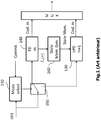
- the patent application published under the number WO2013 / 016262 proposes to update the LPD codec filter memories (130) coding the m + 1 frame using the synthesis of the FD-type encoder and decoder (140) coding the m-frame.
- the update of the memories being necessary only during the coding of FD type frames.
- This technique thus makes it possible, during the selection at 110 of the coding mode and the switching (at 150) of the FD-type coding to LPD, of making it without any transition fault (artifacts) since at the time of coding the frame with the technique LPD, the memories (or states) of the CELP coder (LPD) have already been updated by the generator 160 from the reconstructed signal ⁇ a ( n ) of the frame m.
- the technique described in the application WO2013 / 016262 proposes a step of resampling the memories of the FD type encoder.
- This technique has the disadvantage on the one hand that it requires access to the decoded signal encoder and thus force a local synthesis in the encoder.
- it requires to update the memories of the filters (which may include a resampling step) at the time of encoding and decoding FD type, and a set of operations returning to achieve a CELP type analysis / coding in the previous FD type frame.
- These operations can be complex and are superimposed on conventional coding / decoding operations in the LPD type transition frame, which causes a peak of complexity in "multi-mode" coding.
- the states reset is performed without the need for the decoded signal of the previous frame, it is performed very simply by zero or predetermined constant values.
- the complexity of the decoder is thus reduced compared to state memory updating techniques requiring analysis or other calculations.
- the transition artifacts are then avoided by the implementation of the addition-overlap step which makes it possible to make the link with the previous frame.
- transition predictive decoding it is not necessary to reset the adaptive dictionary memories for this current frame since it is not used. This simplifies all the more the implementation of the transition.
- the inverse transform decoding has a lower processing delay than the predictive decoding and the first decoded current frame segment by predictive decoding is replaced by a segment derived from the decoding of the previous frame corresponding to the offset of the prediction decoding. delay and stored when decoding the previous frame.
- the signal segment synthesized by inverse transform decoding is corrected before the addition-overlap step by applying an inverse window compensating the windowing previously applied to the segment.
- the decoded current frame has an energy that is close to that of the original signal.
- the signal segment synthesized by inverse transform decoding is pre-sampled at the sampling frequency corresponding to the decoded signal segment of the current frame.
- the calculation of the coefficients of the linear prediction filter of the current frame is performed by decoding the coefficients of a single filter and by assigning identical coefficients to the end linear prediction filter. , middle and start of frame.
- the frame start coefficients are not known.
- the decoded values are then used to obtain the coefficients of the linear prediction filter of the complete frame. This is therefore done in a simple manner without providing significant degradation to the decoded audio signal.
- the coefficients corresponding to the frame medium filter are decoded with a smaller error.
- the coefficients of the frame start linear prediction filter are reset to a predetermined value corresponding to an average value of the long term prediction filter coefficients and the linear prediction coefficients of the current frame are determined. using the thus predetermined values and the decoded values of the coefficients of the end of frame filter.
- the frame start coefficients are considered to be known with the predetermined value. This makes it possible to find the coefficients of the complete frame more accurately and to stabilize the predictive decoding more quickly.
- a predetermined default value depends on the type of frame to be decoded.
- the decoding is well adapted to the signal to be decoded.
- the reset of the states is carried out without the need for reconstruction of the signal of the previous frame and thus of local decoding. It is performed very simply by zero or predetermined constant values. The complexity of the coding is thus reduced compared to the techniques for updating state memories that require analysis or other calculations.
- the coefficients of the linear prediction filter are part of at least one state of the predictive coding and the calculation of the coefficients of the prediction filter.
- linear prediction of the current frame is performed by determining the coded values of the coefficients of a single prediction filter, either of medium or of end of frame and assignment of identical coded values for the coefficients of the prediction filter of the beginning weft and end or middle of the frame.
- At least one state of the predictive coding is coded directly.
- the bits normally reserved for encoding the set of coefficients of the frame medium or frame start filter are used, for example, to directly code at least one state of the predictive coding, for example the memory of the screening filter. emphasis.
- the coefficients corresponding to the frame medium filter are coded with a lower error percentage.
- the coefficients of the linear prediction filter are part of at least one state of the predictive coding
- the coefficients of the beginning of frame linear prediction filter are reset to a predetermined value corresponding to an average value of the coefficients of the prediction coding.
- Long-term prediction filter and the linear prediction coefficients of the current frame are determined using the thus predetermined values and the coded values of the end-of-frame filter coefficients.
- the frame start coefficients are considered as known with the predetermined value. This makes it possible to obtain a good estimate of the coefficients of the frame. prediction of the previous frame, without further analysis, to calculate the prediction coefficients of the complete frame.
- a predetermined default value depends on the type of frame to be coded.
- the decoder and the encoder provide the same advantages as the decoding and coding methods that they implement respectively.
- the invention relates to a computer program comprising code instructions for implementing the steps of the decoding method as described above and / or encoding as described above, when these instructions are executed by a processor.
- the invention also relates to a storage means, readable by a processor, whether or not integrated into the decoder or the encoder, possibly removable, storing a computer program implementing a decoding method and / or a coding method as described. previously.
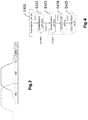
- the figure 2 illustrates schematically the coding principle during a transition between a transform coding and a predictive coding according to the invention.
- a transform coder for example of the MDCT type or with a predictive coder (LPD) by example of type ACELP; it should be noted that additional modes of coding are possible without affecting the invention.
- the transform coder uses windows with a low delay of "Tukey" type (the invention is independent of the type of window used) and the total length of which is equal to two frames (including zero values) as shown in the figure.
- the windows of the encoder FD are synchronized so that the last non-zero portion of the window (right) corresponds to the end of a new frame of the input signal.
- the division into frames illustrated in the figure 2 includes the "lookahead" (or future signal) and the actually coded frame is thus typically shifted in time (delayed) as explained later in relation to the figure 5 .
- the coder performs the procedure of folding and transformation by DCT as described in the state of the art (MDCT).
- MDCT state of the art
- the LPD encoder is derived from the ITU-T G.718 coder whose CELP coding operates at an internal frequency of 12.8 kHz.
- the LPD encoder according to the invention can operate at two internal frequencies 12.8 kHz or 16 kHz depending on the flow.
- the particular embodiment is in the transition frame between a FD transform codec using an MDCT and a predictive codec of the ACELP type.
- a decision module Determines whether the frame to be processed is to be encoded in predictive coding ACELP or in transform coding FD.
- a complete transform step MDCT is performed (E302) by the transform coding entity 302.
- This step includes among other things a windowing with a low delay window aligned as illustrated in FIG. figure 2 , a folding step and a transformation step in the DCT domain.
- the frame FD is then quantized in a step (E303) by a quantization module 303 and the data thus encoded are written in the bit stream (bitstream) at E305 by the bit stream construction module 305.
- This predictive coding E308 may, in a particular embodiment, be a transition coding as defined under the name 'TC mode' in the ITU-T G.718 standard, in which the coding of the excitation is direct and does not use adaptive dictionary from the previous frame. An independent excitation of the previous frame is then coded.
- This realization allows the LPD-type predictive coders to stabilize much more quickly (compared to a conventional CELP coding that would use an adaptive dictionary that would be zeroed out.) This further simplifies the implementation of the transition according to the invention.
- the coding of the excitation may not be in a transition mode but will use a CELP coding similar to G.718 and may use an adaptive dictionary (without forcing or limiting the classification) or classic CELP coding with adaptive and fixed dictionaries.
- This variant is however less advantageous because the adaptive dictionary has not been recalculated and has been set to zero, the coding will be suboptimal.
- the CELP coding in the TC mode transition frame may be replaced by any other type of coding independent of the previous frame, for example by using the iLBC type coding scheme.
- a step E307 for calculating the coefficients of the linear prediction filter for the current frame is performed by the calculation module 307.
- the predictive coding (block 304) performs two linear prediction analyzes per frame as in the G.718 standard, with a coding of the LPC coefficients in the form of ISF (or LSF equivalently) obtained at the end of frame (NEW) and a very low rate coding of the LPC coefficients obtained in the middle of the frame (MID), with a subframe interpolation between the LPC coefficients of the previous frame end (OLD), and those of the frame current (MID and NEW).
- the prediction coefficients in the FD-type previous frame (OLD) are not known because no LPC coefficient is encoded in the FD encoder.
- the bits that could be reserved for the coding of the set of middle frame (MID) or frame start LPC coefficients are used for example to directly code at least one state of the predictive coding, for example the memory of the filter de-emphasis.
- a first step E401 is the initialization of the coefficients of the prediction filter and the equivalent representations ISF or LSF according to the implementation of the step E306 of the figure 3 that is to say at predetermined values, for example according to the long-term average value on a prior learning basis of the LSP coefficients.
- Step E402 encodes the end of frame filter coefficients (LSP NEW) and the obtained code values (LEP NEW Q) as well as the predetermined reset values of the start frame filter coefficients (LSP OLD) are used in E403 for encoding the coefficients of the frame middle prediction filter (MID LSP).
- Step E404 replacement step of the frame start coefficient values (LSP OLD) by the coded values of the frame medium coefficients (LSP MID Q) is performed.
- Step E405 makes it possible to determine the coefficients of the linear prediction filter of the current frame from these values thus coded (OLD LSP, LSP MID Q, LSP NEW Q).
- the coefficients of the linear prediction filter of the previous frame are initialized to a value which is already available "for free” in a variant of encoder FD using an LPC-type spectral envelope.
- LSP OLD linear prediction filter of the previous frame
- a "normal" coding as used in G.718 can be used, the linear prediction coefficients per sub-frame being calculated as an interpolation between the values of the prediction filters OLD, MID and NEW, this operation thus allows the LPD coder to obtain, without further analysis, a good estimate of the LPC coefficients in the previous frame.
- the LPD coding may by default only encode a set of LPC coefficients (NEW), the previous variants of embodiment are simply adapted to take into account that no set of coefficients is available in the middle of frame (MID).
- the initialization of the states of the predictive coding may be performed with default values predetermined in advance which may, for example, correspond to different type of frame to be encoded (for example the values of initialization can be different if the frame comprises a signal of the voiced or unvoiced type).
- the figure 5 illustrates schematically the decoding principle during a transition between a transform decoding and a predictive decoding according to the invention.
- FD transform decoder
- LPD predictive decoder
- the transform decoder (FD) uses "Tukey" type low delay synthesis windows (the invention is independent of the type of window used) and the total length of which is equal to two frames (including zero values). ) as shown in the figure.
- an inverse DCT transformation is applied to the decoded frame.
- the latter is unfolded and the synthesis window is applied to the unfolded signal.
- the synthesis windows of the encoder FD are synchronized so that the non-zero part of the window (left) corresponds to a new frame.
- the frame can be decoded to the point A since the signal does not have aliasing before this point.
- the states or memories of the predictive decoding are reset to predetermined values.
- the particular embodiment is in the transition frame between a FD transform codec using an MDCT and a predictive codec of the ACELP type.
- a decision module (dec.) Determines whether the frame to be processed must be decoded in predictive decoding ACELP or in FD decoding.
- a decoding step E602 by the transform decoding entity 602 makes it possible to obtain the frame in the transformed domain.
- the step may also contain a resampling step at the sampling frequency of the ACELP decoder.
- This step is followed by an inverse MDCT transformation E603 comprising, an inverse DCT transformation, a temporal unfolding, and the application of a synthesis window and an addition-overlap step with the previous frame as described later in reference to the figure 8 .
- the part for which the temporal folding has been canceled is framed in a step E605 by the framing module 605.
- the part which includes time folding is kept in memory (MDCT mem) to make a step of adding recovery in E609 by the processing module 609 with the possible next frame decoded by the core FD.
- the memorized portion of the MDCT decoding that is used for the addition-overlap step does not include time-folding, for example in the case where there is a sufficiently large time shift between the MDCT decoding and the decoding. CELP.
- Step E609 uses the transform coder memory (MDCT mem), as described above, i.e., the decoded signal after point A but which has folding (in the illustrated case).
- MDCT mem transform coder memory
- the signal is used up to the point B which is the folding point of the transform.
- this signal is first compensated by the inverse of the window previously applied to the segment AB.
- the segment AB is corrected by the application of an inverse window compensating the windowing previously applied to the segment. The segment is no longer "windowed” and its energy is close to that of the original signal.
- the two AB segments are then weighted and summed in order to obtain the final AB signal.
- the weighting functions preferably have a sum equal to 1 (of the linear or quadratic sinusoidal type, for example).
- the addition-overlay step combines a synthesized signal segment by predictive decoding of the current frame and a signal segment synthesized by inverse transform decoding, corresponding to a stored segment of the decoding of the previous frame.
- the signal segment synthesized by FD type inverse transform decoding is previously resampled to the sampling frequency corresponding to the decoded signal segment of the current LPD frame.
- This re-sampling of the MDCT memory can be done with or without delay with conventional techniques by FIR type filter, filter bank, IIR filter or using "splines".
- an intermediate delay step (E604) in order to temporally align the two decoders if the decoder FD has less delay than the decoder CELP (LPD).
- a portion of signal whose size corresponds to the delay between the two decoders is then stored in memory (Mem.retard).
- the figure 9 illustrates this case.
- the embodiment here proposes advantageously taking advantage of this difference in delay D to replace the first segment D resulting from the predictive decoding LPD by that resulting from the FD transform decoding and then to proceed to the addition-recovery step (E609 ) as described above, on the AB segment.
- the inverse transform decoding has a lower processing delay than that of the predictive decoding
- the first current frame segment decoded by predictive decoding is replaced by a segment derived from the decoding of the previous frame corresponding to the delay offset and set to memory when decoding the previous frame.
- the initialization of the LPD decoding states can be done with pre-determined default values that can for example correspond to different type of frame to be decoded according to what was done during the encoding.
- a predictive decoding step for the current frame is then implemented in E608 by a predictive decoding entity 608, before the addition-overlap step (E609) described above.
- the step may also contain a resampling step at the sampling rate of the MDCT decoder.
- this predictive coding E608 may be a predictive transition decoding, if this solution has been chosen at the encoder, in which the decoding of the excitation is direct and does not use an adaptive dictionary. In this case, the adaptive dictionary memory does not need to be reset.
- Non-predictive decoding of the excitation is then performed.
- This embodiment allows the predictive decoders LPD type to stabilize much faster because in this case, it does not use the adaptive dictionary memory that had been previously reset. This further simplifies the implementation of the transition according to the invention.
- the predictive decoding of the long-term excitation is replaced by a non-predictive decoding of the excitation.
- a step E607 for calculating the coefficients of the linear prediction filter for the current frame is performed by the calculation module 607.
- the prediction coefficients in the FD-type previous frame are not known because no LPC coefficient is encoded in the FD encoder and the values have been reset to zero.
- a first step E701 is the initialization of the prediction filter coefficients (LSP OLD) according to the implementation of the step E606 of the figure 6 .
- Step E702 decodes the coefficients of the end-of-frame filter (LSP NEW) and the decoded values obtained (LSP NEW) as well as the predetermined values for resetting the coefficients of the start-of-frame filter (LSP OLD) are used jointly in E703. to decode the coefficients of the frame middle prediction filter (MID LSP).
- An E704 replacement step of the frame start coefficient values (LSP OLD) by the decoded values of the frame medium coefficients (MID LSP) is performed.
- Step E705 makes it possible to determine the coefficients of the linear prediction filter of the current frame from these values thus decoded (LSP OLD, MID LSP, LSP NEW).
- the coefficients of the linear prediction filter of the previous frame are initialized to a predetermined value, for example according to the long-term average value of the LSP coefficients.
- a "normal" decoding as used in G.718 can be used, the subframe linear prediction coefficients being calculated as an interpolation between the values of the prediction filters OLD, MID and NEW. This operation allows the LPD encoder to stabilize more quickly.
- This encoder or decoder can be integrated into a communication terminal, a communication gateway or any type of equipment such as a set top box, or audio stream reader.
- This device DISP comprises an input for receiving a digital signal which in the case of the encoder is an input signal x (n) and in the case of the decoder, the bit stream bst.
- the device also comprises a processor PROC of digital signals adapted to perform coding / decoding operations in particular on a signal from the input E.
- This processor is connected to one or more MEM memory units adapted to store information necessary for controlling the device for coding / decoding.
- these memory units comprise instructions for implementing the decoding method described above and in particular for implementing the decoding steps according to an inverse transform decoding of a previous frame of samples of the digital signal.
- these memory units comprise instructions for implementing the coding method described above and in particular for implementing the steps of coding a previous frame of samples of the digital signal according to a transform encoding, receiving a current frame of samples of the digital signal to be coded according to a predictive coding, a step of resetting at least one state of the predictive coding to a predetermined default value.
- These memory units may also include calculation parameters or other information.
- a storage means readable by a processor, whether or not integrated into the encoder or decoder, possibly removable, stores a computer program implementing a decoding method and / or a coding method according to the invention.
- the figures 3 and 6 can for example illustrate the algorithm of such a computer program.
- the processor is also adapted to store results in these memory units.
- the device comprises an output S connected to the processor to provide a output signal which in the case of the encoder is a signal in the form of bit stream bst and in the case of the decoder, an output signal x ( n ).
Landscapes
- Engineering & Computer Science (AREA)
- Physics & Mathematics (AREA)
- Computational Linguistics (AREA)
- Signal Processing (AREA)
- Health & Medical Sciences (AREA)
- Audiology, Speech & Language Pathology (AREA)
- Human Computer Interaction (AREA)
- Acoustics & Sound (AREA)
- Multimedia (AREA)
- Spectroscopy & Molecular Physics (AREA)
- Theoretical Computer Science (AREA)
- Compression, Expansion, Code Conversion, And Decoders (AREA)
Applications Claiming Priority (2)
| Application Number | Priority Date | Filing Date | Title |
|---|---|---|---|
| FR1361243A FR3013496A1 (fr) | 2013-11-15 | 2013-11-15 | Transition d'un codage/decodage par transformee vers un codage/decodage predictif |
| PCT/FR2014/052923 WO2015071613A2 (fr) | 2013-11-15 | 2014-11-14 | Transition d'un codage/décodage par transformée vers un codage/décodage prédictif |
Publications (2)
| Publication Number | Publication Date |
|---|---|
| EP3069340A2 EP3069340A2 (fr) | 2016-09-21 |
| EP3069340B1 true EP3069340B1 (fr) | 2017-09-20 |
Family
ID=50179701
Family Applications (1)
| Application Number | Title | Priority Date | Filing Date |
|---|---|---|---|
| EP14821711.0A Active EP3069340B1 (fr) | 2013-11-15 | 2014-11-14 | Transition d'un codage/décodage par transformée vers un codage/décodage prédictif |
Country Status (11)
| Country | Link |
|---|---|
| US (1) | US9984696B2 (enExample) |
| EP (1) | EP3069340B1 (enExample) |
| JP (1) | JP6568850B2 (enExample) |
| KR (2) | KR102388687B1 (enExample) |
| CN (1) | CN105723457B (enExample) |
| BR (1) | BR112016010522B1 (enExample) |
| ES (1) | ES2651988T3 (enExample) |
| FR (1) | FR3013496A1 (enExample) |
| MX (1) | MX353104B (enExample) |
| RU (1) | RU2675216C1 (enExample) |
| WO (1) | WO2015071613A2 (enExample) |
Families Citing this family (6)
| Publication number | Priority date | Publication date | Assignee | Title |
|---|---|---|---|---|
| EP2980797A1 (en) | 2014-07-28 | 2016-02-03 | Fraunhofer-Gesellschaft zur Förderung der angewandten Forschung e.V. | Audio decoder, method and computer program using a zero-input-response to obtain a smooth transition |
| CN110444216B (zh) | 2014-05-01 | 2022-10-21 | 日本电信电话株式会社 | 解码装置、解码方法、记录介质 |
| US10304472B2 (en) * | 2014-07-28 | 2019-05-28 | Nippon Telegraph And Telephone Corporation | Method, device and recording medium for coding based on a selected coding processing |
| EP2980794A1 (en) * | 2014-07-28 | 2016-02-03 | Fraunhofer-Gesellschaft zur Förderung der angewandten Forschung e.V. | Audio encoder and decoder using a frequency domain processor and a time domain processor |
| EP2980795A1 (en) * | 2014-07-28 | 2016-02-03 | Fraunhofer-Gesellschaft zur Förderung der angewandten Forschung e.V. | Audio encoding and decoding using a frequency domain processor, a time domain processor and a cross processor for initialization of the time domain processor |
| EP2988300A1 (en) | 2014-08-18 | 2016-02-24 | Fraunhofer-Gesellschaft zur Förderung der angewandten Forschung e.V. | Switching of sampling rates at audio processing devices |
Family Cites Families (38)
| Publication number | Priority date | Publication date | Assignee | Title |
|---|---|---|---|---|
| US5327520A (en) * | 1992-06-04 | 1994-07-05 | At&T Bell Laboratories | Method of use of voice message coder/decoder |
| JPH07210199A (ja) * | 1994-01-20 | 1995-08-11 | Hitachi Ltd | 音声符号化方法および音声符号化装置 |
| US5732389A (en) * | 1995-06-07 | 1998-03-24 | Lucent Technologies Inc. | Voiced/unvoiced classification of speech for excitation codebook selection in celp speech decoding during frame erasures |
| US6134518A (en) * | 1997-03-04 | 2000-10-17 | International Business Machines Corporation | Digital audio signal coding using a CELP coder and a transform coder |
| US6169970B1 (en) * | 1998-01-08 | 2001-01-02 | Lucent Technologies Inc. | Generalized analysis-by-synthesis speech coding method and apparatus |
| US6311154B1 (en) * | 1998-12-30 | 2001-10-30 | Nokia Mobile Phones Limited | Adaptive windows for analysis-by-synthesis CELP-type speech coding |
| US6640209B1 (en) * | 1999-02-26 | 2003-10-28 | Qualcomm Incorporated | Closed-loop multimode mixed-domain linear prediction (MDLP) speech coder |
| US6959274B1 (en) * | 1999-09-22 | 2005-10-25 | Mindspeed Technologies, Inc. | Fixed rate speech compression system and method |
| JP4857467B2 (ja) * | 2001-01-25 | 2012-01-18 | ソニー株式会社 | データ処理装置およびデータ処理方法、並びにプログラムおよび記録媒体 |
| DE10124420C1 (de) * | 2001-05-18 | 2002-11-28 | Siemens Ag | Verfahren zur Codierung und zur Übertragung von Sprachsignalen |
| CA2388439A1 (en) * | 2002-05-31 | 2003-11-30 | Voiceage Corporation | A method and device for efficient frame erasure concealment in linear predictive based speech codecs |
| US7103538B1 (en) * | 2002-06-10 | 2006-09-05 | Mindspeed Technologies, Inc. | Fixed code book with embedded adaptive code book |
| CA2457988A1 (en) * | 2004-02-18 | 2005-08-18 | Voiceage Corporation | Methods and devices for audio compression based on acelp/tcx coding and multi-rate lattice vector quantization |
| US7386445B2 (en) * | 2005-01-18 | 2008-06-10 | Nokia Corporation | Compensation of transient effects in transform coding |
| US7831421B2 (en) * | 2005-05-31 | 2010-11-09 | Microsoft Corporation | Robust decoder |
| KR100647336B1 (ko) * | 2005-11-08 | 2006-11-23 | 삼성전자주식회사 | 적응적 시간/주파수 기반 오디오 부호화/복호화 장치 및방법 |
| KR100803212B1 (ko) * | 2006-01-11 | 2008-02-14 | 삼성전자주식회사 | 스케일러블 채널 복호화 방법 및 장치 |
| TR201906713T4 (tr) * | 2007-01-10 | 2019-05-21 | Koninklijke Philips Nv | Audio kod çözücü. |
| CN101622664B (zh) * | 2007-03-02 | 2012-02-01 | 松下电器产业株式会社 | 自适应激励矢量量化装置和自适应激励矢量量化方法 |
| US8515767B2 (en) * | 2007-11-04 | 2013-08-20 | Qualcomm Incorporated | Technique for encoding/decoding of codebook indices for quantized MDCT spectrum in scalable speech and audio codecs |
| CN100578619C (zh) * | 2007-11-05 | 2010-01-06 | 华为技术有限公司 | 编码方法和编码器 |
| CN100578620C (zh) * | 2007-11-12 | 2010-01-06 | 华为技术有限公司 | 固定码书搜索方法及搜索器 |
| EP2077551B1 (en) * | 2008-01-04 | 2011-03-02 | Dolby Sweden AB | Audio encoder and decoder |
| BR122021009252B1 (pt) * | 2008-07-11 | 2022-03-03 | Fraunhofer-Gesellschaft zur Förderung der angewandten Forschung e. V. | Codificador e decodificador de áudio para estruturas de codificação de sinais de áudio amostrados |
| ES2396927T3 (es) * | 2008-07-11 | 2013-03-01 | Fraunhofer-Gesellschaft zur Förderung der angewandten Forschung e.V. | Aparato y procedimiento para decodificar una señal de audio codificada |
| EP2144231A1 (en) * | 2008-07-11 | 2010-01-13 | Fraunhofer-Gesellschaft zur Förderung der angewandten Forschung e.V. | Low bitrate audio encoding/decoding scheme with common preprocessing |
| PL2301020T3 (pl) * | 2008-07-11 | 2013-06-28 | Fraunhofer Ges Forschung | Urządzenie i sposób do kodowania/dekodowania sygnału audio z użyciem algorytmu przełączania aliasingu |
| ES2683077T3 (es) * | 2008-07-11 | 2018-09-24 | Fraunhofer-Gesellschaft zur Förderung der angewandten Forschung e.V. | Codificador y decodificador de audio para codificar y decodificar tramas de una señal de audio muestreada |
| KR101315617B1 (ko) * | 2008-11-26 | 2013-10-08 | 광운대학교 산학협력단 | 모드 스위칭에 기초하여 윈도우 시퀀스를 처리하는 통합 음성/오디오 부/복호화기 |
| US8457975B2 (en) * | 2009-01-28 | 2013-06-04 | Fraunhofer-Gesellschaft Zur Foerderung Der Angewandten Forschung E.V. | Audio decoder, audio encoder, methods for decoding and encoding an audio signal and computer program |
| JP4977157B2 (ja) * | 2009-03-06 | 2012-07-18 | 株式会社エヌ・ティ・ティ・ドコモ | 音信号符号化方法、音信号復号方法、符号化装置、復号装置、音信号処理システム、音信号符号化プログラム、及び、音信号復号プログラム |
| PL3352168T3 (pl) * | 2009-06-23 | 2021-03-08 | Voiceage Corporation | Postępowe tłumienie aliasingu w dziedzinie czasu z zastosowaniem w ważonej albo pierwotnej dziedzinie sygnału |
| MY163358A (en) * | 2009-10-08 | 2017-09-15 | Fraunhofer-Gesellschaft Zur Förderung Der Angenwandten Forschung E V | Multi-mode audio signal decoder,multi-mode audio signal encoder,methods and computer program using a linear-prediction-coding based noise shaping |
| KR101137652B1 (ko) * | 2009-10-14 | 2012-04-23 | 광운대학교 산학협력단 | 천이 구간에 기초하여 윈도우의 오버랩 영역을 조절하는 통합 음성/오디오 부호화/복호화 장치 및 방법 |
| WO2011158485A2 (ja) * | 2010-06-14 | 2011-12-22 | パナソニック株式会社 | オーディオハイブリッド符号化装置およびオーディオハイブリッド復号装置 |
| FR2969805A1 (fr) * | 2010-12-23 | 2012-06-29 | France Telecom | Codage bas retard alternant codage predictif et codage par transformee |
| US9037456B2 (en) * | 2011-07-26 | 2015-05-19 | Google Technology Holdings LLC | Method and apparatus for audio coding and decoding |
| US9043201B2 (en) * | 2012-01-03 | 2015-05-26 | Google Technology Holdings LLC | Method and apparatus for processing audio frames to transition between different codecs |
-
2013
- 2013-11-15 FR FR1361243A patent/FR3013496A1/fr not_active Withdrawn
-
2014
- 2014-11-14 ES ES14821711.0T patent/ES2651988T3/es active Active
- 2014-11-14 EP EP14821711.0A patent/EP3069340B1/fr active Active
- 2014-11-14 BR BR112016010522-2A patent/BR112016010522B1/pt active IP Right Grant
- 2014-11-14 KR KR1020217018976A patent/KR102388687B1/ko active Active
- 2014-11-14 JP JP2016529922A patent/JP6568850B2/ja active Active
- 2014-11-14 MX MX2016006253A patent/MX353104B/es active IP Right Grant
- 2014-11-14 KR KR1020167014550A patent/KR102289004B1/ko active Active
- 2014-11-14 RU RU2016123462A patent/RU2675216C1/ru active
- 2014-11-14 CN CN201480062220.5A patent/CN105723457B/zh active Active
- 2014-11-14 WO PCT/FR2014/052923 patent/WO2015071613A2/fr not_active Ceased
- 2014-11-14 US US15/036,984 patent/US9984696B2/en active Active
Non-Patent Citations (1)
| Title |
|---|
| None * |
Also Published As
| Publication number | Publication date |
|---|---|
| US20160293173A1 (en) | 2016-10-06 |
| CN105723457A (zh) | 2016-06-29 |
| BR112016010522B1 (pt) | 2022-09-06 |
| KR102289004B1 (ko) | 2021-08-10 |
| US9984696B2 (en) | 2018-05-29 |
| KR20160083890A (ko) | 2016-07-12 |
| RU2016123462A (ru) | 2017-12-18 |
| RU2675216C1 (ru) | 2018-12-17 |
| ES2651988T3 (es) | 2018-01-30 |
| MX353104B (es) | 2017-12-19 |
| CN105723457B (zh) | 2019-05-28 |
| KR102388687B1 (ko) | 2022-04-19 |
| JP6568850B2 (ja) | 2019-08-28 |
| MX2016006253A (es) | 2016-09-07 |
| JP2017501432A (ja) | 2017-01-12 |
| WO2015071613A3 (fr) | 2015-07-09 |
| WO2015071613A2 (fr) | 2015-05-21 |
| EP3069340A2 (fr) | 2016-09-21 |
| BR112016010522A2 (enExample) | 2017-08-08 |
| FR3013496A1 (fr) | 2015-05-22 |
| KR20210077807A (ko) | 2021-06-25 |
Similar Documents
| Publication | Publication Date | Title |
|---|---|---|
| EP1905010B1 (fr) | Codage/décodage audio hiérarchique | |
| EP1907812B1 (fr) | Procede de commutation de debit en decodage audio scalable en debit et largeur de bande | |
| EP1989706B1 (fr) | Dispositif de ponderation perceptuelle en codage/decodage audio | |
| EP3069340B1 (fr) | Transition d'un codage/décodage par transformée vers un codage/décodage prédictif | |
| EP2656343B1 (fr) | Codage de son à bas retard alternant codage prédictif et codage par transformée | |
| EP3161659A1 (fr) | Ré-échantillonnage par interpolation d'un signal audio pour un codage /décodage à bas retard | |
| CN101379551A (zh) | 在语音编解码器中用于有效帧擦除隐蔽的方法和装置 | |
| FR2929466A1 (fr) | Dissimulation d'erreur de transmission dans un signal numerique dans une structure de decodage hierarchique | |
| CN106575505B (zh) | Fd/lpd转换环境中的帧丢失管理 | |
| WO2011004098A1 (fr) | Allocation de bits dans un codage/décodage d'amélioration d'un codage/décodage hiérarchique de signaux audionumériques | |
| EP3175443B1 (fr) | Détermination d'un budget de codage d'une trame de transition lpd/fd | |
| CA2766864A1 (fr) | Codage/decodage perfectionne de signaux audionumeriques | |
| EP2005424A2 (fr) | Procede de post-traitement d'un signal dans un decodeur audio | |
| EP2345029B1 (fr) | Procédé, programme informatique et entité de décodage d'un signal audio numérique | |
| FR2990552A1 (fr) | Traitement d'amelioration de la qualite des signaux audiofrequences | |
| FR2980620A1 (fr) | Traitement d'amelioration de la qualite des signaux audiofrequences decodes |
Legal Events
| Date | Code | Title | Description |
|---|---|---|---|
| PUAI | Public reference made under article 153(3) epc to a published international application that has entered the european phase |
Free format text: ORIGINAL CODE: 0009012 |
|
| 17P | Request for examination filed |
Effective date: 20160614 |
|
| AK | Designated contracting states |
Kind code of ref document: A2 Designated state(s): AL AT BE BG CH CY CZ DE DK EE ES FI FR GB GR HR HU IE IS IT LI LT LU LV MC MK MT NL NO PL PT RO RS SE SI SK SM TR |
|
| AX | Request for extension of the european patent |
Extension state: BA ME |
|
| DAX | Request for extension of the european patent (deleted) | ||
| GRAP | Despatch of communication of intention to grant a patent |
Free format text: ORIGINAL CODE: EPIDOSNIGR1 |
|
| INTG | Intention to grant announced |
Effective date: 20170503 |
|
| GRAS | Grant fee paid |
Free format text: ORIGINAL CODE: EPIDOSNIGR3 |
|
| GRAA | (expected) grant |
Free format text: ORIGINAL CODE: 0009210 |
|
| AK | Designated contracting states |
Kind code of ref document: B1 Designated state(s): AL AT BE BG CH CY CZ DE DK EE ES FI FR GB GR HR HU IE IS IT LI LT LU LV MC MK MT NL NO PL PT RO RS SE SI SK SM TR |
|
| REG | Reference to a national code |
Ref country code: GB Ref legal event code: FG4D Free format text: NOT ENGLISH |
|
| REG | Reference to a national code |
Ref country code: CH Ref legal event code: EP |
|
| REG | Reference to a national code |
Ref country code: AT Ref legal event code: REF Ref document number: 930740 Country of ref document: AT Kind code of ref document: T Effective date: 20171015 |
|
| REG | Reference to a national code |
Ref country code: IE Ref legal event code: FG4D Free format text: LANGUAGE OF EP DOCUMENT: FRENCH |
|
| REG | Reference to a national code |
Ref country code: FR Ref legal event code: PLFP Year of fee payment: 4 |
|
| REG | Reference to a national code |
Ref country code: DE Ref legal event code: R096 Ref document number: 602014014918 Country of ref document: DE |
|
| REG | Reference to a national code |
Ref country code: NL Ref legal event code: MP Effective date: 20170920 |
|
| REG | Reference to a national code |
Ref country code: ES Ref legal event code: FG2A Ref document number: 2651988 Country of ref document: ES Kind code of ref document: T3 Effective date: 20180130 |
|
| PG25 | Lapsed in a contracting state [announced via postgrant information from national office to epo] |
Ref country code: FI Free format text: LAPSE BECAUSE OF FAILURE TO SUBMIT A TRANSLATION OF THE DESCRIPTION OR TO PAY THE FEE WITHIN THE PRESCRIBED TIME-LIMIT Effective date: 20170920 Ref country code: LT Free format text: LAPSE BECAUSE OF FAILURE TO SUBMIT A TRANSLATION OF THE DESCRIPTION OR TO PAY THE FEE WITHIN THE PRESCRIBED TIME-LIMIT Effective date: 20170920 Ref country code: NO Free format text: LAPSE BECAUSE OF FAILURE TO SUBMIT A TRANSLATION OF THE DESCRIPTION OR TO PAY THE FEE WITHIN THE PRESCRIBED TIME-LIMIT Effective date: 20171220 Ref country code: SE Free format text: LAPSE BECAUSE OF FAILURE TO SUBMIT A TRANSLATION OF THE DESCRIPTION OR TO PAY THE FEE WITHIN THE PRESCRIBED TIME-LIMIT Effective date: 20170920 Ref country code: HR Free format text: LAPSE BECAUSE OF FAILURE TO SUBMIT A TRANSLATION OF THE DESCRIPTION OR TO PAY THE FEE WITHIN THE PRESCRIBED TIME-LIMIT Effective date: 20170920 |
|
| REG | Reference to a national code |
Ref country code: LT Ref legal event code: MG4D |
|
| REG | Reference to a national code |
Ref country code: AT Ref legal event code: MK05 Ref document number: 930740 Country of ref document: AT Kind code of ref document: T Effective date: 20170920 |
|
| PG25 | Lapsed in a contracting state [announced via postgrant information from national office to epo] |
Ref country code: BG Free format text: LAPSE BECAUSE OF FAILURE TO SUBMIT A TRANSLATION OF THE DESCRIPTION OR TO PAY THE FEE WITHIN THE PRESCRIBED TIME-LIMIT Effective date: 20171220 Ref country code: RS Free format text: LAPSE BECAUSE OF FAILURE TO SUBMIT A TRANSLATION OF THE DESCRIPTION OR TO PAY THE FEE WITHIN THE PRESCRIBED TIME-LIMIT Effective date: 20170920 Ref country code: GR Free format text: LAPSE BECAUSE OF FAILURE TO SUBMIT A TRANSLATION OF THE DESCRIPTION OR TO PAY THE FEE WITHIN THE PRESCRIBED TIME-LIMIT Effective date: 20171221 Ref country code: LV Free format text: LAPSE BECAUSE OF FAILURE TO SUBMIT A TRANSLATION OF THE DESCRIPTION OR TO PAY THE FEE WITHIN THE PRESCRIBED TIME-LIMIT Effective date: 20170920 |
|
| PG25 | Lapsed in a contracting state [announced via postgrant information from national office to epo] |
Ref country code: NL Free format text: LAPSE BECAUSE OF FAILURE TO SUBMIT A TRANSLATION OF THE DESCRIPTION OR TO PAY THE FEE WITHIN THE PRESCRIBED TIME-LIMIT Effective date: 20170920 |
|
| PG25 | Lapsed in a contracting state [announced via postgrant information from national office to epo] |
Ref country code: CZ Free format text: LAPSE BECAUSE OF FAILURE TO SUBMIT A TRANSLATION OF THE DESCRIPTION OR TO PAY THE FEE WITHIN THE PRESCRIBED TIME-LIMIT Effective date: 20170920 Ref country code: RO Free format text: LAPSE BECAUSE OF FAILURE TO SUBMIT A TRANSLATION OF THE DESCRIPTION OR TO PAY THE FEE WITHIN THE PRESCRIBED TIME-LIMIT Effective date: 20170920 Ref country code: PL Free format text: LAPSE BECAUSE OF FAILURE TO SUBMIT A TRANSLATION OF THE DESCRIPTION OR TO PAY THE FEE WITHIN THE PRESCRIBED TIME-LIMIT Effective date: 20170920 |
|
| PG25 | Lapsed in a contracting state [announced via postgrant information from national office to epo] |
Ref country code: SM Free format text: LAPSE BECAUSE OF FAILURE TO SUBMIT A TRANSLATION OF THE DESCRIPTION OR TO PAY THE FEE WITHIN THE PRESCRIBED TIME-LIMIT Effective date: 20170920 Ref country code: AT Free format text: LAPSE BECAUSE OF FAILURE TO SUBMIT A TRANSLATION OF THE DESCRIPTION OR TO PAY THE FEE WITHIN THE PRESCRIBED TIME-LIMIT Effective date: 20170920 Ref country code: IS Free format text: LAPSE BECAUSE OF FAILURE TO SUBMIT A TRANSLATION OF THE DESCRIPTION OR TO PAY THE FEE WITHIN THE PRESCRIBED TIME-LIMIT Effective date: 20180120 Ref country code: EE Free format text: LAPSE BECAUSE OF FAILURE TO SUBMIT A TRANSLATION OF THE DESCRIPTION OR TO PAY THE FEE WITHIN THE PRESCRIBED TIME-LIMIT Effective date: 20170920 Ref country code: SK Free format text: LAPSE BECAUSE OF FAILURE TO SUBMIT A TRANSLATION OF THE DESCRIPTION OR TO PAY THE FEE WITHIN THE PRESCRIBED TIME-LIMIT Effective date: 20170920 |
|
| REG | Reference to a national code |
Ref country code: DE Ref legal event code: R097 Ref document number: 602014014918 Country of ref document: DE |
|
| PG25 | Lapsed in a contracting state [announced via postgrant information from national office to epo] |
Ref country code: MC Free format text: LAPSE BECAUSE OF FAILURE TO SUBMIT A TRANSLATION OF THE DESCRIPTION OR TO PAY THE FEE WITHIN THE PRESCRIBED TIME-LIMIT Effective date: 20170920 |
|
| PLBE | No opposition filed within time limit |
Free format text: ORIGINAL CODE: 0009261 |
|
| STAA | Information on the status of an ep patent application or granted ep patent |
Free format text: STATUS: NO OPPOSITION FILED WITHIN TIME LIMIT |
|
| PG25 | Lapsed in a contracting state [announced via postgrant information from national office to epo] |
Ref country code: DK Free format text: LAPSE BECAUSE OF FAILURE TO SUBMIT A TRANSLATION OF THE DESCRIPTION OR TO PAY THE FEE WITHIN THE PRESCRIBED TIME-LIMIT Effective date: 20170920 Ref country code: LI Free format text: LAPSE BECAUSE OF NON-PAYMENT OF DUE FEES Effective date: 20171130 Ref country code: CH Free format text: LAPSE BECAUSE OF NON-PAYMENT OF DUE FEES Effective date: 20171130 |
|
| 26N | No opposition filed |
Effective date: 20180621 |
|
| PG25 | Lapsed in a contracting state [announced via postgrant information from national office to epo] |
Ref country code: LU Free format text: LAPSE BECAUSE OF NON-PAYMENT OF DUE FEES Effective date: 20171114 |
|
| REG | Reference to a national code |
Ref country code: BE Ref legal event code: MM Effective date: 20171130 |
|
| REG | Reference to a national code |
Ref country code: IE Ref legal event code: MM4A |
|
| PG25 | Lapsed in a contracting state [announced via postgrant information from national office to epo] |
Ref country code: MT Free format text: LAPSE BECAUSE OF FAILURE TO SUBMIT A TRANSLATION OF THE DESCRIPTION OR TO PAY THE FEE WITHIN THE PRESCRIBED TIME-LIMIT Effective date: 20170920 |
|
| REG | Reference to a national code |
Ref country code: FR Ref legal event code: PLFP Year of fee payment: 5 |
|
| PG25 | Lapsed in a contracting state [announced via postgrant information from national office to epo] |
Ref country code: IE Free format text: LAPSE BECAUSE OF NON-PAYMENT OF DUE FEES Effective date: 20171114 |
|
| PG25 | Lapsed in a contracting state [announced via postgrant information from national office to epo] |
Ref country code: SI Free format text: LAPSE BECAUSE OF FAILURE TO SUBMIT A TRANSLATION OF THE DESCRIPTION OR TO PAY THE FEE WITHIN THE PRESCRIBED TIME-LIMIT Effective date: 20170920 Ref country code: BE Free format text: LAPSE BECAUSE OF NON-PAYMENT OF DUE FEES Effective date: 20171130 |
|
| PG25 | Lapsed in a contracting state [announced via postgrant information from national office to epo] |
Ref country code: HU Free format text: LAPSE BECAUSE OF FAILURE TO SUBMIT A TRANSLATION OF THE DESCRIPTION OR TO PAY THE FEE WITHIN THE PRESCRIBED TIME-LIMIT; INVALID AB INITIO Effective date: 20141114 |
|
| PG25 | Lapsed in a contracting state [announced via postgrant information from national office to epo] |
Ref country code: CY Free format text: LAPSE BECAUSE OF FAILURE TO SUBMIT A TRANSLATION OF THE DESCRIPTION OR TO PAY THE FEE WITHIN THE PRESCRIBED TIME-LIMIT Effective date: 20170920 |
|
| PG25 | Lapsed in a contracting state [announced via postgrant information from national office to epo] |
Ref country code: MK Free format text: LAPSE BECAUSE OF FAILURE TO SUBMIT A TRANSLATION OF THE DESCRIPTION OR TO PAY THE FEE WITHIN THE PRESCRIBED TIME-LIMIT Effective date: 20170920 |
|
| PG25 | Lapsed in a contracting state [announced via postgrant information from national office to epo] |
Ref country code: TR Free format text: LAPSE BECAUSE OF FAILURE TO SUBMIT A TRANSLATION OF THE DESCRIPTION OR TO PAY THE FEE WITHIN THE PRESCRIBED TIME-LIMIT Effective date: 20170920 |
|
| PG25 | Lapsed in a contracting state [announced via postgrant information from national office to epo] |
Ref country code: PT Free format text: LAPSE BECAUSE OF FAILURE TO SUBMIT A TRANSLATION OF THE DESCRIPTION OR TO PAY THE FEE WITHIN THE PRESCRIBED TIME-LIMIT Effective date: 20170920 |
|
| PG25 | Lapsed in a contracting state [announced via postgrant information from national office to epo] |
Ref country code: AL Free format text: LAPSE BECAUSE OF FAILURE TO SUBMIT A TRANSLATION OF THE DESCRIPTION OR TO PAY THE FEE WITHIN THE PRESCRIBED TIME-LIMIT Effective date: 20170920 |
|
| PGFP | Annual fee paid to national office [announced via postgrant information from national office to epo] |
Ref country code: DE Payment date: 20241022 Year of fee payment: 11 |
|
| PGFP | Annual fee paid to national office [announced via postgrant information from national office to epo] |
Ref country code: GB Payment date: 20241022 Year of fee payment: 11 |
|
| PGFP | Annual fee paid to national office [announced via postgrant information from national office to epo] |
Ref country code: FR Payment date: 20241022 Year of fee payment: 11 |
|
| PGFP | Annual fee paid to national office [announced via postgrant information from national office to epo] |
Ref country code: IT Payment date: 20241022 Year of fee payment: 11 Ref country code: ES Payment date: 20241202 Year of fee payment: 11 |