EP3069321B1 - Verfahren zur automatischen charakterisierung der textur eines digitalen bildes - Google Patents
Verfahren zur automatischen charakterisierung der textur eines digitalen bildes Download PDFInfo
- Publication number
- EP3069321B1 EP3069321B1 EP14806040.3A EP14806040A EP3069321B1 EP 3069321 B1 EP3069321 B1 EP 3069321B1 EP 14806040 A EP14806040 A EP 14806040A EP 3069321 B1 EP3069321 B1 EP 3069321B1
- Authority
- EP
- European Patent Office
- Prior art keywords
- image
- pixels
- window
- analysis
- texture
- Prior art date
- Legal status (The legal status is an assumption and is not a legal conclusion. Google has not performed a legal analysis and makes no representation as to the accuracy of the status listed.)
- Active
Links
Images
Classifications
-
- G—PHYSICS
- G06—COMPUTING OR CALCULATING; COUNTING
- G06T—IMAGE DATA PROCESSING OR GENERATION, IN GENERAL
- G06T7/00—Image analysis
- G06T7/40—Analysis of texture
- G06T7/41—Analysis of texture based on statistical description of texture
- G06T7/48—Analysis of texture based on statistical description of texture using fractals
-
- G—PHYSICS
- G06—COMPUTING OR CALCULATING; COUNTING
- G06T—IMAGE DATA PROCESSING OR GENERATION, IN GENERAL
- G06T7/00—Image analysis
- G06T7/40—Analysis of texture
- G06T7/41—Analysis of texture based on statistical description of texture
- G06T7/45—Analysis of texture based on statistical description of texture using co-occurrence matrix computation
-
- G—PHYSICS
- G06—COMPUTING OR CALCULATING; COUNTING
- G06T—IMAGE DATA PROCESSING OR GENERATION, IN GENERAL
- G06T2207/00—Indexing scheme for image analysis or image enhancement
- G06T2207/20—Special algorithmic details
- G06T2207/20004—Adaptive image processing
- G06T2207/20012—Locally adaptive
-
- G—PHYSICS
- G06—COMPUTING OR CALCULATING; COUNTING
- G06T—IMAGE DATA PROCESSING OR GENERATION, IN GENERAL
- G06T2207/00—Indexing scheme for image analysis or image enhancement
- G06T2207/20—Special algorithmic details
- G06T2207/20021—Dividing image into blocks, subimages or windows
-
- G—PHYSICS
- G06—COMPUTING OR CALCULATING; COUNTING
- G06T—IMAGE DATA PROCESSING OR GENERATION, IN GENERAL
- G06T2207/00—Indexing scheme for image analysis or image enhancement
- G06T2207/30—Subject of image; Context of image processing
- G06T2207/30004—Biomedical image processing
- G06T2207/30068—Mammography; Breast
Definitions
- the invention relates to a method for automatic characterization of the texture of a digital image.
- the invention also relates to an information recording medium and an electronic computer for implementing this method.
- the invention finally relates to a method for automatically classifying digital images as a function of their texture.
- the texture can be characterized statistically by means of a mathematical index known as the Hurst exponent (also known as the coefficient or Hurst index).
- Hurst exponent also known as the coefficient or Hurst index.
- This Hurst exponent is for example defined, within the framework of an anisotropic model, by Grace Chan and Andrew Wood in their article "Increment-based estimators of fractal dimension for two-dimensional surface data", Statistica Sinica, vol. 10 p. 343-376, 2000 .
- a Hurst exponent is calculated on the whole of a digital image to characterize the texture of this image. This calculation is carried out using a mathematical method of quadratic variations.
- a limitation of this method is that it does not take proper account of the regularity fluctuations of the texture of the digital image at the local scale.
- the texture at the global scale of the image is estimated, without taking these fluctuations into account. This results in an imprecise characterization of the texture of the image, in particular when this texture locally exhibits significant inhomogeneity.
- the invention therefore relates to a method for automatic characterization of the texture of a digital image according to claim 1.
- the embodiments of the invention may have one or more of the features of claims 2 to 7.
- the invention also relates to a method of automatic classification of digital images according to their texture, according to claim 8.
- the invention also relates to an information recording medium comprising instructions for the execution of a method according to the invention when these instructions are executed by an electronic computer.
- the invention also relates to an electronic computer for implementing a method according to the invention, this computer being according to claim 10.
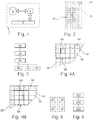
- the figure 1 represents a device 2 for characterizing the texture of a digital image.
- the device 2 is configured to characterize the texture of a digital image. More specifically, the device 2 is configured to provide, for a given digital image, a signature which characterizes the texture of this digital image.
- This signature is presented here in the form of a single numerical value. The nature of this signature will be specified in more detail below.
- the interface 8 is configured to acquire a digital image.
- the computer 6 is programmed to execute instructions recorded in the medium 4.
- the medium 4 includes in particular instructions for the execution of the characterization process of the figure 3 and the classification process of the figure 6 .
- the “texture” of a digital image is generally considered to be the spatial distribution of variations in intensity and / or tonal variations of the pixels forming the digital image.
- the texture is for example defined in the section “I. Introduction” of the article of Robert M. Haralick et al; "Textural features for image classification”; IEEE Transactions on Systems, Man and Cybernetics; flight. SMC-3, n ° 6, p. 610-621, November 1973 .
- the texture is defined according to a stochastic approach.
- the digital image is modeled as being the statistical realization of a random field, using as an mathematical model an extension of the model of random Brownian fields ("fractional Brownian fields" in English), for example as described in the article of A. Bonami et al. ; "Anisotropic analysis of some gaussian models”; Journal of Fourier Analysis and Applications; flight. 9; p. 215-213; Springer, 2003; DOI: 10.1007 / s00041-003-0012-2 .
- the device 2 is in particular programmed to determine a global signature of a digital image by combining a plurality of Hurst coefficients estimated locally at various locations on this image.
- the device 2 is programmed to define a plurality of analysis windows on an acquired digital image, then to estimate a Hurst exponent for each analysis window thus defined.
- H i the Hurst exponent estimated for the window indexed by the index i, where i is a non-zero natural integer.
- Each index i uniquely identifies a window for analyzing the digital image.
- the Hurst exponent is for example defined, in the context of a mathematical model of a fractional brownian fields image, as being a critical Holder exponent of the Brownian field. Hurst's exhibitor therefore provides a measure of the regularity of the image.
- the value of H i is here included in the interval [0; 1]. In practice, here, the value of the exponent H i is estimated using a statistical estimator.
- the device 2 is programmed so that the combination of the exponents H i includes the calculation of a co-occurrence matrix of values of these exponents H i .
- the signature here is a Haralick parameter of this co-occurrence matrix.
- the Haralick parameters are for example defined in appendix I of the article by Robert M. Haralick et al. previously cited. These concepts will be defined in more detail in the following with reference to the organization chart of the figure 3 .
- the figure 2 shows an example of a digital image 20 whose texture is to be characterized, by means of the device 2.
- the image 20 is formed of a plurality of pixels.
- Image 20 is suitable for being stored on an information recording medium.
- Image 20 is here (for example) a picture of a biological tissue obtained during a mammography. This image is here encoded in grayscale. Each pixel of the image 20 therefore has a non-zero integer digital value coding its light intensity. This numerical value will subsequently be called “pixel intensity”.
- the pixel intensities of image 20 are between 0 and 2 16 , the value 0 corresponding to zero intensity and the value 2 16 corresponding to maximum intensity.
- the image 20 here has a rectangular planar shape, with dimensions of approximately 2000 pixels by 3000 pixels.
- Image 20 is here a computer file encoded in DICOM format (“Digital imaging and communications in medicine” in English).
- a characteristic of the image will be called “global” if it applies to the entire image, while it will be called “local” if it applies only to a portion of dimensions of the image.
- a portion of image 20 will be said to have reduced dimensions if its area is less than 10% or 5% or 1% or 0.5% than the area of image 20.
- the image 20 here presents patterns formed by zones 22 of low intensity, called dark and zones 24 of high intensity, called light.
- the texture of the image provides information about the probability that the biological tissue that was the subject of the mammogram will develop a cancerous tumor.
- the image 20 is acquired by the device 2, for example by means of the interface 8.
- a prior image processing is applied to the acquired image 20, to to eliminate certain parasitic elements, for example which do not correspond to the biological tissue and to focus on a region of interest made up of biological tissues.
- the entire image 20 corresponds to a region of interest.
- Each analysis window is a portion of the image 20 and is formed of pixels of this image 20 .
- the analysis windows are defined so that the entire image 20 includes analysis windows, that is to say that the pixels of the image 20 contained inside one or more several of the defined analysis windows represent at least 90% or 95% or 99% of all the pixels of the digital image.
- the defined analysis windows overlap with each other, that is to say that two windows immediately adjacent to each other have at least one pixel in common.
- these windows are uniformly distributed over the surface of image 20.
- the windows here have a square shape.
- the dimensions of the windows are here chosen according to the way in which the exponents H i will be estimated later.
- the length of the side of each window is here greater than or equal to three pixels or five pixels and, preferably, greater than or equal to 15 or 20 pixels. This length is here less than or equal to 50 pixels or 40 pixels. Preferably, this length is between 25 and 35 pixels.
- the windows are here chosen all of identical shape and dimensions.
- the pixels located near the edges of the image 20 are not taken into account, in order to avoid edge effects which could disturb the estimate of the exponents H i . Subsequently, these pixels will not be taken into account when defining the analysis windows.
- the Figures 4A and 4B show in more detail examples of analysis windows on part of the image 20. To simplify the Figures 4A and 4B , only an analysis window is drawn each time.
- the Figures 4A and 4B represent the pixels forming the image 20, delimited by the horizontal and vertical lines here bearing the references 52 and 54.
- the figure 4A represents a first analysis window 56, defined around a first pixel 58.
- the figure 4B represents a second analysis window 60, defined around a second pixel 62.
- the following description is made in the particular case where the windows 56 and 58 have a length of only three pixels. However, as indicated above, in reality the side length is chosen differently, preferably between 25 and 35 pixels. A person skilled in the art knows how to adapt the description which follows to a greater length on the side of the analysis windows.
- the other analysis windows are defined successively for each of the pixels of the image 20.
- the windows are thus defined by selecting each pixel of the image in turn, then by defining a shape area square and of dimensions of 3x3 pixels around this pixel, called central pixel.
- an exclusion zone 64 of pixels is defined for example for which one does not wish to estimate a coefficient H i .
- this area 64 is a band of width W which extends from the outer border of the image 20 towards the interior of the image 20.
- the analysis windows are defined so that no of them has no central pixel which is included inside this area 64.
- the width W of this strip is also chosen as a function of the size and dimensions of the analysis windows. Here, for square windows with three side pixels, the width W is equal to one pixel.
- Each analysis window is uniquely identified by the index i.
- This index i here comprises the coordinates of the central pixel of the window in the image 20. These coordinates are typically Cartesian coordinates expressed in an orthonormal reference frame originating from one of the corners of the image 20.
- an exponent H i is automatically estimated for each of the defined analysis windows. More precisely, during this step, an estimated value ⁇ i of the exponent H i . Subsequently, here, for simplicity, we will speak of "estimation of H i " to denote this estimated value ⁇ i .
- This value is here calculated for the central pixel of this window, as a function of the intensity values of the pixels contained inside the window and situated around this central pixel. This calculation is carried out here by means of a linear regression on the logarithm of texture variations obtained at different scales. For example, we use the method described in the patent US 5625705 (RECHT ), in columns 8 to 11 of this patent.
- the pixels are distributed around the central pixel.
- Each of the pixels in the analysis window is located at a distance D from the central pixel.
- the distance D can only take certain values, called permissible values, which depend in particular on the dimensions of the analysis window and the shape of the pixels. These allowed values thus determine the number of scales used for this filter.
- the distances D are measured in the plane of the image 20, between the respective geometric centers of the pixels.
- the pixels of image 20 have a square shape and all have the same dimensions.
- the pixels of image 20 therefore differ from each other here only in their position in image 20 and in their pixel intensity value.
- the permitted values of the distances D are 1 and ⁇ 2.
- the minimum pixel intensity values are determined from among the pixels of the analysis window which are located at this distance D from the central pixel. maximum taken by these pixels.
- the difference Y (D) between these maximum and minimum values thus determined is calculated. This determination is made for each of the values of the distances D allowed by the dimensions of the window. At the end of this calculation, there are therefore as many values of Y (D) as there are permitted values of the distance D for this analysis window.
- the estimated value ⁇ i for the central pixel is estimated by linear regression of the function, presumed to be linear, which associates the value Y (D) with any value of D. This regression is performed using the values of Y (D) thus calculated for each permitted value of D in this analysis window.
- the selection of the pixels located at a given distance D from the central pixel is carried out here by superimposing a predefined filter on the analysis window.
- the filter is chosen according to the size of the analysis window.
- This filter here has the same size as the analysis window.
- This filter is typically a square-shaped image composed of pixels which have the respective intensity values of the distance between this pixel and the middle of the square. These values thus correspond to the possible values of distances D for this analysis window with reference to which this filter is defined.
- the distances are defined here in the same way as for the distance D.
- the figure 5 represents an example of such a filter, or mask, for an analysis window of dimensions 3 ⁇ 3 pixels.
- This filter is here an image having the shape of a square of dimensions 3 ⁇ 3 whose pixel located in the middle of this square has a value 0 and whose other pixels have for value the distance between this pixel and the middle of this square, namely, 1 and ⁇ 2.
- the pixel of value 0 of this filter is thus able to be superimposed on the central pixel of the analysis window.
- the filter is superimposed on the analysis window, so that the pixel located in the middle of the square coincides with the central pixel, then select the pixels of the analysis window which coincide with the pixels of the filter having the value ⁇ 2.
- the size chosen for the analysis windows has an impact on the precision of the calculation of the estimated value ⁇ i , because the more we choose a window allowing a high number of possible values of D, the more the precision of the estimate is high.
- the dimensions chosen should not be too large so as not to lose information on the texture fluctuations of the image 20 at the local scale.
- the estimated value ⁇ i is then stored in an information recording medium.
- step 80 there is an estimate of the exponent H i for the central pixel of each window of analysis of image 20. More exactly, here, with the definition chosen for the analysis windows, we have an estimate ⁇ i of the exponent H i for all the pixels of image 20 except those of zone 64.
- the estimated exponents H i are discretized, or quantified, that is to say that each of them is assigned a numerical value h i chosen from a previously defined range of values.
- the allowed values for h i are a set of values in the interval (0,1).
- h i a value h i , called the discrete value.
- ⁇ i is a Gaussian random variable with variance ⁇ (H i ) and which has as its statistical mean the value of the exponent H i .
- a co-occurrence matrix M o of the discretized estimated values of the exponents is constructed for the image 20.
- This matrix M o here represents the co-occurrence of exponent values ⁇ i for pixels of image 20 separated by space offset o.
- the summation is performed here for all the analysis windows defined for image 20, each with a geometric center X i and such that the point X i , after translation of the vector o in the plane of image 20, always belongs to image 20. Due to the choice of possible values for h i , the matrix here has a size of n ⁇ n where n is the number of discrete values of h.
- the signature of the image is calculated from the matrix M o thus constructed.
- the matrix M o can be difficult to handle during calculations, because it can have large dimensions or still be an essentially hollow matrix ("sparse matrix" in English).
- step 100 there is a signature of the image 20, which characterizes the texture of the image 20.
- the image 20 is then said to be characterized.
- a plurality of digital images are acquired, for example by the device 2.
- a signature characterizing the texture of this image is automatically calculated, by means of steps 30, 40, 80 and 100 of the method for characterizing the figure 3 .
- the acquired digital images are classified automatically by means of a classifier, as a function of the texture signature calculated for each of the acquired digital images.
- This classifier (“classifier” in English) is for example a classification algorithm based on neural networks or a support vector machine (“support vector machine”). For example, acquired images with a signature whose value exceeds a predefined threshold are classified as belonging to a first category of images, while acquired images having a signature whose value is less than or equal to this predefined threshold are classified as belonging to a second category of images, distinct from the first category.
- Image 20 may be different from a mammogram.
- the device 2 can thus be used for applications such as geography, geology, meteorology or even materials science.
- image 20 is an aerial or satellite view of a terrain, or a section of an ore or a material, or an image of any biological tissue.
- Image 20 can be encoded differently.
- the pixel intensity values can take different values.
- Image 20 can be in color.
- image 20 is a color image encoded on 32 bits.
- Analysis windows can be defined differently. For example, windows have a rectangular, or even irregular, shape.
- Analysis windows can have an even length side. In this case, as we cannot define a central pixel in the same way as for a side window of odd length, we define a geometric center of the window. The rest of the process is modified accordingly to take account of this geometric center, in particular with reference to filters.
- the image 20 is for example simply divided into a plurality of contiguous analysis windows with the exception, where appropriate, of the pixels of the area 64 situated on the edge of the image 20. Thus, there may be pixels of image 20 (even outside of zone 64) for which there is no estimate of the exponent ⁇ i at the end of step 80.
- Analysis windows are not necessarily contiguous to each other and there may therefore be areas of the image that are not included in any window.
- Analysis windows of different dimensions and / or shape can be used for the same image 20.
- the calculation of the signature of image 20 involves the application of a digital correction to take account of the variation of statistical parameters (such as the variance) induced during the estimation of the exponents H i by the differences in shape and / or dimensions.
- the numbering of the windows can be carried out according to a different convention.
- the exponent H i can be estimated according to a different method, in particular when the image 20 is encoded differently.
- the estimation of H i is carried out, within each analysis window, by applying the method of quadratic variations described in the article by Wood and Chan previously cited. We can thus dispense with using the filter of the figure 5 .
- the exhibitor can be estimated using the method described in the article H. Biermé et al. ; "Central limit theorems and quadratic variations in terms of spectral density"; Electronic Journal of Probability; flight. 16, p. 362-395, 2011 .
- Different methods of estimating the exponents H i can be implemented from one analysis window to another to estimate the respective exponents H i of these windows. Different analysis windows of the same image can be estimated using different methods.
- the h i values can be calculated differently.
- a Gaussian test is however preferable because the estimated H i are in theory Gaussian.
- We then have h i f ( ⁇ i ).
- the estimate of the Hurst index for the entire image is for example calculated using the same algorithm as that used to calculate the estimates of ⁇ i but using only one window of the size of the image.
- the error of a model here expresses the difference between measured data and corresponding data predicted by the model. This is for example the error in the sense of least squares, for example defined as the sum of the squares of the differences between measured value and predicted value.
- the error made during step 80 is the error made during the linear regression of the function which associates the value Y (D) with D.
- This value U is included in an interval [0; 1] and is close to 1 when the texture has a homogeneous regularity and close to 0 when the texture does not have a homogeneous regularity.
- the value U is thus the signature of the image.
- different signatures can be calculated for the same image. For example, one can obtain different signatures for the same image by using different Haralick parameters during step 100 or different moments during step 100 '. The different signatures obtained for the same image can then be simultaneously used to classify it in relation to other images.
- the image classification process may be different. Other classifiers can be used. These classifiers can further be configured to classify the images according to a combination of signatures.
Landscapes
- Physics & Mathematics (AREA)
- Engineering & Computer Science (AREA)
- Theoretical Computer Science (AREA)
- Probability & Statistics with Applications (AREA)
- Computer Vision & Pattern Recognition (AREA)
- General Physics & Mathematics (AREA)
- Computing Systems (AREA)
- Mathematical Physics (AREA)
- Image Analysis (AREA)
- Image Processing (AREA)
Claims (10)
- Verfahren zur automatischen Charakterisierung der Textur eines digitalen Bildes, dadurch gekennzeichnet, dass das Verfahren umfasst:- die Erfassung (30) eines digitalen Bildes, das von mehreren Pixeln gebildet wird;- die Definition (40), innerhalb des erfassten digitalen Bildes, mehrerer verschiedener Analysefenster, wobei jedes Fenster von Pixeln des digitalen Bildes gebildet wird;- die Schätzung (80), für jedes definierte Fenster, eines Hurst-Exponenten Hi anhand nur der Pixel dieses Fensters, wobei der Index i auf eindeutige Weise das Analysefenster identifiziert, das zum Schätzen des Exponenten Hi verwendet wird, wobei diese Schätzung des Hurst-Exponenten Hi für jedes Analysefenster (56) Rechenoperationen umfasst zwischen Werten:- des sogenannten mittleren Pixels (58) des Analysefensters, das sich in der geometrischen Mitte des Analysefensters befindet, und- der anderen in dem Analysefenster enthaltenen Pixel, wobei sich diese anderen Pixel in verschiedenen Abständen von dem mittleren Pixel befinden;- die Berechnung (100, 100', 100") einer Signatur in der Form eines einzigen numerischen Wertes, der für die Textur des digitalen Bildes charakteristisch ist, durch Kombinieren der geschätzten Exponenten Hi für jedes Fenster des digitalen Bildes,und dadurch, dass:- das Verfahren die Berechnung eines diskreten Wertes hi jedes Exponenten Hi umfasst, wobei diese Berechnung mittels ein und derselben vorbestimmten Funktion f mit dem Exponenten Hi als Argument durchgeführt wird, wobei diese Funktion f für jeden möglichen Wert, den ein Hurst-Exponent annehmen kann, einen eindeutigen diskreten Wert zuordnet, der zwischen zwei vorbestimmten positiven ganzen Werten A und B liegt;- die Kombination (100) der Exponenten Hi die Konstruktion einer Grauwertematrix Mo mithilfe der folgenden Formel umfasst:
 - Mo(m,l) der Wert des Koeffizienten der m-ten Zeile und der l-ten Spalte der Matrix Mo ist,- wi,i+o ein numerischer Wert ist, der gleich 1 ist, falls Hi = hl und Hi+o = hm ist, und andernfalls gleich null ist, wobei hl und hm die diskreten Werte der Exponenten Hi sind, die für Werte von Indizes i = I bzw. i = m geschätzt wurden, wobei die Summenbildung für alle solchen Analysefenster des Bildes mit dem geometrischen Mittelpunkt Xi durchgeführt wird, für die der Punkt Xi nach Translation um einen Vektor o in der Ebene des Bildes noch immer zu dem Bild gehört, wobei o ein vordefinierter Parameter ist, der konstant ist, unabhängig von den Werten von i, m und I.
 - Verfahren nach Anspruch 1, wobei die Signatur aus der Menge gewählt wird, die von den Haralick-Parametern gebildet wird, die der berechneten Grauwertematrix Mo zugeordnet sind.
- Verfahren nach einem der vorhergehenden Ansprüche, wobei die im Inneren der Analysefenster enthaltenen Pixel des Bildes wenigstens 90 % aller Pixel des digitalen Bildes repräsentieren.
- Verfahren nach einem der vorhergehenden Ansprüche, wobei die definierten Analysefenster eine Form und Abmessungen aufweisen, die miteinander identisch sind.
- Verfahren nach einem der vorhergehenden Ansprüche, wobei die definierten Analysefenster alle zueinander disjunkt sind.
- Verfahren nach einem der vorhergehenden Ansprüche, wobei die definierten Analysefenster jeweils eine quadratische Form aufweisen.
- Verfahren nach einem der vorhergehenden Ansprüche, wobei die Analysefenster eine Form eines regelmäßigen Vierecks aufweisen, dessen Seiten eine Länge zwischen 15 Pixeln und 50 Pixeln haben.
- Verfahren zur automatischen Klassifizierung digitaler Bilder in Abhängigkeit von ihrer Textur, dadurch gekennzeichnet, dass das Verfahren umfasst:- die Erfassung (200) mehrerer digitaler Bilder, die jeweils von mehreren Pixeln gebildet werden;- die automatische Charakterisierung (202) der Textur jedes der erfassten digitalen Bilder mittels eines Verfahrens gemäß einem der vorhergehenden Ansprüche, wobei diese Charakterisierung die Berechnung einer für die Textur charakteristischen Signatur für jedes Bild zum Ergebnis hat;- die Klassifizierung (204) der erfassten digitalen Bilder mittels eines automatischen Klassifikators in Abhängigkeit, für jedes Bild, von der berechneten Signatur der Textur.
- Informationsaufzeichnungsmedium (4), dadurch gekennzeichnet, dass es Anweisungen zur Ausführung eines Verfahrens gemäß einem der vorhergehenden Ansprüche, wenn diese Anweisungen von einem elektronischen Rechner ausgeführt werden, umfasst.
- Elektronischer Rechner (6) zur Durchführung eines Verfahrens gemäß einem der Ansprüche 1 bis 7, dadurch gekennzeichnet, dass dieser Rechner dafür programmiert ist:- ein digitales Bild zu erfassen, das von mehreren Pixeln gebildet wird;- innerhalb des erfassten digitalen Bildes mehrere verschiedene Analysefenster zu definieren, wobei jedes Fenster von Pixeln des digitalen Bildes gebildet wird;- für jedes definierte Fenster einen Hurst-Exponenten Hi anhand nur der Pixel dieses Fensters zu schätzen, wobei der Index i auf eindeutige Weise das Analysefenster identifiziert, das zum Schätzen des Exponenten Hi verwendet wird, wobei diese Schätzung des Hurst-Exponenten Hi für jedes Analysefenster (56) Rechenoperationen umfasst zwischen Werten:- des sogenannten mittleren Pixels (58) des Analysefensters, das sich in der geometrischen Mitte des Analysefensters befindet, und- der anderen in dem Analysefenster enthaltenen Pixel, wobei sich diese anderen Pixel in verschiedenen Abständen von dem mittleren Pixel befinden;- automatisch eine Signatur in der Form eines einzigen numerischen Wertes, der für die Textur des digitalen Bildes charakteristisch ist, durch Kombinieren der geschätzten Exponenten Hi für jedes Fenster des digitalen Bildes zu berechnen, und dadurch, dass:- der Rechner außerdem dafür programmiert ist, einen diskreten Wert hi jedes Exponenten Hi zu berechnen, wobei diese Berechnung mittels ein und derselben vorbestimmten Funktion f mit dem Exponenten Hi als Argument durchgeführt wird, wobei diese Funktion f für jeden möglichen Wert, den ein Hurst-Exponent annehmen kann, einen eindeutigen diskreten Wert zuordnet, der zwischen zwei vorbestimmten positiven ganzen Werten A und B liegt;- die automatische Berechnung der Signatur durch Kombinieren der Hurst-Exponenten Hi die Kombination der Exponenten Hi durch Konstruieren einer Grauwertematrix Mo mithilfe der folgenden Formel umfasst:
 - Mo(m,l) der Wert des Koeffizienten der m-ten Zeile und der l-ten Spalte der Matrix Mo ist,- wi,i+o ein numerischer Wert ist, der gleich 1 ist, falls Hi = hl und Hi+o = hm ist, und andernfalls gleich null ist, wobei hl und hm die diskreten Werte der Exponenten Hi sind, die für Werte von Indizes i = I bzw. i = m geschätzt wurden, wobei die Summenbildung für alle solchen Analysefenster des Bildes mit dem geometrischen Mittelpunkt Xi durchgeführt wird, für die der Punkt Xi nach Translation um einen Vektor o in der Ebene des Bildes noch immer zu dem Bild gehört, wobei o ein vordefinierter Parameter ist, der konstant ist, unabhängig von den Werten von i, m und I.
Applications Claiming Priority (2)
| Application Number | Priority Date | Filing Date | Title |
|---|---|---|---|
| FR1361075A FR3013141B1 (fr) | 2013-11-13 | 2013-11-13 | Procede de caracterisation automatique de la texture d'une image numerique |
| PCT/FR2014/052858 WO2015071579A1 (fr) | 2013-11-13 | 2014-11-07 | Procédé de caractérisation automatique de la texture d'une image numérique |
Publications (2)
| Publication Number | Publication Date |
|---|---|
| EP3069321A1 EP3069321A1 (de) | 2016-09-21 |
| EP3069321B1 true EP3069321B1 (de) | 2020-01-01 |
Family
ID=50489171
Family Applications (1)
| Application Number | Title | Priority Date | Filing Date |
|---|---|---|---|
| EP14806040.3A Active EP3069321B1 (de) | 2013-11-13 | 2014-11-07 | Verfahren zur automatischen charakterisierung der textur eines digitalen bildes |
Country Status (3)
| Country | Link |
|---|---|
| EP (1) | EP3069321B1 (de) |
| FR (1) | FR3013141B1 (de) |
| WO (1) | WO2015071579A1 (de) |
Family Cites Families (2)
| Publication number | Priority date | Publication date | Assignee | Title |
|---|---|---|---|---|
| US5625705A (en) | 1994-06-03 | 1997-04-29 | Neuromedical Systems, Inc. | Intensity texture based classification system and method |
| US5859919A (en) * | 1996-08-12 | 1999-01-12 | The United States Of America As Represented By The Secretary Of The Navy | Method and system for measuring surface roughness using fractal dimension values |
-
2013
- 2013-11-13 FR FR1361075A patent/FR3013141B1/fr not_active Expired - Fee Related
-
2014
- 2014-11-07 EP EP14806040.3A patent/EP3069321B1/de active Active
- 2014-11-07 WO PCT/FR2014/052858 patent/WO2015071579A1/fr not_active Ceased
Non-Patent Citations (1)
| Title |
|---|
| None * |
Also Published As
| Publication number | Publication date |
|---|---|
| WO2015071579A1 (fr) | 2015-05-21 |
| FR3013141A1 (fr) | 2015-05-15 |
| FR3013141B1 (fr) | 2017-04-21 |
| EP3069321A1 (de) | 2016-09-21 |
Similar Documents
| Publication | Publication Date | Title |
|---|---|---|
| FR3067242B1 (fr) | Procede d'evaluation d'une gouttiere orthodontique | |
| Dehecq et al. | Deriving large-scale glacier velocities from a complete satellite archive: Application to the Pamir–Karakoram–Himalaya | |
| EP3014570B1 (de) | Verfahren zur rauschverminderung in sequenzen von fluoroskopischen bildern | |
| FR2990545A1 (fr) | Systemes et procedes pour la detection, la classification et la quantification de caracteristiques de surface de plaquette avec des outils de metrologie de geometrie de plaquette. | |
| WO2011051382A1 (fr) | Procede et dispositif d'analyse d'images hyper-spectrales. | |
| EP2435985B1 (de) | Verfahren zur quantifizierung von pathologien, welche veränderungen im volumen von körpern, insbesondere von tumoren einschliessen | |
| WO2011131410A1 (fr) | Methode de controle de l'aspect de la surface d'un pneumatique | |
| EP0945830A1 (de) | Bildverarbeitungsverfahren mit multidimensionalen Bildsegmentationsstufen und medizinische Vorrichtung die diese verwendet | |
| CA3095089A1 (fr) | Methode de detection de cellules presentant au moins une anomalie dans un echantilllon cytologique | |
| FR3072812B1 (fr) | Procede d'estimation d'une note d'adhesion entre la composition de caoutchouc et les plis de renfort d'une eprouvette representative d'un pneumatique a caracteriser. | |
| US10219688B2 (en) | System and method for the selection of optical coherence tomography slices | |
| EP3195259B1 (de) | Verfahren zur identifizierung der anisotropie der textur eines digitalen bildes | |
| WO2012117210A1 (fr) | Procédé et système pour estimer une similarité entre deux images binaires | |
| FR2857484A1 (fr) | Scoring automatique en radiologie numerique, en particulier en mammographie | |
| EP3958785B1 (de) | Computerprogram zur bewertung eines orthodontischen aligners | |
| EP3545496B1 (de) | Verfahren zur charakterisierung der anisotropie der textur eines digitalen bildes | |
| WO2015071579A1 (fr) | Procédé de caractérisation automatique de la texture d'une image numérique | |
| FR2997284A1 (fr) | Procede d'obtention d'images de tomosynthese | |
| EP2943935B1 (de) | Schätzung der bewegung eines bildes | |
| FR3055999A1 (fr) | Systeme et procede pour reconstruire un signal physiologique d'un systeme dynamique artere/tissu/veine d'un organe dans un espace surfacique | |
| EP3903282B1 (de) | Verfahren zum segmentieren eines bildes | |
| FR3059453A1 (fr) | Procede et dispositif de deconvolution d'images numeriques | |
| EP3163462A1 (de) | Verfahren zum einschätzen eines faltungsprodukts | |
| Jangra et al. | Hyper spectral images restoration approach using LRMR and LDA | |
| WO2016151103A1 (fr) | Procédé de dénombrement d'objets dans une zone spatiale prédéterminée |
Legal Events
| Date | Code | Title | Description |
|---|---|---|---|
| PUAI | Public reference made under article 153(3) epc to a published international application that has entered the european phase |
Free format text: ORIGINAL CODE: 0009012 |
|
| 17P | Request for examination filed |
Effective date: 20160511 |
|
| AK | Designated contracting states |
Kind code of ref document: A1 Designated state(s): AL AT BE BG CH CY CZ DE DK EE ES FI FR GB GR HR HU IE IS IT LI LT LU LV MC MK MT NL NO PL PT RO RS SE SI SK SM TR |
|
| AX | Request for extension of the european patent |
Extension state: BA ME |
|
| DAX | Request for extension of the european patent (deleted) | ||
| REG | Reference to a national code |
Ref country code: DE Ref legal event code: R079 Ref document number: 602014059407 Country of ref document: DE Free format text: PREVIOUS MAIN CLASS: G06T0007400000 Ipc: G06T0007450000 |
|
| RIC1 | Information provided on ipc code assigned before grant |
Ipc: G06T 7/48 20170101ALI20190613BHEP Ipc: G06T 7/45 20170101AFI20190613BHEP |
|
| GRAP | Despatch of communication of intention to grant a patent |
Free format text: ORIGINAL CODE: EPIDOSNIGR1 |
|
| STAA | Information on the status of an ep patent application or granted ep patent |
Free format text: STATUS: GRANT OF PATENT IS INTENDED |
|
| INTG | Intention to grant announced |
Effective date: 20190722 |
|
| GRAS | Grant fee paid |
Free format text: ORIGINAL CODE: EPIDOSNIGR3 |
|
| GRAA | (expected) grant |
Free format text: ORIGINAL CODE: 0009210 |
|
| STAA | Information on the status of an ep patent application or granted ep patent |
Free format text: STATUS: THE PATENT HAS BEEN GRANTED |
|
| AK | Designated contracting states |
Kind code of ref document: B1 Designated state(s): AL AT BE BG CH CY CZ DE DK EE ES FI FR GB GR HR HU IE IS IT LI LT LU LV MC MK MT NL NO PL PT RO RS SE SI SK SM TR |
|
| REG | Reference to a national code |
Ref country code: GB Ref legal event code: FG4D Free format text: NOT ENGLISH |
|
| REG | Reference to a national code |
Ref country code: CH Ref legal event code: EP Ref country code: AT Ref legal event code: REF Ref document number: 1220754 Country of ref document: AT Kind code of ref document: T Effective date: 20200115 |
|
| REG | Reference to a national code |
Ref country code: IE Ref legal event code: FG4D Free format text: LANGUAGE OF EP DOCUMENT: FRENCH |
|
| REG | Reference to a national code |
Ref country code: DE Ref legal event code: R096 Ref document number: 602014059407 Country of ref document: DE |
|
| REG | Reference to a national code |
Ref country code: NL Ref legal event code: MP Effective date: 20200101 |
|
| REG | Reference to a national code |
Ref country code: LT Ref legal event code: MG4D |
|
| PG25 | Lapsed in a contracting state [announced via postgrant information from national office to epo] |
Ref country code: FI Free format text: LAPSE BECAUSE OF FAILURE TO SUBMIT A TRANSLATION OF THE DESCRIPTION OR TO PAY THE FEE WITHIN THE PRESCRIBED TIME-LIMIT Effective date: 20200101 Ref country code: RS Free format text: LAPSE BECAUSE OF FAILURE TO SUBMIT A TRANSLATION OF THE DESCRIPTION OR TO PAY THE FEE WITHIN THE PRESCRIBED TIME-LIMIT Effective date: 20200101 Ref country code: NO Free format text: LAPSE BECAUSE OF FAILURE TO SUBMIT A TRANSLATION OF THE DESCRIPTION OR TO PAY THE FEE WITHIN THE PRESCRIBED TIME-LIMIT Effective date: 20200401 Ref country code: CZ Free format text: LAPSE BECAUSE OF FAILURE TO SUBMIT A TRANSLATION OF THE DESCRIPTION OR TO PAY THE FEE WITHIN THE PRESCRIBED TIME-LIMIT Effective date: 20200101 Ref country code: NL Free format text: LAPSE BECAUSE OF FAILURE TO SUBMIT A TRANSLATION OF THE DESCRIPTION OR TO PAY THE FEE WITHIN THE PRESCRIBED TIME-LIMIT Effective date: 20200101 Ref country code: PT Free format text: LAPSE BECAUSE OF FAILURE TO SUBMIT A TRANSLATION OF THE DESCRIPTION OR TO PAY THE FEE WITHIN THE PRESCRIBED TIME-LIMIT Effective date: 20200527 Ref country code: LT Free format text: LAPSE BECAUSE OF FAILURE TO SUBMIT A TRANSLATION OF THE DESCRIPTION OR TO PAY THE FEE WITHIN THE PRESCRIBED TIME-LIMIT Effective date: 20200101 |
|
| PG25 | Lapsed in a contracting state [announced via postgrant information from national office to epo] |
Ref country code: LV Free format text: LAPSE BECAUSE OF FAILURE TO SUBMIT A TRANSLATION OF THE DESCRIPTION OR TO PAY THE FEE WITHIN THE PRESCRIBED TIME-LIMIT Effective date: 20200101 Ref country code: IS Free format text: LAPSE BECAUSE OF FAILURE TO SUBMIT A TRANSLATION OF THE DESCRIPTION OR TO PAY THE FEE WITHIN THE PRESCRIBED TIME-LIMIT Effective date: 20200501 Ref country code: SE Free format text: LAPSE BECAUSE OF FAILURE TO SUBMIT A TRANSLATION OF THE DESCRIPTION OR TO PAY THE FEE WITHIN THE PRESCRIBED TIME-LIMIT Effective date: 20200101 Ref country code: BG Free format text: LAPSE BECAUSE OF FAILURE TO SUBMIT A TRANSLATION OF THE DESCRIPTION OR TO PAY THE FEE WITHIN THE PRESCRIBED TIME-LIMIT Effective date: 20200401 Ref country code: HR Free format text: LAPSE BECAUSE OF FAILURE TO SUBMIT A TRANSLATION OF THE DESCRIPTION OR TO PAY THE FEE WITHIN THE PRESCRIBED TIME-LIMIT Effective date: 20200101 |
|
| REG | Reference to a national code |
Ref country code: DE Ref legal event code: R097 Ref document number: 602014059407 Country of ref document: DE |
|
| PG25 | Lapsed in a contracting state [announced via postgrant information from national office to epo] |
Ref country code: SM Free format text: LAPSE BECAUSE OF FAILURE TO SUBMIT A TRANSLATION OF THE DESCRIPTION OR TO PAY THE FEE WITHIN THE PRESCRIBED TIME-LIMIT Effective date: 20200101 Ref country code: EE Free format text: LAPSE BECAUSE OF FAILURE TO SUBMIT A TRANSLATION OF THE DESCRIPTION OR TO PAY THE FEE WITHIN THE PRESCRIBED TIME-LIMIT Effective date: 20200101 Ref country code: DK Free format text: LAPSE BECAUSE OF FAILURE TO SUBMIT A TRANSLATION OF THE DESCRIPTION OR TO PAY THE FEE WITHIN THE PRESCRIBED TIME-LIMIT Effective date: 20200101 Ref country code: SK Free format text: LAPSE BECAUSE OF FAILURE TO SUBMIT A TRANSLATION OF THE DESCRIPTION OR TO PAY THE FEE WITHIN THE PRESCRIBED TIME-LIMIT Effective date: 20200101 Ref country code: ES Free format text: LAPSE BECAUSE OF FAILURE TO SUBMIT A TRANSLATION OF THE DESCRIPTION OR TO PAY THE FEE WITHIN THE PRESCRIBED TIME-LIMIT Effective date: 20200101 Ref country code: RO Free format text: LAPSE BECAUSE OF FAILURE TO SUBMIT A TRANSLATION OF THE DESCRIPTION OR TO PAY THE FEE WITHIN THE PRESCRIBED TIME-LIMIT Effective date: 20200101 |
|
| PLBE | No opposition filed within time limit |
Free format text: ORIGINAL CODE: 0009261 |
|
| STAA | Information on the status of an ep patent application or granted ep patent |
Free format text: STATUS: NO OPPOSITION FILED WITHIN TIME LIMIT |
|
| REG | Reference to a national code |
Ref country code: AT Ref legal event code: MK05 Ref document number: 1220754 Country of ref document: AT Kind code of ref document: T Effective date: 20200101 |
|
| 26N | No opposition filed |
Effective date: 20201002 |
|
| PG25 | Lapsed in a contracting state [announced via postgrant information from national office to epo] |
Ref country code: IT Free format text: LAPSE BECAUSE OF FAILURE TO SUBMIT A TRANSLATION OF THE DESCRIPTION OR TO PAY THE FEE WITHIN THE PRESCRIBED TIME-LIMIT Effective date: 20200101 Ref country code: AT Free format text: LAPSE BECAUSE OF FAILURE TO SUBMIT A TRANSLATION OF THE DESCRIPTION OR TO PAY THE FEE WITHIN THE PRESCRIBED TIME-LIMIT Effective date: 20200101 |
|
| PGFP | Annual fee paid to national office [announced via postgrant information from national office to epo] |
Ref country code: FR Payment date: 20201120 Year of fee payment: 7 Ref country code: GB Payment date: 20201120 Year of fee payment: 7 Ref country code: DE Payment date: 20201119 Year of fee payment: 7 |
|
| PG25 | Lapsed in a contracting state [announced via postgrant information from national office to epo] |
Ref country code: SI Free format text: LAPSE BECAUSE OF FAILURE TO SUBMIT A TRANSLATION OF THE DESCRIPTION OR TO PAY THE FEE WITHIN THE PRESCRIBED TIME-LIMIT Effective date: 20200101 Ref country code: PL Free format text: LAPSE BECAUSE OF FAILURE TO SUBMIT A TRANSLATION OF THE DESCRIPTION OR TO PAY THE FEE WITHIN THE PRESCRIBED TIME-LIMIT Effective date: 20200101 |
|
| PG25 | Lapsed in a contracting state [announced via postgrant information from national office to epo] |
Ref country code: MC Free format text: LAPSE BECAUSE OF FAILURE TO SUBMIT A TRANSLATION OF THE DESCRIPTION OR TO PAY THE FEE WITHIN THE PRESCRIBED TIME-LIMIT Effective date: 20200101 |
|
| REG | Reference to a national code |
Ref country code: CH Ref legal event code: PL |
|
| PG25 | Lapsed in a contracting state [announced via postgrant information from national office to epo] |
Ref country code: LU Free format text: LAPSE BECAUSE OF NON-PAYMENT OF DUE FEES Effective date: 20201107 |
|
| REG | Reference to a national code |
Ref country code: BE Ref legal event code: MM Effective date: 20201130 |
|
| PG25 | Lapsed in a contracting state [announced via postgrant information from national office to epo] |
Ref country code: LI Free format text: LAPSE BECAUSE OF NON-PAYMENT OF DUE FEES Effective date: 20201130 Ref country code: CH Free format text: LAPSE BECAUSE OF NON-PAYMENT OF DUE FEES Effective date: 20201130 |
|
| PG25 | Lapsed in a contracting state [announced via postgrant information from national office to epo] |
Ref country code: IE Free format text: LAPSE BECAUSE OF NON-PAYMENT OF DUE FEES Effective date: 20201107 |
|
| PG25 | Lapsed in a contracting state [announced via postgrant information from national office to epo] |
Ref country code: TR Free format text: LAPSE BECAUSE OF FAILURE TO SUBMIT A TRANSLATION OF THE DESCRIPTION OR TO PAY THE FEE WITHIN THE PRESCRIBED TIME-LIMIT Effective date: 20200101 Ref country code: MT Free format text: LAPSE BECAUSE OF FAILURE TO SUBMIT A TRANSLATION OF THE DESCRIPTION OR TO PAY THE FEE WITHIN THE PRESCRIBED TIME-LIMIT Effective date: 20200101 Ref country code: CY Free format text: LAPSE BECAUSE OF FAILURE TO SUBMIT A TRANSLATION OF THE DESCRIPTION OR TO PAY THE FEE WITHIN THE PRESCRIBED TIME-LIMIT Effective date: 20200101 |
|
| REG | Reference to a national code |
Ref country code: DE Ref legal event code: R119 Ref document number: 602014059407 Country of ref document: DE |
|
| PG25 | Lapsed in a contracting state [announced via postgrant information from national office to epo] |
Ref country code: MK Free format text: LAPSE BECAUSE OF FAILURE TO SUBMIT A TRANSLATION OF THE DESCRIPTION OR TO PAY THE FEE WITHIN THE PRESCRIBED TIME-LIMIT Effective date: 20200101 Ref country code: AL Free format text: LAPSE BECAUSE OF FAILURE TO SUBMIT A TRANSLATION OF THE DESCRIPTION OR TO PAY THE FEE WITHIN THE PRESCRIBED TIME-LIMIT Effective date: 20200101 |
|
| GBPC | Gb: european patent ceased through non-payment of renewal fee |
Effective date: 20211107 |
|
| PG25 | Lapsed in a contracting state [announced via postgrant information from national office to epo] |
Ref country code: GR Free format text: LAPSE BECAUSE OF FAILURE TO SUBMIT A TRANSLATION OF THE DESCRIPTION OR TO PAY THE FEE WITHIN THE PRESCRIBED TIME-LIMIT Effective date: 20200101 Ref country code: BE Free format text: LAPSE BECAUSE OF NON-PAYMENT OF DUE FEES Effective date: 20201130 |
|
| PG25 | Lapsed in a contracting state [announced via postgrant information from national office to epo] |
Ref country code: GB Free format text: LAPSE BECAUSE OF NON-PAYMENT OF DUE FEES Effective date: 20211107 Ref country code: DE Free format text: LAPSE BECAUSE OF NON-PAYMENT OF DUE FEES Effective date: 20220601 |
|
| PG25 | Lapsed in a contracting state [announced via postgrant information from national office to epo] |
Ref country code: FR Free format text: LAPSE BECAUSE OF NON-PAYMENT OF DUE FEES Effective date: 20211130 |