EP3069271B1 - Dynamische datenstromberechnungstopologie - Google Patents
Dynamische datenstromberechnungstopologie Download PDFInfo
- Publication number
- EP3069271B1 EP3069271B1 EP13897488.6A EP13897488A EP3069271B1 EP 3069271 B1 EP3069271 B1 EP 3069271B1 EP 13897488 A EP13897488 A EP 13897488A EP 3069271 B1 EP3069271 B1 EP 3069271B1
- Authority
- EP
- European Patent Office
- Prior art keywords
- post
- topology
- processing node
- data objects
- processing
- Prior art date
- Legal status (The legal status is an assumption and is not a legal conclusion. Google has not performed a legal analysis and makes no representation as to the accuracy of the status listed.)
- Active
Links
Images


Classifications
-
- G—PHYSICS
- G06—COMPUTING OR CALCULATING; COUNTING
- G06F—ELECTRIC DIGITAL DATA PROCESSING
- G06F16/00—Information retrieval; Database structures therefor; File system structures therefor
- G06F16/20—Information retrieval; Database structures therefor; File system structures therefor of structured data, e.g. relational data
- G06F16/24—Querying
- G06F16/245—Query processing
- G06F16/2455—Query execution
- G06F16/24568—Data stream processing; Continuous queries
-
- G—PHYSICS
- G06—COMPUTING OR CALCULATING; COUNTING
- G06F—ELECTRIC DIGITAL DATA PROCESSING
- G06F16/00—Information retrieval; Database structures therefor; File system structures therefor
- G06F16/90—Details of database functions independent of the retrieved data types
- G06F16/901—Indexing; Data structures therefor; Storage structures
- G06F16/9024—Graphs; Linked lists
Definitions
- This specification relates to stream computing.
- Stream computing refers to systems and techniques for continually processing unbounded sequences of objects in real time, e.g., receiving incoming streams of data objects, processing the data objects, and producing output streams of modified data objects.
- the objects may represent page requests received by a web site or microblog messages posted by users.
- Stream computing systems can provide immediate search results as data objects are found, as well as continually process new data objects as they are received.
- Distributed stream computing systems can include multiple computing nodes that process data to generate sequences of data objects, the sequence referred to as a stream.
- An example streaming data object is a list of named values referred to as a tuple.
- the computing nodes can perform various operations on the streams in a particular order.
- a topology is a computing graph of compute nodes and the respective stream transformations performed by the computing nodes.
- Computing nodes that read raw data and generate streams in the first instance may be referred to as source nodes, or "spouts;" and computing nodes that subscribe to streams, perform operations on the data, and pass on transformed streams may be referred to as processing nodes, or "bolts.”
- Edges in the topology indicate which bolts subscribe to which streams.
- Nodes in a stream computing topology are typically configured to process streams indefinitely.
- FIG. 1A is a diagram of an example prior art system.
- the system includes a stream computing subsystem 130a that processes streams of data objects from a key-value storage subsystem 150, e.g., a Hadoop Database (HBase) that stores data by key-value pairs in distinct column families.
- a key-value storage subsystem 150 e.g., a Hadoop Database (HBase) that stores data by key-value pairs in distinct column families.
- the storage subsystem 150 can alternatively be a relational database or any other appropriate storage subsystem.
- the stream computing subsystem 130a generates streams using source nodes and processing nodes of a topology 126a according to a topology definition 125a received from a management node 120a.
- An example stream computing subsystem is the Storm distributed real-time computation system. (Storm is described at http://storm-project.net/ and documentation identified there.)
- a user of user device 110 can query the key-value storage subsystem to obtain matching data objects 145.
- the user device 110 can be a personal computer, smartphone, or any other kind of computer-based device with which a user can interact.
- the user 110 device issues a query 105 to the management node 120a.
- the management node 120a parses the query 105 and generates one or more processes required to identify matching data objects 145 that satisfy the query 105.
- the management node 120a generates a corresponding topology definition 125a of the processes required to satisfy the query 105; the topology definition 125a maps the processes to source nodes and processing nodes.
- satisfying the query 105 generally requires filter processes that filter streams of data objects from the key-value storage subsystem 150 and read processes to read data objects from the key-value storage subsystem 150.
- the topology definition 125a is then used to generate a topology that is run on a cluster of computers.
- a search subsystem 140 can index data objects in the key-value storage subsystem 150 for more efficient retrieval of matching data objects.
- An example search subsystem 104 is the Apache SolrTM search platform. ("Apache Solr” is a trademark of The Apache Software Foundation.)
- source nodes e.g., source node "Get IDs" 132, in the topology 126a will communicate with the search subsystem 140 to obtain matching identifiers 135 of data objects that satisfy the query 105.
- the source nodes will then generate matching identifier streams 145 that are received by a processing node "Read Data Objects" 134 in the topology 126a.
- the processing node 134 receives the matching identifier streams from the source nodes and requests the data objects from the key-value storage subsystem 150.
- the processing node 134 can use batch processing techniques to improve the performance of reading the data objects from the key-value storage subsystem 150. For example, the processing node 134 can wait to request data objects from the key-value storage subsystem 150 until at least a minimum number of identifier tuples have been received from the matching identifier streams 145. The processing node 134 can then return the matching data objects 145 to the user device 110.
- US 7 383 253 B1 discloses a Continuous Query Processor that processes queries on continuously updating data sources or data streams and that includes a Publication Manager for accepting published structured elements of data from data stream Publishers, a Subscription Manager for giving structured elements of data to one or more data stream Subscribers, a Query Module Manager for processing queries represented by Query Modules, a Query Module Store for maintaining deployed Query Modules, a Query Primitive Manager that performs processing for various primitives that comprise a Query Module, and a Schedule Manager for coordinating when a primitive within a Query Module gets processed in order to maintain that each continuous query is continuously updated immediately upon the arrival of structured element data affecting any part of a continuous query.
- one innovative aspect of the subject matter described in this specification can be embodied in methods that include the actions of receiving, from a user, a query that specifies a search criterion and a post-processing function prototype; generating, from the query, a topology definition that specifies: one or more source nodes and at least one processing node, wherein the processing node is specified in the topology to receive, from the one or more source nodes, one or more streams of data object identifiers of data objects that satisfy the search criterion, and wherein the processing node is specified in the topology to output a stream of data objects corresponding to the data object identifiers; and a post-processing node according to the post-processing function prototype, wherein the post-processing node is specified in the topology to receive a stream of data objects output by the processing node, perform one or more operations on the data objects according to the post-processing function prototype, and is specified in the topology to output one or more modified
- inventions of this aspect include corresponding computer systems, apparatus, and computer programs recorded on one or more computer storage devices, each configured to perform the actions of the methods.
- a system of one or more computers to be configured to perform particular operations or actions means that the system has installed on it software, firmware, hardware, or a combination of them that in operation cause the system to perform the operations or actions.
- one or more computer programs to be configured to perform particular operations or actions means that the one or more programs include instructions that, when executed by data processing apparatus, cause the apparatus to perform the operations or actions.
- the data object identifiers of data objects that satisfy the search query are data objects having field values that satisfy the search terms.
- the actions include receiving, from the user, an argument for the post-processing function prototype, wherein the post-processing node is specified in the topology to perform the one or more operations on the data objects using the argument.
- the post-processing node generated from the post-processing function prototype is specified in the topology to extract fields from the received data objects according to the argument and provides the extracted fields as output.
- the post-processing node generated from the post-processing function prototype is specified in the topology to filter the data objects received by the post-processing node according to the argument and provides the filtered data objects as output.
- the post-processing node generated from the function prototype is specified in the topology to aggregate one or more data object values specified by the argument and provides an aggregated value as output.
- the query and the identifier of the post-processing function are text provided as input by the user.
- the actions include receiving a second identifier of a different, second post-processing function prototype, wherein the topology definition specifies a second post-processing node according to the second post-processing function prototype, wherein the second post-processing node is specified in the topology to receive a stream of data objects output by the post-processing node, performs one or more operations on the data objects according to the second post-processing function prototype, and outputs one or more second modified data objects.
- the text input specifies a subscription of streams of data objects output by the post-processing node and streams of data objects received by the second post-processing node.
- the query and the identifier of a post-processing function are received from the user at runtime.
- a user can quickly and easily generate new stream computing topologies at runtime, which can allow the user to easily develop new searching techniques.
- the query 106 can specify one or more function prototypes that define post-processing nodes to be added to the topology 125b.
- the system 100b can maintain a repository 122 of available function prototypes that the management node 120b will use to generate a corresponding topology definition 125b that causes the stream computing subsystem 130b to insert nodes in the topology 126b.
- Post-processing nodes may have similar functionality to processing nodes in the topology that are generated automatically by the management node 120b in order to satisfy a query.
- post-processing nodes refer to nodes in the topology generated from user-specified function prototypes and, optionally, one or more user-defined arguments.
- a user may want to receive streaming data describing real-time web page requests originating from a particular Internet Protocol (IP) address.
- IP Internet Protocol
- the user can issue a query for web page requests. Absent a specification by the user of additional post-processing operations, e.g., filtering operations, the stream computing subsystem 130b will return, to the client device, a stream of full data objects that satisfy the query.
- additional post-processing operations e.g., filtering operations
- the "filter” and “fields” terms of the query 106 are reserved terms that refer to function prototypes maintained by the system 100b.
- the management node 120b will add, to the initial topology definition, one or more post-processing nodes that correspond to the function prototypes specified in the query 106.
- the vertical bar character specifies that a post-processing node defined by a function prototype following the vertical bar will subscribe to a stream generated by a node defined by a portion of the query before the vertical bar, which may be another post-processing node or a processing node in the initial topology corresponding to the base query.
- the order of function prototypes specified in the query represents a structure of post-processing nodes in the topology 126b and represents the streams between the post-processing nodes.
- the function prototypes specified in the query can be accompanied by arguments.
- the "fields” prototype is accompanied by an argument "time” that specifies the fields that a post-processing node should extract from data objects in a received data object stream.
- the management node 120b generates a topology definition 125b corresponding to the query 106 and provides the topology definition 125b to the stream computing subsystem 130b.
- the stream computing subsystem 130b receives the topology definition 125b and initializes stream computing nodes according to the topology definition.
- the functionality of a single logical node in the topology can be implemented as one or more physical computers or as software installed as a virtual machine on a physical computer.
- the resulting topology 126b includes three source nodes that receive matching identifiers 135 from the search subsystem 140.
- the topology also includes a processing node 134 that receives streams of matching identifiers 145 and requests the corresponding matching data objects 145 from the key-value storage subsystem 150.
- the topology 126b also includes two post-processing nodes corresponding to the function prototypes specified in the query 106.
- the topology 126 includes a first post-processing node 136 corresponding to the "filter” function prototype and a second post-processing node 138 corresponding to the "fields" function prototype.
- the "filter” post-processing node 136 subscribes to the stream generated by the initial topology corresponding to the base query, e.g., the stream emitted by the processing node 134.
- the "fields" post-processing node 138 subscribes to the stream generated by the "filter” post-processing node 138.
- the "filter" post-processing node 136 receives a stream of full matching data objects 145 from the processing node 134.
- the data objects can be JavaScript Object Notation (JSON) records about web page requests.
- JSON record can include the following information about a web page request:
- the stream is provided to the "fields" post-processing node 138.
- the "fields" post-processing node 138 extracts one or more fields corresponding to the provided argument "time” to generate a stream 145 of time field data objects that includes only values from the field "time” in the original matching data objects 145, and only for page requests received from IP address "10.117.28.22.”
- FIG. 2 is a conceptual diagram of dynamic topology generation.
- a dynamic topology builder 240 can generate dynamic topologies by receiving output of any appropriate query parser 220 that generates stream computing methods from a query. The dynamic topology builder 240 can then provide the dynamic topology to any appropriate stream computing subsystem for execution.
- a parser 220 receives a query 210 and parses the query into one or more processes, which are then provided to a dynamic topology builder 240.
- the dynamic topology builder 240 uses post-processing function prototypes 230 to generate, at runtime, a topology definition according to post-processing functions specified in the query 210.
- the topology definition is then provided to a stream computing subsystem, which allocates resources to initialize and run computing nodes according to the generated topology.
- the generated topology 250 can then process streaming data objects, for example, indexed data objects 250 in order to satisfy the query 210.
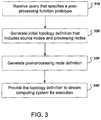
- FIG. 3 is a flow chart of an example process for dynamically generating a stream computing topology.
- a user issues a query that specifies one or more function prototypes that define additional post-processing nodes that should be added to a stream computing topology.
- the process can be performed by a management node, e.g., the management node 120b in FIG. 1 .
- the process will be described as being performed by a system of one or more appropriately programmed computers.
- the system receives, from a user, a query that includes an identifier of a post-processing function prototype (310).
- the query will generally include a base query that specifies a data collection to search and one or more search criteria.
- the base query can specify a table name of a relational database or a column-family of an HBase system.
- the base query can also specify a particular input stream that corresponds to events occurring in real time, e.g., web page requests.
- the post-processing function prototype can be one defined in a repository of predefined function prototypes.
- the identifiers of the function prototypes specified in the query can be reserved terms in the query.
- the user can also specify one or more arguments for each post-processing function prototype in the query.
- An example function prototype is a field extraction prototype.
- a field extraction prototype defines a function that extracts fields data objects and generates new fields as output. The criteria for field extraction can be specified by any appropriate regular expression format.
- a function that extracts and passes on values of a "lastName" field is an example of a field extraction prototype.
- a filter prototype defines a function that filters data objects according to one or more criteria.
- Another example function prototype is an aggregate prototype.
- An aggregate prototype generates an aggregate measure from received data objects that are processed through the topology.
- a user can indicate a particular predefined aggregate function, e.g., sum, avg, max, min, count, or unique_count, to name just a few examples.
- TABLE 1 provides further examples of function prototypes that can be used to generate post-processing nodes in the topology.
- FUNCTION IDENTIFIER DESCRIPTION rex Generate new fields from old fields using a regular expression argument filter Filter data objects according to an argument stats Compute statistics on data objects according an argument, e.g., sum, avg, max, min, count, unique_count fields Extract fields from data objects strcat Concatenates a string argument to a data object field replace Replaces a value of a data object field with a new value specified by an argument. rename Renames a data object field with an argument fillnull Replace null values in data objects with value specified by an argument.
- rangemap Classify a range of data object values for numerical fields with a descriptive names specified by an argument top Determine a most common value, among received data objects, of a particular field specified by an argument rare Determine a least common value, among received data objects, of a particular field specified by an argument
- the system generates an initial topology definition that specifies source nodes and processing nodes (320).
- the system will parse the base query to generate an initial topology definition.
- the initial topology definition will include a specification for source nodes that determine data object identifiers of data objects that satisfy the one or more search criteria in the data collection specified by the base query.
- the source nodes will generate streams of matching identifiers that are provided to one or more processing nodes.
- the processing nodes will generally include at least one node that reads from a key-value storage subsystem for data objects of the matching identifier streams.
- the system generates a post-processing node definition (330).
- the system can add additional post-processing nodes to the topology definition according to the function prototypes and arguments specified by the user in the query.
- the function prototypes define operations to be performed by the post-processing node, e.g., by specifying source or object code to be performed by the node.
- the function prototypes can be implemented in any appropriate programming language, e.g., Java, Ruby, Python, or Fancy, to name just a few examples.
- the system provides the topology definition to a stream computing system for execution (340).
- the stream computing system will generate a real-time stream computing topology according to the topology definition. For example, the stream computing system can allocate one or more computing nodes for each node in the topology and establish network connections between computing nodes that correspond to stream subscriptions in the topology.
- data processing apparatus encompasses all kinds of apparatus, devices, and machines for processing data, including by way of example a programmable processor, a computer, or multiple processors or computers.
- the apparatus can include special purpose logic circuitry, e.g., an FPGA (field programmable gate array) or an ASIC (application-specific integrated circuit).
- the apparatus can also include, in addition to hardware, code that creates an execution environment for the computer program in question, e.g., code that constitutes processor firmware, a protocol stack, a database management system, an operating system, or a combination of one or more of them.
- a computer program (which may also be referred to or described as a program, software, a software application, a module, a software module, a script, or code) can be written in any form of programming language, including compiled or interpreted languages, or declarative or procedural languages, and it can be deployed in any form, including as a stand-alone program or as a module, component, subroutine, or other unit suitable for use in a computing environment.
- a computer program may, but need not, correspond to a file in a file system.
- a program can be stored in a portion of a file that holds other programs or data, e.g., one or more scripts stored in a markup language document, in a single file dedicated to the program in question, or in multiple coordinated files, e.g., files that store one or more modules, sub-programs, or portions of code.
- a computer program can be deployed to be executed on one computer or on multiple computers that are located at one site or distributed across multiple sites and interconnected by a communication network.
- the processes and logic flows described in this specification can be performed by one or more programmable computers executing one or more computer programs to perform functions by operating on input data and generating output.
- the processes and logic flows can also be performed by, and apparatus can also be implemented as, special purpose logic circuitry, e.g., an FPGA (field programmable gate array) or an ASIC (application-specific integrated circuit).
- special purpose logic circuitry e.g., an FPGA (field programmable gate array) or an ASIC (application-specific integrated circuit).
- Computers suitable for the execution of a computer program include, by way of example, can be based on general or special purpose microprocessors or both, or any other kind of central processing unit.
- a central processing unit will receive instructions and data from a read-only memory or a random access memory or both.
- the essential elements of a computer are a central processing unit for performing or executing instructions and one or more memory devices for storing instructions and data.
- a computer will also include, or be operatively coupled to receive data from or transfer data to, or both, one or more mass storage devices for storing data, e.g., magnetic, magneto-optical disks, or optical disks.
- mass storage devices for storing data, e.g., magnetic, magneto-optical disks, or optical disks.
- a computer need not have such devices.
- a computer can be embedded in another device, e.g., a mobile telephone, a personal digital assistant (PDA), a mobile audio or video player, a game console, a Global Positioning System (GPS) receiver, or a portable storage device, e.g., a universal serial bus (USB) flash drive, to name just a few.
- PDA personal digital assistant
- GPS Global Positioning System
- USB universal serial bus
- Computer-readable media suitable for storing computer program instructions and data include all forms of non-volatile memory, media and memory devices, including by way of example semiconductor memory devices, e.g., EPROM, EEPROM, and flash memory devices; magnetic disks, e.g., internal hard disks or removable disks; magneto-optical disks; and CD-ROM and DVD-ROM disks.
- semiconductor memory devices e.g., EPROM, EEPROM, and flash memory devices
- magnetic disks e.g., internal hard disks or removable disks
- magneto-optical disks e.g., CD-ROM and DVD-ROM disks.
- the processor and the memory can be supplemented by, or incorporated in, special purpose logic circuitry.
- a computer having a display device, e.g., a CRT (cathode ray tube) monitor, an LCD (liquid crystal display) monitor, or an OLED display, for displaying information to the user, as well as input devices for providing input to the computer, e.g., a keyboard, a mouse, or a presence sensitive display or other surface.
- a display device e.g., a CRT (cathode ray tube) monitor, an LCD (liquid crystal display) monitor, or an OLED display
- input devices for providing input to the computer, e.g., a keyboard, a mouse, or a presence sensitive display or other surface.
- Other kinds of devices can be used to provide for interaction with a user as well; for example, feedback provided to the user can be any form of sensory feedback, e.g., visual feedback, auditory feedback, or tactile feedback; and input from the user can be received in any form, including acoustic, speech, or tactile input.
- a computer can interact with a user
- Embodiments of the subject matter described in this specification can be implemented in a computing system that includes a back-end component, e.g., as a data server, or that includes a middleware component, e.g., an application server, or that includes a front-end component, e.g., a client computer having a graphical user interface or a Web browser through which a user can interact with an implementation of the subject matter described in this specification, or any combination of one or more such back-end, middleware, or front-end components.
- the components of the system can be interconnected by any form or medium of digital data communication, e.g., a communication network. Examples of communication networks include a local area network (“LAN”) and a wide area network (“WAN”), e.g., the Internet.
- LAN local area network
- WAN wide area network
Landscapes
- Engineering & Computer Science (AREA)
- Theoretical Computer Science (AREA)
- Databases & Information Systems (AREA)
- General Physics & Mathematics (AREA)
- Physics & Mathematics (AREA)
- General Engineering & Computer Science (AREA)
- Data Mining & Analysis (AREA)
- Computational Linguistics (AREA)
- Software Systems (AREA)
- Information Retrieval, Db Structures And Fs Structures Therefor (AREA)
- Stored Programmes (AREA)
- Computer Networks & Wireless Communication (AREA)
- Signal Processing (AREA)
Claims (14)
- Computerimplementiertes Verfahren, umfassend:
Empfangen, zur Laufzeit und von einem Benutzer, einer Abfrage (106), die ein Suchkriterium und einen Prototyp einer Nachverarbeitungsfunktion spezifiziert; wobei das computerimplementierte Verfahren gekennzeichnet ist durch das Folgende:Erzeugen, zur Laufzeit und aus der empfangenen Abfrage, einer Topologiedefinition (125b), die Folgendes spezifiziert:einen oder mehrere Quellknoten (132) und mindestens einen Verarbeitungsknoten (134), wobei der Verarbeitungsknoten in der Topologie dazu spezifiziert ist, von dem einen oder den mehreren Quellknoten (132), einen oder mehrere Ströme von Datenobjektkennungen (145) von Datenobjekten zu empfangen, die dem Suchkriterium entsprechen, und wobei der Verarbeitungsknoten (134) in der Topologie dazu spezifiziert ist, einen Strom von Datenobjekten auszugeben, die den Datenobjektkennungen (145) entsprechen; undNachverarbeitungsknoten (136, 138) gemäß dem Prototyp der Nachverarbeitungsfunktion, wobei der Nachverarbeitungsknoten (136, 138) in der Topologie dazu spezifiziert ist, einen Strom von Datenobjekten zu empfangen, die vom Verarbeitungsknoten (134) ausgegeben werden, eine oder mehrere Operationen an den Datenobjekten gemäß dem Prototyp der Nachverarbeitungsfunktion durchzuführen, und in der Topologie dazu spezifiziert ist, ein oder mehrere modifizierte Datenobjekte (155) auszugeben; undBereitstellen der Topologiedefinition (125b) an ein Echtzeit-Strom-Rechensystem zur Ausführung. - Verfahren nach Anspruch 1, wobei das Erzeugen der Topologiedefinition aus der Abfrage umfasst:Erzeugen einer anfänglichen Topologiedefinition, die den einen oder die mehreren Quellknoten (132) und den mindestens einen Verarbeitungsknoten (134) spezifiziert; undHinzufügen des Nachverarbeitungsknotens zur anfänglichen Topologiedefinition.
- Verfahren nach Anspruch 1, wobei die Funktionalität eines Knotens in der Topologie als ein oder mehrere physische Computer oder als Software implementiert ist, die als virtuelle Maschine auf einem physischen Computer installiert ist.
- Verfahren nach Anspruch 1, wobei die Abfrage (106) eine Suchabfrage ist, die einen oder mehrere Suchbegriffe spezifiziert, und wobei die Datenobjektkennungen (145) von Datenobjekten, die der Suchabfrage entsprechen, Datenobjekte mit Feldwerten sind, die den Suchbegriffen entsprechen.
- Verfahren nach Anspruch 1, ferner umfassend:
Empfangen, vom Benutzer, eines Arguments für den Prototyp der Nachverarbeitungsfunktion, wobei der Nachverarbeitungsknoten (136, 138) in der Topologie dazu spezifiziert ist, eine oder mehrere Operationen an den Datenobjekten unter Verwendung des Arguments durchzuführen. - Verfahren nach Anspruch 5, wobei der Prototyp der Nachverarbeitungsfunktion ein Feldextraktionsprototyp ist, und wobei der aus dem Prototyp der Nachverarbeitungsfunktion erzeugte Nachverarbeitungsknoten (138) in der Topologie dazu spezifiziert ist, Felder aus den empfangenen Datenobjekten gemäß dem Argument zu extrahieren, und die extrahierten Felder als Ausgabe bereitstellt.
- Verfahren nach Anspruch 5, wobei der Prototyp der Nachverarbeitungsfunktion ein Filterprototyp ist, und wobei der aus dem Prototyp der Nachverarbeitungsfunktion erzeugte Nachverarbeitungsknoten (136) in der Topologie dazu spezifiziert ist, die vom Nachverarbeitungsknoten (136) empfangenen Datenobjekte gemäß dem Argument zu filtern, und die gefilterten Datenobjekte als Ausgabe bereitstellt.
- Verfahren nach Anspruch 5, wobei der Prototyp der Nachverarbeitungsfunktion ein aggregierender Prototyp ist, und wobei der aus dem Funktionsprototyp erzeugte Nachverarbeitungsknoten in der Topologie dazu spezifiziert ist, einen oder mehrere durch das Argument spezifizierte Datenobjektwerte zu aggregieren, und einen aggregierten Wert als Ausgabe bereitstellt.
- Verfahren nach Anspruch 1, wobei die Abfrage (106), die das Suchkriterium und den Prototyp der Nachverarbeitungsfunktion spezifiziert, Texteingaben sind, die als Eingabe durch den Benutzer bereitgestellt werden.
- Verfahren nach Anspruch 1, ferner umfassend:
Empfangen einer Kennung eines anderen, zweiten Prototyps einer Nachverarbeitungsfunktion,
wobei die Topologiedefinition (125b) einen zweiten Nachverarbeitungsknoten gemäß dem zweiten Prototyp der Nachverarbeitungsfunktion spezifiziert, wobei der zweite Nachverarbeitungsknoten in der Topologie dazu spezifiziert ist, einen Strom von Datenobjekten zu empfangen, die vom Nachverarbeitungsknoten (138) ausgegeben werden, eine oder mehrere Operationen an den Datenobjekten gemäß dem zweiten Prototyp der Nachverarbeitungsfunktion durchführt und ein oder mehrere zweite modifizierte Datenobjekte ausgibt. - Verfahren nach Anspruch 10, wobei die Abfrage (106), die das Suchkriterium und die Nachverarbeitungsfunktion spezifiziert, eine vom Benutzer empfangene Texteingabe ist, wobei die Texteingabe eine Subskription von Datenobjektströmen, die vom Nachverarbeitungsknoten ausgegeben werden, und von Datenobjektströmen, die vom zweiten Nachverarbeitungsknoten empfangen werden, spezifiziert.
- Verfahren nach Anspruch 1, ferner umfassend:Zuordnen, durch das Strom-Rechensystem, eines oder mehrerer Rechenknoten für jeden des einen oder der mehreren Quellknoten (132), den Verarbeitungsknoten (134) und den Nachverarbeitungsknoten (136, 138),wobei der Verarbeitungsknoten (134) Ströme von dem einem oder den mehreren Quellknoten (132) subskribiert, wobei der Nachverarbeitungsknoten (136, 138) einen Strom vom Verarbeitungsknoten (134) subskribiert.
- System, umfassend:
einen oder mehrere Computer und eine oder mehrere Speichervorrichtungen, die Anweisungen speichern, die, wenn sie von dem einem oder den mehreren Computern ausgeführt werden, dazu geeignet sind, den einen oder die mehreren Computer dazu zu veranlassen, Operationen gemäß einem der Ansprüche 1-12 auszuführen. - Computerprogrammprodukt, das auf einem oder mehreren Computerspeichermedien kodiert ist, umfassend Anweisungen, die, wenn sie von einem oder mehreren Computern ausgeführt werden, bewirken, dass der eine oder die mehreren Computer Operationen gemäß einem der Ansprüche 1-12 ausführen.
Applications Claiming Priority (1)
| Application Number | Priority Date | Filing Date | Title |
|---|---|---|---|
| PCT/CN2013/086980 WO2015070379A1 (en) | 2013-11-12 | 2013-11-12 | Dynamic stream computing topology |
Publications (3)
| Publication Number | Publication Date |
|---|---|
| EP3069271A1 EP3069271A1 (de) | 2016-09-21 |
| EP3069271A4 EP3069271A4 (de) | 2017-07-26 |
| EP3069271B1 true EP3069271B1 (de) | 2020-01-08 |
Family
ID=53056603
Family Applications (1)
| Application Number | Title | Priority Date | Filing Date |
|---|---|---|---|
| EP13897488.6A Active EP3069271B1 (de) | 2013-11-12 | 2013-11-12 | Dynamische datenstromberechnungstopologie |
Country Status (4)
| Country | Link |
|---|---|
| US (2) | US9740745B2 (de) |
| EP (1) | EP3069271B1 (de) |
| CN (1) | CN106062739B (de) |
| WO (1) | WO2015070379A1 (de) |
Families Citing this family (8)
| Publication number | Priority date | Publication date | Assignee | Title |
|---|---|---|---|---|
| WO2015070379A1 (en) | 2013-11-12 | 2015-05-21 | Pivotal Software, Inc. | Dynamic stream computing topology |
| US20170144893A1 (en) | 2015-11-25 | 2017-05-25 | Adrian Vazquez Torres | Desalination method by heat and condensation |
| US10122788B2 (en) * | 2016-03-29 | 2018-11-06 | Amazon Technologies, Inc. | Managed function execution for processing data streams in real time |
| WO2020014939A1 (en) * | 2018-07-20 | 2020-01-23 | Pivotal Software, Inc. | Container framework for user-defined functions |
| US11169785B2 (en) * | 2019-03-11 | 2021-11-09 | Nec Corporation | Specification and execution of real-time streaming applications |
| US11095522B2 (en) * | 2019-08-21 | 2021-08-17 | Microsoft Technology Licensing, Llc | Dynamic scaling for data processing streaming system |
| CN112632082B (zh) * | 2020-12-30 | 2024-06-07 | 中国农业银行股份有限公司 | 一种创建Flink作业的方法及装置 |
| CN115794262A (zh) * | 2022-12-07 | 2023-03-14 | 百度(中国)有限公司 | 任务处理方法、装置、设备、存储介质以及程序产品 |
Family Cites Families (8)
| Publication number | Priority date | Publication date | Assignee | Title |
|---|---|---|---|---|
| US20030101253A1 (en) * | 2001-11-29 | 2003-05-29 | Takayuki Saito | Method and system for distributing data in a network |
| US6978264B2 (en) * | 2002-01-03 | 2005-12-20 | Microsoft Corporation | System and method for performing a search and a browse on a query |
| US7383253B1 (en) | 2004-12-17 | 2008-06-03 | Coral 8, Inc. | Publish and subscribe capable continuous query processor for real-time data streams |
| US7991766B2 (en) * | 2007-10-20 | 2011-08-02 | Oracle International Corporation | Support for user defined aggregations in a data stream management system |
| US8620900B2 (en) * | 2009-02-09 | 2013-12-31 | The Hong Kong Polytechnic University | Method for using dual indices to support query expansion, relevance/non-relevance models, blind/relevance feedback and an intelligent search interface |
| US10311105B2 (en) * | 2010-12-28 | 2019-06-04 | Microsoft Technology Licensing, Llc | Filtering queried data on data stores |
| US8359305B1 (en) * | 2011-10-18 | 2013-01-22 | International Business Machines Corporation | Query metadata engine |
| WO2015070379A1 (en) | 2013-11-12 | 2015-05-21 | Pivotal Software, Inc. | Dynamic stream computing topology |
-
2013
- 2013-11-12 WO PCT/CN2013/086980 patent/WO2015070379A1/en not_active Ceased
- 2013-11-12 EP EP13897488.6A patent/EP3069271B1/de active Active
- 2013-11-12 CN CN201380081647.5A patent/CN106062739B/zh active Active
-
2014
- 2014-11-12 US US14/539,010 patent/US9740745B2/en not_active Expired - Fee Related
-
2017
- 2017-07-10 US US15/646,023 patent/US9971811B2/en not_active Expired - Fee Related
Non-Patent Citations (1)
| Title |
|---|
| None * |
Also Published As
| Publication number | Publication date |
|---|---|
| US9971811B2 (en) | 2018-05-15 |
| US9740745B2 (en) | 2017-08-22 |
| EP3069271A4 (de) | 2017-07-26 |
| WO2015070379A1 (en) | 2015-05-21 |
| US20160132560A1 (en) | 2016-05-12 |
| CN106062739B (zh) | 2020-02-28 |
| US20170308581A1 (en) | 2017-10-26 |
| EP3069271A1 (de) | 2016-09-21 |
| CN106062739A (zh) | 2016-10-26 |
Similar Documents
| Publication | Publication Date | Title |
|---|---|---|
| US9971811B2 (en) | Dynamic stream computing topology | |
| US11720581B2 (en) | Query decomposition for scalability of continuous query processing | |
| US11036735B2 (en) | Dimension context propagation techniques for optimizing SQL query plans | |
| US9424150B2 (en) | Fault tolerance based query execution | |
| US10447772B2 (en) | Managed function execution for processing data streams in real time | |
| US11288319B1 (en) | Generating trending natural language request recommendations | |
| US10579627B2 (en) | Database operation using metadata of data sources | |
| US9442967B2 (en) | Systems and methods for efficient data ingestion and query processing | |
| US20180074852A1 (en) | Compact Task Deployment for Stream Processing Systems | |
| US20110218978A1 (en) | Operating on time sequences of data | |
| JP2019532416A (ja) | ストリームデータにおける空間変化検出器 | |
| US8290939B2 (en) | Visualizing query results in stream processing systems | |
| US10599654B2 (en) | Method and system for determining unique events from a stream of events | |
| CN111125344B (zh) | 相关词推荐方法和装置 | |
| US20170060977A1 (en) | Data preparation for data mining | |
| US10776368B1 (en) | Deriving cardinality values from approximate quantile summaries | |
| US20190171749A1 (en) | Data integration framework for multiple data providers using service url | |
| WO2016206395A1 (zh) | 周报信息处理方法及装置 | |
| Hashem et al. | Pre-processing and modeling tools for bigdata | |
| CN116108043B (zh) | 查询指令生成方法、装置、设备及介质 | |
| Wu et al. | Efficient on/off-line query pre-processing for telecom social streaming data |
Legal Events
| Date | Code | Title | Description |
|---|---|---|---|
| PUAI | Public reference made under article 153(3) epc to a published international application that has entered the european phase |
Free format text: ORIGINAL CODE: 0009012 |
|
| 17P | Request for examination filed |
Effective date: 20160602 |
|
| AK | Designated contracting states |
Kind code of ref document: A1 Designated state(s): AL AT BE BG CH CY CZ DE DK EE ES FI FR GB GR HR HU IE IS IT LI LT LU LV MC MK MT NL NO PL PT RO RS SE SI SK SM TR |
|
| AX | Request for extension of the european patent |
Extension state: BA ME |
|
| DAX | Request for extension of the european patent (deleted) | ||
| A4 | Supplementary search report drawn up and despatched |
Effective date: 20170628 |
|
| RIC1 | Information provided on ipc code assigned before grant |
Ipc: G06F 17/30 20060101AFI20170622BHEP |
|
| REG | Reference to a national code |
Ref country code: DE Ref legal event code: R079 Ref document number: 602013065012 Country of ref document: DE Free format text: PREVIOUS MAIN CLASS: G06F0017300000 Ipc: G06F0016901000 |
|
| RIC1 | Information provided on ipc code assigned before grant |
Ipc: G06F 16/901 20190101AFI20190408BHEP Ipc: G06F 16/2455 20190101ALI20190408BHEP |
|
| GRAP | Despatch of communication of intention to grant a patent |
Free format text: ORIGINAL CODE: EPIDOSNIGR1 |
|
| STAA | Information on the status of an ep patent application or granted ep patent |
Free format text: STATUS: GRANT OF PATENT IS INTENDED |
|
| INTG | Intention to grant announced |
Effective date: 20190521 |
|
| GRAS | Grant fee paid |
Free format text: ORIGINAL CODE: EPIDOSNIGR3 |
|
| GRAA | (expected) grant |
Free format text: ORIGINAL CODE: 0009210 |
|
| STAA | Information on the status of an ep patent application or granted ep patent |
Free format text: STATUS: THE PATENT HAS BEEN GRANTED |
|
| AK | Designated contracting states |
Kind code of ref document: B1 Designated state(s): AL AT BE BG CH CY CZ DE DK EE ES FI FR GB GR HR HU IE IS IT LI LT LU LV MC MK MT NL NO PL PT RO RS SE SI SK SM TR |
|
| REG | Reference to a national code |
Ref country code: GB Ref legal event code: FG4D |
|
| REG | Reference to a national code |
Ref country code: CH Ref legal event code: EP |
|
| REG | Reference to a national code |
Ref country code: DE Ref legal event code: R096 Ref document number: 602013065012 Country of ref document: DE |
|
| REG | Reference to a national code |
Ref country code: IE Ref legal event code: FG4D |
|
| REG | Reference to a national code |
Ref country code: AT Ref legal event code: REF Ref document number: 1223567 Country of ref document: AT Kind code of ref document: T Effective date: 20200215 |
|
| REG | Reference to a national code |
Ref country code: NL Ref legal event code: MP Effective date: 20200108 |
|
| REG | Reference to a national code |
Ref country code: LT Ref legal event code: MG4D |
|
| PG25 | Lapsed in a contracting state [announced via postgrant information from national office to epo] |
Ref country code: NO Free format text: LAPSE BECAUSE OF FAILURE TO SUBMIT A TRANSLATION OF THE DESCRIPTION OR TO PAY THE FEE WITHIN THE PRESCRIBED TIME-LIMIT Effective date: 20200408 Ref country code: PT Free format text: LAPSE BECAUSE OF FAILURE TO SUBMIT A TRANSLATION OF THE DESCRIPTION OR TO PAY THE FEE WITHIN THE PRESCRIBED TIME-LIMIT Effective date: 20200531 Ref country code: FI Free format text: LAPSE BECAUSE OF FAILURE TO SUBMIT A TRANSLATION OF THE DESCRIPTION OR TO PAY THE FEE WITHIN THE PRESCRIBED TIME-LIMIT Effective date: 20200108 Ref country code: RS Free format text: LAPSE BECAUSE OF FAILURE TO SUBMIT A TRANSLATION OF THE DESCRIPTION OR TO PAY THE FEE WITHIN THE PRESCRIBED TIME-LIMIT Effective date: 20200108 Ref country code: NL Free format text: LAPSE BECAUSE OF FAILURE TO SUBMIT A TRANSLATION OF THE DESCRIPTION OR TO PAY THE FEE WITHIN THE PRESCRIBED TIME-LIMIT Effective date: 20200108 Ref country code: LT Free format text: LAPSE BECAUSE OF FAILURE TO SUBMIT A TRANSLATION OF THE DESCRIPTION OR TO PAY THE FEE WITHIN THE PRESCRIBED TIME-LIMIT Effective date: 20200108 |
|
| PG25 | Lapsed in a contracting state [announced via postgrant information from national office to epo] |
Ref country code: HR Free format text: LAPSE BECAUSE OF FAILURE TO SUBMIT A TRANSLATION OF THE DESCRIPTION OR TO PAY THE FEE WITHIN THE PRESCRIBED TIME-LIMIT Effective date: 20200108 Ref country code: GR Free format text: LAPSE BECAUSE OF FAILURE TO SUBMIT A TRANSLATION OF THE DESCRIPTION OR TO PAY THE FEE WITHIN THE PRESCRIBED TIME-LIMIT Effective date: 20200409 Ref country code: LV Free format text: LAPSE BECAUSE OF FAILURE TO SUBMIT A TRANSLATION OF THE DESCRIPTION OR TO PAY THE FEE WITHIN THE PRESCRIBED TIME-LIMIT Effective date: 20200108 Ref country code: SE Free format text: LAPSE BECAUSE OF FAILURE TO SUBMIT A TRANSLATION OF THE DESCRIPTION OR TO PAY THE FEE WITHIN THE PRESCRIBED TIME-LIMIT Effective date: 20200108 Ref country code: BG Free format text: LAPSE BECAUSE OF FAILURE TO SUBMIT A TRANSLATION OF THE DESCRIPTION OR TO PAY THE FEE WITHIN THE PRESCRIBED TIME-LIMIT Effective date: 20200408 Ref country code: IS Free format text: LAPSE BECAUSE OF FAILURE TO SUBMIT A TRANSLATION OF THE DESCRIPTION OR TO PAY THE FEE WITHIN THE PRESCRIBED TIME-LIMIT Effective date: 20200508 |
|
| REG | Reference to a national code |
Ref country code: DE Ref legal event code: R097 Ref document number: 602013065012 Country of ref document: DE |
|
| PG25 | Lapsed in a contracting state [announced via postgrant information from national office to epo] |
Ref country code: CZ Free format text: LAPSE BECAUSE OF FAILURE TO SUBMIT A TRANSLATION OF THE DESCRIPTION OR TO PAY THE FEE WITHIN THE PRESCRIBED TIME-LIMIT Effective date: 20200108 Ref country code: SK Free format text: LAPSE BECAUSE OF FAILURE TO SUBMIT A TRANSLATION OF THE DESCRIPTION OR TO PAY THE FEE WITHIN THE PRESCRIBED TIME-LIMIT Effective date: 20200108 Ref country code: EE Free format text: LAPSE BECAUSE OF FAILURE TO SUBMIT A TRANSLATION OF THE DESCRIPTION OR TO PAY THE FEE WITHIN THE PRESCRIBED TIME-LIMIT Effective date: 20200108 Ref country code: SM Free format text: LAPSE BECAUSE OF FAILURE TO SUBMIT A TRANSLATION OF THE DESCRIPTION OR TO PAY THE FEE WITHIN THE PRESCRIBED TIME-LIMIT Effective date: 20200108 Ref country code: DK Free format text: LAPSE BECAUSE OF FAILURE TO SUBMIT A TRANSLATION OF THE DESCRIPTION OR TO PAY THE FEE WITHIN THE PRESCRIBED TIME-LIMIT Effective date: 20200108 Ref country code: ES Free format text: LAPSE BECAUSE OF FAILURE TO SUBMIT A TRANSLATION OF THE DESCRIPTION OR TO PAY THE FEE WITHIN THE PRESCRIBED TIME-LIMIT Effective date: 20200108 Ref country code: RO Free format text: LAPSE BECAUSE OF FAILURE TO SUBMIT A TRANSLATION OF THE DESCRIPTION OR TO PAY THE FEE WITHIN THE PRESCRIBED TIME-LIMIT Effective date: 20200108 |
|
| PLBE | No opposition filed within time limit |
Free format text: ORIGINAL CODE: 0009261 |
|
| STAA | Information on the status of an ep patent application or granted ep patent |
Free format text: STATUS: NO OPPOSITION FILED WITHIN TIME LIMIT |
|
| REG | Reference to a national code |
Ref country code: AT Ref legal event code: MK05 Ref document number: 1223567 Country of ref document: AT Kind code of ref document: T Effective date: 20200108 |
|
| 26N | No opposition filed |
Effective date: 20201009 |
|
| PG25 | Lapsed in a contracting state [announced via postgrant information from national office to epo] |
Ref country code: AT Free format text: LAPSE BECAUSE OF FAILURE TO SUBMIT A TRANSLATION OF THE DESCRIPTION OR TO PAY THE FEE WITHIN THE PRESCRIBED TIME-LIMIT Effective date: 20200108 Ref country code: IT Free format text: LAPSE BECAUSE OF FAILURE TO SUBMIT A TRANSLATION OF THE DESCRIPTION OR TO PAY THE FEE WITHIN THE PRESCRIBED TIME-LIMIT Effective date: 20200108 |
|
| PG25 | Lapsed in a contracting state [announced via postgrant information from national office to epo] |
Ref country code: PL Free format text: LAPSE BECAUSE OF FAILURE TO SUBMIT A TRANSLATION OF THE DESCRIPTION OR TO PAY THE FEE WITHIN THE PRESCRIBED TIME-LIMIT Effective date: 20200108 Ref country code: SI Free format text: LAPSE BECAUSE OF FAILURE TO SUBMIT A TRANSLATION OF THE DESCRIPTION OR TO PAY THE FEE WITHIN THE PRESCRIBED TIME-LIMIT Effective date: 20200108 |
|
| PG25 | Lapsed in a contracting state [announced via postgrant information from national office to epo] |
Ref country code: MC Free format text: LAPSE BECAUSE OF FAILURE TO SUBMIT A TRANSLATION OF THE DESCRIPTION OR TO PAY THE FEE WITHIN THE PRESCRIBED TIME-LIMIT Effective date: 20200108 |
|
| REG | Reference to a national code |
Ref country code: CH Ref legal event code: PL |
|
| PG25 | Lapsed in a contracting state [announced via postgrant information from national office to epo] |
Ref country code: LU Free format text: LAPSE BECAUSE OF NON-PAYMENT OF DUE FEES Effective date: 20201112 |
|
| REG | Reference to a national code |
Ref country code: BE Ref legal event code: MM Effective date: 20201130 |
|
| PG25 | Lapsed in a contracting state [announced via postgrant information from national office to epo] |
Ref country code: CH Free format text: LAPSE BECAUSE OF NON-PAYMENT OF DUE FEES Effective date: 20201130 Ref country code: LI Free format text: LAPSE BECAUSE OF NON-PAYMENT OF DUE FEES Effective date: 20201130 |
|
| PG25 | Lapsed in a contracting state [announced via postgrant information from national office to epo] |
Ref country code: IE Free format text: LAPSE BECAUSE OF NON-PAYMENT OF DUE FEES Effective date: 20201112 |
|
| PG25 | Lapsed in a contracting state [announced via postgrant information from national office to epo] |
Ref country code: TR Free format text: LAPSE BECAUSE OF FAILURE TO SUBMIT A TRANSLATION OF THE DESCRIPTION OR TO PAY THE FEE WITHIN THE PRESCRIBED TIME-LIMIT Effective date: 20200108 Ref country code: MT Free format text: LAPSE BECAUSE OF FAILURE TO SUBMIT A TRANSLATION OF THE DESCRIPTION OR TO PAY THE FEE WITHIN THE PRESCRIBED TIME-LIMIT Effective date: 20200108 Ref country code: CY Free format text: LAPSE BECAUSE OF FAILURE TO SUBMIT A TRANSLATION OF THE DESCRIPTION OR TO PAY THE FEE WITHIN THE PRESCRIBED TIME-LIMIT Effective date: 20200108 |
|
| PG25 | Lapsed in a contracting state [announced via postgrant information from national office to epo] |
Ref country code: MK Free format text: LAPSE BECAUSE OF FAILURE TO SUBMIT A TRANSLATION OF THE DESCRIPTION OR TO PAY THE FEE WITHIN THE PRESCRIBED TIME-LIMIT Effective date: 20200108 Ref country code: AL Free format text: LAPSE BECAUSE OF FAILURE TO SUBMIT A TRANSLATION OF THE DESCRIPTION OR TO PAY THE FEE WITHIN THE PRESCRIBED TIME-LIMIT Effective date: 20200108 |
|
| PG25 | Lapsed in a contracting state [announced via postgrant information from national office to epo] |
Ref country code: BE Free format text: LAPSE BECAUSE OF NON-PAYMENT OF DUE FEES Effective date: 20201130 |
|
| PGFP | Annual fee paid to national office [announced via postgrant information from national office to epo] |
Ref country code: DE Payment date: 20251112 Year of fee payment: 13 |
|
| PGFP | Annual fee paid to national office [announced via postgrant information from national office to epo] |
Ref country code: GB Payment date: 20251023 Year of fee payment: 13 |
|
| PGFP | Annual fee paid to national office [announced via postgrant information from national office to epo] |
Ref country code: FR Payment date: 20251022 Year of fee payment: 13 |