EP3067622A1 - Combustion chamber with double wall - Google Patents
Combustion chamber with double wall Download PDFInfo
- Publication number
- EP3067622A1 EP3067622A1 EP15158820.9A EP15158820A EP3067622A1 EP 3067622 A1 EP3067622 A1 EP 3067622A1 EP 15158820 A EP15158820 A EP 15158820A EP 3067622 A1 EP3067622 A1 EP 3067622A1
- Authority
- EP
- European Patent Office
- Prior art keywords
- cooling
- duct wall
- wall
- cavity
- gas
- Prior art date
- Legal status (The legal status is an assumption and is not a legal conclusion. Google has not performed a legal analysis and makes no representation as to the accuracy of the status listed.)
- Granted
Links
Images

Classifications
-
- F—MECHANICAL ENGINEERING; LIGHTING; HEATING; WEAPONS; BLASTING
- F23—COMBUSTION APPARATUS; COMBUSTION PROCESSES
- F23R—GENERATING COMBUSTION PRODUCTS OF HIGH PRESSURE OR HIGH VELOCITY, e.g. GAS-TURBINE COMBUSTION CHAMBERS
- F23R3/00—Continuous combustion chambers using liquid or gaseous fuel
- F23R3/42—Continuous combustion chambers using liquid or gaseous fuel characterised by the arrangement or form of the flame tubes or combustion chambers
-
- F—MECHANICAL ENGINEERING; LIGHTING; HEATING; WEAPONS; BLASTING
- F23—COMBUSTION APPARATUS; COMBUSTION PROCESSES
- F23R—GENERATING COMBUSTION PRODUCTS OF HIGH PRESSURE OR HIGH VELOCITY, e.g. GAS-TURBINE COMBUSTION CHAMBERS
- F23R3/00—Continuous combustion chambers using liquid or gaseous fuel
- F23R3/002—Wall structures
-
- F—MECHANICAL ENGINEERING; LIGHTING; HEATING; WEAPONS; BLASTING
- F02—COMBUSTION ENGINES; HOT-GAS OR COMBUSTION-PRODUCT ENGINE PLANTS
- F02C—GAS-TURBINE PLANTS; AIR INTAKES FOR JET-PROPULSION PLANTS; CONTROLLING FUEL SUPPLY IN AIR-BREATHING JET-PROPULSION PLANTS
- F02C7/00—Features, components parts, details or accessories, not provided for in, or of interest apart form groups F02C1/00 - F02C6/00; Air intakes for jet-propulsion plants
- F02C7/12—Cooling of plants
-
- F—MECHANICAL ENGINEERING; LIGHTING; HEATING; WEAPONS; BLASTING
- F02—COMBUSTION ENGINES; HOT-GAS OR COMBUSTION-PRODUCT ENGINE PLANTS
- F02C—GAS-TURBINE PLANTS; AIR INTAKES FOR JET-PROPULSION PLANTS; CONTROLLING FUEL SUPPLY IN AIR-BREATHING JET-PROPULSION PLANTS
- F02C7/00—Features, components parts, details or accessories, not provided for in, or of interest apart form groups F02C1/00 - F02C6/00; Air intakes for jet-propulsion plants
- F02C7/12—Cooling of plants
- F02C7/16—Cooling of plants characterised by cooling medium
- F02C7/18—Cooling of plants characterised by cooling medium the medium being gaseous, e.g. air
-
- F—MECHANICAL ENGINEERING; LIGHTING; HEATING; WEAPONS; BLASTING
- F23—COMBUSTION APPARATUS; COMBUSTION PROCESSES
- F23M—CASINGS, LININGS, WALLS OR DOORS SPECIALLY ADAPTED FOR COMBUSTION CHAMBERS, e.g. FIREBRIDGES; DEVICES FOR DEFLECTING AIR, FLAMES OR COMBUSTION PRODUCTS IN COMBUSTION CHAMBERS; SAFETY ARRANGEMENTS SPECIALLY ADAPTED FOR COMBUSTION APPARATUS; DETAILS OF COMBUSTION CHAMBERS, NOT OTHERWISE PROVIDED FOR
- F23M5/00—Casings; Linings; Walls
- F23M5/08—Cooling thereof; Tube walls
-
- F—MECHANICAL ENGINEERING; LIGHTING; HEATING; WEAPONS; BLASTING
- F23—COMBUSTION APPARATUS; COMBUSTION PROCESSES
- F23R—GENERATING COMBUSTION PRODUCTS OF HIGH PRESSURE OR HIGH VELOCITY, e.g. GAS-TURBINE COMBUSTION CHAMBERS
- F23R3/00—Continuous combustion chambers using liquid or gaseous fuel
- F23R3/02—Continuous combustion chambers using liquid or gaseous fuel characterised by the air-flow or gas-flow configuration
- F23R3/04—Air inlet arrangements
- F23R3/06—Arrangement of apertures along the flame tube
-
- F—MECHANICAL ENGINEERING; LIGHTING; HEATING; WEAPONS; BLASTING
- F05—INDEXING SCHEMES RELATING TO ENGINES OR PUMPS IN VARIOUS SUBCLASSES OF CLASSES F01-F04
- F05D—INDEXING SCHEME FOR ASPECTS RELATING TO NON-POSITIVE-DISPLACEMENT MACHINES OR ENGINES, GAS-TURBINES OR JET-PROPULSION PLANTS
- F05D2240/00—Components
- F05D2240/35—Combustors or associated equipment
-
- F—MECHANICAL ENGINEERING; LIGHTING; HEATING; WEAPONS; BLASTING
- F23—COMBUSTION APPARATUS; COMBUSTION PROCESSES
- F23R—GENERATING COMBUSTION PRODUCTS OF HIGH PRESSURE OR HIGH VELOCITY, e.g. GAS-TURBINE COMBUSTION CHAMBERS
- F23R2900/00—Special features of, or arrangements for continuous combustion chambers; Combustion processes therefor
- F23R2900/03041—Effusion cooled combustion chamber walls or domes
-
- F—MECHANICAL ENGINEERING; LIGHTING; HEATING; WEAPONS; BLASTING
- F23—COMBUSTION APPARATUS; COMBUSTION PROCESSES
- F23R—GENERATING COMBUSTION PRODUCTS OF HIGH PRESSURE OR HIGH VELOCITY, e.g. GAS-TURBINE COMBUSTION CHAMBERS
- F23R2900/00—Special features of, or arrangements for continuous combustion chambers; Combustion processes therefor
- F23R2900/03043—Convection cooled combustion chamber walls with means for guiding the cooling air flow
-
- F—MECHANICAL ENGINEERING; LIGHTING; HEATING; WEAPONS; BLASTING
- F23—COMBUSTION APPARATUS; COMBUSTION PROCESSES
- F23R—GENERATING COMBUSTION PRODUCTS OF HIGH PRESSURE OR HIGH VELOCITY, e.g. GAS-TURBINE COMBUSTION CHAMBERS
- F23R2900/00—Special features of, or arrangements for continuous combustion chambers; Combustion processes therefor
- F23R2900/03045—Convection cooled combustion chamber walls provided with turbolators or means for creating turbulences to increase cooling
Definitions
- the disclosure refers to a cooled combustion chamber wall, more particularly to a combustion chamber with cooled double walls.
Landscapes
- Engineering & Computer Science (AREA)
- Chemical & Material Sciences (AREA)
- Combustion & Propulsion (AREA)
- Mechanical Engineering (AREA)
- General Engineering & Computer Science (AREA)
- Turbine Rotor Nozzle Sealing (AREA)
Abstract
Description
- The disclosure refers to a cooled combustion chamber wall, more particularly to a combustion chamber with cooled double walls.
- The thermodynamic efficiency of power generating cycles depends on the maximum temperature of its working fluid which, in the case for example of a gas turbine, is maximum temperature of the hot gas exiting the combustor. The maximum feasible temperature of the hot gas is limited by combustion emissions as well as by the operating temperature limit of the metal parts in contact with this hot gas, and on the ability to cool these parts below the their metal temperature limit. The cooling of the hot gas duct walls forming the hot gas flow paths of advanced heavy duty gas turbines is difficult and currently known cooling methods carry performance penalties, i.e. lead to a reduction in power and efficiency.
- Cooling of combustor walls exposed to the hot combustion gases is critical to assure life time of the gas turbine. Cooling sleeves for guiding cooling gas along the walls of combustion chambers have been suggested. For example a combination of sleeves to guide the cooling gas along the combustion chamber with impingement cooling has been disclosed in the
EP 13 190 131.6 - The
EP 2 031 302 A1 - The object of the present disclosure is to propose a combustion chamber which allows efficient cooling of a duct wall. In this context a combustion chamber can comprise the section of a combustor in which the combustion takes place. It can also comprise the so called transition zone. This is a region downstream of the main combustion zone in which the cross sectional area of the combustor is progressively reduced in the downstream direction between the main combustion zone and the outlet guiding the hot gas flow towards the turbine inlet.
- The cooling gas can be air which has been compressed by a compressor of a gas turbine if the combustor is installed in an air breathing gas turbine. It can be any other gas or mixture of gases. For example it can be a mixture of air and flue gases for a gas turbine with flue gas recirculation into the compressor inlet. The cooling gas can for example also be carbon dioxide for a semi-closed oxy-fuel gas turbine cycle with carbon dioxide as working medium into which fuel and oxygen are injected in the combustion chamber for combustion.
- The disclosed combustion chamber comprises a duct wall for guiding a hot gas flow in a hot gas flow path during operation. The duct wall is a double-walled construction including an inner face, an outer face, and a wall cavity extending from a cavity inlet to a cavity outlet along the duct wall. Along the duct wall means for example that the cavity is extending substantially parallel to the surface of the duct wall and remains inside the wall below the surface. The combustion chamber further comprises a sleeve which is at least partly enclosing the duct wall and guides a cooling gas in a cooling channel between the sleeve and the duct wall along the outer surface of the duct wall to an exit end. The cavity outlet opens to the cooling channel. During operation cooling gas is feed to the wall cavity through the cavity inlet. After passing through the wall cavity the cooling gas is discharged from the cavity outlet into the cooling channel. The cooling gas further cools the duct wall as it flows through the cooling channel towards the exit end of the cooling channel.
- The double wall can for example be cast, be manufactured by SLM (Selective Laser Melting), or manufactured from wall layers which are brazed or welded together.
- According to a further embodiment of the combustion chamber the sleeve comprises a plurality of apertures surrounding the duct wall which are spaced at a distance therefrom such that cooling gas injected from a compressed gas plenum through the apertures impinges on the duct wall during operation. After impingement cooling of the duct wall the cooling gas flows as cross flow towards the exit end of the cooling channel.
- According to yet a further embodiment of the combustion chamber the cavity inlet and the apertures for impingement cooling of the duct wall are connected to the same compressed gas plenum. Thus, cooling gas from one plenum as cooling gas source can be used to cool the duct wall by impingement cooling in addition to cooling by heat transfer to cooling gas flowing through the wall cavities. Both cooling flows can thus be reused in the cooling channel to further cool the duct wall.
- In one exemplary embodiment of the combustion chamber the cooling cavities extend in a direction normal to an axial extension of the combustor circumferentially around the duct wall.
- In another embodiment the duct wall has a rectangular, trapezoidal, elliptical, or circular cross section with a first cavity inlet on one side and a second cavity inlet on an opposite side. For a rectangular or trapezoidal cross section a side is a flat side wall. For a circular or elliptical cross section a side can be a section of the circle, respectively ellipse which covers for example an angle between 30° and 90° or for example up to 150°. In this embodiment a first cavity outlet is arranged in a wall section connecting the first and second cavity inlet on one side of the hot gas flow and a second cavity outlet in a wall section connecting the first and second cavity inlet on an opposite side of the hot gas flow. Here, a wall cavity extends from the cavity inlet on one side to the cavity outlet a neighboring side.
- Alternatively or in combination the duct wall has a cavity inlet on one side and a cavity outlet on an opposite side. Here, a wall cavity extends from the cavity inlet on one side to the cavity outlet on the opposite side.
- In a further embodiment of the combustion chamber the cavity inlet is arranged next to a joint at which two sections of the duct wall are connected. A duct wall can consist of different sections. For manufacturing and stability reasons it can be difficult to configure a region in which sections of a duct wall are joined or connected to each other as a double wall. A joint can for example be weld or flange. To cool the joint region it is best to introduce the cooling gas closely to the joint through a cavity inlet next to the joint. Next to the joint in this context can for example be within a distance in the order of the thickness of the duct wall, more specifically for example. one to five times the wall thickness. In the cavity inlet the cooling gas flow direction typically can change from a direction inclined to or normal to the duct wall surface to a direction tangential to the duct wall surface. This change in flow direction leads to increased heat transfer needed to cool the joint region. Alternatively or in combination the cavity outlet can be arranged next to the joint. Also at the outlet the flow direction is typically changed (e.g. from direction tangential to the duct wall surface to inclined or normal to the surface) which can lead to an increased heat transfer.
- In yet another configuration a first section of the duct wall is configured as a double wall comprising the wall cavity and a second section is configured as a single wall. The second section is extending below the sleeve for cooling.
- Besides the combustion chamber a gas turbine comprising a compressor, a turbine and a combustor with a plurality of the above described combustion chambers is an object of the disclosure.
- Specifically such a gas turbine can for example comprise a plurality of combustion chambers with a duct wall for guiding a hot gas flow in a hot gas flow path during operation wherein the duct wall is a double-walled construction including an inner face, an outer face, and a wall cavity extending from a cavity inlet to a cavity outlet along the duct wall. The combustion chamber further comprises a sleeve which is at least partly enclosing the duct wall and guides a cooling gas in a cooling channel between the sleeve and the duct wall along the outer surface of the duct wall to an exit end. The cavity outlet opens to the cooling channel. During operation cooling gas is feed to the wall cavity through the cavity inlet. After passing through the wall cavity the cooling gas is discharged from the cavity outlet into the cooling channel. The cooling gas further cools the duct wall as it flows through the cooling channel towards the exit end of the cooling channel.
- According to a further embodiment of the combustion chamber of this gas turbine has a sleeve comprising a plurality of apertures surrounding the duct wall, which are spaced at a distance therefrom such that cooling gas injected from a compressed gas plenum through the apertures impinges on the duct wall during operation. After impingement cooling of the duct wall the cooling gas flows as cross flow towards the exit end of the cooling channel. Typically the exit end of the cooling channel is arranged at the upstream side of the combustion chamber relative to the hot gas flow direction of the hot gases inside the combustion chamber during operation.
- According to yet a further embodiment the gas turbine has compressed gas plenum, e.g. the compressor plenum, and both the cavity inlet and the apertures for impingement cooling of the duct wall are connected to this plenum. Thus, cooling gas from one plenum as cooling gas source can be used to cool the duct wall by impingement cooling in addition to heat transfer to cooling gas flowing through the wall cavities. Both cooling flows can be reused in the cooling channel to further cool the duct wall.
- In a further embodiment the exit end of the cooling channel is connected to a burner of the gas turbine for introduction of the cooling gas into the burner during operation. Thus the cooling gas will be reused as a combustion gas after it has been used for cooling of the combustion chamber. This reuse of the cooling gas which is heated due to the heat pick up during cooling of the combustion chamber increases efficiency and reduces the NOx emissions for a given hot gas temperature because the cooling gas is not bypassed around the combustion process.
- In a specific embodiment a plurality of combustion chambers is circumferentially arranged around the axis of the gas turbine. A section of the duct wall of two neighboring combustion chambers facing each other is configured as a double wall with a wall cavity. The sleeve is arranged above a section of the duct wall facing towards the axis of the gas turbine. Alternatively or in combination the sleeve the sleeve is arranged above a section of the duct wall facing away from the axis of the gas turbine. The section respective sections of the duct wall of two neighboring combustion chambers facing each other are free of a sleeve and cooling channel. Therefore the circumferential distance between neighboring combustion chambers can be reduced. For a given hot gas flow cross section the diameter on which the combustion chambers are arranged can thereby be reduced. Consequently the combustor casing and the whole gas turbine diameter can be reduced, saving material and cost. Alternatively or in combination the reduced space requirement of the double wall arrangement can be used to increase the free area between the walls of neighboring combustion chambers turs reducing the pressure loss of a gas flow between these. The space can also be used for additional installations such as a Helmholtz damper.
- In an alternative embodiment a plurality of combustion chambers are circumferentially arranged around the axis of the gas turbine and the cavity inlet is arranged on a section the duct wall which is facing a neighboring combustion chamber. In this arrangement a sleeve is arranged above a section of the duct wall facing towards the axis of the gas turbine and/or in that a sleeve is arranged above a section of the duct wall facing away from the axis of the gas turbine. Also in this embodiment no space is needed for a sleeve or impingement cooling between neighboring combustion chambers allowing a reduced distance between combustion chambers compared to an arrangement where a sleeve and in particular where impingement cooling is applied on these sides. The arrangement of the cavity inlets at the sides provides the wall cavities with the coldest available cooling gas in the side sections which have no additional cooling by the cooling channel and are not impingement cooled.
- Besides the combustion chamber and gas turbine a method for cooling such a combustion chamber is an object of the disclosure. According to the method a cooling fluid is feed into a cavity inlet of duct wall having a double-walled construction including an inner face, an outer face, and a wall cavity extending from the cavity inlet to a cavity outlet along the duct wall, such that the cooling gas flows through the wall cavity for cooling the duct wall. The cooling gas is then discharged into a cooling channel through the cavity outlet for further convective cooling of the duct wall. The cooling channel is delimited by the duct wall and a sleeve which is at least partly enclosing the duct wall for guiding a cooling gas along the outer surface of the duct wall.
- According to a further embodiment of the method cooling gas is injected through a plurality of apertures in the surrounding sleeve, which is spaced at a distance from the duct wall such that cooling gas from a compressed gas plenum which passes through the apertures impinges on the duct wall. After impingement the cooling gas flows as cross flow owards an exit end of the cooling channel.
- According to another embodiment of the method the cooling gas is feed from one compressed gas plenum to the wall cavity through the cavity inlet and discharges to the cooling channel from the cavity outlet. Further, cooling gas from the same cooling plenum is injected through through the apertures in the sleeve, impinges on the duct wall, and flows as cross flow thrrough the same cooling channe as the cooling gas which discharges from the cavity outled.
- The proposed combustion chamber allows an efficient cooling scheme which can be easily adjusted according to the effective cooling requirements during operation and adjusted to additionally cool local hot sports. The disclosure also refers to a method for designing a combustion chamber taking into account this flexibility. The method comprises the following steps:
- Design the wall cavities of the combustion chamber for a specific cooling requirement. The cooling requirement can for example be the result of a numerical simulation of the combustion chamber operation and heat transfer.
- Operate the combustion chamber under design conditions, and measure at the combustor wall temperature of at least one wall section. Add at least one aperture in the cooling sleeve for local additional impingement cooling if the measured temperature exceeds a limit temperature. The limit temperature can for example be a critical material temperature above which the life time of the combustor may be compromised.
- The proposed cooling design also allows for an easy adjustment of the cooling capacity according to different operating regimes of the gas turbine.
- For long service intervals the number of impingement cooing holes can be increased relative to the number of impingement cooling holes for a standard design. The increased number of cooling holes leads to a reduction in the combustion chamber wall which can allow long service intervals.
- For maximum gas turbine efficiency and power the number of impingement cooing holes can be reduced relative to the number of impingement cooling holes for a standard design. The reduced number of cooling holes reduces the gas flow through the cooling system and can reduce the required pressure loss to feed the cooling gas through the cooling system and back into the burner. Thus the power and efficiency can be increased.
- The combustion chamber can for example be an annular combustion or a combustion chamber of a can combustor. It can also be a combustion chamber of a silo combustor. The combustion chamber can for example be the second combustor of a sequential combustor arrangement. A sequential combustor arrangement can comprise a first combustor with a first burner for admitting fuel into a combustor inlet gas during operation and a first combustion chamber, a dilution gas admixer for admixing a dilution gas to the first combustor combustion products leaving the first combustion chamber, a second burner for admixing fuel, and a second combustion chamber. Such a sequential combustor arrangement is known form the
EP 14 150 737.6 - Different burner types can be used. For the first combustor so called EV burner as known for example from the
EP 0 321 809 or AEV burners as known for example from theDE 195 47 913 can for example be used. Also a BEV burner comprising a swirl chamber as described in the EuropeanPatent application EP 2 722 591 , which is incorporated by reference, can be used. In a can architecture a single or a multiple burner arrangement per can combustor can be used. Further, a flamesheet combustor as described inUS 2004/0211186 , which is incorporated by reference, can be used as first combustor. - The disclosure, its nature as well as its advantages, shall be described in more detail below with the aid of the accompanying schematic drawings.
- Referring to the drawings:
- Fig. 1
- shows a gas turbine with a compressor, a combustion chamber, and a turbine;
- Fig. 2
- shows a cross section II-II of a combustion chamber of
Fig. 1 . - Fig. 3
- shows an example of a cross section of a combustion chamber with a cooling sleeve on one side,
- Fig. 4
- shows another an example of a cross section of a combustion chamber with a cooling sleeve wherein one section of the combustion chamber wall is configured as double wall and another section as an impingement cooled single wall.
- Fig. 5
- shows a cross section of gas turbine having a combustion arrangement with an array of double-walled combustion chambers circumferentially arranged around the axis of the gas turbine.
-
Fig. 1 shows a gas turbine 1 with an impingement cooledcombustor 4. It comprises a compressor 3, acombustor 4, and aturbine 5. - Intake air is compressed to
compressed gas 8 by the compressor 3.Fuel 28 is burned with thecompressed gas 8 in thecombustor 4 to generate a hot gas flow 9. The hot gas 9 is expanded in theturbine 5 generating mechanical work. - The
combustor 4 is housed in acombustor casing 31. Thecompressed gas 8 leaving the compressor 3 passes through a diffusor for at least partly recovering the dynamic pressure of the gas leaving the compressor 3.Compressed gas 8 leaving the diffusor flows through acompressor plenum 30. From thecompressor plenum 30 part of the compressed gas flows directly into theburner 25 for mixing withfuel 28 and subsequent combustion in thecombustion chamber 26. Part ofcompressed gas 8 is first used as coolinggas 16 to cool theduct wall 10 of thecombustion chamber 26. Typically also other cooling gas flows are taken from thecompressor plenum 30 for cooling of theburner 25 and of theturbine 5. - Typically, the gas turbine system includes a generator which is coupled to a
shaft 2 of the gas turbine 1. The gas turbine 1 further comprises a cooling system for theturbine 5, which is not shown, as it is not the subject of this disclosure. -
Exhaust gas 7 leaves theturbine 5. The remaining heat is typically used in a subsequent water steam cycle, which is also not shown here. -
Fig. 1 shows acombustor 4 with an impingement cooling arrangement for cooling theduct wall 10. Thecombustor 4 comprises aburner 25 at the upstream end and acombustion chamber 26 extending from the burner to the downstream end. Thecombustion chamber 26 is delimited to the sides by theduct wall 10. For the impingement cooling of the duct wall 10 asleeve 15 comprisingapertures 14 is arranged around thecombustion chamber 26. Coolinggas 16 is injected through the apertures and 16 impinges on theduct wall 10. After impingement it flows in thecooling flow path 17 formed by theduct wall 10 and thesleeve 15 towards the upstream end of thecombustion chamber 26 in counter flow to the hot gas flow inside thecombustion chamber 26. After cooling theduct wall 10 the coolinggas 16 can flow into the burner (not shown in the cross section), respectively into thecombustion chamber 26 at the upstream end of the hot gas flow path to be further used as combustion gas. - At least part of the
duct wall 10 is configured as a double-walled construction for additional cooing. The double walled duct wall has aninner face 11 facing the hot gas flow path and anouter face 12 facing towards the compressor plenum. A wall cavity is extending from a cavity inlet to a cavity outlet (seeFigs. 2 to 4 for the cavity inlets and outlets) along theduct wall 10 between theinner face 11 andouter face 12. During operation cooling gas flows through thewall cavities 13. After cooling theduct wall 10 cooling gas is discharged from the wall cavities into the coolingchannel 17 delimited by the coolingsleeve 15 and theouter face 12 of theduct wall 10. Together with the cooling gas which was used for impingement cooling, the cooling gas discharged from the wall cavities flows towards the upstream end of thecombustion chamber 26 for further use in theburner 25, respectively in thecombustion chamber 26. In this example thewall cavity 13 is split into a plurality ofwall cavities 13 byribs 24 which connect theouter face 12 with theinner face 11. Also pins can be used to connect theouter face 12 with theinner face 11. -
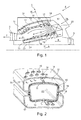
Fig. 2 shows a perspective view of the cross section II-II of thecombustion chambers 26 ofFig. 1 as an example of acombustion chamber 26 with a double-walled construction. Theduct wall 10 is configured as a double-walled construction with aninner face 11, anouter face 12, and awall cavity 13 extending from acavity inlet 19 to acavity outlet 20 along theduct wall 10. In this example with a rectangular cross section fourwall cavities 13 are arranged in the cross section. Each wall cavity is extending from acavity inlet 19 arranged on the side wall of the combustion chamber to acavity outlet 20 arranged on a top wall, respectively bottom wall of thecombustion chamber 26. The coolinggas 16 is feed to thecavity inlets 19 from thecompressor plenum 30 surrounding thecombustion chamber 26. An upper section and a lower section of theduct wall 10 is enclosed by asleeve 15 forming a coolingchannel 17 there between. Thecavity outlet 20 opens to the coolingchannel 17 and the coolinggas 16 discharged from thecavity outlets 20 flows towards an exit end (not shown in the cross section) of the coolingchannel 17. - For the impingement cooling of the
duct wall 10 thesleeve 15 comprisesapertures 14. Coolinggas 16 is injected through the apertures and 16 impinges on theduct wall 10. After impingement it flows in the coolingchannel 17 towards the upstream end of the combustion chamber (not shown). In this example apertures 14 are arranged above the top and bottom sides of theduct wall 10. -
Fig. 3 shows another example of a cross section of acombustion chamber 26 with a double-walled construction. Theduct wall 10 is configured as a double-walled construction with aninner face 11, anouter face 12, and awall cavity 13 extending from acavity inlet 19 to acavity outlet 20 along theduct wall 10. In this example with a rectangular cross section twowall cavities 13 are arranged in the cross section. Eachwall cavity 13 is extending from acavity inlet 19 arranged at the center of bottom side wall of the combustion chamber to acavity outlet 20 arranged at the center of a top wall. Onewall cavity 13 spans around the left half of theduct wall 10 and theother wall cavity 13 spans around the right half of theduct wall 10. The coolinggas 16 is feed to thecavity inlets 19 from thecompressor plenum 30 surrounding thecombustion chamber 26. An upper section of theduct wall 10 is enclosed by asleeve 15 forming a coolingchannel 17 there between. In this example the top wall of theduct wall 10 is practically enclosed by thesleeve 15. Thecavity outlet 20 opens to the coolingchannel 17 and the coolinggas 16 discharged from thecavity outlets 20 flows towards an exit end (not shown in the cross section) of the coolingchannel 17. - For the impingement cooling of the
duct wall 10 thesleeve 15 comprisesapertures 14. Coolinggas 16 is injected through the apertures and 16 impinges on theduct wall 10. After impingement it flows in the coolingchannel 17 towards the upstream end of the combustion chamber (not shown). In this example apertures 14 are arranged above the top side of theduct wall 10. - In this example the
duct wall 10 comprises a left and a right section. Both sections are connected by an upper joint 22 and a lower joint 27. The cavity inlets 19 are arranged on both sides of the lower joint 27. Thecavity outlets 20 are arranged on both sides of the upper joint 22. The joint can for example be a weld. -
Fig. 4 shows another example of a cross section of acombustion chamber 26 with a double-walled construction. The example ofFig. 4 is based on the example ofFig. 3 . In contrast to the example ofFig. 3 the top section of theduct wall 10 is single-walled. Thecavity outlets 20 are arranged towards the left, respectively the right side of the top section. The top section extending between thecavity outlets 20 is impingement cooled. -
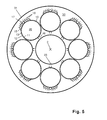
Fig. 5 shows a cross section of gas turbine having a combustion arrangement with an array of double-walled combustion chambers 26 circumferentially arranged around theaxis 2 of the gas turbine. Eachcombustion chamber 26 has acylindrical duct wall 10. Theduct walls 10 have aninner face 11 andouter face 12 and are feed with cooling gas on a side facing towards theaxis 2 of the gas turbine from acompressor plenum 30 which is delimited by therotor cover 23 and thecombustor casing 31. The side of each combustor facing away from theaxis 2 is enclosed by asleeve 15 delimiting a coolingchannel 17 between theduct wall 10 and thesleeve 15. After cooling theduct wall 10 coolinggas 16 discharges from the doublewalled duct wall 10 into the coolingchannel 17 flows towards an exit end (not shown in the cross section) of the coolingchannel 17. - The outwards facing section of the
duct wall 10 below thesleeve 15 is further impingement cooled by coolinggas 16 injected throughapertures 14. Afterimpingement cooling gas 16 flows in the coolingchannel 17 towards the upstream end of the combustion chamber (not shown). -
- 1
- Gas Turbine
- 2
- Axis
- 3
- Compressor
- 4
- Combustor
- 5
- Turbine
- 7
- Exhaust Gas
- 8
- Compressed gas
- 9
- Hot gas flow
- 10
- Duct wall
- 11
- Inner face
- 12
- Outer face
- 13
- Wall cavity
- 14
- Aperture
- 15
- Sleeve
- 16
- Cooling gas
- 17
- Cooling channel
- 18
- Convective liner cooling
- 19
- Cavity inlet
- 20
- Cavity outlet
- 21
- Exit end
- 22
- Inner joint
- 23
- Rotor cover
- 24
- Rib
- 25
- Burner
- 26
- Combustion chamber
- 27
- Outer joint
- 28
- Fuel
- 30
- Compressor plenum
- 31
- Combustor casing
Claims (15)
- A combustion chamber (26) comprising a duct wall (10) for guiding a hot gas flow (9) in a hot gas flow path during operation, wherein the duct wall (10) is a double-walled construction including an inner face (11), an outer face (12), and a wall cavity (13) extending from a cavity inlet (19) to a cavity outlet (20) along the duct wall (10) characterized that a sleeve (15) is at least partly enclosing the duct wall (10) for guiding a cooling gas (16) in a cooling channel (17) between the sleeve (15) and the duct wall (10) along the outer surface of the duct wall (10) to an exit end (21), and in that the cavity outlet (20) opens to the cooling channel.
- A combustion chamber (26) according to claim 1, characterized in that the sleeve (15) comprises a plurality of apertures (14) surrounding the duct wall (10), and spaced at a distance therefrom such that cooling gas (16) injected from a compressed gas plenum (30) through the apertures (14) during operation impinges on the duct wall (10) and flows as cross flow (18) towards the exit end (21) of the cooling channel (17).
- A combustion chamber (26) according to claim 1, characterized in that the cavity inlet (19) is connected to the same compressed gas plenum (30) as the apertures (14) for impingement cooling of the duct wall (10).
- A combustion chamber (26) according to one of the claims 1 to 3, characterized in that the cooling cavities (13) extend in a direction normal to an axial extension of the combustor (4) circumferentially around the duct wall (10).
- A combustion chamber (26) according to one of the claims 1 to 4, characterized in that the duct wall (10) has a rectangular, trapezoidal, elliptical, or circular cross section with a first cavity inlet (19) on one side and a second cavity inlet (19) on an opposite side and a first cavity outlet (20) in a wall section connecting the first and second cavity inlet (19) on one side of the hot gas flow (9) and a second cavity outlet (20) in a wall section connecting the first and second cavity inlet (19) on an opposite side of the hot gas flow (9), or in that the duct wall has a cavity inlet (19) on one side and a cavity outlet (19) on an opposite side with a wall cavity (13) extending from the cavity inlet (19) on one side to the cavity outlet (19) on the opposite side.
- A combustion chamber (26) according to one of the claims 1 to 5, characterized in that the cavity inlet (19) and/or the cavity outlet (20) is arranged next to a joint (22, 27) at which two sections of the duct wall (10) are connected.
- A combustion chamber (26) according to one of the claims 1 to 6, characterized in that a first section of the duct wall (10) is configured as a double wall comprising the wall cavity (13) and a second section is configured as a single wall wherein the second section is extending below the sleeve (15).
- A gas turbine (1) with at least one compressor (3), and at least one turbine (5), characterized in that it comprises at least one combustion chamber (26) according to one of the claims 1 to 7.
- A gas turbine (1) according to claim 8, characterized in that the exit end (21) of the cooling channel (17) is connected to a burner (25) of the gas turbine (1) for introducing the cooling gas (16) into the burner (25) during operation.
- A gas turbine (1) according to claim 8, characterized in that a plurality of combustion chambers (26) is circumferentially arranged around the axis (2) of the gas turbine (9), and in that a section the duct wall (10) of two neighboring combustion chambers (26) facing each other is configured as a double wall with a wall cavity (13), and in that the sleeve (15) is arranged above a section of the duct wall (10) facing towards the axis (2) of the gas turbine (1), and/or in that the sleeve (15) is arranged above a section of the duct wall (10) facing away from the axis (2) of the gas turbine (1).
- A gas turbine (1) according to claim 8, characterized in that a plurality of combustion chambers (26) is circumferentially arranged around the axis (2) of the gas turbine (9), in that the cavity inlet (19) is arranged on a section of the duct wall (10) of two neighboring combustion chambers (26) facing each other, and in that the sleeve (15) is arranged above a section of the duct wall (10) facing towards the axis (2) of the gas turbine (1) and/or in that the sleeve (15) is arranged above a section of the duct wall (10) facing away from the axis (2) of the gas turbine (1).
- Method for cooling a combustion chamber (26) comprising a duct wall (10) for guiding a hot gas flow (9) in a hot gas flow path during operation, wherein the duct wall (10) is a double-walled construction including an inner face (11), an outer face (12), and a wall cavity (13) extending from a cavity inlet (19) to a cavity outlet (20) along the duct wall (10), and wherein a sleeve (15) is at least partly enclosing the duct wall (10) for guiding a cooling gas (16) in a cooling channel (17) between the sleeve (15) and the duct wall (10) along the outer surface of the duct wall (10), characterized in that a cooling fluid is feed into the cavity inlet (19), flows through the wall cavity (13) for cooling the duct wall (10), and discharges into the cooling channel (17) through a cavity outlet (20) for further convective cooling of the duct wall (10).
- Method for cooling a combustion chamber (26) according to claim 12, characterized in that a cooling gas (16) is injected through a plurality of apertures (14) in the surrounding the sleeve (15) which is spaced at a distance from duct wall (10) such that the cooling gas (16) from a compressed gas plenum (30) passing through the apertures (14), impinges on the duct wall (10), and flows as cross flow (18) towards an exit end (21) of the cooling channel (17).
- Method for cooling a combustion chamber (26) according to claim 13, characterized in the cooling gas (16) is feed from one compressed gas plenum (30) to the wall cavity (13) through the cavity inlet (19) and discharges to the cooling channel (17) from the cavity outlet (20), and in that cooling gas (16) from the same cooling plenum (30) is injected through through the apertures (14), impinges on the duct wall (10), and flows as cross flow (18) thrrough the same cooling channel (17) as the cooling gas (16) which discharges from the cavity outled (20).
- Method for designing a combustion chamber (26) according to one of the claims 2 or 3, characterized in that the wall cavities (13) are designed to for a specific cooling requirement, operating the combustion chamber under design conditions, and adding at least one aperture (14) for additional impingement cooling if a limit temperature of a section of the duct wall (10) is exceeded.
Priority Applications (5)
| Application Number | Priority Date | Filing Date | Title |
|---|---|---|---|
| EP15158820.9A EP3067622B1 (en) | 2015-03-12 | 2015-03-12 | Combustion chamber with double wall and method of cooling the combustion chamber |
| CN201610138281.6A CN105972637B (en) | 2015-03-12 | 2016-03-11 | Combustion chamber with double walls |
| JP2016048970A JP2016186415A (en) | 2015-03-12 | 2016-03-11 | Combustion chamber with double wall |
| US15/068,100 US10648667B2 (en) | 2015-03-12 | 2016-03-11 | Combustion chamber with double wall |
| KR1020160030134A KR20160110264A (en) | 2015-03-12 | 2016-03-14 | Combustion chamber having a double wall |
Applications Claiming Priority (1)
| Application Number | Priority Date | Filing Date | Title |
|---|---|---|---|
| EP15158820.9A EP3067622B1 (en) | 2015-03-12 | 2015-03-12 | Combustion chamber with double wall and method of cooling the combustion chamber |
Publications (2)
| Publication Number | Publication Date |
|---|---|
| EP3067622A1 true EP3067622A1 (en) | 2016-09-14 |
| EP3067622B1 EP3067622B1 (en) | 2018-12-26 |
Family
ID=52633180
Family Applications (1)
| Application Number | Title | Priority Date | Filing Date |
|---|---|---|---|
| EP15158820.9A Active EP3067622B1 (en) | 2015-03-12 | 2015-03-12 | Combustion chamber with double wall and method of cooling the combustion chamber |
Country Status (5)
| Country | Link |
|---|---|
| US (1) | US10648667B2 (en) |
| EP (1) | EP3067622B1 (en) |
| JP (1) | JP2016186415A (en) |
| KR (1) | KR20160110264A (en) |
| CN (1) | CN105972637B (en) |
Cited By (1)
| Publication number | Priority date | Publication date | Assignee | Title |
|---|---|---|---|---|
| CN108266275A (en) * | 2016-12-30 | 2018-07-10 | 安萨尔多能源英国知识产权有限公司 | Gas turbine with secondary air system |
Families Citing this family (4)
| Publication number | Priority date | Publication date | Assignee | Title |
|---|---|---|---|---|
| US10316746B2 (en) * | 2015-02-04 | 2019-06-11 | General Electric Company | Turbine system with exhaust gas recirculation, separation and extraction |
| CN106949497B (en) * | 2017-03-10 | 2019-10-15 | 中国人民解放军战略支援部队航天工程大学 | A regenerative cooling dual-channel scheme for enhancing heat transfer by spraying against the wall |
| CN113739208B (en) * | 2021-09-09 | 2022-08-26 | 成都中科翼能科技有限公司 | Mixed cooling flame tube for low-pollution gas turbine |
| CN117620216A (en) * | 2023-12-18 | 2024-03-01 | 湖北三江航天红阳机电有限公司 | A method of SLM forming of special-shaped conduits |
Citations (8)
| Publication number | Priority date | Publication date | Assignee | Title |
|---|---|---|---|---|
| EP0321809A1 (en) | 1987-12-21 | 1989-06-28 | BBC Brown Boveri AG | Process for combustion of liquid fuel in a burner |
| US4903477A (en) * | 1987-04-01 | 1990-02-27 | Westinghouse Electric Corp. | Gas turbine combustor transition duct forced convection cooling |
| US5467815A (en) * | 1992-12-28 | 1995-11-21 | Abb Research Ltd. | Apparatus for impingement cooling |
| DE19547913A1 (en) | 1995-12-21 | 1997-06-26 | Abb Research Ltd | Burners for a heat generator |
| US20040211186A1 (en) | 2003-04-28 | 2004-10-28 | Stuttaford Peter J. | Flamesheet combustor |
| US20070180827A1 (en) * | 2006-02-09 | 2007-08-09 | Siemens Power Generation, Inc. | Gas turbine engine transitions comprising closed cooled transition cooling channels |
| EP2031302A1 (en) | 2007-08-27 | 2009-03-04 | Siemens Aktiengesellschaft | Gas turbine with a coolable component |
| EP2722591A1 (en) | 2012-10-22 | 2014-04-23 | Alstom Technology Ltd | Multiple cone gas turbine burner |
Family Cites Families (5)
| Publication number | Priority date | Publication date | Assignee | Title |
|---|---|---|---|---|
| CN2097963U (en) * | 1991-04-18 | 1992-03-04 | 韩照彦 | Rotary combustion chamber |
| CN100510541C (en) * | 2007-06-27 | 2009-07-08 | 北京航空航天大学 | Single-vortex combustion chamber |
| US8096133B2 (en) * | 2008-05-13 | 2012-01-17 | General Electric Company | Method and apparatus for cooling and dilution tuning a gas turbine combustor liner and transition piece interface |
| US20100071377A1 (en) * | 2008-09-19 | 2010-03-25 | Fox Timothy A | Combustor Apparatus for Use in a Gas Turbine Engine |
| CN101694301B (en) * | 2009-09-25 | 2010-12-08 | 北京航空航天大学 | Hedge Flame Combustion Chamber |
-
2015
- 2015-03-12 EP EP15158820.9A patent/EP3067622B1/en active Active
-
2016
- 2016-03-11 US US15/068,100 patent/US10648667B2/en active Active
- 2016-03-11 CN CN201610138281.6A patent/CN105972637B/en active Active
- 2016-03-11 JP JP2016048970A patent/JP2016186415A/en active Pending
- 2016-03-14 KR KR1020160030134A patent/KR20160110264A/en not_active Withdrawn
Patent Citations (8)
| Publication number | Priority date | Publication date | Assignee | Title |
|---|---|---|---|---|
| US4903477A (en) * | 1987-04-01 | 1990-02-27 | Westinghouse Electric Corp. | Gas turbine combustor transition duct forced convection cooling |
| EP0321809A1 (en) | 1987-12-21 | 1989-06-28 | BBC Brown Boveri AG | Process for combustion of liquid fuel in a burner |
| US5467815A (en) * | 1992-12-28 | 1995-11-21 | Abb Research Ltd. | Apparatus for impingement cooling |
| DE19547913A1 (en) | 1995-12-21 | 1997-06-26 | Abb Research Ltd | Burners for a heat generator |
| US20040211186A1 (en) | 2003-04-28 | 2004-10-28 | Stuttaford Peter J. | Flamesheet combustor |
| US20070180827A1 (en) * | 2006-02-09 | 2007-08-09 | Siemens Power Generation, Inc. | Gas turbine engine transitions comprising closed cooled transition cooling channels |
| EP2031302A1 (en) | 2007-08-27 | 2009-03-04 | Siemens Aktiengesellschaft | Gas turbine with a coolable component |
| EP2722591A1 (en) | 2012-10-22 | 2014-04-23 | Alstom Technology Ltd | Multiple cone gas turbine burner |
Cited By (1)
| Publication number | Priority date | Publication date | Assignee | Title |
|---|---|---|---|---|
| CN108266275A (en) * | 2016-12-30 | 2018-07-10 | 安萨尔多能源英国知识产权有限公司 | Gas turbine with secondary air system |
Also Published As
| Publication number | Publication date |
|---|---|
| US20160265776A1 (en) | 2016-09-15 |
| US10648667B2 (en) | 2020-05-12 |
| KR20160110264A (en) | 2016-09-21 |
| CN105972637A (en) | 2016-09-28 |
| EP3067622B1 (en) | 2018-12-26 |
| JP2016186415A (en) | 2016-10-27 |
| CN105972637B (en) | 2021-01-29 |
Similar Documents
| Publication | Publication Date | Title |
|---|---|---|
| US8544277B2 (en) | Turbulated aft-end liner assembly and cooling method | |
| EP2500523B1 (en) | Aft frame and method for cooling the aft frame | |
| EP2378200B1 (en) | Combustor liner cooling at transition duct interface and related method | |
| JP6176723B2 (en) | Combustor cap assembly | |
| US8590314B2 (en) | Combustor liner helical cooling apparatus | |
| US8959886B2 (en) | Mesh cooled conduit for conveying combustion gases | |
| CN100393997C (en) | Combustion chamber | |
| EP2211105A2 (en) | Turbulated combustor aft-end liner assembly and related cooling method | |
| JP6367559B2 (en) | Transition duct with improved turbomachine cooling | |
| US20090120093A1 (en) | Turbulated aft-end liner assembly and cooling method | |
| EP2921779B1 (en) | Combustion chamber with cooling sleeve | |
| US20050268613A1 (en) | Method and apparatus for cooling combustor liner and transition piece of a gas turbine | |
| US10648667B2 (en) | Combustion chamber with double wall | |
| JP2015078694A (en) | Combustor cooling structure | |
| EP2375160A2 (en) | Angled seal cooling system | |
| US20110110761A1 (en) | Gas turbine having an improved cooling architecture | |
| EP2532836A2 (en) | Combustion liner and transistion piece | |
| US11215072B2 (en) | Aft frame assembly for gas turbine transition piece | |
| US20150159873A1 (en) | Compressor discharge casing assembly | |
| CN105531543B (en) | Tubular combustion chamber having a flame tube end region and gas turbine | |
| KR101842745B1 (en) | Connecting device of transition piece and turbine of gas turbine |
Legal Events
| Date | Code | Title | Description |
|---|---|---|---|
| PUAI | Public reference made under article 153(3) epc to a published international application that has entered the european phase |
Free format text: ORIGINAL CODE: 0009012 |
|
| AK | Designated contracting states |
Kind code of ref document: A1 Designated state(s): AL AT BE BG CH CY CZ DE DK EE ES FI FR GB GR HR HU IE IS IT LI LT LU LV MC MK MT NL NO PL PT RO RS SE SI SK SM TR |
|
| AX | Request for extension of the european patent |
Extension state: BA ME |
|
| STAA | Information on the status of an ep patent application or granted ep patent |
Free format text: STATUS: REQUEST FOR EXAMINATION WAS MADE |
|
| 17P | Request for examination filed |
Effective date: 20170313 |
|
| RBV | Designated contracting states (corrected) |
Designated state(s): AL AT BE BG CH CY CZ DE DK EE ES FI FR GB GR HR HU IE IS IT LI LT LU LV MC MK MT NL NO PL PT RO RS SE SI SK SM TR |
|
| RAP1 | Party data changed (applicant data changed or rights of an application transferred) |
Owner name: ANSALDO ENERGIA SWITZERLAND AG |
|
| GRAP | Despatch of communication of intention to grant a patent |
Free format text: ORIGINAL CODE: EPIDOSNIGR1 |
|
| STAA | Information on the status of an ep patent application or granted ep patent |
Free format text: STATUS: GRANT OF PATENT IS INTENDED |
|
| INTG | Intention to grant announced |
Effective date: 20180709 |
|
| GRAS | Grant fee paid |
Free format text: ORIGINAL CODE: EPIDOSNIGR3 |
|
| GRAA | (expected) grant |
Free format text: ORIGINAL CODE: 0009210 |
|
| STAA | Information on the status of an ep patent application or granted ep patent |
Free format text: STATUS: THE PATENT HAS BEEN GRANTED |
|
| AK | Designated contracting states |
Kind code of ref document: B1 Designated state(s): AL AT BE BG CH CY CZ DE DK EE ES FI FR GB GR HR HU IE IS IT LI LT LU LV MC MK MT NL NO PL PT RO RS SE SI SK SM TR |
|
| REG | Reference to a national code |
Ref country code: GB Ref legal event code: FG4D |
|
| REG | Reference to a national code |
Ref country code: CH Ref legal event code: EP |
|
| REG | Reference to a national code |
Ref country code: AT Ref legal event code: REF Ref document number: 1081921 Country of ref document: AT Kind code of ref document: T Effective date: 20190115 |
|
| REG | Reference to a national code |
Ref country code: DE Ref legal event code: R096 Ref document number: 602015022110 Country of ref document: DE |
|
| REG | Reference to a national code |
Ref country code: IE Ref legal event code: FG4D |
|
| PG25 | Lapsed in a contracting state [announced via postgrant information from national office to epo] |
Ref country code: FI Free format text: LAPSE BECAUSE OF FAILURE TO SUBMIT A TRANSLATION OF THE DESCRIPTION OR TO PAY THE FEE WITHIN THE PRESCRIBED TIME-LIMIT Effective date: 20181226 Ref country code: LV Free format text: LAPSE BECAUSE OF FAILURE TO SUBMIT A TRANSLATION OF THE DESCRIPTION OR TO PAY THE FEE WITHIN THE PRESCRIBED TIME-LIMIT Effective date: 20181226 Ref country code: HR Free format text: LAPSE BECAUSE OF FAILURE TO SUBMIT A TRANSLATION OF THE DESCRIPTION OR TO PAY THE FEE WITHIN THE PRESCRIBED TIME-LIMIT Effective date: 20181226 Ref country code: BG Free format text: LAPSE BECAUSE OF FAILURE TO SUBMIT A TRANSLATION OF THE DESCRIPTION OR TO PAY THE FEE WITHIN THE PRESCRIBED TIME-LIMIT Effective date: 20190326 Ref country code: LT Free format text: LAPSE BECAUSE OF FAILURE TO SUBMIT A TRANSLATION OF THE DESCRIPTION OR TO PAY THE FEE WITHIN THE PRESCRIBED TIME-LIMIT Effective date: 20181226 Ref country code: NO Free format text: LAPSE BECAUSE OF FAILURE TO SUBMIT A TRANSLATION OF THE DESCRIPTION OR TO PAY THE FEE WITHIN THE PRESCRIBED TIME-LIMIT Effective date: 20190326 |
|
| REG | Reference to a national code |
Ref country code: NL Ref legal event code: MP Effective date: 20181226 |
|
| REG | Reference to a national code |
Ref country code: LT Ref legal event code: MG4D |
|
| PG25 | Lapsed in a contracting state [announced via postgrant information from national office to epo] |
Ref country code: AL Free format text: LAPSE BECAUSE OF FAILURE TO SUBMIT A TRANSLATION OF THE DESCRIPTION OR TO PAY THE FEE WITHIN THE PRESCRIBED TIME-LIMIT Effective date: 20181226 Ref country code: GR Free format text: LAPSE BECAUSE OF FAILURE TO SUBMIT A TRANSLATION OF THE DESCRIPTION OR TO PAY THE FEE WITHIN THE PRESCRIBED TIME-LIMIT Effective date: 20190327 Ref country code: RS Free format text: LAPSE BECAUSE OF FAILURE TO SUBMIT A TRANSLATION OF THE DESCRIPTION OR TO PAY THE FEE WITHIN THE PRESCRIBED TIME-LIMIT Effective date: 20181226 Ref country code: SE Free format text: LAPSE BECAUSE OF FAILURE TO SUBMIT A TRANSLATION OF THE DESCRIPTION OR TO PAY THE FEE WITHIN THE PRESCRIBED TIME-LIMIT Effective date: 20181226 |
|
| REG | Reference to a national code |
Ref country code: AT Ref legal event code: MK05 Ref document number: 1081921 Country of ref document: AT Kind code of ref document: T Effective date: 20181226 |
|
| PG25 | Lapsed in a contracting state [announced via postgrant information from national office to epo] |
Ref country code: NL Free format text: LAPSE BECAUSE OF FAILURE TO SUBMIT A TRANSLATION OF THE DESCRIPTION OR TO PAY THE FEE WITHIN THE PRESCRIBED TIME-LIMIT Effective date: 20181226 |
|
| PG25 | Lapsed in a contracting state [announced via postgrant information from national office to epo] |
Ref country code: CZ Free format text: LAPSE BECAUSE OF FAILURE TO SUBMIT A TRANSLATION OF THE DESCRIPTION OR TO PAY THE FEE WITHIN THE PRESCRIBED TIME-LIMIT Effective date: 20181226 Ref country code: IT Free format text: LAPSE BECAUSE OF FAILURE TO SUBMIT A TRANSLATION OF THE DESCRIPTION OR TO PAY THE FEE WITHIN THE PRESCRIBED TIME-LIMIT Effective date: 20181226 Ref country code: ES Free format text: LAPSE BECAUSE OF FAILURE TO SUBMIT A TRANSLATION OF THE DESCRIPTION OR TO PAY THE FEE WITHIN THE PRESCRIBED TIME-LIMIT Effective date: 20181226 Ref country code: PT Free format text: LAPSE BECAUSE OF FAILURE TO SUBMIT A TRANSLATION OF THE DESCRIPTION OR TO PAY THE FEE WITHIN THE PRESCRIBED TIME-LIMIT Effective date: 20190426 Ref country code: PL Free format text: LAPSE BECAUSE OF FAILURE TO SUBMIT A TRANSLATION OF THE DESCRIPTION OR TO PAY THE FEE WITHIN THE PRESCRIBED TIME-LIMIT Effective date: 20181226 |
|
| PG25 | Lapsed in a contracting state [announced via postgrant information from national office to epo] |
Ref country code: EE Free format text: LAPSE BECAUSE OF FAILURE TO SUBMIT A TRANSLATION OF THE DESCRIPTION OR TO PAY THE FEE WITHIN THE PRESCRIBED TIME-LIMIT Effective date: 20181226 Ref country code: SM Free format text: LAPSE BECAUSE OF FAILURE TO SUBMIT A TRANSLATION OF THE DESCRIPTION OR TO PAY THE FEE WITHIN THE PRESCRIBED TIME-LIMIT Effective date: 20181226 Ref country code: SK Free format text: LAPSE BECAUSE OF FAILURE TO SUBMIT A TRANSLATION OF THE DESCRIPTION OR TO PAY THE FEE WITHIN THE PRESCRIBED TIME-LIMIT Effective date: 20181226 Ref country code: IS Free format text: LAPSE BECAUSE OF FAILURE TO SUBMIT A TRANSLATION OF THE DESCRIPTION OR TO PAY THE FEE WITHIN THE PRESCRIBED TIME-LIMIT Effective date: 20190426 Ref country code: RO Free format text: LAPSE BECAUSE OF FAILURE TO SUBMIT A TRANSLATION OF THE DESCRIPTION OR TO PAY THE FEE WITHIN THE PRESCRIBED TIME-LIMIT Effective date: 20181226 |
|
| REG | Reference to a national code |
Ref country code: DE Ref legal event code: R097 Ref document number: 602015022110 Country of ref document: DE |
|
| PG25 | Lapsed in a contracting state [announced via postgrant information from national office to epo] |
Ref country code: MC Free format text: LAPSE BECAUSE OF FAILURE TO SUBMIT A TRANSLATION OF THE DESCRIPTION OR TO PAY THE FEE WITHIN THE PRESCRIBED TIME-LIMIT Effective date: 20181226 Ref country code: DK Free format text: LAPSE BECAUSE OF FAILURE TO SUBMIT A TRANSLATION OF THE DESCRIPTION OR TO PAY THE FEE WITHIN THE PRESCRIBED TIME-LIMIT Effective date: 20181226 Ref country code: AT Free format text: LAPSE BECAUSE OF FAILURE TO SUBMIT A TRANSLATION OF THE DESCRIPTION OR TO PAY THE FEE WITHIN THE PRESCRIBED TIME-LIMIT Effective date: 20181226 |
|
| REG | Reference to a national code |
Ref country code: CH Ref legal event code: PL |
|
| PLBE | No opposition filed within time limit |
Free format text: ORIGINAL CODE: 0009261 |
|
| STAA | Information on the status of an ep patent application or granted ep patent |
Free format text: STATUS: NO OPPOSITION FILED WITHIN TIME LIMIT |
|
| GBPC | Gb: european patent ceased through non-payment of renewal fee |
Effective date: 20190326 |
|
| PG25 | Lapsed in a contracting state [announced via postgrant information from national office to epo] |
Ref country code: LU Free format text: LAPSE BECAUSE OF NON-PAYMENT OF DUE FEES Effective date: 20190312 |
|
| 26N | No opposition filed |
Effective date: 20190927 |
|
| REG | Reference to a national code |
Ref country code: BE Ref legal event code: MM Effective date: 20190331 |
|
| PG25 | Lapsed in a contracting state [announced via postgrant information from national office to epo] |
Ref country code: LI Free format text: LAPSE BECAUSE OF NON-PAYMENT OF DUE FEES Effective date: 20190331 Ref country code: IE Free format text: LAPSE BECAUSE OF NON-PAYMENT OF DUE FEES Effective date: 20190312 Ref country code: CH Free format text: LAPSE BECAUSE OF NON-PAYMENT OF DUE FEES Effective date: 20190331 Ref country code: GB Free format text: LAPSE BECAUSE OF NON-PAYMENT OF DUE FEES Effective date: 20190326 |
|
| PG25 | Lapsed in a contracting state [announced via postgrant information from national office to epo] |
Ref country code: SI Free format text: LAPSE BECAUSE OF FAILURE TO SUBMIT A TRANSLATION OF THE DESCRIPTION OR TO PAY THE FEE WITHIN THE PRESCRIBED TIME-LIMIT Effective date: 20181226 Ref country code: FR Free format text: LAPSE BECAUSE OF NON-PAYMENT OF DUE FEES Effective date: 20190331 Ref country code: BE Free format text: LAPSE BECAUSE OF NON-PAYMENT OF DUE FEES Effective date: 20190331 |
|
| PG25 | Lapsed in a contracting state [announced via postgrant information from national office to epo] |
Ref country code: TR Free format text: LAPSE BECAUSE OF FAILURE TO SUBMIT A TRANSLATION OF THE DESCRIPTION OR TO PAY THE FEE WITHIN THE PRESCRIBED TIME-LIMIT Effective date: 20181226 |
|
| PG25 | Lapsed in a contracting state [announced via postgrant information from national office to epo] |
Ref country code: MT Free format text: LAPSE BECAUSE OF NON-PAYMENT OF DUE FEES Effective date: 20190312 |
|
| PG25 | Lapsed in a contracting state [announced via postgrant information from national office to epo] |
Ref country code: CY Free format text: LAPSE BECAUSE OF FAILURE TO SUBMIT A TRANSLATION OF THE DESCRIPTION OR TO PAY THE FEE WITHIN THE PRESCRIBED TIME-LIMIT Effective date: 20181226 |
|
| PG25 | Lapsed in a contracting state [announced via postgrant information from national office to epo] |
Ref country code: HU Free format text: LAPSE BECAUSE OF FAILURE TO SUBMIT A TRANSLATION OF THE DESCRIPTION OR TO PAY THE FEE WITHIN THE PRESCRIBED TIME-LIMIT; INVALID AB INITIO Effective date: 20150312 |
|
| PG25 | Lapsed in a contracting state [announced via postgrant information from national office to epo] |
Ref country code: MK Free format text: LAPSE BECAUSE OF FAILURE TO SUBMIT A TRANSLATION OF THE DESCRIPTION OR TO PAY THE FEE WITHIN THE PRESCRIBED TIME-LIMIT Effective date: 20181226 |
|
| P01 | Opt-out of the competence of the unified patent court (upc) registered |
Effective date: 20240430 |
|
| PGFP | Annual fee paid to national office [announced via postgrant information from national office to epo] |
Ref country code: DE Payment date: 20260320 Year of fee payment: 12 |