EP3061604A2 - Conformal composite coatings and methods - Google Patents
Conformal composite coatings and methods Download PDFInfo
- Publication number
- EP3061604A2 EP3061604A2 EP16156987.6A EP16156987A EP3061604A2 EP 3061604 A2 EP3061604 A2 EP 3061604A2 EP 16156987 A EP16156987 A EP 16156987A EP 3061604 A2 EP3061604 A2 EP 3061604A2
- Authority
- EP
- European Patent Office
- Prior art keywords
- fibers
- ceramic
- layer
- particulate
- particles
- Prior art date
- Legal status (The legal status is an assumption and is not a legal conclusion. Google has not performed a legal analysis and makes no representation as to the accuracy of the status listed.)
- Granted
Links
Images


Classifications
-
- B—PERFORMING OPERATIONS; TRANSPORTING
- B32—LAYERED PRODUCTS
- B32B—LAYERED PRODUCTS, i.e. PRODUCTS BUILT-UP OF STRATA OF FLAT OR NON-FLAT, e.g. CELLULAR OR HONEYCOMB, FORM
- B32B18/00—Layered products essentially comprising ceramics, e.g. refractory products
-
- C—CHEMISTRY; METALLURGY
- C04—CEMENTS; CONCRETE; ARTIFICIAL STONE; CERAMICS; REFRACTORIES
- C04B—LIME, MAGNESIA; SLAG; CEMENTS; COMPOSITIONS THEREOF, e.g. MORTARS, CONCRETE OR LIKE BUILDING MATERIALS; ARTIFICIAL STONE; CERAMICS; REFRACTORIES; TREATMENT OF NATURAL STONE
- C04B35/00—Shaped ceramic products characterised by their composition; Ceramics compositions; Processing powders of inorganic compounds preparatory to the manufacturing of ceramic products
- C04B35/622—Forming processes; Processing powders of inorganic compounds preparatory to the manufacturing of ceramic products
- C04B35/626—Preparing or treating the powders individually or as batches ; preparing or treating macroscopic reinforcing agents for ceramic products, e.g. fibres; mechanical aspects section B
- C04B35/628—Coating the powders or the macroscopic reinforcing agents
- C04B35/62844—Coating fibres
- C04B35/62857—Coating fibres with non-oxide ceramics
- C04B35/6286—Carbides
- C04B35/62863—Silicon carbide
-
- B—PERFORMING OPERATIONS; TRANSPORTING
- B05—SPRAYING OR ATOMISING IN GENERAL; APPLYING FLUENT MATERIALS TO SURFACES, IN GENERAL
- B05D—PROCESSES FOR APPLYING FLUENT MATERIALS TO SURFACES, IN GENERAL
- B05D1/00—Processes for applying liquids or other fluent materials
- B05D1/007—Processes for applying liquids or other fluent materials using an electrostatic field
-
- B—PERFORMING OPERATIONS; TRANSPORTING
- B05—SPRAYING OR ATOMISING IN GENERAL; APPLYING FLUENT MATERIALS TO SURFACES, IN GENERAL
- B05D—PROCESSES FOR APPLYING FLUENT MATERIALS TO SURFACES, IN GENERAL
- B05D1/00—Processes for applying liquids or other fluent materials
- B05D1/36—Successively applying liquids or other fluent materials, e.g. without intermediate treatment
-
- C—CHEMISTRY; METALLURGY
- C04—CEMENTS; CONCRETE; ARTIFICIAL STONE; CERAMICS; REFRACTORIES
- C04B—LIME, MAGNESIA; SLAG; CEMENTS; COMPOSITIONS THEREOF, e.g. MORTARS, CONCRETE OR LIKE BUILDING MATERIALS; ARTIFICIAL STONE; CERAMICS; REFRACTORIES; TREATMENT OF NATURAL STONE
- C04B35/00—Shaped ceramic products characterised by their composition; Ceramics compositions; Processing powders of inorganic compounds preparatory to the manufacturing of ceramic products
- C04B35/515—Shaped ceramic products characterised by their composition; Ceramics compositions; Processing powders of inorganic compounds preparatory to the manufacturing of ceramic products based on non-oxide ceramics
- C04B35/56—Shaped ceramic products characterised by their composition; Ceramics compositions; Processing powders of inorganic compounds preparatory to the manufacturing of ceramic products based on non-oxide ceramics based on carbides or oxycarbides
- C04B35/565—Shaped ceramic products characterised by their composition; Ceramics compositions; Processing powders of inorganic compounds preparatory to the manufacturing of ceramic products based on non-oxide ceramics based on carbides or oxycarbides based on silicon carbide
- C04B35/571—Shaped ceramic products characterised by their composition; Ceramics compositions; Processing powders of inorganic compounds preparatory to the manufacturing of ceramic products based on non-oxide ceramics based on carbides or oxycarbides based on silicon carbide obtained from Si-containing polymer precursors or organosilicon monomers
-
- C—CHEMISTRY; METALLURGY
- C04—CEMENTS; CONCRETE; ARTIFICIAL STONE; CERAMICS; REFRACTORIES
- C04B—LIME, MAGNESIA; SLAG; CEMENTS; COMPOSITIONS THEREOF, e.g. MORTARS, CONCRETE OR LIKE BUILDING MATERIALS; ARTIFICIAL STONE; CERAMICS; REFRACTORIES; TREATMENT OF NATURAL STONE
- C04B35/00—Shaped ceramic products characterised by their composition; Ceramics compositions; Processing powders of inorganic compounds preparatory to the manufacturing of ceramic products
- C04B35/515—Shaped ceramic products characterised by their composition; Ceramics compositions; Processing powders of inorganic compounds preparatory to the manufacturing of ceramic products based on non-oxide ceramics
- C04B35/58—Shaped ceramic products characterised by their composition; Ceramics compositions; Processing powders of inorganic compounds preparatory to the manufacturing of ceramic products based on non-oxide ceramics based on borides, nitrides, i.e. nitrides, oxynitrides, carbonitrides or oxycarbonitrides or silicides
- C04B35/583—Shaped ceramic products characterised by their composition; Ceramics compositions; Processing powders of inorganic compounds preparatory to the manufacturing of ceramic products based on non-oxide ceramics based on borides, nitrides, i.e. nitrides, oxynitrides, carbonitrides or oxycarbonitrides or silicides based on boron nitride
-
- C—CHEMISTRY; METALLURGY
- C04—CEMENTS; CONCRETE; ARTIFICIAL STONE; CERAMICS; REFRACTORIES
- C04B—LIME, MAGNESIA; SLAG; CEMENTS; COMPOSITIONS THEREOF, e.g. MORTARS, CONCRETE OR LIKE BUILDING MATERIALS; ARTIFICIAL STONE; CERAMICS; REFRACTORIES; TREATMENT OF NATURAL STONE
- C04B35/00—Shaped ceramic products characterised by their composition; Ceramics compositions; Processing powders of inorganic compounds preparatory to the manufacturing of ceramic products
- C04B35/622—Forming processes; Processing powders of inorganic compounds preparatory to the manufacturing of ceramic products
- C04B35/626—Preparing or treating the powders individually or as batches ; preparing or treating macroscopic reinforcing agents for ceramic products, e.g. fibres; mechanical aspects section B
- C04B35/628—Coating the powders or the macroscopic reinforcing agents
- C04B35/62844—Coating fibres
- C04B35/62857—Coating fibres with non-oxide ceramics
- C04B35/62865—Nitrides
- C04B35/62868—Boron nitride
-
- C—CHEMISTRY; METALLURGY
- C04—CEMENTS; CONCRETE; ARTIFICIAL STONE; CERAMICS; REFRACTORIES
- C04B—LIME, MAGNESIA; SLAG; CEMENTS; COMPOSITIONS THEREOF, e.g. MORTARS, CONCRETE OR LIKE BUILDING MATERIALS; ARTIFICIAL STONE; CERAMICS; REFRACTORIES; TREATMENT OF NATURAL STONE
- C04B35/00—Shaped ceramic products characterised by their composition; Ceramics compositions; Processing powders of inorganic compounds preparatory to the manufacturing of ceramic products
- C04B35/71—Ceramic products containing macroscopic reinforcing agents
- C04B35/78—Ceramic products containing macroscopic reinforcing agents containing non-metallic materials
- C04B35/80—Fibres, filaments, whiskers, platelets, or the like
Definitions
- the disclosure relates generally to coatings and more specifically to ceramic layer-by-layer coatings.
- An embodiment of an article includes a substrate and a conformal coating.
- the conformal coating includes a first particulate layer between a first matrix layer and a second matrix layer.
- the first particulate layer includes a first plurality of ordered inorganic particles spaced and distributed substantially uniformly throughout the first particulate layer, and a ceramic matrix material disposed between individual ones of the first plurality of particles.
- An embodiment of a composite article includes a first plurality of fibers distributed throughout a binder or bulk matrix.
- the first plurality of fibers includes a substrate, and a coating which includes a plurality of particulate layers and a plurality of matrix layers.
- Each particulate layer has a plurality of ordered inorganic particles spaced and distributed substantially uniformly throughout each layer, and a ceramic matrix material disposed between individual ones of the plurality of particles.
- the plurality of matrix layers includes primarily the ceramic matrix material disposed between individual ones of the plurality of particulate layers.
- An embodiment of a method includes applying a preceramic composition and a plurality of inorganic particles to a receiving surface.
- the combination of the preceramic composition and the inorganic particles is cured to form at least a particulate layer and a matrix layer on the receiving surface.
- FIG. 1 shows composite material 10 which includes a first plurality of coated fibers 12 and binder or bulk matrix material 14.
- fibers can be combined with a binder / bulk matrix material to form a composite (e.g., ceramic matrix composites, glass matrix composites, metal matrix composites, and polymer matrix composites).
- a composite e.g., ceramic matrix composites, glass matrix composites, metal matrix composites, and polymer matrix composites.
- Some non-limiting examples of composites include airfoils and cases for gas turbine engines.
- at least some of coated fibers 12 can include substrate 16 with conformal coating 18, shown in more detail in subsequent figures.
- coated fibers 12 can be intermingled with a second plurality of fibers 19, which do not have a conformal coating, and can have the same or different composition(s) as coated fiber substrate(s) 16.
- FIG. 2 shows an example coated fiber 12 with substrate 16 and conformal coating 18.
- Substrate 16 of fibers 12 can be selected from one or more of a group consisting of: oxide ceramic fibers, carbide ceramic fibers, nitride ceramic fibers, boride ceramic fibers, phosphide ceramic fibers, glass-ceramic fibers, oxycarbide fibers, oxynitride fibers, metal fibers, glass fibers, and carbon fibers.
- Such fibers are used in a wide variety of manufacturing processes.
- Various fibers are grouped, typically wound, woven, wrapped or handled in other ways to make fabrics, preforms, etc.
- These groups of fibers 12 can be used independently, or can be formed into a composite material (e.g., composite material 10 shown in FIG. 1 ).
- the fibers include silicon carbide (SiC) fibers
- Conformal coating 18 can be a composite coating which includes a plurality of particulate layers 20 alternating with a plurality of matrix layers 22 on an outer surface of substrate 16.
- Each particulate layer 20 includes a plurality of spaced and distributed inorganic filler particles (shown in FIG. 3 ).
- a ceramic matrix material which can be the same material as in matrix layers 22, is disposed between individual ones of the particles as shown below.
- FIG. 3 shows a detailed view of conformal coating 18, and includes a first plurality of inorganic filler particles 24 spaced and distributed throughout first particulate layer 26.
- Ceramic matrix material 28 can be disposed between individual ones of the first plurality of filler particles 24.
- Second inorganic particulate layer 30 can include a second plurality of inorganic filler particles 32 spaced and distributed therethrough. Ceramic matrix material 28 can also be disposed between individual ones of the second plurality of filler particles 32.
- the matrix of individual layers (e.g., matrix material 28) and the matrix of the overall composite article e.g., binder/bulk matrix material 14 shown in FIG. 1 ) need not be the same composition.
- Multiple sets of alternating layers can define conformal coating 18 with a "brick-and-mortar” type structure.
- the particulate and matrix can similarly be arranged in a "brick-and-mortar” type structure.
- First matrix layer 36 is disposed adjacent to or between first particulate layer 26 and second particulate layer 30.
- Second matrix layer 38 can also be disposed between two particulate layers, and here is shown adjacent to second particulate layer 30.
- Second particulate layer 30 can be disposed between second and third matrix layers 38, 40.
- Matrix layers 36, 38, 40 include primarily ceramic matrix material 28. In certain embodiments, less than 10% of the particles 24 in first particulate layer 26 protrude into second particulate layer 30, and vice versa.
- conformal coating 18 can be applied to substrate 16 via a layer-by-layer (LBL) deposition process to form coated fibers 12.
- LBL layer-by-layer
- a preceramic polymer compound can be used in combination with filler particulates as part of a single coating solution. This effectively cuts the number of process steps in half while improving coating quality and ensuring uniformity over previous processes with substantially uniform and ordered particle distribution.
- a preceramic polymer compound can be part of a first solution and a dispersion of filler particulate can be another liquid which, when used in conjunction with the first solution, can provide a conformal coating on substrate 16.
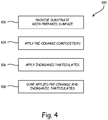
- FIG. 4 shows coating method 100 for forming an LBL coating.
- Method 100 first includes step 102 of providing a substrate with at least one surface prepared to receive a coating.
- the ceramic precursors in solution and the dispersed particulates can have opposing electrical charges.
- the substrate surface(s) must be prepared to interact with those as well. This can depend on a particular coating but step 102 can include one or more chemical, physical, electrical, mechanical or other processes known in the art to induce positive- or negative-charged coating receiving surface(s).
- step 104 includes applying a preceramic composition to the substrate, while step 106 includes applying a plurality of inorganic filler particles to the substrate.
- Steps 104 and 106 can be performed simultaneously or in an alternating manner with step 108 below. Performing the steps together, however, using a single coating solution can greatly expedite the process by eliminating a number of repetitive steps.
- the coating system is designed to "self assemble" on the substrate to produce an energetically favorable state, i.e ., one having a relatively low system energy.
- the preceramic composition can at least partially dissociate in a first solution.
- a first solution can include, for example, an ionizable preceramic compound that is soluble in an appropriate liquid. Examples include halo- and hydroxyl-substituted polycarbosilanes or polysiloxanes.
- Appropriate liquids include aqueous-based liquids, non-aqueous liquids, solvent blends, organic liquids and ionic liquids.
- a preceramic composition includes a polymer having a plurality of side or functional groups, at least some of which are adapted to readily dissociate from the polymer.
- organic preceramic polymer types can include polycarbosilane, polysiloxane, polysilazane, polycarbosiloxane, polysilane and polycarbosilazane, all of which can further convert with heat into silicon-based ceramic precursors, so that the resulting ceramic matrix material includes a silicon-based matrix ( e .
- the solution can include any preceramic composition adapted to dissociate under controlled conditions where thermally and/or chemically induced dissociation results in a partially charged preceramic composition with one or more types of ceramic precursors.
- Other organic, inorganic, and ionic preceramic compounds can be used to form ceramic matrix compositions other than silicon carbide (SiC).
- An appropriate composition of the first solution is based on compatibility with the preceramic composition, and ability to facilitate dissociation of particular ionic or functional groups from the preceramic composition.
- Example solutions include aqueous acid solutions, aqueous basic solutions, polar organic solvents and ionic liquids.
- One suitable example polymer class includes preceramic siloxanes, HO[-SiR 1 R 2 O-] n H, where R 1 , R 2 are functional groups and/or other polysiloxane chains attached to the silicon atom, with at least one of R 1 , R 2 partially dissociable.
- Another suitable example polymer class includes polycarbosilanes (-CH 2 -Si-) n (XY) m ), where X and Y are functional groups and/or other polycarbosilane chains attached to the silicon atom. At least one of X and Y is partially dissociable to create a charged species on the polymer chain.
- X and Y have substantially different electronegativities and/or a relatively large dissociation constant K.
- the functional groups X and/or Y on the polymer chain at least partially dissociate leaving behind negatively charged ceramic precursors.
- the inorganic filler material can include one or more filler compositions.
- the particles can be selected from glass, carbides, oxides, nitrides, borides, phosphides, sulfides, and combinations thereof.
- Particle morphologies can be selected to be planar, spherical, fibrous, nanostructured, acicular and/or elongated as desired by the selected application and the preceramic polymer choice.
- at least one of the pluralities of particles includes boron nitride (BN).
- the filler material Prior to placing them in a suitable liquid for dispersion or dissolution, the filler material can be provided with a charge opposite that of the expected charge of the preceramic composition from step 104.
- An appropriate composition of the second solution is based on compatibility with the filler material, and ability to facilitate dispersion of the filler material.
- the BN or other particles can be positively charged via suitable well-known processes. Though described with respect to a single particle composition, it will be recognized that multiple types of particulates can be used. That is, each particulate layer may have more than one particle composition, and/or different particulate layers can have a single composition which differs from layer to layer. Attractive forces between oppositely charged preceramic polymer layers and inorganic filler-based dispersions to create self-assembled structures can be passive, in that they are caused by naturally formed dissociated chemical structures or they can be active, in which charge differences are induced with an applied electromotive field using electrophoretic or electrostatic methods.
- the ceramic precursor and the filler material are placed in a common liquid or solution, allowing steps 104 and 106 to be performed simultaneously.
- step 108 is performed to cure the first layers of the coating.
- various curing processes can be implemented with examples including application of thermal and/or electromagnetic energy or exposure to certain atmospheric compositions and/or pressures.
- step 108 the combination of the preceramic composition and the filler particles are cured about the substrate to form a ceramic filler layer and a matrix layer.
- steps 104-108 can be iteratively performed to form a composite layer-by-layer (LBL) coating on a substrate (e.g., a fiber) to result in an LBL coating which includes a plurality of particle layers.
- LBL layer-by-layer
- the functional groups on many of the molecules can begin dissociating on or from the polymer chain. Partial dissociation may also occur by hydrolysis reactions of hydrolysable functional groups on polymers caused by the presence of small amounts of water in solutions of the polymers in organic solvents.
- the resulting coating can have a plurality of matrix layers alternating with individual ones of the plurality of filler layers.
- Each filler layer can include a plurality of ceramic filler particles spaced and distributed throughout the filler layer, with a ceramic matrix material disposed between individual ones of the plurality of particles.
- Each matrix layer can include primarily the ceramic matrix material.
- substituted polycarbosilane has hydroxy or alkoxy functional groups which at least partially dissociate in the presence of water above about 0° C (about 32° F).
- a hydroxide (OH-) or alkoxide (RO-) is the ionic or salt form, derived from the hydroxyl or alkoxy functional group when the proton is replaced by a metal.
- a substrate such as a SiC fiber, with at least one prepared surface is placed in the solution.
- the prepared surface has a slightly positive charge which will attract the electronegative or negatively charged substituted polycarbosilane preceramic polymer with partially dissociated alkoxy groups.
- the prepared surface is coated with a layer of preceramic polymer in 104.
- positively charged filler particles are provided and are electrostatically attracted to the negatively charged SiC precursors.
- the prepared surface can have a positive/negative charge so as to attract the charged particulates/ceramic precursors.
- They can be positively charged so that they are repelled from one another but attracted to the negative ceramic precursor polymer chains, subchains or functional groups.
- Curing step 108 increases the stability of the deposited layer(s).
- Curing step 108 can include any single or multiple application of a method suitable for increasing the molecular weight of the preceramic polymer (thermal, UV, IR, visible, microwave, ultrasonic or other suitable electromagnetic radiation, or differential solubility).
- a method suitable for increasing the molecular weight of the preceramic polymer thermal, UV, IR, visible, microwave, ultrasonic or other suitable electromagnetic radiation, or differential solubility.
- the cured preceramic polymer/filler layers would be further processed by applying additional energy (thermal, microwave, etc.) to the composite coatings in one or more steps to convert the preceramic polymer into the desired inorganic ceramic phase(s) such as SiC.
- these preceramic polymer In combination with the plurality of particles such as boron nitride (BN), as part of curing and further processing, these preceramic polymer would produce an amorphous structure including mostly silicon carbide (SiC) to form the matrix about the BN filler particles. Repeating the process results in a conformal coated reinforced fiber with a self-ordered "brick-and-mortar" composition.
- BN boron nitride
- An embodiment of an article includes a substrate and a conformal coating.
- the conformal coating includes a first particulate layer between a first matrix layer and a second matrix layer.
- the first particulate layer includes a first plurality of ordered inorganic particles spaced and distributed substantially uniformly throughout the first particulate layer, and a ceramic matrix material disposed between individual ones of the first plurality of particles.
- the substrate comprises a fiber formed from one of a group consisting of: oxide ceramic fibers, carbide ceramic fibers, nitride ceramic fibers, boride ceramic fibers, phosphide ceramic fibers, glass-ceramic fibers, oxycarbide fibers, oxynitride fibers, metal fibers, glass fibers, and carbon fibers.
- the first plurality of inorganic particles comprises boron nitride (BN) particles.
- the ceramic matrix material comprises silicon carbide (SiC).
- the article further comprises: a second particulate layer disposed adjacent to one of the first and second matrix layers, the second particulate layer including a second plurality of ordered inorganic particles spaced and distributed substantially uniformly throughout the second particulate layer, and the ceramic matrix material disposed between individual ones of the second plurality of particles; wherein less than 10% of the particles in the first particulate layer protrude into the second particulate layer.
- the present disclosure provides a composite article comprising the article as herein described.
- An embodiment of a composite article includes a first plurality of fibers distributed throughout a binder or bulk matrix.
- the first plurality of fibers includes a substrate, and a coating which includes a plurality of particulate layers and a plurality of matrix layers.
- Each particulate layer has a plurality of ordered inorganic particles spaced and distributed substantially uniformly throughout each layer, and a ceramic matrix material disposed between individual ones of the plurality of particles.
- the plurality of matrix layers includes primarily the ceramic matrix material disposed between individual ones of the plurality of particulate layers.
- the composite article (or article) of the preceding paragraph(s) can optionally include, additionally and/or alternatively, any one or more of the following features, configurations and/or additional components:
- the substrate is selected from one or more of a group consisting of: oxide ceramic fibers, carbide ceramic fibers, nitride ceramic fibers, boride ceramic fibers, phosphide ceramic fibers, glass-ceramic fibers, oxycarbide fibers, oxynitride fibers, metal fibers, glass fibers, and carbon fibers.
- BN boron nitride
- SiC silicon carbide
- the composite article further comprises: a second plurality of fibers intermingled with the first plurality of fibers, wherein the second plurality of fibers do not include the conformal coating.
- An embodiment of a method (e.g. a method for making an article or composite article as herein described) includes applying a preceramic composition and a plurality of inorganic particles to a receiving surface. The combination of the preceramic composition and the inorganic particles are cured to form at least a particulate layer and a matrix layer on the receiving surface.
- the method of the preceding paragraph can optionally include, additionally and/or alternatively, any one or more of the following features, configurations and/or additional components:
- a further embodiment of the foregoing method wherein the method further comprises: prior to at least one of the applying steps, treating a surface of a substrate to form the receiving surface.
- treating step comprises: applying an electrostatic charge to the surface of the substrate.
- each particulate layer includes a plurality of ordered inorganic particles spaced and distributed substantially uniformly throughout the particulate layer, and a ceramic matrix material disposed between individual ones of the plurality of particles; and each matrix layer alternates with individual ones of the plurality of particulate layers, each matrix layer including primarily the ceramic matrix material.
- the preceramic composition comprises a compound adapted to dissociate into a plurality of electrostatically charged ceramic precursors in a first solution.
- the compound is a polymer which includes a plurality of functional groups adapted to dissociate from the polymer in the first solution.
- the preceramic composition is selected from one or more of a group consisting of: polycarbosilane, polysiloxane, polysilazane, polycarbosiloxane, polysilane and polycarbosilazane.
- the preceramic composition comprises a plurality of electrostatically charged ceramic particles in a second solution.
- first solution and the second solution are a common solution containing both the electrostatically charged ceramic precursors and the electrostatically charged inorganic particles.
Landscapes
- Chemical & Material Sciences (AREA)
- Engineering & Computer Science (AREA)
- Ceramic Engineering (AREA)
- Manufacturing & Machinery (AREA)
- Materials Engineering (AREA)
- Structural Engineering (AREA)
- Organic Chemistry (AREA)
- Inorganic Chemistry (AREA)
- Chemical Kinetics & Catalysis (AREA)
- Laminated Bodies (AREA)
- Ceramic Products (AREA)
- Application Of Or Painting With Fluid Materials (AREA)
Abstract
Description
- The disclosure relates generally to coatings and more specifically to ceramic layer-by-layer coatings.
- Conventional processing of ceramics can be difficult, particularly when seeking to conformally coat fibers. Layer-by-layer fabrication of ceramic coatings has been shown to produce structures with desired features such as enhanced durability and toughness. However, the water-soluble polymers and clays used in current processes remain relatively slow and difficult to manage, while the resulting coatings are not uniform and not appropriate for certain hostile application environments.
- Since certain polymers cannot infiltrate between the individual clay particles, the clay, absent some other inducement, will form large and amorphous clumps which are locally weakened at the interfaces between certain polymers and the clay particles. In addition, processes and raw materials of this type do not readily self-assemble into an ordered structure about the substrate.
- An embodiment of an article includes a substrate and a conformal coating. The conformal coating includes a first particulate layer between a first matrix layer and a second matrix layer. The first particulate layer includes a first plurality of ordered inorganic particles spaced and distributed substantially uniformly throughout the first particulate layer, and a ceramic matrix material disposed between individual ones of the first plurality of particles.
- An embodiment of a composite article includes a first plurality of fibers distributed throughout a binder or bulk matrix. The first plurality of fibers includes a substrate, and a coating which includes a plurality of particulate layers and a plurality of matrix layers. Each particulate layer has a plurality of ordered inorganic particles spaced and distributed substantially uniformly throughout each layer, and a ceramic matrix material disposed between individual ones of the plurality of particles. The plurality of matrix layers includes primarily the ceramic matrix material disposed between individual ones of the plurality of particulate layers.
- An embodiment of a method includes applying a preceramic composition and a plurality of inorganic particles to a receiving surface. The combination of the preceramic composition and the inorganic particles is cured to form at least a particulate layer and a matrix layer on the receiving surface.
-
-
FIG. 1 shows a cross-section of a composite material formed with coated and uncoated fibers. -
FIG. 2 shows a coated fiber from the composite material ofFIG. 1 . -
FIG. 3 is a detailed view of the coating shown inFIG. 2 . -
FIG. 4 is a process chart detailing steps to make a coating. -
FIG. 1 showscomposite material 10 which includes a first plurality of coatedfibers 12 and binder orbulk matrix material 14. In a number of industries, fibers can be combined with a binder / bulk matrix material to form a composite (e.g., ceramic matrix composites, glass matrix composites, metal matrix composites, and polymer matrix composites). Some non-limiting examples of composites include airfoils and cases for gas turbine engines. Incomposite material 10, at least some of coatedfibers 12 can includesubstrate 16 withconformal coating 18, shown in more detail in subsequent figures. In certain embodiments, coatedfibers 12 can be intermingled with a second plurality offibers 19, which do not have a conformal coating, and can have the same or different composition(s) as coated fiber substrate(s) 16. -
FIG. 2 shows an example coatedfiber 12 withsubstrate 16 andconformal coating 18.Substrate 16 offibers 12 can be selected from one or more of a group consisting of: oxide ceramic fibers, carbide ceramic fibers, nitride ceramic fibers, boride ceramic fibers, phosphide ceramic fibers, glass-ceramic fibers, oxycarbide fibers, oxynitride fibers, metal fibers, glass fibers, and carbon fibers. Such fibers are used in a wide variety of manufacturing processes. Various fibers are grouped, typically wound, woven, wrapped or handled in other ways to make fabrics, preforms, etc. These groups offibers 12 can be used independently, or can be formed into a composite material (e.g.,composite material 10 shown inFIG. 1 ). In one non-limiting example, the fibers include silicon carbide (SiC) fibers -
Conformal coating 18 can be a composite coating which includes a plurality ofparticulate layers 20 alternating with a plurality ofmatrix layers 22 on an outer surface ofsubstrate 16. Eachparticulate layer 20 includes a plurality of spaced and distributed inorganic filler particles (shown inFIG. 3 ). A ceramic matrix material, which can be the same material as inmatrix layers 22, is disposed between individual ones of the particles as shown below. -
FIG. 3 shows a detailed view ofconformal coating 18, and includes a first plurality ofinorganic filler particles 24 spaced and distributed throughoutfirst particulate layer 26.Ceramic matrix material 28 can be disposed between individual ones of the first plurality offiller particles 24. Secondinorganic particulate layer 30 can include a second plurality ofinorganic filler particles 32 spaced and distributed therethrough.Ceramic matrix material 28 can also be disposed between individual ones of the second plurality offiller particles 32. The matrix of individual layers (e.g., matrix material 28) and the matrix of the overall composite article (e.g., binder/bulk matrix material 14 shown inFIG. 1 ) need not be the same composition. Multiple sets of alternating layers can defineconformal coating 18 with a "brick-and-mortar" type structure. On a finer scale withinindividual layers -
First matrix layer 36 is disposed adjacent to or betweenfirst particulate layer 26 andsecond particulate layer 30.Second matrix layer 38 can also be disposed between two particulate layers, and here is shown adjacent tosecond particulate layer 30.Second particulate layer 30 can be disposed between second andthird matrix layers Matrix layers ceramic matrix material 28. In certain embodiments, less than 10% of theparticles 24 in firstparticulate layer 26 protrude into secondparticulate layer 30, and vice versa. - Conventional fibers are sometimes coated to improve certain properties of the composite, or of the fibers alone when not combined with a binder or bulk matrix into a composite material. Conventional coatings, and even certain multilayer coatings have been applied via vapor deposition, dip or spray coating. However, with such conventional processes, uniformity and adherence of the fiber coating can be an issue, and providing multiphase compositions is difficult and expensive. For example, in fibers conventionally coated with particulates, the particulates can clump together in certain locations along the fiber, reducing final coating effectiveness, leading to uneven reinforcement or other shortcomings. Even current multilayer deposition processes for non-particulates rely on a conventional dip-type process alternating between two or more coating solutions, each solution corresponding to the different coating layer. In many cases, individually deposited layers of the multilayer coating must be processed independently, often using different processing conditions. This is a time- and labor-intensive process which makes multilayer coatings less practical for many uses.
- In contrast,
conformal coating 18 can be applied tosubstrate 16 via a layer-by-layer (LBL) deposition process to form coatedfibers 12. A preceramic polymer compound can be used in combination with filler particulates as part of a single coating solution. This effectively cuts the number of process steps in half while improving coating quality and ensuring uniformity over previous processes with substantially uniform and ordered particle distribution. In an alternative approach, a preceramic polymer compound can be part of a first solution and a dispersion of filler particulate can be another liquid which, when used in conjunction with the first solution, can provide a conformal coating onsubstrate 16. -
FIG. 4 showscoating method 100 for forming an LBL coating.Method 100 first includesstep 102 of providing a substrate with at least one surface prepared to receive a coating. As will be explained in more detail, the ceramic precursors in solution and the dispersed particulates can have opposing electrical charges. Thus the substrate surface(s) must be prepared to interact with those as well. This can depend on a particular coating butstep 102 can include one or more chemical, physical, electrical, mechanical or other processes known in the art to induce positive- or negative-charged coating receiving surface(s). - Next,
step 104 includes applying a preceramic composition to the substrate, whilestep 106 includes applying a plurality of inorganic filler particles to the substrate.Steps step 108 below. Performing the steps together, however, using a single coating solution can greatly expedite the process by eliminating a number of repetitive steps. The coating system is designed to "self assemble" on the substrate to produce an energetically favorable state, i.e., one having a relatively low system energy. - To facilitate a conformal coating in which the "brick-and-mortar" distribution is ordered and substantially uniform, e.g., where less than 10% of the filler particulates in one particulate layer protrude into a nearby particulate layer, the preceramic composition can at least partially dissociate in a first solution. This can include, for example, an ionizable preceramic compound that is soluble in an appropriate liquid. Examples include halo- and hydroxyl-substituted polycarbosilanes or polysiloxanes. Appropriate liquids include aqueous-based liquids, non-aqueous liquids, solvent blends, organic liquids and ionic liquids. In other examples, a preceramic composition includes a polymer having a plurality of side or functional groups, at least some of which are adapted to readily dissociate from the polymer. Examples of organic preceramic polymer types can include polycarbosilane, polysiloxane, polysilazane, polycarbosiloxane, polysilane and polycarbosilazane, all of which can further convert with heat into silicon-based ceramic precursors, so that the resulting ceramic matrix material includes a silicon-based matrix (e.g., silicon carbide (SiC), silicon oxycarbide (SiOC), silicon nitride (Si3N4), silicon dioxide (SiO2), silicon carbonitride (SiCN)). Generally, the solution can include any preceramic composition adapted to dissociate under controlled conditions where thermally and/or chemically induced dissociation results in a partially charged preceramic composition with one or more types of ceramic precursors. Other organic, inorganic, and ionic preceramic compounds can be used to form ceramic matrix compositions other than silicon carbide (SiC). An appropriate composition of the first solution is based on compatibility with the preceramic composition, and ability to facilitate dissociation of particular ionic or functional groups from the preceramic composition. Example solutions include aqueous acid solutions, aqueous basic solutions, polar organic solvents and ionic liquids.
- One suitable example polymer class includes preceramic siloxanes, HO[-SiR1R2O-] n H, where R1, R2 are functional groups and/or other polysiloxane chains attached to the silicon atom, with at least one of R1, R2 partially dissociable. Another suitable example polymer class includes polycarbosilanes (-CH2-Si-)n (XY)m), where X and Y are functional groups and/or other polycarbosilane chains attached to the silicon atom. At least one of X and Y is partially dissociable to create a charged species on the polymer chain. In one example, X and Y have substantially different electronegativities and/or a relatively large dissociation constant K. When placed in solution, heated, and/or chemically induced, the functional groups X and/or Y on the polymer chain at least partially dissociate leaving behind negatively charged ceramic precursors.
- With respect to step 106, the inorganic filler material can include one or more filler compositions. In certain examples, the particles can be selected from glass, carbides, oxides, nitrides, borides, phosphides, sulfides, and combinations thereof. Particle morphologies can be selected to be planar, spherical, fibrous, nanostructured, acicular and/or elongated as desired by the selected application and the preceramic polymer choice. In one non-limiting example, at least one of the pluralities of particles includes boron nitride (BN). Prior to placing them in a suitable liquid for dispersion or dissolution, the filler material can be provided with a charge opposite that of the expected charge of the preceramic composition from
step 104. An appropriate composition of the second solution is based on compatibility with the filler material, and ability to facilitate dispersion of the filler material. - In the example of negatively charged ceramic precursors, the BN or other particles can be positively charged via suitable well-known processes. Though described with respect to a single particle composition, it will be recognized that multiple types of particulates can be used. That is, each particulate layer may have more than one particle composition, and/or different particulate layers can have a single composition which differs from layer to layer. Attractive forces between oppositely charged preceramic polymer layers and inorganic filler-based dispersions to create self-assembled structures can be passive, in that they are caused by naturally formed dissociated chemical structures or they can be active, in which charge differences are induced with an applied electromotive field using electrophoretic or electrostatic methods.
- In certain embodiments, the ceramic precursor and the filler material are placed in a common liquid or solution, allowing
steps steps step 108 is performed to cure the first layers of the coating. Depending on the particular compositions selected, and the available time and resources, various curing processes can be implemented with examples including application of thermal and/or electromagnetic energy or exposure to certain atmospheric compositions and/or pressures. - In
step 108, the combination of the preceramic composition and the filler particles are cured about the substrate to form a ceramic filler layer and a matrix layer. Generally speaking steps 104-108 can be iteratively performed to form a composite layer-by-layer (LBL) coating on a substrate (e.g., a fiber) to result in an LBL coating which includes a plurality of particle layers. - In certain instances, particularly where thermal curing is involved, during ramp up to curing
step 108 or during the curing step itself, the functional groups on many of the molecules can begin dissociating on or from the polymer chain. Partial dissociation may also occur by hydrolysis reactions of hydrolysable functional groups on polymers caused by the presence of small amounts of water in solutions of the polymers in organic solvents. - The resulting coating can have a plurality of matrix layers alternating with individual ones of the plurality of filler layers. Each filler layer can include a plurality of ceramic filler particles spaced and distributed throughout the filler layer, with a ceramic matrix material disposed between individual ones of the plurality of particles. Each matrix layer can include primarily the ceramic matrix material.
- In one example, substituted polycarbosilane has hydroxy or alkoxy functional groups which at least partially dissociate in the presence of water above about 0° C (about 32° F). A hydroxide (OH-) or alkoxide (RO-) is the ionic or salt form, derived from the hydroxyl or alkoxy functional group when the proton is replaced by a metal.
- A substrate, such as a SiC fiber, with at least one prepared surface is placed in the solution. In one example, the prepared surface has a slightly positive charge which will attract the electronegative or negatively charged substituted polycarbosilane preceramic polymer with partially dissociated alkoxy groups. Thus, the prepared surface is coated with a layer of preceramic polymer in 104. In a
subsequent step 106, positively charged filler particles are provided and are electrostatically attracted to the negatively charged SiC precursors. - The prepared surface can have a positive/negative charge so as to attract the charged particulates/ceramic precursors. To further facilitate separation of the particles (BN or otherwise), they can be positively charged so that they are repelled from one another but attracted to the negative ceramic precursor polymer chains, subchains or functional groups.
- These filler particles end up alternating and stacking in a self assembly manner to form at least a matrix layer and a particulate layer. An
optional curing step 108 increases the stability of the deposited layer(s). Curingstep 108 can include any single or multiple application of a method suitable for increasing the molecular weight of the preceramic polymer (thermal, UV, IR, visible, microwave, ultrasonic or other suitable electromagnetic radiation, or differential solubility). In practice, the cured preceramic polymer/filler layers would be further processed by applying additional energy (thermal, microwave, etc.) to the composite coatings in one or more steps to convert the preceramic polymer into the desired inorganic ceramic phase(s) such as SiC. In combination with the plurality of particles such as boron nitride (BN), as part of curing and further processing, these preceramic polymer would produce an amorphous structure including mostly silicon carbide (SiC) to form the matrix about the BN filler particles. Repeating the process results in a conformal coated reinforced fiber with a self-ordered "brick-and-mortar" composition. - The following are non-exclusive descriptions of possible embodiments of the present disclosure.
- An embodiment of an article includes a substrate and a conformal coating. The conformal coating includes a first particulate layer between a first matrix layer and a second matrix layer. The first particulate layer includes a first plurality of ordered inorganic particles spaced and distributed substantially uniformly throughout the first particulate layer, and a ceramic matrix material disposed between individual ones of the first plurality of particles.
- The article of the preceding paragraph can optionally include, additionally and/or alternatively, any one or more of the following features, configurations and/or additional components:
- An article according to an exemplary embodiment of this disclosure, among other possible things includes a substrate; and a conformal coating comprising: a first matrix layer including primarily a ceramic matrix material; a second matrix layer including primarily the ceramic matrix material; and a first particulate layer disposed between the first and second matrix layers, the first particulate layer including a plurality of ordered inorganic particles spaced and distributed substantially uniformly throughout the first particulate layer, and the ceramic matrix material disposed between individual ones of the first plurality of particles.
- A further embodiment of the foregoing article, wherein the substrate comprises a fiber formed from one of a group consisting of: oxide ceramic fibers, carbide ceramic fibers, nitride ceramic fibers, boride ceramic fibers, phosphide ceramic fibers, glass-ceramic fibers, oxycarbide fibers, oxynitride fibers, metal fibers, glass fibers, and carbon fibers.
- A further embodiment of any of the foregoing articles, wherein the fiber comprises silicon carbide (SiC).
- A further embodiment of any of the foregoing articles, wherein the first plurality of inorganic particles comprises boron nitride (BN) particles.
- A further embodiment of any of the foregoing articles, wherein the ceramic matrix material comprises silicon carbide (SiC).
- A further embodiment of any of the foregoing articles, wherein the article further comprises: a second particulate layer disposed adjacent to one of the first and second matrix layers, the second particulate layer including a second plurality of ordered inorganic particles spaced and distributed substantially uniformly throughout the second particulate layer, and the ceramic matrix material disposed between individual ones of the second plurality of particles; wherein less than 10% of the particles in the first particulate layer protrude into the second particulate layer. In a further embodiment, the present disclosure provides a composite article comprising the article as herein described.
- An embodiment of a composite article includes a first plurality of fibers distributed throughout a binder or bulk matrix. The first plurality of fibers includes a substrate, and a coating which includes a plurality of particulate layers and a plurality of matrix layers. Each particulate layer has a plurality of ordered inorganic particles spaced and distributed substantially uniformly throughout each layer, and a ceramic matrix material disposed between individual ones of the plurality of particles. The plurality of matrix layers includes primarily the ceramic matrix material disposed between individual ones of the plurality of particulate layers.
- The composite article (or article) of the preceding paragraph(s) can optionally include, additionally and/or alternatively, any one or more of the following features, configurations and/or additional components:
- A composite article according to an exemplary embodiment of this disclosure, among other possible things includes a binder; and a first plurality of fibers distributed throughout the binder, the first plurality of fibers comprising: a substrate (e.g. any substrate as herein described); and a coating (e.g. any conformal coating as herein described) or a coating comprising: a plurality of particulate layers, each layer including a plurality of ordered inorganic particles spaced and distributed substantially uniformly throughout each layer, and a ceramic matrix material disposed between individual ones of the plurality of particles; and a plurality of matrix layers including primarily the ceramic matrix material disposed between individual ones of the plurality of particulate layers.
- A further embodiment of the foregoing composite article, wherein the substrate is selected from one or more of a group consisting of: oxide ceramic fibers, carbide ceramic fibers, nitride ceramic fibers, boride ceramic fibers, phosphide ceramic fibers, glass-ceramic fibers, oxycarbide fibers, oxynitride fibers, metal fibers, glass fibers, and carbon fibers.
- A further embodiment of any of the foregoing composite articles, wherein the substrate comprises silicon carbide (SiC).
- A further embodiment of any of the foregoing composite articles, wherein the plurality of ceramic particles comprises boron nitride (BN) and the ceramic matrix material comprises silicon carbide (SiC).
- A further embodiment of any of the foregoing composite articles, wherein the composite article further comprises: a second plurality of fibers intermingled with the first plurality of fibers, wherein the second plurality of fibers do not include the conformal coating.
- An embodiment of a method (e.g. a method for making an article or composite article as herein described) includes applying a preceramic composition and a plurality of inorganic particles to a receiving surface. The combination of the preceramic composition and the inorganic particles are cured to form at least a particulate layer and a matrix layer on the receiving surface.
- The method of the preceding paragraph can optionally include, additionally and/or alternatively, any one or more of the following features, configurations and/or additional components:
- A method according to an exemplary embodiment of this disclosure, among other possible things includes (a) applying a preceramic composition to a receiving surface; (b) applying a plurality of inorganic particles to the receiving surface; and (c) curing the combination of the preceramic composition and the ceramic particles to form at least a particulate layer and a matrix layer on the receiving surface.
- A further embodiment of the foregoing method, wherein the method further comprises: prior to at least one of the applying steps, treating a surface of a substrate to form the receiving surface.
- A further embodiment of any of the foregoing methods, wherein the treating step comprises: applying an electrostatic charge to the surface of the substrate.
- A further embodiment of any of the foregoing methods, wherein the method further comprises iteratively performing steps (a)-(c) to form a plurality of alternating particulate layers and matrix layers arranged into a conformal layer-by-layer (LBL) coating, wherein: each particulate layer includes a plurality of ordered inorganic particles spaced and distributed substantially uniformly throughout the particulate layer, and a ceramic matrix material disposed between individual ones of the plurality of particles; and each matrix layer alternates with individual ones of the plurality of particulate layers, each matrix layer including primarily the ceramic matrix material.
- A further embodiment of any of the foregoing methods, wherein the preceramic composition comprises a compound adapted to dissociate into a plurality of electrostatically charged ceramic precursors in a first solution.
- A further embodiment of any of the foregoing methods, wherein the compound is a polymer which includes a plurality of functional groups adapted to dissociate from the polymer in the first solution.
- A further embodiment of any of the foregoing methods, wherein the preceramic composition is selected from one or more of a group consisting of: polycarbosilane, polysiloxane, polysilazane, polycarbosiloxane, polysilane and polycarbosilazane.
- A further embodiment of any of the foregoing methods, wherein the preceramic composition comprises a plurality of electrostatically charged ceramic particles in a second solution.
- A further embodiment of any of the foregoing methods, wherein the first solution and the second solution are a common solution containing both the electrostatically charged ceramic precursors and the electrostatically charged inorganic particles.
- Preferred embodiments of the present disclosure are set out below:
- 1. An article comprising:
- a substrate; and
- a conformal coating comprising:
- a first matrix layer including primarily a ceramic matrix material;
- a second matrix layer including primarily the ceramic matrix material; and
- a first particulate layer disposed between the first and second matrix layers, the first particulate layer including a plurality of ordered inorganic particles spaced and distributed substantially uniformly throughout the first particulate layer, and the ceramic matrix material disposed between individual ones of the first plurality of particles.
- 2. The article of embodiment 1, wherein the substrate comprises a fiber formed from one of a group consisting of: oxide ceramic fibers, carbide ceramic fibers, nitride ceramic fibers, boride ceramic fibers, phosphide ceramic fibers, glass-ceramic fibers, oxycarbide fibers, oxynitride fibers, metal fibers, glass fibers, and carbon fibers.
- 3. The article of embodiment 2, wherein the fiber comprises silicon carbide (SiC).
- 4. The article of embodiment 1, wherein the first plurality of inorganic particles is selected from glass, carbides, oxides, nitrides, borides, phosphides, sulfides, and combinations thereof.
- 5. The article of embodiment 1, wherein the ceramic matrix material comprises silicon carbide (SiC).
- 6. The article of embodiment 1, further comprising:
- a second particulate layer disposed adjacent to one of the first and second matrix layers, the second particulate layer including a second plurality of ordered inorganic particles spaced and distributed substantially uniformly throughout the second particulate layer, and the ceramic matrix material disposed between individual ones of the second plurality of particles;
- wherein less than 10% of the particles in the first particulate layer protrude into the second particulate layer.
- 7. A composite article comprising:
- a binder; and
- a first plurality of fibers distributed throughout the binder, the first plurality of fibers comprising:
- a substrate; and
- a coating comprising:
- a plurality of particulate layers, each layer including a plurality of ordered inorganic particles spaced and distributed substantially uniformly throughout each layer, and a ceramic matrix material disposed between individual ones of the plurality of particles; and
- a plurality of matrix layers including primarily the ceramic matrix material disposed between individual ones of the plurality of particulate layers.
- 8. The article of embodiment 7, wherein the substrate is selected from one or more of a group consisting of: oxide ceramic fibers, carbide ceramic fibers, nitride ceramic fibers, boride ceramic fibers, phosphide ceramic fibers, glass-ceramic fibers, oxycarbide fibers, oxynitride fibers, metal fibers, glass fibers, and carbon fibers.
- 9. The article of embodiment 8, wherein the substrate comprises silicon carbide (SiC).
- 10. The article of embodiment 7, wherein the plurality of ceramic particles comprises boron nitride (BN) and the ceramic matrix material comprises silicon carbide (SiC).
- 11. The article of embodiment 7, further comprising:
- a second plurality of fibers intermingled with the first plurality of fibers, wherein the second plurality of fibers do not include the conformal coating.
- 12. A method comprising:
- applying a preceramic composition to a receiving surface;
- applying a plurality of inorganic particles to the receiving surface; and
- curing the combination of the preceramic composition and the ceramic particles to form at least a particulate layer and a matrix layer on the receiving surface.
- 13. The method of
embodiment 12, further comprising:- prior to at least one of the applying steps, treating a surface of a substrate to form the receiving surface.
- 14. The method of embodiment 13, wherein the treating step comprises:
- applying an electrostatic charge to the surface of the substrate.
- 15. The method of
embodiment 12, further comprising:- iteratively performing the steps of
claim 12 to form a plurality of alternating particulate layers and matrix layers arranged into a conformal layer-by-layer (LBL) coating, wherein:- each particulate layer includes a plurality of ordered inorganic particles spaced and distributed substantially uniformly throughout the particulate layer, and a ceramic matrix material disposed between individual ones of the plurality of particles; and
- each matrix layer alternates with individual ones of the plurality of particulate layers, each matrix layer including primarily the ceramic matrix material.
- iteratively performing the steps of
- 16. The method of
embodiment 12, wherein the preceramic composition comprises a compound adapted to dissociate into a plurality of electrostatically charged ceramic precursors in a first solution. - 17. The method of
embodiment 16, wherein the compound is a polymer which includes a plurality of functional groups adapted to dissociate from the polymer in the first solution. - 18. The method of embodiment 17, wherein the preceramic composition is selected from one or more of a group consisting of: polycarbosilane, polysiloxane, polysilazane, polycarbosiloxane, polysilane and polycarbosilazane.
- 19. The method of embodiment 17, wherein the preceramic composition comprises a plurality of electrostatically charged ceramic particles in a second solution.
- 20. The method of
embodiment 19, wherein the first solution and the second solution are a common solution containing both the electrostatically charged ceramic precursors and the electrostatically charged inorganic particles. - While the invention has been described with reference to an exemplary embodiment(s), it will be understood by those skilled in the art that various changes may be made and equivalents may be substituted for elements thereof without departing from the scope of the invention. In addition, many modifications may be made to adapt a particular situation or material to the teachings of the invention without departing from the essential scope thereof. Therefore, it is intended that the invention not be limited to the particular embodiment(s) disclosed, but that the invention will include all embodiments falling within the scope of the appended claims.
Claims (15)
- An article comprising:a substrate; anda conformal coating comprising:a first matrix layer including primarily a ceramic matrix material;a second matrix layer including primarily the ceramic matrix material; anda first particulate layer disposed between the first and second matrix layers, the first particulate layer including a plurality of ordered inorganic particles spaced and distributed substantially uniformly throughout the first particulate layer, and the ceramic matrix material disposed between individual ones of the first plurality of particles.
- A composite article comprising:a binder; anda first plurality of fibers distributed throughout the binder, the first plurality of fibers comprising:a substrate; anda coating comprising:a plurality of particulate layers, each layer including a plurality of ordered inorganic particles spaced and distributed substantially uniformly throughout each layer, and a ceramic matrix material disposed between individual ones of the plurality of particles; anda plurality of matrix layers including primarily the ceramic matrix material disposed between individual ones of the plurality of particulate layers.
- The article of claim 1 or claim 2, wherein the substrate comprises a fiber formed from one of a group consisting of: oxide ceramic fibers, carbide ceramic fibers, nitride ceramic fibers, boride ceramic fibers, phosphide ceramic fibers, glass-ceramic fibers, oxycarbide fibers, oxynitride fibers, metal fibers, glass fibers, and carbon fibers, preferably wherein the fiber comprises silicon carbide (SiC).
- The article of any one of the preceding claims, wherein the first plurality of inorganic particles is selected from glass, carbides, oxides, nitrides, borides, phosphides, sulfides, and combinations thereof.
- The article of any one of the preceding claims, wherein the ceramic matrix material comprises silicon carbide (SiC).
- The article of any one of claims 1, 3, 4 or 5, further comprising:a second particulate layer disposed adjacent to one of the first and second matrix layers, the second particulate layer including a second plurality of ordered inorganic particles spaced and distributed substantially uniformly throughout the second particulate layer, and the ceramic matrix material disposed between individual ones of the second plurality of particles;wherein less than 10% of the particles in the first particulate layer protrude into the second particulate layer.
- The article of any one of claims 2 to 6, wherein the plurality of ceramic particles comprises boron nitride (BN) and the ceramic matrix material comprises silicon carbide (SiC).
- The article of any one of claims 2 to 7, further comprising:a second plurality of fibers intermingled with the first plurality of fibers, wherein the second plurality of fibers do not include the conformal coating.
- A method comprising:applying a preceramic composition to a receiving surface;applying a plurality of inorganic particles to the receiving surface; andcuring the combination of the preceramic composition and the ceramic particles to form at least a particulate layer and a matrix layer on the receiving surface.
- The method of claim 9, further comprising:prior to at least one of the applying steps, treating a surface of a substrate to form the receiving surface, preferably wherein the treating step comprises:applying an electrostatic charge to the surface of the substrate.
- The method of claim 9 or claim 10, further comprising:iteratively performing the steps of claim 9 or claim 10 to form a plurality of alternating particulate layers and matrix layers arranged into a conformal layer-by-layer (LBL) coating, wherein:each particulate layer includes a plurality of ordered inorganic particles spaced and distributed substantially uniformly throughout the particulate layer, and a ceramic matrix material disposed between individual ones of the plurality of particles; andeach matrix layer alternates with individual ones of the plurality of particulate layers, each matrix layer including primarily the ceramic matrix material.
- The method of any one of claims 9 to 11, wherein the preceramic composition comprises a compound adapted to dissociate into a plurality of electrostatically charged ceramic precursors in a first solution, preferably wherein the compound is a polymer which includes a plurality of functional groups adapted to dissociate from the polymer in the first solution.
- The method of any one of claims 9 to 12, wherein the preceramic composition is selected from one or more of a group consisting of: polycarbosilane, polysiloxane, polysilazane, polycarbosiloxane, polysilane and polycarbosilazane.
- The method of any one of claims 9 to 13, wherein the preceramic composition comprises a plurality of electrostatically charged ceramic particles in a second solution.
- The method of claim 14 wherein the first solution and the second solution are a common solution containing both the electrostatically charged ceramic precursors and the electrostatically charged inorganic particles.
Applications Claiming Priority (1)
| Application Number | Priority Date | Filing Date | Title |
|---|---|---|---|
| US14/629,829 US10501378B2 (en) | 2015-02-24 | 2015-02-24 | Conformal composite coatings and methods |
Publications (3)
| Publication Number | Publication Date |
|---|---|
| EP3061604A2 true EP3061604A2 (en) | 2016-08-31 |
| EP3061604A3 EP3061604A3 (en) | 2016-11-16 |
| EP3061604B1 EP3061604B1 (en) | 2019-08-07 |
Family
ID=55854553
Family Applications (1)
| Application Number | Title | Priority Date | Filing Date |
|---|---|---|---|
| EP16156987.6A Active EP3061604B1 (en) | 2015-02-24 | 2016-02-23 | Conformal composite coatings |
Country Status (2)
| Country | Link |
|---|---|
| US (1) | US10501378B2 (en) |
| EP (1) | EP3061604B1 (en) |
Cited By (2)
| Publication number | Priority date | Publication date | Assignee | Title |
|---|---|---|---|---|
| EP3098210A1 (en) * | 2015-05-29 | 2016-11-30 | United Technologies Corporation | Preceramic ionic systems |
| US11097986B2 (en) | 2015-05-29 | 2021-08-24 | Raytheon Technologies Corporation | Preceramic ionic systems |
Families Citing this family (3)
| Publication number | Priority date | Publication date | Assignee | Title |
|---|---|---|---|---|
| US20150291473A1 (en) * | 2014-04-09 | 2015-10-15 | United Technologies Corporation | Energy preparation of ceramic fiber for coating |
| JP6900302B2 (en) * | 2017-11-06 | 2021-07-07 | クアーズテック株式会社 | Method for manufacturing BN-coated SiC fiber |
| EP3647298A1 (en) * | 2018-10-29 | 2020-05-06 | United Technologies Corporation | Preceramic ionic systems |
Family Cites Families (8)
| Publication number | Priority date | Publication date | Assignee | Title |
|---|---|---|---|---|
| CA2074200A1 (en) * | 1991-08-20 | 1993-02-21 | Robert G. Smith | High temperature ceramic composite |
| US6627019B2 (en) * | 2000-12-18 | 2003-09-30 | David C. Jarmon | Process for making ceramic matrix composite parts with cooling channels |
| WO2006101799A2 (en) * | 2005-03-16 | 2006-09-28 | Honeywell International Inc. | Carbon fiber containing ceramic particles |
| US20100015396A1 (en) | 2008-07-21 | 2010-01-21 | General Electric Company | Barrier coatings, methods of manufacture thereof and articles comprising the same |
| US20100129673A1 (en) | 2008-11-25 | 2010-05-27 | Rolls-Royce Corporation | Reinforced oxide coatings |
| FR2950622B1 (en) * | 2009-09-28 | 2011-10-21 | Snecma Propulsion Solide | PIECE OF COMPOSITE MATERIAL WITH CERAMIC MATRIX AND METHOD FOR MANUFACTURING THE SAME |
| US9708226B2 (en) * | 2013-03-15 | 2017-07-18 | Rolls-Royce Corporation | Method for producing high strength ceramic matrix composites |
| US9556743B2 (en) | 2014-07-03 | 2017-01-31 | Rolls-Royce Corporation | Visual indicator of coating thickness |
-
2015
- 2015-02-24 US US14/629,829 patent/US10501378B2/en active Active
-
2016
- 2016-02-23 EP EP16156987.6A patent/EP3061604B1/en active Active
Non-Patent Citations (1)
| Title |
|---|
| None |
Cited By (3)
| Publication number | Priority date | Publication date | Assignee | Title |
|---|---|---|---|---|
| EP3098210A1 (en) * | 2015-05-29 | 2016-11-30 | United Technologies Corporation | Preceramic ionic systems |
| US11097986B2 (en) | 2015-05-29 | 2021-08-24 | Raytheon Technologies Corporation | Preceramic ionic systems |
| US11873258B2 (en) | 2015-05-29 | 2024-01-16 | Rtx Corporation | Preceramic ionic systems |
Also Published As
| Publication number | Publication date |
|---|---|
| US10501378B2 (en) | 2019-12-10 |
| US20160244372A1 (en) | 2016-08-25 |
| EP3061604B1 (en) | 2019-08-07 |
| EP3061604A3 (en) | 2016-11-16 |
Similar Documents
| Publication | Publication Date | Title |
|---|---|---|
| EP3061604B1 (en) | Conformal composite coatings | |
| US10894746B2 (en) | Ceramic matrix composite reinforced material | |
| US9221720B2 (en) | Dense protective coatings, methods for their preparation and coated articles | |
| EP3492440A1 (en) | Method of densifying a ceramic matrix composite using a filled tackifier | |
| US8968459B1 (en) | Self-healing superhydrophobic coating composition and method of preparation | |
| Olugebefola et al. | Structural reinforcement of microvascular networks using electrostatic layer-by-layer assembly with halloysite nanotubes | |
| US20210053882A1 (en) | Method of densifying a ceramic matrix composite using a filled tackifier | |
| WO2009006324A1 (en) | Multifunctional primers | |
| US20210245490A1 (en) | Nanofiber interlaminar layer for ceramic matrix composites | |
| CN101985250B (en) | Weather-resistant self-cleaning coating and method for forming same | |
| US20150291473A1 (en) | Energy preparation of ceramic fiber for coating | |
| ATE310543T1 (en) | METHOD FOR PRODUCING RIGID NETWORKED ARTICLES | |
| Konegger et al. | Preparation of polymer-derived ceramic coatings by dip-coating | |
| US9944564B2 (en) | Ceramic article and method therefor using particle infiltration and preceramic polymer infiltration | |
| US20250027224A1 (en) | Formation of a barrier coating using electrophoretic deposition of a slurry | |
| EP4201915A1 (en) | Introduction of metallic particles to enable formation of metallic carbides in a matrix | |
| EP4119318B1 (en) | Electrostatic filament dispersal for cmc applications | |
| Reifler et al. | Flexible ceramic-reinforced polyurethane composite coatings on synthetic fibres: Process of continuous liquid film coating and its influence on the coating thickness | |
| EP4477634A1 (en) | Fabricating methods and apparatuses for a multilayered, nanoparticle-coated fiber material | |
| JP6900302B2 (en) | Method for manufacturing BN-coated SiC fiber | |
| US20240400467A1 (en) | Particle enhanced ceramic matrix composite with no particles on surface plies | |
| JP6944345B2 (en) | SiC fiber bundle for SiC fiber reinforced composite material and its manufacturing method | |
| US20250249656A1 (en) | Ultrahigh-temperature particle-incorporated composite and methods of manufacturing thereof | |
| RU2529685C1 (en) | Ceramic suspension for obtaining protective high-temperature antioxidation coatings on carbon materials | |
| JP2003129672A (en) | Structure surface reinforcing method and structure |
Legal Events
| Date | Code | Title | Description |
|---|---|---|---|
| PUAI | Public reference made under article 153(3) epc to a published international application that has entered the european phase |
Free format text: ORIGINAL CODE: 0009012 |
|
| AK | Designated contracting states |
Kind code of ref document: A2 Designated state(s): AL AT BE BG CH CY CZ DE DK EE ES FI FR GB GR HR HU IE IS IT LI LT LU LV MC MK MT NL NO PL PT RO RS SE SI SK SM TR |
|
| AX | Request for extension of the european patent |
Extension state: BA ME |
|
| PUAL | Search report despatched |
Free format text: ORIGINAL CODE: 0009013 |
|
| RAP1 | Party data changed (applicant data changed or rights of an application transferred) |
Owner name: UNITED TECHNOLOGIES CORPORATION |
|
| AK | Designated contracting states |
Kind code of ref document: A3 Designated state(s): AL AT BE BG CH CY CZ DE DK EE ES FI FR GB GR HR HU IE IS IT LI LT LU LV MC MK MT NL NO PL PT RO RS SE SI SK SM TR |
|
| AX | Request for extension of the european patent |
Extension state: BA ME |
|
| RIC1 | Information provided on ipc code assigned before grant |
Ipc: B32B 18/00 20060101AFI20161013BHEP Ipc: C04B 35/80 20060101ALI20161013BHEP Ipc: C04B 35/583 20060101ALI20161013BHEP Ipc: C04B 35/571 20060101ALI20161013BHEP |
|
| STAA | Information on the status of an ep patent application or granted ep patent |
Free format text: STATUS: REQUEST FOR EXAMINATION WAS MADE |
|
| 17P | Request for examination filed |
Effective date: 20170515 |
|
| RBV | Designated contracting states (corrected) |
Designated state(s): AL AT BE BG CH CY CZ DE DK EE ES FI FR GB GR HR HU IE IS IT LI LT LU LV MC MK MT NL NO PL PT RO RS SE SI SK SM TR |
|
| GRAP | Despatch of communication of intention to grant a patent |
Free format text: ORIGINAL CODE: EPIDOSNIGR1 |
|
| STAA | Information on the status of an ep patent application or granted ep patent |
Free format text: STATUS: GRANT OF PATENT IS INTENDED |
|
| INTG | Intention to grant announced |
Effective date: 20190221 |
|
| GRAS | Grant fee paid |
Free format text: ORIGINAL CODE: EPIDOSNIGR3 |
|
| GRAA | (expected) grant |
Free format text: ORIGINAL CODE: 0009210 |
|
| STAA | Information on the status of an ep patent application or granted ep patent |
Free format text: STATUS: THE PATENT HAS BEEN GRANTED |
|
| AK | Designated contracting states |
Kind code of ref document: B1 Designated state(s): AL AT BE BG CH CY CZ DE DK EE ES FI FR GB GR HR HU IE IS IT LI LT LU LV MC MK MT NL NO PL PT RO RS SE SI SK SM TR |
|
| REG | Reference to a national code |
Ref country code: GB Ref legal event code: FG4D |
|
| REG | Reference to a national code |
Ref country code: CH Ref legal event code: EP Ref country code: AT Ref legal event code: REF Ref document number: 1163198 Country of ref document: AT Kind code of ref document: T Effective date: 20190815 |
|
| REG | Reference to a national code |
Ref country code: IE Ref legal event code: FG4D |
|
| REG | Reference to a national code |
Ref country code: DE Ref legal event code: R096 Ref document number: 602016017939 Country of ref document: DE |
|
| REG | Reference to a national code |
Ref country code: NL Ref legal event code: MP Effective date: 20190807 |
|
| REG | Reference to a national code |
Ref country code: LT Ref legal event code: MG4D |
|
| PG25 | Lapsed in a contracting state [announced via postgrant information from national office to epo] |
Ref country code: FI Free format text: LAPSE BECAUSE OF FAILURE TO SUBMIT A TRANSLATION OF THE DESCRIPTION OR TO PAY THE FEE WITHIN THE PRESCRIBED TIME-LIMIT Effective date: 20190807 Ref country code: NL Free format text: LAPSE BECAUSE OF FAILURE TO SUBMIT A TRANSLATION OF THE DESCRIPTION OR TO PAY THE FEE WITHIN THE PRESCRIBED TIME-LIMIT Effective date: 20190807 Ref country code: HR Free format text: LAPSE BECAUSE OF FAILURE TO SUBMIT A TRANSLATION OF THE DESCRIPTION OR TO PAY THE FEE WITHIN THE PRESCRIBED TIME-LIMIT Effective date: 20190807 Ref country code: LT Free format text: LAPSE BECAUSE OF FAILURE TO SUBMIT A TRANSLATION OF THE DESCRIPTION OR TO PAY THE FEE WITHIN THE PRESCRIBED TIME-LIMIT Effective date: 20190807 Ref country code: PT Free format text: LAPSE BECAUSE OF FAILURE TO SUBMIT A TRANSLATION OF THE DESCRIPTION OR TO PAY THE FEE WITHIN THE PRESCRIBED TIME-LIMIT Effective date: 20191209 Ref country code: BG Free format text: LAPSE BECAUSE OF FAILURE TO SUBMIT A TRANSLATION OF THE DESCRIPTION OR TO PAY THE FEE WITHIN THE PRESCRIBED TIME-LIMIT Effective date: 20191107 Ref country code: SE Free format text: LAPSE BECAUSE OF FAILURE TO SUBMIT A TRANSLATION OF THE DESCRIPTION OR TO PAY THE FEE WITHIN THE PRESCRIBED TIME-LIMIT Effective date: 20190807 Ref country code: NO Free format text: LAPSE BECAUSE OF FAILURE TO SUBMIT A TRANSLATION OF THE DESCRIPTION OR TO PAY THE FEE WITHIN THE PRESCRIBED TIME-LIMIT Effective date: 20191107 |
|
| REG | Reference to a national code |
Ref country code: AT Ref legal event code: MK05 Ref document number: 1163198 Country of ref document: AT Kind code of ref document: T Effective date: 20190807 |
|
| PG25 | Lapsed in a contracting state [announced via postgrant information from national office to epo] |
Ref country code: IS Free format text: LAPSE BECAUSE OF FAILURE TO SUBMIT A TRANSLATION OF THE DESCRIPTION OR TO PAY THE FEE WITHIN THE PRESCRIBED TIME-LIMIT Effective date: 20191207 Ref country code: AL Free format text: LAPSE BECAUSE OF FAILURE TO SUBMIT A TRANSLATION OF THE DESCRIPTION OR TO PAY THE FEE WITHIN THE PRESCRIBED TIME-LIMIT Effective date: 20190807 Ref country code: ES Free format text: LAPSE BECAUSE OF FAILURE TO SUBMIT A TRANSLATION OF THE DESCRIPTION OR TO PAY THE FEE WITHIN THE PRESCRIBED TIME-LIMIT Effective date: 20190807 Ref country code: GR Free format text: LAPSE BECAUSE OF FAILURE TO SUBMIT A TRANSLATION OF THE DESCRIPTION OR TO PAY THE FEE WITHIN THE PRESCRIBED TIME-LIMIT Effective date: 20191108 Ref country code: LV Free format text: LAPSE BECAUSE OF FAILURE TO SUBMIT A TRANSLATION OF THE DESCRIPTION OR TO PAY THE FEE WITHIN THE PRESCRIBED TIME-LIMIT Effective date: 20190807 Ref country code: RS Free format text: LAPSE BECAUSE OF FAILURE TO SUBMIT A TRANSLATION OF THE DESCRIPTION OR TO PAY THE FEE WITHIN THE PRESCRIBED TIME-LIMIT Effective date: 20190807 |
|
| PG25 | Lapsed in a contracting state [announced via postgrant information from national office to epo] |
Ref country code: TR Free format text: LAPSE BECAUSE OF FAILURE TO SUBMIT A TRANSLATION OF THE DESCRIPTION OR TO PAY THE FEE WITHIN THE PRESCRIBED TIME-LIMIT Effective date: 20190807 |
|
| PG25 | Lapsed in a contracting state [announced via postgrant information from national office to epo] |
Ref country code: EE Free format text: LAPSE BECAUSE OF FAILURE TO SUBMIT A TRANSLATION OF THE DESCRIPTION OR TO PAY THE FEE WITHIN THE PRESCRIBED TIME-LIMIT Effective date: 20190807 Ref country code: PL Free format text: LAPSE BECAUSE OF FAILURE TO SUBMIT A TRANSLATION OF THE DESCRIPTION OR TO PAY THE FEE WITHIN THE PRESCRIBED TIME-LIMIT Effective date: 20190807 Ref country code: DK Free format text: LAPSE BECAUSE OF FAILURE TO SUBMIT A TRANSLATION OF THE DESCRIPTION OR TO PAY THE FEE WITHIN THE PRESCRIBED TIME-LIMIT Effective date: 20190807 Ref country code: RO Free format text: LAPSE BECAUSE OF FAILURE TO SUBMIT A TRANSLATION OF THE DESCRIPTION OR TO PAY THE FEE WITHIN THE PRESCRIBED TIME-LIMIT Effective date: 20190807 Ref country code: IT Free format text: LAPSE BECAUSE OF FAILURE TO SUBMIT A TRANSLATION OF THE DESCRIPTION OR TO PAY THE FEE WITHIN THE PRESCRIBED TIME-LIMIT Effective date: 20190807 Ref country code: AT Free format text: LAPSE BECAUSE OF FAILURE TO SUBMIT A TRANSLATION OF THE DESCRIPTION OR TO PAY THE FEE WITHIN THE PRESCRIBED TIME-LIMIT Effective date: 20190807 |
|
| PG25 | Lapsed in a contracting state [announced via postgrant information from national office to epo] |
Ref country code: IS Free format text: LAPSE BECAUSE OF FAILURE TO SUBMIT A TRANSLATION OF THE DESCRIPTION OR TO PAY THE FEE WITHIN THE PRESCRIBED TIME-LIMIT Effective date: 20200224 Ref country code: SM Free format text: LAPSE BECAUSE OF FAILURE TO SUBMIT A TRANSLATION OF THE DESCRIPTION OR TO PAY THE FEE WITHIN THE PRESCRIBED TIME-LIMIT Effective date: 20190807 Ref country code: SK Free format text: LAPSE BECAUSE OF FAILURE TO SUBMIT A TRANSLATION OF THE DESCRIPTION OR TO PAY THE FEE WITHIN THE PRESCRIBED TIME-LIMIT Effective date: 20190807 Ref country code: CZ Free format text: LAPSE BECAUSE OF FAILURE TO SUBMIT A TRANSLATION OF THE DESCRIPTION OR TO PAY THE FEE WITHIN THE PRESCRIBED TIME-LIMIT Effective date: 20190807 |
|
| REG | Reference to a national code |
Ref country code: DE Ref legal event code: R097 Ref document number: 602016017939 Country of ref document: DE |
|
| PLBE | No opposition filed within time limit |
Free format text: ORIGINAL CODE: 0009261 |
|
| STAA | Information on the status of an ep patent application or granted ep patent |
Free format text: STATUS: NO OPPOSITION FILED WITHIN TIME LIMIT |
|
| PG2D | Information on lapse in contracting state deleted |
Ref country code: IS |
|
| 26N | No opposition filed |
Effective date: 20200603 |
|
| PG25 | Lapsed in a contracting state [announced via postgrant information from national office to epo] |
Ref country code: SI Free format text: LAPSE BECAUSE OF FAILURE TO SUBMIT A TRANSLATION OF THE DESCRIPTION OR TO PAY THE FEE WITHIN THE PRESCRIBED TIME-LIMIT Effective date: 20190807 |
|
| REG | Reference to a national code |
Ref country code: CH Ref legal event code: PL |
|
| REG | Reference to a national code |
Ref country code: BE Ref legal event code: MM Effective date: 20200229 |
|
| PG25 | Lapsed in a contracting state [announced via postgrant information from national office to epo] |
Ref country code: LU Free format text: LAPSE BECAUSE OF NON-PAYMENT OF DUE FEES Effective date: 20200223 Ref country code: MC Free format text: LAPSE BECAUSE OF FAILURE TO SUBMIT A TRANSLATION OF THE DESCRIPTION OR TO PAY THE FEE WITHIN THE PRESCRIBED TIME-LIMIT Effective date: 20190807 |
|
| PG25 | Lapsed in a contracting state [announced via postgrant information from national office to epo] |
Ref country code: LI Free format text: LAPSE BECAUSE OF NON-PAYMENT OF DUE FEES Effective date: 20200229 Ref country code: CH Free format text: LAPSE BECAUSE OF NON-PAYMENT OF DUE FEES Effective date: 20200229 |
|
| PG25 | Lapsed in a contracting state [announced via postgrant information from national office to epo] |
Ref country code: IE Free format text: LAPSE BECAUSE OF NON-PAYMENT OF DUE FEES Effective date: 20200223 |
|
| PG25 | Lapsed in a contracting state [announced via postgrant information from national office to epo] |
Ref country code: BE Free format text: LAPSE BECAUSE OF NON-PAYMENT OF DUE FEES Effective date: 20200229 |
|
| PG25 | Lapsed in a contracting state [announced via postgrant information from national office to epo] |
Ref country code: MT Free format text: LAPSE BECAUSE OF FAILURE TO SUBMIT A TRANSLATION OF THE DESCRIPTION OR TO PAY THE FEE WITHIN THE PRESCRIBED TIME-LIMIT Effective date: 20190807 Ref country code: CY Free format text: LAPSE BECAUSE OF FAILURE TO SUBMIT A TRANSLATION OF THE DESCRIPTION OR TO PAY THE FEE WITHIN THE PRESCRIBED TIME-LIMIT Effective date: 20190807 |
|
| PG25 | Lapsed in a contracting state [announced via postgrant information from national office to epo] |
Ref country code: MK Free format text: LAPSE BECAUSE OF FAILURE TO SUBMIT A TRANSLATION OF THE DESCRIPTION OR TO PAY THE FEE WITHIN THE PRESCRIBED TIME-LIMIT Effective date: 20190807 |
|
| REG | Reference to a national code |
Ref country code: DE Ref legal event code: R081 Ref document number: 602016017939 Country of ref document: DE Owner name: RAYTHEON TECHNOLOGIES CORPORATION (N.D.GES.D.S, US Free format text: FORMER OWNER: UNITED TECHNOLOGIES CORPORATION, FARMINGTON, CONN., US Ref country code: DE Ref legal event code: R081 Ref document number: 602016017939 Country of ref document: DE Owner name: RTX CORPORATION (N.D.GES.D. STAATES DELAWARE),, US Free format text: FORMER OWNER: UNITED TECHNOLOGIES CORPORATION, FARMINGTON, CONN., US |
|
| P01 | Opt-out of the competence of the unified patent court (upc) registered |
Effective date: 20230520 |
|
| REG | Reference to a national code |
Ref country code: DE Ref legal event code: R081 Ref document number: 602016017939 Country of ref document: DE Owner name: RTX CORPORATION (N.D.GES.D. STAATES DELAWARE),, US Free format text: FORMER OWNER: RAYTHEON TECHNOLOGIES CORPORATION (N.D.GES.D.STAATES DELAWARE), ARLINGTON, VA, US |
|
| PGFP | Annual fee paid to national office [announced via postgrant information from national office to epo] |
Ref country code: GB Payment date: 20260121 Year of fee payment: 11 |
|
| PGFP | Annual fee paid to national office [announced via postgrant information from national office to epo] |
Ref country code: DE Payment date: 20260121 Year of fee payment: 11 |
|
| PGFP | Annual fee paid to national office [announced via postgrant information from national office to epo] |
Ref country code: FR Payment date: 20260121 Year of fee payment: 11 |