EP3061504A1 - Game system, controller, game device, control method for game device, and program - Google Patents
Game system, controller, game device, control method for game device, and program Download PDFInfo
- Publication number
- EP3061504A1 EP3061504A1 EP16155409.2A EP16155409A EP3061504A1 EP 3061504 A1 EP3061504 A1 EP 3061504A1 EP 16155409 A EP16155409 A EP 16155409A EP 3061504 A1 EP3061504 A1 EP 3061504A1
- Authority
- EP
- European Patent Office
- Prior art keywords
- user
- controller
- operating
- section
- function
- Prior art date
- Legal status (The legal status is an assumption and is not a legal conclusion. Google has not performed a legal analysis and makes no representation as to the accuracy of the status listed.)
- Granted
Links
Images






Classifications
-
- A—HUMAN NECESSITIES
- A63—SPORTS; GAMES; AMUSEMENTS
- A63F—CARD, BOARD, OR ROULETTE GAMES; INDOOR GAMES USING SMALL MOVING PLAYING BODIES; VIDEO GAMES; GAMES NOT OTHERWISE PROVIDED FOR
- A63F13/00—Video games, i.e. games using an electronically generated display having two or more dimensions
- A63F13/20—Input arrangements for video game devices
- A63F13/24—Constructional details thereof, e.g. game controllers with detachable joystick handles
-
- A—HUMAN NECESSITIES
- A63—SPORTS; GAMES; AMUSEMENTS
- A63F—CARD, BOARD, OR ROULETTE GAMES; INDOOR GAMES USING SMALL MOVING PLAYING BODIES; VIDEO GAMES; GAMES NOT OTHERWISE PROVIDED FOR
- A63F13/00—Video games, i.e. games using an electronically generated display having two or more dimensions
- A63F13/20—Input arrangements for video game devices
-
- A—HUMAN NECESSITIES
- A63—SPORTS; GAMES; AMUSEMENTS
- A63F—CARD, BOARD, OR ROULETTE GAMES; INDOOR GAMES USING SMALL MOVING PLAYING BODIES; VIDEO GAMES; GAMES NOT OTHERWISE PROVIDED FOR
- A63F13/00—Video games, i.e. games using an electronically generated display having two or more dimensions
- A63F13/40—Processing input control signals of video game devices, e.g. signals generated by the player or derived from the environment
- A63F13/42—Processing input control signals of video game devices, e.g. signals generated by the player or derived from the environment by mapping the input signals into game commands, e.g. mapping the displacement of a stylus on a touch screen to the steering angle of a virtual vehicle
-
- A—HUMAN NECESSITIES
- A63—SPORTS; GAMES; AMUSEMENTS
- A63F—CARD, BOARD, OR ROULETTE GAMES; INDOOR GAMES USING SMALL MOVING PLAYING BODIES; VIDEO GAMES; GAMES NOT OTHERWISE PROVIDED FOR
- A63F13/00—Video games, i.e. games using an electronically generated display having two or more dimensions
- A63F13/45—Controlling the progress of the video game
- A63F13/49—Saving the game status; Pausing or ending the game
- A63F13/493—Resuming a game, e.g. after pausing, malfunction or power failure
-
- H—ELECTRICITY
- H04—ELECTRIC COMMUNICATION TECHNIQUE
- H04N—PICTORIAL COMMUNICATION, e.g. TELEVISION
- H04N21/00—Selective content distribution, e.g. interactive television or video on demand [VOD]
- H04N21/40—Client devices specifically adapted for the reception of or interaction with content, e.g. set-top-box [STB]; Operations thereof
- H04N21/41—Structure of client; Structure of client peripherals
- H04N21/422—Input-only peripherals, i.e. input devices connected to specially adapted client devices, e.g. global positioning system [GPS]
- H04N21/42204—User interfaces specially adapted for controlling a client device through a remote control device; Remote control devices therefor
-
- H—ELECTRICITY
- H04—ELECTRIC COMMUNICATION TECHNIQUE
- H04N—PICTORIAL COMMUNICATION, e.g. TELEVISION
- H04N21/00—Selective content distribution, e.g. interactive television or video on demand [VOD]
- H04N21/40—Client devices specifically adapted for the reception of or interaction with content, e.g. set-top-box [STB]; Operations thereof
- H04N21/47—End-user applications
- H04N21/472—End-user interface for requesting content, additional data or services; End-user interface for interacting with content, e.g. for content reservation or setting reminders, for requesting event notification, for manipulating displayed content
- H04N21/47202—End-user interface for requesting content, additional data or services; End-user interface for interacting with content, e.g. for content reservation or setting reminders, for requesting event notification, for manipulating displayed content for requesting content on demand, e.g. video on demand
-
- H—ELECTRICITY
- H04—ELECTRIC COMMUNICATION TECHNIQUE
- H04N—PICTORIAL COMMUNICATION, e.g. TELEVISION
- H04N21/00—Selective content distribution, e.g. interactive television or video on demand [VOD]
- H04N21/40—Client devices specifically adapted for the reception of or interaction with content, e.g. set-top-box [STB]; Operations thereof
- H04N21/47—End-user applications
- H04N21/475—End-user interface for inputting end-user data, e.g. personal identification number [PIN], preference data
-
- H—ELECTRICITY
- H04—ELECTRIC COMMUNICATION TECHNIQUE
- H04N—PICTORIAL COMMUNICATION, e.g. TELEVISION
- H04N21/00—Selective content distribution, e.g. interactive television or video on demand [VOD]
- H04N21/40—Client devices specifically adapted for the reception of or interaction with content, e.g. set-top-box [STB]; Operations thereof
- H04N21/47—End-user applications
- H04N21/475—End-user interface for inputting end-user data, e.g. personal identification number [PIN], preference data
- H04N21/4751—End-user interface for inputting end-user data, e.g. personal identification number [PIN], preference data for defining user accounts, e.g. accounts for children
-
- H—ELECTRICITY
- H04—ELECTRIC COMMUNICATION TECHNIQUE
- H04N—PICTORIAL COMMUNICATION, e.g. TELEVISION
- H04N21/00—Selective content distribution, e.g. interactive television or video on demand [VOD]
- H04N21/40—Client devices specifically adapted for the reception of or interaction with content, e.g. set-top-box [STB]; Operations thereof
- H04N21/47—End-user applications
- H04N21/478—Supplemental services, e.g. displaying phone caller identification, shopping application
- H04N21/4781—Games
-
- H—ELECTRICITY
- H04—ELECTRIC COMMUNICATION TECHNIQUE
- H04N—PICTORIAL COMMUNICATION, e.g. TELEVISION
- H04N21/00—Selective content distribution, e.g. interactive television or video on demand [VOD]
- H04N21/40—Client devices specifically adapted for the reception of or interaction with content, e.g. set-top-box [STB]; Operations thereof
- H04N21/41—Structure of client; Structure of client peripherals
- H04N21/422—Input-only peripherals, i.e. input devices connected to specially adapted client devices, e.g. global positioning system [GPS]
- H04N21/42204—User interfaces specially adapted for controlling a client device through a remote control device; Remote control devices therefor
- H04N21/42206—User interfaces specially adapted for controlling a client device through a remote control device; Remote control devices therefor characterized by hardware details
-
- H—ELECTRICITY
- H04—ELECTRIC COMMUNICATION TECHNIQUE
- H04N—PICTORIAL COMMUNICATION, e.g. TELEVISION
- H04N21/00—Selective content distribution, e.g. interactive television or video on demand [VOD]
- H04N21/40—Client devices specifically adapted for the reception of or interaction with content, e.g. set-top-box [STB]; Operations thereof
- H04N21/45—Management operations performed by the client for facilitating the reception of or the interaction with the content or administrating data related to the end-user or to the client device itself, e.g. learning user preferences for recommending movies, resolving scheduling conflicts
- H04N21/4508—Management of client data or end-user data
- H04N21/4532—Management of client data or end-user data involving end-user characteristics, e.g. viewer profile, preferences
Definitions
- the present disclosure relates to a game system, a controller, a game device, a control method for such a game device, and a program.
- Some game devices are operated using a controller associated with a user.
- the game device can be operated by the controller associated with that user.
- the game device be connected with a general-purpose controller such as a television (TV) remote control to view videos, for example.
- a general-purpose controller such as a television (TV) remote control to view videos
- TV television
- an inconvenience may be experienced if the game device can be operated only by the controller associated with a particular user.
- a minimally individualized general-purpose function such as viewing of videos is being executed, it is preferred that anyone be allowed to perform such common operations as playing of a video.
- the present disclosure has been made in view of the above circumstances and provides a game system including a game device and a controller and enabling a process of a general-purpose function not associated with the user using the controller to be executed in accordance with a function of operating members of the controller.
- a game system including a game device used by a first user and a second user and a controller.
- the game device includes: an association section configured to associate the controller with the first user using the controller; a first process executing section configured such that during execution of a general-purpose function associated with neither the first user nor the second user, the first process executing section executes a process of the general-purpose function in accordance with first operating information acquired from the controller; and a second process executing section configured such that during execution of a first user function associated with the first user, the second process executing section executes a process of the first user function in accordance with second operating information acquired from the controller.
- the controller includes: a first operating member configured to be associated with the first operating information; a second operating member configured to be associated with the second operating information; an operation receiving section configured to receive an operation on one of the first and the second operating members; and an operating information outputting section configured to output to the game device one of the first and the second operating information associated with the operation on the corresponding one of the first and the second operating members.
- the game device may include a second process limiting section configured such that during non-execution of the first user function associated with the first user, the second process limiting section limits execution of the process of the first user function in accordance with the second operating information acquired from the controller.
- the game device may include a first process limiting section configured such that during non-execution of the general-purpose function associated with neither the first user nor the second user, the first process limiting section limits execution of the process of the general-purpose function in accordance with the first operating information acquired from the controller.
- a controller connected with a game device used by a first user and a second user.
- the controller includes: a first operating member configured such that during execution of a general-purpose function associated with neither the first user nor the second user, the first operating member is associated with first operating information for executing a process of the general-purpose function; a second operating member configured such that during execution of a first user function associated with the first user, the second operating member is associated with second operating information for executing a process of the first user function; an operation receiving section configured to receive an operation on one of the first and the second operating members; and an operating information outputting section configured to output to the game device one of the first and the second operating information associated with the operation on the corresponding one of the first and the second operating members.
- a game device connected with a controller and used by a first user and a second user.
- the game device includes: an association section configured to associate the controller with the first user using the controller; a first process executing section configured such that during execution of a general-purpose function associated with neither the first user nor the second user, the first process executing section executes a process of the general-purpose function in accordance with first operating information acquired from the controller; and a second process executing section configured such that during execution of a first user function associated with the first user, the second process executing section executes a process of the first user function in accordance with second operating information acquired from the controller.
- a control method for a game device connected with a controller and used by a first user and a second user.
- the control method includes: associating the controller with the first user using the controller; during execution of a general-purpose function associated with neither the first user nor the second user, executing a process of the general-purpose function in accordance with first operating information acquired from the controller; and during execution of a first user function associated with the first user, executing a process of the first user function in accordance with second operating information acquired from the controller.
- a program for causing a game device connected with a controller and used by a first user and a second user including: by an association section, associating the controller with the first user using the controller; by a first process executing section, during execution of a general-purpose function associated with neither the first user nor the second user, executing a process of the general-purpose function in accordance with first operating information acquired from the controller; and by a second process executing section, during execution of a first user function associated with the first user, executing a process of the first user function in accordance with second operating information acquired from the controller.
- This program may be stored on a computer-readable information storage medium.
- FIG. 1 is a configuration diagram showing a typical overall configuration of a game system 1 in a first embodiment of the present disclosure.
- the game system 1 in the embodiment includes a display section 17, a game device 10, and multiple controllers capable of operating the game device 10.
- the game device 10 is an information processing device used by a user to play games and view videos.
- the game device 10 may be a home-use game machine, a handheld video game machine, or a personal computer.
- the game device 10 in the embodiment includes a control section 11, a storage section 12, an image processing section 13, and a communication section 14.
- the game device 10 is connected with an AV remote controller 15, a game controller 16a, another game controller 16b, and a display section 17.
- the control section 11 includes a program control device such as a central processing unit (CPU) and executes diverse information processing in accordance with programs stored in the storage section 12.
- the storage section 12 includes a memory device such as a random access memory (RAM) or a read-only memory (ROM) storing the programs to be executed by the control section 11 and the data to be processed by the programs.
- the storage section 12 also functions as a work memory for the control section 11.
- the image processing section 13 includes a graphical processing unit (GPU) and a frame buffer memory, for example.
- the image processing section 13 draws an image to be displayed on the screen of the display section 17.
- the image processing section 13 may have a frame buffer memory corresponding to the screen of the display section 17.
- the GPU writes images to the frame buffer memory at predetermined time intervals.
- the image written to the frame buffer memory is converted to a video signal in a suitably timed manner and displayed on the screen of the display device 17.
- the communication section 14 is an interface that transmits and receives data to and from another device via a communication network.
- the game device 10 transmits and receives information to and from another device via the communication section 14.
- the communication section 14 transmits and receives information to and from the AV remote controller 15 and the game controller 16 (16a and 16b) using a wireless communication function such as Bluetooth (registered trademark).
- the AV remote controller 15 is a device that receives the input of the user's operations.
- the AV remote controller 15 may be a general-purpose controller for operating an AV amplifier, a TV set, or a home-use game machine.
- the user operates the AV remote controller 15 to input various instructions to the AV amplifier, the TV set, or the home-use game machine.
- the AV remote controller 15 is assumed to be used primarily for operating the game device 10.
- the AV remote controller 15 may include part or all of the functions provided by the game controller 16 dedicated for use with the game device 10.
- the game controller 16 is a device that receives the input of the user's operations.
- the game controller 16 may be a controller for a home-use game machine.
- the user operates the game controller 16 to input various instructions to the game device 10.
- the game controller 16 is assumed to be dedicated for use with the game device 10.
- the display section 17 is a display device such as a home-use TV set or a liquid crystal display.
- the display section 17 displays the image corresponding to the video signal output from the image processing section 13.
- FIG. 2 is a schematic diagram showing typical use status of the game device 10 in the embodiment. Multiple users can use the same game device 10 in the embodiment. Each user can use the game device 10 by creating an individual account for login purposes.
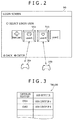
- FIG. 2 shows a typical login screen 90 displayed when the game device 10 is started. On the login screen 90, user A operating the game controller 16a can log in by selecting a login image 91 (login image 91 a corresponding to an account name "user A" on the screen) for login to his/her account. At this point, the game controller 16a is associated with a user identifier identifying the user A (e.g., account name "user A"). That is, the operator of the game controller 16a is identified as the user A.
- a login image 91 login image 91 a corresponding to an account name "user A" on the screen
- the operating instructions output from the game controller 16a will be processed as the information regarding "user A.”
- user B operating the game controller 16b can log in by selecting another login image 91 (login image 91 b corresponding to an account name "user B" on the screen) for login to his/her account.
- the game controller 16b is then associated with a user identifier identifying the user B (e.g., account name "user B").
- the operator of the game controller 16b is thus identified as the user B.
- the operating instructions output from the game controller 16b will be processed as the information regarding "user B.”
- FIG. 3 is a tabular view showing a typical association table Tbl100 associating controller identifiers with user identifiers in the embodiment.
- each controller identifier identifying the corresponding controller connected to the game device 10 is stored in association with the user identifier identifying the user operating that controller.
- a controller identifier C001 identifying the game controller 16a is associated with the user identifier A identifying the user A
- a controller identifier C002 identifying the game controller 16b is associated with the user identifier B identifying the user B.
- the game device 10 determines the user from the information identifying the controller (controller identifier C001 or C002) in the association table Tbl100.
- the game controller 16 it should be noted, is not the only controller connectable with the game device 10.
- the AV remote controller 15 or some other suitable controller may be connected instead.
- each controller identifier identifying the corresponding controller is also stored in the association table Tbl100 in association with the user identifier identifying the user operating the controller.
- the game device 10 identifying the user from the controller identifier, during execution of a user function associated with the identified user (e.g., while a user screen associated with the user is being displayed on the display section 17), all operating instructions from any other user with regard to that user function may be arranged to be rejected. Also, upon receipt of an operating instruction from another user, the execution of the process corresponding to the operating instruction may be limited. Rejecting the operating instructions from any other user constitutes effective means to improve security, particularly when highly individualized information is displayed, such as at the time of displaying the user's account information or at the time of purchasing a game.
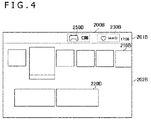
- FIG. 4 is a schematic diagram showing a typical user screen associated with the user displayed on the display section 17 in the embodiment.
- a user screen 200B shown in FIG. 4 is a top screen displayed after the user B has logged in, for example.
- the user screen 200B is the screen generated for each user (the screen is associated with the user B in this case).
- the user screen 200B includes a function area 201 B and a main area 202B.
- the function area 201 B may display a user identifying icon 230B identifying the operating user and a function icon 250B indicating the function used by the user.
- FIG. 4 is a schematic diagram showing a typical user screen associated with the user displayed on the display section 17 in the embodiment.
- a user screen 200B shown in FIG. 4 is a top screen displayed after the user B has logged in, for example.
- the user screen 200B is the screen generated for each user (the screen is associated with the user B in this case).
- the user screen 200B includes a function area 201 B and a
- the user identifying icon 230B displays an icon identifying the user B
- the function icon 250B displays an icon indicating the game controller 16b operated by the user B and an icon indicating the remaining battery level of the game controller 16b.
- the main area 202B may display a starting image 210B for starting various applications and an execution history image 220B indicating the execution history of applications.
- the diverse items of information displayed on the user screen 200B reflect the use status of the game device 10 as used by the user B.
- the function icon 250B reflects the controller associated with the user B as determined in reference to the association table Tbl100.
- the game device 10 basically executes only the processes corresponding to the operating instructions from the game controller 16b operated by the user B. For example, if the game controller 16a operated by the user A outputs operating information for selecting the starting image 210B, the game device 10 rejects the operating information from the game controller 16a operated by the user A that is not associated with the user identifier B. Alternatively, the game device 10 will not execute the process of selecting the starting image 210B even if receiving the operating information from the game controller 16a operated by the user A.
- the general-purpose AV remote controller 15 may be easier to operate than a game controller dedicated for use with a game device. With the AV remote controller 15 connected to the game device 10 for control use, if a specific user were associated with the AV remote controller 15 as with the above-described game controller 16, only the user function associated with that user could be operated.
- the AV remote controller 15 be used by anyone for performing operations to view videos or to play music (e.g., play, stop, volume control).
- the game system 1 enables the operations received from the AV remote controller 15 to be performed with the general-purpose function.
- the AV remote controller 15 connected with the game device 10 has first operating members and second operating members. The first operating members are associated with the functions that can be processed during execution of a general-purpose function not associated with the user operating the AV remote controller 15, and the second operating members are associated with the functions for executing processes of the user function associated with the user operating the AV remote controller 15.
- FIG. 5 is a schematic diagram showing a typical appearance of the AV remote controller 15 in the embodiment.
- the surface of the AV remote controller 15 has a first operating member group 150 composed of multiple first operating members, a second operating member group 160 made up of multiple second operating members, and a third operating member group 170 formed by multiple third operating members.
- the first operating members are associated with the functions that can be processed regardless of the user operating the AV remote controller 15 and regardless of the user associated with the function currently executed by the game device 10.
- the first operating members are basically assigned the functions that can be operated by anyone with no trouble. In the embodiment, as shown in FIG.
- the first operating members include a play button 151 associated with the function of reproducing videos and music and a volume key 152 associated with the function of controlling the sound volume, for example.
- the second operating members are associated with the function of executing the process of the user function associated with the user operating the AV remote controller 15.
- the second operating members are assumed to have the functions similar to those of the operating members of the game controller 16.
- the second operating members include a "circle ( ⁇ ) button,” a "cross ( ⁇ ) button,” a "square ( ⁇ ) button,” a “triangle ( ⁇ ) button,” and arrow keys arranged on the game controller 16.
- the second operating members may also function as the first operating members that can be processed regardless of the user operating the AV remote controller 15.
- the third operating members are associated with the function of executing the process of the user function associated with the user operating the AV remote controller 15.
- the third operating members are each assigned the function of executing the process of a highly individualized function for the user.
- the third operating members are each assigned the function of switching to a user function principally associated with the user operating the AV remote controller.
- the third operating members include a home button 171 with the function of displaying the top screen associated with the user, and a share button 172 with the function of starting an application for uploading videos, among others, owned by the user.
- These functions corresponding to the third operating members are arranged to be processed only if the user operating the AV remote controller 15 is identified. If no user identifier is associated with the AV remote controller 15, then the game device 10, before executing a process corresponding to any of the third operating members, needs to identify the user by having a suitable user identifier associated with the AV remote controller 15.
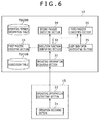
- FIG. 6 is a functional block diagram showing typical functions implemented by the game device 10 and the AV remote controller 15 in the embodiment.
- the AV remote controller 15 in the embodiment functionally includes an operation receiving section 21 and an operating information outputting section 22. These functions are implemented by a control section executing a programs stored in a storage section of the controller. This program may be stored on any of various computer-readable information storage media such as optical disks or downloaded via the communication network when offered.
- the game device 10 in the embodiment functionally includes an operating information acquiring section 31, a first process executing section 33, a second process executing section 34, a user identifier associating section 35, a third process executing section 36, an association table Tbl100, and an operating member information table Tbl200.
- the functions of the operating information acquiring section 31, the first process executing section 33, the second process executing section 34, the user identifier associating section 35, and the third process executing section 36 are implemented by the control section 11 executing a program stored in the storage section 12 of the game device 10. This program may be stored on any of various computer-readable information storage media such as optical disks or downloaded via the communication network such as the Internet when offered.
- the association table Tbl100 and the operating member information table Tbl200 are implemented in the storage section 12.
- the operation receiving section 21 of the AV remote controller 15 receives operations performed on the operating members of the AV remote controller 15.
- the operating information outputting section 22 of the AV remote controller 15 generates the operating information representing the operation received by the operation receiving section 21 and outputs the generated operating information to the game device 10.
- the operating information outputting section 22 may output as the operating information either an operating member code identifying the corresponding operating member or information indicative of the function associated with the operating member.
- the game device 10 can identify the function to be executed from the operating information.
- the operating member code is output as the operating information, the game device 10 needs to retain association information by which each operating member code is associated with the corresponding function so as to identify the function corresponding to the received operating member code.
- one operating member is associated with multiple functions. For example, pressing an operating member once may designate one function, and holding down the same operating member may designate another function. In that case, a code allocated to each function may be output as the operating information.
- the operating information acquiring section 31 of the game device 10 acquires the operating information output from the operating information outputting section 22 of the AV remote controller 15.
- An execution function identifying section 32 of the game device 10 identifies both the type of the operating information acquired by the operating information acquiring section 31 and the function currently executed by the game device 10.
- the operating information type indicates which of the operating members has been operated to output the operating information. It is assumed here that first operating information is output by operation of any of the first operating members, second operating information is output by operation of any of the second operating members, and third operating information is output by operation of any of the third operating members. Specifically, if the game device 10 is executing a general-purpose function and if the acquired operating information is identified as the first operating information, the operating information is processed by the first process executing section 33.
- the operating information is processed by the second process executing section 34. If the acquired operating information is identified as the third operating information, the operating information is processed by the third process executing section 36.
- the first process executing section 33 of the game device 10 executes the process on the basis of the first operating information acquired by the operating information acquiring section 31.
- the first process executing section 33 executes the process of the general-purpose function in accordance with the first operating information acquired by the operating information acquiring section 31.
- the process executed by the first process executing section 33 is one which is executed by the general-purpose function such as a video playing function currently executed by the game device 10.
- the first process executing section 33 executes the process on the basis of the first operating information associated with the general-purpose function.
- the first process executing section 33 limits execution of the process of the general-purpose function in accordance with the first operating information acquired by the operating information acquiring section 31. That is, if the game device 10 is not executing any general-purpose function, no process is executed even given the first operating information associated with the general-purpose function.
- the second process executing section 34 of the game device 10 executes the process on the basis of the second operating information acquired by the operating information acquiring section 31.
- the second process executing section 34 executes the process of the user function in accordance with the second operating information acquired by the operating information acquiring section 31.
- the process executed by the second process executing section 34 is one which is executed by the user function associated with the user, such as a game application currently executed by the game device 10.
- the second process executing section 34 executes the process on the basis of the second operating information associated with the user function.
- the second process executing section 34 limits execution of the process of the user function in accordance with the second operating information acquired by the operating information acquiring section 31. That is, the user function processes only the second operating information from the controller operated by the user associated with the user function.
- the user identifier associating section 35 of the game device 10 associates the controller connected to the game device 10 with the user identifier identifying the user operating the connected controller. As described above, when the user operating the controller selects the login image 91 on the login screen 90 in FIG. 2 to log in to his/her account, the user identifier associating section 35 associates the controller with the user identifier identifying the user.
- the third process executing section 36 of the game device 10 executes the process on the basis of the third operating information acquired by the operating information acquiring section 31. In this case, even during execution of any function, i.e., regardless of the general-purpose function or the user function associated with the user being executed, the third process executing section 36 executes the process associated with the third operating information in accordance therewith following acquisition of the information by the operating information acquiring section 31. Specifically, the third process executing section 36 primarily executes the process of switching to, and executing, the user function designated by the third operating information.
- FIG. 8 is a schematic diagram showing a general screen 100 displayed on the display section 17 in the embodiment.
- the general screen 100 shown in FIG. 8 is displayed when the game device 10 executes the application for playing videos.
- the user A operates the AV remote controller 15. This causes the operating information acquiring section 31 of the game device 10 to acquire the operating information output from the AV remote controller 15 (step S101).
- the operating information output from the AV remote controller 15 may be the operating member code identifying the operating member operated by the user A.
- the storage section 12 of the game device 10 is assumed to store in advance the operating member information table Tbl200 that associates operating member codes, operating member functions, and operating information types with one another.
- FIG. 9 is a tabular view showing a typical operating member information table Tbl200 stored in the storage section 12 of the game device 10 in the embodiment. As shown in FIG.
- the operating member information table Tbl200 holds the operating member codes each identifying the corresponding operating member of the AV remote controller 15, the functions each associated with the corresponding operating member, and the information indicative of different operating information types (information indicating the first operating information, the second operating information, etc.), all associated with one another for management purposes. Referencing the operating member information table makes it possible to identify the function associated with the operating information (operating member code) acquired by the operating information acquiring section 31 of the game device 10, as well as the type of the operating information.
- the operating member information table may be managed for each function executed by the game device 10.
- the first operating member group 150 of the AV remote controller 15 in FIG. 5 may be associated with a predetermined general-purpose function executed by the game device 10.
- the general-purpose function may then receive only the operating information regarding the operating members included in the first operating member group 150 and reject the operating information regarding any other operating members.
- different functions may be associated with each operating member depending on the function executed by the game device 10. For example, where an operating member "circle button" is arranged on the AV remote controller 15, the function associated with the "circle button” may be either "enter” or "back” depending on the application in use.
- the functions associated with the operating members may be changed as desired by rewriting the operating member information table.
- the execution function identifying section 32 identifies the function to be executed from the operating information acquired by the operating information acquiring section 31 (step S102). If the execution function identifying section 32 determines that the operating information acquired by the operating information acquiring section 31 of the game device 10 is the first operating information, the execution function identifying section 32 executes the process in accordance with the acquired operating information (step S103), and terminates the process.
- the play button 151 as one of the first operating members of the AV remote controller 15 is operated.
- Operating the play button 151 causes the operation receiving section 21 of the AV remote controller 15 to receive the operating instruction on the play button 151.
- the operating information outputting section 22 of the AV remote controller 15 outputs to the game device 10 the operating information indicative of an operating member code B001 representing the play button 151.
- the execution function identifying section 32 identifies as the first operating information the operating information acquired by reference to the operating member information table Tbl200.
- the first process executing section 33 executes the function (a playing process in this example) associated with the acquired operating information. With the first process executing section 33 executing the playing process of the video playing function, a video is displayed on the general screen 100 shown in FIG. 8 .
- an operating instruction on any of the first operating members causes the corresponding process to be executed on the general screen 100 associated with none of the users using the game device 10.
- the general screen is displayed on which the video playing function is executed as the general-purpose function associated with none of the users who use the game device 10.
- this example is not limitative of executable general-purpose functions.
- a music playing function may be executed in the background as another general-purpose function associated with none of the users using the game device 10.
- the display section 17 may be arranged to display a user screen associated with one of the users using the game device 10 (such as the top screen associated with the user B and shown in FIG. 4 ), without displaying any screen regarding the music playing function.
- the first process executing section 33 executes the process of the music playing function in accordance with the operating instruction (e.g., stop, fast-forward) on any of the first operating members of the AV remote controller 15.
- the process of the general-purpose function is executed in accordance with the operating instruction on any of the first operating members of the AV remote controller 15.
- the process of the general-purpose function is executed in accordance with the operating instruction on any of the first operating members of the AV remote controller 15.
- the execution function identifying section 32 determines that the operating information acquired by the operating information acquiring section 31 of the game device 10 is the third operating information, the execution function identifying section 32 further determines whether a user identifier is associated with the AV remote controller 15 having output the operating information. That is, the execution function identifying section 32 determines whether a user identifier is associated with the controller identifier identifying the AV remote controller 15 in the association table Tbl100.
- the execution function identifying section 32 determines that no user identifier is associated with the AV remote controller 15
- the user identifier associating section 35 associates the AV remote controller 15 with the user identifier (step S104).
- the home button 171 is operated as one of the third operating members of the AV remote controller 15 not associated with any user identifier.
- the operation causes the operation receiving section 21 of the AV remote controller 15 to receive the operating instruction on the home button 171.
- the operating information outputting section 22 of the AV remote controller 15 outputs to the game device 10 the operating information indicative of an operating member code B003 representing the home button 171.
- the execution function identifying section 32 identifies as the third operating information the operating information acquired by reference to the operating member information table Tbl200, and determines that no user identifier is associated with the AV remote controller 15.
- the login screen 90 shown in FIG. 2 is displayed on the display section 17.
- the top screen which is the function associated with the operating member code B003, varies from one user to another and it is difficult to be displayed unless the user is identified. The user operating the AV remote controller 15 is thus prompted to log in to let the user identifier associating section 35 associate the AV remote controller 15 with the user identifier.
- the controller identifier identifying the AV remote controller 15 is stored into the association table Tbl100 in association with the user identifier. This enables the user operating the AV remote controller 15 to be identified and the top screen associated with the identified user to be displayed. For example, on the login screen 90 shown in FIG. 2 , the user A operates on the login image 91 to log in to his/her account (login image 91 a associated with the account name "userA" in FIG. 2 ). This causes a controller identifier C003 identifying the AV remote controller 15 to be stored into the association table Tbl100 in association with the user identifier A identifying the user A. This is how the user operating the AV remote controller 15 is identified.
- step S104 the user identifier associating section 35 associates the AV remote controller 15 with the user identifier.
- the third process executing section 36 executes the process on the basis of the user identifier associated by the user identifier associating section 35 and the operating information acquired by the operating information acquiring section 31 (step S105), and terminates the process.
- step S102 determines in step S102 that the acquired operating information is the third operating information and that the user identifier is associated with the AV remote controller 15
- the third process executing section 36 executes the process on the basis of the user identifier associated with the AV remote controller 15 and the operating information acquired by the operating information acquiring section 31 (step S105), and terminates the process.
- the third process executing section 36 generates the user screen associated with the user A in accordance with the user identifier A associated with the AV remote controller 15, and substitutes the generated user screen for the general screen 100 displayed on the display section 17.
- FIG. 10 is a schematic diagram showing a typical user screen 200A associated with the user A and displayed anew on the display section 17 in the embodiment.
- the user screen 200A shown in FIG. 10 is the top screen displayed after the user A has logged in, for example.
- the user screen 200A in FIG. 10 which is the screen generated for each user (this screen is associated with the user A), includes a function area 201A and a main area 202A, for example.
- the function area 201A may display a user identifying icon 230A identifying the user doing the operation, and a function icon 251A indicating the function used by the user, for example.
- the user identifying icon 230A shows an icon indicative of the user A
- the function icon 251A shows an icon indicative of the AV remote controller 15 operated by the user A and an icon representative of the remaining battery level of the AV remote controller 15.
- the main area 202A shows a starting image 210A for starting various applications, and an execution history image 220A indicating the execution history of each application.
- the diverse items of information displayed on the user screen 200A reflect the use status of the game device 10 used by the user A.
- the function icon 251 A reflects the association made between the AV remote controller 15 and the user identifier A by the user identifier associating section 35 in step S104 and stored into the association table Tbl100.
- the controller identifier C003 identifying the AV remote controller 15 is associated with the user identifier A identifying the user A.
- the manner in which each icon is shown in FIG. 10 is only an example and is not limitative of how the icons are to be displayed.
- the function icon 251A may display solely the icon representative of the AV remote controller 15 without displaying the icon indicative of the remaining battery level of the AV remote controller 15.
- the user A may operate one of the second operating members (e.g., an arrow key) of the AV remote controller 15.
- the operation causes the operating information acquiring section 31 of the game device 10 to acquire the operating information output from the AV remote controller 15.
- the execution function identifying section 32 identifies the acquired operating information as the second operating information
- the second process executing section 34 executes the process in accordance with the operating information. That is, on the user screen 200A, a selection cursor or like object is moved as directed by the arrow key being operated.
- step S102 determines in step S102 that the operating information acquired by the operating information acquiring section 31 of the game device 10 is the second operating information
- the second process executing section 34 limits execution of the process in accordance with the operating information (step S106), and terminates the process.
- the second operating member "circle button" of the AV remote controller 15 is operated.
- the operation causes the operation receiving section 21 of the AV remote controller 15 to receive the operating instruction on the "circle button.”
- the operating information outputting section 22 of the AV remote controller 15 outputs to the game device 10 the operating information representative of an operating member code B004 of the "circle button.”
- the execution function identifying section 32 identifies as the second operating information the operating information acquired by reference to the operating member information table Tbl200.
- the execution function identifying section 32 further determines that the general screen 100 associated with none of the users using the game device 10 is being displayed and that the user function associated with the user operating the AV remote controller 15 is not being executed.
- the second process executing section 34 limits execution of the process associated with the operating information acquired by the operating information acquiring section 31. That is, the display of the general screen 100 shown in FIG. 8 remains unchanged because the second process executing section 34 does not execute an enter process associated with the "circle button.”
- the first operating members are associated with the video playing function executed as a general-purpose function.
- Other functions associated with the first operating members include a volume control function.
- the video playing function involves having the corresponding application executed by the game device 10, there is no need for the game device 10 to perform an application in executing the volume control function.
- the volume control function is commonly executed not by the game device 10 but by the display section 17.
- the operating information acquiring section 31 of the game device 10 acquires the operating information about the volume key 152 of the AV remote controller 15.
- the first process executing section 33 executes the process of outputting the acquired operating information to the display section 17 via a connector.
- the display section 17 then executes a volume control process on the basis of the acquired operating information.
- the operation on any of the first operating members associated with the operating information that is output to an external device via the game device 10 may always processed by the first process operating section 33 where the game device 10 is connected with the external device. That is, whereas the operations on the first operating members associated with the video playing function are processed only if the game device 10 is executing the video playing function, the operation on the first operating member associated with the volume control function is processed even if the game device 10 is not executing the volume control function.
- Such operating information that is output to an external device via the game device 10 can be dealt with if the corresponding operation can be processed by the external device such as the display section 17.
- another operation of this kind is a channel changing operation.
- the game device 10 determines which of the first process executing section 33, the second process executing section 34, and the third process executing section 36 will execute the process depending on the operating member operated on the AV remote controller 15. In particular, if any of the third operating members is operated and if no user identifier is associated with the AV remote controller 15, the user identifier associating section 35 associate the AV remote controller 15 with the user identifier. In a second embodiment, by contrast, the user identifier associating section 35 associates the AV remote controller 15 with the user identifier at a timing given by a predetermined operating instruction such as when the game device 10 executes a predetermined application or displays a predetermined screen.
- a predetermined operating instruction such as when the game device 10 executes a predetermined application or displays a predetermined screen.
- the user identifier associating section 35 may be arranged to execute the process at a timing when a highly individualized user function is executed, such as at the time of acquiring an operating instruction to display a screen for connecting with external services such as a game purchasing screen or a social networking service (SNS) screen.
- a highly individualized user function such as at the time of acquiring an operating instruction to display a screen for connecting with external services such as a game purchasing screen or a social networking service (SNS) screen.
- SNS social networking service
- the game device 10 is arranged to store the third operating information as the operating information type associated with the operating instruction to display a predetermined screen and the operating instruction to execute a predetermined application.
- the third operating information is associated with the third operating members of the AV remote controller 15.
- the third operating information is associated with the instructions indicative of predetermined timings from the AV remote controller 15, such as the instruction to display a predetermined screen and the instruction to execute a predetermined application. That is, the execution function identifying section 32 identifies the process to be executed not at a timing when any of the operating members associated with the third operating information is operated but at a timing when an instruction with which the third operating information is associated is given.
- the execution function identifying section 32 determines whether or not a user identifier is associated with the AV remote controller 15 having output the instruction associated with the third operating information. If no user identifier is determined to be associated, the execution function identifying section 32 prompts the user to perform a login operation by displaying the login screen 90 shown in FIG. 2 . The login operation causes the user identifier associating section 35 to associate the AV remote controller 15 with the user identifier.
- the third process executing section 36 executes the predetermined application under instructions from the AV remote controller 15. If the AV remote controller 15 is determined to be associated with the user identifier, the predetermined application may be executed without delay under instructions from the AV remote controller 15. As described, during operation of the first operating members of the AV remote controller 15, no user is associated with the AV remote controller 15; the user is associated with the AV remote controller 15 only when a predetermined, highly individualized user screen is displayed. With the user identified only if the highly individualized screen is displayed, the security of the user is ensured while the user is being allowed to operate the game device 10 as desired using the AV remote controller 15.
- the user identifier associating section 35 associates the AV remote controller 15 with the user identifier at a timing given by a predetermined operating instruction during operation of the predetermined operating members of the AV remote controller 15.
- the user identifier associating section 35 associates the AV remote controller 15 with the user identifier at a timing when the AV remote controller 15 is connected to the game device 10 for the first time.
- FIG. 11 is a schematic diagram showing a typical peripheral device setting screen 300 displayed on the display section 17 in the third embodiment.
- the peripheral device setting screen 300 is used to set the peripheral devices connected to the game device 10 in wired or wireless fashion.
- Typical peripheral devices include audio equipment, a controller, a keyboard, a mouse, and a camera.
- the peripheral device setting screen 300 includes multiple peripheral device selection items 301, each of which may be selectively designated by the user. When the user selectively designates one of the peripheral device selection items 301, a detail screen is displayed on which the peripheral device indicated by the selected peripheral device selection item 301 is to be set.
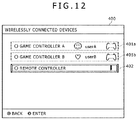
- FIG. 12 is a schematic diagram showing a typical wirelessly connected device setting screen 400 displayed on the display section 17 in the embodiment. As shown in FIG. 12 , the wirelessly connected device setting screen 400 displays a list of peripheral devices connected wirelessly with the game device 10.
- This list displays a controller item 401a indicative of a game controller A (corresponding to the game controller 16a in the embodiment), a controller item 401 b indicative of a game controller B (corresponding to the game controller 16b in the embodiment), and a controller item 402 representative of the AV remote controller 15, each device being a peripheral device connected wirelessly with the game device 10.
- Each controller item may be selectively designated by the user. The selective designation of a given item by the user displays the detail screen on which the peripheral device indicated by the item is to be set.
- the controller items 401 a and 401 b are each associated with the user identifier identifying the user operating the corresponding game controller, whereas the controller item 402 has yet to be associated with the user identifier identifying the user operating the AV remote controller 15.
- the controller item 402 is selectively designated on the wirelessly connected device setting screen 400 shown in FIG. 12 in order to set the connection with the AV remote controller 15.
- the selective designation causes a connecting operation screen 500 to be displayed.
- FIG. 13 is a schematic diagram showing a typical connecting operation screen 500 displayed on the display section 17 in the embodiment.
- the connecting operation screen 500 shown in FIG. 13 includes a disconnect button 501 and a connect button 502, the disconnect button 501 being used to disconnect the connection between the AV remote controller 15 and the game device 10, the connect button 502 being used to establish the connection between the AV remote controller 15 and the game device 10.
- Selectively designating the connect button 502 on the connecting operation screen 500 in FIG. 13 displays a screen for selecting the user who will operate the AV remote controller 15.
- This user selecting screen may be similar to the login screen 90 shown in FIG. 2 .
- the userA logs in to his/her account by selecting the login image 91 (login image 91 a corresponding to the account name "user A" in this example).
- the user identifier associating section 35 associates the AV remote controller 15 with the user identifier identifying the user A.
- the controller identifier identifying the AV remote controller 15 is stored into the association table Tbl100 in association with the user identifier identifying the user A.
- the operator of the AV remote controller 15 is identified as the user A. Thereafter, the second operating information output from the AV remote controller 15 is processed as the information about the user A.
- the user identifier associating section 35 associates the AV remote controller 15 with the user identifier in accordance with the user's connecting instruction as described above, the connection between the AV remote controller 15 and the game device 10 is established.
- the connection between the AV remote controller 15 and the game device 10 is disconnected by selectively designating the disconnect button 501 on the connecting operation screen 500 shown in FIG. 13 .
- the association between the AV remote controller 15 and the userA is maintained until the disconnect button 501 is selectively designated on the connecting operation screen 500.
- the user A can skip the display of the login screen for selecting the user who will operate the AV remote controller 15 when again logging in after a log-out or power deactivation.
- there may be set a power-saving mode in which the AV remote controller 15 is deactivated after no operations on the AV remote controller 15 have been received for a predetermined time period. In this case, at return from power-saving mode, it is also possible to skip the display of the login screen for selecting the user who will operate the AV remote controller 15.
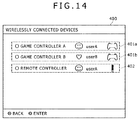
- FIG. 14 is a schematic diagram showing a typical wirelessly connected device setting screen 400 in effect after a connection is established between the AV remote controller 15 and the game device 10.
- the controller item 402 is associated with the user identifier "user A" of the user A.
- the wirelessly connected device setting screen 400 in FIG. 14 verifies that the user operating the AV remote controller 15 is the user A. Also, it shows that the user identifier of the user A is associated with both the controller item 401 a and the controller item 402, which indicates that multiple different controllers may be associated with the same user.
- FIG. 15 is a schematic diagram showing a typical user screen 200A associated with the user A who uses multiple controllers.
- the user screen 200A shown in FIG. 15 is the top screen associated with the user A. Except that it includes multiple function icons, the user screen 200A in FIG. 15 is structurally similar to the user screen 200A (top screen) in FIG. 10 . Thus the same components as those of the user screen 200A in FIG. 10 are given the same reference symbols in FIG. 15 , and their explanations are omitted where redundant.
- a function icon 250A displays an icon indicative of the game controller 16a used by the user A, and an icon indicative of the remaining battery level of the game controller 16a.
- a function icon 251A displays an icon indicative of the AV remote controller 15 used by the user A, and an icon indicative of the remaining battery level of the AV remote controller 15.
- the display of the function icon 250A indicating the game controller 16a and the display of the function icon 251A representing the AV remote controller 15 verify that the user A uses two controllers 15 and 16a.
- the second process executing section 34 and the third process executing section 36 can deal with the operating information from the AV remote controller 15 operated by the user A and the operating information from the game controller 16a also operated by the user A.
Landscapes
- Engineering & Computer Science (AREA)
- Multimedia (AREA)
- Human Computer Interaction (AREA)
- Signal Processing (AREA)
- Databases & Information Systems (AREA)
- Health & Medical Sciences (AREA)
- Child & Adolescent Psychology (AREA)
- General Health & Medical Sciences (AREA)
- Selective Calling Equipment (AREA)
- User Interface Of Digital Computer (AREA)
- Input From Keyboards Or The Like (AREA)
Abstract
Description
- The present disclosure relates to a game system, a controller, a game device, a control method for such a game device, and a program.
- Some game devices are operated using a controller associated with a user. When a screen associated with the user is being displayed on this type of game device, the game device can be operated by the controller associated with that user.
- It may be desired that the game device be connected with a general-purpose controller such as a television (TV) remote control to view videos, for example. In such a case, an inconvenience may be experienced if the game device can be operated only by the controller associated with a particular user. Where a minimally individualized general-purpose function such as viewing of videos is being executed, it is preferred that anyone be allowed to perform such common operations as playing of a video.
- The present disclosure has been made in view of the above circumstances and provides a game system including a game device and a controller and enabling a process of a general-purpose function not associated with the user using the controller to be executed in accordance with a function of operating members of the controller.
- Respective aspects and features of the disclosure are defined by the appended claims.
- In solving (or at least alleviating) the above problem and according to one embodiment of the present disclosure, there is provided a game system including a game device used by a first user and a second user and a controller. The game device includes: an association section configured to associate the controller with the first user using the controller; a first process executing section configured such that during execution of a general-purpose function associated with neither the first user nor the second user, the first process executing section executes a process of the general-purpose function in accordance with first operating information acquired from the controller; and a second process executing section configured such that during execution of a first user function associated with the first user, the second process executing section executes a process of the first user function in accordance with second operating information acquired from the controller. The controller includes: a first operating member configured to be associated with the first operating information; a second operating member configured to be associated with the second operating information; an operation receiving section configured to receive an operation on one of the first and the second operating members; and an operating information outputting section configured to output to the game device one of the first and the second operating information associated with the operation on the corresponding one of the first and the second operating members.
- Preferably in the above game system, the game device may include a second process limiting section configured such that during non-execution of the first user function associated with the first user, the second process limiting section limits execution of the process of the first user function in accordance with the second operating information acquired from the controller.
- Preferably in the above game system, the game device may include a first process limiting section configured such that during non-execution of the general-purpose function associated with neither the first user nor the second user, the first process limiting section limits execution of the process of the general-purpose function in accordance with the first operating information acquired from the controller.
- In solving (or at least alleviating) the above problem and according to another embodiment of the present disclosure, there is provided a controller connected with a game device used by a first user and a second user. The controller includes: a first operating member configured such that during execution of a general-purpose function associated with neither the first user nor the second user, the first operating member is associated with first operating information for executing a process of the general-purpose function; a second operating member configured such that during execution of a first user function associated with the first user, the second operating member is associated with second operating information for executing a process of the first user function; an operation receiving section configured to receive an operation on one of the first and the second operating members; and an operating information outputting section configured to output to the game device one of the first and the second operating information associated with the operation on the corresponding one of the first and the second operating members.
- In solving (or at least alleviating) the above problem and according to a further embodiment of the present disclosure, there is provided a game device connected with a controller and used by a first user and a second user. The game device includes: an association section configured to associate the controller with the first user using the controller; a first process executing section configured such that during execution of a general-purpose function associated with neither the first user nor the second user, the first process executing section executes a process of the general-purpose function in accordance with first operating information acquired from the controller; and a second process executing section configured such that during execution of a first user function associated with the first user, the second process executing section executes a process of the first user function in accordance with second operating information acquired from the controller.
- According to an even further embodiment of the present disclosure, there is provided a control method for a game device connected with a controller and used by a first user and a second user. The control method includes: associating the controller with the first user using the controller; during execution of a general-purpose function associated with neither the first user nor the second user, executing a process of the general-purpose function in accordance with first operating information acquired from the controller; and during execution of a first user function associated with the first user, executing a process of the first user function in accordance with second operating information acquired from the controller.
- According to a still further embodiment of the present disclosure, there is provided a program for causing a game device connected with a controller and used by a first user and a second user, including: by an association section, associating the controller with the first user using the controller; by a first process executing section, during execution of a general-purpose function associated with neither the first user nor the second user, executing a process of the general-purpose function in accordance with first operating information acquired from the controller; and by a second process executing section, during execution of a first user function associated with the first user, executing a process of the first user function in accordance with second operating information acquired from the controller. This program may be stored on a computer-readable information storage medium.
- Embodiments of the disclosure will now be described, by way of example only, with reference to the accompanying drawings in which:
-
FIG. 1 is a configuration diagram showing a typical overall configuration of a game system in one embodiment of the present disclosure; -
FIG. 2 is a schematic diagram showing typical use status of a game device in one embodiment of the present disclosure; -
FIG. 3 is a tabular view showing a typical association table associating controller identifiers with user identifiers in one embodiment of the present disclosure; -
FIG. 4 is a schematic diagram showing a typical user screen associated with a user displayed on a display section in one embodiment of the present disclosure; -
FIG. 5 is a schematic diagram showing a typical appearance of an audio video (AV) remote controller in one embodiment of the present disclosure; -
FIG. 6 is a functional block diagram showing typical functions implemented by the game device and the AV remote controller in one embodiment of the present disclosure; -
FIG. 7 is a flowchart of a typical process executed by the game system under operating instructions from the AV remote controller in one embodiment of the present disclosure; -
FIG. 8 is a schematic diagram showing a general screen in one embodiment of the present disclosure; -
FIG. 9 is a tabular view showing a typical operating member information table stored in a storage section of the game device in one embodiment of the present disclosure; -
FIG. 10 is a schematic diagram showing a typical user screen associated with a user and displayed anew on the display section in one embodiment of the present disclosure; -
FIG. 11 is a schematic diagram showing a typical peripheral device setting screen displayed on the display section in one embodiment of the present disclosure; -
FIG. 12 is a schematic diagram showing a typical wirelessly connected device setting screen displayed on the display section in one embodiment of the present disclosure; -
FIG. 13 is a schematic diagram showing a typical connecting operation screen displayed on the display section in one embodiment of the present disclosure; -
FIG. 14 is a schematic diagram showing a typical wirelessly connected device setting screen in effect after a connection is established between the AV remote controller and the game device; and -
FIG. 15 is a schematic diagram showing a typical user screen associated with a user who uses multiple controllers. -
FIG. 1 is a configuration diagram showing a typical overall configuration of agame system 1 in a first embodiment of the present disclosure. Thegame system 1 in the embodiment includes adisplay section 17, agame device 10, and multiple controllers capable of operating thegame device 10. - The
game device 10 is an information processing device used by a user to play games and view videos. For example, thegame device 10 may be a home-use game machine, a handheld video game machine, or a personal computer. As shown inFIG. 1 , thegame device 10 in the embodiment includes acontrol section 11, astorage section 12, animage processing section 13, and acommunication section 14. Thegame device 10 is connected with anAV remote controller 15, agame controller 16a, anothergame controller 16b, and adisplay section 17. - The
control section 11 includes a program control device such as a central processing unit (CPU) and executes diverse information processing in accordance with programs stored in thestorage section 12. Thestorage section 12 includes a memory device such as a random access memory (RAM) or a read-only memory (ROM) storing the programs to be executed by thecontrol section 11 and the data to be processed by the programs. Thestorage section 12 also functions as a work memory for thecontrol section 11. - The
image processing section 13 includes a graphical processing unit (GPU) and a frame buffer memory, for example. In accordance with a drawing instruction from thecontrol section 11, theimage processing section 13 draws an image to be displayed on the screen of thedisplay section 17. As a specific example, theimage processing section 13 may have a frame buffer memory corresponding to the screen of thedisplay section 17. Under instructions from thecontrol section 11, the GPU writes images to the frame buffer memory at predetermined time intervals. The image written to the frame buffer memory is converted to a video signal in a suitably timed manner and displayed on the screen of thedisplay device 17. - The
communication section 14 is an interface that transmits and receives data to and from another device via a communication network. Thegame device 10 transmits and receives information to and from another device via thecommunication section 14. In the embodiment, thecommunication section 14 transmits and receives information to and from theAV remote controller 15 and the game controller 16 (16a and 16b) using a wireless communication function such as Bluetooth (registered trademark). - The AV
remote controller 15 is a device that receives the input of the user's operations. For example, theAV remote controller 15 may be a general-purpose controller for operating an AV amplifier, a TV set, or a home-use game machine. The user operates theAV remote controller 15 to input various instructions to the AV amplifier, the TV set, or the home-use game machine. In the embodiment, the AVremote controller 15 is assumed to be used primarily for operating thegame device 10. The AVremote controller 15 may include part or all of the functions provided by the game controller 16 dedicated for use with thegame device 10. - The game controller 16 is a device that receives the input of the user's operations. For example, the game controller 16 may be a controller for a home-use game machine. The user operates the game controller 16 to input various instructions to the
game device 10. In the embodiment, the game controller 16 is assumed to be dedicated for use with thegame device 10. - The
display section 17 is a display device such as a home-use TV set or a liquid crystal display. Thedisplay section 17 displays the image corresponding to the video signal output from theimage processing section 13. -
FIG. 2 is a schematic diagram showing typical use status of thegame device 10 in the embodiment. Multiple users can use thesame game device 10 in the embodiment. Each user can use thegame device 10 by creating an individual account for login purposes.FIG. 2 shows atypical login screen 90 displayed when thegame device 10 is started. On thelogin screen 90, user A operating thegame controller 16a can log in by selecting a login image 91 (login image 91 a corresponding to an account name "user A" on the screen) for login to his/her account. At this point, thegame controller 16a is associated with a user identifier identifying the user A (e.g., account name "user A"). That is, the operator of thegame controller 16a is identified as the user A. Thereafter, the operating instructions output from thegame controller 16a will be processed as the information regarding "user A." On thesame login screen 90, user B operating thegame controller 16b can log in by selecting another login image 91 (login image 91 b corresponding to an account name "user B" on the screen) for login to his/her account. Thegame controller 16b is then associated with a user identifier identifying the user B (e.g., account name "user B"). The operator of thegame controller 16b is thus identified as the user B. Thereafter, the operating instructions output from thegame controller 16b will be processed as the information regarding "user B." - Once the game controller 16 is associated with the user identifier, the association information about the game controller 16 and the corresponding user identifier is stored into the
storage section 12 of thegame device 10.FIG. 3 is a tabular view showing a typical association table Tbl100 associating controller identifiers with user identifiers in the embodiment. As shown inFIG. 3 , each controller identifier identifying the corresponding controller connected to thegame device 10 is stored in association with the user identifier identifying the user operating that controller. InFIG. 3 , a controller identifier C001 identifying thegame controller 16a is associated with the user identifier A identifying the user A, and a controller identifier C002 identifying thegame controller 16b is associated with the user identifier B identifying the user B. Thegame device 10 determines the user from the information identifying the controller (controller identifier C001 or C002) in the association table Tbl100. The game controller 16, it should be noted, is not the only controller connectable with thegame device 10. The AVremote controller 15 or some other suitable controller may be connected instead. In such cases, each controller identifier identifying the corresponding controller is also stored in the association table Tbl100 in association with the user identifier identifying the user operating the controller. - With the
game device 10 identifying the user from the controller identifier, during execution of a user function associated with the identified user (e.g., while a user screen associated with the user is being displayed on the display section 17), all operating instructions from any other user with regard to that user function may be arranged to be rejected. Also, upon receipt of an operating instruction from another user, the execution of the process corresponding to the operating instruction may be limited. Rejecting the operating instructions from any other user constitutes effective means to improve security, particularly when highly individualized information is displayed, such as at the time of displaying the user's account information or at the time of purchasing a game. -
FIG. 4 is a schematic diagram showing a typical user screen associated with the user displayed on thedisplay section 17 in the embodiment. Auser screen 200B shown inFIG. 4 is a top screen displayed after the user B has logged in, for example. Theuser screen 200B is the screen generated for each user (the screen is associated with the user B in this case). For example, theuser screen 200B includes afunction area 201 B and amain area 202B. Thefunction area 201 B may display auser identifying icon 230B identifying the operating user and afunction icon 250B indicating the function used by the user. InFIG. 4 , theuser identifying icon 230B displays an icon identifying the user B, and thefunction icon 250B displays an icon indicating thegame controller 16b operated by the user B and an icon indicating the remaining battery level of thegame controller 16b. Themain area 202B may display a startingimage 210B for starting various applications and anexecution history image 220B indicating the execution history of applications. The diverse items of information displayed on theuser screen 200B reflect the use status of thegame device 10 as used by the user B. For example, thefunction icon 250B reflects the controller associated with the user B as determined in reference to the association table Tbl100. - During display of the
user screen 200B associated with the user B as shown inFIG. 4 , thegame device 10 basically executes only the processes corresponding to the operating instructions from thegame controller 16b operated by the user B. For example, if thegame controller 16a operated by the user A outputs operating information for selecting the startingimage 210B, thegame device 10 rejects the operating information from thegame controller 16a operated by the user A that is not associated with the user identifier B. Alternatively, thegame device 10 will not execute the process of selecting the startingimage 210B even if receiving the operating information from thegame controller 16a operated by the user A. - However, during execution of a general-purpose function of relatively low individuality such as watching of TV programs, viewing of videos, or playing of music, an inconvenience would be experienced if the operating instructions from any other user were rejected. For example, when TV programs are to be watched, videos are to be viewed, or music is to be played, the general-purpose AV
remote controller 15 may be easier to operate than a game controller dedicated for use with a game device. With the AVremote controller 15 connected to thegame device 10 for control use, if a specific user were associated with the AVremote controller 15 as with the above-described game controller 16, only the user function associated with that user could be operated. It is thus preferred that the AVremote controller 15 be used by anyone for performing operations to view videos or to play music (e.g., play, stop, volume control). In the embodiment, during execution of a general-purpose function not associated with the user operating the AVremote controller 15, thegame system 1 enables the operations received from the AVremote controller 15 to be performed with the general-purpose function. The AVremote controller 15 connected with thegame device 10 has first operating members and second operating members. The first operating members are associated with the functions that can be processed during execution of a general-purpose function not associated with the user operating the AVremote controller 15, and the second operating members are associated with the functions for executing processes of the user function associated with the user operating the AVremote controller 15. -
FIG. 5 is a schematic diagram showing a typical appearance of the AVremote controller 15 in the embodiment. As shown inFIG. 5 , the surface of the AVremote controller 15 has a firstoperating member group 150 composed of multiple first operating members, a secondoperating member group 160 made up of multiple second operating members, and a thirdoperating member group 170 formed by multiple third operating members. The first operating members are associated with the functions that can be processed regardless of the user operating the AVremote controller 15 and regardless of the user associated with the function currently executed by thegame device 10. The first operating members are basically assigned the functions that can be operated by anyone with no trouble. In the embodiment, as shown inFIG. 5 , the first operating members include aplay button 151 associated with the function of reproducing videos and music and avolume key 152 associated with the function of controlling the sound volume, for example. Meanwhile, the second operating members are associated with the function of executing the process of the user function associated with the user operating the AVremote controller 15. In the embodiment, the second operating members are assumed to have the functions similar to those of the operating members of the game controller 16. For example, the second operating members include a "circle (○) button," a "cross (×) button," a "square (□) button," a "triangle (Δ) button," and arrow keys arranged on the game controller 16. The second operating members may also function as the first operating members that can be processed regardless of the user operating the AVremote controller 15. The third operating members are associated with the function of executing the process of the user function associated with the user operating the AVremote controller 15. In particular, the third operating members are each assigned the function of executing the process of a highly individualized function for the user. In the embodiment, the third operating members are each assigned the function of switching to a user function principally associated with the user operating the AV remote controller. For example, the third operating members include ahome button 171 with the function of displaying the top screen associated with the user, and ashare button 172 with the function of starting an application for uploading videos, among others, owned by the user. These functions corresponding to the third operating members are arranged to be processed only if the user operating the AVremote controller 15 is identified. If no user identifier is associated with the AVremote controller 15, then thegame device 10, before executing a process corresponding to any of the third operating members, needs to identify the user by having a suitable user identifier associated with the AVremote controller 15. -
FIG. 6 is a functional block diagram showing typical functions implemented by thegame device 10 and the AVremote controller 15 in the embodiment. As shown inFIG. 6 , the AVremote controller 15 in the embodiment functionally includes anoperation receiving section 21 and an operatinginformation outputting section 22. These functions are implemented by a control section executing a programs stored in a storage section of the controller. This program may be stored on any of various computer-readable information storage media such as optical disks or downloaded via the communication network when offered. - The
game device 10 in the embodiment functionally includes an operatinginformation acquiring section 31, a firstprocess executing section 33, a secondprocess executing section 34, a useridentifier associating section 35, a thirdprocess executing section 36, an association table Tbl100, and an operating member information table Tbl200. The functions of the operatinginformation acquiring section 31, the firstprocess executing section 33, the secondprocess executing section 34, the useridentifier associating section 35, and the thirdprocess executing section 36 are implemented by thecontrol section 11 executing a program stored in thestorage section 12 of thegame device 10. This program may be stored on any of various computer-readable information storage media such as optical disks or downloaded via the communication network such as the Internet when offered. The association table Tbl100 and the operating member information table Tbl200 are implemented in thestorage section 12. - The
operation receiving section 21 of the AVremote controller 15 receives operations performed on the operating members of the AVremote controller 15. - The operating
information outputting section 22 of the AVremote controller 15 generates the operating information representing the operation received by theoperation receiving section 21 and outputs the generated operating information to thegame device 10. In this case, the operatinginformation outputting section 22 may output as the operating information either an operating member code identifying the corresponding operating member or information indicative of the function associated with the operating member. When the information indicative of the function is output as the operating information, thegame device 10 can identify the function to be executed from the operating information. When the operating member code is output as the operating information, thegame device 10 needs to retain association information by which each operating member code is associated with the corresponding function so as to identify the function corresponding to the received operating member code. There may be a case where one operating member is associated with multiple functions. For example, pressing an operating member once may designate one function, and holding down the same operating member may designate another function. In that case, a code allocated to each function may be output as the operating information. - The operating
information acquiring section 31 of thegame device 10 acquires the operating information output from the operatinginformation outputting section 22 of the AVremote controller 15. - An execution
function identifying section 32 of thegame device 10 identifies both the type of the operating information acquired by the operatinginformation acquiring section 31 and the function currently executed by thegame device 10. The operating information type indicates which of the operating members has been operated to output the operating information. It is assumed here that first operating information is output by operation of any of the first operating members, second operating information is output by operation of any of the second operating members, and third operating information is output by operation of any of the third operating members. Specifically, if thegame device 10 is executing a general-purpose function and if the acquired operating information is identified as the first operating information, the operating information is processed by the firstprocess executing section 33. If thegame device 10 is executing a user function and if the acquired operating information is identified as the second operating information, the operating information is processed by the secondprocess executing section 34. If the acquired operating information is identified as the third operating information, the operating information is processed by the thirdprocess executing section 36. - The first
process executing section 33 of thegame device 10 executes the process on the basis of the first operating information acquired by the operatinginformation acquiring section 31. In this case, during execution of a general-purpose function not associated with the user using thegame device 10, the firstprocess executing section 33 executes the process of the general-purpose function in accordance with the first operating information acquired by the operatinginformation acquiring section 31. Specifically, the process executed by the firstprocess executing section 33 is one which is executed by the general-purpose function such as a video playing function currently executed by thegame device 10. The firstprocess executing section 33 executes the process on the basis of the first operating information associated with the general-purpose function. Meanwhile, during non-execution of a general-purpose function associated with none of the users using thegame device 10, the firstprocess executing section 33 limits execution of the process of the general-purpose function in accordance with the first operating information acquired by the operatinginformation acquiring section 31. That is, if thegame device 10 is not executing any general-purpose function, no process is executed even given the first operating information associated with the general-purpose function. - The second
process executing section 34 of thegame device 10 executes the process on the basis of the second operating information acquired by the operatinginformation acquiring section 31. In this case, during execution of a user function associated with the user operating the AVremote controller 15, the secondprocess executing section 34 executes the process of the user function in accordance with the second operating information acquired by the operatinginformation acquiring section 31. Specifically, the process executed by the secondprocess executing section 34 is one which is executed by the user function associated with the user, such as a game application currently executed by thegame device 10. The secondprocess executing section 34 executes the process on the basis of the second operating information associated with the user function. Meanwhile, during non-execution of the user function associated with the user operating the AVremote controller 15, the secondprocess executing section 34 limits execution of the process of the user function in accordance with the second operating information acquired by the operatinginformation acquiring section 31. That is, the user function processes only the second operating information from the controller operated by the user associated with the user function. - The user
identifier associating section 35 of thegame device 10 associates the controller connected to thegame device 10 with the user identifier identifying the user operating the connected controller. As described above, when the user operating the controller selects the login image 91 on thelogin screen 90 inFIG. 2 to log in to his/her account, the useridentifier associating section 35 associates the controller with the user identifier identifying the user. - The third
process executing section 36 of thegame device 10 executes the process on the basis of the third operating information acquired by the operatinginformation acquiring section 31. In this case, even during execution of any function, i.e., regardless of the general-purpose function or the user function associated with the user being executed, the thirdprocess executing section 36 executes the process associated with the third operating information in accordance therewith following acquisition of the information by the operatinginformation acquiring section 31. Specifically, the thirdprocess executing section 36 primarily executes the process of switching to, and executing, the user function designated by the third operating information. - Explained below with reference to the flowchart shown in
FIG. 7 is a typical process executed by thegame system 1 under operating instructions from the AVremote controller 15 in the embodiment. - The
game device 10 is assumed to be executing a general-purpose function associated with none of the users using thegame device 10. It is also assumed here that the video playing function is being executed as the general-purpose function associated with none of the users using thegame device 10.FIG. 8 is a schematic diagram showing ageneral screen 100 displayed on thedisplay section 17 in the embodiment. Thegeneral screen 100 shown inFIG. 8 is displayed when thegame device 10 executes the application for playing videos. - With the
general screen 100 displayed as shown inFIG. 8 , the user A operates the AVremote controller 15. This causes the operatinginformation acquiring section 31 of thegame device 10 to acquire the operating information output from the AV remote controller 15 (step S101). - In this example, the operating information output from the AV
remote controller 15 may be the operating member code identifying the operating member operated by the user A. Thestorage section 12 of thegame device 10 is assumed to store in advance the operating member information table Tbl200 that associates operating member codes, operating member functions, and operating information types with one another.FIG. 9 is a tabular view showing a typical operating member information table Tbl200 stored in thestorage section 12 of thegame device 10 in the embodiment. As shown inFIG. 9 , the operating member information table Tbl200 holds the operating member codes each identifying the corresponding operating member of the AVremote controller 15, the functions each associated with the corresponding operating member, and the information indicative of different operating information types (information indicating the first operating information, the second operating information, etc.), all associated with one another for management purposes. Referencing the operating member information table makes it possible to identify the function associated with the operating information (operating member code) acquired by the operatinginformation acquiring section 31 of thegame device 10, as well as the type of the operating information. - The operating member information table may be managed for each function executed by the
game device 10. For example, the firstoperating member group 150 of the AVremote controller 15 inFIG. 5 may be associated with a predetermined general-purpose function executed by thegame device 10. The general-purpose function may then receive only the operating information regarding the operating members included in the firstoperating member group 150 and reject the operating information regarding any other operating members. Also, different functions may be associated with each operating member depending on the function executed by thegame device 10. For example, where an operating member "circle button" is arranged on the AVremote controller 15, the function associated with the "circle button" may be either "enter" or "back" depending on the application in use. The functions associated with the operating members may be changed as desired by rewriting the operating member information table. - The execution
function identifying section 32 identifies the function to be executed from the operating information acquired by the operating information acquiring section 31 (step S102). If the executionfunction identifying section 32 determines that the operating information acquired by the operatinginformation acquiring section 31 of thegame device 10 is the first operating information, the executionfunction identifying section 32 executes the process in accordance with the acquired operating information (step S103), and terminates the process. - Specifically, suppose that with the
general screen 100 displayed as shown inFIG. 8 , theplay button 151 as one of the first operating members of the AVremote controller 15 is operated. Operating theplay button 151 causes theoperation receiving section 21 of the AVremote controller 15 to receive the operating instruction on theplay button 151. The operatinginformation outputting section 22 of the AVremote controller 15 outputs to thegame device 10 the operating information indicative of an operating member code B001 representing theplay button 151. - When the operating
information acquiring section 31 of thegame device 10 has acquired the operating information representative of the operating member code B001, the executionfunction identifying section 32 identifies as the first operating information the operating information acquired by reference to the operating member information table Tbl200. In turn, the firstprocess executing section 33 executes the function (a playing process in this example) associated with the acquired operating information. With the firstprocess executing section 33 executing the playing process of the video playing function, a video is displayed on thegeneral screen 100 shown inFIG. 8 . - As described, an operating instruction on any of the first operating members causes the corresponding process to be executed on the
general screen 100 associated with none of the users using thegame device 10. - It was explained above that the general screen is displayed on which the video playing function is executed as the general-purpose function associated with none of the users who use the
game device 10. However, this example is not limitative of executable general-purpose functions. For example, a music playing function may be executed in the background as another general-purpose function associated with none of the users using thegame device 10. In this case, thedisplay section 17 may be arranged to display a user screen associated with one of the users using the game device 10 (such as the top screen associated with the user B and shown inFIG. 4 ), without displaying any screen regarding the music playing function. Also in this case, the firstprocess executing section 33 executes the process of the music playing function in accordance with the operating instruction (e.g., stop, fast-forward) on any of the first operating members of the AVremote controller 15. In this manner, even during display of the user screen associated with a user different from the user operating the AVremote controller 15, as long as a general-purpose function is being executed, the process of the general-purpose function is executed in accordance with the operating instruction on any of the first operating members of the AVremote controller 15. Likewise, during display on thedisplay section 17 of the top screen associated with the user A operating the AVremote controller 15, the process of the general-purpose function is executed in accordance with the operating instruction on any of the first operating members of the AVremote controller 15. - Meanwhile, if the execution
function identifying section 32 determines that the operating information acquired by the operatinginformation acquiring section 31 of thegame device 10 is the third operating information, the executionfunction identifying section 32 further determines whether a user identifier is associated with the AVremote controller 15 having output the operating information. That is, the executionfunction identifying section 32 determines whether a user identifier is associated with the controller identifier identifying the AVremote controller 15 in the association table Tbl100. - If the execution
function identifying section 32 determines that no user identifier is associated with the AVremote controller 15, the useridentifier associating section 35 associates the AVremote controller 15 with the user identifier (step S104). - Specifically, suppose that the
home button 171 is operated as one of the third operating members of the AVremote controller 15 not associated with any user identifier. The operation causes theoperation receiving section 21 of the AVremote controller 15 to receive the operating instruction on thehome button 171. The operatinginformation outputting section 22 of the AVremote controller 15 outputs to thegame device 10 the operating information indicative of an operating member code B003 representing thehome button 171. - When the operating
information acquiring section 31 of thegame device 10 has acquired the operating information indicative of the operating member code B003, the executionfunction identifying section 32 identifies as the third operating information the operating information acquired by reference to the operating member information table Tbl200, and determines that no user identifier is associated with the AVremote controller 15. In this case, thelogin screen 90 shown inFIG. 2 is displayed on thedisplay section 17. It should be noted that the top screen, which is the function associated with the operating member code B003, varies from one user to another and it is difficult to be displayed unless the user is identified. The user operating the AVremote controller 15 is thus prompted to log in to let the useridentifier associating section 35 associate the AVremote controller 15 with the user identifier. Once the AVremote controller 15 is associated with the user identifier by the useridentifier associating section 35, the controller identifier identifying the AVremote controller 15 is stored into the association table Tbl100 in association with the user identifier. This enables the user operating the AVremote controller 15 to be identified and the top screen associated with the identified user to be displayed. For example, on thelogin screen 90 shown inFIG. 2 , the user A operates on the login image 91 to log in to his/her account (loginimage 91 a associated with the account name "userA" inFIG. 2 ). This causes a controller identifier C003 identifying the AVremote controller 15 to be stored into the association table Tbl100 in association with the user identifier A identifying the user A. This is how the user operating the AVremote controller 15 is identified. - In step S104, the user
identifier associating section 35 associates the AVremote controller 15 with the user identifier. In turn, the thirdprocess executing section 36 executes the process on the basis of the user identifier associated by the useridentifier associating section 35 and the operating information acquired by the operating information acquiring section 31 (step S105), and terminates the process. - If the execution
function identifying section 32 determines in step S102 that the acquired operating information is the third operating information and that the user identifier is associated with the AVremote controller 15, then the thirdprocess executing section 36 executes the process on the basis of the user identifier associated with the AVremote controller 15 and the operating information acquired by the operating information acquiring section 31 (step S105), and terminates the process. - In this example, the third
process executing section 36 generates the user screen associated with the user A in accordance with the user identifier A associated with the AVremote controller 15, and substitutes the generated user screen for thegeneral screen 100 displayed on thedisplay section 17.FIG. 10 is a schematic diagram showing atypical user screen 200A associated with the user A and displayed anew on thedisplay section 17 in the embodiment. Theuser screen 200A shown inFIG. 10 is the top screen displayed after the user A has logged in, for example. Theuser screen 200A inFIG. 10 , which is the screen generated for each user (this screen is associated with the user A), includes afunction area 201A and amain area 202A, for example. Thefunction area 201A may display auser identifying icon 230A identifying the user doing the operation, and afunction icon 251A indicating the function used by the user, for example. InFIG. 10 , theuser identifying icon 230A shows an icon indicative of the user A, while thefunction icon 251A shows an icon indicative of the AVremote controller 15 operated by the user A and an icon representative of the remaining battery level of the AVremote controller 15. Themain area 202A shows a starting image 210A for starting various applications, and anexecution history image 220A indicating the execution history of each application. The diverse items of information displayed on theuser screen 200A reflect the use status of thegame device 10 used by the user A. In this case, thefunction icon 251 A reflects the association made between the AVremote controller 15 and the user identifier A by the useridentifier associating section 35 in step S104 and stored into the association table Tbl100. In the table, the controller identifier C003 identifying the AVremote controller 15 is associated with the user identifier A identifying the user A. Incidentally, the manner in which each icon is shown inFIG. 10 is only an example and is not limitative of how the icons are to be displayed. For example, thefunction icon 251A may display solely the icon representative of the AVremote controller 15 without displaying the icon indicative of the remaining battery level of the AVremote controller 15. - With the
user screen 200A displayed as shown inFIG. 10 , the user A may operate one of the second operating members (e.g., an arrow key) of the AVremote controller 15. The operation causes the operatinginformation acquiring section 31 of thegame device 10 to acquire the operating information output from the AVremote controller 15. When the executionfunction identifying section 32 identifies the acquired operating information as the second operating information, the secondprocess executing section 34 executes the process in accordance with the operating information. That is, on theuser screen 200A, a selection cursor or like object is moved as directed by the arrow key being operated. - If the execution
function identifying section 32 determines in step S102 that the operating information acquired by the operatinginformation acquiring section 31 of thegame device 10 is the second operating information, the secondprocess executing section 34 limits execution of the process in accordance with the operating information (step S106), and terminates the process. - Specifically, with the
general screen 100 displayed as shown inFIG. 8 , suppose that the second operating member "circle button" of the AVremote controller 15 is operated. The operation causes theoperation receiving section 21 of the AVremote controller 15 to receive the operating instruction on the "circle button." In turn, the operatinginformation outputting section 22 of the AVremote controller 15 outputs to thegame device 10 the operating information representative of an operating member code B004 of the "circle button." - When the operating
information acquiring section 31 of thegame device 10 has acquired the operating information representing the operating member code B004, the executionfunction identifying section 32 identifies as the second operating information the operating information acquired by reference to the operating member information table Tbl200. The executionfunction identifying section 32 further determines that thegeneral screen 100 associated with none of the users using thegame device 10 is being displayed and that the user function associated with the user operating the AVremote controller 15 is not being executed. As a result of this, the secondprocess executing section 34 limits execution of the process associated with the operating information acquired by the operatinginformation acquiring section 31. That is, the display of thegeneral screen 100 shown inFIG. 8 remains unchanged because the secondprocess executing section 34 does not execute an enter process associated with the "circle button." - It was explained above that the first operating members are associated with the video playing function executed as a general-purpose function. Other functions associated with the first operating members include a volume control function. Whereas the video playing function involves having the corresponding application executed by the
game device 10, there is no need for thegame device 10 to perform an application in executing the volume control function. Specifically, the volume control function is commonly executed not by thegame device 10 but by thedisplay section 17. In the embodiment, the operatinginformation acquiring section 31 of thegame device 10 acquires the operating information about thevolume key 152 of the AVremote controller 15. In turn, the firstprocess executing section 33 executes the process of outputting the acquired operating information to thedisplay section 17 via a connector. Thedisplay section 17 then executes a volume control process on the basis of the acquired operating information. In this manner, the operation on any of the first operating members associated with the operating information that is output to an external device via thegame device 10 may always processed by the firstprocess operating section 33 where thegame device 10 is connected with the external device. That is, whereas the operations on the first operating members associated with the video playing function are processed only if thegame device 10 is executing the video playing function, the operation on the first operating member associated with the volume control function is processed even if thegame device 10 is not executing the volume control function. Such operating information that is output to an external device via thegame device 10 can be dealt with if the corresponding operation can be processed by the external device such as thedisplay section 17. For example, another operation of this kind is a channel changing operation. - In the first embodiment, the
game device 10 determines which of the firstprocess executing section 33, the secondprocess executing section 34, and the thirdprocess executing section 36 will execute the process depending on the operating member operated on the AVremote controller 15. In particular, if any of the third operating members is operated and if no user identifier is associated with the AVremote controller 15, the useridentifier associating section 35 associate the AVremote controller 15 with the user identifier. In a second embodiment, by contrast, the useridentifier associating section 35 associates the AVremote controller 15 with the user identifier at a timing given by a predetermined operating instruction such as when thegame device 10 executes a predetermined application or displays a predetermined screen. In particular, the useridentifier associating section 35 may be arranged to execute the process at a timing when a highly individualized user function is executed, such as at the time of acquiring an operating instruction to display a screen for connecting with external services such as a game purchasing screen or a social networking service (SNS) screen. - Specifically, the
game device 10 is arranged to store the third operating information as the operating information type associated with the operating instruction to display a predetermined screen and the operating instruction to execute a predetermined application. In the above example, it was explained that the third operating information is associated with the third operating members of the AVremote controller 15. In the second embodiment, by contrast, the third operating information is associated with the instructions indicative of predetermined timings from the AVremote controller 15, such as the instruction to display a predetermined screen and the instruction to execute a predetermined application. That is, the executionfunction identifying section 32 identifies the process to be executed not at a timing when any of the operating members associated with the third operating information is operated but at a timing when an instruction with which the third operating information is associated is given. - For example, suppose that during operation of the first operating members of the AV
remote controller 15 not associated with any user identifier, an operation is performed to give an instruction to execute a predetermined application associated with the third operating information. In such a case, the executionfunction identifying section 32 determines whether or not a user identifier is associated with the AVremote controller 15 having output the instruction associated with the third operating information. If no user identifier is determined to be associated, the executionfunction identifying section 32 prompts the user to perform a login operation by displaying thelogin screen 90 shown inFIG. 2 . The login operation causes the useridentifier associating section 35 to associate the AVremote controller 15 with the user identifier. After the useridentifier associating section 35 has associated the AVremote controller 15 with the user identifier, the thirdprocess executing section 36 executes the predetermined application under instructions from the AVremote controller 15. If the AVremote controller 15 is determined to be associated with the user identifier, the predetermined application may be executed without delay under instructions from the AVremote controller 15. As described, during operation of the first operating members of the AVremote controller 15, no user is associated with the AVremote controller 15; the user is associated with the AVremote controller 15 only when a predetermined, highly individualized user screen is displayed. With the user identified only if the highly individualized screen is displayed, the security of the user is ensured while the user is being allowed to operate thegame device 10 as desired using the AVremote controller 15. - With regard to the first and second embodiments, it was explained that the user
identifier associating section 35 associates the AVremote controller 15 with the user identifier at a timing given by a predetermined operating instruction during operation of the predetermined operating members of the AVremote controller 15. In a third embodiment, by contrast, the useridentifier associating section 35 associates the AVremote controller 15 with the user identifier at a timing when the AVremote controller 15 is connected to thegame device 10 for the first time. - Explained below is an example in which a connection is established for the first time between the AV
remote controller 15 operated by the user A and thegame device 10. - When the user A connects the AV
remote controller 15 to thegame device 10, thedisplay section 17 displays a peripheral device setting screen.FIG. 11 is a schematic diagram showing a typical peripheraldevice setting screen 300 displayed on thedisplay section 17 in the third embodiment. The peripheraldevice setting screen 300 is used to set the peripheral devices connected to thegame device 10 in wired or wireless fashion. Typical peripheral devices include audio equipment, a controller, a keyboard, a mouse, and a camera. As shown inFIG. 11 , the peripheraldevice setting screen 300 includes multiple peripheraldevice selection items 301, each of which may be selectively designated by the user. When the user selectively designates one of the peripheraldevice selection items 301, a detail screen is displayed on which the peripheral device indicated by the selected peripheraldevice selection item 301 is to be set. - With this example, it is assumed that the user A, in setting a connection with the AV
remote controller 15, selectively designates the peripheraldevice selection item 301 indicative of wirelessly connected devices. Selectively designating the peripheraldevice selection item 301 indicating wirelessly connected devices displays a wirelessly connecteddevice setting screen 400.FIG. 12 is a schematic diagram showing a typical wirelessly connecteddevice setting screen 400 displayed on thedisplay section 17 in the embodiment. As shown inFIG. 12 , the wirelessly connecteddevice setting screen 400 displays a list of peripheral devices connected wirelessly with thegame device 10. This list displays acontroller item 401a indicative of a game controller A (corresponding to thegame controller 16a in the embodiment), acontroller item 401 b indicative of a game controller B (corresponding to thegame controller 16b in the embodiment), and acontroller item 402 representative of the AVremote controller 15, each device being a peripheral device connected wirelessly with thegame device 10. Each controller item may be selectively designated by the user. The selective designation of a given item by the user displays the detail screen on which the peripheral device indicated by the item is to be set. In this example, thecontroller items controller item 402 has yet to be associated with the user identifier identifying the user operating the AVremote controller 15. - The
controller item 402 is selectively designated on the wirelessly connecteddevice setting screen 400 shown inFIG. 12 in order to set the connection with the AVremote controller 15. The selective designation causes a connectingoperation screen 500 to be displayed.FIG. 13 is a schematic diagram showing a typical connectingoperation screen 500 displayed on thedisplay section 17 in the embodiment. The connectingoperation screen 500 shown inFIG. 13 includes adisconnect button 501 and aconnect button 502, thedisconnect button 501 being used to disconnect the connection between the AVremote controller 15 and thegame device 10, theconnect button 502 being used to establish the connection between the AVremote controller 15 and thegame device 10. - Selectively designating the
connect button 502 on the connectingoperation screen 500 inFIG. 13 displays a screen for selecting the user who will operate the AVremote controller 15. This user selecting screen may be similar to thelogin screen 90 shown inFIG. 2 . On thelogin screen 90 inFIG. 2 , the userA logs in to his/her account by selecting the login image 91 (login image 91 a corresponding to the account name "user A" in this example). At this point, the useridentifier associating section 35 associates the AVremote controller 15 with the user identifier identifying the user A. The controller identifier identifying the AVremote controller 15 is stored into the association table Tbl100 in association with the user identifier identifying the user A. That is, the operator of the AVremote controller 15 is identified as the user A. Thereafter, the second operating information output from the AVremote controller 15 is processed as the information about the user A. When the useridentifier associating section 35 associates the AVremote controller 15 with the user identifier in accordance with the user's connecting instruction as described above, the connection between the AVremote controller 15 and thegame device 10 is established. - The process executed by the
game system 1 in accordance with operating instructions from the AVremote controller 15 following the establishment of the connection between the AVremote controller 15 and thegame device 10 can be explained in reference to the flowchart ofFIG. 7 and thus will not be discussed further. - The connection between the AV
remote controller 15 and thegame device 10 is disconnected by selectively designating thedisconnect button 501 on the connectingoperation screen 500 shown inFIG. 13 . In other words, the association between the AVremote controller 15 and the userA is maintained until thedisconnect button 501 is selectively designated on the connectingoperation screen 500. Specifically, as long as the association between the AVremote controller 15 and the user A is maintained in the association table Tb1100, the user A can skip the display of the login screen for selecting the user who will operate the AVremote controller 15 when again logging in after a log-out or power deactivation. Meanwhile, there may be set a power-saving mode in which the AVremote controller 15 is deactivated after no operations on the AVremote controller 15 have been received for a predetermined time period. In this case, at return from power-saving mode, it is also possible to skip the display of the login screen for selecting the user who will operate the AVremote controller 15. -
FIG. 14 is a schematic diagram showing a typical wirelessly connecteddevice setting screen 400 in effect after a connection is established between the AVremote controller 15 and thegame device 10. On the wirelessly connecteddevice setting screen 400, as shown inFIG. 14 , thecontroller item 402 is associated with the user identifier "user A" of the user A. The wirelessly connecteddevice setting screen 400 inFIG. 14 verifies that the user operating the AVremote controller 15 is the user A. Also, it shows that the user identifier of the user A is associated with both thecontroller item 401 a and thecontroller item 402, which indicates that multiple different controllers may be associated with the same user. -
FIG. 15 is a schematic diagram showing atypical user screen 200A associated with the user A who uses multiple controllers. Theuser screen 200A shown inFIG. 15 is the top screen associated with the user A. Except that it includes multiple function icons, theuser screen 200A inFIG. 15 is structurally similar to theuser screen 200A (top screen) inFIG. 10 . Thus the same components as those of theuser screen 200A inFIG. 10 are given the same reference symbols inFIG. 15 , and their explanations are omitted where redundant. On theuser screen 200A inFIG. 15 , afunction icon 250A displays an icon indicative of thegame controller 16a used by the user A, and an icon indicative of the remaining battery level of thegame controller 16a. Also on theuser screen 200A, afunction icon 251A displays an icon indicative of the AVremote controller 15 used by the user A, and an icon indicative of the remaining battery level of the AVremote controller 15. The display of thefunction icon 250A indicating thegame controller 16a and the display of thefunction icon 251A representing the AVremote controller 15 verify that the user A uses twocontrollers FIG. 15 , the secondprocess executing section 34 and the thirdprocess executing section 36 can deal with the operating information from the AVremote controller 15 operated by the user A and the operating information from thegame controller 16a also operated by the user A. - The present disclosure contains subject matter related to that disclosed in Japanese Priority Patent Application
JP 2015-039489 - It should be understood by those skilled in the art that various modifications, combinations, sub-combinations and alterations may occur depending on design requirements and other factors insofar as they are within the scope of the appended claims.
Claims (7)
- A game system comprising
a game device used by a first user and a second user, and
a controller,
the game device including:an association section configured to associate the controller with the first user using the controller;a first process executing section configured such that during execution of a general-purpose function associated with neither the first user nor the second user, the first process executing section executes a process of the general-purpose function in accordance with first operating information acquired from the controller; anda second process executing section configured such that during execution of a first user function associated with the first user, the second process executing section executes a process of the first user function in accordance with second operating information acquired from the controller,the controller including:a first operating member configured to be associated with the first operating information;a second operating member configured to be associated with the second operating information;an operation receiving section configured to receive an operation on one of the first and the second operating members; andan operating information outputting section configured to output to the game device one of the first and the second operating information associated with the operation on the corresponding one of the first and the second operating members. - The game system according to claim 1,
wherein the game device includes a second process limiting section configured such that during non-execution of the first user function associated with the first user, the second process limiting section limits execution of the process of the first user function in accordance with the second operating information acquired from the controller. - The game system according to claim 1 or 2,
wherein the game device includes a first process limiting section configured such that during non-execution of the general-purpose function associated with neither the first user nor the second user, the first process limiting section limits execution of the process of the general-purpose function in accordance with the first operating information acquired from the controller. - A controller connected with a game device used by a first user and a second user, the controller comprising:a first operating member configured such that during execution of a general-purpose function associated with neither the first user nor the second user, the first operating member is associated with first operating information for executing a process of the general-purpose function;a second operating member configured such that during execution of a first user function associated with the first user, the second operating member is associated with second operating information for executing a process of the first user function;an operation receiving section configured to receive an operation on one of the first and the second operating members; andan operating information outputting section configured to output to the game device one of the first and the second operating information associated with the operation on the corresponding one of the first and the second operating members.
- A game device connected with a controller and used by a first user and a second user, the game device comprising:an association section configured to associate the controller with the first user using the controller;a first process executing section configured such that during execution of a general-purpose function associated with neither the first user nor the second user, the first process executing section executes a process of the general-purpose function in accordance with first operating information acquired from the controller; anda second process executing section configured such that during execution of a first user function associated with the first user, the second process executing section executes a process of the first user function in accordance with second operating information acquired from the controller.
- A control method for a game device connected with a controller and used by a first user and a second user, the control method comprising:associating the controller with the first user using the controller;during execution of a general-purpose function associated with neither the first user nor the second user, executing a process of the general-purpose function in accordance with first operating information acquired from the controller; andduring execution of a first user function associated with the first user, executing a process of the first user function in accordance with second operating information acquired from the controller.
- A program for causing a game device connected with a controller and used by a first user and a second user, comprising:by an association section, associating the controller with the first user using the controller;by a first process executing section, during execution of a general-purpose function associated with neither the first user nor the second user, executing a process of the general-purpose function in accordance with first operating information acquired from the controller; andby a second process executing section, during execution of a first user function associated with the first user, executing a process of the first user function in accordance with second operating information acquired from the controller.
Applications Claiming Priority (1)
| Application Number | Priority Date | Filing Date | Title |
|---|---|---|---|
| JP2015039489A JP6063975B2 (en) | 2015-02-27 | 2015-02-27 | GAME SYSTEM, CONTROLLER, GAME DEVICE, GAME DEVICE CONTROL METHOD, AND PROGRAM |
Publications (2)
| Publication Number | Publication Date |
|---|---|
| EP3061504A1 true EP3061504A1 (en) | 2016-08-31 |
| EP3061504B1 EP3061504B1 (en) | 2020-03-25 |
Family
ID=55353101
Family Applications (1)
| Application Number | Title | Priority Date | Filing Date |
|---|---|---|---|
| EP16155409.2A Active EP3061504B1 (en) | 2015-02-27 | 2016-02-12 | Game system, controller, game device, control method for game device, and program |
Country Status (4)
| Country | Link |
|---|---|
| US (1) | US9844722B2 (en) |
| EP (1) | EP3061504B1 (en) |
| JP (1) | JP6063975B2 (en) |
| CN (1) | CN105933753B (en) |
Families Citing this family (9)
| Publication number | Priority date | Publication date | Assignee | Title |
|---|---|---|---|---|
| US9788139B2 (en) * | 2013-10-15 | 2017-10-10 | Voyetra Turtle Beach, Inc. | System and method for automatically pairing headset to gaming audio source based on proximity |
| US11184574B2 (en) | 2017-07-17 | 2021-11-23 | Facebook, Inc. | Representing real-world objects with a virtual reality environment |
| JP7234063B2 (en) * | 2019-07-16 | 2023-03-07 | 株式会社ソニー・インタラクティブエンタテインメント | Information processing device and login permission method |
| USD1103200S1 (en) | 2020-10-05 | 2025-11-25 | Sony Interactive Entertainment Inc. | Display screen with animated graphical user interface |
| USD1103199S1 (en) * | 2020-10-05 | 2025-11-25 | Sony Interactive Entertainment Inc. | Display screen with animated graphical user interface |
| USD1103201S1 (en) | 2020-10-05 | 2025-11-25 | Sony Interactive Entertainment Inc. | Display screen with animated graphical user interface |
| US12223104B2 (en) | 2020-12-22 | 2025-02-11 | Meta Platforms Technologies, Llc | Partial passthrough in virtual reality |
| KR102582545B1 (en) | 2021-09-30 | 2023-09-25 | 삼성전자주식회사 | Display apparatus and operating method thereof |
| CN120227057A (en) * | 2023-12-29 | 2025-07-01 | 通用电气精准医疗有限责任公司 | Operation device, input device and ultrasonic imaging system of ultrasonic imaging system |
Family Cites Families (10)
| Publication number | Priority date | Publication date | Assignee | Title |
|---|---|---|---|---|
| US7240093B1 (en) * | 2000-02-29 | 2007-07-03 | Microsoft Corporation | Use of online messaging to facilitate selection of participants in game play |
| JP3098896U (en) * | 2000-11-10 | 2004-03-18 | 株式会社ソニー・コンピュータエンタテインメント | Remote control device |
| JP4849829B2 (en) | 2005-05-15 | 2012-01-11 | 株式会社ソニー・コンピュータエンタテインメント | Center device |
| US8724007B2 (en) * | 2008-08-29 | 2014-05-13 | Adobe Systems Incorporated | Metadata-driven method and apparatus for multi-image processing |
| CN201708882U (en) * | 2010-06-18 | 2011-01-12 | 深圳市九洲电器有限公司 | Multi-user TV |
| US9440144B2 (en) * | 2011-04-21 | 2016-09-13 | Sony Interactive Entertainment Inc. | User identified to a controller |
| US9098967B2 (en) * | 2011-09-29 | 2015-08-04 | Wms Gaming, Inc. | Controlling wagering game peripherals |
| CN104995592B (en) * | 2013-02-19 | 2020-10-02 | 索尼电脑娱乐公司 | Information processing apparatus and information processing method |
| JP6039506B2 (en) * | 2013-06-07 | 2016-12-07 | 株式会社ソニー・インタラクティブエンタテインメント | Information processing device |
| CN104113774B (en) * | 2014-07-25 | 2018-06-12 | 海信集团有限公司 | A kind of television devices control method, equipment and system |
-
2015
- 2015-02-27 JP JP2015039489A patent/JP6063975B2/en active Active
-
2016
- 2016-02-05 US US15/016,694 patent/US9844722B2/en active Active
- 2016-02-12 EP EP16155409.2A patent/EP3061504B1/en active Active
- 2016-02-19 CN CN201610094206.4A patent/CN105933753B/en active Active
Non-Patent Citations (3)
| Title |
|---|
| ANONYMOUS: "Logitech Harmony Ultimate universal remote review - CNET", 30 March 2014 (2014-03-30), XP055284466, Retrieved from the Internet <URL:https://web.archive.org/web/20140330044053/http://www.cnet.com/products/logitech-harmony-ultimate/> [retrieved on 20160629] * |
| WIKIPEDIA: "Wikipedia - Mario Kart 8", 23 February 2015 (2015-02-23), XP055284459, Retrieved from the Internet <URL:https://en.wikipedia.org/w/index.php?title=Mario_Kart_8&oldid=648428397> [retrieved on 20160629] * |
| WIKIPEDIA: "Wikipedia - Wii U", 31 December 2012 (2012-12-31), XP055284427, Retrieved from the Internet <URL:https://en.wikipedia.org/w/index.php?title=Wii_U&oldid=530655451> [retrieved on 20160629] * |
Also Published As
| Publication number | Publication date |
|---|---|
| CN105933753A (en) | 2016-09-07 |
| JP2016158830A (en) | 2016-09-05 |
| CN105933753B (en) | 2019-03-05 |
| EP3061504B1 (en) | 2020-03-25 |
| US20160250548A1 (en) | 2016-09-01 |
| JP6063975B2 (en) | 2017-01-18 |
| US9844722B2 (en) | 2017-12-19 |
Similar Documents
| Publication | Publication Date | Title |
|---|---|---|
| EP3061504B1 (en) | Game system, controller, game device, control method for game device, and program | |
| CN109275040B (en) | Interaction method, device and system based on live game | |
| US9220981B2 (en) | Controlling attribute expression within a virtual environment | |
| JP5749895B2 (en) | Game device | |
| US10086273B2 (en) | Notifications on game controller | |
| US20150370456A1 (en) | Information processing apparatus and information processing method | |
| EP4321986A1 (en) | Display apparatus and operation method thereof | |
| US20150248204A1 (en) | Information processing apparatus and information processing method | |
| US20170212771A1 (en) | Distribution and custom display of graphical components | |
| CN102999358A (en) | Intelligent program starting method | |
| US12282647B2 (en) | Information processing device, information processing method, and computer program | |
| US9868057B2 (en) | Information processing system, information processing method, information processing program, and computer-readable storage medium storing the information processing program | |
| US20130241944A1 (en) | Electronic Device and Display Control Method Thereof | |
| JP2023041812A (en) | Information processing device, program, and information processing method | |
| CN105324160A (en) | Electronic game machine, electronic game processing method, and electronic game program | |
| CN103970396A (en) | Handheld equipment and control method | |
| CN103313130A (en) | Television and system and method for rapidly accessing applications in television | |
| KR101825101B1 (en) | Method of providing game play plan and mobile device providing thereof | |
| CN116980706A (en) | Video playback method and device, storage medium and electronic equipment | |
| US20150352439A1 (en) | Information processing system, information processing device, non-transitory storage medium encoded with computer readable information processing program, and information processing method | |
| CN105159765B (en) | The method and device of management application between multiple domain | |
| EP4276594A1 (en) | A method for configuring a multimedia entertainment system | |
| KR102022531B1 (en) | Automatic mapping control system | |
| JP2022118710A (en) | Information processing program, information processing device, information processing system, and information processing method | |
| CN119002769A (en) | Multi-system switching method and device |
Legal Events
| Date | Code | Title | Description |
|---|---|---|---|
| PUAI | Public reference made under article 153(3) epc to a published international application that has entered the european phase |
Free format text: ORIGINAL CODE: 0009012 |
|
| 17P | Request for examination filed |
Effective date: 20160308 |
|
| AK | Designated contracting states |
Kind code of ref document: A1 Designated state(s): AL AT BE BG CH CY CZ DE DK EE ES FI FR GB GR HR HU IE IS IT LI LT LU LV MC MK MT NL NO PL PT RO RS SE SI SK SM TR |
|
| AX | Request for extension of the european patent |
Extension state: BA ME |
|
| RAP1 | Party data changed (applicant data changed or rights of an application transferred) |
Owner name: SONY INTERACTIVE ENTERTAINMENT INC. |
|
| STAA | Information on the status of an ep patent application or granted ep patent |
Free format text: STATUS: EXAMINATION IS IN PROGRESS |
|
| 17Q | First examination report despatched |
Effective date: 20180223 |
|
| GRAP | Despatch of communication of intention to grant a patent |
Free format text: ORIGINAL CODE: EPIDOSNIGR1 |
|
| STAA | Information on the status of an ep patent application or granted ep patent |
Free format text: STATUS: GRANT OF PATENT IS INTENDED |
|
| RIC1 | Information provided on ipc code assigned before grant |
Ipc: A63F 13/20 20140101AFI20190916BHEP Ipc: A63F 13/42 20140101ALI20190916BHEP Ipc: H04N 5/44 20110101ALN20190916BHEP Ipc: A63F 13/493 20140101ALI20190916BHEP |
|
| INTG | Intention to grant announced |
Effective date: 20191002 |
|
| GRAS | Grant fee paid |
Free format text: ORIGINAL CODE: EPIDOSNIGR3 |
|
| GRAA | (expected) grant |
Free format text: ORIGINAL CODE: 0009210 |
|
| STAA | Information on the status of an ep patent application or granted ep patent |
Free format text: STATUS: THE PATENT HAS BEEN GRANTED |
|
| AK | Designated contracting states |
Kind code of ref document: B1 Designated state(s): AL AT BE BG CH CY CZ DE DK EE ES FI FR GB GR HR HU IE IS IT LI LT LU LV MC MK MT NL NO PL PT RO RS SE SI SK SM TR |
|
| REG | Reference to a national code |
Ref country code: GB Ref legal event code: FG4D |
|
| REG | Reference to a national code |
Ref country code: AT Ref legal event code: REF Ref document number: 1247898 Country of ref document: AT Kind code of ref document: T Effective date: 20200415 Ref country code: IE Ref legal event code: FG4D |
|
| REG | Reference to a national code |
Ref country code: DE Ref legal event code: R096 Ref document number: 602016032372 Country of ref document: DE |
|
| PG25 | Lapsed in a contracting state [announced via postgrant information from national office to epo] |
Ref country code: FI Free format text: LAPSE BECAUSE OF FAILURE TO SUBMIT A TRANSLATION OF THE DESCRIPTION OR TO PAY THE FEE WITHIN THE PRESCRIBED TIME-LIMIT Effective date: 20200325 Ref country code: RS Free format text: LAPSE BECAUSE OF FAILURE TO SUBMIT A TRANSLATION OF THE DESCRIPTION OR TO PAY THE FEE WITHIN THE PRESCRIBED TIME-LIMIT Effective date: 20200325 Ref country code: NO Free format text: LAPSE BECAUSE OF FAILURE TO SUBMIT A TRANSLATION OF THE DESCRIPTION OR TO PAY THE FEE WITHIN THE PRESCRIBED TIME-LIMIT Effective date: 20200625 |
|
| PG25 | Lapsed in a contracting state [announced via postgrant information from national office to epo] |
Ref country code: SE Free format text: LAPSE BECAUSE OF FAILURE TO SUBMIT A TRANSLATION OF THE DESCRIPTION OR TO PAY THE FEE WITHIN THE PRESCRIBED TIME-LIMIT Effective date: 20200325 Ref country code: LV Free format text: LAPSE BECAUSE OF FAILURE TO SUBMIT A TRANSLATION OF THE DESCRIPTION OR TO PAY THE FEE WITHIN THE PRESCRIBED TIME-LIMIT Effective date: 20200325 Ref country code: BG Free format text: LAPSE BECAUSE OF FAILURE TO SUBMIT A TRANSLATION OF THE DESCRIPTION OR TO PAY THE FEE WITHIN THE PRESCRIBED TIME-LIMIT Effective date: 20200625 Ref country code: HR Free format text: LAPSE BECAUSE OF FAILURE TO SUBMIT A TRANSLATION OF THE DESCRIPTION OR TO PAY THE FEE WITHIN THE PRESCRIBED TIME-LIMIT Effective date: 20200325 Ref country code: GR Free format text: LAPSE BECAUSE OF FAILURE TO SUBMIT A TRANSLATION OF THE DESCRIPTION OR TO PAY THE FEE WITHIN THE PRESCRIBED TIME-LIMIT Effective date: 20200626 |
|
| REG | Reference to a national code |
Ref country code: NL Ref legal event code: MP Effective date: 20200325 |
|
| REG | Reference to a national code |
Ref country code: LT Ref legal event code: MG4D |
|
| PG25 | Lapsed in a contracting state [announced via postgrant information from national office to epo] |
Ref country code: NL Free format text: LAPSE BECAUSE OF FAILURE TO SUBMIT A TRANSLATION OF THE DESCRIPTION OR TO PAY THE FEE WITHIN THE PRESCRIBED TIME-LIMIT Effective date: 20200325 |
|
| PG25 | Lapsed in a contracting state [announced via postgrant information from national office to epo] |
Ref country code: SK Free format text: LAPSE BECAUSE OF FAILURE TO SUBMIT A TRANSLATION OF THE DESCRIPTION OR TO PAY THE FEE WITHIN THE PRESCRIBED TIME-LIMIT Effective date: 20200325 Ref country code: LT Free format text: LAPSE BECAUSE OF FAILURE TO SUBMIT A TRANSLATION OF THE DESCRIPTION OR TO PAY THE FEE WITHIN THE PRESCRIBED TIME-LIMIT Effective date: 20200325 Ref country code: PT Free format text: LAPSE BECAUSE OF FAILURE TO SUBMIT A TRANSLATION OF THE DESCRIPTION OR TO PAY THE FEE WITHIN THE PRESCRIBED TIME-LIMIT Effective date: 20200818 Ref country code: SM Free format text: LAPSE BECAUSE OF FAILURE TO SUBMIT A TRANSLATION OF THE DESCRIPTION OR TO PAY THE FEE WITHIN THE PRESCRIBED TIME-LIMIT Effective date: 20200325 Ref country code: EE Free format text: LAPSE BECAUSE OF FAILURE TO SUBMIT A TRANSLATION OF THE DESCRIPTION OR TO PAY THE FEE WITHIN THE PRESCRIBED TIME-LIMIT Effective date: 20200325 Ref country code: RO Free format text: LAPSE BECAUSE OF FAILURE TO SUBMIT A TRANSLATION OF THE DESCRIPTION OR TO PAY THE FEE WITHIN THE PRESCRIBED TIME-LIMIT Effective date: 20200325 Ref country code: IS Free format text: LAPSE BECAUSE OF FAILURE TO SUBMIT A TRANSLATION OF THE DESCRIPTION OR TO PAY THE FEE WITHIN THE PRESCRIBED TIME-LIMIT Effective date: 20200725 Ref country code: CZ Free format text: LAPSE BECAUSE OF FAILURE TO SUBMIT A TRANSLATION OF THE DESCRIPTION OR TO PAY THE FEE WITHIN THE PRESCRIBED TIME-LIMIT Effective date: 20200325 |
|
| REG | Reference to a national code |
Ref country code: AT Ref legal event code: MK05 Ref document number: 1247898 Country of ref document: AT Kind code of ref document: T Effective date: 20200325 |
|
| REG | Reference to a national code |
Ref country code: DE Ref legal event code: R097 Ref document number: 602016032372 Country of ref document: DE |
|
| PG25 | Lapsed in a contracting state [announced via postgrant information from national office to epo] |
Ref country code: IT Free format text: LAPSE BECAUSE OF FAILURE TO SUBMIT A TRANSLATION OF THE DESCRIPTION OR TO PAY THE FEE WITHIN THE PRESCRIBED TIME-LIMIT Effective date: 20200325 Ref country code: ES Free format text: LAPSE BECAUSE OF FAILURE TO SUBMIT A TRANSLATION OF THE DESCRIPTION OR TO PAY THE FEE WITHIN THE PRESCRIBED TIME-LIMIT Effective date: 20200325 Ref country code: DK Free format text: LAPSE BECAUSE OF FAILURE TO SUBMIT A TRANSLATION OF THE DESCRIPTION OR TO PAY THE FEE WITHIN THE PRESCRIBED TIME-LIMIT Effective date: 20200325 Ref country code: AT Free format text: LAPSE BECAUSE OF FAILURE TO SUBMIT A TRANSLATION OF THE DESCRIPTION OR TO PAY THE FEE WITHIN THE PRESCRIBED TIME-LIMIT Effective date: 20200325 |
|
| PLBE | No opposition filed within time limit |
Free format text: ORIGINAL CODE: 0009261 |
|
| STAA | Information on the status of an ep patent application or granted ep patent |
Free format text: STATUS: NO OPPOSITION FILED WITHIN TIME LIMIT |
|
| PG25 | Lapsed in a contracting state [announced via postgrant information from national office to epo] |
Ref country code: PL Free format text: LAPSE BECAUSE OF FAILURE TO SUBMIT A TRANSLATION OF THE DESCRIPTION OR TO PAY THE FEE WITHIN THE PRESCRIBED TIME-LIMIT Effective date: 20200325 |
|
| 26N | No opposition filed |
Effective date: 20210112 |
|
| PG25 | Lapsed in a contracting state [announced via postgrant information from national office to epo] |
Ref country code: SI Free format text: LAPSE BECAUSE OF FAILURE TO SUBMIT A TRANSLATION OF THE DESCRIPTION OR TO PAY THE FEE WITHIN THE PRESCRIBED TIME-LIMIT Effective date: 20200325 |
|
| PG25 | Lapsed in a contracting state [announced via postgrant information from national office to epo] |
Ref country code: MC Free format text: LAPSE BECAUSE OF FAILURE TO SUBMIT A TRANSLATION OF THE DESCRIPTION OR TO PAY THE FEE WITHIN THE PRESCRIBED TIME-LIMIT Effective date: 20200325 |
|
| REG | Reference to a national code |
Ref country code: BE Ref legal event code: MM Effective date: 20210228 |
|
| PG25 | Lapsed in a contracting state [announced via postgrant information from national office to epo] |
Ref country code: LU Free format text: LAPSE BECAUSE OF NON-PAYMENT OF DUE FEES Effective date: 20210212 Ref country code: LI Free format text: LAPSE BECAUSE OF NON-PAYMENT OF DUE FEES Effective date: 20210228 Ref country code: CH Free format text: LAPSE BECAUSE OF NON-PAYMENT OF DUE FEES Effective date: 20210228 |
|
| PG25 | Lapsed in a contracting state [announced via postgrant information from national office to epo] |
Ref country code: IE Free format text: LAPSE BECAUSE OF NON-PAYMENT OF DUE FEES Effective date: 20210212 |
|
| PG25 | Lapsed in a contracting state [announced via postgrant information from national office to epo] |
Ref country code: BE Free format text: LAPSE BECAUSE OF NON-PAYMENT OF DUE FEES Effective date: 20210228 |
|
| PG25 | Lapsed in a contracting state [announced via postgrant information from national office to epo] |
Ref country code: HU Free format text: LAPSE BECAUSE OF FAILURE TO SUBMIT A TRANSLATION OF THE DESCRIPTION OR TO PAY THE FEE WITHIN THE PRESCRIBED TIME-LIMIT; INVALID AB INITIO Effective date: 20160212 |
|
| P01 | Opt-out of the competence of the unified patent court (upc) registered |
Effective date: 20230519 |
|
| PG25 | Lapsed in a contracting state [announced via postgrant information from national office to epo] |
Ref country code: CY Free format text: LAPSE BECAUSE OF FAILURE TO SUBMIT A TRANSLATION OF THE DESCRIPTION OR TO PAY THE FEE WITHIN THE PRESCRIBED TIME-LIMIT Effective date: 20200325 |
|
| PG25 | Lapsed in a contracting state [announced via postgrant information from national office to epo] |
Ref country code: MK Free format text: LAPSE BECAUSE OF FAILURE TO SUBMIT A TRANSLATION OF THE DESCRIPTION OR TO PAY THE FEE WITHIN THE PRESCRIBED TIME-LIMIT Effective date: 20200325 |
|
| PG25 | Lapsed in a contracting state [announced via postgrant information from national office to epo] |
Ref country code: TR Free format text: LAPSE BECAUSE OF FAILURE TO SUBMIT A TRANSLATION OF THE DESCRIPTION OR TO PAY THE FEE WITHIN THE PRESCRIBED TIME-LIMIT Effective date: 20200325 |
|
| PG25 | Lapsed in a contracting state [announced via postgrant information from national office to epo] |
Ref country code: MT Free format text: LAPSE BECAUSE OF FAILURE TO SUBMIT A TRANSLATION OF THE DESCRIPTION OR TO PAY THE FEE WITHIN THE PRESCRIBED TIME-LIMIT Effective date: 20200325 |
|
| PGFP | Annual fee paid to national office [announced via postgrant information from national office to epo] |
Ref country code: GB Payment date: 20260122 Year of fee payment: 11 |
|
| PGFP | Annual fee paid to national office [announced via postgrant information from national office to epo] |
Ref country code: DE Payment date: 20260121 Year of fee payment: 11 |
|
| PGFP | Annual fee paid to national office [announced via postgrant information from national office to epo] |
Ref country code: FR Payment date: 20260121 Year of fee payment: 11 |