EP3060552B1 - 1,3-dipolar compound bearing an imidazole function and process for modifying an unsaturated polymer by grafting - Google Patents
1,3-dipolar compound bearing an imidazole function and process for modifying an unsaturated polymer by grafting Download PDFInfo
- Publication number
- EP3060552B1 EP3060552B1 EP14790056.7A EP14790056A EP3060552B1 EP 3060552 B1 EP3060552 B1 EP 3060552B1 EP 14790056 A EP14790056 A EP 14790056A EP 3060552 B1 EP3060552 B1 EP 3060552B1
- Authority
- EP
- European Patent Office
- Prior art keywords
- group
- methyl
- dipolar compound
- carbon atoms
- process according
- Prior art date
- Legal status (The legal status is an assumption and is not a legal conclusion. Google has not performed a legal analysis and makes no representation as to the accuracy of the status listed.)
- Active
Links
- 0 C*CC(C1(C)C*(C)C)C(*)=NN1N Chemical compound C*CC(C1(C)C*(C)C)C(*)=NN1N 0.000 description 4
Classifications
-
- C—CHEMISTRY; METALLURGY
- C08—ORGANIC MACROMOLECULAR COMPOUNDS; THEIR PREPARATION OR CHEMICAL WORKING-UP; COMPOSITIONS BASED THEREON
- C08F—MACROMOLECULAR COMPOUNDS OBTAINED BY REACTIONS ONLY INVOLVING CARBON-TO-CARBON UNSATURATED BONDS
- C08F8/00—Chemical modification by after-treatment
- C08F8/30—Introducing nitrogen atoms or nitrogen-containing groups
-
- C—CHEMISTRY; METALLURGY
- C07—ORGANIC CHEMISTRY
- C07D—HETEROCYCLIC COMPOUNDS
- C07D233/00—Heterocyclic compounds containing 1,3-diazole or hydrogenated 1,3-diazole rings, not condensed with other rings
- C07D233/54—Heterocyclic compounds containing 1,3-diazole or hydrogenated 1,3-diazole rings, not condensed with other rings having two double bonds between ring members or between ring members and non-ring members
- C07D233/56—Heterocyclic compounds containing 1,3-diazole or hydrogenated 1,3-diazole rings, not condensed with other rings having two double bonds between ring members or between ring members and non-ring members with only hydrogen atoms or radicals containing only hydrogen and carbon atoms, attached to ring carbon atoms
- C07D233/61—Heterocyclic compounds containing 1,3-diazole or hydrogenated 1,3-diazole rings, not condensed with other rings having two double bonds between ring members or between ring members and non-ring members with only hydrogen atoms or radicals containing only hydrogen and carbon atoms, attached to ring carbon atoms with hydrocarbon radicals, substituted by nitrogen atoms not forming part of a nitro radical, attached to ring nitrogen atoms
-
- C—CHEMISTRY; METALLURGY
- C08—ORGANIC MACROMOLECULAR COMPOUNDS; THEIR PREPARATION OR CHEMICAL WORKING-UP; COMPOSITIONS BASED THEREON
- C08C—TREATMENT OR CHEMICAL MODIFICATION OF RUBBERS
- C08C19/00—Chemical modification of rubber
- C08C19/22—Incorporating nitrogen atoms into the molecule
Definitions
- the field of the present invention is that of grafting with modifying agents intended to functionalize unsaturated polymers along the polymer chain.
- the modification of the chemical structure of a polymer generally impacts the chemical and physical properties of the polymer, as well as the properties of the compositions containing it.
- the modification of the structure of a polymer such as the functionalization of a polymer, is particularly sought after when it is desired to bring together a polymer and a filler in a composition.
- Chemical modification of a polymer can improve the dispersion of the filler in the polymer and thus allow a more homogeneous material to be obtained. In the case of certain fillers, such as carbon black or silica, better dispersion of the filler will generally result in a decrease in the hysteresis of the composition.
- Such a property is sought after, in particular in rubber compositions intended for example for applications for tires.
- the invention also relates to a polymer which can be obtained by the process according to the invention.
- the invention also relates to a 1,3-dipolar compound defined in any one of claims 2 to 6 and a 1,3-dipolar compound defined in any one of claims 8 to 9, which compounds are useful in the process of grafting according to the invention.
- any interval of values designated by the expression “between a and b” represents the range of values greater than “a” and less than “b” (that is to say limits a and b excluded) while any range of values designated by the expression “from a to b” means the range of values going from “a” to "b” (that is to say including the strict limits a and b).
- 1,3-dipolar compound is understood as defined by IUPAC.
- R 'de notes a direct connection to A, in which case R' is the 4th symbol.
- Z and Y are each a hydrogen atom.
- R represents a hydrogen atom
- R is an alkyl group preferably containing from 1 to 12 carbon atoms, even more preferably a methyl.
- A is a group containing up to 20 carbon atoms, which group may contain at least one heteroatom.
- A is an aliphatic or aromatic group.
- A When A is an aliphatic group, A preferably contains from 1 to 20 carbon atoms, more preferably from 1 to 12 carbon atoms, even more preferably from 1 to 6 carbon atoms, very particularly from 1 to 3 carbon atoms. When A is an aromatic group, A preferably contains from 6 to 20 carbon atoms, more preferably from 6 to 12 carbon atoms.
- divalent group A particularly suitable is an alkylene group containing from 1 to 20 carbon atoms, preferably from 1 to 12 carbon atoms, more preferably from 1 to 6 carbon atoms, still more preferably from 1 to 3 carbon atoms.
- divalent group A containing from 1 to 3 carbon atoms which is suitable, there may be mentioned the methylene group.
- Suitable divalent group A may also be an arylene group containing preferably from 6 to 20 carbon atoms, more preferably from 6 to 12 carbon atoms.
- Q preferably comprises, more preferably represents the unit corresponding to formula (III) in which four of the five symbols R1 to R5 identical or different, are each an atom or a group of atoms and the fifth symbol denotes a direct attachment to A, knowing that R1 and R5 are both different from H.
- the four of the five symbols R1 to R5 can be groups aliphatic or aromatic.
- the aliphatic groups may contain from 1 to 20 carbon atoms, preferably from 1 to 12 carbon atoms, more preferably from 1 to 6 carbon atoms, even more preferably from 1 to 3 carbon atoms.
- the aromatic groups can contain from 6 to 20 carbon atoms, preferably from 6 to 12 carbon atoms.
- R1, R3 and R5 are each preferably an alkyl group of 1 to 6 carbon atoms, more preferably of 1 to 3 carbon atoms, still more preferably a methyl or ethyl group.
- R1, R3 and R5 are identical. According to this variant where they are identical, R1, R3 and R5 are each preferably an alkyl group of 1 to 6 carbon atoms, more preferably of 1 to 3 carbon atoms, even more preferably a methyl or ethyl group.
- the 1,3-dipolar compound is the compound 2,4,6-trimethyl-3 - ((2-methyl-1 H -imidazol-1-yl) methyl) benzonitrile oxide corresponding to the formula (IIIa ) or the compound 2,4,6-triethyl-3 - ((2-methyl-1 H -imidazol-1-yl) methyl) benzonitrile oxide corresponding to the formula (IIIb):
- the 1,3-dipolar compound is the compound of formula (IVa), (IVb), (Va) or (Vb)
- the process which is the subject of the invention, comprises the reaction of the 1,3-dipolar compound described above on at least one and preferably several unsaturations of an unsaturated polymer.
- unsaturations By several unsaturations is meant at least 2 unsaturations.
- the 1,3-dipolar compound can be used to modify an unsaturated polymer by a grafting reaction of the 1,3-dipolar compound on at least one and preferably more unsaturations of the unsaturated polymer.
- the unsaturations of the polymer are carbon-carbon bonds, preferably carbon-carbon double bonds.
- the grafting of the 1,3-dipolar compound can be carried out in bulk, for example in an internal mixer or an external mixer such as a roller mixer.
- the grafting is then carried out either at a temperature of the external mixer or of the internal mixer below 60 ° C, followed by a grafting reaction step in a press or in an oven at temperatures ranging from 80 ° C to 200 ° C. , or at a temperature of the external mixer or of the internal mixer above 60 ° C without subsequent heat treatment.
- the grafting process can also be carried out in solution.
- the temperature at which the grafting is carried out is easily adjusted by a person skilled in the art on the basis of his general knowledge, taking into account the concentration of the reaction medium, the reflux temperature of the solvent, the thermal stability of the polymer and of the compound. 1,3-dipolar. For example, a temperature around 60 ° C can be suitable.
- the polymer thus modified can be separated from its solution by any type of means known to those skilled in the art and in particular by an operation of evaporating the solvent under reduced pressure or by a steam stripping operation. .
- the 1,3-dipolar compound is reacted according to a preferential stoichiometry of between 0 and 3 molar equivalents, more preferably between 0 and 2 molar equivalents, even more preferably between 0 and 1 equivalent. molar, or even more preferably between 0 and 0.7 molar equivalent of imidazole ring per 100 moles of monomer units constituting the polymer.
- the lower limit is advantageously at least 0.1 molar equivalent of 1,3-dipolar compound.
- the amount of 1,3-dipolar compound used to graft the polymer is expressed in molar equivalent of imidazole ring.
- 1,3-dipolar compound contains a single imidazole ring of formula (II) as defined previously, one mole of 1,3-dipolar compound corresponds to one mole of imidazole ring. If the 1,3-dipolar compound contains two imidazole rings of formula (II) as defined above, one mole of 1,3-dipolar compound corresponds to two moles of imidazole ring. In the latter case, the use of the 1,3-dipolar compound according to one molar equivalent of the imidazole ring corresponds to half a mole of 1,3-dipolar compound.
- the polymer is first antioxidated in order to prevent possible degradation of the macrostructure of the polymer during the grafting reaction.
- the unsaturated polymer to be modified has at least one and preferably several unsaturations which are capable of reacting with the 1,3-dipolar compound in accordance with the invention.
- the unsaturated polymer is preferably a diene polymer, more preferably a diene elastomer.
- diene polymer should be understood a polymer comprising diene monomer units, in particular 1,3-diene monomer units.
- elastomer or indiscriminately rubber "diene”
- elastomer or indiscriminately rubber "diene”
- elastomer consisting at least in part (ie, a homopolymer or a copolymer) of diene monomer units (monomers bearing two double carbon-carbon bonds, conjugated or not).
- diene elastomers can be classified into two categories: “essentially unsaturated” or “essentially saturated”.
- essentially unsaturated is understood to mean a diene elastomer derived at least in part from conjugated diene monomers, having a level of units or units of diene origin (conjugated dienes) which is greater than 15% (% by moles); it is thus that diene elastomers such as butyl rubbers or copolymers of dienes and alpha-olefins of the EPDM type do not fall within the preceding definition and can in particular be qualified as "essentially saturated” diene elastomers (content of units of weak or very weak diene origin, always less than 15%).
- the term “highly unsaturated” diene elastomer is understood to mean in particular a diene elastomer having a level of units of diene origin (conjugated dienes) which is greater than 50%.
- diene elastomer any type of diene elastomer, those skilled in the art of tires will understand that the present invention is preferably implemented with essentially unsaturated diene elastomers, in particular of type (a) or (b ) above.
- copolymers of type (b) contain from 20 to 99% by weight of diene units and from 1 to 80% by weight of vinyl aromatic units.
- Suitable conjugated dienes in particular are 1,3-butadiene, 2-methyl-1,3-butadiene, 2,3-di (C 1 -C 5 alkyl) -1,3-butadienes such as for example 2,3-dimethyl-1,3-butadiene, 2,3-diethyl-1,3-butadiene, 2-methyl-3-ethyl-1,3-butadiene, 2-methyl-3-isopropyl- 1,3-butadiene, aryl-1,3-butadiene, 1,3-pentadiene, 2,4-hexadiene.
- Suitable vinyl aromatic compounds are, for example, styrene, ortho-, meta-, para-methylstyrene, the commercial mixture “vinyl-toluene”, para-tert-butylstyrene, methoxystyrenes, chlorostyrenes, vinylmesitylene, divinylbenzene, vinylnaphthalene.
- the diene elastomer is an essentially unsaturated elastomer chosen from the group consisting of polybutadienes (BR), polyisoprenes, butadiene copolymers, isoprene copolymers, and mixtures of these elastomers.
- BR polybutadienes
- SBR copolymer of butadiene and styrene
- NR natural rubber
- IR synthetic polyisoprene
- a subject of the invention is also the polymer which can be obtained by the process described according to any one of its embodiments.
- the polymer, object of the invention is preferably a diene polymer, preferably a diene elastomer, more preferably an essentially unsaturated diene elastomer, even more preferably an essentially unsaturated elastomer chosen from the group consisting of polybutadienes, polyisoprenes, copolymers. of butadiene, isoprene copolymers and mixtures of these elastomers.
- Another subject of the invention is also a 1,3-dipolar compound defined in any one of claims 2 to 6.
- Another object of the invention is a 1,3-dipolar compound defined in any one of claims 8 to 9.
- the structural analysis as well as the determination of the molar purities of the synthetic molecules are carried out by an NMR analysis.
- the spectra are acquired on an Avance 3400 MHz BRUKER spectrometer equipped with a 5 mm BBFO-zgrad "broadband" probe.
- the quantitative 1 H NMR experiment uses a 30 ° single pulse sequence and a 3 second repetition delay between each of the 64 acquisitions.
- the samples are solubilized in a deuterated solvent, deuterated dimethyl sulfoxide (DMSO) unless otherwise indicated.
- DMSO deuterated dimethyl sulfoxide
- the deuterated solvent is also used for the lock signal.
- the calibration is performed on the proton signal of deuterated DMSO at 2.44 ppm compared to a TMS reference at 0 ppm.
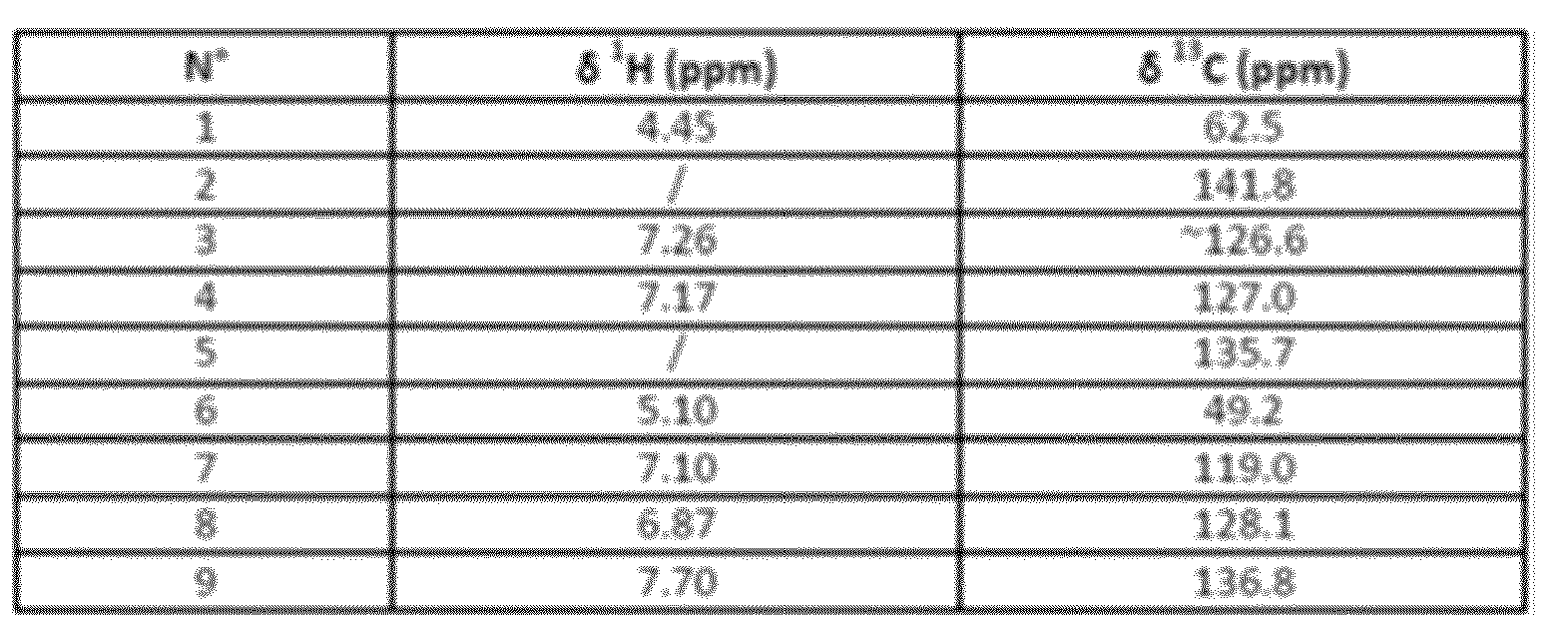
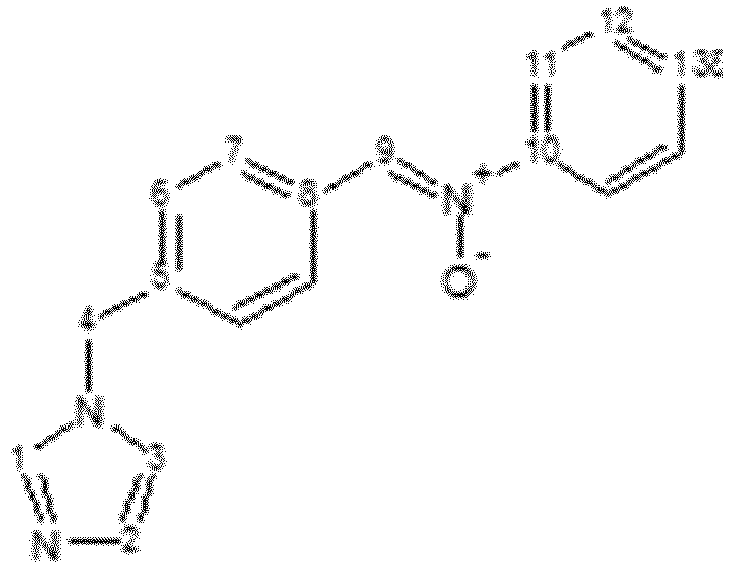
- the 1 H NMR spectrum coupled to the 2D HSQC 1 H / 13C and HMBC 1 H / 13 C experiments allow the structural determination of the molecules (see allocation tables).
- the molar quantifications are carried out from the 1D 1 H quantitative NMR spectrum.
- the determination of the molar content of grafted nitrile oxide compound is carried out by NMR analysis.
- the spectra are acquired on a 500 MHz BRUKER spectrometer equipped with a “BBFO-zgrad-5 mm CryoSonde”.
- the quantitative 1 H NMR experiment uses a 30 ° single pulse sequence and a 5 second repetition delay between each acquisition.
- the samples are solubilized in deuterated chloroform (CDCl3) in order to obtain a “lock” signal.
- This compound can be prepared according to the following reaction scheme:
- This compound can be obtained according to a procedure described in the following article: Zenkevich, IG; Makarov, AA; Russian Journal of General Chemistry; flight. 77; nb. 4; (2007); p. 611-619 ( Zhurnal Obshchei Khimii; flight. 77; nb. 4; (2007); p. 653 - 662 )
- This compound can be obtained according to a procedure described in the following article: Yakubov, AP; Tsyganov, DV; Belen'kii, LI; Krayushkin, MM; Bulletin of the Academy of Sciences of the USSR, Division of Chemical Science (English Translation); flight. 40; nb. 7.2; (1991); p. 1427 - 1432 ( Izvestiya Akademii Nauk SSSR, Seriya Khimicheskaya; nb. 7; (1991); p. 1609 - 1615 )
- the modifying agent obtained according to the procedure described above is used with a molar purity of 93 mol%.
- the SBR before modification contains 25% of styrene unit and 58% of unit 1,2 of the butadiene part.
- 0.5 g of anti-oxidant N- (1,3-dimethylbutyl) -N'-phenyl-p-phenylenediamine is then incorporated.
- the mixture is homogenized in 15 wallet passes.
- This mixing phase is followed by a heat treatment at 120 ° C. for 10 minutes in a press at 10 bar pressure.
- the suspension is stirred for 10-15 minutes and the precipitate is filtered, washed on the filter with a mixture of CH 2 Cl 2 / petroleum ether (2 ml / 4 ml) and with petroleum ether (40/60) (6 ml) and finally dried for 10-15 hours under atmospheric pressure at room temperature.
- a white solid (4.85 g, 15.9 mmol, yield 79%) with a melting point of 142 ° C. is obtained.
- the molar purity is greater than 71% ( 1 H NMR).
- the crude product (4.4 g) is redissolved in acetone (100 ml), then this solution poured into water (500 ml), the suspension is stirred for 5-10 minutes.
- the synthetic polyisoprene (IR) before modification contains 98% by weight of 1,4-cis units.
- the 1,3-dipolar compound is incorporated at a rate of 1.35 g per 100 g of IR on a roller tool (external mixer at 30 ° C.).
- 1 g of anti-oxidant N- (1,3-dimethylbutyl) -N'-phenyl-p-phenylenediamine is then incorporated per 100 g of IR.
- the mixture is homogenized in 12 wallet passes.
- This mixing phase is followed by a heat treatment at 120 ° C. for 10 minutes in a press at 10 bar pressure.
- Analysis by 1 H NMR made it possible to determine a molar grafting rate of 0.20% and a molar grafting yield of 71%.
- This compound can be prepared according to the following reaction scheme:
- a mixture of 4-chloromethylbenzoic acid (10.64 g, 0.062 mol), of DMF (70 mg, catalytic amount) and of SOCl 2 (25 mL, 0.346 mol) is heated at 75 ° C. for 2 hours.
- the brown solution is evaporated under reduced pressure for 1.5 hours at 30 ° C. 12.9 g of a brown oil are obtained containing a small amount of a solid.
- anhydrous ethanol 60 mL is added all at once.
- the temperature of the reaction medium immediately rises to 40 ° C.
- the solution obtained is then brought to reflux (T bath 95 ° C.) for 3 hours.
- the reaction crude is dissolved in CH 2 Cl 2 (150 mL) then concentrated under reduced pressure at 70-80 ° C.
- the organic phase is extracted with CH 2 Cl 2 three times and the combined organic phases are washed with water. Brown oil (8.00 g, yield 51%) is obtained.
- the molar purity is greater than 81% ( 1 H NMR). The product was used without further purification.
- Phenylhydroxylamine was synthesized according to the procedure described in Org.Syntheses, Coll. Flight. 1, p. 445, 1941 ; Org.Syntheses, Coll. Flight. 3, p. 668, 1955
- the SBR-g and IR-g elastomers are used for the preparation of the rubber compositions C-SBR-g and C-IR-g.
- the SBR and IR elastomers which were used to prepare the SBR-g and IR-g grafted elastomers are used in unmodified form to constitute the elastomeric matrix of the control compositions C-SBR and C-IR respectively.
- compositions C-SBR-g and C-IR-g are in accordance with the invention.
- Compositions C-SGR and C-IR are respective control compositions of compositions C-SBR-g and C-IR-g.
- the procedure for the manufacture of these compositions is as follows: the elastomer is introduced into an internal mixer (final filling rate: approximately 70% by volume), the initial tank temperature of which is approximately 110 ° C. , silica, the coupling agent, as well as the various other ingredients with the exception of the vulcanization system.
- a thermomechanical work (non-productive phase) is then carried out in one step, which lasts approximately 5 min to 6 minutes, until a maximum “fall” temperature of 160 ° C. is reached.
- the mixture thus obtained is recovered, it is cooled and then sulfur and a sulfenamide type accelerator are incorporated on a mixer (homo-finisher) at 23 ° C, while mixing the whole (productive phase) for an appropriate time (for example between 5 and 12 min).
- compositions thus obtained are then calendered, either in the form of plates (with a thickness ranging from 2 to 3 mm) or thin sheets of rubber, for the measurement of their physical or mechanical properties, or in the form of directly usable profiles, after cutting and / or assembly to the desired dimensions, for example as semi-finished products for tires, in particular for treads.
- Crosslinking is carried out at 150 ° C.
- the applied crosslinking time, t ' c (90) is the time required for the torque of the composition to reach 90% of the maximum torque of the composition.
- the torques of the composition are measured at 150 ° C. with an oscillating chamber rheometer, according to DIN 53529 - part 3 (June 1983).
- t ' c (90) is determined according to standard NF T 43-015 for each of the compositions.
- the dynamic properties are measured on a viscoanalyst (Metravib VA4000), according to standard ASTM D 5992-96.
- the response of a sample of vulcanized composition (cylindrical test piece 4 mm thick and 400 mm 2 in section) is recorded, subjected to a sinusoidal stress in alternating simple shear, at a frequency of 10 Hz, under normal conditions of temperature (23 ° C) according to standard ASTM D 1349-99, or depending on the case at a different temperature (100 ° C).
- a strain amplitude sweep is carried out from 0.1% to 100% (outward cycle), then from 100% to 0.1% (return cycle).
- Table (II) Composition C-SBR C-SBR-g C-IR C-IR-g Cooked properties MSA100 at 23 ° C 2.83 3.19 1.84 3.72 tan ⁇ max at 23 ° C 0.28 0.17 0.23 0.08 ⁇ G * at 23 ° C 4 0.93 3.27 0.59 G * at 100 ° C 1.61 1.63 1.35 1.45 tan ⁇ max at 100 ° C 0.13 0.08 0.13 0.06
- compositions C-SBR-g and C-IR-g exhibit at 23 ° C. an MSA100 modulus at 23 ° C. which is much higher than that of the respective control compositions C-SBR and C-IR.
- This increase in rigidity when cooked is obtained although a very significant decrease in hysteresis at 23 ° C is also observed for C-SBR-g and C-IR-g in comparison to their respective control C-SBR and C-IR.
- the increase in stiffness when cooked is all the more remarkable the greater the drop in hysteresis.
- compositions according to the invention C-SBR-g and C-IR-g retain a level of rigidity when cooked at 100 ° C. comparable to that of the respective control compositions C-SBR and C-IR.
- These results suggest a temperature versatility of the rubber composition in accordance with the invention.
- a tread containing the composition C-SBR-g or C-IR-g will allow the tire to have road behavior at least as good as the control composition C-SBR or C-IR, in more extreme driving conditions, especially for sports car tires driving at high speed.
Landscapes
- Chemical & Material Sciences (AREA)
- Organic Chemistry (AREA)
- General Chemical & Material Sciences (AREA)
- Health & Medical Sciences (AREA)
- Chemical Kinetics & Catalysis (AREA)
- Medicinal Chemistry (AREA)
- Polymers & Plastics (AREA)
- Compositions Of Macromolecular Compounds (AREA)
- Addition Polymer Or Copolymer, Post-Treatments, Or Chemical Modifications (AREA)
- Plural Heterocyclic Compounds (AREA)
Description
Le domaine de la présente invention est celui du greffage avec des agents de modification destinés à fonctionnaliser des polymères insaturés le long de la chaîne polymère.The field of the present invention is that of grafting with modifying agents intended to functionalize unsaturated polymers along the polymer chain.
La modification de la structure chimique d'un polymère impacte généralement les propriétés chimiques et physiques du polymère, ainsi que les propriétés des compositions le contenant. La modification de structure d'un polymère, telle que la fonctionnalisation d'un polymère, est particulièrement recherchée lorsque l'on souhaite mettre en présence un polymère et une charge dans une composition. La modification chimique d'un polymère peut améliorer la dispersion de la charge dans le polymère et permettre ainsi l'obtention d'un matériau davantage homogène. Dans le cas de certaines charges, comme le noir de carbone ou la silice, une meilleure dispersion de la charge va généralement se traduire par une baisse d'hystérèse de la composition. Une telle propriété est recherchée, notamment dans les compositions de caoutchouc destinées par exemple à des applications pour pneumatique. Cette baisse d'hystérèse s'accompagne souvent d'une baisse de la rigidité à cuit de la composition, ce qui peut rendre la composition inadaptée à l'usage que l'on veut en faire. Il existe donc un besoin de trouver des agents de modification qui permettent à la fois de fonctionnaliser un polymère et de modifier ce compromis hystérèse rigidité à cuit d'une composition comprenant un polymère et une charge.The modification of the chemical structure of a polymer generally impacts the chemical and physical properties of the polymer, as well as the properties of the compositions containing it. The modification of the structure of a polymer, such as the functionalization of a polymer, is particularly sought after when it is desired to bring together a polymer and a filler in a composition. Chemical modification of a polymer can improve the dispersion of the filler in the polymer and thus allow a more homogeneous material to be obtained. In the case of certain fillers, such as carbon black or silica, better dispersion of the filler will generally result in a decrease in the hysteresis of the composition. Such a property is sought after, in particular in rubber compositions intended for example for applications for tires. This drop in hysteresis is often accompanied by a drop in the baked-on rigidity of the composition, which can make the composition unsuitable for the use to be made of it. There is therefore a need to find modifying agents which make it possible both to functionalize a polymer and to modify this hysteresis-stiffness-to-cure compromise of a composition comprising a polymer and a filler.
Parmi les réactions chimiques pour modifier un polymère insaturé, on décompte les réactions de greffage d'un composé. Des composés connus pour se greffer sur un polymère insaturé sont par exemple des composés 1,3-dipolaires tels que décrits dans les demandes de brevet
L'invention concerne un procédé pour modifier un polymère insaturé, lequel procédé comprend la réaction d'un composé 1,3-dipolaire sur au moins une et de préférence plusieurs insaturations du polymère insaturé, le composé 1,3-dipolaire étant choisi dans le groupe constitué par les oxydes de nitrile, les imines de nitrile et les nitrone et répondant à la formule (I)
Q-A-B (I)
dans laquelle :
- Q contient un motif -C≡N→O, -C≡N→N- ou -C=N(→O)-,
- A est un atome ou un groupe d'atomes reliant Q à B,
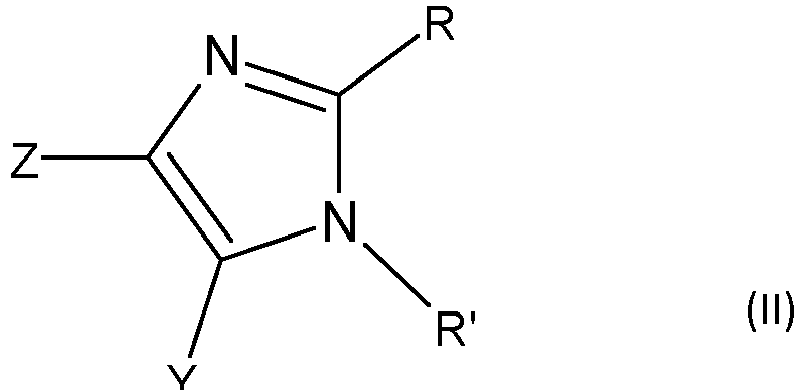
- B comprend un cycle répondant à la formule (II)

- 3 des 4 symboles Z, Y, R et R' identiques ou différents représentent chacun un atome ou un groupe d'atomes,
- et le quatrième symbole Z, Y, R ou R' désigne un rattachement direct à A,
- A contenant jusqu'à 20 atomes de carbone est un groupe aliphatique ou un groupe aromatique,
- R' désigne le rattachement direct à A,
- R représente un atome d'hydrogène ou un groupe alkyle,
- Z et Y sont chacun un atome d'hydrogène.
QAB (I)
in which :
- Q contains a pattern -C≡N → O, -C≡N → N- or -C = N (→ O) -,
- A is an atom or a group of atoms connecting Q to B,
- B comprises a ring corresponding to formula (II)
- 3 of the 4 symbols Z, Y, R and R 'which are identical or different each represent an atom or a group of atoms,
- and the fourth symbol Z, Y, R or R 'denotes a direct attachment to A,
- A containing up to 20 carbon atoms is an aliphatic group or an aromatic group,
- R 'denotes direct attachment to A,
- R represents a hydrogen atom or an alkyl group,
- Z and Y are each a hydrogen atom.
L'invention concerne également un polymère qui est susceptible d'être obtenu par le procédé conforme à l'invention.The invention also relates to a polymer which can be obtained by the process according to the invention.
L'invention concerne aussi un composé 1,3-dipolaire défini dans l'une quelconque des revendications 2 à 6 et un composé 1,3-dipolaire défini dans l'une quelconque des revendications 8 à 9, lesquels composés sont utiles au procédé de greffage conforme à l'invention.The invention also relates to a 1,3-dipolar compound defined in any one of claims 2 to 6 and a 1,3-dipolar compound defined in any one of claims 8 to 9, which compounds are useful in the process of grafting according to the invention.
Dans la présente description, sauf indication expresse différente, tous les pourcentages (%) indiqués sont des % en masse. L'abréviation "pce" signifie parties en poids pour cent parties d'élastomère (du total des élastomères si plusieurs élastomères sont présents).In the present description, unless expressly indicated otherwise, all the percentages (%) indicated are% by weight. The abbreviation "phr" stands for parts by weight per hundred parts of elastomer (of the total elastomers if more than one elastomer is present).
D'autre part, tout intervalle de valeurs désigné par l'expression "entre a et b" représente le domaine de valeurs supérieur à "a" et inférieur à "b" (c'est-à-dire bornes a et b exclues) tandis que tout intervalle de valeurs désigné par l'expression "de a à b" signifie le domaine de valeurs allant de "a" jusqu'à "b" (c'est-à-dire incluant les bornes strictes a et b).On the other hand, any interval of values designated by the expression "between a and b" represents the range of values greater than "a" and less than "b" (that is to say limits a and b excluded) while any range of values designated by the expression "from a to b" means the range of values going from "a" to "b" (that is to say including the strict limits a and b).
Le terme composé 1,3-dipolaire est compris selon la définition donnée par IUPAC.The term 1,3-dipolar compound is understood as defined by IUPAC.
Le composé 1,3-dipolaire utile au procédé conforme à l'invention répond à la formule (I) :
Q-A-B (I)
dans laquelle :
- Q contient un motif -C≡N→O, -C≡N→N- ou -C=N(→O)-,
- A est un atome ou un groupe d'atomes reliant Q à B,
- B comprend un cycle imidazole répondant à la formule (II) :
- 3 des 4 symboles Z, Y, R et R' identiques ou différents représentent chacun un atome ou un groupe d'atomes,
- et le seul quatrième symbole désigne un rattachement direct à A.
QAB (I)
in which :
- Q contains a pattern -C≡N → O, -C≡N → N- or -C = N (→ O) -,
- A is an atom or a group of atoms connecting Q to B,
- B comprises an imidazole ring corresponding to formula (II):
- 3 of the 4 symbols Z, Y, R and R 'which are identical or different each represent an atom or a group of atoms,
- and the only fourth symbol denotes a direct attachment to A.
Selon l'invention, R' désigne un rattachement direct à A, auquel cas R' est le 4ème symbole.According to the invention, R 'denotes a direct connection to A, in which case R' is the 4th symbol.
Selon l'invention, Z et Y sont chacun un atome d'hydrogène.According to the invention, Z and Y are each a hydrogen atom.
Selon un mode de réalisation particulier de l'invention, R représente un atome d'hydrogène.According to a particular embodiment of the invention, R represents a hydrogen atom.
Selon un mode de réalisation particulier de l'invention, R est un groupe alkyle contenant de préférence de 1 à 12 atomes de carbone, de manière encore plus préférentielle un méthyle.According to a particular embodiment of the invention, R is an alkyl group preferably containing from 1 to 12 carbon atoms, even more preferably a methyl.
A est un groupe contenant jusqu'à 20 atomes de carbone, lequel groupe peut contenir au moins un hétéroatome. A est un groupe aliphatique ou aromatique.A is a group containing up to 20 carbon atoms, which group may contain at least one heteroatom. A is an aliphatic or aromatic group.
Lorsque A est un groupe aliphatique, A contient préférentiellement de 1 à 20 atomes de carbone, plus préférentiellement de 1 à 12 atomes de carbone, encore plus préférentiellement de 1 à 6 atomes de carbone, tout particulièrement de 1 à 3 atomes de carbone. Lorsque A est un groupe aromatique, A contient préférentiellement de 6 à 20 atomes de carbone, plus préférentiellement de 6 à 12 atomes de carbone.When A is an aliphatic group, A preferably contains from 1 to 20 carbon atoms, more preferably from 1 to 12 carbon atoms, even more preferably from 1 to 6 carbon atoms, very particularly from 1 to 3 carbon atoms. When A is an aromatic group, A preferably contains from 6 to 20 carbon atoms, more preferably from 6 to 12 carbon atoms.
Comme groupe divalent A convient particulièrement un groupe alkylène contenant de 1 à 20 atomes de carbone, préférentiellement de 1 à 12 atomes de carbone, plus préférentiellement de 1 à 6 atomes de carbone, encore plus préférentiellement de 1 à 3 atomes de carbone. On peut citer comme groupe A divalent contenant de 1 à 3 atomes de carbone qui convient le groupe méthylène.As divalent group A particularly suitable is an alkylene group containing from 1 to 20 carbon atoms, preferably from 1 to 12 carbon atoms, more preferably from 1 to 6 carbon atoms, still more preferably from 1 to 3 carbon atoms. As a divalent group A containing from 1 to 3 carbon atoms, which is suitable, there may be mentioned the methylene group.
Comme groupe divalent A peut aussi convenir un groupe arylène contenant de préférence de 6 à 20 atomes de carbone, plus préférentiellement de 6 à 12 atomes de carbone.Suitable divalent group A may also be an arylene group containing preferably from 6 to 20 carbon atoms, more preferably from 6 to 12 carbon atoms.
Conviennent tout particulièrement comme composés 1,3-dipolaires les composés choisis dans le groupe constitué par les oxydes de nitrile, les imines de nitrile et les nitrones, auquel cas Q contient un motif -C≡N→O, -C≡N→N- ou -C=N(→O)-.The compounds chosen from the group consisting of nitrile oxides, nitrile imines and nitrones, in which case Q contains a -C≡N → O, -C≡N → N unit, are most particularly suitable as 1,3-dipolar compounds - or -C = N (→ O) -.
Selon le mode de réalisation particulier de l'invention où Q comprend un motif -C≡N→O, Q de préférence comporte, de manière plus préférentielle représente le motif répondant à la formule (III) dans laquelle quatre des cinq symboles R1 à R5 identiques ou différents, sont chacun un atome ou un groupe d'atomes et le cinquième symbole désigne un rattachement direct à A, sachant que R1 et R5 sont tous les deux différents de H. Les quatre des cinq symboles R1 à R5 peuvent être des groupes aliphatiques ou aromatiques. Les groupes aliphatiques peuvent contenir de 1 à 20 atomes de carbone, préférentiellement de 1 à 12 atomes de carbone, plus préférentiellement de 1 à 6 atomes de carbone, encore plus préférentiellement de 1 à 3 atomes de carbone. Les groupes aromatiques peuvent contenir de 6 à 20 atomes de carbone, préférentiellement de 6 à 12 atomes de carbone.

R1, R3 et R5 sont préférentiellement chacun un groupe alkyle de 1 à 6 atomes de carbone, plus préférentiellement de 1 à 3 atomes de carbone, encore plus préférentiellement un groupe méthyle ou éthyle.R1, R3 and R5 are each preferably an alkyl group of 1 to 6 carbon atoms, more preferably of 1 to 3 carbon atoms, still more preferably a methyl or ethyl group.
Selon une variante de ce mode de réalisation particulier de l'invention, R1, R3 et R5 sont identiques. Selon cette variante où ils sont identiques, R1, R3 et R5 sont préférentiellement chacun un groupe alkyle de 1 à 6 atomes de carbone, plus préférentiellement de 1 à 3 atomes de carbone, encore plus préférentiellement un groupe méthyle ou éthyle.According to a variant of this particular embodiment of the invention, R1, R3 and R5 are identical. According to this variant where they are identical, R1, R3 and R5 are each preferably an alkyl group of 1 to 6 carbon atoms, more preferably of 1 to 3 carbon atoms, even more preferably a methyl or ethyl group.
De manière davantage préférentielle, le composé 1,3-dipolaire est le composé 2,4,6-triméthyl-3-((2-méthyl-1H-imidazol-1-yl)méthyl)benzonitrile oxyde répondant à la formule (IIIa) ou le composé 2,4,6-triéthyl-3-((2-méthyl-1H-imidazol-1-yl)méthyl)benzonitrile oxyde répondant à la formule (IIIb) :


Selon le mode de réalisation particulier de l'invention où Q comprend un motif -C=N(→O)-, Q de préférence comporte, de manière plus préférentielle représente le motif répondant à la formule (IV) ou (V)
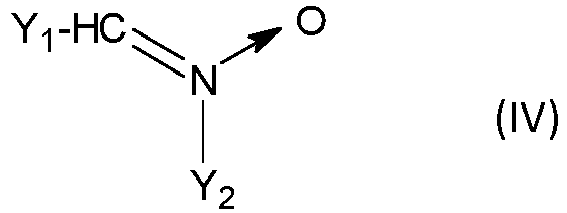

- Y1 est un groupe aliphatique, préférentiellement un groupe alkyle contenant de préférence 1 à 12 atomes de carbone, ou un groupe aromatique contenant de 6 à 20 atomes de carbone, préférentiellement un groupe alkylaryle, plus préférentiellement un groupe phényle ou tolyle,
- et Y2, comportant un rattachement direct à A, est un groupe aliphatique, préférentiellement un groupe alkylène contenant de préférence 1 à 12 atomes de carbone, ou un groupe aromatique contenant préférentiellement de 6 à 20 atomes de carbone et comportant sur son noyau benzénique le rattachement direct à A.
- Y 1 is an aliphatic group, preferably an alkyl group preferably containing 1 to 12 carbon atoms, or an aromatic group containing 6 to 20 carbon atoms, preferably an alkylaryl group, more preferably a phenyl or tolyl group,
- and Y 2 , comprising a direct attachment to A, is an aliphatic group, preferably an alkylene group preferably containing 1 to 12 carbon atoms, or an aromatic group preferably containing from 6 to 20 carbon atoms and comprising on its benzene ring the direct attachment to A.
Le rattachement direct du noyau benzénique de Y2 à A revient à dire que A est un substituant du noyau benzénique de Y2.The direct attachment of the benzene ring of Y 2 to A amounts to saying that A is a substituent of the benzene ring of Y 2 .
Selon ce mode de réalisation particulier de l'invention, le composé 1,3-dipolaire est le composé de formule (IVa), (IVb), (Va) ou (Vb)


Le procédé, objet de l'invention, comprend la réaction du composé 1,3-dipolaire décrit précédemment sur au moins une et de préférence plusieurs insaturations d'un polymère insaturé. On entend par plusieurs insaturations au moins 2 insaturations.The process, which is the subject of the invention, comprises the reaction of the 1,3-dipolar compound described above on at least one and preferably several unsaturations of an unsaturated polymer. By several unsaturations is meant at least 2 unsaturations.
Le composé 1,3-dipolaire peut être utilisé pour modifier un polymère insaturé par une réaction de greffage du composé 1,3-dipolaire sur au moins une et de préférence plusieurs insaturations du polymère insaturé.The 1,3-dipolar compound can be used to modify an unsaturated polymer by a grafting reaction of the 1,3-dipolar compound on at least one and preferably more unsaturations of the unsaturated polymer.
Selon un mode de réalisation préférentiel de l'invention, les insaturations du polymère sont des liaisons carbone-carbone, de préférence des doubles liaisons carbone-carbone.According to a preferred embodiment of the invention, the unsaturations of the polymer are carbon-carbon bonds, preferably carbon-carbon double bonds.
Le greffage du composé 1,3-dipolaire est effectué par cycloaddition [3+2] du ou des groupes réactifs du composé 1,3-dipolaire sur une ou plusieurs doubles liaisons d'une chaîne élastomère diénique. Le mécanisme de la cycloaddition d'un oxyde de nitrile, d'une nitrone et d'une imine de nitrile peut être illustré par les équations suivantes, dans lesquelles le symbole ¤ représente un quelconque substituant :
- Cycloaddition d'un oxyde de nitrile sur une insaturation ou double liaison d'un élastomère diénique (ici un polyisoprène)

- Cycloaddition d'une nitrone sur une insaturation ou double liaison d'un élastomère diénique (ici un polyisoprène)

- Cycloaddition d'une imine de nitrile sur une insaturation ou double liaison d'un élastomère diénique (ici un polyisoprène)
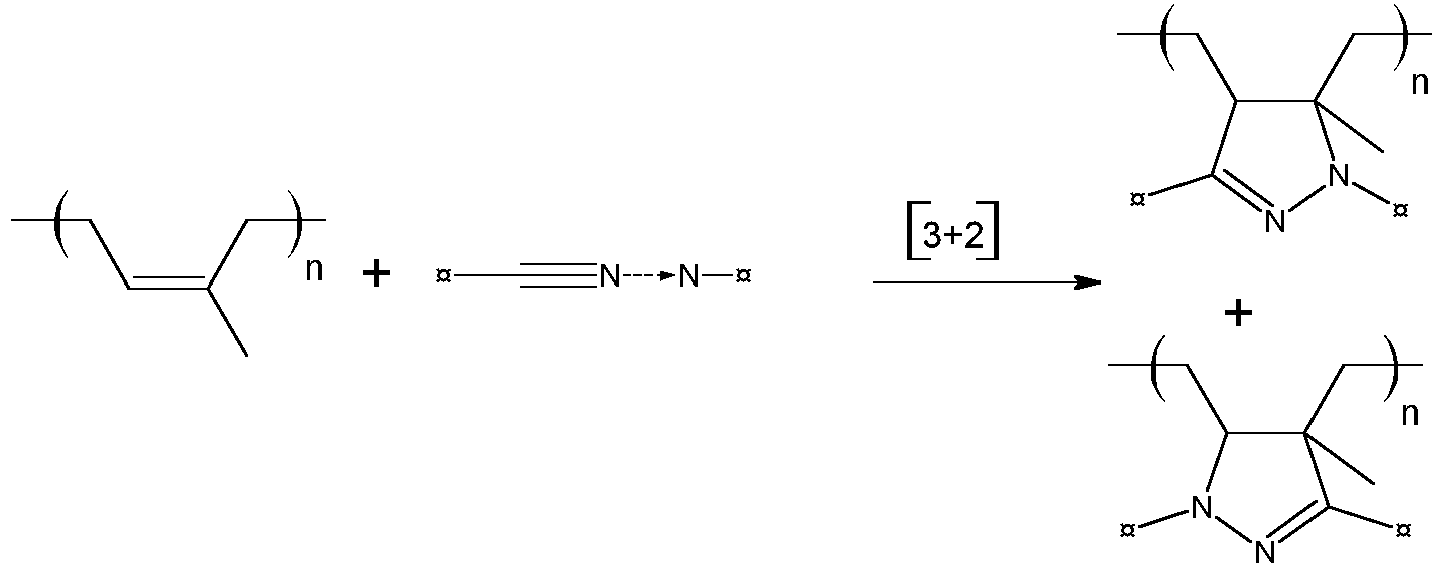
- Cycloaddition of a nitrile oxide on an unsaturation or double bond of a diene elastomer (here a polyisoprene)
- Cycloaddition of a nitrone on an unsaturation or double bond of a diene elastomer (here a polyisoprene)
- Cycloaddition of a nitrile imine on an unsaturation or double bond of a diene elastomer (here a polyisoprene)
Le greffage du composé 1,3-dipolaire peut être réalisé en masse, par exemple dans un mélangeur interne ou un mélangeur externe tel qu'un mélangeur à cylindres. Le greffage est alors mis en œuvre soit à une température du mélangeur externe ou du mélangeur interne inférieure à 60°C, suivi d'une étape de réaction de greffage sous presse ou en étuve à des températures allant de 80°C à 200°C, soit à une température du mélangeur externe ou du mélangeur interne supérieure à 60°C sans traitement thermique postérieur.The grafting of the 1,3-dipolar compound can be carried out in bulk, for example in an internal mixer or an external mixer such as a roller mixer. The grafting is then carried out either at a temperature of the external mixer or of the internal mixer below 60 ° C, followed by a grafting reaction step in a press or in an oven at temperatures ranging from 80 ° C to 200 ° C. , or at a temperature of the external mixer or of the internal mixer above 60 ° C without subsequent heat treatment.
Le procédé de greffage peut également être effectué en solution. La température à laquelle est mené le greffage est facilement ajustée par l'homme du métier à partir de ses connaissances générales en tenant compte de la concentration du milieu réactionnel, de la température de reflux du solvant, de la stabilité thermique du polymère et du composé 1,3-dipolaire. Par exemple peut convenir une température aux alentours de 60°C. Le polymère ainsi modifié peut être séparé de sa solution par tout type de moyen connu par l'homme de l'art et en particulier par une opération d'évaporation du solvant sous pression réduite ou par une opération de stripping à la vapeur d'eau.The grafting process can also be carried out in solution. The temperature at which the grafting is carried out is easily adjusted by a person skilled in the art on the basis of his general knowledge, taking into account the concentration of the reaction medium, the reflux temperature of the solvent, the thermal stability of the polymer and of the compound. 1,3-dipolar. For example, a temperature around 60 ° C can be suitable. The polymer thus modified can be separated from its solution by any type of means known to those skilled in the art and in particular by an operation of evaporating the solvent under reduced pressure or by a steam stripping operation. .
Dans la réaction de greffage pour modifier le polymère insaturé, on fait réagir le composé 1,3-dipolaire selon une stœchiométrie préférentielle comprise entre 0 et 3 équivalents molaires, plus préférentiellement entre 0 et 2 équivalents molaires, encore plus préférentiellement entre 0 et 1 équivalent molaire, voire encore plus préférentiellement entre 0 et 0.7 équivalent molaire de cycle imidazole pour 100 moles d'unités monomères constituant le polymère. Pour chacune de ces plages préférentielles, la borne inférieure est avantageusement d'au moins 0.1 équivalent molaire de composé 1,3-dipolaire. La quantité de composé 1,3-dipolaire utilisée pour greffer le polymère est exprimée en équivalent molaire de cycle imidazole. Par exemple, si le composé 1,3-dipolaire contient un seul cycle imidazole de formule (II) telle que définie précédemment, à une mole de composé 1,3-dipolaire correspond une mole de cycle imidazole. Si le composé 1,3-dipolaire contient deux cycles imidazole de formule (II) telle que définie précédemment, à une mole de composé 1,3-dipolaire correspond deux moles de cycle imidazole. Dans ce dernier cas l'utilisation du composé 1,3-dipolaire selon un équivalent molaire de cycle imidazole correspond à une demi-mole de composé 1,3-dipolaire.In the grafting reaction to modify the unsaturated polymer, the 1,3-dipolar compound is reacted according to a preferential stoichiometry of between 0 and 3 molar equivalents, more preferably between 0 and 2 molar equivalents, even more preferably between 0 and 1 equivalent. molar, or even more preferably between 0 and 0.7 molar equivalent of imidazole ring per 100 moles of monomer units constituting the polymer. For each of these preferred ranges, the lower limit is advantageously at least 0.1 molar equivalent of 1,3-dipolar compound. The amount of 1,3-dipolar compound used to graft the polymer is expressed in molar equivalent of imidazole ring. For example, if the 1,3-dipolar compound contains a single imidazole ring of formula (II) as defined previously, one mole of 1,3-dipolar compound corresponds to one mole of imidazole ring. If the 1,3-dipolar compound contains two imidazole rings of formula (II) as defined above, one mole of 1,3-dipolar compound corresponds to two moles of imidazole ring. In the latter case, the use of the 1,3-dipolar compound according to one molar equivalent of the imidazole ring corresponds to half a mole of 1,3-dipolar compound.
De manière préférentielle, que le greffage soit réalisé en solution ou en masse, le polymère est au préalable antioxydé pour prévenir une éventuelle dégradation de la macrostructure du polymère au cours de la réaction de greffage.Preferably, whether the grafting is carried out in solution or in bulk, the polymer is first antioxidated in order to prevent possible degradation of the macrostructure of the polymer during the grafting reaction.
Le polymère insaturé à modifier présente au moins une et de préférence plusieurs insaturations qui sont susceptibles de réagir avec le composé 1,3 dipolaire conforme à l'invention.The unsaturated polymer to be modified has at least one and preferably several unsaturations which are capable of reacting with the 1,3-dipolar compound in accordance with the invention.
Le polymère insaturé est de préférence un polymère diénique, plus préférentiellement un élastomère diénique.The unsaturated polymer is preferably a diene polymer, more preferably a diene elastomer.
Par polymère diénique, doit être compris un polymère comprenant des unités monomères diéniques, en particulier des unités de monomères 1,3-diéniques.By diene polymer should be understood a polymer comprising diene monomer units, in particular 1,3-diene monomer units.
Par élastomère (ou indistinctement caoutchouc) "diénique", doit être compris de manière connue un élastomère constitué au moins en partie (i.e., un homopolymère ou un copolymère) d'unités monomères diènes (monomères porteurs de deux doubles liaisons carbone-carbone, conjuguées ou non).By elastomer (or indiscriminately rubber) "diene", should be understood in a known manner an elastomer consisting at least in part (ie, a homopolymer or a copolymer) of diene monomer units (monomers bearing two double carbon-carbon bonds, conjugated or not).
Ces élastomères diéniques peuvent être classés dans deux catégories : "essentiellement insaturés" ou "essentiellement saturés". On entend en général par "essentiellement insaturé", un élastomère diénique issu au moins en partie de monomères diènes conjugués, ayant un taux de motifs ou unités d'origine diénique (diènes conjugués) qui est supérieur à 15% (% en moles) ; c'est ainsi que des élastomères diéniques tels que les caoutchoucs butyle ou les copolymères de diènes et d'alpha-oléfines type EPDM n'entrent pas dans la définition précédente et peuvent être notamment qualifiés d'élastomères diéniques "essentiellement saturés" (taux de motifs d'origine diénique faible ou très faible, toujours inférieur à 15%). Dans la catégorie des élastomères diéniques "essentiellement insaturés", on entend en particulier par élastomère diénique "fortement insaturé" un élastomère diénique ayant un taux de motifs d'origine diénique (diènes conjugués) qui est supérieur à 50%.These diene elastomers can be classified into two categories: "essentially unsaturated" or "essentially saturated". In general, the term “essentially unsaturated” is understood to mean a diene elastomer derived at least in part from conjugated diene monomers, having a level of units or units of diene origin (conjugated dienes) which is greater than 15% (% by moles); it is thus that diene elastomers such as butyl rubbers or copolymers of dienes and alpha-olefins of the EPDM type do not fall within the preceding definition and can in particular be qualified as "essentially saturated" diene elastomers (content of units of weak or very weak diene origin, always less than 15%). In the category of “essentially unsaturated” diene elastomers, the term “highly unsaturated” diene elastomer is understood to mean in particular a diene elastomer having a level of units of diene origin (conjugated dienes) which is greater than 50%.
Ces définitions étant données, on entend plus particulièrement par élastomère diénique susceptible d'être utilisé dans les compositions conformes à l'invention:
- (a) - tout homopolymère d'un monomère diène conjugué, notamment tout homopolymère obtenu par polymérisation d'un monomère diène conjugué ayant de 4 à 12 atomes de carbone;
- (b) - tout copolymère obtenu par copolymérisation d'un ou plusieurs diènes conjugués entre eux ou avec un ou plusieurs composés vinyle aromatique ayant de 8 à 20 atomes de carbone;
- (c) - un copolymère ternaire obtenu par copolymérisation d'éthylène, d'une α-oléfine ayant 3 à 6 atomes de carbone avec un monomère diène non conjugué ayant de 6 à 12 atomes de carbone, comme par exemple les élastomères obtenus à partir d'éthylène, de propylène avec un monomère diène non conjugué du type précité tel que notamment l'hexadiène-1,4, l'éthylidène norbornène, le dicyclopentadiène;
- (d) - un copolymère d'isobutène et d'isoprène (caoutchouc butyle), ainsi que les versions halogénées, en particulier chlorées ou bromées, de ce type de copolymère.
- (a) - any homopolymer of a conjugated diene monomer, in particular any homopolymer obtained by polymerization of a conjugated diene monomer having from 4 to 12 carbon atoms;
- (b) - any copolymer obtained by copolymerization of one or more dienes conjugated with one another or with one or more vinyl aromatic compounds having from 8 to 20 carbon atoms;
- (c) - a ternary copolymer obtained by copolymerization of ethylene, of an α-olefin having 3 to 6 carbon atoms with an unconjugated diene monomer having 6 to 12 carbon atoms, such as for example the elastomers obtained from ethylene, propylene with an unconjugated diene monomer of the aforementioned type such as in particular 1,4-hexadiene, ethylidene norbornene, dicyclopentadiene;
- (d) - a copolymer of isobutene and isoprene (butyl rubber), as well as the halogenated versions, in particular chlorinated or brominated, of this type of copolymer.
Bien qu'elle s'applique à tout type d'élastomère diénique, l'homme du métier du pneumatique comprendra que la présente invention est de préférence mise en œuvre avec des élastomères diéniques essentiellement insaturés, en particulier du type (a) ou (b) ci-dessus.Although it applies to any type of diene elastomer, those skilled in the art of tires will understand that the present invention is preferably implemented with essentially unsaturated diene elastomers, in particular of type (a) or (b ) above.
Dans le cas de copolymères du type (b), ceux-ci contiennent de 20 à 99% en poids d'unités diéniques et de 1 à 80% en poids d'unités vinylaromatique.In the case of copolymers of type (b), these contain from 20 to 99% by weight of diene units and from 1 to 80% by weight of vinyl aromatic units.
A titre de diènes conjugués conviennent notamment le butadiène-1,3, le 2-méthyl-1,3-butadiène, les 2,3-di(alkyle en C1-C5)-1,3-butadiènes tels que par exemple le 2,3-diméthyl-1,3-butadiène, le 2,3-diéthyl-1,3-butadiène, le 2-méthyl-3-éthyl-1,3-butadiène, le 2-méthyl-3-isopropyl-1,3-butadiène, un aryl-1,3-butadiène, le 1,3-pentadiène, le 2,4-hexadiène.Suitable conjugated dienes in particular are 1,3-butadiene, 2-methyl-1,3-butadiene, 2,3-di (C 1 -C 5 alkyl) -1,3-butadienes such as for example 2,3-dimethyl-1,3-butadiene, 2,3-diethyl-1,3-butadiene, 2-methyl-3-ethyl-1,3-butadiene, 2-methyl-3-isopropyl- 1,3-butadiene, aryl-1,3-butadiene, 1,3-pentadiene, 2,4-hexadiene.
A titre de composés vinylaromatiques conviennent par exemple le styrène, l'ortho-, méta-, para-méthylstyrène, le mélange commercial "vinyle-toluène", le para-tertiobutylstyrène, les méthoxystyrènes, les chlorostyrènes, le vinylmésitylène, le divinylbenzène, le vinylnaphtalène.Suitable vinyl aromatic compounds are, for example, styrene, ortho-, meta-, para-methylstyrene, the commercial mixture “vinyl-toluene”, para-tert-butylstyrene, methoxystyrenes, chlorostyrenes, vinylmesitylene, divinylbenzene, vinylnaphthalene.
Préférentiellement, l'élastomère diénique est un élastomère essentiellement insaturé choisi dans le groupe constitué par les polybutadiènes (BR), les polyisoprènes, les copolymères de butadiène, les copolymères d'isoprène, et les mélanges de ces élastomères. A titre d'élastomère diénique convient tout particulièrement un polybutadiène (BR), un copolymère de butadiène et de styrène (SBR), un caoutchouc naturel (NR) ou un polyisoprène de synthèse (IR) présentant préférentiellement un taux molaire de liaison cis-1,4 supérieur à 90%.Preferably, the diene elastomer is an essentially unsaturated elastomer chosen from the group consisting of polybutadienes (BR), polyisoprenes, butadiene copolymers, isoprene copolymers, and mixtures of these elastomers. As diene elastomer very particularly suitable is a polybutadiene (BR), a copolymer of butadiene and styrene (SBR), a natural rubber (NR) or a synthetic polyisoprene (IR) preferably having a molar content of cis-1 bond. , 4 greater than 90%.
L'invention a également pour objet le polymère qui peut être obtenu par le procédé décrit selon l'un quelconque de ses modes de réalisation.A subject of the invention is also the polymer which can be obtained by the process described according to any one of its embodiments.
Le polymère, objet de l'invention, est de préférence un polymère diénique, préférentiellement un élastomère diénique, plus préférentiellement un élastomère diénique essentiellement insaturé, encore plus préférentiellement un élastomère essentiellement insaturé choisi dans le groupe constitué par les polybutadiènes, les polyisoprènes, les copolymères de butadiène, les copolymères d'isoprène et les mélanges de ces élastomères.The polymer, object of the invention, is preferably a diene polymer, preferably a diene elastomer, more preferably an essentially unsaturated diene elastomer, even more preferably an essentially unsaturated elastomer chosen from the group consisting of polybutadienes, polyisoprenes, copolymers. of butadiene, isoprene copolymers and mixtures of these elastomers.
Un autre objet de l'invention est aussi un composé 1,3-dipolaire défini dans l'une quelconque des revendications 2 à 6.Another subject of the invention is also a 1,3-dipolar compound defined in any one of claims 2 to 6.
Un autre objet de l'invention est un composé 1,3-dipolaire défini dans l'une quelconque des revendications 8 à 9.Another object of the invention is a 1,3-dipolar compound defined in any one of claims 8 to 9.
Les caractéristiques précitées de la présente invention, ainsi que d'autres, seront mieux comprises à la lecture de la description suivante de plusieurs exemples de réalisation de l'invention, donnés à titre illustratif et non limitatif.The aforementioned characteristics of the present invention, as well as others, will be better understood on reading the following description of several exemplary embodiments of the invention, given by way of illustration and not by way of limitation.
L'analyse structurale ainsi que la détermination des puretés molaires des molécules de synthèses sont réalisées par une analyse RMN. Les spectres sont acquis sur un spectromètre Avance 3 400 MHz BRUKER équipé d'une sonde " large bande " BBFO-zgrad 5 mm. L'expérience RMN 1H quantitative, utilise une séquence simple impulsion 30° et un délai de répétition de 3 secondes entre chacune des 64 acquisitions. Les échantillons sont solubilisés dans un solvant deutéré, le diméthylsulfoxide deutéré (DMSO) sauf indication contraire. Le solvant deutéré est également utilisé pour le signal de lock. Par exemple, la calibration est réalisée sur le signal des protons du DMSO deutéré à 2.44 ppm par rapport à une référence TMS à 0ppm. Le spectre RMN 1H couplé aux expériences 2D HSQC 1H/13C et HMBC 1H/13C permettent la détermination structurale des molécules (cf tableaux d'attributions). Les quantifications molaires sont réalisées à partir du spectre RMN 1D 1H quantitatif.The structural analysis as well as the determination of the molar purities of the synthetic molecules are carried out by an NMR analysis. The spectra are acquired on an Avance 3400 MHz BRUKER spectrometer equipped with a 5 mm BBFO-zgrad "broadband" probe. The quantitative 1 H NMR experiment uses a 30 ° single pulse sequence and a 3 second repetition delay between each of the 64 acquisitions. The samples are solubilized in a deuterated solvent, deuterated dimethyl sulfoxide (DMSO) unless otherwise indicated. The deuterated solvent is also used for the lock signal. For example, the calibration is performed on the proton signal of deuterated DMSO at 2.44 ppm compared to a TMS reference at 0 ppm. The 1 H NMR spectrum coupled to the 2D HSQC 1 H / 13C and HMBC 1 H / 13 C experiments allow the structural determination of the molecules (see allocation tables). The molar quantifications are carried out from the 1D 1 H quantitative NMR spectrum.
La détermination du taux molaire de composé oxyde de nitrile greffé est réalisée par une analyse RMN. Les spectres sont acquis sur un spectromètre 500 MHz BRUKER équipé d'une « CryoSonde BBFO-zgrad-5 mm ». L'expérience RMN 1H quantitative, utilise une séquence simple impulsion 30° et un délai de répétition de 5 secondes entre chaque acquisition. Les échantillons sont solubilisés dans le chloroforme deutéré (CDCl3) dans le but d'obtenir un signal de « lock ».The determination of the molar content of grafted nitrile oxide compound is carried out by NMR analysis. The spectra are acquired on a 500 MHz BRUKER spectrometer equipped with a “BBFO-zgrad-5 mm CryoSonde”. The quantitative 1 H NMR experiment uses a 30 ° single pulse sequence and a 5 second repetition delay between each acquisition. The samples are solubilized in deuterated chloroform (CDCl3) in order to obtain a “lock” signal.
Des expériences RMN 2D ont permis de vérifier la nature du motif greffé grâce aux déplacements chimiques des atomes de carbone et de proton.2D NMR experiments made it possible to verify the nature of the grafted motif thanks to the chemical shifts of the carbon and proton atoms.
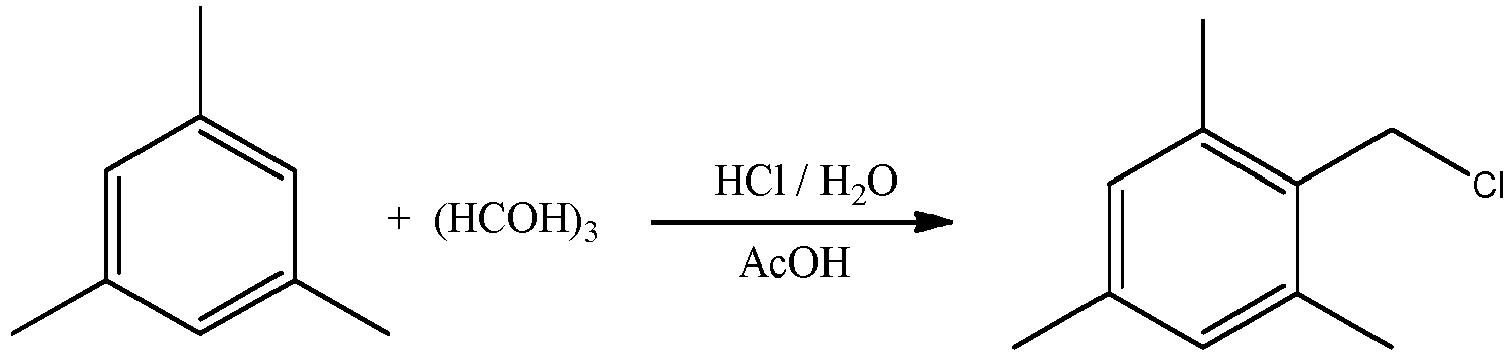
Ce composé peut être préparé selon le schéma réactionnel suivant :

Ce composé peut être obtenu selon une procédure décrite dans l'article suivant : 
Un mélange de mésitylène (100,0 g, 0,832 mol), de para-formaldéhyde (26,2 g, 0,874 mol) et d'acide chlorhydrique (240 ml, 37 %, 2,906 mol) dans l'acide acétique (240 ml) est agité et chauffé très lentement (1,5 heures) jusqu'à 37°C. Après retour à température ambiante, le mélange est dilué par de l'eau (1,0 I) avec CH2Cl2 (200 ml), le produit est extrait par CH2Cl2 (4 fois par 50 mL). Les phases organiques sont rassemblées, puis lavées par l'eau (5 fois par 100 ml) et évaporées jusqu'à 11-12 mbar (Température du bain = 42°C). Une huile incolore (133,52 g, rendement 95 %) est obtenue. Après 15-18 heures à +4°C, l'huile a cristallisé. Les cristaux sont filtrés, lavés par de l'éther de pétrole refroidi à -18°C (40 ml), puis séchés pendant 3 à 5 heures sous pression atmosphérique à température ambiante. Un solide blanc (95,9 g, rendement 68 %) de point de fusion 39 °C est obtenu. La pureté molaire est supérieure à 96 % (RMN 1H).

Ce composé peut être obtenu selon une procédure décrite dans l'article suivant : 
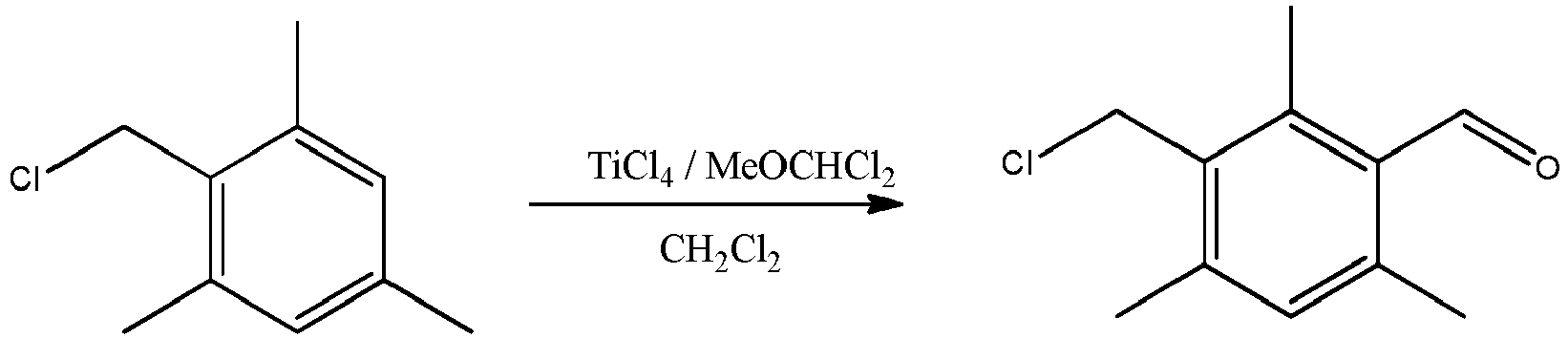
A une solution de TiCl4 (90,0 g, 0,474 mol) dans le dichlorométhane (200 ml) à 17°C est ajoutée sous argon pendant 10-12 minutes une solution du 2-(chlorométhyl)-1,3,5-triméthylbenzène (20,0 g, 0,118 mol) et de dichlorométhylméthyl éther (27,26 g, 0,237 mol) dans le dichlorométhane (200 ml). Après agitation pendant 15-20 minutes à 17-20 °C, de l'eau (1000 ml) et de la glace (500 g) sont ajoutées au milieu réactionnel. Après 10-15 minutes d'agitation, la phase organique est séparée. La phase aqueuse est extraite par CH2Cl2 (3 fois par 75 ml). Les phases organiques rassemblées sont lavées par l'eau (4 fois par 100 ml) et évaporées sous pression réduite pour conduire à un solide (Température du bain = 28°C). Le produit cible (22,74 g) est obtenu avec un rendement de 97 % de point de fusion 58 °C. La pureté molaire estimée par RMN 1H est de 95%mol.


Un mélange de 3-(chlorométhyl)-2,4,6-triméthylbenzaldéhyde (10,0 g, 0,051 mol) et d'imidazole (10,44 g, 0,127 mol) dans le DMF (10 ml) est agité à 80°C pendant une heure. Après retour à 40-50°C, le mélange est dilué par l'eau (200ml), et agité pendant 10 minutes. Le précipité obtenu est filtré et lavé sur le filtre par l'eau (4 fois par 25 ml) puis séché à température ambiante. Un solide blanc (7,92 g, rendement 64 %) de point de fusion 161 °C est obtenu. La pureté molaire est 91 % (RMN 1H).


A une solution de 2,4,6-triméthyl-3-((2-méthyl-1H-imidazol-1-yl)méthyl) benzaldéhyde (20.3 g, 0,084mol) dans EtOH (110 ml) à 40°C, est ajoutée une solution aqueuse d'hydroxylamine (809 g, 0,134 mol, 50 % dans l'eau, Aldrich) dans EtOH (10 ml). Le milieu réactionnel est agité pendant 2,5 heures à une température de 50 à 55°C. Après retour à 23°C, le précipité obtenu est filtré et lavé deux fois sur le filtre par un mélange EtOH/H2O (10 ml/15 ml) et séché pendant 15 à 20 heures sous pression atmosphérique à température ambiante. Un solide blanc (19.57 g, rendement 91 %) de point de fusion 247°C est obtenu. La pureté molaire est supérieure à 87 % (RMN 1H).


A un mélange de 2,4,6-triméthyl-3-((2-méthyl-1H-imidazol-1-yl)méthyl)benzaldéhyde oxime (8,80 g, 0,034 mol) dans CH2Cl2 (280 ml) à 6°C est ajoutée goutte à goutte une solution aqueuse de NaOCl (4 % de chlore actif, Aldrich, 49 ml) pendant 5 minutes. La température du milieu réactionnel est maintenue entre 6 et 8°C. Le milieu réactionnel est ensuite agité pendant 2 heures de 8°C à 21°C. La phase organique est séparée. La phase organique est lavée par l'eau (3 fois par 50 ml). Après concentration sous pression réduite (température du bain = 22-23°C, 220 mbar), de l'éther de pétrole (10 ml) est ajouté, le solvant est évaporé jusqu'à 8-10 ml, et la solution est maintenue à -18°C pendant 10-15 heures de façon à obtenir un précipité. Le précipité est filtré et lavé sur le filtre par le mélange de CH2Cl2 / éther de pétrole (2 ml / 6 ml) puis par l'éther de pétrole (2 fois 10 ml) et enfin séché pendant 10-15 heures sous pression atmosphérique à température ambiante. Un solide blanc (5,31 g, rendement 61 %) de point de fusion 139 °C est obtenu.Has a mixture of 2,4,6-trimethyl-3 - ((2-methyl-1H-imidazol-1-yl) methyl) benzaldehyde oxime (8.80 g, 0.034 mol) in CH 2 Cl 2 (280 ml) at 6 ° C. an aqueous solution of NaOCl (4% active chlorine, Aldrich, 49 ml) is added dropwise over 5 minutes. The temperature of the reaction medium is maintained between 6 and 8 ° C. The reaction medium is then stirred for 2 hours at 8 ° C to 21 ° C. The organic phase is separated. The organic phase is washed with water (3 times with 50 ml). After concentration under reduced pressure (bath temperature = 22-23 ° C, 220 mbar), petroleum ether (10 ml) is added, the solvent is evaporated to 8-10 ml, and the solution is maintained at -18 ° C for 10-15 hours so as to obtain a precipitate. The precipitate is filtered off and washed on the filter with a mixture of CH 2 Cl 2 / petroleum ether (2 ml / 6 ml) then with petroleum ether (2 times 10 ml) and finally dried for 10-15 hours under atmospheric pressure at room temperature. A white solid (5.31 g, 61% yield) with a melting point of 139 ° C. is obtained.
La pureté molaire est supérieure à 95 % mol (RMN 1H).

On utilise l'agent de modification obtenu selon le mode opératoire décrit ci-dessus avec une pureté molaire de 93% molaire.The modifying agent obtained according to the procedure described above is used with a molar purity of 93 mol%.
Le SBR avant modification contient 25% de motif styrène et 58% de motif 1,2 de la partie butadiénique.
On incorpore le 2,4,6-triméthyl-3-((2-méthyl-1H-imidazol-1-yl)méthyl)benzonitrile oxyde (0,58g, 2,26 mmol), à 50g de SBR sur un outil à cylindres (mélangeur externe à 30°C). On incorpore ensuite 0.5 g d'anti-oxydant N-(1,3-diméthylbutyl)-N'-phényl-p-phénylènediamine. Le mélange est homogénéisé en 15 passes portefeuille.The SBR before modification contains 25% of styrene unit and 58% of unit 1,2 of the butadiene part.
We incorporate 2,4,6-trimethyl-3 - ((2-methyl-1 H -imidazol-1-yl) methyl) benzonitrile oxide (0.58g, 2.26 mmol), to 50g of SBR on a tool with cylinders (external mixer at 30 ° C). 0.5 g of anti-oxidant N- (1,3-dimethylbutyl) -N'-phenyl-p-phenylenediamine is then incorporated. The mixture is homogenized in 15 wallet passes.
Cette phase de mélangeage est suivie d'un traitement thermique à 120°C pendant 10 minutes sous presse à 10 bars de pression.This mixing phase is followed by a heat treatment at 120 ° C. for 10 minutes in a press at 10 bar pressure.
L'analyse par RMN 1H a permis de déterminer un taux molaire de greffage de 0,23% et un rendement molaire de greffage de 83%.
La quantification de la fonction par RMN est réalisée en intégrant un proton Hb du motif ci-dessous :

- CH (b) situé à 6.25 ppm concernant les matrices SBR
The quantification of the function by NMR is carried out by integrating an Hb proton of the motif below:
- CH (b) located at 6.25 ppm for SBR matrices
La synthèse est à l'identique de celle décrite dans le paragraphe II.2-1.
La synthèse est à l'identique de celle décrite dans le paragraphe II.2-2.

Un mélange d'aldéhyde (11,9 g, 60,5 mmol), de 2-méthylbenzimidazole (8,00 g, 60,5 mmol) et de carbonate de potassium (6,27 g, 45,4 mmol) dans le DMF (diméthylformamide, 15 ml) est agité pendant 1 heure à 80 °C et trois heures à 90 °C. Le mélange est ensuite dilué par l'eau (600ml). La phase organique est extraite par EtOAc (trois fois 150 ml) et lavée à l'eau (4 fois 75 ml). Les solvants sont évaporés sous pression réduite (36°C (Tbain) pour conduire à une huile brune. Celle-ci est cristallisée avec l'éther de pétrole 40/60 (15 ml) et l'éthylacétate (20 ml).
Un solide (11,70 g, 40,0 mmol, rendement 66 %) de point de fusion 118 °C est obtenu. La pureté molaire est 70 %, EtOAc - 5 % (RMN 1H).


A solid (11.70 g, 40.0 mmol, yield 66%) of melting point 118 ° C is obtained. The molar purity is 70%, EtOAc - 5% ( 1 H NMR).

À une solution d'aldéhyde (11,5 g, 39,4 mmol) dans EtOH (80 ml) à 35 °C est ajoutée une solution d'hydroxylamine (6,14 g, 62,9 mmol, 50 % dans l'eau, Aldrich) dans EtOH (20 ml). Le milieu réactionnel est agité pendant 3,5 heures à 48-50°C. Le milieu réactionnel est ensuite refroidi jusqu'au 10-15 °C, le précipité obtenu est filtré et lavé sur le filtre par un mélange d'éthanol et d'eau (deux fois par mélange 5 ml et 10 ml) puis séché pendant 15-20 heures sous pression atmosphérique à température ambiante.
Un solide (7,95 g, 25,9 mmol, rendement 66 %) de point de fusion 248 °C est obtenu. La pureté molaire est supérieure à 80 % (RMN 1H).


A solid (7.95 g, 25.9 mmol, yield 66%) of melting point 248 ° C is obtained. The molar purity is greater than 80% ( 1 H NMR).

A une solution d'oxime (6,20 g, 20,2 mmol) dans le dichlorométhane (150 ml) refroidi jusqu'à 5°C est ajoutée goutte à goutte une solution aqueuse de NaOCl (6 % du chlore actif) (25,4 ml) pendant 6-8 minutes. Le milieu réactionnel est agité pendant 4,5 heures jusqu'à émulsion à 10°C. La phase organique est séparée et lavée par l'eau (3 fois par 25 ml). Après évaporation du solvant sous pression réduite (Tbain 22-23 ºC) jusqu'à cristallisation, de l'éther de pétrole (40/60) (10 ml) et du dichlorométhane (4 ml) sont ajoutés. La suspension est agitée pendant 10-15 minutes et le précipité est filtré, lavé sur le filtre par le mélange de CH2Cl2 / éther de pétrole (2 ml / 4 ml) et par l'éther de pétrole (40/60) (6 ml) et enfin séché pendant 10-15 heures sous pression atmosphérique à température ambiante.
Un solide blanc (4,85 g, 15,9 mmol, rendement 79 %) de point de fusion 142 °C est obtenu. La pureté molaire est supérieure à 71 % (RMN 1H).
Le produit brut (4,4 g) est remis en solution dans l'acétone (100 ml), puis cette solution versée dans l'eau (500 ml), la suspension est agitée pendant 5-10 minutes. Le précipité est filtré et lavé sur le filtre par l'eau (200 ml), séché pendant 10-15 heures sous pression atmosphérique à température ambiante.
Un solide blanc (3,82 g, 12,6 mmol, rendement 62 %) de point de fusion 136,5-137,5 °C est obtenu avec une pureté de 94%mol en RMN 1H.

A white solid (4.85 g, 15.9 mmol, yield 79%) with a melting point of 142 ° C. is obtained. The molar purity is greater than 71% ( 1 H NMR).
The crude product (4.4 g) is redissolved in acetone (100 ml), then this solution poured into water (500 ml), the suspension is stirred for 5-10 minutes. The precipitate is filtered off and washed on the filter with water (200 ml), dried for 10-15 hours under atmospheric pressure at room temperature.
A white solid (3.82 g, 12.6 mmol, yield 62%) with a melting point of 136.5-137.5 ° C is obtained with a purity of 94% mol in 1 H NMR.
La figure ci-dessous représente une unité isoprène greffée :

On utilise le composé 1,3-dipolaire obtenu selon le mode opératoire décrit dans le paragraphe II.4.The 1,3-dipolar compound obtained according to the procedure described in paragraph II.4 is used.
Le polyisoprène de synthèse (IR) avant modification contient 98% en poids de motifs 1,4-cis.
On incorpore le composé 1,3 dipolaire à raison de 1,35 g pour 100 g de IR sur un outil à cylindres (mélangeur externe à 30°C). On incorpore ensuite 1 g d'anti-oxydant N-(1,3-diméthylbutyl)-N'-phényl-p-phénylènediamine pour 100 g de IR. Le mélange est homogénéisé en 12 passes portefeuille.The synthetic polyisoprene (IR) before modification contains 98% by weight of 1,4-cis units.
The 1,3-dipolar compound is incorporated at a rate of 1.35 g per 100 g of IR on a roller tool (external mixer at 30 ° C.). 1 g of anti-oxidant N- (1,3-dimethylbutyl) -N'-phenyl-p-phenylenediamine is then incorporated per 100 g of IR. The mixture is homogenized in 12 wallet passes.
Cette phase de mélangeage est suivie d'un traitement thermique à 120°C pendant 10 minutes sous presse à 10 bars de pression.
L'analyse par RMN 1H a permis de déterminer un taux molaire de greffage de 0,20% et un rendement molaire de greffage de 71%.This mixing phase is followed by a heat treatment at 120 ° C. for 10 minutes in a press at 10 bar pressure.
Analysis by 1 H NMR made it possible to determine a molar grafting rate of 0.20% and a molar grafting yield of 71%.
Ce composé peut être préparé selon le schéma réactionnel suivant :


Un mélange d'acide 4-chlorométhylbenzoïque (10.64 g, 0.062 mol), de DMF (70 mg, quantité catalytique) et de SOCl2 (25 mL, 0.346 mol) est chauffé à 75°C pendant 2 heures. La solution brune est évaporée sous pression réduite pendant 1.5 heures à 30°C. On obtient 12.9 g d'une huile brune contenant une petite quantité d'un solide. Après filtration, on ajoute en une fois de l'éthanol anhydre (60 mL). La température du milieu réactionnel s'élève immédiatement jusqu'à 40°C. La solution obtenue est ensuite portée au reflux (Tbain 95°C) pendant 3 heures. La réaction est contrôlée en RMN 1H (disparition du signal Cl-CH 2 -C6H4 à 5.8 ppm, solvant - CDCl3). Une huile jaune (11,40 g, rendement 92 %) est obtenue après concentration sous pression réduite (40°C/15-20 mbar). La pureté molaire est supérieure à 93 % (RMN 1H).


Un mélange d'ethyl 4-(chloromethyl)benzoate (13.55 g, 0.068 mol.), d'imidazole (4.62 g, 0.068 mol.) et de K2CO3 (12.48 g, 0.090 mol.) dans DMF (100 mL) est chauffé à 115°C (Tbain) pendant 3-4 heures. Après refroidissement sous atmosphère inerte (azote), le milieu réactionnel est maintenu à température ambiante pendant 10-12 heures. Le précipité jaune formé est filtré et lavé 2 fois par le DMF (30 mL). Une concentration du solvant sous pression réduite à 70-80°C permet d'obtenir environ 22 g d'huile brune qui contient DMF. Le brut réactionnel est solubilisé dans CH2Cl2 (150 mL) puis concentré sous pression réduite à 70-80°C. La phase organique est extraite par CH2Cl2 trois fois et les phases organiques rassemblées sont lavées par l'eau. L'huile brune (8.00 g, rendement 51%) est obtenue. La pureté molaire est supérieure à 81 % (RMN 1H). Le produit a été utilisé sans purification supplémentaire.


Une solution de LiAlH4 (1.50 g, 0.039 mol) dans le THF anhydre (230 mL) est refroidi à-60°C. Une solution d'éthyl 4-((1H-imidazol-1-yl)methyl)benzoate (7.80 g, 0.028 mol, 81%mol) dans le THF anhydre (100 mL) est ajoutée sous argon pendant 15 minutes. Le milieu réactionnel est agité pendant 1 heure à -60°C, puis 10-12 heures à température ambiante. De l'eau (20 mL) est ajoutée goutte à goutte (une réaction exothermique). Le précipité formé est filtré, Le filtrat est concentré sous pression réduite. Le brut obtenu est solubilisé dans CH2Cl2 (100 mL) pour faire précipiter des insolubles. Après filtration et concentration sous pression réduite, une huile jaune (4,96 g, rendement 93 %) est obtenue. La pureté molaire est supérieure à 85 % (RMN 1H).


Un mélange de MnO2 (6.88 g, 0.079 mol) et de 4-((1H-imidazol-1-yl)methyl)phenylmethanol (4.57 g, 0.021 mol, 85% mol. par RMN 1H) dans CHCl3 (180 mL) est agité pendant 4 heures à température au reflux. Le milieu réactionnel est refroidi jusqu'à température ambiante et est maintenu sous agitation à cette température pendant 10-12 heures. Les produits insolubles sont filtrés, le filtrat est concentré sous pression réduite. Une huile jaune (3,78 g, rendement 98 %) est obtenue après concentration sous pression réduite. La pureté molaire est supérieure à 81 % (RMN 1H).


La phénylhydroxylamine a été synthétisé selon le mode opératoire décrit dans

Une solution de l'aldéhyde (3.48 g, 0.015 mol, 81% mol. par 1H RMN) et de phénylhydroxylamine (2.86 g, 0.026 mol) dans l'éthanol anhydre (20 mL) est agitée pendant 2 heures à 60°C (Tbain) et ensuite pendant 12 heures à température ambiante. On filtre le précipité jaune (0,249 g contenant le produit attendu). Au filtrat, on ajoute de l'eau (30 mL) sous vive agitation. Le précipité jaune alors formé est filtré après 20 minutes d'agitation et lavé par un mélange d'EtOH (10 mL) et d'eau (20 mL), puis par l'eau (50 mL). Les deux portions de solide sont réunies et séchées pendant 10-12 heures sous pression atmosphérique à température ambiante. Un solide jaune (3,71 g, rendement 89 %) de la pureté molaire supérieure à 82 % (RMN 1H) est obtenu. Une purification supplémentaire est appliquée par agitation pendant 1.5 heures à température ambiante, filtration, lavage sur le filtre par 50 ml d'éther éthylique, séchage pendant 2 jours à température ambiante. Un solide jaune (3,04 g, rendement 78 %) de point de fusion 115-116°C est obtenu. La pureté molaire est supérieure à 88 % (RMN 1H).

Les élastomères SBR-g et IR-g sont utilisés pour la préparation des compositions de caoutchouc C-SBR-g et C-IR-g. Les élastomères SBR et IR qui ont été utilisés pour préparer les élastomères greffés SBR-g et IR-g sont utilisés sous forme non modifiée pour constituer la matrice élastomère des compositions témoins C-SBR et C-IR respectivement.The SBR-g and IR-g elastomers are used for the preparation of the rubber compositions C-SBR-g and C-IR-g. The SBR and IR elastomers which were used to prepare the SBR-g and IR-g grafted elastomers are used in unmodified form to constitute the elastomeric matrix of the control compositions C-SBR and C-IR respectively.
Les formulations (en pce) des compositions sont décrites dans le tableau (I). Les compositions C-SBR-g et C-IR-g sont conformes à l'invention. Les compositions C-SGR et C-IR sont des compositions témoins respectives des compositions C-SBR-g et C-IR-g.The formulations (in phr) of the compositions are described in table (I). The compositions C-SBR-g and C-IR-g are in accordance with the invention. Compositions C-SGR and C-IR are respective control compositions of compositions C-SBR-g and C-IR-g.
On procède pour la fabrication de ces compositions de la manière suivante : on introduit dans un mélangeur interne (taux de remplissage final : environ 70% en volume), dont la température initiale de cuve est d'environ 110°C, successivement l'élastomère, la silice, l'agent de couplage, ainsi que les divers autres ingrédients à l'exception du système de vulcanisation. On conduit alors un travail thermomécanique (phase non-productive) en une étape, qui dure environ 5 min à 6 minutes, jusqu'à atteindre une température maximale de « tombée » de 160°C. On récupère le mélange ainsi obtenu, on le refroidit puis on incorpore du soufre et un accélérateur type sulfénamide sur un mélangeur (homo-finisseur) à 23°C, en mélangeant le tout (phase productive) pendant un temps approprié (par exemple entre 5 et 12 min).
(2) SBR-g : SBR modifié selon la synthèse décrite ci-dessus dans le paragraphe précédent II.3
(3) IR : polyisoprène à 98% en poids de motifs 1,4-cis
(4) IR-g : IR modifié selon la synthèse décrite ci-dessus dans le paragraphe précédent II.5
(5) Silice « Zeosil 1165 MP » de la société Rhodia (type HDS)
(6) TESPT (« Si69 » de la société Degussa)
(7) 2,2,4-triméthyl-1,2-dihydroquinoline
(8) N-(1,3-diméthylbutyl)-N'-phényl-p-phénylènediamine, de la société Flexsys
(9) N-cylohexyl-2-benzothiazol-sulfénamide (« Santocure CBS » de la société Flexsys)
(2) SBR-g: SBR modified according to the synthesis described above in the previous paragraph II.3
(3) IR: polyisoprene 98% by weight of 1,4-cis units
(4) IR-g: IR modified according to the synthesis described above in the previous paragraph II.5
(5) Silica “Zeosil 1165 MP” from Rhodia (HDS type)
(6) TESPT (“Si69” from Degussa)
(7) 2,2,4-trimethyl-1,2-dihydroquinoline
(8) N- (1,3-dimethylbutyl) -N'-phenyl-p-phenylenediamine, from the company Flexsys
(9) N-cylohexyl-2-benzothiazol-sulfenamide (“Santocure CBS” from the company Flexsys)
Les compositions ainsi obtenues sont ensuite calandrées, soit sous forme de plaques (d'une épaisseur allant de 2 à 3 mm) ou fines feuilles de caoutchouc, pour la mesure de leurs propriétés physiques ou mécaniques, soit sous la forme de profilés directement utilisables, après découpage et/ou assemblage aux dimensions souhaitées, par exemple comme produits semi-finis pour pneumatiques, en particulier pour des bandes de roulement.
La réticulation est effectuée à 150°C. Le temps de réticulation appliqué, t'c (90), est le temps nécessaire pour que le couple de la composition atteigne 90% du couple maximum de la composition. Les couples de la composition sont mesurés à 150°C avec un rhéomètre à chambre oscillante, selon la norme DIN 53529 - partie 3 (juin 1983). t'c (90) est déterminé selon la norme NF T 43-015 pour chacune des compositions.The compositions thus obtained are then calendered, either in the form of plates (with a thickness ranging from 2 to 3 mm) or thin sheets of rubber, for the measurement of their physical or mechanical properties, or in the form of directly usable profiles, after cutting and / or assembly to the desired dimensions, for example as semi-finished products for tires, in particular for treads.
Crosslinking is carried out at 150 ° C. The applied crosslinking time, t ' c (90), is the time required for the torque of the composition to reach 90% of the maximum torque of the composition. The torques of the composition are measured at 150 ° C. with an oscillating chamber rheometer, according to DIN 53529 - part 3 (June 1983). t ' c (90) is determined according to standard NF T 43-015 for each of the compositions.
Ces essais de traction permettent de déterminer les contraintes d'élasticité. Sauf indication différente, ils sont effectués conformément à la norme française NF T 46-002 de septembre 1988. Un traitement des enregistrements de traction permet également de tracer la courbe de module en fonction de l'allongement. On mesure en première élongation le module sécant nominal calculé en se ramenant à la section initiale de l'éprouvette (ou contrainte apparente, en MPa) à 100% d'allongement noté MSA100. Toutes ces mesures de traction sont effectuées dans les conditions normales de température (23 ± 2°C) selon la norme NF T 46-002.These tensile tests make it possible to determine the elasticity stresses. Unless otherwise indicated, they are carried out in accordance with French standard NF T 46-002 of September 1988. Processing of the tensile records also makes it possible to plot the modulus curve as a function of the elongation. The nominal secant modulus calculated by reducing to the initial section of the test piece (or apparent stress, in MPa) at 100% elongation noted MSA100 is measured in first elongation. All these tensile measurements are carried out under normal temperature conditions (23 ± 2 ° C) according to standard NF T 46-002.
Les propriétés dynamiques sont mesurées sur un viscoanalyseur (Metravib VA4000), selon la norme ASTM D 5992-96. On enregistre la réponse d'un échantillon de composition vulcanisée (éprouvette cylindrique de 4 mm d'épaisseur et de 400 mm2 de section), soumis à une sollicitation sinusoïdale en cisaillement simple alterné, à la fréquence de 10Hz, dans les conditions normales de température (23°C) selon la norme ASTM D 1349-99, ou selon les cas à une température différente (100°C). On effectue un balayage en amplitude de déformation de 0,1% à 100% (cycle aller), puis de 100% à 0,1% (cycle retour). Les résultats exploités sont le module complexe de cisaillement dynamique (G*) à 25% de déformation, le facteur de perte tan(δ) et l'écart de module (ΔG*) entre les valeurs à 0,1 et 100% de déformation (effet Payne). Pour le cycle retour, on indique la valeur maximale de tan(δ) observée, noté tan(δ)max.The dynamic properties are measured on a viscoanalyst (Metravib VA4000), according to standard ASTM D 5992-96. The response of a sample of vulcanized composition (cylindrical test piece 4 mm thick and 400 mm 2 in section) is recorded, subjected to a sinusoidal stress in alternating simple shear, at a frequency of 10 Hz, under normal conditions of temperature (23 ° C) according to standard ASTM D 1349-99, or depending on the case at a different temperature (100 ° C). A strain amplitude sweep is carried out from 0.1% to 100% (outward cycle), then from 100% to 0.1% (return cycle). The results used are the complex dynamic shear modulus (G *) at 25% deformation, the loss factor tan (δ) and the modulus difference (ΔG *) between the values at 0.1 and 100% deformation (Payne effect). For the return cycle, we indicate the maximum value of tan (δ) observed, denoted tan (δ) max.
Les résultats sont consignés dans le tableau (II) ci-après.
Les compositions C-SBR-g et C-IR-g présentent à 23°C un module MSA100 à 23°C qui est bien supérieur à celui des compositions témoin respectives C-SBR et C-IR. Cette hausse de rigidité à cuit est obtenue bien qu'une diminution très significative de l'hystérèse à 23°C soit également observée pour C-SBR-g et C-IR-g en comparaison à leur témoin respectif C-SBR et C-IR. L'augmentation de la rigidité à cuit est d'autant plus remarquable que la baisse d'hystérèse est très forte.
Un bon comportement routier d'un pneumatique étant généralement associé à une forte rigidité à cuit de la composition qui constitue sa bande de roulement, ce résultat augure un bon comportement routier d'un pneumatique ayant une bande de roulement comportant une composition C-SBR-g ou C-IR-g.The compositions C-SBR-g and C-IR-g exhibit at 23 ° C. an MSA100 modulus at 23 ° C. which is much higher than that of the respective control compositions C-SBR and C-IR. This increase in rigidity when cooked is obtained although a very significant decrease in hysteresis at 23 ° C is also observed for C-SBR-g and C-IR-g in comparison to their respective control C-SBR and C-IR. The increase in stiffness when cooked is all the more remarkable the greater the drop in hysteresis.
Since good road behavior of a tire is generally associated with a high degree of rigidity when cured of the composition which constitutes its tread, this result augurs well for good road behavior of a tire having a tread comprising a C-SBR- composition. g or C-IR-g.
Par ailleurs il est observé que les compositions selon l'invention C-SBR-g et C-IR-g conservent un niveau de rigidité à cuit à 100°C comparable à celui des compositions témoin respectives C-SBR et C-IR. Ces résultats présagent d'une polyvalence en température de la composition de caoutchouc conforme à l'invention. En effet on peut attendre qu'une bande de roulement contenant la composition C-SBR-g ou C-IR-g permette au pneumatique d'avoir un comportement routier au moins tout aussi bon que ne le ferait la composition témoin C-SBR ou C-IR, lors de conditions de roulage plus extrêmes, notamment pour des pneumatiques de voiture sport roulant à haute vitesse.Moreover, it is observed that the compositions according to the invention C-SBR-g and C-IR-g retain a level of rigidity when cooked at 100 ° C. comparable to that of the respective control compositions C-SBR and C-IR. These results suggest a temperature versatility of the rubber composition in accordance with the invention. In fact, it can be expected that a tread containing the composition C-SBR-g or C-IR-g will allow the tire to have road behavior at least as good as the control composition C-SBR or C-IR, in more extreme driving conditions, especially for sports car tires driving at high speed.
Claims (15)
- Process for modifying, by a grafting reaction, an unsaturated polymer which exhibits at least one unsaturation, which process comprises the reaction of a 1,3-dipolar compound with at least one unsaturation of the unsaturated polymer, the 1,3-dipolar compound being selected from the group consisting of nitrile oxides, nitrile imines and nitrones and corresponding to the formula (I):
Q-A-B (I)
in which:Q contains a -C≡N→O, -C≡N→N- or -C=N(→O)- unit,A is an atom or a group of atoms connecting Q to B,B comprises a ring corresponding to the formula (II):in which: three of the four symbols Z, Y, R and R', which are identical or different, each represent an atom or a group of atoms,and the fourth symbol Z, Y, R or R' denotes a direct attachment to Ain whichA containing up to 20 carbon atoms is an aliphatic group or an aromatic group,R' denotes a direct attachment to A,R represents a hydrogen atom or an alkyl group,Z and Y are each a hydrogen atom.
 - Process according to Claim 1, in which Q contains a -C≡N→O unit.
- Process according to Claim 2, in which Q comprises the unit corresponding to the formula (III):

four of the five symbols R1 to R5, which are identical or different, are each an atom or a group of atoms, and the fifth symbol denotes a direct attachment to A, it being known that R1 and R5 are both other than H. - Process according to Claim 3, in which R1, R3 and R5 are each an alkyl group of 1 to 6 carbon atoms.
- Process according to Claim 4, in which R1, R3 and R5 are each a methyl or ethyl.
- Process according to Claim 5, which compound is 2,4,6-trimethyl-3-((2-methyl-1H-imidazol-1-yl)methyl)benzonitrile oxide or 2,4,6-triethyl-3-((2-methyl-1H-imidazol-1-yl)methyl)benzonitrile oxide.
- Process according to Claim 1, in which Q contains a -C=N(→O)- unit.
- Process according to Claim 7, in which Q comprises the unit corresponding to the formula (IV) or (V):

 Y1 is an aliphatic group or an aromatic group containing from 6 to 20 carbon atoms,Y2, comprising a direct attachment to A, is an aliphatic group or an aromatic group comprising on its benzene nucleus the direct attachment to A.
 - Process according to Claim 8 in which the 1,3-dipolar compound is of formula (IVa), (IVb), (Va) or (Vb) :

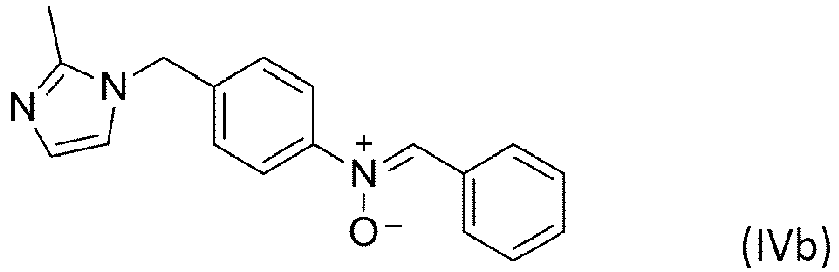

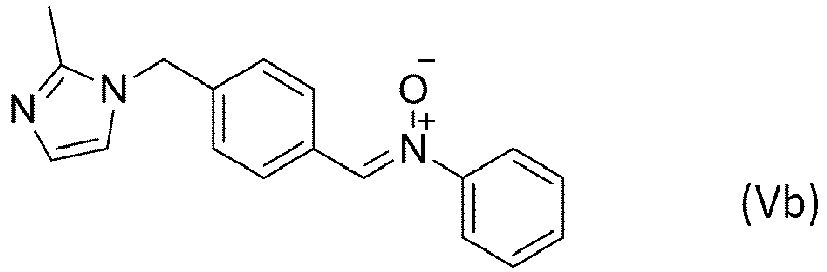
- Process according to any one of Claims 1 to 9, in which the 1,3-dipolar compound is reacted according to a stoichiometry of between 0 and 3 molar equivalents of imidazole ring per 100 moles of monomer units constituting the polymer.
- Process according to any one of Claims 1 to 10, in which the unsaturated polymer is a diene polymer.
- Polymer capable of being obtained by the process defined according to any one of Claims 1 to 11.
- 1,3-dipolar compound defined according to any one of Claims 2 to 6.
- 1,3-dipolar compound defined according to Claim 8 in which Y1 is an alkyl group or an aromatic group containing from 6 to 20 carbon atoms and in which Y2, is an aromatic group containing a benzene nucleus and comprising on its benzene nucleus a direct attachment to A and in which A is an alkylene group containing from 1 to 20 carbon atoms or an arylene group.
- 1,3-dipolar compound defined according to Claim 9.
Priority Applications (1)
| Application Number | Priority Date | Filing Date | Title |
|---|---|---|---|
| PL14790056T PL3060552T3 (en) | 2013-10-25 | 2014-10-24 | 1,3-dipolar compound bearing an imidazole function and process for modifying an unsaturated polymer by grafting |
Applications Claiming Priority (2)
| Application Number | Priority Date | Filing Date | Title |
|---|---|---|---|
| FR1360413A FR3012451B1 (en) | 2013-10-25 | 2013-10-25 | 1,3-DIPOLAR COMPOUND WITH IMIDAZOLE FUNCTION |
| PCT/EP2014/072838 WO2015059269A1 (en) | 2013-10-25 | 2014-10-24 | 1,3-dipolar compound bearing an imidazole function |
Publications (2)
| Publication Number | Publication Date |
|---|---|
| EP3060552A1 EP3060552A1 (en) | 2016-08-31 |
| EP3060552B1 true EP3060552B1 (en) | 2020-12-02 |
Family
ID=49759378
Family Applications (1)
| Application Number | Title | Priority Date | Filing Date |
|---|---|---|---|
| EP14790056.7A Active EP3060552B1 (en) | 2013-10-25 | 2014-10-24 | 1,3-dipolar compound bearing an imidazole function and process for modifying an unsaturated polymer by grafting |
Country Status (7)
| Country | Link |
|---|---|
| US (2) | US10202471B2 (en) |
| EP (1) | EP3060552B1 (en) |
| JP (1) | JP6568849B2 (en) |
| CN (1) | CN105683165B (en) |
| FR (1) | FR3012451B1 (en) |
| PL (1) | PL3060552T3 (en) |
| WO (1) | WO2015059269A1 (en) |
Families Citing this family (37)
| Publication number | Priority date | Publication date | Assignee | Title |
|---|---|---|---|---|
| FR3012460B1 (en) | 2013-10-25 | 2015-12-11 | Michelin & Cie | RUBBER COMPOSITION COMPRISING DIENIC ELASTOMER HAVING IMIDAZOLE FUNCTIONS RANDOMLY DISTRIBUTED ALONG THE CHAIN |
| FR3012458B1 (en) * | 2013-10-25 | 2015-10-30 | Michelin & Cie | RUBBER COMPOSITION COMPRISING A 1,3-DIPOLAR COMPOUND ADDITIVE WITH IMIDAZOLE FUNCTION |
| FR3038607A1 (en) | 2015-07-10 | 2017-01-13 | Michelin & Cie | A 1,3-DIPOLAR COMPOUND HAVING A PHOSPHORUS GROUP AND A DIPOLE CONTAINING A NITROGEN ATOM. |
| FR3046603B1 (en) * | 2016-01-11 | 2017-12-29 | Michelin & Cie | METHOD FOR MODIFYING NATURAL RUBBER AND MODIFIED NATURAL RUBBER |
| FR3054233A1 (en) | 2016-07-21 | 2018-01-26 | Compagnie Generale Des Etablissements Michelin | HIGH RIGIDITY RUBBER COMPOSITION |
| FR3054226A1 (en) | 2016-07-21 | 2018-01-26 | Compagnie Generale Des Etablissements Michelin | HIGH RIGIDITY RUBBER COMPOSITION |
| FR3060560A1 (en) * | 2016-12-15 | 2018-06-22 | Compagnie Generale Des Etablissements Michelin | 1,3-DIPOLAR COMPOUND HAVING A CONJUGATED CARBON-CARBON DOUBLE BOND |
| FR3060570A1 (en) * | 2016-12-19 | 2018-06-22 | Compagnie Generale Des Etablissements Michelin | PROCESS FOR THE PREPARATION OF A DIODE MODEL ELASTOMER MODIFIED BY A 1,3-DIPOLAR COMPOUND BY REACTIVE EXTRUSION |
| WO2019002756A1 (en) * | 2017-06-28 | 2019-01-03 | Compagnie Generale Des Etablissements Michelin | Diene rubber bearing imidazole groups |
| WO2019102131A1 (en) * | 2017-11-21 | 2019-05-31 | Compagnie Generale Des Etablissements Michelin | Rubber composition |
| WO2019122546A1 (en) | 2017-12-20 | 2019-06-27 | Compagnie Generale Des Etablissements Michelin | Rubber composition |
| EP3728338B1 (en) * | 2017-12-20 | 2023-09-06 | Compagnie Generale Des Etablissements Michelin | Rubber composition |
| FR3087197B1 (en) * | 2018-10-11 | 2020-10-23 | Michelin & Cie | RUBBER COMPONENT INCLUDING REINFORCING ELEMENTS |
| FR3087201B1 (en) | 2018-10-11 | 2020-10-23 | Michelin & Cie | PNEUMATIC |
| FR3088328B3 (en) | 2018-11-09 | 2020-12-04 | Michelin & Cie | FUNCTIONAL DIENIC ELASTOMER AND RUBBER COMPOSITION |
| FR3091289A3 (en) * | 2018-12-27 | 2020-07-03 | Michelin & Cie | Rubber compositions based on at least one compound carrying cyclic carbonate functions |
| FR3097222B1 (en) | 2019-06-11 | 2021-05-28 | Michelin & Cie | NEW 1,3-DIPOLAR COMPOUNDS INCLUDING AN AROMATIC HETEROCYCLE AND AN IMIDAZOLE CYCLE |
| FR3097224B1 (en) * | 2019-06-11 | 2021-05-21 | Michelin & Cie | GRAFT POLYMER WITH FUNCTIONAL PENDANT GROUPS IMIDAZOLE. |
| FR3097549A1 (en) | 2019-06-19 | 2020-12-25 | Compagnie Generale Des Etablissements Michelin | rubber composition |
| FR3099765B1 (en) * | 2019-08-07 | 2021-07-09 | Michelin & Cie | POLYMER WITH SPECIAL FUNCTIONAL PENDANT GROUPS IMIDAZOLIDINONE N-SUBSTITUTES |
| FR3105237B1 (en) | 2019-12-24 | 2022-12-30 | Michelin & Cie | MASTERBATCH BASED ON A MODIFIED POLYMER AND AN ORGANOPHOSPHOROUS ADDITIVE AND METHOD FOR MANUFACTURING IT |
| FR3113906B1 (en) * | 2020-09-04 | 2022-08-05 | Michelin & Cie | RUBBER COMPOSITION BASED ON HIGHLY SATURATED DIENIQUE ELASTOMER |
| FR3117120B1 (en) | 2020-12-09 | 2025-08-15 | Beyond Lotus Llc | METHODS FOR PREPARING A COMPOSITE COMPRISING A NEVER-DRIED RUBBER AND A FILLER |
| WO2022125677A1 (en) | 2020-12-09 | 2022-06-16 | Beyond Lotus Llc | Method of preparing a compound having elastomer and filler |
| FR3121144B1 (en) | 2021-03-29 | 2023-03-31 | Michelin & Cie | Composite comprising a metallic reinforcing element and an elastomeric composition comprising an adhesion promoter resin |
| FR3129401B1 (en) | 2021-11-22 | 2023-11-10 | Michelin & Cie | Rubber composition |
| FR3129400B1 (en) | 2021-11-22 | 2023-11-10 | Michelin & Cie | Rubber composition |
| KR20240117594A (en) | 2021-12-08 | 2024-08-01 | 비욘드 로투스 엘엘씨 | Method for producing composites with resins |
| FR3130800B1 (en) | 2021-12-21 | 2023-11-03 | Michelin & Cie | METHOD FOR SYNTHESIS OF AN OXIME COMPRISING AN IMIDAZOLE GROUP AND METHOD FOR SYNTHESIS OF A NITRILE OXIDE FROM SAID OXIME. |
| FR3130801A1 (en) | 2021-12-21 | 2023-06-23 | Compagnie Generale Des Etablissements Michelin | Process for the synthesis of 5-((2-methyl-1H-imidazol-1-yl)methyl)furan-2-carbaldehyde and nitrones from 5-((2-methyl-1H-imidazol-1-yl)methyl )furan-2-carbaldehyde |
| FR3135983B1 (en) | 2022-05-31 | 2024-05-31 | Michelin & Cie | Process for preparing a diene rubber composition. |
| FR3149608B1 (en) | 2023-06-08 | 2025-05-23 | Michelin & Cie | Functional diene elastomer and rubber composition containing it. |
| FR3161910B1 (en) | 2024-05-02 | 2026-04-10 | Michelin & Cie | Anion exchange membrane and its method of production. |
| FR3163942B1 (en) | 2024-07-01 | 2026-06-26 | Michelin & Cie | POLYMER GRAFT CARRYING FUNCTIONAL IMIDAZOLS PENDANT GROUPS |
| FR3167484A1 (en) | 2024-10-15 | 2026-04-17 | Compagnie Generale Des Etablissements Michelin | Anion exchange membrane and its method of production. |
| FR3167330A1 (en) | 2024-10-15 | 2026-04-17 | Cabot Corporation | Extrusion processes for elastomeric compositions |
| US20260103572A1 (en) | 2024-10-15 | 2026-04-16 | Cabot Corporation | Methods for preparing elastomer composites with mixer ventilation |
Family Cites Families (39)
| Publication number | Priority date | Publication date | Assignee | Title |
|---|---|---|---|---|
| US5140055A (en) | 1986-07-01 | 1992-08-18 | Bridgestone Corporation | Rubber composition |
| US4803282A (en) * | 1986-08-27 | 1989-02-07 | Pennwalt Corporation | Alpha-substituted ketonitrone derivatives |
| IL83436A0 (en) * | 1986-08-27 | 1988-01-31 | Pennwalt Corp | 5-substituted-3-phenyl-3-(1h-imidazol-1-ylmethyl)-2-methylisoxazolidines |
| IL87797A0 (en) * | 1987-10-02 | 1989-03-31 | Pennwalt Corp | 5-mono or disubstituted-3-(phenyl or 2-naphthalenyl)-3-((1h-imidazol-1-ylmethyl)-and(1h-1,2,4-triazol-1-ylmethyl))-2-(methyl or benzyl)isoxazolidines |
| DE3842067A1 (en) * | 1988-12-14 | 1990-06-21 | Hoechst Ag | ENZYME-INHIBITABLE AMINOSA-E-LEED DERIVATIVES, PROCESS FOR THEIR MANUFACTURE, THESE AGENTS, AND THEIR USE |
| US5346962A (en) | 1993-11-03 | 1994-09-13 | Bridgestone/Firestone, Inc. | Elastomers having reduced hysteresis prepared with vinyl imidazole |
| ES2248820T3 (en) | 1995-05-22 | 2006-03-16 | Cabot Corporation | ELASTOMERIC COMPOUNDS THAT INCORPORATE SMOKE BLACKS TREATED WITH SILICON. |
| AT405285B (en) | 1995-09-07 | 1999-06-25 | Semperit Ag | RUBBER BLEND |
| TW429241B (en) * | 1996-09-26 | 2001-04-11 | Sumitomo Pharma | Nitrone derivatives |
| BR9814910A (en) | 1997-11-28 | 2000-10-03 | Michelin & Cie | Composition of vulcanizable rubber with sulfur, use of it, rubber article, pneumatic, and tread. |
| FR2780404B1 (en) | 1998-06-26 | 2001-04-13 | Adir | NOVEL NITRONE DERIVATIVES, THEIR PREPARATION PROCESS AND THE PHARMACEUTICAL COMPOSITIONS CONTAINING THEM |
| KR100820033B1 (en) | 2000-07-31 | 2008-04-08 | 소시에떼 드 테크놀로지 미쉐린 | Tires with running tread |
| CA2425330A1 (en) | 2000-10-13 | 2002-04-18 | Jean-Claude Tardivat | Rubber composition comprising as coupling agent a polyfunctional organosilane |
| RU2272042C2 (en) | 2000-10-13 | 2006-03-20 | Сосьете Де Текноложи Мишлен | Polyfunctional organosilane useful for using as binding agent and method for its preparing |
| JP4536375B2 (en) | 2001-06-28 | 2010-09-01 | ソシエテ ド テクノロジー ミシュラン | Tire tread reinforced with silica with extremely low specific surface area |
| ATE465208T1 (en) | 2001-06-28 | 2010-05-15 | Michelin Soc Tech | TIRE TREAD REINFORCED BY SILICIC ACID WITH LOW SPECIFIC SURFACE AREA |
| RU2004107514A (en) | 2001-08-13 | 2005-10-10 | Сосьете Де Текноложи Мишлен (Fr) | COMPOSITION BASED ON DIENE RUBBER FOR PNEUMATIC TIRES, INCLUDING SPECIAL SILICON DIOXIDE AS A REINFORCING FILLER |
| FR2866028B1 (en) | 2004-02-11 | 2006-03-24 | Michelin Soc Tech | PLASTICIZING SYSTEM FOR RUBBER COMPOSITION |
| US7186845B2 (en) | 2004-10-20 | 2007-03-06 | Bridgestone Corporation | Polymer-filler coupling additives |
| FR2877348B1 (en) | 2004-10-28 | 2007-01-12 | Michelin Soc Tech | PLASTICIZING SYSTEM FOR RUBBER COMPOSITION |
| FR2886306B1 (en) | 2005-05-26 | 2007-07-06 | Michelin Soc Tech | PNEUMATIC RUBBER COMPOSITION COMPRISING AN ORGANOSILOXANE COUPLING AGENT |
| FR2886305B1 (en) | 2005-05-26 | 2007-08-10 | Michelin Soc Tech | PNEUMATIC RUBBER COMPOSITION COMPRISING AN ORGANOSILICALLY COUPLED AGENT AND AN INORGANIC CHARGE RECOVERY AGENT |
| FR2886304B1 (en) | 2005-05-26 | 2007-08-10 | Michelin Soc Tech | RUBBER COMPOSITION FOR PNEUMATIC COMPRISING AN ORGANOSILICIC COUPLING SYSTEM |
| FR2889538B1 (en) | 2005-08-08 | 2007-09-14 | Michelin Soc Tech | PLASTICATING SYSTEM FOR COMBINING RUBBER. |
| WO2008002614A2 (en) * | 2006-06-28 | 2008-01-03 | The Florida International University Board Of Trustees | Pseudoazulenyl nitrones |
| JP4803617B2 (en) | 2008-05-13 | 2011-10-26 | 住友ゴム工業株式会社 | Modified natural rubber, method for producing modified natural rubber, rubber composition and tire |
| FR2946050B1 (en) | 2009-06-02 | 2016-10-28 | Rhodia Operations | USE AS A COUPLING AGENT IN AN ELASTOMER (S) COMPOSITION COMPRISING A REINFORCING INORGANIC LOAD OF A PARTICULAR FUNCTIONALIZED ORGANOSILIC COMPOUND |
| JP2011057946A (en) * | 2009-09-14 | 2011-03-24 | Bridgestone Corp | Rubber composition and tire using the same |
| FR2951186B1 (en) | 2009-10-12 | 2012-01-06 | Michelin Soc Tech | RUBBER COMPOSITION BASED ON GLYCEROL AND A FUNCTIONALIZED ELASTOMER AND TIRE TREAD FOR PNEUMATIC |
| FR2962737B1 (en) | 2010-07-13 | 2012-08-17 | Michelin Soc Tech | RUBBER COMPOSITION CONTAINING MODIFIED ELASTOMER, PROCESS FOR PREPARING THE SAME AND PNEUMATIC CONTAINING THE SAME |
| FR2962733B1 (en) | 2010-07-13 | 2012-08-17 | Michelin Soc Tech | POLYMER GRAFTED BY NITROGEN ASSOCIATIVE MOLECULES. |
| JP2012082265A (en) | 2010-10-07 | 2012-04-26 | Sumitomo Rubber Ind Ltd | Rubber composition for tire and pneumatic tire |
| JP5772361B2 (en) * | 2011-08-03 | 2015-09-02 | 横浜ゴム株式会社 | Rubber composition |
| JP5827538B2 (en) | 2011-10-17 | 2015-12-02 | 住友ゴム工業株式会社 | Rubber composition for tire and pneumatic tire |
| FR2999586B1 (en) | 2012-12-17 | 2014-12-26 | Michelin & Cie | PNEUMATIC COMPRISING A RUBBER COMPOSITION COMPRISING AN EPOXY POLYMER RETICULATED BY A CARBOXYLIC ACIDIC ACID |
| JP5716780B2 (en) * | 2013-03-26 | 2015-05-13 | 横浜ゴム株式会社 | Thermosetting resin composition |
| JP6163973B2 (en) * | 2013-08-28 | 2017-07-19 | 横浜ゴム株式会社 | Rubber composition for tire and pneumatic tire |
| FR3012460B1 (en) | 2013-10-25 | 2015-12-11 | Michelin & Cie | RUBBER COMPOSITION COMPRISING DIENIC ELASTOMER HAVING IMIDAZOLE FUNCTIONS RANDOMLY DISTRIBUTED ALONG THE CHAIN |
| FR3012458B1 (en) | 2013-10-25 | 2015-10-30 | Michelin & Cie | RUBBER COMPOSITION COMPRISING A 1,3-DIPOLAR COMPOUND ADDITIVE WITH IMIDAZOLE FUNCTION |
-
2013
- 2013-10-25 FR FR1360413A patent/FR3012451B1/en active Active
-
2014
- 2014-10-24 US US15/031,337 patent/US10202471B2/en active Active
- 2014-10-24 JP JP2016526223A patent/JP6568849B2/en active Active
- 2014-10-24 EP EP14790056.7A patent/EP3060552B1/en active Active
- 2014-10-24 PL PL14790056T patent/PL3060552T3/en unknown
- 2014-10-24 CN CN201480058215.7A patent/CN105683165B/en active Active
- 2014-10-24 WO PCT/EP2014/072838 patent/WO2015059269A1/en not_active Ceased
-
2018
- 2018-12-21 US US16/230,180 patent/US11034780B2/en active Active
Non-Patent Citations (1)
| Title |
|---|
| None * |
Also Published As
| Publication number | Publication date |
|---|---|
| US20190119412A1 (en) | 2019-04-25 |
| FR3012451A1 (en) | 2015-05-01 |
| WO2015059269A1 (en) | 2015-04-30 |
| JP2016535744A (en) | 2016-11-17 |
| EP3060552A1 (en) | 2016-08-31 |
| US11034780B2 (en) | 2021-06-15 |
| US20160251456A1 (en) | 2016-09-01 |
| US10202471B2 (en) | 2019-02-12 |
| CN105683165B (en) | 2018-08-07 |
| JP6568849B2 (en) | 2019-08-28 |
| FR3012451B1 (en) | 2016-11-11 |
| CN105683165A (en) | 2016-06-15 |
| PL3060552T3 (en) | 2021-06-14 |
Similar Documents
| Publication | Publication Date | Title |
|---|---|---|
| WO2015059269A1 (en) | 1,3-dipolar compound bearing an imidazole function | |
| EP3060585B1 (en) | Rubber composition comprising a diene elastomer bearing imidazole functions randomly distributed along the chain | |
| EP3060413B1 (en) | Rubber composition comprising a 1,3-dipolar compound additive having an imidazole function | |
| EP2593485B1 (en) | Polymers craftet with azotic molecules | |
| EP3319972B1 (en) | Rubber composition comprising an 1,3-dipolar compound bearing a phosphorus-containing group and a dipole containing a nitrogen atom | |
| EP3713924B1 (en) | 1,3-dipolar compound comprising an epoxide group | |
| EP2593486A1 (en) | Rubber composition comprising modified elastomer, process of preparation thereof and tire containing rubber compostion | |
| EP3713774B1 (en) | Rubber composition | |
| EP3648988B1 (en) | Composition on the basis of at least one specific polyaromatic compound | |
| EP3145909B1 (en) | 1,3-dipolar compound comprising an ester function of carboxylic acid and rubber composition containing same | |
| WO2015177105A1 (en) | Method for grafting a carboxylic acid ester function onto an unsaturated polymer | |
| EP3713772B1 (en) | Diene polymer modified by an epoxide group | |
| EP3261853A1 (en) | Diene rubber composition based on a 1,3-dipolar compound bearing an imidazole function and on a blocked mercaptosilane | |
| WO2022003279A1 (en) | Grafted elastomer bearing epoxy pendant groups | |
| WO2018109396A1 (en) | 1,3-dipolar compound having a conjugated carbon-carbon double bond | |
| EP3648989B1 (en) | Polymer carrying specific pendant imidazolidinone functional groups | |
| EP3555143B1 (en) | Diene elastomer bearing anthracenyl pendant groups | |
| EP4172150A1 (en) | Compound comprising an epoxide group | |
| WO2023117840A1 (en) | Polymer carrying specific epoxy functional pendant groups |
Legal Events
| Date | Code | Title | Description |
|---|---|---|---|
| PUAI | Public reference made under article 153(3) epc to a published international application that has entered the european phase |
Free format text: ORIGINAL CODE: 0009012 |
|
| 17P | Request for examination filed |
Effective date: 20160525 |
|
| AK | Designated contracting states |
Kind code of ref document: A1 Designated state(s): AL AT BE BG CH CY CZ DE DK EE ES FI FR GB GR HR HU IE IS IT LI LT LU LV MC MK MT NL NO PL PT RO RS SE SI SK SM TR |
|
| AX | Request for extension of the european patent |
Extension state: BA ME |
|
| DAX | Request for extension of the european patent (deleted) | ||
| RAP1 | Party data changed (applicant data changed or rights of an application transferred) |
Owner name: COMPAGNIE GENERALE DES ETABLISSEMENTS MICHELIN |
|
| RAP1 | Party data changed (applicant data changed or rights of an application transferred) |
Owner name: COMPAGNIE GENERALE DES ETABLISSEMENTS MICHELIN |
|
| STAA | Information on the status of an ep patent application or granted ep patent |
Free format text: STATUS: EXAMINATION IS IN PROGRESS |
|
| 17Q | First examination report despatched |
Effective date: 20180115 |
|
| RAP1 | Party data changed (applicant data changed or rights of an application transferred) |
Owner name: COMPAGNIE GENERALE DES ETABLISSEMENTS MICHELIN |
|
| GRAP | Despatch of communication of intention to grant a patent |
Free format text: ORIGINAL CODE: EPIDOSNIGR1 |
|
| STAA | Information on the status of an ep patent application or granted ep patent |
Free format text: STATUS: GRANT OF PATENT IS INTENDED |
|
| INTG | Intention to grant announced |
Effective date: 20200630 |
|
| GRAS | Grant fee paid |
Free format text: ORIGINAL CODE: EPIDOSNIGR3 |
|
| GRAA | (expected) grant |
Free format text: ORIGINAL CODE: 0009210 |
|
| STAA | Information on the status of an ep patent application or granted ep patent |
Free format text: STATUS: THE PATENT HAS BEEN GRANTED |
|
| AK | Designated contracting states |
Kind code of ref document: B1 Designated state(s): AL AT BE BG CH CY CZ DE DK EE ES FI FR GB GR HR HU IE IS IT LI LT LU LV MC MK MT NL NO PL PT RO RS SE SI SK SM TR |
|
| REG | Reference to a national code |
Ref country code: GB Ref legal event code: FG4D Free format text: NOT ENGLISH |
|
| REG | Reference to a national code |
Ref country code: AT Ref legal event code: REF Ref document number: 1340784 Country of ref document: AT Kind code of ref document: T Effective date: 20201215 Ref country code: CH Ref legal event code: EP |
|
| REG | Reference to a national code |
Ref country code: DE Ref legal event code: R096 Ref document number: 602014072967 Country of ref document: DE |
|
| REG | Reference to a national code |
Ref country code: IE Ref legal event code: FG4D Free format text: LANGUAGE OF EP DOCUMENT: FRENCH |
|
| PG25 | Lapsed in a contracting state [announced via postgrant information from national office to epo] |
Ref country code: GR Free format text: LAPSE BECAUSE OF FAILURE TO SUBMIT A TRANSLATION OF THE DESCRIPTION OR TO PAY THE FEE WITHIN THE PRESCRIBED TIME-LIMIT Effective date: 20210303 Ref country code: FI Free format text: LAPSE BECAUSE OF FAILURE TO SUBMIT A TRANSLATION OF THE DESCRIPTION OR TO PAY THE FEE WITHIN THE PRESCRIBED TIME-LIMIT Effective date: 20201202 Ref country code: RS Free format text: LAPSE BECAUSE OF FAILURE TO SUBMIT A TRANSLATION OF THE DESCRIPTION OR TO PAY THE FEE WITHIN THE PRESCRIBED TIME-LIMIT Effective date: 20201202 Ref country code: NO Free format text: LAPSE BECAUSE OF FAILURE TO SUBMIT A TRANSLATION OF THE DESCRIPTION OR TO PAY THE FEE WITHIN THE PRESCRIBED TIME-LIMIT Effective date: 20210302 |
|
| REG | Reference to a national code |
Ref country code: NL Ref legal event code: MP Effective date: 20201202 |
|
| REG | Reference to a national code |
Ref country code: AT Ref legal event code: MK05 Ref document number: 1340784 Country of ref document: AT Kind code of ref document: T Effective date: 20201202 |
|
| PG25 | Lapsed in a contracting state [announced via postgrant information from national office to epo] |
Ref country code: LV Free format text: LAPSE BECAUSE OF FAILURE TO SUBMIT A TRANSLATION OF THE DESCRIPTION OR TO PAY THE FEE WITHIN THE PRESCRIBED TIME-LIMIT Effective date: 20201202 Ref country code: SE Free format text: LAPSE BECAUSE OF FAILURE TO SUBMIT A TRANSLATION OF THE DESCRIPTION OR TO PAY THE FEE WITHIN THE PRESCRIBED TIME-LIMIT Effective date: 20201202 Ref country code: BG Free format text: LAPSE BECAUSE OF FAILURE TO SUBMIT A TRANSLATION OF THE DESCRIPTION OR TO PAY THE FEE WITHIN THE PRESCRIBED TIME-LIMIT Effective date: 20210302 |
|
| PG25 | Lapsed in a contracting state [announced via postgrant information from national office to epo] |
Ref country code: NL Free format text: LAPSE BECAUSE OF FAILURE TO SUBMIT A TRANSLATION OF THE DESCRIPTION OR TO PAY THE FEE WITHIN THE PRESCRIBED TIME-LIMIT Effective date: 20201202 Ref country code: HR Free format text: LAPSE BECAUSE OF FAILURE TO SUBMIT A TRANSLATION OF THE DESCRIPTION OR TO PAY THE FEE WITHIN THE PRESCRIBED TIME-LIMIT Effective date: 20201202 |
|
| REG | Reference to a national code |
Ref country code: LT Ref legal event code: MG9D |
|
| PG25 | Lapsed in a contracting state [announced via postgrant information from national office to epo] |
Ref country code: SM Free format text: LAPSE BECAUSE OF FAILURE TO SUBMIT A TRANSLATION OF THE DESCRIPTION OR TO PAY THE FEE WITHIN THE PRESCRIBED TIME-LIMIT Effective date: 20201202 Ref country code: EE Free format text: LAPSE BECAUSE OF FAILURE TO SUBMIT A TRANSLATION OF THE DESCRIPTION OR TO PAY THE FEE WITHIN THE PRESCRIBED TIME-LIMIT Effective date: 20201202 Ref country code: RO Free format text: LAPSE BECAUSE OF FAILURE TO SUBMIT A TRANSLATION OF THE DESCRIPTION OR TO PAY THE FEE WITHIN THE PRESCRIBED TIME-LIMIT Effective date: 20201202 Ref country code: SK Free format text: LAPSE BECAUSE OF FAILURE TO SUBMIT A TRANSLATION OF THE DESCRIPTION OR TO PAY THE FEE WITHIN THE PRESCRIBED TIME-LIMIT Effective date: 20201202 Ref country code: PT Free format text: LAPSE BECAUSE OF FAILURE TO SUBMIT A TRANSLATION OF THE DESCRIPTION OR TO PAY THE FEE WITHIN THE PRESCRIBED TIME-LIMIT Effective date: 20210405 Ref country code: LT Free format text: LAPSE BECAUSE OF FAILURE TO SUBMIT A TRANSLATION OF THE DESCRIPTION OR TO PAY THE FEE WITHIN THE PRESCRIBED TIME-LIMIT Effective date: 20201202 |
|
| PG25 | Lapsed in a contracting state [announced via postgrant information from national office to epo] |
Ref country code: AT Free format text: LAPSE BECAUSE OF FAILURE TO SUBMIT A TRANSLATION OF THE DESCRIPTION OR TO PAY THE FEE WITHIN THE PRESCRIBED TIME-LIMIT Effective date: 20201202 |
|
| REG | Reference to a national code |
Ref country code: DE Ref legal event code: R097 Ref document number: 602014072967 Country of ref document: DE |
|
| PG25 | Lapsed in a contracting state [announced via postgrant information from national office to epo] |
Ref country code: IS Free format text: LAPSE BECAUSE OF FAILURE TO SUBMIT A TRANSLATION OF THE DESCRIPTION OR TO PAY THE FEE WITHIN THE PRESCRIBED TIME-LIMIT Effective date: 20210402 |
|
| PLBE | No opposition filed within time limit |
Free format text: ORIGINAL CODE: 0009261 |
|
| STAA | Information on the status of an ep patent application or granted ep patent |
Free format text: STATUS: NO OPPOSITION FILED WITHIN TIME LIMIT |
|
| PG25 | Lapsed in a contracting state [announced via postgrant information from national office to epo] |
Ref country code: IT Free format text: LAPSE BECAUSE OF FAILURE TO SUBMIT A TRANSLATION OF THE DESCRIPTION OR TO PAY THE FEE WITHIN THE PRESCRIBED TIME-LIMIT Effective date: 20201202 Ref country code: AL Free format text: LAPSE BECAUSE OF FAILURE TO SUBMIT A TRANSLATION OF THE DESCRIPTION OR TO PAY THE FEE WITHIN THE PRESCRIBED TIME-LIMIT Effective date: 20201202 |
|
| 26N | No opposition filed |
Effective date: 20210903 |
|
| PG25 | Lapsed in a contracting state [announced via postgrant information from national office to epo] |
Ref country code: ES Free format text: LAPSE BECAUSE OF FAILURE TO SUBMIT A TRANSLATION OF THE DESCRIPTION OR TO PAY THE FEE WITHIN THE PRESCRIBED TIME-LIMIT Effective date: 20201202 Ref country code: DK Free format text: LAPSE BECAUSE OF FAILURE TO SUBMIT A TRANSLATION OF THE DESCRIPTION OR TO PAY THE FEE WITHIN THE PRESCRIBED TIME-LIMIT Effective date: 20201202 Ref country code: SI Free format text: LAPSE BECAUSE OF FAILURE TO SUBMIT A TRANSLATION OF THE DESCRIPTION OR TO PAY THE FEE WITHIN THE PRESCRIBED TIME-LIMIT Effective date: 20201202 |
|
| REG | Reference to a national code |
Ref country code: CH Ref legal event code: PL |
|
| PG25 | Lapsed in a contracting state [announced via postgrant information from national office to epo] |
Ref country code: IS Free format text: LAPSE BECAUSE OF FAILURE TO SUBMIT A TRANSLATION OF THE DESCRIPTION OR TO PAY THE FEE WITHIN THE PRESCRIBED TIME-LIMIT Effective date: 20210402 |
|
| REG | Reference to a national code |
Ref country code: BE Ref legal event code: MM Effective date: 20211031 |
|
| GBPC | Gb: european patent ceased through non-payment of renewal fee |
Effective date: 20211024 |
|
| PG25 | Lapsed in a contracting state [announced via postgrant information from national office to epo] |
Ref country code: MC Free format text: LAPSE BECAUSE OF FAILURE TO SUBMIT A TRANSLATION OF THE DESCRIPTION OR TO PAY THE FEE WITHIN THE PRESCRIBED TIME-LIMIT Effective date: 20201202 |
|
| PG25 | Lapsed in a contracting state [announced via postgrant information from national office to epo] |
Ref country code: LU Free format text: LAPSE BECAUSE OF NON-PAYMENT OF DUE FEES Effective date: 20211024 Ref country code: GB Free format text: LAPSE BECAUSE OF NON-PAYMENT OF DUE FEES Effective date: 20211024 Ref country code: BE Free format text: LAPSE BECAUSE OF NON-PAYMENT OF DUE FEES Effective date: 20211031 |
|
| PG25 | Lapsed in a contracting state [announced via postgrant information from national office to epo] |
Ref country code: LI Free format text: LAPSE BECAUSE OF NON-PAYMENT OF DUE FEES Effective date: 20211031 Ref country code: CH Free format text: LAPSE BECAUSE OF NON-PAYMENT OF DUE FEES Effective date: 20211031 |
|
| PG25 | Lapsed in a contracting state [announced via postgrant information from national office to epo] |
Ref country code: IE Free format text: LAPSE BECAUSE OF NON-PAYMENT OF DUE FEES Effective date: 20211024 |
|
| PG25 | Lapsed in a contracting state [announced via postgrant information from national office to epo] |
Ref country code: HU Free format text: LAPSE BECAUSE OF FAILURE TO SUBMIT A TRANSLATION OF THE DESCRIPTION OR TO PAY THE FEE WITHIN THE PRESCRIBED TIME-LIMIT; INVALID AB INITIO Effective date: 20141024 |
|
| PG25 | Lapsed in a contracting state [announced via postgrant information from national office to epo] |
Ref country code: CY Free format text: LAPSE BECAUSE OF FAILURE TO SUBMIT A TRANSLATION OF THE DESCRIPTION OR TO PAY THE FEE WITHIN THE PRESCRIBED TIME-LIMIT Effective date: 20201202 |
|
| PG25 | Lapsed in a contracting state [announced via postgrant information from national office to epo] |
Ref country code: MK Free format text: LAPSE BECAUSE OF FAILURE TO SUBMIT A TRANSLATION OF THE DESCRIPTION OR TO PAY THE FEE WITHIN THE PRESCRIBED TIME-LIMIT Effective date: 20201202 |
|
| PG25 | Lapsed in a contracting state [announced via postgrant information from national office to epo] |
Ref country code: MT Free format text: LAPSE BECAUSE OF FAILURE TO SUBMIT A TRANSLATION OF THE DESCRIPTION OR TO PAY THE FEE WITHIN THE PRESCRIBED TIME-LIMIT Effective date: 20201202 |
|
| PG25 | Lapsed in a contracting state [announced via postgrant information from national office to epo] |
Ref country code: TR Free format text: LAPSE BECAUSE OF FAILURE TO SUBMIT A TRANSLATION OF THE DESCRIPTION OR TO PAY THE FEE WITHIN THE PRESCRIBED TIME-LIMIT Effective date: 20201202 |
|
| PGFP | Annual fee paid to national office [announced via postgrant information from national office to epo] |
Ref country code: DE Payment date: 20251021 Year of fee payment: 12 |
|
| PGFP | Annual fee paid to national office [announced via postgrant information from national office to epo] |
Ref country code: FR Payment date: 20251030 Year of fee payment: 12 |
|
| PGFP | Annual fee paid to national office [announced via postgrant information from national office to epo] |
Ref country code: CZ Payment date: 20251017 Year of fee payment: 12 |
|
| PGFP | Annual fee paid to national office [announced via postgrant information from national office to epo] |
Ref country code: PL Payment date: 20251020 Year of fee payment: 12 |