EP3059239A1 - Sulfur-containing bicyclic compound - Google Patents
Sulfur-containing bicyclic compound Download PDFInfo
- Publication number
- EP3059239A1 EP3059239A1 EP14853825.9A EP14853825A EP3059239A1 EP 3059239 A1 EP3059239 A1 EP 3059239A1 EP 14853825 A EP14853825 A EP 14853825A EP 3059239 A1 EP3059239 A1 EP 3059239A1
- Authority
- EP
- European Patent Office
- Prior art keywords
- esi
- compound
- methyl
- methylthieno
- added
- Prior art date
- Legal status (The legal status is an assumption and is not a legal conclusion. Google has not performed a legal analysis and makes no representation as to the accuracy of the status listed.)
- Granted
Links
- 0 C*c1nc(S=C(*2)C3=CCC(*)(*)CC3)c2c(C(*)(*)*)n1 Chemical compound C*c1nc(S=C(*2)C3=CCC(*)(*)CC3)c2c(C(*)(*)*)n1 0.000 description 14
- WEWJPQMIUWNLSZ-UHFFFAOYSA-N CC(C(CCc1nc(C)nc2c1nc(C1CCC(C)(C)CC1)[s]2)CC1)C(C)(C)CN1C(CC#N)=O Chemical compound CC(C(CCc1nc(C)nc2c1nc(C1CCC(C)(C)CC1)[s]2)CC1)C(C)(C)CN1C(CC#N)=O WEWJPQMIUWNLSZ-UHFFFAOYSA-N 0.000 description 1
- VDRLIDOYROKFKV-UHFFFAOYSA-N CC(C)(C)OC(N1CC(C)(C)N(Cc2c(cc(C3CCC(C)(C)CC3)[s]3)c3nc(C)n2)CC1)=O Chemical compound CC(C)(C)OC(N1CC(C)(C)N(Cc2c(cc(C3CCC(C)(C)CC3)[s]3)c3nc(C)n2)CC1)=O VDRLIDOYROKFKV-UHFFFAOYSA-N 0.000 description 1
- PSXNCCJFEHRMEW-UHFFFAOYSA-N CC(C)(C1)OCCC1NCc1c(cc(C2CCCCC2)[s]2)c2nc(C)n1 Chemical compound CC(C)(C1)OCCC1NCc1c(cc(C2CCCCC2)[s]2)c2nc(C)n1 PSXNCCJFEHRMEW-UHFFFAOYSA-N 0.000 description 1
- CDGGZDOQRUNQJW-UHFFFAOYSA-N CC(C)(CC1)CCC1c1cc(C(N)=O)c(NC(C)=O)[s]1 Chemical compound CC(C)(CC1)CCC1c1cc(C(N)=O)c(NC(C)=O)[s]1 CDGGZDOQRUNQJW-UHFFFAOYSA-N 0.000 description 1
- CYODTOMMTMBLAZ-UHFFFAOYSA-N CC(C)(CC1)CCC1c1cc(c(CN(CC2)CCC2(COC)O)nc(C)n2)c2[s]1 Chemical compound CC(C)(CC1)CCC1c1cc(c(CN(CC2)CCC2(COC)O)nc(C)n2)c2[s]1 CYODTOMMTMBLAZ-UHFFFAOYSA-N 0.000 description 1
- OIDQCPBJBQTQPR-UHFFFAOYSA-N CC(C)(CC1)CCC1c1cc2c(C(C)=O)nc(C)nc2[s]1 Chemical compound CC(C)(CC1)CCC1c1cc2c(C(C)=O)nc(C)nc2[s]1 OIDQCPBJBQTQPR-UHFFFAOYSA-N 0.000 description 1
- XWMYFIWWLOSFAJ-UHFFFAOYSA-N CC(C)(CC1)CCC1c1cc2c(CN(C)C(C3)CS3(=O)=O)nc(C)nc2[s]1 Chemical compound CC(C)(CC1)CCC1c1cc2c(CN(C)C(C3)CS3(=O)=O)nc(C)nc2[s]1 XWMYFIWWLOSFAJ-UHFFFAOYSA-N 0.000 description 1
- AFWWKQJHUJBFEQ-UHFFFAOYSA-N CC(C)(CC1)CCC1c1cc2c(CN(C3)CC3(C(F)(F)F)O)nc(C)nc2[s]1 Chemical compound CC(C)(CC1)CCC1c1cc2c(CN(C3)CC3(C(F)(F)F)O)nc(C)nc2[s]1 AFWWKQJHUJBFEQ-UHFFFAOYSA-N 0.000 description 1
- GNHGZLYLKPLXSC-HNNXBMFYSA-N CC(C)(CC1)CCC1c1cc2c(CN(CC3)C[C@H]3O)nc(C)nc2[s]1 Chemical compound CC(C)(CC1)CCC1c1cc2c(CN(CC3)C[C@H]3O)nc(C)nc2[s]1 GNHGZLYLKPLXSC-HNNXBMFYSA-N 0.000 description 1
- JGCSZDLEGNDYEB-UHFFFAOYSA-N CC(C)(CC1)CCC1c1cc2c(CN(CCC3)CCS3(=O)=O)nc(C)nc2[s]1 Chemical compound CC(C)(CC1)CCC1c1cc2c(CN(CCC3)CCS3(=O)=O)nc(C)nc2[s]1 JGCSZDLEGNDYEB-UHFFFAOYSA-N 0.000 description 1
- IGZHDYDRQFWMFJ-KDURUIRLSA-N CC(C)(CC1)CCC1c1cc2c(CN(CCO)[C@H](CC3)CC[C@H]3O)nc(C)nc2[s]1 Chemical compound CC(C)(CC1)CCC1c1cc2c(CN(CCO)[C@H](CC3)CC[C@H]3O)nc(C)nc2[s]1 IGZHDYDRQFWMFJ-KDURUIRLSA-N 0.000 description 1
- NMBXSZQYWQWNQJ-MSOLQXFVSA-N CC(C)(CC1)CCC1c1cc2c(CN(CC[C@H]3O)C[C@@H]3O)nc(C)nc2[s]1 Chemical compound CC(C)(CC1)CCC1c1cc2c(CN(CC[C@H]3O)C[C@@H]3O)nc(C)nc2[s]1 NMBXSZQYWQWNQJ-MSOLQXFVSA-N 0.000 description 1
- KEXPPAPEAXBLKX-UHFFFAOYSA-N CC(C)(CC1)CCC1c1cc2c(CN3CCC4(CC4)CC3)nc(C)nc2[s]1 Chemical compound CC(C)(CC1)CCC1c1cc2c(CN3CCC4(CC4)CC3)nc(C)nc2[s]1 KEXPPAPEAXBLKX-UHFFFAOYSA-N 0.000 description 1
- IKFFLJXPPGGDAQ-UHFFFAOYSA-N CC(C)(CC1)CCC1c1cc2c(CNC3(C)CCSCC3)nc(C)nc2[s]1 Chemical compound CC(C)(CC1)CCC1c1cc2c(CNC3(C)CCSCC3)nc(C)nc2[s]1 IKFFLJXPPGGDAQ-UHFFFAOYSA-N 0.000 description 1
- YDBSNZOMCPTVDY-CVEARBPZSA-N CC(C)(CC1)CCC1c1nc(c(CN(CC[C@H]2O)C[C@@H]2O)nc(C)n2)c2[s]1 Chemical compound CC(C)(CC1)CCC1c1nc(c(CN(CC[C@H]2O)C[C@@H]2O)nc(C)n2)c2[s]1 YDBSNZOMCPTVDY-CVEARBPZSA-N 0.000 description 1
- QPJGOPKZKSEKBQ-UHFFFAOYSA-N CC(C)(CO)N(C)Cc1c(cc(C2CCCCC2)[s]2)c2nc(C)n1 Chemical compound CC(C)(CO)N(C)Cc1c(cc(C2CCCCC2)[s]2)c2nc(C)n1 QPJGOPKZKSEKBQ-UHFFFAOYSA-N 0.000 description 1
- RFJSNOOWECXODX-UHFFFAOYSA-N CC(C)(COC)NCc1c(cc(C(CC2)CCC2(F)F)[s]2)c2nc(C)n1 Chemical compound CC(C)(COC)NCc1c(cc(C(CC2)CCC2(F)F)[s]2)c2nc(C)n1 RFJSNOOWECXODX-UHFFFAOYSA-N 0.000 description 1
- HRTXAAMGKDEUNE-UHFFFAOYSA-N CC(N(Cc1nc(C)nc2c1cc(C1CCCCC1)[s]2)C1CCCCC1)=O Chemical compound CC(N(Cc1nc(C)nc2c1cc(C1CCCCC1)[s]2)C1CCCCC1)=O HRTXAAMGKDEUNE-UHFFFAOYSA-N 0.000 description 1
- WIAOWAPCXTZBHP-UHFFFAOYSA-N CC1(C)N(Cc2c(cc(C3CCC(C)(C)CC3)[s]3)c3nc(C)n2)CC1O Chemical compound CC1(C)N(Cc2c(cc(C3CCC(C)(C)CC3)[s]3)c3nc(C)n2)CC1O WIAOWAPCXTZBHP-UHFFFAOYSA-N 0.000 description 1
- UANHPCPYBRSPFV-XFNLHSONSA-N CCC/C=C(\C)/N=C(/CC)\c1c(C)[s]c(C2CCC(C)(C)CC2)c1 Chemical compound CCC/C=C(\C)/N=C(/CC)\c1c(C)[s]c(C2CCC(C)(C)CC2)c1 UANHPCPYBRSPFV-XFNLHSONSA-N 0.000 description 1
- BDWGZCWRNMEYMX-UHFFFAOYSA-N CC[O](C)C(c1c(cc(C(CC2)CCC2(F)F)[s]2)c2nc(C)n1)=O Chemical compound CC[O](C)C(c1c(cc(C(CC2)CCC2(F)F)[s]2)c2nc(C)n1)=O BDWGZCWRNMEYMX-UHFFFAOYSA-N 0.000 description 1
- BIHLPVIMICFZNT-UHFFFAOYSA-N Cc(nc1COC(c2ccccc2)=O)nc2c1nc(C1(CC(C3)C4)CC4CC3C1)[s]2 Chemical compound Cc(nc1COC(c2ccccc2)=O)nc2c1nc(C1(CC(C3)C4)CC4CC3C1)[s]2 BIHLPVIMICFZNT-UHFFFAOYSA-N 0.000 description 1
- SGOIPQDAAXXYPQ-MGCOHNPYSA-N Cc(nc1COS(C)(=O)=O)nc2c1nc([C@H](CC1)CC[C@@H]1C(F)(F)F)[s]2 Chemical compound Cc(nc1COS(C)(=O)=O)nc2c1nc([C@H](CC1)CC[C@@H]1C(F)(F)F)[s]2 SGOIPQDAAXXYPQ-MGCOHNPYSA-N 0.000 description 1
- UJDZGLUMKNYQQW-UHFFFAOYSA-N Cc(nc1O)nc2c1nc(C1CCCCC1)[s]2 Chemical compound Cc(nc1O)nc2c1nc(C1CCCCC1)[s]2 UJDZGLUMKNYQQW-UHFFFAOYSA-N 0.000 description 1
- TWMTWFAMTOZVHV-FPLPWBNLSA-N Cc1nc(/C=C\O)c(cc(C2CCCCC2)[s]2)c2n1 Chemical compound Cc1nc(/C=C\O)c(cc(C2CCCCC2)[s]2)c2n1 TWMTWFAMTOZVHV-FPLPWBNLSA-N 0.000 description 1
- QWXCDEXJZVDASY-UHFFFAOYSA-N Cc1nc(CN(C)C2CCOCC2)c(cc(C2CCCCC2)[s]2)c2n1 Chemical compound Cc1nc(CN(C)C2CCOCC2)c(cc(C2CCCCC2)[s]2)c2n1 QWXCDEXJZVDASY-UHFFFAOYSA-N 0.000 description 1
- CEGWWYLJTCQKAQ-UHFFFAOYSA-N Cc1nc(CN(CC2)CCS2(=O)=O)c(cc(C2=CCC3(CC3)CC2)[s]2)c2n1 Chemical compound Cc1nc(CN(CC2)CCS2(=O)=O)c(cc(C2=CCC3(CC3)CC2)[s]2)c2n1 CEGWWYLJTCQKAQ-UHFFFAOYSA-N 0.000 description 1
- SGCYEEMSEBSVQT-HNNXBMFYSA-N Cc1nc(CN2[C@@H](CO)COCC2)c(cc(C2CCCCC2)[s]2)c2n1 Chemical compound Cc1nc(CN2[C@@H](CO)COCC2)c(cc(C2CCCCC2)[s]2)c2n1 SGCYEEMSEBSVQT-HNNXBMFYSA-N 0.000 description 1
- SGCYEEMSEBSVQT-OAHLLOKOSA-N Cc1nc(CN2[C@H](CO)COCC2)c(cc(C2CCCCC2)[s]2)c2n1 Chemical compound Cc1nc(CN2[C@H](CO)COCC2)c(cc(C2CCCCC2)[s]2)c2n1 SGCYEEMSEBSVQT-OAHLLOKOSA-N 0.000 description 1
- VPVGVWAEUXGDAN-UHFFFAOYSA-N Cc1nc(CO)c(cc(C(CC2)CCC2(F)F)[s]2)c2n1 Chemical compound Cc1nc(CO)c(cc(C(CC2)CCC2(F)F)[s]2)c2n1 VPVGVWAEUXGDAN-UHFFFAOYSA-N 0.000 description 1
- LILWAGFSKLNIGL-UHFFFAOYSA-N Cc1nc(Cl)c(cc([s]2)Cl)c2n1 Chemical compound Cc1nc(Cl)c(cc([s]2)Cl)c2n1 LILWAGFSKLNIGL-UHFFFAOYSA-N 0.000 description 1
- FDUVTAOGRQYNSW-UHFFFAOYSA-N Cc1nc([s]c(C2CCCCC2)c2)c2c(CN(CC(CC2)N3C)C2C3=O)n1 Chemical compound Cc1nc([s]c(C2CCCCC2)c2)c2c(CN(CC(CC2)N3C)C2C3=O)n1 FDUVTAOGRQYNSW-UHFFFAOYSA-N 0.000 description 1
- ZYWVZYUKDITEFY-UHFFFAOYSA-N Cc1nc([s]c(C2CCCCC2)c2)c2c(CNC2CCCCCC2)n1 Chemical compound Cc1nc([s]c(C2CCCCC2)c2)c2c(CNC2CCCCCC2)n1 ZYWVZYUKDITEFY-UHFFFAOYSA-N 0.000 description 1
Classifications
-
- C—CHEMISTRY; METALLURGY
- C07—ORGANIC CHEMISTRY
- C07D—HETEROCYCLIC COMPOUNDS
- C07D495/00—Heterocyclic compounds containing in the condensed system at least one hetero ring having sulfur atoms as the only ring hetero atoms
- C07D495/02—Heterocyclic compounds containing in the condensed system at least one hetero ring having sulfur atoms as the only ring hetero atoms in which the condensed system contains two hetero rings
- C07D495/04—Ortho-condensed systems
-
- A—HUMAN NECESSITIES
- A61—MEDICAL OR VETERINARY SCIENCE; HYGIENE
- A61K—PREPARATIONS FOR MEDICAL, DENTAL OR TOILETRY PURPOSES
- A61K31/00—Medicinal preparations containing organic active ingredients
- A61K31/33—Heterocyclic compounds
- A61K31/395—Heterocyclic compounds having nitrogen as a ring hetero atom, e.g. guanethidine or rifamycins
- A61K31/495—Heterocyclic compounds having nitrogen as a ring hetero atom, e.g. guanethidine or rifamycins having six-membered rings with two or more nitrogen atoms as the only ring heteroatoms, e.g. piperazine or tetrazines
- A61K31/505—Pyrimidines; Hydrogenated pyrimidines, e.g. trimethoprim
- A61K31/519—Pyrimidines; Hydrogenated pyrimidines, e.g. trimethoprim ortho- or peri-condensed with heterocyclic rings
-
- A—HUMAN NECESSITIES
- A61—MEDICAL OR VETERINARY SCIENCE; HYGIENE
- A61K—PREPARATIONS FOR MEDICAL, DENTAL OR TOILETRY PURPOSES
- A61K31/00—Medicinal preparations containing organic active ingredients
- A61K31/33—Heterocyclic compounds
- A61K31/395—Heterocyclic compounds having nitrogen as a ring hetero atom, e.g. guanethidine or rifamycins
- A61K31/535—Heterocyclic compounds having nitrogen as a ring hetero atom, e.g. guanethidine or rifamycins having six-membered rings with at least one nitrogen and one oxygen as the ring hetero atoms, e.g. 1,2-oxazines
- A61K31/5355—Non-condensed oxazines and containing further heterocyclic rings
-
- A—HUMAN NECESSITIES
- A61—MEDICAL OR VETERINARY SCIENCE; HYGIENE
- A61K—PREPARATIONS FOR MEDICAL, DENTAL OR TOILETRY PURPOSES
- A61K31/00—Medicinal preparations containing organic active ingredients
- A61K31/33—Heterocyclic compounds
- A61K31/395—Heterocyclic compounds having nitrogen as a ring hetero atom, e.g. guanethidine or rifamycins
- A61K31/535—Heterocyclic compounds having nitrogen as a ring hetero atom, e.g. guanethidine or rifamycins having six-membered rings with at least one nitrogen and one oxygen as the ring hetero atoms, e.g. 1,2-oxazines
- A61K31/5375—1,4-Oxazines, e.g. morpholine
- A61K31/5377—1,4-Oxazines, e.g. morpholine not condensed and containing further heterocyclic rings, e.g. timolol
-
- A—HUMAN NECESSITIES
- A61—MEDICAL OR VETERINARY SCIENCE; HYGIENE
- A61K—PREPARATIONS FOR MEDICAL, DENTAL OR TOILETRY PURPOSES
- A61K31/00—Medicinal preparations containing organic active ingredients
- A61K31/33—Heterocyclic compounds
- A61K31/395—Heterocyclic compounds having nitrogen as a ring hetero atom, e.g. guanethidine or rifamycins
- A61K31/54—Heterocyclic compounds having nitrogen as a ring hetero atom, e.g. guanethidine or rifamycins having six-membered rings with at least one nitrogen and one sulfur as the ring hetero atoms, e.g. sulthiame
- A61K31/541—Non-condensed thiazines containing further heterocyclic rings
-
- A—HUMAN NECESSITIES
- A61—MEDICAL OR VETERINARY SCIENCE; HYGIENE
- A61K—PREPARATIONS FOR MEDICAL, DENTAL OR TOILETRY PURPOSES
- A61K31/00—Medicinal preparations containing organic active ingredients
- A61K31/33—Heterocyclic compounds
- A61K31/395—Heterocyclic compounds having nitrogen as a ring hetero atom, e.g. guanethidine or rifamycins
- A61K31/55—Heterocyclic compounds having nitrogen as a ring hetero atom, e.g. guanethidine or rifamycins having seven-membered rings, e.g. azelastine, pentylenetetrazole
- A61K31/554—Heterocyclic compounds having nitrogen as a ring hetero atom, e.g. guanethidine or rifamycins having seven-membered rings, e.g. azelastine, pentylenetetrazole having at least one nitrogen and one sulfur as ring hetero atoms, e.g. clothiapine, diltiazem
-
- A—HUMAN NECESSITIES
- A61—MEDICAL OR VETERINARY SCIENCE; HYGIENE
- A61P—SPECIFIC THERAPEUTIC ACTIVITY OF CHEMICAL COMPOUNDS OR MEDICINAL PREPARATIONS
- A61P25/00—Drugs for disorders of the nervous system
-
- A—HUMAN NECESSITIES
- A61—MEDICAL OR VETERINARY SCIENCE; HYGIENE
- A61P—SPECIFIC THERAPEUTIC ACTIVITY OF CHEMICAL COMPOUNDS OR MEDICINAL PREPARATIONS
- A61P25/00—Drugs for disorders of the nervous system
- A61P25/04—Centrally acting analgesics, e.g. opioids
-
- A—HUMAN NECESSITIES
- A61—MEDICAL OR VETERINARY SCIENCE; HYGIENE
- A61P—SPECIFIC THERAPEUTIC ACTIVITY OF CHEMICAL COMPOUNDS OR MEDICINAL PREPARATIONS
- A61P25/00—Drugs for disorders of the nervous system
- A61P25/08—Antiepileptics; Anticonvulsants
-
- A—HUMAN NECESSITIES
- A61—MEDICAL OR VETERINARY SCIENCE; HYGIENE
- A61P—SPECIFIC THERAPEUTIC ACTIVITY OF CHEMICAL COMPOUNDS OR MEDICINAL PREPARATIONS
- A61P25/00—Drugs for disorders of the nervous system
- A61P25/18—Antipsychotics, i.e. neuroleptics; Drugs for mania or schizophrenia
-
- A—HUMAN NECESSITIES
- A61—MEDICAL OR VETERINARY SCIENCE; HYGIENE
- A61P—SPECIFIC THERAPEUTIC ACTIVITY OF CHEMICAL COMPOUNDS OR MEDICINAL PREPARATIONS
- A61P25/00—Drugs for disorders of the nervous system
- A61P25/22—Anxiolytics
-
- A—HUMAN NECESSITIES
- A61—MEDICAL OR VETERINARY SCIENCE; HYGIENE
- A61P—SPECIFIC THERAPEUTIC ACTIVITY OF CHEMICAL COMPOUNDS OR MEDICINAL PREPARATIONS
- A61P25/00—Drugs for disorders of the nervous system
- A61P25/24—Antidepressants
-
- A—HUMAN NECESSITIES
- A61—MEDICAL OR VETERINARY SCIENCE; HYGIENE
- A61P—SPECIFIC THERAPEUTIC ACTIVITY OF CHEMICAL COMPOUNDS OR MEDICINAL PREPARATIONS
- A61P25/00—Drugs for disorders of the nervous system
- A61P25/28—Drugs for disorders of the nervous system for treating neurodegenerative disorders of the central nervous system, e.g. nootropic agents, cognition enhancers, drugs for treating Alzheimer's disease or other forms of dementia
-
- A—HUMAN NECESSITIES
- A61—MEDICAL OR VETERINARY SCIENCE; HYGIENE
- A61P—SPECIFIC THERAPEUTIC ACTIVITY OF CHEMICAL COMPOUNDS OR MEDICINAL PREPARATIONS
- A61P25/00—Drugs for disorders of the nervous system
- A61P25/30—Drugs for disorders of the nervous system for treating abuse or dependence
-
- A—HUMAN NECESSITIES
- A61—MEDICAL OR VETERINARY SCIENCE; HYGIENE
- A61P—SPECIFIC THERAPEUTIC ACTIVITY OF CHEMICAL COMPOUNDS OR MEDICINAL PREPARATIONS
- A61P25/00—Drugs for disorders of the nervous system
- A61P25/30—Drugs for disorders of the nervous system for treating abuse or dependence
- A61P25/32—Alcohol-abuse
-
- A—HUMAN NECESSITIES
- A61—MEDICAL OR VETERINARY SCIENCE; HYGIENE
- A61P—SPECIFIC THERAPEUTIC ACTIVITY OF CHEMICAL COMPOUNDS OR MEDICINAL PREPARATIONS
- A61P29/00—Non-central analgesic, antipyretic or antiinflammatory agents, e.g. antirheumatic agents; Non-steroidal antiinflammatory drugs [NSAID]
-
- A—HUMAN NECESSITIES
- A61—MEDICAL OR VETERINARY SCIENCE; HYGIENE
- A61P—SPECIFIC THERAPEUTIC ACTIVITY OF CHEMICAL COMPOUNDS OR MEDICINAL PREPARATIONS
- A61P43/00—Drugs for specific purposes, not provided for in groups A61P1/00-A61P41/00
-
- C—CHEMISTRY; METALLURGY
- C07—ORGANIC CHEMISTRY
- C07D—HETEROCYCLIC COMPOUNDS
- C07D495/00—Heterocyclic compounds containing in the condensed system at least one hetero ring having sulfur atoms as the only ring hetero atoms
- C07D495/02—Heterocyclic compounds containing in the condensed system at least one hetero ring having sulfur atoms as the only ring hetero atoms in which the condensed system contains two hetero rings
- C07D495/08—Bridged systems
-
- C—CHEMISTRY; METALLURGY
- C07—ORGANIC CHEMISTRY
- C07D—HETEROCYCLIC COMPOUNDS
- C07D495/00—Heterocyclic compounds containing in the condensed system at least one hetero ring having sulfur atoms as the only ring hetero atoms
- C07D495/02—Heterocyclic compounds containing in the condensed system at least one hetero ring having sulfur atoms as the only ring hetero atoms in which the condensed system contains two hetero rings
- C07D495/10—Spiro-condensed systems
-
- C—CHEMISTRY; METALLURGY
- C07—ORGANIC CHEMISTRY
- C07D—HETEROCYCLIC COMPOUNDS
- C07D513/00—Heterocyclic compounds containing in the condensed system at least one hetero ring having nitrogen and sulfur atoms as the only ring hetero atoms, not provided for in groups C07D463/00, C07D477/00 or C07D499/00 - C07D507/00
- C07D513/02—Heterocyclic compounds containing in the condensed system at least one hetero ring having nitrogen and sulfur atoms as the only ring hetero atoms, not provided for in groups C07D463/00, C07D477/00 or C07D499/00 - C07D507/00 in which the condensed system contains two hetero rings
- C07D513/04—Ortho-condensed systems
-
- C—CHEMISTRY; METALLURGY
- C07—ORGANIC CHEMISTRY
- C07D—HETEROCYCLIC COMPOUNDS
- C07D519/00—Heterocyclic compounds containing more than one system of two or more relevant hetero rings condensed among themselves or condensed with a common carbocyclic ring system not provided for in groups C07D453/00 or C07D455/00
Definitions
- Baclofen is a GABA B receptor-selective agonist and is clinically used. In preclinical trials, it has been reported that baclofen improves methanephetamine-induced cognitive impairment in mice ( European Journal of Pharmacology, 2009, vol. 602 (1), p. 101-104 ); methanephetamine- and MK-801-induced prepulse inhibition disorder ( Neuropsychopharmacology, 2008, Dec, vol. 33 (13), p. 3164-3175 ); and social behavioral disorder, spatial memory disorder, and ⁇ -band brain waves in genetically modified mice with NMDA receptor hypofunction ( Translational Psychiatry, 2012, Jul 17, vol. 2, p. e142 ).
- GABA B ⁇ -hydroxybutyric acid
- the symptom of fibromyalgia is similar to that of a chronic fatigue syndrome.
- the GABA B agonist is expected to be effective for the chronic fatigue syndrome.
- Patent Document 1 discloses a compound of the following general formula, which includes a compound represented by Ex60 as a drug for treating schizophrenia.
- definition of R 1 includes many groups. As one of those groups, R 1 is a cycloalkyl group which may be substituted, or the like.
- Definition of A n includes many groups. As one of those groups, A n is an alkyl group which may be substituted, or the like. For the other symbols in the formula, refer to Patent Document 1.
- the present inventors have conducted extensive studies on PAM of a GABA B receptor, and as a result, they have found that a sulfur-containing bicyclic compound is the PANM of the GABA B receptor, thereby completing the present invention.
- the term "subject” is a human being or another animal in need of prevention or treatment thereof, and according to a certain embodiment, a human being in need of prevention or treatment thereof.
- the compound of the formula (I) or a salt thereof has a PAM action of a GABA B receptor, and can be used as an agent for preventing and/or treating schizophrenia, CIAS, cognitive impairment, fragile X syndrome, autism spectrum disorder, spasticity, anxiety disorder, substance addiction, pain, fibromyalgia, Charcot-Marie-Tooth disease, or the like.
- halo-lower alkyl is C 1-6 alkyl substituted with one or more halogen atoms, in another embodiment, lower alkyl substituted with 1 to 5 halogen atoms, in a further embodiment, lower alkyl substituted with 1 to 3 halogen atoms, and in a still further embodiment, -CF 3 .
- cycloalkyl is a C 3-8 saturated hydrocarbon ring group, for example, cyclopropyl, cyclobutyl, cyclopentyl, cyclohexyl, cycloheptyl, or cyclooctyl, in another embodiment, C 5-6 cycloalkyl, in a further embodiment, cyclohexyl, and in a still further embodiment, cyclopropyl.
- examples of the "group selected from the Group Z" include the groups selected from the following Group Z1.
- Examples of the specific compounds included in the present invention include the following compounds or salts thereof:
- the "PAM action” is an action which the PAM as described above has.
- Test Example 1 it means a compound that left-shifts or up-shifts a GABA dose-response reaction curve having a horizontal axis as a dose and a vertical axis as a response.
- the compound left-shifts the GABA dose-response curve leftwards, whereas when a test drug has "Efficacy”, the compound up-shits GABA dose-response curve.
- ICD10 International Classification of Diseases of WHO ( World Health Organization), 4th editi on (DSM-4) and 5 th edition (DSM-5) Statistical Manual of Mental Diagnosis in American Psychiatric Association (APA), and/or Guidelines of the Japanese Society of Neurology guidelines, or the like.
- the compound of the formula (I) may exist in the form of tautomers or geometrical isomers depending on the kind of substituents.
- the compound of the formula (I) may be described in only one form of isomer, yet the present invention includes such an isomer, isolated forms of the isomers, or a mixture thereof.
- the present invention also includes a pharmaceutically acceptable prodrug of the compound represented by the formula (I).
- the pharmaceutically acceptable prodrug is a compound having a group that can be converted into an amino group, a hydroxyl group, a carboxyl group, or the like through solvolysis or under physiological conditions. Examples of the group forming the prodrug include the groups described in Progress in Medicine, 1985, p. 2157-2161 and " Pharmaceutical Research and Development” (Hirokawa Publishing Company) 1990, Vol. 7, Drug Design, p. 163-198 .
- the present invention further includes various hydrates or solvates, and polymorphic crystal substances of the compound of the formula (I) and a salt thereof.
- the present invention also includes compounds labeled with various radioactive or non-radioactive isotopes.
- PAM positive allosteric modulator
- PAM action positive allosteric modulating action
- CIAS cognitive impairment associated with schizophrenia.
- the compound (I-1) of the present invention can be prepared from a compound (1) and a compound (1a).
- the solvent is not particularly limited as long as it does not interfere with the reaction, but examples thereof include aromatic hydrocarbons such as toluene, xylene and the like, ethers such as Et 2 O, THF, DME, dioxane and the like, halogenated hydrocarbons such as DCM, DCE, chloroform and the like, DMF, DMSO, EtOAc, MeCN, and a mixed solvent thereof. It may be advantageous in some cases for the smooth progress of the reaction to carry out the reaction in the presence of an organic base such as TEA, DIPEA, and NMO, or an inorganic base such as K 2 CO 3 , Na 2 CO 3 , and KOH.
- aromatic hydrocarbons such as toluene, xylene and the like
- ethers such as Et 2 O, THF, DME, dioxane and the like
- halogenated hydrocarbons such as DCM, DCE, chloroform and the like
- DMF dioform and the like
- the compound (I-2) of the present invention can be prepared from a compound (2) and the compound (1a).
- This reaction can be carried out by using an alcohol (Prg-OH) as a solvent and a reagent, and stirring a mixture thereof with a compound (11) and hydrogen hydride such as HCl/dioxane and HCl/EtOAc, under any temperature condition from room temperature to heating, for several hours to overnight.
- a compound (11) and hydrogen hydride such as HCl/dioxane and HCl/EtOAc
- the starting compound (10-1) can be prepared from a compound (14).
- This reaction can be carried out by heating and stirring the compound (14) with an aqueous inorganic base solution such as an aqueous NaOH solution or the like, in a solvent which is inert to the reaction.
- the solvent is not particularly limited as long as it does not interfere with the reaction, but alcohols such as EtOH and the like can be used.
- the starting compound (10-2) can be prepared from a compound (17) and a compound (17a).
- the starting compound (4) can be prepared from a compound (18) and a compound (18a).
- Isolation and purification are carried out by employing ordinary chemical operations such as extraction, fractional crystallization, various types of fractional chromatography, and the like.
- a change in the intracellular concentration of calcium mobilized due to activation of a GABA B receptor was measured with a Fluorometric Imaging Plate Reader (FLIPR, Molecular Devices).
- FLIPR Fluorometric Imaging Plate Reader
- the stably expressing cells established as described above were proliferated in a D-MEM medium containing a screening agent (0.5 mg/mL G418 Disulfate and 0.2 mg/mL Hydromycin B solution), 1% penicillin/streptomycin, and 10% FCS.
- a maze in which three runways having a length of one arm of 40 cm, a height of a wall of 13 cm, a width of a floor of 3 cm, and a width of a top of 10 cm are each joined at 120 degrees in a Y shape, was used.
- the solid composition for oral administration tablets, powders, granules, or the like are used.
- one or more active ingredient(s) are mixed with at least one inactive excipient.
- the composition may contain inactive additives, such as a lubricant, a disintegrating agent, a stabilizer, or a solubilization assisting agent. If necessary, tablets or pills may be coated with sugar or a film of a gastric or enteric coating substance.
- the compound of the formula (I) can be used in combination with various agents for treating or preventing the diseases for which the compound of the formula (I) is considered to be effective.
- the combined preparation may be administered simultaneously, or separately and continuously, or at a desired time interval.
- the preparations to be co-administered may be a blend, or may be prepared individually.
- Str Structural formula
- Data Physicochemical data.
- (3S)-1- ⁇ [2-(4,4-Dimethylcyclohexyl)-5-methyl[1,3]thiazolo[5,4-d]pyrimidin-7-yl]methyl ⁇ pyrrolidin-3-ol (73 mg) was dissolved in EtOH (3 mL), and fumaric acid (24 mg) was added thereto, followed by concentration under reduced pressure. To the residue was added IPE, followed by stirring at room temperature. The precipitate was collected by filtration to obtain (3S)-1- ⁇ [2-(4,4-dimethylcyclohexyl)-5-methyl[1,3]thiazolo[5,4-d]pyrimidin-7-yl]methyl ⁇ pyrrolidin-3-ol fumarate (81 mg).
- the PAM of the GABA B receptor can be used as a drug for preventing and/or treating schizophrenia, cognitive impairment, fragile X syndrome, autism spectrum disorder, spasticity, anxiety disorder, substance addiction, pain, fibromyalgia, Charcot-Marie-Tooth disease, or the like.
Landscapes
- Chemical & Material Sciences (AREA)
- Health & Medical Sciences (AREA)
- Organic Chemistry (AREA)
- General Health & Medical Sciences (AREA)
- Veterinary Medicine (AREA)
- Public Health (AREA)
- Medicinal Chemistry (AREA)
- Pharmacology & Pharmacy (AREA)
- Life Sciences & Earth Sciences (AREA)
- Animal Behavior & Ethology (AREA)
- Bioinformatics & Cheminformatics (AREA)
- Engineering & Computer Science (AREA)
- Nuclear Medicine, Radiotherapy & Molecular Imaging (AREA)
- Chemical Kinetics & Catalysis (AREA)
- General Chemical & Material Sciences (AREA)
- Biomedical Technology (AREA)
- Neurology (AREA)
- Neurosurgery (AREA)
- Epidemiology (AREA)
- Psychiatry (AREA)
- Pain & Pain Management (AREA)
- Addiction (AREA)
- Hospice & Palliative Care (AREA)
- Rheumatology (AREA)
- Pharmaceuticals Containing Other Organic And Inorganic Compounds (AREA)
- Heterocyclic Carbon Compounds Containing A Hetero Ring Having Oxygen Or Sulfur (AREA)
- Nitrogen And Oxygen Or Sulfur-Condensed Heterocyclic Ring Systems (AREA)
- Acyclic And Carbocyclic Compounds In Medicinal Compositions (AREA)
- Nitrogen Condensed Heterocyclic Rings (AREA)
- Heterocyclic Carbon Compounds Containing A Hetero Ring Having Nitrogen And Oxygen As The Only Ring Hetero Atoms (AREA)
- Organic Low-Molecular-Weight Compounds And Preparation Thereof (AREA)
Abstract
Description
- The present invention relates to a sulfur-containing bicyclic compound which is useful as an active ingredient for a pharmaceutical composition, in particular, a pharmaceutical composition for treating schizophrenia, cognitive impairment associated with schizophrenia (CIAS), cognitive impairment, fragile X syndrome, autism spectrum disorder, spasticity, anxiety disorder, substance addiction, pain, fibromyalgia, Charcot-Marie-Tooth disease, or the like.
- γ-Aminobutyric acid (GABA) is a typical inhibitory neurotransmitter which activates both an ionotropic GABAA and a metabotropic GABAB receptor. The GABAB receptor is expressed in most of both presynaptic terminals and postsynaptic portions in the mammalian brain and adjusts the inhibitory synaptic transmission, and it thus has a wide range of physiological and psychopathological actions. The GABAB receptor is a G protein coupled receptor (GPCR), has a seven-transmembrane domain, and is structurally classified to a Class C. This Class C GPCRs have a particularly large extracellular region and functions by forming a homo- or hetero-dimer(s) (Neuropharmacology, 2011, Jan, vol. 60 (1), p. 82-92). The GABAB receptor forms a hetero-dimer of GABAB, and GABAB2, and exerts a function as a receptor by the cooperation between the subunits. That is, only the GABAB1 has a function for allowing a ligand of an orthosteric GABAB receptor to bind, and promotes the coupling and activating function of a G protein of GABAB2. The activated GABAB receptor inhibits an adenylate cyclase and controls the openings of K+ channels (GIRK) conjugated with G protein and voltage-dependent calcium channels.
- From the recent studies, there have been reports that mental disorders such as a cognitive impairment and the like are caused by dysfunction of GABA-mediated nerves in a patient (Trends in Neurosciences, 2012, vol. 35 (1), p. 57-67; Molecular Psychiatry, 2003, vol. 8 (8), p. 721-737, 715; Frontiers in Psychiatry, 2012, vol. 3, p. 51; and Neuroscience & Biobehavioral Reviews, 2012, Oct, vol. 36 (9), p. 2044-2055).
- Baclofen is a GABAB receptor-selective agonist and is clinically used. In preclinical trials, it has been reported that baclofen improves methanephetamine-induced cognitive impairment in mice (European Journal of Pharmacology, 2009, vol. 602 (1), p. 101-104); methanephetamine- and MK-801-induced prepulse inhibition disorder (Neuropsychopharmacology, 2008, Dec, vol. 33 (13), p. 3164-3175); and social behavioral disorder, spatial memory disorder, and γ-band brain waves in genetically modified mice with NMDA receptor hypofunction (Translational Psychiatry, 2012, Jul 17, vol. 2, p. e142). It has been reported that R-baclofen is effective in a fragile X syndrome patient and an autism spectrum disorder (Science Translational Medicine, 2012, Sep 19, vol. 4 (152), p. 152ra127; and Journal of Autism and Development Disorders., 2014, Apr, vol. 44 (4), p. 958-964). It has also been reported that FMR1, a gene causing a fragile X syndrome, has a significant effect on the expression of numerous genes associated in an autism spectrum disorder (Nature, 2012, Dec, vol. 492, p. 382-386; and Cell, 2011, Jul, vol. 146 (2), p. 247-261).
- Baclofen has been clinically used for the treatment of spasticity, contracture, or rigidity, which is caused from spinocerebellar degeneration, spinal cord injury, multiple sclerosis, amyotrophic lateral sclerosis, cerebral palsy, stroke, head trauma, or the like (Neurology, 2004, Oct 26, vol. 63 (8), p. 1357-1363). It has also been reported that baclofen is effective in anxiety disorder (Journal of Pharmacology and Experimental Therapeutics, 2004, vol. 310, P. 952-963); substance addiction, for example, addiction to drugs such as nicotine, cocaine, morphine, and the like, or alcoholism (Advances in Pharmacology, 2010, vol. 58, p. 373-396; Drug and Alcohol Dependence, 2002, Feb1, vol. 65 (3), p. 209-220; and Synapse, 2003, Oct, vol. 50 (1), p. 1-6); pain, for example, neuropathic pain (European Journal of Pain, 2004, Aug, vol. 8(4), p. 377-383); and reflux esophagitis (Neurogastroenterology and Motility, 2012, Jun, vol. 24 (6), p. 553-559, e253).
- There is a report that γ-hydroxybutyric acid (GHB), a GABAB agonist, also improves the fatigue in fibromyalgia patients and is thus effective for fibromyalgia (Pain, 2011, vol. 152, p. 1007-1017). The symptom of fibromyalgia is similar to that of a chronic fatigue syndrome. The GABAB agonist is expected to be effective for the chronic fatigue syndrome.
- It has been reported that when GABAB signals are activated, the overexpression of PMP22 genes causing Charcot-Marie-Tooth disease type 1A is inhibited (European Journal of Neuroscience, 2004, May, vol. 19(10), p. 2641-2649; and Nature Reviews Drug Discovery, 2012, vol. 11, p. 589).
- It has been reported that a GABAB receptor is also present in the peripheral organs, such as spleen, lung, liver, intestine, stomach, esophagus, bladder, and the like (Neuroscience, 2000, vol. 100 (1), p. 155-170; and The Journal of Biological Chemistry, 2000, Oct 13, vol. 275 (41), p. 32174-32181). Therefore, the GABAB receptor ligand is expected to be applied in the treatment of diseases in the peripheral organs.
- Thus, it is believed that a compound activating a GABAB receptor is useful for the prevention or treatment of schizophrenia, CIAS, cognitive impairment, fragile X syndrome, autism spectrum disorder, spasticity, anxiety disorder, substance addiction, pain, fibromyalgia, Charcot-Marie-Tooth disease, or the like.
- On the other hand, baclofen has a narrow therapeutic window due to adverse side effects such as sedation, muscle weakness, and the like, and thus, its use is limited. A decrease in motor coordination, a decrease in a body temperature, and the like are also the side effects in baclofen therapy.
- A plurality of reports on a positive allosteric modulator (PAM) exist (Molecular Pharmacology, 2001, vol. 60 (5), p. 963-971; Journal of Pharmacology and Experimental Therapeutics, 2004, Sep, vol. 310 (3), p. 952-963; and Psychopharmacology (Berl), 2011, May, vol. 215(1), p. 117-128). The PAM of the GABAB receptor binds to a receptor at a site different from a site for binding to an endogenous ligand, thereby improving the function of the receptor. The PAM of the GABAB receptor does not exhibit an agonistic activity alone, but increases the affinity to a receptor of an endogenous GABA, and thus, it has an action to increase the Potency and Efficacy of the GABAB receptor. It is believed that due to these properties, the PAM of the GABAB receptor does not exhibit the side effects of the GABAB agonist (for example, the side effects of baclofen as described above) and has useful therapeutic effects.
- Therefore, the PAM of the GABAB receptor has little side effects and is expected to be useful for the prevention or treatment of schizophrenia, CIAS, cognitive impairment, fragile X syndrome, autism spectrum disorder, spasticity, anxiety disorder, substance addiction, pain, fibromyalgia, Charcot-Marie-Tooth disease, or the like.
- Patent Document 1 discloses a compound of the following general formula, which includes a compound represented by Ex60 as a drug for treating schizophrenia.


- Patent Document 2 discloses that an mGluR1 inhibitor represented by the following general formula is useful for Parkinson's disease, migraine, or the like.

- Patent Document 3 discloses that a 5-HT antagonist represented by the following general formula is useful as a drug for treating for a neuropathological disease.

-
- [Patent Document 1] International Publication
WO 2006/030031 4 - [Patent Document 2] International Publication
WO 02/062803 - [Patent Document 3] International Publication
WO 2004/089312 - The present invention provides a sulfur-containing bicyclic compound which is useful as an active ingredient for a pharmaceutical composition, in particular, a pharmaceutical composition for treating schizophrenia, CIAS, cognitive impairment, fragile X syndrome, autism spectrum disorder, spasticity, anxiety disorder, substance addiction, pain, fibromyalgia, Charcot-Marie-Tooth disease, or the like.
- The present inventors have conducted extensive studies on PAM of a GABAB receptor, and as a result, they have found that a sulfur-containing bicyclic compound is the PANM of the GABAB receptor, thereby completing the present invention.
- That is, the present invention relates to a compound of the formula (I) or a salt thereof, as well as a pharmaceutical composition comprising a compound of the formula (I) or a salt thereof and an excipient.

- X is CH,
- R1 is lower alkyl,
- R2 is lower alkyl,
- in which R1 and R2 may form a cycloalkane together with carbon atoms to which they are bonded,
- R3 is -H,
- R4 is -H,
- A ring is a cyclohexane ring,
- RY is -NRARB,
- RA and RB form cyclic amino which may be substituted, together with a nitrogen atom to which they are bonded,
- in which the cyclic amino is a group represented by the following formula (III):

- Y is NH, O, S, S (=O)2 or CH2, and
- RL is lower alkyl).
- In addition, unless otherwise specified, when symbols in a certain chemical formula in the present specification are also used in another chemical formula, the same symbol represents the same meaning.
- Further, the present invention relates to:
- (1) a pharmaceutical composition for preventing or treating schizophrenia, CIAS, cognitive impairment, fragile X syndrome, autism spectrum disorder, spasticity, anxiety disorder, substance addiction, pain, fibromyalgia, or Charcot-Marie-Tooth disease, comprising a compound of the formula (I) or a salt thereof; where the pharmaceutical composition includes an agent for treating schizophrenia, CIAS, cognitive impairment, fragile X syndrome, autism spectrum disorder, spasticity, anxiety disorder, substance addiction, pain, fibromyalgia, or Charcot-Marie-Tooth disease, comprising a compound of the formula (I) or a salt thereof;
- (2) use of a compound of the formula (I) or a salt thereof for the preparation of a pharmaceutical composition for preventing or treating schizophrenia, CIAS, cognitive impairment, fragile X syndrome, autism spectrum disorder, spasticity, anxiety disorder, substance addiction, pain, fibromyalgia, or Charcot-Marie-Tooth disease;
- (3) use of a compound of the formula (I) or a salt thereof for preventing or treating schizophrenia, CIAS, cognitive impairment, fragile X syndrome, autism spectrum disorder, spasticity, anxiety disorder, substance addiction, pain, fibromyalgia, or Charcot-Marie-Tooth disease;
- (4) a compound of the formula (I) or a salt thereof for preventing or treating schizophrenia, CIAS, cognitive impairment, fragile X syndrome, autism spectrum disorder, spasticity, anxiety disorder, substance addiction, pain, fibromyalgia, or Charcot-Marie-Tooth disease;
- (5) a method for preventing or treating schizophrenia, CIAS, cognitive impairment, fragile X syndrome, autism spectrum disorder, spasticity, anxiety disorder, substance addiction, pain, fibromyalgia, or Charcot-Marie-Tooth disease, comprising administering to a subject an effective amount of a compound of the formula (I) or a salt thereof.
- Meanwhile, the term "subject" is a human being or another animal in need of prevention or treatment thereof, and according to a certain embodiment, a human being in need of prevention or treatment thereof.
- The compound of the formula (I) or a salt thereof has a PAM action of a GABAB receptor, and can be used as an agent for preventing and/or treating schizophrenia, CIAS, cognitive impairment, fragile X syndrome, autism spectrum disorder, spasticity, anxiety disorder, substance addiction, pain, fibromyalgia, Charcot-Marie-Tooth disease, or the like.
- Hereinafter, the present invention will be described in detail.
- The "lower alkyl" is straight or branched chain alkyl having 1 to 6 carbon atoms (hereinafter simply referred to as C1-6), for example, methyl, ethyl, n-propyl, isopropyl, n-butyl, isobutyl, sec-butyl, tert-butyl, n-pentyl, n-hexyl, or the like, in another embodiment, C1-4 alkyl, and in a further embodiment, methyl.
- The "lower alkylene" is straight or branched C1-6 alkylene, for example, methylene, ethylene, trimethylene, tetramethylene, pentamethylene, hexamethylene, methylmethylene, ethylethylene, 1,2-dimethylethylene, 1,1,2,2-tetramethylethylene, or the like, in another embodiment, C1-4 alkylene, and in a further embodiment, ethylene.
- The "halo-lower alkyl" is C1-6 alkyl substituted with one or more halogen atoms, in another embodiment, lower alkyl substituted with 1 to 5 halogen atoms, in a further embodiment, lower alkyl substituted with 1 to 3 halogen atoms, and in a still further embodiment, -CF3.
- The "halogen" means F, Cl, Br, or I.
- The "cycloalkane" is a C3-8 saturated hydrocarbon ring, for example, cyclopropane, cyclobutane, cyclopentane, cyclohexane, cycloheptane, or cyclooctane, in another embodiment, C5-6 cycloalkane, in a further embodiment, cyclohexane, and in a still further embodiment, cyclopropane.
- The "cycloalkyl" is a C3-8 saturated hydrocarbon ring group, for example, cyclopropyl, cyclobutyl, cyclopentyl, cyclohexyl, cycloheptyl, or cyclooctyl, in another embodiment, C5-6 cycloalkyl, in a further embodiment, cyclohexyl, and in a still further embodiment, cyclopropyl.
- In the present specification, the expression "which may be substituted" means "which is not substituted" or "which is substituted with 1 to 5 substituents", and in another embodiment, "which is not substituted" or "which is substituted with 1 to 3 substituents". Further, if it has a plurality of substituents, the substituents may be the same as or different from each other.
- In the present specification, with respect to the expression "RA and RB form cyclic amino which may be substituted, together with a nitrogen atom to which they are bonded", examples of the substituent which may be used for substitution in cyclic amino include the groups selected from the following Group Z.
- Group Z:
- (1) =O,
- (2) -OH,
- (3) -O-lower alkyl,
- (4) halogen,
- (5) -CN,
- (6) lower alkyl,
- (7) halo-lower alkyl,
- (8) lower alkylene-OH,
- (9) lower alkylene-O-lower alkyl,
- (10) -C(=O)-lower alkyl,
- (11) -C(=O)-lower alkylene-OH,
- (12) -C(=O)-lower alkylene-CN, and
- (13) cycloalkyl.
- In a certain aspect, examples of the "group selected from the Group Z" include the groups selected from the following Group Z1.
- Group Z1:
- (1) -OH,
- (2) lower alkyl, and
- (3) -C(=O)-lower alkylene-OH.
- Certain aspects of the present invention are shown below.
- [1] A compound represented by the formula (I) or a salt thereof, in which
RY is -NRARB,
RA and RB form cyclic amino which may be substituted with R0, together with a nitrogen atom to which they are bonded,
in which the cyclic amino is a group represented by the following formula (III):
R0 is a group selected from the following Group Z:- Group Z:
- (1)=O,
- (2) -OH,
- (3) -O-lower alkyl,
- (4) halogen,
- (5) -CN,
- (6) lower alkyl,
- (7) halo-lower alkyl,
- (8) lower alkylene-OH,
- (9) lower alkylene-O-lower alkyl,
- (10) -C(=O)-lower alkyl,
- (11) -C(=O)-lower alkylene-OH,
- (12) -C(=O)-lower alkylene-CN, and
- (13) cycloalkyl.
- Group Z:
- [2] The compound or a salt thereof as described in [1], in which the group selected from the Group Z is a group selected from:
- Group Z1:
- (1) -OH,
- (2) lower alkyl, and
- (3) -C(=O)-lower alkylene-OH.
- Group Z1:
- [3] The compound of the formula (I) or a salt thereof, in which Y is O, S, or S(=O)2.
- [4] The compound of the formula (I) or a salt thereof, in which RL is CH3.
- [5] The compound or a salt thereof, which is a combination of two or more groups of the groups described in the embodiments [1] to [4].
- Examples of the combination of the present invention are shown below.
- [6] The compound of the formula (I) or a salt thereof, in which X is CH, Ring A is a cyclohexane ring, R1 is lower alkyl, R2 is lower alkyl, R3 is -H, R4 is -H, RY is represented by the following formula (III) which may be substituted:

- Examples of the specific compounds included in the present invention include the following compounds or salts thereof:
- 6-(4,4-dimethylcyclohexyl)-4-[(1,1-dioxo-1λ6-thiomorpholin-4-yl)methyl]-2-methylthieno [2,3 -d]pyrimidine,
- trans-1-{[6-(4,4-dimethylcyclohexyl)-2-methylthieno[2,3-d]pyrimidin-4-yl]methyl}piperidine-3,4-diol,
- 1-{[6-(4,4-dimethylcyclohexyl)-2-methylthieno[2,3-d]pyrimidin-4-yl]methyl}piperidin-4-ol,
- 6-(4,4-dimethylcyclohexyl)-2-methyl-4-(thiomorpholin-4-ylmethyl)thieno[2,3-d]pyrimidine,
- 6-(4,4-dimethylcyclohexyl)-4-[(3,3-dimethylmorpholin-4-yl)methyl]-2-methylthieno[2,3-d]pyrimidine, or
- 1-{[6-(4,4-dimethylcyclohexyl)-2-methylthieno[2,3-d]pyrimidin-4-yl]methyl}-2,2-dimethylpiperidin-4-ol.
- The group "1,1-dioxo-1λ6-thiomorpholin-4-yl" means the same group as "1,1-dioxidothiomorpholin-4-yl".
- In the present specification, the "PAM" is a compound that binds to a receptor at a site different from a site for binding to an endogenous ligand, thereby improving the function of the receptor. The compound does not exhibit an agonistic activity alone, but has an action to increase the Potency and Efficacy of the receptor.
- In the present specification, the "PAM action" is an action which the PAM as described above has. For example, in Test Example 1, it means a compound that left-shifts or up-shifts a GABA dose-response reaction curve having a horizontal axis as a dose and a vertical axis as a response. When a test drug has the "Potency", the compound left-shifts the GABA dose-response curve leftwards, whereas when a test drug has "Efficacy", the compound up-shits GABA dose-response curve.
- In the present specification, the symptoms of disease are not completely independent and may overlap each other. For example, the symptoms of schizophrenia, CIAS, and cognitive impairment may overlap each other.
- Further, in the present specification, the name of disease is based on the references of "ICD10", which is the International Classification of Diseases of WHO (World Health Organization), 4th edition (DSM-4) and 5th edition (DSM-5) Statistical Manual of Mental Diagnosis in American Psychiatric Association (APA), and/or Guidelines of the Japanese Society of Neurology guidelines, or the like.
- The compound of the formula (I) may exist in the form of tautomers or geometrical isomers depending on the kind of substituents. In the present specification, the compound of the formula (I) may be described in only one form of isomer, yet the present invention includes such an isomer, isolated forms of the isomers, or a mixture thereof.
- In addition, the compound of the formula (I) may have asymmetric carbon atoms or axial asymmetry in some cases, and correspondingly, it may exist in the form of optical isomers. The present invention includes an isolated form of the optical isomers of the compound of the formula (I) or a mixture thereof.
- Moreover, the present invention also includes a pharmaceutically acceptable prodrug of the compound represented by the formula (I). The pharmaceutically acceptable prodrug is a compound having a group that can be converted into an amino group, a hydroxyl group, a carboxyl group, or the like through solvolysis or under physiological conditions. Examples of the group forming the prodrug include the groups described in Progress in Medicine, 1985, p. 2157-2161 and "Pharmaceutical Research and Development" (Hirokawa Publishing Company) 1990, Vol. 7, Drug Design, p. 163-198.
- Moreover, the salt of the compound of the formula (I) is a pharmaceutically acceptable salt of the compound of the formula (I) and may form an acid addition salt depending on the kind of substituents. Specific examples thereof include acid addition salts with inorganic acids such as hydrochloric acid, hydrobromic acid, hydroiodic acid, sulfuric acid, nitric acid, and phosphoric acid; and acid addition salts with organic acids such as formic acid, acetic acid, propionic acid, oxalic acid, malonic acid, succinic acid, fumaric acid, maleic acid, lactic acid, malic acid, mandelic acid, tartaric acid, dibenzoyltartaric acid, ditolyltartaric acid, citric acid, methanesulfonic acid, ethanesulfonic acid, benzenesulfonic acid, p-toluenesulfonic acid, aspartic acid, and glutamic acid.
- The present invention further includes various hydrates or solvates, and polymorphic crystal substances of the compound of the formula (I) and a salt thereof. In addition, the present invention also includes compounds labeled with various radioactive or non-radioactive isotopes.
- The compound of the formula (I) and a salt thereof can be prepared using the characteristics based on the basic structure or the type of substituent thereof and by applying various known synthesis methods. At this time, depending on the type of the functional groups, it is effective in some cases, from the viewpoint of the preparation techniques, to substitute the functional group with an appropriate protective group (a group which is capable of being easily converted into the functional group), at the stage from starting materials to intermediates. Examples of such a protective group include those described in by P. G. M. Wuts and T. W. Greene, "Greene's Protective Groups in Organic Synthesis (4th edition), 2006", and the like, and one of these may be appropriately selected and used as necessary depending on reaction conditions. In this kind of method, a desired compound can be obtained by introducing the protective group to carry out a reaction, and then by eliminating the protective group as necessary.
- In addition, the prodrug of the compound of the formula (I) can be produced by introducing a specific group or by further carrying out the reaction using the obtained compound of the formula (I) at the stage from a starting material to an intermediate, just as in the case of the above-mentioned protective group. The reaction can be carried out using methods known to those skilled in the art, such as ordinary esterification, amidation, dehydration, and the like.
- Hereinbelow, the representative preparation methods for the compound of the formula (I) will be described. Each of the production processes may also be carried out with reference to the References appended in the present description. Further, the preparation methods of the present invention are not limited to the examples as shown below.
- The following abbreviations may be used in some cases in the present specification, Examples, Preparation Examples, and Tables below.
- PAM = positive allosteric modulator, PAM action = positive allosteric modulating action, CIAS = cognitive impairment associated with schizophrenia.
- AcOH = acetic acid, BINAP = 2,2'-bis(diphenylphosphino)-1,1'-binaphthyl, brine = saturated physiological saline, CBB = Coomassie Brilliant Blue, CHAPS = 3-[(3-chloramidopropyl)dimethylammonio]propanesulfonate, DABCO = 1,4-diazabicyclo[2.2.2]octane, DCE = 1,2-dichloroethane, DCM = dichloromethane, CDI = 1,1'-carbonyldiimidazole, D-MEM = Dulbecco's Modified Eagle's Medium, DIBAL = diisobutylaluminum, DIBOC = di-tert-butyl bicarbonate, DIPEA = N,N-diisopropylethylamine, DME = dimethoxyethane, DMF = N,N-dimethylformamide, DMSO = dimethylsulfoxide, DPPA = diphenylphosphoryl azide, DPPF = 1,1'-bis(diphenylphosphino)ferrocene, EGTA = glycol ether diamine tetraacetic acid, Et2O = diethylether, EtOAc = ethyl acetate, EtOH = ethanol, GABA = γ-aminobutyric acid, HATU = 1-[bis(dimethylamino)methylene]-1H-1,2,3-triazolo[4,5-b]pyridin-1-ium 3-oxide hexafluorophosphate, HCl/EtOAc = hydrogen chloride/EtOAc solution, HCl/dioxane = hydrogen chloride/dioxane solution, HBSS = Hanks' balanced salt solution, Hepes = 4-(2-hydroxyethyl)-1-piperazineethanesulfonic acid, HOBt = 1-hydroxybenzotriazole, IPE = diisopropylethylether, KOBut = potassium tert-butoxide, LAH = lithiumaluminum hydride, MeCN = acetonitrile, MeOH = methanol, MgSO4 = anhydrous magnesium sulfate, Ms = methanesulfonyl, MsCl = methanesulfonyl chloride, NaOEt = sodium methoxide, Na2SO4 = anhydrous sodium sulfate, NaBH(OAc)3 = sodium triacetoxyborohydrie, NaOBut = sodium tert-butoxide, NBS = N-bromosuccinimide, NCS = N-chlorosuccinimide, n-BuLi = n-butyllithium, NMO = N-methylmorpholine, NMP = N-methyl-2-pyrrolidone, ORF = open reading frame, Pd(OAc)2 = palladium (II) acetate, Pd/C = palladium on carbon, Pd2dba3 = tris(dibenzylideneacetone) dipalladium (0), Pd(PPh3)4 = tetrakis(triphenylphosphine) palladium (0), Red-A1= sodium bis(2-methoxyethoxy)aluminum hydride, TEA = triethylamine, THF = tetrahydrofuran, TTIP = titanium (IV) isopropoxide, WSC = 1-ethyl-3-(3-dimethylaminopropyl) carbodiimide, silica gel column = silica gel column chromatography, basic silica gel column = basic silica gel column chromatography, supercritical chromatography = supercritical chromatography, saturated aqueous sodium bicarbonate = saturated aqueous NaHCO3 solution.
- In the structural formulae, the following abbreviations may be used in some cases.
- Ac = acetyl, Bn = benzyl, Boc = tert-butoxycarbonyl, Et = ethyl, Me = methyl, Ms = SO2CH3, Ph = phenyl, tBu or But = tert-butyl.
- Furthermore, for the sake of convenience, a concentration mol/L is expressed as M. For example, a 1 M aqueous NaOH solution means a 1 mol/L aqueous NaOH solution.
-

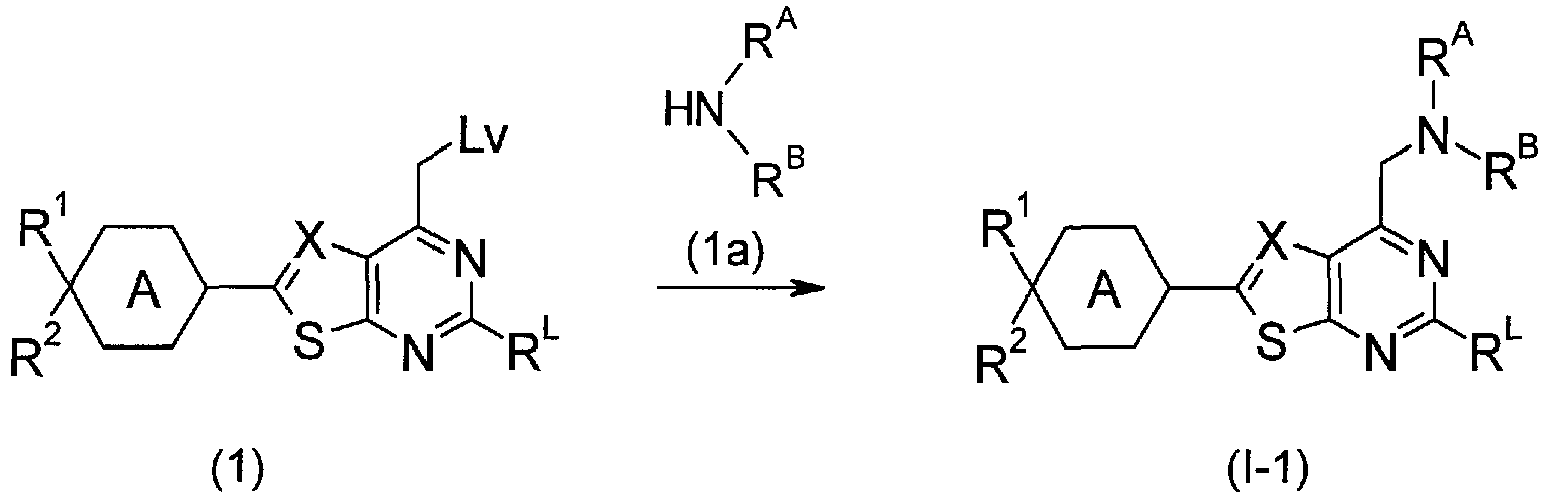
- The compound (I-1) of the present invention can be prepared from a compound (1) and a compound (1a).
- The leaving group is, for example, halogen, an OMs group, or the like. This reaction can be carried out using the compound (1) and the compound (1a) in equivalent amounts, or with either thereof in an excess amount, by stirring a mixture thereof under any temperature condition from cooling to heating, preferably at 0°C to 80°C, usually for 0.1 hours to 5 days, in a solvent which is inert to the reaction or without a solvent. The solvent is not particularly limited as long as it does not interfere with the reaction, but examples thereof include aromatic hydrocarbons such as toluene, xylene and the like, ethers such as Et2O, THF, DME, dioxane and the like, halogenated hydrocarbons such as DCM, DCE, chloroform and the like, DMF, DMSO, EtOAc, MeCN, and a mixed solvent thereof. It may be advantageous in some cases for the smooth progress of the reaction to carry out the reaction in the presence of an organic base such as TEA, DIPEA, and NMO, or an inorganic base such as K2CO3, Na2CO3, and KOH.
- S. R. Sandler and W. Karo, "Organic Functional Group Preparations", 2nd edition, Vol. 1, Academic Press Inc., 1991
- "Jikken Kagaku Koza (Courses in Experimental Chemistry) (5th edition)", Vol. 14 (2005), edited by The Chemical Society of Japan, Maruzen.
-

- The compound (I-2) of the present invention can be prepared from a compound (2) and the compound (1a).
- In this reaction, the compound (2) and the compound (1a) are used in equivalent amounts, or with either thereof in an excess amount, and a mixture thereof is stirred under any temperature condition from -30°C to heating to reflux, preferably at 0°C to room temperature, usually for 0.1 hours to 5 days, in a solvent which is inert to the reaction, in the presence of a reducing agent. The solvent is not particularly limited as long as it does not interfere with the reaction, but examples thereof include alcohols such as MeOH and the like, ethers, and a mixed solvent thereof. As the reducing agent, NaBH (OAc)3, NaBH3CN, NaBH4, or the like can be used. It may be advantageous in some cases for the smooth progress of the reaction to add a dehydrating agent such as molecular sieves, AcOH, hydrochloric acid, a TTIP complex, or the like. By condensation of the compound (2) with the compound (1a), an imine is produced, and can be isolated as a stable intermediate in some cases. This imine intermediate can be subjected to reduction to prepare a compound (I-2). Further, instead of use of the reducing agent, a reduction catalyst (for example, Pd/C and a Raney nickel) can be used at normal pressure to 50 atm in a hydrogen atmosphere, in the presence or absence of an acid such as AcOH and hydrochloric acid in a solvent such as MeOH, EtOH, and EtOAc. This reaction can be carried out under any temperature condition from cooling to heating.
- "Comprehensive Organic Functional Group Transformations II", A. R. Katritzky and R. J. K. Taylor, Vol. 2, Elsevier Pergamon, 2005
- "Courses in Experimental Chemistry (5th edition)", edited by The Chemical Society of Japan, Vol. 14 (2005) (Maruzen)
-

- The compound (I-3) of the present invention can be prepared from a compound (3) and the compound (1a).
- In this reaction, the compound (3) and the compound (1a) are used in equivalent amounts, or with either thereof in an excess amount, and a mixture thereof is stirred under any temperature condition from cooling to heating, preferably at -20°C to 60°C, usually for 0.1 hours to 5 days, in a solvent which is inert to the reaction, in the presence of a condensing agent. The solvent is not particularly limited as long as it does not interfere with the reaction, but examples thereof include aromatic hydrocarbons, halogenated hydrocarbons such as DCM and the like, ethers, DMF, DMSO, EtOAc, CH3CN, or water, and a mixed solvent thereof. The condensing agent is, for example, WSC, CDI, DPPA, HATU, phosphorous oxychloride, or the like. With an additive such as HOBt or the like, smooth progress of the reaction may be allowed in some cases. With an organic base such as pyridine, TEA, DIPEA, NMO or the like, or an inorganic base such as K2CO3, Na2CO3, KOH or the like, smooth progress of the reaction may be allowed in some cases.
- Furthermore, the compound (I-3) of the present invention can also be prepared from a reactive derivative of a carboxylic acid (3) and the compound (1a). Examples of the reactive derivative include acid halides obtained by the reaction with a halogenating agent such as phosphorus oxychloride, thionyl chloride, and the like; mixed acid anhydrides obtained by the reaction with isobutyl chloroformate or the like; and active esters obtained by condensation with HOBt or the like. In the reaction of the reactive derivative with the compound (1a), a mixture thereof can be stirred under any temperature condition from cooling to heating, preferably at -20°C to 60°C usually for 0.1 hours to 5 days, with an organic base such as pyridine, TEA, DIPEA, NMO, and the like, in a solvent which is inert to the reaction. The solvent is not particularly limited as long as it does not interfere with the reaction, but halogenated hydrocarbons, aromatic hydrocarbons, ethers, or the like can be used. Further, the organic base can be used in combination with the solvent.
- S. R. Sandler and W. Karo, "Organic Functional Group Preparations", 2nd edition, Vol. 1, Academic Press Inc., 1991
- "Jikken Kagaku Koza (Courses in Experimental Chemistry) (5th edition)", Vol. 16 (2005), edited by The Chemical Society of Japan (Maruzen)
-


- The compound (I-4) of the present invention can be prepared by the hydrogenation reaction of a compound (4).
- In this reaction, the compound (4) is stirred under any temperature condition from cooling to heating, preferably at room temperature usually for 1 hour to 5 days, with a metal catalyst, in a solvent which is inert to the reaction under a hydrogen atmosphere. The solvent is not particularly limited as long as it does not interfere with the reaction, but examples thereof include alcohols, ethers, and the like. The metal catalyst is, for example, a palladium catalyst such as Pd(OH)2 and the like. Instead of a hydrogen gas, formic acid or ammonium formate in equivalent amounts or in an excess amount can be used as a hydrogen source, relative to the compound (4).
- M. Hudlicky, "Reductions in Organic Chemistry, 2nd edition (ACS Monograph: 188)", ACS, 1996
- "Jikken Kagaku Koza" (Courses in Experimental Chemistry) (5th edition), edited by The Chemical Society of Japan, Vol. 19 (2005) (Maruzen)
-

- A starting compound (1) can be prepared from a compound (6).
- (i) The starting compound (1) in which Lv is halogen can be prepared by the halogenations of a compound (6). This reaction can be carried out under any temperature condition from heating to heating to reflux with a halogenating agent such as SO2Cl2, phosphorous oxychloride or the like, and DMF. The solvent is not particularly limited as long as it does not interfere with the reaction, but toluene or the like can be used. As the halogenating agent, PBr3, NBS, or the like can be used.
- (ii) The starting compound (1) in which Lv is an OMs group can be prepared by adding an organic base and MsCl to the compound (6) under any temperature condition from 0°C to at room temperature in a solvent which is inert to the reaction under a hydrogen atmosphere. The solvent is not particularly limited as long as it does not interfere with the reaction, but DCM or the like can be used.
- The compound (6) can be prepared by the reduction of a compound (5).
- In this reaction, the compound (5) is treated with a reducing agent in an equivalent amount or in an excess amount, under any temperature condition from cooling to heating, preferably at -20°C to 80°C, usually for 0.1 hours to 3 days, in a solvent which is inert to the reaction. The solvent is not particularly limited as long as it does not interfere with the reaction, but examples thereof include ethers, aromatic hydrocarbons, alcohols, and a mixed solvent thereof. As the reducing agent, NaBH4, borane (BH3), or a reducing agent in the following documents is used. When as the reducing agent, for example, NaBH4 is used, calcium chloride may allow the smooth progress of the reaction in some cases.
- M. Hudlicky, "Reductions in Organic Chemistry, 2nd edition (ACS Monograph: 188)", ACS, 1996
- R. C. Larock, "Comprehensive Organic Transformations", 2nd edition, VCH Publishers, Inc., 1999
- T. J. Donohoe, "Oxidation and Reduction in Organic Synthesis (Oxford Chemistry Primers 6)", Oxford Science Publications, 2000
- "Jikken Kagaku Koza" (Courses in Experimental Chemistry) (5th edition), edited by The Chemical Society of Japan, Vol. 14 (2005) (Maruzen)
- The starting compound (3) can be prepared by the deprotection of the compound (5). This reaction can be carried out with reference to "Protective Groups in Organic Synthesis", Greene and Wuts, 3rd edition, John Wiley & Sons Inc, 1999.
-

- The compound (2) can be prepared by the deprotection of a compound (8). This reaction can be carried out with reference to "Protective Groups in Organic Synthesis", Greene and Wuts, 3rd edition, John Wiley & Sons Inc, 1999.
- The compound (8) can be prepared from a compound (7) and a lower alkyloxyetheneboronic acid pinacol ester (7a). This reaction is a so-called Suzuki coupling between the compound (7) and a boronic acid compound. This reaction can be carried out by adding palladium, a phosphine ligand, and a metal base as a reagent under any temperature condition from at room temperature to heating to reflux. The solvent is not particularly limited as long as it does not interfere with the reaction, but a solvent which is inert to the reaction, such as aromatic hydrocarbons, ethers, halogenated hydrocarbons, aprotic solvents, and AcOH may be used or a solvent may not be used. As the palladium, for example, Pd(OAc)2, Pd2dba3, or the like can be used. As the phosphine ligand, for example, BINAP, DPPF, P(But)3, or the like can be used. As the metal base, K2CO3, Cs2CO3, NaOBut, or the like can be used.
-


- The starting compound (6) can be prepared by the hydrolysis of a compound (9).
- The compound (9) can be prepared from the compound (7) and a compound (7b). This reaction is Negishi coupling, in which an organic zinc compound and an organic halide are condensed with a palladium or nickel catalyst to prepare a carbon-carbon bonding product. The solvent is not particularly limited as long as it does not interfere with the reaction, but THF or the like can be used. As the catalyst, for example, Pd(PPh3)4 can be used. Usually, the reaction can be carried out at room temperature.
- Negishi, E. Acc. Chem. Res. 1982, vol. 15, p. 340-348,
- "Metal-Catalyzed Cross-Coupling Reactions", edited by A. de Meijere and F. Diederich, 2nd edition, VCH Publishers Inc., 2004,
- "Jikken Kagaku Koza" (Courses in Experimental Chemistry) (5th edition), edited by The Chemical Society of Japan, Vol. 13 (2005) (Maruzen)
- Organic Letters, 2004, p. 3225, Synlett, 2008, p. 543
-


- The compound (7) can be prepared by the halogenations of the compound (10).
- This reaction can be carried out in the same manner as the method described in Starting Material Synthesis 1 above.
-

- The starting compound (5) can be prepared from a compound (11). Prg is lower alkyl such as Me and Et.
- This reaction can be carried out by using an alcohol (Prg-OH) as a solvent and a reagent, and stirring a mixture thereof with a compound (11) and hydrogen hydride such as HCl/dioxane and HCl/EtOAc, under any temperature condition from room temperature to heating, for several hours to overnight.
- The compound (11) can be prepared by the cyanation of the compound (7). This reaction can be carried out with a CN source such as NaCN, KCN, Zn (CN)2 or the like, and CH3SO2Na or the like, under any temperature condition from 50°C to 80°C, for several hours to overnight under stirring. The solvent is not particularly limited as long as it does not interfere with the reaction, but DMF or the like can be used.
-

- The starting compound (10-1) can be prepared from a compound (14).
- This reaction can be carried out by heating and stirring the compound (14) with an aqueous inorganic base solution such as an aqueous NaOH solution or the like, in a solvent which is inert to the reaction. The solvent is not particularly limited as long as it does not interfere with the reaction, but alcohols such as EtOH and the like can be used.
- The compound (14) can be prepared from a compound (13).
- This reaction is amidation in which the compound (13) is reacted with an acid halide of a formula RL-C(C=O)-Hal. For the reaction, the same method as Production Process 3 can be used.
- The compound (13) can be prepared from the compound (12) with an organic base such as 2-cyanoacetamide (12a), sulfur, TEA, and the like in a solvent, usually by heating. The solvent is not particularly limited as long as it does not interfere with the reaction, but DMF or the like can be used.
-


- The starting compound (10-2) can be prepared from a compound (17) and a compound (17a).
- This reaction can be carried out by adding formic acid to the compound (17) and the compound (17a), in a solvent which is inert to the reaction, and heating and stirring. The solvent is not particularly limited as long as it does not interfere with the reaction, but an alcohol or the like can be used.
- The compound (17) can be prepared by the amidation of the compound (15) and the compound (16).
- This reaction can be carried out in the same manner as the method described in Production Process 3.
-
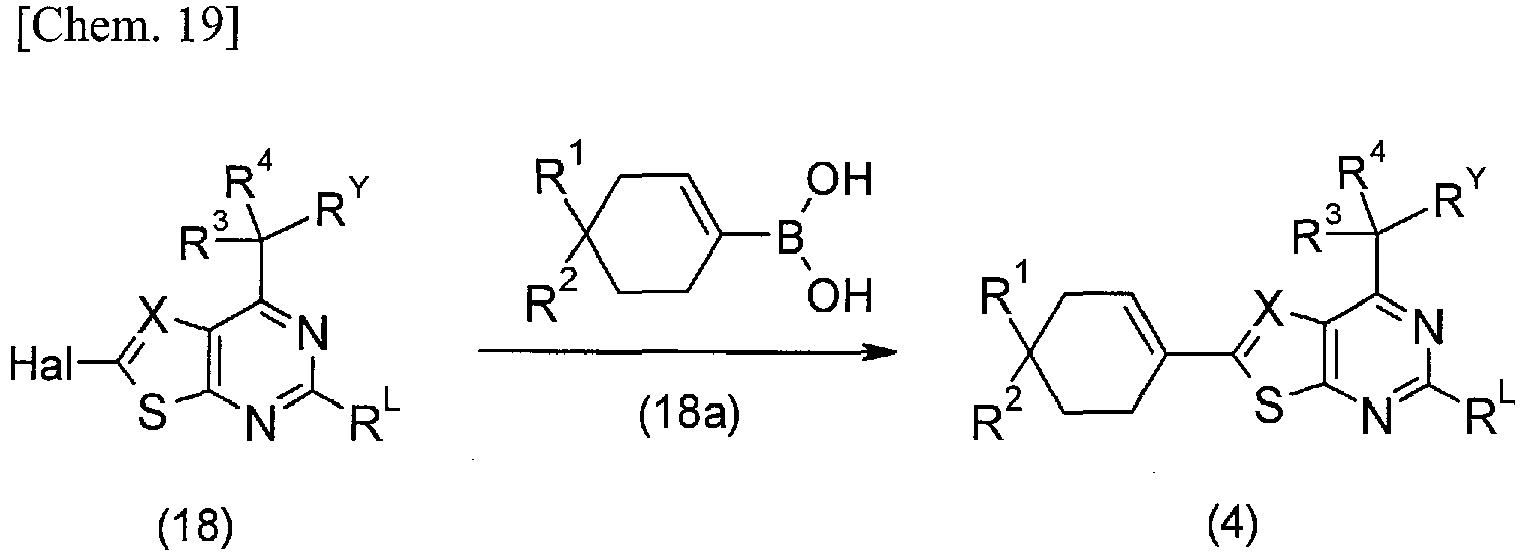
- The starting compound (4) can be prepared from a compound (18) and a compound (18a).
- This production process is a so-called Suzuki coupling, and can be carried out in the same manner as the method for preparing the compound (7) from the compound (8) of Starting Material Synthesis 2 as described above.
- The compound of the formula (I) is isolated and purified as a free compound, a salt, a hydrate, a solvate, or a polymorphic crystal substance thereof. A salt of the compound of the formula (I) can be prepared by carrying out a conventional salt forming reaction.
- Isolation and purification are carried out by employing ordinary chemical operations such as extraction, fractional crystallization, various types of fractional chromatography, and the like.
- Various isomers can be prepared by selecting an appropriate starting compound or separated by using the difference in the physicochemical properties between the isomers. For example, the optical isomers can be obtained by means of a general method for designing optical resolution of racemic compounds (for example, fractional crystallization for inducing diastereomer salts with optically active bases or acids, chromatography using a chiral column or the like, and others), and further, the isomers can also be prepared from an appropriate optically active starting material.
- The pharmacological activity of the compound of the formula (I) or a salt thereof was confirmed by the tests below.
- The medium composition and the buffer composition used in the following Test Examples are shown below (the concentration of each reagent represents a final concentration).
- KH Buffer (Krebs-Henseleit Buffer): Aqueous solution containing 119 mM NaCl, 4.8 mM KCl, 1.2 mM KH2PO4, 1.2 mM MgSO4, 2.5 mM CaCl2, 25 mM NaHCO3, 10 mM Glucose, and 20 mM Tris-HCl (pH = 7.4).
- A Buffer: Aqueous solution containing 0.32 M sucrose, 1 mM MgCl2, and 1 mM K2HPO4.
- B Buffer: Aqueous solution containing 50 mM Tris-HCl (pH = 7.7), 100 mM NaCl, 10mM MgCl2, 2 mM CaCl2, 0.2 mM EGTA, and 30 µM GDP.
- C Buffer: Aqueous solution containing 20 mM Tris-HCl (pH = 7.7) and 5 mM MgCl2.
- Base buffer: Aqueous solution containing 2.5 mM probenecid, 20 mM Hepes-NaOH (pH = 7.5), and a Hanks' balanced salt solution (HBSS) containing 0.02% CHAPS.
- Fluo-4 loaded solution: Base buffer containing 1 µM Fluo-4 AM (Dojindo Molecular Technologies, Inc.), 0.067% DMSO and 0.0033% Pluronic F-127 (Life Technologies).
- Test Example 1: Confirmation of PAM action by GTPγS binding test
- The function of the GABAB receptor of the compound of the present invention was evaluated using a [35S] GTPγS binding test. This method is used for the detection of the PAM action of the compound on the GABAB receptor (Journal of Pharmacology and Experimental Therapeutics, 2003, vol. 307(1), p. 322-330; and Molecular Pharmacology, 2001, vol. 60(5), p. 963-971).
- The mouse brain cortical membrane was prepared with reference to a method for preparing a rat brain membrane (European Journal of Pharmacology, 1990, vol. 187 (1), p. 27-38).
- The cortex (about 30 g) was cut out of the brains of 90 ddY mice (Japan SLC, Inc.). An A buffer was added to the cortex (cortex/A buffer = about 1:3 (wt/vol)), and homogenized with a glass Teflon-lined homogenizer (Teflon: registered trademark) on ice. The homogenate was centrifuged (750 g, 10 min, 4°C) and a supernatant was then obtained. An A buffer (90 mL) was added to pellets and homogenized on ice, and a supernatant (750 g, 10 min, 4°C) was then obtained. By repeating this operation, the supernatant was collected.
- The supernatant was centrifuged (18000 g, 15 min, 4°C). Ultrapure water (54 mL) was added to the pellets, left to stand for 30 min on ice, and then centrifuged (39000 g, 20 min, 4°C). The pellets were suspended in a KH buffer (54 mL), repeatedly frozen and thawed, and centrifuged (18000 g, 15 min) at 4°C. The buffer was added to the pellets and then frozen and thawed, and this operation was repeated until the centrifugation. By a Bradford method using a protein assay (Protein assay CBB solution; Nacalai Tesque, Inc.), a KH buffer suspension of the pellet was prepared at a protein concentration of 10 mg/mL.
- The PAM action of the GABAB receptor in the mouse brain cortex of a test drug was evaluated. To each of wells of a 96-well microplate, a test drug diluted with a B buffer at each concentration (3 nM to 30 µM), a mouse brain cortex membrane (4 µg), [35S] GTPγS (final concentration of 0.34 nM, Muromachi Yakuhin Co., Ltd.; Institute of Isotopes Co., Ltd.), GABA (final concentration of 0.3 µM; Sigma) were added in this order, followed by standing at room temperature for 1 hour. With a harvester (Filtermate, Perkin-Elmer, Inc.), the suspension was suction-filtered through a glass filter (UniFilter 96-well GF/B filter plates, Perkin-Elmer, Inc.). The glass filter was washed with a C buffer that had been ice-cooled. After drying the glass filter, a liquid scintillation cocktail (50 µL, MicroScinti-PS; PerkinElmer, Inc.) was added to each well. The amount of [35S] GTPγS bound to the membrane was measured on a plate reader (TopCount, PerkinElmer, Inc.).
- The maximum reaction rate of 100 µM GABA was taken as 100%. The reaction rate when GABA and the test drug did not exist was taken as 0%. At a time when the test drug was not added, the concentration of the test drug that increased the reaction rate from 20% with 0.3 µM GABA to 50% was taken as a PAM Potency (µM) of the GABAB of the test drug. In the presence of 0.3 µM GABA, the maximum reaction rate of the effect on the GABAB receptor when the test drug was administered up to maximum 30 µM was taken as a PAM Efficacy (%) of the GABAB of the test drug.
- The Potency and Efficacy of several representative Example Compounds of the present invention are shown in Table below (In the Table, Ex represents Example Compound No. The "Potency" represents the PAM Potency of GABAB of the test drug, and the "Efficacy" represents PAM Efficacy (%) of GABAB of the test drug. These shall apply hereinafter).
[Table 1] No. Potency (µM) Efficacy (%) No. Potency (µM) Efficacy (%) Ex2 0.11 207 Ex55 0.25 175 Ex4 0.20 161 Ex61 0.24 160 Ex5 0.24 176 Ex72 0.089 289 Ex7 0.24 139 Ex73 0.085 272 Ex12 0.23 377 Ex74 0.19 244 Ex31 0.11 300 Ex79 0.046 230 Ex31-1 0.18 191 Ex101 0.38 134 Ex39 0.42 165 Ex102 0.40 127 Ex40 0.53 203 Ex104 0.079 218 Ex43 0.26 118 Ex108 0.20 176 Ex44 0.27 119 Ex127 0.11 338 Ex45 0.44 134 Ex132 0.15 218 Ex46 0.18 188 Ex142 0.0071 214 Ex47 0.12 240 Ex143 1.2 182 Ex48 0.26 238 Ex144 0.31 182 Ex50 0.54 222 Ex146 0.10 258 Ex51 0.15 249 Ex151 0.12 168 Ex52 0.17 259 Ex153 0.059 180 Ex54 0.32 88 Ex155 0.046 159 - A natural GABAB receptor has a heterodimeric structure consisting of two kinds of subunits of GABAB1 and GABAB2 (Nature, 1997, vol. 386, p. 239-246) In the subunit of GABAB1, two major splice variants referred to as GABAB1a and ib exist. However, the two variants have no difference in the pharmacological effects in the receptor-downstreaming signals (Nature, 1998, vol. 396, p. 683-687).
- In HEK293 cells expressing the heterodimers of GABAB1b and GABAB2, the PAM action in the presence of GABA was measured over time with a change in the intracellular Ca2+ concentration using RFU (relative fluorescence units) as an index, and evaluated.
- All vectors, wherein each vector was formed by human GABAB1b (NM_021903. 2), GABAB2 (NM_005458. 7), or Gaqo chimera, were incorporated by lipofection to establish stably expressing human embryonic kidney-derived cell lines, HEK293 cells (ATCC).
- The Gaqo chimera was fabricated by the following method. The genes coding human Gαq (NM_002072.3) were cloned, and C-terminal 15 base pairs (1107-1121 bp) of ORF (41-1121 bp) of Gaq was substituted with C-terminal 15 base pairs (1948-1962 bp) of ORF (898-1962 bp) of human Gαo (NM_138736. 2) into a Gaqo chimera.
- A change in the intracellular concentration of calcium mobilized due to activation of a GABAB receptor was measured with a Fluorometric Imaging Plate Reader (FLIPR, Molecular Devices). The stably expressing cells established as described above were proliferated in a D-MEM medium containing a screening agent (0.5 mg/mL G418 Disulfate and 0.2 mg/mL Hydromycin B solution), 1% penicillin/streptomycin, and 10% FCS. About 1 x 10⁴ cells/well were diluted and seeded in a black-wall, 384-well poly-D-lysin-coated plate (Becton Dickinson) in a D-MEM medium containing 10% FCS, but not a selective agent and 1 % penicillin/streptomycin. After 24 hours, the medium was removed from the plate, and a Fluo-4 loaded solution (20 µL) was added to each well, followed by incubation at room temperature for 2 hours. The fluorescent reagent loaded solution was removed from each well, the cells were washed with a base buffer three times, and then a base buffer (20 µL) was added thereto, followed by analysis with FLIPR TETRA (Molecular Devices). The base buffer (10 µL) solution of the test drug was added thereto to a final concentration (1 nM to 30 µM) and the measurement of a change in the fluorescence was initiated. Thereafter, GABA (1 µM, 20 µL) was added thereto and the measurement was continued. The change in the fluorescence was measured every two or five seconds.
- The maximum reaction rate of 100 µM GABA was taken as 100%. The reaction rate when GABA and the test drug did not exist was taken as 0%. At a time when the test drug was not added, the concentration of the test drug that increased the reaction rate from 5% with 1 µM GABA to 50% was taken as a PAM Potency (µM) of the GABAB of the test drug. In the presence of 1 µM GABA, the maximum reaction rate of the effect on the GABAB receptor when the test drug was administered up to maximum 30 µM was taken as a PAM Efficacy (%) of the GABAB of the test drug.
- The evaluation test results in FLIPR of several representative Example Compounds of the present invention are shown in Table below.
[Table 2] No. Potency (µM) Efficacy (%) Ex2 0.059 470 Ex31 0.22 273 - Test Example 3: Y-Maze Test: Improvement Effect on Cognitive impairment
- The effect on the improvement of short-term memory impairment of the compound of the present invention was evaluated using a Y-maze test that is an experimental system of spontaneous alternation behavior.
- As the Y maze, a maze, in which three runways having a length of one arm of 40 cm, a height of a wall of 13 cm, a width of a floor of 3 cm, and a width of a top of 10 cm are each joined at 120 degrees in a Y shape, was used.
- The test drugs were orally administered once to 5- to 6-week old ddY male mice (n=8) at 30 minutes before the initiation of the Y-maze test, and further, MK-801 (Sigma) which is an NMDA receptor antagonist inducing cognitive impairment was intraperitoneally administered thereto at a dose of 0.15 mg/kg at 20 minutes before the initiation of the Y-maze test.
- Further, for the mice in a control group, a vehicle (0.5% methyl cellulose) was used instead of the test drug, and physiological saline was used instead of MK-801.
- For the mice in the MK-801 control group, a vehicle (0.5% methyl cellulose) was used instead of the test drug.
- The mouse was placed at one end of a certain place in the runway in the Y maze, and then freely explored for 8 minutes, and the runways into which the mice invaded and the order thereof were recorded. The number of the entries of the mice within a measurement time was counted and defined as a total number of entries. Among these, a combination when the mice invaded into different three runways (for example, in a case where the three arms are referred to as a, b, and c, respectively, and the order of the arms with entries is abccbacab, the number was counted as 4, including the repetition) was defined as the number of spontaneous alternation behaviors. For the spontaneous alternation rate, a spontaneous alternation rate calculated by the following equation was taken as an index of spontaneous alternation behavior:

- A higher value of this index indicates that more short-term memory is retained.
- The measured value was expressed in an average value ± a standard error. A significant difference assay between the control group and the MK-801 control group was carried out by a Student's t-test. Further, a Dunnett's multi-comparison test was carried out in a significant difference assay between the group administered with the test drug and the MK-801 control group, and it was thus determined that the test drug has an action to improve the learning disorder. In each test, if p < 0.05 was satisfied, it was determined that there was a significant difference.
- The MED (mg/kg) of several representative Example Compounds in the present invention are shown in Table below.
[Table 3] No. MED (mg/kg) Ex2 0.1 Ex31 1.0 - Test Example 4: Effect on Pressure Pain Threshold in Model with Reserpine-Induced Muscle Pain
- This model is a model that mimics the pathological conditions of fibromyalgia. This test was carried out on the basis of the description in Pain, 2009, vol. 146, p. 26-33. Reserpine (1 mg/kg) was subcutaneously administered to the male SD rat (Japan SLC, Inc.)) once per day for 3 days. After 5 days, the solvent or the test drug was orally administered. After 30 minutes, the pressure pain threshold value was measured using a Randall-Selitto instrument (Muromachi Kikai Co., Ltd.) in the gastrocnemius muscle. The significant difference assay between the solvent group and the group administered with the test drug was carried out by comparison between the groups using a Student's t-test or a Dunnett's multiple comparison test. Here, the value obtained by administering a solvent to a normal rat not administered with reserpine was taken as 100%, and the value of the reserpine group administered with a solvent was taken as 0%. In each assay, if p < 0.05 was satisfied, it was determined that there was a significant difference.
[Table 4] No. MED (mg/kg) Ex2 0.03 - As a result of the tests above, it was found that the compound of the present invention has a PAM action of the GABAB receptor. Accordingly, the compound is useful for preventing or treating GABAB receptor -related diseases or disorders, for example, schizophrenia, CIAS, cognitive impairment, fragile X syndrome, autism spectrum disorder, spasticity, anxiety disorder, substance addiction, pain, fibromyalgia, Charcot-Marie-Tooth disease, or the like.
- A pharmaceutical composition containing one or two or more kinds of the compound of the formula (I) or a salt thereof as an active ingredient can be prepared using excipients that are usually used in the art, that is, excipients for pharmaceutical preparation, carriers for pharmaceutical preparation, and the like according to the methods usually used.
- Administration can be accomplished either by oral administration via tablets, pills, capsules, granules, powders, solutions, and the like, or parenteral administration injections, such as intraarticular, intravenous, or intramuscular injections, and the like, suppositories, ophthalmic solutions, eye ointments, transdermal liquid preparations, ointments, transdermal patches, transmucosal liquid preparations, transmucosal patches, inhalers, and the like.
- As the solid composition for oral administration, tablets, powders, granules, or the like are used. In such a solid composition, one or more active ingredient(s) are mixed with at least one inactive excipient. In a conventional method, the composition may contain inactive additives, such as a lubricant, a disintegrating agent, a stabilizer, or a solubilization assisting agent. If necessary, tablets or pills may be coated with sugar or a film of a gastric or enteric coating substance.
- The liquid composition for oral administration contains pharmaceutically acceptable emulsions, solutions, suspensions, syrups, elixirs, or the like, and also contains generally used inert diluents, for example, purified water or ethanol. In addition to the inert diluent, the liquid composition may also contain auxiliary agents, such as a solubilization assisting agent, a moistening agent, and a suspending agent, sweeteners, flavors, aromatics, and antiseptics.
- The injections for parenteral administration include sterile aqueous or non-aqueous solution preparations, suspensions and emulsions. The aqueous solvent includes, for example, distilled water for injection and physiological saline. Examples of the non-aqueous solvent include alcohols such as EtOH. Such a composition may further contain a tonicity agent, an antiseptic, a moistening agent, an emulsifying agent, a dispersing agent, a stabilizing agent, or a solubilizing aid. These are sterilized, for example, by filtration through a bacteria retaining filter, blending of a bactericide, or irradiation. In addition, these can also be used by preparing a sterile solid composition, and dissolving or suspending it in sterile water or a sterile solvent for injection prior to its use.
- Examples of the agent for external use includes ointments, plasters, creams, jellies, patches, sprays, lotions, eye drops, eye ointments, and the like. The agents contain generally used ointment bases, lotion bases, aqueous or non-aqueous liquid preparations, suspensions, emulsions, or the like.
- As the transmucosal agents such as an inhaler, a transnasal agent, and the like, those in the form of a solid, liquid, or semi-solid state are used, and can be prepared in accordance with a conventionally known method. For example, a known excipient, and also a pH adjusting agent, an antiseptic, a surfactant, a lubricant, a stabilizing agent, a thickening agent, or the like may be appropriately added thereto. For the administration, an appropriate device for inhalation or blowing can be used. For example, a compound may be administered alone or as a powder of formulated mixture, or as a solution or suspension in combination with a pharmaceutically acceptable carrier, using a conventionally known device or sprayer, such as a measured administration inhalation device, and the like. A dry powder inhaler or the like may be for single or multiple administration use, and a dry powder or a powder-containing capsule may be used. Alternatively, this may be in a form such as a pressurized aerosol spray which uses an appropriate ejection agent, for example, a suitable gas such as chlorofluoroalkane, carbon dioxide, and the like, or other forms.
- In general oral administration, the daily dose is suitably from about 0.001 mg/kg to 100 mg/kg, preferably from 0.1 mg/kg to 30 mg/kg, and more preferably from 0.1 mg/kg to 10 mg/kg, per body weight, administered in one portion or in 2 to 4 divided portions. In the case of intravenous administration, the daily dose is suitably from about 0.0001 mg/kg to 10 mg/kg per body weight, once a day or two or more times a day. In addition, a transmucosal agent is administered at a dose from about 0.001 to 100 mg/kg per body weight, once a day or two or more times a day. The dose is appropriately decided in response to the individual case by taking the symptoms, the age, and the gender, and the like into consideration.
- Although varying depending on administration routes, dosage forms, administration sites, or the types of excipients and additives, the pharmaceutical composition of the present invention contains 0.01% by weight to 100% by weight, and in a certain embodiment, 0.01% by weight to 50% by weight of one or more kinds of the compound of the formula (I) or a salt thereof, which is an active ingredient.
- The compound of the formula (I) can be used in combination with various agents for treating or preventing the diseases for which the compound of the formula (I) is considered to be effective. The combined preparation may be administered simultaneously, or separately and continuously, or at a desired time interval. The preparations to be co-administered may be a blend, or may be prepared individually.
- Hereinbelow, the preparation methods for the compound of the formula (I) will be described in more detail with reference to Examples. Further, the present invention is not limited to the compounds described in the Examples as described below. Furthermore, the production processes for the starting compounds will be described in Preparation Examples. Further, the preparation methods for the compound of the formula (I) are not limited to the preparation methods of the specific Examples as below, but the compound of the formula (I) can be prepared by any combination of the preparation methods or the methods that are apparent to a person skilled in the art.
- The compounds shown in the following Table were prepared by using the above-mentioned preparation methods and the methods that are apparent to a person skilled in the art, or modified methods thereof. The tables show the structures and physicochemical data of the Example Compounds and methods for preparing the compounds. Further, the symbols in the tables represent the following meanings.
- No. = Example No. or Preparation Example No.
- No./Inf = (Example No. or Preparation Example No. of the compound)/(salt information of the compound). /Inf, for example, /HCl denotes that the Example Compound is a monohydrochloride. Further, a case where /2HCl is described means that the compound is a dihydrochloride. In addition, /FUM denotes that the compound is fumarate. A case where nothing is described indicates that the compound is a free form. In the tables, Chiral denotes that the compound is an optically active form.
- Pr = Preparation Example No., Ex = Example No., Ref = preparation method (the numeral shows that the Example Compound was prepared by the same preparation method as that for a compound having its number as the Example No. Further, in the tables, for example, in Ex86, a case where Pr8 + Ex85 is described denotes that a material is prepared by the same method as for the preparation of Preparation Example Compound 8 (Pr8), and then, by using the obtained material as starting material. A desired product is prepared by the same method as for the preparation of Example Compound 85 (Ex85). Further, in Tables, for example, in Pr26, a case where Pr8 + Ex1 is described denotes that a material is prepared by the same method as for the preparation of Preparation Example Compound 8 (Pr8), and then, by using the obtained material as starting material. A desired product is prepared by the same method as for the preparation of Example Compound 1 (Ex1 )).
- Str = Structural formula, Data = Physicochemical data.
- NMR (CDCl3) = Chemical shift δ value in 1H-NMR, as measured using CDCl3 as a solvent, NMR (DMSO-d6) = Chemical shift δ value in 1H-NMR, as measured using DMSO-d6 as a solvent, EI = m/z value measured by EI-MS, ESI = m/z value measured by ESI-MS, APCI = m/z value measured by APCI-MS, APCI/ESI = m/z value measured by APCI and ESI at once, CI = m/z value measured by CI-MS. Further, in a case where + or - is described as a suffix in ESI or the like, + means a MS value measured in a positive ion mode and - means a MS value measured in a negative ion mode.
- To a mixture of 2-acetamide-5-(4,4-dimethylcyclohexyl)thiophene-3-carboxamide (37.3 g) and EtOH (200 mL) was added a 2 M aqueous NaOH solution (200 mL), followed by heating and stirring at 80°C for 2 hours. The reaction mixture was left to be cooled to room temperature, and then, 1 M hydrochloric acid (500 mL) was added thereto, followed by stirring at room temperature. The precipitate was collected by filtration to obtain 6-(4,4-dimethylcyclohexyl)-2-methylthieno[2,3-d]pyrimidin-4(3H)-one (26.3 g).
- To a mixture of 6-cyclohexyl-2-methylthieno[2,3-d]pyrimidin-4(3H)-one (25.0 g) and toluene (300 mL) were added phosphorous oxychloride (14 mL) and DMF (200 µL), followed by heating to reflux at 150°C for 14 hours. The reaction mixture was left to be cooled to room temperature and concentrated under reduced pressure. To the residue were added chloroform, water, and saturated aqueous sodium bicarbonate, followed by stirring. The reaction mixture was extracted with chloroform. The organic layer was washed sequentially with water and brine. To the organic layer were added MgSO4, activated carbon (2 g), and silica gel (100 mL), followed by stirring. The mixture was filtered through Celite and then concentrated under reduced pressure to obtain 4-chloro-6-cyclohexyl-2-methylthieno[2,3-d]pyrimidine (27.4 g).
- To a mixture of 6-(4,4-dimethylcyclohexyl)-2-methylthieno[2,3-d]pyrimidin-4(3H)-one (30.0 g) and toluene (240 mL) were added phosphorous oxychloride (40 mL) and DMF (1.0 mL), followed by heating to reflux at 130°C for 2 hours. The reaction mixture was left to be cooled to room temperature and concentrated under reduced pressure. To the residue were added chloroform and saturated aqueous sodium bicarbonate, followed by stirring. The organic layer was washed sequentially with water and brine. To the organic layer were added MgSO4,activated carbon (10 g), and silica gel (100 mL), followed by stirring. The mixture was filtered through Celite and then concentrated under reduced pressure to obtain 4-chloro-6-(4,4-dimethylcyclohexyl)-2-methylthieno[2,3-d]pyrimidine (31.3 g).
- To a mixture of 2-(4,4-dimethylcyclohexyl)-5-methyl[1,3]thiazolo[5,4-d]pyrimidin-7-ol (16.2 g) and toluene (160 mL) were added DMF (10 mL) and phosphorous oxychloride (11 mL), followed by stirring at 95°C for 30 minutes. The reaction mixture was concentrated under reduced pressure. To the residue was added chloroform, and the mixture was neutralized with a 1 M aqueous NaOH solution in an ice bath and extracted with chloroform. The organic layer was dried over MgSO4 and then concentrated under reduced pressure. The residue was purified by silica gel column (hexane/EtOAc) to obtain 7-chloro-2-(4,4-dimethylcyclohexyl)-5-methyl[1,3]thiazolo[5,4-d]pyrimidine (13.2 g).
- To a mixture of 4-chloro-6-(4,4-dimethylcyclohexyl)-2-methylthieno[2,3-d]pyrimidine (31.1 g) and DMF (220 mL) were added CH3SO2Na (11 g) and KCN (10 g), followed by heating and stirring at 70°C for 15 hours. The reaction mixture was concentrated to about a half of the amount under reduced pressure, diluted with water (300 mL), and then stirred. The precipitate was collected by filtration. To the precipitate was added chloroform, followed by dissolving therein, and MgSO4,activated carbon (10 g), and silica gel (100 mL) were added thereto, followed by stirring. The mixture was filtered through Celite and then concentrated under reduced pressure to obtain 6-(4,4-dimethylcyclohexyl)-2-methylthieno[2,3-d]pyrimidine-4-carbonitrile (27.4 g).
- To a mixture of 6-cyclohexyl-2-methylthieno[2,3-d]pyrimidine-4-carbonitrile (23.5 g) and EtOH (100 mL) was added 4 M HCl/dioxane (100 mL), followed by stirring at 80°C for 2 days. The reaction mixture was left to be cooled to room temperature and concentrated under reduced pressure. To the residue was added chloroform, followed by dissolving therein, and activated carbon (2 g) and basic silica gel (100 mL) were further added thereto, followed by stirring. The mixture was filtered through Celite and then concentrated under reduced pressure to obtain ethyl 6-cyclohexyl-2-methylthieno[2,3-d]pyrimidine-4-carboxylate (30.8 g).
- To a mixture of 6-(4,4-dimethylcyclohexyl)-2-methylthieno[2,3-d]pyrimidine-4-carbonitrile (27.4 g) and EtOH (200 mL) was added 4 M HCl/dioxane (200 mL), followed by stirring at 80°C overnight. The reaction mixture was left to be cooled to room temperature and then concentrated under reduced pressure. To the residue were added EtOH (200 mL) and water (200 mL), followed by stirring. The precipitate was collected by filtration. To the obtained precipitate was added chloroform, followed by dissolving therein, and MgSO4,activated carbon (10 g), and basic silica gel (100 mL) were added thereto, followed by stirring. The mixture was filtered through Celite and then concentrated under reduced pressure to obtain ethyl 6-(4,4-dimethylcyclohexyl)-2-methylthieno[2,3-d]pyrimidine-4-carboxylate (23.3 g).
- To a mixture of ethyl 6-cyclohexyl-2-methylthieno[2,3-d]pyrimidine-4-carboxylate (29.3 g), calcium chloride (18 g), and THF (200 mL) was added NaBH4 (5.5 g) in small divided portions at room temperature, and then EtOH (200 mL) was slowly added thereto over 5 minutes, followed by stirring at room temperature for 4 hours. To the reaction mixture was added ice water, followed by stirring, adding 1 M hydrochloric acid until the suspension becomes a solution state, and then extracting with EtOAc. The organic layer was washed sequentially with water, saturated aqueous sodium bicarbonate, and brine. To the organic layer were added MgSO4,activated carbon, and basic silica gel, followed by stirring. The mixture was filtered through Celite and then concentrated under reduced pressure. The residue was purified by silica gel column (chloroform/EtOAc) to obtain (6-cyclohexyl-2-methylthieno[2,3-d]pyrimidin-4-yl)methanol (12.7 g).
- To a mixture of ethyl 6-(4,4-dimethylcyclohexyl)-2-methylthieno[2,3-d]pyrimidine-4-carboxylate (13.0 g), THF (150 mL), and EtOH (150 mL) was added calcium chloride (6.6 g), followed by stirring at room temperature for 30 minutes and then adding NaBH4 (1.8 g) in small divided portions over 15 minutes under ice-cooling. After stirring at room temperature for 4.5 hours, to the reaction mixture were added water (100 mL) and EtOAc (100 mL) under ice-cooling. 1 M Hydrochloric acid (100 mL) was added thereto until the suspension became a solution, followed by concentration under reduced pressure and extracting with EtOAc. The organic layer was washed sequentially with water, saturated aqueous sodium bicarbonate, and brine, dried over MgSO4, and then concentrated under reduced pressure. The residue was purified by silica gel column (chloroform/EtOAc) to obtain [6-(4,4-dimethylcyclohexyl)-2-methylthieno[2,3-d]pyrimidin-4-yl]methanol (9.35 g).
- To a mixture of [6-(4,4-dimethylcyclohexyl)-2-methylthieno[2,3-d]pyrimidin-4-yl]methanol (16.0 g), TEA (10 mL) and DCM (200 mL) was added dropwise MsCl (5.0 mL) at 0°C for 15 minutes, followed by stirring at the same temperature for 1 hour. To the reaction mixture was added saturated aqueous sodium bicarbonate, followed by extraction with chloroform. The organic layer was washed sequentially with saturated aqueous sodium bicarbonate and brine. To the organic layer were added MgSO4, activated carbon (5 g), and basic silica gel (20 mL), followed by stirring. The mixture was filtered through Celite and then concentrated under reduced pressure to obtain [6-(4,4-dimethylcyclohexyl)-2-methylthieno[2,3-d]pyrimidin-4-yl]methyl methanesulfonate (18.9 g).
- To a mixture of [2-(4,4-dimethylcyclohexyl)-5-methyl[1,3]thiazolo[5,4-d]pyrimidin-7-yl]methanol (6.42 g) and EtOAc (65 mL) were added dropwise TEA (4.5 mL) and MsCl (2.1 mL) under ice-cooling, followed by stirring at 0°C for 1 hour. The reaction mixture was filtered and then to the liquid was added saturated aqueous sodium bicarbonate, followed by extraction with EtOAc. The organic layer was dried over MgSO4 and then concentrated under reduced pressure to obtain [2-(4,4-dimethylcyclohexyl)-5-methyl[1,3]thiazolo[5,4-d]pyrimidin-7-yl]methyl methanesulfonate (9.3 g).
- To a mixture of N-(4,6-dichloro-2-methylpyrimidin-5-yl)-4,4-dimethylcyclocarboxamide (23.8 g) and EtOH (200 mL) were added thiourea (6 g) and formic acid (900 µL), followed by heating and stirring at 85°C for 15 hours. To the reaction mixture was added water, followed by extraction with chloroform. The organic layer was dried over MgSO4 and then concentrated under reduced pressure. The residue was purified by silica gel column (chloroform/MeOH) to obtain 2-(4,4-dimethylcyclohexyl)-5-methyl[1,3]thiazolo[5,4-d]pyrimidin-7-ol (16.2 g).
- Under an argon atmosphere, to a suspension of zinc powder (7.5 g) in THF (50 mL) were added dibromoethane (200 µL) and trimethylsilylchloride (200 µL), and then a solution of iodomethyl benzoate (15 g) in THF (50 mL) was added thereto, followed by stirring at room temperature for 1 hour. Then, a solution of 7-chloro-2-(4,4-dimethylcyclohexyl)-5-methyl[1,3]thiazolo[5,4-d]pyrimidine (10.9 g) in THF (50 mL) and Pd(PPh3)4 (4.25 g) were added thereto, followed by stirring at room temperature for 15 hours. The reaction mixture was filtered through Celite and then concentrated under reduced pressure. To the residue was added a 1 M aqueous NH4C1 solution, followed by extraction with EtOAc. To the organic layer were added MgSO4 and basic silica gel, followed by stirring, filtrating, and then concentrating under reduced pressure. The residue was purified by silica gel column (hexane/EtOAc) to obtain [2-(4,4-dimethylcyclohexyl)-5-methyl[1,3]thiazolo[5,4-d]pyrimidin-7-yl]methyl benzoate (13.8 g).
- To a mixture of [2-(4,4-dimethylcyclohexyl)-5-methyl[1,3]thiazolo[5,4-d]pyrimidin-7-yl]methyl benzoate (13.8 g) and MeOH (250 mL) was added a 28% NaOCH3 solution (670 µL) in MeOH, followed by stirring at room temperature for 3 hours. The reaction mixture was neutralized by the addition of 4 M HCl/EtOAc (870 µL), and concentrated under reduced pressure. To the residue was added water, followed by extraction with EtOAc. To the organic layer were added MgSO4 and basic silica gel, followed by stirring. The mixture was filtered through Celite and then concentrated under reduced pressure. The residue was purified by silica gel column (hexane/EtOAc) to obtain [2-(4,4-dimethylcyclohexyl)-5-methyl[1,3]thiazolo[5,4-d]pyrimidin-7-yl]methanol (7.9 g).
- To a mixture of 2-amino-5-cyclohexylthiophene-3-carboxamide (53.5 g) and THF (500 mL) were added dropwise acetyl chloride (18 mL) and TEA (36 mL) under ice-cooling, followed by stirring at room temperature for 17 hours. The reaction mixture was concentrated under reduced pressure. To the residue were added EtOH (500 mL) and a 1 M aqueous NaOH solution (500 mL), followed by stirring at 80°C for 24 hours. The reaction mixture was left to be cooled to room temperature, and 1 M hydrochloric acid (500 mL) was added thereto, followed by stirring. The precipitate was collected by filtration, washed with water, and dried by blowing air to obtain 6-cyclohexyl-2-methylthieno[2,3-d]pyrimidin-4(3H)-one (57.0 g).
- To a mixture of (6-cyclohexyl-2-methylthieno[2,3-d]pyrimidin-4-yl)methanol (1.28 g) and DCM (20 mL) were added thionyl chloride (1 mL) and DMF (50 µL), followed by stirring at room temperature for 2 hours. The reaction mixture was concentrated under reduced pressure, azeotroped with toluene, and dried. To the residue was added EtOAc. The organic layer was washed sequentially with saturated aqueous sodium bicarbonate and brine. The organic layer was dried over MgSO4 and then concentrated under reduced pressure. The residue was purified by silica gel column (chloroform/EtOAc) to obtain 4-(chloromethyl)-6-cyclohexyl-2-methylthieno[2,3-d]pyrimidine (663 mg).
- To a mixture of 4-chloro-6-cyclohexyl-2-methylthieno[2,3-d]pyrimidine (1.0 g) and DMF (40 mL) were added (E)-1-ethoxyethene-2-boronic acid pinacol ester (900 mg) and K3PO4 (4.3 g), and Pd(PPh3)4 (500 mg) was added thereto under an argon atmosphere, followed by heating and stirring at 85°C for 2 hours. To the reaction mixture was added water, followed by extraction with EtOAc. The organic layer was washed with brine, dried over Na2SO4, then concentrated under reduced pressure, and purified by silica gel column (hexane/EtOAc) to obtain 6-cyclohexyl-4-[(E)-2-ethoxyvinyl]-2-methylthieno[2,3-d]pyrimidine (885 mg).
- To tert-butyl 4-{[6-(4,4-dimethylcyclohexyl)-2-methylthieno[2,3-d]pyrimidin-4-yl]methyl}-3,3-dimethylpiperazine-1-carboxylate (645 mg) and dioxane (6.45 mL) was added 4 M HCl/EtOAc (1.66 mL), followed by stirring at room temperature for 1 hour. The reaction mixture was concentrated under reduced pressure. To the residue was added EtOAc, followed by stirring. The precipitate was filtered and dried under reduced pressure to obtain 6-(4,4-dimethylcyclohexyl)-4-[(2,2-dimethylpiperazin-1-yl)methyl]-2-methylthieno[2,3-d]pyrimidine (422 mg).
- To tert-butyl (1 S,4S)-5-{[2-(4,4-dimethylcyclohexyl)-5-methyl[1,3]thiazolo[5,4-d]pyrimidin-7-yl]methyl}-2,5-diazabicyclo[2.2.1]heptane-2-carboxylate (476 mg) and DCM (10 mL) was added trifluoroacetic acid (2.0 mL), followed by stirring at room temperature for 2 hours. To the reaction mixture was added saturated aqueous sodium bicarbonate, followed by extraction with EtOAc. The organic layer was washed with brine, dried over Na2SO4, and then concentrated under reduced pressure. The residue was purified by silica gel column to obtain 7-[(1S,4S)-2,5-diazabicyclo[2.2.1]hept-2-ylmethyl]-2-(4,4-dimethylcyclohexyl)-5-methyl[1,3]thiazolo[5,4-d]pyrimidine (332 mg).
- To a mixture of 6-cyclohexyl-4-[(E)-2-ethoxyvinyl]-2-methylthieno[2,3-d]pyrimidine (300 mg) and THF (3 mL) was added 1 M hydrochloric acid (3 mL), followed by stirring at room temperature for 30 minutes. To the reaction mixture was added saturated aqueous sodium bicarbonate to adjust the pH to 8 to 9, followed by extraction with EtOAc. The organic layer was washed with brine, dried over Na2SO4 and then concentrated under reduced pressure. The residue was purified by silica gel column (chloroform/MeOH) to obtain (Z)-2-(6-cyclohexyl-2-methylthieno[2,3-d]pyrimidin-4-yl)ethenol (248 mg).
- To a mixture of (Z)-2-(6-cyclohexyl-2-methylthieno[2,3-d]pyrimidin-4-yl)ethenol (430 mg) and MeOH (10 mL) was added NaBH4 (65 mg) in small divided portions, followed by stirring for 15 minutes. To the reaction mixture was added water, followed by extraction with EtOAc. The organic layer was washed sequentially with a saturated aqueous NH4C1 solution and brine, and dried over Na2SO4 and the residue was purified by silica gel column (hexane/EtOAc) to obtain 2-(6-cyclohexyl-2-methylthieno[2,3-d]pyrimidin-4-yl)ethanol (315 mg).
- To a mixture of ethyl 6-(4,4-dimethylcyclohexyl)-2-methylthieno[2,3-d]pyrimidine-4-carboxylate (1.0 g) and EtOH (10 mL) was added a 1 M aqueous NaOH solution (3.9 mL) under ice-cooling, followed by stirring at the same temperature for 1 hour. The reaction mixture was concentrated under reduced pressure, and 1 M hydrochloric acid was added thereto, followed by stirring for 30 minutes. The precipitate was collected by filtration, washed with water and then with hexane, dried by flowing air, and then dried under reduced pressure to obtain 6-(4,4-dimethylcyclohexyl)-2-methylthieno[2,3-d]pyrimidine-4-carboxylic acid (900 mg).
- To a mixture of [2-(4,4-dimethylcyclohexyl)-5-methyl[1,3]thiazolo[5,4-d]pyrimidin-7-yl]methanol (500 mg) and DCM (10 mL) was added Dess-Martin periodinane (1.46 g) under ice-cooling, followed by stirring at 0°C for 3 hours. To the reaction mixture was added an aqueous Na2S2O3 solution, followed by extraction with DCM. The organic layer was washed sequentially with saturated aqueous sodium bicarbonate and brine, dried over Na2SO4, and then concentrated under reduced pressure to obtain 2-(4,4-dimethylcyclohexyl)-5-methyl[1,3]thiazolo[5,4-d]pyrimidine-7-carbaldehyde (492 mg). To a mixture of the obtained aldehyde, NaH2PO4 (245 mg), 2-methyl-2-butene (542 µL), water (5 mL), and acetone (10 mL) was added NaClO2 (231 mg) under ice-cooling, followed by stirring at room temperature for 1 hour. To the reaction mixture were added an aqueous Na2S2O3 solution and Na2SO4, followed by extraction with a mixed solution (1:9) of 2-propanol and chloroform. The organic layer was dried over Na2SO4 and then concentrated under reduced pressure to obtain 2-(4,4-dimethylcyclohexyl)-5-methyl[1,3]thiazolo[5,4-d]pyrimidine-7-carboxylic acid (870 mg).
- To a mixture of 4-chloro-6-(4,4-dimethylcyclohexyl)-2-methylthieno[2,3-d]pyrimidine (1.0 g), tributyl(1-ethoxyvinyl)stannane (1.16 mL), and toluene (10.8 mL) was added Pd(PPh3)4 (392 mg), followed by heating to reflux for 5 hours. The reaction mixture was left to be cooled to room temperature, and to the reaction mixture were added a saturated aqueous NH4Cl solution, followed by extraction with EtOAc. The organic layer was washed sequentially with water and brine, dried over MgSO4,and then concentrated under reduced pressure to obtain a crude product (1.12 g) containing 6-(4,4-dimethylcyclohexyl)-4-(1-ethoxyvinyl)-2-methylthieno[2,3-d]pyrimidine. To this crude product were added EtOH (9.0 mL) and 1 M hydrochloric acid (10.2 mL) at room temperature, followed by stirring at 50°C overnight. The reaction mixture was left to be cooled and concentrated under reduced pressure. To the residue was added water, followed by extraction with EtOAc. The organic layer was washed with brine, dried over MgSO4,and then concentrated under reduced pressure. The residue was purified by silica gel column to obtain 1-[6-(4,4-dimethylcyclohexyl)-2-methylthieno[2,3-d]pyrimidin-4-yl]ethanone (820 mg).
- A mixed solution of MeOH (2 mL) and THF (15 mL) was cooled in an ice bath, and NaH (60% oil, 600 mg) was added thereto, followed by stirring for 15 minutes. Then, a solution of 6-bromo-4-chloro-2-methylthieno[2,3-d]pyrimidine (2.0 g) in THF (5 mL) was added thereto, followed by stirring at room temperature for 2 hours. To the reaction mixture was added water, followed by extraction with EtOAc. The organic layer was washed with brine, dried over Na2SO4, and then concentrated under reduced pressure. The residue was purified by silica gel column (hexane/EtOAc) to obtain 6-bromo-4-methoxy-2-methylthieno[2,3-d]pyrimidine (1.8 g).
- To a mixture of 2-methylthieno[2,3-d]pyrimidin-4(3H)-one (5.0 g) and AcOH (50 mL) was added NCS (4.8 g), followed by heating and stirring at 40°C for 2 days. The reaction mixture was concentrated under reduced pressure. To the residue was added water, followed by stirring, and the precipitate was collected by filtration and then dried to obtain 6-chloro-2-methylthieno[2,3-d]pyrimidin-4(3H)-one (5.5 g).
- To a mixture of 4-chloro-6-cyclohexyl-2-methylthieno[2,3-d]pyrimidine (27.3 g), DABCO(1.2 g) and DMSO (150 mL) was slowly added an aqueous solution (14 mL) of KCN (8 g), followed by stirring at room temperature for 15 hours. To the reaction mixture was added water (150 mL) under ice-cooling, followed by stirring. The precipitate was collected by filtration and dissolved in chloroform. To the organic layer were added MgSO4,activated carbon (2 g), and basic silica gel (100 mL), followed by stirring. The mixture was filtered through Celite and then concentrated under reduced pressure to obtain 6-cyclohexyl-2-methylthieno[2,3-d]pyrimidine-4-carbonitrile (23.7 g).
- Under an argon atmosphere, to DME (12.5 mL) that had been ice-cooled was added NaH (60% oil, 203 mg), followed by stirring for 10 minutes. To this mixture was added dropwise a solution of ethyl 3-(1,1-dioxidothiomorpholin-4-yl)-3-oxopropanoate (1.40 g) in DME (10 mL), followed by stirring at the same temperature for 30 minutes. Then, 4-chloro-6-(4,4-dimethylcyclohexyl)-2-methylthieno[2,3-d]pyrimidine (750 mg) was added thereto, followed by stirring at 60°C overnight. The reaction mixture was left to be cooled, and then a saturated aqueous NH4C1 solution was added thereto, followed by extraction with EtOAc. The organic layer was washed sequentially with water and brine, dried over MgSO4,and then concentrated under reduced pressure. The residue was purified by silica gel column to obtain ethyl 2-[6-(4,4-dimethylcyclohexyl)-2-methylthieno[2,3-d]pyrimidin-4-yl]-3-(1,1-dioxidothiomorpholin-4-yl)-3-oxopropanoate (559 mg).
- To a mixture of 6-bromo-4-[(1,1-dioxidothiomorpholin-4-yl)methyl]-2-methylthieno[2,3-d]pyrimidine (200 mg), 4,4,5,5-tetramethyl-2-(spiro[2.5]octa-5-en-6-yl)-1,3,2-dioxaborolane (185 mg), and dioxane (4 mL) were added Pd2dba3 (25 mg), dicyclohexyl (2',4',6'-triisopropylbiphenyl-2-yl)phosphine (50 mg), K3PO4(340 mg), and water (200 µL), followed by heating and stirring at 100°C overnight. The reaction mixture was cooled to room temperature, and water was added thereto, followed by extraction with EtOAc. The organic layer was dried over MgSO4,and then concentrated under reduced pressure. The residue was purified by a basic silica gel column (hexane/EtOAc) to obtain 4-[(1,1-dioxidothiomorpholin-4-yl)methyl]-2-methyl-6-(spiro[2.5]octa-5-en-6-yl)thieno[2,3-d]pyrimidine (167 mg).
- To a mixture of N-[(6-cyclohexyl-2-methylthieno[2,3-d]pyrimidin-4-yl)methyl]cycloheptaneamine (132 mg) and CH3CN (3 mL) were added CH3I (100 µL) and DIPEA (200 µL), followed by stirring at room temperature for 15 hours. To the reaction mixture was added water, followed by extraction with EtOAc. The organic layer was dried over MgSO4 and then concentrated under reduced pressure. The residue was purified by silica gel column (hexane/EtOAc) to obtain N-[(6-cyclohexyl-2-methylthieno[2,3-d]pyrimidin-4-yl)methyl]-N-methylcycloheptaneamine (77 mg).
- To a mixture of N-{[6-(4,4-dimethylcyclohexyl)-2-methylthieno[2,3-d]pyrimidin-4-yl]methyl}cyclopentaneamine (128 mg) and DMF (3 mL) were added 3-bromopropan-1-ol (100 µL) and Na2CO3 (110 mg), followed by stirring at 100°C for 15 hours. The reaction mixture was cooled to room temperature and then water was added thereto, followed by extraction with EtOAc. The organic layer was dried over MgSO4 and then concentrated under reduced pressure. The residue was purified by basic silica gel column (hexane/EtOAc) to obtain 3-(cyclopentyl{[6-(4,4-dimethylcyclohexyl)-2-methylthieno[2,3-d]pyrimidin-4-yl]methyl}amino)propan-1-ol (88 mg).
- To a mixture of (6-cyclohexyl-2-methylthieno[2,3-d]pyrimidin-4-yl)methyl methanesulfonate (500 mg) and CH3CN (10 mL) was added cyclopentylamine (1.0 mL), followed by stirring at room temperature for 3 hours. To the reaction mixture was added water, followed by extraction with EtOAc. The organic layer was dried over MgSO4 and then concentrated under reduced pressure. The residue was purified by basic silica gel column (hexane/EtOAc) and silica gel column (hexane/EtOAc) to obtain N-[(6-cyclohexyl-2-methylthieno[2,3-d]pyrimidin-4-yl)methyl]cyclopentaneamine (326 mg).
- To a mixture of (6-cyclohexyl-2-methylthieno[2,3-d]pyrimidin-4-yl]methyl methanesulfonate (150 mg), cyclopentylmethylamine (100 mg), and CH3CN (3 mL) was added DIPEA (200 µL), followed by stirring at room temperature overnight. To the reaction mixture was added saturated aqueous sodium bicarbonate, followed by extraction with EtOAc. The organic layer was washed with brine, dried over MgSO4, and then concentrated under reduced pressure, and the residue was purified by silica gel column (hexane/EtOAc) to obtain N-[(6-cyclohexyl-2-methylthieno[2,3-d]pyrimidin-4-yl)methyl]-N-methylcyclopentaneamine (131 mg).
- To a mixture of (4,4-dimethylcyclohexyl)acetaldehyde (27.3 g) and DMF (100 mL) were added 2-cyanoacetamide (12 g), sulfur (5 g), and TEA (24 mL), followed by heating and stirring at 60°C for 12 hours. To the reaction mixture was added water, followed by extraction with EtOAc. The organic layer was washed sequentially with water and brine, and then Na2SO4 and activated carbon (2 g) were added thereto, followed by stirring. The mixture was filtered through Celite and then concentrated under reduced pressure to obtain 2-amino-5-(4,4-dimethylcyclohexyl)thiophene-3-carboxamide (33.0 g).
- To a mixture of 2-amino-5-(4,4-dimethylcyclohexyl)thiophene-3-carboxamide (33 g), pyridine (40 mL), and DCM (200 mL) was added dropwise acetyl chloride (14 mL) at 0°C, followed by stirring at room temperature for 1.5 hours. The reaction mixture was concentrated under reduced pressure, and then water and 1 M hydrochloric acid were added thereto, followed by extraction with chloroform. The organic layer was washed sequentially with water, saturated aqueous sodium bicarbonate, and brine. To the organic layer were added MgSO4,activated carbon (2 g), and basic silica gel (100 mL), followed by stirring. The mixture was filtered through Celite and then concentrated under reduced pressure to obtain 2-acetamide-5-(4,4-dimethylcyclohexyl)thiophene-3-carboxamide (37.3 g).
- To a mixture of WSC hydrochloride (4.5 g), HOBt (3.2 g), and DMF (50 mL) were added difluoroacetic acid (2 mL) and 2-amino-5-cyclohexylthiophene-3-carboxamide (5.0 g), followed by stirring at room temperature for 3 days. To the reaction mixture was added 50% brine, followed by extraction with EtOAc. The organic layer was washed sequentially with saturated aqueous sodium bicarbonate, water, and brine. To the organic layer were added MgSO4, and basic silica gel was added thereto, followed by stirring. The mixture was filtered through Celite and then concentrated under reduced pressure to obtain 5-cyclohexyl-2-[(difluoroacetyl)amino]thiophene-3-carboxamide (7.0 g).
- To a mixture of 4,4-dimethylcyclohexane carboxylic acid (20.4 g) and toluene (150 mL) was added thionyl chloride (19 mL), followed by stirring at 80°C for 15 hours. The reaction liquid was concentrated under reduced pressure. To the residue was added 4,6-dichloro-2-methylpyrimidine-5-amine (23.3 g), followed by stirring at 90°C for 10 minutes. DCE (207 mL) was added thereto, followed by stirring at 100°C for 15 hours. The reaction mixture was cooled to room temperature, and then water was added thereto, followed by extraction with chloroform. The organic layer was dried over MgSO4 and then concentrated under reduced pressure. The residue was purified by silica gel column (hexane/EtOAc) to obtain N-(4,6-dichloro-2-methylpyrimidin-5-yl)-4,4-dimethylcyclohexanecarboxamide (23.8 g).
- To a mixture of adamanthane-1-carboxylic acid (2.43 g) and DCM (40 mL) was added 1-chloro-N,N,2-trimethylpropenylamine (2.23 mL) at room temperature, followed by stirring for 1 hour. To this mixture were added 4,6-dichloro-2-methylpyrimidine-5-amine (2.0 g) and pyridine (2.71 mL), followed by stirring at room temperature for additional 1 hour. To the reaction mixture was added water, followed by extraction with EtOAc. The organic layer was washed with brine, dried over MgSO4, and then concentrated under reduced pressure. The residue was purified by silica gel column to obtain N-(4,6-dichloro-2-methylpyrimidin-5-yl)adamanthane-1-carboxamide (3.51 g).
- To a mixture of thiomorpholine-1,1-dioxide (3.22 g) and DCM (48 mL) was added ethyl 3-chloro-3-oxopropanoate (2.0 mL) under ice-cooling, followed by stirring at the same temperature for 30 minutes. To the reaction mixture was added water, followed by extraction with chloroform. The organic layer was washed with brine, dried over MgSO4, and then concentrated under reduced pressure to obtain a crude product (3.11 g) of ethyl 3-(1,1-dioxidothiomorpholin-4-yl)-3-oxopropanoate. The crude product was used as it was for the next reaction without purification.
- Under an argon atmosphere, to a mixture of 2-(4,4-dimethylcyclohexyl)ethanol (25.3 g) and DCM (200 mL) were added DMSO (50 mL) and TEA (100 mL), and a sulfur trioxide-pyridine complex (77.7 g) was added in small divided portions while maintaining the inner temperature to 10°C or lower under ice-cooling. After stirring at room temperature for 2 hours, to the reaction mixture was added ice water, followed by concentration under reduced pressure and then extraction with chloroform. The organic layer was washed sequentially with 1 M hydrochloric acid and brine. To the organic layer was added MgSO4, followed by stirring. Then, the mixture was filtered and concentrated under reduced pressure to obtain (4,4-dimethylcyclohexyl)acetaldehyde (27.3 g).
- To a mixture of ethyl 1-(3-ethoxy-3-oxopropanoyl)piperidin-4-yl malonate (1.02 g) and EtOH (5.1 mL) was added NaOEt (20% EtOH solution, 105 mg), followed by stirring at room temperature for 30 minutes. To the reaction mixture was added a saturated aqueous NH4Cl solution, followed by extraction with EtOAc. The organic layer was washed with brine, dried over Na2SO4, and then concentrated under reduced pressure. The residue was purified by silica gel column to obtain ethyl 3-(4-hydroxypiperidin-1-yl)-3-oxopropanpate (368 mg).
- To a mixture of a 30% hydrogen peroxide solution (2.7 mL) and DCM (100 mL) was added dropwise trifluoroacetate anhydride (4.4 mL) under ice-cooling, and a solution of 1-benzyl-5-methyl-1,2,3,6-tetrahydropyridine (2.1 g) in DCM (5 mL) was added thereto, followed by stirring for 1.5 hours. To the reaction mixture was added a saturated aqueous Na2SO3 solution, followed by extraction with DCM. The organic layer was washed with saturated aqueous sodium bicarbonate, dried over MgSO4, and then concentrated under reduced pressure. The residue was purified by silica gel column (chloroform/MeOH) to obtain trans-1-benzyl-3-methylpiperidine-3,4-diol (2.0 g).
- To a solution of 5-benzyl-2,5-diazabicyclo[2.2.2]octan-3-one (400 mg) in EtOH (5 mL) was added 20% Pd(OH)2/C (65 mg), followed by stirring at room temperature overnight at normal pressure under a hydrogen atmosphere. The reaction mixture was filtered through Celite and then concentrated under reduced pressure to obtain 2,5-diazabicyclo[2.2.2]octan-3-one (219 mg).
- A mixture of a trans-1-benzyl-4-methylpiperidine-3,4-diolacetate (256 mg), 10% Pd/C (193 mg), acetic acid (5 mL), and EtOH (5 mL) was stirred at room temperature for 12 hours under a hydrogen atmosphere of 3 atm. The reaction mixture was filtered through Celite and then concentrated under reduced pressure to obtain trans-4-methylpiperidine-3,4-diol acetate (212 mg), which was used for the next reaction without purification.
- Under a hydrogen atmosphere of 3 atm, a mixture of trans-1-benzyl-3-methylpiperidine-3,4-diol (460 mg), DIBOC (907 mg), 20% Pd(OH)2/C (291 mg), and EtOAc (28 mL) was stirred at room temperature for 12 hours. The reaction mixture was filtered through Celite and then concentrated under reduced pressure to obtain tert-butyl trans-3,4-dihydroxy-3-methylpiperidine-1-carboxylate (80 mg).
- To a mixture of 10% Pd/C (409 mg) and MeOH (7 mL) was added a mixture of ammonium formate (2.92 g) and 1-(diphenylmethyl)-2,2-dimethylazetidin-3-ol (1.03 g) in MeOH (7 mL) and THF (14 mL), followed by stirring at 50°C for 2 hours. The reaction mixture was cooled to room temperature and then concentrated under reduced pressure. The residue was purified by basic silica gel column (chloroform/MeOH) to obtain 2,2-dimethylazetidin-3-ol (378 mg).
- To a mixture of a 30% hydrogen peroxide solution (3.6 mL) and DCM (120 mL) were added trifluoroacetic anhydride (6.0 mL) at 0°C, and a solution of 1-benzyl-4-methyl-1,2,3,6-tetrahydropyridine (2.9 g) in DCM (10 mL) was further added thereto, followed by stirring at room temperature for 12 hours and then stirring at 50°C for additional 3 hours. To the reaction mixture was added an aqueous Na2SO3 solution, followed by stirring until peroxides disappeared, and then extracting with DCM. The organic layer was washed with saturated aqueous sodium bicarbonate, dried over MgSO4, and then concentrated under reduced pressure. The residue was purified by silica gel column (chloroform/MeOH) to obtain 3-benzyl-6-methyl-7-oxa-3-azabicyclo[4.1.0]heptane (1.8 g).
- To a mixture of 3-benzyl-6-methyl-7-oxa-3-azabicyclo[4.1.0]heptane (700 mg) in THF (10 mL) was added AcOH (10 mL), followed by stirring at 80°C for 2 hours. The reaction mixture was concentrated under reduced pressure. The residue was purified by silica gel column (chloroform/MeOH) to obtain trans-1-benzyl-4-methylpiperidine-3,4-diolacetate (256 mg).
- To a mixture of tert-butyl trans-3,4-dihydroxy-3-methylpiperidine-l-carboxylate (80 mg) and EtOAc (5 mL) was added 4 M HCl/EtOAc (0.4 mL) at room temperature, followed by stirring for 12 hours. The reaction mixture was concentrated under reduced pressure to obtain trans-3-methylpiperidine-3,4-diol hydrochloride (50 mg).
- To a mixture of thiomorpholine-1,1-dioxide (65 mg) and DMF (4 mL) were added (6-cyclohexyl-2-methylthieno[2,3-d]pyrimidin-4-yl)methyl methanesulfonate (110 mg) and TEA (150 µL), followed by stirring at room temperature for 24 hours. To the reaction mixture was added water, followed by extraction with EtOAc. The organic layer was washed with brine, dried over Na2SO4, and then concentrated under reduced pressure. The residue was purified by basic silica gel column (hexane/EtOAc) to obtain 6-cyclohexyl-4-[(1,1-dioxidothiomorpholin-4-yl)methyl]-2-methylthieno[2,3-d]pyrimidine (94 mg).
- To a mixture of thiomorpholine-1,1-dioxide (70 mg) and DMF (4 mL) were added [6-(4,4-dimethylcyclohexyl)-2-methylthieno[2,3-d]pyrimidin-4-yl]methyl methanesulfonate (120 mg) and TEA (150 µL), followed by stirring at room temperature overnight. To the reaction mixture was added water, followed by extraction with EtOAc. The organic layer was washed with brine, dried over MgSO4,and then concentrated under reduced pressure. The residue was purified by basic silica gel column (hexane/EtOAc) to obtain 6-(4,4-dimethylcyclohexyl)-4-[(1,1-dioxidothiomorpholin-4-yl)methyl]-2-methylthieno[2,3-d]pyrimidine (102 mg).
- Aracemic compound of trans-1-{[6-(4,4-dimethylcyclohexyl)-2-methylthieno[2,3-d]pyrimidin-4-yl]methyl}piperidine-3,4-diol (321 mg) was purified by supercritical fluid chromatography (column: manufactured by Daicel Corporation, Chiralpak IC 10 x 250 mm, mobile phase: liquid carbon dioxide gas/0.1 % diethylamine-containing MeOH = 75/25, flow rate of 10 mL/min, column temperature: 40°C). To the residue was added IPE, followed by stirring, and then the precipitate was collected by filtration to obtain optically active trans-1-{[6-(4,4-dimethylcyclohexyl)-2-methylthieno[2,3-d]pyrimidin-4-yl]methyl}piperidine-3,4-diol (110 mg) having a retention time of 8.48 minutes and optically active trans-1-{[6-(4,4-dimethylcyclohexyl)-2-methylthieno[2,3-d]pyrimidin-4-yl]methyl}piperidine-3,4-diol (112 mg) having a retention time of 9.44 minutes, respectively.
- To a mixture of 6-cyclohexyl-4-[(2,2-dimethylmorpholin-4-yl)methyl]-2-methylthieno[2,3-d]pyrimidine (130 mg) and EtOAc (2 mL) was added 4 M HCl/EtOAc (100 µL), followed by stirring at room temperature. The precipitated solid was collected by filtration to obtain 6-cyclohexyl-4-[(2,2-dimethylmorpholin-4-yl)methyl]-2-methylthieno[2,3-d]pyrimidine hydrochloride (90 mg).
- To a mixture of [6-(4,4-dimethylcyclohexyl)-2-methylthieno[2,3-d]pyrimidin-4-yl]methyl methanesulfonate (120 mg) and DMF (4 mL) were added piperidin-4-ol (70 mg) and TEA (100 µL), followed by stirring at room temperature for 18 hours. To the reaction mixture was added water, followed by extraction with EtOAc. The organic layer was washed with saturated aqueous sodium bicarbonate and brine, dried over Na2SO4, and then concentrated under reduced pressure. The residue was purified by basic silica gel column (hexane/EtOAc). To the obtained purified product was added EtOAc, and then 4 M HCl/EtOAc (100 µL) was added thereto, followed by stirring at room temperature. The precipitate was collected by filtration to obtain 1-{[6-(4,4-dimethylcyclohexyl)-2-methylthieno[2,3-d]pyrimidin-4-yl]methyl}piperidin-4-ol hydrochloride (115 mg).
- A suspension of [6-(4,4-dimethylcyclohexyl)-2-methylthieno[2,3-d]pyrimidin-4-yl]methyl methanesulfonate (100 mg), cis-pyrrolidine-3,4-diol hydrochloride (57 mg), and K2CO3 (75 mg) in DMF (3 mL) was stirred at 50°C for 12 hours. The reaction mixture was cooled to room temperature, and water was added thereto, followed by extraction with EtOAc. The organic layer was dried over MgSO4 and then concentrated under reduced pressure. The residue was purified by silica gel column (chloroform/MeOH). The obtained purified product was suspended in IPE, and the precipitate was collected by filtration to obtain cis-1-{[6-(4,4-dimethylcyclohexyl)-2-methylthieno[2,3-d]pyrimidin-4-yl]methyl}pyrrolidine-3,4-diol (9 mg).
- A suspension of [6-(4,4-dimethylcyclohexyl)-2-methylthieno[2,3-d]pyrimidin-4-yl]methyl methanesulfonate (100 mg), 2-(azetidin-3-yl)propan-2-ol hydrochloride (62 mg) and K2CO3 (94 mg) in DMF (1.0 mL) was stirred at 70°C for 12 hours. The reaction mixture was cooled to room temperature, and water was added thereto, followed by extraction with EtOAc. The organic layer was dried over MgSO4 and then concentrated under reduced pressure. The residue was purified by silica gel column (chloroform/MeOH) to form a salt with 4 M HCl/EtOAc, and then washed with EtOAc to obtain 2-(1-{[6-(4,4-dimethylcyclohexyl)-2-methylthieno[2,3-d]pyrimidin-4-yl]methyl}azetidin-3-yl)propan-2-ol hydrochloride (32 mg).
- To a mixture of 5-[(6-cyclohexyl-2-methylthieno[2,3-d]pyrimidin-4-yl)methyl]-2,5-diazabicyclo[2.2.2]octan-3-one (113 mg) and DMF was added NaH (60% oil, 12 mg) under ice-cooling, followed by stirring at the same temperature for 5 minutes, and CH3I (38 µL) was added thereto, followed by stirring at the same temperature for 20 minutes. To the reaction mixture was added water, followed by extraction with EtOAc. The organic layer was washed sequentially with water and brine, dried over MgSO4,and then concentrated under reduced pressure. The residue was purified by basic silica gel column (hexane/EtOAc). The residue was dissolved in EtOAc, and an excess amount of 4 M HCl/EtOAc was added thereto, followed by concentration under reduced pressure. To the obtained purified product was added Et2O, followed by stirring, and the precipitate was collected by filtration to obtain 5-[(6-cyclohexyl-2-methylthieno[2,3-d]pyrimidin-4-yl)methyl]-2-methyl-2,5-diazabicyclo[2.2.2]octan-3-one hydrochloride (83 mg).
- To a mixture of (Z)-2-(6-cyclohexyl-2-methylthieno[2,3-d]pyrimidin-4-yl)ethenol (120 mg) and AcOH (12 mL) were added morpholine (400 µL) and NaBH (OAc)3(200 mg), followed by stirring at room temperature for 15 hours. To the reaction mixture was added saturated aqueous sodium bicarbonate, followed by extraction with chloroform. The organic layer was washed with brine, dried over Na2SO4, and then concentrated under reduced pressure. The residue was purified by basic silica gel column (hexane/EtOAc) to obtain 6-cyclohexyl-2-methyl-4-[2-(morpholin-4-yl)ethyl]thieno[2,3-d]pyrimidine (53 mg).
- To a mixture of 2-[(6-cyclohexyl-2-methylthieno[2,3-d]pyrimidin-4-yl)methyl]-2,5-diazabicyclo[2.2.2]octan-3-one (67 mg), 1H-benzotriazole-1-methanol (54 mg), and DCE was added NaBH(OAc)3 (115 mg) at room temperature, followed by stirring at the same temperature for 5 hours. To the reaction mixture was added water, followed by extraction with EtOAc. The organic layer was washed with brine, dried over Na2SO4, and then concentrated under reduced pressure. The residue was purified by basic silica gel column (hexane/EtOAc) and the obtained purified product was dissolved in EtOAc. An excess amount of 4 M HCl/EtOAc was added thereto, followed by concentration under reduced pressure. To the residue was added Et2O, followed by stirring, and the precipitate was collected by filtration to obtain 2-[(6-cyclohexyl-2-methylthieno[2,3-d]pyrimidin-4-yl)methyl]-5-methyl-2,5-diazabicyclo[2.2.2]octan-3-one hydrochloride (57 mg).
- A mixture of 4-[(1,1-dioxidothiomorpholin-4-yl)methyl]-2-methyl-6-(spiro[2.5]octa-5-en-6-yl)thieno[2,3-d]pyrimidine (165 mg), THF (5 mL), and EtOH (5 mL) was allowed to undergo a reaction using H-Cube (registered trademark, 10% Pd/C cartridge, Thalesnano) at 50 bar and 50°C under a H2 atmosphere. The reaction mixture was concentrated under reduced pressure. The residue was purified by silica gel column chromatorgraphy (chloroform/MeOH) to obtain 4-[(1,1-dioxidothiomorpholin-4-yl)methyl]-2-methyl-6-(spiro[2.5]octa-6-yl)thieno[2,3-d]pyrimidine (59 mg).
- To a mixture of {(3S)-4-[(6-cyclohexyl-2-methylthieno[2,3-d]pyrimidin-4-yl)methyl]morpholin-3-yl}methanol (132 mg) and DMF was added NaH (60% oil, 15 mg) under ice-cooling, followed by stirring at the same temperature for 5 minutes, and then CH3I (17 µL) was added thereto, followed by stirring at the same temperature for 30 minutes. To the reaction mixture was added water, followed by extraction with EtOAc. The organic layer was washed with brine, then dried over Na2SO4 and concentrated under reduced pressure. The residue was purified by basic silica gel column (hexane/EtOAc) to obtain 6-cyclohexyl-4- {[(3S)-3-(methoxymethyl)morpholin-4-yl]methyl}-2-methylthieno[2,3-d]pyrimidine (102 mg).
- To a mixture of piperidin-2-one (100 mg), THF (4 mL), and DMF (1 mL) was added NaH (60% oil, 40 mg), followed by stirring at room temperature for 30 minutes, and then (6-cyclohexyl-2-methylthieno[2,3-d]pyrimidin-4-yl)methyl methanesulfonate (150 mg) was added thereto, followed by further stirring at room temperature for 1 hour. To the reaction mixture were added water and 1 M hydrochloric acid, followed by extraction with EtOAc. The organic layer was washed with brine, dried over MgSO4, and then concentrated under reduced pressure. The residue was purified by silica gel column (hexane/EtOAc) to obtain 1-[(6-cyclohexyl-2-methylthieno[2,3-d]pyrimidin-4-yl)methyl]piperidin-2-one (13 mg).
- To a mixture of (6-cyclohexyl-2-methylthieno[2,3-d]pyrimidin-4-yl)methyl methanesulfonate (130 mg) and CH3CN (5 mL) were added 3-fluoropiperidinehydrochloride (107 mg) and TEA (200 µL), followed by stirring at room temperature for 15 hours. To the reaction mixture was added water, followed by extraction with EtOAc. The organic layer was washed with brine, dried over Na2SO4, and then concentrated under reduced pressure. The residue was purified by basic silica gel column (hexane/EtOAc). To the obtained purified product were added EtOH and fumaric acid (35 mg), followed by dissolving therein and concentrating under reduced pressure. To the residue was added EtOH:acetone (1:5), followed by heating and dissolving therein, and leaving to be cooled under stirring. The precipitate was collected by filtration to obtain 6-cyclohexyl-4-[(3-fluoropiperidin-1-yl)methyl]-2-methylthieno[2,3-d]pyrimidine fumarate (105 mg).
- A mixture of [6-(4,4-dimethylcyclohexyl)-2-methylthieno[2,3-d]pyrimidin-4-yl]methyl methanesulfonate (100 mg), 2-oxa-6-azaspiro[3.3]heptaneoxalate (67 mg), K2CO3 (94 mg), and DMF (1.0 mL) was stirred at 80°C for 12 hours. The reaction mixture was cooled to room temperature, and water was added thereto, followed by extraction with EtOAc. The organic layer was dried over MgSO4 and then concentrated under reduced pressure. The residue was purified by silica gel column (chloroform/MeOH), and fumaric acid (10 mg) was added thereto to form a salt, followed by washing with EtOAc, thereby obtaining 6-(4,4-dimethylcyclohexyl)-2-methyl-4-(2-oxa-6-azaspiro[3.3]hept-6-ylmethyl)thieno[2,3-d]pyrimidinefumarate (23 mg).
- To a mixture of 2-(6-cyclohexyl-2-methylthieno[2,3-d]pyrimidin-4-yl)ethyl methanesulfonate (64 mg) and CH3CN (2 mL) was slowly added piperidine (800 µL), followed by stirring at room temperature for 3 days. To the reaction mixture was added water, followed by extraction with EtOAc. The organic layer was washed with brine, dried over Na2SO4, and then concentrated under reduced pressure. The residue was purified by basic silica gel column (hexane/EtOAc). To a solution of the obtained purified product in chloroform (3 mL) was added 4 M HCl/EtOAc (150 µL), followed by concentration under reduced pressure. To the residue was added EtOAc, followed by heating and washing, and the precipitate was collected by filtration to obtain 6-cyclohexyl-2-methyl-4-[2-(piperidin-1-yl)ethyl]thieno[2,3-d]pyrimidine dihydrochloride (61 mg).
- To a mixture of (6-cyclohexyl-2-methylthieno[2,3-d]pyrimidin-4-yl)methyl methanesulfonate (150 mg) and CH3CN (2 mL) was slowly added a solution of (2S)-pyrrolidin-2-ylmethanol (100 mg) in CH3CN (1 mL), followed by stirring at room temperature for 15 hours. To the reaction mixture was added water, followed by extraction with EtOAc. The organic layer was washed with brine, dried over Na2SO4, and then concentrated under reduced pressure. The residue was purified by basic silica gel column (hexane/EtOAc). To the obtained purified product were added EtOH and fumaric acid (39 mg), followed by dissolving therein and concentrating under reduced pressure. To the residue was added EtOH/acetone (1:10), followed by heating and dissolving therein. After leaving to be cooled under stirring, the precipitate was collected by filtration to obtain {(2S)-1-[(6-cyclohexyl-2-methylthieno[2,3-d]pyrimidin-4-yl)methyl]pyrrolidin-2-yl}methanolfumarate (76 mg).
- To a mixture of 6-(4,4-dimethylcyclohexyl)-2-methylthieno[2,3-d]pyrimidin-4-yl]methyl methanesulfonate (150 mg), DIPEA (209 µL), and DMF (2.25 mL) was added 2,2-dimethylazetidin-3-ol (54 mg), followed by stirring at room temperature for 18 hours. To the reaction mixture were added water and EtOAc, followed by extraction with EtOAc. The organic layer was washed with brine, dried over Na2SO4, and then concentrated under reduced pressure. The residue was purified by silica gel column (hexane/EtOAc). The obtained purified product was dissolved in EtOAc (1.5 mL), and then a mixture of fumaric acid (38 mg) and MeOH (300 µL) was added thereto. The precipitate was collected by filtration to obtain 1-{ [6-(4,4-dimethylcyclohexyl)-2-methylthieno[2,3-d]pyrimidin-4-yl]methyl}-2,2-dimethylazetidin-3-ol fumarate (106 mg).
- To a mixture of 2-{[(6-cyclohexyl-2-methylthieno[2,3-d]pyrimidin-4-yl)methyl]amino}-2-methylpropan-1-ol (55 mg) and DCM was added CDI(40 mg), followed by stirring at room temperature for 6 hours. The reaction mixture was concentrated under reduced pressure. The residue was purified by silica gel column (hexane/EtOAc) to obtain 3-[(6-cyclohexyl-2-methylthieno[2,3-d]pyrimidin-4-yl)methyl]-4,4-dimethyl-1,3-oxazolidin-2-one (54 mg).
- To a mixture of 6-(4,4-dimethylcyclohexyl)-4-[(2,2-dimethylpiperazin-1-yl)methyl]-2-methylthieno[2,3-d]pyrimidine (40 mg), pyridine (83 µL), and DCM (1.2 mL) was added acetic anhydride (49 µL), followed by stirring at room temperature for 30 minutes. To the reaction mixture was added water, followed by extraction with EtOAc. The organic layer was washed with brine, dried over MgSO4, and then concentrated under reduced pressure. The residue was purified by silica gel column. To a solution of the obtained purified product in EtOAc was added dropwise 4 M HCl/dioxane, and the precipitate was collected by filtration and dried to obtain 1-(4-{[6-(4,4-dimethylcyclohexyl)-2-methylthieno[2,3-d]pyrimidin-4-yl]methyl}-3,3-dimethylpiperazin-1-yl)ethanone hydrochloride (35 mg).
- To a mixture of 6-(4,4-dimethylcyclohexyl)-4-[(2,2-dimethylpiperazin-1-yl)methyl]-2-methylthieno[2,3-d]pyrimidine (222 mg), glycolic acid (52 mg), and NMP (3.2 mL) were added HATU (306 mg) and DIPEA (492 µL), followed by stirring at room temperature overnight. To the reaction mixture was added a saturated aqueous NH4Cl solution, followed by extraction with EtOAc. The organic layer was washed sequentially with water and brine, dried over MgSO4, and then concentrated under reduced pressure. The residue was purified by silica gel column to obtain 1-(4-{[6-(4,4-dimethylcyclohexyl)-2-methylthieno[2,3-d]pyrimidin-4-yl]methyl}-3,3-dimethylpiperazin-1-yl)-2-hydroxyethanone (102 mg).
- (3S)-1-{[2-(4,4-Dimethylcyclohexyl)-5-methyl[1,3]thiazolo[5,4-d]pyrimidin-7-yl]methyl}pyrrolidin-3-ol (73 mg) was dissolved in EtOH (3 mL), and fumaric acid (24 mg) was added thereto, followed by concentration under reduced pressure. To the residue was added IPE, followed by stirring at room temperature. The precipitate was collected by filtration to obtain (3S)-1-{[2-(4,4-dimethylcyclohexyl)-5-methyl[1,3]thiazolo[5,4-d]pyrimidin-7-yl]methyl}pyrrolidin-3-ol fumarate (81 mg).
- To a mixture of 5-benzyl-2-[(6-cyclohexyl-2-methylthieno[2,3-d]pyrimidin-4-yl)methyl]-2,5-diazabicyclo[2.2.2]octan-3-one (140 mg) and DCE (5 mL) was added 1-chloroethyl chloroformate (50 µL), followed by stirring at room temperature overnight. The reaction solution was purified by silica gel column (chloroform/MeOH/saturated aqueous NH3) without concentration. The residue was dissolved in MeOH, and heated to reflux for 30 minutes. The reaction mixture was concentrated under reduced pressure and the residue was purified by silica gel column (chloroform/MeOH/saturated aqueous NH3) to obtain 2-[(6-cyclohexyl-2-methylthieno[2,3-d]pyrimidin-4-yl)methyl]-2,5-diazabicyclo[2.2.2]octan-3-one (87 mg).
- To a mixture of N-[(6-cyclohexyl-2-methylthieno[2,3-d]pyrimidin-4-yl)methyl]cyclohexaneamine (47 mg) and DCM (4 mL) were added dropwise acetyl chloride (20 µL) and TEA (40 µL) at 0°C, followed by stirring at room temperature for 2.5 hours. To the reaction mixture was added water, followed by extraction with EtOAc. The organic layer was washed sequentially with 1 M hydrochloric acid, saturated aqueous sodium bicarbonate, and brine, dried over MgSO4, and then concentrated under reduced pressure to obtain N-cyclohexyl-N-[(6-cyclohexyl-2-methylthieno[2,3-d]pyrimidin-4-yl)methyl]acetamide (50 mg).
- To a mixture of N-{[6-(4,4-dimethylcyclohexyl)-2-methylthieno[2,3-d]pyrimidin-4-yl]methyl}tetrahydro-2H-pyran-4-amine (60 mg), pyridine (129 µL), and DCM (1.8 mL) was added acetic anhydride (76 µL), followed by stirring at room temperature for 30 minutes. To the reaction mixture was added water, followed by extraction with EtOAc. The organic layer was washed with brine, dried over Na2SO4, and then concentrated under reduced pressure. The residue was purified by silica gel column to obtain N-{[6-(4,4-dimethylcyclohexyl)-2-methylthieno[2,3-d]pyrimidin-4-yl]methyl}-N-(tetrahydro-2H-pyran-4-yl)acetamide (23 mg).
- To a mixture of N-{[6-(4,4-difluorocyclohexyl)-2-methylthieno[2,3-d]pyrimidin-4-yl]methyl}-1-methoxy-2-methylpropan-2-amine (110 mg), 1H-benzotriazole-1-methanol (86 mg), and DCE was added NaBH(OAc)3 (182 mg), followed by stirring at room temperature for 4 hours. To the reaction mixture was added water, followed by extraction with EtOAc. The organic layer was washed with brine, dried over Na2SO4, and then concentrated under reduced pressure. The residue was purified by basic silica gel column (hexane/EtOAc) to obtain N-{[6-(4,4-difluorocyclohexyl)-2-methylthieno[2,3-d]pyrimidin-4-yl]methyl}-1-methoxy-N,2-dimethylpropan-2-amine (93 mg). This product was dissolved in MeOH, and fumaric acid (27 mg) was added thereto, followed by concentration under reduced pressure to obtain N-{[6-(4,4-difluorocyclohexyl)-2-methylthieno[2,3-d]pyrimidin-4-yl]methyl}-1-methoxy-N,2-dimethylpropan-2-aminefumarate (117 mg).
- To a mixture of N-{[6-(4,4-dimethylcyclohexyl)-2-methylthieno[2,3-d]pyrimidin-4-yl]methyl}tetrahydro-2H-thiopyran-4-amine-1,1-dioxide hydrochloride (100 mg), CH3I(16 µL) and DMF (2.0 mL) was added K2CO3 (60 mg), followed by stirring at 50°C overnight. The reaction mixture was left to be cooled, and a saturated aqueous NH4Cl solution was added thereto, followed by extraction with EtOAc. The organic layer was washed sequentially with water and brine, and dried over MgSO4. The residue was purified by silica gel column. The obtained purified product was dissolved in EtOAc, and 4 M HCl/EtOAc (55 µL) was added dropwise thereto. The precipitate was collected by filtration and then dried to obtain N-{[6-(4,4-dimethylcyclohexyl)-2-methylthieno[2,3-d]pyrimidin-4-yl]methyl}-N-methyltetrahydro-2H-thiopyran-4-amine 1,1-dioxidehydrochloride (69 mg).
- To a mixture of N-{[6-(4,4-dimethylcyclohexyl)-2-methylthieno[2,3-d]pyrimidin-4-yl]methyl}tetrahydro-2H-pyran-4-amine (100 mg), 1,4-dioxane-2,5-diol (64 mg), DCE(2 mL), and MeOH (1 mL) was added NaBH(OAc)3 (170 mg) under ice-cooling, followed by stirring at 0°C for 1 hour. To the reaction mixture were added water and EtOAc, followed by extraction with EtOAc. The organic layer was washed with brine, dried, and then concentrated under reduced pressure. The residue was purified by silica gel column to obtain 2-[{[6-(4,4-dimethylcyclohexyl)-2-methylthieno[2,3-d]pyrimidin-4-yl]methyl}(tetrahydro-2H-pyran-4-yl)amino]ethanol (51 mg).
- To a mixture of [6-(4,4-dimethylcyclohexyl)-2-methylthieno[2,3-d]pyrimidin-4-yl]methyl methanesulfonate (200 mg), DIPEA (139 µL), and DMF (3.0 mL) was added tetrahydro-2H-thiopyran-4-amine-1,1-dioxide (97 mg), followed by stirring at room temperature for 4 hours. To the reaction mixture was added a saturated aqueous NH4Cl solution, followed by extraction with EtOAc. The organic layer was washed sequentially with water and brine, dried over MgSO4, and then concentrated under reduced pressure. The residue was purified by silica gel column and dissolved in EtOAc, and 4 M HCl/EtOAc (137 µL) was added dropwise. The precipitate was collected by filtration and then dried to obtain N-{[6-(4,4-dimethylcyclohexyl)-2-methylthieno[2,3-d]pyrimidin-4-yl]methyl}tetrahydro-2H-thiopyran-4-amine-1,1-dioxide hydrochloride (165 mg).
- To a suspension of N-{[6-(4,4-dimethylcyclohexyl)-2-methylthieno[2,3-d]pyrimidin-4-yl]methyl}-4-methyltetrahydro-2H-thiopyran-4-amine (55 mg) and sodium tungstate (IV) dihydrate (9.0 mg) in MeOH (1.1 mL) were sequentially added dropwise 1 M hydrochloric acid (313 µL) and a 35% hydrogen peroxide solution (56 µL) under ice-cooling, followed by stirring at the same temperature for 10 minutes, and further stirring at room temperature for 6 hours. To the reaction mixture that had been ice-cooled was added an aqueous Na2S2O3 solution, followed by stirring at room temperature for 30 minutes. Then, saturated aqueous sodium bicarbonate was added thereto, followed by extraction with chloroform. The organic layer was washed with brine, dried over MgSO4, and then concentrated under reduced pressure. The residue was purified by silica gel column. The obtained purified product was dissolved in EtOAc, and 4 M HCl/dioxane was added dropwise thereto. The precipitate was collected by filtration and then dried under reduced pressure to obtain N-{[6-(4,4-dimethylcyclohexyl)-2-methylthieno[2,3-d]pyrimidin-4-yl]methyl}-4-methyltetrahydro-2H-thiopyran-4-amine-1,1-dioxidehydrochloride (22 mg).
- To a mixture of 6-(4,4-dimethyleyclohexyl)-2-methylthieno[2,3-d]pyrimidine-4-carboxylic acid (150 mg), 4-methylpiperidin-4-ol (68 mg), HATU(262 mg), and NMP (2.1 mL) was added DIPEA (244 µL), followed by stirring at room temperature overnight. To the reaction mixture was added a saturated aqueous NH4Cl solution, followed by extraction with EtOAc. The organic layer was washed sequentially with water and brine, dried over MgSO4, and then concentrated under reduced pressure. The residue was purified by silica gel column. The obtained purified product was suspended in IPE, collected by filtration, and then dried under reduced pressure to obtain [6-(4,4-dimethylcyclohexyl)-2-methylthieno[2,3-d]pyrimidin-4-yl](4-hydroxy-4-methylpiperidin-1-yl)methanone (120 mg).
- To a mixture of ethyl 2-[6-(4,4-dimethylcyclohexyl)-2-methylthieno[2,3-d]pyrimidin-4-yl]-3-(1,1-dioxidothiomorpholin-4-yl)-3-oxopropanpate (520 mg) and THF (16 mL) were added MeOH (2.7 mL) and a 1 M aqueous NaOH solution (3.9 mL) at room temperature, followed by stirring at 60°C for 8 hours. The reaction mixture was left to be cooled, and then 1 M hydrochloric acid was added thereto, followed by concentration under reduced pressure. To the residue was added EtOAc, followed by extraction. The organic layer was washed with brine, dried over MgSO4, and then concentrated under reduced pressure. The residue was purified by silica gel column to obtain 2-[6-(4,4-dimethylcyclohexyl)-2-methylthieno[2,3-d]pyrimidin-4-yl]-1-(1,1-dioxidethiomorpholin-4-yl)ethanone (322 mg).
- In the same manner as the methods of Preparation Examples or Examples above, the compounds of Preparation Examples and Examples in Tables below were prepared.
[Table 5] No. /Inf Str No. /Inf Str Pr1 
Pr1-5 Pr1-1 
Pr1-6 
Pr1-2 
Pr1-7 
Pr1-3 Chiral 
Pr1-8 
Pr1-4 
Pr1-9 
[Table 6] No. /Inf Str No. /Inf Str Pr1-10 
Pr1-15 
Pr1-11 
Pr1-16 Chiral 
Pr1-12 
Pr1-17 
Pr1-13 
Pr1-18 Chiral 
Pr1-14 
Pr2 
[Table 7] No. /Inf Str No. /Inf Str Pr2-1 
Pr3-1 
Pr2-2 
Pr4 
Pr2-3 
Pr4-1 
Pr2-4 Chiral 
Pr4-2 
Pr3 
Pr4-3 
[Table 8] No. /Inf Str No. /Inf Str Pr4-4 
Pr4-10 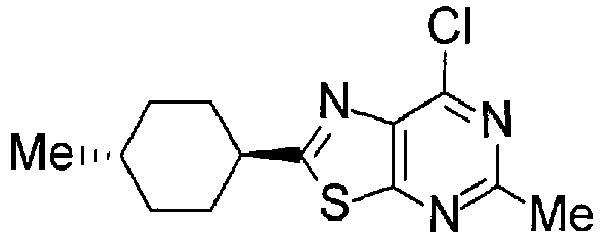
Pr4-5 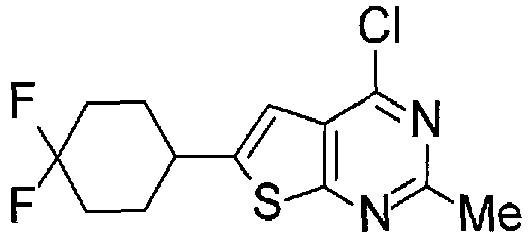
Pr5 
Pr4-6 
Pr5-1 
Pr4-7 
Pr6 
Pr4-8 
Pr6-1 
Pr4-9 
Pr6-2 
[Table 9] No. /Inf Str No Str Pr6-3 
Pr7-4 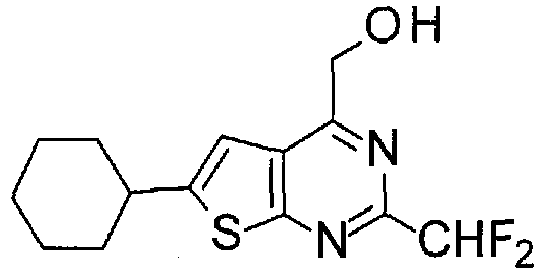
Pr6-4 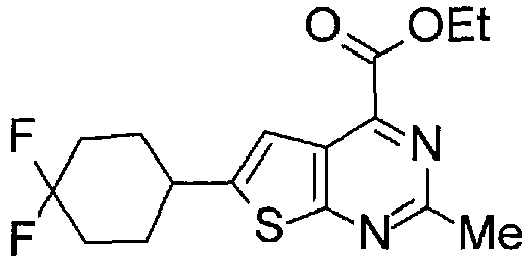
Pr8 
Pr7 
Pr8-1 
Pr7-1 
Pr8-2 
Pr7-2 
Pr8-3 
Pr7-3 
Pr8-4 
[Table 10] No. /Inf Str No. /Inf Str Pr8-5 
Pr9 
Pr8-6 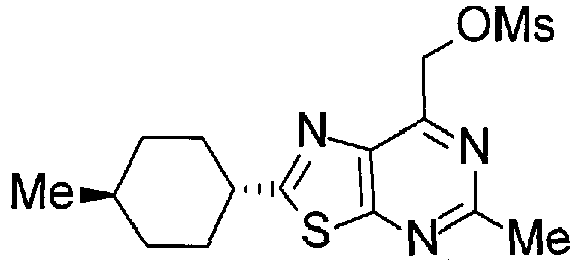
Pr9-1 
Pr8-7 
Pr9-2 
Pr8-8 
Pr9-3 
Pr8-9 
Pr9-4 
Pr8-10 
Pr10 
[Table 11] No. /Inf Str No. /Inf Str Pr10-1 
Pr11-1 
Pr10-2 
Pr11-2 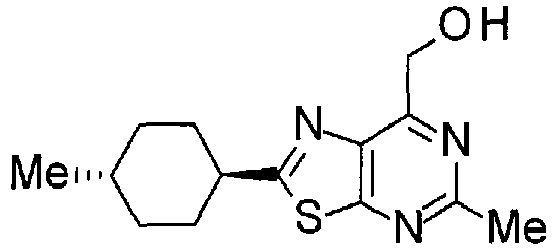
Pr10-3 
Pr11-3 
Pr10-4 
Pr12 
Pr11 
Pr12-1 
[Table 12] No. /Inf Str No Str Pr13 
Pr15-2 
Pr14 
Pr16 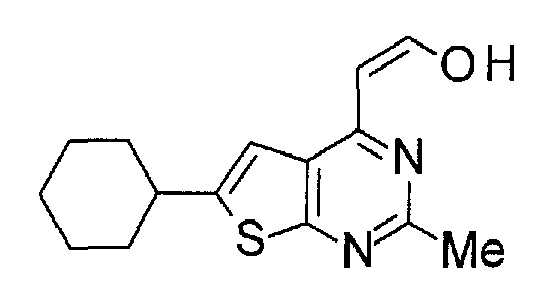
Pr14-1 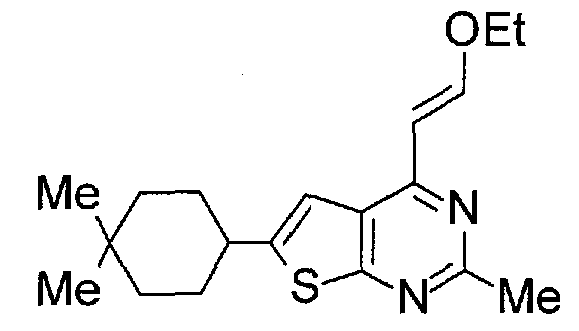
Pr16-1 
Pr15 
Pr17 
Pr15-1 Chiral 
Pr17-1 
[Table 13] No. /Inf Str No. /Inf Str Pr17-2 
Pr21 
Pr18 
Pr22 
Pr18-1 
Pr23 
Pr19 
Pr24 
Pr20 
Pr24-1 
[Table 14] No. /Inf Str No. /Inf Str Pr24-2 
Pr26-1 Chiral 
Pr25 
Pr27 /2HCl 
Pr25-1 
Pr28 
Pr25-2 
Pr29 
Pr26 
Pr30 
[Table 15] No. /Inf Str No. /Inf Str Pr30-1 
Pr31-3 
Pr30-2 
Pr31-4 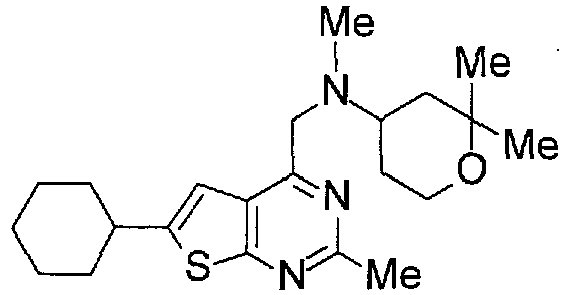
Pr31 
Pr32 
Pr31-1 
Pr32-1 
Pr31-2 
Pr32-2 
[Table 16] No. /Inf Str No. /Inf Str Pr32-3 
Pr34-1 
Pr33 
Pr34-2 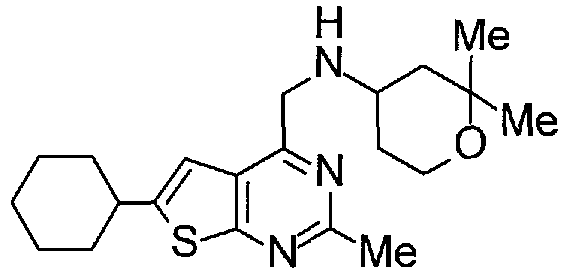
Pr33-1 
Pr34-3 
Pr33-2 
Pr34-4 
Pr34 
Pr34-5 
[Table 17] No. /Inf Str No. /Inf Str Pr34-6 
Pr37-2 
Pr34-7 
Pr38 
Pr35 /HCl 
Pr39 
Pr36 /HCl 
Pr40 
Pr37 
Pr40-1 
Pr37-1 
Pr40-2 
[Table 18] No. /Inf Str No. /Inf Str Pr40-3 
Pr46 
Pr41 
Pr47 /AcOH 
Pr42 
Pr48 
Pr42-1 
Pr49 
Pr43 
Pr50 
Pr44 
Pr51 /AcOH 
Pr45 
Pr52 /HCl 
[Table 19] No. /Inf Str No. /Inf Str Ex1 
Ex6 
Ex2 
Ex7 
Ex3 Chiral 
Ex8 
Ex4 
Ex9 
Ex5 
Ex10 
[Table 20] No. /Inf Str No. /Inf Str Ex11 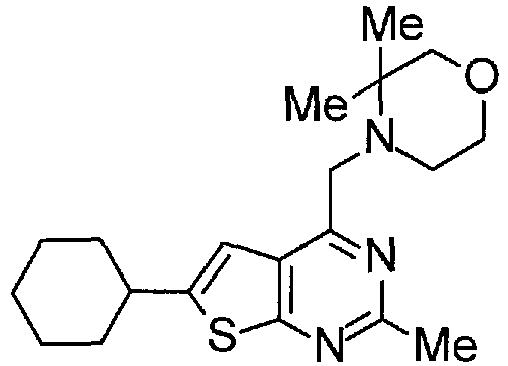
Ex16 
Ex12 
Ex17 
Ex13 
Ex18 
Ex14 
Ex19 Chiral 
Ex15 
Ex20 
[Table 21] No. /Inf Str No. /Inf Str Ex21 
Ex26 
Ex22 
Ex27 
Ex23 
Ex28 
Ex24 
Ex29 
Ex25 
Ex30 
[Table 22] No. /Inf Str No. /Inf Str Ex31 Chiral 
Ex34 /HCl 
Ex31-1 Chiral 
Ex35 /HCl Chiral 
Ex32 Chiral 
Ex36 /HCl Chiral 
Ex32-1 Chiral 
Ex37 /HCl 
Ex33 /HCl 
Ex38 /HCl 
[Table 23] No. /Inf Str No. /Inf Str Ex39 /HCl 
Ex44 /HCl 
Ex40 /HCl 
Ex45 /HCl 
Ex41 /HCl 
Ex46 /HCl 
Ex42 /HCl 
Ex47 /HCl 
Ex43 /HCl 
Ex48 /HCl 
[Table 24] No. /Inf Str No. /Inf Str Ex49 /HCl 
Ex54 /HCl 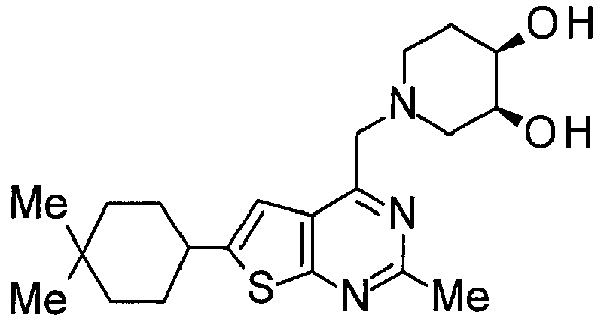
Ex50 /HCl 
Ex55 /HCl 
Ex51 /HCl 
Ex56 /HCl 
Ex52 /HCl 
Ex57 /HCl 
Ex53 /HCl 
Ex58 /HCl 
[Table 25] No. /Inf Str No. /Inf Str Ex59 /HCl Chiral 
Ex64 /HCl 
Ex60 /HCl Chiral 
Ex65 /HCl 
Ex61 /HCl 
Ex66 /HCl 
Ex62 /HCl 
Ex67 /2HCl 
Ex63 /HCl 
Ex68 /HCl 
[Table 26] No. /Inf Str No. /Inf Str Ex69 /2HCl 
Ex74 /HCl 
Ex70 /2HCl 
Ex75 /HCl 
Ex71 /2HCl 
Ex76 /HCl 
Ex72 /HCl Chiral 
Ex77 /HCl 
Ex73 /HCl Chiral 
Ex78 /HCl Chiral 
[Table 27] No. /Inf Str No. /Inf Str Ex79 /HCl 
Ex84 /HCl 
Ex80 /HCl 
Ex85 
Ex81 /HCl 
Ex86 
Ex82 /2HCl 
Ex87 
Ex83 /2HCl 
Ex88 
[Table 28] No. /Inf Str No. /Inf Str Ex89 
Ex94 
Ex90 
Ex95 
Ex91 
Ex96 /HCl 
Ex92 
Ex97 /HCl 
Ex93 
Ex98 /HCl 
[Table 29] No. /Inf Str No. /Inf Str Ex99 /HCl 
Ex104 /HCl 
Ex100 /HCl 
Ex105 /HCl 
Ex101 /HCl Chiral 
Ex106 
Ex102 /HCl Chiral 
Ex107 /HCl 
Ex103 /HCl 
Ex108 
[Table 30] No. /Inf Str No. /Inf Str Ex109 Chiral 
Ex114 
Ex110 Chiral 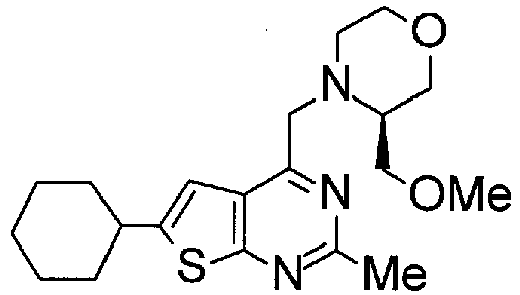
Ex115 
Ex111 /HCl Chiral 
Ex116 /FUM 
Ex112 
Ex117 /FUM Chiral 
Ex113 
Ex118 /FUM 
[Table 31] No. /Inf Str No. /Inf Str Ex119 /FUM 
Ex124 /FUM 
Ex120 /FUM 
Ex125 /FUM Chiral 
Ex121 /FUM 
Ex126 /FUM 
Ex122 /FUM 
Ex127 /FUM 
Ex123 /FUM 
Ex128 /FUM 
[Table 32] No. /Inf Str No. /Inf Str Ex129 
Ex134 /FUM Chiral 
Ex130 /2HCl 
Ex135 /FUM Chiral 
Ex131 /HCl Chiral 
Ex136 /FUM Chiral 
Ex132 /HCl 
Ex137 /FUM Chiral 
Ex133 /2HCl 
Ex138 /FUM Chiral 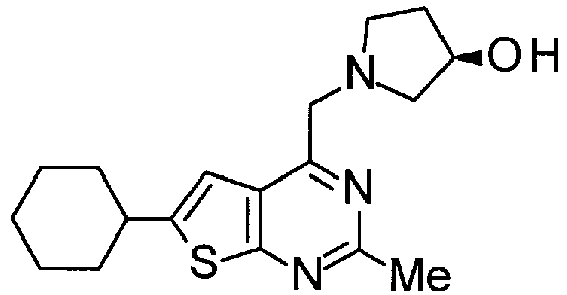
[Table 33] No. /Inf Str No. /Inf Str Ex139 /FUM Chiral 
Ex144 
Ex140 Chiral 
Ex145 Chiral 
Ex141 Chiral 
Ex146 /HCl 
Ex142 
Ex147 /HCl 
Ex143 Chiral 
Ex148 /HCl 
[Table 34] No. /Inf Str No. /Inf Str Ex149 /HCl 
Ex154 
Ex150 /FUM 
Ex155 
Ex151 /FUM 
Ex156 
Ex152 
Ex157 
Ex153 /HCl 
Ex158 
[Table 35] No. /Inf Str No. /Inf Str Ex159 Chiral 
Ex164 /HCl 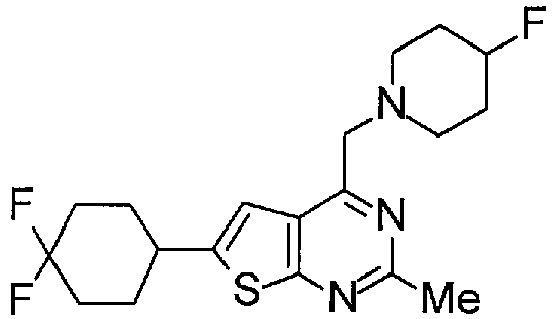
Ex160 
Ex165 /HCl 
Ex161 /FUM Chiral 
Ex166 /HCl 
Ex162 /FUM 
Ex167 /HCl 
Ex163 
Ex168 
[Table 36] No. /Inf Str No. /Inf Str Ex169 
Ex174 /HCl 
Ex170 
Ex175 /HCl 
Ex171 /HCl 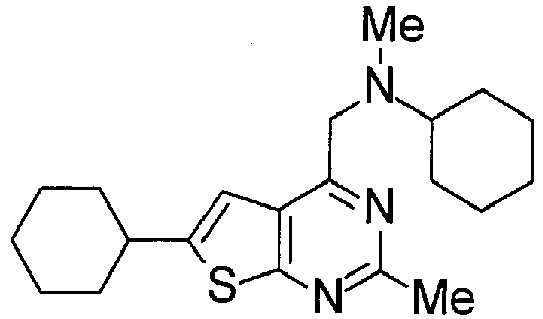
Ex176 /HCl 
Ex172 /HCl 
Ex177 /HCl 
Ex173 /HCl 
Ex178 /HCl 
[Table 37] No. /Inf Str No. /Inf Str Ex179 /HCl 
Ex184 /HCl 
Ex180 /HCl 
Ex185 /HCl 
Ex181 /HCl 
Ex186 
Ex182 /HCl 
Ex187 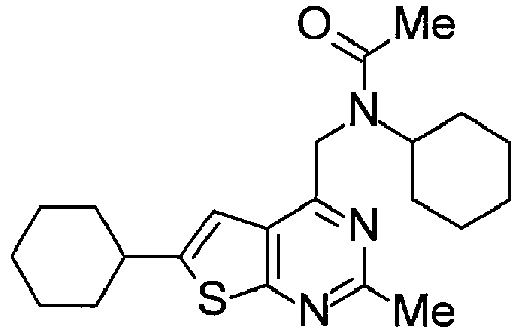
Ex183 /HCl 
Ex188 
[Table 38] No. /Inf Str No. /Inf Str Ex189 
Ex194 
Ex190 /FUM 
Ex195 
Ex191 /HCl 
Ex196 
Ex192 /HCl 
Ex197 /HCl 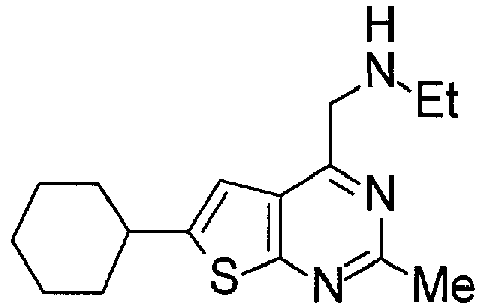
Ex193 /HCl 
Ex198 /HCl 
[Table 39] No. /Inf Str No. /Inf Str Ex199 /HCl Chiral 
Ex204 
Ex200 /HCl Chiral 
Ex205 /HCl 
Ex201 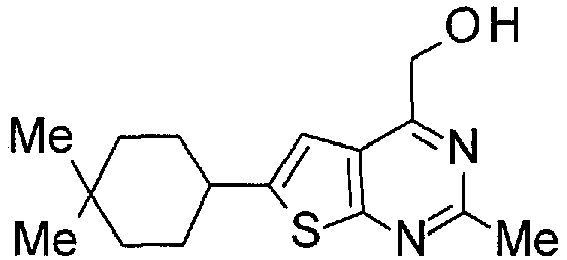
Ex206 
Ex202 
Ex207 
Ex203 
Ex208 
[Table 40] No. /Inf Str No. /Inf Str Ex209 
Ex214 
Ex210 
Ex215 
Ex211 
Ex216 
Ex212 
Ex217 Chiral 
Ex213 
Ex218 
[Table 41] No. /Inf Str No. /Inf Str Ex219 
Ex224 
Ex220 Chiral 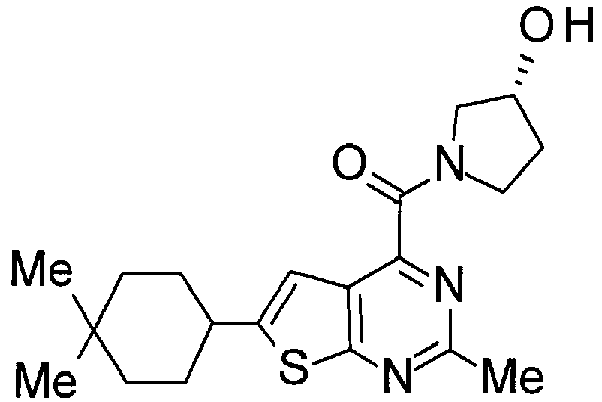
Ex225 
Ex221 Chiral 
Ex226 
Ex222 
Ex227 
Ex223 
Ex228 Chiral 
[Table 42] No. /Inf Str No. /Inf Str Ex229 
Ex231 
Ex230 
[Table 43] No. Ref Data Pr1 Ex1 ESI+:418 Pr1-1 Ex1 ESI+:360 Pr1-2 Ex1 ESI+:360 Pr1-3 Ex1 Pr1-4 Ex1 ESI+:358 Pr1-5 Ex1 ESI+:388 Pr1-6 Ex1 ESI+:388 Pr1-7 Ex1 ESI+:372 Pr1-8 Ex1 ESI+:344 Pr1-9 Ex1 ESI+:384 Pr1-10 Ex1 ESI+:386 Pr1-11 Ex1 ESI+:386 Pr1-12 Ex1 ESI+:418 Pr1-13 Ex1 ESI+:388 Pr1-14 Ex1 ESI+:402 Pr1-15 Ex1 ESI+:360 Pr1-16 Ex1 ESI+:361 [Table 44] No. Ref Data Pr1-17 Ex1 ESI+:361 Pr1-18 Ex1 ESI+:346 Pr2 Pr34 Pr2-1 Pr34 ESI+:487 Pr2-2 Pr34 ESI+:392 Pr2-3 Pr34 ESI+:488 Pr2-4 Pr34 ESI+:472 Pr3 Pr3 ESI+:277 Pr3-1 Pr3 ESI+:285 Pr4 Pr4 ESI+:267 Pr4-1 Pr4-1 ESI+:295 Pr4-2 Pr4 ESI+:263,265 Pr4-3 Pr4 EI:218,220 Pr4-4 Pr4 ESI+:303,305 Pr4-5 Pr4 ESI+:303 Pr4-6 Pr4-6 ESI+:296,298 Pr4-7 Pr4 ESI+:268,270 Pr4-8 Pr4 ESI+:320 Pr4-9 Pr4-6 ESI+:336,338 Pr4-10 Pr4-6 ESI+:282,284 Pr5 Pr5 ESI+:286 Pr5-1 Pr5 ESI+:294 Pr6 Pr6 ESI+:305 Pr6-1 Pr6-1 ESI+:333 Pr6-2 Pr6 ESI+:301,303 Pr6-3 Pr6 ESI+:341 Pr6-4 Pr6 ESI+:341 Pr7 Pr7 ESI+:263 Pr7-1 Pr7-1 ESI+:291 Pr7-2 Pr7 ESI+:259,261 Pr7-3 Pr7 ESI+:299 Pr7-4 Pr7 APCI/ESI+:299 Pr8 Pr8 ESI+:369 [Table 45] No. Ref Data Pr8-1 Pr8 ESI+:341 Pr8-2 Pr8 Pr8-3 Pr8 Pr8-4 Pr8 Pr8-5 Pr8 ESI+:377 Pr8-6 Pr8-7 ESI+:356 Pr8-7 Pr8-7 ESI+:370 Pr8-8 Pr8 Pr8-9 Pr8-7 ESI+:342 Pr8-10 Pr8-7 ESI+:410 Pr9 Pr9 ESI+:278 Pr9-1 Pr9 ESI+:250 Pr9-2 Pr9 ESI+:302 Pr9-3 Pr9 ESI+:318 Pr9-4 Pr9 ESI+:264 Pr10 Pr10 ESI+:396 Pr10-1 Pr10 ESI+:368 Pr10-2 Pr10 ESI+:420 Pr10-3 Pr10 ESI+:436 Pr10-4 Pr10 ESI+:382 Pr11 Pr11 ESI+:292 Pr11-1 Pr11 ESI+:264 Pr11-2 Pr11 ESI+:278 Pr11-3 Pr11 ESI+:332 Pr12 Pr12 ESI+:249 Pr12-1 Pr12 ESI+:285 Pr13 Pr13 ESI+:281,283 Pr14 Pr14 ESI+:303 Pr14-1 Pr14 ESI+:331 Pr15 Pr15 ESI+:387 Pr15-1 Pr15-1 ESI+:372 Pr15-2 Pr15-1 ESI+:388 Pr16 Pr16 ESI+:275 [Table 46] No. Ref Data Pr16-1 Pr16 ESI+:303 Pr17 Pr17 ESI+:277 Pr17-1 Pr17 ESI+:305 Pr17-2 Pr17 ESI+:305 Pr18 Pr18 ESI+:305 Pr18-1 Pr18 ESI+:316 Pr19 Pr19 ESI+:306 Pr20 Pr20 Pr21 Ex112 ESI+:461 Pr22 Pr22 ESI+:259,261 Pr23 Pr23 ESI+:201,203 Pr24 Pr24 ESI+:258 Pr24-1 Pr24 ESI+:294 Pr24-2 Pr24 ESI+:254,256 Pr25 Pr25 ESI+:508 Pr25-1 Pr25 APCI/ESI+:460 Pr25-2 Pr25 ESI+:474 Pr26 Pr8+Ex1 ESI+:376,378 Pr26-1 Pr8+Ex1 ESI+: 362 Pr27 Pr15 ESI+:371 Pr28 Pr28 ESI+:404 Pr29 Ex1 APCI/ESI+:344 Pr30 Ex85 ESI+:384 Pr30-1 Ex85 ESI+:388 Pr30-2 Ex85 ESI+:388 Pr31 Pr31 ESI+:372 Pr31-1 Pr31 ESI+:374 Pr31-2 Pr31 ESI+:388 Pr31-3 Pr31 ESI+:394 Pr31-4 Pr31 ESI+:388 Pr32 Pr32 ESI+:416 Pr32-1 Pr32 ESI+:402 Pr32-2 Pr32 ESI+:432 [Table 47] No. Ref Data Pr32-3 Pr32 ESI+:432 Pr33 Pr33 ESI+:330 Pr33-1 Pr33 ESI+:358 Pr33-2 Pr33 ESI+:358 Pr34 Pr34 ESI+:344 Pr34-1 Pr34 ESI+:360 Pr34-2 Pr34 ESI+:374 Pr34-3 Pr34 ESI+:380 Pr34-4 Pr34 APCI/ESI+:404 Pr34-5 Pr34 ESI+:358 Pr34-6 Pr34 ESI+:374 Pr34-7 Pr34 ESI+:346 Pr35 Ex130 ESI+:326 Pr36 Ex198 ESI+:394 Pr37 Pr37 ESI+:253 Pr37-1 Pr37 ESI+:261 Pr37-2 Pr37 ESI+:225 Pr38 Pr38 ESI+:295 Pr39 Pr39 ESI+:303 Pr40 Pr40 ESI+:316,318 Pr40-1 Pr40 ESI+:288,290 Pr40-2 Pr40 ESI+:356,358 Pr40-3 Pr40 ESI-:300,302 Pr41 Pr41 ESI+:340 Pr42 Pr42 Pr42-1 Pr42 ESI+:330 Pr43 Pr43 CI+:155 Pr44 Pr44 ESI+:216 Pr45 Pr45 ESI+:222 Pr46 Pr46 ESI+:127 Pr47 Pr47 ESI+:132 [Table 48] No. Ref Data Pr48 Pr48 ESI+:254 Pr49 Pr49 NMR(CDCl3):4.20(1H,dd,J=6.8,6.8Hz),3.64(1H,dd,J=6. 8,8.9Hz),3.31(1H,dd,J=6.8,8.9Hz),1.30(3H,s),1.27(3H ,s) Pr50 Pr50 Pr51 Pr51 ESI+:222 Pr52 Pr52 ESI+:132 [Table 49] No. Ref Data Ex1 Ex1 ESI+:380 Ex2 Ex2 ESI+:408 NMR(DMSO-d6):7.56(1H,d,J=1.1Hz),4.03(2H,s),3.18-3.07(4H,m),3.04-2.97(4H,m),2.93-2.85(1H,m),2.66(3H,s),1.94-1.86(2H,m),1.71-1.59(2H,m),1.53-1.44(2H,m),1.42-1.30(2H,m),0.95(6H,s) Ex3 Ex1 ESI+:360 Ex4 Ex1 ESI+:404 Ex5 Ex1 ESI+:390 Ex6 Ex1 ESI+:414 Ex7 Ex1 ESI+:418 Ex8 Ex1 ESI+:420 Ex9 Ex1 ESI+:422 Ex10 Ex1 ESI+:420 Ex11 Ex1 ESI+:360 Ex12 Ex1 ESI+:442 Ex13 Ex1 ESI+:375 Ex14 Ex1 ESI+:389 Ex15 Ex1 ESI+:403 Ex16 Ex1 ESI+:389 Ex17 Ex1 ESI+:389 Ex18 Ex1 ESI+:401 [Table 50] No. Ref Data Ex19 Ex1 ESI+:391 Ex20 Ex1 ESI+:405 NMR(DMSO-d6):4.45(1H,d,J=4.0Hz),4.15(1H,s),4.00(2H,s),3.21-3.15(1H,m),3.13-3.05(1H,m),2.71(3H,s),2.70-2.64(1H,m),2.55(1H,d,J=10.2Hz),2.30-2.21(1H,m),2.07(1H,d,J=10.9Hz),2.03-1.94(2H,m),1.83-1.65(3H,m),1.53-1.28(5H,m),1.02(3H,s),0.96(3H,s),0.94(3H,s) Ex21 Ex1 ESI+:433 Ex22 Ex1 ESI+:415 Ex23 Ex1 ESI+:375 Ex24 Ex1 ESI+:403 Ex25 Ex1 ESI+:421 Ex26 Ex1 ESI+:395 Ex27 Ex1 ESI+:429 Ex28 Ex1 ESI+:361 Ex29 Ex1 ESI+:333 Ex30 Ex1 ESI+:443 Ex31 Ex31 ESI+:390 NMR(DMSO-d6):7.56(1H,d,J=1.1Hz),4.67(2H,t,J=4.4Hz),3.85(1H,d, J=14.0Hz),3.78(1H,d,J=14.0Hz),3.25-3.08(2H,m),2.91-2.75(2H,m),2.74-2.67(1H,m),2.65(3H,s),2.07(1H,td,J=11.6,2.4Hz),1.95-1.85(3H,m),1.77-1.58(3H,m),1.51-1.44(2H,m),1.41-1.31(3H,m),0.95(3H,s),0.94(3H,s) Ex31-1 Ex31 ESI+:390 Ex32 Ex31 ESI+:391 NMR(CDCl3):4.19(1H,d,J=14.0Hz),4,15(1H,d,J=14.0Hz), 3.68-3.60(1H,m),3.56-3.48(H,m),3.15-3.08(1H,m),3.04-2.92(2H,m),2.83(3H,s),2.62(1H,brs),2.47-2.36(1H,m),2.36-2.28(1H,m),2.07-1.97(3H,m),1.89(1H,brs),1.88-1.75(2H,m),1.74-1.62(1H,m),1.6-1.5(2H,m),1.43-1.32(2H,m),0.99(6H,s) Ex32-1 Ex31 ESI+:391 Ex33 Ex33 ESI+:360 Ex34 Ex33 ESI+:360 [Table 51] No. Ref Data Ex35 Ex33 ESI+:346 Ex36 Ex33 ESI+:346 Ex37 Ex33 ESI+:358 Ex38 Ex33 ESI+:358 Ex39 Ex33 ESI+:388 Ex40 Ex33 ESI+:388 Ex41 Ex33 ESI+:372 Ex42 Ex33 ESI+:344 Ex43 Ex33 ESI+:384 Ex44 Ex33 ESI+:386 Ex45 Ex33 ESI+:386 Ex46 Ex33 ESI+:418 Ex47 Ex33 ESI+:388 NMR(DMSO-d6) :10.1(1H,brs),7.55(1H,d,J=1.1Hz),4.83(2H,brs),4.08 -3.58(2H,m),3.46-3.20(3H,m),2.93-2.82(1H,m),2.76(3H,s),1.96-1.82(4H,m),1.73-1.61(4H,m),1.53-1.45(2H,m),1.43-1.33(2H,m),1.30-1.16(3H,m),0.96(3H,s),0.95(3H,s) Ex48 Ex33 ESI+:402 Ex49 Ex33 ESI+:360 Ex50 Ex33 ESI+:418 Ex51 Ex33 ESI+:392 Ex52 Ex52 ESI+:374 NMR(DMSO-d6):10.41(1H,brs),7.57(1H,s),5.25-4.95(1H,brs),4.80(2H,brs),4.04-3.04(5H,m),2.94-2.80(1H,m),2.76(3H,s),2.08-1.87(4H,m),1.82-1.60(4H,m),1.54-1.44(2H,m),1.44-1.31(2H,m),0.96(3H,s),0.95(3H,s) Ex53 Ex52 ESI+:330 Ex54 Ex52 ESI+:390 Ex55 Ex198 ESI+:394 Ex56 Ex198 ESI+:356 Ex57 Ex52 ESI+:346 Ex58 Ex52 ESI+:366 Ex59 Ex52 ESI+:330 Ex60 Ex52 ESI+:330 Ex61 Ex52 ESI+:408 Ex62 Ex52 ESI+:360 [Table52] No. Ref Data Ex63 Ex52 ESI+:402 Ex64 Ex52 ESI+:332 NMR(DMSO-d6):11.19(1H,brs),7.54(1H,d,J=1.1Hz),4.85(2H,brs), 3.91(4H,brs),3.64-3.25(4H,brs),3.01-2.89(1H,m),2.75(3H,s),2.12-2.03(2H,m),1.86-1.76(2H,m),1.76-1.67(1H,m),1.55-1.35(4H,m),1.32-1.20(1H,m) Ex65 Ex52 ESI+:359 Ex66 Ex52 ESI+:364 Ex67 Ex52 ESI+:365 Ex68 Ex52 ESI+:378 Ex69 Ex52 ESI+:379 Ex70 Ex52 ESI+:368 Ex71 Ex52 ESI+:368 Ex72 Ex52 ESI+:374 Ex73 Ex52 ESI+:374 Ex74 Ex52 ESI+:376 Ex75 Ex52 ESI+:356 Ex76 Ex52 ESI+:392 Ex77 Ex52 ESI+:384 Ex78 Ex52 ESI+:360 Ex79 Ex52 ESI+:388 Ex80 Ex52 ESI+:422 Ex81 Ex52 ESI+:346 Ex82 Ex52 ESI+:396 Ex83 Ex52 ESI+:396 Ex84 Ex52 ESI+:405 Ex85 Ex85 ESI+:376 Ex86 Pr8+Ex85 ESI+:371 Ex87 Ex85 ESI+:409 Ex88 Ex85 ESI+:419 Ex89 Ex85 ESI+:391 Ex90 Ex85 ESI+:391 Ex91 Ex85 ESI+:405 Ex92 Ex85 ESI+:445 Ex93 Ex85 ESI+:377 [Table 53] No. Ref Data Ex94 Ex85 ESI+:431 Ex95 Ex85 ESI+:395 Ex96 Ex96 ESI+:388 Ex97 Pr8+Ex96 ESI+:396 Ex98 Ex96 ESI+:366 Ex99 Pr8+Ex96 ESI+:396 Ex100 Ex96 ESI+:422 Ex101 Ex96 ESI+:390 Ex102 Ex96 ESI+:390 Ex103 Ex96 ESI+:372 Ex104 Ex96 ESI+:404 Ex105 Ex105 ESI+:385 Ex106 Ex106 ESI+:346 Ex107 Ex107 ESI+:385 Ex108 Ex108 ESI+:406 Ex109 Ex109 ESI+:376 Ex110 Ex109 ESI+:376 Ex111 Ex109 ESI+:360 Ex112 Ex112 APCI/ESI+:344 Ex113 Ex112 ESI+:346 Ex114 Ex112 APCI/ESI+:330 Ex115 Ex112 ESI+:370 Ex116 Ex116 ESI+:348 Ex117 Ex116 ESI+:346 Ex118 Ex116 ESI+:374 Ex119 Ex116 ESI+:374 Ex120 Ex116 ESI+:388 Ex121 Ex116 ESI+:372 Ex122 Ex116 ESI+:373 Ex123 Ex116 ESI+:389 Ex124 Ex116 ESI+:415 Ex125 Ex116 ESI+:376 Ex126 Ex126 ESI+:372 Ex127 Ex126 ESI+:404 Ex128 Ex126 ESI+:391 [Table 54] No. Ref Data Ex129 Pr33 ESI+:358 Ex130 Ex130 ESI+:344 Ex131 Ex130 ESI+:376 Ex132 Ex130 ESI+:360 Ex133 Ex130 ESI+:360 Ex134 Ex134 ESI+:346 Ex135 Ex134 ESI+:346 Ex136 Ex134 ESI+:360 Ex137 Ex134 ESI+:360 Ex138 Ex134 ESI+:332 Ex139 Ex134 ESI+:332 Ex140 Pr8+Pr34 ESI+:362 Ex141 Pr8+Pr34 ESI+:362 Ex142 Pr34 ESI+:402 Ex143 Pr34 ESI+:392 Ex144 Pr34 ESI+:392 Ex145 Pr34 ESI+:393 Ex146 Ex198 ESI+:402 Ex147 Ex198 ESI+:400 Ex148 Ex198 ESI+:348 Ex149 Ex198 ESI+:355 Ex150 Ex150 ESI+:374 Ex151 Ex150 ESI+:401 Ex152 Ex152 ESI+:360 Ex153 Ex153 ESI+:429 Ex154 Ex153 ESI+:413 Ex155 Ex155 ESI+:445 Ex156 Ex155 ESI+:429 Ex157 Ex155 ESI+:438 Ex158 Ex155 ESI+:446 Ex159 Ex155 ESI+:430 Ex160 Ex155 ESI+:455 Ex161 Ex161 ESI+:361 Ex162 Ex161 ESI+:361 Ex163 Ex163 ESI+:371 Ex164 Pr13+Ex ESI+:384 [Table 55] No. Ref Data Ex165 Pr13+Ex ESI+:402 Ex166 Pr13+Ex ESI+:368 Ex167 Pr13+Ex ESI+:402 Ex168 Ex1 ESI+:388 Ex169 Ex1 ESI+:414 Ex170 Ex1 ESI+:332 Ex171 Ex33 ESI+:358 Ex172 Ex33 ESI+:372 Ex173 Ex33 ESI+:394 Ex174 Ex33 ESI+:388 Ex175 Ex33 ESI+:374 Ex176 Ex33 ESI+:416 Ex177 Ex33 ESI+:402 Ex178 Ex33 ESI+:432 Ex179 Ex33 ESI+:360 Ex180 Ex33 ESI+:388 Ex181 Ex33 ESI+:432 Ex182 Ex33 ESI+:344 Ex183 Ex52 ESI+:318 Ex184 Ex130 ESI+:378 Ex185 Ex52 ESI+:346 Ex186 Pr8+Ex85 ESI+:334 Ex187 Ex187 APCI/ESI+:386 Ex188 Ex188 ESI+:416 Ex189 Ex190 ESI+:348 Ex190 Ex190 ESI+:398 Ex191 Ex191 ESI+:436 Ex192 Ex191 ESI+:408 Ex193 Ex191 ESI+:450 Ex194 Ex191 ESI+:466 Ex195 Ex191 ESI+:360 Ex196 Ex196 ESI+:418 Ex197 Ex130 ESI+:290 Ex198 Ex198 ESI+:422 Ex199 Ex198 ESI+:422 Ex200 Ex198 ESI+:422 [Table 56] No. Ref Data Ex201 Pr7-1 ESI+:291 Ex202 Ex187 ESI+:332 Ex203 Ex187 ESI+:398 Ex204 Ex187 ESI+:362 Ex205 Ex205 ESI+:436 Ex206 Ex206 ESI+:402 Ex207 Ex206 ESI+:414 Ex208 Ex206 ESI+:374 Ex209 Ex206 ESI+:372 Ex210 Ex206 ESI+:387 NMR(DMSO-d6):7.11(1H,d,1.1Hz),3.74-3.67(2H,m),3.29-3.24(2H,m),2.94-2.84(1H,m),2.70(3H,s),2.46-2.40(2H,m),2.27-2.22(2H,m),2.20(3H,s),1.92-1.84(2H,m),1.71-1.58(2H,m),1.51-1.43(2H,m),1.40-1.29(2H,m),0.94(6H,s) Ex211 Ex206 ESI+:388 Ex212 Ex206 ESI+:404 Ex213 Ex206 ESI+:401 Ex214 Ex206 ESI+:415 Ex215 Ex206 ESI+:413 Ex216 Ex206 ESI+:428 Ex217 Ex206 ESI+:413 Ex218 Ex206 ESI+:388 Ex219 Ex206 ESI+:388 Ex220 Ex206 ESI+:374 Ex221 Ex206 ESI+:374 Ex222 Ex206 ESI+:360 Ex223 Ex206 ESI+:389 Ex224 Ex206 ESI+:403 Ex225 Ex206 ESI+:417 Ex226 Ex206 ESI+:401 Ex227 Ex206 ESI+:403 Ex228 Ex206 ESI+:414 Ex229 Ex229 ESI+:436 Ex230 Ex229 ESI+:388 Ex231 Ex229 ESI+:402 - The compound of the present invention is a PAM of a GABAB receptor, and can be used as an agent for preventing and/or treating schizophrenia, cognitive impairment, fragile X syndrome, autism spectrum disorder, spasticity, anxiety disorder, substance addiction, pain, fibromyalgia, Charcot-Marie-Tooth disease, or the like.
- Furthermore, based on the knowledge obtained by the present invention, the PAM of the GABAB receptor can be used as a drug for preventing and/or treating schizophrenia, cognitive impairment, fragile X syndrome, autism spectrum disorder, spasticity, anxiety disorder, substance addiction, pain, fibromyalgia, Charcot-Marie-Tooth disease, or the like.
Claims (19)
- A compound of the formula (I) or a salt thereof:
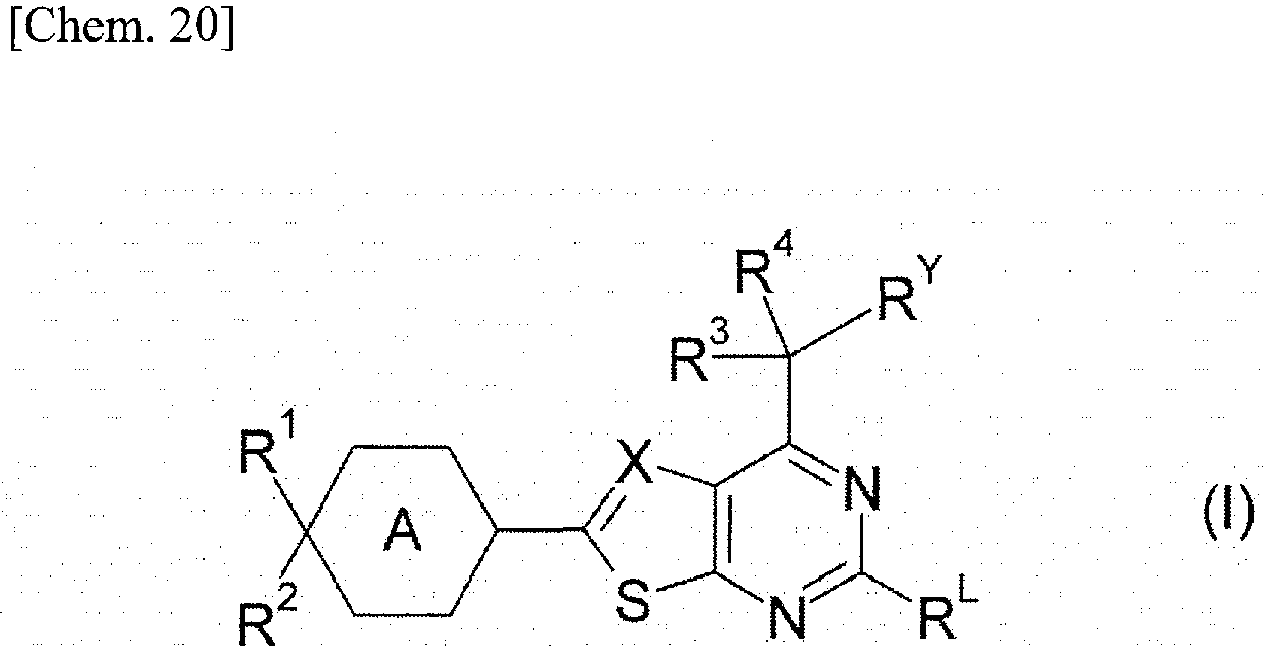 X is CH,R1 is lower alkyl,R2 is lower alkyl,in which R1 and R2 may form a cycloalkane together with carbon atoms to which they are bonded,R3 is -H,R4 is -H,A ring is a cyclohexane ring,RY is -NRARB,RA and RB form cyclic amino which may be substituted, together with a nitrogen atom to which they are bonded,in which the cyclic amino is a group represented by the following formula (III):
 Y is NH, O, S, S (=O)2, or CH2, andRL is lower alkyl).
 - The compound or a salt thereof according to claim 1, wherein RY is -NRARB,RA and RB form cyclic amino which may be substituted with R0, together with a nitrogen atom to which they are bonded,in which the cyclic amino is a group represented by the following formula (III):
 R0 is a group selected from the following Group Z:Group Z:(1)=O,(2) -OH,(3) -O-lower alkyl,(4) halogen,(5) -CN,(6) lower alkyl,(7) halo-lower alkyl,(8) lower alkylene-OH,(9) lower alkylene-O-lower alkyl,(10) -C(=O)-lower alkyl,(11) -C(=O)-lower alkylene-OH,(12) -C(=O)-lower alkylene-CN, and(13) cycloalkyl.
 - The compound or a salt thereof according to claim 2, wherein the group selected from the Group Z is a group selected from:Group Z1:(1) -OH,(2) lower alkyl, and(3) -C(=O)-lower alkylene-OH.
- The compound or a salt thereof according to claim 3, wherein Y is O, S, or S(=O)2
- The compound or a salt thereof according to claim 4, wherein RL is CH3.
- The compound or a salt thereof according to claim 1, which is selected from the following compound group:6-(4,4-dimethylcyclohexyl)-4-[(1,1-dioxo-1λ6-thiomorpholin-4-yl)methyl]-2-methylthieno [2,3-d]pyrimidine,trans-1-{[6-(4,4-dimethylcyclohexyl)-2-methylthieno[2,3-d]pyrimidin-4-yl]methyl}piperidine-3,4-diol,1-{[6-(4,4-dimethylcyclohexyl)-2-methylthieno[2,3-d]pyrimidin-4-yl]methyl}piperidin-4-ol,6-(4,4-dimethylcyclohexyl)-2-methyl-4-(thiomorpholin-4-ylmethyl)thieno[2,3-d]pyrimidine,6-(4,4-dimethylcyclohexyl)-4-[(3,3-dimethylmorpholin-4-yl)methyl]-2-methylthieno[2,3-d]pyrimidine, and1-{[6-(4,4-dimethylcyclohexyl)-2-methylthieno[2,3-d]pyrimidin-4-yl]methyl}-2,2-dimethylpiperidin-4-ol.
- The compound or a salt thereof according to claim 6, which is 6-(4,4-dimethylcyclohexyl)-4-[(1,1-dioxo-1λ6-thiomorpholin-4-yl)methyl]-2-methylthieno[2,3-d]pyrimidine.
- The compound or a salt thereof according to claim 6, which is trays-1-{[6-(4,4-dimethylcyclohexyl)-2-methylthieno[2,3-d]pyrimidin-4-yl]methyl}piperidine-3,4-diol.
- The compound or a salt thereof according to claim 6, which is 1-{[6-(4,4-dimethylcyclohexyl)-2-methylthieno[2,3-d]pyrimidin-4-yl]methyl}piperidin-4-ol.
- The compound or a salt thereof according to claim 6, which is 6-(4,4-dimethylcyclohexyl)-2-methyl-4-(thiomorpholin-4-ylmethyl)thieno[2,3-d]pyrimidine.
- The compound or a salt thereof according to claim 6, which is 6-(4,4-dimethylcyclohexyl)-4-[(3,3-dimethylmorpholin-4-yl)methyl]-2-methylthieno[2,3-d]pyrimidine.
- The compound or a salt thereof according to claim 6, which is 1-{[6-(4,4-dimethylcyclohexyl)-2-methylthieno[2,3-d]pyrimidin-4-yl]methyl}-2,2-dimethylpiperidin-4-ol.
- A pharmaceutical composition comprising the compound or a salt thereof according to claim 1 and a pharmaceutically acceptable excipient.
- The pharmaceutical composition according to claim 13, which is a GABAB positive allosteric modulator.
- The pharmaceutical composition according to claim 13, which is a pharmaceutical composition for preventing or treating a disease selected from a group consisting of schizophrenia, CIAS, cognitive impairment, fragile X syndrome, autism spectrum disorder, spasticity, anxiety disorder, substance addiction, pain, fibromyalgia, and Charcot-Marie-Tooth disease.
- Use of the compound or a salt thereof according to claim 1 for the preparation of a pharmaceutical composition for preventing or treating a disease selected from a group consisting of schizophrenia, CIAS, cognitive impairment, fragile X syndrome, autism spectrum disorder, spasticity, anxiety disorder, substance addiction, pain, fibromyalgia, and Charcot-Marie-Tooth disease.
- Use of the compound or a salt thereof according to claim 1 for preventing or treating a disease selected from a group consisting of schizophrenia, CIAS, cognitive impairment, fragile X syndrome, autism spectrum disorder, spasticity, anxiety disorder, substance addiction, pain, fibromyalgia, and Charcot-Marie-Tooth disease.
- The compound or a salt thereof according to claim 1 for preventing or treating a disease selected from a group consisting of schizophrenia, CIAS, cognitive impairment, fragile X syndrome, autism spectrum disorder, spasticity, anxiety disorder, substance addiction, pain, fibromyalgia, and Charcot-Marie-Tooth disease.
- A method for preventing or treating a disease selected from a group consisting of schizophrenia, CIAS, cognitive impairment, fragile X syndrome, autism spectrum disorder, spasticity, anxiety disorder, substance addiction, pain, fibromyalgia, and Charcot-Marie-Tooth disease, comprising administering to a subject an effective amount of the compound or a salt thereof according to claim 1.
Priority Applications (5)
| Application Number | Priority Date | Filing Date | Title |
|---|---|---|---|
| SM20180431T SMT201800431T1 (en) | 2013-10-17 | 2014-10-17 | Sulfur-containing bicyclic compound |
| HRP20181183TT HRP20181183T1 (en) | 2013-10-17 | 2014-10-17 | CYCLIC COMPOUND CONTAINING SUMPOR |
| SI201430780T SI3059239T1 (en) | 2013-10-17 | 2014-10-17 | Sulfur-containing bicyclic compound |
| PL14853825T PL3059239T3 (en) | 2013-10-17 | 2014-10-17 | BICYCLIC COMPOUND CONTAINING SULFUR |
| RS20180865A RS57532B1 (en) | 2013-10-17 | 2014-10-17 | Sulfur-containing bicyclic compound |
Applications Claiming Priority (2)
| Application Number | Priority Date | Filing Date | Title |
|---|---|---|---|
| JP2013216332 | 2013-10-17 | ||
| PCT/JP2014/077653 WO2015056771A1 (en) | 2013-10-17 | 2014-10-17 | Sulfur-containing bicyclic compound |
Publications (3)
| Publication Number | Publication Date |
|---|---|
| EP3059239A1 true EP3059239A1 (en) | 2016-08-24 |
| EP3059239A4 EP3059239A4 (en) | 2017-04-26 |
| EP3059239B1 EP3059239B1 (en) | 2018-06-27 |
Family
ID=52826697
Family Applications (1)
| Application Number | Title | Priority Date | Filing Date |
|---|---|---|---|
| EP14853825.9A Active EP3059239B1 (en) | 2013-10-17 | 2014-10-17 | Sulfur-containing bicyclic compound |
Country Status (31)
| Country | Link |
|---|---|
| US (2) | US9051339B2 (en) |
| EP (1) | EP3059239B1 (en) |
| JP (1) | JP6477484B2 (en) |
| KR (1) | KR102248450B1 (en) |
| CN (1) | CN105636965B (en) |
| AR (1) | AR098070A1 (en) |
| AU (1) | AU2014335304B2 (en) |
| BR (1) | BR112016008654B8 (en) |
| CA (1) | CA2927518C (en) |
| CY (1) | CY1120880T1 (en) |
| DK (1) | DK3059239T3 (en) |
| EA (1) | EA029075B1 (en) |
| ES (1) | ES2685070T3 (en) |
| HR (1) | HRP20181183T1 (en) |
| HU (1) | HUE040208T2 (en) |
| IL (1) | IL244953B (en) |
| LT (1) | LT3059239T (en) |
| MX (1) | MX367857B (en) |
| MY (1) | MY177271A (en) |
| NZ (1) | NZ719149A (en) |
| PH (1) | PH12016500625A1 (en) |
| PL (1) | PL3059239T3 (en) |
| PT (1) | PT3059239T (en) |
| RS (1) | RS57532B1 (en) |
| SA (1) | SA516370956B1 (en) |
| SG (1) | SG11201602926UA (en) |
| SI (1) | SI3059239T1 (en) |
| SM (1) | SMT201800431T1 (en) |
| TW (1) | TWI648281B (en) |
| UA (1) | UA116042C2 (en) |
| WO (1) | WO2015056771A1 (en) |
Families Citing this family (9)
| Publication number | Priority date | Publication date | Assignee | Title |
|---|---|---|---|---|
| HU231058B1 (en) | 2017-03-13 | 2020-04-28 | Richter Gedeon Nyrt. | Pharmacologically active alicyclic-substituted pyrazolo[1,5-a]pyrimidine derivatives |
| WO2019155765A1 (en) | 2018-02-06 | 2019-08-15 | 株式会社瑞光 | Stretchable sheet, disposable article using stretchable sheet, and method for manufacturing same |
| JP7355020B2 (en) | 2018-08-31 | 2023-10-03 | アステラス製薬株式会社 | Pharmaceutical composition for oral administration |
| CN112979655A (en) | 2019-12-16 | 2021-06-18 | 上海赛默罗生物科技有限公司 | Triazolopyridazine derivative, preparation method, pharmaceutical composition and application thereof |
| TWI907472B (en) | 2020-08-05 | 2025-12-11 | 匈牙利商羅特格登公司 | Pharmacologically active heterocyclic-substituted pyrazolo〔1 ,5-a〕 pyrimidine derivatives |
| WO2023028519A2 (en) * | 2021-08-27 | 2023-03-02 | Astellas Pharma Global Development, Inc. | Methods of treating substance use disorder |
| JP2025157626A (en) * | 2022-09-01 | 2025-10-16 | アステラス製薬株式会社 | Method for producing 6-(4,4-dimethylcyclohexyl)-4-[(1,1-dioxo-1λ6-thiomorpholin-4-yl)methyl]-2-methylthieno[2,3-d]pyrimidine or its salt |
| JP2026514915A (en) * | 2023-04-21 | 2026-05-13 | シーザン ハイスーク ファーマシューティカル カンパニー リミテッド | CYP11A1 inhibitors and their applications |
| CN117263951A (en) * | 2023-09-13 | 2023-12-22 | 广东莱佛士制药技术有限公司 | Synthesis method of 6-bromo-2-methylthieno[2,3-d]pyrimidine-4-carbonitrile |
Family Cites Families (12)
| Publication number | Priority date | Publication date | Assignee | Title |
|---|---|---|---|---|
| JP2001097979A (en) | 1999-07-28 | 2001-04-10 | Takeda Chem Ind Ltd | Condensed heterocyclic compound, and method of production and application thereof |
| JP2002308882A (en) * | 2001-02-08 | 2002-10-23 | Yamanouchi Pharmaceut Co Ltd | Thienopyrimidine derivatives |
| WO2002062803A1 (en) | 2001-02-08 | 2002-08-15 | Yamanouchi Pharmaceutical Co., Ltd. | Thienopyrimidine derivative |
| BRPI0408988A (en) | 2003-03-31 | 2006-03-28 | Predix Pharmaceuticals Holding | piperidinylaminothieno [2,3-d] pyrimidine compound |
| US7723324B2 (en) * | 2003-10-28 | 2010-05-25 | Sepracor, Inc. | Imidazo[1,2-A]pyridine anxiolytics |
| GB0416168D0 (en) | 2004-07-20 | 2004-08-18 | Vernalis Cambridge Ltd | Pyrmidothiophene compounds |
| GB0420719D0 (en) * | 2004-09-17 | 2004-10-20 | Addex Pharmaceuticals Sa | Novel allosteric modulators |
| ES2324231T3 (en) * | 2004-12-17 | 2009-08-03 | F. Hoffmann-La Roche Ag | DERIVATIVES OF TIENO-PIRIDINA AS ALLOSTERIC INTENSIFIERS OF GABA-B. |
| PL2041139T3 (en) | 2006-04-26 | 2012-05-31 | Hoffmann La Roche | Pharmaceutical compounds |
| EP2923734B1 (en) | 2009-03-13 | 2018-01-10 | Katholieke Universiteit Leuven, K.U. Leuven R&D | Purine analogues and their use as immunosuppressive agents |
| AU2010289321A1 (en) * | 2009-09-04 | 2012-04-05 | The Regents Of The University Of Michigan | Compositions and methods for treatment of leukemia |
| GB201015411D0 (en) | 2010-09-15 | 2010-10-27 | Univ Leuven Kath | Anti-cancer activity of novel bicyclic heterocycles |
-
2014
- 2014-10-16 TW TW103135823A patent/TWI648281B/en not_active IP Right Cessation
- 2014-10-17 SG SG11201602926UA patent/SG11201602926UA/en unknown
- 2014-10-17 ES ES14853825.9T patent/ES2685070T3/en active Active
- 2014-10-17 HR HRP20181183TT patent/HRP20181183T1/en unknown
- 2014-10-17 PT PT14853825T patent/PT3059239T/en unknown
- 2014-10-17 US US14/517,229 patent/US9051339B2/en active Active
- 2014-10-17 BR BR112016008654A patent/BR112016008654B8/en not_active IP Right Cessation
- 2014-10-17 AR ARP140103875A patent/AR098070A1/en active IP Right Grant
- 2014-10-17 MY MYPI2016701379A patent/MY177271A/en unknown
- 2014-10-17 EP EP14853825.9A patent/EP3059239B1/en active Active
- 2014-10-17 EA EA201690790A patent/EA029075B1/en not_active IP Right Cessation
- 2014-10-17 RS RS20180865A patent/RS57532B1/en unknown
- 2014-10-17 MX MX2016004944A patent/MX367857B/en active IP Right Grant
- 2014-10-17 CN CN201480057239.0A patent/CN105636965B/en not_active Expired - Fee Related
- 2014-10-17 KR KR1020167011628A patent/KR102248450B1/en not_active Expired - Fee Related
- 2014-10-17 LT LTEP14853825.9T patent/LT3059239T/en unknown
- 2014-10-17 HU HUE14853825A patent/HUE040208T2/en unknown
- 2014-10-17 SI SI201430780T patent/SI3059239T1/en unknown
- 2014-10-17 DK DK14853825.9T patent/DK3059239T3/en active
- 2014-10-17 SM SM20180431T patent/SMT201800431T1/en unknown
- 2014-10-17 WO PCT/JP2014/077653 patent/WO2015056771A1/en not_active Ceased
- 2014-10-17 UA UAA201605245A patent/UA116042C2/en unknown
- 2014-10-17 CA CA2927518A patent/CA2927518C/en active Active
- 2014-10-17 AU AU2014335304A patent/AU2014335304B2/en not_active Ceased
- 2014-10-17 JP JP2015542677A patent/JP6477484B2/en not_active Expired - Fee Related
- 2014-10-17 PL PL14853825T patent/PL3059239T3/en unknown
- 2014-10-17 NZ NZ71914914A patent/NZ719149A/en not_active IP Right Cessation
-
2015
- 2015-04-17 US US14/689,748 patent/US9642852B2/en not_active Expired - Fee Related
-
2016
- 2016-04-06 IL IL244953A patent/IL244953B/en active IP Right Grant
- 2016-04-06 PH PH12016500625A patent/PH12016500625A1/en unknown
- 2016-04-16 SA SA516370956A patent/SA516370956B1/en unknown
-
2018
- 2018-08-14 CY CY20181100858T patent/CY1120880T1/en unknown
Also Published As
Similar Documents
| Publication | Publication Date | Title |
|---|---|---|
| EP3059239B1 (en) | Sulfur-containing bicyclic compound | |
| US10435399B2 (en) | HDAC6 inhibitory heterocyclic compound | |
| US10414761B2 (en) | Cyclopropanamine compound and use thereof | |
| CN103429585B (en) | Indazolyltriazole derivatives as interleukin-1 receptor-associated kinase inhibitors | |
| DK2864318T3 (en) | 2-AMINOPYRAZINE DERIVATIVES AS CSF-1R KINase INHIBITORS | |
| EP2739615B1 (en) | Phenyl-3-aza-bicyclo[3.1.0]hex-3-yl-methanones and the use thereof as medicament | |
| US20120178735A1 (en) | 2h-chromene compound and derivative thereof | |
| US20180338980A1 (en) | Aromatic sulfonamide derivatives | |
| JP5451633B2 (en) | Triazole oxadiazole derivatives | |
| WO2016031815A1 (en) | Heterocyclic compound | |
| WO2006085685A1 (en) | Pyrazole compound | |
| JP7693709B2 (en) | 1,5-dihydro-2,4-benzodiazepin-3-one derivatives and uses thereof | |
| JP2013511571A (en) | Imidazo-pyrazoles as GPR119 inhibitors | |
| US8618303B2 (en) | Pyrrolidine derivatives | |
| WO2015162452A1 (en) | Substituted pyrazole compounds as cb1 receptor antagonists and uses thereof | |
| HK1220192B (en) | Sulfur-containing bicyclic compound | |
| HK1191938B (en) | Indazolyl triazole derivatives as irak inhibitors |
Legal Events
| Date | Code | Title | Description |
|---|---|---|---|
| PUAI | Public reference made under article 153(3) epc to a published international application that has entered the european phase |
Free format text: ORIGINAL CODE: 0009012 |
|
| 17P | Request for examination filed |
Effective date: 20160411 |
|
| AK | Designated contracting states |
Kind code of ref document: A1 Designated state(s): AL AT BE BG CH CY CZ DE DK EE ES FI FR GB GR HR HU IE IS IT LI LT LU LV MC MK MT NL NO PL PT RO RS SE SI SK SM TR |
|
| AX | Request for extension of the european patent |
Extension state: BA ME |
|
| A4 | Supplementary search report drawn up and despatched |
Effective date: 20170327 |
|
| RIC1 | Information provided on ipc code assigned before grant |
Ipc: A61P 43/00 20060101ALI20170321BHEP Ipc: A61P 25/00 20060101ALI20170321BHEP Ipc: A61K 31/5377 20060101ALI20170321BHEP Ipc: C07D 495/04 20060101AFI20170321BHEP Ipc: A61P 25/22 20060101ALI20170321BHEP Ipc: A61K 31/519 20060101ALI20170321BHEP Ipc: A61P 25/18 20060101ALI20170321BHEP Ipc: A61K 31/554 20060101ALI20170321BHEP Ipc: C07D 519/00 20060101ALI20170321BHEP Ipc: A61K 31/541 20060101ALI20170321BHEP |
|
| GRAP | Despatch of communication of intention to grant a patent |
Free format text: ORIGINAL CODE: EPIDOSNIGR1 |
|
| INTG | Intention to grant announced |
Effective date: 20180119 |
|
| GRAS | Grant fee paid |
Free format text: ORIGINAL CODE: EPIDOSNIGR3 |
|
| GRAA | (expected) grant |
Free format text: ORIGINAL CODE: 0009210 |
|
| AK | Designated contracting states |
Kind code of ref document: B1 Designated state(s): AL AT BE BG CH CY CZ DE DK EE ES FI FR GB GR HR HU IE IS IT LI LT LU LV MC MK MT NL NO PL PT RO RS SE SI SK SM TR |
|
| AX | Request for extension of the european patent |
Extension state: BA ME |
|
| REG | Reference to a national code |
Ref country code: GB Ref legal event code: FG4D |
|
| REG | Reference to a national code |
Ref country code: CH Ref legal event code: NV Representative=s name: SERVOPATENT GMBH, CH |
|
| REG | Reference to a national code |
Ref country code: AT Ref legal event code: REF Ref document number: 1012230 Country of ref document: AT Kind code of ref document: T Effective date: 20180715 |
|
| REG | Reference to a national code |
Ref country code: DE Ref legal event code: R096 Ref document number: 602014027693 Country of ref document: DE |
|
| REG | Reference to a national code |
Ref country code: IE Ref legal event code: FG4D |
|
| REG | Reference to a national code |
Ref country code: HR Ref legal event code: TUEP Ref document number: P20181183 Country of ref document: HR |
|
| REG | Reference to a national code |
Ref country code: DK Ref legal event code: T3 Effective date: 20180808 |
|
| REG | Reference to a national code |
Ref country code: RO Ref legal event code: EPE |
|
| REG | Reference to a national code |
Ref country code: NL Ref legal event code: FP |
|
| REG | Reference to a national code |
Ref country code: SE Ref legal event code: TRGR |
|
| REG | Reference to a national code |
Ref country code: FR Ref legal event code: PLFP Year of fee payment: 5 |
|
| REG | Reference to a national code |
Ref country code: ES Ref legal event code: FG2A Ref document number: 2685070 Country of ref document: ES Kind code of ref document: T3 Effective date: 20181005 |
|
| REG | Reference to a national code |
Ref country code: PT Ref legal event code: SC4A Ref document number: 3059239 Country of ref document: PT Date of ref document: 20181009 Kind code of ref document: T Free format text: AVAILABILITY OF NATIONAL TRANSLATION Effective date: 20180823 |
|
| REG | Reference to a national code |
Ref country code: EE Ref legal event code: FG4A Ref document number: E015923 Country of ref document: EE Effective date: 20180821 |
|
| REG | Reference to a national code |
Ref country code: HR Ref legal event code: T1PR Ref document number: P20181183 Country of ref document: HR |
|
| REG | Reference to a national code |
Ref country code: NO Ref legal event code: T2 Effective date: 20180627 |
|
| REG | Reference to a national code |
Ref country code: GR Ref legal event code: EP Ref document number: 20180402209 Country of ref document: GR Effective date: 20190109 |
|
| REG | Reference to a national code |
Ref country code: HU Ref legal event code: AG4A Ref document number: E040208 Country of ref document: HU |
|
| REG | Reference to a national code |
Ref country code: DE Ref legal event code: R097 Ref document number: 602014027693 Country of ref document: DE |
|
| PLBE | No opposition filed within time limit |
Free format text: ORIGINAL CODE: 0009261 |
|
| STAA | Information on the status of an ep patent application or granted ep patent |
Free format text: STATUS: NO OPPOSITION FILED WITHIN TIME LIMIT |
|
| 26N | No opposition filed |
Effective date: 20190328 |
|
| REG | Reference to a national code |
Ref country code: HR Ref legal event code: ODRP Ref document number: P20181183 Country of ref document: HR Payment date: 20190912 Year of fee payment: 6 |
|
| REG | Reference to a national code |
Ref country code: CH Ref legal event code: PCAR Free format text: NEW ADDRESS: WANNERSTRASSE 9/1, 8045 ZUERICH (CH) |
|
| REG | Reference to a national code |
Ref country code: HR Ref legal event code: ODRP Ref document number: P20181183 Country of ref document: HR Payment date: 20201007 Year of fee payment: 7 |
|
| REG | Reference to a national code |
Ref country code: AT Ref legal event code: UEP Ref document number: 1012230 Country of ref document: AT Kind code of ref document: T Effective date: 20180627 |
|
| REG | Reference to a national code |
Ref country code: HR Ref legal event code: ODRP Ref document number: P20181183 Country of ref document: HR Payment date: 20211015 Year of fee payment: 8 |
|
| REG | Reference to a national code |
Ref country code: HR Ref legal event code: ODRP Ref document number: P20181183 Country of ref document: HR Payment date: 20221013 Year of fee payment: 9 |
|
| P01 | Opt-out of the competence of the unified patent court (upc) registered |
Effective date: 20230512 |
|
| REG | Reference to a national code |
Ref country code: HR Ref legal event code: ODRP Ref document number: P20181183 Country of ref document: HR Payment date: 20231003 Year of fee payment: 10 |
|
| PGFP | Annual fee paid to national office [announced via postgrant information from national office to epo] |
Ref country code: NL Payment date: 20231026 Year of fee payment: 10 |
|
| PGFP | Annual fee paid to national office [announced via postgrant information from national office to epo] |
Ref country code: LU Payment date: 20231027 Year of fee payment: 10 |
|
| PGFP | Annual fee paid to national office [announced via postgrant information from national office to epo] |
Ref country code: SK Payment date: 20231003 Year of fee payment: 10 |
|
| PGFP | Annual fee paid to national office [announced via postgrant information from national office to epo] |
Ref country code: GB Payment date: 20231027 Year of fee payment: 10 Ref country code: GR Payment date: 20231027 Year of fee payment: 10 |
|
| PGFP | Annual fee paid to national office [announced via postgrant information from national office to epo] |
Ref country code: MC Payment date: 20231006 Year of fee payment: 10 |
|
| PGFP | Annual fee paid to national office [announced via postgrant information from national office to epo] |
Ref country code: ES Payment date: 20231102 Year of fee payment: 10 |
|
| PGFP | Annual fee paid to national office [announced via postgrant information from national office to epo] |
Ref country code: IS Payment date: 20231019 Year of fee payment: 10 |
|
| PGFP | Annual fee paid to national office [announced via postgrant information from national office to epo] |
Ref country code: TR Payment date: 20231004 Year of fee payment: 10 Ref country code: SM Payment date: 20231009 Year of fee payment: 10 Ref country code: SI Payment date: 20231002 Year of fee payment: 10 Ref country code: SE Payment date: 20231027 Year of fee payment: 10 Ref country code: RS Payment date: 20231004 Year of fee payment: 10 Ref country code: RO Payment date: 20231006 Year of fee payment: 10 Ref country code: PT Payment date: 20231003 Year of fee payment: 10 Ref country code: NO Payment date: 20231027 Year of fee payment: 10 Ref country code: MT Payment date: 20231003 Year of fee payment: 10 Ref country code: LV Payment date: 20231009 Year of fee payment: 10 Ref country code: LT Payment date: 20231003 Year of fee payment: 10 Ref country code: HU Payment date: 20231013 Year of fee payment: 10 Ref country code: HR Payment date: 20231003 Year of fee payment: 10 Ref country code: FR Payment date: 20231025 Year of fee payment: 10 Ref country code: FI Payment date: 20231025 Year of fee payment: 10 Ref country code: EE Payment date: 20231003 Year of fee payment: 10 Ref country code: DK Payment date: 20231027 Year of fee payment: 10 Ref country code: DE Payment date: 20231027 Year of fee payment: 10 Ref country code: CZ Payment date: 20231011 Year of fee payment: 10 Ref country code: CY Payment date: 20231005 Year of fee payment: 10 Ref country code: CH Payment date: 20231102 Year of fee payment: 10 Ref country code: BG Payment date: 20231018 Year of fee payment: 10 Ref country code: AT Payment date: 20231004 Year of fee payment: 10 Ref country code: IT Payment date: 20231023 Year of fee payment: 10 Ref country code: IE Payment date: 20231027 Year of fee payment: 10 |
|
| PGFP | Annual fee paid to national office [announced via postgrant information from national office to epo] |
Ref country code: PL Payment date: 20231005 Year of fee payment: 10 Ref country code: BE Payment date: 20231027 Year of fee payment: 10 |
|
| PGFP | Annual fee paid to national office [announced via postgrant information from national office to epo] |
Ref country code: MK Payment date: 20231004 Year of fee payment: 10 |
|
| PGFP | Annual fee paid to national office [announced via postgrant information from national office to epo] |
Ref country code: AL Payment date: 20231018 Year of fee payment: 10 |
|
| REG | Reference to a national code |
Ref country code: HR Ref legal event code: PBON Ref document number: P20181183 Country of ref document: HR Effective date: 20241017 |
|
| REG | Reference to a national code |
Ref country code: DE Ref legal event code: R119 Ref document number: 602014027693 Country of ref document: DE |
|
| REG | Reference to a national code |
Ref country code: LT Ref legal event code: MM4D Effective date: 20241017 |
|
| REG | Reference to a national code |
Ref country code: EE Ref legal event code: MM4A Ref document number: E015923 Country of ref document: EE Effective date: 20241031 |
|
| REG | Reference to a national code |
Ref country code: DK Ref legal event code: EBP Effective date: 20241031 |
|
| REG | Reference to a national code |
Ref country code: SK Ref legal event code: MM4A Ref document number: E 28237 Country of ref document: SK Effective date: 20241017 |
|
| REG | Reference to a national code |
Ref country code: CH Ref legal event code: PL |
|
| REG | Reference to a national code |
Ref country code: SE Ref legal event code: EUG |
|
| REG | Reference to a national code |
Ref country code: NL Ref legal event code: MM Effective date: 20241101 |
|
| PG25 | Lapsed in a contracting state [announced via postgrant information from national office to epo] |
Ref country code: RS Free format text: LAPSE BECAUSE OF NON-PAYMENT OF DUE FEES Effective date: 20241017 |
|
| REG | Reference to a national code |
Ref country code: AT Ref legal event code: MM01 Ref document number: 1012230 Country of ref document: AT Kind code of ref document: T Effective date: 20241017 |
|
| GBPC | Gb: european patent ceased through non-payment of renewal fee |
Effective date: 20241017 |
|
| PG25 | Lapsed in a contracting state [announced via postgrant information from national office to epo] |
Ref country code: SM Free format text: LAPSE BECAUSE OF NON-PAYMENT OF DUE FEES Effective date: 20250506 |
|
| PG25 | Lapsed in a contracting state [announced via postgrant information from national office to epo] |
Ref country code: MC Free format text: LAPSE BECAUSE OF NON-PAYMENT OF DUE FEES Effective date: 20241031 |
|
| PG25 | Lapsed in a contracting state [announced via postgrant information from national office to epo] |
Ref country code: FI Free format text: LAPSE BECAUSE OF NON-PAYMENT OF DUE FEES Effective date: 20241017 |
|
| PG25 | Lapsed in a contracting state [announced via postgrant information from national office to epo] |
Ref country code: DE Free format text: LAPSE BECAUSE OF NON-PAYMENT OF DUE FEES Effective date: 20250501 |
|
| PG25 | Lapsed in a contracting state [announced via postgrant information from national office to epo] |
Ref country code: GB Free format text: LAPSE BECAUSE OF NON-PAYMENT OF DUE FEES Effective date: 20241017 |
|
| PG25 | Lapsed in a contracting state [announced via postgrant information from national office to epo] |
Ref country code: LT Free format text: LAPSE BECAUSE OF NON-PAYMENT OF DUE FEES Effective date: 20241017 |
|
| PG25 | Lapsed in a contracting state [announced via postgrant information from national office to epo] |
Ref country code: NO Free format text: LAPSE BECAUSE OF NON-PAYMENT OF DUE FEES Effective date: 20241031 Ref country code: HU Free format text: LAPSE BECAUSE OF NON-PAYMENT OF DUE FEES Effective date: 20241018 |
|
| PG25 | Lapsed in a contracting state [announced via postgrant information from national office to epo] |
Ref country code: NL Free format text: LAPSE BECAUSE OF NON-PAYMENT OF DUE FEES Effective date: 20241101 Ref country code: LU Free format text: LAPSE BECAUSE OF NON-PAYMENT OF DUE FEES Effective date: 20241017 Ref country code: BE Free format text: LAPSE BECAUSE OF NON-PAYMENT OF DUE FEES Effective date: 20241031 |
|
| PG25 | Lapsed in a contracting state [announced via postgrant information from national office to epo] |
Ref country code: HR Free format text: LAPSE BECAUSE OF NON-PAYMENT OF DUE FEES Effective date: 20241017 |
|
| PG25 | Lapsed in a contracting state [announced via postgrant information from national office to epo] |
Ref country code: LV Free format text: LAPSE BECAUSE OF NON-PAYMENT OF DUE FEES Effective date: 20241017 Ref country code: PT Free format text: LAPSE BECAUSE OF NON-PAYMENT OF DUE FEES Effective date: 20250417 |
|
| PG25 | Lapsed in a contracting state [announced via postgrant information from national office to epo] |
Ref country code: EE Free format text: LAPSE BECAUSE OF NON-PAYMENT OF DUE FEES Effective date: 20241031 Ref country code: FR Free format text: LAPSE BECAUSE OF NON-PAYMENT OF DUE FEES Effective date: 20241031 |
|
| PG25 | Lapsed in a contracting state [announced via postgrant information from national office to epo] |
Ref country code: GR Free format text: LAPSE BECAUSE OF NON-PAYMENT OF DUE FEES Effective date: 20250512 Ref country code: BG Free format text: LAPSE BECAUSE OF NON-PAYMENT OF DUE FEES Effective date: 20241017 |
|
| PG25 | Lapsed in a contracting state [announced via postgrant information from national office to epo] |
Ref country code: CH Free format text: LAPSE BECAUSE OF NON-PAYMENT OF DUE FEES Effective date: 20241031 |
|
| PG25 | Lapsed in a contracting state [announced via postgrant information from national office to epo] |
Ref country code: RO Free format text: LAPSE BECAUSE OF NON-PAYMENT OF DUE FEES Effective date: 20241017 Ref country code: AT Free format text: LAPSE BECAUSE OF NON-PAYMENT OF DUE FEES Effective date: 20241017 |
|
| PG25 | Lapsed in a contracting state [announced via postgrant information from national office to epo] |
Ref country code: CY Free format text: LAPSE BECAUSE OF NON-PAYMENT OF DUE FEES Effective date: 20241017 Ref country code: SK Free format text: LAPSE BECAUSE OF NON-PAYMENT OF DUE FEES Effective date: 20241017 |
|
| PG25 | Lapsed in a contracting state [announced via postgrant information from national office to epo] |
Ref country code: CZ Free format text: LAPSE BECAUSE OF NON-PAYMENT OF DUE FEES Effective date: 20241017 |
|
| REG | Reference to a national code |
Ref country code: BE Ref legal event code: MM Effective date: 20241031 |
|
| REG | Reference to a national code |
Ref country code: SI Ref legal event code: KO00 Effective date: 20241018 |
|
| PG25 | Lapsed in a contracting state [announced via postgrant information from national office to epo] |
Ref country code: DK Free format text: LAPSE BECAUSE OF NON-PAYMENT OF DUE FEES Effective date: 20241031 |
|
| PG25 | Lapsed in a contracting state [announced via postgrant information from national office to epo] |
Ref country code: SE Free format text: LAPSE BECAUSE OF NON-PAYMENT OF DUE FEES Effective date: 20241018 Ref country code: IT Free format text: LAPSE BECAUSE OF NON-PAYMENT OF DUE FEES Effective date: 20241017 |
|
| PG25 | Lapsed in a contracting state [announced via postgrant information from national office to epo] |
Ref country code: IE Free format text: LAPSE BECAUSE OF NON-PAYMENT OF DUE FEES Effective date: 20241017 |
|
| REG | Reference to a national code |
Ref country code: ES Ref legal event code: FD2A Effective date: 20251202 |
|
| PG25 | Lapsed in a contracting state [announced via postgrant information from national office to epo] |
Ref country code: ES Free format text: LAPSE BECAUSE OF NON-PAYMENT OF DUE FEES Effective date: 20241018 |
|
| PG25 | Lapsed in a contracting state [announced via postgrant information from national office to epo] |
Ref country code: SI Free format text: LAPSE BECAUSE OF NON-PAYMENT OF DUE FEES Effective date: 20241018 |
|
| PG25 | Lapsed in a contracting state [announced via postgrant information from national office to epo] |
Ref country code: TR Free format text: LAPSE BECAUSE OF NON-PAYMENT OF DUE FEES Effective date: 20241017 |
|
| PG25 | Lapsed in a contracting state [announced via postgrant information from national office to epo] |
Ref country code: PL Free format text: LAPSE BECAUSE OF NON-PAYMENT OF DUE FEES Effective date: 20241017 |
|
| PG25 | Lapsed in a contracting state [announced via postgrant information from national office to epo] |
Ref country code: IS Free format text: LAPSE BECAUSE OF NON-PAYMENT OF DUE FEES Effective date: 20250502 |