EP3059085A1 - Post process control apparatus, method of controlling the same, sheet processing system, and storage medium - Google Patents
Post process control apparatus, method of controlling the same, sheet processing system, and storage medium Download PDFInfo
- Publication number
- EP3059085A1 EP3059085A1 EP16000117.8A EP16000117A EP3059085A1 EP 3059085 A1 EP3059085 A1 EP 3059085A1 EP 16000117 A EP16000117 A EP 16000117A EP 3059085 A1 EP3059085 A1 EP 3059085A1
- Authority
- EP
- European Patent Office
- Prior art keywords
- sheets
- printed
- copy
- post processing
- sheet
- Prior art date
- Legal status (The legal status is an assumption and is not a legal conclusion. Google has not performed a legal analysis and makes no representation as to the accuracy of the status listed.)
- Granted
Links
Images





Classifications
-
- B—PERFORMING OPERATIONS; TRANSPORTING
- B42—BOOKBINDING; ALBUMS; FILES; SPECIAL PRINTED MATTER
- B42C—BOOKBINDING
- B42C1/00—Collating or gathering sheets combined with processes for permanently attaching together sheets or signatures or for interposing inserts
- B42C1/12—Machines for both collating or gathering and permanently attaching together the sheets or signatures
-
- B—PERFORMING OPERATIONS; TRANSPORTING
- B41—PRINTING; LINING MACHINES; TYPEWRITERS; STAMPS
- B41J—TYPEWRITERS; SELECTIVE PRINTING MECHANISMS, i.e. MECHANISMS PRINTING OTHERWISE THAN FROM A FORME; CORRECTION OF TYPOGRAPHICAL ERRORS
- B41J3/00—Typewriters or selective printing or marking mechanisms characterised by the purpose for which they are constructed
- B41J3/44—Typewriters or selective printing mechanisms having dual functions or combined with, or coupled to, apparatus performing other functions
-
- B—PERFORMING OPERATIONS; TRANSPORTING
- B41—PRINTING; LINING MACHINES; TYPEWRITERS; STAMPS
- B41F—PRINTING MACHINES OR PRESSES
- B41F13/00—Common details of rotary presses or machines
- B41F13/54—Auxiliary folding, cutting, collecting or depositing of sheets or webs
- B41F13/56—Folding or cutting
- B41F13/60—Folding or cutting crosswise
-
- B—PERFORMING OPERATIONS; TRANSPORTING
- B41—PRINTING; LINING MACHINES; TYPEWRITERS; STAMPS
- B41F—PRINTING MACHINES OR PRESSES
- B41F13/00—Common details of rotary presses or machines
- B41F13/54—Auxiliary folding, cutting, collecting or depositing of sheets or webs
- B41F13/64—Collecting
- B41F13/66—Collecting and stapling
-
- B—PERFORMING OPERATIONS; TRANSPORTING
- B41—PRINTING; LINING MACHINES; TYPEWRITERS; STAMPS
- B41F—PRINTING MACHINES OR PRESSES
- B41F33/00—Indicating, counting, warning, control or safety devices
- B41F33/0009—Central control units
-
- B—PERFORMING OPERATIONS; TRANSPORTING
- B41—PRINTING; LINING MACHINES; TYPEWRITERS; STAMPS
- B41J—TYPEWRITERS; SELECTIVE PRINTING MECHANISMS, i.e. MECHANISMS PRINTING OTHERWISE THAN FROM A FORME; CORRECTION OF TYPOGRAPHICAL ERRORS
- B41J29/00—Details of, or accessories for, typewriters or selective printing mechanisms not otherwise provided for
- B41J29/38—Drives, motors, controls or automatic cut-off devices for the entire printing mechanism
- B41J29/393—Devices for controlling or analysing the entire machine ; Controlling or analysing mechanical parameters involving printing of test patterns
-
- B—PERFORMING OPERATIONS; TRANSPORTING
- B65—CONVEYING; PACKING; STORING; HANDLING THIN OR FILAMENTARY MATERIAL
- B65H—HANDLING THIN OR FILAMENTARY MATERIAL, e.g. SHEETS, WEBS, CABLES
- B65H31/00—Pile receivers
- B65H31/02—Pile receivers with stationary end support against which pile accumulates
-
- B—PERFORMING OPERATIONS; TRANSPORTING
- B65—CONVEYING; PACKING; STORING; HANDLING THIN OR FILAMENTARY MATERIAL
- B65H—HANDLING THIN OR FILAMENTARY MATERIAL, e.g. SHEETS, WEBS, CABLES
- B65H39/00—Associating, collating, or gathering articles or webs
- B65H39/10—Associating articles from a single source, to form, e.g. a writing-pad
-
- B—PERFORMING OPERATIONS; TRANSPORTING
- B65—CONVEYING; PACKING; STORING; HANDLING THIN OR FILAMENTARY MATERIAL
- B65H—HANDLING THIN OR FILAMENTARY MATERIAL, e.g. SHEETS, WEBS, CABLES
- B65H43/00—Use of control, checking, or safety devices, e.g. automatic devices comprising an element for sensing a variable
-
- B—PERFORMING OPERATIONS; TRANSPORTING
- B65—CONVEYING; PACKING; STORING; HANDLING THIN OR FILAMENTARY MATERIAL
- B65H—HANDLING THIN OR FILAMENTARY MATERIAL, e.g. SHEETS, WEBS, CABLES
- B65H45/00—Folding thin material
- B65H45/12—Folding articles or webs with application of pressure to define or form crease lines
- B65H45/18—Oscillating or reciprocating blade folders
-
- G—PHYSICS
- G03—PHOTOGRAPHY; CINEMATOGRAPHY; ANALOGOUS TECHNIQUES USING WAVES OTHER THAN OPTICAL WAVES; ELECTROGRAPHY; HOLOGRAPHY
- G03G—ELECTROGRAPHY; ELECTROPHOTOGRAPHY; MAGNETOGRAPHY
- G03G15/00—Apparatus for electrographic processes using a charge pattern
- G03G15/65—Apparatus which relate to the handling of copy material
- G03G15/6538—Devices for collating sheet copy material, e.g. sorters, control, copies in staples form
- G03G15/6541—Binding sets of sheets, e.g. by stapling, glueing
- G03G15/6544—Details about the binding means or procedure
-
- G—PHYSICS
- G03—PHOTOGRAPHY; CINEMATOGRAPHY; ANALOGOUS TECHNIQUES USING WAVES OTHER THAN OPTICAL WAVES; ELECTROGRAPHY; HOLOGRAPHY
- G03G—ELECTROGRAPHY; ELECTROPHOTOGRAPHY; MAGNETOGRAPHY
- G03G15/00—Apparatus for electrographic processes using a charge pattern
- G03G15/65—Apparatus which relate to the handling of copy material
- G03G15/6582—Special processing for irreversibly adding or changing the sheet copy material characteristics or its appearance, e.g. stamping, annotation printing, punching
-
- G—PHYSICS
- G06—COMPUTING OR CALCULATING; COUNTING
- G06F—ELECTRIC DIGITAL DATA PROCESSING
- G06F3/00—Input arrangements for transferring data to be processed into a form capable of being handled by the computer; Output arrangements for transferring data from processing unit to output unit, e.g. interface arrangements
- G06F3/12—Digital output to print unit, e.g. line printer, chain printer
-
- B—PERFORMING OPERATIONS; TRANSPORTING
- B65—CONVEYING; PACKING; STORING; HANDLING THIN OR FILAMENTARY MATERIAL
- B65H—HANDLING THIN OR FILAMENTARY MATERIAL, e.g. SHEETS, WEBS, CABLES
- B65H2301/00—Handling processes for sheets or webs
- B65H2301/10—Selective handling processes
- B65H2301/13—Relative to size or orientation of the material
- B65H2301/132—Relative to size or orientation of the material single face or double face
- B65H2301/1321—Printed material
-
- B—PERFORMING OPERATIONS; TRANSPORTING
- B65—CONVEYING; PACKING; STORING; HANDLING THIN OR FILAMENTARY MATERIAL
- B65H—HANDLING THIN OR FILAMENTARY MATERIAL, e.g. SHEETS, WEBS, CABLES
- B65H2301/00—Handling processes for sheets or webs
- B65H2301/10—Selective handling processes
- B65H2301/16—Selective handling processes of discharge in bins, stacking, collating or gathering
- B65H2301/163—Bound or non bound, e.g. stapled or non stapled stacking mode
-
- B—PERFORMING OPERATIONS; TRANSPORTING
- B65—CONVEYING; PACKING; STORING; HANDLING THIN OR FILAMENTARY MATERIAL
- B65H—HANDLING THIN OR FILAMENTARY MATERIAL, e.g. SHEETS, WEBS, CABLES
- B65H2301/00—Handling processes for sheets or webs
- B65H2301/10—Selective handling processes
- B65H2301/16—Selective handling processes of discharge in bins, stacking, collating or gathering
- B65H2301/166—Superposed or interfolded stacking mode
-
- B—PERFORMING OPERATIONS; TRANSPORTING
- B65—CONVEYING; PACKING; STORING; HANDLING THIN OR FILAMENTARY MATERIAL
- B65H—HANDLING THIN OR FILAMENTARY MATERIAL, e.g. SHEETS, WEBS, CABLES
- B65H2301/00—Handling processes for sheets or webs
- B65H2301/40—Type of handling process
- B65H2301/42—Piling, depiling, handling piles
- B65H2301/421—Forming a pile
- B65H2301/4213—Forming a pile of a limited number of articles, e.g. buffering, forming bundles
-
- B—PERFORMING OPERATIONS; TRANSPORTING
- B65—CONVEYING; PACKING; STORING; HANDLING THIN OR FILAMENTARY MATERIAL
- B65H—HANDLING THIN OR FILAMENTARY MATERIAL, e.g. SHEETS, WEBS, CABLES
- B65H2301/00—Handling processes for sheets or webs
- B65H2301/40—Type of handling process
- B65H2301/42—Piling, depiling, handling piles
- B65H2301/421—Forming a pile
- B65H2301/4214—Forming a pile of articles on edge
- B65H2301/42146—Forming a pile of articles on edge by introducing articles from above
-
- B—PERFORMING OPERATIONS; TRANSPORTING
- B65—CONVEYING; PACKING; STORING; HANDLING THIN OR FILAMENTARY MATERIAL
- B65H—HANDLING THIN OR FILAMENTARY MATERIAL, e.g. SHEETS, WEBS, CABLES
- B65H2511/00—Dimensions; Position; Numbers; Identification; Occurrences
- B65H2511/30—Numbers, e.g. of windings or rotations
-
- B—PERFORMING OPERATIONS; TRANSPORTING
- B65—CONVEYING; PACKING; STORING; HANDLING THIN OR FILAMENTARY MATERIAL
- B65H—HANDLING THIN OR FILAMENTARY MATERIAL, e.g. SHEETS, WEBS, CABLES
- B65H2801/00—Application field
- B65H2801/24—Post -processing devices
- B65H2801/27—Devices located downstream of office-type machines
-
- G—PHYSICS
- G03—PHOTOGRAPHY; CINEMATOGRAPHY; ANALOGOUS TECHNIQUES USING WAVES OTHER THAN OPTICAL WAVES; ELECTROGRAPHY; HOLOGRAPHY
- G03G—ELECTROGRAPHY; ELECTROPHOTOGRAPHY; MAGNETOGRAPHY
- G03G2215/00—Apparatus for electrophotographic processes
- G03G2215/00362—Apparatus for electrophotographic processes relating to the copy medium handling
- G03G2215/00789—Adding properties or qualities to the copy medium
- G03G2215/00822—Binder, e.g. glueing device
- G03G2215/00831—Stitcher
-
- G—PHYSICS
- G03—PHOTOGRAPHY; CINEMATOGRAPHY; ANALOGOUS TECHNIQUES USING WAVES OTHER THAN OPTICAL WAVES; ELECTROGRAPHY; HOLOGRAPHY
- G03G—ELECTROGRAPHY; ELECTROPHOTOGRAPHY; MAGNETOGRAPHY
- G03G2215/00—Apparatus for electrophotographic processes
- G03G2215/00362—Apparatus for electrophotographic processes relating to the copy medium handling
- G03G2215/00789—Adding properties or qualities to the copy medium
- G03G2215/00877—Folding device
Definitions
- the present invention relates to a post process control apparatus, a method of controlling a post process control apparatus, a sheet processing system, and storage medium.
- non-bookbinding center-folding processing in order to make it easy to recognize a separation of copies in a printed sheet bundle, bundling a plurality of sheets that configure a copy, and folding them collectively is typical. Furthermore, in Japanese Patent Laid-Open No. 2012-141668 it is recited that an inter leaf is inserted between copies of printed sheet bundles in order to make it easy to recognize a separation of copies.
- An aspect of the present invention is to eliminate the above-mentioned problems with conventional technology.
- the present invention in its first aspect provides a post process control apparatus as specified in claims 1 to 7.
- the present invention in its second aspect provides a sheet processing system as specified in claims 8 and 9.
- the present invention in its third aspect provides a method of controlling a post process control apparatus as specified in claim 10.
- the present invention in its fourth aspect provides a computer-readable storage medium as specified in claim 11.
- the present invention is not limited such a configuration; the present invention may be a stand-alone post process control apparatus such as, for example, a bookbinding apparatus, or may be a control apparatus that is connected to a post process control apparatus and that controls operation of the post process control apparatus. Also, the present invention can be applied to a sheet processing system including an image forming apparatus (a printing apparatus) 100 and a finishing apparatus (a post process control apparatus) according to the embodiment.
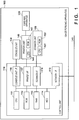
- FIG. 1 is a block diagram for explaining a hardware configuration of the image forming apparatus 100 according to the embodiment of present invention.
- a control unit 110 controls operation of the image forming apparatus 100 on the whole.
- the control unit 110 comprises a configuration explained below.
- a CPU 111 executes various control processing explained later by deploying programs for the control unit 110 stored in a ROM 112 into a RAM 113 and executing them.
- Programs executed by the CPU 111 includes an application program for scanning. Then, by executing the application program for scanning, an image of an original is read by a scanner unit 150 and image data of the original is generated. Then, the CPU 111 stores the generated image data in an HDD 114.
- a console unit I/F 116 transfers an instruction inputted by a user using a console unit 130 to the CPU 111.
- the console unit I/F 116 receives data to be displayed on the console unit 130 from the CPU 111 and transfers it to the console unit 130.
- the console unit 130 comprises a display unit (Graphical User Interface, GUI hereinafter) comprising a touch panel function or a keyboard, and accepts a user instruction.
- a printer I/F 117 is an interface for connecting the control unit 110 to a printer unit 140.
- the printer unit 140 prints on a recording medium such as paper (a sheet) based on image data transferred from the control unit 110 via the printer I/F 117.
- the printer unit 140 controls a finishing apparatus 330 for performing finishing processing of a printed sheet.
- a scanner I/F 118 is an interface for connecting the control unit 110 to the scanner unit 150.
- the scanner unit 150 generates image data by reading an image of an original using a line sensor or the like. Then, the scanner unit 150 transmits the generated image data to the control unit 110 through the scanner I/F 118. In this way, the image data stored in the HDD 114 is printed by the printer unit 140. Also, a copy operation can be performed by the printer unit 140 printing the image data generated by the scanner unit 150.
- a network I/F 119 connects the image forming apparatus 100 and a LAN, receives print data transmitted from a PC (not shown) or the like connected to the LAN, and executes printing.
- the printer unit 140 and the scanner unit 150 respectively comprise CPUs 141 and 151 and ROMs 142 and 152 for storing control programs of each corresponding CPU.
- the CPUs 141 and 151 reading and executing programs stored in the corresponding ROMs 142 and 152 respectively, it is possible to perform operations of the printer unit 140 and the scanner unit 150, and communication with the control unit 110.
- FIG. 2 is a functional block diagram for explaining functions of the control unit 110 of the image forming apparatus 100 according to the embodiment. Note, each function illustrated in FIG. 2 is achieved by the CPU 111 executing the program stored in the ROM 112.
- a UI control module 211 controls the console unit 130 through the console unit I/F 116.
- a print control module 212 controls the printer unit 140 and the finishing apparatus 330 through the printer I/F 117.
- a scanner control module 213 controls the scanner unit 150 through the scanner I/F 118.
- a job control module 214 interprets a job setting accepted from the network I/F 119 or the console unit 130 and transfers to the print control module 212 imposition processing for printing on a sheet or finishing information.
- An application control module 215 implements various functions of the image forming apparatus 100.
- An OS 230 is an operating system for controlling execution of programs that implement the functions corresponding to each unit described above.
- FIG. 3A and FIG. 3B depict views for explaining a configuration of the image forming apparatus 100 according to the embodiment;
- FIG. 3A depicts a structural cross-section view from a perspective of a front surface;
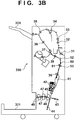
- FIG. 3B depicts a structural cross-section view from a perspective of a front surface of the finishing apparatus 330.
- a sheet is stacked on a paper feed cassette 310 or a paper feed cassette 311, and is conveyed into the apparatus by a feed/conveyance unit.
- An image is formed on the conveyed sheet via an image forming unit and a fixing unit of the printer unit 140, and the sheet on which an image has been formed is discharged via the finishing apparatus 330.
- the finishing apparatus 330 is equipped with a discharge tray 320 and a discharge tray 321, and the discharge tray 321 receives a printed sheet to which binding saddle stitching or non-bookbinding saddle stitching processing is performed. Note, the maximum number at which center-folding can be executed in the finishing apparatus 330 according to this embodiment is set to 3.
- the finishing apparatus 330 comprises conveyance rollers 31-39, leading edge detection sensors 50 and 53, a stapler 42, a push member 43, a stopper 44, folding rollers 45 and 46, bundle conveyance roller pair 47 and 48, and the discharge trays 320 and 321.
- the finishing apparatus 330 may be operated by a command from the control unit 110 of the image forming apparatus 100 or may be operated by an independent controller.
- Print sheets conveyed from the image forming apparatus 100 are discharged to one of the discharge trays 320 and 321 in accordance with the type of the sheet processing set by the user. For example, in a case where the sheet processing is not executed, the printed sheets are discharged to the discharge tray 320. On the other hand, in a case where saddle stitching processing or center-folding processing is executed, the sheets (a sheet bundle) to which these processes have been performed are discharged to the discharge tray 321.
- the printed sheets conveyed from the image forming apparatus 100 are conveyed by the conveyance rollers 31-38 until the leading edge of the sheet reaches the position of the leading edge detection sensor 50.
- the rotating speed of the conveyance roller 38 pinching the sheet is decelerated, and the leading edge of the sheet is caused to collide with a nip of a skew correction roller 51.
- the conveyance roller 38 continues to rotate for a time after the leading edge of the sheet collides with the nip of the skew correction roller 51.
- the rotation of the conveyance roller 38 is stopped after the sheet forms a loop in a loop space 52.
- the skew correction roller 51 starts rotating. In a case where the sheet is skewed, the skew of the sheet is corrected by the skew correction roller 51.
- a sheet whose skew is corrected is conveyed to a direction of the conveyance roller 39.
- the leading edge of the sheet is detected by the leading edge detection sensor 53 in this way, the sheet is conveyed a predetermined amount from that point in time, and the leading edge of the sheet is caused to collide with the stopper 44.
- the sheet is positioned by the stopper 44 so that a position for binding by the stapler 42 comes to the central portion of the sheet.
- the stapler 42 performs the binding processing to the central portion of the sheet bundle.
- the stopper 44 supporting the sheet bundle moves towards a downstream side of the conveyance direction, and the sheet bundle moves downstream in the conveyance direction.
- the stapling processing by the stapler 42 is omitted.
- the stopper 44 performs positioning of the sheet bundle so that the central portion of the sheet bundle comes to the position of the push member 43. Then, the leading edge of the push member 43 abuts a portion at which a fold of the sheet bundle positioned by the stopper 44 is formed, and the sheet bundle is pressed to the nip of the folding rollers 45 and 46, to form the fold on sheets of the sheet bundle. In this way, the sheet bundle to which the fold is formed by the folding rollers 45 and 46 is discharged to the discharge tray 321 by the rotation of the bundle conveyance roller pair 47 and 48.
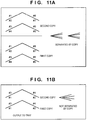
- FIGS. 11A and 11B illustrated numerals to which # is added indicate page numbers of the originals.
- FIG. 11A depicts a view illustrating an example of the output imposition and finished bundles of "binding saddle stitching”; here an example illustrates a case where 1 copy is configured by 8 pages of originals, and 2 bookbinding products consisting of 2 double-sided printed sheet bundle copies of these originals are formed.
- bookbinding saddle stitching imposition to both sides of each sheet and saddle stitching of the sheets are performed so that the printed sheets are bound in a state in which they are folded in 2.
- finishing processing is performed at a separation of copies, and finishing processing is performed so that the separation of copies is clear.
- FIG. 11B depicts a view illustrating an example of the output imposition of "non-bookbinding center-folding", where 1 copy is configured by 4 pages of originals and 2 sheets corresponding to 2 copies of sheets are outputted.
- the separation of the copies is every 1 sheet, because "non-bookbinding center-folding" is set and the number of sheets per 1 copy to which the double-sided printing of these originals is performed is 1.
- center-folding finishing takes time here, an example in which productivity can be improved by performing sheet folding finishing collectively with the maximum number of sheets for the folding capability of the center-folding apparatus is illustrated. In other words, in a case where the maximum number of sheets for center-folding in the finishing apparatus 330 is 3, folding processing is performed for the 2 sheets collectively without separating sheets by copy, because the folding finishing can be performed on 2 sheets collectively.
- FIGS. 7A through 7C depict views for explaining a state of an original, printed sheets, and after finishing when a single sheet original is copied with a copy number of 3, and "non-bookbinding center-folding" finishing is executed.
- an original 701 illustrates a 1 page original. 711-713 in FIG. 7B illustrate printed sheets obtained as a result of copying the original 701 into 3 single-sided copies (1 sheet for 1 copy).
- FIG. 7C illustrates the result of "non-bookbinding center-folding" finishing being performed on sheets 711-713.
- the center-folding processing is performed on 3 copies (3 sheets) corresponding to the above described maximum number of sheets for center-folding collectively.
- FIGS. 8A through 8C depict views for explaining a state of originals, printed sheets, and after finishing when four originals are copied with a copy number of 3, and "non-bookbinding center-folding" finishing is executed.
- FIGS. 8A and 8B the result of 3 copies of the single-sided printing of 4 originals 801 is illustrated in reference numerals 811 through to 813.
- printed sheets obtained as a result of 3 copies of single-sided copying of the originals 801 which consist of 4 pages are illustrated.
- FIG. 8C illustrates the result of "non-bookbinding center-folding" finishing being performed on sheets of 3 copies 811 through to 813.
- the maximum number of sheets for the folding capability of the finishing apparatus is set to 3. Accordingly, non-bookbinding center-folding is executed on the first 3 printed sheets of the first copy 811, and a finished bundle 821 is outputted.
- the center-folding processing is executed a plurality of times for 1 copy.
- the center-folding processing is executed similarly on the remaining 2 copies of printed sheets. Note, for example as illustrated by 822, the folding processing is not performed together with the sheets of the next copy. This is to make clear the separation of copies by performing the folding processing for every copy separately.
- FIGS. 4 through 6 are flowcharts for describing center-folding processing by which the finishing apparatus 330 is controlled by the image forming apparatus 100 according to a first embodiment. Processing illustrated by the flowcharts is achieved by the CPU 111 deploying a program stored in the ROM 112 into the RAM 113 and executing it.
- This process is started by the CPU 111 receiving information of a job setting and a copy start operation from, for example, the console unit 130, and starting job execution based on the job information.
- the CPU 111 functions as the job control module 214 to execute the job.
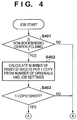
- the CPU 111 interprets the received job setting, and functioning as the scanner control module 213 and the print control module 212, starts an operation in accordance with the job setting in step S401 based on the job setting. Then, it is determined in step S401 whether or not a setting for "non-bookbinding center-folding" is included in the job setting. In a case where "non-bookbinding center-folding" is not set, the processing proceeds to step S601 in FIG. 6 , operation is performed so that printed sheets are separated at the separation of copies of printed sheets, and then finishing processing is performed. The explanation of the flowchart in FIG. 6 is described later.
- step S401 the processing proceeds to step S402, and the CPU 111 obtains the number of sheets per 1 copy based on the number of sheets of originals, image imposition, and setting as to whether or not double-sided printing is performed.
- step S403 the CPU 111 determines whether the number of sheets per 1 copy is 1 (singular) or plural.
- the processing proceeds to step S601 in FIG. 6 as previously described, and in a case where the number of sheets per 1 copy is 1, the processing proceeds to step S501 in FIG. 5 .
- step S501 of FIG. 5 the CPU 111 functions as the print control module 212 and starts print processing.
- the processing proceeds to step S502, the CPU 111 performs printing of the first sheet, and by conveying of the printed first sheet to the finishing apparatus 330, causes it to be held in the conveying path 41.
- step S503 the CPU 111 determines whether or not it is the last printed sheet of the executing job.
- the original 701 is 1 page and the number of print copies is 3, so the processing proceeds to step S504.
- step S504 the CPU 111 determines whether or not the number of printed sheets held in the current conveying path 41 has reached the maximum number of sheets for the folding capability of the finishing apparatus 330.
- the processing proceeds to step S502 and printing is performed on the next sheet.
- the processing proceeds to step S506, the CPU 111 causes the finishing apparatus 330 to execute non-bookbinding center-folding processing, the sheets on which the folding processing has been executed are discharged to the discharge tray 321, and the processing proceeds to step S502.
- step S503 the CPU 111 determines that it is the final printed sheet of the executing job
- the processing proceeds to step S505, non-bookbinding center-folding processing is caused to be executed on one or more sheets held in the current conveying path 41 by the finishing apparatus 330, the sheets on which the folding processing has been executed are discharged to the discharge tray 321, and the processing terminates.
- step S504 the processing from step S504 to step S502 to step S503 is repeated. Then, at the point in time of printing to the third sheet, it is determined that the sheet is the final sheet of the job in step S503, the processing proceeds to step S505, and non-bookbinding center-folding is executed as shown in FIG. 7C .
- folding processing is performed collectively for the number of sheets (the number of copies 3) corresponding to the maximum number of sheets of the folding capability. That is, folding processing is executed in one batch on sheets corresponding to a plurality of copies.
- the CPU 111 determines that it is not a 1 copy/1 sheet job, and advances the processing to step S601 of FIG. 6 .
- the CPU 111 functions as the print control module 212 and starts print processing.
- the processing proceeds to step S602, the CPU 111 performs printing of the first sheet, and by conveying of the printed first sheet to the finishing apparatus 330, causes it to be held in the conveying path 41.
- step S603 the CPU 111 determines whether or not the sheet is at the separation of copies; if it is not at a separation of copies, the processing proceeds to step S604; if it is at a separation of copies, the processing proceeds to step S605, and folding processing is caused to be executed on the sheet bundle held in the conveying path 41 by the finishing apparatus 330.
- step S604 the CPU 111 determines whether or not the number of sheets held in the conveying path 41 has reached the maximum number of sheets for the folding capability of the finishing apparatus 330. Note that the number of sheets held in the conveying path 41 is counted by a counter arranged in the RAM 113.
- the processing proceeds to step S602, and the next sheet is printed.
- step S604 when it is determined that the number of sheets held reaches the maximum number of sheets for the folding capability of the finishing apparatus 330, the processing proceeds to step S605.
- step S605 the CPU 111 controls the finishing apparatus 330 to cause folding processing to be executed on the sheet bundle held in the conveying path 41, and the processing proceeds to step S606.
- step S606 the CPU 111 determines whether or not the final printed sheet of the executing job is determined, and if not, the processing proceeds to step S602, and printing of the next sheet is executed.
- the non-bookbinding center-folding processing is caused to be executed by the finishing apparatus 330, the sheets on which the folding processing is executed are discharged to the discharge tray 321, and the processing terminates.
- FIGS. 8A through 8C A concrete example of processing by the flowchart of FIG. 6 is explained with reference to FIGS. 8A through 8C .
- step S601 of FIG. 6 from step S403 of FIG. 4 .
- step S604 determines that the maximum number of sheets for the folding capability is reached, the processing proceeds to step S605, the bookbinding center-folding is executed as shown 821 in FIG. 8C , and the finished bundle 821 is discharged to the discharge tray 321. Then, the processing proceeds to step S606.
- step S602 the 4th sheet of the first copy is printed, and discharged to the finishing apparatus 330.
- step S603 the CPU 111 determines that the 4th sheet is the separation of the first copy, the processing proceeds to step S605, the non-bookbinding center-folding is caused to be executed by the finishing apparatus 330 as shown 822 in FIG. 8C , and the finished product 822 is discharged to the discharge tray 321. Thereafter, in the second copy and the third copy, similar processing is performed to execute the folding processing illustrated in FIG. 8C .
- post processing is executed individually by the sheets corresponding to 1 copy.
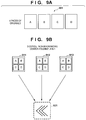
- FIGS. 9A and 9B depict views for explaining a state of originals, printed sheets, and after finishing when four originals are copied into 3 4in1 copies, and "non-bookbinding center-folding" finishing is executed.
- FIG. 9A The result of printing 3 4in1 copies of 4 sheets of originals 901 illustrated in FIG. 9A is illustrated by reference numerals 911-913 of FIG. 9B . Furthermore, FIG. 9B illustrates the result of "non-bookbinding center-folding" finishing being performed on sheets 911-913 as a finished bundle 921.
- the number is 3 which is the maximum number of sheets for the folding capability of the finishing apparatus 330, the processing terminates after a single folding process.
- step S502 In the case of this job, the CPU 111, in step S403 of FIG. 4 , determines that the number of sheets for 1 copy is 1 sheet, and advances the processing to step S501 of FIG. 5 .
- step S502 1 sheet is printed in a 4in1, and in step S503 and in step S504, because the sheet is not the final sheet of the job, and because the number of sheets is not the maximum for the folding capability, the processing proceeds to step S502.
- the processing proceeds to step S506 from step S504.
- step S506 the CPU 111 causes the folding finishing to be executed collectively on these 3 sheets 911-913 by the finishing apparatus 330. In this way, the finished bundle 921 of the non-bookbinding center-folding as is illustrated in FIG. 9B is generated, and discharged to the discharge tray 321.
- FIGS. 10A and 10B depict views for explaining a state of the originals, the printed sheets, and after finishing when four originals are copied into 3 4in1 copies, and "bookbinding center-folding" finishing is executed.
- FIG. 10A The results of printing, 3 double-sided, 2in1 copies of 4 sheets of originals 1001 illustrated in FIG. 10A is illustrated by reference numerals 1011-1013. Furthermore, FIG. 10B illustrates the result of "bookbinding center-folding" finishing being performed on these sheets.
- the originals are imposed in a bookbinding mode for a front surface and a back surface of the sheets so that when folding finishing is performed on the printed sheets, it becomes the bookbound page order.
- the 4 originals 1001 are laid out respectively such that the second page (B) and the third page (C) are on the front surface 1011-F of the sheet 1011, and the first page (A) and the fourth page (D) are on the back surface 1011-R of the sheet 1011, and the originals 1001 are output as printed sheets for which bookbinding imposition is performed.
- This imposition processing is performed similarly for a sheet 1012 of the second copy and a sheet 1013 of the third copy.
- step S601 of FIG. 6 the sheet of the first copy is printed, it is discharged to the finishing apparatus 330 in step S602, and it is determined to be a separation of copies in step S603. With this the processing proceeds to step S605, and the CPU 111 controls the finishing apparatus 330 to execute "bookbinding center-folding". Next, the processing proceeds to step S606, the CPU 111 determines that it is not the final sheet of the job, the processing proceeds to step S602, and the second copy and the third copy are similarly processed.
- folding processing is executed at a separation of copies, and a finishing result 1021 of the first copy, a finishing result 1022 of the second copy, and a finishing result 1023 of the third copy are obtained, as shown in FIG. 10B .
- productivity can be improved in a case where the number of print sheets in 1 copy is 1 in setting for "non-bookbinding center-folding". Also, in a case in which there are multiple sheets in 1 copy where the separation of copies becomes important, it is possible to reduce the effort of a user for finding the separation between copies because the finishing processing is executed at the separation of copies.
- the finishing apparatus 330 which is connected to the image forming apparatus 100, executes the folding processing having received sheets that are printed by the image forming apparatus 100, but the present invention is not limited to this.
- the operator inputs what conditions the job designated in the printing, that is the number of sheets configuring 1 copy, a print layout (page compiling, or the like), the existence/absence of double-sided printing, or the like, via a console unit (not shown), for example, to the finishing apparatus.
- the finishing apparatus can obtain the number of sheets in 1 copy as in step S402 of FIG. 4 as described previously.
- Embodiment of the present invention can also be realized by a computer of a system or apparatus that reads out and executes computer executable instructions (e.g., one or more programs) recorded on a storage medium (which may also be referred to more fully as a 'non-transitory computer-readable storage medium') to perform the functions of the above-described embodiment and/or that includes one or more circuits (e.
- the computer may comprise one or more processors (e. g., central processing unit (CPU), micro processing unit (MPU)) and may include a network of separate computers or separate processors to read out and execute the computer executable instructions.
- the computer executable instructions may be provided to the computer, for example, from a network or the storage medium.
- the storage medium may include, for example, one or more of a hard disk, a random-access memory (RAM), a read only memory (ROM), a storage of distributed computing systems, an optical disk (such as a compact disc (CD), digital versatile disc (DVD), or Blu-ray Disc (BD)TM), a flash memory device, a memory card, and the like.
- RAM random-access memory
- ROM read only memory
- BD Blu-ray Disc
Landscapes
- Engineering & Computer Science (AREA)
- Mechanical Engineering (AREA)
- Physics & Mathematics (AREA)
- General Physics & Mathematics (AREA)
- Theoretical Computer Science (AREA)
- Human Computer Interaction (AREA)
- General Engineering & Computer Science (AREA)
- Folding Of Thin Sheet-Like Materials, Special Discharging Devices, And Others (AREA)
- Control Or Security For Electrophotography (AREA)
- Paper Feeding For Electrophotography (AREA)
- Accessory Devices And Overall Control Thereof (AREA)
- Facsimiles In General (AREA)
Abstract


Description
- The present invention relates to a post process control apparatus, a method of controlling a post process control apparatus, a sheet processing system, and storage medium.
- "Saddle stitching" in which after binding sheets that are respectively imposed for bookbinding, bookbinding is performed by folding in two is known. Also "bookbinding center-folding" in which bookbinding is performed by folding printed sheets that are respectively imposed for bookbinding in two without stitching them is known. In "saddle stitching" and "bookbinding center-folding", a plurality of sheets are bundled, and folding processing or bookbinding processing is performed. Meanwhile, "non-bookbinding center-folding" in which sheets that are not imposed for bookbinding are folded in two is known. If such "non-bookbinding center-folding" processing is performed, in order to make it easy to recognize a separation of copies in a printed sheet bundle, bundling a plurality of sheets that configure a copy, and folding them collectively is typical. Furthermore, in
Japanese Patent Laid-Open No. 2012-141668 - However, in the foregoing conventional technique, in a case where the number of sheets in 1 copy is one, for example, the effort to find the separation between copies does not exist in the first place. In spite of this, each sheet is folded dividing by each copy, that is, the folding processing for each single sheet takes time, and there is a problem in that productivity is worsened.
- An aspect of the present invention is to eliminate the above-mentioned problems with conventional technology.
- The present invention in its first aspect provides a post process control apparatus as specified in
claims 1 to 7. - The present invention in its second aspect provides a sheet processing system as specified in
claims 8 and 9. - The present invention in its third aspect provides a method of controlling a post process control apparatus as specified in claim 10.
- The present invention in its fourth aspect provides a computer-readable storage medium as specified in claim 11.
- Further features of the present invention will become apparent from the following description of exemplary embodiments with reference to the attached drawings.
- The accompanying drawings, which are incorporated in and constitute a part of the specification, illustrate embodiments of the invention and, together with the description, serve to explain the principles of the invention.
-
FIG. 1 is a block diagram for explaining a hardware configuration of an image forming apparatus according to an embodiment of present invention. -
FIG. 2 is a functional block diagram for explaining functions of a control unit of the image forming apparatus according to the embodiment. -
FIG. 3A depicts a structural cross-section view of the image forming apparatus according to the embodiment from a perspective of a front surface. -
FIG. 3B depicts a structural cross-section view of a finishing apparatus according to the embodiment from a perspective of a side face. -
FIGS. 4 through 6 are flowcharts for describing center-folding processing in which the finishing apparatus is controlled by the image forming apparatus according to a first embodiment. -
FIGS. 7A to 7C depict views for explaining a state of an original, printed sheets, and after finishing when a single sheet original is copied with a copy number of 3, and "non-bookbinding center-folding" finishing is executed. -
FIGS. 8A to 8C depict views for explaining a state of originals, printed sheets, and after finishing when four originals are copied with a copy number of 3, and "non-bookbinding center-folding" finishing is executed. -
FIGS. 9A and 9B depict views for explaining a state of originals, printed sheets, and after finishing when four originals are copied into 3 4in1 copies, and "non-bookbinding center-folding" finishing is executed. -
FIGS. 10A and 10B depict views for explaining a state of originals, printed sheets, and after finishing when four originals are copied into 3 4in1 copies, and "bookbinding center-folding" finishing is executed. -
FIG. 11A depicts a view for explaining an example of an output imposition and a finished bundle for "binding saddle stitching". -
FIG. 11B depicts a view for explaining an example of an output imposition for "non-bookbinding center-folding". - Embodiments of the present invention will be described hereinafter in detail, with reference to the accompanying drawings. It is to be understood that the following embodiments are not intended to limit the claims of the present invention, and that not all of the combinations of the aspects that are described according to the following embodiments are necessarily required with respect to the means to solve the problems according to the present invention.
- Note, explanation is given using an example of an image forming apparatus to which a finishing apparatus is connected, and which discharges printed sheets to the finishing apparatus, and which causes the finishing apparatus to execute folding processing as an example of post processing, as an example of a post process control apparatus according to the present invention. However, the present invention is not limited such a configuration; the present invention may be a stand-alone post process control apparatus such as, for example, a bookbinding apparatus, or may be a control apparatus that is connected to a post process control apparatus and that controls operation of the post process control apparatus. Also, the present invention can be applied to a sheet processing system including an image forming apparatus (a printing apparatus) 100 and a finishing apparatus (a post process control apparatus) according to the embodiment.
-
FIG. 1 is a block diagram for explaining a hardware configuration of theimage forming apparatus 100 according to the embodiment of present invention. - A
control unit 110 controls operation of theimage forming apparatus 100 on the whole. For this, thecontrol unit 110 comprises a configuration explained below. ACPU 111 executes various control processing explained later by deploying programs for thecontrol unit 110 stored in aROM 112 into aRAM 113 and executing them. Programs executed by theCPU 111 includes an application program for scanning. Then, by executing the application program for scanning, an image of an original is read by ascanner unit 150 and image data of the original is generated. Then, theCPU 111 stores the generated image data in anHDD 114. A console unit I/F 116 transfers an instruction inputted by a user using aconsole unit 130 to theCPU 111. Also, the console unit I/F 116 receives data to be displayed on theconsole unit 130 from theCPU 111 and transfers it to theconsole unit 130. Note, theconsole unit 130 comprises a display unit (Graphical User Interface, GUI hereinafter) comprising a touch panel function or a keyboard, and accepts a user instruction. A printer I/F 117 is an interface for connecting thecontrol unit 110 to aprinter unit 140. Here, theprinter unit 140 prints on a recording medium such as paper (a sheet) based on image data transferred from thecontrol unit 110 via the printer I/F 117. Also, theprinter unit 140 controls afinishing apparatus 330 for performing finishing processing of a printed sheet. A scanner I/F 118 is an interface for connecting thecontrol unit 110 to thescanner unit 150. Here, thescanner unit 150 generates image data by reading an image of an original using a line sensor or the like. Then, thescanner unit 150 transmits the generated image data to thecontrol unit 110 through the scanner I/F 118. In this way, the image data stored in theHDD 114 is printed by theprinter unit 140. Also, a copy operation can be performed by theprinter unit 140 printing the image data generated by thescanner unit 150. A network I/F 119 connects theimage forming apparatus 100 and a LAN, receives print data transmitted from a PC (not shown) or the like connected to the LAN, and executes printing. - Here, the
printer unit 140 and thescanner unit 150 respectively compriseCPUs ROMs CPUs corresponding ROMs printer unit 140 and thescanner unit 150, and communication with thecontrol unit 110. - Next, explanation is given for a functional configuration of software executed by the
CPU 111 of thecontrol unit 110 in theimage forming apparatus 100 according to the embodiment. -
FIG. 2 is a functional block diagram for explaining functions of thecontrol unit 110 of theimage forming apparatus 100 according to the embodiment. Note, each function illustrated inFIG. 2 is achieved by theCPU 111 executing the program stored in theROM 112. - A
UI control module 211 controls theconsole unit 130 through the console unit I/F 116. Similarly, aprint control module 212 controls theprinter unit 140 and thefinishing apparatus 330 through the printer I/F 117. Ascanner control module 213 controls thescanner unit 150 through the scanner I/F 118. Ajob control module 214 interprets a job setting accepted from the network I/F 119 or theconsole unit 130 and transfers to theprint control module 212 imposition processing for printing on a sheet or finishing information. Anapplication control module 215 implements various functions of theimage forming apparatus 100. AnOS 230 is an operating system for controlling execution of programs that implement the functions corresponding to each unit described above. -
FIG. 3A andFIG. 3B depict views for explaining a configuration of theimage forming apparatus 100 according to the embodiment;FIG. 3A depicts a structural cross-section view from a perspective of a front surface; andFIG. 3B depicts a structural cross-section view from a perspective of a front surface of the finishingapparatus 330. - In
FIG. 3A , a sheet is stacked on apaper feed cassette 310 or apaper feed cassette 311, and is conveyed into the apparatus by a feed/conveyance unit. An image is formed on the conveyed sheet via an image forming unit and a fixing unit of theprinter unit 140, and the sheet on which an image has been formed is discharged via thefinishing apparatus 330. The finishingapparatus 330 is equipped with adischarge tray 320 and adischarge tray 321, and thedischarge tray 321 receives a printed sheet to which binding saddle stitching or non-bookbinding saddle stitching processing is performed. Note, the maximum number at which center-folding can be executed in thefinishing apparatus 330 according to this embodiment is set to 3. - Next, a configuration of the finishing
apparatus 330 is explained with reference toFIG. 3B . - The finishing
apparatus 330 comprises conveyance rollers 31-39, leadingedge detection sensors stapler 42, apush member 43, a stopper 44,folding rollers conveyance roller pair discharge trays apparatus 330 may be operated by a command from thecontrol unit 110 of theimage forming apparatus 100 or may be operated by an independent controller. - Printed sheets conveyed from the
image forming apparatus 100 are discharged to one of thedischarge trays discharge tray 320. On the other hand, in a case where saddle stitching processing or center-folding processing is executed, the sheets (a sheet bundle) to which these processes have been performed are discharged to thedischarge tray 321. The printed sheets conveyed from theimage forming apparatus 100 are conveyed by the conveyance rollers 31-38 until the leading edge of the sheet reaches the position of the leadingedge detection sensor 50. Then, if the leading edge of the sheet is detected by the leadingedge detection sensor 50, the rotating speed of theconveyance roller 38 pinching the sheet is decelerated, and the leading edge of the sheet is caused to collide with a nip of askew correction roller 51. In this way, theconveyance roller 38 continues to rotate for a time after the leading edge of the sheet collides with the nip of theskew correction roller 51. Then, the rotation of theconveyance roller 38 is stopped after the sheet forms a loop in aloop space 52. Next, theskew correction roller 51 starts rotating. In a case where the sheet is skewed, the skew of the sheet is corrected by theskew correction roller 51. Also a sheet whose skew is corrected is conveyed to a direction of theconveyance roller 39. When the leading edge of the sheet is detected by the leadingedge detection sensor 53 in this way, the sheet is conveyed a predetermined amount from that point in time, and the leading edge of the sheet is caused to collide with the stopper 44. In this case, the sheet is positioned by the stopper 44 so that a position for binding by thestapler 42 comes to the central portion of the sheet. By repeating the above described operation, a plurality of sheets are conveyed to a conveyingpath 41 sequentially. - In this way, when the all of the sheets constituting a book are conveyed to the conveying
path 41, positions in the widthwise direction of these sheets are aligned by a widthwise direction alignment plate (not shown), and a later described sheet bundle is formed within the conveyingpath 41. At this point, the sheets which are conveyed in the conveyingpath 41 are conveyed sequentially in order from the sheet positioned innermost in the book. - Then, in a case where it is set to perform the saddle stitching processing, the
stapler 42 performs the binding processing to the central portion of the sheet bundle. When the sheet bundle is bound by thestapler 42, the stopper 44 supporting the sheet bundle moves towards a downstream side of the conveyance direction, and the sheet bundle moves downstream in the conveyance direction. - Meanwhile, in a case where it is not set to perform the saddle stitching processing and it is set to perform the center-folding processing (also called saddle folding processing), the stapling processing by the
stapler 42 is omitted. The stopper 44 performs positioning of the sheet bundle so that the central portion of the sheet bundle comes to the position of thepush member 43. Then, the leading edge of thepush member 43 abuts a portion at which a fold of the sheet bundle positioned by the stopper 44 is formed, and the sheet bundle is pressed to the nip of thefolding rollers folding rollers discharge tray 321 by the rotation of the bundleconveyance roller pair - Here, explanation is given for "binding saddle stitching" and "non-bookbinding center-folding" with reference to
FIGS. 11A and 11B . Note, inFIGS. 11A and 11B , illustrated numerals to which # is added indicate page numbers of the originals. -
FIG. 11A depicts a view illustrating an example of the output imposition and finished bundles of "binding saddle stitching"; here an example illustrates a case where 1 copy is configured by 8 pages of originals, and 2 bookbinding products consisting of 2 double-sided printed sheet bundle copies of these originals are formed. For "bookbinding saddle stitching", imposition to both sides of each sheet and saddle stitching of the sheets are performed so that the printed sheets are bound in a state in which they are folded in 2. Furthermore, in bookbinding imposition, finishing processing is performed at a separation of copies, and finishing processing is performed so that the separation of copies is clear. -
FIG. 11B depicts a view illustrating an example of the output imposition of "non-bookbinding center-folding", where 1 copy is configured by 4 pages of originals and 2 sheets corresponding to 2 copies of sheets are outputted. Here, the separation of the copies is every 1 sheet, because "non-bookbinding center-folding" is set and the number of sheets per 1 copy to which the double-sided printing of these originals is performed is 1. Because center-folding finishing takes time here, an example in which productivity can be improved by performing sheet folding finishing collectively with the maximum number of sheets for the folding capability of the center-folding apparatus is illustrated. In other words, in a case where the maximum number of sheets for center-folding in thefinishing apparatus 330 is 3, folding processing is performed for the 2 sheets collectively without separating sheets by copy, because the folding finishing can be performed on 2 sheets collectively. - Next, explanation is given for an example of a setting of a copy job and a finishing operation according to this embodiment.
-
FIGS. 7A through 7C depict views for explaining a state of an original, printed sheets, and after finishing when a single sheet original is copied with a copy number of 3, and "non-bookbinding center-folding" finishing is executed. - In
FIG. 7A , an original 701 illustrates a 1 page original. 711-713 inFIG. 7B illustrate printed sheets obtained as a result of copying the original 701 into 3 single-sided copies (1 sheet for 1 copy).FIG. 7C illustrates the result of "non-bookbinding center-folding" finishing being performed on sheets 711-713. Here, the center-folding processing is performed on 3 copies (3 sheets) corresponding to the above described maximum number of sheets for center-folding collectively. -
FIGS. 8A through 8C depict views for explaining a state of originals, printed sheets, and after finishing when four originals are copied with a copy number of 3, and "non-bookbinding center-folding" finishing is executed. - In
FIGS. 8A and 8B , the result of 3 copies of the single-sided printing of 4originals 801 is illustrated inreference numerals 811 through to 813. Here, printed sheets obtained as a result of 3 copies of single-sided copying of theoriginals 801 which consist of 4 pages are illustrated.FIG. 8C illustrates the result of "non-bookbinding center-folding" finishing being performed on sheets of 3copies 811 through to 813. Here, the maximum number of sheets for the folding capability of the finishing apparatus is set to 3. Accordingly, non-bookbinding center-folding is executed on the first 3 printed sheets of thefirst copy 811, and afinished bundle 821 is outputted. Then, after the fourth sheet of thefirst copy 811 is printed, it is determined that the fourth sheet is a separation of thefirst copy 811, non-bookbinding center-folding is executed on the fourth sheet, and afinished product 822 is outputted. In this way, in a case where the number of sheets of 1 copy is more than the maximum number of sheets for folding capability, the center-folding processing is executed a plurality of times for 1 copy. The center-folding processing is executed similarly on the remaining 2 copies of printed sheets. Note, for example as illustrated by 822, the folding processing is not performed together with the sheets of the next copy. This is to make clear the separation of copies by performing the folding processing for every copy separately. - Next, finishing processing according to this embodiment is explained with reference to flowcharts in
FIGS. 4 through 6 . -
FIGS. 4 through 6 are flowcharts for describing center-folding processing by which thefinishing apparatus 330 is controlled by theimage forming apparatus 100 according to a first embodiment. Processing illustrated by the flowcharts is achieved by theCPU 111 deploying a program stored in theROM 112 into theRAM 113 and executing it. - This process is started by the
CPU 111 receiving information of a job setting and a copy start operation from, for example, theconsole unit 130, and starting job execution based on the job information. Upon the job execution, theCPU 111 functions as thejob control module 214 to execute the job. - Firstly, the
CPU 111 interprets the received job setting, and functioning as thescanner control module 213 and theprint control module 212, starts an operation in accordance with the job setting in step S401 based on the job setting. Then, it is determined in step S401 whether or not a setting for "non-bookbinding center-folding" is included in the job setting. In a case where "non-bookbinding center-folding" is not set, the processing proceeds to step S601 inFIG. 6 , operation is performed so that printed sheets are separated at the separation of copies of printed sheets, and then finishing processing is performed. The explanation of the flowchart inFIG. 6 is described later. - In a case where "non-bookbinding center-folding" is set in step S401, the processing proceeds to step S402, and the
CPU 111 obtains the number of sheets per 1 copy based on the number of sheets of originals, image imposition, and setting as to whether or not double-sided printing is performed. Next, the processing proceeds to step S403, theCPU 111 determines whether the number of sheets per 1 copy is 1 (singular) or plural. Here, in a case where the number of sheets per 1 copy is plural, the processing proceeds to step S601 inFIG. 6 as previously described, and in a case where the number of sheets per 1 copy is 1, the processing proceeds to step S501 inFIG. 5 . - Next, explanation is given with reference to the flowchart in
FIG. 5 . - In step S501 of
FIG. 5 , theCPU 111 functions as theprint control module 212 and starts print processing. Next, the processing proceeds to step S502, theCPU 111 performs printing of the first sheet, and by conveying of the printed first sheet to thefinishing apparatus 330, causes it to be held in the conveyingpath 41. Next the processing proceeds to step S503, and theCPU 111 determines whether or not it is the last printed sheet of the executing job. Here, for example in a case of the job explained inFIGS. 7A-7C , the original 701 is 1 page and the number of print copies is 3, so the processing proceeds to step S504. In step S504, theCPU 111 determines whether or not the number of printed sheets held in the current conveyingpath 41 has reached the maximum number of sheets for the folding capability of the finishingapparatus 330. Here, if the number is determined not to reach the maximum number of sheets for the folding capability, the processing proceeds to step S502 and printing is performed on the next sheet. Also, if the number is determined to reach the maximum number of sheets for the folding capability in step S504, the processing proceeds to step S506, theCPU 111 causes thefinishing apparatus 330 to execute non-bookbinding center-folding processing, the sheets on which the folding processing has been executed are discharged to thedischarge tray 321, and the processing proceeds to step S502. - Then, when, in step S503, the
CPU 111 determines that it is the final printed sheet of the executing job, the processing proceeds to step S505, non-bookbinding center-folding processing is caused to be executed on one or more sheets held in the current conveyingpath 41 by the finishingapparatus 330, the sheets on which the folding processing has been executed are discharged to thedischarge tray 321, and the processing terminates. - For example, in the example of
FIGS. 7A-7C , because the first and second sheets are not the final sheet of the job and because the maximum number of sheets of the folding capability is not reached, the processing from step S504 to step S502 to step S503 is repeated. Then, at the point in time of printing to the third sheet, it is determined that the sheet is the final sheet of the job in step S503, the processing proceeds to step S505, and non-bookbinding center-folding is executed as shown inFIG. 7C . - In this way, as is illustrated in
FIG. 7C , if 1 copy is comprised by 1 sheet, folding processing is performed collectively for the number of sheets (the number of copies 3) corresponding to the maximum number of sheets of the folding capability. That is, folding processing is executed in one batch on sheets corresponding to a plurality of copies. - Next, explanation is given of a case in which a job, in which there are 4 pages of originals, and the number of copies is 3, is executed, as shown in
FIGS. 8A-8C . - In such a case, the
CPU 111, in step S403 ofFIG. 4 , determines that it is not a 1 copy/1 sheet job, and advances the processing to step S601 ofFIG. 6 . In step S601 ofFIG. 6 , theCPU 111 functions as theprint control module 212 and starts print processing. Next, the processing proceeds to step S602, theCPU 111 performs printing of the first sheet, and by conveying of the printed first sheet to thefinishing apparatus 330, causes it to be held in the conveyingpath 41. Next, the processing proceeds to step S603, theCPU 111 determines whether or not the sheet is at the separation of copies; if it is not at a separation of copies, the processing proceeds to step S604; if it is at a separation of copies, the processing proceeds to step S605, and folding processing is caused to be executed on the sheet bundle held in the conveyingpath 41 by the finishingapparatus 330. Meanwhile, in step S604, theCPU 111 determines whether or not the number of sheets held in the conveyingpath 41 has reached the maximum number of sheets for the folding capability of the finishingapparatus 330. Note that the number of sheets held in the conveyingpath 41 is counted by a counter arranged in theRAM 113. Here, if theCPU 111 determines that the number of sheets held in the conveyingpath 41 does not reach the maximum number of sheets for the folding capability of the finishingapparatus 330, the processing proceeds to step S602, and the next sheet is printed. - In this way, in step S604, when it is determined that the number of sheets held reaches the maximum number of sheets for the folding capability of the finishing
apparatus 330, the processing proceeds to step S605. In step S605, theCPU 111 controls the finishingapparatus 330 to cause folding processing to be executed on the sheet bundle held in the conveyingpath 41, and the processing proceeds to step S606. In step S606, theCPU 111 determines whether or not the final printed sheet of the executing job is determined, and if not, the processing proceeds to step S602, and printing of the next sheet is executed. The non-bookbinding center-folding processing is caused to be executed by the finishingapparatus 330, the sheets on which the folding processing is executed are discharged to thedischarge tray 321, and the processing terminates. - A concrete example of processing by the flowchart of
FIG. 6 is explained with reference toFIGS. 8A through 8C . - The setting of the job in
FIGS. 8A-8C is to use 4originals 801, where the number of copies is 3, and finishing is "non-bookbinding center-folding". Accordingly, the processing proceeds to step S601 ofFIG. 6 from step S403 ofFIG. 4 . Then, after printing to the third sheet of the first copy, theCPU 111, in step S604, determines that the maximum number of sheets for the folding capability is reached, the processing proceeds to step S605, the bookbinding center-folding is executed as shown 821 inFIG. 8C , and thefinished bundle 821 is discharged to thedischarge tray 321. Then, the processing proceeds to step S606. Here, because there is a subsequent page, the processing proceeds to step S602, the 4th sheet of the first copy is printed, and discharged to thefinishing apparatus 330. Here, in step S603, theCPU 111 determines that the 4th sheet is the separation of the first copy, the processing proceeds to step S605, the non-bookbinding center-folding is caused to be executed by the finishingapparatus 330 as shown 822 inFIG. 8C , and thefinished product 822 is discharged to thedischarge tray 321. Thereafter, in the second copy and the third copy, similar processing is performed to execute the folding processing illustrated inFIG. 8C . In other words, if 1 copy is comprised by a plurality of sheets, post processing is executed individually by the sheets corresponding to 1 copy. - Next, with reference to
FIGS. 9A and 9B , explanation is given for an example in which 3 copies of 4 originals are copied in a 4in1, and the center-folding processing is performed. -
FIGS. 9A and 9B depict views for explaining a state of originals, printed sheets, and after finishing when four originals are copied into 3 4in1 copies, and "non-bookbinding center-folding" finishing is executed. - The result of
printing 3 4in1 copies of 4 sheets oforiginals 901 illustrated inFIG. 9A is illustrated by reference numerals 911-913 ofFIG. 9B . Furthermore,FIG. 9B illustrates the result of "non-bookbinding center-folding" finishing being performed on sheets 911-913 as a finished bundle 921. Here, because the number is 3 which is the maximum number of sheets for the folding capability of the finishingapparatus 330, the processing terminates after a single folding process. - Next, explanation is given of the flow of this processing in accordance with the flowcharts of
FIG. 4 andFIG. 5 . - In the case of this job, the
CPU 111, in step S403 ofFIG. 4 , determines that the number of sheets for 1 copy is 1 sheet, and advances the processing to step S501 ofFIG. 5 . In step S502, 1 sheet is printed in a 4in1, and in step S503 and in step S504, because the sheet is not the final sheet of the job, and because the number of sheets is not the maximum for the folding capability, the processing proceeds to step S502. In this way, when the printed sheets 911-913 ofFIG. 9B , by steps S502 through S504, are held in the conveyingpath 41 of the finishingapparatus 330, the processing proceeds to step S506 from step S504. In step S506, theCPU 111 causes the folding finishing to be executed collectively on these 3 sheets 911-913 by the finishingapparatus 330. In this way, the finished bundle 921 of the non-bookbinding center-folding as is illustrated inFIG. 9B is generated, and discharged to thedischarge tray 321. - Next, for processing of a job where 3 copies of 4 originals are copied, and the finishing setting is "bookbinding center-folding", explanation is given with reference to
FIGS. 10A and 10B . -
FIGS. 10A and 10B depict views for explaining a state of the originals, the printed sheets, and after finishing when four originals are copied into 3 4in1 copies, and "bookbinding center-folding" finishing is executed. - The results of printing, 3 double-sided, 2in1 copies of 4 sheets of
originals 1001 illustrated inFIG. 10A is illustrated by reference numerals 1011-1013. Furthermore,FIG. 10B illustrates the result of "bookbinding center-folding" finishing being performed on these sheets. - Here, for the imposition to the sheets, as is illustrated in
reference numeral 1011, the originals are imposed in a bookbinding mode for a front surface and a back surface of the sheets so that when folding finishing is performed on the printed sheets, it becomes the bookbound page order. The 4originals 1001 are laid out respectively such that the second page (B) and the third page (C) are on the front surface 1011-F of thesheet 1011, and the first page (A) and the fourth page (D) are on the back surface 1011-R of thesheet 1011, and theoriginals 1001 are output as printed sheets for which bookbinding imposition is performed. This imposition processing is performed similarly for asheet 1012 of the second copy and asheet 1013 of the third copy. - When the job illustrated in
FIGS. 10A and 10B is started, it is determined not to be "non-bookbinding center-folding" in step S401 ofFIG. 4 , and the processing proceeds to step S601 ofFIG. 6 . In step S601 ofFIG. 6 , the sheet of the first copy is printed, it is discharged to thefinishing apparatus 330 in step S602, and it is determined to be a separation of copies in step S603. With this the processing proceeds to step S605, and theCPU 111 controls the finishingapparatus 330 to execute "bookbinding center-folding". Next, the processing proceeds to step S606, theCPU 111 determines that it is not the final sheet of the job, the processing proceeds to step S602, and the second copy and the third copy are similarly processed. - By the foregoing processing, when "bookbinding center-folding" is executing, folding processing is executed at a separation of copies, and a
finishing result 1021 of the first copy, a finishingresult 1022 of the second copy, and afinishing result 1023 of the third copy are obtained, as shown inFIG. 10B . - As explained above, in accordance with this embodiment productivity can be improved in a case where the number of print sheets in 1 copy is 1 in setting for "non-bookbinding center-folding". Also, in a case in which there are multiple sheets in 1 copy where the separation of copies becomes important, it is possible to reduce the effort of a user for finding the separation between copies because the finishing processing is executed at the separation of copies.
- Note that in the foregoing embodiment, explanation was given for an example in which the
finishing apparatus 330, which is connected to theimage forming apparatus 100, executes the folding processing having received sheets that are printed by theimage forming apparatus 100, but the present invention is not limited to this. For example, it is possible to apply this to a case in which an operator carries sheets that are printed by a printing apparatus in accordance with a job to a finishing apparatus, and stacks them in a paper feed tray of the finishing apparatus or a paper feed stacker connected to the finishing apparatus, and then causes post processing (folding processing, or the like) to be executed on the sheet bundle. At that time, the operator inputs what conditions the job designated in the printing, that is the number of sheets configuring 1 copy, a print layout (page compiling, or the like), the existence/absence of double-sided printing, or the like, via a console unit (not shown), for example, to the finishing apparatus. With this, the finishing apparatus can obtain the number of sheets in 1 copy as in step S402 ofFIG. 4 as described previously. - Also, cases in which the
finishing apparatus 330 executes the processing illustrated in the flowcharts ofFIGS. 4 through 6 are included in the present invention. In such cases, from the setting of the job and the number of originals for which step S402 is executed, the calculation of the number of sheets in 1 copy can be realized by receiving the setting information of the job from the image forming apparatus which is a printing apparatus. - Embodiment of the present invention can also be realized by a computer of a system or apparatus that reads out and executes computer executable instructions (e.g., one or more programs) recorded on a storage medium (which may also be referred to more fully as a 'non-transitory computer-readable storage medium') to perform the functions of the above-described embodiment and/or that includes one or more circuits (e. g., application specific integrated circuit (ASIC)) for performing the functions of the above-described embodiment, and by a method performed by the computer of the system or apparatus by, for example, reading out and executing the computer executable instructions from the storage medium to perform the functions of the above-described embodiment and/or controlling the one or more circuits to perform the functions of the above-described embodiment. The computer may comprise one or more processors (e. g., central processing unit (CPU), micro processing unit (MPU)) and may include a network of separate computers or separate processors to read out and execute the computer executable instructions. The computer executable instructions may be provided to the computer, for example, from a network or the storage medium. The storage medium may include, for example, one or more of a hard disk, a random-access memory (RAM), a read only memory (ROM), a storage of distributed computing systems, an optical disk (such as a compact disc (CD), digital versatile disc (DVD), or Blu-ray Disc (BD)™), a flash memory device, a memory card, and the like.
- While the present invention has been described with reference to exemplary embodiments, it is to be understood that the invention is not limited to the disclosed exemplary embodiments. The scope of the following claims is to be accorded the broadest interpretation so as to encompass all such modifications and equivalent structures and functions.
Claims (11)
- A post process control apparatus, comprising:post processing means (330) for performing post processing on a printed sheet printed in accordance with a job;obtaining means (S402) for obtaining a number of sheets in one copy of printed sheets instructed by the job; andcontrol means (110) for controlling said post processing means to:(i) if the number of sheets in one copy obtained by said obtaining means is singular, execute the post processing in one batch on printed sheets corresponding to a plurality of copies, and(ii) if the number of sheets in one copy obtained by said obtaining means is plural, execute the post processing individually by printed sheets corresponding to one copy.
- The post process control apparatus according to claim 1, wherein said control means, if the number of sheets in one copy is singular, controls said post processing means to execute the post processing when a number of sheets corresponding to a maximum number of sheets for which the post processing can be executed by said post processing means are printed, or a final sheet of the job is printed.
- The post process control apparatus according to claim 1, wherein said control means, if the number of sheets in one copy is plural, controls said post processing means to execute the post processing when a number of sheets corresponding to a maximum number of sheets for which the post processing can be executed by said post processing means are printed, or a final sheet of a copy is printed.
- The post process control apparatus according to any one of claims 1 to 3, wherein the post processing includes folding processing on the printed sheet.
- The post process control apparatus according to claim 4, further comprising:discrimination means (S401) for discriminating whether the post processing executed by said post processing means is center-folding processing accompanying a bookbinding layout or center-folding processing not accompanying a bookbinding layout,wherein when said discrimination means discriminates that the post processing is the center-folding processing accompanying the bookbinding layout, said control means controls said post processing means to execute the post processing individually by printed sheets corresponding to one copy even if the number of sheets in one copy is singular.
- The post process control apparatus according to claim 1, wherein said obtaining means obtains the number of sheets in one copy of printed sheets based on at least one of a number of originals, a number of copies of printing, a print layout, and existence/absence of double-sided printing.
- The post process control apparatus according to any one of claims 1 to 6, wherein said post processing means performs the post processing on a printed sheet printed by a printing apparatus in accordance with the job and conveyed from the printing apparatus.
- A sheet processing system including a printing apparatus (140), and a post process control apparatus (330) that receives a sheet printed by the printing apparatus and performs post processing on the sheet,
wherein the printing apparatus comprises:conveyance means for discharging and conveying to the post process control apparatus a sheet printed in accordance with a job, andwherein the post process control apparatus is a post process control apparatus according to any one of claims 1 to 7, and the post processing means thereof is adapted for performing the post processing on a printed sheet that is conveyed by said conveyance means. - The sheet processing system according to claim 8, wherein said obtaining means obtains from the printing apparatus information of at least one of a number of originals, a number of copies for printing, a print layout, and existence/absence of double-sided printing, and obtains the number of sheets in one copy of printed sheets based on the information.
- A method of controlling a post process control apparatus, the method comprising:a post processing step of performing post processing on a printed sheet printed in accordance with a job;an obtaining step of obtaining a number of sheets in one copy of printed sheets instructed by the job;a control step of controlling to, if the obtained number of sheets in one copy is singular, execute the post processing in one batch on printed sheets corresponding to a plurality of copies, andcontrolling to, if the obtained number of sheets in one copy is plural, execute the post processing individually by printed sheets corresponding to one copy.
- A computer-readable storage medium storing a program that causes a computer to perform a method according to claim 10.
Applications Claiming Priority (1)
| Application Number | Priority Date | Filing Date | Title |
|---|---|---|---|
| JP2015031058A JP2016151759A (en) | 2015-02-19 | 2015-02-19 | Post-processing control device and its control method, sheet processing system and program |
Publications (2)
| Publication Number | Publication Date |
|---|---|
| EP3059085A1 true EP3059085A1 (en) | 2016-08-24 |
| EP3059085B1 EP3059085B1 (en) | 2019-04-17 |
Family
ID=55587994
Family Applications (1)
| Application Number | Title | Priority Date | Filing Date |
|---|---|---|---|
| EP16000117.8A Active EP3059085B1 (en) | 2015-02-19 | 2016-01-19 | Post process control apparatus, method of controlling the same, sheet processing system, and storage medium |
Country Status (5)
| Country | Link |
|---|---|
| US (2) | US9925819B2 (en) |
| EP (1) | EP3059085B1 (en) |
| JP (1) | JP2016151759A (en) |
| KR (1) | KR20160102115A (en) |
| CN (1) | CN105904854B (en) |
Families Citing this family (2)
| Publication number | Priority date | Publication date | Assignee | Title |
|---|---|---|---|---|
| CN112236100B (en) * | 2019-04-15 | 2024-01-02 | 柯惠Lp公司 | Method for calibrating a torque sensor of an instrument drive unit of a surgical robot |
| JP2023154545A (en) * | 2022-04-07 | 2023-10-20 | 株式会社リコー | Sheet processing devices, image forming devices, and image forming systems |
Citations (4)
| Publication number | Priority date | Publication date | Assignee | Title |
|---|---|---|---|---|
| EP1324147A2 (en) * | 2001-12-27 | 2003-07-02 | Konica Corporation | Image forming apparatus |
| EP1876123A2 (en) * | 2006-07-07 | 2008-01-09 | Ricoh Company, Ltd. | Sheet alignment device, sheet finishing apparatus including the same, and image processing system including the same |
| EP2472388A2 (en) * | 2010-12-28 | 2012-07-04 | Fujifilm Corporation | Image forming apparatus, image forming method, image output system, and program |
| US20130328258A1 (en) * | 2012-06-07 | 2013-12-12 | Canon Kabushiki Kaisha | Sheet processing apparatus, control method of sheet processing apparatus, and program |
Family Cites Families (8)
| Publication number | Priority date | Publication date | Assignee | Title |
|---|---|---|---|---|
| JP2001039614A (en) * | 1999-07-30 | 2001-02-13 | Canon Inc | Image forming device |
| JP3926545B2 (en) * | 2000-08-31 | 2007-06-06 | 株式会社リコー | Paper processing apparatus, paper processing system, and image forming system |
| ES2295494T3 (en) * | 2002-09-20 | 2008-04-16 | Ricoh Company, Ltd. | PAPER PROCESSING DEVICE. |
| JP4940843B2 (en) * | 2006-09-07 | 2012-05-30 | コニカミノルタビジネステクノロジーズ株式会社 | Image forming system |
| JP5325905B2 (en) | 2011-02-16 | 2013-10-23 | 京セラドキュメントソリューションズ株式会社 | Post-processing apparatus and image forming apparatus having the same |
| JP5832140B2 (en) * | 2011-05-12 | 2015-12-16 | キヤノン株式会社 | Printing apparatus, printing method, and program |
| JP6226519B2 (en) * | 2012-11-13 | 2017-11-08 | キヤノン株式会社 | Printing apparatus, control method therefor, and program |
| JP6376806B2 (en) * | 2014-04-02 | 2018-08-22 | キヤノン株式会社 | Image forming apparatus, control method therefor, and program |
-
2015
- 2015-02-19 JP JP2015031058A patent/JP2016151759A/en active Pending
-
2016
- 2016-01-19 EP EP16000117.8A patent/EP3059085B1/en active Active
- 2016-02-04 US US15/015,293 patent/US9925819B2/en not_active Expired - Fee Related
- 2016-02-05 CN CN201610083895.9A patent/CN105904854B/en active Active
- 2016-02-12 KR KR1020160016086A patent/KR20160102115A/en not_active Ceased
-
2018
- 2018-02-12 US US15/893,988 patent/US10414191B2/en active Active
Patent Citations (5)
| Publication number | Priority date | Publication date | Assignee | Title |
|---|---|---|---|---|
| EP1324147A2 (en) * | 2001-12-27 | 2003-07-02 | Konica Corporation | Image forming apparatus |
| EP1876123A2 (en) * | 2006-07-07 | 2008-01-09 | Ricoh Company, Ltd. | Sheet alignment device, sheet finishing apparatus including the same, and image processing system including the same |
| EP2472388A2 (en) * | 2010-12-28 | 2012-07-04 | Fujifilm Corporation | Image forming apparatus, image forming method, image output system, and program |
| JP2012141668A (en) | 2010-12-28 | 2012-07-26 | Fujifilm Corp | Image forming apparatus, image forming method, image output system and program |
| US20130328258A1 (en) * | 2012-06-07 | 2013-12-12 | Canon Kabushiki Kaisha | Sheet processing apparatus, control method of sheet processing apparatus, and program |
Also Published As
| Publication number | Publication date |
|---|---|
| CN105904854A (en) | 2016-08-31 |
| US20180162153A1 (en) | 2018-06-14 |
| JP2016151759A (en) | 2016-08-22 |
| EP3059085B1 (en) | 2019-04-17 |
| US10414191B2 (en) | 2019-09-17 |
| CN105904854B (en) | 2018-01-02 |
| KR20160102115A (en) | 2016-08-29 |
| US9925819B2 (en) | 2018-03-27 |
| US20160243874A1 (en) | 2016-08-25 |
Similar Documents
| Publication | Publication Date | Title |
|---|---|---|
| US10744808B2 (en) | Printing apparatus capable of conveying sheets to sheet processing apparatus, method of controlling the same, and storage medium | |
| JP6238614B2 (en) | Sheet processing apparatus and image forming apparatus | |
| JP2012001370A (en) | Sheet processing apparatus for maintaining alignment of bundle of sheets, image forming apparatus, and sheet buffering device | |
| US10414619B2 (en) | Printing apparatus, method of controlling the same, and storage medium | |
| JP2013035642A (en) | Sheet post-processing device | |
| US9389820B2 (en) | Information processing apparatus and control method thereof, and non-transitory computer-readable medium | |
| US20160070223A1 (en) | Printing apparatus, printing method, storage medium for storing program, and printing system | |
| JP5825914B2 (en) | Sheet stacking device | |
| US11182654B2 (en) | Printing apparatus, control method of printing apparatus, and storage medium | |
| US10414191B2 (en) | Post process control apparatus, method of controlling the same, sheet processing system, and storage medium | |
| US8864129B2 (en) | Sheet processing apparatus, method of controlling the same, and storage medium storing program | |
| US9283796B2 (en) | Sheet processing apparatus, control method of sheet processing apparatus, and storage medium | |
| JP5503434B2 (en) | Printing apparatus, printing apparatus control method, and program | |
| US10719046B2 (en) | Image forming apparatus method for controlling image forming apparatus and storage medium | |
| US10954094B2 (en) | Method of switching trays for feeding inter sheets in image forming apparatus | |
| US20150266696A1 (en) | Printing apparatus capable of conveying sheet to bookbinding device, control method of the same, and storage medium | |
| US20160139857A1 (en) | Print apparatus, method of controlling a print apparatus, and a non-transitory computer-readable storage medium | |
| US9623682B2 (en) | Printing apparatus, method for controlling the same, and storage medium | |
| US9292774B2 (en) | Image forming apparatus, image forming method | |
| JP5631472B2 (en) | Sheet processing apparatus, sheet processing apparatus control method, and program |
Legal Events
| Date | Code | Title | Description |
|---|---|---|---|
| PUAI | Public reference made under article 153(3) epc to a published international application that has entered the european phase |
Free format text: ORIGINAL CODE: 0009012 |
|
| AK | Designated contracting states |
Kind code of ref document: A1 Designated state(s): AL AT BE BG CH CY CZ DE DK EE ES FI FR GB GR HR HU IE IS IT LI LT LU LV MC MK MT NL NO PL PT RO RS SE SI SK SM TR |
|
| AX | Request for extension of the european patent |
Extension state: BA ME |
|
| STAA | Information on the status of an ep patent application or granted ep patent |
Free format text: STATUS: REQUEST FOR EXAMINATION WAS MADE |
|
| 17P | Request for examination filed |
Effective date: 20170224 |
|
| RBV | Designated contracting states (corrected) |
Designated state(s): AL AT BE BG CH CY CZ DE DK EE ES FI FR GB GR HR HU IE IS IT LI LT LU LV MC MK MT NL NO PL PT RO RS SE SI SK SM TR |
|
| STAA | Information on the status of an ep patent application or granted ep patent |
Free format text: STATUS: EXAMINATION IS IN PROGRESS |
|
| 17Q | First examination report despatched |
Effective date: 20170920 |
|
| GRAP | Despatch of communication of intention to grant a patent |
Free format text: ORIGINAL CODE: EPIDOSNIGR1 |
|
| STAA | Information on the status of an ep patent application or granted ep patent |
Free format text: STATUS: GRANT OF PATENT IS INTENDED |
|
| INTG | Intention to grant announced |
Effective date: 20181129 |
|
| GRAS | Grant fee paid |
Free format text: ORIGINAL CODE: EPIDOSNIGR3 |
|
| GRAA | (expected) grant |
Free format text: ORIGINAL CODE: 0009210 |
|
| STAA | Information on the status of an ep patent application or granted ep patent |
Free format text: STATUS: THE PATENT HAS BEEN GRANTED |
|
| RAP1 | Party data changed (applicant data changed or rights of an application transferred) |
Owner name: CANON KABUSHIKI KAISHA |
|
| AK | Designated contracting states |
Kind code of ref document: B1 Designated state(s): AL AT BE BG CH CY CZ DE DK EE ES FI FR GB GR HR HU IE IS IT LI LT LU LV MC MK MT NL NO PL PT RO RS SE SI SK SM TR |
|
| REG | Reference to a national code |
Ref country code: GB Ref legal event code: FG4D |
|
| REG | Reference to a national code |
Ref country code: CH Ref legal event code: EP |
|
| REG | Reference to a national code |
Ref country code: DE Ref legal event code: R096 Ref document number: 602016012410 Country of ref document: DE |
|
| REG | Reference to a national code |
Ref country code: AT Ref legal event code: REF Ref document number: 1121098 Country of ref document: AT Kind code of ref document: T Effective date: 20190515 Ref country code: IE Ref legal event code: FG4D |
|
| REG | Reference to a national code |
Ref country code: NL Ref legal event code: MP Effective date: 20190417 |
|
| REG | Reference to a national code |
Ref country code: LT Ref legal event code: MG4D |
|
| PG25 | Lapsed in a contracting state [announced via postgrant information from national office to epo] |
Ref country code: NL Free format text: LAPSE BECAUSE OF FAILURE TO SUBMIT A TRANSLATION OF THE DESCRIPTION OR TO PAY THE FEE WITHIN THE PRESCRIBED TIME-LIMIT Effective date: 20190417 |
|
| PG25 | Lapsed in a contracting state [announced via postgrant information from national office to epo] |
Ref country code: FI Free format text: LAPSE BECAUSE OF FAILURE TO SUBMIT A TRANSLATION OF THE DESCRIPTION OR TO PAY THE FEE WITHIN THE PRESCRIBED TIME-LIMIT Effective date: 20190417 Ref country code: AL Free format text: LAPSE BECAUSE OF FAILURE TO SUBMIT A TRANSLATION OF THE DESCRIPTION OR TO PAY THE FEE WITHIN THE PRESCRIBED TIME-LIMIT Effective date: 20190417 Ref country code: NO Free format text: LAPSE BECAUSE OF FAILURE TO SUBMIT A TRANSLATION OF THE DESCRIPTION OR TO PAY THE FEE WITHIN THE PRESCRIBED TIME-LIMIT Effective date: 20190717 Ref country code: PT Free format text: LAPSE BECAUSE OF FAILURE TO SUBMIT A TRANSLATION OF THE DESCRIPTION OR TO PAY THE FEE WITHIN THE PRESCRIBED TIME-LIMIT Effective date: 20190817 Ref country code: HR Free format text: LAPSE BECAUSE OF FAILURE TO SUBMIT A TRANSLATION OF THE DESCRIPTION OR TO PAY THE FEE WITHIN THE PRESCRIBED TIME-LIMIT Effective date: 20190417 Ref country code: SE Free format text: LAPSE BECAUSE OF FAILURE TO SUBMIT A TRANSLATION OF THE DESCRIPTION OR TO PAY THE FEE WITHIN THE PRESCRIBED TIME-LIMIT Effective date: 20190417 Ref country code: LT Free format text: LAPSE BECAUSE OF FAILURE TO SUBMIT A TRANSLATION OF THE DESCRIPTION OR TO PAY THE FEE WITHIN THE PRESCRIBED TIME-LIMIT Effective date: 20190417 Ref country code: ES Free format text: LAPSE BECAUSE OF FAILURE TO SUBMIT A TRANSLATION OF THE DESCRIPTION OR TO PAY THE FEE WITHIN THE PRESCRIBED TIME-LIMIT Effective date: 20190417 |
|
| PG25 | Lapsed in a contracting state [announced via postgrant information from national office to epo] |
Ref country code: LV Free format text: LAPSE BECAUSE OF FAILURE TO SUBMIT A TRANSLATION OF THE DESCRIPTION OR TO PAY THE FEE WITHIN THE PRESCRIBED TIME-LIMIT Effective date: 20190417 Ref country code: BG Free format text: LAPSE BECAUSE OF FAILURE TO SUBMIT A TRANSLATION OF THE DESCRIPTION OR TO PAY THE FEE WITHIN THE PRESCRIBED TIME-LIMIT Effective date: 20190717 Ref country code: RS Free format text: LAPSE BECAUSE OF FAILURE TO SUBMIT A TRANSLATION OF THE DESCRIPTION OR TO PAY THE FEE WITHIN THE PRESCRIBED TIME-LIMIT Effective date: 20190417 Ref country code: GR Free format text: LAPSE BECAUSE OF FAILURE TO SUBMIT A TRANSLATION OF THE DESCRIPTION OR TO PAY THE FEE WITHIN THE PRESCRIBED TIME-LIMIT Effective date: 20190718 Ref country code: PL Free format text: LAPSE BECAUSE OF FAILURE TO SUBMIT A TRANSLATION OF THE DESCRIPTION OR TO PAY THE FEE WITHIN THE PRESCRIBED TIME-LIMIT Effective date: 20190417 |
|
| REG | Reference to a national code |
Ref country code: AT Ref legal event code: MK05 Ref document number: 1121098 Country of ref document: AT Kind code of ref document: T Effective date: 20190417 |
|
| PG25 | Lapsed in a contracting state [announced via postgrant information from national office to epo] |
Ref country code: IS Free format text: LAPSE BECAUSE OF FAILURE TO SUBMIT A TRANSLATION OF THE DESCRIPTION OR TO PAY THE FEE WITHIN THE PRESCRIBED TIME-LIMIT Effective date: 20190817 |
|
| REG | Reference to a national code |
Ref country code: DE Ref legal event code: R097 Ref document number: 602016012410 Country of ref document: DE |
|
| PG25 | Lapsed in a contracting state [announced via postgrant information from national office to epo] |
Ref country code: SK Free format text: LAPSE BECAUSE OF FAILURE TO SUBMIT A TRANSLATION OF THE DESCRIPTION OR TO PAY THE FEE WITHIN THE PRESCRIBED TIME-LIMIT Effective date: 20190417 Ref country code: DK Free format text: LAPSE BECAUSE OF FAILURE TO SUBMIT A TRANSLATION OF THE DESCRIPTION OR TO PAY THE FEE WITHIN THE PRESCRIBED TIME-LIMIT Effective date: 20190417 Ref country code: AT Free format text: LAPSE BECAUSE OF FAILURE TO SUBMIT A TRANSLATION OF THE DESCRIPTION OR TO PAY THE FEE WITHIN THE PRESCRIBED TIME-LIMIT Effective date: 20190417 Ref country code: EE Free format text: LAPSE BECAUSE OF FAILURE TO SUBMIT A TRANSLATION OF THE DESCRIPTION OR TO PAY THE FEE WITHIN THE PRESCRIBED TIME-LIMIT Effective date: 20190417 Ref country code: RO Free format text: LAPSE BECAUSE OF FAILURE TO SUBMIT A TRANSLATION OF THE DESCRIPTION OR TO PAY THE FEE WITHIN THE PRESCRIBED TIME-LIMIT Effective date: 20190417 Ref country code: CZ Free format text: LAPSE BECAUSE OF FAILURE TO SUBMIT A TRANSLATION OF THE DESCRIPTION OR TO PAY THE FEE WITHIN THE PRESCRIBED TIME-LIMIT Effective date: 20190417 |
|
| PLBE | No opposition filed within time limit |
Free format text: ORIGINAL CODE: 0009261 |
|
| STAA | Information on the status of an ep patent application or granted ep patent |
Free format text: STATUS: NO OPPOSITION FILED WITHIN TIME LIMIT |
|
| PG25 | Lapsed in a contracting state [announced via postgrant information from national office to epo] |
Ref country code: IT Free format text: LAPSE BECAUSE OF FAILURE TO SUBMIT A TRANSLATION OF THE DESCRIPTION OR TO PAY THE FEE WITHIN THE PRESCRIBED TIME-LIMIT Effective date: 20190417 Ref country code: SM Free format text: LAPSE BECAUSE OF FAILURE TO SUBMIT A TRANSLATION OF THE DESCRIPTION OR TO PAY THE FEE WITHIN THE PRESCRIBED TIME-LIMIT Effective date: 20190417 |
|
| 26N | No opposition filed |
Effective date: 20200120 |
|
| PG25 | Lapsed in a contracting state [announced via postgrant information from national office to epo] |
Ref country code: TR Free format text: LAPSE BECAUSE OF FAILURE TO SUBMIT A TRANSLATION OF THE DESCRIPTION OR TO PAY THE FEE WITHIN THE PRESCRIBED TIME-LIMIT Effective date: 20190417 |
|
| PG25 | Lapsed in a contracting state [announced via postgrant information from national office to epo] |
Ref country code: SI Free format text: LAPSE BECAUSE OF FAILURE TO SUBMIT A TRANSLATION OF THE DESCRIPTION OR TO PAY THE FEE WITHIN THE PRESCRIBED TIME-LIMIT Effective date: 20190417 |
|
| REG | Reference to a national code |
Ref country code: DE Ref legal event code: R119 Ref document number: 602016012410 Country of ref document: DE |
|
| PG25 | Lapsed in a contracting state [announced via postgrant information from national office to epo] |
Ref country code: MC Free format text: LAPSE BECAUSE OF FAILURE TO SUBMIT A TRANSLATION OF THE DESCRIPTION OR TO PAY THE FEE WITHIN THE PRESCRIBED TIME-LIMIT Effective date: 20190417 |
|
| REG | Reference to a national code |
Ref country code: CH Ref legal event code: PL |
|
| REG | Reference to a national code |
Ref country code: BE Ref legal event code: MM Effective date: 20200131 |
|
| PG25 | Lapsed in a contracting state [announced via postgrant information from national office to epo] |
Ref country code: LU Free format text: LAPSE BECAUSE OF NON-PAYMENT OF DUE FEES Effective date: 20200119 Ref country code: FR Free format text: LAPSE BECAUSE OF NON-PAYMENT OF DUE FEES Effective date: 20200131 Ref country code: DE Free format text: LAPSE BECAUSE OF NON-PAYMENT OF DUE FEES Effective date: 20200801 |
|
| PG25 | Lapsed in a contracting state [announced via postgrant information from national office to epo] |
Ref country code: CH Free format text: LAPSE BECAUSE OF NON-PAYMENT OF DUE FEES Effective date: 20200131 Ref country code: LI Free format text: LAPSE BECAUSE OF NON-PAYMENT OF DUE FEES Effective date: 20200131 Ref country code: BE Free format text: LAPSE BECAUSE OF NON-PAYMENT OF DUE FEES Effective date: 20200131 |
|
| PG25 | Lapsed in a contracting state [announced via postgrant information from national office to epo] |
Ref country code: IE Free format text: LAPSE BECAUSE OF NON-PAYMENT OF DUE FEES Effective date: 20200119 |
|
| PG25 | Lapsed in a contracting state [announced via postgrant information from national office to epo] |
Ref country code: MT Free format text: LAPSE BECAUSE OF FAILURE TO SUBMIT A TRANSLATION OF THE DESCRIPTION OR TO PAY THE FEE WITHIN THE PRESCRIBED TIME-LIMIT Effective date: 20190417 Ref country code: CY Free format text: LAPSE BECAUSE OF FAILURE TO SUBMIT A TRANSLATION OF THE DESCRIPTION OR TO PAY THE FEE WITHIN THE PRESCRIBED TIME-LIMIT Effective date: 20190417 |
|
| PG25 | Lapsed in a contracting state [announced via postgrant information from national office to epo] |
Ref country code: MK Free format text: LAPSE BECAUSE OF FAILURE TO SUBMIT A TRANSLATION OF THE DESCRIPTION OR TO PAY THE FEE WITHIN THE PRESCRIBED TIME-LIMIT Effective date: 20190417 |
|
| PGFP | Annual fee paid to national office [announced via postgrant information from national office to epo] |
Ref country code: GB Payment date: 20251220 Year of fee payment: 11 |