EP3057069A1 - Dokumentenlesegerät zur überprüfung eines identifikationsdokuments - Google Patents
Dokumentenlesegerät zur überprüfung eines identifikationsdokuments Download PDFInfo
- Publication number
- EP3057069A1 EP3057069A1 EP16155410.0A EP16155410A EP3057069A1 EP 3057069 A1 EP3057069 A1 EP 3057069A1 EP 16155410 A EP16155410 A EP 16155410A EP 3057069 A1 EP3057069 A1 EP 3057069A1
- Authority
- EP
- European Patent Office
- Prior art keywords
- document
- code
- data
- identification
- document data
- Prior art date
- Legal status (The legal status is an assumption and is not a legal conclusion. Google has not performed a legal analysis and makes no representation as to the accuracy of the status listed.)
- Granted
Links
Images

Classifications
-
- G—PHYSICS
- G07—CHECKING-DEVICES
- G07D—HANDLING OF COINS OR VALUABLE PAPERS, e.g. TESTING, SORTING BY DENOMINATIONS, COUNTING, DISPENSING, CHANGING OR DEPOSITING
- G07D7/00—Testing specially adapted to determine the identity or genuineness of valuable papers or for segregating those which are unacceptable, e.g. banknotes that are alien to a currency
- G07D7/004—Testing specially adapted to determine the identity or genuineness of valuable papers or for segregating those which are unacceptable, e.g. banknotes that are alien to a currency using digital security elements, e.g. information coded on a magnetic thread or strip
- G07D7/0047—Testing specially adapted to determine the identity or genuineness of valuable papers or for segregating those which are unacceptable, e.g. banknotes that are alien to a currency using digital security elements, e.g. information coded on a magnetic thread or strip using checkcodes, e.g. coded numbers derived from serial number and denomination
Definitions
- the present invention relates to the field of verification of an identification document.
- Document data is often printed on an identification document in order to be able to determine the identity of the owner of the identification document.
- the identification document is a passport on which the name, date of birth and gender of the holder are printed.
- the printed document data can be read out by a controller.
- printed document data can be manipulated, for example, to fake a false identity.
- identification documents In order to be able to detect a manipulation of the printed document data, identification documents therefore often additionally have an electronic circuit in which the document data are stored and from which the stored document data can be read out wirelessly by means of radio frequency identification (RFID) or near field communication (NFC).
- RFID radio frequency identification
- NFC near field communication
- the inspector can read the stored document data from the electronic circuit of the identification document by means of a radio frequency (RF) reader and compare the read document data with the printed document data to check the identification document.
- RF radio frequency
- the integration of the electronic circuit in the identification document is complicated and expensive.
- a reading device with a cost-intensive RF reading module is used for wireless reading of the electronic circuit.
- the electronic circuit of the identification document may be deactivated by intentional or unintentional destruction. In this case, a verification of the identification document by means of the reader can not be performed.
- the invention is based on the finding that the above object can be achieved by applying an optically detectable code to the identification document, wherein the code encodes verification data for checking document data applied to the identification document.
- both the code and the document data can be detected optically by means of a cost-effective image camera.
- the code can be integrated into the identification document in a particularly cost-effective manner by printing, puncturing, perforating or laser-lapping, in particular by burning-in by means of a laser or laser technology, such as laser engraving.
- the invention relates to a document reader for checking an identification document, the identification document comprising document data and an optically detectable code which encodes verification data for checking the document data, comprising: an image camera, which is designed to optically detect the code obtain a detected code, and which is further configured to optically detect the document data to obtain detected document data; a processor configured to decode the detected code to obtain the verification data, and to check the acquired document data based on the verification data to verify the identification document.
- the document reader may be a computer, a laptop or a telephone, in particular a mobile telephone or a smartphone. Furthermore, the document reader may be an element of a self-service terminal, in particular an ATM or a transfer machine, a vending machine, in particular a ticket vending machine or a cigarette vending machine, a working time recording system or an access control system.
- the identification document may be one of the following identification documents: identity document, such as identity card, passport, access control card, authorization card, company card, tax stamp or ticket, birth certificate, driver's license or vehicle pass, means of payment, for example a bank card or credit card.
- identity document such as identity card, passport, access control card, authorization card, company card, tax stamp or ticket, birth certificate, driver's license or vehicle pass, means of payment, for example a bank card or credit card.
- the identification document may further comprise an electronically readable circuit, for example an RFID chip.
- the identification document can be single-layered or multi-layered or paper and / or plastic-based.
- the identification document can be constructed from plastic-based films which are joined together to form a card body by means of gluing and / or lamination, the films preferably having similar material properties.
- the document data may include a personal data such as name, date of birth, place of birth and / or personal number of the holder of the identification document.
- the document data may include data associated with the identification document, such as a serial number of the identification document and / or a validity date of the identification document.
- the document data may also be in the form of characters on the identification document.
- the document data is printed on the identification document or a document body of the identification document, punched in the identification document or a document body of the identification document, perforated in the identification document or a document body of the identification document or by means of a laser or a laser technology, such as laser Engraving, in the identification document or the Document body burned.
- the identification document is or comprises a polycarbonate (PC) passport into which the document data is burned in using laser technology.
- PC polycarbonate
- the verification data may include reference document data, a checksum, in particular a hash value, reference document data, a digital signature of or parts of reference document data, manipulation protection data, and / or manipulation detection data.
- the reference document data include a personal date of the holder of the identification document, a hash value of a personal date of the holder of the identification document, and / or a digital signature of a personal date of the holder of the identification document.
- the verification data may further comprise a data set comprising a constituent or constituent parts of a hash value or a digital signature.
- the hash value is a SHA256 hash value and the record is a one-digit hash of the hash value.
- a SHA256 hash of name, first name, or document number results in 256 bits of data.
- the amount of data can be reduced by means of a checksum algorithm which delivers a one-digit check digit, for example by means of a modulo 11 method or a module 11 method. With a reduction of the data amount, however, a collision probability, that is to say a probability that different source data lead to the same checksum, can be increased at the same time.
- the optically detectable code may encode the verification data by means of a bar code, a bar code, a 1-D code, a 2-D code, a 3-D code, or a coding method, such as a sequence of geometric shapes. Further, the optically detectable code may be printed on the identification document or a document body of the identification document, punched in the identification document or a document body of the identification document, perforated in the identification document or a document body of the identification document, or engraved in the identification document or a document body of the identification document.
- the image camera can be designed to record an image, for example in the infrared, visible and / or ultraviolet wavelength range, of the identification document.
- the image camera may further comprise an image sensor, a lighting element for illuminating the identification document, a camera lens and / or a line scanner, as in a flatbed scanner.
- an optical image of the code can be recorded by means of the image camera.
- the processor can also be used to determine the position of the code in the recorded image, in particular by means of pattern recognition. and extract the code from the captured image to obtain the captured code.
- a further image can be recorded in the same or in a different wavelength range of the document data.
- the processor can also determine the position of the document data in the captured further image and extract the document data from the captured further image, in particular by means of character recognition or pattern recognition, in order to obtain the acquired document data.
- the processor may be further configured to decode the detected code using a pattern recognition method to obtain the verification data. Further, the processor may be configured to compare the acquired document data with reference document data included in the check data to check the acquired document data based on the check data. If the captured document data match the reference document data, the identification document may be valid.
- the image camera is further configured to capture an image of the identification document to optically capture the code along with the document data
- the processor is configured to extract the captured code and the captured document data from the image.
- the code and the document data may be arranged on a page, surface or visible surface of the identification document.
- the code and document data are arranged on the data side of the identification document.
- the code may be applied under a film such as a protective film or a transparent layer.
- the code can also be optically detectable in the infrared wavelength range and be arranged in an interior of one side of the identification document, since it is known that even internal circuit portions are sometimes visible in the infrared wavelength range.
- the code is a bar code, 2D code, or 3D code
- the processor is configured to decode the bar code, the 2D code, or the 3D code to obtain the verification data.
- the bar code may be a bar code according to one of the standards Code39, Code 93, Codabar, Code 128, European Article Number (EAN) or Universal Product Code (UPC). Further, the bar code may be a bar code.
- the 2D code may further be code according to one of the standards Codablock, Code 49, PDF417, Quick Response Code (QR Code), DataMatrix, MaxiCode, Aztec Code, Dot Code A, Snowflake Code, BeeTagg or ShotCode.
- the 3D code may be a 2D code in which the third dimension is formed by color information such as hue, color saturation or color brightness. According to an embodiment, the third dimension of the 3D code may further be formed by a height profile. To capture the height profile, the image camera can be designed as a stereoscopic image camera.
- the document data includes characters
- the processor is configured to capture the document data using character recognition or pattern recognition to provide captured document data. This provides the advantage that the document data can be captured efficiently. Furthermore, human-readable document data can be efficiently captured.
- the processor is further configured to compare the captured document data with the verification data to verify the captured document data.
- the processor is further configured to compare the captured document data with the verification data to verify the captured document data.
- the processor is further configured to determine a checksum of the acquired document data and to compare the checksum with a reference checksum included in the verification data to check the acquired document data.
- the checksum may include a hash value or form a hash value. Furthermore, the checksum according to the standard Message-Digest Algorithm 5 (MD5) or the standard family Secure Hash Algorithm (SHA) are formed. The checksum can also be a one-digit checksum. The reference checksum may also be associated with reference document data. If the reference checksum and the checksum match, the identification document may be valid.
- MD5 Message-Digest Algorithm 5
- SHA Secure Hash Algorithm
- the processor is further configured to check the acquired document data by means of a digital signature, which is associated with the reference document data, in the check data.
- the digital signature can be generated by means of an asymmetric signature method using a private key or private key.
- a public key or public key which can be pre-stored in a memory of the document reading device can also be used to check the digital signature.
- additional verification of the document data can be checked whether the manufacturer of the identification document is in possession of the private key and thus authorized to issue the identification document.
- the digital signature may also be generated by means of a symmetric signature method. According to In one embodiment, only a portion or a checksum of the digital signature may be used to reduce counterfeit security.
- the document reading apparatus is formed with: a display element for optically displaying a result of checking the acquired document data. This provides the advantage that the result of the check can be displayed to a user of the document reading device. If the document reader is formed by a mobile phone, the result of the check can also be displayed location-independently.
- the display element may comprise a light emitting diode (LED) and / or a liquid crystal display (LCD) display.
- the document reader can be designed to display the result of the check by means of an acoustic signal and / or by vibration.
- the document reader may comprise an acoustic signal transmitter, a loudspeaker, a buzzer and / or a vibration transmitter, in particular an electric motor with an imbalance.
- the document reading device is formed with: a luminous element for illuminating the identification document during the optical detection of the code or during the optical detection of the document data.
- a luminous element for illuminating the identification document during the optical detection of the code or during the optical detection of the document data.
- the light-emitting element may comprise a light-emitting diode (LED).
- the invention relates to a method for checking an identification document, wherein the identification document comprises document data and an optically detectable code which encodes verification data for checking the document data, comprising: optically acquiring the code by means of an imaging method, in particular by means of an image camera or a line scanner to obtain a detected code; optically capturing the document data using the imaging method to obtain captured document data; Decoding the detected code by a processor to obtain the verification data; and checking the acquired document data based on the verification data by the processor to acquire the identification document to verify.
- the identification document can be checked efficiently and inexpensively by means of a visual check.
- the method is carried out with: simultaneously optically acquiring the code and the document data by means of the imaging method in order to obtain the detected code and the acquired document data.
- the advantage is achieved that the verification of the identification document can be accelerated by taking only one image.
- an image of the identification document can be recorded by means of the image camera, from which the acquired code and the recorded document data, for example by means of the processor, are extracted.
- the decoding of the detected code comprises decoding a bar code, 2D codes or 3D codes included in the detected code. This provides the advantage that the detected code can be efficiently decoded.
- the optical detection of the document data is performed by an optical character recognition method or by an optical pattern recognition method. This provides the advantage that the document data can be captured efficiently. Furthermore, human-readable document data can be efficiently captured.
- the method for checking an identification document can be carried out by means of the document reader according to the invention. Further features of the method for checking an identification document arise directly from the functionality of the document reading device according to the invention.
- the method for checking an identification document can be executed by means of a computer program with a program code when the program code is executed on a computer.
- the method for checking an identification document by means of software, in particular an application is executed on a smartphone.
- the invention relates to an identification document comprising: a document body; document data arranged on the document body; and an optically detectable code disposed on the document body, which encodes verification data for checking the document data; wherein the document data and the optically detectable code are arranged at a distance from each other.
- the identification document may be one of the following identification documents: identity document, such as identity card, passport, access control card, authorization card, company card, tax stamp or ticket, birth certificate, driver's license or vehicle pass, means of payment, for example a bank card or credit card.
- identity document such as identity card, passport, access control card, authorization card, company card, tax stamp or ticket, birth certificate, driver's license or vehicle pass, means of payment, for example a bank card or credit card.
- the identification document may further comprise an electronically readable circuit, for example an RFID chip.
- the identification document can be single-layered or multi-layered or paper and / or plastic-based.
- the identification document can be constructed from plastic-based films which are joined together to form a card body by means of gluing and / or lamination, the films preferably having similar material properties.
- the document data may include a personal data such as name, date of birth, place of birth and / or personal number of the holder of the identification document. Furthermore, the document data may include data associated with the identification document, such as a serial number of the identification document and / or a validity date of the identification document. The document data may also be in the form of characters on the identification document. For example, the document data is printed on the identification document or a document body of the identification document, punched in the identification document or a document body of the identification document, perforated in the identification document or a document body of the identification document, or engraved in the identification document or a document body of the identification document.
- the verification data may include reference document data, a checksum, in particular a hash value, reference document data, a digital signature of Reference document data, manipulation protection data and / or manipulation detection data include.
- the reference document data include a personal date of the holder of the identification document, a hash value of a personal date of the holder of the identification document, and / or a digital signature of a personal date of the holder of the identification document.
- the optically detectable code may encode the verification data by means of a bar code, a bar code, a 1-D code, a 2-D code, a 3-D code, or a coding method, such as a sequence of geometric shapes. Furthermore, the optically detectable code can be printed on the document body, stamped into the document body or perforated in the document body.
- the document data and the code are arranged on a data page of the identification document. This has the advantage of being able to collect the document data and code together.
- the code comprises a bar code, a 2D code or a 3D code. This provides the advantage that the area occupied by the code on the document body can be reduced.
- the code is printed on the document body, punched in the document body, formed by a perforation of the document body or engraved in the document body.
- the identification document can be checked by means of the document reader according to the invention. Further features of the identification document result directly from the functionality of the document reader according to the invention.
- the invention can be implemented in hardware and / or software.
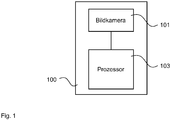
- Fig. 1 shows a schematic diagram of a document reader 100 for checking an identification document.
- the document reader 100 includes an image camera 101 and a processor 103.
- the document reading apparatus 100 for checking an identification document wherein the identification document has document data and an optically detectable code which encodes verification data for checking the document data, is formed with: the image camera 101, which is adapted to optically detect the code, a detected code and which is further configured to optically detect the document data to obtain captured document data; the processor 103 configured to decode the detected code to obtain the check data, and to check the detected document data based on the check data to check the identification document.
- the document reader 100 may be a computer, a laptop or a telephone, in particular a mobile telephone or a smartphone. Furthermore, the document reader 100 may be an element of a self-service terminal, in particular an ATM or a transfer machine, a vending machine, in particular a ticket vending machine or a cigarette vending machine, a working time recording system or an access control system. Further, the document reader 100 may be constituted by a system having a computer and a remote image pickup unit. The document reader 100 may further be provided by a peripheral device, in particular a Universal Serial Bus (USB) peripheral device on a Personal Computer (PC), be formed. Furthermore, the document reader 100 may be formed by a plurality of components.
- USB Universal Serial Bus
- PC Personal Computer
- the identification document may be one of the following identification documents: identity document, such as identity card, passport, access control card, authorization card, company card, tax stamp or ticket, birth certificate, driver's license or vehicle pass, means of payment, for example a bank card or credit card.
- identity document such as identity card, passport, access control card, authorization card, company card, tax stamp or ticket, birth certificate, driver's license or vehicle pass, means of payment, for example a bank card or credit card.
- the identification document may further comprise an electronically readable circuit, for example an RFID chip.
- the identification document can be single-layered or multi-layered or paper and / or plastic-based.
- the identification document can be constructed from plastic-based films which are joined together to form a card body by means of gluing and / or lamination, the films preferably having similar material properties.
- the document data may include a person's date, such as name, birthday, place of birth, address, eye color, and / or personnel number, of the owner of the identification document. Further, the document data may include data associated with the identification document, such as a serial number of the identification document, an expiration date of the identification document, an issue date of the identification document, and / or the name of the issuer or the issuing authority of the identification document.
- the document data can furthermore comprise data derived from a person's date and / or the data associated with the identification document, such as checksums or check digits, which can secure further document data and can be secured thereby.
- the document data may also be in the form of characters on the identification document.
- the document data is printed on the identification document or a document body of the identification document, punched in the identification document or a document body of the identification document, perforated in the identification document or a document body of the identification document, or engraved in the identification document or a document body of the identification document. If the identification document has a plastic-based card body or document body, the Document data preferably engraved to personalize the identification document.
- the verification data may include reference document data, a checksum, in particular a hash value, reference document data, a digital signature of reference document data, manipulation protection data, and / or manipulation detection data.
- the reference document data include a personal date of the holder of the identification document, a hash value of a personal date of the holder of the identification document, and / or a digital signature of a personal date of the holder of the identification document.
- the optically detectable code may encode the verification data by means of a bar code, a bar code, a 1-D code, a 2-D code, a 3-D code, or a coding method, such as a sequence of geometric shapes. Further, the optically detectable code may be printed on the identification document or a document body of the identification document, punched in the identification document or a document body of the identification document, or perforated in the identification document or a document body of the identification document.
- the image camera 101 can be designed to record an image, for example in the infrared, visible and / or ultraviolet wavelength range, of the identification document.
- the image camera 101 may further comprise an image sensor, a lighting element for illuminating the identification document, a camera lens and / or a line scanner, as in a flatbed scanner.
- an optical image of the code can be recorded by means of the image camera 101.
- the position of the code in the recorded image in particular by means of pattern recognition, can also be determined and the code can be extracted from the recorded image in order to obtain the detected code.
- a further image in the same or a different wavelength range of the document data can be recorded.
- the processor 103 the Position of the document data in the captured further image determined and the document data from the captured further image, in particular by means of a character recognition or a pattern recognition, extracted to obtain the detected document data.
- the processor 103 may be further configured to decode the detected code using a pattern recognition method to obtain the verification data. Further, the processor 103 may be configured to compare the acquired document data with reference document data included in the check data to check the acquired document data based on the check data. If the captured document data match the reference document data, the identification document may be valid.
- the image camera 101 may further be configured to take an image of the identification document to optically detect the code together with the document data
- the processor 103 may be configured to extract the acquired code and the captured document data from the image.
- the code and the document data may be arranged on a page, surface or visible surface of the identification document.
- the code and document data are arranged on the data side of the identification document.
- the code may be applied under a film such as a protective film or a transparent layer.
- the code can also be optically detectable in the infrared wavelength range and be arranged in an interior of a document page of the identification document, since it is known that even internal circuit portions are sometimes visible in the infrared wavelength range.
- the code may be a bar code, 2D code or 3D code
- the processor 103 may be configured to decode the bar code, the 2D code or the 3D code to obtain the verification data.
- the bar code may be a bar code according to one of the standards Code39, Code 93, Codabar, Code 128, European Article Number (EAN) or Universal Product Code (UPC). Further, the bar code may be a bar code.
- the 2D code may further be code according to one of the standards Codablock, Code 49, PDF417, Quick Response Code (QR Code), DataMatrix, MaxiCode, Aztec Code, Dot Code A, Snowflake Code, BeeTagg or ShotCode.
- the 3D code may be a 2D code in which the third dimension is formed by color information such as hue, color saturation or color brightness.
- the third dimension of the 3D code may further be formed by a height profile.
- the image camera 101 can be designed as a stereoscopic image camera.
- the document data may include characters
- the processor 103 may be configured to capture the document data using character recognition or pattern recognition to provide captured document data.
- the document data may be further input, supplemented or corrected by a user of the document reading apparatus 100 into the document reading apparatus 100 if the optical detection of the document data by means of the image camera 101 fails.
- the document reader 100 may comprise a user interface.
- the user interface is formed by a touch screen, a keyboard or a voice input interface.
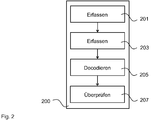
- Fig. 2 shows a schematic diagram of a method 200 for checking an identification document.
- the method 200 includes the method steps 201 to 207.
- the method 200 for checking an identification document comprises document data and an optically detectable code which encodes verification data for checking the document data, comprises the method steps: optically detecting 201 the code by means of an imaging method, in particular by means of the image camera 101 or a line scanner to obtain a detected code; optically detecting 203 the document data by the imaging method to obtain captured document data; Decoding 205 the detected code by the processor 103 to obtain the verification data; and checking 207 the acquired document data based on the check data by the processor 103 to check the identification document.
- the code and the document data can be detected simultaneously by means of the imaging method.
- an image of the identification document can be taken, from which the acquired code and the recorded document data, for example by means of the processor 103, are extracted.
- the decoded 205 of the detected code may include decoding a bar code, 2D codes or 3D codes included in the detected code.
- the optical detection 203 of the document data may be performed by an optical character recognition method or by an optical pattern recognition method.
- the method 200 may be performed by the document reader 100. Further features of the method 200 result directly from the functionality of the document reading device 100.
- the method 200 may be further executed by a plurality of devices.
- the code and the document data are optically detected by means of an image camera 101 of a document reader and further processed by means of an electronic network service.
- the document reader and the electronic network service for data exchange over a communication network, such as a computer network or the Internet, be connected.
- FIG. 12 shows a schematic diagram of an identification document 300.
- the identification document 300 includes a document body 301, a code 303, and document data 305.
- the identification document 300 is formed with: the document body 301; the document data 305 arranged on the document body 301; and the optically detectable code 303 arranged on the document body 301, which codes verification data for checking the document data 305; the Document data 305 and the optically detectable code 303 are arranged spaced from each other.
- the document data 305 and the optically detectable code 303 may further overlap.
- the document data 305 and the optically detectable code 303 may be optically readable or detectable in different wavelength ranges.
- the optically detectable code 303 is detectable or applied in a non-visible wavelength range, such as UV, and the document data can be read out or acquired in the visible wavelength range.
- the identification document 300 may be one of the following identification documents: identity document, such as identity card, passport, access control card, authorization card, company card, tax stamp or ticket, birth certificate, driver's license or vehicle pass, means of payment, for example a bank card or credit card.
- identity document such as identity card, passport, access control card, authorization card, company card, tax stamp or ticket, birth certificate, driver's license or vehicle pass, means of payment, for example a bank card or credit card.
- the identification document 300 may further comprise an electronically readable circuit, for example an RFID chip.
- the identification document 300 may be single-layered or multi-layered or paper and / or plastic-based.
- the identification document 300 may be constructed of plastic-based films which are joined together to form a card body by means of gluing and / or laminating, the films preferably having similar material properties.
- the document data 305 may include a person's date, such as name, birthday, birthplace, and / or personnel number, of the owner of the identification document 300. Furthermore, the document data 305 may include data associated with the identification document 300, such as a serial number of the identification document 300 and / or a validity date of the identification document 300. The document data 305 may also be in the form of characters on the identification document 300. For example, the document data 305 is printed on the document body 301, stamped in the document body 301, perforated in the document body 301, or engraved in the document body 301.
- the verification data may include reference document data, a checksum, in particular a hash value, reference document data, a digital signature of reference document data, manipulation protection data, and / or Include tampering detection data.
- the reference document data include a personal date of the owner of the identification document 300, a hash value of a personal date of the owner of the identification document 300, and / or a digital signature of a personal date of the owner of the identification document 300.
- the optically detectable code 303 may encode the verification data by means of a bar code, a bar code, a 1-D code, a 2-D code, a 3-D code, or a coding method, such as a sequence of geometric shapes. Further, the optically detectable code 303 may be printed on the document body 301, punched in the document body 301, perforated in the document body 301, or engraved in the document body 301.
- the document data 305 and the code 303 may be arranged on a data page of the identification document.
- the code 303 may comprise a bar code, a 2D code or a 3D code.
- the identification document 300 can be checked by means of the document reader 100. Further features of the identification document 300 result directly from the functionality of the document reading device 100.
- an authenticity check of the identification document 300 can be carried out by means of the method 200. In this case, it can be checked whether an identity described on the identification document 300 is authentic and / or whether the identification document 300 has been authorized.
- the code 303 may be formed by optically machine-readable coded secure authentication data applied to the identity document 300 or to the document body 301.
- the code 303 may be applied to a data page of the identification document 300 on which the document data 305, in particular personal data, applied or personalized and secured with optical security features.
- the code 303 and the document data 305 may be arranged on different document pages of the identification document 300. In this case, it may be necessary to take a further image of the identification document 300 or two images of the identification document 300. This can further protect the code 303 and / or the document data 305.
- the document data 305 is on a front side of a document side of the identification document 300, and the code 303 is disposed on a back side of the document side of the identification document 300 or vice versa. This is particularly advantageous if the identification document 300 is an identity card or a banknote.
- personal data, identification data and / or corresponding manipulation protection data or manipulation recognition data such as hash values or digital signatures of these personal data or identification data, may be coded in the code 303.
- the method 200 can provide a simple and very secure way of protecting the authenticity of the personal document data 305 or personal data personalized on an identification document 300 and / or authenticating it without an electronic circuit such as an electronic circuit Chip, the identification document 300 read.
Landscapes
- Engineering & Computer Science (AREA)
- Computer Security & Cryptography (AREA)
- Physics & Mathematics (AREA)
- General Physics & Mathematics (AREA)
- Credit Cards Or The Like (AREA)
Abstract
Description
- Die vorliegende Erfindung betrifft das Gebiet der Überprüfung eines Identifikationsdokuments.
- Auf einem Identifikationsdokument sind häufig Dokumentendaten aufgedruckt, um die Identität des Inhabers des Identifikationsdokuments feststellen zu können. Beispielsweise ist das Identifikationsdokument ein Reisepass, auf welchem Name, Geburtsdatum und Geschlecht des Inhabers aufgedruckt sind. Zur Feststellung der Identität des Inhabers können die aufgedruckten Dokumentendaten von einem Kontrolleur ausgelesen werden. Aufgedruckte Dokumentendaten können jedoch manipuliert werden, beispielsweise um eine falsche Identität vorzutäuschen.
- Um eine Manipulation der aufgedruckten Dokumentendaten erkennen zu können, weisen Identifikationsdokumente daher häufig zusätzlich einen elektronischen Schaltkreis auf, in welchem die Dokumentendaten gespeichert sind und aus welchem die gespeicherten Dokumentendaten drahtlos mittels Radiofrequenzidentifikation (RFID) oder Nahfeldkommunikation (NFC) ausgelesen werden können. Der Kontrolleur kann die gespeicherten Dokumentendaten mittels eines Radiofrequenz (RF) Lesegerätes aus dem elektronischen Schaltkreis des Identifikationsdokuments auslesen und die ausgelesenen Dokumentendaten mit den aufgedruckten Dokumentendaten vergleichen, um das Identifikationsdokument zu überprüfen. Das Integrieren des elektronischen Schaltkreises in das Identifikationsdokument ist jedoch aufwändig und kostenintensiv. Ferner wird zum drahtlosen Auslesen des elektronischen Schaltkreises ein Lesegerät mit einem kostenintensiven RF-Lesemodul verwendet. Ferner kann der elektronische Schaltkreis des Identifikationsdokuments durch beabsichtigte oder unbeabsichtigte Zerstörung deaktiviert werden. In diesem Fall kann eine Überprüfung des Identifikationsdokuments mittels des Lesegerätes nicht durchgeführt werden.
- Es ist daher die Aufgabe der vorliegenden Erfindung, ein effizientes und kostengünstiges Konzept zur Überprüfung eines Identifikationsdokuments zu schaffen.
- Diese Aufgabe wird durch die Merkmale der unabhängigen Ansprüche gelöst. Vorteilhafte Weiterbildungsformen sind Gegenstand der abhängigen Patentansprüche, der Beschreibung sowie der Zeichnungen.
- Die Erfindung basiert auf der Erkenntnis, dass die obige Aufgabe durch Aufbringen eines optisch erfassbaren Codes auf das Identifikationsdokument gelöst werden kann, wobei der Code Überprüfungsdaten zur Überprüfung von auf dem Identifikationsdokument aufgebrachten Dokumentendaten codiert. Dadurch können sowohl der Code als auch die Dokumentendaten optisch mittels einer kostengünstigen Bildkamera erfasst werden. Ferner kann der Code besonders kostengünstig durch Aufdrucken, Einstanzen, Perforieren oder Einlasern, insbesondere durch Einbrennen mittels eines Lasers oder einer Lasertechnologie, wie Laser Engraving, in das Identifikationsdokument integriert werden.
- Gemäß einem ersten Aspekt betrifft die Erfindung ein Dokumentenlesegerät zur Überprüfung eines Identifikationsdokuments, wobei das Identifikationsdokument Dokumentendaten und einen optisch erfassbaren Code, welcher Überprüfungsdaten zur Überprüfung der Dokumentendaten codiert, aufweist, mit: einer Bildkamera, welche ausgebildet ist, den Code optisch zu erfassen, um einen erfassten Code zu erhalten, und welche ferner ausgebildet ist, die Dokumentendaten optisch zu erfassen, um erfasste Dokumentendaten zu erhalten; einem Prozessor, welcher ausgebildet ist, den erfassten Code zu decodieren, um die Überprüfungsdaten zu erhalten, und die erfassten Dokumentendaten auf der Basis der Überprüfungsdaten zu überprüfen, um das Identifikationsdokument zu überprüfen. Dadurch wird der Vorteil erreicht, dass ein besonders kostengünstiges Dokumentenlesegerät zur Überprüfung des Identifikationsdokuments geschaffen werden kann.
- Das Dokumentenlesegerät kann ein Computer, ein Laptop oder ein Telefon, insbesondere ein Mobiltelefon oder ein Smartphone, sein. Ferner kann das Dokumentenlesegerät ein Element eines Selbstbedienungsterminals, insbesondere eines Geldautomaten oder eines Überweisungsautomaten, eines Verkaufsautomaten, insbesondere eines Fahrkartenautomaten oder eines Zigarettenautomaten, eines Arbeitszeiterfassungssystems oder eines Zugangskontrollsystems sein.
- Das Identifikationsdokument kann eines der folgenden Identifikationsdokumente sein: Identitätsdokument, wie Personalausweis, Reisepass, Zugangskontrollausweis, Berechtigungsausweis, Unternehmensausweis, Steuerzeichen oder Ticket, Geburtsurkunde, Führerschein oder Kraftfahrzeugausweis, Zahlungsmittel, beispielsweise eine Bankkarte oder Kreditkarte. Das Identifikationsdokument kann ferner einen elektronisch auslesbaren Schaltkreis, beispielsweise einen RFID-Chip umfassen. Das Identifikationsdokument kann ein- oder mehrlagig bzw. papier- und/oder kunststoffbasiert sein. Das Identifikationsdokument kann aus kunststoffbasierten Folien aufgebaut sein, welche zu einem Kartenkörper mittels Verkleben und/oder Laminieren zusammengefügt werden, wobei die Folien bevorzugt ähnliche stoffliche Eigenschaften aufweisen.
- Die Dokumentendaten können ein Personendatum, wie Name, Geburtstag, Geburtsort und/oder Personalnummer, des Inhabers des Identifikationsdokuments umfassen. Ferner können die Dokumentendaten dem Identifikationsdokument zugeordnete Daten, wie eine Seriennummer des Identifikationsdokuments und/oder ein Gültigkeitsdatum des Identifikationsdokuments, umfassen. Die Dokumentendaten können ferner in Form von Schriftzeichen auf dem Identifikationsdokument vorliegen. Beispielsweise sind die Dokumentendaten auf das Identifikationsdokument oder einen Dokumentenkörper des Identifikationsdokuments aufgedruckt, in das Identifikationsdokument oder einen Dokumentenkörper des Identifikationsdokuments eingestanzt, in das Identifikationsdokument oder einen Dokumentenkörper des Identifikationsdokuments perforiert oder mittels eines Lasers oder einer Lasertechnologie, wie Laser Engraving, in das Identifikationsdokument oder den Dokumentenkörper eingebrannt. Beispielsweise ist oder umfasst das Identifikationsdokument eine Polycarbonat (PC) Passkarte, in welche die Dokumentendaten mittels Lasertechnologie eingebrannt sind.
- Die Überprüfungsdaten können Referenzdokumentendaten, eine Prüfsumme, insbesondere einen Hashwert, von Referenzdokumentendaten, eine digitale Signatur von oder von Teilen von Referenzdokumentendaten, Manipulationsschutzdaten und/oder Manipulationserkennungsdaten umfassen. Beispielsweise umfassen die Referenzdokumentendaten ein Personendatum des Inhabers des Identifikationsdokuments, einen Hashwert eines Personendatums des Inhabers des Identifikationsdokuments und/oder eine digitale Signatur eines Personendatums des Inhabers des Identifikationsdokuments.
- Gemäß einer Ausführungsform können die Überprüfungsdaten ferner einen Datensatz umfassen, welcher einen Bestandteil oder Bestandteile eines Hashwerts oder einer digitale Signatur umfasst. Hierdurch kann eine Datenmenge der in den Überprüfungsdaten umfassten Daten reduziert werden, wodurch ferner das Aufbringen des Codes auf das Identifikationsdokument oder ein Aufbringen der Überprüfungsdaten vereinfacht werden kann. Beispielsweise ist der Hashwert ein SHA256 Hashwert und der Datensatz ist eine einstellige Prüfsumme des Hashwerts. Hierbei ergibt ein SHA256 Hashwert von Name, Vorname oder Dokumentennummer eine Datenmenge von 256 Bit. Die Datenmenge kann mittels eines Prüfsummenalgorithmus, welcher eine einstellige Prüfziffer liefert, beispielsweise mittels eines Modulo-11-Verfahrens oder eines Module-11-Verfahrens, reduziert werden. Bei einer Reduzierung der Datenmenge kann jedoch gleichzeitig eine Kollisionswahrscheinlichkeit, das heißt eine Wahrscheinlichkeit, dass verschiedene Quelldaten zu derselben Prüfsumme führen, erhöht sein.
- Der optisch erfassbare Code kann die Überprüfungsdaten mittels eines Strichcodes, eines Barcodes, eines 1 D-Codes, eines 2D-Codes, eines 3D-Codes oder einer codierenden Methode, wie einer Sequenz von geometrischen Formen, codieren. Ferner kann der optisch erfassbare Code auf das Identifikationsdokument oder einen Dokumentenkörper des Identifikationsdokuments aufgedruckt, in das Identifikationsdokument oder einen Dokumentenkörper des Identifikationsdokuments eingestanzt, in das Identifikationsdokument oder einen Dokumentenkörper des Identifikationsdokuments perforiert oder in das Identifikationsdokument oder einen Dokumentenkörper des Identifikationsdokuments eingraviert sein.
- Die Bildkamera kann zur Aufnahme eines Bildes, beispielsweise im infraroten, sichtbaren und/oder ultravioletten Wellenlängenbereich, des Identifikationsdokumentes ausgebildet sein. Die Bildkamera kann ferner einen Bildsensor, ein Leuchtelement zur Beleuchtung des Identifikationsdokumentes, ein Kameraobjektiv und/oder einen Zeilenscanner, wie bei einem Flachbettscanner, umfassen.
- Zur Überprüfung des Identifikationsdokuments kann mittels der Bildkamera ein optisches Bild des Codes aufgenommen werden. Mittels des Prozessors kann ferner die Position des Codes in dem aufgenommenen Bild, insbesondere mittels einer Mustererkennung, bestimmt und der Code aus dem aufgenommenen Bild extrahiert werden, um den erfassten Code zu erhalten. Ferner kann mittels der Bildkamera ein weiteres Bild im gleichen oder in einem anderen Wellenlängenbereich der Dokumentendaten aufgenommen werden. Mittels des Prozessors kann ferner die Position der Dokumentendaten in dem aufgenommenen weiteren Bild bestimmt und die Dokumentendaten aus dem aufgenommenen weiteren Bild, insbesondere mittels einer Zeichenerkennung oder einer Mustererkennung, extrahiert werden, um die erfassten Dokumentendaten zu erhalten.
- Der Prozessor kann ferner ausgebildet sein, den erfassten Code unter Verwendung eines Mustererkennungsverfahrens zu decodieren, um die Überprüfungsdaten zu erhalten. Ferner kann der Prozessor ausgebildet sein, die erfassten Dokumentendaten mit in den Überprüfungsdaten umfassten Referenzdokumentendaten zu vergleichen, um die erfassten Dokumentendaten auf der Basis der Überprüfungsdaten zu überprüfen. Stimmen die erfassten Dokumentendaten mit den Referenzdokumentendaten überein, so kann das Identifikationsdokument gültig sein.
- Gemäß einer Ausführungsform ist die Bildkamera ferner ausgebildet, ein Bild des Identifikationsdokumentes aufzunehmen, um den Code gemeinsam mit den Dokumentendaten optisch zu erfassen, und ist der Prozessor ausgebildet, den erfassten Code und die erfassten Dokumentendaten aus dem Bild zu extrahieren. Dadurch wird der Vorteil erreicht, dass die Überprüfung des Identifikationsdokuments durch Aufnahme lediglich eines Bildes beschleunigt werden kann. Ferner kann die Bedienung des Dokumentenlesegerätes vereinfacht werden. Hierbei können der Code und die Dokumentendaten auf einer Seite, Oberfläche oder sichtbaren Fläche des Identifikationsdokuments angeordnet sein. Beispielsweise sind der Code und Dokumentendaten auf der Datenseite des Identifikationsdokuments angeordnet. Ferner kann der Code unter einer Folie, wie einer Schutzfolie, oder einer transparenten Schicht aufgebracht sein. Der Code kann ferner im infraroten Wellenlängenbereich optisch erfassbar sein und in einem Inneren einer Seite des Identifikationsdokuments angeordnet sein, da bekanntlich im infraroten Wellenlängenbereich manchmal sogar innenliegende Schaltkreisteile sichtbar sind.
- Gemäß einer Ausführungsform ist der Code ein Strichcode, 2D-Code oder 3D-Code, und ist der Prozessor ausgebildet, den Strichcode, den 2D-Code oder den 3D-Code zu decodieren, um die Überprüfungsdaten zu erhalten. Dadurch wird der Vorteil erreicht, dass durch die Verwendung eines standardisierten und optimierten Decodierungsverfahrens ein besonders kostengünstiger Prozessor verwendet werden kann.
- Der Strichcode kann ein Strichcode gemäß einem der Standards Code39, Code 93, Codabar, Code 128, European Article Number (EAN) oder Universal Product Code (UPC) sein. Ferner kann der Strichcode ein Barcode sein. Der 2D-Code kann ferner ein Code nach einem der Standards Codablock, Code 49, PDF417, Quick-Response-Code (QR-Code), DataMatrix, MaxiCode, Aztec-Code, Dot Code A, Snowflake Code, BeeTagg oder ShotCode sein. Ferner kann der 3D-Code ein 2D-Code sein, bei welchem die dritte Dimension durch eine Farbinformation, wie Farbton, Farbsättigung oder Farbhelligkeit, gebildet ist. Gemäß einer Ausführungsform kann die dritte Dimension des 3D-Codes ferner durch einen Höhenprofil gebildet sein. Zum Erfassen des Höhenprofils kann die Bildkamera als eine stereoskopische Bildkamera ausgebildet sein.
- Gemäß einer Ausführungsform umfassen die Dokumentendaten Zeichen, und ist der Prozessor ausgebildet, die Dokumentendaten mittels einer Zeichenerkennung oder Mustererkennung zu erfassen, um erfasste Dokumentendaten bereitzustellen. Dadurch wird der Vorteil erreicht, dass die Dokumentendaten effizient erfasst werden können. Ferner können für Menschen lesbare Dokumentendaten effizient erfasst werden.
- Gemäß einer Ausführungsform ist der Prozessor ferner ausgebildet, die erfassten Dokumentendaten mit den Überprüfungsdaten zu vergleichen, um die erfassten Dokumentendaten zu überprüfen. Dadurch wird der Vorteil erreicht, dass die erfassten Dokumentendaten besonders effizient überprüft werden können. Beispielsweise ist ein Personendatum des Inhabers des Identifikationsdokuments sowohl in den Dokumentendaten als auch in den Überprüfungsdaten umfasst. Durch Vergleichen des in den erfassten Dokumentendaten umfassten Personendatums mit dem in den Überprüfungsdaten umfassten Personendatum kann besonders effizient eine Manipulation des Identifikationsdokuments bei diesem Personendatum festgestellt werden. Hierbei ist es vorteilhaft, wenn ein häufig gefälschtes Personendatum, wie ein Ablaufdatum oder ein Geburtsdatum, gewählt wird.
- Gemäß einer Ausführungsform ist der Prozessor ferner ausgebildet, eine Prüfsumme der erfassten Dokumentendaten zu bestimmen und die Prüfsumme mit einer in den Überprüfungsdaten umfassten Referenzprüfsumme zu vergleichen, um die erfassten Dokumentendaten zu überprüfen. Dadurch wird der Vorteil erreicht, dass die aus dem zu decodierenden Code Datenmenge reduziert werden kann. Ferner kann die Rechenlast des Prozessors bei der Decodierung des Codes reduziert werden.
- Die Prüfsumme kann einen Hashwert umfassen oder einen Hashwert bilden. Ferner kann die Prüfsumme nach dem Standard Message-Digest Algorithm 5 (MD5) oder der Standardfamilie Secure Hash Algorithm (SHA) gebildet werden. Die Prüfsumme kann ferner eine einstellige Quersumme sein. Die Referenzprüfsumme kann ferner Referenzdokumentendaten zugeordnet sein. Stimmen die Referenzprüfsumme und die Prüfsumme überein, kann das Identifikationsdokument gültig sein.
- Gemäß einer Ausführungsform ist der Prozessor ferner ausgebildet, die erfassten Dokumentendaten mittels einer in den Überprüfungsdaten umfassten digitalen Signatur, welche Referenzdokumentendaten zugeordnet ist, zu überprüfen. Dadurch wird der Vorteil erreicht, dass zusätzlich die Authentizität der Herstellung dieser Dokumentendaten überprüft werden kann.
- Die digitale Signatur kann mittels eines asymmetrischen Signaturverfahrens unter Verwendung eines privaten Schlüssels oder Private Keys erzeugt werden. Zur Überprüfung der digitalen Signatur kann hierbei neben den Dokumentendaten ferner ein öffentlicher Schlüssel oder Public Key verwendet werden, welcher in einem Speicher des Dokumentenlesegerätes vorgespeichert sein kann. Durch die Überprüfung der Überprüfungsdaten mittels der digitalen Signatur kann zusätzliche zu der Überprüfung der Dokumentendaten überprüft werden, ob der Hersteller des Identifikationsdokuments im Besitz des privaten Schlüssels und damit autorisiert zur Ausstellung des Identifikationsdokuments ist. Hierdurch kann die Fälschungssicherheit des Identifikationsdokuments erhöht werden. Gemäß einer Ausführungsform kann die digitale Signatur ferner mittels eines symmetrischen Signaturverfahrens erzeugt werden. Gemäß einer Ausführungsform kann unter Verminderung der Fälschungssicherheit nur ein Teil oder eine Prüfsumme der digitalen Signatur verwendet werden.
- Gemäß einer Ausführungsform ist das Dokumentenlesegerät ausgebildet mit: einem Anzeigeelement zum optischen Anzeigen eines Ergebnisses der Überprüfung der erfassten Dokumentendaten. Dadurch wird der Vorteil erreicht, dass das Ergebnis der Überprüfung einem Benutzer des Dokumentenlesegerätes angezeigt werden kann. Ist das Dokumentenlesegerät durch ein Mobiltelefon gebildet, kann das Ergebnis der Überprüfung ferner ortsunabhängig angezeigt werden.
- Das Anzeigeelement kann eine lichtemittierende Diode (LED) und/oder eine Liquid Crystal Display (LCD) Anzeige umfassen. Ferner kann das Dokumentenlesegerät ausgebildet sein, das Ergebnis der Überprüfung mittels eines akustischen Signals und/oder durch Vibration anzuzeigen. Hierzu kann das Dokumentenlesegerät einen akustischen Signalgeber, einen Lautsprecher, einen Buzzer und/oder einen Vibrationsgeber, insbesondere einen Elektromotor mit einer Unwucht, umfassen.
- Gemäß einer Ausführungsform ist das Dokumentenlesegerät ausgebildet mit: einem Leuchtelement zum Beleuchten des Identifikationsdokumentes während des optischen Erfassens des Codes oder während des optischen Erfassens der Dokumentendaten. Dadurch wird der Vorteil erreicht, dass eine externe Beleuchtungseinrichtung zum Beleuchten des Identifikationsdokuments entfallen kann. Das Leuchtelement kann eine lichtemittierende Diode (LED) umfassen.
- Gemäß einem zweiten Aspekt betrifft die Erfindung ein Verfahren zur Überprüfung eines Identifikationsdokuments, wobei das Identifikationsdokument Dokumentendaten und einen optisch erfassbaren Code, welcher Überprüfungsdaten zur Überprüfung der Dokumentendaten codiert, aufweist, mit: optischem Erfassen des Codes mittels eines bildgebenden Verfahrens, insbesondere mittels einer Bildkamera oder eines Zeilenscanners, um einen erfassten Code zu erhalten; optischem Erfassen der Dokumentendaten mittels des bildgebenden Verfahrens, um erfasste Dokumentendaten zu erhalten; Decodieren des erfassten Codes mittels eines Prozessors, um die Überprüfungsdaten zu erhalten; und Überprüfen der erfassten Dokumentendaten auf der Basis der Überprüfungsdaten mittels des Prozessors, um das Identifikationsdokument zu überprüfen. Dadurch wird der Vorteil erreicht, dass das Identifikationsdokument effizient und kostengünstig mittels einer optischen Überprüfung überprüft werden kann.
- Gemäß einer Ausführungsform wird das Verfahren ausgeführt mit: gleichzeitigem optischen Erfassen des Codes und der Dokumentendaten mittels des bildgebenden Verfahrens, um den erfassten Code und die erfassten Dokumentendaten zu erhalten. Dadurch wird der Vorteil erreicht, dass die Überprüfung des Identifikationsdokuments durch Aufnahme lediglich eines Bildes beschleunigt werden kann. Hierbei kann mittels der Bildkamera ein Bild des Identifikationsdokuments aufgenommen werden, aus welchem der erfasste Code und die erfassten Dokumentendaten, beispielsweise mittels des Prozessors, extrahiert werden.
- Gemäß einer Ausführungsform umfasst das Decodieren des erfassten Codes ein Decodieren eines in dem erfassten Code umfassten Strichcodes, 2D-Codes oder 3D-Codes. Dadurch wird der Vorteil erreicht, dass der erfasste Code effizient decodiert werden kann.
- Gemäß einer Ausführungsform wird das optische Erfassen der Dokumentendaten mittels eines optischen Zeichenerkennungsverfahrens oder mittels eines optischen Mustererkennungsverfahrens durchgeführt. Dadurch wird der Vorteil erreicht, dass die Dokumentendaten effizient erfasst werden können. Ferner können für Menschen lesbare Dokumentendaten effizient erfasst werden.
- Das Verfahren zur Überprüfung eines Identifikationsdokuments kann mittels des erfindungsgemäßen Dokumentenlesegerätes durchgeführt werden. Weitere Merkmale des Verfahrens zur Überprüfung eines Identifikationsdokuments ergeben sich unmittelbar aus der Funktionalität des erfindungsgemäßen Dokumentenlesegerätes.
- Ferner kann das Verfahren zur Überprüfung eines Identifikationsdokuments mittels eines Computerprogramms mit einem Programmcode ausgeführt werden, wenn der Programmcode auf einem Computer ausgeführt wird. Beispielsweise wird das Verfahren zur Überprüfung eines Identifikationsdokuments mittels einer Software, insbesondere einer Applikation, auf einem Smartphone ausgeführt.
- Gemäß einem dritten Aspekt betrifft die Erfindung ein Identifikationsdokument, mit: einem Dokumentenkörper; auf dem Dokumentenkörper angeordneten Dokumentendaten; und einem auf dem Dokumentenkörper angeordneten optisch erfassbaren Code, welcher Überprüfungsdaten zur Überprüfung der Dokumentendaten codiert; wobei die Dokumentendaten und der optisch erfassbare Code voneinander beabstandet angeordnet sind. Dadurch wird der Vorteil erreicht, dass ein effizient überprüfbares Identifikationsdokument geschaffen werden kann.
- Das Identifikationsdokument kann eines der folgenden Identifikationsdokumente sein: Identitätsdokument, wie Personalausweis, Reisepass, Zugangskontrollausweis, Berechtigungsausweis, Unternehmensausweis, Steuerzeichen oder Ticket, Geburtsurkunde, Führerschein oder Kraftfahrzeugausweis, Zahlungsmittel, beispielsweise eine Bankkarte oder Kreditkarte. Das Identifikationsdokument kann ferner einen elektronisch auslesbaren Schaltkreis, beispielsweise einen RFID-Chip umfassen. Das Identifikationsdokument kann ein- oder mehrlagig bzw. papier- und/oder kunststoffbasiert sein. Das Identifikationsdokument kann aus kunststoffbasierten Folien aufgebaut sein, welche zu einem Kartenkörper mittels Verkleben und/oder Laminieren zusammengefügt werden, wobei die Folien bevorzugt ähnliche stoffliche Eigenschaften aufweisen.
- Die Dokumentendaten können ein Personendatum, wie Name, Geburtstag, Geburtsort und/oder Personalnummer, des Inhabers des Identifikationsdokuments umfassen. Ferner können die Dokumentendaten dem Identifikationsdokument zugeordnete Daten, wie eine Seriennummer des Identifikationsdokuments und/oder ein Gültigkeitsdatum des Identifikationsdokuments, umfassen. Die Dokumentendaten können ferner in Form von Schriftzeichen auf dem Identifikationsdokument vorliegen. Beispielsweise sind die Dokumentendaten auf das Identifikationsdokument oder einen Dokumentenkörper des Identifikationsdokuments aufgedruckt, in das Identifikationsdokument oder einen Dokumentenkörper des Identifikationsdokuments eingestanzt, in das Identifikationsdokument oder einen Dokumentenkörper des Identifikationsdokuments perforiert oder in das Identifikationsdokument oder einen Dokumentenkörper des Identifikationsdokuments eingraviert.
- Die Überprüfungsdaten können Referenzdokumentendaten, eine Prüfsumme, insbesondere einen Hashwert, von Referenzdokumentendaten, eine digitale Signatur von Referenzdokumentendaten, Manipulationsschutzdaten und/oder Manipulationserkennungsdaten umfassen. Beispielsweise umfassen die Referenzdokumentendaten ein Personendatum des Inhabers des Identifikationsdokuments, einen Hashwert eines Personendatums des Inhabers des Identifikationsdokuments und/oder eine digitale Signatur eines Personendatums des Inhabers des Identifikationsdokuments.
- Der optisch erfassbare Code kann die Überprüfungsdaten mittels eines Strichcodes, eines Barcodes, eines 1 D-Codes, eines 2D-Codes, eines 3D-Codes oder einer codierenden Methode, wie einer Sequenz von geometrischen Formen, codieren. Ferner kann der optisch erfassbare Code auf den Dokumentenkörper aufgedruckt, in den Dokumentenkörper eingestanzt oder in den Dokumentenkörper perforiert sein.
- Gemäß einer Ausführungsform sind die Dokumentendaten und der Code auf einer Datenseite des Identifikationsdokuments angeordnet. Dadurch wird der Vorteil erreicht, dass die Dokumentendaten und der Code gemeinsam erfasst werden können.
- Gemäß einer Ausführungsform umfasst der Code einen Strichcode, einen 2D-Code oder einen 3D-Code. Dadurch wird der Vorteil erreicht, dass die durch den Code belegte Fläche auf dem Dokumentenkörper reduziert werden kann.
- Gemäß einer Ausführungsform ist der Code auf den Dokumentenkörper aufgedruckt, in den Dokumentenkörper eingestanzt, durch eine Perforation des Dokumentenkörpers gebildet oder in den Dokumentenkörper eingraviert. Dadurch wird der Vorteil erreicht, dass das Identifikationsdokument effizient und kostengünstig hergestellt werden kann.
- Das Identifikationsdokument kann mittels des erfindungsgemäßen Dokumentenlesegerätes überprüft werden. Weitere Merkmale des Identifikationsdokuments ergeben sich unmittelbar aus der Funktionalität des erfindungsgemäßen Dokumentenlesegerätes.
- Die Erfindung kann in Hardware und/oder Software realisiert werden.
- Weitere Ausführungsbeispiele werden Bezug nehmend auf die beiliegenden Zeichnungen näher erläutert. Es zeigen:
-
Fig. 1 ein schematisches Diagramm eines Dokumentenlesegerätes zur Überprüfung eines Identifikationsdokuments; -
Fig. 2 ein schematisches Diagramm eines Verfahrens zur Überprüfung eines Identifikationsdokuments; und -
Fig. 3 ein schematisches Diagramm eines Identifikationsdokuments. -
Fig. 1 zeigt ein schematisches Diagramm eines Dokumentenlesegerätes 100 zur Überprüfung eines Identifikationsdokuments. Das Dokumentenlesegerät 100 umfasst eine Bildkamera 101 und einen Prozessor 103. - Das Dokumentenlesegerät 100 zur Überprüfung eines Identifikationsdokuments, wobei das Identifikationsdokument Dokumentendaten und einen optisch erfassbaren Code, welcher Überprüfungsdaten zur Überprüfung der Dokumentendaten codiert, aufweist, ist ausgebildet mit: der Bildkamera 101, welche ausgebildet ist, den Code optisch zu erfassen, um einen erfassten Code zu erhalten, und welche ferner ausgebildet ist, die Dokumentendaten optisch zu erfassen, um erfasste Dokumentendaten zu erhalten; dem Prozessor 103, welcher ausgebildet ist, den erfassten Code zu decodieren, um die Überprüfungsdaten zu erhalten, und die erfassten Dokumentendaten auf der Basis der Überprüfungsdaten zu überprüfen, um das Identifikationsdokument zu überprüfen.
- Das Dokumentenlesegerät 100 kann ein Computer, ein Laptop oder ein Telefon, insbesondere ein Mobiltelefon oder ein Smartphone, sein. Ferner kann das Dokumentenlesegerät 100 ein Element eines Selbstbedienungsterminals, insbesondere eines Geldautomaten oder eines Überweisungsautomaten, eines Verkaufsautomaten, insbesondere eines Fahrkartenautomaten oder eines Zigarettenautomaten, eines Arbeitszeiterfassungssystems oder eines Zugangskontrollsystems sein. Ferner kann das Dokumentenlesegerät 100 durch ein System mit einem Computer und einer abgesetzten Bildaufnahmeeinheit gebildet sein. Das Dokumentenlesegerät 100 kann ferner durch ein Peripheriegerät, insbesondere ein Universal Serial Bus (USB) Peripheriegerät an einem Personal Computer (PC), gebildet sein. Ferner kann das Dokumentenlesegerät 100 durch mehrere Bestandteile gebildet sein.
- Das Identifikationsdokument kann eines der folgenden Identifikationsdokumente sein: Identitätsdokument, wie Personalausweis, Reisepass, Zugangskontrollausweis, Berechtigungsausweis, Unternehmensausweis, Steuerzeichen oder Ticket, Geburtsurkunde, Führerschein oder Kraftfahrzeugausweis, Zahlungsmittel, beispielsweise eine Bankkarte oder Kreditkarte. Das Identifikationsdokument kann ferner einen elektronisch auslesbaren Schaltkreis, beispielsweise einen RFID-Chip umfassen. Das Identifikationsdokument kann ein- oder mehrlagig bzw. papier- und/oder kunststoffbasiert sein. Das Identifikationsdokument kann aus kunststoffbasierten Folien aufgebaut sein, welche zu einem Kartenkörper mittels Verkleben und/oder Laminieren zusammengefügt werden, wobei die Folien bevorzugt ähnliche stoffliche Eigenschaften aufweisen.
- Die Dokumentendaten können ein Personendatum, wie Name, Geburtstag, Geburtsort, Adresse, Augenfarbe und/oder Personalnummer, des Inhabers des Identifikationsdokuments umfassen. Ferner können die Dokumentendaten dem Identifikationsdokument zugeordnete Daten, wie eine Seriennummer des Identifikationsdokuments, ein Gültigkeitsdatum des Identifikationsdokuments, ein Ausstellungsdatum des Identifikationsdokuments und/oder den Namen des Ausstellers oder der ausstellenden Behörde des Identifikationsdokuments, umfassen. Die Dokumentendaten können ferner aus einem Personendatum und/oder den dem Identifikationsdokument zugeordneten Daten abgeleitete Daten, wie Prüfsummen oder Prüfziffern, umfassen, welche weitere Dokumentendaten absichern und hierdurch abgesichert werden können. Die Dokumentendaten können ferner in Form von Schriftzeichen auf dem Identifikationsdokument vorliegen. Beispielsweise sind die Dokumentendaten auf das Identifikationsdokument oder einen Dokumentenkörper des Identifikationsdokuments aufgedruckt, in das Identifikationsdokument oder einen Dokumentenkörper des Identifikationsdokuments eingestanzt, in das Identifikationsdokument oder einen Dokumentenkörper des Identifikationsdokuments perforiert oder in das Identifikationsdokument oder einen Dokumentenkörper des Identifikationsdokuments eingraviert. Weist das Identifikationsdokument einen kunststoffbasierten Kartenkörper oder Dokumentenkörper auf, werden die Dokumentendaten bevorzugt eingraviert, um das Identifikationsdokument zu personalisieren.
- Die Überprüfungsdaten können Referenzdokumentendaten, eine Prüfsumme, insbesondere einen Hashwert, von Referenzdokumentendaten, eine digitale Signatur von Referenzdokumentendaten, Manipulationsschutzdaten und/oder Manipulationserkennungsdaten umfassen. Beispielsweise umfassen die Referenzdokumentendaten ein Personendatum des Inhabers des Identifikationsdokuments, einen Hashwert eines Personendatums des Inhabers des Identifikationsdokuments und/oder eine digitale Signatur eines Personendatums des Inhabers des Identifikationsdokuments.
- Der optisch erfassbare Code kann die Überprüfungsdaten mittels eines Strichcodes, eines Barcodes, eines 1 D-Codes, eines 2D-Codes, eines 3D-Codes oder einer codierenden Methode, wie einer Sequenz von geometrischen Formen, codieren. Ferner kann der optisch erfassbare Code auf das Identifikationsdokument oder einen Dokumentenkörper des Identifikationsdokuments aufgedruckt, in das Identifikationsdokument oder einen Dokumentenkörper des Identifikationsdokuments eingestanzt oder in das Identifikationsdokument oder einen Dokumentenkörper des Identifikationsdokuments perforiert sein.
- Die Bildkamera 101 kann zur Aufnahme eines Bildes, beispielsweise im infraroten, sichtbaren und/oder ultravioletten Wellenlängenbereich, des Identifikationsdokumentes ausgebildet sein. Die Bildkamera 101 kann ferner einen Bildsensor, ein Leuchtelement zur Beleuchtung des Identifikationsdokumentes, ein Kameraobjektiv und/oder einen Zeilenscanner, wie bei einem Flachbettscanner, umfassen.
- Zur Überprüfung des Identifikationsdokuments kann mittels der Bildkamera 101 ein optisches Bild des Codes aufgenommen werden. Mittels des Prozessors 103 kann ferner die Position des Codes in dem aufgenommenen Bild, insbesondere mittels einer Mustererkennung, bestimmt und der Code aus dem aufgenommenen Bild extrahiert werden, um den erfassten Code zu erhalten. Ferner kann mittels der Bildkamera 101 ein weiteres Bild im gleichen oder einem anderen Wellenlängenbereich der Dokumentendaten aufgenommen werden. Mittels des Prozessors 103 kann ferner die Position der Dokumentendaten in dem aufgenommenen weiteren Bild bestimmt und die Dokumentendaten aus dem aufgenommenen weiteren Bild, insbesondere mittels einer Zeichenerkennung oder einer Mustererkennung, extrahiert werden, um die erfassten Dokumentendaten zu erhalten.
- Der Prozessor 103 kann ferner ausgebildet sein, den erfassten Code unter Verwendung eines Mustererkennungsverfahrens zu decodieren, um die Überprüfungsdaten zu erhalten. Ferner kann der Prozessor 103 ausgebildet sein, die erfassten Dokumentendaten mit in den Überprüfungsdaten umfassten Referenzdokumentendaten zu vergleichen, um die erfassten Dokumentendaten auf der Basis der Überprüfungsdaten zu überprüfen. Stimmen die erfassten Dokumentendaten mit den Referenzdokumentendaten überein, so kann das Identifikationsdokument gültig sein.
- Gemäß einer Ausführungsform kann die Bildkamera 101 ferner ausgebildet sein, ein Bild des Identifikationsdokumentes aufzunehmen, um den Code gemeinsam mit den Dokumentendaten optisch zu erfassen, und kann der Prozessor 103 ausgebildet sein, den erfassten Code und die erfassten Dokumentendaten aus dem Bild zu extrahieren. Hierbei können der Code und die Dokumentendaten auf einer Seite, Oberfläche oder sichtbaren Fläche des Identifikationsdokuments angeordnet sein. Beispielsweise sind der Code und Dokumentendaten auf der Datenseite des Identifikationsdokuments angeordnet. Ferner kann der Code unter einer Folie, wie einer Schutzfolie, oder einer transparenten Schicht aufgebracht sein. Der Code kann ferner im infraroten Wellenlängenbereich optisch erfassbar sein und in einem Inneren einer Dokumentenseite des Identifikationsdokuments angeordnet sein, da bekanntlich im infraroten Wellenlängenbereich manchmal sogar innenliegende Schaltkreisteile sichtbar sind.
- Gemäß einer Ausführungsform kann der Code ein Strichcode, 2D-Code oder 3D-Code sein, und kann der Prozessor 103 ausgebildet sein, den Strichcode, den 2D-Code oder den 3D-Code zu decodieren, um die Überprüfungsdaten zu erhalten. Der Strichcode kann ein Strichcode gemäß einem der Standards Code39, Code 93, Codabar, Code 128, European Article Number (EAN) oder Universal Product Code (UPC) sein. Ferner kann der Strichcode ein Barcode sein. Der 2D-Code kann ferner ein Code nach einem der Standards Codablock, Code 49, PDF417, Quick-Response-Code (QR-Code), DataMatrix, MaxiCode, Aztec-Code, Dot Code A, Snowflake Code, BeeTagg oder ShotCode sein. Ferner kann der 3D-Code ein 2D-Code sein, bei welchem die dritte Dimension durch eine Farbinformation, wie Farbton, Farbsättigung oder Farbhelligkeit, gebildet ist. Gemäß einer Ausführungsform kann die dritte Dimension des 3D-Codes ferner durch einen Höhenprofil gebildet sein. Zum Erfassen des Höhenprofils kann die Bildkamera 101 als eine stereoskopische Bildkamera ausgebildet sein.
- Gemäß einer Ausführungsform können die Dokumentendaten Zeichen umfassen, und kann der Prozessor 103 ausgebildet sein, die Dokumentendaten mittels einer Zeichenerkennung oder Mustererkennung zu erfassen, um erfasste Dokumentendaten bereitzustellen.
- Gemäß einer Ausführungsform können die Dokumentendaten ferner durch einen Benutzer des Dokumentenlesegerätes 100 in das Dokumentenlesegerät 100 eingegeben, ergänzt oder korrigiert werden, falls das optische Erfassen der Dokumentendaten mittels der Bildkamera 101 misslingt. Hierzu kann das Dokumentenlesegerät 100 eine Benutzerschnittstelle umfassen. Beispielsweise ist die Benutzerschnittstelle durch einen Touchscreen, eine Tastatur oder eine Spracheingabeschnittstelle gebildet.
-
Fig. 2 zeigt ein schematisches Diagramm eines Verfahrens 200 zur Überprüfung eines Identifikationsdokuments. Das Verfahren 200 umfasst die Verfahrensschritte 201 bis 207. - Das Verfahren 200 zur Überprüfung eines Identifikationsdokuments, wobei das Identifikationsdokument Dokumentendaten und einen optisch erfassbaren Code, welcher Überprüfungsdaten zur Überprüfung der Dokumentendaten codiert, aufweist, umfasst die Verfahrensschritte: optisches Erfassen 201 des Codes mittels eines bildgebenden Verfahrens, insbesondere mittels der Bildkamera 101 oder eines Zeilenscanners, um einen erfassten Code zu erhalten; optisches Erfassen 203 der Dokumentendaten mittels des bildgebenden Verfahrens, um erfasste Dokumentendaten zu erhalten; Decodieren 205 des erfassten Codes mittels des Prozessors 103, um die Überprüfungsdaten zu erhalten; und Überprüfen 207 der erfassten Dokumentendaten auf der Basis der Überprüfungsdaten mittels des Prozessors 103, um das Identifikationsdokument zu überprüfen.
- Gemäß einer Ausführungsform können der Code und die Dokumentendaten gleichzeitig mittels des bildgebenden Verfahrens erfasst werden. Hierbei kann mittels der Bildkamera 101 ein Bild des Identifikationsdokuments aufgenommen werden, aus welchem der erfasste Code und die erfassten Dokumentendaten, beispielsweise mittels des Prozessors 103, extrahiert werden.
- Gemäß einer Ausführungsform kann das Decodieren 205 des erfassten Codes ein Decodieren eines in dem erfassten Code umfassten Strichcodes, 2D-Codes oder 3D-Codes umfassen.
- Gemäß einer Ausführungsform kann das optische Erfassen 203 der Dokumentendaten mittels eines optischen Zeichenerkennungsverfahrens oder mittels eines optischen Mustererkennungsverfahrens durchgeführt werden.
- Das Verfahren 200 kann mittels des Dokumentenlesegerätes 100 ausgeführt werden. Weitere Merkmale des Verfahrens 200 ergeben sich unmittelbar aus der Funktionalität des Dokumentenlesegerätes 100.
- Gemäß einer Ausführungsform kann das Verfahren 200 ferner mittels einer Mehrzahl von Geräten ausgeführt werden. Beispielsweise werden der Code und die Dokumentendaten mittels einer Bildkamera 101 eines Dokumentenlesers optisch erfasst und mittels eines elektronischen Netzwerkdienstes weiterverarbeitet. Hierbei können der Dokumentenleser und der elektronische Netzwerkdienst zum Datenaustausch über ein Kommunikationsnetzwerk, beispielsweise ein Computernetzwerk oder das Internet, verbunden sein.
-
Fig. 3 zeigt ein schematisches Diagramm eines Identifikationsdokuments 300. Das Identifikationsdokument 300 weist einen Dokumentenkörper 301, einen Code 303 und Dokumentendaten 305 auf. - Das Identifikationsdokument 300 ist ausgebildet mit: dem Dokumentenkörper 301; den auf dem Dokumentenkörper 301 angeordneten Dokumentendaten 305; und dem auf dem Dokumentenkörper 301 angeordneten optisch erfassbaren Code 303, welcher Überprüfungsdaten zur Überprüfung der Dokumentendaten 305 codiert; wobei die Dokumentendaten 305 und der optisch erfassbare Code 303 voneinander beabstandet angeordnet sind. Gemäß einer alternativen Ausführungsform können sich die Dokumentendaten 305 und der optisch erfassbare Code 303 ferner überlagern. Hierbei können die Dokumentendaten 305 und der optisch erfassbare Code 303 in unterschiedlichen Wellenlängenbereichen optisch auslesbar oder erfassbar sein. Beispielsweise ist der optisch erfassbare Code 303 in einem nichtsichtbaren Wellenlängenbereich, wie UV, erfassbar oder aufgebracht und die Dokumentendaten können im sichtbaren Wellenlängenbereich ausgelesen oder erfasst werden.
- Das Identifikationsdokument 300 kann eines der folgenden Identifikationsdokumente sein: Identitätsdokument, wie Personalausweis, Reisepass, Zugangskontrollausweis, Berechtigungsausweis, Unternehmensausweis, Steuerzeichen oder Ticket, Geburtsurkunde, Führerschein oder Kraftfahrzeugausweis, Zahlungsmittel, beispielsweise eine Bankkarte oder Kreditkarte. Das Identifikationsdokument 300 kann ferner einen elektronisch auslesbaren Schaltkreis, beispielsweise einen RFID-Chip umfassen. Das Identifikationsdokument 300 kann ein- oder mehrlagig bzw. papier- und/oder kunststoffbasiert sein. Das Identifikationsdokument 300 kann aus kunststoffbasierten Folien aufgebaut sein, welche zu einem Kartenkörper mittels Verkleben und/oder Laminieren zusammengefügt werden, wobei die Folien bevorzugt ähnliche stoffliche Eigenschaften aufweisen.
- Die Dokumentendaten 305 können ein Personendatum, wie Name, Geburtstag, Geburtsort und/oder Personalnummer, des Inhabers des Identifikationsdokuments 300 umfassen. Ferner können die Dokumentendaten 305 dem Identifikationsdokument 300 zugeordnete Daten, wie eine Seriennummer des Identifikationsdokuments 300 und/oder ein Gültigkeitsdatum des Identifikationsdokuments 300, umfassen. Die Dokumentendaten 305 können ferner in Form von Schriftzeichen auf dem Identifikationsdokument 300 vorliegen. Beispielsweise sind die Dokumentendaten 305 auf den Dokumentenkörper 301 aufgedruckt, in den Dokumentenkörper 301 eingestanzt, in den Dokumentenkörper 301 perforiert oder in den Dokumentenkörper 301 eingraviert.
- Die Überprüfungsdaten können Referenzdokumentendaten, eine Prüfsumme, insbesondere einen Hashwert, von Referenzdokumentendaten, eine digitale Signatur von Referenzdokumentendaten, Manipulationsschutzdaten und/oder Manipulationserkennungsdaten umfassen. Beispielsweise umfassen die Referenzdokumentendaten ein Personendatum des Inhabers des Identifikationsdokuments 300, einen Hashwert eines Personendatums des Inhabers des Identifikationsdokuments 300 und/oder eine digitale Signatur eines Personendatums des Inhabers des Identifikationsdokuments 300.
- Der optisch erfassbare Code 303 kann die Überprüfungsdaten mittels eines Strichcodes, eines Barcodes, eines 1 D-Codes, eines 2D-Codes, eines 3D-Codes oder einer codierenden Methode, wie einer Sequenz von geometrischen Formen, codieren. Ferner kann der optisch erfassbare Code 303 auf den Dokumentenkörper 301 aufgedruckt, in den Dokumentenkörper 301 eingestanzt, in den Dokumentenkörper 301 perforiert oder in den Dokumentenkörper 301 eingraviert sein.
- Gemäß einer Ausführungsform können die Dokumentendaten 305 und der Code 303 auf einer Datenseite des Identifikationsdokuments angeordnet sein.
- Gemäß einer Ausführungsform kann der Code 303 einen Strichcode, einen 2D-Code oder einen 3D-Code umfassen.
- Das Identifikationsdokument 300 kann mittels des Dokumentenlesegerätes 100 überprüft werden. Weitere Merkmale des Identifikationsdokuments 300 ergeben sich unmittelbar aus der Funktionalität des Dokumentenlesegerätes 100.
- Gemäß einer Ausführungsform kann mittels des Verfahrens 200 eine Echtheitsprüfung des Identifikationsdokuments 300 durchgeführt werden. Hierbei kann überprüft werden, ob eine auf dem Identifikationsdokument 300 beschriebene Identität authentisch ist und/oder ob das Identifikationsdokument 300 autorisiert hergestellt wurde.
- Gemäß einer Ausführungsform kann der Code 303 durch optisch maschinenlesbare kodierte Daten zur sicheren Authentifizierung gebildet sein, welche auf das Identitätsdokument 300 oder auf den Dokumentenkörper 301 aufgebracht werden.
- Gemäß einer Ausführungsform kann der Code 303 auf einer Datenseite des Identifikationsdokuments 300 aufgebracht werden, auf welcher die Dokumentendaten 305, insbesondere Personendaten, aufgebracht oder personalisiert und mit optischen Sicherheitsmerkmalen gesichert sind. Ist das Identifikationsdokument 300 mehrseitig ausgeführt, können ferner der Code 303 und die Dokumentendaten 305 auf unterschiedlichen Dokumentenseiten des Identifikationsdokumentes 300 angeordnet sein. Hierbei kann eine Aufnahme eines weiteren Bildes des Identifikationsdokuments 300 oder von zwei Bildern des Identifikationsdokuments 300 erforderlich sein. Hierdurch können ferner der Code 303 und/oder die Dokumentendaten 305 geschützt werden. Beispielsweise sind die Dokumentendaten 305 auf einer Vorderseite einer Dokumentenseite des Identifikationsdokuments 300 und ist der Code 303 auf einer Rückseite der Dokumentenseite des Identifikationsdokuments 300 oder umgekehrt angeordnet. Dies ist insbesondere vorteilhaft, wenn das Identifikationsdokument 300 eine Identitätskarte oder eine Banknote ist.
- Gemäß einer Ausführungsform können in dem Code 303 Personendaten, Identifikationsdaten und/oder entsprechende Manipulationsschutzdaten oder Manipulationserkennungsdaten, wie Hashwerte oder digitale Signaturen dieser Personendaten oder Identifikationsdaten, codiert sein.
- Gemäß einer Ausführungsform kann mittels des Verfahrens 200 eine einfache und sehr sichere Methode geschaffen werden, die Echtheit der auf einem Identifikationsdokument 300 personalisierten und für Menschen lesbaren Dokumentendaten 305 oder Personendaten zu schützen und/oder deren Authentizität festzustellen, ohne einen elektronischen Schaltkreis, wie einen elektronischen Chip, des Identifikationsdokuments 300 auszulesen.
-
- 100
- Dokumentenlesegerät
- 101
- Bildkamera
- 103
- Prozessor
- 200
- Verfahren
- 201
- Erfassen
- 203
- Erfassen
- 205
- Decodieren
- 207
- Überprüfen
- 300
- Identifikationsdokument
- 301
- Dokumentenkörper
- 303
- Code
- 305
- Dokumentendaten
Claims (15)
- Dokumentenlesegerät (100) zur Überprüfung eines Identifikationsdokuments (300), wobei das Identifikationsdokument (300) Dokumentendaten (305) und einen optisch erfassbaren Code (303), welcher Überprüfungsdaten zur Überprüfung der Dokumentendaten (305) codiert, aufweist, mit:einer Bildkamera (101), welche ausgebildet ist, den Code (303) optisch zu erfassen, um einen erfassten Code zu erhalten, und welche ferner ausgebildet ist, die Dokumentendaten (305) optisch zu erfassen, um erfasste Dokumentendaten zu erhalten;einem Prozessor (103), welcher ausgebildet ist, den erfassten Code zu decodieren, um die Überprüfungsdaten zu erhalten, und die erfassten Dokumentendaten auf der Basis der Überprüfungsdaten zu überprüfen, um das Identifikationsdokument (300) zu überprüfen.
- Dokumentenlesegerät (100) nach Anspruch 1, wobei die Bildkamera (101) ferner ausgebildet ist, ein Bild des Identifikationsdokumentes (300) aufzunehmen, um den Code (303) gemeinsam mit den Dokumentendaten (305) optisch zu erfassen, und wobei der Prozessor (103) ausgebildet ist, den erfassten Code und die erfassten Dokumentendaten aus dem Bild zu extrahieren.
- Dokumentenlesegerät (100) nach Anspruch 1 oder 2, wobei der Code (303) ein Strichcode, 2D-Code oder 3D-Code ist, und wobei der Prozessor (103) ausgebildet ist, den Strichcode, den 2D-Code oder den 3D-Code zu decodieren, um die Überprüfungsdaten zu erhalten.
- Dokumentenlesegerät (100) nach einem der vorangehenden Ansprüche, wobei die Dokumentendaten (305) Zeichen umfassen, und wobei der Prozessor (103) ausgebildet ist, die Dokumentendaten (305) mittels einer Zeichenerkennung oder Mustererkennung zu erfassen, um erfasste Dokumentendaten bereitzustellen.
- Dokumentenlesegerät (100) nach einem der vorangehenden Ansprüche, wobei der Prozessor (103) ferner ausgebildet ist, die erfassten Dokumentendaten mit den Überprüfungsdaten zu vergleichen, um die erfassten Dokumentendaten zu überprüfen.
- Dokumentenlesegerät (100) nach einem der vorangehenden Ansprüche, wobei der Prozessor (103) ferner ausgebildet ist, eine Prüfsumme der erfassten Dokumentendaten zu bestimmen und die Prüfsumme mit einer in den Überprüfungsdaten umfassten Referenzprüfsumme zu vergleichen, um die erfassten Dokumentendaten zu überprüfen.
- Dokumentenlesegerät (100) nach einem der vorangehenden Ansprüche, wobei der Prozessor (103) ferner ausgebildet ist, die erfassten Dokumentendaten mittels einer in den Überprüfungsdaten umfassten digitalen Signatur, welche Referenzdokumentendaten zugeordnet ist, zu überprüfen.
- Dokumentenlesegerät (100) nach einem der vorangehenden Ansprüche, mit:einem Anzeigeelement zum optischen Anzeigen eines Ergebnisses der Überprüfung der erfassten Dokumentendaten.
- Verfahren (200) zur Überprüfung eines Identifikationsdokuments (300), wobei das Identifikationsdokument (300) Dokumentendaten (305) und einen optisch erfassbaren Code (303), welcher Überprüfungsdaten zur Überprüfung der Dokumentendaten (305) codiert, aufweist, mit:optischem Erfassen (201) des Codes (303), um einen erfassten Code zu erhalten;optischem Erfassen (203) der Dokumentendaten (305), um erfasste Dokumentendaten zu erhalten;Decodieren (205) des erfassten Codes, um die Überprüfungsdaten zu erhalten; undÜberprüfen (207) der erfassten Dokumentendaten auf der Basis der Überprüfungsdaten, um das Identifikationsdokument (300) zu überprüfen.
- Verfahren (200) nach Anspruch 9, mit:gleichzeitigem optischen Erfassen des Codes (303) und der Dokumentendaten (305), um den erfassten Code und die erfassten Dokumentendaten zu erhalten.
- Verfahren (200) nach einem der Ansprüche 9 oder 10, wobei das optische Erfassen der Dokumentendaten (305) mittels eines optischen Zeichenerkennungsverfahrens oder mittels eines optischen Mustererkennungsverfahrens durchgeführt wird.
- Identifikationsdokument (300), mit:einem Dokumentenkörper (301);auf dem Dokumentenkörper (301) angeordneten Dokumentendaten (305); undeinem auf dem Dokumentenkörper (301) angeordneten optisch erfassbaren Code (303), welcher Überprüfungsdaten zur Überprüfung der Dokumentendaten (305) codiert; wobeidie Dokumentendaten (305) und der optisch erfassbare Code (303) voneinander beabstandet angeordnet sind.
- Identifikationsdokument (300) nach Anspruch 12, wobei die Dokumentendaten (305) und der Code (303) auf einer Datenseite des Identifikationsdokuments (300) angeordnet sind.
- Identifikationsdokument (300) nach Anspruch 12 oder 13, wobei der Code (303) einen Strichcode, einen 2D-Code oder einen 3D-Code umfasst.
- Identifikationsdokument (300) nach einem der Ansprüche 12 bis 14, wobei der Code (303) auf den Dokumentenkörper (301) aufgedruckt, in den Dokumentenkörper (301) eingestanzt oder durch eine Perforation des Dokumentenkörpers (301) gebildet ist.
Applications Claiming Priority (1)
| Application Number | Priority Date | Filing Date | Title |
|---|---|---|---|
| DE102015102048.3A DE102015102048A1 (de) | 2015-02-12 | 2015-02-12 | Dokumentenlesegerät zur Überprüfung eines Identifikationsdokuments |
Publications (2)
| Publication Number | Publication Date |
|---|---|
| EP3057069A1 true EP3057069A1 (de) | 2016-08-17 |
| EP3057069B1 EP3057069B1 (de) | 2022-10-26 |
Family
ID=55405136
Family Applications (1)
| Application Number | Title | Priority Date | Filing Date |
|---|---|---|---|
| EP16155410.0A Active EP3057069B1 (de) | 2015-02-12 | 2016-02-12 | Dokumentenlesegerät zur überprüfung eines identifikationsdokuments |
Country Status (2)
| Country | Link |
|---|---|
| EP (1) | EP3057069B1 (de) |
| DE (1) | DE102015102048A1 (de) |
Citations (1)
| Publication number | Priority date | Publication date | Assignee | Title |
|---|---|---|---|---|
| US20100155463A1 (en) * | 2008-12-22 | 2010-06-24 | Roquemore Iii John P | Fraudulent document detection system and method |
Family Cites Families (6)
| Publication number | Priority date | Publication date | Assignee | Title |
|---|---|---|---|---|
| BG65111B1 (bg) * | 2001-10-04 | 2007-02-28 | "Кеит" Оод | Метод и система за запис и четене на код от материала върху продукти за защита и контрол на тяхнатаоригиналност |
| DE102005052671A1 (de) * | 2005-11-04 | 2007-05-10 | Giesecke & Devrient Gmbh | Verfahren und System zum Überprüfen von geldwerten Dokumenten |
| DE102007060605A1 (de) * | 2007-12-13 | 2009-06-25 | Fraunhofer-Gesellschaft zur Förderung der angewandten Forschung e.V. | Sichern von Personen-Identitätsdokumenten gegen Fälschung |
| DE102008041990A1 (de) * | 2008-09-11 | 2010-03-25 | Bundesdruckerei Gmbh | Dokument, Verfahren zur Herstellung und zur Überprüfung eines Dokuments, Computerprogrammprodukt, Datenverarbeitungssystem und Prüfsystem |
| CA2865587A1 (en) * | 2012-02-27 | 2013-09-06 | L-1 Secure Credentialing, Inc. | Method and apparatus for the detection of digital watermarks for instant credential authentication |
| WO2014059439A1 (en) * | 2012-10-12 | 2014-04-17 | Document Security Systems, Inc. | System and method for analysis and authentication using a smart device |
-
2015
- 2015-02-12 DE DE102015102048.3A patent/DE102015102048A1/de not_active Withdrawn
-
2016
- 2016-02-12 EP EP16155410.0A patent/EP3057069B1/de active Active
Patent Citations (1)
| Publication number | Priority date | Publication date | Assignee | Title |
|---|---|---|---|---|
| US20100155463A1 (en) * | 2008-12-22 | 2010-06-24 | Roquemore Iii John P | Fraudulent document detection system and method |
Also Published As
| Publication number | Publication date |
|---|---|
| EP3057069B1 (de) | 2022-10-26 |
| DE102015102048A1 (de) | 2016-08-18 |
Similar Documents
| Publication | Publication Date | Title |
|---|---|---|
| US20210323337A1 (en) | Security document and method for the authentication thereof | |
| WO2010040971A1 (en) | Document security feature and method for authenticating a document | |
| EP3063743B1 (de) | Verfahren zur überprüfung der identität einer person | |
| US20150002915A1 (en) | Method for Scanning and Processing Documents | |
| EP3256331B1 (de) | Dokument | |
| DK2499000T3 (da) | Identitetsdokumenter omfattende et identitetsfotografi sikret ved hjælp af motiver. | |
| US9983410B2 (en) | Device and method for authentication of a document | |
| KR102242678B1 (ko) | 광결정 소재를 포함하는 위변조 방지용 전자태그 및 이의 활용방법 | |
| EP2881289B1 (de) | Verfahren zum Entriegeln einer Fahrzeugverriegelungsanlage | |
| DE102008041990A1 (de) | Dokument, Verfahren zur Herstellung und zur Überprüfung eines Dokuments, Computerprogrammprodukt, Datenverarbeitungssystem und Prüfsystem | |
| EP3057069B1 (de) | Dokumentenlesegerät zur überprüfung eines identifikationsdokuments | |
| CN104011745B (zh) | 具有机读区的身份证件以及证件读取设备 | |
| JP4491285B2 (ja) | 2次元コードによる情報検証システム及び情報検証方法 | |
| US7617986B2 (en) | Laminate security feature | |
| KR20010067697A (ko) | 주민증을 이용한 본인확인기 | |
| EP3256328B1 (de) | Identifikationsdokument mit einem personenbild | |
| US20160217473A1 (en) | Transparent Pigmented Polymer Security Printing | |
| JP7215713B2 (ja) | 偽造防止帳票 | |
| DE102024126783A1 (de) | Sicherheitsmerkmale für ein wertdokument, wertdokument, systeme zum verifizieren eines wertdokuments, verfahren zum verifizieren eines wertdokuments | |
| EP3429866B1 (de) | Authentifikationsdokument | |
| EP3183692A1 (de) | Erzeugung eines identitätsdokumentes mit personalisierungsdaten und eindeutigen maschinendaten | |
| DE102013112931A1 (de) | Chipanordnung und Verfahren zum Überprüfen, ob ein Chip in einem vorgesehenen Chipträger angeordnet ist |
Legal Events
| Date | Code | Title | Description |
|---|---|---|---|
| PUAI | Public reference made under article 153(3) epc to a published international application that has entered the european phase |
Free format text: ORIGINAL CODE: 0009012 |
|
| AK | Designated contracting states |
Kind code of ref document: A1 Designated state(s): AL AT BE BG CH CY CZ DE DK EE ES FI FR GB GR HR HU IE IS IT LI LT LU LV MC MK MT NL NO PL PT RO RS SE SI SK SM TR |
|
| AX | Request for extension of the european patent |
Extension state: BA ME |
|
| STAA | Information on the status of an ep patent application or granted ep patent |
Free format text: STATUS: REQUEST FOR EXAMINATION WAS MADE |
|
| 17P | Request for examination filed |
Effective date: 20170120 |
|
| RBV | Designated contracting states (corrected) |
Designated state(s): AL AT BE BG CH CY CZ DE DK EE ES FI FR GB GR HR HU IE IS IT LI LT LU LV MC MK MT NL NO PL PT RO RS SE SI SK SM TR |
|
| STAA | Information on the status of an ep patent application or granted ep patent |
Free format text: STATUS: EXAMINATION IS IN PROGRESS |
|
| 17Q | First examination report despatched |
Effective date: 20180413 |
|
| GRAP | Despatch of communication of intention to grant a patent |
Free format text: ORIGINAL CODE: EPIDOSNIGR1 |
|
| STAA | Information on the status of an ep patent application or granted ep patent |
Free format text: STATUS: GRANT OF PATENT IS INTENDED |
|
| INTG | Intention to grant announced |
Effective date: 20220520 |
|
| GRAS | Grant fee paid |
Free format text: ORIGINAL CODE: EPIDOSNIGR3 |
|
| GRAA | (expected) grant |
Free format text: ORIGINAL CODE: 0009210 |
|
| STAA | Information on the status of an ep patent application or granted ep patent |
Free format text: STATUS: THE PATENT HAS BEEN GRANTED |
|
| AK | Designated contracting states |
Kind code of ref document: B1 Designated state(s): AL AT BE BG CH CY CZ DE DK EE ES FI FR GB GR HR HU IE IS IT LI LT LU LV MC MK MT NL NO PL PT RO RS SE SI SK SM TR |
|
| REG | Reference to a national code |
Ref country code: GB Ref legal event code: FG4D Free format text: NOT ENGLISH |
|
| REG | Reference to a national code |
Ref country code: CH Ref legal event code: EP |
|
| REG | Reference to a national code |
Ref country code: AT Ref legal event code: REF Ref document number: 1527620 Country of ref document: AT Kind code of ref document: T Effective date: 20221115 |
|
| REG | Reference to a national code |
Ref country code: DE Ref legal event code: R096 Ref document number: 502016015370 Country of ref document: DE |
|
| REG | Reference to a national code |
Ref country code: IE Ref legal event code: FG4D Free format text: LANGUAGE OF EP DOCUMENT: GERMAN |
|
| REG | Reference to a national code |
Ref country code: LT Ref legal event code: MG9D |
|
| REG | Reference to a national code |
Ref country code: NL Ref legal event code: MP Effective date: 20221026 |
|
| PG25 | Lapsed in a contracting state [announced via postgrant information from national office to epo] |
Ref country code: NL Free format text: LAPSE BECAUSE OF FAILURE TO SUBMIT A TRANSLATION OF THE DESCRIPTION OR TO PAY THE FEE WITHIN THE PRESCRIBED TIME-LIMIT Effective date: 20221026 |
|
| PG25 | Lapsed in a contracting state [announced via postgrant information from national office to epo] |
Ref country code: SE Free format text: LAPSE BECAUSE OF FAILURE TO SUBMIT A TRANSLATION OF THE DESCRIPTION OR TO PAY THE FEE WITHIN THE PRESCRIBED TIME-LIMIT Effective date: 20221026 Ref country code: PT Free format text: LAPSE BECAUSE OF FAILURE TO SUBMIT A TRANSLATION OF THE DESCRIPTION OR TO PAY THE FEE WITHIN THE PRESCRIBED TIME-LIMIT Effective date: 20230227 Ref country code: NO Free format text: LAPSE BECAUSE OF FAILURE TO SUBMIT A TRANSLATION OF THE DESCRIPTION OR TO PAY THE FEE WITHIN THE PRESCRIBED TIME-LIMIT Effective date: 20230126 Ref country code: LT Free format text: LAPSE BECAUSE OF FAILURE TO SUBMIT A TRANSLATION OF THE DESCRIPTION OR TO PAY THE FEE WITHIN THE PRESCRIBED TIME-LIMIT Effective date: 20221026 Ref country code: FI Free format text: LAPSE BECAUSE OF FAILURE TO SUBMIT A TRANSLATION OF THE DESCRIPTION OR TO PAY THE FEE WITHIN THE PRESCRIBED TIME-LIMIT Effective date: 20221026 Ref country code: ES Free format text: LAPSE BECAUSE OF FAILURE TO SUBMIT A TRANSLATION OF THE DESCRIPTION OR TO PAY THE FEE WITHIN THE PRESCRIBED TIME-LIMIT Effective date: 20221026 |
|
| PG25 | Lapsed in a contracting state [announced via postgrant information from national office to epo] |
Ref country code: RS Free format text: LAPSE BECAUSE OF FAILURE TO SUBMIT A TRANSLATION OF THE DESCRIPTION OR TO PAY THE FEE WITHIN THE PRESCRIBED TIME-LIMIT Effective date: 20221026 Ref country code: PL Free format text: LAPSE BECAUSE OF FAILURE TO SUBMIT A TRANSLATION OF THE DESCRIPTION OR TO PAY THE FEE WITHIN THE PRESCRIBED TIME-LIMIT Effective date: 20221026 Ref country code: LV Free format text: LAPSE BECAUSE OF FAILURE TO SUBMIT A TRANSLATION OF THE DESCRIPTION OR TO PAY THE FEE WITHIN THE PRESCRIBED TIME-LIMIT Effective date: 20221026 Ref country code: IS Free format text: LAPSE BECAUSE OF FAILURE TO SUBMIT A TRANSLATION OF THE DESCRIPTION OR TO PAY THE FEE WITHIN THE PRESCRIBED TIME-LIMIT Effective date: 20230226 Ref country code: HR Free format text: LAPSE BECAUSE OF FAILURE TO SUBMIT A TRANSLATION OF THE DESCRIPTION OR TO PAY THE FEE WITHIN THE PRESCRIBED TIME-LIMIT Effective date: 20221026 Ref country code: GR Free format text: LAPSE BECAUSE OF FAILURE TO SUBMIT A TRANSLATION OF THE DESCRIPTION OR TO PAY THE FEE WITHIN THE PRESCRIBED TIME-LIMIT Effective date: 20230127 |
|
| P01 | Opt-out of the competence of the unified patent court (upc) registered |
Effective date: 20230526 |
|
| REG | Reference to a national code |
Ref country code: DE Ref legal event code: R097 Ref document number: 502016015370 Country of ref document: DE |
|
| PG25 | Lapsed in a contracting state [announced via postgrant information from national office to epo] |
Ref country code: SM Free format text: LAPSE BECAUSE OF FAILURE TO SUBMIT A TRANSLATION OF THE DESCRIPTION OR TO PAY THE FEE WITHIN THE PRESCRIBED TIME-LIMIT Effective date: 20221026 Ref country code: RO Free format text: LAPSE BECAUSE OF FAILURE TO SUBMIT A TRANSLATION OF THE DESCRIPTION OR TO PAY THE FEE WITHIN THE PRESCRIBED TIME-LIMIT Effective date: 20221026 Ref country code: EE Free format text: LAPSE BECAUSE OF FAILURE TO SUBMIT A TRANSLATION OF THE DESCRIPTION OR TO PAY THE FEE WITHIN THE PRESCRIBED TIME-LIMIT Effective date: 20221026 Ref country code: DK Free format text: LAPSE BECAUSE OF FAILURE TO SUBMIT A TRANSLATION OF THE DESCRIPTION OR TO PAY THE FEE WITHIN THE PRESCRIBED TIME-LIMIT Effective date: 20221026 Ref country code: CZ Free format text: LAPSE BECAUSE OF FAILURE TO SUBMIT A TRANSLATION OF THE DESCRIPTION OR TO PAY THE FEE WITHIN THE PRESCRIBED TIME-LIMIT Effective date: 20221026 |
|
| PG25 | Lapsed in a contracting state [announced via postgrant information from national office to epo] |
Ref country code: SK Free format text: LAPSE BECAUSE OF FAILURE TO SUBMIT A TRANSLATION OF THE DESCRIPTION OR TO PAY THE FEE WITHIN THE PRESCRIBED TIME-LIMIT Effective date: 20221026 Ref country code: AL Free format text: LAPSE BECAUSE OF FAILURE TO SUBMIT A TRANSLATION OF THE DESCRIPTION OR TO PAY THE FEE WITHIN THE PRESCRIBED TIME-LIMIT Effective date: 20221026 |
|
| PLBE | No opposition filed within time limit |
Free format text: ORIGINAL CODE: 0009261 |
|
| STAA | Information on the status of an ep patent application or granted ep patent |
Free format text: STATUS: NO OPPOSITION FILED WITHIN TIME LIMIT |
|
| PG25 | Lapsed in a contracting state [announced via postgrant information from national office to epo] |
Ref country code: MC Free format text: LAPSE BECAUSE OF FAILURE TO SUBMIT A TRANSLATION OF THE DESCRIPTION OR TO PAY THE FEE WITHIN THE PRESCRIBED TIME-LIMIT Effective date: 20221026 |
|
| REG | Reference to a national code |
Ref country code: CH Ref legal event code: PL |
|
| 26N | No opposition filed |
Effective date: 20230727 |
|
| REG | Reference to a national code |
Ref country code: BE Ref legal event code: MM Effective date: 20230228 |
|
| PG25 | Lapsed in a contracting state [announced via postgrant information from national office to epo] |
Ref country code: LU Free format text: LAPSE BECAUSE OF NON-PAYMENT OF DUE FEES Effective date: 20230212 Ref country code: LI Free format text: LAPSE BECAUSE OF NON-PAYMENT OF DUE FEES Effective date: 20230228 Ref country code: CH Free format text: LAPSE BECAUSE OF NON-PAYMENT OF DUE FEES Effective date: 20230228 |
|
| PG25 | Lapsed in a contracting state [announced via postgrant information from national office to epo] |
Ref country code: SI Free format text: LAPSE BECAUSE OF FAILURE TO SUBMIT A TRANSLATION OF THE DESCRIPTION OR TO PAY THE FEE WITHIN THE PRESCRIBED TIME-LIMIT Effective date: 20221026 |
|
| REG | Reference to a national code |
Ref country code: IE Ref legal event code: MM4A |
|
| PG25 | Lapsed in a contracting state [announced via postgrant information from national office to epo] |
Ref country code: IE Free format text: LAPSE BECAUSE OF NON-PAYMENT OF DUE FEES Effective date: 20230212 |
|
| PG25 | Lapsed in a contracting state [announced via postgrant information from national office to epo] |
Ref country code: BE Free format text: LAPSE BECAUSE OF NON-PAYMENT OF DUE FEES Effective date: 20230228 |
|
| REG | Reference to a national code |
Ref country code: AT Ref legal event code: MM01 Ref document number: 1527620 Country of ref document: AT Kind code of ref document: T Effective date: 20230212 |
|
| PG25 | Lapsed in a contracting state [announced via postgrant information from national office to epo] |
Ref country code: AT Free format text: LAPSE BECAUSE OF NON-PAYMENT OF DUE FEES Effective date: 20230212 |
|
| PG25 | Lapsed in a contracting state [announced via postgrant information from national office to epo] |
Ref country code: AT Free format text: LAPSE BECAUSE OF NON-PAYMENT OF DUE FEES Effective date: 20230212 |
|
| PG25 | Lapsed in a contracting state [announced via postgrant information from national office to epo] |
Ref country code: IT Free format text: LAPSE BECAUSE OF FAILURE TO SUBMIT A TRANSLATION OF THE DESCRIPTION OR TO PAY THE FEE WITHIN THE PRESCRIBED TIME-LIMIT Effective date: 20221026 |
|
| PG25 | Lapsed in a contracting state [announced via postgrant information from national office to epo] |
Ref country code: BG Free format text: LAPSE BECAUSE OF FAILURE TO SUBMIT A TRANSLATION OF THE DESCRIPTION OR TO PAY THE FEE WITHIN THE PRESCRIBED TIME-LIMIT Effective date: 20221026 |
|
| PG25 | Lapsed in a contracting state [announced via postgrant information from national office to epo] |
Ref country code: BG Free format text: LAPSE BECAUSE OF FAILURE TO SUBMIT A TRANSLATION OF THE DESCRIPTION OR TO PAY THE FEE WITHIN THE PRESCRIBED TIME-LIMIT Effective date: 20221026 |
|
| PG25 | Lapsed in a contracting state [announced via postgrant information from national office to epo] |
Ref country code: CY Free format text: LAPSE BECAUSE OF FAILURE TO SUBMIT A TRANSLATION OF THE DESCRIPTION OR TO PAY THE FEE WITHIN THE PRESCRIBED TIME-LIMIT; INVALID AB INITIO Effective date: 20160212 |
|
| PG25 | Lapsed in a contracting state [announced via postgrant information from national office to epo] |
Ref country code: HU Free format text: LAPSE BECAUSE OF FAILURE TO SUBMIT A TRANSLATION OF THE DESCRIPTION OR TO PAY THE FEE WITHIN THE PRESCRIBED TIME-LIMIT; INVALID AB INITIO Effective date: 20160212 |
|
| PG25 | Lapsed in a contracting state [announced via postgrant information from national office to epo] |
Ref country code: TR Free format text: LAPSE BECAUSE OF FAILURE TO SUBMIT A TRANSLATION OF THE DESCRIPTION OR TO PAY THE FEE WITHIN THE PRESCRIBED TIME-LIMIT Effective date: 20221026 |
|
| PGFP | Annual fee paid to national office [announced via postgrant information from national office to epo] |
Ref country code: GB Payment date: 20260219 Year of fee payment: 11 |
|
| PGFP | Annual fee paid to national office [announced via postgrant information from national office to epo] |
Ref country code: DE Payment date: 20260217 Year of fee payment: 11 |
|
| PGFP | Annual fee paid to national office [announced via postgrant information from national office to epo] |
Ref country code: FR Payment date: 20260223 Year of fee payment: 11 |