EP3055302B1 - Substituted heterocyclic sulfonamide compounds useful as trpa1 modulators - Google Patents
Substituted heterocyclic sulfonamide compounds useful as trpa1 modulators Download PDFInfo
- Publication number
- EP3055302B1 EP3055302B1 EP14789194.9A EP14789194A EP3055302B1 EP 3055302 B1 EP3055302 B1 EP 3055302B1 EP 14789194 A EP14789194 A EP 14789194A EP 3055302 B1 EP3055302 B1 EP 3055302B1
- Authority
- EP
- European Patent Office
- Prior art keywords
- methyl
- mmol
- fluoro
- trifluoromethyl
- pyrrolidine
- Prior art date
- Legal status (The legal status is an assumption and is not a legal conclusion. Google has not performed a legal analysis and makes no representation as to the accuracy of the status listed.)
- Active
Links
- 0 CC(*)([C@]1*)C(C)(*)C(C)(*)N1N Chemical compound CC(*)([C@]1*)C(C)(*)C(C)(*)N1N 0.000 description 18
- YGWZXQOYEBWUTH-RQJHMYQMSA-N CC(C)(C)OC(N(C[C@@H](C1)F)[C@@H]1C(O)=O)=O Chemical compound CC(C)(C)OC(N(C[C@@H](C1)F)[C@@H]1C(O)=O)=O YGWZXQOYEBWUTH-RQJHMYQMSA-N 0.000 description 3
- BFXHJFKKRGVUMU-UHFFFAOYSA-N O=S(c(cc1)ccc1F)(Cl)=O Chemical compound O=S(c(cc1)ccc1F)(Cl)=O BFXHJFKKRGVUMU-UHFFFAOYSA-N 0.000 description 3
- GFYBVBJBNNKXFO-UHFFFAOYSA-N CC(C)(C)OC(NCc1cc(-c2ccc(C(F)(F)F)cc2)nc(SCc2ccccc2)n1)=O Chemical compound CC(C)(C)OC(NCc1cc(-c2ccc(C(F)(F)F)cc2)nc(SCc2ccccc2)n1)=O GFYBVBJBNNKXFO-UHFFFAOYSA-N 0.000 description 2
- FJBYXALKFQSAGN-APWZRJJASA-N COc(c(CNC([C@H](C[C@H](C1)F)N1S(c(cc1)ccc1F)(=O)=O)=O)c1)cnc1-c1cnc(C(F)(F)F)nc1 Chemical compound COc(c(CNC([C@H](C[C@H](C1)F)N1S(c(cc1)ccc1F)(=O)=O)=O)c1)cnc1-c1cnc(C(F)(F)F)nc1 FJBYXALKFQSAGN-APWZRJJASA-N 0.000 description 2
- VPDMFKCWLDVZER-MWTRTKDXSA-N C[C@](C[C@H](C1)F)(C(NCc(nc2)cc(-c3ccc(C(F)(F)F)nc3)c2F)=O)N1S(c(cc1)ccc1F)(=O)=O Chemical compound C[C@](C[C@H](C1)F)(C(NCc(nc2)cc(-c3ccc(C(F)(F)F)nc3)c2F)=O)N1S(c(cc1)ccc1F)(=O)=O VPDMFKCWLDVZER-MWTRTKDXSA-N 0.000 description 2
- FHTOBCAUNVYQCW-UTKZUKDTSA-N N#Cc(c(CNC([C@H](C[C@H](C1)F)N1S(c(cc1)ccc1F)(=O)=O)=O)c1)n[n]1-c1ccc(C(F)(F)F)cc1 Chemical compound N#Cc(c(CNC([C@H](C[C@H](C1)F)N1S(c(cc1)ccc1F)(=O)=O)=O)c1)n[n]1-c1ccc(C(F)(F)F)cc1 FHTOBCAUNVYQCW-UTKZUKDTSA-N 0.000 description 2
- XSCCGKSIBNQWIP-UZLBHIALSA-N O=C([C@H](C[C@H](C1)F)N1S(c(cc1)ccc1F)(=O)=O)NCc1cc(-c2cnc(C(F)(F)F)cc2)ncc1F Chemical compound O=C([C@H](C[C@H](C1)F)N1S(c(cc1)ccc1F)(=O)=O)NCc1cc(-c2cnc(C(F)(F)F)cc2)ncc1F XSCCGKSIBNQWIP-UZLBHIALSA-N 0.000 description 2
- IPVJLUUYKAZERW-IERDGZPVSA-N O=C([C@H](C[C@H](C1)F)N1S(c(cc1)ccc1F)(=O)=O)NCc1ncnc(-c(cc2)ccc2OC(F)F)c1 Chemical compound O=C([C@H](C[C@H](C1)F)N1S(c(cc1)ccc1F)(=O)=O)NCc1ncnc(-c(cc2)ccc2OC(F)F)c1 IPVJLUUYKAZERW-IERDGZPVSA-N 0.000 description 2
- BNTIPMNMTIAWIW-UHFFFAOYSA-N OB(c1cnc(C(F)(F)F)cc1)O Chemical compound OB(c1cnc(C(F)(F)F)cc1)O BNTIPMNMTIAWIW-UHFFFAOYSA-N 0.000 description 2
- YGWDWTKEODYXGV-SCZZXKLOSA-N OC([C@H](C[C@H](C1)F)N1S(c(cc1)ccc1F)(=O)=O)=O Chemical compound OC([C@H](C[C@H](C1)F)N1S(c(cc1)ccc1F)(=O)=O)=O YGWDWTKEODYXGV-SCZZXKLOSA-N 0.000 description 2
- STJVJSRVURIGFK-BZNIZROVSA-N Bc1cc(CNC([C@H](C[C@H](C2)F)N2S(c(cc2)ccc2F)(=O)=O)=O)ncc1F Chemical compound Bc1cc(CNC([C@H](C[C@H](C2)F)N2S(c(cc2)ccc2F)(=O)=O)=O)ncc1F STJVJSRVURIGFK-BZNIZROVSA-N 0.000 description 1
- GSBKSWKXRVEENU-DXWLQBKVSA-N C/C=C\C(\C(F)(F)F)=N/C Chemical compound C/C=C\C(\C(F)(F)F)=N/C GSBKSWKXRVEENU-DXWLQBKVSA-N 0.000 description 1
- AXIUIWMWNVYQEU-UHFFFAOYSA-N C/C=[O]/C(c1c[nH]nc1OC)=O Chemical compound C/C=[O]/C(c1c[nH]nc1OC)=O AXIUIWMWNVYQEU-UHFFFAOYSA-N 0.000 description 1
- YMHNMIPFYVLKDP-DAXSKMNVSA-N C/N=C\C(C(OC)=O)=C Chemical compound C/N=C\C(C(OC)=O)=C YMHNMIPFYVLKDP-DAXSKMNVSA-N 0.000 description 1
- MSYARRPGIJVTMR-VMXOYPLMSA-N C=C(C(F)(F)F)/C=C\C(c(cc1CNC([C@H](CCC2)N2S(c(cc2)ccc2F)(=O)=O)=O)ncc1C#N)=C=N Chemical compound C=C(C(F)(F)F)/C=C\C(c(cc1CNC([C@H](CCC2)N2S(c(cc2)ccc2F)(=O)=O)=O)ncc1C#N)=C=N MSYARRPGIJVTMR-VMXOYPLMSA-N 0.000 description 1
- LDDVODZYYSRIDQ-RQOWECAXSA-N C=C(C(F)(F)F)/C=C\CCN Chemical compound C=C(C(F)(F)F)/C=C\CCN LDDVODZYYSRIDQ-RQOWECAXSA-N 0.000 description 1
- GBCSUDGITOMCNX-BQYQJAHWSA-N C=CCC(COC1)/C1=N/O Chemical compound C=CCC(COC1)/C1=N/O GBCSUDGITOMCNX-BQYQJAHWSA-N 0.000 description 1
- IYERWQHHNJEIOY-UHFFFAOYSA-N C=CCC(COC1)C1NS(c(cc1)ccc1F)(=O)=O Chemical compound C=CCC(COC1)C1NS(c(cc1)ccc1F)(=O)=O IYERWQHHNJEIOY-UHFFFAOYSA-N 0.000 description 1
- WUKRFSPPJJHHFI-PQOXBAKNSA-N C=S(C(C1C=C2)C1C=C2F)(N(C[C@@H](C1)F)[C@@H]1C(NCc1cc(-c2ccc(C(F)(F)F)nc2)c(CN)cn1)=O)=O Chemical compound C=S(C(C1C=C2)C1C=C2F)(N(C[C@@H](C1)F)[C@@H]1C(NCc1cc(-c2ccc(C(F)(F)F)nc2)c(CN)cn1)=O)=O WUKRFSPPJJHHFI-PQOXBAKNSA-N 0.000 description 1
- FUFHKYGMAPYJMV-YVHUYAKUSA-N C=S(c(cc1)ccc1F)(N(C[C@@H](C1)F)[C@@H]1C(NCc(cc1N(CC2)CCC2(F)F)ncc1F)=O)=O Chemical compound C=S(c(cc1)ccc1F)(N(C[C@@H](C1)F)[C@@H]1C(NCc(cc1N(CC2)CCC2(F)F)ncc1F)=O)=O FUFHKYGMAPYJMV-YVHUYAKUSA-N 0.000 description 1
- BXXGFSAZLWDBDY-BJQOMGFOSA-N CC(C)(C)OC(N(CC(CF)(C1)F)[C@@H]1C(NCc1ncnc(-c2cnc(C(F)(F)F)cc2)c1)=O)=O Chemical compound CC(C)(C)OC(N(CC(CF)(C1)F)[C@@H]1C(NCc1ncnc(-c2cnc(C(F)(F)F)cc2)c1)=O)=O BXXGFSAZLWDBDY-BJQOMGFOSA-N 0.000 description 1
- HHBBBPZPEBZLII-UHFFFAOYSA-N CC(C)(C)OC(N(CC1)CCC1(F)F)=O Chemical compound CC(C)(C)OC(N(CC1)CCC1(F)F)=O HHBBBPZPEBZLII-UHFFFAOYSA-N 0.000 description 1
- ROUYFJUVMYHXFJ-UHFFFAOYSA-N CC(C)(C)OC(N(CC1)CCC1=O)=O Chemical compound CC(C)(C)OC(N(CC1)CCC1=O)=O ROUYFJUVMYHXFJ-UHFFFAOYSA-N 0.000 description 1
- DVIOIVLLUIUCIA-FQEVSTJZSA-N CC(C)(C)OC(N(CCC1)[C@@H]1C(NCc(nc1)cc(-c2ccc(C(F)(F)F)cc2)c1C#N)=O)=O Chemical compound CC(C)(C)OC(N(CCC1)[C@@H]1C(NCc(nc1)cc(-c2ccc(C(F)(F)F)cc2)c1C#N)=O)=O DVIOIVLLUIUCIA-FQEVSTJZSA-N 0.000 description 1
- RPEKZZLRFJPULB-LPHOPBHVSA-N CC(C)(C)OC(N(CC[C@@H]1F)[C@@H]1C(NCc(cc(-c1cnc(C(F)(F)F)cc1)nc1)c1C#N)=O)=O Chemical compound CC(C)(C)OC(N(CC[C@@H]1F)[C@@H]1C(NCc(cc(-c1cnc(C(F)(F)F)cc1)nc1)c1C#N)=O)=O RPEKZZLRFJPULB-LPHOPBHVSA-N 0.000 description 1
- FOVAQECMYDOOHI-ROUUACIJSA-N CC(C)(C)OC(N(CC[C@@H]1F)[C@@H]1C(NCc1cc(-c2cnc(C(F)(F)F)nc2)ccc1C#N)=O)=O Chemical compound CC(C)(C)OC(N(CC[C@@H]1F)[C@@H]1C(NCc1cc(-c2cnc(C(F)(F)F)nc2)ccc1C#N)=O)=O FOVAQECMYDOOHI-ROUUACIJSA-N 0.000 description 1
- OJCANURQPRFUJW-IRXDYDNUSA-N CC(C)(C)OC(N(CC[C@@H]1F)[C@@H]1C(NCc1cc(-c2cnc(C(F)(F)F)nc2)ccc1C(N)=O)=O)=O Chemical compound CC(C)(C)OC(N(CC[C@@H]1F)[C@@H]1C(NCc1cc(-c2cnc(C(F)(F)F)nc2)ccc1C(N)=O)=O)=O OJCANURQPRFUJW-IRXDYDNUSA-N 0.000 description 1
- UIPYXILJLXHYSX-WMZOPIPTSA-N CC(C)(C)OC(N(CC[C@@H]1F)[C@@H]1C(NCc1ncnc(-c2ccc(C(F)F)cc2)c1)=O)=O Chemical compound CC(C)(C)OC(N(CC[C@@H]1F)[C@@H]1C(NCc1ncnc(-c2ccc(C(F)F)cc2)c1)=O)=O UIPYXILJLXHYSX-WMZOPIPTSA-N 0.000 description 1
- BATNDZXUYRRTLB-SNRMUNEXSA-N CC(C)(C)OC(N(C[C@@H](C1)F)[C@@H]1C(N/N=C(/C(F)(F)F)\C=C/C)=O)=O Chemical compound CC(C)(C)OC(N(C[C@@H](C1)F)[C@@H]1C(N/N=C(/C(F)(F)F)\C=C/C)=O)=O BATNDZXUYRRTLB-SNRMUNEXSA-N 0.000 description 1
- QACOIPUWHLXKCR-HIFRSBDPSA-N CC(C)(C)OC(N(C[C@@H](C1)F)[C@@H]1C(NCc1cc(Cl)nc(-c2cnc(C(F)(F)F)nc2)c1)=O)=O Chemical compound CC(C)(C)OC(N(C[C@@H](C1)F)[C@@H]1C(NCc1cc(Cl)nc(-c2cnc(C(F)(F)F)nc2)c1)=O)=O QACOIPUWHLXKCR-HIFRSBDPSA-N 0.000 description 1
- STDFLZPNNMIQCU-MJGOQNOKSA-N CC(C)(C)OC(N(C[C@@H](C1)F)[C@@H]1C(NCc1nc(OCCOC)cc(-c2cnc(C(F)(F)F)cc2)c1)=O)=O Chemical compound CC(C)(C)OC(N(C[C@@H](C1)F)[C@@H]1C(NCc1nc(OCCOC)cc(-c2cnc(C(F)(F)F)cc2)c1)=O)=O STDFLZPNNMIQCU-MJGOQNOKSA-N 0.000 description 1
- METPQQHVRNLTRX-SFYZADRCSA-N CC(C)(C)OC(N(C[C@@H](C1)F)[C@@H]1C(OC)=O)=O Chemical compound CC(C)(C)OC(N(C[C@@H](C1)F)[C@@H]1C(OC)=O)=O METPQQHVRNLTRX-SFYZADRCSA-N 0.000 description 1
- DLTNMAKGHSADNZ-UHFFFAOYSA-N CC(C)(C)OC(NCC#CC(c1ccc(C(F)(F)F)cc1)=O)=O Chemical compound CC(C)(C)OC(NCC#CC(c1ccc(C(F)(F)F)cc1)=O)=O DLTNMAKGHSADNZ-UHFFFAOYSA-N 0.000 description 1
- XFJZSPRPEVQCPX-UHFFFAOYSA-N CC(C)(C)OC(NCc1cc(-c2ccc(C(F)(F)F)nc2)nc(SCc2ccccc2)n1)=O Chemical compound CC(C)(C)OC(NCc1cc(-c2ccc(C(F)(F)F)nc2)nc(SCc2ccccc2)n1)=O XFJZSPRPEVQCPX-UHFFFAOYSA-N 0.000 description 1
- SLVHELJLPHOMLT-UHFFFAOYSA-N CC(C)(C)OC(NCc1ncnc(Cl)c1)=O Chemical compound CC(C)(C)OC(NCc1ncnc(Cl)c1)=O SLVHELJLPHOMLT-UHFFFAOYSA-N 0.000 description 1
- VIHUUYQBFIYFLL-MYJWUSKBSA-N CC(C1)(CN[C@@H]1C(NCc1ncnc(-c(cc2)ccc2OC(F)(F)F)c1)=O)F Chemical compound CC(C1)(CN[C@@H]1C(NCc1ncnc(-c(cc2)ccc2OC(F)(F)F)c1)=O)F VIHUUYQBFIYFLL-MYJWUSKBSA-N 0.000 description 1
- KVPXMFIPHJDJEW-UHFFFAOYSA-N CC(CC(C(CC1)(CC2)CCC12/C(/OC)=[O]\CCc1ncnc(C(CC2)(CC3)CCC23C(OC)=O)c1)=O)=O Chemical compound CC(CC(C(CC1)(CC2)CCC12/C(/OC)=[O]\CCc1ncnc(C(CC2)(CC3)CCC23C(OC)=O)c1)=O)=O KVPXMFIPHJDJEW-UHFFFAOYSA-N 0.000 description 1
- PZQXFUMDDAMBOY-UHFFFAOYSA-O CC(CC1)[NH2+]C1(C)C(NCc1ncnc(-c2cnc(C(F)(F)F)cc2)c1)=O Chemical compound CC(CC1)[NH2+]C1(C)C(NCc1ncnc(-c2cnc(C(F)(F)F)cc2)c1)=O PZQXFUMDDAMBOY-UHFFFAOYSA-O 0.000 description 1
- XRNODLKDNIDXDI-UHFFFAOYSA-N CC(CC1C(O)=O)N1S(c(cc1)ccc1F)(=O)=O Chemical compound CC(CC1C(O)=O)N1S(c(cc1)ccc1F)(=O)=O XRNODLKDNIDXDI-UHFFFAOYSA-N 0.000 description 1
- QUVQHIHAFXMZEH-MOENNCHZSA-N CC(CC=C)NC(C(C[C@H](C1)F)N1C(OC(C)(C)C)=O)=O Chemical compound CC(CC=C)NC(C(C[C@H](C1)F)N1C(OC(C)(C)C)=O)=O QUVQHIHAFXMZEH-MOENNCHZSA-N 0.000 description 1
- VWPRAEUDXJRJCS-SNAWJCMRSA-N CC/C(/C(N)=O)=C\N=C Chemical compound CC/C(/C(N)=O)=C\N=C VWPRAEUDXJRJCS-SNAWJCMRSA-N 0.000 description 1
- VOWCUHRWERITTM-UMEJXRAUSA-N CC/C=C\C(\C(F)(F)F)=N/OC Chemical compound CC/C=C\C(\C(F)(F)F)=N/OC VOWCUHRWERITTM-UMEJXRAUSA-N 0.000 description 1
- DRRLRBGFOHMMAU-BAGCDHRJSA-N CC/C=C\CC(NC([C@H](CCC1)N1C(OC(C)(C)C)=O)=O)F Chemical compound CC/C=C\CC(NC([C@H](CCC1)N1C(OC(C)(C)C)=O)=O)F DRRLRBGFOHMMAU-BAGCDHRJSA-N 0.000 description 1
- ICEPDSCBSSKPQQ-YVMONPNESA-N CC/N=C\C(C#N)=C Chemical compound CC/N=C\C(C#N)=C ICEPDSCBSSKPQQ-YVMONPNESA-N 0.000 description 1
- XAUICJLRYMPZJR-SPWQZCLJSA-N CCC/N=C(\C=C(\CNC([C@H](CC(C)C1)N1S(c(cc1)ccc1F)(=O)=O)=O)/N)/c(cc1)ccc1OC(F)(F)F Chemical compound CCC/N=C(\C=C(\CNC([C@H](CC(C)C1)N1S(c(cc1)ccc1F)(=O)=O)=O)/N)/c(cc1)ccc1OC(F)(F)F XAUICJLRYMPZJR-SPWQZCLJSA-N 0.000 description 1
- IMTIIUCFHLDIEK-GDKBPFBDSA-N CCOC([C@H](C(C)C(C1)O)N1OC(c1ccccc1)=O)=O Chemical compound CCOC([C@H](C(C)C(C1)O)N1OC(c1ccccc1)=O)=O IMTIIUCFHLDIEK-GDKBPFBDSA-N 0.000 description 1
- UUCNQDBSVWSKCD-LBPRGKRZSA-N CCOC([C@H](C=CC1)N1OC(c1ccccc1)=O)=O Chemical compound CCOC([C@H](C=CC1)N1OC(c1ccccc1)=O)=O UUCNQDBSVWSKCD-LBPRGKRZSA-N 0.000 description 1
- HXWYXCYJQFXRSR-ZVAWYAOSSA-N CCOC([C@H](CC(C1)Sc2ccccc2)N1OC(c1ccccc1)=O)=O Chemical compound CCOC([C@H](CC(C1)Sc2ccccc2)N1OC(c1ccccc1)=O)=O HXWYXCYJQFXRSR-ZVAWYAOSSA-N 0.000 description 1
- PYKWGRYRBQXEBR-AEFFLSMTSA-N CCOC(c(c(CNC([C@H](C[C@H](C1)F)N1C(OC(C)(C)C)=O)=O)c1)n[n]1-c1ccc(C(F)(F)F)cc1)=O Chemical compound CCOC(c(c(CNC([C@H](C[C@H](C1)F)N1C(OC(C)(C)C)=O)=O)c1)n[n]1-c1ccc(C(F)(F)F)cc1)=O PYKWGRYRBQXEBR-AEFFLSMTSA-N 0.000 description 1
- TUINBVLPZOKUIA-UHFFFAOYSA-N CCOC(c1c[n](-c2cnc(C(F)(F)F)cn2)nc1OC)=O Chemical compound CCOC(c1c[n](-c2cnc(C(F)(F)F)cn2)nc1OC)=O TUINBVLPZOKUIA-UHFFFAOYSA-N 0.000 description 1
- NZKGOVDFSZDXLD-UHFFFAOYSA-N CN(C(CC1)C2)C1CC2C(F)(F)F Chemical compound CN(C(CC1)C2)C1CC2C(F)(F)F NZKGOVDFSZDXLD-UHFFFAOYSA-N 0.000 description 1
- GENRMUUSRZVCQV-UHFFFAOYSA-N CN(CC1)CCC1C(F)(F)F Chemical compound CN(CC1)CCC1C(F)(F)F GENRMUUSRZVCQV-UHFFFAOYSA-N 0.000 description 1
- GHLWCNVHSZFICN-UTKZUKDTSA-N CNc1nc(CNC([C@H](C[C@H](C2)F)N2S(c(cc2)ccc2F)(=O)=O)=O)cc(-c2ccc(C(F)(F)F)cc2)n1 Chemical compound CNc1nc(CNC([C@H](C[C@H](C2)F)N2S(c(cc2)ccc2F)(=O)=O)=O)cc(-c2ccc(C(F)(F)F)cc2)n1 GHLWCNVHSZFICN-UTKZUKDTSA-N 0.000 description 1
- GIERXUYXWZXHGM-UHFFFAOYSA-N COC(c1cnc(CN)cc1-c1cnc(C(F)(F)F)cc1)=O Chemical compound COC(c1cnc(CN)cc1-c1cnc(C(F)(F)F)cc1)=O GIERXUYXWZXHGM-UHFFFAOYSA-N 0.000 description 1
- CWFMCHZONMZUCR-UHFFFAOYSA-N COCCOc1cc(-c2cnc(C(F)(F)F)cc2)cc(CN)n1 Chemical compound COCCOc1cc(-c2cnc(C(F)(F)F)cc2)cc(CN)n1 CWFMCHZONMZUCR-UHFFFAOYSA-N 0.000 description 1
- SVQSOUPVLJBJMZ-UHFFFAOYSA-N COCCOc1nc(C(F)(F)F)ccc1-c1cc(C(OC)=O)cc(F)c1 Chemical compound COCCOc1nc(C(F)(F)F)ccc1-c1cc(C(OC)=O)cc(F)c1 SVQSOUPVLJBJMZ-UHFFFAOYSA-N 0.000 description 1
- QNLQGGQQZWVKLU-UHFFFAOYSA-N COCCOc1nc(C(F)(F)F)ccc1-c1cc(F)cc(COC)c1 Chemical compound COCCOc1nc(C(F)(F)F)ccc1-c1cc(F)cc(COC)c1 QNLQGGQQZWVKLU-UHFFFAOYSA-N 0.000 description 1
- XAAXGRUMNACQHI-UHFFFAOYSA-N COc(c(C(N)=O)c1)n[n]1-c1cnc(C(F)(F)F)nc1 Chemical compound COc(c(C(N)=O)c1)n[n]1-c1cnc(C(F)(F)F)nc1 XAAXGRUMNACQHI-UHFFFAOYSA-N 0.000 description 1
- BGICORNTIIMMCI-UHFFFAOYSA-N COc(c(C(O)=O)c1)n[n]1-c1cnc(C(F)(F)F)nc1 Chemical compound COc(c(C(O)=O)c1)n[n]1-c1cnc(C(F)(F)F)nc1 BGICORNTIIMMCI-UHFFFAOYSA-N 0.000 description 1
- FQVNSBMNMUCBML-UHFFFAOYSA-N COc(c(CN)c1)n[n]1-c1ccc(C(F)(F)F)nc1 Chemical compound COc(c(CN)c1)n[n]1-c1ccc(C(F)(F)F)nc1 FQVNSBMNMUCBML-UHFFFAOYSA-N 0.000 description 1
- NJMNVEUNWYELSK-ZJUUUORDSA-N COc(c(CNC([C@H](C1)NC[C@@H]1F)=O)c1)n[n]1-c1ncc(C(F)(F)F)nc1 Chemical compound COc(c(CNC([C@H](C1)NC[C@@H]1F)=O)c1)n[n]1-c1ncc(C(F)(F)F)nc1 NJMNVEUNWYELSK-ZJUUUORDSA-N 0.000 description 1
- QWTRKWBGKUSEGF-XLIONFOSSA-N COc(c(CNC([C@H](C[C@H](C1)F)N1S(c(cc1)ccc1F)(=O)=O)=O)c1)n[n]1-c1ccc(C(F)(F)F)cc1 Chemical compound COc(c(CNC([C@H](C[C@H](C1)F)N1S(c(cc1)ccc1F)(=O)=O)=O)c1)n[n]1-c1ccc(C(F)(F)F)cc1 QWTRKWBGKUSEGF-XLIONFOSSA-N 0.000 description 1
- FMAWUSSXGHYEJS-ZBFHGGJFSA-N COc(c(CNC([C@H](C[C@H](C1)F)N1S(c(cc1)ccc1F)(=O)=O)=O)c1)n[n]1-c1cnc(C(F)(F)F)cn1 Chemical compound COc(c(CNC([C@H](C[C@H](C1)F)N1S(c(cc1)ccc1F)(=O)=O)=O)c1)n[n]1-c1cnc(C(F)(F)F)cn1 FMAWUSSXGHYEJS-ZBFHGGJFSA-N 0.000 description 1
- WDMXXUBLSSBLHB-XLIONFOSSA-N COc(c(CNC([C@H](C[C@H](C1)F)N1S(c1cc(F)ccc1)(=O)=O)=O)c1)n[n]1-c1ccc(C(F)(F)F)cc1 Chemical compound COc(c(CNC([C@H](C[C@H](C1)F)N1S(c1cc(F)ccc1)(=O)=O)=O)c1)n[n]1-c1ccc(C(F)(F)F)cc1 WDMXXUBLSSBLHB-XLIONFOSSA-N 0.000 description 1
- KNWZWHLODHSNMA-UTKZUKDTSA-N COc1nc(C(F)(F)F)ccc1-c1cc(I)cc(CNC([C@H](C[C@H](C2)F)N2S(c(cc2)ccc2F)(=O)=O)=O)c1 Chemical compound COc1nc(C(F)(F)F)ccc1-c1cc(I)cc(CNC([C@H](C[C@H](C2)F)N2S(c(cc2)ccc2F)(=O)=O)=O)c1 KNWZWHLODHSNMA-UTKZUKDTSA-N 0.000 description 1
- FZBQCOBVXDOWIT-WDSKDSINSA-N C[C@@H](CC1)N[C@@H]1C(OC)=O Chemical compound C[C@@H](CC1)N[C@@H]1C(OC)=O FZBQCOBVXDOWIT-WDSKDSINSA-N 0.000 description 1
- IVFJIFHRUDYWHW-FPTDNZKUSA-N C[C@@H](CC1)[C@@H](C(NCc(cc2-c3ncc(C(F)(F)F)nc3)ccc2F)=O)N1S(c(cc1)ccc1F)(=O)=O Chemical compound C[C@@H](CC1)[C@@H](C(NCc(cc2-c3ncc(C(F)(F)F)nc3)ccc2F)=O)N1S(c(cc1)ccc1F)(=O)=O IVFJIFHRUDYWHW-FPTDNZKUSA-N 0.000 description 1
- VPIFOJHCDBBWPS-KWQFWETISA-N C[C@@H](CC[C@H]1C(O)=O)N1S(c(cc1)ccc1F)(=O)=O Chemical compound C[C@@H](CC[C@H]1C(O)=O)N1S(c(cc1)ccc1F)(=O)=O VPIFOJHCDBBWPS-KWQFWETISA-N 0.000 description 1
- XBVKSGDXSMYKNJ-CABZTGNLSA-N C[C@@H](CC[C@H]1C(OC)=O)N1S(c(cc1)ccc1F)(=O)=O Chemical compound C[C@@H](CC[C@H]1C(OC)=O)N1S(c(cc1)ccc1F)(=O)=O XBVKSGDXSMYKNJ-CABZTGNLSA-N 0.000 description 1
- WYXGQTJNYMMMLO-ORAYPTAESA-N C[C@@H](C[C@@H]1C(NCc2ncnc(-c3cnc(C(F)(F)F)cc3)c2)=O)N1S(c(cc1)ccc1F)(=O)=O Chemical compound C[C@@H](C[C@@H]1C(NCc2ncnc(-c3cnc(C(F)(F)F)cc3)c2)=O)N1S(c(cc1)ccc1F)(=O)=O WYXGQTJNYMMMLO-ORAYPTAESA-N 0.000 description 1
- BWDSFCNNJVYJSB-SFNBMPIDSA-N C[C@H](CC(CC1)(CC2)c3cc(C)ncn3)C12C(F)F Chemical compound C[C@H](CC(CC1)(CC2)c3cc(C)ncn3)C12C(F)F BWDSFCNNJVYJSB-SFNBMPIDSA-N 0.000 description 1
- OUXKPJAHLKVECB-ZHRRBRCNSA-N C[C@H](C[C@H]1C(NCc2cc(-c3cnc(C(F)(F)F)nc3)ncc2C)=O)CN1S(c1ccc(C)cc1)(=O)=O Chemical compound C[C@H](C[C@H]1C(NCc2cc(-c3cnc(C(F)(F)F)nc3)ncc2C)=O)CN1S(c1ccc(C)cc1)(=O)=O OUXKPJAHLKVECB-ZHRRBRCNSA-N 0.000 description 1
- WYXGQTJNYMMMLO-YJYMSZOUSA-N C[C@H](C[C@H]1C(NCc2ncnc(-c3cnc(C(F)(F)F)cc3)c2)=O)N1S(c(cc1)ccc1F)(=O)=O Chemical compound C[C@H](C[C@H]1C(NCc2ncnc(-c3cnc(C(F)(F)F)cc3)c2)=O)N1S(c(cc1)ccc1F)(=O)=O WYXGQTJNYMMMLO-YJYMSZOUSA-N 0.000 description 1
- SZBPQYFWTGZAMC-NRFANRHFSA-N C[C@](CC1)(C(NCc2cc(-c3cnc(C(F)(F)F)cc3)ncn2)=O)N1S(c(cc1)ccc1F)(=O)=O Chemical compound C[C@](CC1)(C(NCc2cc(-c3cnc(C(F)(F)F)cc3)ncn2)=O)N1S(c(cc1)ccc1F)(=O)=O SZBPQYFWTGZAMC-NRFANRHFSA-N 0.000 description 1
- SNLKVSGXSRSUAR-QFIPXVFZSA-N C[C@](CCC1)(C(NCc2cc(-c3ccc(C(F)(F)F)nc3)ncn2)=O)N1S(c(cc1)ccc1F)(=O)=O Chemical compound C[C@](CCC1)(C(NCc2cc(-c3ccc(C(F)(F)F)nc3)ncn2)=O)N1S(c(cc1)ccc1F)(=O)=O SNLKVSGXSRSUAR-QFIPXVFZSA-N 0.000 description 1
- ACZKGVOQBBHBRV-MWTRTKDXSA-N C[C@](C[C@H](C1)F)(C(NCc2ncnc(-c3ccc(C(F)(F)F)cc3)c2)=O)N1S(c(cc1F)ccc1F)(O)=O Chemical compound C[C@](C[C@H](C1)F)(C(NCc2ncnc(-c3ccc(C(F)(F)F)cc3)c2)=O)N1S(c(cc1F)ccc1F)(O)=O ACZKGVOQBBHBRV-MWTRTKDXSA-N 0.000 description 1
- NSMVPLGFGKOGBJ-ZHRRBRCNSA-N C[C@](C[C@H](C1)F)(C(NCc2ncnc(-c3cnc(C(F)(F)F)cc3)c2)=O)N1S(c(cc1)ccc1F)(=O)=O Chemical compound C[C@](C[C@H](C1)F)(C(NCc2ncnc(-c3cnc(C(F)(F)F)cc3)c2)=O)N1S(c(cc1)ccc1F)(=O)=O NSMVPLGFGKOGBJ-ZHRRBRCNSA-N 0.000 description 1
- LWHHAVWYGIBIEU-LURJTMIESA-N C[C@]1(C(O)=O)NCCC1 Chemical compound C[C@]1(C(O)=O)NCCC1 LWHHAVWYGIBIEU-LURJTMIESA-N 0.000 description 1
- ICIXWOILXWARKO-UHFFFAOYSA-N Cc1cnc(C(F)(F)F)nc1 Chemical compound Cc1cnc(C(F)(F)F)nc1 ICIXWOILXWARKO-UHFFFAOYSA-N 0.000 description 1
- NMPVIVGPMWHFQK-UHFFFAOYSA-N FC(C(CC1)CCN1c1cc(Cl)ncc1C(F)(F)F)(F)F Chemical compound FC(C(CC1)CCN1c1cc(Cl)ncc1C(F)(F)F)(F)F NMPVIVGPMWHFQK-UHFFFAOYSA-N 0.000 description 1
- RDRQUUWCJTYHCT-UHFFFAOYSA-N FC(C1CCNCC1)(F)F Chemical compound FC(C1CCNCC1)(F)F RDRQUUWCJTYHCT-UHFFFAOYSA-N 0.000 description 1
- XXGQGFIISHCNSE-UHFFFAOYSA-N FC(OC1CCNCC1)(F)F Chemical compound FC(OC1CCNCC1)(F)F XXGQGFIISHCNSE-UHFFFAOYSA-N 0.000 description 1
- XEEQBBXEZSNIQV-UHFFFAOYSA-N FC(c(c(I)c1)cnc1Cl)(F)F Chemical compound FC(c(c(I)c1)cnc1Cl)(F)F XEEQBBXEZSNIQV-UHFFFAOYSA-N 0.000 description 1
- AIEGIFIEQXZBCP-UHFFFAOYSA-N FC(c(nc1)cnc1Cl)(F)F Chemical compound FC(c(nc1)cnc1Cl)(F)F AIEGIFIEQXZBCP-UHFFFAOYSA-N 0.000 description 1
- MJDIVKJWXYWBHL-OCCSQVGLSA-N N#Cc(c(CNC([C@H](C1)NC[C@@H]1F)=O)c1)n[n]1-c1ccc(C(F)(F)F)cc1 Chemical compound N#Cc(c(CNC([C@H](C1)NC[C@@H]1F)=O)c1)n[n]1-c1ccc(C(F)(F)F)cc1 MJDIVKJWXYWBHL-OCCSQVGLSA-N 0.000 description 1
- ZKGVGSMPJCRCOI-OFNKIYASSA-N N#Cc(c(CNC([C@H](C[C@H](C1)F)N1S(c(cc1)ccc1F)(=O)=O)=O)c1)cnc1-c1ccc(C(F)(F)F)cc1 Chemical compound N#Cc(c(CNC([C@H](C[C@H](C1)F)N1S(c(cc1)ccc1F)(=O)=O)=O)c1)cnc1-c1ccc(C(F)(F)F)cc1 ZKGVGSMPJCRCOI-OFNKIYASSA-N 0.000 description 1
- UMPKQOIERIFEBI-XLIONFOSSA-N N#Cc(c(CNC([C@H](C[C@H](C1)F)N1S(c(cc1)ccc1F)(=O)=O)=O)c1)cnc1-c1cnc(C(F)(F)F)nc1 Chemical compound N#Cc(c(CNC([C@H](C[C@H](C1)F)N1S(c(cc1)ccc1F)(=O)=O)=O)c1)cnc1-c1cnc(C(F)(F)F)nc1 UMPKQOIERIFEBI-XLIONFOSSA-N 0.000 description 1
- ZKTUMHFHLXSNAM-SFTDATJTSA-N N#Cc(c(CNC([C@H]([C@H](CC1)F)N1S(c(cc1)ccc1F)(=O)=O)=O)c1)ccc1-c1cnc(C(F)(F)F)nc1 Chemical compound N#Cc(c(CNC([C@H]([C@H](CC1)F)N1S(c(cc1)ccc1F)(=O)=O)=O)c1)ccc1-c1cnc(C(F)(F)F)nc1 ZKTUMHFHLXSNAM-SFTDATJTSA-N 0.000 description 1
- WLBIFECTHKFYKV-UHFFFAOYSA-N N#Cc(ncc(F)c1)c1F Chemical compound N#Cc(ncc(F)c1)c1F WLBIFECTHKFYKV-UHFFFAOYSA-N 0.000 description 1
- DIZQHKYVQVHNLH-UHFFFAOYSA-N N#Cc(ncc(F)c1I)c1F Chemical compound N#Cc(ncc(F)c1I)c1F DIZQHKYVQVHNLH-UHFFFAOYSA-N 0.000 description 1
- LXWGVCUOMCUIKC-LDCVWXEPSA-N N#Cc1c(CNC(C(C2)NC[C@@H]2F)=O)cc(-c2ccc(C(F)(F)F)cc2)nc1 Chemical compound N#Cc1c(CNC(C(C2)NC[C@@H]2F)=O)cc(-c2ccc(C(F)(F)F)cc2)nc1 LXWGVCUOMCUIKC-LDCVWXEPSA-N 0.000 description 1
- ZHXQHXKAHFQXGU-UHFFFAOYSA-N NCc(cc(-c1cnc(C(F)(F)F)cc1)nc1)c1F Chemical compound NCc(cc(-c1cnc(C(F)(F)F)cc1)nc1)c1F ZHXQHXKAHFQXGU-UHFFFAOYSA-N 0.000 description 1
- UWDFMYYOVSUAED-UHFFFAOYSA-N NCc(cc1-c2ccc(C(F)F)cc2)ncc1F Chemical compound NCc(cc1-c2ccc(C(F)F)cc2)ncc1F UWDFMYYOVSUAED-UHFFFAOYSA-N 0.000 description 1
- FLCNWWAUPCTOKU-UHFFFAOYSA-N NCc(cc1C(CC2)CCC2(F)F)cnc1F Chemical compound NCc(cc1C(CC2)CCC2(F)F)cnc1F FLCNWWAUPCTOKU-UHFFFAOYSA-N 0.000 description 1
- ACQSBKUHKFFENQ-UHFFFAOYSA-N NCc(nc1)cc(-c(cc2)ccc2OC(F)F)c1F Chemical compound NCc(nc1)cc(-c(cc2)ccc2OC(F)F)c1F ACQSBKUHKFFENQ-UHFFFAOYSA-N 0.000 description 1
- PVTPWQUDJPBLPS-UHFFFAOYSA-N NCc(nc1)cc(N(C(CC2)C3)C2CC3C(F)(F)F)c1F Chemical compound NCc(nc1)cc(N(C(CC2)C3)C2CC3C(F)(F)F)c1F PVTPWQUDJPBLPS-UHFFFAOYSA-N 0.000 description 1
- IVYGGYHAWAKTRT-UHFFFAOYSA-N NCc1cc(-c2ccc(C(F)(F)F)cc2)nc(SCc2ccccc2)n1 Chemical compound NCc1cc(-c2ccc(C(F)(F)F)cc2)nc(SCc2ccccc2)n1 IVYGGYHAWAKTRT-UHFFFAOYSA-N 0.000 description 1
- YGIPYXADCALKGY-UHFFFAOYSA-N NCc1cc(-c2ccc(C(F)(F)F)nc2)nc(SCc2ccccc2)n1 Chemical compound NCc1cc(-c2ccc(C(F)(F)F)nc2)nc(SCc2ccccc2)n1 YGIPYXADCALKGY-UHFFFAOYSA-N 0.000 description 1
- OBITTXAPELWCHK-UHFFFAOYSA-N NCc1cc(Br)cc(I)c1 Chemical compound NCc1cc(Br)cc(I)c1 OBITTXAPELWCHK-UHFFFAOYSA-N 0.000 description 1
- JUDUWUJIMAUTLC-UHFFFAOYSA-N NCc1ncnc(-c(cc2)ccc2OC(F)(F)F)c1 Chemical compound NCc1ncnc(-c(cc2)ccc2OC(F)(F)F)c1 JUDUWUJIMAUTLC-UHFFFAOYSA-N 0.000 description 1
- GUVJJZHGUBAILY-UHFFFAOYSA-N NCc1ncnc(-c2cnc(C(F)(F)F)cc2)c1 Chemical compound NCc1ncnc(-c2cnc(C(F)(F)F)cc2)c1 GUVJJZHGUBAILY-UHFFFAOYSA-N 0.000 description 1
- KQLVZMVJBMQWCM-KNVGNIICSA-N O=C([C@H](C1)NCC1(CF)F)NCc1ncnc(-c2cnc(C(F)(F)F)cc2)c1 Chemical compound O=C([C@H](C1)NCC1(CF)F)NCc1ncnc(-c2cnc(C(F)(F)F)cc2)c1 KQLVZMVJBMQWCM-KNVGNIICSA-N 0.000 description 1
- RTYUVVPWNPBAAI-YDNXMHBPSA-N O=C([C@H](CC(C1)(C2)C1(F)F)N2S(c(cc1)ccc1F)(=O)=O)NCc1cc(-c2ccc(C(F)(F)F)nc2)ncn1 Chemical compound O=C([C@H](CC(C1)(C2)C1(F)F)N2S(c(cc1)ccc1F)(=O)=O)NCc1cc(-c2ccc(C(F)(F)F)nc2)ncn1 RTYUVVPWNPBAAI-YDNXMHBPSA-N 0.000 description 1
- WOQBXHRTBJSKFU-INIZCTEOSA-N O=C([C@H](CC1)N1S(c(cc1)ccc1F)(=O)=O)NCc1c[n](-c2ccc(C(F)(F)F)nc2)nc1I Chemical compound O=C([C@H](CC1)N1S(c(cc1)ccc1F)(=O)=O)NCc1c[n](-c2ccc(C(F)(F)F)nc2)nc1I WOQBXHRTBJSKFU-INIZCTEOSA-N 0.000 description 1
- MQWVXCFLFCEROX-INIZCTEOSA-N O=C([C@H](CC1)N1S(c(cc1)ccc1F)(=O)=O)NCc1c[n](-c2cnc(C(F)(F)F)cc2)nc1Cl Chemical compound O=C([C@H](CC1)N1S(c(cc1)ccc1F)(=O)=O)NCc1c[n](-c2cnc(C(F)(F)F)cc2)nc1Cl MQWVXCFLFCEROX-INIZCTEOSA-N 0.000 description 1
- WAUVHMIWUAOQLZ-LFABVHOISA-N O=C([C@H](CCC1)N1S(C1C=CC(F)=CC1)(=O)=O)NCc1cc(-c2cc(F)c(C(F)(F)F)cc2)ncn1 Chemical compound O=C([C@H](CCC1)N1S(C1C=CC(F)=CC1)(=O)=O)NCc1cc(-c2cc(F)c(C(F)(F)F)cc2)ncn1 WAUVHMIWUAOQLZ-LFABVHOISA-N 0.000 description 1
- BUBWIXAFBYFPDB-ZQRQZVKFSA-N O=C([C@H](CCC1)N1S(c(cc1)ccc1F)(=O)=O)NCc1cc(C2=CNC(C(F)(F)F)N=C2)ncc1Cl Chemical compound O=C([C@H](CCC1)N1S(c(cc1)ccc1F)(=O)=O)NCc1cc(C2=CNC(C(F)(F)F)N=C2)ncc1Cl BUBWIXAFBYFPDB-ZQRQZVKFSA-N 0.000 description 1
- PLNFNIDVNXTMKP-MLMRRJNNSA-N O=C([C@H](C[C@H](C1)F)N1S(C(C=C1)=CCC1F)(=O)=O)NCc1cc(Cl)nc(-c2cnc(C(F)(F)F)nc2)c1 Chemical compound O=C([C@H](C[C@H](C1)F)N1S(C(C=C1)=CCC1F)(=O)=O)NCc1cc(Cl)nc(-c2cnc(C(F)(F)F)nc2)c1 PLNFNIDVNXTMKP-MLMRRJNNSA-N 0.000 description 1
- YQHPVKOFCJLZHO-ZPLNEGCWSA-N O=C([C@H](C[C@H](C1)F)N1S(C(C=C1)=CCC1F)=O)NCc(cc1N(C(CC2)C3)C2CC3C(F)(F)F)ncc1F Chemical compound O=C([C@H](C[C@H](C1)F)N1S(C(C=C1)=CCC1F)=O)NCc(cc1N(C(CC2)C3)C2CC3C(F)(F)F)ncc1F YQHPVKOFCJLZHO-ZPLNEGCWSA-N 0.000 description 1
- DFWJJIXCQREGTC-XLIONFOSSA-N O=C([C@H](C[C@H](C1)F)N1S(c(cc1)ccc1F)(=O)=O)NCc(cc(cc1)-c2cnc(C(F)(F)I)nc2)c1F Chemical compound O=C([C@H](C[C@H](C1)F)N1S(c(cc1)ccc1F)(=O)=O)NCc(cc(cc1)-c2cnc(C(F)(F)I)nc2)c1F DFWJJIXCQREGTC-XLIONFOSSA-N 0.000 description 1
- GVDCWIWNLLLASC-IERDGZPVSA-N O=C([C@H](C[C@H](C1)F)N1S(c(cc1)ccc1F)(=O)=O)NCc(cc1N(CC2)CCC2(C2)C2(F)F)ncc1F Chemical compound O=C([C@H](C[C@H](C1)F)N1S(c(cc1)ccc1F)(=O)=O)NCc(cc1N(CC2)CCC2(C2)C2(F)F)ncc1F GVDCWIWNLLLASC-IERDGZPVSA-N 0.000 description 1
- KUZQVDWAFOZJOE-QRWLVFNGSA-N O=C([C@H](C[C@H](C1)F)N1S(c(cc1)ccc1F)(=O)=O)NCc(cc1N(CC2)CCC2(F)F)ncc1F Chemical compound O=C([C@H](C[C@H](C1)F)N1S(c(cc1)ccc1F)(=O)=O)NCc(cc1N(CC2)CCC2(F)F)ncc1F KUZQVDWAFOZJOE-QRWLVFNGSA-N 0.000 description 1
- RFVGHGUGSAAXTQ-IERDGZPVSA-N O=C([C@H](C[C@H](C1)F)N1S(c(cc1)ccc1F)(=O)=O)NCc(cc1N(CC2)CCC2C(F)(F)F)ncc1F Chemical compound O=C([C@H](C[C@H](C1)F)N1S(c(cc1)ccc1F)(=O)=O)NCc(cc1N(CC2)CCC2C(F)(F)F)ncc1F RFVGHGUGSAAXTQ-IERDGZPVSA-N 0.000 description 1
- GHKCXTRPFPXNAI-YMHHLACNSA-N O=C([C@H](C[C@H](C1)F)N1S(c(cc1)ccc1F)(=O)=O)NCc(nc1)cc(N(C(CC2)C3)C2CC3C(F)(F)F)c1F Chemical compound O=C([C@H](C[C@H](C1)F)N1S(c(cc1)ccc1F)(=O)=O)NCc(nc1)cc(N(C(CC2)C3)C2CC3C(F)(F)F)c1F GHKCXTRPFPXNAI-YMHHLACNSA-N 0.000 description 1
- OCPANKWZNDYWSE-PBHICJAKSA-N O=C([C@H](C[C@H](C1)F)N1S(c(cc1)ccc1F)(=O)=O)NCc1c[n](-c2ccc(C(F)(F)F)nc2)nc1Cl Chemical compound O=C([C@H](C[C@H](C1)F)N1S(c(cc1)ccc1F)(=O)=O)NCc1c[n](-c2ccc(C(F)(F)F)nc2)nc1Cl OCPANKWZNDYWSE-PBHICJAKSA-N 0.000 description 1
- SMMFPASDMNZEDG-IERDGZPVSA-N O=C([C@H](C[C@H](C1)F)N1S(c(cc1)ccc1F)(=O)=O)NCc1cc(-c(cc2)ccc2OC(F)(F)F)ncn1 Chemical compound O=C([C@H](C[C@H](C1)F)N1S(c(cc1)ccc1F)(=O)=O)NCc1cc(-c(cc2)ccc2OC(F)(F)F)ncn1 SMMFPASDMNZEDG-IERDGZPVSA-N 0.000 description 1
- KISLLAVVUQSKFA-BEFAXECRSA-N O=C([C@H](C[C@H](C1)F)N1S(c(cc1)ccc1F)(=O)=O)NCc1cc(-c2cnc(C(F)(F)F)cc2)ncn1 Chemical compound O=C([C@H](C[C@H](C1)F)N1S(c(cc1)ccc1F)(=O)=O)NCc1cc(-c2cnc(C(F)(F)F)cc2)ncn1 KISLLAVVUQSKFA-BEFAXECRSA-N 0.000 description 1
- UUNIDFJRGJIJRR-KNQAVFIVSA-N O=C([C@H](C[C@H](C1)F)N1S(c(cc1)ccc1F)(=O)=O)NCc1cc(-c2ncc(C(F)(F)F)cc2)cc(F)c1 Chemical compound O=C([C@H](C[C@H](C1)F)N1S(c(cc1)ccc1F)(=O)=O)NCc1cc(-c2ncc(C(F)(F)F)cc2)cc(F)c1 UUNIDFJRGJIJRR-KNQAVFIVSA-N 0.000 description 1
- ZKMARFBVNODTEA-MULNXWOJSA-N O=C([C@H](C[C@H](C1)F)N1S(c(cc1)ccc1F)(=O)=O)NCc1cc(C(CC2)(CC3)CCC23C(F)F)ncn1 Chemical compound O=C([C@H](C[C@H](C1)F)N1S(c(cc1)ccc1F)(=O)=O)NCc1cc(C(CC2)(CC3)CCC23C(F)F)ncn1 ZKMARFBVNODTEA-MULNXWOJSA-N 0.000 description 1
- JHXOWAOGHMUCFO-IDLMPWNNSA-N O=C([C@H](C[C@H](C1)F)N1S(c(cc1)ccc1F)(=O)=O)NCc1cc(C(CC2)=CCC2C(F)(F)F)ncn1 Chemical compound O=C([C@H](C[C@H](C1)F)N1S(c(cc1)ccc1F)(=O)=O)NCc1cc(C(CC2)=CCC2C(F)(F)F)ncn1 JHXOWAOGHMUCFO-IDLMPWNNSA-N 0.000 description 1
- RPYNGOUXKHDDOG-APWZRJJASA-N O=C([C@H](C[C@H](C1)F)N1S(c(cc1)ccc1F)(=O)=O)NCc1cc(F)cc(-[n]2nc(C(F)(F)F)cc2)c1 Chemical compound O=C([C@H](C[C@H](C1)F)N1S(c(cc1)ccc1F)(=O)=O)NCc1cc(F)cc(-[n]2nc(C(F)(F)F)cc2)c1 RPYNGOUXKHDDOG-APWZRJJASA-N 0.000 description 1
- TVVQCFOIOIBUOF-UTKZUKDTSA-N O=C([C@H](C[C@H](C1)F)N1S(c(cc1)ccc1F)(=O)=O)NCc1cc(F)cc(-c2ncc(C(F)F)nc2)c1 Chemical compound O=C([C@H](C[C@H](C1)F)N1S(c(cc1)ccc1F)(=O)=O)NCc1cc(F)cc(-c2ncc(C(F)F)nc2)c1 TVVQCFOIOIBUOF-UTKZUKDTSA-N 0.000 description 1
- VPKMJOYLVJNYJL-NQIIRXRSSA-N O=C([C@H](C[C@H](C1)F)N1S(c(cc1)ccc1F)(=O)=O)NCc1cc(F)cc(N(C=CC(C(F)(F)F)=C2)C2=O)c1 Chemical compound O=C([C@H](C[C@H](C1)F)N1S(c(cc1)ccc1F)(=O)=O)NCc1cc(F)cc(N(C=CC(C(F)(F)F)=C2)C2=O)c1 VPKMJOYLVJNYJL-NQIIRXRSSA-N 0.000 description 1
- WVPZXHRZPLFNOG-GCJKJVERSA-N O=C([C@H](C[C@H](C1)F)N1S(c(cc1)ccc1F)(=O)=O)NCc1ccnc(-c(cc2)ccc2OC(F)F)c1 Chemical compound O=C([C@H](C[C@H](C1)F)N1S(c(cc1)ccc1F)(=O)=O)NCc1ccnc(-c(cc2)ccc2OC(F)F)c1 WVPZXHRZPLFNOG-GCJKJVERSA-N 0.000 description 1
- SWYFCGPPXKEKNP-APWZRJJASA-N O=C([C@H](C[C@H](C1)F)N1S(c(cc1)ccc1F)(=O)=O)NCc1ccnc(-c2cnc(C(F)(F)F)nc2)c1 Chemical compound O=C([C@H](C[C@H](C1)F)N1S(c(cc1)ccc1F)(=O)=O)NCc1ccnc(-c2cnc(C(F)(F)F)nc2)c1 SWYFCGPPXKEKNP-APWZRJJASA-N 0.000 description 1
- FMQCHWYYJNLQTD-BEFAXECRSA-N O=C([C@H](C[C@H](C1)F)N1S(c(cc1)ccc1F)(=O)=O)NCc1ncnc(-c(cc2O3)ccc2OC3(F)F)c1 Chemical compound O=C([C@H](C[C@H](C1)F)N1S(c(cc1)ccc1F)(=O)=O)NCc1ncnc(-c(cc2O3)ccc2OC3(F)F)c1 FMQCHWYYJNLQTD-BEFAXECRSA-N 0.000 description 1
- DUKDOQAYUAMVIA-QJLMEOIESA-N O=C([C@H](C[C@H](C1)F)N1S(c(cc1)ccc1F)(=O)=O)NCc1ncnc([C@H](CC2)CC[C@H]2C(F)(F)F)c1 Chemical compound O=C([C@H](C[C@H](C1)F)N1S(c(cc1)ccc1F)(=O)=O)NCc1ncnc([C@H](CC2)CC[C@H]2C(F)(F)F)c1 DUKDOQAYUAMVIA-QJLMEOIESA-N 0.000 description 1
- OBEVBOOBEWVPJL-OHOGDBNVSA-N O=C([C@H]([C@@H]1C[C@H]2CC1)N2S(c(cc1)ccc1F)(=O)=O)NCc1cc(-c2cnc(C(F)(F)F)cc2)ncn1 Chemical compound O=C([C@H]([C@@H]1C[C@H]2CC1)N2S(c(cc1)ccc1F)(=O)=O)NCc1cc(-c2cnc(C(F)(F)F)cc2)ncn1 OBEVBOOBEWVPJL-OHOGDBNVSA-N 0.000 description 1
- GXYVIPVHFLYGMR-RXVVDRJESA-N O=C([C@H]([C@H](CC1)F)N1S(c(cc1)ccc1F)(=O)=O)NCc1cc(-c2cc(F)c(C(F)(F)F)cc2)ncn1 Chemical compound O=C([C@H]([C@H](CC1)F)N1S(c(cc1)ccc1F)(=O)=O)NCc1cc(-c2cc(F)c(C(F)(F)F)cc2)ncn1 GXYVIPVHFLYGMR-RXVVDRJESA-N 0.000 description 1
- XQDBJRZGDIFZFV-OALUTQOASA-N O=C([C@H]([C@H](CC1)F)N1S(c(cc1)ccc1F)(=O)=O)NCc1nccc(-c2cnc(C(F)(F)F)nc2)c1 Chemical compound O=C([C@H]([C@H](CC1)F)N1S(c(cc1)ccc1F)(=O)=O)NCc1nccc(-c2cnc(C(F)(F)F)nc2)c1 XQDBJRZGDIFZFV-OALUTQOASA-N 0.000 description 1
- KMBLGOMYUYJQKX-UHFFFAOYSA-N O=C(c1c2cccc1)N(Cc(cc(nc1)Br)c1F)C2=O Chemical compound O=C(c1c2cccc1)N(Cc(cc(nc1)Br)c1F)C2=O KMBLGOMYUYJQKX-UHFFFAOYSA-N 0.000 description 1
- WDCWJWUASSVOED-UHFFFAOYSA-N O=C(c1c2cccc1)N(Cc1cc(Cl)ncc1Cl)C2=O Chemical compound O=C(c1c2cccc1)N(Cc1cc(Cl)ncc1Cl)C2=O WDCWJWUASSVOED-UHFFFAOYSA-N 0.000 description 1
- MMSLGMAKTCBQAC-UHFFFAOYSA-N O=C(c1c2cccc1)N(Cc1cc(F)cc(-c3cnc(C(F)(F)F)c(CNCc4cc(-c5ncc(C(F)(F)F)nc5)cc(F)c4)n3)c1)C2=O Chemical compound O=C(c1c2cccc1)N(Cc1cc(F)cc(-c3cnc(C(F)(F)F)c(CNCc4cc(-c5ncc(C(F)(F)F)nc5)cc(F)c4)n3)c1)C2=O MMSLGMAKTCBQAC-UHFFFAOYSA-N 0.000 description 1
- UGNNTKNYBAHUOX-UHFFFAOYSA-N O=C(c1ccccc11)N(Cc2cc(-c3cnc(C(F)(F)F)nc3)ncc2F)C1=O Chemical compound O=C(c1ccccc11)N(Cc2cc(-c3cnc(C(F)(F)F)nc3)ncc2F)C1=O UGNNTKNYBAHUOX-UHFFFAOYSA-N 0.000 description 1
- DEFVWXFNAOWCOG-UHFFFAOYSA-N O=C(c1ccccc11)N(Cc2cc(Br)cc(I)c2)C1=O Chemical compound O=C(c1ccccc11)N(Cc2cc(Br)cc(I)c2)C1=O DEFVWXFNAOWCOG-UHFFFAOYSA-N 0.000 description 1
- ZLYQUDRNBDBBBD-UHFFFAOYSA-N O=Cc1cc(-c2cnc(C(F)(F)F)cc2)ncc1F Chemical compound O=Cc1cc(-c2cnc(C(F)(F)F)cc2)ncc1F ZLYQUDRNBDBBBD-UHFFFAOYSA-N 0.000 description 1
- DDLSIOQASXKYHW-UHFFFAOYSA-N O=Cc1cc(Br)ncc1F Chemical compound O=Cc1cc(Br)ncc1F DDLSIOQASXKYHW-UHFFFAOYSA-N 0.000 description 1
- HUOFUOCSQCYFPW-UHFFFAOYSA-N OB(c(cc1)ccc1OC(F)(F)F)O Chemical compound OB(c(cc1)ccc1OC(F)(F)F)O HUOFUOCSQCYFPW-UHFFFAOYSA-N 0.000 description 1
- OEZMIKKBMMAABO-UHFFFAOYSA-N OB(c1cnc(C(F)(F)F)nc1)O Chemical compound OB(c1cnc(C(F)(F)F)nc1)O OEZMIKKBMMAABO-UHFFFAOYSA-N 0.000 description 1
- ADHHJOWXNYATKJ-UHFFFAOYSA-N OCC(CC1C2COC1)N2S(c(cc1)ccc1F)(=O)=O Chemical compound OCC(CC1C2COC1)N2S(c(cc1)ccc1F)(=O)=O ADHHJOWXNYATKJ-UHFFFAOYSA-N 0.000 description 1
- ANEJVRSCWQZIPR-UHFFFAOYSA-N OCc1cc(Cl)ncc1Cl Chemical compound OCc1cc(Cl)ncc1Cl ANEJVRSCWQZIPR-UHFFFAOYSA-N 0.000 description 1
- RIPDWZHHYMQBAT-UZLBHIALSA-N OS(c(cc1)ccc1F)(N(C[C@@H](C1)F)[C@@H]1C(NCc1cc(-c2ncc(C(F)(F)F)nc2)cc(I)c1)=O)=O Chemical compound OS(c(cc1)ccc1F)(N(C[C@@H](C1)F)[C@@H]1C(NCc1cc(-c2ncc(C(F)(F)F)nc2)cc(I)c1)=O)=O RIPDWZHHYMQBAT-UZLBHIALSA-N 0.000 description 1
Classifications
-
- C—CHEMISTRY; METALLURGY
- C07—ORGANIC CHEMISTRY
- C07D—HETEROCYCLIC COMPOUNDS
- C07D207/00—Heterocyclic compounds containing five-membered rings not condensed with other rings, with one nitrogen atom as the only ring hetero atom
- C07D207/46—Heterocyclic compounds containing five-membered rings not condensed with other rings, with one nitrogen atom as the only ring hetero atom with hetero atoms directly attached to the ring nitrogen atom
- C07D207/48—Sulfur atoms
-
- A—HUMAN NECESSITIES
- A61—MEDICAL OR VETERINARY SCIENCE; HYGIENE
- A61K—PREPARATIONS FOR MEDICAL, DENTAL OR TOILETRY PURPOSES
- A61K31/00—Medicinal preparations containing organic active ingredients
- A61K31/33—Heterocyclic compounds
- A61K31/395—Heterocyclic compounds having nitrogen as a ring hetero atom, e.g. guanethidine or rifamycins
- A61K31/40—Heterocyclic compounds having nitrogen as a ring hetero atom, e.g. guanethidine or rifamycins having five-membered rings with one nitrogen as the only ring hetero atom, e.g. sulpiride, succinimide, tolmetin, buflomedil
- A61K31/4025—Heterocyclic compounds having nitrogen as a ring hetero atom, e.g. guanethidine or rifamycins having five-membered rings with one nitrogen as the only ring hetero atom, e.g. sulpiride, succinimide, tolmetin, buflomedil not condensed and containing further heterocyclic rings, e.g. cromakalim
-
- A—HUMAN NECESSITIES
- A61—MEDICAL OR VETERINARY SCIENCE; HYGIENE
- A61K—PREPARATIONS FOR MEDICAL, DENTAL OR TOILETRY PURPOSES
- A61K31/00—Medicinal preparations containing organic active ingredients
- A61K31/33—Heterocyclic compounds
- A61K31/395—Heterocyclic compounds having nitrogen as a ring hetero atom, e.g. guanethidine or rifamycins
- A61K31/41—Heterocyclic compounds having nitrogen as a ring hetero atom, e.g. guanethidine or rifamycins having five-membered rings with two or more ring hetero atoms, at least one of which being nitrogen, e.g. tetrazole
- A61K31/415—1,2-Diazoles
- A61K31/4155—1,2-Diazoles non condensed and containing further heterocyclic rings
-
- A—HUMAN NECESSITIES
- A61—MEDICAL OR VETERINARY SCIENCE; HYGIENE
- A61K—PREPARATIONS FOR MEDICAL, DENTAL OR TOILETRY PURPOSES
- A61K31/00—Medicinal preparations containing organic active ingredients
- A61K31/33—Heterocyclic compounds
- A61K31/395—Heterocyclic compounds having nitrogen as a ring hetero atom, e.g. guanethidine or rifamycins
- A61K31/495—Heterocyclic compounds having nitrogen as a ring hetero atom, e.g. guanethidine or rifamycins having six-membered rings with two or more nitrogen atoms as the only ring heteroatoms, e.g. piperazine or tetrazines
- A61K31/505—Pyrimidines; Hydrogenated pyrimidines, e.g. trimethoprim
- A61K31/506—Pyrimidines; Hydrogenated pyrimidines, e.g. trimethoprim not condensed and containing further heterocyclic rings
-
- A—HUMAN NECESSITIES
- A61—MEDICAL OR VETERINARY SCIENCE; HYGIENE
- A61P—SPECIFIC THERAPEUTIC ACTIVITY OF CHEMICAL COMPOUNDS OR MEDICINAL PREPARATIONS
- A61P1/00—Drugs for disorders of the alimentary tract or the digestive system
-
- A—HUMAN NECESSITIES
- A61—MEDICAL OR VETERINARY SCIENCE; HYGIENE
- A61P—SPECIFIC THERAPEUTIC ACTIVITY OF CHEMICAL COMPOUNDS OR MEDICINAL PREPARATIONS
- A61P1/00—Drugs for disorders of the alimentary tract or the digestive system
- A61P1/04—Drugs for disorders of the alimentary tract or the digestive system for ulcers, gastritis or reflux esophagitis, e.g. antacids, inhibitors of acid secretion, mucosal protectants
-
- A—HUMAN NECESSITIES
- A61—MEDICAL OR VETERINARY SCIENCE; HYGIENE
- A61P—SPECIFIC THERAPEUTIC ACTIVITY OF CHEMICAL COMPOUNDS OR MEDICINAL PREPARATIONS
- A61P11/00—Drugs for disorders of the respiratory system
-
- A—HUMAN NECESSITIES
- A61—MEDICAL OR VETERINARY SCIENCE; HYGIENE
- A61P—SPECIFIC THERAPEUTIC ACTIVITY OF CHEMICAL COMPOUNDS OR MEDICINAL PREPARATIONS
- A61P11/00—Drugs for disorders of the respiratory system
- A61P11/06—Antiasthmatics
-
- A—HUMAN NECESSITIES
- A61—MEDICAL OR VETERINARY SCIENCE; HYGIENE
- A61P—SPECIFIC THERAPEUTIC ACTIVITY OF CHEMICAL COMPOUNDS OR MEDICINAL PREPARATIONS
- A61P11/00—Drugs for disorders of the respiratory system
- A61P11/08—Bronchodilators
-
- A—HUMAN NECESSITIES
- A61—MEDICAL OR VETERINARY SCIENCE; HYGIENE
- A61P—SPECIFIC THERAPEUTIC ACTIVITY OF CHEMICAL COMPOUNDS OR MEDICINAL PREPARATIONS
- A61P11/00—Drugs for disorders of the respiratory system
- A61P11/14—Antitussive agents
-
- A—HUMAN NECESSITIES
- A61—MEDICAL OR VETERINARY SCIENCE; HYGIENE
- A61P—SPECIFIC THERAPEUTIC ACTIVITY OF CHEMICAL COMPOUNDS OR MEDICINAL PREPARATIONS
- A61P13/00—Drugs for disorders of the urinary system
- A61P13/02—Drugs for disorders of the urinary system of urine or of the urinary tract, e.g. urine acidifiers
-
- A—HUMAN NECESSITIES
- A61—MEDICAL OR VETERINARY SCIENCE; HYGIENE
- A61P—SPECIFIC THERAPEUTIC ACTIVITY OF CHEMICAL COMPOUNDS OR MEDICINAL PREPARATIONS
- A61P17/00—Drugs for dermatological disorders
- A61P17/04—Antipruritics
-
- A—HUMAN NECESSITIES
- A61—MEDICAL OR VETERINARY SCIENCE; HYGIENE
- A61P—SPECIFIC THERAPEUTIC ACTIVITY OF CHEMICAL COMPOUNDS OR MEDICINAL PREPARATIONS
- A61P19/00—Drugs for skeletal disorders
- A61P19/02—Drugs for skeletal disorders for joint disorders, e.g. arthritis, arthrosis
-
- A—HUMAN NECESSITIES
- A61—MEDICAL OR VETERINARY SCIENCE; HYGIENE
- A61P—SPECIFIC THERAPEUTIC ACTIVITY OF CHEMICAL COMPOUNDS OR MEDICINAL PREPARATIONS
- A61P25/00—Drugs for disorders of the nervous system
-
- A—HUMAN NECESSITIES
- A61—MEDICAL OR VETERINARY SCIENCE; HYGIENE
- A61P—SPECIFIC THERAPEUTIC ACTIVITY OF CHEMICAL COMPOUNDS OR MEDICINAL PREPARATIONS
- A61P25/00—Drugs for disorders of the nervous system
- A61P25/02—Drugs for disorders of the nervous system for peripheral neuropathies
-
- A—HUMAN NECESSITIES
- A61—MEDICAL OR VETERINARY SCIENCE; HYGIENE
- A61P—SPECIFIC THERAPEUTIC ACTIVITY OF CHEMICAL COMPOUNDS OR MEDICINAL PREPARATIONS
- A61P25/00—Drugs for disorders of the nervous system
- A61P25/04—Centrally acting analgesics, e.g. opioids
-
- A—HUMAN NECESSITIES
- A61—MEDICAL OR VETERINARY SCIENCE; HYGIENE
- A61P—SPECIFIC THERAPEUTIC ACTIVITY OF CHEMICAL COMPOUNDS OR MEDICINAL PREPARATIONS
- A61P27/00—Drugs for disorders of the senses
- A61P27/16—Otologicals
-
- A—HUMAN NECESSITIES
- A61—MEDICAL OR VETERINARY SCIENCE; HYGIENE
- A61P—SPECIFIC THERAPEUTIC ACTIVITY OF CHEMICAL COMPOUNDS OR MEDICINAL PREPARATIONS
- A61P29/00—Non-central analgesic, antipyretic or antiinflammatory agents, e.g. antirheumatic agents; Non-steroidal antiinflammatory drugs [NSAID]
-
- A—HUMAN NECESSITIES
- A61—MEDICAL OR VETERINARY SCIENCE; HYGIENE
- A61P—SPECIFIC THERAPEUTIC ACTIVITY OF CHEMICAL COMPOUNDS OR MEDICINAL PREPARATIONS
- A61P29/00—Non-central analgesic, antipyretic or antiinflammatory agents, e.g. antirheumatic agents; Non-steroidal antiinflammatory drugs [NSAID]
- A61P29/02—Non-central analgesic, antipyretic or antiinflammatory agents, e.g. antirheumatic agents; Non-steroidal antiinflammatory drugs [NSAID] without antiinflammatory effect
-
- A—HUMAN NECESSITIES
- A61—MEDICAL OR VETERINARY SCIENCE; HYGIENE
- A61P—SPECIFIC THERAPEUTIC ACTIVITY OF CHEMICAL COMPOUNDS OR MEDICINAL PREPARATIONS
- A61P43/00—Drugs for specific purposes, not provided for in groups A61P1/00-A61P41/00
-
- C—CHEMISTRY; METALLURGY
- C07—ORGANIC CHEMISTRY
- C07D—HETEROCYCLIC COMPOUNDS
- C07D401/00—Heterocyclic compounds containing two or more hetero rings, having nitrogen atoms as the only ring hetero atoms, at least one ring being a six-membered ring with only one nitrogen atom
- C07D401/02—Heterocyclic compounds containing two or more hetero rings, having nitrogen atoms as the only ring hetero atoms, at least one ring being a six-membered ring with only one nitrogen atom containing two hetero rings
- C07D401/12—Heterocyclic compounds containing two or more hetero rings, having nitrogen atoms as the only ring hetero atoms, at least one ring being a six-membered ring with only one nitrogen atom containing two hetero rings linked by a chain containing hetero atoms as chain links
-
- C—CHEMISTRY; METALLURGY
- C07—ORGANIC CHEMISTRY
- C07D—HETEROCYCLIC COMPOUNDS
- C07D401/00—Heterocyclic compounds containing two or more hetero rings, having nitrogen atoms as the only ring hetero atoms, at least one ring being a six-membered ring with only one nitrogen atom
- C07D401/14—Heterocyclic compounds containing two or more hetero rings, having nitrogen atoms as the only ring hetero atoms, at least one ring being a six-membered ring with only one nitrogen atom containing three or more hetero rings
-
- C—CHEMISTRY; METALLURGY
- C07—ORGANIC CHEMISTRY
- C07D—HETEROCYCLIC COMPOUNDS
- C07D403/00—Heterocyclic compounds containing two or more hetero rings, having nitrogen atoms as the only ring hetero atoms, not provided for by group C07D401/00
- C07D403/02—Heterocyclic compounds containing two or more hetero rings, having nitrogen atoms as the only ring hetero atoms, not provided for by group C07D401/00 containing two hetero rings
- C07D403/12—Heterocyclic compounds containing two or more hetero rings, having nitrogen atoms as the only ring hetero atoms, not provided for by group C07D401/00 containing two hetero rings linked by a chain containing hetero atoms as chain links
-
- C—CHEMISTRY; METALLURGY
- C07—ORGANIC CHEMISTRY
- C07D—HETEROCYCLIC COMPOUNDS
- C07D403/00—Heterocyclic compounds containing two or more hetero rings, having nitrogen atoms as the only ring hetero atoms, not provided for by group C07D401/00
- C07D403/14—Heterocyclic compounds containing two or more hetero rings, having nitrogen atoms as the only ring hetero atoms, not provided for by group C07D401/00 containing three or more hetero rings
-
- C—CHEMISTRY; METALLURGY
- C07—ORGANIC CHEMISTRY
- C07D—HETEROCYCLIC COMPOUNDS
- C07D405/00—Heterocyclic compounds containing both one or more hetero rings having oxygen atoms as the only ring hetero atoms, and one or more rings having nitrogen as the only ring hetero atom
- C07D405/14—Heterocyclic compounds containing both one or more hetero rings having oxygen atoms as the only ring hetero atoms, and one or more rings having nitrogen as the only ring hetero atom containing three or more hetero rings
-
- C—CHEMISTRY; METALLURGY
- C07—ORGANIC CHEMISTRY
- C07D—HETEROCYCLIC COMPOUNDS
- C07D417/00—Heterocyclic compounds containing two or more hetero rings, at least one ring having nitrogen and sulfur atoms as the only ring hetero atoms, not provided for by group C07D415/00
- C07D417/02—Heterocyclic compounds containing two or more hetero rings, at least one ring having nitrogen and sulfur atoms as the only ring hetero atoms, not provided for by group C07D415/00 containing two hetero rings
- C07D417/12—Heterocyclic compounds containing two or more hetero rings, at least one ring having nitrogen and sulfur atoms as the only ring hetero atoms, not provided for by group C07D415/00 containing two hetero rings linked by a chain containing hetero atoms as chain links
-
- C—CHEMISTRY; METALLURGY
- C07—ORGANIC CHEMISTRY
- C07D—HETEROCYCLIC COMPOUNDS
- C07D417/00—Heterocyclic compounds containing two or more hetero rings, at least one ring having nitrogen and sulfur atoms as the only ring hetero atoms, not provided for by group C07D415/00
- C07D417/14—Heterocyclic compounds containing two or more hetero rings, at least one ring having nitrogen and sulfur atoms as the only ring hetero atoms, not provided for by group C07D415/00 containing three or more hetero rings
-
- C—CHEMISTRY; METALLURGY
- C07—ORGANIC CHEMISTRY
- C07D—HETEROCYCLIC COMPOUNDS
- C07D451/00—Heterocyclic compounds containing 8-azabicyclo [3.2.1] octane, 9-azabicyclo [3.3.1] nonane, or 3-oxa-9-azatricyclo [3.3.1.0<2,4>] nonane ring systems, e.g. tropane or granatane alkaloids, scopolamine; Cyclic acetals thereof
- C07D451/02—Heterocyclic compounds containing 8-azabicyclo [3.2.1] octane, 9-azabicyclo [3.3.1] nonane, or 3-oxa-9-azatricyclo [3.3.1.0<2,4>] nonane ring systems, e.g. tropane or granatane alkaloids, scopolamine; Cyclic acetals thereof containing not further condensed 8-azabicyclo [3.2.1] octane or 3-oxa-9-azatricyclo [3.3.1.0<2,4>] nonane ring systems, e.g. tropane; Cyclic acetals thereof
-
- C—CHEMISTRY; METALLURGY
- C07—ORGANIC CHEMISTRY
- C07D—HETEROCYCLIC COMPOUNDS
- C07D491/00—Heterocyclic compounds containing in the condensed ring system both one or more rings having oxygen atoms as the only ring hetero atoms and one or more rings having nitrogen atoms as the only ring hetero atoms, not provided for by groups C07D451/00 - C07D459/00, C07D463/00, C07D477/00 or C07D489/00
- C07D491/02—Heterocyclic compounds containing in the condensed ring system both one or more rings having oxygen atoms as the only ring hetero atoms and one or more rings having nitrogen atoms as the only ring hetero atoms, not provided for by groups C07D451/00 - C07D459/00, C07D463/00, C07D477/00 or C07D489/00 in which the condensed system contains two hetero rings
- C07D491/04—Ortho-condensed systems
- C07D491/044—Ortho-condensed systems with only one oxygen atom as ring hetero atom in the oxygen-containing ring
- C07D491/048—Ortho-condensed systems with only one oxygen atom as ring hetero atom in the oxygen-containing ring the oxygen-containing ring being five-membered
Definitions
- the heterocycle can be attached to its pendant group at any heteroatom or carbon atom that results in a stable structure and any of the ring atoms can be optionally substituted.
- saturated or partially unsaturated heterocycles include, without limitation, tetrahydrofuranyl, tetrahydrothienyl, pyrrolidinyl, pyrrolidonyl, piperidinyl, pyrrolinyl, tetrahydroquinolinyl, tetrahydroisoquinolinyl, decahydroquinolinyl, oxazolidinyl, piperazinyl, dioxanyl, dioxolanyl, diazepinyl, oxazepinyl, thiazepinyl, morpholinyl, and quinuclidinyl.
- Salts derived from organic bases include, but are not limited to salts of primary, secondary, and tertiary amines, substituted amines including naturally occurring substituted amines, cyclic amines and basic ion exchange resins, such as isopropylamine, trimethylamine, diethylamine, triethylamine, tripropylamine, ethanolamine, lysine, arginine, N -ethylpiperidine, piperidine, polyamine resins and the like.
- an effective amount of any one of the compounds of this invention or a combination of any of the compounds of this invention or a pharmaceutically acceptable salt or ester thereof is administered via any of the usual and acceptable methods known in the art, either singly or in combination.
- the compounds or compositions can thus be administered orally (e.g., buccal cavity), sublingually, parenterally (e.g., intramuscularly, intravenously, or subcutaneously), rectally (e.g., by suppositories or washings), transdermally (e.g., skin electroporation) or by inhalation (e.g., by aerosol), and in the form of solid, liquid or gaseous dosages, including tablets and suspensions.
- buccal cavity e.g., buccal cavity
- parenterally e.g., intramuscularly, intravenously, or subcutaneously
- rectally e.g., by suppositories or washings
- transdermally e.g., skin electroporation
- An example of an aerosol formulation can be prepared by dissolving the compound, for example 5-400mg, of the invention in a suitable buffer solution, e.g. a phosphate buffer, adding a tonicifier, e.g. a salt such sodium chloride, if desired.
- a suitable buffer solution e.g. a phosphate buffer
- a tonicifier e.g. a salt such sodium chloride
- the solution may be filtered, e.g., using a 0.2 micron filter, to remove impurities and contaminants.
- the formulations can be packaged in unit-dose or multi-dose containers, for example sealed ampoules and vials, and can be stored in a freeze-dried (lyophilized) condition requiring only the addition of the sterile liquid carrier, for example water, for injection immediately prior to use.
- sterile liquid carrier for example water
- Extemporaneous injection solutions and suspensions are prepared from sterile powders, granules and tablets of the kind previously described.
- Preferred unit dosage formulations are those containing a daily dose or unit daily sub-dose, as herein above recited, or an appropriate fraction thereof, of the active ingredient.
- Compounds of the invention can be administered to treat gastrointestinal and urinary tract disorders such as, bladder overactivity, inflammatory hyperalgesia, visceral hyperreflexia of the urinary bladder, hemorrhagic cystitis ( Dinis, P. et al., J Neurosci., 2004, 24, 11253-11263 ), interstitial cystitis ( Sculptoreanu, A. et al., Neurosci Lett., 2005, 381, 42-46 ), inflammatory prostate disease, prostatitis ( Sanchez, M. et al., Eur J Pharmacal., 2005, 515, 20-27 ), nausea, vomiting, intestinal cramping, intestinal bloating, bladder spasms, urinary urgency, defecation urgency and urge incontinence.
- gastrointestinal and urinary tract disorders such as, bladder overactivity, inflammatory hyperalgesia, visceral hyperreflexia of the urinary bladder, hemorrhagic cystitis ( Dinis, P. et al.,
- an N-PG-substituted carboxylic acid where the amine may be protected using well known protecting groups (PG) as described in " Protective Groups in Organic Synthesis” [T.W. Greene and P.G.M. Wuts, 3rd Edition, John Wiley and Sons, N.Y. 1999 ], may be reacted with an amine of formula 2 to yield an amide of formula 3.
- protecting groups PG
- This transformation is well-documented in the chemical literature and familiar to those skilled in the art.
- Example 3 Preparation of (2 S ,4 R )-4-fluoro-1-(4-fluorophenylsulfonyl)- N -((6-(6-(trifluoromethyl)pyridin-3-yl)pyrimidin-4-yl)methyl)pyrrolidine-2-carboxamide.
- Example 6 Preparation of (2 S ,4 R )-4-fluoro-1-(3-fluorophenylsulfonyl)- N -((6-(4-(trifluoromethyl)phenyl)pyrimidin-4-yl)methyl)pyrrolidine-2-carboxamide.
- Step 5 Preparation of (4 R )-4-fluoro-1-[(4-fluorobenzene)sulfonyl]-2-methylpyrrolidine-2-carboxylic acid.
- Step 4 Preparation of (2 S ,4 R )-4-fluoro-1-(4-fluorophenylsulfonyl)- N -((2-methyl-6-(6-(trifluoromethyl)pyridin-3-yl)pyrimidin-4-yl)methyl)pyrrolidine-2-carboxamide.
- Step 7 Preparation of (2 S ,4 R )- N -((6-(6-cyclopropylpyridin-3-yl)pyrimidin-4-yl)methyl)-4-fluoro-1-(4-fluorophenylsulfonyl)pyrrolidine-2-carboxamide.
- Step 1 Preparation of 2-chloro-5-fluoro-4-(4-(trifluoromethyl)piperidin-1-yl)pyridine.
- Step 6 Preparation of tert-butyl N -([2-carbamoyl-5-[2-(trifluoromethyl)pyrimidin-5-yl]phenyl]methyl)carbamate
- Step 6 Preparation of (2 S )-1-[(tert-butoxy)carbonyl]-4-fluoro-4-(fluoromethyl)pyrrolidine-2-carboxylic acid
- Step 7 (2 S ,4 R )-4-fluoro- N -([6-fluoro-4-[5-(trifluoromethyl)pyridin-2-yl]pyridin-2-yl] methyl)pyrrolidine-2-carboxamide hydrochloride
- Step 1 Preparation of ethyl 2-azabicyclo[2.2.1]hept-5-ene-3-carboxylate
- 6-fluoro-2-(4-fluorophenyl)sulfonyl- N -[[6-[6-(trifluoromethyl)-3-pyridyl]pyrimidin-4-yl]methyl]-2-azabicyclo[2.2.1]heptane-3-carboxamide was also isolated (732.9mg, 20.9%) as a white solid.
- Example 52 Preparation of (2 S ,4 R )-4-fluoro- N -(3-fluoro-5-(2-(trifluoromethyl)pyrimidin-5-yl)benzyl)-1-((4-fluorophenyl)sulfonyl)-4-methylpyrrolidine-2-carboxamide.
- Step 4 (2 S ,4 R )-4-fluoro- N -[[5-fluoro-4-[5-fluoro-6-(trifluoromethyl)-3-pyridyl]-2-pyridyl]methyl]-1-(4-fluorophenyl)sulfonyl-pyrrolidine-2-carboxamide
Landscapes
- Chemical & Material Sciences (AREA)
- Organic Chemistry (AREA)
- Health & Medical Sciences (AREA)
- Life Sciences & Earth Sciences (AREA)
- Veterinary Medicine (AREA)
- Public Health (AREA)
- General Health & Medical Sciences (AREA)
- Medicinal Chemistry (AREA)
- Animal Behavior & Ethology (AREA)
- Pharmacology & Pharmacy (AREA)
- Nuclear Medicine, Radiotherapy & Molecular Imaging (AREA)
- General Chemical & Material Sciences (AREA)
- Chemical Kinetics & Catalysis (AREA)
- Bioinformatics & Cheminformatics (AREA)
- Engineering & Computer Science (AREA)
- Pulmonology (AREA)
- Epidemiology (AREA)
- Neurology (AREA)
- Pain & Pain Management (AREA)
- Rheumatology (AREA)
- Neurosurgery (AREA)
- Biomedical Technology (AREA)
- Orthopedic Medicine & Surgery (AREA)
- Immunology (AREA)
- Urology & Nephrology (AREA)
- Physical Education & Sports Medicine (AREA)
- Dermatology (AREA)
- Pharmaceuticals Containing Other Organic And Inorganic Compounds (AREA)
- Plural Heterocyclic Compounds (AREA)
- Nitrogen Condensed Heterocyclic Rings (AREA)
- Pyrrole Compounds (AREA)
Description
- The present invention relates to substituted sulfonamide compounds, their manufacture, pharmaceutical compositions containing them and their use as Transient Receptor Potential (TRP) channel antagonists.
- TRP channels are a class of ion channels found on the plasma membrane of a variety of human (and other animal) cell types. There are at least 28 known human TRP channels which are broken into a number of families or groups based upon sequence homology and function. TRPA1 is a non-selective cation conducting channel that modulates membrane potential via flux of sodium, potassium and calcium. TRPA1 has been shown to be highly expressed in the human dorsal root ganglion neurons and peripheral sensory nerves. In humans, TRPA1 is activated by a number of reactive compounds such as acrolein, allylisothiocyanate, ozone as well as unreactive compounds such as nicotine and menthol and is thus thought to act as a 'chemosensor.'
- Many of the known TRPA1 agonists are irritants that cause pain, irritation and neurogenic inflammation in humans and other animals. Therefore, it would be expected that TRPA1 antagonists or agents that block the biological effect of TRPA1 channel activators would be useful in the treatment of diseases such as asthma and its exacerbations, chronic cough and related maladies as well as being useful for the treatment of acute and chronic pain. Recently, it has also been shown that products of tissue damage and oxidative stress, e.g. 4-hydroxynonenal and related compounds, activate the TRPA1 channel. This finding provides additional rationale for the utility of small molecule TRPA1 antagonists in the treatment of diseases related to tissue damage, oxidative stress and bronchial smooth muscle contraction such as asthma, chronic obstructive pulmonary disease (COPD), occupational asthma, and virally-induced lung inflammation. Moreover, recently findings have correlated activation of TRPA1 channels with increased pain perception (Kosugi et al., J.Neurosci 27, (2007) 4443-4451; Kremayer et al., Neuron 66 (2010) 671-680; Wei et al., Pain 152 (2011) 582-591); Wei et al., Neurosci Lett 479 (2010) 253-256)) providing additional rationale for the utility of small molecule TRPA1 inhibitors in the treatment of pain disorders. Further background information can be found in
WO 2013/108857 ,WO 2012/152983 andWO 2010/141805 . - The invention provides a compound of the invention which is a compound of formula II:

or a salt or pharmaceutically acceptable salt thereof. - The invention also provides a pharmaceutical composition comprising a compound of the invention and a pharmaceutically acceptable carrier.
- The invention also provides a compound of the invention or a pharmaceutically acceptable salt thereof for use in medical therapy.
- The invention also provides for a compound of the invention or a pharmaceutically acceptable salt thereof for the treatment or prophylaxis of a respiratory disorder.
- The invention also provides for a compound of the invention or a pharmaceutically acceptable salt thereof for modulating TRPA1 activity.
- In another embodiment, the invention provides for a compound of the invention or a pharmaceutically acceptable salt thereof for the treatment or prophylaxis of a disease or condition mediated by TRPA1 activity. Within aspects of this embodiment, the disease or condition is pain, itch, an inflammatory disorder, an inner ear disorder, fever or another disorder of thermoregulation, tracheobronchial or diaphragmatic dysfunction, a gastrointestinal or urinary tract disorder, chronic obstructive pulmonary disease, incontinence, or a disorder associated with reduced blood flow to the CNS or CNS hypoxia. Within certain aspects of this embodiment, the disease or condition is pain, arthritis, itch, cough, asthma, inflammatory bowel disease, or an inner ear disorder.
- Unless otherwise indicated, the following specific terms and phrases used in the description and claims are defined as follows:
The term "moiety" refers to an atom or group of chemically bonded atoms that is attached to another atom or molecule by one or more chemical bonds thereby forming part of a molecule. For example, the variables R1 to R5 of formula I or II refer to moieties that are attached to the core structure of formula I or II by a covalent bond. - In reference to a particular moiety with one or more hydrogen atoms, the term "substituted" refers to the fact that at least one of the hydrogen atoms of that moiety is replaced by another substituent or moiety. For example, the term "lower alkyl substituted by halogen" refers to the fact that one or more hydrogen atoms of a lower alkyl (as defined below) is replaced by one or more halogen atoms (e.g., trifluoromethyl, difluoromethyl, fluoromethyl, chloromethyl, etc.).
- The term "alkyl" refers to an aliphatic straight-chain or branched-chain saturated hydrocarbon moiety having 1 to 20 carbon atoms. In particular embodiments the alkyl has 1 to 10 carbon atoms. In particular embodiments the alkyl has 1 to 6 carbon atoms.
- The term "alkoxy" denotes a group of the formula -O-R', wherein R' is an alkyl group. Examples of alkoxy moieties include methoxy, ethoxy, isopropoxy, and tert-butoxy.
- "Aryl" means a cyclic aromatic hydrocarbon moiety having a mono-, bi- or tricyclic aromatic ring of 6 to 16 carbon ring atoms. The aryl group can be optionally substituted as defined herein. Examples of aryl moieties include, but are not limited to, phenyl, naphthyl, phenanthryl, fluorenyl, indenyl, pentalenyl, azulenyl, and the like, The term "aryl" also includes partially hydrogenated derivatives of the cyclic aromatic hydrocarbon moiety provided that at least one ring of the cyclic aromatic hydrocarbon moiety is aromatic, each being optionally substituted. In one embodiment the aryl has 6 to 14 carbon ring atoms (i.e., (C6-C14)aryl). In another embodiment the aryl has 6 to 10 carbon ring atoms (i.e., (C6-C10)aryl).
- The term "heteroaryl" denotes an aromatic heterocyclic mono- or bicyclic ring system of 5 to 12 ring atoms, comprising 1, 2, 3 or 4 heteroatoms selected from N, O and S, the remaining ring atoms being carbon. Examples of heteroaryl moieties include pyrrolyl, furanyl, thienyl, imidazolyl, oxazolyl, thiazolyl, triazolyl, oxadiazolyl, thiadiazolyl, tetrazolyl, pyridinyl, pyrazinyl, pyrazolyl, pyridazinyl, pyrimidinyl, triazinyl, isoxazolyl, benzofuranyl, isothiazolyl, benzothienyl, indolyl, isoindolyl, isobenzofuranyl, benzimidazolyl, benzoxazolyl, benzoisoxazolyl, benzothiazolyl, benzoisothiazolyl, benzooxadiazolyl, benzothiadiazolyl, benzotriazolyl, purinyl, quinolinyl, isoquinolinyl, quinazolinyl, or quinoxalinyl.
- The terms "halo", "halogen" and "halide", which may be used interchangeably, refer to a substituent fluoro, chloro, bromo, or iodo.
- The term "haloalkyl" denotes an alkyl group wherein one or more of the hydrogen atoms of the alkyl group has been replaced by the same or different halogen atoms, particularly fluoro atoms. Examples of haloalkyl include monofluoro-, difluoro- or trifluoro-methyl, -ethyl or -propyl, for example 3,3,3-trifluoropropyl, 2-fluoroethyl, 2,2,2-trifluoroethyl, fluoromethyl, or trifluoromethyl.
- "Cycloalkyl" means a saturated or partially unsaturated carbocyclic moiety having mono- or bicyclic (including bridged bicyclic) rings and 3 to 10 carbon atoms in the ring. The cycloalkyl moiety can optionally be substituted with one or more substituents. In particular embodiments cycloalkyl contains from 3 to 8 carbon atoms (i.e., (C3-C8)cycloalkyl). In other particular embodiments cycloalkyl contains from 3 to 6 carbon atoms (i.e., (C3-C6)cycloalkyl). Examples of cycloalkyl moieties include, but are not limited to, cyclopropyl, cyclobutyl, cyclopentyl, cyclohexyl, cycloheptyl, and partially unsaturated (cycloalkenyl) derivatives thereof (e.g. cyclopentenyl, cyclohexenyl, and cycloheptenyl). The cycloalkyl moiety can be attached in a "spirocycloakyl" fashion such as "spirocyclopropyl":

- "Heterocycle" refers to a 4, 5, 6 and 7-membered monocyclic or 7, 8, 9 and 10-membered bicyclic (including bridged bicyclic) heterocyclic moiety that is saturated or partially unsaturated, and has one or more (e.g., 1, 2, 3 or 4 heteroatoms selected from oxygen, nitrogen and sulfur in the ring with the remaining ring atoms being carbon. When used in reference to a ring atom of a heterocycle, a nitrogen or sulfur may also be in an oxidized form, and a nitrogen may be substituted with one or more (C1-C6)alkyl or groups. The heterocycle can be attached to its pendant group at any heteroatom or carbon atom that results in a stable structure and any of the ring atoms can be optionally substituted. Examples of such saturated or partially unsaturated heterocycles include, without limitation, tetrahydrofuranyl, tetrahydrothienyl, pyrrolidinyl, pyrrolidonyl, piperidinyl, pyrrolinyl, tetrahydroquinolinyl, tetrahydroisoquinolinyl, decahydroquinolinyl, oxazolidinyl, piperazinyl, dioxanyl, dioxolanyl, diazepinyl, oxazepinyl, thiazepinyl, morpholinyl, and quinuclidinyl. The term the term heterocycle also includes groups in which a heterocycle is fused to one or more aryl, heteroaryl, or cycloalkyl rings, such as indolinyl, 3H-indolyl, chromanyl, 2-azabicyclo[2.2.1]heptanyl,octahydroindolyl, or tetrahydroquinolinyl.
- Unless otherwise indicated, the term "hydrogen" or "hydro" refers to the moiety of a hydrogen atom (-H) and not H2.
- Unless otherwise indicated, the term "a compound of the formula" or "a compound of formula" or "compounds of the formula" or "compounds of formula" refers to any compound selected from the genus of compounds as defined by the formula (including any pharmaceutically acceptable salt or ester of any such compound if not otherwise noted).
- The term "pharmaceutically acceptable salts" refers to those salts which retain the biological effectiveness and properties of the free bases or free acids, which are not biologically or otherwise undesirable. Salts may be formed with inorganic acids such as hydrochloric acid, hydrobromic acid, sulfuric acid, nitric acid, phosphoric acid and the like, preferably hydrochloric acid, and organic acids such as acetic acid, propionic acid, glycolic acid, pyruvic acid, oxalic acid, maleic acid, malonic acid, salicylic acid, succinic acid, fumaric acid, tartaric acid, citric acid, benzoic acid, cinnamic acid, mandelic acid, methanesulfonic acid, ethanesulfonic acid, p-toluenesulfonic acid, N-acetylcystein and the like. In addition, salts may be prepared by the addition of an inorganic base or an organic base to the free acid. Salts derived from an inorganic base include, but are not limited to, the sodium, potassium, lithium, ammonium, calcium, and magnesium salts and the like. Salts derived from organic bases include, but are not limited to salts of primary, secondary, and tertiary amines, substituted amines including naturally occurring substituted amines, cyclic amines and basic ion exchange resins, such as isopropylamine, trimethylamine, diethylamine, triethylamine, tripropylamine, ethanolamine, lysine, arginine, N-ethylpiperidine, piperidine, polyamine resins and the like.
- The compounds of the present invention can be present in the form of pharmaceutically acceptable salts. Another embodiment provides non-pharmaceutically acceptable salts of a compound of formula I or II, which can be useful as an intermediate for isolating or purifying a compound of Formula I or II. The compounds of the present invention can also be present in the form of pharmaceutically acceptable esters (i.e., the methyl and ethyl esters of the acids of Formula I or II to be used as prodrugs). The compounds of the present invention can also be solvated, i.e. hydrated. The solvation can be effected in the course of the manufacturing process or can take place i.e. as a consequence of hygroscopic properties of an initially anhydrous compound of Formula I or II.
- Compounds that have the same molecular formula but differ in the nature or sequence of bonding of their atoms or the arrangement of their atoms in space are termed "isomers." Isomers that differ in the arrangement of their atoms in space are termed "stereoisomers." Diastereomers are stereoisomers with opposite configuration at one or more chiral centers which are not enantiomers. Stereoisomers bearing one or more asymmetric centers that are non-superimposable mirror images of each other are termed "enantiomers." When a compound has an asymmetric center, for example, if a carbon atom is bonded to four different groups, a pair of enantiomers is possible. An enantiomer can be characterized by the absolute configuration of its asymmetric center or centers and is described by the R- and S-sequencing rules of Cahn, Ingold and Prelog, or by the manner in which the molecule rotates the plane of polarized light and designated as dextrorotatory or levorotatory (i.e., as (+) or (-)-isomers respectively). A chiral compound can exist as either individual enantiomer or as a mixture thereof. A mixture containing equal proportions of the enantiomers is called a "racemic mixture". In certain embodiments the compound is enriched by at least about 90% by weight with a single diastereomer or enantiomer. In other embodiments the compound is enriched by at least about 95%, 98%, or 99% by weight with a single diastereomer or enantiomer.
- Certain compounds of the present invention possess asymmetric carbon atoms (optical centers) or double bonds; the racemates, diastereomers, geometric isomers, regioisomers and individual isomers (e.g., separate enantiomers) are all intended to be encompassed within the scope of the present invention.
- The term "a therapeutically effective amount" of a compound means an amount of compound that is effective to prevent, alleviate or ameliorate symptoms of disease or prolong the survival of the subject being treated. Determination of a therapeutically effective amount is within the skill in the art. The therapeutically effective amount or dosage of a compound according to this invention can vary within wide limits and may be determined in a manner known in the art. Such dosage will be adjusted to the individual requirements in each particular case including the specific compound(s) being administered, the route of administration, the condition being treated, as well as the patient being treated. In general, in the case of oral or parenteral administration to adult humans weighing approximately 70 Kg, a daily dosage of about 0.1 mg to about 5,000 mg, 1 mg to about 1,000 mg, or 1 mg to 100 mg may be appropriate, although the lower and upper limits may be exceeded when indicated. The daily dosage can be administered as a single dose or in divided doses, or for parenteral administration, it may be given as continuous infusion.
- The term "pharmaceutically acceptable carrier" is intended to include any and all material compatible with pharmaceutical administration including solvents, dispersion media, coatings, antibacterial and antifungal agents, isotonic and absorption delaying agents, and other materials and compounds compatible with pharmaceutical administration. Except insofar as any conventional media or agent is incompatible with the active compound, use thereof in the compositions of the invention is contemplated. Supplementary active compounds can also be incorporated into the compositions.
- Useful pharmaceutical carriers for the preparation of the compositions hereof, can be solids, liquids or gases; thus, the compositions can take the form of tablets, pills, capsules, suppositories, powders, enterically coated or other protected formulations (e.g. binding on ion-exchange resins or packaging in lipid-protein vesicles), sustained release formulations, solutions, suspensions, elixirs, aerosols, and the like. The carrier can be selected from the various oils including those of petroleum, animal, vegetable or synthetic origin, e.g., peanut oil, soybean oil, mineral oil, sesame oil, and the like. Water, saline, aqueous dextrose, and glycols are preferred liquid carriers, particularly (when isotonic with the blood) for injectable solutions. For example, formulations for intravenous administration comprise sterile aqueous solutions of the active ingredient(s) which are prepared by dissolving solid active ingredient(s) in water to produce an aqueous solution, and rendering the solution sterile. Suitable pharmaceutical excipients include starch, cellulose, talc, glucose, lactose, talc, gelatin, malt, rice, flour, chalk, silica, magnesium stearate, sodium stearate, glycerol monostearate, sodium chloride, dried skim milk, glycerol, propylene glycol, water, ethanol, and the like. The compositions may be subjected to conventional pharmaceutical additives such as preservatives, stabilizing agents, wetting or emulsifying agents, salts for adjusting osmotic pressure, buffers and the like. Suitable pharmaceutical carriers and their formulation are described in Remington's Pharmaceutical Sciences by E. W. Martin. Such compositions will, in any event, contain an effective amount of the active compound together with a suitable carrier so as to prepare the proper dosage form for proper administration to the recipient.
- In the practice of the method described herein, an effective amount of any one of the compounds of this invention or a combination of any of the compounds of this invention or a pharmaceutically acceptable salt or ester thereof, is administered via any of the usual and acceptable methods known in the art, either singly or in combination. The compounds or compositions can thus be administered orally (e.g., buccal cavity), sublingually, parenterally (e.g., intramuscularly, intravenously, or subcutaneously), rectally (e.g., by suppositories or washings), transdermally (e.g., skin electroporation) or by inhalation (e.g., by aerosol), and in the form of solid, liquid or gaseous dosages, including tablets and suspensions. The administration can be conducted in a single unit dosage form with continuous therapy or in a single dose therapy ad libitum. The therapeutic composition can also be in the form of an oil emulsion or dispersion in conjunction with a lipophilic salt such as pamoic acid, or in the form of a biodegradable sustained-release composition for subcutaneous or intramuscular administration.
- Described are compounds selected from Table 1 below or a salt or a pharmaceutically acceptable salt thereof.
Table 1 Example Number Chemical Name via ChemDraw Structure 1 (S)-1-(4-fluorophenylsulfonyl)-2-methyl-N-((6-(6-(trifluoromethyl)pyridin-3-yl)pyrimidin-4-yl)methyl)pyrrolidine-2-carboxamide 
2 (S)-1-(4-fluorophenylsulfonyl)-2-methyl-N-((6-(6-(trifluoromethyl)pyridin-3-yl)pyrimidin-4-yl)methyl)azetidine-2-carboxamide 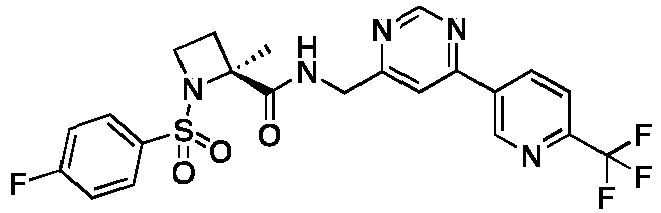
4 (2S,4S)-4-fluoro-1-(4-fluorophenylsulfonyl)-N-((6-(6-(trifluoromethyl)pyridin-3-yl)pyrimidin-4-yl)methyl)pyrrolidine-2-carboxamide 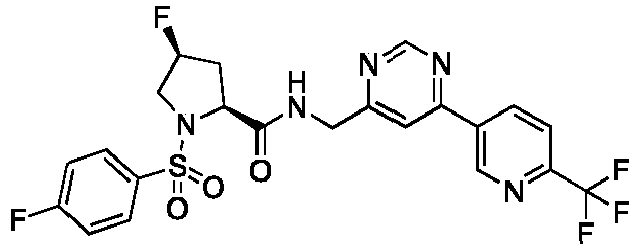
3 (2S,4R)-4-fluoro-1-(4-fluorophenylsulfonyl)-N-((6-(6-(trifluoromethyl)pyridin-3-yl)pyrimidin-4-yl)methyl)pyrrolidine-2-carboxamide 
5 (2S,4R)-4-fluoro-1-(4-fluorophenylsulfonyl)-N-((6-(4-(trifluoromethyl)phenyl)pyrimidin-4-yl)methyl)pyrrolidine-2-carboxamide 
6 (2S,4R)-4-fluoro-1-(3-fluorophenylsulfonyl)-N-((6-(4-(trifluoromethyl)phenyl)pyrimidin-4-yl)methyl)pyrrolidine-2-carboxamide 
14 (S)-1-(4-fluorophenylsulfonyl)-2-methyl-N-((6-(5-(trifluoromethyl)pyridin-2-yl)pyrimidin-4-yl)methyl)pyrrolidine-2-carboxamide 
7 (R)-1-(4-fluorophenylsulfonyl)-2-(hydroxymethyl)-N-((6-(6-(trifluoromethyl)pyridin-3-yl)pyrimidin-4-yl)methyl)pyrrolidine-2-carboxamide 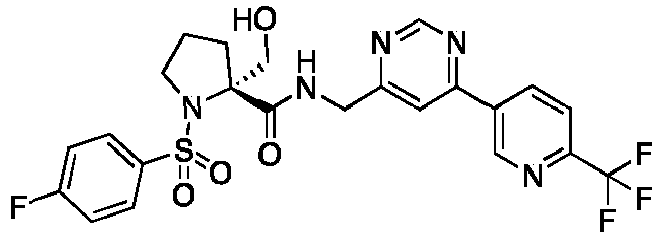
9 (2S,4R)-4-fluoro-N-((5'-fluoro-6-(trifluoromethyl)-3,4'-bipyridin-2'-yl)methyl)-1-(4-fluorophenylsulfonyl)pyrrolidine-2-carboxamide 
8 (2S,4R)-4-fluoro-N-((5-fluoro-6'-(trifluoromethyl)-2,3'-bipyridin-4-yl)methyl)-1-(4-fluorophenylsulfonyl)pyrrolidine-2-carboxamide 
17 (2S,4R)-N-((3-cyclopropyl-1-(6-(trifluoromethyl)pyridin-3-yl)-1H-pyrazol-4-yl)methyl)-4-fluoro-1-(4-fluorophenylsulfonyl)pyrrolidine-2-carboxamide 
15 (2S,4R)-N-((3-chloro-1-(6-(trifluoromethyl)pyridin- 3-yl)-1H-pyrazol-4-yl)methyl)-4-fluoro-1-(4-fluorophenylsulfonyl)pyrrolidine-2-carboxamide 
16 (2S,4R)-N-((3-chloro-1-(4-(trifluoromethyl)phenyl)-1H-pyrazol-4-yl)methyl)-4-fluoro-1-(4-fluorophenylsulfonyl)pyrrolidine-2-carboxamide 
18 (2S,4R)-N-((3-chloro-1-(4-(trifluoromethyl)phenyl)-1H-pyrazol-4-yl)methyl)-1-(4-cyanophenylsulfonyl)-4-fluoropyrrolidine-2-carboxamide 
19 (2S,4R)-4-fluoro-1-(4-fluorophenylsulfonyl)-2-methyl-N-((6-(6-(trifluoromethyl)pyridin-3-yl)pyrimidin-4-yl)methyl)pyrrolidine-2-carboxamide 
10 (2S,4R)-N-((6-(4-cyclopropylphenyl)pyrimidin-4-yl)methyl)-4-fluoro-1-(4-fluorophenylsulfonyl)pyrrolidine-2-carboxamide 
11 (2S,4R)-4-fluoro-1-(4-fluorophenylsulfonyl)-N-((6-(4-(trifluoromethyl)piperidin-1-yl)pyrimidin-4-yl)methyl)pyrrolidine-2-carboxamide 
20 (2S,4R)-4-fluoro-1-(4-fluorophenylsulfonyl)-2-methyl-N-((6-(4-(trifluoromethyl)phenyl)pyrimidin-4-yl)methyl)pyrrolidine-2-carboxamide 
21 (2S,4R)-4-fluoro-1-(4-fluorophenylsulfonyl)-N-((6-(4-(trifluoromethoxy)phenyl)pyrimidin-4-yl)methyl)pyrrolidine-2-carboxamide 
22 (2S,4R)-4-fluoro-1-(4-fluorophenylsulfonyl)-N-((2-methyl-6-(6-(trifluoromethyl)pyridin-3-yl)pyrimidin-4-yl)methyl)pyrrolidine-2-carboxamide 
23 (2S,4R)-N-((6-(6-cyclopropylpyridin-3-yl)pyrimidin-4-yl)methyl)-4-fluoro-1-(4-fluorophenylsulfonyl)pyrrolidine-2-carboxamide 
24 (2S,4R)-1-(5-chlorothiophen-2-ylsulfonyl)-4-fluoro-N-((6-(6-(trifluoromethyl)pyridin-3-yl)pyrimidin-4-yl)methyl)pyrrolidine-2-carboxamide 
25 (2S,4R)-1-(3,4-difluorophenylsulfonyl)-4-fluoro-N-((6-(6-(trifluoromethyl)pyridin-3-yl)pyrimidin-4-yl)methyl)pyrrolidine-2-carboxamide 
26 (2S,4R)-1-(3,4-difluorophenylsulfonyl) -4-fluoro-N-((6-(4-(trifluoromethyl)phenyl)pyrimidin-4-yl)methyl)pyrrolidine-2-carboxamide 
27 (2S,4R)-4-fluoro-1-(5-fluoropyridin-3-ylsulfonyl)-N-((6-(6-(trifluoromethyl)pyridin-3-yl)pyrimidin-4-yl)methyl)pyrrolidine-2-carboxamide 
28 (2S,4R)-4-fluoro-1-(5-fluoropyridin-3-ylsulfonyl)-N-((6-(4-(trifluoromethyl)phenyl)pyrimidin-4-yl)methyl)pyrrolidine-2-carboxamide 
29 (2S,4R)-4-fluoro-1-(4-fluorophenylsulfonyl)-N-((6-(4-(trifluoromethylthio)phenyl)pyrimidin-4-yl)methyl)pyrrolidine-2-carboxamide 
12 (2S,4R)-4-fluoro-1-(4-fluorophenylsulfonyl)-N-((6-(4-(trifluoromethyl)cyclohex-1-enyl)pyrimidin-4-yl)methyl)pyrrolidine-2-carboxamide 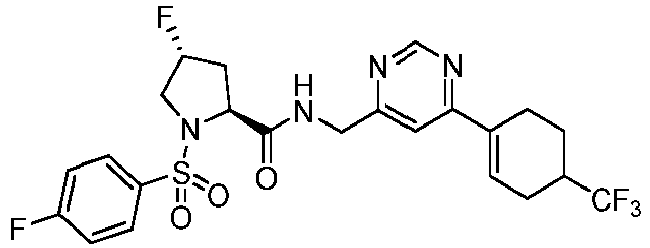
13 (2S,4R)-4-fluoro-1-(4-fluorophenylsulfonyl)-N-((6-((1s,4R)-4-(trifluoromethyl)cyclohexyl)pyrimidin-4-yl)methyl)pyrrolidine-2-carboxamide 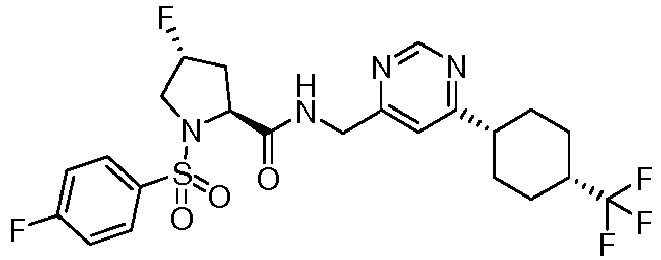
13 (2S,4R)-4-fluoro-1-(4-fluorophenylsulfonyl)-N-((6-((1r,4S)-4-(trifluoromethyl)cyclohexyl)pyrimidin-4-yl)methyl)pyrrolidine-2-carboxamide 
30 (R)-1-(4-fluorophenylsulfonyl)-2-(methoxymethyl)-N-((6-(6-(trifluoromethyl)pyridin-3-yl)pyrimidin-4-yl)methyl)pyrrolidine-2-carboxamide 
31 (S)-2-(difluoromethyl)-1-(4-fluorophenylsulfonyl)-N-((6-(6-(trifluoromethyl)pyridin-3-yl)pyrimidin-4-yl)methyl)pyrrolidine-2-carboxamide 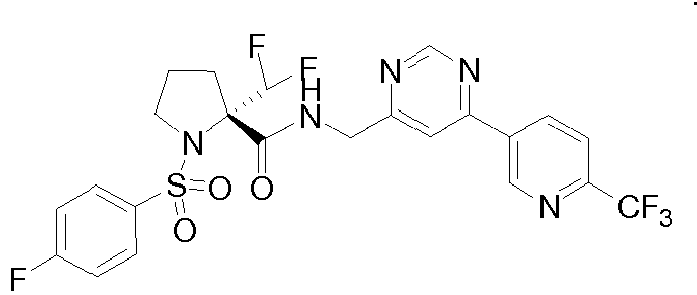
32 (R)-2-cyano-1-(4-fluorophenylsulfonyl)-N-((6-(6-(trifluoromethyl)pyridin-3-yl)pyrimidin-4-yl)methyl)pyrrolidine-2-carboxamide 
35 (2R,3S)-3-fluoro-1-(4-fluorophenylsulfonyl)-N-((6-(6-(trifluoromethyl)pyridin-3-yl)pyrimidin-4-yl)methyl)pyrrolidine-2-carboxamide 
33 (1R,3S,4S)-2-(4-fluorophenylsulfonyl)-N-((6-(4-(trifluoromethyl)phenyl)pyrimidin-4-yl)methyl)-2-azabicyclo[2.2.1]heptane-3-carboxamide 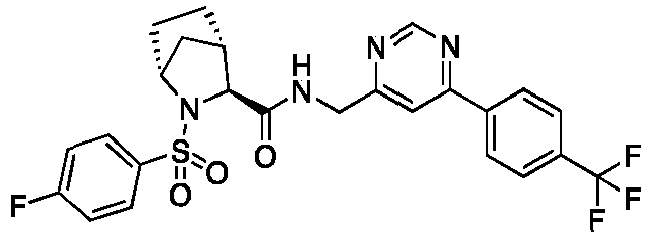
34 (1R,3S,4S)-2-(4-fluorophenylsulfonyl)-N-((6-(6-(trifluoromethyl)pyridin-3-yl)pyrimidin-4-yl)methyl)-2-azabicyclo[2.2.1]heptane-3-carboxamide 
36 (2R,3R)-3-fluoro-1-(4-fluorophenylsulfonyl)-N-((6-(6-(trifluoromethyl)pyridin-3-yl)pyrimidin-4-yl)methyl)pyrrolidine-2-carboxamide 
37 (2S,4R)-4-fluoro-N-((5-fluoro-4-(4-(trifluoromethyl)piperidin-1-yl)pyridin-2-yl)methyl)-1-(4-fluorophenylsulfonyl)pyrrolidine-2-carboxamide 
- The present invention provides for compounds of formula II as described herein below (embodiment "EE1"):
EE1. A compound of formula II:
- (2) A is

- B2 is a pyridinyl, wherein any pyridinyl of B2 is optionally substituted with one or more groups independently selected from halogen, (C1-C6)alkyl, -O(C1-C6)alkyl, -O(C1-C6)alkyl-O(C1-C6)alkyl, (C3-C7)cycloalkyl, (C1-C6)haloalkyl, -CN, and 6-membered heteroaryl, wherein any 6-membered heteroaryl is optionally substituted with one or more (C1-C6)alkyl or (C1-C6)haloalkyl;
- R1 is a phenyl, 5-membered heteroaryl or 6-membered heteroaryl, wherein any phenyl, 5-membered heteroaryl or 6-membered heteroaryl of R1 is optionally substituted with one or more groups independently selected from halogen, -CN, (C1-C6)alkyl and (C1-C6)haloalkyl;
- one R3b group is halogen, -CN, or (C1-C6)alkyl and the remaining R3b groups are independently selected from H, (C1-C6)alkyl and (C1-C6)haloalkyl;
- R4 is H, (C1-C6)alkyl or (C1-C6)haloalkyl;
- R5b is


- (1) the A group

- (1) the A group is:

- (1) the A group is:

- (1) the A group is:
- (1) the A group is:

- (1) the A group is:

- (1) the A group is:

- (1) the A group is:

- (1) the A group is:

- (1) the A group is:

- IThe compounds of Formula II can be isotopically-labeled by having one or more atoms therein replaced by an atom having a different atomic mass or mass number. Such isotopically-labeled (i.e., radiolabelled) compounds of Formula II are considered to be within the scope of this invention. Examples of isotopes that can be incorporated into the compounds of Formula II include isotopes of hydrogen, carbon, nitrogen, oxygen, phosphorous, sulfur, fluorine, chlorine, and iodine, such as, but not limited to, 2H, 3H, 11C, 13C, 14C, 13N, 15N, 15O, 17O, 18O, 31P, 32P, 35S, 18F, 36Cl, 123I, and 125I, respectively. These isotopically-labeled compounds would be useful to help determine or measure the effectiveness of the compounds, by characterizing, for example, the site or mode of action on the ion channels, or binding affinity to pharmacologically important site of action on the ion channels, particularly TRPA1. Certain isotopically-labeled compounds of Formula I or II, for example, those incorporating a radioactive isotope, are useful in drug and/or substrate tissue distribution studies. The radioactive isotopes tritium, i.e. 3H, and carbon-14, i.e., 14C, are particularly useful for this purpose in view of their ease of incorporation and ready means of detection. For example, a compound of Formula II can be enriched with 1, 2, 5, 10, 25, 50, 75, 90, 95, or 99 percent of a given isotope.
- Substitution with heavier isotopes such as deuterium, i.e. 2H, may afford certain therapeutic advantages resulting from greater metabolic stability, for example, increased in vivo half-life or reduced dosage requirements.
- Substitution with positron emitting isotopes, such as 11C, 18F, 15O and 13N, can be useful in Positron Emission Topography (PET) studies for examining substrate receptor occupancy. Isotopically-labeled compounds of Formula II can generally be prepared by conventional techniques known to those skilled in the art or by processes analogous to those described in the Examples as set out below using an appropriate isotopically-labeled reagent in place of the non-labeled reagent previously employed.
- In another embodiment, the invention provides for a pharmaceutical composition, comprising a therapeutically effective amount of a compound according to Formula II and a pharmaceutically acceptable carrier.
- In addition to salt forms, compounds are disclosed which are in a prodrug form. As used herein the term "prodrug" refers to those compounds that readily undergo chemical changes under physiological conditions to provide the compounds of the present invention. Additionally, prodrugs can be converted to the compounds of the present invention by chemical or biochemical methods in an ex vivo environment. For example, prodrugs can be slowly converted to the compounds of the present invention when placed in a transdermal patch reservoir with a suitable enzyme or chemical reagent.
- Prodrugs include compounds wherein an amino acid residue, or a polypeptide chain of two or more (e.g., two, three or four) amino acid residues, is covalently joined through an amide or ester bond to a free amino, hydroxy or carboxylic acid group of a compound of the present invention. The amino acid residues include but are not limited to the 20 naturally occurring amino acids commonly designated by three letter symbols and also includes phosphoserine, phosphothreonine, phosphotyrosine, 4-hydroxyproline, hydroxylysine, demosine, isodemosine, gamma-carboxyglutamate, hippuric acid, octahydroindole-2-carboxylic acid, statine, 1,2,3,4-tetrahydroisoquinoline-3-carboxylic acid, penicillamine, ornithine, 3-methylhistidine, norvaline, beta-alanine, gamma-aminobutyric acid, citrulline, homocysteine, homoserine, methyl-alanine, para-benzoylphenylalanine, phenylglycine, propargylglycine, sarcosine, methionine sulfone and tert-butylglycine.
- Additional types of prodrugs are also disclosed. For instance, a free carboxyl group of a compound of the invention can be derivatized as an amide or alkyl ester. As another example, compounds of this invention comprising free hydroxy groups can be derivatized as prodrugs by converting the hydroxy group into a group such as, but not limited to, a phosphate ester, hemisuccinate, dimethylaminoacetate, or phosphoryloxymethyloxycarbonyl group, as outlined in Fleisher, D. et al., (1996) Improved oral drug delivery: solubility limitations overcome by the use of prodrugs Advanced Drug Delivery Reviews, 19:115. Carbamate prodrugs of hydroxy and amino groups are also included, as are carbonate prodrugs, sulfonate esters and sulfate esters of hydroxy groups. Derivatization of hydroxy groups as (acyloxy)methyl and (acyloxy)ethyl ethers, wherein the acyl group can be an alkyl ester optionally substituted with groups including, but not limited to, ether, amine and carboxylic acid functionalities, or where the acyl group is an amino acid ester as described above, are also encompassed. Prodrugs of this type are described in J. Med. Chem., (1996), 39:10. More specific examples include replacement of the hydrogen atom of the alcohol group with a group such as (C1-6)alkanoyloxymethyl, 1-((C1-6)alkanoyloxy)ethyl, 1-methyl-1-((C1-6)alkanoyloxy)ethyl, (C1-6)alkoxycarbonyloxymethyl, N-(C1-6)alkoxycarbonylaminomethyl, succinoyl, (C1-6)alkanoyl, alpha-aniino(C1-4)alkanoyl, arylacyl and alpha-aminoacyl, or alpha-aminoacyl-alpha-aminoacyl, where each alpha-aminoacyl group is independently selected from the naturally occurring L-amino acids, P(O)(OH)2, -P(O)(O(C1-6)alkyl)2 or glycosyl (the radical resulting from the removal of a hydroxyl group of the hemiacetal form of a carbohydrate).
- For additional examples of prodrug derivatives, see, for example, a) Design of Prodrugs, edited by H. Bundgaard, (Elsevier, 1985) and Methods in Enzymology, Vol. 42, p. 309-396, edited by K. Widder, et al. (Academic Press, 1985); b) A Textbook of Drug Design and Development, edited by Krogsgaard-Larsen and H. Bundgaard, Chapter 5 "Design and Application of Prodrugs," by H. Bundgaard p. 113-191 (1991); c) H. Bundgaard, Advanced Drug Delivery Reviews, 8:1-38 (1992); d) H. Bundgaard, et al., Journal of Pharmaceutical Sciences, 77:285 (1988); and e) N. Kakeya, et al., Chem. Pharm. Bull., 32:692 (1984), each of which is specifically incorporated herein by reference.
- Additionally, described are metabolites of compounds of the invention. As used herein, a "metabolite" refers to a product produced through metabolism in the body of a specified compound or salt thereof. Such products can result for example from the oxidation, reduction, hydrolysis, amidation, deamidation, esterification, deesterification, enzymatic cleavage, and the like, of the administered compound.
- Metabolite products typically are identified by preparing a radiolabelled (e.g., 14C or 3H) isotope of a compound of the invention, administering it parenterally in a detectable dose (e.g., greater than about 0.5 mg/kg) to an animal such as rat, mouse, guinea pig, monkey, or to man, allowing sufficient time for metabolism to occur (typically about 30 seconds to 30 hours) and isolating its conversion products from the urine, blood or other biological samples. These products are easily isolated since they are labeled (others are isolated by the use of antibodies capable of binding epitopes surviving in the metabolite). The metabolite structures are determined in conventional fashion, e.g., by MS, LC/MS or NMR analysis. In general, analysis of metabolites is done in the same way as conventional drug metabolism studies well known to those skilled in the art. The metabolite products, so long as they are not otherwise found in vivo, are useful in diagnostic assays for therapeutic dosing of the compounds of the invention.
- Certain compounds of the present invention can exist in unsolvated forms as well as solvated forms, including hydrated forms. In general, the solvated forms are equivalent to unsolvated forms and are intended to be encompassed within the scope of the present invention. Certain compounds of the present invention can exist in multiple crystalline or amorphous forms. In general, all physical forms are equivalent for the uses contemplated by the present invention and are intended to be within the scope of the present invention.
- In addition to one or more of the compounds provided above (including stereoisomers, geometric isomers, tautomers, solvates, isotopes, or pharmaceutically acceptable salts thereof), the invention also provides for compositions and medicaments comprising a compound of Formula II or an embodiment thereof and at least one pharmaceutically acceptable carrier. The compositions of the invention can be used to selectively inhibit TRPA1 in patients (e.g., humans).
- The term "composition," as used herein, is intended to encompass a product comprising the specified ingredients in the specified amounts, as well as any product which results, directly or indirectly, from combination of the specified ingredients in the specified amounts. By "pharmaceutically acceptable" it is meant the carrier, diluent or excipient must be compatible with the other ingredients of the formulation and not deleterious to the recipient thereof.
- In one embodiment, the invention provides for pharmaceutical compositions or medicaments comprising a compound of Formula II or an embodiment thereof, and its stereoisomers, geometric isomers, tautomers, solvates, isotopes, pharmaceutically acceptable salts thereof) and a pharmaceutically acceptable carrier, diluent or excipient. In another embodiment, the invention provides for preparing compositions (or medicaments) comprising compounds of the invention. ICompositions are formulated, dosed, and administered in a fashion consistent with good medical practice. Factors for consideration in this context include the particular disorder being treated, the particular mammal being treated, the clinical condition of the individual patient, the cause of the disorder, the site of delivery of the agent, the method of administration, the scheduling of administration, and other factors known to medical practitioners. The effective amount of the compound to be administered will be governed by such considerations, and is the minimum amount necessary to inhibit TRPA1 activity as required to prevent or treat the undesired disease or disorder, such as for example, pain. For example, such amount may be below the amount that is toxic to normal cells, or the mammal as a whole.
- In one example, the therapeutically effective amount of the compound of the invention administered parenterally per dose will be in the range of about 0.01-100 mg/kg, alternatively about e.g., 0.1 to 20 mg/kg of patient body weight per day, with the typical initial range of compound used being 0.3 to 15 mg/kg/day. The daily does is, in certain embodiments, given as a single daily dose or in divided doses two to six times a day, or in sustained release form. In the case of a 70kg adult human, the total daily dose will generally be from about 7mg to about 1,400mg. This dosage regimen may be adjusted to provide the optimal therapeutic response. The compounds may be administered on a regimen of 1 to 4 times per day, preferably once or twice per day.
- The compounds of the present invention may be administered in any convenient administrative form, e.g., tablets, powders, capsules, solutions, dispersions, suspensions, syrups, sprays, suppositories, gels, emulsions, patches, etc. Such compositions may contain components conventional in pharmaceutical preparations, e.g., diluents, carriers, pH modifiers, sweeteners, bulking agents, and further active agents.
- The compounds of the invention may be administered by any suitable means, including oral, topical (including buccal and sublingual), rectal, vaginal, transdermal, parenteral, subcutaneous, intraperitoneal, intrapulmonary, intradermal, intrathecal and epidural and intranasal, and, if desired for local treatment, intralesional administration. Parenteral infusions include intramuscular, intravenous, intraarterial, intraperitoneal, intracerebral, intraocular, intralesional or subcutaneous administration.
- The compositions comprising compounds of Formula II or an embodiment thereof are normally formulated in accordance with standard pharmaceutical practice as a pharmaceutical composition. A typical formulation is prepared by mixing a compound of the present invention and a diluent, carrier or excipient. Suitable diluents, carriers and excipients are well known to those skilled in the art and are described in detail in, e.g., Ansel, Howard C., et al., Ansel's Pharmaceutical Dosage Forms and Drug Delivery Systems. Philadelphia: Lippincott, Williams & Wilkins, 2004; Gennaro, Alfonso R., et al. Remington: The Science and Practice of Pharmacy. Philadelphia: Lippincott, Williams & Wilkins, 2000; and Rowe, Raymond C. Handbook of Pharmaceutical Excipients. Chicago, Pharmaceutical Press, 2005. The formulations may also include one or more buffers, stabilizing agents, surfactants, wetting agents, lubricating agents, emulsifiers, suspending agents, preservatives, antioxidants, opaquing agents, glidants, processing aids, colorants, sweeteners, perfuming agents, flavoring agents, diluents and other known additives to provide an elegant presentation of the drug (i.e., a compound of the present invention or pharmaceutical composition thereof) or aid in the manufacturing of the pharmaceutical product (i.e., medicament). Suitable carriers, diluents and excipients are well known to those skilled in the art and include buffers such as phosphate, citrate and other organic acids; antioxidants including ascorbic acid and methionine; preservatives (such as octadecyldimethylbenzyl ammonium chloride; hexamethonium chloride; benzalkonium chloride, benzethonium chloride; phenol, butyl or benzyl alcohol; alkyl parabens such as methyl or propyl paraben; catechol; resorcinol; cyclohexanol; 3-pentanol; and m-cresol); low molecular weight (less than about 10 residues) polypeptides; proteins, such as serum albumin, gelatin, or immunoglobulins; hydrophilic polymers such as polyvinylpyrrolidone; amino acids such as glycine, glutamine, asparagine, histidine, arginine, or lysine; monosaccharides, disaccharides and other carbohydrates including glucose, mannose, or dextrins; chelating agents such as EDTA; sugars such as sucrose, mannitol, trehalose or sorbitol; salt-forming counter-ions such as sodium; metal complexes (e.g., Zn-protein complexes); and/or non-ionic surfactants such as TWEEN™, PLURONICS™ or polyethylene glycol (PEG). A active pharmaceutical ingredient of the invention (e.g., a compound of Formula I or II or an embodiment thereof) can also be entrapped in microcapsules prepared, for example, by coacervation techniques or by interfacial polymerization, for example, hydroxymethylcellulose or gelatin-microcapsules and poly-(methylmethacylate) microcapsules, respectively, in colloidal drug delivery systems (for example, liposomes, albumin microspheres, microemulsions, nano-particles and nanocapsules) or in macroemulsions. Such techniques are disclosed in Remington: The Science and Practice of Pharmacy: Remington the Science and Practice of Pharmacy (2005) 21st Edition, Lippincott Williams & Wilkins, Philidelphia, PA. The particular carrier, diluent or excipient used will depend upon the means and purpose for which a compound of the present invention is being applied. Solvents are generally selected based on solvents recognized by persons skilled in the art as safe (GRAS) to be administered to a mammal. In general, safe solvents are non-toxic aqueous solvents such as water and other non-toxic solvents that are soluble or miscible in water. Suitable aqueous solvents include water, ethanol, propylene glycol, polyethylene glycols (e.g., PEG 400, PEG 300), etc. and mixtures thereof. Acceptable diluents, carriers, excipients and stabilizers are nontoxic to recipients at the dosages and concentrations employed, and include
- Sustained-release preparations of a compound of the invention (e.g., compound of Formula II or an embodiment thereof) can be prepared. Suitable examples of sustained-release preparations include semipermeable matrices of solid hydrophobic polymers containing a compound of Formula II or an embodiment thereof, which matrices are in the form of shaped articles, e.g., films, or microcapsules. Examples of sustained-release matrices include polyesters, hydrogels (for example, poly(2-hydroxyethyl-methacrylate), or poly(vinyl alcohol)), polylactides (
U.S. Patent No. 3,773,919 ), copolymers of L-glutamic acid and gamma-ethyl-L-glutamate (Sidman et al., Biopolymers 22:547, 1983), non-degradable ethylene-vinyl acetate (Langer et al., J. Biomed. Mater. Res. 15:167, 1981), degradable lactic acid-glycolic acid copolymers such as the LUPRON DEPOT™ (injectable microspheres composed of lactic acid-glycolic acid copolymer and leuprolide acetate) and poly-D-(-)-3-hydroxybutyric acid (EP 133,988A U.S. Patent Nos. 4,485,045 and4,544,545 ; andEP 102,324A - In one example, compounds of Formula II or an embodiment thereof may be formulated by mixing at ambient temperature at the appropriate pH, and at the desired degree of purity, with physiologically acceptable carriers, i.e., carriers that are non-toxic to recipients at the dosages and concentrations employed into a galenical administration form. The pH of the formulation depends mainly on the particular use and the concentration of compound, but preferably ranges anywhere from about 3 to about 8. In one example, a compound of Formula II (or an embodiment thereof) is formulated in an acetate buffer, at pH 5. In another embodiment, the compounds of Formula I or II or an embodiment thereof are sterile. The compound may be stored, for example, as a solid or amorphous composition, as a lyophilized formulation or as an aqueous solution.
- Formulations of a compound of the invention (e.g., compound of Formula I or II or an embodiment thereof) suitable for oral administration can be prepared as discrete units such as pills, capsules, cachets or tablets each containing a predetermined amount of a compound of the invention.
- Compressed tablets can be prepared by compressing in a suitable machine the active ingredient in a free-flowing form such as a powder or granules, optionally mixed with a binder, lubricant, inert diluent, preservative, surface active or dispersing agent. Molded tablets can be made by molding in a suitable machine a mixture of the powdered active ingredient moistened with an inert liquid diluent. The tablets can optionally be coated or scored and optionally are formulated so as to provide slow or controlled release of the active ingredient therefrom.
- Tablets, troches, lozenges, aqueous or oil suspensions, dispersible powders or granules, emulsions, hard or soft capsules, e.g., gelatin capsules, syrups or elixirs can be prepared for oral use. Formulations of a compound of the invention (e.g., compound of Formula I or II or an embodiment thereof) intended for oral use can be prepared according to any method known to the art for the manufacture of pharmaceutical compositions and such compositions can contain one or more agents including sweetening agents, flavoring agents, coloring agents and preserving agents, in order to provide a palatable preparation. Tablets containing the active ingredient in admixture with non-toxic pharmaceutically acceptable excipient which are suitable for manufacture of tablets are acceptable. These excipients can be, for example, inert diluents, such as calcium or sodium carbonate, lactose, calcium or sodium phosphate; granulating and disintegrating agents, such as maize starch, or alginic acid; binding agents, such as starch, gelatin or acacia; and lubricating agents, such as magnesium stearate, stearic acid or talc. Tablets can be uncoated or can be coated by known techniques including microencapsulation to delay disintegration and adsorption in the gastrointestinal tract and thereby provide a sustained action over a longer period. For example, a time delay material such as glyceryl monostearate or glyceryl distearate alone or with a wax can be employed.
- An example of a suitable oral administration form is a tablet containing about 1 mg, 5 mg, 10 mg, 25mg, 30mg, 50mg, 80mg, 100mg, 150mg, 250mg, 300mg and 500mg of the compound of the invention compounded with about 90-30mg anhydrous lactose, about 5-40mg sodium croscarmellose, about 5-30mg polyvinylpyrrolidone (PVP) K30, and about 1-10mg magnesium stearate. The powdered ingredients are first mixed together and then mixed with a solution of the PVP. The resulting composition can be dried, granulated, mixed with the magnesium stearate and compressed to tablet form using conventional equipment. An example of an aerosol formulation can be prepared by dissolving the compound, for example 5-400mg, of the invention in a suitable buffer solution, e.g. a phosphate buffer, adding a tonicifier, e.g. a salt such sodium chloride, if desired. The solution may be filtered, e.g., using a 0.2 micron filter, to remove impurities and contaminants.
- For treatment of the eye or other external tissues, e.g., mouth and skin, the formulations are preferably applied as a topical ointment or cream containing the active ingredient(s) in an amount of, for example, 0.075 to 20% w/w. When formulated in an ointment, the active ingredient can be employed with either a paraffinic or a water-miscible ointment base. Alternatively, the active ingredients can be formulated in a cream with an oil-in-water cream base. If desired, the aqueous phase of the cream base can include a polyhydric alcohol, i.e., an alcohol having two or more hydroxyl groups such as propylene glycol, butane 1,3-diol, mannitol, sorbitol, glycerol and polyethylene glycol (including PEG 400) and mixtures thereof. The topical formulations can desirably include a compound which enhances absorption or penetration of the active ingredient through the skin or other affected areas. Examples of such dermal penetration enhancers include dimethyl sulfoxide and related analogs.
- For topical formulations, it is desired to administer an effective amount of a pharmaceutical composition according to the invention to target area, e.g., skin surfaces, mucous membranes, and the like, which are adjacent to peripheral neurons which are to be treated. This amount will generally range from about 0.0001 mg to about 1 g of a compound of the invention per application, depending upon the area to be treated, whether the use is diagnostic, prophylactic or therapeutic, the severity of the symptoms, and the nature of the topical vehicle employed. A preferred topical preparation is an ointment, wherein about 0.001 to about 50 mg of active ingredient is used per cc of ointment base. The pharmaceutical composition can be formulated as transdermal compositions or transdermal delivery devices ("patches"). Such compositions include, for example, a backing, active compound reservoir, a control membrane, liner and contact adhesive. Such transdermal patches may be used to provide continuous pulsatile, or on demand delivery of the compounds of the present invention as desired.
- The formulations can be packaged in unit-dose or multi-dose containers, for example sealed ampoules and vials, and can be stored in a freeze-dried (lyophilized) condition requiring only the addition of the sterile liquid carrier, for example water, for injection immediately prior to use. Extemporaneous injection solutions and suspensions are prepared from sterile powders, granules and tablets of the kind previously described. Preferred unit dosage formulations are those containing a daily dose or unit daily sub-dose, as herein above recited, or an appropriate fraction thereof, of the active ingredient.
- When the binding target is located in the brain, certain embodiments of the invention provide for a compound of Formula I or II (or an embodiment thereof) to traverse the blood-brain barrier. Certain neurodegenerative diseases are associated with an increase in permeability of the blood-brain barrier, such that a compound of Formula I or II (or an embodiment thereof) can be readily introduced to the brain. When the blood-brain barrier remains intact, several art-known approaches exist for transporting molecules across it, including, but not limited to, physical methods, lipid-based methods, and receptor and channel-based methods.
- Physical methods of transporting a compound of Formula I or II (or an embodiment thereof) across the blood-brain barrier include, but are not limited to, circumventing the blood- brain barrier entirely, or by creating openings in the blood-brain barrier.
- Circumvention methods include, but are not limited to, direct injection into the brain (see, e.g., Papanastassiou et al., Gene Therapy 9:398-406, 2002), interstitial infusion/convection-enhanced delivery (see, e.g., Bobo et al., Proc. Natl. Acad. Sci. U.S.A. 91 :2076-2080, 1994), and implanting a delivery device in the brain (see, e.g., Gill et al., Nature Med. 9:589-595, 2003; and Gliadel Wafers™, Guildford.
- Pharmaceutical). Methods of creating openings in the barrier include, but are not limited to, ultrasound (see, e.g.,
U.S. Patent Publication No. 2002/0038086 ), osmotic pressure (e.g., by administration of hypertonic mannitol (Neuwelt, E. A., Implication of the Blood-Brain Barrier and its Manipulation, Volumes 1 and 2, Plenum Press, N.Y., 1989)), and permeabilization by, e.g., bradykinin or permeabilizer A-7 (see, e.g.,U.S. Patent Nos. 5,112,596 ,5,268,164 ,5,506,206 , and5,686,416 ). - Lipid-based methods of transporting a compound of Formula II (or an embodiment thereof) across the blood-brain barrier include, but are not limited to, encapsulating the a compound of Formula II (or an embodiment thereof) in liposomes that are coupled to antibody binding fragments that bind to receptors on the vascular endothelium of the blood- brain barrier (see, e.g.,
U.S. Patent Application Publication No. 2002/0025313 ), and coating a compound of Formula I or II (or an embodiment thereof) in low-density lipoprotein particles (see, e.g.,U.S. Patent Application Publication No. 2004/0204354 ) or apolipoprotein E (see, e.g.,U.S. Patent Application Publication No. 2004/0131692 ). - Receptor and channel-based methods of transporting a compound of Formula I or II (or an embodiment thereof) across the blood-brain barrier include, but are not limited to, using glucocorticoid blockers to increase permeability of the blood-brain barrier (see, e.g.,
U.S. Patent Application Publication Nos. 2002/0065259 ,2003/0162695 , and2005/0124533 ); activating potassium channels (see, e.g.,U.S. Patent Application Publication No. 2005/0089473 ), inhibiting ABC drug transporters (see, e.g.,U.S. Patent Application Publication No. 2003/0073713 ); coating a compound of Formula I or II (or an embodiment thereof) with a transferrin and modulating activity of the one or more transferrin receptors (see, e.g.,U.S. Patent Application Publication No. 2003/0129186 ), and cationizing the antibodies (see, e.g.,U.S. Patent No. 5,004,697 ). - For intracerebral use, in certain embodiments, the compounds can be administered continuously by infusion into the fluid reservoirs of the CNS, although bolus injection may be acceptable. The inhibitors can be administered into the ventricles of the brain or otherwise introduced into the CNS or spinal fluid. Administration can be performed by use of an indwelling catheter and a continuous administration means such as a pump, or it can be administered by implantation, e.g., intracerebral implantation of a sustained-release vehicle. More specifically, the inhibitors can be injected through chronically implanted cannulas or chronically infused with the help of osmotic minipumps. Subcutaneous pumps are available that deliver proteins through a small tubing to the cerebral ventricles. Highly sophisticated pumps can be refilled through the skin and their delivery rate can be set without surgical intervention. Examples of suitable administration protocols and delivery systems involving a subcutaneous pump device or continuous intracerebroventricular infusion through a totally implanted drug delivery system are those used for the administration of dopamine, dopamine agonists, and cholinergic agonists to Alzheimer's disease patients and animal models for Parkinson's disease, as described by Harbaugh, J. Neural Transm. Suppl. 24:271, 1987; and DeYebenes et al., Mov. Disord. 2: 143, 1987.
- Representative compounds of the invention have been shown to modulate TRPA1 activity. Accordingly, the compounds of the invention are useful for treating diseases and conditions mediated by TRPA1 activity. Such diseases and conditions include but are not limited to: pain (acute, chronic, inflammatory, or neuropathic pain); itch or various inflammatory disorders; inner ear disorders; fever or other disorders of thermoregulation; tracheobronchial or diaphragmatic dysfunction; gastrointestinal or urinary tract disorders; chronic obstructive pulmonary disease; incontinence; and disorders associated with reduced blood flow to the CNS or CNS hypoxia.
- Compounds of the invention can be administered to treat pain, including but not limited to neuropathic and inflammatory pain, among others. Certain types of pain may be considered a disease or disorder, while other types may be considered symptoms of various diseases or disorders, and pain may include various etiologies. Exemplary types of pain treatable with a TRPA1-modulating agent according to the invention include pain associated with, arising from, or caused by: osteoarthritis, rotator cuff disorders, arthritis (e.g., rheumatoid arthritis or inflammatory arthritis; see, Barton et al. Exp. Mol. Pathol. 2006, 81(2), 166-170), fibromyalgia, migraine and headache (e.g. cluster headache, sinus headache, or tension headache; see, Goads by Curr. Pain Headache Reports 2004, 8, 393), sinusitis, oral mucositis, toothache, dental trauma, dental extractions, dental infections, burn (Bolcskei et al., Pain 2005, 117(3), 368-376), sunburn, dermatitis, psoriasis, eczema, insect sting or bite, musculoskeletal disorders, bony fractures, ligamentous sprains, plantar fasciitis, costochondritis, tendonitis, bursitis, tennis elbow, pitcher's elbow, patellar tendonitis, repetitive strain injury, myofascial syndrome, muscle strain, myositis, temporomandibular joint disorder, amputation, low back pain, spinal cord injury, neck pain, whiplash, bladder spasms, Gl tract disorders, cystitis, interstitial cystitis, cholecystitis, urinary tract infection, urethral colic, renal colic, pharyngitis, cold sores, stomatitis, external otitis, otitis media (Chan et al., Lancet, 2003, 361, 385), burning mouth syndrome, mucositis, esophageal pain, esophageal spasms, abdominal disorders, gastroesophageal reflux disease, pancreatitis, enteritis, irritable bowel disorder, inflammatory bowel disease, Crohn's disease, ulcerative colitis, colon distension, abdominal constriction,diverticulosis, diverticulitis, intestinal gas, hemorrhoids, anal fissures, anorectal disorders, prostatitis, epididymitis, testicular pain, proctitis, rectal pain, labor, childbirth, endometriosis, menstrual cramps, pelvic pain, vulvodynia, vaginitis, orolabial and genital infections (e.g. herpes simplex), pleurisy, pericarditis, non- cardiac chest pain, contusions, abrasions, skin incision (Honore, P. et al., J Pharmacal Exp Ther., 2005, 314, 410-21), postoperative pain, peripheral neuropathy, central neuropathy, diabetic neuropathy, acute herpetic neuralgia, post-herpetic neuralgia, trigeminal neuralgia, glossopharyngeal neuralgia, atypical facial pain, gradiculopathy, HIV associated neuropathy, physical nerve damage, causalgia, reflex sympathetic dystrophy, sciatica, cervical, thoracic or lumbar radiculopathy, brachial plexopathy, lumbar plexopathy, neurodegenerative disorders, occipital neuralgia, intercostal neuralgia, supraorbital neuralgia, inguinal neuralgia, meralgia paresthetica, genitofemoral neuralgia, carpal tunnel syndrome, Morton's neuroma, post-mastectomy syndrome, post-thoracotomy syndrome, post-polio syndrome, Guillain-Barre syndrome, Raynaud's syndrome, coronary artery spasm (Printzmetal's or variant angina), visceral hyperalgesia (Pomonis, J.D. et al. J. Pharmacal. Exp. Ther. 2003, 306, 387; Walker, K.M. et al., J. Pharmacal. Exp. Ther. 2003, 304(1), 56-62), thalamic pain, cancer (e.g. pain caused by cancer, including osteolytic sarcoma, by treatment of cancer by radiation or chemotherapy, or by nerve or bone lesions associated with cancer (see, Menendez, L. et al., Neurosci. Lett. 2005, 393 (1), 70-73; Asai, H. et al., Pain 2005, 117, 19-29), or bone destruction pain (see, Ghilardi, J.R. et al., J. Neurosci. 2005, 25, 3126-31)), infection, or metabolic disease. Additionally, the compounds may be used to treat pain indications such as visceral pain, ocular pain, thermal pain, dental pain, capsaicin-induced pain (as well as other symptomatic conditions induced by capsaicin such as cough, lachrymation, and bronchospasm).
- Compounds of the invention can be administered to treat itch, which may arise from various sources, such as dermatological or inflammatory disorders.
- Compounds of the invention can be administered to treat inflammatory disorders, including disorders selected from the group consisting of: renal or hepatobiliary disorders, immunological disorders, medication reactions and unknown/idiopathic conditions. Inflammatory disorders treatable with an inventive agent include, for example, inflammatory bowel disease (lBO), Crohn's disease, and ulcerative colitis (Geppetti, P. et al., Br. J. Pharmacal. 2004, 141, 1313-20; Yiangou, Y. et al., Lancet2001, 357, 1338-39; Kimball, E.S. etal., Neurogastroenterol. Motif., 2004,16, 811), osteoarthritis (Szabo, A. et al., J. Pharmacal. Exp. Ther. 2005, 314, 111-119), psoriasis, psoriatic arthritis, rheumatoid arthritis, myasthenia gravis, multiple sclerosis, scleroderma, glomerulonephritis, pancreatitis, inflammatory hepatitis, asthma, chronic obstructive pulmonary disease, allergic rhinitis, uveitis, and cardiovascular manifestations of inflammation including atherosclerosis, myocarditis, pericarditis, and vasculitis.
- Compounds of the invention can be administered to treat inner ear disorders. Such disorders include, for example, hyperacusis, tinnitus, vestibular hypersensitivity, and episodic vertigo.
- For example, compounds of the invention can be administered to treat tracheobronchial and diaphragmatic dysfunctions including, for example, asthma and allergy-related immune responses (Agopyan, N. et al., Am. J. Physiol. Lung Cell Mol. Physiol. 2004, 286, L563-72; Agopyan, N. et al., Toxicol. Appl. Pharmacal. 2003, 192, 21-35), cough (e.g., acute or chronic cough, or cough caused by irritation from gastroesophageal reflux disease; see, Lalloo, U.G. et al., J. Appl. Physiol. 1995, 79(4), 1082-7), bronchospasm, chronic obstructive pulmonary disease, chronic bronchitis, emphysema, and hiccups (hiccoughs, singultus).
- Compounds of the invention can be administered to treat gastrointestinal and urinary tract disorders such as, bladder overactivity, inflammatory hyperalgesia, visceral hyperreflexia of the urinary bladder, hemorrhagic cystitis (Dinis, P. et al., J Neurosci., 2004, 24, 11253-11263), interstitial cystitis (Sculptoreanu, A. et al., Neurosci Lett., 2005, 381, 42-46), inflammatory prostate disease, prostatitis (Sanchez, M. et al., Eur J Pharmacal., 2005, 515, 20-27), nausea, vomiting, intestinal cramping, intestinal bloating, bladder spasms, urinary urgency, defecation urgency and urge incontinence.
- Compounds of the invention can be administered to treat disorders associated with reduced blood flow to the CNS or CNS hypoxia. Such disorders include, for example, head trauma, spinal injury, thromboembolic or hemorrhagic stroke, transient ischaemic attacks, cerebral vasospasm, hypoglycaemia, cardiac arrest, status epilepticus, perinatal asphyxia, Alzheimer's disease, and Huntington's Disease.
- Compounds of the invention can be administered to treat other diseases, disorders, or conditions mediated through TRPA1 activity, such as: anxiety; learning or memory disorders; eye-related disorders (such as glaucoma, vision loss, increased intraocular pressure, and conjunctivitis); baldness (e.g., by stimulating hair growth); diabetes (including insulin-resistant diabetes or diabetic conditions mediated by insulin sensitivity or secretion); obesity (e.g., through appetite suppression); dyspepsia; biliary colic; renal colic; painful bladder syndrome; inflamed esophagus; upper airway disease; urinary incontinence; acute cystitis; and envenomations (such as marine, snake, or insect stings or bites, including jellyfish, spider, or stingray envenomations).
- Compounds of the invention are administered to treat pain (including but not limited to acute, chronic, neuropathic and inflammatory pain), arthritis, itch, cough, asthma, or inflammatory bowel disease.
- A method for treating neuropathic pain or inflammatory pain, comprising the step of administering a therapeutically effective amount of a compound according to Formula II to a subject in need thereof is described.
- In another embodiment, the invention provides for a compound of Formula II or a pharmaceutically acceptable salt thereof for modulating TRPA1 activity.
- In another embodiment, the invention provides for a compound of Formula II or a pharmaceutically acceptable salt thereof for use in medical therapy.
- Described is a method for treating a respiratory disorder selected from chronic obstructive pulmonary disorder (COPD), asthma, allergic rhinitis and bronchospasm, comprising the step of administering a therapeutically effective amount of a compound according to Formula II to a subject in need thereof.
- In another embodiment, the invention provides for a compound of Formula II or a pharmaceutically acceptable salt thereof for the treatment or prophylaxis of a respiratory disorder.
- Described is a method for treating a respiratory disorder in a mammal (e.g., a human) comprising administering a compound of Formula II or a pharmaceutically acceptable salt thereof to the mammal.
- Described is a method for modulating TRPA1 activity, comprising contacting TRPA1 with a compound of Formula II or a salt thereof.
- In another embodiment, the invention provides for a compound of Formula II (e.g., a compound as described in any one of E1-E50, E1A-E33A, E1B-E24B, E1C-E29C, E1D-E26D, E1E-E33E, Table 1, Table 2, or EE1-EE67 above) or a pharmaceutically acceptable salt thereof for the treatment or prophylaxis of a disease or condition mediated by TRPA1 activity. Within aspects of this embodiment, the disease or condition is pain (including but not limited to acute, chronic, neuropathic and inflammatory pain), itch, an inflammatory disorder, an inner ear disorder, fever or another disorder of thermoregulation, tracheobronchial or diaphragmatic dysfunction, a gastrointestinal or urinary tract disorder, chronic obstructive pulmonary disease, incontinence, or a disorder associated with reduced blood flow to the CNS or CNS hypoxia. Within certain aspects of this embodiment, wherein the disease or condition is pain (including but not limited to acute, chronic, neuropathic and inflammatory pain), arthritis, itch, cough, asthma, inflammatory bowel disease, or an inner ear disorder.
- Described is a method for treating a disease or condition mediated by TRPA1 activity in a mammal (e.g., a human), comprising administering a compound of Formula II or a pharmaceutically acceptable salt thereof to the mammal. Within certain aspects, the disease or condition is pain (including but not limited to acute, chronic, neuropathic and inflammatory pain), itch, an inflammatory disorder, an inner ear disorder, fever or another disorder of thermoregulation, tracheobronchial or diaphragmatic dysfunction, a gastrointestinal or urinary tract disorder, chronic obstructive pulmonary disease, incontinence, or a disorder associated with reduced blood flow to the CNS or CNS hypoxia. Within certain aspects of this embodiment, the disease or condition is pain (including but not limited to acute, chronic, neuropathic and inflammatory pain), arthritis, itch, cough, asthma, inflammatory bowel disease, or an inner ear disorder.
- In one aspect, compounds of the invention demonstrate surprisingly superior stability in in vivo rat pharmacokinetic (PK) studies over related compounds. Monofluorination, specifically at the 4-position of the proline ring, enhances the stability of the compounds, such that the compounds do not clear as rapidly from the blood as other related compounds. For example, a monofluorinated compound at the proline 3-position, (2S,4R)-4-fluoro-1-(4-fluorophenyl)sulfonyl-N-[[6-[6-(trifluoromethyl)-3-pyridyl]pyrimidin-4-yl]methyl]pyrrolidine-2-carboxamide, possess the highest stability (slowest clearance) over related difluorinated, non-fluorinated, and 3-fluorinated compounds as shown below:
Structure Name Rat PK Clp (ml/min/kg) 
(2S,4R)-4-fluoro-1-(4-fluorophenyl)sulfonyl-N-[[6-[6-(trifluoromethyl)-3-pyridyl]pyrimidin-4-yl]methyl]pyrrolidine-2-carboxamide 15 
(2S)-1-(4-fluorophenyl)sulfonyl-N-[[6-[6-(trifluoromethyl)-3-pyridyl]pyrimidin-4-yl]methyl]pyrrolidine-2-carboxamide 98 
(2S)-4,4-difluoro-1-(4-fluorophenyl)sulfonyl-N-[[6-[6-(trifluoromethyl)-3-pyridyl]pyrimidin-4-yl]methyl]pyrrolidine-2-carboxamide 30 
(2R,3S)-3-fluoro-1-(4-fluorophenyl)sulfonyl-N-[[6-[6-(trifluoromethyl)-3-pyridyl]pyrimidin-4-yl]methyl]pyrrolidine-2-carboxamide 101 - Other representative compounds, commensurate in scope of the present invention, demonstrate similar surprisingly enhanced PK stability as (2S,4R)-4-fluoro-1-(4-fluorophenyl)sulfonyl-N-[[6-[6-(trifluoromethyl)-3-pyridyl]pyrimidin-4-yl]methyl]pyrrolidine-2-carboxamide, shown below:
Structure Name Rat PK Clp (ml/min/kg) 
(2S,4R)-4-fluoro-1-(4-fluorophenyl)sulfonyl-N-[[5-fluoro-4-[2-(trifluoromethyl)pyrimidin-5-yl]-2-pyridyl]methyl]pyrrolidine-2-carboxamide 5.9 
(2S,4R)-4-cyano-1-(4-fluorophenyl)sulfonyl-N-[[6-[4-(trifluoromethyl)phenyl]pyrimidin-4-yl]methyl]pyrrolidine-2-carboxamide 7.6 
(2S,4R)-N-[[2,6-bis[6-(trifluoromethyl)-3-pyridyl]-4-pyridyl]methyl]-4-fluoro-1-(4-fluorophenyl)sulfonyl-pyrrolidine-2-carboxamide 9.1 
(2S,4R)-N-[[3-[5-(difluoromethyl)pyrazin-2-yl]-5-fluoro-phenyl]methyl]-4-fluoro-1-(4-fluorophenyl) sulfonyl-pyrrolidine-2-carboxamide 9.9 
(2S,4R)-4-fluoro-1-(4-fluorophenyl)sulfonyl-4-methyl-N-[[6-[6-(trifluoromethyl)-3-pyridyl]pyrimidin-4-yl]methyl]pyrrolidine-2-carboxamide 11.3 
(2S,4R)-4-fluoro-1-(4-fluorophenyl)sulfonyl-N-[[3-methoxy-1-[6-(trifluoromethyl)-3-pyridyl]pyrazol-4-yl]methyl]pyrrolidine-2-carboxamide 13 
(2S,4R)-N-[[6-[4-(difluoromethoxy)phenyl]py imidin-4-yl]methyl]-4-fluoro-1-(4-fluorophenyl)sulfonyl-pyrrolidine-2-carboxamide 13.2 
(2S,4R)-4-fluoro-1-(4-fluorophenyl)sulfonyl-2-methyl-N-[[6-[6-(trifluoromethyl)-3-pyridyl]pyrimidin-4-yl]methyl]pyrrolidine-2-carboxamide 15 
(2S,4R)-4-fluoro-1-(4-fluorophenyl)sulfonyl-N-[[2-methoxy-6-[6-(trifluoromethyl)-3-pyridyl]pyrimidin-4-yl]methyl]pyrrolidine-2-carboxamide 16.5 - The compounds of the invention may be usefully combined with one or more other compounds of the invention or one or more other therapeutic agent or as any combination thereof, in the treatment of ion channel-mediated diseases and conditions. For example, a compound of the invention may be administered simultaneously, sequentially or separately in combination with other therapeutic agents, including, but not limited to:
- opiates analgesics, e.g., morphine, heroin, cocaine, oxymorphine, levorphanol, levallorphan, oxycodone, codeine, dihydrocodeine, propoxyphene, nalmefene, fentanyl, hydrocodone, hydromorphone, meripidine, methadone, nalorphine, naloxone, naltrexone, buprenorphine, butorphanol, nalbuphine and pentazocine;
- non-opiate analgesics, e.g., acetomeniphen, salicylates (e.g., aspirin);
- nonsteroidal antiinflammatory drugs (NSAIDs), e.g., ibuprofen, naproxen, fenoprofen, ketoprofen, celecoxib, diclofenac, diflusinal, etodolac, fenbufen, fenoprofen, flufenisal, flurbiprofen, ibuprofen, indomethacin, ketoprofen, ketorolac, meclofenamic acid, mefenamic acid, meloxicam, nabumetone, naproxen, nimesulide, nitroflurbiprofen, olsalazine, oxaprozin, phenylbutazone, piroxicam, sulfasalazine, sulindac, tolmetin and zomepirac;
- anticonvulsants, e.g., carbamazepine, oxcarbazepine, lamotrigine, valproate, topiramate, gabapentin and pregabalin;
- antidepressants such as tricyclic antidepressants, e.g., amitriptyline, clomipramine, despramine, imipramine and nortriptyline;
- COX-2 selective inhibitors, e.g., celecoxib, rofecoxib, parecoxib, valdecoxib, deracoxib, etoricoxib, and lumiracoxib;
- alpha-adrenergics, e.g., doxazosin, tamsulosin, clonidine, guanfacine, dexmetatomidine, modafinil, and 4-amino-6,7-dimethoxy-2-(5-methane sulfonamido-1,2,3,4-tetrahydroisoquinol-2-yl)-5-(2-pyridyl) quinazoline;
- barbiturate sedatives, e.g., amobarbital, aprobarbital, butabarbital, butabital, mephobarbital, metharbital, methohexital, pentobarbital, phenobartital, secobarbital, talbutal, theamylal and thiopental;
- tachykinin (NK) antagonist, particularly an NK-3, NK-2 or NK-1 antagonist, e.g., (□R, 9R)-7-[3,5-bis(trifluoromethyl)benzyl)]-8,9,10,11-tetrahydro-9-methyl-5-(4-methylphenyl)-7H-[1,4]diazocino[2,1-g][1,7]-naphthyridine-6-13-dione (TAK-637), 5-[[2R,3S)-2-[(1R)-1-[3,5-bis(trifluoromethylphenyl]ethoxy-3-(4-fluorophenyl)-4-morpholinyl]-methyl]-1,2-dihydro-3H-1,2,4-triazol-3-one (MK-869), aprepitant, lanepitant, dapitant or 3-[[2-methoxy5-(trifluoromethoxy)phenyl]-methylamino]-2-phenylpiperidine (2S,3S);
- coal-tar analgesics, in particular paracetamol;
- serotonin reuptake inhibitors, e.g., paroxetine, sertraline, norfluoxetine (fluoxetine desmethyl metabolite), metabolite demethylsertraline, '3 fluvoxamine, paroxetine, citalopram, citalopram metabolite desmethylcitalopram, escitalopram, d,l-fenfluramine, femoxetine, ifoxetine, cyanodothiepin, litoxetine, dapoxetine, nefazodone, cericlamine, trazodone and fluoxetine;
- noradrenaline (norepinephrine) reuptake inhibitors, e.g., maprotiline, lofepramine, mirtazepine, oxaprotiline, fezolamine, tomoxetine, mianserin, buproprion, buproprion metabolite hydroxybuproprion, nomifensine and viloxazine (Vivalan®)), especially a selective noradrenaline reuptake inhibitor such as reboxetine, in particular (S,S)-reboxetine, and venlafaxine duloxetine neuroleptics sedative/anxiolytics;
- dual serotonin-noradrenaline reuptake inhibitors, such as venlafaxine, venlafaxine metabolite O-desmethylvenlafaxine, clomipramine, clomipramine metabolite desmethylclomipramine, duloxetine, milnacipran and imipramine;
- acetylcholinesterase inhibitors such as donepezil;
- 5-HT3 antagonists such as ondansetron;
- metabotropic glutamate receptor (mGluR) antagonists;
- local anaesthetic such as mexiletine and lidocaine;
- corticosteroid such as dexamethasone;
- antiarrhythimics, e.g., mexiletine and phenytoin;
- muscarinic antagonists, e.g.,, tolterodine, propiverine, tropsium t chloride, darifenacin, solifenacin, temiverine and ipratropium;
- cannabinoids;
- vanilloid receptor agonists (e.g., resinferatoxin) or antagonists (e.g., capsazepine);
- sedatives, e.g., glutethimide, meprobamate, methaqualone, and dichloralphenazone;
- anxiolytics such as benzodiazepines,
- antidepressants such as mirtazapine,
- topical agents (e.g., lidocaine, capsacin and resiniferotoxin);
- muscle relaxants such as benzodiazepines, baclofen, carisoprodol, chlorzoxazone, cyclobenzaprine, methocarbamol and orphrenadine;
- anti-histamines or HI antagonists;
- NMDA receptor antagonists;
- 5-HT receptor agonists/antagonists;
- PDEV inhibitors;
- Tramadol®;
- cholinergic (nicotinc) analgesics;
- alpha-2-delta ligands;
- prostaglandin E2 subtype antagonists;
- leukotriene B4 antagonists;
- 5-lipoxygenase inhibitors; and
- 5-HT3 antagonists.
- As used herein "combination" refers to any mixture or permutation of one or more compounds of the invention and one or more other compounds of the invention or one or more additional therapeutic agent. Unless the context makes clear otherwise, "combination" may include simultaneous or sequentially delivery of a compound of the invention with one or more therapeutic agents. Unless the context makes clear otherwise, "combination" may include dosage forms of a compound of the invention with another therapeutic agent. Unless the context makes clear otherwise, "combination" may include routes of administration of a compound of the invention with another therapeutic agent. Unless the context makes clear otherwise, "combination" may include formulations of a compound of the invention with another therapeutic agent. Dosage forms, routes of administration and pharmaceutical compositions include, but are not limited to, those described herein.
- In another embodiment, provided is an invention as hereinbefore described.
- The starting materials and reagents used in preparing these compounds generally are either available from commercial suppliers, such as Aldrich Chemical Co., or are prepared by methods known to those skilled in the art following procedures set forth in references such as Fieser and Fieser's Reagents for Organic Synthesis; Wiley & Sons: New York, 1991, Volumes 1-15; Rodd's Chemistry of Carbon Compounds, Elsevier Science Publishers, 1989, Volumes 1-5 and Supplementals; and Organic Reactions, Wiley & Sons: New York, 1991, Volumes 1-40.
- The following synthetic reaction schemes are merely illustrative of some methods by which the compounds of the present invention can be synthesized, and various modifications to these synthetic reaction schemes can be made and will be suggested to one skilled in the art having referred to the disclosure contained in this Application.
- The starting materials and the intermediates of the synthetic reaction schemes can be isolated and purified if desired using conventional techniques, including but not limited to, filtration, distillation, crystallization, chromatography, and the like. Such materials can be characterized using conventional means, including physical constants and spectral data.
- Unless specified to the contrary, the reactions described herein preferably are conducted under an inert atmosphere at atmospheric pressure at a reaction temperature range of from about -78 °C to about 150 °C, more preferably from about 0 °C to about 125 °C, and most preferably and conveniently at about room (or ambient) temperature, e.g., about 20 °C.
- Compounds of the invention can be made according methods known in art. In one aspect, compounds of the invention can be made as outlined in Schemes 1-4 herein. In Schemes 1-4, the variable A, B, R1, R4, Rz1 and R5 have the meaning as defined for Formula I or II. R is an non-interfering group and Hal represents halogen.

- According to Scheme 1, an N-PG-substituted carboxylic acid, where the amine may be protected using well known protecting groups (PG) as described in "Protective Groups in Organic Synthesis" [T.W. Greene and P.G.M. Wuts, 3rd Edition, John Wiley and Sons, N.Y. 1999], may be reacted with an amine of formula 2 to yield an amide of formula 3. This transformation is well-documented in the chemical literature and familiar to those skilled in the art. It proceeds under various reactions conditions, for example, the carboxylic acid and amine can be combined in an aprotic solvent such as N,N-dimethylformamide and treated with any number of peptide coupling reagents such as 2-(1H-7-azabenzotriazol-1-yl)--1,1,3,3-tetramethyl uronium hexafluorophosphate methanaminium or bromo-tris-pyrrolidino phosphoniumhexafluorophosphate.. A large variety and number of N-PG-substituted carboxylic acids may be purchased from commercial sources. Examples include (2S,4R)-1-(tert-butoxycarbonyl)-4-fluoropyrrolidine-2-carboxylic acid, 1-(tert-butoxycarbonyl)-2-methylazetidine-2-carboxylic acid, and (2S,4S)-1-(tert-butoxycarbonyl)-4-fluoropyrrolidine-2-carboxylic acid. The amine coupling partner of formula 2 in Scheme 1 can be purchased or made from the methods described in Scheme 3. An intermediate of formula 4 can then be made by a variety of well-established methods. For example, an intermediate of formula 3 can be treated with hydrochloric acid, trifluoroacetic acid, or other reagent to provide an intermediate of formula 4. An intermediate of formula 4 can then be coupled with a R1-substituted sulfonyl chloride by a variety of well-established methods to yield compounds of formula 1. For example, the sulfonyl chloride and amine can be combined in an aprotic solvent such as dichloromethane and treated with an excess of base such as triethylamine or potassium carbonate. Numerous sulfonyl chlorides can be obtained from commercial sources including benzenesulfonyl chloride, 4-fluorobenzenesulfonyl chloride, 3,4-dichlorobenzenesulfonyl chloride, pyridine-3-sulfonyl chloride, 2-chloropyridine-5-sulfonyl chloride , 3-cyanobenzenesulfonyl chloride and 2-thiazolesulfonyl chloride.

- Alternatively, compounds of the invention may be made according to the processes outlined in Scheme 2. According to Scheme 2, sulfonamides of formula 5 can be readily prepared according to well established methods by combining sulfonyl chlorides containing R1 with amino acids. For example, sulfonyl chloride may be added to a solution of the amino acid and an organic base such as triethylamine in a polar, aprotic solvent such as THF. Alternatively, the reagents may be combined in a moderately basic solvent such as pyridine. A large variety and number of amino acids may be purchased from commercial sources. An intermediate of formula 5 may then be reacted with an amine of formula 2. This transformation is well-documented in the chemical literature and familiar to those skilled in the art. It proceeds under various reactions conditions, for example, the carboxylic acid and amine can be combined in an aprotic solvent such as N,N-dimethylformamide and treated with any number of peptide coupling reagents such as 2-(1H-7-azabenzotriazol-1-yl)-1,1,3,3-tetramethyl uronium hexafluorophosphate methanaminium or bromo-tris-pyrrolidino phosphoniumhexafluorophosphate.

- As shown in Scheme 3, intermediates of the general structure 2 may be synthesized by well-established methods. For example, the bond between the central aromatic ring and R5 may be created by a number of efficient metal-catalyzed coupling methods such as method that has come to be known as the Suzuki coupling. Under this scheme either of the two groups to be linked may be boronic acid or ester or halogen/pseudo-halogen. The other coupling partner would then be halogen/pseudo-halogen or boronic acid/ester respectively. Conditions for effecting this coupling include heating the boronic acid and aryl halide in a polar solvent mixture such as dioxane/water in the presence of an organic or inorganic base such as triethylamine or potassium carbonate and using a palladium catalyst such as tetrakis [triphenylphosphine] palladium or palladium (II) acetate.
- Numerous starting materials of formula 2a and 2b may be purchased commercially. For example, 2-chloro-6-(trifluoromethoxy)-4-pyridinemethanamine, 2-bromo-4-pyridinemethanamine hydrochloride, (3,6-dichloropyridazin-4-yl)methanamine, 4-aminomethyl-6-chloropyrimidine, (3-aminomethylphenyl)boronic acid hydrochloride, 5-(aminomethyl)-2-fluorophenylboronic acid, HCl, [5-(aminomethyl)-2-methylphenyl]boronic acid, (5-bromopyridin-3-yl)methanamine, 3-(aminomethyl)-5-bromopyridin-2-ol, (5-bromo-2-chloro-pyridin-3-yl)-methanamine hydrochloride, (4-bromopyridin-2-yl)methanamine, (4-bromo-6-(trifluoromethyl)pyridin-2-yl)methanamine, 2-bromo-4-pyridinethylamine, (2-bromo-5-chloropyridin-4-yl)methanamine.

- Although certain exemplary embodiments are depicted and described herein, the compounds of the present invention can be prepared using appropriate starting materials according to the methods described generally herein and/or by methods available to one of ordinary skill in the art.
- Intermediates and final compounds were purified by either flash chromatography, and/or by reverse-phase preparative HPLC (high performance liquid chromatography), and/or by supercritical fluid chromatography. Unless otherwise noted, flash chromatography was carried out using pre-packed silica gel cartridges from either ISCO or SiliCycle on an ISCO CombiFlash® chromatography instrument (from Teledyne Isco, Inc.). Reverse-phase preparative HPLC was performed using a (1) Polaris C-18 5 µM column (50 x 21 mm), or (2) XBridge Prep C-18 OBD 5 µM column (19 x 150 mm). Supercritical fluid chromatography was carried out using packed columns by Chiral Technologies, Chiralpak AD, Chiralpak AS, Chiralpak IA, Chiralpak IB, Chiralpak IC, Chiralcel OD, or Chiralcel OJ with column dimensions such as (1) 4.6 cm x 5 cm, 3 µM, (2) 4.6 cm x 5 cm, 5 µM, or (3) 15 cm x 21.2 mm, 5 µM.
- Mass spectrometry (MS) was performed using a (1) Sciex 15 mass spectrometer in ES+ mode, or (2) Shimadzu LCMS 2020 mass spectrometer in ESI+ mode. Mass spectra data generally only indicates the parent ions unless otherwise stated. MS or HRMS data is provided for a particular intermediate or compound where indicated.
- Nuclear magnetic resonance spectroscopy (NMR) was performed using a (1) Bruker AV III 300 NMR spectrometer, (2) Bruker AV III 400 NMR spectrometer, or (3) Bruker AV III 500 NMR spectrometer, and referenced to tetramethylsilane. NMR data is provided for a particular intermediate or compound where indicated.
- All reactions involving air-sensitive reagents were performed under an inert atmosphere. Reagents were used as received from commercial suppliers unless otherwise noted.
-

-

- A mixture of (S)-2-methylpyrrolidine-2-carboxylic acid (0.1 g, 0.77 mmol), 4-fluorobenzene-1-sulfonyl chloride (0.16 g, 0.81 mmol) and 10 N NaOH (1.5 mL, 15 mmol) in THF (1.5 mL) was stirred at room temperature for 12 h. The mixture was diluted with EtOAc, acidified with 3 N HCl (pH 2-3) and separated. The aqueous layer was extracted with EtOAc (2x). The combined organic layers were washed with brine (2x), dried (Na2SO4), filtered, and concentrated to provide crude (S)-1-(4-fluorophenylsulfonyl)-2-methylpyrrolidine-2-carboxylic acid as a white solid, which was used in the next step without any further purification.
-

- A mixture of crude (S)-1-(4-fluorophenylsulfonyl)-2-methylpyrrolidine-2-carboxylic acid (0.043 g, 0.15 mmol), (6-(6-(trifluoromethyl)pyridin-3-yl)pyrimidin-4-yl)methanamine (0.046 mg, 0.18 mmol), EDC (0.057 mg, 0.3 mmol), HOAt (0.042 mg, 0.3 mmol) and Et3N (0.063 mL, 0.45 mmol) in DMF (1.5 mL) was stirred at room temperature for 48 h. The mixture was diluted with water and extracted with EtOAc (2x). The combined organic layers were dried (Na2SO4), filtered, and concentrated. The resulting residue was purified by reverse phase HPLC affording the title compound (37 mg, 9%, two steps): 1H-NMR (400 MHz, DMSO-d6 ) δ 9.47 (d, J = 1.9 Hz, 1H), 9.29 (d, J = 1.2 Hz, 1H), 8.78 (dd, J = 8.2, 1.7 Hz, 1H), 8.62 (t, J = 5.8 Hz, 1H), 8.25 (d, J = 0.9 Hz, 1H), 8.09 (d, J = 8.0 Hz, 1H), 8.02 - 7.93 (m, 2H), 7.48 - 7.39 (m, 2H), 4.61 (dd, J = 17.4, 6.3 Hz, 1H), 4.41 (dd, J = 17.4, 5.4 Hz, 1H), 3.67 - 3.58 (m, 1H), 3.38 - 3.31 (m, 1H), 2.22 - 2.13 (m, 1H), 2.06 - 1.95 (m, 1H), 1.94 - 1.80 (m, 2H), 1.50 (s, 3H).
-

-

- A mixture of 1-(tert-butoxycarbonyl)-2-methylazetidine-2-carboxylic acid (0.1 g, 0.51 mmol), (6-(6-(trifluoromethyl)pyridin-3-yl)pyrimidin-4-yl)methanamine (0.13 mg, 0.51 mmol), iPr2NEt (0.17 mL, 0.98 mmol), PyAOP (0.29 mg, 0.54 mmol) and 4-DMAP (0.006 mg, 0.05 mmol) in DMF (3 mL) was stirred at room temperature for 3 h. The mixture was washed with saturated aqueous NaHCO3 solution and brine, and extracted with EtOAc (2x). The combined organic layers were dried (Na2SO4) filtered, passed through a silica gel plug washing with EtOAc, and concentrated to provide crude tert-butyl 2-methyl-2-((6-(6-(trifluoromethyl)pyridin-3-yl)pyrimidin-4-yl)methylcarbamoyl)azetidine-1-carboxylate, which was used in the next step without any further purification.
-

- To a solution of crude tert-butyl 2-methyl-2-((6-(6-(trifluoromethyl)pyridin-3-yl)pyrimidin-4-yl)methylcarbamoyl)azetidine-1-carboxylate (0.22 g, 0.49 mmol), in CH2Cl2 (2 mL) was added 4 N HCl in dioxane (1 mL, 4 mmol) and the mixture stirred at room temperature for 3 h. The mixture was concentrated under reduced pressure to provide 2-methyl-2-((6-(6-(trifluoromethyl)pyridin-3-yl)pyrimidin-4-yl)methylcarbamoyl)azetidinium chloride as a crude salt, which was used in the next step without any further purification.
-

- A mixture of crude 2-methyl-2-((6-(6-(trifluoromethyl)pyridin-3-yl)pyrimidin-4-yl)methylcarbamoyl)azetidinium chloride (0.085 g, 0.22 mmol), 4-fluorobenzene-1-sulfonyl chloride (0.047 mg, 0.24 mmol), and Et3N (0.15 mL, 1.1 mmol) in CH2Cl2 (2 mL) was stirred at room temperature for 12 h. The mixture was diluted with water and extracted with CH2Cl2 (2x). The combined organic layers were dried (Na2SO4), filtered, and concentrated. The resulting residue was purified by chiral SFC affording the title compound (22 mg) as the slower eluting isomer: 1H-NMR (400 MHz, DMSO-d6 ) δ 9.48 (d, J = 1.9 Hz, 1H), 9.32 (d, J = 1.2 Hz, 1H), 8.79 (dd, J = 8.2, 1.7 Hz, 1H), 8.74 (t, J = 5.9 Hz, 1H), 8.18 (d, J = 0.9 Hz, 1H), 8.11 (d, J = 8.2 Hz, 1H), 8.03 - 7.95 (m, 2H), 7.54 - 7.43 (m, 2H), 4.66 (dd, J = 17.4, 6.4 Hz, 1H), 4.49 (dd, J = 17.4, 5.4 Hz, 1H), 3.97 - 3.86 (m, 1H), 3.82 - 3.74 (m, 1H), 2.10 - 1.98 (m, 1H), 1.54 (s, 3H).
-
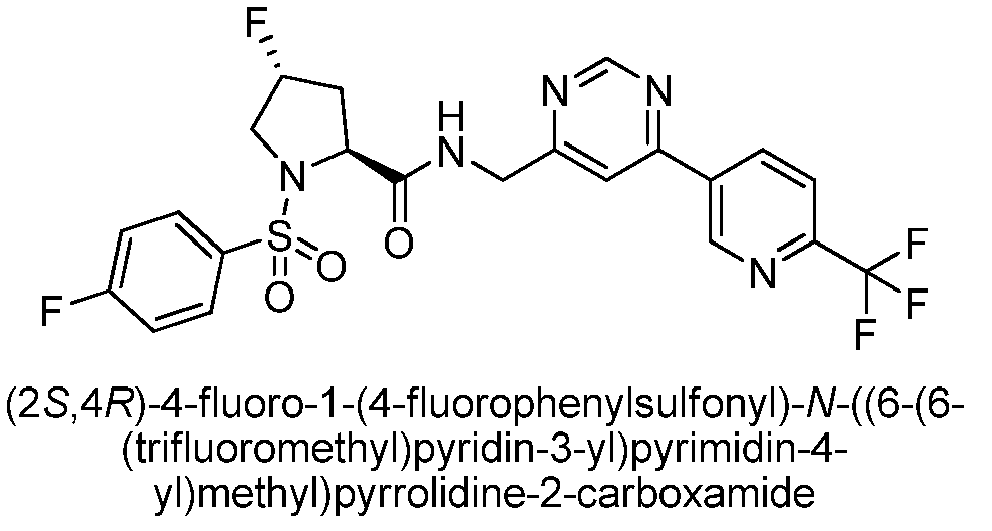
-

- (2S,4R)-tert-butyl 4-fluoro-2-((6-(6-(trifluoromethyl)pyridin-3-yl)pyrimidin-4-yl)methylcarbamoyl)pyrrolidine-1-carboxylate was prepared by the procedure described in Example 2, step 1 using (2S,4R)-1-(tert-butoxycarbonyl)-4-fluoropyrrolidine-2-carboxylic acid.
-

- (2S,4R)-4-fluoro-N-((6-(6-(trifluoromethyl)pyridin-3-yl)pyrimidin-4-yl)methyl)pyrrolidine-2-carboxamide was prepared by the procedure described in Example 2, step 2.
-

- The title compound was prepared by the procedure described in Example 2, step 3 (29 mg): 1H-NMR (400 MHz, DMSO-d6 ) δ 9.48 (d, J = 1.9 Hz, 1H), 9.30 (d, J = 1.2 Hz, 1H), 9.11 (t, J = 5.9 Hz, 1H), 8.79 (dd, J = 8.3, 1.7 Hz, 1H), 8.23 (s, 1H), 8.08 (d, J = 8.3 Hz, 1H), 8.05 - 7.98 (m, 2H), 7.47 (t, J = 8.8 Hz, 2H), 5.21 (d, J = 52.4 Hz, 1H), 4.53 (d, J = 5.9 Hz, 2H), 4.25 (dd, J = 9.8, 7.2 Hz, 1H), 3.79 - 3.60 (m, 2H), 2.46 - 2.37 (m, 1H), 2.25 - 2.04 (m, 1H).
-

- The title compound was prepared by the procedures described in Example 2, step 1 using (2S,4S)-1-(tert-butoxycarbonyl)-4-fluoropyrrolidine-2-carboxylic acid, and Example 2, steps 2 and 3 (37 mg): 1H-NMR (400 MHz, DMSO-d6 ) δ 9.43 (d, J = 1.9 Hz, 1H), 9.28 (d, J = 1.2 Hz, 1H), 8.89 (t, J = 6.1 Hz, 1H), 8.75 (dd, J = 8.1, 1.8 Hz, 1H), 8.14 - 8.01 (m, 4H), 7.55 - 7.43 (m, 2H), 5.26 (dt, J = 53.3, 3.7 Hz, 1H), 4.61 - 4.44 (m, 2H), 4.39 (d, J = 9.5 Hz, 1H), 3.81 (dd, J = 22.4, 12.2 Hz, 1H), 3.45 (ddd, J = 36.0, 12.3, 3.8 Hz, 1H), 2.37 - 2.24 (m, 1H), 2.07 - 1.85 (m, 1H).
-

- The title compound was prepared by the procedures described in Example 2, step 1 using (2S,4R)-1-(tert-butoxycarbonyl)-4-fluoropyrrolidine-2-carboxylic acid and (6-(4-(trifluoromethyl)phenyl)pyrimidin-4-yl)methanamine, and Example 2, steps 2 and 3 (107 mg): 1H-NMR (400 MHz, DMSO-d6 ) δ 9.25 (s, 1H), 9.11 (t, J = 5.7 Hz, 1H), 8.40 (d, J = 8.1 Hz, 2H), 8.15 (s, 1H), 8.07 - 7.99 (m, 2H), 7.88 (d, J = 8.1 Hz, 2H), 7.47 (t, J = 8.6 Hz, 2H), 5.21 (d, J = 52.4 Hz, 1H), 4.51 (d, J = 5.8 Hz, 2H), 4.31 - 4.22 (m, 1H), 3.78 - 3.59 (m, 2H), 2.48 - 2.38 (m, 1H), 2.23 - 2.05 (m, 1H).
-

- The title compound was prepared by the procedures described in Example 2, step 1 using (2S,4R)-1-(tert-butoxycarbonyl)-4-fluoropyrrolidine-2-carboxylic acid and (6-(4-(trifluoromethyl)phenyl)pyrimidin-4-yl)methanamine, Example 2, step 2 and Example 2, step 3 using 3-fluorobenzene-1-sulfonyl chloride (108 mg): 1H-NMR (400 MHz, DMSO-d6 ) δ 9.25 (d, J = 1.1 Hz, 1H), 9.13 (t, J = 5.8 Hz, 1H), 8.40 (d, J = 8.1 Hz, 2H), 8.15 (s, 1H), 7.88 (d, J = 8.3 Hz, 2H), 7.85 - 7.77 (m, 2H), 7.73 - 7.65 (m, 1H), 7.63 - 7.56 (m, 1H), 5.22 (d, J = 52.3 Hz, 1H), 4.59 - 4.45 (m, 2H), 4.31 (dd, J = 9.9, 7.1 Hz, 1H), 3.83 - 3.58 (m, 2H), 2.48 - 2.39 (m, 1H), 2.23 - 2.05 (m, 1H).
-

- Step1: Preparation of (3R,7aS)-3-(trichloromethyl)-tetrahydropyrrolo[1,2-c]oxazol-1(3H)-one.

- A solution of (2S)-pyrrolidine-2-carboxylic acid (5.8 g, 50.38 mmol), 2,2,2-trichloroacetaldehyde (12.4 g, 84.13 mmol) in chloroform (100 mL) was stirred for 18 h at 75°C in an oil bath. The resulting mixture was washed with water (2x) and brine, dried (Na2SO4) and concentrated under reduced pressure. The crude product was recrystallized from ethanol to afford the title compound (6.2 g, 50%) as a white solid.
-

- n-BuLi (36 mL, 90 mmol) was added dropwise to a solution of diisopropylamine (9.1 g, 89.93 mmol,) in THF (60 mL) with stirring at -78°C under nitrogen and the reaction mixture was stirred for another 15 min at 0°C. The resulting solution was added dropwise into a solution of (3R,7aS)-3-(trichloromethyl)-hexahydropyrrolo[1,2-c][1,3]oxazol-1-one (14.6 g, 59.71 mmol) in THF (100 mL) within 30 min at -78°C and stirred for another 30 min at -78°C. Then [(chloromethoxy)methyl]benzene (14.1 g, 90.03 mmol) was added dropwise. The resulting solution was stirred for an additional 2 h at -40°C and quenched by the addition of water (150 mL), extracted with EtOAc (3x200 mL) and separated. The combined organic layers were dried (Na2SO4) and concentrated under reduced pressure. The residue was purified by flash chromatography on silica gel eluting with EtOAc/petroleum ether (1:10) to afford the title compound (10 g, 38%) as light yellow oil.
-

- Sodium methoxide (890 mg, 16.47 mmol) was added portionwise to a solution of (3R,7aR)-7a-[(benzyloxy)methyl]-3-(trichloromethyl)-hexahydropyrrolo[1,2-c][1,3]oxazol-1-one (10 g, 27.42 mmol) in methanol (100 mL). The resulting solution was stirred for 30 min at room temperature and acetyl chloride (38 mL, 532.50 mmol) was added dropwise with stirring over 1 h at 0°C. The resulting solution was allowed to react for an additional 24 h at room temperature and concentrated under reduced pressure. The residue was diluted with EtOAc (50 mL) and saturated aqueous sodium carbonate (100 mL), extracted with EtOAc (3x100 mL). The combined organic layers were washed with brine (100 mL), dried (Na2SO4), filtered and concentrated under reduced pressure to afford the title compound (5.85 g, 86%) as light red oil.
-

- 4-Fluorobenzene-1-sulfonyl chloride (6.8 g, 34.94 mmol) was added dropwise to a solution of methyl (2R)-2-[(benzyloxy)methyl]pyrrolidine-2-carboxylate (5.8 g, 23.26 mmol), DIPEA (9 g, 69.64 mmol), 4-dimethylaminopyridine (280 mg, 2.29 mmol) in CH2Cl2 (150 mL) with stirring at 0°C. The resulting solution was stirred for 18 h at room temperature and diluted with CH2Cl2 (150 mL), washed with 2 N HCl (2x) and brine. The mixture was dried (Na2SO4), filtered and concentrated under reduced pressure to afford the title compound (8.3 g, 88%) as yellow oil
-

- A mixture of methyl (2R)-2-[(benzyloxy)methyl]-1-[(4-fluorobenzene)sulfonyl]pyrrolidine-2-carboxylate (510 mg, 1.3 mmol), 10% palladium carbon (100 mg) in methanol (30 mL) was stirred for 18 h at room temperature under an atmosphere of hydrogen gas. The solids were filtered off and the filtrate was concentrated under reduced pressure to afford the title compound (400 mg) as light yellow oil, which was used in the next step without any further purification.
-

- A mixture of methyl (2R)-I-[(4-fluorobenzene)sulfonyl]-2-(hydroxymethyl)pyrrolidine-2-carboxylate (40 mg, 0.13 mmol), LiOH (30 mg, 1.25 mmol) in methanol (1 mL), water (1 mL) was stirred for 18 h at room temperature. The solution was acidified (pH∼5) with 2 N HCl and concentrated under reduced pressure. The resulting solution was extracted with EtOAc (3x10 mL), and the organic layers were combined, dried (Na2SO4) and concentrated under reduced pressure to afford the title compound (40 mg) as a light yellow syrup, which was used in the next step without any further purification.
-

- A solution of (2R)-1-[(4-fluorobenzene)sulfonyl]-2-(hydroxymethyl)pyrrolidine-2-carboxylic acid (40 mg, 0.13 mmol), HATU (62.7 mg, 0.16 mmol), DIPEA (57 mg, 0.44 mmol) and [6-[6-(trifluoromethyl)pyridin-3-yl]pyrimidin-4-yl]methanamine hydrochloride (32 mg, 0.11 mmol) in DMF (2 mL) was stirred for 2 h at room temperature. The resulting solution was diluted with water (10 mL), extracted with EtOAc (3x). The combined organic layers were washed with brine (3x), dried (Na2SO4) and concentrated under reduced pressure. The crude product (70 mg) was purified by Prep-HPLC high pH to afford the title compound (24.7 mg) as a white solid. 1H-NMR (400 MHz, DMSO-d6 ) δ 9.47 (s, 1H), 9.28 (s, 1H), 8.78 (d, J = 8 Hz, 1H), 8.57 - 8.56 (m, 1H), 8.25 (s, 1H), 8.08 (d, J = 8.4 Hz, 1H), 7.96 - 7.92 (m, 2H), 7.38 (t, J = 8.8 Hz, 2H), 5.20 - 5.17 (m, 1H), 4.59 - 4.57 (m, 1H), 4.47 - 4.46 (m, 1H), 4.06 - 4.03 (m, 1H), 3.87 - 3.85 (m, 1H), 3.53 - 3.52 (m, 1H), 3.24 - 3.22 (m, 1H), 2.34 - 2.33 (m, 1H), 2.04 - 1.90 (m, 3H).
-

-

- A mixture of 2-bromo-5-fluoropyridine-4-carbaldehyde (300 mg, 1.47 mmol), [6-(trifluoromethyl)pyridin-3-yl]boronic acid (420 mg, 2.20 mmol), Pd(dppf)Cl2.CH2Cl2 (60 mg, 0.07 mmol), Cs2CO3 (1.44 g, 0.09 mmol) in water (2mL) and 1,4-Dioxane (6 mL) was stirred overnight at 90°C in an oil bath under nitrogen. The resulting mixture was quenched with water (20 mL), extracted with CH2Cl2 (3 x) and separated. The combined organic layers were washed with brine (50 mL), dried (Na2SO4) and concentrated under reduce pressure. The residue was purified by flash chromatography on silica gel with EtOAc/petroleum ether (12:88) to afford the title compound (110 mg) as a light yellow solid.
-

- A mixture of 5-fluoro-2-[6-(trifluoromethyl)pyridin-3-yl]pyridine-4-carbaldehyde (363 mg, 1.34 mmol), NH2OH.HCl (187 mg, 2.69 mmol) in ethanol (15 mL) and water (3 mL) was stirred for 30 min at 25°C. Then concentrated HCl (0.08 mL, 36%), Pd/C (300 mg, 10%) was added and the reaction mixture was stirred for 50 min at 25°C under an atmosphere of hydrogen gas. The solids were filtered off and the filtrate was concentrated under reduced pressure. The resulting mixture was diluted with H2O (20 mL), and adjusted to pH ∼7-8 with 5 N NaHCO3, extracted with EtOAc (3x). The combined organic layers were washed with brine (50 mL), dried (Na2SO4) and concentrated under reduced pressure to afford the crude title compound (300 mg) as yellow oil, which was used in the next step without any further purification.
-

- A mixture of (2S,4R)-4-fluoro-1-[(4-fluorobenzene)sulfonyl]pyrrolidine-2-carboxylic acid (129 mg, 0.44 mmol), HATU (169 mg, 0.44 mmol), DIPEA (143 mg, 1.11 mmol), [5-fluoro-2-[6-(trifluoromethyl)pyridin-3-yl]pyridin-4-yl]methanamine (100 mg, 0.37 mmol) in DMF (2 mL) was stirred for overnight at 25°C. The reaction mixture was quenched with water (20 mL), extracted with dichloromethane (3x). The combined organic layers were washed with brine (20 mL), dried (Na2SO4) and concentrated under reduced pressure. The residue was purified by flash chromatography on silica gel eluting with EtOAc/petroleum ether (6:4). The crude product was recrystallized from methanol to afford the title compound (67 mg) as an off-white solid. 1H-NMR (300 MHz, CD3OD) δ 9.08 (s, 1H), 8.61 (d, J = 3 Hz, 1H), 8.43 (d, J = 6 Hz, 1H), 8.02 - 7.92 (m, 4H), 7.38 - 7.32 (m, 2H), 5.16 (d, J = 54 Hz, 1H), 4.65 (s, 2H), 4.31 - 4.26 (m, 1H), 3.86 - 3.68 (m, 2H). 2.54 - 2.52 (m, 1H), 2.32 - 2.06 (m, 1H).
-

-

- A mixture of 2-chloro-5-fluoro-4-iodopyridine (2.57 g, 9.98 mmol), [6-(trifluoromethyl)pyridin-3-yl]boronic acid (2.00 g, 10.48 mmol), Pd(dppf)Cl2.CH2Cl2 (407.63 mg, 0.50 mmol), sodium carbonate (2.12 g, 20.00 mmol) in water (10 mL) and toluene (25 mL) was stirred for overnight at 90°C under nitrogen. The reaction mixture was concentrated under reduced pressure, diluted with water (100 mL), extracted with dichloromethane (2x100 mL), and separated. The combined organic layers were washed with brine (200 mL), dried (Na2SO4) and concentrated under reduced pressure. The residue was purified by flash chromatography on silica gel eluting with EtOAc/petroleum ether (1:5) to afford the title compound (2.31 g) as colorless oil.
-

- A mixture of 2-chloro-5-fluoro-4-[6-(trifluoromethyl)pyridin-3-yl]pyridine (1 g, 3.62 mmol), Pd2(dba)3.CHCl3 (187 mg, 0.18 mmol), Zn(CN)2 (254 mg, 2.16 mmol), DPPF (200 mg, 0.36 mmol), and Zn (24 mg, 0.37 mmol) in DMA (10 mL) was irradiated with microwave radiation for 1 h at 125°C under nitrogen. The reaction was then quenched with water (100 mL), extracted with EtOAc (3x100 mL). The organic layers were combined and washed with brine (100 mL), dried (Na2SO4) and concentrated under reduced pressure. The residue was purified by flash chromatography on silica gel eluting with EtOAc/petroleum ether (1:5) to afford the title compound (860 mg) as a yellow solid.
-

- A mixture of 5-fluoro-4-[6-(trifluoromethyl)pyridin-3-yl]pyridine-2-carbonitrile (250 mg, 0.94 mmol), Raney Ni (100 mg, 1.17 mmol) in methanol (10 mL) was stirred for 1 h at room temperature under an atmosphere of hydrogen. The solids were filtered off and the filtrate was concentrated under reduced pressure to afford the crude title compound (250 mg) as brown oil, which was used in the next step without any further purification.
-

- A mixture of [5-fluoro-4-[6-(trifluoromethyl)pyridin-3-yl]pyridin-2-yl]methanamine (141 mg, 0.52 mmol), HATU (231 mg, 0.61 mmol), DIPEA (157 mg, 1.21 mmol), (3R,4R)-4-fluoro-1-[(4-fluorobenzene)sulfonyl]pyrrolidine-3-carboxylic acid (110 mg, 0.38 mmol) in DMF (5 mL) was stirred overnight at 25°C. The reaction mixture was quenched with water (20 mL), extracted with CH2Cl2 (3x20 mL). The combined organic layers were washed with brine (20 mL), dried (Na2SO4) and concentrated under reduced pressure. The residue was purified by Prep-HPLC to afford the title compound (32.4 mg) as a white solid. 1H-NMR (300 MHz, CD3OD) δ 9.41 (s, 1H), 8.72 (d, J = 9.9 Hz, 2H), 8.58 (d, J = 1.2 Hz, 1H), 8.28 (d, J = 5.7 Hz, 1H), 8.04 - 7.99 (m, 2H), 7.86 (d, J = 8.4 Hz, 1H), 7.37 - 7.31 (m, 2H), 5.16 (d, J = 51.9 Hz, 1H), 4.74 - 4.56 (m, 2H), 4.33 - 4.27 (m, 1H), 3.86 - 3.67 (m, 2H), 2.54 - 2.52 (m, 1H), 2.30 - 2.12 (m, 1H).
-

- A mixture of (2S,4R)-4-fluoro-1-[(4-fluorobenzene)sulfonyl]pyrrolidine-2-carboxylic acid (155.2 mg, 0.53 mmol), HATU (253.3 mg, 0.67 mmol), DIPEA (172 mg, 1.33 mmol), [6-(4-cyclopropylphenyl)pyrimidin-4-yl]methanamine (100 mg, 0.44 mmol) in DMF (5 mL) was stirred overnight at 25°C. The reaction mixture was quenched with water (20 mL), extracted with CH2Cl2 (3x) and separated. The combined organic layers were washed with brine (20 mL), dried over anhydrous Na2SO4 and concentrated under reduced pressure. The residue was purified by Prep-HPLC to afford the title compound (36.4 mg) as a white solid. 1H-NMR (400 MHz, CD3OD) δ 8.94 (s, 1H), 8.04 (d, J = 8 Hz, 3H), 7.94 - 7.90 (m, 2H), 7.26 - 7.21 (m, 2H), 7.05 (d, J = 8.4 Hz, 2H), 5.06 (d, J = 52 Hz, 1H), 4.48 (dd, J = 17.6, 8.8 Hz, 2H), 4.23 - 4.18 (m, 1H), 3.76 - 3.63 (m, 2H), 2.43 - 2.39 (m, 1H), 2.17 - 2.04 (m, 1H), 1.86 - 1.81 (m, 1H), 0.92 - 0.90 (m, 2H), 0.65 - 0.63 (m, 2H).
-

-

- A mixture of 4,6-dichloropyrimidine (2 g, 13.42 mmol), DIPEA (0.65 mL, 3.93 mmol), 4-(trifluoromethyl)piperidine (9.74 g, 63.60 mmol) in DMF (20 mL) was stirred for 3 h at 25°C. The reaction mixture was then quenched with water (100 mL), extracted with EtOAc (3x100 mL). The combined organic layers were washed with water (3x) and brine, dried over anhydrous Na2SO4 and concentrated under reduced pressure. The residue was purified by flash chromatography on silica gel eluting with EtOAc/petroleum ether (3:7) to afford the title compound (3.4 g) as a white solid.
-

- A mixture of 4-chloro-6-[4-(trifluoromethyl)piperidin-1-yl]pyrimidine (2.6 g, 9.79 mmol), Pd2(dba)3.CHCl3 (506 mg, 0.49 mmol), Zn(CN)2 (686 mg, 5.84 mmol), DPPF (540 mg, 0.97 mmol), and Zn (64 mg, 0.98 mmol) in DMA (26 mL) was irradiated with microwave radiation for 1 h at 125°C under nitrogen. The reaction mixture was then quenched with water (100 mL), extracted with EtOAc (3x100 mL). The combined organic layers were washed with water (3x) and brine, dried over anhydrous Na2SO4 and concentrated under reduced pressure. The residue was purified by flash chromatography on silica gel with EtOAc/petroleum ether (35:65) to afford the title compound (3.4 g) as a light yellow solid.
-

- A mixture of 6-[4-(trifluoromethyl)piperidin-1-yl]pyrimidine-4-carbonitrile (500 mg, 1.95 mmol), 10% Pa/C (500 mg), conc. HCl (0.2 mL) in methanol (10 mL) was stirred for 20 min at 25°C under an atmosphere of hydrogen gas. The solids were filtered off and the mixture was concentrated under reduced pressure to afford the crude title compound (500 mg) as purple oil, which was used in the next step without any further purification.
-

- A mixture of [6-[4-(trifluoromethyl)piperidin-1-yl]pyrimidin-4-yl]methanamine (178.7 mg, 0.69 mmol), (2S,4R)-4-fluoro-1-[(4-fluorobenzene)sulfonyl]pyrrolidine-2-carboxylic acid (200 mg, 0.69 mmol), HOBT (102 mg, 0.75 mmol), EDC.HCl (213 mg, 1.11 mmol) and DIPEA (117.2 mg, 0.91 mmol), in DMF (5 mL) was stirred overnight at 25°C. The reaction mixture was quenched with water (20 mL), extracted with EtOAc (3x20 mL). The combined organic layers were washed with brine (20 mL), dried over anhydrous Na2SO4 and concentrated under reduced pressure. The residue was purified by flash chromatography on silica gel eluting with dichloromethane/methanol (85:15) to afford the crude product (101 mg), which was then purified by Prep-HPLC to afford the title compound (45.5 mg) as a white solid. 1H-NMR (400 MHz, CD3OD) δ 8.42 (s, 1H), 8.04 - 8.01 (m, 2H), 7.39 - 7.35 (m, 2H), 7.05 (s, 1H), 5.15 (d, J = 39 Hz, 1H), 4.74 (m, 2H), 4.44 - 4.27 (m, 3H), 3.84 - 3.73 (m, 2H), 3.00 - 2.94 (m, 2H), 2.56 - 2.51 (m, 2H), 2.40 - 2.11 (m, 1H), 1.88 - 1.82 (m, 2H), 1.50 - 1.43 (m, 2H).
-

-

- NaBH4 (76 mg, 2.01 mmol) was added portionwise to a solution of ethyl 6-[4-(trifluoromethyl) cyclohex-1-en-1-yl]pyrimidine-4-carboxylate (300 mg, 1.00 mmol) in methanol (10 mL) with stirring. The resulting mixture was stirred for 2 h at 25°C, and concentrated under reduced pressure. The residue was purified by flash chromatography on silica gel eluting with EtOAc/petroleum ether (1:1) to afford the title compound (254 mg) as a white solid.
-

- DIAD (235 mg, 1.16 mmol) was added dropwise to a solution of [6-[4-(trifluoromethyl)cyclohex-1-en-1-yl]pyrimidin-4-yl]methanol (150 mg, 0.58 mmol), 2,3-dihydro-1H-isoindole-1,3-dione (94 mg, 0.64 mmol), PPh3 (305 mg, 1.16 mmol) in THF (10 mL) at 0°C with stirring. The resulting mixture was stirred for 2 h at 25°C, then diluted with water (20 mL), extracted with dichloromethane (3 x20 mL). The organic layers were combined and washed with brine (20 mL), dried over anhydrous Na2SO4 and concentrated under reduced pressure. The residue was purified by flash chromatography on silica gel eluting with EtOAc/petroleum ether (1:1) to afford the title compound (425 mg) as a white solid.
-

- A mixture of 2-([6-[4-(trifluoromethyl)cyclohex-1-en-1-yl]pyrimidin-4-yl]methyl)-2,3-dihydro-1H-isoindole-1,3-dione (425 mg, 1.10 mmol), hydrazine hydrate (80%) (0.5 mL) in methanol (10 mL) was stirred for 3 h at 25°C, and concentrated under reduced pressure. The residue was dissolved in EtOAc (3 mL), and the solids were filtered out. The filtrate was concentrated under reduced pressure to afford the crude title compound (210 mg) as a white solid, which was used in the next step without any further purification.
-

- A mixture of [6-[4-(trifluoromethyl) cyclohex-1-en-1-yl]pyrimidin-4-yl]methanamine (284 mg, 1.10 mmol), HATU (465.8 mg, 1.23 mmol), DIPEA (317 mg, 2.45 mmol) in DMF (5 mL) was stirred for 10 min at 25°C. Then (2S,4R)-4-fluoro-1-[(4-fluorobenzene)sulfonyl]pyrrolidine-2-carboxylic acid (210 mg, 0.72 mmol) was added and the resulting mixture was a stirred overnight at 25°C. The reaction mixture was then quenched with water (10 mL), extracted with dichloromethane (3x10 mL). The combined organic layers were washed with brine (2x10 mL), dried over anhydrous Na2SO4 and concentrated under reduced pressure. The crude product (120 mg) was purified by Flash-Prep-HPLC with the following conditions (IntelFlash-1): Column, C18 silica gel; mobile phase, CH3CN: H2O from 10% to 65% within 30 min; Detector, UV 254 nm to afford the title compound (25.8 mg) as a white solid. 1H-NMR (300 MHz, CD3OD) δ 8.99 (s, 1H), 8.04 (q, J = 6 Hz, 2H), 7.84 (s, 1H), 7.38 (t, J = 9 Hz, 2H), 7.15 (s, 1H), 5.16 (d, J = 51 Hz, 1H), 4.88 - 4.86 (d, J = 6 Hz, 2H), 4.31 (t, J = 9 Hz, 1H), 3.86 - 3.72 (m, 2H), 2.84 (m, 1H), 2.59 - 2.47 (m, 4H), 2.32 - 2.14 (m, 3H), 1.67 - 1.61 (m, 1H).
-

- A mixture of (2S,4R)-4-fluoro-1-[(4-fluorobenzene)sulfonyl]-N-([6-[4-(trifluoromethyl)cyclohex-1-en-1-yl]pyrimidin-4-yl]methyl)pyrrolidine-2-carboxamide (180 mg, 0.34 mmol), 10% Pd(OH)2/C (30 mg) in methanol (20 mL) was stirred for 15 min at 25°C under an atmosphere of hydrogen gas. The solids were filtered off and the filtrate was concentrated under reduced pressure. The residue (260 mg) was purified by Flash-Prep-HPLC with the following conditions: Column, C18 silica gel; mobile phase, CH3CN: H2O from 10% to 55% within 30 min; Detector, UV 254 nm to afford a mixture of cis/trans-isomers (120 mg). The isomers were separated by Chiral-Prep-HPLC with the following conditions (Prep-HPLC-004): Column, Chiralpak IA, 2*25cm, 5um; mobile phase, Hex and IPA (hold 30.0% IPA in 20 min); Detector, UV 254/220nm.
- Faster eluting isomer (33.6 mg) arbitrarily assigned as trans isomer (2S,4R)-4-fluoro-1-[(4-fluorobenzene) sulfonyl]-N-([6-[(1r,4S)-4-(trifluoromethyl) cyclohexyl]pyrimidin-4-yl]methyl) pyrrolidine-2-carboxamide: 1H-NMR (300 MHz, CD3OD) δ 8.97 (s, 1H), 8.04 (q, J = 6 Hz, 2H), 7.71 (s, 1H), 7.37 (t, J = 9 Hz, 2H), 5.16 (d, J = 54 Hz, 1H), 4.54 (s, 2H), 4.32 (t, J = 9 Hz, 1H), 3.86 - 3.72 (m, 2H), 2.72 (t, J = 3 Hz, 1H), 2.51 (m, 1H), 2.27 - 2.04 (m, 6H), 1.74 - 1.53 (m, 2H), 1.50 - 1.44 (m, 2H).
- Slower eluting isomer (18 mg), arbitrarily assigned as cis isomer (2S,4R)-4-fluoro-1-[(4-fluorobenzene)sulfonyl]-N-([6-[(1s,4R)-4-(trifluoromethyl)cyclohexyl]pyrimidin-4-yl]methyl)pyrrolidine-2-carboxamide: 1H-NMR (300 MHz, CD3OD) δ 9.02 (s, 1H), 8.01 (q, J = 6 Hz, 2H), 7.74 (s, 1H), 7.36 (t, J = 9 Hz, 2H), 5.15 (d, J = 54 Hz, 1H), 4.56 (d, J = 3 Hz, 2H), 4.27 (t, J = 9 Hz, 1H), 3.86 - 3.72 (m, 2H), 3.03 - 3.00 (m, 1H), 2.53 - 2.51 (m, 1H), 2.35 - 2.06 (m, 5H), 1.88 - 1.61 (m, 6H).
-
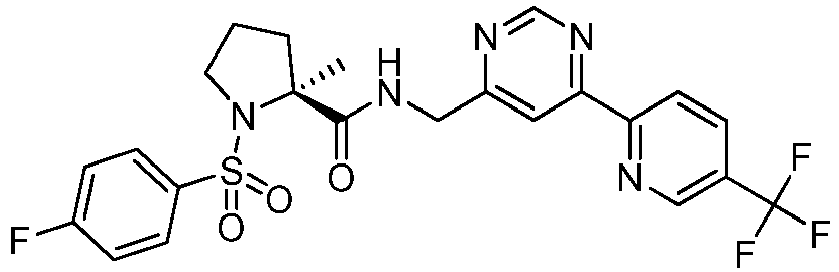
-

- Triethylamine (19 g, 187.8 mmol) was added dropwise to a mixture of 1,4-diethyl but-2-ynedioate (25 g, 146.92 mmol), methanimidamide hydrochloride (11.83 g, 146.93 mmol), CH3CN (500 mL). The reaction was stirred for 2.5 h at 80°C in an oil bath and then cooled to 5°C. The crude products were collected by filtration and re-crystallized from CH3CN to afford the title compound (18.0 g, 73%) as a white solid.
-

- To a mixture of ethyl 6-hydroxypyrimidine-4-carboxylate (5.0 g, 29.74 mmol), EtOAc (150 mL) and N,N-dimethylformamide (0.2 mL) was added (COCl)2 (11.3 g, 89.03 mmol) dropwise with stirring. The reaction was stirred overnight at 75°C. The reaction was cooled and the solids were filtered off. The filtrate was concentrated and purified by a flash chromatography on a silica gel eluting with petroleum ether:EtOAc (10:1-5:1) to afford the title compound (2.2 g, 40%) as a light yellow solid.
-

- A mixture of 2-(tributylstannyl)-5-(trifluoromethyl)pyridine (8.4 g, 19.26 mmol), Pd(PPh3)2Cl2 (558 mg, 0.79 mmol), CuI (168 mg, 0.88 mmol), and ethyl 6-chloropyrimidine-4-carboxylate (900 mg, 4.82 mmol) in DMF (72 mL) was irradiated with microwave radiation for 30 min at 60°C under nitrogen. The reaction was diluted EtOAc (300 mL), washed with brine (2x), dried over anhydrous Na2SO4 and concentrated. The residue was purified by flash chromatography on a silica gel eluting with EtOAc/ petroleum (10/1) to afford the title compound (300 mg, 21%) as a yellow solid.
-

- NaBH4 (55 mg, 1.45 mmol) was added to a mixture of ethyl 6-[5-(trifluoromethyl)pyridin-2-yl]pyrimidine-4-carboxylate (290 mg, 0.98 mmol) in THF (30 mL) in portionwise at 0-5°C. The reaction was stirred for 0.5 h at room temperature. The reaction was then quenched with the addition of water (50mL) at 0-5°C, extracted with EtOAc (3x50mL), washed with brine (3x30mL), dried over anhydrous Na2SO4 and concentrated. The residue was purified by flash chromatography on a silica gel eluting with petroleum ether:EtOAc (5:1) to afford the title compound (216 mg, 87%) as a light yellow solid.
-

- DIAD (326 mg, 1.61 mmol) was added dropwise into a mixture of [6-[5-(trifluoromethyl)pyridin-2-yl]pyrimidin-4-yl]methanol (206 mg, 0.81 mmol), THF (20 mL), PPh3 (423 mg, 1.61 mmol) and 2,3-dihydro-1H-isoindole-1,3-dione (142 mg, 0.97 mmol) with stirring at 0°C. The reaction was stirred for 2 h at room temperature and concentrated. The residue was purified by flash chromatography on a silica gel eluting with petroleum ether:EtOAc (20:1) to afford the title compound (300 mg , 97%) as a white solid.
-

- A mixture of 2-([6-[5-(trifluoromethyl)pyridin-2-yl]pyrimidin-4-yl]methyl)-2,3-dihydro-1H-isoindole-1,3-dione (290 mg, 0.75 mmol), methanol (15 mL) and hydrazine hydrate (472 mg, 9.43 mmol) was stirred for 4 h at 40°C. The mixture was concentrated, diluted with water (20mL), extracted with EtOAc (3x30mL). The combined organic layers were dried over anhydrous Na2SO4, concentrated to afford the title compound (360 mg) as a green solid, which was used in the next step without any further purification.
-

- A mixture of (2S)-1-[(4-fluorobenzene)sulfonyl]-2-methylpyrrolidine-2-carboxylic acid (190 mg, 0.66 mmol), N,N-dimethylformamide (5 mL), DIPEA (213 mg, 1.65 mmol, 3.00 equiv), HATU (314 mg, 0.83 mmol) and [6-[5-(trifluoromethyl)pyridin-2-yl]pyrimidin-4-yl]methanamine (140 mg, 0.55 mmol) was stirred overnight at room temperature. The crude solution was purified directly by Prep-HPLC to afford the title compound (7.6 mg, 3%) as a white solid. 1H-NMR (300MHz, DMSO-d6 ) δ 9.35 (s, 1H), 9.17 (s, 1H), 8.69 (d, J = 3 Hz, 1H), 8.60 - 8.57 (m, 1H), 8.53 - 8.50 (m, 1H), 8.49 (s, 1H), 8.01 - 7.96 (m, 2H), 7.50 - 7.44 (m, 2H), 4.58 - 4.55 (m, 2H), 3.70 - 3.50 (m, 2H), 2.31 - 2.26 (m, 1H), 2.06 - 1.95 (m, 3H), 1.58 (s, 3H), 1.40 - 1.20 (m, 1H).
-

- A mixture of (2S,4R)-4-fluoro-1-[(4-fluorobenzene)sulfonyl]-pyrrolidine-2-carboxylic acid (48 mg, 0.16 mmol), DIPEA (63 mg, 0.49 mmol), DMF (3 mL), HATU (94 mg, 0.25 mmol) and [3-chloro-1-[6-(trifluoromethyl)pyridin-3-yl]-1H-pyrazol-4-yl]methanamine (46 mg, 0.17 mmol) was stirred for 2h at room temperature. The reaction mixture was purified directly by Prep-HPLC to afford the title compound (40 mg, 44%) as a white solid. 1H-NMR (300 MHz, CD3OD) δ 9.16 (s, 1H), 8.55 (s, 1H), 8.33 - 8.37 (m, 1H), 7.94 - 8.02 (m, 3H), 7.32 - 7.38 (m, 2H), 5.15 (d, J = 52.5 Hz, 1H), 4.39 (s, 2H), 4.25 - 4.19 (m, 1H), 3.85 - 3.67 (m, 2H), 2.53 - 2.42 (m, 1H), 2.29 - 2.10 (m, 1H).
-

- A mixture of (2S,4R)-4-fluoro-1-[(4-fluorobenzene)sulfonyl]-pyrrolidine-2-carboxylic acid (100 mg, 0.34 mmol), DMF (2 mL), DIPEA (132 mg, 1.02 mmol), HATU (194 mg, 0.51 mmol) and [3-chloro-1-[4-(trifluoromethyl)phenyl]-1H-pyrazol-4-yl]methanamine (187 mg, 0.68 mmol) was stirred for 2 h at room temperature. The reaction mixture was purified directly by Prep-HPLC to afford the title compound (38 mg, 20%) as a white solid. 1H-NMR (400 MHz, CD3OD) δ 8.45 (s, 1H), 8.00 - 7.79 (m, 6H), 7.42 - 7.31 (m, 2H), 5.14 (d, J = 52 Hz, 1H), 4.37 (s, 2H), 4.30 - 4.19 (m, 1H), 3.87 - 3.69 (m, 3H), 2.52 - 2.43 (m, 1H), 2.25 - 2.08 (m, 1H).
-
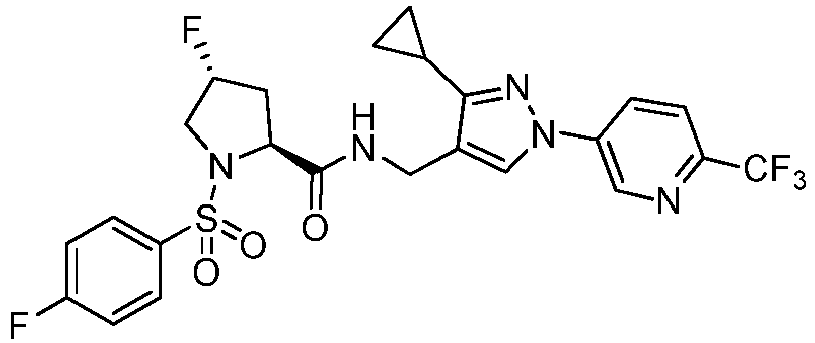
-

- A mixture of 3-cyclopropyl-3-oxopropanenitrile (5.5 g, 50.40 mmol), (diethoxymethoxy)ethane (74.7 g, 504.05 mmol), acetic anhydride (60 mL, 634.74 mmol) was stirred for 2 h at 150°C. The mixture was cooled, concentrated under reduced pressure. The residue was recrystallized from ethanol to afford the title compound (6 g, 72%) as a light yellow solid.
-

- A mixture of 2(cyclopropanecarbonyl)-3-ethoxyprop-2-enenitrile (2 g, 12.11 mmol), hydrazine hydrate (85%) (6.1 g, 121.85 mmol) and ethanol (20 mL) was stirred for 10 min at room temperature. The mixture was concentrated under reduced pressure. The residue was re-crystallized from toluene to afford the title compound (1 g, 62%) as a yellow solid.
-

- A mixture of 3-cyclopropyl-1H-pyrazole-4-carbonitrile (1 g, 7.51 mmol), 5-bromo-2-(trifluoromethyl)pyridine (2.88 g, 12.74 mmol), CuI (143 mg, 0.75 mmol), L-proline (173 mg, 1.50 mmol), potassium carbonate (2.28 g, 16.50 mmol) and DMSO (50 mL) was stirred for 12 h at 100°C under nitrogen. The mixture was cooled, diluted with EtOAc (200mL), washed with brine (3x100mL), dried over anhydrous Na2SO4 and concentrated under reduced pressure. The residue was purified by flash chromatography on a silica gel eluting with petroleum ether/EtOAc (50/1) to afford the title compound (1.1 g, 53%) as a white solid.
-

- A mixture of 3-cyclopropyl-1-[6-(trifluoromethyl)pyridin-3-yl]-1H-pyrazole-4-carbonitrile (1 g, 3.59 mmol), methanol (50 mL) and RaneyNi (500 mg, 5.84 mmol) was stirred for 15 min at room temperature under an atmosphere of hydrogen gas. The solids were filtered off, and the filtrate was concentrated under reduced pressure to afford the title compound (900 mg) as a white solid, which was used in the next step without any further purification.
-

- A mixture of (2S,4R)-4-fluoro-1-[(4-fluorobenzene)sulfonyl]pyrrolidine-2-carboxylic acid (80 mg, 0.27 mmol), DMF (5 mL), DIPEA (106.8 mg, 0.83 mmol), HATU (156.6 mg, 0.41 mmol) and 3-cyclopropyl-1-[6-(trifluoromethyl)pyridin-3-yl]-1H-pyrazol-4-ylmethanamine (77.55 mg, 0.27 mmol) was stirred for 1 h at room temperature. The crude solution was purified directly by Prep-HPLC to afford the title compound (50 mg, 33%) as a white solid. 1H-NMR (300 MHz, DMSO-d6 ) δ 9.14 (s, 1H), 8.66 (s, 1H), 8.49 (s, 1H), 8.32 (d, J = 7.8 Hz, 1H), 8.02 - 7.96 (m, 3H), 7.74 (m, 1H), 5.27 - 5.10 (m, 1H), 4.33 - 4.30 (m, 2H), 4.19 - 4.14 (m, 1H), 3.71 - 3.67 (m, 1H), 3.62 - 3.58 (m, 1H), 2.51 (m, 1H), 2.42 - 2.29 (m, 1H), 2.18 - 1.94 (m, 1H), 0.96 - 0.90 (m, 4H).
-

-

- A mixture of (2S,4R)-4-fluoropyrrolidine-2-carboxylic acid (79 mg, 0.59 mmol), tetrahydrofuran (5 mL), water (2 mL), sodium carbonate (121 mg, 1.13 mmol) and 4-cyanobenzene-1-sulfonyl chloride (100 mg, 0.50 mmol) was stirred for 1 h at 0°C. The mixture was diluted with water, extracted with ether (30mL). The aqueous layers was acidified with 3 N HCl to pH= 2-3, extracted with EtOAc (3x50mL). The combined organic layers were dried over anhydrous Na2SO4 and concentrated to afford the title compound (100 mg, 68%) as a white solid, which was used in the next step without any further purification.
-

- A mixture of (2S,4R)-1-[(4-cyanobenzene)sulfonyl]-4-fluoropyrrolidine-2-carboxylic acid (180 mg, 0.60 mmol), N,N-dimethylformamide (5 mL), DIPEA (234 mg, 1.81 mmol), HATU (234 mg, 0.62 mmol) and [3-chloro-1-[4-(trifluoromethyl)phenyl]-1H-pyrazol-4-yl]methanamine (234 mg, 0.85 mmol) was stirred overnight at room temperature. The reaction mixture was purified by Prep-HPLC to afford the title compound (85.1 mg, 25%) as a white solid. 1H-NMR (300MHz, DMSO-d6 ) δ 8.74 (m, 1H), 8.60 (s, 1H), 8.12 - 8.04 (m, 4H), 7.99 - 7.88 (m, 4H), 5.20 (d, J = 51.9 Hz, 1H), 4.21 - 4.17 (m, 3H), 3.85 - 3.55 (m, 2H), 2.77 - 2.33 (m, 1H), 2.19 - 1.98 (m, 1H).
-

-

- A mixture of (2S,4R)-1-[(tert-butoxy)carbonyl]-4-fluoropyrrolidine-2-carboxylic acid (2 g, 8.57 mmol), potassium carbonate (5.9 g, 42.69 mmol), THF (80 mL) and CH3I (6.1 g, 42.98 mmol) was stirred for 12 h at room temperature. The solids were filtered off and the filtrate was concentrated under reduced pressure. The residue was purified by flash chromatography on silica gel eluting with EtOAc/petroleum ether (1:5) to afford the title compound (800 mg, 38%) as colorless oil.
-

- A 1 M solution of LiHMDS (4.85 mL, 4.85 mmol) was added dropwise into a mixture of 1-tert-butyl 2-methyl (2S,4R)-4-fluoropyrrolidine-1,2-dicarboxylate (400 mg, 1.62 mmol) in THF (20 mL) with stirring at -78°C under nitrogen. The reaction solution was stirred for 30 min at -78°C. To this was added CH3I (690 mg, 4.86 mmol) dropwise at -78°C. The reaction mixture stirred for 12 h at room temperature, quenched with water (20mL), extracted with EtOAc (3x30mL), dried over anhydrous Na2SO4 and concentrated. The residue was purified by flash chromatography on silica gel eluting with EtOAc/petroleum ether (1:5) to afford the title compound (360 mg, 85%) as colorless oil.
-

- A mixture of 1-tert-butyl 2-methyl (4R)-4-fluoro-2-methylpyrrolidine-1,2-dicarboxylate (360 mg, 1.38 mmol) and HCl in dioxane (10 mL, 1mol/L) was stirred for 2 h at room temperature. The mixture was concentrated to afford the crude product (315 mg) as a light yellow solid, which was used in the next step without any further purification.
-

- A mixture of 4R-4-fluoro-2-methylpyrrolidine-2-carboxylate hydrochloride (315 mg, 1.60 mmol), triethylamine (485 mg, 4.80 mmol), dichloromethane (20 mL) and 4-fluorobenzene-1-sulfonyl chloride (310 mg, 1.60 mmol) was stirred for 12 h at room temperature. The reaction was diluted with dichloromethane (100 mL), washed with brine (3x20mL), dried over anhydrous Na2SO4 and concentrated. The residue was purified by flash chromatography on silica gel eluting with EtOAc/petroleum ether (1:4) to afford the title compound (380 mg) as colorless oil, which was used in the next step without any further purification.
-

- A mixture of methyl (4R)-4-fluoro-1-[(4-fluorobenzene)sulfonyl]-2-methylpyrrolidine-2-carboxylate (380 mg, 1.19 mmol), LiOH (58 mg, 2.42 mmol), methanol (8 mL), water (2 mL) was stirred for 12 h at room temperature. The reaction mixture was concentrated, dissolved in water (20 mL), extracted with ether (3x20mL). The aqueous layers was acidified with 3 N HCl (pH 2-3), extracted with EtOAc (3x50mL), dried over anhydrous Na2SO4 and concentrated to afford the title compound (260 mg, 72%) as yellow oil, which was used in the next step without any further purification.
-

- A mixture of (4R)-4-fluoro-1-[(4-fluorobenzene)sulfonyl]-2-methylpyrrolidine-2-carboxylic acid (125 mg, 0.41 mmol), DMF (4 mL), HATU (228 mg, 0.60 mmol), DIPEA (206 mg, 1.59 mmol) and [6-[6-(trifluoromethyl)pyridin-3-yl]pyrimidin-4-yl]methanamine hydrochloride (104 mg, 0.36 mmol) was stirred for 12 h at room temperature. The mixture was diluted with water (20 mL), extracted with EtOAc (3x50mL). The combined organic layers were washed with brine, dried over anhydrous Na2SO4 and concentrated. The residue was purified by flash chromatography on silica gel eluting with EtOAc/petroleum ether (1:1 to 2:1).
- Slower eluting isomer (72.7 mg) was assigned by potency as (2S,4R)-4-fluoro-1-(4-fluorophenylsulfonyl)-2-methyl-N-((6-(6-(trifluoromethyl)pyridin-3-yl)pyrimidin-4-yl)methyl)pyrrolidine-2-carboxamide: 1H-NMR (300 MHz, CD3OD) δ 9.50 (s, 1H), 9.20 (s,1H), 8.83 (d, J = 8.4 Hz, 1H), 8.31 (s, 1H), 8.06 - 7.98 (m, 3H), 7.37 (t, J = 17.4 Hz, 2H), 5.26 (d, J = 51 Hz, 1H), 4.80 (d, J = 15 Hz, 1H), 4.54 (d, J = 17.4 Hz, 1H), 4.19 - 4.07 (m, 1H), 3.76 - 3.60 (m, 1H), 2.76 - 2.64 (m, 1H), 2.33 - 2.14 (m, 1H), 1.61(s, 3H).
-

- A mixture of (4R)-4-fluoro-1-[(4-fluorobenzene)sulfonyl]-2-methylpyrrolidine-2-carboxylic acid (125 mg, 0.41 mmol), DMF (4 mL), HATU (234 mg, 0.62 mmol), DIPEA (212 mg, 1.64 mmol) and [6-[4-(trifluoromethyl)phenyl]pyrimidin-4-yl]methanamine hydrochloride (106 mg, 0.37 mmol) was stirred for 12 h at room temperature. The mixture was diluted with water (20mL), extracted with EtOAc (3x50mL), washed with brine (3x20mL), dried over anhydrous Na2SO4 and concentrated. The residue was purified by flash chromatography on silica gel eluting with EtOAc/petroleum ether (1:1).
- Faster eluting isomer (24.8 mg) (2S,4R)-4-fluoro-1-(4-fluorophenylsulfonyl)-2-methyl-N-((6-(4-(trifluoromethyl)phenyl)pyrimidin-4-yl)methyl)pyrrolidine-2-carboxamide: 1H-NMR (300 MHz, CD3OD) δ 9.19 (d, J = 1.2 Hz, 1H), 8.45 (d, J = 7.8 Hz, 2H), 8.34 (s, 1H), 8.05 - 8.01 (m, 2H), 7.77 (d, J = 8.4 Hz, 2H), 7.32 (t, J = 8.7 Hz, 2H), 5.30 (d, J = 51.9 Hz, 1H), 4.71 - 4.51 (m, 2H), 3.94 - 3.90 (m, 1H), 3.82 (d, J = 2.4 Hz, 1H), 2.72 - 2.34 (m, 2H), 1.82 (s, 3H).
-

-

- A mixture of 4,6-dichloropyrimidine (2.17 g, 14.57 mmol), [4-(trifluoromethoxy)phenyl]boronic acid (1 g, 4.86 mmol), Pd(dppf)Cl2 (731 mg, 1.00 mmol), potassium carbonate (5 g, 36.18 mmol), dioxane (40 mL) and water (4 mL) was stirred for 12 h at 100°C under nitrogen. The mixture was diluted with EtOAc (150mL), washed with brine (3x), dried and concentrated. The residue was purified by flash chromatography on silica gel eluting with EtOAc/petroleum ether (1/50) to afford the title compound (1.1 g, 82%) as a white solid.
-

- A mixture of 4-chloro-6-[4-(trifluoromethoxy)phenyl]pyrimidine (820 mg, 2.99 mmol), Zn(CN)2 (421 mg, 3.58 mmol), Pd(PPh3)4 (347 mg, 0.30 mmol), DMF (6 mL) was stirred for 9 h at 100°C under nitrogen. The reaction was cooled, diluted with water (30mL), extracted with EtOAc (3x50mL). The combined organic layers were washed with brine, dried over anhydrous Na2SO4 and concentrated. The residue was purified by flash chromatography on silica gel eluting with EtOAc/petroleum ether (1/50) to afford the title compound (320 mg, 40%) as a white solid.
-

- A mixture of 6-[4-(trifluoromethoxy)phenyl]pyrimidine-4-carbonitrile (160 mg, 0.60 mmol), ethanol (10 mL), concentrated HCl solution (0.02 mL), 10% Palladium over carbon (100 mg) was stirred for 10 min at room temperature under an atmosphere of hydrogen gas. The solids were filtered off and the filtrate was concentrated to afford the crude product (200 mg) as a solid, which was used in the next step without any further purification.
-

- A mixture of (2S,4R)-4-fluoro-1-[(4-fluorobenzene)sulfonyl]pyrro-lidine-2-carboxylic acid (150 mg, 0.51 mmol), DMF (4 mL), DIPEA (263 mg, 2.03 mmol), HATU (294 mg, 0.77 mmol) and [6-[4-(trifluoromethoxy)phenyl]pyrimidin-4-yl]methanamine (200 mg, 0.74 mmol) was stirred for 12 h at room temperature. The crude solution was purified directly by Prep-HPLC to afford the title compound (51 mg, 13%) as a white solid. 1H-NMR (300 MHz, CD3OD) δ 9.15 (s, 1H), 8.41 (d, J = 8.7 Hz, 6H), 8.25 (s, 1H), 8.08 - 8.03 (m, 2H), 7.40 - 7.34 (m, 4H), 5.17 (d, J = 51.6 Hz, 1H), 4.63 (d, J = 4.8 Hz, 2H), 4.37 - 4.31 (m, 1H), 3.88 - 3.75 (m, 2H), 2.61 - 2.48 (m, 1H), 2.35 - 2.11 (m, 1H).
-

-

- A mixture of 4,6-dichloro-2-methylpyrimidine (1 g, 6.13 mmol), [6-(trifluoromethyl)pyridin-3-yl]boronic acid (229 mg, 1.20 mmol), potassium carbonate (2.07 g, 14.98 mmol), dioxane (50 mL), water (2 mL) and Pd(dppf)Cl2 (320 mg, 0.44 mmol) was irradiated with microwave radiation for 3 h at 100°C under nitrogen. The mixture was diluted with EtOAc (150mL), washed with brine (3x50mL), dried over anhydrous Na2SO4 and concentrated. The residue was purified by flash chromatography on silica gel eluting with EtOAc/petroleum ether (1/10) to afford the title compound (1.1 g, 66%) as a white solid.
-

- A mixture of 4-chloro-2-methyl-6-[6-(trifluoromethyl)pyridin-3-yl]pyrimidine (300 mg, 1.10 mmol), DMF (5 mL), Zn(CN)2 (128.7 mg, 1.10 mmol), dppf (60.9 mg, 0.11 mmol) and Pd2(dba)3CHCl3 (113.9 mg, 0.11 mmol) was irradiated with microwave radiation for 3 h at 120°C under nitrogen. The mixture was diluted with EtOAc (100 mL), washed with brine (3x), dried over anhydrous Na2SO4 and concentrated. The residue was purified by flash chromatography on silica gel eluting with EtOAc/petroleum ether (1/10) to afford the title compound (250 mg, 86%) as a white solid.
-

- A mixture of 2-methyl-6-[6-(trifluoromethyl)pyridin-3-yl]pyrimidine-4-carbonitrile (250 mg, 0.94 mmol), ethanol (20 mL), concentrated HCl (0.2 mL) and 10% Palladium carbon (200 mg) was stirred for 5 min at room temperature under an atmosphere of hydrogen gas. The solids were filtered off and the filtrate was concentrated to afford the crude product (200 mg) as a black solid, which was used in the next step without any further purification.
-

- A mixture of (2S,4R)-4-fluoro-1-[(4-fluorobenzene)sulfonyl]pyrrolidine-2-carboxylic acid (107.7 mg, 0.37 mmol), DMF (5 mL), DIPEA (144.4 mg, 1.12 mmol), HATU (212.8 mg, 0.56 mmol) and [2-methyl-6-[6-(trifluoromethyl)pyridin-3-yl]pyrimidin-4-yl]methanamine hydrogen chloride (112 mg, 0.37 mmol) was stirred for 1 h at room temperature. The crude solution was purified directly by Prep-HPLC to afford the title compound (32.9 mg, 16%) as a white solid. 1H-NMR (300 MHz, DMSO-d6 ) δ 9.46 (s, 1H), 8.69 (d, J = 7.2 Hz, 1H), 7.94 - 7.91 (m, 3H), 7.89 (d, J = 8.1 Hz, 1H), 7.61 (s, 1H), 7.28 - 7.23 (m, 1H), 5.09 (d, J = 52.2 Hz ,1H), 4.94 - 4.89 (m, 1H), 4.50 - 4.45 (m ,1H), 4.37 - 4.31 (m, 1H), 3.96 - 3.62 (m, 2H), 2.83 (s, 3H), 2.64 - 2.54 (m, 1H), 2.34 - 1.52 (m, 1H).
-

-

- A mixture of 4,4,5,5-tetramethyl-2-(tetramethyl-1,3,2-dioxaborolan-2-yl)-1,3,2-dioxaborolane (2.7 g, 10.63 mmol), Pd(dppf)Cl2 (519 mg, 0.71 mmol), KOAc (1.39 g, 14.16 mmol), 1,4-dioxane (100 mL) and 5-bromo-2-cyclopropylpyridine (1.4 g, 7.07 mmol) was stirred for 6 h at 90°C under nitrogen. The mixture was concentrated and purified by flash chromatography on a silica gel eluting with petroleum ether/EtOAc (10/1) to afford the title compound (1.5 g, 87%) as brown oil.
-

- A mixture of 2-cyclopropyl-5-(tetramethyl-1,3,2-dioxaborolan-2-yl)pyridine (1.5 g, 6.12 mmol), ethyl 6-chloropyrimidine-4-carboxylate (1.3 g, 6.97 mmol), Pd(PPh3)4 (1.04 g, 0.90 mmol), K3PO4 (3.18 g, 14.98 mmol), 1,4-dioxane (100 mL) and water (10 mL) was stirred overnight at 65°C under nitrogen. The mixture was concentrated, diluted with water (50mL), acidified with 3 N HCl (pH 2-3), extracted with EtOAc (3x100mL). The combined organic layers were dried over anhydrous Na2SO4 and concentrated to afford the title compound (2.6 g) as a brown solid, which was used in the next step without any further purification.
-

- A mixture of 6-(6-cyclopropylpyridin-3-yl)pyrimidine-4-carboxylic acid (2.6 g, 10.78 mmol), methanol (60 mL, 1.48 mol), concentrated H2SO4 (0.5 mL, 98%) was stirred overnight at 70°C. The mixture was concentrated under reduced pressure, dissolved with EtOAc (150 mL), washed with saturated NaHCO3 (3 x 30mL), dried over anhydrous Na2SO4 and concentrated to afford the title compound (310 mg) as a brown solid, which was used in the next step without any further purification.
-

- NaBH4 (136 mg, 3.69 mmol) was added into a solution of 6-(6-cyclopropylpyridin-3-yl)pyrimidine-4-carboxylate (310 mg, 1.21 mmol) and methanol (10 mL) with stirring at room temperature. The reaction was stirred for 30 min and quenched with water (20mL), extracted with EtOAc (3 x 30 mL), washed with brine (3 x 20 mL), dried over anhydrous Na2SO4 and concentrated. The residue was purified by flash chromatography on silica gel eluting with dichloromethane/methanol (10/1) to afford the title compound (230 mg, 83%) as a brown solid.
-

- DIAD (266 mg, 1.32 mmol) was added dropwise into a mixture of [6-(6-cyclopropylpyridin-3-yl)pyrimidin-4-yl]methanol (100 mg, 0.44 mmol), 2,3-dihydro-1H-isoindole-1,3-dione (98 mg, 0.67 mmol), PPh3 (346 mg, 1.32 mmol) and THF (10 mL) with stirring at 0°C. The resulting solution was stirred for 5 h at room temperature. The mixture was concentrated under reduced pressure, and the residue was purified by flash chromatography on silica gel eluting with EtOAc/petroleum ether (1/1) to afford the title compound (102 mg, 65%) as a yellow solid.
-

- A mixture of 2-[[6-(6-cyclopropylpyridin-3-yl)pyrimidin-4-yl]methyl]-2,3-dihydro-1H-isoindole-1,3-dione (102 mg, 0.29 mmol), methanol (20 mL) and hydrazine hydrate (140 mg, 80%) was stirred for 5 h at 40°C. The resulting mixture was concentrated, diluted with 1 N HCl (20 mL), washed with EtOAc (30mL). The aqueous layer was basified with 3 N NaOH (pH∼8-9), extracted with EtOAc (3x50mL). The organic layer combined, dried over anhydrous Na2SO4 and concentrated to afford the crude product (35 mg, 54%) as a yellow solid, which was used in the next step without any further purification.
-

- A mixture of (2S,4R)-4-fluoro-1-[(4-fluorobenzene)sulfonyl]pyrrolidine-2-carboxylic acid (52 mg, 0.18 mmol), DMF(5mL), DIPEA (38.7 mg, 0.30 mmol), HATU (85.5 mg, 0.22 mmol) and [6-(6-cyclopropylpyridin-3-yl)pyrimidin-4-yl]methanamine (35 mg, 0.15 mmol) was stirred overnight at room temperature. The crude solution was purified directly by Prep-HPLC to afford the title compound (16.5 mg, 21%) as a white solid. 1H-NMR (300 MHz, DMSO-d6 ) δ 9.21 (s, 2H), 9.39 (d, J = 9.0 Hz, 1H), 7.96 - 7.91 (m, 3H), 7.64 (d, J = 9.0 Hz, 1H), 7.25 (t, J = 3.9 Hz, 3H), 5.09 (d, J = 51.9 Hz, 1H), 4.89 - 4.81 (m, 1H), 4.59 - 4.52 (m, 1H), 4.34 (t, J = 9 Hz, 1H), 3.98 - 3.63 (m, 2H), 2.66 - 2.52 (m, 1H), 2.37 - 2.17 (m, 2H), 1.14 - 1.05 (m, 4H).
-

- The title compound was prepared by the procedures described in Example 2, step 1 using (2S,4R)-1-(tert-butoxycarbonyl)-4-fluoropyrrolidine-2-carboxylic acid and (6-(6-(trifluoromethyl)pyridin-3-yl)pyrimidin-4-yl)methanamine, Example 2, step 2 and Example 2, step 3 using 5-chlorothiophene-2-sulfonyl chloride (50.9 mg) as a light yellow solid. 1H-NMR (300 MHz, DMSO-d6 ) δ9.46 (s, 1H), 9.30 (s, 1H), 9.12 (t, J = 5.7 Hz, 1H), 8.80 - 8.76 (m, 1H), 8.13 (t, J = 8.1 Hz, 2H), 7.78 (s, 1H), 7.40 (s, 1H), 5.27 (d, J = 51 Hz, 1H), 4.52 (d, J = 5.7 Hz, 2H), 4.32 - 4.26 (m, 1H), 3.86 - 3.75 (m, 1H), 3.70 (s, 1H), 2.59 - 2.47 (m, 1H), 2.29 - 2.06 (m, 1H).
-

- The title compound was prepared by the procedures described in Example 2, step 1 using (2S,4R)-1-(tert-butoxycarbonyl)-4-fluoropyrrolidine-2-carboxylic acid and(6-(6-(trifluoromethyl)pyridin-3-yl)pyrimidin-4-yl)methanamine, Example 2, step 2 and Example 2, step 3 using 3,4-difluorobenzene-1-sulfonyl chloride as a light yellow solid. 1H-NMR (300 MHz, CDCl3) δ 9.52 (s, 1H), 9.28 (s, 1H), 8.70 (d, J = 7.8 Hz, 1H), 8.09 (s, 1H), 7.83 - 7.68 (m, 3H), 7.61 - 7.58 (m, 1H), 7.42 - 7.33 (m, 1H), 5.11 (d, J = 51.6 Hz, 1H), 4.99 - 4.92 (m, 1H), 4.62 - 4.55 (m, 1H), 4.35 (t, J = 9 Hz, 1H), 3.95 - 3.64 (m, 2H), 2.65 - 2.57 (m, 1H), 2.37 - 2.02 (m, 1H).
-

- The title compound was prepared by the procedures described in Example 2, step 1 using (2S,4R)-1-(tert-butoxycarbonyl)-4-fluoropyrrolidine-2-carboxylic acid and (6-(4-(trifluoromethyl)phenyl)pyrimidin-4-yl)methanamine, and Example 2, steps 2 and 3 using 3,4-difluorobenzene-1-sulfonyl chloride as a white solid. 1H-NMR (300 MHz, CDCl3) δ 9.29 (s, 1H), 8.33 (d, J = 8.1 Hz, 2H), 8.08 (s, 1H), 7.82 - 7.61 (m, 5H), 7.41 - 7.33 (m, 1H), 5.11 (d, J = 51.9 Hz, 1H), 4.95 - 4.88 (m, 1H), 4.71 - 4.65 (m, 1H), 4.33 (dd, J = 7.4, 9.9 Hz, 1H), 3.94 - 3.69 (m, 2H), 2.67 - 2.53 (m, 1H), 2.40 - 2.23 (m, 1H).
-

- The title compound was prepared by the procedures described in Example 2, step 1 using (2S,4R)-1-(tert-butoxycarbonyl)-4-fluoropyrrolidine-2-carboxylic acid and(6-(6-(trifluoromethyl)pyridin-3-yl)pyrimidin-4-yl)methanamine, Example 2, step 2 and Example 2, step 3 using 5-fluoropyridine-3-sulfonyl chloride as a white solid. 1H-NMR (300 MHz, DMSO-d6 ) δ 9.49 (s, 1H), 9.31 (s, 1H), 9.20 - 9.10 (m, 1H), 9.01 (s, 1H), 8.94 (d, J = 2.7 Hz, 1H), 8.80 (m, 1H), 8.40 (m, 1H), 8.21 (d, J = 2.7 Hz, 1H), 8.10 (m, 1H), 5.24 (d, J = 51.3 Hz, 1H), 4.40 - 4.38 (m, 2H), 4.36 - 4.33 (m, 2H), 3.97 - 3.59 (m, 2H), 2.44 - 2.04 (m, 2H).
-

- The title compound was prepared by the procedures described in Example 2, step 1 using (2S,4R)-1-(tert-butoxycarbonyl)-4-fluoropyrrolidine-2-carboxylic acid and (6-(4-(trifluoromethyl)phenyl)pyrimidin-4-yl)methanamine, and Example 2, steps 2 and 3 using 5-fluoropyridine-3-sulfonyl chloride. 1H-NMR (300 MHz, CDCl3) δ 9.26 (s, 1H), 8.94 (s, 1H), 8.75 (s, 1H), 8.29 (d, J = 8.1 Hz, 2H), 7.94 - 7.89 (m, 2H), 7.77 (d, J = 8.1 Hz, 2H), 7.61 (s, 1H), 5.13 (d, J = 51 Hz, 1H), 4.82 (m, 1H), 4.75 (m, 1H), 4.39 (m, 1H), 4.29 (m, 1H), 3.97 - 3.6 (m, 2H), 2.63 - 2.2 (m, 2H).
-

- A mixture of (2S,4R)-4-fluoro-1-[(4-fluorobenzene)sulfonyl]pyrrolidine-2-carboxylic acid (102 mg, 0.35 mmol), DMF(5 mL), DIPEA (136 mg, 1.05 mmol), HATU (200 mg, 0.53 mmol) and (6-[4-[(trifluoromethyl)sulfanyl]phenyl]pyrimidin-4-yl)methanamine (100 mg, 0.35 mmol) was stirred for 1 h at room temperature. The crude solution was purified directly by Prep-HPLC high to afford the title compound (75.4 mg, 39%) as a white solid. 1H-NMR (300MHz, CD3OD) δ 9.16 (s, 1H), 8.39 (d, J = 8.4 Hz, 2H), 8.27 (s, 1H), 8.07 - 8.01 (m, 2H), 7.79 (d, J = 8.4 Hz, 2H), 7.38 - 7.32 (m, 2H), 5.16 (d, J = 51.9 Hz, 1H), 4.63 (d, J = 4.2 Hz, 2H), 4.32 (dd, J = 10.2, 7.2 Hz, 1H), 3.87 - 3.9 (m, 2H), 2.57 - 2.15 (m, 2H).
-

-
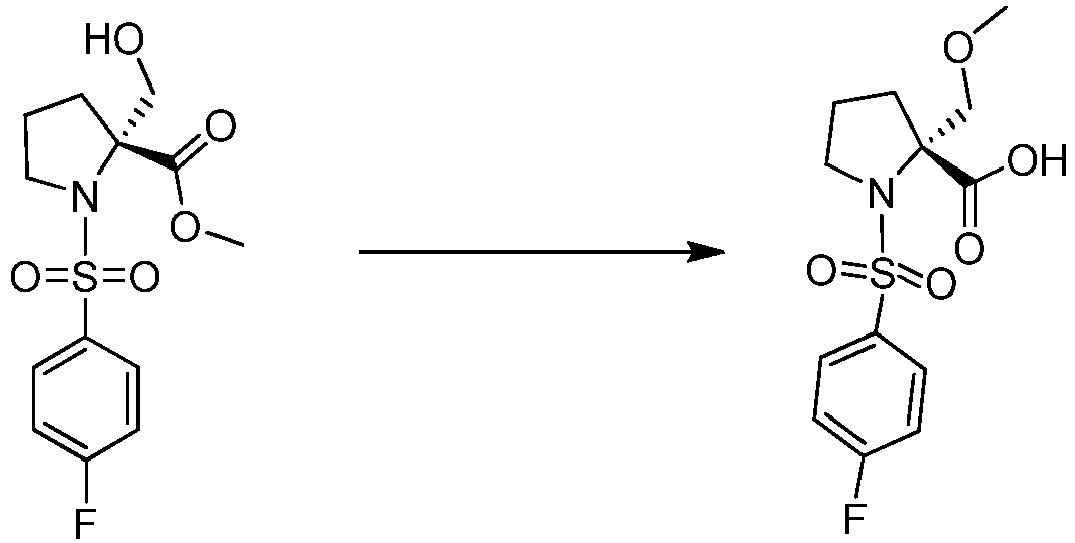
- Sodium hydride (379 mg, 9.47 mmol, 60% in mineral oil) was added to a solution of methyl 1-[(4-fluorobenzene)sulfonyl]-2-(hydroxymethyl)pyrrolidine-2-carboxylate (100 mg, 0.32 mmol), THF (7 mL). The mixture was stirred for 20 min at room temperature, and CH3I (222.8 mg, 1.57 mmol) was added. The resulting solution was stirred for 2 h at room temperature. The reaction was then quenched with 5% HCl (15 m), extracted with EtOAc (3x30mL). The combined organic layers were dried over anhydrous Na2SO4, concentrated to afford the title compound (75 mg) as a white solid, which was used in the next step without any further purification.
-

- A mixture of (2R)-1-[(4-fluorobenzene)sulfonyl]-2-(methoxymethyl)pyrrolidine-2-carboxylic acid (70 mg, 0.22 mmol), DMF (2 mL), DIPEA (113.9 mg, 0.88 mmol), HATU (125.86 mg, 0.33 mmol) and [6-[6-(trifluoromethyl) pyridin-3-yl] pyrimidin-4-yl] methanamine hydrochloride (77.1 mg, 0.27 mmol) was stirred for 12 h at room temperature. The reaction mixture was purified directly by Prep-HPLC to afford the title compound (51.8 mg, 42%) as a light yellow solid. 1H-NMR (300 MHz, CDCl3) δ 9.50 (s, 1H), 9.25 (s, 1H), 8.70 (d, J = 7.8 Hz, 1H), 8.15 (s, 1H), 7.99 - 7.94 (m, 2H), 7.77 - 7.71 (m, 1H), 7.21 - 7.15 (m, 2H), 4.82 - 4.64 (m, 2H), 4.00 (dd, J = 67.5, 9.6 Hz, 2H), 3.57 - 3.52 (m, 1H), 3.38 - 3.29 (m, 4H), 2.48 - 2.41 (m, 1H), 2.23 - 2.19 (m, 1H), 2.05 - 1.98 (m, 2H).
-

-

- A mixture of methyl (2R)-1-[(4-fluorobenzene)sulfonyl]-2-(hydroxymethyl)pyrrolidine-2-carboxylate (100 mg, 0.32 mmol), dichloromethane (20 mL), silica gel (1 g), PCC (136 mg, 0.63 mmol) was stirred overnight at room temperature. The mixture was concentrated, purified by flash chromatography on a silica gel eluting with EtOAc/petroleum ether (1/5) to afford the title compound (70 mg, 70%) as colorless oil.
-

- A mixture of methyl (2R)-1-[(4-fluorobenzene)sulfonyl]-2-formylpyrrolidine-2-carboxylate (120 mg, 0.38 mmol), dichloromethane (20 mL), DAST (123 mg, 2.00 equiv) was stirred overnight at room temperature. The mixture was concentrated and the residue was purified by flash chromatography on silica gel eluting with EtOAc/petroleum ether (1/5) to afford the title compound (90 mg, 70%) as a white solid.
-

- A mixture of methyl (2S)-2-(difluoromethyl)-1-[(4-fluorobenzene)sulfonyl]pyrrolidine-2-carboxylate (90 mg, 0.27 mmol), methanol (10 mL) and LiOH (20 mg, 0.83 mmol) was stirred overnight at room temperature. The mixture was concentrated, diluted with water (20 mL), extracted with ether (30 mL). The aqueous layers was acidified with 3N HCl to pH ∼ 2-3, extracted with EtOAc (3x30mL). The organic phases were dried over anhydrous Na2SO4 and concentrated to afford the title compound (30 mg) as colorless oil, which was used in the next step without any further purification.
-

- A mixture of (2S)-2-(difluoromethyl)-1-[(4-fluorobenzene)sulfonyl]pyrrolidine-2-carboxylic acid (110 mg, 0.34 mmol), HOBt (55 mg, 0.41 mmol), DIPEA (2 mL, 12.10 mmol), N,N-dimethylformamide (10 mL), EDC.HCl (78 mg, 0.41 mmol) and [6-[6-(trifluoromethyl)pyridin-3-yl]pyrimidin-4-yl]methanamine (95 mg, 0.37 mmol) was stirred overnight at room temperature. The mixture was diluted with EtOAc (100mL), washed with brine (3 x 20 mL), dried over Na2SO4 and concentrated. The residue was purified by Prep-HPLC to afford the title compound (12.3 mg) as a light yellow solid. 1H-NMR (300 MHz, CDCl3) δ 9.47 (d, J = 1.8 Hz, 1H), 9.26 (d, J = 1.2 Hz, 1H), 8.66 (dd, J = 1.5, 8.1 Hz, 1H), 8.07 (s, 1H), 7.95 - 7.90 (m, 2H), 7.79 (d, J = 8.1 Hz, 1H), 7.25 - 7.20 (m, 2H), 6.61 (t, J = 56.1 Hz, 1H), 4.93 - 4.85 (m, 1H), 4.64 - 4.57 (m, 1H), 3.77 - 3.71 (m, 1H), 3.29 - 3.21 (m, 1H), 2.56 - 2.48 (m, 1H), 2.36 - 2.27 (m, 1H), 2.10 - 2.01 (m, 2H).
-

-

- A mixture of (2R)-1-[(4-fluorobenzene)sulfonyl]-2-formyl-N-([6-[6-(trifluoromethyl)pyridin-3-yl]pyrimidin-4-yl]methyl)pyrrolidine-2-carboxamide (60 mg, 0.11 mmol), ethanol (10 mL), NH2OH.HCl (23 mg, 0.33 mmol) and NaOAc (46 mg, 5.00 equiv) was stirred overnight at room temperature. The mixture was concentrated, diluted with EtOAc (100 mL), washed with brine (30 mL), dried over anhydrous Na2SO4 and concentrated to afford the title compound (70 mg) as a brown solid, which was used in the next step without any further purification.
-

- A mixture of Ph3PO (4 mg, 0.01 mmol), chloroform (15 mL), thionyl chloride (45 mg, 0.38 mmol) was stirred for 5 min at 0°C. To this was added a solution of (2R)-1-[(4-fluorobenzene)sulfonyl]-2-[(1E)-(hydroxyimino)methyl]-N-([6-[6-(trifluoromethyl)pyridin-3-yl]pyrimidin-4-yl]methyl)pyrrolidine-2-carboxamide (70 mg, 0.13 mmol) in chloroform (5 mL) dropwise with stirring at 0°C. The resulting solution was stirred for an additional 30 min at room temperature, quenched with saturated NaHCO3 (20 mL), extracted with EtOAc (3x30mL) and separated. The combined organic layers were dried over anhydrous Na2SO4 and concentrated. The crude product was purified by Prep-HPLC to afford the title compound (19.6 mg) as a white solid. 1H-NMR (400 MHz, CDCl3) δ 9.47 (s, 1H), 9.28 (d, J = 0.8 Hz, 1H), 8.65 (dd, J = 6.4, 2.0 Hz, 1H), 8.06 - 8.03 (m, 3H), 7.78 (d, J = 8.4 Hz, 1H), 7.48 (t, J = 5.4Hz, 1H), 7.27 - 7.22 (m, 3H), 4.79 (d, J = 5.6 Hz, 2H), 3.69 - 3.66 (m, 1H), 3.39 - 3.35 (m, 1H), 2.68 - 2.64 (m, 2H), 2.28 - 2.08 (m,2H).
-

- The title compound was prepared by the procedures described in Example 2, step 1 using (1R,3S,4S)-2-(tert-butoxycarbonyl)-2-azabicyclo[2.2.1]heptane-3-carboxylic acid and (6-(4-(trifluoromethyl)phenyl)pyrimidin-4-yl)methanamine, and Example 2, steps 2 and 3 (71 mg): 1H-NMR (400 MHz, DMSO-d6 ) δ 9.23 (d, J = 1.3 Hz, 1H), 8.78 (t, J = 5.9 Hz, 1H), 8.38 - 8.32 (m, 2H), 8.06 - 7.99 (m, 3H), 7.84 (d, J = 8.3 Hz, 2H), 7.46 - 7.38 (m, 2H), 4.46 (d, J = 6.1 Hz, 2H), 4.07 (s, 1H), 3.92 (s, 1H), 2.64 (d, J = 4.1 Hz, 1H), 2.10 (d, J = 9.7 Hz, 1H), 1.69 - 1.59 (m, 1H), 1.52 - 1.39 (m, 2H), 1.34 (d, J = 9.9 Hz, 1H), 1.19 - 1.08 (m, 1H).
-

- The title compound was prepared by the procedures described in Example 2, step 1 using (1R,3S,4S)-2-(tert-butoxycarbonyl)-2-azabicyclo[2.2.1]heptane-3-carboxylic acid, and Example 2, steps 2 and 3 (72 mg): 1H-NMR (400 MHz, DMSO-d6 ) δ 9.43 (d, J = 2.1 Hz, 1H), 9.28 (d, J = 1.3 Hz, 1H), 8.81 (t, J = 5.9 Hz, 1H), 8.77 - 8.72 (m, 1H), 8.14 (d, J = 1.2 Hz, 1H), 8.07 - 7.99 (m, 3H), 7.46 - 7.39 (m, 2H), 4.48 (d, J = 6.0 Hz, 2H), 4.07 (s, 1H), 3.92 (s, 1H), 2.65 (d, J = 4.0 Hz, 1H), 2.10 (d, J = 10.4 Hz, 1H), 1.70 - 1.57 (m, 1H), 1.47 - 1.38 (m, 2H), 1.34 (d, J = 10.1 Hz, 1H), 1.17 - 1.07 (m, 1H).
-

-

- A mixture of (2S,3R)-1-[(tert-butoxy)carbonyl]-3-hydroxypyrrolidine-2-carboxylic acid (200 mg, 0.86 mmol, 1.00 equiv), DMF (10 mL), HATU (493.6 mg, 1.30 mmol, 1.50 equiv), DIEA (446.9 mg, 3.46 mmol, 4.00 equiv), and [6-[6-(trifluoromethyl)pyridin-3-yl]pyrimidin-4-yl]methanamine hydrochloride (302.3 mg, 1.04 mmol, 1.20 equiv) was stirred for 3 h at room temperature. The reaction was quenched by addition of 15 mL of water and extracted with ethyl acetate (3x15 mL). The organic layers were combined, washed with water (2x25 mL) and brine (20 mL), dried over anhydrous sodium sulfate, and concentrated under vacuum. This resulted in 400 mg (99%) of the title compound as orange oil.
-

- DAST (204 mg, 0.89 mmol, 3.00 equiv) was added dropwise into a solution of tert-butyl(2S,3R)-3-hydroxy-2-[([6-[6-(trifluoromethyl)pyridin-3-yl]pyrimidin-4-yl]methyl)carbamoyl]pyrrolidine-1-carboxylate (200 mg, 0.43 mmol, 1.00 equiv) in 10 mL of DCM at 0°C. The resulting solution was stirred for an additional 30 min at room temperature, quenched by water (15 mL), and extracted with ethyl acetate (3x15 mL). The organic layers were combined, dried over anhydrous sodium sulfate, and concentrated. The residue was applied onto a silica gel column with dichloromethane/methanol (40:1) to afford the title compound (85 mg, 42%) as an orange solid.
-

- A mixture of tert-butyl (2R,3S)-3-fluoro-2-[([6-[6-(trifluoromethyl)pyridin-3-yl]pyrimidin-4-yl]methyl)carbamoyl]pyrrolidine-1-carboxylate (85 mg, 0.18 mmol, 1.00 equiv) and HCl in dioxane (10 mL, 1 mol/L) was stirred for 3 h at room temperature. The resulting solution was diluted with 5 mL of EtOAc. The solids were collected by filtration to afford the title compound (70 mg, 95%) as an orange solid.
-

- A mixture of (2R,3S)-3-fluoro-N-([6-[6-(trifluoromethyl)pyridin-3-yl]pyrimidin-4-yl]methyl)pyrrolidine-2-carboxamide hydrochloride (70 mg, 0.17 mmol, 1.00 equiv), TEA (51.5 mg, 0.51 mmol, 3.00 equiv), 4-fluorobenzene-1-sulfonyl chloride (39.6 mg, 0.20 mmol, 1.10 equiv), and 4-dimethylaminopyridine (2.1 mg, 0.02 mmol, 0.10 equiv) in DCM (3 mL) was stirred for 3 h at room temperature. The reaction was quenched by water (10 mL) and extracted with ethyl acetate (3x10 mL). The organic layers were combined, dried over anhydrous sodium sulfate, and concentrated under vacuum. The residue was applied onto a silica gel column with ethyl acetate/petroleum ether (1:1) to afford the title compound (40 mg, 44%) as a light yellow solid. 1H-NMR (400 MHz, CDCl3) δ 9.49 (s, 1H), 9.28 (s, 1H), 8.69 (d, J = 8.4 Hz, 1H), 7.99 (s, 1H), 7.94 - 7.91 (m, 2H), 7.84 - 7.80 (m, 2H), 7.29 (t, J = 8.4 Hz, 2H), 5.32 (d, J = 48 Hz, 1H), 4.96 - 4.90 (m, 1H), 4.59 - 4.53 (m, 1H), 4.41 (d, J = 22.4 Hz, 1H), 3.84 (t, J = 8.8 Hz 1H), 3.34 - 3.27 (m, 1H), 2.26 - 2.03 (m, 2H).
-

-

- A mixture of (2S,3S)-1-[(tert-butoxy)carbonyl]-3-hydroxypyrrolidine-2-carboxylic acid (200 mg, 0.86 mmol, 1.00 equiv), DMF (10 mL), HATU (493.6 mg, 1.30 mmol, 1.50 equiv), DIEA (446.9 mg, 3.46 mmol, 4.00 equiv), and [6-[6-(trifluoromethyl)pyridin-3-yl]pyrimidin-4-yl]methanamine hydrochloride (302.3 mg, 1.04 mmol, 1.20 equiv) was stirred for 3 h at room temperature. The mixture was quenched by water (15 mL) and extracted with ethyl acetate (3x15 mL). The organic layers were combined, washed with water (2x25 mL) and brine (20 mL), dried over anhydrous sodium sulfate, and concentrated under vacuum. This resulted in 400 mg (99%) of the title compound as an orange oil.
-

- DAST (413.7 mg, 1.81 mmol, 3.00 equiv) was added dropwise into a solution of tert-butyl (2S,3S)-3-hydroxy-2-[([6-[6-(trifluoromethyl)pyridin-3-yl]pyrimidin-4-yl]methyl)carbamoyl]pyrrolidine-1-carboxylate (400 mg, 0.86 mmol, 1.00 equiv) in DCM (15 mL) at -78 °C. The resulting solution was warmed slowly to room temperature, quenched by water (20 mL), and extracted with ethyl acetate (3x25 mL). The organic layers were combined, dried over anhydrous sodium sulfate, and concentrated. The residue was applied onto a silica gel column with ethyl acetate/petroleum ether (1:1) to afford the title compound (210 mg, 52%) as a colorless solid.
-

- A mixture of tert-butyl (2R,3R)-3-fluoro-2-[([6-[6-(trifluoromethyl)pyridin-3-yl]pyrimidin-4-yl]methyl)carbamoyl]pyrrolidine-1-carboxylate (200 mg, 0.43 mmol, 1.00 equiv) and HCl in dioxane (10 mL, 1mol/L) was stirred for 5 h at room temperature. The resulting solution was diluted with 10 mL of EA. The solids were collected by filtration to afford the title compound (105 mg, 60%) as a colorless solid.
-

- A mixture of (2R,3R)-3-fluoro-N-([6-[6-(trifluoromethyl)pyridin-3-yl]pyrimidin-4-yl]methyl)pyrrolidine-2-carboxamide hydrochloride (100 mg, 0.25 mmol, 1.00 equiv), TEA (101 mg, 1.00 mmol, 4.00 equiv), 4-fluorobenzene-1-sulfonyl chloride (58.3 mg, 0.30 mmol, 1.20 equiv), and 4-dimethylaminopyridine (3 mg, 0.02 mmol, 0.10 equiv) in dichloromethane (10 mL) was stirred for 3 h at room temperature. The mixture was quenched by water (10 mL) and extracted with DCM (3x10 mL). The organic layers were combined, dried over anhydrous sodium sulfate, and concentrated under vacuum. The residue was applied onto a silica gel column with ethyl acetate/petroleum ether (1:1) to afford the title compound (35 mg, 27%) as a light yellow solid. 1H-NMR (400 MHz, CDCl3) δ 9.34 (s, 1H), 9.26 (s, 1H), 8.70 (d, J = 7.6 Hz, 1H), 8.10 (s, 1H), 7.96 - 7.93 (m, 2H), 7.80 (d, J = 8.0 Hz, 1H), 7.51 (s, 1H), 7.31 (t, J = 8 Hz, 2H), 5.46 (d, J = 52 Hz, 1H), 4.95 - 4.91 (m, 1H), 4.75 - 4.66 (m, 1H), 4.29 - 4.22 (m, 1H), 3.83 (d, J = 8.8 Hz, 2H), 2.32 - 2.12 (m, 1H), 1.37 - 1.16 (m, 1H).
-

-

- A mixture of 2-chloro-5-fluoro-4-iodopyridine (1.5 g, 5.83 mmol), 4-(trifluoromethyl)piperidine (890 mg, 5.81 mmol), Pd2(dba)3·CHCl3 (300 mg, 0.29 mmol), BINAP (360 mg, 0.58 mmol), and t-BuONa (1.4 g, 14.57 mmol) in toluene (15 mL) was irradiated with microwave radiation for 1 h at 125 °C under nitrogen. The reaction was quenched by water (50 mL), extracted with dichloromethane (3x100 mL), dried over anhydrous sodium sulfate, and concentrated under reduced pressure. The residue was purified by flash chromatography on silica gel with ethyl acetate/petroleum ether (1:5) to afford the title compound (960 mg, 55%) as a yellow solid.
-

- A mixture of 2-chloro-5-fluoro-4-[4-(trifluoromethyl)piperidin-1-yl]pyridine (400 mg, 1.42 mmol), Pd2(dba)3·CHCl3 (72 mg, 0.07 mmol), Zn(CN)2 (100 mg, 0.85 mmol), dppf (80 mg, 0.14 mmol), and Zn (8 mg, 0.12 mmol) in DMA (10 mL) was irradiated with microwave radiation for 1 h at 125 °C under nitrogen. The reaction was quenched by water (100 mL), extracted with dichloromethane (3x150 mL), dried over anhydrous sodium sulfate, and concentrated under reduced pressure. The residue was purified by flash chromatography on silica gel with ethyl acetate/petroleum ether (1:5) to afford the title compound (350 mg, 90%) as a yellow solid.
-

- A mixture of 5-fluoro-4-[4-(trifluoromethyl)piperidin-1-yl]pyridine-2-carbonitrile (200 mg, 0.73 mmol), 10% Pd/C (50 mg), and saturated HCl (0.25 mL) in methanol (10 mL) was stirred for 1 h at room temperature under an atmosphere of hydrogen gas. The solids were filtered out and the filtrate was concentrated under reduced pressure to afford the title compound (200 mg) as a brown solid, which was used in the next step without any further purification.
-

- A mixture of (2S,4R)-4-fluoro-1-[(4-fluorobenzene)sulfonyl]pyrrolidine-2-carboxylic acid (315 mg, 1.08 mmol), HATU (410 mg, 1.08 mmol), DIEA (0.8 mL, 4.84 mmol), and [5-fluoro-4-[4-(trifluoromethyl)piperidin-1-yl]pyridin-2-yl]methanamine (250 mg, 0.90 mmol) in DMF (4 mL) was stirred overnight at room temperature. The resulting mixture was purified by Prep-HPLC with the following conditions: Column, X Bridge C18; mobile phase A: water/0.05% NH4HCO3; mobile phase B: ACN=30% increasing to ACN=70% within 10 min; detector, UV 254 nm. This resulted in the title compound (28.2 mg) as a white solid. 1H-NMR (400 MHz, CD3OD) δ 8.09 (s, 1H), 8.03 - 7.99 (m, 2H), 7.39 - 7.34 (m, 2H), 7.17 (d, J = 7.6 Hz, 2H), 5.14 (d, J = 52.4 Hz, 1H), 4.47 (s, 2H), 4.28 - 4.24 (m, 1H), 4.03 (d, J = 12.8 Hz, 2H), 3.83 - 3.70 (m, 2H), 2.97 (t, J = 12.8 Hz, 2H), 2.51 - 2.40 (m, 2H), 2.25 - 2.12 (m, 1H), 1.93 (d, J = 12.8 Hz, 2H), 1.71 - 1.65 (m, 2H).
- IC50s (effective concentration) of compounds on the human TRPA1 channel were determined using a Hamamatsu FDSS fluorescence plate reader. CHO cells expressing human TRPA1 were plated into 384-well plates, incubated overnight at 37C, and loaded with BD calcium indicator dye for 1 hr at 37 °C followed by 15 minutes. at room temperature. The assay buffer was Hank's Balanced Salt Solution (HBSS) containing 20mM HEPES (pH readjusted to 7.4) along with 0.02% BSA.
- Following dye load and plate cool down, compounds were added to the cells using the FDSS while monitoring fluorescence to determine whether any of the test compounds have TRPA1 agonist activity. Plates were then incubated with compound for 20 minutes at room temperature prior to adding agonist. Following this incubation, 100 mM cinnamaldehyde was added to all wells of the plate and block of this cinnamaldehyde induced calcium influx was measured.
- IC50s were fit with a standard Hill function, keeping the Hill coefficient (n) fixed to 1.5. Fixing the Hill coefficient will generally reduce variability of the IC50 determination. The IC50s were examined by eye to make sure the MIN and MAX points were set correctly prior to validation of the results. Data for representative compounds of formula I is provided in Table 3 below.
Table 3: IC50 Determinations of Exemplified Compounds. Example Number Structure hTRPA1 AUC IC50 (µM) 1 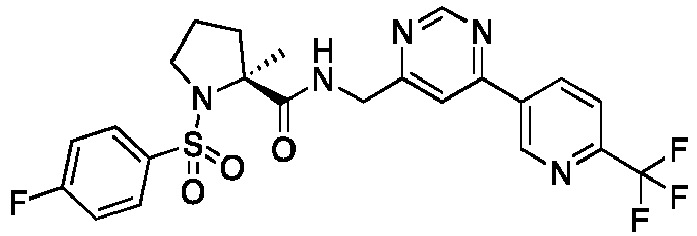
0.051 2 
0.059 4 
0.819 3 
0.097 5 
0.015 6 
0.023 14 
0.268 7 
0.284 9 
0.020 8 
0.017 17 
0.055 15 
0.030 16 
0.008 18 
0.049 19 
0.016 10 
0.107 11 
0.434 20 
0.007 21 
0.021 22 
0.087 23 
2.7 24 
0.027 25 
0.126 26 
0.030 27 
3.0 28 
0.229 29 
0.032 12 
0.030 13 
0.308 13 
0.029 30 
0.252 31 
0.029 32 
0.867 35 
0.023 33 
0.023 34 
0.040 36 
0.120 37 
0.021 -

-

- A mixture of methyl 4-bromo-2-(bromomethyl)benzoate (3 g, 9.74 mmol, 1.0 equiv) and ammonium hydroxide (30 mL, 30%) in 1,4-dioxane (250 mL) was stirred for 3 h at 20°C. The resulting mixture was concentrated under vacuum. The crude product was purified by recrystallization from ethyl acetate to afford the title compound (1.8, 87%) as a white solid.
-

- A mixture of 5-bromo-2,3-dihydro-1H-isoindol-1-one (1.38 g, 6.51 mmol, 1.0 equiv), TEA (1.8 g, 17.79 mmol, 2.70 equiv), 4-dimethylaminopyridine (73 mg, 0.60 mmol) and di-tert-butyl dicarbonate (2.6 g, 11.91 mmol, 1.80 equiv) in tetrahydrofuran (50 mL) was stirred for 12 h at 20°C. The resulting mixture was concentrated under vacuum. The residue was dissolved in ethyl acetate, washed with brine, dried over anhydrous sodium sulfate, and concentrated under vacuum. The residue was purified by a silica gel column eluting with ethyl acetate/petroleum ether (1/10) to afford the title compound (1.7 g, 84%) as a white solid.
-

- A mixture of tert-butyl 5-bromo-1-oxo-2,3-dihydro-1H-isoindole-2-carboxylate (1.7 g, 5.45 mmol, 1.00 equiv), KOAc (1.6 g, 16.30 mmol, 3.00 equiv), 4,4,5,5-tetramethyl-2-(tetramethyl-1,3,2-dioxaborolan-2-yl)-1,3,2-dioxaborolane (2.08 g, 8.19 mmol, 1.50 equiv), and Pd(dppf)Cl2 (395 mg, 0.54 mmol, 0.10 equiv) in 1,4-dioxane (40 mL) was stirred for 12 h at 90°C under nitrogen. The resulting mixture was concentrated under vacuum. The residue was dissolved in ethyl acetate, washed with brine, dried over anhydrous sodium sulfate, and concentrated under vacuum. This resulted in the title compound (2 g, crude) as a white solid.
-

-

- A mixture of tert-butyl 1-oxo-5-[2-(trifluoromethyl)pyrimidin-5-yl]-2,3-dihydro-1H-isoindole-2-carboxylate (250 mg, 0.66 mmol, 1.00 equiv) and LiOH (100 mg, 4.18 mmol, 6.30 equiv) in tetrahydrofuran (3 mL)/water (0.3 mL) was stirred for 12 h at 20°C. The resulting solution was diluted with water and extracted with diethyl ether. The pH value of the aqueous solution was adjusted to 3-4 with 5% HCl. The resulting solution was extracted with ethyl acetate, dried over anhydrous sodium sulfate, and concentrated under vacuum. This resulted in the title compound (180 mg, 69%) as a brown solid.
-

- A mixture of 2-([[(tert-butoxy)carbonyl]amino]methyl)-4-[2-(trifluoromethyl)pyrimidin-5-yl]benzoic acid (160 mg, 0.40 mmol, 1.00 equiv), DIEA (600 mg, 4.64 mmol, 11.50 equiv), HATU (183 mg, 0.48 mmol, 1.20 equiv), and NH4Cl (260 mg, 4.86 mmol, 12.10 equiv) in DMF (5 mL) was stirred for 12 h at 20°C. The resulting solution was diluted with ethyl acetate, washed with brine, dried over anhydrous sodium sulfate, and concentrated under vacuum. The residue was purified by a silica gel column eluting with ethyl acetate/petroleum ether (1/1) to afford the title compound (160 mg, 100%) as a brown solid.
-

- A mixture of tert-butyl N-([2-carbamoyl-5-[2-(trifluoromethyl)pyrimidin-5-yl]phenyl]methyl)carbamate (160 mg, 0.40 mmol, 1.00 equiv) and HCl(saturated solution in 20 mL of 1,4-dioxane) was stirred for 2 h at room temperature. The resulting mixture was concentrated under vacuum to afford the title compound (120 mg, crude) as a white solid.
-

- A mixture of (2S,3R)-1-[(tert-butoxy)carbonyl]-3-hydroxypyrrolidine-2-carboxylic acid (93.67 mg, 0.41 mmol, 1.00 equiv), DIEA (157.06 mg, 1.22 mmol, 3.00 equiv), HATU (231.03 mg, 0.61 mmol, 1.50 equiv), and 2-(aminomethyl)-4-[2-(trifluoromethyl)pyrimidin-5-yl]benzamide hydrochloride (120.00 mg, 0.41 mmol, 1.00 equiv) in DMF (5 mL) was stirred for 2 h at room temperature. The resulting solution was diluted with ethyl acetate, washed with brine, dried over anhydrous sodium sulfate, and concentrated under vacuum. The residue was purified by a silica gel column eluting with dichloromethane/methanol (20:1) to afford the title compound (130 mg, 63%) as a white solid.
-

- DAST (174.01 mg, 1.08 mmol, 5.00 equiv) was added dropwise into a stirred mixture of tert-butyl (2S,3R)-2-[([2-carbamoyl-5-[2-(trifluoromethyl)pyrimidin-5-yl]phenyl]methyl)carbamoyl]-3-hydroxypyrrolidine-1-carboxylate (110.00 mg, 0.22 mmol, 1.00 equiv) in dichloromethane (5 mL) at - 78°C under nitrogen. The reaction was stirred for 30 min at -78°C and 12 h at room temperature. The reaction was then quenched by water and extracted with dichloromethane. The combined extracts were washed with saturated aqueous sodium bicarbonate and brine, dried over anhydrous sodium sulfate, and concentrated under vacuum. The residue was purified by a silica gel column eluting with ethyl acetate/petroleum ether (1:1) to afford the title compound (60 mg, 54%) as a white solid.
-

- TFAA (49.28 mg, 0.23 mmol, 2.00 equiv) was added to a mixture of tert-butyl (2R,3S)-2-[([2-carbamoyl-5-[2-(trifluoromethyl)pyrimidin-5-yl]phenyl]methyl)carbamoyl]-3-fluoropyrrolidine-1-carboxylate (60.00 mg, 0.12 mmol, 1.00 equiv) in dichloromethane (5 mL)/triethylamine (11.87 mg, 0.12 mmol, 1.00 equiv). The reaction was stirred for 10 min at room temperature, quenched by water, and extracted with dichloromethane. The combined extracts were washed with brine, dried over anhydrous sodium sulfate, and concentrated under vacuum. The residue was purified by a silica gel column eluting with ethyl acetate/petroleum ether (1:5) to afford the title compound (50 mg, 86%) as a white solid.
-

- A mixture of tert-butyl (2R,3S)-2-[([2-cyano-5-[2-(trifluoromethyl)pyrimidin-5-yl]phenyl]methyl)carbamoyl]-3-fluoropyrrolidine-1-carboxylate (50 mg, 0.10 mmol, 1.00 equiv) and HCl (saturated solution in 5mL of 1,4-dioxane) was stirred for 3 h at room temperature. The resulting mixture was concentrated under vacuum to afford the title compound (40 mg, crude) as a white solid.
-

- A mixture of (2R,3S)-N-([2-cyano-5-[2-(trifluoromethyl)pyrimidin-5-yl]phenyl]methyl)-3-fluoropyrrolidine-2-carboxamide (47.00 mg, 0.119 mmol, 1.000 equiv), triethylamine (36.27 mg, 0.358 mmol, 3.000 equiv), and 4-fluorobenzene-1-sulfonyl chloride (46.51 mg, 0.239 mmol, 2.000 equiv) in dichloromethane (5 ml) was stirred for 12 h at room temperature. The reaction was then quenched by water and extracted with dichloromethane. The combined extracts were washed with brine, dried over anhydrous sodium sulfate, and concentrated under vacuum. The residue was purified by a silica gel column eluting with ethyl acetate/petroleum ether (1:1). The crude product (40 mg) was re-purified by Prep-HPLC to afford the title compound (25.1 mg, 38%) as a white solid.
1H NMR (400 MHz, CD3OD) δ 9.40 (s, 1H), 8.10 (s, 1H), 8.03-7.91 (m, 4H), 7.41 - 7.35 (m, 2H), 5.19 (d, J = 52 Hz, 1H) , 4.92 - 4.87 (m, 1H), 4.64 (d, J = 24.4 Hz, 2H) , 4.36 (d, J = 24.4 Hz, 1H), 3.80 - 3.85 (m, 1H), 3.33 - 3.27 (m, 1H), 2.29 - 2.14 (m, 2H). -

-

- Lithium triethylborohydride (34.5 mL, 1.20 equiv) was added dropwise into a solution of 1-tert-butyl 2-methyl (2S)-5-oxopyrrolidine-1,2-dicarboxylate (7g, 1.00 equiv) in tetrahydrofuran (30 mL) at -78°C under nitrogen. The reaction was stirred for 2 h at -78°C and quenched by aqueous sodium bicarbonate at 0°C. 30% H2O2 (15mL) was added and the reaction was stirred for 20 minutes. The mixture was extracted with Et2O (2x50 mL), washed with brine, dried over Na2SO4, and concentrated under vacuum. To the resulting crude aminol in methanol (25 mL) was added PTSA (656 mg, 0.38 mmol, 0.12 equiv). The resulting solution was stirred for 12 h at room temperature, quenched by aqueous sodium bicarbonate, extracted with ether, washed with brine, dried over anhydrous sodium sulfate and concentrated under vacuum. The residue was purified by a silica gel column eluting with ethyl acetate/petroleum ether (1:3). This resulted in the title compound (4.1g) as light yellow oil.
-

- A mixture of copper(I) bromide-dimethyl sulfide (1.05 g, 5.11 mmol, 4.00 equiv) and diethyl ether (13 mL) was added MeMgBr (1.645 mL, 3M in Et2O) dropwise at -40°C under nitrogen. After 45 min at -40°C the mixture was cooled to -78°C and BF3.Et2O (0.62 mL, 5.24 mmol, 4.00 equiv) was added dropwise at -78°C. The reaction was stirred for 30 min and 1-tert-butyl 2-methyl (2S)-5-methoxypyrrolidine-1,2-dicarboxylate (320 mg, 1.23 mmol, 1.00 equiv) in diethyl ether (17 mL) was added at -78°C. The resulting solution was stirred for 30 min at -78°C and 1h at room temperature. The reaction mixture was then stirred with aqueous NH4Cl for 1h at room temperature. The resulting solution was extracted with Et2O, washed with sodium bicarbonate and brine, dried over anhydrous sodium sulfate, and concentrated under vacuum. The residue was purified by a silica gel column eluting with ethyl acetate/petroleum ether (1:4). This resulted in the title compound (180 mg, 60%) as colorless oil.
-

- A mixture of 1-tert-butyl 2-methyl (2S)-5-methylpyrrolidine-1,2-dicarboxylate (180 mg, 0.74 mmol, 1.00 equiv) and LiOH (1.6 mg, 0.07 mmol, 0.10 equiv) in methanol (2 mL)/water (0.2 mL) was stirred overnight at room temperature and concentrated under vacuum. The residue was diluted with 10 mL of water and the pH value of the solution was adjusted to 3 with diluted HCl. The resulting solution was extracted with dichloromethane, dried over sodium sulfate, and concentrated under vacuum. This resulted in the title compound (110 mg, 65%) as light yellow oil.
-

- A solution of (2S,5R)-1-[(tert-butoxy)carbonyl]-5-methylpyrrolidine-2-carboxylic acid (120 mg, 0.52 mmol, 1.00 equiv), HATU (298 mg, 0.78 mmol, 1.50 equiv), DIEA (202 mg, 1.56 mmol, 3.00 equiv), and 6-[6-(trifluoromethyl)pyridin-3-yl]pyrimidin-4-ylmethanamine (182 mg, 0.72 mmol, 1.20 equiv) in DMF (5 mL) was stirred overnight at room temperature. The reaction solution was diluted with 40 mL of ethyl acetate, washed with brine, dried over anhydrous sodium sulfate, and concentrated under vacuum. The residue was purified by a silica gel column eluting with ethyl acetate/petroleum ether (1:1) to afford the title compound (90 mg, 37%) as light yellow oil.
-

- A solution of tert-butyl (2R,5S)-2-methyl-5-[([6-[6-(trifluoromethyl)pyridin-3-yl]pyrimidin-4-yl]methyl)carbamoyl]pyrrolidine-1-carboxylate (90 mg, 0.19 mmol, 1.00 equiv) and saturated HCl in 1,4-dioxane (10 mL) was stirred overnight at room temperature and concentrated under vacuum. This resulted in the title compound (85 mg) as light yellow oil.
-

- A solution of (2S,5R)-5-methyl-N-([6-[6-(trifluoromethyl)pyridin-3-yl]pyrimidin-4-yl]methyl)pyrrolidine-2-carboxamide hydrochloride (75 mg, 0.19 mmol, 1.0 equiv), TEA (56.6 mg, 0.56 mmol, 3.000 equiv), 4-dimethylaminopyridine (2.28 mg, 0.019 mmol, 0.1 equiv), and 4-fluorobenzene-1-sulfonyl chloride (43.5 mg, 0.224 mmol, 1.2 equiv) in dichloromethane (5 mL) was stirred for 1.5 h at room temperature. The resulting mixture was diluted with DCM, washed with brine, dried over anhydrous sodium sulfate, and concentrated under vacuum. The crude product was purified by Prep-HPLC to afford the title compound (21mg, 21%) as a white solid.
1H NMR (300 MHz, CDCl3) δ 9.49 (s, 1H), 9.26 (s, 1H), 8.68 - 8.65 (d, J = 8.4 Hz, 1H), 8.15 (s, 1H), 7.97 - 7.93 (m, 2H), 7.77 - 7.16 (m, 1H), 7.26 - 7.16 (m, 3H), 4.94 - 4.82 (m, 1H), 4.65 - 4.57 (m, 1H), 4.43 - 4.41 (m, 1H), 4.28 - 4.24 (m, 1H), 2.29 - 2.15 (m, 3H), 1.65 - 1.59 (m, 1H), 1.14 - 1.12 (m, 3H). -

-

- A mixture of 1-tert-butyl 2-methyl 4-methylidenepyrrolidine-1,2-dicarboxylate (1 g, 4.14 mmol, 1.00 equiv) and 4-methylmorpholin-4-ium-4-olate (1.175 g, 10.03 mmol, 1.60 equiv) in acetone (10 mL)/water(10 mL) was stirred for 7 h at room temperature. The mixture was diluted with water and extracted with ethyl acetate. The combined extracts were washed with brine, dried over anhydrous sodium sulfate, and concentrated under vacuum. The residue was purified by a silica gel column eluting with ethyl acetate/petroleum ether (1:1) to afford the title compound (700 mg, 61%) as orange oil.
-

- A mixture of 1-tert-butyl 2-methyl 4-hydroxy-4-(hydroxymethyl)pyrrolidine-1,2-dicarboxylate (1.068 g, 3.88 mmol, 1.00 equiv), TBS-Cl (1.165 g, 7.73 mmol, 2.00 equiv), imidazole (528 mg, 7.76 mmol, 2.00 equiv), and 4-dimethylaminopyridine (47 mg, 0.38 mmol, 0.10 equiv) in N,N-dimethylformamide (27 mL) was stirred for 12 h at room temperature. The mixture was diluted with water and extracted with ethyl acetate. The combined extracts were washed with brine, dried over anhydrous sodium sulfate, and concentrated under vacuum. The residue was purified by a silica gel column eluting with ethyl acetate/petroleum ether (1:10). This resulted in the title compound (1.37 g, 91%) as light yellow oil.
-

- DAST (1.13 g, 7.01 mmol, 2.00 equiv) was added dropwise into a solution of 1-tert-butyl 2-methyl (2S)-4-[[(tert-butyldimethylsilyl)oxy]methyl]-4-hydroxypyrrolidine-1,2-dicarboxylate (1.37 g, 3.52 mmol, 1.00 equiv) in dichloromethane (25 mL) at -78°C under nitrogen. The resulting solution was stirred for 1.5 h at room temperature. The reaction was then quenched by water, extracted with ethyl acetate, washed with brine, dried over anhydrous sodium sulfate, and concentrated under vacuum. This resulted in the title compound (1.25 g, 91%) as light yellow oil.
-

- A mixture of 1-tert-butyl 2-methyl (2S)-4-[[(tert-butyldimethylsilyl)oxy]methyl]-4-fluoropyrrolidine-1,2-dicarboxylate (1 g, 2.55 mmol, 1.00 equiv), TBAF (1.335 g, 5.11 mmol, 2.00 equiv) in tetrahydrofuran (5 mL) was stirred for 12 h at room temperature. The mixture was diluted with water and extracted with ethyl acetate. The combined extracts were washed with brine, dried over anhydrous sodium sulfate, and concentrated under vacuum. The residue was purified by a silica gel column eluting with ethyl acetate/petroleum ether (1:10) to afford the title compound (520 mg, 73%) as colorless oil.
-

- BAST (1.637 g, 7.40 mmol, 4.00 equiv) was added dropwise into a solution of 1-tert-butyl 2-methyl (2S)-4-fluoro-4-(hydroxymethyl)pyrrolidine-1,2-dicarboxylate (513 mg, 1.85 mmol, 1.00 equiv) in chloroform (10 mL) at 0°C under nitrogen. The resulting solution was stirred for 5 h at 60°C. The reaction mixture was cooled to room temperature, quenched by water, and extracted with dichloromethane. The combined extracts were washed with brine, dried over anhydrous sodium sulfate, and concentrated under vacuum. The residue was purified by a silica gel column eluting with ethyl acetate/petroleum ether (1:10). This resulted in the title compound (300 mg, 58%) as orange oil.
-

- A mixture of 1-tert-butyl 2-methyl (2S)-4-fluoro-4-(fluoromethyl)pyrrolidine-1,2-dicarboxylate (270 mg, 0.97 mmol, 1.00 equiv) and LiOH (116 mg, 4.84 mmol, 5.00 equiv) in tetrahydrofuran (3 mL)/water (2 mL) was stirred for 5 h at room temperature. The resulting solution was diluted with water and extracted with ethyl acetate. The pH value of the aqueous solution was adjusted to 4 with acetic acid. The resulting solution was extracted with ethyl acetate, washed with brine, dried over anhydrous sodium sulfate, and concentrated under vacuum. This resulted in the title compound (250 mg, 97%) as orange oil.
-

- A mixture of (2S)-1-[(tert-butoxy)carbonyl]-4-fluoro-4-(fluoromethyl)pyrrolidine-2-carboxylic acid (110 mg, 0.41 mmol, 1.00 equiv), HATU (173.4 mg, 0.46 mmol, 1.10 equiv), DIEA (160.6 mg, 1.24 mmol, 3.00 equiv), and [6-[6-(trifluoromethyl)pyridin-3-yl]pyrimidin-4-yl]methanamine hydrochloride (120.3 mg, 0.41 mmol, 1.00 equiv) in N,N-dimethylformamide (6 mL) was stirred for 2 h at room temperature. The mixture was diluted with water and extracted with ethyl acetate. The combined extracts were washed with brine, dried over anhydrous sodium sulfate, and concentrated under vacuum. The residue was purified by a silica gel column eluting with ethyl acetate/petroleum ether (1:1) to afford the title compound (170 mg, 82%) as a yellow solid.
-

- A mixture of tert-butyl (2S)-4-fluoro-4-(fluoromethyl)-2-[([6-[6-(trifluoromethyl)pyridin-3-yl]pyrimidin-4-yl]methyl)carbamoyl]pyrrolidine-1-carboxylate (170 mg, 0.34 mmol, 1.00 equiv) and saturated hydrogen chloride in dioxane (5 mL) was stirred for 20 h at room temperature. The resulting mixture was concentrated under vacuum to afford the title compound (125 mg, 84%) as a pink solid.
-

- A mixture of 4-fluorobenzene-1-sulfonyl chloride (125 mg, 0.642 mmol, 1.00 equiv), TEA (86.6 mg, 0.856 mmol, 3.00 equiv), and (2S)-4-fluoro-4-(fluoromethyl)-N-([6-[6-(trifluoromethyl)pyridin-3-yl]pyrimidin-4-yl]methyl)pyrrolidine-2-carboxamide hydrochloride (61.0 mg, 0.139 mmol, 1.10 equiv) in dichloromethane (5 mL) was stirred for 3 h at room temperature. The mixture was diluted with water and extracted with ethyl acetate. The combined extracts were washed with brine, dried over anhydrous sodium sulfate, and concentrated under vacuum. The residue was purified by a silica gel column eluting with ethyl acetate/petroleum ether (1:1). The crude product was purified by Prep-HPLC to afford the title compound (15.2 mg, 4%) as a white solid. tR = 0.93 min (CHIRALPAK AS-3, 4.6x100cm, 3µm, MeOH (0.1%DEA) = 10% to 40% in 2.0 min, hold 1.0 min at 40%, 4 ml/min).
1H NMR (400 MHz, CDCl3) δ 9.51 (s, 1H), 9.29 (s, 1H), 8.70 - 8.68 (d, J = 8 Hz, 1H), 8.09 (s, 1H), 7.95 - 7.92 (m, 2H), 7.83 - 7.81 (d, J = 8 Hz, 1H), 7.61 (s, 1H), 7.52 - 7.28 (m, 2H), 4.97 - 4.91 (m, 1H), 4.61 - 4.35 (m, 4H), 3.93 - 3.71 (m, 2H), 2.52 - 2.49 (m, 1H), 2.38 - 2.27 (m, 1H). - And (2S,4R)-4-fluoro-1-[(4-fluorobenzene)sulfonyl]-4-(fluoromethyl)-N-([6-[6-(trifluoromethyl)pyridin-3-yl]pyrimidin-4-yl]methyl)pyrrolidine-2-carboxamide was also isolated (31.8 mg, 9%) as a white solid. tR = 1.18 min (CHIRALPAK AS-3, 4.6x100cm, 3µm, MeOH (0.1%DEA) = 10% to 40% in 2.0 min, hold 1.0 min at 40%, 4 ml/min).
1H NMR (400 MHz, CDCl3) δ 9.50 (s, 1H), 9.27 (s, 1H), 8.68 - 8.66 (d, J = 8 Hz, 1H), 8.00 (s, 1H), 7.96 - 7.92 (m, 2H), 7.82 - 7.80 (d, J = 8 Hz, 1H), 7.69 (s, 1H), 7.35 - 7.31 (m, 2H), 4.92 - 4.85 (m, 1H), 4.70 - 4.64 (m, 1H), 4.59 - 4.31 (m, 3H), 4.02 - 3.94 (m, 1H), 3.45 - 3.33 (m, 1H), 2.65 - 2.57 (m, 1H), 2.03 - 1.72 (m, 1H). - The 4-proline stereochemistry for the above two compounds was arbitrarily assigned. The 2-proline stereochemistry for the above two compounds is as shown.
-

-

- A solution of MeMgBr (1M) (33 mL, 1.00 equiv) was added dropwise to a solution of 1-tert-butyl 2-methyl (2S)-5-oxopyrrolidine-1,2-dicarboxylate (8 g, 32.89 mmol, 1.00 equiv) in tetrahydrofuran (20 mL) at -40°C. The resulting solution was stirred for 2 h at -40°C. The resulting solution was stirred overnight at room temperature. The reaction was then quenched by saturated NH4Cl. The resulting solution was extracted with ethyl acetate and dried over anhydrous sodium sulfate. The solids were filtered off. The filtrate was concentrated under reduced pressure. The residue was purified by a silica gel column eluting with ethyl acetate/petroleum ether (1:5) to afford the title compound (5.1 g, 60%) as light yellow oil.
-

- A solution of methyl (2S)-2-[[(tert-butoxy)carbonyl]amino]-5-oxohexanoate (3.7 g, 14.27 mmol, 1.00 equiv) and trifluoroacetic acid (10 mL, 134.63 mmol, 1.00 equiv) in dichloromethane (20 mL) was stirred for 1 day at room temperature. The resulting mixture was concentrated under vacuum to afford the title compound (3.5 g) as light yellow oil.
-

- A mixture of methyl (2S)-5-methyl-3,4-dihydro-2H-pyrrole-2-carboxylate (350 mg, 2.48 mmol, 1.00 equiv) and palladium on carbon (300 mg) in methanol (3 mL) was stirred for 8 h at room temperature under hydrogen. The solids were filtered out. The filtrate was concentrated under vacuum to afford the title compound (400 mg) as light yellow oil.
-

- A mixture of methyl (2S,5S)-5-methylpyrrolidine-2-carboxylate (350 mg, 2.44 mmol, 1.00 equiv), TEA (987 mg, 9.75 mmol, 4.00 equiv), 4-dimethylaminopyridine (28 mg, 0.23 mmol, 0.10 equiv), and 4-fluorobenzene-1-sulfonyl chloride (567 mg, 2.91 mmol, 1.20 equiv) in dichloromethane (30 mL) was stirred for 8 h at room temperature. The resulting solution was diluted with ethyl acetate, washed with brine, and dried over anhydrous sodium sulfate. The residue was purified by a silica gel column eluting with ethyl acetate/petroleum ether (1:3) to afford the title compound (190 mg, 26%) as light yellow oil.
-

- A mixture of methyl (2S,5S)-1-[(4-fluorobenzene)sulfonyl]-5-methylpyrrolidine-2-carboxylate (160 mg, 0.53 mmol, 1.00 equiv) and LiOH (25.5 mg, 1.06 mmol, 1.00 equiv) in methanol (4 mL)/water(0.5 mL) was stirred overnight at room temperature. The resulting solution was diluted with 20 mL of water. The pH value of the solution was adjusted to 9 with Na2CO3. The resulting solution was extracted with dichloromethane, dried over anhydrous sodium sulfate, and concentrated under vacuum. This resulted in the title compound (180 mg) as a white solid.
-

- A mixture of (2S,5S)-1-[(4-fluorobenzene)sulfonyl]-5-methylpyrrolidine-2-carboxylic acid (150 mg, 0.522 mmol, 1.00 equiv), HATU (285 mg, 0.750 mmol, 1.50 equiv), DIEA (190 mg, 1.470 mmol, 3.000 equiv), and 6-[6-(trifluoromethyl)pyridin-3-yl]pyrimidin-4-ylmethanamine hydrochloride (182 mg, 0.626 mmol, 1.200 equiv) in N,N-dimethylformamide (4 mL) was stirred for 1 h at room temperature. The resulting solution was diluted with ethyl acetate, washed with brine, dried over anhydrous sodium sulfate, and concentrated under vacuum. The residue was purified by Prep-HPLC to afford the title compound (99.7 mg, 36%) as a white solid.
1H NMR (300 MHz, CDCl3) δ 9.49 (s, 1H), 9.27 (s, 1H), 8.71 - 8.70 (d, J = 1.5 Hz, 1H), 8.04 (s, 1H), 7.95 - 7.90 (m, 2H), 7.82 - 7.80 (m, 1H), 7.69 - 7.67 (m, 1H), 7.31 - 7.26 (m, 2H), 5.01 - 4.92 (m, 1H), 4.60 - 4.53 (m, 1H), 4.22 - 4.17 (m, 1H), 3.73 - 3.71 (m, 1H), 2.19 - 2.16 (m, 1H), 1.77 - 1.68 (m, 3H), 1.60 - 1.51 (m, 3H). -

- A solution of 2-(trifluoromethyl)pyrimidin-5-ylboronic acid (100 mg, 0.50 mmol), 4,6-dichloropyrimidine (0.742559 mmol), cesium carbonate (322.595 mg, 0.99 mmol) and [1,1'-bis(diphenylphosphino)ferrocene]dichloropalladium(ii) dichloromethane adduct (0.10 equiv., 0.050 mmol) in acetonitrile (6.0 ml) and water (3.0 mL) was degassed. The reaction mixture was heated at 95 °C for 2h. The reaction was filtered thru celite. The crude product was purified by flash chromatography (EtOAc/Hex_eluted at 20%EtOAc) to give 74mg, 57.3% yield. LCMS (ESI) m/z:260.9 [M+H]+

- A solution of 4-chloro-6-[2-(trifluoromethyl)pyrimidin-5-yl]pyrimidine (A, 150 mg, 0.58 mmol), zinc cyanide (82.763 mg, 0.69071 mmol), and 1,1'-bis(diphenylphosphino)ferrocene-palladium(ii)dichloride dichloromethane complex (48.0 mg, 0.058 mmol) in N,N-dimethylformamide (5.7559 mL, 74.4 mmol) was stirred at 150°C 45min. The reaction was quenched with water and extracted with EtOAc. The organic layers was dried with sodium sulfate, filtered, and concentrated via rotovap. The crude product was purified by flash chromatography (MeOH/DCM) to give 103mg, 71.2% yield. LCMS (ESI) m/z:252.0 [M+H]+

- A solution of 6-[2-(trifluoromethyl)pyrimidin-5-yl]pyrimidine-4-carbonitrile (A, 140 mg, 0.557 mmol) and palladium on Carbon 10% (11.864 mg, 0.0111 mmol) in methanol (11.148 mL) and hydrochloric acid (0.10 mL, 2.7870 mmol) was stirred under H2 10min. The reaction was filtered thru celite. The crude product was carried to next step. LCMS (ESI) m/z:255.95 [M+H]+

- To a solution of (2S,4R)-1-tert-butoxycarbonyl-4-fluoro-pyrrolidine-2-carboxylic acid (125 mg, 0.536 mmol) and [6-[2-(trifluoromethyl)pyrimidin-5-yl]pyrimidin-4-yl]methanamine (136.77 mg, 0.536 mmol) in N,N-dimethylformamide (2.0 mL) was added N,N-diisopropylethylamine (0.140 mL, 0.80389 mmol) and HATU (249.52 mg, 0.64311 mmol). The reaction mixture was stirred at RT 2h.The reaction was quenched with water and extracted with EtOAc. The organic layers was dried with sodium sulfate, filtered, and concentrated via rotovap. The crude product was carried to next step. LCMS (ESI) m/z:471.20 [M+H]+

- To a solution of tert-butyl (2S,4R)-4-fluoro-2-[[6-[2-(trifluoromethyl)pyrimidin-5-yl]pyrimidin-4-yl]methylcarbamoyl]pyrrolidine-1-carboxylate (252 mg, 0.5357 mmol) in 1,4-dioxane (2.7 mL) was added hydrochloric acid (4 mol/L) in 1,4-dioxane (1.34 mL, 5.357 mmol). The reaction mixture was stirred at RT 6h. The reaction was concentrated and carried to next step. LCMS (ESI) m/z:371.05 [M+H]+

- To a solution of (2S,4R)-4-fluoro-N-[[6-[2-(trifluoromethyl)pyrimidin-5-yl]pyrimidin-4-yl]methyl]pyrrolidine-2-carboxamide (198 mg, 0.5347 mmol) in dichloromethane (10.71 mL) was added triethylamine (1.49 mL, 10.71 mmol) then 4-fluorobenzenesulfonyl chloride (156.4 mg, 0.8036 mmol). The reaction was stirred at RT 1h. The reaction was concentrated and submitted for rHPLC to give 119mg, 42.03% yield.
1H NMR (400 MHz, DMSO) δ 9.72 - 9.68 (s, 2H), 9.36 - 9.33 (d, J = 1.2 Hz, 1H), 9.21 - 9.11 (t, J = 6.0 Hz, 1H), 8.30 - 8.25 (d, J = 1.3 Hz, 1H), 8.08 - 7.99 (m, 2H), 7.52 - 7.43 (m, 2H), 5.31 - 5.12 (d, J = 52.3 Hz, 1H), 4.61 - 4.47 (m, 2H), 4.30 - 4.20 (dd, J = 10.0, 7.1 Hz, 1H), 3.80 - 3.58 (m, 2H), 2.46 - 2.37 (m, 1H), 2.25 - 2.03 (dddd, J = 42.7, 13.8, 10.0, 3.3 Hz, 1H)., LCMS (ESI) m/z:529.11 [M+H]+. -

- To a solution of tert-butyl (2S,4R)-2-[[2-chloro-6-[2-(trifluoromethyl)pyrimidin-5-yl]-4-pyridyl]methylcarbamoyl]-4-fluoro-pyrrolidine-1-carboxylate (120 mg, 0.2381 mmol) and trimethylboroxine (45.30 mg, 0.0504 mL, 0.3572 mmol) in 1,2-dimethoxyethane (4.763 mL)was added potassium carbonate (99.73 mg, 0.7144 mmol) and [1,1'-bis(diphenylphosphino)ferrocene]dichloropalladium(II) (17.60 mg, 0.02381 mmol). The reaction mixture was degassed then heated microwave at 120°C 40min. The reaction was filtered thru celite concentrated. The crude product was purified by flash chromatography (DCM/MeOH) to give 95mg, 82.5% yield. LCMS (ESI) m/z:484.15 [M+H]+

- To a solution of tert-butyl (2S,4R)-4-fluoro-2-[[2-methyl-6-[2-(trifluoromethyl)pyrimidin-5-yl]-4-pyridyl]methylcarbamoyl]pyrrolidine-1-carboxylate (A, 95 mg, 0.1965 mmol) in 1,4-dioxane (0.9824 mL) was added hydrochloric acid (4 mol/L) in 1,4-dioxane (0.4912 mL, 1.965 mmol). The reaction mixture was stirred at RT 6h. The reaction was concentrated and carried to next step. LCMS (ESI) m/z:384.1 [M+H]+

- To a solution of (2S,4R)-4-fluoro-N-[[2-methyl-6-[2-(trifluoromethyl)pyrimidin-5-yl]-4-pyridyl]methyl]pyrrolidine-2-carboxamide (75.31 mg, 0.1965 mmol) in dichloromethane (3.930 mL) was added triethylamine (0.548 mL, 3.930 mmol) then 4-fluorobenzenesulfonyl chloride (57.36 mg, 0.2947 mmol). The reaction was stirred at RT 1h. The reaction was concentrated and submitted for rHPLC to give 65.4mg, 61.47% yield.
1H NMR (400 MHz, DMSO) δ 9.67 - 9.58 (s, 2H), 9.04 - 8.93 (t, J = 6.0 Hz, 1H), 8.06 - 7.95 (m, 3H), 7.53 - 7.42 (m, 2H), 7.41 - 7.36 (d, J = 1.3 Hz, 1H), 5.30 - 5.11 (d, J = 52.4 Hz, 1H), 4.55 - 4.37 (m, 2H), 4.24 - 4.17 (dd, J = 10.0, 7.1 Hz, 1H), 3.76 - 3.58 (m, 2H), 2.61 - 2.56 (s, 3H), 2.22 - 2.00 (m, 1H)., LCMS (ESI) m/z:542.13 [M+H]+ -

-

- A mixture of (2S,4R)-N-[(3-bromo-5-fluorophenyl)methyl]-4-fluoro-1-[(4-fluorobenzene)sulfonyl]pyrrolidine-2-carboxamide (500 mg, 1.05 mmol, 1.00 equiv), potassium carbonate (430 mg, 3.11 mmol, 3.00 equiv), [2-methoxy-6-(trifluoromethyl)pyridin-3-yl]boronic acid (230 mg, 1.04 mmol, 1.00 equiv), and Pd(dppf)Cl2 (78 mg, 0.11 mmol, 0.10 equiv) in 1,4-dioxane (12 mL)/water(1.2 mL) was stirred for 12 h at 80°C under nitrogen. The resulting solution was diluted with ethyl acetate, washed with brine, dried over sodium sulfate, and concentrated under vacuum. The residue was purified by Prep-HPLC to afford the title compound (200 mg, 33%) as a white solid.
1H NMR (400 MHz, CDCl3) δ 7.88 - 7.85 (m, 3H),7.85 - 7.78 (m, 1H), 7.35 - 7.26 (m, 3H), 7.24 -7.22 (m, 2H), 7.21 - 7.07 (d, 1H), 5.10 - 4.97 (m, 1H), 4.67 - 4.62 (m, 1H), 4.51 - 4.48 (m, 1H), 4.29 - 2.25 (m, 1H), 4.03 (s, 3H), 3.95 - 3.86 (m, 1H),3.67 - 3.42 (s, 1H), 2.52 - 2.50 (m, 1H), 2.49 - 2.35 (m, 1H). -

- To a microwave vial was added (2S)-N-[(3-bromo-5-fluoro-phenyl)methyl]-4-fluoro-1-(4-fluorophenyl)sulfonyl-4-methyl-pyrrolidine-2-carboxamide (INT-52-5 of Example 52) (60 m
- g, 0.12 mmol), 3-chloro-6-(trifluoromethyl)pyridazine (29 mg, 0.16 mmol), bis(di-tert-butyl(4-dimethylaminophenyl)phosphine)dichloropalladium(II) (6.3 mg, 0.0089 mmol), sodium carbonate (17 mg, 0.16 mmol) and potassium acetate (15 mg, 0.16 mmol). Acetonitrile (0.8 mL) and water (0.16 mL) were added and nitrogen was bubbled through the reaction mixture for 3 mins then heated to 140 °C in the microwave for 30 mins. The reaction mixture was diluted with dichloromethane, filtered through celite, eluting with dichloromethane and the filtrate was concentrated in vacuo. The residue was adsorbed onto silica and purified by flash column chromatography with 0-100% EtOAc in heptane to afford the partially purified product. The residue was further purified by RP-HPLC to yield the title compound as a white solid (17.0 mg, 27%). MS-ESI: [M+H]+ 559.12
1H NMR (400 MHz, DMSO) δ 8.92 (t, J = 6.1 Hz, 1H), 8.57 (d, J = 8.9 Hz, 1H), 8.39 (d, J = 9.0 Hz, 1H), 8.07 (t, J = 1.4 Hz, 1H), 8.04 - 7.92 (m, 3H), 7.51 - 7.38 (m, 3H), 4.57 - 4.42 (m, 2H), 4.25 - 4.16 (m, 1H), 3.72 - 3.47 (m, 2H), 2.49 - 2.32 (m, 1H), 2.14 -1.94 (m, 1H), 1.38 (d, J = 20.8 Hz, 3H). -

- To a microwave vial was added tert-butyl N-[(6-chloropyrimidin-4-yl)methyl]carbamate (150 mg, 0.58 mmol), 4-(trifluoromethoxy)phenylboronic acid (174 mg, 0.82 mmol), bis(di-tert-butyl(4-dimethylaminophenyl)phosphine)dichloropalladium(II) (33 mg, 0.047 mmol), sodium carbonate (87 mg, 0.82 mmol) and potassium acetate (81 mg, 0.82 mmol). Acetonitrile (3.0 mL) and water (0.6 mL) were added and nitrogen was bubbled through the reaction mixture for 3 mins then heated to 140 °C in the microwave for 30 mins. The reaction mixture was diluted with dichloromethane, filtered through celite, eluting with dichloromethane and the filtrate was concentrated in vacuo. The residue was adsorbed onto silica and purified by flash column chromatography with 0-100% EtOAc in heptane to afford the desired compound as a yellow foam (215 mg, 100%). MS-ESI: [M+H]+ 370.2
- To a solution of tert-butyl N-[[6-[4-(trifluoromethoxy)phenyl]pyrimidin-4-yl]methyl]carbamate (215 mg, 0.6038 mmol,) in dichloromethane (6 mL) was added hydrochloric acid (4 mol/L) in 1,4-dioxane (3 mL, 12 mmol) and the reaction mixture was stirred for 2 h at room temperature then concentrated in vacuo. The residue was dissolved in dichloromethane (3 mL) and (2S)-1-benzyloxycarbonyl-4-oxo-pyrrolidine-2-carboxylic acid (100 mg, 0.38 mmol) was added followed by N,N-diisopropylethylamine (147.3 mg, 0.199 mL, 1.140 mmol). The reaction mixture was stirred overnight at room temperature then quenched with sat. aq. sodium bicarbonate and extracted with EtOAc (3x). The combined organic extracts were washed with brine then dried over sodium sulfate, filtered and concentrated in vacuo. The residue was adsorbed onto silica and purified by flash column chromatography with 0-10% MeOH in DCM to afford the desired compound as a beige solid (142 mg, 46%). MS-ESI: [M+H]+ 515.2
- To a solution of benzyl (2S)-4-oxo-2-[[6-[4-(trifluoromethoxy)phenyl]pyrimidin-4-yl]methylcarbamoyl]pyrrolidine-1-carboxylate (142 mg, 0.28 mmol) in tetrahydrofuran (3.0 mL) was added lanthanum(III) chloride bis(lithium chloride) complex solution (0.6 M in THF) (0.51 mL, 0.30 mmol) and the reaction mixture was stirred for 1 h at room temperature. The reaction mixture was then cooled to -78 °C and methylmagnesium bromide (3.0 mol/L in diethyl ether) (0.14 mL, 0.41 mmol) was added dropwise and the reaction mixture was stirred for 30 mins at -78 °C. An additional portion of methylmagnesium bromide (3.0 mol/L in diethyl ether) (0.14 mL, 0.41 mmol) was added and the reaction mixture was stirred at -78 °C for an additional 15 min. An additional portion of methylmagnesium bromide (3.0 mol/L in diethyl ether) (0.14 mL, 0.41 mmol) was added an the reaction mixcture was stirred at -78 °C for an additional 10 min. The reaction mixture was warmed to room temperature, quenched by the addition of sat. aq. ammonium chloride and extracted with EtOAc (3x). The combined organic layers were washed with brine, dried over sodium sulfate, filtered and concentrated in vacuo. The residue was adsorbed onto silica and purified by flash column chromatography with 0-10% MeOH in DCM to afford the desired compound as a beige foam (100 mg, 68%). MS-ESI: [M+H]+ 531.2
- To a solution of (2S)-benzyl 4-hydroxy-4-methyl-2-[[6-[4-(trifluoromethoxy)phenyl]pyrimidin-4-yl]methylcarbamoyl]pyrrolidine-1-carboxylate (100 mg, 0.19 mmol) in dichloromethane (4 mL) cooled to -78 °C was added diethylaminosulfur trifluoride (0.050 mL, 0.38 mmol) and the reaction mixture was stirred at -78 °C for 2 h. The reaction mixture was quenched by the careful addition of sat. aq. ammonium chloride and extracted with DCM (3x). The combined organic layers were dried over sodium sulfate, filtered and concentrated in vacuo. The residue was adsorbed onto silica and purified by flash column chromatography with 0-10% MeOH in DCM to afford the desired compound as a brown solid (72.5 mg, 72%). MS-ESI: [M+H]+ 399.1
- To a solution of (2S)-benzyl 4-fluoro-4-methyl-2-[[6-[4-(trifluoromethoxy)phenyl]pyrimidin-4-yl]methylcarbamoyl]pyrrolidine-1-carboxylate (72.5 mg, 0.14 mmol) in ethanol (4 mL) was added palladium on carbon (10 mass%) (14.5 mg, 0.014 mmol). Hydrogen was bubbled through the reaction mixture for 5 mins then the reaction was stirred at room temp under an atmosphere of hydrogen overnight. The reaction mixture was diluted with dichloromethane, filtered through celite, eluting with dichloromethane and the filtrate was concentrated in vacuo. To the crude mixture was added palladium on carbon (10 mass%) (14.5 mg, 0.014 mmol) and ethanol (4 mL) and hydrogen was bubbled through the reaction mixture for 5 min. The mixture was then heated to 60 °C overnight under an atmosphere of hydrogen. The reaction mixture was diluted with dichloromethane, filtered through celite, eluting with dichloromethane and the filtrate was concentrated in vacuo. The residue was adsorbed onto silica and purified by flash column chromatography with 0-10% MeOH in DCM to afford the desired compound as a yellow foam (37.6 mg, 69%). MS-ESI: [M+H]+ 533.2
- To (2S)-4-fluoro-4-methyl-N-[[6-[4-(trifluoromethoxy)phenyl]pyrimidin-4-yl]methyl]pyrrolidine-2-carboxamide (37.6 mg, 0.094 mmol) dissolved in dichloromethane (2 mL) was added triethylamine (0.026 mL, 0.19 mmol,) and 4-fluorobenzenesulfonyl chloride (20.2 mg, 0.10 mmol) at room temperature for 4 h. The reaction mixture was diluted with DCM and water, the layers were separated and the aqueous layer was extracted with DCM (2x). The combined organic layers were dried over sodium sulfate, filtered and concentrated in vacuo. The residue was adsorbed onto silica and purified by flash column chromatography with 0-10% MeOH in DCM to afford the partially purified title compound. The residue was purified by RP-HPLC to yield the title compound (4.1 mg, 8%) as a white solid. MS-ESI: [M+H]+ 557.13
1H NMR (400 MHz, DMSO) δ 9.20 (d, J = 1.3 Hz, 1H), 9.07 (t, J = 5.9 Hz, 1H), 8.37 - 8.28 (m, 2H), 8.09 (d, J = 1.4 Hz, 1H), 8.06 - 7.94 (m, 2H), 7.51 - 7.43 (m, 4H), 4.57 - 4.41 (m, 2H), 4.32 - 4.23 (m, 1H), 3.74 - 3.48 (m, 2H), 2.49 - 2.34 (m, 1H), 2.18 - 1.97 (m, 1H), 1.39 (d, J = 20.8 Hz, 3H). -

- To a vial was added (2S,4R)-N-[(3-bromo-5-fluoro-phenyl)methyl]-4-fluoro-1-(4-fluorophenyl)sulfonyl-4-methyl-pyrrolidine-2-carboxamide (INT-52-5) (340 mg, 0.69 mmol), 1,1'-bis(diphenylphosphino)ferrocene-palladium(II)dichloride dichloromethane complex (58 mg, 0.069 mmol), bis(pinacolato)diboron (264 mg, 1.04 mmol) and potassium acetate (204 mg, 2.08 mmol). 1,4-dioxane (10 mL) was added and nitrogen was bubbled through the solution for 3 mins and the reaction mixture was heated to 85 °C for 16 h. The reaction mixture was diluted with dichloromethane, filtered through celite, eluting with dichloromethane and the filtrate was concentrated in vacuo. The residue was adsorbed onto silica and purified by flash column chromatography with 0-100% EtOAc in heptane to afford the desired compound as a brown oil (329 mg, 88%). MS-ESI: [M+H]+ 539.3
- To a microwave vial was added (2S,4R)-4-fluoro-1-(4-fluorophenyl)sulfonyl-N-[[3-fluoro-5-(4,4,5,5-tetramethyl-1,3,2-dioxaborolan-2-yl)phenyl]methyl]-4-methyl-pyrrolidine-2-carboxamide (329 mg, 0.61 mmol), 2-chloro-5-(trifluoromethyl)pyrazine (138 mg, 0.73 mmol), bis(di-tert-butyl(4-dimethylaminophenyl)phosphine)dichloropalladium(II) (35 mg, 0.049 mmol), sodium carbonate (91 mg, 0.86 mmol) and potassium acetate (85 mg, 0.86 mmol). Acetonitrile (8.0 mL) and water (1.6 mL) were added and nitrogen was bubbled through the reaction mixture for 4 mins then heated to 140 °C in the microwave for 30 mins. The reaction mixture was diluted with dichloromethane, filtered through celite, eluting with dichloromethane and the filtrate was concentrated in vacuo. The residue was adsorbed onto silica and purified by flash column chromatography with 0-100% EtOAc in heptane to afford the partially purified product. The residue was purified by RP-HPLC to yield the title compound (108 mg, 32%) as a white solid.
1H NMR (400 MHz, DMSO) δ 9.49 (d, J = 1.4 Hz, 1H), 9.25 (d, J = 1.4 Hz, 1H), 8.92 (t, J = 6.0 Hz, 1H), 8.05 (t, J = 1.5 Hz, 1H), 8.00 - 7.92 (m, 3H), 7.53 - 7.36 (m, 3H), 4.56 - 4.40 (m, 2H), 4.25 - 4.16 (m, 1H), 3.71 - 3.47 (m, 2H), 2.44 - 2.34 (m, 1H), 2.14 -1.93 (m, 1H), 1.38 (d, J = 20.8 Hz, 3H). -

- To a solution of (2S,4R)-1-tert-butoxycarbonyl-4-fluoro-pyrrolidine-2-carboxylic acid (100 mg, 0.43 mmol) and (4-bromo-6-methyl-2-pyridyl)methanamine hydrochloride (112.02 mg, 0.47 mmol) in N,N-dimethylformamide (1.7 mL) was added N,N-diisopropylethylamine (0.112 mL, 0.64 mmol) and HATU (199.62 mg, 0.51 mmol). The reaction mixture was stirred at RT 2h.The reaction was quenched with water and extracted with EtOAc. The organic layers was dried with sodium sulfate, filtered, and concentrated via rotovap. The crude product was purified by flash chromatography (MeOH/DCM) to give 54mg, 30.2% yield. LCMS (ESI) m/z:416.05 [M+H]+

- A solution of 2-(trifluoromethyl)pyrimidin-5-ylboronic acid (1.2 equiv., 0.3574 mmol), tert-butyl (2S,4R)-2-[(4-bromo-6-methyl-2-pyridyl)methylcarbamoyl]-4-fluoro-pyrrolidine-1-carboxylate (124 mg, 0.2979 mmol), cesium carbonate (194.1 mg, 0.04714 mL, 0.5957 mmol) and [1,1'-bis(diphenylphosphino)ferrocene]dichloropalladium(ii) dichloromethane adduct (0.10 equiv., 0.02979 mmol) in acetonitrile (3.0 mL) and water (1.5 mL) was degassed. The reaction mixture was heated at 95 °C for 2h. The reaction was filtered thru celite. The crude product was purified by flash chromatography (MeOH/DCM) to give 70mg, 48.6% yield. LCMS (ESI) m/z:484.15 [M+H]+

- To a solution of tert-butyl (2S,4R)-4-fluoro-2-[[6-methyl-4-[2-(trifluoromethyl)pyrimidin-5-yl]-2-pyridyl]methylcarbamoyl]pyrrolidine-1-carboxylate (70 mg, 0.1448 mmol) in 1,4-dioxane (0.7239 mL) was added hydrochloric acid (4 mol/L) in 1,4-dioxane (0.3619 mL,). The reaction mixture was stirred at RT 6h. The reaction was concentrated and carried to next step. LCMS (ESI) m/z:384.1 [M+H]+

- To a solution of (2S,4R)-4-fluoro-N-[[6-methyl-4-[2-(trifluoromethyl)pyrimidin-5-yl]-2-pyridyl]methyl]pyrrolidine-2-carboxamide (55.5 mg, 0.1448 mmol) in dichloromethane (2.9 mL) was added triethylamine (0.404 mL, 2.896 mmol) then 4-fluorobenzenesulfonyl chloride (42.26 mg, 0.2172 mmol). The reaction was stirred at RT 1h. The reaction was concentrated and submitted for rHPLC to give 61.4mg, 78.32% yield.
1H NMR (400 MHz, DMSO) δ 9.51 - 9.41 (s, 2H), 9.06 - 8.95 (t, J = 6.0 Hz, 1H), 8.05 - 7.95 (m, 2H), 7.77 - 7.68 (dd, J = 9.2, 1.5 Hz, 2H), 7.49 - 7.42 (m, 2H), 5.31 - 5.09 (d, J = 52.4 Hz, 1H), 4.56 - 4.40 (m, 2H), 4.30 - 4.20 (dd, J = 9.9, 7.1 Hz, 1H), 3.78 - 3.57 (m, 2H), 2.62 - 2.56 (s, 3H), 2.44 - 2.30 (m, 1H), 2.24 - 2.00 (dddd, J = 42.5, 14.0, 9.9, 3.4 Hz, 1H)., LCMS (ESI) m/z:542.13 [M+H]+ -

-

- n-BuLi (3 mL, 2.5 M in hexane, 1.50 equiv) was added dropwise into a solution of 2,6-dichloro-4-iodopyridine (1.40 g, 5.112 mmol, 1.00 equiv) in tetrahydrofuran (20 mL) at -78°C under nitrogen. The resulting solution was stirred for 30 min at -78°C. Trimethyl borate (580 mg, 5.582 mmol, 1.10 equiv) was added at -78°C and the reaction was stirred for 1 h at -78°C. The resulting solution was stirred for an additional 12 h at room temperature, quenched by 1.6 g of pinacol and then AcOH (0.6 mL). The solids were filtered out and the liquid was concentrated under vacuum. This resulted in the title compound (1 g, crude) as a yellow solid.
-

- A mixture of 2-bromo-5-(trifluoromethyl)pyridine (800.00 mg, 3.54 mmol, 1.00 equiv), (2,6-dichloropyridin-4-yl)boronic acid (1 g, 5.21 mmol, 1.00 equiv), Pd(dppf)Cl2.CH2Cl2 (290 mg, 0.36 mmol, 0.10 equiv), and potassium carbonate (1.96 g, 14.18 mmol, 4.00 equiv) in 1,4-dioxane (40 mL) /water(2 mL) was stirred for 12 h at 120°C under nitrogen. The resulting solution was diluted with ethyl acetate, washed with brine, dried over anhydrous sodium sulfate, and concentrated under vacuum. The residue was purified by flash chromatography on silica gel eluting with ethyl acetate/petroleum ether (1:100). This resulted in the title compound (680 mg, 66%) as a white solid.
-

- A mixture of 2,6-dichloro-4-[5-(trifluoromethyl)pyridin-2-yl]pyridine (680.00 mg, 2.32 mmol, 1.00 equiv), and KF (134.80 mg, 2.32 mmol, 1.00 equiv) in DMSO (5 mL) was stirred for 6 h at 140°C. The resulting solution was diluted with water and extracted with ethyl acetate. The combined extracts were washed with brine, dried over anhydrous sodium sulfate, and concentrated under vacuum. The residue was purified by flash chromatography on silica gel eluting with ethyl acetate/petroleum ether (1:100). This resulted in the title compound (600 mg, 93%) as a white solid.
-

- A mixture of 2-chloro-6-fluoro-4-[5-(trifluoromethyl)pyridin-2-yl]pyridine (680.00 mg, 2.46 mmol, 1.00 equiv), Zn(CN)2 (288.71 mg, 2.46 mmol, 1.00 equiv), Pd2(dba)3.CHCl3 (250 mg, 0.24 mmol, 0.10 equiv), dppf (410 mg, 0.74 mmol, 0.30 equiv), and DMF (5 mL) was irradiated with microwave for 2 h at 100°C under nitrogen. The resulting solution was diluted with ethyl acetate, washed with brine, dried over anhydrous sodium sulfate, and concentrated under vacuum. The residue was purified by flash chromatography on silica gel eluting with ethyl acetate/petroleum ether (1:100). This resulted in the title compound (610 mg, 93%) as a white solid.
-

- A mixture of 6-fluoro-4-[5-(trifluoromethyl)pyridin-2-yl]pyridine-2-carbonitrile (300 mg, 1.12 mmol, 1.00 equiv), and palladium on carbon (500 mg) in methanol (50 mL) was stirred for 30 min at room temperature under hydrogen. The solids were filtered out and the liquid was concentrated under vacuum to afford the title compound (300 mg, crude) as a yellow solid.
-
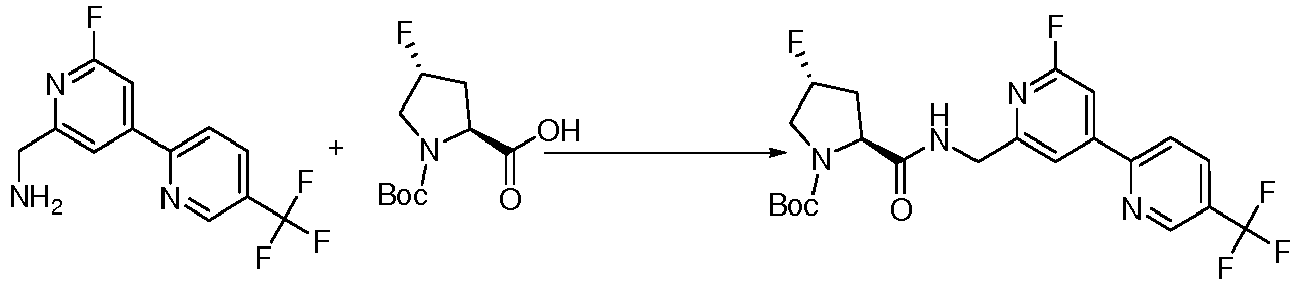
- A mixture of (2S,4R)-1-[(tert-butoxy)carbonyl]-4-fluoropyrrolidine-2-carboxylic acid (260.00 mg, 1.11 mmol, 1.00 equiv), DIEA (432.22 mg, 3.34 mmol, 3.00 equiv), HATU (635.79 mg, 1.67 mmol, 1.50 equiv), and [6-fluoro-4-[5-(trifluoromethyl)pyridin-2-yl]pyridin-2-yl]methanamine (302.33 mg, 1.11 mmol, 1.00 equiv) in N,N-dimethylformamide (5 mL) was stirred for 2 h at room temperature. The resulting solution was diluted with ethyl acetate, washed with brine, dried over anhydrous sodium sulfate, and concentrated under vacuum. The residue was purified by flash chromatography on silica gel eluting with ethyl acetate/petroleum ether (1:1). This resulted in the title compound (200 mg, 37%) as a white solid.
-

- A mixture of tert-butyl (2S,4R)-4-fluoro-2-[([6-fluoro-4-[5-(trifluoromethyl)pyridin-2-yl]pyridin-2-yl]methyl)carbamoyl]pyrrolidine-1-carboxylate (200 mg, 0.41 mmol, 1.00 equiv) and saturated HCl in 1,4-dioxane (30 mL) was stirred for 2 h at room temperature. The resulting mixture was concentrated under vacuum to afford the title compound (150 mg, 94%) as a yellow solid.
-

- A mixture of (2S,4R)-4-fluoro-N-([6-fluoro-4-[5-(trifluoromethyl)pyridin-2-yl]pyridin-2-yl]methyl)pyrrolidine-2-carboxamide (150.00 mg, 0.39 mmol, 1.00 equiv), triethylamine (117.87 mg, 1.16 mmol, 3.00 equiv), and 4-fluorobenzene-1-sulfonyl chloride (151.13 mg, 0.78 mmol, 2.00 equiv) in dichloromethane (20 mL) was stirred for 12 h at room temperature. The reaction was diluted with water, extracted with dichloromethane, washed with brine, dried over anhydrous sodium sulfate, and concentrated under vacuum. The residue was purified by a silica gel column eluting with ethyl acetate/petroleum ether (1:1). The crude product (100 mg) was re-purified by Prep-HPLC to afford the title compound (54.1 mg, 26%) as a white solid.
1H NMR (400 MHz, CDCl3) δ 9.13 (s, 1H), 9.05 - 9.02 (m, 1H), 8.42 - 8.34 (m, 2H), 8.07 (s, 1H), 8.01 - 7.97 (m, 2H), 7.78 (s, 1H), 7.47 - 7.43 (m, 2H), 5.21 (d, J = 52.8 Hz, 2H), 4.46 (d, J = 6 Hz, 2H), 4.26 - 4.22 (m, 1H), 3.72 - 3.61 (m, 2H), 2.50 - 2.01 (m, 2H). -

-

- A mixture of ethyl 4-methyl-1H-pyrazole-3-carboxylate (5 g, 32.43 mmol, 1.0 equiv), 1-iodo-4-(trifluoromethyl)benzene (13.25 g, 48.71 mmol, 1.5 equiv), CuI (600 mg, 3.15 mmol, 0.10 equiv), L-proline (750 mg, 6.51 mmol, 0.20 equiv), and potassium carbonate (8.95 g, 64.76 mmol, 2.00 equiv) in DMSO (150 mg) was stirred overnight at 100°C under nitrogen. The reaction mixture was cooled, diluted with ethyl acetate, washed with brine, dried over anhydrous sodium sulfate, and concentrated under vacuum. The residue was purified by a silica gel column eluting with ethyl acetate/petroleum ether (1:5) to afford the title compound (5.3 g, 55%) as a light yellow solid.
-

- A mixture of ethyl 4-methyl-1-[4-(trifluoromethyl)phenyl]-1H-pyrazole-3-carboxylate (5.78 g, 19.38 mmol, 1.00 equiv), benzoyl benzenecarboperoxoate (469 mg, 1.94 mmol, 0.10 equiv), and 1-bromopyrrolidine-2,5-dione (3.45 g, 19.38 mmol, 1.00 equiv) in CCl4(120 mL) was stirred overnight at 80°C under nitrogen. The resulting solution was diluted with ethyl acetate, washed with water and brine, dried over anhydrous sodium sulfate, and concentrated under vacuum. The residue was purified by a silica gel column eluting with ethyl acetate/petroleum ether (1:3) to afford the title compound (5 g, 68%) as a yellow solid.
-

- A mixture of ethyl 4-(bromomethyl)-1-[4-(trifluoromethyl)phenyl]-1H-pyrazole-3-carboxylate (5 g, 13.26 mmol, 1.00 equiv) and sodium azide (1 g, 15.38 mmol, 1.20 equiv) in N, N-dimethylformamide (80 mL) was stirred for 2 days at room temperature. The reaction mixture was then quenched by water, extracted with ethyl acetate, washed with water and brine, dried over anhydrous sodium sulfate, and concentrated under vacuum. The residue was purified by a silica gel column eluting with ethyl acetate/petroleum ether (1:10). This resulted in the title compound (1.3 g, 29%) as light yellow oil.
-

- Into a 100-mL round-bottom flask purged and maintained with an atmosphere of H2 was placed ethyl 4-(azidomethyl)-1-[4-(trifluoromethyl)phenyl]-1H-pyrazole-3-carboxylate (1.15 g, 3.39 mmol, 1.00 equiv), ethanol (30 mL), palladium on carbon (500 mg), and hydrogen chloride (2 mL). The resulting solution was stirred for 1 h at room temperature. The solids were filtered out and the liquid was concentrated under vacuum. This resulted in the title compound (1 g, 84%) as a light yellow solid.
-

- A solution of (2S,4R)-1-[(tert-butoxy)carbonyl]-4-fluoropyrrolidine-2-carboxylic acid (824 mg, 3.53 mmol, 1.30 equiv), HATU (1.55 g, 4.08 mmol, 1.50 equiv), DIEA (1.05 g, 8.12 mmol, 3.00 equiv), and ethyl 4-(aminomethyl)-1-[4-(trifluoromethyl)phenyl]-1H-pyrazole-3-carboxylate hydrochloride (950 mg, 2.72 mmol, 1.00 equiv) in N, N-dimethylformamide (30 mL) was stirred for 1 h at room temperature. The reaction mixture was diluted with water, extracted with ethyl acetate, washed with brine, dried over anhydrous sodium sulfate, and concentrated under vacuum. The residue was purified by a silica gel column eluting with ethyl acetate/petroleum ether (1:3) to afford the title compound (1.35 g, 94%) as a light yellow solid.
-

- A mixture of ethyl 4-([[(2S,4R)-1-[(tert-butoxy)carbonyl]-4-fluoropyrrolidin-2-yl]formamido]methyl)-1-[4-(trifluoromethyl)phenyl]-1H-pyrazole-3-carboxylate (1.3 g, 2.46 mmol, 1.00 equiv) and NH3/methanol (20 mL, 493.98 mmol, 1.00 equiv) was stirred overnight at 70°C. The reaction mixture was concentrated under vacuum. This resulted in the title compound (1.1 g) as a light yellow solid which was used for the next step without any purification.
-

- A solution of 4-([[(2S,4R)-1-[(tert-butoxy)carbonyl]-4-fluoropyrrolidin-2-yl]formamido]methyl)-1-[4-(trifluoromethyl)phenyl]-1H-pyrazole-3-carboxylic acid (400 mg, 0.80 mmol, 1.00 equiv), TFAA (452 mg, 2.15 mmol, 2.00 equiv), and TEA (320 mg, 3.16 mmol, 4.00 equiv) in dichloromethane (20 mL) was stirred for 1 h at room temperature. The reaction mixture was diluted with water, extracted with ethyl acetate, dried over anhydrous sodium sulfate, and concentrated under vacuum. The residue was purified by a silica gel column eluting with ethyl acetate/petroleum ether (1:3) to afford the title compound (320 mg, 83%) as a light yellow solid.
-

- A mixture of tert-butyl (2S,4R)-2-[([3-cyano-1-[4-(trifluoromethyl)phenyl]-1H-pyrazol-4-yl]methyl)carbamoyl]-4-fluoropyrrolidine-1-carboxylate (310 mg, 0.64 mmol, 1.00 equiv) and HCl/1,4-dioxane (20 mL) was stirred for 5 h at room temperature. The solids were collected by filtration to afford the title compound (270 mg) as a white solid which was used for the next step without any further purification.
-

- A solution (2S,4R)-N-([3-cyano-1-[4-(trifluoromethyl)phenyl]-1H-pyrazol-4-yl]methyl)-4-fluoropyrrolidine-2-carboxamide hydrochloride (250 mg, 0.598 mmol, 1.00 equiv), TEA (267 mg, 2.639 mmol, 4.00 equiv), 4-dimethylaminopyridine (8 mg, 0.065 mmol, 0.10 equiv), and 4-fluorobenzene-1-sulfonyl chloride (152 mg, 0.781 mmol, 1.20 equiv) in dichloromethane (10 mL) was stirred for 1 h at room temperature. The reaction mixture was diluted with dichloromethane, washed with brine, dried over sodium sulfate, and concentrated under vacuum. The residue was purified by Prep-HPLC to afford the title compound (124.8 mg, 39%) as a white solid.
1H NMR (400 MHz, CDCl3) δ 8.88 - 8.85 (m, 1H), 8.76 (s, 1H), 8.09 - 8.06 (m, 2H), 7.97 - 7.94 (m, 4H), 7.47 - 7.41 (m, 2H), 5.27 - 5.09 (d, J = 52.5 Hz, 1H), 4.38 - 4.34 (m, 2H), 4.16 - 4.10 (m, 1H), 3.71 - 3.57(m, 2H), 2.49 - 2.28(m, 1H), 2.20 - 2.35(m, 1H). -
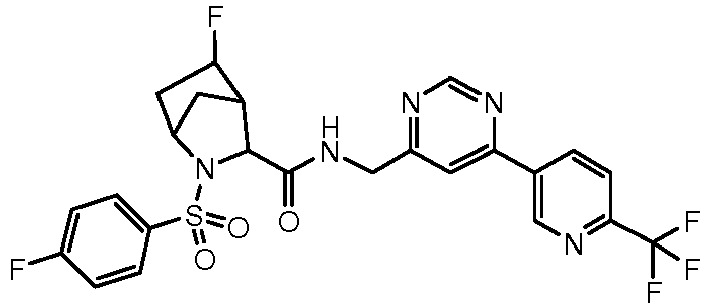
-

- A mixture of cyclopenta-1,3-diene (16.5 g, 249.62 mmol, 1.00 equiv), ethyl 2-oxoacetate (75 mL, 756.70 mmol, 3.00 equiv), and NH4Cl (200 g, 3.74 mol, 15.00 equiv) in water (800 mL) was stirred for 16 h at room temperature. Sodium bicarbonate (5M) was employed to adjust the pH to 8. The resulting solution was extracted with ethyl acetate, dried over anhydrous sodium sulfate, and concentrated under vacuum. This resulted in the title compound (58 g, crude) as brown oil.
-

- A mixture of ethyl 2-azabicyclo[2.2.1]hept-5-ene-3-carboxylate (5 g, crude, 29.90 mmol, 1.00 equiv), Cbz-Cl (5 g, 29.31 mmol, 1.00 equiv), and TEA (6 g, 59.29 mmol, 2.00 equiv) in dichloromethane (30 mL) was stirred for 16 h at room temperature. The resulting mixture was concentrated under vacuum. The residue was purified by a silica gel column eluting with ethyl acetate/petroleum ether (1/5) to afford the title compound (1.8 g, 20%) as red oil.
-

- BH3.THF (47.8 mL, 1M in THF, 1.1equiv) was added dropwise into a mixture of 2-benzyl 3-ethyl 2-aza-bicyclo[2.2.1]hept-5-ene-2,3-dicarboxylate (12 g, 42.4 mmol, 1.00 equiv) in tetrahydrofuran (150 mL) at -78°C under nitrogen. After 1h at room temperature sodium hydroxide (10%) (69.6 mL, 148 mmol, 3.50 equiv) and H2O2 (30%) (22.6 mL, 212 mmol, 5.00 equiv) were added at 0°C. The resulting solution was stirred for 1 h at room temperature, quenched by water, and extracted with ethyl acetate. The combined extracts were washed with brine, dried over anhydrous sodium sulfate, and concentrated under vacuum. The residue was purified by a silica gel column eluting with ethyl acetate/petroleum ether (1/1). This resulted in the title compound (8.2 g, 62%) as yellow oil.
-

- DAST (4.99g, 31 mmol, 2.2 equiv) was added dropwise into a mixture of 2-benzyl 3-ethyl 5-hydroxy-2-aza-bicyclo[2.2.1]heptane-2,3-dicarboxylateand 2-benzyl 3-ethyl 6-hydroxy-2-aza-bicyclo[2.2.1]heptane-2,3-dicarboxylate (4.5 g, 14.1 mmol, 1.00 equiv) in DCM (100 mL) at -78°C under nitrogen. The resulting solution was stirred for 5 h at rt, quenched with water, and extracted with dichloromethane. The combined extracts were washed with brine, dried over anhydrous sodium sulfate, and concentrated under vacuum. The residue was purified by a silica gel column eluting with ethyl acetate/petroleum ether (1/5). This resulted in the mixture of the title compounds and 2-benzyl 3-ethyl 6-fluoro-2-aza-bicyclo[2.2.1]heptane-2,3-dicarboxylate (1.2g, 27%) as yellow oil.
-
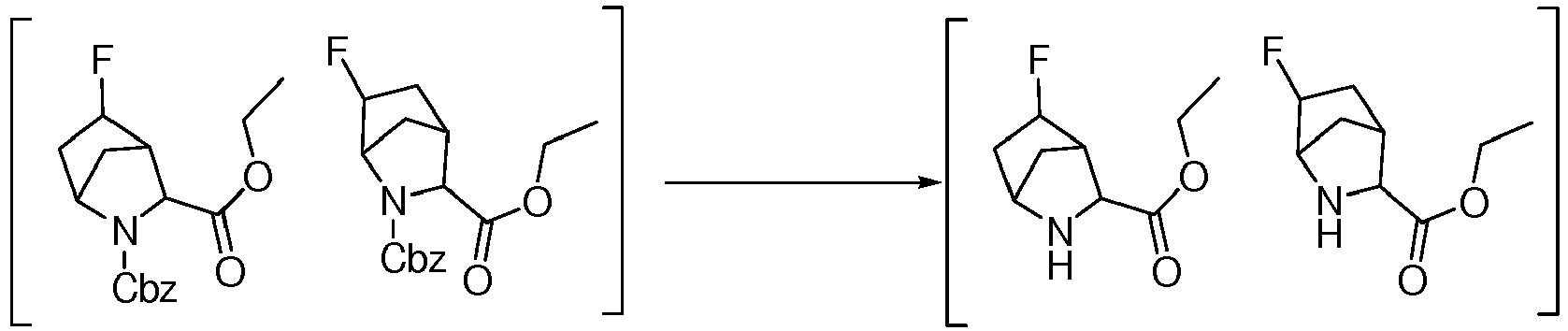
- A mixture of 2-benzyl 3-ethyl 6-fluoro-2-aza-bicyclo[2.2.1]heptane-2,3-dicarboxylat and 2-benzyl 3-ethyl 5-fluoro-2-aza-bicyclo[2.2.1]heptane-2,3-dicarboxylate(4.7 g, 15.5 mmol, 1.00 equiv), and palladium on carbon (1.0 g) in methanol (50 mL) was stirred for 16 h at room temperature under hydrogen. The solids were filtered out and the liquid was concentrated under vacuum. This resulted in the title compound and its ethyl 6-fluoro-2-aza-bicyclo[2.2.1]heptane-3-carboxylate(2.5 g, 86%) as yellow oil.
-

- A mixture of two position isomers (2.5 g, 13.3 mmol, 1.00 equiv), TEA (2.7 g, 26.68 mmol, 2.00 equiv), and 4-fluorobenzene-1-sulfonyl chloride (3.1 g, 15.93 mmol, 1.20 equiv) in dichloromethane (50 mL) was stirred for 2 h at room temperature. The resulting mixture was concentrated under vacuum. The residue was purified by a silica gel column eluting with ethyl acetate/petroleum ether (1/5) to afford the mixture of the title compound and ethyl 6-fluoro-2-(4-fluorophenylsulfonyl)-2-aza-bicyclo[2.2.1]heptane-3-carboxylate(2.5 g, 54%) as a yellow solid.
-

- A mixture of ethyl 5-fluoro-2-(4-fluorophenylsulfonyl)-2-aza-bicyclo[2.2.1]heptane-3-carboxylate and ethyl 6-fluoro-2-(4-fluorophenylsulfonyl)-2-aza-bicyclo[2.2.1]heptane-3-carboxylate(2.5 g, 7.24 mmol, 1.00 equiv) in tetrahydrofuran (50 mL) and LiOH (522 mg, 21.80 mmol, 3.00 equiv) in water (50 mL) was stirred for 16 h at room temperature. The pH value of the solution was adjusted to 5 with citric acid. The resulting solution was extracted with ethyl acetate, washed with brine, dried over anhydrous sodium sulfate, and concentrated under vacuum. This resulted in a mixture of the title compound and 6-fluoro-2-(4-fluorophenylsulfonyl)-2-aza-bicyclo[2.2.1]heptane-3-carboxylic acid (2.0 g, 87%) as a yellow solid.
-

- A mixture of 5-fluoro-2-(4-fluorophenylsulfonyl)-2-aza-bicyclo[2.2.1]heptane-3-carboxylic acid and 6-fluoro-2-(4-fluorophenylsulfonyl)-2-aza-bicyclo[2.2.1]heptane-3-carboxylic acid (2.0g, 6.3 mmol, 1.00 equiv), (6-(6-(trifluoromethyl)pyridin-3-yl)pyrimidin-4-yl)methanaminel (1.6 g, 6.3 mmol, 1.0 equiv), HATU (3.6g, 9.5mmol, 1.50 equiv), and DIPEA (1.6g, 12.6 mmol, 2.0 equiv) in DMF (50 mL) was stirred for 16 h at room temperature. The reaction mixture was diluted with water and extracted with ethyl acetate. The combined extracts were washed with brine, dried over anhydrous sodium sulfate, and concentrated under vacuum. The crude residue was purified by Prep_SFC to afford the title compound (137.3mg, 3.9%). tR = 0.90 min (Lux 3µm Cellulose-4, 4.6x100mm, 3µm, MeOH (0.1%DEA) = 30%, 4 ml/min).
1H NMR (300 MHz, DMSO-d6 ) δ 9.41 (s, 1H), 9.29 (d, J = 0.9 Hz, 1H), 8.91 (t, J = 6.3 Hz, 1H),8.73 - 8.70 (m, 1H), 8.09 - 7.99 (m, 4H),7.38 (t, J = 9.0Hz, 2H), 4.85 - 4.95 (d, J = 59.7 Hz, 1H),4.47 (t, J = 5.1Hz, 2H), 4.08 (s, 1H), 3.93 (s, 1H), 2.98 (d, J = 3.9Hz, 1H), 2.15 (s, J = 9.6Hz, 1H), 1.79 - 1.56 (m, 3H). - 6-fluoro-2-(4-fluorophenyl)sulfonyl-N-[[6-[6-(trifluoromethyl)-3-pyridyl]pyrimidin-4-yl]methyl]-2-azabicyclo[2.2.1]heptane-3-carboxamide was also isolated (732.9mg, 20.9%) as a white solid. tR = 1.07 min (Lux 3µm Cellulose-4, 4.6x100mm, 3µm, MeOH (0.1%DEA) = 30%, 4 ml/min).
1H NMR (300 MHz, DMSO-d6 ) δ 9.42 (s, 1H), 9.29 (s, 1H), 8.91 (t, J = 5.7 Hz, 1H),8.73 (d, J = 8.1Hz, 1H), 8.13 - 7.99 (m, 4H), 7.38 (t, J = 9.0Hz, 2H),4.85 - 4.65 (d, J = 59.7 Hz, 1H), 4.54 - 4.39 (m, 2H), 4.08 (s, 1H), 3.93 (s, 1H), 2.79 (d, J = 3.6Hz, 1H), 2.15 (s, J = 9.9 Hz, 1H), 1.91 - 1.39 (m, 3H). - The F position (5-F or 6-F) for the above two position isomers was arbitrary assigned. The 2-proline stereochemistry is as shown.
-

- To a round bottomed flask was added (2S)-1-tert-butoxycarbonyl-4-oxo-pyrrolidine-2-carboxylic acid (2.35 g, 10.2 mmol), (3-bromo-5-fluorophenyl)methanamine (2.00 g, 9.31 mmol) and HATU (3.97 g, 10.2 mmol). Dichloromethane (47 mL) was added followed by N,N-diisopropylethylamine (3.25 mL, 18.6 mmol) and the reaction mixture was stirred overnight at room temperature. The reaction was quenched with sat. aq. sodium bicarbonate and extracted with DCM (3x). The combined organic extracts were washed with water (1x), brine (1x) then dried over sodium sulfated, filtered and concentrated in vacuo. The residue was adsorbed onto silica and purified by flash column chromatography with 0-100% EtOAc in Heptane to afford the desired compound as a beige solid (3.47 g, 90%). MS-ESI: [M+H]+ 414.9
- To a solution of (S)-tert-butyl 2-((3-bromo-5-fluorobenzyl)carbamoyl)-4-oxopyrrolidine-1-carboxylate (1.94 g, 4.67 mmol) in tetrahydrofuran (40 mL) was added Lanthanum(III) chloride bis(lithium chloride) complex solution 0.6 M in THF (8.6 mL, 5.14 mmol) and the reaction mixture was stirred for 1 h at room temperature. The reaction mixture was then cooled to -78 °C and methylmagnesium bromide (3.0 mol/L) in diethyl ether (7.0 mL, 21.0 mmol) was added dropwise and the reaction mixture was stirred for 30 mins at -78 °C. An additional portion of methylmagnesium bromide (3.0 mol/L) in diethyl ether (7.0 mL, 21.0 mmol) was added and the mixture was stirred at - 78 °C for an additional 30 min. An additional portion of methylmagnesium bromide (3.0 mol/L) in diethyl ether (7.0 mL, 21.0 mmol) was added and the mixture was stirred at -78 °C for an additional 15 min. The reaction mixture was warmed to room temperature, quenched by the addition of sat. aq. ammonium chloride and extracted with EtOAc (3x). The combined organic layers were washed with brine, dried over sodium sulfate, filtered and concentrated in vacuo. The residue was adsorbed onto silica and purified by flash column chromatography with 0-100% EtOAc in heptane to afford the desired compound as a beige foam (1.29 g, 64%). MS-ESI: [M-100]+ 331.0
- To a solution of (2S,4R)-tert-butyl 2-((3-bromo-5-fluorobenzyl)carbamoyl)-4-hydroxy-4-methylpyrrolidine-1-carboxylate (337 mg, 0.781 mmol) in dichloromethane (10 mL) cooled to -78 °C was added diethylaminosulfur trifluoride (0.21 mL, 1.56 mmol) and the reaction mixture was stirred at -78 °C for 30 min. The reaction mixture was quenched by the careful addition of sat. aq. ammonium chloride and extracted with DCM (3x). The combined organic layers were dried over sodium sulfate, filtered and concentrated in vacuo. The residue was adsorbed onto silica and purified by flash column chromatography with 0-10% MeOH in DCM to afford the desired compound as a brown solid (314.7 mg, 93%). MS-ESI: [M+H]+ 433.1
- To a solution of (2S,4R)-tert-butyl 2-((3-bromo-5-fluorobenzyl)carbamoyl)-4-fluoro-4-methylpyrrolidine-1-carboxylate (315 mg, 0.7270 mmol) in dichloromethane (4 mL) was added hydrochloric acid (4 mol/L) in 1,4-dioxane (1.5 mL, 6.0 mmol). The reaction mixture was stirred at room temp for 2 h then concentrated in vacuo. The crude residue was dissolved in dichloromethane (6 mL) and triethylamine (0.30 mL, 2.2 mmol) and 4-fluorobenzenesulfonyl chloride (156 mg, 0.8005 mmol,) were added and the reaction mixture was stirred at room temperature for 2 h. The reaction mixture was diluted with DCM and water, the layers were separated and the aqueous layer was extracted with DCM (2x). The combined organic layers were dried over sodium sulfate, filtered and concentrated in vacuo. The residue was adsorbed onto silica and purified by flash column chromatography with 0-10% MeOH in DCM to afford the title compound as a pale yellow foam (172.4 mg, 48%). MS-ESI: [M-H]- 493.1
- To a microwave vial was added (2S)-N-[(3-bromo-5-fluoro-phenyl)methyl]-4-fluoro-1-(4-fluorophenyl)sulfonyl-4-methyl-pyrrolidine-2-carboxamide (60 mg, 0.12 mmol), 2-(trifluoromethyl)pyrimidin-5-ylboronic acid (33 mg, 0.17 mmol), bis(di-tert-butyl(4-dimethylaminophenyl)phosphine)dichloropalladium(II) (6.9 mg, 0.0098 mmol), sodium carbonate (18 mg, 0.17 mmol) and potassium acetate (17 mg, 0.17 mmol). Acetonitrile (0.8 mL) and water (0.16 mL) were added and nitrogen was bubbled through the reaction mixture for 3 mins then heated to 140 °C in the microwave for 30 mins. The reaction mixture was diluted with dichloromethane, filtered through celite, eluting with dichloromethane and the filtrate was concentrated in vacuo. The residue was adsorbed onto silica and purified by flash column chromatography with 0-100% EtOAc in heptane to afford the partially purified product. The residue was further purified by RP-HPLC to yield the title compound as a white solid (43.3 mg, 68%). MS-ESI: [M+H]+ 559.12
1H NMR (400 MHz, DMSO) δ 9.42 (s, 2H), 8.92 (t, J = 6.0 Hz, 1H), 8.02 - 7.92 (m, 2H), 7.78 - 7.69 (m, 2H), 7.51 - 7.40 (m, 2H), 7.40 - 7.32 (m, 1H), 4.56 - 4.38 (m, 2H), 4.25 - 4.16 (m, 1H), 3.71 - 3.46 (m, 2H), 2.48 - 2.31 (m, 1H), 2.15 - 1.94 (m, 1H), 1.38 (d, J = 20.7 Hz, 3H). -

- Preparation of the title compound follows the same general procedure as Example 48.
1H NMR (400 MHz, DMSO) δ 9.51 - 9.44 (s, 2H), 9.08 - 8.98 (t, J = 6.0 Hz, 1H), 8.78 - 8.69 (dd, J = 5.2, 0.8 Hz, 1H), 8.04 - 7.96 (m, 2H), 7.94 - 7.89 (dd, J = 1.7, 0.9 Hz, 1H), 7.89 - 7.83 (dd, J = 5.2, 1.8 Hz, 1H), 7.51 - 7.40 (m, 2H), 5.30 - 5.09 (d, J = 52.5 Hz, 1H), 4.62 - 4.46 (m, 2H), 4.29 - 4.18 (dd, J = 9.9, 7.1 Hz, 1H), 3.78 - 3.57 (m, 2H), 2.43 - 2.35 (m, 1H), 2.23 - 2.02 (m, 1H)., LCMS (ESI) m/z:528.11 [M+H]+ -

- To a microwave vial was added (2S,4R)-4-fluoro-1-(4-fluorophenyl)sulfonyl-N-[[2-fluoro-5-(4,4,5,5-tetramethyl-1,3,2-dioxaborolan-2-yl)phenyl]methyl]pyrrolidine-2-carboxamide 1 (216 mg, 0.41 mmol), 2-chloro-5-(trifluoromethyl)pyrazine (105 mg, 0.58 mmol), Pd (amphos)Cl2 (23 mg, 0.03 mmol), sodium carbonate (61 mg, 0.58 mmol) and potassium acetate (57 mg, 0.58 mmol), acetonitrile (0.8 mL) and water (0.16 mL). The reaction mixture was purged with nitrogen gas for 3 minutes and then heated to 140 °C in the microwave for 30 minutes. Upon cooling to room temperature, the resulting mixture was filtered through a thin layer of celite, washed with water and extracted with ethyl acetate. The combined organic layer was dried over Na2SO4, filtered and concentrated under reduced pressure. The residue was purified by reverse phase HPLC to afford the title compound (99 mg, 44%) as a white solid. LC/MS (ESI+): m/z 545.5 (M+H).
1H NMR (400 MHz, DMSO-d6 ) δ 9.42 (d, J = 1.5 Hz, 1H), 9.21 (d, J = 1.4 Hz, 1H), 8.92 (t, J = 5.9 Hz, 1H), 8.36 - 8.13 (m, 2H), 8.08 - 7.88 (m, 2H), 7.44 (td, J = 8.6, 1.3 Hz, 3H), 4.54 - 4.35 (m, 2H), 4.22 (dd, J = 9.8, 7.2 Hz, 1H), 3.78 - 3.49 (m, 2H), 2.50 - 2.27 (m, 2H), 2.09 (dddd, J = 42.1, 13.8, 9.8, 3.5 Hz, 1H). -
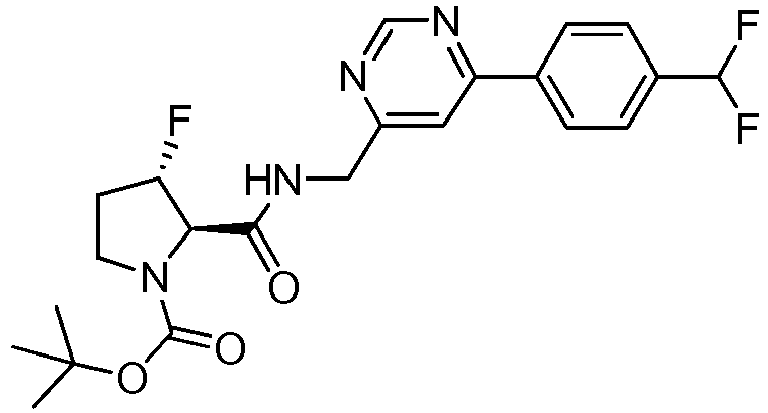
- To a solution of tert-butyl (2S,3R)-2-[[6-[4-(difluoromethyl)phenyl]pyrimidin-4-yl]methylcarbamoyl]-3-hydroxy-pyrrolidine-1-carboxylate (360 mg, 0.8027 mmol) in dichloromethane (16.0 mL) at 0°C was added dropwise diethylaminosulfur trifluoride (388.1 mg, 0.3187 mL, 2.408 mmol). The reaction was warmed to RT 1h. The reaction was quenched with water and extracted with EtOAc. The organic layers was dried with sodium sulfate, filtered, and concentrated via rotovap. The crude product was carried to next step. LCMS (ESI) m/z:451.20 [M+H]+

- A solution of tert-butyl (2R,3S)-2-[[6-[4-(difluoromethyl)phenyl]pyrimidin-4-yl]methylcarbamoyl]-3-fluoro-pyrrolidine-1-carboxylate (361 mg, 0.8015 mmol) in hydrochloric acid (4 mol/L) in 1,4-dioxane (2.00 mL) and 1,4-dioxane (3.00 mL) was stirred at RT 18h. The reaction was concentrated and carried to next step. LCMS (ESI) m/z:351.05 [M+H]+

- To a solution of (2R,3S)-N-[[6-[4-(difluoromethyl)phenyl]pyrimidin-4-yl]methyl]-3-fluoro-pyrrolidine-2-carboxamide (281 mg, 0.8022 mmol) in dichloromethane (8.027 mL) was added triethylamine (2.24 mL, 16.05 mmol) and 4-fluorobenzenesulfonyl chloride (187.5 mg, 0.9632 mmol). The reaction mixture was stirred at RT 1h. The crude product was concentrated and purified by flash chromatography (MeOH/DCM) then submitted for rHPLC to give 113mg, 27.69%.
1H NMR (400 MHz, DMSO) δ 9.25 - 9.21 (d, J = 1.3 Hz, 1H), 9.21 - 9.14 (t, J = 6.0 Hz, 1H), 8.40 - 8.31 (m, 2H), 8.09 - 8.00 (m, 3H), 7.77 - 7.70 (dt, J = 8.5, 1.1 Hz, 2H), 7.56 - 7.47 (m, 2H), 7.28 - 6.96 (m, 1H), 5.32 - 5.12 (m, 1H), 4.61 - 4.38 (m, 3H), 3.74 - 3.63 (ddd, J = 9.7, 6.7, 1.9 Hz, 1H), 3.23 - 3.12 (m, 1H), 2.29 - 2.08 (m, 2H)., LCMS (ESI) m/z:509.13 [M+H]+ -

- Following the same procedure of Example 183, step 4: The title compound (2S,4R)-4-fluoro-N-(2-fluoro-5-(2-(trifluoromethyl)pyrimidin-5-yl)benzyl)-1-((4-fluorophenyl)sulfonyl)pyrrolidine-2-carboxamide (849 mg, 68%) was prepared from (2S,4R)-N-[(5-bromo-2-fluoro-phenyl)methyl]-4-fluoro-1-(4-fluorophenyl)sulfonyl-pyrrolidine-2-carboxamide 1 (1.1 g, 2.3 mmol), [5-(trifluoromethyl)pyrimidin-2-yl]boronic acid (487mg, 2.5 mmol), cesium carbonate 1 M in water (3.2 mL, 3.2 mmol), Pd(dppf)Cl2 (192 mg, 0.23 mmol) in acetonitrile (4 mL). LC/MS (ESI+): m/z 545.5 (M+H).
1H NMR (400 MHz, DMSO-d6 ) δ 9.36 (s, 1H), 8.90 (t, J = 5.9 Hz, 1H), 8.06 - 7.79 (m, 3H), 7.45 (td, J = 8.8, 1.4 Hz, 2H), 5.19 (d, J = 52.6 Hz, 1H), 4.47 (d, J = 5.9 Hz, 2H), 4.29 - 4.10 (m, 1H), 3.75 - 3.67 (m, 1H), 3.67 - 3.51 (m, 1H), 2.47 - 2.29 (m, 1H), 2.09 (dddd, J = 42.5, 13.8, 10.0, 3.4 Hz, 1H). -

- The title compound (72 mg, 64%) was prepared following the Suzuki coupling procedure of Example 8, Step 1 from (2S,4R)-N-[(2-bromo-4-pyridyl)methyl]-4-fluoro-1-(4-fluorophenyl)sulfonyl-pyrrolidine-2-carboxamide (82 mg, 0.18 mmol), 2-benzyloxy-4-(trifluoromethyl)phenylboronic acid (69 mg, 0.22 mmol), [1,1'-bis(diphenylphosphino)ferrocene]dichloropalladium(II) (14 mg, 0.02 mmol) and aqueous Cs2CO3 (0.22 mL, 0.22 mmol, 1.0 mol/L) in acetonotrile (4 mL). LCMS (ESI_Formic_MeCN): [MH+] = 632.
-

- (2S,4R)-N-[[2-[2-benzyloxy-4-(trifluoromethyl)phenyl]-4-pyridyl]methyl]-4-fluoro-1-(4-fluorophenyl)sulfonyl-pyrrolidine-2-carboxamide (36 mg, 0.06 mmol) in methanol (4 ml) was hydrogenated at 1 atm over palladium on carbon (10%) (22 mg) for 2 hours. The mixture was filtered through Celite and the filtrate concentrated in vacuum. The residue was subjected to RP HPLC purification to afford 22 mg (71%) of the title compound.
1H NMR (400 MHz, DMSO-d6) δ 14.70 (s, 1H), 9.02 (t, J = 6.0 Hz, 1H), 8.64 (dd, J = 5.3, 0.7 Hz, 1H), 8.32 - 8.22 (m, 2H), 8.06 - 7.97 (m, 2H), 7.53 - 7.43 (m, 3H), 7.27 - 7.21 (m, 1H), 7.20 -7.14 (m, 1H), 5.21 (d, J = 52.2 Hz, 1H), 4.61 - 4.44 (m, 2H), 4.21 (dd, J = 9.9, 7.1 Hz, 1H), 3.81 - 3.57 (m, 2H), 2.49 - 2.36 (m, 1H), 2.11 (dddd, J = 42.5, 13.8, 10.0, 3.4 Hz, 1H). -

-

- A mixture of ethyl 3-methoxy-1H-pyrazole-4-carboxylate (1.116 g, 6.56 mmol, 1.00 equiv) in N,N-dimethylformamide (60 mL), L-Proline (151 mg, 1.31 mmol, 0.20 equiv), CuI (128 mg, 0.67 mmol, 0.10 equiv), 2-chloro-5-(trifluoromethyl)pyrazine (1.19 g, 6.52 mmol, 1.00 equiv), and potassium carbonate (2.72 g, 19.68 mmol, 3.00 equiv) was stirred overnight at 100°C under nitrogen. The solids were filtered out. The filtrate was diluted with 500 mL of ethyl acetate, washed with brine, dried over anhydrous sodium sulfate, and concentrated under vacuum. The residue was applied onto a silica gel column eluting with ethyl acetate/petroleum ether (5:100) to afford the title compound (1 g, 48%) as an off-white solid.
-

- DIBAL-H (6 mL, 6.33 mmol, 2.10 equiv) was added dropwise into a solution of ethyl 3-methoxy-1-[5-(trifluoromethyl)pyrazin-2-yl]-1H-pyrazole-4-carboxylate (950 mg, 3.00 mmol, 1.00 equiv) in dichloromethane (50 mL) at -78°C under nitrogen. After 3h at -78°C the reaction was quenched by methanol, diluted with brine, extracted with dichloromethane, dried over anhydrous sodium sulfate, and concentrated under vacuum. The residue was purified by a silica gel column eluting with ethyl acetate/petroleum ether (10:100) to afford the title compound (600 mg, 73%) as a white solid.
-

- DIAD (267 mg, 1.32 mmol, 1.20 equiv) was added dropwise into a solution of [3-methoxy-1-[5-(trifluoromethyl)pyrazin-2-yl]-1H-pyrazol-4-yl]methanol (300 mg, 1.09 mmol, 1.00 equiv), 2,3-dihydro-1H-isoindole-1,3-dione (242 mg, 1.64 mmol, 1.50 equiv), and PPh3 (577 mg, 2.20 mmol, 2.00 equiv) in tetrahydrofuran (30 mL) at 0°C under nitrogen. After 5 h at room temperature the resulting mixture was concentrated under vacuum. The residue was purified by a silica gel column eluting with ethyl acetate/petroleum ether (5:100) to afford the title compound (500 mg) as a white solid.
-

- A solution of 2-([3-methoxy-1-[5-(trifluoromethyl)pyrazin-2-yl]-1H-pyrazol-4-yl]methyl)-2,3-dihydro-1H-isoindole-1,3-dione (400 mg, 0.99 mmol, 1.00 equiv) and NH2NH2.H2O (1 mL, 20.58 mmol, 41.50 equiv) in methanol (5 mL) was stirred overnight at room temperature. The reaction mixture was concentrated under vacuum and the residue was dissolved in ethyl acetate. The solids were filtered out. The filtrate was concentrated under vacuum to afford the title compound (210 mg, 77%) as light yellow oil.
-

- A mixture of [3-methoxy-1-[5-(trifluoromethyl)pyrazin-2-yl]-1H-pyrazol-4-yl]methanamine (210 mg, 0.77 mmol, 1.00 equiv), (2S,4R)-1-[(tert-butoxy)carbonyl]-4-fluoropyrrolidine-2-carboxylic acid (197 mg, 0.84 mmol, 1.10 equiv), HATU (437 mg, 1.15 mmol, 1.50 equiv), and DIEA (248 mg, 1.92 mmol, 2.50 equiv) in N,N-dimethylformamide (5 mL) was stirred overnight at room temperature. The mixture was diluted with water and extracted with ethyl acetate. The combined extracts were washed with brine, dried over anhydrous sodium sulfate, and concentrated under vacuum. The residue was purified by a silica gel column eluting with ethyl acetate/petroleum ether (1:10) to afford the title compound (190 mg, 51%) as light yellow oil.
-

- A mixture of tert-butyl (2S,4R)-4-fluoro-2-[([3-methoxy-1-[5-(trifluoromethyl)pyrazin-2-yl]-1H-pyrazol-4-yl]methyl)carbamoyl]pyrrolidine-1-carboxylate (100 mg, 0.205 mmol, 1.00 equiv) and saturated hydrogen chloride in 1,4-dioxane (5 mL) was stirred overnight at room temperature. The resulting mixture was concentrated under vacuum to afford the title compound (79 mg, 91%) as light yellow oil.
-

- A mixture of (2S,4R)-4-fluoro-N-([3-methoxy-1-[5-(trifluoromethyl)pyrazin-2-yl]-1H-pyrazol-4-yl]methyl)pyrrolidine-2-carboxamide hydrochloride (60 mg, 0.141 mmol, 1.00 equiv), 4-fluorobenzene-1-sulfonyl chloride (36 mg, 0.185 mmol, 1.20 equiv), 4-dimethylaminopyridine (2 mg, 0.016 mmol, 0.20 equiv), and TEA (60 mg, 0.593 mmol, 3.80 equiv) in dichloromethane (5 mL) was stirred overnight at room temperature. The mixture was diluted with water and extracted with ethyl acetate. The combined extracts were washed with brine, dried over anhydrous sodium sulfate, and concentrated under vacuum. The residue was purified by a silica gel column eluting with ethyl acetate/petroleum ether (1/5) to afford the title compound (30.6 mg, 38%) as a white solid.
1H NMR (300 MHz, CDCl3) δ 9.16 (s, 1H), 8.61 (s, 1H), 8.37 (s, 1H), 7.88 - 7.33 (m, 2H), 7.36 - 7.18 (m, 2H), 5.11 - 4.94 (d, J = 26.1 Hz, 1H), 4.44 - 4.22 (m, 3H), 4.19 (s, 3H), 3.95 - 3.38 (m, 1H), 3.69 - 3.50 (m, 1H), 2.50 - 2.19 (m, 2H). -

- Preparation of the title compound follows the same general procedure as Example 42.
1H NMR (400 MHz, DMSO) δ 9.26 - 9.22 (d, J = 1.3 Hz, 1H), 9.15 - 9.07 (t, J = 6.0 Hz, 1H), 8.21 - 8.09 (m, 3H), 8.07 - 8.00 (m, 2H), 7.82 - 7.74 (t, J = 7.7 Hz, 1H), 7.52 - 7.44 (m, 2H), 7.40 - 7.11 (m, 1H), 5.31 - 5.12 (m, 1H), 4.59 - 4.42 (m, 2H), 4.29 - 4.22 (dd, J = 10.0, 7.1 Hz, 1H), 3.76 - 3.58 (m, 2H), 2.46-2.36 (m, 1H), 2.24 - 2.02 (dddd, J = 42.6, 13.6, 10.0, 3.3 Hz, 1H)., LCMS (ESI) m/z:527.12 [M+H]+ -

- Preparation of the title compound follows the same general procedure of Example 62.
1H NMR (400 MHz, DMSO) δ 9.36 - 9.28 (dd, J = 2.3, 0.8 Hz, 1H), 9.07 - 8.97 (t, J = 6.0 Hz, 1H), 8.65 - 8.57 (dd, J = 8.2, 2.2 Hz, 1H), 8.14 - 8.09 (d, J = 1.2 Hz, 1H), 8.04 - 7.96 (m, 2H), 7.86 - 7.80 (m, 1H), 7.61 - 7.55 (d, J = 1.0 Hz, 1H), 7.52 - 7.43 (m, 2H), 7.20 - 6.87 (m, 1H), 5.31 - 5.10 (d, J = 52.4 Hz, 1H), 4.58 - 4.40 (m, 2H), 4.24 - 4.13 (dd, J = 10.0, 7.1 Hz, 1H), 3.79 - 3.59 (m, 2H), 2.46 - 2.36 (m, 1H), 2.22 - 1.99 (m, 1H)., LCMS (ESI) m/z:543.09 [M+H]+ -

- Preparation of the title compound follows the same general procedure of Example 62.
1H NMR (400 MHz, DMSO) δ 9.96 - 9.82 (s, 4H), 9.21 - 9.09 (t, J = 6.0 Hz, 1H), 8.42 - 8.29 (s, 2H), 8.10 - 7.98 (m, 2H), 7.55 - 7.41 (m, 2H), 5.31 - 5.12 (d, J = 52.2 Hz, 1H), 4.72 - 4.53 (m, 2H), 4.29 - 4.18 (dd, J = 10.1, 7.0 Hz, 1H), 3.80 - 3.60 (m, 2H), 2.47 - 2.37 (m, 1H), 2.26 - 2.03 (m, 1H)., LCMS (ESI) m/z:674.2 [M+H]+ -

- To a solution of (2S,4R)-1-tert-butoxycarbonyl-4-fluoro-pyrrolidine-2-carboxylic acid (500 mg, 2.1437 mmol) and 2,6-dichloropyridine-4-methylamine (426 mg, 2.36 mmol) in N,N-dimethylformamide (8.6 mL) was added N,N-diisopropylethylamine (0.561 mL, 3.2156 mmol) and HATU (998.09 mg, 2.5725 mmol). The reaction mixture was stirred at RT 2h.The reaction was quenched with water and extracted with EtOAc. The organic layers was dried with sodium sulfate, filtered, and concentrated via rotovap. The crude product was carried to next step. LCMS (ESI) m/z:392.10 [M+H]+
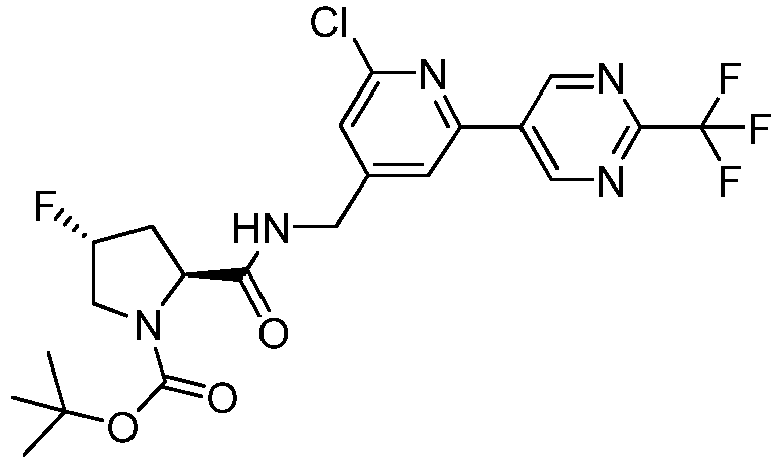
- A solution of 5-(4,4,5,5-tetramethyl-1,3,2-dioxaborolan-2-yl)-2-(trifluoromethyl)pyrimidine (0.5 equiv., 0.2295 mmol), tert-butyl (2S,4R)-2-[(2,6-dichloro-4-pyridyl)methylcarbamoyl]-4-fluoro-pyrrolidine-1-carboxylate (180 mg, 0.4589 mmol), cesium carbonate (299.1 mg, 0.07263 mL, 0.9179 mmol) and [1,1'-bis(diphenylphosphino)ferrocene]dichloropalladium(ii) dichloromethane adduct (0.10 equiv., 0.04589 mmol) in acetonitrile (3.0 mL) and water (1.5 mL) was degassed. The reaction mixture was heated at 95 °C for 2h. The reaction was filtered thru celite. The crude product was purified by flash chromatography (MeOH/DCM) to give 84mg, 36.3% yield. LCMS (ESI) m/z:504.20 [M+H]+

- To a solution of tert-butyl (2S,4R)-2-[[2-chloro-6-[2-(trifluoromethyl)pyrimidin-5-yl]-4-pyridyl]methylcarbamoyl]-4-fluoro-pyrrolidine-1-carboxylate (84 mg, 0.1667 mmol) in 1,4-dioxane (860.2 mg, 0.8335 mL, 9.763 mmol) was added hydrochloric acid (4 mol/L) in 1,4-dioxane (438 mg, 0.4167 mL, 1.667 mmol). The reaction mixture was stirred at RT 6h. The reaction was concentrated and carried to next step. LCMS (ESI) m/z:404.0 [M+H]+

- To a solution of (2S,4R)-N-[[2-chloro-6-[2-(trifluoromethyl)pyrimidin-5-yl]-4-pyridyl]methyl]-4-fluoro-pyrrolidine-2-carboxamide (B) in dichloromethane (3.3 mL) was added triethylamine (337.4 mg, 0.465 mL, 3.334 mmol) then 4-fluorobenzenesulfonyl chloride (C, 48.66 mg, 0.2500 mmol). The reaction was stirred at RT 1h. The reaction was concentrated and submitted for rHPLC 32.1mg, 34.3% yield.
1H NMR (400 MHz, DMSO) δ 9.64 - 9.57 (s, 2H), 9.11 - 9.01 (t, J = 6.0 Hz, 1H), 8.23 - 8.16 (d, J = 1.1 Hz, 1H), 8.05 - 7.97 (m, 2H), 7.70 - 7.63 (q, J = 0.9 Hz, 1H), 7.53 - 7.43 (m, 2H), 5.30 - 5.10 (d, J = 52.6 Hz, 1H), 4.59 - 4.41 (m, 2H), 4.23 - 4.13 (dd, J = 10.1, 7.1 Hz, 1H), 3.79 - 3.58 (m, 2H), 2.47 - 2.36 (m, 1H), 2.21 - 1.98 (m, 1H)., LCMS (ESI) m/z:562.2 [M+H]+ -

- Preparation of the title compound follows the same general procedure as Example 42.
1H NMR (400 MHz, DMSO) δ 9.26 - 9.20 (d, J = 1.2 Hz, 1H), 9.12 - 9.04 (m, 1H), 8.37 - 8.32 (dd, J = 7.7, 1.2 Hz, 1H), 8.17 - 8.10 (m, 1H), 8.07 - 8.00 (m, 2H), 7.73 - 7.67 (d, J = 8.2 Hz, 1H), 7.54 - 7.45 (m, 2H), 7.35 - 7.28 (m, 1H), 7.26 - 6.94 (m, 2H), 5.31 - 5.12 (d, J = 52.3 Hz, 1H), 4.60 - 4.42 (m, 2H), 4.31 - 4.21 (m, 1H), 3.79 - 3.59 (m, 2H), 2.46 - 2.31 (m, 1H), 2.23 - 2.01 (m, 1H)., LCMS (ESI) m/z:509.2 [M+H]+ -

- Preparation of the title compound follows the same general procedure as Example 42.
1H NMR (400 MHz, DMSO) δ 9.20 - 9.14 (d, J = 1.2 Hz, 1H), 9.11 - 9.04 (t, J = 6.0 Hz, 1H), 8.33 - 8.25 (m, 2H), 8.08 - 8.01 (m, 3H), 7.51 - 7.44 (m, 2H), 7.32 - 7.26 (m, 2H), 5.32 - 5.11 (d, J = 52.3 Hz, 1H), 4.50 - 4.45 (dd, J = 5.8, 3.7 Hz, 2H), 4.29 - 4.21 (m, 1H), 3.76 - 3.62 (m, 2H), 2.46 - 2.36 (m, 1H), 2.25 - 2.01 (m, 1H)., LCMS (ESI) m/z:525.2 [M+H]+ -

-

- A mixture of 5-bromo-2-chloro-3-fluoropyridine (5.00 g, 23.76 mmol, 1.000 equiv), NaI (10.68 g, 71.25 mmol, 3.0 equiv), and chlorotrimethylsilane (2.58 g, 23.748 mmol, 1.000 equiv) in CH3CN (20 mL) was stirred for 2 h at 80°C. The reaction was then quenched by water, extracted with ethyl acetate, washed with brine, dried over anhydrous sodium sulfate, and concentrated under vacuum. The residue was purified by a silica gel column eluting with ethyl acetate/petroleum ether (1:100) to afford the title compound (1.5 g, 21%) as a yellow solid.
-

- A mixture of 5-bromo-3-fluoro-2-iodopyridine (1.20 g, 3.98 mmol, 1.00 equiv), methyl 2,2-difluoro-2-(fluorosulfonyl)acetate (5.35 g, 27.85 mmol, 7.00 equiv), CuI (5.30 g, 27.83 mmol, 7.00 equiv), and DMF (20 mL) was stirred for 12 h at 70°C under nitrogen. The reaction was then quenched by water, extracted with ethyl acetate, washed with brine, dried over anhydrous sodium sulfate, and concentrated under vacuum. The residue was purified by a silica gel column eluting with ethyl acetate/petroleum ether (1:200) to afford the title compound (200 mg, 21%) as yellow oil.
-

- A mixture of 5-bromo-3-fluoro-2-(trifluoromethyl)pyridine (200.00 mg, 0.82 mmol, 1.00 equiv), 4,4,5,5-tetramethyl-2-(tetramethyl-1,3,2-dioxaborolan-2-yl)-1,3,2-dioxaborolane (312.24 mg, 1.23 mmol, 1.50 equiv), Pd(dppf)Cl2 (29.99 mg, 0.04 mmol), and KOAc (241.35 mg, 2.46 mmol, 3.00 equiv) in 1,4-dioxane (5 mL) was stirred for 3 h at 100°C under nitrogen. The reaction was then quenched by water, extracted with ethyl acetate, washed with brine, dried over anhydrous sodium sulfate, and concentrated under vacuum. This resulted in the title compound (400 mg, crude) as a black solid.
-

- A mixture of (2S,4R)-N-[(4-bromo-5-fluoropyridin-2-yl)methyl]-4-fluoro-1-[(4-fluorobenzene)sulfonyl]pyrroli-dine-2-carboxamide (150.00 mg, 0.314 mmol, 1.000 equiv), [5-fluoro-6-(trifluoromethyl)pyridin-3-yl]boronic acid (400 mg, 1.915 mmol, 3.000 equiv), Pd(dppf)Cl2 (22.95 mg, 0.031 mmol, 0.100 equiv), potassium carbonate (130.03 mg, 0.941 mmol, 3.000 equiv), and 1,4-dioxane (20 mL)/water (2 mL) was stirred for 3 h at 100°C under nitrogen. The resulting solution was diluted with ethyl acetate, washed with brine, dried over anhydrous sodium sulfate, and concentrated under vacuum. The residue was purified by a silica gel column eluting with ethyl acetate/petroleum ether (1:1) to afford the title compound (57.3 mg, 32%) as a white solid.
1H NMR (300 MHz, DMSO-d6 ) δ 9.07 - 9.03 (m, 1H), 8.89 (s, 1H), 8.74 (s, 1H), 8.40 (d, J = 11.4 Hz, 1H), 8.00 - 7.95 (m, 2H), 7.77 (d, J = 6.3 Hz, 1H), 7.48 - 7.42 (m, 2H), 5.19 (d, J = 52 Hz, 1H), 4.57 - 4.42 (m, 2H), 4.23 - 4.18 (m, 1H), 3.71 - 3.54 (m, 2H), 2.49 - 1.99 (m, 2H). -

-

- A mixture of tert-butyl 4-hydroxypiperidine-1-carboxylate (5 g, 24.84 mmol, 1.00 equiv) and HCl (saturated solution in 30 mL of 1,4-dioxane) was stirred for 2 h at room temperature. The resulting mixture was concentrated under vacuum to afford the title compound (3.4 g, 99%) as an off-white solid.
-

- Benzyl chloroformate (4.64 g, 27.199 mmol, 1.101 equiv) was added dropwise into a mixture of piperidin-4-ol hydrochloride (3.4 g, 24.71 mmol, 1.0 equiv), sodium hydroxide (2.17 g, 54.25 mmol, 2.2 equiv), and water (55 mL)/1,4-dioxane (55 mL). The resulting solution was stirred for 30 min at room temperature. The mixture was diluted with water. The pH value of the mixture was adjusted to 2 with IN HCl. The resulting solution was extracted with ethyl acetate, washed with brine, dried over anhydrous sodium sulfate, and concentrated under vacuum. The residue was purified by a silica gel column eluting with ethyl acetate/petroleum ether (1:2). This resulted in the title compound (4.4 g, 76%) as colorless oil.
-

- Sodium hydride (960 mg, 60% in mineral oil, 2.139 equiv) was added in several batches into a solution of benzyl 4-hydroxypiperidine-1-carboxylate (4.4 g, 18.70 mmol, 1.0 equiv) in N,N-dimethylformamide (50 mL) at 0°C under nitrogen. After 0.5 h at 0°C carbon disulfide (5.8 g, 76.174 mmol, 4.07 equiv) was added dropwise. The resulting mixture was stirred for 0.5 h at 0°C and CH3I (4.0 g, 28.181 mmol, 1.51 equiv) was then added dropwise. After 1h at 0°C the reaction was then quenched by water, extracted with ethyl acetate, washed with brine, dried over anhydrous sodium sulfate, and concentrated under vacuum. The residue was purified by silica gel column eluting with ethyl acetate/petroleum ether (1/10). This resulted in the title compound (3 g, 49%) as colorless oil.
-

- HF pyridine (20 g, 201.80 mmol, 21.89 equiv) and benzyl 4-[[(methylsulfanyl)methanethioyl]oxy]piperidine-1-carboxylate (3 g, 9.22 mmol, 1.0 equiv) in 10 mL of dichloromethane were added in sequentially into a mixture of 1,3-dibromo-5,5-dimethylimidazolidine-2,4-dione (7.9 g, 27.630 mmol, 2.997 equiv) in dichloromethane (100 mL) at - 78°C under nitrogen. The resulting solution was stirred for 12 h at room temperature. The reaction was then quenched by saturated sodium bicarbonate, extracted with dichloromethane, washed with brine, dried over anhydrous sodium sulfate, and concentrated under vacuum. The residue was purified by a silica gel column eluting with ethyl acetate/petroleum ether (1/10) to afford the title compound (1.5 g, 54%) as light yellow oil.
-

- A mixture of benzyl 4-(trifluoromethoxy)piperidine-1-carboxylate (1.1 g, 3.63 mmol, 1.0 equiv) and palladium on carbon (1 g, 9.397 mmol, 2.591 equiv) in methanol (50 mL) was stirred for 12 h at room temperature. The solids were filtered out and the liquid was concentrated under vacuum. The residue was dissolved with saturated solution of HCl in 1,4-dioxane and concentrated under vacuum. This resulted in the title compound (0.7 g, crude) as a light yellow solid.
-

- A mixture of 4-(trifluoromethoxy)piperidine hydrochloride (200 mg, 0.973 mmol, 1.0 equiv), potassium carbonate (410 mg, 2.967 mmol, 3.05 equiv), (2S,4R)-N-[(4-bromo-5-fluoropyridin-2-yl)methyl]-4-fluoro-1-[(4-fluorobenzene)sulfonyl]pyrrolidine-2-carboxamide (231 mg, 0.483 mmol, 0.5 equiv), Pd2(dba)3.CHCl3 (100 mg, 0.097 mmol, 0.099 equiv), and XantPhos (112 mg, 0.194 mmol, 0.2 equiv) in toluene (10 mL) was stirred for 12 h at 100°C under nitrogen. The reaction mixture was concentrated under vacuum. The residue was dissolved in water, extracted with ethyl acetate, washed with brine, dried over anhydrous sodium sulfate, and concentrated under vacuum. The residue was purified by a silica gel column eluting with ethyl acetate/petroleum ether (1/10) to afford the title compound (46.9 mg, 9%) as a white solid.
1H NMR (300 MHz, CDCl3) δ 8.87 - 8.86 (m, 1H), 8.19 - 8.18 (m, 1H), 8.00 - 7.96 (m, 2H), 7.50 - 7.44 (m, 2H), 7.01 - 6.98 (d, J = 15 Hz, 1H), 5.27 - 5.10 (d, J = 95 Hz, 1H), 4.69 - 4.63 (m, 1H), 4.35 - 4.16 (m, 3H), 3.71 - 3.53 (m, 4H), 3.21 - 3.14 (m, 2H), 2.43 - 2.36 (m, 1H), 2.28 - 2.10 (m, 1H), 2.01 - 1.97 (m, 2H), 1.79 - 1.72 (m, 2H). -
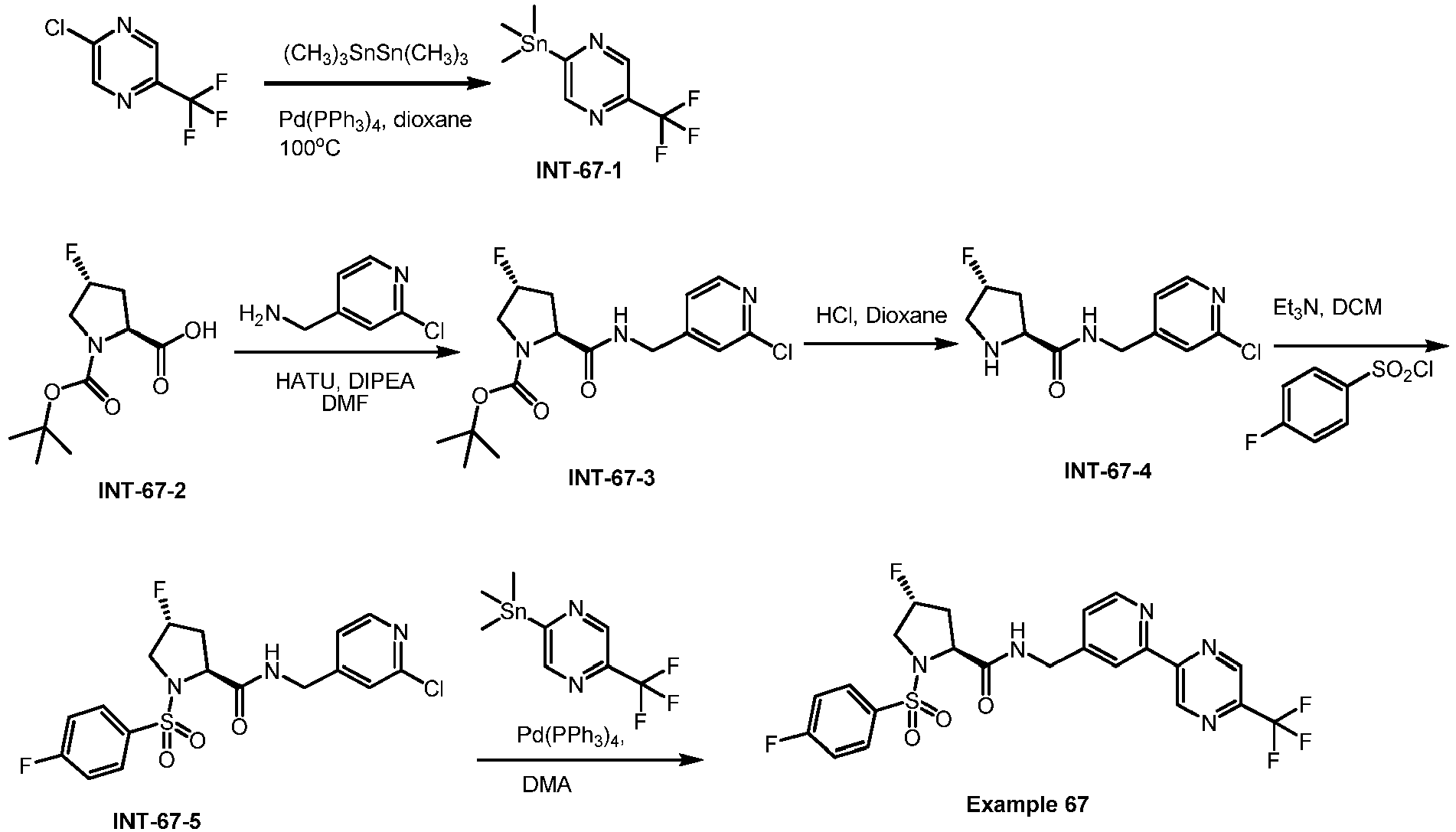
- To a pressure tube was added 2-chloro-5-(trifluoromethyl)pyrazine (200 mg, 1.1 mmol), hexamethylditin (0.281 mL 1.3 mmol), Pd(PPh3)4 (318.5 mg, 0.27 mmol) and dioxane (10 mL). The reaction mixture was purged with Nitrogen and heated at 100 °C for 1 hour. The resulting mixture was cooled to room temperature, and filtered through a thin layer of celite. The filter cake was washed with DCM. The filtrate was concentrated in vacuo to give a dark solid. The crude was stored in the refrigerator and used without further purification. (341 mg, 100%). MS-ESI: [M+H]+ 311.9
- Step 2: Following the HATU coupling procedure of Example 35, step 1: tert-butyl (2S,4R)-2-[(2-chloro-4-pyridyl)methylcarbamoyl]-4-fluoro-pyrrolidine-1-carboxylate (INT-67-3) (801 mg, 89%) was prepared from (2S,4R)-1-tert-butoxycarbonyl-4-fluoro-pyrrolidine-2-carboxylic acid (450 mg, 1.9 mmol) and (2-chloro-4-pyridyl)methanamine hydrochloride (380 mg, 2.1 mmol), DIPEA (1 mL, 6.4 mmol), HATU (898 mg, 2.3 mmol), DMF (2mL). MS-ESI: [M+H]+ 358.9
- Step 3: Following the boc removal procedure of Example 35, step 3: (2S,4R)-N-[(2-chloro-4-pyridyl)methyl]-4-fluoro-pyrrolidine-2-carboxamide (INT-67-4) (375 mg, 100%) was prepared from tert-butyl (2S,4R)-2-[(2-chloro-4-pyridyl)methylcarbamoyl]-4-fluoro-pyrrolidine-1-carboxylate (500 mg, 1.94 mmol) and 4 N HCl in dioxane (3 mL, 12.4 mmol). MS-ESI: [M+H]+ 258.9
- Step 4: Following the sulfonamide formation procedure of Example 35, step 4 : (2S,4R)-N-[(2-chloro-4-pyridyl)methyl]-4-fluoro-1-(4-fluorophenyl)sulfonyl-pyrrolidine-2-carboxamide (INT-67-5) (95 mg, 63%) was prepared from (2S,4R)-N-[(2-chloro-4-pyridyl)methyl]-4-fluoro-pyrrolidine-2-carboxamide (INT-67-4) (100 mg, 0.3 mmol), Et3N (0.8 mL, 6 mmol), 4-fluorobenzenesulfonyl chloride (70 mg, 0.36 mmol) in DCM (1 mL). MS-ESI: [M+H]+ 416.5
- Step 5: (2S,4R)-4-fluoro-1-(4-fluorophenyl)sulfonyl-N-[[2-fluoro-5-[5-(trifluoromethyl)pyrazin-2-yl]phenyl]methyl]pyrrolidine-2-carboxamide (67)
- To a pressure tube was added trimethyl-[5-(trifluoromethyl)pyrazin-2-yl]stannane (67 mg, 0.2mmol), (2S,4R)-N-[(5-chloro-2-fluoro-phenyl)methyl]-4-fluoro-1-(4-fluorophenyl)sulfonyl-pyrrolidine-2-carboxamide (50 mg, 0.11 mmol), Pd(PPh3)4 (13 mg, 0.011 mmol) and N,N-dimethylacetamide (1 mL). The reaction mixture was purged with Nitrogen and subject to microwave at 150 °C for 30 min. The resulting mixture was cooled to room temperature, and filtered through a thin layer of celite. The crude was purified with reverse phase HPLC and afforded the title compound 67 (30 mg, 53%). MS-ESI: [M+H]+ 528.5
1H NMR (400 MHz, DMSO-d6 ) δ 9.42 (d, J = 2.1 Hz, 1H), 9.29 (d, J = 1.3 Hz, 1H), 8.81 (t, J = 5.9 Hz, 1H), 8.73 (ddd, J = 8.4, 2.3, 0.9 Hz, 1H), 8.17 (d, J = 1.3 Hz, 1H), 8.11 - 7.94 (m, 3H), 7.49 - 7.19 (m, 2H), 4.67 - 4.48 (m, 2H), 4.39 (dd, J = 17.4, 5.6 Hz, 1H), 2.24 - 2.10 (m, 1H), 2.02 (td, J = 11.5, 6.5 Hz, 1H), 1.84 (ddt, J = 12.0, 6.1, 2.7 Hz, 1H), 1.71 (ddd, J = 11.8, 6.7, 2.9 Hz, 1H), 1.45 (s, 3H), 1.24 (s, 3H). -

- Preparation of the title compound follows the same general procedure as Example 55.
1H NMR (400 MHz, DMSO) δ 9.46 - 9.42 (s, 2H), 9.09 - 8.99 (t, J = 6.0 Hz, 1H), 8.04 - 7.94 (m, 2H), 7.79 - 7.72 (dt, J = 9.9, 2.1 Hz, 1H), 7.72 - 7.67 (t, J = 1.5 Hz, 1H), 7.54 - 7.45 (m, 2H), 7.38 - 7.30 (dt, J = 9.6, 1.8 Hz, 1H), 5.29 - 5.09 (m, 1H), 4.54 - 4.39 (m, 2H), 4.39 - 4.30 (d, J = 24.6 Hz, 1H), 3.73 - 3.61 (m, 1H), 3.21 - 3.11 (m, 1H), 2.22 - 2.02 (m, 2H)., LCMS (ESI) m/z:545.11 [M+H]+ -

-

- A mixture of tert-butyl 4-methylidenepiperidine-1-carboxylate (1.00 g, 5.07 mmol, 1.00 equiv), NaI (379.91 mg, 2.53 mmol, 0.50 equiv), and trimethyl(trifluoromethyl)silane (1.80 g, 12.66 mmol, 2.50 equiv) in THF (10 mL) was stirred for 12 h at 60°C under nitrogen. The reaction was then quenched by water, extracted with ethyl acetate, washed with brine, dried over anhydrous sodium sulfate, and concentrated under vacuum. The residue was purified by a silica gel column eluting with ethyl acetate/petroleum ether (1:10) to afford the title compound (1.2 g, 96%) as colorless oil.
-

- A mixture of tert-butyl 1,1-difluoro-6-azaspiro[2.5]octane-6-carboxylate (1.2 g, 4.85 mmol, 1.00 equiv) and HCl (saturated solution in 20 mL of 1,4-dioxane) was stirred for 2 h at room temperature. The resulting mixture was concentrated under vacuum to afford the title compound (800 mg, 90%) as a white solid.
-

- A mixture of (2S,4R)-N-[(4-br-omo-5-fluoropyridin-2-yl)methyl]-4-fluoro-1-[(4-fluorobenzene)sulfonyl]pyrrolidine-2-carboxamide (135.00 mg, 0.28 mmol, 1.00 equiv), 1,1-difluoro-6-azaspiro[2.5]octane hydrochloride (51.83 mg, 0.28 mmol, 1.00 equiv), Pd2(dba)3.CHCl3 (58.43 mg, 0.06 mmol, 0.20 equiv), XantPhos (65.33 mg, 0.11 mmol, 0.40 equiv), Cs2CO3 (275.90 mg, 0.85 mmol, 3.00 equiv), and toluene (5 mL) was stirred for 12 h at 110°C under nitrogen. The reaction was quenched by water, extracted with ethyl acetate, washed with brine, dried over anhydrous sodium sulfate, and concentrated under vacuum. The residue was purified by a silica gel column eluting with ethyl acetate/petroleum ether (2:1). The crude product was re-purified by Prep-HPLC to afford the title compound (26.5 mg, 17%) as a white solid.
1H NMR (400 MHz, CDCl3) δ 8.15 - 8.13 (m, 1H), 7.89 - 7.86 (m, 2H), 7.54 (s, 1H), 7.26 - 7.19 (m, 2H), 5.87 (d, J = 57.2 Hz, 1H), 5.05 (d, J = 52 Hz, 1H), 4.66 - 4.60 (m, 1H), 4.37 - 4.43 (m, 1H), 4.29 - 4.25 (m, 1H), 3.88 - 3.64 (m, 2H), 3.49 - 3.42 (m, 2H), 3.34 - 3.28 (m, 2H), 2.60 - 2.45 (m, 1H), 2.31 - 2.11 (m, 1H), 1.79 - 1.74 (m, 4H), 1.16 - 1.12 (m, 2H). -

-
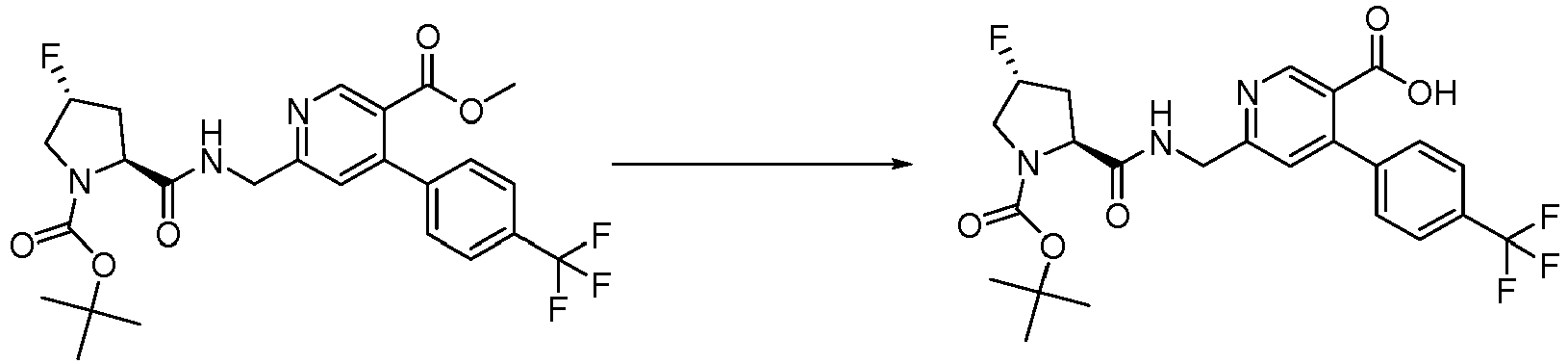
- A mixture of methyl 6-([[(2S,4R)-1-[(tert-butoxy)carbonyl]-4-fluoropyrrolidin-2-yl]formamido]methyl)-4-[4-(trifluoromethyl)phenyl]pyridine-3-carboxylate (1.4 g, 2.66 mmol, 1.00 equiv) in tetrahydrofuran (20 mL)/water(2 mL) and LiOH (96 mg, 4.01 mmol, 1.50 equiv) in water (2 mL) was stirred for 14 h at room temperature. The reaction was diluted with water and the pH value of the solution was adjusted to 7 with citric acid. The resulting solution was extracted with dichloromethane and concentrated under vacuum. This resulted in the title compound (405mg, 30%) as a yellow solid.
-

- A mixture of 6-([[(2S,4R)-1-[(tert-butoxy)carbonyl]-4-fluoropyrrolidin-2-yl]formamido]methyl)-4-[4-(trifluoromethyl)phenyl]pyridine-3-carboxylic acid (405 mg, 0.79 mmol, 1.00 equiv), NH4Cl (51 mg, 0.95 mmol, 1.20 equiv), HATU (361 mg, 0.95 mmol, 1.20 equiv), DIEA (307 mg, 2.38 mmol, 3.00 equiv) in tetrahydrofuran (20 mL) was stirred for 14 h at room temperature. The reaction was quenched by water, extracted with ethyl acetate, and concentrated under vacuum. The residue was purified by a silica gel column eluting with ethyl acetate/petroleum ether(3:1) to afford the title compound (190mg, 47%) as an off-white solid.
-

- A solution of tert-butyl (2S,4R)-2-[([5-carbamoyl-4-[4-(trifluoromethyl)phenyl]pyridin-2-yl]methyl)carbamoyl]-4-fluoropyrrolidine-1-carboxylate (190 mg, 0.37 mmol, 1.00 equiv), TFAA (157 mg, 0.75 mmol, 2.00 equiv), and TEA (37 mg, 0.37 mmol, 1.00 equiv) in dichloromethane (5 mL) was stirred for 30 seconds at room temperature. The reaction was then quenched by water, extracted with dichloromethane, washed with brine, and concentrated under vacuum. This resulted in the crude product (200mg) as a yellow solid which was used for the next step without any further purification.
-
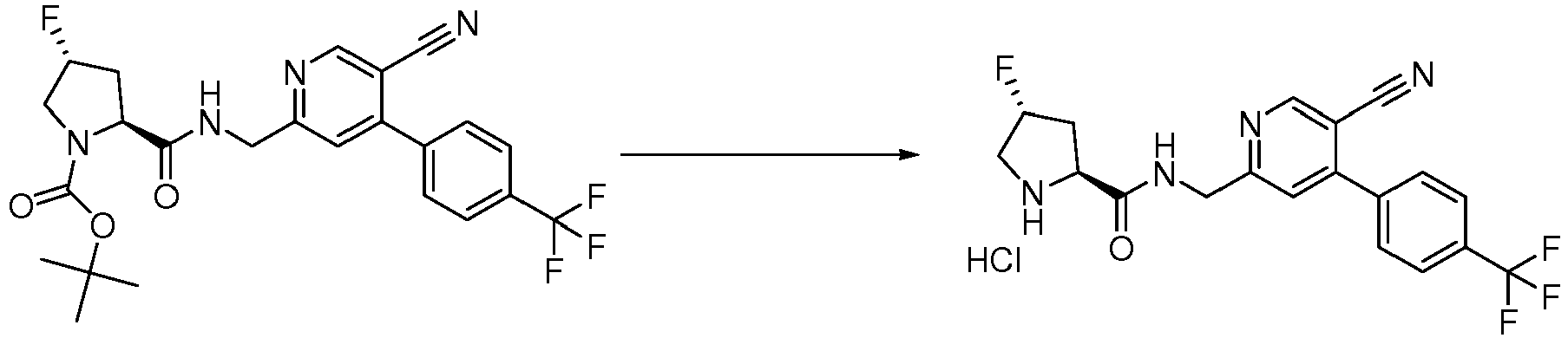
- A mixture of tert-butyl (2S,4R)-2-[([5-cyano-4-[4-(trifluoromethyl)phenyl]pyridin-2-yl]methyl)carbamoyl]-4-fluoropyrrolidine-1-carboxylate (200 mg, 0.41 mmol, 1.00 equiv) and TFA (1 mL, 13.46 mmol, 33.20 equiv) in. dichloromethane (2 mL) was stirred for 2 min at room temperature. The reaction mixture was concentrated under vacuum. The residue was diluted with 2 mL of hydrogen chloride (6M) and concentrated under vacuum. The resulting solid washed with 2x20 mL of hexane to give the title compound as a crude product.
-

- A mixture of 4-fluorobenzene-1-sulfonyl chloride (47.5 mg, 0.24 mmol, 1.20 equiv), (2S,4R)-N-([5-cyano-4-[4-(trifluoromethyl)phenyl]pyridin-2-yl]methyl)-4-fluoropyrrolidine-2-carboxamide (80 mg, 0.10 mmol, 1.00 equiv, 50%), and TEA (62 mg, 0.61 mmol, 3.00 equiv) in dichloromethane (5 mL) was stirred for 1 h at room temperature. The reaction was quenched by water, extracted with dichloromethane, and concentrated under vacuum. The residue was purified by a silica gel column eluting with ethyl acetate/petroleum ether (1:1) to afford the title compound (15.8 mg, 28%) as a white solid.
1H NMR (400 MHz, CDCl3) δ 8.94 (s, 1H), 7.88 - 7.85 (m, 2H), 7.81 - 7.77 (m, 4H), 7.66 - 7.63 (m, 2H), 7.30 - 7.20 (m, 2H), 5.12 - 4.99 (d, J = 51.2 Hz, 1H), 4.95 - 24.89 (dd, J = 8.0 Hz, J = 6.8 Hz, 1H), 4.67 - 4.61 (dd, J = 4.8 Hz, J = 5.2 Hz, 1H), 4.30 - 4.25 (t, J = 8.8 Hz, 1H), 3.93 - 3.84 (m, 1H), 3.75 - 3.64 (m, 1H), 2.60 - 2.50 (m, 1H), 2.32 - 2.00 (m, 1H). -

-

- n-BuLi (8.8 mL, 2.5 M in hexanes, 2.00 equiv) was added dropwise into a solution of bis(propan-2-yl)amine (2.02 g, 19.96 mmol, 2.00 equiv) in 30 mL of dry THF at -78°C under nitrogen. The mixture was warmed to -30°C and stirred for 30 min. A solution of 6-chloropyridine-3-carboxylic acid (1.58 g, 10.03 mmol, 1.00 equiv) in tetrahydrofuran (10 mL) was added dropwise at -78°C. After 1 h I2 (3.07 g, 12.10 mmol, 1.20 equiv) was added at 0°C. After 30 minutes the reaction mixture was diluted with water, extracted with ethyl acetate, washed with brine, dried over anhydrous sodium sulfate, and concentrated under vacuum. The residue was purified by a silica gel column eluting with ethyl acetate/petroleum ether (1/1) to afford the title compound (1.2 g, 42%) as a yellow solid.
-

- A mixture of 6-chloro-4-iodopyridine-3-carboxylic acid (5 g, 17.64 mmol, 1.00 equiv) in dioxane (100 mL), [6-(trifluoromethyl)pyridin-3-yl]boronic acid (3.17 g, 16.60 mmol, 0.90 equiv), potassium carbonate (6.9 g, 49.93 mmol, 2.80 equiv), Pd(dppf)Cl2 (1g, 1.37 mmol), and water (20 mL) was stirred for 5 h at 80°C under nitrogen. The reaction mixture was diluted with water, extracted with ethyl acetate, washed with brine, dried over anhydrous sodium sulfate, and concentrated under vacuum. The residue was purified by a silica gel column eluting with ethyl acetate/petroleum ether (1/1). This resulted in the title compound (8.7 g) as a yellow solid.
-

- A mixture of 6-chloro-4-[6-(trifluoromethyl)pyridin-3-yl]pyridine-3-carboxylic acid (8.5 g, 28.09 mmol, 1.00 equiv) and thionyl chloride (10 mL, 137.85 mmol, 4.90 equiv) in dichloromethane (50 mL) was stirred for 1 hour at room temperature. The mixture was concentrated under vacuum and the residue was dissolved in methanol (10 mL) and stirred for 30 min. The resulting mixture was concentrated under vacuum. The residue was purified by a silica gel column eluting with ethyl acetate/petroleum ether (1/4) to afford the title compound (2.6 g, 29%) as a yellow solid.
-

- A mixture of methyl 6-chloro-4-[6-(trifluoromethyl)pyridin-3-yl]pyridine-3-carboxylate (1.0 g, 3.16 mmol, 1.00 equiv) in N,N-dimethylformamide (10 mL), Zn(CN)2 (444 mg, 3.78 mmol, 1.20 equiv), Pd2(dba)3 (200 mg, 0.22 mmol), and dppf (400 mg, 0.72 mmol, 0.20 equiv) was stirred for 3 h at 100°C under nitrogen. The reaction mixture was diluted with water, extracted with ethyl acetate, washed with brine, dried over anhydrous sodium sulfate, and concentrated under vacuum. The residue was purified by a silica gel column eluting with ethyl acetate/petroleum ether (1/1) to afford the title compound (750 mg, 77%) as a yellow solid.
-

- A mixture of methyl 6-cyano-4-[6-(trifluoromethyl)pyridin-3-yl]pyridine-3-carboxylate (750 mg, 2.44 mmol, 1.00 equiv) in methanol (50 mL), conc. HCl (1 mL), and palladium on carbon (750 mg, 7.05 mmol, 2.90 equiv) was stirred for 1 h at room temperature under hydrogen. The solids were filtered out and the liquid was concentrated under vacuum. This resulted in the title compound (700 mg, 92.3%) as a yellow solid.
-

- A mixture of methyl 6-(aminomethyl)-4-[6-(trifluoromethyl)pyridin-3-yl]pyridine-3-carboxylate hydrochloride (700 mg, 2.25 mmol, 1.00 equiv) in tetrahydrofuran (50 mL), (2S,4R)-1-[(tert-butoxy)carbonyl]-4-fluoropyrrolidine-2-carboxylic acid (629 mg, 2.70 mmol, 1.20 equiv), HATU (1.28 g, 3.37 mmol, 1.50 equiv), and DIPEA (870 mg, 6.73 mmol, 3.00 equiv) was stirred for 16 h at room temperature. The reaction mixture was diluted with water, extracted with ethyl acetate, washed with brine, dried over anhydrous sodium sulfate, and concentrated under vacuum. The residue was purified by a silica gel column eluting with ethyl acetate/petroleum ether (1/1) to afford the title compound (650 mg, 55%) as a yellow solid.
-

- A mixture of methyl 6-([[(2S,4R)-1-[(tert-butoxy)carbonyl]-4-fluoropyrrolidin-2-yl]formamido]methyl)-4-[6-(trifluoromethyl)pyridin-3-yl]pyridine-3-carboxylate (600 mg, 1.14 mmol, 1.00 equiv) in tetrahydrofuran (20 mL), LiOH (96 mg, 4.01 mmol, 3.50 equiv), and water (20 mL) was stirred for 16 h at room temperature. The pH value of the solution was adjusted to 5 with citric acid. The resulting solution was extracted with ethyl acetate. The combined extracts were washed with brine, dried over anhydrous sodium sulfate, and concentrated under vacuum. This resulted in the title compound (480 mg, 82%) as a white solid.
-

- A mixture of 6-([[(2S,4R)-1-[(tert-butoxy)carbonyl]-4-fluoropyrrolidin-2-yl]formamido]methyl)-4-[6-(trifluoromethyl)pyridin-3-yl]pyridine-3-carboxylic acid (480 mg, 0.94 mmol, 1.00 equiv) in tetrahydrofuran (50 mL), NH4Cl (496 mg, 9.27 mmol, 9.90 equiv), HATU (714 mg, 1.88 mmol, 2.00 equiv), and DIPEA (606 mg, 4.69 mmol, 5.00 equiv) was stirred for 16 h at room temperature. The reaction mixture was diluted with water, extracted with ethyl acetate, washed with brine, dried over anhydrous sodium sulfate, and concentrated under vacuum. This resulted in the title compound (450 mg, 94%) as a white solid.
-

- A mixture of tert-butyl (2S,4R)-2-[([5-carbamoyl-4-[6-(trifluoromethyl)pyridin-3-yl]pyridin-2-yl]methyl)carbamoyl]-4-fluoropyrrolidine-1-carboxylate (450 mg, 0.88 mmol, 1.00 equiv) in dichloromethane (5 mL), TFAA (370 mg, 1.76 mmol, 2.00 equiv), and TEA (133 mg, 1.31 mmol, 1.50 equiv) was stirred for 30 min at room temperature. The reaction mixture was diluted with water, extracted with ethyl acetate, washed with brine, dried over anhydrous sodium sulfate, and concentrated under vacuum. The residue was purified by silica gel chromatography eluting with petroleum ether/ethyl acetate (2/1). This resulted in the title compound (410 mg, 94%) as a yellow solid.
-

- A mixture of tert-butyl (2S,4R)-2-[([5-cyano-4-[6-(trifluoromethyl)pyridin-3-yl]pyridin-2-yl]methyl)carbamoyl]-4-fluoropyrrolidine-1-carboxylate (410 mg, 0.83 mmol, 1.00 equiv) and HCl (saturated solution in 50 mL of 1,4-dioxane) was stirred for 3 h at room temperature. The resulting mixture was concentrated under vacuum. This resulted in the title compound (300 mg, 84%) as a yellow solid.
-

- A mixture of (2S,4R)-N-([5-cyano-4-[6-(trifluoromethyl)pyridin-3-yl]pyridin-2-yl]methyl)-4-fluoropyrrolidine-2-carboxamide hydrochloride (300 mg, 0.70 mmol, 1.00 equiv) in dichloromethane (20 mL), TEA (282 mg, 2.79 mmol, 4.00 equiv), and 4-fluorobenzene-1-sulfonyl chloride (204 mg, 1.05 mmol, 1.50 equiv) was stirred for 16 h at room temperature. The reaction mixture was diluted with water, extracted with ethyl acetate, washed with brine, dried over anhydrous sodium sulfate, and concentrated under vacuum. The crude product was purified by silica gel chromatography eluting with ethyl acetate/petroleum ether (1/1). This resulted in the title compound (41.1 mg, 11%) as a white solid.
1H NMR (300 MHz, DMSO-d6 ) δ 9.17 - 9.04 (m, 3H), 8.43 - 8.40 (m, 1H), 8.15 (d, J = 8.1 Hz, 1H), 7.97 - 7.83 (m, 2H), 7.83 (s, 1H), 7.44 (t, J = 9.0 Hz, 2H), 5.28 - 5.10 (d, J = 52.2 Hz, 1H), 4.60 - 4.58 (d, J = 6.6 Hz, 2H), 4.23 - 4.17(m, 1H), 3.71 - 3.63 (m, 2H), 2.73 - 2.08 (m, 2H). -

- Preparation of the title compound follows the same general procedure as Example 55.
1H NMR (400 MHz, DMSO) δ 9.15 - 9.10 (dt, J = 2.0, 1.0 Hz, 1H), 9.11 - 9.04 (t, J = 6.0 Hz, 1H), 8.73 - 8.69 (dd, J = 5.0, 0.9 Hz, 1H), 8.42 - 8.36 (m, 1H), 8.36 - 8.29 (m, 1H), 8.07 - 8.01 (m, 2H), 8.01 - 7.95 (m, 2H), 7.52 - 7.43 (m, 2H), 5.27 - 5.08 (m, 1H), 4.61 - 4.49 (m, 2H), 4.49 - 4.38 (d, J = 24.1 Hz, 1H), 3.73 - 3.60 (t, J = 9.1 Hz, 1H), 3.25 - 3.14 (td, J = 9.2, 7.0 Hz, 1H), 2.30 - 2.06 (m, 2H)., LCMS (ESI) m/z:527.12 [M+H]+ -

- Preparation of the title compound follows the same general procedure as Example 48.
1H NMR (400 MHz, DMSO) δ 9.69 - 9.63 (s, 2H), 9.05 - 8.97 (t, J = 6.0 Hz, 1H), 8.78 - 8.72 (dd, J = 5.1, 0.7 Hz, 1H), 8.20 - 8.16 (dd, J = 1.5, 0.7 Hz, 1H), 8.05 - 7.97 (m, 2H), 7.54 - 7.43 (m, 3H), 5.30 - 5.11 (d, J = 52.3 Hz, 1H), 4.59 - 4.40 (m, 2H), 4.25 - 4.15 (dd, J = 10.0, 7.1 Hz, 1H), 3.79 - 3.59 (m, 2H), 2.47 - 2.37 (m, 1H), 2.21 - 2.00 (m, 1H)., LCMS (ESI) m/z:528.11 [M+H]+ -

- The reaction was carried out on the H-Cube with Rh/C 1.0mL/min, 80bar, 100°C in acetic acid. LCMS showed 50% of desired product. The reaction was concentrated and purified by flash chromatography (EtOAc then MeOH/DCM eluted at 8%MeOH). The product was submitted for rHPLC to give 12.3mg, 9.358% yield.
1H NMR (400 MHz, DMSO) δ 8.84 - 8.76 (t, J = 6.0 Hz, 1H), 8.01 - 7.92 (m, 2H), 7.51 - 7.40 (m, 2H), 7.20 - 7.14 (d, J = 1.8 Hz, 1H), 7.12 - 6.96 (m, 2H), 5.29 - 5.08 (d, J = 52.6 Hz, 1H), 4.44 - 4.27 (m, 2H), 4.22 - 4.11 (m, 1H), 3.79 - 3.55 (m, 3H), 3.05 - 2.84 (m, 2H), 2.46 - 2.28 (m, 2H), 2.17 - 1.94 (dt, J = 43.0, 11.0 Hz, 1H), 1.86 - 1.63 (m, 4H)., LCMS (ESI) m/z:550.16 [M+H]+ -

- Preparation of the title compound follows the same general procedure as Example 48.
1H NMR (400 MHz, DMSO) δ 8.95 - 8.84 (m, 2H), 8.22 - 8.15 (m, 1H), 8.13 - 8.06 (m, 1H), 8.03 - 7.94 (m, 3H), 7.88 - 7.79 (ddd, J = 10.1, 2.5, 1.5 Hz, 1H), 7.52 - 7.41 (m, 2H), 7.35 - 7.04 (m, 2H), 5.31 - 5.10 (d, J = 52.5 Hz, 1H), 4.55 - 4.38 (m, 2H), 4.25 - 4.15 (dd, J = 9.8, 7.2 Hz, 1H), 3.78 - 3.57 (m, 2H), 2.47 - 2.28 (m, 1H), 2.20 - 1.98 (m, 1H)., LCMS (ESI) m/z:526.12 [M+H]+ -

-

- A mixture of (2S,4R)-N-[(3-bromo-5-fluorophenyl)methyl]-4-fluoro-1-[(4-fluorobenzene)sulfonyl]pyrrolidine-2-carboxamide (150 mg, 0.31 mmol, 1.00 equiv) in dioxane (20 mL), 2-(difluoromethoxy)-5-(tetramethyl-1,3,2-dioxaborolan-2-yl)pyridine (94 mg, 0.35 mmol, 1.10 equiv), potassium carbonate (174 mg, 1.26 mmol, 4.00 equiv) in water(4 mL), and Pd(dppf)Cl2 (46 mg, 0.06 mmol, 0.20 equiv) was stirred for 6 h at 60°C under nitrogen. The solids were filtered out. The liquid was diluted with ethyl acetate, washed with brine, dried over anhydrous sodium sulfate and concentrated under vacuum. The residue was purified by Prep-HPLC to afford the title compound (47.4 mg, 28%) as a white solid.
1H NMR (400 MHz, CD3OD) δ 8.55 (s, 1H), 8.21 - 8.18 (m, 1H), 8.00 - 7.97 (m, 2H), 7.56 (s, 1H), 7.41 (s, 1H), 7.36 - 7.32 (m, 3H), 7.20 - 7.18 (m, 1H), 7.05 - 7.03 (m, 1H), 5.21 - 5.10 (d, J = 52 Hz, 1H), 4.55 (s, 2H), 4.28 - 4.23 (m, 1H), 3.85 - 3.69 (m, 2H), 2.51 - 2.49 (m, 1H), 2.21 -2.06 (m, 1H). -

-

- A mixture of 1-(difluoromethoxy)-4-iodobenzene (1.35 g, 5.00 mmol, 1.00 equiv), 4,4,5,5-tetramethyl-2-(tetramethyl-1,3,2-dioxaborolan-2-yl)-1,3,2-dioxaborolane (1.413 g, 5.56 mmol, 1.10 equiv), AcOK (1.47 g, 14.98 mmol, 3.00 equiv), and Pd(dppf)Cl2 (186 mg, 0.25 mmol, 0.05 equiv) in dioxane (30 mL)/ water(3 mL) was stirred for 2 h at 95°C under nitrogen. The mixture was diluted with water and extracted with ethyl acetate. The combined extracts were washed with brine, dried over anhydrous sodium sulfate, and concentrated under vacuum. The residue was purified by a silica gel column eluting with ethyl acetate/petroleum ether (1:50) to afford the title compound (660 mg, 49%) as colorless oil.
-

- A mixture of 2-[4-(difluoromethoxy)phenyl]-4,4,5,5-tetramethyl-1,3,2-dioxaborolane (600 mg, 2.22 mmol, 1.00 equiv), 2-chloro-5-fluoro-4-iodopyridine (682.7 mg, 2.65 mmol, 1.20 equiv), potassium carbonate (910 mg, 6.58 mmol, 3.00 equiv), and Pd(dppf)Cl2 (82.7 mg, 0.11 mmol, 0.05 equiv) in dioxane (20 mL)/water(2 mL) was stirred for 12 h at 75°C under nitrogen. The mixture was diluted with water and extracted with ethyl acetate. The combined extracts were washed with brine, dried over anhydrous sodium sulfate, and concentrated under vacuum. The residue was purified by a silica gel column eluting with ethyl acetate/petroleum ether (1:80). This resulted in the title compound (410 mg, 67%) as a white solid.
-

- A mixture of 2-chloro-4-[4-(difluoromethoxy)phenyl]-5-fluoropyridine (370 mg, 1.35 mmol, 1.00 equiv), Zn(CN)2 (208.7 mg, 1.78 mmol, 1.50 equiv), dppf (65.8 mg, 0.12 mmol, 0.10 equiv), and Pd2(dba)3CHCl3 (61.5 mg, 0.06 mmol, 0.05 equiv) in N,N-dimethylformamide (10 ml) was irradiated with microwave radiation for 2 h at 120°C under nitrogen. The mixture was diluted with water and extracted with ethyl acetate. The combined extracts were washed with brine, dried over anhydrous sodium sulfate, and concentrated under vacuum. The residue was purified by a silica gel column eluting with ethyl acetate/petroleum ether (1:12) to afford the title compound (330 mg, 92%) as an off-white solid.
-

- A mixture of 4-[4-(difluoromethoxy)phenyl]-5-fluoropyridine-2-carbonitrile (300 mg, 1.14 mmol, 1.00 equiv), concentrated hydrogen chloride (0.05 mL), palladium on carbon (600 mg) in methanol (30 mL) was stirred for 5 min at room temperature under hydrogen. The solids were filtered out and the filtrate was concentrated under vacuum. This resulted in the title compound (310mg) as a light yellow solid.
-

- A mixture of (2S,4R)-1-[(tert-butoxy)carbonyl]-4-fluoropyrrolidine-2-carboxylic acid (359 mg, 1.54 mmol, 1.33 equiv), HATU (643.7 mg, 1.69 mmol, 1.46 equiv), DIEA (595.9 mg, 4.61 mmol, 4.00 equiv), and [4-[4-(difluoromethoxy)phenyl]-5-fluoropyridin-2-yl]methanamine hydrochloride (310 mg, 1.16 mmol, 1.00 equiv) in N,N-dimethylformamide (15 mL) was stirred for 2 h at room temperature. The mixture was diluted with water and extracted with ethyl acetate. The combined extracts were washed with brine, dried over anhydrous sodium sulfate, and concentrated under vacuum. The residue was purified by a silica gel column eluting with ethyl acetate/petroleum ether (1:3) to afford the title compound (310 mg, 55%) as orange oil.
-

- A mixture of tert-butyl (2S,4R)-2-[([4-[4-(difluoromethoxy)phenyl]-5-fluoropyridin-2-yl]methyl)carbamoyl]-4-fluoropyrrolidine-1-carboxylate (310 mg, 0.64 mmol, 1.00 equiv), and saturated hydrogen chloride in dioxane (15 mL) was stirred for 12 h at room temperature. The reaction mixture was concentrated under vacuum to afford the title compound (255 mg, 95%) as a pink solid.
-

- A mixture of 4-fluorobenzene-1-sulfonyl chloride (255 mg, 1.31 mmol, 1.00 equiv), (2S,4R)-N-([4-[4-(difluoromethoxy)phenyl]-5-fluoropyridin-2-yl]methyl)-4-fluoropyrrolidine-2-carboxamide hydrochloride (130.2 mg, 0.31 mmol, 1.10 equiv), TEA (184.8 mg, 1.83 mmol, 3.00 equiv), and 4-dimethylaminopyridine (7.44 mg, 0.06 mmol, 0.10 equiv) in dichloromethane (5 mL) was stirred for 2 h at room temperature. The mixture was diluted with water and extracted with ethyl acetate. The combined extracts were washed with brine, dried over anhydrous sodium sulfate, and concentrated under vacuum. The residue was purified by a silica gel column eluting with ethyl acetate/petroleum ether (1:4). This resulted in the title compound (108.2 mg, 15%) as an off-white solid.
1H NMR (300 MHz, CD3OD) δ 8.46 (s, 1H), 8.00 - 7.96 (m, 2H), 7.82 - 7.79 (m, 3H), 7.36 - 7.22 (m, 3H), 7.16 - 6.67 (t, J = 73.8 Hz, 1H), 5.22 - 5.05 (d, J = 51.6 Hz, 1H), 4.60 (s, 1H), 4.29 - 4.23 (m, 1H), 3.84 - 3.66 (m, 2H), 2.51 - 2.43 (m, 1H), 2.29 - 2.11 (m, 1H). -

-

- A mixture of methyl 4,6-dichloropyridine-3-carboxylate (10 g, 48.54 mmol, 2.00 equiv), [4-(trifluoromethyl)phenyl]boronic acid (4.6 g, 24.22 mmol, 1.00 equiv), Pd(dppf)Cl2 (800 mg, 1.09 mmol, 0.05 equiv), and potassium carbonate (10 g, 72.36 mmol, 3.00 equiv) in 1,4-dioxane (100 mL)/water (10 mL) was stirred for 3 h at 70°C under nitrogen. The reaction was then quenched by iced water, extracted with ethyl acetate, washed with brine, and concentrated under vacuum. The residue was purified by a silica gel column eluting with ethyl acetate/petroleum ether (1:10) to afford the title compound (5.6 g , 73%) of as a white solid.
-

- Into a 30-mL sealed tube was placed methyl 4-chloro-6-[4-(trifluoromethyl)phenyl]pyridine-3-carboxylate (2g, 6.34 mmol, 1.00 equiv), Zn(CN)2 (740 mg, 6.30 mmol, 1.00 equiv), Pd2(dba)3.CHCl3 (320 mg, 0.31 mmol, 0.05 equiv), and dppf (350 mg, 0.63 mmol, 0.10 equiv) in N,N-dimethylformamide (10 mL). The reaction mixture was irradiated with microwave for 90 min at 110°C. The reaction was then quenched by water, extracted with ethyl acetate, washed with brine, and concentrated under vacuum. The residue was purified by a silica gel column eluting with ethyl acetate/petroleum ether (1:10) to afford the title compound (0.8 g , 41%) as a yellow solid.
-

- Into a 100-mL round-bottom flask was placed with methyl 4-cyano-6-[4-(trifluoromethyl)phenyl]pyridine-3-carboxylate (150 mg, 0.49 mmol, 1.00 equiv), palladium on carbon (10 mg), methanol (10 mL), and concentrated hydrogen chloride (0.1 mL). The resulting solution was maintained with an atmosphere of H2 and stirred for 1 h at room temperature. The solids were filtered out and the solution was concentrated under vacuum to afford the title compound (147 mg, 87%) as a yellow solid.
-

- A solution of (2S,4R)-1-[(tert-butoxy)carbonyl]-4-fluoropyrrolidine-2-carboxylic acid (67 mg, 0.29 mmol, 1.00 equiv), methyl 4-(aminomethyl)-6-[4-(trifluoromethyl)phenyl]pyridine-3-carboxylate hydrochloride (100 mg, 0.29 mmol, 1.00 equiv), HATU (131 mg, 0.34 mmol, 1.20 equiv), and DIEA (111 mg, 0.86 mmol, 3.00 equiv) in tetrahydrofuran (5 mL) was stirred for 14 h at room temperature. The reaction was then quenched by water, extracted with ethyl acetate, and concentrated under vacuum. The residue was purified by a silica gel column eluting with ethyl acetate/petroleum ether (2:1) to afford the title compound (100 mg, 66%) as a white solid.
-

- LiOH (46 mg, 1.92 mmol, 2.00 equiv) in water (2 mL) was added dropwise into a stirred solution of methyl 4-([[(2S,4R)-1-[(tert-butoxy)carbonyl]-4-fluoropyrrolidin-2-yl]formamido]methyl)-6-[4-(trifluoromethyl)phenyl]pyridine-3-carboxylate(500mg, 0.95 mmol, 1.00 equiv) in tetrahydrofuran (10 mL) at 0°C. After being stirred for 14 h at room temperature the reaction was then quenched by water and extracted with ethyl acetate. The aqueous layers were combined and the pH value of the solution was adjusted to 7 with aqueous citric acid. The resulting solution was extracted with 2x100 mL of ethyl acetate and the organic layers were combined and concentrated under vacuum. This resulted in to the title compound (396 mg, 81%) as a yellow solid.
-

- A mixture of 4-([[(2S,4R)-1-[(tert-butoxy)carbonyl]-4-fluoropyrrolidin-2-yl]formamido]methyl)-6-[4-(trifluoromethyl)phenyl]pyridine-3-carboxylic acid (336 mg, 0.66 mmol, 1.00 equiv), NH4Cl (42 mg, 0.79 mmol, 1.20 equiv), HATU (299 mg, 0.79 mmol, 1.20 equiv), and DIEA (254 mg, 1.97 mmol, 3.00 equiv) in tetrahydrofuran (10 mL) was stirred for 2.5 h at room temperature. The reaction was then quenched by water, extracted with ethyl acetate, and concentrated under vacuum. The residue was purified by a silica gel column eluting with ethyl acetate/petroleum ether (2:1) to afford the title compound (130 mg, 39%) as a yellow solid.
-

- A solution of tert-butyl (2S,4R)-2-[([5-carbamoyl-2-[4-(trifluoromethyl)phenyl]pyridin-4-yl]methyl)carbamoyl]-4-fluoropyrrolidine-1-carboxylate (130 mg, 0.25 mmol, 1.00 equiv), TFAA (107 mg, 0.51 mmol, 2.00 equiv), and TEA (38 mg, 0.38 mmol, 1.50 equiv) in dichloromethane (2 mL) was stirred for 3 h at room temperature. The reaction was then quenched by water, extracted with ethyl acetate, and concentrated under vacuum. The residue was purified by a silica gel column eluting with ethyl acetate/petroleum ether. This resulted in the title compound (74 mg, 59%) as a yellow solid.
-

- A solution of tert-butyl (2S,4R)-2-[([5-cyano-2-[4-(trifluoromethyl)phenyl]pyridin-4-yl]methyl)carbamoyl]-4-fluoropyrrolidine-1-carboxylate (74 mg, 0.15 mmol, 1.00 equiv), and TFA (2 mL, 26.93 mmol, 179.20 equiv) in dichloromethane (4 mL) was stirred for 1 h at room temperature. The reaction mixture was concentrated under vacuum. The residue was mixed with 0.5 mL of hydrogen chloride (6M) and concentrated under vacuum. This resulted in the title compound (56mg, 87%) as a white solid.
-

- A mixture of 4-fluorobenzene-1-sulfonyl chloride (31 mg, 0.16 mmol, 1.20 equiv), (2S,4R)-N-([5-cyano-2-[4-(trifluoromethyl)phenyl]pyridin-4-yl]methyl)-4-fluoropyrrolidine-2-carboxamide hydrochloride (56 mg, 0.13 mmol, 1.00 equiv), and TEA (40 mg, 0.40 mmol, 3.00 equiv) in dichloromethane (2 mL) was stirred for 14 h at room temperature. The reaction was then quenched by water, extracted with DCM, and concentrated under vacuum. The residue was purified by a silica gel column eluting with ethyl acetate/petroleum ether (1:1) to afford the title compound (25.4 mg, 35%) as a light yellow solid.
1H NMR (400 MHz, CDCl3) δ 8.91 (s, 1H), 8.3 1- 8.28 (d, J = 8.4 Hz, 2H), 8.15 (s, 1H), 7.92 -7.88 (m, 2H), 7.73 - 7.70 (d, J = 8.4 Hz, 2H), 7.50 - 7.46 (m, 1H), 7.28 - 7.26 (d, J = 6.6 Hz, 1H), 7.22 (s, 1H), 5.15 - 4.96 (m, 2H), 4.68 - 4.57 (d, J = 11.2 Hz, 1H), 4.34 - 4.28 (t, J = 8.7 Hz, 1H), 3.97 - 3.61 (m, 2H), 2.61 - 2.53 (m, 1H), 2.35 - 2.12 (m, 1H). -

-

- A mixture of methyl 4,6-dichloropyridine-3-carboxylate (5.5 g, 26.70 mmol, 2.00 equiv), [6-(trifluoromethyl)pyridin-3-yl]boronic acid (2.5 g, 13.09 mmol, 1.00 equiv), Pd(dppf)Cl2 (480 mg, 0.66 mmol,0.05 equiv), and potassium carbonate (5.5 g, 39.80 mmol, 3.00 equiv) in 1,4-dioxane (100 mL)/water (10 mL) was stirred for 3 h at 70°C. The reaction was then quenched by water, extracted with ethyl acetate, washed with brine, and concentrated under vacuum. The residue was purified by a silica gel column eluting with ethyl acetate/petroleum ether (1:3). This resulted in the title compound (2.0g, 48%) as an off-white solid.
-

- Into a 30-mL sealed tube purged and maintained with an inert atmosphere of nitrogen was placed methyl 4-chloro-6-[6-(trifluoromethyl)pyridin-3-yl]pyridine-3-carboxylate (400 mg, 1.26 mmol, 1.00 equiv), Zn(CN)2 (148 mg, 1.26 mmol, 1.00 equiv), Pd2(dba)3CHCl3 (131 mg, 0.13 mmol, 0.10 equiv), and dppf (140 mg, 0.25 mmol, 0.20 equiv) in N,N-dimethylformamide (8 mL). The reaction mixture was irradiated with microwave for 90 min at 105°C. The reaction was then quenched by water, extracted with 2x50 mL of ethyl acetate, and concentrated under vacuum. The residue was purified by a silica gel column eluting with ethyl acetate/petroleum ether (1:10). This resulted in the title compound (342 mg, 88%) as a yellow solid.
-

- A suspension of methyl 4-cyano-6-[6-(trifluoromethyl)pyridin-3-yl]pyridine-3-carboxylate (200 mg, 0.65 mmol, 1.00 equiv), palladium on carbon (20 mg, 0.19 mmol, 0.30 equiv) in methanol (10 mL)/concentrated aqueous HCl (0.3 mL).was maintained with an atmosphere of H2 and stirred for 1 hour at room temperature. The solids were filtered out and the filtrate was concentrated under vacuum. The resulting mixture was washed with 20 mL of hexane to afford the title compound (224 mg, 99%) as a brown solid.
-

- A solution of (2S,4R)-1-[(tert-butoxy)carbonyl]-4-fluoropyrrolidine-2-carboxylic acid (150 mg, 0.64 mmol, 1.00 equiv), methyl 4-(aminomethyl)-6-[6-(trifluoromethyl)pyridin-3-yl]pyridine-3-carboxylate hydrochloride (224 mg, 0.64 mmol, 1.00 equiv), HATU (294 mg, 0.77 mmol, 1.20 equiv), and DIEA (249 mg, 1.93 mmol, 3.00 equiv) in tetrahydrofuran (10 mL) was stirred for 14 h at room temperature. The reaction was then quenched by water, extracted with ethyl acetate, and concentrated under vacuum. The residue was purified by a silica gel column eluting with ethyl acetate/petroleum ether (1:10) to afford the title compound (212 mg, 63%) as a yellow solid.
-

- A solution of LiOH (46 mg, 1.92 mmol, 2.00 equiv) in water(2 mL) was added dropwise into a solution of methyl 4-([[(2R,4S)-1-[(tert-butoxy)carbonyl]-4-fluoropyrrolidin-2-yl]formamido]methyl)-6-[6-(trifluoromethyl)pyridin-3-yl]pyridine-3-carboxylate (500 mg, 0.95 mmol, 1.00 equiv) in tetrahydrofuran (10 mL) at 0°C. The resulting solution was stirred for 4 h at room temperature. The reaction was diluted with 50 mL of water. The pH value of the solution was adjusted to 7 with HCl (6M). The resulting solution was extracted with dichloromethane and the organic layers were combined and concentrated under vacuum. This resulted in the title compound (191mg) as a green solid which was used for the next step without any further purification.
-

- A solution of 4-([[(2S,4R)-1-[(tert-butoxy)carbonyl]-4-fluoropyrrolidin-2-yl]formamido]methyl)-6-[6-(trifluoromethyl)pyridin-3-yl]pyridine-3-carboxylic acid (191 mg, 0.37 mmol, 1.00 equiv), NH4Cl (30 mg, 0.56 mmol, 1.50 equiv), HATU (171 mg, 0.45 mmol, 1.20 equiv), and DIEA (145 mg, 1.12 mmol, 3.00 equiv) in tetrahydrofuran (20 mL) was stirred for 14 h at room temperature. The reaction was then quenched by 10 mL of water, extracted with ethyl acetate, dried over Na2SO4, and concentrated under vacuum. The residue was applied onto a silica gel column with ethyl acetate/petroleum ether (7:1). This resulted in 100 mg (52%) of the title compound as a yellow solid.
-

- A solution of tert-butyl (2S,4R)-2-[([5-carbamoyl-2-[6-(trifluoromethyl)pyridin-3-yl]pyridin-4-yl]methyl)carbamoyl]-4-fluoropyrrolidine-1-carboxylate (100 mg, 0.20 mmol, 1.00 equiv), TFAA (82 mg, 0.39 mmol, 2.00 equiv), and TEA (20 mg, 0.20 mmol, 1.00 equiv).in dichloromethane (5 mL) was stirred for 14 h at room temperature. The reaction mixture was concentrated under vacuum. The residue was purified by a silica gel column eluting with ethyl acetate/petroleum ether (1:1) to afford the title compound (100mg) as a yellow solid
-

- A mixture of (2R,4R)-tert-butyl 2-((5-cyano-6'-(trifluoromethyl)-2,3'-bipyridin-4-yl)methylcarbamoyl)-4-fluoropyrrolidine-1-carboxylate (74 mg, 0.15 mmol, 1.00 equiv) and TFA (2 mL, 26.93 mmol, 179.20 equiv) in dichloromethane (4 mL) was stirred for 1 h at room temperature. The reaction mixture was concentrated under vacuum. The residue was diluted with 0.5 mL of HCl (6M). The resulting mixture was concentrated under vacuum to afford the title compound (56mg, 87%) as a white solid
-

- A solution of 4-fluorobenzene-1-sulfonyl chloride (49 mg, 0.25 mmol, 1.20 equiv), (2S,4R)-N-([5-cyano-2-[6-(trifluoromethyl)pyridin-3-yl]pyridin-4-yl]methyl)-4-fluoropyrrolidine-2-carboxamide hydrochloride (91 mg, 0.21 mmol, 1.00 equiv), and TEA (64 mg, 0.63 mmol, 3.00 equiv) in dichloromethane (3 mL) was stirred for 2 h at room temperature. The reaction was quenched by water, extracted with dichloromethane, and concentrated under vacuum. The residue was purified by a silica gel column eluting with ethyl acetate/petroleum ether (1:1) to afford the title compound (15.9 mg, 14%) as a white solid.
1H NMR (400 MHz, CDCl3) δ 9.51 (s, 1H), 8.97 (s, 1H), 8.70 - 8.68 (dd, J = 1.6 Hz, J = 1.6 Hz, 1H), 8.25 (s, 1H), 7.94 - 7.91 (m, 2H), 7.81 - 7.79 (d, J = 8.4 Hz, 1H), 7.51 - 7.48 (m, 1H), 7.30 - 7.26 (m, 2H), 5.16 - 5.03 (m, 2H), 4.64 - 4.58 (dd, J = 4.8 Hz, J = 4.8 Hz, 1H), 4.36 - 4.32 (m, 1H), 3.96 - 3.80 (m, 1H), 2.66 - 2.64 (m, 1H), 2.15 - 2.35 (m, 1H). -

- To a solution of (5S)-6-tert-butoxycarbonyl-6-azaspiro[2.4]heptane-5-carboxylic acid (200 mg, 0.83 mmol) and [6-[6-(trifluoromethyl)-3-pyridyl]pyrimidin-4-yl]methanamine hydrochloride (265 mg, 0.91 mmol) in ethyl acetate (8.3 mL) was added 2,4,6-tripropyl-1,3,5,2,4,6-trioxatriphosphorinane-2,4,6-trioxide (50 wt%) in ethyl acetate (0.74 mL, 1.24 mmol) and N,N-diisopropylethylamine (0.43 mL, 2.49 mmol) and the reaction mixture was stirred at room temperature overnight. An additional portion of 2,4,6-tripropyl-1,3,5,2,4,6-trioxatriphosphorinane-2,4,6-trioxide (50 wt%) in ethyl acetate (1.48 mL, 2.48 mmol) was added and the reaction mixture was stirred for an additional 72 h. An additional portion of 2,4,6-tripropyl-1,3,5,2,4,6-trioxatriphosphorinane-2,4,6-trioxide (50 wt%) in ethyl acetate (1.48 mL, 2.48 mmol) was added and the reaction mixture was heated to 60 °C. The reaction mixture was quenched by the addition of sat. aq. ammonium chloride and extracted with EtOAc (3x). The combined organic layers were washed with brine, dried over sodium sulfate, filtered and concentrated in vacuo. The residue was adsorbed onto silica and purified by flash column chromatography with 0-100% EtOAc in Heptane to afford the desired compound as a brown foam (295 mg, 76%).
MS-ESI: [M+H]+ 478.3 - To a solution of tert-butyl (5S)-5-[[6-[6-(trifluoromethyl)-3-pyridyl]pyrimidin-4-yl]methylcarbamoyl]-6-azaspiro[2.4]heptane-6-carboxylate (295 mg, 0.62 mmol) in dichloromethane (4 mL) was added hydrochloric acid (4 mol/L) in 1,4-dioxane (2.0 mL, 8.0 mmol) and the reaction mixture was stirred at room temperature for 2 h. The reaction mixture was concentrated in vacuo and used directly without further purification.
MS-ESI: [M-HCl]+ 376.1 - To crude (S)-N-((6-(6-(trifluoromethyl)pyridin-3-yl)pyrimidin-4-yl)methyl)-5-azaspiro[2.4]heptane-6-carboxamide (122 mg, 0.29 mmol) dissolved in dichloromethane (3 mL) was added triethylamine (0.123 mL, 0.88 mmol) and 4-fluorobenzenesulfonyl chloride (63 mg, 0.32 mmol) at room temperature for 4 h. The reaction mixture was diluted with DCM and water, the layers were separated and the aqueous layer was extracted with DCM (2x). The combined organic layers were dried over sodium sulfate, filtered and concentrated in vacuo. The residue was adsorbed onto silica and purified by flash column chromatography with 0-10% MeOH in DCM to afford the partially purified title compound. The residue was purified by RP-HPLC to yield the title compound (110.6 mg, 70%) as a white solid.
MS-ESI: [M+H]+ 536.14
1H NMR (400 MHz, DMSO) δ 9.49 (d, J = 1.8 Hz, 1H), 9.30 (d, J = 1.3 Hz, 1H), 8.98 (t, J = 6.1 Hz, 1H), 8.84 - 8.77 (m, 1H), 8.22 (d, J = 1.3 Hz, 1H), 8.14 - 8.08 (m, 1H), 8.08 - 8.01 (m, 2H), 7.58 - 7.46 (m, 2H), 4.67 - 4.56 (m, 1H), 4.51 - 4.41 (m, 1H), 4.32 - 4.23 (m, 1H), 3.45 (d, J = 10.4 Hz, 1H), 3.19 (d, J = 10.5 Hz, 1H), 1.93 - 1.78 (m, 2H), 0.62 - 0.52 (m, 1H), 0.52 - 0.41 (m, 1H), 0.27 - 0.17 (m, 1H), 0.17 - 0.06 (m, 1H). -

- Preparation of the title compound follows the same general procedure as Example 48.
1H NMR (400 MHz, DMSO) δ 9.24 - 9.15 (m, 1H), 9.05 - 8.96 (t, J = 6.0 Hz, 1H), 8.73 - 8.66 (dd, J = 5.1, 0.8 Hz, 1H), 8.51 - 8.44 (m, 1H), 8.07 - 7.95 (m, 3H), 7.89 - 7.84 (dd, J = 1.8, 0.8 Hz, 1H), 7.82 - 7.75 (dd, J = 5.2, 1.8 Hz, 1H), 7.51 - 7.39 (m, 2H), 5.29 - 5.10 (m, 1H), 4.61 - 4.45 (m, 2H), 4.29 - 4.18 (dd, J = 9.9, 7.1 Hz, 1H), 3.77 - 3.57 (m, 2H), 2.47 - 2.30 (m, 1H), 2.23 - 2.02 (dddd, J = 42.4, 13.8, 9.9, 3.4 Hz, 1H)., LCMS (ESI) m/z:527.12 [M+H]+ -

- Preparation of the title compound follows the same general procedure as Example 48.
1H NMR (400 MHz, DMSO) δ 9.53 - 9.51 (d, J = 1.4 Hz, 1H), 9.33 - 9.30 (t, J = 0.9 Hz, 1H), 9.06 - 8.98 (t, J = 6.0 Hz, 1H), 8.79 - 8.74 (dd, J = 5.2, 0.8 Hz, 1H), 8.17 - 8.13 (dd, J = 1.6, 0.8 Hz, 1H), 8.09 - 8.05 (dd, J = 5.1, 1.7 Hz, 1H), 8.03 - 7.96 (m, 2H), 7.49 - 7.39 (m, 2H), 5.31 - 5.12 (d, J = 52.5 Hz, 1H), 4.59 - 4.51 (d, J = 5.9 Hz, 2H), 4.29 - 4.22 (dd, J = 9.8, 7.2 Hz, 1H), 3.75 - 3.57 (m, 2H), 2.47 - 2.31 (td, J = 16.5, 16.0, 6.8 Hz, 1H), 2.24 - 2.02 (dddd, J = 42.1, 13.8, 9.6, 3.4 Hz, 1H)., LCMS (ESI) m/z:528.11 [M+H]+ -

- The title compound (60 mg, 98%) was prepared following the Boc deprotection procedure of Example 2, Step 2 from tert-butyl (2S,4R)-2-[[2,6-bis[6-(trifluoromethyl)-3-pyridyl]-4-pyridyl]methylcarbamoyl]-4-fluoro-pyrrolidine-1-carboxylate (68 mg, 0.11 mmol) and 4M HCl in dioxane (4 ml) in DCM (4 ml). LCMS (ESI_Formic_MeCN): [MH+] = 514.
-

- The title compound (48 mg, 65%) was prepared following the sulfonamide coupling procedure of Example 2, Step 3 from (2S,4R)-N-[[2,6-bis[6-(trifluoromethyl)-3-pyridyl]-4-pyridyl]methyl]-4-fluoro-pyrrolidine-2-carboxamide hydrochloride (60 mg, 0.11 mmol), 4-fluorobenzenesulfonyl chloride (27 mg, 0.14 mmol) and triethylamine (0.05 mL, 0.4 mmol) in DCM (6 mL).
1H NMR (400 MHz, DMSO-d6 ) δ 9.58 (dt, J = 2.2, 0.7 Hz, 2H), 9.11 (t, J = 6.0 Hz, 1H), 8.92 - 8.85 (m, 2H), 8.23 (d, J = 0.8 Hz, 2H), 8.07 (dd, J = 8.3, 0.8 Hz, 2H), 8.05 - 8.00 (m, 2H), 7.51 - 7.44 (m, 2H), 5.22 (d, J = 52.4 Hz, 1H), 4.70 - 4.52 (m, 2H), 4.24 (dd, J = 10.1, 7.1 Hz, 1H), 3.77 - 3.60 (m, 2H), 2.44 (dd, J = 17.2, 7.7 Hz, 2H), 2.24 - 2.03 (m, 1H). -

- The title compound (1473 mg, 66%) was prepared following the amide coupling procedure of Example 7, Step 7 from (2,6-dichloro-4-pyridyl)methanamine (1.00 g, 5.65 mmol),
(2S,4R)-1-tert-butoxycarbonyl-4-fluoro-pyrrolidine-2-carboxylic acid (1320 mg, 5.66 mmol), HATU (2210 mg, 5.81 mmol) and triethylamine (2.05 mL, 14.7 mmol) in DMF(12 mL). LCMS (ESI_Formic_MeCN): [MH+] = 392. -

- The title compounds were prepared following the Suzuki coupling procedure of Example 8, Step 1 from tert-butyl (2S,4R)-2-[(2,6-dichloro-4-pyridyl)methylcarbamoyl]-4-fluoro-pyrrolidine-1-carboxylate (157 mg, 0.40 mmol), [6-(trifluoromethyl)-3-pyridyl]boronic acid (105 mg, 0.55 mmol), [1,1'-bis(diphenylphosphino)ferrocene]dichloropalladium(II) (31 mg., 0.040 mmol) and 1 M aq Cs2CO3 (0.41mL, 0.41 mmol, 1.0 mol/L) in acetonotrile (4 ml). Compound A (72 mg, 36%): LCMS (ESI_Formic_MeCN): [MH+] = 503. Compound B (68 mg, 28%): LCMS (ESI_Formic_MeCN): [MH+] = 614.
-

- The title compound (61 mg, 97%) was prepared following the Boc deprotection procedure of Example 2, Step 2 from tert-butyl (2S,4R)-2-[[2-chloro-6-[6-(trifluoromethyl)-3-pyridyl]-4-pyridyl]methylcarbamoyl]-4-fluoro-pyrrolidine-1-carboxylate (72 mg, 0.1432 mmol) and 4M HCl in dioxane (5 mL) in DCM (5 ml). LCMS (ESI_Formic_MeCN): [MH+] = 403.
-

- The title compound (47 mg, 61%) was prepared following the sulfonamide coupling procedure of Example 2, Step 3 from (2S,4R)-N-[[2-chloro-6-[6-(trifluoromethyl)-3-pyridyl]-4-pyridyl]methyl]-4-fluoro-pyrrolidine-2-carboxamide hydrochloride (61 mg, 0.14 mmol), 4-fluorobenzenesulfonyl chloride (33 mg, 0.17 mmol) and triethylamine (0.35 mL, 2.5 mmol) in DCM (5 ml).
1H NMR (400 MHz, DMSO-d6 ) δ 9.38 (d, J = 2.2 Hz, 1H), 9.03 (t, J = 6.0 Hz, 1H), 8.71 - 8.64 (m, 1H), 8.14 (d, J = 1.2 Hz, 1H), 8.05 (dd, J = 8.3, 0.8 Hz, 1H), 8.03 - 7.97 (m, 2H), 7.60 (d, J = 1.1 Hz, 1H), 7.51 - 7.43 (m, 2H), 5.20 (d, J = 52.6 Hz, 1H), 4.60 - 4.41 (m, 2H), 4.23 - 4.14 (m, 1H), 3.79 - 3.57 (m, 2H), 2.49 - 2.36 (m, 1H), 2.23 - 1.98 (m, 1H). -

- Preparation of the title compound follows the same general procedure of Example 86.
1H NMR (400 MHz, DMSO) δ 8.93 - 8.86 (t, J = 6.0 Hz, 1H), 7.99 - 7.92 (m, 2H), 7.92 - 7.87 (dt, J = 7.2, 0.9 Hz, 1H), 7.50 - 7.41 (m, 2H), 7.37 - 7.25 (m, 3H), 6.94 - 6.89 (dq, J = 2.0, 1.0 Hz, 1H), 6.56 - 6.51 (dd, J = 7.2, 2.0 Hz, 1H), 5.28 - 5.09 (m, 1H), 4.50 - 4.33 (m, 2H), 4.21 - 4.11 (dd, J = 9.9, 7.1 Hz, 1H), 3.73 - 3.54 (m, 2H), 2.44 - 2.30 (td, J = 15.2, 14.7, 6.1 Hz, 1H), 2.19 - 1.96 (m, 1H)., LCMS (ESI) m/z:560.11 [M+H]+ -

- A solution containing (2S,4R)-N-[(3-bromo-5-fluoro-phenyl)methyl]-4-fluoro-1-(4-fluorophenyl)sulfonyl-pyrrolidine-2-carboxamide (80 mg, 0.1676 mmol), 4-(trifluoromethyl)-1h-pyrazole (48.0 mg, 0.3352 mmol), cuprous iodide (31.92 mg, 0.1676 mmol), N,N'-dimethylethylenediamine (0.036 mL, 0.34 mmol) and potassium carbonate (48.65 mg, 0.3520 mmol) in 1,4-dioxane (1.7 mL) was stirred at 100°C 18h. The crude was filtered thru celite and purified by flash chromatography (EtOAc/Heptane_eluted at 80%EtOAc) then submitted for rHPLC to give 60.9mg, 68.23% yield.
1H NMR (400 MHz, DMSO) δ 9.19 - 9.14 (t, J = 1.0 Hz, 1H), 8.95 - 8.88 (t, J = 6.1 Hz, 1H), 8.28 - 8.22 (d, J = 0.8 Hz, 1H), 8.02 - 7.93 (m, 2H), 7.77 - 7.72 (t, J = 1.7 Hz, 1H), 7.71 - 7.65 (dt, J = 10.0, 2.2 Hz, 1H), 7.51 - 7.42 (m, 2H), 7.25 - 7.18 (ddd, J = 9.5, 2.4, 1.3 Hz, 1H), 5.30 - 5.10 (m, 1H), 4.53 - 4.36 (m, 2H), 4.22 - 4.13 (dd, J = 9.9, 7.1 Hz, 1H), 3.74 - 3.56 (m, 2H), 2.45 - 2.31 (m, 1H), 2.20 - 1.97 (m, 1H)., LCMS (ESI) m/z:533.11 [M+H]+ -

- Preparation of the title compound follows the same general procedure as Example 86.
1H NMR (400 MHz, DMSO) δ 8.95 - 8.89 (t, J = 6.1 Hz, 1H), 8.75 - 8.71 (dq, J = 2.7, 1.0 Hz, 1H), 8.02 - 7.94 (m, 2H), 7.74 - 7.65 (m, 2H), 7.50 - 7.41 (m, 2H), 7.28 - 7.19 (ddd, J = 9.6, 2.3, 1.4 Hz, 1H), 7.10 - 7.07 (m, 1H), 5.30 - 5.08 (d, J = 52.4 Hz, 1H), 4.53 - 4.36 (m, 2H), 4.22 - 4.13 (dd, J = 9.8, 7.2 Hz, 1H), 3.75 - 3.57 (m, 2H), 2.46 - 2.29 (td, J = 16.3, 7.2 Hz, 1H), 2.18 - 1.98 (m, 1H)., LCMS (ESI) m/z:533.11 [M+H]+ -
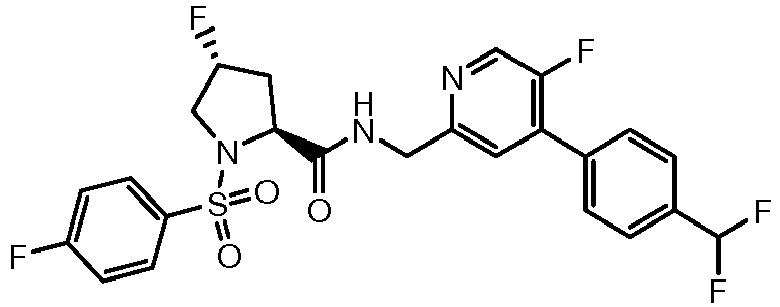
-

- A mixture of (4-formylphenyl)boronic acid (500 mg, 3.33 mmol, 1.00 equiv), 2-chloro-5-fluoro-4-iodopyridine (575 mg, 2.23 mmol, 0.70 equiv), Pd(dppf)Cl2 (80 mg, 0.11 mmol), potassium carbonate (930 mg, 6.73 mmol, 2.00 equiv), and 1,4-dioxane (15 mL)/water(1.5 mL) was stirred for 12 h at 75°C under nitrogen. The reaction mixture was diluted with ethyl acetate, washed with brine, dried over anhydrous sodium sulfate, and concentrated under vacuum. The residue was purified by a silica gel column eluting with petroleum ether/ethyl acetate (5:1). This resulted in the title compound (520 mg, 66%) as an off-white solid.
-

- DAST (3.56 g, 22.09 mmol, 10.00 equiv) was added dropwise into a mixture of 4-(2-chloro-5-fluoropyridin-4-yl)benzaldehyde (520 mg, 2.21 mmol, 1.00 equiv) in dichloromethane (130 mL) at -78°C under nitrogen. The resulting solution was stirred for 12 h at room temperature. The reaction was then quenched by water, extracted with ethyl acetate, washed with saturated solution of sodium bicarbonate and then brine, dried over anhydrous sodium sulfate, and concentrated under vacuum. The residue was purified by a silica gel column eluting with petroleum ether/ethyl acetate (5:1) to afford the title compound (500 mg, 88%) as a white solid.
-

- A mixture of 2-chloro-4-[4-(difluoromethyl)phenyl]-5-fluoropyridine (500 mg, 1.94 mmol, 1.00 equiv), Zn(CN)2 (272 mg, 2.32 mmol, 1.20 equiv), Pd2(dba)3CHCl3 (200 mg, 0.19 mmol, 0.10 equiv), and dppf (214 mg, 0.39 mmol, 0.20 equiv) in N,N-dimethylformamide (16 mL) was stirred for 1.5 h at 100°C under nitrogen. The residue was diluted with ethyl acetate, washed with brine, dried over anhydrous sodium sulfate, and concentrated under vacuum. The residue was purified by a silica gel column eluting with petroleum ether/ethyl acetate (10:1). This resulted in the title compound (440 mg, 91%) as a light yellow solid.
-

- A mixture of 4-[4-(difluoromethyl)phenyl]-5-fluoropyridine-2-carbonitrile (440 mg, 1.77 mmol, 1.00 equiv), methanol (40 mL), and palladium on carbon (400 mg, 3.76 mmol, 2.10 equiv) was stirred for 2 h at room temperature under hydrogen. The solids were filtered out and the liquid was concentrated under vacuum. This resulted in the title compound (420 mg, 94%) as an off-white solid.
-

- A mixture of (2S,4R)-1-[(tert-butoxy)carbonyl]-4-fluoropyrrolidine-2-carboxylic acid (92 mg, 0.39 mmol, 1.00 equiv), N,N-dimethylformamide (20 mL), DIEA (154 mg, 1.19 mmol, 3.00 equiv), HATU (226 mg, 0.59 mmol, 1.50 equiv), and [4-[4-(difluoromethyl)phenyl]-5-fluoropyridin-2-yl]methanamine (100 mg, 0.40 mmol, 1.00 equiv) was stirred for 12 h at room temperature. The reaction mixture was diluted with ethyl acetate, washed with brine, dried over anhydrous sodium sulfate, and concentrated under vacuum. The residue was purified by a silica gel column eluting with petroleum ether/ethyl acetate (5:1). This resulted in the title compound (120 mg, 65%) as an off-white solid.
-

- A mixture of tert-butyl (2S,4R)-2-[([4-[4-(difluoromethyl)phenyl]-5-fluoropyridin-2-yl]methyl)carbamoyl]-4-fluoropyrrolidine-1-carboxylate (138 mg, 0.30 mmol, 1.00 equiv) and HCl (saturated solution in 5 ml of dioxane) was stirred for 1 h at room temperature. The resulting mixture was concentrated under vacuum to afford the title compound (120 mg, crude) as an off-white solid.
-

- A mixture of (2S,4R)-N-([4-[4-(difluoromethyl)phenyl]-5-fluoropyridin-2-yl]methyl)-4-fluoropyrrolidine-2-carboxamide hydrochloride (120 mg, 0.33 mmol, 1.00 equiv), dichloromethane (10 mL), TEA (99 mg, 0.98 mmol, 3.00 equiv), and 4-fluorobenzene-1-sulfonyl chloride (64 mg, 0.33 mmol, 1.00 equiv) was stirred for 2 h at room temperature. The reaction mixture was diluted with ethyl acetate, washed with brine, dried over anhydrous sodium sulfate, and concentrated under vacuum. The residue was purified by a silica gel column eluting with petroleum ether/ethyl acetate (1:2) to afford the title compound (41.4 mg, 24%) as an off-white solid.
1H NMR (300 MHz, CDCl3) δ 9.01 - 8.99 (m, 1H), 8.64 (s, 1H), 8.00 - 7.98 (m, 2H), 7.98 - 7.97 (m, 2H), 7.81 - 7.70 (m, 3H), 7.69 - 7.67 (m, 2H), 7.48 - 7.43 (m, 3H), 5.28 - 5.10 (d, J = 27 Hz, 1H), 4.50 - 4.46 (m, 2H), 4.20 - 4.17 (m, 1H), 3.72 - 3.59 (m, 2H), 2.46 - 2.35 (m, 1H), 2.27 - 2.02 (m, 1H). -

- The title compound was prepared using the same general procedure as Example 91.
1H NMR (400 MHz, DMSO) δ 8.97 - 8.90 (t, J = 6.0 Hz, 1H), 8.59 - 8.55 (m, 1H), 8.41 - 8.37 (d, J = 9.0 Hz, 1H), 8.09 - 8.04 (t, J = 1.5 Hz, 1H), 8.01 - 7.94 (m, 3H), 7.50 - 7.39 (m, 3H), 5.29 - 5.10 (d, J = 52.4 Hz, 1H), 4.57 - 4.42 (m, 2H), 4.22 - 4.14 (dd, J = 9.9, 7.1 Hz, 1H), 3.74 - 3.58 (m, 2H), 2.44 - 2.30 (m, 1H), 2.20 - 1.98 (m, 1H)., LCMS (ESI) m/z:545.2 [M+H]+ -
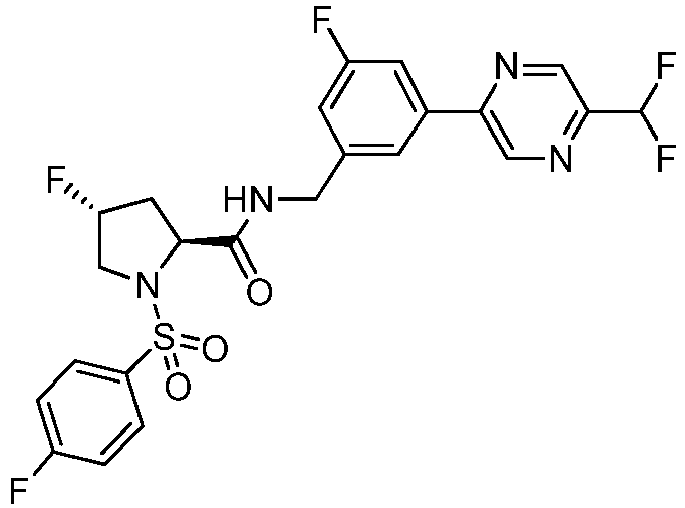
- The title compound was prepared using the same general procedure as Example 91.
1H NMR (400 MHz, DMSO) δ 9.43 - 9.40 (d, J = 1.4 Hz, 1H), 9.06 - 9.02 (d, J = 1.3 Hz, 1H), 8.96 - 8.89 (t, J = 6.1 Hz, 1H), 8.06 - 8.02 (t, J = 1.5 Hz, 1H), 8.01 - 7.95 (m, 2H), 7.95 - 7.88 (dt, J = 9.8, 2.0 Hz, 1H), 7.51 - 7.42 (m, 2H), 7.40 - 7.33 (dd, J = 9.7, 2.1 Hz, 1H), 7.32 - 7.03 (t, J = 54.2 Hz, 1H), 5.30 - 5.09 (d, J = 52.4 Hz, 1H), 4.55 - 4.40 (m, 2H), 4.24 - 4.14 (dd, J = 9.8, 7.2 Hz, 1H), 3.76 - 3.71 (q, J = 2.0, 1.5 Hz, 1H), 3.70 - 3.57 (m, 1H), 2.43 - 2.29 (dt, J = 16.5, 7.9 Hz, 1H), 2.20 - 1.98 (m, 1H)., LCMS (ESI) m/z:527.2 [M+H]+ -

- To a solution of (2S,4R)-1-tert-butoxycarbonyl-4-fluoro-pyrrolidine-2-carboxylic acid (A, 2000 mg, 8.6 mmol) and (3-bromo-5-fluoro-phenyl)methanamine (1.9 g, 9.4 mmol) in N,N-dimethylformamide (34 ml) was added N,N-diisopropylethylamine (2.2 mL, 13 mmol) and HATU (4.0 g, 10 mmol). The reaction mixture was stirred at RT 2h.The reaction was quenched with water and extracted with EtOAc. The organic layers was dried with sodium sulfate, filtered, and concentrated via rotovap. The crude product was purified by flash chromatography (EtOAc/Heptane_eluted at 50%EtOAc) to give 3.24g, 90% yield. LCMS (ESI) m/z:419.1 [M+H]+

- To a solution of tert-butyl (2S,4R)-2-[(3-bromo-5-fluoro-phenyl)methylcarbamoyl]-4-fluoro-pyrrolidine-1-carboxylate (820 mg, 1.956 mmol) in 1,4-dioxane (6.519 mL) was added hydrochloric acid (4 mol/L) in 1,4-dioxane (4.9 mL, 19.56 mmol). The reaction mixture was stirred at RT 6h. The reaction was concentrated and carried to next step. LCMS (ESI) m/z:318.9 [M+H]+

- To a solution of (2S,4R)-N-[(3-bromo-5-fluoro-phenyl)methyl]-4-fluoro-pyrrolidine-2-carboxamide (624 mg, 1.9553 mmol) in dichloromethane (39 mL) was added triethylamine (5.45 mL, 39.11 mmol) then 4-fluorobenzenesulfonyl chloride (571.0 mg, 2.933 mmol). The reaction was stirred at RT 2h. The reaction was quenched with water and extracted with EtOAc. The organic layers was dried with sodium sulfate, filtered, and concentrated via rotovap. The crude product was purified by flash chromatography (EtOAc/Heptane_eluted at 65%EtOAc) to give 933.4mg, 89.46% yield. LCMS (ESI) m/z:477.0 [M+H]+

- To a solution of (2S,4R)-N-[(3-bromo-5-fluoro-phenyl)methyl]-4-fluoro-1-(4-fluorophenyl)sulfonyl-pyrrolidine-2-carboxamide (205 mg, 0.4295 mmol) and bis(pinacolato)diboron (166.9 mg, 0.6442 mmol) in 1,4-dioxane (8.60 mL, 100.6 mmol) was added potassium acetate (126.5 mg, 0.0805 mL, 1.288 mmol) and [1,1'-bis(diphenylphosphino)ferrocene]dichloropalladium(II) (31.74 mg, 0.04295 mmol). The reaction mixture was degassed then heated 85°C 18h. The reaction was filtered thru celite. The crude was concentrated and carried to next step. LCMS (ESI) m/z:525.1 [M+H]+

- A solution of (2S,4R)-4-fluoro-1-(4-fluorophenyl)sulfonyl-N-[[3-fluoro-5-(4,4,5,5-tetramethyl-1,3,2-dioxaborolan-2-yl)phenyl]methyl]pyrrolidine-2-carboxamide (225 mg, 0.4291 mmol), 5-bromo-2-(trifluoromethyl)pyrimidine (153.9 mg, 0.6442 mmol), [1,1'-bis(diphenylphosphino)ferrocene]dichloropalladium(II) (31.74 mg, 0.04295 mmol) and cesium carbonate (279.9 mg, 0.8590 mmol) in water (2.0 mL) and acetonitrile (4.0 mL) was degassed. The reaction mixture was heated at 95 °C for 2h. The reaction was filtered thru celite. The crude product was purified by flash chromatography (EtOAc/Hep_eluted at 70%EtOAc) then submitted for rHPLC to give 111.2mg, 47.55% yield.
1H NMR (400 MHz, DMSO) δ 9.46 - 9.37 (s, 2H), 8.98 - 8.89 (t, J = 6.0 Hz, 1H), 8.03 - 7.94 (m, 2H), 7.77 - 7.70 (m, 2H), 7.51 - 7.42 (m, 2H), 7.40 - 7.31 (m, 1H), 5.31 - 5.09 (m, 1H), 4.56 - 4.37 (m, 2H), 4.23 - 4.13 (dd, J = 9.9, 7.1 Hz, 1H), 3.77 - 3.55 (m, 2H), 2.47 - 2.29 (m, 1H), 2.20 - 1.98 (m, 1H)., LCMS (ESI) m/z:545.2 [M+H]+ -

-

- A solution of 5-bromo-2,2-difluoro-2H-1,3-benzodioxole (1 g, 4.22 mmol, 1.00 equiv), 4,4,5,5-tetramethyl-2-(tetramethyl-1,3,2-dioxaborolan-2-yl)-1,3,2-dioxaborolane (1.2 g, 4.73 mmol, 1.10 equiv), Pd(dppf)Cl2 (300 mg, 0.41 mmol, 0.10 equiv), and AcOK (800 mg, 8.15 mmol, 2.00 equiv) in dioxane (20 mL) was stirred overnight at 100°C. The reaction mixture was concentrated under vacuum. The residue was purified by a silica gel column eluting with ethyl acetate/petroleum ether (1:20) to afford the title compound (900 mg, 75%) as yellow oil.
-

- A solution of 2-(2,2-difluoro-2H-1,3-benzodioxol-5-yl)-4,4,5,5-tetramethyl-1,3,2-dioxaborolane (800 mg, 2.82 mmol, 1.00 equiv), 4,6-dichloropyrimidine (640 mg, 4.30 mmol, 1.50 equiv), potassium carbonate (776 mg, 5.61 mmol, 2.00 equiv), and Pd(PPh3)4 (328 mg, 0.28 mmol, 0.10 equiv) in dioxane (15 mL)/water (3 mL) was stirred overnight at 100°C. The resulting mixture was concentrated under vacuum. The residue was purified by a silica gel column eluting with ethyl acetate/petroleum ether (1:6) to afford the title compound (570 mg, 75%) as a white solid.
-

- A solution of 4-chloro-6-(2,2-difluoro-2H-1,3-benzodioxol-5-yl)pyrimidine (500 mg, 1.85 mmol, 1.00 equiv), Pd(PPh3)4 (180 mg, 0.16 mmol, 0.10 equiv), and Zn(CN)2 (330 mg, 2.81 mmol, 1.50 equiv) in N,N-dimethylformamide (8 mL) was stirred for 1 h at 100°C. The reaction mixture was diluted with 100 ml of ethyl acetate, washed with water, dried over sodium sulfate, and concentrated under vacuum. The residue was purified by a silica gel column eluting with ethyl acetate/petroleum ether (1:6). This resulted in the title compound (360 mg, 75%) as a white solid.
-

- A mixture of 6-(2,2-difluoro-2H-1,3-benzodioxol-5-yl)pyrimidine-4-carbonitrile (340 mg, 1.30 mmol, 1.00 equiv), palladium on carbon (100 mg, 0.94 mmol, 1.00 equiv), and hydrogen chloride (2 drop) in methanol (80 mL) was stirred for 5 min at room temperature under hydrogen. The solids were filtered out and the liquid was concentrated under vacuum. The residue was purified by a silica gel column eluting with DCM:MeOH (100:5) to afford the title compound (220 mg, 64%) as a white solid.
-
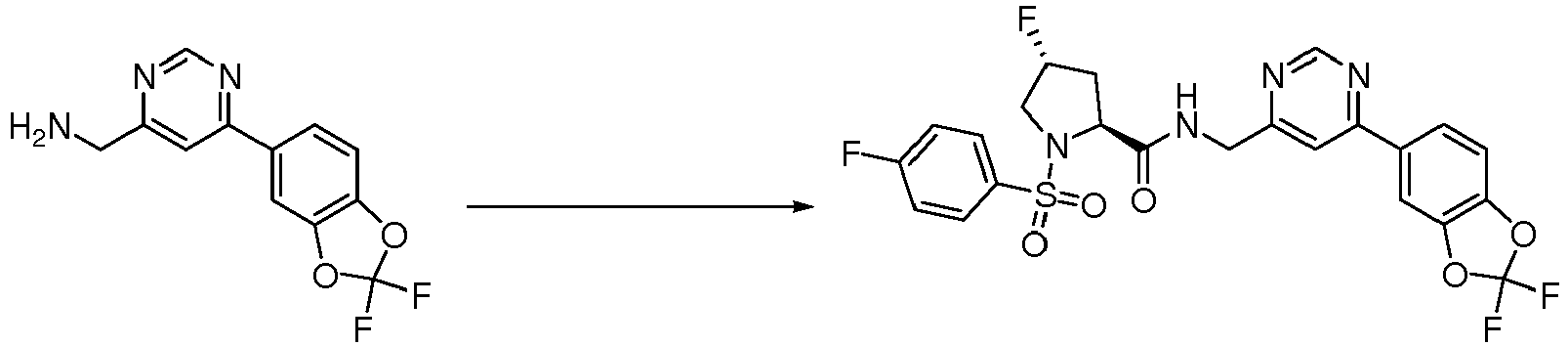
- A solution of (2S,4R)-4-fluoro-1-[(4-fluorobenzene)sulfonyl]pyrrolidine-2-carboxylic acid (110 mg, 0.38 mmol, 1.0 equiv), HATU (172 mg, 0.45 mmol, 1.2 equiv), and DIEA (200 mg, 1.55 mmol, 2.00 equiv) in N,N-dimethylformamide (10 mL) was stirred for 10 min at room temperature. Then [6-(2,2-difluoro-2H-1,3-benzodioxol-5-yl)pyrimidin-4-yl]methanamine (100 mg, 0.38 mmol, 1.0 equiv) was added and the resulting solution was stirred for an additional 3 h at room temperature. The resulting solution was diluted with ethyl acetate, washed with water, dried over sodium sulfate, and concentrated under vacuum. The residue was purified by a silica gel column eluting with ethyl acetate to afford the title compound (43.2 mg, 21%) as a white solid.
1H NMR (400 MHz, CDCl3) δ 9.20 (s, 1H), 8.06 - 8.02 (m, 3H), 7.96 - 7.92 (m, 2H), 7.80 (s, 1H), 7.28 - 7.23 (m, 2H),7.18 (d, J = 8.4 Hz, 1H), 5.15 - 5.02 (d, J = 51.2 Hz, 1H), 4.95 - 4.92 (m, 1H), 4.66 - 4.62 (m, 1H), 4.29 (t, J = 8.4 Hz, 1H), 3.88 - 3.72 (m, 2H), 2.59 - 2.53 (m, 1H), 2.34 - 2.17 (m, 1H). -

-

- A mixture of (2S,3R)-1-[(tert-butoxy)carbonyl]-3-hydroxypyrrolidine-2-carboxylic acid (209 mg, 0.90 mmol, 1.00 equiv), [6-[3-fluoro-4-(trifluoromethyl)phenyl]pyrimidin-4-yl]methanamine hydrochloride (280 mg, 0.91 mmol, 1.00 equiv), HATU (414 mg, 1.09 mmol, 1.20 equiv), and DIEA (351 mg, 2.72 mmol, 3.00 equiv) in tetrahydrofuran (10 mL) was stirred for 6 h at room temperature. The reaction was then quenched by water. The resulting solution was extracted with 2x50 mL of ethyl acetate and the organic layers were combined and concentrated under vacuum. The residue was purified by a silica gel column eluting with ethyl acetate/petroleum ether (2:1). This resulted in the title compound (270 mg, 62%) as an off-white solid.
-

- DAST (36.6 mg, 0.23 mmol, 2.20 equiv) was added slowly into a solution of tert-butyl (2S,3R)-2-[([6-[3-fluoro-4-(trifluoromethyl)phenyl]pyrimidin-4-yl]methyl)carbamoyl]-3-hydroxypyrrolidine-1-carboxylate (50 mg, 0.10 mmol, 1.00 equiv) in dichloromethane (5 mL) at 0°C under nitrogen. The resulting solution was stirred for 10 min at 0°C in a water/ice bath. The reaction was then quenched by iced water, extracted with 2x50 mL of dichloromethane, washed with 2x10 mL of saturated aqueous NaHCO3, and concentrated under vacuum. The residue was purified by a silica gel column eluting with ethyl acetate/petroleum ether(3:1) to afford the title compound 57 mg (crude) as a brown solid
-

- A solution of tert-butyl (2R,3S)-3-fluoro-2-[([6-[3-fluoro-4-(trifluoromethyl)phenyl]pyrimidin-4-yl]methyl)carbamoyl]pyrrolidine-1-carboxylate (57 mg, 0.12 mmol, 1.00 equiv) and saturated hydrogen chloride in 1,4-dioxane (5 mL) was stirred for 14 h at room temperature. The resulting mixture was concentrated under vacuum. This resulted in the title compound (44 mg, 89%) as a brown solid.
-

- A mixture of 4-fluorobenzene-1-sulfonyl chloride (24 mg, 0.12 mmol, 1.20 equiv), (2R,3S)-3-fluoro-N-([6-[3-fluoro-4-(trifluoromethyl)phenyl]pyrimidin-4-yl]methyl)pyrrolidine-2-carboxamide hydrochloride (44 mg, 0.10 mmol, 1.00 equiv), and TEA (31.5 mg, 0.31 mmol, 3.00 equiv) in dichloromethane (5 mL) was stirred for 14 h at room temperature. The reaction mixture was quenched by water, extracted by ethyl acetate, and concentrated under vacuum. The residue was purified by a silica gel column eluting with ethyl acetate/petroleum ether (3:1) to afford the title compound (21.4mg, 38%) as a white solid.
1H NMR (400 MHz, CDCl3) δ 9.25 (s, 1H), 8.10 - 8.06 (t, J = 8.5 Hz, 2H), 7.94 - 7.91 (m, 3H), 7.78 - 7.72 (m, 2H), 7.31 - 7.26 (m, 2H), 5.38 - 5.25 (d, J = 50.8 Hz, 1H), 4.93 - 4.91 (m, 1H), 4.58 - 4.53 (m, 1H), 4.43 - 4.37 (d, J = 22.0 Hz,1H), 3.83 (t, J = 8.8 Hz, 1H), 3.35 - 3.28 (m, 1H), 2.23 - 2.03 (m, 2H). -

- Preparation of the title compound follows the same general procedure as Example 48.
1H NMR (400 MHz, DMSO) δ 9.07 - 9.04 (dd, J = 2.3, 0.8 Hz, 1H), 8.93 - 8.87 (t, J = 6.0 Hz, 1H), 8.35 - 8.30 (dd, J = 8.2, 2.3 Hz, 1H), 8.02 - 7.94 (m, 2H), 7.80 - 7.75 (m, 1H), 7.65 - 7.62 (t, J = 1.5 Hz, 1H), 7.62 - 7.56 (ddd, J = 10.0, 2.5, 1.6 Hz, 1H), 7.50 - 7.41 (m, 2H), 7.30 - 7.23 (ddd, J = 9.8, 2.4, 1.5 Hz, 1H), 7.17 - 6.86 (t, J = 54.9 Hz, 1H), 5.30 - 5.10 (d, J = 52.7 Hz, 1H), 4.54 - 4.37 (m, 2H), 4.23 - 4.13 (dd, J = 9.9, 7.1 Hz, 1H), 3.76 - 3.56 (m, 2H), 2.46 - 2.30 (m, 1H), 2.20 - 1.99 (m, 1H)., LCMS (ESI) m/z:526.12 [M+H]+ -

- Preparation of the title compound follows the same general procedure as Example 91.
1H NMR (400 MHz, DMSO) δ 9.09 - 9.03 (dt, J = 1.9, 0.9 Hz, 1H), 8.95 - 8.87 (t, J = 6.0 Hz, 1H), 8.35 - 8.29 (m, 1H), 8.28 - 8.23 (m, 1H), 8.03 - 7.93 (m, 3H), 7.91 - 7.83 (ddd, J = 10.2, 2.6, 1.6 Hz, 1H), 7.51 - 7.41 (m, 2H), 7.36 - 7.28 (ddd, J = 9.5, 2.4, 1.3 Hz, 1H), 5.31 - 5.10 (d, J = 52.5 Hz, 1H), 4.54 - 4.39 (m, 2H), 4.23 - 4.13 (dd, J = 9.8, 7.1 Hz, 1H), 3.79 - 3.57 (m, 2H), 2.46 - 2.29 (td, J = 16.5, 15.8, 7.1 Hz, 1H), 2.19 - 1.98 (m, 1H)., LCMS (ESI) m/z:544.11 [M+H]+ -

-

- A mixture of 5-chloro-4-[6-(trifluoromethyl)pyridin-3-yl]pyridine-2-carbonitrile (1.08 g, 3.81 mmol, 1.00 equiv) in dioxane (50 mL), Pd(dppf)Cl2 (560 mg, 0.77 mmol, 0.20 equiv), and Zn(CH3)2 (4.2 mL, 5.72 mmol, 1.30 equiv) was stirred for overnight at 65°C under nitrogen. The resulting mixture was concentrated under vacuum. The residue was purified by a silica gel column eluting with ethyl acetate/petroleum ether (15:100). This resulted in the title compound (292 mg, 29%) as yellow oil.
-

- A mixture of 5-methyl-4-[6-(trifluoromethyl)pyridin-3-yl]pyridine-2-carbonitrile (280 mg, 1.06 mmol, 1.00 equiv) in methanol (40 mL), palladium on carbon (50 mg, 0.47 mmol, 0.40 equiv), and concentrated hydrogen chloride (1 mL) was stirred for 10 min at room temperature under hydrogen. The solids were filtered out and the liquid was concentrated under vacuum. This resulted in the title compound (263 mg, 81%) as an off-white solid.
-

- A mixture of [5-methyl-4-[6-(trifluoromethyl)pyridin-3-yl]pyridin-2-yl]methanamine hydrochloride (260 mg, 0.86 mmol, 1.00 equiv) in N,N-dimethylformamide (20 mL), (2S,4R)-1-[(tert-butoxy)carbonyl]-4-fluoropyrrolidine-2-carboxylic acid (200 mg, 0.86 mmol, 1.00 equiv), DIEA (1.11 g, 8.59 mmol, 10.00 equiv), and HATU (392 mg, 1.03 mmol, 1.20 equiv) was stirred for 2 h at room temperature. The reaction was diluted with water, extracted with ethyl acetate, washed with brine, dried over anhydrous sodium sulfate, and concentrated under vacuum. The residue was purified by a silica gel column eluting with dichloromethane/methanol (100:5) to afford the title compound (380 mg, 92%) as brown oil.
-

- A solution of tert-butyl (2S,4R)-4-fluoro-2-[([5-methyl-4-[6-(trifluoromethyl)pyridin-3-yl]pyridin-2-yl]methyl)carbamoyl]pyrrolidine-1-carboxylate (380 mg, 0.79 mmol, 1.00 equiv) in HCl (saturated solution in 50 mL of 1,4-dioxane) was stirred overnight at room temperature. The resulting mixture was concentrated under vacuum to afford the title compound (285 mg, 86%) as a light brown solid.
-

- A mixture of (2S,4R)-4-fluoro-N-([5-methyl-4-[6-(trifluoromethyl)pyridin-3-yl]pyridin-2-yl]methyl)pyrrolidine-2-carboxamide hydrochloride (285 mg, 0.680 mmol, 1.000 equiv) in dichloromethane (20 mL), TEA (687 mg, 6.789 mmol, 10.000 equiv), and 4-fluorobenzene-1-sulfonyl chloride (200 mg, 1.028 mmol, 1.500 equiv) was stirred for 2 h at room temperature. The resulting solution was diluted with dichloromethane, washed with brine, dried over anhydrous sodium sulfate, and concentrated under vacuum. The residue was purified by a silica gel column eluting with dichloromethane/methanol (100:10). This resulted in the title compound (71.6 mg, 19%) as a white solid.
1H NMR (300 MHz, CDCl3) δ 8.92 - 8.83 (m, 2H), 8.52 (s, 1H), 8.18 - 8.16 (m, 1H), 8.01 - 7.91 (m, 3H), 7.45 - 7.40 (m, 3H), 5.27 - 5.01 (d, J = 52.2 Hz, 1H), 4.47 - 4.44 (m, 2H), 4.23 - 4.17 (m, 1H), 3.67 - 3.57 (m, 2H), 2.44 - 2.41 (m, 1H), 2.38 - 2.14 (m, 3H), 2.07 - 2.00 (m, 1H). -

-

- A mixture of (5-cyano-2-fluorophenyl)boronic acid (91 mg, 0.55 mmol, 1.00 equiv), 2-chloro-5-(trifluoromethyl)pyrazine (100 mg, 0.55 mmol, 1.00 equiv), Pd(PPh3)4 (63 mg, 0.05 mmol, 0.10 equiv), and potassium carbonate (152 mg, 1.10 mmol, 2.00 equiv) in 1,4-dioxane (2 mL)/water(0.4 mL) was stirred overnight at 95°C under nitrogen. The reaction mixture was diluted with water, extracted with ethyl acetate, dried over anhydrous sodium sulfate, and concentrated under vacuum. The residue was purified by a silica gel column eluting with ethyl acetate/petroleum ether (1:10). This resulted in the title compound (110 mg) as a light yellow solid
-

- A mixture of 4-fluoro-3-[5-(trifluoromethyl)pyrazin-2-yl]benzonitrile (200 mg, 0.75 mmol, 1.0 equiv), palladium on carbon (50 mg, 0.47 mmol, 1.00 equiv), and HCl(conc.)(1drop) in methanol (20 mL) was stirred for 20 min at room temperature under hydrogen. The solids were filtered out and the liquid was concentrated under vacuum. This resulted in the title compound (95 mg, 47%) as a brown solid.
-

- A mixture of (2S,3R)-1-[(tert-butoxy)carbonyl]-3-hydroxypyrrolidine-2-carboxylic acid (90 mg, 0.39 mmol, 1.00 equiv), DIEA (226 mg, 1.75 mmol, 2.00 equiv), and HATU (160 mg, 0.42 mmol, 1.20 equiv) in N,N-dimethylformamide (5 mL) was stirred for 10 min at room temperature. Then [4-fluoro-3-[5-(trifluoromethyl)pyrazin-2-yl]phenyl]methanamine (95 mg, 0.35 mmol, 1.00 equiv) was added to the reaction mixture. The resulting solution was stirred overnight at room temperature. The reaction solution was diluted with water, extracted with ethyl acetate, dried over anhydrous sodium sulfate, and concentrated under vacuum. This resulted in the title compound (160 mg, 85%) as a light yellow solid.
-

- DAST (220 mg, 1.36 mmol, 3.00 equiv) was added dropwise into a stirred solution of tert-butyl (2S,3R)-2-[([4-fluoro-3-[5-(trifluoromethyl)pyrazin-2-yl]phenyl]methyl)carbamoyl]-3-hydroxypyrrolidine-1-carboxylate (220 mg, 0.45 mmol, 1.00 equiv) in dichloromethane (20 mL) at 0°C. The resulting solution was stirred for 5 h at room temperature and quenched by aqueous NaHCO3. The reaction solution was extracted with 100 mL of ethyl acetate, dried over anhydrous sodium sulfate, and concentrated under vacuum. The residue was purified by a silica gel column eluting with ethyl acetate/petroleum ether (1:1) to afford the title compound (65 mg, 29%) as colorless oil.
-

- A solution of tert-butyl (2R,3S)-3-fluoro-2-[([4-fluoro-3-[5-(trifluoromethyl)pyrazin-2-yl]phenyl]methyl)carbamoyl]pyrrolidine-1-carboxylate (65 mg, 0.13 mmol, 1.00 equiv) and saturated hydrogen chloride in dioxane (6 mL) was stirred overnight at room temperature and concentrated under vacuum. This resulted in the title compound (60 mg) as a brown solid.
-

- A mixture of (2R,3S)-3-fluoro-N-([4-fluoro-3-[5-(trifluoromethyl)pyrazin-2-yl]phenyl]methyl)pyrrolidine-2-carboxamide hydrochloride (60 mg, 0.14 mmol, 1.00 equiv), TEA (42 mg, 0.42 mmol, 3.00 equiv), and 4-fluorobenzene-1-sulfonyl chloride (30 mg, 0.15 mmol, 1.10 equiv) in dichloromethane (5 mL) was stirred for 3 h at room temperature. The diluted with 50 mL of DCM, washed with water, dried over anhydrous sodium sulfate, and concentrated under vacuum. The residue was purified by a silica gel column eluting with ethyl acetate/petroleum ether (1:2). This resulted in the title compound (23.7 mg, 31%) as a white solid.
1H NMR (400 MHz, CDCl3) δ 9.23 (s, 1H), 9.02 (s, 1H), 8.01 (dd, J = 7.2 Hz, J = 2.4 Hz, 1H), 7.87 - 7.85 (m, 2H), 7.49 - 7.46 (m, 2H), 7.27 - 7.22 (m, 3H), 5.44 - 5.31 (dd, J = 50.4 Hz, J = 2.4Hz, 1H), 4.63 - 4.49 (m, 2H), 4.34 - 4.29 (d, J = 22.0 Hz, 2H), 3.74 (t, J = 9.2 Hz, 1H), 3.32 - 3.26 (m, 1H), 2.16 - 1.90 (m, 2H). -

-

- A mixture of (2S,3R)-1-[(tert-butoxy)carbonyl]-3-hydroxypyrrolidine-2-carboxylic acid (358 mg, 1.55 mmol, 1.00 equiv) in N,N-dimethylformamide (30 mL), [3-fluoro-5-[5-(trifluoromethyl)pyrazin-2-yl]phenyl]methanamine (420 mg, 1.55 mmol, 1.00 equiv), DIEA (1 g, 7.74 mmol, 5.00 equiv), and HATU (707 mg, 1.86 mmol, 1.20 equiv) was stirred for overnight at room temperature. The reaction was then diluted with water, extracted with ethyl acetate, washed with brine, dried over anhydrous sodium sulfate, and concentrated under vacuum. The residue was purified by flash chromatography on silica gel eluting with ethyl acetate/petroleum ether (1:1). This resulted in the title compound (400 mg, 53%) as a white solid.
-

- DAST (81 mg, 0.50 mmol, 1.20 equiv) was added dropwise into a solution of tert-butyl (2S,3R)-2-[([3-fluoro-5-[5-(trifluoromethyl)pyrazin-2-yl]phenyl]methyl)carbamoyl]-3-hydroxypyrrolidine-1-carboxylate (200 mg, 0.41 mmol, 1.00 equiv) in dichloromethane (20 mL) at 0°C under nitrogen. The resulting solution was stirred for 1 h at 5°C in a water/ice bath. The reaction was then quenched by saturated sodium bicarbonate solution, extracted with dichloromethane, washed with brine, dried over anhydrous sodium sulfate, and concentrated under vacuum. The residue was purified by flash chromatography on silica gel eluting with ethyl acetate/petroleum ether (1:10). This resulted in the title compound (100 mg, 50%) as colorless oil.
-

- A solution of tert-butyl (2R,3S)-3-fluoro-2-([3-fluoro-5-[5-(trifluoromethyl)pyrazin-2-yl]phenyl]carbamoyl)pyrrolidine-1-carboxylate (100 mg, 0.21 mmol, 1.00 equiv) in saturated HCl (20 mL) in 1,4-dioxane was stirred overnight at room temperature. The resulting mixture was concentrated under vacuum to afford the title compound (75 mg, 87%) as a white solid.
-

- A mixture of (2R,3S)-3-fluoro-N-([3-fluoro-5-[5-(trifluoromethyl)pyrazin-2-yl]phenyl]methyl)pyrrolidine-2-carboxamide hydrochloride (75 mg, 0.18 mmol, 1.00 equiv) in dichloromethane (20 mL), TEA (182 mg, 1.80 mmol, 10.10 equiv), and 4-fluorobenzene-1-sulfonyl chloride (53 mg, 0.27 mmol, 1.50 equiv) was stirred for 2 h at room temperature. The resulting solution was diluted with dichloromethane, washed with brine, dried over anhydrous sodium sulfate, and concentrated under vacuum. The residue was purified by flash chromatography on silica gel eluting with dichloromethane/methanol (10:1) to afford the title compound (32.2 mg, 33%) as a white solid.
1H NMR (400 MHz, DMSO-d6 ) δ 9.50 (s, 1H), 9.26 (s, 1H), 9.08 - 9.05 (m, 1H), 8.03 (s, 1H), 8.00 - 7.95 (m, 3H), 7.51 - 7.47 (m, 2H), 7.39 - 7.37 (m, 1H), 5.24 - 5.11 (d, J = 52.4 Hz, 1H), 4.49 - 4.46 (m, 2H), 4.39- 4.33 (m, 1H), 3.70 - 3.66 (m, 1H), 3.21 - 3.14 (m, 1H), 2.16 - 2.10 (m, 2H). -

-

-

- m-CPBA (88 g, 509.95 mmol, 1.20 equiv) was added in several batches into a solution of 2,5-dihydrofuran (30 g, 428.02 mmol, 1.00 equiv) in dichloromethane (300 mL) at ∼0°C. After 12 h at room temperature the resulting solution was diluted with saturated Na2SO3 and stirred for 0.5 h at room temperature. The resulting mixture was washed with saturated sodium bicarbonate and brine, dried over anhydrous sodium sulfate, and concentrated under vacuum at low temperature. This resulted in the title compound (30 g, crude) as colorless oil
-

- Bromo(prop-2-en-1-yl)magnesium (300 mL, 2.06 mol, 2.00 equiv) was added dropwise into a mixture of 3,6-dioxabicyclo[3.1.0]hexane (12.9 g, 149.84 mmol, 1.00 equiv) and CuI (2.85 g, 14.96 mmol, 0.10 equiv) in tetrahydrofuran (100 mL) at 0-5°C under nitrogen. The resulting solution was stirred for 3 h at 0°C, quenched by NH4Cl (aq.), and extracted with ethyl acetate. The combined extracts were washed with brine, dried over anhydrous sodium sulfate, and concentrated under vacuum. The residue was purified by a silica gel column eluting with ethyl acetate/petroleum ether (1:6) to afford the title compound (5 g, 26%) as light yellow oil.
-

- A mixture of (3S,4R)-4-(prop-2-en-1-yl)oxolan-3-ol (3.5 g, 27.31 mmol, 1.00 equiv) and PCC (13 g, 60.31 mmol, 2.00 equiv) in dichloromethane (160 mL) was stirred for 12 h at room temperature. The reaction was then quenched by water, extracted with ethyl acetate, washed with brine, dried over anhydrous sodium sulfate, and concentrated under vacuum. This resulted in the title compound (2.0 g, 58%) as a gray liquid.
-

- A mixture of 4-(prop-2-en-1-yl)oxolan-3-one (2.25 g, 17.84 mmol, 1.00 equiv), NH2OH.HCl (2.46 g, 35.40 mmol, 2.00 equiv), and pyridine (1.4 g, 17.48 mmol, 1.00 equiv) in ethanol (50 mL) was stirred for 1.5 h at room temperature. The resulting mixture was concentrated under vacuum. The mixture was diluted with water and extracted with ethyl acetate. The combined extracts were washed with brine, dried over anhydrous sodium sulfate, and concentrated under vacuum. The residue was purified by a silica gel column eluting with ethyl acetate/petroleum ether (1:10) to afford the title compound (1.3 g, 52%) as colorless oil.
-

- LiAlH4 (1.186 g, 31.25 mmol, 3.00 equiv) was added batch wise into a solution of N-[(3Z)-4-(prop-2-en-1-yl)oxolan-3-ylidene]hydroxylamine (1.17 g, 8.29 mmol, 1.00 equiv) in tetrahydrofuran (25 mL) at 0-5°C under nitrogen. The resulting solution was stirred for 1 h at room temperature and 2 h at 45°C. The reaction was then quenched by aqueous Na2SO4. The solids were filtered out and the filtrate was concentrated under vacuum. This resulted in the title compound (1.46 g, crude) as a colorless liquid.
-

- A solution of 4-(prop-2-en-1-yl)oxolan-3-amine (1.35 g, 10.61 mmol, 1.00 equiv), 4-fluorobenzene-1-sulfonyl chloride (1.65 g, 8.48 mmol, 0.80 equiv), TEA (2.14 g, 21.15 mmol, 2.00 equiv), and 4-dimethylaminopyridine (50 mg, 0.41 mmol, 0.05 equiv) in tetrahydrofuran (50 mL) was stirred for 1 h at room temperature. The mixture was diluted with water, extracted with ethyl acetate, washed with brine, dried over anhydrous sodium sulfate, and concentrated under vacuum. The residue was purified by a silica gel column eluting with ethyl acetate/petroleum ether (1:9) to afford the title compound (1.46 g, 48%) as orange oil.
-

- A mixture of 4-fluoro-N-[4-(prop-2-en-1-yl)oxolan-3-yl]benzene-1-sulfonamide (1.57 g, 5.50 mmol, 1.00 equiv), potassium peroxymonosulfate (6.77 g, 11.01 mmol, 2.00 equiv), and TsOH (105.8 mg, 0.61 mmol, 0.10 equiv) in water (15 mL)/MeCN (30 mL) was stirred for 12 h at 50°C. The reaction mixture was cooled to room temperature, quenched by saturated sodium bicarbonate, extracted with ethyl acetate, washed with brine, dried over anhydrous sodium sulfate, and concentrated under vacuum. The residue was purified by a silica gel column eluting with ethyl acetate/petroleum ether (1:3) to afford the title compound (700 mg, 42%) as light yellow oil
-

- A solution of [1-[(4-fluorobenzene)sulfonyl]-hexahydro-1H-furo[3,4-b]pyrrol-2-yl]methanol (700 mg, 2.32 mmol, 1.00 equiv) in acetone (40 mL) was mixed with a solution of CrO3 (1.163 g, 11.63 mmol, 5.00 equiv) in water(5mL) containing sulfuric acid (1 mL). The resulting solution was stirred for 2 h at room temperature. The reaction was then quenched by methanol. After 15 min the mixture was poured into 200 mL of brine. The resulting solution was extracted with ethyl acetate. The combined extracts were washed with brine, dried over anhydrous sodium sulfate, and concentrated under vacuum. This resulted in the title compound (630 mg, 86%) as an off-white solid.
-

- A mixture of 1-[(4-fluorobenzene)sulfonyl]-hexahydro-1H-furo[3,4-b]pyrrole-2-carboxylic acid (600 mg, 1.90 mmol, 1.00 equiv), HATU (794.2 mg, 2.09 mmol, 1.10 equiv), DIEA (735.3 mg, 5.69 mmol, 3.00 equiv), and [6-[4-(trifluoromethyl)phenyl]pyrimidin-4-yl]methanamine hydrochloride (550 mg, 1.90 mmol, 1.00 equiv) in N,N-dimethylformamide (25 mL) was stirred for 2 h at room temperature. The mixture was diluted with water and extracted with ethyl acetate. The combined extracts were washed with brine, dried over anhydrous sodium sulfate, and concentrated under vacuum. The residue was purified by a silica gel column eluting with ethyl acetate/petroleum ether (1:3). The mixture was separated by Chiral-Prep-HPLC to afford (2S,3aR,6aS)-1-[(4-fluorobenzene)sulfonyl]-N-([6-[4-(trifluoromethyl)phenyl]pyrimidin-4-yl]methyl)-hexahydro-1H-furo[3,4-b]pyrrole-2-carboxamide (47.9 mg, 5%) as a white solid. tR = 4.84 min (Repaired IA (CHIRALPAK IA), 0.46x10cm, 5µm, Hex(0.1%TEA):EtOH = 50:50, 1.0 ml/min).
1H NMR (300 MHz, CDCl3) δ 9.26 (s, 1H), 8.28 - 8.26 (d, J = 6 Hz, 2H), 7.89 - 7.84 (m, 3H), 7.77 - 7.74 (d, J = 9 Hz, 2H), 7.26 - 7.11 (m, 3H), 4.68 - 4.60 (m, 2H), 4.55 - 4.50 (m, 2H), 4.10 - 4.06 (m, 1H), 3.73 - 3.70 (m, 1H), 3.61 - 3.54 (m, 2H), 3.29 - 3.19 (m, 1H), 2.42 - 2.29 (m, 1H), 2.12 - 2.02 (m, 1H). - (2R,3aS,6aR)-1-[(4-fluorobenzene)sulfonyl]-N-([6-[4-(trifluoromethyl)phenyl]pyrimidin-4-yl]methyl)-hexahydro-1H-furo[3,4-b]pyrrole-2-carboxamide (51.5 mg, 5%) was also isolated as a white solid. tR = 12.96 min (Lux Cellulose-4, 0.46x15cm, 5µm, Hex(0.1%TEA):EtOH = 50:50, 1.0 ml/min).
1H NMR (300 MHz, CDCl3) δ 9.24 (s, 1H), 8.36 - 8.34 (d, J = 9 Hz, 2H), 8.05 (s, 1H), 7.96 - 7.91 (m, 2H), 7.87 - 7.83 (b, 1H), 7.76 - 7.73 (d, J = 9 Hz, 2H), 7.33 - 7.26 (m, 2H), 4.85 - 4.64 (m, 2H), 4.42 - 4.38 (d, J = 12 Hz, 1H), 4.33 - 4.27 (m, 2H), 3.74 - 3.67 (m, 2H), 2.88 - 2.79 (m, 1H), 2.36 - 2.31 (m, 1H), 1.94 - 1.83 (m, 1H). - (2S,3aS,6aR)-1-[(4-fluorobenzene)sulfonyl]-N-([6-[4-(trifluoromethyl)phenyl]pyrimidin-4-yl]methyl)-hexahydro-1H-furo[3,4-b]pyrrole-2-carboxamide (36 mg, 3%) was isolated as a white solid. tR = 3.27 min (Repaired IA (CHIRALPAK IA), 0.46x10cm, 5µm, Hex(0.1%TEA):EtOH = 50:50, 1.0 ml/min).
1H NMR (300 MHz, CDCl3) δ 9.25 (s, 1H), 8.28 - 8.26 (d, J = 6 Hz, 2H), 7.89 - 7.84 (m, 3H), 7.77 - 7.74 (d, J = 9 Hz, 2H), 7.26 - 7.12 (m, 3H), 4.62 - 4.61 (m, 2H), 4.56 - 4.50 (m, 2H), 4.10 - 4.06 (m, 1H), 3.73 - 3.70 (m, 1H), 3.58 - 3.53 (m, 2H), 3.29 - 3.19 (m, 1H), 2.35 - 2.28 (m, 1H), 2.12 - 2.02 (m, 1H). - (2R,3aR,6aS)-1-[(4-fluorobenzene)sulfonyl]-N-([6-[4-(trifluoromethyl)phenyl]pyrimidin-4-yl]methyl)-hexahydro-1H-furo[3,4-b]pyrrole-2-carboxamide (34.3 mg, 3%) was isolated as a white solid. tR = 6.60 min (Lux Cellulose-4, 0.46x15cm, 5µm, Hex(0.1%TEA):EtOH = 50:50, 1.0 ml/min).
1H NMR (300 MHz, CDCl3) δ 9.24 (s, 1H), 8.37 - 8.34 (d, J = 8.5 Hz, 2H), 8.04 (s, 1H), 7.96 - 7.91 (q, 2H), 7.86 - 7.83 (m, 1H), 7.76 - 7.73 (d, J = 9 Hz, 2H), 7.33 - 7.27 (m, 2H), 4.86 - 4.64 (m, 2H), 4.42 - 4.38 (d, J = 12 Hz, 1H), 4.33 - 4.27 (m, 2H), 3.74 - 3.67 (m, 2H), 2.86 - 2.82 (m, 1H), 2.36 - 2.31 (m, 1H), 1.94 - 1.84 (m, 1H). - The stereochemistry for the bicyclic ring of the above compounds was arbitrarily assigned. The 2-proline stereochemistry is as shown.
-

-

- A mixture of 2,5-dichloro-4-iodopyridine (10 g, 36.511 mmol, 1.00 equiv), [6-(trifluoromethyl)pyridin-3-yl]boronic acid (6.7 g, 35.094 mmol, 1.00 equiv), Pd(dppf)Cl2(2.67 g, 3.649 mmol, 0.10 equiv), 1,4-dioxane (250 mL), potassium carbonate (15 g, 108.534 mmol, 3.00 equiv), and water (25 mL) was stirred for 12 h at 80°C under nitrogen. The solids were filtered out and the solution was concentrated under vacuum. The residue was dissolved in ethyl acetate, washed with brine, dried over anhydrous sodium sulfate, and concentrated under vacuum. The residue was purified by flash chromatography on silica gel eluting with ethyl acetate/petroleum ether (1:20). This resulted in the title compound (9.9 g, 93%) as a white solid.
-

- A mixture of 2,5-dichloro-4-[6-(trifluoromethyl)pyridin-3-yl]pyridine (8.8 g, 30.027 mmol, 1.00 equiv), Pd(dppf)Cl2 (2.2 g, 3.007 mmol, 0.10 equiv), methanol (120 mL), TEA (9.1 g, 89.930 mmol, 2.995 equiv) was stirred for 12 h at 60°C under nitrogen. The solids were filtered out. The resulting solution was extracted with ethyl acetate, washed with brine, dried over anhydrous sodium sulfate, and concentrated under vacuum. The residue was purified by flash chromatography on silica gel eluting with ethyl acetate/petroleum ether (1:10). This resulted in the title compound (4.5 g, 47%) as a white solid.
-

- DIBAL-H (47.5 mL, 1M in hexanes, 3.00 equiv) was added dropwise into a solution of methyl 5-chloro-4-[6-(trifluoromethyl)pyridin-3-yl]pyridine-2-carboxylate (5.0 g, 15.790 mmol, 1.00 equiv) in dichloromethane (200 mL) at -70°C under nitrogen. The resulting solution was stirred for 30 min at -70°C. The reaction was then quenched by methanol at -70°C and then NaBH4 (0.9g) was added at 0°C. After 10 min at 0°C the mixture was then quenched by 1N of HCl at 0°C. The resulting solution was extracted with ethyl acetate, washed with saturated sodium bicarbonate and brine, dried over anhydrous sodium sulfate, and concentrated under vacuum. The residue was purified by flash chromatography on silica gel eluting with ethyl acetate/petroleum ether (1:1). This resulted in the title compound (4.2 g, 92%) as a light yellow solid.
-

- DIAD (6.0 g, 29.672 mmol, 1.992 equiv) was added dropwise into a mixture of [5-chloro-4-[6-(trifluoromethyl)pyridin-3-yl]pyridin-2-yl]methanol (4.3 g, 14.897 mmol, 1.000 equiv), 2,3-dihydro-1H-isoindole-1,3-dione (4.4 g, 29.905 mmol, 2.008 equiv), and PPh3 (7.8 g, 29.739 mmol, 1.996 equiv) in tetrahydrofuran (200 mL) at 0°C under nitrogen. After 12 h at room temperature the resulting mixture was concentrated under vacuum. The residue was purified by flash chromatography on silica gel eluting with ethyl acetate/petroleum ether (1:10). This resulted in the title compound (6.0 g, 96%) as an off-white solid.
-

- A mixture of 2-([5-chloro-4-[6-(trifluoromethyl)pyridin-3-yl]pyridin-2-yl]methyl)-2,3-dihydro-1H-isoindole-1,3-dione (6.0 g, 14.362 mmol, 1.000 equiv), methanol (150 mL), and NH2NH2.H2O (7.2 g, 143.826 mmol, 10.014 equiv) was stirred for 12 h at room temperature. The resulting mixture was concentrated under vacuum and the residue was dissolved in ethyl acetate. The solids were filtered out and the liquid was concentrated under vacuum. This resulted in the title compound (7.5 g) as a light yellow solid.
-

- A mixture of (2S,4R)-1-[(tert-butoxy)carbonyl]-4-fluoropyrrolidine-2-carboxylic acid (4.1 g, 17.579 mmol, 1.00 equiv), N,N-dimethylformamide (50 mL), DIEA (4.5 g, 34.818 mmol, 1.98 equiv), HATU (7.9 g, 20.777 mmol, 1.18 equiv), and [5-chloro-4-[6-(trifluoromethyl)pyridin-3-yl]pyridin-2-yl]methanamine (7.5 g, 26.072 mmol, 1.48 equiv) was stirred for 1 h at room temperature. The resulting solution was diluted with ethyl acetate, washed with brine, dried over anhydrous sodium sulfate, and concentrated under vacuum. The residue was purified by flash chromatography on silica gel eluting with ethyl acetate/petroleum ether (1:1). This resulted in the title compound (4.5 g, 51%) as an off-white solid.
-

- A solution of tert-butyl (2S,4R)-2-[([5-chloro-4-[6-(trifluoromethyl)pyridin-3-yl]pyridin-2-yl]methyl)carbamoyl]-4-fluoropyrrolidine-1-carboxylate (3.5 g, 6.960 mmol, 1.00 equiv) in dichloromethane (100 mL) and trifluoroacetic acid (20 mL) was stirred for 2 h at room temperature. The resulting mixture was concentrated under vacuum. The residue was dissolved in water. The pH value of the solution was adjusted to 8 with saturated sodium bicarbonate. The resulting solution was extracted with ethyl acetate, washed with brine, dried over anhydrous sodium sulfate, and concentrated under vacuum. This resulted in the title compound (2.5 g, 89%) as an off-white solid.
-

- A solution of (2S,4R)-N-([5-chloro-4-[6-(trifluoromethyl)pyridin-3-yl]pyridin-2-yl]methyl)-4-fluoropyrrolidine-2-carboxamide (2.5 g, 6.207 mmol, 1.00 equiv), dichloromethane (100 mL), TEA (1.9 g, 18.777 mmol, 3.025 equiv), and 4-fluorobenzene-1-sulfonyl chloride (1.3 g, 6.680 mmol, 1.08 equiv) was stirred for 12 h at room temperature. The resulting solution was diluted with ethyl acetate, washed with brine, dried over anhydrous sodium sulfate, and concentrated under vacuum. The residue was purified by flash chromatography on silica gel eluting with ethyl acetate/petroleum ether (1/1). The crude product was purified by re-crystallization from ethyl acetate to afford the title compound (2.66 g, 76%) as a white solid.
1H NMR (400 MHz, CDCl3) δ 8.89 (m, 1H), 8.69 (s, 1H), 8.08 - 8.06 (m, 1H), 7.89 - 7.80 (m, 3H), 7.67 - 7.64 (br, 1H), 7.47 (s, 1H), 7.28 - 7.21 (m, 2H), 5.13 - 5.00 (d, J = 52 Hz, 1H), 4.86 - 4.80 (m, 1H), 4.60 - 4.55 (m, 1H), 4.30 - 4.26 (m, 1H), 3.94 - 3.61 (m, 2H), 2.55 - 2.21 (m, 2H). -

-

- A mixture of 2-chloro-5-fluoro-4-iodopyridine (500 mg, 1.94 mmol, 1.00 equiv), 4,4,5,5-tetramethyl-2-(tetramethyl-1,3,2-dioxaborolan-2-yl)-1,3,2-dioxaborolane (544 mg, 2.14 mmol, 1.10 equiv), KOAc (572 mg, 5.83 mmol, 3.00 equiv), and Pd(dppf)Cl2 (142 mg, 0.19 mmol, 0.10 equiv) in 1,4-dioxane (4 mL) was stirred for 14 h at 100°C under nitrogen. The mixture was diluted with water and extracted with ethyl acetate. The combined extracts were washed with brine, dried over anhydrous sodium sulfate, and concentrated under vacuum. The residue was purified by a silica gel column eluting with ethyl acetate/petroleum ether (1:5) to afford the title compound (272 mg) as a yellow solid.
-

- A mixture of (2-chloro-5-fluoropyridin-4-yl)boronic acid (3g, 17.11 mmol, 3.10 equiv), 2-chloro-5-(trifluoromethyl)pyrazine (1g, 5.48 mmol, 1.00 equiv), Pd(dppf)Cl2 (200 mg, 0.27 mmol, 0.05 equiv), and potassium carbonate (2.26g, 16.35 mmol, 3.00 equiv) in water (2 mL)/1,4-dioxane (20 mL) was stirred for 14 h at 75°C under nitrogen. The mixture was diluted with water and extracted with ethyl acetate. The combined extracts were washed with brine, dried over anhydrous sodium sulfate, and concentrated under vacuum. The residue was purified by a silica gel column eluting with ethyl acetate/petroleum ether (1:10). This resulted in the title compound (500mg, 33%) as a white solid.
-

- A mixture of 2-(2-chloro-5-fluoropyridin-4-yl)-5-(trifluoromethyl)pyrazine (500 mg, 1.80 mmol, 1.00 equiv), Zn(CN)2 (253 mg, 2.15 mmol, 1.20 equiv), Pd2(dba)3.CHCl3 (186 mg, 0.18 mmol, 0.10 equiv), and dppf (200 mg, 0.36 mmol, 0.20 equiv) in 10 mL of N,N-dimethylformamide was irradiated with microwave radiation for 1 h under nitrogen at 100°C. The mixture was diluted with water and extracted with ethyl acetate. The combined extracts were washed with brine, dried over anhydrous sodium sulfate, and concentrated under vacuum. The residue was purified by a silica gel column eluting with ethyl acetate/petroleum ether (1:10) to afford the title compound (250mg, 52%) as a yellow solid
-

- A suspension of 5-fluoro-4-[5-(trifluoromethyl)pyrazin-2-yl]pyridine-2-carbonitrile (200 mg, 0.75 mmol, 1.00 equiv), palladium on carbon (50 mg), and hydrogen chloride (0.5 mL, conc.) in 20 mL of methanol was stirred for 1min at room temperature under hydrogen. The solids were filtered out. The filtrate was concentrated under vacuum to afford the title compound (120 mg) as a brown solid.
-

- A mixture of (2S,4R)-4-fluoro-1-[(4-fluorobenzene)sulfonyl]pyrrolidine-2-carboxylic acid (47 mg, 0.16 mmol, 1.00 equiv), [5-fluoro-4-[5-(trifluoromethyl)pyrazin-2-yl]pyridin-2-yl]methanamine hydrochloride (50 mg, 0.16 mmol, 1.00 equiv), HATU (74 mg, 0.19 mmol, 1.20 equiv), and DIEA (63 mg, 0.49 mmol, 3.00 equiv) in 3 mL of tetrahydrofuran was stirred for 14 h at room temperature. The mixture was diluted with water and extracted with ethyl acetate. The combined extracts were washed with brine, dried over anhydrous sodium sulfate, and concentrated under vacuum. The crude product was purified by Prep-HPLC to afford the title compound (19.7mg, 22%) as a white solid.
1H NMR (300 MHz, CDCl3) δ 9.32 (s, 1H), 9.11 (s, 1H), 8.67 (s, 1H), 8.21 (s, 1H), 8.20 - 7.90 (m, 3H), 7.29 - 7.20 (m, 2H), 5.13 - 5.0 (d, J = 39 Hz, 1H), 4.80 - 4.76 (m, 1H), 4.28 - 4.24 (t, 1H), 3.92 - 3.75 (m, 2H), 2.55 - 2.45 (m, 1H), 2.39 - 2.22 (m, 1H). -

-

- A solution of (2S,3S)-1-[(tert-butoxy)carbonyl]-3-hydroxypyrrolidine-2-carboxylic acid (108 mg, 0.47 mmol, 1.20 equiv), HATU (222 mg, 0.58 mmol, 1.50 equiv), DIEA (151 mg, 1.17 mmol, 3.00 equiv), and [3-methoxy-1-[6-(trifluoromethyl)pyridin-3-yl]-1H-pyrazol-4-yl]methanamine hydrochloride (120 mg, 0.39 mmol, 1.00 equiv) in N,N-dimethylformamide (10 mL) was stirred for 3 h at room temperature. The reaction mixture was diluted with ethyl acetate, washed with brine, dried over anhydrous sodium sulfate, and concentrated under vacuum. The residue was purified by a silica gel column eluting with ethyl acetate/petroleum ether (1:4) to afford the title compound (150 mg, 79%) as a light yellow solid.
-
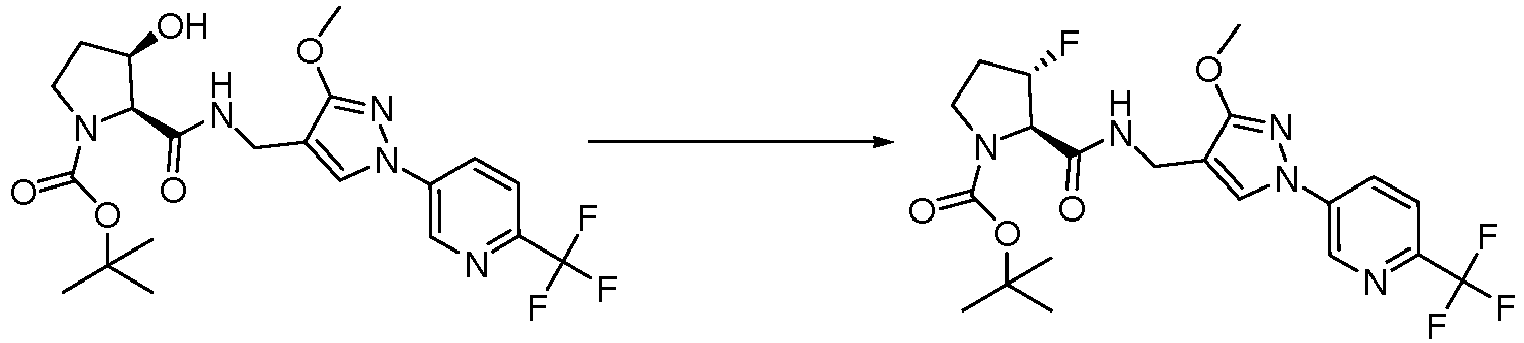
- DAST (109 mg, 0.48 mmol, 3.00 equiv) was added dropwise into a solution of tert-butyl (2S,3R)-3-hydroxy-2-[([3-methoxy-1-[6-(trifluoromethyl)pyridin-3-yl]-1H-pyrazol-4-yl]methyl)carbamoyl]pyrrolidine-1-carboxylate (110 mg, 0.23 mmol, 1.0 equiv) in dichloromethane (10 mL) at 0°C under nitrogen. The resulting solution was stirred for 15 min at 0°C. The reaction was quenched by saturated sodium bicarbonate, extracted with dichloromethane, dried over anhydrous sodium sulfate, and concentrated under vacuum. The residue was purified by a silica gel column eluting with ethyl acetate/petroleum ether (1:1) to afford the title compound (65mg, 59%) as a light yellow solid.
-

- A mixture of tert-butyl (2R,3S)-3-fluoro-2-[([3-methoxy-1-[6-(trifluoromethyl)pyridin-3-yl]-1H-pyrazol-4-yl]methyl)carbamoyl]pyrrolidine-1-carboxylate (65 mg, 0.13 mmol, 1.00 equiv), and saturated HCl in 1,4-dioxane (5 mL). The resulting solution was stirred for 2 h at room temperature. The resulting mixture was concentrated under vacuum to afford the title compound (61mg) as yellow oil.
-

- A solution of (2R,3S)-3-fluoro-N-([3-methoxy-1-[6-(trifluoromethyl)pyridin-3-yl]-1H-pyrazol-4-yl]methyl)pyrrolidine-2-carboxamide hydrochloride (50 mg, 0.12 mmol, 1.00 equiv), 4-fluorobenzene-1-sulfonyl chloride (25 mg, 0.13 mmol, 1.10 equiv), 4-dimethylaminopyridine (1 mg, 0.01 mmol, 0.10 equiv), and TEA (30 mg, 0.30 mmol, 1.00 equiv) in dichloromethane (3 mL) was stirred for 2 h at room temperature. The reaction mixture was diluted with dichloromethane, washed with water, dried with Na2SO4, and concentrated under vacuum. The residue was purified by HPLC-Prep to afford the title compound (29.53mg) as a white solid.
1H NMR (400 MHz, CDCl3) δ 8.98 (s, 1H), 8.07 - 8.05 (m, 1H), 7.96 (s, 1H), 7.89 - 7.86 (m, 2H), 7.73 - 7.70 (m, 1H), 7.52 - 7.36 (m, 1H), 7.28 - 7.23 (m, 2H), 5.38 - 5.26 (d, J = 50.4 Hz, 1H), 4.49 - 4.44 (m, 1H), 4.32 - 4.21 (m, 2H), 4.05 (s, 3H), 3.77 - 3.72 (m, 1H), 3.31 - 3.24 (m, 1H), 2.15 - 1.85 (m, 2H). -

-

- n-BuLi (2.3 mL, 2.5M in hexanes, 1.50 equiv) was added dropwise into a solution of 4-bromo-2-fluoro-1-(trifluoromethoxy)benzene (1 g, 3.86 mmol, 1.00 equiv) in tetrahydrofuran (10 mL) at -78°C under nitrogen. After 1h at-78°C tris(propan-2-yl) borate (1.1 g, 5.85 mmol, 1.50 equiv) was added dropwise at -78°C. The resulting solution was stirred for 14 h at room temperature and quenched by 3N NaOH. The resulting solution was stirred for 30 min at room temperature. The pH value of the solution was adjusted to 7 with 3N aqueous hydrogen chloride. The resulting mixture was extracted with ethyl acetate. The combined extracts were washed with brine, dried over anhydrous sodium sulfate, and concentrated under vacuum. This resulted in the title compound (1.6 g) as yellow oil.
-
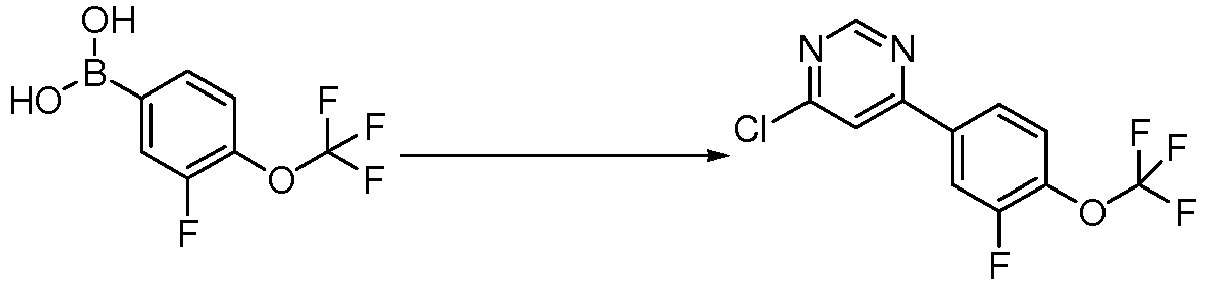
- A mixture of [3-fluoro-4-(trifluoromethoxy)phenyl]boronic acid (500 mg, 2.23 mmol, 1.00 equiv), 4,6-dichloropyrimidine (660 mg, 4.43 mmol, 2.00 equiv), Pd(dppf)Cl2 (82 mg, 0.11 mmol, 0.05 equiv), and potassium carbonate (616 mg, 4.46 mmol, 2.00 equiv) in water(1 mL)/1,4-dioxane (10 mL) was stirred for 14 h at 75°C under nitrogen. The mixture was diluted with water and extracted with ethyl acetate. The combined extracts were washed with brine, dried over anhydrous sodium sulfate, and concentrated under vacuum. The residue was purified by a silica gel column eluting with ethyl acetate/petroleum ether (1:10) to afford the title compound (150mg, 23%) as a white solid.
-

- A mixture of 4-chloro-6-[3-fluoro-4-(trifluoromethoxy)phenyl]pyrimidine (150 mg, 0.51 mmol, 1.00 equiv), Zn(CN)2 (72 mg, 0.61 mmol, 1.20 equiv), Pd2(dba)3.CHCl3 (53 mg, 0.05 mmol, 0.10 equiv), and dppf (57 mg, 0.10 mmol, 0.20 equiv) in N,N-dimethylformamide (5 mL) was irradiated with microwave radiation for 1 h at 100°C under nitrogen. The mixture was diluted with water and extracted with ethyl acetate. The combined extracts were washed with brine, dried over anhydrous sodium sulfate, and concentrated under vacuum. The residue was purified by a silica gel column eluting with ethyl acetate/petroleum ether (1:10). This resulted in the title compound (120mg, 83%) as a yellow solid.
-

- A mixture of 6-[3-fluoro-4-(trifluoromethoxy)phenyl]pyrimidine-4-carbonitrile (120 mg, 0.42 mmol, 1.00 equiv), palladium on carbon (40 mg, 0.38 mmol, 0.90 equiv), and hydrogen chloride(6M, 0.1 mL) in methanol (20 mL) was stirred for 20 min at room temperature under hydrogen. The solids were filtered out. The filtrate was concentrated under vacuum to afford the title compound (133mg, 97%) as a brown solid.
-

- A mixture of (2S,4R)-4-fluoro-1-[(4-fluorobenzene)sulfonyl]pyrrolidine-2-carboxylic acid (119 mg, 0.41 mmol, 1.00 equiv), [6-[3-fluoro-4-(trifluoromethoxy)phenyl]pyrimidin-4-yl]methanamine hydrochloride (133 mg, 0.41 mmol, 1.00 equiv), EDCI (158 mg, 0.82 mmol, 2.00 equiv), HOBT (61 mg, 0.45 mmol, 1.10 equiv), and DIEA (159 mg, 1.23 mmol, 3.00 equiv) in tetrahydrofuran (10 mL) was stirred for 14 h at room temperature. The mixture was diluted with water and extracted with ethyl acetate. The combined extracts were washed with brine, dried over anhydrous sodium sulfate, and concentrated under vacuum. The crude product was purified by Prep-HPLC to afford the title compound (6.6 mg, 3%) as a white solid.
1H NMR (400 MHz, CDCl3) δ 9.23 (s, 1H), 8.16 - 8.12 (m, 1H), 8.06 - 8.02 (m, 2H), 7.96 - 7.91 (m, 2H), 7.65 (s, 1H), 7.44 - 7.38 (t, J = 8.7 Hz, 1H), 7.28 -7.23 (m, 1H), 5.17 - 4.90 (m, 2H), 4.61 - 4.54 (dd, J = 3.9 Hz, J = 3.6 Hz, 1H), 4.35 - 4.29 (t, J = 8.7 Hz, 1H), 3.96 - 3.66 (m, 2H), 2.61 - 2.53 (m, 1H), 2.35 - 2.18 (m,1H). -

-

- A mixture of tert-butyl N-(prop-2-yn-1-yl)carbamate (5 g, 32.22 mmol, 1.0 equiv), Pd(PPh3)2Cl2 (2.25 g, 3.21 mmol, 0.10 equiv), CuI (1.84 g, 9.66 mmol, 0.20 equiv), 4-(trifluoromethyl)benzoyl chloride (6.5 g, 31.17 mmol, 1.00 equiv), and TEA (3.2 g, 31.62 mmol, 1.0 equiv) in THF (150 mL) was stirred for 20 min at room temperature. The solids were filtered out the liquid was concentrated under vacuum. The residue was purified by a silica gel column eluting with ethyl acetate/petroleum ether (1:5). This resulted in the title compound (10g, 98%) as a brown solid.
-

- A mixture of tert-butyl N-[4-oxo-4-[4-(trifluoromethyl)phenyl]but-2-yn-1-yl]carbamate (10 g, 30.55 mmol, 1.0 equiv), benzyl carbamimidothioate hydrochloride (6.3 g, 31.08 mmol, 1.00 equiv), and potassium carbonate (6.35 g, 45.95 mmol, 1.50 equiv) in CH3CN (150 mL) was stirred for 2 h at room temperature. The reaction mixture was diluted with ethyl acetate, washed with water, dried over anhydrous sodium sulfate, and concentrated under vacuum. The residue was purified by a silica gel column eluting with ethyl acetate/petroleum ether (1:5). This resulted in the title compound (7g, 48%) as a yellow solid.
-

- A solution of tert-butyl N-[[2-(benzylsulfanyl)-6-[4-(trifluoromethyl)phenyl]pyrimidin-4-yl]methyl]carbamate (3 g, 6.31 mmol, 1.00 equiv) and saturated HCl in 1,4-dioxane (50 mL) was stirred for overnight at room temperature. The solids were collected by filtration. This resulted in the title compound (2.5g, 96%) as a light brown solid.
-

- A solution of (2S,4R)-4-fluoro-1-[(4-fluorobenzene)sulfonyl]pyrrolidine-2-carboxylic acid (276.5 mg, 0.95 mmol, 1.00 equiv), HATU (433 mg, 1.14 mmol, 1.20 equiv), DIEA (367.5 mg,2.84 mmol, 3.0 equiv), and [2-(benzylsulfanyl)-6-[4(trifluoromethyl)phenyl]pyrimidin-4-yl]methanamine hydrochloride (400 mg, 0.97 mmol, 1.00 equiv) in N,N-dimethylformamide (10 mL) was stirred for 3 h at room temperature. The resulting mixture was diluted with 50 mL of ethyl acetate, washed with brine, dried over anhydrous sodium sulfate, and concentrated under vacuum. The residue was purified by a silica gel column eluting with ethyl acetate/petroleum ether (1:1) to afford the title compound (360mg, 57%) as light yellow oil.
-

- A solution of (2S,4R)-N-[[2-(benzylsulfanyl)-6-[4-(trifluoromethyl)phenyl]pyrimidin-4-yl]methyl]-4-fluoro-1-[(4-fluorobenzene)sulfonyl]pyrrolidine-2-carboxamide (360 mg, 0.55 mmol, 1.00 equiv) and m-CPBA (385 mg, 2.23 mmol, 4.00 equiv) in dichloromethane (30 mL) was stirred for 6 h at room temperature. The resulting mixture was diluted with 50 mL of DCM, washed with aqueous sodium bicarbonate, dried over anhydrous sodium sulfate, and concentrated under vacuum. The residue was purified by a silica gel column eluting with ethyl acetate/petroleum ether (2:3). This resulted in the title compound (260mg, 69%) as colorless oil.
-

- A mixture of (2S,4R)-4-fluoro-1-[(4-fluorobenzene)sulfonyl]-N-[[2-(phenylmethane)sulfonyl-6-[4-(trifluoromethyl)phenyl]pyrimidin-4-yl]methyl]pyrrolidine-2-carboxamide (100 mg, 0.15 mmol, 1.00 equiv) and CH3NH2 (100 mg, 3.22 mmol, 21.00 equiv) in CH3CN (15 mL) was stirred for 5 h at room temperature. The reaction mixture was concentrated under vacuum. The crude product was purified by Prep-HPLC to afford the title compound (41.7mg, 51%) of as a white solid.
1H NMR (400 MHz, CDCl3) δ 8.25 - 8.19 (m, 2H), 7.93 - 7.89 (m, 3H), 7.73 - 7.71 (m, 2H), 7.25 -7.21 (m, 2H), 7.12 (s, 1H), 5.13 - 5.00 (d, J = 52.0 Hz, 1H), 4.67 - 4.61 (m, 1H), 4.45 - 4.39 (m, 1H), 4.36 - 4.32 (m, 1H), 3.96 - 3.87 (m, 1H), 3.78 - 3.65 (m, 1H), 3.15 (s, 3H), 2.57 - 2.48 (m, 1H), 2.41 - 2.28(m, 1H). -

-

- Cbz-Cl (70 g, 410.33 mmol, 2.00 equiv) in dichloromethane (50 mL) was added dropwise into a mixture of ethyl (2S,4R)-4-hydroxypyrrolidine-2-carboxylate hydrochloride (40 g, 204.45 mmol, 1.00 equiv) and TEA (83 g, 820.24 mmol, 4.00 equiv) in dichloromethane (400 mL) at room temperature. The resulting solution was stirred overnight at room temperature. The mixture was diluted with water and extracted with ethyl acetate. The combined extracts were washed with brine, dried over anhydrous sodium sulfate, and concentrated under vacuum. The residue was purified by a silica gel column eluting with ethyl acetate/petroleum ether (2:1) to afford the title compound (60 g) as light yellow oil.
-

- 4-Methylbenzene-1-sulfonyl chloride (24.0 g, 125.89 mmol, 1.00 equiv) in dichloromethane (200 mL) was added dropwise into a solution of 1-benzyl 2-ethyl (2S,4R)-4-hydroxypyrrolidine-1,2-dicarboxylate (18.6 g, 63.41 mmol, 0.50 equiv), TEA (16.5 g, 163.06 mmol, 1.30 equiv), and 4-dimethylaminopyridine (1.0 g, 8.19 mmol) in dichloromethane (1 L) at room temperature. The resulting solution was stirred for 12 h at 30°C. The mixture was diluted with water and extracted with ethyl acetate. The combined extracts were washed with brine, dried over anhydrous sodium sulfate, and concentrated under vacuum. The residue was purified by a silica gel column eluting with ethyl acetate/petroleum ether (1/5) to afford the title compound (25 g, 44%) as colorless oil.
-

- A mixture of (phenyldiselanyl)benzene (109 g, 349.21 mmol, 1.20 equiv) and NaBH4 (13 g, 343.62 mmol, 1.20 equiv) in ethanol (600 mL) was stirred for 30 min at room temperature. To this was added 1-benzyl 2-ethyl (2S,4R)-4-[[(4-methylbenzene)sulfonyl]oxy]pyrrolidine-1,2-dicarboxylate (78 g, 174.30 mmol, 1.00 equiv). The resulting solution was refluxed overnight and concentrated under vacuum. The residue was diluted with ethyl acetate, washed with water, dried over anhydrous sodium sulfate, and concentrated under vacuum. The residue was purified by a silica gel column with ethyl acetate/petroleum ether (1/1) to afford the title compound (32 g, 42%) as colorless oil.
-

- Pyridine (52 mg, 0.66 mmol, 1.40 equiv) and H2O2 (30%, 131 mg, 3.85 mmol, 2.50 equiv) was added sequentially into a solution of 1-benzyl 2-ethyl (2S,4S)-4-(phenylselanyl)pyrrolidine-1,2-dicarboxylate (200 mg, 0.46 mmol, 1.00 equiv) in DCM (20 mL) at 0°C. The resulting solution was stirred for 2 h at room temperature, diluted with DCM, washed with water, dried over anhydrous sodium sulfate, and concentrated under vacuum. The residue was purified by a silica gel column eluting with ethyl acetate/petroleum ether (1:5). This resulted in the title compound (100 mg, 79%) as colorless oil.
-

- m-CPBA (36 g, 208.62 mmol, 6.00 equiv) was added in portions to a stirred solution of 1-benzyl 2-ethyl (2S)-2,5-dihydro-1H-pyrrole-1,2-dicarboxylate (9.5 g, 34.51 mmol, 1.00 equiv) in chloroform (300 mL). The resulting solution was heated to reflux for overnight. The resulting mixture was washed with saturated sodium bicarbonate, dried over anhydrous sodium sulfate, and concentrated under vacuum. The residue was purified by a silica gel column eluting with ethyl acetate/petroleum ether (1:5) to afford the title compound (4 g, 40%) as light yellow oil.
-

- CH3Li (20 mL, 5.00 equiv) was added dropwise into a mixture of CuI (2.8 g, 14.70 mmol, 2.40 equiv) in ether (60 mL) at -10°C under nitrogen. After 20 min at -10°C a solution of 3-benzyl 2-ethyl 6-oxa-3-azabicyclo[3.1.0]hexane-2,3-dicarboxylate (1.8 g, 6.18 mmol, 1.00 equiv) in ether (13 mL) was added dropwise at -10°C. After 1h at -10°C the reaction was quenched by water, extracted with ethyl acetate, dried over sodium sulfate, and concentrated under vacuum. The residue was purified by a silica gel column eluting with petroleum ether/diethyl ether (5:1) to afford the title compound (700 mg, 37%) as light brown oil.
-

- DAST (8.4 g, 36.68 mmol, 6.00 equiv) was added dropwise into a solution of 1-benzyl 2-ethyl (2S)-4-hydroxy-3-methylpyrrolidine-1,2-dicarboxylate (2.7 g, 8.79 mmol, 1.00 equiv) in dichloromethane (100 mL) at 0°C under nitrogen. The resulting solution was stirred overnight at room temperature, diluted with DCM, washed with saturated sodium bicarbonate, dried over anhydrous sodium sulfate, and concentrated under vacuum. The residue was applied onto a silica gel column eluting with ethyl acetate/petroleum ether (1:5) to afford the title compound (710 mg, 26%) as colorless oil.
-

- A mixture of 1-benzyl 2-ethyl (2S)-4-fluoro-3-methylpyrrolidine-1,2-dicarboxylate (710 mg, 2.30 mmol, 1.00 equiv) and LiOH (276 mg, 11.52 mmol, 5.00 equiv) in methanol (30ml) was stirred overnight at room temperature. The resulting mixture was concentrated under vacuum. The residue was diluted with water and the pH value of the solution was adjusted to 4 with diluted HCl. The resulting solution was extracted with ethyl acetate, washed with brine, dried over anhydrous sodium sulfate, and concentrated under vacuum. This resulted in the title compound (480 mg, 74%) as crude oil.
-
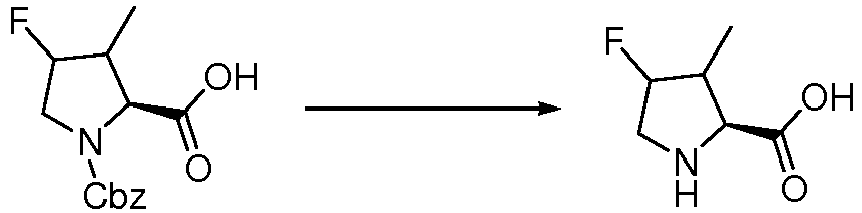
- A mixture of (2S)-1-[(benzyloxy)carbonyl]-4-fluoro-3-methylpyrrolidine-2-carboxylic acid (480 mg, 1.71 mmol, 1.00 equiv) and palladium on carbon (50 mg) in methanol (30 mL) was stirred overnight at 35°C under hydrogen. The solids were filtered out. The filtrate was concentrated under vacuum to afford the title compound (250 mg) as a light brown crude solid.
-

- A mixture of (2S)-4-fluoro-3-methylpyrrolidine-2-carboxylic acid (250 mg, 1.70 mmol, 1.00 equiv), TEA (515 mg, 5.09 mmol, 3.00 equiv), and 4-fluorobenzene-1-sulfonyl chloride (330 mg, 1.70 mmol, 1.00 equiv) in dichloromethane (20 mL) was stirred for 3 h at room temperature. The resulting mixture was concentrated under vacuum. The residue was diluted with water. The pH value of the solution was adjusted to 10-11 with aqueous sodium carbonate. The resulting solution was washed with ethyl acetate. The pH value of the aqueous layer was adjusted to ∼1 by diluted HCl. The resulting solution was extracted with ethyl acetate, dried over anhydrous sodium sulfate, and concentrated under vacuum. This resulted in the title compound (330 mg) as a brown solid which was used for the next step without any further purification
-

- A mixture of (2S)-4-fluoro-1-[(4-fluorobenzene)sulfonyl]-3-methylpyrrolidine-2-carboxylic acid (160 g, 524.08 mmol, 1.00 equiv), HATU (239 g, 628.57 mmol, 1.20 equiv), DIEA (135 g, 1.04 mol, 2.00 equiv), and [6-[6-(trifluoromethyl)pyridin-3-yl]pyrimidin-4-yl]methanamine hydrochloride (153 g, 526.37 mmol, 1.00 equiv) in N,N-dimethylformamide (5 mL) was stirred overnight at room temperature. The mixture was diluted with water and extracted with ethyl acetate. The combined extracts were washed with brine, dried over anhydrous sodium sulfate, and concentrated under vacuum. The residue was purified by a silica gel column eluting with ethyl acetate/petroleum ether (4:1). The crude product was separated by Chiral-Prep-HPLC to afford the title compound (7.3 mg) as a white solid. tR = 5.14 min (Lux Cellulose-4, 0.46x5cm, 3µm, Hex:EtOH = 80:20, 1.0 ml/min).
1H NMR (300 MHz, CDCl3) δ 9.51 (s, 1H), 9.26 (s, 1H), 8.70 (d, J = 1.5 Hz, 1H), 8.17 (s, 1H), 7.93 - 7.89 (m, 2H), 7.80 - 7.77 (d, J = 8.1 Hz, 1H), 7.49 (s, 1H), 7.29 - 7.23 (m, 2H), 5.04 - 4.96 (m, 1H), 4.89 - 4.71 (d, J = 52.2 Hz, 1H), 4.53 - 4.46 (m, 1H), 3.89 - 3.64 (m, 3H), 2.51 - 2.34 (m, 1H), 1.19 (d, J = 6.6 Hz, 3H). - And (2S,4R)-4-fluoro-1-[(4-fluorobenzene)sulfonyl]-3-methyl-N-([6-[6-(trifluoromethyl)pyridin-3-yl]pyrimidin-4-yl]methyl)pyrrolidine-2-carboxamide (82 mg) was also isolated as a white solid. tR = 4.08 min (Lux Cellulose-4, 0.46x5cm, 3µm, Hex:EtOH = 80:20, 1.0 ml/min).
1H NMR (300 MHz, CDCl3) δ 9.51 (s, 1H), 9.26 (s, 1H), 8.70 (d, J = 1.5 Hz, 1H), 8.17 (s, 1H), 7.93 - 7.89 (m, 2H), 7.80 - 7.77 (d, J = 8.1 Hz, 1H), 7.49 (s, 1H), 7.29 - 7.23 (m, 2H), 5.04 - 4.96 (dd, J = 17.7 Hz, J = 7.2 Hz, 1H), 4.89 - 4.71(d, J = 52.2 Hz, 1H), 4.53 - 4.46 (dd, J = 18.0 Hz, J = 4.2 Hz, 1H), 3.89 - 3.64 (m, 3H), 2.51 - 2.34 (m, 1H), 1.19 (d, J = 6.6 Hz, 3H). - The 3-proline stereochemistry for the above two compounds was arbitrarily assigned. The 2-proline and 4-proline stereochemistry for the above two compounds is as shown.
-

-

- A mixture of 1-tert-butyl 2-methyl (2S,4R)-4-hydroxypyrrolidine-1,2-dicarboxylate (6.45 g, 26.30 mmol, 1.00 equiv) and LiOH (3.16 g, 131.95 mmol, 5.00 equiv) in water (50 mL)/methanol (50 mL) was stirred for 1 h at room temperature. The resulting mixture was concentrated under vacuum. The residue was dissolved in water. The resulting solution was extracted with ethyl acetate. The pH value of the water layer was adjusted to 4 with 1M hydrogen chloride. The resulting mixture was extracted with ethyl acetate, washed with brine, dried over anhydrous sodium sulfate, and concentrated under vacuum. This resulted in the title compound (3.5 g, 58%) as colorless syrup which was used for the next step without any further purification.
-

- A mixture of (2S,4R)-1-[(tert-butoxy)carbonyl]-4-hydroxypyrrolidine-2-carboxylic acid (3.5 g, 15.14 mmol, 1.00 equiv), HATU (8.6 g, 22.62 mmol, 1.50 equiv), DIEA (7.84 g, 60.66 mmol, 4.00 equiv), and [6-[6-(trifluoromethyl)pyridin-3-yl]pyrimidin-4-yl]methanamine hydrochloride (4.4 g, 15.14 mmol, 1.00 equiv) in N,N-dimethylformamide (300 mL) was stirred for 1 h at room temperature. The reaction was then quenched by water and extracted with ethyl acetate. The combined extracts were washed with brine, dried over anhydrous sodium sulfate, and concentrated under vacuum. The residue was purified by a silica gel column eluting with dichloromethane/methanol (50:1). This resulted in the title compound (6.8 g, 96%) as a light brown solid.
-

- A mixture of tert-butyl (2S,4R)-4-hydroxy-2-[([6-[6-(trifluoromethyl)pyridin-3-yl]pyrimidin-4-yl]methyl)carbamoyl]pyrrolidine-1-carboxylate (1.23 g, 2.63 mmol, 1.00 equiv), Dess-Martin (1.34 g, 3.16 mmol, 1.20 equiv) in dichloromethane (25 mL) was stirred for 12 h at room temperature. The reaction was then quenched by water. The resulting solution was extracted with dichloromethane, washed with saturated sodium bicarbonate solution and then brine, dried over anhydrous sodium sulfate, and concentrated under vacuum. The residue was purified by a silica gel column eluting with ethyl acetate/petroleum ether (1:10). This resulted in the title compound (960 mg, 78%) as a yellow solid.
-

- MeMgBr (1.4 mL, 2.00 equiv) was added into a mixture of tert-butyl (2S)-4-oxo-2-[([6-[6-(trifluoromethyl)pyridin-3-yl]pyrimidin-4-yl]methyl)carbamoyl]pyrrolidine-1-carboxylate (960 mg, 2.06 mmol, 1.00 equiv) in tetrahydrofuran (15 mL) at -5°C under nitrogen. The resulting solution was stirred for 5 h at 0°C, quenched by saturated solution of NH4Cl, and extracted with ethyl acetate. The combined extracts were washed with brine, dried over anhydrous sodium sulfate, and concentrated under vacuum. The residue was purified by a silica gel column eluting with dichloromethane/methanol (50:1) to afford the title compound (250 mg, 25%) as a yellow solid.
-

- DAST (170.6 mg, 0.74 mmol, 3.00 equiv) was added dropwise into a mixture of tert-butyl (2S)-4-hydroxy-4-methyl-2-[([6-[6-(trifluoromethyl)pyridin-3-yl]pyrimidin-4-yl]methyl)carbamoyl]pyrrolidine-1-carboxylate (170 mg, 0.35 mmol, 1.00 equiv) in dichloromethane (3 mL) at -10°C under nitrogen. The resulting solution was stirred for 1 h at -10°C, quenched by water, and extracted with dichloromethane. The combined extracts were washed with saturated sodium bicarbonate and brine, dried over anhydrous sodium sulfate, and concentrated under vacuum. This resulted in the title compound (160 mg, 94%) as an orange solid.
-

- A mixture of tert-butyl (2S)-4-fluoro-4-methyl-2-[([6-[6-(trifluoromethyl)pyridin-3-yl]pyrimidin-4-yl]methyl)carbamoyl]pyrrolidine-1-carboxylate (200 mg, 0.41 mmol, 1.00 equiv) and saturated hydrogen chloride in dioxane (5 mL) was stirred for 3 h at room temperature. The resulting solution was concentrated under vacuum to afford the title compound (186 mg) as an orange solid.
-

- A mixture of (2S)-4-fluoro-4-methyl-N-([6-[6-(trifluoromethyl)pyridin-3-yl]pyrimidin-4-yl]methyl)pyrrolidine-2-carboxamide (186 mg, 0.49 mmol, 1.00 equiv), TEA (196 mg, 1.94 mmol, 4.00 equiv), 4-fluorobenzene-1-sulfonyl chloride (113 mg, 0.58 mmol, 1.20 equiv), and 4-dimethylaminopyridine (6 mg, 0.05 mmol, 0.10 equiv) in dichloromethane (5 mL) was stirred for 3 h at room temperature. The reaction mixture was diluted with water and extracted with ethyl acetate. The combined extracts were washed with brine, dried over anhydrous sodium sulfate, and concentrated under vacuum. The residue was purified by a silica gel column eluting with ethyl acetate/petroleum ether (1:3). The crude product was purified by Prep-HPLC to afford the title compound (51.7 mg, 20%) as a white solid. tR = 1.94 min (CHIRALPAK IC-3, 0.46x5cm, 3µm, Hex:EtOH = 70:30, 1.0 ml/min).
1H NMR (300 MHz, DMSO-d6 ) δ 9.45 (s, 1H), 9.31 (s, 1H), 9.15 - 9.11 (t, J = 6.1 Hz, 1H), 8.81 - 8.78 (d, J = 9.2 Hz, 1H), 8.24 (s, 1H), 8.07 - 8.01 (m, 3H), 7.50 - 7.44 (t, 2H), 4.54 - 4.52 (d, J = 6.1 Hz, 2H), 4.28 - 4.24 (m, 1H), 3.74 - 2.48 (m, 2H), 2.46 - 2.39 (m, 1H), 2.19 - 2.02 (m, 1H), 1.43 - 1.36 (d, J = 9.0 Hz, 3H). - The 4-proline stereochemistry for the above compound was arbitrarily assigned. The 2-proline stereochemistry for the above compound is as shown.
-

-

- Sodium hydride (1.2 g, 60% in mineral oil, 2.30 equiv) was added in portions to a stirred solution of 6-chloro-4-iodopyridin-3-ol hydrochloride (3.80 g, 13.02 mmol, 1.00 equiv) in N,N-dimethylformamide (30 mL) at 0°C under nitrogen. After 30 min at 0°C CH3I (2.22 g, 15.64 mmol, 1.20 equiv) was added to the solution. The resulting solution was stirred for 12 h at room temperature, quenched by water, extracted with ethyl acetate, washed with brine, dried over anhydrous sodium sulfate, and concentrated under vacuum. The residue was purified by flash chromatography on silica gel eluting with petroleum ether/ethyl acetate (10:1). This resulted in the title compound (2.9 g, 83%) as a white solid.
-

- A mixture of 2-chloro-4-iodo-5-methoxypyridine (1 g, 3.71 mmol, 1.00 equiv) in dioxane (30 mL), [6-(trifluoromethyl)pyridin-3-yl]boronic acid (710 mg, 3.72 mmol, 1.00 equiv), Pd(dppf)Cl2 (271 mg, 0.37 mmol, 0.10 equiv), potassium carbonate (1.532 g, 11.08 mmol, 3.00 equiv), and water (3 mL) was stirred for 5 h at 50°C under nitrogen. The solids were filtered out and the liquid was concentrated under vacuum. The residue was purified by flash chromatography on silica gel eluting with petroleum ether/ethyl acetate (100:3). This resulted in the title compound (510 mg, 48%) as a white solid.
-

- A mixture of 2-chloro-5-methoxy-4-[6-(trifluoromethyl)pyridin-3-yl]pyridine (400 mg, 1.39 mmol, 1.00 equiv) in N,N-dimethylformamide (10 mL), Zn(CN)2 (162 mg, 1.38 mmol, 1.00 equiv), DPPF (77 mg, 0.14 mmol, 0.10 equiv), and Pd2(dba)3.CHCl3 (72 mg, 0.07 mmol, 0.05 equiv) was irradiated with microwave for 1 h at 110°C under nitrogen. The reaction was then quenched by water, extracted with ethyl acetate, washed with brine, dried over anhydrous sodium sulfate, and concentrated under vacuum. The residue was purified by flash chromatography on silica gel eluting with ethyl acetate/petroleum ether (15:100). This resulted in the title compound (440 mg) as an off-white solid.
-

- A mixture of 5-methoxy-4-[6-(trifluoromethyl)pyridin-3-yl]pyridine-2-carbonitrile (150 mg, 0.54 mmol, 1.00 equiv), methanol (30 mL), palladium on carbon (30 mg), hydrogen chloride (0.6 mL, concentrated) was stirred for 1 h at room temperature under hydrogen. The solids were filtered out and the liquid was concentrated under vacuum. This resulted in the title compound (325 mg) as a yellow solid.
-

- A mixture of (2S,4R)-4-fluoro-1-[(4-fluorobenzene)sulfonyl]pyrrolidine-2-carboxylic acid (291 mg, 1.00 mmol, 1.00 equiv) in N,N-dimethylformamide (30 mL), [5-methoxy-4-[6-(trifluoromethyl)pyridin-3-yl]pyridin-2-yl]methanamine hydrochloride (320 mg, 1.00 mmol, 1.00 equiv), DIEA (1.29 g, 9.98 mmol, 10.00 equiv), and HATU (570 mg, 1.50 mmol, 1.50 equiv) was stirred for overnight at room temperature. The reaction was then quenched by water, extracted with ethyl acetate, washed with brine, dried over anhydrous sodium sulfate, and concentrated under vacuum. The residue was purified by flash chromatography on silica gel eluting with ethyl acetate/petroleum ether (1/10). This resulted in the title compound (55.7 mg, 10%) as a white solid.
1H NMR (300 MHz, DMSO-d6 ) δ 8.95 - 8.90 (m, 2H), 8.48 (s, 1H), 8.28 - 8.25 (m, 1H), 7.99 - 7.93 (m, 3H), 7.52 (s, 1H), 7.46 - 7.41 (m, 2H), 5.27 - 5.01 (d, J = 52.8 Hz, 1H), 4.46 - 4.42 (m, 2H),4.23 - 4.17 (m, 1H), 3.93 (s, 3H), 3.70 (s, 1H), 3.62 - 3.57 (m, 1H), 2.39 - 2.00 (m, 2H). -

-

- A mixture of [5-methoxy-4-[6-(trifluoromethyl)pyridin-3-yl]pyridin-2-yl]methanamine(150 mg, 0.530 mmol, 1.000 equiv), DMF (5 mL), DIEA (190 mg, 1.470 mmol, 2.776 equiv), HATU (280 mg, 0.736 mmol, 1.391 equiv), and (4R)-4-fluoro-1-[(4-fluorobenzene)sulfonyl]-2-methylpyrrolidine-2-carboxylic acid (157 mg, 0.514 mmol, 0.971 equiv) was stirred for 2 h at room temperature. The reaction was then quenched by water, extracted with ethyl acetate, washed with brine, dried over sodium sulfate, and concentrated under vacuum. The residue was purified a silica gel column eluting with petroleum ether/ethyl acetate (1:1). The crude product (200 mg) was re-purified by Chiral-Prep-HPLC eluting with Hex and ethanol (hold 20.0% ethanol in 20 min) to afford the title compound (89.5 mg, 30%) as a white solid. tR = 2.68 min (CHIRALPAK IC, 4.6x100mm, 5µm, MeOH (0.1%) = 10% to 50% in 4.0 min, hold 2.0 min at 50%, 4 ml/min).
1H NMR (300 MHz, CD3OD) δ 8.96 (s, 1H), 8.40 (s, 1H), 8.33 (d, J = 1.5 Hz, 1H), 8.00 - 7.96 (m, 2H), 7.88 (d, J = 8.4 Hz, 1H), 7.65 (s, 1H), 7.37 - 7.31 (m, 2H), 5.20 (d, J = 52.8 Hz, 1H), 4.86 - 4.49 (m, 2H), 4.07 - 3.95 (m, 4H), 3.73 - 3.57 (m, 1H), 2.67 - 2.60 (m, 1H), 2.27 - 2.08 (m, 2H), 1.58 (s, 3H). - (2S,4R)-4-fluoro-1-(4-fluorophenyl)sulfonyl-N-[[5-methoxy-4-[6-(trifluoromethyl)-3-pyridyl]-2-pyridyl]methyl]-2-methyl-pyrrolidine-2-carboxamide (37.1 mg, 12%) was also isolated as a white solid. tR = 2.46 min (CHIRALPAK IC, 4.6x100mm, 5µm, MeOH (0.1%) = 10% to 50% in 4.0 min, hold 2.0min at 50%, 4 ml/min).
1H NMR (300 MHz, CD3OD) δ 8.97 (s, 1H), 8.40 (s, 1H), 8.32 - 8.28 (m, 1H), 7.94 - 7.90 (m, 2H), 7.82 (d, J = 8.4 Hz, 1H), 7.73 (s, 1H), 7.30 - 7.24 (m, 2H), 5.20 (d, J = 52.8 Hz, 1H), 4.64 - 4.51 (m, 2H), 3.99 (s, 3H), 3.86 - 3.75 (m, 1H), 2.60 - 2.27 (m, 1H), 1.75 (s, 3H). -

-

- A mixture of 1-tert-butyl 2-methyl (2S,4S)-4-hydroxypyrrolidine-1,2-dicarboxylate (5 g, 20.39 mmol, 1.00 equiv), methanol (100 mL), water (20 mL), and sodium hydroxide (2.85 g, 71.26 mmol, 3.50 equiv) was stirred for 12 h at 20°C. The resulting solution was concentrated and dissolved in water. The pH value of the solution was adjusted to 3-4 with 5% of HCl, extracted with ethyl acetate, dried over anhydrous sodium sulfate, and concentrated under vacuum. This resulted in the title compound (2.4 g, 51%) as a white solid.
-

- A mixture of (2S,4S)-1-[(tert-butoxy)carbonyl]-4-hydroxypyrrolidine-2-carboxylic acid (500 mg, 2.16 mmol, 1.00 equiv), dichloromethane (20 mL), EDCI (412.5 mg, 2.15 mmol, 1.00 equiv), HOBT (292.5 mg, 2.16 mmol, 1.00 equiv), and 3-methoxy-1-[4-(trifluoromethyl)phenyl]-1H-pyrazol-4-ylmethanamine (600 mg, 2.21 mmol, 1.00 equiv) was stirred for 1 h at 20°C. The resulting solution was diluted with water, extracted with dichloromethane, dried over sodium sulfate, and concentrated under vacuum. The residue was purified by flash chromatography on silica gel eluting with dichloromethane/methanol (20/1). This resulted in the title compound (630 mg, 60%) as a white solid.
-

- A solution of tert-butyl (2S,4S)-4-hydroxy-2-[([3-methoxy-1-[4-(trifluoromethyl)phenyl]-1H-pyrazol-4-yl]methyl)carbamoyl]pyrrolidine-1-carboxylate (1.6 g, 3.30 mmol, 1.00 equiv) in dichloromethane (20 mL)/ trifluoroacetic acid (4 mL) was stirred for 12 h at 20°C. The resulting mixture was concentrated under vacuum. The residue was dissolved in water. The pH value of the solution was adjusted to 8-9 with sodium bicarbonate. The resulting solution was extracted with ethyl acetate, dried over anhydrous sodium sulfate, and concentrated under vacuum. This resulted in the title compound (1.2 g, 95%) as a yellow solid.
-

- A solution of (2S,4S)-4-hydroxy-N-([3-methoxy-1-[4-(trifluoromethyl)phenyl]-1H-pyrazol-4-yl]methyl)pyrrolidine-2-carboxamide (1.2 g, 3.12 mmol, 1.00 equiv), dichloromethane (60 mL), TEA (630 mg, 6.23 mmol, 2.00 equiv), and 4-fluorobenzene-1-sulfonyl chloride (606 mg, 3.11 mmol, 1.00 equiv) was stirred for 12 h at 20°C. The resulting solution was diluted with water, extracted with ethyl acetate, dried over anhydrous sodium sulfate, and concentrated under vacuum. The residue was purified by flash chromatography on silica gel eluting with ethyl acetate/petroleum ether (1:1). This resulted in the title compound (1.1g, 65%) as a white solid.
-

- A mixture of (2S,4S)-1-[(4-fluorobenzene)sulfonyl]-4-hydroxy-N-([3-methoxy-1-[4-(trifluoromethyl)phenyl]-1H-pyrazol-4-yl]methyl)pyrrolidine-2-carboxamide (1.1 g, 2.03 mmol, 1.00 equiv), TEA (615 mg, 6.08 mmol, 3.00 equiv), Tesco (578 mg, 3.03 mmol, 1.50 equiv), and 4-dimethylaminopyridine (25 mg, 0.20 mmol, 0.10 equiv) in dichloromethane (20 mL) was stirred for 24 h at 20°C. The resulting solution was diluted with water and extracted with ethyl acetate. The combined extracts were dried over anhydrous sodium sulfate and concentrated under vacuum. The residue was purified by flash chromatography on silica gel eluting with ethyl acetate/petroleum ether (1/10) to afford the title compound (1 g, 71%) as a white solid.
-

- A mixture of (3S,5S)-1-[(4-fluorobenzene)sulfonyl]-5-[([3-methoxy-1-[4-(trifluoromethyl)phenyl]-1H-pyrazol-4-yl]methyl)carbamoyl]pyrrolidin-3-yl 4-methylbenzene-1-sulfonate (1.1 g, 1.58 mmol, 1.00 equiv), DMSO (6 mL), and NaCN (93 mg, 1.90 mmol, 1.20 equiv) was stirred for 48 h at 50°C. The resulting solution was diluted with ethyl acetate, washed with brine, dried over anhydrous sodium sulfate, and concentrated under vacuum. The residue was purified by flash chromatography on silica gel eluting with ethyl acetate/petroleum ether (1/1). The crude product was purified by Prep-HPLC to afford the title compound (43.1 mg, 5%) as a white solid.
1H NMR (400 MHz, CDCl3) δ 7.90 - 7.85 (m, 3H), 7.71 - 7.64 (m, 4H), 7.31 - 7.26 (s, 2H), 4.35 - 4.23 (m, 3H), 4.05 (s, 3H), 3.87 - 3.83 (m, 1H), 3.40 - 3.35 (m, 1H), 3.18 - 3.14 (m, 1H), 2.69 - 2.65 (m, 1H), 1.93 - 1.87 (m, 1H). -

-

- A mixture of [4-(trifluoromethoxy)phenyl]boronic acid (5 g, 24.28 mmol, 1.00 equiv) in 1,4-dioxane (50 mL), water (10 mL), 4,6-dichloropyrimidine (3.59 g, 24.10 mmol, 1.00 equiv), potassium carbonate (6.67 g, 48.26 mmol, 1.00 equiv), and Pd(dppf)Cl2 (1.2 g, 1.64 mmol, 1.00 equiv) was stirred for 3 h at 80°C under nitrogen. The reaction mixture was diluted with water and extracted with ethyl acetate. The combined extracts were washed with brine, dried over anhydrous sodium sulfate, and concentrated under vacuum. The crude residue was purified by recrystallized from ethyl acetate/petroleum ether (1/10) to afford the title compound (3.6 g, 54%) as a white solid.
-

- A mixture of 4-chloro-6-[4-(trifluoromethoxy)phenyl]pyrimidine (500 mg, 1.82 mmol, 1.00 equiv), Zn(CN)2 (256 mg, 2.18 mmol, 1.20 equiv), dppf (150 mg, 0.27 mmol, 0.30 equiv), and Pd2(dba)3 (100 mg, 0.11 mmol, 0.20 equiv) in N,N-dimethylformamide (5 mL) was irradiated with microwave for 3 h at 100°C under nitrogen. The reaction mixture was diluted with water and extracted with ethyl acetate. The combined extracts were washed with brine, dried over anhydrous sodium sulfate, and concentrated under vacuum. The residue was purified by flash chromatography on silica gel eluting with ethyl acetate/petroleum ether (1/10). This resulted in the title compound (200 mg, 41%) as yellow oil.
-

- A mixture of 6-[4-(trifluoromethoxy)phenyl]pyrimidine-4-carbonitrile (200 mg, 0.75 mmol, 1.00 equiv), palladium on carbon (100 mg, 0.94 mmol, 1.00 equiv), ethanol (10 mL), and concentrated hydrogen chloride (0.2 mL) was stirred for 10 min at room temperature under hydrogen. The solids were filtered out and the liquid was concentrated under vacuum. This resulted in the title compound (65 mg, 32%) as a yellow solid.
-

- A mixture of [6-[4-(trifluoromethoxy)phenyl]pyrimidin-4-yl]methanamine hydrochloride (65 mg, 0.24 mmol, 1.00 equiv), (2R,3S)-3-fluoro-1-[(4-fluorobenzene)sulfonyl]pyrrolidine-2-carboxylic acid (70 mg, 0.24 mmol, 1.00 equiv), DIPEA (93 mg, 0.72 mmol, 3.00 equiv), and HATU (182 mg, 0.48 mmol, 2.00 equiv) in tetrahydrofuran (10 mL) was stirred for 16 h at room temperature. The reaction mixture was diluted with water and extracted with ethyl acetate. The combined extracts were washed with brine, dried over anhydrous sodium sulfate, and concentrated under vacuum. The crude product was purified by chromatograph on a silica gel eluting with ethyl acetate/petroleum ether (1/1). This resulted in the title compound (23 mg, 18%) as a white solid.
1H NMR (300 MHz, DMSO-d6 ) δ 9.21 - 9.17 (m, 2H), 8.35 (d, J = 6.6 Hz, 1H), 8.05 - 8.01 (m, 3H), 7.54 - 7.49 (m, 4H), 5.33 - 5.15 (d, J = 52.2 Hz, 1H), 4.57 - 4.40 (m, 3H), 3.71 - 3.66 (t, J = 6.6 Hz, 1H), 3.33 - 3.15 (m, 1H), 2.27 - 2.01 (m, 2H). -

-

- BH3.THF (51 mL, 1 mol/L in THF) dropwise was added dropwise into a solution of 3-bromo-5-iodobenzoic acid (10 g, 30.59 mmol, 1.00 equiv) in THF (50 mL) at 0°C under nitrogen. The resulting solution was stirred for 12 h at room temperature. The reaction was then quenched by water at 0°C. The resulting solution was extracted with ethyl acetate, washed with brine, dried over anhydrous sodium sulfate, and concentrated under vacuum. This resulted in the title compound (8.5 g, 89%) as an off-white solid.
-

- A mixture of (3-bromo-5-iodophenyl)methanol (3.00 g, 9.59 mmol, 1.00 equiv), dichloromethane (20 mL), and sulfuryl dichloride (2.20 g, 19.21 mmol, 2.00 equiv) was stirred for 1 h at 0°C. The resulting solution was diluted with water and extracted with dichloromethane. The combined extracts were washed with brine, dried over anhydrous sodium sulfate, and concentrated under vacuum. The residue was purified by a silica gel column eluting with ethyl acetate/petroleum ether (1:10). This resulted in the title compound (2 g, 63%) as a white solid.
-

- A mixture of 1-bromo-3-(chloromethyl)-5-iodobenzene (2.00 g, 6.04 mmol, 1.00 equiv) and 2-potassio-2,3-dihydro-1H-isoindole-1,3-dione (1.68 g, 9.07 mmol, 1.50 equiv) in DMF (15 mL) was stirred for 12 h at room temperature. The reaction mixture was diluted with water. The solids were collected by filtration to afford the title compound (2.5 g, 94%) as a white solid.
-

- A mixture of 2-[(3-bromo-5-iodophenyl)methyl]-2,3-dihydro-1H-isoindole-1,3-dione (3.00 g, 6.79 mmol, 1.00 equiv), methanol (50 mL), and NH2NH2.H2O (3.40 g, 67.92 mmol, 10.00 equiv) was stirred for 12 h at 50°C. The solids were filtered out and the liquid was concentrated under vacuum. The residue was purified by a silica gel column eluting with dichloromethane/methanol (20:1). This resulted in the title compound (2 g, 94%) as yellow oil.
-

- A mixture of (2S,4R)-4-fluoro-1-[(4-fluorobenzene)sulfonyl]pyrrolidine-2-carboxylic acid (780.00 mg, 2.68 mmol, 1.00 equiv), DMF (10.01 mL), HATU (1527.34 mg, 4.02 mmol, 1.50 equiv), DIEA (1038.31 mg, 8.03 mmol, 3.00 equiv), and (3-bromo-5-iodophenyl)methanamine (1002.44 mg, 3.21 mmol, 1.20 equiv) was stirred for 12 h at room temperature. The resulting solution was diluted with water and extracted with ethyl acetate. The combined extracts were washed with brine, dried over anhydrous sodium sulfate, and concentrated under vacuum. The residue was purified by a silica gel column eluting with ethyl acetate/petroleum ether (1:1). This resulted in the title compound (1.2 g, 77%) as a white solid.
-

- A mixture of [6-(trifluoromethyl)pyridin-3-yl]boronic acid (130.50 mg, 0.68 mmol, 1.00 equiv), (2S,4R)-N-[(3-bromo-5-iodophenyl)methyl]-4-fluoro-1-[(4-fluorobenzene)sulfonyl]pyrrolidine-2-carboxamide (400.01 mg, 0.68 mmol, 1.00 equiv), Pd(dppf)Cl2 (50.02 mg, 0.07 mmol, 0.10 equiv), potassium carbonate (380 mg, 2.75 mmol, 4.00 equiv), and 1,4-dioxane (15 mL)/water(3 mL) was stirred for 12 h at 50°C under nitrogen. The resulting solution was diluted with water and extracted with ethyl acetate. The combined extracts were washed with brine, dried over anhydrous sodium sulfate, and concentrated under vacuum. The residue was purified by a silica gel column eluting with ethyl acetate/petroleum ether (1:1). This resulted in the title compound (260 mg, 63%) as a light yellow solid.
-

- A mixture of (2S,4R)-N-([3-bromo-5-[6-(trifluoromethyl)pyridin-3-yl]phenyl]methyl)-4-fluoro-1-[(4fluorobenzene)su-lfonyl]-pyrrolidine-2-carboxamide (220 mg, 0.36 mmol, 1.00 equiv), DMF (3 mL), dppf (55 mg, 0.10 mmol, 0.30 equiv), Zn(CN)2 (43 mg, 0.37 mmol, 1.00 equiv), and Pd2(dba)3 (33 mg, 0.04 mmol, 0.10 equiv) was irradiated with microwave radiation for 2 h at 100°C under nitrogen. The resulting solution was diluted with water and extracted with ethyl acetate. The combined extracts were washed with brine, dried over anhydrous sodium sulfate, and concentrated under vacuum. The residue was purified by a silica gel column eluting with ethyl acetate/petroleum ether (1:1). The crude product (200 mg) was purified by Prep-HPLC to afford the title compound (92 mg, 46%) as a white solid.
1H NMR (300 MHz, CDCl3) δ 8.97 (s, 1H), 8.14 - 8.11 (m, 1H), 7.90 - 7.71 (m, 7H), 7.43 (s, 1H), 7.26 - 7.21 (m, 2H), 5.05 (d, J = 52.5 Hz, 1H), 4.87 - 4.80 (m, 1H), 4.48 - 4.42 (m, 1H), 4.30 - 4.24 (m, 1H), 3.96 - 3.84 (m, 1H), 3.72 - 3.49 (m, 1H), 2.61 - 2.41 (m, 1H), 2.35 - 2.00 (m, 1H). -

-

- A mixture of [2-fluoro-4-(trifluoromethyl)phenyl]boronic acid (1 g, 4.81 mmol, 1.00 equiv), 4,6-dichloropyrimidine (2 g, 13.42 mmol, 3.00 equiv), potassium carbonate (1.66 g, 12.01 mmol, 2.50 equiv), and Pd(dppf)Cl2 (180 mg, 0.25 mmol, 0.05 equiv) in 1,4-dioxane (15 mL)/water(1 mL) was stirred overnight at 100°C under nitrogen. The reaction mixture was cooled to room temperature, quenched with water, extracted with ethyl acetate, washed with brine, dried over anhydrous sodium sulfate, and concentrated under vacuum. The residue was purified by a silica gel column eluting with ethyl acetate/petroleum ether (1:1) to afford the title compound (0.7 g, 53%) as a brown solid.
-

- A mixture of 4-chloro-6-[2-fluoro-4-(trifluoromethyl)phenyl]pyrimidine (2.2 g, 7.95 mmol, 1.00 equiv), Zn(CN)2 (564 mg, 4.80 mmol, 0.60 equiv), Pd2(dba)3.CHCl3 (414 mg, 0.40 mmol, 0.05 equiv), dppf (446 mg, 0.80 mmol, 0.10 equiv), and Zn (50 mg, 0.76 mmol, 0.10 equiv) in DMA (15 mL) was irradiated with microwave radiation for 1 h at 125°C under nitrogen. The resulting mixture was cooled to room temperature, quenched by water, extracted with ethyl acetate, washed with brine, dried over anhydrous sodium sulfate, and concentrated under vacuum. The residue was purified by a silica gel column eluting with ethyl acetate/petroleum ether (1:1) to afford the title compound (730 mg, 34%) as a brown solid.
-

- A mixture of 6-[2-fluoro-4-(trifluoromethyl)phenyl]pyrimidine-4-carbonitrile (300 mg, 1.12 mmol, 1.00 equiv) in ethyl acetate (5 mL), methanol (5 mL, 123.49 mmol, 110.00 equiv), and Pd(OH)2/C (200 mg, 1.42 mmol, 1.30 equiv) was stirred for 15 h at room temperature under hydrogen. The solids were filtered out and the liquid was concentrated under vacuum to afford the title compound 280 mg) as a brown oil.
-

- A solution of [6-[2-fluoro-4-(trifluoromethyl)phenyl]pyrimidin-4-yl]methanamine (280 mg, 1.03 mmol, 1.00 equiv), (2S,4R)-4-fluoro-1-[(4-fluorobenzene)sulfonyl]pyrrolidine-2-carboxylic acid (300 mg, 1.03 mmol, 1.00 equiv), EDCI (297 mg, 1.55 mmol, 1.50 equiv), HOBT (153 mg, 1.13 mmol, 1.10 equiv), and DIEA (267 mg, 2.07 mmol, 2.00 equiv) in tetrahydrofuran (10 mL) was stirred for 10 h at room temperature. The reaction was then quenched by water, extracted with ethyl acetate, washed with brine, and concentrated under vacuum. The crude product was purified by Prep-HPLC to afford the title compound (28.4 mg, 5%) as a white solid.
1H NMR (300 MHz, CDCl3) δ 9.41 (s, 1H), 8.35 - 8.29 (t, J = 7.7 Hz, 1H), 7.94 -7.88 (m, 3H), 7.79 (s, 1H), 7.62 - 7.59 (d, J = 7.5 Hz, 1H), 7.49 - 7.46 (d, J = 11.4 Hz, 1H), 7.31 - 7.20 (m, 2H), 5.16 - 4.99 (d, J = 52.2 Hz, 1H), 4.77 - 4.66 (s, 2H), 4.33 - 4.27 (t, J = 8.5 Hz, 1H), 3.97 - 3.49 (m, 2H), 2.60 - 2.46 (m, 1H), 2.42 - 2.04 (m, 1H). -

-

- A mixture of 4-chloro-6-[3-fluoro-4-(trifluoromethyl)phenyl]pyrimidine (200 mg, 0.72 mmol, 1.00 equiv), dppf (80 mg, 0.14 mmol, 0.20 equiv), Zn(CN)2 (124 mg, 1.06 mmol, 1.50 equiv), and Pd2(dba)3.CHCl3 (72 mg, 0.07 mmol, 0.10 equiv) in N,N-dimethylformamide (4 mL) was irradiated with microwave radiation for 2 h at 100°C under nitrogen. The reaction was then quenched by water. The resulting solution was extracted with ethyl acetate, washed with brine, and concentrated under vacuum. The residue was purified by a silica gel column eluting with ethyl acetate/petroleum ether (1:10) to afford the title compound (160 mg, 80%) as a yellow solid.
-

- Into a 100-mL round-bottom flask was placed 6-[3-fluoro-4-(trifluoromethyl)phenyl]pyrimidine-4-carbonitrile (160 mg, 0.60 mmol, 1.00 equiv), palladium on carbon (160 mg, 1.50 mmol, 2.50 equiv), methanol (5 mL), and ethyl acetate (5 mL). The resulting solution was maintained with an atmosphere of H2 for 10 min at room temperature. Then the solids were filtered out and the liquid was concentrated under vacuum. This resulted in the title compound (120 mg, 74%) as a yellow solid.
-

- A solution of [6-[3-fluoro-4-(trifluoromethyl)phenyl]pyrimidin-4-yl]methanamine (120 mg, 0.44 mmol, 1.00 equiv), (2S,4R)-4-fluoro-1-[(4-fluorobenzene)sulfonyl]pyrrolidine-2-carboxylic acid (128 mg, 0.44 mmol, 1.00 equiv), EDCI (170 mg, 0.89 mmol, 2.00 equiv), HOBT (65.7 mg, 0.49 mmol, 1.10 equiv), and DIEA (114 mg, 0.88 mmol, 2.00 equiv) in tetrahydrofuran (4 mL) was stirred for 13 h at room temperature. The reaction was then quenched by water/ice, extracted with ethyl acetate, and concentrated under vacuum. The crude product was purified by Prep-HPLC to afford the title compound (34.7 mg, 14%) as a white solid.
1H NMR (300 MHz, CDCl3) δ 9.21 (s, 1H), 8.19 - 8.08 (m, 3H), 7.95 - 7.86 (m, 2H), 7.74 - 7.64 (m, 2H), 7.28 - 7.23 (m, 2H), 5.17 - 4.91 (m, 2H), 4.54 - 4.53 (d, J = 4.2 Hz, 1H), 4.36 - 4.30 (t, J = 8.5 Hz, 1H), 3.95 - 3.65 (m, 2H), 2.66 - 2.56 (m, 1H), 2.34 - 2.13 (m, 1H). -

-

- A mixture of 1-tert-butyl 2-methyl (3R)-3-hydroxypyrrolidine-1,2-dicarboxylate (760 mg, 3.10 mmol, 1.00 equiv) in dichloromethane (20 mL, 314.60 mmol, 1.00 equiv) was added DAST (1.1 g, 4.80 mmol, 3.00 equiv) dropwise with stirring at -78°C under nitrogen. The resulting solution was stirred overnight at room temperature. The reaction was then quenched by water, extracted with dichloromethane, washed with brine, dried over anhydrous sodium sulfate, and concentrated under vacuum. The residue was purified by a silica gel column eluting with ethyl acetate/petroleum ether (1:1) to afford the title compound (420 mg, 55%) as brown oil.
-

- A mixture of 1-tert-butyl 2-methyl (3S)-3-fluoropyrrolidine-1,2-dicarboxylate (420 mg, 1.70 mmol, 1.00 equiv) and HCl (saturated solution in 10 mL of 1,4-dioxane) was stirred for 3 h at room temperature. The reaction was concentrated under vacuum to afford the title compound (320 mg, crude) as brown oil.
-

- A mixture of methyl (3S)-3-fluoropyrrolidine-2-carboxylate hydrochloride (320 mg, 2.17 mmol, 1.00 equiv) in dichloromethane (20 mL), TEA (661 mg, 6.53 mmol, 3.00 equiv), and 4-fluorobenzene-1-sulfonyl chloride (844 mg, 4.34 mmol, 2.00 equiv) was stirred for 16 hours at room temperature. The reaction mixture was diluted with water and extracted with ethyl acetate. The combined extracts were washed with brine, dried over anhydrous sodium sulfate, and concentrated under vacuum. The residue was purified by a silica gel column eluting with ethyl acetate/petroleum ether (1:1) to afford the title compound (520 mg, 78%) as a brown solid.
-

- A mixture of methyl (3S)-3-fluoro-1-[(4-fluorobenzene)sulfonyl]pyrrolidine-2-carboxylate (200 mg, 0.66 mmol, 1.00 equiv) in 1,4-dioxane (2 mL) and sulfuric acid (50%) (10 mL, 187.61 mmol, 1.00 equiv) was stirred for 1 h at 100°C. The reaction mixture was diluted with water, extracted with ethyl acetate, washed with brine, dried over anhydrous sodium sulfate, and concentrated under vacuum. This resulted in the title compound (228 mg, crude) as yellow oil.
-

- A mixture of [5-fluoro-4-[6-(trifluoromethyl)pyridin-3-yl]pyridin-2-yl]methanamine (100 mg, 0.37 mmol, 1.00 equiv) in DMF (10 mL), (3S)-3-fluoro-1-[(4-fluorobenzene)sulfonyl]pyrrolidine-2-carboxylic acid (92 mg, 0.32 mmol, 1.00 equiv), DIPEA (133 mg, 1.03 mmol, 3.00 equiv), and HATU (258 mg, 0.68 mmol, 2.00 equiv) was stirred for 16 h at room temperature. The reaction mixture was diluted with water, extracted with ethyl acetate, washed with brine, dried over anhydrous sodium sulfate, and concentrated under vacuum. The residue was purified by flash chromatography on silica gel eluting with petroleum ether/ethyl acetate (1/1). This resulted in the title compound (45.2 mg, 23%) as a white solid.
1H NMR (300 MHz, DMSO-d6 ) δ 9.11 - 9.09 (m, 1H), 8.73 (d, J = 1.8 Hz, 1H), 8.40 (d, J = 7.8 Hz, 1H), 8.11 (d, J = 8.1 Hz, 1H), 7.99 - 7.95 (m, 2H), 7.71 (d, J = 6 Hz, 1H), 7.51 (t, J = 8.7 Hz, 2H), 5.27 - 5.10 (d, J = 51.6 Hz, 1H), 4.59 - 4.35 (m, 3H), 3.68 - 3.62 (m, 1H), 3.21 - 3.12 (m, 1H), 2.27 - 2.08 (m,2H). -

-

- A mixture of NBS (5.31 g, 29.83 mmol, 1.20 equiv), AIBN (2.04 g, 12.42 mmol, 0.50 equiv), CCl4 (100 mL), and 1-bromo-3-methoxy-5-methylbenzene (5.00 g, 24.87 mmol, 1.00 equiv) was stirred for 12 h at 80°C under nitrogen. The reaction was then quenched by water, extracted with dichloromethane, washed with brine, dried over anhydrous sodium sulfate, and concentrated under vacuum. The residue was purified by a silica gel column eluting with ethyl acetate/petroleum ether (1:100) to afford the title compound (6 g, 86%) as a light yellow solid.
-

- A mixture of 2-potassio-2,3-dihydro-1H-isoindole-1,3-dione (5.95 g, 32.12 mmol, 1.00 equiv), DMF (30 ml), and 1-bromo-3-(bromomethyl)-5-methoxybenzene (6 g, 21.43 mmol, 1.00 equiv) was stirred for 12 h at 50°C. The resulting solution was diluted with water, extracted with ethyl acetate, washed with brine, dried over anhydrous sodium sulfate, and concentrated under vacuum. The residue was purified by a silica gel column eluting with ethyl acetate/petroleum ether (1:20) to afford the title compound (5 g, 45%) as a white solid.
-

- A mixture of 2-[(3-bromo-5-methoxyphenyl)methyl]-2,3-dihydro-1H-isoindole-1,3-dione (4.90 g, 14.15 mmol, 1.00 equiv), methanol (50 mL), and NH2NH2.H2O (7.09 g, 141.63 mmol, 10.00 equiv) was stirred for 3 h at 50°C. The resulting mixture was concentrated under vacuum. The residue was dissolved in ethyl acetate. The solids were filtered out and the filtrate was concentrated under vacuum to afford the title compound (3 g, 98%) as yellow oil.
-

- A mixture (2S,4R)-4-fluoro-1-[(4-fluorobenzene)sulfonyl]pyrrolidine-2-carboxylic acid (1.00 g, 3.43 mmol, 1.00 equiv), N,N-dimethylformamide (20 mL), HATU (1.96 g, 5.15 mmol, 1.50 equiv), DIEA (1.33 g, 10.29 mmol, 3.00 equiv), and (3-bromo-5-methoxyphenyl)methanamine (890 mg, 4.12 mmol, 1.20 equiv) was stirred for 12 h at room temperature. The resulting solution was diluted with water, extracted with ethyl acetate, washed with brine, dried over anhydrous sodium sulfate, and concentrated under vacuum. The residue was purified by a silica gel column eluting with ethyl acetate/petroleum ether (1:1) to afford the title compound (1 g, 60%) as a yellow solid.
-

- A mixture of (2S,4R)-N-[(3-bromo-5-methoxyphenyl)methyl]-4-fluoro-1-[(4-fluorobenzene)sulfonyl]pyrrolidine-2-carboxamide (500 mg, 1.02 mmol, 1.00 equiv), [6-(trifluoromethyl)pyridin-3-yl]boronic acid (400 mg, 2.10 mmol, 2.10 equiv), Pd(dppf)Cl2 (80 mg, 0.11 mmol, 0.10 equiv), potassium carbonate (560 mg, 4.05 mmol, 4.00 equiv), and 1,4-dioxane (20 mL)/water (4 mL) was stirred for 12 h at 100°C under nitrogen. The resulting solution was diluted with water, extracted with ethyl acetate, washed with brine, dried over anhydrous sodium sulfate, and concentrated under vacuum. The residue was purified by a silica gel column eluting with ethyl acetate/petroleum ether (2:1). The crude product (230 mg) was purified by Prep-HPLC to afford the title compound (152 mg, 27%) as a white solid.
1H NMR (300 MHz, CDCl3) δ 8.94 (s, 1H), 8.08 (d, J = 8.1 Hz, 1H), 7.89 - 7.85 (m, 2H), 7.73 (d, J = 8.1 Hz, 1H), 7.29 - 7.18 (m, 4H), 7.02 (d, J = 9.3 Hz, 2H), 5.04 (d, J = 51.3 Hz, 1H), 4.76 - 4.71 (m, 1H), 4.46 - 4.40 (m, 1H), 4.31 - 4.28 (m, 1H), 3.94 - 3.82 (m, 4H), 3.70 - 3.52 (m, 1H), 2.55 - 2.47 (m, 1H), 2.34 - 2.19 (m,1H). -

-

- LDA (841.14 mg, 7.85 mmol, 1.10 equiv) was added dropwise into a solution of 3,5-difluoropyridine-2-carbonitrile (1.00 g, 7.14 mmol, 1.00 equiv) in tetrahydrofuran (15 mL). at -78°C under nitrogen. After being stirred for 30 min at -78°C a solution of I2 (1.81 g, 7.13 mmol, 1.00 equiv) in tetrahydrofuran (8 mL) was added dropwise. The resulting reaction was stirred at -78°C for 40 minutes, quenched by water, extracted with ethyl acetate, washed with brine, dried over anhydrous sodium sulfate, and concentrated under vacuum. The residue was purified by a silica gel column eluting with ethyl acetate/petroleum ether (1:5) to afford the title compound (920 mg, 48%) as a yellow solid.
-

- A mixture of 3,5-difluoro-4-iodopyridine-2-carbonitrile (650.00 mg, 2.44 mmol, 1.00 equiv), [6-(trifluoromethyl)pyridin-3-yl]boronic acid (1399.64 mg, 7.33 mmol, 3.00 equiv), Pd(dppf)Cl2.CH2Cl2 (99.78 mg, 0.12 mmol), and sodium carbonate (518.01 mg, 4.89 mmol, 2.00 equiv) in water(4.5 mL)/toluene (40 mL) was stirred overnight at 70°C under nitrogen. The reaction was then quenched by water, extracted with dichloromethane, and washed with brine. The organic layer was dried over anhydrous sodium sulfate and concentrated under vacuum. The residue was purified by a silica gel column eluting with ethyl acetate/petroleum ether (1:4) to afford the title compound (220 mg, 32%) as a white solid
-

- Into a 25-mL round-bottom flask was placed 3,5-difluoro-4-[6-(trifluoromethyl)pyridin-3-yl]pyridine-2-carbonitrile (20 mg, 0.07 mmol, 1.00 equiv), methanol (15 mL), palladium on carbon (20 mg, 0.19 mmol, 2.70 equiv), and concentrated hydrogen chloride (0.05 mL). To the above mixture hydrogen gas was introduced. The resulting solution was stirred for 15 min at 25°C. The solids were filtered out and the liquid was concentrated under vacuum. This resulted in the title compound (20 mg) as a light yellow solid.
-

- A solution of [3,5-difluoro-4-[6-(trifluoromethyl)pyridin-3-yl]pyridin-2-yl]methanamine (50 mg, 0.17 mmol, 1.00 equiv), (2S,4R)-4-fluoro-1-[(4-fluorobenzene)sulfonyl]pyrrolidine-2-carboxylic acid (50.3 mg, 0.17 mmol, 1.00 equiv), EDCI (66.4 mg, 0.35 mmol, 2.00 equiv), HOBT (25.7 mg, 0.19 mmol, 1.10 equiv), and DIEA (44.6 mg, 0.35 mmol, 2.00 equiv) in tetrahydrofuran (5 mL) was stirred for 10 h at room temperature. The reaction mixture was then quenched with water. The resulting solution was extracted with ethyl acetate and concentrated under vacuum. The residue was purified by a silica gel column eluting with ethyl acetate/petroleum ether (1:5) to afford the title compound (10 mg, 10%) as an off-white solid.
1H NMR (300 MHz, CDCl3) δ 8.91 (s, 1H), 8.52 (s, 1H), 8.10 - 8.07 (d, J = 8.1 Hz, 1H), 7.92 -7.81 (m, 4H), 7.23 - 7.20 (d, J = 8.4 Hz, 2H), 5.16 - 4.99 (d, J = 52.2 Hz, 1H), 4.75 (s, 2H), 4.33 - 4.27 (t, J = 8.4 Hz, 1H), 3.99 - 3.86 (m, 1H), 2.53 - 2.26 (m, 2H). -

-

- A mixture of (2S,4R)-4-fluoro-N-([6-fluoro-4-[6-(trifluoromethyl)pyridin-3-yl]pyridin-2-yl]methyl)-1-[(4-fluorobenzene)sulfonyl]pyrrolidine-2-carboxamide (55 mg, 0.10 mmol, 1.00 equiv), methanol (5 mL, 123.49 mmol, 1222.50 equiv), and MeONa (6 mg, 0.11 mmol, 1.10 equiv) was stirred overnight at 60°C. The reaction mixture was concentrated under vacuum, dissolved in water, and extracted with ethyl acetate. The combined extracts were dried over anhydrous sodium sulfate and concentrated under vacuum. The crude product (48.6 mg) was purified by Prep-HPLC to afford the title compound (12.5 mg, 22%) as a white solid.
1H NMR (400 MHz, CD3OD) δ 9.11 (s, 1H), 8.45 - 8.43 (m, 1H), 8.03 - 7.99 (m, 2H), 7.90 - 7.88 (m, 1H), 7.56 (s, 1H), 7.37 - 7.32 (m, 2H), 7.09 (s, 1H), 5.22 - 5.09 (d, J = 52 Hz, 1H), 4.63 - 4.53 (m, 2H), 4.35 - 4.30 (m, 1H), 4.02 (s, 3H), 3.90 - 3.70 (m, 2H), 2.54 - 2.16 (m, 2H). -

-

- A mixture of 2,6-dichloropyridine-4-carbonitrile (5.00 g, 28.90 mmol, 1.00 equiv), [6-(trifluoromethyl)pyridin-3-yl]boronic acid (1.82 g, 9.53 mmol, 0.30 equiv), Pd(dppf)Cl2.CH2Cl2 (1.18 g, 1.44 mmol, 0.05 equiv), sodium carbonate (6.13 g, 57.84 mmol, 2.00 equiv), and water (12 mL)/1,4-dioxane (100 mL) was stirred for 1 h at 70°C under nitrogen. The resulting mixture was concentrated under vacuum. The mixture was diluted with water, extracted with ethyl acetate, washed with brine, dried over anhydrous sodium sulfate, and concentrated under vacuum. The residue was purified by flash chromatography on silica gel eluting with ethyl acetate/petroleum ether (1/10) to afford the title compound (2.6 g, 32%) as a white solid.
-

- A mixture of 2-chloro-6-[6-(trifluoromethyl)pyridin-3-yl]pyridine-4-carbonitrile (1.5 g, 5.29 mmol, 1.00 equiv), KF (928 mg, 15.97 mmol, 4.00 equiv), and 30 mL of DMSO was stirred for 5 h at 110°C under nitrogen. The reaction was then quenched by water, extracted with ethyl acetate, washed with brine, concentrated under vacuum, and dried over anhydrous sodium sulfate. The residue was purified by flash chromatography on silica gel eluting with ethyl acetate/petroleum ether (1/10) to afford the title compound (1.1 g, 78%) as a white solid.
-

- A mixture of 2-fluoro-6-[6-(trifluoromethyl)pyridin-3-yl]pyridine-4-carbonitrile (3 g, 11.23 mmol, 1.00 equiv), palladium on carbon (500 mg), and hydrogen chloride (2 mL) in 60mL of tetrahydrofuran was stirred for 12 h under hydrogen at 40°C. The solids were filtered out and the liquid was concentrated under vacuum. This resulted in the title compound (3 g, 87%) as a light yellow solid.
-

- A mixture of (2S,4R)-1-[(tert-butoxy)carbonyl]-4-fluoropyrrolidine-2-carboxylic acid (3 g, 12.86 mmol, 1.00 equiv), HOBT (1.74 g, 12.88 mmol, 1.10 equiv), EDCI (4.47 g, 23.32 mmol, 2.00 equiv), DIEA (3.02 g, 23.37 mmol, 2.00 equiv), and [2-fluoro-6-[6-(trifluoromethyl)pyridin-3-yl]pyridin-4-yl]methanamine hydrochloride (3.6 g, 11.70 mmol, 1.00 equiv) in 300mL of tetrahydrofuran was stirred for 2 h at room temperature. The resulting mixture was diluted with ethyl acetate, washed with brine, dried over anhydrous sodium sulfate, and concentrated under vacuum. The residue was purified by flash chromatography on silica gel eluting with ethyl acetate/petroleum ether (1:2). This resulted in the title compound (4g, 64%) as a light yellow solid.
-

- A mixture of tert-butyl (2S,4R)-4-fluoro-2-[([2-fluoro-6-[6-(trifluoromethyl)pyridin-3-yl]pyridin-4-yl]methyl)carbamoyl]pyrrolidine-1-carboxylate (4 g, 8.22 mmol, 1.00 equiv) in 100 mL HCl (a saturated solution in 1,4-dioxane) was stirred for 2 h at 40°C. The solids were collected by filtration and washed with hexane to afford the title compound (4 g) as a light yellow solid.
-

- A mixture of (2S,4R)-4-fluoro-N-([2-fluoro-6-[6-(trifluoromethyl)pyridin-3-yl]pyridin-4-yl]methyl)pyrrolidine-2-carboxamide hydrochloride (4 g, 9.46 mmol, 1.00 equiv), 4-dimethylaminopyridine (115 mg, 0.94 mmol, 0.10 equiv), TEA (3.83 g, 37.85 mmol, 4.00 equiv), and 4-fluorobenzene-1-sulfonyl chloride (2.2 g, 11.30 mmol, 1.20 equiv) in 200 mL of dichloromethane was stirred for 3 h at 40°C. The resulting solution was diluted with dichloromethane, washed with brine, dried over sodium sulfate, and concentrated under vacuum. The residue was purified by flash chromatography on silica gel eluting with ethyl acetate/petroleum ether (1:1) to afford the title compound (1.204 g, 23%) as a white solid.
1H NMR (400 MHz, CDCl3) δ 9.35 (s, 1H), 8.58 - 8.56 (m, 1H), 7.92 - 7.88 (m, 2H), 7.83 (s, 1H), 7.78 - 7.76 (d, J = 8.4 Hz, 1H), 7.49 (s, 1H), 7.27 - 7.23 (m, 2H), 6.97 (s, 1H), 5.13 - 4.99 (d, J = 51.6 Hz, 1H), 4.89 - 4.83 (m, 1H), 4.47 - 4.42 (m, 1H), 4.32 - 4.28 (m, 1H), 3.96 - 3.87 (m, 1H), 3.74 - 3.59 (m, 1H), 2.60 - 2.58 (m, 1H), 2.31 - 2.12 (m, 1H). -

-

- A mixture of 2,6-dichloro-4-iodopyridine (7.00 g, 25.56 mmol, 1.00 equiv), [6-(trifluoromethyl)pyridin-3-yl]boronic acid (4.88 g, 25.56 mmol, 1.00 equiv), 1,4-dioxane (100 mL), sodium carbonate (5.42 g, 51.14 mmol, 2.00 equiv), and water (2 mL) was stirred overnight at 100°C under nitrogen. The reaction was diluted with water, extracted with ethyl acetate, washed with brine, dried over anhydrous sodium sulfate, and concentrated under vacuum. The residue was purified by a silica gel column eluting with ethyl acetate/petroleum ether (1/20) to afford the title compound (6.5 g, 87%) as a light yellow solid.
-

- A mixture of 2,6-dichloro-4-[6-(trifluoromethyl)pyridin-3-yl]pyridine (5.00 g, 17.06 mmol, 1.00 equiv), DMSO (15 mL, 211.18 mmol, 12.40 equiv), and KF (990 mg, 17.04 mmol, 1.00 equiv) was stirred overnight at 150°C in an oil bath. The reaction was cooled to room temperature, diluted with water, extracted with of ethyl acetate, washed with brine, dried oven anhydrous sodium sulfate, and concentrated under vacuum. The residue was purified by a silica gel column eluting with ethyl acetate/petroleum ether (1/20) to afford the title compound (3.8 g, 81%) as a white solid.
-

- A mixture of 6-chloro-4-[6-(trifluoromethyl)pyridin-3-yl]pyridine-2-carbonitrile (1 g, 3.53 mmol, 1.00 equiv), Zn(CN)2(420 mg, 3.58 mmol, 1.00 equiv), Zn (20 mg, 0.31 mmol, 0.09 equiv), Pd2(dba)3.CHCl3 (190 mg, 0.18 mmol, 0.05 equiv), dppf (100 mg, 0.18 mmol, 0.05 equiv), and DMA (4 mL, 43.02 mmol, 12.20 equiv) was irradiated with microwave radiation for 1 h at 125°C under nitrogen. The reaction was then quenched by water, extracted with ethyl acetate, washed with brine, dried over anhydrous sodium sulfate, and concentrated under vacuum. The residue was purified by a silica gel column eluting with ethyl acetate/petroleum ether (1/20) to afford the title compound (410 mg) as a white solid.
-

- A mixture of 6-fluoro-4-[6-(trifluoromethyl)pyridin-3-yl]pyridine-2-carbonitrile (200 mg, 0.75 mmol, 1.00 equiv), tetrahydrofuran (30 mL), palladium on carbon (200 mg, 1.88 mmol, 2.50 equiv), and concentrated hydrogen chloride (0.1 mL) was stirred for 8 h at 25°C. The solids were filtered out. The filtrate was concentrated under vacuum to afford the title compound (200 mg) as a light yellow solid which was used for the next step without any further purification.
-

- A mixture of (2S,4R)-4-fluoro-1-[(4-fluorobenzene)sulfonyl]pyrrolidine-2-carboxylic acid (214.79 mg, 0.74 mmol, 1.00 equiv), [6-fluoro-4-[6-(trifluoromethyl)pyridin-3-yl]pyridin-2-yl]methanamine hydrochloride (200.00 mg, 0.74 mmol, 1.00 equiv), tetrahydrofuran (10 mL), HOBT (109.61 mg, 0.81 mmol, 1.10 equiv), EDCI (282.73 mg, 1.47 mmol, 2.00 equiv), and DIEA (190.61 mg, 1.47 mmol, 2.00 equiv) was stirred overnight at 25°C. The reaction mixture was diluted with water, extracted with ethyl acetate, washed with brine, dried over anhydrous sodium sulfate, and concentrated under vacuum. The crude product (50.8 mg) was purified by Prep-HPLC to afford the title compound (21.2 mg, 5%) as a white solid.
1H NMR (400 MHz, CD3OD) δ 9.18 (s, 1H), 8.52 - 8.49 (m, 2H), 8.04 - 8.00 (m, 2H), 8.00 - 7.91 (m, 2H),7.43 (s, 1H), 7.38 - 7.33 (m, 2H), 5.23 - 5.10 (d, J = 52 Hz, 1H), 4.65 - 4.54 (m, 2H), 4.33 - 4.29 (m, 1H), 3.86 - 3.71 (m, 2H), 2.54 - 2.53 (m, 1H), 2.30 - 2.16 (m, 1H). -

-

- A solution of tert-butyl 3-oxo-8-azabicyclo[3.2.1]octane-8-carboxylate (20 g, 88.78 mmol, 1.00 equiv), trimethyl(trifluoromethyl)silane (38 g, 267.24 mmol, 3.00 equiv), and TBAF (4 mL, 61.02 mmol, 1.00 equiv) in tetrahydrofuran (180ml) was stirred for 1 day at 60°C and concentrated under vacuum. The residue was purified by a silica gel column eluting with ethyl acetate/petroleum ether (1:10) to afford the title compound (19g, 58%) as yellow oil.
-

- A mixture of tert-butyl 3-(trifluoromethyl)-3-[(trimethylsilyl)oxy]-8-azabicyclo[3.2.1]octane-8-carboxylate (7.0 g, 19.05 mmol, 1.0 equiv) and potassium methaneperoxoate (4 g, 28.73 mmol, 1.50 equiv) in methanol (100 mL) was stirred for 30 min at room temperature and concentrated under vacuum. The resulting solution was diluted with 50 mL of ethyl acetate, washed with brine, dried over anhydrous sodium sulfate, and concentrated under vacuum. This resulted in the title compound (6g) as a light yellow solid.
-
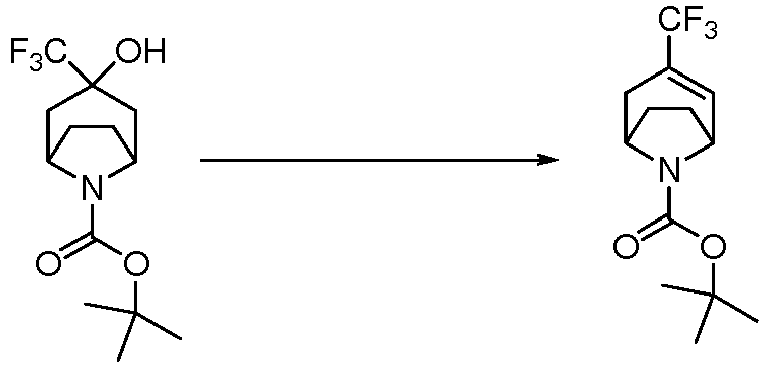
- Thionyl chloride (7 g, 58.84 mmol, 6.00 equiv) and pyridine (4.7 g, 59.42 mmol, 6.0 equiv) was added dropwise into a solution of tert-butyl 3-hydroxy-3-(trifluoromethyl)-8-azabicyclo[3.2.1]octane-8-carboxylate (3g,10.16 mmol,1.00 equiv), 4-dimethylaminopyridine (122mg, 0.10 equiv) in 1,4-dioxane (100 mL) at 0°C. The resulting solution was heated to 60°C for 12 h, quenched with sodium bicarbonate solution (200ml), extracted with ethyl acetate, dried over anhydrous sodium sulfate, and concentrated under vacuum. The residue was purified by a silica gel column eluting with ethyl acetate/petroleum ether (1:10) to afford the title compound (900 mg, 50%) as a light yellow solid
-

- Into a 100-mL round-bottom flask purged and maintained with an atmosphere of H2 was placed tert-butyl 3-(trifluoromethyl)-8-azabicyclo[3.2.1]oct-2-ene-8-carboxylate (900 mg, 3.25 mmol, 1.00 equiv), and palladium on carbon (30 mg) in methanol (15 mL). The resulting solution was stirred overnight at room temperature. The solids were filtered out and the liquid was concentrated under vacuum. This resulted in the title compound (800mg, 88%) as light yellow oil
-

- A solution of tert-butyl 3-(trifluoromethyl)-8-azabicyclo[3.2.1]octane-8-carboxylate (800 mg, 2.86 mmol, 1.00 equiv) and saturated HCl in 1,4-dioxane (20 mL) was stirred for 2 h at room temperature and concentrated under vacuum. This resulted in the title compound (400 mg, 65%) as a white solid
-

- Into a 20-mL sealed tube purged and maintained with an inert atmosphere of nitrogen was placed 3-(trifluoromethyl)-8-azabicyclo[3.2.1]octane hydrochloride (400 mg, 1.85 mmol, 1.00 equiv), 2-chloro-5-fluoro-4-iodopyridine (860 mg, 3.34 mmol, 1.80 equiv), Pd2(dba)3CHCl3 (385 mg, 0.37 mmol, 0.20 equiv), Xantphos (400 mg, 0.69 mmol, 0.40 equiv), Cs2CO3 (1.8 g, 5.52 mmol, 3.00 equiv), and methylbenzene (6 mL). The resulting solution was stirred overnight at 110°C and concentrated under vacuum. The residue was applied onto a silica gel column with ethyl acetate/petroleum ether (1:1). This resulted in 580 mg of the title compound as a light brown solid
-

- Into a 20-mL sealed tube purged and maintained with an inert atmosphere of nitrogen was placed 8-(2-chloro-5-fluoropyridin-4-yl)-3-(trifluoromethyl)-8-azabicyclo[3.2.1]octane (760 mg, 2.46 mmol, 1.00 equiv), Pd2(dba)3CHCl3 (248 mg, 0.24 mmol, 0.10 equiv), dppf (265 mg, 0.48 mmol, 0.20 equiv), zinc dicarbonitrile (282 mg, 2.40 mmol, 1.00 equiv), Zn (15.5 mg, 0.24 mmol, 0.10 equiv), and DMA (8 mL). The resulting solution was stirred overnight at 110°C, diluted with 20 mL of water, extracted with ethyl acetate, dried over anhydrous sodium sulfate, and concentrated under vacuum. The residue was purified by a silica gel column eluting with ethyl acetate/petroleum ether (1:3) to afford the title compound (120 mg, 16%) as a white solid.
-

- Into a 50-mL round-bottom flask purged and maintained with an inert atmosphere of H2 was placed 5-fluoro-4-[3-(trifluoromethyl)-8-azabicyclo[3.2.1]octan-8-yl]pyridine-2-carbonitrile (120 mg, 0.40 mmol, 1.00 equiv), methanol (20 mL), palladium on carbon (100 mg), and hydrogen chloride (0.5 mL). The resulting solution was stirred for 20 min at room temperature. The solids were filtered out and the liquid was concentrated under vacuum. This resulted in the title compound 120 mg (88%) as a light brown solid.
-

- A solution of (2S,4R)-4-fluoro-1-[(4-fluorobenzene)sulfonyl]pyrrolidine-2-carboxylic acid (170 mg, 0.58 mmol, 1.50 equiv), HATU (227 mg, 0.60 mmol, 1.50 equiv), DIEA (154 mg, 1.19 mmol, 3.00 equiv), and [5-fluoro-4-[3-(trifluoromethyl)-8-azabicyclo[3.2.1]octan-8-yl]pyridin-2-yl]methanamine hydrochloride (120 mg, 0.35 mmol, 1.00 equiv) in N,N-dimethylformamide (3 mL) was stirred for 2 h at room temperature. The resulting mixture was diluted with ethyl acetate, washed with brine, dried over sodium sulfate, and concentrated under vacuum. The crude product was purified by Prep-HPLC to afford the title compound 56.8 mg (28%) of as a white solid.
1H NMR (300 MHz, DMSO-d6 ) δ 8.86 - 8.84 (m, 1H), 8.15 - 8.13 (d, J = 6.0 Hz, 1H), 8.01 - 7.96 (m, 2H), 7.49 - 7.43 (t, J = 9.0 Hz, 2H), 6.92 - 6.89 (d, J = 8.1 Hz, 2H), 5.27 - 5.10 (d, J = 51.3 Hz, 1H), 4.53 (s, 2H), 4.39 - 4.16 (m, 3H), 3.71 (s, 1H), 3.61 - 3.59 (m, 1H), 2.95 (s, 1H), 2.42 - 2.35 (m, 1H), 2.14 - 2.07 (s, 1H), 2.00 - 1.96 (m, 2H), 1.90 - 1.85 (m, 2H), 1.83 - 1.60 (m, 4H). -

-

- A mixture of 3-bromo-5-fluorobenzoic acid (2 g, 9.13 mmol, 1.00 equiv), ethanol (40 mL), and sulfuric acid (3 mL) was stirred overnight at 85°C in an oil bath. The reaction mixture was diluted with water, extracted with ethyl acetate, washed with brine, dried over anhydrous sodium sulfate, and concentrated under vacuum. This resulted in the title compound (1.9 g, 84%) as a light brown solid.
-
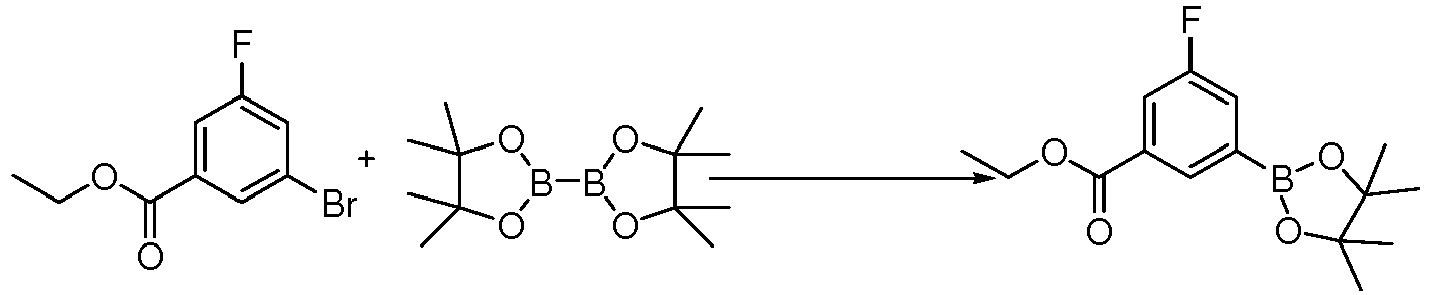
- A mixture of ethyl 3-bromo-5-fluorobenzoate (800 mg, 3.24 mmol, 1.00 equiv) in dioxane (30 mL), 4,4,5,5-tetramethyl-2-(tetramethyl-1,3,2-dioxaborolan-2-yl)-1,3,2-dioxaborolane (1.24 g, 4.88 mmol, 1.50 equiv), AcOK (959 mg, 9.77 mmol, 3.00 equiv), and Pd(dppf)Cl2 (477 mg, 0.65 mmol, 0.20 equiv) was stirred overnight at 90°C under nitrogen. The reaction mixture was diluted with water, extracted with ethyl acetate, washed with brine, dried over anhydrous sodium sulfate, and concentrated under vacuum. This resulted in the title compound (700 mg, crude) as a black crude solid.
-

- A mixture of ethyl 3-fluoro-5-(tetramethyl-1,3,2-dioxaborolan-2-yl)benzoate (700 mg, 2.38 mmol, 1.00 equiv) in dioxane (15 mL), 2-chloro-5-(trifluoromethyl)pyrazine (437 mg, 2.39 mmol, 1.00 equiv), Pd(dppf)Cl2 (352 mg, 0.48 mmol, 0.20 equiv), and Cs2CO3 (2.35 g, 7.21 mmol, 3.00 equiv) was stirred overnight at 90°C under nitrogen. The reaction mixture was diluted with water, extracted with ethyl acetate, washed with brine, dried over anhydrous sodium sulfate, and concentrated under vacuum. The residue was purified by a silica gel column eluting with ethyl acetate/petroleum ether (1:100) to afford the title compound (300 mg, 40%) as an off-white solid.
-

- LiAlH4 (73 mg, 1.92 mmol, 2.00 equiv) was added in several batches into a solution of ethyl 3-fluoro-5-[5-(trifluoromethyl)pyrazin-2-yl]benzoate (300 mg, 0.95 mmol, 1.00 equiv) in tetrahydrofuran (15 mL) at 0°C under nitrogen. After 10 min at 0°C the reaction was quenched by water. The solids were filtered out and the filtrate was concentrated under vacuum. The residue was purified by a silica gel column eluting with ethyl acetate/petroleum ether (7:100) to afford the title compound (160 mg, 62%) as an off-white solid.
-

- DIAD (134 mg, 0.66 mmol, 1.20 equiv) was added dropwise into a solution of [3-fluoro-5-[5-(trifluoromethyl)pyrazin-2-yl]phenyl]methanol (150 mg, 0.55 mmol, 1.00 equiv), 2,3-dihydro-1H-isoindole-1,3-dione (98 mg, 0.67 mmol, 1.20 equiv), and PPh3 (288 mg, 1.10 mmol, 2.00 equiv) in 10 mL of THF at 0°C under nitrogen. The resulting solution was stirred overnight at room temperature. The resulting mixture was concentrated under vacuum. The residue was purified by a silica gel column eluting with ethyl acetate/petroleum ether (7:100) to afford the title compound (230 mg) as a white solid.
-

- A solution of 2-([3-fluoro-5-[5-(trifluoromethyl)pyrazin-2-yl]phenyl]methyl)-2,3-dihydro-1H-isoindole-1,3-dione (230 mg, 0.57 mmol, 1.00 equiv) in ethanol (7 mL) and NH2NH2H2O (7 mL, 144.03 mmol, 251.30 equiv) was stirred overnight at 60°C. The resulting mixture was concentrated under vacuum. The residue was purified by a silica gel column eluting with dichloromethane/methanol (100:10) to afford the title compound (100 mg, 64%) as an off-white solid.
-

- A mixture of [3-fluoro-5-[5-(trifluoromethyl)pyrazin-2-yl]phenyl]methanamine (104 mg, 0.38 mmol, 1.00 equiv), (2S,4R)-4-fluoro-1-[(4-fluorobenzene)sulfonyl]pyrrolidine-2-carboxylic acid (168 mg, 0.58 mmol, 1.50 equiv),N,N-dimethylformamide (5 mL), DIEA (150 mg, 1.16 mmol, 3.00 equiv), and HATU (220 mg, 0.58 mmol, 1.50 equiv) was stirred overnight at room temperature. The reaction mixture was diluted with water, extracted with ethyl acetate, washed with brine, dried over anhydrous sodium sulfate, and concentrated under vacuum. The residue was purified by a silica gel column eluting with ethyl acetate/petroleum ether (20:100) to afford the title compound (15.7 mg, 8%) as a white solid.
1H NMR (300 MHz, CD3OD) δ 9.39 - 9.38 (m, 1H), 9.07 (s, 1H), 8.07 (s, 1H), 8.00 - 7.88 (m, 3H), 7.37 - 7.30 (m, 3H), 5.50 - 5.22 (d, J = 83.1 Hz, 1H), 4.58 (s, 2H), 4.29 - 4.23 (m, 1H), 3.85 - 3.70 (m, 2H), 2.60 - 2.40 (m, 1H), 2.39 - 2.04 (m, 1H). -

-

- A mixture of (5S)-5-(hydroxymethyl)pyrrolidin-2-one (20 g, 173.72 mmol, 1.00 equiv), 1H-imidazole (26 g, 381.92 mmol, 2.20 equiv), 4-dimethylaminopyridine (2.12 g, 17.35 mmol, 0.10 equiv), and TBDPS-Cl (50 g, 181.91 mmol, 1.00 equiv) in dichloromethane (800 mL) was stirred overnight at room temperature. The reaction mixture was diluted with water, extracted with ethyl acetate, washed with brine, dried over anhydrous sodium sulfate, and concentrated under vacuum. This resulted in the title compound (62.7 g, crude) as a colorless crystal.
-

- A mixture of (5S)-5-[[(tert-butyldiphenylsilyl)oxy]methyl]pyrrolidin-2-one (62.7 g, 177.35 mmol, 1.00 equiv), 4-dimethylaminopyridine (24 g, 196.45 mmol, 1.10 equiv), and di-tert-butyl dicarbonate (38.6 g, 176.86 mmol, 1.00 equiv) in acetonitrile (800 mL) was stirred for 16 h at room temperature. The reaction mixture was diluted with water, extracted with ethyl acetate, washed with brine, dried over anhydrous sodium sulfate, and concentrated under vacuum. The residue was purified by a silica gel column eluting with petroleum ether/ethyl acetate (50:1) to afford the title compound (45 g, 56%) as a white solid.
-

- Lithium triethylborohydride (23 mL, 217.10 mmol, 9.80 equiv) was added dropwise into a solution of tert-butyl (2S)-2-[[(tert-butyldiphenylsilyl)oxy]methyl]-5-oxopyrrolidine-1-carboxylate (10.05 g, 22.15 mmol, 1.00 equiv) in toluene (36 mL) at -50°C under nitrogen. After 30 min DIEA (16.5 mL, 99.84 mmol, 4.50 equiv), 4-dimethylaminopyridine (34 mg, 0.28 mmol), and Tf2O (3.6 mL, 21.31 mmol, 1.00 equiv) was added sequentially at -50°C. The resulting solution was stirred overnight at 20°C. The reaction was then quenched by water, extracted with ethyl acetate, washed with brine, dried over anhydrous sodium sulfate, and concentrated under vacuum. The residue was purified by a silica gel column eluting with ethyl acetate/petroleum ether (3:100) to afford the title compound (4.321 g, 45%) as yellow oil.
-

- Diethylzinc (8.3 mL, 67.19 mmol, 1.10 equiv) was added dropwise into a solution of tert-butyl (2S)-2-[[(tert-butyldiphenylsilyl)oxy]methyl]-2,3-dihydro-1H-pyrrole-1-carboxylate (3.3 g, 7.54 mmol, 1.00 equiv) in dichloromethane (30 mL) at 0°C. To this was added diiodomethane (3.04 g, 11.35 mmol, 1.50 equiv) dropwise with stirring at 0°C. After 30 min at 0°C the resulting solution was stirred for 4 h at 20°C. The pH value of the solution was adjusted to 8 with saturated sodium carbonate solution. The resulting solution was extracted with dichloromethane, washed with brine, dried over anhydrous sodium sulfate, and concentrated under vacuum. The residue was purified by a silica gel column eluting with ethyl acetate/petroleum ether (1:50) to afford the title compound (2 g, 59%) as colorless oil.
-

- A mixture of tert-butyl (3S)-3-[[(tert-butyldiphenylsilyl)oxy]methyl]-2-azabicyclo[3.1.0]hexane-2-carboxylate (1.6 g, 3.54 mmol, 1.00 equiv) in tetrahydrofuran (20 mL) and TBAF (3.5 mL, 13.39 mmol, 1.00 equiv) was stirred for overnight at room temperature. The resulting mixture was concentrated under vacuum. The residue was purified by a silica gel column eluting with ethyl acetate/petroleum ether (1:10) to afford the title compound (900 mg) as colorless oil.
-

- A mixture of tert-butyl (3S)-3-(hydroxymethyl)-2-azabicyclo[3.1.0]hexane-2-carboxylate (900 mg, 4.22 mmol, 1.00 equiv) in CH3CN (10 mL)/CCl4 (10 mL), NaIO4 (2.72 g, 12.72 mmol, 3.00 equiv) in water (10 mL), and RuCl3.H2O (44 mg, 0.20 mmol) was stirred for overnight at room temperature. The reaction mixture was diluted with water, extracted with ethyl acetate, washed with brine, dried over anhydrous sodium sulfate, and concentrated under vacuum. This resulted in the title compound (620 mg, 65%) as a brown solid.
-

- A mixture of (3S)-2-[(tert-butoxy)carbonyl]-2-azabicyclo[3.1.0]hexane-3-carboxylic acid (620 mg, 2.73 mmol, 1.00 equiv) in N,N-dimethylformamide (20 mL), [6-[6-(trifluoromethyl)pyridin-3-yl]pyrimidin-4-yl]methanamine hydrochloride (955 mg, 3.29 mmol, 1.20 equiv), DIEA (3.52 g, 27.24 mmol, 10.00 equiv), and HATU (1.246 g, 3.28 mmol, 1.20 equiv) was stirred overnight at room temperature. The reaction mixture was diluted with water, extracted with ethyl acetate, washed with brine, dried over anhydrous sodium sulfate, and concentrated under vacuum. The residue was purified by a silica gel column eluting with ethyl acetate/petroleum ether (30:100) to afford the title compound (700 mg, 55%) as a yellow solid.
-

- A mixture of tert-butyl (3S)-3-[([6-[6-(trifluoromethyl)pyridin-3-yl]pyrimidin-4-yl]methyl)carbamoyl]-2-azabicyclo[3.1.0]hexane-2-carboxylate (700 mg, 1.51 mmol, 1.00 equiv) and HCl (saturated solution in 50 mL of 1,4-dioxane) was stirred for 20 min at room temperature. The resulting mixture was concentrated under vacuum to afford the title compound (790 mg, crude) as a yellow solid.
-

- A mixture of (3S)-2-[(4-fluorobenzene)sulfonyl]-N-([6-[6-(trifluoromethyl)pyridin-3-yl]pyrimidin-4-yl]methyl)-2-azabicyclo[3.1.0]hexane-3-carboxamide (700 mg, 1.34 mmol, 1.00 equiv) in dichloromethane (40 mL), triethylamine (884 mg, 8.74 mmol, 5.00 equiv), 4-dimethylaminopyridine (43 mg, 0.35 mmol, 0.30 equiv), and 4-fluorobenzene-1-sulfonyl chloride (683 mg, 3.51 mmol, 2.60 equiv) was stirred for 2 h at room temperature. The reaction mixture was diluted with water, extracted with ethyl acetate, washed with brine, dried over anhydrous sodium sulfate, and concentrated under vacuum. The residue was purified by a silica gel column eluting with ethyl acetate/petroleum ether (35:100) to afford the title compound (328.3 mg, 47%) as a white solid.
1H NMR (400 MHz, CD3OD) δ 9.47 (s, 1H), 9.30 - 9.29 (m, 1H), 8.94 - 8.90 (m, 1H), 8.80 - 8.77 (m, 1H), 8.26 - 8.25 (m, 1H), 8.10 - 8.01 (m, 1H), 8.01 - 7.97 (m, 2H), 7.57 - 7.51 (m, 2H), 4.52 - 4.48 (m, 2H), 3.60 - 3.54 (m, 1H), 3.39 - 3.32 (m, 1H), 2.30 - 2.15 (m, 2H), 1.67 - 1.66 (m, 1H), 0.38 - 0.35 (m, 1H), -0.41 - -0.39 (m,1H). -

-

- A mixture of NaI (87.14 mg, 0.50 equiv), 1-tert-butyl 2-methyl (2S)-4-methylidenepyrrolidine-1,2-dicarboxylate (280 mg, 1.16 mmol, 1.00 equiv), and TMS-CF3 (412.5 mg, 2.50 equiv) in tetrahydrofuran (10 mL) was stirred for 12 h at 60°C under nitrogen. The reaction was then quenched by saturated NH4Cl solution. The resulting solution was extracted with ethyl acetate, washed with saturated Na2S2O3 and then brine, dried over anhydrous sodium sulfate, and concentrated under vacuum. This resulted in the title compound (400 mg, crude) as orange oil.
-

- A mixture of 5-tert-butyl 6-methyl (6S)-1,1-difluoro-5-azaspiro[2.4]heptane-5,6-dicarboxylate (400 mg, 1.37 mmol, 1.00 equiv) and LiOH (164.95 mg, 6.89 mmol, 5.00 equiv) in water(5 mL)/ methanol (2 mL) was stirred for 2 h at 0-5°C. The mixture was diluted with water and extracted with ethyl acetate. The pH value of the water layer was adjusted to 5 with hydrogen chloride (10 %). The resulting solution was extracted with ethyl acetate, washed with brine, dried over anhydrous sodium sulfate, and concentrated under vacuum. This resulted in the title compound (240 mg, 63%) as orange oil.
-

- A mixture of (6S)-5-[(tert-butoxy)carbonyl]-1,1-difluoro-5-azaspiro[2.4]heptane-6-carboxylic acid (247 mg, 0.89 mmol, 1.00 equiv), HATU (508 mg, 1.34 mmol, 1.50 equiv), DIEA (460.2 mg), and [6-[6-(trifluoromethyl)pyridin-3-yl]pyrimidin-4-yl]methanamine hydrochloride (271.7 mg, 0.93 mmol, 1.20 equiv) in N,N-dimethylformamide (15 mL) was stirred for 1 h at room temperature. The mixture was diluted with water and extracted with ethyl acetate. The combined extracts were washed with brine, dried over anhydrous sodium sulfate, and concentrated under vacuum. The residue was purified by a silica gel column eluting with ethyl acetate/petroleum ether (1:3) to afford the title compound (230 mg) as a light yellow solid.
-

- A mixture of tert-butyl (6S)-1,1-difluoro-6-[([6-[6-(trifluoromethyl)pyridin-3-yl]pyrimidin-4-yl]methyl)carbamoyl]-5-azaspiro[2.4]heptane-5-carboxylate (230 mg, 0.45 mmol, 1.00 equiv) and saturated hydrogen chloride in dioxane (3 mL) was stirred for 12 h at room temperature. The resulting solution was concentrated under vacuum to afford the title compound (200 mg, crude) as an orange solid.
-

- A mixture of (6S)-1,1-difluoro-N-([6-[6-(trifluoromethyl)pyridin-3-yl]pyrimidin-4-yl]methyl)-5-azaspiro[2.4]heptane-6-carboxamide hydrochloride (200 mg, 0.44 mmol, 1.00 equiv), triethylamine (179.78 mg, 1.78 mmol, 4.00 equiv), 4-fluorobenzene-1-sulfonyl chloride (103.7 mg, 0.53 mmol, 1.20 equiv), and 4-dimethylaminopyridine (5.43 mg, 0.04 mmol, 0.10 equiv) in dichloromethane (10 mL) was stirred for 12 h at room temperature. The reaction was then quenched by water and extracted with ethyl acetate. The organic layers were combined, washed with brine, dried over anhydrous sodium sulfate, and concentrated under vacuum. The crude product was purified by Prep-HPLC to afford the title compound (42.7 mg, 17%) as a white solid. tR = 1.14 min (Repaired IC (CHIRALPAK IC), 0.46x10cm, 5µm, MeOH (0.1%DEA) = 2%, 4 ml/min).
1H NMR (300 MHz, CDCl3) δ 9.48 (s, 1H), 9.29 (s, 1H), 8.70 - 8.67 (m, 1H), 8.03 (s, 1H), 7.96 - 7.91 (m, 2H), 7.91 - 7.84 (m, 1H), 7.75 - 7.71 (m, 1H), 7.34 - 7.26 (m, 2H), 4.99 - 4.91 (m, 1H), 4.64 - 4.56 (m, 1H), 4.39 - 4.34 (m, 1H), 3.61 (s, 2H), 2.25 - 2.01 (m, 2H), 1.40 - 1.34 (m, 2H). - And (3S,6S)-1,1-difluoro-5-[(4-fluorobenzene)sulfonyl]-N-([6-[6-(trifluoromethyl)pyridin-3-yl]pyrimidin-4-yl]methyl)-5-azaspiro[2.4]heptane-6-carboxamide was also isolated (27.3 mg, 11%) as a white solid. tR = 1.45 min (Repaired IC (CHIRALPAK IC), 0.46x10cm, 5µm, MeOH (0.1%DEA) = 2%, 4 ml/min).
1H NMR (300 MHz, CDCl3) δ 9.47 (s, 1H), 9.30 (s, 1H), 8.99 (m, 1H), 8.79 - 8.77 (d, J = 6 Hz, 1H), 8.15 - 8.03 (m, 4H), 7.53 - 7.47 (m, 2H), 4.53 - 4.45 (m, 3H), 3.61 - 3.32 (m, 2H), 2.03 (s, 2H), 1.48 - 1.44 (m, 2H). - The stereochemistry for position 4 of the prolines was arbitrarily assigned. The stereochemistry for position 2 of the prolines is as shown.
-

-

- A mixture of (2R,4R)-4-fluoro-1-[(4-fluorobenzene)sulfonyl]-2-methylpyrrolidine-2-carboxylic acid (360 mg, 1.18 mmol, 1.00 equiv), HATU (673 mg, 1.77 mmol, 1.50 equiv), DIEA (456 mg, 3.53 mmol, 3.00 equiv), and [3-methoxy-1-[6-(trifluoromethyl)pyridin-3-yl]-1H-pyrazol-4-yl]methanamine (250 mg, 0.92 mmol, 0.80 equiv) in N,N-dimethylformamide (15 mL) was stirred for 3 h at room temperature. The reaction was then quenched by water and extracted with ethyl acetate. The combined extracts were washed with brine, dried over anhydrous sodium sulfate, and concentrated under vacuum. The residue was purified by a silica gel column eluting with ethyl acetate/petroleum ether (1:5). The crude product was purified by Chiral-Prep-HPLC to afford the title compound (39.8 mg, 6%) as a white solid. tR = 2.42 min (Lux 3µm, Cellulose-4, 0.46x5cm, 3µm, Hex:EtOH = 70:30, 1.0 ml/min).
1H NMR (400 MHz, CDCl3) δ 8.98 (s, 1H), 8.06 - 8.04 (m, 2H), 7.93 - 7.89 (m, 2H), 7.70 - 7.68 (d, J = 6.0 Hz, 1H), 7.24 - 7.17 (m, 2H), 7.05 (s, 1H), 5.23 - 5.05 (m, 1H), 4.45 - 4.25 (m, 2H), 4.04 (s, 3H), 3.91 - 3.63 (m, 2H), 2.77 - 2.58 (m. 1H), 2.33 - 2.27 (m, 1H), 1.70 (s, 3H). - (2R,4R)-4-fluoro-1-[(4-fluorobenzene)sulfonyl]-N-([3-methoxy-1-[6-(trifluoromethyl)pyridin-3-yl]-1H-pyrazol-4-yl]methyl)-2-methylpyrrolidine-2-carboxamide was also isolated (110 mg, 17%) as a white solid. tR = 3.56 min (Lux 3µm, Cellulose-4, 0.46x5cm, 3µm, Hex:EtOH = 70:30, 1.0 ml/min).
1H NMR (400 MHz, CDCl3) δ 8.96 (s, 1H), 8.07 - 8.02 (m, 2H), 7.91 - 7.86 (m, 2H), 7.70 - 7.67 (d, J = 6 Hz, 1H), 7.26 - 7.20 (m, 3H), 5.22 - 5.03 (m, 1H), 4.48 - 4.24 (m, 2H), 4.07 - 3.96 (m, 4H), 3.52 - 3.36 (m, 1H), 2.95 - 2.83 (m, 1H), 2.05 - 1.86 (m, 1H), 1.64 (s, 3H). -
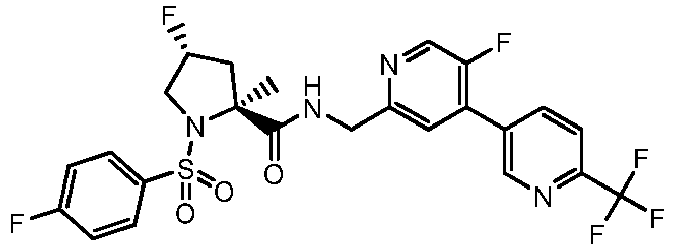
-

- A mixture of [5-fluoro-4-[6-(trifluoromethyl)pyridin-3-yl]pyridin-2-yl]methanamine (100.00 mg, 0.37 mmol, 1.00 equiv), (4R)-4-fluoro-1-[(4-fluorobenzene)sulfonyl]-2-methylpyrrolidine-2-carboxylic acid (112.57 mg, 0.37 mmol, 1.00 equiv), HOBT (54.80 mg, 0.41 mmol, 1.10 equiv), EDCI (141.37 mg, 0.74 mmol, 2.00 equiv), and DIEA (95.31 mg, 0.74 mmol, 2.00 equiv) in THF (5 mL) was stirred for 12h at 25°C. The reaction mixture was diluted with water, extracted with ethyl acetate, washed with brine, dried over anhydrous sodium sulfate, and concentrated under vacuum. The crude product (100.9 mg) was purified by Prep-HPLC to afford (2S,4R)-4-fluoro-N-([5-fluoro-4-[6-(trifluoromethyl)pyridin-3-yl]pyridin-2-yl]methyl)-1-[(4-fluorobenzene)sulfonyl]-2-methylpyrrolidine-2-carboxamide (41.9 mg, 20%) as a white solid. tR = 1.68 min (CHIRALPAK AD-H, 0.46x15cm, 5µm, MeOH (0.1% DEA) = 30%, 4 ml/min).
1H NMR (400 MHz, CD3OD) δ 9.06 (s, 1H), 8.60 - 8.59 (d, J = 4 Hz, 1H),8.42 - 8.40 (m, 1H), 8.03 - 7.96 (m, 3H), 7.88 - 7.87 (d, J = 4 Hz, 1H), 7.39 - 7.35 (m, 2H), 5.36 - 5.18 (d, J = 72 Hz, 1H), 4.79 - 4.75 (d, J = 16 Hz, 1H), 4.58 - 4.54 (d, J = 16 Hz, 1H), 4.18 - 4.05 (m, 1H), 3.83 - 3.62 (m, 1H), 2.78 - 2.62 (m, 1H), 2.13 - 2.28 (m, 1H), 1.60(s, 3H). - (2R,4R)-4-fluoro-N-([5-fluoro-4-[6-(trifluoromethyl)pyridin-3-yl]pyridin-2-yl]methyl)-1-[(4-fluorobenzene)sulfonyl]-2-methylpyrrolidine-2-carboxamide (20.9 mg, 10%) was also isolated from the reaction as a white solid. tR = 2.12 min (CHIRALPAK AD-H, 0.46x15cm, 5µm, MeOH (0.1% DEA) = 30%, 4 ml/min).
1H NMR (400 MHz, CD3OD) δ 9.09 (s, 1H), 8.60 - 8.59 (d, J = 4 Hz, 1H), 8.41 - 8.39 (d, J = 8 Hz, 1H), 7.98 - 7.90 (m, 4H), 7.32 - 7.27 (m, 2H), 5.35 - 5.34 (d, J = 4 Hz, 1H), 4.89 - 4.58 (m, 2H), 3.92 - 3.76 (m, 2H), 2.70 - 2.32 (m, 2H), 1.78 (s, 1H). -
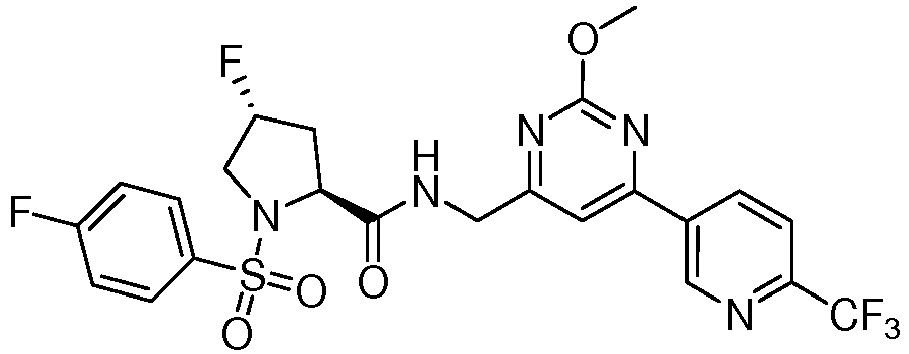
-

- A mixture of tert-butyl N-[[2-(benzylsulfanyl)-6-[6-(trifluoromethyl)pyridin-3-yl]pyrimidin-4-yl]methyl]carbamate (1.2 g, 2.52 mmol, 1.00 equiv) and saturated HCl in 50 mL of 1,4-dioxane was stirred for 3 h at room temperature. The solids were collected by filtration to afford the title compound (850 mg, 82%) as a gray solid.
-

- A solution of (1S,4R)-4-fluoro-2-[(4-fluorobenzene)sulfonyl]cyclopentane-1-carboxylic acid (300 mg, 1.03 mmol, 1.00 equiv), HATU (470 mg, 1.24 mmol, 1.00 equiv), and DIEA (266 mg, 2.06 mmol, 2.00 equiv) in N,N-dimethylformamide (8 mL) was stirred for 10 min at room temperature. [2-(Benzylsulfanyl)-6-[6-(trifluoromethyl)pyridin-3-yl]pyrimidin-4-yl]methanamine hydrochloride (424 mg, 1.03 mmol, 1.00 equiv) was added and the resulting solution was stirred overnight at room temperature. The resulting solution was diluted with ethyl acetate, washed with brine, dried over anhydrous sodium sulfate, and concentrated under vacuum. The residue was purified by a silica gel column eluting with ethyl acetate/petroleum ether (1:1). This resulted in the title compound (320mg, 48%) as light brown oil.
-

- m-CPBA (340 mg, 1.97 mmol, 4.00 equiv) was added in portions into a solution of (1S,4R)-N-[[2-(benzylsulfanyl)-6-[6-(trifluoromethyl)pyridin-3-yl]pyrimidin-4-yl]methyl]-4-fluoro-2-[(4-fluorobenzene)sulfonyl]cyclopentane-1-carboxamide (320 mg, 0.49 mmol, 1.00 equiv) in dichloromethane (50 mL) at room temperature. After 4 h at room temperature the resulting solution was diluted with dichloromethane, washed with saturated sodium bicarbonate, dried over sodium sulfate, and concentrated under vacuum. The residue was purified by a silica gel column eluting with ethyl acetate/petroleum ether (2:1) to afford the title compound (250mg, 74%) as a yellow solid.
-

- Sodium methylate (60 mg, 2.00 equiv) was added in several batches into a solution of (2S,4R)-4-fluoro-1-[(4-fluorobenzene)sulfonyl]-N-[[2-(phenylmethane)sulfonyl-6-[6-(trifluoromethyl)pyridin-3-yl]pyrimidin-4-yl]methyl]pyrrolidine-2-carboxamide (250 mg, 0.37 mmol, 1.00 equiv) in methanol (20 mL) at 0°C. The resulting solution was stirred for 30 min at room temperature and concentrated under vacuum. The residue was purified by a silica gel column eluting with ethyl acetate/petroleum ether (2:1) to afford the title compound (91.7 mg, 45%) as a pink solid.
1H NMR (300MHz, DMSO-d6 ) δ 9.46 (s, 1H), 9.10 (t, J = 5.8 Hz, 1H), 8.78 (d, J = 8.4 Hz, 1H), 8.09 - 8.00 (m, 3H), 7.88 (s, 1H), 7.47 (t, J = 8.8 Hz, 2H), 5.29 - 5.12 (d, J = 52.0 Hz, 1H), 4.46 (d, J = 6.0 Hz, 2H), 4.27 - 4.22 (dd, J = 9.9 Hz, J = 7.2 Hz, 1H), 4.04 (s, 3H), 3.75 (s, 1H), 3.71 - 3.58 (m, 1H), 2.51 - 2.37 (m, 1H), 2.24 - 2.01 (m, 1H). -
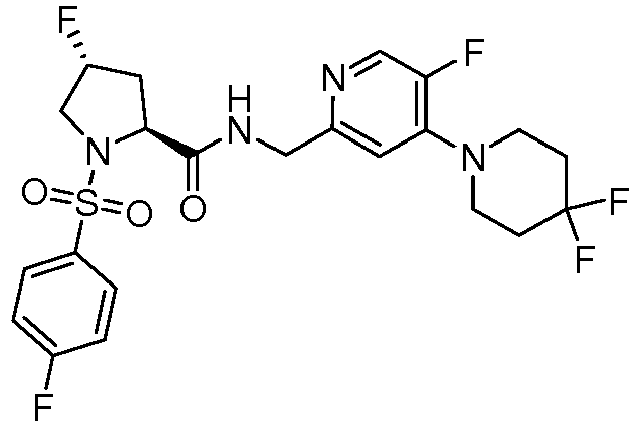
-

- BAST (222.4 g, 1.01 mol, 20.00 equiv) was added dropwise into a solution of tert-butyl 4-oxopiperidine-1-carboxylate (10 g, 50.19 mmol, 1.00 equiv) in dichloromethane (200 mL) at 0°C under nitrogen. The resulting solution was stirred overnight at 25°C. The reaction was then quenched by saturated sodium bicarbonate, extracted with dichloromethane, washed with brine, dried over sodium sulfate, and concentrated under vacuum. The residue was purified by a silica gel column eluting with ethyl acetate/petroleum ether (1/10). This resulted in the title compound (9.7 g, 87%) as a light yellow solid.
-

- A mixture of tert-butyl 4,4-difluoropiperidine-1-carboxylate (5 g, 22.60 mmol, 1.00 equiv) and hydrogen chloride (saturated solution in 150 mL of 1,4-dioxane) was stirred for 6 h at 25°C. The resulting mixture was concentrated under vacuum to afford the title compound (4.2 g, crude) as a yellow solid.
-

- A mixture of 2-chloro-5-fluoro-4-iodopyridine (813 mg, 3.16 mmol, 1.00 equiv), 4,4-difluoropiperidine hydrochloride (500 mg, 3.17 mmol, 1.00 equiv), XantPhos (183 mg, 0.32 mmol, 0.10 equiv), Cs2CO3 (3.1 g, 9.51 mmol, 3.00 equiv), and Pd2(dba)3CHCl3 (164 mg, 0.16 mmol, 0.05 equiv) in toluene (20 mL) was stirred overnight at 100°C under nitrogen. The resulting mixture was concentrated under vacuum. The resulting solution was diluted with water, extracted with ethyl acetate, washed with brine, dried over anhydrous sodium sulfate, and concentrated under vacuum. The residue was purified by a silica gel column eluting with ethyl acetate/petroleum ether (1/5) to afford the title compound (200 mg, 25%) as a yellow solid.
-

- A mixture of 2-chloro-4-(4,4-difluoropiperidin-1-yl)-5-fluoropyridine (150 mg, 0.60 mmol, 1.00 equiv), Pd2(dba)3.CHCl3 (10.3 mg, 0.01 mmol, 0.05 equiv), Zn(CN)2 (23.3 mg, 0.20 mmol, 1.00 equiv), dppf (11 mg, 0.02 mmol, 0.10 equiv), Zn (1.3 mg, 0.02 mmol, 0.10 equiv), and DMA (2 mL) was irradiated with microwave radiation for 1.5 h at 125°C under nitrogen. The reaction mixture was diluted with water, extracted with ethyl acetate, washed with brine, dried over anhydrous sodium sulfate, and concentrated under vacuum. The residue was purified by a silica gel column eluting with ethyl acetate/petroleum ether (1/4) to afford the title compound (180 mg) as a yellow solid.
-
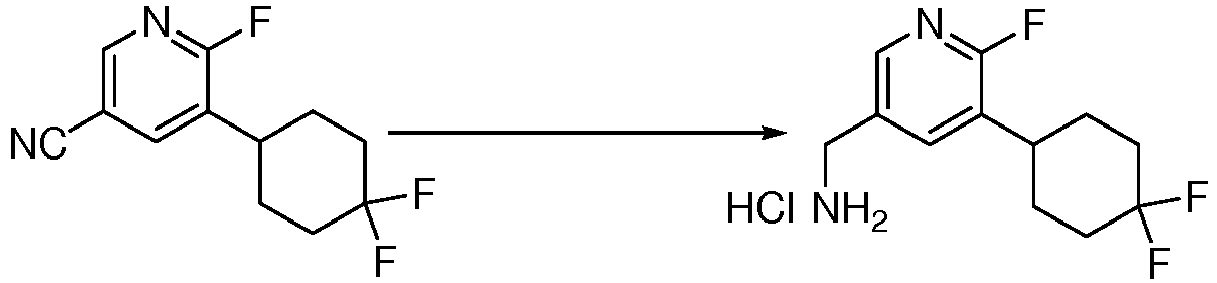
- A mixture of 4-(4,4-difluoropiperidin-1-yl)-5-fluoropyridine-2-carbonitrile (180 mg, 0.75 mmol, 1.00 equiv), methanol (20 mL), palladium on carbon (180 mg, 1.69 mmol, 1.00 equiv), and concentrated hydrogen chloride (0.2 mL) was stirred for 20 min at 25°C under hydrogen. The solids were filtered out. The resulting solution was concentrated under vacuum to afford the title compound (180 mg, 98%) as a white solid.
-
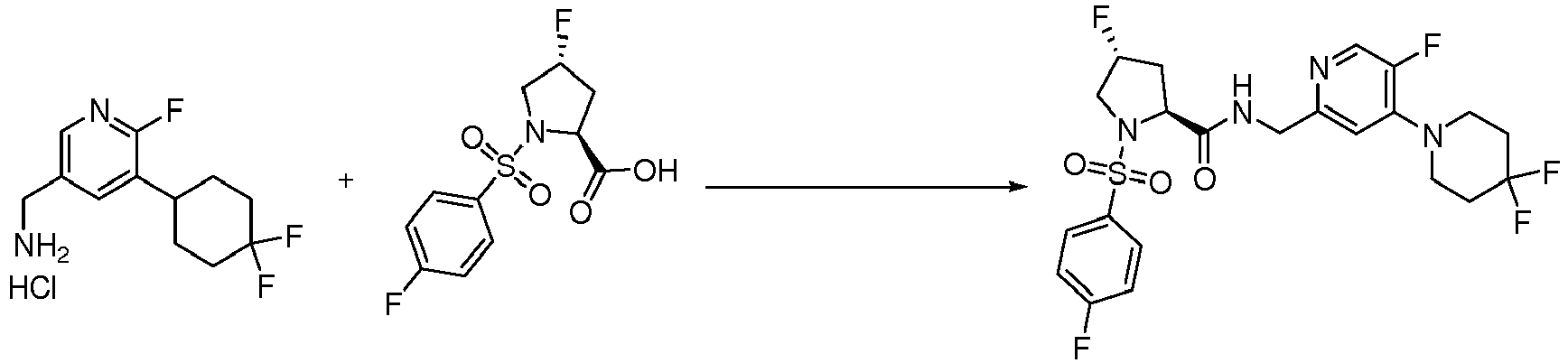
- A mixture of [4-(4,4-difluoropiperidin-1-yl)-5-fluoropyridin-2-yl]methanamine hydrochloride (180 mg, 0.73 mmol, 1.00 equiv), (2S,4R)-4-fluoro-1-[(4-fluorobenzene)sulfonyl]pyrrolidine-2-carboxylic acid (213.8 mg, 0.73 mmol, 1.00 equiv), EDCI (282.1 mg, 1.47 mmol, 2.00 equiv), HOBt (109.1 mg, 0.81 mmol, 1.10 equiv), and DIEA (189.6 mg, 1.47 mmol, 12.00 equiv) in tetrahydrofuran (10 mL) was stirred overnight at 25°C. The reaction mixture was diluted with water, extracted with ethyl acetate, washed with brine, dried over anhydrous sodium sulfate, and concentrated under vacuum. The crude product (150 mg) was purified by Prep-HPLC to afford the title compound (39.2 mg, 10%) as a white solid.
1H NMR (300 MHz, CDCl3) δ 8.09 - 8.01 (m, 1H), 8.00 - 7.97 (m, 2H), 7.38 - 7.32 (m, 2H), 7.19 - 7.17 (m, 1H), 5.21 - 5.14 (d, J = 52.0 Hz, 1H), 4.52 - 4.39 (m, 2H), 4.27 - 4.21 (m, 1H), 3.83 - 3.74 (m, 2H), 3.70 - 3.54 (m, 4H), 2.62 - 2.42 (m, 1H), 2.27 - 2.00 (m, 5H). -

-

- A mixture of 6-azaspiro[2.5]octane hydrochloride (1.00 g, 6.77 mmol, 1.00 equiv), 2-chloro-5-fluoro-4-iodopyridine (1.74 g, 6.76 mmol, 1.00 equiv), Pd2(dba)3.CHCl3 (350 mg, 0.34 mmol, 0.05 equiv), BINAP (420 mg, 0.67 mmol, 0.10 equiv), and t-BuONa (1.95 g, 20.29 mmol, 3.00 equiv) in toluene (20 mL) was stirred for overnight at 100°C under nitrogen. The reaction mixture was diluted with water, extracted with ethyl acetate, washed with brine, dried over anhydrous sodium sulfate, and concentrated under vacuum. The residue was purified by a silica gel column eluting with ethyl acetate/petroleum ether (1/10) to afford the title compound (480 mg, 29%) as a light yellow solid.
-

- A mixture of 2-chloro-4-(4-cyclopropylpiperidin-1-yl)-5-fluoropyridine (480.00 mg, 1.88 mmol, 1.00 equiv), Pd2(dba)3.CHCl3 (103 mg, 0.10 mmol, 0.05 equiv), Zn(CN)2 (140 mg, 1.19 mmol, 0.60 equiv), dppf (104.46 mg, 0.19 mmol, 0.10 equiv), Zn (12.33 mg, 0.19 mmol, 0.10 equiv), and DMA (5 mL, 53.78 mmol, 28.50 equiv) was irradiated with microwave radiation for 1 h at 100°C under nitrogen. The reaction mixture was diluted with water, extracted with ethyl acetate, washed with brine, dried over anhydrous sodium sulfate, and concentrated under vacuum. The residue was purified by a silica gel column eluting with ethyl acetate/petroleum ether (1/10) to afford the title compound (170 mg, 37%) as a light yellow solid.
-

- A mixture of 4-[6-azaspiro[2.5]octan-6-yl]-5-fluoropyridine-2-carbonitrile (140 mg, 0.61 mmol, 1.00 equiv), methanol (5 mL, 123.49 mmol, 204.00 equiv), palladium on carbon (140 mg, 1.32 mmol, 2.20 equiv), and concentrated hydrogen chloride (0.1 mL) was stirred for 15 min at 25°C under hydrogen. The resulting mixture was concentrated under vacuum to afford the title compound (140 mg, 98%) as a light yellow solid.
-

- A mixture of (4-[6-azaspiro[2.5]octan-6-yl]-5-fluoropyridin-2-yl)methanamine (140.00 mg, 0.59 mmol, 1.00 equiv), (2S,4R)-4-fluoro-1-[(4-fluorobenzene)sulfonyl]pyrrolidine-2-carboxylic acid (225.29 mg, 0.77 mmol, 1.30 equiv), EDCI (228.12 mg, 1.19 mmol, 2.00 equiv), HOBT (88.44 mg, 0.65 mmol, 1.10 equiv), and DIEA (153.80 mg, 1.19 mmol, 2.00 equiv) in THF (5 mL) was stirred overnight at 25°C. The reaction mixture was diluted with water, extracted with ethyl acetate, washed with brine, dried over anhydrous sodium sulfate, and concentrated under vacuum. The crude product (43.9 mg) was purified by Prep-HPLC to afford the title compound (28.4 mg, 9%) as a white solid.
1H NMR (400 MHz, CD3OD) δ 8.04 - 7.98 (m, 3H), 7.38 - 7.33 (m, 2H), 7.16 - 7.14 (d, J = 8 Hz, 1H), 5.20 - 5.07(d, J = 52 Hz, 1H), 4.46 (s, 2H), 4.28 - 4.24 (m, 1H), 3.83 - 3.68 (m, 2H), 3.49 - 3.46 (m, 4H), 2.54 - 2.46 (m, 1H), 2.26 - 2.12 (m, 1H),1.51 - 1.49 (m, 4H), 0.37 (s, 4H). -

-

- A mixture of 2-chloro-4-iodo-5-(trifluoromethyl)pyridine (1.00 g, 3.25 mmol, 1.00 equiv), 4-(trifluoromethyl)piperidine (500 mg, 3.26 mmol, 1.00 equiv), Pd(dppf)Cl2.CH2Cl2(130 mg, 0.16 mmol, 0.05 equiv), and Cs2CO3 (2.12 g, 6.51 mmol, 2.00 equiv) in toluene (10.00 mL) was stirred overnight at 100°C under nitrogen. The reaction mixture was diluted with water, extracted with ethyl acetate, washed with brine, dried over anhydrous sodium sulfate, and concentrated under vacuum. The residue was purified by a silica gel column eluting with ethyl acetate/petroleum ether (1/10) to afford the title compound (700 mg, 65%) as a yellow solid.
-

- A mixture of 2-chloro-5-(trifluoromethyl)-4-[4-(trifluoromethyl)piperidin-1-yl]pyridine (700.00 mg, 2.10 mmol, 1.00 equiv), Pd2(dba)3.CHCl3 (108.90 mg, 0.11 mmol, 0.05 equiv), Zn(CN)2 (148.27 mg, 1.26 mmol, 0.60 equiv), dppf (116.65 mg, 0.21 mmol, 0.10 equiv), Zn (13.76 mg, 0.21 mmol, 0.10 equiv), and DMA (5.01 mL) was irradiated with microwave radiation for 1 h at 125°C under nitrogen. The reaction mixture was diluted with water, extracted with ethyl acetate, washed with brine, dried over anhydrous sodium sulfate, and concentrated under vacuum. The residue was purified by a silica gel column eluting with ethyl acetate/petroleum ether (1/10) to afford the title compound (450 mg, 66%) as a white solid.
-

- A mixture of 5-(trifluoromethyl)-4-[4-(trifluoromethyl)piperidin-1-yl]pyridine-2-carbonitrile (120 mg, 0.37 mmol, 1.00 equiv), palladium on carbon (120 mg, 1.13 mmol, 3.00 equiv), and concentrated hydrogen chloride (0.1 mL) in methanol (10 mL) was stirred for 10 min at 25°C under hydrogen. The resulting mixture was concentrated under vacuum to afford the title compound (130 mg, crude) as a white solid.
-

- A mixture of [5-(trifluoromethyl)-4-[4-(trifluoromethyl)piperidin-1-yl]pyridin-2-yl]methanamine (100.00 mg, 0.31 mmol, 1.00 equiv), (2S,4R)-4-fluoro-1-[(4-fluorobenzene)sulfonyl]pyrrolidine-2-carboxylic acid (115.70 mg, 0.40 mmol, 1.30 equiv), EDCI (117.15 mg, 0.61 mmol, 2.00 equiv), HOBT (45.42 mg, 0.34 mmol, 1.10 equiv), and DIEA (78.98 mg, 0.61 mmol, 2.00 equiv) in tetrahydrofuran (5 mL) was stirred overnight at 25°C. The reaction mixture was diluted with water, extracted with ethyl acetate, washed with brine, dried over anhydrous sodium sulfate, and concentrated under vacuum. The crude product (58 mg) was purified by Prep-HPLC to afford the title compound (43.4 mg, 24%) as a white solid.
1H NMR (400 MHz, CD3OD) δ 8.42 (s,1H), 8.05 - 8.00 (m, 2H), 7.40 - 7.35 (m, 3H), 5.24 - 5.18 (d, J = 18 Hz, 2H), 4.57 - 4.56 (m, 2H), 4.31 - 4.26 (m, 1H), 3.86 (s, 1H), 3.68 - 3.63 (m, 3H), 3.02 (m, 2H), 2.68 - 2.12 (m, 3H), 1.97 - 1.93 (d, J = 12 Hz, 2H), 1.73 - 1.72 (m, 2H). -

-

- A mixture of 4-chloropyridine-2-carbonitrile (5 g, 36.09 mmol, 1.00 equiv), 4,4,5,5-tetramethyl-2-(tetramethyl-1,3,2-dioxaborolan-2-yl)-1,3,2-dioxaborolane (13.8 g, 54.34 mmol, 1.50 equiv), KOAc (11 g, 112.08 mmol, 3.10 equiv), and Pd(dppf)Cl2 (1.33 g, 1.82 mmol) in dioxane (40 mL) was stirred for 6 h at 100°C under nitrogen. The reaction mixture was diluted with water, extracted with ethyl acetate, washed with brine, dried over anhydrous sodium sulfate, and concentrated under vacuum. This resulted in the title compound (16 g, crude) as black oil.
-

- A mixture of 4-(tetramethyl-1,3,2-dioxaborolan-2-yl)pyridine-2-carbonitrile (1.6 g, 6.95 mmol, 3.10 equiv), 2-bromo-5-(trifluoromethyl)pyridine (500 mg, 2.21 mmol, 1.00 equiv), Pd(dppf)Cl2 (170 mg, 0.23 mmol, 0.10 equiv), and potassium carbonate (921 mg, 6.66 mmol, 3.00 equiv) in dioxane (40 mL)/water (2 mL) was stirred for 12 h at 100°C under nitrogen. The reaction mixture was diluted with water, extracted with ethyl acetate, washed with brine, dried over anhydrous sodium sulfate, and concentrated under vacuum. The residue was purified by a silica gel column eluting with ethyl acetate/petroleum ether (1:20) to afford the title compound (380 mg, 69%) as a white solid.
-
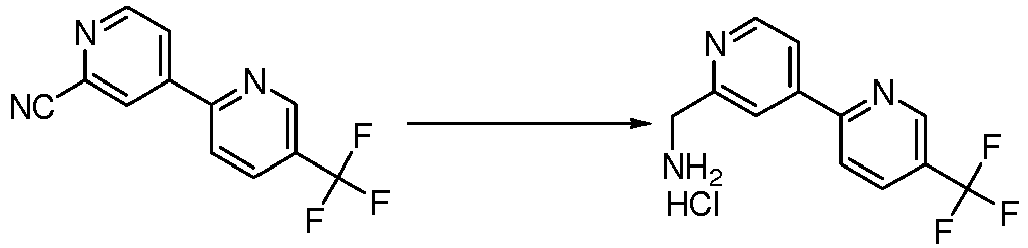
- A mixture of 4-[5-(trifluoromethyl)pyridin-2-yl]pyridine-2-carbonitrile (200 mg, 0.80 mmol, 1.00 equiv), palladium on carbon (100 mg, 0.94 mmol, 1.20 equiv), and concentrated hydrogen chloride (0.1 mL) in ethanol (10 mL) was stirred for 30 min at room temperature under hydrogen. The solids were filtered out. The filtrate was concentrated under vacuum to afford the title compound (240 mg, crude) as a white solid.
-

- A mixture of (2S,4R)-4-fluoro-1-[(4-fluorobenzene)sulfonyl]pyrrolidine-2-carboxylic acid (150.00 mg, 0.51 mmol, 1.00 equiv), DIEA (266.23 mg, 2.06 mmol, 4.00 equiv), HATU (293.72 mg, 0.77 mmol, 1.50 equiv), and [4-[5-(trifluoromethyl)pyridin-2-yl]pyridin-2-yl]methanamine hydrochloride (223.77 mg, 0.77 mmol, 1.50 equiv) in N,N-dimethylformamide (5 mL) was stirred for 12 h at room temperature. The reaction mixture was diluted with water, extracted with ethyl acetate, washed with brine, dried over anhydrous sodium sulfate, and concentrated under vacuum. The residue was purified by a silica gel column eluting with dichloromethane/methanol (20:1) to afford the title compound (78.2 mg, 29%) as a white solid.
1H NMR (400 MHz, DMSO-d6 ) δ 9.11 (s, 1H), 9.02 - 9.01 (m, 1H), 8.71 (d, J = 4.8 HZ, 1H), 8.83 - 8.22 (m, 2H), 8.09 - 7.98 (m, 4H), 7.47 - 7.43 (m, 2H), 5.21 (d, J = 52.8 Hz, 2H), 4.53 - 4.24 (m, 3H), 3.76 - 3.58 (m, 2H), 2.50 - 2.33 (m, 1H), 2.22 - 2.04 (m, 1H). -

-

- A mixture of 5-bromo-2-iodopyrimidine (10 g, 35.10 mmol, 1.00 equiv), trimethyl(trifluoromethyl)silane (20 g, 140.65 mmol, 4.00 equiv), KF (4.1 g, 70.57 mmol, 2.00 equiv), and CuI (13 g, 68.26 mmol, 2.00 equiv) in NMP (80 mL) was stirred overnight at 70°C under nitrogen. The reaction was quenched by 200 mL of ammonia hydroxide, extracted with ethyl acetate, dried over anhydrous sodium sulfate, and concentrated under vacuum. The residue was purified by a silica gel column eluting with petroleum ether to afford the title compound 1.1 g (14%) of 5-bromo-2-(trifluoromethyl)pyrimidine as a light yellow solid.
-

- A mixture of CuI (88 mg, 0.46 mmol, 0.10 equiv), L-proline (108 mg, 0.94 mmol, 0.20 equiv), potassium carbonate (1.3 g, 9.41 mmol, 2.00 equiv), ethyl 3-methoxy-1H-pyrazole-4-carboxylate (800 mg, 4.70 mmol, 1.00 equiv), and 5-bromo-2-(trifluoromethyl)pyrimidine (1.28 g, 5.64 mmol, 1.20 equiv) in DMSO (5 mL) was stirred overnight at 100°C under nitrogen. The reaction mixture was diluted with 40 mL of water, extracted with ethyl acetate, dried over anhydrous sodium sulfate, and concentrated under vacuum. The residue was purified by a silica gel column eluting with ethyl acetate/petroleum ether (1:5) to afford the title compound (580mg, 39%) as a white solid.
-
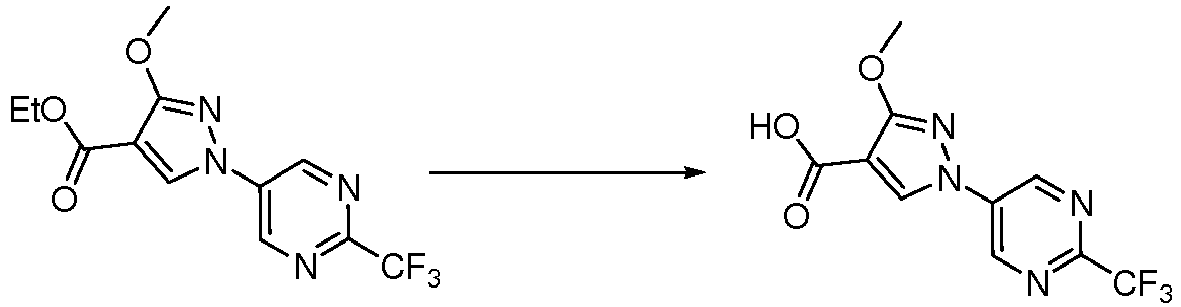
- A mixture of ethyl 3-methoxy-1-[2-(trifluoromethyl)pyrimidin-5-yl]-1H-pyrazole-4-carboxylate (150 mg, 0.47 mmol, 1.0 equiv) and LiOH (22 mg, 0.92 mmol, 2.0 equiv) in THF (5 mL)/water (2 mL) was stirred for 2 h at 50°C and diluted with 30 mL of water. The pH value of the solution was adjusted to 2 with diluted HCl. The resulting solution was extracted with ethyl acetate, dried over anhydrous sodium sulfate, and concentrated under vacuum. This resulted in the title compound (120 mg, 88%) as a white solid.
-

- A mixture of 3-methoxy-1-[2-(trifluoromethyl)pyrimidin-5-yl]-1H-pyrazole-4-carboxylic acid (400 mg, 1.39 mmol, 1.0 equiv), HATU (792 mg, 2.08 mmol, 1.5 equiv), DIEA (540 mg, 4.18 mmol, 3.0 equiv), and NH4Cl (110 mg, 2.06 mmol, 1.5 equiv) in N,N-dimethylformamide (20 ml) was stirred for 1 h at room temperature. The reaction was diluted with 30 mL of water, extracted with ethyl acetate, dried over anhydrous sodium sulfate, and concentrated under vacuum. The residue was purified by a silica gel column eluting with ethyl acetate/petroleum ether (1:3). This resulted in the title compound (300mg, 75%) as a white solid.
-

- A mixture of 3-methoxy-1-[4-(trifluoromethyl)phenyl]-1H-pyrazole-4-carboxamide (300 mg, 1.05 mmol, 1.00 equiv), pyridine (347 mg, 4.39 mmol, 4.00 equiv), and Tf2O (620 mg, 2.20 mmol, 2.00 equiv) in dichloromethane (30 mL) was stirred for 2 h at room temperature. The reaction was diluted with 30 mL of water, extracted with dichloromethane, dried over anhydrous sodium sulfate, and concentrated under vacuum. This resulted in the title compound 170 mg (60%) as a brown solid.
-

- Into a 100-mL round-bottom flask purged and maintained with an inert atmosphere of H2 was placed 3-methoxy-1-[2-(trifluoromethyl)pyrimidin-5-yl]-1H-pyrazole-4-carbonitrile (170 mg, 0.63 mmol, 1.00 equiv), methanol (30 mL), hydrogen chloride (0.5 mL, 13.71 mmol, 1.00 equiv), and palladium on carbon (40 mg, 0.38 mmol, 1.00 equiv). After 30 min at room temperature the solids were filtered out. The liquid was concentrated under vacuum to afford the title compound (120mg, 70%) of as a light yellow solid.
-

- A mixture of (2S,4R)-4-fluoro-1-[(4-fluorobenzene)sulfonyl]pyrrolidine-2-carboxylic acid (253 mg, 0.87 mmol, 1.50 equiv), HATU (330 mg, 0.87 mmol, 1.50 equiv), and DIEA (224 mg, 1.73 mmol, 3.00 equiv) in N,N-dimethylformamide (3 mL) was stirred for 15 min at room temperature and then (3-methoxy-1-(2-(trifluoromethyl)pyrimidin-5-yl)-1H-pyrazol-4-yl)methanamine hydrochloride (160 mg, 0.59 mmol, 1.0 equiv) was added. The resulting solution was stirred overnight at room temperature, diluted with ethyl acetate, washed with brine, dried over anhydrous magnesium sulfate, and concentrated under vacuum. The crude product was purified by Pre-HPLC to afford the title compound 20 mg (6%) of as a white solid
1H NMR (300 MHz, CDCl3) δ 9.32 (s, 1H), 8.65 - 8.62 (m, 1H), 8.48 (s, 1H), 7.97 - 7.79 (m, 2H), 7.47 - 7.42 (m, 2H), 5.24 - 5.11 (d, J = 52.4 Hz, 1H), 4.18 - 4.05 (m, 3H), 3.99 (s, 3H), 3.69 - 3.58 (m, 2H), 2.40 - 2.22 (m, 1H), 2.18 - 1.95 (m, 1H). -

-

- PrMgBr (71 mL, 575.75 mmol, 1M in THF, 1.50 equiv) was added dropwise into a solution of tert-butyl 3-oxobutanoate (11.2 g, 70.80 mmol, 1.50 equiv) in tetrahydrofuran (150 mL) at 0°C under nitrogen. After 2 h at 0°C the chloride (prepared by refluxing 4-(methoxycarbonyl)bicyclo[2.2.2]octane-1-carboxylic acid (10 g, 47.12 mmol, 1.00 equiv) in thionyl chloride (50 mL) for 3h) in 50 mL of THF at 0°C. The resulting solution was stirred for 12 h at room temperature. The reaction was then quenched by saturated solution of NH4Cl, extracted with ethyl acetate, washed with brine, dried over anhydrous sodium sulfate, and concentrated under vacuum. This resulted in the title compound (10 g, crude) as yellow oil.
-

- A solution of methyl 4-[2-acetyl-3-(tert-butoxy)-3-oxopropanoyl]bicyclo[2.2.2]octane-1-carboxylate (10 g, 28.38 mmol, 1.00 equiv) and 2,2,2-trifluoroacetaldehyde (20 mL) in DCM (100 mL) was stirred for 12 h at room temperature. The pH value of the solution was adjusted to 8 to 9 with sodium bicarbonate. The resulting solution was extracted with ethyl acetate. The combined extracts were washed with brine, dried over anhydrous sodium sulfate, and concentrated under vacuum. The residue was purified by a silica gel column eluting with ethyl acetate/petroleum ether (1/10) to afford the title compound (4.8 g, 67%) as a light yellow solid.
-

- A solution of methyl 4-(3-oxobutanoyl)bicyclo[2.2.2]octane-1-carboxylate (4.8 g, 19.02 mmol, 1.00 equiv) in formamide (50 mL) was irradiated with microwave radiation for 3 h at 180°C in 5 batches. The reaction mixture was diluted with water, extracted with ethyl acetate, washed with brine, dried over anhydrous sodium sulfate, and concentrated under vacuum. The residue was purified by a silica gel column eluting with ethyl acetate/petroleum ether (1/20) to afford the title compound (1.5 g, 30%) as a light yellow solid.
-

- DIBAL-H (17 mL, 119.53 mmol, 1M in hexanes, 3.00 equiv) was added dropwise into a solution of methyl 4-(6-methylpyrimidin-4-yl)bicyclo[2.2.2]octane-1-carboxylate (1.5 g, 5.76 mmol, 1.00 equiv) in dichloromethane (150 mL) at -78°C under nitrogen. The resulting solution was stirred for 3 h at -78°C. The reaction was then quenched by sodium hydroxide (1N). The solids were filtered out. The filtrate was dried over anhydrous sodium sulfate and concentrated under vacuum. This resulted in the title compound (1.1 g, 82%) as a white solid.
-

- A mixture of [4-(6-methylpyrimidin-4-yl)bicyclo[2.2.2]octan-1-yl]methanol (1.1 g, 4.73 mmol, 1.00 equiv) and DMP (2.0 g, 4.72 mmol, 1.00 equiv) in dichloromethane (150 mL) was stirred for 1 h at room temperature. The solids were filtered out. The resulting solution was diluted with CH2Cl2 washed with saturated sodium bicarbonate and brine, dried over anhydrous sodium sulfate, and concentrated under vacuum. The residue was purified by a silica gel column eluting with ethyl acetate/petroleum ether (1/10) to afford the title compound (875 mg, 80%) as a light yellow solid.
-

- DAST (8.67 g, 37.86 mmol, 10.00 equiv) was added dropwise into a solution of 4-(6-methylpyrimidin-4-yl)bicyclo[2.2.2]octane-1-carbaldehyde (875 mg, 3.80 mmol, 1.00 equiv) in dichloromethane (200 mL) at -78°C under nitrogen. The resulting solution was stirred for 12 h at room temperature. The reaction was then quenched by saturated sodium bicarbonate and extracted with ethyl acetate. The combined extracts were washed with brine, dried over anhydrous sodium sulfate, and concentrated under vacuum. The residue was purified by a silica gel column eluting with ethyl acetate/petroleum ether (1/4) to afford the title compound (750 mg, 78%) as a light yellow solid.
-

- BPO (152 mg, 0.59 mmol, 0.20 equiv) was added in portions into a mixture of 4-[4-(difluoromethyl)bicyclo[2.2.2]octan-1-yl]-6-methylpyrimidine (750 mg, 2.97 mmol, 1.00 equiv) and NBS (530 mg, 2.98 mmol, 1.00 equiv) in CCl4 (50 mL) at room temperature under nitrogen. The resulting solution was heated to 80°C. After 6 h at 80°C the reaction mixture was cooled to room temperature. The reaction mixture was then diluted with water and extracted with ethyl acetate. The combined extracts were washed with brine, dried over anhydrous sodium sulfate, and concentrated under vacuum. This resulted in the title compound (750 mg, crude) as yellow oil.
-

- A mixture of 4-(bromomethyl)-6-[4-(difluoromethyl)bicyclo[2.2.2]octan-1-yl]pyrimidine (550 mg, 1.66 mmol, 1.00 equiv) and 2-potassio-2,3-dihydro-1H-isoindole-1,3-dione (307 mg, 1.66 mmol, 1.00 equiv) in N,N-dimethylformamide (5 mL) was stirred for 12 h at room temperature. The reaction mixture was diluted with water and extracted with ethyl acetate. The combined extracts were washed with brine, dried over anhydrous sodium sulfate, and concentrated under vacuum. The residue was purified by a silica gel column eluting with ethyl acetate/petroleum ether (1/1) to afford the title compound (180 mg) as an off-white solid.
-

- A mixture of 2-([6-[4-(difluoromethyl)bicyclo[2.2.2]octan-1-yl]pyrimidin-4-yl]methyl)-2,3-dihydro-1H-isoindole-1,3-dione (180 mg, 0.45 mmol, 1.00 equiv) and hydrazine hydrate (227 mg, 4.53 mmol, 10.00 equiv) in methanol (10 mL) was stirred for 12 h at room temperature. The resulting mixture was concentrated under vacuum. The residue was dissolved in ethyl acetate. The solids were filtered out and the filtrate was concentrated under vacuum. This resulted in the title compound (100 mg, 83%) as a yellow solid which was used for the next step without any further purification.
-

- A solution of (2S,4R)-4-fluoro-1-[(4-fluorobenzene)sulfonyl]pyrrolidine-2-carboxylic acid (218 mg, 0.75 mmol, 2.00 equiv), DIEA (145 mg, 1.12 mmol, 3.00 equiv), HATU (285 mg, 0.75 mmol, 2.00 equiv), and [6-[4-(difluoromethyl)bicyclo[2.2.2]octan-1-yl]pyrimidin-4-yl]methanamine (100 mg, 0.37 mmol, 1.00 equiv) in N,N-dimethylformamide (3 mL) was stirred for 1 h at room temperature. The reaction mixture was diluted with water, extracted with ethyl acetate, washed with brine, dried over anhydrous sodium sulfate, and concentrated under vacuum. The crude product was purified by Prep-HPLC to afford the title compound (38.7 mg, 19%) as a white solid.
1H NMR (300 MHz, CD3OD) δ 8.95 (s, 1H), 8.04 - 8.00 (m, 2H), 7.72 (s, 1H), 7.39 - 7.34 (m, 2H), 5.67 - 5.29 (t, J = 56.9 Hz, 1H), 5.23 - 5.05 (d, J = 52.2 Hz, 1H), 4.59 - 4.46 (m, 2H), 4.28 - 4.25 (m, 1H), 3.84 - 3.70 (m, 2H), 2.52 - 2.11 (m, 2H), 2.04 - 1.94 (m, 6H), 1.68 - 1.63 (m, 6H). -

-

- A mixture of (1S,4R)-4-fluoro-2-[(3-fluorobenzene)sulfonyl]cyclopentane-1-carboxylic acid (384 mg, 1.32 mmol, 1.50 equiv), HATU (501 mg, 1.32 mmol, 1.50 equiv), DIEA (227 mg, 1.76 mmol, 2.00 equiv), and [3-methoxy-1-[4-(trifluoromethyl)phenyl]-1H-pyrazol-4-yl]methanamine (240 mg, 0.88 mmol, 1.00 equiv) in N,N-dimethylformamide (20mL) was stirred overnight at room temperature. The mixture was diluted with water, extracted with ethyl acetate. The combined extracts were washed with brine, dried over anhydrous sodium sulfate, and concentrated under vacuum. The crude product was purified by Prep-HPLC to afford the title compound (60.4 mg, 13%) as a light yellow solid.
1H NMR (400 MHz, DMSO-d6 ) δ 8.62 - 8.61 (m, 1H), 8.36 (s, 1H), 7.88 - 7.54 (m, 8H), 5.25 - 5.12 (d, J = 52.4 Hz, 1H), 4.21 - 4.05 (m, 3H), 3.96 (s, 3H), 3.76 - 3.54 (m, 2H), 2.37 - 2.29 (m, 1H), 2.15 - 1.95 (m, 1H). -

-

- A mixture of ethyl 3-hydroxy-1H-pyrazole-4-carboxylate (15 g, 96.07 mmol, 1.00 equiv), 4-dimethylaminopyridine (587 mg, 4.80 mmol, 0.05 equiv), triethylamine (29 g, 286.59 mmol, 3.00 equiv), and Boc2O (42 g, 192.4 mmol, 2.0 equiv) in tetrahydrofuran (180 mL) was stirred overnight at room temperature and concentrated under vacuum. The residue was purified by a silica gel column eluting with ethyl acetate/petroleum ether (1:3) to afford the title compound (20g, 81%) as a white solid.
-

- Into a 250-mL round-bottom flask was placed 1-tert-butyl 4-ethyl 3-hydroxy-1H-pyrazole-1,4-dicarboxylate (1.8 g, 7.02 mmol, 1.00 equiv), CH3CN (60 mL, 1.14 mol, 100.00 equiv), and potassium carbonate (3.86 g, 27.93 mmol, 4.00 equiv). Iodomethane (3.0 g, 21.14 mmol, 3.0 equiv) was added dropwise at 0°C. After 3 h at room temperature the solid was filtered out. The liquid was concentrated under vacuum. The residue was purified by a silica gel column eluting with ethyl acetate/petroleum ether (1:1) to afford the title compound (600mg, 32%) as colorless oil.
-
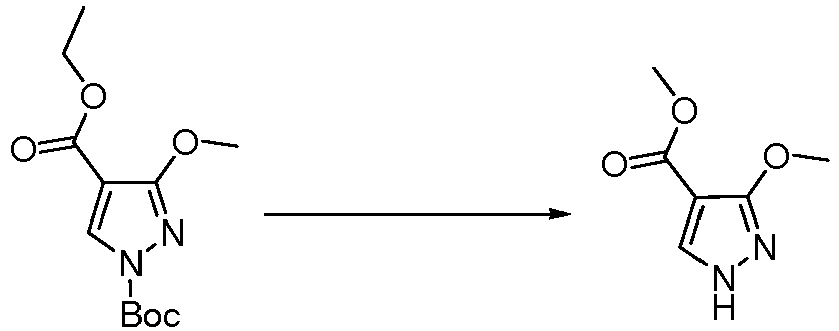
- A mixture of 1-tert-butyl 4-ethyl 3-methoxy-1H-pyrazole-1,4-dicarboxylate (16 g, 59.20 mmol, 1.00 equiv) and saturated hydrogen chloride in 1,4-dioxane (200 mL) was stirred for 5 h at room temperature and concentrated under vacuum. The resulting solution was diluted with 20 mL of water and the pH value of the solution was adjusted to 8 by sodium bicarbonate. The resulting solution was extracted with ethyl acetate, dried over anhydrous sodium sulfate, and concentrated under vacuum. This resulted in the title compound (7 g, 69%) as brown oil.
-

- A mixture of CuI (95 mg, 0.50 mmol, 0.10 equiv), L-proline (115 mg, 1.00 mmol, 0.20 equiv), potassium carbonate (1.38 g, 9.99 mmol, 2.00 equiv), ethyl 3-methoxy-1H-pyrazole-4-carboxylate (850 mg, 5.00 mmol, 1.00 equiv), and 1-bromo-4-(trifluoromethyl)benzene (2.04 g, 7.50 mmol, 1.50 equiv) in DMSO (10 mL) was stirred overnight at 100°C under nitrogen. The reaction was diluted with water, extracted with ethyl acetate, dried over anhydrous sodium sulfate, and concentrated under vacuum. This resulted in the title compound (1.06g, 68%) as a white solid.
-

- LiAlH4 (385 mg, 10.14 mmol, 3.0 equiv) was added batch wise into a solution of ethyl 3-methoxy-1-[4-(trifluoromethyl)phenyl]-1H-pyrazole-4-carboxylate (1.06 g, 3.37 mmol, 1.00 equiv) in tetrahydrofuran (20 mL) at 0°C under nitrogen. The resulting solution was stirred for 1.5 h at 0°C, quenched by water, extracted with ethyl acetate, dried over anhydrous sodium sulfate, and concentrated under vacuum. This resulted in the title compound (800 mg, 87%) as a light yellow solid.
-

- A solution of [3-methoxy-1-[4-(trifluoromethyl)phenyl]-1H-pyrazol-4-yl] methanol (580 mg, 2.13 mmol, 1.00 equiv) and PCC (916 mg, 4.25 mmol, 2.0 equiv) in dichloromethane (20 mL) was stirred for 3 h at room temperature and concentrated under vacuum. The residue was purified by a silica gel column eluting with ethyl acetate/petroleum ether (1:3) to afford the title compound (500mg, 87%) as a light yellow solid.
-

- A mixture of 3-methoxy-1-[4-(trifluoromethyl)phenyl]-1H-pyrazole-4-carbaldehyde (500 mg, 1.85 mmol, 1.00 equiv), hydroxylamine hydrochloride (383 mg, 5.51 mmol, 3.00 equiv), and sodium acetate (759 mg, 9.25 mmol, 5.00 equiv) in ethanol (20 mL) was stirred for 40 min at room temperature and concentrated under vacuum. The residue was diluted with water, extracted with ethyl acetate, dried over anhydrous sodium sulfate, and concentrated under vacuum. This resulted in the title compound (520 mg, 99%) as a yellow solid.
-

- Into a 250-mL round-bottom flask purged and maintained with an atmosphere of H2 was placed Raney Ni (50 mg, 0.58 mmol, 1.00 equiv), methanol (10 mL), and (E)-N-([3-methoxy-1-[4-(trifluoromethyl)phenyl]-1H-pyrazol-4-yl]methylidene)hydroxylamine (520 mg, 1.82 mmol, 1.00 equiv). After 30 min at room temperature the solids were filtered out. The liquid was concentrated under vacuum to afford the title compound (480mg) as a greenish solid.
-

- A mixture of (2S,4R)-4-fluoro-1-[(4-fluorobenzene)sulfonyl]pyrrolidine-2-carboxylic acid (384 mg, 1.32 mmol, 1.50 equiv), HATU (501 mg, 1.32 mmol, 1.50 equiv), DIEA (227 mg, 1.76 mmol, 2.00 equiv), and [3-methoxy-1-[4-(trifluoromethyl)phenyl]-1H-pyrazol-4-yl]methanamine (240 mg, 0.88 mmol, 1.00 equiv) in N,N-dimethylformamide (20 mL)was stirred overnight at room temperature. The reaction was diluted with 20 mL of water, extracted with ethyl acetate, dried over anhydrous sodium sulfate, and concentrated under vacuum. The residue was purified by a silica gel column eluting with ethyl acetate/petroleum ether (1:6). The crude product was purified by Prep-HPLC to afford the title compound (53.8 mg, 11%) as a white solid.
1H NMR (300 MHz, CDCl3) δ 8.61 - 8.58 (m, 1H), 8.35 (s, 1H), 7.98 - 7.94 (m, 2H), 7.87 - 7.80 (m, 4H), 7.47 - 7.42 (m, 2H), 5.24 - 5.11 (d, J = 52.8 Hz, 1H), 4.16 - 4.05 (m, 3H), 3.96 (s, 3H), 3.68 - 3.55 (m, 2H), 2.38 - 2.28 (m, 1H), 2.15 - 1.90 (m, 1H). -

- A mixture of (2S,3R)-1-[(tert-butoxy)carbonyl]-3-hydroxypyrrolidine-2-carboxylic acid (200 mg, 0.86 mmol, 1.00 equiv), DMF (10 mL), HATU (493.6 mg, 1.30 mmol, 1.50 equiv), DIEA (446.9 mg, 3.46 mmol, 4.00 equiv), [6-[6-(trifluoromethyl)pyridin-3-yl]pyrimidin-4-yl]methanamine hydrochloride (302.3 mg, 1.04 mmol, 1.20 equiv) was stirred for 3 h at room temperature. The reaction was then quenched by the addition of water, extracted with ethyl acetate. The organic layers combined, washed with water and brine, dried over anhydrous sodium sulfate and concentrated to afford the title compound 400 mg (99%) as orange oil.
-

- DAST (204 mg, 0.89 mmol, 3.00 equiv) was added dropwise into a solution of tert-butyl(2S,3R)-3-hydroxy-2-[([6-[6-(trifluoromethyl)pyridin-3-yl]pyrimidin-4-yl]methyl)carbamoyl]pyrrolidine-1-carboxylate (200 mg, 0.43 mmol, 1.00 equiv) in 10mL of DCM at 0 °C. The resulting solution was stirred for an additional 30 min at room temperature, quenched by the addition of water, extracted with ethyl acetate. The organic layers combined, dried over anhydrous sodium sulfate and concentrated. The residue was applied onto a silica gel column with dichloromethane/methanol (40:1) to afford the title compound 85 mg (42%) as a orange solid.
-

- A mixture of tert-butyl (2R,3S)-3-fluoro-2-[([6-[6-(trifluoromethyl)pyridin-3-yl]pyrimidin-4-yl]methyl)carbamoyl]pyrrolidine-1-carboxylate (85 mg, 0.18 mmol, 1.00 equiv), HCl in dioxane (10 mL, 1mol/L) was stirred for 3 h at room temperature. The resulting solution was diluted with ethyl acetate. The solids were collected by filtration to afford the title compound 70 mg (95%) as a orange solid.
-

- A mixture of (2R,3S)-3-fluoro-N-([6-[6-(trifluoromethyl)pyridin-3-yl]pyrimidin-4-yl]methyl)pyrrolidine-2-carboxamide hydrochloride (70 mg, 0.17 mmol, 1.00 equiv), TEA (51.5 mg, 0.51 mmol, 3.00 equiv), 4-fluorobenzene-1-sulfonyl chloride (39.6 mg, 0.20 mmol, 1.10 equiv), 4-dimethylaminopyridine (2.1 mg, 0.02 mmol, 0.10 equiv) in DCM (3 mL) was stirred for 3 h at room temperature. The reaction was quenched by the addition of water, extracted with ethyl acetate. The organic layers combined, dried over anhydrous sodium sulfate and concentrated. The residue was applied onto a silica gel column with ethyl acetate/petroleum ether (1:1) to afford the title compound 40 mg (44%) as a light yellow solid. 1H NMR (400 MHz, CDCl3) δ 9.49 (s, 1H), 9.28 (s, 1H), 8.70 - 8.68 (d, J = 8.4 Hz, 1H), 7.99 (s, 1H), 7.94 - 7.91 (m, 2H), 7.84 - 7.80 (m, 2H), 7.31 - 7.27 (t, J = 8.4 Hz, 2H), 5.38 - 5.26 (d, J = 48 Hz, 1H), 4.96 - 4.90 (m, 1H), 4.59 - 4.53 (m, 1H), 4.43 - 4.38 (d, J = 22.4 Hz, 1H), 3.86 - 3.81 (t, J = 8.8 Hz 1H), 3.34 - 3.27 (m, 1H), 2.26 - 2.03 (m, 2H).
-

- A mixture of (2S,4R)-4-fluoro-l-[(4-fluorobenzene)sulfonyl]-pyrrolidine-2-carboxylic acid (100 mg, 0.34 mmol), DMF (2 mL), DIPEA (132 mg, 1.02 mmol), HATU (194 mg, 0.51 mmol) and [3-chloro-1-[4-(trifluoromethyl)phenyl]-1H-pyrazol-4-yl]methanamine (187 mg, 0.68 mmol) was stirred for 2 h at room temperature. The reaction mixture was purified directly by Prep-HPLC to afford the title compound (38 mg, 20%) as a white solid. 1H NMR (400 MHz, CD3OD) • 8.45 (s, 1H), 8.00 - 7.79 (m, 6H), 7.42 - 7.31 (m, 2H), 5.14 (d, J = 52 Hz, 1H), 4.37 (s, 2H), 4.30 - 4.19 (m, 1H), 3.87 - 3.69 (m, 3H), 2.52 - 2.43 (m, 1H), 2.25 - 2.08 (m, 1H).
-

- A mixture of (4R)-4-fluoro-1-[(4-fluorobenzene)sulfonyl]-2-methylpyrrolidine-2-carboxylic acid (125 mg, 0.41 mmol), DMF (4 mL), HATU (234 mg, 0.62 mmol), DIPEA (212 mg, 1.64 mmol) and [6-[4-(trifluoromethyl)phenyl]pyrimidin-4-yl]methanamine hydrochloride (106 mg, 0.37 mmol) was stirred for 12 h at room temperature. The mixture was diluted with water, extracted with EtOAc, washed with brine, dried over anhydrous Na2SO4 and concentrated. The residue was purified by flash chromatography on silica gel eluting with EtOAc/petroleum ether (1:1).
- Faster eluting isomer (24.8 mg) assigned by potency SAR as (2S,4R)-4-fluoro-1-(4-fluorophenylsulfonyl)-2-methyl-N-((6-(4-(trifluoromethyl)phenyl)pyrimidin-4-yl)methyl)pyrrolidine-2-carboxamide: 1H NMR (300 MHz, CD3OD) δ 9.19 (d, J = 1.2 Hz, 1H), 8.45 (d, J = 7.8 Hz, 2H), 8.34 (s, 1H), 8.05 - 8.01 (m, 2H), 7.77 (d, J = 8.4 Hz, 2H), 7.32 (t, J = 8.7 Hz, 2H), 5.30 (d, J = 51.9 Hz, 1H), 4.71 - 4.51 (m, 2H), 3.94 - 3.90 (m, 1H), 3.82 (d, J = 2.4 Hz, 1H), 2.72 - 2.34 (m, 2H), 1.82 (s, 3H
-

-

- A mixture of 3-bromo-5-fluorobenzonitrile (10 g, 50.00 mmol, 1.00 equiv), [6-(trifluoromethyl)pyridin-3-yl]boronic acid (9.6 g, 50.28 mmol, 1.00 equiv), potassium carbonate (27.6 g, 199.70 mmol, 4.00 equiv), and Pd(dppf)Cl2 (3.67 g, 5.02 mmol, 0.10 equiv) in dioxane (400 mL)/water(80 mL) was stirred overnight at 100°C under nitrogen. The reaction mixture was diluted with water, extracted with ethyl acetate, washed with brine, dried over anhydrous sodium sulfate, and concentrated under vacuum. The residue was purified by a silica gel column eluting with ethyl acetate/petroleum ether (10:100) to afford the title compound (11.4 g, 86%) as a light yellow solid.
-

- A mixture of 3-fluoro-5-[6-(trifluoromethyl)pyridin-3-yl]benzonitrile (3 g, 11.27 mmol, 1.00 equiv), palladium on carbon (1 g, 9.40 mmol, 0.80 equiv), and concentrated HCl (10 mL) in methanol (200 mL)/tetrahydrofuran (100 mL) was stirred for 1.5 h at room temperature under hydrogen. The solids were filtered out and the filtrate was concentrated under vacuum. This resulted in the title compound (4 g, crude) as a yellow solid.
-

- A mixture of [3-fluoro-5-[6-(trifluoromethyl)pyridin-3-yl]phenyl]methanamine hydrochloride (8 g, 26.09 mmol, 1.00 equiv), (2S,4R)-4-fluoro-1-[(4-fluorobenzene)sulfonyl]pyrrolidine-2-carboxylic acid (7.6 g, 26.09 mmol, 1.00 equiv), DIEA (34 g, 263.07 mmol, 10.10 equiv), and HATU (14.8 g, 38.92 mmol, 1.50 equiv) in N,N-dimethylformamide (300 mL) was stirred overnight at room temperature. The reaction mixture was diluted with water, extracted with ethyl acetate, washed with brine, dried over anhydrous sodium sulfate, and concentrated under vacuum. The residue was purified by a silica gel column eluting with ethyl acetate/petroleum ether (30:100) to afford the title compound (2.7672 g, 20%) as a white solid.
1H NMR (300 MHz, DMSO-d6 ) δ 9.14 (s, 1H), 8.95 - 8.91 (m, 1H), 8.43 - 8.40 (m, 1H), 8.01 - 7.95 (m, 3H), 7.66 - 7.62 (m, 2H), 7.50 - 7.43 (m, 2H), 7.32 - 7.29 (m, 1H), 5.28 - 5.11 (m, 1H), 4.55 - 4.54 (m, 2H), 4.22 - 4.16 (m, 1H), 3.73 - 3.60 (m, 2H), 2.42 - 2.37 (m, 1H), 2.16 - 2.02 (m, 1H). -

- A mixture of 2-chloro-5-fluoro-4-iodopyridine (2.57 g, 9.98 mmol), [6-(trifluoromethyl)pyridin-3-yl]boronic acid (2.00 g, 10.48 mmol), Pd(dppf)Cl2.CH2Cl2 (407.63 mg, 0.50 mmol), sodium carbonate (2.12 g, 20.00 mmol) in water (10 mL) and toluene (25 mL) was stirred for overnight at 90 °C under nitrogen. The reaction mixture was concentrated under reduced pressure, diluted with water, extracted with dichloromethane, and separated. The combined organic layers were washed with brine, dried (Na2SO4) and concentrated under reduced pressure. The residue was purified by flash chromatography on silica gel eluting with EtOAc/petroleum ether (1:5) to afford the title compound (2.31 g) as colorless oil.
-

- A mixture of 2-chloro-5-fluoro-4-[6-(trifluoromethyl)pyridin-3-yl]pyridine (1 g, 3.62 mmol), Pd2(dba)3.CHCl3 (187 mg, 0.18 mmol), Zn(CN)2 (254 mg, 2.16 mmol), DPPF (200 mg, 0.36 mmol), and Zn (24 mg, 0.37 mmol) in DMA (10 mL) was irradiated with microwave radiation for 1 h at 125oC under nitrogen. The reaction was then quenched with water, extracted with EtOAc. The organic layers were combined and washed with brine, dried (Na2SO4) and concentrated under reduced pressure. The residue was purified by flash chromatography on silica gel eluting with EtOAc/petroleum ether (1:5) to afford the title compound (860 mg) as a yellow solid.
-

- A mixture of 5-fluoro-4-[6-(trifluoromethyl)pyridin-3-yl]pyridine-2-carbonitrile (250 mg, 0.94 mmol), Raney Ni (100 mg, 1.17 mmol) in methanol (10 mL) was stirred for 1 h at room temperature under an atmosphere of hydrogen. The solids were filtered off and the filtrate was concentrated under reduced pressure to afford the crude title compound (250 mg) as brown oil, which was used in the next step without any further purification.
-

- A mixture of [5-fluoro-4-[6-(trifluoromethyl)pyridin-3-yl]pyridin-2-yl]methanamine (141 mg, 0.52 mmol), HATU (231 mg, 0.61 mmol), DIPEA (157 mg, 1.21 mmol), (3R,4R)-4-fluoro-1-[(4-fluorobenzene)sulfonyl]pyrrolidine-3-carboxylic acid (110 mg, 0.38 mmol) in DMF (5 mL) was stirred overnight at 25 °C. The reaction mixture was quenched with water, extracted with CH2Cl2. The combined organic layers were washed with brine, dried (Na2SO4) and concentrated under reduced pressure. The residue was purified by Prep-HPLC to afford the title compound (32.4 mg) as a white solid. 1H NMR (300 MHz, CD3OD) δ 9.41 (s, 1H), 8.72 (d, J = 9.9 Hz, 2H), 8.58 (d, J = 1.2 Hz, 1H), 8.28 (d, J = 5.7 Hz, 1H), 8.04 - 7.99 (m, 2H), 7.86 (d, J = 8.4 Hz, 1H), 7.37 - 7.31 (m, 2H), 5.16 (d, J = 51.9 Hz, 1H), 4.74 - 4.56 (m, 2H), 4.33 - 4.27 (m, 1H), 3.86 - 3.67 (m, 2H), 2.54 - 2.52 (m, 1H), 2.30 - 2.12 (m, 1H).
-

- A mixture of 2-bromo-5-fluoropyridine-4-carbaldehyde (300 mg, 1.47 mmol), [6-(trifluoromethyl)pyridin-3-yl]boronic acid (420 mg, 2.20 mmol), Pd(dppf)Cl2. CH2Cl2 (60 mg, 0.07 mmol), Cs2CO3 (1.44 g, 0.09 mmol) in water (2mL) and 1,4-Dioxane (6 mL) was stirred overnight at 90oC in an oil bath under nitrogen. The resulting mixture was quenched with water, extracted with CH2Cl2 and separated. The combined organic layers were washed with brine, dried (Na2SO4) and concentrated under reduce pressure. The residue was purified by flash chromatography on silica gel with EtOAc/petroleum ether (12:88) to afford the title compound (110 mg) as a light yellow solid.
-

- A mixture of 5-fluoro-2-[6-(trifluoromethyl)pyridin-3-yl]pyridine-4-carbaldehyde (363 mg, 1.34 mmol), NH2OH.HCl (187 mg, 2.69 mmol) in ethanol (15 mL) and water (3 mL) was stirred for 30 min at 25 °C. Then concentrated HCl (0.08 mL, 36%), Pd/C (300 mg, 10%) was added and the reaction mixture was stirred for 50 min at 25oC under an atmosphere of hydrogen gas. The solids were filtered off and the filtrate was concentrated under reduced pressure. The resulting mixture was diluted with H2O, and adjusted to pH ~7-8 with 5 N NaHCO3, extracted with EtOAc. The combined organic layers were washed with brine, dried (Na2SO4) and concentrated under reduced pressure to afford the crude title compound (300 mg) as yellow oil, which was used in the next step without any further purification.
-

- A mixture of (2S,4R)-4-fluoro-1-[(4-fluorobenzene)sulfonyl]pyrrolidine-2-carboxylic acid (129 mg, 0.44 mmol), HATU (169 mg, 0.44 mmol), DIPEA (143 mg, 1.11 mmol), [5-fluoro-2-[6-(trifluoromethyl)pyridin-3-yl]pyridin-4-yl]methanamine (100 mg, 0.37 mmol) in DMF (2 mL) was stirred for overnight at 25 °C. The reaction mixture was quenched with water, extracted with dichloromethane. The combined organic layers were washed with brine, dried (Na2SO4) and concentrated under reduced pressure. The residue was purified by flash chromatography on silica gel eluting with EtOAc/petroleum ether (6:4). The crude product was recrystallized from methanol to afford the title compound (67 mg) as an off-white solid. 1H NMR (300 MHz, CD3OD) δ 9.08 (s, 1H), 8.61 (d, J = 3 Hz, 1H), 8.43 (d, J = 6 Hz, 1H), 8.02 - 7.92 (m, 4H), 7.38 - 7.32 (m, 2H), 5.16 (d, J = 54 Hz, 1H), 4.65 (s, 2H), 4.31 - 4.26 (m, 1H), 3.86 - 3.68 (m, 2H). 2.54 - 2.52 (m, 1H), 2.32 - 2.06 (m, 1H).
-

- A mixture of (2S,4R)-1-[(tert-butoxy)carbonyl]-4-fluoropyrrolidine-2-carboxylic acid (2 g, 8.57 mmol), potassium carbonate (5.9 g, 42.69 mmol), THF (80 mL) and CH3I (6.1 g, 42.98 mmol) was stirred for 12 h at room temperature. The solids were filtered off and the filtrate was concentrated under reduced pressure. The residue was purified by flash chromatography on silica gel eluting with EtOAc/petroleum ether (1:5) to afford the title compound (800 mg, 38%) as colorless oil.
-

- A 1 M solution of LiHMDS (4.85 mL, 4.85 mmol) was added dropwise into a mixture of 1-tert-butyl 2-methyl (2S,4R)-4-fluoropyrrolidine-1,2-dicarboxylate (400 mg, 1.62 mmol) in THF (20 mL) with stirring at -78 °C under nitrogen. The reaction solution was stirred for 30 min at -78 °C. To this was added CH3I (690 mg, 4.86 mmol) dropwise at -78 °C. The reaction mixture stirred for 12 h at room temperature, quenched with water, extracted with EtOAc, dried over anhydrous Na2SO4 and concentrated. The residue was purified by flash chromatography on silica gel eluting with EtOAc/petroleum ether (1:5) to afford the title compound (360 mg, 85%) as colorless oil.
-

- A mixture of 1-tert-butyl 2-methyl (4R)-4-fluoro-2-methylpyrrolidine-1,2-dicarboxylate (360 mg, 1.38 mmol) and HCl in dioxane (10 mL, 1mol/L) was stirred for 2 h at room temperature. The mixture was concentrated to afford the crude product (315 mg) as a light yellow solid, which was used in the next step without any further purification.
-

- A mixture of 4R-4-fluoro-2-methylpyrrolidine-2-carboxylate hydrochloride (315 mg, 1.60 mmol), triethylamine (485 mg, 4.80 mmol), dichloromethane (20 mL) and 4-fluorobenzene-1-sulfonyl chloride (310 mg, 1.60 mmol) was stirred for 12 h at room temperature. The reaction was diluted with dichloromethane, washed with brine, dried over anhydrous Na2SO4 and concentrated. The residue was purified by flash chromatography on silica gel eluting with EtOAc/petroleum ether (1:4) to afford the title compound (380 mg) as colorless oil, which was used in the next step without any further purification.
-

- A mixture of methyl (4R)-4-fluoro-1-[(4-fluorobenzene)sulfonyl]-2-methylpyrrolidine-2-carboxylate (380 mg, 1.19 mmol), LiOH (58 mg, 2.42 mmol), methanol (8 mL), water (2 mL) was stirred for 12 h at room temperature. The reaction mixture was concentrated, dissolved in water, extracted with ether. The aqueous layers was acidified with 3 N HCl (pH 2-3), extracted with EtOAc, dried over anhydrous Na2SO4 and concentrated to afford the title compound (260 mg, 72%) as yellow oil, which was used in the next step without any further purification.
-

- A mixture of (4R)-4-fluoro-1-[(4-fluorobenzene)sulfonyl]-2-methylpyrrolidine-2-carboxylic acid (125 mg, 0.41 mmol), DMF (4 mL), HATU (228 mg, 0.60 mmol), DIPEA (206 mg, 1.59 mmol) and [6-[6-(trifluoromethyl)pyridin-3-yl]pyrimidin-4-yl]methanamine hydrochloride (104 mg, 0.36 mmol) was stirred for 12 h at room temperature. The mixture was diluted with water, extracted with EtOAc. The combined organic layers were washed with brine, dried over anhydrous Na2SO4 and concentrated. The residue was purified by flash chromatography on silica gel eluting with EtOAc/petroleum ether (1:1 to 2:1).
- Slower eluting isomer (72.7 mg) assigned by potency SAR as (2S,4R)-4-fluoro-1-(4-fluorophenylsulfonyl)-2-methyl-N-((6-(6-(trifluoromethyl)pyridin-3-yl)pyrimidin-4-yl)methyl)pyrrolidine-2-carboxamide: 1H NMR (300 MHz, CD3OD) δ 9.50 (s, 1H), 9.20 (s,1H), 8.83 (d, J = 8.4 Hz, 1H), 8.31 (s, 1H), 8.06 - 7.98 (m, 3H), 7.37 (t, J = 17.4 Hz, 2H), 5.26 (d, J = 51 Hz, 1H), 4.80 (d, J = 15 Hz, 1H), 4.54 (d, J = 17.4 Hz, 1H), 4.19 - 4.07 (m, 1H), 3.76 - 3.60 (m, 1H), 2.76 - 2.64 (m, 1H), 2.33 - 2.14 (m, 1H), 1.61 (s, 3H).
-

- The title compound was prepared by the procedures described in Example 198, step 1 using (2S,4R)-1-(tert-butoxycarbonyl)-4-fluoropyrrolidine-2-carboxylic acid and (6-(4-(trifluoromethyl)phenyl)pyrimidin-4-yl)methanamine (obtained following Example 145, steps 1, 2, 3, and standard deprotonation of the HCl salt) and Example 198, steps 2 and 3 (107 mg): 1H NMR (400 MHz, DMSO-d6 ) δ 9.25 (s, 1H), 9.11 (t, J = 5.7 Hz, 1H), 8.40 (d, J = 8.1 Hz, 2H), 8.15 (s, 1H), 8.07 - 7.99 (m, 2H), 7.88 (d, J = 8.1 Hz, 2H), 7.47 (t, J = 8.6 Hz, 2H), 5.21 (d, J = 52.4 Hz, 1H), 4.51 (d, J = 5.8 Hz, 2H), 4.31 - 4.22 (m, 1H), 3.78 - 3.59 (m, 2H), 2.48 - 2.38 (m, 1H), 2.23 - 2.05 (m, 1H).
-

- A mixture of 2-chloro-5-fluoro-4-iodopyridine (1.5 g, 5.83 mmol), 4-(trifluoromethyl)piperidine (890 mg, 5.81 mmol), Pd2(dba)3.CHCl3 (300 mg, 0.29 mmol), BINAP (360 mg, 0.58 mmol), t-BuONa (1.4 g, 14.57 mmol) in Toluene (15 mL) was irradiated with microwave radiation for 1 h at 125 °C under nitrogen and quenched by water (50 mL), extracted with dichloromethane, and the organic layers was combined and dried over anhydrous sodium sulfate and concentrated under reduced pressure. The residue was purified by flash chromatography on silica gel with ethyl acetate/petroleum ether (1:5) to afford the title compound (960 mg) as a yellow solid.
-

- A mixture of 2-chloro-5-fluoro-4-[4-(trifluoromethyl)piperidin-1-yl]pyridine (400 mg, 1.42 mmol), Pd2(dba)3.CHCl3 (72 mg, 0.07 mmol), Zn(CN)2 (100 mg, 0.85 mmol), Dppf (80 mg, 0.14 mmol), Zn (8 mg, 0.12 mmol) in DMA (10 mL) was irradiated with microwave radiation for 1 h at 125 °C under nitrogen and quenched by water (100 mL), extracted with dichloromethane, dried over anhydrous sodium sulfate and concentrated under reduced pressure. The residue was purified by flash chromatography on silica gel with ethyl acetate/petroleum ether (1:5) to afford the title compound (350 mg) as a yellow solid.
-

- A mixture of 5-fluoro-4-[4-(trifluoromethyl)piperidin-1-yl]pyridine-2-carbonitrile (200 mg, 0.73 mmol), 10% Pd/C (50 mg), conc.HCl (0.25 mL) in methanol (10 mL) was stirred for 1 h at room temperature under an atmosphere of hydrogen gas. The solids were filtered out and the filtrate was concentrated under reduced pressure to afford the crude title compound as a brown solid, which was used in the next step without any further purification.
-

- A mixture of (2S,4R)-4-fluoro-1-[(4-fluorobenzene)sulfonyl]pyrrolidine-2-carboxylic acid (315 mg, 1.08 mmol), HATU (410 mg, 1.08 mmol), DIEA (0.8 mL, 4.84 mmol), [5-fluoro-4-[4-(trifluoromethyl)piperidin-1-yl]pyridin-2-yl]methanamine (250 mg, 0.90 mmol) in DMF (4 mL) was stirred overnight at room temperature. The resulting mixture was purified by Prep-HPLC with the following conditions (1#Waters 2767-1): Column, X Bridge C18; mobile phase, Mobile Phase A: Water/0.05% NH4HCO3, Mobile Phase B: ACN=30% increasing to ACN=70% within 10 min; Detector, UV 254 nm to afford the title compound (28.2 mg) as a white solid. 1H NMR (400 MHz, CD3OD) δ 8.09 (s, 1H), 8.03 - 7.99 (m, 2H), 7.39 - 7.34 (m, 2H), 7.18 - 7.16 (d, J = 7.6 Hz, 2H), 5.21 - 5.07 (d, J = 52.4 Hz, 1H), 4.47 (s, 2H), 4.28 - 4.24 (m, 1H), 4.04 - 4.01 (d, J = 12.8 Hz, 2H), 3.83 - 3.70 (m, 2H), 3.00 - 2.94 (t, J = 12.8 Hz, 2H), 2.51 - 2.40 (m, 2H), 2.25 - 2.12 (m, 1H), 1.94 - 1.91 (d, J = 12.8 Hz, 2H), 1.71 - 1.65 (m, 2H).
-

- A mixture of 4,6-dichloropyrimidine (2.17 g, 14.57 mmol), [4-(trifluoromethoxy)phenyl]boronic acid (1 g, 4.86 mmol), Pd(dppf)Cl2 (731 mg, 1.00 mmol), potassium carbonate (5 g, 36.18 mmol), dioxane (40 mL) and water (4 mL) was stirred for 12 h at 100°C under nitrogen. The mixture was diluted with EtOAc, washed with brine, dried and concentrated. The residue was purified by flash chromatography on silica gel eluting with EtOAc/petroleum ether (1/50) to afford the title compound (1.1 g, 82%) as a white solid.
-

- A mixture of 4-chloro-6-[4-(trifluoromethoxy)phenyl]pyrimidine (820 mg, 2.99 mmol), Zn(CN)2 (421 mg, 3.58 mmol), Pd(PPh3)4 (347 mg, 0.30 mmol), DMF (6 mL) was stirred for 9 h at 100°C under nitrogen. The reaction was cooled, diluted with water (30mL), extracted with EtOAc. The combined organic layers were washed with brine, dried over anhydrous Na2SO4 and concentrated. The residue was purified by flash chromatography on silica gel eluting with EtOAc/petroleum ether (1/50) to afford the title compound (320 mg, 40%) as a white solid.
-

- A mixture of 6-[4-(trifluoromethoxy)phenyl]pyrimidine-4-carbonitrile (160 mg, 0.60 mmol), ethanol (10 mL), concentrated HCl solution (0.02 mL), 10% Palladium on carbon (100 mg) was stirred for 10 min at room temperature under an atmosphere of hydrogen gas. The solids were filtered off and the filtrate was concentrated to afford the crude product (200 mg) as a solid, which was used in the next step without any further purification.
-

- A mixture of (2S,4R)-4-fluoro-1-[(4-fluorobenzene)sulfonyl]pyrro-lidine-2-carboxylic acid (150 mg, 0.51 mmol), DMF (4 mL), DIPEA (263 mg, 2.03 mmol), HATU (294 mg, 0.77 mmol) and [6-[4-(trifluoromethoxy)phenyl]pyrimidin-4-yl]methanamine (200 mg, 0.74 mmol) was stirred for 12 h at room temperature. The crude solution was purified directly by Prep-HPLC to afford the title compound (51 mg, 13%) as a white solid. 1H NMR (300 MHz, CD3OD) δ 9.15 (s, 1H), 8.41 (d, J = 8.7 Hz, 6H), 8.25 (s, 1H), 8.08 - 8.03 (m, 2H), 7.40 - 7.34 (m, 4H), 5.17 (d, J = 51.6 Hz, 1H), 4.63 (d, J = 4.8 Hz, 2H), 4.37 - 4.31 (m, 1H), 3.88 - 3.75 (m, 2H), 2.61 - 2.48 (m, 1H), 2.35 - 2.11 (m, 1H).
-

- A mixture of (2S,4R)-4-fluoro-1-[(4-fluorobenzene)sulfonyl]-pyrrolidine-2-carboxylic acid (48 mg, 0.16 mmol), DIPEA (63 mg, 0.49 mmol), DMF (3 mL), HATU (94 mg, 0.25 mmol) and [3-chloro-1-[6-(trifluoromethyl)pyridin-3-yl]-1H-pyrazol-4-yl]methanamine (46 mg, 0.17 mmol) was stirred for 2 h at room temperature. The reaction mxture was purified directly by Prep-HPLC to afford the title compound (40 mg, 44%) as a white solid. 1H NMR (300 MHz, CD3OD) δ 9.16 (s, 1H), 8.55 (s, 1H), 8.33 - 8.37 (m, 1H), 7.94 - 8.02 (m, 3H), 7.32 - 7.38 (m, 2H), 5.15 (d, J = 52.5 Hz, 1H), 4.39 (s, 2H), 4.25 - 4.19 (m, 1H), 3.85 - 3.67 (m, 2H), 2.53 - 2.42 (m, 1H), 2.29 - 2.10 (m, 1H).
-

- A mixture of (2S,4R)-4-fluoro-1-[(4-fluorobenzene)sulfonyl]pyrrolidine-2-carboxylic acid (102 mg, 0.35 mmol), DMF(5 mL), DIPEA (136 mg, 1.05 mmol), HATU (200 mg, 0.53 mmol) and (6-[4-[(trifluoromethyl)sulfanyl]phenyl]pyrimidin-4-yl)methanamine (100 mg, 0.35 mmol) was stirred for 1 h at room temperature. The crude solution was purified directly by Prep-HPLC high to afford the title compound (75.4 mg, 39%) as a white solid. 1H NMR (300MHz, CD3OD) δ 9.16 (s, 1H), 8.39 (d, J = 8.4 Hz, 2H), 8.27 (s, 1H), 8.07 - 8.01 (m, 2H), 7.79 (d, J = 8.4 Hz, 2H), 7.38 - 7.32 (m, 2H), 5.16 (d, J = 51.9 Hz, 1H), 4.63 (d, J = 4.2 Hz, 2H), 4.32 (dd, J = 10.2, 7.2 Hz, 1H), 3.87 - 3.9 (m, 2H), 2.57 - 2.15 (m, 2H).
-

- NaBH4 (76 mg, 2.01 mmol) was added portionwise to a solution of ethyl 6-[4-(trifluoromethyl)cyclohex-1-en-1-yl]pyrimidine-4-carboxylate (300 mg, 1.00 mmol) in methanol (10 mL) with stirring. The resulting mixture was stirred for 2 h at 25oC, and concentrated under reduced pressure. The residue was purified by flash chromatography on silica gel eluting with EtOAc/petroleum ether (1:1) to afford the title compound (254 mg) as a white solid.
-

- DIAD (235 mg, 1.16 mmol) was added dropwise to a solution of [6-[4-(trifluoromethyl)cyclohex-1-en-1-yl]pyrimidin-4-yl]methanol (150 mg, 0.58 mmol), 2,3-dihydro-1H-isoindole-1,3-dione (94 mg, 0.64 mmol), PPh3 (305 mg, 1.16 mmol) in THF (10 mL) at 0°C with stirring. The resulting mixture was stirred for 2 h at 25oC, then diluted with water, extracted with dichloromethane. The organic layers were combined and washed with brine, dried over anhydrous Na2SO4 and concentrated under reduced pressure. The residue was purified by flash chromatography on silica gel eluting with EtOAc/petroleum ether (1:1) to afford the title compound (425 mg) as a white solid.
-

- A mixture of 2-([6-[4-(trifluoromethyl)cyclohex-1-en-1-yl]pyrimidin-4-yl]methyl)-2,3-dihydro-1H-isoindole-1,3-dione (425 mg, 1.10 mmol), hydrazine hydrate (80%) (0.5 mL) in methanol (10 mL) was stirred for 3 h at 25 °C, and concentrated under reduced pressure. The residue was dissolved in EtOAc, and the solids were filtered out. The filtrate was concentrated under reduced pressure to afford the crude title compound (210 mg) as a white solid, which was used in the next step without any further purification.
-

- A mixture of [6-[4-(trifluoromethyl) cyclohex-1-en-1-yl]pyrimidin-4-yl]methanamine (284 mg, 1.10 mmol), HATU (465.8 mg, 1.23 mmol), DIPEA (317 mg, 2.45 mmol) in DMF (5 mL) was stirred for 10 min at 25 °C. Then (2S,4R)-4-fluoro-1-[(4-fluorobenzene)sulfonyl]pyrrolidine-2-carboxylic acid (210 mg, 0.72 mmol) was added and the resulting mixture was a stirred overnight at 25oC. The reaction mixture was then quenched with water, extracted with dichloromethane. The combined organic layers were washed with brine (2x10 mL), dried over anhydrous Na2SO4 and concentrated under reduced pressure. The crude product (120 mg) was purified by Prep-HPLC to afford the title compound (25.8 mg) as a white solid. 1H NMR (300 MHz, CD3OD) δ 8.99 (s, 1H), 8.04 (q, J = 6 Hz, 2H), 7.84 (s, 1H), 7.38 (t, J = 9 Hz, 2H), 7.15 (s, 1H), 5.16 (d, J = 51 Hz, 1H), 4.88 - 4.86 (d, J = 6 Hz, 2H), 4.31 (t, J = 9 Hz, 1H), 3.86 - 3.72 (m, 2H), 2.84 (m, 1H), 2.59 - 2.47 (m, 4H), 2.32 - 2.14 (m, 3H), 1.67 - 1.61 (m, 1H).
-

- A mixture of (2S,4R)-4-fluoro-1-[(4-fluorobenzene)sulfonyl]-N-([6-[4-(trifluoromethyl)cyclohex-1-en-1-yl]pyrimidin-4-yl]methyl)pyrrolidine-2-carboxamide (180 mg, 0.34 mmol), 10% Pd(OH)2/C (30 mg) in methanol (20 mL) was stirred for 15 min at 25 °C under an atmosphere of hydrogen gas. The solids were filtered off and the filtrate was concentrated under reduced pressure. The residue (260 mg) was purified by Prep-HPLC to afford a mixture of cis/trans-isomers (120 mg). The isomers were separated by Chiral-Prep-HPLC eluting with Hex and IPA (hold 30.0% IPA in 20 min). Faster eluting isomer (33.6 mg) arbitrarily assigned as trans isomer (2S,4R)-4-fluoro-1-[(4-fluorobenzene) sulfonyl]-N-([6-[(1r,4S)-4-(trifluoromethyl) cyclohexyl]pyrimidin-4-yl]methyl) pyrrolidine-2-carboxamide: 1H NMR (300 MHz, CD3OD) δ 8.97 (s, 1H), 8.04 (q, J = 6 Hz, 2H), 7.71 (s, 1H), 7.37 (t, J = 9 Hz, 2H), 5.16 (d, J = 54 Hz, 1H), 4.54 (s, 2H), 4.32 (t, J = 9 Hz, 1H), 3.86 - 3.72 (m, 2H), 2.72 (t, J = 3 Hz, 1H), 2.51 (m, 1H), 2.27 - 2.04 (m, 6H), 1.74 - 1.53 (m, 2H), 1.50 - 1.44 (m, 2H).
- Slower eluting isomer (18 mg), arbitrarily assigned as cis isomer (2S,4R)-4-fluoro-1-[(4-fluorobenzene)sulfonyl]-N-([6-[(1s,4R)-4-(trifluoromethyl)cyclohexyl]pyrimidin-4-yl]methyl)pyrrolidine-2-carboxamide: 1H NMR (300 MHz, CD3OD) δ 9.02 (s, 1H), 8.01 (q, J = 6 Hz, 2H), 7.74 (s, 1H), 7.36 (t, J = 9 Hz, 2H), 5.15 (d, J = 54 Hz, 1H), 4.56 (d, J = 3 Hz, 2H), 4.27 (t, J = 9 Hz, 1H), 3.86 - 3.72 (m, 2H), 3.03 - 3.00 (m, 1H), 2.53 - 2.51 (m, 1H), 2.35 - 2.06 (m, 5H), 1.88 - 1.61 (m, 6H).
-
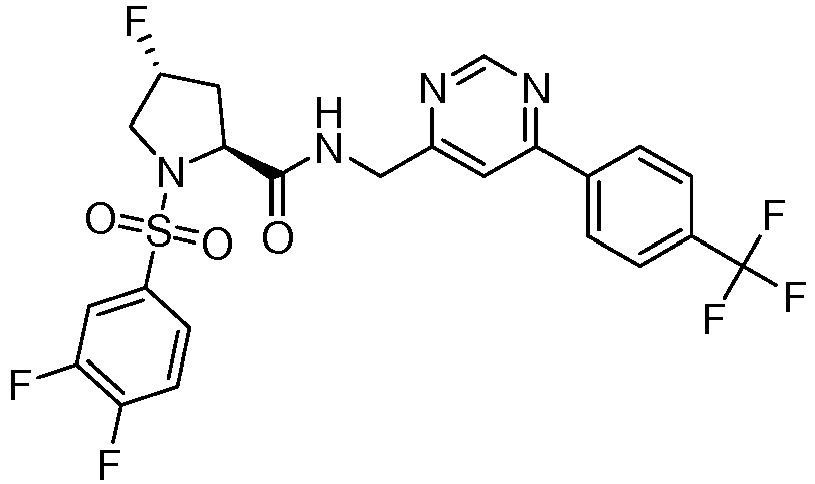
- The title compound was prepared by the procedures described in Example 198, step 1 using (2S,4R)-1-(tert-butoxycarbonyl)-4-fluoropyrrolidine-2-carboxylic acid and (6-(4-(trifluoromethyl)phenyl)pyrimidin-4-yl)methanamine, and Example 198, steps 2 and 3 using 3,4-difluorobenzene-1-sulfonyl chloride as a white solid. 1H NMR (300 MHz, CDCl3) δ 9.29 (s, 1H), 8.33 (d, J = 8.1 Hz, 2H), 8.08 (s, 1H), 7.82 - 7.61 (m, 5H), 7.41 - 7.33 (m, 1H), 5.11 (d, J = 51.9 Hz, 1H), 4.95 - 4.88 (m, 1H), 4.71 - 4.65 (m, 1H), 4.33 (dd, J = 7.4Hz, J = 9.9 Hz, 1H), 3.94 - 3.69 (m, 2H), 2.67 - 2.53 (m, 1H), 2.40 - 2.23 (m, 1H).
-

- A mixture of 3-cyclopropyl-3-oxopropanenitrile (5.5 g, 50.40 mmol), (diethoxymethoxy)ethane (74.7 g, 504.05 mmol), acetic anhydride (60 mL, 634.74 mmol) was stirred for 2 h at 150°C. The mixture was cooled, concentrated under reduced pressure. The residue was recrystallized from ethanol to afford the title compound (6 g, 72%) as a light yellow solid.
-

- A mixture of 2(cyclopropanecarbonyl)-3-ethoxyprop-2-enenitrile (2 g, 12.11 mmol), hydrazine hydrate (85%) (6.1 g, 121.85 mmol) and ethanol (20 mL) was stirred for 10 min at room temperature. The mixture was concentrated under reduced pressure. The residue was re-crystallized from toluene to afford the title compound (1 g, 62%) as a yellow solid.
-

- A mixture of 3-cyclopropyl-1H-pyrazole-4-carbonitrile (1 g, 7.51 mmol), 5-bromo-2-(trifluoromethyl)pyridine (2.88 g, 12.74 mmol), CuI (143 mg, 0.75 mmol), L-proline (173 mg, 1.50 mmol), potassium carbonate (2.28 g, 16.50 mmol) and DMSO (50 mL) was stirred for 12 h at 100°C under nitrogen. The mixture was cooled, diluted with EtOAc, washed with brine, dried over anhydrous Na2SO4 and concentrated under reduced pressure. The residue was purified by flash chromatography on a silica gel eluting with petroleum ether/EtOAc (50/1) to afford the title compound (1.1 g, 53%) as a white solid.
-

- A mixture of 3-cyclopropyl-1-[6-(trifluoromethyl)pyridin-3-yl]-1H-pyrazole-4-carbonitrile (1 g, 3.59 mmol), methanol (50 mL) and Raney Ni (500 mg, 5.84 mmol) was stirred for 15 min at room temperature under an atmosphere of hydrogen gas. The solids were filtered off, and the filtrate was concentrated under reduced pressure to afford the title compound (900 mg) as a white solid, which was used in the next step without any further purification.
-

- A mixture of (2S,4R)-4-fluoro-1-[(4-fluorobenzene)sulfonyl]pyrrolidine-2-carboxylic acid (80 mg, 0.27 mmol), DMF (5 mL), DIPEA (106.8 mg, 0.83 mmol), HATU (156.6 mg, 0.41 mmol) and 3-cyclopropyl-1-[6-(trifluoromethyl)pyridin-3-yl]-1H-pyrazol-4-ylmethanamine (77.55 mg, 0.27 mmol) was stirred for 1 h at room temperature. The crude solution was purified directly by Prep-HPLC to afford the title compound (50 mg, 33%) as a white solid. 1H-NMR (300 MHz, DMSO-d6 ) δ 9.14 (s, 1H), 8.66 (s, 1H), 8.49 (s, 1H), 8.32 (d, J = 7.8 Hz, 1H), 8.02 - 7.96 (m, 3H), 7.74 (m, 1H), 5.27 - 5.10 (m, 1H), 4.33 - 4.30 (m, 2H), 4.19 - 4.14 (m, 1H), 3.71 - 3.67 (m, 1H), 3.62 - 3.58 (m, 1H), 2.51 (m, 1H), 2.42 - 2.29 (m, 1H), 2.18 - 1.94 (m, 1H), 0.96 - 0.90 (m, 4H).
-

- A mixture of 4,6-dichloro-2-methylpyrimidine (1 g, 6.13 mmol), [6-(trifluoromethyl)pyridin-3-yl]boronic acid (229 mg, 1.20 mmol), potassium carbonate (2.07 g, 14.98 mmol), dioxane (50 mL), water (2 mL) and Pd(dppf)Cl2 (320 mg, 0.44 mmol) was irradiated with microwave radiation for 3 h at 100°C under nitrogen. The mixture was diluted with EtOAc (150mL), washed with brine (3x50mL), dried over anhydrous Na2SO4 and concentrated. The residue was purified by flash chromatography on silica gel eluting with EtOAc/petroleum ether (1/10) to afford the title compound (1.1 g, 66%) as a white solid.
-

- A mixture of 4-chloro-2-methyl-6-[6-(trifluoromethyl)pyridin-3-yl]pyrimidine (300 mg, 1.10 mmol), DMF (5 mL), Zn(CN)2 (128.7 mg, 1.10 mmol), dppf (60.9 mg, 0.11 mmol) and Pd2(dba)3CHCl3 (113.9 mg, 0.11 mmol) was irradiated with microwave radiation for 3 h at 120°C under nitrogen. The mixture was diluted with EtOAc (100 mL), washed with brine (3x), dried over anhydrous Na2SO4 and concentrated. The residue was purified by flash chromatography on silica gel eluting with EtOAc/petroleum ether (1/10) to afford the title compound (250 mg, 86%) as a white solid.
-

- A mixture of 2-methyl-6-[6-(trifluoromethyl)pyridin-3-yl]pyrimidine-4-carbonitrile (250 mg, 0.94 mmol), ethanol (20 mL), concentrated HCl (0.2 mL) and 10% Palladium carbon (200 mg) was stirred for 5 min at room temperature under an atmosphere of hydrogen gas. The solids were filtered off and the filtrate was concentrated to afford the crude product (200 mg) as a black solid, which was used in the next step without any further purification.
-

- A mixture of (2S,4R)-4-fluoro-1-[(4-fluorobenzene)sulfonyl]pyrrolidine-2-carboxylic acid (107.7 mg, 0.37 mmol), DMF (5 mL), DIPEA (144.4 mg, 1.12 mmol), HATU (212.8 mg, 0.56 mmol) and [2-methyl-6-[6-(trifluoromethyl)pyridin-3-yl]pyrimidin-4-yl]methanamine hydrogen chloride (112 mg, 0.37 mmol) was stirred for 1 h at room temperature. The crude solution was purified directly by Prep-HPLC to afford the title compound (32.9 mg, 16%) as a white solid. 1H NMR (300 MHz, DMSO-d6 ) δ 9.46 (s, 1H), 8.69 (d, J = 7.2 Hz, 1H), 7.94 - 7.91 (m, 3H), 7.89 (d, J = 8.1 Hz, 1H), 7.61 (s, 1H), 7.28 - 7.23 (m, 1H), 5.09 (d, J = 52.2 Hz ,1H), 4.94 - 4.89 (m, 1H), 4.50 - 4.45 (m ,1H), 4.37 - 4.31 (m, 1H), 3.96 - 3.62 (m, 2H), 2.83 (s, 3H), 2.64 - 2.54 (m, 1H), 2.34 - 1.52 (m, 1H).
-

-

- A mixture of CuI (122.93 mg, 0.65 mmol, 0.10 equiv), L-proline (148.8 mg, 1.29 mmol, 0.20 equiv), potassium carbonate (1.786 g, 12.92 mmol, 2.00 equiv), ethyl 3-methoxy-1H-pyrazole-4-carboxylate (1.1 g, 6.46 mmol, 1.00 equiv), and 5-bromo-2-(trifluoromethyl)pyridine (2.185 g, 9.67 mmol, 1.50 equiv) in DMSO (60 mL) was stirred overnight at 100°C under nitrogen. The reaction solution was diluted with water and extracted with ethyl acetate. The combined extracts were washed with brine, dried over anhydrous sodium sulfate, and concentrated under vacuum. The residue was purified by a silica gel column with ethyl acetate/petroleum ether (1:6) to afford the title compound (790 mg, 39%) as a white solid.
-

- LiAlH4 (190.61 mg, 5.02 mmol, 1.50 equiv) was added in several batches into a solution of ethyl 3-methoxy-1-[6-(trifluoromethyl)pyridin-3-yl]-1H-pyrazole-4-carboxylate (790 mg, 2.51 mmol, 1.00 equiv) in tetrahydrofuran (10 mL) at 0°C. The resulting solution was stirred for 30 min at 0°C. The reaction was then quenched by water and the solids were filtered out. The resulting solution was extracted with ethyl acetate and the organic layers were combined. The organic was washed with brine, dried over anhydrous sodium sulfate, and concentrated under vacuum. The residue was purified by a silica gel column eluting with ethyl acetate/petroleum ether (1:12) to afford the title compound (462 mg, 67%) as a yellow solid.
-

- A mixture of [3-methoxy-1-[6-(trifluoromethyl)pyridin-3-yl]-1H-pyrazol-4-yl]methanol (460 mg, 1.68 mmol, 1.00 equiv) and PCC (714.43 mg, 3.31 mmol, 2.00 equiv) in dichloromethane (20 mL) was stirred for 1 h at room temperature. The resulting mixture was concentrated under vacuum. The residue was purified by a silica gel column eluting with ethyl acetate/petroleum ether (1:12) to afford the title compound (283 mg, 62%) as a light yellow solid.
-

- A mixture of 3-methoxy-1-[6-(trifluoromethyl)pyridin-3-yl]-1H-pyrazole-4-carbaldehyde (450 mg, 1.66 mmol, 1.00 equiv), ethanol (20 mL), water (1 mL), and hydroxylamine hydrochloride (229.15 mg, 3.30 mmol, 2.00 equiv) was stirred for 2h at room temperature. Then the flask was purged and maintained with H2 (g). Concentrated hydrogen chloride (0.1 mL) and Pd/C (300 mg, 10%) were added to the above mixture. The resulting solution was stirred for 15 min at room temperature. The solids were filtered out and the filtrate was concentrated under vacuum. The resulting solution was diluted with water. The pH value of the solution was adjusted to 8 with sodium bicarbonate. The resulting solution was extracted with ethyl acetate, dried over anhydrous sodium sulfate, and concentrated under vacuum. This resulted in the title compound (280 mg, 62%) as a gray solid.
-

- A mixture of (2S,4R)-4-fluoro-1-[(4-fluorobenzene)sulfonyl]pyrrolidine-2-carboxylic acid (64.13 mg, 0.22 mmol, 1.20 equiv), HATU (104.89 mg, 0.28 mmol, 1.50 equiv), DIEA (71.21 mg, 0.55 mmol, 3.00 equiv), and [3-methoxy-1-[6-(trifluoromethyl)pyridin-3-yl]-1H-pyrazol-4-yl]methanamine (50 mg, 0.18 mmol, 1.00 equiv) in N,N-dimethylformamide (5 mL) was stirred for 45 min at room temperature. The reaction was then quenched by water. The solids were collected by filtration. The crude product was purified by Prep-HPLC to afford the title compound (41.5 mg, 41%) as a white solid.
1H NMR (400 MHz, CDCl3) δ 8.57 - 8.51 (m, 2H), 8.02 - 7.88 (m, 6H), 7.47 - 7.41 (t, 2H), 4.42 - 4.36 (m, 1H), 4.15 - 4.05 (m, 5H), 3.57 - 3.51 (t, 1H), 3.42 - 3.35 (m, 1H). -

- (2S,4R)-tert-butyl 4-fluoro-2-((6-(6-(trifluoromethyl)pyridin-3-yl)pyrimidin-4-yl)methylcarbamoyl)pyrrolidine-1-carboxylate was prepared by the procedure described in Example 198, step 1 using (2S,4R)-1-(tert-butoxycarbonyl)-4-fluoropyrrolidine-2-carboxylic acid.
-

- (2S,4R)-4-fluoro-N-((6-(6-(trifluoromethyl)pyridin-3-yl)pyrimidin-4-yl)methyl)pyrrolidine-2-carboxamide was prepared by the procedure described in Example 198, step 2.
-

- The title compound was prepared by the procedure described in Example 198, step 3 (29 mg): 1H NMR (400 MHz, DMSO-d6 ) δ 9.48 (d, J = 1.9 Hz, 1H), 9.30 (d, J = 1.2 Hz, 1H), 9.11 (t, J = 5.9 Hz, 1H), 8.79 (dd, J = 8.3 Hz, J = 1.7 Hz, 1H), 8.23 (s, 1H), 8.08 (d, J = 8.3 Hz, 1H), 8.05 - 7.98 (m, 2H), 7.47 (t, J = 8.8 Hz, 2H), 5.21 (d, J = 52.4 Hz, 1H), 4.53 (d, J = 5.9 Hz, 2H), 4.25 (dd, J = 9.8, 7.2 Hz, 1H), 3.79 - 3.60 (m, 2H), 2.46 - 2.37 (m, 1H), 2.25 - 2.04 (m, 1H).
-

- A mixture of (2S,4R)-4-fluoro-1-[(4-fluorobenzene)sulfonyl]pyrrolidine-2-carboxylic acid (155.2 mg, 0.53 mmol), HATU (253.3 mg, 0.67 mmol), DIPEA (172 mg, 1.33 mmol), [6-(4-cyclopropylphenyl)pyrimidin-4-yl]methanamine (100 mg, 0.44 mmol) in DMF (5 mL) was stirred overnight at 25oC. The reaction mixture was quenched with water (20 mL), extracted with CH2Cl2 (3x) and separated. The combined organic layers were washed with brine (20 mL), dried over anhydrous Na2SO4 and concentrated under reduced pressure. The residue was purified by Prep-HPLC to afford the title compound (36.4 mg) as a white solid. 1H NMR (400 MHz, CD3OD) δ 8.94 (s, 1H), 8.04 (d, J = 8 Hz, 3H), 7.94 - 7.90 (m, 2H), 7.26 - 7.21 (m, 2H), 7.05 (d, J = 8.4 Hz, 2H), 5.06 (d, J = 52 Hz, 1H), 4.48 (dd, J = 17.6Hz, J = 8.8 Hz, 2H), 4.23 - 4.18 (m, 1H), 3.76 - 3.63 (m, 2H), 2.43 - 2.39 (m, 1H), 2.17 - 2.04 (m, 1H), 1.86 - 1.81 (m, 1H), 0.92 - 0.90 (m, 2H), 0.65 - 0.63 (m, 2H).
-

- The title compound was prepared by the procedures described in Example 198, step 1 using (2S,4R)-1-(tert-butoxycarbonyl)-4-fluoropyrrolidine-2-carboxylic acid and(6-(6-(trifluoromethyl)pyridin-3-yl)pyrimidin-4-yl)methanamine, Example 198, step 2 and Example 198, step 3 using 3,4-difluorobenzene-1-sulfonyl chloride as a light yellow solid. 1H NMR (300 MHz, CDCl3) δ 9.52 (s, 1H), 9.28 (s, 1H), 8.70 (d, J = 7.8 Hz, 1H), 8.09 (s, 1H), 7.83 - 7.68 (m, 3H), 7.61 - 7.58 (m, 1H), 7.42 - 7.33 (m, 1H), 5.11 (d, J = 51.6 Hz, 1H), 4.99 - 4.92 (m, 1H), 4.62 - 4.55 (m, 1H), 4.35 (t, J = 9 Hz, 1H), 3.95 - 3.64 (m, 2H), 2.65 - 2.57 (m, 1H), 2.37 - 2.02 (m, 1H).
-

- Preparation of the title compound follows the same general procedure as Example 55.
1H NMR (400 MHz, DMSO) δ 9.52 - 9.47 (s, 2H), 9.15 - 9.06 (t, J = 6.0 Hz, 1H), 8.77 - 8.71 (dd, J = 4.8, 1.2 Hz, 1H), 8.05 - 7.96 (m, 2H), 7.90 - 7.83 (m, 2H), 7.54 - 7.45 (m, 2H), 5.30 - 5.12 (m, 1H), 4.64 - 4.46 (m, 2H), 4.46 - 4.37 (m, 1H), 3.71 - 3.62 (ddd, J = 9.8, 5.6, 2.1 Hz, 1H), 3.21 - 3.12 (m, 1H), 2.29 - 2.05 (m, 2H)., LCMS (ESI) m/z:528.2 [M+H]+ -

- Preparation of the title compound follows the same general procedure as Example 48.
1H NMR (400 MHz, DMSO) δ 9.39 - 9.36 (s, 2H), 9.00 - 8.92 (t, J = 5.9 Hz, 1H), 8.02 - 7.94 (m, 3H), 7.90 - 7.85 (dd, J = 8.3, 2.3 Hz, 1H), 7.72 - 7.68 (d, J = 8.3 Hz, 1H), 7.49 - 7.40 (m, 2H), 5.29 - 5.09 (d, J = 52.2 Hz, 1H), 4.51 - 4.46 (d, J = 5.9 Hz, 2H), 4.27 - 4.19 (dd, J = 10.0, 7.1 Hz, 1H), 3.73 - 3.56 (m, 2H), 2.46 - 2.35 (m, 1H), 2.21 - 2.00 (m, 1H)., LCMS (ESI) m/z:561.2 [M+H]+ -

- Preparation of the title compound follows the same general procedure as Example 48.
1H NMR (400 MHz, DMSO) δ 8.98 - 8.91 (t, J = 6.0 Hz, 1H), 8.64 - 8.59 (dd, J = 5.0, 0.8 Hz, 1H), 8.25 - 8.19 (m, 2H), 8.03 - 7.96 (m, 2H), 7.96 - 7.93 (dd, J = 1.6, 0.9 Hz, 1H), 7.52 - 7.41 (m, 5H), 7.36 - 7.31 (dd, J = 5.0, 1.5 Hz, 1H), 5.31 - 5.11 (d, J = 52.3 Hz, 1H), 4.55 - 4.37 (m, 2H), 4.25 - 4.16 (dd, J = 9.9, 7.1 Hz, 1H), 3.76 - 3.57 (m, 2H), 2.47 - 2.35 (m, 1H), 2.21 - 2.00 (m, 1H)., LCMS (ESI) m/z:542.2 [M+H]+ -

- Preparation of the title compound follows the same general procedure as Example 48.
1H NMR (400 MHz, DMSO) δ 8.99 - 8.88 (t, J = 6.0 Hz, 1H), 8.62 - 8.56 (dd, J = 5.0, 0.7 Hz, 1H), 8.20 - 8.12 (m, 2H), 8.04 - 7.96 (m, 2H), 7.94 - 7.89 (dd, J = 1.6, 0.8 Hz, 1H), 7.53 - 7.45 (m, 2H), 7.45 - 7.13 (m, 1H), 7.31 - 7.22 (m, 3H), 5.31 - 5.10 (m, 1H), 4.53 - 4.36 (m, 2H), 4.26 - 4.16 (dd, J = 9.9, 7.1 Hz, 1H), 3.78 - 3.58 (m, 2H), 2.47 - 2.35 (m, 1H), 2.20 - 1.98 (dddd, J = 42.5, 13.7, 9.9, 3.4 Hz, 1H)., LCMS (ESI) m/z:524.2 [M+H]+ -

- Following the same procedure of Example 163, step 2: The title compound (2S,4R)-4-fluoro-1-(4-fluorophenyl)sulfonyl-N-[[2-fluoro-5-[6-(trifluoromethyl)-3-pyridyl]phenyl]methyl]pyrrolidine-2-carboxamide (39 mg, 60%) was prepared from (2S,4R)-4-fluoro-1-(4-fluorophenyl)sulfonyl-N-[[2-fluoro-5-(4,4,5,5-tetramethyl-1,3,2-dioxaborolan-2-yl)phenyl]methyl]pyrrolidine-2-carboxamide 1 (62 mg, 0.12 mmol), 2-bromo-5-(trifluoromethyl)pyridine (37 mg, 0.17 mmol), cesium carbonate 1 M in water (0.16 mL, 0.16 mmol), Pd(amphos)Cl2 (7 mg, 0.009 mmol) in acetonitrile (1 mL). LC/MS (ESI+): m/z 544.2 (M+H).
1H NMR (400 MHz, DMSO-d6 ) δ 9.08 (d, J = 2.2 Hz, 1H), 8.89 (t, J = 5.9 Hz, 1H), 8.44 - 8.20 (m, 1H), 8.07 - 7.93 (m, 2H), 7.93 - 7.72 (m, 2H), 7.56 - 7.29 (m, 3H), 5.12 (t, J = 2.7 Hz, 1H), 4.46 (d, J = 5.8 Hz, 2H), 4.21 (dd, J = 9.9, 7.1 Hz, 1H), 3.79 - 3.50 (m, 2H), 2.47 - 2.29 (m, 1H), 2.08 (dddd, J = 42.5, 13.8, 9.9, 3.4 Hz, 1H). -
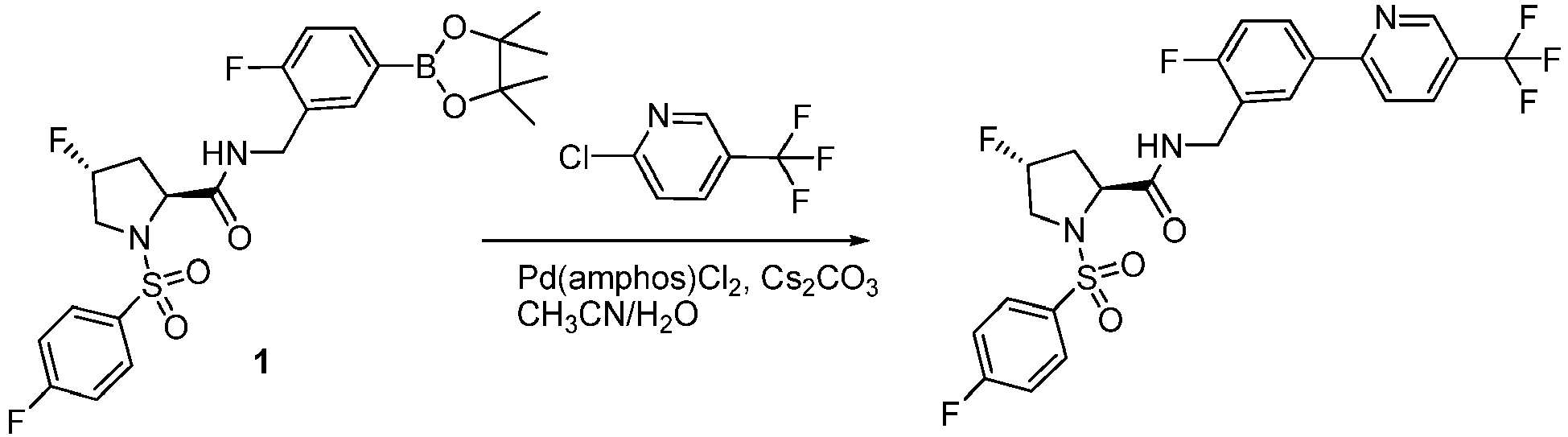
- Following the same procedure of Example 163, step 2: The title compound (2S,4R)-4-fluoro-1-(4-fluorophenyl)sulfonyl-N-[[2-fluoro-5-[5-(trifluoromethyl)-2-pyridyl]phenyl]methyl]pyrrolidine-2-carboxamide (15 mg, 14%) was prepared from (2S)-4-fluoro-1-(4-fluorophenyl)sulfonyl-N-[[2-fluoro-5-(4,4,5,5-tetramethyl-1,3,2-dioxaborolan-2-yl)phenyl]methyl]pyrrolidine-2-carboxamide 1 (108 mg, 0.21 mmol), 2-chloro-5-(trifluoromethyl)pyridine (52 mg, 0.29 mmol), cesium carbonate 1 M in water (0.6 mL, 0.6 mmol), Pd(amphos)Cl2 (11 mg, 0.016 mmol) in acetonitrile (1 mL). LC/MS (ESI+): m/z 544.2 (M+H).
1H NMR (400 MHz, DMSO-d6 ) δ 9.02 (dq, J = 2.5, 1.0 Hz, 1H), 8.87 (t, J = 5.8 Hz, 1H), 8.28 - 8.11 (m, 3H), 8.01 - 7.92 (m, 2H), 7.48 - 7.41 (m, 2H), 7.38 (dd, J = 9.8, 8.6 Hz, 1H), 5.37 - 5.04 (m, 1H), 4.55 - 4.37 (m, 2H), 4.30 - 4.13 (m, 1H), 3.81 - 3.49 (m, 2H), 2.46 - 2.28 (m, 1H), 2.08 (dddd, J = 42.1, 13.8, 9.8, 3.7 Hz, 1H). -

- To a microwave vial was added (2S,4R)-N-[(5-bromo-2-fluoro-phenyl)methyl]-4-fluoro-1-(4-fluorophenyl)sulfonyl-pyrrolidine-2-carboxamide 1(prepared following the same procedure of Example 177, step 1-3) (1.2 g, 2.5 mmol), Pd(dppf)Cl2 (210 mg, 0.25 mmol), bis(pinacolato)diboron (960 mg, 3.8 mmol), potassium acetate (740 mg, 7.5 mmol) and dioxane (5 mL). The reaction mixture was purged with nitrogen gas for 3 minutes and then heated to 85 °C in the microwave for 16 hours. Upon cooling to room temperature, the resulting mixture was diluted with DCM, filtered through a thin layer of celite, and concentrated under reduced pressure to afford the crude product 2 (1.3, 100%).
LC/MS (ESI+): m/z 525.5 (M+H). - To a microwave vial was added (2S)-4-fluoro-1-(4-fluorophenyl)sulfonyl-N-[[2-fluoro-5-(4,4,5,5-tetramethyl-1,3,2-dioxaborolan-2-yl)phenyl]methyl]pyrrolidine-2-carboxamide 2 (108 mg, 0.2059 mmol), 3-chloro-6-(trifluoromethyl)pyridazine (52.63 mg, 0.2883 mmol), cesium carbonate 1 M in water (0.6 mL, 0.6 mmol), acetonitrile (0.8 mL) and Pd(amphos)Cl2 (11.67 mg, 0.016 mmol) were added and the reaction mixture was purged with nitrogen gas for 3 minutes and then heated to 140 °C in the microwave for 30 minutes. Upon cooling to room temperature, the resulting mixture was filtered through a thin layer of celite, washed with water and extracted with ethyl acetate. The combined organic layer was dried over Na2SO4, filtered and concentrated under reduced pressure. The residue was purified by reverse phase HPLC to afford the title compound (39 mg, 25%) as a white solid.
LC/MS (ESI+): m/z 545.2 (M+H).
1H NMR (400 MHz, DMSO-d6) δ 8.89 (t, J = 5.9 Hz, 1H), 8.49 (d, J = 9.2 Hz, 1H), 8.33 (d, J = 9.0 Hz, 1H), 8.26 (ddd, J = 10.6, 5.8, 2.5 Hz, 2H), 8.04 - 7.89 (m, 2H), 7.56 - 7.32 (m, 3H), 5.35 - 5.02 (m, 1H), 4.62 - 4.36 (m, 2H), 4.21 (dd, J = 9.8, 7.2 Hz, 1H), 3.82 - 3.64 (m, 1H), 3.58 (dd, J = 13.4, 2.7 Hz, 1H), 2.39 (dt, J = 17.5, 8.8 Hz, 1H), 2.08 (dddd, J = 42.0, 13.8, 9.7, 3.5 Hz, 1H). -

- Following the same HATU coupling procedure of Example 176, step 6: (2S,4R)-tert-butyl 2-(2-carbamoyl-5-(2-(trifluoromethyl)pyrimidin-5-yl)benzylcarbamoyl)-4-fluoropyrrolidine-1-carboxylate 2 (387 mg, 75%) was prepared from (2S,4R)-1-tert-butoxycarbonyl-4-fluoro-pyrrolidine-2-carboxylic acid (259.9 mg, 1.11 mmol) and 2-(aminomethyl)-4-[2-(trifluoromethyl)pyrimidin-5-yl]benzamide 1 (300 mg, 1.01 mmol), DIPEA (0.530 mL, 3.04 mmol), HATU (471.6 mg, 1.2 mmol) in DMF (4mL). LC/MS (ESI+): m/z 512.5 (M+H).
- Following the same procedure of Example 176, step 7: (2S,4R)-N-[[2-carbamoyl-5-[2-(trifluoromethyl)pyrimidin-5-yl]phenyl]methyl]-4-fluoro-1-(4-fluorophenyl)sulfonyl-pyrrolidine-2-carboxamide 3 (180 mg, 52%) was prepared from (2S,4R)-tert-butyl 2-(2-carbamoyl-5-(2-(trifluoromethyl)pyrimidin-5-yl)benzylcarbamoyl)-4-fluoropyrrolidine-1-carboxylate 2 (387 mg, 0.76 mmol), 4 N HCl in dioxane (1.9 mL, 7.6 mmol) followed by the reaction with Et3N (1.7 mL, 12.15 mmol), 4-fluorobenzenesulfonyl chloride (142 mg, 0.73 mmol) in DCM (1 mL).
LC/MS (ESI+): m/z 570.5 (M+H). - Following the same procedure of Example 176, step 8: The title compound (129 mg, 78%) was prepared from (2S,4R)-N-[[2-carbamoyl-5-[2-(trifluoromethyl)pyrimidin-5-yl]phenyl]methyl]-4-fluoro-1-(4-fluorophenyl)sulfonyl-pyrrolidine-2-carboxamide 3 (180 mg, 0.3 mmol), trifluoroacetic anhydride (0.08 mL, 0.6 mmol), Et3N (0.04 mL, 0.32mmol) in DCM (5 mL). LC/MS (ESI+): m/z 552.5 (M+H).
1H NMR (400 MHz, DMSO-d6 ) δ 9.43 (s, 2H), 9.09 (t, J = 5.8 Hz, 1H), 8.11 - 8.05 (m, 2H), 8.03 (dd, J = 8.0, 1.9 Hz, 1H), 8.01 - 7.94 (m, 2H), 7.57 - 7.31 (m, 2H), 5.34 - 5.07 (m, 1H), 4.69 - 4.52 (m, 2H), 4.20 (dd, J = 10.0, 7.1 Hz, 1H), 3.79 - 3.70 (m, 1H), 3.70 - 3.53 (m, 1H), 2.41 (td, J = 16.3, 15.8, 6.7 Hz, 1H), 2.24 - 2.00 (m, 1H). -
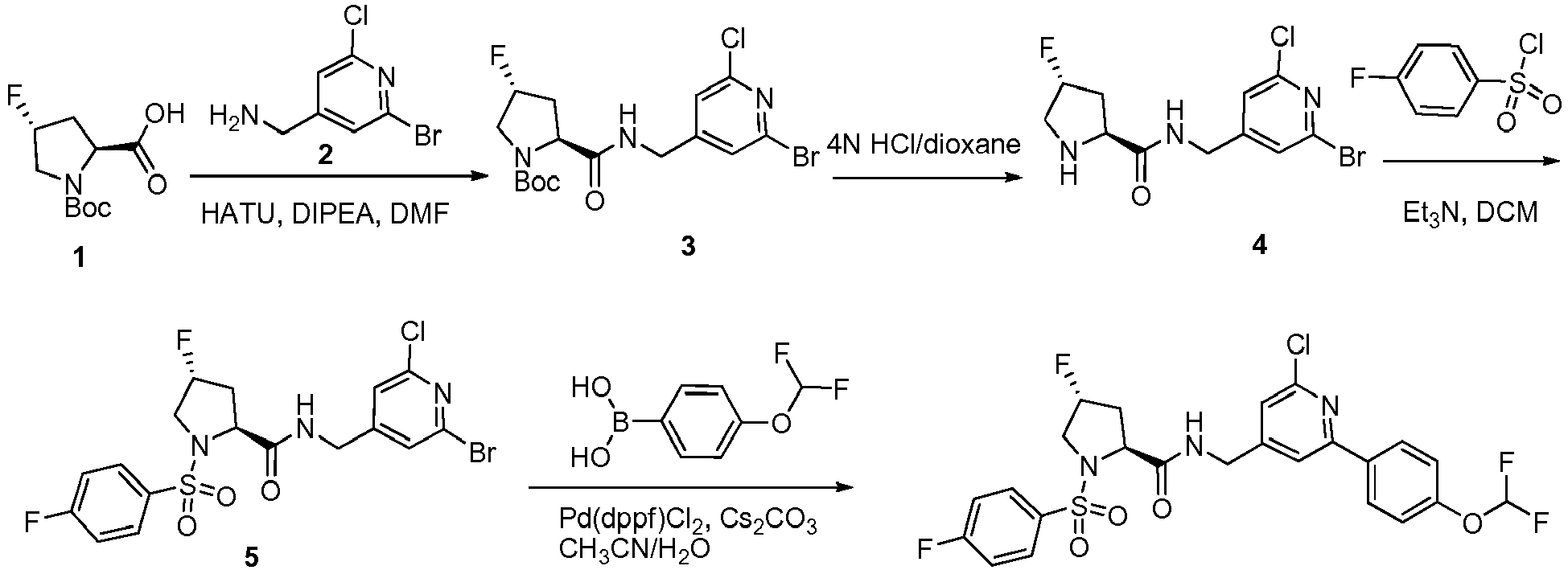
- Following the HATU coupling procedure of Example 183, step 1: tert-butyl (2S,4R)-2-[(2-bromo-6-chloro-4-pyridyl)methylcarbamoyl]-4-fluoro-pyrrolidine-1-carboxylate 3 (4 g, 93%) was prepared from (2S,4R)-1-tert-butoxycarbonyl-4-fluoro-pyrrolidine-2-carboxylic acid 1 (2.3 g, 9.9 mmol) and (2-bromo-6-chloro-4-pyridyl)methanamine 2 (2.4 g, 11 mmol), DIPEA (5.2 mL, 30 mmol), HATU (4.6 g, 12 mmol) in DMF (39mL). LC/MS (ESI+): m/z 437.7 (M+H).
- Following the same procedure of Example 183, step 2: (2S,4R)-N-[(2-bromo-6-chloro-4-pyridyl)methyl]-4-fluoro-pyrrolidine-2-carboxamide 4 (2.3 g, 100%) was prepared from tert-butyl (2S,4R)-2-[(2-bromo-6-chloro-4-pyridyl)methylcarbamoyl]-4-fluoro-pyrrolidine-1-carboxylate 3 (3 g, 6.9 mmol) and 4 N HCl in dioxane (8.6 mL, 34 mmol). LC/MS (ESI+): m/z 337.7 (M+H).
- Following the same procedure of Example 183, step 3: (2S,4R)-N-[(2-bromo-6-chloro-4-pyridyl)methyl]-4-fluoro-1-(4-fluorophenyl)sulfonyl-pyrrolidine-2-carboxamide 5 (2.2 g, 60%) was prepared from tert-butyl (2S,4R)-2-[(2-bromo-6-chloro-4-pyridyl)methylcarbamoyl]-4-fluoro-pyrrolidine-1-carboxylate 4 (2.5 g, 7.4 mmol), Et3N (21 mL, 0.148 mol), 4-fluorobenzenesulfonyl chloride (1.7 g, 8.9 mmol) in DCM (10 mL). LC/MS (ESI+): m/z 495.7 (M+H).
- Following the same procedure of Example 183, step 4: The title compound (2S,4R)-N-[[2-chloro-6-[4-(difluoromethoxy)phenyl]-4-pyridyl]methyl]-4-fluoro-1-(4-fluorophenyl)sulfonyl-pyrrolidine-2-carboxamide (18 mg, 28%) was prepared from (2S,4R)-N-[(2-bromo-6-chloro-4-pyridyl)methyl]-4-fluoro-1-(4-fluorophenyl)sulfonyl-pyrrolidine-2-carboxamide 5 (54 mg, 0.11 mmol), [5-(trifluoromethyl)pyrimidin-2-yl]boronic acid (30 mg, 0.16 mmol), cesium carbonate 1 M in water (0.16 mL, 0.16 mmol), Pd(dppf)Cl2 (11 mg, 0.016 mmol) in acetonitrile (1 mL). LC/MS (ESI+): m/z 558.2 (M+H).
1H NMR (400 MHz, DMSO-d6 ) δ 9.08 (d, J = 2.2 Hz, 1H), 8.89 (t, J = 5.9 Hz, 1H), 8.44 - 8.20 (m, 1H), 8.07 - 7.93 (m, 2H), 7.93 - 7.72 (m, 2H), 7.56 - 7.29 (m, 3H), 5.12 (t, J = 2.7 Hz, 1H), 4.46 (d, J = 5.8 Hz, 2H), 4.21 (dd, J = 9.9, 7.1 Hz, 1H), 3.79 - 3.50 (m, 2H), 2.47 - 2.29 (m, 1H), 2.08 (dddd, J = 42.5, 13.8, 9.9, 3.4 Hz, 1H). -

-

- A solution of (2S,3R)-1-[(tert-butoxy)carbonyl]-3-hydroxypyrrolidine-2-carboxylic acid (318 mg, 1.38 mmol, 1.00 equiv), DIEA (356 mg, 2.75 mmol, 2.00 equiv), HATU (525 mg, 1.38 mmol, 1.00 equiv), and methyl 4-(aminomethyl)-6-[6-(trifluoromethyl)pyridin-3-yl]pyridine-3-carboxylate (430 mg, 1.38 mmol, 1.00 equiv) in DMF (10 mL) was stirred for 1 h at 20°C. The resulting solution was diluted with ethyl acetate, washed with water, dried over anhydrous sodium sulfate, and concentrated under vacuum. The residue was purified by a silica gel column eluting with DCM/MeOH (10:1) to afford the title compound (450 mg, 62%) as a white solid.
-

- A solution of methyl 4-([[(2S,3R)-1-[(tert-butoxy)carbonyl]-3-hydroxypyrrolidin-2-yl]formamido]methyl)-6-[6-(trifluoromethyl)pyridin-3-yl]pyridine-3-carboxylate (280mg, 0.53mmol, 1.00equiv) and LiOH (64 mg, 2.67 mmol, 5.00 equiv) in THF (2 mL)/water (2 mL) was stirred for 4 h at room temperature. The resulting solution was diluted with water. The pH value of the solution was adjusted to 4 with AcOH, extracted with ethyl acetate, washed with water and brine, dried over anhydrous sodium sulfate, and concentrated under vacuum. This resulted in 180 mg (66%) of the title compound as a yellow solid.
-

- A solution of 4-([[(2S,3R)-1-[(tert-butoxy)carbonyl]-3-hydroxypyrrolidin-2-yl]formamido]methyl)-6-[6-(trifluoromethyl)pyridin-3-yl]pyridine-3-carboxylic acid (180 mg, 0.35 mmol, 1.00 equiv), HATU (147 mg, 0.39 mmol, 1.10 equiv), DIEA (182 mg, 1.41 mmol, 4.00 equiv), and NH4Cl (20.58 mg, 0.38 mmol, 1.10 equiv) in DMF (5 mL) was stirred for 3 h at room temperature. The reaction was quenched with water, extracted with ethyl acetate, dried over anhydrous sodium sulfate, and concentrated under vacuum. This resulted in 155 mg (86%) of the title compound as brown oil.
-

- DAST (237.2 mg, 1.47 mmol, 5.00 equiv) was added to the solution of tert-butyl (2S,3R)-2-[([5-carbamoyl-2-[6-(trifluoromethyl)pyridin-3-yl]pyridin-4-yl]methyl)carbamoyl]-3-hydroxypyrrolidine-1-carboxylate (150 mg, 0.29 mmol, 1.00 equiv) in chloroform (2 mL) dropwise at 0°C. The resulting solution was stirred for 2 h at room temperature and then quenched with of water, extracted with dichloromethane, washed with sodium bicarbonate/water, dried over anhydrous sodium sulfate, and concentrated under vacuum. The residue was purified by a silica gel column eluting with ethyl acetate/petroleum ether (3/2) to afford the title compound (50 mg, 33%) as a yellow solid.
-

- A solution of tert-butyl (2R,3S)-2-[([5-carbamoyl-2-[6-(trifluoromethyl)pyridin-3-yl]pyridin-4-yl]methyl)carbamoyl]-3-fluoropyrrolidine-1-carboxylate (40 mg, 0.08 mmol, 1.00 equiv), TFAA (32.8 mg, 0.16 mmol, 2.00 equiv), and TEA (12 mg, 0.12 mmol, 1.50 equiv) in dichloromethane (3 mL) was stirred for 15 min at room temperature. The reaction was then quenched with water, extracted with dichloromethane, washed with saturated sodium bicarbonate and brine, dried over anhydrous sodium sulfate, and concentrated under vacuum. This resulted in 50 mg (crude) of the title compound as orange oil.
-

- A mixture of tert-butyl (2R,3S)-2-[([5-cyano-2-[6-(trifluoromethyl)pyridin-3-yl]pyridin-4-yl]methyl)carbamoyl]-3-fluoropyrrolidine-1-carboxylate (50 mg, 0.10 mmol, 1.00 equiv) and saturated hydrogen chloride in 1,4-dioxane (3 mL) was stirred for 0.5 h at room temperature. The solids were collected by filtration. This resulted in 40 mg (92%) of the title compound as a dark red solid.
-

- 4-Fluorobenzene-1-sulfonyl chloride (19.9 mg, 102.20 mmol, 1.10 equiv) was added into a solution of (2R,3S)-N-([5-cyano-2-[6-(trifluoromethyl)pyridin-3-yl]pyridin-4-yl]methyl)-3-fluoropyrrolidine-2-carboxamide hydrochloride (40 mg, 93.06 mmol, 1.00 equiv), and TEA (28 mg, 276.70 mmol, 3.00 equiv) in dichloromethane (5 mL). This was stirred for 2 h at room temperature. The reaction was then quenched with water, extracted with dichloromethane, dried over anhydrous sodium sulfate, and concentrated under vacuum. The residue was purified by a silica gel column eluting with ethyl acetate/petroleum ether (3:2) to afford the title compound 12.6 mg (crude) of as a pink solid.
1H NMR (300 MHz, CDCl3) δ 9.48 (s, 1H), 8.95 (s, 1H), 8.68 - 8.65 (d, J = 8.1 Hz, J = 1.2 Hz, 1H), 8.11 (s, 1H), 7.93 - 7.89 (m, 2H), 7.82 - 7.79 (d, J = 8.1 Hz, 1H), 7.70 (t, J = 6.0 Hz, 1H), 7.32 - 7.26 (m, 2H), 5.39 - 5.22 (dd, J = 49.8 Hz, J = 1.8 Hz, 1H), 5.11 - 5.02 (dd, J = 17.4 Hz, J = 7.8 Hz, 1H), 4.61 (dd, J = 17.7 Hz, J = 4.8 Hz, 1H), 4.41 - 4.33 (d, J = 23.1 Hz, 1H), 3.83 (t, J = 8.4 Hz, 1H), 3.34 - 3.25 (m, 1H), 2.23 - 1.98 (m, 2H). -

-

- A mixture of (2S,4R)-N-[(4-bromo-5-fluoropyridin-2-yl)methyl]-4-fluoro-1-[(4-fluorobenzene)sulfonyl]pyrrolidine-2-carboxamide (300 mg, 0.63 mmol, 1.00 equiv), 4,4,5,5-tetramethyl-2-(tetramethyl-1,3,2-dioxaborolan-2-yl)-1,3,2-dioxaborolane (238 mg, 0.94 mmol, 1.50 equiv), KOAc (184 mg, 1.87 mmol, 3.00 equiv), and Pd(dppf)Cl2 (46 mg, 0.06 mmol, 0.10 equiv) in 1,4-dioxane (20 mL) was stirred for 12 h at 75°C under nitrogen. The solids were filtered out. The filtrate was diluted with water and extracted with ethyl acetate. The combined extracts were washed with brine, dried over anhydrous sodium sulfate, and concentrated under vacuum. This resulted in the title compound (500 mg, crude) as brown oil.
-

- A mixture of [5-fluoro-2-([[(2S,4R)-4-fluoro-1-[(4-fluorobenzene)sulfonyl]pyrrolidin-2-yl]formamido]methyl)pyridin-4-yl]boronic acid (278 mg, 0.627 mmol, 1.00 equiv), 5-bromo-2-(trifluoromethyl)pyrimidine (284 mg, 1.251 mmol, 2.00 equiv), potassium carbonate (260 mg, 1.881 mmol, 3.00 equiv), and Pd(dppf)Cl2 (46 mg, 0.063 mmol, 0.100 equiv) in 1,4-dioxane (20 mL)/water (2 mL) was stirred for 4 h at 70°C under nitrogen. The mixture was diluted with water and extracted with ethyl acetate. The combined extracts were washed with brine, dried over anhydrous sodium sulfate, and concentrated under vacuum. The residue was purified by a silica gel column eluting with ethyl acetate/petroleum ether (1/1). The crude product (100 mg) was purified by Prep-HPLC to afford the titled compound (35.5 mg, 10%) as a white solid.
1H NMR (300 MHz, CDCl3) δ 9.23 (s, 2H), 8.61 (s, 1H), 7.90 - 7.86 (m, 2H), 7.72 - 7.70 (d, J = 6 Hz, 1H), 7.58 - 7.54 (t, J = 5.86 Hz, 1H), 7.26 - 7.24 (d, J = 7.2 Hz, 2H), 5.15 - 4.92 (m, 2H), 4.56 - 4.48 (m, 1H), 4.32 - 4.26 (t, J = 8.7 Hz, 1H), 3.94 - 3.59 (m, 2H), 2.60 - 2.54 (m, 1H), 2.32 - 2.01 (m, 1H). -

- Preparation of the title compound follows the same general procedure as Example 55.
1H NMR (400 MHz, DMSO) δ 9.69 - 9.65 (s, 2H), 9.16 - 9.09 (t, J = 6.0 Hz, 1H), 8.77 - 8.73 (m, 1H), 8.17 - 8.12 (s, 1H), 8.06 - 7.98 (m, 2H), 7.55 - 7.45 (m, 3H), 5.30 - 5.13 (m, 1H), 4.59 - 4.42 (m, 2H), 4.42 - 4.33 (d, J = 24.3 Hz, 1H), 3.75 - 3.64 (ddd, J = 9.4, 7.5, 2.3 Hz, 1H), 3.24 - 3.12 (ddd, J = 10.8, 9.1, 7.3 Hz, 1H), 2.25 - 2.05 (m, 2H)., LCMS (ESI) m/z:527.2 [M+H]+ -

-

- A mixture of 5-bromo-2-(trifluoromethyl)pyrimidine (10.0 g, 44.056 mmol, 1.0 equiv), 4,4,5,5-tetramethyl-2-(tetramethyl-1,3,2-dioxaborolan-2-yl)-1,3,2-dioxaborolane (11.19 g, 44.066 mmol, 1.0 equiv), and Pd(OAc)2 (100 mg, 0.445 mmol) in DMF (100 mL) was stirred for 12 h at 70°C under nitrogen. The reaction mixture was then quenched with water, extracted with ethyl acetate, washed with brine, dried over anhydrous sodium sulfate, and concentrated under vacuum. This resulted in the title compound (10 g, 83%) as black oil.
-

- A mixture of 5-(tetramethyl-1,3,2-dioxaborolan-2-yl)-2-(trifluoromethyl)pyrimidine (3 g, 10.95 mmol, 1.00 equiv), methyl 2,5-dichloropyridine-4-carboxylate (6 g, 29.12 mmol, 1.00 equiv), Pd(dppf)Cl2 (1.55 g, 2.12 mmol, 0.20 equiv), and potassium carbonate (8.78 g, 63.53 mmol, 5.80 equiv) in dioxane (100 mL)/water(5 mL) was stirred for 12 h at 60°C under nitrogen. The reaction mixture was concentrated under vacuum. The residue purified by a silica gel column eluting with ethyl acetate/petroleum ether (1:10) to afford the title compound (1.4 g, 40%) as a white solid.
-

- A mixture of methyl 5-chloro-2-[2-(trifluoromethyl)pyrimidin-5-yl]pyridine-4-carboxylate (600.00 mg, 1.89 mmol, 1.00 equiv), Pd(dppf)Cl2 (230.35 mg, 0.315 mmol, 0.200 equiv), and Zn(CH3)2 (4.8 ml, 3.000 equiv, 1.2 mol/L in toluene) in dioxane (20 mL) was stirred for 12 h at 65°C under nitrogen. The reaction mixture was concentrated under vacuum. The residue was purified by a silica gel column eluting with ethyl acetate/petroleum ether (1:10) to afford the title compound (400 mg, 71%) as a white solid.
-

- DIBA1-H (4 mL, 1 mol/L in hexanes, 3.000 equiv) was added dropwise into a solution of methyl 5-methyl-2-[2-(trifluoromethyl)pyrimidin-5-yl]pyridine-4-carboxylate (380.00 mg, 1.278 mmol, 1.000 equiv) in THF (20 mL) at -78°C under nitrogen. The resulting solution was stirred for 30 min at -78°C. The resulting solution was stirred for 12 h at room temperature and quenched by methanol. The pH value of the solution was adjusted to 9 with sodium hydroxide (1 mol/L). The resulting solution was extracted with ethyl acetate, washed with brine, dried over anhydrous sodium sulfate, and concentrated under vacuum. The residue was purified by a silica gel column eluting with ethyl acetate/petroleum ether (1:1). This resulted in the title compound (250 mg, 73%) as a white solid.
-

- DIAD (300.43 mg, 1.486 mmol, 2.0 equiv) was added dropwise into a solution of [5-methyl-2-[2-(trifluoromethyl)pyrimidin-5-yl]pyridin-4-yl]methanol (200.0 mg, 0.743 mmol, 1.0 equiv), PPh3 (389.69 mg, 1.486 mmol, 2.0 equiv), and 2,3-dihydro-1H-isoindole-1,3-dione (131.16 mg, 0.891 mmol, 1.2 equiv) in THF (20 mL) at 0°C under nitrogen. The resulting solution was stirred for 10 min at 0°C and 12 h at room temperature. The mixture was concentrated under vacuum. The solid was washed with ethyl acetate to afford the title compound (400 mg) as a white solid.
-
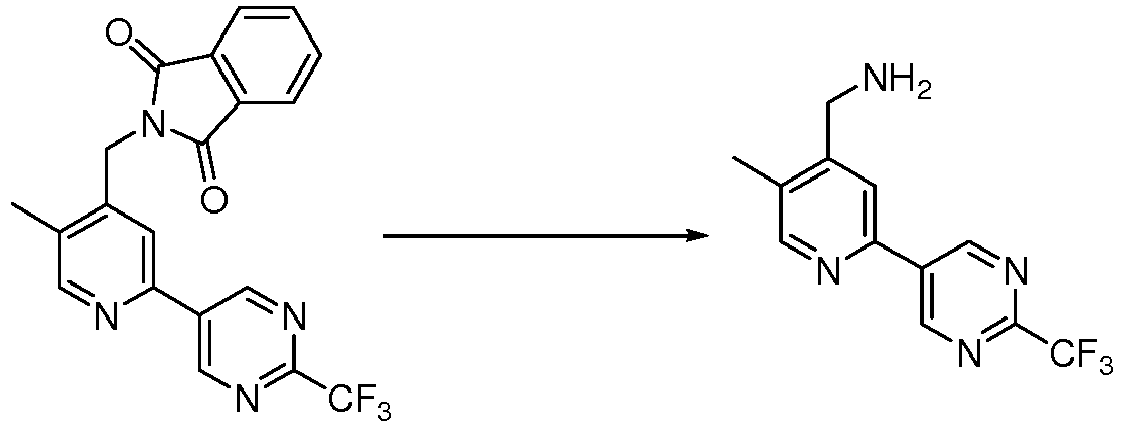
- A mixture of 2-([5-methyl-2-[2-(trifluoromethyl)pyrimidin-5-yl]pyridin-4-yl]methyl)-2,3-dihydro-1H-isoindole-1,3-dione (400.00 mg, 1.004 mmol, 1.000 equiv) and NH2NH2.H2O (502.69 mg, 10.042 mmol, 10.000 equiv) in methanol (40 mL) was stirred for 12 h at 60°C. The reaction mixture was concentrated under vacuum. The resulting solution was diluted with ethyl acetate and the solids were filtered out. The liquid was concentrated under vacuum to afford the title compound (200 mg, 74%) as a white solid.
-

- A solution of (2S,4R)-1-[(tert-butoxy)carbonyl]-4-fluoropyrrolidine-2-carboxylic acid (130.43 mg, 0.559 mmol, 1.000 equiv), HATU (318.95 mg, 0.839 mmol, 1.500 equiv), DIEA (216.83 mg, 1.678 mmol, 3.000 equiv), and [5-methyl-2-[2-(trifluoromethyl)pyrimidin-5-yl]pyridin-4-yl]methanamine (150.0 mg, 0.559 mmol, 1.0 equiv) in DMF (5 mL) was stirred for 2 h at room temperature. The reaction mixture was diluted with ethyl acetate, washed with brine, dried over anhydrous sodium sulfate, and concentrated under vacuum. The residue was purified by a silica gel column eluting with ethyl acetate/petroleum ether (1:1) to afford the title compound (200 mg, 74%) as a white solid.
-

- A mixture of tert-butyl (2S,4R)-4-fluoro-2-[([5-methyl-2-[2-(trifluoromethyl)pyrimidin-5-yl]pyridin-4-yl]methyl)carbamoyl]pyrrolidine-1-carboxylate (200 mg, 0.414 mmol, 1.000 equiv) and saturated HCl in dioxane (20 mL) was stirred for 2 h at room temperature. The reaction mixture was concentrated under vacuum. This resulted in the title compound (150 mg, 95%) as a white solid.
-

- A solution of (2S,4R)-4-fluoro-N-((5-methyl-2-(2-(trifluoromethyl)pyrimidin-5-yl)pyridin-4-yl)methyl)pyrrolidine-2-carboxamide hydrochloride (200.00 mg, 0.522 mmol, 1.0 equiv), triethylamine (158.38 mg, 1.565 mmol, 3.0 equiv), and 4-fluorobenzene-1-sulfonyl chloride (203.07 mg, 1.04 mmol, 2.0 equiv) in DCM (10 mL) was stirred for 12 h at room temperature. The reaction was then quenched by water, extracted with dichloromethane, dried over anhydrous sodium sulfate, and concentrated under vacuum. The residue was purified by a silica gel column eluting with ethyl acetate/petroleum ether (1:1). The crude product (200 mg) was re-purified by Flash-Prep-HPLC to afford the title compound (105.5 mg, 37%) as a white solid.
1H NMR (300 MHz, CDCl3) δ 9.65 (s, 2H), 8.51 (s, 1H), 8.04 (s, 1H), 7.92 - 7.88 (m, 2H), 7.46 - 7.43 (m, 1H), 7.28 - 7.23 (m, 2H), 5.05 (d, J = 51.2 Hz, 1H), 4.89 - 4.83 (m, 2H), 4.36 - 4.32 (m, 2H), 3.95 - 3.86 (m, 1H), 3.74 - 3.60 (m, 1H), 2.63 - 2.61 (m, 1H), 2.39 (s, 3H), 2.28 - 2.00 (m, 1H). -

-

- A mixture of Pd(dppf)Cl2 (534 mg, 0.73 mmol, 0.10 equiv), potassium carbonate (2g, 14.47 mmol, 2.00 equiv), 2,6-dichloro-4-iodopyridine (2 g, 7.30 mmol, 1.00 equiv), and [6-(trifluoromethyl)pyridin-3-yl]boronic acid (1.39 g, 7.28 mmol, 1.00 equiv) in 1,4-dioxane (80 mL)/water(8 mL) was stirred for 12 h at 60°C under nitrogen. The solids were filtered out. The filtrate was diluted with water and extracted with ethyl acetate. The combined extracts were washed with brine, dried over anhydrous sodium sulfate, and concentrated under vacuum. The residue was purified by a silica gel column eluting with ethyl acetate/petroleum ether (1/50) to afford the title compound (1.9 g, 89%) as a solid.
-
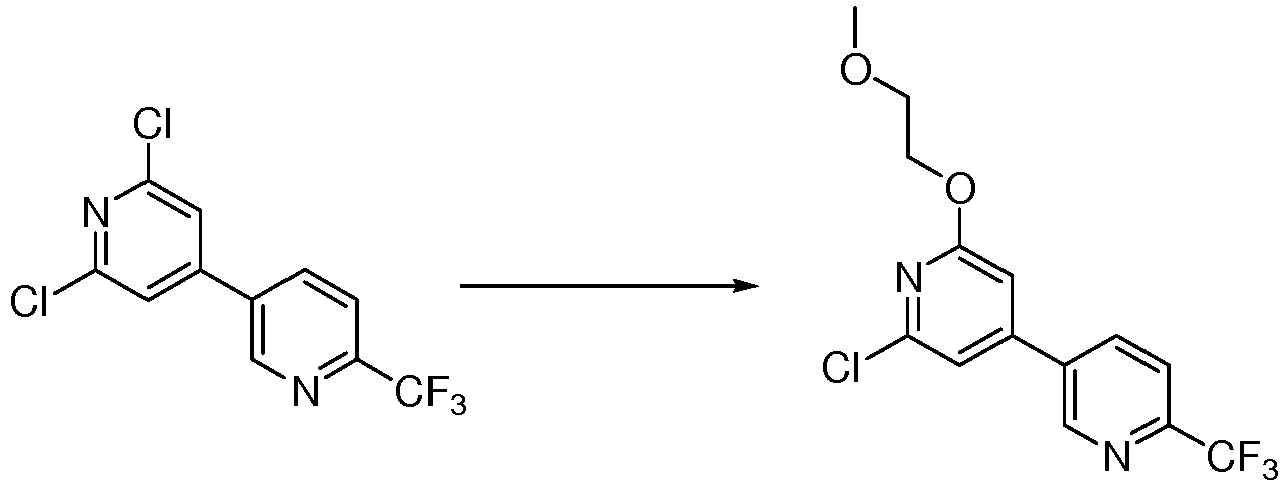
- A solution of 2,6-dichloro-4-[6-(trifluoromethyl)pyridin-3-yl]pyridine (900 mg, 3.07 mmol, 1.00 equiv) and 1-methoxy-2-(sodiooxy)ethane (1.7 mL, 2.7 mmol/mL in 2-methoxyethan-1-ol, 1.50 equiv) in 2-methoxyethan-1-ol (18 mL) was stirred for 12 h at 60°C. The mixture was diluted with water and extracted with ethyl acetate. The combined extracts were washed with brine, dried over anhydrous sodium sulfate, and concentrated under vacuum. This resulted in the title compound (948 mg, 93%) as a white solid which was used for the next step without any further purification.
-

- A mixture of 2-chloro-6-(2-methoxyethoxy)-4-[6-(trifluoromethyl)pyridin-3-yl]pyridine (400 mg, 1.202 mmol, 1.00 equiv), dppf (133 mg, 0.241 mmol, 0.20 equiv), Zn(CN)2 (282 mg, 2.401 mmol, 2.0 equiv), and Pd2(dba)3CHCl3 (62 mg, 0.060 mmol, 0.050 equiv) in N,N-dimethylformamide (8 mL) was irradiated with microwave radiation for 1 h at 100°C under nitrogen. The mixture was diluted with water and extracted with ethyl acetate. The combined extracts were washed with brine, dried over anhydrous sodium sulfate, and concentrated under vacuum. The residue was purified by a silica gel column eluting with ethyl acetate/petroleum ether (1/5) to afford the title compound (350 mg, 90%) as a solid.
-

- A mixture of 6-(2-methoxyethoxy)-4-[6-(trifluoromethyl)pyridin-3-yl]pyridine-2-carbonitrile (1 g, 3.093 mmol, 1.00 equiv), concentrated hydrogen chloride (4 mL), and palladium on carbon (2 g) in methanol (200 mL) was stirred for 7 min at room temperature under hydrogen. The solids were filtered out. The filtrate was concentrated under vacuum to afford the title compound (1.43 g, crude) as a yellow solid.
-

- A mixture of (2S,4R)-1-[(tert-butoxy)carbonyl]-4-fluoropyrrolidine-2-carboxylic acid (235 mg, 1.008 mmol, 1.00 equiv), DIEA (355 mg, 2.747 mmol, 2.73 equiv), HATU (418 mg, 1.099 mmol, 1.09 equiv), and 6-(2-methoxyethoxy)-4-[6-(trifluoromethyl)pyridin-3-yl]pyridin-2-yl]methanamine (300 mg, 0.917 mmol, 0.91 equiv) in N,N-dimethylformamide (8 mL) was stirred for 10 min at room temperature. The mixture was diluted with water and extracted with ethyl acetate. The combined extracts were washed with brine, dried over anhydrous sodium sulfate, and concentrated under vacuum. The residue was purified by a silica gel column eluting with ethyl acetate/petroleum ether (1/1) to afford the title compound (450 mg, 82%) as a white solid.
-

- A solution oftert-butyl 4-fluoro-2-([[6-(2-methoxyethoxy)-4-[6-(trifluoromethyl)pyridin-3-yl]pyridin-2-yl]methyl]carbamoyl)-1H-pyrrole-1-carboxylate (450 mg, 0.836 mmol, 1.000 equiv) and trifluoroacetic acid (4 mL)in dichloromethane (20 mL) was stirred for 1 h at 25°C. The resulting mixture was concentrated under vacuum. The residue was dissolved in water. The pH value of the mixture was adjusted to 8 with saturated solution of sodium bicarbonate. The resulting mixture was extracted with ethyl acetate. The combned extracts were washed with brine, dried over anhydrous sodium sulfate and concentrated under vacuum. This resulted in the title compound (270 mg, 75%) as light yellow oil.
-

- A mixture of 4-fluoro-N-[[6-(2-methoxyethoxy)-4-[6-(trifluoromethyl)pyridin-3-yl]pyridin-2-yl]methyl]-1H-pyrrole-2-carboxamide (270 mg, 0.616 mmol, 1.000 equiv), triethylamine (178 mg), and 4-fluorobenzene-1-sulfonyl chloride (138 mg, 0.709 mmol, 0.703 equiv) in dichloromethane (30 mL) was stirred for 12 h at 25°C. The mixture was diluted with water and extracted with ethyl acetate. The combined extracts were washed with brine, dried over anhydrous sodium sulfate, and concentrated under vacuum. The residue was purified by a silica gel column eluting with ethyl acetate/petroleum ether (1/1). The crude product (300 mg) was purified by Prep-HPLC to afford the title compound (99 mg) as a white solid.
1H NMR (300 MHz, CDCl3) δ 8.97 (s, 1H), 8.13 - 8.10 (m, 1H), 7.93 - 7.87 (m, 3H), 7.79 - 7.77 (m, 1H), 7.27 - 7.19 (m, 3H), 6.98 (s, 1H), 5.11 - 4.98 (d, J = 52 Hz, 1H), 4.98-4.63 (m, 3H), 4.53-4.48 (m, 1H), 4.35 - 4.30 (m, 1H), 3.96 - 3.87 (m, 1H), 3.82 - 3.80 (m, 2H), 3.71 - 3.58 (m, 1H), 3.47 (s, 3H), 2.67 - 2.20 (m, 2H). -

- Preparation of the title compound follows the same general procedure as Example 48.
1H NMR (400 MHz, DMSO) δ 9.45 - 9.37 (d, J = 2.3 Hz, 2H), 9.06 - 8.95 (dq, J = 6.2, 2.8 Hz, 1H), 8.76 - 8.67 (t, J = 2.5 Hz, 1H), 8.47 - 8.38 (dt, J = 9.1, 2.6 Hz, 1H), 8.03 - 7.93 (ddd, J = 8.2, 5.1, 2.4 Hz, 2H), 7.51 - 7.41 (td, J = 8.9, 2.5 Hz, 2H), 5.30 - 5.07 (m, 1H), 4.52 - 4.38 (m, 2H), 4.24 - 4.13 (ddd, J = 9.7, 7.2, 2.4 Hz, 1H), 3.76 - 3.55 (m, 2H), 2.46 - 2.30 (td, J = 16.8, 16.3, 7.2 Hz, 1H), 2.20 - 1.98 (m, 1H)., LCMS (ESI) m/z:546.2 [M+H]+ -

- Preparation of the title compound follows the same general procedure as Example 48.
1H NMR (400 MHz, DMSO) δ 9.68 - 9.63 (s, 2H), 8.92 - 8.85 (t, J = 6.0 Hz, 1H), 8.77 - 8.71 (d, J = 5.0 Hz, 1H), 8.17 - 8.10 (s, 1H), 7.97 - 7.89 (m, 2H), 7.51 - 7.42 (m, 3H), 4.58 - 4.38 (qd, J = 16.7, 6.0 Hz, 2H), 4.24 - 4.21 (s, 1H), 3.82 - 3.71 (dd, J = 10.4, 3.4 Hz, 1H), 3.54 - 3.45 (d, J = 10.5 Hz, 1H), 1.68 - 1.51 (dtd, J = 7.5, 5.9, 5.2, 3.7 Hz, 2H), 0.59 - 0.48 (td, J = 7.8, 5.3 Hz, 1H), - 0.77 - -0.89 (q, J = 4.4 Hz, 1H)., LCMS (ESI) m/z:522.2 [M+H]+ -

- Preparation of the title compound follows the same general procedure as Example 91.
1H NMR (400 MHz, DMSO) δ 8.96 - 8.90 (t, J = 6.1 Hz, 1H), 8.65 - 8.59 (q, J = 0.9 Hz, 1H), 8.02 - 7.94 (m, 2H), 7.83 - 7.78 (t, J = 1.5 Hz, 1H), 7.72 - 7.66 (ddd, J = 9.4, 2.5, 1.6 Hz, 1H), 7.50 - 7.42 (m, 2H), 7.40 - 7.34 (ddd, J = 9.7, 2.4, 1.4 Hz, 1H), 5.29 - 5.09 (m, 1H), 4.54 - 4.38 (m, 2H), 4.23 - 4.13 (dd, J = 9.9, 7.1 Hz, 1H), 3.75 - 3.57 (m, 2H), 2.47 - 2.31 (m, 1H), 2.20 - 1.97 (m, 1H)., LCMS (ESI) m/z:550.2 [M+H]+ -

- Preparation of the title compound follows the same general procedure as Example 91.
1H NMR (400 MHz, DMSO) δ 8.96 - 8.89 (t, J = 6.0 Hz, 1H), 8.61 - 8.58 (q, J = 1.1 Hz, 1H), 8.03 - 7.95 (m, 2H), 7.69 - 7.62 (m, 1H), 7.62 - 7.58 (t, J = 1.5 Hz, 1H), 7.51 - 7.43 (m, 2H), 7.32 - 7.25 (ddd, J = 9.7, 2.4, 1.4 Hz, 1H), 5.29 - 5.10 (dd, J = 50.1, 3.0 Hz, 1H), 4.54 - 4.34 (m, 2H), 4.23 - 4.14 (dd, J = 10.0, 7.1 Hz, 1H), 3.76 - 3.57 (m, 2H), 2.47 - 2.34 (m, 1H), 2.19 - 1.98 (m, 1H)., LCMS (ESI) m/z:550.2 [M+H]+ -
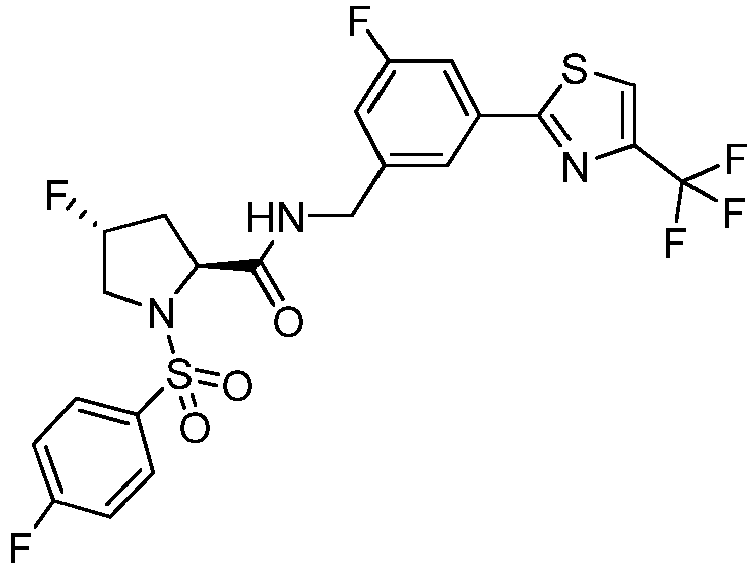
- Preparation of the title compound follows the same general procedure as Example 91.
1H NMR (400 MHz, DMSO) δ 8.92 - 8.86 (t, J = 6.0 Hz, 1H), 8.65 - 8.62 (s, 1H), 8.01 - 7.94 (m, 2H), 7.82 - 7.79 (t, J = 1.5 Hz, 1H), 7.74 - 7.68 (ddd, J = 9.9, 2.5, 1.5 Hz, 1H), 7.49 - 7.41 (m, 2H), 7.26 - 7.20 (ddd, J = 9.7, 2.4, 1.4 Hz, 1H), 5.28 - 5.10 (d, J = 52.6 Hz, 1H), 4.50 - 4.37 (m, 2H), 4.22 - 4.15 (dd, J = 9.8, 7.1 Hz, 1H), 3.74 - 3.56 (m, 2H), 2.46 - 2.33 (m, 1H), 2.20 - 1.98 (m, 1H)., LCMS (ESI) m/z:550.2 [M+H]+ -

- Step 1: tert-butyl 5-bromo-1-oxo-isoindoline-2-carboxylate 2A mixture of 5-bromoisoindolin-1-one 1 (5 g, 23.6 mmol), THF (50 mL), 4-dimethylaminopyridine (288 mg, 2.36 mmol) and di-tert-butyl dicarbonate (8 g, 35.4 mmol) was stirred for overnight at room temperature. The resulting mixture was concentrated under reduced pressure, diluted with ethyl acetate, washed with 10% citric acid. The organic layer was dried over Na2SO4, filtered and concentrated under reduced pressure. The residue was purified by flash chromatography on silica gel, eluting with ethyl acetate/heptane (1:1) to afford the compound 2 (7.1 g, 96%) as a white solid. LC/MS (ESI+): m/z 313.2 (M+H).
- To a microwave vial was added tert-butyl 5-bromo-1-oxo-isoindoline-2-carboxylate 2 (800 mg, 2.6 mmol), [5-(trifluoromethyl)pyrimidin-2-yl]boronic acid (584 mg, 3.1 mmol), potassium carbonate (1.1 g, 7.7 mmol), water (0.5 mL, 30 mmol) and Pd(dppf)Cl2 (214 mg, 0.26 mmol) in dioxane (5 mL). The reaction mixture was purged with nitrogen gas for 3 minutes and then heated to 120 °C in the microwave for 30 minutes. Upon cooling to room temperature, the resulting mixture was filtered through a thin layer of celite, washed with water and extracted with ethyl acetate. The combined organic layer was dried over Na2SO4, filtered and concentrated. The residue was purified by flash chromatography on silica gel, eluting with ethyl acetate /heptane (1:1) to afford the title compound 3 (700 mg, 72%) as a white solid. LC/MS (ESI+): m/z 380.3 (M+H).
- tert-butyl 1-oxo-5-[2-(trifluoromethyl)pyrimidin-5-yl]isoindoline-2-carboxylate 3 (200 mg, 0.53 mmol), lithium hydroxide 1 M in water (1 mL) and THF (1 mL) was stirred for 12 h at room temperature. The resulting solution was concentrated under reduced pressure, acidified by 10% aqueous citric acid to pH = 5 and extracted with ethyl acetate twice. The combined organic layer was washed with brine, dried over Na2SO4, filtered and concentrated to afford the crude product 4 which was used without further purification. LC/MS (ESI+): m/z 398.4 (M+H).
- 2-[(tert-butoxycarbonylamino)methyl]-4-[2-(trifluoromethyl)pyrimidin-5-yl]benzoic acid 4 (300 mg, 0.75 mmol) in THF (10 mL) was treated with HATU (351 mg, 0.91 mmol), DIPEA (1.5 mL, 8.3 mmol) followed by NH4Cl (485 mg, 9.1 mmol). The resulting solution was washed with saturated sodium bicarbonate and extracted with ethyl acetate twice. The combined organic layer was dried over sodium sulfate and concentrated. The residue was purified by flash chromatography on silica gel, eluting with ethyl acetate/heptane (1:1) to afford the compound 5 (250 mg, 84%) as a white solid. LC/MS (ESI+): m/z 397.4 (M+H).
- tert-butyl N-[[2-carbamoyl-5-[2-(trifluoromethyl)pyrimidin-5-yl]phenyl]methyl]carbamate 5 (400 mg, 1 mmol) was treated with 4N HCl in dioxane (1.8 mL, 7.4 mmol), and stirred at room temperature for 30 minutes. The reaction was concentrated to dry and the crude product 6 was used in the next step without further purification. LC/MS (ESI+): m/z 297.4 (M+H).
- To a solution of (1R,4S,5S)-3-tert-butoxycarbonyl-3-azabicyclo[3.1.0]hexane-4-carboxylic acid (278 mg, 1.23 mmol) and 2-(aminomethyl)-4-[2-(trifluoromethyl)pyrimidin-5-yl]benzamide 6 (330 mg, 1.11 mmol) in DMF (1 mL) was added DIPEA (0.58 mL, 3.3 mmol) and HATU (518.6 mg, 1.34 mmol). The reaction mixture was stirred for 1h at room temperature. The resulting mixture was diluted with ethyl acetate, washed with water, brine, dried over sodium sulfate, filtered and concentrated under reduced pressure. The residue was purified by flash chromatography on silica gel column, eluting with ethyl acetate/Heptane (1:1) to afford the compound 7 (499 mg, 88%) as a white solid. LC/MS (ESI+): m/z 506.5 (M+H).
- tert-butyl (1R,4S,5S)-4-[[2-carbamoyl-5-[2-(trifluoromethyl)pyrimidin-5-yl]phenyl]methylcarbamoyl]-3-azabicyclo[3.1.0]hexane-3-carboxylate 7 (387 mg, 0.7656 mmol) was treated with 4N HCl in dioxane (1.9 mL, 7.6 mmol), and stirred at room temperature for 30 minutes. The reaction was concentrated to dry and the crude product (310 mg, 0.76 mmol) was treated with Et3N (2 mL, 1.415.369 mmol) in DCM (1 mL), followed by 4-fluorobenzenesulfonyl chloride (179 mg, 0.92 mmol). The reaction was stirred for overnight at room temperature. The reaction mixture was concentrated under reduced pressure. The residue was purified by flash chromatography on silica gel, eluting with ethyl acetate/heptane (1:1) to afford the compound 8 (180 mg, 40%) as yellow solid. LC/MS (ESI+): m/z 564.5 (M+H).
- (1R,4S,5S)-N-[[2-carbamoyl-5-[2-(trifluoromethyl)pyrimidin-5-yl]phenyl] methyl] -3 -(4-fluorophenyl)sulfonyl-3-azabicyclo[3.1.0]hexane-4-carboxamide 8 (180 mg, 0.32 mmol) was treated with trifluoroacetic anhydride (0.09 mL, 0.64 mmol) and triethylamine (0.04 mL, 0.32mmol) in DCM (5 mL). The reaction mixture was stirred for overnight at room temperature. The resulting solution was concentrated and purified with reverse phase HPLC to afford the title compound (54 mg, 31%). LC/MS (ESI+): m/z 546.2 (M+H).
1H NMR (400 MHz, DMSO-d 6) δ 9.43 (s, 2H), 8.95 (t, J = 5.8 Hz, 1H), 8.09 (d, J = 8.1 Hz, 1H), 8.06 - 7.95 (m, 2H), 7.95 - 7.79 (m, 2H), 7.59 - 7.38 (m, 2H), 4.65 (dd, J = 16.0, 6.1 Hz, 1H), 4.52 (dd, J = 16.0, 5.5 Hz, 1H), 4.22 (s, 1H), 3.74 (dd, J = 10.4, 3.7 Hz, 1H), 3.47 (d, J = 10.4 Hz, 1H), 1.59 (tdd, J = 9.6, 7.0, 3.8 Hz, 2H), 0.54 (td, J = 7.8, 5.3 Hz, 1H), -0.84 (q, J = 4.4 Hz, 1H). -

- Following the HATU coupling procedure of Example 35, step 1: tert-butyl (2S,4R)-2-[(5-bromo-2-fluoro-phenyl)methylcarbamoyl]-4-fluoro-pyrrolidine-1-carboxylate 3 (801 mg, 89%) was prepared from (2S,4R)-1-tert-butoxycarbonyl-4-fluoro-pyrrolidine-2-carboxylic acid 1 (500 mg, 2.14 mmol) and (5-bromo-2-fluorophenyl)methanamine 2 (567 mg, 2.55 mmol), DIPEA (1.12 mL, 6.4 mmol), HATU (998 mg, 2.57 mmol), DMF (8mL). LC/MS (ESI+): m/z 420.3 (M+H).
- Following the same procedure of Example 35, step 3: (2S,4R)-N-[(5-bromo-2-fluorophenyl)methyl]-4-fluoro-pyrrolidine-2-carboxamide 4 (609 mg, 100%) was prepared from tert-butyl (2S,4R)-2-[(5-bromo-2-fluoro-phenyl)methylcarbamoyl]-4-fluoro-pyrrolidine-l-carboxylate 3 (801 mg, 1.9 mmol) and 4 N HCl in dioxane (3.8 mL, 15.2 mmol). LC/MS (ESI+): m/z 320.3 (M+H).
- Following the same procedure of Example 35, step 4: (2S,4R)-N-[(5-bromo-2-fluorophenyl)methyl]-4-fluoro-1-(4-fluorophenyl)sulfonyl-pyrrolidine-2-carboxamide 6 (710 mg, 70%) was prepared from (2S,4R)-N-[(5-bromo-2-fluoro-phenyl)methyl]-4-fluoro-pyrrolidine-2-carboxamide 4 (680 mg, 2.1 mmol), Et3N (6 mL, 42.6 mmol), 4-fluorobenzenesulfonyl chloride (710 mg, 1.5 mmol) in DCM (1 mL). LC/MS (ESI+): m/z 478.3 (M+H).
- Following the same procedure of Example 183, step 4: The title compound (2S,4R)-4-fluoro-1-(4-fluorophenyl)sulfonyl-N-[[2-fluoro-5-[4-(trifluoromethyl)phenyl]phenyl]methyl]pyrrolidine-2-carboxamide (48 mg, 39%) was prepared from (2S,4R)-N-[(5-bromo-2-fluoro-phenyl)methyl]-4-fluoro-1-(4-fluorophenyl)sulfonyl-pyrrolidine-2-carboxamide 6 (110 mg, 0.23 mmol), [4-(trifluoromethyl)phenyl]boronic acid (48 mg, 0.25 mmol), cesium carbonate 1 M in water (0.32 mL, 0.32 mmol), Pd(dppf)Cl2 (19 mg, 0.023 mmol) in acetonitrile (1 mL). LC/MS (ESI+): m/z 543.2 (M+H).
1H NMR (400 MHz, DMSO-d6 ) δ 8.86 (t, J = 5.8 Hz, 1H), 8.07 - 7.93 (m, 2H), 7.89 (d, J = 7.9 Hz, 2H), 7.82 (dd, J = 7.2, 2.5 Hz, 1H), 7.75 (d, J = 8.3 Hz, 2H), 7.72 - 7.64 (m, 1H), 7.53 - 7.40 (m, 2H), 7.34 (dd, J = 9.9, 8.5 Hz, 1H), 5.38 - 4.97 (m, 1H), 4.45 (d, J = 5.8 Hz, 2H), 4.22 (dd, J = 9.8, 7.1 Hz, 1H), 3.79 - 3.65 (m, 1H), 3.65 (s, 1H), 2.43 - 2.29 (m, 1H). -

- The title compound (4812 mg, 98%) was prepared following the amide coupling procedure of Example 35, Step 1 from (2-bromo-4-pyridyl)methanamine (2020 mg, 10.800 mmol), (2S,4R)-1-tert-butoxycarbonyl-4-fluoro-pyrrolidine-2-carboxylic acid (2771 mg, 11.88 mmol), HATU (4610 mg, 11.88 mmol) and triethylamine (3.31 mL, 23.7 mmol) in N,N-dimethylformamide (25 mL). LC/MS (ESI+): m/z 402 (M+H).
-
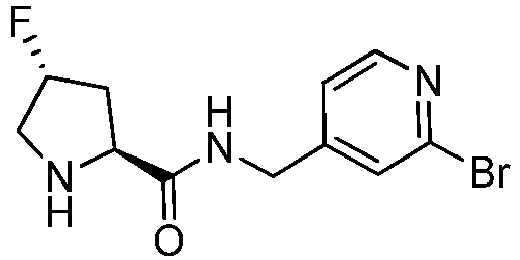
- Trifluoroacetic acid (8 ml) was added dropwise to a solution of tert-butyl (2S,4R)-2-[(2-bromo-4-pyridyl)methylcarbamoyl]-4-fluoro-pyrrolidine-1-carboxylate (1010 mg, 2.51 mmol) in DCM (12 ml) mixture . The mixture was stirred for 2 hours, concentrated in vacuum, the residue diluted with sat aq NaHCO3 and extracted with ethyl acetate. The organic extracts were washed with brine, dried over Na2SO4 and concentrated to afford 422 mg (56%). The residue was used without further purification. LC/MS (ESI+): m/z 302 (M+H).
-

- The title compound (369 mg, 57%) was prepared following the sulfonamide coupling procedure of Example 35, Step 4 from (2S,4R)-N-[(2-bromo-4-pyridyl)methyl]-4-fluoro-pyrrolidine-2-carboxamide (422 mg, 1.40 mmol), 4-fluorobenzenesulfonyl chloride (300 mg, 1.54 mmol) and triethylamine (0.30 mL, 2.2 mmol) in 9 ml of DMF/DCM mixture (2:1). LC/MS (ESI+): m/z 460 (M+H).
-
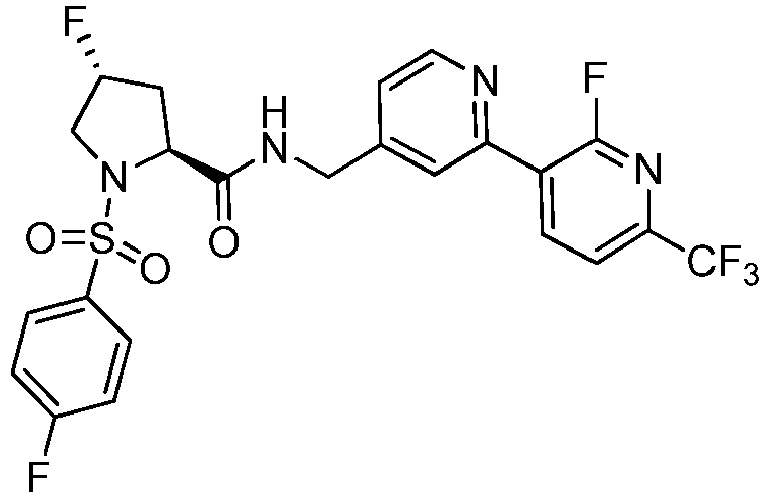
- The title compound (174 mg, 40%) was prepared following the Suzuki coupling procedure of Example 42, Step 1 from (2S,4R)-N-[(2-bromo-4-pyridyl)methyl]-4-fluoro-1-(4-fluorophenyl)sulfonyl-pyrrolidine-2-carboxamide (369 mg, 0.80 mmol), [2-fluoro-6-(trifluoromethyl)-3-pyridyl]boronic acid (402 mg, 1.92 mmol), [1,1'-bis(diphenylphosphino)ferrocene]dichloropalladium(II) (112 mg, 0.15 mmol) and aqueous Cs2CO3 (1.6 mL, 1.60 mmol, 1.0 mol/L) in acetonitrile (10 mL). LCMS (ESI_Formic_MeCN): [MH+] = 545.
-

- A mixture of (2S,4R)-4-fluoro-1-(4-fluorophenyl)sulfonyl-N-[[2-[2-fluoro-6-(trifluoromethyl)-3-pyridyl]-4-pyridyl]methyl]pyrrolidine-2-carboxamide (80 mg, 0.13 mmol) in DMSO (2 ml) was saturated with ammonia (gas) and then heated at 80°C in a sealed vial for 24 hours. The mixture was degassed in vacuum and submitted for RP HPLC purification to afford 51 mg (71%) of the title product.
1H NMR (400 MHz, DMSO-d6) δ 8.96 (t, J = 6.0 Hz, 1H), 8.63 (dd, J = 5.1, 0.7 Hz, 1H), 8.29 - 8.21 (m, 1H), 8.04 - 7.88 (m, 5H), 7.52 - 7.43 (m, 2H), 7.37 (dd, J = 5.2, 1.5 Hz, 1H), 7.00 (d, J = 7.8 Hz, 1H), 5.32 - 5.09 (m, 1H), 4.57 - 4.38 (m, 2H), 4.20 (dd, J = 9.9, 7.1 Hz, 1H), 3.80 - 3.57 (m, 2H), 2.48 - 2.35 (m, 1H), 2.10 (dddd, J = 42.5, 13.9, 10.0, 3.4 Hz, 1H). -

- A mixture of (2S,4R)-4-fluoro-1-(4-fluorophenyl)sulfonyl-N-[[2-[2-fluoro-6-(trifluoromethyl)-3-pyridyl]-4-pyridyl]methyl]pyrrolidine-2-carboxamide (80 mg, 0.15 mmol) and methylamine in tetrahydrofuran (1.0 mL, 2.0 mmol, 2 mol/L) in dimethyl sulfoxide (2 mL) was heated in a sealed vial at 80°C for 3 hours. The mixture was degassed in vacuum and submitted for a RP HPLC purification to afford 46 mg (56%) of the title compound.
1H NMR (400 MHz, DMSO-d6) δ 9.34 (q, J = 4.8 Hz, 1H), 8.96 (t, J = 6.0 Hz, 1H), 8.63 (dd, J = 5.2, 0.7 Hz, 1H), 8.28 - 8.21 (m, 1H), 8.05 - 7.95 (m, 3H), 7.52 - 7.43 (m, 2H), 7.39 (dd, J = 5.2, 1.5 Hz, 1H), 6.97 (d, J = 7.8 Hz, 1H), 5.32 - 5.10 (m, 1H), 4.56 - 4.39 (m, 2H), 4.20 (dd, J = 9.9, 7.1 Hz, 1H), 3.80 - 3.56 (m, 2H), 2.98 (d, J = 4.7 Hz, 3H), 2.42 (dddd, J = 20.0, 14.7, 6.6, 2.0 Hz, 1H), 2.22 - 1.97 (m, 1H). -

- Preparation of the title compound follows the same general procedure as Example 48.
1H NMR (400 MHz, DMSO) δ 9.63 - 9.57 (s, 2H), 9.11 - 9.04 (t, J = 5.9 Hz, 1H), 8.81 - 8.74 (d, J = 1.3 Hz, 1H), 8.28 - 8.21 (d, J = 5.7 Hz, 1H), 8.06 - 7.99 (m, 2H), 7.52 - 7.44 (m, 2H), 5.30 - 5.11 (m, 1H), 4.60 - 4.50 (d, J = 5.8 Hz, 2H), 4.27 - 4.19 (dd, J = 10.0, 7.1 Hz, 1H), 3.76 - 3.57 (m, 2H), 2.47 - 2.36 (m, 1H), 2.21 - 2.00 (m, 1H)., LCMS (ESI) m/z:546.2 [M+H]+ -

- Preparation of the title compound follows the same general procedure as Example 48.
1H NMR (400 MHz, DMSO) δ 9.47 - 9.39 (s, 2H), 8.75 - 8.68 (dd, J = 6.8, 5.3 Hz, 1H), 7.95 - 7.87 (m, 2H), 7.82 - 7.77 (t, J = 1.5 Hz, 1H), 7.76 - 7.69 (ddd, J = 9.8, 2.3, 1.4 Hz, 1H), 7.56 - 7.48 (m, 2H), 7.44 - 7.36 (ddd, J = 9.7, 2.3, 1.3 Hz, 1H), 4.70 - 4.59 (dd, J = 16.0, 6.8 Hz, 1H), 4.40 - 4.27 (dd, J = 16.2, 5.4 Hz, 1H), 3.74 - 3.62 (ddd, J = 10.5, 9.0, 3.1 Hz, 1H), 2.99 - 2.87 (dt, J = 10.4, 8.3 Hz, 1H), 2.24 - 2.10 (dtd, J = 12.6, 8.9, 5.7 Hz, 1H), 1.87 - 1.72 (m, 2H), 1.50 - 1.43 (dd, J = 9.0, 5.9 Hz, 1H), 0.31 - 0.22 (t, J = 5.9 Hz, 1H)., LCMS (ESI) m/z:539.2 [M+H]+ -

- Preparation of the title compound follows the same general procedure as Example 48.
1H NMR (400 MHz, DMSO) δ 9.40 - 9.35 (s, 2H), 8.71 - 8.66 (dd, J = 6.8, 5.2 Hz, 1H), 8.10 - 8.04 (dd, J = 7.2, 2.4 Hz, 1H), 7.95 - 7.85 (m, 3H), 7.56 - 7.47 (m, 2H), 7.47 - 7.40 (dd, J = 9.9, 8.6 Hz, 1H), 4.75 - 4.64 (dd, J = 16.1, 6.8 Hz, 1H), 4.36 - 4.26 (dd, J = 16.1, 5.3 Hz, 1H), 3.74 - 3.62 (ddd, J = 10.6, 9.2, 3.1 Hz, 1H), 3.00 - 2.88 (dt, J = 10.5, 8.5 Hz, 1H), 2.24 - 2.11 (dtd, J = 13.0, 9.1, 5.9 Hz, 1H), 1.88 - 1.74 (m, 2H), 1.52 - 1.42 (dd, J = 9.0, 5.9 Hz, 1H), 0.33 - 0.23 (t, J = 6.0 Hz, 1H)., LCMS (ESI) m/z:539.2 [M+H]+ -

- To a solution of (1R,4S,5S)-3-tert-butoxycarbonyl-3-azabicyclo[3.1.0]hexane-4-carboxylic acid 1 (31 mg, 0.13 mmol), (5-bromo-2-fluoro-phenyl)methanamine hydrochloride 2 (36 mg, 0.15 mmol) and DIPEA (0.07 mL, 0.4 mmol) in DMF (0.5 mL) was added HATU (63.5 mg, 0.16 mmol). The reaction mixture was stirred for 1h at room temperature. The resulting mixture was diluted with ethyl acetate, washed with water, brine, dried over sodium sulfate, filtered, and concentrated under reduced pressure. The residue was purified by flash chromatography on silica gel column, eluting with ethyl acetate/Heptane (1:1) to afford the compound 3 (30 mg, 53%) as a clear oil. LC/MS (ESI+): m/z 414 (M+H).
- A solution of tert-butyl (1R,4S,5S)-4-[(5-bromo-2-fluoro-phenyl)methylcarbamoyl]-3-azabicyclo[3.1.0]hexane-3-carboxylate 3 (30 mg, 0.072 mmol) in dioxane (5 mL) was treated with 4N HCl in dioxane (0.46 mL, 1.9 mmol). The reaction was stirred for 30 minutes at room temperature. The resulting mixture was concentrated under reduced pressure to afford the crude product 4 which was used without further purification. LC/MS (ESI+): m/z 314 (M+H).
- (1R,4S,5S)-N-[(5-bromo-2-fluoro-phenyl)methyl] -3 -azabicyclo[3 .1.0]hexane-4-carboxamide 4 (23 mg, 0.07 mmol) in DCM (1 mL) was treated with Et3N (0.2 mL, 1.5 mmol) followed by 4-fluorobenzenesulfonyl chloride 5 (17 mg, 0.09 mmol). The reaction was stirred for overnight at room temperature. The resulting mixture was concentrated under reduced pressure. The residue was purified by flash chromatography on silica gel, eluting with ethyl acetate/heptane (1:1) to afford the compound 6 (26 mg, 75%) as a clear oil. LC/MS (ESI+): m/z 472 (M+H).
- To a microwave vial was added (1R,4S,5S)-N-[(5-bromo-2-fluoro-phenyl)methyl]-3-(4-fluorophenyl)sulfonyl-3-azabicyclo[3.1.0]hexane-4-carboxamide 6 (35 mg, 0.07 mmol), [5-(trifluoromethyl)pyrimidin-2-yl]boronic acid (15.7 mg, 0.08 mmol), cesium carbonate 1 M in water (0.10 mL, 0.10 mmol), Pd(dppf)Cl2 (0.1 equiv., 0.01 mmol) and acetonitrile (0.8 mL). The reaction mixture was purged with nitrogen gas for 3 minutes and then heated to 140 °C in the microwave for 30 minutes. Upon cooling to room temperature, the resulting mixture was filtered through a thin layer of celite, washed with water and extracted with ethyl acetate. The combined organic layer was dried over Na2SO4, filtered and concentrated under reduced pressure. The residue was purified by flash chromatography on silica gel, eluting with ethyl acetate/heptane (3:1) to afford the title compound (24 mg, 60%) as a white solid. LC/MS (ESI+): m/z 539.2 (M+H).
1H NMR (400 MHz, DMSO-d6 ) δ 9.36 (s, 2H), 8.77 (t, J = 5.9 Hz, 1H), 8.02 - 7.75 (m, 4H), 7.57 - 7.28 (m, 3H), 4.60 - 4.31 (m, 2H), 4.22 (s, 1H), 3.72 (td, J = 9.9, 3.6 Hz, 1H), 3.47 (d, J = 10.4 Hz, 1H), 1.69 - 1.40 (m, 2H), 0.60 - 0.45 (m, 1H), -0.82 (dt, J = 5.1, 4.0 Hz, 1H). -

-

- A solution of 2,5-dichloropyridine-4-carboxylic acid (2.00 g, 10.417 mmol, 1.0 equiv) and BH3-THF (30 mL, 3.0 equiv, 1 mol/L in THF) in tetrahydrofuran (100 mL) was stirred for 30 min at 0°C and 2 h at room temperature. The reaction was then quenched by water, extracted ethyl acetate, washed with brine and concentrated under vacuum. The residue was purified by a silica gel column eluting with ethyl acetate/petroleum ether (1:3) to afford the title compound (1.5 g, 81%) as a white solid.
-

- DIAD (3.18 g, 15.726 mmol, 2.0 equiv) was added dropwise into a solution of (2,5-dichloropyridin-4-yl)methanol (1.40 g, 7.864 mmol, 1.0 equiv), PPh3 (4125.47 mg, 15.729 mmol, 2.0 equiv), and 2,3-dihydro-1H-isoindole-1,3-dione (1735.66 mg, 11.797 mmol, 1.5 equiv) in tetrahydrofuran (50 mL) at 0°C under nitrogen. The resulting solution was stirred for 2 h at 0°C and quenched by water. The resulting solution was extracted with ethyl acetate, washed with brine, dried over Na2SO4, and concentrated under vacuum. The residue was purified by a silica gel column eluting with ethyl acetate/petroleum ether (1:5) to afford the title compound (1.4 g, 58%) as a yellow solid.
-

- A mixture of 2-[(2,5-dichloropyridin-4-yl)methyl]-2,3-dihydro-1H-isoindole-1,3-dione (1.40 g, 4.558 mmol, 1.0 equiv), 5-(tetramethyl-1,3,2-dioxaborolan-2-yl)-2-(trifluoromethyl)pyrimidine (1.25 g, 4.561 mmol, 1.0 equiv), Pd(dppf)Cl2 (330 mg, 0.451 mmol, 0.1 equiv), and potassium carbonate (1.89 g, 13.675 mmol, 3.000 equiv) in dioxane (100 mL)/water(5 mL) was stirred for 12 h at 60°C under nitrogen. The reaction mixture was diluted with ethyl acetate, washed with brine, dried over anhydrous sodium sulfate, and concentrated under vacuum. The residue was purified by a silica gel column eluting with dichloromethane/petroleum ether (20:1) to afford the title compound (700 mg, 37%) as a white solid.
-

- A mixture of 2-([5-chloro-2-[2-(trifluoromethyl)pyrimidin-5-yl]pyridin-4-yl]methyl)-2,3-dihydro-1H-isoindole-1,3-dione (300.00 mg, 0.716 mmol, 1.0 equiv) and NH2NH2.H2O (358.64 mg, 7.164 mmol, 10.0 equiv) in methanol (20 mL) was stirred for 12 h at 50°C. The reaction mixture was concentrated under vacuum. The solution was diluted with ethyl acetate and the solids were filtered out. The solution was concentrated under vacuum to afford the title compound (200 mg, 97%) as a gray solid.
-

- A solution of (2S,4R)-1-[(tert-butoxy)carbonyl]-4-fluoropyrrolidine-2-carboxylic acid (161.60 mg, 0.693 mmol, 1.0 equiv), DIEA (268.64 mg, 2.079 mmol, 3.0 equiv), and HATU (316.14 mg, 0.831 mmol, 1.2 equiv) in DMF (5 mL) was stirred for 30 min at room temperature. [5-Chloro-2-[2-(trifluoromethyl)pyrimidin-5-yl]pyridin-4-yl]methanamine (200.00 mg, 0.693 mmol, 1.0 equiv) was then added to the solution. The resulting solution was stirred for 12 h at room temperature. The reaction mixture was diluted with ethyl acetate, washed with brine, dried over anhydrous sodium sulfate, and concentrated under vacuum. The residue was purified by a silica gel column eluting with ethyl acetate/petroleum ether (1:3) to afford the title compound (250 mg, 72%) as a white solid.
-

- A mixture of tert-butyl (2S,4R)-2-[([5-chloro-2-[2-(trifluoromethyl)pyrimidin-5-yl]pyridin-4-yl]methyl)carbamoyl]-4-fluoropyrrolidine-1-carboxylate (250 mg, 0.496 mmol, 1.000 equiv) and saturated HCl in dioxane(20 mL) was stirred for 12 h at room temperature. The reaction mixture was concentrated under vacuum. This resulted in the title compound (200 mg, 100%) as a white solid.
-

- A solution of (2S,4R)-N-((5-chloro-2-(2-(trifluoromethyl)pyrimidin-5-yl)pyridin-4-yl)methyl)-4-fluoropyrrolidine-2-carboxamide hydrochloride (300.00 mg, 0.743 mmol, 1.0 equiv), triethylamine (225.56 mg, 2.229 mmol, 3.0 equiv), and 4-fluorobenzene-1-sulfonyl chloride (289.20 mg, 1.486 mmol, 2.0 equiv) in dichloromethane (20 mL) was stirred for 12 h at room temperature. The reaction mixture was then quenched by water, extracted with dichloromethane, washed with brine, dried over anhydrous sodium sulfate, and concentrated under vacuum. The residue was purified by a silica gel column eluting with ethyl acetate/petroleum ether (1:1) to afford the title compound (33.5 mg, 8%) as a white solid.
1H NMR (300 MHz, CDCl3) δ 9.65 (s, 2H), 8.69 (s, 1H), 8.18 (s, 1H), 7.91 - 7.88 (m, 2H), 7.41 (s, 1H), 7.29 - 7.23 (m, 2H), 5.15 - 4.96 (m, 2H), 4.45 - 4.31 (m, 2H), 3.95 - 3.60 (m, 2H), 2.70 - 2.57 (m, 1H), 2.15 - 2.07 (m, 1H). -

- A solution of 5-fluoro-2-[(4-fluorobenzene)sulfonyl]-2-azabicyclo[2.2.1]heptane-3-carboxylic acid and 6-fluoro-2-[(4-fluorobenzene)sulfonyl]-2-azabicyclo[2.2.1]heptane-3-carboxylic acid (150 mg, 0.473 mmol, 1.74 equiv), [5-fluoro-2-[2-(trifluoromethyl)pyrimidin-5-yl]pyridin-4-yl]methanamine (74 mg, 0.272 mmol, 1.00 equiv), DIEA (121 mg, 0.936 mmol, 3.44 equiv), and HATU (270 mg, 0.710 mmol, 2.61 equiv) in tetrahydrofuran (20 mL) was stirred for 12h at room temperature. The mixture was diluted with water and extracted with ethyl acetate. The combined extracts were washed with brine, dried over anhydrous sodium sulfate, and concentrated under vacuum. The residue was purified by a silica gel column eluting with ethyl acetate/petroleum ether (1:15). This resulted in the title compound (6.7 mg, 4%) as a white solid. tR = 2.09 min (Lux Cellulose-4, 0.46x5cm, 3µm, Hex:EtOH = 50:50, 1.0 ml/min).
1H NMR (300 MHz, CD3OD) δ 9.58 (s, 2H), 8.59 (s, 1H), 8.28 (d, J = 5.7 Hz, 1H), 8.04 - 8.00 (m, 2H), 7.34 - 7.29 (m, 2H), 5.18 - 5.00 (m, 1H), 4.77 - 4.51 (m, 2H), 4.44 (s, 1H), 4.23 (s, 1H), 3.01 (d, J = 3.9 Hz, 1H), 2.25 (d, J = 10.8 Hz, 1H), 1.90 - 1.77 (m, 1H), 1.57 (d, J = 11.4 Hz, 1H), 1.46 - 1.28 (m, 1H). - 6-Fluoro-N-([5-fluoro-2-[2-(trifluoromethyl)pyrimidin-5-yl]pyridin-4-yl]methyl)-2-[(4-fluorobenzene)sulfonyl]-2-azabicyclo[2.2.1]heptane-3-carboxamide (7.1 mg, 5%) was also isolated as a white solid. tR = 2.76 min (Lux Cellulose-4, 0.46x5cm, 3µm, Hex:EtOH = 50:50, 1.0 ml/min).
1H NMR (300 MHz, CD3OD) δ 9.58 (s, 2H), 8.60 (s, 1H), 8.28 (d, J = 5.7 Hz, 1H), 8.04 - 8.00 (m, 2H), 7.34 -7.26 (m, 2H), 5.19 - 4.99 (m, 1H), 4.77 - 4.51 (m, 2H), 4.44 (s, 1H), 4.23 (s, 1H), 3.02 (d, J = 4.2 Hz, 1H), 2.25 (d, J = 10.2 Hz, 1H), 2.00 - 1.77 (m, 1H), 1.57 (d, J = 11.4 Hz, 1H), 1.41 - 1.21 (m, 1H). - The F position (5-F or 6-F) for the above two position isomers was arbitrary assigned. The 2-proline stereochemistry is as shown.
-

-
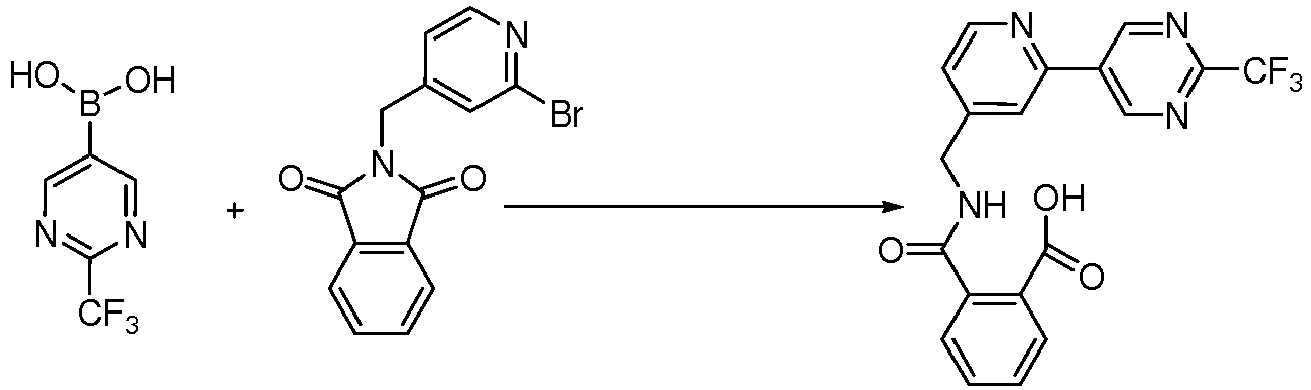
- A mixture of Pd(dppf)Cl2 (1.15 g, 1.572 mmol, 0.10 equiv), potassium carbonate (4.35 g, 31.475 mmol, 2.00 equiv), 2-[(2-bromopyridin-4-yl)methyl]-2,3-dihydro-1H-isoindole-1,3-dione (5 g, 15.77 mmol, 1.00 equiv), and bis(propan-2-yl) [2-(trifluoromethyl)pyrimidin-5-yl]boron ate (4.35 g, 15.757 mmol, 1.00 equiv) in dioxane (80 mL)/water (8 mL) was stirred for 12 h at 70°C under nitrogen. The solids were filtered out and the filtrate was diluted in water. The aqueous layer was extracted with ethyl acetate. The pH value of the aqueous solution was adjusted to 3-4 with IN HCl. The resulting solution was extracted with ethyl acetate. The combined extracts were washed with brine, dried over anhydrous sodium sulfate, and concentrated under vacuum. This resulted in the title compound (10 g, crude) as a yellow solid.
-

- A solution of 2-([2-[2-(trifluoromethyl)pyrimidin-5-yl]pyridin-4-yl]methyl)-2,3-dihydro-1H-isoindole-1,3-dione (10 g, 26.021 mmol, 1.00 equiv) and NH2NH2.H2O (13 g, 259.686 mmol, 9.98 equiv) in ethanol (150 mL) was stirred for 12 h at 80°C. The resulting mixture was concentrated under vacuum. The reaction was diluted in water. The pH value of the aqueous solution was adjusted to 3-4 with IN HCl. The resulting solution was extracted with ethyl acetate. The pH value of the solution was adjusted to 8 with sodium bicarbonate. The resulting solution was extracted with ethyl acetate. The combined extracts were washed with brine, dried over anhydrous sodium sulfate, and concentrated under vacuum. This resulted in the title compound (1 g, crude) as a yellow solid.
-

- A solution of (2S,5S)-1-[(4-fluorobenzene)sulfonyl]-5-methylpyrrolidine-2-carboxylic acid (140 mg, 0.487 mmol, 0.67 equiv), DIEA (189 mg, 1.462 mmol, 2.0 equiv), HATU (222 mg, 0.584 mmol, 0.8 equiv), and [2-[2-(trifluoromethyl)pyrimidin-5-yl]pyridin-4-yl]methanamine (186 mg, 0.732 mmol, 1.00 equiv) in N,N-dimethylformamide (10 mL) was stirred for 30 min at 25°C. The mixture was diluted with water and extracted with ethyl acetate. The combined extracts were washed with brine, dried over anhydrous sodium sulfate, and concentrated under vacuum. The residue was purified by a silica gel column eluting with ethyl acetate/petroleum ether (1/1). The crude product (568 mg) was purified by Prep-HPLC to afford the title compound (136 mg) as a white solid.
1H NMR (300 MHz, CDCl3) δ 9.59 (s, 2H), 8.74 - 8.72 (s, 1H), 7.95 - 7.89 (m, 3H), 7.54 (s, 1H), 7.36 - 7.26 (m, 3H), 4.94 - 4.86 (m, 1H), 4.48 - 4.41 (m, 1H), 4.19 - 4.15 (m, 1H), 3.73 - 3.67 (m, 1H), 2.22 - 2.15 (s, 1H), 1.81 - 1.71 (m, 2H), 1.70 - 1.46 (m, 4H). -
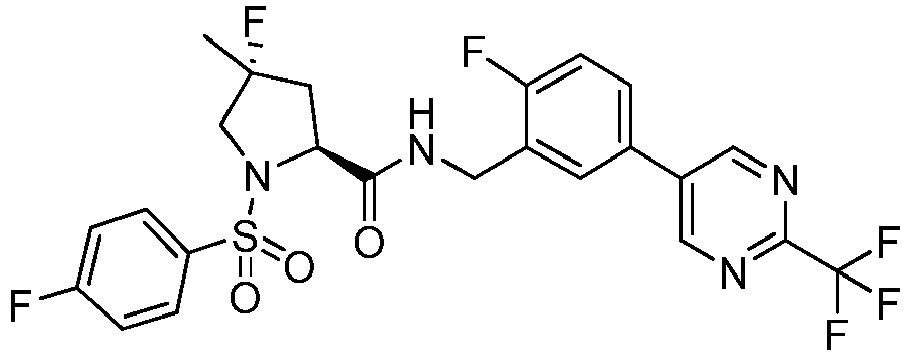
- Preparation of the title compound follow the same general procedure as Example 52.
MS-ESI: [M+H]+ 559.2
1H NMR (400 MHz, DMSO) δ 9.36 (s, 2H), 8.89 (t, J = 5.9 Hz, 1H), 8.00 - 7.93 (m, 3H), 7.92 - 7.87 (m, 1H), 7.52 - 7.39 (m, 3H), 4.47 (d, J = 5.8 Hz, 2H), 4.27 - 4.18 (m, 1H), 3.70 - 3.45 (m, 2H), 2.45 - 2.30 (m, 1H), 2.14 - 1.93 (m, 1H), 1.37 (d, J = 20.7 Hz, 3H). -

- Preparation of the title compound follows the same general procedure as Example 48.
1H NMR (400 MHz, DMSO) δ 9.69 - 9.63 (s, 2H), 9.00 - 8.93 (t, J = 6.0 Hz, 1H), 8.03 - 7.96 (m, 2H), 7.82 - 7.79 (d, J = 1.1 Hz, 1H), 7.52 - 7.44 (m, 2H), 6.97 - 6.92 (q, J = 1.0 Hz, 1H), 5.29 - 5.10 (d, J = 52.3 Hz, 1H), 4.53 - 4.36 (m, 2H), 4.23 - 4.16 (dd, J = 10.0, 7.1 Hz, 1H), 4.03 - 3.98 (s, 3H), 3.75 - 3.58 (m, 2H), 2.46 - 2.36 (m, 1H), 2.21 - 1.99 (m, 1H)., LCMS (ESI) m/z:558.2 [M+H]+ -

-

- A mixture of (2S,4R)-N-([5-chloro-2-[2-(trifluoromethyl)pyrimidin-5-yl]pyridin-4-yl]methyl)-4-fluoro-1-[(4-fluorobenzene)sulfonyl]pyrrolidine-2-carboxamide (150 mg, 0.267 mmol, 1.0 equiv), Zn(CN)2 (32 mg, 0.272 mmol, 1.02\ equiv), Pd2(dba)3.CHCl3 (28 mg, 0.027 mmol, 0.10 equiv), and dppf (45 mg, 0.081 mmol, 0.31 equiv) in DMF (15 mL) was irradiated with microwave for 1 h at 150°C under nitrogen. The reaction mixture was diluted with ethyl acetate, washed with brine, dried over anhydrous sodium sulfate, and concentrated under vacuum. The residue was purified by a silica gel column eluting with ethyl acetate/petroleum ether (1:1). The crude product (100 mg) was re-purified by Flash-Prep-HPLC to afford the title compound (44.5 mg, 30%) as a pink solid.
1H NMR (400 MHz, CDCl3) δ 9.65 (s, 2H), 8.96 (s, 1H), 8.32 (s, 1H), 7.92 - 7.88 (m, 2H), 7.52 -7.49 (m, 1H), 7.29 - 7.24 (m, 2H), 5.17 - 5.01 (m, 2H), 4.58 - 4.52 (m, 1H), 4.34 - 4.30 (m, 1H), 3.91 - 3.65 (m, 2H), 2.66 - 2.60 (m, 1H), 2.25 - 2.12 (m, 1H). -

-

- 2-Chloro-6-(trifluoromethyl)pyridin-3-amine (3 g, 15.263 mmol, 1.000 equiv) was added into a mixture of CuBr2 (6.8 g, 30.445 mmol, 2.000 equiv) and t-BuONO (3.1 g, 30.062 mmol, 2.000 equiv) in CH3CN (100 mL). The resulting solution was stirred for 2 h at room temperature. The reaction mixture was diluted with water, extracted with diethyl ether, dried over sodium sulfate, and concentrated under vacuum. This resulted in the title compound (3 g, 75%) as a brown liquid.
-

- A mixture of 3-bromo-2-chloro-6-(trifluoromethyl)pyridine (3 g, 11.519 mmol, 1.00 equiv) and 1-methoxy-2-(sodiooxy)ethane (1.2 g, 12.235 mmol, 1.10 equiv) in 2-methoxyethan-1-ol (30 mL) was stirred overnight at room temperature. The reaction mixture was then quenched with water, extracted with diethyl ether, dried over sodium sulfate, and concentrated under vacuum. This resulted in the title compound (4 g) as a red liquid which was used for the next step without any further purification.
-

- A mixture of 3-bromo-2-(2-methoxyethoxy)-6-(trifluoromethyl)pyridine (1.6 g, 5.33 mmol, 1.0 equiv), methyl 3-fluoro-5-(tetramethyl-1,3,2-dioxaborolan-2-yl)benzoate (1.5 g, 5.36 mmol, 1.0 equiv), potassium carbonate (1.5 g, 10.85 mmol, 2.0 equiv), and Pd(dppf)Cl2 (390 mg, 0.533 mmol, 0.10 equiv) in dioxane (50 mL) was stirred overnight at 90°C under nitrogen. The reaction mixture was diluted with water, extracted with ethyl acetate, dried over sodium sulfate, and concentrated under vacuum. The residue was purified by a silica gel column eluting with ethyl acetate/petroleum ether (1:10) to afford the title compound (1.9 g, 95%) as brown oil.
-

- LiAlH4 (360 mg, 9.485 mmol, 2.000 equiv) was added in several batches into a solution of methyl 3-fluoro-5-[2-(2-methoxyethoxy)-6-(trifluoromethyl)pyridin-3-yl]benzoate (1.8 g, 4.822 mmol, 1.000 equiv) in tetrahydrofuran (50 mL) at 0°C under nitrogen. The resulting solution was stirred for 2 h at 0°C and quenched by water. The solids were filtered out and the liquid was concentrated under vacuum. This resulted in 1.5 g of the title compound as a light yellow solid.
-

- DIAD (1.6 g, 7.913 mmol, 2.000 equiv) was added dropwise into a solution of [3-fluoro-5-[2-(2-methoxyethoxy)-6-(trifluoromethyl)pyridin-3-yl]phenyl]methanol (1.4 g, 4.055 mmol, 1.000 equiv), 2,3-dihydro-1H-isoindole-1,3-dione (1.2 g, 8.156 mmol, 2.000 equiv), and PPh3 (2.1 g, 8.007 mmol, 2.000 equiv) in tetrahydrofuran (50 mL) at 0°C under nitrogen. The resulting solution was stirred for 2 h at room temperature and concentrated under vacuum. The residue was purified by a silica gel column eluting with ethyl acetate/petroleum ether (1:5) to afford the title compound (1.3 g, 68%) as a white solid.
-

- A mixture of 2-([3-fluoro-5-[2-(2-methoxyethoxy)-6-(trifluoromethyl)pyridin-3-yl]phenyl]methyl)-2,3-dihydro-1H-isoindole-1,3-dione (1.2 g, 2.53 mmol, 1.0 equiv) and NH2NH2.H2O (2 mL, 41.150 mmol, 10.0 equiv) in methanol (10 mL) was stirred overnight at room temperature. The reaction mixture was concentrated under vacuum, diluted with water, extracted with dichloromethane, dried over sodium sulfate, and concentrated under vacuum. This resulted in the title compound (750 mg, 86%) as light yellow oil.
-

- A solution of (2S,4R)-1-[(tert-butoxy)carbonyl]-4-fluoropyrrolidine-2-carboxylic acid (68 mg, 0.292 mmol, 1.000 equiv), HATU (132 mg, 0.347 mmol, 1.200 equiv), [3-fluoro-5-[2-(2-methoxyethoxy)-6-(trifluoromethyl)pyridin-3-yl]phenyl]methanamine (100 mg, 0.290 mmol, 1.000 equiv), and DIEA (75 mg, 0.580 mmol, 2.000 equiv) in N,N-dimethylformamide (5 mL) was stirred for 2 h at room temperature. The reaction mixture was diluted with water, extracted with ethyl acetate, dried over anhydrous sodium sulfate, and concentrated under vacuum. This resulted in the title compound (180 mg) as light yellow oil.
-

- A mixture of tert-butyl (4R)-4-fluoro-2-[([3-fluoro-5-[2-(2-methoxyethoxy)-6-(trifluoromethyl)pyridin-3-yl]phenyl]methyl)carbamoyl]pyrrolidine-1-carboxylate (180 mg, 0.322 mmol, 1.000 equiv) and hydrogen chloride in dioxane (10 mL) was stirred overnight at room temperature. The product was precipitated by the addition of hexane. The solids were collected by filtration to afford the title compound (160 mg) as a brown solid.
-

- A solution of (2S,4R)-4-fluoro-N-([3-fluoro-5-[2-(2-methoxyethoxy)-6-(trifluoromethyl)pyridin-3-yl]phenyl]methyl)pyrrolidine-2-carboxamide hydrochloride (160 mg, 0.32 mmol, 1.000 equiv), DIEA (125 mg, 0.967 mmol, 3.0 equiv), and 4-fluorobenzene-1-sulfonyl chloride (69 mg, 0.355 mmol, 1.1 equiv) in dichloromethane (20 mL) was stirred for 2 h at room temperature. The reaction mixture was concentrated under vacuum. The residue was purified by a silica gel column eluting with ethyl acetate/petroleum ether (1:1). The crude product was purified by Prep-HPLC to afford the tile compound (50.3 mg, 25%) as a white solid.
1H NMR (400 MHz, CDCl3) δ 7.79 - 7.84 (m, 3H), 7.40 - 7.22 (m, 6H), 7.11 (d, J = 12.0 Hz, 1H), 5.12 - 4.99 (d, J = 52.0 Hz, 1H), 4.68 - 4.60 (m, 3H), 4.53 - 4.48 (dd, J = 15.2 Hz, J = 5.2 Hz, 1H), 4.29 (t, J = 8.4 Hz, 1H), 3.96 - 3.87 (m, 1H), 3.78 (t, J = 4.8 Hz, 1H), 3.70 - 3.56 (m, 1H), 3.43 (s, 3H), 2.60 - 2.47 (m, 1H), 2.40 - 2.20 (m, 1H). -

-

- A mixture of 2,6-dichloro-4-iodopyridine (8.61 g, 31.43 mmol, 1.00 equiv), 5-(tetramethyl-1,3,2-dioxaborolan-2-yl)-2-(trifluoromethyl)pyrimidine (7.85 g, 28.64 mmol, 1.00 equiv), potassium carbonate (11.9 g, 86.10 mmol, 1.00 equiv), and Pd(dppf)Cl2(1.05 g, 1.43 mmol, 1.00 equiv) in dioxane (150 mL)/water(10 mL) was stirred for 12 h at 60°C under nitrogen. The reaction solution was diluted with ethyl acetate, washed with brine, dried over anhydrous sodium sulfate, and concentrated under vacuum. The residue was purified by a silica gel column eluting with ethyl acetate/petroleum ether (1:20) to afford the title compound (6 g, 65%) as an off-white solid.
-

- A mixture of 5-(2,6-dichloropyridin-4-yl)-2-(trifluoromethyl)pyrimidine (1.7 g, 5.78 mmol, 1.00 equiv), Pd(dppf)Cl2 (423 mg, 0.57 mmol, 0.10 equiv), and dimethylzinc (21.7 mL, 1.2 M in toluene, 4.50 equiv) in dioxane (100 mL) was stirred for 12 h at 60°C under nitrogen. The resulting mixture was concentrated under vacuum. The residue was purified by a silica gel column eluting with ethyl acetate/petroleum ether (1:5) to afford the title compound (770 mg, 53%) as a light yellow solid.
-

- A solution of m-CPBA (578 mg, 3.34 mmol, 1.10 equiv) in ethyl acetate(5 mL) was added dropwise with stirring into the solution of 5-(2,6-dimethylpyridin-4-yl)-2-(trifluoromethyl)pyrimidine (770 mg, 3.04 mmol, 1.00 equiv) in dichloromethane (50 mL) at 0°C. The resulting solution was stirred for 12 h at room temperature. The reaction was then quenched with saturated of sodium bicarbonate, extracted with ethyl acetate, washed with brine, dried over anhydrous sodium sulfate, and concentrated under vacuum. The residue was purified by a silica gel column eluting with dichloromethane/methanol (50/1) to afford the title compound (750 mg, 92%) as a light yellow solid.
-
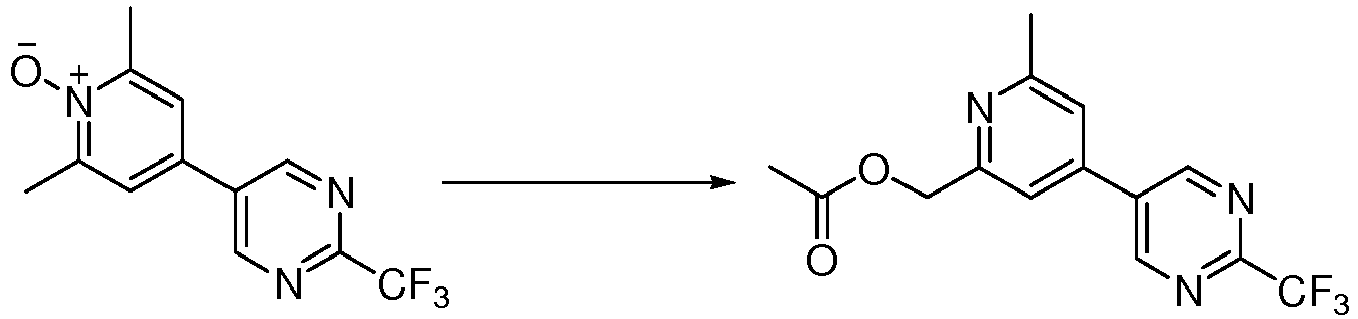
- A solution of 2,6-dimethyl-4-[2-(trifluoromethyl)pyrimidin-5-yl]pyridin-1-ium-1-olate(750mg, 2.78 mmol, 1.00 equiv) in acetic anhydride (15 mL) was heated to reflux for 1 h. The reaction mixture was cooled and poured into ice water. The pH value of the solution was adjusted to 8 with saturated of sodium bicarbonate, extracted with ethyl acetate, washed with brine, dried over anhydrous sodium sulfate, and concentrated under vacuum. The residue was purified by a silica gel column eluting with dichloromethane/methanol (20/1) to afford the title compound (650 mg, 75%) as an off-white solid.
-
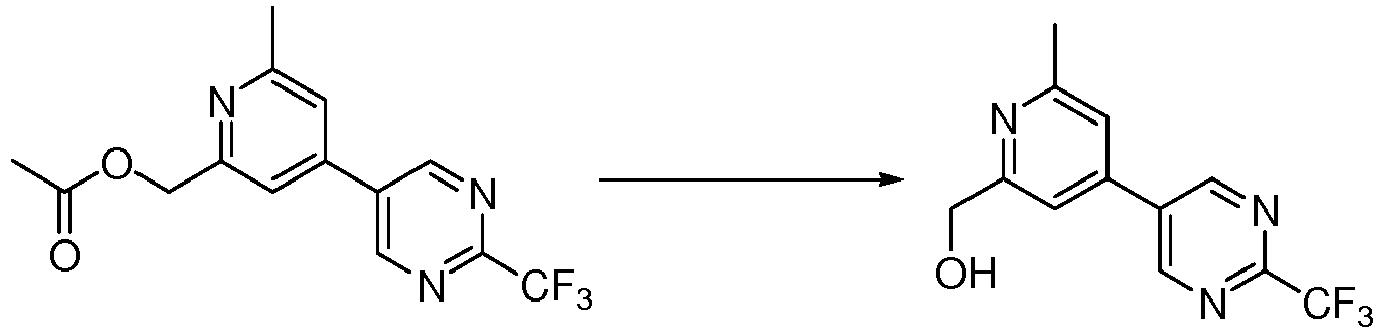
- A solution of [6-methyl-4-[2-(trifluoromethyl)pyrimidin-5-yl]pyridin-2-yl]methyl acetate (650 mg, 2.08 mmol, 1.00 equiv) and hydrogen chloride (15 mL, 493.67 mmol, 1.00 equiv) in ethanol (15 mL) was heated to reflux for 2 h. The reaction solution was diluted with water. The pH value of the solution was adjusted to 8 with saturated of sodium bicarbonate, extracted with ethyl acetate, washed with brine, dried over anhydrous sodium sulfate, and concentrated under vacuum. The residue was purified by a silica gel column eluting with dichloromethane/methanol (20/1) to afford the title compound (340 mg, 60%) as a light yellow solid.
-

- DIAD (511 mg, 2.52 mmol, 2.00 equiv) was added to the solution of [6-methyl-4-[2-(trifluoromethyl)pyrimidin-5-yl]pyridin-2-yl]methanol (340 mg, 1.26 mmol, 1.00 equiv), 2,3-dihydro-1H-isoindole-1,3-dione (372 mg, 2.52 mmol, 2.00 equiv), and PPh3 (662 mg, 2.52 mmol, 1.99 equiv) in THF (50 mL) dropwise at 0°C. The resulting solution was stirred for 12 h at room temperature. The resulting mixture was concentrated under vacuum. The residue was purified by a silica gel column eluting with acetate/petroleum ether (1/1) to afford the title compound (300 mg, 60%) as a white solid.
-

- A solution of 2-[6-methyl-4-[2-(trifluoromethyl)pyrimidin-5-yl]pyridin-2-yl]-2,3-dihydro-1H-isoindole-1,3-dione (600 mg, 1.56 mmol, 1.00 equiv) and NH2NH2.H2O (754 mg, 15.06 mmol, 9.64 equiv) in methanol (15 mL) was stirred for 12 h at 25°C. The resulting mixture was concentrated under vacuum. The residue was dissolved with ethyl acetate and the solid were filtered out. The filtrate was concentrated under vacuum. This resulted in 686 mg (crude) of the title compound as oil.
-

- A solution of (2S,3R)-1-[(tert-butoxy)carbonyl]-3-hydroxypyrrolidine-2-carboxylic acid (97 mg, 0.41 mmol, 1.19 equiv), DIEA (136 mg, 1.05 mmol, 3.00 equiv), HATU (213 mg, 0.56 mmol, 1.59 equiv), and [6-methyl-4-[2-(trifluoromethyl)pyrimidin-5-yl]pyridin-2-yl]methanamine(94 mg, 0.35 mmol, 1.00 equiv) in DMF (5 mL) was stirred for 30 min at 25°C. The reaction solution was diluted with ethyl acetate, washed with brine, dried over anhydrous sodium sulfate, and concentrated under vacuum. This resulted in 168 mg (crude) of the title compound as a solid.
-

- DAST (112 mg, 0.69 mmol, 1.99 equiv) was added to a solution of tert-butyl (2S,3R)-3-hydroxy-2-[([6-methyl-4-[2-(trifluoromethyl)pyrimidin-5-yl]pyridin-2-yl]methyl)carbamoyl]pyrrolidine-1-carboxylate (168 mg, 0.34 mmol, 1.00 equiv) in dichloromethane (20 mL) dropwise at 0°C and the reaction was stirred for 2 h at room temperature. The reaction was then quenched by sodium bicarbonate/water, extracted with of ethyl acetate, dried over anhydrous sodium sulfate, and concentrated under vacuum. This resulted in 65 mg (39%) of the title compound as a white solid.
-

- A mixture of tert-butyl (2R,3S)-3-fluoro-2-[([6-methyl-4-[2-(trifluoromethyl)pyrimidin-5-yl]pyridin-2-yl]methyl)carbamoyl]pyrrolidine-1-carboxylate (65 mg, 0.13 mmol, 1.00 equiv) and saturated hydrogen chloride in 1,4-dioxane (5 mL) was stirred for 2h at room temperature. The resulting mixture was concentrated under vacuum to afford the title compound (120 mg) as a crude solid.
-

- 4-Fluorobenzene-1-sulfonyl chloride (84 mg, 0.43 mmol, 1.51 equiv) was added into the solution of (2R,3S)-3-fluoro-N-([6-methyl-4-[2-(trifluoromethyl)pyrimidin-5-yl]pyridin-2-yl]methyl)pyrrolidine-2-carboxamide hydrochloride (120 mg, 0.28 mmol, 1.00 equiv) and TEA (87 mg, 0.86 mmol, 3.00 equiv) in dichloromethane(20 mL). The reaction mixture was stirred for 12h at room temperature. The resulting solution was diluted with ethyl acetate, washed with brine, dried over anhydrous sodium sulfate and concentrated under vacuum. This resulted in the title compound (24.4 mg, 16%) as a white solid.
1H NMR (400 MHz, CDCl3) δ 9.18 (s, 2H), 7.98 - 7.88 (m, 3H), 7.60 - 7.50 (m, 1H), 7.34 - 7.23 (m, 2H), 6.91 (m, 1H), 5.39 - 5.22 (d, J = 51.0 Hz, 1H), 4.94 - 4.86 (m, 1H), 4.60 - 4.55 (m, 1H), 4.41 - 4.33 (m, 1H), 3.84 - 3.70 (m, 1H), 3.33 - 3.24 (m, 1H), 2.72 - 2.62 (s, 3H), 2.20 - 1.95 (m, 2H). -
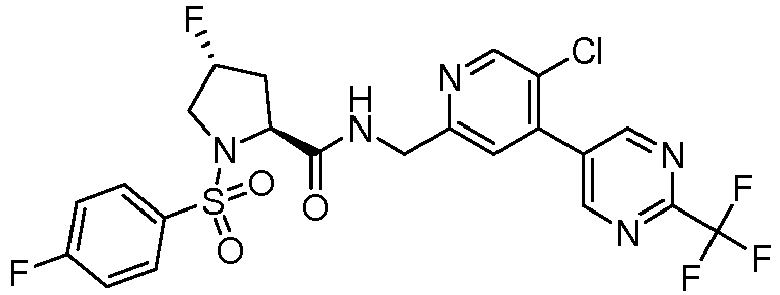
-

- A mixture of 2,5-dichloro-4-iodopyridine (3.86 g, 14.09 mmol, 1.00 equiv), 5-(tetramethyl-1,3,2-dioxaborolan-2-yl)-2-(trifluoromethyl)pyrimidine (4.26 g, 15.54 mmol, 1.10 equiv), potassium carbonate (5.83 g, 42.19 mmol, 2.99 equiv), and Pd(dppf)Cl2 (516 mg, 0.70 mmol, 0.05 equiv) in dioxane (50 mL)/water (5 mL) was stirred for 12 h at 60°C under nitrogen. The solids were filtered out. The filtrate was diluted with ethyl acetate, washed with brine, dried over anhydrous sodium sulfate, and concentrated under vacuum. The residue was purified by a silica gel column eluting with acetate/petroleum ether (1/100) to afford the title compound (2.2 g, 53%) as a yellow solid.
-

- A mixture of 5-(2,5-dichloropyridin-4-yl)-2-(trifluoromethyl)pyrimidine (2.19 g, 7.47 mmol, 1.00 equiv), Pd(dppf)Cl2 (549 mg, 0.75 mmol, 0.10 equiv), and TEA (2.27 g, 22.47 mmol, 3.00 equiv) in methanol (50 mL) was stirred for 12 h at 60°C under carbon monoxide. The reaction solution was diluted with ethyl acetate, washed with water and brine, dried over anhydrous sodium sulfate, and concentrated under vacuum. The residue was purified by a silica gel column eluting with acetate/petroleum ether (1/100) to afford the title compound (1.2 g, 52%) as a pink solid.
-

- DIBAL-H (4.5 mL, 31.64 mmol, 3.00 equiv) was added to the solution methyl 5-chloro-4-[2-(trifluoromethyl)pyrimidin-5-yl]pyridine-2-carboxylate(482 mg, 1.51 mol, 1.00 equiv) in dichloromethane (200 mL) dropwise at -78°C under nitrogen, and stirred for 20 min at -78°C. The reaction was then quenched with methanol. The resulting solution was diluted with ethyl acetate, washed with water and brine, dried over anhydrous sodium sulfate, and concentrated under vacuum. The residue was purified by a silica gel column eluting with acetate/petroleum ether (1/20) to afford the title compound 344 mg (crude) as a light yellow solid.
-

- NaBH4 (18 mg, 0.47 mmol, 0.39 equiv) was added into the solution of 5-chloro-4-[2-(trifluoromethyl)pyrimidin-5-yl]pyridine-2-carbaldehyde (344 mg, 1.19 mmol, 1.00 equiv) in methanol (200 mL) batch wise at -20°C and stirred for 30 min. The reaction mixture was quenched with saturated NH4Cl, extracted with ethyl acetate, dried over anhydrous sodium sulfate, and concentrated under vacuum. The residue was purified by a silica gel column eluting with acetate/petroleum ether (1/1) to afford the title compound (330 mg, 95%) as a brown solid.
-

- DIAD (490 mg, 2.42 mmol, 2.00 equiv) was added to a solution of [5-chloro-4-[2-(trifluoromethyl)pyrimidin-5-yl]pyridin-2-yl]methanol (350 mg, 1.20 mmol, 1.00 equiv), 2,3-dihydro-1H-isoindole-1,3-dione (356 mg, 2.42 mmol, 2.00 equiv), and PPh3 (634 mg, 2.41 mmol, 2.00 equiv) in tetrahydrofuran (200 mL) dropwise at 0°C. The resulting solution was stirred for 12 hours at room temperature. The resulting solution was diluted with ethyl acetate, washed with water and brine, dried over anhydrous sodium sulfate, and concentrated under vacuum. The residue was purified by a silica gel column eluting with acetate/petroleum ether (1/5) to afford the title compound 800 mg (crude) as yellow oil.
-

- A solution of 2-([5-chloro-4-[2-(trifluoromethyl)pyrimidin-5-yl]pyridin-2-yl]methyl)-2,3-dihydro-1H-isoindole-1,3-dione (800 mg, 1.91 mmol, 1.00 equiv), NH2NH2.H2O (957 mg, 19.17 mmol, 10.00 equiv) in methanol (60 mL) was stirred for 3 h at 60°C. The resulting mixture was concentrated under vacuum. The residue was dissolved with ethyl acetate. The solids were filtered out. The filtrate was concentrated under vacuum. This resulted in 700 mg (crude) of the title compound as yellow oil.
-

- A solution of (2S,4R)-1-[(tert-butoxy)carbonyl]-4-fluoropyrrolidine-2-carboxylic acid (690 mg, 2.95 mmol, 1.23 equiv), HATU (1.091 g, 2.86 mmol, 1.20 equiv), DIEA (618 mg, 4.78 mmol, 2.00 equiv), and [5-chloro-4-[2-(trifluoromethyl)pyrimidin-5-yl]pyridin-2-yl]methanamine (690 mg, 2.39 mmol, 1.00 equiv) in DMF (15 mL) was stirred for 2 h at room temperature. The resulting solution was diluted with ethyl acetate, washed with water and brine, dried over anhydrous sodium sulfate, and concentrated under vacuum. The residue was purified by a silica gel column eluting with acetate/petroleum ether (1/5) to afford the title compound (800 mg, 66%) as a yellow solid.
-

- A mixture of (2S,4R)-2-[([5-chloro-4-[2-(trifluoromethyl)pyrimidin-5-yl]pyridin-2-yl]methyl)carbamoyl]-4-fluoropyrrolidine-1-carboxylate (210 mg, 0.41 mmol, 1.00 equiv) and saturated hydrogen chloride in 1,4-dioxane (50 mL) was stirred for 12 hours at room temperature. The resulting mixture was concentrated under vacuum. This resulted in 168 mg (92%) of the title compound as light yellow oil.
-

- 4-Fluorobenzene-1-sulfonyl chloride (180 mg, 0.92 mmol, 2.42 equiv) was added to the solution of (2S,4R)-N-([5-chloro-4-[2-(trifluoromethyl)pyrimidin-5-yl]pyridin-2-yl]methyl)-4-fluoropyrrolidine-2-carboxamide hydrochloride (168 mg, 0.38 mmol, 1.00 equiv), and TEA (200 mg, 1.97 mmol, 5.17 equiv) in dichloromethane (30 mL), and stirred for 4 h at room temperature. The resulting solution was diluted with ethyl acetate, washed with brine, dried over anhydrous sodium sulfate, and concentrated under vacuum. The crude product (200 mg) was purified by Prep-HPLC to give the title compound (32.3 mg, 15%) as a white solid.
1H NMR (400 MHz, CDCl3) δ 9.10 (s, 2H), 8.73 (s, 1H), 7.87 - 7.84 (m, 2H), 7.58 (s, 1H), 7.55 (s, 1H), 7.23 (s, 1H), 7.21 (s, 1H), 5.12 - 4.99 (d, J = 52.0 Hz, 1H), 4.94 - 4.88 (m, 1H), 4.57 - 4.52 (m, 1H), 4.29 - 4.25 (t, J = 8.4 Hz, 1H), 3.91 - 3.61 (m, 2H), 2.61 - 2.51 (m, 1H), 2.31 - 2.15 (m, 1H). -

-

- A solution of 2-methyl (2S,4S)-4-hydroxypyrrolidine-1,2-dicarboxylate (10 g, 40.77 mmol, 1.00 equiv), Imidazole (2.78 g, 40.83 mmol, 1.10 equiv), and tert-butyl(chloro)dimethylsilane(6.7 g, 44.45mmol, 1.10equiv) in DMF (100 mL) was stirred overnight at room temperature. The resulting solution was diluted with ethyl acetate, washed with water and of brine, dried over anhydrous sodium sulfate, and concentrated under vacuum. The residue was purified by a silica gel column eluting with acetate/petroleum ether (1/8) to afford the title compound (16 g) as colorless oil.
-

- A mixture of NaIO4 (7.43 g, 34.73 mmol, 2.50 equiv) and ruthenium(IV) oxide (370 mg, 2.78 mmol, 0.20 equiv) in water (107 mL) was stirred for 5 min at room temperature. To this was added the solution of 1-tert-butyl 2-methyl (2S,4S)-4-[(tert-butyldimethylsilyl)oxy]pyrrolidine-1,2-dicarboxylate (5 g, 13.90 mmol, 1.00 equiv) in ethyl acetate (60 mL) and the reaction was stirred for 3h at room temperature. The resulting solution was diluted with ethyl acetate, washed with NaHSO3/water and brine, dried over anhydrous sodium sulfate, and concentrated under vacuum. The residue was purified by a silica gel column eluting with acetate/petroleum ether (1/8) to afford the title compound (3.3 g, 64%) as colorless oil.
-

- Bromo(methyl)magnesium (3.48 mL, 87.55 mmol, 1.20 equiv) was added to the solution of 1-tert-butyl 2-methyl (2S,4S)-4-[(tert-butyldimethylsilyl)oxyl-5-oxopyrrolidine-1,2-dicarboxylate (3.25 g, 8.70 mmol, 1.00 equiv) in THF (50 mL) dropwise at -40°C and stirred for 2h at -40°C. The reaction was then quenched with saturated NH4Cl, extracted with ethyl acetate, washed with water and of brine, dried over anhydrous sodium sulfate, and concentrated under vacuum. The residue was purified by a silica gel column eluting with ethyl acetate/petroleum ether (1/8) to afford the title compound (1.1 g, 32%) as light yellow oil.
-

- A solution of methyl (2S,4S)-1-tert-butyl 2-methyl 4-(tert-butyldimethylsilyloxy)-5-hydroxy-5-methylpyrrolidine-1,2-dicarboxylate (6 g, 15.40 mmol, 1.00 equiv) and TFA (5 mL, 67.31 mmol, 1.00 equiv) in dichloromethane (50 mL) was stirred for 5 h at room temperature. The resulting mixture was concentrated under vacuum. This resulted in 6 g of the title compound as brown oil.
-

- A mixture of methyl (2S,4S)-4-[(tert-butyldimethylsilyl)oxy]-5-methyl-3,4-dihydro-2H-pyrrole-2-carboxylate (6 g, 22.10 mmol, 1.00 equiv) and palladium carbon (500 mg) in methanol (100 mL) was stirred for 2 h at room temperature under H2. The solids were filtered out. The resulting mixture was concentrated under vacuum. This resulted in 5.6 g (93%) of as yellow oil.
-

- A solution of methyl (2S,4S,5S)-4-[(tert-butyldimethylsilyl)oxy]-5-methylpyrrolidine-2-carboxylate (5.5 g, 20.11 mmol, 1.00 equiv), TEA (8.13 g, 80.34 mmol, 4.00 equiv), 4-dimethylaminopyridine (245mg, 2.00 mmol, 0.10 equiv), di-tert-butyl dicarbonate (13.16 g, 60.29 mmol, 3.00 equiv) in THF (250 mL) was stirred overnight at 50°C. The resulting mixture was concentrated under vacuum. The residue was purified by a silica gel column eluting with ethyl acetate/petroleum ether (1/10) to afford the title compound (3 g, 40%) as light yellow oil.
-

- A solution of 1-tert-butyl 2-methyl (2S,4S,5S)-4-[(tert-butyldimethylsilyl)oxy]-5-methylpyrrolidine-1,2-dicarboxylate (20 mg, 0.05 mmol, 1.00 equiv) and LiOH (3 mg, 0.12 mmol, 2.00 equiv) in methanol (2 mL)/water (0.2 mL) was stirred for 5 h at 40°C. The resulting solution was diluted with water. The pH value of the solution was adjusted to 4 with acetic acid. The resulting solution was extracted with dichloromethane, dried over anhydrous sodium sulfate, and concentrated under vacuum. This resulted in 20 mg (crude) of the title compound as yellow oil.
-

- A solution of (2S,4S,5S)-1-[(tert-butoxy)carbonyl]-4-[(tert-butyldimethylsilyl)oxy]-5-methylpyrrolidine-2-carboxylic acid (400 mg, 1.11 mmol, 1.00 equiv), HATU (880 mg, 2.31 mmol, 1.50 equiv), DIEA(600 mg, 4.64 mmol, 3.00 equiv), and 2-[2-(trifluoromethyl)pyrimidin-5-yl]pyridin-4-ylmethanamine(464 mg, 1.82 mmol, 1.20 equiv) in DMF (10 mL) was stirred for 1 h at room temperature. The resulting solution was diluted with ethyl acetate, washed with water and brine, dried over anhydrous sodium sulfate, and concentrated under vacuum. The residue was purified by a silica gel column eluting with ethyl acetate/petroleum ether (1/3) to afford the title compound (360 mg, 54%) as light yellow oil.
-

- A solution of tert-butyl (2S,3S,5S)-3-[(tert-butyldimethylsilyl)oxy]-2-methyl-5-[([2-[2-(trifluoromethyl)pyrimidin-5-yl]pyridin-4-yl]methyl)carbamoyl]pyrrolidine-1-carboxylate (360 mg, 0.60 mmol, 1.00 equiv) and TBAF (1.34 mL, 5.12 mmol, 1.00 equiv) in THF (10 mL) was stirred for 1 h at room temperature. The resulting mixture was concentrated under vacuum. The residue was purified by a silica gel column eluting with ethyl acetate/petroleum ether (2/1) to afford the title compound (300 mg, crude) as a white solid.
-

- DAST (424 mg, 2.63 mmol, 3.00 equiv) was added to the solution of tert-butyl (2S,3S,5S)-3-hydroxy-2-methyl-5-[([2-[2-(trifluoromethyl)pyrimidin-5-yl]pyridin-4-yl]methyl)carbamoyl]pyrrolidine-1-carboxylate (300 mg, 0.62 mmol, 1.00 equiv) in dichloromethane (10 mL) dropwise at 0°C and stirred overnight at room temperature. The reaction was then quenched with water, extracted with dichloromethane, dried over anhydrous sodium sulfate, and concentrated under vacuum. The residue was purified by a silica gel column eluting with ethyl acetate/petroleum ether (2/1) to afford the title compound (110 mg, 37%) as a light yellow solid.
-

- A mixture of tert-butyl (2S,3R,5S)-3-fluoro-2-methyl-5-[([2-[2-(trifluoromethyl)pyrimidin-5-yl]pyridin-4-yl]methyl)carbamoyl]pyrrolidine-1-carboxylate (110 mg, 0.22 mmol, 1.00 equiv) and saturated hydrogen chloride in 1,4-dioxane (20 mL) was stirred overnight at room temperature. The resulting mixture was concentrated under vacuum. This resulted in 105 mg (crude) of the title compound as a light yellow solid.
-

- 4-Fluorobenzene-1-sulfonyl chloride (73 mg, 0.37 mmol, 1.20 equiv) was added to a solution of(2S,4R,5S)-4-fluoro-5-methyl-N-([2-[2-(trifluoromethyl)pyrimidin-5-yl]pyridin-4-yl]methyl)pyrrolidine-2-carboxamide hydrochloride (105 mg, 0.25 mmol, 1.00 equiv) and sodium bicarbonate (41.5 mg, 0.49 mmol, 2.00 equiv) in THF (8 mL)/water (8 mL). This was stirred for 1 h at room temperature. The resulting solution was extracted with ethyl acetate, washed with water and brine, dried over anhydrous sodium sulfate, and concentrated under vacuum. The crude product was purified by Prep-HPLC to give the title compound (16.9 mg, 12%) as a white solid.
1H NMR (400 MHz, CDCl3) δ 9.65 (s, 2H), 8.80 (s, 1H), 8.13 (s, 1H), 7.93 - 7.90 (m, 2H), 7.54 - 7.51 (m, 2H), 7.28 - 7.25 (m, 1H), 5.03 - 4.99 (m, 1H), 4.82 - 4.68 (d, J= 51.6 Hz, 1H), 4.50 - 4.32 (m, 1H), 4.30 - 4.27 (m, 1H), 4.15 - 4.08 (m, 1H), 2.65 - 2.55 (m, 1H), 2.39 - 2.23 (m, 1H), 1.48 - 1.38 (m, 3H). -

- Step 1: Following the HATU coupling procedure of Example 35, step 1: tert-butyl (5S)-2,2-dimethyl-5-[[6-[6-(trifluoromethyl)-3-pyridyl]pyrimidin-4-yl]methylcarbamoyl]pyrrolidine-1-carboxylate (INT-194-2) (320 mg, 81%) was prepared from (2S)-1-tert-butoxycarbonyl-5,5-dimethyl-pyrrolidine-2-carboxylic acid (200 mg, 0.8 mmol) and [6-[6-(trifluoromethyl)-3-pyridyl]pyrimidin-4-yl]methanamine (230 mg, 0.9 mmol), DIPEA (0.4 mL, 2.5 mmol), HATU (383 mg, 0.99 mmol) in DMF (2mL). MS-ESI: [M+H]+ 480.5
- Step 2: Following the boc removal procedure of Example 35, step 3: (2S)-5,5-dimethyl-N-[[6-[6-(trifluoromethyl)-3-pyridyl]pyrimidin-4-yl]methyl]pyrrolidine-2-carboxamide hydrochloride (INT-194-3) (250 mg, 81%) was prepared from tert-butyl (5S)-2,2-dimethyl-5-[[6-[6-(trifluoromethyl)-3-pyridyl]pyrimidin-4-yl]methylcarbamoyl]pyrrolidine-1-carboxylate (387 mg, 0.8 mmol) and 4 N HCl in dioxane (2 mL, 8 mmol). MS-ESI: [M+H]+ 380.5
- Step 3: Following the sulfonamide formation procedure of Example 35, step 4: The title compound 194 (2S)-1-(4-fluorophenyl)sulfonyl-5,5-dimethyl-N-[[6-[6-(trifluoromethyl)-3-pyridyl]pyrimidin-4-yl]methyl]pyrrolidine-2-carboxamide (162 mg, 37%) was prepared from (2S)-5,5-dimethyl-N-[[6-[6-(trifluoromethyl)-3-pyridyl]pyrimidin-4-yl]methyl]pyrrolidine-2-carboxamide hydrochloride (INT194-3) (306 mg, 0.8 mmol), Et3N (2.25 mL, 16 mmol), 4-fluorobenzenesulfonyl chloride (188 mg, 0.97 mmol) in DCM (1 mL). MS-ESI: [M+H]+ 538.5
-

- Step 1: Following the HATU coupling procedure of Example 35, step 1: tert-butyl (2S,4R)-2-[(5-bromo-3-pyridyl)methylcarbamoyl]-4-fluoro-pyrrolidine-1-carboxylate (INT-195-2) (280 mg, 32%) was prepared from (2S,4R)-1-tert-butoxycarbonyl-4-fluoro-pyrrolidine-2-carboxylic acid (500 mg, 2.1 mmol) and (5-bromo-3-pyridyl)methanamine (441 mg, 2.4 mmol), DIPEA (1.1 mL, 6.4 mmol), HATU (998 mg, 2.6 mmol) in DMF (2mL). MS-ESI: [M+H]+ 403.3
- Step 2: Following the boc removal procedure of Example 35, step 3: (2S,4R)-N-[(5-bromo-3-pyridyl)methyl]-4-fluoro-pyrrolidine-2-carboxamide (INT-195-3) (210 mg, 100%) was prepared from tert-butyl (2S,4R)-2-[(5-bromo-3-pyridyl)methylcarbamoyl]-4-fluoro-pyrrolidine-1-carboxylate (INT-195-2) (280 mg, 0.7 mmol) and 4 N HCl in dioxane (1.7 mL, 7 mmol). MS-ESI: [M+H]+ 303.3
- Step 3: Following the sulfonamide formation procedure of Example 35, step 4: (2S,4R)-N-[(5-bromo-3-pyridyl)methyl]-4-fluoro-1-(4-fluorophenyl)sulfonyl-pyrrolidine-2-carboxamide (INT-195-4) (200 mg, 63%) was prepared from (2S,4R)-N-[(5-bromo-3-pyridyl)methyl]-4-fluoro-pyrrolidine-2-carboxamide (INT-195-3) (210 mg, 0.7 mmol), Et3N (1.9 mL, 14 mmol), 4-fluorobenzenesulfonyl chloride (162 mg, 0.8 mmol) in DCM (1 mL). MS-ESI: [M+H]+ 461.3
- Step 4: Following the same Suzuki coupling procedure of Example 42, step 1: The title compound 195 (2S,4R)-4-fluoro-1-(4-fluorophenyl)sulfonyl-N-[[5-[2-(trifluoromethyl)pyrimidin-5-yl]-3-pyridyl]methyl]pyrrolidine-2-carboxamide (62 mg, 54%) was prepared from (2S,4R)-N-[(5-bromo-3-pyridyl)methyl]-4-fluoro-1-(4-fluorophenyl)sulfonyl-pyrrolidine-2-carboxamide (INT-195-4) (100 mg, 0.22 mmol), [5-(trifluoromethyl)pyrimidin-2-yl]boronic acid (46 mg, 0.24 mmol), cesium carbonate 1 M in water (0.3 mL, 0.3 mmol), Pd(dppf)Cl2 (18 mg, 0.02 mmol) in acetonitrile (1 mL). MS-ESI: [M+H]+ 528.5
-

-

- DIAD (1.57 g, 7.76 mmol, 2.00 equiv) was added dropwise into a solution of 2,3-dihydro-1H-isoindole-1,3-dione (690 mg, 4.69 mmol, 1.20 equiv), (2-bromo-5-fluoropyridin-4-yl)methanol (800.00 mg, 3.88 mmol, 1.00 equiv), and PPh3 (2.04 g, 7.78 mmol, 2.00 equiv) in tetrahydrofuran (40 mL) at 0°C under nitrogen. The resulting solution was stirred for 12h at room temperature. The resulting mixture was concentrated under vacuum. The residue was purified by a silica gel column with ethyl acetate/petroleum ether (1:5) to afford the title compound (500 mg, 38%) as a white solid.
-

- A mixture of Pd(dppf)Cl2 (196 mg, 0.268 mmol, 0.10 equiv), potassium carbonate (741 mg, 5.362 mmol, 2.0 equiv), 2-[(2-bromo-5-fluoropyridin-4-yl)methyl]-2,3-dihydro-1H-isoindole-1,3-dione (900 mg, 2.686 mmol, 1.0 equiv), and bis(propan-2-yl) [2-(trifluoromethyl)pyrimidin-5-yl]boronate (3.3 g, 11.954 mmol, 4.45 equiv) in 1,4-dioxane (25 mL)/water(2.5 mL) was stirred for 12 h at 70°C under nitrogen. The mixture was diluted with water and extracted with ethyl acetate. The combined extracts were washed with brine, dried over anhydrous sodium sulfate, and concentrated under vacuum. The residue was purified by a silica gel column eluting with ethyl acetate/petroleum ether (1/5) to afford the title compound (1g, 91%) as a yellow solid.
-

- A solution of 2-([5-fluoro-2-[2-(trifluoromethyl)pyrimidin-5-yl]pyridin-4-yl]methyl)-2,3-dihydro-1H-isoindole-1,3-dione (250 mg, 0.621 mmol, 1.00 equiv) and MeONa (340 mg, 6.294 mmol, 10.128 equiv) in methanol (50 mL) was stirred for 5 h at 85°C. The resulting mixture was concentrated under vacuum and diluted with water. The pH value of the solution was adjusted to 3-5 with IN hydrogen chloride. The resulting solution was extracted with ethyl acetate. The combined extracts were washed with brine, dried over anhydrous sodium sulfate, and concentrated under vacuum. This resulted in the title compound (250 mg, 93%) as a white solid.
-

- A solution of 2-[([5-methoxy-2-[2-(trifluoromethyl)pyrimidin-5-yl]pyridin-4-yl]methyl)carbamoyl]benzoic acid (250 mg, 0.578 mmol, 1.00 equiv) and NH2NH2.H2O (300 mg, 5.993 mmol, 10.36 equiv) in ethanol (30 mL) was stirred for 12 h at 80°C. The resulting mixture was concentrated under vacuum and diluted with water. The pH value of the solution was adjusted to 3-5 with IN hydrogen chloride. The resulting solution was extracted with ethyl acetate. The pH value of the aqueous solution was adjusted to 8 with sodium bicarbonate. The resulting solution was extracted with ethyl acetate. The combined extracts were dried over anhydrous sodium sulfate and concentrated under vacuum. This resulted in the title compound (120 mg, 73%) as a solid.
-

- A solution of (2S,4R)-1-[(tert-butoxy)carbonyl]-4-fluoropyrrolidine-2-carboxylic acid (108 mg, 0.463 mmol, 1.097 equiv), DIEA (164 mg, 1.269 mmol, 3.0 equiv), HATU (193 mg, 0.508 mmol, 1.202 equiv), and [5-methoxy-2-[2-(trifluoromethyl)pyrimidin-5-yl]pyridin-4-yl]methanamine (120 mg, 0.422 mmol, 1.000 equiv) in N,N-dimethylformamide (8 mL) was stirred for 30 min at 25°C. The reaction mixture was diluted with water and extracted with ethyl acetate. The combined extracts were washed with brine, dried over anhydrous sodium sulfate, and concentrated under vacuum. The residue was purified by a silica gel column eluting with ethyl acetate/petroleum ether (1/5). This resulted in the title compound (180 mg, 85%) as light yellow oil.
-

- A solution of tert-butyl (2S,4R)-4-fluoro-2-[([5-methoxy-2-[2-(trifluoromethyl)pyrimidin-5-yl]pyridin-4-yl]methyl)carbamoyl]pyrrolidine-1-carboxylate (120 mg, 0.24 mmol, 1.00 equiv) and trifluoroacetic acid (4 mL) in dichloromethane (20 mL) was stirred for 30 min at 25°C. The resulting mixture was concentrated under vacuum. The residue was dissolved in water. The pH value of the solution was adjusted to 7-9 with aqueous sodium bicarbonate. The resulting solution was extracted with ethyl acetate. The combined extracts were washed with brine, dried over anhydrous sodium sulfate, and concentrated under vacuum. This resulted in the title compound (140 mg, crude) as a light yellow solid.
-

- A solution of (2S,4R)-4-fluoro-N-([5-methoxy-2-[2-(trifluoromethyl)pyrimidin-5-yl]pyridin-4-yl]methyl)pyrrolidine-2-carboxamide (225 mg, 0.563 mmol, 1.00 equiv), TEA (171 mg, 1.690 mmol, 3.0 equiv), and 4-fluorobenzene-1-sulfonyl chloride (132 mg, 0.678 mmol, 1.20 equiv) in dichloromethane (25 mL) was stirred for 12 h at 25°C. The mixture was diluted with water and extracted with ethyl acetate. The combined extracts were washed with brine, dried over anhydrous sodium sulfate, and concentrated under vacuum. The crude product was purified by Prep-HPLC to afford the title compound (20.7 mg) as a white solid.
1H NMR (300 MHz, CDCl3) δ 9.55 (s, 1H), 8.41 (s, 1H), 8.07 (s, 1H), 7.88 - 7.91 (m, 2H), 7.44 - 7.52 (s, 1H), 7.23 - 7.26 (m, 2H), 4.99 - 5.12 (d, J = 51.2 Hz, 1H), 4.83 - 4.90 (m, 1H), 4.29 - 4.39 (m, 2H), 4.07 (s, 3H), 3.84 - 3.93 (m, 1H), 3.61 - 3.73 (m, 1H), 2.55 - 2.61 (m, 1H), 2.13 - 2.26 (m, 1H). -

- A mixture of (2S)-1-[(4-fluorobenzene)sulfonyl]azetidine-2-carboxylic acid (62 mg, 0.24 mmol, 1.20 equiv), HATU (114 mg, 0.30 mmol, 1.50 equiv), DIEA (77 g, 595.78 mmol, 3.00 equiv), and [3-chloro-1-[4-(trifluoromethyl)phenyl]-1H-pyrazol-4-yl]methanamine (55 mg, 0.20 mmol, 1.00 equiv) in N,N-dimethylformamide (2 mL) was stirred for 1 h at room temperature. The resulting solution was diluted with water, extracted with ethyl acetate, washed with brine, dried over anhydrous sodium sulfate, and concentrated under vacuum. The crude product (100 mg) was purified by Prep-HPLC to afford the title compound (63.3 mg, 61%) as a white solid.
1H NMR (400 MHz, DMSO-d6 ) δ 8.59 (s, 1H), 8.55 - 8.52 (t, J = 5.4 Hz, 1H), 8.00 - 7.88 (m, 6H), 7.55 - 7.51 (t, J = 8.8 Hz, 2H), 4.31 - 4.21 (m, 2H), 3.73 - 3.71 (m, 1H), 3.58 - 3.55 (m, 1H), 2.21 - 2.14 (m, 2H). -

- A mixture of 1-(tert-butoxycarbonyl)-2-methylazetidine-2-carboxylic acid (0.1 g, 0.51mmol), (6-(6-(trifluoromethyl)pyridin-3-yl)pyrimidin-4-yl)methanamine (0.13 mg, 0.51 mmol), iPr2NEt (0.17 mL, 0.98 mmol), PyAOP (0.29 mg, 0.54 mmol) and 4-DMAP (0.006 mg, 0.05 mmol) in DMF (3 mL) was stirred at room temperature for 3 h. The mixture was washed with saturated aqueous NaHCO3 solution and brine, and extracted with EtOAc (2x). The combined organic layers were dried (Na2SO4) filtered, passed through a silica gel plug washing with EtOAc, and concentrated to provide crude tert-butyl 2-methyl-2-((6-(6-(trifluoromethyl)pyridin-3-yl)pyrimidin-4-yl)methylcarbamoyl)azetidine-1-carboxylate, which was used in the next step without any further purification.
-

- To a solution of crude tert-butyl 2-methyl-2-((6-(6-(trifluoromethyl)pyridin-3-yl)pyrimidin-4-yl)methylcarbamoyl)azetidine-1-carboxylate (0.22 g, 0.49mmol), in CH2Cl2 (2 mL) was added 4 N HCl in dioxane (1 mL, 4 mmol) and the mixture stirred at room temperature for 3 h. The mixture was concentrated under reduced pressure to provide 2-methyl-2-((6-(6-(trifluoromethyl)pyridin-3-yl)pyrimidin-4-yl)methylcarbamoyl)azetidinium chloride as a crude salt, which was used in the next step without any further purification.
-

- A mixture of crude 2-methyl-2-((6-(6-(trifluoromethyl)pyridin-3-yl)pyrimidin-4-yl)methylcarbamoyl)azetidinium chloride (0.085 g, 0.22mmol), 4-fluorobenzene-1-sulfonyl chloride (0.047 mg, 0.24mmol), and Et3N (0.15 mL, 1.1mmol) in CH2Cl2 (2 mL) was stirred at room temperature for 12 h. The mixture was diluted with water and extracted with CH2Cl2 (2x). The combined organic layers were dried (Na2SO4), filtered, and concentrated. The resulting residue was purified by chiral SFC affording the title compound (22 mg) as the slower eluting isomer: 1H NMR (400 MHz, DMSO-d6 ) δ 9.48 (d, J = 1.9 Hz, 1H), 9.32 (d, J = 1.2 Hz, 1H), 8.79 (dd, J = 8.2, 1.7 Hz, 1H), 8.74 (t, J = 5.9 Hz, 1H), 8.18 (d, J = 0.9 Hz, 1H), 8.11 (d, J = 8.2 Hz, 1H), 8.03 -7.95 (m, 2H), 7.54 - 7.43 (m, 2H), 4.66 (dd, J = 17.4Hz, J = 6.4 Hz, 1H), 4.49 (dd, J = 17.4, J = 5.4 Hz, 1H), 3.97 - 3.86 (m, 1H), 3.82 - 3.74 (m, 1H), 2.10 - 1.98 (m, 1H), 1.54 (s, 3H).
-

-

- 4-Fluorobenzene-1-sulfonyl chloride (2.14 g, 11.00 mmol, 1.00 equiv) was added into a solution of (2S)-azetidine-2-carboxylic acid (1 g, 9.89 mmol, 1.10 equiv) in saturated aqueous sodium hydroxide (6 mL)/tetrahydrofuran (6 mL) at 0°C. The resulting mixture was stirred for 18 h at room temperature. The mixture was extracted with ether. The pH value of the aqueous solution was adjusted to 3 with 2 M hydrogen chloride. The resulting mixture was extracted with ethyl acetate, washed with brine, dried over anhydrous sodium sulfate, and concentrated under vacuum. This resulted in the title compound (1.7 g, 60%) as a white solid.
-

- A mixture of (2S)-1-[(4-fluorobenzene)sulfonyl]azetidine-2-carboxylic acid (62 mg, 0.24 mmol, 1.20 equiv), HATU (114 mg, 0.30 mmol, 1.50 equiv), DIEA (77 mg, 0.60 mmol, 3.00 equiv), and [3-chloro-1-[6-(trifluoromethyl)pyridin-3-yl]-1H-pyrazol-4-yl]methanamine (55 mg, 0.20 mmol, 1.00 equiv) in N,N-dimethylformamide (2 mL) was stirred for 1 h at room temperature. The resulting solution was diluted with water, extracted with ethyl acetate, washed with brine, dried over anhydrous sodium sulfate, and concentrated under vacuum. The crude product (100 mg) was purified by Prep-HPLC to afford the title compound (40.2 mg, 39%) as a white solid.
1H NMR (400 MHz, DMSO-d6 ) δ 9.21 (s, 1H), 8.67 (s, 1H), 8.56 - 8.53 (m, 1H), 8.44 - 8.41 (m, 1H), 8.09 - 8.07 (d, J = 8.4 Hz, 1H), 7.98 - 7.93 (m, 2H), 7.55 - 7.49 (m, 2H), 4.31 - 4.22 (m, 3H), 3.73 - 3.70 (m, 1H), 3.61 - 3.52 (m, 1H), 2.27 - 2.11 (m, 2H). -

-

- 4-Fluorobenzene-1-sulfonyl chloride (312 mg, 1.60 mmol, 1.20 equiv) was added into a solution of methyl 4-methylazetidine-2-carboxylate (400 mg, 3.10 mmol, 1.00 equiv), 4-dimethylaminopyridine (240 mg, 1.96 mmol, 0.70 equiv), and TEA (0.8 mL, 5.76 mmol, 4.00 equiv) in dichloromethane (12 mL) at room temperature. The reaction was stirred for 12 h at room temperature. The mixture was diluted with water, extracted with dichloromethane, washed with brine, dried over anhydrous sodium sulfate, and concentrated under vacuum. The residue was purified by a silica gel column eluting with ethyl acetate/petroleum ether (1:5) to afford the title compound (220 mg, 25%) as orange oil.
-

- A mixture of methyl 1-[(4-fluorobenzene)sulfonyl]-4-methylazetidine-2-carboxylate (180 mg, 0.63 mmol, 1.00 equiv) and LiOH (15 mg, 0.63 mmol, 1.00 equiv) in methanol (15 mL)/H2O (1.5 mL) was stirred for 12 h at room temperature. The mixture was concentrated under vacuum. The residue was dissolved in water. The pH value of the solution was adjusted to 3 with 1 M hydrogen chloride. The resulting mixture was extracted with ethyl acetate, washed with brine, dried over anhydrous sodium sulfate, and concentrated under vacuum. This resulted in the title compound (0.12 g, 70%) as a white solid.
-

- A solution of 1-[(4-fluorobenzene)sulfonyl]-4-methylazetidine-2-carboxylic acid (123 mg, 0.45 mmol, 1.00 equiv), [6-[6-(trifluoromethyl)pyridin-3-yl]pyrimidin-4-yl]methanamine hydrochloride (198 mg, 0.68 mmol, 1.50 equiv), DIEA (290 mg, 2.24 mmol, 5.00 equiv), and HATU (259 mg, 0.68 mmol, 1.50 equiv) in N,N-dimethylformamide (4 mL) was stirred overnight at room temperature. The reaction was diluted with water, extracted with ethyl acetate, washed with brine, dried over anhydrous sodium sulfate, and concentrated under vacuum. The residue was purified by a silica gel column eluting with ethyl acetate/petroleum ether (30:100). The crude product was purified by Chiral-Prep-HPLC to afford the title compound (96.9 mg, 42%) as a white solid. tR = 5.32 min (Lux Cellulose-4, 0.46x5cm, 3µm, Hex:EtOH = 80:20, 1.0 ml/min).
1H NMR (300 MHz, DMSO-d6 ) δ 9.47 (m, 1H), 9.31 - 9.30 (m, 1H), 9.08 - 9.04 (m, 1H), 8.79 - 8.76 (m, 1H), 8.18 (s, 1H), 8.10 - 8.07 (m, 1H), 7.91 - 7.86 (m, 2H), 7.43 - 7.38 (m, 2H), 4.77 - 4.72 (m, 1H), 4.51 - 4.45 (m, 3H), 2.37 - 2.31 (m, 1H), 2.11 - 2.06 (m, 1H), 1.28 - 1.26 (m, 3H). - And (2R,4S)-1-[(4-fluorobenzene)sulfonyl]-4-methyl-N-([6-[6-(trifluoromethyl)pyridin-3-yl]pyrimidin-4-yl]methyl)azetidine-2-carboxamide (94.4 mg, 41%) was also isolated as a white solid. tR = 6.48 min (Lux Cellulose-4, 0.46x5cm, 3µm, Hex:EtOH = 80:20, 1.0 ml/min).
1H NMR (300 MHz, DMSO-d6 ) δ 9.47 (m, 1H), 9.31 - 9.30 (m, 1H), 9.08 - 9.04 (m, 1H), 8.79 - 8.76 (m, 1H), 8.18 (s, 1H), 8.10 - 8.07 (m, 1H), 7.91 - 7.87 (m, 2H), 7.44 - 7.38 (m, 2H), 4.77 - 4.72 (m, 1H), 4.57 - 4.43 (m, 3H), 2.39 - 2.31 (m, 1H), 2.11 - 2.03 (m, 1H), 1.28 - 1.26 (m, 3H). -

- Preparation of the title compound follows the same general procedure as Example 198.
LCMS: m/z = 496 (ret time: 4.78)
1H NMR (400 MHz, DMSO) δ 9.49 (d, J = 1.9 Hz, 1H), 9.30 (d, J = 1.2 Hz, 1H), 8.96 (t, J = 5.5 Hz, 1H), 8.80 (dd, J = 8.3, 1.9 Hz, 1H), 8.16 (d, J = 0.9 Hz, 1H), 8.09 (d, J = 8.3 Hz, 1H), 8.05 - 7.98 (m, 2H), 7.56 (t, J = 8.8 Hz, 2H), 4.56 (ddd, J = 40.0, 17.3, 6.0 Hz, 2H), 4.42 - 4.35 (m, 1H), 3.81 - 3.73 (m, 1H), 3.59 (dd, J = 16.9, 8.5 Hz, 1H), 2.34 - 2.15 (m, 2H), LCMS (ESI) m/z: 496 [M+H]+Table 4: MS Data for Exemplified Compounds. Example LC/MS (ESI+): m/z (M+H) 38 552.1 39 524.1 40 560.1 41 524.1 42 529.11 43 542.13 44 574.1 45 559.12 46 557.13 47 559.12 48 542.13 49 545.1 50 540.1 51 554.1 52 559.12 53 528.11 54 545.11 55 509.13 56 545.11 57 542.12 58 547.1 59 527.12 60 543.09 61 674.2 62 562.2 63 509.2 64 525.2 65 563.1 66 567.1 67 528.11 68 545.11 69 545.1 70 551.1 71 552.1 72 527.12 73 528.11 74 550.16 75 526.12 76 542.1 77 542.1 78 551.1 79 552.1 80 536.14 81 527.12 82 528.11 83 672.13 84 561.07 85 560.11 86 533.11 87 533.11 88 526.1 89 545.2 90 527.2 91 545.2 92 539.1 93 545.1 94 526.12 95 544.11 96 541.1 97 545.1 98 545.1 99 551.1 100 551.1 101 561.1 102 546.1 103 546.1 104 561.1 105 556.1 106 542.1 107 542.1 108 557.1 109 571.1 110 552.1 111 543.1 112 551.1 113 545.1 114 545.1 115 545.1 116 556.1 117 563.1 118 557.1 119 545.1 120 545.1 121 577.1 122 545.1 123 522.1 124 572.1 125 560.1 126 559.1 127 558.1 128 519.1 129 509.1 130 601.1 131 527.1 132 547.1 133 541.2 134 545.1 135 545.1 136 528.1 137 549.1 138 541.1 139 544.1 140 545.1 141 545.1 142 542.1 143 527.2 144 551.1 145 543.1 146 550.1 147 559.1 148 531.1 149 533.2 150 545.1 151 556.1 152 542.1 153 546.1 154 528.2 155 499.2 156 546.1 157 528.2 158 561.2 159 542.2 160 524.2 161 544.2 162 543.2 163 545.2 164 552.2 165 558.2 166 552.1 167 546.1 168 527.2 169 542.1 170 601.1 171 546.2 172 522.2 173 550.2 174 550.2 175 550.2 176 546.2 177 543.2 178 542.2 179 556.2 180 546.2 181 539.2 182 539.2 183 539.2 184 562.1 185 572.1 186 524.1 187 559.2 188 558.2 189 553.1 190 618.1 191 542.1 192 562.1 193 542.1 194 538.5 195 528.5 196 558.1 197 517.1 198 510.2 199 518.1 200 510. 201 496 - IC50 Determinations of Exemplified Compounds.
- IC50s (effective concentration) of compounds on the human and rat TRPA1 channels were determined using a FLIPR Tetra instrument. CHO cells expressing TRPA1 were plated into 384-well plates, incubated overnight at 37C, and loaded with BD calcium indicator dye for 1 hr at 37 °C followed by 15 minutes. at room temperature. The assay buffer was Hank's Balanced Salt Solution (HBSS) containing 20mM HEPES (pH readjusted to 7.4) along with 0.02% BSA.
- Following dye load and plate cool down, compounds were added to the cells using FLIPR Tetra. Plates were then incubated with compounds for 20 minutes at room temperature prior to adding agonist. Following this incubation, ∼ EC80 concentration of cinnamaldehyde (75 uM for human TRPA1 and 45 uM for rat TRPA1) was added to active the channels and block of cinnamaldehyde induced calcium influx was measured.
- IC50s were fit with a standard Hill function, keeping the Hill coefficient (n) fixed to 1.5. Fixing the Hill coefficient will generally reduce variability of the IC50 determination. The IC50s were individually examined to make sure the MIN and MAX points were set correctly prior to validation of the results. Data for representative compounds of formula I and II is provided in Table 5 below.
Table 5: IC50 Determinations of Exemplified Compounds. Example Number Structure hTRPA1 AUC IC50 (µM) 38 
0.014 39 
0.045 40 
0.291 41 
0.005 42 
0.251 43 
0.047 44 
0.048 45 
0.024 46 
0.020 47 
0.011 48 
0.152 49 
0.009 50 
0.060 51 
0.052 52 
0.016 53 
0.411 54 
0.013 55 
0.033 56 
0.011 57 
0.005 58 
0.014 59 
0.029 60 
0.055 61 
0.071 62 
0.014 63 
0.318 64 
0.041 65 
0.040 66 
0.022 67 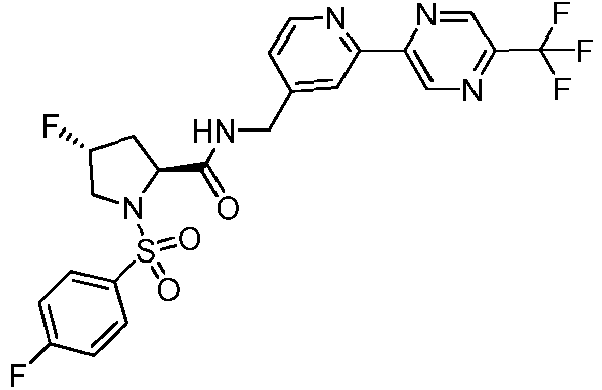
0.290 68 
0.007 69 
0.014 70 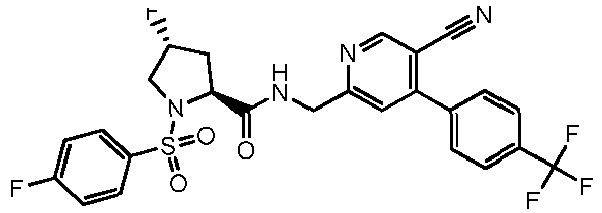
0.023 71 
0.176 72 
0.007 73 
0.129 74 
0.192 75 
0.031 76 
0.039 77 
0.053 78 
0.007 79 
0.009 80 
0.044 81 
0.187 82 
0.189 83 
0.0546 84 
0.014 85 
0.771 86 
0.119 87 
0.103 88 
0.041 89 
0.020 90 
0.062 91 
0.014 92 
0.087 93 
0.014 94 
0.029 95 
0.012 96 
0.162 97 
0.024 98 
0.004 99 
0.428 100 
0.449 101 
0.033 102 
0.066 103 
0.026 104 
0.072 105 
0.128 106 
0.28 107 
0.090 108 
0.256 109 
0.164 110 
0.165 111 
0.007 112 
0.048 113 
0.161 114 
0.026 115 
0.013 116 
0.047 117 
0.224 118 
0.037 119 
0.052 120 
0.049 121 
0.741 122 
0.014 123 
0.156 124 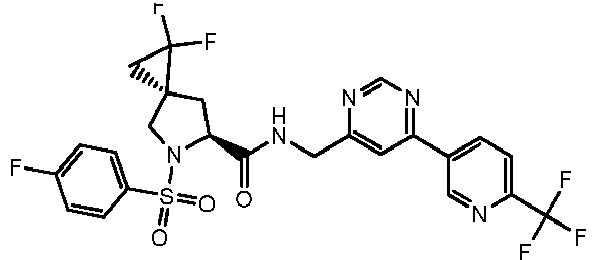
0.113 125 
0.009 126 
0.025 127 
0.097 128 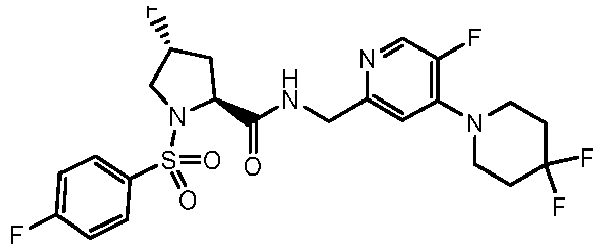
0.404 129 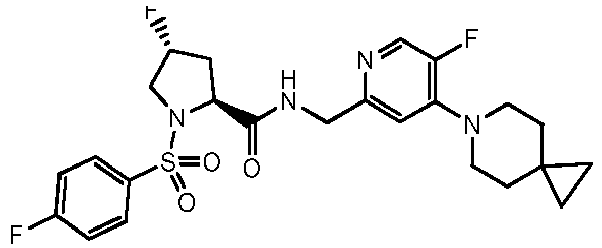
0.099 130 
0.052 131 
0.102 132 
0.126 133 
0.059 134 
0.023 135 
0.011 136 
0.021 137 
0.078 138 
0.025 139 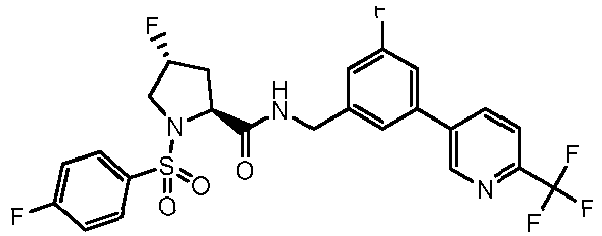
0.016 140 
0.020 141 
0.068 142 
0.092 143 
0.015 144 
0.056 145 
0.021 146 
0.078 147 
0.049 148 
0.046 149 
0.034 150 
0.046 151 
0.161 152 
0.163 153 
0.068 154 
0.097 155 
0.134 156 
0.109 157 
0.103 158 
0.004 159 
0.018 160 
0.086 161 
0.009 162 
0.011 163 
0.043 164 
0.032 165 
0.066 166 
0.013 167 
0.038 168 
0.075 169 
0.116 170 
0.089 171 
0.211 172 
0.038 173 
0.111 174 
0.012 175 
0.086 176 
0.008 177 
0.005 178 
0.175 179 
0.062 180 
0.026 181 
0.010 182 
0.021 183 
0.003 184 
0.010 185 
0.155 186 
0.004 187 
0.006 188 
0.008 189 
0.055 190 
0.052 191 
0.027 192 
0.042 193 
0.015 194 
0.381 195 
0.795 196 
0.134 197 
0.015 198 
0.059 199 
0.138 200 
0.333 201 
0.268
Additional embodiments of the invention are set forth below.
EE16. The compound of the invention, wherein one R3b group is F and the remaining R3b groups are H.
EE17. The compound of the invention, wherein
EE18. The compound of athe invention, wherein B2 is pyridinyl, wherein any pyridinyl of B2 is optionally substituted with one or more groups independently selected from halogen, (C1-C6)alkyl, -O(C1-C6)alkyl, -O(C1-C6)alkyl-O(C1-C6)alkyl, (C3-C7)cycloalkyl, (C1-C6)haloalkyl, -CN, and 6-membered heteroaryl, wherein any 6-membered heteroaryl is optionally substituted with one or more (C1-C6)alkyl or (C1-C6)haloalkyl.
EE19. The compound of the invention, wherein B2 is:

EE37. The compound of the invention, wherein R4 is H.
EE38. The compound of the invention, wherein R1 is a phenyl or thiophenyl, wherein any phenyl or thiophenyl of R1 is optionally substituted with one or more groups independently selected from halogen, -CN, (C1-C6)alkyl and (C1-C6)haloalkyl.
EE39. The compound of the invention, wherein R1 is a phenyl or thiophenyl, wherein any phenyl or thiophenyl of R1 is optionally substituted with one or more groups independently selected from halogen and -CN.
EE40. The compound of any one of the invention, wherein R1 is a phenyl or thiophenyl, wherein any phenyl or thiophenyl of R1 is optionally substituted with one or more groups independently selected from fluoro, chloro and -CN.
EE41. The compound of the invention, wherein R1 is 4-fluorophenyl, 3-fluorophenyl, 4-cyanophenyl, 2-chlorothiophen-5-yl, 3,4,-difluorophenyl or 3-fluoropyridin-5-yl.
EE51. The compound according to the invention, which is:

EE52. The compound in the Table 2 below or a salt or a pharmaceutically acceptable salt thereof are described Compounds with a * are not part of the invention.
| Example Number | Chemical Name via ChemDraw | Structure |
| 38* | (2R,3S)-N-[[2-cyano-5-[2-(trifluoromethyl)pyrimidin-5-yl]phenyl]methyl]-3-fluoro-1-(4-fluorophenyl)sulfonyl-pyrrolidine-2-carboxamide |  |
| 39* | (2S,5R)-1-(4-fluorophenyl)sulfonyl-5-methyl-N-[[6-[6-(trifluoromethyl)-3-pyridyl]pyrimidin-4-yl]methyl]pyrrolidine-2-carboxamide |  |
| 40* | (2S,4S)-4-fluoro-4-(fluoromethyl)-1-(4-fluorophenyl)sulfonyl-N-[[6-[6-(trifluoromethyl)-3-pyridyl]pyrimidin-4-yl]methyl]pyrrolidine-2-carboxamide |  |
| 41* | (2S,5S)-1-(4-fluorophenyl)sulfonyl-5-methyl-N-[[6-[6-(trifluoromethyl)-3-pyridyl]pyrimidin-4-yl]methyl]pyrrolidine-2-carboxamide |  |
| 42* | (2S,4R)-4-fluoro-1-(4-fluorophenyl)sulfonyl-N-[[6-[2-(trifluoromethyl)pyrimidin-5-yl]pyrimidin-4-yl]methyl]pyrrolidine-2-carboxamide |  |
| 43 | (2S,4R)-4-fluoro-1-(4-fluorophenyl)sulfonyl-N-[[2-methyl-6-[2-(trifluoromethyl)pyrimidin-5-yl]-4-pyridyl] methyl]pyrrolidine-2-carboxamide |  |
| 44* | (2S,4R)-4-fluoro-N-[[3-fluoro-5-[2-methoxy-6-(trifluoromethyl)-3-pyridyl]phenyl]methyl]-1-(4-fluorophenyl)sulfonyl-pyrrolidine-2-carboxamide |  |
| 45* | (2S,4R)-4-fluoro-1-(4-fluorophenyl)sulfonyl-N-[[3-fluoro-5-[6-(trifluoromethyl)pyridazin-3-yl]phenyl]methyl]-4-methyl-pyrrolidine-2-carboxamide |  |
| 46* | (2S)-4-fluoro-1-(4-fluorophenyl)sulfonyl-4-methyl-N-[[6-[4-(trifluoromethoxy)phenyl]pyrimidin-4-yl] methyl]pyrrolidine-2-carboxamide |  |
| 47* | (2S,4R)-4-fluoro-1-(4-fluorophenyl)sulfonyl-N-[[3-fluoro-5-[5-(trifluoromethyl)pyrazin-2-yl]phenyl]methyl]-4-methyl-pyrrolidine-2-carboxamide |  |
| 48 | (2S,4R)-4-fluoro-1-(4-fluorophenyl)sulfonyl-N-[[6-methyl-4-[2-(trifluoromethyl)pyrimidin-5-yl]-2-pyridyl] methyl]pyrrolidine-2-carboxamide |  |
| 49* | (2S,4R)-4-fluoro-1-(4-fluorophenyl)sulfonyl-N-[[6-fluoro-4-[5-(trifluoromethyl)-2-pyridyl]-2-pyridyl]methyl]pyrrolidine-2-carboxamide |  |
| 50* | (2S,4R)-N-[[3-cyano-1-[4-(trifluoromethyl)phenyl]pyrazol-4-yl]methyl]-4-fluoro-1-(4-fluorophenyl)sulfonyl-pyrrolidine-2-carboxamide |  |
| 51* | 5-fluoro-2-(4-fluorophenyl)sulfonyl-N-[[6-[6-(trifluoromethyl)-3-pyridyl]pyrimidin-4-yl]methyl]-2-azabicyclo[2.2.1]heptane-3-carboxamide |  |
| 52* | (2S,4R)-4-fluoro-1-(4-fluorophenyl)sulfonyl-N-[[3-fluoro-5-[2-(trifluoromethyl)pyrimidin-5-yl]phenyl]methyl]-4-methyl-pyrrolidine-2-carboxamide |  |
| 53 | (2S,4R)-4-fluoro-1-(4-fluorophenyl)sulfonyl-N-[[4-[2-(trifluoromethyl)pyrimidin-5-yl]-2-pyridyl]methyl]pyrrolidine-2-carboxamide |  |
| 54* | (2S,4R)-4-fluoro-1-(4-fluorophenyl)sulfonyl-N-[[2-fluoro-5-[5-(trifluoromethyl)pyrazin-2-yl]phenyl]methyl]pyrrolidine-2-carboxamide |  |
| 55* | (2R,3S)-N-[[6-[4-(difluoromethyl)phenyl]pyrimidin-4-yl]methyl]-3-fluoro-1-(4-fluorophenyl)sulfonyl-pyrrolidine-2-carboxamide |  |
| 56* | (2S,4R)-4-fluoro-1-(4-fluorophenyl)sulfonyl-N-[[2-fluoro-5-[2-(trifluoromethyl)pyrimidin-5-yl]phenyl]methyl]pyrrolidine-2-carboxamide |  |
| 57* | (2S,4R)-4-fluoro-1-(4-fluorophenyl)sulfonyl-N-[[2-[2-hydroxy-4-(trifluoromethyl)phenyl]-4-pyridyl]methyl]pyrrolidine-2-carboxamide |  |
| 58* | (2S,4R)-4-fluoro-1-(4-fluorophenyl)sulfonyl-N-[[3-methoxy-1-[5-(trifluoromethyl)pyrazin-2-yl]pyrazol-4-yl]methyl]pyrrolidine-2-carboxamide |  |
| 59* | (2S,4R)-N-[[6-[4-(difluoromethyl)-3-fluoro-phenyl]pyrimidin-4-yl]methyl]-4-fluoro-1-(4-fluorophenyl)sulfonyl-pyrrolidine- 2-carboxamide |  |
| 60* | (2S,4R)-N-[[2-chloro-6-[6-(difluoromethyl)-3-pyridyl]-4-pyridyl]methyl]-4-fluoro-1-(4-fluorophenyl)sulfonyl-pyrrolidine-2-carboxamide | 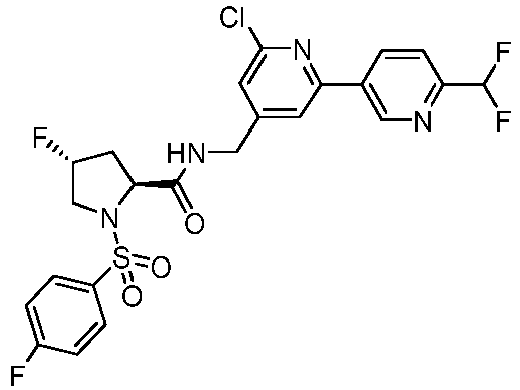 |
| 61 | (2S,4R)-N-[[2,6-bis[2-(trifluoromethyl)pyrimidin-5-yl]-4-pyridyl]methyl]-4-fluoro-1-(4-fluorophenyl)sulfonyl-pyrrolidine-2-carboxamide |  |
| 62 | (2S,4R)-N-[[2-chloro-6-[2-(trifluoromethyl)pyrimidin-5-yl]-4-pyridyl] methyl]-4-fluoro-1-(4-fluorophenyl)sulfonyl-pyrrolidine-2-carboxamide |  |
| 63* | (2S,4R)-N-[[6-[4-(difluoromethyl)phenyl]pyrimidin-4-yl]methyl]-4-fluoro-1-(4-fluorophenyl)sulfonyl-pyrrolidine-2-carboxamide |  |
| 64* | (2S,4R)-N-[[6-[4-(difluoromethoxy)phenyl]pyrimidin-4-yl]methyl]-4-fluoro-1-(4-fluorophenyl)sulfonyl-pyrrolidine-2-carboxamide |  |
| 65* | (2S,4R)-4-fluoro-N-[[5-fluoro-4-[5-fluoro-6-(trifluoromethyl)-3-pyridyl]-2-pyridyl]methyl]-1-(4-fluorophenyl)sulfonyl-pyrrolidine-2-carboxamide |  |
| 66 | (2S,4R)-4-fluoro-1-(4-fluorophenyl)sulfonyl-N-[[5-fluoro-4-[4-(trifluoromethoxy)-1-piperidyl]-2-pyridyl]methyl]pyrrolidine-2-carboxamide |  |
| 67 | (2S,4R)-4-fluoro-1-(4-fluorophenyl)sulfonyl-N-[[2-[5-(trifluoromethyl)pyrazin-2-yl]-4-pyridyl]methyl]pyrrolidine-2-carboxamide |  |
| 68* | (2R,3S)-3-fluoro-1-(4-fluorophenyl)sulfonyl-N-[[3-fluoro-5-[2-(trifluoromethyl)pyrimidin-5-yl]phenyl]methyl]pyrrolidine-2-carboxamide |  |
| 69 | (2S,4R)-N-[[4-(2,2-difluoro-6-azaspiro[2.5]octan-6-yl)-5-fluoro-2-pyridyl]methyl]-4-fluoro-1-(4-fluorophenyl)sulfonyl-pyrrolidine-2-carboxamide |  |
| 70* | (2S,4R)-N-[[5-cyano-4-[4-(trifluoromethyl)phenyl]-2-pyridyl]methyl] -4-fluoro-1-(4-fluorophenyl)sulfonyl-pyrrolidine-2-carboxamide |  |
| 71* | (2S,4R)-N-[[5-cyano-4-[6-(trifluoromethyl)-3-pyridyl]-2-pyridyl]methyl]-4-fluoro-1-(4-fluorophenyl)sulfonyl-pyrrolidine-2-carboxamide |  |
| 72 | (2R,3S)-3-fluoro-1-(4-fluorophenyl)sulfonyl-N-[[4-[5-(trifluoromethyl)-2-pyridyl]-2-pyridyl]methyl]pyrrolidine-2-carboxamide |  |
| 73 | (2S,4R)-4-fluoro-1-(4-fluorophenyl)sulfonyl-N-[[2-[2-(trifluoromethyl)pyrimidin-5-yl]-4-pyridyl]methyl]pyrrolidine-2-carboxamide |  |
| 74* | (2S,4R)-4-fluoro-1-(4-fluorophenyl)sulfonyl-N-[[3-fluoro-5-[5-(trifluoromethyl)-2-piperidyl]phenyl]methyl]pyrrolidine-2-carboxamide |  |
| 75* | (2S,4R)-N-[[3-[5-(difluoromethyl)-2-pyridyl]-5-fluoro-phenyl]methyl]-4-fluoro-1-(4-fluorophenyl)sulfonyl-pyrrolidine-2-carboxamide |  |
| 76* | (2S,4R)-N-[[3-[6-(difluoromethoxy)-3-pyridyl]-5-fluoro-phenyl]methyl]-4-fluoro-1-(4-fluorophenyl)sulfonyl-pyrrolidine-2-carboxamide |  |
| 77* | (2S,4R)-N-[[4-[4-(difluoromethoxy)phenyl]-5-fluoro-2-pyridyl]methyl]-4-fluoro-1-(4-fluorophenyl)sulfonyl-pyrrolidine-2-carboxamide |  |
| 78* | (2S,4R)-N-[[5-cyano-2-[4-(trifluoromethyl)phenyl]-4-pyridyl]methyl]-4-fluoro-1-(4-fluorophenyl)sulfonyl-pyrrolidine-2-carboxamide |  |
| 79* | (2S,4R)-N-[[5-cyano-2-[6-(trifluoromethyl)-3-pyridyl]-4-pyridyl]methyl]-4-fluoro-1-(4-fluorophenyl)sulfonyl-pyrrolidine-2-carboxamide |  |
| 80* | (6S)-5-(4-fluorophenyl)sulfonyl-N-[[6-[6-(trifluoromethyl)-3-pyridyl]pyrimidin-4-yl]methyl]-5-azaspiro[2.4]heptane-6-carboxamide | 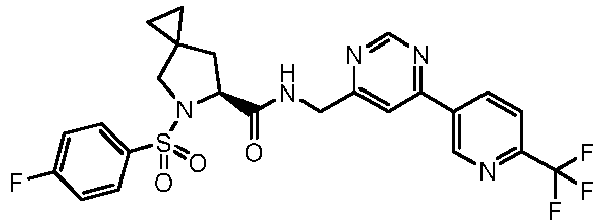 |
| 81* | (2S,4R)-4-fluoro-1-(4-fluorophenyl)sulfonyl-N-[[4-[6-(trifluoromethyl)-3-pyridyl]-2-pyridyl]methyl]pyrrolidine-2-carboxamide |  |
| 82* | (2S,4R)-4-fluoro-1-(4-fluorophenyl)sulfonyl-N-[[4-[5-(trifluoromethyl)pyrazin-2-yl]-2-pyridyl]methyl]pyrrolidine-2-carboxamide |  |
| 83* | (2S,4R)-N-[[2,6-bis[6-(trifluoromethyl)-3-pyridyl]-4-pyridyl]methyl]-4-fluoro-1-(4-fluorophenyl)sulfonyl-pyrrolidine-2-carboxamide |  |
| 84* | (2S,4R)-N-[[2-chloro-6-[6-(trifluoromethyl)-3-pyridyl]-4-pyridyl]methyl]-4-fluoro-1-(4-fluorophenyl)sulfonyl-pyrrolidine-2-carboxamide |  |
| 85* | (2S,4R)-4-fluoro-N-[[3-fluoro-5-[2-oxo-4-(trifluoromethyl)-1-pyridyl]phenyl]methyl]-1-(4-fluorophenyl)sulfonyl-pyrrolidine-2-carboxamide |  |
| 86* | (2S,4R)-4-fluoro-1-(4-fluorophenyl)sulfonyl-N-[[3-fluoro-5-[4-(trifluoromethyl)pyrazol-1-yl]phenyl]methyl]pyrrolidine-2-carboxamide |  |
| 87* | (2S,4R)-4-fluoro-1-(4-fluorophenyl)sulfonyl-N-[[3-fluoro-5-[3-(trifluoromethyl)pyrazol-1-yl]phenyl]methyl]pyrrolidine-2-carboxamide |  |
| 88* | (2S,4R)-N-[[4-[4-(difluoromethyl)phenyl]-5-fluoro-2-pyridyl]methyl]-4-fluoro-1-(4-fluorophenyl)sulfonyl-pyrrolidine-2-carboxamide |  |
| 89* | (2S,4R)-4-fluoro-1-(4-fluorophenyl)sulfonyl-N-[[3-fluoro-5-[6-(trifluoromethyl)pyridazin-3-yl]phenyl]methyl]pyrrolidine-2-carboxamide |  |
| 90* | (2S,4R)-N-[[3-[5-(difluoromethyl)pyrazin-2-yl]-5-fluoro-phenyl] methyl]-4-fluoro-1-(4-fluorophenyl)sulfonyl-pyrrolidine-2-carboxamide |  |
| 91* | (2S,4R)-4-fluoro-1-(4-fluorophenyl)sulfonyl-N-[[3-fluoro-5-[2-(trifluoromethyl)pyrimidin-5-yl]phenyl]methyl]pyrrolidine-2-carboxamide | 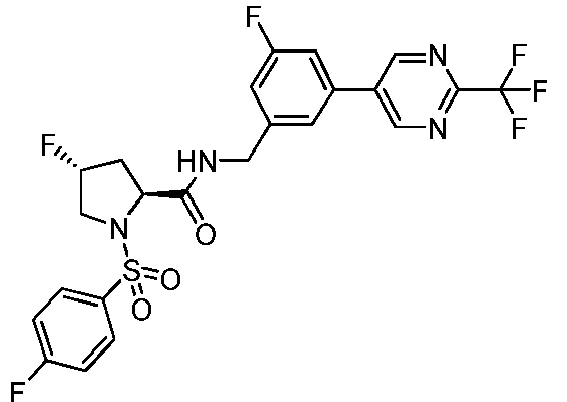 |
| 92* | (2S,4R)-N-[[6-(2,2-difluoro-1,3-benzodioxol-5-yl)pyrimidin-4-yl]methyl]-4-fluoro-1-(4-fluorophenyl)sulfonyl-pyrrolidine-2-carboxamide |  |
| 93* | (2R,3S)-3-fluoro-1-(4-fluorophenyl)sulfonyl-N-[[6-[3-fluoro-4-(trifluoromethyl)phenyl]pyrimidin-4-yl]methyl]pyrrolidine-2-carboxamide |  |
| 94* | (2S,4R)-N-[[3-[6-(difluoromethyl)-3-pyridyl]-5-fluoro-phenyl]methyl]-4-fluoro-1-(4-fluorophenyl)sulfonyl-pyrrolidine-2-carboxamide |  |
| 95* | (2S,4R)-4-fluoro-1-(4-fluorophenyl)sulfonyl-N-[[3-fluoro-5-[5-(trifluoromethyl)-2-pyridyl]phenyl]methyl]pyrrolidine-2-carboxamide |  |
| 96* | (2S,4R)-4-fluoro-1-(4-fluorophenyl)sulfonyl-N-[[5-methyl-4-[6-(trifluoromethyl)-3-pyridyl]-2-pyridyl]methyl]pyrrolidine-2-carboxamide |  |
| 97* | (2R,3S)-3-fluoro-1-(4-fluorophenyl)sulfonyl-N-[[4-fluoro-3-[5-(trifluoromethyl)pyrazin-2-yl]phenyl]methyl]pyrrolidine-2-carboxamide |  |
| 98* | (2R,3S)-3-fluoro-1-(4-fluorophenyl)sulfonyl-N-[[3-fluoro-5-[5-(trifluoromethyl)pyrazin-2-yl]phenyl]methyl]pyrrolidine-2-carboxamide |  |
| 99* | (2S,3aS,6aR)-1-(4-fluorophenyl)sulfonyl-N-[[6-[4-(trifluoromethyl)phenyl]pyrimidin-4-yl]methyl]-2,3,3a,4,6,6a-hexahydrofuro[3,4-b]pyrrole-2-carboxamide |  |
| 100* | (2S,3aR,6aS)-1-(4-fluorophenyl)sulfonyl-N-[[6-[4-(trifluoromethyl)phenyl]pyrimidin-4-yl]methyl]-2,3,3a,4,6,6a-hexahydrofuro[3,4-b]pyrrole-2-carboxamide |  |
| 101* | (2S,4R)-N-[[5-chloro-4-[6-(trifluoromethyl)-3-pyridyl] -2-pyridyl]methyl]-4-fluoro-1-(4-fluorophenyl)sulfonyl-pyrrolidine-2-carboxamide |  |
| 102 | (2S,4R)-4-fluoro-1-(4-fluorophenyl)sulfonyl-N-[[5-fluoro-4-[5-(trifluoromethyl)pyrazin-2-yl]-2-pyridyl]methyl]pyrrolidine-2-carboxamide |  |
| 103* | (2R,3S)-3-fluoro-1-(4-fluorophenyl)sulfonyl-N-[[3-methoxy-1-[6-(trifluoromethyl)-3-pyridyl]pyrazol-4-yl]methyl]pyrrolidine-2-carboxamide |  |
| 104* | (2S,4R)-4-fluoro-1-(4-fluorophenyl)sulfonyl-N-[[6-[3-fluoro-4-(trifluoromethoxy)phenyl]pyrimidin-4-yl]methyl]pyrrolidine-2-carboxamide |  |
| 105* | (2S,4R)-4-fluoro-1-(4-fluorophenyl)sulfonyl-N-[[2-(methylamino)-6-[4-(trifluoromethyl)phenyl]pyrimidin-4-yl]methyl]pyrrolidine-2-carboxamide |  |
| 106* | (2S,3R,4R)-4-fluoro-1-(4-fluorophenyl)sulfonyl-3-methyl-N-[[6-[6-(trifluoromethyl)-3-pyridyl]pyrimidin-4-yl]methyl]pyrrolidine-2-carboxamide |  |
| 107* | (2S,4R)-4-fluoro-1-(4-fluorophenyl)sulfonyl-4-methyl-N-[[6-[6-(trifluoromethyl)-3-pyridyl]pyrimidin-4-yl]methyl]pyrrolidine-2-carboxamide |  |
| 108* | (2S,4R)-4-fluoro-1-(4-fluorophenyl)sulfonyl-N-[[5-methoxy-4-[6-(trifluoromethyl)-3-pyridyl]-2-pyridyl]methyl]pyrrolidine-2-carboxamide |  |
| 109* | (2S,4R)-4-fluoro-1-(4-fluorophenyl)sulfonyl-N-[[5-methoxy-4-[6-(trifluoromethyl)-3-pyridyl]-2-pyridyl]methyl]-2-methyl-pyrrolidine-2-carboxamide |  |
| 110* | (2S,4R)-4-cyano-1-(4-fluorophenyl)sulfonyl-N-[[3-methoxy-1-[4-(trifluoromethyl)phenyl]pyrazol-4-yl]methyl]pyrrolidine-2-carboxamide |  |
| 111* | (2R,3S)-3-fluoro-1-(4-fluorophenyl)sulfonyl-N-[[6-[4-(trifluoromethoxy)phenyl]pyrimi din-4-yl]methyl]pyrrolidine-2-carboxamide |  |
| 112* | (2S,4R)-N-[[3-cyano-5-[6-(trifluoromethyl)-3-pyridyl]phenyl]methyl]-4-fluoro-1-(4-fluorophenyl)sulfonyl-pyrrolidine-2-carboxamide | 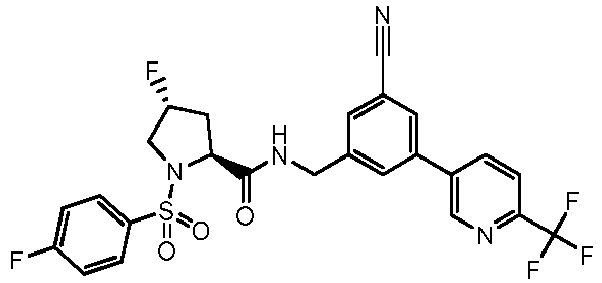 |
| 113* | (2S,4R)-4-fluoro-1-(4-fluorophenyl)sulfonyl-N-[[6-[2-fluoro-4-(trifluoromethyl)phenyl]pyrimidin-4-yl]methyl]pyrrolidine-2-carboxamide |  |
| 114* | (2S,4R)-4-fluoro-1-(4-fluorophenyl)sulfonyl-N-[[6-[3-fluoro-4-(trifluoromethyl)phenyl]pyrimidin-4-yl]methyl]pyrrolidine-2-carboxamide |  |
| 115* | (2R,3S)-3-fluoro-1-(4-fluorophenyl)sulfonyl-N-[[5-fluoro-4-[6-(trifluoromethyl)-3-pyridyl]-2-pyridyl]methyl]pyrrolidine-2-carboxamide |  |
| 116* | (2S,4R)-4-fluoro-1-(4-fluorophenyl)sulfonyl-N-[[3-methoxy-5-[6-(trifluoromethyl)-3-pyridyl]phenyl]methyl]pyrrolidine-2-carboxamide |  |
| 117* | (2S,4R)-N-[[3,5-difluoro-4-[6-(trifluoromethyl)-3-pyridyl]-2-pyridyl]methyl]-4-fluoro-1-(4-fluorophenyl)sulfonyl-pyrrolidine-2-carboxamide |  |
| 118* | (2S,4R)-4-fluoro-1-(4-fluorophenyl)sulfonyl-N-[[6-methoxy-4-[6-(trifluoromethyl)-3-pyridyl]-2-pyridyl]methyl]pyrrolidine-2-carboxamide |  |
| 119* | (2S,4R)-4-fluoro-1-(4-fluorophenyl) sulfonyl-N-[[2-fluoro-6-[6-(trifluoromethyl)-3-pyridyl]-4-pyridyl]methyl]pyrrolidine-2-carboxamide |  |
| 120* | (2S,4R)-4-fluoro-1-(4-fluorophenyl)sulfonyl-N-[[6-fluoro-4-[6-(trifluoromethyl)-3-pyridyl]-2-pyridyl]methyl]pyrrolidine-2-carboxamide |  |
| 121 | (2S,4R)-4-fluoro-1-(4-fluorophenyl)sulfonyl-N-[[5-fluoro-4-[3-(trifluoromethyl)-8-azabicyclo[3.2.1]octan-8-yl]-2-pyridyl]methyl]pyrrolidine-2-carboxamide |  |
| 122* | (2S,4R)-4-fluoro-1-(4-fluorophenyl)sulfonyl-N-[[3-fluoro-5-[5-(trifluoromethyl)pyrazin-2-yl]phenyl]methyl]pyrrolidine-2-carboxamide |  |
| 123* | (1R,3S,5R)-2-(4-fluorophenyl)sulfonyl-N-[[6-[6-(trifluoromethyl)-3-pyridyl]pyrimidin-4-yl]methyl]-2-azabicyclo[3.1.0]hexane-3-carboxamide |  |
| 124* | (3R,6S)-2,2-difluoro-5-(4-fluorophenyl)sulfonyl-N-[[6-[6-(trifluoromethyl)-3-pyridyl]pyrimidin-4-yl]methyl]-5-azaspiro[2.4]heptane-6-carboxamide |  |
| 125* | (2S,4R)-4-fluoro-1-(4-fluorophenyl)sulfonyl-N-[[3-methoxy-1-[6-(trifluoromethyl)-3-pyridyl]pyrazol-4-yl]methyl]-2-methyl-pyrrolidine-2-carboxamide |  |
| 126* | (2S,4R)-4-fluoro-1-(4-fluorophenyl)sulfonyl-N-[[5-fluoro-4-[6-(trifluoromethyl)-3-pyridyl]-2-pyridyl]methyl]-2-methyl-pyrrolidine- 2-carboxamide |  |
| 127* | (2S,4R)-4-fluoro-1-(4-fluorophenyl)sulfonyl-N-[[2-methoxy-6-[6-(trifluoromethyl)-3-pyridyl]pyrimidin-4-yl]methyl]pyrrolidine-2-carboxamide |  |
| 128 | (2S,4R)-N-[[4-(4,4-difluoro-1-piperidyl)-5-fluoro-2-pyridyl]methyl] -4-fluoro-1-(4-fluorophenyl)sulfonyl-pyrrolidine-2-carboxamide |  |
| 129 | (2S,4R)-N-[[4-(6-azaspiro[2.5]octan-6-yl)-5-fluoro-2-pyridyl]methyl]-4-fluoro-1-(4-fluorophenyl)sulfonyl-pyrrolidine-2-carboxamide |  |
| 130 | (2S,4R)-4-fluoro-1-(4-fluorophenyl)sulfonyl-N-[[5-(trifluoromethyl)-4-[4-(trifluoromethyl)-1-piperidyl]-2-pyridyl] methyl]pyrrolidine-2-carboxamide |  |
| 131* | (2S,4R)-4-fluoro-1-(4-fluorophenyl)sulfonyl-N-[[4-[5-(trifluoromethyl)-2-pyridyl]-2-pyridyl] methyl]pyrrolidine-2-carboxamide |  |
| 132* | (2S,4R)-4-fluoro-1-(4-fluorophenyl)sulfonyl-N-[[3-methoxy-1-[2-(trifluoromethyl)pyrimidin-5-yl]pyrazol-4-yl]methyl]pyrrolidine-2-carboxamide | 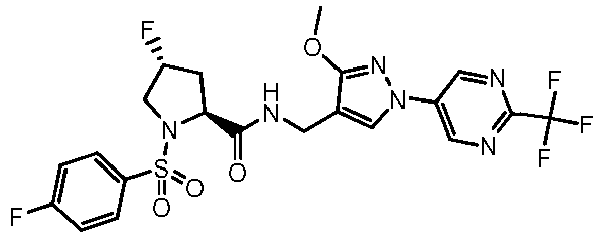 |
| 133* | (2S,4R)-N-[[6-[4-(difluoromethyl)-1-bicyclo[2.2.2]octanyl]pyrimidin-4-yl]methyl]-4-fluoro-1-(4-fluorophenyl)sulfonyl-pyrrolidine-2-carboxamide |  |
| 134* | (2S,4R)-4-fluoro-1-(3-fluorophenyl)sulfonyl-N-[[3-methoxy-1-[4-(trifluoromethyl)phenyl]pyrazol-4-yl]methyl]pyrrolidine-2-carboxamide |  |
| 135* | (2S,4R)-4-fluoro-1-(4-fluorophenyl)sulfonyl-N-[[3-methoxy-1-[4-(trifluoromethyl)phenyl]pyrazol-4-yl]methyl]pyrrolidine-2-carboxamide | 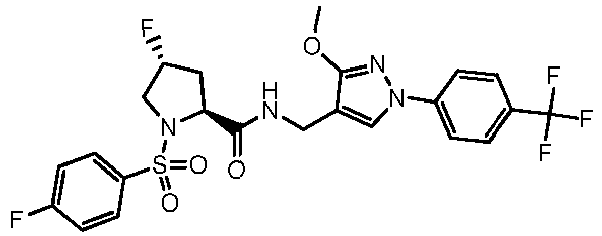 |
| 136* | (2R,3S)-3-fluoro-1-(4-fluorophenyl)sulfonyl-N-[[6-[6-(trifluoromethyl)-3-pyridyl]pyrimidin-4-yl]methyl]pyrrolidine-2-carboxamide |  |
| 137* | (2S,4R)-N-[[3-chloro-1-[4-(trifluoromethyl)phenyl] pyrazol-4-yl]methyl]-4-fluoro-1-(4-fluorophenyl)sulfonyl-pyrrolidine-2-carboxamide |  |
| 138* | (2S,4R)-4-fluoro-1-(4-fluorophenyl)sulfonyl-2-methyl-N-[[6-[4-(trifluoromethyl)phenyl]pyrimidin-4-yl]methyl]pyrrolidine-2-carboxamide |  |
| 139* | (2S,4R)-4-fluoro-1-(4-fluorophenyl)sulfonyl-N-[[3-fluoro-5-[6-(trifluoromethyl)-3-pyridyl]phenyl]methyl]pyrrolidine-2-carboxamide |  |
| 140* | (2S,4R)-4-fluoro-1-(4-fluorophenyl)sulfonyl-N-[[5-fluoro-4-[6-(trifluoromethyl)-3-pyridyl]-2-pyridyl]methyl]pyrrolidine-2-carboxamide |  |
| 141* | (2S,4R)-4-fluoro-1-(4-fluorophenyl)sulfonyl-N-[[5-fluoro-2-[6-(trifluoromethyl)-3-pyridyl]-4-pyridyl]methyl]pyrrolidine-2-carboxamide |  |
| 142* | (2S,4R)-4-fluoro-1-(4-fluorophenyl) sulfonyl-2-methyl-N-[[6-[6-(trifluoromethyl)-3-pyridyl]pyrimidin-4-yl]methyl]pyrrolidine-2-carboxamide |  |
| 143* | (2S,4R)-4-fluoro-1-(4-fluorophenyl)sulfonyl-N-[[6-[4-(trifluoromethyl)phenyl]pyrimidin-4-yl]methyl]pyrrolidine-2-carboxamide |  |
| 144 | (2S,4R)-4-fluoro-1-(4-fluorophenyl)sulfonyl-N-[[5-fluoro-4-[4-(trifluoromethyl)-1-piperidyl]-2-pyridyl]methyl]pyrrolidine-2-carboxamide |  |
| 145* | (2S,4R)-4-fluoro-1-(4-fluorophenyl)sulfonyl-N-[[6-[4-(trifluoromethoxy)phenyl]pyrimidin-4-yl]methyl]pyrrolidine-2-carboxamide |  |
| 146* | (2S,4R)-N-[[3-chloro-1-[6-(trifluoromethyl)-3-pyridyl]pyrazol-4-yl]methyl]-4-fluoro-1-(4-fluorophenyl)sulfonyl-pyrrolidine-2-carboxamide |  |
| 147* | (2S,4R)-4-fluoro-1-(4-fluorophenyl)sulfonyl-N-[[6-[4-(trifluoromethylsulfanyl)phenyl]pyrimidin-4-yl]methyl]pyrrolidine-2-carboxamide |  |
| 148* | (2S,4R)-4-fluoro-1-(4-fluorophenyl)sulfonyl-N-[[6-[4-(trifluoromethyl)cyclohexen-1-yl]pyrimidin-4-yl]methyl]pyrrolidine-2-carboxamide |  |
| 149* | (2S,4R)-4-fluoro-1-(4-fluorophenyl)sulfonyl-N-[[6-[4-(trifluoromethyl)cyclohexyl]pyrimidin-4-yl]methyl]pyrrolidine-2-carboxamide |  |
| 150* | (2S,4R)-1-(3,4-difluorophenyl)sulfonyl-4-fluoro-N-[[6-[4-(trifluoromethyl)phenyl]pyrimidin-4-yl]methyl]pyrrolidine-2-carboxamide |  |
| 151* | (2S,4R)-N-[[3-cyclopropyl-1-[6-(trifluoromethyl)-3-pyridyl]pyrazol-4-yl]methyl]-4-fluoro-1-(4-fluorophenyl)sulfonyl-pyrrolidine-2-carboxamide |  |
| 152* | (2S,4R)-4-fluoro-1-(4-fluorophenyl)sulfonyl-N-[[2-methyl-6-[6-(trifluoromethyl)-3-pyridyl]pyrimidin-4-yl]methyl]pyrrolidine-2-carboxamide |  |
| 153* | (2S,4R)-4-fluoro-1-(4-fluorophenyl)sulfonyl-N-[[3-methoxy-1-[6-(trifluoromethyl)-3-pyridyl]pyrazol-4-yl]methyl]pyrrolidine-2-carboxamide |  |
| 154* | (2S,4R)-4-fluoro-1-(4-fluorophenyl)sulfonyl-N-[[6-[6-(trifluoromethyl)-3-pyridyl]pyrimidin-4-yl]methyl]pyrrolidine-2-carboxamide |  |
| 155* | (2S,4R)-N-[[6-(4-cyclopropylphenyl)pyrimidin-4-yl]methyl]-4-fluoro-1-(4-fluorophenyl)sulfonyl-pyrrolidine-2-carboxamide |  |
| 156* | (2S,4R)-1-(3,4-difluorophenyl)sulfonyl-4-fluoro-N-[[6-[6-(trifluoromethyl)-3-pyridyl]pyrimidin-4-yl]methyl]pyrrolidine-2-carboxamide |  |
| 157 | (2R,3S)-3-fluoro-1-(4-fluorophenyl)sulfonyl-N-[[4-[2-(trifluoromethyl)pyrimidin-5-yl]-2-pyridyl]methyl]pyrrolidine-2-carboxamide |  |
| 158* | (2S,4R)-N-[[2-chloro-5-[2-(trifluoromethyl)pyrimidin-5-yl]phenyl]methyl]-4-fluoro-1-(4-fluorophenyl)sulfonyl-pyrrolidine-2-carboxamide |  |
| 159* | (2S,4R)-4-fluoro-1-(4-fluorophenyl)sulfonyl-N-[[2-[4-(trifluoromethoxy)phenyl]-4-pyridyl] methyl]pyrrolidine-2-carboxamide |  |
| 160* | (2S,4R)-N-[[2-[4-(difluoromethoxy)phenyl]-4-pyridyl]methyl]-4-fluoro-1-(4-fluorophenyl)sulfonyl-pyrrolidine-2-carboxamide |  |
| 161* | (2S,4R)-4-fluoro-1-(4-fluorophenyl)sulfonyl-N-[[2-fluoro-5-[6-(trifluoromethyl)-3-pyridyl]phenyl]methyl]pyrrolidine-2-carboxamide |  |
| 162* | (2S,4R)-4-fluoro-1-(4-fluorophenyl)sulfonyl-N-[[2-fluoro-5-[5-(trifluoromethyl)-2-pyridyl]phenyl]methyl]pyrrolidi ne-2-carboxamide |  |
| 163* | (2S,4R)-4-fluoro-1-(4-fluorophenyl) sulfonyl-N-[[2-fluoro-5-[6-(trifluoromethyl)pyridazin-3-yl]phenyl]methyl]pyrrolidine-2-carboxamide |  |
| 164* | (2S,4R)-N-[[2-cyano-5-[2-(trifluoromethyl)pyrimidin-5-yl]phenyl]methyl]-4-fluoro-1-(4-fluorophenyl)sulfonyl-pyrrolidine-2-carboxamide |  |
| 165* | (2S,4R)-N-[[2-chloro-6-[4-(difluoromethoxy)phenyl] -4-pyridyl]methyl]-4-fluoro-1-(4-fluorophenyl)sulfonyl-pyrrolidine-2-carboxamide |  |
| 166* | (2R,3S)-N-[[5-cyano-2-[6-(trifluoromethyl)-3-pyridyl]-4-pyridyl]methyl]-3-fluoro-1-(4-fluorophenyl)sulfonyl-pyrrolidine-2-carboxamide |  |
| 167 | (2S,4R)-4-fluoro-1-(4-fluorophenyl)sulfonyl-N-[[5-fluoro-4-[2-(trifluoromethyl)pyrimidin-5-yl]-2-pyridyl] methyl]pyrrolidine-2-carboxamide |  |
| 168 | (2R,3S)-3-fluoro-1-(4-fluorophenyl)sulfonyl-N-[[2-[2-(trifluoromethyl)pyrimidin-5-yl]-4-pyridyl]methyl]pyrrolidine-2-carboxamide |  |
| 169 | (2S,4R)-4-fluoro-1-(4-fluorophenyl)sulfonyl-N-[[5-methyl-2-[2-(trifluoromethyl)pyrimidin-5-yl]-4-pyridyl] methyl]pyrrolidine-2-carboxamide | 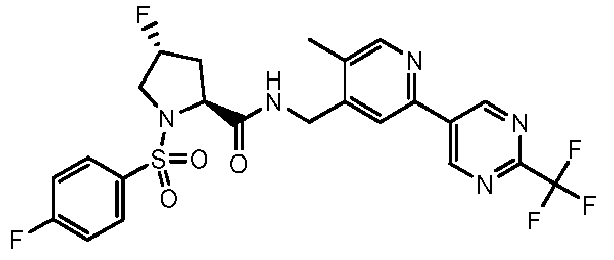 |
| 170* | (2S,4R)-4-fluoro-1-(4-fluorophenyl)sulfonyl-N-[[6-(2-methoxyethoxy)-4-[6-(trifluoromethyl)-3-pyridyl] -2-pyridyl]methyl]pyrrolidine-2-carboxamide |  |
| 171 | (2S,4R)-4-fluoro-1-(4-fluorophenyl)sulfonyl-N-[[2-fluoro-5-[2-(trifluoromethyl)pyrimidin-5-yl]-3-pyridyl]methyl]pyrrolidine-2-carboxamide |  |
| 172 | (1R,4S,5S)-3-(4-fluorophenyl)sulfonyl-N-[[2-[2-(trifluoromethyl)pyrimidin-5-yl]-4-pyridyl]methyl]-3-azabicyclo[3.1.0]hexane-4-carboxamide |  |
| 173* | (2S,4R)-4-fluoro-1-(4-fluorophenyl)sulfonyl-N-[[3-fluoro-5-[2-(trifluoromethyl)thiazol-4-yl]phenyl]methyl]pyrrolidine-2-carboxamide | 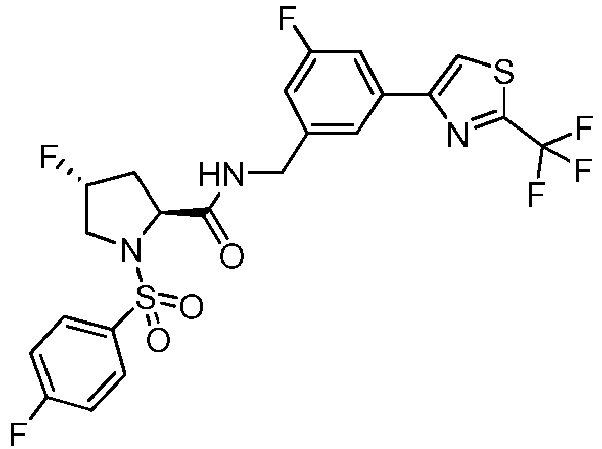 |
| 174* | (2S,4R)-4-fluoro-1-(4-fluorophenyl)sulfonyl-N-[[3-fluoro-5-[2-(trifluoromethyl)thiazol-5-yl]phenyl]methyl]pyrrolidine-2-carboxamide | 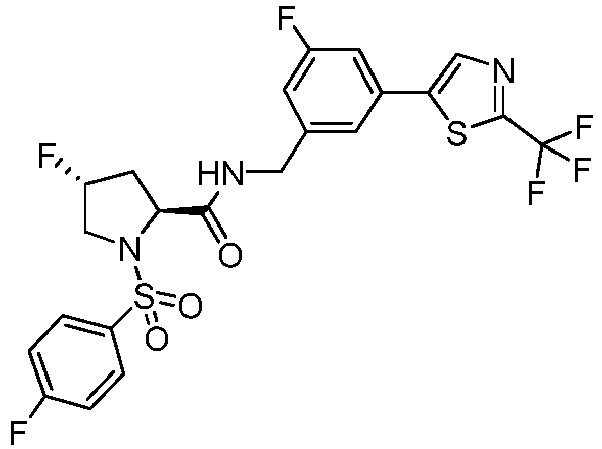 |
| 175* | (2S,4R)-4-fluoro-1-(4-fluorophenyl)sulfonyl-N-[[3-fluoro-5-[4-(trifluoromethyl)thiazol-2-yl]phenyl]methyl]pyrrolidine-2-carboxamide |  |
| 176* | (1S,2S,5R)-N-[[2-cyano-5-[2-(trifluoromethyl)pyrimidin-5-yl]phenyl]methyl]-3-(4-fluorophenyl)sulfonyl-3-azabicyclo[3.1.0]hexane-2-carboxamide |  |
| 177* | (2S,4R)-4-fluoro-1-(4-fluorophenyl)sulfonyl-N-[[2-fluoro-5-[4-(trifluoromethyl)phenyl]phenyl]methyl]pyrrolidine- 2-carboxamide |  |
| 178* | (2S,4R)-N-[[2-[2-amino-6-(trifluoromethyl)-3-pyridyl]-4-pyridyl]methyl]-4-fluoro-1-(4-fluorophenyl)sulfonyl-pyrrolidine-2-carboxamide |  |
| 179* | (2S,4R)-4-fluoro-1-(4-fluorophenyl) sulfonyl-N-[[2-[2-(methylamino)-6-(trifluoromethyl)-3-pyridyl]-4-pyridyl]methyl]pyrrolidine-2-carboxamide |  |
| 180 | (2S,4R)-4-fluoro-1-(4-fluorophenyl)sulfonyl-N-[[5-fluoro-2-[2-(trifluoromethyl)pyrimidin-5-yl]-4-pyridyl]methyl]pyrrolidine-2-carboxamide |  |
| 181* | (1R,5S)-4-(4-fluorophenyl)sulfonyl-N-[[3-fluoro-5-[2-(trifluoromethyl)pyrimidin-5-yl]phenyl]methyl]-4-azabicyclo[3.1.0]hexane-5-carboxamide |  |
| 182* | (1R,5S)-4-(4-fluorophenyl)sulfonyl-N-[[2-fluoro-5-[2-(trifluoromethyl)pyrimidin-5-yl]phenyl]methyl]-4-azabicyclo[3.1.0]hexane-5-carboxamide |  |
| 183* | (1S,2S,5R)-3-(4-fluorophenyl)sulfonyl-N-[[2-fluoro-5-[2-(trifluoromethyl)pyrimidin-5-yl]phenyl]methyl]-3-azabicyclo[3.1.0]hexane-2-carboxamide |  |
| 184 | (2S,4R)-N-[[5-chloro-2-[2-(trifluoromethyl)pyrimidin-5-yl]-4-pyridyl]methyl]-4-fluoro-1-(4-fluorophenyl)sulfonyl-pyrrolidine-2-carboxamide |  |
| 185* | 5-fluoro-2-(4-fluorophenyl)sulfonyl-N-[[5-fluoro-2-[2-(trifluoromethyl)pyrimidin-5-yl]-4-pyridyl]methyl]-2-azabicyclo[2.2.1]heptane-3-carboxamide |  |
| 186 | (2S,5S)-1-(4-fluorophenyl) sulfonyl-5 -methyl-N-[[2-[2-(trifluoromethyl)pyrimidin-5-yl]-4-pyridyl]methyl]pyrrolidine-2-carboxamide | 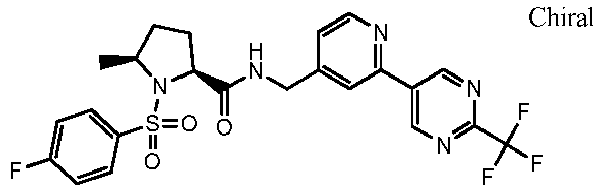 |
| 187* | (2S,4R)-4-fluoro-1-(4-fluorophenyl)sulfonyl-N-[[2-fluoro-5-[2-(trifluoromethyl)pyrimidin-5-yl]phenyl]methyl]-4-methyl-pyrrolidine-2-carboxamide |  |
| 188 | (2S,4R)-4-fluoro-1-(4-fluorophenyl)sulfonyl-N-[[2-methoxy-6-[2-(trifluoromethyl)pyrimidin-5-yl]-4-pyridyl]methyl]pyrrolidine-2-carboxamide | 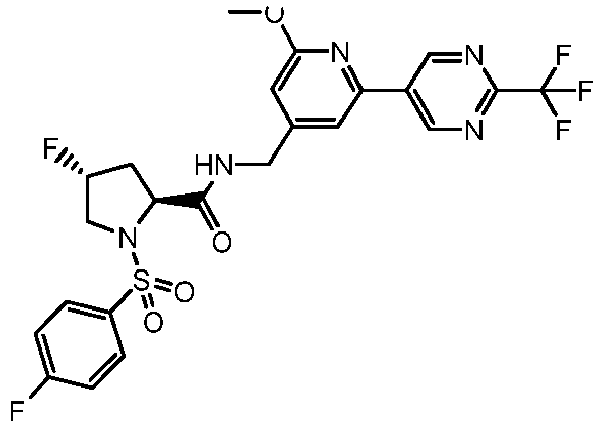 |
| 189 | (2S,4R)-N-[[5-cyano-2-[2-(trifluoromethyl)pyrimidin-5-yl]-4-pyridyl]methyl]-4-fluoro-1-(4-fluorophenyl)sulfonyl-pyrrolidine-2-carboxamide |  |
| 190* | (2S,4R)-4-fluoro-N-[[3-fluoro-5-[2-(2-methoxyethoxy)-6-(trifluoromethyl)-3-pyridyl]phenyl]methyl]-1-(4-fluorophenyl)sulfonyl-pyrrolidine-2-carboxamide |  |
| 191 | (2R,3S)-3-fluoro-1-(4-fluorophenyl)sulfonyl-N-[[6-methyl-4-[2-(trifluoromethyl)pyrimidin-5-yl]-2-pyridyl] methyl]pyrrolidine-2-carboxamide |  |
| 192 | (2S,4R)-N-[[5-chloro-4-[2-(trifluoromethyl)pyrimidin-5-yl]-2-pyridyl]methyl]-4-fluoro-1-(4-fluorophenyl)sulfonyl-pyrrolidine-2-carboxamide |  |
| 193 | (2S,4R,5S)-4-fluoro-1-(4-fluorophenyl)sulfonyl-5-methyl-N-[[2-[2-(trifluoromethyl)pyrimidin-5-yl]-4-pyridyl]methyl]pyrrolidine-2-carboxamide |  |
| 194* | (2S)-1-(4-fluorophenyl)sulfonyl-5,5-dimethyl-N-[[6-[6-(trifluoromethyl)-3-pyridyl]pyrimidin-4-yl]methyl]pyrrolidine-2-carboxamide |  |
| 195 | (2S,4R)-4-fluoro-1-(4-fluorophenyl)sulfonyl-N-[[5-[2-(trifluoromethyl)pyrimidin-5-yl]-3-pyridyl]methyl]pyrrolidine-2-carboxamide |  |
| 196 | (2S,4R)-4-fluoro-1-(4-fluorophenyl)sulfonyl-N-[[5-methoxy-2-[2-(trifluoromethyl)pyrimidin-5-yl]-4-pyridyl] methyl]pyrrolidine-2-carboxamide |  |
| 197* | (2S)-N-[[3-chloro-1-[4-(trifluoromethyl)phenyl]pyrazol-4-yl]methyl]-1-(4-fluorophenyl)sulfonyl-azetidine-2-carboxamide |  |
| 198* | (2S)-1-(4-fluorophenyl)sulfonyl-2-methyl-N-[[6-[6-(trifluoromethyl)-3-pyridyl]pyrimidin-4-yl]methyl]azetidine-2-carboxamide |  |
| 199* | (2S)-N-[[3-chloro-1-[6-(trifluoromethyl)-3-pyridyl]pyrazol-4-yl]methyl]-1-(4-fluorophenyl)sulfonyl-azetidine-2-carboxamide |  |
| 200* | (2S,4R)-1-(4-fluorophenyl)sulfonyl-4-methyl-N-[[6-[6-(trifluoromethyl)-3-pyridyl]pyrimidin-4-yl]methyl]azetidine-2-carboxamide |  |
| 201* | (2S)-1-(4-fluorophenyl)sulfonyl-N-[[6-[6-(trifluoromethyl)-3-pyridyl]pyrimidin-4-yl]methyl]azetidine-2-carboxamide |  |
EE53. A compound of the invention
wherein:
EE54. A compound of the invention wherein:
EE55. A compound of the invention wherein:
EE56. A compound of the invention
wherein:
EE57. A compound of the invention
wherein:
EE58. A compound of the invention
wherein:
EE59. A compound of the invention
wherein:
EE60. A compound of the invention
wherein:
EE61. A compound of the invention
wherein:
Claims (28)
- A compound of formula II:
 (2) A is
 B2 is a pyridinyl, wherein any pyridinyl of B2 is optionally substituted with one or more groups independently selected from halogen, (C1-C6)alkyl, -O(C1-C6)alkyl, -O(C1-C6)alkyl-O(C1-C6)alkyl, (C3-C7)cycloalkyl, (C1-C6)haloalkyl, -CN, and 6-membered heteroaryl, wherein any 6-membered heteroaryl is optionally substituted with one or more (C1-C6)alkyl or (C1-C6)haloalkyl;R1 is a phenyl, 5-membered heteroaryl or 6-membered heteroaryl, wherein any phenyl, 5-membered heteroaryl or 6-membered heteroaryl of R1 is optionally substituted with one or more groups independently selected from halogen, -CN, (C1-C6)alkyl and (C1-C6)haloalkyl;one R3b group is halogen, -CN, or (C1-C6)alkyl and the remaining R3b groups are independently selected from H, (C1-C6)alkyl and (C1-C6)haloalkyl;R4 is H, (C1-C6)alkyl or (C1-C6)haloalkyl;R5b isor a salt thereof.


- The compound of claim 1, wherein one R3b group is F and the remaining R3b groups are H.
- The compound of any one of claims 1-2, wherein(1) the A group

- The compound of any one of claims 1-3, wherein B2 is pyridinyl, wherein any pyridinyl of B2 is optionally substituted with one or more groups independently selected from halogen, (C1-C6)alkyl, -O(C1-C6)alkyl, -O(C1-C6)alkyl-O(C1-C6)alkyl, (C1-C6)haloalkyl, -CN, and 6-membered heteroaryl, wherein any 6-membered heteroaryl is optionally substituted with one or more (C1-C6)alkyl or (C1-C6)haloalkyl.
- The compound of any one of claims 1-4, wherein B2 is:

- The compound of any one of claims 1-5, wherein R4 is H.
- The compound of any one of claims 1-6, wherein R1 is a phenyl or thiophenyl, wherein any phenyl or thiophenyl of R1 is optionally substituted with one or more groups independently selected from halogen, -CN, (C1-C6)alkyl and (C1-C6)haloalkyl.
- The compound of any one of claims 1-7, wherein R1 is a phenyl or thiophenyl, wherein any phenyl or thiophenyl of R1 is optionally substituted with one or more groups independently selected from halogen and -CN.
- The compound of any one of claims 1-8, wherein R1 is a phenyl or thiophenyl, wherein any phenyl or thiophenyl of R1 is optionally substituted with one or more groups independently selected from fluoro, chloro and -CN.
- The compound of any one of claims 1-9, wherein R1 is 4-fluorophenyl, 3-fluorophenyl, 4-cyanophenyl, 2-chlorothiophen-5-yl, 3,4,-difluorophenyl or 3-fluoropyridin-5-yl.
- The compound according to claim 1, which is:

- The compound according to claim 1, which is:

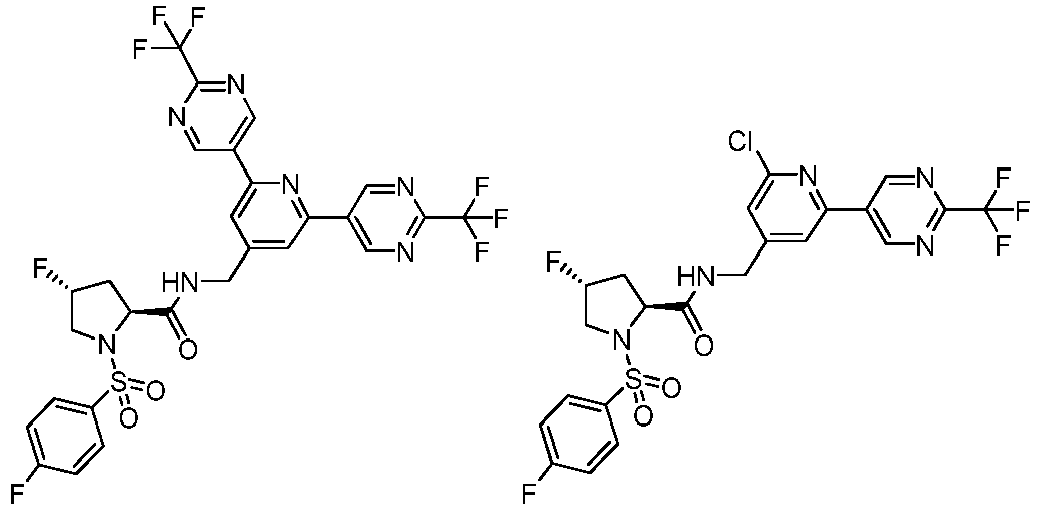


- The compound of claim 1, wherein(1) the A group


- The compound of claim 1, wherein(1) the A group


- The compound of claim 1, wherein(1) the A group


- The compound of claim 1, wherein(1) the A group


- The compound of claim 1, wherein(1) the A group


- The compound of claim 1, wherein(1) the A group


- The compound of claim 1, wherein(1) the A group

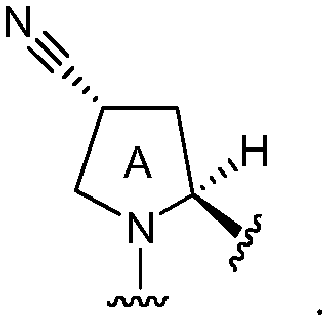
- The compound of claim 1, wherein(1) the A group


- The compound of claim 1, wherein:(1) the A group
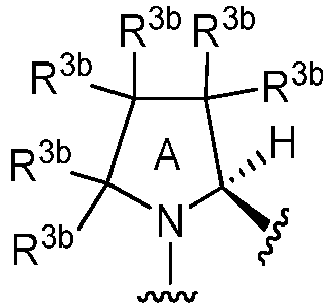

- The compound of any one of claims 13-21, wherein:R1 is a phenyl or thiophenyl, wherein any phenyl or thiophenyl of R1 is optionally substituted with one or more groups independently selected from fluoro, chloro and -CN; andR4 is H.
- A pharmaceutical composition, comprising a compound of Formula II as described in any one of claims 1-22 or a pharmaceutically acceptable salt thereof, and a pharmaceutically acceptable carrier, diluent or excipient.
- A compound of Formula II as described in any one of claims 1-22 or a pharmaceutically acceptable salt thereof for use in medical therapy.
- A compound of Formula II as described in any one of claims 1-22 or a pharmaceutically acceptable salt thereof for use in the treatment or prophylaxis of a respiratory disorder.
- A compound of Formula II as described in any one of claims 1-22 or a pharmaceutically acceptable salt thereof for use in modulating TRPA1 activity.
- A compound of Formula II as described in any one of claims 1-22 or a pharmaceutically acceptable salt thereof for use in the treatment or prophylaxis of a disease or condition mediated by TRPA1 activity.
- The compound for use of claim 27 wherein the disease or condition is pain, itch, an inflammatory disorder, an inner ear disorder, fever or another disorder of thermoregulation, tracheobronchial or diaphragmatic dysfunction, a gastrointestinal or urinary tract disorder, chronic obstructive pulmonary disease, incontinence, or a disorder associated with reduced blood flow to the CNS or CNS hypoxia, in particular pain, arthritis, itch, cough, asthma, inflammatory bowel disease, or an inner ear disorder.
Priority Applications (4)
| Application Number | Priority Date | Filing Date | Title |
|---|---|---|---|
| SI201431098T SI3055302T1 (en) | 2013-10-11 | 2014-10-09 | Substituted heterocyclic sulfonamide compounds useful as trpa1 modulators |
| RS20190254A RS58376B1 (en) | 2013-10-11 | 2014-10-09 | Substituted heterocyclic sulfonamide compounds useful as trpa1 modulators |
| PL14789194T PL3055302T3 (en) | 2013-10-11 | 2014-10-09 | Substituted heterocyclic sulfonamide compounds useful as trpa1 modulators |
| HRP20190329TT HRP20190329T1 (en) | 2013-10-11 | 2014-10-09 | SUBSTITUTED HETEROCYCLIC SULFONAMIDE COMPOUNDS USEFUL TO APPLY AS TRPA1 PROTEIN MODULATORS |
Applications Claiming Priority (3)
| Application Number | Priority Date | Filing Date | Title |
|---|---|---|---|
| US201361890127P | 2013-10-11 | 2013-10-11 | |
| CN2014086380 | 2014-09-12 | ||
| PCT/EP2014/071593 WO2015052264A1 (en) | 2013-10-11 | 2014-10-09 | Substituted heterocyclic sulfonamide compounds useful as trpa1 modulators |
Publications (2)
| Publication Number | Publication Date |
|---|---|
| EP3055302A1 EP3055302A1 (en) | 2016-08-17 |
| EP3055302B1 true EP3055302B1 (en) | 2018-12-26 |
Family
ID=51794850
Family Applications (1)
| Application Number | Title | Priority Date | Filing Date |
|---|---|---|---|
| EP14789194.9A Active EP3055302B1 (en) | 2013-10-11 | 2014-10-09 | Substituted heterocyclic sulfonamide compounds useful as trpa1 modulators |
Country Status (22)
| Country | Link |
|---|---|
| US (4) | US20160221945A1 (en) |
| EP (1) | EP3055302B1 (en) |
| JP (2) | JP2016532673A (en) |
| KR (1) | KR20160064230A (en) |
| CN (1) | CN105612153B (en) |
| BR (1) | BR112016002012A2 (en) |
| CA (1) | CA2917193A1 (en) |
| DK (1) | DK3055302T3 (en) |
| ES (1) | ES2713323T3 (en) |
| HR (1) | HRP20190329T1 (en) |
| HU (1) | HUE041652T2 (en) |
| LT (1) | LT3055302T (en) |
| MX (1) | MX363457B (en) |
| PL (1) | PL3055302T3 (en) |
| PT (1) | PT3055302T (en) |
| RS (1) | RS58376B1 (en) |
| RU (1) | RU2675792C2 (en) |
| SG (1) | SG11201609411SA (en) |
| SI (1) | SI3055302T1 (en) |
| TR (1) | TR201902249T4 (en) |
| TW (1) | TWI657076B (en) |
| WO (1) | WO2015052264A1 (en) |
Families Citing this family (24)
| Publication number | Priority date | Publication date | Assignee | Title |
|---|---|---|---|---|
| WO2016128529A1 (en) * | 2015-02-15 | 2016-08-18 | F. Hoffmann-La Roche Ag | 1-(het)arylsulfonyl-(pyrrolidine or piperidine)-2-carboxamide derivatives and their use as trpa1 antagonists |
| CN107531666A (en) | 2015-02-20 | 2018-01-02 | 里格尔药品股份有限公司 | The inhibitor of GDF 8 |
| US20180186755A1 (en) * | 2015-07-01 | 2018-07-05 | Pharmakea, Inc. | Lysyl oxidase-like 2 inhibitors and uses thereof |
| KR102766396B1 (en) * | 2016-02-05 | 2025-02-13 | 이에이 파마 가부시키가이샤 | Heterocyclic sulfonamide derivatives and medicaments containing them |
| JP2019513700A (en) | 2016-03-16 | 2019-05-30 | バイエル・クロップサイエンス・アクチェンゲゼルシャフト | N- (Cyanobenzyl) -6- (cyclopropyl-carbonylamino) -4- (phenyl) -pyridine-2-carboxamide derivative as a pesticide and plant protection agent and related compounds |
| JP7043483B2 (en) * | 2016-07-20 | 2022-03-29 | エフ.ホフマン-ラ ロシュ アーゲー | Bicyclic proline compound |
| JP6975515B2 (en) * | 2016-07-20 | 2021-12-01 | エフ.ホフマン−ラ ロシュ アーゲーF. Hoffmann−La Roche Aktiengesellschaft | Sulfonylcycloalkylcarboxamide compounds as TRPA1 modulators |
| EP3497093B1 (en) * | 2016-08-12 | 2021-09-15 | F. Hoffmann-La Roche AG | Sulfonyl pyridyl trp inhibitors |
| CN110678463B (en) | 2017-06-01 | 2023-06-06 | 百时美施贵宝公司 | Substituted Nitrogenous Compounds |
| JP2019019124A (en) * | 2017-07-19 | 2019-02-07 | 日本化薬株式会社 | Pyrazine compound |
| CA3085006A1 (en) * | 2017-12-08 | 2019-06-13 | Vertex Pharmaceuticals Incorporated | Processes for making modulators of cystic fibrosis transmembrane conductance regulator |
| TW202000201A (en) * | 2018-02-20 | 2020-01-01 | 瑞士商赫孚孟拉羅股份公司 | Process for preparing 1-arylsulfonyl-pyrrolidine-2-carboxamide Transient Receptor Potential channel antagonist compounds and crystalline forms thereof |
| KR102006157B1 (en) | 2018-03-22 | 2019-08-01 | (주)에스더블유엠 | Method and apparatus for providing driving guide line of autonomous vehicle |
| KR102006158B1 (en) | 2018-03-27 | 2019-08-01 | (주)에스더블유엠 | Method and apparatus for providing driving guide line of vehicle |
| KR102068473B1 (en) | 2018-03-30 | 2020-02-11 | (주)에스더블유엠 | Simulation method and apparatus vehicle |
| JP7367001B2 (en) | 2019-03-28 | 2023-10-23 | 住友建機株式会社 | Excavators and construction systems |
| CN111116456B (en) * | 2019-12-26 | 2022-01-28 | 南通华祥医药科技有限公司 | Preparation method of 4, 4-difluoropiperidine hydrochloride |
| FR3114235A1 (en) | 2020-09-18 | 2022-03-25 | Université Grenoble Alpes | INHIBITION OF ASTROCYTIC TRPA1 CHANNEL AS A NEW NEUROPROTECTIVE THERAPEUTIC TARGET IN THE PRODROMAL PHASES OF ALZHEIMER'S DISEASE |
| CN112624966B (en) * | 2020-12-25 | 2022-12-23 | 杭州澳赛诺生物科技有限公司 | A kind of synthetic method of 2-aminomethyl-4-methyl-5-pyridinecarboxylic acid |
| IT202100015098A1 (en) | 2021-06-09 | 2022-12-09 | Flonext S R L | TRPA1 CHANNEL ANTAGONIST COMPOUND FOR USE IN DEGENERATIVE DISEASES OF THE RETINA |
| CN116478076A (en) * | 2023-04-26 | 2023-07-25 | 南京优氟医药科技有限公司 | A kind of preparation method of (2S,4S)-1-tert-butoxycarbonyl-2-(difluoromethyl)-4-hydroxypyrrolidine |
| WO2025132542A1 (en) | 2023-12-19 | 2025-06-26 | Idorsia Pharmaceuticals Ltd | Macrocyclic orexin agonists |
| WO2025259779A1 (en) * | 2024-06-12 | 2025-12-18 | Insmed Incorporated | Uses of certain carboxamides as dpp1 inhibitors |
| CN119019440A (en) * | 2024-10-24 | 2024-11-26 | 浙江雅辰药物科技股份有限公司 | A preparation method of 6-cyclopropylpyridine-3-boric acid pinacol ester |
Citations (3)
| Publication number | Priority date | Publication date | Assignee | Title |
|---|---|---|---|---|
| WO2010141805A1 (en) * | 2009-06-05 | 2010-12-09 | Janssen Pharmaceutica Nv | Heterocyclic amides as modulators of trpa1 |
| WO2012152983A1 (en) * | 2011-05-06 | 2012-11-15 | Orion Corporation | Phenyl- sulfonyl derivatives as mediators of trpa1 receptor activity for the treatment of pain |
| WO2013108857A1 (en) * | 2012-01-17 | 2013-07-25 | 味の素株式会社 | Heterocyclic amide derivative and pharmaceutical product containing same |
Family Cites Families (21)
| Publication number | Priority date | Publication date | Assignee | Title |
|---|---|---|---|---|
| US3773919A (en) | 1969-10-23 | 1973-11-20 | Du Pont | Polylactide-drug mixtures |
| US4485045A (en) | 1981-07-06 | 1984-11-27 | Research Corporation | Synthetic phosphatidyl cholines useful in forming liposomes |
| EP0102324A3 (en) | 1982-07-29 | 1984-11-07 | Ciba-Geigy Ag | Lipids and surfactants in an aqueous medium |
| US4544545A (en) | 1983-06-20 | 1985-10-01 | Trustees University Of Massachusetts | Liposomes containing modified cholesterol for organ targeting |
| HUT35524A (en) | 1983-08-02 | 1985-07-29 | Hoechst Ag | Process for preparing pharmaceutical compositions containing regulatory /regulative/ peptides providing for the retarded release of the active substance |
| US5004697A (en) | 1987-08-17 | 1991-04-02 | Univ. Of Ca | Cationized antibodies for delivery through the blood-brain barrier |
| US5268164A (en) | 1990-04-23 | 1993-12-07 | Alkermes, Inc. | Increasing blood-brain barrier permeability with permeabilizer peptides |
| US5112596A (en) | 1990-04-23 | 1992-05-12 | Alkermes, Inc. | Method for increasing blood-brain barrier permeability by administering a bradykinin agonist of blood-brain barrier permeability |
| EP0652775B1 (en) | 1992-07-27 | 2000-04-19 | THE GOVERNMENT OF THE UNITED STATES OF AMERICA as represented by the SECRETARY OF THE DEPARTMENT OF HEALTH AND HUMAN SERVICES | Targeting of liposomes to the blood-brain barrier |
| GB9826174D0 (en) * | 1998-11-30 | 1999-01-20 | Celltech Therapeutics Ltd | Chemical compounds |
| US6514221B2 (en) | 2000-07-27 | 2003-02-04 | Brigham And Women's Hospital, Inc. | Blood-brain barrier opening |
| WO2002017930A2 (en) | 2000-08-30 | 2002-03-07 | The Board Of Trustees Of The Leland Stanford Junior University | Glucocorticoid blocking agents for increasing blood-brain barrier permeability |
| US7034036B2 (en) | 2000-10-30 | 2006-04-25 | Pain Therapeutics, Inc. | Inhibitors of ABC drug transporters at the blood-brain barrier |
| DE10121982B4 (en) | 2001-05-05 | 2008-01-24 | Lts Lohmann Therapie-Systeme Ag | Nanoparticles of protein with coupled apolipoprotein E to overcome the blood-brain barrier and process for their preparation |
| AU2002322720B2 (en) | 2001-07-25 | 2008-11-13 | Raptor Pharmaceutical Inc. | Compositions and methods for modulating blood-brain barrier transport |
| US20030162695A1 (en) | 2002-02-27 | 2003-08-28 | Schatzberg Alan F. | Glucocorticoid blocking agents for increasing blood-brain barrier permeability |
| AU2003302676A1 (en) | 2002-12-03 | 2004-06-23 | Blanchette Rockefeller Neurosciences Institute | Artificial low-density lipoprotein carriers for transport of substances across the blood-brain barrier |
| EP1663239A4 (en) | 2003-09-10 | 2008-07-23 | Cedars Sinai Medical Center | ASSISTED ADMINISTRATION BY POTASSIUM CHANNELS OF AGENTS THROUGH THE HEMATO-ENCEPHALIC BARRIER |
| JP2009096764A (en) * | 2007-10-17 | 2009-05-07 | Japan Tobacco Inc | Piperidine compound and its use as hcv polymerase inhibitor |
| JP2013028537A (en) * | 2009-11-11 | 2013-02-07 | Dainippon Sumitomo Pharma Co Ltd | N-benzyl amide derivative and pharmaceutical composition containing the same |
| RU2603770C2 (en) * | 2014-11-28 | 2016-11-27 | Федеральное государственное автономное образовательное учреждение высшего образования "Белгородский государственный национальный исследовательский университет" (НИУ "БелГУ") | Substituted pyrazine pyrimidinones as trpa1 channel blockers, pharmaceutical composition, methods of production and use thereof |
-
2014
- 2014-10-09 HU HUE14789194A patent/HUE041652T2/en unknown
- 2014-10-09 WO PCT/EP2014/071593 patent/WO2015052264A1/en not_active Ceased
- 2014-10-09 KR KR1020167012211A patent/KR20160064230A/en not_active Withdrawn
- 2014-10-09 PT PT14789194T patent/PT3055302T/en unknown
- 2014-10-09 CA CA2917193A patent/CA2917193A1/en not_active Abandoned
- 2014-10-09 ES ES14789194T patent/ES2713323T3/en active Active
- 2014-10-09 PL PL14789194T patent/PL3055302T3/en unknown
- 2014-10-09 RS RS20190254A patent/RS58376B1/en unknown
- 2014-10-09 HR HRP20190329TT patent/HRP20190329T1/en unknown
- 2014-10-09 EP EP14789194.9A patent/EP3055302B1/en active Active
- 2014-10-09 TW TW103135249A patent/TWI657076B/en not_active IP Right Cessation
- 2014-10-09 DK DK14789194.9T patent/DK3055302T3/en active
- 2014-10-09 TR TR2019/02249T patent/TR201902249T4/en unknown
- 2014-10-09 RU RU2016115868A patent/RU2675792C2/en not_active IP Right Cessation
- 2014-10-09 SI SI201431098T patent/SI3055302T1/en unknown
- 2014-10-09 LT LTEP14789194.9T patent/LT3055302T/en unknown
- 2014-10-09 SG SG11201609411SA patent/SG11201609411SA/en unknown
- 2014-10-09 CN CN201480053713.2A patent/CN105612153B/en active Active
- 2014-10-09 JP JP2016522013A patent/JP2016532673A/en active Pending
- 2014-10-09 BR BR112016002012A patent/BR112016002012A2/en not_active Application Discontinuation
- 2014-10-09 MX MX2016002368A patent/MX363457B/en unknown
-
2016
- 2016-04-11 US US15/095,467 patent/US20160221945A1/en not_active Abandoned
-
2017
- 2017-12-21 US US15/851,322 patent/US20180118680A1/en not_active Abandoned
-
2018
- 2018-06-06 US US16/001,770 patent/US20180282272A1/en not_active Abandoned
- 2018-12-11 JP JP2018231696A patent/JP6735330B2/en active Active
-
2019
- 2019-10-18 US US16/657,102 patent/US11236046B2/en active Active
Patent Citations (3)
| Publication number | Priority date | Publication date | Assignee | Title |
|---|---|---|---|---|
| WO2010141805A1 (en) * | 2009-06-05 | 2010-12-09 | Janssen Pharmaceutica Nv | Heterocyclic amides as modulators of trpa1 |
| WO2012152983A1 (en) * | 2011-05-06 | 2012-11-15 | Orion Corporation | Phenyl- sulfonyl derivatives as mediators of trpa1 receptor activity for the treatment of pain |
| WO2013108857A1 (en) * | 2012-01-17 | 2013-07-25 | 味の素株式会社 | Heterocyclic amide derivative and pharmaceutical product containing same |
Also Published As
Similar Documents
| Publication | Publication Date | Title |
|---|---|---|
| US11236046B2 (en) | Substituted heterocyclic sulfonamide compounds useful as TRPA1 modulators | |
| EP3256463B1 (en) | 1-(het)arylsulfonyl-(pyrrolidine or piperidine)-2-carboxamide derivatives and their use as trpa1 antagonists | |
| JP7471348B2 (en) | Bruton's tyrosine kinase inhibitors and methods of use thereof | |
| EP3390384B1 (en) | Quinoline-3-carboxamides as h-pgds inhibitors | |
| JP5703212B2 (en) | Pyrrolopyridine as a kinase inhibitor | |
| EP3487853B1 (en) | Bicyclic proline compounds | |
| CN115667259A (en) | Condensed ring compounds for inhibiting H-PGDS | |
| HK1219478B (en) | Substituted heterocyclic sulfonamide compounds useful as trpa1 modulators | |
| HK1251815B (en) | 1-(het)arylsulfonyl-(pyrrolidine or piperidine)-2-carboxamide derivatives and their use | |
| HK1262331B (en) | Inhibitors of bruton's tyrosine kinase and methods of their use | |
| HK1262331A1 (en) | Inhibitors of bruton's tyrosine kinase and methods of their use |
Legal Events
| Date | Code | Title | Description |
|---|---|---|---|
| PUAI | Public reference made under article 153(3) epc to a published international application that has entered the european phase |
Free format text: ORIGINAL CODE: 0009012 |
|
| 17P | Request for examination filed |
Effective date: 20160511 |
|
| AK | Designated contracting states |
Kind code of ref document: A1 Designated state(s): AL AT BE BG CH CY CZ DE DK EE ES FI FR GB GR HR HU IE IS IT LI LT LU LV MC MK MT NL NO PL PT RO RS SE SI SK SM TR |
|
| AX | Request for extension of the european patent |
Extension state: BA ME |
|
| DAX | Request for extension of the european patent (deleted) | ||
| PUAG | Search results despatched under rule 164(2) epc together with communication from examining division |
Free format text: ORIGINAL CODE: 0009017 |
|
| STAA | Information on the status of an ep patent application or granted ep patent |
Free format text: STATUS: EXAMINATION IS IN PROGRESS |
|
| 17Q | First examination report despatched |
Effective date: 20170324 |
|
| B565 | Issuance of search results under rule 164(2) epc |
Effective date: 20170324 |
|
| GRAP | Despatch of communication of intention to grant a patent |
Free format text: ORIGINAL CODE: EPIDOSNIGR1 |
|
| STAA | Information on the status of an ep patent application or granted ep patent |
Free format text: STATUS: GRANT OF PATENT IS INTENDED |
|
| INTG | Intention to grant announced |
Effective date: 20180720 |
|
| GRAS | Grant fee paid |
Free format text: ORIGINAL CODE: EPIDOSNIGR3 |
|
| GRAA | (expected) grant |
Free format text: ORIGINAL CODE: 0009210 |
|
| STAA | Information on the status of an ep patent application or granted ep patent |
Free format text: STATUS: THE PATENT HAS BEEN GRANTED |
|
| AK | Designated contracting states |
Kind code of ref document: B1 Designated state(s): AL AT BE BG CH CY CZ DE DK EE ES FI FR GB GR HR HU IE IS IT LI LT LU LV MC MK MT NL NO PL PT RO RS SE SI SK SM TR |
|
| REG | Reference to a national code |
Ref country code: GB Ref legal event code: FG4D |
|
| REG | Reference to a national code |
Ref country code: CH Ref legal event code: EP |
|
| REG | Reference to a national code |
Ref country code: AT Ref legal event code: REF Ref document number: 1081230 Country of ref document: AT Kind code of ref document: T Effective date: 20190115 |
|
| REG | Reference to a national code |
Ref country code: DE Ref legal event code: R096 Ref document number: 602014038729 Country of ref document: DE |
|
| REG | Reference to a national code |
Ref country code: IE Ref legal event code: FG4D |
|
| REG | Reference to a national code |
Ref country code: HR Ref legal event code: TUEP Ref document number: P20190329 Country of ref document: HR |
|
| REG | Reference to a national code |
Ref country code: RO Ref legal event code: EPE |
|
| REG | Reference to a national code |
Ref country code: PT Ref legal event code: SC4A Ref document number: 3055302 Country of ref document: PT Date of ref document: 20190226 Kind code of ref document: T Free format text: AVAILABILITY OF NATIONAL TRANSLATION Effective date: 20190218 |
|
| REG | Reference to a national code |
Ref country code: DK Ref legal event code: T3 Effective date: 20190311 |
|
| REG | Reference to a national code |
Ref country code: SE Ref legal event code: TRGR |
|
| REG | Reference to a national code |
Ref country code: NL Ref legal event code: FP |
|
| REG | Reference to a national code |
Ref country code: HR Ref legal event code: T1PR Ref document number: P20190329 Country of ref document: HR |
|
| PG25 | Lapsed in a contracting state [announced via postgrant information from national office to epo] |
Ref country code: LV Free format text: LAPSE BECAUSE OF FAILURE TO SUBMIT A TRANSLATION OF THE DESCRIPTION OR TO PAY THE FEE WITHIN THE PRESCRIBED TIME-LIMIT Effective date: 20181226 |
|
| REG | Reference to a national code |
Ref country code: NO Ref legal event code: T2 Effective date: 20181226 |
|
| REG | Reference to a national code |
Ref country code: ES Ref legal event code: FG2A Ref document number: 2713323 Country of ref document: ES Kind code of ref document: T3 Effective date: 20190521 |
|
| REG | Reference to a national code |
Ref country code: HU Ref legal event code: AG4A Ref document number: E041652 Country of ref document: HU |
|
| PG25 | Lapsed in a contracting state [announced via postgrant information from national office to epo] |
Ref country code: AL Free format text: LAPSE BECAUSE OF FAILURE TO SUBMIT A TRANSLATION OF THE DESCRIPTION OR TO PAY THE FEE WITHIN THE PRESCRIBED TIME-LIMIT Effective date: 20181226 |
|
| REG | Reference to a national code |
Ref country code: SK Ref legal event code: T3 Ref document number: E 30206 Country of ref document: SK |
|
| REG | Reference to a national code |
Ref country code: GR Ref legal event code: EP Ref document number: 20190400664 Country of ref document: GR Effective date: 20190509 |
|
| PG25 | Lapsed in a contracting state [announced via postgrant information from national office to epo] |
Ref country code: EE Free format text: LAPSE BECAUSE OF FAILURE TO SUBMIT A TRANSLATION OF THE DESCRIPTION OR TO PAY THE FEE WITHIN THE PRESCRIBED TIME-LIMIT Effective date: 20181226 Ref country code: SM Free format text: LAPSE BECAUSE OF FAILURE TO SUBMIT A TRANSLATION OF THE DESCRIPTION OR TO PAY THE FEE WITHIN THE PRESCRIBED TIME-LIMIT Effective date: 20181226 Ref country code: IS Free format text: LAPSE BECAUSE OF FAILURE TO SUBMIT A TRANSLATION OF THE DESCRIPTION OR TO PAY THE FEE WITHIN THE PRESCRIBED TIME-LIMIT Effective date: 20190426 |
|
| REG | Reference to a national code |
Ref country code: DE Ref legal event code: R097 Ref document number: 602014038729 Country of ref document: DE |
|
| REG | Reference to a national code |
Ref country code: HR Ref legal event code: ODRP Ref document number: P20190329 Country of ref document: HR Payment date: 20191002 Year of fee payment: 6 |
|
| PGFP | Annual fee paid to national office [announced via postgrant information from national office to epo] |
Ref country code: LT Payment date: 20190927 Year of fee payment: 6 Ref country code: NL Payment date: 20190927 Year of fee payment: 6 Ref country code: DK Payment date: 20190925 Year of fee payment: 6 Ref country code: NO Payment date: 20190925 Year of fee payment: 6 Ref country code: IE Payment date: 20190925 Year of fee payment: 6 Ref country code: FI Payment date: 20190925 Year of fee payment: 6 Ref country code: CZ Payment date: 20190919 Year of fee payment: 6 Ref country code: SK Payment date: 20190923 Year of fee payment: 6 Ref country code: PT Payment date: 20190926 Year of fee payment: 6 |
|
| PLBE | No opposition filed within time limit |
Free format text: ORIGINAL CODE: 0009261 |
|
| STAA | Information on the status of an ep patent application or granted ep patent |
Free format text: STATUS: NO OPPOSITION FILED WITHIN TIME LIMIT |
|
| PGFP | Annual fee paid to national office [announced via postgrant information from national office to epo] |
Ref country code: RS Payment date: 20190930 Year of fee payment: 6 Ref country code: BE Payment date: 20190918 Year of fee payment: 6 Ref country code: GR Payment date: 20190925 Year of fee payment: 6 |
|
| 26N | No opposition filed |
Effective date: 20190927 |
|
| PGFP | Annual fee paid to national office [announced via postgrant information from national office to epo] |
Ref country code: HU Payment date: 20191002 Year of fee payment: 6 Ref country code: RO Payment date: 20191002 Year of fee payment: 6 Ref country code: BG Payment date: 20191002 Year of fee payment: 6 Ref country code: SE Payment date: 20191011 Year of fee payment: 6 |
|
| PGFP | Annual fee paid to national office [announced via postgrant information from national office to epo] |
Ref country code: SI Payment date: 20191002 Year of fee payment: 6 Ref country code: ES Payment date: 20191104 Year of fee payment: 6 Ref country code: IT Payment date: 20191022 Year of fee payment: 6 Ref country code: HR Payment date: 20191002 Year of fee payment: 6 |
|
| PGFP | Annual fee paid to national office [announced via postgrant information from national office to epo] |
Ref country code: AT Payment date: 20190925 Year of fee payment: 6 |
|
| PG25 | Lapsed in a contracting state [announced via postgrant information from national office to epo] |
Ref country code: MC Free format text: LAPSE BECAUSE OF FAILURE TO SUBMIT A TRANSLATION OF THE DESCRIPTION OR TO PAY THE FEE WITHIN THE PRESCRIBED TIME-LIMIT Effective date: 20181226 |
|
| PG25 | Lapsed in a contracting state [announced via postgrant information from national office to epo] |
Ref country code: LU Free format text: LAPSE BECAUSE OF NON-PAYMENT OF DUE FEES Effective date: 20191009 |
|
| REG | Reference to a national code |
Ref country code: HR Ref legal event code: PBON Ref document number: P20190329 Country of ref document: HR Effective date: 20201009 |
|
| PG25 | Lapsed in a contracting state [announced via postgrant information from national office to epo] |
Ref country code: CZ Free format text: LAPSE BECAUSE OF NON-PAYMENT OF DUE FEES Effective date: 20201009 |
|
| REG | Reference to a national code |
Ref country code: NO Ref legal event code: MMEP Ref country code: DK Ref legal event code: EBP Effective date: 20201031 |
|
| PG25 | Lapsed in a contracting state [announced via postgrant information from national office to epo] |
Ref country code: CY Free format text: LAPSE BECAUSE OF FAILURE TO SUBMIT A TRANSLATION OF THE DESCRIPTION OR TO PAY THE FEE WITHIN THE PRESCRIBED TIME-LIMIT Effective date: 20181226 |
|
| REG | Reference to a national code |
Ref country code: FI Ref legal event code: MAE |
|
| REG | Reference to a national code |
Ref country code: SE Ref legal event code: EUG |
|
| REG | Reference to a national code |
Ref country code: NL Ref legal event code: MM Effective date: 20201101 |
|
| REG | Reference to a national code |
Ref country code: AT Ref legal event code: MM01 Ref document number: 1081230 Country of ref document: AT Kind code of ref document: T Effective date: 20201009 |
|
| REG | Reference to a national code |
Ref country code: SK Ref legal event code: MM4A Ref document number: E 30206 Country of ref document: SK Effective date: 20201009 |
|
| REG | Reference to a national code |
Ref country code: BE Ref legal event code: MM Effective date: 20201031 |
|
| PG25 | Lapsed in a contracting state [announced via postgrant information from national office to epo] |
Ref country code: PT Free format text: LAPSE BECAUSE OF NON-PAYMENT OF DUE FEES Effective date: 20210409 Ref country code: SK Free format text: LAPSE BECAUSE OF NON-PAYMENT OF DUE FEES Effective date: 20201009 Ref country code: RO Free format text: LAPSE BECAUSE OF NON-PAYMENT OF DUE FEES Effective date: 20201009 Ref country code: FI Free format text: LAPSE BECAUSE OF NON-PAYMENT OF DUE FEES Effective date: 20201009 Ref country code: GR Free format text: LAPSE BECAUSE OF NON-PAYMENT OF DUE FEES Effective date: 20210510 Ref country code: HR Free format text: LAPSE BECAUSE OF NON-PAYMENT OF DUE FEES Effective date: 20201009 Ref country code: BG Free format text: LAPSE BECAUSE OF NON-PAYMENT OF DUE FEES Effective date: 20210430 Ref country code: NL Free format text: LAPSE BECAUSE OF NON-PAYMENT OF DUE FEES Effective date: 20201101 Ref country code: MT Free format text: LAPSE BECAUSE OF FAILURE TO SUBMIT A TRANSLATION OF THE DESCRIPTION OR TO PAY THE FEE WITHIN THE PRESCRIBED TIME-LIMIT Effective date: 20181226 Ref country code: NO Free format text: LAPSE BECAUSE OF NON-PAYMENT OF DUE FEES Effective date: 20201031 |
|
| REG | Reference to a national code |
Ref country code: LT Ref legal event code: MM4D Effective date: 20201009 |
|
| PG25 | Lapsed in a contracting state [announced via postgrant information from national office to epo] |
Ref country code: BE Free format text: LAPSE BECAUSE OF NON-PAYMENT OF DUE FEES Effective date: 20201031 Ref country code: AT Free format text: LAPSE BECAUSE OF NON-PAYMENT OF DUE FEES Effective date: 20201009 Ref country code: HU Free format text: LAPSE BECAUSE OF NON-PAYMENT OF DUE FEES Effective date: 20201010 Ref country code: SI Free format text: LAPSE BECAUSE OF NON-PAYMENT OF DUE FEES Effective date: 20201010 Ref country code: SE Free format text: LAPSE BECAUSE OF NON-PAYMENT OF DUE FEES Effective date: 20201010 |
|
| PG25 | Lapsed in a contracting state [announced via postgrant information from national office to epo] |
Ref country code: RS Free format text: LAPSE BECAUSE OF NON-PAYMENT OF DUE FEES Effective date: 20201009 |
|
| REG | Reference to a national code |
Ref country code: SI Ref legal event code: KO00 Effective date: 20210810 |
|
| PG25 | Lapsed in a contracting state [announced via postgrant information from national office to epo] |
Ref country code: LT Free format text: LAPSE BECAUSE OF NON-PAYMENT OF DUE FEES Effective date: 20201009 Ref country code: IT Free format text: LAPSE BECAUSE OF NON-PAYMENT OF DUE FEES Effective date: 20201009 Ref country code: IE Free format text: LAPSE BECAUSE OF NON-PAYMENT OF DUE FEES Effective date: 20201009 |
|
| PG25 | Lapsed in a contracting state [announced via postgrant information from national office to epo] |
Ref country code: DK Free format text: LAPSE BECAUSE OF NON-PAYMENT OF DUE FEES Effective date: 20201031 |
|
| REG | Reference to a national code |
Ref country code: ES Ref legal event code: FD2A Effective date: 20220120 |
|
| PG25 | Lapsed in a contracting state [announced via postgrant information from national office to epo] |
Ref country code: PL Free format text: LAPSE BECAUSE OF NON-PAYMENT OF DUE FEES Effective date: 20191009 Ref country code: ES Free format text: LAPSE BECAUSE OF NON-PAYMENT OF DUE FEES Effective date: 20201010 |
|
| PG25 | Lapsed in a contracting state [announced via postgrant information from national office to epo] |
Ref country code: TR Free format text: LAPSE BECAUSE OF NON-PAYMENT OF DUE FEES Effective date: 20201009 Ref country code: MK Free format text: LAPSE BECAUSE OF FAILURE TO SUBMIT A TRANSLATION OF THE DESCRIPTION OR TO PAY THE FEE WITHIN THE PRESCRIBED TIME-LIMIT Effective date: 20181226 |
|
| REG | Reference to a national code |
Ref country code: AT Ref legal event code: UEP Ref document number: 1081230 Country of ref document: AT Kind code of ref document: T Effective date: 20181226 |
|
| PGFP | Annual fee paid to national office [announced via postgrant information from national office to epo] |
Ref country code: GB Payment date: 20250923 Year of fee payment: 12 |
|
| PGFP | Annual fee paid to national office [announced via postgrant information from national office to epo] |
Ref country code: FR Payment date: 20250923 Year of fee payment: 12 |
|
| REG | Reference to a national code |
Ref country code: CH Ref legal event code: U11 Free format text: ST27 STATUS EVENT CODE: U-0-0-U10-U11 (AS PROVIDED BY THE NATIONAL OFFICE) Effective date: 20251101 |
|
| PGFP | Annual fee paid to national office [announced via postgrant information from national office to epo] |
Ref country code: DE Payment date: 20250923 Year of fee payment: 12 |
|
| PGFP | Annual fee paid to national office [announced via postgrant information from national office to epo] |
Ref country code: CH Payment date: 20251101 Year of fee payment: 12 |