EP3054773B1 - Herbicidal compounds - Google Patents
Herbicidal compounds Download PDFInfo
- Publication number
- EP3054773B1 EP3054773B1 EP14780489.2A EP14780489A EP3054773B1 EP 3054773 B1 EP3054773 B1 EP 3054773B1 EP 14780489 A EP14780489 A EP 14780489A EP 3054773 B1 EP3054773 B1 EP 3054773B1
- Authority
- EP
- European Patent Office
- Prior art keywords
- formula
- compound
- alkyl
- alkoxy
- halogen
- Prior art date
- Legal status (The legal status is an assumption and is not a legal conclusion. Google has not performed a legal analysis and makes no representation as to the accuracy of the status listed.)
- Active
Links
- 0 C*(C)OC(N*)=O Chemical compound C*(C)OC(N*)=O 0.000 description 10
- OASPNVIRQPDBMI-UHFFFAOYSA-N C=CCC(C(N1c2cc(C(F)(F)F)ccn2)=O)NC1=O Chemical compound C=CCC(C(N1c2cc(C(F)(F)F)ccn2)=O)NC1=O OASPNVIRQPDBMI-UHFFFAOYSA-N 0.000 description 1
- WBSKOCFIKUEGCG-UHFFFAOYSA-N CC(C(N(C1=O)c2cc(C(C(F)(F)F)(F)F)ccn2)O)N1OC Chemical compound CC(C(N(C1=O)c2cc(C(C(F)(F)F)(F)F)ccn2)O)N1OC WBSKOCFIKUEGCG-UHFFFAOYSA-N 0.000 description 1
- BKTXKVPZIHTWFO-UHFFFAOYSA-N CC(C(N1c(cc2C(F)(F)F)ncc2NC(C)=O)O)N(C)C1=O Chemical compound CC(C(N1c(cc2C(F)(F)F)ncc2NC(C)=O)O)N(C)C1=O BKTXKVPZIHTWFO-UHFFFAOYSA-N 0.000 description 1
- LFQZWLARTGDAFI-UHFFFAOYSA-N CC(C(N1c2cc(C(C)(C)OC)ccn2)O)N(C)C1=O Chemical compound CC(C(N1c2cc(C(C)(C)OC)ccn2)O)N(C)C1=O LFQZWLARTGDAFI-UHFFFAOYSA-N 0.000 description 1
- OOWGJOIOALLBFA-UHFFFAOYSA-N CC(C(N1c2cc(C(F)F)ccn2)O)N(C)C1=O Chemical compound CC(C(N1c2cc(C(F)F)ccn2)O)N(C)C1=O OOWGJOIOALLBFA-UHFFFAOYSA-N 0.000 description 1
- MKLDAYMWJINUCT-UHFFFAOYSA-N CC1NC1OC Chemical compound CC1NC1OC MKLDAYMWJINUCT-UHFFFAOYSA-N 0.000 description 1
- VDVZALIANMLCGA-UHFFFAOYSA-N CCCN(C(C)C(N1c2nccc(C(F)(F)F)c2)O)C1=O Chemical compound CCCN(C(C)C(N1c2nccc(C(F)(F)F)c2)O)C1=O VDVZALIANMLCGA-UHFFFAOYSA-N 0.000 description 1
- DOVILJHPRLRGES-UHFFFAOYSA-N CCN(C(C(N1c2nccc(C(F)(F)F)c2)O)OCC)C1=O Chemical compound CCN(C(C(N1c2nccc(C(F)(F)F)c2)O)OCC)C1=O DOVILJHPRLRGES-UHFFFAOYSA-N 0.000 description 1
- MJQNQKVDIFBATN-UHFFFAOYSA-N CCOC(C(N1c2nccc(C(C)(F)F)c2)O)N(C)C1=O Chemical compound CCOC(C(N1c2nccc(C(C)(F)F)c2)O)N(C)C1=O MJQNQKVDIFBATN-UHFFFAOYSA-N 0.000 description 1
- OUFUDLMSQDSIIQ-XDGVHFHYSA-N CCOC(C(N1c2nccc(C(F)(F)F)c2)OC([C@@H](C)c2ccc(CC(C)C)cc2)=O)N(C)C1=O Chemical compound CCOC(C(N1c2nccc(C(F)(F)F)c2)OC([C@@H](C)c2ccc(CC(C)C)cc2)=O)N(C)C1=O OUFUDLMSQDSIIQ-XDGVHFHYSA-N 0.000 description 1
- PHZSPMUIHAUXQQ-QVDQXJPCSA-N CCO[C@H](C(N1c2cc(C(F)(F)F)ccn2)O)N(C)C1=O Chemical compound CCO[C@H](C(N1c2cc(C(F)(F)F)ccn2)O)N(C)C1=O PHZSPMUIHAUXQQ-QVDQXJPCSA-N 0.000 description 1
- RYRDFZQKHYSVGU-UHFFFAOYSA-N CC[O](C)(OC(N)OC(C)(C)C)I Chemical compound CC[O](C)(OC(N)OC(C)(C)C)I RYRDFZQKHYSVGU-UHFFFAOYSA-N 0.000 description 1
- KTMUKNKEQFTZNC-UHFFFAOYSA-N CC[O](C)(OC1NC1OC(C)(C)C)I Chemical compound CC[O](C)(OC1NC1OC(C)(C)C)I KTMUKNKEQFTZNC-UHFFFAOYSA-N 0.000 description 1
- ARLRAJGVKQSVAS-UHFFFAOYSA-N CN(C(C(N1c2cc(C(F)(F)F)ccn2)O)C(F)(F)F)C1=O Chemical compound CN(C(C(N1c2cc(C(F)(F)F)ccn2)O)C(F)(F)F)C1=O ARLRAJGVKQSVAS-UHFFFAOYSA-N 0.000 description 1
- QNQOCXUZZBBBCO-UHFFFAOYSA-N CN(C(CC=C)C(N1c2cc(C(F)(F)F)ccn2)=O)C1=O Chemical compound CN(C(CC=C)C(N1c2cc(C(F)(F)F)ccn2)=O)C1=O QNQOCXUZZBBBCO-UHFFFAOYSA-N 0.000 description 1
- DXPNWQHGOPWNTO-VJSCVCEBSA-N C[C@H](C(N(C1=O)c2nccc(C(F)(F)F)c2)O)N1OC Chemical compound C[C@H](C(N(C1=O)c2nccc(C(F)(F)F)c2)O)N1OC DXPNWQHGOPWNTO-VJSCVCEBSA-N 0.000 description 1
Classifications
-
- C—CHEMISTRY; METALLURGY
- C07—ORGANIC CHEMISTRY
- C07D—HETEROCYCLIC COMPOUNDS
- C07D401/00—Heterocyclic compounds containing two or more hetero rings, having nitrogen atoms as the only ring hetero atoms, at least one ring being a six-membered ring with only one nitrogen atom
- C07D401/02—Heterocyclic compounds containing two or more hetero rings, having nitrogen atoms as the only ring hetero atoms, at least one ring being a six-membered ring with only one nitrogen atom containing two hetero rings
- C07D401/04—Heterocyclic compounds containing two or more hetero rings, having nitrogen atoms as the only ring hetero atoms, at least one ring being a six-membered ring with only one nitrogen atom containing two hetero rings directly linked by a ring-member-to-ring-member bond
-
- C—CHEMISTRY; METALLURGY
- C07—ORGANIC CHEMISTRY
- C07D—HETEROCYCLIC COMPOUNDS
- C07D401/00—Heterocyclic compounds containing two or more hetero rings, having nitrogen atoms as the only ring hetero atoms, at least one ring being a six-membered ring with only one nitrogen atom
- C07D401/14—Heterocyclic compounds containing two or more hetero rings, having nitrogen atoms as the only ring hetero atoms, at least one ring being a six-membered ring with only one nitrogen atom containing three or more hetero rings
-
- A—HUMAN NECESSITIES
- A01—AGRICULTURE; FORESTRY; ANIMAL HUSBANDRY; HUNTING; TRAPPING; FISHING
- A01N—PRESERVATION OF BODIES OF HUMANS OR ANIMALS OR PLANTS OR PARTS THEREOF; BIOCIDES, e.g. AS DISINFECTANTS, AS PESTICIDES OR AS HERBICIDES; PEST REPELLANTS OR ATTRACTANTS; PLANT GROWTH REGULATORS
- A01N43/00—Biocides, pest repellants or attractants, or plant growth regulators containing heterocyclic compounds
- A01N43/48—Biocides, pest repellants or attractants, or plant growth regulators containing heterocyclic compounds having rings with two nitrogen atoms as the only ring hetero atoms
- A01N43/50—1,3-Diazoles; Hydrogenated 1,3-diazoles
-
- A—HUMAN NECESSITIES
- A01—AGRICULTURE; FORESTRY; ANIMAL HUSBANDRY; HUNTING; TRAPPING; FISHING
- A01N—PRESERVATION OF BODIES OF HUMANS OR ANIMALS OR PLANTS OR PARTS THEREOF; BIOCIDES, e.g. AS DISINFECTANTS, AS PESTICIDES OR AS HERBICIDES; PEST REPELLANTS OR ATTRACTANTS; PLANT GROWTH REGULATORS
- A01N43/00—Biocides, pest repellants or attractants, or plant growth regulators containing heterocyclic compounds
- A01N43/48—Biocides, pest repellants or attractants, or plant growth regulators containing heterocyclic compounds having rings with two nitrogen atoms as the only ring hetero atoms
- A01N43/54—1,3-Diazines; Hydrogenated 1,3-diazines
-
- A—HUMAN NECESSITIES
- A01—AGRICULTURE; FORESTRY; ANIMAL HUSBANDRY; HUNTING; TRAPPING; FISHING
- A01N—PRESERVATION OF BODIES OF HUMANS OR ANIMALS OR PLANTS OR PARTS THEREOF; BIOCIDES, e.g. AS DISINFECTANTS, AS PESTICIDES OR AS HERBICIDES; PEST REPELLANTS OR ATTRACTANTS; PLANT GROWTH REGULATORS
- A01N43/00—Biocides, pest repellants or attractants, or plant growth regulators containing heterocyclic compounds
- A01N43/90—Biocides, pest repellants or attractants, or plant growth regulators containing heterocyclic compounds having two or more relevant hetero rings, condensed among themselves or with a common carbocyclic ring system
-
- A—HUMAN NECESSITIES
- A01—AGRICULTURE; FORESTRY; ANIMAL HUSBANDRY; HUNTING; TRAPPING; FISHING
- A01N—PRESERVATION OF BODIES OF HUMANS OR ANIMALS OR PLANTS OR PARTS THEREOF; BIOCIDES, e.g. AS DISINFECTANTS, AS PESTICIDES OR AS HERBICIDES; PEST REPELLANTS OR ATTRACTANTS; PLANT GROWTH REGULATORS
- A01N53/00—Biocides, pest repellants or attractants, or plant growth regulators containing cyclopropane carboxylic acids or derivatives thereof
-
- C—CHEMISTRY; METALLURGY
- C07—ORGANIC CHEMISTRY
- C07D—HETEROCYCLIC COMPOUNDS
- C07D405/00—Heterocyclic compounds containing both one or more hetero rings having oxygen atoms as the only ring hetero atoms, and one or more rings having nitrogen as the only ring hetero atom
- C07D405/14—Heterocyclic compounds containing both one or more hetero rings having oxygen atoms as the only ring hetero atoms, and one or more rings having nitrogen as the only ring hetero atom containing three or more hetero rings
-
- C—CHEMISTRY; METALLURGY
- C07—ORGANIC CHEMISTRY
- C07D—HETEROCYCLIC COMPOUNDS
- C07D487/00—Heterocyclic compounds containing nitrogen atoms as the only ring hetero atoms in the condensed system, not provided for by groups C07D451/00 - C07D477/00
- C07D487/02—Heterocyclic compounds containing nitrogen atoms as the only ring hetero atoms in the condensed system, not provided for by groups C07D451/00 - C07D477/00 in which the condensed system contains two hetero rings
- C07D487/04—Ortho-condensed systems
-
- C—CHEMISTRY; METALLURGY
- C07—ORGANIC CHEMISTRY
- C07D—HETEROCYCLIC COMPOUNDS
- C07D498/00—Heterocyclic compounds containing in the condensed system at least one hetero ring having nitrogen and oxygen atoms as the only ring hetero atoms
- C07D498/02—Heterocyclic compounds containing in the condensed system at least one hetero ring having nitrogen and oxygen atoms as the only ring hetero atoms in which the condensed system contains two hetero rings
- C07D498/04—Ortho-condensed systems
-
- G—PHYSICS
- G02—OPTICS
- G02B—OPTICAL ELEMENTS, SYSTEMS OR APPARATUS
- G02B27/00—Optical systems or apparatus not provided for by any of the groups G02B1/00 - G02B26/00, G02B30/00
- G02B27/0093—Optical systems or apparatus not provided for by any of the groups G02B1/00 - G02B26/00, G02B30/00 with means for monitoring data relating to the user, e.g. head-tracking, eye-tracking
-
- C—CHEMISTRY; METALLURGY
- C07—ORGANIC CHEMISTRY
- C07B—GENERAL METHODS OF ORGANIC CHEMISTRY; APPARATUS THEREFOR
- C07B2200/00—Indexing scheme relating to specific properties of organic compounds
- C07B2200/13—Crystalline forms, e.g. polymorphs
Definitions
- EP 0 234 323 A1 describes phenyl imidazolidinone and imidazolidinethione compounds for use as herbicides.
- EP 0 133 310 A1 also describes imidazolidinones and imidazolidinethiones for use as herbicides and JINTAO HAN et al. Molecules, vol. 16, no. 12, pages 2833-2845 , describes benzyl imidazolidinethiones having herbicidal activity.
- US 4, 426, 527 describes herbicidal aryl imidazolidinones comprising an oxadiazolyl group and YONOVA P et al. BULGARSKA AKADEMIYA NA NAUKITE. DOKLADI, AKADEMICHNO IZDATELSTVO PROF. MARIN DRINOV, BG, vol.58, no.5, 2005, pages 595-600, XP009181798 describes a herbicidal pyridyl-imidazolinone compound.
- R a is hydrogen
- R 1 is selected from C 1 -C 4 alkyl, C 1 -C 4 alkoxy and C 1 -C 4 haloalkyl. More preferably, R 1 is selected from C 1 -C 4 alkyl and C 1 -C 4 alkoxy. Most preferably, R 1 is selected from methyl and methoxy.
- R 2 is selected from C 1 -C 3 alkyl, C 1 -C 3 alkoxy and C 1 -C 3 alkoxy-C 1 -C 3 alkyl. More preferably, R 2 is selected from methyl, ethyl, methoxy, ethoxy and methoxymethyl. Even more preferably, R 2 is selected from methyl and ethoxy. Most preferably, R 2 is methyl.
- R a , R d , R 1 , R 2 and R 3 are as described above in any combination and R b and R c are as described below in any combination.
- R a , R d , R 1 , R 2 and R 3 are as described above in any combination and R b is selected from R 5 R 6 NC(O)- and R 5 C(O)N(R 6 )-, wherein R 5 and R 6 are as described above, and R c is selected from hydrogen, halo, C 1 -C 4 alkyl and C 1 -C 4 haloalkyl. More preferably, R b is R 5 R 6 NC(O)-.
- R a , R d , R 1 , R 2 and R 3 are as described above in any combination and R b is selected from halogen and C 1 -C 4 alkyl and R c is trifluoromethyl.
- X, R a , R d , R 1 , R 2 and R 3 are as described above in any combination and R b and R c are as described below in any combination.
- R c is tert -butyl, (1-methyl-1-cyano)-eth-1-yl, 1,1-difluoroethyl, 1-fluoro-1-methylethyl or trifluoromethyl.
- Alkenyl refers to an aliphatic hydrocarbon chain having at least one double bond, and preferably one double bond, and includes straight and branched chains e. g. of 2 to 8 carbon atoms such as ethenyl (vinyl), prop-1-enyl, prop-2-enyl (allyl), isopropenyl, but-1-enyl, but-2-enyl, but-3-enyl, 2-methypropenyl.
- Cycloalkyl refers to a cyclic, saturated hydrocarbon group having from 3 to 6 ring carbon atoms.
- Examples of cycloalkyl groups are cyclopropyl, cyclobutyl, cyclopentyl and cyclohexyl.
- Alkenyloxy refers to the group -OR, wherein R is alkenyl as defined above.
- alkenyloxy groups are ethenyloxy, propenyloxy, isopropenyloxy, but-1-enyloxy, but-2-enyloxy, but-3-enyloxy, 2-methypropenyloxy etc.
- Alkenyloxyalkyl refers to the group -ROR', wherein R is alkyl as used herein and R' is alkenyl as used herein.
- Haloalkyl refers to an alkyl group as defined above wherein at least one hydrogen atom has been replaced with a halogen atom as defined above.
- haloalkyl groups include chloromethyl, dichloromethyl, trichloromethyl, fluoromethyl, difluoromethyl and trifluoromethyl.
- Preferred haloalkyl groups are fluoroalkyl groups ⁇ i.e. haloalkyl groups, containing fluorine as the only halogen). More highly preferred haloalkyl groups are perfluoroalkyl groups, i.e. alkyl groups wherein all the hydrogen atoms are replaced with fluorine atoms.
- Alkylsulfinyl refers to the group -S(O)R, wherein R is an alkyl group as defined above.
- Alkylcarbonyloxy refers to the group -OC(O)R, wherein R is alkyl as defined herein.
- Examples of such groups include pyrrolidinyl, imidazolinyl, pyrazolidinyl, piperidyl, piperazinyl, quinuclidinyl, morpholinyl, together with unsaturated or partially unsaturated analogues such as 4,5,6,7-tetrahydro-benzothiophenyl, chromen-4-onyl, 9H-fluorenyl, 3,4-dihydro-2H-benzo-l,4-dioxepinyl, 2,3-dihydro-benzofuranyl, piperidinyl, 1,3-dioxolanyl, 1,3-dioxanyl, 4,5-dihydro-isoxazolyl, tetrahydrofuranyl and morpholinyl.
- unsaturated or partially unsaturated analogues such as 4,5,6,7-tetrahydro-benzothiophenyl, chromen-4-onyl, 9H-flu
- Acceptable salts can be formed from organic and inorganic acids, for example, acetic, propionic, lactic, citric, tartaric, succinic, fumaric, maleic, malonic, mandelic, malic, phthalic, hydrochloric, hydrobromic, phosphoric, nitric, sulfuric, methanesulfonic, naphthalenesulfonic, benzenesulfonic, toluenesulfonic, camphorsulfonic, and similarly known acceptable acids when a compound of this invention contains a basic moiety.
- organic and inorganic acids for example, acetic, propionic, lactic, citric, tartaric, succinic, fumaric, maleic, malonic, mandelic, malic, phthalic, hydrochloric, hydrobromic, phosphoric, nitric, sulfuric, methanesulfonic, naphthalenesulfonic, benzenesulfonic, toluene
- the cyclisation to (VIII) may occur in situ or require heating for carboxylic acids or esters or treatment with a reagent such as thionyl chloride for carboxylic acids.
- a reagent such as thionyl chloride for carboxylic acids.
- Compounds of type (VII) can be converted to compounds of type (IX) directly by treatment with a reducing reagent such as DIBAL-H or NaBH 4 .
- Esters of type (VII) may also be reduced to their corresponding primary alcohols and then such alcohols can be re-oxidised to compounds of type (IX) with oxidants such as Dess-Martin periodinane.
- compounds of formula (IX) wherein R 1 is an alkyl group or alkoxy group and R 2 is a hydrogen or alkyl group may be prepared by Palladium catalysed reaction of chloro-pyridine (X) with urea (XI) to give (XII) (for a reference to a related reaction see WO2006048249 , example 3.1) and then subsequent cyclisation gives compounds of type (IX).
- reaction of compounds of type (XIV) with methoxylamine following by reduction of the oxime ether formed gives compounds of type (XV) which can form compounds of type (XI) where R 1 is alkoxy.
- reaction of compounds of type (XIV) where R 2 is hydrogen with methoxylamine followe by addition of Grignard reagents to the formed oxime also can give compounds of type (XV).
- compounds of formula (V) may be reacted with compounds of formula (XIX) wherein R 2 is a hydrogen or alkyl group to give products of type (XX).
- Reduction as before gives compounds of type (IX).
- Amino and chloro-pyridines where not commercially available, may be made by literature routes such as below and as detailed in J. March, Advanced Organic Chemistry, 4th ed. Wiley, New York, 1992 .
- the active ingredients contain active ingredients in an amount of about from 25 to 95 % by weight of the capsule weight.
- the active ingredients can be in the form of a monolithic solid, in the form of fine particles in solid or liquid dispersion or in the form of a suitable solution.
- the encapsulating membranes comprise, for example, natural or synthetic rubbers, cellulose, styrene/butadiene copolymers, polyacrylonitrile, polyacrylate, polyesters, polyamides, polyureas, polyurethane or chemically modified polymers and starch xanthates or other polymers that are known to the person skilled in the art in this connection.
- very fine microcapsules can be formed in which the active ingredient is contained in the form of finely divided particles in a solid matrix of base substance, but the microcapsules are not themselves encapsulated.
- a large number of surface-active substances can advantageously be used in both solid and liquid formulations, especially in those formulations which can be diluted with a carrier prior to use.
- Surface-active substances may be anionic, cationic, non-ionic or polymeric and they can be used as emulsifiers, wetting agents or suspending agents or for other purposes.
- Typical surface-active substances include, for example, salts of alkyl sulfates, such as diethanolammonium lauryl sulfate; salts of alkylarylsulfonates, such as calcium dodecylbenzenesulfonate; alkylphenol/alkylene oxide addition products, such as nonylphenol ethoxylate; alcohol/alkylene oxide addition products, such as tridecylalcohol ethoxylate; soaps, such as sodium stearate; salts of alkylnaphthalenesulfonates, such as sodium dibutylnaphthalenesulfonate; dialkyl esters of sulfosuccinate salts, such as sodium di(2-ethylhexyl)sulfosuccinate; sorbitol esters, such as sorbitol oleate; quaternary amines, such as lauryltrimethylammonium chloride, polyethylene glycol esters of fatty
- Further adjuvants that can usually be used in pesticidal formulations include crystallization inhibitors, viscosity modifiers, suspending agents, dyes, anti-oxidants, foaming agents, light absorbers, mixing auxiliaries, antifoams, complexing agents, neutralizing or pH-modifying substances and buffers, corrosion inhibitors, fragrances, wetting agents, take-up enhancers, micronutrients, plasticisers, glidants, lubricants, dispersants, thickeners, antifreezes, microbicides, and also liquid and solid fertilizers.
- a preferred additive contains, for example, as active components essentially 80 % by weight alkyl esters of fish oils and 15 % by weight methylated rapeseed oil, and also 5 % by weight of customary emulsifiers and pH modifiers.
- Especially preferred oil additives comprise alkyl esters of C 8 -C 22 fatty acids, especially the methyl derivatives of C 12 -C 18 fatty acids, for example the methyl esters of lauric acid, palmitic acid and oleic acid, being of importance.
- Those esters are known as methyl laurate ( CAS-111-82-0 ), methyl palmitate ( CAS-112-39-0 ) and methyl oleate ( CAS-112-62-9 ).
- a preferred fatty acid methyl ester derivative is Emery ® 2230 and 2231 (Cognis GmbH).
- Those and other oil derivatives are also known from the Compendium of Herbicide Adjuvants, 5th Edition, Southern Illinois University, 2000 .
- the rates of application of compounds of formula (I) may vary within wide limits and depend on the nature of the soil, the method of application (pre- or post-emergence; seed dressing; application to the seed furrow; no tillage application etc.), the crop plant, the grass or weed to be controlled, the prevailing climatic conditions, and other factors governed by the method of application, the time of application and the target crop.
- the compounds of formula (I) according to the invention are generally applied at a rate of from 10 to 2000 g/ha, especially from 50 to 1000 g/ha.
- Emulsions of any desired concentration can be obtained from such concentrates by dilution with water.
- the solutions are suitable for use in the form of microdrops.
- F3. Wettable powders a) b) c) d) active ingredient 5% 25% 50% 80 % sodium lignosulfonate 4% - 3 % - sodium lauryl sulfate 2% 3% - 4% sodium diisobutylnaphthalene-sulfonate - 6% 5% 6% octylphenol polyglycol ether (7-8 mol of ethylene oxide) - 1 % 2 % - highly dispersed silicic acid 1% 3% 5% 10% kaolin 88% 62% 35% -
- the active ingredient is mixed and ground with the adjuvants, and the mixture is moistened with water. The mixture is extruded and then dried in a stream of air.
- F7. Dusts a) b) c) active ingredient 0.1 % 1 % 5% talcum 39.9% 49% 35% kaolin 60.0% 50% 60%
- the finely ground active ingredient is intimately mixed with the adjuvants, giving a suspension concentrate from which suspensions of any desired concentration can be obtained by dilution with water.
- Also disclosed is a method of selectively controlling grasses and/or weeds in crops of useful plants which comprises applying to the useful plants or locus thereof or to the area of cultivation a herbicidally effective amount of a compound of formula (I).
- herbicide as used herein means a compound that controls or modifies the growth of plants.
- herbicidally effective amount means the quantity of such a compound or combination of such compounds that is capable of producing a controlling or modifying effect on the growth of plants. Controlling or modifying effects include all deviation from natural development, for example: killing, retardation, leaf burn, albinism and dwarfing.
- plants refers to all physical parts of a plant, including seeds, seedlings, saplings, roots, tubers, stems, stalks, foliage, and fruits.
- Crops are to be understood as also including those crops which have been rendered tolerant to herbicides or classes of herbicides (e.g. auxins or ALS-, EPSPS-, PPO- and HPPD-inhibitors) by conventional methods of breeding or by genetic engineering.
- herbicides or classes of herbicides e.g. auxins or ALS-, EPSPS-, PPO- and HPPD-inhibitors
- An example of a crop that has been rendered tolerant to imidazolinones, e.g. imazamox, by conventional methods of breeding is Clearfield ® summer rape (canola).
- crops that have been rendered tolerant to herbicides by genetic engineering methods include e.g. glyphosate- and glufosinate-resistant maize varieties commercially available under the trade names RoundupReady ® and LibertyLink ® , respectively.
- Crops are also to be understood as being those which have been rendered resistant to harmful insects by genetic engineering methods, for example Bt maize (resistant to European corn borer), Bt cotton (resistant to cotton boll weevil) and also Bt potatoes (resistant to Colorado beetle).
- Bt maize are the Bt 176 maize hybrids of NK ® (Syngenta Seeds).
- the Bt toxin is a protein that is formed naturally by Bacillus thuringiensis soil bacteria.
- Examples of toxins, or transgenic plants able to synthesize such toxins, are described in EP-A-451 878 , EP-A-374 753 , WO 93/07278 , WO 95/34656 , WO 03/052073 and EP-A-427 529 .
- Examples of transgenic plants comprising one or more genes that code for an insecticidal resistance and express one or more toxins are KnockOut ® (maize), Yield Gard ® (maize), NuCOTlN33B ® (cotton), Bollgard ® (cotton), NewLeaf ® (potatoes), NatureGard ® and Protexcta ® .
- Crops are also to be understood as being those which are obtained by conventional methods of breeding or genetic engineering and contain so-called output traits (e.g. improved storage stability, higher nutritional value and improved flavor).
- output traits e.g. improved storage stability, higher nutritional value and improved flavor.
- the mixing ratio of compound of formula (I) to safener is from 100:1 to 1:10, especially from 20:1 to 1:1.
- Preferred mixtures of a compound of formula (I) with further herbicides and safeners include:
- N,1,1-trimethoxypropan-2-amine (2.000 g, 13.41 mmol) was dissolved in IPA (5 mL) and the mixture was cooled to 0°C under N 2 , then trimethylsilyl isocyanate (commercially available) (4.83 mL, 33.51 mmol) was added and the reaction was allowed to warm to room temperature and was stirred at room temperature for 24 h.
- the reaction mixture was worked up by adding DCM (30 mL) and water (15 mL), extracting with further DCM (2 ⁇ 15 mL), dried (Na 2 SO 4 ), filtered and evaporated then chromatographed on silica eluting with 50-100% EtOAc in isohexane.
- NMR indicated a ratio of diastereoisomers in approximately a 2:1 ratio.
- Phenyl N-[4-(trifluoromethyl)-2-pyridyl]carbamate (for a synthesis see WO 2007004749 ) (9.93 g, 1.05 equiv.) was suspended in 1,4-dioxane (25 mL) under a Nitrogen atmosphere and treated with N,1,1-trimethoxypropan-2-amine (5.00 g, 22.51 mmol, 1 equiv.) and the reaction was heated to reflux for 2.5h. The reaction was cooled to room temperature, then 2N aqueous HCl (30 mL) was added to the reaction mixture and heated to 50°C for 25 minutes.
- the diastereomeric ratio was found to vary according to conditions for product synthesis, purification and analysis.
- the stereochemistry of the chiral centre at the carbon containing the hydroxyl group was found to interconvert at room temperature.
- the reaction mixture was diluted with EtOAc (20 mL) and water (20 mL) and filtered through a pad of celite, rinsing through with further small portions of EtOAc and water.
- the organic phase was separated and the aqueous further extracted with EtOAc (5 mL).
- the organic extracts were combined, washed with brine (10 mL), dried over MgSO 4 , filtered and the filtrate evaporated giving an orange liquid. This was chromatographed (eluting with an EtOAc/iso-hexane gradient) and fractions containing product were evaporated and triturated with iso-hexane to give the desired product as a light yellow powder (0.669 g, 55%).
- 1,1-dimethoxy-N-methyl-propan-2-amine (1.0 g, 7.50 mmol) was dissolved in CDCl 3 (1.5 mL). Trimethylsilyl isocyanate (commercially available) (2 equiv.) was added and the reaction was stirred at room temp for 4 days. The reaction mixture heated to reflux for 160 minutes while incrementally adding a further trimethylsilyl isocyanate (1.5 equiv.) The reaction was evaporated and treated with water (10 mL), stirred for 90 minutes, then evaporated to give crude product (1.08 g) which was used without further purification.
- 1-(2,2-dimethoxy-1-methyl-ethyl)-1-methyl-urea (220 mg, 1.249 mmol), 2-chloro-4-(trifluoromethyl)pyridine (commercially available) (272 mg, 1.2 equiv.), potassium carbonate (259 mg, 1.5 equiv.), tris(dibenzylideneacetone)dipalladium(0) (47 mg), 4,5-bis(diphenylphosphino)-9,9-dimethylxanthene (111 mg) were suspended in 1-4-dioxane (6 mL) and the mixture was then heated at 105°C in a sealed vial for 1h.
- Phenyl N-[4-(trifluoromethyl)-2-pyridyl]carbamate (4.54 g, 1.05 equiv.) was suspended in 1,4-dioxane (12 mL) under a Nitrogen atmosphere and then 1,1-dimethoxy-N-methyl-propan-2-amine (3.46 g, 15.3 mmol) was added and the reaction was heated at 105°C for 25 mins. Aqueous 2N HCl (20 mL) was added to the reaction mixture and this was heated to 32°C for 30 mins.
- the aqueous was further extracted with DCM (2 ⁇ 10mL) and the DCM extracts combined, dried over MgSO 4 , filtered and the filtrate concentrated giving crude intermediate 2-[[4-(trifluoromethyl)-2-pyridyl]carbamoylamino]pent-4-enoic acid as a white gum (47 mg).
- the aqueous phase was evaporated giving further 2-[[4-(trifluoromethyl)-2-pyridyl]carbamoylamino]pent-4-enoic acid as a white foam (73 mg).
- Methylamine hydrochloride (4.05 g, 1.05 equiv.) in DCM (60 mL) was cooled to 0°C, then K 2 CO 3 (5.53 g, 1 equiv.) was added over 5 minutes. Reaction was stirred at 0°C for a further 10 minutes then 2,2-dimethoxyacetaldehyde (6.04 mL, 40 mmol) was added and the reaction was stirred vigorously at 0°C. After 5 minutes at 0°C, the reaction was allowed to warm to room temperature. After 15 minutes at room temperature, DCM was decanted off, solid was extracted with DCM (2 ⁇ 15 mL). Combined DCM fractions were dried (Na 2 SO 4 ), filtered, and evaporated to give product which was used without further purification (4.10 g, 87%).
- 1,1,1-trifluoro-3,3-dimethoxy-N-methyl-propan-2-amine (0.377 g) was suspended in water (2 mL) and then treated with TFA (2 mL) and the reaction mixture was then heated to 60°C for 1.5h. The reaction was evaporated and treated with sat. aqueous NaHCO 3 (15 mL) and DCM (15 mL). The aqueous phase was further extracted with DCM (2 ⁇ 10 mL) and then the combined DCM phases were dried (Na 2 SO 4 ), filtered and evaporated to give product as a white solid (320 mg, 97%).
- the diastereomeric ratio was found to vary according to conditions for product synthesis, purification and analysis.
- the stereochemistry of the chiral centre at the carbon containing the hydroxyl group was found to interconvert at room temperature.
- Table 1 lists examples of compounds of the general formula (I) wherein R a , R b , R c , R d , R 1 , R 2 , R 3 and X are as defined above.
- positive ES MH+ 290 A2 8.47 (s, 1H), 8.38 (d, 1H), 7.18 (dd, 1H), 5.72 (d, 1H), 4.81 (d, 1H), 4.71 (s, 1H), 3.54 (ddq, 2H), 3.00 (s, 3H), 1.65 (m, 2H), 0.96 (t, 3H).
- positive ES MH+ 320 A3 As for A8 As for A8 A4 As for A8 As for A8 A5 8.46 (s, 1H), 8.39 (d, 1H), 7.19 (d, 1H), 5.74 (d, 1H), 4.82 (d, 1H), 4.67 (s, 1H), 3.43 (s, 3H), 3.01 (s, 3H).
- positive ES MH+ 292 A6 8.46 (s, 1H), 8.38 (d, 1H), 7.18 (dd, 1H), 5.73 (d, 1H), 4.82 (d, 1H), 4.71 (s, 1H), 3.66 (m, 2H), 3.00 (s, 3H), 1.28 (t, 3H).
- A31 Major diastereomer 8.54 (s, 1H), 8.37 (d, 1H), 7.17 (m, 1H), 5.75 (ddd, 1H), 5.70 (d, 1H), 5.44 (m, 1H), 5.43 (m, 1H), 5.01 (br s, 1H), 3.89 (m, 1H), 2.89 (s, 3H).
- positive ES MH+ 288 Minor diastereomer 8.54 (s, 1H), 8.39 (m, 1H), 7.17 (m, 1H), 6.02 (m, 2H), 5.51 (m, 2H), 4.06 (m, 1H), 2.83 (s, 3H).
- A32 Major diastereomer 8.15 (s, 1H), 8.37 (d, 1H), 7.15 (dd, 1H), 5.75 (m, 1H), 5.70 (d, 1H), 5.23 (dd, 1H), 5.20 (dd, 1H), 4.90 (d, 1H), 3.54 (ddd, 1H), 2.96 (s, 3H), 2.55 (m, 1H), 2.53 (m, 1H).
- positive ES MH+ 360 A40 (DMSO-d6): 8.57 (d, 1H), 8.47 (s, 1H), 7.75 (s, 1H), 7.36 (d, 1H), 6.46 (d, 1H), 5.68 (d, 1H), 3.43 (q, 1H), 1.15 (d, 3H).
- positive ES MH+ 262 A41 8.46 (s, 1H), 8.38 (d, 1H), 7.19 (dd, 1H), 5.94 (m, 1H), 5.75 (d, 1H), 5.36 (dd, 1H), 5.26 (dd, 1H), 4.80 (d, 1H), 4.77 (s, 1H), 4.15 (m, 2H), 3.01 (s, 3H).
- positive ES MH+ 288 A47 As for A46 As for A46 A48 8.46 (s, 1H), 8.37 (d, 1H), 7.17 (d, 1H), 5.66 (d, 1H), 4.80 (d, 1H), 4.71 (s, 1H), 3.93 (dt, 1H), 2.96 (s, 3H), 1.27 (dd, 6H).
- positive ES MH+ 320 A53 8.57 (s, 1H), 8.34 (s, 1H), 5.70 (d, 1H), 4.70 (s, 1H), 4.52 (d, 1H), 3.67 (m, 2H), 3.00 (s, 3H), 1.28 (t, 3H).
- positive ES MH+ 340 A54 8.55 (s, 1H), 8.39 (d, 1H), 7.17 (d, 1H), 5.82 (s, 1H), 3.58 (br s, 3H), 3.39 (s, 3H), 2.98 (s, 3H).
- positive ES MH+ 306 A55 Major diastereomer 8.63 (s, 1H), 8.54 (s, 1H), 5.83 (d, 1H), 4.30 (br s, 1H), 3.93 (s, 3H), 3.80 (m, 1H), 1.50 (d, 3H).
- A64 Major diastereomer 8.47 (s, 1H), 8.42 (d, 1H), 7.25 (m, 1H), 5.57 (d, 1H), 3.73 (m, 1H), 1.47 (d, 3H).
- positive ES MH+ 278 Minor diastereomer 8.44 (s, 1H), 8.35 (d, 1H), 7.27 (m, 1H), 5.94 (d, 1H), 3.86 (m, 1H), 1.48 (d, 3H).
- A65 Major diastereomer 8.58 (s, 1H), 8.46 (s, 1H), 5.63 (br.
- A66 Major diastereomer 8.65 (d, 1H), 8.26 (dd, 1H), 8.02 (t, 1H), 5.87 (br.s, 1H), 5.53 (d, 1H), 5.20 (br.s, 1H), 3.89 (s, 3H), 3.70 (m, 1H), 1.48 (s, 9H), 1.45 (d, 3H).
- positive ES MH+ 371 A70 Major diastereomer 8.59 (s, 1H), 8.34 (s, 1H), 6.15 (s, 1H), 5.53 (d, 1H), 3.90 (s, 3H), 3.72 (m, 1H), 1.49 (s, 9H), 1.46 (d, 3H).
- positive ES MH+ 357 Minor diastereomer 8.59 (s, 1H), 8.34 (s, 1H), 6.15 (s, 1H), 5.85 (d, 1H), 3.93 (s, 3H), 3.79 (m, 1H), 1.49 (s, 9H), 1.46 (d, 3H).
- A71 Major diastereomer 8.52 (s, 1H), 8.27 (s, 1H), 6.28 (s, 1H), 5.56 (d, 1H), 4.98 (brs, 1H), 3.51 (m, 1H), 2.91 (s, 3H), 1.47 (s, 9H), 1.32 (d, 3H).
- positive ES MH+ 341 Minor diastereomer 8.52 (s, 1H), 8.27 (s, 1H), 6.28 (s, 1H), 5.91 (d, 1H), 4.80 (brs, 1H), 3.73 (m, 1H), 2.87 (s, 3H), 1.47 (s, 9H), 1.37 (d, 3H).
- A73 Major diastereomer 8.57 (s, 1H), 8.46 (d, 1H), 7.26 (m, 1H), 5.58 (d, 1H), 5.03 (brs, 1H), 3.92 (s, 3H), 3.74 (m, 1H), 1.47 (d, 3H).
- positive ES MH+ 342 Minor diastereomer 8.55 (s, 1H), 8.47 (d, 1H), 7.26 (m, 1H), 5.89 (d, 1H), 5.03 (brs, 1H), 3.95 (s, 3H), 3.81 (m, 1H), 1.51 (d, 3H).
- A89 Major diastereomer 8.19 (m, 2H), 7.09 (d, 1H), 5.59 (d, 1H), 3.50 (m, 1H), 3.13 (s, 3H), 2.92 (s, 3H), 1.52 (s, 6H), 1.33 (d, 3H).
- positive ES MH+ 280 Minor diastereomer 8.19 (m, 2H), 7.09 (d,1H, 5.93 (d, 1H),3.73 (m, 1H), 3.13 (s, 3H), 2.88(s, 3H), 1.52 (s, 6H), 1.40 (d, 3H).
- A90 Major diastereomer 8.54 (m, 1H), 8.39 (d, 1H), 7.26 (dd, 1H), 5.53 (dd, 1H), 5.03 (d, 1H), 3.90 (s, 3H), 3.71 (ddd, 1H), 1.45 (d, 3H).
- Positive ES MH+ 308 Minor diastereomer 8.52 (m, 1H), 8.42 (d, 1H), 7.24 (dd, 1H), 5.85 (dd, 1H), 4.59 (d, 1H), 3.93 (s, 3H), 3.79 (pentet, 1H), 1.49 (d, 3H).
- A106 Major diastereomer 8.30-8.56 (m, 2H), 7.27-7.32 (m, 1H), 6.80-7.23 (m, 1H), 5.59-5.75 (m, 1H), 4.80-4.97 (m, 1H), 3.83-4.10 (m, 1H), 1.40-1.53 (m, 3H).
- positive ES MH+ 312 Minor diastereomer 8.30-8.56 (m, 2H), 7.27-7.32 (m, 1H), 6.80-7.23 (m, 1H), 5.87-6.09 (m, 1H), 4.69-4.80 (m, 1H), 4.10-4.35 (m, 1H), 1.53-1.60 (m, 3H).
- A107 Major diastereomer 8.53 (s, 1H), 8.29-8.44 (m, 1H), 7.07-7.23 (m, 1H), 5.73-5.89 (m, 1H), 5.62 (t, 1H), 5.17-5.36 (m, 2H), 4.92 (d, 1H), 4.15-4.33 (m, 1H), 3.51-3.77 (m, 2H), 1.24-1.34 (m, 3H).
- A113 Major diastereomer 8.44-8.59 (m, 1H), 8.31-8.42 (m, 1H), 7.16 (d, 1H), 5.94 (d, 1H), 4.83 (br. s., 1H), 3.83-3.96 (m, 1H), 3.17-3.33 (m, 1H), 3.02 (dd, 1H), 1.83-2.13 (m, 1H), 1.38 (d, 3H), 0.87-1.05 (m, 6H) - positive ES MH+ 318 Minor diastereomer: 8.44-8.59 (m, 1H), 8.31-8.42 (m, 1H), 7.16 (d, 1H), 5.61 (s, 1H), 4.87-5.00 (m, 1H), 3.52-3.69 (m, 1H), 3.33-3.47 (m, 1H), 2.90 (dd, 1H), 1.83-2.13 (m, 1H), 1.31 (d, 3H), 0.87-1.05 (m, 6H).
- A115 Major diastereomer 8.48-8.60 (m, 1H), 8.29-8.44 (m, 1H), 7.06-7.21 (m, 1H), 5.51-5.65 (m, 1H), 4.82 (br. s., 1H), 3.48-3.57 (m, 1H), 2.48-2.58 (m, 1H), 1.33-1.41 (m, 3H), 0.59-1.06 (m, 4H).
- Example 19 Preparation of 1,1,3-trimethoxy-N-methyl-propan-2-amine as used for synthesis of examples of the type A54, A77 and A78 (chiral preparative HPLC of racemic product A54 gave separated enantiomers A77 and A78).
- Example 23 Preparation of 2-chloro-4-(1-methoxy-1-methyl-ethyl)pyridine as used for synthesis of examples of the type A89.
- Example 26 Preparation of 2-chloro-5-(methoxymethyl)-4-(trifluoromethyl)pyridine as used for synthesis of examples of the type A105.
- Seeds of a variety of test species were sown in standard soil in pots. After cultivation for one day (pre-emergence) under controlled conditions in a glasshouse (at 24/16°C, day/night; 14 hours light; 65% humidity), the plants were sprayed with an aqueous spray solution derived from the formulation of the technical active ingredient in acetone / water (50:50) solution containing 0.5% Tween 20 (polyoxyethelyene sorbitan monolaurate, CAS RN 9005-64-5 ). The test plants were then grown in a glasshouse under controlled conditions (at 24/16°C, day/night; 14 hours light; 65% humidity) and watered twice daily.
Landscapes
- Chemical & Material Sciences (AREA)
- Organic Chemistry (AREA)
- Life Sciences & Earth Sciences (AREA)
- Wood Science & Technology (AREA)
- Environmental Sciences (AREA)
- Plant Pathology (AREA)
- Health & Medical Sciences (AREA)
- Engineering & Computer Science (AREA)
- Dentistry (AREA)
- General Health & Medical Sciences (AREA)
- Agronomy & Crop Science (AREA)
- Zoology (AREA)
- Pest Control & Pesticides (AREA)
- Physics & Mathematics (AREA)
- General Physics & Mathematics (AREA)
- Optics & Photonics (AREA)
- Agricultural Chemicals And Associated Chemicals (AREA)
- Plural Heterocyclic Compounds (AREA)
- Nitrogen Condensed Heterocyclic Rings (AREA)
- Nitrogen And Oxygen Or Sulfur-Condensed Heterocyclic Ring Systems (AREA)
- Pyrrole Compounds (AREA)
- Pharmaceuticals Containing Other Organic And Inorganic Compounds (AREA)
Description
- The present invention relates to certain substituted dihydro-hydantoin derivatives, to processes for their preparation, herbicidal compositions comprising them, and their use in controlling plants or inhibiting plant growth.
- Herbicidal dihydro-hydantoins of the formula

US Patent No, 4,600,430 . Similar compounds wherein A is a pyridazine ring are taught inUS Patent No. 4, 604,127 . - Certain imidazolidinone and imidazolidinethione derivatives have been described as herbicidal compounds, for example,
EP 0 234 323 A1 describes phenyl imidazolidinone and imidazolidinethione compounds for use as herbicides.EP 0 133 310 A1 also describes imidazolidinones and imidazolidinethiones for use as herbicides and JINTAO HAN et al. Molecules, vol. 16, no. 12, pages 2833-2845, describes benzyl imidazolidinethiones having herbicidal activity.US 4, 426, 527 describes herbicidal aryl imidazolidinones comprising an oxadiazolyl group and YONOVA P et al. BULGARSKA AKADEMIYA NA NAUKITE. DOKLADI, AKADEMICHNO IZDATELSTVO PROF. MARIN DRINOV, BG, vol.58, no.5, 2005, pages 595-600, XP009181798 describes a herbicidal pyridyl-imidazolinone compound. - In a first aspect, the invention provides compounds of the formula (I)

- X is O;
- Ra is selected from hydrogen and halogen;
- Rb is selected from hydrogen, halogen, C1-C4 alkyl, C2-C4 alkenyl C1-C4 haloalkyl, C1-C6 alkoxy, C2-C4 alkenyloxy, C2-C4 alkynyloxy, C1-C4 alkoxy-C1-C4 alkyl, C1-C4 haloalkoxy, C1-C3 alkoxy-C1-C3 alkoxy, C1-C4 alkylthio, C1-C4 alkylsulfinyl, C1-C4 alkylsulfonyl, a group R5R6N-, a group R5C(O)N(R6)-, a group R5S(O2)N(R6)-, a group R5R6NSO2-, a group R5R6NC(O)-, aryl optionally substituted by one or more groups independently selected from halogen, nitro, cyano, C1-C3 alkyl, C1-C3 alkoxy, C1-C3 haloalkyl and C1-C3 haloalkoxy, aryloxy optionally substituted by one or more groups independently selected from halogen, nitro, cyano, C1-C3 alkyl, C1-C3 alkoxy, C1-C3 haloalkyl and C1-C3 haloalkoxy and heteroaryl optionally substituted substituted by one or more groups independently selected from halogen, nitro, cyano, C1-C3 alkyl, C1-C3 alkoxy, C1-C3 haloalkyl and C1-C3 haloalkoxy;
- Rc is trifluoromethyl;
- Rd is selected from hydrogen, halogen, cyano, C1-C6 alkyl and C1-C6 haloalkyl;
- R1 is selected from C1-C4 alkyl, C1-C4 alkoxy and C1-C4 haloalkyl and R2 is selected from C1-C4 alkyl, C1-C4 alkoxy, and C1-C4 alkoxy-C1-C4 alkyl;
- R3 is selected from halogen, hydroxyl, -NR14R15, or any one of the following groups


- R5 and R6 are independently selected from hydrogen, C1-C6 alkyl, C1-C6 haloalkyl, C1-C6 cyanoalkyl, C2-C6 alkenyl, C2-C6 alkynyl, C1-C6 alkoxy and C1-C6 alkoxy-C1-C6 alkyl, or R5 and R6 together with the carbon atoms to which they are attached form a 3-6 membered saturated or partially unsaturated ring optionally comprising from 1 to 3 heteroatoms independently selected from S, O and N and optionally substituted with from 1 to 3 groups independently selected from halogen and C1-C6 alkyl;
- R7 and R8 are independently selected from hydrogen, C1-C6 alkyl, C1-C6 haloalkyl, C2-C6 alkenyl, C2-C6 alkynyl, a C3-C6 cycloalkyl group optionally substituted with 1 to 3 groups independently selected from C1-C3 alkyl, C2-C4 alkenyl, C1-C3 haloalkyl and C2-C4 haloalkenyl, a C5-C10 heterocyclyl group which can be mono- or bicyclic comprising from 1 to 4 heteroatoms independently selected from N, O and S and optionally substituted with 1 to 3 groups independently selected from halogen, C1-C3 alkyl, C1-C3 haloalkyl and C1-C3 alkoxy, a C5-C10 heteroaryl group which can be mono- or bicyclic comprising from 1 to 4 heteroatoms independently selected from N, O and S and optionally substituted with 1 to 3 groups independently selected from halogen, C1-C3 alkyl, C1-C3 haloalkyl and C1-C3 alkoxy, a C6-C10 aryl group optionally substituted with 1 to 3 groups independently selected from halogen, nitro, cyano, C1-C3 alkyl, C1-C3 alkoxy, C1-C3 haloalkyl and C1-C3 haloalkoxy, a C6-C10 arylalkyl group optionally substituted with 1 to 3 groups independently selected from C1-C4 alkyl, C1-C3 alkoxy, C1-C3 haloalkyl and the group -OC(O)-C1-C4 alkyl, or R7 and R8 together with the atoms to which they are attached form a 3-6 membered saturated or partially unsaturated ring optionally comprising from 1 to 3 heteroatoms independently selected from S, O and N and optionally substituted with from 1 to 3 groups independently selected from halogen and C1-C6 alkyl;
- R9 is selected from C1-C6 alkyl and benzyl optionally substituted with 1 to 3 groups independently selected from halogen, nitro, cyano, C1-C3 alkyl, C1-C3 alkoxy, C1-C3 haloalkyl and C1-C3 haloalkoxy;
- R14 and R15 are, independently, selected from hydrogen, C1-C20 alkyl, C1-C20 haloalkyl, C1-C20 alkoxy, C1-C20 alkoxy-C1-C20 alkyl,C2-C20 alkenyl, C2-C20 alkynyl and benzyl, or R14 and R15 together with the carbon atoms to which they are attached form a 3-6 membered saturated or partially unsaturated ring optionally comprising from 1 to 3 heteroatoms independently selected from S, O and N and optionally substituted with from 1 to 3 groups independently selected from halogen and C1-C6 alkyl;
- or an N-oxide or salt form thereof.
- In a second aspect, the invention provides herbicidal compositions comprising a compound of the invention together with at least one agriculturally acceptable adjuvant or diluent.
- In a third aspect, the invention provides the use of a compound or a composition of the invention for use as a herbicide.
- In a fourth aspect, the invention provides a method of controlling weeds in crops of useful plants, comprising applying to said weeds or to the locus of said weeds, or to said useful crop plants, a compound or a composition of the invention.
- Further disclosed are processes useful in the preparation of compounds of the invention.
- In another aspect, the invention relates to intermediates useful in the preparation of compounds of the invention.
- In particularly preferred embodiments of the invention, the preferred groups for Ra, Rb Rc, Rd, R1, R2 and R3, in any combination thereof, are as set out below.
- Preferably, Ra is hydrogen.
- Preferably, Rd is hydrogen.
- Preferably, R1 is selected from C1-C4 alkyl, C1-C4 alkoxy and C1-C4 haloalkyl. More preferably, R1 is selected from C1-C4 alkyl and C1-C4 alkoxy. Most preferably, R1 is selected from methyl and methoxy.
- Preferably, R2 is selected from C1-C3 alkyl, C1-C3 alkoxy and C1-C3 alkoxy-C1-C3 alkyl. More preferably, R2 is selected from methyl, ethyl, methoxy, ethoxy and methoxymethyl. Even more preferably, R2 is selected from methyl and ethoxy. Most preferably, R2 is methyl.
- Preferably, R3 is selected from hydroxyl, halogen, C1-C6 alkylcarbonyloxy, C1-C6 alkoxycarbonyloxy and aryloxycarbonyloxy wherein the aryl group may be substituted with 1 to 3 groups independently selected from halogen, nitro, cyano, C1-C3 alkyl, C1-C3 alkoxy, C1-C3 haloalkyl and C1-C3 haloalkoxy. Even more preferably, R3 is selected from hydroxyl and halogen. Most preferably, R3 is hydroxyl.
- In one embodiment, Ra, Rd, R1, R2 and R3 are as described above in any combination and Rb and Rc are as described below in any combination.
- Preferably Rb is selected from hydrogen, halogen, C1-C3 alkyl, C1-C3 alkoxy, C1-C3 alkoxy-C1-C3 alkyl, heteroaryl substituted by halogen or methoxy and aryl substituted by halogen or methoxy. More preferably, Rb is selected from hydrogen, halogen, methoxy, heteroaryl substituted by halogen or methoxy and aryl substituted by halogen or methoxy groups. Even more preferably, Rb is hydrogen.
- Rc is trifluoromethyl.
- In particular, the substituted pyridine may be 4-(trifluoromethyl)-pyrid-2-yl.
- Further disclosed are compounds of formula (I) wherein, Ra, Rd, R1, R2 and R3 are as described above in any combination and Rb is selected from R5R6NC(O)- and R5C(O)N(R6)-, wherein R5 and R6 are as described above, and Rc is selected from hydrogen, halo, C1-C4 alkyl and C1-C4 haloalkyl. More preferably, Rb is R5R6NC(O)-.
- Further disclosed are compounds of formula (I) wherein, Ra, Rd, R1, R2 and R3 are as described above in any combination and Rb is selected from halogen and C1-C4 alkyl and Rc is trifluoromethyl.
- Further disclosed are compounds of the formula (I)

- X is selected from S and O;
- Ra is selected from hydrogen and halogen;
- Rb is selected from hydrogen, halogen, C1-C4 alkyl, C1-C4 haloalkyl, C1-C6 alkoxy, C1-C3 alkoxy-C1-C3 alkoxy, a group R5R6N-, a group R5C(O)N(R6)-, a group R5S(O2)N(R6)-, a group R5R6NSO2-, a group R5R6NC(O)-, aryl optionally substituted by one or more groups independently selected from halogen, nitro, cyano, C1-C3 alkyl, C1-C3 alkoxy, C1-C3 haloalkyl and C1-C3 haloalkoxy, and heteroaryl optionally substituted substituted by one or more groups independently selected from halogen, nitro, cyano, C1-C3 alkyl, C1-C3 alkoxy, C1-C3 haloalkyl and C1-C3 haloalkoxy;
- Rc is selected from hydrogen, halogen, C1-C8 alkyl, C1-C6 haloalkyl, C2-C8 alkenyl, C1-C6 cyanoalkyl, C1-C6 alkoxy, C1-C6 hydroxyalkyl, C2-C6 alkenyloxy C1-C6 alkyl and C3-C6 cycloalkyl optionally substituted by from 1 to 3 groups independently selected from cyano, C1-C3 alkyl and C1-C3 alkoxy;
- Rd is selected from hydrogen, halogen, cyano, C1-C6 alkyl and C1-C6 haloalkyl;
- R1 is selected from C1-C4 alkyl, C1-C4 alkoxy and C1-C4 haloalkyl and R2 is selected from C1-C4 alkyl, C1-C4 alkoxy, and C1-C4 alkoxy-C1-C4 alkyl;
- R3 is selected from halogen, hydroxyl, and any one of the following groups


- R5 and R6 are independently selected from hydrogen, C1-C6 alkyl, C1-C6 haloalkyl, C2-C6 alkenyl, C2-C6 alkynyl, or R5 and R6 together with the carbon atoms to which they are attached form a 3-6 membered saturated or partially unsaturated ring optionally comprising from 1 to 3 heteroatoms independently selected from S, O and N and optionally substituted with from 1 to 3 groups independently selected from halogen and C1-C6 alkyl;
- R7 and R8 are independently selected from hydrogen, C1-C6 alkyl, C1-C6 haloalkyl, C2-C6 alkenyl, C2-C6 alkynyl, a C5-C10 heteroaryl group which can be mono- or bicyclic comprising from 1 to 4 heteroatoms independently selected from N, O and S and optionally substituted with 1 to 3 groups independently selected from halogen, C1-C3 alkyl, C1-C3 haloalkyl and C1-C3 alkoxy, a C6-C10 aryl group optionally substituted with 1 to 3 groups independently selected from halogen, nitro, cyano, C1-C3 alkyl, C1-C3 alkoxy, C1-C3 haloalkyl and C1-C3 haloalkoxy, or R7 and R8 together with the atoms to which they are attached form a 3-6 membered saturated or partially unsaturated ring optionally comprising from 1 to 3 heteroatoms independently selected from S, O and N and optionally substituted with from 1 to 3 groups independently selected from halogen or C1-C6 alkyl;
- R9 is selected from C1-C6 alkyl and benzyl optionally substituted with 1 to 3 groups independently selected from halogen, nitro, cyano, C1-C3 alkyl, C1-C3 alkoxy, C1-C3 haloalkyl and C1-C3 haloalkoxy;
- or an N-oxide or salt form thereof.
- Further disclosed are compounds of formula (I) wherein, the preferred groups for X, Ra, Rb Rc, Rd, R1, R2 and R3, in any combination thereof, are as set out below.
- Preferably X is O.
- Preferably Ra is hydrogen.
- Preferably, Rd is hydrogen.
- Preferably R1 is C1-C4 alkyl, C1-C4 alkoxy or C1-C4 haloalkyl. More preferably, R1 is C1-C4 alkyl or C1-C4 alkoxy. Most preferably, R1 is methyl or methoxy.
- Preferably R2 is C1-C3 alkyl, C1-C3 alkoxy or C1-C3 alkoxy-C1-C3 alkyl. More preferably R2 is methyl, methoxy, ethoxy or methoxymethyl.
- Preferably, R3 is hydroxyl, halogen, C1-C6 alkylcarbonyloxy, C1-C6 alkoxycarbonyloxy or aryloxycarbonyloxy wherein the aryl group may be substituted with 1 to 3 groups independently selected from halogen, nitro, cyano, C1-C3 alkyl, C1-C3 alkoxy, C1-C3 haloalkyl and C1-C3 haloalkoxy. Even more preferably, R3 is hydroxyl or halogen. Most preferably, R3 is hydroxyl.
- In one embodiment of this embodiment, X, Ra, Rd, R1, R2 and R3 are as described above in any combination and Rb and Rc are as described below in any combination.
- Preferably Rb is hydrogen, halogen, methoxy, heteroaryl substituted by halogen or methoxy or aryl substituted by halogen or methoxy groups.
- Even more preferably, Rb is hydrogen.
- Preferably, Rc is C1-C8 alkyl, C1-C6 haloalkyl, C2-C8 alkenyl, C1-C6 cyanoalkyl or C3-C6 cycloalkyl optionally substituted by from 1 to 3 groups independently selected from cyano and C1-C3 alkyl.
- Even more preferably, Rc is C1-C6 alkyl, C1-C3 haloalkyl, C1-C6 cyanoalkyl or C3-C6 cycloalkyl optionally substituted by from 1 to 3 groups independently selected from cyano and C1-C3 alkyl.
- Even more preferably Rc is methyl, ethyl, iso-propyl, (2-methyl)-prop-1-yl, (1-methyl)-prop-1-yl, tert-butyl, (1,1-dimethyl)-prop-1-yl, (1,1-dimethyl)-but-1-yl, (1-methyl-1-ethyl)-prop-1-yl, cyclobutyl, cyclopropyl, (1-methyl)cycloprop-1-yl, (1-methyl-1-cyano)-eth-1-yl, (1-methyl-1-ethyl-2-cyano)-prop-1-yl, (1,1-dimethyl-2-cyano)-prop-1-yl, 1-fluoroethyl, 1,1-difluoroethyl, difluoromethyl, 1-fluoro-1-methylethyl ortrifluoromethyl.
- Even more preferably, Rc is tert-butyl, (1-methyl-1-cyano)-eth-1-yl, 1,1-difluoroethyl, 1-fluoro-1-methylethyl or trifluoromethyl.
- Most preferably, Rc is trifluoromethyl.
- In particular, the substituted pyridine may be 4-tert-butyl-pyrid-2-yl, 4-((1-methyl-1-cyano)-eth-1-yl)-pyrid-2-yl, 4-(1,1-difluoroethyl)-pyrid-2-yl, 4-(1-fluoro-1-methylethyl)-pyrid-2-yl or 4-(trifluoromethyl)-pyrid-2-yl.
- Further disclosed are compounds of formula (I) wherein, X, Ra, Rd, R1, R2 and R3 are as described above in any combination and Rb is R5R6NC(O)- or R5C(O)N(R6)-, wherein R5 and R6 are as described above, and Rc is hydrogen, halo, C1-C4 alkyl or C1-C4 haloalkyl. More preferably, Rb is R5R6NC(O)-.
- Further disclosed are compounds of formula (I) wherein, X, Ra, Rd, R1, R2 and R3 are as described above in any combination and Rb is halogen or C1-C4 alkyl and Rc is C1-C3 haloalkyl, preferably trifluoromethyl.
- The compounds of formula (I) may exist as different geometric isomers, or in different tautomeric forms. This invention covers all such isomers and tautomers, and mixtures thereof in all proportions, as well as isotopic forms such as deuterated compounds.
- The compounds of this invention may contain one or more asymmetric centers and may thus give rise to optical isomers and diastereomers. While shown without respect to stereochemistry, the present invention includes all such optical isomers and diastereomers as well as the racemic and resolved, enantiomerically pure R and S stereoisomers and other mixtures of the R and S stereoisomers and agrochemically acceptable salts thereof. It is recognized certain optical isomers or diastereomers may have favorable properties over the other. Thus when disclosing and claiming the invention, when a racemic mixture is disclosed, it is clearly contemplated that both optical isomers, including diastereomers, substantially free of the other, are disclosed and claimed as well.
- Alkyl, as used herein, refers to an aliphatic hydrocarbon chain and includes straight and branched chains e. g. of 1 to 8 carbon atoms such as methyl, ethyl, n-propyl, isopropyl, n-butyl, isobutyl, sec-butyl, t-butyl, n-pentyl, isopentyl, neo-pentyl, n-hexyl, and isohexyl.
- Alkenyl, as used herein, refers to an aliphatic hydrocarbon chain having at least one double bond, and preferably one double bond, and includes straight and branched chains e. g. of 2 to 8 carbon atoms such as ethenyl (vinyl), prop-1-enyl, prop-2-enyl (allyl), isopropenyl, but-1-enyl, but-2-enyl, but-3-enyl, 2-methypropenyl.
- Alkynyl, as used herein, refers to an aliphatic hydrocarbon chain having at least one triple bond, and preferably one triple bond, and includes straight and branched chains e. g. of 2 to 8 carbon atoms such as ethynyl, prop-1-ynyl, prop-2-ynyl (propargyl) but-1-ynyl, but-2-ynyl and but-3-ynyl.
- Cycloalkyl, as used herein, refers to a cyclic, saturated hydrocarbon group having from 3 to 6 ring carbon atoms. Examples of cycloalkyl groups are cyclopropyl, cyclobutyl, cyclopentyl and cyclohexyl.
- Hydroxyalkyl, as used herein, refers to the group -ROH, wherein R is alkyl as defined above.
- Alkoxy, as used herein, refers to the group -OR, wherein R is alkyl as defined above. Examples of alkoxy groups include methoxy, ethoxy, n-propoxy, isopropoxy, n-butoxy, isobutoxy, sec-butoxy, t-butoxy, n-pentoxy, isopentoxy, neo-pentoxy, n-hexyloxy, and isohexyloxy.
- Alkenyloxy, as used herein, refers to the group -OR, wherein R is alkenyl as defined above. Examples of alkenyloxy groups are ethenyloxy, propenyloxy, isopropenyloxy, but-1-enyloxy, but-2-enyloxy, but-3-enyloxy, 2-methypropenyloxy etc.
- Alkynyloxy, as used herein, refers to the group -OR, wherein R is alkynyl is as defined above. Examples of alkynyloxy groups are ethynyloxy, propynyloxy, but-1-ynyloxy, but-2-ynyloxy and but-3-ynyloxy.
- Alkoxyalkyl, as used herein, refers to a group R, substituted at any position with one or more groups -OR, wherein each R is, independently, alkyl as defined herein.
- Alkoxyalkoxy, as used herein, refers to the group -OROR, wherein each R is, independently, an alkyl group as defined above.
- Alkenyloxyalkyl, as used herein, refers to the group -ROR', wherein R is alkyl as used herein and R' is alkenyl as used herein.
- Cyanoalkyl, as used herein, refers to an alkyl group substituted with one or more cyano groups.
- Halogen, halide and halo, as used herein, refer to iodine, bromine, chlorine and fluorine.
- Haloalkyl, as used herein, refers to an alkyl group as defined above wherein at least one hydrogen atom has been replaced with a halogen atom as defined above. Examples of haloalkyl groups include chloromethyl, dichloromethyl, trichloromethyl, fluoromethyl, difluoromethyl and trifluoromethyl. Preferred haloalkyl groups are fluoroalkyl groups {i.e. haloalkyl groups, containing fluorine as the only halogen). More highly preferred haloalkyl groups are perfluoroalkyl groups, i.e. alkyl groups wherein all the hydrogen atoms are replaced with fluorine atoms.
- Haloalkenyl, as used herein, refers to an alkenyl group as defined above wherein at least one hydrogen atom has been replaced with a halogen atom as defined above.
- Haloalkoxy, as used herein, refers to the group -OR, wherein R is haloalkyl as defined above.
- Alkylthio, as used herein, refers to the group -SR, wherein R is an alkyl group as defined above. Alkylthio groups include, but are not limited to, methylthio, ethylthio, propylthio, tert-butylthio, and the like.
- Alkylsulfinyl, as used herein, refers to the group -S(O)R, wherein R is an alkyl group as defined above.
- Alkylsulfonyl, as used herein, refers to the group -S(O)2R, wherein R is an alkyl group as defined above.
- Alkylcarbonyloxy, as used herein, refers to the group -OC(O)R, wherein R is alkyl as defined herein.
- Alkoxycarbonyloxy, as used herein, refers to the group -OC(O)OR, wherein R is an alkyl group as defined above. Examples of alkoxycarbonyloxy groups are methoxycarbonyloxy, ethoxycarbonyloxy, propoxycarbonyloxy, but-1-oxycarbonyloxy, but-2-oxycarbonyloxy and but-3-oxycarbonyloxy.
- Hydroxy or hydroxyl, as used herein, refers to the group -OH.
- Nitro, as used herein, refers to the group -NO2.
- Cyano, as used herein, refers to the group -CN.
- Aryl, as used herein, refers to an unsaturated aromatic carbocyclic group of from 6 to 10 carbon atoms having a single ring (e. g., phenyl) or multiple condensed (fused) rings, at least one of which is aromatic (e.g., indanyl, naphthyl). Preferred aryl groups include phenyl, naphthyl and the like. Most preferably, an aryl group is a phenyl group.
- Aryloxy, as used herein, refers to the group -O-aryl, wherein aryl is as defined above. Preferred aryloxy groups include phenoxy, naphthyloxy and the like.
- Aryloxycarbonyloxy, as used herein, refers to the group -OC(O)O-aryl wherein aryl is a as defined above.
- Arylalkyl, as used herein, refers to a group R-Ar, wherein R is alkyl as defined herein and Ar is aryl as defined herein. Arylalkyl groups may be substituted on the alkyl linker or on the ring. An example of an arylalkyl group is the benzyl group(-CH2C6H5).
- Heterocyclyl, as used herein, refers to a non-aromatic ring system containing 3 to 10 ring atoms, at least one ring heteroatom and consisting either of a single ring or of two or more fused rings. Preferably, single rings will contain up to three and bicyclic systems up to four heteroatoms which will preferably be chosen from nitrogen, oxygen and sulfur. Examples of such groups include pyrrolidinyl, imidazolinyl, pyrazolidinyl, piperidyl, piperazinyl, quinuclidinyl, morpholinyl, together with unsaturated or partially unsaturated analogues such as 4,5,6,7-tetrahydro-benzothiophenyl, chromen-4-onyl, 9H-fluorenyl, 3,4-dihydro-2H-benzo-l,4-dioxepinyl, 2,3-dihydro-benzofuranyl, piperidinyl, 1,3-dioxolanyl, 1,3-dioxanyl, 4,5-dihydro-isoxazolyl, tetrahydrofuranyl and morpholinyl.
- Heteroaryl, as used herein, refers to a ring system containing 5 to 10 ring atoms, 1 to 4 ring heteroatoms and consisting either of a single aromatic ring or of two or more fused rings, at least one of which is aromatic. Preferably, single rings will contain up to three and bicyclic systems up to four heteroatoms which will preferably be independently chosen from nitrogen, oxygen and sulfur. Examples of such groups include pyridyl, pyridazinyl, pyrimidinyl, pyrazinyl, triazinyl, furanyl, thiophenyl, oxazolyl, isoxazolyl, oxadiazolyl, thiazolyl, isothiazolyl, thiadiazolyl, pyrrolyl, pyrazolyl, imidazolyl, triazolyl and tetrazolyl. Examples of bicyclic groups are benzothiophenyl, benzimidazolyl, benzothiadiazolyl, quinolinyl, cinnolinyl, quinoxalinyl and pyrazolo[1,5-a]pyrimidinyl.
- Saturated ring', as used herein, refers to a ring system in which the atoms in the ring are linked by single bonds.
- 'Partially unsaturated ring', as used herein, refers to a ring system in which at least two atoms in the ring are linked by a double bond. Partially unsaturated ring systems do not include aromatic rings.
- "Optionally substituted", as used herein, means the group referred to can be substituted at one or more positions by any one or any combination of the radicals listed thereafter. For most groups, one or more hydrogen atoms are replaced by the radicals listed thereafter. For halogenated groups, for example, haloalkyl groups, one or more halogen atoms are replaced by the radicals listed thereafter.
- Suitable salts include those derived from alkali or alkaline earth metals and those derived from ammonia and amines. Preferred cations include sodium, potassium, magnesium, and ammonium cations of the formula N+(R19R20R21R22) wherein R19, R20, R21 and R22 are independently selected from hydrogen, C1-C6 alkyl and C1-C6 hydroxyalkyl. Salts of the compounds of Formula I can be prepared by treatment of compounds of Formula I with a metal hydroxide, such as sodium hydroxide, or an amine, such as ammonia, trimethylamine, diethanolamine, 2-methylthiopropylamine, bisallylamine, 2-butoxyethylamine, morpholine, cyclododecylamine, or benzylamine. Amine salts are often preferred forms of the compounds of Formula I because they are water-soluble and lend themselves to the preparation of desirable aqueous based herbicidal compositions.
- Acceptable salts can be formed from organic and inorganic acids, for example, acetic, propionic, lactic, citric, tartaric, succinic, fumaric, maleic, malonic, mandelic, malic, phthalic, hydrochloric, hydrobromic, phosphoric, nitric, sulfuric, methanesulfonic, naphthalenesulfonic, benzenesulfonic, toluenesulfonic, camphorsulfonic, and similarly known acceptable acids when a compound of this invention contains a basic moiety.
- In another aspect the present invention provides intermediates useful in the preparation of compounds of the invention.
- In one embodiment, there are provided intermediates of the formula (III) wherein X, R1, R2, Ra, Rb, Rc and Rd are as defined above.

- In another embodiment, there are provided intermediates shown below wherein X, R1, R2, R14, R15, Ra, Rb, Rc and Rd are as defined above.
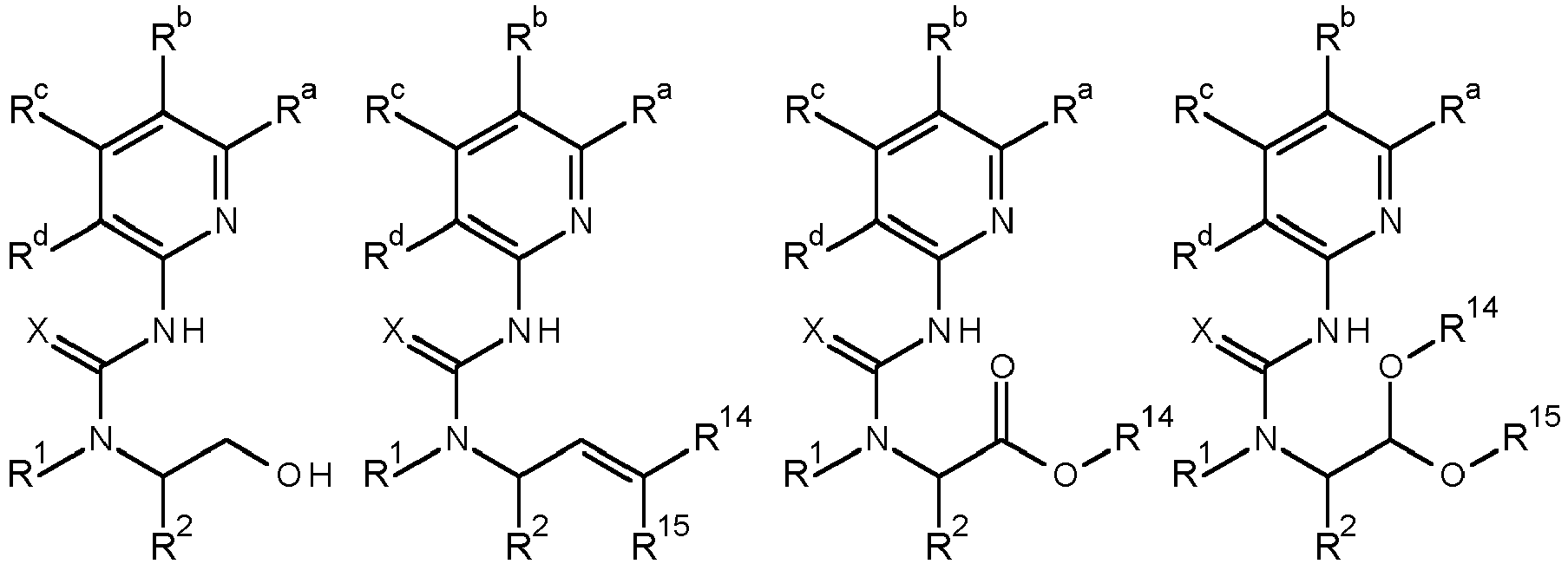
- Compounds of the invention may be prepared by techniques known to the person skilled in the art of organic chemistry. General methods for the production of compounds of formula (I) are described below. Unless otherwise stated in the text, the substituents X, R1, R2, R3, Ra, Rb, Rc and Rd are as defined hereinbefore. The starting materials used for the preparation of the compounds of the invention may be purchased from usual commercial suppliers or may be prepared by known methods. The starting materials as well as the intermediates may be purified before use in the next step by state of the art methodologies such as chromatography, crystallization, distillation and filtration.
- For example, compounds of formula (IX) wherein R1 is an alkyl or alkoxy group and R2 is a hydrogen or alkyl group may be prepared by reaction of amino-pyridine (IV) with phenylchloroformate to give carbamate product (V). The subsequent reaction with an appropriately substituted amino-ester (VI) gives compounds of type (VII) and subsequent cyclisation gives compounds of type (VIII) and reduction with e.g. with sodium borohydride gives compounds of type (IX). The methyl amino-ester (VI) may also be replaced by other amino esters or amino-acids. Phenyl chloroformate may be replaced by other activating groups such as phosgene or para-nitrophenyl chloroformate. The cyclisation to (VIII) may occur in situ or require heating for carboxylic acids or esters or treatment with a reagent such as thionyl chloride for carboxylic acids. Compounds of type (VII) can be converted to compounds of type (IX) directly by treatment with a reducing reagent such as DIBAL-H or NaBH4. Esters of type (VII) may also be reduced to their corresponding primary alcohols and then such alcohols can be re-oxidised to compounds of type (IX) with oxidants such as Dess-Martin periodinane.

- Alternatively, compounds of formula (IX) wherein R1 is an alkyl group or alkoxy group and R2 is a hydrogen or alkyl group may be prepared by Palladium catalysed reaction of chloro-pyridine (X) with urea (XI) to give (XII) (for a reference to a related reaction see
WO2006048249 , example 3.1) and then subsequent cyclisation gives compounds of type (IX).
- Urea (XI) may be formed by reaction of ester (XIII) with Grignard reagents, reductive amination of the product ketone (XIV) with amines and finally reaction of the subsequent product amine (XV) with TMS-isocyanate to give compounds of type (XI). Alternatively (XV) can be formed by a Grignard addition of type R2MgCl to appropriate imines. Alternatively, a nitrile can replace the ester group of (XIII) in the reaction with Grignard reagents.

- Alternatively, reaction of compounds of type (XIV) with methoxylamine following by reduction of the oxime ether formed gives compounds of type (XV) which can form compounds of type (XI) where R1 is alkoxy. Alternatively, reaction of compounds of type (XIV) where R2 is hydrogen with methoxylamine followe by addition of Grignard reagents to the formed oxime also can give compounds of type (XV).

- Compounds of formula (XVIII) wherein R2 is an hydroxy group may be prepared by the Palladium catalysed reaction of chloro-pyridine (X) with urea (XVI) to give urea (XVII) (for a reference to a related reaction see
WO2006048249 , example 3.1), which can react with aqueous glyoxal solution to give product (XVIII). Compounds of formula (IX) where R2 is an alkoxy group may be prepared by reacting compounds of formula (XVIII) with alcohols of type R4-OH under acidic conditions.
- Alternatively, compounds of formula (V) may be reacted with compounds of formula (XIX) wherein R2 is a hydrogen or alkyl group to give products of type (XX). Cyclisation with a suitable reagent such as thionyl chloride gives compounds of formula (XXI), which can be alkylated with a suitable base such as LiHMDS and a suitable alkylating agent such as methyl iodide (for R1 = Me) to give compound (VIII). Reduction as before gives compounds of type (IX).

- Alternatively oxidative cleavage (using ozonolysis or OsO4/NaIO4 or similar conditions) of an appropriate vinyl compound such as (XXII) or derivatives thereof and cyclisation could give the desired product.

- Alternatively, compounds of type (XXIII) may be coupled with compounds of type (X) under Palladium catalysed conditions to give compounds of type (VIII) and then standard reduction with NaBH4 for example gives products of type (IX).

- Amino and chloro-pyridines, where not commercially available, may be made by literature routes such as below and as detailed in J. March, Advanced Organic Chemistry, 4th ed. Wiley, New York, 1992 .

- Suitable conditions for effecting these transformations are set out in J. March, Advanced Organic Chemistry, 4th ed. Wiley, New York, 1992 .
- The compounds of formula (I) according to the invention can be used as herbicides in unmodified form, as obtained in the synthesis, but they are generally formulated into herbicidal compositions in various ways using formulation adjuvants, such as carriers, solvents and surface-active substances. Therefore, the invention also relates to a herbicidal composition which comprises a herbicidally effective amount of a compound of formula (I) in addition to formulation adjuvants. The formulations can be in various physical forms, e.g. in the form of dusting powders, gels, wettable powders, water-dispersible granules, water-dispersible tablets, effervescent pellets, emulsifiable concentrates, microemulsifiable concentrates, oil-in-water emulsions, oil-flowables, aqueous dispersions, oily dispersions, suspo-emulsions, capsule suspensions, emulsifiable granules, soluble liquids, water-soluble concentrates (with water or a water-miscible organic solvent as carrier), impregnated polymer films or in other forms known e.g. from the Manual on Development and Use of FAO Specifications for Plant Protection Products, 5th Edition, 1999. Such formulations can either be used directly or they are diluted prior to use. The dilutions can be made, for example, with water, liquid fertilizers, micronutrients, biological organisms, oil or solvents.
- The formulations can be prepared e.g. by mixing the active ingredient with the formulation adjuvants in order to obtain compositions in the form of finely divided solids, granules, solutions, dispersions or emulsions. The active ingredients can also be formulated with other adjuvants, such as finely divided solids, mineral oils, oils of vegetable or animal origin, modified oils of vegetable or animal origin, organic solvents, water, surface-active substances or combinations thereof. The active ingredients can also be contained in very fine microcapsules consisting of a polymer. Microcapsules contain the active ingredients in a porous carrier. This enables the active ingredients to be released into the environment in controlled amounts (e.g. slow-release). Microcapsules usually have a diameter of from 0.1 to 500 microns. They contain active ingredients in an amount of about from 25 to 95 % by weight of the capsule weight. The active ingredients can be in the form of a monolithic solid, in the form of fine particles in solid or liquid dispersion or in the form of a suitable solution. The encapsulating membranes comprise, for example, natural or synthetic rubbers, cellulose, styrene/butadiene copolymers, polyacrylonitrile, polyacrylate, polyesters, polyamides, polyureas, polyurethane or chemically modified polymers and starch xanthates or other polymers that are known to the person skilled in the art in this connection. Alternatively, very fine microcapsules can be formed in which the active ingredient is contained in the form of finely divided particles in a solid matrix of base substance, but the microcapsules are not themselves encapsulated.
- The formulation adjuvants that are suitable for the preparation of the compositions according to the invention are known per se. As liquid carriers there may be used: water, toluene, xylene, petroleum ether, vegetable oils, acetone, methyl ethyl ketone, cyclohexanone, acid anhydrides, acetonitrile, acetophenone, amyl acetate, 2-butanone, butylene carbonate, chlorobenzene, cyclohexane, cyclohexanol, alkyl esters of acetic acid, diacetone alcohol, 1,2-dichloropropane, diethanolamine, p-diethylbenzene, diethylene glycol, diethylene glycol abietate, diethylene glycol butyl ether, diethylene glycol ethyl ether, diethylene glycol methyl ether, N,N-dimethylformamide, dimethyl sulfoxide, 1,4-dioxane, dipropylene glycol, dipropylene glycol methyl ether, dipropylene glycol dibenzoate, diproxitol, alkylpyrrolidone, ethyl acetate, 2-ethylhexanol, ethylene carbonate, 1,1,1-trichloroethane, 2-heptanone, alpha-pinene, d-limonene, ethyl lactate, ethylene glycol, ethylene glycol butyl ether, ethylene glycol methyl ether, gamma-butyrolactone, glycerol, glycerol acetate, glycerol diacetate, glycerol triacetate, hexadecane, hexylene glycol, isoamyl acetate, isobornyl acetate, isooctane, isophorone, isopropylbenzene, isopropyl myristate, lactic acid, laurylamine, mesityl oxide, methoxypropanol, methyl isoamyl ketone, methyl isobutyl ketone, methyl laurate, methyl octanoate, methyl oleate, methylene chloride, m-xylene, n-hexane, n-octylamine, octadecanoic acid, octylamine acetate, oleic acid, oleylamine, o-xylene, phenol, polyethylene glycol (PEG400), propionic acid, propyl lactate, propylene carbonate, propylene glycol, propylene glycol methyl ether, p-xylene, toluene, triethyl phosphate, triethylene glycol, xylenesulfonic acid, paraffin, mineral oil, trichloroethylene, perchloroethylene, ethyl acetate, amyl acetate, butyl acetate, propylene glycol methyl ether, diethylene glycol methyl ether, methanol, ethanol, isopropanol, and alcohols of higher molecular weight, such as amyl alcohol, tetrahydrofurfuryl alcohol, hexanol, octanol, ethylene glycol, propylene glycol, glycerol, N-methyl-2-pyrrolidone and the like. Water is generally the carrier of choice for diluting the concentrates. Suitable solid carriers are, for example, talc, titanium dioxide, pyrophyllite clay, silica, attapulgite clay, kieselguhr, limestone, calcium carbonate, bentonite, calcium montmorillonite, cottonseed husks, wheat flour, soybean flour, pumice, wood flour, ground walnut shells, lignin and similar substances, as described, for example, in CFR 180.1001. (c) & (d).
- A large number of surface-active substances can advantageously be used in both solid and liquid formulations, especially in those formulations which can be diluted with a carrier prior to use. Surface-active substances may be anionic, cationic, non-ionic or polymeric and they can be used as emulsifiers, wetting agents or suspending agents or for other purposes. Typical surface-active substances include, for example, salts of alkyl sulfates, such as diethanolammonium lauryl sulfate; salts of alkylarylsulfonates, such as calcium dodecylbenzenesulfonate; alkylphenol/alkylene oxide addition products, such as nonylphenol ethoxylate; alcohol/alkylene oxide addition products, such as tridecylalcohol ethoxylate; soaps, such as sodium stearate; salts of alkylnaphthalenesulfonates, such as sodium dibutylnaphthalenesulfonate; dialkyl esters of sulfosuccinate salts, such as sodium di(2-ethylhexyl)sulfosuccinate; sorbitol esters, such as sorbitol oleate; quaternary amines, such as lauryltrimethylammonium chloride, polyethylene glycol esters of fatty acids, such as polyethylene glycol stearate; block copolymers of ethylene oxide and propylene oxide; and salts of mono- and di-alkylphosphate esters; and also further substances described e.g. in "McCutcheon's Detergents and Emulsifiers Annual" MC Publishing Corp., Ridgewood New Jersey, 1981.
- Further adjuvants that can usually be used in pesticidal formulations include crystallization inhibitors, viscosity modifiers, suspending agents, dyes, anti-oxidants, foaming agents, light absorbers, mixing auxiliaries, antifoams, complexing agents, neutralizing or pH-modifying substances and buffers, corrosion inhibitors, fragrances, wetting agents, take-up enhancers, micronutrients, plasticisers, glidants, lubricants, dispersants, thickeners, antifreezes, microbicides, and also liquid and solid fertilizers.
- The compositions according to the invention can additionally include an additive comprising an oil of vegetable or animal origin, a mineral oil, alkyl esters of such oils or mixtures of such oils and oil derivatives. The amount of oil additive in the composition according to the invention is generally from 0.01 to 10 %, based on the spray mixture. For example, the oil additive can be added to the spray tank in the desired concentration after the spray mixture has been prepared. Preferred oil additives comprise mineral oils or an oil of vegetable origin, for example rapeseed oil, olive oil or sunflower oil, emulsified vegetable oil, such as AMIGO® (Rhône-Poulenc Canada Inc.), alkyl esters of oils of vegetable origin, for example the methyl derivatives, or an oil of animal origin, such as fish oil or beef tallow. A preferred additive contains, for example, as active components essentially 80 % by weight alkyl esters of fish oils and 15 % by weight methylated rapeseed oil, and also 5 % by weight of customary emulsifiers and pH modifiers. Especially preferred oil additives comprise alkyl esters of C8-C22 fatty acids, especially the methyl derivatives of C12-C18 fatty acids, for example the methyl esters of lauric acid, palmitic acid and oleic acid, being of importance. Those esters are known as methyl laurate (CAS-111-82-0), methyl palmitate (CAS-112-39-0) and methyl oleate (CAS-112-62-9). A preferred fatty acid methyl ester derivative is Emery® 2230 and 2231 (Cognis GmbH). Those and other oil derivatives are also known from the Compendium of Herbicide Adjuvants, 5th Edition, Southern Illinois University, 2000.
- The application and action of the oil additives can be further improved by combination with surface-active substances, such as non-ionic, anionic or cationic surfactants. Examples of suitable anionic, non-ionic and cationic surfactants are listed on pages 7 and 8 of
WO 97/34485 - If desired, it is also possible for the mentioned surface-active substances to be used in the formulations on their own, that is to say, without oil additives.
- Furthermore, the addition of an organic solvent to the oil additive/surfactant mixture may contribute to an additional enhancement of action. Suitable solvents are, for example, Solvesso® (ESSO) or Aromatic Solvent® (Exxon Corporation). The concentration of such solvents can be from 10 to 80 % by weight of the total weight. Oil additives that are present in admixture with solvents are described, for example, in
US-A-4,834,908 . A commercially available oil additive disclosed therein is known by the name MERGE® (BASF Corporation). A further oil additive that is preferred according to the invention is SCORE® (Syngenta Crop Protection Canada). - In addition to the oil additives listed above, for the purpose of enhancing the action of the compositions according to the invention it is also possible for formulations of alkylpyrrolidones (e.g. Agrimax®) to be added to the spray mixture. Formulations of synthetic lattices, e.g. polyacrylamide, polyvinyl compounds or poly-1-p-menthene (e.g. Bond®, Courier® or Emerald®) may also be used. It is also possible for solutions that contain propionic acid, for example Eurogkem Pen-e-trate®, to be added to the spray mixture as action-enhancing agent.
- The herbicidal compositions generally comprise from 0.1 to 99 % by weight, especially from 0.1 to 95 % by weight, compounds of formula (I) and from 1 to 99.9 % by weight of a formulation adjuvant which preferably includes from 0 to 25 % by weight of a surface-active substance. Whereas commercial products will preferably be formulated as concentrates, the end user will normally employ dilute formulations.
- The rates of application of compounds of formula (I) may vary within wide limits and depend on the nature of the soil, the method of application (pre- or post-emergence; seed dressing; application to the seed furrow; no tillage application etc.), the crop plant, the grass or weed to be controlled, the prevailing climatic conditions, and other factors governed by the method of application, the time of application and the target crop. The compounds of formula (I) according to the invention are generally applied at a rate of from 10 to 2000 g/ha, especially from 50 to 1000 g/ha.
- Preferred formulations have especially the following compositions (% = percent by weight):
Emulsifiable concentrates: active ingredient: 1 to 95 %, preferably 60 to 90 % surface-active agent: 1 to 30 %, preferably 5 to 20 % liquid carrier: 1 to 80 %, preferably 1 to 35 % Dusts: active ingredient: 0.1 to 10 %, preferably 0.1 to 5 % solid carrier: 99.9 to 90 %, preferably 99.9 to 99 % Suspension concentrates: active ingredient: 5 to 75 %, preferably 10 to 50 % water: 94 to 24 %, preferably 88 to 30 % surface-active agent: 1 to 40 %, preferably 2 to 30 % Wettable powders: active ingredient: 0.5 to 90 %, preferably 1 to 80 % surface-active agent: 0.5 to 20 %, preferably 1 to 15 % solid carrier: 5 to 95 %, preferably 15 to 90 % Granules: active ingredient: 0.1 to 30 %, preferably 0.1 to 15 % solid carrier: 99.5 to 70 %, preferably 97 to 85 % - The following Examples further illustrate, but do not limit, the invention.
-
F1. Emulsifiable concentrates a) b) c) d) active ingredient 5% 10% 25% 50% calcium dodecylbenzenesulfonate 6% 8% 6% 8% castor oil polyglycol ether 4% - 4% 4% (36 mol of ethylene oxide) octylphenol polyglycol ether - 4% - 2% (7-8 mol of ethylene oxide) NMP - - 10% 20% arom. hydrocarbon mixture C9-C12 85% 78% 55% 16% - Emulsions of any desired concentration can be obtained from such concentrates by dilution with water.
F2. Solutions a) b) c) d) active ingredient 5% 10% 50% 90% 1-methoxy-3-(3-methoxy-propoxy)-propane - 20% 20 % - polyethylene glycol MW 400 20 % 10% - - NMP - - 30% 10% arom. hydrocarbon mixture C9-C12 75% 60 % - - - The solutions are suitable for use in the form of microdrops.
F3. Wettable powders a) b) c) d) active ingredient 5% 25% 50% 80 % sodium lignosulfonate 4% - 3 % - sodium lauryl sulfate 2% 3% - 4% sodium diisobutylnaphthalene-sulfonate - 6% 5% 6% octylphenol polyglycol ether (7-8 mol of ethylene oxide) - 1 % 2 % - highly dispersed silicic acid 1% 3% 5% 10% kaolin 88% 62% 35% - - The active ingredient is mixed thoroughly with the adjuvants and the mixture is thoroughly ground in a suitable mill, affording wettable powders which can be diluted with water to give suspensions of any desired concentration.
F4. Coated qranules a) b) c) active ingredient 0.1% 5% 15% highly dispersed silicic acid 0.9% 2% 2% inorganic carrier (diameter 0.1 - 1 mm) e.g. CaCO3 or SiO2 99.0% 93% 83% - The active ingredient is dissolved in methylene chloride and applied to the carrier by spraying, and the solvent is then evaporated off in vacuo.
F5. Coated qranules a) b) c) active ingredient 0.1% 5% 15% polyethylene glycol MW 200 1.0 % 2% 3% highly dispersed silicic acid 0.9% 1 % 2% inorganic carrier (diameter 0.1 - 1 mm) e.g. CaCO3 or SiO2 98.0% 92% 80% - The finely ground active ingredient is uniformly applied, in a mixer, to the carrier moistened with polyethylene glycol. Non-dusty coated granules are obtained in this manner.
F6. Extruder qranules a) b) c) d) active ingredient 0.1% 3% 5% 15% sodium lignosulfonate 1.5 % 2% 3% 4% carboxymethylcellulose 1.4% 2% 2% 2% kaolin 97.0% 93% 90% 79% - The active ingredient is mixed and ground with the adjuvants, and the mixture is moistened with water. The mixture is extruded and then dried in a stream of air.
F7. Dusts a) b) c) active ingredient 0.1 % 1 % 5% talcum 39.9% 49% 35% kaolin 60.0% 50% 60% - Ready-to-use dusts are obtained by mixing the active ingredient with the carriers and grinding the mixture in a suitable mill.
F8. Suspension concentrates a) b) c) d) active ingredient 3% 10% 25% 50% ethylene glycol 5% 5% 5% 5% nonylphenol polyglycol ether (15 mol of ethylene oxide) - 1 % 2 % - sodium lignosulfonate 3% 3% 4% 5% carboxymethylcellulose 1 % 1 % 1 % 1 % 37 % aqueous formaldehyde solution 0.2% 0.2% 0.2% 0.2 % silicone oil emulsion 0.8% 0.8% 0.8% 0.8 % water 87% 79% 62% 38% - The finely ground active ingredient is intimately mixed with the adjuvants, giving a suspension concentrate from which suspensions of any desired concentration can be obtained by dilution with water.
- Disclosed is a method of controlling plants which comprises applying to the plants or to the locus thereof a herbicidally effective amount of a compound of formula (I).
- Also disclosed is a method of inhibiting plant growth which comprises applying to the plants or to the locus thereof a herbicidally effective amount of a compound of formula (I).
- The invention also provides a method of controlling weeds in crops of useful plants, comprising applying to said weeds or to the locus of said weeds, or to said useful plants or to the locus of said useful plants, a compound or a composition of the invention.
- Also disclosed is a method of selectively controlling grasses and/or weeds in crops of useful plants which comprises applying to the useful plants or locus thereof or to the area of cultivation a herbicidally effective amount of a compound of formula (I).
- The term "herbicide" as used herein means a compound that controls or modifies the growth of plants. The term "herbicidally effective amount" means the quantity of such a compound or combination of such compounds that is capable of producing a controlling or modifying effect on the growth of plants. Controlling or modifying effects include all deviation from natural development, for example: killing, retardation, leaf burn, albinism and dwarfing. The term "plants" refers to all physical parts of a plant, including seeds, seedlings, saplings, roots, tubers, stems, stalks, foliage, and fruits. The term "locus" is intended to include soil, seeds, and seedlings, as well as established vegetation and includes not only areas where weeds may already be growing, but also areas where weeds have yet to emerge, and also to areas under cultivation with respect to crops of useful plants. "Areas under cultivation" include land on which the crop plants are already growing and land intended for cultivation with such crop plants. The term "weeds" as used herein means any undesired plant, and thus includes not only agronomically important weeds as described below, but also volunteer crop plants.
- The compounds of the invention can be applied before or after planting of the crops, before weeds emerge (pre-emergence application) or after weeds emerge (post-emergence application), and are particularly effective when applied post-emergence to the weeds.
- Crops of useful plants in which the composition according to the invention can be used include, but are not limited to, perennial crops, such as citrus fruit, grapevines, nuts, oil palms, olives, pome fruit, stone fruit and rubber, and annual arable crops, such as cereals, for example barley and wheat, cotton, oilseed rape, maize, rice, soy beans, sugar beet, sugar cane, sunflowers, ornamentals, switchgrass, turf and vegetables, especially cereals, maize and soy beans.
- The grasses and weeds to be controlled may be both monocotyledonous species, for example Agrostis, Alopecurus, Avena, Brachiaria, Bromus, Cenchrus, Cyperus, Digitaria, Echinochloa, Eriochloa, Lolium, Monochoria, Panicum, Poa, Rottboellia, Sagittaria, Scirpus, Setaria, Sida and Sorghum, and dicotyledonous species, for example Abutilon, Amaranthus, Chenopodium, Chrysanthemum, Euphorbia, Galium, Ipomoea, Kochia, Nasturtium, Polygonum, Sida, Sinapis, Solanum, Stellaria, Veronica, Viola and Xanthium.
- In all aspects of the invention, in a particular embodiment, the weeds, e.g. to be controlled and/or growth-inhibited may be monocotyledonous or dicotyledonous weeds, which are tolerant or resistant to one or more other herbicides for example, HPPD inhibitor herbicides such as mesotrione, PSII inhibitor herbicides such as atrazine or EPSPS inhibitors such as glyphosate. Such weeds include, but are not limited to resistant Amaranthus biotypes.
- Crops are to be understood as also including those crops which have been rendered tolerant to herbicides or classes of herbicides (e.g. auxins or ALS-, EPSPS-, PPO- and HPPD-inhibitors) by conventional methods of breeding or by genetic engineering. An example of a crop that has been rendered tolerant to imidazolinones, e.g. imazamox, by conventional methods of breeding is Clearfield® summer rape (canola). Examples of crops that have been rendered tolerant to herbicides by genetic engineering methods include e.g. glyphosate- and glufosinate-resistant maize varieties commercially available under the trade names RoundupReady® and LibertyLink®, respectively.
- Crops are also to be understood as being those which have been rendered resistant to harmful insects by genetic engineering methods, for example Bt maize (resistant to European corn borer), Bt cotton (resistant to cotton boll weevil) and also Bt potatoes (resistant to Colorado beetle). Examples of Bt maize are the Bt 176 maize hybrids of NK® (Syngenta Seeds). The Bt toxin is a protein that is formed naturally by Bacillus thuringiensis soil bacteria. Examples of toxins, or transgenic plants able to synthesize such toxins, are described in
EP-A-451 878 EP-A-374 753 WO 93/07278 WO 95/34656 WO 03/052073 EP-A-427 529 - Crops are also to be understood as being those which are obtained by conventional methods of breeding or genetic engineering and contain so-called output traits (e.g. improved storage stability, higher nutritional value and improved flavor).
- Any method of application to weeds/crop of useful plant, or locus thereof, which is routinely used in agriculture may be used, for example application by spray or broadcast method typically after suitable dilution of a compound of formula (I) (whether said compound is formulated and/or in combination with one or more further active ingredients and/or safeners, as described herein).
- The compounds of formula (I) according to the invention can also be used in combination with other active ingredients, e.g. other herbicides, and/or insecticides, and/or acaricides, and/or nematocides, and/or molluscicides, and/or fungicides, and/or plant growth regulators. Such mixtures, and the use of such mixtures to control weeds and/or undesired plant growth, form yet further aspects of the invention. For the avoidance of doubt, mixtures of invention also include mixtures of two or more different compounds of formula (I). In particular, the present invention also relates to a composition of the invention which comprises at least one further herbicide in addition to the compound of formula (I).
- When a compound of formula (I) is combined with at least one additional herbicide, the following mixtures of the compound of formula (I) are preferred. Compound of formula (I) + acetochlor, compound of formula (I) + acifluorfen, compound of formula (I) + acifluorfen-sodium, compound of formula (I) + aclonifen, compound of formula (I) + acrolein, compound of formula (I) + alachlor, compound of formula (I) + alloxydim, compound of formula (I) + allyl alcohol, compound of formula (I) + ametryn, compound of formula (I) + amicarbazone, compound of formula (I) + amidosulfuron, compound of formula (I) + aminocyclopyrachlor, compound of formula (I) + aminopyralid, compound of formula (I) + amitrole, compound of formula (I) + ammonium sulfamate, compound of formula (I) + anilofos, compound of formula (I) + asulam, compound of formula (I) + atrazine, formula (I) + aviglycine, formula (I) + azafenidin, compound of formula (I) + azimsulfuron, compound of formula (I) + BCPC, compound of formula (I) + beflubutamid, compound of formula (I) + benazolin, formula (I) + bencarbazone, compound of formula (I) + benfluralin, compound of formula (I) + benfuresate, compound of formula (I) + bensulfuron, compound of formula (I) + bensulfuron-methyl, compound of formula (I) + bensulide, compound of formula (I) + bentazone, compound of formula (I) + benzfendizone, compound of formula (I) + benzobicyclon, compound of formula (I) + benzofenap, compound of formula (I) + bicyclopyrone, compound of formula (I) + bifenox, compound of formula (I) + bilanafos, compound of formula (I) + bispyribac, compound of formula (I) + bispyribac-sodium, compound of formula (I) + borax, compound of formula (I) + bromacil, compound of formula (I) + bromobutide, formula (I) + bromophenoxim, compound of formula (I) + bromoxynil, compound of formula (I) + butachlor, compound of formula (I) + butafenacil, compound of formula (I) + butamifos, compound of formula (I) + butralin, compound of formula (I) + butroxydim, compound of formula (I) + butylate, compound of formula (I) + cacodylic acid, compound of formula (I) + calcium chlorate, compound of formula (I) + cafenstrole, compound of formula (I) + carbetamide, compound of formula (I) + carfentrazone, compound of formula (I) + carfentrazone-ethyl, compound of formula (I) + CDEA, compound of formula (I) + CEPC, compound of formula (I) + chlorflurenol, compound of formula (I) + chlorflurenol-methyl, compound of formula (I) + chloridazon, compound of formula (I) + chlorimuron, compound of formula (I) + chlorimuron-ethyl, compound of formula (I) + chloroacetic acid, compound of formula (I) + chlorotoluron, compound of formula (I) + chlorpropham, compound of formula (I) + chlorsulfuron, compound of formula (I) + chlorthal, compound of formula (I) + chlorthal-dimethyl, compound of formula (I) + cinidon-ethyl, compound of formula (I) + cinmethylin, compound of formula (I) + cinosulfuron, compound of formula (I) + cisanilide, compound of formula (I) + clethodim, compound of formula (I) + clodinafop, compound of formula (I) + clodinafop-propargyl, compound of formula (I) + clomazone, compound of formula (I) + clomeprop, compound of formula (I) + clopyralid, compound of formula (I) + cloransulam, compound of formula (I) + cloransulam-methyl, compound of formula (I) + CMA, compound of formula (I) + 4-CPB, compound of formula (I) + CPMF, compound of formula (I) + 4-CPP, compound of formula (I) + CPPC, compound of formula (I) + cresol, compound of formula (I) + cumyluron, compound of formula (I) + cyanamide, compound of formula (I) + cyanazine, compound of formula (I) + cycloate, compound of formula (I) + cyclosulfamuron, compound of formula (I) + cycloxydim, compound of formula (I) + cyhalofop, compound of formula (I) + cyhalofop-butyl, compound of formula (I) + 2,4-D, compound of formula (I) + 3,4-DA, compound of formula (I) + daimuron, compound of formula (I) + dalapon, compound of formula (I) + dazomet, compound of formula (I) + 2,4-DB, compound of formula (I) + 3,4-DB, compound of formula (I) + 2,4-DEB, compound of formula (I) + desmedipham, formula (I) + desmetryn, compound of formula (I) + dicamba, compound of formula (I) + dichlobenil, compound of formula (I) + ortho-dichlorobenzene, compound of formula (I) + para-dichlorobenzene, compound of formula (I) + dichlorprop, compound of formula (I) + dichlorprop-P, compound of formula (I) + diclofop, compound of formula (I) + diclofop-methyl, compound of formula (I) + diclosulam, compound of formula (I) + difenzoquat, compound of formula (I) + difenzoquat metilsulfate, compound of formula (I) + diflufenican, compound of formula (I) + diflufenzopyr, compound of formula (I) + dimefuron, compound of formula (I) + dimepiperate, compound of formula (I) + dimethachlor, compound of formula (I) + dimethametryn, compound of formula (I) + dimethenamid, compound of formula (I) + dimethenamid-P, compound of formula (I) + dimethipin, compound of formula (I) + dimethylarsinic acid, compound of formula (I) + dinitramine, compound of formula (I) + dinoterb, compound of formula (I) + diphenamid, formula (I) + dipropetryn, compound of formula (I) + diquat, compound of formula (I) + diquat dibromide, compound of formula (I) + dithiopyr, compound of formula (I) + diuron, compound of formula (I) + DNOC, compound of formula (I) + 3,4-DP, compound of formula (I) + DSMA, compound of formula (I) + EBEP, compound of formula (I) + endothal, compound of formula (I) + EPTC, compound of formula (I) + esprocarb, compound of formula (I) + ethalfluralin, compound of formula (I) + ethametsulfuron, compound of formula (I) + ethametsulfuron-methyl, formula (I) + ethephon, compound of formula (I) + ethofumesate, compound of formula (I) + ethoxyfen, compound of formula (I) + ethoxysulfuron, compound of formula (I) + etobenzanid, compound of formual (I) + fenoxaprop, compound of formula (I) + fenoxaprop-P, compound of formula (I) + fenoxaprop-ethyl, compound of formula (I) + fenoxaprop-P-ethyl, compound of formula (I) + fentrazamide, compound of formula (I) + ferrous sulfate, compound of formula (I) + flamprop-M, compound of formula (I) + flazasulfuron, compound of formula (I) + florasulam, compound of formula (I) + fluazifop, compound of formula (I) + fluazifop-butyl, compound of formula (I) + fluazifop-P, compound of formula (I) + fluazifop-P-butyl, formula (I) + fluazolate, compound of formula (I) + flucarbazone, compound of formula (I) + flucarbazone-sodium, compound of formula (I) + flucetosulfuron, compound of formula (I) + fluchloralin, compound of formula (I) + flufenacet, compound of formula (I) + flufenpyr, compound of formula (I) + flufenpyr-ethyl, formula (I) + flumetralin, compound of formula (I) + flumetsulam, compound of formula (I) + flumiclorac, compound of formula (I) + flumiclorac-pentyl, compound of formula (I) + flumioxazin, formula (I) + flumipropin, compound of formula (I) + fluometuron, compound of formula (I) + fluoroglycofen, compound of formula (I) + fluoroglycofen-ethyl, formula (I) + fluoxaprop, formula (I) + flupoxam, formula (I) + flupropacil, compound of formula (I) + flupropanate, compound of formula (I) + flupyrsulfuron, compound of formula (I) + flupyrsulfuron-methyl-sodium, compound of formula (I) + flurenol, compound of formula (I) + fluridone, compound of formula (I) + flurochloridone, compound of formula (I) + fluroxypyr, compound of formula (I) + flurtamone, compound of formula (I) + fluthiacet, compound of formula (I) + fluthiacet-methyl, compound of formula (I) + fomesafen, compound of formula (I) + foramsulfuron, compound of formula (I) + fosamine, compound of formula (I) + glufosinate, compound of formula (I) + glufosinate-ammonium, compound of formula (I) + glyphosate, compound of formula (I) + halauxifen, compound of formula (I) + halauxifen-methyl, compound of formula (I) + halosulfuron, compound of formula (I) + halosulfuron-methyl, compound of formula (I) + haloxyfop, compound of formula (I) + haloxyfop-P, compound of formula (I) + HC-252, compound of formula (I) + hexazinone, compound of formula (I) + imazamethabenz, compound of formula (I) + imazamethabenz-methyl, compound of formula (I) + imazamox, compound of formula (I) + imazapic, compound of formula (I) + imazapyr, compound of formula (I) + imazaquin, compound of formula (I) + imazethapyr, compound of formula (I) + imazosulfuron, compound of formula (I) + indanofan, compound of formula (I) and indaziflam, compound of formula (I) + iodomethane, compound of formula (I) + iodosulfuron, compound of formula (I) + iodosulfuron-methyl-sodium, compound of formula (I) + ioxynil, compound of formula (I) and ipfencarbazone, compound of formula (I) + isoproturon, compound of formula (I) + isouron, compound of formula (I) + isoxaben, compound of formula (I) + isoxachlortole, compound of formula (I) + isoxaflutole, formula (I) + isoxapyrifop, compound of formula (I) + karbutilate, compound of formula (I) + lactofen, compound of formula (I) + lenacil, compound of formula (I) + linuron, compound of formula (I) + MAA, compound of formula (I) + MAMA, compound of formula (I) + MCPA, compound of formula (I) + MCPA-thioethyl, compound of formula (I) + MCPB, compound of formula (I) + mecoprop, compound of formula (I) + mecoprop-P, compound of formula (I) + mefenacet, compound of formula (I) + mefluidide, compound of formula (I) + mesosulfuron, compound of formula (I) + mesosulfuron-methyl, compound of formula (I) + mesotrione, compound of formula (I) + metam, compound of formula (I) + metamifop, compound of formula (I) + metamitron, compound of formula (I) + metazachlor, compound of formula (I) and metazosulfuron, compound of formula (I) + methabenzthiazuron, formula (I) + methazole, a compound of formula (I) and methiozolin, compound of formula (I) + methylarsonic acid, compound of formula (I) + methyldymron, compound of formula (I) + methyl isothiocyanate, compound of formula (I) + metobenzuron, formula (I) + metobromuron, compound of formula (I) + metolachlor, compound of formula (I) + S-metolachlor, compound of formula (I) + metosulam, compound of formula (I) + metoxuron, compound of formula (I) + metribuzin, compound of formula (I) + metsulfuron, compound of formula (I) + metsulfuron-methyl, compound of formula (I) + MK-616, compound of formula (I) + molinate, compound of formula (I) + monolinuron, a compound of formula (I) and monosulfuron, a compound of formula (I) and monosulfuron-ester compound of formula (I) + MSMA, compound of formula (I) + naproanilide, compound of formula (I) + napropamide, compound of formula (I) + naptalam, formula (I) + NDA-402989, compound of formula (I) + neburon, compound of formula (I) + nicosulfuron, formula (I) + nipyraclofen, formula (I) + n-methyl glyphosate, compound of formula (I) + nonanoic acid, compound of formula (I) + norflurazon, compound of formula (I) + oleic acid (fatty acids), compound of formula (I) + orbencarb, compound of formula (I) + orthosulfamuron, compound of formula (I) + oryzalin, compound of formula (I) + oxadiargyl, compound of formula (I) + oxadiazon, compound of formula (I) + oxasulfuron, compound of formula (I) + oxaziclomefone, compound of formula (I) + oxyfluorfen, compound of formula (I) + paraquat, compound of formula (I) + paraquat dichloride, compound of formula (I) + pebulate, compound of formula (I) + pendimethalin, compound of formula (I) + penoxsulam, compound of formula (I) + pentachlorophenol, compound of formula (I) + pentanochlor, compound of formula (I) + pentoxazone, compound of formula (I) + pethoxamid, compound of formula (I) + petrolium oils, compound of formula (I) + phenmedipham, compound of formula (I) + phenmedipham-ethyl, compound of formula (I) + picloram, compound of formula (I) + picolinafen, compound of formula (I) + pinoxaden, compound of formula (I) + piperophos, compound of formula (I) + potassium arsenite, compound of formula (I) + potassium azide, compound of formula (I) + pretilachlor, compound of formula (I) + primisulfuron, compound of formula (I) + primisulfuron-methyl, compound of formula (I) + prodiamine, compound of formula (I) + profluazol, compound of formula (I) + profoxydim, formula (I) + prohexadione-calcium, compound of formula (I) + prometon, compound of formula (I) + prometryn, compound of formula (I) + propachlor, compound of formula (I) + propanil, compound of formula (I) + propaquizafop, compound of formula (I) + propazine, compound of formula (I) + propham, compound of formula (I) + propisochlor, compound of formula (I) + propoxycarbazone, compound of formula (I) + propoxycarbazone-sodium, compound of formula (I) + propyzamide, compound of formula (I) + prosulfocarb, compound of formula (I) + prosulfuron, compound of formula (I) + pyraclonil, compound of formula (I) + pyraflufen, compound of formula (I) + pyraflufen-ethyl, formula (I) + pyrasulfotole, compound of formula (I) + pyrazolynate, compound of formula (I) + pyrazosulfuron, compound of formula (I) + pyrazosulfuron-ethyl, compound of formula (I) + pyrazoxyfen, compound of formula (I) + pyribenzoxim, compound of formula (I) + pyributicarb, compound of formula (I) + pyridafol, compound of formula (I) + pyridate, compound of formula (I) + pyriftalid, compound of formula (I) + pyriminobac, compound of formula (I) + pyriminobac-methyl, compound of formula (I) + pyrimisulfan, compound of formula (I) + pyrithiobac, compound of formula (I) + pyrithiobac-sodium, formula (I) + pyroxasulfone, formula (I) + pyroxulam, compound of formula (I) + quinclorac, compound of formula (I) + quinmerac, compound of formula (I) + quinoclamine, compound of formula (I) + quizalofop, compound of formula (I) + quizalofop-P, compound of formula (I) + quizalofop-ethyl, compound of formula (I) + quizalofop-P-ethyl, compound of formula (I) + rimsulfuron, compound of formula (I) + saflufenacil, compound of formula (I) + sethoxydim, compound of formula (I) + siduron, compound of formula (I) + simazine, compound of formula (I) + simetryn, compound of formula (I) + SMA, compound of formula (I) + sodium arsenite, compound of formula (I) + sodium azide, compound of formula (I) + sodium chlorate, compound of formula (I) + sulcotrione, compound of formula (I) + sulfentrazone, compound of formula (I) + sulfometuron, compound of formula (I) + sulfometuron-methyl, compound of formula (I) + sulfosate, compound of formula (I) + sulfosulfuron, compound of formula (I) + sulfuric acid, compound of formula (I) + tar oils, compound of formula (I) + 2,3,6-TBA, compound of formula (I) + TCA, compound of formula (I) + TCA-sodium, formula (I) + tebutam, compound of formula (I) + tebuthiuron, formula (I) + tefuryltrione, compound of formula 1 + tembotrione, compound of formula (I) + tepraloxydim, compound of formula (I) + terbacil, compound of formula (I) + terbumeton, compound of formula (I) + terbuthylazine, compound of formula (I) + terbutryn, compound of formula (I) + thenylchlor, compound of formula (I) + thiazafluron, compound of formula (I) + thiazopyr, compound of formula (I) + thifensulfuron, compound of formula (I) + thiencarbazone, compound of formula (I) + thifensulfuron-methyl, compound of formula (I) + thiobencarb, compound of formula (I) + tiocarbazil, compound of formula (I) + topramezone, compound of formula (I) + tralkoxydim, a compound of formula (I) and triafamone compound of formula (I) + tri-allate, compound of formula (I) + triasulfuron, compound of formula (I) + triaziflam, compound of formula (I) + tribenuron, compound of formula (I) + tribenuron-methyl, compound of formula (I) + tricamba, compound of formula (I) + triclopyr, compound of formula (I) + trietazine, compound of formula (I) + trifloxysulfuron, compound of formula (I) + trifloxysulfuron-sodium, compound of formula (I) + trifluralin, compound of formula (I) + triflusulfuron, compound of formula (I) + triflusulfuron-methyl, compound of formula (I) + trifop, compound of formula (I) + trifop-methyl, compound of formula (I) + trihydroxytriazine, compound of formula (I) + trinexapac-ethyl, compound of formula (I) + tritosulfuron, compound of formula (I) + [3-[2-chloro-4-fluoro-5-(1-methyl-6-trifluoromethyl-2,4-dioxo-1,2,3,4-tetrahydropyrimidin-3-yl)phenoxy]-2-pyridyloxy]acetic acid ethyl ester (CAS RN 353292-31-6), compound of formula (I) + 2-[[8-chloro-3,4-dihydro-4-(4-methoxyphenyl)-3-oxo-2-quinoxalinyl]carbonyl-1,3-cyclohexanedione and the compound of formula (I) + VX-573.
- In particular, the following mixtures are important:
- mixtures of a compound of formula (I) with an acetanilide (e.g. compound of formula (I) + acetochlor, compound of formula (I) + dimethenamid, compound of formula (I) + metolachlor, compound of formula (I) + S-metolachlor, or compound of formula (I) + pretilachlor) or with other inhibitors of VLCFAE (e.g. compound of formula (I) + pyroxasulfone).
- mixtures of a compound of formula (I) with an HPPD inhibitor (e.g. compound of formula (I) + isoxaflutole, compound of formula (I) + mesotrione, compound of formula (I) + pyrasulfotole, compound of formula (I) + sulcotrione, compound of formula (I) + tembotrione, compound of formula (I) + topramezone, compound of formula (I) + bicyclopyrone;
- mixtures of a compound of formula (I) with a triazine (e.g. compound of formula (I) + atrazine, or compound of formula (I) + terbuthylazine);
- mixtures of a compound of formula (I) with glyphosate;
- mixtures of a compound of formula (I) with glufosinate-ammonium;
- mixtures of a compound of formula (I) with a PPO inhibitor (e.g. compound of formula (I) + acifluorfen-sodium, compound of formula (I) + butafenacil, compound of formula (I) + carfentrazone-ethyl, compound of formula (I) + cinidon-ethyl, compound of formula (I) + flumioxazin, compound of formula (I) + fomesafen, compound of formula (I) + lactofen, or compound of formula (I) + SYN 523 ([3-[2-chloro-4-fluoro-5-(1-methyl-6-trifluoromethyl-2,4-dioxo-1,2,3,4-tetrahydropyrimidin-3-yl)phenoxy]-2-pyridyloxy]acetic acid ethyl ester) (CAS RN 353292-31-6)).
- Whilst two-way mixtures of a compound of formula (I) and another herbicide are explicitly disclosed above, the skilled man will appreciate that the invention extends to three-way, and further multiple combinations comprising the above two-way mixtures. In particular, the invention extends to:
- mixtures of a compound of formula (I) with a triazine and an HPPD inhibitor (e.g. compound of formula (I) + triazine + isoxaflutole, compound of formula (I) + triazine + mesotrione, compound of formula (I) + triazine + pyrasulfotole, compound of formula (I) + triazine + sulcotrione, compound of formula (I) + triazine + tembotrione, compound of formula (I) + triazine + topramezone, compound of formula (I) + triazine + bicyclopyrone;
- mixtures of a compound of formula (I) with glyphosate and an HPPD inhibitor (e.g. compound of formula (I) + glyphosate + isoxaflutole, compound of formula (I) + glyphosate + mesotrione, compound of formula (I) + glyphosate + pyrasulfotole, compound of formula (I) + glyphosate + sulcotrione, compound of formula (I) + glyphosate + tembotrione, compound of formula (I) + glyphosate + topramezone, compound of formula (I) + glyphosate + bicyclopyrone;
- mixtures of a compound of formula (I) with glufosinate-ammonium and an HPPD inhibitor (e.g. compound of formula (I) + glufosinate-ammonium + isoxaflutole, compound of formula (I) + glufosinate-ammonium + mesotrione, compound of formula (I) + glufosinate-ammonium + pyrasulfotole, compound of formula (I) + glufosinate-ammonium + sulcotrione, compound of formula (I) + glufosinate-ammonium + tembotrione, compound of formula (I) + glufosinate-ammonium + topramezone, compound of formula (I) + glufosinate-ammonium + bicyclopyrone;
- mixtures of a compound of formula (I) with a VLCFAE inhibitor and an HPPD inhibitor (e.g. compound of formula (I) + S-metolachlor + isoxaflutole, compound of formula (I) + S-metolachlor + mesotrione, compound of formula (I) + S-metolachlor + pyrasulfotole, compound of formula (I) + S-metolachlor + sulcotrione, compound of formula (I) + S-metolachlor + tembotrione, compound of formula (I) + S-metolachlor + topramezone, compound of formula (I) + S-metolachlor + bicyclopyrone, compound of formula (I) + acetochlor + isoxaflutole, compound of formula (I) + acetochlor + mesotrione, compound of formula (I) + acetochlor + pyrasulfotole, compound of formula (I) + acetochlor + sulcotrione, compound of formula (I) + acetochlor + tembotrione, compound of formula (I) + acetochlor + topramezone, compound of formula (I) + acetochlor + bicyclopyrone, compound of formula (I) + pyroxasulfone + isoxaflutole, compound of formula (I) + pyroxasulfone + mesotrione, compound of formula (I) + pyroxasulfone + pyrasulfotole, compound of formula (I) + pyroxasulfone + sulcotrione, compound of formula (I) + pyroxasulfone + tembotrione, compound of formula (I) + pyroxasulfone + topramezone, compound of formula (I) + pyroxasulfone + bicyclopyrone, compound of formula (I) + S-metolachlor + mesotrione + bicyclopyrone.
- mixtures of a compound of formula (I) with glyphosate and a VLCFAE inhibitor (e.g. compound of formula (I) + glyphosate + S-metolachlor, compound of formula (I) + glyphosate + acetochlor, compound of formula (I) + glyphosate + pyroxasulfone).
- Particularly preferred are mixtures of the compound of formula (I) with mesotrione, bicyclopyrone, isoxaflutole, tembotrione, topramezone, sulcotrione, pyrasulfotole, metolachlor, S-metolachlor, acetochlor, pyroxasulfone, P-dimethenamid, dimethenamid, flufenacet, pethoxamid, atrazine, terbuthylazine, bromoxynil, metribuzin, amicarbazone, bentazone, ametryn, hexazinone, diuron, tebuthiuron, glyphosate, paraquat, diquat, glufosinate, acifluorfen-sodium, butafenacil, carfentrazone-ethyl, cinidon-ethyl, flumioxazin, fomesafen, lactofen, [3-[2-chloro-4-fluoro-5-(1-methyl-6-trifluoromethyl-2,4-dioxo-1,2,3,4-tetrahydropyrimidin-3-yl)phenoxy]-2-pyridyloxy]acetic acid ethyl ester.
- The mixing partners of the compound of formula (I) may also be in the form of esters or salts, as mentioned e.g. in The Pesticide Manual, 14th Edition (BCPC), 2006. The reference to acifluorfen-sodium also applies to acifluorfen, the reference to dimethenamid also applies to dimethenamid-P, the reference to glufosinate-ammonium also applies to glufosinate, the reference to bensulfuron-methyl also applies to bensulfuron, the reference to cloransulam-methyl also applies to cloransulam, the reference to flamprop-M also applies to flamprop, and the reference to pyrithiobac-sodium also applies to pyrithiobac, etc.
- The mixing ratio of the compound of formula (I) to the mixing partner is preferably from 1: 100 to 1000:1.
- The mixtures can advantageously be used in the above-mentioned formulations (in which case "active ingredient" relates to the respective mixture of compound of formula (I) with the mixing partner).
- The compounds of formula (I) according to the invention can also be used in combination with one or more safeners. Likewise, mixtures of a compound of formula (I) according to the invention with one or more further active ingredients, in particular with one or more further herbicides, can also be used in combination with one or more safeners. The term "safener" as used herein means a chemical that when used in combination with a herbicide reduces the undesirable effects of the herbicide on non-target organisms, for example, a safener protects crops from injury by herbicides but does not prevent the herbicide from killing the weeds. Where a compound of formula (I) is combined with a safener, the following combinations of the compound of formula (I) and the safener are particularly preferred. Compound of formula (I) + AD 67 (MON 4660), compound of formula (I) + benoxacor, compound of formula (I) + cloquintocet-mexyl, compound of formula (I) + cyometrinil and a compound of formula (I) + the corresponding (Z) isomer of cyometrinil, compound of formula (I) + cyprosulfamide (CAS RN 221667-31-8), compound of formula (I) + dichlormid, compound of formula (I) and dicyclonon, compound of formula (I) and dietholate, compound of formula (I) + fenchlorazole-ethyl, compound of formula (I) + fenclorim, compound of formula (I) + flurazole, compound of formula (I) + fluxofenim, compound of formula (I) + furilazole and a compound of formula (I) + the corresponding R isomer or furilazome, compound of formula (I) + isoxadifen-ethyl, compound of formula (I) + mefenpyrdiethyl, compound of formula (I) and mephenate, compound of formula (I) + oxabetrinil, compound of formula (I) + naphthalic anhydride (CAS RN 81-84-5), compound of formula (I) and TI-35, compound of formula (I) + N-isopropyl-4-(2-methoxy-benzoylsulfamoyl)-benzamide (CAS RN 221668-34-4) and a compound of formula (I) + N-(2-methoxybenzoyl)-4-[(methylaminocarbonyl)amino]benzenesulfonamide. Particularly preferred are mixtures of a compound of formula (I) with benoxacor, a compound of formula (I) with cloquintocet-mexyl, a compound of formula (I) + cyprosulfamide and a compound of formula (I) with N-(2-methoxybenzoyl)-4-[(methylaminocarbonyl)amino]benzenesulfonamide.
- The safeners of the compound of formula (I) may also be in the form of esters or salts, as mentioned e.g. in The Pesticide Manual, 14th Edition (BCPC), 2006. The reference to cloquintocet-mexyl also applies to cloquintocet and to a lithium, sodium, potassium, calcium, magnesium, aluminium, iron, ammonium, quaternary ammonium, sulfonium or phosphonium salt thereof as disclosed in
WO02/34048 - Preferably the mixing ratio of compound of formula (I) to safener is from 100:1 to 1:10, especially from 20:1 to 1:1.
- The mixtures can advantageously be used in the above-mentioned formulations (in which case "active ingredient" relates to the respective mixture of compound of formula (I) and any further active ingredient, in particular a further herbicide, with the safener).
- It is possible that the safener and a compound of formula (I) and one or more additional herbicide(s), if any, are applied simultaneously. For example, the safener, a compound of formula (I) and one or more additional herbicide(s), if any, might be applied to the locus pre-emergence or might be applied to the crop post-emergence. It is also possible that the safener and a compound of formula (I) and one or more additional herbicide(s), if any, are applied sequentially. For example, the safener might be applied before sowing the seeds as a seed treatment and a compound of formula (I) and one or more additional herbicides, if any, might be applied to the locus pre-emergence or might be applied to the crop post-emergence.
- Preferred mixtures of a compound of formula (I) with further herbicides and safeners include:
- Mixtures of a compound of formula (I) with S-metolachlor and a safener, particularly benoxacor.
- Mixtures of a compound of formula (I) with isoxaflutole and a safener.
- Mixtures of a compound of formula (I) with mesotrione and a safener.
- Mixtures of a compound of formula (I) with sulcotrione and a safener.
- Mixtures of a compound of formula (I) with tembotrione and a safener.
- Mixtures of a compound of formula (I) with topramezone and a safener.
- Mixtures of a compound of formula (I) with bicyclopyrone and a safener.
- Mixtures of a compound of formula (I) with a triazine and a safener.
- Mixtures of a compound of formula (I) with a triazine and isoxaflutole and a safener.
- Mixtures of a compound of formula (I) with a triazine and mesotrione and a safener.
- Mixtures of a compound of formula (I) with a triazine and sulcotrione and a safener.
- Mixtures of a compound of formula (I) with a triazine and tembotrione and a safener.
- Mixtures of a compound of formula (I) with a triazine and topramezone and a safener.
- Mixtures of a compound of formula (I) with a triazine and bicyclopyrone and a safener.
- Mixtures of a compound of formula (I) with glyphosate and a safener.
- Mixtures of a compound of formula (I) with glyphosate and isoxaflutole and a safener.
- Mixtures of a compound of formula (I) with glyphosate and mesotrione and a safener.
- Mixtures of a compound of formula (I) with glyphosate and sulcotrione and a safener.
- Mixtures of a compound of formula (I) with glyphosate and tembotrione and a safener.
- Mixtures of a compound of formula (I) with glyphosate and topramezone and a safener.
- Mixtures of a compound of formula (I) with glyphosate and bicyclopyrone and a safener.
- Mixtures of a compound of formula (I) with glufosinate-ammonium and a safener.
- Mixtures of a compound of formula (I) with glufosinate-ammonium and isoxaflutole and a safener.
- Mixtures of a compound of formula (I) with glufosinate-ammonium and mesotrione and a safener.
- Mixtures of a compound of formula (I) with glufosinate-ammonium and sulcotrione and a safener.
- Mixtures of a compound of formula (I) with glufosinate-ammonium and tembotrione and a safener.
- Mixtures of a compound of formula (I) with glufosinate-ammonium and topramezone and a safener.
- Mixtures of a compound of formula (I) with glufosinate-ammonium and bicyclopyrone and a safener.
- Mixtures of a compound of formula (I) with S-metolachlor and a safener.
- Mixtures of a compound of formula (I) with S-metolachlor and isoxaflutole and a safener.
- Mixtures of a compound of formula (I) with S-metolachlor and mesotrione and a safener.
- Mixtures of a compound of formula (I) with S-metolachlor and sulcotrione and a safener.
- Mixtures of a compound of formula (I) with S-metolachlor and tembotrione and a safener.
- Mixtures of a compound of formula (I) with S-metolachlor and topramezone and a safener.
- Mixtures of a compound of formula (I) with S-metolachlor and bicyclopyrone and a safener
- Mixtures of a compound of formula (I) with pyroxasulfone and a safener.
- Mixtures of a compound of formula (I) with pyroxasulfone and isoxaflutole and a safener.
- Mixtures of a compound of formula (I) with pyroxasulfone and mesotrione and a safener.
- Mixtures of a compound of formula (I) with pyroxasulfone and sulcotrione and a safener.
- Mixtures of a compound of formula (I) with pyroxasulfone and tembotrione and a safener.
- Mixtures of a compound of formula (I) with pyroxasulfone and topramezone and a safener.
- Mixtures of a compound of formula (I) with pyroxasulfone and bicyclopyrone and a safener
- Mixtures of a compound of formula (I) with acetochlor and a safener.
- Mixtures of a compound of formula (I) with acetochlor and isoxaflutole and a safener.
- Mixtures of a compound of formula (I) with acetochlor and mesotrione and a safener.
- Mixtures of a compound of formula (I) with acetochlor and sulcotrione and a safener.
- Mixtures of a compound of formula (I) with acetochlor and tembotrione and a safener.
- Mixtures of a compound of formula (I) with acetochlor and topramezone and a safener.
- Mixtures of a compound of formula (I) with acetochlor and bicyclopyrone and a safener.
- Mixtures of a compound of formula (I) with S-metolachlor and mesotrione and bicyclopyrone and a safener.
- Mixtures of a compound of formula (I) with S-metolachlor and a triazine and mesotrione and bicyclopyrone and a safener.
- Various aspects including embodiments of the present invention will now be illustrated in more detail by way of example.
- The following abbreviations were used in this section: s = singlet; bs = broad singlet; d = doublet; dd = double doublet; dt = double triplet; t = triplet, tt = triple triplet, q = quartet, sept = septet; m = multiplet; RT = retention time, MH+ = molecular mass of the molecular cation.
- 1H NMR spectra were recorded at 400MHz either on a Varian Unity Inova instrument 400MHz or on a Bruker AVANCE - II instrument.
- The compounds may exist in a mixture of diastereoisomers, which may be observed by LC-MS and NMR. The stereochemistry of the chiral centre at the carbon containing the R3 group was generally found to interconvert at room temperature when R3 is hydroxyl. Depending on the nature of R2 substitution and the conditions for product synthesis, purification and analysis the ratio of diastereomers may change.
-

-

- 5-iodo-4-(trifluoromethyl)pyridin-2-amine (for a synthesis see Bioorganic & Medicinal Chemistry Letters, 1994, 4(6), 835-8) (0.500 g, 1.74 mmol) was dissolved in DCM (5 mL) and then carbonyldiimidazole (1.06g, 80% purity) was added. The reaction mixture was heated at 105°C in a microwave vial for 15 minutes and then cooled to 10°C. 1,1-dimethoxy-N-methyl-propan-2-amine (preparation as in example 13) (695 mg, 3 equiv.) was added and the reaction was stirred at room temperature for 15 mins. The reaction was diluted with DCM (10 mL) and water (5 mL) was added.
- This mixture was filtered and the aqueous layer extracted with further DCM (2 x10 mL). The combined organics were dried (Na2SO4), filtered and evaporated and then chromatographed on silica eluting with 20-30% EtOAc in isohexane. Fractions containing product were evaporated to give desired product as an amber gum (326 mg, 42%).
- LC-MS: (positive ES MH+ 448).
-

- 1-(2,2-dimethoxy-1-methyl-ethyl)-3-[5-iodo-4-(trifluoromethyl)-2-pyridyl]-1-methyl-urea (260 mg, 0.581 mmol) was dissolved in acetic acid (5.2 mL) and water (2.6 mL). The reaction mixture was stirred at room temperature for 2 days. The reaction mixture was then evaporated and dried (100 to 1mBar at 20-35°C) for 2h to remove traces of acetic acid to give product as a lilac gum which crystallised to give a solid (230 mg, 98%).
- LC-MS: (positive ES MH+ 402).
- 1H NMR (CDCl3): Major diastereomer: 8.69 (s, 1H), 8.64 (s, 1H), 5.56 (m, 1H), 4.65 (very br s, 1H), 3.53 (m, 1H), 2.93 (s, 3H), 1.33 (d, 3H).
- Minor diastereomer: 8.70 (s, 1H), 8.64 (s, 1H), 5.91 (d, 1H), 4.65 (very br s, 1H), 3.76 (m, 1H), 2.88 (s, 3H), 1.38 (d, 3H).
-

- 5-hydroxy-1-[5-iodo-4-(trifluoromethyl)-2-pyridyl]-3,4-dimethyl-imidazolidin-2-one (50 mg, 1 equiv. 0.125 mmol), (6-methyl-3-pyridyl)boronic acid (22 mg, 1.1 equiv.), tricyclohexylphosphine (4 mg, 0.12 equiv.) tris(dibenzylideneacetone)dipalladium(0) (6 mg, 0.05 equiv.), in 1,4-dioxane (0.5 mL) was treated with K2CO3 (38 mg) in water (0.2 mL). The reaction was heated for 80 minutes at 100°C, then treated with further 6-methyl-3-pyridyl)boronic acid (2.2 equiv.), tricyclohexyl
- phosphine (4mg, 0.12 equiv.), tris(dibenzylideneacetone)dipalladium(0) (6 mg, 0.05 equiv), K3PO4 (45 mg, 1.7 equiv.) and the reaction was then heated for a further 75 minutes at 100°C. The reaction mixture was diluted with EtOAc (6 mL) then filtered through celite, evaporated, then chromatographed on silica eluting with 20-100% EtOAc in isohexane. Fractions containing product were evaporated to give desired product as an amber gum (35 mg, 69%).
- LC-MS: (positive ES MH+ 367).
- 1H NMR (CDCl3): Major diastereomer: 8.69 (s, 1H), 8.46 (s, 1H), 8.21 (m, 1H), 7.57 (dm, 1H), 7.25 (dm, 1H), 5.65 (m, 1H), 4.91 (br s, 1H), 3.56 (m, 1H), 2.95 (s, 3H), 2.64 (s, 3H), 1.36 (d, 3H). Minor diastereomer: 8.69 (s, 1H), 8.46 (s, 1H), 8.21 (m, 1H), 7.57 (dm, 1H), 7.25 (dm, 1H), 6.00 (d, 1H), 4.78 (br s, 1H), 3.79 (m, 1H), 2.92 (s, 3H), 2. 64 (s, 3H), 1.42 (d, 3H).
-

- A mixture of di-tert-butyl-[6-methoxy-3-methyl-2-(2,4,6-triisopropylphenyl)phenyl]phosphane (RockPhos) (11 mg, 4.5 mol%), allylpalladium(II) chloride dimer (3 mg, 1.5mol%) and Cs2CO3 (245 mg, 1.5 equiv.) in toluene (0.8 mL) was degassed by bubbling N2 through the reaction mixture for 5mins. This mixture was then heated to 90°C for 3 mins then methanol (101 µL, 5 equiv.) was added, followed by 5-hydroxy-1-[5-iodo-4-(trifluoromethyl)-2-pyridyl]-3,4-dimethyl-imidazolidin-2-one (200mg, 0.499 mmol, 1 equiv.). The reaction was then heated in a sealed tube at 80°C for 1h and 25 minutes. Further di-tert-butyl-[6-methoxy-3-methyl-2-(2,4,6-triisopropylphenyl)phenyl]phosphane (RockPhos) (11 mg, 4.5 mol%), allylpalladium(II) chloride dimer (3 mg, 1.5mol%) and methanol (40 µL, 2 equiv.) was added. The reaction was then heated in a sealed tube at 80°C for a further 1 h. The reaction mixture was diluted with 4ml EtOAc, filtered through celite, then evaporated, then chromatographed on silica eluting with 0-100% EtOAc in isohexane. Fractions containing product were evaporated to give desired product as a pale yellow solid (80 mg, 53%).
- LC-MS: (positive ES MH+ 306).
- 1H NMR (CDCl3): Major diastereomer: 8.45 (s, 1H), 8.03 (s, 1H), 5.53 (m, 1H), 4.90 (br s, 1H), 3.95 (s, 3H), 3.50 (m, 1H), 2.91 (s, 3H), 1.33 (d, 3H).
- Minor diastereomer: 8.44 (s, 1H), 8.05 (s, 1H), 5.88 (d, 1H), 4.75 (br s, 1H), 3.95 (s, 3H), 3.75 (m, 1H), 2.88 (s, 3H), 1.39 (d, 3H).
-

-

- Methoxylamine hydrochloride (21.2 g) was suspended in methanol (65 mL) then potassium acetate (50.4 g, quickly ground in pestle and mortar to break up lumps) was added all at once and the thick white suspension resulting was stirred at room temp for 15mins then cooled to 15°C and then 1,1-dimethoxypropan-2-one (30g) was addded slowly over 25mins. The reaction was stirred at room temperature for 50 mins and then diluted with 200ml DCM, then 100ml sat. NaHCO3 (aq) was added cautiously over 15mins. After effervescence subsided, the layers were separated, extracted with further DCM (2 × 80 mL), dried Na2SO4, filtered and concentrated at 220 mbar and 35°C (care as desired product is volatile) to give 37g amber liquid, which was used without further purification. 1H NMR (CDCl3) showed a 3:1 ratio of E:Z isomers.
-

- N,1,1-trimethoxypropan-2-imine (20 g) was dissolved in acetic acid (80 mL) then was cooled to 13°C. NaBH3CN (9.82 g) was added portionwise over 10mins. After 18hrs at room temperature, the reaction was concentrated to remove bulk of HOAc then residue dissolved in DCM (300 mL) and satd. NaHCO3 (aq) (300 mL) was added slowly with stirring. The mixture was stirred at rt for 90 mins, and then 40% NaOH(aq) was added until the solution reached pH 12. The layers were separated, extracted with further DCM (3 × 100 mL). The combined DCM layers were dried (Na2SO4), filtered and evaporated to give 16.4 g of crude product as a pale amber oil, which was further purified by Kugelrohr distillation (120°C at 70mBar) to give product (12.0 g, 59% yield) which was approximately 95% pure by NMR and used without further purification.
-

- N,1,1-trimethoxypropan-2-amine (2.000 g, 13.41 mmol) was dissolved in IPA (5 mL) and the mixture was cooled to 0°C under N2, then trimethylsilyl isocyanate (commercially available) (4.83 mL, 33.51 mmol) was added and the reaction was allowed to warm to room temperature and was stirred at room temperature for 24 h. The reaction mixture was worked up by adding DCM (30 mL) and water (15 mL), extracting with further DCM (2 × 15 mL), dried (Na2SO4), filtered and evaporated then chromatographed on silica eluting with 50-100% EtOAc in isohexane. Fractions containing product were evaporated to give the desired product as a white solid (2.08 g, 81% yield). 1H NMR (CDCl3): 5.36 (br s, 2H), 4.47 (d, 1H), 4.32 (pentet, 1H), 3.75 (s, 3H), 3.37 (d, 6H), 1.24 (d, 3H).
-

- 1-(2,2-dimethoxy-1-methyl-ethyl)-1-methoxy-urea (300 mg, 1.56 mmol), 2-chloro-4-(trifluoromethyl)pyridine (commercially available) (312 mg, 1.1 equiv.), potassium carbonate (324 mg), tris(dibenzylideneacetone)dipalladium(0) (30 mg), 4,5-bis(diphenylphosphino)-9,9-dimethylxanthene (70 mg) were suspended in 1-4-dioxane (4 mL) and the mixture was then heated at 105°C in a sealed vial for 2h. The mixture was allowed to cool to room temperature, diluted with EtOAc (6 mL), filtered, then chromatographed on silica eluting with 0-100% EtOAc in isohexane. Fractions containing product were evaporated to give the desired product as a yellow gum (170 mg, 32%).
- LC-MS: (positive ES MH+ 338).
-

- 1-(2,2-dimethoxy-1-methyl-ethyl)-1-methoxy-3-[4-(trifluoromethyl)-2-pyridyl]urea (155 mg, 0.459 mmol) was dissolved in acetic acid (1 mL) and water (0.5 mL) and stirred at room temperature for 25 mins and then at 60°C for 2h and 45 mins. The reaction was left at room temperature for 18h before heating again at 60°C for 2h. Reaction mixture was evaporated and then chromatographed on silica eluting with 0-24% EtOAc in isohexane. Fractions containing product were evaporated to give the desired product as a pale beige solid (101 mg, 75%).
- NMR indicated a ratio of diastereoisomers in approximately a 2:1 ratio.
- 1H NMR (CDCl3): Major diastereomer: 8.55 (s, 1H), 8.43 (dd, 1H), 7.25 (d, 1H), 5.55 (m, 1H), 5.04 (very br s, 1H), 3.90 (s, 3H), 3.71 (m, 1H), 1.45 (d, 3H).
- 1H NMR (CDCl3): Minor diastereomer: 8.53 (s, 1H), 8.45 (dd, 1H), 7.24 (d, 1H), 5.87 (d, 1H), 4.60 (very br s, 1H), 3.93 (s, 3H), 3.80 (m, 1H), 1.50 (d, 3H).
- LC-MS: (positive ES MH+ 292).
- The diastereomeric ratio was found to vary according to conditions for product synthesis, purification and analysis. The stereochemistry of the chiral centre at the carbon containing the hydroxyl group was found to interconvert at room temperature.
-

- Phenyl N-[4-(trifluoromethyl)-2-pyridyl]carbamate (for a synthesis see
WO 2007004749 ) (9.93 g, 1.05 equiv.) was suspended in 1,4-dioxane (25 mL) under a Nitrogen atmosphere and treated with N,1,1-trimethoxypropan-2-amine (5.00 g, 22.51 mmol, 1 equiv.) and the reaction was heated to reflux for 2.5h. The reaction was cooled to room temperature, then 2N aqueous HCl (30 mL) was added to the reaction mixture and heated to 50°C for 25 minutes. EtOAc (100 mL) and water (75 mL) was added and the aqueous layer was further extracted EtOAc (2 × 75 mL). The combined organic fractions were washed with satd NaHCO3 (aq), dried (Na2SO4), filtered and then chromatographed on silica eluting with 0-26% EtOAc in isohexane. Fractions containing product were evaporated to give the desired product as a crystalline solid (6.865 g). - LC-MS: (positive ES MH+ 292).
- NMR and LC-MS data for A3 and A4 were consistant with A8 (example 4).
- The diastereomeric ratio was found to vary according to conditions for product synthesis, purification and analysis. The stereochemistry of the chiral centre at the carbon containing the hydroxyl group was found to interconvert at room temperature.
- A sample of compound A8 was separated into two major fractions by preparative chiral SFC (Lux Cellulose-4 column, eluting with IPA (7%) with other fractions discarded. The analysis could be perfomed by HPLC on a Lux Amylose-2 or WHELK-O1 column eluting with heptane/IPA in a 70/30 ratio.
- One fraction eluting from the SFC column was found to equilibrate to (4R,5R)-4-hydroxy-1-methoxy-5-methyl-3-[4-(trifluoromethyl)-2-pyridyl]imidazolidin-2-one and (4S,5R)-4-hydroxy-1-methoxy-5-methyl-3-[4-(trifluoromethyl)-2-pyridyl]imidazolidin-2-one.
- The absolute stereochemistry may be proven by synthesis (in an analogous way to example 8-alternative synthesis below).
- Another fraction eluting from the SFC column was found to equilibrate to (4R,5S)-4-hydroxy-1-methoxy-5-methyl-3-[4-(trifluoromethyl)-2-pyridyl]imidazolidin-2-one and (4S,5S)-4-hydroxy-1-methoxy-5-methyl-3-[4-(trifluoromethyl)-2-pyridyl]imidazolidin-2-one.
- The absolute stereochemistry could be proven by synthesis (see Example 8 - alternative synthesis below) and also by X-ray crystallography after recrystallization of a sample from DCM/isoHexane. NMR and LC-MS data for A3 and A4 were consistant with A8 (example 4).
- The diastereomeric ratio was found to vary according to conditions for product synthesis, purification and analysis. The stereochemistry of the chiral centre at the carbon containing the hydroxyl group was found to interconvert at room temperature.
-
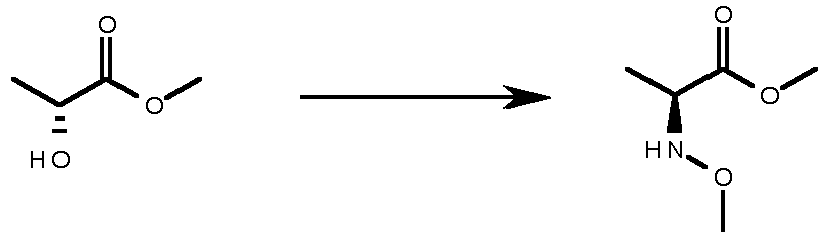
- To a stirred solution of methyl (2R)-2-hydroxypropanoate (16.5 g, 158 mmol, 15.1 mL) in DCM (475 mL) at 0°C was added trifluoromethanesulfonic anhydride (49.7 g, 174 mmol) followed after 5mins by 2,6-dimethylpyridine (19.5 g, 182 mmol). The resulting mixture was stirred at 0°C for 10 minutes to give a solution of methyl (2R)-2-(trifluoromethylsulfonyloxy)propanoate. Separately, O-methylhydroxylamine hydrochloride (65.98 g, 790.0 mmol) was dissolved in water (130 mL) then sodium hydroxide (50% aqueous) (33.1 mL 632.0 mmol) was added. The solution of O-methylhydroxylamine in water was added to the solution of methyl (2R)-2-(trifluoromethylsulfonyloxy)propanoate in DCM, and the mixture was stirred at room temperature for 30 minutes. The organic layer was separated and chromatographed on silica eluting with 0-45% EtOAc in isohexane. Fractions containing product were evaporated to give the desired product as a pale yellow oil (23.5 g). The product appears to have some volatility so caution was taken with the evaporation step. The product was used without further purification.
-

- Procedure as for example 5 alternative synthesis.
-

- To a stirred solution of methyl (2S)-2-[methoxy-[[4-(trifluoromethyl)-2-pyridyl]carbamoyl]amino]propanoate (18.3 g, 57.0 mmol) in a mixture of tetrahydrofuran (103 mL) and methanol (103 mL) at 5°C under nitrogen was added NaBH4 (5.10 g, 2.25 equiv.) portionwise over 20mins, keeping the internal temperature below ~6.5°C. The mixture was then stirred at 6.5°C for 1h before the reaction was quenched with acetone (50 mL) slowly over 45 minutes with external cooling to keep the internal temperature below ~6.5°C. Sat. aqueous NH4Cl solution (150 mL) was added followed by water (150 mL). The reaction was stirred at 15°C for 10mins, then extracted with DCM (4 × 400 mL and then 1 × 100mL). Combined DCM fractions were washed with water (50 mL) dried (Na2SO4), filtered and concentrated to ~200 mL volume, then chromatographed on silica eluting with 0-27% EtOAc in isohexane. Fractions containing product were evaporated to give the desired product as a white solid (5.65g, 34%).
- NMR and LC-MS data for A3 was consistant with A8 (example 4).
- The diastereomeric ratio was found to vary according to conditions for product synthesis, purification and analysis. The stereochemistry of the chiral centre at the carbon containing the hydroxyl group was found to interconvert at room temperature.
-

-

- A mixture of tris(dibenzylideneacetone)dipalladium(0) (0.202 g, 0.220 mmol), 4,5-bis(diphenylphosphino)-9,9-dimethylxanthene (0.493 g, 0.826 mmol), potassium carbonate (1.93 g, 13.8 mmol) and methylurea (0.408 g, 5.51 mmol) in 1,4-dioxane (30 mL) was treated with 2-chloro-4-(trifluoromethyl)pyridine (commercially available) (1.0 g, 5.51 mmol), The mixture was warmed to 75-80°C with stirring under a Nitrogen atmosphere for 3.5 h. The reaction mixture was diluted with EtOAc (20 mL) and water (20 mL) and filtered through a pad of celite, rinsing through with further small portions of EtOAc and water. The organic phase was separated and the aqueous further extracted with EtOAc (5 mL). The organic extracts were combined, washed with brine (10 mL), dried over MgSO4, filtered and the filtrate evaporated giving an orange liquid. This was chromatographed (eluting with an EtOAc/iso-hexane gradient) and fractions containing product were evaporated and triturated with iso-hexane to give the desired product as a light yellow powder (0.669 g, 55%).
- 1H NMR (CDCl3): 9.44 (br.s, 1H), 9.04 (br.s, 1H), 8.32 (d, 1H), 7.15 (s, 1H), 7.06 (d, 1H), 2.99 (d, 3H).
- LC-MS: (positive ES MH+ 220).
-

- To 1-methyl-3-[4-(trifluoromethyl)-2-pyridyl]urea (0.65 g, 3.0 mmol) in ethanol (20 mL) was added glyoxal (40% aqueous solution) (2.6 g, 18 mmol, 2.0 mL) via syringe, the mixture then being warmed and heated at reflux for 2 hours. The reaction mixture was allowed to cool to room temperature and concentrated to give a syrupy residue. This was dissolved in DCM (50 mL) and washed with brine (2 × 5 mL). The organic phase was dried (MgSO4) filtered and the filtrate concentrated giving the crude product as a dark green gum (1.07 g). The crude product was dissolved in DCM (20 mL) then chromatographed on silica eluting with EtOAc in isohexane. Fractions containing product were evaporated to give 4,5-dihydroxy-1-methyl-3-[4-(trifluoromethyl)-2-pyridyl]imidazolidin-2-one (0.562 g, 68%) and 5-ethoxy-4-hydroxy-1-methyl-3-[4-(trifluoromethyl)-2-pyridyl]imidazolidin-2-one (0.11 g, 12%).
- 4,5-Dihydroxy-1-methyl-3-[4-(trifluoromethyl)-2-pyridyl]imidazolidin-2-one:
1H NMR (CDCl3): Major diastereoisomer: 8.35 (br.s, 1H), 8.32 (d, 1H), 7.12 (dd, 1H), 5.71 (d, 1H); 4.96 (m, 1H), 4.82 (m, 1H), 3.54 (d, 1H), 3.01 (s, 3H). - Minor diastereoisomer: 8.47 (br.s, 1H), 8.38 (d, 1H), 7.19 (dd, 1H), 5.89 (d, 1H), 5.15 (m, 1H), 5.12 (m, 1H), 3.82 (d, 1H), 2.97 (s, 3H).
- LC-MS: (positive ES MH+ 278).
- 5-Ethoxy-4-hydroxy-1-methyl-3-[4-(trifluoromethyl)-2-pyridyl]imidazolidin-2-one (existing predominately as the trans diastereoisomer):
1H NMR (CDCl3): 8.46 (s, 1H), 8.38 (d, 1H), 7.18 (dd, 1H), 5.73 (d, 1H), 4.82 (d, 1H), 4.71 (s, 1H), 3.66 (m, 2H), 3.00 (s, 3H), 1.28 (t, 3H). - LC-MS: (positive ES MH+ 306).
-

- 5-ethoxy-4-hydroxy-1-methyl-3-[4-(trifluoromethyl)-2-pyridyl]imidazolidin-2-one (A6) was separated into individual enantiomers E1 and E2 by preparative chiral HPLC (CHIRALPAK IC column, eluting with isoHexane (containing 0.1% TFA) and IPA).
- The first eluting enantiomer E1 was purified further by chromatography on silica eluting with EtOAc in isohexane. Fractions containing product were evaporated to give pure enantiomer E1 (A34). A34 could be assigned as (5R)-5-ethoxy-4-hydroxy-1-methyl-3-[4-(trifluoromethyl)-2-pyridyl]imidazolidin-2-one by inference from biological activity of related compounds of known absolute configuration and comparison of elution time from chiral HPLC.
- Enantiomer E2 (A35) was sufficiently pure after the chiral HPLC purification and could be assigned as (5S)-5-ethoxy-4-hydroxy-1-methyl-3-[4-(trifluoromethyl)-2-pyridyl]imidazolidin-2-one by inference from biological activity of related compounds of known absolute configuration and comparison of elution time from chiral HPLC.
- NMR and LC-MS data was consistant with racemic 5-ethoxy-4-hydroxy-1-methyl-3-[4-(trifluoromethyl)-2-pyridyl]imidazolidin-2-one (A6) - both enantiomers were of predominantly trans configuration as determined by NMR.
-

-

- Ti(O-iPr)4 (34.3 g, 2 equiv.) was cooled to 10°C under a nitrogen atmosphere then ethanol (89 mL) was added followed by 1,1-dimethoxypropan-2-one (7.14 g , 1 equiv), methylamine hydrochloride (8.16 g, 2 equiv.) and triethylamine (16.8 mL, 2 equiv.). The reaction was stirred at room temperature for 15h. The reaction was cooled to 10°C and then NaBH4 (3.43 g, 1.5 equiv.) was added and the reaction was stirred at room temperature for 6h. The reaction was cooled to 10°C, then carefully over 10 minutes poured into ice cold aqueous ammonia (180 mL, 2M). The mixture was filtered, washing through with DCM (300 mL). The layers were separated and then the aqueous layer was extracted with further DCM (3 × 100 mL). The combined DCM layers were dried (Na2SO4), filtered and evaporated with care as to not lose any of the volatile product. This crude material was distilled on a Kugelrohr (70 to 110°C 14mBar) to give product (4.41 g) as a colourless oil, which was used without further purification.
- 1H NMR (CDCl3): 4.11 (d, 1H), 3.41 (s, 6H), 2.69 (pentet, 1H), 2.43 (s, 3H), 1.06 (d, 3H).
-

- 1,1-dimethoxy-N-methyl-propan-2-amine (1.0 g, 7.50 mmol) was dissolved in CDCl3 (1.5 mL). Trimethylsilyl isocyanate (commercially available) (2 equiv.) was added and the reaction was stirred at room temp for 4 days. The reaction mixture heated to reflux for 160 minutes while incrementally adding a further trimethylsilyl isocyanate (1.5 equiv.) The reaction was evaporated and treated with water (10 mL), stirred for 90 minutes, then evaporated to give crude product (1.08 g) which was used without further purification.
- 1H NMR (CDCl3): 4.60 (br s, 2H), 4.30 (br s, 1H), 4.24 (d, 1H), 3.41 (s, 6H), 2.71 (s, 3H), 1.18 (d, 3H).
-

- 1-(2,2-dimethoxy-1-methyl-ethyl)-1-methyl-urea (220 mg, 1.249 mmol), 2-chloro-4-(trifluoromethyl)pyridine (commercially available) (272 mg, 1.2 equiv.), potassium carbonate (259 mg, 1.5 equiv.), tris(dibenzylideneacetone)dipalladium(0) (47 mg), 4,5-bis(diphenylphosphino)-9,9-dimethylxanthene (111 mg) were suspended in 1-4-dioxane (6 mL) and the mixture was then heated at 105°C in a sealed vial for 1h. The mixture was allowed to cool to room temperature, diluted with EtOAc (6 mL), filtered then chromatographed on silica eluting with 0-100% EtOAc in isohexane. Fractions containing product were evaporated to give the desired product as a colourless gum (282 mg, 70%).
- LC-MS: (positive ES MH+ 322).
-

- 1-(2,2-dimethoxy-1-methyl-ethyl)-1-methyl-3-[4-(trifluoromethyl)-2-pyridyl]urea (240 mg, 0.787 mmol) was dissolved in acetic acid (6 mL), then water (3 mL) was added to give a homogeneous solution. This was stirred at room temperature for 2 days and then at 60°C for 1h. The reaction was evaporated (100 to 1 mBar at 20-35°C for 2h) to remove traces of HOAc to give product (204 mg, 99%) as an amber gum.
- 1H NMR (CDCl3): Major diastereomer: 8.54 (s, 1H), 8.37 (d, 1H), 7.16 (d, 1H), 5.61 (m, 1H), 4.95 (br s, 1H), 3.53 (m, 1H), 2.93 (s, 3H), 1.34 (d, 3H).
- Minor diastereomer: 8.54 (s, 1H), 8.39 (m, 1H), 7.16 (d, 1H), 5.95 (d, 1H), 4.81 (br s, 1H), 3.76 (pentet, 1H), 2.89 (s, 3H), 1.40 (d, 3H).
- LC-MS: (positive ES MH+ 276).
- The diastereomeric ratio was found to vary according to conditions for product synthesis, purification and analysis. The stereochemistry of the chiral centre at the carbon containing the hydroxyl group was found to interconvert at room temperature.
-

- Phenyl N-[4-(trifluoromethyl)-2-pyridyl]carbamate (for a synthesis see
WO 2007004749 ) (4.54 g, 1.05 equiv.) was suspended in 1,4-dioxane (12 mL) under a Nitrogen atmosphere and then 1,1-dimethoxy-N-methyl-propan-2-amine (3.46 g, 15.3 mmol) was added and the reaction was heated at 105°C for 25 mins. Aqueous 2N HCl (20 mL) was added to the reaction mixture and this was heated to 32°C for 30 mins. EtOAc (5 mL) and water (50 mL) were added and the aqueous phase was extracted with further EtOAc (2 × 50 mL). The combined EtOAc layers were washed with sat. aqueous NaHCO3 (5 mL), evaporated and then chromatographed on silica eluting with 0-100% EtOAc in isohexane. Fractions containing product were evaporated to give a colourless gum which slowly crystallised to give product (3.80 g, 90%). - NMR and LC-MS consistant with A19 from example 13 above.
- The diastereomeric ratio was found to vary according to conditions for product synthesis, purification and analysis. The stereochemistry of the chiral centre at the carbon containing the hydroxyl group was found to interconvert at room temperature.
-

-

- To phenyl N-[4-(trifluoromethyl)-2-pyridyl]carbamate (for a synthesis see
WO 2007004749 ) (0.328 g, 1.16 mmol) dissolved in 1,4-dioxane (6 mL), under a Nitrogen atmosphere, was added methyl 2-aminopent-4-enoate (for a synthesis seeWO2007137168 ) (0.150 g, 1.16 mmol). The mixture was then warmed to 80°C for 3h. The reaction temperature was then raised to 100°C, and heating continued for a further 1.5h. The reaction mixture was concentrated to remove the bulk of solvent, the oily residue being taken up in EtOAc (20 mL) and washed with water (2 × 5 mL). The organic phase was separated and dried over MgSO4, filtered and then chromatographed on silica eluting with EtOAc in isohexane. Fractions containing product were evaporated to give product as a white solid (0.167 g, 45%) - LC-MS: (positive ES MH+ 318).
-

- Methyl 2-[[4-(trifluoromethyl)-2-pyridyl]carbamoylamino]pent-4-enoate (0.114 g, 0.359 mmol) was dissolved in 1,4-dioxane (4 mL) was treated with 2N hydrochloric acid (4 mL) and the mixture was heated at 60-70°C for 3h. The reaction temp was raised to 85°C and heating continued for a further 1h. The reaction mixture then being allowed to cool to room temperature and then concentrated. The residue was taken into DCM (15 mL) and the organic phase separated. The aqueous was further extracted with DCM (2 × 10mL) and the DCM extracts combined, dried over MgSO4, filtered and the filtrate concentrated giving crude intermediate 2-[[4-(trifluoromethyl)-2-pyridyl]carbamoylamino]pent-4-enoic acid as a white gum (47 mg). The aqueous phase was evaporated giving further 2-[[4-(trifluoromethyl)-2-pyridyl]carbamoylamino]pent-4-enoic acid as a white foam (73 mg). Both fractions of 2-[[4-(trifluoromethyl)-2-pyridyl]carbamoylamino]pent-4-enoic acid were combined and used with further purification in the next step. The crude 2-[[4-(trifluoromethyl)-2-pyridyl]carbamoylamino]pent-4-enoic acid was taken into DCM (4 mL), then oxalyl chloride (0.0912 g, 0.719 mmol) was added to the fine slurry at room temperature. The reaction mixture was stirred for 2h and then allowed to stand overnight. The reaction mixture was concentrated and the residue taken into EtOAc (20 mL) and washed with water (5 mL). The organic phase was separated, the aqueous being further extracted with EtOAc (10 mL). The organic extracts were then combined, washed with water (3 mL), dried over MgSO4, filtered and the filtrate concentrated giving crude product as a light brown gum that began to solidify on standing (141 mg). This was used in the next step without further purification.
- LC-MS: (positive ES MH+ 286).
-

- A solution of 5-allyl-3-[4-(trifluoromethyl)-2-pyridyl]imidazolidine-2,4-dione (0.120 g, 0.421 mmol) in DMF (1.5 mL) was cooled to 0-5°C in an ice bath was treated dropwise with LiHMDS (1.0M in THF, 0.442 mmol, 0.442 mL). The resultant solution was stirred 5 minutes, then iodomethane (0.0717 g, 0.505 mmol) was added and stirring continued for 40 minutes. The reaction mixture was concentrated and the oily residue being taken up in EtOAc (15 mL) and washed with brine (3 × 2mL), dried over MgSO4, filtered and the filtrate concentrated giving crude product, which was chromatographed on silica eluting with EtOAc in isohexane. Fractions containing product were evaporated to give product as a white solid (0.060 g, 48%).
- LC-MS: (positive ES MH+ 300).
-

- 5-allyl-1-methyl-3-[4-(trifluoromethyl)-2-pyridyl]imidazolidine-2,4-dione (0.057 g, 0.19 mmol) in methanol (10 mL) was cooled to around -35°C (acetone/CO2 bath). NaBH4 (0.0073 g, 0.19 mmol) was added in a single portion and the reaction was stirred for 30 minutes at between -30 and - 40°C. The reaction mixture was allowed to warm slowly to room temperature. Further NaBH4 (0.0073 g, 0.19 mmol) was added and the mixture stirred at room temp for a further 30 minutes. The reaction mixture was quenched by the careful addition of water (2 mL), then concentrated and the residue being left to stand at room temperature for 72h. The mixture was diluted with EtOAc (20 mL) and the organic phase separated. The aqueous phase was further extracted with EtOAc (15 mL) and the organic extracts combined, washed with water (5 mL), dried over MgSO4, filtered and evaporated to give product as a light grey gum (56 mg, 98%).
- LC-MS: (positive ES MH+ 302).
- 1H NMR (CDCl3): Major diastereomer: 8.15 (s, 1H), 8.37 (d, 1H), 7.15 (dd, 1H), 5.75 (m, 1H), 5.70 (d, 1H), 5.23 (dd, 1H), 5.20 (dd, 1H), 4.90 (d, 1H), 3.54 (ddd, 1H), 2.96 (s, 3H), 2.55 (m, 1H), 2.53 (m, 1H).
- 1H NMR (CDCl3): Minor diastereomer: 8.15 (s, 1H), 8.37 (d, 1H), 7.15 (dd, 1H), 5.98 (m, 1H), 5.70 (d, 1H), 5.26 (dd, 1H), 5.18 (d, 1H), 4.79 (br.s, 1H), 3.65 (ddd, 1H), 2.91 (s, 3H), 2.69 (m, 1H), 2.55 (m, 1H).
-

-

- Methylamine hydrochloride (4.05 g, 1.05 equiv.) in DCM (60 mL) was cooled to 0°C, then K2CO3 (5.53 g, 1 equiv.) was added over 5 minutes. Reaction was stirred at 0°C for a further 10 minutes then 2,2-dimethoxyacetaldehyde (6.04 mL, 40 mmol) was added and the reaction was stirred vigorously at 0°C. After 5 minutes at 0°C, the reaction was allowed to warm to room temperature. After 15 minutes at room temperature, DCM was decanted off, solid was extracted with DCM (2 × 15 mL). Combined DCM fractions were dried (Na2SO4), filtered, and evaporated to give product which was used without further purification (4.10 g, 87%).
-

- KHF2 (2.01 g, 0.75 equiv.) was suspended in MeCN (69 mL) and DMF (8.0 mL) under Nitrogen, and cooled to 0°C then 2,2-dimethoxy-N-methyl-ethanimine (4.02g, 1 equiv.) was added followed by dropwise addition of TFA (3.28 mL, 1.25 equiv.) over 2 minutes. Reaction was stirred at 0°C for 5 minutes, then trimethyl(trifluoromethyl)silane (7.6 mL, 1.5 equiv.) was added over 5 mintues and the reaction was stirred at 0°C for 3h. Reaction was then treated with sat. aqueous NaHCO3 (50 mL) over 3 minutes The reaction mixture was then extracted with diethyl ether (3 × 200 mL), dried (Na2SO4), filtered and evaporated (care as product is volatile) to give product (14.1 g, 44%), which was used without further purification.
-

- Crude 1,1,1-trifluoro-3,3-dimethoxy-N-methyl-propan-2-amine (3.58 g, 1.2 equiv.) was dissolved in 1,4-dioxane (2.5 mL) and treated with N-[4-(trifluoromethyl)-2-pyridyl]carbamate (for a synthesis see
WO 2007004749 ) (1.00 g, 3.19 mmol) and heated at 110°C for 2 h 15 minutes. Reaction mixture was then evaporated and the residue chromatographed on silica eluting with EtOAc in isohexane (0-35%). Fractions containing product were evaporated to give product as a gum (0.40 g, 33%). - LC-MS: (positive ES MH+ 376).
-

- 1,1,1-trifluoro-3,3-dimethoxy-N-methyl-propan-2-amine (0.377 g) was suspended in water (2 mL) and then treated with TFA (2 mL) and the reaction mixture was then heated to 60°C for 1.5h. The reaction was evaporated and treated with sat. aqueous NaHCO3 (15 mL) and DCM (15 mL). The aqueous phase was further extracted with DCM (2 × 10 mL) and then the combined DCM phases were dried (Na2SO4), filtered and evaporated to give product as a white solid (320 mg, 97%).
- LC-MS: (positive ES MH+ 330).
- 1H NMR (CDCl3): 8.48 (s, 1H), 8.42 (d, 1H), 7.25 (d, 1H), 6.02 (m, 1H), 5.01 (br s, 1H), 3.93 (m, 1H), 3.10 (s, 3H).
-

-

- To a stirred solution of 4-(trifluoromethyl)pyridin-2-amine (5 g, 30.84 mmol) and pyridine (2.56 g, 32.38 mmol) in DCM (75 mL) at 0°C (internal temp) was added (4-nitrophenyl) carbonochloridate (6.22 g, 30.84 mmol,) over 15mins, keeping temp at or below 8°C, and the reaction mixture was then stirred at 0°C for 1 h. After 90 mins at 0°C, the reaction was allowed to warm to room temperature, and stirred at for 1hr. Ice cold water (25 mL) was added. The biphasic mixture was filtered and the precipitate washed with ice cold water (10 mL) and DCM (2 × 10 mL). The precipitate was dried under vacuum to give product as a white solid (7.60 g, 75%).
- LC-MS: (positive ES MH+ 328).
-

- A mixture of (4-nitrophenyl) N-[4-(trifluoromethyl)-2-pyridyl]carbamate (1.20 g, 3.67 mmol) and 1,4-dioxane (12 mL), under a nitrogen atmosphere, was treated with (2S)-2-(methylamino)propanoic acid (commercially available) (0.416 g, 4.03 mmol, and the mixture was stirred at room temperature for 5h then at 60°C for 1.5h, left at room temperature overnight, then heated at 80°C for 1.5h and then left over the weekend at rt. The reaction mixture was filtered rinsing through with small portions of EtOAc, then the filtrate and washings were combined and concentrated to give a deep yellow oily residue. The oily residue was taken into EtOAc (25 mL) and washed with saturated NaHCO3 solution (3 × 15 mL) and brine (10 mL). The organic phase was dried over MgSO4, filtered, evaporated and the residue chromatographed on silica eluting with EtOAc in isohexane. Fractions containing product were evaporated to give product (0.675 g, 67%).
- LC-MS: (positive ES MH+ 274).
-

- (5S)-1,5-dimethyl-3-[4-(trifluoromethyl)-2-pyridyl]imidazolidine-2,4-dione (0.660 g, 2.42 mmol) was stirred in methanol (20 mL) and the solution was cooled to around -15°C (ice-salt bath). Sodium borohydride (0.0933 g, 2.42 mmol) was added in a single portion and the reaction was allowed to warm to 15°C over 1h, and was then quenched by the careful addition of water (0.5 mL). After 5 minutes stirring the mixture was diluted further with water (40 mL). A white precipitate formed, which was filtered off, washed with water and dried under suction giving a white powder. The combined filtrate and washings were extracted with DCM (3 × 20mL). The organic extracts were then combined, washed with brine (2 × 20mL), dried over MgSO4, filtered and the filtrate concentrated giving a light grey gum, (0.367 g, 55%).
- NMR and LC-MS consistant with example 13 (A19).
- The diastereomeric ratio was found to vary according to conditions for product synthesis, purification and analysis. The stereochemistry of the chiral centre at the carbon containing the hydroxyl group was found to interconvert at room temperature.
-

- Method as for example 17 but using (2R)-2-(methylamino)propanoic acid (commercially available).
- NMR and LC-MS consistant with example 13 (A19).
- The diastereomeric ratio was found to vary according to conditions for product synthesis, purification and analysis. The stereochemistry of the chiral centre at the carbon containing the hydroxyl group was found to interconvert at room temperature.
- Table 1 lists examples of compounds of the general formula (I)

- These compounds were made by the general methods described. Compounds A26, A27, A30-A32, A39, A40, A43, A44, A46, A47, A59-A61, A66-A69, A70-A75, A80-A87, A89-A95, A107, A109 and A116 do not form part of the invention.
Table 1 Compound STRUCTURE 1H NMR (measured in CDCl3 unless otherwise indicated) δ LC-MS A1 
8.52 (s, 1H), 8.39 (d, 1H), 7.15 (d, 1H), 5.68 (m, 1H), 4.94 (br s, 1H), 3.40 (m, 1H), 2.92 (s, 3H), 1.85 (m, 1H), 1.55 (m, 1H), 0.98 (t, 3H). positive ES MH+ 290 A2 
8.47 (s, 1H), 8.38 (d, 1H), 7.18 (dd, 1H), 5.72 (d, 1H), 4.81 (d, 1H), 4.71 (s, 1H), 3.54 (ddq, 2H), 3.00 (s, 3H), 1.65 (m, 2H), 0.96 (t, 3H). positive ES MH+ 320 A3 
As for A8 As for A8 A4 
As for A8 As for A8 A5 
8.46 (s, 1H), 8.39 (d, 1H), 7.19 (d, 1H), 5.74 (d, 1H), 4.82 (d, 1H), 4.67 (s, 1H), 3.43 (s, 3H), 3.01 (s, 3H). positive ES MH+ 292 A6 
8.46 (s, 1H), 8.38 (d, 1H), 7.18 (dd, 1H), 5.73 (d, 1H), 4.82 (d, 1H), 4.71 (s, 1H), 3.66 (m, 2H), 3.00 (s, 3H), 1.28 (t, 3H). positive ES MH+ 306 A7 
Major diastereoisomer: 8.35 (br.s, 1H), 8.32 (d, 1H), 7.12 (dd, 1H), 5.71 (d, 1H); 4.96 (m, 1H), 4.82 (m, 1H), 3.54 (d, 1H), 3.01 (s, 3H). Minor diastereoisomer: 8.47 (br.s, 1H), 8.38 (d, 1H), 7.19 (dd, 1H), 5.89 (d, 1H), 5.15 (m, 1H), 5.12 (m, 1H), 3.82 (d, 1H), 2.97 (s, 3H). positive ES MH+ 278 A8 
Major diastereomer: 8.55 (s, 1H), 8.43 (dd, 1H), 7.25 (d, 1H), 5.55 (m, 1H), 5.04 (very br s, 1H), 3.90 (s, 3H), 3.71 (m, 1H), 1.45 (d, 3H). Minor diastereomer: 8.53 (s, 1H), 8.45 (dd, 1H), 7.24 (d, 1H), 5.87 (d, 1H), 4.60 (very br s, 1H), 3.93 (s, 3H), 3.80 (m, 1H), 1.50 (d, 3H). positive ES MH+ 292 A9 
Major diastereomer: 8.72 (m, 1H), 8.67 (s, 1H), 8.42 (s, 1H), 7.78 (t, 1H), 7.45 (d, 1H), 7.35 (dd, 1H), 5.65 (s, 1H), 4.94 (s, 1H), 3.56 (m, 1H), 2.94 (s, 3H), 1.36 (d, 3H). Minor diastereomer: 8.72 (m, 1H), 8.67 (s, 1H), 8.44 (s, 1H), 7.78 (t, 1H), 7.45 (d, 1H), 7.35 (dd, 1H), 5.99 (d, 1H), 4.77 (s, 1H), 3.79 (pentet, 1H), 2.95 (s, 3H), 1.41 (d, 3H). positive ES MH+ 353 A10 
8.36 (s, 1H), 8.03 (s, 1H), 5.66 (s, 1H), 4.80 (br s, 1H), 4.69 (s, 1H), 3.95 (s, 3H), 3.65 (m, 2H), 2.97 (s, 3H), 1.26 (t, 3H). positive ES MH+ 336 A11 
Major diastereomer: 9.30 (s, 1H), 8.75 (s, 1H) 8.72 (s, 2H), 8.24 (s, 1H), 5.65 (m, 1H), 4.80 (m, 1H), 3.55 (m, 1H), 2.96 (s, 3H), 1.35 (d, 3H). Minor diastereomer: 9.30 (s, 1H), 8.75 (s, 1H) 8.72 (s, 2H), 8.24 (s, 1H), 6.00 (d, 1H), 4.65 (s, 1H), 3.85 (m, 1H), 2.92 (s, 3H), 1.42 (d, 3H). positive ES MH+ 354 A12 
Major diastereomer: 8.45 (s, 1H), 8.03 (s, 1H), 5.53 (m, 1H), 4.90 (br s, 1H), 3.95 (s, 3H), 3.50 (m, 1H), 2.91 (s, 3H), 1.33 (d, 3H). Minor diastereomer: 8.44 (s, 1H), 8.05 (s, 1H), 5.88 (d, 1H), 4.75 (br s, 1H), 3.95 (s, 3H), 3.75 (m, 1H), 2.88 (s, 3H), 1.39 (d, 3H). positive ES MH+ 306 A13 
8.56 (s, 1H), 8.23 (s, 1H), 7.44 (m, 3H), 7.32 (m, 2H), 5.77 (d, 1H), 4.81 (d, 1H), 4.74 (s, 1H), 3.66 (m, 2H), 3.03 (s, 3H), 1.28 (m, 3H). positive ES MH+ 382 A14 
9.30 (s, 1H), 8.75 (s, 2H), 8.70 (s, 1H), 8.24 (s, 1H), 5.80 (d, 1H), 4.75 (s, 1H), 4.71 (d, 1H), 3.69 (m, 2H), 3.04 (s, 3H), 1.29 (t, 3H). positive ES MH+ 384 A15 
9.30 (s, 1H), 8.75 (s, 2H), 8.70 (s, 1H), 8.25 (s, 1H), 5.81 (d, 1H), 4.71 (s, 1H), 4.70 (d, 1H), 3.46. (s, 3H), 3.05 (s, 3H). positive ES MH+ 370 A16 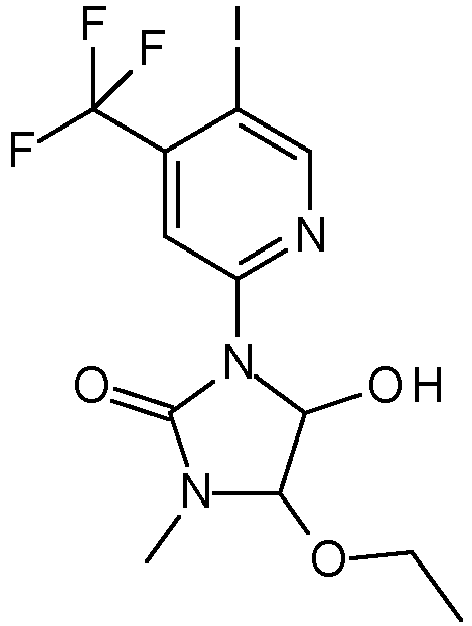
8.70 (s, 1H), 8.58 (s, 1H), 5.70 (d, 1H), 4.71 (s, 1H), 4.54 (d, 1H), 3.66 (m, 2H), 3.00 (s, 3H), 1.27 (t, 3H). positive ES MH+ 432 A17 
8.81 (s, 1H), 8.62 (s, 1H), 5.65 (d, 1H), 4.84 (d, 1H), 4.81 (d, 1H), 2.91 (s, 3H). positive ES MH+ 404 A18 
8.70 (s, 1H), 8.57 (s, 1H), 5.71 (d, 1H), 4.66 (s, 1H), 4.58 (d, 1H), 3.43 (s, 3H), 3.00 (s, 3H). positive ES MH+ 418 A19 
Major diastereomer: 8.54 (s, 1H), 8.37 (d, 1H), 7.16 (d, 1H), 5.61 (m, 1H), 4.95 (br s, 1H), 3.53 (m, 1H), 2.93 (s, 3H), 1.34 (d, 3H). Minor diastereomer: 8.54 (s, 1H), 8.39 (m, 1H), 7.16 (d, 1H), 5.95 (d, 1H), 4.81 (br s, 1H), 3.76 (pentet, 1H), 2.89 (s, 3H), 1.40 (d, 3H). positive ES MH+ 276 A20 
Major diastereomer: 8.70 (m, 1H), 8.48 (s, 1H), 8.25 (s, 1H), 8.20 (s, 1H), 7.18 (s, 1H), 5.62 (s, 1H), 4.92 (s, 1H), 3.90 (s, 3H), 3.55 (m, 1H), 2.94 (s, 3H), 1.36 (d, 3H). positive ES MH+ 383 A21 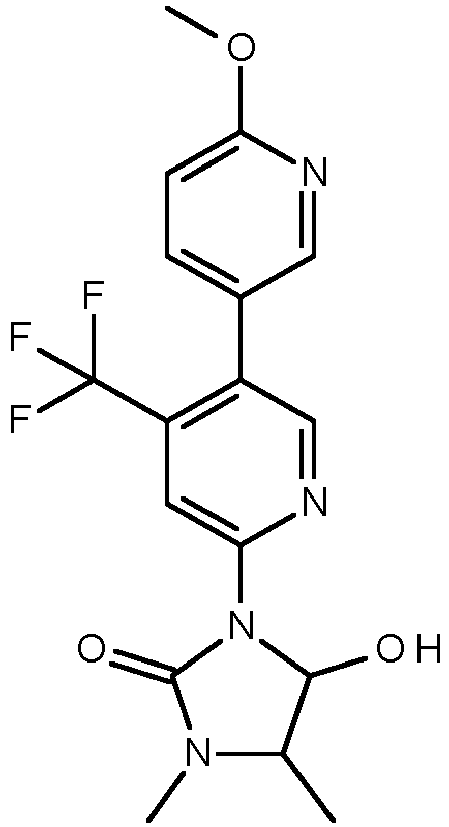
Major diastereomer: 8.65 (m, 1H), 8.20 (s, 1H), 8.12 (s, 1H), 7.55 (s, 1H), 6.82 (s, 1H), 5.62 (s, 1H), 4.85 (s, 1H), 3.90 (s, 3H), 3.55 (m, 1H), 2.95 (s, 3H), 1.35 (d, 3H). positive ES MH+ 383 A22 
Major diastereomer: 8.72 (s, 1H), 8.50 (s, 2H), 8.20 (s, 1H), 5.62 (s, 1H), 4.83 (s, 1H), 4.08 (s, 3H), 3.55 (m, 1H), 2.94 (s, 3H), 1.35 (d, 3H). positive ES MH+ 384 A23 
Major diastereomer: 8.68 (m, 1H), 8.55 (d, 1H), 8.28 (s, 1H), 8.15 (s, 1H), 6.89 (d, 1H), 5.62 (s, 1H), 4.95 (br s, 1H), 3.70 (s, 3H), 3.54 (m, 1H), 2.95 (s, 3H), 1.35 (d, 3H). positive ES MH+ 383 A24 
Major diastereomer: 8.69 (s, 1H), 8.46 (s, 1H), 8.21 (m, 1H), 7.57 (dm, 1H), 7.25 (dm, 1H), 5.65 (m, 1H), 4.91 (br s, 1H), 3.56 (m, 1H), 2.95 (s, 3H), 2.64 (s, 3H), 1.36 (d, 3H). positive ES MH+ 367 Minor diastereomer: 8.69 (s, 1H), 8.46 (s, 1H), 8.21 (m, 1H), 7.57 (dm, 1H), 7.25 (dm, 1H), 6.00 (d, 1H), 4.78 (br s, 1H), 3.79 (m, 1H), 2.92 (s, 3H), 2. 64 (s, 3H), 1.42 (d, 3H). A25 
Major diastereomer: 8.69 (s, 1H), 8.64 (s, 1H), 5.56 (m, 1H), 4.65 (very br s, 1H), 3.53 (m, 1H), 2.93 (s, 3H), 1.33 (d, 3H). positive ES MH+ 402 Minor diastereomer: 8.70 (s, 1H), 8.64 (s, 1H), 5.91 (d, 1H), 4.65 (very br s, 1H), 3.76 (m, 1H), 2.88 (s, 3H), 1.38 (d, 3H). A26 
Major diastereomer 8.32 (s, 1H), 8.16 (d, 1H), 7.86 (d, 1H), 6.43 (d, 1H), 5.58 (d, 1H), 3.37 (m, 1H), 2.80 (s, 3H), 1.18 (d, 3H). Positive ES MH+ 242 Minor diastereomer 8.32 (s, 1H), 8.17 (d, 1H), 7.86 (d, 1H), 6.18 (d, 1H), 5.91 (d, 1H), 3.39 (m, 1H), 2.72 (s, 3H), 1.18 (d, 3H). A27 
Major diastereomer 8.48 (s, 1H), 8.15 (d, 1H), 7.05 (d, 1H), 5.79 (d, 1H), 3.65 (m, 1H), 2.97 (s, 3H), 2.5(s, 3H), 1.4 (d, 3H). Positive ES MH+ 222 Minor diastereomer 8.58 (s, 1H), 8.16 (d, 1H), 7.07 (d, 1H), 6.21 (d, 1H), 3.88 (m, 1H), 2.94 (s, 3H), 2.55(s, 3H), 1.45 (d, 3H). A28 
Major diastereomer 8.55 (s, 1H), 8.43 (dd, 1H), 7.25 (d, 1H), 5.55 (d, 1H), 5.04 (very br s, 1H), 3.90 (s, 3H), 3.38 (d, 1H), 1.45 (d, 3H). positive ES MH+ 306 Minor diastereomer 8.53 (s, 1H), 8.45 (dd, 1H), 7.24 (d, 1H), 5.87(d, 1H), 4.60 (very br s, 1H), 3.93 (s, 3H), 3.71 (m, 1H), 1.50 (d, 3H). A29 
8.46 (s, 1H), 8.38 (d, 1H), 7.18 (dd, 1H), 5.74 (d, 1H), 4.80 (d, 1H), 4.79 (s, 1H), 3.51-3.73 (m, 3H), 3.33 (m, 1H), 1.27 (t, 3H), 1.25 (t, 3H). positive ES MH+ 320 A30 
Major diastereomer 8.17 (d, 1H), 8.04 (d, 1H), 6.91 (d, 1H), 5.50 (d, 1H), 3.41 (m, 1H), 2.84 (s, 3H), 1.31 (d, 3H), 1.24 (s, 9H). Positive ES MH+ 264 Minor diastereomers 8.17 (d, 1H), 8.05 (d, 1H), 6.92 (d, 1H), 5.85 (d, 1H), 3.63 (m, 1H), 2.80 (s, 3H), 1.31 (d, 3H), 1.27 (s, 9H). A31 
Major diastereomer: 8.54 (s, 1H), 8.37 (d, 1H), 7.17 (m, 1H), 5.75 (ddd, 1H), 5.70 (d, 1H), 5.44 (m, 1H), 5.43 (m, 1H), 5.01 (br s, 1H), 3.89 (m, 1H), 2.89 (s, 3H). positive ES MH+ 288 Minor diastereomer: 8.54 (s, 1H), 8.39 (m, 1H), 7.17 (m, 1H), 6.02 (m, 2H), 5.51 (m, 2H), 4.06 (m, 1H), 2.83 (s, 3H). A32 
Major diastereomer: 8.15 (s, 1H), 8.37 (d, 1H), 7.15 (dd, 1H), 5.75 (m, 1H), 5.70 (d, 1H), 5.23 (dd, 1H), 5.20 (dd, 1H), 4.90 (d, 1H), 3.54 (ddd, 1H), 2.96 (s, 3H), 2.55 (m, 1H), 2.53 (m, 1H). positive ES MH+ 302 Minor diastereomer: 8.15 (s, 1H), 8.37 (d, 1H), 7.15 (dd, 1H), 5.98 (m, 1H), 5.70 (d, 1H), 5.26 (dd, 1H), 5.18 (d, 1H), 4.79 (br.s, 1H), 3.65 (ddd, 1H), 2.91 (s, 3H), 2.69 (m, 1H), 2.55 (m, 1H). A33 
8.48 (s, 1H), 8.42 (d, 1H), 7.25 (d, 1H), 6.02 (m, 1H), 5.01 (br s, 1H), 3.93 (m, 1H), 3.10 (s, 3H). positive ES MH+ 330 A34 
As for A6 As for A6 A35 
As for A6 As for A6 A36 
8.54 (s, 1H), 8.45 (dd, 1H), 7.25 (d, 1H), 6.02 (m, 1H), 4.75 (very br s, 1H), 3.89 (s, 3H), 3.75 (m, 1H), 3.68 (m, 1H). positive ES MH+ 278 A37 
As for A19 As for A19 A38 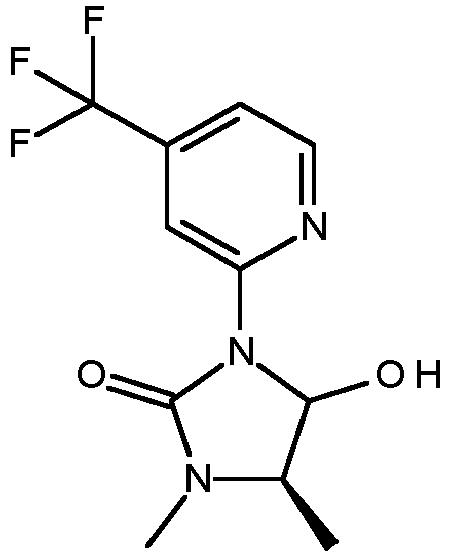
As for A19 As for A19 A39 
8.44 (s, 1H), 8.40 (d, 1H), 7.22 (d, 1H), 5.77 (d, 1H), 4.86 (s, 1H), 4.85 (d, 1H), 3.99 (m, 2H), 3.03 (s, 3H). positive ES MH+ 360 A40 
(DMSO-d6): 8.57 (d, 1H), 8.47 (s, 1H), 7.75 (s, 1H), 7.36 (d, 1H), 6.46 (d, 1H), 5.68 (d, 1H), 3.43 (q, 1H), 1.15 (d, 3H). positive ES MH+ 262 A41 
8.46 (s, 1H), 8.38 (d, 1H), 7.19 (dd, 1H), 5.94 (m, 1H), 5.75 (d, 1H), 5.36 (dd, 1H), 5.26 (dd, 1H), 4.80 (d, 1H), 4.77 (s, 1H), 4.15 (m, 2H), 3.01 (s, 3H). positive ES MH+ 318 A42 
8.50 (s, 1H), 8.37 (d, 1H), 7.16 (d, 1H), 5.89 (s, 1H), 4.90 (s, 1H), 4.37 (d, 1H), 3.57 (m, 1H), 3.49 (d, 6H), 3.04 (s, 3H). positive ES MH+ 336 A43 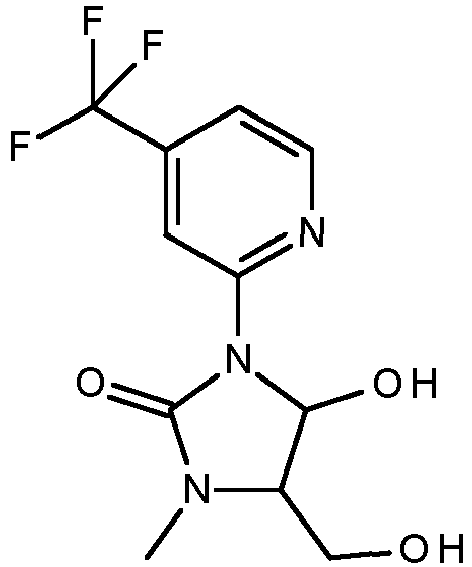
Major diastereomer: 8.50 (s, 1H), 8.37 (d, 1H), 7.16 (d, 1H), 5.89 (m, 1H), 5.03 (m, 1H), 3.91 (m, 1H), 3.82 (m, 1H), 3.51 (q, 1H), 2.96 (s, 3H), 2.36 (br m, 1H) Minor diastereomer: 8.55 (s, 1H), 8.37 (d, 1H), 7.18 (m, 1H), 5.89 (m, 1H), 5.46 (br s, 1H), 3.96 (m, 1H), 3.76 (m, 1H), 3.51 (q, 1H), 2.96 (s, 3H), 2.36 (br m, 1H) positive ES MH+ 292 A44 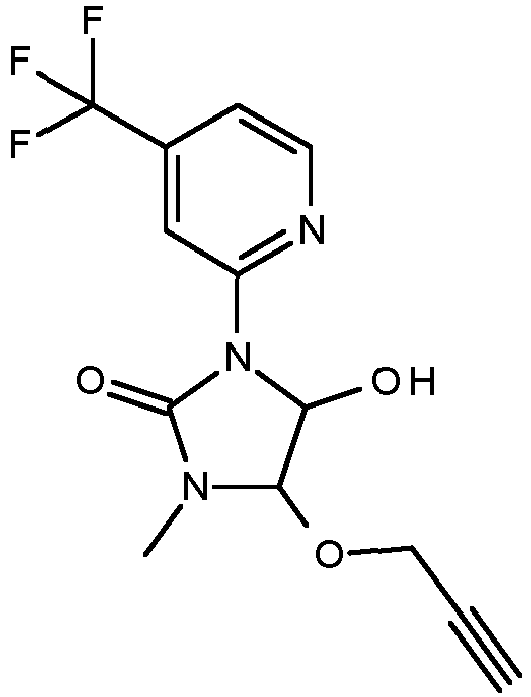
8.44 (s, 1H), 8.38 (d, 1H), 7.19 (dd, 1H), 5.82 (d, 1H), 4.92 (s, 1H), 4.79 (d, 1H), 4.32 (d, 2H), 3.03 (s, 3H), 2.54 (t, 1H) positive ES MH+ 316 A45 
8.45 (s, 1H), 8.38 (d, 1H), 7.18 (d, 1H), 5.77 (d, 1H), 4.80 (s, 1H), 4.78 (d, 1H), 3.74 (q, 2H), 3.58 (t, 2H), 3.39 (s, 3H), 3.01 (s, 3H). positive ES MH+ 336 A46 
8.62 (s, 1H), 8.42 (d, 1H), 7.20 (dd, 1H), 5.92 (t, 1H), 4.98 (d, 1H), 3.68-3.77 (m, 2H), 3.21-3.29 (m, 1H), 2.14-2.22 (m, 1H), 2.02-2.13 (m, 1H), 1.89-2.02 (m, 1H), 1.36-1.49 (m, 1H). positive ES MH+ 288 A47 
As for A46 As for A46 A48 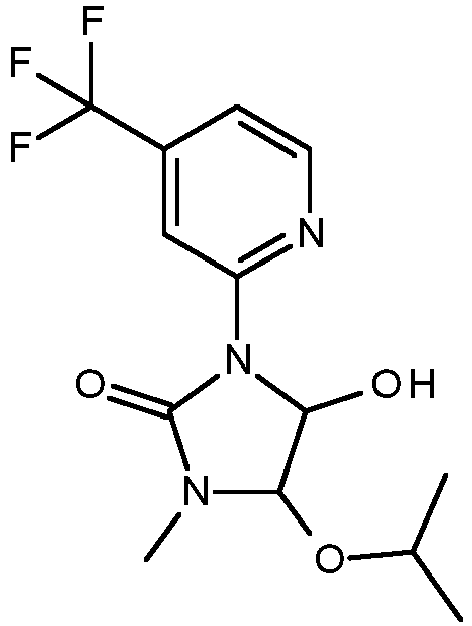
8.46 (s, 1H), 8.37 (d, 1H), 7.17 (d, 1H), 5.66 (d, 1H), 4.80 (d, 1H), 4.71 (s, 1H), 3.93 (dt, 1H), 2.96 (s, 3H), 1.27 (dd, 6H). positive ES MH+ 320 A49 
Major diastereomer: 8.64 (s, 1H), 8.33 (s, 1H), 5.56 (t, 1H), 4.63 (d, 1H), 3.52 (m, 1H), 2.93 (s, 3H), 1.34 (d, 3H). positive ES MH+ 310 Minor diastereomer: 8.64 (s, 1H), 8.35 (s, 1H), 5.91 (dd, 1H), 4.46 (d, 1H), 3.76 (m, 1H), 2.89 (s, 3H), 1.39 (d, 3H). A50 
Major diastereomer: 8.64 (s, 1H), 8.38 (s, 1H), 5.51 (dd, 1H), 4.68 (d, 1H), 3.89 (s, 3H), 3.72 (m, 1H), 1.45 (d, 3H). positive ES MH+ 326 Minor diastereomer: 8.62 (s, 1H), 8.40 (s, 1H), 5.83 (dd, 1H), 4.28 (d, 1H), 3.92 (s, 3H), 3.79 (m, 1H), 1.50 (d, 3H). A51 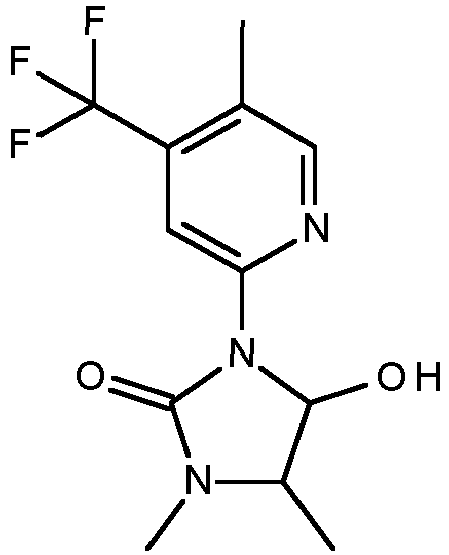
Major diastereomer 8.48 (s, 1H), 8.15 (s, 1H), 5.56 (d, 1H), 4.98 (br s, 1H), 3.51 (dq, 1H), 2.92 (s, 3H), 2.40 (s, 3H), 1.33 (d, 3H). positive ES MH+ 290 Minor diastereomer 8.47 (s, 1H), 8.17 (s, 1H), 5.91 (d, 1H), 4.83 (br s, 1H), 3.74 (pentet, 1H), 2.88 (s, 3H), 2.40 (s, 3H), 1.39 (d, 3H). A52 
8.41 (s, 1H), 8.17 (s, 1H), 5.70 (s, 1H), 4.70 (s, 1H), 3.64 (m, 2H), 3.00 (s, 3H), 2.40 (s, 3H), 1.27 (t, 3H). positive ES MH+ 320 A53 
8.57 (s, 1H), 8.34 (s, 1H), 5.70 (d, 1H), 4.70 (s, 1H), 4.52 (d, 1H), 3.67 (m, 2H), 3.00 (s, 3H), 1.28 (t, 3H). positive ES MH+ 340 A54 
8.55 (s, 1H), 8.39 (d, 1H), 7.17 (d, 1H), 5.82 (s, 1H), 3.58 (br s, 3H), 3.39 (s, 3H), 2.98 (s, 3H). positive ES MH+ 306 A55 
Major diastereomer 8.63 (s, 1H), 8.54 (s, 1H), 5.83 (d, 1H), 4.30 (br s, 1H), 3.93 (s, 3H), 3.80 (m, 1H), 1.50 (d, 3H). positive ES MH+ 370/372 Minor diastereomer 8.65 (s, 1H), 8.52 (s, 1H), 5.51 (d, 1H), 4.70 (br s, 1H), 3.90 (s, 3H), 3.72 (m, 1H), 1.45 (d, 3H). A56 
Major diastereomer 8.85 (s, 1H), 8.53 (s, 1H), 7.22 (br s, 1H), 5.60 (m, 1H), 4.84 (br s, 1H), 3.53 (m, 1H), 2.92 (s, 3H), 2.23 (s, 3H), 1.33 (d, 3H). positive ES MH+ 333 Minor diastereomer 8.85 (s, 1H), 8.52 (s, 1H), 7.22 (br s, 1H), 5.93 (m, 1H), 4.70 (br s, 1H), 3.75 (m, 1H), 2.88 (s, 3H), 2.23 (s, 3H), 1.39 (d, 3H). A57 
Major diastereomer 8.95 (s, 1H), 8.53 (s, 1H), 7.48 (br s, 1H), 5.60 (m, 1H), 4.86 (m, 1H), 3.52 (m, 1H), 2.92 (s, 3H), 1.33 (d, 3H), 1.33 (s, 9H). positive ES MH+ 375 Minor diastereomer 8.97 (s, 1H), 8.52 (s, 1H), 7.48 (br s, 1H), 5.94 (m, 1H), 4.71 (m, 1H), 3.75 (m, 1H), 2.88 (s, 3H), 1.39 (d, 3H), 1.33 (s, 9H). A58 
Major diastereomer 8.50 (s, 1H), 8.20 (s, 1H), 5.50 (m, 1H), 5.02 (m, 1H), 3.89 (s, 3H), 3.68 (m, 1H), 2.41 (s, 3H), 1.44 (d, 3H). positive ES MH+ 306 Minor diastereomer 8.47 (s, 1H), 8.23 (s, 1H), 5.81 (m, 1H), 4.59 (m, 1H), 3.93 (s, 3H), 3.76 (quintet, 1H), 2.41 (s, 3H), 1.48 (d, 3H). A59 
8.28 (m, 2H), 7.10 (dd, 1H), 5.72 (d, 1H), 5.00 (d, 1H), 4.71 (s, 1H), 3.66 (m, 2H), 2.99 (s, 3H), 1.91(t, 3H), 1.27(t, 3H). positive ES MH+ 302 A60 
Major diastereomer: 8.36 (d, 1H), 8.30 (d, 1H), 7.09 (dd, 1H), 5.59 (m, 1H), 5.12 (d, 1H), 3.51 (m, 1H), 2.93 (s, 3H), 1.92 (t, 3H), 1.33 (d, 3H). positive ES MH+ 272 Minor diastereomer: 8.36 (d, 1H), 8.30 (d, 1H), 7.09 (dd, 1H), 5.92 (m, 1H), 4.98 (d, 1H), 3.74 (m, 1H), 2.89 (s, 3H), 1.92 (t, 3H), 1.40 (d, 3H). A61 
8.21 (d, 1H), 8.06 (m, 1H), 7.07 (dd, 1H), 5.71 (s, 1H), 5.19 (s, 1H), 4.70(s, 1H), 3.65 (m, 2H), 2.98 (s, 3H), 1.70(d, 3H), 1.63(d, 3H), 1.27(t, 3H). positive ES MH+ 298 A62 
Major diastereomer: 8.51 (s, 1H), 8.50 (s, 1H), 6.93 (m, 1H), 5.71 (d, 1H), 5.60 (m, 1H), 5.42 (d, 1H), 4.91 (m, 1H), 3.53 (m, 1H), 2.93 (s, 3H), 1.33 (d, 3H). positive ES MH+ 302 Minor diastereomer: 8.51 (s, 1H), 8.50 (s, 1H), 6.93 (m, 1H), 5.94 (m, 1H), 5.71 (d, 1H), 5.42 (d, 1H), 4.76 (m, 1H), 3.76 (m, 1H), 2.88 (s, 3H), 1.39 (d, 3H). A63 
Major diastereomer 8.15 (d, 1H), 8.11 (m, 1H), 7.01 (dd, 1H), 5.54 (d, 1H), 3.46 (m, 1H), 2.88 (s, 3H), 1.66 (d, 3H), 1.60 (d, 3H), 1.28 (d, 3H). positive ES MH+ 268 Minor diastereomer 8.15 (d, 1H), 8.11 (m, 1H), 7.01 (dd, 1H), 5.88 (d, 1H), 3.68 (m, 1H), 2.83 (s, 3H), 1.66 (d, 3H), 1.60 (d, 3H), 1.34 (d, 3H). A64 
Major diastereomer: 8.47 (s, 1H), 8.42 (d, 1H), 7.25 (m, 1H), 5.57 (d, 1H), 3.73 (m, 1H), 1.47 (d, 3H). positive ES MH+ 278 Minor diastereomer: 8.44 (s, 1H), 8.35 (d, 1H), 7.27 (m, 1H), 5.94 (d, 1H), 3.86 (m, 1H), 1.48 (d, 3H). A65 
Major diastereomer: 8.58 (s, 1H), 8.46 (s, 1H), 5.63 (br. s., 1H), 4.77 (d, 1H), 4.12 (m, 1H), 3.54 (qd, 1H), 2.94 (s, 3H), 1.46 (s, 9H) 1.35 (d, 3H). positive ES MH+ Minor diastereomer: 8.58 (s, 1H), 8.46 (s, 1H), 5.95 (dd, 1H), 5.60 (t, 1H), 4.60 (d, 1H), 3.78 (t, 1H), 2.90 (s, 3H), 1.46 (s, 9H) 1.35 (d, 3H). A66 
Major diastereomer: 8.65 (d, 1H), 8.26 (dd, 1H), 8.02 (t, 1H), 5.87 (br.s, 1H), 5.53 (d, 1H), 5.20 (br.s, 1H), 3.89 (s, 3H), 3.70 (m, 1H), 1.48 (s, 9H), 1.45 (d, 3H). positive ES MH+ 323 Minor diastereomer: 8.67 (d, 1H), 8.24 (dd, 1H), 8.00 (t, 1H), 5.87 (br.s, 1H), 5.85 (d, 1H), 4.75 (br.s, 1H), 3.92 (s, 3H), 3.78 (m, 1H), 1.50 (d, 3H), 1.48 (s, 9H). A67 
Major diastereomer: 8.62 (d, 1H), 8.25 (d, 1H), 7.96 (dd, 1H), 5.84 (br.s, 1H), 5.59 (t, 1H), 5.11 (d, 1H), 3.51 (ddd, 1H), 2.92 (s, 3H), 1.48 (s, 9H), 1.34 (d, 3H). positive ES MH+ 307 Minor diastereomer: 8.62 (d, 1H), 8.25 (d, 1H); 7.96 (dd, 1H), 5.94 (dd, 1H), 5.84 (br.s, 1H), 4.96 (d, 1H), 3.75 (m, 1H), 2.88 (s, 3H), 1.48 (s, 9H), 1.38 (d, 3H). A68 
Major diastereomer: 8.44 (d, 1H), 7.98 (s, 1H), 7.26 (dd, 1H), 5.81 (m, 1H), 5.12 (d, 1H), 4.13 (m, 1H), 3.18 (d, 3H), 2.65-2.36 (m, 2H). positive ES MH+ 344 Minor diastereomer: 8.46 (d, 1H), 8.29 (s, 1H), 7.28 (dd, 1H), 5.72 (m, 1H), 5.40 (t, 1H), 4.00 (m, 1H), 3.18 (d, 3H), 2.65-2.36 (m, 2H). A69 
8.58 (s, 1H), 8.24 (s, 1H), 6.20 (brs, 1H), 5.71 (s, 1H), 4.79 (brs, 1H), 4.69 (s, 1H), 3.68 (m, 2H), 2.99 (s, 3H), 1.48 (s, 9H), 1.28 (t, 3H). positive ES MH+ 371 A70 
Major diastereomer: 8.59 (s, 1H), 8.34 (s, 1H), 6.15 (s, 1H), 5.53 (d, 1H), 3.90 (s, 3H), 3.72 (m, 1H), 1.49 (s, 9H), 1.46 (d, 3H). positive ES MH+ 357 Minor diastereomer: 8.59 (s, 1H), 8.34 (s, 1H), 6.15 (s, 1H), 5.85 (d, 1H), 3.93 (s, 3H), 3.79 (m, 1H), 1.49 (s, 9H), 1.46 (d, 3H). A71 
Major diastereomer: 8.52 (s, 1H), 8.27 (s, 1H), 6.28 (s, 1H), 5.56 (d, 1H), 4.98 (brs, 1H), 3.51 (m, 1H), 2.91 (s, 3H), 1.47 (s, 9H), 1.32 (d, 3H). positive ES MH+ 341 Minor diastereomer: 8.52 (s, 1H), 8.27 (s, 1H), 6.28 (s, 1H), 5.91 (d, 1H), 4.80 (brs, 1H), 3.73 (m, 1H), 2.87 (s, 3H), 1.47 (s, 9H), 1.37 (d, 3H). A72 
Major diastereomer 8.37 (s, 1H), 8.30 (d, 1H), 7.11 (dd, 1H), 5.59 (d, 1H), 5.51 (brs, 1H), 3.53 (m, 1H), 2.93 (s, 3H), 1.33 (d, 3H). positive ES MH+ 326 Minor diastereomer 8.37 (s, 1H), 8.30 (d, 1H), 7.11 (dd, 1H), 5.93 (d, 1H), 5.51 (brs, 1H), 3.73 (m, 1H), 2.89 (s, 3H), 1.40 (d, 3H). A73 
Major diastereomer: 8.57 (s, 1H), 8.46 (d, 1H), 7.26 (m, 1H), 5.58 (d, 1H), 5.03 (brs, 1H), 3.92 (s, 3H), 3.74 (m, 1H), 1.47 (d, 3H). positive ES MH+ 342 Minor diastereomer: 8.55 (s, 1H), 8.47 (d, 1H), 7.26 (m, 1H), 5.89 (d, 1H), 5.03 (brs, 1H), 3.95 (s, 3H), 3.81 (m, 1H), 1.51 (d, 3H). A74 
Major diastereomer: 8.49 (m, 1H), 8.36 (d, 1H), 7.88 (dd, 1H), 5.60 (d, 1H), 4.94 (br.s, 1H), 3.53 (ddd, 1H), 2.93 (s, 3H), 1.34 (d, 3H). positive ES MH+ 276 Minor diastereomer: 8.49 (m, 1H), 8.36 (d, 1H), 7.88 (dd, 1H), 5.96 (d, 1H), 4.78 (br.s, 1H), 3.77 (pent, 1H), 2.89 (s, 3H), 1.40 (d, 3H). A75 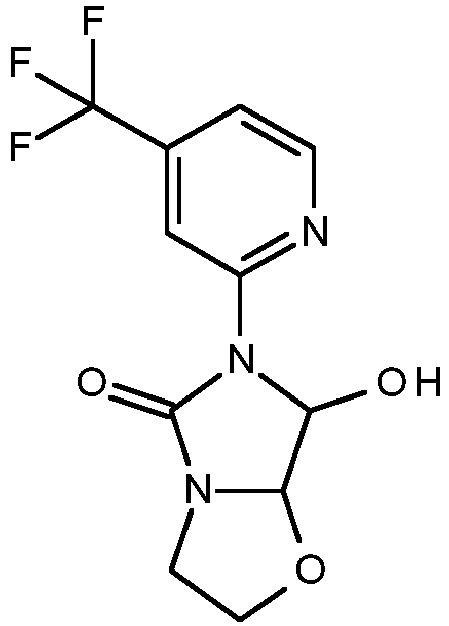
8.49-8.61 (m, 1H), 8.45 (d, 1H), 7.21-7.28 (m, 1H), 5.86-5.94 (m, 1H), 4.88-4.93 (m, 1H), 4.78-4.86 (m, 1H), 3.86-4.08 (m, 3H), 3.29-3.42 (m, 1H). positive ES MH+ 290 A76 
Major diastereomer: 8.50 (s, 1H), 8.36-8.44 (m, 1H), 7.21 (d, 1H), 5.60-5.67 (m, 1H), 4.92-4.98 (m, 1H), 4.58-4.92 (m, 2H), 3.67-3.79 (m, 1H), 3.32-3.39 (m, 3H), 1.34-1.41 (m, 3H). positive ES MH+ 306 Minor diastereomer: 8.50 (s, 1H), 8.36-8.44 (m, 1H), 7.21 (d, 1H), 5.97 (dd, 1H), 4.92-4.98 (m, 1H), 4.58-4.92 (m, 2H), 3.94-4.06 (m, 1H), 3.40-3.52 (m, 3H) 1.41-1.47 (m, 3H). A77 
8.54 (s, 1H) 8.38 (d, 1H) 7.12-7.19 (m, 1H) 5.81 (s, 1H) 4.96 (d, 1H) 3.58 (s, 3H) 3.40 (s, 3H) 2.99 (s, 3H). positive ES MH+ 306 A78 
As for A77 As for A77 A79 
Major diastereomer: 8.48 (s, 1H), 8.25 (s, 1H), 6.80 (d, 1H), 5.61 (dd, 1H), 3.76 (s, 3H), 3.61 (dq, 1H), 2.39 (s, 3H), 1.27 (d, 3H). positive ES MH+ 306 Minor diastereomer: 8.49 (s, 1H), 8.33 (s, 1H), 6.56 (d, 1H), 5.92 (t, 1H), 3.77 (s, 3H), 3.70 (quin, 1H), 2.39 (s, 3H), 1.30 (d, 3H). A80 
Major diastereomer: 8.53 (m, 1H), 8.39 (d, 1H), 7.93 (dd, 1H), 5.55 (d, 1H), 5.00 (br.s, 1H), 3.90 (s, 3H), 3.72 (ddd, 1H), 1.45 (d, 3H). positive ES MH+ 292 Minor diastereomer: 8.56 (m, 1H), 8.37 (d, 1H), 7.93 (dd, 1H), 5.87 (d, 1H), 4.56 (br.s, 1H), 3.93 (s, 3H), 3.80 (pent, 1H), 1.50 (d, 3H). A81 
8.49 (d, 1H), 8.28 (d, 1H), 7.89 (dd, 1H), 5.73 (d, 1H), 5.00 (d, 1H), 4.79 (d, 1H), 3.02 (s, 3H), 2.74 (d, 1H). positive ES MH+ 278 A82 
8.47 (s, 1H), 8.40 (d, 1H), 7.18 (d, 1H), 5.74 (s, 1H), 4.85 (brs, 1H), 4.71 (s, 1H), 3.67 (m, 2H), 3.00 (s, 3H), 1.28 (t, 3H). positive ES MH+ 356 A83 
8.50 (d, 1H), 8.30 (d, 1H), 7.89 (dd, 1H), 5.74 (d, 1H), 4.80 (d, 1H), 4.71 (s, 1H), 3.68 (m, 2H), 3.00 (s, 3H), 1.28 (t, 3H). positive ES MH+ 306 A84 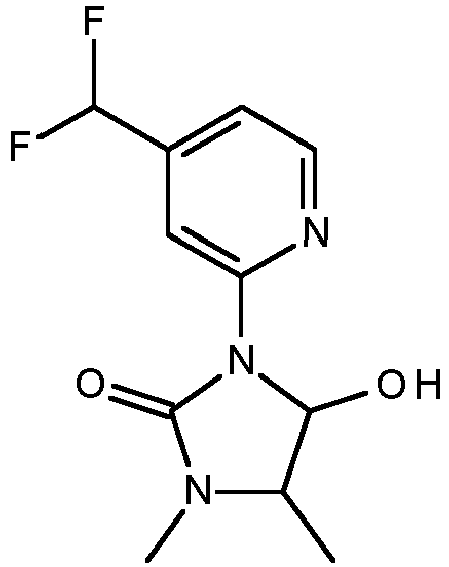
Major diastereomer: 8.35 (s, 1H), 8.32 (d, 1H), 7.11 (d, 1H), 6.60 (t, 1H), 5.59 (d, 1H), 5.10 (br. s., 1H), 3.51 (dq, 1H), 2.92 (s, 3H), 1.33 (d, 3H). positive ES MH+ 258 Minor diastereomer: 8.34 (s, 1H), 8.32 (d, 1H), 7.11 (d, 1H), 6.60 (t, 1H), 5.93 (d, 1H), 4.96 (br. s., 1H), 3.74 (pentet, 1H), 2.88 (s, 3H), 1.39 (d, 3H). A85 
Major diastereomer: 8.53 (d, 1H), 8.35 (d, 1H), 7.16 (dd, 1H), 5.59 (t, 1H), 4.97 (d, 1H), 3.53 (dq, 1H), 2.93 (s, 3H), 1.34 (d, 3H). positive ES MH+ 292 Major diastereomer: 8.53 (d, 1H), 8.36 (d, 1H), 7.16 (dd, 1H), 5.94 (dd, 1H), 4.83 (d, 1H), 3.75 (t, 1H), 2.89 (s, 3H), 1.39 (d, 3H). A86 
Major diastereomer: 8.31 (s, 1H), 7.12 (s, 1H), 6.57 (t, 1H), 5.59 (t, 1H), 4.61 (d, 1H), 3.53 (dq, 1H), 2.92 (s, 3H), 1.33 (d, 3H). positive ES MH+ 292 Major diastereomer: 8.31 (s, 1H), 7.12 (s, 1H), 6.57 (t, 1H), 5.94 (dd, 1H), 4.45 (d, 1H), 3.75 (pentet, 1H), 2.88 (s, 3H), 1.39 (d, 3H). A87 
Major diastereomer: 8.45-8.61 (m, 1H), 8.23-8.44 (m, 1H), 7.07-7.22 (m, 1H), 5.64-5.62 (m, 1H), 4.97-4.99 (m, 1H), 4.42 (dd, 1H), 3.92 (dd, 1H), 3.67-3.84 (m, 1H), 2.15-2.33 (m, 1H), 1.34-1.46 ppm (m, 3H). positive ES MH+ 300 Minor diastereomer: 8.45-8.61 (m, 1H), 8.23-8.44 (m, 1H), 7.07-7.22 (m, 1H), 5.85-6.03 (m, 1H), 4.74 (d, 1H), 4.57 (dd, 1H), 4.02 (quin, 1H), 3.67-3.84 (m, 1H), 2.15-2.33 (m, 1H), 1.34-1.46 ppm (m, 3H). A88 
Major diastereomer: 8.55 (s,1H), 8.39 (d,1H), 7.16 (d,1H), 5.94 (d,1H), 3.92 (m,1H), 3.62 (m,1H), 3.19 (m,1H), 1.39 (d,3H), 1.18 (t, 3H). positive ES MH+ 290 Minor diastereomer: 8.55 (s,1H), 8.39 (d,1H), 7.16 (d,1H), 5.57 (d,1H), 3.62(m, 2H), 3.19 (m, 1H), 1.35 (d, 3H), 1.20 (t, 3H). A89 
Major diastereomer: 8.19 (m, 2H), 7.09 (d, 1H), 5.59 (d, 1H), 3.50 (m, 1H), 3.13 (s, 3H), 2.92 (s, 3H), 1.52 (s, 6H), 1.33 (d, 3H). positive ES MH+ 280 Minor diastereomer: 8.19 (m, 2H), 7.09 (d,1H, 5.93 (d, 1H),3.73 (m, 1H), 3.13 (s, 3H), 2.88(s, 3H), 1.52 (s, 6H), 1.40 (d, 3H). A90 
Major diastereomer: 8.54 (m, 1H), 8.39 (d, 1H), 7.26 (dd, 1H), 5.53 (dd, 1H), 5.03 (d, 1H), 3.90 (s, 3H), 3.71 (ddd, 1H), 1.45 (d, 3H). positive ES MH+ 308 Minor diastereomer: 8.52 (m, 1H), 8.42 (d, 1H), 7.24 (dd, 1H), 5.85 (dd, 1H), 4.59 (d, 1H), 3.93 (s, 3H), 3.79 (pentet, 1H), 1.49 (d, 3H). A91 
Major diastereomer: 8.50 (s, 1H), 8.38 (d, 1H), 7.19 (dd, 1H), 5.86 (br s, 1H), 5.68 (m, 1H), 4.98 (d, 1H), 3.74 (m, 1H), 1.36 (d, 3H). positive ES MH+ 278 Minor diastereomer: 8.46 (s, 1H), 8.36 (d, 1H) , 7.12 (dd, 1H), 5.99 (d, 1H), 5.71 (br s, 1H), 4.88 (d, 1H), 4.04 (pentet, 1H) , 1.39 (d, 3H). A92 
Major diastereomer: 8.28 (d, 1H), 8.10 (d, 1H), 6.96 (dd, 1H), 5.55 (t, 1H), 5.07 (d, 1H), 3.49 (ddd, 1H), 2.91 (s, 3H), 1.32 (d, 3H). positive ES MH+ 242 Minor diastereomer: 8.27 (d, 1H), 8.11 (d, 1H), 6.96 (dd, 1H), 5.89 (dd, 1H), 4.94 (d, 1H), 3.72 (m, 1H), 2.87 (s, 3H), 1.37 (d, 3H). A93 
Major diastereomer 8.36 (m, 2H), 7.18 (m, 1H), 5.52 (d, 1H), 4.47 (brs, 1H), 3.90 (s, 3H), 3.70 (m, 1H), 1.92 (t, 3H), 1.48 (d, 3H). positive ES MH+ 288 Minor diastereomer 8.36 (m, 2H), 7.18 (m, 1H), 5.83 (d, 1H), 5.21 (brs, 1H), 3.93 (s, 3H), 3.77 (m, 1H), 1.92 (t, 3H), 1.49 (d, 3H). A94 
Major diastereomer 8.59 (s, 1H), 8.45 (d, 1H), 7.28 (dd, 1H), 5.97 (d, 1H), 5.39 (d, 1H), 5.03 (brs, 1H), 4.42 (m, 1H), 4.12 (m, 1H), 4.00 (m, 1H), 3.63 (m, 1H). positive ES MH+ 290 Minor diastereomer 8.59 (s, 1H), 8.45 (d, 1H), 7.28 (dd, 1H), 6.17 (d, 1H), 5.39 (d, 1H), 5.24 (brs, 1H), 4.41 (m, 1H), 4.39 (m, 1H), 4.26 (m, 1H), 3.88 (m, 1H). A95 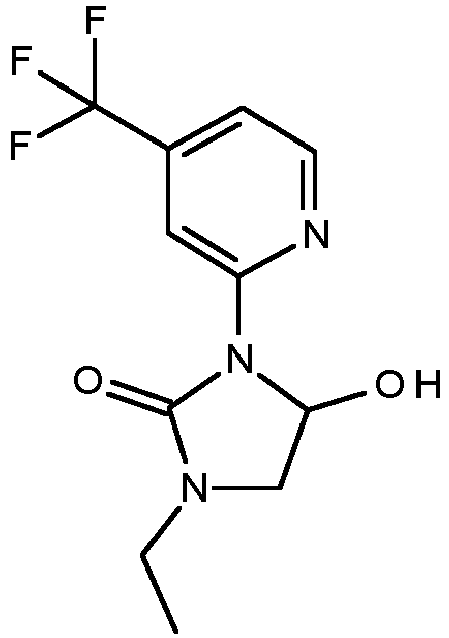
8.55 (s, 1H), 8.39 (d, 1H), 7.17 (d, 1H), 6.07 (d, 1H), 5.0(br.s, 1H), 3.72 (m, 1H), 3.42 (m, 3H), 1.22 (t, 3H). positive ES MH+ 276 A96 
8.57 (s, 1H), 8.40 (d, 1H), 7.17 (d, 1H), 6.90 (s, 1H), 4.62 (s, 1H), 3.87 (m, 1H), 3.64 (m, 1H), 2.99 (s, 3H), 2.07 (s, 3H), 1.27 (t, 3H). positive ES MH+ 348 A97 
positive ES MH+ 482 A98 
positive ES MH+ 496/498 A99 
positive ES MH+ 494 A100 
positive ES MH+ 404 A101 
positive ES MH+ 396 A102 
8.49 (s, 1H), 8.27 (d, 1H), 7.55 (d, 2H), 7.33-7.41 (m, 3H), 7.14 (dd, 1H), 7.10 (s, 1H), 4.70 (s, 1H), 3.92 (dq, 1H), 3.68 (dq, 1H), 3.39 (s, 3H), 3.00 (s, 3H), 1.30 (t, 3H). positive ES MH+ 522 A103 
8.55 (s, 1H), 8.42 (d, 1H), 7.53 (d, 2H), 7.31-7.41 (m, 3H), 7.21 (dd, 1H), 7.11 (s, 1H), 4.51 (s, 1H), 3.91 (dq, 1H), 3.66 (dq, 1H), 3.46 (s, 3H), 2.92 (s, 3H), 1.30 (t, 3H). positive ES MH+ 522 A104 
Major diastereomer: 8.50 (s, 1H), 8.40 (d, 1H), 7.28-7.13 (m, 6H), 5.13 (d, 1H), 3.89 (s, 3H), 3.77-3.71 (m, 2H), 3.53 (d, 1H), 3.16 (br. s., 1H), 1.45 (d, 3H) positive ES MH+ 381 Minor diastereomer: 8.57 (s, 1H), 8.40 (d, 1H), 7.28-7.13 (m, 6H), 5.52 (d, 1H), 3.94 (s, 3H), 3.90-3.73 (m, 2H), 3.57 (d, 1H), 3.30 (very br. s., 1H), 1.53 (d, 3H). A105 
Major diastereomer: 8.53 (s, 1H), 8.46 (s, 1H), 5.59 (t, 1H), 4.97 (t, 1H), 4.57 (s, 2H), 3.52 (m, 1H), 3.45 (s, 3H), 2.92 (d, 3H), 1.33 (dd, 3H). positive ES MH+ 320 Minor diastereomer: 8.53 (s, 1H), 8.47 (s, 1H), 5.94 (dd, 1H), 4.82 (t, 1H), 4.57 (s, 2H), 3.75 (m, 1H), 3.45 (s, 3H), 2.88 (d, 3H), 1.39 (dd, 3H). A106 
Major diastereomer: 8.30-8.56 (m, 2H), 7.27-7.32 (m, 1H), 6.80-7.23 (m, 1H), 5.59-5.75 (m, 1H), 4.80-4.97 (m, 1H), 3.83-4.10 (m, 1H), 1.40-1.53 (m, 3H). positive ES MH+ 312 Minor diastereomer: 8.30-8.56 (m, 2H), 7.27-7.32 (m, 1H), 6.80-7.23 (m, 1H), 5.87-6.09 (m, 1H), 4.69-4.80 (m, 1H), 4.10-4.35 (m, 1H), 1.53-1.60 (m, 3H). A107 
Major diastereomer: 8.53 (s, 1H), 8.29-8.44 (m, 1H), 7.07-7.23 (m, 1H), 5.73-5.89 (m, 1H), 5.62 (t, 1H), 5.17-5.36 (m, 2H), 4.92 (d, 1H), 4.15-4.33 (m, 1H), 3.51-3.77 (m, 2H), 1.24-1.34 (m, 3H). positive ES MH+ 302 Minor diastereomer: 8.53 (s, 1H), 8.29-8.44 (m, 1H), 7.07-7.23 (m, 1H), 5.94 (dd, 1H), 5.73-5.89 (m, 1H), 5.17-5.36 (m, 2H), 4.80 (d, 1H), 4.15-4.33 (m, 1H), 3.89 (quin, 1H), 3.51-3.77 (m, 1H), 1.36 (d, 3H). A108 
Major diastereomer: 8.52 (s, 1H), 8.51 (s, 1H), 5.58 (t, 1H), 4.96 (br t, 1H), 4.69 (s, 2H), 3.69 (m, 2H), 3.60 (m, 2H), 3.52 (dq, 1H), 3.40 (d, 3H), 2.92 (d, 3H), 1.33 (dd, 3H). positive ES MH+ 364 Minor diastereomer: 8.52 (s, 1H), 8.51 (s, 1H), 5.93 (dd, 1H), 4.81 (dd, 1H), 4.69 (s, 2H), 3.75 (m, 1H), 3.69 (m, 2H), 3.60 (m, 2H), 3.40 (d, 3H), 2.88 (d, 3H), 1.38 (dd, 3H). A109 
8.27 (d, 1H), 8.13 (s, 1H), 7.04 (d, 1H), 5.75 (s, 1H), 4.62 (s, 1H), 3.58 (m, 2H), 3.02 (s, 3H), 2.85 (s, 3H), 1.42 (s, 6H), 1.15 (t, 3H). positive ES MH+ 310 A110 
Major diastereomer: 8.53 (s, 1H), 8.35-8.38 (m, 1H), 7.12-7.18 (m, 1H), 5.59-5.65 (m, 1H), 4.96 (br. s., 1H), 3.54-3.63 (m, 2H), 3.02-3.17 (m, 1H), 1.45-1.77 (m, 2H), 1.32 (d, 2H), 0.90-1.02 (m, 3H). positive ES MH+ 304 Minor diastereomer: 8.53 (s, 1H), 8.35-8.38 (m, 1H), 7.12-7.18 (m, 1H), 5.94 (d, 1H), 4.84 (br. s., 1H), 3.85-3.95 (m, 1H), 3.02-3.17 (m, 1H), 1.45-1.77 (m, 2H), 1.38 (d, 1H), 0.90-1.02 (m, 3H). A111 
Major diastereomer: 8.50 (s, 1H), 8.42 (d, 1H), 7.17-7.25 (m, 1H), 5.66-5.71 (m, 1H), 4.92 (br. s., 1H), 4.16-4.38 (m, 1H), 3.79 (qd, 1H), 3.53-3.74 (m, 1H), 1.38 (d, 3H). positive ES MH+ 344 Minor diasteromer: 8.48 (s, 1H), 8.42 (d, 1H), 7.17-7.25 (m, 1H), 6.00 (d, 1H), 4.80 (br. s., 1H), 4.16-4.38 (m, 1H), 3.99-4.08 (m, 1H), 3.53-3.74 (m, 1H), 1.41-1.47 (m, 3H). A112 
Major diastereomer: 8.47 (s, 1H), 8.36-8.43 (m, 1H), 7.20 (d, 1H), 5.79-6.15 (m, 1H), 5.61-5.69 (m, 1H), 4.92 (br. s., 1H), 3.95-4.07 (m, 1H), 3.67-3.78 (m, 1H), 3.38-3.56 (m, 1H), 1.36 (d, 3H). positive ES MH+ 326 Minor diastereomer: 8.47 (s, 1H), 8.36-8.43 (m, 1H), 7.20 (d, 1H), 5.79-6.15 (m, 2H), 4.69-4.82 (m, 1H), 3.95-4.07 (m, 1H), 3.78-3.94 (m, 1H), 3.38-3.56 (m, 1H), 1.39-1.44 (m, 3H). A113 
Major diastereomer: 8.44-8.59 (m, 1H), 8.31-8.42 (m, 1H), 7.16 (d, 1H), 5.94 (d, 1H), 4.83 (br. s., 1H), 3.83-3.96 (m, 1H), 3.17-3.33 (m, 1H), 3.02 (dd, 1H), 1.83-2.13 (m, 1H), 1.38 (d, 3H), 0.87-1.05 (m, 6H) - positive ES MH+ 318 Minor diastereomer: 8.44-8.59 (m, 1H), 8.31-8.42 (m, 1H), 7.16 (d, 1H), 5.61 (s, 1H), 4.87-5.00 (m, 1H), 3.52-3.69 (m, 1H), 3.33-3.47 (m, 1H), 2.90 (dd, 1H), 1.83-2.13 (m, 1H), 1.31 (d, 3H), 0.87-1.05 (m, 6H). A114 
Major diastereomer: 8.36-8.49 (m, 2H), 7.25 (d, 1H), 5.69 (d, 1H), 4.32-4.47 (m, 1H), 4.16-4.28 (m, 1H), 3.66-3.84 (m, 1H), 1.40-1.50 (m, 3H). positive ES MH+ 301 Minor diastereomer: 8.36-8.49 (m, 2H), 7.25 (d, 1H), 6.02 (d, 1H), 4.56-4.70 (m, 1H), 3.89-4.03 (m, 1H), 3.66-3.84 (m, 1H), 1.40-1.50 (m, 3H). A115 
Major diastereomer: 8.48-8.60 (m, 1H), 8.29-8.44 (m, 1H), 7.06-7.21 (m, 1H), 5.51-5.65 (m, 1H), 4.82 (br. s., 1H), 3.48-3.57 (m, 1H), 2.48-2.58 (m, 1H), 1.33-1.41 (m, 3H), 0.59-1.06 (m, 4H). positive ES MH+ 302 Minor diastereomer 8.48-8.60 (m, 1H), 8.29-8.44 (m, 1H), 7.06-7.21 (m, 1H), 5.89 (d, 1H), 4.88-4.99 (m, 1H), 3.76-3.88 (m, 1H), 2.36-2.47 (m, 1H), 1.42-1.50 (m, 3H), 0.59-1.06 (m, 4H). A116 
Major diastereomer 8.59 (s, 1H), 8.49 (d, 1H), 7.32 (d, 1H), 6.05 (s, 1H), 4.84 (brs, 1H), 4.18 (m, 1H), 3.98 (m, 1H), 3.91 (m, 1H), 2.68 (m, 1H), 2.13 (m, 1H). positive ES MH+ 290 Minor diastereomer 8.59 (s, 1H), 8.46 (d, 1H), 7.32 (d, 1H), 6.15 (d, 1H), 5.39 (brs, 1H), 4.23 (m, 1H), 3.98 (m, 1H), 3.91 (m, 1H), 2.80 (m, 1H), 2.35 (m, 1H). -

-

- A solution of 2-bromo-1,1,3-trimethoxy-propane (commercially available) (7 g, 32.85 mmol) in methylamine (40 % aqueous solution) (105 mL, 210 mmol) was divided into seven equal portions and these were heated at 130°C for 1 h in a microwave. The combined reaction mixtures were then concentrated and the residue obtained was treated with toluene and evaporated again. The residue was then stirred with DCM, filtered and evaporated to give the crude product that was taken to next step without further purification.
-

-

- 2-(2-chloro-4-pyridyl)propan-2-ol (commercially available)(180 mg, 1.0 mmol) was dissolved in DCM and the resultant mixture was cooled to 0°C. Diethylaminosulfur trifluoride (2.5 equiv., 5.2 mmol) was added dropwise such that the temperature did not exceed 5°C. After the addition the reaction was allowed to warm to room temperature and was then added portionwise with stirring to a mixture of ice (100ml) and NaHCO3 in a beaker (some effervescence), making sure that the pH of the solution was >7 at all times. After ~30mins, the mixture was diluted with DCM (30 mL) and water (20 mL) and transferred to a sep funnel. The organic phase was separated. The aqueous phase was further extracted with DCM (2 x 20 mL), the organic extracts were then combined, washed with water (15 mL), dried over MgSO4, filtered and the filtrate evaporated giving a yellow-brown liquid. This was chromatographed on silica. Fractions containing product were evaporated to give the desired product, which was used without further purification.
- LC-MS: (positive ES MH+ 174).
-

-

- Prepared by analogy to the synthesis of 4-(trifluoromethyl)pyridin-2-amine (as described in
EP2228366 ) using (E)-5-ethoxy-3-hydroxy-3-(1,1,2,2,2-pentafluoroethyl)pent-4-enenitrile (for a synthesis see Martins et al, ARKIVOC Issue 13, pages 187-194) as starting material. This synthesis can be applied to the synthesis of a range of related pyridine intermediates. -

-

- 2-chloro-4-(difluoromethyl)pyridine (commercially available) (0.950 g, 5.81 mmol) was suspended in CCl4 (3.3ml), then 1,3,5-trichloro-1,3,5-triazinane-2,4,6-trione (675 mg, 0.5 equiv.) and benzoyl benzenecarboperoxoate (70 mg, 0.05 equiv.) were added and the mixture was microwaved to 160°C for 30mins. Further benzoyl benzenecarboperoxoate (70 mg, 0.05 equiv.) was added and the mixture was further microwaved to 180°C for 20 mins. Even further benzoyl benzenecarboperoxoate (70 mg, 0.05 equiv.) was added and the mixture was further microwaved at 180°C for 20 mins. The mixture wa filtered through celite, washed through with DCM then chromatographed eluting with 0-7% ethyl acetate in isohexane. Fractions contained product were combined and evaporated to give product as a colourless oil (700 mg, 61% yield).
- 1H NMR: 8.58 (dd, 1H), 7.57 (d, 1H), 7.45 (dd, 1H).
-

-

- A mixture of 2-(2-chloro-4-pyridyl)propan-2-ol (commercially available) (2.4 g, 14 mmol) in THF (120 mL) and methyl iodide (1.8 mL, 28 mmol) was treated with sodium hydride (0.71 g, 28 mmol). The mixture was stirred for 16h at rt. and then the reaction mix was poured into water (500 mL), and extracted with ethyl acetate. The combined organic layers were dried over sodium sulfate and chromatographed. Fractions contained product were combined and evaporated to give product as a colourless oil (2.31 g, 89% yield).
- LC-MS: (positive ES MH+ 186).
-

-

- A mixture of 5-bromo-2-chloro-4-(trifluoromethyl)pyridine (commercially available) (75 mg, 0.288 mmol), 2,2-dimethylpropanamide (32 mg, 0.317 mmol), XantPhos Pd G3 precatalyst (13 mg, 0.014 mmol), K2CO3 (79 mg, 0.57 mmol) in 1,4-Dioxane (0.5 mL) was heated at 90°C for 0.5h and then 110°C for 2h. Purification by reverse phase HPLC delivered product (14 mg, 15%).
- LC-MS: (positive ES MH+ 281).
-

-

- To a stirred solution of 6-chloro-4-(trifluoromethyl)pyridine-3-carboxylic acid (for a synthesis see Tetrahedron, 2004, 60(51), pages 11869-11874) (3.87 g, 17.2 mmol) in DCM (8 mL) was added tert-butylamine (3.61 mL, 34.3 mmol) followed by DIPEA (3.59 mL, 20.6 mmol). The reaction mixture was cooled to 0°C before the addition of HATU (4.84 g, 20.6 mmol). The reaction was stirred for 10 mins at 0°C, followed by stirring for 30 mins at room temperature. The reaction was then quenched with water. The aqueous layer was extracted with DCM, and the combined organic phases, dried (MgSO4) and evaporated. Crude product was chromatographed eluting with 3:1, iso-hexane/ EtOAc, followed by recrystallisation (Et2O/ i-hexane) provided product (3.44 g, 12.3 mmol, 71% yield).
- LC-MS: (positive ES MH+ 281).
-

-

- Methyl 6-chloro-4-(trifluoromethyl)pyridine-3-carboxylate (commercially available) (1.00 g) was dissolved in dry THF (12 mL) under a N2 atmosphere and the reaction was cooled to -60°C then LiAIH4 (163 mg) was added over 10mins. The reaction was stirred at -60°C for 25 mins and was then treated with saturated NH4Cl (aq) (5 mL) and then EtOAc (60 mL). Filtration through celite and then evaporation gave a crude oil which was dissolved in MeOH (5 mL), cooled to 0°C then NaBH4 (53 mg) was added portionwise and the reaction was stirred at 0°C. The reaction was then concentrated, treated with EtOAc (10 mL) and washed with 10% citric acid and then saturated brine and finally the organic layer was dried Na2SO4 and evaporated to give the desired product.
- 1H NMR: (400MHz, Chloroform) δ 8.78 (s, 1H), 7.56 (s, 1H), 4.93 (s, 2H), 1.91 (very br s, 1H).
-

- [6-chloro-4-(trifluoromethyl)-3-pyridyl]methanol (655 mg) was dissolved in dry THF (2 mL), cooled to 5°C under N2 then KOtBu (1.65M in THF) (2.07 mL) was added over 1 min. Then Mel (236 µL) was added. The reaction was stirred for 3 minutes, then EtOAc (10 mL) and saturated brine (aqueous), was added and the aqueous layer was extracted with further EtOAc (2 x 20 mL). The combined organic layers were dried (Na2SO4), filtered and evaporated to give amber oil, which was chromatographed, eluting with 0-30% EtOAc in isohexane. Fractions containing product were evaporated to give product as an amber oil (332 mg, 48%).
- 1H NMR: (400MHz, Chloroform) δ 8.70 (s, 1H), 7.56 (s, 1H), 4.63 (s, 2H), 3.48 (s, 3H).
- LC-MS: (positive ES MH+ 226).
- Seeds of a variety of test species were sown in standard soil in pots. After cultivation for one day (pre-emergence) under controlled conditions in a glasshouse (at 24/16°C, day/night; 14 hours light; 65% humidity), the plants were sprayed with an aqueous spray solution derived from the formulation of the technical active ingredient in acetone / water (50:50) solution containing 0.5% Tween 20 (polyoxyethelyene sorbitan monolaurate, CAS RN 9005-64-5). The test plants were then grown in a glasshouse under controlled conditions (at 24/16°C, day/night; 14 hours light; 65% humidity) and watered twice daily. After 13 days, the test was evaluated (5= total damage to plant; 0 = no damage to plant). Results are shown in Table 2.
Table 2: Application pre-emergence Compound number Rate (g/Ha) AMARE ABUTH ECHCG SETFA ALOMY ZEAMX A1 1000 5 5 5 5 4 3 A2 1000 5 5 4 3 2 1 A3 1000 5 4 5 5 3 3 A4 1000 5 5 5 5 4 3 A5 1000 5 5 4 4 3 2 A6 1000 5 5 4 5 4 2 A7 1000 5 5 3 4 4 1 A8 1000 5 5 4 5 4 3 A9 1000 5 5 5 5 4 3 A10 1000 5 5 5 5 4 3 A11 1000 5 5 4 5 4 3 A12 1000 5 5 5 5 4 3 A13 1000 5 5 3 3 3 1 A14 1000 5 5 5 4 A15 1000 5 3 4 3 A16 1000 5 5 4 4 A17 1000 5 4 3 3 A18 1000 5 5 4 4 A19 1000 5 5 5 5 4 3 A20 1000 5 5 4 5 4 5 A21 1000 5 5 5 5 3 2 A22 1000 5 5 5 5 4 3 A23 1000 5 2 2 3 3 1 A24 1000 5 5 5 4 4 3 A25 1000 5 5 5 4 4 2 A26 1000 3 4 4 4 2 2 A27 1000 5 4 4 4 3 3 A28 1000 5 3 4 5 4 2 A29 1000 5 5 1 2 1 1 A30 1000 5 5 5 5 4 2 A31 1000 5 5 5 5 2 A32 1000 5 5 5 4 4 2 A33 1000 5 4 2 3 3 0 A34 1000 5 5 5 5 3 A35 1000 5 4 4 4 2 A36 1000 5 1 4 2 2 0 A37 1000 5 5 5 4 4 3 A38 1000 5 5 5 5 3 A39 1000 5 5 3 2 4 1 A40 1000 5 4 3 2 2 2 A41 1000 5 5 2 2 1 1 A42 1000 4 1 0 3 0 0 A43 1000 2 5 1 2 1 0 A44 1000 5 5 5 4 4 2 A45 1000 5 5 3 3 2 1 A46 1000 5 5 4 2 4 3 A47 1000 5 5 5 4 4 2 A48 1000 5 5 1 3 4 1 A49 1000 5 5 4 4 4 3 A50 1000 5 5 5 4 4 2 A51 1000 5 5 5 4 4 3 A52 1000 5 5 5 4 4 2 A53 1000 5 5 4 4 4 2 A54 1000 5 5 2 2 3 0 A55 1000 5 5 4 4 4 2 A56 1000 5 5 1 1 2 0 A57 1000 5 5 3 3 4 1 A58 1000 5 5 3 3 4 4 A59 1000 5 5 3 3 4 1 A60 1000 5 5 1 1 1 0 A61 1000 5 5 4 1 4 1 A62 1000 5 4 4 3 2 A64 1000 5 2 4 3 2 A65 1000 5 5 5 5 3 A66 1000 5 5 5 4 2 A67 1000 5 5 5 5 3 A68 1000 0 0 0 0 0 A69 1000 5 5 5 5 2 A70 1000 5 5 5 5 3 A71 1000 5 5 5 0 3 A72 1000 5 5 5 5 2 A73 1000 5 5 4 5 3 A74 1000 5 5 4 4 3 A75 1000 5 5 4 4 2 A76 1000 5 5 3 4 2 A77 1000 5 5 5 5 3 A78 1000 5 5 4 3 1 A79 1000 5 5 5 5 2 A80 1000 5 5 5 4 2 A81 1000 3 2 0 2 0 A82 1000 5 5 3 3 2 A83 1000 5 5 4 4 1 A84 1000 5 5 5 5 3 A85 1000 5 5 5 5 3 A86 1000 5 5 5 5 3 A87 1000 5 5 4 4 3 A88 1000 5 5 4 4 2 A89 1000 5 5 4 4 2 A90 1000 5 3 4 4 2 A91 1000 5 5 4 4 2 A92 1000 5 5 5 4 3 A93 1000 5 5 5 5 3 A94 1000 5 5 5 5 4 A95 1000 5 5 5 5 1 A96 1000 5 5 4 4 4 1 A97 1000 5 5 4 4 4 3 A98 1000 0 0 0 0 0 0 A99 1000 5 1 0 0 0 0 A100 1000 5 5 3 3 4 1 A101 1000 5 5 4 4 4 0 A102 1000 5 5 4 3 1 A103 1000 2 1 1 4 1 A104 1000 5 4 5 5 3 A105 1000 5 5 5 5 4 A106 1000 5 5 4 3 2 A107 1000 5 5 5 4 2 A108 1000 5 5 5 4 2 - Seeds of a variety of test species were sown in standard soil in pots. After 8 days cultivation (post-emergence) under controlled conditions in a glasshouse (at 24/16°C, day/night; 14 hours light; 65% humidity), the plants were sprayed with an aqueous spray solution derived from the formulation of the technical active ingredient in acetone / water (50:50) solution containing 0.5% Tween 20 (polyoxyethelyene sorbitan monolaurate, CAS RN 9005-64-5). The test plants were then grown in a glasshouse under controlled conditions (at 24/16°C, day/night; 14 hours light; 65% humidity) and watered twice daily. After 13 days, the test was evaluated (5 = total damage to plant; 0 = no damage to plant). Results are shown in Table 3.
Table 3: Application post-emergence Compound number Rate (g/Ha) ECHCG SETFA AMARE ABUTH ALOMY ZEAMX A1 1000 5 5 5 5 5 3 A2 1000 5 5 5 5 4 2 A3 1000 5 5 5 5 5 5 A4 1000 5 5 5 5 5 5 A5 1000 4 4 5 5 4 2 A6 1000 5 5 5 5 5 2 A7 1000 5 5 5 5 4 4 A8 1000 5 5 5 5 5 4 A9 1000 5 5 5 5 5 4 A10 1000 5 5 5 5 5 4 A11 1000 5 5 5 5 4 4 A12 1000 5 5 5 5 5 5 A13 1000 5 5 5 5 4 0 A14 1000 5 5 5 5 4 3 A15 1000 4 4 5 5 4 0 A16 1000 5 5 5 5 5 2 A17 1000 5 5 5 5 5 4 A18 1000 5 5 5 5 5 3 A19 1000 5 5 5 5 5 4 A20 1000 5 5 5 5 5 4 A21 1000 5 5 5 5 5 3 A22 1000 5 5 5 5 5 5 A23 1000 2 4 5 5 4 2 A24 1000 5 5 5 5 5 4 A25 1000 5 5 5 5 5 5 A26 1000 1 1 3 4 1 1 A27 1000 3 3 5 5 3 3 A28 1000 5 5 4 4 5 2 A29 1000 4 3 5 5 4 2 A30 1000 5 5 5 5 5 3 A31 1000 5 5 5 5 4 A32 1000 5 5 5 5 5 2 A33 1000 1 2 3 5 4 1 A34 1000 5 5 5 5 4 A35 1000 3 3 5 0 1 A36 1000 5 3 5 1 4 2 A37 1000 5 5 5 5 5 4 A38 1000 5 5 5 5 4 A39 1000 5 5 5 5 5 1 A40 1000 4 3 5 5 4 1 A41 1000 2 4 5 5 4 2 A42 1000 0 2 4 4 2 1 A43 1000 5 0 1 5 1 2 A44 1000 5 5 5 5 4 4 A45 1000 3 3 5 5 2 1 A46 1000 5 5 5 5 5 3 A47 1000 5 5 5 5 5 4 A48 1000 4 4 5 5 4 1 A49 1000 5 5 5 5 5 4 A50 1000 5 5 5 5 5 5 A51 1000 5 5 5 5 5 5 A52 1000 5 5 5 5 5 5 A53 1000 5 5 5 5 5 3 A54 1000 5 5 5 5 5 4 A55 1000 5 5 5 5 5 4 A56 1000 3 2 5 5 4 1 A57 1000 5 5 5 5 5 4 A58 1000 5 5 5 5 4 4 A59 1000 5 5 5 5 5 4 A60 1000 4 3 5 5 4 3 A61 1000 5 5 5 5 5 3 A62 1000 5 5 5 5 2 A64 1000 5 4 5 4 1 A65 1000 5 5 5 5 5 A66 1000 5 5 5 5 5 A67 1000 5 5 5 5 4 A68 1000 0 0 0 0 0 A69 1000 5 4 4 5 3 A70 1000 5 5 5 5 5 A71 1000 5 5 5 5 4 A72 1000 5 5 5 5 2 A73 1000 5 5 5 5 3 A74 1000 4 5 5 5 3 A75 1000 5 5 5 5 2 A76 1000 4 4 5 5 1 A77 1000 5 5 5 5 5 A78 1000 5 3 5 5 0 A79 1000 5 5 5 5 4 A80 1000 5 5 5 5 4 A81 1000 2 2 4 4 0 A82 1000 4 4 5 5 2 A83 1000 1 4 5 5 1 A84 1000 5 5 5 5 4 A85 1000 5 5 5 5 4 A86 1000 5 5 5 5 2 A87 1000 5 5 5 5 4 A88 1000 5 5 5 5 3 A89 1000 5 5 5 5 3 A90 1000 5 5 5 5 5 A91 1000 5 4 5 5 3 A92 1000 5 5 5 5 4 A93 1000 5 5 5 5 4 A94 1000 5 5 5 5 5 A95 1000 5 5 5 5 2 A96 1000 5 5 5 5 5 3 A97 1000 5 5 5 5 5 3 A98 1000 0 0 4 0 0 1 A99 1000 3 0 5 1 0 1 A100 1000 5 5 5 5 5 4 A101 1000 5 5 5 5 5 3 A102 1000 2 1 5 5 1 A103 1000 0 1 2 0 1 A104 1000 5 5 5 5 5 A105 1000 5 5 5 5 5 A106 1000 4 4 5 5 1 A107 1000 5 5 5 5 3 A108 1000 5 5 5 5 5 ABUTH = Abutilon theophrasti; AMARE = Amaranthus retroflexus; SETFA = Setaria faberi;
ALOMY = Alopecurus myosuroides; ECHCG = Echinochloa crus-galli; ZEAMX = Zea mays.
Claims (12)
- A herbicidal compound of formula (I)
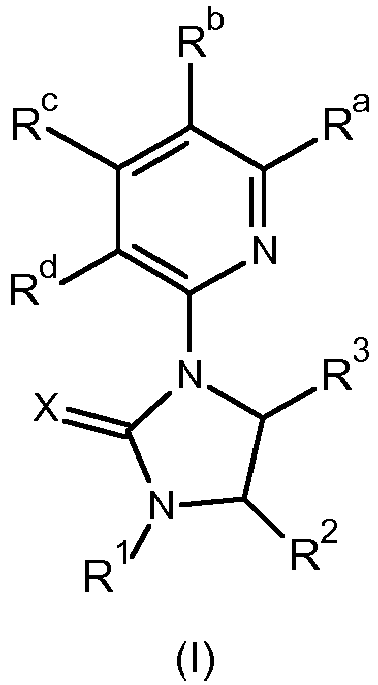 X is O;Ra is selected from hydrogen and halogen;Rb is selected from hydrogen, halogen, C1-C4 alkyl, C2-C4 alkenyl C1-C4 haloalkyl, C1-C6 alkoxy, C2-C4 alkenyloxy, C2-C4 alkynyloxy, C1-C4 alkoxy-C1-C4 alkyl, C1-C4 haloalkoxy, C1-C3 alkoxy-C1-C3 alkoxy, C1-C4 alkylthio, C1-C4 alkylsulfinyl, C1-C4 alkylsulfonyl, a group R5R6N-, a group R5C(O)N(R6)-, a group R5S(O2)N(R6)-, a group R5R6NSO2-, a group R5R6NC(O)-, aryl optionally substituted by one or more groups independently selected from halogen, nitro, cyano, C1-C3 alkyl, C1-C3 alkoxy, C1-C3 haloalkyl and C1-C3 haloalkoxy, aryloxy optionally substituted by one or more groups independently selected from halogen, nitro, cyano, C1-C3 alkyl, C1-C3 alkoxy, C1-C3 haloalkyl and C1-C3 haloalkoxy and heteroaryl optionally substituted substituted by one or more groups independently selected from halogen, nitro, cyano, C1-C3 alkyl, C1-C3 alkoxy, C1-C3 haloalkyl and C1-C3 haloalkoxy;Rc is trifluoromethyl;Rd is selected from hydrogen, halogen, cyano, C1-C6 alkyl and C1-C6 haloalkyl;R1 is selected from C1-C4 alkyl, C1-C4 alkoxyand C1-C4 haloalkyl and R2 is selected from C1-C4 alkyl, C1-C4 alkoxy and C1-C4 alkoxy-C1-C4 alkyl;R3 is selected from halogen, hydroxyl, -NR14R15, or any one of the following groups

 R5 and R6 are independently selected from hydrogen, C1-C6 alkyl, C1-C6 haloalkyl, C1-C6 cyanoalkyl, C2-C6 alkenyl, C2-C6 alkynyl, C1-C6 alkoxy and C1-C6 alkoxy-C1-C3 alkyl, or R5 and R6 together with the carbon atoms to which they are attached form a 3-6 membered saturated or partially unsaturated ring optionally comprising from 1 to 3 heteroatoms independently selected from S, O and N and optionally substituted with from 1 to 3 groups independently selected from halogen and C1-C6 alkyl;R7 and R8 are independently selected from hydrogen, C1-C6 alkyl, C1-C6 haloalkyl, C2-C6 alkenyl, C2-C6 alkynyl, a C3-C6 cycloalkyl group optionally substituted with 1 to 3 groups independently selected from C1-C3 alkyl, C2-C4 alkenyl, C1-C3 haloalkyl and C2-C4 haloalkenyl, a C5-C10 heterocyclyl group which can be mono- or bicyclic comprising from 1 to 4 heteroatoms independently selected from N, O and S and optionally substituted with 1 to 3 groups independently selected from halogen, C1-C3 alkyl, C1-C3 haloalkyl and C1-C3 alkoxy, a C5-C10 heteroaryl group which can be mono- or bicyclic comprising from 1 to 4 heteroatoms independently selected from N, O and S and optionally substituted with 1 to 3 groups independently selected from halogen, C1-C3 alkyl, C1-C3 haloalkyl and C1-C3 alkoxy, a C6-C10 aryl group optionally substituted with 1 to 3 groups independently selected from halogen, nitro, cyano, C1-C3 alkyl, C1-C3 alkoxy, C1-C3 haloalkyl and C1-C3 haloalkoxy, a C6-C10 arylalkyl group optionally substituted with 1 to 3 groups independently selected from C1-C4 alkyl, C1-C3 alkoxy, C1-C3 haloalkyl and the group -OC(O)-C1-C4 alkyl, or R7 and R8 together with the atoms to which they are attached form a 3-6 membered saturated or partially unsaturated ring optionally comprising from 1 to 3 heteroatoms independently selected from S, O and N and optionally substituted with from 1 to 3 groups independently selected from halogen and C1-C6 alkyl;R9 is selected from C1-C6 alkyl and benzyl optionally substituted with 1 to 3 groups independently selected from halogen, nitro, cyano, C1-C3 alkyl, C1-C3 alkoxy, C1-C3 haloalkyl and C1-C3 haloalkoxy;R14 and R15 are independently selected from hydrogen, C1-C20 alkyl, C1-C20 haloalkyl, C1-C20 alkoxy, C1-C20 alkoxy-C1-C20 alkyl,C2-C20 alkenyl, C2-C20 alkynyl and benzyl, or R14 and R15 together with the carbon atoms to which they are attached form a 3-6 membered saturated or partially unsaturated ring optionally comprising from 1 to 3 heteroatoms independently selected from S, O and N and optionally substituted with from 1 to 3 groups independently selected from halogen and C1-C6 alkyl;or an N-oxide or salt form thereof.
 - The compound of claim 1 wherein Ra is hydrogen.
- The compound of claim 1 or claim 2, wherein Rd is hydrogen.
- The compound of any one of claims 1 to 3, wherein R3 is selected from hydroxyl, halogen, C1-C6 alkylcarbonyloxy, C1-C6 alkoxycarbonyloxy and aryloxycarbonyloxy wherein the aryl group may be substituted with 1 to 3 groups independently selected from halogen, nitro, cyano, C1-C3 alkyl, C1-C3 alkoxy, C1-C3 haloalkyl and C1-C3 haloalkoxy.
- The compound of any one of claims 1 to 4, wherein Rb is selected from hydrogen, halogen, C1-C3 alkyl, C1-C3 alkoxy, C1-C3 alkoxy-C1-C3 alkyl, heteroaryl substituted by halogen or methoxy and aryl substituted by halogen or methoxy.
- A herbicidal composition comprising a compound of formula I as defined in any one of claims 1 to 5 together with at least one agriculturally acceptable adjuvant or diluent.
- A composition according to claim 6 which comprises a further herbicide in addition to the compound of formula I.
- A composition according to claim 6 or 7 which comprises a safener.
- Use of a compound of formula I as defined in any one of claims 1 to 5 or a composition as defined in any one of claims 6 to 8 as a herbicide.
- A method of controlling weeds in crops of useful plants, comprising applying to said weeds or to the locus of said weeds, or to said useful plants or to the locus of said useful plants, a compound of formula I as defined in any one of claims 1 to 5 or a composition as claimed in any one of claims 6 to 8.
- An intermediate of the formula (III) wherein X, R1, R2, Ra, Rb, Rc and Rd are as defined in any one of claims 1 to 5.

- An intermediate selected from the group consisting of:
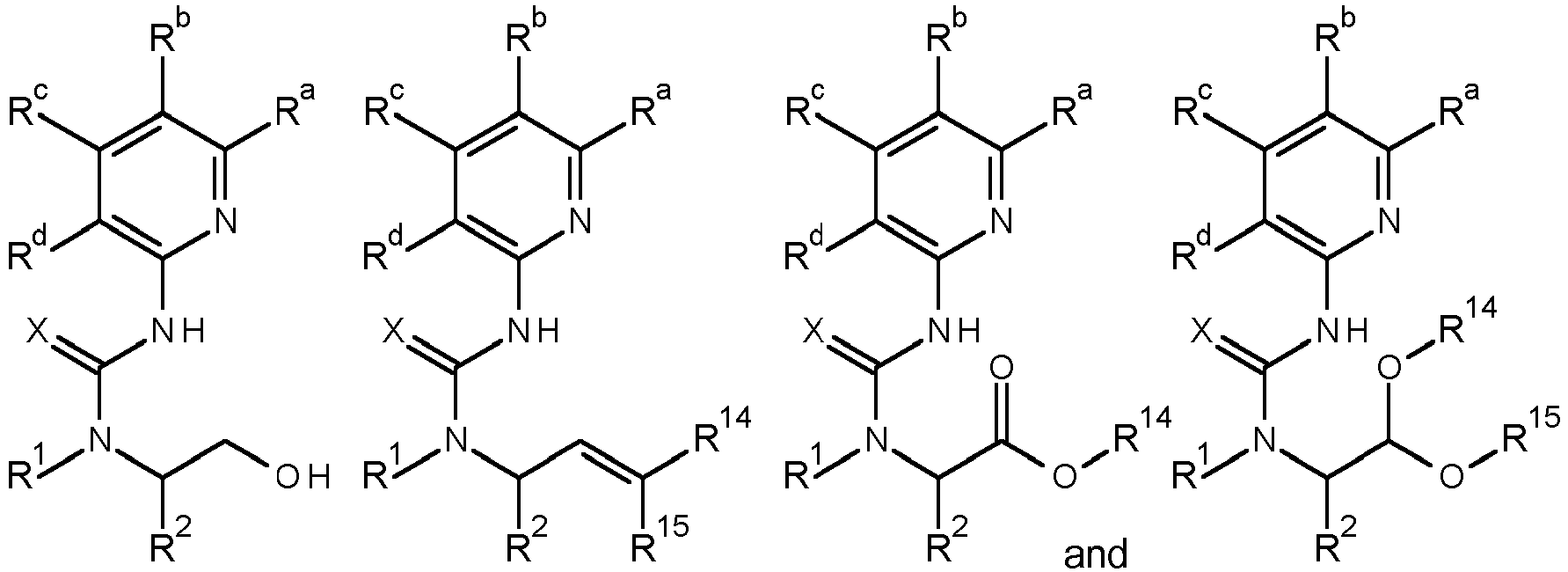
Applications Claiming Priority (2)
| Application Number | Priority Date | Filing Date | Title |
|---|---|---|---|
| PCT/EP2014/071167 WO2015052076A1 (en) | 2013-10-07 | 2014-10-02 | Herbicidal compounds |
| IN2977DE2013 IN2013DE02977A (en) | 2013-10-07 | 2014-10-02 |
Publications (2)
| Publication Number | Publication Date |
|---|---|
| EP3054773A1 EP3054773A1 (en) | 2016-08-17 |
| EP3054773B1 true EP3054773B1 (en) | 2022-01-26 |
Family
ID=51659651
Family Applications (1)
| Application Number | Title | Priority Date | Filing Date |
|---|---|---|---|
| EP14780489.2A Active EP3054773B1 (en) | 2013-10-07 | 2014-10-02 | Herbicidal compounds |
Country Status (17)
| Country | Link |
|---|---|
| US (2) | US20160264547A1 (en) |
| EP (1) | EP3054773B1 (en) |
| JP (1) | JP6419171B2 (en) |
| KR (1) | KR20160067950A (en) |
| CN (2) | CN105636439A (en) |
| AR (1) | AR097936A1 (en) |
| AU (1) | AU2014333967B2 (en) |
| BR (1) | BR112016007356B1 (en) |
| CA (1) | CA2924243C (en) |
| EA (1) | EA032393B1 (en) |
| ES (1) | ES2910437T3 (en) |
| HK (1) | HK1222980A1 (en) |
| IN (1) | IN2013DE02977A (en) |
| UA (1) | UA118035C2 (en) |
| UY (1) | UY35769A (en) |
| WO (1) | WO2015052076A1 (en) |
| ZA (1) | ZA201601788B (en) |
Families Citing this family (20)
| Publication number | Priority date | Publication date | Assignee | Title |
|---|---|---|---|---|
| GB201505852D0 (en) * | 2015-04-07 | 2015-05-20 | Syngenta Participations Ag | Herbicidal mixtures |
| GB201604969D0 (en) * | 2016-03-23 | 2016-05-04 | Syngenta Participations Ag | Improvements in or relating to organic compounds |
| GB201604970D0 (en) * | 2016-03-23 | 2016-05-04 | Syngenta Participations Ag | Improvements in or relating to organic compounds |
| AU2017239000B2 (en) * | 2016-03-23 | 2021-07-29 | Syngenta Participations Ag | Herbicides |
| AU2017258665A1 (en) * | 2016-04-29 | 2018-10-11 | Syngenta Participations Ag | Process for the preparation of herbicidal compounds |
| AR108107A1 (en) * | 2016-04-29 | 2018-07-18 | Syngenta Participations Ag | PROCESS TO PREPARE HERBICIDE COMPOUNDS |
| WO2017214442A1 (en) | 2016-06-08 | 2017-12-14 | President And Fellows Of Harvard College | Methods and compositions for reducing tactile dysfunction and anxiety associated with autism spectrum disorder, rett syndrome, and fragile x syndrome |
| GB201612748D0 (en) * | 2016-07-22 | 2016-09-07 | Syngenta Participations Ag | Method of controlling plants |
| CN109790150A (en) | 2016-08-11 | 2019-05-21 | 拜耳作物科学股份公司 | Substituted pyrazolinyl derivative, preparation method and its purposes as herbicide and/or plant growth regulator |
| GB201617050D0 (en) * | 2016-10-07 | 2016-11-23 | Syngenta Participations Ag | Herbicidal mixtures |
| GB201617062D0 (en) | 2016-10-07 | 2016-11-23 | Syngenta Participations Ag | Herbicidal mixtures |
| WO2019006358A1 (en) * | 2017-06-30 | 2019-01-03 | Syngenta Participations Ag | Herbicidal composition and method of use thereof |
| GB201715324D0 (en) * | 2017-09-22 | 2017-11-08 | Syngenta Participations Ag | Improvements in or relating to organic compounds |
| CA3099751A1 (en) | 2018-05-22 | 2019-11-28 | President And Fellows Of Harvard College | Compositions and methods for reducing tactile dysfunction, anxiety, and social impairment |
| AU2019279858A1 (en) | 2018-05-29 | 2020-11-26 | President And Fellows Of Harvard College | Compositions and methods for reducing tactile dysfunction, anxiety, and social impairment |
| GB201818117D0 (en) | 2018-11-06 | 2018-12-19 | Syngenta Participations Ag | Enantioselective process |
| GB201901559D0 (en) | 2019-02-05 | 2019-03-27 | Syngenta Crop Protection Ag | Herbicidal compositions |
| WO2020164925A1 (en) | 2019-02-15 | 2020-08-20 | Syngenta Crop Protection Ag | Herbicidal compositions |
| US12077512B2 (en) | 2019-03-25 | 2024-09-03 | President And Fellows Of Harvard College | Compositions and methods for reducing tactile dysfunction, anxiety, and social impairment |
| CN113045548B (en) * | 2020-07-15 | 2022-01-28 | 周银平 | Compound, weeding composition and application thereof |
Family Cites Families (13)
| Publication number | Priority date | Publication date | Assignee | Title |
|---|---|---|---|---|
| FR2194369B1 (en) * | 1972-08-04 | 1980-04-25 | Roussel Uclaf | |
| CA1031349A (en) * | 1973-12-26 | 1978-05-16 | John Krenzer | Thiadiazolylimidazolidinones |
| US4130714A (en) * | 1977-05-23 | 1978-12-19 | Pfizer Inc. | Hydantoin therapeutic agents |
| US4426527A (en) * | 1982-02-12 | 1984-01-17 | Ppg Industries, Inc. | 3-[5- Or 3-substituted-1,2,4-oxadiazol-3- or -5-yl]-1-substituted-4-substituted-5-substituted or unsubstituted-2-imidazolidinones |
| JPS608290A (en) * | 1983-06-27 | 1985-01-17 | ピーピージー・インダストリィズ・インコーポレイテッド | 3-(5- or 3-substituted-1,2,4-oxadiazol-3-or -5-yl)-1-substituted-4-substituted-5-substituted or nonsubstituted-2-imidazolidinone |
| EP0133310B1 (en) * | 1983-08-02 | 1988-09-14 | American Cyanamid Company | Imidazolidinones, and imidazolidinethiones, process for the preparation thereof, and use of said compounds as herbicidal agents |
| US4604127A (en) * | 1984-07-17 | 1986-08-05 | Eli Lilly And Company | Herbicidal pyridazinylimidazolidinone compounds |
| EP0169050A3 (en) * | 1984-07-17 | 1986-12-10 | Eli Lilly And Company | Pyridazinylimidazolidinone compounds |
| US4600430A (en) * | 1985-02-22 | 1986-07-15 | Eli Lilly And Company | Pyridinylimidazolidinone compounds |
| DE3604042A1 (en) * | 1986-02-08 | 1987-08-13 | Hoechst Ag | IMIDAZOLIDIN (THI) ON DERIVATIVES, METHOD FOR THE PRODUCTION THEREOF AND THEIR USE IN PLANT PROTECTION |
| FI90869C (en) * | 1986-11-14 | 1994-04-11 | Tanabe Seiyaku Co | Process for the preparation of imidazolidinone derivatives useful as a medicament |
| EP0801068A4 (en) * | 1994-12-27 | 2000-08-23 | Sagami Chem Res | HYDANTOIN DERIVATIVES, METHOD FOR THE PRODUCTION THEREOF AND HERBICIDES CONTAINING IT AS ACTIVE INGREDIENTS |
| US20080293947A1 (en) * | 2005-11-28 | 2008-11-27 | Halvachs Robert E | Method of Preparation for Imidazolepyridines |
-
2014
- 2014-02-10 UA UAA201604929A patent/UA118035C2/en unknown
- 2014-10-02 IN IN2977DE2013 patent/IN2013DE02977A/en unknown
- 2014-10-02 AU AU2014333967A patent/AU2014333967B2/en active Active
- 2014-10-02 CN CN201480055222.1A patent/CN105636439A/en active Pending
- 2014-10-02 HK HK16111452.0A patent/HK1222980A1/en unknown
- 2014-10-02 KR KR1020167012003A patent/KR20160067950A/en not_active Ceased
- 2014-10-02 ES ES14780489T patent/ES2910437T3/en active Active
- 2014-10-02 JP JP2016520645A patent/JP6419171B2/en active Active
- 2014-10-02 CN CN202010834225.2A patent/CN111961033A/en active Pending
- 2014-10-02 EA EA201600317A patent/EA032393B1/en not_active IP Right Cessation
- 2014-10-02 WO PCT/EP2014/071167 patent/WO2015052076A1/en not_active Ceased
- 2014-10-02 BR BR112016007356-8A patent/BR112016007356B1/en active IP Right Grant
- 2014-10-02 CA CA2924243A patent/CA2924243C/en active Active
- 2014-10-02 EP EP14780489.2A patent/EP3054773B1/en active Active
- 2014-10-02 US US15/027,768 patent/US20160264547A1/en not_active Abandoned
- 2014-10-03 UY UY0001035769A patent/UY35769A/en not_active Application Discontinuation
- 2014-10-06 AR ARP140103717A patent/AR097936A1/en active IP Right Grant
-
2016
- 2016-03-15 ZA ZA2016/01788A patent/ZA201601788B/en unknown
-
2018
- 2018-12-17 US US16/222,900 patent/US11608323B2/en active Active
Also Published As
| Publication number | Publication date |
|---|---|
| IN2013DE02977A (en) | 2015-04-10 |
| BR112016007356A2 (en) | 2017-09-12 |
| WO2015052076A1 (en) | 2015-04-16 |
| JP2016534037A (en) | 2016-11-04 |
| EA032393B1 (en) | 2019-05-31 |
| JP6419171B2 (en) | 2018-11-07 |
| CN105636439A (en) | 2016-06-01 |
| AR097936A1 (en) | 2016-04-20 |
| AU2014333967B2 (en) | 2018-06-21 |
| UA118035C2 (en) | 2018-11-12 |
| ES2910437T3 (en) | 2022-05-12 |
| CA2924243A1 (en) | 2015-04-16 |
| ZA201601788B (en) | 2020-09-30 |
| CA2924243C (en) | 2023-01-17 |
| EP3054773A1 (en) | 2016-08-17 |
| AU2014333967A1 (en) | 2016-03-31 |
| EA201600317A1 (en) | 2016-09-30 |
| HK1222980A1 (en) | 2017-07-21 |
| CN111961033A (en) | 2020-11-20 |
| UY35769A (en) | 2015-05-29 |
| US11608323B2 (en) | 2023-03-21 |
| KR20160067950A (en) | 2016-06-14 |
| US20190112288A1 (en) | 2019-04-18 |
| BR112016007356B1 (en) | 2021-01-05 |
| US20160264547A1 (en) | 2016-09-15 |
Similar Documents
| Publication | Publication Date | Title |
|---|---|---|
| US11608323B2 (en) | Herbicidal compounds | |
| EP3060558B1 (en) | Pyridinylimidazolones as herbicides | |
| EP3030081B1 (en) | Pyrazolyl pyrrolinones and their use as herbicides | |
| EP3154965B1 (en) | Herbicidal compounds | |
| US10499640B2 (en) | Herbicidal compounds | |
| WO2016071360A1 (en) | Herbicidal pyrrolone derivatives | |
| US9936701B2 (en) | Herbicidal compounds | |
| CA2931585A1 (en) | Dihydro-hydantoin derivatives with herbicidal activity | |
| EP3215502B1 (en) | Herbicidal compounds | |
| US10098351B2 (en) | Herbicidal compounds | |
| EP3036232B1 (en) | Herbicidal compounds | |
| EP3068777B1 (en) | 1-(pyridazin-3-yl)-imidazolidin-2-one derivatives as herbicides | |
| AU2014345555A1 (en) | 1 -(pyridazin-3-yl)-imidazolidin-2-one derivatives as herbicides |
Legal Events
| Date | Code | Title | Description |
|---|---|---|---|
| PUAI | Public reference made under article 153(3) epc to a published international application that has entered the european phase |
Free format text: ORIGINAL CODE: 0009012 |
|
| 17P | Request for examination filed |
Effective date: 20160509 |
|
| AK | Designated contracting states |
Kind code of ref document: A1 Designated state(s): AL AT BE BG CH CY CZ DE DK EE ES FI FR GB GR HR HU IE IS IT LI LT LU LV MC MK MT NL NO PL PT RO RS SE SI SK SM TR |
|
| AX | Request for extension of the european patent |
Extension state: BA ME |
|
| DAX | Request for extension of the european patent (deleted) | ||
| STAA | Information on the status of an ep patent application or granted ep patent |
Free format text: STATUS: EXAMINATION IS IN PROGRESS |
|
| 17Q | First examination report despatched |
Effective date: 20180119 |
|
| RAP1 | Party data changed (applicant data changed or rights of an application transferred) |
Owner name: SYNGENTA PARTICIPATIONS AG Owner name: SYNGENTA LIMITED |
|
| RAP1 | Party data changed (applicant data changed or rights of an application transferred) |
Owner name: SYNGENTA PARTICIPATIONS AG Owner name: SYNGENTA LIMITED |
|
| GRAP | Despatch of communication of intention to grant a patent |
Free format text: ORIGINAL CODE: EPIDOSNIGR1 |
|
| STAA | Information on the status of an ep patent application or granted ep patent |
Free format text: STATUS: GRANT OF PATENT IS INTENDED |
|
| INTG | Intention to grant announced |
Effective date: 20201022 |
|
| GRAJ | Information related to disapproval of communication of intention to grant by the applicant or resumption of examination proceedings by the epo deleted |
Free format text: ORIGINAL CODE: EPIDOSDIGR1 |
|
| STAA | Information on the status of an ep patent application or granted ep patent |
Free format text: STATUS: EXAMINATION IS IN PROGRESS |
|
| GRAP | Despatch of communication of intention to grant a patent |
Free format text: ORIGINAL CODE: EPIDOSNIGR1 |
|
| STAA | Information on the status of an ep patent application or granted ep patent |
Free format text: STATUS: GRANT OF PATENT IS INTENDED |
|
| INTC | Intention to grant announced (deleted) | ||
| INTG | Intention to grant announced |
Effective date: 20210325 |
|
| GRAJ | Information related to disapproval of communication of intention to grant by the applicant or resumption of examination proceedings by the epo deleted |
Free format text: ORIGINAL CODE: EPIDOSDIGR1 |
|
| STAA | Information on the status of an ep patent application or granted ep patent |
Free format text: STATUS: EXAMINATION IS IN PROGRESS |
|
| INTC | Intention to grant announced (deleted) | ||
| GRAP | Despatch of communication of intention to grant a patent |
Free format text: ORIGINAL CODE: EPIDOSNIGR1 |
|
| STAA | Information on the status of an ep patent application or granted ep patent |
Free format text: STATUS: GRANT OF PATENT IS INTENDED |
|
| INTG | Intention to grant announced |
Effective date: 20210902 |
|
| GRAS | Grant fee paid |
Free format text: ORIGINAL CODE: EPIDOSNIGR3 |
|
| GRAA | (expected) grant |
Free format text: ORIGINAL CODE: 0009210 |
|
| STAA | Information on the status of an ep patent application or granted ep patent |
Free format text: STATUS: THE PATENT HAS BEEN GRANTED |
|
| AK | Designated contracting states |
Kind code of ref document: B1 Designated state(s): AL AT BE BG CH CY CZ DE DK EE ES FI FR GB GR HR HU IE IS IT LI LT LU LV MC MK MT NL NO PL PT RO RS SE SI SK SM TR |
|
| REG | Reference to a national code |
Ref country code: GB Ref legal event code: FG4D |
|
| REG | Reference to a national code |
Ref country code: CH Ref legal event code: EP |
|
| REG | Reference to a national code |
Ref country code: AT Ref legal event code: REF Ref document number: 1464562 Country of ref document: AT Kind code of ref document: T Effective date: 20220215 |
|
| REG | Reference to a national code |
Ref country code: IE Ref legal event code: FG4D |
|
| REG | Reference to a national code |
Ref country code: DE Ref legal event code: R096 Ref document number: 602014082328 Country of ref document: DE |
|
| REG | Reference to a national code |
Ref country code: ES Ref legal event code: FG2A Ref document number: 2910437 Country of ref document: ES Kind code of ref document: T3 Effective date: 20220512 |
|
| REG | Reference to a national code |
Ref country code: LT Ref legal event code: MG9D |
|
| REG | Reference to a national code |
Ref country code: NL Ref legal event code: MP Effective date: 20220126 |
|
| REG | Reference to a national code |
Ref country code: AT Ref legal event code: MK05 Ref document number: 1464562 Country of ref document: AT Kind code of ref document: T Effective date: 20220126 |
|
| PG25 | Lapsed in a contracting state [announced via postgrant information from national office to epo] |
Ref country code: NL Free format text: LAPSE BECAUSE OF FAILURE TO SUBMIT A TRANSLATION OF THE DESCRIPTION OR TO PAY THE FEE WITHIN THE PRESCRIBED TIME-LIMIT Effective date: 20220126 |
|
| PG25 | Lapsed in a contracting state [announced via postgrant information from national office to epo] |
Ref country code: SE Free format text: LAPSE BECAUSE OF FAILURE TO SUBMIT A TRANSLATION OF THE DESCRIPTION OR TO PAY THE FEE WITHIN THE PRESCRIBED TIME-LIMIT Effective date: 20220126 Ref country code: RS Free format text: LAPSE BECAUSE OF FAILURE TO SUBMIT A TRANSLATION OF THE DESCRIPTION OR TO PAY THE FEE WITHIN THE PRESCRIBED TIME-LIMIT Effective date: 20220126 Ref country code: PT Free format text: LAPSE BECAUSE OF FAILURE TO SUBMIT A TRANSLATION OF THE DESCRIPTION OR TO PAY THE FEE WITHIN THE PRESCRIBED TIME-LIMIT Effective date: 20220526 Ref country code: NO Free format text: LAPSE BECAUSE OF FAILURE TO SUBMIT A TRANSLATION OF THE DESCRIPTION OR TO PAY THE FEE WITHIN THE PRESCRIBED TIME-LIMIT Effective date: 20220426 Ref country code: LT Free format text: LAPSE BECAUSE OF FAILURE TO SUBMIT A TRANSLATION OF THE DESCRIPTION OR TO PAY THE FEE WITHIN THE PRESCRIBED TIME-LIMIT Effective date: 20220126 Ref country code: HR Free format text: LAPSE BECAUSE OF FAILURE TO SUBMIT A TRANSLATION OF THE DESCRIPTION OR TO PAY THE FEE WITHIN THE PRESCRIBED TIME-LIMIT Effective date: 20220126 Ref country code: BG Free format text: LAPSE BECAUSE OF FAILURE TO SUBMIT A TRANSLATION OF THE DESCRIPTION OR TO PAY THE FEE WITHIN THE PRESCRIBED TIME-LIMIT Effective date: 20220426 |
|
| PG25 | Lapsed in a contracting state [announced via postgrant information from national office to epo] |
Ref country code: PL Free format text: LAPSE BECAUSE OF FAILURE TO SUBMIT A TRANSLATION OF THE DESCRIPTION OR TO PAY THE FEE WITHIN THE PRESCRIBED TIME-LIMIT Effective date: 20220126 Ref country code: LV Free format text: LAPSE BECAUSE OF FAILURE TO SUBMIT A TRANSLATION OF THE DESCRIPTION OR TO PAY THE FEE WITHIN THE PRESCRIBED TIME-LIMIT Effective date: 20220126 Ref country code: GR Free format text: LAPSE BECAUSE OF FAILURE TO SUBMIT A TRANSLATION OF THE DESCRIPTION OR TO PAY THE FEE WITHIN THE PRESCRIBED TIME-LIMIT Effective date: 20220427 Ref country code: FI Free format text: LAPSE BECAUSE OF FAILURE TO SUBMIT A TRANSLATION OF THE DESCRIPTION OR TO PAY THE FEE WITHIN THE PRESCRIBED TIME-LIMIT Effective date: 20220126 Ref country code: AT Free format text: LAPSE BECAUSE OF FAILURE TO SUBMIT A TRANSLATION OF THE DESCRIPTION OR TO PAY THE FEE WITHIN THE PRESCRIBED TIME-LIMIT Effective date: 20220126 |
|
| PG25 | Lapsed in a contracting state [announced via postgrant information from national office to epo] |
Ref country code: IS Free format text: LAPSE BECAUSE OF FAILURE TO SUBMIT A TRANSLATION OF THE DESCRIPTION OR TO PAY THE FEE WITHIN THE PRESCRIBED TIME-LIMIT Effective date: 20220526 |
|
| REG | Reference to a national code |
Ref country code: DE Ref legal event code: R097 Ref document number: 602014082328 Country of ref document: DE |
|
| PG25 | Lapsed in a contracting state [announced via postgrant information from national office to epo] |
Ref country code: SM Free format text: LAPSE BECAUSE OF FAILURE TO SUBMIT A TRANSLATION OF THE DESCRIPTION OR TO PAY THE FEE WITHIN THE PRESCRIBED TIME-LIMIT Effective date: 20220126 Ref country code: SK Free format text: LAPSE BECAUSE OF FAILURE TO SUBMIT A TRANSLATION OF THE DESCRIPTION OR TO PAY THE FEE WITHIN THE PRESCRIBED TIME-LIMIT Effective date: 20220126 Ref country code: RO Free format text: LAPSE BECAUSE OF FAILURE TO SUBMIT A TRANSLATION OF THE DESCRIPTION OR TO PAY THE FEE WITHIN THE PRESCRIBED TIME-LIMIT Effective date: 20220126 Ref country code: EE Free format text: LAPSE BECAUSE OF FAILURE TO SUBMIT A TRANSLATION OF THE DESCRIPTION OR TO PAY THE FEE WITHIN THE PRESCRIBED TIME-LIMIT Effective date: 20220126 Ref country code: DK Free format text: LAPSE BECAUSE OF FAILURE TO SUBMIT A TRANSLATION OF THE DESCRIPTION OR TO PAY THE FEE WITHIN THE PRESCRIBED TIME-LIMIT Effective date: 20220126 Ref country code: CZ Free format text: LAPSE BECAUSE OF FAILURE TO SUBMIT A TRANSLATION OF THE DESCRIPTION OR TO PAY THE FEE WITHIN THE PRESCRIBED TIME-LIMIT Effective date: 20220126 |
|
| PG25 | Lapsed in a contracting state [announced via postgrant information from national office to epo] |
Ref country code: AL Free format text: LAPSE BECAUSE OF FAILURE TO SUBMIT A TRANSLATION OF THE DESCRIPTION OR TO PAY THE FEE WITHIN THE PRESCRIBED TIME-LIMIT Effective date: 20220126 |
|
| PLBE | No opposition filed within time limit |
Free format text: ORIGINAL CODE: 0009261 |
|
| STAA | Information on the status of an ep patent application or granted ep patent |
Free format text: STATUS: NO OPPOSITION FILED WITHIN TIME LIMIT |
|
| 26N | No opposition filed |
Effective date: 20221027 |
|
| PG25 | Lapsed in a contracting state [announced via postgrant information from national office to epo] |
Ref country code: SI Free format text: LAPSE BECAUSE OF FAILURE TO SUBMIT A TRANSLATION OF THE DESCRIPTION OR TO PAY THE FEE WITHIN THE PRESCRIBED TIME-LIMIT Effective date: 20220126 |
|
| PG25 | Lapsed in a contracting state [announced via postgrant information from national office to epo] |
Ref country code: MC Free format text: LAPSE BECAUSE OF FAILURE TO SUBMIT A TRANSLATION OF THE DESCRIPTION OR TO PAY THE FEE WITHIN THE PRESCRIBED TIME-LIMIT Effective date: 20220126 |
|
| REG | Reference to a national code |
Ref country code: CH Ref legal event code: PL |
|
| REG | Reference to a national code |
Ref country code: BE Ref legal event code: MM Effective date: 20221031 |
|
| PG25 | Lapsed in a contracting state [announced via postgrant information from national office to epo] |
Ref country code: LU Free format text: LAPSE BECAUSE OF NON-PAYMENT OF DUE FEES Effective date: 20221002 |
|
| PG25 | Lapsed in a contracting state [announced via postgrant information from national office to epo] |
Ref country code: LI Free format text: LAPSE BECAUSE OF NON-PAYMENT OF DUE FEES Effective date: 20221031 Ref country code: CH Free format text: LAPSE BECAUSE OF NON-PAYMENT OF DUE FEES Effective date: 20221031 |
|
| PG25 | Lapsed in a contracting state [announced via postgrant information from national office to epo] |
Ref country code: BE Free format text: LAPSE BECAUSE OF NON-PAYMENT OF DUE FEES Effective date: 20221031 |
|
| PG25 | Lapsed in a contracting state [announced via postgrant information from national office to epo] |
Ref country code: IE Free format text: LAPSE BECAUSE OF NON-PAYMENT OF DUE FEES Effective date: 20221002 |
|
| PG25 | Lapsed in a contracting state [announced via postgrant information from national office to epo] |
Ref country code: HU Free format text: LAPSE BECAUSE OF FAILURE TO SUBMIT A TRANSLATION OF THE DESCRIPTION OR TO PAY THE FEE WITHIN THE PRESCRIBED TIME-LIMIT; INVALID AB INITIO Effective date: 20141002 |
|
| PG25 | Lapsed in a contracting state [announced via postgrant information from national office to epo] |
Ref country code: CY Free format text: LAPSE BECAUSE OF FAILURE TO SUBMIT A TRANSLATION OF THE DESCRIPTION OR TO PAY THE FEE WITHIN THE PRESCRIBED TIME-LIMIT Effective date: 20220126 |
|
| PG25 | Lapsed in a contracting state [announced via postgrant information from national office to epo] |
Ref country code: MK Free format text: LAPSE BECAUSE OF FAILURE TO SUBMIT A TRANSLATION OF THE DESCRIPTION OR TO PAY THE FEE WITHIN THE PRESCRIBED TIME-LIMIT Effective date: 20220126 |
|
| PG25 | Lapsed in a contracting state [announced via postgrant information from national office to epo] |
Ref country code: MT Free format text: LAPSE BECAUSE OF FAILURE TO SUBMIT A TRANSLATION OF THE DESCRIPTION OR TO PAY THE FEE WITHIN THE PRESCRIBED TIME-LIMIT Effective date: 20220126 |
|
| PG25 | Lapsed in a contracting state [announced via postgrant information from national office to epo] |
Ref country code: TR Free format text: LAPSE BECAUSE OF FAILURE TO SUBMIT A TRANSLATION OF THE DESCRIPTION OR TO PAY THE FEE WITHIN THE PRESCRIBED TIME-LIMIT Effective date: 20220126 |
|
| PGFP | Annual fee paid to national office [announced via postgrant information from national office to epo] |
Ref country code: DE Payment date: 20251028 Year of fee payment: 12 |
|
| PGFP | Annual fee paid to national office [announced via postgrant information from national office to epo] |
Ref country code: GB Payment date: 20251023 Year of fee payment: 12 |
|
| PGFP | Annual fee paid to national office [announced via postgrant information from national office to epo] |
Ref country code: IT Payment date: 20251022 Year of fee payment: 12 |
|
| PGFP | Annual fee paid to national office [announced via postgrant information from national office to epo] |
Ref country code: FR Payment date: 20251027 Year of fee payment: 12 |
|
| PGFP | Annual fee paid to national office [announced via postgrant information from national office to epo] |
Ref country code: ES Payment date: 20251118 Year of fee payment: 12 |
|
| REG | Reference to a national code |
Ref country code: DE Ref legal event code: R081 Ref document number: 602014082328 Country of ref document: DE Owner name: SYNGENTA CROP PROTECTION AG, CH Free format text: FORMER OWNERS: SYNGENTA LIMITED, BRACKNELL, BERKSHIRE, GB; SYNGENTA PARTICIPATIONS AG, BASEL, CH Ref country code: DE Ref legal event code: R081 Ref document number: 602014082328 Country of ref document: DE Owner name: SYNGENTA LIMITED, BRACKNELL, GB Free format text: FORMER OWNERS: SYNGENTA LIMITED, BRACKNELL, BERKSHIRE, GB; SYNGENTA PARTICIPATIONS AG, BASEL, CH |