EP3054097B1 - Gebläseschaufel - Google Patents
Gebläseschaufel Download PDFInfo
- Publication number
- EP3054097B1 EP3054097B1 EP16154415.0A EP16154415A EP3054097B1 EP 3054097 B1 EP3054097 B1 EP 3054097B1 EP 16154415 A EP16154415 A EP 16154415A EP 3054097 B1 EP3054097 B1 EP 3054097B1
- Authority
- EP
- European Patent Office
- Prior art keywords
- core
- root
- airfoil
- pressure face
- residual stress
- Prior art date
- Legal status (The legal status is an assumption and is not a legal conclusion. Google has not performed a legal analysis and makes no representation as to the accuracy of the status listed.)
- Active
Links
Images




Classifications
-
- F—MECHANICAL ENGINEERING; LIGHTING; HEATING; WEAPONS; BLASTING
- F01—MACHINES OR ENGINES IN GENERAL; ENGINE PLANTS IN GENERAL; STEAM ENGINES
- F01D—NON-POSITIVE DISPLACEMENT MACHINES OR ENGINES, e.g. STEAM TURBINES
- F01D5/00—Blades; Blade-carrying members; Heating, heat-insulating, cooling or antivibration means on the blades or the members
- F01D5/30—Fixing blades to rotors; Blade roots ; Blade spacers
- F01D5/3092—Protective layers between blade root and rotor disc surfaces, e.g. anti-friction layers
-
- F—MECHANICAL ENGINEERING; LIGHTING; HEATING; WEAPONS; BLASTING
- F01—MACHINES OR ENGINES IN GENERAL; ENGINE PLANTS IN GENERAL; STEAM ENGINES
- F01D—NON-POSITIVE DISPLACEMENT MACHINES OR ENGINES, e.g. STEAM TURBINES
- F01D5/00—Blades; Blade-carrying members; Heating, heat-insulating, cooling or antivibration means on the blades or the members
- F01D5/30—Fixing blades to rotors; Blade roots ; Blade spacers
- F01D5/3007—Fixing blades to rotors; Blade roots ; Blade spacers of axial insertion type
-
- F—MECHANICAL ENGINEERING; LIGHTING; HEATING; WEAPONS; BLASTING
- F02—COMBUSTION ENGINES; HOT-GAS OR COMBUSTION-PRODUCT ENGINE PLANTS
- F02C—GAS-TURBINE PLANTS; AIR INTAKES FOR JET-PROPULSION PLANTS; CONTROLLING FUEL SUPPLY IN AIR-BREATHING JET-PROPULSION PLANTS
- F02C3/00—Gas-turbine plants characterised by the use of combustion products as the working fluid
- F02C3/04—Gas-turbine plants characterised by the use of combustion products as the working fluid having a turbine driving a compressor
-
- F—MECHANICAL ENGINEERING; LIGHTING; HEATING; WEAPONS; BLASTING
- F05—INDEXING SCHEMES RELATING TO ENGINES OR PUMPS IN VARIOUS SUBCLASSES OF CLASSES F01-F04
- F05D—INDEXING SCHEME FOR ASPECTS RELATING TO NON-POSITIVE-DISPLACEMENT MACHINES OR ENGINES, GAS-TURBINES OR JET-PROPULSION PLANTS
- F05D2220/00—Application
- F05D2220/30—Application in turbines
- F05D2220/32—Application in turbines in gas turbines
-
- F—MECHANICAL ENGINEERING; LIGHTING; HEATING; WEAPONS; BLASTING
- F05—INDEXING SCHEMES RELATING TO ENGINES OR PUMPS IN VARIOUS SUBCLASSES OF CLASSES F01-F04
- F05D—INDEXING SCHEME FOR ASPECTS RELATING TO NON-POSITIVE-DISPLACEMENT MACHINES OR ENGINES, GAS-TURBINES OR JET-PROPULSION PLANTS
- F05D2220/00—Application
- F05D2220/30—Application in turbines
- F05D2220/36—Application in turbines specially adapted for the fan of turbofan engines
-
- F—MECHANICAL ENGINEERING; LIGHTING; HEATING; WEAPONS; BLASTING
- F05—INDEXING SCHEMES RELATING TO ENGINES OR PUMPS IN VARIOUS SUBCLASSES OF CLASSES F01-F04
- F05D—INDEXING SCHEME FOR ASPECTS RELATING TO NON-POSITIVE-DISPLACEMENT MACHINES OR ENGINES, GAS-TURBINES OR JET-PROPULSION PLANTS
- F05D2230/00—Manufacture
- F05D2230/10—Manufacture by removing material
-
- F—MECHANICAL ENGINEERING; LIGHTING; HEATING; WEAPONS; BLASTING
- F05—INDEXING SCHEMES RELATING TO ENGINES OR PUMPS IN VARIOUS SUBCLASSES OF CLASSES F01-F04
- F05D—INDEXING SCHEME FOR ASPECTS RELATING TO NON-POSITIVE-DISPLACEMENT MACHINES OR ENGINES, GAS-TURBINES OR JET-PROPULSION PLANTS
- F05D2230/00—Manufacture
- F05D2230/20—Manufacture essentially without removing material
- F05D2230/23—Manufacture essentially without removing material by permanently joining parts together
-
- F—MECHANICAL ENGINEERING; LIGHTING; HEATING; WEAPONS; BLASTING
- F05—INDEXING SCHEMES RELATING TO ENGINES OR PUMPS IN VARIOUS SUBCLASSES OF CLASSES F01-F04
- F05D—INDEXING SCHEME FOR ASPECTS RELATING TO NON-POSITIVE-DISPLACEMENT MACHINES OR ENGINES, GAS-TURBINES OR JET-PROPULSION PLANTS
- F05D2240/00—Components
- F05D2240/20—Rotors
- F05D2240/30—Characteristics of rotor blades, i.e. of any element transforming dynamic fluid energy to or from rotational energy and being attached to a rotor
-
- F—MECHANICAL ENGINEERING; LIGHTING; HEATING; WEAPONS; BLASTING
- F05—INDEXING SCHEMES RELATING TO ENGINES OR PUMPS IN VARIOUS SUBCLASSES OF CLASSES F01-F04
- F05D—INDEXING SCHEME FOR ASPECTS RELATING TO NON-POSITIVE-DISPLACEMENT MACHINES OR ENGINES, GAS-TURBINES OR JET-PROPULSION PLANTS
- F05D2300/00—Materials; Properties thereof
- F05D2300/40—Organic materials
- F05D2300/43—Synthetic polymers, e.g. plastics; Rubber
- F05D2300/432—PTFE [PolyTetraFluorEthylene]
-
- F—MECHANICAL ENGINEERING; LIGHTING; HEATING; WEAPONS; BLASTING
- F05—INDEXING SCHEMES RELATING TO ENGINES OR PUMPS IN VARIOUS SUBCLASSES OF CLASSES F01-F04
- F05D—INDEXING SCHEME FOR ASPECTS RELATING TO NON-POSITIVE-DISPLACEMENT MACHINES OR ENGINES, GAS-TURBINES OR JET-PROPULSION PLANTS
- F05D2300/00—Materials; Properties thereof
- F05D2300/40—Organic materials
- F05D2300/43—Synthetic polymers, e.g. plastics; Rubber
- F05D2300/433—Polyamides, e.g. NYLON
-
- F—MECHANICAL ENGINEERING; LIGHTING; HEATING; WEAPONS; BLASTING
- F05—INDEXING SCHEMES RELATING TO ENGINES OR PUMPS IN VARIOUS SUBCLASSES OF CLASSES F01-F04
- F05D—INDEXING SCHEME FOR ASPECTS RELATING TO NON-POSITIVE-DISPLACEMENT MACHINES OR ENGINES, GAS-TURBINES OR JET-PROPULSION PLANTS
- F05D2300/00—Materials; Properties thereof
- F05D2300/60—Properties or characteristics given to material by treatment or manufacturing
- F05D2300/603—Composites; e.g. fibre-reinforced
-
- F—MECHANICAL ENGINEERING; LIGHTING; HEATING; WEAPONS; BLASTING
- F05—INDEXING SCHEMES RELATING TO ENGINES OR PUMPS IN VARIOUS SUBCLASSES OF CLASSES F01-F04
- F05D—INDEXING SCHEME FOR ASPECTS RELATING TO NON-POSITIVE-DISPLACEMENT MACHINES OR ENGINES, GAS-TURBINES OR JET-PROPULSION PLANTS
- F05D2300/00—Materials; Properties thereof
- F05D2300/60—Properties or characteristics given to material by treatment or manufacturing
- F05D2300/603—Composites; e.g. fibre-reinforced
- F05D2300/6034—Orientation of fibres, weaving, ply angle
-
- Y—GENERAL TAGGING OF NEW TECHNOLOGICAL DEVELOPMENTS; GENERAL TAGGING OF CROSS-SECTIONAL TECHNOLOGIES SPANNING OVER SEVERAL SECTIONS OF THE IPC; TECHNICAL SUBJECTS COVERED BY FORMER USPC CROSS-REFERENCE ART COLLECTIONS [XRACs] AND DIGESTS
- Y02—TECHNOLOGIES OR APPLICATIONS FOR MITIGATION OR ADAPTATION AGAINST CLIMATE CHANGE
- Y02T—CLIMATE CHANGE MITIGATION TECHNOLOGIES RELATED TO TRANSPORTATION
- Y02T50/00—Aeronautics or air transport
- Y02T50/60—Efficient propulsion technologies, e.g. for aircraft
Definitions
- the present disclosure generally relates to gas turbine engines, and more particularly to a fan blade root.
- Gas turbine engines are commonly used to generate energy and propulsion in many modern aircraft as well as other vehicles and industrial processes. Many such engines include a fan, compressor, combustor and turbine provided in serial fashion, forming an engine core and arranged along a central longitudinal axis. Air enters the gas turbine engine through the fan and is pressurized in the compressor. This pressurized air is mixed with fuel in the combustor. The fuel-air mixture is then ignited, generating hot combustion gases that flow downstream to the turbine. The turbine is driven by the exhaust gases and mechanically powers the compressor and fan via a central rotating shaft. Energy from the combustion gases not used by the turbine is discharged through an exhaust nozzle, producing thrust to power the aircraft.
- the airfoils of a gas turbine engine including the fan, compressor, and turbine blades and vanes, are subjected to extreme internal temperatures and weather conditions when the gas turbine engine is in operation. Accordingly, such airfoils need to be manufactured well. This is important not only for efficient, proper operation, but for safe operation as well. For example, given the proximity of such engines to the fuselage of the aircraft, it is important that such blades remain connected to their respective rotor hubs, and in the rare event of dislodgement, that the blades be contained within the engine. In fact, the Federal Aviation Administration requires that gas turbine engines meet certain requirements in this regard and thus sets forth regulations, such as 14 C.F.R. ⁇ 33.94, pertaining to blade containment.
- Fan blades with improved wear are disclosed in WO 2014/137438 which proposes polymeric mitigation wear pads on fan blade roots.
- EP 2955326 discloses a configuration with a reinforced ground path for turbine blades.
- US 2013/302173 discloses a wear resistant turbine fan blade having a composite lubricated sheet adhered to a root of the turbine fan blade.
- a fan blade has an airfoil component and an airfoil root.
- the airfoil root is formed having a core.
- a wear covering is disposed onto the core of the airfoil root.
- the wear covering is a composite laminate layer.
- the composite laminate layer is an integrally bonded woven laminate containing a mixture of polytetrafluoroethylene and poly-meta-phenylene isophthalamide fibers arranged in an inverse fashion to produce a right angle grid.
- a compressive residual stress layer is treated into the core of the airfoil root. The compressive residual stress layer is produced by burnishing the core of the airfoil root.
- the wear covering is adhered to the compressive residual stress layer by an epoxy bond.
- the core of the airfoil root has a first pressure face and a second pressure face angled outward from a vertical axis of the core, a first runout fillet disposed into and traveling the length of the first pressure face and a second runout fillet disposed into and traveling the length of the second pressure face, a horizontal face connecting the first pressure face to the second pressure face located at a bottom of the core, and a neck portion extending above the first pressure face and the second pressure face.
- the wear covering is adhered to the first runout fillet and the second runout fillet of the core.
- the wear covering is adhered to the neck portion of the core.
- a compressive residual stress layer is treated into the first runout fillet and the second runout fillet of the core.
- a gas turbine engine having a fan, a compressor downstream of the fan, a combustor downstream of the compressor, and a turbine downstream of the combustor.
- the fan has a plurality of fan blades connected to a rotor.
- the plurality of fan blades each have an airfoil component and an airfoil root as herein described.
- the airfoil root has a core and a wear covering adhered to the core of the airfoil root.
- the wear covering is a composite laminate layer.
- the composite laminate layer is an integrally bonded woven laminate containing a mixture of polytetrafluoroethylene and poly-meta-phenylene isophthalamide fibers arranged in an inverse fashion to produce a right angle grid.
- a compressive residual stress layer is treated into the core of the airfoil root.
- the compressive residual stress layer is produced by burnishing the core of the airfoil root.
- the wear covering disposed onto the core of the airfoil root is adhered to the compressive residual stress layer by an epoxy bond.
- the core of the airfoil root has a first pressure face and a second pressure face angled outward from a vertical axis of the core, a first runout fillet disposed into and traveling the length of the first pressure face and a second runout fillet disposed into and traveling the length of the second pressure face, a horizontal face connecting the first pressure face to the second pressure face located at a bottom of the core, and a neck portion extending above the first pressure face and the second pressure face.
- the airfoil root has a first pressure face and a second pressure face angled outward from a vertical axis of the airfoil root, a first runout fillet disposed into and traveling the length of the first pressure face and a second runout fillet disposed into and traveling the length of the second pressure face, a horizontal face connecting the first pressure face to the second pressure face located at a bottom of the airfoil root, and a neck portion extending above the first pressure face and the second pressure face.
- the wear covering is adhered to the first runout fillet and the second runout fillet of the core of the airfoil root. In an additional and/or alternative embodiment of any of the foregoing embodiments, the wear covering is adhered to the first runout fillet and the second runout fillet of the airfoil root.
- the wear covering is adhered to the neck portion of the core of the airfoil root. In an additional and/or alternative embodiment of any of the foregoing embodiments, the wear covering is adhered to the neck portion of the airfoil root.
- the compressive residual stress layer provided in the core of the airfoil root is treated into the first runout fillet and the second runout fillet of the core.
- a compressive residual stress layer is treated into the first runout fillet and the second runout fillet of the airfoil root.
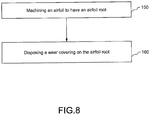
- a method of making an airfoil for a gas turbine engine is depicted.
- An airfoil is machined to have an airfoil root.
- a wear covering is disposed onto the airfoil root.
- the airfoil root is as herein described.
- the wear covering is a composite laminate layer.
- the composite laminate layer is an integrally bonded woven laminate containing a mixture of polytetrafluoroethylene and poly-meta-phenylene isophthalamide fibers arranged in an inverse fashion to produce a right angle grid.
- the method of making an airfoil root includes treating the airfoil root to produce a compressive residual stress layer.
- the compressive residual stress layer is achieved by burnishing the airfoil root.
- compressive residual stress layer refers to a stress layer imparted into an airfoil root by a process modifying the mechanical properties of the airfoil root.
- the compressive residual stress layer is not a layer of stress inherent in the airfoil root, but is added to the airfoil root by an additional process applied to the material of the airfoil root.
- a gas turbine engine constructed in accordance with the present disclosure is generally referred to by reference numeral 10.
- the engine 10 includes from fore-to-aft, a fan 20, a compressor 22, a combustor 24, a turbine 26, known as the engine core 28, lying along a central longitudinal axis 40, and surrounded by an engine core cowl 30.
- the compressor 22 is connected to the turbine 26 via a central rotating shaft 32.
- the engine 10 is depicted as a multi-spool engine design.
- Plural turbines sections 26 are connected to, and drive, corresponding plural sections of the compressor 22 and a fan 20 via the central rotating shaft 32 and a concentric rotating shaft 34, enabling increased compression efficiency.
- the fan 20 includes a disc rotor 50 having multiple slots 52 disposed around the circumference 51 of the disc rotor 50.
- the slots 52 are equally spaced around the circumference 51 of the disc rotor 50.
- a bearing aperture 54 running along the central longitudinal axis 40, is present where a central rotating shaft 32 or another connection can fit the fan 20 to the power generation unit of the gas turbine engine 10.
- each fan blade includes a blade section 62 and a root 70.
- the root 70 may be dovetail in shape, with the slots 52 being complementarily formed to receive the dovetail root 70 in a secure fashion. Given this size and shape, the dovetail root 70 presses against the sides of the slots 52 due to centrifugal force when the disc rotor 50 spins around the central longitudinal axis 40. The slots 52 pressing against the dovetail root 70 therefore prevent the fan blade 60 from dislodging from the disc rotor 50 when the gas turbine engine 10 is in operation.
- the dovetail root 70 can be seen in more detail.
- the dovetail root 70 is formed from a metallic core 71, which may be an aluminum alloy.
- the dovetail root 70 has a first pressure face 72 and a second pressure face 74 angling outward from the vertical axis 80 of the dovetail root 70.
- a horizontal face 76 connects the first pressure face 72 to the second pressure face 74.
- a neck portion 73 extends upward from both the first pressure face 72 and the second pressure face 74 of the dovetail root 70, and attaches to the blade component 62 of the fan blade 60.
- a first runout fillet 78 is machined onto the first pressure face 72 of the dovetail root 70 so that it may fit into a slot 52 of the disc rotor 50.
- a second runout fillet 79 is machined onto the second pressure face 74 of the dovetail root 70 so that it may fit the same.
- the first runout fillet 78 and the second runout fillet 79 each travel the length of their respective pressure faces, and may be equal to each other in their size, shape and formation on the dovetail root 70.
- a compressive residual stress layer 90 is treated into the first runout fillet 78 and the second runout fillet 79 of the dovetail root 70. Treating the fillets 78 and 79 of the dovetail root 70 in such a way imparts the compressive residual stress layer 90 into the dovetail root 70.
- the treatment is performed by burnishment. To burnish the fillets 78 and 79 of the dovetail root 70, a heavy pressure is applied to the fillets 78 and 79 in a controlled manner such as using a roller(s) or the like.
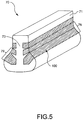
- the wear covering 100 may envelop the length of the first runout fillet 78 of the first pressure face 72 as well as the second runout fillet 79 of the second pressure face 74 of the dovetail root 70. Additionally, the wear covering 100 can extend to envelop the neck portion 73 of the dovetail root 70 above both the first runout fillet 78 and the second runout fillet 79.
- the wear covering 100 envelops the dovetail root 70 in a precise geometric pattern over the dovetail root 70 so that the areas of the dovetail root 70 which press against the walls of the slot 52 are adequately protected when the disc rotor 50 rotates. Configuring the wear covering 100 in such a way prevents cracking and deformation of the dovetail root 70 when the gas turbine engine 10 is in operation. Additionally, the wear covering 100 protects the dovetail root 70 from handling damage when placing the dovetail root 70 into the slot 52 of the disc rotor 50.
- the dovetail root 70 is placed within one of the slots 52 of the disc rotor 50.
- the dovetail root 70 has already been treated and implanted with the compressive residual stress layer 90 described above.
- a wear covering 100 also as understood and described above, is affixed to the outside of the dovetail root 70 before placing the dovetail root 70 into the slot 52. Placing the dovetail root 70 into the slot 52 in this fashion and with the added protection of the compressive residual stress layer 90 and the wear covering 100 prevents cracking and deformation of the dovetail root 70 when the gas turbine engine 10 is in operation. Furthermore, reducing crack formation and deformation of the dovetail root 70 prevents the likelihood of the dovetail root 70 dislodging from the slot 52 of the disc rotor 50 when the gas turbine engine 10 is in operation.
- the wear covering 100 is depicted in greater detail in FIG. 7 . As illustrated, the wear covering 100 is bonded by an epoxy 120, adhesive or the like to the dovetail root 70. The wear covering 100 can be affixed to the metallic core 71 of the dovetail root 70 in other fashions including but not limited to scribing.
- the wear covering 100 is a composite laminate layer 110 made from integrally bonded woven laminate. The materials used to form the integrally bonded woven laminate are Teflon® (polytetrafluoroethylene) fibers 130 and Nomex® (poly-meta-phenylene isophthalamide) fibers 140. Polytetrafluoroethylene fibers 130 have a low coefficient of friction against solid masses.
- polytetrafluoroethylene fibers 130 reduce friction and wear when used on machinery.
- Poly-meta-phenylene isophthalamide fibers 140 are rigid and very durable. Additionally, poly-meta-phenylene isophthalamide fibers 140 have fire resistant qualities which allow the poly-meta-phenylene isophthalamide fibers 140 to hold up well in the extreme operation temperatures and conditions of a gas turbine engine 10. Furthermore, the polytetrafluoroethylene fibers 130 and the poly-meta-phenylene isophthalamide fibers 140 are arranged in an inverse fashion so as to produce a right angle grid. The wear covering 100 may then be epoxy bonded 120 onto the dovetail root 70.
- an airfoil or fan blade 60 is machined to have an airfoil root 70.
- a wear covering 100 is disposed on the of the airfoil root 70.
- the wear covering 100 is a composite laminate layer 110 made from integrally bonded woven laminate.
- the material used to form the integrally bonded woven laminate are polytetrafluoroethylene fibers 130 and poly-meta-phenylene isophthalamide fibers 140.
- the wear covering can be disposed on the airfoil root 70 by adhering it to the airfoil root 70 with an epoxy 120, other adhesive or the like. Disposing the wear covering 100 on the airfoil root 70 provides an addition layer of protection to guard the airfoil root 70 from crack initiation while a gas turbine engine 10 is in operation.
- the airfoil root 70 is treated to have a compressive residual stress layer 90. Treating the airfoil root or 70 to have a compressive residual stress layer 90 is done by burnishing the airfoil root 70.
- the compressive residual stress layer 90 aids in the prevention of crack initiation within the airfoil root 70 when a gas turbine engine 10 is in operation.
- the wear covering 100 may be disposed on the compressive residual stress layer 90 of the airfoil root 70.
- Figure 8 illustrates the significant improvement in strength achieved by the burnished dovetail root 70 of the present disclosure as opposed to a prior art polished dovetail root. If a metallic core is simply polished as with the prior art and placed into testing conditions, the resulting cycles to failure are shown in the bar chart to be roughly 225,000 cycles. If, however, the dovetail root 70 is treated to impart a compressive residual stress layer 90 into the metallic core 71 of the dovetail root 70 as with the prior art, the resulting cycles to failure can be dramatically increased. More specifically, the number of cycles to failure for such a burnished dovetail root 70 can be viewed with the bar representing stimulated deep burnished surface as roughly one million cycles. Comparing the two bars against one another it can be seen that the dovetail root 70 of the present disclosure lasts at least four times longer, if not greater, before failing in respect to a dovetail root having only a polished surface.
- dovetail roots disclosed herein may have industrial applicability in a variety of setting such as, but not limited to, use in a gas turbine engine environment. Such disclosed dovetail roots may also be used, for example, in aerospace or marine machines for generating thrust, or in industrial or mining applications for generating power.
- dovetail roots substantially avoid cracking or other fatigue related inconsistencies so as to provide a stronger and longer lasting blade and root.
- Use of the disclosed dovetail roots also allow for the production of more light weight and thus, more efficient gas turbine engines.
- roots are less susceptible to cracking, they are also less susceptible to dislodgement from the engine rotor.
Landscapes
- Engineering & Computer Science (AREA)
- Mechanical Engineering (AREA)
- General Engineering & Computer Science (AREA)
- Chemical & Material Sciences (AREA)
- Combustion & Propulsion (AREA)
- Structures Of Non-Positive Displacement Pumps (AREA)
Claims (8)
- Gebläseschaufel, die eine Schaufelprofilkomponente (60) und einen Schaufelprofilfuß (70) aufweist, wobei der Schaufelprofilfuß (70) Folgendes umfasst:einen Kern (71); undeine Verschleißabdeckung (100), die auf dem Kern (71) angeordnet ist;dadurch gekennzeichnet, dass die Verschleißabdeckung (100) eine Verbundlaminatschicht (110) ist, wobei die Verbundlaminatschicht (110) ein einstückig verklebtes gewebtes Laminat ist, das ein Gemisch aus Fasern aus Polytetrafluorethylen (130) und Polymetaphenylenisophthalamid (140) enthält, die auf umgekehrte Weise angeordnet sind, um ein Gitter im rechten Winkel zu erzeugen,wobei der Schaufelprofilfuß ferner eineDruckeigenspannungsschicht (90) beinhaltet, die in den Kern (71) übertragen ist, wobei die Druckeigenspannungsschicht (90) durch ein Polieren des Kerns erzeugt wird.
- Gebläseschaufel nach Anspruch 1, wobei die Verschleißabdeckung (100) durch eine Epoxidbindung an der Druckeigenspannungsschicht (90) angebracht ist.
- Gebläseschaufel nach Anspruch 1 oder Anspruch 2, wobei der Kern (71) eine erste Druckfläche (72) und eine zweite Druckfläche (74), die von einer vertikalen Achse (80) des Kerns (71) nach außen gewinkelt sind, einen ersten Ausrundungsauslauf (78), der in die erste Druckfläche (72) angeordnet ist und über deren Länge verläuft, und einen zweiten Ausrundungsauslauf (79), der in die zweite Druckfläche (74) angeordnet ist und über deren Länge verläuft, eine horizontale Fläche (76), die die erste Druckfläche (72) mit der zweiten Druckfläche (74), die sich an einem Boden des Kerns (71) befindet, verbindet, und einen Halsabschnitt (73), der sich über der ersten Druckfläche (72) und der zweiten Druckfläche (74) erstreckt, aufweist.
- Gebläseschaufel nach Anspruch 3, wobei die Verschleißabdeckung (100) an dem ersten Ausrundungsauslauf (78) und dem zweiten Ausrundungsauslauf (79) des Kerns (71) angebracht ist.
- Gebläseschaufel nach Anspruch 3 oder Anspruch 4, wobei die Verschleißabdeckung (100) an dem Halsabschnitt (73) des Kerns (71) angebracht ist.
- Gebläseschaufel nach einem der Ansprüche 3 bis 5, wobei die Druckeigenspannungsschicht (90) in den ersten Ausrundungsauslauf (78) und den zweiten Ausrundungsauslauf (79) des Kerns (71) übertragen ist.
- Gasturbinenmotor (10), umfassend:ein Gebläse (20), das eine Vielzahl von Gebläseschaufeln (60) aufweist, die mit einem Rotor (50) verbunden ist, wobei die Vielzahl von Gebläseschaufeln (60) jeweils eine Schaufelprofilkomponente (60) und einen Schaufelprofilfuß (70) nach einem der vorhergehenden Ansprüche aufweist;einen Verdichter (22) stromabwärts des Gebläses (20);eine Brennkammer (24) stromabwärts des Verdichters (22); undeine Turbine (26) stromabwärts der Brennkammer (24).
- Verfahren zum Herstellen eines Schaufelprofils für einen Gasturbinenmotor (10), wobei das Verfahren Folgendes umfasst:Bearbeiten des Schaufelprofils, sodass es einen Schaufelprofilfuß (70) aufweist; undAnordnen einer Verschleißabdeckung (100) an dem Schaufelprofilfuß (70),dadurch gekennzeichnet, dass die Verschleißabdeckung (100) eine Verbundlaminatschicht (110) ist, wobei die Verbundlaminatschicht (110) ein einstückig verklebtes gewebtes Laminat ist, das ein Gemisch aus Fasern aus Polytetrafluorethylen (130) und Polymetaphenylenisophthalamid (140) enthält, die auf umgekehrte Weise angeordnet sind, um ein Gitter im rechten Winkel zu erzeugen,wobei das Verfahren ferner das Behandeln des Schaufelprofilfußes (70) beinhaltet, sodass er eine Druckeigenspannungsschicht (90) aufweist, wobei die Druckeigenspannungsschicht (90) durch Polieren des Schaufelprofilfußes (70) erreicht wird.
Applications Claiming Priority (1)
| Application Number | Priority Date | Filing Date | Title |
|---|---|---|---|
| US14/617,614 US10570755B2 (en) | 2015-02-09 | 2015-02-09 | Fan blade root |
Publications (2)
| Publication Number | Publication Date |
|---|---|
| EP3054097A1 EP3054097A1 (de) | 2016-08-10 |
| EP3054097B1 true EP3054097B1 (de) | 2019-09-18 |
Family
ID=55304917
Family Applications (1)
| Application Number | Title | Priority Date | Filing Date |
|---|---|---|---|
| EP16154415.0A Active EP3054097B1 (de) | 2015-02-09 | 2016-02-05 | Gebläseschaufel |
Country Status (2)
| Country | Link |
|---|---|
| US (1) | US10570755B2 (de) |
| EP (1) | EP3054097B1 (de) |
Families Citing this family (2)
| Publication number | Priority date | Publication date | Assignee | Title |
|---|---|---|---|---|
| US11454118B2 (en) * | 2020-09-04 | 2022-09-27 | General Electric Company | Gas turbine engine rotor blade having a root section with composite and metallic portions |
| US12123321B2 (en) * | 2022-12-27 | 2024-10-22 | General Electric Company | Composite airfoil assembly having a dovetail portion |
Citations (2)
| Publication number | Priority date | Publication date | Assignee | Title |
|---|---|---|---|---|
| EP1555329A1 (de) * | 2004-01-15 | 2005-07-20 | Siemens Aktiengesellschaft | Bauteil mit Druckeigenspannungen, Verfahren zur Herstellung und Vorrichtung zur Erzeugung von Druckeigenspannungen |
| US20130302173A1 (en) * | 2012-05-11 | 2013-11-14 | E. I. Du Pont De Nemours And Company | Wear resistant turbine fan blade |
Family Cites Families (9)
| Publication number | Priority date | Publication date | Assignee | Title |
|---|---|---|---|---|
| US5522706A (en) | 1994-10-06 | 1996-06-04 | General Electric Company | Laser shock peened disks with loading and locking slots for turbomachinery |
| US8721294B2 (en) * | 2010-05-20 | 2014-05-13 | United Technologies Corporation | Airfoil with galvanically isolated metal coating |
| US20130004327A1 (en) | 2011-06-30 | 2013-01-03 | United Technologies Corporation | Aluminum fan blade root |
| US8443706B2 (en) * | 2011-09-07 | 2013-05-21 | E I Du Pont De Nemours And Company | Triaxial braid fabric architectures for improved soft body armor ballistic impact performance |
| WO2014137438A1 (en) | 2013-03-07 | 2014-09-12 | United Technologies Corporation | Aluminum fan blades with root wear mitigation |
| WO2014164859A2 (en) | 2013-03-11 | 2014-10-09 | Rolls-Royce Corporation | Compliant layer for ceramic components and methods of forming the same |
| US10415402B2 (en) | 2013-03-13 | 2019-09-17 | United Technologies Corporation | Blade wear pads and manufacture methods |
| DE102014206758A1 (de) | 2014-04-08 | 2015-10-08 | Siemens Aktiengesellschaft | Gasturbinenschaufel oder Verdichterschaufel mit Anti-Fretting-Beschichtung im Schaufelfußbereich und Rotor |
| US10107105B2 (en) | 2014-06-11 | 2018-10-23 | United Technologies Corporation | Fan blade grounding tab |
-
2015
- 2015-02-09 US US14/617,614 patent/US10570755B2/en active Active
-
2016
- 2016-02-05 EP EP16154415.0A patent/EP3054097B1/de active Active
Patent Citations (2)
| Publication number | Priority date | Publication date | Assignee | Title |
|---|---|---|---|---|
| EP1555329A1 (de) * | 2004-01-15 | 2005-07-20 | Siemens Aktiengesellschaft | Bauteil mit Druckeigenspannungen, Verfahren zur Herstellung und Vorrichtung zur Erzeugung von Druckeigenspannungen |
| US20130302173A1 (en) * | 2012-05-11 | 2013-11-14 | E. I. Du Pont De Nemours And Company | Wear resistant turbine fan blade |
Also Published As
| Publication number | Publication date |
|---|---|
| US10570755B2 (en) | 2020-02-25 |
| EP3054097A1 (de) | 2016-08-10 |
| US20160230572A1 (en) | 2016-08-11 |
Similar Documents
| Publication | Publication Date | Title |
|---|---|---|
| US8029231B2 (en) | Fan track liner assembly | |
| JP6302251B2 (ja) | フィレット移行部がある複合ブレードのシステムおよび方法 | |
| EP2348192B1 (de) | Fanschaufelummantelung | |
| EP2959108B1 (de) | Gasturbinenmotor mit verstimmter stufe | |
| US7887299B2 (en) | Rotary body for turbo machinery with mistuned blades | |
| US20030129061A1 (en) | Multi-component hybrid turbine blade | |
| US7018168B2 (en) | Method and apparatus for fabricating gas turbine engines | |
| US20200011203A1 (en) | Blade containment structure | |
| US10030522B2 (en) | Blade with metallic leading edge and angled shear zones | |
| US20160032729A1 (en) | Composite Fan Blade | |
| JP2000337294A (ja) | 応力除去された動翼支持構造 | |
| US10337521B2 (en) | Fan blade with integrated composite fan blade cover | |
| EP3049635B1 (de) | Aluminiumschaufel mit titanbeschichtung | |
| EP3054097B1 (de) | Gebläseschaufel | |
| US20190218920A1 (en) | Blade for a gas turbine engine | |
| US10273816B2 (en) | Wear pad to prevent cracking of fan blade | |
| US11879354B2 (en) | Rotor blade with frangible spar for a gas turbine engine | |
| EP2472064A2 (de) | Schaufel für Gasturbinenmotore | |
| US20170023006A1 (en) | Fan blade with composite cover and structural filler | |
| US12049848B2 (en) | Planetary gearbox and gas turbine engine having planetary gearbox | |
| US10995631B2 (en) | Method of shedding ice and fan blade | |
| WO2014096840A1 (en) | An aerofoil structure with tip portion cutting edges | |
| CN116292398A (zh) | 具有微细杆的可旋转翼型部件 | |
| US20250334050A1 (en) | Rotor Blade with Frangible Spar for a Gas Turbine Engine |
Legal Events
| Date | Code | Title | Description |
|---|---|---|---|
| PUAI | Public reference made under article 153(3) epc to a published international application that has entered the european phase |
Free format text: ORIGINAL CODE: 0009012 |
|
| AK | Designated contracting states |
Kind code of ref document: A1 Designated state(s): AL AT BE BG CH CY CZ DE DK EE ES FI FR GB GR HR HU IE IS IT LI LT LU LV MC MK MT NL NO PL PT RO RS SE SI SK SM TR |
|
| AX | Request for extension of the european patent |
Extension state: BA ME |
|
| RAP1 | Party data changed (applicant data changed or rights of an application transferred) |
Owner name: UNITED TECHNOLOGIES CORPORATION |
|
| STAA | Information on the status of an ep patent application or granted ep patent |
Free format text: STATUS: REQUEST FOR EXAMINATION WAS MADE |
|
| 17P | Request for examination filed |
Effective date: 20170209 |
|
| RBV | Designated contracting states (corrected) |
Designated state(s): AL AT BE BG CH CY CZ DE DK EE ES FI FR GB GR HR HU IE IS IT LI LT LU LV MC MK MT NL NO PL PT RO RS SE SI SK SM TR |
|
| STAA | Information on the status of an ep patent application or granted ep patent |
Free format text: STATUS: EXAMINATION IS IN PROGRESS |
|
| 17Q | First examination report despatched |
Effective date: 20170627 |
|
| GRAP | Despatch of communication of intention to grant a patent |
Free format text: ORIGINAL CODE: EPIDOSNIGR1 |
|
| STAA | Information on the status of an ep patent application or granted ep patent |
Free format text: STATUS: GRANT OF PATENT IS INTENDED |
|
| INTG | Intention to grant announced |
Effective date: 20190328 |
|
| GRAS | Grant fee paid |
Free format text: ORIGINAL CODE: EPIDOSNIGR3 |
|
| GRAA | (expected) grant |
Free format text: ORIGINAL CODE: 0009210 |
|
| STAA | Information on the status of an ep patent application or granted ep patent |
Free format text: STATUS: THE PATENT HAS BEEN GRANTED |
|
| AK | Designated contracting states |
Kind code of ref document: B1 Designated state(s): AL AT BE BG CH CY CZ DE DK EE ES FI FR GB GR HR HU IE IS IT LI LT LU LV MC MK MT NL NO PL PT RO RS SE SI SK SM TR |
|
| REG | Reference to a national code |
Ref country code: GB Ref legal event code: FG4D |
|
| REG | Reference to a national code |
Ref country code: CH Ref legal event code: EP |
|
| REG | Reference to a national code |
Ref country code: DE Ref legal event code: R096 Ref document number: 602016020669 Country of ref document: DE |
|
| REG | Reference to a national code |
Ref country code: AT Ref legal event code: REF Ref document number: 1181543 Country of ref document: AT Kind code of ref document: T Effective date: 20191015 |
|
| REG | Reference to a national code |
Ref country code: IE Ref legal event code: FG4D |
|
| REG | Reference to a national code |
Ref country code: NL Ref legal event code: MP Effective date: 20190918 |
|
| PG25 | Lapsed in a contracting state [announced via postgrant information from national office to epo] |
Ref country code: HR Free format text: LAPSE BECAUSE OF FAILURE TO SUBMIT A TRANSLATION OF THE DESCRIPTION OR TO PAY THE FEE WITHIN THE PRESCRIBED TIME-LIMIT Effective date: 20190918 Ref country code: LT Free format text: LAPSE BECAUSE OF FAILURE TO SUBMIT A TRANSLATION OF THE DESCRIPTION OR TO PAY THE FEE WITHIN THE PRESCRIBED TIME-LIMIT Effective date: 20190918 Ref country code: SE Free format text: LAPSE BECAUSE OF FAILURE TO SUBMIT A TRANSLATION OF THE DESCRIPTION OR TO PAY THE FEE WITHIN THE PRESCRIBED TIME-LIMIT Effective date: 20190918 Ref country code: BG Free format text: LAPSE BECAUSE OF FAILURE TO SUBMIT A TRANSLATION OF THE DESCRIPTION OR TO PAY THE FEE WITHIN THE PRESCRIBED TIME-LIMIT Effective date: 20191218 Ref country code: FI Free format text: LAPSE BECAUSE OF FAILURE TO SUBMIT A TRANSLATION OF THE DESCRIPTION OR TO PAY THE FEE WITHIN THE PRESCRIBED TIME-LIMIT Effective date: 20190918 Ref country code: NO Free format text: LAPSE BECAUSE OF FAILURE TO SUBMIT A TRANSLATION OF THE DESCRIPTION OR TO PAY THE FEE WITHIN THE PRESCRIBED TIME-LIMIT Effective date: 20191218 |
|
| REG | Reference to a national code |
Ref country code: LT Ref legal event code: MG4D |
|
| PG25 | Lapsed in a contracting state [announced via postgrant information from national office to epo] |
Ref country code: RS Free format text: LAPSE BECAUSE OF FAILURE TO SUBMIT A TRANSLATION OF THE DESCRIPTION OR TO PAY THE FEE WITHIN THE PRESCRIBED TIME-LIMIT Effective date: 20190918 Ref country code: LV Free format text: LAPSE BECAUSE OF FAILURE TO SUBMIT A TRANSLATION OF THE DESCRIPTION OR TO PAY THE FEE WITHIN THE PRESCRIBED TIME-LIMIT Effective date: 20190918 Ref country code: AL Free format text: LAPSE BECAUSE OF FAILURE TO SUBMIT A TRANSLATION OF THE DESCRIPTION OR TO PAY THE FEE WITHIN THE PRESCRIBED TIME-LIMIT Effective date: 20190918 Ref country code: GR Free format text: LAPSE BECAUSE OF FAILURE TO SUBMIT A TRANSLATION OF THE DESCRIPTION OR TO PAY THE FEE WITHIN THE PRESCRIBED TIME-LIMIT Effective date: 20191219 |
|
| REG | Reference to a national code |
Ref country code: AT Ref legal event code: MK05 Ref document number: 1181543 Country of ref document: AT Kind code of ref document: T Effective date: 20190918 |
|
| PG25 | Lapsed in a contracting state [announced via postgrant information from national office to epo] |
Ref country code: IT Free format text: LAPSE BECAUSE OF FAILURE TO SUBMIT A TRANSLATION OF THE DESCRIPTION OR TO PAY THE FEE WITHIN THE PRESCRIBED TIME-LIMIT Effective date: 20190918 Ref country code: EE Free format text: LAPSE BECAUSE OF FAILURE TO SUBMIT A TRANSLATION OF THE DESCRIPTION OR TO PAY THE FEE WITHIN THE PRESCRIBED TIME-LIMIT Effective date: 20190918 Ref country code: NL Free format text: LAPSE BECAUSE OF FAILURE TO SUBMIT A TRANSLATION OF THE DESCRIPTION OR TO PAY THE FEE WITHIN THE PRESCRIBED TIME-LIMIT Effective date: 20190918 Ref country code: RO Free format text: LAPSE BECAUSE OF FAILURE TO SUBMIT A TRANSLATION OF THE DESCRIPTION OR TO PAY THE FEE WITHIN THE PRESCRIBED TIME-LIMIT Effective date: 20190918 Ref country code: ES Free format text: LAPSE BECAUSE OF FAILURE TO SUBMIT A TRANSLATION OF THE DESCRIPTION OR TO PAY THE FEE WITHIN THE PRESCRIBED TIME-LIMIT Effective date: 20190918 Ref country code: AT Free format text: LAPSE BECAUSE OF FAILURE TO SUBMIT A TRANSLATION OF THE DESCRIPTION OR TO PAY THE FEE WITHIN THE PRESCRIBED TIME-LIMIT Effective date: 20190918 Ref country code: PL Free format text: LAPSE BECAUSE OF FAILURE TO SUBMIT A TRANSLATION OF THE DESCRIPTION OR TO PAY THE FEE WITHIN THE PRESCRIBED TIME-LIMIT Effective date: 20190918 Ref country code: PT Free format text: LAPSE BECAUSE OF FAILURE TO SUBMIT A TRANSLATION OF THE DESCRIPTION OR TO PAY THE FEE WITHIN THE PRESCRIBED TIME-LIMIT Effective date: 20200120 |
|
| PG25 | Lapsed in a contracting state [announced via postgrant information from national office to epo] |
Ref country code: CZ Free format text: LAPSE BECAUSE OF FAILURE TO SUBMIT A TRANSLATION OF THE DESCRIPTION OR TO PAY THE FEE WITHIN THE PRESCRIBED TIME-LIMIT Effective date: 20190918 Ref country code: SK Free format text: LAPSE BECAUSE OF FAILURE TO SUBMIT A TRANSLATION OF THE DESCRIPTION OR TO PAY THE FEE WITHIN THE PRESCRIBED TIME-LIMIT Effective date: 20190918 Ref country code: IS Free format text: LAPSE BECAUSE OF FAILURE TO SUBMIT A TRANSLATION OF THE DESCRIPTION OR TO PAY THE FEE WITHIN THE PRESCRIBED TIME-LIMIT Effective date: 20200224 Ref country code: SM Free format text: LAPSE BECAUSE OF FAILURE TO SUBMIT A TRANSLATION OF THE DESCRIPTION OR TO PAY THE FEE WITHIN THE PRESCRIBED TIME-LIMIT Effective date: 20190918 |
|
| REG | Reference to a national code |
Ref country code: DE Ref legal event code: R097 Ref document number: 602016020669 Country of ref document: DE |
|
| PLBE | No opposition filed within time limit |
Free format text: ORIGINAL CODE: 0009261 |
|
| STAA | Information on the status of an ep patent application or granted ep patent |
Free format text: STATUS: NO OPPOSITION FILED WITHIN TIME LIMIT |
|
| PG2D | Information on lapse in contracting state deleted |
Ref country code: IS |
|
| PG25 | Lapsed in a contracting state [announced via postgrant information from national office to epo] |
Ref country code: DK Free format text: LAPSE BECAUSE OF FAILURE TO SUBMIT A TRANSLATION OF THE DESCRIPTION OR TO PAY THE FEE WITHIN THE PRESCRIBED TIME-LIMIT Effective date: 20190918 Ref country code: IS Free format text: LAPSE BECAUSE OF FAILURE TO SUBMIT A TRANSLATION OF THE DESCRIPTION OR TO PAY THE FEE WITHIN THE PRESCRIBED TIME-LIMIT Effective date: 20200119 |
|
| 26N | No opposition filed |
Effective date: 20200619 |
|
| PG25 | Lapsed in a contracting state [announced via postgrant information from national office to epo] |
Ref country code: SI Free format text: LAPSE BECAUSE OF FAILURE TO SUBMIT A TRANSLATION OF THE DESCRIPTION OR TO PAY THE FEE WITHIN THE PRESCRIBED TIME-LIMIT Effective date: 20190918 |
|
| REG | Reference to a national code |
Ref country code: CH Ref legal event code: PL |
|
| REG | Reference to a national code |
Ref country code: BE Ref legal event code: MM Effective date: 20200229 |
|
| PG25 | Lapsed in a contracting state [announced via postgrant information from national office to epo] |
Ref country code: LU Free format text: LAPSE BECAUSE OF NON-PAYMENT OF DUE FEES Effective date: 20200205 Ref country code: MC Free format text: LAPSE BECAUSE OF FAILURE TO SUBMIT A TRANSLATION OF THE DESCRIPTION OR TO PAY THE FEE WITHIN THE PRESCRIBED TIME-LIMIT Effective date: 20190918 |
|
| PG25 | Lapsed in a contracting state [announced via postgrant information from national office to epo] |
Ref country code: CH Free format text: LAPSE BECAUSE OF NON-PAYMENT OF DUE FEES Effective date: 20200229 Ref country code: LI Free format text: LAPSE BECAUSE OF NON-PAYMENT OF DUE FEES Effective date: 20200229 |
|
| PG25 | Lapsed in a contracting state [announced via postgrant information from national office to epo] |
Ref country code: IE Free format text: LAPSE BECAUSE OF NON-PAYMENT OF DUE FEES Effective date: 20200205 |
|
| PG25 | Lapsed in a contracting state [announced via postgrant information from national office to epo] |
Ref country code: BE Free format text: LAPSE BECAUSE OF NON-PAYMENT OF DUE FEES Effective date: 20200229 |
|
| PG25 | Lapsed in a contracting state [announced via postgrant information from national office to epo] |
Ref country code: TR Free format text: LAPSE BECAUSE OF FAILURE TO SUBMIT A TRANSLATION OF THE DESCRIPTION OR TO PAY THE FEE WITHIN THE PRESCRIBED TIME-LIMIT Effective date: 20190918 Ref country code: MT Free format text: LAPSE BECAUSE OF FAILURE TO SUBMIT A TRANSLATION OF THE DESCRIPTION OR TO PAY THE FEE WITHIN THE PRESCRIBED TIME-LIMIT Effective date: 20190918 Ref country code: CY Free format text: LAPSE BECAUSE OF FAILURE TO SUBMIT A TRANSLATION OF THE DESCRIPTION OR TO PAY THE FEE WITHIN THE PRESCRIBED TIME-LIMIT Effective date: 20190918 |
|
| PG25 | Lapsed in a contracting state [announced via postgrant information from national office to epo] |
Ref country code: MK Free format text: LAPSE BECAUSE OF FAILURE TO SUBMIT A TRANSLATION OF THE DESCRIPTION OR TO PAY THE FEE WITHIN THE PRESCRIBED TIME-LIMIT Effective date: 20190918 |
|
| REG | Reference to a national code |
Ref country code: DE Ref legal event code: R081 Ref document number: 602016020669 Country of ref document: DE Owner name: RAYTHEON TECHNOLOGIES CORPORATION (N.D.GES.D.S, US Free format text: FORMER OWNER: UNITED TECHNOLOGIES CORPORATION, FARMINGTON, CONN., US Ref country code: DE Ref legal event code: R081 Ref document number: 602016020669 Country of ref document: DE Owner name: RTX CORPORATION (N.D.GES.D. STAATES DELAWARE),, US Free format text: FORMER OWNER: UNITED TECHNOLOGIES CORPORATION, FARMINGTON, CONN., US |
|
| P01 | Opt-out of the competence of the unified patent court (upc) registered |
Effective date: 20230520 |
|
| PGFP | Annual fee paid to national office [announced via postgrant information from national office to epo] |
Ref country code: DE Payment date: 20250122 Year of fee payment: 10 |
|
| PGFP | Annual fee paid to national office [announced via postgrant information from national office to epo] |
Ref country code: FR Payment date: 20250121 Year of fee payment: 10 |
|
| PGFP | Annual fee paid to national office [announced via postgrant information from national office to epo] |
Ref country code: GB Payment date: 20250123 Year of fee payment: 10 |
|
| REG | Reference to a national code |
Ref country code: DE Ref legal event code: R081 Ref document number: 602016020669 Country of ref document: DE Owner name: RTX CORPORATION (N.D.GES.D. STAATES DELAWARE),, US Free format text: FORMER OWNER: RAYTHEON TECHNOLOGIES CORPORATION (N.D.GES.D.STAATES DELAWARE), ARLINGTON, VA, US |