EP3053688A1 - Graphene electrode - Google Patents
Graphene electrode Download PDFInfo
- Publication number
- EP3053688A1 EP3053688A1 EP15154045.7A EP15154045A EP3053688A1 EP 3053688 A1 EP3053688 A1 EP 3053688A1 EP 15154045 A EP15154045 A EP 15154045A EP 3053688 A1 EP3053688 A1 EP 3053688A1
- Authority
- EP
- European Patent Office
- Prior art keywords
- graphene
- electrode
- coating
- wire
- copper
- Prior art date
- Legal status (The legal status is an assumption and is not a legal conclusion. Google has not performed a legal analysis and makes no representation as to the accuracy of the status listed.)
- Granted
Links
- OKTJSMMVPCPJKN-UHFFFAOYSA-N Carbon Chemical compound [C] OKTJSMMVPCPJKN-UHFFFAOYSA-N 0.000 title claims abstract description 99
- 229910021389 graphene Inorganic materials 0.000 title claims abstract description 78
- 238000000576 coating method Methods 0.000 claims abstract description 98
- 239000011248 coating agent Substances 0.000 claims abstract description 67
- RYGMFSIKBFXOCR-UHFFFAOYSA-N Copper Chemical compound [Cu] RYGMFSIKBFXOCR-UHFFFAOYSA-N 0.000 claims abstract description 28
- 229910052802 copper Inorganic materials 0.000 claims abstract description 27
- 239000010949 copper Substances 0.000 claims abstract description 27
- 229910001369 Brass Inorganic materials 0.000 claims abstract description 13
- 239000010951 brass Substances 0.000 claims abstract description 13
- 229910000831 Steel Inorganic materials 0.000 claims abstract description 8
- 239000010959 steel Substances 0.000 claims abstract description 8
- ZOKXTWBITQBERF-UHFFFAOYSA-N Molybdenum Chemical compound [Mo] ZOKXTWBITQBERF-UHFFFAOYSA-N 0.000 claims abstract description 5
- 229910052750 molybdenum Inorganic materials 0.000 claims abstract description 5
- 239000011733 molybdenum Substances 0.000 claims abstract description 5
- WFKWXMTUELFFGS-UHFFFAOYSA-N tungsten Chemical compound [W] WFKWXMTUELFFGS-UHFFFAOYSA-N 0.000 claims abstract description 5
- 229910052721 tungsten Inorganic materials 0.000 claims abstract description 5
- 239000010937 tungsten Substances 0.000 claims abstract description 5
- 238000000034 method Methods 0.000 claims description 31
- 239000002131 composite material Substances 0.000 claims description 26
- 239000011701 zinc Substances 0.000 claims description 20
- 229910052725 zinc Inorganic materials 0.000 claims description 20
- HCHKCACWOHOZIP-UHFFFAOYSA-N Zinc Chemical compound [Zn] HCHKCACWOHOZIP-UHFFFAOYSA-N 0.000 claims description 16
- TVZPLCNGKSPOJA-UHFFFAOYSA-N copper zinc Chemical compound [Cu].[Zn] TVZPLCNGKSPOJA-UHFFFAOYSA-N 0.000 claims description 10
- 229910001297 Zn alloy Inorganic materials 0.000 claims description 8
- 238000004519 manufacturing process Methods 0.000 claims description 7
- 238000005229 chemical vapour deposition Methods 0.000 claims description 5
- 238000005553 drilling Methods 0.000 claims description 5
- 238000001962 electrophoresis Methods 0.000 claims description 3
- 238000003980 solgel method Methods 0.000 claims description 2
- 239000010410 layer Substances 0.000 description 14
- 238000009760 electrical discharge machining Methods 0.000 description 13
- 239000000463 material Substances 0.000 description 13
- 229910002804 graphite Inorganic materials 0.000 description 11
- 239000010439 graphite Substances 0.000 description 11
- 239000002041 carbon nanotube Substances 0.000 description 10
- 229910021393 carbon nanotube Inorganic materials 0.000 description 10
- 238000005520 cutting process Methods 0.000 description 8
- 238000000151 deposition Methods 0.000 description 7
- 230000000694 effects Effects 0.000 description 6
- 238000003754 machining Methods 0.000 description 6
- 239000002114 nanocomposite Substances 0.000 description 5
- 230000008901 benefit Effects 0.000 description 4
- 230000008021 deposition Effects 0.000 description 3
- 239000002071 nanotube Substances 0.000 description 3
- 239000000758 substrate Substances 0.000 description 3
- 230000000153 supplemental effect Effects 0.000 description 3
- CURLTUGMZLYLDI-UHFFFAOYSA-N Carbon dioxide Chemical compound O=C=O CURLTUGMZLYLDI-UHFFFAOYSA-N 0.000 description 2
- 238000013459 approach Methods 0.000 description 2
- 230000015572 biosynthetic process Effects 0.000 description 2
- 229910052799 carbon Inorganic materials 0.000 description 2
- 238000004070 electrodeposition Methods 0.000 description 2
- 238000001652 electrophoretic deposition Methods 0.000 description 2
- 239000011888 foil Substances 0.000 description 2
- 238000010348 incorporation Methods 0.000 description 2
- 239000011159 matrix material Substances 0.000 description 2
- 239000002109 single walled nanotube Substances 0.000 description 2
- 239000007787 solid Substances 0.000 description 2
- 239000000725 suspension Substances 0.000 description 2
- 238000003786 synthesis reaction Methods 0.000 description 2
- 229910001015 Alpha brass Inorganic materials 0.000 description 1
- UGFAIRIUMAVXCW-UHFFFAOYSA-N Carbon monoxide Chemical compound [O+]#[C-] UGFAIRIUMAVXCW-UHFFFAOYSA-N 0.000 description 1
- LZZYPRNAOMGNLH-UHFFFAOYSA-M Cetrimonium bromide Chemical compound [Br-].CCCCCCCCCCCCCCCC[N+](C)(C)C LZZYPRNAOMGNLH-UHFFFAOYSA-M 0.000 description 1
- 229910017518 Cu Zn Inorganic materials 0.000 description 1
- 229910000881 Cu alloy Inorganic materials 0.000 description 1
- 229910017752 Cu-Zn Inorganic materials 0.000 description 1
- 229910017943 Cu—Zn Inorganic materials 0.000 description 1
- 229910001263 D-2 tool steel Inorganic materials 0.000 description 1
- PMZURENOXWZQFD-UHFFFAOYSA-L Sodium Sulfate Chemical compound [Na+].[Na+].[O-]S([O-])(=O)=O PMZURENOXWZQFD-UHFFFAOYSA-L 0.000 description 1
- 238000007605 air drying Methods 0.000 description 1
- 229910045601 alloy Inorganic materials 0.000 description 1
- 239000000956 alloy Substances 0.000 description 1
- 238000004458 analytical method Methods 0.000 description 1
- 230000009286 beneficial effect Effects 0.000 description 1
- KGBXLFKZBHKPEV-UHFFFAOYSA-N boric acid Chemical compound OB(O)O KGBXLFKZBHKPEV-UHFFFAOYSA-N 0.000 description 1
- 239000004327 boric acid Substances 0.000 description 1
- 239000001569 carbon dioxide Substances 0.000 description 1
- 229910002092 carbon dioxide Inorganic materials 0.000 description 1
- 229910002091 carbon monoxide Inorganic materials 0.000 description 1
- 230000015556 catabolic process Effects 0.000 description 1
- 239000007795 chemical reaction product Substances 0.000 description 1
- 239000011247 coating layer Substances 0.000 description 1
- 230000002860 competitive effect Effects 0.000 description 1
- 238000010892 electric spark Methods 0.000 description 1
- 230000005518 electrochemistry Effects 0.000 description 1
- 239000003792 electrolyte Substances 0.000 description 1
- 238000005516 engineering process Methods 0.000 description 1
- 230000003628 erosive effect Effects 0.000 description 1
- 238000001704 evaporation Methods 0.000 description 1
- 230000008020 evaporation Effects 0.000 description 1
- 230000002349 favourable effect Effects 0.000 description 1
- 239000012530 fluid Substances 0.000 description 1
- VNWKTOKETHGBQD-UHFFFAOYSA-N methane Chemical compound C VNWKTOKETHGBQD-UHFFFAOYSA-N 0.000 description 1
- 230000036961 partial effect Effects 0.000 description 1
- 238000012545 processing Methods 0.000 description 1
- 239000000047 product Substances 0.000 description 1
- 238000011160 research Methods 0.000 description 1
- 230000003763 resistance to breakage Effects 0.000 description 1
- 229910052938 sodium sulfate Inorganic materials 0.000 description 1
- 235000011152 sodium sulphate Nutrition 0.000 description 1
- 239000004094 surface-active agent Substances 0.000 description 1
- 230000002195 synergetic effect Effects 0.000 description 1
- 238000012360 testing method Methods 0.000 description 1
- 238000007669 thermal treatment Methods 0.000 description 1
- 238000003856 thermoforming Methods 0.000 description 1
- 238000005491 wire drawing Methods 0.000 description 1
- NWONKYPBYAMBJT-UHFFFAOYSA-L zinc sulfate Chemical compound [Zn+2].[O-]S([O-])(=O)=O NWONKYPBYAMBJT-UHFFFAOYSA-L 0.000 description 1
- 229960001763 zinc sulfate Drugs 0.000 description 1
- 229910000368 zinc sulfate Inorganic materials 0.000 description 1
Images
Classifications
-
- B—PERFORMING OPERATIONS; TRANSPORTING
- B23—MACHINE TOOLS; METAL-WORKING NOT OTHERWISE PROVIDED FOR
- B23H—WORKING OF METAL BY THE ACTION OF A HIGH CONCENTRATION OF ELECTRIC CURRENT ON A WORKPIECE USING AN ELECTRODE WHICH TAKES THE PLACE OF A TOOL; SUCH WORKING COMBINED WITH OTHER FORMS OF WORKING OF METAL
- B23H7/00—Processes or apparatus applicable to both electrical discharge machining and electrochemical machining
- B23H7/02—Wire-cutting
- B23H7/08—Wire electrodes
-
- B—PERFORMING OPERATIONS; TRANSPORTING
- B23—MACHINE TOOLS; METAL-WORKING NOT OTHERWISE PROVIDED FOR
- B23H—WORKING OF METAL BY THE ACTION OF A HIGH CONCENTRATION OF ELECTRIC CURRENT ON A WORKPIECE USING AN ELECTRODE WHICH TAKES THE PLACE OF A TOOL; SUCH WORKING COMBINED WITH OTHER FORMS OF WORKING OF METAL
- B23H1/00—Electrical discharge machining, i.e. removing metal with a series of rapidly recurring electrical discharges between an electrode and a workpiece in the presence of a fluid dielectric
- B23H1/04—Electrodes specially adapted therefor or their manufacture
- B23H1/06—Electrode material
-
- B—PERFORMING OPERATIONS; TRANSPORTING
- B23—MACHINE TOOLS; METAL-WORKING NOT OTHERWISE PROVIDED FOR
- B23H—WORKING OF METAL BY THE ACTION OF A HIGH CONCENTRATION OF ELECTRIC CURRENT ON A WORKPIECE USING AN ELECTRODE WHICH TAKES THE PLACE OF A TOOL; SUCH WORKING COMBINED WITH OTHER FORMS OF WORKING OF METAL
- B23H1/00—Electrical discharge machining, i.e. removing metal with a series of rapidly recurring electrical discharges between an electrode and a workpiece in the presence of a fluid dielectric
- B23H1/04—Electrodes specially adapted therefor or their manufacture
-
- C—CHEMISTRY; METALLURGY
- C23—COATING METALLIC MATERIAL; COATING MATERIAL WITH METALLIC MATERIAL; CHEMICAL SURFACE TREATMENT; DIFFUSION TREATMENT OF METALLIC MATERIAL; COATING BY VACUUM EVAPORATION, BY SPUTTERING, BY ION IMPLANTATION OR BY CHEMICAL VAPOUR DEPOSITION, IN GENERAL; INHIBITING CORROSION OF METALLIC MATERIAL OR INCRUSTATION IN GENERAL
- C23C—COATING METALLIC MATERIAL; COATING MATERIAL WITH METALLIC MATERIAL; SURFACE TREATMENT OF METALLIC MATERIAL BY DIFFUSION INTO THE SURFACE, BY CHEMICAL CONVERSION OR SUBSTITUTION; COATING BY VACUUM EVAPORATION, BY SPUTTERING, BY ION IMPLANTATION OR BY CHEMICAL VAPOUR DEPOSITION, IN GENERAL
- C23C16/00—Chemical coating by decomposition of gaseous compounds, without leaving reaction products of surface material in the coating, i.e. chemical vapour deposition [CVD] processes
- C23C16/22—Chemical coating by decomposition of gaseous compounds, without leaving reaction products of surface material in the coating, i.e. chemical vapour deposition [CVD] processes characterised by the deposition of inorganic material, other than metallic material
- C23C16/26—Deposition of carbon only
-
- C—CHEMISTRY; METALLURGY
- C23—COATING METALLIC MATERIAL; COATING MATERIAL WITH METALLIC MATERIAL; CHEMICAL SURFACE TREATMENT; DIFFUSION TREATMENT OF METALLIC MATERIAL; COATING BY VACUUM EVAPORATION, BY SPUTTERING, BY ION IMPLANTATION OR BY CHEMICAL VAPOUR DEPOSITION, IN GENERAL; INHIBITING CORROSION OF METALLIC MATERIAL OR INCRUSTATION IN GENERAL
- C23C—COATING METALLIC MATERIAL; COATING MATERIAL WITH METALLIC MATERIAL; SURFACE TREATMENT OF METALLIC MATERIAL BY DIFFUSION INTO THE SURFACE, BY CHEMICAL CONVERSION OR SUBSTITUTION; COATING BY VACUUM EVAPORATION, BY SPUTTERING, BY ION IMPLANTATION OR BY CHEMICAL VAPOUR DEPOSITION, IN GENERAL
- C23C16/00—Chemical coating by decomposition of gaseous compounds, without leaving reaction products of surface material in the coating, i.e. chemical vapour deposition [CVD] processes
- C23C16/44—Chemical coating by decomposition of gaseous compounds, without leaving reaction products of surface material in the coating, i.e. chemical vapour deposition [CVD] processes characterised by the method of coating
-
- C—CHEMISTRY; METALLURGY
- C25—ELECTROLYTIC OR ELECTROPHORETIC PROCESSES; APPARATUS THEREFOR
- C25D—PROCESSES FOR THE ELECTROLYTIC OR ELECTROPHORETIC PRODUCTION OF COATINGS; ELECTROFORMING; APPARATUS THEREFOR
- C25D13/00—Electrophoretic coating characterised by the process
- C25D13/02—Electrophoretic coating characterised by the process with inorganic material
-
- C—CHEMISTRY; METALLURGY
- C25—ELECTROLYTIC OR ELECTROPHORETIC PROCESSES; APPARATUS THEREFOR
- C25D—PROCESSES FOR THE ELECTROLYTIC OR ELECTROPHORETIC PRODUCTION OF COATINGS; ELECTROFORMING; APPARATUS THEREFOR
- C25D13/00—Electrophoretic coating characterised by the process
- C25D13/12—Electrophoretic coating characterised by the process characterised by the article coated
- C25D13/16—Wires; Strips; Foils
-
- C—CHEMISTRY; METALLURGY
- C25—ELECTROLYTIC OR ELECTROPHORETIC PROCESSES; APPARATUS THEREFOR
- C25D—PROCESSES FOR THE ELECTROLYTIC OR ELECTROPHORETIC PRODUCTION OF COATINGS; ELECTROFORMING; APPARATUS THEREFOR
- C25D9/00—Electrolytic coating other than with metals
- C25D9/04—Electrolytic coating other than with metals with inorganic materials
- C25D9/08—Electrolytic coating other than with metals with inorganic materials by cathodic processes
Definitions
- the present invention relates to an electrode for electrical discharge machining (EDM) according to the generic part of claim 1.
- EDM electrical discharge machining
- the invention relates in particular to wire electrodes, drilling electrodes or die-sinking electrodes.
- Wire electrodes are commonly known and used in Wire electrical discharge machines (WEDM) for the machining of workpieces by electroerosion.
- WEDM Wire electrical discharge machines
- the wire electrode is intended to cut the electrical conductive workpiece very precisely and constitutes an essential part for the EDM process.
- Wire electrodes have a brass, copper, or steel core and are covered by a coating to allow a higher electroerosion performance.
- EDM wires for high-speed cutting is directly related to the electrical properties of the wire in terms of electrical conductivity, thermal conductivity and resistance to heat. The higher these conductivities and resistance are the more current and in a shorter time can be delivered by the sparks to the workpiece, allowing therewith an increased removal performance compared to conventional wires. Electrical conductivity, thermal conductivity and heat resistance are increased by providing an EDM wire with a suitable coating, which protects the wire also against thermal rupture. Thermal rupture is avoided by evacuating the heat generated by the sparks at the surface of a wire towards the core.
- Conventional high speed wires are based on Copper cores and Copper-Zinc alloy coatings or beta and gamma phase brass coatings. Up to date, no other material has shown to improve all the properties provided by these structures which are related to their performances for high speed cutting in WEDM's.
- coatings have the above-mentioned benefits for high removal of material and wire protection against heat.
- the incorporation of Copper in the coating increases its thermal resistance in respect of the occurring spark heat.
- high speed wires have usually thicker coatings than conventional wires in order to prevent any occurring removal during the electroerosion machining.
- Such coatings can also be made of alpha-phase brass in order to optimize the conduction of current and deliver high current peaks with high erosion potential during the discharge process.
- the core - often made of copper - is on the other hand also an essential part of the high speed EDM-wire, since high removal coatings have lower electrical and thermal conductivities which need to be compensated by the core of the wire.
- the efforts to improve wire for EDM machining have been ongoing.
- the document US 4717804 discloses a wire made for instance of molybdenum or tungsten to which a carbon coating (graphite) is applied.
- the US 4740666 discloses also a wire made of molybdenum or tungsten with an intermediate layer made of copper and zinc to which a carbon coating is adhered.
- the incorporation of graphite into coatings has been known particularly since graphite has been used as a material for producing die sinking electrodes.
- the document US 20130119023 A1 discloses also a graphite coating of wire electrodes.
- the layer of graphite is metallurgically bonded to a core made of brass.
- the document claims improved electroerosion cutting performances based on the fact that graphite oxidizes during the electrical spark discharge and produces gaseous reaction products such as carbon monoxide and carbon dioxide.
- the graphite does consequently not produce any solid debris, which could disturb the electroerosion process as conventional standard coating materials, e.g. introducing conductive bridges in the gap, leading to short circuits, arcing and even wire breakage.
- the document US 5030818 is also disclosing a wire electrode composed primarily of brass and copper alloys which include in their matrix graphite as second component with about 3 to 40 weight percent.
- Carbon nanotubes have a three-dimensional tubular structure and are mostly single-walled having a diameter of close to 1 nanometer.
- Such an application is published in the article " Analysis of surface characteristics of AISI D2 tool steel material using Electric Discharge Machining process with Single wall carbon nanotubes", (IACSIT Int. Journal of Engineering and Technology Vol. 2, No. 1, Feb. 2010, p. 35 ).
- Such carbon nanotubes can be produced for instance as explained in the document US 2008/0296147 A1 .
- JP2004306162A discloses a micro electrode used for micro thermoforming which is coated with carbon nanotubes.
- the present invention intends consequently to provide an improved, new coating of wire electrodes used in EDM applications.
- the objective of the invention is achieved by providing an electrode wire for electroerosion machines according to the features of claim 1.
- Graphene is a new material having outstanding properties in terms of thermal conductivity, electrical conductivity and thermal shielding. These properties are superior to those offered by copper and standard carbon structures like the graphite or the carbon nanotubes used by the state of the art. Incorporating this new material - graphene - at the surface of the wire increases all the required properties for high speed EDM cutting and that in an economical way with respect to all known conventional EDM coated and uncoated wires.
- a second advantage is the improved thermal conductivity of graphene, which can be up 3 times of the known copper conductivity, which helps to spread and evacuate the thermal heat generated by the electric sparks towards the wire core and around the spark hot spot.
- Graphene based coatings reduce the thermal resistance of an electrode wire in respect to copper-zinc alloy coatings significantly, as graphene has a special carbon structure which is extremely resistant to heat. Hence, it will be less affected by the occurring thermal heat generated by the sparks at the hot spot. The electrode wear is therewith reduced same as the wire breakage probability.
- graphite used as coating in the state of the art has a three-dimensional structure - same as the carbon nanotubes which have also a three-dimensional and tubular form - the graphene of the inventive coating consists of a two-dimensional structure.
- the essential difference between graphene and graphite is that the latter, due to its structure, offers a comparably low thermal and electrical conductivity which doesn't contribute to any improvement neither in the conduction of current through the electrode nor to the dissipation of heat from the hot spot where a spark occurs.
- the improved performance of EDM electrodes with graphene coatings is a surprising effect, which is does not appear in conventional EDM coatings for high speed cutting.
- the remarkable effect of graphene coatings is that only a thin layer is necessary to improve the thermal conductivity at the surface of the wire.
- Conventional coatings have a substantially larger thickness on the wire core to meet the requirements of high power generators, in order to withstand the increased thermal load and wear produced at the hot spot during such high energetic processes.
- An observable effect of graphene coatings is that only a thin layer is necessary to improve the thermal conductivity at the surface of the electrode wire. This is due to the surprising fact that the improved thermal performance is actually produced in the metallic core of the wire (e.g. made of copper), which is in contact with the graphene coating.
- thermal conductivity of copper can be increased by 25% after coating graphene on its surface, not because of the graphene properties but because the deposition modifies the micro-structure of the underlying copper making the coated substrate thermal more conductive than normal pure copper substrates.
- a supplementary coating on the top of the graphene layer can be applied.
- That supplemental coating can be - for instance - made of a Copper-Zinc alloy, with high Zinc content, or a composite Zn-graphene coating.
- the supplementary coating at the top of the graphene layer is introducing new properties to the wire electrode which are further improving the wires performance in terms of cutting speed.
- the unexpected inventive effect than be observed even with very small graphene concentrations, e.g. below 1% in volume. This is enough to improve the mechanical resistance to fracture of the coating, which ultimately determines the resistance to breakage of the entire electrode wire.
- the observed inventive effect is surprising and cannot be obtained for instance with carbon nanotubes.
- the improved thermal performance is consequently not just produced by the coating itself, as it occurs with conventional coatings, but by the observed synergetic effect of the metallic wire core combined with the graphene respectively graphene-composite coating.
- Graphene can be used as pure coating material or can be combined as mentioned in a composite with other materials, for example with zinc, which, due to the low evaporation temperature, will add on beneficial effects for reduction of hot spot temperature, spark breakdown facilitation and increase of current density for an improved material removal rate at the machined workpiece, while reducing the wear and the thickness required for high speed cutting with respect to conventional copper-zinc based wire coatings .
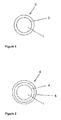
- the figure 1 shows a cross section of a wire electrode according to the invention.
- the core 1 of the wire electrode 3 is made of copper, brass or steel and is covered with a coating 2 made of graphene or a composite of either graphene with Zinc, graphene with copper or a composite of graphene with both zinc and copper.
- the figure 2 illustrates a further, second variant of the inventive wire electrode 6.
- the core 1 is made of copper, brass or steel and covered with a first coating 4 made of Zinc or a Copper-Zinc alloy, and a second, external coating 5 made of graphene or a composite graphene-zinc or a graphene-zinc-copper composite.
- the electrode core made of copper, brass or steel will be covered with an inventive coating.
- the coating can be synthesized or deposited on the core by using an electrochemical process.
- a graphene coating can for instance be applied by such an electrochemical process, same as coatings made of zinc, zinc and graphene or made of copper and graphene.
- Another possible embodiment of this invention is a copper or brass core with a first coating of copper-zinc alloy having higher zinc content than alpha brass, over which a graphene coating is synthesized or deposited using an electrochemical process.
- the Copper or brass core is replaced with a steel core, over which a graphene coating is synthesized or deposited using an electrochemical process.
- a composite containing zinc and graphene or a composite containing zinc, copper and graphene might be used as coating material, also deposited by an electrochemical process.
- metallic wires are introduced in large sections in a CVD cell.
- the metallic (core) wire is exposed to the CVD-process to deposit graphene on the wire surface until a desired thickness of the graphene-coating is reached. Since the necessary graphene layer is very thing - less than 1 micron - a continuous CVD-process can be used for industrial applications. Such a coating process would not be economical, if layers of 10 or more microns would have to be applied as necessary with ordinary coating materials.
- Such a small graphene concentration can be produced on a wire by electro-deposition in a zinc based bath, containing graphene platelets in suspension.
- a classic solution of 200 g/l zinc sulfate, 40 g/l sodium sulfate, 40 g/l boric acid, 1-4 g/l of graphene platelets and 2 g/l of cetyl trimethyl ammonium bromide as surfactant agent for maintaining the suspension during the process would be sufficient to produce an inventive zinc-graphene composite coating with a of low graphene concentration on copper wires.
- the electro-deposition method is today used for the manufacturing of conventional zinc-coatings on wire electrodes. Thus it can be readily adapted to the deposition of zinc-graphene composites according to one of the inventive embodiments.
- the invention is not limited to the application to wire electrodes, but can be used for all kind of electrodes used in electrical discharge machines.
- the invention respectively the inventive electrode can be for instance a wire electrode, a drilling electrode or a die-sinking electrode.
- the inventive electrode has a core - preferably made of copper, brass, molybdenum, tungsten or steel - and which is covered by the inventive coating containing graphene.
- the coating is made of a composite also including zinc and/or copper.
- the electrode has - additionally to the inventive coating - a supplemental first inner coating.
- supplemental first inner coating is made of zinc or a copper-zinc alloy and the second external coating contains graphene, preferably a graphene-zinc composite or a graphene-copper-composite, most preferably a graphene-zinc-copper composite.
- the coating containing graphene has a layer thickness ⁇ 1 micron [10-6 m].
- the coating containing graphene can have a graphene concentration of ⁇ 1 % in volume.
Landscapes
- Chemical & Material Sciences (AREA)
- Engineering & Computer Science (AREA)
- Mechanical Engineering (AREA)
- Chemical Kinetics & Catalysis (AREA)
- Materials Engineering (AREA)
- Metallurgy (AREA)
- Organic Chemistry (AREA)
- Electrochemistry (AREA)
- Inorganic Chemistry (AREA)
- Manufacturing & Machinery (AREA)
- General Chemical & Material Sciences (AREA)
- Electrical Discharge Machining, Electrochemical Machining, And Combined Machining (AREA)
- Non-Insulated Conductors (AREA)
Abstract
Description
- The present invention relates to an electrode for electrical discharge machining (EDM) according to the generic part of
claim 1. The invention relates in particular to wire electrodes, drilling electrodes or die-sinking electrodes. - Wire electrodes are commonly known and used in Wire electrical discharge machines (WEDM) for the machining of workpieces by electroerosion. The wire electrode is intended to cut the electrical conductive workpiece very precisely and constitutes an essential part for the EDM process. Wire electrodes have a brass, copper, or steel core and are covered by a coating to allow a higher electroerosion performance.
- The performance of EDM wires for high-speed cutting is directly related to the electrical properties of the wire in terms of electrical conductivity, thermal conductivity and resistance to heat. The higher these conductivities and resistance are the more current and in a shorter time can be delivered by the sparks to the workpiece, allowing therewith an increased removal performance compared to conventional wires. Electrical conductivity, thermal conductivity and heat resistance are increased by providing an EDM wire with a suitable coating, which protects the wire also against thermal rupture. Thermal rupture is avoided by evacuating the heat generated by the sparks at the surface of a wire towards the core. Conventional high speed wires are based on Copper cores and Copper-Zinc alloy coatings or beta and gamma phase brass coatings. Up to date, no other material has shown to improve all the properties provided by these structures which are related to their performances for high speed cutting in WEDM's.
- These coatings have the above-mentioned benefits for high removal of material and wire protection against heat. The incorporation of Copper in the coating increases its thermal resistance in respect of the occurring spark heat. Furthermore, as high power sparks favor also an undesired removal of the coating, high speed wires have usually thicker coatings than conventional wires in order to prevent any occurring removal during the electroerosion machining. Such coatings can also be made of alpha-phase brass in order to optimize the conduction of current and deliver high current peaks with high erosion potential during the discharge process. The core - often made of copper - is on the other hand also an essential part of the high speed EDM-wire, since high removal coatings have lower electrical and thermal conductivities which need to be compensated by the core of the wire.
- The efforts to improve wire for EDM machining have been ongoing. The document
US 4717804 discloses a wire made for instance of molybdenum or tungsten to which a carbon coating (graphite) is applied. TheUS 4740666 on the other hand discloses also a wire made of molybdenum or tungsten with an intermediate layer made of copper and zinc to which a carbon coating is adhered. The incorporation of graphite into coatings has been known particularly since graphite has been used as a material for producing die sinking electrodes. - The document
US 20130119023 A1 discloses also a graphite coating of wire electrodes. The layer of graphite is metallurgically bonded to a core made of brass. The document claims improved electroerosion cutting performances based on the fact that graphite oxidizes during the electrical spark discharge and produces gaseous reaction products such as carbon monoxide and carbon dioxide. The graphite does consequently not produce any solid debris, which could disturb the electroerosion process as conventional standard coating materials, e.g. introducing conductive bridges in the gap, leading to short circuits, arcing and even wire breakage. - The document
US 5030818 is also disclosing a wire electrode composed primarily of brass and copper alloys which include in their matrix graphite as second component with about 3 to 40 weight percent. - Further, it is also known in the state of the art to mix single-wall carbon nanotubes with dielectric fluids for EDM machining. Carbon nanotubes have a three-dimensional tubular structure and are mostly single-walled having a diameter of close to 1 nanometer. Such an application is published in the article "Analysis of surface characteristics of AISI D2 tool steel material using Electric Discharge Machining process with Single wall carbon nanotubes", (IACSIT Int. Journal of Engineering and Technology Vol. 2, No. 1, Feb. 2010, p. 35). Such carbon nanotubes can be produced for instance as explained in the document
US 2008/0296147 A1 . - The Japanese patent application
JP2004306162A - The present invention intends consequently to provide an improved, new coating of wire electrodes used in EDM applications.
- The objective of the invention is achieved by providing an electrode wire for electroerosion machines according to the features of
claim 1. - Graphene is a new material having outstanding properties in terms of thermal conductivity, electrical conductivity and thermal shielding. These properties are superior to those offered by copper and standard carbon structures like the graphite or the carbon nanotubes used by the state of the art. Incorporating this new material - graphene - at the surface of the wire increases all the required properties for high speed EDM cutting and that in an economical way with respect to all known conventional EDM coated and uncoated wires.
- The advantages of graphene based coatings over conventional ones are related to the improved electrical conductivity of 30% with respect to copper reducing line resistance and Joule effect losses, allowing an increased peak current in shorter pulse on-times which lead to a significant higher efficiency cutting.
- A second advantage is the improved thermal conductivity of graphene, which can be up 3 times of the known copper conductivity, which helps to spread and evacuate the thermal heat generated by the electric sparks towards the wire core and around the spark hot spot. Graphene based coatings reduce the thermal resistance of an electrode wire in respect to copper-zinc alloy coatings significantly, as graphene has a special carbon structure which is extremely resistant to heat. Hence, it will be less affected by the occurring thermal heat generated by the sparks at the hot spot. The electrode wear is therewith reduced same as the wire breakage probability.
- While graphite used as coating in the state of the art has a three-dimensional structure - same as the carbon nanotubes which have also a three-dimensional and tubular form - the graphene of the inventive coating consists of a two-dimensional structure. The essential difference between graphene and graphite is that the latter, due to its structure, offers a comparably low thermal and electrical conductivity which doesn't contribute to any improvement neither in the conduction of current through the electrode nor to the dissipation of heat from the hot spot where a spark occurs.
- Tests have shown that graphene can be deposited in a continuous layer over the surface of the wire, whereas carbon nanotubes will cover only partially the surface of the wire and need to be part of a composite in order to be applied on the wire core. The properties of resistance to heat of carbon nanotubes are significantly lowered with respect to a full graphene layer due to the fact that the covering with nanotubes is only partial and it is not possible to have a homogeneous full coating with nanotubes over the surface of the wire.
- The improved performance of EDM electrodes with graphene coatings is a surprising effect, which is does not appear in conventional EDM coatings for high speed cutting. The remarkable effect of graphene coatings is that only a thin layer is necessary to improve the thermal conductivity at the surface of the wire. Conventional coatings have a substantially larger thickness on the wire core to meet the requirements of high power generators, in order to withstand the increased thermal load and wear produced at the hot spot during such high energetic processes. An observable effect of graphene coatings is that only a thin layer is necessary to improve the thermal conductivity at the surface of the electrode wire. This is due to the surprising fact that the improved thermal performance is actually produced in the metallic core of the wire (e.g. made of copper), which is in contact with the graphene coating. In fact, the extraordinary properties of a pure graphene layer, e.g. less than 1 micron, does not provide the measured conductivity properties observable with an inventive electrode wire. However, if such a thin layer of graphene, e.g. also less than 1 micron, is deposited as a coating around a metallic wire core, the resulting structure ends to be much more performing. This observation is confirmed by the article "Thermal properties of graphene-copper-graphene heterogeneous films" (Nano let. 2014, 14(3), p1497). These researches found out that the thermal conductivity of copper can be increased by 25% after coating graphene on its surface, not because of the graphene properties but because the deposition modifies the micro-structure of the underlying copper making the coated substrate thermal more conductive than normal pure copper substrates.
- Apart of the improved thermal and electrical conductivity, coatings made of pure graphene or graphene-composites possess also superior mechanical properties compared to carbon nanotubes. The articles "Fracture and Fatigue in Graphene Nanocomposites," published in Small; "Enhanced Mechanical Properties of Nanocomposites at Low Graphene Content," published in ACS Nano; and "Buckling Resistant Graphene Nanocomposites," published in the journal Applied Physics Letters) show that graphene composites manifest better mechanical performances than carbon nanotubes composites, as a composites is "as weak as its weakest links", which in the case of carbon nanotubes coatings cracks and breakages are more likely to occur due to the reduced contact between the nanotube and the circumventing matrix.
- In an embodiment of the invention, aiming to further increase the unexpected performance of a graphene coating on a metallic core, a supplementary coating on the top of the graphene layer can be applied. That supplemental coating can be - for instance - made of a Copper-Zinc alloy, with high Zinc content, or a composite Zn-graphene coating. The supplementary coating at the top of the graphene layer is introducing new properties to the wire electrode which are further improving the wires performance in terms of cutting speed.
- Regarding the applicable composites used for producing such coatings with graphene as one component, the unexpected inventive effect than be observed even with very small graphene concentrations, e.g. below 1% in volume. This is enough to improve the mechanical resistance to fracture of the coating, which ultimately determines the resistance to breakage of the entire electrode wire. The observed inventive effect is surprising and cannot be obtained for instance with carbon nanotubes.
- The improved thermal performance is consequently not just produced by the coating itself, as it occurs with conventional coatings, but by the observed synergetic effect of the metallic wire core combined with the graphene respectively graphene-composite coating.
- Graphene can be used as pure coating material or can be combined as mentioned in a composite with other materials, for example with zinc, which, due to the low evaporation temperature, will add on beneficial effects for reduction of hot spot temperature, spark breakdown facilitation and increase of current density for an improved material removal rate at the machined workpiece, while reducing the wear and the thickness required for high speed cutting with respect to conventional copper-zinc based wire coatings .
- In the following, the invention will be further explained by making reference to figures and possible embodiments. The invention is however not restricted to the embodiments and alternative illustrated, which are merely intended as incitement for the person skilled in the art to implement the invention in useful ways.
- The
figure 1 shows a cross section of a wire electrode according to the invention. In the displayed embodiment, thecore 1 of thewire electrode 3 is made of copper, brass or steel and is covered with acoating 2 made of graphene or a composite of either graphene with Zinc, graphene with copper or a composite of graphene with both zinc and copper. - The
figure 2 illustrates a further, second variant of theinventive wire electrode 6. Here thecore 1 is made of copper, brass or steel and covered with afirst coating 4 made of Zinc or a Copper-Zinc alloy, and a second,external coating 5 made of graphene or a composite graphene-zinc or a graphene-zinc-copper composite. - For the implementation of the invention, the electrode core made of copper, brass or steel will be covered with an inventive coating. The coating can be synthesized or deposited on the core by using an electrochemical process. A graphene coating can for instance be applied by such an electrochemical process, same as coatings made of zinc, zinc and graphene or made of copper and graphene.
- Another possible embodiment of this invention is a copper or brass core with a first coating of copper-zinc alloy having higher zinc content than alpha brass, over which a graphene coating is synthesized or deposited using an electrochemical process.
- In an alternative embodiment, the Copper or brass core is replaced with a steel core, over which a graphene coating is synthesized or deposited using an electrochemical process. Alternatively, a composite containing zinc and graphene or a composite containing zinc, copper and graphene might be used as coating material, also deposited by an electrochemical process.
- Different methods are known to produce coatings made of graphene. Since the invention requires as a matter of fact only a thin graphene coating or a small concentration of graphene in a coating-composite, different possibilities exist in practice to manufacture such a coating on a metallic wire core, which do not belong to the known methods for manufacturing EDM wires.
- Such a method is described for instance in the article "Graphene based materials and their composites as coatings" (Tong I., Austin J. Nanomed Nanotechnol. 2013;1(1): 16). Graphene coatings can be for instance produced by Chemical Vapor Deposition (CVD). Further known methods for depositing graphene on a surface are for instance the sol-gel process or the electrophoresis process. An alternative method which can be used to produce composite coatings by electrochemistry is described in the article "A New Electrochemical Approach for the Synthesis of Copper-Graphene Nanocomposite Foils with High Hardness" (Chokkakula L, Sci. Rep. 2014/02/11). Therein graphene is incorporated into the electrolyte together with copper, whereby both components are deposited by electrochemical process on a surface.
- It is a part of the invention to use those coating methods to apply a graphene coating on a wire core for manufacturing the inventive wire electrode. The use of these coating deposition methods makes the inventive wire electrode economic and competitive with respect to known electrode wires having conventional coatings according the state of the art.
- Using for instance the CVD process to implement the invention, metallic wires are introduced in large sections in a CVD cell. In that cell, the metallic (core) wire is exposed to the CVD-process to deposit graphene on the wire surface until a desired thickness of the graphene-coating is reached. Since the necessary graphene layer is very thing - less than 1 micron - a continuous CVD-process can be used for industrial applications. Such a coating process would not be economical, if layers of 10 or more microns would have to be applied as necessary with ordinary coating materials.
- By using the other mentioned methods for producing a graphene coating on a metallic wire, the sol-gel or the electrophoresis process (EPD), graphene is added to colloidal solution in which the wire is immerged. The solution with the wire is subsequently exposed to a thermal treatment in order to manufacture a solid coating on metallic surfaces. A simple EPD process is described by An et al. (J. Phys. Chem. Lett. 2010, 1, 1259-1263) and starts with commercially available graphene oxide solutions of 1.5 mg/ml (for instance available from Graphenea Inc., see http://www.graphenea.com/products/graphene-oxide) and which can be used for depositing layers up to several microns thick of graphene on metallic substrates, acting as electrodes and using voltages of 10-30 V for processing times of 1-5 minutes, followed by air drying. The process has the advantage of depositing and reducing simultaneously the graphene oxide into graphene with the suitable properties for the discharge machining. Such a process can be used for producing a coating on previously Zn or Cu-Zn alloy coated wires, followed by a wire drawing step which consolidates mechanically the graphene into the wire coating.
- Similarly, such a small graphene concentration can be produced on a wire by electro-deposition in a zinc based bath, containing graphene platelets in suspension. For instance, a classic solution of 200 g/l zinc sulfate, 40 g/l sodium sulfate, 40 g/l boric acid, 1-4 g/l of graphene platelets and 2 g/l of cetyl trimethyl ammonium bromide as surfactant agent for maintaining the suspension during the process, would be sufficient to produce an inventive zinc-graphene composite coating with a of low graphene concentration on copper wires. The electro-deposition method is today used for the manufacturing of conventional zinc-coatings on wire electrodes. Thus it can be readily adapted to the deposition of zinc-graphene composites according to one of the inventive embodiments.
- The before mentioned method disclosed in the article "A New Electrochemical Approach for the Synthesis of Copper-Graphene Nanocomposite Foils with High Hardness" can be for instance used for the deposition of composite coatings based on Copper-Zinc alloys on a EDM electrode wire.
- The mentioned coating processes can also be combined respectively applied subsequently. This is done if an inventive electrode wire shall be manufactured as indicated in the foregoing text with two different coating layers.
- The invention is not limited to the application to wire electrodes, but can be used for all kind of electrodes used in electrical discharge machines. The invention respectively the inventive electrode can be for instance a wire electrode, a drilling electrode or a die-sinking electrode. The inventive electrode has a core - preferably made of copper, brass, molybdenum, tungsten or steel - and which is covered by the inventive coating containing graphene.
- In a preferred embodiment, the coating is made of a composite also including zinc and/or copper.
- In a further embodiment, the electrode has - additionally to the inventive coating - a supplemental first inner coating.
- Preferably, that supplemental first inner coating is made of zinc or a copper-zinc alloy and the second external coating contains graphene, preferably a graphene-zinc composite or a graphene-copper-composite, most preferably a graphene-zinc-copper composite.
- Most preferably, the coating containing graphene has a layer thickness ≤ 1 micron [10-6 m].
- The coating containing graphene can have a graphene concentration of ≤ 1 % in volume.
- The present invention is not limited to the explicitly explained examples and embodiments. The illustrated alternatives are rather to be considered suggestions intended to motivate the person skilled in the art to implement the invention in a most favorable way.
-
- 1
- core of wire electrode
- 2
- coating
- 3
- wire electrode
- 4
- first coating
- 5
- second coating
- 6
- wire electrode
Claims (8)
- Electrode for electrical discharge machines, preferably a wire electrode (3), a drilling electrode or a die-sinking electrode, with a core (1), preferably made of copper, brass, molybdenum, tungsten or steel, and a coating (2),
characterized in that
the coating (2) contains graphene. - Electrode for electrical discharge machines according to claim 1, characterized in that the coating (2) is made of a composite also including zinc and/or copper.
- Electrode for electrical discharge machines according to claim 1 or 2, characterized in that
the electrode (6) has a first inner coating (4). - Electrode for electrical discharge machines according to claim 3, characterized in that
the first inner coating (4) is made of zinc or a copper-zinc alloy and the second external coating (6) contains graphene, preferably a graphene-zinc composite or a graphene-copper-composite, most preferably a graphene-zinc-copper composite. - Electrode for electrical discharge machines according to one of the preceding claims, characterized in that
the coating (2, 5) containing graphene has a layer thickness ≤ 1 micron [10-6 m]. - Electrode for electrical discharge machines according to one of the preceding claims, characterized in that
the coating (2, 5) containing graphene has graphene concentration of ≤ 1 % in volume. - Manufacturing process for producing an electrode, preferably a wire electrode (3, 6), a drilling electrode or a die-sinking electrode, for electrical discharge machines according to one of the preceding claims,
characterized in that
the coating (2, 4, 5) is applied on the wire core (1) by an electrochemical process, preferably an electrolytic process. - Manufacturing process for producing an electrode, preferably a wire electrode (3, 6), a drilling electrode or a die-sinking electrode, for electrical discharge machines according to one of the preceding claims, characterized in that
the coating (2, 4, 5) is applied by a chemical vapor deposition process, a sol-gel process or an electrophoresis process.
Priority Applications (3)
| Application Number | Priority Date | Filing Date | Title |
|---|---|---|---|
| EP15154045.7A EP3053688B1 (en) | 2015-02-06 | 2015-02-06 | Graphene electrode and method of producing such electrode |
| US15/008,480 US20160228964A1 (en) | 2015-02-06 | 2016-01-28 | Graphene electrode |
| CN201610081501.6A CN105855647A (en) | 2015-02-06 | 2016-02-05 | Graphene electrode |
Applications Claiming Priority (1)
| Application Number | Priority Date | Filing Date | Title |
|---|---|---|---|
| EP15154045.7A EP3053688B1 (en) | 2015-02-06 | 2015-02-06 | Graphene electrode and method of producing such electrode |
Publications (2)
| Publication Number | Publication Date |
|---|---|
| EP3053688A1 true EP3053688A1 (en) | 2016-08-10 |
| EP3053688B1 EP3053688B1 (en) | 2019-10-09 |
Family
ID=52544278
Family Applications (1)
| Application Number | Title | Priority Date | Filing Date |
|---|---|---|---|
| EP15154045.7A Active EP3053688B1 (en) | 2015-02-06 | 2015-02-06 | Graphene electrode and method of producing such electrode |
Country Status (3)
| Country | Link |
|---|---|
| US (1) | US20160228964A1 (en) |
| EP (1) | EP3053688B1 (en) |
| CN (1) | CN105855647A (en) |
Cited By (2)
| Publication number | Priority date | Publication date | Assignee | Title |
|---|---|---|---|---|
| WO2020229046A1 (en) * | 2019-05-14 | 2020-11-19 | Berkenhoff Gmbh | Wire electrode for wirecut electrical discharge machining with carbonaceous surface layer and the preparation methods thereof |
| IT202000012319A1 (en) * | 2020-05-26 | 2021-11-26 | Domenico Barbieri | WIRES, STRANDS, RIGID AND FLEXIBLE ROPES WITH HIGH ELECTRICAL, PHYSICO-CHEMICAL AND ENVIRONMENTAL PERFORMANCES FOR THE PURPOSES OF ELECTRIC CONDUCTION, AND A METHOD FOR THEIR PREPARATION. |
Families Citing this family (9)
| Publication number | Priority date | Publication date | Assignee | Title |
|---|---|---|---|---|
| IT201700020695A1 (en) * | 2017-03-14 | 2018-09-14 | Vincenzo Tagliaferri | New electrical or data transmission cables with high electrical conductivity and / or high data transmission speed. |
| US10923887B2 (en) * | 2017-03-15 | 2021-02-16 | Tenneco Inc. | Wire for an ignition coil assembly, ignition coil assembly, and methods of manufacturing the wire and ignition coil assembly |
| CN110384867A (en) * | 2018-04-20 | 2019-10-29 | 灯达(深圳)电器有限公司 | A kind of belt sensor magnetic vibration heat cure coil based on graphene wire |
| IT202000016903A1 (en) * | 2020-07-13 | 2022-01-13 | Company Trafil Production Srl | ELECTRICAL CONDUCTORS FOR POWER TRANSFORMERS WITH HIGH ELECTRICAL AND THERMAL CONDUCTIVITY. |
| EP4089691B1 (en) * | 2021-05-10 | 2024-08-07 | ABB Schweiz AG | Graphene-copper coated electrical contact |
| US12340918B2 (en) * | 2022-02-15 | 2025-06-24 | Arizona Board Of Regents On Behalf Of Arizona State University | Composite wire |
| US20240257996A1 (en) * | 2023-01-30 | 2024-08-01 | GM Global Technology Operations LLC | System and method of making an electric conductor having a conductive skin layer |
| CN115958262B (en) * | 2023-01-30 | 2025-07-11 | 宁波博威合金精密细丝有限公司 | Electrode wire for slow wire electrospark machining |
| CN116864197A (en) * | 2023-07-11 | 2023-10-10 | 昆山品志金属材料有限公司 | High-performance slow-running wire and production process thereof |
Citations (10)
| Publication number | Priority date | Publication date | Assignee | Title |
|---|---|---|---|---|
| US4717804A (en) | 1986-07-24 | 1988-01-05 | General Electric Company | EDM wire electrode |
| US4740666A (en) | 1986-08-28 | 1988-04-26 | General Electric Company | Electrical discharge machining electrode |
| US5030818A (en) | 1989-08-28 | 1991-07-09 | Dudas David J | Composite wire electrode |
| JP2004306162A (en) | 2003-04-02 | 2004-11-04 | Osaka Industrial Promotion Organization | Electrode for micro thermal processing and method for thermal processing of metal member or semiconductor member using the same |
| US20080296147A1 (en) | 2007-03-21 | 2008-12-04 | Nebojsa Ilija Jaksic | Method for Manufacturing of Carbon Nanotubes in Dielectric Liquids |
| EP2354272A1 (en) * | 2010-02-08 | 2011-08-10 | Sungkyunkwan University Foundation for Corporate Collaboration | Graphene roll-to-roll coating apparatus and graphene roll-to-roll coating method using the same |
| US20130119023A1 (en) | 2010-07-23 | 2013-05-16 | Dandridge Tomalin | Graphitized edm wire |
| KR20130058389A (en) * | 2011-11-25 | 2013-06-04 | 전자부품연구원 | Method for metal wire with graphene surface |
| CN103127919A (en) * | 2013-03-19 | 2013-06-05 | 北京师范大学 | Method for preparing titanium-based graphene coating for solid phase microextraction |
| US20130143067A1 (en) * | 2011-12-05 | 2013-06-06 | K-Technology Usa, Inc. | Anti-oxidation coating using graphene |
Family Cites Families (11)
| Publication number | Priority date | Publication date | Assignee | Title |
|---|---|---|---|---|
| SE444278B (en) * | 1979-10-11 | 1986-04-07 | Charmilles Sa Ateliers | WIRELESS ELECTROD |
| US4686153A (en) * | 1984-12-08 | 1987-08-11 | Fujikura Ltd. | Electrode wire for use in electric discharge machining and process for preparing same |
| JPS6219326A (en) * | 1985-07-19 | 1987-01-28 | Furukawa Electric Co Ltd:The | Electrode wire for wire-cut electric discharge machining |
| DE19510740A1 (en) * | 1995-03-24 | 1996-10-02 | Berkenhoff Gmbh | Wire electrode and method for producing a wire electrode, in particular for the spark erosion method |
| JP3090009B2 (en) * | 1995-11-30 | 2000-09-18 | 日立電線株式会社 | Electrode wire for electric discharge machining |
| US6806433B2 (en) * | 1996-09-04 | 2004-10-19 | Berkenhoff Gmbh | High-strength erosion electrode |
| FR2881973B1 (en) * | 2005-02-11 | 2007-05-11 | Thermocompact Sa | COMPOSITE WIRE FOR ELECTROSION |
| FR2911806B1 (en) * | 2007-01-29 | 2009-03-13 | Thermocompact Sa | ELECTRODE WIRE FOR ELECTROEROSION |
| ES2390167T3 (en) * | 2008-10-01 | 2012-11-07 | Berkenhoff Gmbh | Wire electrodes for electric shock cutting |
| US9950394B2 (en) * | 2012-03-12 | 2018-04-24 | Hobart Brothers Company | Systems and methods for welding electrodes |
| CN104175609A (en) * | 2014-08-08 | 2014-12-03 | 苏州宏久航空防热材料科技有限公司 | CVD graphene-SiC carbon fiber |
-
2015
- 2015-02-06 EP EP15154045.7A patent/EP3053688B1/en active Active
-
2016
- 2016-01-28 US US15/008,480 patent/US20160228964A1/en not_active Abandoned
- 2016-02-05 CN CN201610081501.6A patent/CN105855647A/en active Pending
Patent Citations (10)
| Publication number | Priority date | Publication date | Assignee | Title |
|---|---|---|---|---|
| US4717804A (en) | 1986-07-24 | 1988-01-05 | General Electric Company | EDM wire electrode |
| US4740666A (en) | 1986-08-28 | 1988-04-26 | General Electric Company | Electrical discharge machining electrode |
| US5030818A (en) | 1989-08-28 | 1991-07-09 | Dudas David J | Composite wire electrode |
| JP2004306162A (en) | 2003-04-02 | 2004-11-04 | Osaka Industrial Promotion Organization | Electrode for micro thermal processing and method for thermal processing of metal member or semiconductor member using the same |
| US20080296147A1 (en) | 2007-03-21 | 2008-12-04 | Nebojsa Ilija Jaksic | Method for Manufacturing of Carbon Nanotubes in Dielectric Liquids |
| EP2354272A1 (en) * | 2010-02-08 | 2011-08-10 | Sungkyunkwan University Foundation for Corporate Collaboration | Graphene roll-to-roll coating apparatus and graphene roll-to-roll coating method using the same |
| US20130119023A1 (en) | 2010-07-23 | 2013-05-16 | Dandridge Tomalin | Graphitized edm wire |
| KR20130058389A (en) * | 2011-11-25 | 2013-06-04 | 전자부품연구원 | Method for metal wire with graphene surface |
| US20130143067A1 (en) * | 2011-12-05 | 2013-06-06 | K-Technology Usa, Inc. | Anti-oxidation coating using graphene |
| CN103127919A (en) * | 2013-03-19 | 2013-06-05 | 北京师范大学 | Method for preparing titanium-based graphene coating for solid phase microextraction |
Non-Patent Citations (11)
| Title |
|---|
| "ACS Nano", article "Enhanced Mechanical Properties of Nanocomposites at Low Graphene Content" |
| "Analysis of surface characteristics of AISI D2 tool steel material using Electric Discharge Machining process with Single wall carbon nanotubes", IACSIT INT. JOURNAL OF ENGINEERING AND TECHNOLOGY, vol. 2, no. 1, February 2010 (2010-02-01), pages 35 |
| "Buckling Resistant Graphene Nanocomposites", JOURNAL APPLIED PHYSICS LETTERS |
| "Fracture and Fatigue in Graphene Nanocomposites", SMALL |
| "Thermal properties of graphene-copper-graphene heterogeneous films", NANO LET., vol. 14, no. 3, 2014, pages 1497 |
| AN ET AL., J. PHYS. CHEM. LETT., vol. 1, 2010, pages 1259 - 1263 |
| CHOKKAKULA L: "A New Electrochemical Approach for the Synthesis of Copper-Graphene Nanocomposite Foils with High Hardness", SCI. REP., 11 February 2014 (2014-02-11) |
| CHOKKAKULA L: "A New Electrochemical Approach for the Synthesis of Copper-Graphene Nanocomposite Foils with High Hardness", SCI. REP., 11 February 2014 (2014-02-11), XP002741836 * |
| DATABASE WPI Week 201356, Derwent World Patents Index; AN 2013-K92810, XP002741835 * |
| DATABASE WPI Week 201379, Derwent World Patents Index; AN 2013-R61676, XP002741834 * |
| TONG I.; AUSTIN J.: "Graphene based materials and their composites as coatings", NANOMED NANOTECHNOL., vol. 1, no. 1, 2013, pages 16 |
Cited By (3)
| Publication number | Priority date | Publication date | Assignee | Title |
|---|---|---|---|---|
| WO2020229046A1 (en) * | 2019-05-14 | 2020-11-19 | Berkenhoff Gmbh | Wire electrode for wirecut electrical discharge machining with carbonaceous surface layer and the preparation methods thereof |
| IT202000012319A1 (en) * | 2020-05-26 | 2021-11-26 | Domenico Barbieri | WIRES, STRANDS, RIGID AND FLEXIBLE ROPES WITH HIGH ELECTRICAL, PHYSICO-CHEMICAL AND ENVIRONMENTAL PERFORMANCES FOR THE PURPOSES OF ELECTRIC CONDUCTION, AND A METHOD FOR THEIR PREPARATION. |
| WO2021239658A1 (en) * | 2020-05-26 | 2021-12-02 | Barbieri Domenico | Wires, strands, rigid and flexible ropes having high electric, physico-chemical and environmental performances |
Also Published As
| Publication number | Publication date |
|---|---|
| CN105855647A (en) | 2016-08-17 |
| US20160228964A1 (en) | 2016-08-11 |
| EP3053688B1 (en) | 2019-10-09 |
Similar Documents
| Publication | Publication Date | Title |
|---|---|---|
| EP3053688B1 (en) | Graphene electrode and method of producing such electrode | |
| EP2005343B1 (en) | Edm wire | |
| Talla et al. | Effect of powder-suspended dielectric on the EDM characteristics of Inconel 625 | |
| RU2516125C2 (en) | Wire electrode for arc cutting | |
| CA1327157C (en) | Eroding electrode, in particular a wire electrode for the spark-erosive working | |
| CA2302202C (en) | Electrode wire for use in electric discharge machining and process for preparing same | |
| CN113811415B (en) | Electrode wire for spark erosion cutting and method of manufacturing the same | |
| George et al. | Experimental investigation of silicon powder mixed EDM using graphene and CNT nano particle coated electrodes | |
| Mandal et al. | Development and application of Cu-SWCNT nanocomposite–coated 6061Al electrode for EDM | |
| CN102170990A (en) | Wire electrode for spark-erosion cutting | |
| US6566622B1 (en) | Wire electrode | |
| Pramanik et al. | Effect of reinforced particle size on wire EDM of MMCs | |
| Kruth et al. | Composite wires with high tensile core for wire EDM | |
| Shirguppikar et al. | Experimental investigation of CNT coated tools for EDM processes | |
| Mandal et al. | Investigation on the performance of copper-coated 6061 aluminium alloy electrode in electric discharge machining | |
| US20130119023A1 (en) | Graphitized edm wire | |
| Gill et al. | A review of recent methods for tool wear reduction in electrical discharge machining | |
| Prasad et al. | Optimization of process parameters during WEDM of EN-42 spring steel | |
| Rouniyar et al. | Improvement in machined surface with the use of powder and magnetic field assisted on machining aluminium 6061 alloy with EDM | |
| Karmiris-Obratański et al. | On machining Ti6Al4V ELI with EDM by using copper and graphite electrodes: A comparison study | |
| KV et al. | Experimental investigation on the recast layer and performance indicators during nano powder mixed μ ED miling of Ti-6Al-4V | |
| US20070295695A1 (en) | EDM wire | |
| Muniamuthu et al. | Effect of dielectric medium on electro-discharge machining of aluminium metal matrix composites | |
| Abdul-Rani et al. | Analysis on Cu-WC-Si as electrode for advancement in electro-discharge machining | |
| Kumar et al. | A state of art in development of wire electrodes for high performance wire cut EDM |
Legal Events
| Date | Code | Title | Description |
|---|---|---|---|
| PUAI | Public reference made under article 153(3) epc to a published international application that has entered the european phase |
Free format text: ORIGINAL CODE: 0009012 |
|
| AK | Designated contracting states |
Kind code of ref document: A1 Designated state(s): AL AT BE BG CH CY CZ DE DK EE ES FI FR GB GR HR HU IE IS IT LI LT LU LV MC MK MT NL NO PL PT RO RS SE SI SK SM TR |
|
| AX | Request for extension of the european patent |
Extension state: BA ME |
|
| STAA | Information on the status of an ep patent application or granted ep patent |
Free format text: STATUS: REQUEST FOR EXAMINATION WAS MADE |
|
| 17P | Request for examination filed |
Effective date: 20170207 |
|
| RBV | Designated contracting states (corrected) |
Designated state(s): AL AT BE BG CH CY CZ DE DK EE ES FI FR GB GR HR HU IE IS IT LI LT LU LV MC MK MT NL NO PL PT RO RS SE SI SK SM TR |
|
| GRAP | Despatch of communication of intention to grant a patent |
Free format text: ORIGINAL CODE: EPIDOSNIGR1 |
|
| STAA | Information on the status of an ep patent application or granted ep patent |
Free format text: STATUS: GRANT OF PATENT IS INTENDED |
|
| INTG | Intention to grant announced |
Effective date: 20190527 |
|
| GRAS | Grant fee paid |
Free format text: ORIGINAL CODE: EPIDOSNIGR3 |
|
| GRAA | (expected) grant |
Free format text: ORIGINAL CODE: 0009210 |
|
| STAA | Information on the status of an ep patent application or granted ep patent |
Free format text: STATUS: THE PATENT HAS BEEN GRANTED |
|
| AK | Designated contracting states |
Kind code of ref document: B1 Designated state(s): AL AT BE BG CH CY CZ DE DK EE ES FI FR GB GR HR HU IE IS IT LI LT LU LV MC MK MT NL NO PL PT RO RS SE SI SK SM TR |
|
| REG | Reference to a national code |
Ref country code: GB Ref legal event code: FG4D |
|
| REG | Reference to a national code |
Ref country code: CH Ref legal event code: EP Ref country code: CH Ref legal event code: NV Representative=s name: GEORG FISCHER AG, CH |
|
| REG | Reference to a national code |
Ref country code: IE Ref legal event code: FG4D |
|
| REG | Reference to a national code |
Ref country code: DE Ref legal event code: R096 Ref document number: 602015039336 Country of ref document: DE |
|
| REG | Reference to a national code |
Ref country code: AT Ref legal event code: REF Ref document number: 1188208 Country of ref document: AT Kind code of ref document: T Effective date: 20191115 |
|
| REG | Reference to a national code |
Ref country code: NL Ref legal event code: MP Effective date: 20191009 |
|
| REG | Reference to a national code |
Ref country code: LT Ref legal event code: MG4D |
|
| REG | Reference to a national code |
Ref country code: AT Ref legal event code: MK05 Ref document number: 1188208 Country of ref document: AT Kind code of ref document: T Effective date: 20191009 |
|
| PG25 | Lapsed in a contracting state [announced via postgrant information from national office to epo] |
Ref country code: NO Free format text: LAPSE BECAUSE OF FAILURE TO SUBMIT A TRANSLATION OF THE DESCRIPTION OR TO PAY THE FEE WITHIN THE PRESCRIBED TIME-LIMIT Effective date: 20200109 Ref country code: BG Free format text: LAPSE BECAUSE OF FAILURE TO SUBMIT A TRANSLATION OF THE DESCRIPTION OR TO PAY THE FEE WITHIN THE PRESCRIBED TIME-LIMIT Effective date: 20200109 Ref country code: PL Free format text: LAPSE BECAUSE OF FAILURE TO SUBMIT A TRANSLATION OF THE DESCRIPTION OR TO PAY THE FEE WITHIN THE PRESCRIBED TIME-LIMIT Effective date: 20191009 Ref country code: LT Free format text: LAPSE BECAUSE OF FAILURE TO SUBMIT A TRANSLATION OF THE DESCRIPTION OR TO PAY THE FEE WITHIN THE PRESCRIBED TIME-LIMIT Effective date: 20191009 Ref country code: FI Free format text: LAPSE BECAUSE OF FAILURE TO SUBMIT A TRANSLATION OF THE DESCRIPTION OR TO PAY THE FEE WITHIN THE PRESCRIBED TIME-LIMIT Effective date: 20191009 Ref country code: AT Free format text: LAPSE BECAUSE OF FAILURE TO SUBMIT A TRANSLATION OF THE DESCRIPTION OR TO PAY THE FEE WITHIN THE PRESCRIBED TIME-LIMIT Effective date: 20191009 Ref country code: NL Free format text: LAPSE BECAUSE OF FAILURE TO SUBMIT A TRANSLATION OF THE DESCRIPTION OR TO PAY THE FEE WITHIN THE PRESCRIBED TIME-LIMIT Effective date: 20191009 Ref country code: PT Free format text: LAPSE BECAUSE OF FAILURE TO SUBMIT A TRANSLATION OF THE DESCRIPTION OR TO PAY THE FEE WITHIN THE PRESCRIBED TIME-LIMIT Effective date: 20200210 Ref country code: GR Free format text: LAPSE BECAUSE OF FAILURE TO SUBMIT A TRANSLATION OF THE DESCRIPTION OR TO PAY THE FEE WITHIN THE PRESCRIBED TIME-LIMIT Effective date: 20200110 Ref country code: ES Free format text: LAPSE BECAUSE OF FAILURE TO SUBMIT A TRANSLATION OF THE DESCRIPTION OR TO PAY THE FEE WITHIN THE PRESCRIBED TIME-LIMIT Effective date: 20191009 Ref country code: SE Free format text: LAPSE BECAUSE OF FAILURE TO SUBMIT A TRANSLATION OF THE DESCRIPTION OR TO PAY THE FEE WITHIN THE PRESCRIBED TIME-LIMIT Effective date: 20191009 Ref country code: LV Free format text: LAPSE BECAUSE OF FAILURE TO SUBMIT A TRANSLATION OF THE DESCRIPTION OR TO PAY THE FEE WITHIN THE PRESCRIBED TIME-LIMIT Effective date: 20191009 |
|
| PG25 | Lapsed in a contracting state [announced via postgrant information from national office to epo] |
Ref country code: RS Free format text: LAPSE BECAUSE OF FAILURE TO SUBMIT A TRANSLATION OF THE DESCRIPTION OR TO PAY THE FEE WITHIN THE PRESCRIBED TIME-LIMIT Effective date: 20191009 Ref country code: HR Free format text: LAPSE BECAUSE OF FAILURE TO SUBMIT A TRANSLATION OF THE DESCRIPTION OR TO PAY THE FEE WITHIN THE PRESCRIBED TIME-LIMIT Effective date: 20191009 Ref country code: IS Free format text: LAPSE BECAUSE OF FAILURE TO SUBMIT A TRANSLATION OF THE DESCRIPTION OR TO PAY THE FEE WITHIN THE PRESCRIBED TIME-LIMIT Effective date: 20200224 |
|
| PG25 | Lapsed in a contracting state [announced via postgrant information from national office to epo] |
Ref country code: AL Free format text: LAPSE BECAUSE OF FAILURE TO SUBMIT A TRANSLATION OF THE DESCRIPTION OR TO PAY THE FEE WITHIN THE PRESCRIBED TIME-LIMIT Effective date: 20191009 |
|
| REG | Reference to a national code |
Ref country code: DE Ref legal event code: R097 Ref document number: 602015039336 Country of ref document: DE |
|
| PG2D | Information on lapse in contracting state deleted |
Ref country code: IS |
|
| PG25 | Lapsed in a contracting state [announced via postgrant information from national office to epo] |
Ref country code: RO Free format text: LAPSE BECAUSE OF FAILURE TO SUBMIT A TRANSLATION OF THE DESCRIPTION OR TO PAY THE FEE WITHIN THE PRESCRIBED TIME-LIMIT Effective date: 20191009 Ref country code: CZ Free format text: LAPSE BECAUSE OF FAILURE TO SUBMIT A TRANSLATION OF THE DESCRIPTION OR TO PAY THE FEE WITHIN THE PRESCRIBED TIME-LIMIT Effective date: 20191009 Ref country code: DK Free format text: LAPSE BECAUSE OF FAILURE TO SUBMIT A TRANSLATION OF THE DESCRIPTION OR TO PAY THE FEE WITHIN THE PRESCRIBED TIME-LIMIT Effective date: 20191009 Ref country code: EE Free format text: LAPSE BECAUSE OF FAILURE TO SUBMIT A TRANSLATION OF THE DESCRIPTION OR TO PAY THE FEE WITHIN THE PRESCRIBED TIME-LIMIT Effective date: 20191009 Ref country code: IS Free format text: LAPSE BECAUSE OF FAILURE TO SUBMIT A TRANSLATION OF THE DESCRIPTION OR TO PAY THE FEE WITHIN THE PRESCRIBED TIME-LIMIT Effective date: 20200209 |
|
| PLBE | No opposition filed within time limit |
Free format text: ORIGINAL CODE: 0009261 |
|
| STAA | Information on the status of an ep patent application or granted ep patent |
Free format text: STATUS: NO OPPOSITION FILED WITHIN TIME LIMIT |
|
| PG25 | Lapsed in a contracting state [announced via postgrant information from national office to epo] |
Ref country code: SK Free format text: LAPSE BECAUSE OF FAILURE TO SUBMIT A TRANSLATION OF THE DESCRIPTION OR TO PAY THE FEE WITHIN THE PRESCRIBED TIME-LIMIT Effective date: 20191009 Ref country code: IT Free format text: LAPSE BECAUSE OF FAILURE TO SUBMIT A TRANSLATION OF THE DESCRIPTION OR TO PAY THE FEE WITHIN THE PRESCRIBED TIME-LIMIT Effective date: 20191009 Ref country code: SM Free format text: LAPSE BECAUSE OF FAILURE TO SUBMIT A TRANSLATION OF THE DESCRIPTION OR TO PAY THE FEE WITHIN THE PRESCRIBED TIME-LIMIT Effective date: 20191009 |
|
| 26N | No opposition filed |
Effective date: 20200710 |
|
| REG | Reference to a national code |
Ref country code: BE Ref legal event code: MM Effective date: 20200229 |
|
| PG25 | Lapsed in a contracting state [announced via postgrant information from national office to epo] |
Ref country code: LU Free format text: LAPSE BECAUSE OF NON-PAYMENT OF DUE FEES Effective date: 20200206 Ref country code: MC Free format text: LAPSE BECAUSE OF FAILURE TO SUBMIT A TRANSLATION OF THE DESCRIPTION OR TO PAY THE FEE WITHIN THE PRESCRIBED TIME-LIMIT Effective date: 20191009 |
|
| PG25 | Lapsed in a contracting state [announced via postgrant information from national office to epo] |
Ref country code: SI Free format text: LAPSE BECAUSE OF FAILURE TO SUBMIT A TRANSLATION OF THE DESCRIPTION OR TO PAY THE FEE WITHIN THE PRESCRIBED TIME-LIMIT Effective date: 20191009 |
|
| PG25 | Lapsed in a contracting state [announced via postgrant information from national office to epo] |
Ref country code: IE Free format text: LAPSE BECAUSE OF NON-PAYMENT OF DUE FEES Effective date: 20200206 |
|
| PG25 | Lapsed in a contracting state [announced via postgrant information from national office to epo] |
Ref country code: BE Free format text: LAPSE BECAUSE OF NON-PAYMENT OF DUE FEES Effective date: 20200229 |
|
| PG25 | Lapsed in a contracting state [announced via postgrant information from national office to epo] |
Ref country code: TR Free format text: LAPSE BECAUSE OF FAILURE TO SUBMIT A TRANSLATION OF THE DESCRIPTION OR TO PAY THE FEE WITHIN THE PRESCRIBED TIME-LIMIT Effective date: 20191009 Ref country code: MT Free format text: LAPSE BECAUSE OF FAILURE TO SUBMIT A TRANSLATION OF THE DESCRIPTION OR TO PAY THE FEE WITHIN THE PRESCRIBED TIME-LIMIT Effective date: 20191009 Ref country code: CY Free format text: LAPSE BECAUSE OF FAILURE TO SUBMIT A TRANSLATION OF THE DESCRIPTION OR TO PAY THE FEE WITHIN THE PRESCRIBED TIME-LIMIT Effective date: 20191009 |
|
| PG25 | Lapsed in a contracting state [announced via postgrant information from national office to epo] |
Ref country code: MK Free format text: LAPSE BECAUSE OF FAILURE TO SUBMIT A TRANSLATION OF THE DESCRIPTION OR TO PAY THE FEE WITHIN THE PRESCRIBED TIME-LIMIT Effective date: 20191009 |
|
| PGFP | Annual fee paid to national office [announced via postgrant information from national office to epo] |
Ref country code: FR Payment date: 20230221 Year of fee payment: 9 Ref country code: CH Payment date: 20230307 Year of fee payment: 9 |
|
| PGFP | Annual fee paid to national office [announced via postgrant information from national office to epo] |
Ref country code: GB Payment date: 20230221 Year of fee payment: 9 Ref country code: DE Payment date: 20230216 Year of fee payment: 9 |
|
| P01 | Opt-out of the competence of the unified patent court (upc) registered |
Effective date: 20230529 |
|
| REG | Reference to a national code |
Ref country code: DE Ref legal event code: R119 Ref document number: 602015039336 Country of ref document: DE |
|
| REG | Reference to a national code |
Ref country code: CH Ref legal event code: PL |
|
| PG25 | Lapsed in a contracting state [announced via postgrant information from national office to epo] |
Ref country code: CH Free format text: LAPSE BECAUSE OF NON-PAYMENT OF DUE FEES Effective date: 20240229 |
|
| GBPC | Gb: european patent ceased through non-payment of renewal fee |
Effective date: 20240206 |
|
| PG25 | Lapsed in a contracting state [announced via postgrant information from national office to epo] |
Ref country code: CH Free format text: LAPSE BECAUSE OF NON-PAYMENT OF DUE FEES Effective date: 20240229 |
|
| PG25 | Lapsed in a contracting state [announced via postgrant information from national office to epo] |
Ref country code: DE Free format text: LAPSE BECAUSE OF NON-PAYMENT OF DUE FEES Effective date: 20240903 |
|
| PG25 | Lapsed in a contracting state [announced via postgrant information from national office to epo] |
Ref country code: GB Free format text: LAPSE BECAUSE OF NON-PAYMENT OF DUE FEES Effective date: 20240206 |
|
| PG25 | Lapsed in a contracting state [announced via postgrant information from national office to epo] |
Ref country code: FR Free format text: LAPSE BECAUSE OF NON-PAYMENT OF DUE FEES Effective date: 20240229 |
|
| PG25 | Lapsed in a contracting state [announced via postgrant information from national office to epo] |
Ref country code: GB Free format text: LAPSE BECAUSE OF NON-PAYMENT OF DUE FEES Effective date: 20240206 Ref country code: FR Free format text: LAPSE BECAUSE OF NON-PAYMENT OF DUE FEES Effective date: 20240229 Ref country code: DE Free format text: LAPSE BECAUSE OF NON-PAYMENT OF DUE FEES Effective date: 20240903 |