EP3052519B1 - Protoxin-ii variants and methods of use - Google Patents
Protoxin-ii variants and methods of use Download PDFInfo
- Publication number
- EP3052519B1 EP3052519B1 EP14790422.1A EP14790422A EP3052519B1 EP 3052519 B1 EP3052519 B1 EP 3052519B1 EP 14790422 A EP14790422 A EP 14790422A EP 3052519 B1 EP3052519 B1 EP 3052519B1
- Authority
- EP
- European Patent Office
- Prior art keywords
- artificial sequence
- variant
- cooh
- prt
- mod
- Prior art date
- Legal status (The legal status is an assumption and is not a legal conclusion. Google has not performed a legal analysis and makes no representation as to the accuracy of the status listed.)
- Not-in-force
Links
Images


Classifications
-
- C—CHEMISTRY; METALLURGY
- C07—ORGANIC CHEMISTRY
- C07K—PEPTIDES
- C07K14/00—Peptides having more than 20 amino acids; Gastrins; Somatostatins; Melanotropins; Derivatives thereof
- C07K14/435—Peptides having more than 20 amino acids; Gastrins; Somatostatins; Melanotropins; Derivatives thereof from animals; from humans
- C07K14/43504—Peptides having more than 20 amino acids; Gastrins; Somatostatins; Melanotropins; Derivatives thereof from animals; from humans from invertebrates
- C07K14/43513—Peptides having more than 20 amino acids; Gastrins; Somatostatins; Melanotropins; Derivatives thereof from animals; from humans from invertebrates from arachnidae
- C07K14/43518—Peptides having more than 20 amino acids; Gastrins; Somatostatins; Melanotropins; Derivatives thereof from animals; from humans from invertebrates from arachnidae from spiders
-
- A—HUMAN NECESSITIES
- A61—MEDICAL OR VETERINARY SCIENCE; HYGIENE
- A61P—SPECIFIC THERAPEUTIC ACTIVITY OF CHEMICAL COMPOUNDS OR MEDICINAL PREPARATIONS
- A61P29/00—Non-central analgesic, antipyretic or antiinflammatory agents, e.g. antirheumatic agents; Non-steroidal antiinflammatory drugs [NSAID]
-
- A—HUMAN NECESSITIES
- A61—MEDICAL OR VETERINARY SCIENCE; HYGIENE
- A61K—PREPARATIONS FOR MEDICAL, DENTAL OR TOILETRY PURPOSES
- A61K38/00—Medicinal preparations containing peptides
- A61K38/16—Peptides having more than 20 amino acids; Gastrins; Somatostatins; Melanotropins; Derivatives thereof
- A61K38/17—Peptides having more than 20 amino acids; Gastrins; Somatostatins; Melanotropins; Derivatives thereof from animals; from humans
- A61K38/1767—Peptides having more than 20 amino acids; Gastrins; Somatostatins; Melanotropins; Derivatives thereof from animals; from humans from invertebrates
-
- A—HUMAN NECESSITIES
- A61—MEDICAL OR VETERINARY SCIENCE; HYGIENE
- A61P—SPECIFIC THERAPEUTIC ACTIVITY OF CHEMICAL COMPOUNDS OR MEDICINAL PREPARATIONS
- A61P25/00—Drugs for disorders of the nervous system
- A61P25/02—Drugs for disorders of the nervous system for peripheral neuropathies
-
- C—CHEMISTRY; METALLURGY
- C07—ORGANIC CHEMISTRY
- C07K—PEPTIDES
- C07K14/00—Peptides having more than 20 amino acids; Gastrins; Somatostatins; Melanotropins; Derivatives thereof
- C07K14/435—Peptides having more than 20 amino acids; Gastrins; Somatostatins; Melanotropins; Derivatives thereof from animals; from humans
- C07K14/46—Peptides having more than 20 amino acids; Gastrins; Somatostatins; Melanotropins; Derivatives thereof from animals; from humans from vertebrates
- C07K14/47—Peptides having more than 20 amino acids; Gastrins; Somatostatins; Melanotropins; Derivatives thereof from animals; from humans from vertebrates from mammals
-
- C—CHEMISTRY; METALLURGY
- C07—ORGANIC CHEMISTRY
- C07K—PEPTIDES
- C07K14/00—Peptides having more than 20 amino acids; Gastrins; Somatostatins; Melanotropins; Derivatives thereof
- C07K14/435—Peptides having more than 20 amino acids; Gastrins; Somatostatins; Melanotropins; Derivatives thereof from animals; from humans
- C07K14/76—Albumins
- C07K14/765—Serum albumin, e.g. HSA
-
- C—CHEMISTRY; METALLURGY
- C12—BIOCHEMISTRY; BEER; SPIRITS; WINE; VINEGAR; MICROBIOLOGY; ENZYMOLOGY; MUTATION OR GENETIC ENGINEERING
- C12N—MICROORGANISMS OR ENZYMES; COMPOSITIONS THEREOF; PROPAGATING, PRESERVING, OR MAINTAINING MICROORGANISMS; MUTATION OR GENETIC ENGINEERING; CULTURE MEDIA
- C12N15/00—Mutation or genetic engineering; DNA or RNA concerning genetic engineering, vectors, e.g. plasmids, or their isolation, preparation or purification; Use of hosts therefor
- C12N15/09—Recombinant DNA-technology
- C12N15/11—DNA or RNA fragments; Modified forms thereof; Non-coding nucleic acids having a biological activity
-
- A—HUMAN NECESSITIES
- A61—MEDICAL OR VETERINARY SCIENCE; HYGIENE
- A61K—PREPARATIONS FOR MEDICAL, DENTAL OR TOILETRY PURPOSES
- A61K38/00—Medicinal preparations containing peptides
-
- C—CHEMISTRY; METALLURGY
- C07—ORGANIC CHEMISTRY
- C07K—PEPTIDES
- C07K2319/00—Fusion polypeptide
- C07K2319/31—Fusion polypeptide fusions, other than Fc, for prolonged plasma life, e.g. albumin
Definitions
- the present invention relates to Protoxin-II variants, synthetic polynucleotides encoding them, and methods of making and using the foregoing.
- Voltage-gated sodium channels are present in all excitable cells including cardiac and skeletal muscle cells and central and peripheral neurons. In neuronal cells, sodium channels are responsible for amplifying sub-threshold depolarizations and generating the rapid upstroke of the action potential. As such, sodium channels are essential to the initiation and propagation of electrical signals in the nervous system.
- Sodium channels are typically a complex of various subunits, the principle one being the pore-forming alpha-subunit, which is alone sufficient for function.
- Nav1.1 - Nav1.9 Nine known members of the family of voltage-gated sodium channel alpha subunits exist in humans, Nav1.1 - Nav1.9.
- the Nav1.x subfamily can be pharmacologically subdivided into two groups, the tetrodotoxin (TTX) -sensitive and TTX-resistant.
- Nav1.7 (a.k.a. PN1 or hNE) is encoded by the SCN9A gene, is TTX-sensitive and is primarily expressed in peripheral sympathetic and sensory neurons.
- Nav1.7 accumulates at nerve fiber endings and amplifies small sub-threshold depolarizations and acts as a threshold channel that regulates excitability.
- Nav1.7 function is implicated in various pain states, including acute, inflammatory and/or neuropathic pain.
- gain of function mutations of Nav1.7 have been linked to primary erythermalgia (PE), a disease characterized by burning pain and inflammation of the extremities ( Yang et al., J Med Genet 41:171-4, 2004 ), and paroxysmal extreme pain disorder (PEPD)( Fertleman et al., Neuron 52:767-74, 2006 ).
- PE primary erythermalgia
- PEPD paroxysmal extreme pain disorder
- non-selective sodium channel blockers lidocaine, mexiletine and carbamazepine can provide symptomatic relief in these painful disorders ( Legroux-Crespel et al., Ann Dermatol Venereol 130:429-33, 2003 ; Fertleman et al., Neuron 52:767-74, 2006 ).
- CIP congenital indifference to pain
- Single nucleotide polymorphisms in the coding region of SCN9A have been associated with increased nociceptor excitability and pain sensitivity.
- a polymorphism rs6746030 resulting in R1150W substitution in human Nav1.7 has been associated with osteoarthritis pain, lumbar discectomy pain, phantom pain, and pancreatitis pain ( Reimann et al., Proc Natl Acad Sci USA 107:5148-53, 2010 ).
- DRG neurons expressing the R1150W mutant Nav1.7 display increased firing frequency in response to depolarization ( Estacion et al., Ann Neurol 66:862-6, 2009 ).
- a disabling form of fibromyalgia has been associated with SCN9A sodium channel polymorphism rs6754031, indicating that some patients with severe fibromyalgia may have a dorsal root ganglia sodium channelopathy ( Vargas-Alarcon et al., BMC Musculoskelet Disord 13:23, 2012 ).
- Spider venoms are known to contain a large number of sodium channel blocking peptides, including Huwentoxin-IV (HwTx-IV) ( Peng et al., J Biol Chem 277:47564-71, 2002 ), Protoxin-I, Protoxin-II ( Middleton et al., Biochemistry 41:14734-47, 2002 ) and Phrixotoxin-III ( Bosmans et al., Mol Pharmacol 69:419-29, 2006 ).
- Huwentoxin-IV HwTx-IV
- Protoxin-I Protoxin-II
- Middleton et al. Biochemistry 41:14734-47, 2002
- Phrixotoxin-III Bosmans et al., Mol Pharmacol 69:419-29, 2006 ).
- the invention provides an isolated Protoxin-II variant comprising an amino acid sequence selected from the group consisting of SEQ ID Nos: 40, 44, 56, 59, 65, 78, 109, 110, 111, 114, 115, 116, 117, 118, 119, 121, 122, 123, 129, 131, 132, 133, 134, 135, 136, 138, 139, 140, 141, 142, 145, 146, 147, 149, 150, 151, 152, 153, 154, 156, 158, 159, 172, 173, 175, 177, 178, 183, 184, 185, 186, 189, 190, 193, 196, 197, 199, 205, 207, 210, 211, 216, 217, 224, 230, 269, 270, 271, 272, 273, 274, 275, 277, 278, 279, 280, 281, 282, 283, 284, 287
- the invention also provides the protein conjugate comprising the Protoxin-II variant as defined by the claims conjugated to a half-life extending moiety; wherein the conjugate is a fusion protein comprising the Protoxin-II variant and a human serum albumin (HSA), albumin binding domain (ABD), or a Fc polypeptide; or the conjugate comprises polyethylene glycol (PEG) chemically coupled to the Protoxin-II variant.
- HSA human serum albumin
- ABS albumin binding domain
- Fc polypeptide Fc polypeptide
- the invention also provides an isolated polynucleotide encoding the Protoxin-II variant as defined by the claims.
- the invention also provides a vector comprising the isolated polynucleotide as defined by the claims.
- the invention also provides a host cell comprising the vector as defined by the claims.
- the invention also provides a method of producing an isolated Protoxin-II variant, comprising culturing the host cell as defined by the claims and recovering the Protoxin-II variant produced by the host cell.
- the invention also provides a pharmaceutical composition comprising the isolated Protoxin-II variant as defined by the claims and a pharmaceutically acceptable excipient.
- the invention also provides the Protoxin-II variant as defined by the claims for use in treating Nav1.7-mediated pain in a subject in need thereof.
- the disclosure provides an isolated Protoxin-II variant comprising the sequence X 1 X 2 X 3 CX 4 X 5 WX 6 QX 7 CX 8 X 9 X 10 X 11 X 12 CCX 13 X 14 FX 15 CX 16 LWCX 17 KKLW (SEQ ID NO: 403), wherein
- Another embodiment of the invention is a polynucleotide encoding the Protoxin-II variant of the invention.
- Another embodiment of the invention is a vector comprising the isolated polynucleotide of the invention.
- Another embodiment of the invention is a host cell comprising the vector of the invention.
- Another embodiment of the invention is a method for producing the Protoxin-II variant of the invention, comprising culturing the host cell of the invention and recovering the Protoxin-II variant from the cell.
- Another embodiment of the invention is a pharmaceutical composition comprising the isolated Protoxin-II variant of the invention and a pharmaceutically acceptable excipient.
- Another embodiment of the invention is a Protoxin-II variant as defined by the claims for use in treating Nav1.7-mediated pain in a subject, comprising administering to a subject an effective amount of the Protoxin-II variant of the invention to treat the Nav1.7-mediated pain.
- polypeptide means a molecule that comprises at least two amino acid residues linked by a peptide bond to form a polypeptide. Small polypeptides of less than 50 amino acids may be referred to as “peptides”. Polypeptides may also be referred as "proteins”.
- polynucleotide means a molecule comprising a chain of nucleotides covalently linked by a sugar-phosphate backbone or other equivalent covalent chemistry. Double and single-stranded DNAs and RNAs are typical examples of polynucleotides.
- complementary sequence means a second isolated polynucleotide sequence that is antiparallel to a first isolated polynucleotide sequence and that comprises nucleotides complementary to the nucleotides in the first polynucleotide sequence.
- vector means a non-natural polynucleotide capable of being duplicated within a biological system or that can be moved between such systems.
- Vector polynucleotides typically contain a cDNA encoding a protein of interest and additional elements, such as origins of replication, polyadenylation signal or selection markers, that function to facilitate the duplication or maintenance of these polynucleotides in a biological system.
- additional elements such as origins of replication, polyadenylation signal or selection markers, that function to facilitate the duplication or maintenance of these polynucleotides in a biological system.
- Examples of such biological systems may include a cell, virus, animal, plant, and reconstituted biological systems utilizing biological components capable of duplicating a vector.
- the polynucleotide comprising a vector may be DNA or RNA molecules or a hybrid of these.
- expression vector means a vector that can be utilized in a biological system or a reconstituted biological system to direct the translation of a polypeptide encoded by a polynucleotide sequence present in the expression vector.
- variant refers to a polypeptide or a polynucleotide that differs from wild type Protoxin-II polypeptide of SEQ ID NO: 1 or the polynucleotide encoding the wild type Protoxin-II having the sequence of SEQ ID NO: 107 by one or more modifications for example, substitutions, insertions or deletions of nucleotides or amino acids.
- residues that are substituted in the Protoxin-II variants are numbered corresponding to their position in the wild-type Protoxin-II of SEQ ID NO: 1.
- "Y1A" in the specification refers to the substitution of tyrosine at residue position that corresponds to the position 1 in the wild type Protoxin-II of SEQ ID NO:1 with alanine.
- Codons encoding the initiator methionine may or may not be present in cDNA.
- cDNA may be synthesized for example by reverse transcription or synthetic gene assembly.
- Synthetic or “non-natural” as used herein refers to a polynucleotide or a polypeptide molecule not present in nature.
- Nav1.7 (also referred to as hNE or PN1) or "hNav1.7” as used herein refers to the well-known human sodium channel protein type 9 subunit alpha having a sequence shown in GenBank accession number NP_002968.1 and in SEQ ID NO: 79.
- wild type Protoxin-II or wild type ProTx-II as used herein refers to the tarantula Thrixopelma pruriens (Peruvian green velvet tarantula) toxin peptide having the amino acid sequence YCQKWMWTCDSERKCCEGMVCRLWCKKKLW-COOH (SEQ ID NO: 1) as described in Middleton et al., Biochemistry 41(50):14734-47, 2002 .
- Recombinant Protoxin-II or recombinant ProTx-II as used herein refers to the recombinant Protoxin-II obtained from expression and subsequent cleavage of a Protoxin-II fusion protein having the sequence of GPYCQKWMWTCDSERKCCEGMVCRLWCKKKLW-OH as shown in SEQ ID NO: 2.
- Recombinant Protoxin-II incorporates a two amino acid N-terminal extension (residues G and P) when compared to the wild type Protoxin-II.
- Blocks human Nav1.7 activity or “inhibits human Nav1.7 activity” as used herein refers to the ability of the Protoxin-II variant of the invention to reduce membrane depolarization induced by veratridine (3-veratroylveracevine) with an IC 50 value of about 1x10 -7 M or less in a FLIPR® Tetra membrane depolarization assay using fluorescence resonance energy transfer (FRET), where veratridine-induced depolarization is measured as a reduction in FRET signal using DISBAC2(3) ([bis-(1,3-diethylthiobarbituric acid) trimethine oxonol]) as an acceptor and PTS18 (trisodium 8-octadecyloxypyrene-1,3,6-trisulfonate) as a donor by exciting the donor at 390-420 nm and measuring FRET at 515-575 nm in a cell line stably expressing human Nav1.7.
- FRET fluorescence resonance energy
- FLIPR® Tetra membrane depolarization assay as used herein is the assay described in Example 3.
- substantially identical means that the two Protoxin-II variant amino acid sequences being compared are identical or have "insubstantial differences". Insubstantial differences are substitutions of 1, 2, 3, 4, 5, 6, or 7 amino acids in the Protoxin-II variant amino acid sequence that do not adversely affect peptide properties.
- Amino acid sequences substantially identical to the Protoxin-II variants disclosed herein are within the scope of the application. In some instances, the sequence identity can be about 80%, 81%, 82%, 83%, 84%, 85%, 86%, 87%, 88%, 89%, 90%, 91%, 92%, 93%, 94%, 95%, 96%, 97%, 98%, 99% or higher.
- Percent identity can be determined for example by pairwise alignment using the default settings of the AlignX module of Vector NTI v.9.0.0 (Invitrogen, Carslbad, CA).
- the protein sequences of the present invention may be used as a query sequence to perform a search against public or patent databases, for example, to identify related sequences.
- Exemplary programs used to perform such searches are the XBLAST or BLASTP programs (http_//www_ncbi_nlm/nih_gov), or the GenomeQuestTM (GenomeQuest, Westborough, MA) suite using the default settings.
- the present invention provides isolated Protoxin-II (ProTx-II) variant polypeptides as defined by the claims that inhibit human Nav1.7 activity, polynucleotides encoding them, vectors, host cells, and methods of using the polynucleotides and polypeptides of the invention.
- the polypeptides of the invention inhibit depolarization resulting from Nav1.7 activation, and therefore may be useful in the treatment of various conditions associated with pain and conditions associated with sensory or sympathetic neuron dysfunction.
- the variants of the invention are potent inhibitors of Nav1.7.
- the current invention is based, at least in part, on the finding that certain residue substitutions in Protoxin-II enhance selectivity, synthetic yield and/or homogeneity without adversely affecting the potency of the generated Protoxin-II variants, specifically W7 and M19, and additionally residues Y1 and S11, and further additionally residues E12, R22 and (residue numbering according to SEQ ID NO: 1).
- One embodiment of the invention is an isolated Protoxin-II variant, wherein the Protoxin-II variant inhibits human Nav1.7 activity with an IC 50 value of about 1x10 -9 M or less, about 1x10 -10 M or less, about 1x10 -11 M or less, or about 1x10 -12 M or less, wherein the IC 50 value is measured using a FLIPR® Tetra membrane depolarization assay using fluorescence resonance energy transfer (FRET) in the presence of 25x10 -6 M 3-veratroylveracevine in HEK293 cells stably expressing human Nav1.7 and using bis-1,3(diethylthiobarbituric acid) trimethine oxonol as an electron acceptor and trisodium 8-octadecyloxypyrene-1,3,6-trisulfonate as a donor by exciting the donor at 390- 420 nm and measuring FRET at 515-575 nm.
- FRET fluorescence resonance energy
- the disclosure provides an isolated Protoxin-II variant comprising the sequence X 1 X 2 X 3 CX 4 X 5 WX 6 QX 7 CX 8 X 9 X 10 X 11 X 12 CCX 13 X 14 FX 15 CX 16 LWCX 17 KKLW (SEQ ID NO: 403), wherein
- the N-terminal extension can comprise the amino acid sequences of SEQ ID NOs: 372, 373, 374, 375, 376, 377, 378, 379, 380, 381, 382, 383, 384 or 385.
- the C-terminal extension can comprise the amino acid sequence of SEQ ID NOs: 374, 386, 387, 388, 389, 390, 391, 392, 393, 394, 395, 396 or 397.
- the N-terminal and/or the C-terminal extension may be conjugated to the Protoxin-II variant via a linker.
- the linker can comprise the amino acid sequence of SEQ ID NOs: 383, 392, 398, 399, 400, 401 or 402.
- the N-terminal extension can consist of the amino acid sequences of SEQ ID NOs: 372, 373, 374, 375, 376, 377, 378, 379, 380, 381, 382, 383, 384 or 385.
- the C-terminal extension can consist of the amino acid sequence of SEQ ID NOs: 374, 386, 387, 388, 389, 390, 391, 392, 393, 394, 395, 396 or 397.
- the linker can consist of the amino acid sequence of SEQ ID NOs: 383, 392, 398, 399, 400, 401 or 402.
- the Protoxin-II variants of the invention are potent Nav1.7 inhibitors.
- Recombinant Protoxin-II (SEQ ID NO: 2) has an IC 50 value of about 4x10 -9 M for human Nav1.7 in a veratridine-induced depolarization inhibition assay measuring decline in FRET (fluorescence resonance energy transfer) in cells stably expressing Nav1.7 using FLIPR® Tetra instrument (Molecular Devices) using experimental details described in Example 3.
- a Protoxin-II variant is "a potent" Nav1.7 inhibitor when the IC 50 value in the assay described above and in Experiment 3 is about 30x10 -9 M or less i.e. within 10 fold of recombinant Protoxin-II.
- an IC 50 of 30x10 -9 M is identical to IC 50 of 3.0x10 -8 M.
- the Protoxin-II variant polypeptides of the invention may be produced by chemical synthesis, such as solid phase peptide synthesis, on an automated peptide synthesizer.
- the polypeptides of the invention may be obtained from polynucleotides encoding the polypeptides by the use of cell-free expression systems such as reticulocyte lysate based expression systems, or by recombinant expression systems. Those skilled in the art will recognize other techniques for obtaining the polypeptides of the invention.
- the Protoxin-II variants of the invention are generated by expressing them as human serum albumin (HSA) fusion proteins utilizing a glycine-rich linker such as (GGGGS) 4 (SEQ ID NO:80) or (GGGGS) 6 (SEQ ID NO: 81) coupled to a protease cleavable linker such as a recognition sequence for HRV3C protease (Recombinant type 14 3C protease from human rhinovirus) LEVLFQGP (HRV3C linker) (SEQ ID NO: 82), and cleaving the expressed fusion proteins with the HRV3C protease to release the recombinant Protoxin-II variant peptides.
- HSA human serum albumin
- a glycine-rich linker such as (GGGGS) 4 (SEQ ID NO:80) or (GGGGS) 6 (SEQ ID NO: 81) coupled to a protease cleavable linker such
- Protoxin-II variants of the invention may be purified using methods described herein.
- Protoxin-II variants of the invention expressed as HSA fusion proteins and cleaved with HRV3C protease may be purified using sold phase extraction (SPE) as described herein.
- SPE sold phase extraction
- Protoxin-II variants optionally having N-terminal and/or C-terminal extensions, and Protoxin-II variant fusion proteins is typically achieved at the nucleic acid level.
- the polynucleotides may be synthesized using chemical gene synthesis according to methods described in U.S. Pat. No. 6,521,427 and 6,670,127 , utilizing degenerate oligonucleotides to generate the desired variants, or by standard PCR cloning and mutagenesis. Libraries of variants may be generated by standard cloning techniques to clone the polynucleotides encoding the Protoxin-II variants into the vector for expression.
- the Protoxin-II variants may incorporate additional N- and/or C-terminal amino acids when compared to the wild type Protoxin-II of SEQ ID NO: 1, for example resulting from cloning and/or expression schemes.
- cleavage from HSA after expression of the variant as HSA-linker-HRV3C cleavable peptide-Protoxin-II variant fusion protein may result in the incorporation of additional two residues to the N-terminus of each Protoxin-II variant, such as G and P.
- the Protoxin-II variants of the invention are tested for their ability to inhibit human Nav1.7 using methods described herein.
- An exemplary assay is a veratridine-induced depolarization inhibition assay measuring decline in FRET (fluorescence resonance energy transfer) in cells stably expressing Nav1.7.
- Another exemplary assay employs electrophysiological recordings to measure changes in Nav1.7-mediated currents using well known patch clamp techniques and as described herein.
- Protoxin-II variants are those comprising the amino acid sequence of SEQ ID NOs: 3, 4, 5, 6, 7, 8, 9, 10, 11, 12, 13, 14, 15, 16, 17, 18, 19, 20, 21, 22, 23, 24, 25, 26, 27, 28, 29, 30, 31, 32, 33, 34, 35, 36, 37, 38, 39, 40, 41, 42, 43, 44, 45, 46, 47, 48, 49, 50, 51, 52, 53, 54, 55, 56, 57, 58, 59, 60, 61, 62, 63, 64, 65, 66, 67, 68, 69, 70, 71, 72, 73, 74, 75, 76, 77, 78, 109, 110, 111, 112, 113, 114, 115, 116, 117, 118, 119, 121, 122, 123, 124, 125, 126, 127, 128, 129, 130, 131, 132, 133, 134, 135, 136, 137, 138, 139, 140, 141
- the Protoxin-II variants of the invention may inhibit human Nav1.7 with an IC 50 value of about 1x10 -9 or less, about 1x10 -10 M or less, about 1x10 -11 M or less, or about 1x10 -12 M or less.
- variants demonstrating the range of IC 50 values are variants having amino acid sequences shown in SEQ ID NOs: 30, 40, 44, 52, 56, 56, 59, 65, 78, 109, 110, 111, 117, 118, 119, 120, 121, 122, 123, 124, 125, 126, 127, 128, 129, 131, 132, 133, 134, 135, 136, 137, 138, 139, 140, 141, 142, 143, 144, 145, 146, 147, 148, 149, 150, 151, 152, 153, 154, 155, 156, 157, 158, 159, 162, 165, 166, 167, 168, 169, 170, 171, 172, 173, 174, 175, 177, 178, 179, 180, 182, 183, 184, 185, 186, 189, 190, 193, 195, 197, 199, 206,
- Some isolated Protoxin-II variants inhibit human Nav1.7 activity with an IC 50 value of about 3x10 -8 M or less.
- Some isolated Protoxin-II variants inhibit human Nav1.7 activity with an IC 50 value of between about 3x10 -8 M to about 1x10 -9 M.
- the disclosure also provides an isolated Protoxin-II variant comprising the amino acid sequence GPQCX 1 X 2 WX 3 QX 4 CX 5 X 6 X 7 X 8 X 9 CCX 10 X 11 FX 12 CX 13 LWCX 14 KKLW (SEQ ID NO: 404), wherein
- Exemplary Protoxin-II variants that inhibit human Nav1.7 activity with an IC 50 value of about 30x10 -9 M or less are variants comprising the amino acid sequences of SEQ ID NOs: 56, 78, 111, 114, 117, 118, 119, 122, 123, 129, 130, 131, 132, 133, 134, 135, 136, 138, 139, 140, 141, 142, 145,146, 147, 149 ,150, 151, 152, 153, 154, 156, 158, 159, 165, 172, 173, 175, 177, 178, 183, 184, 185, 186, 189, 190, 193, 197, 199, 207, 210, 211, 216, 217, 224, 266, 273, 282 or 335.
- the isolated Protoxin-II variant selectively inhibits human Nav1.7.
- the Protoxin-II variants of the invention may be more selective towards Nav1.7 when compared to the recombinant Protoxin-II (SEQ ID NO: 2).
- recombinant Protoxin-II has an IC 50 of about 2.2x10 -9 M for Nav1.7 and an IC 50 of about 62x10 -9 M for Nav1.6, and therefore the ratio of IC 50 for Nav1.6 to IC 50 for Nav1.7 about 28 fold.
- IC 50 for Nav1.6 may be assayed in a QPatch electrophysiology assay using cell lines stably expressing Nav1.6 using similar methods to those described for Nav1.7.
- Residue positions in Protoxin-II that can be mutagenized to improve selectivity include residues 7 and 19, and optionally residues 1 and 11, and further optionally 12, 20, 22 and 26 (residue numbering according to SEQ ID NO: 1).
- Exemplary substitutions to improve selectivity are Y1Q, W7Q, S11R, S11A, E12T, M19F, V20S,, R22T, and K26R.
- Exemplary Protoxin-II variants with improved selectivity are variants of SEQ ID NOs: 56, 59, 65, 78, 111, 114, 117, 118, 119, 121, 122, 123, 129, 130, 133, 150, 190, 217, 281, 324, 325 or 326.
- An isolated Protoxin-II variant may comprise the sequence GPX 1 CQKWMQX 2 CDX 3 X 4 RKCCX 5 GFX 6 CX 7 LWCX 8 KKLW (SEQ ID NO: 405); wherein
- An isolated Protoxin-II variant may comprise the sequence GPQCQKWMQX 1 CDX 2 X 3 RKCCX 4 GFX 5 CX 6 LWCX 8 KKLW (SEQ ID NO: 406); wherein
- An isolated Protoxin-II variant may comprise the amino acid sequence that is 90%, 91%, 92%, 93%, 94%, 95%, 96%, 97%, 98% or 99% identical to the amino acid sequence of SEQ ID NO: 78 (GPQCQKWMQTCDRERKCCEGFVCTLWCRKKLW-COOH); wherein the amino acid sequence has Q at position 1, Q at position 7 and F at position 19, when residue numbering is according to SEQ ID NO: 1; the polypeptide inhibits human Nav1.7 activity with an IC 50 value of about 30x10 -9 M or less, wherein the IC 50 value is measured using a FLIPR® Tetra membrane depolarization assay using fluorescence resonance energy transfer (FRET) in the presence of 25x10 -6 M 3-veratroylveracevine in HEK293 cells stably expressing human Nav1.7; and the polypeptide selectively inhibits Nav1.7.
- SEQ ID NO: 78 GPQCQKWMQTCDRERKCCEGFVCTLW
- the isolated Protoxin-II variant has a free C-terminal carboxylic acid, amide, methylamide or butylamide group, which are generated via routine synthetic methods.
- the disclosure also provides an isolated fusion protein comprising the Protoxin-II variant of SEQ ID NOs: 3, 4, 5, 6, 7, 8, 9, 10, 11, 12, 13, 14, 15, 16, 17, 18, 19, 20, 21, 22, 23, 24, 25, 26, 27, 28, 29, 30, 31, 32, 33, 34, 35, 36, 37, 38, 39, 40, 41, 42, 43, 44, 45, 46, 47, 48, 49, 50, 51, 52, 53, 54, 55, 56, 57, 58, 59, 60, 61, 62, 63, 64, 65, 66, 67, 68, 69, 70, 71, 72, 73, 74, 75, 76, 77, 78, 109, 110, 111, 112, 113, 114, 115, 116, 117, 118, 119, 121, 122, 123, 124, 125, 126, 127, 128, 129, 130, 131, 132, 133, 134, 135, 136, 137, 138, 139, 140,
- Such second polypeptides may be well known leader or secretory signal sequences, or synthetic sequences resulting for example from cloning steps, or tags such as hexahistidine tag (SEQ ID NO: 108). Such second polypeptide may be a half-life extending moiety.
- the isolated fusion protein comprises the Protoxin-II variant of the invention conjugated to a half-life extending moiety.
- Exemplary half-life extending moieties that can be used include well known human serum albumin, transthyretin (TTR), a thyroxine-binding globulin (TGB), albumin-binding domains, or an Fc or fragments thereof.
- TTR transthyretin
- TGB thyroxine-binding globulin
- Fc or fragments thereof include well known human serum albumin, transthyretin (TTR), a thyroxine-binding globulin (TGB), albumin-binding domains, or an Fc or fragments thereof.
- Biologically suitable polymers or copolymers may also be used, for example ethylene glycol or polyethylene glycol (PEG) molecules, such as PEG5000 or PEG20000, dextran, polylysine, fatty acids and fatty acid esters of different chain lengths, for example laurate, myristate, stearate, arachidate, behenate, oleate, arachidonate, octanedioic acid, tetradecanedioic acid, octadecanedioic acid, docosanedioic acid, and the like, octane, or carbohydrates (dextran, cellulose, oligo- or polysaccharides).
- PEG polyethylene glycol
- moieties may be direct fusions with the Protoxin-II variant polypeptides and may be generated by standard cloning and expression techniques. Alternatively, well known chemical coupling methods may be used to attach the moieties to recombinantly produced Protoxin-II variants of the invention.
- the half-life extending moiety of the fusion protein of the invention is human serum albumin, albumin binding domain (ABD), or polyethylene glycol (PEG).
- the half-life extending moiety of is conjugated to the Protoxin-II variant via a linker.
- Suitable linkers are well known and include linkers having the sequence shown in SEQ ID NOs: 80 or 81.
- Exemplary fusion proteins incorporating Protoxin-II variants of the invention are those having the polypeptide sequence of SEQ ID NOs: 83, 85, 87 or 103.
- Protoxin-II variants of the invention incorporating additional moieties may be compared for functionality by several well-known assays. For example, pharmacokinetic properties of Protoxin-II variants coupled to PEG may be evaluated in well known in vivo models.
- Protoxin-II variants can be made as long as the resulting variant or the fusion protein retains similar characteristics when compared to the parent peptide.
- Exemplary modifications are for example conservative substitutions that will result in Protoxin-II variants with similar characteristics to those of the parent molecules.
- Conservative replacements are those that take place within a family of amino acids that are related in their side chains.
- Genetically encoded amino acids can be divided into four families: (1) acidic (aspartate, glutamate); (2) basic (lysine, arginine, histidine); (3) nonpolar (alanine, valine, leucine, isoleucine, proline, phenylalanine, methionine, tryptophan); and (4) uncharged polar (glycine, asparagine, glutamine, cysteine, serine, threonine, tyrosine). Phenylalanine, tryptophan, and tyrosine are sometimes classified jointly as aromatic amino acids.
- the amino acid repertoire can be grouped as (1) acidic (aspartate, glutamate); (2) basic (lysine, arginine histidine), (3) aliphatic (glycine, alanine, valine, leucine, isoleucine, serine, threonine), with serine and threonine optionally grouped separately as aliphatic-hydroxyl; (4) aromatic (phenylalanine, tyrosine, tryptophan); (5) amide (asparagine, glutamine); and (6) sulfur-containing (cysteine and methionine) ( Stryer (ed.), Biochemistry, 2nd ed, WH Freeman and Co., 1981 ).
- Non-conservative substitutions can be made to the Protoxin-II variants that involve substitutions of amino acid residues between different classes of amino acids to improve properties of the Protoxin-II variants and Protoxin-II variant fusion proteins.
- Whether a change in the amino acid sequence of a polypeptide or fragment thereof results in a functional homolog can be readily determined by assessing the ability of the modified polypeptide or fragment to produce a response in a fashion similar to the unmodified polypeptide or fragment using the assays described herein.
- Peptides, polypeptides or proteins in which more than one replacement takes place can readily be tested in the same manner.
- Another embodiment of the invention is an isolated synthetic polynucleotide comprising a polynucleotide encoding the Protoxin-II variant of the invention.
- Certain exemplary synthetic polynucleotides are disclosed herein, however, other synthetic polynucleotides which, given the degeneracy of the genetic code or codon preferences in a given expression system, encode the Protoxin-II variants and Protoxin-II variant fusion proteins of the invention are also within the scope of the invention.
- Exemplary synthetic polynucleotides are for example polynucleotide sequences shown in SEQ ID NOs: 84, 86, 88 and 104, which encode the Protoxin-II variant fusion proteins of the invention.
- SEQ ID NOs: 84, 86, 88 and 104 which encode the Protoxin-II variant fusion proteins of the invention.
- Those skilled in the art can readily identify the polynucleotide segments in the fusion proteins that encode the Protoxin-II variant itself.
- the synthetic polynucleotide sequences encoding the Protoxin-II variants or fusion proteins of the invention can be operably linked to one or more regulatory elements, such as a promoter and enhancer, that allow expression of the nucleotide sequence in the intended host cell.
- the synthetic polynucleotide may be a cDNA.
- the polynucleotides of the invention may be produced by chemical synthesis such as solid phase polynucleotide synthesis on an automated polynucleotide synthesizer.
- the polynucleotides of the invention may be produced by other techniques such as PCR based duplication, vector based duplication, or restriction enzyme based DNA manipulation techniques. Techniques for producing or obtaining polynucleotides of known sequences are well known.
- the polynucleotides of the invention may also comprise at least one non-coding sequence, such as transcribed but not translated sequences, termination signals, ribosome binding sites, mRNA stabilizing sequences, introns and polyadenylation signals.
- the polynucleotide sequences may also comprise additional sequences encoding additional amino acids. These additional polynucleotide sequences may, for example, encode a marker or well-known tag sequences such as a hexa-histidine (SEQ ID NO: 108) or a HA tag which facilitate the purification of fused polypeptides.
- Another embodiment of the invention is a vector comprising the polynucleotide of the invention.
- Such vectors may be plasmid vectors, viral vectors, vectors for baculovirus expression, transposon based vectors or any other vector suitable for introduction of the polynucleotide of the invention into a given organism or genetic background by any means.
- polynucleotides encoding the Protoxin-II variants or the Protoxin-II variant fusion proteins of the invention are inserted into an expression vector and may be operably linked to control sequences in the expression vector to ensure efficient expression, such as signal sequences, promoters (e.g.
- the vector Once the vector has been incorporated into the appropriate host, the host is maintained under conditions suitable for high level expression of the proteins encoded by the incorporated polynucleotides.
- Suitable expression vectors are typically replicable in the host organisms either as episomes or as an integral part of the host chromosomal DNA. Commonly, expression vectors contain selection markers such as ampicillin-resistance, hygromycin-resistance, tetracycline resistance, kanamycin resistance or neomycin resistance to permit detection of those cells transformed with the desired DNA sequences.
- Suitable promoter and enhancer elements are known in the art.
- suitable promoters include, but are not limited to, lacl, lacZ, T3, T7, gpt, lambda P and trc.
- suitable promoters include, but are not limited to, light and/or heavy chain immunoglobulin gene promoter and enhancer elements; cytomegalovirus immediate early promoter; herpes simplex virus thymidine kinase promoter; early and late SV40 promoters; promoter present in long terminal repeats from a retrovirus; mouse metallothionein-I promoter; and various art-known tissue specific promoters.
- a suitable promoter is a constitutive promoter such as an ADH1 PGK1, ENO or PYK1 promoter and the like, or a regulatable promoter such as a GAL1 or GAL10 promoter. Selection of the appropriate vector and promoter is well within the level of ordinary skill in the art.
- Bacterial pBs, phagescript, PsiX174, pBluescript SK, pBs KS, pNH8a, pNH16a, pNH18a, pNH46a (Stratagene, La Jolla, Calif., USA); pTrc99A, pKK223-3, pKK233-3, pDR540, and pRIT5 (Pharmacia, Uppsala, Sweden).
- Eukaryotic pWLneo, pSV2cat, pOG44, PXR1, pSG (Stratagene) pSVK3, pBPV, pMSG and pSVL (Pharmacia).
- An exemplary vector for expression of the Protoxin-II variants or Protoxin-II variant fusion proteins is a vector having ampicillin-resistance selection marker, CMV promoter, CMV intron, signal peptide, neomycin resistance, f1 origin of replication, SV40 polyadenylation signal, and cDNA encoding the Protoxin-II variant or the Protoxin-II variant fusion protein of the invention.
- host cell refers to a cell into which a vector has been introduced. It is understood that the term host cell is intended to refer not only to the particular subject cell but also to the progeny of such a cell. Because certain modifications may occur in succeeding generations due to either mutation or environmental influences, such progeny may not be identical to the parent cell, but are still included within the scope of the term "host cell” as used herein.
- host cells may be eukaryotic cells, prokaryotic cells, plant cells or archeal cells.
- Escherichia coli, bacilli, such as Bacillus subtilis, and other enterobacteriaceae, such as Salmonella, Serratia, and various Pseudomonas species, are examples of prokaryotic host cells.
- Other microbes, such as yeast, are also useful for expression. Saccharomyces (e.g., S. cerevisiae) and Pichia are examples of suitable yeast host cells.
- Exemplary eukaryotic cells may be of mammalian, insect, avian or other animal origins.
- Mammalian eukaryotic cells include immortalized cell lines such as hybridomas or myeloma cell lines such as SP2/0 (American Type Culture Collection (ATCC), Manassas, VA, CRL-1581), NS0 (European Collection of Cell Cultures (ECACC), Salisbury, Wiltshire, UK, ECACC No. 85110503), FO (ATCC CRL-1646) and Ag653 (ATCC CRL-1580) murine cell lines.
- An exemplary human myeloma cell line is U266 (ATTC CRL-TIB-196).
- Other useful cell lines include those derived from Chinese Hamster Ovary (CHO) cells such as CHO-K1SV (Lonza Biologics, Walkersville, MD), CHO-K1 (ATCC CRL-61) or DG44.
- a polynucleotide such as a vector
- Introduction of a polynucleotide, such as a vector, into a host cell can be effected by methods well known to those skilled in the art. Exemplary methods are calcium phosphate transfection, DEAE-Dextran mediated transfection, microinjection, cationic lipid-mediated transfection and electroporation.
- Another embodiment of the invention is a method for producing the Protoxin-II variant of the invention comprising the steps of providing a host cell of the invention; culturing the host cell under conditions sufficient for the expression of at least one Protoxin-II variant of the invention; and recovering the Protoxin-II variant produced by the host cell.
- Host cells can be cultured under any conditions suitable for maintaining or propagating a given type of host cell and sufficient for expressing a polypeptide.
- Culture conditions, media, and related methods sufficient for the expression of polypeptides are well known in the art.
- many mammalian cell types can be aerobically cultured at 37°C using appropriately buffered DMEM media while bacterial, yeast and other cell types may be cultured at 37°C under appropriate atmospheric conditions in LB media.
- the expression of the Protoxin-II variant can be confirmed using a variety of well-known methods.
- expression of a polypeptide can be confirmed using detection reagents, such as using SDS-PAGE or HPLC.
- Another aspect of the disclosure is a method of modulating the activity of Nav1.7 in a biological tissue, the method comprising contacting the biological tissue expressing Nav1.7 with a Nav1.7-modulating amount of the Protoxin-II variant of the invention.
- Protoxin-II variants of the invention may be utilized in any therapy where it is desired to treat, reduce or alleviate symptoms of pain or other disorders of sensory or sympathetic neuron dysfunction.
- Pain treated with the Protoxin-II variants of the invention may be any type of pain, such as chronic pain, acute pain, neuropathic pain, nociceptive pain, visceral pain, back pain, pain associated with inflammatory conditions, post-operative pain, thermal pain or pain associated with disease and degeneration.
- Pain treated with the Protoxin-II variants of the invention may be Nav1.7-mediated pain.
- Nav1.7-mediated pain refers to pain resulting at least partially from increased Nav1.7 channel activity.
- the Protoxin-II variants of the invention may be used to treat an animal patient belonging to any classification.
- animals include mammals such as humans, rodents, dogs, cats and farm animals.
- the pain and/or Nav1.7-mediated pain may result from one or more causes, such as peripheral neuropathy, central neuropathy, nerve compression or entrapment syndromes such as carpal tunnel syndrome, tarsus tunnel syndrome, ulnar nerve entrapment, compression radiculopathy, lumbar spinal stenosis, sciatic nerve compression, spinal root compression, intercostal neuralgia, compression radiculopathy and radicular lower back pain, spinal root lesions, neuritis, autoimmune diseases, general inflammation, chronic inflammatory conditions, arthritis, rheumatic diseases, lupus, osteoarthritis, general gastrointestinal disorders, colitis, gastric ulceration, duodenal ulcers, inflammatory bowel disorders, irritable bowel syndrome, pain associated with diarrhea, inflammatory eye disorders, inflammatory or unstable bladder disorders, psoriasis, skin complaints with inflammatory components, sunburn, carditis, dermatitis, myositis, neuritis, collagen vascular diseases, inflammatory pain and associated hyperalgesia and allodyn
- Protoxin-II variants of the invention include itch, cough and asthma.
- mice global deletion of the SCN9A gene leads to complete insensitivity to histamine-induced itch (Gingras et al., American Pain Society Meeting Abstract 2013 and U.S. Pat. Publ. No. 2012/0185956 ).
- peptide Nav1.7 blockers may have utility in the treatment of itch, which may arise from various sources, such as dermatological or inflammatory disorders; or inflammatory disorders such as renal or hepatobiliary disorders, immunological disorders, medication reactions and unknown/idiopathic conditions, including dermatitis, psoriasis, eczema, insect sting or bite.
- Nav1.7 is also expressed in sensory nerves innervating the airways ( Muroi et al., J Physiol. 2011 Dec 1;589(Pt 23):5663-76 ; Muroi et al., Am J Physiol Regul Integr Comp Physiol.
- peptide Nav1.7 blockers may be beneficial in the treatment of cough e.g., acute or chronic cough, or cough caused by irritation from gastroesophageal reflux disease, and inflammatory diseases of the airways such as asthma and allergy-related immune responses, bronchospasm, chronic obstructive pulmonary disease, chronic bronchitis, emphysema, and hiccups (hiccoughs, singultus).
- Silencing Nav1.7 in vivo in nodose ganglia of guinea pigs using shRNA nearly abolished the cough reflex induced by mechanical probing ( Muroi et al., Am J Physiol Regul Integr Comp Physiol. 2013 Apr 10 ).
- the Protoxin-II variants of the invention can be used in a method of alleviating or treating itch, cough or asthma in a subject by administering a therapeutically effective amount of the Protoxin-II variant of the invention to a subject in need thereof for a time sufficient to alleviate the itch, cough or asthma.
- the Protoxin-II variants of the invention can be used in a method of alleviating or treating Nav1.7-mediated itch, Nav1.7-mediated cough or Nav1.7-mediated asthma in a subject by administering a therapeutically effective amount of the Protoxin-II variant of the invention to a subject in need thereof for a time sufficient to alleviate the itch, cough or asthma.
- Nav1.7-mediated itch refers to itch resulting at least partially from increased Nav1.7 channel activity.
- Nav1.7-mediated cough refers to cough resulting at least partially from increased Nav1.7 channel activity.
- Nav1.7-mediated asthma refers to asthma resulting at least partially from increased Nav1.7 channel activity.
- Protoxin-II variants of the invention may be tested for their effect in reducing or alleviating pain and/or Nav1.7-mediated pain using animal models described herein, and models such as the rat spinal nerve ligation (SNL) model of neuropathic pain, carageenan induced allodynia model, the Freund's complete adjuvant (CFA)-induced allodynia model, the thermal injury model, the formalin model and the Bennett Model, and other models as described in U.S. Pat. Appl. No. 2011/0124711 and U.S. Pat. No. 7,998,980 .
- Carageenan induced allodynia and CFA-induced allodynia are models of inflammatory pain.
- the Bennett model provides an animal model for chronic pain including post-operative pain, complex regional pain syndrome, and reflex sympathetic dystrophy.
- any of the foregoing animal models may be used to evaluate the efficacy of Protoxin-II variants of the invention inhibitor in treating pain and/or NAv1.7-mediated pain.
- the efficacy of the Protoxin-II variants of the invention may be compared to a no treatment or placebo control. Additionally or alternatively, efficacy may be evaluated in comparison to one or more known pain-relieving medicaments.
- the present invention provides Protoxin-II variants for use in treating Nav1.7-mediated pain using the Protoxin-II variants of the invention. It has been discovered in the pending application by the inventors ( U.S. Patent Application Number 61/781,276 ) that administration of Nav1.7 blocking peptides are efficacious in treating and/or alleviating pain in various animal models of pain, contrary to what was disclosed and suggested in the literature.
- peptide inhibitors of Nav1.7 have been shown to be potent and/or selective towards Nav1.7 in in vitro cell culture models using overexpressed Nav1.7 or on isolated neurons in which the blood-nerve barrier is subverted through desheathing or hypertonic saline injection, they have so far proven non-efficacious in in vivo animal models of pain, where the lack of efficacy has been reported to result from the inability of the peptides to pass the blood-nerve barrier.
- Several publications describe lack of efficacy of Nav1.7 blocking peptides in animal models of pain or in isolated nerves.
- Nav1.7 is expressed in the peripheral nervous system e.g., in nociceptive dorsal root ganglions (DRG), most notably in nociceptive small-diameter DRG neurons, in particular in peripheral terminals in the skin, with little representation in the brain.
- DRG nociceptive dorsal root ganglions
- Nav1.7 distribution e.g. sensory ending
- physiology predispose it to a major role in transmitting painful stimuli.
- One embodiment of the invention is a Protoxin-II variant for use in treating Nav1.7-mediated pain by administering a therapeutically effective amount of the Protoxin-II variant of the invention to a subject in need thereof for a time sufficient to treat the Nav1.7-mediated pain.
- Protoxin-II variants of the invention Nav1.7 may be utilized in any therapy where it is desired to treat Nav1.7-mediated pain or other disorders of sensory or sympathetic neuron dysfunction.
- Treatment or “treatment” of pain is meant to include partially or completely to prevent, stop, inhibit, reduce, or delay the perception of pain.
- the Nav1.7-mediated pain is chronic pain, acute pain, neuropathic pain, nociceptive pain, visceral pain, back pain, post-operative pain, thermal pain, phantom limb pain, or pain associated with inflammatory conditions, primary erythemalgia (PE), paraoxysmal extreme pain disorder (PEPD), osteoarthritis, rheumatoid arthritis, lumbar discectomy, pancreatitis, fibromyalgia, painful diabetic neuropathy (PDN), post-herpetic neuropathy (PHN), trigeminal neuralgia (TN), spinal cord injuries or multiple sclerosis, or pain associated with disease and degeneration.
- PE primary erythemalgia
- PEPD paraoxysmal extreme pain disorder
- osteoarthritis osteoarthritis
- rheumatoid arthritis lumbar discectomy
- pancreatitis fibromyalgia
- painful diabetic neuropathy (PDN) post-herpetic neuropathy (PHN)
- TN trige
- Neuropathic pain includes for example painful diabetic neuropathy (PDN), post-herpetic neuropathy (PHN) or trigeminal neuralgia (TN).
- PDN painful diabetic neuropathy
- PPN post-herpetic neuropathy
- TN trigeminal neuralgia
- Other causes of neuropathic pain include spinal cord injuries, multiple sclerosis, phantom limb pain, post-stroke pain and HIV-associated pain.
- Conditions such as chronic back pain, osteoarthritis and cancer may also result in the generation of neuropathic-related pain and thus are potentially suitable for treatment with the Protoxin-II variants of the invention.
- the Nav1.7-mediated pain is associated with primary erythemalgia (PE), paraoxysmal extreme pain disorder (PEPD), osteoarthritis, rheumatoid arthritis, lumbar discectomy, pancreatitis or fibromyalgia.
- PE primary erythemalgia
- PEPD paraoxysmal extreme pain disorder
- osteoarthritis rheumatoid arthritis
- lumbar discectomy pancreatitis or fibromyalgia.
- the Protoxin-II variants of the invention may be conjugated to a second polypeptide to form a fusion protein.
- fusion proteins are for example the well-known Fc fusions or fusions to human serum albumin to extend half-life of the peptide inhibitors.
- the conjugation may be a direct conjugation via a linker, such as a glycine-serine rich linker.
- linkers are well known in the art.
- the Protoxin-II variants of the invention incorporating additional moieties may be compared for their Nav1.7 blocking ability and efficacy in treatment or reducing pain using well known methods and those described herein.
- Protoxin-II variants of the invention include asthma, cough, heart-burn, itch, dermatitis, bladder instability, and Reynaud's disease.
- the Protoxin-II variants of the invention may be formulated in a pharmaceutically acceptable vehicle or carrier.
- One embodiment of the invention is a pharmaceutical composition comprising the isolated Protoxin-II variant of the invention and a pharmaceutically acceptable excipient.
- a suitable vehicle or carrier may be water for injection, physiological saline solution or artificial cerebrospinal fluid, possibly supplemented with other materials common in compositions for parenteral administration.
- Neutral buffered saline or saline mixed with serum albumin are further exemplary vehicles.
- These solutions are sterile and generally free of particulate matter, and may be sterilized by conventional, well-known sterilization techniques (e.g., filtration).
- the compositions may contain pharmaceutically acceptable excipients as required to approximate physiological conditions, such as pH adjusting and buffering agents, stabilizing, thickening, lubricating and coloring agents, etc.
- Suitable vehicles and their formulation and packaging are described, for example, in Remington: The Science and Practice of Pharmacy (21st ed., Troy, D. ed., Lippincott Williams & Wilkins, Baltimore, MD (2005) Chapters 40 and 41 ).
- Protoxin-II variants of the invention may be administered by peripheral administration.
- Peripheral administration or “administered peripherally” means introducing an agent into a subject outside of the central nervous system.
- Peripheral administration encompasses any route of administration other than direct administration to the spine or brain.
- Peripheral administration can be local or systemic. Local administration may be used to concentrate the therapeutic to the site of action, such as local administration to joints, spinal cord, surgical wounds, sites of injury/trauma, peripheral nerve fibers, various organs (GI, urogenital, etc) or inflamed tissues.
- Systemic administration results in delivery of a pharmaceutical composition to essentially the entire peripheral nervous system of the subject and may also result in delivery to the central nervous system depending on the properties of the composition.
- Routes of peripheral administration encompass, without limitation, topical administration, intravenous or other injection, and implanted mini-pumps or other extended release devices or formulations.
- compositions of the invention include formulations involving the Protoxin-II variants of the invention in sustained- or controlled-delivery formulations. These formulations may be achieved through use of for example injectable microspheres, bio-erodible particles, microemulsions, nanoparticles, nanocapsules, macroemulsions, polymeric compounds (such as polyesters, polyamino acids, hydrogels, poly(lactic acid), polyglycolic acid or ethylene vinylacetate copolymers), beads or liposomes, hyaluronic acid or implantable drug delivery devices.
- injectable microspheres such as polyesters, polyamino acids, hydrogels, poly(lactic acid), polyglycolic acid or ethylene vinylacetate copolymers
- beads or liposomes such as hyaluronic acid or implantable drug delivery devices.
- the Protoxin-II variants of the invention may be prepared for use for parenteral (subcutaneous, intramuscular or intravenous), intracerebral (intra-parenchymal), intracerebroventricular, intramuscular, intra-ocular, intraarterial, intraportal, or intralesional routes; by sustained release systems or by implantation devices, or any other administration, particularly in the form of liquid solutions or suspensions; for buccal or sublingual administration such as in the form of tablets or capsules; or intranasally such as in form of powders, nasal drops or aerosols or certain agents; transdermally in a form of a gel, ointment, lotion, cream or dusting powder, suspension or patch delivery system with chemical enhancers to either modify the skin structure or to increase the drug concentration in the transdermal patch, or with agents that enable the application of formulations containing proteins and peptides onto the skin (Int.
- composition also may be administered locally via implantation of a membrane, sponge or another appropriate material onto which the desired molecule has been absorbed or encapsulated.
- the device may be implanted into any suitable tissue or organ, and delivery of the desired molecule may be via diffusion, timed-release bolus, or continuous administration.
- the concentration of the Protoxin-II variants of the invention or other peptide inhibitors of Nav1.7 in such pharmaceutical formulation can vary widely, for example from about 0.1%, 0.2%, 0.3%, 0.4%, 0.5%, 0.6%, 0.7%, 0.8%, 0.9%, 1.0%, 1.1%, 1.2%, 1.3%, 1.4%, 1.5%, 1.6%, 1.7%, 1.8%, 1.9%, 2%, or between 2% to 5%, up to as much as 15%, 20%, 30%, 40%, 50%, 60% or 70% by weight and will be selected primarily based on fluid volumes, viscosities and other factors, according to the particular mode of administration selected.
- the Protoxin-II variants of the invention can be lyophilized for storage and reconstituted in a suitable vehicle prior to use. This technique has been shown to be effective with conventional protein preparations. Lyophilization and reconstitution techniques are well known in the art.
- An exemplary pharmaceutical compositions of the present invention may comprise Tris buffer of about pH 7.0-8.5, or acetate buffer of about pH 4.0-5.5, and may further include sorbitol, sucrose, Tween-20 and/or a suitable substitute thereof.
- An effective dose refers to an amount or dosage sufficient to produce a desired result, i.e. to partially or completely prevent, stop, inhibit, reduce, or delay the perception of pain associated with any painful medical condition.
- the effective amount may vary depending on the specific vehicle and the Protoxin-II variants of the invention selected, and is also dependent on a variety of factors and conditions related to the subject to be treated and the severity of the pain. For example, factors such as age, weight and health of the subject to be administered with the pharmaceutical compositions of the invention as well as dose response curves and toxicity data obtained in preclinical animal work could be among those considered.
- a determined dose may, if necessary, be repeated at appropriate time intervals selected as appropriate by a physician or other person skilled in the relevant art (e.g. nurse, veterinarian, or veterinary technician) during the treatment period.
- a physician or other person skilled in the relevant art e.g. nurse, veterinarian, or veterinary technician
- the determination of an effective amount or a therapeutically effective amount for a given agent is well within the ability of those skilled in the art.
- a pharmaceutical composition of the invention for intramuscular injection could be prepared to contain 1 ml sterile buffered water, and between about 1 ng to about 100 mg, about 50 ng to about 30 mg or about 5 mg to about 25 mg of a Protoxin-II variant of the invention.
- a pharmaceutical composition of the invention for intravenous infusion could be made up to contain about 250 ml of sterile Ringer's solution, and about 1 mg to about 30 mg or about 5 mg to about 25 mg of the Protoxin-II variants of the invention.
- Actual methods for preparing parenterally administrable compositions are well known and are described in more detail in, for example, " Remington's Pharmaceutical Science", 15th ed., Mack Publishing Company, Easton, PA .
- Protoxin-II single position limited amino acid scanning library substitution was designed to assess to what degree selectivity, peptide yield, and homogeneity can be improved.
- Protoxin-II variants were designed as HRV3C protease cleavable HSA fusion proteins in the following format from N-to C- terminus: 6xHis-HSA-linker-HRV3C cleavable peptide-Protoxin-II variant ("6xHis" disclosed as SEQ ID NO: 108); linker being (GGGGSGGGGSGGGGSGGGGS; SEQ ID NO: 80, HSA having the sequence of SEQ ID NO: 106, HRV3C cleavable peptide having the sequence of SEQ ID NO: 82). Each Protoxin-II variant, after cleavage from HSA had a residual N-terminal GP from the cleavage site.
- the variants were characterized in membrane depolarization assays using FLIPR® Tetra as described in Example 3 FLIPR® Tetra membrane depolarization assay, and in whole cell patch clamp experiments using the QPatch assay as described in Example 3.
- Combinatorial libraries were designed to test for additive effects of select single position hits in an attempt to generate Nav1.7 antagonists with further improved potency and selectivity profile compared to the native peptide.
- the designed Protoxin-II variant genes were generated using synthetic gene assembly technology as described in U.S. Pat. No. US6,521,427 .
- the amino acid sequences of the designed peptide variants were back-translated to DNA sequences using human high-frequency codons.
- the DNA sequence of each variant gene, together with a portion of vector DNA including the DNA cloning sites, was synthesized as multiple oligonucleotides, some of which contained degenerate codons, and assembled into full-length DNA fragments.
- the assembled DNA fragments were amplified by PCR and PCR products were subsequently cloned as a pool.
- HEK 293-F cells were maintained in 293 FreestyleTM media (Invitrogen Cat # 12338) and split when the cell concentration was between 1.5 and 2.0 x 10 6 cells per ml. The cells were grown in suspension, shaking at 125 RPM in a humidified incubator set at 37°C and 8% CO 2 . HEK 293F cells were transiently transfected using a DNA/lipid complex after they were diluted to 1.0 x 10 6 cells per ml.
- DNA per ml of transfection was diluted in 1.0 ml of OptiPro media (Invitrogen Cat # 12309) and 1.25 ml of FreestyleTM Max transfection reagent (Invitrogen Cat # 16447) was diluted in 1.0 ml of OptiPro media.
- the DNA and Max transfection reagent were mixed together and incubated for 10 minutes at room temperature before adding to the cells. Transfected cells were placed in a humidified incubator set at 37°C and 8% CO 2 for 4 days shaking at 125 RPM.
- the supernatant was separated from the cells by centrifugation at 5,000 x g for 10 minutes and filtered through a 0.2 ⁇ m filter (Corning; Cat #431153), then concentrated 10 and 50 fold using an Amicon Ultra Concentrator 10K (Cat #UFC901096), and centrifuging for approximately 10 minutes at 3,750 x g.
- Protoxin-II variants were expressed as HSA fusion proteins as indicated in Example 1 and the Protoxin-II variant peptides were cleaved with HRV3C protease prior to purification. Two methodologies were tested for efficient purification of the Protoxin-II variants.
- the secreted proteins were purified from the expression supernatants via IMAC using 1 ml HisTrap HP columns (GE Healthcare Cat# 17-5247-01).
- the chromatography method was run using an AKTA Xpress and protein was eluted from the column using a step gradient of Imidazole. Peak fractions were pooled and digested overnight with HRV 3C protease (1 ⁇ g protease / 150 ⁇ g fusion).
- Cleaved peptide-fusion pools were further purified using a Dionex HPLC system with a reverse phase Phenomenex Luna 5 ⁇ m C18(2) column (Cat# 00B-4252-P0-AX). Samples were eluted from the column with a 0-68% Acetonitrile (0.05% TFA) linear gradient. Elution fractions were pooled, lyophilized overnight and reconstituted in HEPES buffered saline, pH 7.4 (10 mM HEPES, 137mM NaCl, 5.4 mM KCl, 5 mM glucose, 2mM CaCl 2 , 1mM MgCl 2 ).
- Table 4 shows yields of Protoxin-II variants purified by RP-HPLC. The average mg yield/L was 0.01615.
- the secreted proteins were purified from the expression supernatants via IMAC using 1 ml HisTrap HP columns (GE Healthcare Cat# 17-5247-01).
- the chromatography method was run using an AKTA Xpress and protein was eluted from the column using a step gradient of Imidazole. Peak fractions were pooled and digested overnight with HRV3C protease (1 ⁇ g protease / 150 ⁇ g fusion).
- the cleaved sample was loaded into a 50 kDa molecular weight cut off centrifugal filter unit (Millipore UFC805096) and cleaved peptide collected in the filtrate fraction.
- Peptide pools were loaded onto a 96-well solid phase extraction block (Agilent Bond Elut Plexa A3969030) for further purification, desalting, and concentration. Blocks were used in conjunction with a vacuum manifold (Whatman). Peptide samples were loaded and washed in 0.05% TFA in water and eluted with a step gradient of acetonitrile with 0.05% TFA in water. Elution fractions were then lyophilized overnight and reconstituted in HEPES buffered saline, pH 7.4 (10 mM HEPES, 137mM NaCl, 5.4 mM KCl, 5 mM glucose, 2mM CaCl 2 , 1mM MgCl 2 ).
- Peptides were reconstituted in supplemented HEPES buffered saline, pH 7.4 (10 mM HEPES, 137mM NaCl, 5.4 mM KCl, 5 mM glucose, 2mM CaCl 2 , 1mM MgCl 2 ) and absorbance was measured at 280 nm. Concentration values were then calculated using each sample's extinction coefficient. 2 ⁇ g of each peptide were loaded onto an Invitrogen NuPAGE® Novex® Bis-Tris Gel 15 well gel and run in MES buffer non-reduced.
- Table 5 shows yields (mg) of Protoxin-II variants purified by SPE. The average mg yield/L was 0.05353.
- Protoxin-II Variant Peptide ID yield (mg) Protoxin-II Variant Peptide ID yield (mg) NV1D12 0.0054 NV1D2734 0.0602 NV1D2659 0.0234 NV1D2772 0.2050 NV1D2664 0.0060 NV1D2775 0.2225 NV1D2666 0.0225 NV1D2738 0.0512 NV1D2708 0.0721 NV1D2740 0.0373 NV1D2725 0.0144 NV1D2733 0.1913 NV1D2739 0.0053 NV1D788 0.0000 NV1D2765 0.0097 NV1D757 0.0021 NV1D2748 0.0995 NV1D791 0.0007 NV1D2771 0.0103 NV1D2310 0.0011 NV1D2770 0.0121 NV1D2308 0.0014 NV1D2778 0.0644 NV1D778 0.0019 NV1
- the ability of the generated peptides to inhibit membrane depolarization induced by Nav1.7 agonist veratridine (3-Veratroylveracevine; Biomol, Catalog# NA125) was measured with a FRET (fluorescence resonance energy transfer) assay on FLIPR® Tetra using DISBAC2(3) (Invitrogen, K1018) as an electron acceptor and PTS18 (Trisodium 8-octadecyloxypyrene-1,3,6-trisulfonate) (Sigma) as a donor by exciting the donor at 390-420 nm and measuring FRET at 515-575 nm.
- FRET fluorescence resonance energy transfer
- HEK293 cells stably expressing human Nav1.7 were cultured in DMEM/F-12 media (1:1), supplemented with 10% fetal bovine serum, 1% penicillin/streptomycin, 400 pg/mL geneticin and 100 ⁇ M NEAAs (all reagents from Invitrogen). 50 ⁇ L of harvested cells were plated at 25,000 cells/well into poly-lysine coated 384-well black clear bottom plates. The plates were incubated at room temperature (RT) for 15 min followed by an overnight incubation at 37°C. All incubations were done in the dark unless otherwise stated.
- RT room temperature
- Peptides were suspended at 3x their final concentration in the assay buffer containing 10 ⁇ M DISBAC2(3) and 400 ⁇ M VABSC-1 to suppress background fluorescence (Sigma, cat# 201987). 25 pL/well of the suspended peptides were added into each well, and incubated for 60 minutes at RT. Depolarization was induced by 25 ⁇ M final concentration of veratridine (by adding 25 ⁇ L/well of 75 ⁇ M (3x) stock solution), and the reduction in the mean intensity of FRET dye fluorescence was measured 30-100 seconds after adding the agonist. A 1.3X dilution of each measured peptide occurred after adding veratridine by convention, the concentration at the beginning of the FLIPR® Tetra assay is reported.
- Concentration-response curves of synthetic Protoxin-II were constructed in each experimental series and were used as controls. Fluorescence counts for each well were converted to % response by normalizing the signal to the difference between negative control (response to agonist veratridine alone) and positive control (response to veratridine in the presence of 10 ⁇ M tetracaine) values. For measurements, "spatial uniformity correction” (all fluorescence traces are normalized to the average initial starting intensity) and "subtract bias value” (subtract the initial starting intensity from each trace) were turned on in FLIPR® Tetra. Each data point represented the response in an individual well.
- HEK293 cells stably expressing human Nav1.5 (SEQ ID NO: 105), Nav1.7 (SEQ ID NO: 79) or Nav1.6 (SEQ ID NO: 407) were cultured in DMEM/F-12 media (1:1), supplemented with 10% fetal bovine serum, 1% penicillin/ streptomycin, 400 ⁇ g/mL Geneticin and 100 ⁇ M NEAAs (all reagents from Invitrogen). Cells were maintained at 37°C and in 5% CO2 and assayed upon reaching ⁇ 50-90% confluency.
- CHO cells stably expressing human Nav1.6 in a tetracycline-inducible manner (SEQ ID NO: 407) were cultured in HAMs F12, supplemented with 10% fetal bovine serum, 1% penicillin/ streptomycin, 10 pg/mL Blasticidin and 400 ⁇ g/mL Zeocin. Cells were maintained at 37°C and in 5% CO2, and assayed upon reaching ⁇ 50-90% confluency. Nav1.6 expression was induced with 1 ⁇ g/ml of tetracycline, 24-48h prior to an experiment.
- the voltage protocol used in the assay was as follows.
- the first liquid application contained only the control buffer (5 ⁇ l).
- the voltage protocol was executed 10 times (for a total duration of 10 min) five sec after the application.
- the next three liquid applications (5 ⁇ l each) contained a test compound (same compound at the same concentration for all three applications) or control buffer (for control cells only). Five seconds after each of these applications, the voltage protocol was again executed 10 times (also once per min).
- the last application contained positive (composed of three 10 ⁇ l sub-applications, each separated by 2 sec), five seconds after which the same voltage protocol was executed twice to obtain the baseline current. Currents were sampled at 25 kHz and filtered at 5 kHz with an 8-pole Bessle filter. The series resistance compensation level was set at 80%.
- the peak current amplitude at 0 mV for each current trace in the first four liquid applications was first subtracted from that of the last trace in the presence of positive control and then normalized to that of the last trace in the first (control buffer) application as % inhibition.
- this (% inhibition) value for each cell in the presence of a test compound was further normalized to the average % inhibition value for control (typically 5-6) cells in the same experiment.
- the mean of the last two such values in the last compound application i.e., the corrected % inhibition value for each concentration of a test compound
- the % inhibition values for all cells tested at each compound concentration were averaged and used in concentration response calculations.
- IC 50 values for Nav1.7 for select Protoxin-II variants obtained using the FLIPR® Tetra are shown in Table 6. Table 6. Protein ID Protoxin-II Variant Peptide ID Protoxin-II variant Peptide SEQ ID NO: hNav1.7 TETRA IC 50 (nM) NV1D12_5 NV1D12 2 4.1 ⁇ 3.6 NV1G1045 NV1D791 11 4.8 ⁇ 0.4 NV1D1332_1 NV1D1332 12 6.7 ⁇ 0.5 NV1D1336_1 NV1D1336 14 10.5 ⁇ 1.2 NV1D1337_1 NV1D1337 15 10.3 ⁇ 1.0 NV1G1049 NV1D2308 16 4.5 ⁇ 0.4 NV1 G953 NV1D2670 17 22.2 ⁇ 3.3 NV1 G951 NV1D2674 18 4.0 ⁇ 0.2 NV1 G963 NV1D2671 20 31.5 ⁇ 6.4 NV1G949 NV1D2675 21 4.3
- Combinatorial libraries were designed to test for additive effects of select single position hits in an attempt to generate Nav1.7 antagonists with further improved potency and selectivity profile compared to the native peptide using several approaches.
- Protoxin-II/Huwentoxin-IV single position chimeras were designed bidirectionally. The purpose of this library was to obtain Protoxin-II variants that retained potency and selectivity profile of the wild type Protoxin-II and would achieve beneficial refolding properties associated with Huwentoxin-IV. Substitutions R22T and E12N were identified from this scan.
- Peptide NV1G1153 was further engineered by diversifying position Y1 by a limited amino acid scan using R, K, T, A, D, E, Q and S, and by charge cluster engineering, where all sets of charged residues in the three-dimensional structure of the peptide (D10/E12, K4/E17, D10/E12/R13) were mutated.
- N- and C-terminal extensions were introduced to select peptides, including NV1G1153 with the purpose of improving peptide distribution to the site of action and of improving half-life of the peptides without significantly increasing the molecular weight of the resulting peptide.
- the N- and C-terminal extensions that were used are shown in Table 8 and 9, respectively, and are described in Oi et. al., Neuroscience Letters 434, 266-272, 2008 ; Whitney et. al., Nature Biotechnology 2011 29:4, 352-356 ; Sockolosky et. al., (2012) 109:40, 16095-16100. Cell penetrating peptides HIV Tat and polyarginine were also used.
- Various linkers were used to couple the Protoxin-II variant to the N- and/or C-terminal extensions. The linkers used are shown in Table 10.
- Protoxin-II variants from each campaign were tested for their potency and selectivity for Nav1.7 using methods described in Example 3.
- the amino acid sequences of the variants that inhibited Nav1.7 with an IC 50 value of 200 nM or less are shown in Table 3.
- Table 11 shows the amino acid substitutions in select variant when compared to the wild type Protoxin-II, and the IC 50 values for Nav1.7 inhibition in the FLIPR Tetra assay. Table 8.
- N-terminal extension Amino acid sequence SEQ ID NO: GPAAAAA 372 GPAPAPA 373 GGGGGG 374 GPCCNCSSKWCRDHSRCC 375 GPSPGARAF 376 GPDGPWRKM 377 GPFGQKASS 378 GPCRTIGPSVC 379 GPSHSNTQTLAKAPEHTG 380 GPQRFVTGHFGGLYPANG 381 GPGWCGDPGATCGKLRLYCCSGFCDSYTKTCKDKSSA 382 APAPAP 383 GPYGRKKRRQRRR 384 GPRRRRRRRRRRR 385 Table 9.
- NV1G1728 NV1D3541 281 Y1A,W7Q, S11R, E12N, M19F, R22T,K26R 9.4 1.2 NV1G1870 NV1D3583 321 Y1A,W7Q,S11A,E12R,M19F ,V20S 13.1 1.57 NV1G1752 NV1D3532 272 Y1A,W7Q,S11A,E12K,M19F ,R22T,K26R 17.3 2 NV1G1749 NV1D3587 326 Y1A,W7Q,S11A, E12N, M19F, V20S 18.3 2.6 NV1G1725 NV1D3572 310 Y1A,W7Q,S11A,E12R,M19F ,R22T 19.8 2.2 NV1G1745 NV1D3537 277 Y1A,W7Q,S11A
- FIG. 1 shows the sequence genus of generated Protoxin-II variants that inhibit Navl.7 with an IC 50 value of 30 nM or less.
- the protoxin-II variants were expressed and purified as described in Example 1, or synthesized by standard solid phase synthesis methods. The yields of the recombinant or synthetic peptides were compared to the yields of the wild-type protoxin. Table 12 shows that the yields of the select protoxin-II variants were significantly higher than that of protoxin-II, indicating improved folding properties of the variants. The scale of the solid-phase synthesis was 0.5 mmol. Table 12.
- mice Male C57Bl/6 mice (24-26g), ordered from Charles River and housed individually, were used for this study.
- Von Frey Test Mechanical (tactile) threshold was assessed by Von Frey Hairs following the Up-Down method (Dixon, 1980, Chaplan et al., 1994). 7 graded stimuli (von Frey filaments: 0.03, 0.07, 0.16, 0.4, 0.6, 1, 2 g; Stoelting, Wood Dale, IL) were used. Von Frey hairs were presented perpendicularly against the center plantar area (between toris) on a hindpaw. Sufficient force was applied to bend the filament slightly and held for 3 seconds. Per the Chaplan paper, a positive response can be either 1) a sharp withdrawal or 2) immediate flinching upon removal of the filament. See Chaplan et al for more details. Mice were acclimated to the wire mesh in the testing chamber for 30-60 minutes prior to testing.
- Hargreaves Test A modified Hargreaves box was used to measure thermal paw withdrawal latency (PWL) ( Hargreaves et al., 1988, Pain, 32:77-88 ; Dirig et al.,1997, J Neurosci. Methods, 76:183-191 ).
- This box consists of a chamber with a raised glass floor maintained at a constant temperature (27°C).
- the thermal nociceptive stimulus originates from a projection bulb light beam below the glass surface. The light beam is aimed at the area between toris (center plantar).
- the "start” button will turn on the light and start the timer. Movements (such as a sudden withdrawal) of the stimulated paw will trigger the switch to turn off the light and stop the timer.
- T 0 threshold on day0 (post-CFA, pre-pump);
- T 1 threshold on dayl post pump implantation;
- Tc cut-off of the test (20s for the Hargreaves test and 2g for the Von Frey test)
- Hotplate Test Animals were placed on a 10" x 10" metal plate surrounded by 4 Plexiglas walls (15 inches high). The plate was maintained at a temperature of either 50 or 55°C.
- the response latency (time when the animal first flinches or licks its hind paw, jumps, or vocalizes) was measured and the animal removed from the plate. Animals showing no response were removed from the plate after 40s (50°C) or 20s (55°C) to prevent any possible tissue damage. This trial was repeated 2-5 times every 15-60 minutes in a day.
- CFA Model Animals were anesthetized with isoflurane (4% induction and 2% maintenance) and 20 ⁇ L of 100% Complete Freund's Adjuvant (CFA; Sigma-Aldrich; Saint Louis, MO) was injected into the center plantar area on one hind paw using a 27gauge needle attached to a 50 ⁇ L Hamilton syringe.
- Carrageenan model Animals were anesthetized with isoflurane (4% induction and 2% maintenance) and 25 ⁇ L of 2% ⁇ -carrageenan (Sigma-Aldrich; Saint Louis, MO) dissolved in normal saline was injected into the center plantar area on hind paws using an insulin syringe (BD; Franklin Lakes, New Jersey).
- Alzet micro-osmotic mini pumps (Durect Corporation Model 1003D and 2001D) were filled and primed per manufacturer's guide. Mice were anesthetized with isoflurane (5% induction; 2% maintenance). Their backs were shaved, wiped down with isopropyl alcohol and povidone iodine, and a small incision was made between the scapulae. Using a pair of forceps or hemostat, a small pocket was formed by spreading the subcutaneous connective tissues apart. The pump was inserted into the pocket with the flow moderator pointing away from the incision. The skin incision was then closed using 7mm staples and the animals were allowed to recover in their home cages.
- NV1D3034-OH NV1D3034-COOH
- NV1D3368-OH NV1D3368-COOH
- NV1D2775-OH NV1D2775-COOH
- NV1D3368-OH fully reversed CFA-induced thermal hyperalgesia at 684 and 1824 ⁇ g/day ( Figure 5A and 5 B ).
- NV1D2775-OH demonstrated strong efficacy in the CFA model. Thermal latencies reached values close to the cut-off following NV1D2775 administration ( Figure 6A and 6 B , 1824 ⁇ g/day), suggesting a strong analgesia effect on top of the anti-hyperalgesia effect.
- NV1D2775-OH reversed CFA-induced tactile allodynia ( Figure 6C and 6 D , 1824 ⁇ g/day).
- NV1D2775-OH also exhibited strong, dose-dependent efficacy in the hotplate test ( Figure 8 ). Latencies at 50 and 55°C reached values near cut-off following the administration of 1824 ⁇ g/day. At 228 ⁇ g/day, NV1D2775-OH produced a modest yet significant increase in the thermal latency, compared to the PBS control.
- NV1D2775-OH was evaluated in another model of inflammatory pain, the carrageenan model.
- Animals were implanted with NV1D2775-OH or PBS pumps. Thermal withdrawal latencies were measured pre-and on dayl post-pump.
- ⁇ -carrageenan was injected into the hindpaws and thermal latencies were measured again on 2, 3 and 4hr following carrageenan.
- NV1D2775-OH at 1824 ⁇ g/day produced significant analgesia ( Figure 9 ). Injection of ⁇ -carrageenan in the hindpaws induced inflammation (not shown) and lowered thermal paw withdrawal latency in the Hargreaves test over the 4hr test-period ( Figure 9 , PBS group). Animals pretreated with NV1D2775-OH at 1824 ⁇ g/day were fully protected from carrageenan-induced hyperalgesia.
Landscapes
- Health & Medical Sciences (AREA)
- Life Sciences & Earth Sciences (AREA)
- Chemical & Material Sciences (AREA)
- Organic Chemistry (AREA)
- Genetics & Genomics (AREA)
- Zoology (AREA)
- General Health & Medical Sciences (AREA)
- Molecular Biology (AREA)
- Engineering & Computer Science (AREA)
- Medicinal Chemistry (AREA)
- Biochemistry (AREA)
- Biophysics (AREA)
- Gastroenterology & Hepatology (AREA)
- Proteomics, Peptides & Aminoacids (AREA)
- Biomedical Technology (AREA)
- Toxicology (AREA)
- Bioinformatics & Cheminformatics (AREA)
- Insects & Arthropods (AREA)
- Biotechnology (AREA)
- General Engineering & Computer Science (AREA)
- Wood Science & Technology (AREA)
- Tropical Medicine & Parasitology (AREA)
- Veterinary Medicine (AREA)
- Public Health (AREA)
- Animal Behavior & Ethology (AREA)
- Pharmacology & Pharmacy (AREA)
- Physics & Mathematics (AREA)
- Plant Pathology (AREA)
- Microbiology (AREA)
- Nuclear Medicine, Radiotherapy & Molecular Imaging (AREA)
- General Chemical & Material Sciences (AREA)
- Chemical Kinetics & Catalysis (AREA)
- Neurosurgery (AREA)
- Immunology (AREA)
- Epidemiology (AREA)
- Neurology (AREA)
- Pain & Pain Management (AREA)
- Rheumatology (AREA)
- Peptides Or Proteins (AREA)
- Micro-Organisms Or Cultivation Processes Thereof (AREA)
Description
- The present invention relates to Protoxin-II variants, synthetic polynucleotides encoding them, and methods of making and using the foregoing.
- Voltage-gated sodium channels (VGSC) are present in all excitable cells including cardiac and skeletal muscle cells and central and peripheral neurons. In neuronal cells, sodium channels are responsible for amplifying sub-threshold depolarizations and generating the rapid upstroke of the action potential. As such, sodium channels are essential to the initiation and propagation of electrical signals in the nervous system. Aberrant sodium channel function is thought to underlie a variety of medical disorders (Hübner and Jentsch, Hum Mol Genet 11:2435-45, 2002), including epilepsy (Yogeeswari et al., Curr Drug Targets 5:589-602, 2004), arrhythmia (Tfelt-Hansen et al., J Cardiovasc Electrophysiol 21:107-15, 2010), myotonia (Cannon and Bean, J Clin Invest 120:80-3, 2010), and pain (Cregg et al., J Physiol 588:1897-904, 2010). Sodium channels are typically a complex of various subunits, the principle one being the pore-forming alpha-subunit, which is alone sufficient for function.
- Nine known members of the family of voltage-gated sodium channel alpha subunits exist in humans, Nav1.1 - Nav1.9. The Nav1.x subfamily can be pharmacologically subdivided into two groups, the tetrodotoxin (TTX) -sensitive and TTX-resistant. Nav1.7, (a.k.a. PN1 or hNE) is encoded by the SCN9A gene, is TTX-sensitive and is primarily expressed in peripheral sympathetic and sensory neurons. Nav1.7 accumulates at nerve fiber endings and amplifies small sub-threshold depolarizations and acts as a threshold channel that regulates excitability.
- Nav1.7 function is implicated in various pain states, including acute, inflammatory and/or neuropathic pain. In man, gain of function mutations of Nav1.7 have been linked to primary erythermalgia (PE), a disease characterized by burning pain and inflammation of the extremities (Yang et al., J Med Genet 41:171-4, 2004), and paroxysmal extreme pain disorder (PEPD)(Fertleman et al., Neuron 52:767-74, 2006). Consistent with this observation, non-selective sodium channel blockers lidocaine, mexiletine and carbamazepine can provide symptomatic relief in these painful disorders (Legroux-Crespel et al., Ann Dermatol Venereol 130:429-33, 2003; Fertleman et al., Neuron 52:767-74, 2006).
- Loss-of-function mutations of Nav1.7 in humans cause congenital indifference to pain (CIP), a rare autosomal recessive disorder characterized by a complete indifference or insensitivity to painful stimuli (Cox et al., Nature 444:894-8, 2006; Goldberg et al, Clin Genet 71:311-9, 2007; Ahmad et al., Hum Mol Genet 16:2114-21, 2007).
- Single nucleotide polymorphisms in the coding region of SCN9A have been associated with increased nociceptor excitability and pain sensitivity. For example, a polymorphism rs6746030 resulting in R1150W substitution in human Nav1.7 has been associated with osteoarthritis pain, lumbar discectomy pain, phantom pain, and pancreatitis pain (Reimann et al., Proc Natl Acad Sci USA 107:5148-53, 2010). DRG neurons expressing the R1150W mutant Nav1.7 display increased firing frequency in response to depolarization (Estacion et al., Ann Neurol 66:862-6, 2009). A disabling form of fibromyalgia has been associated with SCN9A sodium channel polymorphism rs6754031, indicating that some patients with severe fibromyalgia may have a dorsal root ganglia sodium channelopathy (Vargas-Alarcon et al., BMC Musculoskelet Disord 13:23, 2012).
- In mice, deletion of the SCN9A gene in nociceptive neurons leads to reduction in mechanical and thermal pain thresholds and reduction or abolition of inflammatory pain responses (Nassar et al., Proc Natl Acad Sci USA 101:12706-11, 2004). Ablating SCN9A in all sensory neurons abolished mechanical pain, inflammatory pain and reflex withdrawal responses to heat. Deleting SCN9A in both sensory and sympathetic neurons abolished mechanical, thermal and neuropathic pain, and recapitulated the pain-free phenotype seen in humans with Nav1.7 loss-of-function mutations (Minett et al., Nat Commun 3:791, 2012). Nav1.7 inhibitors or blockers may therefore be useful in the treatment of a wide range of pain associated with various disorders.
- Spider venoms are known to contain a large number of sodium channel blocking peptides, including Huwentoxin-IV (HwTx-IV) (Peng et al., J Biol Chem 277:47564-71, 2002), Protoxin-I, Protoxin-II (Middleton et al., Biochemistry 41:14734-47, 2002) and Phrixotoxin-III (Bosmans et al., Mol Pharmacol 69:419-29, 2006).
WO 2012/004664 and Yang et. al. (Yang et. al., Proc Natl Acad Sci USA, 110(43), 17534-17539, 2013) relate to peptides that inhibit the Nav1.7 sodium channel. There is a need for identification of additional Nav1.7 blockers for treatment of a wide range of pain indications. In particular, there is a need for new Nav1.7 blockers with selectivity for Nav1.7 over other voltage gated sodium channel isoforms. - The invention provides an isolated Protoxin-II variant comprising an amino acid sequence selected from the group consisting of SEQ ID Nos:
40, 44, 56, 59, 65, 78, 109, 110, 111, 114, 115, 116, 117, 118, 119, 121, 122, 123, 129, 131, 132, 133, 134, 135, 136, 138, 139, 140, 141, 142, 145, 146, 147, 149, 150, 151, 152, 153, 154, 156, 158, 159, 172, 173, 175, 177, 178, 183, 184, 185, 186, 189, 190, 193, 196, 197, 199, 205, 207, 210, 211, 216, 217, 224, 230, 269, 270, 271, 272, 273, 274, 275, 277, 278, 279, 280, 281, 282, 283, 284, 287, 288, 289, 290, 291, 292, 297, 298, 299, 301, 302, 304, 305, 307, 308, 309, 310, 312, 314, 315, 318, 319,320, 321, 322, 323, 324, 325, and 326,
wherein the variant inhibits human Nav1.7 activity with an IC50 value of 30x10-9 M or less, wherein the IC50 value is measured using a FLIPR Tetra membrane depolarisation assay, the assay comprising fluorescence resonance energy transfer (FRET) in the presence of 25x10-6 M 3-veratroylveracevine in HEK293 cells stably expressing human Nav1.7 and using bis-1,3(diethylthiobarbituric acid)trimethine oxonol as an electron acceptor and trisodium 8-octadecyloxypyrene-1,3,6-trisulfonate as a donor by exciting the donor at 390- 420 nm and measuring FRET at 515-575 nm. - The invention also provides the protein conjugate comprising the Protoxin-II variant as defined by the claims conjugated to a half-life extending moiety; wherein the conjugate is a fusion protein comprising the Protoxin-II variant and a human serum albumin (HSA), albumin binding domain (ABD), or a Fc polypeptide; or the conjugate comprises polyethylene glycol (PEG) chemically coupled to the Protoxin-II variant.
- The invention also provides an isolated polynucleotide encoding the Protoxin-II variant as defined by the claims.
- The invention also provides a vector comprising the isolated polynucleotide as defined by the claims.
- The invention also provides a host cell comprising the vector as defined by the claims.
- The invention also provides a method of producing an isolated Protoxin-II variant, comprising culturing the host cell as defined by the claims and recovering the Protoxin-II variant produced by the host cell.
- The invention also provides a pharmaceutical composition comprising the isolated Protoxin-II variant as defined by the claims and a pharmaceutically acceptable excipient.
- The invention also provides the Protoxin-II variant as defined by the claims for use in treating Nav1.7-mediated pain in a subject in need thereof.
- The disclosure provides an isolated Protoxin-II variant comprising the sequence
X1X2X3CX4X5WX6QX7CX8X9X10X11X12CCX13X14FX15CX16LWCX17KKLW (SEQ ID NO: 403), wherein - X1
- is G, P, A or deleted;
- X2
- is P, A or deleted;
- X3
- is S, Q, A, R or Y;
- X4
- is Q, R, K, A or S;
- X5
- is K, S, Q or R;
- X6
- is M or F;
- X7
- is T, S, R, K or Q;
- X8
- is D or T;
- X9
- is S, A or R;
- X10
- is E, R, N, K, T or Q;
- X11
- is R or K;
- X12
- is K, Q, S or A;
- X13
- is E, Q or D;
- X14
- is G or Q;
- X15
- is V or S;
- X16
- is R or T; and
- X17
- is K or R;
- Another embodiment of the invention is a polynucleotide encoding the Protoxin-II variant of the invention.
- Another embodiment of the invention is a vector comprising the isolated polynucleotide of the invention.
- Another embodiment of the invention is a host cell comprising the vector of the invention.
- Another embodiment of the invention is a method for producing the Protoxin-II variant of the invention, comprising culturing the host cell of the invention and recovering the Protoxin-II variant from the cell.
- Another embodiment of the invention is a pharmaceutical composition comprising the isolated Protoxin-II variant of the invention and a pharmaceutically acceptable excipient.
- Another embodiment of the invention is a Protoxin-II variant as defined by the claims for use in treating Nav1.7-mediated pain in a subject, comprising administering to a subject an effective amount of the Protoxin-II variant of the invention to treat the Nav1.7-mediated pain.
-
-
Figure 1 shows the genus amino acid sequence of Protoxin-II variants that inhibit Nav1.7 with an IC50 value of 30 nM or less in a FLIPR Tetra assay. Residue numbering is according to wild-type Protoxin-II of SEQ ID NO: 1. Genus SEQ ID NO: 403. -
Figure 2 shows the IC50 values for Nav1.7 and Nav1.6 inhibition in a QPatch assay, and selectivity of each variant calculated by ratio of IC50(Nav1.6)/IC50(Nav1.7) obtained in QPatch assay. SE: standard error. -
Figure 3 shows the sequences and the genus sequence of Protoxin-II variants that inhibit Nav1.7 with an IC50 value of 30 nM or less in a FLIPR Tetra assay, and are over 30-fold selective over Nav1.6. Selectivity of each variant was calculated by ratio of IC50(Nav1.6)/IC509av1.7) obtained in QPatch assay. Residue numbering is according to wild-type Protoxin-II of SEQ ID NO: 1. -
Figure 4A shows efficacy of NV1D3034 (NV1D3034-OH) (SEQ ID NO: 78) against CFA-induced thermal hyperalgesia assessed by measurement of paw withdrawal latency in the Hargreaves test before (pre-CFA) and after CFA injection (0) and 1-day after peptide administration (1). ***P<0.001 vs. PBS, two-way ANOVA followed by Bonferroni's multiple comparison. -
Figure 4B shows efficacy of NV1D3034 (NV1D3034-OH) (SEQ ID NO: 78) in CFA-induced thermal hyperalgesia expressed as percent MPE (maximum possible effect) (MPE%) at each dose on day1 following peptide administration. *P<0.05 vs PBS, one-way ANOVA followed by Bonferroni's multiple comparison. -
Figure 5A shows efficacy of NV1D3368 (NV1D3368-OH) (SEQ ID NO: 198) against CFA-induced thermal hyperalgesia assessed by measurement of paw withdrawal latency in the Hargreaves test before (pre-CFA) and after CFA injection (0) and 1-day after peptide administration (1). **P<0.01 and ****P<0.0001 vs. - PBS, two-way ANOVA followed by Bonferroni's multiple comparison
-
Figure 5B shows efficacy of NV1D3368 (NV1D3368-OH) (SEQ ID NO: 198) in CFA-induced thermal hyperalgesia expressed as percent MPE (MPE%) at each dose on day1 following peptide administration. *P<0.05 and **P<0.01 vs PBS, one-way ANOVA followed by Bonferroni's multiple comparison. -
Figure 6A shows efficacy of NV1D2775-OH (SEQ ID NO: 56) against CFA-induced thermal hyperalgesia assessed by measurement of paw withdrawal latency in the Hargreaves test before (pre-CFA) and after CFA injection (0) and 1-day after peptide administration (1). ****P<0.0001 vs. PBS, two-way ANOVA followed by Bonferroni's multiple comparison. -
Figure 6B shows efficacy of NV1D2775-OH (SEQ ID NO: 56) in CFA-induced thermal hyperalgesia expressed as percent MPE (MPE%) at each dose on day1 following peptide administration.. ***P<0.001 and ****P<0.0001 vs PBS, one-way ANOVA followed by Bonferroni's multiple comparison. -
Figure 6C shows efficacy of NV1D2775-OH (SEQ ID NO: 56) against CFA-induced tactile allodynia. Tactile thresholds of hind paw before (pre-CFA) and after CFA (0) and 1-day after peptide administration (1). ****P<0.0001 vs. PBS, two-way ANOVA followed by Bonferroni's multiple comparison. -
Figure 6D shows efficacy of NV1D2775-OH (SEQ ID NO: 56) against CFA-induced tactile allodynia expressed as percent MPE (MPE%) on day1 following peptide. ***P<0.001 vs PBS, one-way ANOVA followed by Bonferroni's multiple comparison. -
Figure 7A shows time course of NV1D2775-OH mediated reversal of thermal hyperalgesia in the CFA model as assessed by measurement of paw withdrawal latency in the Hargreaves test before and after CFA and at various time points post-peptide administration. **P<0.01 vs. PBS, two-way ANOVA followed by Bonferroni's multiple comparison. Shaded areas indicate compound delivery period (0-24hr). -
Figure 7B shows time course of NV1D2775-OH mediated reversal of tactile allodynia in the CFA model as assessed by measurement of tactile threshold before and after CFA and at various time points post-peptide administration. **P<0.01 vs. PBS, two-way ANOVA followed by Bonferroni's multiple comparison. Shaded areas indicate compound delivery period (0-24hr). -
Figure 8 shows that NV1D2775-OH produced significant analgesia in the hotplate test. Thermal withdrawal latency was evaluated at 50 and 55°C pre- and post-pump implantation. Pump implantation had no impact on the latency in the control PBS group. One day after pump, NV1D2775-OH treated-mice exhibited prolonged latency compared to the PBS group. *P<0.05 and ****P<0.0001 vs. PBS, one-way ANOVA followed by Bonferroni's multiple comparison. -
Figure 9 shows that NV1D2775-OH pretreatment protected animals from carrageenan-induced thermal hyperalgesia. Paw withdrawal latencies were measured pre- and on day1 post-pump before intraplantar carrageenan injection. Latencies were measured again at 2, 3 and 4hr following carrageenan. - As used herein and in the claims, the singular forms "a," "and," and "the" include plural reference unless the context clearly dictates otherwise.
- Unless defined otherwise, all technical and scientific terms used herein have the same meaning as commonly understood by one of ordinary skill in the art to which an invention belongs. Although any compositions and methods similar or equivalent to those described herein can be used in the practice or testing of the invention, exemplary compositions and methods are described herein.
- The term "polypeptide" means a molecule that comprises at least two amino acid residues linked by a peptide bond to form a polypeptide. Small polypeptides of less than 50 amino acids may be referred to as "peptides". Polypeptides may also be referred as "proteins".
- The term "polynucleotide" means a molecule comprising a chain of nucleotides covalently linked by a sugar-phosphate backbone or other equivalent covalent chemistry. Double and single-stranded DNAs and RNAs are typical examples of polynucleotides.
- The term "complementary sequence" means a second isolated polynucleotide sequence that is antiparallel to a first isolated polynucleotide sequence and that comprises nucleotides complementary to the nucleotides in the first polynucleotide sequence.
- The term "vector" means a non-natural polynucleotide capable of being duplicated within a biological system or that can be moved between such systems. Vector polynucleotides typically contain a cDNA encoding a protein of interest and additional elements, such as origins of replication, polyadenylation signal or selection markers, that function to facilitate the duplication or maintenance of these polynucleotides in a biological system. Examples of such biological systems may include a cell, virus, animal, plant, and reconstituted biological systems utilizing biological components capable of duplicating a vector. The polynucleotide comprising a vector may be DNA or RNA molecules or a hybrid of these.
- The term "expression vector" means a vector that can be utilized in a biological system or a reconstituted biological system to direct the translation of a polypeptide encoded by a polynucleotide sequence present in the expression vector.
- The term "variant" as used herein refers to a polypeptide or a polynucleotide that differs from wild type Protoxin-II polypeptide of SEQ ID NO: 1 or the polynucleotide encoding the wild type Protoxin-II having the sequence of SEQ ID NO: 107 by one or more modifications for example, substitutions, insertions or deletions of nucleotides or amino acids.
- Throughout the specification, residues that are substituted in the Protoxin-II variants are numbered corresponding to their position in the wild-type Protoxin-II of SEQ ID NO: 1. For example, "Y1A" in the specification refers to the substitution of tyrosine at residue position that corresponds to the
position 1 in the wild type Protoxin-II of SEQ ID NO:1 with alanine. - "Complementary DNA" or "cDNA" refers to a well-known synthetic polynucleotide that shares the arrangement of sequence elements found in native mature mRNA species with contiguous exons, with the intervening introns present in genomic DNA are removed. The codons encoding the initiator methionine may or may not be present in cDNA. cDNA may be synthesized for example by reverse transcription or synthetic gene assembly.
- "Synthetic" or "non-natural" as used herein refers to a polynucleotide or a polypeptide molecule not present in nature.
- "Nav1.7" (also referred to as hNE or PN1) or "hNav1.7" as used herein refers to the well-known human sodium
channel protein type 9 subunit alpha having a sequence shown in GenBank accession number NP_002968.1 and in SEQ ID NO: 79. - The term "wild type Protoxin-II" or "wild type ProTx-II" as used herein refers to the tarantula Thrixopelma pruriens (Peruvian green velvet tarantula) toxin peptide having the amino acid sequence YCQKWMWTCDSERKCCEGMVCRLWCKKKLW-COOH (SEQ ID NO: 1) as described in Middleton et al., Biochemistry 41(50):14734-47, 2002.
- The term "recombinant Protoxin-II" or recombinant ProTx-II" as used herein refers to the recombinant Protoxin-II obtained from expression and subsequent cleavage of a Protoxin-II fusion protein having the sequence of GPYCQKWMWTCDSERKCCEGMVCRLWCKKKLW-OH as shown in SEQ ID NO: 2. Recombinant Protoxin-II incorporates a two amino acid N-terminal extension (residues G and P) when compared to the wild type Protoxin-II.
- "Blocks human Nav1.7 activity" or "inhibits human Nav1.7 activity" as used herein refers to the ability of the Protoxin-II variant of the invention to reduce membrane depolarization induced by veratridine (3-veratroylveracevine) with an IC50 value of about 1x10⁻⁷ M or less in a FLIPR® Tetra membrane depolarization assay using fluorescence resonance energy transfer (FRET), where veratridine-induced depolarization is measured as a reduction in FRET signal using DISBAC2(3) ([bis-(1,3-diethylthiobarbituric acid) trimethine oxonol]) as an acceptor and PTS18 (trisodium 8-octadecyloxypyrene-1,3,6-trisulfonate) as a donor by exciting the donor at 390-420 nm and measuring FRET at 515-575 nm in a cell line stably expressing human Nav1.7.
- "FLIPR® Tetra membrane depolarization assay" as used herein is the assay described in Example 3.
- The term "substantially identical" as used herein means that the two Protoxin-II variant amino acid sequences being compared are identical or have "insubstantial differences". Insubstantial differences are substitutions of 1, 2, 3, 4, 5, 6, or 7 amino acids in the Protoxin-II variant amino acid sequence that do not adversely affect peptide properties. Amino acid sequences substantially identical to the Protoxin-II variants disclosed herein are within the scope of the application. In some instances, the sequence identity can be about 80%, 81%, 82%, 83%, 84%, 85%, 86%, 87%, 88%, 89%, 90%, 91%, 92%, 93%, 94%, 95%, 96%, 97%, 98%, 99% or higher. Percent identity can be determined for example by pairwise alignment using the default settings of the AlignX module of Vector NTI v.9.0.0 (Invitrogen, Carslbad, CA). The protein sequences of the present invention may be used as a query sequence to perform a search against public or patent databases, for example, to identify related sequences. Exemplary programs used to perform such searches are the XBLAST or BLASTP programs (http_//www_ncbi_nlm/nih_gov), or the GenomeQuest™ (GenomeQuest, Westborough, MA) suite using the default settings.
- Conventional one and three-letter amino acid codes are used herein as shown in Table 1.
Table 1. Amino acid Three letter code One letter code Alanine Ala A Arginine Arg R Asparagine Asn N Aspartate Asp D Cysteine Cys C Glutamate Glu E Glutamine Gln Q Glycine Gly G Histidine His H Isoleucine Ile I Leucine Leu L Lysine Lys K Methionine Met M Phenylalanine Phe F Proline Pro P Serine Ser S Threonine Thr T Tryptophan Trp W Tyrosine Tyr Y Valine Val V - The present invention provides isolated Protoxin-II (ProTx-II) variant polypeptides as defined by the claims that inhibit human Nav1.7 activity, polynucleotides encoding them, vectors, host cells, and methods of using the polynucleotides and polypeptides of the invention. The polypeptides of the invention inhibit depolarization resulting from Nav1.7 activation, and therefore may be useful in the treatment of various conditions associated with pain and conditions associated with sensory or sympathetic neuron dysfunction.
- The variants of the invention are potent inhibitors of Nav1.7. The current invention is based, at least in part, on the finding that certain residue substitutions in Protoxin-II enhance selectivity, synthetic yield and/or homogeneity without adversely affecting the potency of the generated Protoxin-II variants, specifically W7 and M19, and additionally residues Y1 and S11, and further additionally residues E12, R22 and (residue numbering according to SEQ ID NO: 1).
- One embodiment of the invention is an isolated Protoxin-II variant, wherein the Protoxin-II variant inhibits human Nav1.7 activity with an IC50 value of about 1x10⁻⁹ M or less, about 1x10⁻¹⁰ M or less, about 1x10-11 M or less, or about 1x10-12 M or less, wherein the IC50 value is measured using a FLIPR® Tetra membrane depolarization assay using fluorescence resonance energy transfer (FRET) in the presence of 25x10-6 M 3-veratroylveracevine in HEK293 cells stably expressing human Nav1.7 and using bis-1,3(diethylthiobarbituric acid) trimethine oxonol as an electron acceptor and trisodium 8-octadecyloxypyrene-1,3,6-trisulfonate as a donor by exciting the donor at 390- 420 nm and measuring FRET at 515-575 nm.
- The disclosure provides an isolated Protoxin-II variant comprising the sequence
X1X2X3CX4X5WX6QX7CX8X9X10X11X12CCX13X14FX15CX16LWCX17KKLW (SEQ ID NO: 403), wherein - X1
- is G, P, A or deleted;
- X2
- is P, A or deleted;
- X3
- is S, Q, A, R or Y;
- X4
- is Q, R, K, A or S;
- X5
- is K, S, Q or R;
- X6
- is M or F;
- X7
- is T, S, R, K or Q;
- X8
- is D or T;
- X9
- is S, A or R;
- X10
- is E, R, N, K, T or Q;
- X11
- is R or K;
- X12
- is K, Q, S or A;
- X13
- is E, Q or D;
- X14
- is G or Q;
- X15
- is V or S;
- X16
- is R or T; and
- X17
- is K or R;
- The N-terminal extension can comprise the amino acid sequences of SEQ ID NOs: 372, 373, 374, 375, 376, 377, 378, 379, 380, 381, 382, 383, 384 or 385.
- The C-terminal extension can comprise the amino acid sequence of SEQ ID NOs: 374, 386, 387, 388, 389, 390, 391, 392, 393, 394, 395, 396 or 397.
- The N-terminal and/or the C-terminal extension may be conjugated to the Protoxin-II variant via a linker.
- The linker can comprise the amino acid sequence of SEQ ID NOs: 383, 392, 398, 399, 400, 401 or 402.
- The N-terminal extension can consist of the amino acid sequences of SEQ ID NOs: 372, 373, 374, 375, 376, 377, 378, 379, 380, 381, 382, 383, 384 or 385.
- The C-terminal extension can consist of the amino acid sequence of SEQ ID NOs: 374, 386, 387, 388, 389, 390, 391, 392, 393, 394, 395, 396 or 397.
- The linker can consist of the amino acid sequence of SEQ ID NOs: 383, 392, 398, 399, 400, 401 or 402.
- The Protoxin-II variants of the invention are potent Nav1.7 inhibitors. Recombinant Protoxin-II (SEQ ID NO: 2) has an IC50 value of about 4x10⁻⁹ M for human Nav1.7 in a veratridine-induced depolarization inhibition assay measuring decline in FRET (fluorescence resonance energy transfer) in cells stably expressing Nav1.7 using FLIPR® Tetra instrument (Molecular Devices) using experimental details described in Example 3. A Protoxin-II variant is "a potent" Nav1.7 inhibitor when the IC50 value in the assay described above and in
Experiment 3 is about 30x10-9 M or less i.e. within 10 fold of recombinant Protoxin-II. For clarity, an IC50 of 30x10-9 M is identical to IC50 of 3.0x10⁻⁸ M. - The Protoxin-II variant polypeptides of the invention may be produced by chemical synthesis, such as solid phase peptide synthesis, on an automated peptide synthesizer. Alternatively, the polypeptides of the invention may be obtained from polynucleotides encoding the polypeptides by the use of cell-free expression systems such as reticulocyte lysate based expression systems, or by recombinant expression systems. Those skilled in the art will recognize other techniques for obtaining the polypeptides of the invention. In an exemplary method, the Protoxin-II variants of the invention are generated by expressing them as human serum albumin (HSA) fusion proteins utilizing a glycine-rich linker such as (GGGGS)4 (SEQ ID NO:80) or (GGGGS)6 (SEQ ID NO: 81) coupled to a protease cleavable linker such as a recognition sequence for HRV3C protease (
Recombinant type 14 3C protease from human rhinovirus) LEVLFQGP (HRV3C linker) (SEQ ID NO: 82), and cleaving the expressed fusion proteins with the HRV3C protease to release the recombinant Protoxin-II variant peptides. Hexahistidine (SEQ ID NO: 108) or other tags may be used to facilitate purification using well known methods. - Protoxin-II variants of the invention may be purified using methods described herein. In an exemplary method, Protoxin-II variants of the invention expressed as HSA fusion proteins and cleaved with HRV3C protease may be purified using sold phase extraction (SPE) as described herein.
- Generation of the Protoxin-II variants optionally having N-terminal and/or C-terminal extensions, and Protoxin-II variant fusion proteins is typically achieved at the nucleic acid level. The polynucleotides may be synthesized using chemical gene synthesis according to methods described in
U.S. Pat. No. 6,521,427 and6,670,127 , utilizing degenerate oligonucleotides to generate the desired variants, or by standard PCR cloning and mutagenesis. Libraries of variants may be generated by standard cloning techniques to clone the polynucleotides encoding the Protoxin-II variants into the vector for expression. - The Protoxin-II variants may incorporate additional N- and/or C-terminal amino acids when compared to the wild type Protoxin-II of SEQ ID NO: 1, for example resulting from cloning and/or expression schemes. For example, cleavage from HSA after expression of the variant as HSA-linker-HRV3C cleavable peptide-Protoxin-II variant fusion protein may result in the incorporation of additional two residues to the N-terminus of each Protoxin-II variant, such as G and P.
- The Protoxin-II variants of the invention are tested for their ability to inhibit human Nav1.7 using methods described herein. An exemplary assay is a veratridine-induced depolarization inhibition assay measuring decline in FRET (fluorescence resonance energy transfer) in cells stably expressing Nav1.7. Another exemplary assay employs electrophysiological recordings to measure changes in Nav1.7-mediated currents using well known patch clamp techniques and as described herein.
- Examples of isolated Protoxin-II variants are those comprising the amino acid sequence of SEQ ID NOs: 3, 4, 5, 6, 7, 8, 9, 10, 11, 12, 13, 14, 15, 16, 17, 18, 19, 20, 21, 22, 23, 24, 25, 26, 27, 28, 29, 30, 31, 32, 33, 34, 35, 36, 37, 38, 39, 40, 41, 42, 43, 44, 45, 46, 47, 48, 49, 50, 51, 52, 53, 54, 55, 56, 57, 58, 59, 60, 61, 62, 63, 64, 65, 66, 67, 68, 69, 70, 71, 72, 73, 74, 75, 76, 77, 78, 109, 110, 111, 112, 113, 114, 115, 116, 117, 118, 119, 121, 122, 123, 124, 125, 126, 127, 128, 129, 130, 131, 132, 133, 134, 135, 136, 137, 138, 139, 140, 141, 142, 143, 144, 145, 146, 147, 148, 149, 150, 151, 152, 153, 154 ,155, 156, 157, 158, 159, 160, 161, 162, 163, 164, 165, 166, 167, 168, 169, 170, 171, 172, 173, 174, 175, 176, 177, 178, 179, 180, 181, 182, 183, 184, 185, 186, 187, 188, 189, 190, 191, 192, 193, 194, 195, 196, 197, 198, 199, 200, 201, 202, 203, 204, 205, 206, 207, 208, 209, 210, 211, 212, 213, 214, 215, 216, 217, 218, 219, 220, 221, 222, 223, 224, 225,226, 227, 228, 229, 230, 231, 232, 233, 234, 235, 236, 237, 238, 239, 240, 241, 242, 243, 244, 245, 246, 247, 248, 249, 250, 251, 252, 253, 254, 256, 257, 258, 259, 260, 261, 262, 263, 264, 265, 266, 267, 268, 269, 270, 271, 272, 273, 274, 275, 276, 277, 278, 279, 280, 281, 282, 283, 284, 285, 286, 287, 288, 289, 290, 291, 292, 293, 294, 295, 296, 297, 298, 299, 300, 301, 302, 303, 304, 305, 306, 307, 308, 309, 310, 311, 312, 313, 314, 315, 316, 317, 318, 319, 320, 321, 322, 323, 324, 325, 326, 327, 328, 329, 330, 331, 332, 333, 334, 335, 336, 337, 338, 339, 340, 341, 342, 343, 344, 345, 346, 347, 348, 349, 350, 351, 352, 353, 354, 355, 35, 357, 358, 359, 360, 361, 362, 363, 364, 365, 366, 367, 368 367, 370 or 371.
- The Protoxin-II variants of the invention may inhibit human Nav1.7 with an IC50 value of about 1x10⁻⁹ or less, about 1x10⁻¹⁰ M or less, about 1x10-11 M or less, or about 1x10-12 M or less. Exemplary variants demonstrating the range of IC50 values are variants having amino acid sequences shown in SEQ ID NOs: 30, 40, 44, 52, 56, 56, 59, 65, 78, 109, 110, 111, 117, 118, 119, 120, 121, 122, 123, 124, 125, 126, 127, 128, 129, 131, 132, 133, 134, 135, 136, 137, 138, 139, 140, 141, 142, 143, 144, 145, 146, 147, 148, 149, 150, 151, 152, 153, 154, 155, 156, 157, 158, 159, 162, 165, 166, 167, 168, 169, 170, 171, 172, 173, 174, 175, 177, 178, 179, 180, 182, 183, 184, 185, 186, 189, 190, 193, 195, 197, 199, 206, 207, 208, 209, 210, 211, 212, 213, 214, 215, 216, 217, 218, 224, 226, 227, 231, 232, 243, 244, 245, 247, 249, 252, 255, 258, 261, 263, 264, 265, 266, 269, 270, 271, 272, 273, 274, 275, 276, 277, 278, 279, 280, 281, 282, 283, 284, 285, 286, 287, 288, 289, 290, 291, 292, 293, 294, 295, 296, 297, 298, 299, 300, 301, 302, 303, 304, 305, 306, 307, 308, 309, 310, 311, 312, 313, 314, 315, 316, 317, 318, 319, 320, 321, 322, 323, 324, 325, 326, 332, 334, 335, 336, 337, 339, 340, 341, 342, 346, 351, 358, 359, 364, 366, 367, or 368.
- Table 2 and Table 3 show the sequences of select Protoxin-II variants.
Table 2. Protein name Protoxin-II variant peptide name SEQ ID NO: Protein amino acid sequence wild type 1 YCQKWMWTCDSERKCCEGMVCRLWCKKKLW-COOH NV1D12 2 GPYCQKWMWTCDSERKCCEGMVCRLWCKKKLW-COOH NV1D748 3 GPACQKWMWTCDSERKCCEGMVCRLWCKKKLW-COOH NV1D751 4 GPQCQKWMWTCDSERKCCEGMVCRLWCKKKLW-COOH NV1D2292 5 GPRCQKWMWTCDSERKCCEGMVCRLWCKKKLW-COOH NV1D750 6 GPSCQKWMWTCDSERKCCEGMVCRLWCKKKLW-COOH NV1D1328 7 GPYCQKWFWTCDSERKCCEGMVCRLWCKKKLW-COOH NV1D774 8 GPYCQKWMQTCDSERKCCEGMVCRLWCKKKLW-COOH NV1D786 9 GPYCQKWMWTCDAERKCCEGMVCRLWCKKKLW-COOH NV1D2300 10 GPYCQKWMWTCDRERKCCEGMVCRLWCKKKLW-COOH NV1D791 11 GPYCQKWMWTCDSKRKCCEGMVCRLWCKKKLW-COOH NV1D1332 12 GPYCQKWMWTCDSNRKCCEGMVCRLWCKKKLW-COOH NV1D2512 13 GPYCQKWMWTCDSERKCCEGFVCRLWCKKKLW-COOH NV1D1336 14 GPYCQKWMWTCDSERKCCEGLVCRLWCKKKLW-COOH NV1D1337 15 GPYCQKWMWTCDSERKCCEGMVCTLWCKKKLW-COOH NV1D2308 16 GPYCQKWMWTCDSERKCCEGMVCRLWCRKKLW-COOH NV1G953 NV1D2670 17 GPACQKWMQTCDSERKCCEGMVCRLWCKKKLW-COOH NV1G951 NV1D2674 18 GPACQKWMWTCDAERKCCEGMVCRLWCKKKLW-COOH NV1G909 NV1D2664 19 GPACQKWMWTCDSERKCCEGFVCRLWCKKKLW-COOH NV1G963 NV1D2671 20 GPQCQKWMQTCDSERKCCEGMVCRLWCKKKLW-COOH NV1G949 NV1D2675 21 GPQCQKWMWTCDAERKCCEGMVCRLWCKKKLW-COOH NV1G977 NV1D2665 22 GPQCQKWMWTCDSERKCCEGFVCRLWCKKKLW-COOH NV1G957 NV1D2668 23 GPRCQKWMQTCDSERKCCEGMVCRLWCKKKLW-COOH NV1G965 NV1D2672 24 GPRCQKWMWTCDAERKCCEGMVCRLWCKKKLW-COOH NV1G973 NV1D2662 25 GPRCQKWMWTCDSERKCCEGFVCRLWCKKKLW-COOH NV1G975 NV1D2669 26 GPSCQKWMQTCDSERKCCEGMVCRLWCKKKLW-COOH NV1G971 NV1D2673 27 GPSCQKWMWTCDAERKCCEGMVCRLWCKKKLW-COOH NV1G995 NV1D2663 28 GPSCQKWMWTCDSERKCCEGFVCRLWCKKKLW-COOH NV1G961 NV1D2676 29 GPYCQKWMQTCDAERKCCEGMVCRLWCKKKLW-COOH NV1G911 NV1D2666 30 GPYCQKWMQTCDSERKCCEGFVCRLWCKKKLW-COOH NV1D2816 31 GPACQKWFQTCDSERKCCEGMVCRLWCKKKLW-COOH NV1G905 NV1D2735 32 GPACQKWMQTCDSERKCCEGFVCRLWCKKKLW-COOH NV1G919 NV1D2739 33 GPACQKWMWTCDAERKCCEGFVCRLWCKKKLW-COOH NV1G979 NV1D2731 34 GPACQKWMQTCDAERKCCEGMVCRLWCKKKLW-COOH NV1D2810 35 GPQCQKWFQTCDSERKCCEGMVCRLWCKKKLW-COOH NV1G1099 NV1D2732 36 GPQCQKWMQTCDAERKCCEGMVCRLWCKKKLW-COOH NV1G1011 NV1D2740 37 GPQCQKWMWTCDAERKCCEGFVCRLWCKKKLW-COOH NV1D2819 38 GPRCQKWFWTCDAERKCCEGMVCRLWCKKKLW-COOH NV1G1105 NV1D2729 39 GPRCQKWMQTCDAERKCCEGMVCRLWCKKKLW-COOH NV1G1013 NV1D2733 40 GPRCQKWMQTCDSERKCCEGFVCRLWCKKKLW-COOH NV1D2814 41 GPSCQKWFQTCDSERKCCEGMVCRLWCKKKLW-COOH NV1D2820 42 GPSCQKWFWTCDAERKCCEGMVCRLWCKKKLW-COOH NV1G983 NV1D2730 43 GPSCQKWMQTCDAERKCCEGMVCRLWCKKKLW-COOH NV1G1003 NV1D2734 44 GPSCQKWMQTCDSERKCCEGFVCRLWCKKKLW-COOH NV1G1009 NV1D2738 45 GPSCQKWMWTCDAERKCCEGFVCRLWCKKKLW-COOH NV1D2851 46 GPYCQKWFKTCDAERKCCEGMVCRLWCKKKLW-COOH NV1D2850 47 GPYCQKWFQTCDAERKCCEGMVCRLWCKKKLW-COOH NV1G987 NV1D2667 48 GPYCQKWMWTCDAERKCCEGFVCRLWCKKKLW-COOH NV1D2867 49 GPACQKWFQTCDAERKCCEGMVCRLWCKKKLW-COOH NV1D2881 50 GPACQKWFQTCDSERKCCEGFVCRLWCKKKLW-COOH NV1D2882 51 GPACQKWFQTCDSERKCCEGLVCRLWCKKKLW-COOH NV1G899 NV1D2774 52 GPACQKWMQTCDAERKCCEGFVCRLWCKKKLW-COOH NV1G1077 NV1D2902 53 GPACQKWMQTCDAERKCCEGLVCRLWCKKKLW-COOH NV1D2861 54 GPQCQKWFQTCDAERKCCEGMVCRLWCKKKLW-COOH NV1D2870 55 GPQCQKWFQTCDSERKCCEGLVCRLWCKKKLW-COOH NV1G1007 NV1D2775 56 GPQCQKWMQTCDAERKCCEGFVCRLWCKKKLW-COOH NV1G1067 NV1D2893 57 GPQCQKWMQTCDAERKCCEGLVCRLWCKKKLW-COOH NV1D2887 58 GPRCQKWFWTCDAERKCCEGFVCRLWCKKKLW-COOH NV1G1005 NV1D2772 59 GPRCQKWMQTCDAERKCCEGFVCRLWCKKKLW-COOH NV1G1061 NV1D2896 60 GPRCQKWMQTCDAERKCCEGLVCRLWCKKKLW-COOH NV1D2877 61 GPSCQKWFQTCDSERKCCEGFVCRLWCKKKLW-COOH NV1D2878 62 GPSCQKWFQTCDSERKCCEGLVCRLWCKKKLW-COOH NV1D2889 63 GPSCQKWFWTCDAERKCCEGFVCRLWCKKKLW-COOH NV1D2889 64 GPSCQKWFWTCDAERKCCEGFVCRLWCKKKLW-COOH NV1G1001 NV1D2773 65 GPSCQKWMQTCDAERKCCEGFVCRLWCKKKLW-COOH NV1D2890 66 GPSCQKWFWTCDAERKCCEGLVCRLWCKKKLW-COOH NV1G1109 NV1D2899 67 GPSCQKWMQTCDAERKCCEGLVCRLWCKKKLW-COOH NV1D2905 68 GPYCQKWFQTCDAERKCCEGFVCRLWCKKKLW-COOH NV1D2906 69 GPYCQKWFQTCDAERKCCEGLVCRLWCKKKLW-COOH NV1D2921 70 GPACQKWFQTCDAERKCCEGFVCRLWCKKKLW-COOH NV1D2922 71 GPACQKWFQTCDAERKCCEGLVCRLWCKKKLW-COOH NV1D2909 72 GPQCQKWFQTCDAERKCCEGFVCRLWCKKKLW-COOH NV1D2910 73 GPQCQKWFQTCDAERKCCEGLVCRLWCKKKLW-COOH NV1D2913 74 GPRCQKWFQTCDAERKCCEGFVCRLWCKKKLW-COOH NV1D2914 75 GPRCQKWFQTCDAERKCCEGLVCRLWCKKKLW-COOH NV1D2917 76 GPSCQKWFQTCDAERKCCEGFVCRLWCKKKLW-COOH NV1D2918 77 GPSCQKWFQTCDAERKCCEGLVCRLWCKKKLW-COOH NV1G1153 NV1D3034 78 GPQCQKWMQTCDRERKCCEGFVCTLWCRKKLW-COOH Table 3. Protein name Protoxin-II variant peptide name SEQ ID NO: Protein amino acid sequence (-GP) NV1G1001 (-GP) NV1D2773 109 
(-GP) NV1G1001-NH-Me (-GP) NV1D2773-NH2 110 
NV1G1007-NH2 NV1D2775-NH2 111 
NV1G1107-NH2 NV1D2890-NH2 112 
NV1G1137 NV1D2974 113 
(-GP) N-Ac-NV1G1137-NH2 (-GP) N-Ac-NV1D2974-NH2 114 
(-GP) N-Ac-NV1G1137- (-GP) N-Ac-NV1D2974 115 
NV1G1153 NV1D3034 116 
NV1G1153-NH2 NV1D3034-NH2 117 
NV1G1153-NH-butyl NV1D3034-NH-butyl 118 
NV1G1153-NH-methyl NV1D3034-NH-methyl 119 
(-GP) N-Ac-NV1G1153 (-GP) N-Ac-NV1D3034 120 
(-GP) N-Ac-NV1G1153-NH2 (-GP) N-Ac-NV1D3034-NH2 121 
NV1G1818 NV1D3368 122 
NV1G1818-NH2 NV1D3368-NH2 123 
NV1G1147 NV1D2969 124 
NV1G1145 NV1D2970 125 
NV1G1143 NV1D2971 126 
NV1G1141 NV1D2972 127 
NV1G1139 NV1D2973 128 
NV1G1137 NV1D2974 129 
NV1G1137-NH2 NV1D2974-NH2 130 
NV1G1517 NV1D3004 131 
NV1G1515 NV1D3005 132 
NV1G1519 NV1D3006 133 

NV1G1513 NV1D3007 134 
NV1G1523 NV1D3012 135 
NV1G1525 NV1D3013 136 
NV1G1255 NV1D3014 137 
NV1G1187 NV1D3015 138 
NV1G1257 NV1D3016 139 
NV1G1221 NV1D3017 140 
NV1G1521 NV1D3018 141 
NV1G1531 NV1D3019 142 
NV1G1239 NV1D3020 143 
NV1G1583 NV1D3030 144 
NV1G1527 NV1D3031 145 
NV1G1511 NV1D3032 146 
NV1G1509 NV1D3033 147 
NV1G1231 NV1D3035 148 
NV1G1211 NV1D3036 149 
NV1G1267 NV1D3044 150 
NV1G1269 NV1D3045 151 
NV1G1215 NV1D3048 152 
NV1G1593 NV1D3050 153 
NV1G1263 NV1D3051 154 
NV1G1585 NV1D3052 155 
NV1G1623 NV1D3056 156 
NV1G1613 NV1D3057 157 

NV1G1259 NV1D3058 158 
NV1G1265 NV1D3062 159 
NV1G1273 NV1D3109 160 
NV1G1225 NV1D3121 161 
NV1G1886 NV1D3249 162 
NV1G1633 NV1D3251 163 
NV1G1631 NV1D3252 164 
NV1G1885 NV1D3254 165 
NV1G1884 NV1D3256 166 
NV1G1881 NV1D3257 167 
NV1G1879 NV1D3259 168 
NV1G1883 NV1D3260 169 
NV1G1880 NV1D3261 170 
NV1G1882 NV1D3262 171 
NV1G1776 NV1D3339 172 
NV1G1775 NV1D3340 173 
NV1G1768 NV1D3341 174 
NV1G1777 NV1D3342 175 
NV1G1770 NV1D3344 176 
NV1G1767 NV1D3345 177 
NV1G1769 NV1D3346 178 
NV1G1774 NV1D3347 179 
NV1G1771 NV1D3348 180 
NV1G1778 NV1D3349 181 
NV1G1773 NV1D3350 182 
NV1G1779 NV1D3351 183 
NV1G1772 NV1D3352 184 
NV1G1868 NV1D3353 185 
NV1G1824 NV1D3354 186 
NV1G1863 NV1D3356 187 
NV1G1826 NV1D3357 188 
NV1G1810 NV1D3358 189 
NV1G1836 NV1D3359 190 
NV1G1834 NV1D3360 191 
NV1G1829 NV1D3361 192 
NV1G1820 NV1D3362 193 
NV1G1828 NV1D3363 194 
NV1G1827 NV1D3365 195 
NV1G1857 NV1D3366 196 
NV1G1823 NV1D3367 197 
NV1G1818 NV1D3368 198 
NV1G1811 NV1D3369 199 
NV1G1853 NV1D3370 200 
NV1G1817 NV1D3371 201 
NV1G1814 NV1D3372 202 
NV1G1831 NV1D3374 203 
NV1G1819 NV1D3375 204 
NV1G1859 NV1D3376 205 
NV1G1825 NV1D3377 206 
NV1G1821 NV1D3378 207 
NV1G1835 NV1D3379 208 
NV1G1815 NV1D3380 209 
NV1G1833 NV1D3381 210 
NV1G1812 NV1D3382 211 
NV1G1782 NV1D3383 212 
NV1G1783 NV1D3384 213 
NV1G1785 NV1D3385 214 
NV1G1784 NV1D3386 215 
NV1G1780 NV1D3387 216 
NV1G1781 NV1D3388 217 
NV1G1786 NV1D3389 218 
NV1G1851 NV1D3390 219 
NV1G1852 NV1D3391 220 
NV1G1854 NV1D3392 221 
NV1G1860 NV1D3393 222 
NV1G1789 NV1D3394 223 
NV1G1787 NV1D3396 224 
NV1G1856 NV1D3397 225 
NV1G1855 NV1D3398 226 
NV1G1788 NV1D3399 227 
NV1G1849 NV1D3400 228 
NV1G1795 NV1D3401 229 
NV1G1803 NV1D3403 230 
NV1G1807 NV1D3408 231 
NV1G1806 NV1D3409 232 
NV1G1805 NV1D3410 233 
NV1G1809 NV1D3413 234 
NV1G1850 NV1D3414 235 
NV1G1793 NV1D3419 236 
NV1G1822 NV1D3423 237 
NV1G1813 NV1D3424 238 
NV1G1840 NV1D3425 239 
NV1G1848 NV1D3426 240 
NV1G1841 NV1D3427 241 
NV1G1844 NV1D3428 242 
NV1G1842 NV1D3430 243 
NV1G1846 NV1D3431 244 
NV1G1843 NV1D3432 245 
NV1G1892 NV1D3439 246 
NV1G1916 NV1D3465 247 
NV1G1922 NV1D3466 248 
NV1G1915 NV1D3467 249 
NV1G1924 NV1D3470 250 
NV1G1709 NV1D3510 251 
NV1G1681 NV1D3511 252 
NV1G1693 NV1D3512 253 
NV1G1705 NV1D3513 254 
NV1G1689 NV1D3514 255 
NV1G1711 NV1D3515 256 
NV1G1685 NV1D3516 257 
NV1G1697 NV1D3517 258 
NV1G1695 NV1D3518 259 
NV1G1701 NV1D3519 260 
NV1G1691 NV1D3520 261 
NV1G1679 NV1D3521 262 
NV1G1683 NV1D3523 263 
NV1G1707 NV1D3524 264 
NV1G1713 NV1D3525 265 
NV1G1687 NV1D3526 266 
NV1G1699 NV1D3527 267 
NV1G1675 NV1D3528 268 
NV1G1754 NV1D3529 269 
NV1G1748 NV1D3530 270 
NV1G1747 NV1D3531 271 
NV1G1752 NV1D3532 272 
NV1G1722 NV1D3533 273 
NV1G1744 NV1D3534 274 
NV1G1742 NV1D3535 275 
NV1G1723 NV1D3536 276 
NV1G1745 NV1D3537 277 
NV1G1757 NV1D3538 278 
NV1G1762 NV1D3539 279 
NV1G1763 NV1D3540 280 
NV1G1728 NV1D3541 281 
NV1G1730 NV1D3542 282 
NV1G1760 NV1D3543 283 
NV1G1727 NV1D3544 284 
NV1G1729 NV1D3545 285 
NV1G1867 NV1D3546 286 
NV1G1759 NV1D3547 287 
NV1G1758 NV1D3548 288 
NV1G1766 NV1D3549 289 
NV1G1761 NV1D3550 290 
NV1G1726 NV1D3551 291 
NV1G1721 NV1D3552 292 
NV1G1765 NV1D3553 293 
NV1G1764 NV1D3554 294 
NV1G1732 NV1D3555 295 
NV1G1862 NV1D3556 296 
NV1G1751 NV1D3558 297 
NV1G1866 NV1D3559 298 
NV1G1865 NV1D3560 299 
NV1G1716 NV1D3561 300 
NV1G1724 NV1D3562 301 
NV1G1717 NV1D3563 302 
NV1G1743 NV1D3564 303 
NV1G1720 NV1D3565 304 
NV1G1735 NV1D3566 305 
NV1G1734 NV1D3568 306 
NV1G1741 NV1D3569 307 
NV1G1719 NV1D3570 308 
NV1G1718 NV1D3571 309 
NV1G1725 NV1D3572 310 
NV1G1869 NV1D3573 311 
NV1G1755 NV1D3574 312 
NV1G1756 NV1D3575 313 
NV1G1746 NV1D3576 314 
NV1G1733 NV1D3577 315 
NV1G1738 NV1D3578 316 
NV1G1737 NV1D3579 317 
NV1G1740 NV1D3580 318 
NV1G1864 NV1D3581 319 
NV1G1739 NV1D3582 320 
NV1G1870 NV1D3583 321 
NV1G1715 NV1D3584 322 
NV1G1753 NV1D3585 323 
NV1G1750 NV1D3586 324 
NV1G1750-NH2 NV1D3586-NH2 325 
NV1G1749 NV1D3587 326 
NV1G1871 NV1D3772 327 
NV1G1839 NV1D3774 328 
NV1G1877 NV1D3775 329 
NV1G1872 NV1D3777 330 
NV1G1941 NV1D3782 331 
NV1G1990 NV1D3788 332 
NV1G1991 NV1D3789 333 
NV1G1989 NV1D3791 334 
NV1G1993 NV1D3792 335 
NV1G1967 NV1D3793 336 
NV1G1969 NV1D3795 337 

NV1G1974 NV1D3796 338 
NV1G1950 NV1D3797 339 
NV1G1948 NV1D3798 340 
NV1G2057 NV1D3799 341 
NV1G1954 NV1D3800 342 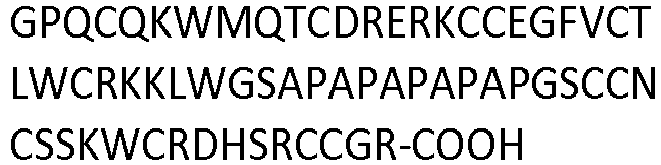
NV1G1956 NV1D3801 343 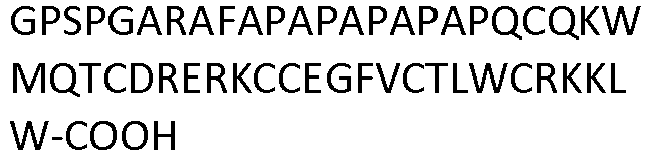
NV1G1961 NV1D3802 344 
NV1G1960 NV1D3803 345 
NV1G1977 NV1D3804 346 
NV1G1982 NV1D3805 347 
NV1G1984 NV1D3806 348 
NV1G1985 NV1D3808 349 
NV1G1983 NV1D3809 350 
NV1G1973 NV1D3810 351 
NV1G1976 NV1D3811 352 
NV1G1980 NV1D3812 353 
NV1G1952 NV1D3813 354 
NV1G1957 NV1D3814 355 
NV1G1981 NV1D3815 356 
NV1G1959 NV1D3818 357 
NV1G1986 NV1D3819 358 
NV1G1968 NV1D3822 359 
NV1G1945 NV1D3823 360 
NV1G1972 NV1D3824 361 
NV1G1946 NV1D3825 362 
NV1G1970 NV1D3826 363 
NV1G1949 NV1D3828 364 
NV1G1951 NV1D3829 365 
NV1G1971 NV1D3830 366 
NV1G1975 NV1D3832 367 
NV1G1978 NV1D3833 368 
NV1G1979 NV1D3834 369 
NV1G2043 NV1D3835 370 
NV1G1955 NV1D3838 371 
- Some isolated Protoxin-II variants inhibit human Nav1.7 activity with an IC50 value of about 3x10⁻⁸ M or less.
- Some isolated Protoxin-II variants inhibit human Nav1.7 activity with an IC50 value of between about 3x10⁻⁸ M to about 1x10⁻⁹ M.
- The disclosure also provides an isolated Protoxin-II variant comprising the amino acid sequence
GPQCX1X2WX3QX4CX5X6X7X8X9CCX10X11FX12CX13LWCX14KKLW (SEQ ID NO: 404), wherein - X1
- is Q, R, K, A or S;
- X2
- is K, S, Q or R;
- X3
- is M or F;
- X4
- is T, S, R, K or Q;
- X5
- is D or T;
- X6
- is S, A or R;
- X7
- is E, R, N, K, T or Q;
- X8
- is R or K;
- X9
- is K, Q, S or A;
- X10
- is E, Q or D;
- X11
- is G or Q;
- X12
- is V or S;
- X13
- is R or T; and
- X14
- is K or R.
- Exemplary Protoxin-II variants that inhibit human Nav1.7 activity with an IC50 value of about 30x10-9 M or less are variants comprising the amino acid sequences of SEQ ID NOs: 56, 78, 111, 114, 117, 118, 119, 122, 123, 129, 130, 131, 132, 133, 134, 135, 136, 138, 139, 140, 141, 142, 145,146, 147, 149 ,150, 151, 152, 153, 154, 156, 158, 159, 165, 172, 173, 175, 177, 178, 183, 184, 185, 186, 189, 190, 193, 197, 199, 207, 210, 211, 216, 217, 224, 266, 273, 282 or 335.
- In some embodiments, the isolated Protoxin-II variant selectively inhibits human Nav1.7. The Protoxin-II variants of the invention may be more selective towards Nav1.7 when compared to the recombinant Protoxin-II (SEQ ID NO: 2). In the QPatch electrophysiology assay, recombinant Protoxin-II has an IC50 of about 2.2x10⁻⁹ M for Nav1.7 and an IC50 of about 62x10-9 M for Nav1.6, and therefore the ratio of IC50 for Nav1.6 to IC50 for Nav1.7 about 28 fold. "Selectivity" or "selective" or "more selective" or "selectively blocks" or "selectively inhibits" when used herein refers to a Protoxin-II variant that has a ratio of IC50 for Nav1.6 to IC50 for Nav1.7 (IC50(Nav1.6)/ IC50(Nav1.7)) equal or over about 30. IC50 for Nav1.6 may be assayed in a QPatch electrophysiology assay using cell lines stably expressing Nav1.6 using similar methods to those described for Nav1.7.
- Residue positions in Protoxin-II that can be mutagenized to improve selectivity include
residues optionally residues - An isolated Protoxin-II variant may comprise the sequence GPX1CQKWMQX2CDX3X4RKCCX5GFX6CX7LWCX8KKLW (SEQ ID NO: 405); wherein
- X1
- is Y, Q, A, S or R;
- X2
- is T or S;
- X3
- is S, R or A;
- X4
- is E, T or N;
- X5
- is E or Q;
- X6
- is V or S;
- X7
- is R or T; and
- X8
- is K or R;
- An isolated Protoxin-II variant may comprise the sequence GPQCQKWMQX1CDX2X3RKCCX4GFX5CX6LWCX8KKLW (SEQ ID NO: 406); wherein
- X1
- is T or S;
- X2
- is S, R or A;
- X3
- is E, T or N;
- X4
- is E or Q;
- X5
- is V or S;
- X6
- is R or T; and
- X7
- is K or R.
- An isolated Protoxin-II variant may comprise the amino acid sequence that is 90%, 91%, 92%, 93%, 94%, 95%, 96%, 97%, 98% or 99% identical to the amino acid sequence of SEQ ID NO: 78 (GPQCQKWMQTCDRERKCCEGFVCTLWCRKKLW-COOH); wherein
the amino acid sequence has Q atposition 1, Q atposition 7 and F atposition 19, when residue numbering is according to SEQ ID NO: 1;
the polypeptide inhibits human Nav1.7 activity with an IC50 value of about 30x10-9 M or less, wherein the IC50 value is measured using a FLIPR® Tetra membrane depolarization assay using fluorescence resonance energy transfer (FRET) in the presence of 25x10-6 M 3-veratroylveracevine in HEK293 cells stably expressing human Nav1.7; and
the polypeptide selectively inhibits Nav1.7. - In some embodiments, the isolated Protoxin-II variant has a free C-terminal carboxylic acid, amide, methylamide or butylamide group, which are generated via routine synthetic methods.
- The disclosure also provides an isolated fusion protein comprising the Protoxin-II variant of SEQ ID NOs: 3, 4, 5, 6, 7, 8, 9, 10, 11, 12, 13, 14, 15, 16, 17, 18, 19, 20, 21, 22, 23, 24, 25, 26, 27, 28, 29, 30, 31, 32, 33, 34, 35, 36, 37, 38, 39, 40, 41, 42, 43, 44, 45, 46, 47, 48, 49, 50, 51, 52, 53, 54, 55, 56, 57, 58, 59, 60, 61, 62, 63, 64, 65, 66, 67, 68, 69, 70, 71, 72, 73, 74, 75, 76, 77, 78, 109, 110, 111, 112, 113, 114, 115, 116, 117, 118, 119, 121, 122, 123, 124, 125, 126, 127, 128, 129, 130, 131, 132, 133, 134, 135, 136, 137, 138, 139, 140, 141, 142, 143, 144, 145, 146, 147, 148, 149, 150, 151, 152, 153, 154 ,155, 156, 157, 158, 159, 160, 161, 162, 163, 164, 165, 166, 167, 168, 169, 170, 171, 172, 173, 174, 175, 176, 177, 178, 179, 180, 181, 182, 183, 184, 185, 186, 187, 188, 189, 190, 191, 192, 193, 194, 195, 196, 197, 198, 199, 200, 201, 202, 203, 204, 205, 206, 207, 208, 209, 210, 211, 212, 213, 214, 215, 216, 217, 218, 219, 220, 221, 222, 223, 224, 225,226, 227, 228, 229, 230, 231, 232, 233, 234, 235, 236, 237, 238, 239, 240, 241, 242, 243, 244, 245, 246, 247, 248, 249, 250, 251, 252, 253, 254, 256, 257, 258, 259, 260, 261, 262, 263, 264, 265, 266, 267, 268, 269, 270, 271, 272, 273, 274, 275, 276, 277, 278, 279, 280, 281, 282, 283, 284, 285, 286, 287, 288, 289, 290, 291, 292, 293, 294, 295, 296, 297, 298, 299, 300, 301, 302, 303, 304, 305, 306, 307, 308, 309, 310, 311, 312, 313, 314, 315, 316, 317, 318, 319, 320, 321, 322, 323, 324, 325, 326, 327, 328, 329, 330, 331, 332, 333, 334, 335, 336, 337, 338, 339, 340, 341, 342, 343, 344, 345, 346, 347, 348, 349, 350, 351, 352, 353, 354, 355, 35, 357, 358, 359, 360, 361, 362, 363, 364, 365, 366, 367, 368 367, 370 or 371. Such second polypeptides may be well known leader or secretory signal sequences, or synthetic sequences resulting for example from cloning steps, or tags such as hexahistidine tag (SEQ ID NO: 108). Such second polypeptide may be a half-life extending moiety. In one embodiment, the isolated fusion protein comprises the Protoxin-II variant of the invention conjugated to a half-life extending moiety.
- Exemplary half-life extending moieties that can be used include well known human serum albumin, transthyretin (TTR), a thyroxine-binding globulin (TGB), albumin-binding domains, or an Fc or fragments thereof. Biologically suitable polymers or copolymers may also be used, for example ethylene glycol or polyethylene glycol (PEG) molecules, such as PEG5000 or PEG20000, dextran, polylysine, fatty acids and fatty acid esters of different chain lengths, for example laurate, myristate, stearate, arachidate, behenate, oleate, arachidonate, octanedioic acid, tetradecanedioic acid, octadecanedioic acid, docosanedioic acid, and the like, octane, or carbohydrates (dextran, cellulose, oligo- or polysaccharides). These moieties may be direct fusions with the Protoxin-II variant polypeptides and may be generated by standard cloning and expression techniques. Alternatively, well known chemical coupling methods may be used to attach the moieties to recombinantly produced Protoxin-II variants of the invention.
- In another embodiment, the half-life extending moiety of the fusion protein of the invention is human serum albumin, albumin binding domain (ABD), or polyethylene glycol (PEG).
- In another embodiment, the half-life extending moiety of is conjugated to the Protoxin-II variant via a linker. Suitable linkers are well known and include linkers having the sequence shown in SEQ ID NOs: 80 or 81.
- Exemplary fusion proteins incorporating Protoxin-II variants of the invention are those having the polypeptide sequence of SEQ ID NOs: 83, 85, 87 or 103.
- Protoxin-II variants of the invention incorporating additional moieties may be compared for functionality by several well-known assays. For example, pharmacokinetic properties of Protoxin-II variants coupled to PEG may be evaluated in well known in vivo models.
- Additional substitutions to the Protoxin-II variants can be made as long as the resulting variant or the fusion protein retains similar characteristics when compared to the parent peptide. Exemplary modifications are for example conservative substitutions that will result in Protoxin-II variants with similar characteristics to those of the parent molecules. Conservative replacements are those that take place within a family of amino acids that are related in their side chains. Genetically encoded amino acids can be divided into four families: (1) acidic (aspartate, glutamate); (2) basic (lysine, arginine, histidine); (3) nonpolar (alanine, valine, leucine, isoleucine, proline, phenylalanine, methionine, tryptophan); and (4) uncharged polar (glycine, asparagine, glutamine, cysteine, serine, threonine, tyrosine). Phenylalanine, tryptophan, and tyrosine are sometimes classified jointly as aromatic amino acids. Alternatively, the amino acid repertoire can be grouped as (1) acidic (aspartate, glutamate); (2) basic (lysine, arginine histidine), (3) aliphatic (glycine, alanine, valine, leucine, isoleucine, serine, threonine), with serine and threonine optionally grouped separately as aliphatic-hydroxyl; (4) aromatic (phenylalanine, tyrosine, tryptophan); (5) amide (asparagine, glutamine); and (6) sulfur-containing (cysteine and methionine) (Stryer (ed.), Biochemistry, 2nd ed, WH Freeman and Co., 1981). Non-conservative substitutions can be made to the Protoxin-II variants that involve substitutions of amino acid residues between different classes of amino acids to improve properties of the Protoxin-II variants and Protoxin-II variant fusion proteins. Whether a change in the amino acid sequence of a polypeptide or fragment thereof results in a functional homolog can be readily determined by assessing the ability of the modified polypeptide or fragment to produce a response in a fashion similar to the unmodified polypeptide or fragment using the assays described herein. Peptides, polypeptides or proteins in which more than one replacement takes place can readily be tested in the same manner.
- Another embodiment of the invention is an isolated synthetic polynucleotide comprising a polynucleotide encoding the Protoxin-II variant of the invention.
- Certain exemplary synthetic polynucleotides are disclosed herein, however, other synthetic polynucleotides which, given the degeneracy of the genetic code or codon preferences in a given expression system, encode the Protoxin-II variants and Protoxin-II variant fusion proteins of the invention are also within the scope of the invention. Exemplary synthetic polynucleotides are for example polynucleotide sequences shown in SEQ ID NOs: 84, 86, 88 and 104, which encode the Protoxin-II variant fusion proteins of the invention. Those skilled in the art can readily identify the polynucleotide segments in the fusion proteins that encode the Protoxin-II variant itself. The synthetic polynucleotide sequences encoding the Protoxin-II variants or fusion proteins of the invention can be operably linked to one or more regulatory elements, such as a promoter and enhancer, that allow expression of the nucleotide sequence in the intended host cell. The synthetic polynucleotide may be a cDNA.
- The polynucleotides of the invention may be produced by chemical synthesis such as solid phase polynucleotide synthesis on an automated polynucleotide synthesizer. Alternatively, the polynucleotides of the invention may be produced by other techniques such as PCR based duplication, vector based duplication, or restriction enzyme based DNA manipulation techniques. Techniques for producing or obtaining polynucleotides of known sequences are well known.
- The polynucleotides of the invention may also comprise at least one non-coding sequence, such as transcribed but not translated sequences, termination signals, ribosome binding sites, mRNA stabilizing sequences, introns and polyadenylation signals. The polynucleotide sequences may also comprise additional sequences encoding additional amino acids. These additional polynucleotide sequences may, for example, encode a marker or well-known tag sequences such as a hexa-histidine (SEQ ID NO: 108) or a HA tag which facilitate the purification of fused polypeptides.
- Another embodiment of the invention is a vector comprising the polynucleotide of the invention. Such vectors may be plasmid vectors, viral vectors, vectors for baculovirus expression, transposon based vectors or any other vector suitable for introduction of the polynucleotide of the invention into a given organism or genetic background by any means. For example, polynucleotides encoding the Protoxin-II variants or the Protoxin-II variant fusion proteins of the invention are inserted into an expression vector and may be operably linked to control sequences in the expression vector to ensure efficient expression, such as signal sequences, promoters (e.g. naturally associated or heterologous promoters), enhancer elements, and transcription termination sequences, and are chosen to be compatible with the host cell chosen to express the Protoxin-II variant or the Protoxin-II variant fusion protein of the invention. Once the vector has been incorporated into the appropriate host, the host is maintained under conditions suitable for high level expression of the proteins encoded by the incorporated polynucleotides.
- Suitable expression vectors are typically replicable in the host organisms either as episomes or as an integral part of the host chromosomal DNA. Commonly, expression vectors contain selection markers such as ampicillin-resistance, hygromycin-resistance, tetracycline resistance, kanamycin resistance or neomycin resistance to permit detection of those cells transformed with the desired DNA sequences.
- Suitable promoter and enhancer elements are known in the art. For expression in a bacterial cell, suitable promoters include, but are not limited to, lacl, lacZ, T3, T7, gpt, lambda P and trc. For expression in a eukaryotic cell, suitable promoters include, but are not limited to, light and/or heavy chain immunoglobulin gene promoter and enhancer elements; cytomegalovirus immediate early promoter; herpes simplex virus thymidine kinase promoter; early and late SV40 promoters; promoter present in long terminal repeats from a retrovirus; mouse metallothionein-I promoter; and various art-known tissue specific promoters. For expression in a yeast cell, a suitable promoter is a constitutive promoter such as an ADH1 PGK1, ENO or PYK1 promoter and the like, or a regulatable promoter such as a GAL1 or GAL10 promoter. Selection of the appropriate vector and promoter is well within the level of ordinary skill in the art.
- Large numbers of suitable vectors and promoters are known to those of skill in the art; many are commercially available for generating recombinant constructs. The following vectors are provided by way of example. Bacterial: pBs, phagescript, PsiX174, pBluescript SK, pBs KS, pNH8a, pNH16a, pNH18a, pNH46a (Stratagene, La Jolla, Calif., USA); pTrc99A, pKK223-3, pKK233-3, pDR540, and pRIT5 (Pharmacia, Uppsala, Sweden). Eukaryotic: pWLneo, pSV2cat, pOG44, PXR1, pSG (Stratagene) pSVK3, pBPV, pMSG and pSVL (Pharmacia).
- An exemplary vector for expression of the Protoxin-II variants or Protoxin-II variant fusion proteins is a vector having ampicillin-resistance selection marker, CMV promoter, CMV intron, signal peptide, neomycin resistance, f1 origin of replication, SV40 polyadenylation signal, and cDNA encoding the Protoxin-II variant or the Protoxin-II variant fusion protein of the invention.
- Another embodiment of the invention is a host cell comprising the vector of the invention. The term "host cell" refers to a cell into which a vector has been introduced. It is understood that the term host cell is intended to refer not only to the particular subject cell but also to the progeny of such a cell. Because certain modifications may occur in succeeding generations due to either mutation or environmental influences, such progeny may not be identical to the parent cell, but are still included within the scope of the term "host cell" as used herein. Such host cells may be eukaryotic cells, prokaryotic cells, plant cells or archeal cells.
- Escherichia coli, bacilli, such as Bacillus subtilis, and other enterobacteriaceae, such as Salmonella, Serratia, and various Pseudomonas species, are examples of prokaryotic host cells. Other microbes, such as yeast, are also useful for expression. Saccharomyces (e.g., S. cerevisiae) and Pichia are examples of suitable yeast host cells. Exemplary eukaryotic cells may be of mammalian, insect, avian or other animal origins. Mammalian eukaryotic cells include immortalized cell lines such as hybridomas or myeloma cell lines such as SP2/0 (American Type Culture Collection (ATCC), Manassas, VA, CRL-1581), NS0 (European Collection of Cell Cultures (ECACC), Salisbury, Wiltshire, UK, ECACC No. 85110503), FO (ATCC CRL-1646) and Ag653 (ATCC CRL-1580) murine cell lines. An exemplary human myeloma cell line is U266 (ATTC CRL-TIB-196). Other useful cell lines include those derived from Chinese Hamster Ovary (CHO) cells such as CHO-K1SV (Lonza Biologics, Walkersville, MD), CHO-K1 (ATCC CRL-61) or DG44.
- Introduction of a polynucleotide, such as a vector, into a host cell can be effected by methods well known to those skilled in the art. Exemplary methods are calcium phosphate transfection, DEAE-Dextran mediated transfection, microinjection, cationic lipid-mediated transfection and electroporation.
- Another embodiment of the invention is a method for producing the Protoxin-II variant of the invention comprising the steps of providing a host cell of the invention; culturing the host cell under conditions sufficient for the expression of at least one Protoxin-II variant of the invention; and recovering the Protoxin-II variant produced by the host cell.
- Host cells can be cultured under any conditions suitable for maintaining or propagating a given type of host cell and sufficient for expressing a polypeptide. Culture conditions, media, and related methods sufficient for the expression of polypeptides are well known in the art. For example, many mammalian cell types can be aerobically cultured at 37°C using appropriately buffered DMEM media while bacterial, yeast and other cell types may be cultured at 37°C under appropriate atmospheric conditions in LB media.
- In the methods of the invention, the expression of the Protoxin-II variant can be confirmed using a variety of well-known methods. For example, expression of a polypeptide can be confirmed using detection reagents, such as using SDS-PAGE or HPLC.
- Another aspect of the disclosure is a method of modulating the activity of Nav1.7 in a biological tissue, the method comprising contacting the biological tissue expressing Nav1.7 with a Nav1.7-modulating amount of the Protoxin-II variant of the invention.
- Protoxin-II variants of the invention may be utilized in any therapy where it is desired to treat, reduce or alleviate symptoms of pain or other disorders of sensory or sympathetic neuron dysfunction.
- Pain treated with the Protoxin-II variants of the invention may be any type of pain, such as chronic pain, acute pain, neuropathic pain, nociceptive pain, visceral pain, back pain, pain associated with inflammatory conditions, post-operative pain, thermal pain or pain associated with disease and degeneration.
- Pain treated with the Protoxin-II variants of the invention may be Nav1.7-mediated pain.
- Nav1.7-mediated pain as used herein refers to pain resulting at least partially from increased Nav1.7 channel activity.
- The Protoxin-II variants of the invention may be used to treat an animal patient belonging to any classification. Examples of such animals include mammals such as humans, rodents, dogs, cats and farm animals.
- The pain and/or Nav1.7-mediated pain may result from one or more causes, such as peripheral neuropathy, central neuropathy, nerve compression or entrapment syndromes such as carpal tunnel syndrome, tarsus tunnel syndrome, ulnar nerve entrapment, compression radiculopathy, lumbar spinal stenosis, sciatic nerve compression, spinal root compression, intercostal neuralgia, compression radiculopathy and radicular lower back pain, spinal root lesions, neuritis, autoimmune diseases, general inflammation, chronic inflammatory conditions, arthritis, rheumatic diseases, lupus, osteoarthritis, general gastrointestinal disorders, colitis, gastric ulceration, duodenal ulcers, inflammatory bowel disorders, irritable bowel syndrome, pain associated with diarrhea, inflammatory eye disorders, inflammatory or unstable bladder disorders, psoriasis, skin complaints with inflammatory components, sunburn, carditis, dermatitis, myositis, neuritis, collagen vascular diseases, inflammatory pain and associated hyperalgesia and allodynia, neuropathic pain and associated hyperalgesia and allodynia, multiple sclerosis, demyelinating diseases, diabetes, diabetic neuropathy pain, causalgia, pain resulting from amputation or abscess, phantom limb pain, fracture pain, bone injury, direct trauma, HIV infection, acquired immune deficiency syndrome ("AIDS"), small pox infection, herpes infection, exposure to toxins or other foreign particles or molecules, invasive cancer, cancer, chemotherapy, radiotherapy, hormonal therapy, burns, congenital defect, dental pain, gout pain, fibromyalgias, encephalitis, chronic alcoholism, hypothyroidism, uremia and vitamin deficiencies, trigeminal neuralgia, stroke, thalamic pain syndrome, general headache, migraine, cluster headache, tension headache, mixed- vascular and non-vascular syndromes, sympathetically maintained pain, deafferentation syndromes, asthma, epithelial tissue damage or dysfunction, disturbances of visceral motility at respiratory, genitourinary, gastrointestinal or vascular regions, wounds, burns, allergic skin reactions, pruritis, vasomotor or allergic rhinitis, or bronchial disorders, dysmenorrhoea, pain during labor and delivery, dyspepsia, gastroesophageal reflux, pancreatitis, and visceralgia.
- Other disorders of sensory or sympathetic neuron dysfunction that may be alleviated by the Protoxin-II variants of the invention include itch, cough and asthma. In mice, global deletion of the SCN9A gene leads to complete insensitivity to histamine-induced itch (Gingras et al., American Pain Society Meeting Abstract 2013 and
U.S. Pat. Publ. No. 2012/0185956 ). This finding suggests that peptide Nav1.7 blockers may have utility in the treatment of itch, which may arise from various sources, such as dermatological or inflammatory disorders; or inflammatory disorders such as renal or hepatobiliary disorders, immunological disorders, medication reactions and unknown/idiopathic conditions, including dermatitis, psoriasis, eczema, insect sting or bite. Nav1.7 is also expressed in sensory nerves innervating the airways (Muroi et al., J Physiol. 2011 ; Muroi et al., Am J Physiol Regul Integr Comp Physiol. 2013 Apr 10), suggesting that peptide Nav1.7 blockers may be beneficial in the treatment of cough e.g., acute or chronic cough, or cough caused by irritation from gastroesophageal reflux disease, and inflammatory diseases of the airways such as asthma and allergy-related immune responses, bronchospasm, chronic obstructive pulmonary disease, chronic bronchitis, emphysema, and hiccups (hiccoughs, singultus). Silencing Nav1.7 in vivo in nodose ganglia of guinea pigs using shRNA nearly abolished the cough reflex induced by mechanical probing (Muroi et al., Am J Physiol Regul Integr Comp Physiol. 2013 Apr 10). - The Protoxin-II variants of the invention can be used in a method of alleviating or treating itch, cough or asthma in a subject by administering a therapeutically effective amount of the Protoxin-II variant of the invention to a subject in need thereof for a time sufficient to alleviate the itch, cough or asthma.
- The Protoxin-II variants of the invention can be used in a method of alleviating or treating Nav1.7-mediated itch, Nav1.7-mediated cough or Nav1.7-mediated asthma in a subject by administering a therapeutically effective amount of the Protoxin-II variant of the invention to a subject in need thereof for a time sufficient to alleviate the itch, cough or asthma.
- Nav1.7-mediated itch as used herein refers to itch resulting at least partially from increased Nav1.7 channel activity.
- Nav1.7-mediated cough as used herein refers to cough resulting at least partially from increased Nav1.7 channel activity.
- Nav1.7-mediated asthma as used herein refers to asthma resulting at least partially from increased Nav1.7 channel activity.
- Protoxin-II variants of the invention may be tested for their effect in reducing or alleviating pain and/or Nav1.7-mediated pain using animal models described herein, and models such as the rat spinal nerve ligation (SNL) model of neuropathic pain, carageenan induced allodynia model, the Freund's complete adjuvant (CFA)-induced allodynia model, the thermal injury model, the formalin model and the Bennett Model, and other models as described in
U.S. Pat. Appl. No. 2011/0124711 andU.S. Pat. No. 7,998,980 . Carageenan induced allodynia and CFA-induced allodynia are models of inflammatory pain. The Bennett model provides an animal model for chronic pain including post-operative pain, complex regional pain syndrome, and reflex sympathetic dystrophy. - Any of the foregoing animal models may be used to evaluate the efficacy of Protoxin-II variants of the invention inhibitor in treating pain and/or NAv1.7-mediated pain. The efficacy of the Protoxin-II variants of the invention may be compared to a no treatment or placebo control. Additionally or alternatively, efficacy may be evaluated in comparison to one or more known pain-relieving medicaments.
- The present invention provides Protoxin-II variants for use in treating Nav1.7-mediated pain using the Protoxin-II variants of the invention. It has been discovered in the pending application by the inventors (
U.S. Patent Application Number 61/781,276 - Nav1.7 is expressed in the peripheral nervous system e.g., in nociceptive dorsal root ganglions (DRG), most notably in nociceptive small-diameter DRG neurons, in particular in peripheral terminals in the skin, with little representation in the brain. Nav1.7 distribution (e.g. sensory ending) and physiology predispose it to a major role in transmitting painful stimuli.
- One embodiment of the invention is a Protoxin-II variant for use in treating Nav1.7-mediated pain by administering a therapeutically effective amount of the Protoxin-II variant of the invention to a subject in need thereof for a time sufficient to treat the Nav1.7-mediated pain.
- The Protoxin-II variants of the invention Nav1.7 may be utilized in any therapy where it is desired to treat Nav1.7-mediated pain or other disorders of sensory or sympathetic neuron dysfunction. "Treat" or "treatment" of pain is meant to include partially or completely to prevent, stop, inhibit, reduce, or delay the perception of pain.
- In some embodiments, the Nav1.7-mediated pain is chronic pain, acute pain, neuropathic pain, nociceptive pain, visceral pain, back pain, post-operative pain, thermal pain, phantom limb pain, or pain associated with inflammatory conditions, primary erythemalgia (PE), paraoxysmal extreme pain disorder (PEPD), osteoarthritis, rheumatoid arthritis, lumbar discectomy, pancreatitis, fibromyalgia, painful diabetic neuropathy (PDN), post-herpetic neuropathy (PHN), trigeminal neuralgia (TN), spinal cord injuries or multiple sclerosis, or pain associated with disease and degeneration.
- Neuropathic pain includes for example painful diabetic neuropathy (PDN), post-herpetic neuropathy (PHN) or trigeminal neuralgia (TN). Other causes of neuropathic pain include spinal cord injuries, multiple sclerosis, phantom limb pain, post-stroke pain and HIV-associated pain. Conditions such as chronic back pain, osteoarthritis and cancer may also result in the generation of neuropathic-related pain and thus are potentially suitable for treatment with the Protoxin-II variants of the invention.
- In another embodiment, the Nav1.7-mediated pain is associated with primary erythemalgia (PE), paraoxysmal extreme pain disorder (PEPD), osteoarthritis, rheumatoid arthritis, lumbar discectomy, pancreatitis or fibromyalgia.
- The Protoxin-II variants of the invention may be conjugated to a second polypeptide to form a fusion protein. Such fusion proteins are for example the well-known Fc fusions or fusions to human serum albumin to extend half-life of the peptide inhibitors. The conjugation may be a direct conjugation via a linker, such as a glycine-serine rich linker. Such linkers are well known in the art. The Protoxin-II variants of the invention incorporating additional moieties may be compared for their Nav1.7 blocking ability and efficacy in treatment or reducing pain using well known methods and those described herein.
- Other disorders of sensory or sympathetic neuron dysfunction that can be treated with the Protoxin-II variants of the invention, including asthma, cough, heart-burn, itch, dermatitis, bladder instability, and Reynaud's disease.
- The Protoxin-II variants of the invention may be formulated in a pharmaceutically acceptable vehicle or carrier. One embodiment of the invention is a pharmaceutical composition comprising the isolated Protoxin-II variant of the invention and a pharmaceutically acceptable excipient.
- A suitable vehicle or carrier may be water for injection, physiological saline solution or artificial cerebrospinal fluid, possibly supplemented with other materials common in compositions for parenteral administration. Neutral buffered saline or saline mixed with serum albumin are further exemplary vehicles. These solutions are sterile and generally free of particulate matter, and may be sterilized by conventional, well-known sterilization techniques (e.g., filtration). The compositions may contain pharmaceutically acceptable excipients as required to approximate physiological conditions, such as pH adjusting and buffering agents, stabilizing, thickening, lubricating and coloring agents, etc. Suitable vehicles and their formulation and packaging are described, for example, in Remington: The Science and Practice of Pharmacy (21st ed., Troy, D. ed., Lippincott Williams & Wilkins, Baltimore, MD (2005) ).
- The Protoxin-II variants of the invention may be administered by peripheral administration. "Peripheral administration" or "administered peripherally" means introducing an agent into a subject outside of the central nervous system. Peripheral administration encompasses any route of administration other than direct administration to the spine or brain.
- Peripheral administration can be local or systemic. Local administration may be used to concentrate the therapeutic to the site of action, such as local administration to joints, spinal cord, surgical wounds, sites of injury/trauma, peripheral nerve fibers, various organs (GI, urogenital, etc) or inflamed tissues. Systemic administration results in delivery of a pharmaceutical composition to essentially the entire peripheral nervous system of the subject and may also result in delivery to the central nervous system depending on the properties of the composition.
- Routes of peripheral administration encompass, without limitation, topical administration, intravenous or other injection, and implanted mini-pumps or other extended release devices or formulations.
- Pharmaceutical compositions of the invention include formulations involving the Protoxin-II variants of the invention in sustained- or controlled-delivery formulations. These formulations may be achieved through use of for example injectable microspheres, bio-erodible particles, microemulsions, nanoparticles, nanocapsules, macroemulsions, polymeric compounds (such as polyesters, polyamino acids, hydrogels, poly(lactic acid), polyglycolic acid or ethylene vinylacetate copolymers), beads or liposomes, hyaluronic acid or implantable drug delivery devices.
- The Protoxin-II variants of the invention may be prepared for use for parenteral (subcutaneous, intramuscular or intravenous), intracerebral (intra-parenchymal), intracerebroventricular, intramuscular, intra-ocular, intraarterial, intraportal, or intralesional routes; by sustained release systems or by implantation devices, or any other administration, particularly in the form of liquid solutions or suspensions; for buccal or sublingual administration such as in the form of tablets or capsules; or intranasally such as in form of powders, nasal drops or aerosols or certain agents; transdermally in a form of a gel, ointment, lotion, cream or dusting powder, suspension or patch delivery system with chemical enhancers to either modify the skin structure or to increase the drug concentration in the transdermal patch, or with agents that enable the application of formulations containing proteins and peptides onto the skin (Int. Pat. Publ. No.
WO98/53847 U.S. Pat. Nos. 4,309,989 and4,767,402 ). The composition also may be administered locally via implantation of a membrane, sponge or another appropriate material onto which the desired molecule has been absorbed or encapsulated. - In certain embodiments, where an implantation device is used, the device may be implanted into any suitable tissue or organ, and delivery of the desired molecule may be via diffusion, timed-release bolus, or continuous administration.
- The concentration of the Protoxin-II variants of the invention or other peptide inhibitors of Nav1.7 in such pharmaceutical formulation can vary widely, for example from about 0.1%, 0.2%, 0.3%, 0.4%, 0.5%, 0.6%, 0.7%, 0.8%, 0.9%, 1.0%, 1.1%, 1.2%, 1.3%, 1.4%, 1.5%, 1.6%, 1.7%, 1.8%, 1.9%, 2%, or between 2% to 5%, up to as much as 15%, 20%, 30%, 40%, 50%, 60% or 70% by weight and will be selected primarily based on fluid volumes, viscosities and other factors, according to the particular mode of administration selected. The Protoxin-II variants of the invention can be lyophilized for storage and reconstituted in a suitable vehicle prior to use. This technique has been shown to be effective with conventional protein preparations. Lyophilization and reconstitution techniques are well known in the art.
- An exemplary pharmaceutical compositions of the present invention may comprise Tris buffer of about pH 7.0-8.5, or acetate buffer of about pH 4.0-5.5, and may further include sorbitol, sucrose, Tween-20 and/or a suitable substitute thereof.
- The appropriate therapeutically effective dose may be determined readily by those skilled in the art. An effective dose refers to an amount or dosage sufficient to produce a desired result, i.e. to partially or completely prevent, stop, inhibit, reduce, or delay the perception of pain associated with any painful medical condition. The effective amount may vary depending on the specific vehicle and the Protoxin-II variants of the invention selected, and is also dependent on a variety of factors and conditions related to the subject to be treated and the severity of the pain. For example, factors such as age, weight and health of the subject to be administered with the pharmaceutical compositions of the invention as well as dose response curves and toxicity data obtained in preclinical animal work could be among those considered. A determined dose may, if necessary, be repeated at appropriate time intervals selected as appropriate by a physician or other person skilled in the relevant art (e.g. nurse, veterinarian, or veterinary technician) during the treatment period. The determination of an effective amount or a therapeutically effective amount for a given agent is well within the ability of those skilled in the art.
- Thus, a pharmaceutical composition of the invention for intramuscular injection could be prepared to contain 1 ml sterile buffered water, and between about 1 ng to about 100 mg, about 50 ng to about 30 mg or about 5 mg to about 25 mg of a Protoxin-II variant of the invention. Similarly, a pharmaceutical composition of the invention for intravenous infusion could be made up to contain about 250 ml of sterile Ringer's solution, and about 1 mg to about 30 mg or about 5 mg to about 25 mg of the Protoxin-II variants of the invention. Actual methods for preparing parenterally administrable compositions are well known and are described in more detail in, for example, "Remington's Pharmaceutical Science", 15th ed., Mack Publishing Company, Easton, PA.
- The present invention will now be described with reference to the following specific, non-limiting examples.
- Protoxin-II single position limited amino acid scanning library substitution was designed to assess to what degree selectivity, peptide yield, and homogeneity can be improved.
- Protoxin-II variants were designed as HRV3C protease cleavable HSA fusion proteins in the following format from N-to C- terminus: 6xHis-HSA-linker-HRV3C cleavable peptide-Protoxin-II variant ("6xHis" disclosed as SEQ ID NO: 108); linker being (GGGGSGGGGSGGGGSGGGGS; SEQ ID NO: 80, HSA having the sequence of SEQ ID NO: 106, HRV3C cleavable peptide having the sequence of SEQ ID NO: 82). Each Protoxin-II variant, after cleavage from HSA had a residual N-terminal GP from the cleavage site.
- The variants were characterized in membrane depolarization assays using FLIPR® Tetra as described in Example 3 FLIPR® Tetra membrane depolarization assay, and in whole cell patch clamp experiments using the QPatch assay as described in Example 3.
- Combinatorial libraries were designed to test for additive effects of select single position hits in an attempt to generate Nav1.7 antagonists with further improved potency and selectivity profile compared to the native peptide.
- The designed Protoxin-II variant genes were generated using synthetic gene assembly technology as described in U.S. Pat. No.
US6,521,427 . The amino acid sequences of the designed peptide variants were back-translated to DNA sequences using human high-frequency codons. The DNA sequence of each variant gene, together with a portion of vector DNA including the DNA cloning sites, was synthesized as multiple oligonucleotides, some of which contained degenerate codons, and assembled into full-length DNA fragments. The assembled DNA fragments were amplified by PCR and PCR products were subsequently cloned as a pool. Pooled PCR products were digested with the appropriate restriction enzymes and cloned into the designed expression vector in such a manner as to fuse each toxin variant gene to the signal peptide and the fusion partner (6xHis-HSA-linker-HRV3C cleavable peptide ("6xHis" disclosed as SEQ ID NO: 108) contained in the vector. Standard molecular biology techniques were used to identify a positive clone for each designed variant. The plasmid DNA from these positive clones was purified and sequence confirmed before expressing the Protoxin-II peptide variant fusion proteins using standard methods. - HEK 293-F cells were maintained in 293 Freestyle™ media (Invitrogen Cat # 12338) and split when the cell concentration was between 1.5 and 2.0 x 10⁶ cells per ml. The cells were grown in suspension, shaking at 125 RPM in a humidified incubator set at 37°C and 8% CO2. HEK 293F cells were transiently transfected using a DNA/lipid complex after they were diluted to 1.0 x 10⁶ cells per ml. To generate the complex, 1.25 µg DNA per ml of transfection was diluted in 1.0 ml of OptiPro media (Invitrogen Cat # 12309) and 1.25 ml of Freestyle™ Max transfection reagent (Invitrogen Cat # 16447) was diluted in 1.0 ml of OptiPro media. The DNA and Max transfection reagent were mixed together and incubated for 10 minutes at room temperature before adding to the cells. Transfected cells were placed in a humidified incubator set at 37°C and 8% CO2 for 4 days shaking at 125 RPM. The supernatant was separated from the cells by centrifugation at 5,000 x g for 10 minutes and filtered through a 0.2µm filter (Corning; Cat #431153), then concentrated 10 and 50 fold using an Amicon Ultra Concentrator 10K (Cat #UFC901096), and centrifuging for approximately 10 minutes at 3,750 x g.
- Protoxin-II variants were expressed as HSA fusion proteins as indicated in Example 1 and the Protoxin-II variant peptides were cleaved with HRV3C protease prior to purification. Two methodologies were tested for efficient purification of the Protoxin-II variants.
- The secreted proteins were purified from the expression supernatants via IMAC using 1 ml HisTrap HP columns (GE Healthcare Cat# 17-5247-01). The chromatography method was run using an AKTA Xpress and protein was eluted from the column using a step gradient of Imidazole. Peak fractions were pooled and digested overnight with HRV 3C protease (1µg protease / 150µg fusion).
- Cleaved peptide-fusion pools were further purified using a Dionex HPLC system with a reverse
phase Phenomenex Luna 5 µm C18(2) column (Cat# 00B-4252-P0-AX). Samples were eluted from the column with a 0-68% Acetonitrile (0.05% TFA) linear gradient. Elution fractions were pooled, lyophilized overnight and reconstituted in HEPES buffered saline, pH 7.4 (10 mM HEPES, 137mM NaCl, 5.4 mM KCl, 5 mM glucose, 2mM CaCl2, 1mM MgCl2). - Table 4 shows yields of Protoxin-II variants purified by RP-HPLC. The average mg yield/L was 0.01615.


- The secreted proteins were purified from the expression supernatants via IMAC using 1 ml HisTrap HP columns (GE Healthcare Cat# 17-5247-01). The chromatography method was run using an AKTA Xpress and protein was eluted from the column using a step gradient of Imidazole. Peak fractions were pooled and digested overnight with HRV3C protease (1µg protease / 150µg fusion). The cleaved sample was loaded into a 50 kDa molecular weight cut off centrifugal filter unit (Millipore UFC805096) and cleaved peptide collected in the filtrate fraction.
- Peptide pools were loaded onto a 96-well solid phase extraction block (Agilent Bond Elut Plexa A3969030) for further purification, desalting, and concentration. Blocks were used in conjunction with a vacuum manifold (Whatman). Peptide samples were loaded and washed in 0.05% TFA in water and eluted with a step gradient of acetonitrile with 0.05% TFA in water. Elution fractions were then lyophilized overnight and reconstituted in HEPES buffered saline, pH 7.4 (10 mM HEPES, 137mM NaCl, 5.4 mM KCl, 5 mM glucose, 2mM CaCl2, 1mM MgCl2).
- Peptides were reconstituted in supplemented HEPES buffered saline, pH 7.4 (10 mM HEPES, 137mM NaCl, 5.4 mM KCl, 5 mM glucose, 2mM CaCl2, 1mM MgCl2) and absorbance was measured at 280 nm. Concentration values were then calculated using each sample's extinction coefficient. 2 µg of each peptide were loaded onto an Invitrogen NuPAGE® Novex® Bis-
Tris Gel 15 well gel and run in MES buffer non-reduced. - Samples were analyzed on Agilent 1100 HPLC using 4-80% acetonitrile in 0.05% TFA linear gradient with a Phenomenex Luna C18(2) analytical column (Cat#00A-4041-B0). Concentrations of all peptides were normalized and 10 µl of each were injected for a total of 1.3 µg per sample. Absorbance at 220 nm was monitored and chromatograms analyzed were using Chromeleon software.
- Table 5 shows yields (mg) of Protoxin-II variants purified by SPE. The average mg yield/L was 0.05353.
- The benefits of the SPE purification process are ease and throughput of purification since samples are processed in parallel in a 96-well block rather than serially on RP-HPLC, and improvement in yield. There was, on average, more than 3-fold higher yield (mg/L) for variants purified by SPE versus RP-HPLC.
Table 5. Protoxin-II Variant Peptide ID yield (mg) Protoxin-II Variant Peptide ID yield (mg) NV1D12 0.0054 NV1D2734 0.0602 NV1D2659 0.0234 NV1D2772 0.2050 NV1D2664 0.0060 NV1D2775 0.2225 NV1D2666 0.0225 NV1D2738 0.0512 NV1D2708 0.0721 NV1D2740 0.0373 NV1D2725 0.0144 NV1D2733 0.1913 NV1D2739 0.0053 NV1D788 0.0000 NV1D2765 0.0097 NV1D757 0.0021 NV1D2748 0.0995 NV1D791 0.0007 NV1D2771 0.0103 NV1D2310 0.0011 NV1D2770 0.0121 NV1D2308 0.0014 NV1D2778 0.0644 NV1D778 0.0019 NV1D2782 0.0202 NV1D2294 0.0000 NV1D2756 0.0466 NV1D856 0.0047 NV1D2759 0.0218 NV1D2309 0.0023 NV1D2712 0.0558 NV1D846 0.0020 NV1D12 0.0127 NV1D2896 0.0504 NV1D2673 0.0625 NV1D2913 0.0203 NV1D2662 0.0433 NV1D2910 0.0253 NV1D2669 0.2661 NV1D2893 0.0569 NV1D2665 0.0389 NV1D2909 0.0195 NV1D2731 0.2547 NV1D2917 0.0339 NV1D2767 0.0238 NV1D2914 0.0201 NV1D2730 0.2566 NV1D2922 0.0554 NV1D2766 0.0198 NV1D2902 0.0061 NV1D2667 0.0050 NV1D2889 0.0022 NV1D2769 0.0142 NV1D2887 0.0025 NV1D2719 0.0675 NV1D2878 0.0272 NV1D2776 0.0633 NV1D2877 0.0129 NV1D2663 0.0344 NV1D2851 0.0029 NV1D2709 0.1841 NV1D2850 0.0026 NV1D2720 0.0538 NV1D2820 0.0020 NV1D12 0.0095 NV1D2819 0.0015 NV1D2773 0.1921 NV1D2814 0.0163 NV1D2810 0.0086 NV1D2918 0.0256 NV1D2732 0.0262 NV1D2921 0.0533 NV1D757 0.0026 NV1D2905 0.0126 NV1D791 0.0206 NV1D2906 0.0189 NV1D2310 0.0085 NV1D2881 0.0207 NV1D2308 0.0179 NV1D2882 0.0223 NV1D778 0.0094 NV1D2869 0.0038 NV1D856 0.0247 NV1D2870 0.0187 NV1D2309 0.0035 NV1D2867 0.0147 NV1D846 0.0043 NV1D2888 0.0045 NV1D2889 0.0107 NV1D2816 0.0133 NV1D2887 0.0061 NV1D2885 0.0025 NV1D2861 0.0469 NV1D2974 0.0418 NV1D2729 0.1101 NV1D2972 0.1089 NV1D2890 0.0088 NV1D2971 0.0407 NV1D2899 0.0402 NV1D2970 0.0557 NV1D2804 0.0044 NV1D2969 0.0799 - Select Protoxin-II variants were characterized in membrane depolarization and whole cell patch clamp assays to assess their potency and selectivity towards Nav1.7.
- The ability of the generated peptides to inhibit membrane depolarization induced by Nav1.7 agonist veratridine (3-Veratroylveracevine; Biomol, Catalog# NA125) was measured with a FRET (fluorescence resonance energy transfer) assay on FLIPR® Tetra using DISBAC2(3) (Invitrogen, K1018) as an electron acceptor and PTS18 (Trisodium 8-octadecyloxypyrene-1,3,6-trisulfonate) (Sigma) as a donor by exciting the donor at 390-420 nm and measuring FRET at 515-575 nm.
- HEK293 cells stably expressing human Nav1.7 were cultured in DMEM/F-12 media (1:1), supplemented with 10% fetal bovine serum, 1% penicillin/streptomycin, 400 pg/mL geneticin and 100 µM NEAAs (all reagents from Invitrogen). 50 µL of harvested cells were plated at 25,000 cells/well into poly-lysine coated 384-well black clear bottom plates. The plates were incubated at room temperature (RT) for 15 min followed by an overnight incubation at 37°C. All incubations were done in the dark unless otherwise stated. The next day, the wells were washed 4 times with assay buffer (137 mM NaCl, 4mM KCl, 2mM MgCl2, 2mM CaCl2, 5 mM Glucose, 10 mM HEPES, pH 7.4), and resuspended in 25 µL of assay buffer. 2x stock (6 µM) of the PTS18 dye was prepared by suspending the dye in 10% pluronic F127 in DMSO at 1:1 (v/v ratio). 25 µL of the 2x PTS18 stock was added into the wells and the cells were stained for 30 min at RT, after which the dye was washed off with the assay buffer. Peptides were suspended at 3x their final concentration in the assay buffer containing 10 µM DISBAC2(3) and 400 µM VABSC-1 to suppress background fluorescence (Sigma, cat# 201987). 25 pL/well of the suspended peptides were added into each well, and incubated for 60 minutes at RT. Depolarization was induced by 25 µM final concentration of veratridine (by adding 25 µL/well of 75µM (3x) stock solution), and the reduction in the mean intensity of FRET dye fluorescence was measured 30-100 seconds after adding the agonist. A 1.3X dilution of each measured peptide occurred after adding veratridine by convention, the concentration at the beginning of the FLIPR® Tetra assay is reported.
- Concentration-response curves of synthetic Protoxin-II (Peptide International) were constructed in each experimental series and were used as controls. Fluorescence counts for each well were converted to % response by normalizing the signal to the difference between negative control (response to agonist veratridine alone) and positive control (response to veratridine in the presence of 10 µM tetracaine) values. For measurements, "spatial uniformity correction" (all fluorescence traces are normalized to the average initial starting intensity) and "subtract bias value" (subtract the initial starting intensity from each trace) were turned on in FLIPR® Tetra. Each data point represented the response in an individual well. All individual data points were used in a non-linear least-squares fitting procedure to find the best fit to a Hill function using Origin (Microcal). IC50 values were extracted from the resultant fitted curve. The mean responses of the positive (P) and negative (N) controls were used to calculate the % response in a well as follows: % response = 100∗(N-R)/(N-P).
- Assay plates were accepted if the potency of control antagonists for that day were within ±0.5 log units of their historical mean.
- HEK293 cells stably expressing human Nav1.5 (SEQ ID NO: 105), Nav1.7 (SEQ ID NO: 79) or Nav1.6 (SEQ ID NO: 407) were cultured in DMEM/F-12 media (1:1), supplemented with 10% fetal bovine serum, 1% penicillin/ streptomycin, 400 µg/mL Geneticin and 100 µM NEAAs (all reagents from Invitrogen). Cells were maintained at 37°C and in 5% CO2 and assayed upon reaching ∼50-90% confluency. CHO cells stably expressing human Nav1.6 in a tetracycline-inducible manner(SEQ ID NO: 407) were cultured in HAMs F12, supplemented with 10% fetal bovine serum, 1% penicillin/ streptomycin, 10 pg/mL Blasticidin and 400 µg/mL Zeocin. Cells were maintained at 37°C and in 5% CO2, and assayed upon reaching ∼50-90% confluency. Nav1.6 expression was induced with 1 µg/ml of tetracycline, 24-48h prior to an experiment.
- Before testing in QPatch HT (Sophion), cells were first dissociated using 0.05% trypsin (5 min at 37°C), resuspended in CHO-S-SFM media (Life Technologies) and gently triturated to break up cell clumps. Cell density was adjusted to 1-2×10⁶/mL with the same media and cells were the transferred to a cell "hotel" in QPatch HT and used in experiments for several hours. For giga-ohm seal formation and whole-cell patch clamp recording, the extracellular solution contained 137 mM NaCl, 5.4 mM KCl, 1 mM MgCl2, 2 mM CaCl2, 5 mM glucose, and 10 mM HEPES, pH = 7.4 and osmolarity = 315 mOsm. The intracellular solution contained 135 mM CsF, 10 mM CsCl, 5 mM EGTA, 5 mM NaCl and 10 mM HEPES, pH = 7.3 and osmolarity = 290 mOsm. The voltage protocol used in the assay was as follows. From a holding potential of -75 mV (Nav1.7), -60 mV (Nav1.6), or -105 mV (Nav1.5) cells were first hyperpolarized to -120 mV for 2 sec and then depolarized to 0 mV for 5 ms before returning to the holding potential. This protocol was repeated once every 60 sec during liquid applications (see below). Cells were otherwise held at the holding potential when the above voltage protocol was not executed. Upon establishment of the whole-cell recording configuration, a total of five applications of the extracellular solution (all containing 0.1% bovine serum albumin (BSA) with or without test compound, except for the last application, which contained 1 µM TTX or 10 mM lidocaine as a positive control) were made on to cells being recorded. The first liquid application contained only the control buffer (5 µl). The voltage protocol was executed 10 times (for a total duration of 10 min) five sec after the application. The next three liquid applications (5 µl each) contained a test compound (same compound at the same concentration for all three applications) or control buffer (for control cells only). Five seconds after each of these applications, the voltage protocol was again executed 10 times (also once per min). The last application contained positive (composed of three 10µl sub-applications, each separated by 2 sec), five seconds after which the same voltage protocol was executed twice to obtain the baseline current. Currents were sampled at 25 kHz and filtered at 5 kHz with an 8-pole Bessle filter. The series resistance compensation level was set at 80%. For each cell, the peak current amplitude at 0 mV for each current trace in the first four liquid applications was first subtracted from that of the last trace in the presence of positive control and then normalized to that of the last trace in the first (control buffer) application as % inhibition. To control for current rundown, this (% inhibition) value for each cell in the presence of a test compound was further normalized to the average % inhibition value for control (typically 5-6) cells in the same experiment. The mean of the last two such values in the last compound application (i.e., the corrected % inhibition value for each concentration of a test compound) were taken as the % inhibition value for each cell at the particular compound concentration tested. The % inhibition values for all cells tested at each compound concentration were averaged and used in concentration response calculations. All experiments were performed at room temperature (∼22 °C). Data are expressed as mean±se. Wild type Protoxin-II was included in each experiment as a positive control. Data were accepted only if the potency of Protoxin-II was within ±0.5 log units of its historical mean.
- IC50 values for Nav1.7 for select Protoxin-II variants obtained using the FLIPR® Tetra are shown in Table 6.
Table 6. Protein ID Protoxin-II Variant Peptide ID Protoxin-II variant Peptide SEQ ID NO: hNav1.7 TETRA IC50 (nM) NV1D12_5 NV1D12 2 4.1±3.6 NV1G1045 NV1D791 11 4.8±0.4 NV1D1332_1 NV1D1332 12 6.7±0.5 NV1D1336_1 NV1D1336 14 10.5±1.2 NV1D1337_1 NV1D1337 15 10.3±1.0 NV1G1049 NV1D2308 16 4.5±0.4 NV1 G953 NV1D2670 17 22.2±3.3 NV1 G951 NV1D2674 18 4.0±0.2 NV1 G963 NV1D2671 20 31.5±6.4 NV1G949 NV1D2675 21 4.3±0.3 NV1 G977 NV1D2665 22 4.9±0.4 NV1G957 NV1D2668 23 17.5±2.6 NV1 G965 NV1D2672 24 4.5±0.3 NV1 G973 NV1D2662 25 4.0±0.4 NV1 G975 NV1D2669 26 18.4±5.7 NV1 G971 NV1D2673 27 4.3±0.5 NV1 G995 NV1D2663 28 4.2±0.4 NV1 G961 NV1D2676 29 26.5±2.9 NV1G911 NV1D2666 30 66.5±36.7 NV1G1133 NV1D2816 31 667±93.6 NV1 G905 NV1D2735 32 60.0±16.2 NV1 G979 NV1D2731 34 20.7±7.2 NV1G1097 NV1 D281 0 35 339±5750 NV1G1099 NV1D2732 36 126±26.9 NV1G1011 NV1D2740 37 3.6±9.9 NV1G1105 NV1D2729 39 8.0±0.9 NV1G1013 NV1D2733 40 7.5±2.9 NV1G1095 NV1D2814 41 754±51.3 NV1 G983 NV1D2730 43 25.5±4.3 NV1G1003 NV1D2734 44 13.4±0.8 NV1G1009 NV1D2738 45 2.6±0.2 NV1G1129 NV1D2867 49 >1000 NV1G1121 NV1D2881 50 488±72.2 NV1G1123 NV1D2882 51 857±65.7 NV1 G899 NV1D2774 52 50.5±15.2 NV1G1103 NV1D2861 54 >1000 NV1G1127 NV1D2870 55 784±84.8 NV1G1007 NV1D2775 56 25.4±2.0 NV1G1067 NV1D2893 57 75.5±10.5 NV1G1005 NV1D2772 59 15.6±1.8 NV1G1061 NV1D2896 60 80.3±7.1 NV1G1085 NV1D2877 61 441±73.3 NV1G1083 NV1D2878 62 680±40.7 NV1G1079 NV1D2889 64 12.1±1.5 NV1G1001 NV1D2773 65 18.8±1.5 NV1G1107 NV1D2890 66 25.8±4.2 NV1G1109 NV1D2899 67 33.3±6.7 NV1G1117 NV1D2905 68 713±87.3 NV1G1119 NV1D2906 69 940±86.7 NV1G1115 NV1D2921 70 586±71.7 NV1G1075 NV1D2922 71 204±45.7 NV1G1069 NV1D2909 72 97.1±10.1 NV1G1065 NV1D2910 73 441±41.7 NV1G1063 NV1D2913 74 79.7±9.3 NV1G1073 NV1D2914 75 135±7.8 NV1G1071 NV1D2917 76 197±48.3 NV1G1113 NV1D2918 77 983±98.7 NV1G1153 NV1D3034 78 10.3±2.1 - Select Protoxin-II variants were tested for selectivity against human Nav1.5 using QPatch. IC50 values for both Nav1.7 and Nav1.5 for select peptides obtained using QPatch are shown in Table 7.
Table 7. Protein ID Protoxin-II Variant Peptide ID Protoxin-II variant Peptide SEQ ID NO: hNav1.7 hNav1.5 QPatch IC50 (nM) IC50 (nM) NV1D12_5 NV1D12 2 2.2±1.3 >1000 NV1G899 NV1D2774 52 18.7±13.6 >3000 NV1G1007 NV1D2775 56 4.0±8.9 >3000 NV1G1005 NV1D2772 59 6.2±3.2 >3000 NV1G1001 NV1D2773 65 4.3±3.3 >3000 NV1G1153 NV1D3034 78 4.3±4.3 >1000 - Combinatorial libraries were designed to test for additive effects of select single position hits in an attempt to generate Nav1.7 antagonists with further improved potency and selectivity profile compared to the native peptide using several approaches.
- A limited amino acid scan was conducted at all non-cysteine Protoxin-II positions using A, D, Q, R, K and S for diversification. In these experiments, Protoxin-II was expressed and tested as monovalent Fc fusion protein as described in Example 1. From this scan, substitutions Y1Q, W7Q, S11A, were identified that improved potency and/or selectivity of the resulting variants.
- A full amino acid scan (excluding cys and trp) at positions M6 and M19 was also conducted. M19F substitution was identified from this scan that improved potency and/or selectivity of the resulting variants.
- Protoxin-II/Huwentoxin-IV single position chimeras were designed bidirectionally. The purpose of this library was to obtain Protoxin-II variants that retained potency and selectivity profile of the wild type Protoxin-II and would achieve beneficial refolding properties associated with Huwentoxin-IV. Substitutions R22T and E12N were identified from this scan.
- Peptide NV1G1153 was further engineered by diversifying position Y1 by a limited amino acid scan using R, K, T, A, D, E, Q and S, and by charge cluster engineering, where all sets of charged residues in the three-dimensional structure of the peptide (D10/E12, K4/E17, D10/E12/R13) were mutated.
- N- and C-terminal extensions were introduced to select peptides, including NV1G1153 with the purpose of improving peptide distribution to the site of action and of improving half-life of the peptides without significantly increasing the molecular weight of the resulting peptide. The N- and C-terminal extensions that were used are shown in Table 8 and 9, respectively, and are described in Oi et. al., Neuroscience Letters 434, 266-272, 2008; Whitney et. al., Nature Biotechnology 2011 29:4, 352-356; Sockolosky et. al., (2012) 109:40, 16095-16100. Cell penetrating peptides HIV Tat and polyarginine were also used. Various linkers were used to couple the Protoxin-II variant to the N- and/or C-terminal extensions. The linkers used are shown in Table 10.
- Protoxin-II variants from each campaign were tested for their potency and selectivity for Nav1.7 using methods described in Example 3. The amino acid sequences of the variants that inhibited Nav1.7 with an IC50 value of 200 nM or less are shown in Table 3. Table 11 shows the amino acid substitutions in select variant when compared to the wild type Protoxin-II, and the IC50 values for Nav1.7 inhibition in the FLIPR Tetra assay.
Table 8. N-terminal extension Amino acid sequence SEQ ID NO: GPAAAAA 372 GPAPAPA 373 GGGGGG 374 GPCCNCSSKWCRDHSRCC 375 GPSPGARAF 376 GPDGPWRKM 377 GPFGQKASS 378 GPCRTIGPSVC 379 GPSHSNTQTLAKAPEHTG 380 GPQRFVTGHFGGLYPANG 381 GPGWCGDPGATCGKLRLYCCSGFCDSYTKTCKDKSSA 382 APAPAPAPAP 383 GPYGRKKRRQRRR 384 GPRRRRRRRRRRR 385 Table 9. C-terminal extensions Amino acid sequence SEQ ID NO: CRTIGPSVC 386 YGRKKRRQRRR 387 GGGGG 374 DGPWRKM 388 CCNCSSKWCRDHSRCC 389 RRRRRRRRRRR 390 SHSNTQTLAKAPEHTG 391 APAPA 392 AAAAA 393 FGQKASS 394 QRFVTGHFGGLYPANG 395 SPGARAF 396 GPGWCGDPGATCGKLRLYCCSGFCDAYTKTCKDKSSA 397 Table 10. Linkers Amino acid sequence SEQ ID NO: GSAPAPAPAPAPGS 398 GSAPAPAPAPAPAPAPAPAPAPGS 399 
400 APAPA 392 
401 APAPAPAPAP 383 APAPAPAPAPAPAPAPAPAP 402 Table 11. Protein name Protoxin-II variant peptide name Protein SEQ ID NO: Substitutions Nav1. 7 IC50 (nM) SE NV1G1728 NV1D3541 281 Y1A,W7Q, S11R, E12N, M19F, R22T,K26R 9.4 1.2 NV1G1870 NV1D3583 321 Y1A,W7Q,S11A,E12R,M19F ,V20S 13.1 1.57 NV1G1752 NV1D3532 272 Y1A,W7Q,S11A,E12K,M19F ,R22T,K26R 17.3 2 NV1G1749 NV1D3587 326 Y1A,W7Q,S11A, E12N, M19F, V20S 18.3 2.6 NV1G1725 NV1D3572 310 Y1A,W7Q,S11A,E12R,M19F ,R22T 19.8 2.2 NV1G1745 NV1D3537 277 Y1A,W7Q,S11A,E12K,M19F ,V20S,R22T,K26R 21.4 4.1 NV1G1720 NV1D3565 304 Y1A,W7Q,S11A,E12R,M19F ,V20S,R22T 23 2.8 NV1G1761 NV1D3550 290 Y1A,W7Q,S11R,M19F,R22T, K26R 25.8 2.7 NV1G1746 NV1D3576 314 Y1A,W7Q,S11A,E12N,M19F ,R22T 26.7 5.2 NV1G979 NV1D2731 34 Y1A,W7Q,S11A 20.7 7.2 NV1G953 NV1D2670 17 Y1A,W7Q 22.2 3.3 NV1G1519 NV1D3006 133 Y1Q,W7Q,S11A,E12R, M19F 4.03 1.05 NV1G1007-NH2 NV1D2775-NH2 111 Y1Q,W7Q,S11A,M19F 5.06 0.473 NV1G1517 NV1D3004 131 Y1Q,W7Q,S11R,M19F 6.23 1.56 (-GP) N-Ac-NV1G1137-NH2 (-GP) N-Ac-NV1D2974-NH2 114 Y1Q,W7Q,S11A,M19F,V20S ,R22T 6.43 1.06 NV1G1776 NV1D3339 172 Y1Q, Q3R,W7Q,S11R,M19F,R22T ,K26R 6.57 0.675 NV1G1153-NH-methyl NV1D3034-NH-methyl 119 Y1Q,W7Q,S11R,M19F,R22T ,K26R 7.1 0.9 (-GP) N-Ac-NV1G1153-NH2 (-GP) N-Ac-NV1D3034-NH2 121 Y1Q,W7Q,S11R,M19F,R22T ,K26R 7.63 1.04 NV1G1523 NV1D3012 135 Y1Q,W7Q,S11R,E12N,M19F 7.74 0.904 NV1G1515 NV1D3005 132 Y1Q,W7Q,S11A,E12N,M19F 7.83 1.38 NV1G1187 NV1D3015 138 Y1Q,W7Q,S11R,M19F,K26R 8.86 2.28 NV1G1521 NV1D3018 141 Y1Q,W7Q,S11A,E12N,M19F ,K26R 9.79 2.91 NV1G1267 NV1D3044 150 Y1Q,W7Q,S11R,E12N,M19F ,R22T,K26R 9.8 0.849 NV1G1153 NV1D3034 78 Y1Q,W7Q,S11R,M19F,R22T ,K26R 10.3 2.14 NV1G1836 NV1D3359 190 YI0,W7Q,T8S, S11R,M19F, R22T,K26R 10.5 0.739 NV1G1593 NV1D3050 153 Y1Q,W7Q,S11R,E12K,M19F 10.8 1.3 NV1G1215 NV1D3048 152 Y1Q,W7Q,S11A,E12K,M19F 11.1 1.05 NV1G1868 NV1D3353 185 Y10,W7Q,T8R,S11R,M19F, R22T,K26R 11.2 1.25 NV1G1525 NV1D3013 136 Y1Q,W7Q,S11R,E12R,M19F 11.3 1.83 NV1G1775 NV1D3340 173 Y1Q,Q3K,W7Q,S11R,M19F, R22T,K26R 11.5 0.798 NV1G1833 NV1D3381 210 Y1Q,W7Q,S11RK14Q, M19F, R22T,K26R 12.2 1.56 NV1G1153-NH2 NV1D3034-NH2 117 Y1Q,W7Q,S11R,M19F,R22T ,K26R 12.2 1 NV1G1777 NV1D3342 175 Y1Q,Q3A,W7Q,S11R,M19F, 12.8 2.67 R22T,K26R NV1G1259 NV1D3058 158 Y1Q,W7Q,S11A,E12K,M19F ,R22T,K26R 12.9 1.29 NV1G1511 NV1D3032 146 Y1Q,W7Q,S11R,E12N,M19F ,K26R 13 203 NV1G1527 NV1D3031 145 Y1Q,W7Q,S11R,E12R,M19F ,R22T 13 1.36 NV1G1265 NV1D3062 159 Y1Q,W7Q,S11R,E12K,M19F ,R22T,K26R 13.2 1.43 NV1G1781 NV1D3388 217 Y1Q,W7Q,S11RE17Q,M19F, R22T,K26R 13.5 1.14 NV1G1824 NV1D3354 186 Y1Q,W7Q,T8K,S11R,M19F, R22T,K26R 13.9 1.12 NV1G1772 NV1D3352 184 Y1Q,K4S,W7Q,S11R,M19F, R22T,K26R 14.2 2.01 NV1G1509 NV1D3033 147 Y1Q,W7Q,S11R,E12R,M19F ,K26R 14.5 2.18 NV1G1779 NV1D3351 183 Y1Q,K4Q,W7Q,S11R,M19F, R22T,K26R 15.3 2.39 NV1G1687 NV1D3526 266 Y1Q,W7Q,S11R,M19F,R22T ,K26R 15.4 NV1G1269 NV1D3045 151 Y1Q,W7Q,S11R,E12R,M19F ,R22T,K26R 15.6 1.39 NV1G1623 NV1D3056 156 Y1Q,W7Q,S11R,E12K,M19F ,R22T 16.2 2.99 NV1G1859 NV1D3376 205 Y1Q,W7Q,S11R,K14R,M19F ,R22T,K26R 16.3 2.53 NV1G1153-NH-butyl NV1D3034-NH-butyl 118 Y1Q,W7Q,S11R,M19F,R22T ,K26R 16.6 1.4 NV1G1211 NV1D3036 149 Y1Q,W7Q,S11A,E12R,M19F ,R22T,K26R 17.2 1.55 NV1G1885 NV1D3254 165 Y1Q,W7Q,S11A,M19F 17.5 2.45 NV1G1730 NV1D3542 282 Y1Q,W7Q,S11R,E12N,M19F ,V20S,R22T,K26R 17.7 2.5 NV1G1263 NV1D3051 154 Y1Q,W7Q,S11A,E12K,M19F ,R22T 17.9 1.78 NV1G1818 NV1D3368 122 Y1Q,W7Q,S11R,E12T, M19F, R22T,K26R 17.9 1.89 NV1G1153 (synthetic) NV1D3034 116 Y1Q,W7Q,S11R,M19F,R22T ,K26R 18 2.5 NV1G1823 NV1D3367 197 Y1Q,W7Q,S11R,E12Q,M19F ,R22T,K26R 18.6 2.17 NV1G1820 NV1D3362 193 Y1Q,W7Q,D10T,S11R,M19F ,R22T,K26R 20.1 2.32 NV1G1811 NV1D3369 199 Y1Q,W7Q,S11R,R13K,M19F ,R22T,K26R 20.4 2.44 NV1G1810 NV1D3358 189 Y1Q,W7Q,T8Q,S11R,M19F, R22T,K26R 20.5 2.11 NV1G1818-NH2 NV1D3368-NH2 123 Y1Q,W7Q,S11R,E12T,M19F ,R22T,K26R 20.5 2.8 NV1G1137 (synthetic) NV1D2974 129 Y1Q,W7Q,S11A,M19F,V20S ,R22T 21.6 1.34 NV1G1221 NV1D3017 140 Y1Q,W7Q,S11A,E12R,M19F ,R22T 21.9 2.48 NV1G1722 NV1D3533 273 Y1Q,W7Q,S11A,E12K,M19F ,V20S,R22T,K26R 22.4 3.5 NV1G1767 NV1D3345 177 Y1Q,Q3S,W7Q,S11R,M19F, R22T,K26R 22.4 2.52 NV1G1769 NV1D3346 178 Y1Q,K4R,W7Q,S11R,M19F, R22T,K26R 23.2 3.39 NV1G1780 NV1D3387 216 Y1Q,W7Q,S11R,E17D,M19F ,R22T,K26R 23.7 2.85 NV1G1886 NV1D3249 162 Y1Q,W7Q,S11A,M19F 24.1 11.5 NV1G1812 NV1D3382 211 Y1Q,W7Q,S11R,K14S,M19F ,R22T,K26R 24.3 2.14 NV1G1857 NV1D3366 196 Y1Q,W7Q,D10S,S11R,M19F ,R22T,K26R 24.6 3.8 NV1G1821 NV1D3378 207 Y1Q,W7Q,S11R,K14A,M19F ,R22T,K26R 24.8 2.66 NV1G1993 NV1D3792 335 Y1Q,W7Q,S11R,M19F,R22T ,K26R 25.3 2.8 NV1G1007 NV1D2775 56 Y1Q,W7Q,S11A,M19F 25.4 2 NV1G1787 NV1D3396 224 Y1Q,W7Q,S11R,G18Q,M19 F,R22T,K26R 26.4 3.17 NV1G1257 NV1D3016 139 Y1Q,W7Q,S11A,E12N,M19F ,R22T 26.6 3.1 NV1G1153 (synthetic) NV1D3034 116 Y1Q,W7Q,S11R,M19F,R22T ,K26R 27.3 2.02 NV1G1803 NV1D3403 230 Y1Q,W7Q,S11R,M19F,R22T ,K26R,K27A 28.3 1.97 (-GP) N-Ac-NV1G1137 N-Ac-NV1D2974 115 Y1Q,W7Q,S11A,M19F,V20S ,R22T 28.6 2.23 NV1G1531 NV1D3019 142 Y1Q,W7Q,S11A,E12R,M19F ,K26R 28.7 4.78 NV1G1513 NV1D3007 134 Y1Q,W7Q,S11A,M19F,K26R 29.6 9.17 NV1G1991 NV1D3789 333 Y1Q,W7Q,S11R,M19F,R22T ,K26R 29.9 5.19 NV1G1013 NV1D2733 40 Y1R,W7Q,M19F 7.54 2.9 NV1G1740 NV1D3580 318 Y1R,W7Q,S11A,E12R,M19F, V20S 8.4 1.5 NV1G1757 NV1D3538 278 Y1R,W7Q,S11R,E12N,M19F ,R22T,K26R 11.6 1.4 NV1G1741 NV1D3569 307 Y1R,W7Q,S11A,E12R,M19F, R22T 11.9 0.8 NV1G1715 NV1D3584 322 Y1R,W7Q,S11A,E12N,M19F ,V20S 13.9 1.4 NV1G1754 NV1D3529 269 Y1R,W7Q,S11A,E12K,M19F, R22T,K26R 14.6 1.7 NV1G1005 NV1D2772 59 Y1R,W7Q,S11A,M19F 15.6 1.8 NV1G1733 NV1D3577 315 Y1R,W7Q,S11A,M19F,V20S 18.8 2.2 NV1G1744 NV1D3534 274 Y1R,W7Q,S11A,E12K,M19F, V20S,R22T,K26R 20.6 2.2 NV1G1724 NV1D3562 301 Y1R,W7Q,S11A,E12R,M19F, V20S,R22T 23.6 2.7 NV1G1735 NV1D3566 305 Y1R,W7Q,S11A,M19F,R22T 23.7 2.5 NV1G1760 NV1D3543 283 Y1R,W7Q,S11R,E12N,M19F ,V20S,R22T,K26R 23.8 1.9 NV1G1759 NV1D3547 287 Y1R,W7Q,S11R,M19F,R22T, K26R 26.5 2.1 NV1G1751 NV1D3558 297 Y1R,W7Q,S11A,E12N,M19F ,V20S,R22T 26.7 3.4 NV1G1726 NV1D3551 291 Y1R,W7Q,S11R,M19F,V20S, R22T,K26R 29.3 3.8 NV1G1105 NV1D2729 39 Y1R,W7Q,S11A 8 8.85E-01 NV1G957 NV1D2668 23 Y1R,W7Q 17.5 2.6 (-GP) NV1G1001 (-GP) NV1D2773 109 Y1S,W7Q,S11A,M19F 9.47 1.28 (-GP) NV1G1001-NH-methyl (-GP) NV1D2773-NH-methyl 110 Y1S,W7Q,S11A,M19F 11.5 0.61 NV1G1003 NV1D2734 44 Y1S,W7Q,M19F 13.4 0.8 NV1G1864 NV1D3581 319 Y1S,W7Q,S11A,E12R,M19F, V20S 14.6 1.7 NV1G1748 NV1D3530 270 Y1S,W7Q,S11A,E12K,M19F, R22T,K26R 15.6 2.2 NV1G1758 NV1D3548 288 Y1S,W7Q,S11R,M19F,R22T, K26R 17.6 1.9 NV1G1727 NV1D3544 284 Y1S,W7Q,S11R,E12N,M19F, V20S,R22T,K26R 17.8 2.2 NV1G1719 NV1D3570 308 Y1S,W7Q,S11A,E12R,M19F, R22T 18.1 1.5 NV1G1742 NV1D3535 275 Y1S,W7Q,S11A,E12K,M19F, V20S,R22T,K26R 18.7 2.8 NV1G1001 NV1D2773 65 Y1S,W7Q,S11A,M19F 18.8 1.5 NV1G1753 NV1D3585 323 Y1S,W7Q,S11A,E12N,M19F ,V20S 19.4 2.1 NV1G1762 NV1D3539 279 Y1S,W7Q,S11R,E12N,M19F, R22T,K26R 19.4 1.8 NV1G1755 NV1D3574 312 Y1S,W7Q,S11A,E12N,M19F ,R22T 22.3 2.7 NV1G1717 NV1D3563 302 Y1S,W7Q,S11A,E12R,M19F, V20S,R22T 22.4 2.4 NV1G1866 NV1D3559 298 Y1S,W7Q,S11A,E12N,M19F ,V20S,R22T 26.5 5.02 NV1G1721 NV1D3552 292 Y1S,W7Q,S11R,M19F,V20S, R22T,K26R 28.1 3.7 NV1G975 NV1D2669 26 Y1S,W7Q 18.4 5.7 NV1G983 NV1D2730 43 Y1S,W7Q,S11A 25.5 4.3 NV1G1750-NH2 NV1D3586-NH2 325 W7Q,S11A,E12N,M19F,V20 S 4.23 0.33 NV1G1747 NV1D3531 271 W7Q,S11A,E12K,M19F,R22 T,K26R 13 2.1 NV1G1763 NV1D3540 280 W7Q,S11R,E12N,M19F,R22 T,K26R 16 1.5 NV1G1739 NV1D3582 320 W7Q,S11A,E12R,M19F,V20 S 17.8 2.2 NV1G1750 NV1D3586 324 W7Q, S11A, E12N, M19F, V20S 20.5 2.2 NV1G1718 NV1D3571 309 W7Q,S11A,E12R,M19F,R22 T 21 2.3 NV1G1865 NV1D3560 299 W7Q,S11A,E12N,M19F,V20 S,R22T 27.2 3.42 NV1G1766 NV1D3549 289 W7Q,S11R,M19F,R22T,K26 R 27.5 3.2 NV1G961 NV1D2676 29 W7Q,S11A 26.5 2.9 NV1G951 NV1D2674 18 Y1A,S11A 4.03 0.2 NV1G1011 NV1D2740 37 Y1Q,S11A,M19F 3.62 9.9 NV1G977 NV1D2665 22 Y1Q,M19F 4.9 0.4 NV1G949 NV1D2675 21 Y1Q,S11A 4.33 0.3 NV1G973 NV1D2662 25 Y1R,M19F 4.03 0.4 NV1G965 NV1D2672 24 Y1R,S11A 4.5 0.3 NV1G1009 NV1D2738 45 Y1S,S11A,M19F 2.57 0.2 NV1G995 NV1D2663 28 Y1S,M19F 4.19 0.4 NV1G1107-NH2 NV1D2890-NH2 112 Y1S,M6F,S11A,M19L 9.12 1.17 NV1G971 NV1D2673 27 Y1S,S11A 4.31 0.5 NV1G1782 NV1D3383 212 Y1Q,W7Q,S11R,E17R,M19F ,R22T,K26R, 30.3 4.06 NV1G1990 NV1D3788 332 Y1Q,W7Q,S11R,M19F,R22T ,K26R, 30.3 4.78 (-GP) N-Ac-NV1G1153- (-GP) N-Ac-NV1D3034 120 Y1Q,W7Q,S11R,M19F,R22T ,K26R 30.4 2.96 NV1G1786 NV1D3389 218 Y1Q,W7Q,S11R,E17S,M19F ,R22T,K26R, 30.8 4.48 NV1G1147 NV1D2969 124 Y1S, W7Q, S11A, M19F, V20S 31 6.15 NV1G1764 NV1D3554 294 Y1A,W7Q,S11R,M19F,V20S ,R22T,K26R 31.4 3.3 NV1G963 NV1D2671 20 Y1Q,W7Q 31.5 6.4 NV1G1835 NV1D3379 208 Y1Q,K4D,W7Q,S11R,M19F, R22T,K26R 31.6 2.88 NV1G1231 NV1D3035 148 Y1Q,W7Q,S11A,E12N,M19 F,R22T,K26R 32 4.9 NV1G1743 NV1D3564 303 W7Q,S11A,E12R,M19F,V2 0S,R22T 32.3 3.1 NV1G1960 NV1D3803 345 Y1Q,W7Q,S11R,M19F,R22 T,K26R 32.3 5.33 NV1G1924 NV1D3470 250 Y1Q,W7Q,S11R,M19L,R22 T,K26R 32.5 403 NV1G1756 NV1D3575 313 W7Q,S11A,E12N,M19F,R22 T 33.2 3.9 NV1G1109 NV1D2899 67 Y1S,W7Q,S11A,M19L 33.3 6.7 NV1G1818 NV1D3368 122 Y1Q,W7Q,S11R,E12T,M19 F,R22T,K26R 33.5 10.7 NV1G1784 NV1D3386 215 Y1Q,W7Q,S11R,E17A,M19 F,R22T,K26R 33.6 4.71 NV1G1141 NV1D2972 127 Y1Q,W7Q,S11A,M19F,V20 S 34.1 6.2 NV1G1774 NV1D3347 179 Y1Q,K4T,W7Q,S11R,M19F, R22T,K26R 34.2 5.99 NV1G1881 NV1D3257 167 Y1Q,W7Q,S11A,M19F 34.2 2.81 NV1G1915 NV1D3467 249 Y1Q,W7Q,S11R,E17G,M19 F,R22T,K26R 34.5 4 NV1G1984 NV1D3806 348 Y1Q,W7Q,S11R,M19F,R22 T,K26R 35.1 4.56 NV1G1716 NV1D3561 300 Y1A,W7Q,S11A,E12N,M19F ,V20S,R22T, 35.6 5 NV1G1255 NV1D3014 137 Y1Q,W7Q,S11R,M19F,R22T 36.1 5.37 NV1G1959 NV1D3818 357 Y1Q,W7Q,S11R,M19F,R22 T,K26R 36.3 204 NV1G1825 NV1D3377 206 Y1Q,W7Q,S11R,K14T,M19 F,R22T,K26R 36.4 4.83 NV1G1723 NV1D3536 276 W7Q,S11A,E12K,M19F,V20 S,R22T,K26R 37 5.4 NV1G1732 NV1D3555 295 Y1R,W7Q,S11A,M19F, V20S, R22T, 37.4 4.3 NV1G1983 NV1D3809 350 Y1Q,W7Q,S11R,M19F,R22 T,K26R 38.9 4.81 NV1G1982 NV1D3805 347 Y1Q,W7Q,S11R,M19F,R22 T,K26R 41.2 5.44 NV1G1785 NV1D3385 214 Y1Q,W7Q,S11R,E17T,M19 F,R22T,K26R 41.5 6.5 NV1G1583 NV1D3030 144 Y1Q,W7Q,S11R,E12N,M19 F,R22T 41.9 5.15 NV1G1729 NV1D3545 285 W7Q,S11R,E12N,M19F,V20 S,R22T,K26R 42.8 4.6 NV1G1007 NV1D2775 56 Y1Q,W7Q,S11A,M19F 42.9 6.7 NV1G1734 NV1D3568 306 Q1A,W7Q,S11A,M19F,R22T 44 8.3 NV1G1683 NV1D3523 263 Y1Q,W7Q,S11R,M19F,R22 T,K26R 44.7 NV1G1834 NV1D3360 191 Y1Q,W7Q,D10R,S11R,M19 F,R22T,K26R 45.2 3.79 NV1G1795 NV1D3401 229 Y1Q,W7Q,S11R,M19F,R22 T,K26R,K27R 45.5 6.58 NV1G1689 NV1D3514 255 Y1Q,W7Q,S11R,M19F,R22 T,K26R 46.4 NV1G2043 NV1D3835 370 Y1Q,W7Q,S11R,M19F,R22 T,K26R 46.4 4.09 NV1G1783 NV1D3384 213 Y1Q,W7Q,S11R,E17K,M19 F,R22T,K26R 46.8 7.39 NV1G1239 NV1D3020 143 Y1Q,W7Q,S11A,M19F,R22 T,K26R 47.2 7.84 NV1G1788 NV1D3399 227 Y1Q,W7Q,S11R,M19F,V20 T,R22T,K26R 47.3 6.36 NV1G899 NV1D2774 52 Y1A,W7Q,S11A,M19F 50.5 15.2 NV1G2057 NV1D3799 341 Y1Q,W7Q,S11R,M19F,R22 T,K26R 50.6 6.33 NV1G1738 NV1D3578 316 W7Q,S11A,M19F,V20S, 50.7 5.7 NV1G1713 NV1D3525 265 Y1Q,W7Q,S11R,M19F,R22 T,K26R 52.3 NV1G1765 NV1D3553 293 W7Q,S11R,M19F,V20S,R22 T,K26R 52.4 10 NV1G1916 NV1D3465 247 Y1Q,W5F,W7Q,S11R,M19F ,R22T,K26R 52.8 10.3 NV1G1977 NV1D3804 346 Y1Q,W7Q,S11R,M19F,R22 T,K26R 53.6 6.27 NV1G1879 NV1D3259 168 Y1Q,W7Q,S11A,M19F 54.9 7.62 NV1G1884 NV1D3256 166 Y1Q,W7Q,S11A,M19F 55.7 10.5 NV1G1986 NV1D3819 358 Y1Q,W7Q,S11R,M19F,R22 T,K26R 56 6.57 NV1G1633 NV1D3251 163 Y1Q,W7Q,S11A,M19F 56.1 13.9 NV1G1880 NV1D3261 170 Y1Q,W7Q,S11A,M19F 57 6.25 NV1G1985 NV1D3808 349 Y1Q,W7Q,S11R,M19F,R22 T,K26R 57 6.74 NV1G1849 NV1D3400 228 Y1Q,W7Q,S11R,M19F,V20 Q,R22T,K26R 57.3 9.52 NV1G1883 NV1D3260 169 Y1Q,W7Q,S11A,M19F 57.6 6.91 NV1G1145 NV1D2970 125 Y1S,W7Q,S11A,M19F,R22T 58 18.8 NV1G1697 NV1D3517 258 Y1Q,W7Q,S11R,M19F,R22 T,K26R 58.5 NV1G1737 NV1D3579 317 Y1A,W7Q,S11A,M19F,V20S 59.9 9.6 NV1G1978 NV1D3833 368 Y1Q,W7Q,S11R,M19F,R22 T,K26R 60.3 9.57 NV1G1954 NV1D3800 342 Y1Q,W7Q,S11R,M19F,R22 T,K26R 60.9 6.43 NV1G1989 NV1D3791 334 Y1Q,W7Q,S11R,M19F,R22 T,K26R 61.8 8.66 NV1G1815 NV1D3380 209 Y1Q,K4E,W7Q,S11R,M19F, R22T,K26R 64 10.5 NV1G1967 NV1D3793 336 Y1Q,W7Q,S11R,M19F,R22 T,K26R 64.6 8.19 NV1G1869 NV1D3573 311 Y1R,W7Q,S11A,E12N,M19 F,R22T 64.7 50.7 NV1G1872 NV1D3777 330 Y1Q,W7Q,S11R,M19F,R22 T,K26R 64.9 15.3 NV1G1979 NV1D3834 369 Y1Q,W7Q,S11R,M19F,R22 T,K26R 65.5 7.59 NV1G1827 NV1D3365 195 Y1Q,W7Q,D10Q,S11R,M19 F,R22T,K26R 66.1 10.1 NV1G1768 NV1D3341 174 Y1Q,Q3T,W7Q,S11R,M19F, R22T,K26R 66.2 9.32 NV1G911 NV1D2666 30 W7Q,M19F 66.5 36.7 NV1G1856 NV1D3397 225 Y1Q,W7Q,S11R,G18S,M19 F,R22T,K26R 66.7 7.31 NV1G1973 NV1D3810 351 Y1Q,W7Q,S11R,M19F,R22 T,K26R 66.9 7.04 NV1G1855 NV1D3398 226 Y1Q,W7Q,S11R,M19F,V20 S,R22T,K26R 67.3 11 NV1G1961 NV1D3802 344 Y1Q,W7Q,S11R,M19F,R22 T,K26R 68 8.23 NV1G1846 NV1D3431 244 Y1Q,K4E,W7Q,S11R,E17K, M19F,R22T,K26R 68.6 13.9 NV1G1771 NV1D3348 180 Y1Q,K4A,W7Q,S11R,M19F, R22T,K26R 70.6 15.9 NV1G1691 NV1D3520 261 Y1Q,W7Q,S11R,M19F,R22 71.4 T,K26R NV1G1681 NV1D3511 252 Y1Q,W7Q,S11R,M19F,R22 T,K26R 71.5 NV1G1968 NV1D3822 359 Y1Q,W7Q,S11R,M19F,R22 T,K26R 74.2 11.1 NV1G1813 NV1D3424 238 Y1Q,W7Q,D10K,S11R,E12K ,M19F,R22T,K26R 75.2 12.2 NV1G1067 NV1D2893 57 Y1Q,W7Q,S11A,M19L 75.5 10.5 NV1G1867 NV1D3546 286 Y1A,W7Q,S11R,E12N,M19 F,V20S,R22T,K26R 76 17.6 NV1G1143 NV1D2971 126 Y1S,W7Q,S11A,M19F,V20S ,R22T 77.5 22.1 NV1G1806 NV1D3409 232 Y1Q,W7Q,S11R,M19F,R22 T,K26R,K28T 79.1 11.3 NV1G1061 NV1D2896 60 Y1R,W7Q,S11A,M19L 80.3 7.13 NV1G1793 NV1D3419 236 Y1Q,W7Q,S11R,M19F,R22 T,K26R,W30D 80.9 11.9 NV1G1613 NV1D3057 157 Y1Q,W7Q,S11R,E12K,M19 F,K26R 83.4 16.6 NV1G1585 NV1D3052 155 Y1Q,W7Q,S11A, E12K,M19F,K26R 84.8 28.8 NV1G1707 NV1D3524 264 Y1Q,W7Q,S11R,M19F,R22 T,K26R 84.9 NV1G1773 NV1D3350 182 Y1Q,K4E,W7Q,S11R,M19F, R22T,K26R 85.6 14.4 NV1G1949 NV1D3828 364 Y1Q,W7Q,S11R,M19F,R22 T,K26R 87.5 11 NV1G1976 NV1D3811 352 Y1Q,W7Q,S11R,M19F,R22 T,K26R 87.7 15.7 NV1G1956 NV1D3801 343 Y1Q,W7Q,S11R,M19F,R22 T,K26R 88.1 11.4 NV1G1975 NV1D3832 367 Y1Q,W7Q,S11R,M19F,R22 T,K26R 88.4 12.3 NV1G1839 NV1D3774 328 Y1Q,W7Q,S11R,M19F,R22 T,K26R 88.6 19.6 NV1G1971 NV1D3830 366 Y1Q,W7Q,S11R,M19F,R22 T,K26R 88.6 9.88 NV1G1882 NV1D3262 171 Y1Q,W7Q,S11A,M19F 89.2 8.32 NV1G1950 NV1D3797 339 Y1Q,W7Q,S11R,M19F,R22 T,K26R 91.1 13.5 NV1G1828 NV1D3363 194 Y1Q,W7Q,D10A,S11R,M19 F,R22T,K26R 93.1 15.3 NV1G1139 NV1D2973 128 Y1Q,W7Q,S11A,M19F,R22 T 93.9 19.5 NV1G1842 NV1D3430 243 Y1Q,K4D,W7Q,S11R,E17K, M19F,R22T,K26R 93.9 14.1 NV1G1948 NV1D3798 340 Y1Q,W7Q,S11R,M19F,R22 T,K26R 94.5 17.8 NV1G1807 NV1D3408 231 Y1Q,W7Q,S11R,M19F,R22 T,K26R,K28R 94.8 17.8 NV1G1137 NV1D2974 129 Y1Q,W7Q,S11A,M19F,V20 S,R22T 95.7 16.2 NV1G1843 NV1D3432 245 Y1Q,K4E,W7Q,S11R,E17R, M19F,R22T,K26R 95.9 10.4 NV1G1822 NV1D3423 237 Y1Q,W7Q,D10R,S11R,E12R ,M19F,R22T,K26R 99.5 9.45 NV1G1862 NV1D3556 296 W7Q,S11A,M19F,V20S,R22 T 100 18.5 NV1G1969 NV1D3795 337 Y1Q,W7Q,S11R,M19F,R22 T,K26R 100 14.5 NV1G1980 NV1D3812 353 Y1Q,W7Q,S11R,M19F,R22 T,K26R 101 23.6 NV1G1850 NV1D3414 235 Y1Q,W7Q,S11R,M19F,R22 T,K26R,K28S 102 19.4 NV1G1981 NV1D3815 356 Y1Q,W7Q,S11R,M19F,R22 T,K26R 102 13.5 NV1G1851 NV1D3390 219 Y1Q,W7Q,S11R,G18R,M19 F,R22T,K26R 108 15.5 NV1G1922 NV1D3466 248 Y1Q,W7Q,S11E,M19F,R22 T,K26R 108 922 NV1G1778 NV1D3349 181 Y1Q,K4D,W7Q,S11R,M19F, R22T,K26R 109 16 NV1G1972 NV1D3824 361 Y1Q,W7Q,S11R,M19F,R22 T,K26R 110 16.1 NV1G1974 NV1D3796 338 Y1Q,W7Q,S11R,M19F,R22 T,K26R 110 19.6 NV1G1826 NV1D3357 188 Y1Q,W7Q,T8E,S11R,M19F, R22T,K26R 111 15.1 NV1G1892 NV1D3439 246 Y1Q,W7Q,S11R,M19F,R22 T,K26R,W30G 112 13.2 NV1G1819 NV1D3375 204 Y1Q,W7Q,S11R,R13S,M19 F,R22T,K26R 113 1270 NV1G1805 NV1D3410 233 Y1Q,W7Q,S11R,M19F,R22 T,K26R,K28A 114 21.5 NV1G1831 NV1D3374 203 Y1Q,W7Q,S11R,R13Q,M19 F,R22T,K26R 114 1600 NV1G1693 NV1D3512 253 Y1Q,W7Q,S11R,M19F,R22 T,K26R 115.6 NV1G1854 NV1D3392 221 Y1Q,W7Q,S11R,G18T,M19 F,R22T,K26R 117 21.8 NV1G1951 NV1D3829 365 Y1Q,W7Q,S11R,M19F,R22 T,K26R 122 13.3 NV1G1860 NV1D3393 222 Y1Q,W7Q,S11R,G18A,M19 F,R22T,K26R 125 24.8 NV1G1099 NV1D2732 36 Y1Q,W7Q,S11A 126 26.9 NV1G1705 NV1D3513 254 Y1Q,W7Q,S11R,M19F,R22 T,K26R 131.2 NV1G1848 NV1D3426 240 Y1Q,W7Q,D10K,S11R,E12K ,R13D,M19F,R22T,K26R 135 39.9 NV1G1952 NV1D3813 354 Y1Q,W7Q,S11R,M19F,R22 T,K26R 139 30.1 NV1G1631 NV1D3252 164 Y1Q,W7Q,S11A,M19F 145 53 NV1G1817 NV1D3371 201 Y1Q,W7Q,S11R,R13A,M19 F,R22T,K26R 151 33.7 NV1G1789 NV1D3394 223 Y1Q,W7Q,S11R,G18D,M19 F,R22T,K26R 155 41.4 NV1G1852 NV1D3391 220 Y1Q,W7Q,S11R,G18K,M19 F,R22T,K26R 157 23.1 NV1G1709 NV1D3510 251 Y1Q,W7Q,S11R,M19F,R22 T,K26R 159 NV1G1840 NV1D3425 239 Y1Q,W7Q,D10R,S11R, E12R, R13D,M19F,R22T,K26R 161 27.9 NV1G1809 NV1D3413 234 Y1Q,W7Q,S11R,M19F,R22 T,K26R,K28Q 164 43.7 NV1G1863 NV1D3356 187 Y1Q,W7Q,T8D,S11R,M19F, R22T,K26R 167 32.2 NV1G1699 NV1D3527 267 Y1Q,W7Q,S11R,M19F,R22 T,K26R 169.1 NV1G1844 NV1D3428 242 Y1Q,W7Q,D10K,S11R,E12 K,R13E,M19F,R22T,K26R 180 52.4 NV1G1853 NV1D3370 200 Y1Q,W7Q,S11R,R13T,M19 F,R22T,K26R 181 25.1 NV1G1946 NV1D3825 362 Y1Q,W7Q,S11R,M19F,R22 T,K26R 194 28.4 - The wild-type Protoxin-II inhibits Navl.7 with an IC50 value of about 4 nM in FLIPR assay as described in Example 3. Variants retaining significant Navl.7 potency were characterized further.
Figure 1 shows the sequence genus of generated Protoxin-II variants that inhibit Navl.7 with an IC50 value of 30 nM or less. - Select Protoxin-II variants were tested for their inhibition of Navl.7 and for their selectivity against human Navl.6 using QPatch. IC50 values for both Navl.7 and Navl.6 for select peptides obtained using QPatch are shown in
Figure 2 . These peptides inhibited Navl.7 with an IC50 of 30 nM or less, and were at least 30-fold selective over Navl.7 when compared to Navl.6. - The amino acid sequences of the peptides shown in
Figure 2 are shown inFigure 3 . All these peptides had W7Q and M19F substitutions when compared to the wild type Protoxin-II. - The protoxin-II variants were expressed and purified as described in Example 1, or synthesized by standard solid phase synthesis methods. The yields of the recombinant or synthetic peptides were compared to the yields of the wild-type protoxin. Table 12 shows that the yields of the select protoxin-II variants were significantly higher than that of protoxin-II, indicating improved folding properties of the variants. The scale of the solid-phase synthesis was 0.5 mmol.
Table 12. Peptide Solid phase synthesis Recombinant expression Total yield Yield from Crude Yield From Linear % active isomer Protoxin-II 52 mg 2.7% 7.3% 54.0% NV1D2775 84 mg 4.5% 18.7% 89.1% NV1D3034 149 mg 8.0% 21.0% 85.2% NV1D3368 83 mg 4.0% 24.0% 93.8% - Animals Male C57Bl/6 mice (24-26g), ordered from Charles River and housed individually, were used for this study.
- Von Frey Test: Mechanical (tactile) threshold was assessed by Von Frey Hairs following the Up-Down method (Dixon, 1980, Chaplan et al., 1994). 7 graded stimuli (von Frey filaments: 0.03, 0.07, 0.16, 0.4, 0.6, 1, 2 g; Stoelting, Wood Dale, IL) were used. Von Frey hairs were presented perpendicularly against the center plantar area (between toris) on a hindpaw. Sufficient force was applied to bend the filament slightly and held for 3 seconds. Per the Chaplan paper, a positive response can be either 1) a sharp withdrawal or 2) immediate flinching upon removal of the filament. See Chaplan et al for more details. Mice were acclimated to the wire mesh in the testing chamber for 30-60 minutes prior to testing.
- Hargreaves Test: A modified Hargreaves box was used to measure thermal paw withdrawal latency (PWL) (Hargreaves et al., 1988, Pain, 32:77-88; Dirig et al.,1997, J Neurosci. Methods, 76:183-191). This box consists of a chamber with a raised glass floor maintained at a constant temperature (27°C). The thermal nociceptive stimulus originates from a projection bulb light beam below the glass surface. The light beam is aimed at the area between toris (center plantar). The "start" button will turn on the light and start the timer. Movements (such as a sudden withdrawal) of the stimulated paw will trigger the switch to turn off the light and stop the timer. The latency in seconds is displayed. If no movement occurs, the bulb will be turned off after 20 seconds (cutoff) to prevent tissue injury. The animals were allowed to habituate on the glass surface for 30-60 minutes before PWL measurement. Constant amperage was used throughout the study, which resulted in Pre-test paw withdrawal latencies between 8-12 seconds when averaged over 3 to 6 read-outs taken at least 5 minutes apart.
- MPE% Calculation: Percent maximum possible effect (MPE%) = (T1 - T0) / (Tc - T0) x 100%. T0: threshold on day0 (post-CFA, pre-pump); T1: threshold on dayl post pump implantation; Tc: cut-off of the test (20s for the Hargreaves test and 2g for the Von Frey test)
Hotplate Test: Animals were placed on a 10" x 10" metal plate surrounded by 4 Plexiglas walls (15 inches high). The plate was maintained at a temperature of either 50 or 55°C. The response latency (time when the animal first flinches or licks its hind paw, jumps, or vocalizes) was measured and the animal removed from the plate. Animals showing no response were removed from the plate after 40s (50°C) or 20s (55°C) to prevent any possible tissue damage. This trial was repeated 2-5 times every 15-60 minutes in a day. - CFA Model: Animals were anesthetized with isoflurane (4% induction and 2% maintenance) and 20 µL of 100% Complete Freund's Adjuvant (CFA; Sigma-Aldrich; Saint Louis, MO) was injected into the center plantar area on one hind paw using a 27gauge needle attached to a 50µL Hamilton syringe. Carrageenan model: Animals were anesthetized with isoflurane (4% induction and 2% maintenance) and 25 µL of 2% λ-carrageenan (Sigma-Aldrich; Saint Louis, MO) dissolved in normal saline was injected into the center plantar area on hind paws using an insulin syringe (BD; Franklin Lakes, New Jersey).
- Alzet micro-osmotic mini pumps (Durect Corporation Model 1003D and 2001D) were filled and primed per manufacturer's guide. Mice were anesthetized with isoflurane (5% induction; 2% maintenance). Their backs were shaved, wiped down with isopropyl alcohol and povidone iodine, and a small incision was made between the scapulae. Using a pair of forceps or hemostat, a small pocket was formed by spreading the subcutaneous connective tissues apart. The pump was inserted into the pocket with the flow moderator pointing away from the incision. The skin incision was then closed using 7mm staples and the animals were allowed to recover in their home cages.
- Data are represented as mean ± s.e.m. Prism (Graphpad Software Inc., La Jolla, CA) was used for graphing and statistical analysis. For comparison of threshold values over time, a two-way ANOVA followed by Bonferroni's multiple comparison test was used with a significance level of p<0.05. Hotplate and data were analyzed by one-way ANOVA followed by Bonferroni's multiple comparison test.
- Efficacy of variants NV1D3034-OH (NV1D3034-COOH), NV1D3368-OH (NV1D3368-COOH) and NV1D2775-OH (NV1D2775-COOH) was studied in the CFA model, a commonly used model of inflammatory pain. The injection of CFA in the hindpaw induced paw edema (not shown) and hypersensitivity to thermal stimuli (thermal hyperalgesia), as indicated by the lowered thermal latency in the injected paw on day0 (
Figure 6A ). Thermal hyperalgesia was completely reversed by NV1D3034-OH at 684 and 1824µg/day, when administered by a subcutaneous osmotic mini-pump (Figure 4A and4 B). - NV1D3368-OH fully reversed CFA-induced thermal hyperalgesia at 684 and 1824µg/day (
Figure 5A and5 B). NV1D2775-OH demonstrated strong efficacy in the CFA model. Thermal latencies reached values close to the cut-off following NV1D2775 administration (Figure 6A and6 B, 1824µg/day), suggesting a strong analgesia effect on top of the anti-hyperalgesia effect. In addition, NV1D2775-OH reversed CFA-induced tactile allodynia (Figure 6C and6 D, 1824µg/day). The anti-hyperalgesic effect of NV1D2775-OH was seen as early as 4hr post-pump implantation (Figure 7A ). The effect reached the maximum at 8hr in both the thermal and tactile tests (Figure 7A and7 B), which was maintained at 24hr. Thermal latency and tactile threshold returned the control level by 48h post pump implantation (approximately 24h after the pumps were predicted to be empty) (Figure 7A and7 B). - CFA-induced thermal hyperalgesia was readily reversed by two additional peptides, NV1D3368-amide (NV1D3368-NH2) and NV1D3034-N-methylamide (NV1D3034-NHMe). Thermal from the experiments is summarized in Table 13.
Table 13. Peptide Dose (µg/day/mouse) Vehicle (PBS) 228 684 1824 NV1D3034- OH 20±7 (11) 22±6 (6) 48±10* (8) 50±6* (8) NV1D3368- OH 13±7 (8) 23±8 (7) 42±9* (7) 47±6** (8) NV1D2775- OH 15±4 (20) 35±8 (8) 57±12*** (8) 85±6**** (12) NV1D3368- NH 215±13 (6) 27±4 (4) 46±9 (4) 55±15 (6) NV1D3034- NHMe 5±25 (3) 49±17 (6) *P<0.05, **P<0.01, ***P<0.001 and ****P<0.0001 vs. PBS, one-way ANOVA followed by Bonferroni's multiple comparison. - NV1D2775-OH also exhibited strong, dose-dependent efficacy in the hotplate test (
Figure 8 ). Latencies at 50 and 55°C reached values near cut-off following the administration of 1824µg/day. At 228µg/day, NV1D2775-OH produced a modest yet significant increase in the thermal latency, compared to the PBS control. - The efficacy of NV1D2775-OH was evaluated in another model of inflammatory pain, the carrageenan model. Animals were implanted with NV1D2775-OH or PBS pumps. Thermal withdrawal latencies were measured pre-and on dayl post-pump. λ-carrageenan was injected into the hindpaws and thermal latencies were measured again on 2, 3 and 4hr following carrageenan. NV1D2775-OH at 1824µg/day produced significant analgesia (
Figure 9 ). Injection of λ-carrageenan in the hindpaws induced inflammation (not shown) and lowered thermal paw withdrawal latency in the Hargreaves test over the 4hr test-period (Figure 9 , PBS group). Animals pretreated with NV1D2775-OH at 1824µg/day were fully protected from carrageenan-induced hyperalgesia. -
- <110> Janssen Biotech, Inc.
- <120> PROTOXIN-II VARIANTS AND METHODS OF USE
- <130> P068172EP
- <140>
EP14790422.1
<141> 2013-10-03 - <150>
PCT/US2014/058972
<151> 2013-10-03 - <150>
61/886,100
<151> 2013-10-03 - <160> 407
- <170> PatentIn version 3.5
- <210> 1
<211> 30
<212> PRT
<213> Thrixopelma pruriens - <220>
<221> MOD_RES
<222> (30)..(30)
<223> -COOH - <400> 1

- <210> 2
<211> 32
<212> PRT
<213> Artificial Sequence - <220>
<223> Description of Artificial Sequence: Synthetic NV1D12 polypeptide - <220>
<221> MOD_RES
<222> (32)..(32)
<223> -COOH - <400> 2


- <210> 3
<211> 32
<212> PRT
<213> Artificial Sequence - <220>
<223> Description of Artificial Sequence: Synthetic NV1D748 polypeptide - <220>
<221> MOD_RES
<222> (32)..(32)
<223> -COOH - <400> 3

- <210> 4
<211> 32
<212> PRT
<213> Artificial Sequence - <220>
<223> Description of Artificial Sequence: Synthetic NV1D751 polypeptide - <220>
<221> MOD_RES
<222> (32)..(32)
<223> -COOH - <400> 4

- <210> 5
<211> 32
<212> PRT
<213> Artificial Sequence - <220>
<223> Description of Artificial Sequence: Synthetic NV1D2292 polypeptide - <220>
<221> MOD_RES
<222> (32)..(32)
<223> -COOH - <400> 5

- <210> 6
<211> 32
<212> PRT
<213> Artificial Sequence - <220>
<223> Description of Artificial Sequence: Synthetic NV1D750 polypeptide - <220>
<221> MOD_RES
<222> (32)..(32)
<223> -COOH - <400> 6

- <210> 7
<211> 32
<212> PRT
<213> Artificial Sequence - <220>
<223> Description of Artificial Sequence: Synthetic NV1D1328 polypeptide - <220>
<221> MOD_RES
<222> (32)..(32)
<223> -COOH - <400> 7

- <210> 8
<211> 32
<212> PRT
<213> Artificial Sequence - <220>
<223> Description of Artificial Sequence: Synthetic NV1D774 polypeptide - <220>
<221> MOD_RES
<222> (32)..(32)
<223> -COOH - <400> 8

- <210> 9
<211> 32
<212> PRT
<213> Artificial Sequence - <220>
<223> Description of Artificial Sequence: Synthetic NV1D786 polypeptide - <220>
<221> MOD_RES
<222> (32)..(32)
<223> -COOH - <400> 9

- <210> 10
<211> 32
<212> PRT
<213> Artificial Sequence - <220>
<223> Description of Artificial Sequence: Synthetic NV1D2300 polypeptide - <220>
<221> MOD_RES
<222> (32)..(32)
<223> -COOH - <400> 10

- <210> 11
<211> 32
<212> PRT
<213> Artificial Sequence - <220>
<223> Description of Artificial Sequence: Synthetic NV1D791 polypeptide - <220>
<221> MOD_RES
<222> (32)..(32)
<223> -COOH - <400> 11

- <210> 12
<211> 32
<212> PRT
<213> Artificial Sequence - <220>
<223> Description of Artificial Sequence: Synthetic NV1D1332 polypeptide - <220>
<221> MOD_RES
<222> (32)..(32)
<223> -COOH - <400> 12

- <210> 13
<211> 32
<212> PRT
<213> Artificial Sequence - <220>
<223> Description of Artificial Sequence: Synthetic NV1D2512 polypeptide - <220>
<221> MOD_RES
<222> (32)..(32)
<223> -COOH - <400> 13

- <210> 14
<211> 32
<212> PRT
<213> Artificial Sequence - <220>
<223> Description of Artificial Sequence: Synthetic NV1D1336 polypeptide - <220>
<221> MOD_RES
<222> (32)..(32)
<223> -COOH - <400> 14

- <210> 15
<211> 32
<212> PRT
<213> Artificial Sequence - <220>
<223> Description of Artificial Sequence: Synthetic NV1D1337 polypeptide - <220>
<221> MOD_RES
<222> (32)..(32)
<223> -COOH - <400> 15


- <210> 16
<211> 32
<212> PRT
<213> Artificial Sequence - <220>
<223> Description of Artificial Sequence: Synthetic NV1D2308 polypeptide - <220>
<221> MOD_RES
<222> (32)..(32)
<223> -COOH - <400> 16

- <210> 17
<211> 32
<212> PRT
<213> Artificial Sequence - <220>
<223> Description of Artificial Sequence: Synthetic NV1D2670 polypeptide - <220>
<221> MOD_RES
<222> (32)..(32)
<223> -COOH - <400> 17

- <210> 18
<211> 32
<212> PRT
<213> Artificial Sequence - <220>
<223> Description of Artificial Sequence: Synthetic NV1D2674 polypeptide - <220>
<221> MOD_RES
<222> (32)..(32)
<223> -COOH - <400> 18

- <210> 19
<211> 32
<212> PRT
<213> Artificial Sequence - <220>
<223> Description of Artificial Sequence: Synthetic NV1D2664 polypeptide - <220>
<221> MOD_RES
<222> (32)..(32)
<223> -COOH - <400> 19

- <210> 20
<211> 32
<212> PRT
<213> Artificial Sequence - <220>
<223> Description of Artificial Sequence: Synthetic NV1D2671 polypeptide - <220>
<221> MOD_RES
<222> (32)..(32)
<223> -COOH - <400> 20


- <210> 21
<211> 32
<212> PRT
<213> Artificial Sequence - <220>
<223> Description of Artificial Sequence: Synthetic NV1D2675 polypeptide - <220>
<221> MOD_RES
<222> (32)..(32)
<223> -COOH - <400> 21

- <210> 22
<211> 32
<212> PRT
<213> Artificial Sequence - <220>
<223> Description of Artificial Sequence: Synthetic NV1D2665 polypeptide - <220>
<221> MOD_RES
<222> (32)..(32)
<223> -COOH - <400> 22

- <210> 23
<211> 32
<212> PRT
<213> Artificial Sequence - <220>
<223> Description of Artificial Sequence: Synthetic NV1D2668 polypeptide - <220>
<221> MOD_RES
<222> (32)..(32)
<223> -COOH - <400> 23

- <210> 24
<211> 32
<212> PRT
<213> Artificial Sequence - <220>
<223> Description of Artificial Sequence: Synthetic NV1D2672 polypeptide - <220>
<221> MOD_RES
<222> (32)..(32)
<223> -COOH - <400> 24

- <210> 25
<211> 32
<212> PRT
<213> Artificial Sequence - <220>
<223> Description of Artificial Sequence: Synthetic NV1D2662 polypeptide - <220>
<221> MOD_RES
<222> (32)..(32)
<223> -COOH - <400> 25


- <210> 26
<211> 32
<212> PRT
<213> Artificial Sequence - <220>
<223> Description of Artificial Sequence: Synthetic NV1D2669 polypeptide - <220>
<221> MOD_RES
<222> (32)..(32)
<223> -COOH - <400> 26

- <210> 27
<211> 32
<212> PRT
<213> Artificial Sequence - <220>
<223> Description of Artificial Sequence: Synthetic NV1D2673 polypeptide - <220>
<221> MOD_RES
<222> (32)..(32)
<223> -COOH - <400> 27

- <210> 28
<211> 32
<212> PRT
<213> Artificial Sequence - <220>
<223> Description of Artificial Sequence: Synthetic NV1D2663 polypeptide - <220>
<221> MOD_RES
<222> (32)..(32)
<223> -COOH - <400> 28

- <210> 29
<211> 32
<212> PRT
<213> Artificial Sequence - <220>
<223> Description of Artificial Sequence: Synthetic NV1D2676 polypeptide - <220>
<221> MOD_RES
<222> (32)..(32)
<223> -COOH - <400> 29

- <210> 30
<211> 32
<212> PRT
<213> Artificial Sequence - <220>
<223> Description of Artificial Sequence: Synthetic NV1D2666 polypeptide - <220>
<221> MOD_RES
<222> (32)..(32)
<223> -COOH - <400> 30


- <210> 31
<211> 32
<212> PRT
<213> Artificial Sequence - <220>
<223> Description of Artificial Sequence: Synthetic NV1D2816 polypeptide - <220>
<221> MOD_RES
<222> (32)..(32)
<223> -COOH - <400> 31

- <210> 32
<211> 32
<212> PRT
<213> Artificial Sequence - <220>
<223> Description of Artificial Sequence: Synthetic NV1D2735 polypeptide - <220>
<221> MOD_RES
<222> (32)..(32)
<223> -COOH - <400> 32

- <210> 33
<211> 32
<212> PRT
<213> Artificial Sequence - <220>
<223> Description of Artificial Sequence: Synthetic NV1D2739 polypeptide - <220>
<221> MOD_RES
<222> (32)..(32)
<223> -COOH - <400> 33

- <210> 34
<211> 32
<212> PRT
<213> Artificial Sequence - <220>
<223> Description of Artificial Sequence: Synthetic NV1D2731 polypeptide - <220>
<221> MOD_RES
<222> (32)..(32)
<223> -COOH - <400> 34

- <210> 35
<211> 32
<212> PRT
<213> Artificial Sequence - <220>
<223> Description of Artificial Sequence: Synthetic NV1D2810 polypeptide - <220>
<221> MOD_RES
<222> (32)..(32)
<223> -COOH - <400> 35


- <210> 36
<211> 32
<212> PRT
<213> Artificial Sequence - <220>
<223> Description of Artificial Sequence: Synthetic NV1D2732 polypeptide - <220>
<221> MOD_RES
<222> (32)..(32)
<223> -COOH - <400> 36

- <210> 37
<211> 32
<212> PRT
<213> Artificial Sequence - <220>
<223> Description of Artificial Sequence: Synthetic NV1D2740 polypeptide - <220>
<221> MOD_RES
<222> (32)..(32)
<223> -COOH - <400> 37

- <210> 38
<211> 32
<212> PRT
<213> Artificial Sequence - <220>
<223> Description of Artificial Sequence: Synthetic NV1D2819 polypeptide - <220>
<221> MOD_RES
<222> (32)..(32)
<223> -COOH - <400> 38

- <210> 39
<211> 32
<212> PRT
<213> Artificial Sequence - <220>
<223> Description of Artificial Sequence: Synthetic NV1D2729 polypeptide - <220>
<221> MOD_RES
<222> (32)..(32)
<223> -COOH - <400> 39

- <210> 40
<211> 32
<212> PRT
<213> Artificial Sequence - <220>
<223> Description of Artificial Sequence: Synthetic NV1D2733 polypeptide - <220>
<221> MOD_RES
<222> (32)..(32)
<223> -COOH - <400> 40

- <210> 41
<211> 32
<212> PRT
<213> Artificial Sequence - <220>
<223> Description of Artificial Sequence: Synthetic NV1D2814 polypeptide - <220>
<221> MOD_RES
<222> (32)..(32)
<223> -COOH - <400> 41

- <210> 42
<211> 32
<212> PRT
<213> Artificial Sequence - <220>
<223> Description of Artificial Sequence: Synthetic NV1D2820 polypeptide - <220>
<221> MOD_RES
<222> (32)..(32)
<223> -COOH - <400> 42

- <210> 43
<211> 32
<212> PRT
<213> Artificial Sequence - <220>
<223> Description of Artificial Sequence: Synthetic NV1D2730 polypeptide - <220>
<221> MOD_RES
<222> (32)..(32)
<223> -COOH - <400> 43

- <210> 44
<211> 32
<212> PRT
<213> Artificial Sequence - <220>
<223> Description of Artificial Sequence: Synthetic NV1D2734 polypeptide - <220>
<221> MOD_RES
<222> (32)..(32)
<223> -COOH - <400> 44

- <210> 45
<211> 32
<212> PRT
<213> Artificial Sequence - <220>
<223> Description of Artificial Sequence: Synthetic NV1D2738 polypeptide - <220>
<221> MOD_RES
<222> (32)..(32)
<223> -COOH - <400> 45

- <210> 46
<211> 32
<212> PRT
<213> Artificial Sequence - <220>
<223> Description of Artificial Sequence: Synthetic NV1D2851 polypeptide - <220>
<221> MOD_RES
<222> (32)..(32)
<223> -COOH - <400> 46

- <210> 47
<211> 32
<212> PRT
<213> Artificial Sequence - <220>
<223> Description of Artificial Sequence: Synthetic NV1D2850 polypeptide - <220>
<221> MOD_RES
<222> (32)..(32)
<223> -COOH - <400> 47

- <210> 48
<211> 32
<212> PRT
<213> Artificial Sequence - <220>
<223> Description of Artificial Sequence: Synthetic NV1D2667 polypeptide - <220>
<221> MOD_RES
<222> (32)..(32)
<223> -COOH - <400> 48

- <210> 49
<211> 32
<212> PRT
<213> Artificial Sequence - <220>
<223> Description of Artificial Sequence: Synthetic NV1D2867 polypeptide - <220>
<221> MOD_RES
<222> (32)..(32)
<223> -COOH - <400> 49

- <210> 50
<211> 32
<212> PRT
<213> Artificial Sequence - <220>
<223> Description of Artificial Sequence: Synthetic NV1D2881 polypeptide - <220>
<221> MOD_RES
<222> (32)..(32)
<223> -COOH - <400> 50

- <210> 51
<211> 32
<212> PRT
<213> Artificial Sequence - <220>
<223> Description of Artificial Sequence: Synthetic NV1D2882 polypeptide - <220>
<221> MOD_RES
<222> (32)..(32)
<223> -COOH - <400> 51

- <210> 52
<211> 32
<212> PRT
<213> Artificial Sequence - <220>
<223> Description of Artificial Sequence: Synthetic NV1D2774 polypeptide - <220>
<221> MOD_RES
<222> (32)..(32)
<223> -COOH - <400> 52

- <210> 53
<211> 32
<212> PRT
<213> Artificial Sequence - <220>
<223> Description of Artificial Sequence: Synthetic NV1D2902 polypeptide - <220>
<221> MOD_RES
<222> (32)..(32)
<223> -COOH - <400> 53

- <210> 54
<211> 32
<212> PRT
<213> Artificial Sequence - <220>
<223> Description of Artificial Sequence: Synthetic NV1D2861 polypeptide - <220>
<221> MOD_RES
<222> (32)..(32)
<223> -COOH - <400> 54

- <210> 55
<211> 32
<212> PRT
<213> Artificial Sequence - <220>
<223> Description of Artificial Sequence: Synthetic NV1D2870 polypeptide - <220>
<221> MOD_RES
<222> (32)..(32)
<223> -COOH - <400> 55

- <210> 56
<211> 32
<212> PRT
<213> Artificial Sequence - <220>
<223> Description of Artificial Sequence: Synthetic NV1D2775 polypeptide - <220>
<221> MOD_RES
<222> (32)..(32)
<223> -COOH - <400> 56

- <210> 57
<211> 32
<212> PRT
<213> Artificial Sequence - <220>
<223> Description of Artificial Sequence: Synthetic NV1D2893 polypeptide - <220>
<221> MOD_RES
<222> (32)..(32)
<223> -COOH - <400> 57

- <210> 58
<211> 32
<212> PRT
<213> Artificial Sequence - <220>
<223> Description of Artificial Sequence: Synthetic NV1D2887 polypeptide - <220>
<221> MOD_RES
<222> (32)..(32)
<223> -COOH - <400> 58

- <210> 59
<211> 32
<212> PRT
<213> Artificial Sequence - <220>
<223> Description of Artificial Sequence: Synthetic NV1D2772 polypeptide - <220>
<221> MOD_RES
<222> (32)..(32)
<223> -COOH - <400> 59

- <210> 60
<211> 32
<212> PRT
<213> Artificial Sequence - <220>
<223> Description of Artificial Sequence: Synthetic NV1D2896 polypeptide - <220>
<221> MOD_RES
<222> (32)..(32)
<223> -COOH - <400> 60

- <210> 61
<211> 32
<212> PRT
<213> Artificial Sequence - <220>
<223> Description of Artificial Sequence: Synthetic NV1D2877 polypeptide - <220>
<221> MOD_RES
<222> (32)..(32)
<223> -COOH - <400> 61

- <210> 62
<211> 32
<212> PRT
<213> Artificial Sequence - <220>
<223> Description of Artificial Sequence: Synthetic NV1D2878 polypeptide - <220>
<221> MOD_RES
<222> (32)..(32)
<223> -COOH - <400> 62

- <210> 63
<211> 32
<212> PRT
<213> Artificial Sequence - <220>
<223> Description of Artificial Sequence: Synthetic NV1D2889 polypeptide - <220>
<221> MOD_RES
<222> (32)..(32)
<223> -COOH - <400> 63

- <210> 64
<211> 32
<212> PRT
<213> Artificial Sequence - <220>
<223> Description of Artificial Sequence: Synthetic NV1D2889 polypeptide - <220>
<221> MOD_RES
<222> (32)..(32)
<223> -COOH - <400> 64

- <210> 65
<211> 32
<212> PRT
<213> Artificial Sequence - <220>
<223> Description of Artificial Sequence: Synthetic NV1D2773 polypeptide - <220>
<221> MOD_RES
<222> (32)..(32)
<223> -COOH - <400> 65

- <210> 66
<211> 32
<212> PRT
<213> Artificial Sequence - <220>
<223> Description of Artificial Sequence: Synthetic NV1D2890 polypeptide - <220>
<221> MOD_RES
<222> (32)..(32)
<223> -COOH - <400> 66

- <210> 67
<211> 32
<212> PRT
<213> Artificial Sequence - <220>
<223> Description of Artificial Sequence: Synthetic NV1D2899 polypeptide - <220>
<221> MOD_RES
<222> (32)..(32)
<223> -COOH - <400> 67

- <210> 68
<211> 32
<212> PRT
<213> Artificial Sequence - <220>
<223> Description of Artificial Sequence: Synthetic NV1D2905 polypeptide - <220>
<221> MOD_RES
<222> (32)..(32)
<223> -COOH - <400> 68

- <210> 69
<211> 32
<212> PRT
<213> Artificial Sequence - <220>
<223> Description of Artificial Sequence: Synthetic NV1D2906 polypeptide - <220>
<221> MOD_RES
<222> (32)..(32)
<223> -COOH - <400> 69

- <210> 70
<211> 32
<212> PRT
<213> Artificial Sequence - <220>
<223> Description of Artificial Sequence: Synthetic NV1D2921 polypeptide - <220>
<221> MOD_RES
<222> (32)..(32)
<223> -COOH - <400> 70

- <210> 71
<211> 32
<212> PRT
<213> Artificial Sequence - <220>
<223> Description of Artificial Sequence: Synthetic NV1D2922 polypeptide - <220>
<221> MOD_RES
<222> (32)..(32)
<223> -COOH - <400> 71

- <210> 72
<211> 32
<212> PRT
<213> Artificial Sequence - <220>
<223> Description of Artificial Sequence: Synthetic NV1D2909 polypeptide - <220>
<221> MOD_RES
<222> (32)..(32)
<223> -COOH - <400> 72

- <210> 73
<211> 32
<212> PRT
<213> Artificial Sequence - <220>
<223> Description of Artificial Sequence: Synthetic NV1D2910 polypeptide - <220>
<221> MOD_RES
<222> (32)..(32)
<223> -COOH - <400> 73

- <210> 74
<211> 32
<212> PRT
<213> Artificial Sequence - <220>
<223> Description of Artificial Sequence: Synthetic NV1D2913 polypeptide - <220>
<221> MOD_RES
<222> (32)..(32)
<223> -COOH - <400> 74

- <210> 75
<211> 32
<212> PRT
<213> Artificial Sequence - <220>
<223> Description of Artificial Sequence: Synthetic NV1D2914 polypeptide - <220>
<221> MOD_RES
<222> (32)..(32)
<223> -COOH - <400> 75

- <210> 76
<211> 32
<212> PRT
<213> Artificial Sequence - <220>
<223> Description of Artificial Sequence: Synthetic NV1D2917 polypeptide - <220>
<221> MOD_RES
<222> (32)..(32)
<223> -COOH - <400> 76

- <210> 77
<211> 32
<212> PRT
<213> Artificial Sequence - <220>
<223> Description of Artificial Sequence: Synthetic NV1D2918 polypeptide - <220>
<221> MOD_RES
<222> (32)..(32)
<223> -COOH - <400> 77

- <210> 78
<211> 32
<212> PRT
<213> Artificial Sequence - <220>
<223> Description of Artificial Sequence: Synthetic NV1D3034 polypeptide - <220>
<221> MOD_RES
<222> (32)..(32)
<223> -COOH - <400> 78


- <210> 79
<211> 1977
<212> PRT
<213> Homo Sapiens - <400> 79


- <210> 80
<211> 20
<212> PRT
<213> Artificial Sequence - <220>
<223> Description of Artificial Sequence: Synthetic Linker peptide - <400> 80

- <210> 81
<211> 30
<212> PRT
<213> Artificial Sequence - <220>
<223> Description of Artificial Sequence: Synthetic Linker polypeptide - <400> 81

- <210> 82
<211> 8
<212> PRT
<213> Artificial Sequence - <220>
<223> Description of Artificial Sequence: Synthetic HRV3C cleavage site peptide - <400> 82

- <210> 83
<211> 672
<212> PRT
<213> Artificial Sequence - <220>
<223> Description of Artificial Sequence: Synthetic NV1G1007 (NV1D2775) Y1Q, W7Q, S11A, M19F polypeptide - <400> 83


- <210> 84
<211> 2019
<212> DNA
<213> Artificial Sequence - <220>
<223> Description of Artificial Sequence: Synthetic NV1G1007 (NV1D2775) Y1Q, W7Q, S11A, M19F polynucleotide - <400> 84


- <210> 85
<211> 672
<212> PRT
<213> Artificial Sequence - <220>
<223> Description of Artificial Sequence: Synthetic NV1G1005 (NV1D2772) Y1R, W7Q, S11A, M19F polypeptide - <400> 85



- <210> 86
<211> 2019
<212> DNA
<213> Artificial Sequence - <220>
<223> Description of Artificial Sequence: Synthetic NV1G1005 (NV1D2772) Y1R, W7Q, S11A, M19F polynucleotide - <400> 86


- <210> 87
<211> 672
<212> PRT
<213> Artificial Sequence - <220>
<223> Description of Artificial Sequence: Synthetic NV1G1001 (NV1D2773) Y1S, W7Q, S11A, M19F polypeptide - <400> 87


- <210> 88
<211> 2019
<212> DNA
<213> Artificial Sequence - <220>
<223> Description of Artificial Sequence: Synthetic NV1G1001 (NV1D2773) Y1S, W7Q, S11A, M19F polynucleotide - <400> 88


- <210> 89
<211> 672
<212> PRT
<213> Artificial Sequence - <220>
<223> Description of Artificial Sequence: Synthetic NV1G1079 (NV1D2889) Y1S,M6F,S11A,M19F polypeptide - <400> 89


- <210> 90
<211> 2019
<212> DNA
<213> Artificial Sequence - <220>
<223> Description of Artificial Sequence: Synthetic NV1G1079 (NV1D2889) Y1S,M6F,S11A,M19F polynucleotide - <400> 90


- <210> 91
<211> 672
<212> PRT
<213> Artificial Sequence - <220>
<223> Description of Artificial Sequence: Synthetic NV1G1107 (NV1D2890) Y1S,M6F,S11A,M19L polypeptide - <400> 91


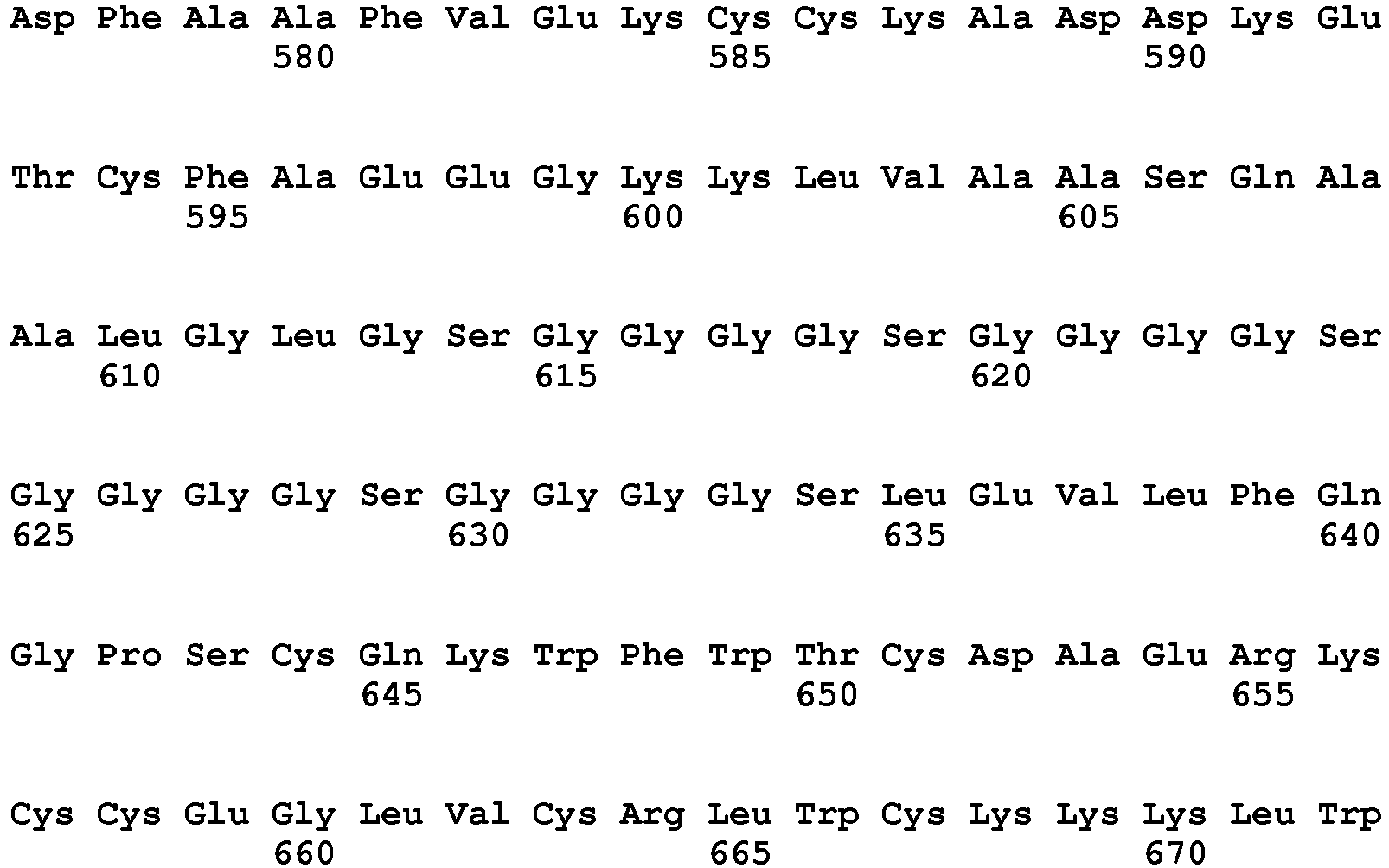
- <210> 92
<211> 2019
<212> DNA
<213> Artificial Sequence - <220>
<223> Description of Artificial Sequence: Synthetic NV1G1107 (NV1D2890) Y1S,M6F,S11A,M19L polynucleotide - <400> 92


- <210> 93
<211> 672
<212> PRT
<213> Artificial Sequence - <220>
<223> Description of Artificial Sequence: Synthetic NV1G1063 (NV1D2913) Y1R,M6F,W7Q,S11A,M19F polypeptide - <400> 93


- <210> 94
<211> 2019
<212> DNA
<213> Artificial Sequence - <220>
<223> Description of Artificial Sequence: Synthetic NV1G1063 (NV1D2913) Y1R,M6F,W7Q,S11A,M19F polynucleotide - <400> 94


- <210> 95
<211> 672
<212> PRT
<213> Artificial Sequence - <220>
<223> Description of Artificial Sequence: Synthetic NV1G1097 (NV1D2810), Y1Q,M6F,W7Q polypeptide - <400> 95


- <210> 96
<211> 1959
<212> DNA
<213> Artificial Sequence - <220>
<223> Description of Artificial Sequence: Synthetic NV1G1097 (NV1D2810), Y1Q,M6F,W7Q polynucleotide - <400> 96


- <210> 97
<211> 672
<212> PRT
<213> Artificial Sequence - <220>
<223> Description of Artificial Sequence: Synthetic NV1G1123 (NV1D2882), Y1A,M6F,W7Q,M19L polypeptide - <400> 97


- <210> 98
<211> 2019
<212> DNA
<213> Artificial Sequence - <220>
<223> Description of Artificial Sequence: Synthetic NV1G1123 (NV1D2882), Y1A,M6F,W7Q,M19L polynucleotide - <400> 98


- <210> 99
<211> 672
<212> PRT
<213> Artificial Sequence - <220>
<223> Description of Artificial Sequence: Synthetic NV1G1127 (NV1D2870), Y1Q,M6F,W7Q,M19L polypeptide - <400> 99


- <210> 100
<211> 2019
<212> DNA
<213> Artificial Sequence - <220>
<223> Description of Artificial Sequence: Synthetic NV1G1127 (NV1D2870), Y1Q,M6F,W7Q,M19L polynucleotide - <400> 100


- <210> 101
<211> 672
<212> PRT
<213> Artificial Sequence - <220>
<223> Description of Artificial Sequence: Synthetic NV1G1083 (NV1D2878), Y1S,M6F,W7Q,M19L polypeptide - <400> 101


- <210> 102
<211> 2019
<212> DNA
<213> Artificial Sequence - <220>
<223> Description of Artificial Sequence: Synthetic NV1G1083 (NV1D2878), Y1S,M6F,W7Q,M19L polynucleotide - <400> 102


- <210> 103
<211> 672
<212> PRT
<213> Artificial Sequence - <220>
<223> Description of Artificial Sequence: Synthetic NV1G1153 (NV1D3034) fusion protein - <400> 103


- <210> 104
<211> 2019
<212> DNA
<213> Artificial Sequence - <220>
<223> Description of Artificial Sequence: Synthetic NV1G1153 (NV1D3034) fusion polynucleotide - <400> 104


- <210> 105
<211> 2016
<212> PRT
<213> Homo sapiens - <400> 105


- <210> 106
<211> 612
<212> PRT
<213> Homo sapiens - <400> 106


- <210> 107
<211> 93
<212> DNA
<213> Thrixopelma pruriens - <400> 107

- <210> 108
<211> 6
<212> PRT
<213> Artificial Sequence - <220>
<223> Description of Artificial Sequence: Synthetic 6xHis tag - <400> 108

- <210> 109
<211> 30
<212> PRT
<213> Artificial sequence - <220>
<223> variant (-GP) NV1D2773 - <220>
<221> MOD_RES
<222> (30)..(30)
<223> -COOH - <400> 109

- <210> 110
<211> 30
<212> PRT
<213> Artificial sequence - <220>
<223> Variant (-GP) NV1D2773-NH2 - <220>
<221> MOD_RES
<222> (30)..(30)
<223> -NH2 - <400> 110

- <210> 111
<211> 32
<212> PRT
<213> Artificial sequence - <220>
<223> Variant NV1D2775-NH2 - <220>
<221> MOD_RES
<222> (32)..(32)
<223> -NH2 - <400> 111

- <210> 112
<211> 30
<212> PRT
<213> Artificial sequence - <220>
<223> Variant NV1D2890-NH2 - <220>
<221> MOD_RES
<222> (30)..(30)
<223> -NH2 - <400> 112


- <210> 113
<211> 32
<212> PRT
<213> Artificial sequence - <220>
<223> Variant NV1D2974 - <220>
<221> MOD_RES
<222> (32)..(32)
<223> -COOH - <400> 113

- <210> 114
<211> 30
<212> PRT
<213> Artificial sequence - <220>
<223> Variant (-GP) N-Ac-NV1D2974-NH2 - <220>
<221> MOD_RES
<222> (1)..(1)
<223> ACETYLATION - <220>
<221> MOD_RES
<222> (30)..(30)
<223> -NH2 - <400> 114

- <210> 115
<211> 30
<212> PRT
<213> Artificial sequence - <220>
<223> Variant (-GP) N-Ac-NV1D2974 - <220>
<221> MOD_RES
<222> (1)..(1)
<223> ACETYLATION - <220>
<221> MOD_RES
<222> (30)..(30)
<223> -NH2 - <400> 115

- <210> 116
<211> 32
<212> PRT
<213> Artificial sequence - <220>
<223> Variant NV1D3034 - <220>
<221> MOD_RES
<222> (32)..(32)
<223> -COOH - <400> 116

- <210> 117
<211> 32
<212> PRT
<213> Artificial sequence - <220>
<223> Variant NV1D3034-NH2 - <220>
<221> MOD_RES
<222> (32)..(32)
<223> -NH2 - <400> 117

- <210> 118
<211> 32
<212> PRT
<213> Artificial sequence - <220>
<223> NV1D3034-NH-butyl - <220>
<221> MOD_RES
<222> (32)..(32)
<223> NH-CH2-CH2-CH2-CH3 - <400> 118

- <210> 119
<211> 32
<212> PRT
<213> Artificial sequence - <220>
<223> Variant NV1D3034-NH-methyl - <220>
<221> MOD_RES
<222> (32)..(32)
<223> -NH-CH3 - <400> 119

- <210> 120
<211> 30
<212> PRT
<213> Artificial sequence - <220>
<223> Variant (-GP) N-Ac-NV1D3034 - <220>
<221> MOD_RES
<222> (1)..(1)
<223> ACETYLATION - <220>
<221> MOD_RES
<222> (30)..(30)
<223> -COOH - <400> 120

- <210> 121
<211> 30
<212> PRT
<213> Artificial sequence - <220>
<223> Variant (-GP) N-Ac-NV1D3034-NH2 - <220>
<221> MOD_RES
<222> (1)..(1)
<223> ACETYLATION - <220>
<221> MOD_RES
<222> (30)..(30)
<223> -NH2 - <400> 121

- <210> 122
<211> 32
<212> PRT
<213> Artificial sequence - <220>
<223> Variant NV1D3368 - <220>
<221> MOD_RES
<222> (32)..(32)
<223> -COOH - <400> 122

- <210> 123
<211> 32
<212> PRT
<213> Artificial sequence - <220>
<223> Variant NV1D3368-NH2 - <220>
<221> MOD_RES
<222> (32)..(32)
<223> -NH2 - <400> 123

- <210> 124
<211> 32
<212> PRT
<213> Artificial sequence - <220>
<223> Variant NV1D2969 - <220>
<221> MOD_RES
<222> (32)..(32)
<223> -COOH - <400> 124

- <210> 125
<211> 32
<212> PRT
<213> Artificial sequence - <220>
<223> Variant NV1D2970 - <220>
<221> MOD_RES
<222> (32)..(32)
<223> -COOH - <400> 125

- <210> 126
<211> 32
<212> PRT
<213> Artificial sequence - <220>
<223> Variant NV1D2971 - <220>
<221> MOD_RES
<222> (32)..(32)
<223> -COOH - <400> 126

- <210> 127
<211> 32
<212> PRT
<213> Artificial sequence - <220>
<223> Variant NV1D2972 - <220>
<221> MOD_RES
<222> (32)..(32)
<223> -COOH - <400> 127

- <210> 128
<211> 32
<212> PRT
<213> Artificial sequence - <220>
<223> Variant NV1D2973 - <220>
<221> MOD_RES
<222> (32)..(32)
<223> -COOH - <400> 128

- <210> 129
<211> 32
<212> PRT
<213> Artificial sequence - <220>
<223> Variant NV1D2974 - <220>
<221> MOD_RES
<222> (32)..(32)
<223> -COOH - <400> 129

- <210> 130
<211> 32
<212> PRT
<213> Artificial sequence - <220>
<223> Variant NV1D2974-NH2 - <220>
<221> MOD_RES
<222> (32)..(32)
<223> -NH2 - <400> 130

- <210> 131
<211> 32
<212> PRT
<213> Artificial sequence - <220>
<223> Variant NV1D3004 - <220>
<221> MOD_RES
<222> (32)..(32)
<223> -COOH - <400> 131

- <210> 132
<211> 32
<212> PRT
<213> Artificial sequence - <220>
<223> Variant NV1D3005 - <220>
<221> MOD_RES
<222> (32)..(32)
<223> -COOH - <400> 132


- <210> 133
<211> 32
<212> PRT
<213> Artificial sequence - <220>
<223> Variant NV1D3006 - <220>
<221> MOD_RES
<222> (32)..(32)
<223> -COOH - <400> 133

- <210> 134
<211> 32
<212> PRT
<213> Artificial sequence - <220>
<223> Variant NV1D3007 - <220>
<221> MOD_RES
<222> (32)..(32)
<223> -COOH - <400> 134

- <210> 135
<211> 32
<212> PRT
<213> Artificial sequence - <220>
<223> Variant NV1D3012 - <220>
<221> MOD_RES
<222> (32)..(32)
<223> -COOH - <400> 135

- <210> 136
<211> 32
<212> PRT
<213> Artificial sequence - <220>
<223> Variant NV1D3013 - <220>
<221> MOD_RES
<222> (32)..(32)
<223> -COOH - <400> 136

- <210> 137
<211> 32
<212> PRT
<213> Artificial sequence - <220>
<223> Variant NV1D3014 - <220>
<221> MOD_RES
<222> (32)..(32)
<223> -COOH - <400> 137

- <210> 138
<211> 32
<212> PRT
<213> Artificial sequence - <220>
<223> Variant NV1D3015 - <220>
<221> MOD_RES
<222> (32)..(32)
<223> -COOH - <400> 138

- <210> 139
<211> 32
<212> PRT
<213> Artificial sequence - <220>
<223> Variant NV1D3016 - <220>
<221> MOD_RES
<222> (32)..(32)
<223> -COOH - <400> 139

- <210> 140
<211> 32
<212> PRT
<213> Artificial sequence - <220>
<223> Variant NV1D3017 - <220>
<221> MOD_RES
<222> (32)..(32)
<223> -COOH - <400> 140


- <210> 141
<211> 32
<212> PRT
<213> Artificial sequence - <220>
<223> Variant NV1D3018 - <220>
<221> MOD_RES
<222> (32)..(32)
<223> -COOH - <400> 141

- <210> 142
<211> 32
<212> PRT
<213> Artificial sequence - <220>
<223> Variant NV1D3019 - <220>
<221> MOD_RES
<222> (32)..(32)
<223> -COOH - <400> 142

- <210> 143
<211> 32
<212> PRT
<213> Artificial sequence - <220>
<223> Variant NV1D3020 - <220>
<221> MOD_RES
<222> (32)..(32)
<223> -COOH - <400> 143

- <210> 144
<211> 32
<212> PRT
<213> Artificial sequence - <220>
<223> Variant NV1D3030 - <220>
<221> MOD_RES
<222> (32)..(32)
<223> -COOH - <400> 144

- <210> 145
<211> 32
<212> PRT
<213> Artificial sequence - <220>
<223> Variant NV1D3031 - <220>
<221> MOD_RES
<222> (32)..(32)
<223> -COOH - <400> 145

- <210> 146
<211> 32
<212> PRT
<213> Artificial sequence - <220>
<223> Variant NV1D3032 - <220>
<221> MOD_RES
<222> (32)..(32)
<223> -COOH - <400> 146

- <210> 147
<211> 32
<212> PRT
<213> Artificial sequence - <220>
<223> Variant NV1D3033 - <220>
<221> MOD_RES
<222> (32)..(32)
<223> -COOH - <400> 147

- <210> 148
<211> 32
<212> PRT
<213> Artificial sequence - <220>
<223> Variant NV1D3035 - <220>
<221> MOD_RES
<222> (32)..(32)
<223> -COOH - <400> 148

- <210> 149
<211> 32
<212> PRT
<213> Artificial sequence - <220>
<223> Variant NV1D3036 - <220>
<221> MOD_RES
<222> (32)..(32)
<223> -COOH - <400> 149

- <210> 150
<211> 32
<212> PRT
<213> Artificial sequence - <220>
<223> Variant NV1D3044 - <220>
<221> MOD_RES
<222> (32)..(32)
<223> -COOH - <400> 150

- <210> 151
<211> 32
<212> PRT
<213> Artificial sequence - <220>
<223> Variant NV1D3045 - <220>
<221> MOD_RES
<222> (32)..(32)
<223> -COOH - <400> 151

- <210> 152
<211> 32
<212> PRT
<213> Artificial sequence - <220>
<223> Variant NV1D3048 - <220>
<221> MOD_RES
<222> (32)..(32)
<223> -COOH - <400> 152

- <210> 153
<211> 32
<212> PRT
<213> Artificial sequence - <220>
<223> Variant NV1D3050 - <220>
<221> MOD_RES
<222> (32)..(32)
<223> -COOH - <400> 153


- <210> 154
<211> 32
<212> PRT
<213> Artificial sequence - <220>
<223> Variant NV1D3051 - <220>
<221> MOD_RES
<222> (32)..(32)
<223> -COOH - <400> 154

- <210> 155
<211> 32
<212> PRT
<213> Artificial sequence - <220>
<223> Variant NV1D3052 - <220>
<221> MOD_RES
<222> (32)..(32)
<223> -COOH - <400> 155

- <210> 156
<211> 32
<212> PRT
<213> Artificial sequence - <220>
<223> Variant NV1D3056 - <220>
<221> MOD_RES
<222> (32)..(32)
<223> -COOH - <400> 156

- <210> 157
<211> 32
<212> PRT
<213> Artificial sequence - <220>
<223> Variant NV1D3057 - <220>
<221> MOD_RES
<222> (32)..(32)
<223> -COOH - <400> 157

- <210> 158
<211> 32
<212> PRT
<213> Artificial sequence - <220>
<223> Variant NV1D3058 - <220>
<221> MOD_RES
<222> (32)..(32)
<223> -COOH - <400> 158

- <210> 159
<211> 32
<212> PRT
<213> Artificial sequence - <220>
<223> Variant NV1D3062 - <220>
<221> MOD_RES
<222> (32)..(32)
<223> -COOH - <400> 159

- <210> 160
<211> 32
<212> PRT
<213> Artificial sequence - <220>
<223> Variant NV1D3109 - <220>
<221> MOD_RES
<222> (32)..(32)
<223> -COOH - <400> 160

- <210> 161
<211> 32
<212> PRT
<213> Artificial sequence - <220>
<223> Variant NV1D3121 - <220>
<221> MOD_RES
<222> (32)..(32)
<223> -COOH - <400> 161


- <210> 162
<211> 37
<212> PRT
<213> Artificial sequence - <220>
<223> Variant NV1D3249 - <220>
<221> MOD_RES
<222> (37)..(37)
<223> -COOH - <400> 162

- <210> 163
<211> 37
<212> PRT
<213> Artificial sequence - <220>
<223> Variant NV1D3251 - <220>
<221> MOD_RES
<222> (37)..(37)
<223> -COOH - <400> 163

- <210> 164
<211> 37
<212> PRT
<213> Artificial sequence - <220>
<223> Variant NV1D3252 - <220>
<221> MOD_RES
<222> (37)..(37)
<223> -COOH - <400> 164

- <210> 165
<211> 37
<212> PRT
<213> Artificial sequence - <220>
<223> Variant NV1D3254 - <220>
<221> MOD_RES
<222> (37)..(37)
<223> -COOH - <400> 165

- <210> 166
<211> 64
<212> PRT
<213> Artificial sequence - <220>
<223> Variant NV1D3256 - <220>
<221> MOD_RES
<222> (64)..(64)
<223> -COOH - <400> 166

- <210> 167
<211> 62
<212> PRT
<213> Artificial sequence - <220>
<223> Variant NV1D3257 - <220>
<221> MOD_RES
<222> (62)..(62)
<223> -COOH - <400> 167
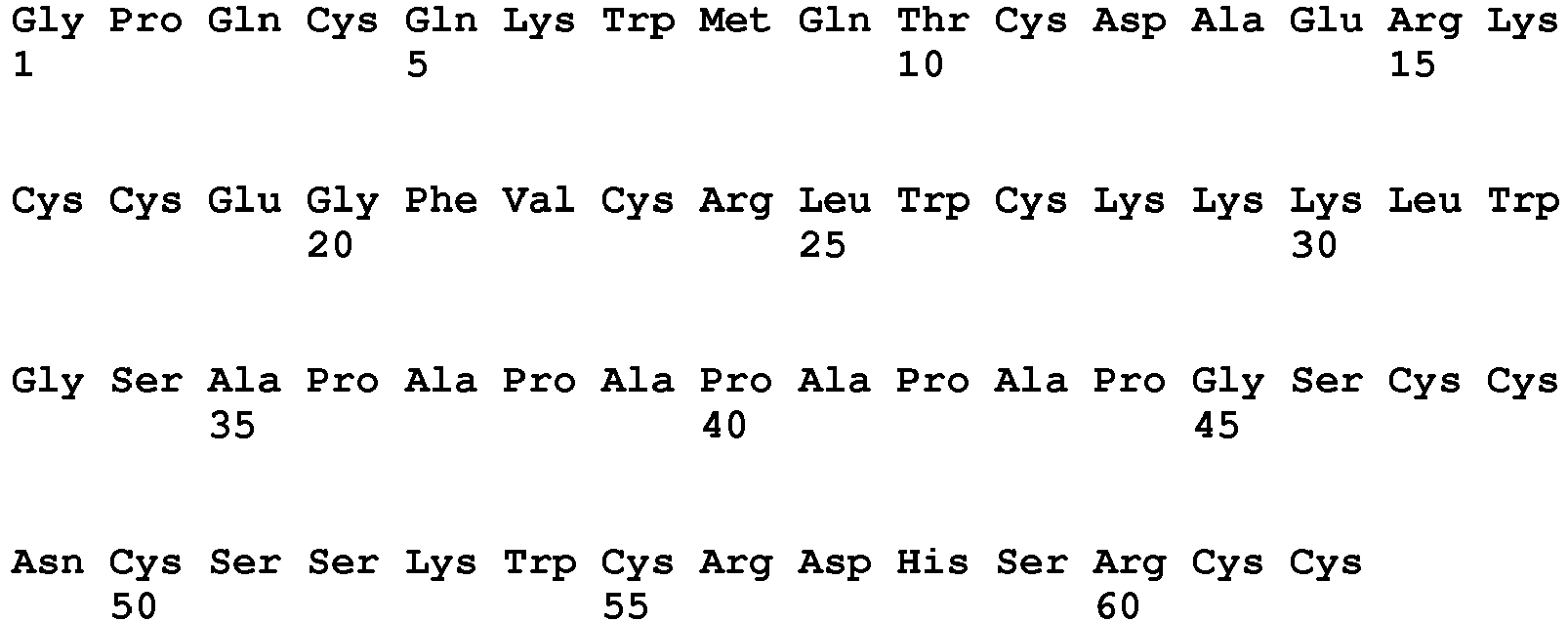
- <210> 168
<211> 74
<212> PRT
<213> Artificial sequence - <220>
<223> Variant NV1D3259 - <220>
<221> MOD_RES
<222> (74)..(74)
<223> -COOH - <400> 168

- <210> 169
<211> 74
<212> PRT
<213> Artificial sequence - <220>
<223> Variant NV1D3260 - <220>
<221> MOD_RES
<222> (74)..(74)
<223> -COOH - <400> 169

- <210> 170
<211> 72
<212> PRT
<213> Artificial sequence - <220>
<223> Variant NV1D3261 - <220>
<221> MOD_RES
<222> (72)..(72)
<223> -COOH - <400> 170

- <210> 171
<211> 72
<212> PRT
<213> Artificial sequence - <220>
<223> Variant NV1D3262 - <220>
<221> MOD_RES
<222> (72)..(72)
<223> -COOH - <400> 171


- <210> 172
<211> 32
<212> PRT
<213> Artificial sequence - <220>
<223> Variant NV1D3339 - <220>
<221> MOD_RES
<222> (32)..(32)
<223> -COOH - <400> 172

- <210> 173
<211> 32
<212> PRT
<213> Artificial sequence - <220>
<223> Variant NV1D3340 - <220>
<221> MOD_RES
<222> (32)..(32)
<223> -COOH - <400> 173

- <210> 174
<211> 32
<212> PRT
<213> Artificial sequence - <220>
<223> Variant NV1D3341 - <220>
<221> MOD_RES
<222> (32)..(32)
<223> -COOH - <400> 174

- <210> 175
<211> 32
<212> PRT
<213> Artificial sequence - <220>
<223> Variant NV1D3342 - <220>
<221> MOD_RES
<222> (32)..(32)
<223> -COOH - <400> 175

- <210> 176
<211> 32
<212> PRT
<213> Artificial sequence - <220>
<223> Variant NV1D3344 - <220>
<221> MOD_RES
<222> (32)..(32)
<223> -COOH - <400> 176


- <210> 177
<211> 32
<212> PRT
<213> Artificial sequence - <220>
<223> Variant NV1D3345 - <220>
<221> MOD_RES
<222> (32)..(32)
<223> -COOH - <400> 177

- <210> 178
<211> 32
<212> PRT
<213> Artificial sequence - <220>
<223> Variant NV1D3346 - <220>
<221> MOD_RES
<222> (32)..(32)
<223> -COOH - <400> 178

- <210> 179
<211> 32
<212> PRT
<213> Artificial sequence - <220>
<223> Variant NV1D3347 - <220>
<221> MOD_RES
<222> (32)..(32)
<223> -COOH - <400> 179

- <210> 180
<211> 32
<212> PRT
<213> Artificial sequence - <220>
<223> Variant NV1D3348 - <220>
<221> MOD_RES
<222> (32)..(32)
<223> -COOH - <400> 180

- <210> 181
<211> 32
<212> PRT
<213> Artificial sequence - <220>
<223> Variant NV1D3349 - <220>
<221> MOD_RES
<222> (32)..(32)
<223> -COOH - <400> 181
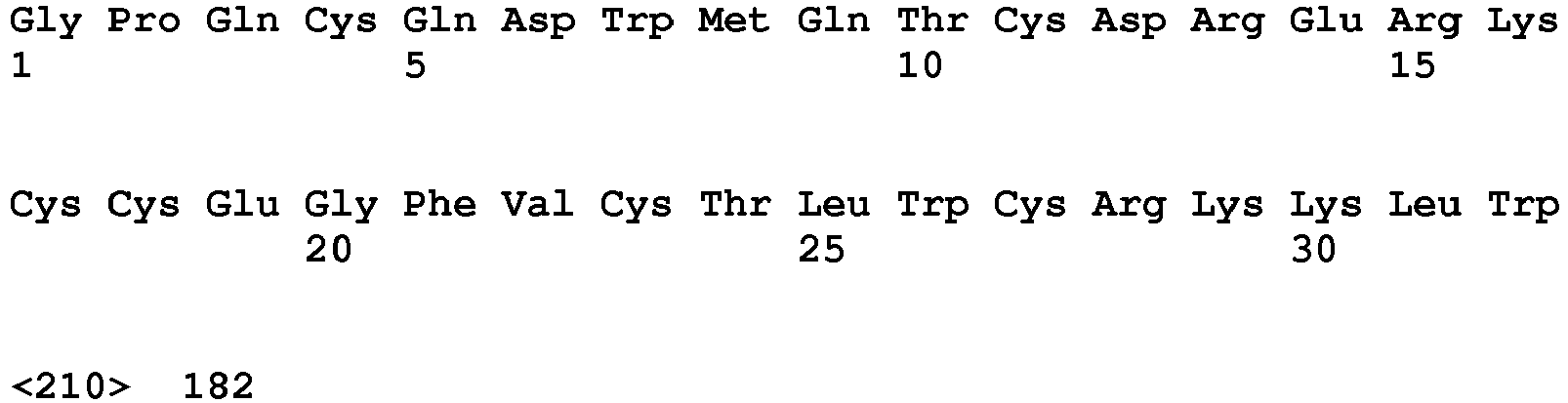
- <211> 32
<212> PRT
<213> Artificial sequence - <220>
<223> Variant NV1D3350 - <220>
<221> MOD_RES
<222> (32)..(32)
<223> -COOH - <400> 182

- <210> 183
<211> 32
<212> PRT
<213> Artificial sequence - <220>
<223> Variant NV1D3351 - <220>
<221> MOD_RES
<222> (32)..(32)
<223> -COOH - <400> 183

- <210> 184
<211> 32
<212> PRT
<213> Artificial sequence - <220>
<223> Variant NV1D3352 - <220>
<221> MOD_RES
<222> (32)..(32)
<223> -COOH - <400> 184

- <210> 185
<211> 32
<212> PRT
<213> Artificial sequence - <220>
<223> Variant NV1D3353 - <220>
<221> MOD_RES
<222> (32)..(32)
<223> -COOH - <400> 185

- <210> 186
<211> 32
<212> PRT
<213> Artificial sequence - <220>
<223> Variant NV1D3354 - <220>
<221> MOD_RES
<222> (32)..(32)
<223> -COOH - <400> 186

- <210> 187
<211> 32
<212> PRT
<213> Artificial sequence - <220>
<223> Variant NV1D3356 - <220>
<221> MOD_RES
<222> (32)..(32)
<223> -COOH - <400> 187

- <210> 188
<211> 32
<212> PRT
<213> Artificial sequence - <220>
<223> Variant NV1D3357 - <220>
<221> MOD_RES
<222> (32)..(32)
<223> -COOH - <400> 188

- <210> 189
<211> 32
<212> PRT
<213> Artificial sequence - <220>
<223> Variant NV1D3358 - <220>
<221> MOD_RES
<222> (32)..(32)
<223> -COOH - <400> 189

- <210> 190
<211> 32
<212> PRT
<213> Artificial sequence - <220>
<223> Variant NV1D3359 - <220>
<221> MOD_RES
<222> (32)..(32)
<223> -COOH - <400> 190

- <210> 191
<211> 32
<212> PRT
<213> Artificial sequence - <220>
<223> Variant NV1D3360 - <220>
<221> MOD_RES
<222> (32)..(32)
<223> -COOH - <400> 191

- <210> 192
<211> 32
<212> PRT
<213> Artificial sequence - <220>
<223> Variant NV1D3361 - <220>
<221> MOD_RES
<222> (32)..(32)
<223> -COOH - <400> 192

- <210> 193
<211> 32
<212> PRT
<213> Artificial sequence - <220>
<223> Variant NV1D3362 - <220>
<221> MOD_RES
<222> (32)..(32)
<223> -COOH - <400> 193

- <210> 194
<211> 32
<212> PRT
<213> Artificial sequence - <220>
<223> Variant NV1D3363 - <220>
<221> MOD_RES
<222> (32)..(32)
<223> -COOH - <400> 194

- <210> 195
<211> 32
<212> PRT
<213> Artificial sequence - <220>
<223> Variant NV1D3365 - <220>
<221> MOD_RES
<222> (32)..(32)
<223> -COOH - <400> 195

- <210> 196
<211> 32
<212> PRT
<213> Artificial sequence - <220>
<223> Variant NV1D3366 - <220>
<221> MOD_RES
<222> (32)..(32)
<223> -COOH - <400> 196

- <210> 197
<211> 32
<212> PRT
<213> Artificial sequence - <220>
<223> Variant NV1D3367 - <220>
<221> MOD_RES
<222> (32)..(32)
<223> -COOH - <400> 197


- <210> 198
<211> 32
<212> PRT
<213> Artificial sequence - <220>
<223> Variant NV1D3368 - <220>
<221> MOD_RES
<222> (32)..(32)
<223> -COOH - <400> 198

- <210> 199
<211> 32
<212> PRT
<213> Artificial sequence - <220>
<223> Variant NV1D3369 - <220>
<221> MOD_RES
<222> (32)..(32)
<223> -COOH - <400> 199

- <210> 200
<211> 32
<212> PRT
<213> Artificial sequence - <220>
<223> Variant NV1D3370 - <220>
<221> MOD_RES
<222> (32)..(32)
<223> -COOH - <400> 200

- <210> 201
<211> 32
<212> PRT
<213> Artificial sequence - <220>
<223> Variant NV1D3371 - <220>
<221> MOD_RES
<222> (32)..(32)
<223> -COOH - <400> 201

- <210> 202
<211> 32
<212> PRT
<213> Artificial sequence - <220>
<223> Variant NV1D3372 - <220>
<221> MOD_RES
<222> (32)..(32)
<223> -COOH - <400> 202
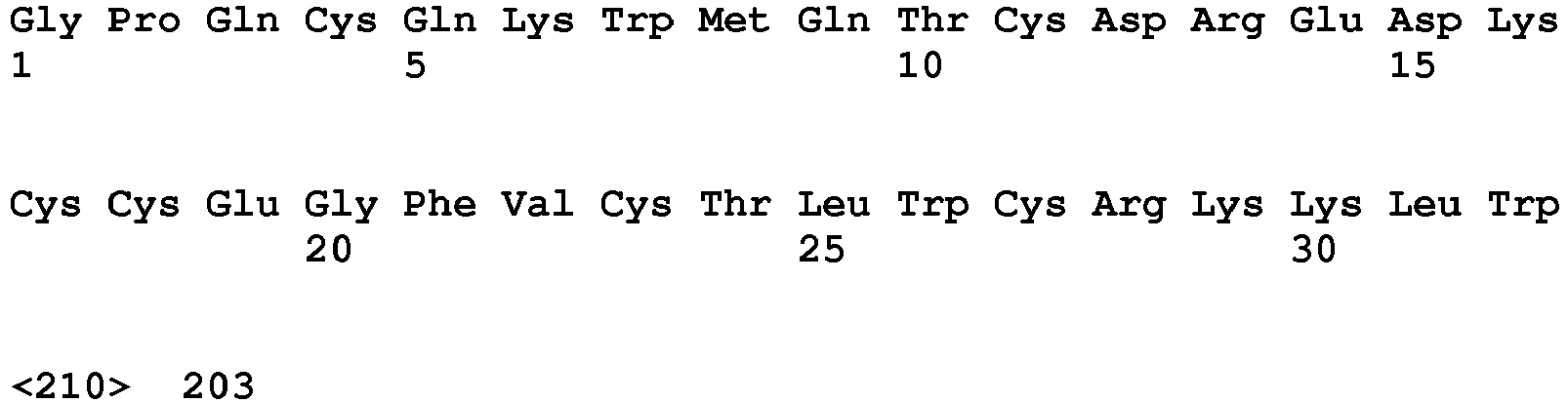
- <211> 32
<212> PRT
<213> Artificial sequence - <220>
<223> Variant NV1D3374 - <220>
<221> MOD_RES
<222> (32)..(32)
<223> -COOH - <400> 203

- <210> 204
<211> 32
<212> PRT
<213> Artificial sequence - <220>
<223> Variant NV1D3375 - <220>
<221> MOD_RES
<222> (32)..(32)
<223> -COOH - <400> 204

- <210> 205
<211> 32
<212> PRT
<213> Artificial sequence - <220>
<223> Variant NV1D3376 - <220>
<221> MOD_RES
<222> (32)..(32)
<223> -COOH - <400> 205

- <210> 206
<211> 32
<212> PRT
<213> Artificial sequence - <220>
<223> Variant NV1D3377 - <220>
<221> MOD_RES
<222> (32)..(32)
<223> -COOH - <400> 206

- <210> 207
<211> 32
<212> PRT
<213> Artificial sequence - <220>
<223> Variant NV1D3378 - <220>
<221> MOD_RES
<222> (32)..(32)
<223> -COOH - <400> 207

- <210> 208
<211> 32
<212> PRT
<213> Artificial sequence - <220>
<223> Variant NV1D3379 - <220>
<221> MOD_RES
<222> (32)..(32)
<223> -COOH - <400> 208

- <210> 209
<211> 32
<212> PRT
<213> Artificial sequence - <220>
<223> Variant NV1D3380 - <220>
<221> MOD_RES
<222> (32)..(32)
<223> -COOH - <400> 209

- <210> 210
<211> 32
<212> PRT
<213> Artificial sequence - <220>
<223> Variant NV1D3381 - <220>
<221> MOD_RES
<222> (32)..(32)
<223> -COOH - <400> 210

- <210> 211
<211> 32
<212> PRT
<213> Artificial sequence - <220>
<223> Variant NV1D3382 - <220>
<221> MOD_RES
<222> (32)..(32)
<223> -COOH - <400> 211

- <210> 212
<211> 32
<212> PRT
<213> Artificial sequence - <220>
<223> Variant NV1D3383 - <220>
<221> MOD_RES
<222> (32)..(32)
<223> -COOH - <400> 212

- <210> 213
<211> 32
<212> PRT
<213> Artificial sequence - <220>
<223> Variant NV1D3384 - <220>
<221> MOD_RES
<222> (32)..(32)
<223> -COOH - <400> 213

- <210> 214
<211> 32
<212> PRT
<213> Artificial sequence - <220>
<223> Variant NV1D3385 - <220>
<221> MOD_RES
<222> (32)..(32)
<223> -COOH - <400> 214

- <210> 215
<211> 32
<212> PRT
<213> Artificial sequence - <220>
<223> Variant NV1D3386 - <220>
<221> MOD_RES
<222> (32)..(32)
<223> -COOH - <400> 215

- <210> 216
<211> 32
<212> PRT
<213> Artificial sequence - <220>
<223> Variant NV1D3387 - <220>
<221> MOD_RES
<222> (32)..(32)
<223> -COOH - <400> 216

- <210> 217
<211> 32
<212> PRT
<213> Artificial sequence - <220>
<223> Variant NV1D3388 - <220>
<221> MOD_RES
<222> (32)..(32)
<223> -COOH - <400> 217

- <210> 218
<211> 32
<212> PRT
<213> Artificial sequence - <220>
<223> Variant NV1D3389 - <220>
<221> MOD_RES
<222> (32)..(32)
<223> -COOH - <400> 218


- <210> 219
<211> 32
<212> PRT
<213> Artificial sequence - <220>
<223> Variant NV1D3390 - <220>
<221> MOD_RES
<222> (32)..(32)
<223> -COOH - <400> 219

- <210> 220
<211> 32
<212> PRT
<213> Artificial sequence - <220>
<223> Variant NV1D3391 - <220>
<221> MOD_RES
<222> (32)..(32)
<223> -COOH - <400> 220

- <210> 221
<211> 32
<212> PRT
<213> Artificial sequence - <220>
<223> Variant NV1D3392 - <220>
<221> MOD_RES
<222> (32)..(32)
<223> -COOH - <400> 221

- <210> 222
<211> 32
<212> PRT
<213> Artificial sequence - <220>
<223> Variant NV1D3393 - <220>
<221> MOD_RES
<222> (32)..(32)
<223> -COOH - <400> 222

- <210> 223
<211> 32
<212> PRT
<213> Artificial sequence - <220>
<223> Variant NV1D3394 - <220>
<221> MOD_RES
<222> (32)..(32)
<223> -COOH - <400> 223

- <210> 224
<211> 32
<212> PRT
<213> Artificial sequence - <220>
<223> Variant NV1D3396 - <220>
<221> MOD_RES
<222> (32)..(32)
<223> -COOH - <400> 224

- <210> 225
<211> 32
<212> PRT
<213> Artificial sequence - <220>
<223> Variant NV1D3397 - <220>
<221> MOD_RES
<222> (32)..(32)
<223> -COOH - <400> 225

- <210> 226
<211> 32
<212> PRT
<213> Artificial sequence - <220>
<223> Variant NV1D3398 - <220>
<221> MOD_RES
<222> (32)..(32)
<223> -COOH - <400> 226

- <210> 227
<211> 32
<212> PRT
<213> Artificial sequence - <220>
<223> Variant NV1D3399 - <220>
<221> MOD_RES
<222> (32)..(32)
<223> -COOH - <400> 227

- <210> 228
<211> 32
<212> PRT
<213> Artificial sequence - <220>
<223> Variant NV1D3400 - <220>
<221> MOD_RES
<222> (32)..(32)
<223> -COOH - <400> 228

- <210> 229
<211> 32
<212> PRT
<213> Artificial sequence - <220>
<223> Variant NV1D3401 - <220>
<221> MOD_RES
<222> (32)..(32)
<223> -COOH - <400> 229

- <210> 230
<211> 32
<212> PRT
<213> Artificial sequence - <220>
<223> Variant NV1D3403 - <220>
<221> MOD_RES
<222> (32)..(32)
<223> -COOH - <400> 230

- <210> 231
<211> 32
<212> PRT
<213> Artificial sequence - <220>
<223> Variant NV1D3408 - <220>
<221> MOD_RES
<222> (32)..(32)
<223> -COOH - <400> 231

- <210> 232
<211> 32
<212> PRT
<213> Artificial sequence - <220>
<223> Variant NV1D3409 - <220>
<221> MOD_RES
<222> (32)..(32)
<223> -COOH - <400> 232

- <210> 233
<211> 32
<212> PRT
<213> Artificial sequence - <220>
<223> Variant NV1D3410 - <220>
<221> MOD_RES
<222> (32)..(32)
<223> -COOH - <400> 233

- <210> 234
<211> 32
<212> PRT
<213> Artificial sequence - <220>
<223> Variant NV1D3413 - <220>
<221> MOD_RES
<222> (32)..(32)
<223> -COOH - <400> 234

- <210> 235
<211> 32
<212> PRT
<213> Artificial sequence - <220>
<223> Variant NV1D3414 - <220>
<221> MOD_RES
<222> (32)..(32)
<223> -COOH - <400> 235

- <210> 236
<211> 32
<212> PRT
<213> Artificial sequence - <220>
<223> Variant NV1D3419 - <220>
<221> MOD_RES
<222> (32)..(32)
<223> -COOH - <400> 236

- <210> 237
<211> 32
<212> PRT
<213> Artificial sequence - <220>
<223> Variant NV1D3423 - <220>
<221> MOD_RES
<222> (32)..(32)
<223> -COOH - <400> 237

- <210> 238
<211> 32
<212> PRT
<213> Artificial sequence - <220>
<223> Variant NV1D3424 - <220>
<221> MOD_RES
<222> (32)..(32)
<223> -COOH - <400> 238

- <210> 239
<211> 32
<212> PRT
<213> Artificial sequence - <220>
<223> Variant NV1D3425 - <220>
<221> MOD_RES
<222> (32)..(32)
<223> -COOH - <400> 239


- <210> 240
<211> 32
<212> PRT
<213> Artificial sequence - <220>
<223> Variant NV1D3426 - <220>
<221> MOD_RES
<222> (32)..(32)
<223> -COOH - <400> 240

- <210> 241
<211> 32
<212> PRT
<213> Artificial sequence - <220>
<223> Variant NV1D3427 - <220>
<221> MOD_RES
<222> (32)..(32)
<223> -COOH - <400> 241

- <210> 242
<211> 32
<212> PRT
<213> Artificial sequence - <220>
<223> Variant NV1D3428 - <220>
<221> MOD_RES
<222> (32)..(32)
<223> -COOH - <400> 242

- <210> 243
<211> 32
<212> PRT
<213> Artificial sequence - <220>
<223> Variant NV1D3430 - <220>
<221> MOD_RES
<222> (32)..(32)
<223> -COOH - <400> 243

- <210> 244
<211> 32
<212> PRT
<213> Artificial sequence - <220>
<223> Variant NV1D3431 - <220>
<221> MOD_RES
<222> (32)..(32)
<223> -COOH - <400> 244

- <210> 245
<211> 32
<212> PRT
<213> Artificial sequence - <220>
<223> Variant NV1D3432 - <220>
<221> MOD_RES
<222> (32)..(32)
<223> -COOH - <400> 245

- <210> 246
<211> 32
<212> PRT
<213> Artificial sequence - <220>
<223> Variant NV1D3439 - <220>
<221> MOD_RES
<222> (32)..(32)
<223> -COOH - <400> 246

- <210> 247
<211> 32
<212> PRT
<213> Artificial sequence - <220>
<223> Variant NV1D3465 - <220>
<221> MOD_RES
<222> (32)..(32)
<223> -COOH - <400> 247

- <210> 248
<211> 32
<212> PRT
<213> Artificial sequence - <220>
<223> Variant NV1D3466 - <220>
<221> MOD_RES
<222> (32)..(32)
<223> -COOH - <400> 248

- <210> 249
<211> 32
<212> PRT
<213> Artificial sequence - <220>
<223> Variant NV1D3467 - <220>
<221> MOD_RES
<222> (32)..(32)
<223> -COOH - <400> 249

- <210> 250
<211> 32
<212> PRT
<213> Artificial sequence - <220>
<223> Variant NV1D3470 - <220>
<221> MOD_RES
<222> (32)..(32)
<223> -COOH - <400> 250

- <210> 251
<211> 44
<212> PRT
<213> Artificial sequence - <220>
<223> Variant NV1D3510 - <220>
<221> MOD_RES
<222> (44)..(44)
<223> -COOH - <400> 251

- <210> 252
<211> 39
<212> PRT
<213> Artificial sequence - <220>
<223> Variant NV1D3511 - <220>
<221> MOD_RES
<222> (39)..(39)
<223> -COOH - <400> 252


- <210> 253
<211> 49
<212> PRT
<213> Artificial sequence - <220>
<223> Variant NV1D3512 - <220>
<221> MOD_RES
<222> (49).. (49)
<223> -COOH - <400> 253

- <210> 254
<211> 44
<212> PRT
<213> Artificial sequence - <220>
<223> Variant NV1D3513 - <220>
<221> MOD_RES
<222> (44)..(44)
<223> -COOH - <400> 254


- <210> 255
<211> 39
<212> PRT
<213> Artificial sequence - <220>
<223> Variant NV1D3514 - <220>
<221> MOD_RES
<222> (39)..(39)
<223> -COOH - <400> 255

- <210> 256
<211> 49
<212> PRT
<213> Artificial sequence - <220>
<223> Variant NV1D3515 - <220>
<221> MOD_RES
<222> (49).. (49)
<223> -COOH - <400> 256


- <210> 257
<211> 44
<212> PRT
<213> Artificial sequence - <220>
<223> Variant NV1D3516 - <220>
<221> MOD_RES
<222> (44)..(44)
<223> -COOH - <400> 257

- <210> 258
<211> 39
<212> PRT
<213> Artificial sequence - <220>
<223> Variant NV1D3517 - <220>
<221> MOD_RES
<222> (39)..(39)
<223> -COOH - <400> 258

- <210> 259
<211> 58
<212> PRT
<213> Artificial sequence - <220>
<223> Variant NV1D3518 - <220>
<221> MOD_RES
<222> (58)..(58)
<223> -COOH - <400> 259

- <210> 260
<211> 53
<212> PRT
<213> Artificial sequence - <220>
<223> Variant NV1D3519 - <220>
<221> MOD_RES
<222> (53)..(53)
<223> -COOH - <400> 260

- <210> 261
<211> 48
<212> PRT
<213> Artificial sequence - <220>
<223> Variant NV1D3520 - <220>
<221> MOD_RES
<222> (48)..(48)
<223> -COOH - <400> 261

- <210> 262
<211> 53
<212> PRT
<213> Artificial sequence - <220>
<223> Variant NV1D3521 - <220>
<221> MOD_RES
<222> (53)..(53)
<223> -COOH - <400> 262

- <210> 263
<211> 43
<212> PRT
<213> Artificial sequence - <220>
<223> Variant NV1D3523 - <220>
<221> MOD_RES
<222> (43)..(43)
<223> -COOH - <400> 263

- <210> 264
<211> 53
<212> PRT
<213> Artificial sequence - <220>
<223> Variant NV1D3524 - <220>
<221> MOD_RES
<222> (53)..(53)
<223> -COOH - <400> 264

- <210> 265
<211> 48
<212> PRT
<213> Artificial sequence - <220>
<223> Variant NV1D3525 - <220>
<221> MOD_RES
<222> (48)..(48)
<223> -COOH - <400> 265

- <210> 266
<211> 43
<212> PRT
<213> Artificial sequence - <220>
<223> Variant NV1D3526 - <220>
<221> MOD_RES
<222> (43)..(43)
<223> -COOH - <400> 266

- <210> 267
<211> 42
<212> PRT
<213> Artificial sequence - <220>
<223> Variant NV1D3527 - <220>
<221> MOD_RES
<222> (42)..(42)
<223> -COOH - <400> 267

- <210> 268
<211> 37
<212> PRT
<213> Artificial sequence - <220>
<223> Variant NV1D3528 - <220>
<221> MOD_RES
<222> (37)..(37)
<223> -COOH - <400> 268

- <210> 269
<211> 32
<212> PRT
<213> Artificial sequence - <220>
<223> Variant NV1D3529 - <220>
<221> MOD_RES
<222> (32)..(32)
<223> -COOH - <400> 269

- <210> 270
<211> 32
<212> PRT
<213> Artificial sequence - <220>
<223> Variant NV1D3530 - <220>
<221> MOD_RES
<222> (32)..(32)
<223> -COOH - <400> 270

- <210> 271
<211> 32
<212> PRT
<213> Artificial sequence - <220>
<223> Variant NV1D3531 - <220>
<221> MOD_RES
<222> (32)..(32)
<223> -COOH - <400> 271

- <210> 272
<211> 32
<212> PRT
<213> Artificial sequence - <220>
<223> Variant NV1D3532 - <220>
<221> MOD_RES
<222> (32)..(32)
<223> -COOH - <400> 272

- <210> 273
<211> 32
<212> PRT
<213> Artificial sequence - <220>
<223> Variant NV1D3533 - <220>
<221> MOD_RES
<222> (32)..(32)
<223> -COOH - <400> 273

- <210> 274
<211> 32
<212> PRT
<213> Artificial sequence - <220>
<223> Variant NV1D3534 - <220>
<221> MOD_RES
<222> (32)..(32)
<223> -COOH - <400> 274

- <210> 275
<211> 32
<212> PRT
<213> Artificial sequence - <220>
<223> Variant NV1D3535 - <220>
<221> MOD_RES
<222> (32)..(32)
<223> -COOH - <400> 275

- <210> 276
<211> 32
<212> PRT
<213> Artificial sequence - <220>
<223> Variant NV1D3536 - <220>
<221> MOD_RES
<222> (32)..(32)
<223> -COOH - <400> 276

- <210> 277
<211> 32
<212> PRT
<213> Artificial sequence - <220>
<223> Variant NV1D3537 - <220>
<221> MOD_RES
<222> (32)..(32)
<223> -COOH - <400> 277


- <210> 278
<211> 32
<212> PRT
<213> Artificial sequence - <220>
<223> Variant NV1D3538 - <220>
<221> MOD_RES
<222> (32)..(32)
<223> -COOH - <400> 278

- <210> 279
<211> 32
<212> PRT
<213> Artificial sequence - <220>
<223> Variant NV1D3539 - <220>
<221> MOD_RES
<222> (32)..(32)
<223> -COOH - <400> 279

- <210> 280
<211> 32
<212> PRT
<213> Artificial sequence - <220>
<223> Variant NV1D3540 - <220>
<221> MOD_RES
<222> (32)..(32)
<223> -COOH - <400> 280

- <210> 281
<211> 32
<212> PRT
<213> Artificial sequence - <220>
<223> Variant NV1D3541 - <220>
<221> MOD_RES
<222> (32)..(32)
<223> -COOH - <400> 281

- <210> 282
<211> 32
<212> PRT
<213> Artificial sequence - <220>
<223> Variant NV1D3542 - <220>
<221> MOD_RES
<222> (32)..(32)
<223> -COOH - <400> 282

- <210> 283
<211> 32
<212> PRT
<213> Artificial sequence - <220>
<223> Variant NV1D3543 - <220>
<221> MOD_RES
<222> (32)..(32)
<223> -COOH - <400> 283

- <210> 284
<211> 32
<212> PRT
<213> Artificial sequence - <220>
<223> Variant NV1D3544 - <220>
<221> MOD_RES
<222> (32)..(32)
<223> -COOH - <400> 284

- <210> 285
<211> 32
<212> PRT
<213> Artificial sequence - <220>
<223> Variant NV1D3545 - <220>
<221> MOD_RES
<222> (32)..(32)
<223> -COOH - <400> 285

- <210> 286
<211> 32
<212> PRT
<213> Artificial sequence - <220>
<223> Variant NV1D3546 - <220>
<221> MOD_RES
<222> (32)..(32)
<223> -COOH - <400> 286

- <210> 287
<211> 32
<212> PRT
<213> Artificial sequence - <220>
<223> Variant NV1D3547 - <220>
<221> MOD_RES
<222> (32)..(32)
<223> -COOH - <400> 287

- <210> 288
<211> 32
<212> PRT
<213> Artificial sequence - <220>
<223> Variant NV1D3548 - <220>
<221> MOD_RES
<222> (32)..(32)
<223> -COOH - <400> 288

- <210> 289
<211> 32
<212> PRT
<213> Artificial sequence - <220>
<223> Variant NV1D3549 - <220>
<221> MOD_RES
<222> (32)..(32)
<223> -COOH - <400> 289

- <210> 290
<211> 32
<212> PRT
<213> Artificial sequence - <220>
<223> Variant NV1D3550 - <220>
<221> MOD_RES
<222> (32)..(32)
<223> -COOH - <400> 290

- <210> 291
<211> 32
<212> PRT
<213> Artificial sequence - <220>
<223> Variant NV1D3551 - <220>
<221> MOD_RES
<222> (32)..(32)
<223> -COOH - <400> 291

- <210> 292
<211> 32
<212> PRT
<213> Artificial sequence - <220>
<223> Variant NV1D3552 - <220>
<221> MOD_RES
<222> (32)..(32)
<223> -COOH - <400> 292

- <210> 293
<211> 32
<212> PRT
<213> Artificial sequence - <220>
<223> Variant NV1D3553 - <220>
<221> MOD_RES
<222> (32)..(32)
<223> -COOH - <400> 293

- <210> 294
<211> 32
<212> PRT
<213> Artificial sequence - <220>
<223> Variant NV1D3554 - <220>
<221> MOD_RES
<222> (32)..(32)
<223> -COOH - <400> 294

- <210> 295
<211> 32
<212> PRT
<213> Artificial sequence - <220>
<223> Variant NV1D3555 - <220>
<221> MOD_RES
<222> (32)..(32)
<223> -COOH - <400> 295

- <210> 296
<211> 32
<212> PRT
<213> Artificial sequence - <220>
<223> Variant NV1D3556 - <220>
<221> MOD_RES
<222> (32)..(32)
<223> -COOH - <400> 296

- <210> 297
<211> 32
<212> PRT
<213> Artificial sequence - <220>
<223> Variant NV1D3558 - <220>
<221> MOD_RES
<222> (32)..(32)
<223> -COOH - <400> 297

- <210> 298
<211> 32
<212> PRT
<213> Artificial sequence - <220>
<223> Variant NV1D3559 - <220>
<221> MOD_RES
<222> (32)..(32)
<223> -COOH - <400> 298


- <210> 299
<211> 32
<212> PRT
<213> Artificial sequence - <220>
<223> Variant NV1D3560 - <220>
<221> MOD_RES
<222> (32)..(32)
<223> -COOH - <400> 299

- <210> 300
<211> 32
<212> PRT
<213> Artificial sequence - <220>
<223> Variant NV1D3561 - <220>
<221> MOD_RES
<222> (32)..(32)
<223> -COOH - <400> 300

- <210> 301
<211> 32
<212> PRT
<213> Artificial sequence - <220>
<223> variant NV1D3562 - <220>
<221> MOD_RES
<222> (32)..(32)
<223> -COOH - <400> 301

- <210> 302
<211> 32
<212> PRT
<213> Artificial sequence - <220>
<223> Variant NV1D3563 - <220>
<221> MOD_RES
<222> (32)..(32)
<223> -COOH - <400> 302

- <210> 303
<211> 32
<212> PRT
<213> Artificial sequence - <220>
<223> Variant NV1D3564 - <220>
<221> MOD_RES
<222> (32)..(32)
<223> -COOH - <400> 303

- <210> 304
<211> 32
<212> PRT
<213> Artificial sequence - <220>
<223> Variant NV1D3565 - <220>
<221> MOD_RES
<222> (32)..(32)
<223> -COOH - <400> 304

- <210> 305
<211> 32
<212> PRT
<213> Artificial sequence - <220>
<223> Variant NV1D3566 - <220>
<221> MOD_RES
<222> (32)..(32)
<223> -COOH - <400> 305

- <210> 306
<211> 32
<212> PRT
<213> Artificial sequence - <220>
<223> Variant NV1D3568 - <220>
<221> MOD_RES
<222> (32)..(32)
<223> -COOH - <400> 306

- <210> 307
<211> 32
<212> PRT
<213> Artificial sequence - <220>
<223> Variant NV1D3569 - <220>
<221> MOD_RES
<222> (32)..(32)
<223> -COOH - <400> 307

- <210> 308
<211> 32
<212> PRT
<213> Artificial sequence - <220>
<223> Variant NV1D3570 - <220>
<221> MOD_RES
<222> (32)..(32)
<223> -COOH - <400> 308

- <210> 309
<211> 32
<212> PRT
<213> Artificial sequence - <220>
<223> Variant NV1D3571 - <220>
<221> MOD_RES
<222> (32)..(32)
<223> -COOH - <400> 309

- <210> 310
<211> 32
<212> PRT
<213> Artificial sequence - <220>
<223> variant NV1D3572 - <220>
<221> MOD_RES
<222> (32)..(32)
<223> -COOH - <400> 310

- <210> 311
<211> 32
<212> PRT
<213> Artificial sequence - <220>
<223> Variant NV1D3573 - <220>
<221> MOD_RES
<222> (32)..(32)
<223> -COOH - <400> 311

- <210> 312
<211> 32
<212> PRT
<213> Artificial sequence - <220>
<223> Variant NV1D3574 - <220>
<221> MOD_RES
<222> (32)..(32)
<223> -COOH - <400> 312

- <210> 313
<211> 32
<212> PRT
<213> Artificial sequence - <220>
<223> Variant NV1D3575 - <220>
<221> MOD_RES
<222> (32)..(32)
<223> -COOH - <400> 313

- <210> 314
<211> 32
<212> PRT
<213> Artificial sequence - <220>
<223> Variant NV1D3576 - <220>
<221> MOD_RES
<222> (32)..(32)
<223> -COOH - <400> 314

- <210> 315
<211> 32
<212> PRT
<213> Artificial sequence - <220>
<223> Variant NV1D3577 - <220>
<221> MOD_RES
<222> (32)..(32)
<223> -COOH - <400> 315

- <210> 316
<211> 32
<212> PRT
<213> Artificial sequence - <220>
<223> Variant NV1D3578 - <220>
<221> MOD_RES
<222> (32)..(32)
<223> -COOH - <400> 316

- <210> 317
<211> 32
<212> PRT
<213> Artificial sequence - <220>
<223> Variant NV1D3579 - <220>
<221> MOD_RES
<222> (32)..(32)
<223> -COOH - <400> 317

- <210> 318
<211> 32
<212> PRT
<213> Artificial sequence - <220>
<223> Variant NV1D3580 - <220>
<221> MOD_RES
<222> (32)..(32)
<223> -COOH - <400> 318

- <210> 319
<211> 32
<212> PRT
<213> Artificial sequence - <220>
<223> Variant NV1D3581 - <220>
<221> MOD_RES
<222> (32)..(32)
<223> -COOH - <400> 319


- <210> 320
<211> 32
<212> PRT
<213> Artificial sequence - <220>
<223> Variant NV1D3582 - <220>
<221> MOD_RES
<222> (32)..(32)
<223> -COOH - <400> 320

- <210> 321
<211> 32
<212> PRT
<213> Artificial sequence - <220>
<223> Variant NV1D3583 - <220>
<221> MOD_RES
<222> (32)..(32)
<223> -COOH - <400> 321

- <210> 322
<211> 32
<212> PRT
<213> Artificial sequence - <220>
<223> Variant NV1D3584 - <220>
<221> MOD_RES
<222> (32)..(32)
<223> -COOH - <400> 322

- <210> 323
<211> 32
<212> PRT
<213> Artificial sequence - <220>
<223> Variant NV1D3585 - <220>
<221> MOD_RES
<222> (32)..(32)
<223> -COOH - <400> 323

- <210> 324
<211> 32
<212> PRT
<213> Artificial sequence - <220>
<223> Variant NV1D3586 - <220>
<221> MOD_RES
<222> (32)..(32)
<223> -COOH - <400> 324

- <210> 325
<211> 32
<212> PRT
<213> Artificial sequence - <220>
<223> Variant NV1D3586-NH2 - <220>
<221> MOD_RES
<222> (32)..(32)
<223> -NH2 - <400> 325

- <210> 326
<211> 32
<212> PRT
<213> Artificial sequence - <220>
<223> Variant NV1D3587 - <220>
<221> MOD_RES
<222> (32)..(32)
<223> -COOH - <400> 326

- <210> 327
<211> 48
<212> PRT
<213> Artificial sequence - <220>
<223> Variant NV1D3772 - <220>
<221> MOD_RES
<222> (48)..(48)
<223> -COOH - <400> 327

- <210> 328
<211> 68
<212> PRT
<213> Artificial sequence - <220>
<223> Variant NV1D3774 - <220>
<221> MOD_RES
<222> (68)..(68)
<223> -COOH - <400> 328

- <210> 329
<211> 58
<212> PRT
<213> Artificial sequence - <220>
<223> Variant NV1D3775 - <220>
<221> MOD_RES
<222> (58)..(58)
<223> -COOH - <400> 329

- <210> 330
<211> 48
<212> PRT
<213> Artificial sequence - <220>
<223> Variant NV1D3777 - <220>
<221> MOD_RES
<222> (48)..(48)
<223> -COOH - <400> 330
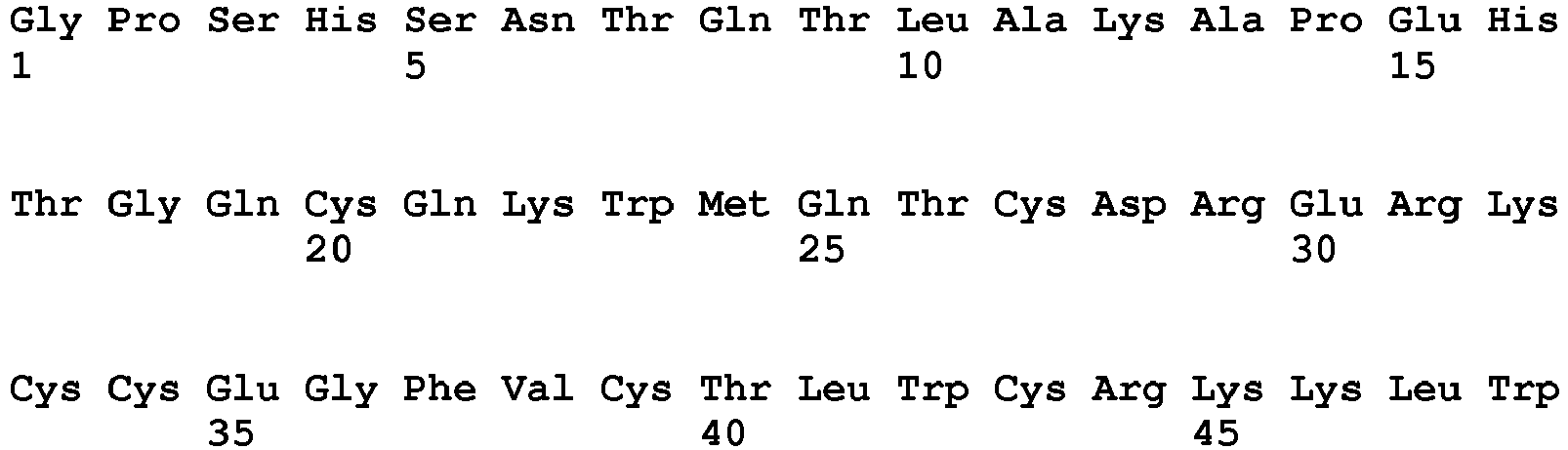
- <210> 331
<211> 32
<212> PRT
<213> Artificial sequence - <220>
<223> Variant NV1D3782 - <220>
<221> MOD_RES
<222> (32)..(32)
<223> -COOH - <400> 331


- <210> 332
<211> 37
<212> PRT
<213> Artificial sequence - <220>
<223> Variant NV1D3788 - <220>
<221> MOD_RES
<222> (37)..(37)
<223> -COOH - <400> 332

- <210> 333
<211> 37
<212> PRT
<213> Artificial sequence - <220>
<223> Variant NV1D3789 - <220>
<221> MOD_RES
<222> (37)..(37)
<223> -COOH - <400> 333

- <210> 334
<211> 37
<212> PRT
<213> Artificial sequence - <220>
<223> Variant NV1D3791 - <220>
<221> MOD_RES
<222> (37)..(37)
<223> -COOH - <400> 334

- <210> 335
<211> 37
<212> PRT
<213> Artificial sequence - <220>
<223> Variant NV1D3792 - <220>
<221> MOD_RES
<222> (37)..(37)
<223> -COOH - <400> 335

- <210> 336
<211> 74
<212> PRT
<213> Artificial sequence - <220>
<223> Variant NV1D3793 - <220>
<221> MOD_RES
<222> (74)..(74)
<223> -COOH - <400> 336

- <210> 337
<211> 72
<212> PRT
<213> Artificial sequence - <220>
<223> Variant NV1D3795 - <220>
<221> MOD_RES
<222> (72)..(72)
<223> -COOH - <400> 337

- <210> 338
<211> 62
<212> PRT
<213> Artificial sequence - <220>
<223> Variant NV1D3796 - <220>
<221> MOD_RES
<222> (62)..(62)
<223> -COOH - <400> 338

- <210> 339
<211> 72
<212> PRT
<213> Artificial sequence - <220>
<223> Variant NV1D3797 - <220>
<221> MOD_RES
<222> (72)..(72)
<223> -COOH - <400> 339
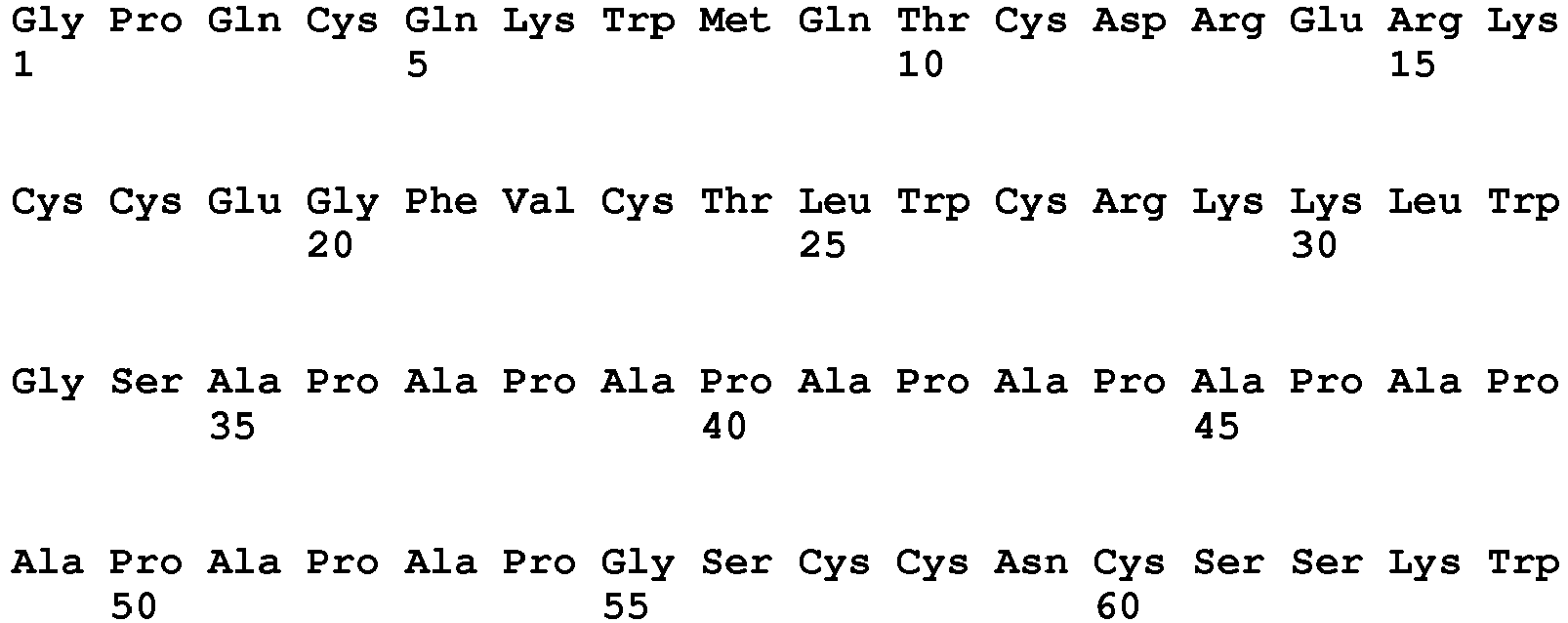

- <210> 340
<211> 74
<212> PRT
<213> Artificial sequence - <220>
<223> Variant NV1D3798 - <220>
<221> MOD_RES
<222> (74)..(74)
<223> -COOH - <400> 340

- <210> 341
<211> 62
<212> PRT
<213> Artificial sequence - <220>
<223> Variant NV1D3799 - <220>
<221> MOD_RES
<222> (62)..(62)
<223> -COOH - <400> 341


- <210> 342
<211> 64
<212> PRT
<213> Artificial sequence - <220>
<223> Variant NV1D3800 - <220>
<221> MOD_RES
<222> (64)..(64)
<223> -COOH - <400> 342

- <210> 343
<211> 49
<212> PRT
<213> Artificial sequence - <220>
<223> Variant NV1D3801 - <220>
<221> MOD_RES
<222> (49).. (49)
<223> -COOH - <400> 343


- <210> 344
<211> 44
<212> PRT
<213> Artificial sequence - <220>
<223> Variant NV1D3802 - <220>
<221> MOD_RES
<222> (44)..(44)
<223> -COOH - <400> 344

- <210> 345
<211> 39
<212> PRT
<213> Artificial sequence - <220>
<223> Variant NV1D3803 - <220>
<221> MOD_RES
<222> (39)..(39)
<223> -COOH - <400> 345


- <210> 346
<211> 49
<212> PRT
<213> Artificial sequence - <220>
<223> Variant NV1D3804 - <220>
<221> MOD_RES
<222> (49).. (49)
<223> -COOH - <400> 346

- <210> 347
<211> 44
<212> PRT
<213> Artificial sequence - <220>
<223> Variant NV1D3805 - <220>
<221> MOD_RES
<222> (44)..(44)
<223> -COOH - <400> 347

- <210> 348
<211> 39
<212> PRT
<213> Artificial sequence - <220>
<223> Variant NV1D3806 - <220>
<221> MOD_RES
<222> (39)..(39)
<223> -COOH - <400> 348

- <210> 349
<211> 44
<212> PRT
<213> Artificial sequence - <220>
<223> Variant NV1D3808 - <220>
<221> MOD_RES
<222> (44)..(44)
<223> -COOH - <400> 349

- <210> 350
<211> 39
<212> PRT
<213> Artificial sequence - <220>
<223> Variant NV1D3809 - <220>
<221> MOD_RES
<222> (39)..(39)
<223> -COOH - <400> 350

- <210> 351
<211> 58
<212> PRT
<213> Artificial sequence - <220>
<223> Variant NV1D3810 - <220>
<221> MOD_RES
<222> (58)..(58)
<223> -COOH - <400> 351

- <210> 352
<211> 53
<212> PRT
<213> Artificial sequence - <220>
<223> Variant NV1D3811 - <220>
<221> MOD_RES
<222> (53)..(53)
<223> -COOH - <400> 352

- <210> 353
<211> 48
<212> PRT
<213> Artificial sequence - <220>
<223> Variant NV1D3812 - <220>
<221> MOD_RES
<222> (48)..(48)
<223> -COOH - <400> 353

- <210> 354
<211> 53
<212> PRT
<213> Artificial sequence - <220>
<223> Variant NV1D3813 - <220>
<221> MOD_RES
<222> (53)..(53)
<223> -COOH - <400> 354

- <210> 355
<211> 48
<212> PRT
<213> Artificial sequence - <220>
<223> Variant NV1D3814 - <220>
<221> MOD_RES
<222> (48)..(48)
<223> -COOH - <400> 355

- <210> 356
<211> 43
<212> PRT
<213> Artificial sequence - <220>
<223> Variant NV1D3815 - <220>
<221> MOD_RES
<222> (43)..(43)
<223> -COOH - <400> 356

- <210> 357
<211> 43
<212> PRT
<213> Artificial sequence - <220>
<223> Variant NV1D3818 - <220>
<221> MOD_RES
<222> (43)..(43)
<223> -COOH - <400> 357

- <210> 358
<211> 42
<212> PRT
<213> Artificial sequence - <220>
<223> Variant NV1D3819 - <220>
<221> MOD_RES
<222> (42)..(42)
<223> -COOH - <400> 358


- <210> 359
<211> 107
<212> PRT
<213> Artificial sequence - <220>
<223> Variant NV1D3822 - <220>
<221> MOD_RES
<222> (107)..(107)
<223> -COOH - <400> 359

- <210> 360
<211> 107
<212> PRT
<213> Artificial sequence - <220>
<223> Variant NV1D3823 - <220>
<221> MOD_RES
<222> (107)..(107)
<223> -COOH - <400> 360

- <210> 361
<211> 107
<212> PRT
<213> Artificial sequence - <220>
<223> Variant NV1D3824 - <220>
<221> MOD_RES
<222> (107)..(107)
<223> -COOH - <400> 361


- <210> 362
<211> 107
<212> PRT
<213> Artificial sequence - <220>
<223> Variant NV1D3825 - <220>
<221> MOD_RES
<222> (107)..(107)
<223> -COOH - <400> 362

- <210> 363
<211> 107
<212> PRT
<213> Artificial sequence - <220>
<223> Variant NV1D3826 - <220>
<221> MOD_RES
<222> (107)..(107)
<223> -COOH - <400> 363

- <210> 364
<211> 84
<212> PRT
<213> Artificial sequence - <220>
<223> Variant NV1D3828 - <220>
<221> MOD_RES
<222> (84)..(84)
<223> -COOH - <400> 364


- <210> 365
<211> 82
<212> PRT
<213> Artificial sequence - <220>
<223> Variant NV1D3829 - <220>
<221> MOD_RES
<222> (82)..(82)
<223> -COOH - <400> 365

- <210> 366
<211> 84
<212> PRT
<213> Artificial sequence - <220>
<223> Variant NV1D3830 - <220>
<221> MOD_RES
<222> (84)..(84)
<223> -COOH - <400> 366

- <210> 367
<211> 61
<212> PRT
<213> Artificial sequence - <220>
<223> Variant NV1D3832 - <220>
<221> MOD_RES
<222> (61)..(61)
<223> -COOH - <400> 367

- <210> 368
<211> 51
<212> PRT
<213> Artificial sequence - <220>
<223> Variant NV1D3833 - <220>
<221> MOD_RES
<222> (51)..(51)
<223> -COOH - <400> 368

- <210> 369
<211> 46
<212> PRT
<213> Artificial sequence - <220>
<223> Variant NV1D3834 - <220>
<221> MOD_RES
<222> (46).. (46)
<223> -COOH - <400> 369

- <210> 370
<211> 41
<212> PRT
<213> Artificial sequence - <220>
<223> Variant NV1D3835 - <220>
<221> MOD_RES
<222> (41)..(41)
<223> -COOH - <400> 370

- <210> 371
<211> 46
<212> PRT
<213> Artificial sequence - <220>
<223> Variant NV1D3838 - <220>
<221> MOD_RES
<222> (46).. (46)
<223> -COOH - <400> 371

- <210> 372
<211> 7
<212> PRT
<213> Artificial sequence - <220>
<223> N-terminal extension - <400> 372

- <210> 373
<211> 7
<212> PRT
<213> Artificial sequence - <220>
<223> N-terminal extension - <400> 373

- <210> 374
<211> 6
<212> PRT
<213> Artificial sequence - <220>
<223> N-terminal extension - <400> 374

- <210> 375
<211> 18
<212> PRT
<213> Artificial sequence - <220>
<223> N-terminal extension - <400> 375

- <210> 376
<211> 9
<212> PRT
<213> Artificial sequence - <220>
<223> N-terminal extension - <400> 376

- <210> 377
<211> 9
<212> PRT
<213> Artificial sequence - <220>
<223> N-terminal extension - <400> 377

- <210> 378
<211> 9
<212> PRT
<213> Artificial sequence - <220>
<223> N-terminal extension - <400> 378

- <210> 379
<211> 11
<212> PRT
<213> Artificial sequence - <220>
<223> N-terminal extension - <400> 379

- <210> 380
<211> 18
<212> PRT
<213> Artificial sequence - <220>
<223> N-terminal extension - <400> 380

- <210> 381
<211> 18
<212> PRT
<213> Artificial sequence - <220>
<223> N-terminal extension - <400> 381

- <210> 382
<211> 37
<212> PRT
<213> Artificial sequence - <220>
<223> N-terminal extension - <400> 382

- <210> 383
<211> 10
<212> PRT
<213> Artificial sequence - <220>
<223> N-terminal extension - <400> 383

- <210> 384
<211> 13
<212> PRT
<213> Artificial sequence - <220>
<223> N-terminal extension - <400> 384

- <210> 385
<211> 13
<212> PRT
<213> Artificial sequence - <220>
<223> N-terminal extension - <400> 385

- <210> 386
<211> 9
<212> PRT
<213> Artificial sequence - <220>
<223> C-terminal extension - <400> 386

- <210> 387
<211> 11
<212> PRT
<213> Artificial sequence - <220>
<223> C-terminal extension - <400> 387

- <210> 388
<211> 7
<212> PRT
<213> Artificial sequence - <220>
<223> C-terminal extension - <400> 388

- <210> 389
<211> 16
<212> PRT
<213> Artificial sequence - <220>
<223> C-terminal extension - <400> 389

- <210> 390
<211> 11
<212> PRT
<213> Artificial sequence - <220>
<223> C-terminal extension - <400> 390

- <210> 391
<211> 16
<212> PRT
<213> Artificial sequence - <220>
<223> C-terminal extension - <400> 391

- <210> 392
<211> 5
<212> PRT
<213> Artificial sequence - <220>
<223> C-terminal extension - <400> 392

- <210> 393
<211> 5
<212> PRT
<213> Artificial sequence - <220>
<223> C-terminal extension - <400> 393

- <210> 394
<211> 7
<212> PRT
<213> Artificial sequence - <220>
<223> C-terminal extension - <400> 394

- <210> 395
<211> 16
<212> PRT
<213> Artificial sequence - <220>
<223> C-terminal extension - <400> 395

- <210> 396
<211> 7
<212> PRT
<213> Artificial sequence - <220>
<223> C-terminal extension - <400> 396

- <210> 397
<211> 37
<212> PRT
<213> Artificial sequence - <220>
<223> C-terminal extension - <400> 397


- <210> 398
<211> 14
<212> PRT
<213> Artificial sequence - <220>
<223> Linker - <400> 398

- <210> 399
<211> 24
<212> PRT
<213> Artificial sequence - <220>
<223> Linker - <400> 399

- <210> 400
<211> 40
<212> PRT
<213> Artificial sequence - <220>
<223> Linker - <400> 400

- <210> 401
<211> 34
<212> PRT
<213> Artificial sequence - <220>
<223> Linker - <400> 401

- <210> 402
<211> 20
<212> PRT
<213> Artificial sequence - <220>
<223> Linker - <400> 402

- <210> 403
<211> 32
<212> PRT
<213> Artificial sequence - <220>
<223> Genus protoxin-II sequence - <220>
<221> MISC_FEATURE
<222> (1)..(1)
<223> Xaa is Gly, Pro, Ala or deleted - <220>
<221> MISC_FEATURE
<222> (2)..(2)
<223> Xaa is Pro, Ala or deleted - <220>
<221> MISC_FEATURE
<222> (3)..(3)
<223> Xaa is Ser, Gln, Ala, Arg or Tyr - <220>
<221> MISC_FEATURE
<222> (5)..(5)
<223> Xaa is Gln, Arg, Lys, Ala or Ser - <220>
<221> MISC_FEATURE
<222> (6)..(6)
<223> Xaa is Lys, Ser, Gln or Arg - <220>
<221> MISC_FEATURE
<222> (8)..(8)
<223> Xaa is Met or Phe - <220>
<221> MISC_FEATURE
<222> (10)..(10)
<223> Xaa is Thr, Ser, Arg, Lys or Gln - <220>
<221> MISC_FEATURE
<222> (12)..(12)
<223> Xaa is Asp or Thr - <220>
<221> MISC_FEATURE
<222> (13)..(13)
<223> Xaa is Ser, Ala or Arg - <220>
<221> MISC_FEATURE
<222> (14)..(14)
<223> Xaa is Glu, Arg, Asn, Lys, Thr or Gln - <220>
<221> MISC_FEATURE
<222> (15)..(15)
<223> Xaa is Arg or Lys - <220>
<221> MISC_FEATURE
<222> (16)..(16)
<223> Xaa is Lys, Gln, Ser or Ala - <220>
<221> MISC_FEATURE
<222> (19)..(19)
<223> Xaa is Glu, Gln or Asp - <220>
<221> MISC_FEATURE
<222> (20)..(20)
<223> Xaa is Glu or Gln - <220>
<221> MISC_FEATURE
<222> (22)..(22)
<223> Xaa is Val or Ser - <220>
<221> MISC_FEATURE
<222> (24)..(24)
<223> Xaa is Arg or Thr - <220>
<221> MISC_FEATURE
<222> (28)..(28)
<223> Xaa is Lys or Arg - <400> 403

- <210> 404
<211> 32
<212> PRT
<213> Artificial sequence - <220>
<223> Protoxin-II genus 2 - <220>
<221> MISC_FEATURE
<222> (5)..(5)
<223> Xaa is Gln, Arg, Lys, Ala or Ser - <220>
<221> MISC_FEATURE
<222> (6)..(6)
<223> Xaa is Lys, Ser, Gln or Arg - <220>
<221> MISC_FEATURE
<222> (8)..(8)
<223> Xaa is Met or Phe - <220>
<221> MISC_FEATURE
<222> (10)..(10)
<223> Xaa is Thr, Ser, Arg, Lys or Gln - <220>
<221> MISC_FEATURE
<222> (12)..(12)
<223> Xaa is Asp or Thr - <220>
<221> MISC_FEATURE
<222> (13)..(13)
<223> Xaa is Ser, Ala or Arg - <220>
<221> MISC_FEATURE
<222> (14)..(14)
<223> Xaa is Glu, Arg, Asn, Lys, Thr or Gln - <220>
<221> MISC_FEATURE
<222> (15)..(15)
<223> Xaa is Arg or Lys - <220>
<221> MISC_FEATURE
<222> (16)..(16)
<223> Xaa is Lys, Gln, Ser or Ala - <220>
<221> MISC_FEATURE
<222> (19)..(19)
<223> Xaa is Glu, Gln or Asp - <220>
<221> MISC_FEATURE
<222> (20)..(20)
<223> Xaa is is Gly or Gln - <220>
<221> MISC_FEATURE
<222> (22)..(22)
<223> Xaa is Val or Ser - <220>
<221> MISC_FEATURE
<222> (24)..(24)
<223> Xaa is Arg or Thr - <220>
<221> MISC_FEATURE
<222> (28)..(28)
<223> Xaa is Lys or Arg - <400> 404

- <210> 405
<211> 32
<212> PRT
<213> Artificial sequence - <220>
<223> Protoxin-II genus 3 - <220>
<221> MISC_FEATURE
<222> (3)..(3)
<223> Xaa is Tyr, Gln, Ala, Ser or Arg - <220>
<221> MISC_FEATURE
<222> (10)..(10)
<223> Xaa is Thr or Ser - <220>
<221> MISC_FEATURE
<222> (13)..(13)
<223> Xaa is Ser, Arg or Ala - <220>
<221> MISC_FEATURE
<222> (14)..(14)
<223> Xaa is Glu, Thr or Asn - <220>
<221> MISC_FEATURE
<222> (19)..(19)
<223> Xaa is Glu or Gln - <220>
<221> MISC_FEATURE
<222> (22)..(22)
<223> Xaa is Val or Ser - <220>
<221> MISC_FEATURE
<222> (24)..(24)
<223> Xaa is Arg or Thr - <220>
<221> MISC_FEATURE
<222> (28)..(28)
<223> Xaa is Lys or Arg - <400> 405

- <210> 406
<211> 32
<212> PRT
<213> Artificial sequence - <220>
<223> Protoxin-II genus 4 - <220>
<221> MISC_FEATURE
<222> (10)..(10)
<223> Xaa is Thr or Ser - <220>
<221> MISC_FEATURE
<222> (13)..(13)
<223> Xaa is Ser, Arg or Ala - <220>
<221> MISC_FEATURE
<222> (14)..(14)
<223> Xaa is Glu, Thr or Asn - <220>
<221> MISC_FEATURE
<222> (19)..(19)
<223> Xaa is Glu or Gln - <220>
<221> MISC_FEATURE
<222> (22)..(22)
<223> Xaa is Val or Ser - <220>
<221> MISC_FEATURE
<222> (24)..(24)
<223> Xaa is Arg or Thr - <220>
<221> MISC_FEATURE
<222> (28)..(28)
<223> Xaa is Lys or Arg - <400> 406

- <210> 407
<211> 1980
<212> PRT
<213> Homo sapiens - <400> 407


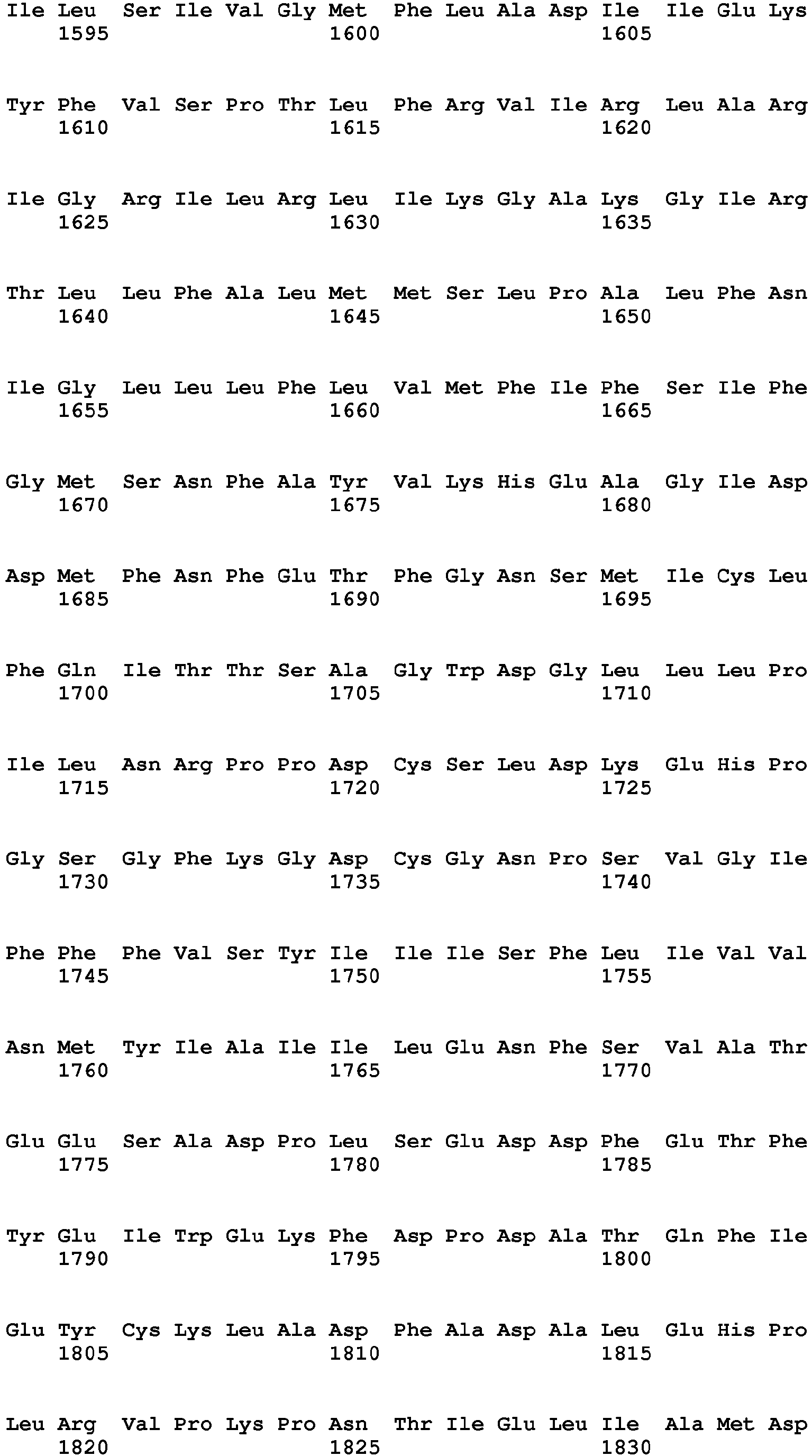

wherein the polypeptide inhibits human Nav1.7 activity with an IC50 value of about 1x10⁻⁷ M or less, wherein the IC50 value is measured using a FLIPR® Tetra membrane depolarization assay using fluorescence resonance energy transfer (FRET) in the presence of 25x10-6 M 3-veratroylveracevine in HEK293 cells stably expressing human Nav1.7. The disclosure also provides an isolated Protoxin-II variant comprising the amino acid sequence that is 90%, 91%, 92%, 93%, 94%, 95%, 96%, 97%, 98% or 99% identical to the amino acid sequence of SEQ ID NO: 78 (GPQCQKWMQTCDRERKCCEGFVCTLWCRKKLW-COOH), wherein
the amino acid sequence has Q at
the polypeptide inhibits human Nav1.7 activity with an IC50 value of about 30x10-9 M or less, wherein the IC50 value is measured using a FLIPR® Tetra membrane depolarization assay using fluorescence resonance energy transfer (FRET) in the presence of 25x10-6 M 3-veratroylveracevine in HEK293 cells stably expressing human Nav1.7; and
the polypeptide selectively inhibits Nav1.7.
wherein the polypeptide inhibits human Nav1.7 activity with an IC50 value of about 1x10⁻⁷ M or less, wherein the IC50 value is measured using a FLIPR® Tetra membrane depolarization assay using fluorescence resonance energy transfer (FRET) in the presence of 25x10-6 M 3-veratroylveracevine in HEK293 cells stably expressing human Nav1.7.
Claims (11)
- An isolated Protoxin-II variant comprising an amino acid sequence selected from the group consisting of SEQ ID Nos:
40, 44, 56, 59, 65, 78, 109, 110, 111, 114, 115, 116, 117, 118, 119, 121, 122, 123, 129, 131, 132, 133, 134, 135, 136, 138, 139, 140, 141, 142, 145, 146, 147, 149, 150, 151, 152, 153, 154, 156, 158, 159, 172, 173, 175, 177, 178, 183, 184, 185, 186, 189, 190, 193, 196, 197, 199, 205, 207, 210, 211, 216, 217, 224, 230, 269, 270, 271, 272, 273, 274, 275, 277, 278, 279, 280, 281, 282, 283, 284, 287, 288, 289, 290, 291, 292, 297, 298, 299, 301, 302, 304, 305, 307, 308, 309, 310, 312, 314, 315, 318, 319, 320, 321, 322, 323, 324, 325, and 326,
wherein the variant inhibits human Nav1.7 activity with an IC50 value of 30x10-9 M or less, wherein the IC50 value is measured using a FLIPR Tetra membrane depolarisation assay, the assay comprising fluorescence resonance energy transfer (FRET) in the presence of 25x10-6 M 3-veratroylveracevine in HEK293 cells stably expressing human Nav1.7 and using bis-1,3(diethylthiobarbituric acid)trimethine oxonol as an electron acceptor and trisodium 8-octadecyloxypyrene-1,3,6-trisulfonate as a donor by exciting the donor at 390- 420 nm and measuring FRET at 515-575 nm. - The isolated Protoxin-II variant of claim 1, wherein the variant selectively inhibits human Navl.7.
- The isolated Protoxin-II variant of claim 2, comprising an amino acid sequence selected from the group consisting of the sequence of SEQ ID NOs: 56, 78, 114, 129, 133, and 146.
- The isolated Protoxin-II variant of any of the claims 1, 2 or 3, having a free C-terminal carboxylic acid, amide, methylamide or butylamide group.
- A conjugate comprising the Protoxin-II variant of any of the claims 1-3 conjugated to a half-life extending moiety; wherein the conjugate is a fusion protein comprising the Protoxin-II variant and a human serum albumin (HSA), albumin binding domain (ABD), or a Fc polypeptide; or the conjugate comprises polyethylene glycol (PEG) chemically coupled to the Protoxin-II variant.
- An isolated polynucleotide encoding the Protoxin-II variant of any one of claims 1-3.
- A vector comprising the isolated polynucleotide of claim 6.
- A host cell comprising the vector of claim 7.
- A method of producing an isolated Protoxin-II variant, comprising culturing the host cell of claim 8 and recovering the Protoxin-II variant produced by the host cell.
- A pharmaceutical composition comprising the isolated Protoxin-II variant of any one of claims 1-4 or the conjugate of claim 5 and a pharmaceutically acceptable excipient.
- The Protoxin-II variant of any one of claims 1-4 or the pharmaceutical composition of claim 10 for use in treating Navl.7-mediated pain in a subject in need thereof; wherein optionally(a) pain is chronic pain, acute pain, neuropathic pain, nociceptive pain, visceral pain, back pain, post-operative pain, thermal pain, phantom limb pain, or pain associated with inflammatory conditions, primary erythemalgia (PE), paroxysmal extreme pain disorder (PEPD), osteoarthritis, rheumatoid arthritis, lumbar discectomy, pancreatitis, fibromyalgia, painful diabetic neuropathy (PDN), post-herpetic neuropathy (PHN), trigeminal neuralgia (TN), spinal cord injuries or multiple sclerosis; or(b) the Protoxin-II variant is administered peripherally; or(c) the Protoxin-II variant is administered locally to a joint, spinal cord, surgical wound, sites of injury or trauma, peripheral nerve fibers, urogenital organs, or inflamed tissues; or(d) the subject is a human.
Priority Applications (1)
| Application Number | Priority Date | Filing Date | Title |
|---|---|---|---|
| EP20197420.1A EP3825323A1 (en) | 2013-10-03 | 2014-10-03 | Protoxin-ii variants and methods of use |
Applications Claiming Priority (2)
| Application Number | Priority Date | Filing Date | Title |
|---|---|---|---|
| US201361886100P | 2013-10-03 | 2013-10-03 | |
| PCT/US2014/058972 WO2015051216A1 (en) | 2013-10-03 | 2014-10-03 | Protoxin-ii variants and methods of use |
Related Child Applications (2)
| Application Number | Title | Priority Date | Filing Date |
|---|---|---|---|
| EP20197420.1A Division-Into EP3825323A1 (en) | 2013-10-03 | 2014-10-03 | Protoxin-ii variants and methods of use |
| EP20197420.1A Division EP3825323A1 (en) | 2013-10-03 | 2014-10-03 | Protoxin-ii variants and methods of use |
Publications (2)
| Publication Number | Publication Date |
|---|---|
| EP3052519A1 EP3052519A1 (en) | 2016-08-10 |
| EP3052519B1 true EP3052519B1 (en) | 2020-11-25 |
Family
ID=51830620
Family Applications (2)
| Application Number | Title | Priority Date | Filing Date |
|---|---|---|---|
| EP14790422.1A Not-in-force EP3052519B1 (en) | 2013-10-03 | 2014-10-03 | Protoxin-ii variants and methods of use |
| EP20197420.1A Withdrawn EP3825323A1 (en) | 2013-10-03 | 2014-10-03 | Protoxin-ii variants and methods of use |
Family Applications After (1)
| Application Number | Title | Priority Date | Filing Date |
|---|---|---|---|
| EP20197420.1A Withdrawn EP3825323A1 (en) | 2013-10-03 | 2014-10-03 | Protoxin-ii variants and methods of use |
Country Status (12)
| Country | Link |
|---|---|
| US (2) | US9624280B2 (en) |
| EP (2) | EP3052519B1 (en) |
| JP (3) | JP6676523B2 (en) |
| KR (1) | KR20160064192A (en) |
| CN (1) | CN105793277B (en) |
| AU (1) | AU2014329454B2 (en) |
| BR (1) | BR112016007062A2 (en) |
| CA (1) | CA2926052A1 (en) |
| ES (1) | ES2841173T3 (en) |
| MX (1) | MX2016004282A (en) |
| PH (1) | PH12016500598A1 (en) |
| WO (1) | WO2015051216A1 (en) |
Families Citing this family (10)
| Publication number | Priority date | Publication date | Assignee | Title |
|---|---|---|---|---|
| US10414808B2 (en) | 2012-05-18 | 2019-09-17 | Janssen Biotech, Inc. | Huwentoxin-IV variants and methods of use |
| ES2841173T3 (en) | 2013-10-03 | 2021-07-07 | Janssen Biotech Inc | Protoxin-II variants and methods of use |
| MA41642A (en) * | 2015-03-03 | 2018-01-09 | Janssen Biotech Inc | PROTOXIN II VARIANTS AND METHODS OF USE |
| TW201708249A (en) | 2015-04-02 | 2017-03-01 | 健生生物科技公司 | Protoxin-II variants and methods of use |
| US11459587B2 (en) * | 2016-07-06 | 2022-10-04 | Vertex Pharmaceuticals Incorporated | Materials and methods for treatment of pain related disorders |
| CA3029132A1 (en) | 2016-07-06 | 2018-01-11 | Vertex Pharmaceuticals Incorporated | Materials and methods for treatment of pain related disorders |
| WO2018132768A1 (en) * | 2017-01-13 | 2018-07-19 | Sanna Pietro P | Methods and compositions for treating hpa hyperactivity |
| CA3206936A1 (en) * | 2021-02-01 | 2022-08-04 | Fernando ALEMAN GUILLEN | Epigenetic gene regulation to treat neurological diseases and pain |
| WO2024011119A2 (en) * | 2022-07-06 | 2024-01-11 | The Regents Of The University Of California | Peptides targeting sodium channels to treat pain |
| WO2025201571A1 (en) * | 2024-03-26 | 2025-10-02 | 广州锡滔生物医药科技有限公司 | Polypeptide and use thereof |
Family Cites Families (32)
| Publication number | Priority date | Publication date | Assignee | Title |
|---|---|---|---|---|
| US4309989A (en) | 1976-02-09 | 1982-01-12 | The Curators Of The University Of Missouri | Topical application of medication by ultrasound with coupling agent |
| US4767402A (en) | 1986-07-08 | 1988-08-30 | Massachusetts Institute Of Technology | Ultrasound enhancement of transdermal drug delivery |
| HUP0001272A3 (en) | 1997-04-16 | 2012-12-28 | Unigene Lab Inc | Direct expression of peptides into culture media |
| IL120943A (en) | 1997-05-29 | 2004-03-28 | Univ Ben Gurion | Transdermal delivery system |
| EP1538206B1 (en) | 1997-09-16 | 2010-03-24 | Centocor, Inc. | Method for the complete chemical synthesis and assembly of genes and genomes |
| US6670127B2 (en) | 1997-09-16 | 2003-12-30 | Egea Biosciences, Inc. | Method for assembly of a polynucleotide encoding a target polypeptide |
| US20030148273A1 (en) | 2000-08-26 | 2003-08-07 | Shoulian Dong | Target enrichment and amplification |
| EP1348466A3 (en) | 2002-02-01 | 2003-10-29 | Inspire Pharmaceuticals, Inc. | Method for treating pain with adenosine-tetraphosphates |
| US7659082B2 (en) | 2002-02-19 | 2010-02-09 | Xenon Pharmaceuticals Inc. | Methods for identifying analgesic agents |
| US7833979B2 (en) | 2005-04-22 | 2010-11-16 | Amgen Inc. | Toxin peptide therapeutic agents |
| WO2007056326A2 (en) | 2005-11-04 | 2007-05-18 | Alnylam Pharmaceuticals, Inc. | Compositions and methods for inhibiting expression of nav1.8 gene |
| WO2007109324A2 (en) | 2006-03-21 | 2007-09-27 | Xenon Pharmaceuticals, Inc. | Potent and selective nav 1.7 sodium channel blockers |
| MX2009002504A (en) | 2006-09-08 | 2009-05-22 | Mayo Foundation | Aquaretic and natriuretic polypeptides lacking vasodilatory activity. |
| WO2008033564A1 (en) | 2006-09-15 | 2008-03-20 | Hydra Biosciences Inc. | Compounds for modulating trpv3 function |
| AR063384A1 (en) | 2006-10-25 | 2009-01-28 | Amgen Inc | THERAPEUTIC AGENTS BASED ON PEPTIDES DERIVED FROM TOXINS |
| CN102202677A (en) | 2008-09-03 | 2011-09-28 | 阿尔伯维塔公司 | Agents and methods for treatment of pain |
| WO2010104115A1 (en) | 2009-03-10 | 2010-09-16 | 独立行政法人産業技術総合研究所 | Method for preparing polypeptide specifically recognizing membrane protein |
| SG179101A1 (en) | 2009-09-15 | 2012-05-30 | Alomone Preclinical Ltd | Novel peptides isolated from spider venom, and uses thereof |
| JP5795341B2 (en) | 2010-03-08 | 2015-10-14 | デイナ ファーバー キャンサー インスティチュート,インコーポレイテッド | FullCOLD-PCR enrichment with reference block sequence |
| US9279003B2 (en) | 2010-07-07 | 2016-03-08 | Purdue Pharma L.P. | Analogs of sodium channel peptide toxin |
| CN101979411A (en) | 2010-10-21 | 2011-02-23 | 湖南师范大学 | Huwen tarantula protease inhibitor |
| JP2014507136A (en) | 2011-01-18 | 2014-03-27 | アムジエン・インコーポレーテツド | NaV1.7 knockout mice and their use |
| EP2705162B1 (en) | 2011-05-04 | 2018-07-11 | Biocept, Inc. | Methods for detecting nucleic acid sequence variants |
| US9102751B2 (en) | 2012-05-18 | 2015-08-11 | Janssen Biotech, Inc. | Huwentoxin-IV variants and methods of use |
| EP3973981A1 (en) | 2012-05-18 | 2022-03-30 | Janssen Biotech, Inc. | Huwentoxin-iv variants and methods of use |
| US10414808B2 (en) | 2012-05-18 | 2019-09-17 | Janssen Biotech, Inc. | Huwentoxin-IV variants and methods of use |
| US9718865B2 (en) | 2012-07-27 | 2017-08-01 | Purdue Pharma L.P. | Sodium channel blocking peptides and the use thereof |
| WO2014165277A2 (en) | 2013-03-12 | 2014-10-09 | Amgen Inc. | POTENT AND SELECTIVE INHIBITORS OF Nav1.7 |
| CN104065367B (en) | 2013-03-20 | 2017-11-07 | 江苏多维科技有限公司 | A kind of low-watt consumption magnetic resistance switch sensor |
| ES2841173T3 (en) | 2013-10-03 | 2021-07-07 | Janssen Biotech Inc | Protoxin-II variants and methods of use |
| MA41642A (en) | 2015-03-03 | 2018-01-09 | Janssen Biotech Inc | PROTOXIN II VARIANTS AND METHODS OF USE |
| TW201708249A (en) | 2015-04-02 | 2017-03-01 | 健生生物科技公司 | Protoxin-II variants and methods of use |
-
2014
- 2014-10-03 ES ES14790422T patent/ES2841173T3/en active Active
- 2014-10-03 EP EP14790422.1A patent/EP3052519B1/en not_active Not-in-force
- 2014-10-03 WO PCT/US2014/058972 patent/WO2015051216A1/en not_active Ceased
- 2014-10-03 US US14/505,592 patent/US9624280B2/en not_active Expired - Fee Related
- 2014-10-03 MX MX2016004282A patent/MX2016004282A/en unknown
- 2014-10-03 KR KR1020167011256A patent/KR20160064192A/en not_active Ceased
- 2014-10-03 AU AU2014329454A patent/AU2014329454B2/en not_active Ceased
- 2014-10-03 EP EP20197420.1A patent/EP3825323A1/en not_active Withdrawn
- 2014-10-03 CA CA2926052A patent/CA2926052A1/en not_active Abandoned
- 2014-10-03 CN CN201480066344.0A patent/CN105793277B/en not_active Expired - Fee Related
- 2014-10-03 BR BR112016007062A patent/BR112016007062A2/en not_active Application Discontinuation
- 2014-10-03 JP JP2016519872A patent/JP6676523B2/en not_active Expired - Fee Related
-
2016
- 2016-04-01 PH PH12016500598A patent/PH12016500598A1/en unknown
-
2017
- 2017-04-17 US US15/489,714 patent/US10975129B2/en not_active Expired - Fee Related
-
2020
- 2020-01-30 JP JP2020013560A patent/JP6940636B2/en not_active Expired - Fee Related
-
2021
- 2021-09-02 JP JP2021142979A patent/JP2022008319A/en not_active Withdrawn
Non-Patent Citations (1)
| Title |
|---|
| None * |
Also Published As
| Publication number | Publication date |
|---|---|
| US20150099705A1 (en) | 2015-04-09 |
| JP2020096606A (en) | 2020-06-25 |
| MX2016004282A (en) | 2016-10-12 |
| JP2022008319A (en) | 2022-01-13 |
| CA2926052A1 (en) | 2015-04-09 |
| US9624280B2 (en) | 2017-04-18 |
| CN105793277A (en) | 2016-07-20 |
| PH12016500598A1 (en) | 2016-06-13 |
| BR112016007062A2 (en) | 2017-09-12 |
| WO2015051216A1 (en) | 2015-04-09 |
| AU2014329454A1 (en) | 2016-04-21 |
| US10975129B2 (en) | 2021-04-13 |
| HK1224307A1 (en) | 2017-08-18 |
| JP6676523B2 (en) | 2020-04-08 |
| US20200048316A1 (en) | 2020-02-13 |
| ES2841173T3 (en) | 2021-07-07 |
| KR20160064192A (en) | 2016-06-07 |
| AU2014329454B2 (en) | 2019-01-17 |
| CN105793277B (en) | 2020-09-15 |
| EP3825323A1 (en) | 2021-05-26 |
| JP6940636B2 (en) | 2021-09-29 |
| EP3052519A1 (en) | 2016-08-10 |
| JP2016533710A (en) | 2016-11-04 |
Similar Documents
| Publication | Publication Date | Title |
|---|---|---|
| US10975129B2 (en) | Protoxin-II variants and methods of use | |
| US20210363204A1 (en) | Protoxin-ii variants and methods of use | |
| US11083776B2 (en) | Protoxin-II variants and methods of use | |
| HK1226746B (en) | Protoxin-ii variants and methods of use | |
| HK1226746A1 (en) | Protoxin-ii variants and methods of use | |
| HK1250476B (en) | Protoxin-ii variants and methods of use | |
| HK1224307B (en) | Protoxin-ii variants and methods of use |
Legal Events
| Date | Code | Title | Description |
|---|---|---|---|
| PUAI | Public reference made under article 153(3) epc to a published international application that has entered the european phase |
Free format text: ORIGINAL CODE: 0009012 |
|
| 17P | Request for examination filed |
Effective date: 20160503 |
|
| AK | Designated contracting states |
Kind code of ref document: A1 Designated state(s): AL AT BE BG CH CY CZ DE DK EE ES FI FR GB GR HR HU IE IS IT LI LT LU LV MC MK MT NL NO PL PT RO RS SE SI SK SM TR |
|
| AX | Request for extension of the european patent |
Extension state: BA ME |
|
| DAX | Request for extension of the european patent (deleted) | ||
| STAA | Information on the status of an ep patent application or granted ep patent |
Free format text: STATUS: EXAMINATION IS IN PROGRESS |
|
| 17Q | First examination report despatched |
Effective date: 20170504 |
|
| REG | Reference to a national code |
Ref country code: HK Ref legal event code: DE Ref document number: 1226746 Country of ref document: HK |
|
| GRAP | Despatch of communication of intention to grant a patent |
Free format text: ORIGINAL CODE: EPIDOSNIGR1 |
|
| STAA | Information on the status of an ep patent application or granted ep patent |
Free format text: STATUS: GRANT OF PATENT IS INTENDED |
|
| INTG | Intention to grant announced |
Effective date: 20191202 |
|
| GRAJ | Information related to disapproval of communication of intention to grant by the applicant or resumption of examination proceedings by the epo deleted |
Free format text: ORIGINAL CODE: EPIDOSDIGR1 |
|
| STAA | Information on the status of an ep patent application or granted ep patent |
Free format text: STATUS: EXAMINATION IS IN PROGRESS |
|
| GRAP | Despatch of communication of intention to grant a patent |
Free format text: ORIGINAL CODE: EPIDOSNIGR1 |
|
| STAA | Information on the status of an ep patent application or granted ep patent |
Free format text: STATUS: GRANT OF PATENT IS INTENDED |
|
| INTG | Intention to grant announced |
Effective date: 20200424 |
|
| GRAS | Grant fee paid |
Free format text: ORIGINAL CODE: EPIDOSNIGR3 |
|
| GRAA | (expected) grant |
Free format text: ORIGINAL CODE: 0009210 |
|
| STAA | Information on the status of an ep patent application or granted ep patent |
Free format text: STATUS: THE PATENT HAS BEEN GRANTED |
|
| AK | Designated contracting states |
Kind code of ref document: B1 Designated state(s): AL AT BE BG CH CY CZ DE DK EE ES FI FR GB GR HR HU IE IS IT LI LT LU LV MC MK MT NL NO PL PT RO RS SE SI SK SM TR |
|
| REG | Reference to a national code |
Ref country code: GB Ref legal event code: FG4D |
|
| REG | Reference to a national code |
Ref country code: CH Ref legal event code: EP Ref country code: CH Ref legal event code: NV Representative=s name: E. BLUM AND CO. AG PATENT- UND MARKENANWAELTE , CH |
|
| REG | Reference to a national code |
Ref country code: AT Ref legal event code: REF Ref document number: 1338185 Country of ref document: AT Kind code of ref document: T Effective date: 20201215 |
|
| REG | Reference to a national code |
Ref country code: DE Ref legal event code: R096 Ref document number: 602014072718 Country of ref document: DE |
|
| REG | Reference to a national code |
Ref country code: IE Ref legal event code: FG4D |
|
| REG | Reference to a national code |
Ref country code: NL Ref legal event code: FP |
|
| REG | Reference to a national code |
Ref country code: AT Ref legal event code: MK05 Ref document number: 1338185 Country of ref document: AT Kind code of ref document: T Effective date: 20201125 |
|
| PG25 | Lapsed in a contracting state [announced via postgrant information from national office to epo] |
Ref country code: PT Free format text: LAPSE BECAUSE OF FAILURE TO SUBMIT A TRANSLATION OF THE DESCRIPTION OR TO PAY THE FEE WITHIN THE PRESCRIBED TIME-LIMIT Effective date: 20210325 Ref country code: NO Free format text: LAPSE BECAUSE OF FAILURE TO SUBMIT A TRANSLATION OF THE DESCRIPTION OR TO PAY THE FEE WITHIN THE PRESCRIBED TIME-LIMIT Effective date: 20210225 Ref country code: FI Free format text: LAPSE BECAUSE OF FAILURE TO SUBMIT A TRANSLATION OF THE DESCRIPTION OR TO PAY THE FEE WITHIN THE PRESCRIBED TIME-LIMIT Effective date: 20201125 Ref country code: RS Free format text: LAPSE BECAUSE OF FAILURE TO SUBMIT A TRANSLATION OF THE DESCRIPTION OR TO PAY THE FEE WITHIN THE PRESCRIBED TIME-LIMIT Effective date: 20201125 Ref country code: GR Free format text: LAPSE BECAUSE OF FAILURE TO SUBMIT A TRANSLATION OF THE DESCRIPTION OR TO PAY THE FEE WITHIN THE PRESCRIBED TIME-LIMIT Effective date: 20210226 |
|
| PG25 | Lapsed in a contracting state [announced via postgrant information from national office to epo] |
Ref country code: BG Free format text: LAPSE BECAUSE OF FAILURE TO SUBMIT A TRANSLATION OF THE DESCRIPTION OR TO PAY THE FEE WITHIN THE PRESCRIBED TIME-LIMIT Effective date: 20210225 Ref country code: AT Free format text: LAPSE BECAUSE OF FAILURE TO SUBMIT A TRANSLATION OF THE DESCRIPTION OR TO PAY THE FEE WITHIN THE PRESCRIBED TIME-LIMIT Effective date: 20201125 Ref country code: SE Free format text: LAPSE BECAUSE OF FAILURE TO SUBMIT A TRANSLATION OF THE DESCRIPTION OR TO PAY THE FEE WITHIN THE PRESCRIBED TIME-LIMIT Effective date: 20201125 Ref country code: PL Free format text: LAPSE BECAUSE OF FAILURE TO SUBMIT A TRANSLATION OF THE DESCRIPTION OR TO PAY THE FEE WITHIN THE PRESCRIBED TIME-LIMIT Effective date: 20201125 Ref country code: LV Free format text: LAPSE BECAUSE OF FAILURE TO SUBMIT A TRANSLATION OF THE DESCRIPTION OR TO PAY THE FEE WITHIN THE PRESCRIBED TIME-LIMIT Effective date: 20201125 Ref country code: IS Free format text: LAPSE BECAUSE OF FAILURE TO SUBMIT A TRANSLATION OF THE DESCRIPTION OR TO PAY THE FEE WITHIN THE PRESCRIBED TIME-LIMIT Effective date: 20210325 |
|
| REG | Reference to a national code |
Ref country code: LT Ref legal event code: MG9D |
|
| PG25 | Lapsed in a contracting state [announced via postgrant information from national office to epo] |
Ref country code: HR Free format text: LAPSE BECAUSE OF FAILURE TO SUBMIT A TRANSLATION OF THE DESCRIPTION OR TO PAY THE FEE WITHIN THE PRESCRIBED TIME-LIMIT Effective date: 20201125 |
|
| REG | Reference to a national code |
Ref country code: ES Ref legal event code: FG2A Ref document number: 2841173 Country of ref document: ES Kind code of ref document: T3 Effective date: 20210707 |
|
| PG25 | Lapsed in a contracting state [announced via postgrant information from national office to epo] |
Ref country code: EE Free format text: LAPSE BECAUSE OF FAILURE TO SUBMIT A TRANSLATION OF THE DESCRIPTION OR TO PAY THE FEE WITHIN THE PRESCRIBED TIME-LIMIT Effective date: 20201125 Ref country code: CZ Free format text: LAPSE BECAUSE OF FAILURE TO SUBMIT A TRANSLATION OF THE DESCRIPTION OR TO PAY THE FEE WITHIN THE PRESCRIBED TIME-LIMIT Effective date: 20201125 Ref country code: SM Free format text: LAPSE BECAUSE OF FAILURE TO SUBMIT A TRANSLATION OF THE DESCRIPTION OR TO PAY THE FEE WITHIN THE PRESCRIBED TIME-LIMIT Effective date: 20201125 Ref country code: LT Free format text: LAPSE BECAUSE OF FAILURE TO SUBMIT A TRANSLATION OF THE DESCRIPTION OR TO PAY THE FEE WITHIN THE PRESCRIBED TIME-LIMIT Effective date: 20201125 Ref country code: RO Free format text: LAPSE BECAUSE OF FAILURE TO SUBMIT A TRANSLATION OF THE DESCRIPTION OR TO PAY THE FEE WITHIN THE PRESCRIBED TIME-LIMIT Effective date: 20201125 Ref country code: SK Free format text: LAPSE BECAUSE OF FAILURE TO SUBMIT A TRANSLATION OF THE DESCRIPTION OR TO PAY THE FEE WITHIN THE PRESCRIBED TIME-LIMIT Effective date: 20201125 |
|
| REG | Reference to a national code |
Ref country code: DE Ref legal event code: R097 Ref document number: 602014072718 Country of ref document: DE |
|
| PG25 | Lapsed in a contracting state [announced via postgrant information from national office to epo] |
Ref country code: DK Free format text: LAPSE BECAUSE OF FAILURE TO SUBMIT A TRANSLATION OF THE DESCRIPTION OR TO PAY THE FEE WITHIN THE PRESCRIBED TIME-LIMIT Effective date: 20201125 |
|
| PLBE | No opposition filed within time limit |
Free format text: ORIGINAL CODE: 0009261 |
|
| STAA | Information on the status of an ep patent application or granted ep patent |
Free format text: STATUS: NO OPPOSITION FILED WITHIN TIME LIMIT |
|
| PG25 | Lapsed in a contracting state [announced via postgrant information from national office to epo] |
Ref country code: AL Free format text: LAPSE BECAUSE OF FAILURE TO SUBMIT A TRANSLATION OF THE DESCRIPTION OR TO PAY THE FEE WITHIN THE PRESCRIBED TIME-LIMIT Effective date: 20201125 |
|
| PGFP | Annual fee paid to national office [announced via postgrant information from national office to epo] |
Ref country code: NL Payment date: 20210915 Year of fee payment: 8 Ref country code: IT Payment date: 20210910 Year of fee payment: 8 Ref country code: IE Payment date: 20210923 Year of fee payment: 8 Ref country code: CH Payment date: 20210928 Year of fee payment: 8 Ref country code: FR Payment date: 20210913 Year of fee payment: 8 |
|
| 26N | No opposition filed |
Effective date: 20210826 |
|
| PG25 | Lapsed in a contracting state [announced via postgrant information from national office to epo] |
Ref country code: SI Free format text: LAPSE BECAUSE OF FAILURE TO SUBMIT A TRANSLATION OF THE DESCRIPTION OR TO PAY THE FEE WITHIN THE PRESCRIBED TIME-LIMIT Effective date: 20201125 |
|
| PGFP | Annual fee paid to national office [announced via postgrant information from national office to epo] |
Ref country code: BE Payment date: 20210916 Year of fee payment: 8 Ref country code: GB Payment date: 20210831 Year of fee payment: 8 |
|
| PGFP | Annual fee paid to national office [announced via postgrant information from national office to epo] |
Ref country code: ES Payment date: 20211110 Year of fee payment: 8 |
|
| PG25 | Lapsed in a contracting state [announced via postgrant information from national office to epo] |
Ref country code: IS Free format text: LAPSE BECAUSE OF FAILURE TO SUBMIT A TRANSLATION OF THE DESCRIPTION OR TO PAY THE FEE WITHIN THE PRESCRIBED TIME-LIMIT Effective date: 20210325 |
|
| PG25 | Lapsed in a contracting state [announced via postgrant information from national office to epo] |
Ref country code: MC Free format text: LAPSE BECAUSE OF FAILURE TO SUBMIT A TRANSLATION OF THE DESCRIPTION OR TO PAY THE FEE WITHIN THE PRESCRIBED TIME-LIMIT Effective date: 20201125 |
|
| PG25 | Lapsed in a contracting state [announced via postgrant information from national office to epo] |
Ref country code: LU Free format text: LAPSE BECAUSE OF NON-PAYMENT OF DUE FEES Effective date: 20211003 |
|
| PGFP | Annual fee paid to national office [announced via postgrant information from national office to epo] |
Ref country code: DE Payment date: 20220621 Year of fee payment: 9 |
|
| PG25 | Lapsed in a contracting state [announced via postgrant information from national office to epo] |
Ref country code: HU Free format text: LAPSE BECAUSE OF FAILURE TO SUBMIT A TRANSLATION OF THE DESCRIPTION OR TO PAY THE FEE WITHIN THE PRESCRIBED TIME-LIMIT; INVALID AB INITIO Effective date: 20141003 |
|
| REG | Reference to a national code |
Ref country code: CH Ref legal event code: PL |
|
| REG | Reference to a national code |
Ref country code: NL Ref legal event code: MM Effective date: 20221101 |
|
| REG | Reference to a national code |
Ref country code: BE Ref legal event code: MM Effective date: 20221031 |
|
| GBPC | Gb: european patent ceased through non-payment of renewal fee |
Effective date: 20221003 |
|
| PG25 | Lapsed in a contracting state [announced via postgrant information from national office to epo] |
Ref country code: CY Free format text: LAPSE BECAUSE OF FAILURE TO SUBMIT A TRANSLATION OF THE DESCRIPTION OR TO PAY THE FEE WITHIN THE PRESCRIBED TIME-LIMIT Effective date: 20201125 |
|
| PG25 | Lapsed in a contracting state [announced via postgrant information from national office to epo] |
Ref country code: NL Free format text: LAPSE BECAUSE OF NON-PAYMENT OF DUE FEES Effective date: 20221101 Ref country code: LI Free format text: LAPSE BECAUSE OF NON-PAYMENT OF DUE FEES Effective date: 20221031 Ref country code: FR Free format text: LAPSE BECAUSE OF NON-PAYMENT OF DUE FEES Effective date: 20221031 Ref country code: CH Free format text: LAPSE BECAUSE OF NON-PAYMENT OF DUE FEES Effective date: 20221031 |
|
| PG25 | Lapsed in a contracting state [announced via postgrant information from national office to epo] |
Ref country code: BE Free format text: LAPSE BECAUSE OF NON-PAYMENT OF DUE FEES Effective date: 20221031 |
|
| PG25 | Lapsed in a contracting state [announced via postgrant information from national office to epo] |
Ref country code: IT Free format text: LAPSE BECAUSE OF NON-PAYMENT OF DUE FEES Effective date: 20221003 Ref country code: IE Free format text: LAPSE BECAUSE OF NON-PAYMENT OF DUE FEES Effective date: 20221003 Ref country code: GB Free format text: LAPSE BECAUSE OF NON-PAYMENT OF DUE FEES Effective date: 20221003 |
|
| REG | Reference to a national code |
Ref country code: ES Ref legal event code: FD2A Effective date: 20231124 |
|
| PG25 | Lapsed in a contracting state [announced via postgrant information from national office to epo] |
Ref country code: ES Free format text: LAPSE BECAUSE OF NON-PAYMENT OF DUE FEES Effective date: 20221004 |
|
| PG25 | Lapsed in a contracting state [announced via postgrant information from national office to epo] |
Ref country code: ES Free format text: LAPSE BECAUSE OF NON-PAYMENT OF DUE FEES Effective date: 20221004 |
|
| PG25 | Lapsed in a contracting state [announced via postgrant information from national office to epo] |
Ref country code: MK Free format text: LAPSE BECAUSE OF FAILURE TO SUBMIT A TRANSLATION OF THE DESCRIPTION OR TO PAY THE FEE WITHIN THE PRESCRIBED TIME-LIMIT Effective date: 20201125 |
|
| REG | Reference to a national code |
Ref country code: DE Ref legal event code: R119 Ref document number: 602014072718 Country of ref document: DE |
|
| PG25 | Lapsed in a contracting state [announced via postgrant information from national office to epo] |
Ref country code: TR Free format text: LAPSE BECAUSE OF FAILURE TO SUBMIT A TRANSLATION OF THE DESCRIPTION OR TO PAY THE FEE WITHIN THE PRESCRIBED TIME-LIMIT Effective date: 20201125 |
|
| PG25 | Lapsed in a contracting state [announced via postgrant information from national office to epo] |
Ref country code: DE Free format text: LAPSE BECAUSE OF NON-PAYMENT OF DUE FEES Effective date: 20240501 |
|
| PG25 | Lapsed in a contracting state [announced via postgrant information from national office to epo] |
Ref country code: MT Free format text: LAPSE BECAUSE OF FAILURE TO SUBMIT A TRANSLATION OF THE DESCRIPTION OR TO PAY THE FEE WITHIN THE PRESCRIBED TIME-LIMIT Effective date: 20201125 |