EP3051017B1 - Method of controlling washing machine - Google Patents
Method of controlling washing machine Download PDFInfo
- Publication number
- EP3051017B1 EP3051017B1 EP16153331.0A EP16153331A EP3051017B1 EP 3051017 B1 EP3051017 B1 EP 3051017B1 EP 16153331 A EP16153331 A EP 16153331A EP 3051017 B1 EP3051017 B1 EP 3051017B1
- Authority
- EP
- European Patent Office
- Prior art keywords
- unbalance
- clothes
- washing
- water
- drum
- Prior art date
- Legal status (The legal status is an assumption and is not a legal conclusion. Google has not performed a legal analysis and makes no representation as to the accuracy of the status listed.)
- Active
Links
- 238000005406 washing Methods 0.000 title claims description 147
- 238000000034 method Methods 0.000 title claims description 43
- XLYOFNOQVPJJNP-UHFFFAOYSA-N water Substances O XLYOFNOQVPJJNP-UHFFFAOYSA-N 0.000 claims description 153
- 239000006185 dispersion Substances 0.000 claims description 42
- 230000018044 dehydration Effects 0.000 claims description 21
- 238000006297 dehydration reaction Methods 0.000 claims description 21
- 230000001939 inductive effect Effects 0.000 claims description 21
- 230000008569 process Effects 0.000 claims description 12
- 230000001133 acceleration Effects 0.000 claims description 11
- 238000007599 discharging Methods 0.000 claims description 7
- 238000001514 detection method Methods 0.000 claims description 6
- 239000003599 detergent Substances 0.000 description 6
- 230000008901 benefit Effects 0.000 description 5
- 230000000694 effects Effects 0.000 description 5
- 230000001965 increasing effect Effects 0.000 description 4
- 230000004048 modification Effects 0.000 description 3
- 238000012986 modification Methods 0.000 description 3
- 238000010586 diagram Methods 0.000 description 2
- 238000005516 engineering process Methods 0.000 description 2
- 239000000725 suspension Substances 0.000 description 2
- 230000009471 action Effects 0.000 description 1
- 239000000356 contaminant Substances 0.000 description 1
- 238000013016 damping Methods 0.000 description 1
- 230000003247 decreasing effect Effects 0.000 description 1
- 239000003344 environmental pollutant Substances 0.000 description 1
- 230000003993 interaction Effects 0.000 description 1
- 230000001151 other effect Effects 0.000 description 1
- 231100000719 pollutant Toxicity 0.000 description 1
- 230000004044 response Effects 0.000 description 1
- 230000000630 rising effect Effects 0.000 description 1
- 230000035939 shock Effects 0.000 description 1
- 239000004094 surface-active agent Substances 0.000 description 1
Images


Classifications
-
- D—TEXTILES; PAPER
- D06—TREATMENT OF TEXTILES OR THE LIKE; LAUNDERING; FLEXIBLE MATERIALS NOT OTHERWISE PROVIDED FOR
- D06F—LAUNDERING, DRYING, IRONING, PRESSING OR FOLDING TEXTILE ARTICLES
- D06F33/00—Control of operations performed in washing machines or washer-dryers
- D06F33/30—Control of washing machines characterised by the purpose or target of the control
- D06F33/48—Preventing or reducing imbalance or noise
-
- D—TEXTILES; PAPER
- D06—TREATMENT OF TEXTILES OR THE LIKE; LAUNDERING; FLEXIBLE MATERIALS NOT OTHERWISE PROVIDED FOR
- D06F—LAUNDERING, DRYING, IRONING, PRESSING OR FOLDING TEXTILE ARTICLES
- D06F29/00—Combinations of a washing machine with other separate apparatus in a common frame or the like, e.g. with rinsing apparatus
- D06F29/02—Combinations of a washing machine with other separate apparatus in a common frame or the like, e.g. with rinsing apparatus with liquid-extracting apparatus
-
- D—TEXTILES; PAPER
- D06—TREATMENT OF TEXTILES OR THE LIKE; LAUNDERING; FLEXIBLE MATERIALS NOT OTHERWISE PROVIDED FOR
- D06F—LAUNDERING, DRYING, IRONING, PRESSING OR FOLDING TEXTILE ARTICLES
- D06F33/00—Control of operations performed in washing machines or washer-dryers
- D06F33/30—Control of washing machines characterised by the purpose or target of the control
- D06F33/32—Control of operational steps, e.g. optimisation or improvement of operational steps depending on the condition of the laundry
- D06F33/34—Control of operational steps, e.g. optimisation or improvement of operational steps depending on the condition of the laundry of water filling
-
- D—TEXTILES; PAPER
- D06—TREATMENT OF TEXTILES OR THE LIKE; LAUNDERING; FLEXIBLE MATERIALS NOT OTHERWISE PROVIDED FOR
- D06F—LAUNDERING, DRYING, IRONING, PRESSING OR FOLDING TEXTILE ARTICLES
- D06F33/00—Control of operations performed in washing machines or washer-dryers
- D06F33/30—Control of washing machines characterised by the purpose or target of the control
- D06F33/46—Control of the energy or water consumption
-
- D—TEXTILES; PAPER
- D06—TREATMENT OF TEXTILES OR THE LIKE; LAUNDERING; FLEXIBLE MATERIALS NOT OTHERWISE PROVIDED FOR
- D06F—LAUNDERING, DRYING, IRONING, PRESSING OR FOLDING TEXTILE ARTICLES
- D06F34/00—Details of control systems for washing machines, washer-dryers or laundry dryers
- D06F34/14—Arrangements for detecting or measuring specific parameters
- D06F34/16—Imbalance
-
- D—TEXTILES; PAPER
- D06—TREATMENT OF TEXTILES OR THE LIKE; LAUNDERING; FLEXIBLE MATERIALS NOT OTHERWISE PROVIDED FOR
- D06F—LAUNDERING, DRYING, IRONING, PRESSING OR FOLDING TEXTILE ARTICLES
- D06F34/00—Details of control systems for washing machines, washer-dryers or laundry dryers
- D06F34/14—Arrangements for detecting or measuring specific parameters
- D06F34/18—Condition of the laundry, e.g. nature or weight
-
- D—TEXTILES; PAPER
- D06—TREATMENT OF TEXTILES OR THE LIKE; LAUNDERING; FLEXIBLE MATERIALS NOT OTHERWISE PROVIDED FOR
- D06F—LAUNDERING, DRYING, IRONING, PRESSING OR FOLDING TEXTILE ARTICLES
- D06F37/00—Details specific to washing machines covered by groups D06F21/00 - D06F25/00
- D06F37/02—Rotary receptacles, e.g. drums
- D06F37/12—Rotary receptacles, e.g. drums adapted for rotation or oscillation about a vertical axis
-
- D—TEXTILES; PAPER
- D06—TREATMENT OF TEXTILES OR THE LIKE; LAUNDERING; FLEXIBLE MATERIALS NOT OTHERWISE PROVIDED FOR
- D06F—LAUNDERING, DRYING, IRONING, PRESSING OR FOLDING TEXTILE ARTICLES
- D06F39/00—Details of washing machines not specific to a single type of machines covered by groups D06F9/00 - D06F27/00
- D06F39/08—Liquid supply or discharge arrangements
- D06F39/087—Water level measuring or regulating devices
-
- D—TEXTILES; PAPER
- D06—TREATMENT OF TEXTILES OR THE LIKE; LAUNDERING; FLEXIBLE MATERIALS NOT OTHERWISE PROVIDED FOR
- D06F—LAUNDERING, DRYING, IRONING, PRESSING OR FOLDING TEXTILE ARTICLES
- D06F39/00—Details of washing machines not specific to a single type of machines covered by groups D06F9/00 - D06F27/00
- D06F39/08—Liquid supply or discharge arrangements
- D06F39/088—Liquid supply arrangements
-
- D—TEXTILES; PAPER
- D06—TREATMENT OF TEXTILES OR THE LIKE; LAUNDERING; FLEXIBLE MATERIALS NOT OTHERWISE PROVIDED FOR
- D06F—LAUNDERING, DRYING, IRONING, PRESSING OR FOLDING TEXTILE ARTICLES
- D06F2103/00—Parameters monitored or detected for the control of domestic laundry washing machines, washer-dryers or laundry dryers
- D06F2103/02—Characteristics of laundry or load
- D06F2103/04—Quantity, e.g. weight or variation of weight
-
- D—TEXTILES; PAPER
- D06—TREATMENT OF TEXTILES OR THE LIKE; LAUNDERING; FLEXIBLE MATERIALS NOT OTHERWISE PROVIDED FOR
- D06F—LAUNDERING, DRYING, IRONING, PRESSING OR FOLDING TEXTILE ARTICLES
- D06F2103/00—Parameters monitored or detected for the control of domestic laundry washing machines, washer-dryers or laundry dryers
- D06F2103/18—Washing liquid level
-
- D—TEXTILES; PAPER
- D06—TREATMENT OF TEXTILES OR THE LIKE; LAUNDERING; FLEXIBLE MATERIALS NOT OTHERWISE PROVIDED FOR
- D06F—LAUNDERING, DRYING, IRONING, PRESSING OR FOLDING TEXTILE ARTICLES
- D06F2103/00—Parameters monitored or detected for the control of domestic laundry washing machines, washer-dryers or laundry dryers
- D06F2103/24—Spin speed; Drum movements
-
- D—TEXTILES; PAPER
- D06—TREATMENT OF TEXTILES OR THE LIKE; LAUNDERING; FLEXIBLE MATERIALS NOT OTHERWISE PROVIDED FOR
- D06F—LAUNDERING, DRYING, IRONING, PRESSING OR FOLDING TEXTILE ARTICLES
- D06F2103/00—Parameters monitored or detected for the control of domestic laundry washing machines, washer-dryers or laundry dryers
- D06F2103/26—Imbalance; Noise level
-
- D—TEXTILES; PAPER
- D06—TREATMENT OF TEXTILES OR THE LIKE; LAUNDERING; FLEXIBLE MATERIALS NOT OTHERWISE PROVIDED FOR
- D06F—LAUNDERING, DRYING, IRONING, PRESSING OR FOLDING TEXTILE ARTICLES
- D06F2105/00—Systems or parameters controlled or affected by the control systems of washing machines, washer-dryers or laundry dryers
- D06F2105/02—Water supply
-
- D—TEXTILES; PAPER
- D06—TREATMENT OF TEXTILES OR THE LIKE; LAUNDERING; FLEXIBLE MATERIALS NOT OTHERWISE PROVIDED FOR
- D06F—LAUNDERING, DRYING, IRONING, PRESSING OR FOLDING TEXTILE ARTICLES
- D06F2105/00—Systems or parameters controlled or affected by the control systems of washing machines, washer-dryers or laundry dryers
- D06F2105/08—Draining of washing liquids
-
- D—TEXTILES; PAPER
- D06—TREATMENT OF TEXTILES OR THE LIKE; LAUNDERING; FLEXIBLE MATERIALS NOT OTHERWISE PROVIDED FOR
- D06F—LAUNDERING, DRYING, IRONING, PRESSING OR FOLDING TEXTILE ARTICLES
- D06F2105/00—Systems or parameters controlled or affected by the control systems of washing machines, washer-dryers or laundry dryers
- D06F2105/58—Indications or alarms to the control system or to the user
-
- Y—GENERAL TAGGING OF NEW TECHNOLOGICAL DEVELOPMENTS; GENERAL TAGGING OF CROSS-SECTIONAL TECHNOLOGIES SPANNING OVER SEVERAL SECTIONS OF THE IPC; TECHNICAL SUBJECTS COVERED BY FORMER USPC CROSS-REFERENCE ART COLLECTIONS [XRACs] AND DIGESTS
- Y02—TECHNOLOGIES OR APPLICATIONS FOR MITIGATION OR ADAPTATION AGAINST CLIMATE CHANGE
- Y02B—CLIMATE CHANGE MITIGATION TECHNOLOGIES RELATED TO BUILDINGS, e.g. HOUSING, HOUSE APPLIANCES OR RELATED END-USER APPLICATIONS
- Y02B40/00—Technologies aiming at improving the efficiency of home appliances, e.g. induction cooking or efficient technologies for refrigerators, freezers or dish washers
Definitions
- the present invention relates to a method of controlling a washing machine.
- a washing machine is an appliance that washes laundry using the surfactant action of detergent, a water stream generated via rotation of a washing tub or a washing blade, shocks applied by the washing blade, and the like.
- the washing machine performs washing, rinsing or dehydration processes to remove contaminants adhering to laundry (hereinafter referred to as 'clothes') using the interaction of water and detergent.
- Washing machines are classified into an agitator-type washing machine, a pulsator-type washing machine, and a drum-type washing machine.
- the agitator-type washing machine rotates a washing rod, which protrudes from the center of a washing container, clockwise and counterclockwise so as to wash laundry.
- the pulsator type washing machine rotates a disk rotary blade, which is formed at the lower portion of a washing container, clockwise and counterclockwise directions so as to wash laundry using the frictional force between a water stream and the laundry.
- the drum-type washing machine rotates a drum accommodating water, detergent, and laundry therein so as to wash laundry.
- washing water is supplied to the tub again, and an operation of dispersing the clothes is performed.
- US 2011/0146002 A1 discloses a washing method having the features of the preamble of claim 1. It includes: performing an eco-rinsing process where a drum rotates in a state where at least a portion of a laundry is pressed against an inner wall of the drum and wash water is sprayed into the drum; performing an intermediating process for reducing an RPM of the drum to an RPM at which at least a portion of the laundry is pressed against an inner wall of the drum; and performing an eco-rinsing process where the drum is accelerated and the wash water is sprayed into the drum.
- the present invention has been made in view of the above problems, and it is an object of the present invention to provide a method of controlling a washing machine, which minimizes the amount of washing water used in clothes dispersion during dehydration.
- Another object of the present invention is to provide a method of controlling a washing machine, which minimizes the amount of water used for washing by checking for the unbalance of clothes before discharge of the washing water.
- a further object of the present invention is to provide a method of controlling a washing machine, which minimizes the time taken to disperse clothes by checking for the unbalance of clothes before discharging washing water.
- the drum may be provided therein with a pulsator, which is rotated by the drive module, wherein the unbalance determination level may be defined as a level at which at least a portion of the pulsator is immersed in the washing water.
- a controller may apply current corresponding to a target speed to the drive module and may detect the actual speed variation of the drum, wherein the unbalance determination operation compares the speed variation with the set value.
- the unbalance determination operation may include an unbalance-inducing acceleration operation of accelerating the drum in an unbalance-inducing pattern, which is conductive to creation of unbalance, by controlling a current value of the drive module after the unbalance water discharge operation, and an unbalance comparison operation of detecting unbalance and comparing the detected unbalance with the set value, after the unbalance-inducing acceleration operation.
- a controller may apply current corresponding to a target speed to the drive module, and may detect the actual speed variation of the drum, and the unbalance comparison operation may compare the speed variation with the set value.
- the controlling process may proceed to the water discharge operation.
- a method of controlling a washing machine including an unbalance water discharge operation of discharging washing water contained in a tub such that a level of the washing water reaches an unbalance determination level, after a rinsing operation, an unbalance-inducting acceleration operation of accelerating a drum in an unbalance-inducing pattern, which is conducive to creation of unbalance, by controlling a current value of a drive module, after the unbalance water discharge operation, and an unbalance comparison operation of detecting unbalance and comparing the detected unbalance with a set value, after the unbalance-inducing acceleration operation.
- the drum may be provided therein with a pulsator, which is rotated by the drive module, wherein the unbalance determination level may be defined as a level at which at least a portion of the pulsator is immersed in the washing water.
- a controller may apply current corresponding to a target speed to the drive module and may detect the actual speed variation of the drum, and the unbalance determination operation may compare the speed variation with the set value.
- the method may further include a clothes dispersion operation of dispersing clothes in the drum by controlling current supplied to the drive module when the speed variation is equal to or higher than the set value, wherein, after the clothes dispersion operation, the controlling process is returned to the unbalance water discharge operation.
- the method may further include a clothes dispersion water supply operation of supplying washing water into the tub between the clothes dispersion operation and the unbalance comparison operation.
- the method may further include, when the speed variation is lower than the set value, a water discharge operation of discharging washing water in the tub, and a dehydration operation of dehydrating clothes so as to remove washing water from clothes after the water discharge operation.
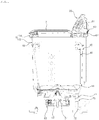
- FIG. 1 is a cross-sectional view showing the interior of a washing machine according to a first embodiment of the present invention.
- the washing machine includes a casing 10 defining the appearance of the washing machine, a control module 20, which is mounted on the casing 10 and includes operation keys to which manipulating force is transferred, a display for displaying information relating to operating conditions of the washing machine, and the like, a tub 30, which is disposed in the casing 10 so as to contain therein washing water, a drum 40, which is disposed in the tub 30 so as to contain laundry, a drive module 50, which is disposed at the tub 30 and rotates the drum 40 so as to wash laundry, a water supply module 60 for supplying washing water to the drum 40, a water discharge module 70 for discharging washing water contained in the drum 40, and a suspension module 80 for reducing or absorbing vibrations generated by the tub 30.
- the casing 10 includes a body 12 which accommodates the tub 30 and the drum 40, a top cover 14 disposed on the body 12, and a door 7, which is disposed on the top cover 14 so as to open and close the interior of the casing 10.
- the control module 20 includes manual operation buttons, dials and the like, which serve as an input part 21, and a display unit (not shown) serving as a display part 22 for transmitting various information about the washing machine to a user.
- the control module 20 is disposed on the top cover 14.
- the tub 30 stores washing water supplied from the water supply module 60.
- the tub 30 is connected to the water discharge module 70 so as to discharge water contained therein to the outside.
- the drum 40 is disposed in the tub 30, and is constructed to be rotated in the forward or reverse direction with respect to the tub 30.
- the drive module 50 includes a motor 52 disposed under the tub 30, a drive shaft 54, which extends through the tub 30 and is connected to the drum 40, and a pulsator 56, which is disposed in the drum 40 and is selectively rotated by drive force transmitted from the motor 52.
- the pulsator 56 may be disposed in the drum 40, and may be rotated in the forward or reverse direction, independent of the rotation of the drum 40.
- the water supply module 60 includes a water supply valve 61 and a water supply channel 62, which are disposed on the top cover 12.
- the water discharge module 70 includes a water discharge valve 71, connected to the tub 30, and a water discharge channel 72, connected to the water discharge valve 71.
- the suspension module 80 is connected to the tub 30 so as to reduce vibrations, generated by the tub 30, using at least one of elastic force and damping force.
- FIG. 2 is a block diagram of a top-loading washing machine according to an embodiment of the present invention.
- a controller 25 controls the overall operation of the washing machine in response to the operation command input to the input part 21.
- the controller 25 is preferably provided in the control module 20.
- the controller 25 may be constituted by a microcomputer for controlling the operation of the washing machine, a storage device, and other electronic devices.
- the controller 25 determines whether each process proceeds, or whether operations, such as water supply, washing, rinsing, drainage, and dehydration, are performed in each process, the operation time, and the number of repetitions, according to the washing course selected by the user, so as to operate the washing machine.
- the controller 25 receives the wash water level, measured by the water level sensor 123, and processes the same.
- the controller 25 receives the rotational speed of the drum 40, measured by the drive module 50, and processes the same.
- the controller 25 receives operation commands from the input part 21 and displays the operating conditions on the display part 22.
- the controller 25 controls the water supply module 60, the drive module 50 and the water discharge module 70 in accordance with the selected course or other operation commands.
- FIG. 3 is a flowchart illustrating the washing process of the washing machine according to one embodiment of the present invention.
- the washing machine detects an amount of clothes (hereinafter, referred to as "clothes amount”) contained in the drum 40.
- a clothes amount detection operation S10 power is applied to the drive module 50 so as to rotate the drum 40.
- the amount of clothes may be measured in various ways.
- the controller 25 may rotate the drum 40 at a predetermined rotational speed for a predetermined period of time by means of the drive module 50, and may determine a clothes amount by measuring a deceleration time.
- the controller 25 may also determine a clothes amount by measuring the time taken by the drum 40 to be accelerated to a predetermined rotational speed by the drive module 50.
- a clothes amount in the clothes amount detection operation S10 may be measured or determined in various ways.
- the controller 25 further determines the operating times of respective operations based on the detected clothes amount.
- a washing water supply operation S20 is performed in such a manner as to supply washing water to a target water level, which is determined based on the clothes amount determined in the clothes amount detection operation S10.
- the target water level is a target amount of washing water, to be supplied into the tub 30 after completion of the washing water supply operation S20.
- the controller 25 controls the water supply module 60 to supply washing water into the tub 30 until a water level reaches the target water level.
- washing water supply operation S20 washing water supplied from an external water source, is mixed with detergent and is then supplied into the tub 30, and clothes are wetted with the washing water mixed with detergent.
- the washing water supply operation S20 is an operation of performing preliminary washing prior to a washing operation S30.
- the drum 40 and the pulsator 56 may be rotated at various rotational speeds. Furthermore, in the washing operation S30, the drum 40 and the pulsator 56 may be rotated in various directions.
- the washing water containing pollutants is discharged to the outside through the water discharge module 70.
- a rinsing operation S40 is intended to rinse away detergent contained in clothes.
- washing water is supplied from an external water source.
- the drum 40 and the pulsator 56 may also be rotated in the rising operation S40.
- the rinsing operation S40 may be repeated several times.
- the controller 25 performs an unbalance determining operation S50 in such a manner as to check for the unbalance of clothes in the state in which the washing water in the tub 30 is not discharged, or in which some of the washing water is left in the tub 30 after the completion of the rinsing operation S40.
- the unbalance determining operation S50 is intended to accelerate the drum 40 in an unbalance-inducing pattern while washing water is contained in the tub 30.
- the unbalance determining operation S50 is an operation of checking for unbalance of the drum 40.
- an unbalanced state is determined while the drum 40 is rotated at a constant or increasing speed after the washing water in the tub 30 is completely discharged.
- this embodiment determines unbalance in the state in which washing water is not discharged, or some of the washing water is left after completion of the rinsing operation S40.
- this embodiment accelerates the drum 40 in an unbalance-inducting pattern, which is highly related to dehydration vibration.
- the unbalance determining operation S50 is performed in such a manner as to calculate variation in the speed of the drum in a specified acceleration range within which the drum 40 is accelerated in the unbalance-inducing pattern.
- this embodiment accelerates the drum 40 in the unbalance-inducing pattern assuming that the clothes contained in the drum 40 are unbalanced.
- a clothes dispersion operation S60 is performed.
- the unbalanced clothes are uniformly dispersed by rotating at least one of the pulsator 56 and the drum 40 without an additional water supply procedure, in the clothes dispersion operation S60.
- the clothes dispersion operation S60 according to this embodiment is able to save washing water by obviating an additional water supply procedure for the dispersion of clothes. Furthermore, the clothes dispersion operation S60 according to this embodiment is also able to reduce washing time by virtue of omission of the water supply procedure. The clothes dispersion operation S60 may be repeatedly performed.
- FIG. 4 is a flowchart showing a method of controlling a washing machine according to an embodiment of the present invention.
- FIG. 5 is a first illustrative graph showing the method of controlling a washing machine according to the embodiment of the present invention.
- FIG. 6 is a second illustrative graph showing the method of controlling a washing machine according to the embodiment of the present invention.
- FIG. 7 is a graph showing the unbalance-inducing pattern shown in FIG. 4 .
- the unbalance determining operation S50 includes, after the rinsing operation S40, an unbalance water discharge operation S51 of discharging the washing water in the tub 30 until the washing water reaches an unbalance determination level, an unbalance-inducing acceleration operation S52 of accelerating the drum 40 in the unbalance-inducing pattern by controlling the drive module 50 when the washing water is discharged to the unbalance determination level, and an unbalance comparison operation S53 of, after the unbalance-inducing acceleration operation S52, detecting unbalance and comparing the detected unbalance with a set value A.
- the graph shown in FIG. 5 is created when the clothes dispersion operation S60 is not performed, and the graph shown in FIG. 6 is created when the clothes dispersion operation S61 is performed.
- the unbalance water discharge operation S51 is an operation of lowering the water level in the tub 30 to an appropriate level, and may be obviated depending on the water level in the rinsing operation S40.
- the unbalance water discharge operation S51 is obviated.
- the unbalance determination level is the level at which at least a portion of the pulsator 56 is immersed in washing water. In this case, some of the clothes may not be immersed in the washing water.
- the controller 25 accelerates the drum 40 in a pattern that is highly related to dehydration vibrations or washing vibrations, calculates a speed variation within the acceleration range, and defines the calculated value as the unbalance.
- the unbalance may be defined in various manners. Since the unbalance-related technology is a technology which is well known to those skilled in the art, a detailed description thereof is omitted.
- the detected speed variation (unbalance) and the set value A are compared with each other.
- the controller 25 applies the target speed to the drive module 50 and detects an actual speed variation.
- the speed variation signifies variations, and the magnitude of speed variation and the magnitude of variations are in direct proportion to each other.
- FIG. 5 The procedure of proceeding to the dehydration operation S70 without the clothes dispersion operation S60 is illustrated in FIG. 5 .
- the solid line indicates a vibration value
- the dotted line indicates an rpm value.
- the controller 25 may also directly perform the clothes dispersion operation S60 without resupplying washing water.
- washing water is resupplied up to the clothes dispersion level (S61).
- the tub 30 is filled with washing water to the unbalance determination level, the amount of washing water that is resupplied is smaller than that in a conventional example.
- the clothes dispersing level may be the same as the water level in the washing operation S30, the clothes dispersing level in this embodiment is controlled to be lower than the water level in the washing operation S30.
- the clothes dispersion operation S60 may be performed in various manners.
- the controller 25 may drive at least one of the pulsator 56 and the drum 40 so as to agitate clothes.
- the controller 25 may rotate the drum 40 so as to create an alpha water stream.
- the alpha water stream refers to a water stream which falls down from an upper portion to a lower portion of the drum 30, like a waterfall, after washing water is outwardly impelled toward the inner circumferential surface of the tub 30 due to the centrifugal force of the drum 40.
- the alpha water stream offers an effect of agitating clothes in the drum 40, whereby the clothes dispersion operation S60 is implemented.
- the unbalance determination operation S50 may be repeatedly performed.
- the solid line indicates a vibration value which is input to the drive module 50
- the dotted line indicates an rpm value of the drum 30. From the graph, it is noted that the clothes dispersion operation S60 is performed twice.
- the unbalance determination operation S50 is performed three times and the vibration value is decreased in the third unbalance determination operation S50 after the execution of the clothes dispersion operation S60.
- the vibration value signifies the speed variation in the unbalance comparison operation S53.
- this embodiment determines the unbalance in the state in which the tub 30 is filled with washing water prior to proceeding to the dehydration operation S70 or the water discharge operation S55, there is an effect of minimizing the amount of washing water used in the clothes dispersion water supply operation S61.
- the unbalance-inducing pattern causes the drum 40 to be accelerated in strong correlation with unbalance generated in the dehydration operation S70.
- the unbalance detection and the clothes dispersion may be performed independently of the unbalance determination operation S50 and the clothes dispersion operation S60.
- the washing machine and the method of controlling the same according to the present invention have one or more effects described below.
- the present invention offers an advantage of being capable of directly performing clothes dispersion without the resupply of washing water, or with minimal resupply of washing water.
- the present invention offers an advantage of being capable of minimizing the resupply of washing water for clothes dispersion so as to minimize the amount of washing water that is used and the resupply time.
- the present invention offers an advantage of being capable of accelerating a tub in a pattern in strong correlation with dehydration vibrations generated in a dehydration operation so as to create an unbalance-inducing pattern while clothes are immersed in washing water, thereby enabling determination of the unbalance.
- the present invention offers an advantage of being capable of minimizing dehydration time.
Landscapes
- Engineering & Computer Science (AREA)
- Textile Engineering (AREA)
- Control Of Washing Machine And Dryer (AREA)
Description
- The present invention relates to a method of controlling a washing machine.
- In general, a washing machine is an appliance that washes laundry using the surfactant action of detergent, a water stream generated via rotation of a washing tub or a washing blade, shocks applied by the washing blade, and the like. The washing machine performs washing, rinsing or dehydration processes to remove contaminants adhering to laundry (hereinafter referred to as 'clothes') using the interaction of water and detergent.
- Washing machines are classified into an agitator-type washing machine, a pulsator-type washing machine, and a drum-type washing machine.
- The agitator-type washing machine rotates a washing rod, which protrudes from the center of a washing container, clockwise and counterclockwise so as to wash laundry. The pulsator type washing machine rotates a disk rotary blade, which is formed at the lower portion of a washing container, clockwise and counterclockwise directions so as to wash laundry using the frictional force between a water stream and the laundry. The drum-type washing machine rotates a drum accommodating water, detergent, and laundry therein so as to wash laundry.
- When a dehydration operation is performed in a typical pulsator-type washing machine, the washing water in the tub is completely discharged.
- In the dehydration operation, the unbalance of clothes is checked for by rotating a drum.
- When the unbalance is detected, washing water is supplied to the tub again, and an operation of dispersing the clothes is performed.
- After the dispersion of the clothes, the washing water in the tub is completely discharged again, and the unbalance is checked for again.
Accordingly, when the unbalance of a drum occurs, a method of controlling such a conventional top-loading washing machine has to repeatedly perform the resupply of washing water and dispersion of clothes, thereby causing a problem whereby the washing time is increased. - Furthermore, since the method of controlling the conventional top-loading washing machine has to supply washing water again in order to perform the dispersion of clothes, there is a problem whereby the amount of used water is increased.
- Korean Unexamined Patent Publication No.
10-2013-0015207 -
US 2011/0146002 A1 discloses a washing method having the features of the preamble of claim 1. It includes: performing an eco-rinsing process where a drum rotates in a state where at least a portion of a laundry is pressed against an inner wall of the drum and wash water is sprayed into the drum; performing an intermediating process for reducing an RPM of the drum to an RPM at which at least a portion of the laundry is pressed against an inner wall of the drum; and performing an eco-rinsing process where the drum is accelerated and the wash water is sprayed into the drum. - Therefore, the present invention has been made in view of the above problems, and it is an object of the present invention to provide a method of controlling a washing machine, which minimizes the amount of washing water used in clothes dispersion during dehydration.
- Another object of the present invention is to provide a method of controlling a washing machine, which minimizes the amount of water used for washing by checking for the unbalance of clothes before discharge of the washing water.
- A further object of the present invention is to provide a method of controlling a washing machine, which minimizes the time taken to disperse clothes by checking for the unbalance of clothes before discharging washing water.
- The present invention is not limited to the foregoing objects, and the other objects thereof will be clearly understood by those skilled in the art from the following description.
- In accordance with an aspect of the present invention, there is provided a method of controlling a washing machine having the features of claim 1.
- The drum may be provided therein with a pulsator, which is rotated by the drive module, wherein the unbalance determination level may be defined as a level at which at least a portion of the pulsator is immersed in the washing water.
- A controller may apply current corresponding to a target speed to the drive module and may detect the actual speed variation of the drum, wherein the unbalance determination operation compares the speed variation with the set value.
- The unbalance determination operation may include an unbalance-inducing acceleration operation of accelerating the drum in an unbalance-inducing pattern, which is conductive to creation of unbalance, by controlling a current value of the drive module after the unbalance water discharge operation, and an unbalance comparison operation of detecting unbalance and comparing the detected unbalance with the set value, after the unbalance-inducing acceleration operation.
- A controller may apply current corresponding to a target speed to the drive module, and may detect the actual speed variation of the drum, and the unbalance comparison operation may compare the speed variation with the set value.
- When the speed variation is lower than the set value in the unbalance comparison operation, the controlling process may proceed to the water discharge operation.
- In accordance with another aspect not forming part of the claimed subject-matter, there is provided a method of controlling a washing machine including an unbalance water discharge operation of discharging washing water contained in a tub such that a level of the washing water reaches an unbalance determination level, after a rinsing operation, an unbalance-inducting acceleration operation of accelerating a drum in an unbalance-inducing pattern, which is conducive to creation of unbalance, by controlling a current value of a drive module, after the unbalance water discharge operation, and an unbalance comparison operation of detecting unbalance and comparing the detected unbalance with a set value, after the unbalance-inducing acceleration operation.
- The drum may be provided therein with a pulsator, which is rotated by the drive module, wherein the unbalance determination level may be defined as a level at which at least a portion of the pulsator is immersed in the washing water.
- A controller may apply current corresponding to a target speed to the drive module and may detect the actual speed variation of the drum, and the unbalance determination operation may compare the speed variation with the set value.
- The method may further include a clothes dispersion operation of dispersing clothes in the drum by controlling current supplied to the drive module when the speed variation is equal to or higher than the set value, wherein, after the clothes dispersion operation, the controlling process is returned to the unbalance water discharge operation.
- The method may further include a clothes dispersion water supply operation of supplying washing water into the tub between the clothes dispersion operation and the unbalance comparison operation.
- The method may further include, when the speed variation is lower than the set value, a water discharge operation of discharging washing water in the tub, and a dehydration operation of dehydrating clothes so as to remove washing water from clothes after the water discharge operation.
- Embodiments will be described in detail with reference to the following drawings in which like reference numerals refer to like elements, and wherein:
-
FIG. 1 is a cross-sectional view showing the interior of a washing machine according to a first embodiment of the present invention; -
FIG. 2 is a block diagram of a top-loading washing machine according to an embodiment of the present invention; -
FIG. 3 is a flowchart illustrating the washing process of the washing machine according to one embodiment of the present invention; -
FIG. 4 is a flowchart showing a method of controlling a washing machine, according to an embodiment of the present invention; -
FIG. 5 is a first illustrative graph showing the method of controlling a washing machine according to the embodiment of the present invention; -
FIG. 6 is a second illustrative graph showing the method of controlling a washing machine according to the embodiment of the present invention; and -
FIG. 7 is a graph showing the unbalance-inducing pattern shown inFIG. 4 . - The advantages and features of the present invention and the way of attaining them will become apparent with reference to embodiments described below in detail in conjunction with the accompanying drawings. Embodiments, however, may be embodied in many different forms and should not be constructed as being limited to example embodiments set forth herein. Rather, these example embodiments are provided so that this disclosure will be through and complete and will fully convey the scope to those skilled in the art. The scope of the present invention should be defined by the claims. Wherever possible, the same reference numbers will be used throughout the drawings to refer to the same or like parts.
-
FIG. 1 is a cross-sectional view showing the interior of a washing machine according to a first embodiment of the present invention. - The washing machine according to the embodiment includes a
casing 10 defining the appearance of the washing machine, acontrol module 20, which is mounted on thecasing 10 and includes operation keys to which manipulating force is transferred, a display for displaying information relating to operating conditions of the washing machine, and the like, atub 30, which is disposed in thecasing 10 so as to contain therein washing water, adrum 40, which is disposed in thetub 30 so as to contain laundry, adrive module 50, which is disposed at thetub 30 and rotates thedrum 40 so as to wash laundry, awater supply module 60 for supplying washing water to thedrum 40, awater discharge module 70 for discharging washing water contained in thedrum 40, and asuspension module 80 for reducing or absorbing vibrations generated by thetub 30. - The
casing 10 includes a body 12 which accommodates thetub 30 and thedrum 40, atop cover 14 disposed on the body 12, and adoor 7, which is disposed on thetop cover 14 so as to open and close the interior of thecasing 10. - The
control module 20 includes manual operation buttons, dials and the like, which serve as aninput part 21, and a display unit (not shown) serving as adisplay part 22 for transmitting various information about the washing machine to a user. In this embodiment, thecontrol module 20 is disposed on thetop cover 14. - The
tub 30 stores washing water supplied from thewater supply module 60. Thetub 30 is connected to thewater discharge module 70 so as to discharge water contained therein to the outside. - The
drum 40 is disposed in thetub 30, and is constructed to be rotated in the forward or reverse direction with respect to thetub 30. - In this embodiment, the
drive module 50 includes amotor 52 disposed under thetub 30, adrive shaft 54, which extends through thetub 30 and is connected to thedrum 40, and apulsator 56, which is disposed in thedrum 40 and is selectively rotated by drive force transmitted from themotor 52. - In this embodiment, the
pulsator 56 may be disposed in thedrum 40, and may be rotated in the forward or reverse direction, independent of the rotation of thedrum 40. - In this embodiment, the
water supply module 60 includes awater supply valve 61 and awater supply channel 62, which are disposed on the top cover 12. - In this embodiment, the
water discharge module 70 includes awater discharge valve 71, connected to thetub 30, and awater discharge channel 72, connected to thewater discharge valve 71. - The
suspension module 80 is connected to thetub 30 so as to reduce vibrations, generated by thetub 30, using at least one of elastic force and damping force. -
FIG. 2 is a block diagram of a top-loading washing machine according to an embodiment of the present invention. - A
controller 25 controls the overall operation of the washing machine in response to the operation command input to theinput part 21. - The
controller 25 is preferably provided in thecontrol module 20. - The
controller 25 may be constituted by a microcomputer for controlling the operation of the washing machine, a storage device, and other electronic devices. - The
controller 25 determines whether each process proceeds, or whether operations, such as water supply, washing, rinsing, drainage, and dehydration, are performed in each process, the operation time, and the number of repetitions, according to the washing course selected by the user, so as to operate the washing machine. - The
controller 25 receives the wash water level, measured by the water level sensor 123, and processes the same. - The
controller 25 receives the rotational speed of thedrum 40, measured by thedrive module 50, and processes the same. - The
controller 25 receives operation commands from theinput part 21 and displays the operating conditions on thedisplay part 22. - The
controller 25 controls thewater supply module 60, thedrive module 50 and thewater discharge module 70 in accordance with the selected course or other operation commands. -
FIG. 3 is a flowchart illustrating the washing process of the washing machine according to one embodiment of the present invention. - First of all, the washing machine according to the embodiment detects an amount of clothes (hereinafter, referred to as "clothes amount") contained in the
drum 40. - In a clothes amount detection operation S10, power is applied to the
drive module 50 so as to rotate thedrum 40. - In the clothes amount detection operation S10, the amount of clothes may be measured in various ways.
- The
controller 25 may rotate thedrum 40 at a predetermined rotational speed for a predetermined period of time by means of thedrive module 50, and may determine a clothes amount by measuring a deceleration time. - Alternatively, the
controller 25 may also determine a clothes amount by measuring the time taken by thedrum 40 to be accelerated to a predetermined rotational speed by thedrive module 50. - In this way, a clothes amount in the clothes amount detection operation S10 may be measured or determined in various ways.
- The
controller 25 further determines the operating times of respective operations based on the detected clothes amount. - Subsequently, a washing water supply operation S20 is performed in such a manner as to supply washing water to a target water level, which is determined based on the clothes amount determined in the clothes amount detection operation S10.
- The target water level is a target amount of washing water, to be supplied into the
tub 30 after completion of the washing water supply operation S20. - In the washing water supply operation S20, the
controller 25 controls thewater supply module 60 to supply washing water into thetub 30 until a water level reaches the target water level. - In the washing water supply operation S20, washing water supplied from an external water source, is mixed with detergent and is then supplied into the
tub 30, and clothes are wetted with the washing water mixed with detergent. The washing water supply operation S20 is an operation of performing preliminary washing prior to a washing operation S30. - In the washing operation S30, the
drum 40 and thepulsator 56 may be rotated at various rotational speeds. Furthermore, in the washing operation S30, thedrum 40 and thepulsator 56 may be rotated in various directions. - After the washing operation S30, the washing water containing pollutants is discharged to the outside through the
water discharge module 70. - A rinsing operation S40 is intended to rinse away detergent contained in clothes. In this operation, washing water is supplied from an external water source.
- The
drum 40 and thepulsator 56 may also be rotated in the rising operation S40. The rinsing operation S40 may be repeated several times. - The
controller 25 performs an unbalance determining operation S50 in such a manner as to check for the unbalance of clothes in the state in which the washing water in thetub 30 is not discharged, or in which some of the washing water is left in thetub 30 after the completion of the rinsing operation S40. - The unbalance determining operation S50 is intended to accelerate the
drum 40 in an unbalance-inducing pattern while washing water is contained in thetub 30. The unbalance determining operation S50 is an operation of checking for unbalance of thedrum 40. - In conventional washing machines, an unbalanced state is determined while the
drum 40 is rotated at a constant or increasing speed after the washing water in thetub 30 is completely discharged. - Unlike this, this embodiment determines unbalance in the state in which washing water is not discharged, or some of the washing water is left after completion of the rinsing operation S40.
- In particular, this embodiment accelerates the
drum 40 in an unbalance-inducting pattern, which is highly related to dehydration vibration. The unbalance determining operation S50 is performed in such a manner as to calculate variation in the speed of the drum in a specified acceleration range within which thedrum 40 is accelerated in the unbalance-inducing pattern. - In other words, this embodiment accelerates the
drum 40 in the unbalance-inducing pattern assuming that the clothes contained in thedrum 40 are unbalanced. When variation in the speed of thedrum 40, which is accelerated in the unbalance-inducing pattern, exceeds the reference value, it is determined that there is unbalance. - Meanwhile, when the variation in the speed of the
drum 40, which is accelerated in the unbalance-inducing pattern, is lower than the reference value, it is determined that there is no unbalance. - When it is determined that the clothes contained in the
drum 40 are unbalanced, a clothes dispersion operation S60 is performed. - Since washing water is not discharged after the rinsing operation S40, the unbalanced clothes are uniformly dispersed by rotating at least one of the
pulsator 56 and thedrum 40 without an additional water supply procedure, in the clothes dispersion operation S60. - The clothes dispersion operation S60 according to this embodiment is able to save washing water by obviating an additional water supply procedure for the dispersion of clothes. Furthermore, the clothes dispersion operation S60 according to this embodiment is also able to reduce washing time by virtue of omission of the water supply procedure. The clothes dispersion operation S60 may be repeatedly performed.
- After the clothes are dispersed by the clothes dispersion operation S60, the washing water in the
tub 30 is completely discharged, and then a dehydration operation S70 is performed. -
FIG. 4 is a flowchart showing a method of controlling a washing machine according to an embodiment of the present invention.FIG. 5 is a first illustrative graph showing the method of controlling a washing machine according to the embodiment of the present invention.FIG. 6 is a second illustrative graph showing the method of controlling a washing machine according to the embodiment of the present invention.FIG. 7 is a graph showing the unbalance-inducing pattern shown inFIG. 4 . - The unbalance determining operation S50 includes, after the rinsing operation S40, an unbalance water discharge operation S51 of discharging the washing water in the
tub 30 until the washing water reaches an unbalance determination level, an unbalance-inducing acceleration operation S52 of accelerating thedrum 40 in the unbalance-inducing pattern by controlling thedrive module 50 when the washing water is discharged to the unbalance determination level, and an unbalance comparison operation S53 of, after the unbalance-inducing acceleration operation S52, detecting unbalance and comparing the detected unbalance with a set value A. - As a result of the comparison, when the detected unbalance is lower than the set value A, it is determined that dehydration is possible, and a water discharge operation S55 is performed so as to completely discharge the washing water contained in the
tub 30. - The graph shown in
FIG. 5 is created when the clothes dispersion operation S60 is not performed, and the graph shown inFIG. 6 is created when the clothes dispersion operation S61 is performed. - The unbalance water discharge operation S51 is an operation of lowering the water level in the
tub 30 to an appropriate level, and may be obviated depending on the water level in the rinsing operation S40. - For example, when the final water level in the rinsing operation S40 satisfies the unbalance determination level, the unbalance water discharge operation S51 is obviated.
- Meanwhile, when the water level after the rinsing operation S40 is higher than the unbalance determination level, it is possible to discharge washing water until the water level reaches the unbalance determination level.
- In this embodiment, the unbalance determination level is the level at which at least a portion of the
pulsator 56 is immersed in washing water. In this case, some of the clothes may not be immersed in the washing water. - As the unbalance determination level in this embodiment is lowered, there is an effect of increasing vibration, thereby making it possible to clearly detect a speed variation, which will be described later.
- In the unbalance-inducing acceleration operation S52, current is applied to the
drive module 50, and thedrum 40 is accelerated under conditions similar to those in which washing water is discharged. - The
controller 25 accelerates thedrum 40 in a pattern that is highly related to dehydration vibrations or washing vibrations, calculates a speed variation within the acceleration range, and defines the calculated value as the unbalance. - Unlike this embodiment, the unbalance may be defined in various manners. Since the unbalance-related technology is a technology which is well known to those skilled in the art, a detailed description thereof is omitted.
- In the unbalance comparison operation S53, the detected speed variation (unbalance) and the set value A are compared with each other.
- Specifically, the
controller 25 applies the target speed to thedrive module 50 and detects an actual speed variation. - Here, the speed variation signifies variations, and the magnitude of speed variation and the magnitude of variations are in direct proportion to each other.
- When the magnitude of speed variation is equal to or higher than the set value A, it is determined that the unbalance is high, and the clothes dispersion operation S60 is thus performed. When the magnitude of speed variation is lower than the set value A, it is determined that dehydration is possible.
- As a result of the unbalance comparison operation S53, when it is determined that dehydration is possible, an additional water supply or clothes dispersion is omitted, and all of the washing water in the
tub 30 is completely discharged. - The procedure of proceeding to the dehydration operation S70 without the clothes dispersion operation S60 is illustrated in
FIG. 5 . In the graph, the solid line indicates a vibration value, and the dotted line indicates an rpm value. - Meanwhile, when it is determined that there is unbalance in the unbalance comparison operation S53, the clothes dispersion operation S60 is performed.
- Since the
tub 30 is filled with washing water to the unbalance determination level even after the unbalance comparison operation S53, thecontroller 25 may also directly perform the clothes dispersion operation S60 without resupplying washing water. - In this embodiment, since the unbalance determination level is lower than a washing level, washing water is resupplied up to the clothes dispersion level (S61).
- However, since the
tub 30 is filled with washing water to the unbalance determination level, the amount of washing water that is resupplied is smaller than that in a conventional example. - Although the clothes dispersing level may be the same as the water level in the washing operation S30, the clothes dispersing level in this embodiment is controlled to be lower than the water level in the washing operation S30.
- The clothes dispersion operation S60 may be performed in various manners.
- For example, for the purpose of execution of the clothes dispersion operation S60, the
controller 25 may drive at least one of thepulsator 56 and thedrum 40 so as to agitate clothes. - Furthermore, for the purpose of execution of the clothes dispersing operation S60, the
controller 25 may rotate thedrum 40 so as to create an alpha water stream. - The alpha water stream refers to a water stream which falls down from an upper portion to a lower portion of the
drum 30, like a waterfall, after washing water is outwardly impelled toward the inner circumferential surface of thetub 30 due to the centrifugal force of thedrum 40. - The alpha water stream offers an effect of agitating clothes in the
drum 40, whereby the clothes dispersion operation S60 is implemented. - After the clothes dispersion operation S60, the operation is returned to the unbalance water discharge operation S51 where the unbalance determination operation S50 is performed again.
- The unbalance determination operation S50 may be repeatedly performed.
- The procedure of performing the clothes dispersion operation S60 in this way is illustrated in
FIG. 6 . - In the graph, the solid line indicates a vibration value which is input to the
drive module 50, and the dotted line indicates an rpm value of thedrum 30. From the graph, it is noted that the clothes dispersion operation S60 is performed twice. - Furthermore, it is noted that the unbalance determination operation S50 is performed three times and the vibration value is decreased in the third unbalance determination operation S50 after the execution of the clothes dispersion operation S60.
- The vibration value signifies the speed variation in the unbalance comparison operation S53.
- As described above, since this embodiment determines the unbalance in the state in which the
tub 30 is filled with washing water prior to proceeding to the dehydration operation S70 or the water discharge operation S55, there is an effect of minimizing the amount of washing water used in the clothes dispersion water supply operation S61. - Furthermore, since the amount of washing water used in the clothes dispersion water supply operation S61 is minimized, it is also possible to reduce the water supply time.
- Referring to
FIG. 7 , the unbalance-inducing pattern causes thedrum 40 to be accelerated in strong correlation with unbalance generated in the dehydration operation S70. - In the dehydration operation S70, the unbalance detection and the clothes dispersion may be performed independently of the unbalance determination operation S50 and the clothes dispersion operation S60.
- As is apparent from the above description, the washing machine and the method of controlling the same according to the present invention have one or more effects described below.
- First, since the unbalance of clothes is determined and a clothes dispersion operation is performed while clothes are immersed in washing water, the present invention offers an advantage of being capable of directly performing clothes dispersion without the resupply of washing water, or with minimal resupply of washing water.
- Secondly, since unbalance of clothes is determined and a clothes dispersion operation is performed while clothes are immersed in washing water, the present invention offers an advantage of being capable of minimizing the resupply of washing water for clothes dispersion so as to minimize the amount of washing water that is used and the resupply time.
- Thirdly, the present invention offers an advantage of being capable of accelerating a tub in a pattern in strong correlation with dehydration vibrations generated in a dehydration operation so as to create an unbalance-inducing pattern while clothes are immersed in washing water, thereby enabling determination of the unbalance.
- Fourthly, since unbalance is determined while clothes are immersed in washing water, and dehydration is performed when there is no unbalance, the present invention offers an advantage of being capable of minimizing dehydration time.
- The present invention is not limited to the foregoing effects, and other effects thereof will be clearly understood by those skilled in the art from the following claims.
- Although embodiments have been described with reference to a number of illustrative embodiments thereof, it should be understood that numerous other modifications and embodiments can be devised by those skilled in the art that will fall within the scope of this invention as defined by the claims. More particularly, various variations and modifications are possible in the component parts and/or arrangements of the subject combination arrangement within the scope of the disclosure, the drawings and the appended claims. In addition to variations and modifications in the component parts and/or arrangements, alternative uses will also be apparent to those skilled in the art.
Claims (6)
- A method of controlling a washing machine comprising:a clothes amount detection operation (S10) of detecting an amount of clothes contained in a drum (40);a washing water supply operation (S20) of supplying washing water based on the detected amount of clothes;a washing operation (S30) of washing the clothes by applying current to a drive module (50) for rotating the drum (40) after the washing water supply operation;a rinsing operation (S40) of rinsing the clothes by supplying water to a tub (30) from an external water source, after the washing operation;
an unbalance water discharge operation (S51) of discharging the washing water contained in the tub (30) such that a level of the washing water reaches an unbalance determination level, after the rinsing operation;an unbalance determination operation (S50) of determining unbalance of the clothes by applying current to the drive module (50) while washing water is contained in the tub (30);a water discharge operation (S55) of discharging the washing water contained in the tub (30) when the unbalance of the clothes is determined to be lower than the set value; anda dehydration operation (S70) of dehydrating the clothes to remove the washing water from the clothes, after the water discharge operation,characterized in:a clothes dispersion water supply operation (S61) of supplying washing water into the tub (30) such that a level of the washing water reaches a clothes dispersing level, when the unbalance of the clothes is determined to be equal to or higher than a set value, wherein the clothes dispersing level is higher than the unbalance determination level and lower than a water level in the washing operation (S30);a clothes dispersion operation (S60) of dispersing the clothes by controlling the current applied to the drive module (50) after the clothes dispersion water supply operation (S61), wherein, after the clothes dispersion operation (S60), the controlling process is returned to the unbalance water discharge operation (S51). - The method according to claim 1, wherein the drum (40) is provided therein with a pulsator (56), which is rotated by the drive module (50),
wherein the unbalance determination level is defined as a level at which at least a portion of the pulsator (56) is immersed in the washing water. - The method according to any one of the claims 1 to 2, wherein a controller (25) applies current corresponding to a target speed to the drive module (50) and detects an actual speed variation of the drum (40),
wherein the unbalance determination operation (S50) compares the speed variation with the set value. - The method according to any one of the claims 1 to 3, wherein the unbalance determination operation (S50) comprises:an unbalance-inducing acceleration operation (S52) of accelerating the drum (40) in an unbalance-inducing pattern, which is conducive to creation of unbalance, by controlling a current value of the drive module (50) after the unbalance water discharge operation (S51); andan unbalance comparison operation (S53) of detecting unbalance and comparing the detected unbalance with the set value, after the unbalance-inducing acceleration operation (S52).
- The method according to claim 4, wherein a controller (25) applies current corresponding to a target speed to the drive module (50) and detects an actual speed variation of the drum (40), and the unbalance comparison operation (S53) compares the speed variation with the set value.
- The method according to claim 5, wherein, when the speed variation is lower than the set value in the unbalance comparison operation (S53), the controlling process proceeds to the water discharge operation (S55).
Applications Claiming Priority (1)
| Application Number | Priority Date | Filing Date | Title |
|---|---|---|---|
| KR1020150016105A KR101661962B1 (en) | 2015-02-02 | 2015-02-02 | Method for controlling process in washing machine |
Publications (2)
| Publication Number | Publication Date |
|---|---|
| EP3051017A1 EP3051017A1 (en) | 2016-08-03 |
| EP3051017B1 true EP3051017B1 (en) | 2019-09-11 |
Family
ID=55272317
Family Applications (1)
| Application Number | Title | Priority Date | Filing Date |
|---|---|---|---|
| EP16153331.0A Active EP3051017B1 (en) | 2015-02-02 | 2016-01-29 | Method of controlling washing machine |
Country Status (4)
| Country | Link |
|---|---|
| US (1) | US10047470B2 (en) |
| EP (1) | EP3051017B1 (en) |
| KR (1) | KR101661962B1 (en) |
| CN (1) | CN105839336B (en) |
Cited By (1)
| Publication number | Priority date | Publication date | Assignee | Title |
|---|---|---|---|---|
| EP4397799A4 (en) * | 2021-08-30 | 2025-08-20 | Lg Electronics Inc | Clothing treatment device and control method therefor |
Families Citing this family (15)
| Publication number | Priority date | Publication date | Assignee | Title |
|---|---|---|---|---|
| USD774713S1 (en) * | 2014-08-19 | 2016-12-20 | Whirlpool Corporation | Topload washing appliance |
| KR102527576B1 (en) * | 2016-10-07 | 2023-04-28 | 엘지전자 주식회사 | Washing machine and method for controlling washing machine |
| BR112019008226B1 (en) * | 2016-10-25 | 2022-11-01 | Electrolux Do Brasil S/A | METHOD OF DETECTING UNBALANCE IN A WASHING MACHINE, METHOD OF DETECTING UNBALANCE IN A WASHING ASSEMBLY OF A WASHING MACHINE AND WASHING MACHINE |
| JP7010609B2 (en) * | 2017-07-12 | 2022-02-10 | 東芝ライフスタイル株式会社 | washing machine |
| CN109487485A (en) * | 2017-09-11 | 2019-03-19 | 无锡小天鹅股份有限公司 | Control method for washing machine, system, computer equipment, readable storage medium storing program for executing and washing machine |
| JP7164107B2 (en) * | 2018-07-05 | 2022-11-01 | 青島海爾洗衣机有限公司 | vertical washing machine |
| JP7316039B2 (en) * | 2018-12-17 | 2023-07-27 | 東芝ライフスタイル株式会社 | washing machine |
| KR102776908B1 (en) * | 2019-07-30 | 2025-03-10 | 엘지전자 주식회사 | A control method of the laundry apparatus |
| US20230250570A1 (en) * | 2022-02-07 | 2023-08-10 | Whirlpool Corporation | Laundry sanitization system that utilizes a hemispheric ultrasound transducer in combination with agitating wash systems |
| KR102716906B1 (en) * | 2022-03-28 | 2024-10-16 | 엘지전자 주식회사 | Laundary treating apparatus |
| US12241195B2 (en) | 2022-05-24 | 2025-03-04 | Haier Us Appliance Solutions, Inc. | Washing machine appliance load size detection using power and balance |
| US12054871B2 (en) | 2022-06-06 | 2024-08-06 | Haier Us Appliance Solutions, Inc. | Washing machine appliance load size detection using deceleration time |
| US12398499B2 (en) | 2022-06-09 | 2025-08-26 | Haier Us Appliance Solutions, Inc. | Washing machine appliance load type detection |
| US12054873B2 (en) | 2022-07-11 | 2024-08-06 | Haier Us Appliance Solutions, Inc. | Washing machine appliance and augmented reality control features |
| US12534839B2 (en) | 2023-12-06 | 2026-01-27 | Haier Us Appliance Solutions, Inc. | Washing machine appliance non-shedding load detection |
Family Cites Families (14)
| Publication number | Priority date | Publication date | Assignee | Title |
|---|---|---|---|---|
| JP3297073B2 (en) * | 1992-03-31 | 2002-07-02 | 株式会社東芝 | Washing machine |
| TW415981B (en) * | 1998-07-16 | 2000-12-21 | Samsung Electronics Co Ltd | Washing machine having a hybrid sensor and a control method thereof |
| US6401284B1 (en) | 2000-04-04 | 2002-06-11 | Lg Electronics Inc. | Method for controlling washing during spinning in tilt-type washing machine for attenuation of vibration |
| KR101029798B1 (en) | 2003-07-25 | 2011-04-20 | 엘지전자 주식회사 | Dehydration Control Method of Drum Washing Machine |
| KR100712848B1 (en) * | 2005-02-03 | 2007-05-02 | 엘지전자 주식회사 | Control method of the washing machine |
| KR101203565B1 (en) | 2005-12-06 | 2012-11-21 | 엘지전자 주식회사 | Controling method of washing machine |
| KR20080076336A (en) | 2007-02-15 | 2008-08-20 | 엘지전자 주식회사 | Control Method of Commercial Washing Machine |
| KR20100040172A (en) * | 2008-10-09 | 2010-04-19 | 삼성전자주식회사 | Washing machine and spin control method thereof |
| KR101100317B1 (en) * | 2009-08-05 | 2011-12-30 | 엘지전자 주식회사 | Control method of laundry treatment equipment and laundry treatment equipment |
| KR101620437B1 (en) | 2009-11-16 | 2016-05-12 | 엘지전자 주식회사 | Control method of washing machine and washing machine |
| US9506178B2 (en) * | 2009-12-23 | 2016-11-29 | Lg Electronics Inc. | Washing method and washing machine |
| US8932369B2 (en) * | 2010-04-13 | 2015-01-13 | Whirlpool Corporation | Method and apparatus for determining an unbalance condition in a laundry treating appliance |
| KR20130005041A (en) | 2011-07-05 | 2013-01-15 | 주식회사 정우테크 | Reassuring level jack to protect you and your vehicle and improve stability by alerting you to location errors |
| KR101888954B1 (en) | 2011-08-02 | 2018-08-16 | 엘지전자 주식회사 | Dehydration control method for washing machine |
-
2015
- 2015-02-02 KR KR1020150016105A patent/KR101661962B1/en not_active Expired - Fee Related
-
2016
- 2016-01-29 US US15/011,296 patent/US10047470B2/en not_active Expired - Fee Related
- 2016-01-29 EP EP16153331.0A patent/EP3051017B1/en active Active
- 2016-02-02 CN CN201610073558.1A patent/CN105839336B/en active Active
Non-Patent Citations (1)
| Title |
|---|
| None * |
Cited By (1)
| Publication number | Priority date | Publication date | Assignee | Title |
|---|---|---|---|---|
| EP4397799A4 (en) * | 2021-08-30 | 2025-08-20 | Lg Electronics Inc | Clothing treatment device and control method therefor |
Also Published As
| Publication number | Publication date |
|---|---|
| US10047470B2 (en) | 2018-08-14 |
| US20160222569A1 (en) | 2016-08-04 |
| EP3051017A1 (en) | 2016-08-03 |
| CN105839336A (en) | 2016-08-10 |
| CN105839336B (en) | 2019-09-10 |
| KR20160094723A (en) | 2016-08-10 |
| KR101661962B1 (en) | 2016-10-04 |
Similar Documents
| Publication | Publication Date | Title |
|---|---|---|
| US10047470B2 (en) | Method of controlling washing machine | |
| KR101052787B1 (en) | Washing machine and its control method | |
| US8156592B2 (en) | Washing machine and method of controlling the same | |
| US9181649B2 (en) | Washing method and washing machine | |
| US6715175B2 (en) | Load unbalanced prediction method and apparatus in an appliance | |
| CN108431320B (en) | Control method of washing machine | |
| KR102304812B1 (en) | Washing machine and Controlling method therefor | |
| US9994987B2 (en) | Washing machine and control method thereof | |
| US8893341B2 (en) | Washing machine and method of controlling spin-drying thereof | |
| US10072371B2 (en) | Washing machine | |
| KR101272341B1 (en) | Apparatus and method for sensing vibration of washer | |
| EP2692929A2 (en) | Method for controlling dehydration in drum washing machine | |
| JP7222607B2 (en) | washing machine | |
| US7752694B2 (en) | Dehydration controlling apparatus for washing machine and method thereof | |
| EP1762648B1 (en) | Dehydration controlling apparatus for washing machine and method thereof | |
| RU2443816C2 (en) | Method of automatic setting of control parameters of washing machine and system of its implementation | |
| KR100290234B1 (en) | How to detect the quantity of drum washing machine | |
| JP7765170B2 (en) | washing machine | |
| KR100751795B1 (en) | How to detect unbalance in washing machine | |
| CN118581691A (en) | washing machine | |
| KR100252951B1 (en) | Method for sensing a volume of laundry of drum washing machine | |
| CN120026473A (en) | Drum washing machine | |
| KR20120109172A (en) | Method for controlling dehydration in drum type washing machine | |
| JP2019150383A (en) | Washing machine | |
| KR20120109171A (en) | Method for controlling dehydration in drum type washing machine |
Legal Events
| Date | Code | Title | Description |
|---|---|---|---|
| PUAI | Public reference made under article 153(3) epc to a published international application that has entered the european phase |
Free format text: ORIGINAL CODE: 0009012 |
|
| AK | Designated contracting states |
Kind code of ref document: A1 Designated state(s): AL AT BE BG CH CY CZ DE DK EE ES FI FR GB GR HR HU IE IS IT LI LT LU LV MC MK MT NL NO PL PT RO RS SE SI SK SM TR |
|
| AX | Request for extension of the european patent |
Extension state: BA ME |
|
| STAA | Information on the status of an ep patent application or granted ep patent |
Free format text: STATUS: REQUEST FOR EXAMINATION WAS MADE |
|
| 17P | Request for examination filed |
Effective date: 20170203 |
|
| RBV | Designated contracting states (corrected) |
Designated state(s): AL AT BE BG CH CY CZ DE DK EE ES FI FR GB GR HR HU IE IS IT LI LT LU LV MC MK MT NL NO PL PT RO RS SE SI SK SM TR |
|
| GRAP | Despatch of communication of intention to grant a patent |
Free format text: ORIGINAL CODE: EPIDOSNIGR1 |
|
| STAA | Information on the status of an ep patent application or granted ep patent |
Free format text: STATUS: GRANT OF PATENT IS INTENDED |
|
| INTG | Intention to grant announced |
Effective date: 20190410 |
|
| GRAS | Grant fee paid |
Free format text: ORIGINAL CODE: EPIDOSNIGR3 |
|
| GRAA | (expected) grant |
Free format text: ORIGINAL CODE: 0009210 |
|
| STAA | Information on the status of an ep patent application or granted ep patent |
Free format text: STATUS: THE PATENT HAS BEEN GRANTED |
|
| AK | Designated contracting states |
Kind code of ref document: B1 Designated state(s): AL AT BE BG CH CY CZ DE DK EE ES FI FR GB GR HR HU IE IS IT LI LT LU LV MC MK MT NL NO PL PT RO RS SE SI SK SM TR |
|
| REG | Reference to a national code |
Ref country code: GB Ref legal event code: FG4D |
|
| REG | Reference to a national code |
Ref country code: CH Ref legal event code: EP |
|
| REG | Reference to a national code |
Ref country code: AT Ref legal event code: REF Ref document number: 1178583 Country of ref document: AT Kind code of ref document: T Effective date: 20190915 |
|
| REG | Reference to a national code |
Ref country code: DE Ref legal event code: R096 Ref document number: 602016020213 Country of ref document: DE Ref country code: IE Ref legal event code: FG4D |
|
| REG | Reference to a national code |
Ref country code: NL Ref legal event code: MP Effective date: 20190911 |
|
| REG | Reference to a national code |
Ref country code: LT Ref legal event code: MG4D |
|
| PG25 | Lapsed in a contracting state [announced via postgrant information from national office to epo] |
Ref country code: HR Free format text: LAPSE BECAUSE OF FAILURE TO SUBMIT A TRANSLATION OF THE DESCRIPTION OR TO PAY THE FEE WITHIN THE PRESCRIBED TIME-LIMIT Effective date: 20190911 Ref country code: SE Free format text: LAPSE BECAUSE OF FAILURE TO SUBMIT A TRANSLATION OF THE DESCRIPTION OR TO PAY THE FEE WITHIN THE PRESCRIBED TIME-LIMIT Effective date: 20190911 Ref country code: BG Free format text: LAPSE BECAUSE OF FAILURE TO SUBMIT A TRANSLATION OF THE DESCRIPTION OR TO PAY THE FEE WITHIN THE PRESCRIBED TIME-LIMIT Effective date: 20191211 Ref country code: LT Free format text: LAPSE BECAUSE OF FAILURE TO SUBMIT A TRANSLATION OF THE DESCRIPTION OR TO PAY THE FEE WITHIN THE PRESCRIBED TIME-LIMIT Effective date: 20190911 Ref country code: FI Free format text: LAPSE BECAUSE OF FAILURE TO SUBMIT A TRANSLATION OF THE DESCRIPTION OR TO PAY THE FEE WITHIN THE PRESCRIBED TIME-LIMIT Effective date: 20190911 Ref country code: NO Free format text: LAPSE BECAUSE OF FAILURE TO SUBMIT A TRANSLATION OF THE DESCRIPTION OR TO PAY THE FEE WITHIN THE PRESCRIBED TIME-LIMIT Effective date: 20191211 |
|
| PG25 | Lapsed in a contracting state [announced via postgrant information from national office to epo] |
Ref country code: LV Free format text: LAPSE BECAUSE OF FAILURE TO SUBMIT A TRANSLATION OF THE DESCRIPTION OR TO PAY THE FEE WITHIN THE PRESCRIBED TIME-LIMIT Effective date: 20190911 Ref country code: ES Free format text: LAPSE BECAUSE OF FAILURE TO SUBMIT A TRANSLATION OF THE DESCRIPTION OR TO PAY THE FEE WITHIN THE PRESCRIBED TIME-LIMIT Effective date: 20190911 Ref country code: AL Free format text: LAPSE BECAUSE OF FAILURE TO SUBMIT A TRANSLATION OF THE DESCRIPTION OR TO PAY THE FEE WITHIN THE PRESCRIBED TIME-LIMIT Effective date: 20190911 Ref country code: RS Free format text: LAPSE BECAUSE OF FAILURE TO SUBMIT A TRANSLATION OF THE DESCRIPTION OR TO PAY THE FEE WITHIN THE PRESCRIBED TIME-LIMIT Effective date: 20190911 Ref country code: GR Free format text: LAPSE BECAUSE OF FAILURE TO SUBMIT A TRANSLATION OF THE DESCRIPTION OR TO PAY THE FEE WITHIN THE PRESCRIBED TIME-LIMIT Effective date: 20191212 |
|
| REG | Reference to a national code |
Ref country code: AT Ref legal event code: MK05 Ref document number: 1178583 Country of ref document: AT Kind code of ref document: T Effective date: 20190911 |
|
| PG25 | Lapsed in a contracting state [announced via postgrant information from national office to epo] |
Ref country code: AT Free format text: LAPSE BECAUSE OF FAILURE TO SUBMIT A TRANSLATION OF THE DESCRIPTION OR TO PAY THE FEE WITHIN THE PRESCRIBED TIME-LIMIT Effective date: 20190911 Ref country code: PL Free format text: LAPSE BECAUSE OF FAILURE TO SUBMIT A TRANSLATION OF THE DESCRIPTION OR TO PAY THE FEE WITHIN THE PRESCRIBED TIME-LIMIT Effective date: 20190911 Ref country code: PT Free format text: LAPSE BECAUSE OF FAILURE TO SUBMIT A TRANSLATION OF THE DESCRIPTION OR TO PAY THE FEE WITHIN THE PRESCRIBED TIME-LIMIT Effective date: 20200113 Ref country code: EE Free format text: LAPSE BECAUSE OF FAILURE TO SUBMIT A TRANSLATION OF THE DESCRIPTION OR TO PAY THE FEE WITHIN THE PRESCRIBED TIME-LIMIT Effective date: 20190911 Ref country code: RO Free format text: LAPSE BECAUSE OF FAILURE TO SUBMIT A TRANSLATION OF THE DESCRIPTION OR TO PAY THE FEE WITHIN THE PRESCRIBED TIME-LIMIT Effective date: 20190911 Ref country code: NL Free format text: LAPSE BECAUSE OF FAILURE TO SUBMIT A TRANSLATION OF THE DESCRIPTION OR TO PAY THE FEE WITHIN THE PRESCRIBED TIME-LIMIT Effective date: 20190911 Ref country code: IT Free format text: LAPSE BECAUSE OF FAILURE TO SUBMIT A TRANSLATION OF THE DESCRIPTION OR TO PAY THE FEE WITHIN THE PRESCRIBED TIME-LIMIT Effective date: 20190911 |
|
| PG25 | Lapsed in a contracting state [announced via postgrant information from national office to epo] |
Ref country code: SM Free format text: LAPSE BECAUSE OF FAILURE TO SUBMIT A TRANSLATION OF THE DESCRIPTION OR TO PAY THE FEE WITHIN THE PRESCRIBED TIME-LIMIT Effective date: 20190911 Ref country code: CZ Free format text: LAPSE BECAUSE OF FAILURE TO SUBMIT A TRANSLATION OF THE DESCRIPTION OR TO PAY THE FEE WITHIN THE PRESCRIBED TIME-LIMIT Effective date: 20190911 Ref country code: IS Free format text: LAPSE BECAUSE OF FAILURE TO SUBMIT A TRANSLATION OF THE DESCRIPTION OR TO PAY THE FEE WITHIN THE PRESCRIBED TIME-LIMIT Effective date: 20200224 Ref country code: SK Free format text: LAPSE BECAUSE OF FAILURE TO SUBMIT A TRANSLATION OF THE DESCRIPTION OR TO PAY THE FEE WITHIN THE PRESCRIBED TIME-LIMIT Effective date: 20190911 |
|
| REG | Reference to a national code |
Ref country code: DE Ref legal event code: R097 Ref document number: 602016020213 Country of ref document: DE |
|
| PLBE | No opposition filed within time limit |
Free format text: ORIGINAL CODE: 0009261 |
|
| STAA | Information on the status of an ep patent application or granted ep patent |
Free format text: STATUS: NO OPPOSITION FILED WITHIN TIME LIMIT |
|
| PG2D | Information on lapse in contracting state deleted |
Ref country code: IS |
|
| PG25 | Lapsed in a contracting state [announced via postgrant information from national office to epo] |
Ref country code: DK Free format text: LAPSE BECAUSE OF FAILURE TO SUBMIT A TRANSLATION OF THE DESCRIPTION OR TO PAY THE FEE WITHIN THE PRESCRIBED TIME-LIMIT Effective date: 20190911 Ref country code: IS Free format text: LAPSE BECAUSE OF FAILURE TO SUBMIT A TRANSLATION OF THE DESCRIPTION OR TO PAY THE FEE WITHIN THE PRESCRIBED TIME-LIMIT Effective date: 20200112 |
|
| 26N | No opposition filed |
Effective date: 20200615 |
|
| PG25 | Lapsed in a contracting state [announced via postgrant information from national office to epo] |
Ref country code: SI Free format text: LAPSE BECAUSE OF FAILURE TO SUBMIT A TRANSLATION OF THE DESCRIPTION OR TO PAY THE FEE WITHIN THE PRESCRIBED TIME-LIMIT Effective date: 20190911 Ref country code: MC Free format text: LAPSE BECAUSE OF FAILURE TO SUBMIT A TRANSLATION OF THE DESCRIPTION OR TO PAY THE FEE WITHIN THE PRESCRIBED TIME-LIMIT Effective date: 20190911 |
|
| REG | Reference to a national code |
Ref country code: CH Ref legal event code: PL |
|
| GBPC | Gb: european patent ceased through non-payment of renewal fee |
Effective date: 20200129 |
|
| REG | Reference to a national code |
Ref country code: BE Ref legal event code: MM Effective date: 20200131 |
|
| PG25 | Lapsed in a contracting state [announced via postgrant information from national office to epo] |
Ref country code: FR Free format text: LAPSE BECAUSE OF NON-PAYMENT OF DUE FEES Effective date: 20200131 Ref country code: LU Free format text: LAPSE BECAUSE OF NON-PAYMENT OF DUE FEES Effective date: 20200129 Ref country code: GB Free format text: LAPSE BECAUSE OF NON-PAYMENT OF DUE FEES Effective date: 20200129 |
|
| PG25 | Lapsed in a contracting state [announced via postgrant information from national office to epo] |
Ref country code: BE Free format text: LAPSE BECAUSE OF NON-PAYMENT OF DUE FEES Effective date: 20200131 Ref country code: CH Free format text: LAPSE BECAUSE OF NON-PAYMENT OF DUE FEES Effective date: 20200131 Ref country code: LI Free format text: LAPSE BECAUSE OF NON-PAYMENT OF DUE FEES Effective date: 20200131 |
|
| PG25 | Lapsed in a contracting state [announced via postgrant information from national office to epo] |
Ref country code: IE Free format text: LAPSE BECAUSE OF NON-PAYMENT OF DUE FEES Effective date: 20200129 |
|
| PG25 | Lapsed in a contracting state [announced via postgrant information from national office to epo] |
Ref country code: TR Free format text: LAPSE BECAUSE OF FAILURE TO SUBMIT A TRANSLATION OF THE DESCRIPTION OR TO PAY THE FEE WITHIN THE PRESCRIBED TIME-LIMIT Effective date: 20190911 Ref country code: MT Free format text: LAPSE BECAUSE OF FAILURE TO SUBMIT A TRANSLATION OF THE DESCRIPTION OR TO PAY THE FEE WITHIN THE PRESCRIBED TIME-LIMIT Effective date: 20190911 Ref country code: CY Free format text: LAPSE BECAUSE OF FAILURE TO SUBMIT A TRANSLATION OF THE DESCRIPTION OR TO PAY THE FEE WITHIN THE PRESCRIBED TIME-LIMIT Effective date: 20190911 |
|
| PG25 | Lapsed in a contracting state [announced via postgrant information from national office to epo] |
Ref country code: MK Free format text: LAPSE BECAUSE OF FAILURE TO SUBMIT A TRANSLATION OF THE DESCRIPTION OR TO PAY THE FEE WITHIN THE PRESCRIBED TIME-LIMIT Effective date: 20190911 |
|
| REG | Reference to a national code |
Ref country code: DE Ref legal event code: R082 Ref document number: 602016020213 Country of ref document: DE Representative=s name: TER MEER STEINMEISTER & PARTNER PATENTANWAELTE, DE |
|
| PGFP | Annual fee paid to national office [announced via postgrant information from national office to epo] |
Ref country code: DE Payment date: 20241205 Year of fee payment: 10 |