EP3046053B1 - Method and apparatus for training language model - Google Patents
Method and apparatus for training language model Download PDFInfo
- Publication number
- EP3046053B1 EP3046053B1 EP15184200.2A EP15184200A EP3046053B1 EP 3046053 B1 EP3046053 B1 EP 3046053B1 EP 15184200 A EP15184200 A EP 15184200A EP 3046053 B1 EP3046053 B1 EP 3046053B1
- Authority
- EP
- European Patent Office
- Prior art keywords
- vector sequence
- estimation
- feature vector
- training
- neural network
- Prior art date
- Legal status (The legal status is an assumption and is not a legal conclusion. Google has not performed a legal analysis and makes no representation as to the accuracy of the status listed.)
- Active
Links
Images




Classifications
-
- G—PHYSICS
- G06—COMPUTING OR CALCULATING; COUNTING
- G06F—ELECTRIC DIGITAL DATA PROCESSING
- G06F40/00—Handling natural language data
- G06F40/20—Natural language analysis
-
- G—PHYSICS
- G06—COMPUTING OR CALCULATING; COUNTING
- G06N—COMPUTING ARRANGEMENTS BASED ON SPECIFIC COMPUTATIONAL MODELS
- G06N3/00—Computing arrangements based on biological models
- G06N3/02—Neural networks
- G06N3/04—Architecture, e.g. interconnection topology
- G06N3/044—Recurrent networks, e.g. Hopfield networks
- G06N3/0442—Recurrent networks, e.g. Hopfield networks characterised by memory or gating, e.g. long short-term memory [LSTM] or gated recurrent units [GRU]
-
- G—PHYSICS
- G06—COMPUTING OR CALCULATING; COUNTING
- G06N—COMPUTING ARRANGEMENTS BASED ON SPECIFIC COMPUTATIONAL MODELS
- G06N3/00—Computing arrangements based on biological models
- G06N3/02—Neural networks
- G06N3/08—Learning methods
-
- G—PHYSICS
- G06—COMPUTING OR CALCULATING; COUNTING
- G06N—COMPUTING ARRANGEMENTS BASED ON SPECIFIC COMPUTATIONAL MODELS
- G06N3/00—Computing arrangements based on biological models
- G06N3/02—Neural networks
- G06N3/08—Learning methods
- G06N3/084—Backpropagation, e.g. using gradient descent
-
- G—PHYSICS
- G06—COMPUTING OR CALCULATING; COUNTING
- G06N—COMPUTING ARRANGEMENTS BASED ON SPECIFIC COMPUTATIONAL MODELS
- G06N3/00—Computing arrangements based on biological models
- G06N3/02—Neural networks
- G06N3/08—Learning methods
- G06N3/09—Supervised learning
-
- G—PHYSICS
- G10—MUSICAL INSTRUMENTS; ACOUSTICS
- G10L—SPEECH ANALYSIS TECHNIQUES OR SPEECH SYNTHESIS; SPEECH RECOGNITION; SPEECH OR VOICE PROCESSING TECHNIQUES; SPEECH OR AUDIO CODING OR DECODING
- G10L15/00—Speech recognition
- G10L15/06—Creation of reference templates; Training of speech recognition systems, e.g. adaptation to the characteristics of the speaker's voice
- G10L15/063—Training
-
- G—PHYSICS
- G10—MUSICAL INSTRUMENTS; ACOUSTICS
- G10L—SPEECH ANALYSIS TECHNIQUES OR SPEECH SYNTHESIS; SPEECH RECOGNITION; SPEECH OR VOICE PROCESSING TECHNIQUES; SPEECH OR AUDIO CODING OR DECODING
- G10L15/00—Speech recognition
- G10L15/08—Speech classification or search
- G10L15/16—Speech classification or search using artificial neural networks
-
- G—PHYSICS
- G10—MUSICAL INSTRUMENTS; ACOUSTICS
- G10L—SPEECH ANALYSIS TECHNIQUES OR SPEECH SYNTHESIS; SPEECH RECOGNITION; SPEECH OR VOICE PROCESSING TECHNIQUES; SPEECH OR AUDIO CODING OR DECODING
- G10L15/00—Speech recognition
- G10L15/08—Speech classification or search
- G10L15/18—Speech classification or search using natural language modelling
- G10L15/183—Speech classification or search using natural language modelling using context dependencies, e.g. language models
- G10L15/19—Grammatical context, e.g. disambiguation of the recognition hypotheses based on word sequence rules
-
- G—PHYSICS
- G10—MUSICAL INSTRUMENTS; ACOUSTICS
- G10L—SPEECH ANALYSIS TECHNIQUES OR SPEECH SYNTHESIS; SPEECH RECOGNITION; SPEECH OR VOICE PROCESSING TECHNIQUES; SPEECH OR AUDIO CODING OR DECODING
- G10L25/00—Speech or voice analysis techniques not restricted to a single one of groups G10L15/00 - G10L21/00
- G10L25/27—Speech or voice analysis techniques not restricted to a single one of groups G10L15/00 - G10L21/00 characterised by the analysis technique
- G10L25/30—Speech or voice analysis techniques not restricted to a single one of groups G10L15/00 - G10L21/00 characterised by the analysis technique using neural networks
-
- G—PHYSICS
- G10—MUSICAL INSTRUMENTS; ACOUSTICS
- G10L—SPEECH ANALYSIS TECHNIQUES OR SPEECH SYNTHESIS; SPEECH RECOGNITION; SPEECH OR VOICE PROCESSING TECHNIQUES; SPEECH OR AUDIO CODING OR DECODING
- G10L15/00—Speech recognition
- G10L15/005—Language recognition
Definitions
- the following description relates to a method and apparatus to train a language model, and a method and apparatus to recognize a language using the language model.
- the artificial neural network is used to output recognition results corresponding to an input pattern of a speech in a speech recognition field.
- the artificial neural network generates mapping between the input pattern and an output pattern through learning and outputs a learning result indicative thereof. Based on the learning result, the artificial neural network generates an output with respect to an input pattern yet to be used for learning.
- V Frinken et al. "Bidirectional Language Model for Handwriting Recognition", Structural, Syntactic, and Statistical Pattern Recognition , proposes a bidirectional recognition using a distinct forward and a backward language model.
- a method including generating a first training feature vector sequence and a second training feature vector sequence from training data; performing forward estimation of a neural network based on the first training feature vector sequence, and performing backward estimation of the neural network based on the second training feature vector sequence; and training a language model based on a result of the forward estimation and a result of the backward estimation.
- the neural network includes first hidden layers for the forward estimation and second hidden layers for the backward estimation, and the first hidden layers are separate from the second hidden layers.
- the generating includes converting the training data into a word vector sequence; and generating the first training feature vector sequence starting in a forward direction of the word vector sequence and the second training feature vector sequence starting in a backward direction of the word vector sequence.
- the forward estimation may include estimating a subsequent word to be connected to a first word included in the training data, and the backward estimation may include estimating a previous word connected to a second word included in the training data.
- the training may include calculating an error value between the training data and output data of the neural network based on the result of the forward estimation and the result of the backward estimation; and updating a connection weight between artificial neurons included in the neural network based on the error value.
- the language model may be configured based on a recurrent neural network of a bidirectional long short-term memory (BLSTM) structure.
- BLSTM bidirectional long short-term memory
- the recurrent neural network of the BLSTM structure may include memory blocks configured to maintain a value output in a previous time period until a subsequent time period.
- the training data may include sequential data including speech data, handwriting data, or a combination thereof.
- a method including generating a first input feature vector sequence and a second input feature vector sequence from input data; and performing forward estimation of a neural network based on the first input feature vector sequence and performing backward estimation of the neural network based on the second input feature vector sequence to estimate a result of recognizing the input data.
- the neural network includes first hidden layers for the forward estimation and second hidden layers for the backward estimation, and the first hidden layers may be separate from the second hidden layers.
- the estimating includes estimating the result of recognizing the input data based on a forward estimation result associated with the first input feature vector sequence and a backward estimation result associated with the second input feature vector sequence.
- a non-transitory computer-readable storage medium including a program including instructions may cause a computer to perform the method described above.
- an apparatus including a training data preprocessor configured to generate a first training feature vector sequence and a second training feature vector sequence from training data; and a language model trainer configured to train a neural network based language model based on the first training feature vector sequence and the second training feature vector sequence, perform forward estimation of the neural network with respect to the first training feature vector sequence, and perform backward estimation of the neural network with respect to the second training feature vector sequence.
- the neural network includes first hidden layers for the forward estimation and second hidden layers for the backward estimation, and the first hidden layers may be separate from the second hidden layers.
- the language model trainer is configured to train the language model based on a result of the forward estimation and a result of the backward estimation.
- the language model trainer may be configured to calculate an error value between the training data and output data based on a result of the forward estimation and a result of the backward estimation, and update a connection weight between artificial neurons included in the neural network based on the error value.
- the training data preprocessor is configured to convert the training data into a word vector sequence, and generate the first training feature vector sequence starting in a forward direction of the word vector sequence and the second training feature vector sequence starting in a backward direction of the word vector sequence.
- an apparatus for recognizing a language including an input data preprocessor configured to generate a first input feature vector sequence and a second input feature vector sequence from input data; and an input data recognizer configured to perform forward estimation of a neural network based on the first input feature vector sequence, and perform backward estimation of the neural network based on the second input feature vector sequence to estimate a result of recognizing the input data.
- an apparatus for recognizing a language includes an input data preprocessor configured to generate a first input feature vector sequence and a second input feature vector sequence from input data; and an input data recognizer configured to perform forward estimation using the first input feature vector sequence based on first hidden layers of a neural network, and perform backward estimation using the second input feature vector sequence based on second hidden layers of the neural network, wherein the first hidden layers are separate from the second hidden layers.
- the apparatus may also include a language model database configured to store a neural network based language model.
- a language model trainer apparatus including a training processor configured to train a language model based on a first training feature vector sequence and a second training feature vector sequence; a controller configured to perform forward estimation of a neural network based on the first training feature vector sequence, and perform backward estimation of the neural network based on the second training feature vector sequence; and an error calculating processor configured to calculate an error value between training data and output data of the language model by integrating a result of the forward estimation with respect to the first training feature vector sequence and a result of the backward estimation with respect to the second training feature vector sequence.
- the controller may continuously perform the forward estimation using the first training feature vector sequence, and may continuously perform the backward estimation using the second training feature vector sequence.
- the controller may be configured to perform the forward estimation of the neural network by estimating a subsequent word to be connected to a first word included in the training data, and by estimating a current word based on a past word record in a sentence, and may be configured to perform the backward estimation by estimating a previous word connected to a second word included in the training data, and by estimating a current word based on a future word record in the sentence.
- a connection weight may be updated between artificial neurons included in the neural network.
- the apparatus may also include a calculating processor configured to calculate bidirectional occurrence probabilities of a word sequence using the neural network, and configure the language model to estimate a word at a position of interest.
- a calculating processor configured to calculate bidirectional occurrence probabilities of a word sequence using the neural network, and configure the language model to estimate a word at a position of interest.
- the first training feature vector sequence may be generated beginning in a forward direction of the word vector sequence, and the second training feature vector sequence may be generated beginning in a backward direction of the word vector sequence.
- FIG. 1 is a block diagram illustrating an example of a configuration of an apparatus to train a language model, in accordance with an embodiment.
- An apparatus 100 to train a language model trains a neural network based language model.
- the apparatus 100 to train the language model trains the language model through bidirectional estimation, and outputs the trained language model.
- the language model estimates a recognition result corresponding to an input pattern based on a neural network. A recognition performance of the language model improves through a learning process.
- the language model is used to estimate words to be recognized with respect to successive speech data or handwriting data, for example, a text input.
- the language model is used for a natural language recognition system, for example, a system for speech recognition, handwriting recognition, dictation, interpretation, and translation.
- the language model includes a set, series, or group of words, and indicates a correspondence rate of each word to an input pattern as probability information.
- the neural network is a recognition model implemented as hardware that simulates a computation capability of a biological system using a large number of artificial neurons connected through edges.
- the neural network executes processes to execute the simulation.
- the neural network performs a recognition action or a learning process of a human through the artificial neurons, and the artificial neurons are connected to each other through edges having connection weights.
- the connection weights are predetermined values of the edges, and may also be referred to as connection strengths.
- the artificial neurons may also be referred to as nodes.
- the apparatus 100 to train a language model includes a training data preprocessor 110 and a language model trainer 120.
- Training data to be used to train a language model is input into the training data preprocessor 110.
- Sequential data for example, speech data or handwriting data, is used as the training data.
- the sequential data to be learned is input into the training data preprocessor 110 as training data.
- the training data preprocessor 110 segments the training data into sentence units. Words constituting each sentence unit are expressed in a form of vectors, and the training data preprocessor 110 converts the words included in a single sentence into a word vector sequence.
- the training data preprocessor 110 extracts a feature from successive words in the training data, and converts the training data into the word vector sequence based on the extracted feature. For example, when the training data corresponds to speech data, the training data preprocessor 110 performs environmental adaptation, endpoint detection, echo cancellation, or noise removal, and extracts a feature vector to effectively express the digitalized speech data.
- the feature vector is extracted, for example, using a cepstrum extraction method that reflects a characteristic of a vocal tract and a characteristic of an excitation signal, or a Mel-frequency cepstrum coefficient (MFCC) corresponding to a cepstrum extraction method that reflects an auditory recognition process of a human.
- MFCC Mel-frequency cepstrum coefficient
- the training data preprocessor 110 generates a first training feature vector sequence for forward estimation and a second training feature vector sequence for backward estimation from the word vector sequence.
- the first training feature vector sequence starts in a forward direction of the word vector sequence
- the second training feature vector sequence starts in a backward direction of the word vector sequence.
- the language model trainer 120 trains the language model based on the first training feature vector sequence and the second training feature vector sequence.
- the first training feature vector sequence and the second training feature vector sequence are input sequentially into a language model over time.
- the language model trainer 120 performs forward estimation of the neural network configuring the language model with respect to the first training feature vector sequence, and performs backward estimation of the neural network with respect to the second training feature vector sequence.
- the language model trainer 120 continuously performs the forward estimation with respect to the first training feature vector sequence, and, in accordance with an example, continuously performs the backward estimation with respect to the second training feature vector sequence.
- the forward estimation of the neural network is a process of estimating a subsequent word to be connected to a first word included in the training data, and a process of estimating a current word based on a past word record in a given sentence.
- the backward estimation is a process of estimating a previous word connected to a second word included in the training data, and a process of estimating a current word based on a future word record in a given sentence.
- the language model is configured using a recurrent neural network of a bidirectional long short-term memory (BLSTM) structure capable of bidirectional estimation, or a recurrent neural network of another structure.
- the recurrent neural network is a neural network in which hidden nodes included in hidden layers are connected recurrently in different time periods.
- the recurrent neural network of the BLSTM structure will be described later with reference to FIG. 2 .
- the language model trainer 120 calculates bidirectional occurrence probabilities of a word sequence using a neural network capable of bidirectional estimation, for example, the recurrent neural network of the BLSTM structure.
- the language model trainer 120 configures the language model to estimate a word at a position of interest. For example, the language model trainer 120 trains the language model based on a forward context of the given sentence from left to right, and a backward context of the given sentence from right to left. Because the bidirectional contexts, the forward context and the backward context, are considered, a word is estimated more accurately and an effect of noise is reduced.
- the language model trainer 120 calculates an error value between the training data and output data of the language model by integrating a result of the forward estimation with respect to the first training feature vector sequence and a result of the backward estimation with respect to the second training feature vector sequence.
- the language model trainer 120 updates a connection weight between artificial neurons included in the neural network based on the calculated error value.
- the language model trainer 120 updates the connection weight between the artificial neurons, for example, using a back propagation through time (BPTT) scheme.
- the language model trainer 120 propagates the error value in a backward direction, starting from a convolution layer of the neural network in which the forward estimation result and the backward estimation result are integrated toward hidden layers and a data layer, and updates the connection weight between the artificial neurons to reduce the error value.
- BPTT back propagation through time
- the language model trainer 120 defines an objective function to be used to measure optimal connection weights between currently set artificial neurons, continuously changes the connection weights based on a result of the objective function, and iteratively performs training.
- the objective function is, for example, an error function to be used to calculate an error between an actual output value and an expected value desired to be output from the neural network based on training data.
- the language model trainer 120 updates the connection weight to reduce a value of the error function.
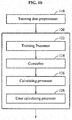
- FIG. 1B is a block diagram illustrating an example of a configuration of the training data preprocessor 110 and the language model trainer 120 to train a language model, in accordance with an embodiment.
- the training data preprocessor 110 generates the first training feature vector sequence beginning in a forward direction of the word vector sequence, and the second training feature vector sequence beginning in a backward direction of the word vector sequence.
- the language model trainer 120 includes a training processor 122 configured to train the language model based on the first training feature vector sequence and the second training feature vector sequence generated at the training data preprocessor 110.
- the language model trainer 120 includes a controller 124 configured to perform forward estimation of the neural network with respect to the first training feature vector sequence, and perform backward estimation of the neural network with respect to the second training feature vector sequence.
- the controller 124 continuously performs the forward estimation with respect to the first training feature vector sequence, and continuously performs the backward estimation with respect to the second training feature vector sequence.
- the controller 124 performs the forward estimation of the neural network by estimating a subsequent word to be connected to a first word included in the training data, and by estimating a current word based on a past word record in a given sentence.
- the controller 124 performs the backward estimation by estimating a previous word connected to a second word included in the training data, and by estimating a current word based on a future word record in the sentence.
- the language model trainer 120 also includes a calculating processor 126 configured to calculate bidirectional occurrence probabilities of a word sequence using a neural network capable of bidirectional estimation, and configures the language model to estimate a word at a position of interest.
- the language model trainer 120 also includes an error calculating processor 128 configured to calculate an error value between the training data and output data of the language model by integrating a result of the forward estimation with respect to the first training feature vector sequence and a result of the backward estimation with respect to the second training feature vector sequence. Based on the calculated error value, a connection weight is updated between artificial neurons included in the neural network.
- the language model is trained based on a forward context of the given sentence from left to right, and a backward context of the given sentence from right to left.
- FIG. 2 is a block diagram illustrating an example of a structure of a neural network configuring a language model, in accordance with an embodiment.
- a neural network 200 includes a data layer 210, hidden layers 240, and a convolution layer 250.
- the hidden layers 240 include a first hidden layer 220 and a second hidden layer 230.
- the first hidden layer 220 and the second hidden layer 230 correspond to long short-term memory (LSTM) layers.
- LSTM long short-term memory
- the recurrent neural network of the BLSTM structure includes memory blocks configured to maintain a value output in a previous time period until a subsequent time period.
- the memory blocks store a past history, and reflect the past history in a current stage.
- the recurrent neural network of the BLSTM structure inputs, stores, and outputs data input in time units using three gates, for example, an input gate, a forget gate, and an output gate, in a hidden layer.
- a first training feature vector sequence for forward estimation and a second training feature vector sequence for backward estimation are input into the data layer 210.
- the first training feature vector sequence and the second training feature vector sequence are separately generated from feature vectors with respect to words included in training data.
- the first training feature vector sequence and the second training feature vector sequence are generated simultaneously with the feature vectors with respect to words included in training data.
- Forward probability information is calculated by performing forward estimation based on the first training feature vector sequence in the first hidden layer 220, and backward probability information is calculated by performing backward estimation based on the second training feature vector sequence in the second hidden layer 230.
- a plurality of first hidden layers 220 and a plurality of second hidden layers 230 are provided, and the plurality of first hidden layers 220 and the plurality of second hidden layers 230 may have a hierarchical structure.
- a first hidden layer 220 is connected to an upper first hidden layer
- a second hidden layer 230 is connected to an upper second hidden layer.
- Probability information calculated in the first hidden layer 220 and probability information calculated in the second hidden layer 230 is transmitted to the upper first hidden layer 220 and the upper second hidden layer 230, respectively. Probability information is recalculated in the upper first hidden layer 220 and the upper second hidden layer 230 based on the received probability information.
- the forward estimation is performed through the first hidden layers 220, and the backward estimation is performed through the second hidden layers 230.
- the first hidden layers 220 and the second hidden layers 230 are structurally and functionally separate from each other.
- the first hidden layers 220 and the second hidden layers 230 are structurally together, but functionally separate from each other.
- a single hidden layer is used to process the first and the second hidden layers.
- the probability information deduced from the forward estimation and the probability information deduced from the backward estimation is integrated, and a final estimation result associated with an input word is generated based on a result of the integrating.
- An apparatus for training a language model calculates an error value between the final estimation result generated in the convolution layer 250 and the input word, and update a connection weight between artificial neurons to reduce the error value.
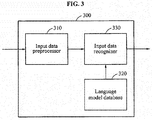
- FIG. 3 is a block diagram illustrating an example of a configuration of an apparatus to recognize a language, in accordance with an embodiment.
- An apparatus 300 to recognize a language recognizes input data using a pre-trained language model, and outputs a recognition result.
- the apparatus 300 to recognize the language extracts a feature from the input data using the language model, and outputs a result that classifies and recognizes the input data by applying the extracted feature to the language model.
- the apparatus 300 to recognize the language recognizes and outputs a sentence or a word corresponding to input speech data.
- the apparatus 300 to recognize language is used in fields of, for example, speech recognition and handwriting recognition, and is applicable to various devices/systems such as smart phones, tablet computers, desktop computers, navigation systems, display devices, wearable devices, security systems, and smart home systems, for example.
- the apparatus 300 to recognize the language includes an input data preprocessor 310, a language model database 320, and an input data recognizer 330.
- the input data preprocessor 310 generates a first input feature vector sequence for forward estimation and a second input feature vector sequence for backward estimation from input data.
- Sequential data for example, speech data or handwriting data, is input as the input data.
- the input data preprocessor 310 extracts a relative variation with respect to a period of time as a feature from input speech data, and converts the extracted feature into a speech feature vector sequence.
- the input data preprocessor 310 generates a first input feature vector sequence starting in a forward direction of the speech feature vector sequence and a second input feature vector sequence starting in a backward direction of the speech feature vector sequence based on the speech feature vector sequence.
- the input data recognizer 330 estimates a result of recognizing the input data by applying the first input feature vector sequence and the second input feature vector sequence to a neural network based on a language model.
- the first input feature vector sequence and the second input feature vector sequence may be sequentially input into the language model over time. In the alternative, the first input feature vector sequence and the second input feature vector sequence may be simultaneously input into the language model.
- the language model is pre-trained by the process described with reference to FIGS. 1 , 4 , and 5 , and stored in the language model database 320.
- a neural network configuring the language model is a recurrent neural network capable of bidirectional estimation, for example, forward estimation and backward estimation.
- the input data recognizer 330 continuously performs forward estimation of the neural network with respect to the first input feature vector sequence, and continuously performs backward estimation of the neural network with respect to the second input feature vector sequence.
- the forward estimation and the backward estimation are performed separately and independently. In the alternative, the forward estimation and the backward estimation are performed simultaneously.
- the neural network configuring the language model includes first hidden layers configured to perform forward estimation and second hidden layers configured to perform backward estimation.
- the first hidden layers and the second hidden layers may be separate from each other or may be integrated.
- the input data recognizer 330 performs the forward estimation with respect to the first input feature vector sequence based on the first hidden layers, and performs the backward estimation with respect to the second input feature vector sequence based on the second hidden layers.
- a forward estimation result associated with the first input feature vector sequence and a backward estimation result associated with the second input feature vector sequence are integrated by the language model, and a recognition result corresponding to the input data is determined based on a result of the integrating.
- the language model confirms that both results are integrated.
- the input data recognizer 330 outputs the recognition result determined by the language model through an interface device, for example, a display and a speaker.
- FIG. 4 is a flowchart illustrating an example of training a language model configured based on a recurrent neural network of a BLSTM structure, in accordance with an embodiment.
- the apparatus 100 to train a language model generates a word vector sequence for bidirectional estimation.
- Training data includes a word sequence including successive words, and the apparatus 100 to train the language model generates the word vector sequence by converting a feature extracted from the word sequence into a form of a vector.
- the apparatus 100 to train a language model separately generates a first training feature vector sequence for forward estimation and a second training feature vector sequence for backward estimation from the word vector sequence.
- the apparatus 100 for training a language model generates the second training feature vector sequence by reconstructing the first training feature vector sequence in a reverse order.
- a special word or indicator flag or pointer In the forward estimation that estimates a word subsequent to a current input word, a special word or indicator flag or pointer is configured to indicate a start of a sentence is inserted at a beginning of the first training feature vector sequence. In the backward estimation that estimates a word previous to a current input word, a special word or indicator flag or pointer is configured to indicate indicating an end of a sentence may be inserted at a beginning of the second training feature vector sequence.
- the word, the flag, or pointer is a single character or compound characters pre-defined to be recognized as an indicator of a start of a sentence.
- the apparatus 100 for training a language model performs estimation between a data layer and a long short-term memory (LSTM) layer.
- the first training feature vector sequence and the second training feature vector sequence generated in operation 410 is sequentially input into a data layer of a recurrent neural network of a bidirectional long short-term memory (BLSTM)structure in word units.
- the apparatus 100 to train a language model calculates a weighted sum of the first training feature vector sequence and the second training feature vector sequence based on an equation of the LSTM layer, which is known in the related art.
- the LSTM layer corresponds to a hidden layer in the recurrent neural network of the BLSTM structure.
- the apparatus 100 to train the language model performs estimation between the LSTM layer and an upper LSTM layer, in operation 430.
- the apparatus 100 to train the language model performs forward estimation of the upper LSTM layer based on, in one example, a result calculated by forward estimation of a previous LSTM layer, and performs backward estimation of the upper LSTM layer based on, in one example, a result calculated by backward estimation of the previous LSTM layer.
- the apparatus 100 to train the language model calculates a probability value with respect to a final word by integrating a forward estimation result, associated with the first training feature vector sequence, and a backward estimation result, associated with the second training feature vector sequence.
- the apparatus 100 to train the language model calculates an error value based on the probability value with respect to the final word, and corrects an error.
- the apparatus 100 to train the language model calculates the error value by comparing an input word to the final word using a supervised learning method, and corrects a connection weight between artificial neurons included in the LSTM layer by propagating the error value to a lower LSTM layer using a back propagation through time (BPTT)scheme.
- BPTT back propagation through time
- the apparatus 100 to train the language model stores a language model trained by correcting the error.
- the apparatus 100 to train the language model stores connection weight information and state information related to artificial neurons constituting the recurrent neural network of the BLSTM structure.
- the apparatus 100 to train the language model verifies whether the error value calculated in operation 450 satisfies a preset condition. When the error value satisfies the preset condition, the apparatus 100 to train the language model terminates training. Conversely, when the error value does not satisfy the preset condition, the apparatus 100 to train the language model re-executes operations 410 through 470.
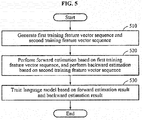
- FIG. 5 is a flowchart illustrating an example of a method of training a language model, in accordance with an embodiment.
- the apparatus 100 for training a language model generates a first training feature vector sequence for forward estimation and a second training feature vector sequence for backward estimation from training data.
- the apparatus 100 to train the language model converts successive words constituting the training data into a word vector sequence, and generates the first training feature vector sequence starting in a forward direction of the word vector sequence and the second training feature vector sequence starting in a backward direction of the word vector sequence.
- the apparatus 100 to train language model performs forward estimation of a neural network configuring a language model based on the first training feature vector sequence, and performs backward estimation of the neural network based on the second training feature vector sequence.
- the forward estimation with respect to the first training feature vector sequence and the backward estimation with respect to the second training feature vector sequence are performed separately.
- the first training feature vector sequence and the backward estimation with respect to the second training feature vector sequence are performed concurrently.
- the apparatus 100 to train the language model trains the language model based on a forward estimation result associated with the first training feature vector sequence and a backward estimation result associated with the second training feature vector sequence.
- the apparatus 100 to train the language model calculates an error value between the training data and output data of the neural network by integrating the forward estimation result and the backward estimation result, and updates a connection weight between artificial neurons to reduce the error value.
- FIG. 6 is a flowchart illustrating an example of a method of recognizing a language, in accordance with an embodiment.
- the apparatus 300 to recognize a language generates an input feature vector sequence from input data.
- the apparatus 300 to recognize the language extracts a feature from the input data, and generates the input feature vector sequence based on the extracted feature.
- the apparatus 300 to recognize the language generates a first input feature vector sequence for forward estimation and a second input feature vector sequence for backward estimation based on the input feature vector sequence.
- the first input feature vector sequence and the second input feature vector sequence are sequentially applied to a pre-trained language model over time.
- the apparatus 300 to recognize language estimates a result of recognizing the input data using a neural network based language model.
- the apparatus 300 to recognize the language continuously performs forward estimation of a neural network configuring the language model based on the first input feature vector sequence, and continuously performs backward estimation of the neural network based on the second input feature vector sequence.
- the apparatus 300 to recognize the language estimates the result of recognizing the input data based on a forward estimation result associated with the first input feature vector sequence and a backward estimation result associated with the second input feature vector sequence.
- a hardware component may be, for example, a physical device that physically performs one or more operations, but is not limited thereto.
- hardware components include resistors, capacitors, inductors, power supplies, frequency generators, operational amplifiers, power amplifiers, low-pass filters, high-pass filters, band-pass filters, analog-to-digital converters, digital-to-analog converters, processing devices, and any other electronic components known to one of ordinary skill in the art.
- the hardware components are implemented by one or more processors or computers.
- a processor or computer is implemented by one or more processing elements, such as an array of logic gates, a controller and an arithmetic logic unit, a digital signal processor, a microcomputer, a programmable logic controller, a field-programmable gate array, a programmable logic array, a microprocessor, or any other device or combination of devices known to one of ordinary skill in the art that is capable of responding to and executing instructions in a defined manner to achieve a desired result.
- processing elements such as an array of logic gates, a controller and an arithmetic logic unit, a digital signal processor, a microcomputer, a programmable logic controller, a field-programmable gate array, a programmable logic array, a microprocessor, or any other device or combination of devices known to one of ordinary skill in the art that is capable of responding to and executing instructions in a defined manner to achieve a desired result.
- a processor or computer includes, or is connected to, one or more memories storing instructions or software that are executed by the processor or computer.
- Hardware components implemented by a processor or computer execute instructions or software, such as an operating system (OS) and one or more software applications that run on the OS, to perform the operations described herein with respect to FIGS. 4-6 .
- the hardware components also access, manipulate, process, create, and store data in response to execution of the instructions or software.
- OS operating system
- processors or computer may be used in the description of the examples described herein, but in other examples multiple processors or computers are used, or a processor or computer includes multiple processing elements, or multiple types of processing elements, or both.
- a hardware component includes multiple processors, and in another example, a hardware component includes a processor and a controller.
- a hardware component has any one or more of different processing configurations, examples of which include a single processor, independent processors, parallel processors, single-instruction single-data (SISD) multiprocessing, single-instruction multiple-data (SIMD) multiprocessing, multiple-instruction single-data (MISD) multiprocessing, and multiple-instruction multiple-data (MIMD) multiprocessing.
- SISD single-instruction single-data
- SIMD single-instruction multiple-data
- MIMD multiple-instruction multiple-data
- a processing device may be implemented using one or more general-purpose or special-purpose computers, such as, for example, a processor, a controller and an arithmetic logic unit, a digital signal processor, a microcomputer, a field-programmable array, a programmable logic unit, a microprocessor, or any other device capable of running software or executing instructions.
- the processing device may run an operating system (OS), and may run one or more software applications that operate under the OS.
- the processing device may access, store, manipulate, process, and create data when running the software or executing the instructions.
- OS operating system
- the singular term "processing device" may be used in the description, but one of ordinary skill in the art will appreciate that a processing device may include multiple processing elements and multiple types of processing elements.
- a processing device may include one or more processors, or one or more processors and one or more controllers.
- different processing configurations are possible, such as parallel processors or multi-core processors.
- FIGS. 4-6 The methods illustrated in FIGS. 4-6 that perform the operations described herein with respect to FIGS. 4-6 are performed by a processor or a computer as described above executing instructions or software to perform the operations described herein.
- Instructions or software to control a processor or computer to implement the hardware components and perform the methods as described above are written as computer programs, code segments, instructions or any combination thereof, for individually or collectively instructing or configuring the processor or computer to operate as a machine or special-purpose computer to perform the operations performed by the hardware components and the methods as described above.
- the instructions or software include machine code that is directly executed by the processor or computer, such as machine code produced by a compiler.
- the instructions or software include higher-level code that is executed by the processor or computer using an interpreter. Programmers of ordinary skill in the art can readily write the instructions or software based on the block diagrams and the flow charts illustrated in the drawings and the corresponding descriptions in the specification, which disclose algorithms for performing the operations performed by the hardware components and the methods as described above.
- the instructions or software to control a processor or computer to implement the hardware components and perform the methods as described above, and any associated data, data files, and data structures, are recorded, stored, or fixed in or on one or more non-transitory computer-readable storage media.
- Examples of a non-transitory computer-readable storage medium include read-only memory (ROM), random-access memory (RAM), flash memory, CD-ROMs, CD-Rs, CD+Rs, CD-RWs, CD+RWs, DVD-ROMs, DVD-Rs, DVD+Rs, DVD-RWs, DVD+RWs, DVD-RAMs, BD-ROMs, BD-Rs, BD-R LTHs, BD-REs, magnetic tapes, floppy disks, magneto-optical data storage devices, optical data storage devices, hard disks, solid-state disks, and any device known to one of ordinary skill in the art that is capable of storing the instructions or software and any associated data, data files, and data structures in a non-transitory
- the instructions or software and any associated data, data files, and data structures are distributed over network-coupled computer systems so that the instructions and software and any associated data, data files, and data structures are stored, accessed, and executed in a distributed fashion by the processor or computer.
Landscapes
- Engineering & Computer Science (AREA)
- Physics & Mathematics (AREA)
- Theoretical Computer Science (AREA)
- Health & Medical Sciences (AREA)
- Artificial Intelligence (AREA)
- Computational Linguistics (AREA)
- Evolutionary Computation (AREA)
- Audiology, Speech & Language Pathology (AREA)
- General Physics & Mathematics (AREA)
- General Health & Medical Sciences (AREA)
- General Engineering & Computer Science (AREA)
- Multimedia (AREA)
- Acoustics & Sound (AREA)
- Human Computer Interaction (AREA)
- Biophysics (AREA)
- Mathematical Physics (AREA)
- Software Systems (AREA)
- Computing Systems (AREA)
- Molecular Biology (AREA)
- Data Mining & Analysis (AREA)
- Biomedical Technology (AREA)
- Life Sciences & Earth Sciences (AREA)
- Signal Processing (AREA)
- Machine Translation (AREA)
- Image Processing (AREA)
- Image Analysis (AREA)
Description
- The following description relates to a method and apparatus to train a language model, and a method and apparatus to recognize a language using the language model.
- In the past, approaches to designing speech and language processing have moved from system and processes based on linguistics and speech science to data-driven pattern recognition techniques. These techniques have been the focus of intense, fast-moving research and have contributed to significant advances in this field. To classify a human input pattern, active research on applications of an efficient pattern recognition method of a human to an actual computer is being conducted. One such area of research is focused on an artificial neural network that models through mathematical expressions characteristics of biological nerve cells of a human.
- The artificial neural network is used to output recognition results corresponding to an input pattern of a speech in a speech recognition field. The artificial neural network generates mapping between the input pattern and an output pattern through learning and outputs a learning result indicative thereof. Based on the learning result, the artificial neural network generates an output with respect to an input pattern yet to be used for learning.
- O. Morillot et al., "Comparative Study of HMM and BLSTM Segmentation-Free Approaches for the Recognition of Handwritten Text-Lines", deals with the recognition of freestyle handwritten text lines.
- A. Graves et al., "Hybrid speech recognition with Deep Bidirectional LSTM", investigates the use of DBLSTM as an acoustic model and a standard neural network - HMM hybrid system.
- V Frinken et al., "Bidirectional Language Model for Handwriting Recognition", Structural, Syntactic, and Statistical Pattern Recognition, proposes a bidirectional recognition using a distinct forward and a backward language model.
- Y-C Tam et al., "ASR error detection using recurrent neural network language model and complementary ASR", proposes two approaches to improve ASR error detection.
- M Schuster et al., "Bidirectional Recurrent Neural Networks" extends a regular recurrent neural network to a bidirectional recurrent neural network and shows how the proposed bidirectional structure can be easily modified to allow efficient estimation of the conditional posterior probability of complete simple sequences without making any explicit assumption about the shape of the distribution.
- M Sundermeyer et al., "Translation Modeling with Bidirectional Recurrent Neural Networks", presents two different translation models using recurrent neuro networks.
- The invention is what is claimed in the independent claims.
- Preferred embodiments are specified in the dependent claims.
- This Summary is provided to introduce a selection of concepts in a simplified form that are further described below in the Detailed Description. This Summary is not intended to identify key features or essential features of the claimed subject matter, nor is it intended to be used as an aid in determining the scope of the claimed subject matter.
- In accordance with an embodiment, there is provided a method, including generating a first training feature vector sequence and a second training feature vector sequence from training data; performing forward estimation of a neural network based on the first training feature vector sequence, and performing backward estimation of the neural network based on the second training feature vector sequence; and training a language model based on a result of the forward estimation and a result of the backward estimation.
- The neural network includes first hidden layers for the forward estimation and second hidden layers for the backward estimation, and the first hidden layers are separate from the second hidden layers.
- The generating includes converting the training data into a word vector sequence; and generating the first training feature vector sequence starting in a forward direction of the word vector sequence and the second training feature vector sequence starting in a backward direction of the word vector sequence.
- The forward estimation may include estimating a subsequent word to be connected to a first word included in the training data, and the backward estimation may include estimating a previous word connected to a second word included in the training data.
- The training may include calculating an error value between the training data and output data of the neural network based on the result of the forward estimation and the result of the backward estimation; and updating a connection weight between artificial neurons included in the neural network based on the error value.
- The language model may be configured based on a recurrent neural network of a bidirectional long short-term memory (BLSTM) structure.
- The recurrent neural network of the BLSTM structure may include memory blocks configured to maintain a value output in a previous time period until a subsequent time period.
- The training data may include sequential data including speech data, handwriting data, or a combination thereof.
- In accordance with an embodiment, there is provided a method, including generating a first input feature vector sequence and a second input feature vector sequence from input data; and performing forward estimation of a neural network based on the first input feature vector sequence and performing backward estimation of the neural network based on the second input feature vector sequence to estimate a result of recognizing the input data.
- The neural network includes first hidden layers for the forward estimation and second hidden layers for the backward estimation, and the first hidden layers may be separate from the second hidden layers.
- The estimating includes estimating the result of recognizing the input data based on a forward estimation result associated with the first input feature vector sequence and a backward estimation result associated with the second input feature vector sequence.
- A non-transitory computer-readable storage medium including a program including instructions may cause a computer to perform the method described above.
- In accordance with another embodiment, there is provided an apparatus, including a training data preprocessor configured to generate a first training feature vector sequence and a second training feature vector sequence from training data; and a language model trainer configured to train a neural network based language model based on the first training feature vector sequence and the second training feature vector sequence, perform forward estimation of the neural network with respect to the first training feature vector sequence, and perform backward estimation of the neural network with respect to the second training feature vector sequence.
- The neural network includes first hidden layers for the forward estimation and second hidden layers for the backward estimation, and the first hidden layers may be separate from the second hidden layers.
- The language model trainer is configured to train the language model based on a result of the forward estimation and a result of the backward estimation.
- The language model trainer may be configured to calculate an error value between the training data and output data based on a result of the forward estimation and a result of the backward estimation, and update a connection weight between artificial neurons included in the neural network based on the error value.
- The training data preprocessor is configured to convert the training data into a word vector sequence, and generate the first training feature vector sequence starting in a forward direction of the word vector sequence and the second training feature vector sequence starting in a backward direction of the word vector sequence.
- In accordance with another embodiment, there is provided an apparatus for recognizing a language, the apparatus including an input data preprocessor configured to generate a first input feature vector sequence and a second input feature vector sequence from input data; and an input data recognizer configured to perform forward estimation of a neural network based on the first input feature vector sequence, and perform backward estimation of the neural network based on the second input feature vector sequence to estimate a result of recognizing the input data.
- In accordance with another embodiment, there is provided an apparatus for recognizing a language, the apparatus includes an input data preprocessor configured to generate a first input feature vector sequence and a second input feature vector sequence from input data; and an input data recognizer configured to perform forward estimation using the first input feature vector sequence based on first hidden layers of a neural network, and perform backward estimation using the second input feature vector sequence based on second hidden layers of the neural network, wherein the first hidden layers are separate from the second hidden layers.
- The apparatus may also include a language model database configured to store a neural network based language model.
- In accordance with another embodiment, there is provided a language model trainer apparatus, including a training processor configured to train a language model based on a first training feature vector sequence and a second training feature vector sequence; a controller configured to perform forward estimation of a neural network based on the first training feature vector sequence, and perform backward estimation of the neural network based on the second training feature vector sequence; and an error calculating processor configured to calculate an error value between training data and output data of the language model by integrating a result of the forward estimation with respect to the first training feature vector sequence and a result of the backward estimation with respect to the second training feature vector sequence.
- The controller may continuously perform the forward estimation using the first training feature vector sequence, and may continuously perform the backward estimation using the second training feature vector sequence.
- The controller may be configured to perform the forward estimation of the neural network by estimating a subsequent word to be connected to a first word included in the training data, and by estimating a current word based on a past word record in a sentence, and may be configured to perform the backward estimation by estimating a previous word connected to a second word included in the training data, and by estimating a current word based on a future word record in the sentence.
- Based on the error value, a connection weight may be updated between artificial neurons included in the neural network.
- The apparatus may also include a calculating processor configured to calculate bidirectional occurrence probabilities of a word sequence using the neural network, and configure the language model to estimate a word at a position of interest.
- The first training feature vector sequence may be generated beginning in a forward direction of the word vector sequence, and the second training feature vector sequence may be generated beginning in a backward direction of the word vector sequence.
- Other features and aspects will be apparent from the following detailed description, the drawings, and the claims.
-
-
FIG. 1A is a block diagram illustrating an example of a configuration of an apparatus to train a language model, in accordance with an embodiment. -
FIG. 1B is a block diagram illustrating an example of a configuration of the training data preprocessor and the language model trainer to train a language model, in accordance with an embodiment. -
FIG. 2 is a block diagram illustrating an example of a structure of a neural network configuring a language model, in accordance with an embodiment. -
FIG. 3 is a block diagram illustrating an example of a configuration of an apparatus to recognize a language, in accordance with an embodiment. -
FIG. 4 is a flowchart illustrating an example of training a language model configured based on a recurrent neural network of a bidirectional long short-term memory (BLSTM) structure, in accordance with an embodiment. -
FIG. 5 is a flowchart illustrating an example of a method to train a language model, in accordance with an embodiment. -
FIG. 6 is a flowchart illustrating an example of a method of recognizing a language, in accordance with an embodiment. - Throughout the drawings and the detailed description, unless otherwise described or provided, the same drawing reference numerals will be understood to refer to the same elements, features, and structures. The drawings may not be to scale, and the relative size, proportions, and depiction of elements in the drawings may be exaggerated for clarity, illustration, and convenience.
- The following detailed description is provided to assist the reader in gaining a comprehensive understanding of the methods, apparatuses, and/or systems described herein. However, various changes, modifications, and equivalents of the systems, apparatuses and/or methods described herein will be apparent to one of ordinary skill in the art. The progression of processing functions and/or operations described is an example; however, the sequence of and/or operations is not limited to that set forth herein and may be changed as is known in the art, with the exception of functions and/or operations necessarily occurring in a certain order. Also, descriptions of functions and constructions that are well known to one of ordinary skill in the art may be omitted for increased clarity and conciseness.
- The features described herein may be embodied in different forms, and are not to be construed as being limited to the examples described herein. Rather, the examples described herein have been provided so that this disclosure will be thorough and complete, and will convey the full scope of the disclosure to one of ordinary skill in the art.
- Hereinafter, examples are described in detail with reference to the accompanying drawings. The following specific structural or functional descriptions are exemplary to merely describe the examples, and the scope of the examples is not limited to the descriptions provided in the present specification. Various changes and modifications can be made thereto by those of ordinary skill in the art. Like reference numerals in the drawings denote like elements, and a known function or configuration will be omitted herein.
- It will be understood that when an element or layer is referred to as being "on" or "connected to" another element or layer, it can be directly on or connected to the other element or layer or through intervening elements or layers may be present. In contrast, when an element is referred to as being "directly on" or "directly connected to" another element or layer, there are no intervening elements or layers present. Like reference numerals refer to like elements throughout. As used herein, the term "and/or" includes any and all combinations of one or more of the associated listed items.
-
FIG. 1 is a block diagram illustrating an example of a configuration of an apparatus to train a language model, in accordance with an embodiment. - An
apparatus 100 to train a language model trains a neural network based language model. Theapparatus 100 to train the language model trains the language model through bidirectional estimation, and outputs the trained language model. - The language model estimates a recognition result corresponding to an input pattern based on a neural network. A recognition performance of the language model improves through a learning process. The language model is used to estimate words to be recognized with respect to successive speech data or handwriting data, for example, a text input. The language model is used for a natural language recognition system, for example, a system for speech recognition, handwriting recognition, dictation, interpretation, and translation. The language model includes a set, series, or group of words, and indicates a correspondence rate of each word to an input pattern as probability information.
- The neural network is a recognition model implemented as hardware that simulates a computation capability of a biological system using a large number of artificial neurons connected through edges. The neural network executes processes to execute the simulation. The neural network performs a recognition action or a learning process of a human through the artificial neurons, and the artificial neurons are connected to each other through edges having connection weights. The connection weights are predetermined values of the edges, and may also be referred to as connection strengths. The artificial neurons may also be referred to as nodes.
- Referring to
FIG. 1A , theapparatus 100 to train a language model includes atraining data preprocessor 110 and alanguage model trainer 120. - Training data to be used to train a language model is input into the
training data preprocessor 110. Sequential data, for example, speech data or handwriting data, is used as the training data. - For example, the sequential data to be learned is input into the
training data preprocessor 110 as training data. Thetraining data preprocessor 110 segments the training data into sentence units. Words constituting each sentence unit are expressed in a form of vectors, and thetraining data preprocessor 110 converts the words included in a single sentence into a word vector sequence. - The
training data preprocessor 110 extracts a feature from successive words in the training data, and converts the training data into the word vector sequence based on the extracted feature. For example, when the training data corresponds to speech data, thetraining data preprocessor 110 performs environmental adaptation, endpoint detection, echo cancellation, or noise removal, and extracts a feature vector to effectively express the digitalized speech data. The feature vector is extracted, for example, using a cepstrum extraction method that reflects a characteristic of a vocal tract and a characteristic of an excitation signal, or a Mel-frequency cepstrum coefficient (MFCC) corresponding to a cepstrum extraction method that reflects an auditory recognition process of a human. - The
training data preprocessor 110 generates a first training feature vector sequence for forward estimation and a second training feature vector sequence for backward estimation from the word vector sequence. The first training feature vector sequence starts in a forward direction of the word vector sequence, and the second training feature vector sequence starts in a backward direction of the word vector sequence. - The
language model trainer 120 trains the language model based on the first training feature vector sequence and the second training feature vector sequence. The first training feature vector sequence and the second training feature vector sequence are input sequentially into a language model over time. Thelanguage model trainer 120 performs forward estimation of the neural network configuring the language model with respect to the first training feature vector sequence, and performs backward estimation of the neural network with respect to the second training feature vector sequence. In accordance with an embodiment, thelanguage model trainer 120 continuously performs the forward estimation with respect to the first training feature vector sequence, and, in accordance with an example, continuously performs the backward estimation with respect to the second training feature vector sequence. - The forward estimation of the neural network is a process of estimating a subsequent word to be connected to a first word included in the training data, and a process of estimating a current word based on a past word record in a given sentence. The backward estimation is a process of estimating a previous word connected to a second word included in the training data, and a process of estimating a current word based on a future word record in a given sentence.
- For example, when the training data corresponds to a sentence "We are friends" and a current word input into the neural network is "are", the forward estimation estimates "are" based on a previous word "We", and the backward estimation estimates "are" based on a subsequent word "friends".
- The language model is configured using a recurrent neural network of a bidirectional long short-term memory (BLSTM) structure capable of bidirectional estimation, or a recurrent neural network of another structure. The recurrent neural network is a neural network in which hidden nodes included in hidden layers are connected recurrently in different time periods. The recurrent neural network of the BLSTM structure will be described later with reference to
FIG. 2 . - The
language model trainer 120 calculates bidirectional occurrence probabilities of a word sequence using a neural network capable of bidirectional estimation, for example, the recurrent neural network of the BLSTM structure. Thelanguage model trainer 120 configures the language model to estimate a word at a position of interest. For example, thelanguage model trainer 120 trains the language model based on a forward context of the given sentence from left to right, and a backward context of the given sentence from right to left. Because the bidirectional contexts, the forward context and the backward context, are considered, a word is estimated more accurately and an effect of noise is reduced. - The
language model trainer 120 calculates an error value between the training data and output data of the language model by integrating a result of the forward estimation with respect to the first training feature vector sequence and a result of the backward estimation with respect to the second training feature vector sequence. Thelanguage model trainer 120 updates a connection weight between artificial neurons included in the neural network based on the calculated error value. - The
language model trainer 120 updates the connection weight between the artificial neurons, for example, using a back propagation through time (BPTT) scheme. Thelanguage model trainer 120 propagates the error value in a backward direction, starting from a convolution layer of the neural network in which the forward estimation result and the backward estimation result are integrated toward hidden layers and a data layer, and updates the connection weight between the artificial neurons to reduce the error value. - The
language model trainer 120 defines an objective function to be used to measure optimal connection weights between currently set artificial neurons, continuously changes the connection weights based on a result of the objective function, and iteratively performs training. The objective function is, for example, an error function to be used to calculate an error between an actual output value and an expected value desired to be output from the neural network based on training data. Thelanguage model trainer 120 updates the connection weight to reduce a value of the error function. -
FIG. 1B is a block diagram illustrating an example of a configuration of thetraining data preprocessor 110 and thelanguage model trainer 120 to train a language model, in accordance with an embodiment. - As previously explained, the
training data preprocessor 110 generates the first training feature vector sequence beginning in a forward direction of the word vector sequence, and the second training feature vector sequence beginning in a backward direction of the word vector sequence. - The
language model trainer 120 includes atraining processor 122 configured to train the language model based on the first training feature vector sequence and the second training feature vector sequence generated at thetraining data preprocessor 110. Thelanguage model trainer 120 includes acontroller 124 configured to perform forward estimation of the neural network with respect to the first training feature vector sequence, and perform backward estimation of the neural network with respect to the second training feature vector sequence. Thecontroller 124 continuously performs the forward estimation with respect to the first training feature vector sequence, and continuously performs the backward estimation with respect to the second training feature vector sequence. Thecontroller 124 performs the forward estimation of the neural network by estimating a subsequent word to be connected to a first word included in the training data, and by estimating a current word based on a past word record in a given sentence. Thecontroller 124 performs the backward estimation by estimating a previous word connected to a second word included in the training data, and by estimating a current word based on a future word record in the sentence. - The
language model trainer 120 also includes a calculatingprocessor 126 configured to calculate bidirectional occurrence probabilities of a word sequence using a neural network capable of bidirectional estimation, and configures the language model to estimate a word at a position of interest. Thelanguage model trainer 120 also includes anerror calculating processor 128 configured to calculate an error value between the training data and output data of the language model by integrating a result of the forward estimation with respect to the first training feature vector sequence and a result of the backward estimation with respect to the second training feature vector sequence. Based on the calculated error value, a connection weight is updated between artificial neurons included in the neural network. The language model is trained based on a forward context of the given sentence from left to right, and a backward context of the given sentence from right to left. -
FIG. 2 is a block diagram illustrating an example of a structure of a neural network configuring a language model, in accordance with an embodiment. - Referring to
FIG. 2 , aneural network 200 includes adata layer 210, hiddenlayers 240, and aconvolution layer 250. Thehidden layers 240 include a firsthidden layer 220 and a secondhidden layer 230. When theneural network 200 corresponds to a recurrent neural network of a BLSTM structure, the firsthidden layer 220 and the secondhidden layer 230 correspond to long short-term memory (LSTM) layers. - The recurrent neural network of the BLSTM structure includes memory blocks configured to maintain a value output in a previous time period until a subsequent time period. The memory blocks store a past history, and reflect the past history in a current stage. The recurrent neural network of the BLSTM structure inputs, stores, and outputs data input in time units using three gates, for example, an input gate, a forget gate, and an output gate, in a hidden layer.
- A first training feature vector sequence for forward estimation and a second training feature vector sequence for backward estimation are input into the
data layer 210. The first training feature vector sequence and the second training feature vector sequence are separately generated from feature vectors with respect to words included in training data. In accordance with an alternative configuration, the first training feature vector sequence and the second training feature vector sequence are generated simultaneously with the feature vectors with respect to words included in training data. - Forward probability information is calculated by performing forward estimation based on the first training feature vector sequence in the first
hidden layer 220, and backward probability information is calculated by performing backward estimation based on the second training feature vector sequence in the secondhidden layer 230. - A plurality of first
hidden layers 220 and a plurality of secondhidden layers 230 are provided, and the plurality of firsthidden layers 220 and the plurality of secondhidden layers 230 may have a hierarchical structure. A first hiddenlayer 220 is connected to an upper first hidden layer, and a secondhidden layer 230 is connected to an upper second hidden layer. - Probability information calculated in the first
hidden layer 220 and probability information calculated in the secondhidden layer 230 is transmitted to the upper firsthidden layer 220 and the upper secondhidden layer 230, respectively. Probability information is recalculated in the upper firsthidden layer 220 and the upper secondhidden layer 230 based on the received probability information. The forward estimation is performed through the firsthidden layers 220, and the backward estimation is performed through the second hidden layers 230. In one configuration, the firsthidden layers 220 and the secondhidden layers 230 are structurally and functionally separate from each other. In an alternative configuration, the firsthidden layers 220 and the secondhidden layers 230 are structurally together, but functionally separate from each other. In a further alternative configuration, a single hidden layer is used to process the first and the second hidden layers. - In the
convolution layer 250, the probability information deduced from the forward estimation and the probability information deduced from the backward estimation is integrated, and a final estimation result associated with an input word is generated based on a result of the integrating. - An apparatus for training a language model calculates an error value between the final estimation result generated in the
convolution layer 250 and the input word, and update a connection weight between artificial neurons to reduce the error value. -
FIG. 3 is a block diagram illustrating an example of a configuration of an apparatus to recognize a language, in accordance with an embodiment. - An
apparatus 300 to recognize a language recognizes input data using a pre-trained language model, and outputs a recognition result. Theapparatus 300 to recognize the language extracts a feature from the input data using the language model, and outputs a result that classifies and recognizes the input data by applying the extracted feature to the language model. For example, theapparatus 300 to recognize the language recognizes and outputs a sentence or a word corresponding to input speech data. Theapparatus 300 to recognize language is used in fields of, for example, speech recognition and handwriting recognition, and is applicable to various devices/systems such as smart phones, tablet computers, desktop computers, navigation systems, display devices, wearable devices, security systems, and smart home systems, for example. - Referring to
FIG. 3 , theapparatus 300 to recognize the language includes aninput data preprocessor 310, alanguage model database 320, and aninput data recognizer 330. - The
input data preprocessor 310 generates a first input feature vector sequence for forward estimation and a second input feature vector sequence for backward estimation from input data. Sequential data, for example, speech data or handwriting data, is input as the input data. Upon receipt of the input data, theinput data preprocessor 310 extracts a relative variation with respect to a period of time as a feature from input speech data, and converts the extracted feature into a speech feature vector sequence. Theinput data preprocessor 310 generates a first input feature vector sequence starting in a forward direction of the speech feature vector sequence and a second input feature vector sequence starting in a backward direction of the speech feature vector sequence based on the speech feature vector sequence. - The
input data recognizer 330 estimates a result of recognizing the input data by applying the first input feature vector sequence and the second input feature vector sequence to a neural network based on a language model. The first input feature vector sequence and the second input feature vector sequence may be sequentially input into the language model over time. In the alternative, the first input feature vector sequence and the second input feature vector sequence may be simultaneously input into the language model. - The language model is pre-trained by the process described with reference to
FIGS. 1 ,4 , and5 , and stored in thelanguage model database 320. A neural network configuring the language model is a recurrent neural network capable of bidirectional estimation, for example, forward estimation and backward estimation. Theinput data recognizer 330 continuously performs forward estimation of the neural network with respect to the first input feature vector sequence, and continuously performs backward estimation of the neural network with respect to the second input feature vector sequence. The forward estimation and the backward estimation are performed separately and independently. In the alternative, the forward estimation and the backward estimation are performed simultaneously. - The neural network configuring the language model includes first hidden layers configured to perform forward estimation and second hidden layers configured to perform backward estimation. The first hidden layers and the second hidden layers may be separate from each other or may be integrated. The
input data recognizer 330 performs the forward estimation with respect to the first input feature vector sequence based on the first hidden layers, and performs the backward estimation with respect to the second input feature vector sequence based on the second hidden layers. - A forward estimation result associated with the first input feature vector sequence and a backward estimation result associated with the second input feature vector sequence are integrated by the language model, and a recognition result corresponding to the input data is determined based on a result of the integrating. In the configuration in which the forward estimation result and the backward estimation results are performed simultaneously and are integrated, the language model confirms that both results are integrated. The
input data recognizer 330 outputs the recognition result determined by the language model through an interface device, for example, a display and a speaker. -
FIG. 4 is a flowchart illustrating an example of training a language model configured based on a recurrent neural network of a BLSTM structure, in accordance with an embodiment. - Referring to
FIG. 4 , inoperation 410, theapparatus 100 to train a language model generates a word vector sequence for bidirectional estimation. Training data includes a word sequence including successive words, and theapparatus 100 to train the language model generates the word vector sequence by converting a feature extracted from the word sequence into a form of a vector. - In accordance with an embodiment, the
apparatus 100 to train a language model separately generates a first training feature vector sequence for forward estimation and a second training feature vector sequence for backward estimation from the word vector sequence. Theapparatus 100 for training a language model generates the second training feature vector sequence by reconstructing the first training feature vector sequence in a reverse order. - In the forward estimation that estimates a word subsequent to a current input word, a special word or indicator flag or pointer is configured to indicate a start of a sentence is inserted at a beginning of the first training feature vector sequence. In the backward estimation that estimates a word previous to a current input word, a special word or indicator flag or pointer is configured to indicate indicating an end of a sentence may be inserted at a beginning of the second training feature vector sequence. In one configuration, for either the forward estimation or the backward estimation, the word, the flag, or pointer is a single character or compound characters pre-defined to be recognized as an indicator of a start of a sentence.
- In
operation 420, theapparatus 100 for training a language model performs estimation between a data layer and a long short-term memory (LSTM) layer. The first training feature vector sequence and the second training feature vector sequence generated inoperation 410 is sequentially input into a data layer of a recurrent neural network of a bidirectional long short-term memory (BLSTM)structure in word units. Theapparatus 100 to train a language model calculates a weighted sum of the first training feature vector sequence and the second training feature vector sequence based on an equation of the LSTM layer, which is known in the related art. The LSTM layer corresponds to a hidden layer in the recurrent neural network of the BLSTM structure. - When the recurrent neural network of the BLSTM structure includes hierarchical LSTM layers, the
apparatus 100 to train the language model performs estimation between the LSTM layer and an upper LSTM layer, inoperation 430. - The
apparatus 100 to train the language model performs forward estimation of the upper LSTM layer based on, in one example, a result calculated by forward estimation of a previous LSTM layer, and performs backward estimation of the upper LSTM layer based on, in one example, a result calculated by backward estimation of the previous LSTM layer. - In
operation 440, when the calculation in the LSTM layer is terminated, theapparatus 100 to train the language model calculates a probability value with respect to a final word by integrating a forward estimation result, associated with the first training feature vector sequence, and a backward estimation result, associated with the second training feature vector sequence. - In
operation 450, theapparatus 100 to train the language model calculates an error value based on the probability value with respect to the final word, and corrects an error. Theapparatus 100 to train the language model calculates the error value by comparing an input word to the final word using a supervised learning method, and corrects a connection weight between artificial neurons included in the LSTM layer by propagating the error value to a lower LSTM layer using a back propagation through time (BPTT)scheme. - In
operation 460, theapparatus 100 to train the language model stores a language model trained by correcting the error. Theapparatus 100 to train the language model stores connection weight information and state information related to artificial neurons constituting the recurrent neural network of the BLSTM structure. - In
operation 470, theapparatus 100 to train the language model verifies whether the error value calculated inoperation 450 satisfies a preset condition. When the error value satisfies the preset condition, theapparatus 100 to train the language model terminates training. Conversely, when the error value does not satisfy the preset condition, theapparatus 100 to train the language modelre-executes operations 410 through 470. -
FIG. 5 is a flowchart illustrating an example of a method of training a language model, in accordance with an embodiment. - Referring to
FIG. 5 , inoperation 510, theapparatus 100 for training a language model generates a first training feature vector sequence for forward estimation and a second training feature vector sequence for backward estimation from training data. Theapparatus 100 to train the language model converts successive words constituting the training data into a word vector sequence, and generates the first training feature vector sequence starting in a forward direction of the word vector sequence and the second training feature vector sequence starting in a backward direction of the word vector sequence. - In
operation 520, theapparatus 100 to train language model performs forward estimation of a neural network configuring a language model based on the first training feature vector sequence, and performs backward estimation of the neural network based on the second training feature vector sequence. The forward estimation with respect to the first training feature vector sequence and the backward estimation with respect to the second training feature vector sequence are performed separately. In an alternative configuration, the first training feature vector sequence and the backward estimation with respect to the second training feature vector sequence are performed concurrently. - In
operation 530, theapparatus 100 to train the language model trains the language model based on a forward estimation result associated with the first training feature vector sequence and a backward estimation result associated with the second training feature vector sequence. Theapparatus 100 to train the language model calculates an error value between the training data and output data of the neural network by integrating the forward estimation result and the backward estimation result, and updates a connection weight between artificial neurons to reduce the error value. - The descriptions provided with reference to
FIGS. 1 ,2 , and4 may be applicable to operations ofFIG. 5 and thus, duplicated descriptions will be omitted for conciseness. -
FIG. 6 is a flowchart illustrating an example of a method of recognizing a language, in accordance with an embodiment. - Referring to
FIG. 6 , inoperation 610, theapparatus 300 to recognize a language generates an input feature vector sequence from input data. Theapparatus 300 to recognize the language extracts a feature from the input data, and generates the input feature vector sequence based on the extracted feature. Theapparatus 300 to recognize the language generates a first input feature vector sequence for forward estimation and a second input feature vector sequence for backward estimation based on the input feature vector sequence. In one embodiment, the first input feature vector sequence and the second input feature vector sequence are sequentially applied to a pre-trained language model over time. - In
operation 620, theapparatus 300 to recognize language estimates a result of recognizing the input data using a neural network based language model. Theapparatus 300 to recognize the language continuously performs forward estimation of a neural network configuring the language model based on the first input feature vector sequence, and continuously performs backward estimation of the neural network based on the second input feature vector sequence. Theapparatus 300 to recognize the language estimates the result of recognizing the input data based on a forward estimation result associated with the first input feature vector sequence and a backward estimation result associated with the second input feature vector sequence. - The descriptions provided with reference to
FIG. 3 may be applicable to operations ofFIG. 6 and thus, duplicated descriptions will be omitted for conciseness. - The various trainers, layers, modules, elements, processors, and controllers described above are implemented using one or more hardware components.
- A hardware component may be, for example, a physical device that physically performs one or more operations, but is not limited thereto. Examples of hardware components include resistors, capacitors, inductors, power supplies, frequency generators, operational amplifiers, power amplifiers, low-pass filters, high-pass filters, band-pass filters, analog-to-digital converters, digital-to-analog converters, processing devices, and any other electronic components known to one of ordinary skill in the art. In one example, the hardware components are implemented by one or more processors or computers. A processor or computer is implemented by one or more processing elements, such as an array of logic gates, a controller and an arithmetic logic unit, a digital signal processor, a microcomputer, a programmable logic controller, a field-programmable gate array, a programmable logic array, a microprocessor, or any other device or combination of devices known to one of ordinary skill in the art that is capable of responding to and executing instructions in a defined manner to achieve a desired result.
- In one example, a processor or computer includes, or is connected to, one or more memories storing instructions or software that are executed by the processor or computer. Hardware components implemented by a processor or computer execute instructions or software, such as an operating system (OS) and one or more software applications that run on the OS, to perform the operations described herein with respect to
FIGS. 4-6 . The hardware components also access, manipulate, process, create, and store data in response to execution of the instructions or software. For simplicity, the singular term "processor" or "computer" may be used in the description of the examples described herein, but in other examples multiple processors or computers are used, or a processor or computer includes multiple processing elements, or multiple types of processing elements, or both. In one example, a hardware component includes multiple processors, and in another example, a hardware component includes a processor and a controller. A hardware component has any one or more of different processing configurations, examples of which include a single processor, independent processors, parallel processors, single-instruction single-data (SISD) multiprocessing, single-instruction multiple-data (SIMD) multiprocessing, multiple-instruction single-data (MISD) multiprocessing, and multiple-instruction multiple-data (MIMD) multiprocessing. - A processing device may be implemented using one or more general-purpose or special-purpose computers, such as, for example, a processor, a controller and an arithmetic logic unit, a digital signal processor, a microcomputer, a field-programmable array, a programmable logic unit, a microprocessor, or any other device capable of running software or executing instructions. The processing device may run an operating system (OS), and may run one or more software applications that operate under the OS. The processing device may access, store, manipulate, process, and create data when running the software or executing the instructions. For simplicity, the singular term "processing device" may be used in the description, but one of ordinary skill in the art will appreciate that a processing device may include multiple processing elements and multiple types of processing elements. For example, a processing device may include one or more processors, or one or more processors and one or more controllers. In addition, different processing configurations are possible, such as parallel processors or multi-core processors.
- The methods illustrated in
FIGS. 4-6 that perform the operations described herein with respect toFIGS. 4-6 are performed by a processor or a computer as described above executing instructions or software to perform the operations described herein. - Instructions or software to control a processor or computer to implement the hardware components and perform the methods as described above are written as computer programs, code segments, instructions or any combination thereof, for individually or collectively instructing or configuring the processor or computer to operate as a machine or special-purpose computer to perform the operations performed by the hardware components and the methods as described above. In one example, the instructions or software include machine code that is directly executed by the processor or computer, such as machine code produced by a compiler. In another example, the instructions or software include higher-level code that is executed by the processor or computer using an interpreter. Programmers of ordinary skill in the art can readily write the instructions or software based on the block diagrams and the flow charts illustrated in the drawings and the corresponding descriptions in the specification, which disclose algorithms for performing the operations performed by the hardware components and the methods as described above.
- The instructions or software to control a processor or computer to implement the hardware components and perform the methods as described above, and any associated data, data files, and data structures, are recorded, stored, or fixed in or on one or more non-transitory computer-readable storage media. Examples of a non-transitory computer-readable storage medium include read-only memory (ROM), random-access memory (RAM), flash memory, CD-ROMs, CD-Rs, CD+Rs, CD-RWs, CD+RWs, DVD-ROMs, DVD-Rs, DVD+Rs, DVD-RWs, DVD+RWs, DVD-RAMs, BD-ROMs, BD-Rs, BD-R LTHs, BD-REs, magnetic tapes, floppy disks, magneto-optical data storage devices, optical data storage devices, hard disks, solid-state disks, and any device known to one of ordinary skill in the art that is capable of storing the instructions or software and any associated data, data files, and data structures in a non-transitory manner and providing the instructions or software and any associated data, data files, and data structures to a processor or computer so that the processor or computer can execute the instructions. In one example, the instructions or software and any associated data, data files, and data structures are distributed over network-coupled computer systems so that the instructions and software and any associated data, data files, and data structures are stored, accessed, and executed in a distributed fashion by the processor or computer.
- While this disclosure includes specific examples, it will be apparent to one of ordinary skill in the art that various changes in form and details may be made in these examples without departing from the scope of the claims. The examples described herein are to be considered in a descriptive sense only, and not for purposes of limitation. Descriptions of features or aspects in each example are to be considered as being applicable to similar features or aspects in other examples. Suitable results may be achieved if the described techniques are performed in a different order, and/or if components in a described system, architecture, device, or circuit are combined in a different manner and/or replaced or supplemented by other components or their equivalents. Therefore, the scope of the disclosure is defined not by the detailed description, but by the claims.
Claims (9)
- A method of training a language model, comprising:generating (510) a first training feature vector sequence for forward estimation and a second training feature vector sequence for backward estimation, from input data being training data including words, wherein the generating comprises converting the input data into a word vector sequence, wherein the first training feature vector sequence starts in a forward direction of the word vector sequence of input data and the second training feature vector sequence starts in a backward direction of the word vector sequence;performing (520) forward estimation of a neural network (200) based on the first training feature vector sequence and performing backward estimation of the neural network based on the second training feature vector sequence; andtraining (530) a language model based on a result of the forward estimation and a result of the backward estimation,characterized in thatthe neural network (200) comprises first hidden layers (220) in a first hierarchical structure for the forward estimation and second hidden layers (230) in a second hierarchical structure for the backward estimation, the first hidden layers (220) in the first hierarchical structure and the second hidden layers in the second hierarchical structure being functionally separate from each other, with the forward estimation result and the backward estimation result being integrated in a convolution layer (250) of the neural network to generate a final estimation result.
- The method of claim 1, wherein the estimating comprises:
estimating the result of recognizing the input data based on a forward estimation result associated with the first input feature vector sequence and a backward estimation result associated with the second input feature vector sequence. - The method of claim 1 or 2, wherein the forward estimation comprises estimating a subsequent word to be connected to a first word included in the input data, and
the backward estimation comprises estimating a previous word connected to a second word included in the input data. - The method of one of claims 1 to 3, wherein the neural network is configured based on a recurrent neural network of a bidirectional long short-term memory, BLSTM, structure.
- The method of one of claims 1 to 4, wherein the input data comprises sequential data comprising speech data, handwriting data, or a combination thereof.
- A non-transitory computer-readable storage medium comprising a program comprising instructions to cause a computer to perform the method of one of claims 1 to 5.
- An apparatus, comprising:a training data preprocessor (110) configured to convert training data including words into a word vector sequence and generate a first training feature vector sequence for forward estimation and a second training feature vector sequence for backward estimation from the training data, wherein the first training feature vector sequence starts in a forward direction of the word vector sequence of input data and the second training feature vector sequence starts in a backward direction of the word vector sequence; anda language model trainer (120) configured to train a neural network based language model based on the first training feature vector sequence and the second training feature vector sequence, perform forward estimation of the neural network (200) with respect to the first training feature vector sequence, and perform backward estimation of the neural network with respect to the second training feature vector sequence,characterized in thatthe neural network (200) comprises first hidden layers (220) in a first hierarchical structure for the forward estimation and second hidden layers (230) in a second hierarchical structure for the backward estimation, the first hidden layers (220) in the first hierarchical structure and the second hidden layers in the second hierarchical structure being functionally separate from each other, with the forward estimation result and the backward estimation result being integrated in a convolution layer (250) of the neural network to generate a final estimation result.
- The apparatus of claim 7, wherein the language model trainer is configured to train the language model based on a result of the forward estimation and a result of the backward estimation.
- The apparatus of claim 7 or 8, wherein the language model trainer is configured to calculate an error value between the training data and output data based on a result of the forward estimation and a result of the backward estimation, and update a connection weight between artificial neurons included in the neural network based on the error value.
Applications Claiming Priority (1)
| Application Number | Priority Date | Filing Date | Title |
|---|---|---|---|
| KR1020150008881A KR102305584B1 (en) | 2015-01-19 | 2015-01-19 | Method and apparatus for training language model, method and apparatus for recognizing language |
Publications (3)
| Publication Number | Publication Date |
|---|---|
| EP3046053A2 EP3046053A2 (en) | 2016-07-20 |
| EP3046053A3 EP3046053A3 (en) | 2016-12-21 |
| EP3046053B1 true EP3046053B1 (en) | 2019-05-08 |
Family
ID=54145576
Family Applications (1)
| Application Number | Title | Priority Date | Filing Date |
|---|---|---|---|
| EP15184200.2A Active EP3046053B1 (en) | 2015-01-19 | 2015-09-08 | Method and apparatus for training language model |
Country Status (5)
| Country | Link |
|---|---|
| US (1) | US10380483B2 (en) |
| EP (1) | EP3046053B1 (en) |
| JP (1) | JP6746292B2 (en) |
| KR (1) | KR102305584B1 (en) |
| CN (1) | CN105810193B (en) |
Families Citing this family (151)
| Publication number | Priority date | Publication date | Assignee | Title |
|---|---|---|---|---|
| US8677377B2 (en) | 2005-09-08 | 2014-03-18 | Apple Inc. | Method and apparatus for building an intelligent automated assistant |
| US9318108B2 (en) | 2010-01-18 | 2016-04-19 | Apple Inc. | Intelligent automated assistant |
| US8977255B2 (en) | 2007-04-03 | 2015-03-10 | Apple Inc. | Method and system for operating a multi-function portable electronic device using voice-activation |
| US8676904B2 (en) | 2008-10-02 | 2014-03-18 | Apple Inc. | Electronic devices with voice command and contextual data processing capabilities |
| US10255566B2 (en) | 2011-06-03 | 2019-04-09 | Apple Inc. | Generating and processing task items that represent tasks to perform |
| US10276170B2 (en) | 2010-01-18 | 2019-04-30 | Apple Inc. | Intelligent automated assistant |
| US10057736B2 (en) | 2011-06-03 | 2018-08-21 | Apple Inc. | Active transport based notifications |
| US10417037B2 (en) | 2012-05-15 | 2019-09-17 | Apple Inc. | Systems and methods for integrating third party services with a digital assistant |
| CN113470641B (en) | 2013-02-07 | 2023-12-15 | 苹果公司 | Voice triggers for digital assistants |
| US10652394B2 (en) | 2013-03-14 | 2020-05-12 | Apple Inc. | System and method for processing voicemail |
| US10748529B1 (en) | 2013-03-15 | 2020-08-18 | Apple Inc. | Voice activated device for use with a voice-based digital assistant |
| US10176167B2 (en) | 2013-06-09 | 2019-01-08 | Apple Inc. | System and method for inferring user intent from speech inputs |
| KR101922663B1 (en) | 2013-06-09 | 2018-11-28 | 애플 인크. | Device, method, and graphical user interface for enabling conversation persistence across two or more instances of a digital assistant |
| US10791216B2 (en) | 2013-08-06 | 2020-09-29 | Apple Inc. | Auto-activating smart responses based on activities from remote devices |
| TWI566107B (en) | 2014-05-30 | 2017-01-11 | 蘋果公司 | Method for processing a multi-part voice command, non-transitory computer readable storage medium and electronic device |
| US9715875B2 (en) | 2014-05-30 | 2017-07-25 | Apple Inc. | Reducing the need for manual start/end-pointing and trigger phrases |
| US10170123B2 (en) | 2014-05-30 | 2019-01-01 | Apple Inc. | Intelligent assistant for home automation |
| US9338493B2 (en) | 2014-06-30 | 2016-05-10 | Apple Inc. | Intelligent automated assistant for TV user interactions |
| KR102305584B1 (en) * | 2015-01-19 | 2021-09-27 | 삼성전자주식회사 | Method and apparatus for training language model, method and apparatus for recognizing language |
| US9721566B2 (en) | 2015-03-08 | 2017-08-01 | Apple Inc. | Competing devices responding to voice triggers |
| US9886953B2 (en) | 2015-03-08 | 2018-02-06 | Apple Inc. | Virtual assistant activation |
| US10460227B2 (en) | 2015-05-15 | 2019-10-29 | Apple Inc. | Virtual assistant in a communication session |
| US10200824B2 (en) | 2015-05-27 | 2019-02-05 | Apple Inc. | Systems and methods for proactively identifying and surfacing relevant content on a touch-sensitive device |
| US20160378747A1 (en) | 2015-06-29 | 2016-12-29 | Apple Inc. | Virtual assistant for media playback |
| CN106486115A (en) * | 2015-08-28 | 2017-03-08 | 株式会社东芝 | Improve method and apparatus and audio recognition method and the device of neutral net language model |
| US10331312B2 (en) | 2015-09-08 | 2019-06-25 | Apple Inc. | Intelligent automated assistant in a media environment |
| US10740384B2 (en) | 2015-09-08 | 2020-08-11 | Apple Inc. | Intelligent automated assistant for media search and playback |
| US10747498B2 (en) | 2015-09-08 | 2020-08-18 | Apple Inc. | Zero latency digital assistant |
| US10671428B2 (en) | 2015-09-08 | 2020-06-02 | Apple Inc. | Distributed personal assistant |
| US11587559B2 (en) | 2015-09-30 | 2023-02-21 | Apple Inc. | Intelligent device identification |
| US10691473B2 (en) | 2015-11-06 | 2020-06-23 | Apple Inc. | Intelligent automated assistant in a messaging environment |
| US10956666B2 (en) | 2015-11-09 | 2021-03-23 | Apple Inc. | Unconventional virtual assistant interactions |
| US10223066B2 (en) | 2015-12-23 | 2019-03-05 | Apple Inc. | Proactive assistance based on dialog communication between devices |
| US10032463B1 (en) * | 2015-12-29 | 2018-07-24 | Amazon Technologies, Inc. | Speech processing with learned representation of user interaction history |
| AU2017100582A4 (en) | 2016-06-06 | 2017-06-29 | Apple Inc. | Intelligent list reading |
| US12223282B2 (en) | 2016-06-09 | 2025-02-11 | Apple Inc. | Intelligent automated assistant in a home environment |
| US10586535B2 (en) | 2016-06-10 | 2020-03-10 | Apple Inc. | Intelligent digital assistant in a multi-tasking environment |
| DK179415B1 (en) | 2016-06-11 | 2018-06-14 | Apple Inc | Intelligent device arbitration and control |
| DK201670540A1 (en) | 2016-06-11 | 2018-01-08 | Apple Inc | Application integration with a digital assistant |
| US12197817B2 (en) | 2016-06-11 | 2025-01-14 | Apple Inc. | Intelligent device arbitration and control |
| JP6671020B2 (en) * | 2016-06-23 | 2020-03-25 | パナソニックIpマネジメント株式会社 | Dialogue act estimation method, dialogue act estimation device and program |
| KR102615290B1 (en) | 2016-09-01 | 2023-12-15 | 에스케이텔레콤 주식회사 | Apparatus and Method for Learning Pronunciation Dictionary |
| US10474753B2 (en) * | 2016-09-07 | 2019-11-12 | Apple Inc. | Language identification using recurrent neural networks |
| KR102824640B1 (en) * | 2016-09-07 | 2025-06-25 | 삼성전자주식회사 | Recognition apparatus based on neural network and training method of neural network |
| US10565493B2 (en) * | 2016-09-22 | 2020-02-18 | Salesforce.Com, Inc. | Pointer sentinel mixture architecture |
| US11113480B2 (en) | 2016-09-26 | 2021-09-07 | Google Llc | Neural machine translation systems |
| US10372814B2 (en) * | 2016-10-18 | 2019-08-06 | International Business Machines Corporation | Methods and system for fast, adaptive correction of misspells |
| US10579729B2 (en) | 2016-10-18 | 2020-03-03 | International Business Machines Corporation | Methods and system for fast, adaptive correction of misspells |
| US20180113919A1 (en) * | 2016-10-24 | 2018-04-26 | Google Llc | Graphical user interface rendering predicted query results to unstructured queries |
| US10839284B2 (en) * | 2016-11-03 | 2020-11-17 | Salesforce.Com, Inc. | Joint many-task neural network model for multiple natural language processing (NLP) tasks |
| KR101869438B1 (en) * | 2016-11-22 | 2018-06-20 | 네이버 주식회사 | Method and system for predicting prognosis from diagnostic histories using deep learning |
| KR102876305B1 (en) | 2016-12-14 | 2025-10-24 | 삼성전자주식회사 | Method and device to recognize based on recurrent model and to train recurrent model |
| CN106778867B (en) | 2016-12-15 | 2020-07-07 | 北京旷视科技有限公司 | Target detection method and device, neural network training method and device |
| CN107610707B (en) * | 2016-12-15 | 2018-08-31 | 平安科技(深圳)有限公司 | A kind of method for recognizing sound-groove and device |
| CN106531150B (en) * | 2016-12-23 | 2020-02-07 | 云知声(上海)智能科技有限公司 | Emotion synthesis method based on deep neural network model |
| US10529324B1 (en) * | 2016-12-27 | 2020-01-07 | Cognistic, LLC | Geographical based voice transcription |
| US11204787B2 (en) | 2017-01-09 | 2021-12-21 | Apple Inc. | Application integration with a digital assistant |
| US10241684B2 (en) * | 2017-01-12 | 2019-03-26 | Samsung Electronics Co., Ltd | System and method for higher order long short-term memory (LSTM) network |
| KR102637338B1 (en) | 2017-01-26 | 2024-02-16 | 삼성전자주식회사 | Apparatus and method for correcting translation, and translation system |
| US11954098B1 (en) * | 2017-02-03 | 2024-04-09 | Thomson Reuters Enterprise Centre Gmbh | Natural language processing system and method for documents |
| US11226720B1 (en) | 2017-02-03 | 2022-01-18 | ThoughtTrace, Inc. | Natural language processing system and method for documents |
| US20190362703A1 (en) * | 2017-02-15 | 2019-11-28 | Nippon Telegraph And Telephone Corporation | Word vectorization model learning device, word vectorization device, speech synthesis device, method thereof, and program |
| US10769522B2 (en) | 2017-02-17 | 2020-09-08 | Wipro Limited | Method and system for determining classification of text |
| CN108461080A (en) * | 2017-02-21 | 2018-08-28 | 中兴通讯股份有限公司 | A kind of Acoustic Modeling method and apparatus based on HLSTM models |
| CN108304365A (en) * | 2017-02-23 | 2018-07-20 | 腾讯科技(深圳)有限公司 | keyword extracting method and device |
| KR102488338B1 (en) * | 2017-03-09 | 2023-01-13 | 삼성전자주식회사 | Electronic apparatus for compressing language model, electronic apparatus for providing recommendation word and operation methods thereof |
| US10825445B2 (en) * | 2017-03-23 | 2020-11-03 | Samsung Electronics Co., Ltd. | Method and apparatus for training acoustic model |
| JP6657137B2 (en) * | 2017-03-31 | 2020-03-04 | Kddi株式会社 | Information processing apparatus, information processing method, and program |
| JP6663881B2 (en) * | 2017-04-13 | 2020-03-13 | 日本電信電話株式会社 | Parallel phrase analysis device, parallel phrase analysis model learning device, method, and program |
| US10572773B2 (en) * | 2017-05-05 | 2020-02-25 | Intel Corporation | On the fly deep learning in machine learning for autonomous machines |
| DK201770383A1 (en) | 2017-05-09 | 2018-12-14 | Apple Inc. | User interface for correcting recognition errors |
| US10726832B2 (en) | 2017-05-11 | 2020-07-28 | Apple Inc. | Maintaining privacy of personal information |
| DK180048B1 (en) | 2017-05-11 | 2020-02-04 | Apple Inc. | MAINTAINING THE DATA PROTECTION OF PERSONAL INFORMATION |
| DK179496B1 (en) | 2017-05-12 | 2019-01-15 | Apple Inc. | USER-SPECIFIC Acoustic Models |
| DK179745B1 (en) | 2017-05-12 | 2019-05-01 | Apple Inc. | SYNCHRONIZATION AND TASK DELEGATION OF A DIGITAL ASSISTANT |
| DK201770429A1 (en) | 2017-05-12 | 2018-12-14 | Apple Inc. | Low-latency intelligent automated assistant |
| DK201770411A1 (en) | 2017-05-15 | 2018-12-20 | Apple Inc. | MULTI-MODAL INTERFACES |
| DK179549B1 (en) | 2017-05-16 | 2019-02-12 | Apple Inc. | Far-field extension for digital assistant services |
| US20180336275A1 (en) | 2017-05-16 | 2018-11-22 | Apple Inc. | Intelligent automated assistant for media exploration |
| US20180336892A1 (en) | 2017-05-16 | 2018-11-22 | Apple Inc. | Detecting a trigger of a digital assistant |
| KR102291615B1 (en) * | 2017-05-29 | 2021-08-18 | 주식회사 케이티 | Apparatus for predicting failure of communication network and method thereof |
| CN107633842B (en) | 2017-06-12 | 2018-08-31 | 平安科技(深圳)有限公司 | Audio recognition method, device, computer equipment and storage medium |
| KR102410820B1 (en) | 2017-08-14 | 2022-06-20 | 삼성전자주식회사 | Method and apparatus for recognizing based on neural network and for training the neural network |
| KR102067973B1 (en) | 2017-08-28 | 2020-02-11 | 에스케이텔레콤 주식회사 | Method for wakeup word selection using edit distance |
| CN108304388B (en) * | 2017-09-12 | 2020-07-07 | 腾讯科技(深圳)有限公司 | Machine translation method and device |
| JP7457647B2 (en) * | 2017-09-19 | 2024-03-28 | ラモット・アット・テル・アビブ・ユニバーシテイ・リミテッド | Method and system for image content recognition |
| KR102424540B1 (en) | 2017-10-16 | 2022-07-25 | 삼성전자주식회사 | Updating method of sentence generation model and sentence generation apparatus |
| KR102458244B1 (en) * | 2017-11-23 | 2022-10-24 | 삼성전자주식회사 | Machine translation method and apparatus |
| KR102449842B1 (en) * | 2017-11-30 | 2022-09-30 | 삼성전자주식회사 | Language model training method and device using the same |
| KR102424514B1 (en) * | 2017-12-04 | 2022-07-25 | 삼성전자주식회사 | Method and apparatus for processing language input |
| KR102083938B1 (en) * | 2017-12-08 | 2020-04-29 | 주식회사 엘솔루 | System for recognizing speech and method for generating transcription data |
| CN108074575A (en) * | 2017-12-14 | 2018-05-25 | 广州势必可赢网络科技有限公司 | Identity verification method and device based on recurrent neural network |
| US11030414B2 (en) * | 2017-12-26 | 2021-06-08 | The Allen Institute For Artificial Intelligence | System and methods for performing NLP related tasks using contextualized word representations |
| CN107993651B (en) * | 2017-12-29 | 2021-01-19 | 深圳和而泰数据资源与云技术有限公司 | Voice recognition method and device, electronic equipment and storage medium |
| KR101896973B1 (en) * | 2018-01-26 | 2018-09-10 | 가천대학교 산학협력단 | Natural Laguage Generating System Using Machine Learning Moodel, Method and Computer-readable Medium Thereof |
| JP6816047B2 (en) * | 2018-02-08 | 2021-01-20 | 日本電信電話株式会社 | Objective utterance estimation model learning device, objective utterance determination device, objective utterance estimation model learning method, objective utterance determination method, program |
| CN108363695B (en) * | 2018-02-23 | 2020-04-24 | 西南交通大学 | A User Comment Attribute Extraction Method Based on Bidirectional Dependency Syntax Tree Representation |
| KR102599980B1 (en) * | 2018-03-23 | 2023-11-07 | 삼성에스디에스 주식회사 | Data processing method for decoding text data and data processing apparatus thereof |
| US10818288B2 (en) | 2018-03-26 | 2020-10-27 | Apple Inc. | Natural assistant interaction |
| KR102622349B1 (en) | 2018-04-02 | 2024-01-08 | 삼성전자주식회사 | Electronic device and control method thereof |
| US10599769B2 (en) * | 2018-05-01 | 2020-03-24 | Capital One Services, Llc | Text categorization using natural language processing |
| US11145294B2 (en) | 2018-05-07 | 2021-10-12 | Apple Inc. | Intelligent automated assistant for delivering content from user experiences |
| US10928918B2 (en) | 2018-05-07 | 2021-02-23 | Apple Inc. | Raise to speak |
| JP7163618B2 (en) * | 2018-05-22 | 2022-11-01 | 大日本印刷株式会社 | LEARNING DEVICE, LEARNING METHOD, PROGRAM AND ESTIMATION DEVICE |
| DK179822B1 (en) | 2018-06-01 | 2019-07-12 | Apple Inc. | Voice interaction at a primary device to access call functionality of a companion device |
| DK201870355A1 (en) | 2018-06-01 | 2019-12-16 | Apple Inc. | Virtual assistant operation in multi-device environments |
| US10892996B2 (en) | 2018-06-01 | 2021-01-12 | Apple Inc. | Variable latency device coordination |
| DK180639B1 (en) | 2018-06-01 | 2021-11-04 | Apple Inc | DISABILITY OF ATTENTION-ATTENTIVE VIRTUAL ASSISTANT |
| KR101951026B1 (en) * | 2018-08-21 | 2019-02-22 | 넷마블 주식회사 | Processing method, processing apparatus, and server |
| US11010561B2 (en) | 2018-09-27 | 2021-05-18 | Apple Inc. | Sentiment prediction from textual data |
| JP7192356B2 (en) * | 2018-09-27 | 2022-12-20 | 大日本印刷株式会社 | Information processing device, information processing method and program |
| US11462215B2 (en) | 2018-09-28 | 2022-10-04 | Apple Inc. | Multi-modal inputs for voice commands |
| US11475898B2 (en) | 2018-10-26 | 2022-10-18 | Apple Inc. | Low-latency multi-speaker speech recognition |
| CN109543041B (en) * | 2018-11-30 | 2021-11-26 | 安徽听见科技有限公司 | Language model score generation method and device |
| CN110176230B (en) * | 2018-12-11 | 2021-10-08 | 腾讯科技(深圳)有限公司 | A speech recognition method, apparatus, device and storage medium |
| US11638059B2 (en) | 2019-01-04 | 2023-04-25 | Apple Inc. | Content playback on multiple devices |
| KR102153211B1 (en) * | 2019-01-11 | 2020-09-07 | 서울과학기술대학교 산학협력단 | Aparatus and method for generating a highlight video using chat data and audio data |
| US11348573B2 (en) | 2019-03-18 | 2022-05-31 | Apple Inc. | Multimodality in digital assistant systems |
| US11475884B2 (en) | 2019-05-06 | 2022-10-18 | Apple Inc. | Reducing digital assistant latency when a language is incorrectly determined |
| US11307752B2 (en) | 2019-05-06 | 2022-04-19 | Apple Inc. | User configurable task triggers |
| DK201970509A1 (en) | 2019-05-06 | 2021-01-15 | Apple Inc | Spoken notifications |
| US11423908B2 (en) | 2019-05-06 | 2022-08-23 | Apple Inc. | Interpreting spoken requests |
| US11140099B2 (en) | 2019-05-21 | 2021-10-05 | Apple Inc. | Providing message response suggestions |
| US11289073B2 (en) | 2019-05-31 | 2022-03-29 | Apple Inc. | Device text to speech |
| DK201970511A1 (en) | 2019-05-31 | 2021-02-15 | Apple Inc | Voice identification in digital assistant systems |
| DK180129B1 (en) | 2019-05-31 | 2020-06-02 | Apple Inc. | USER ACTIVITY SHORTCUT SUGGESTIONS |
| US11496600B2 (en) | 2019-05-31 | 2022-11-08 | Apple Inc. | Remote execution of machine-learned models |
| US11227599B2 (en) | 2019-06-01 | 2022-01-18 | Apple Inc. | Methods and user interfaces for voice-based control of electronic devices |
| US11360641B2 (en) | 2019-06-01 | 2022-06-14 | Apple Inc. | Increasing the relevance of new available information |
| CN110415702A (en) * | 2019-07-04 | 2019-11-05 | 北京搜狗科技发展有限公司 | Training method and device, conversion method and device |
| KR102824645B1 (en) * | 2019-07-31 | 2025-06-24 | 삼성전자주식회사 | Decoding method and apparatus in artificial neural network for speech recognition |
| US11488406B2 (en) | 2019-09-25 | 2022-11-01 | Apple Inc. | Text detection using global geometry estimators |
| KR102405522B1 (en) | 2019-11-27 | 2022-06-03 | 연세대학교 산학협력단 | Apparatus and method for contextual unethical detection reflecting hierarchical characteristics of text |
| WO2021134432A1 (en) * | 2019-12-31 | 2021-07-08 | Paypal, Inc. | Framework for managing natural language processing tools |
| KR102152902B1 (en) * | 2020-02-11 | 2020-09-07 | 주식회사 엘솔루 | Method for converting voice data into text data and speech-to-text device performing method |
| CN113496282B (en) * | 2020-04-02 | 2024-06-28 | 北京金山数字娱乐科技有限公司 | Model training method and device |
| CN111477220B (en) * | 2020-04-15 | 2023-04-25 | 南京邮电大学 | Neural network voice recognition method and system for home spoken language environment |
| US11061543B1 (en) | 2020-05-11 | 2021-07-13 | Apple Inc. | Providing relevant data items based on context |
| US11183193B1 (en) | 2020-05-11 | 2021-11-23 | Apple Inc. | Digital assistant hardware abstraction |
| US12301635B2 (en) | 2020-05-11 | 2025-05-13 | Apple Inc. | Digital assistant hardware abstraction |
| US11755276B2 (en) | 2020-05-12 | 2023-09-12 | Apple Inc. | Reducing description length based on confidence |
| CN111737996B (en) * | 2020-05-29 | 2024-03-26 | 北京百度网讯科技有限公司 | Method, device, equipment and storage medium for obtaining word vector based on language model |
| CN111833851B (en) * | 2020-06-16 | 2021-03-16 | 杭州云嘉云计算有限公司 | Method for automatically learning and optimizing acoustic model |
| US11490204B2 (en) | 2020-07-20 | 2022-11-01 | Apple Inc. | Multi-device audio adjustment coordination |
| US11438683B2 (en) | 2020-07-21 | 2022-09-06 | Apple Inc. | User identification using headphones |
| US11829720B2 (en) | 2020-09-01 | 2023-11-28 | Apple Inc. | Analysis and validation of language models |
| WO2022139047A1 (en) * | 2020-12-22 | 2022-06-30 | 한국과학기술원 | Method and apparatus for automated frame analysis of dialog |
| CN112926344B (en) * | 2021-03-13 | 2023-11-17 | 中国科学院新疆理化技术研究所 | Machine translation model training method, device, electronic equipment and storage medium based on word vector replacement data enhancement |
| CN114283813B (en) * | 2021-12-30 | 2025-01-21 | 联想(北京)有限公司 | A speech recognition method, device and electronic equipment |
| US12380281B2 (en) | 2022-06-02 | 2025-08-05 | Apple Inc. | Injection of user feedback into language model adaptation |
| CN118643890A (en) * | 2024-06-20 | 2024-09-13 | 北京百度网讯科技有限公司 | Large language model training methods, devices, equipment, media and products |
Family Cites Families (26)
| Publication number | Priority date | Publication date | Assignee | Title |
|---|---|---|---|---|
| AUPR824301A0 (en) * | 2001-10-15 | 2001-11-08 | Silverbrook Research Pty. Ltd. | Methods and systems (npw001) |
| KR100480790B1 (en) | 2003-01-28 | 2005-04-06 | 삼성전자주식회사 | Method and apparatus for continous speech recognition using bi-directional n-gram language model |
| JP2007271876A (en) | 2006-03-31 | 2007-10-18 | Denso Corp | Speech recognition apparatus and speech recognition program |
| KR100825690B1 (en) | 2006-09-15 | 2008-04-29 | 학교법인 포항공과대학교 | How to fix recognition error in speech recognition system |
| WO2012025579A1 (en) * | 2010-08-24 | 2012-03-01 | Veovox Sa | System and method for recognizing a user voice command in noisy environment |
| US9031844B2 (en) * | 2010-09-21 | 2015-05-12 | Microsoft Technology Licensing, Llc | Full-sequence training of deep structures for speech recognition |
| KR20120066530A (en) | 2010-12-14 | 2012-06-22 | 한국전자통신연구원 | Method of estimating language model weight and apparatus for the same |
| CN102890930B (en) * | 2011-07-19 | 2014-06-04 | 上海上大海润信息系统有限公司 | Speech emotion recognizing method based on hidden Markov model (HMM) / self-organizing feature map neural network (SOFMNN) hybrid model |
| EP2736042A1 (en) * | 2012-11-23 | 2014-05-28 | Samsung Electronics Co., Ltd | Apparatus and method for constructing multilingual acoustic model and computer readable recording medium for storing program for performing the method |
| CN103871404B (en) * | 2012-12-13 | 2017-04-12 | 北京百度网讯科技有限公司 | Language model training method, query method and corresponding device |
| KR102153606B1 (en) * | 2013-08-13 | 2020-09-08 | 삼성전자주식회사 | Apparatus and method for estimating user fatigue degree of video content |
| KR102183856B1 (en) * | 2013-12-20 | 2020-11-30 | 삼성전자주식회사 | Terminal and Method for sharing content thereof |
| CN103810999B (en) * | 2014-02-27 | 2016-10-19 | 清华大学 | Language model training method based on Distributed Artificial Neural Network and system thereof |
| KR102295769B1 (en) * | 2014-05-20 | 2021-08-30 | 삼성전자주식회사 | Storage system and method of operation of the storage system |
| KR102281178B1 (en) * | 2014-07-09 | 2021-07-23 | 삼성전자주식회사 | Method and apparatus for recognizing multi-level speech |
| KR102187195B1 (en) * | 2014-07-28 | 2020-12-04 | 삼성전자주식회사 | Video display method and user terminal for creating subtitles based on ambient noise |
| KR102265931B1 (en) * | 2014-08-12 | 2021-06-16 | 삼성전자주식회사 | Method and user terminal for performing telephone conversation using voice recognition |
| KR102248822B1 (en) * | 2014-10-06 | 2021-05-10 | 삼성전자주식회사 | Mobile device having displaying apparatus and operating method thereof |
| KR102380833B1 (en) * | 2014-12-02 | 2022-03-31 | 삼성전자주식회사 | Voice recognizing method and voice recognizing appratus |
| KR102117082B1 (en) * | 2014-12-29 | 2020-05-29 | 삼성전자주식회사 | Method and apparatus for speech recognition |
| KR102305584B1 (en) * | 2015-01-19 | 2021-09-27 | 삼성전자주식회사 | Method and apparatus for training language model, method and apparatus for recognizing language |
| KR102387567B1 (en) * | 2015-01-19 | 2022-04-18 | 삼성전자주식회사 | Method and apparatus for speech recognition |
| KR102396250B1 (en) * | 2015-07-31 | 2022-05-09 | 삼성전자주식회사 | Apparatus and Method for determining target word |
| KR102209689B1 (en) * | 2015-09-10 | 2021-01-28 | 삼성전자주식회사 | Apparatus and method for generating an acoustic model, Apparatus and method for speech recognition |
| KR102801724B1 (en) * | 2016-06-28 | 2025-04-30 | 삼성전자주식회사 | Language processing method and apparatus |
| KR102589637B1 (en) * | 2016-08-16 | 2023-10-16 | 삼성전자주식회사 | Method and apparatus for performing machine translation |
-
2015
- 2015-01-19 KR KR1020150008881A patent/KR102305584B1/en active Active
- 2015-09-08 EP EP15184200.2A patent/EP3046053B1/en active Active
- 2015-10-27 JP JP2015210589A patent/JP6746292B2/en active Active
-
2016
- 2016-01-05 CN CN201610005525.3A patent/CN105810193B/en active Active
- 2016-01-11 US US14/992,129 patent/US10380483B2/en active Active
Non-Patent Citations (1)
| Title |
|---|
| None * |
Also Published As
| Publication number | Publication date |
|---|---|
| CN105810193A (en) | 2016-07-27 |
| JP2016134169A (en) | 2016-07-25 |
| KR102305584B1 (en) | 2021-09-27 |
| JP6746292B2 (en) | 2020-08-26 |
| KR20160089210A (en) | 2016-07-27 |
| US20160210551A1 (en) | 2016-07-21 |
| EP3046053A2 (en) | 2016-07-20 |
| EP3046053A3 (en) | 2016-12-21 |
| US10380483B2 (en) | 2019-08-13 |
| CN105810193B (en) | 2022-02-08 |
Similar Documents
| Publication | Publication Date | Title |
|---|---|---|
| US10380483B2 (en) | Method and apparatus for training language model, and method and apparatus for recognizing language | |
| US10332510B2 (en) | Method and apparatus for training language model and recognizing speech | |
| US10957309B2 (en) | Neural network method and apparatus | |
| CN110797021B (en) | Hybrid speech recognition network training method, hybrid speech recognition device and storage medium | |
| EP3736745B1 (en) | Model training method and apparatus | |
| EP3346462B1 (en) | Speech recognizing method and apparatus | |
| EP3142106B1 (en) | Apparatus and method for generating acoustic model, and apparatus and method for speech recognition | |
| EP3029669B1 (en) | Method and apparatus for speech recognition | |
| US10529319B2 (en) | User adaptive speech recognition method and apparatus | |
| US10825445B2 (en) | Method and apparatus for training acoustic model | |
| US11315553B2 (en) | Electronic device and method for providing or obtaining data for training thereof | |
| KR20180027887A (en) | Recognition apparatus based on neural network and training method of neural network | |
| KR20190018278A (en) | Method and apparatus for recognizing based on neural network and for training the neural network | |
| EP3336775B1 (en) | Method and apparatus for performing recognition using recurrent model and training recurrent model | |
| EP3444809A1 (en) | Personalized speech recognition method, and user terminal performing the method | |
| US11955026B2 (en) | Multimodal neural network for public speaking guidance | |
| EP3785258B1 (en) | Electronic device and method for providing or obtaining data for training thereof | |
| US20250149027A1 (en) | Method and device with speech processing |
Legal Events
| Date | Code | Title | Description |
|---|---|---|---|
| PUAI | Public reference made under article 153(3) epc to a published international application that has entered the european phase |
Free format text: ORIGINAL CODE: 0009012 |
|
| AK | Designated contracting states |
Kind code of ref document: A2 Designated state(s): AL AT BE BG CH CY CZ DE DK EE ES FI FR GB GR HR HU IE IS IT LI LT LU LV MC MK MT NL NO PL PT RO RS SE SI SK SM TR |
|
| AX | Request for extension of the european patent |
Extension state: BA ME |
|
| PUAL | Search report despatched |
Free format text: ORIGINAL CODE: 0009013 |
|
| AK | Designated contracting states |
Kind code of ref document: A3 Designated state(s): AL AT BE BG CH CY CZ DE DK EE ES FI FR GB GR HR HU IE IS IT LI LT LU LV MC MK MT NL NO PL PT RO RS SE SI SK SM TR |
|
| AX | Request for extension of the european patent |
Extension state: BA ME |
|
| RIC1 | Information provided on ipc code assigned before grant |
Ipc: G06F 17/27 20060101ALI20161117BHEP Ipc: G06N 3/04 20060101AFI20161117BHEP Ipc: G10L 15/19 20130101ALI20161117BHEP Ipc: G10L 15/00 20130101ALN20161117BHEP Ipc: G10L 15/16 20060101ALI20161117BHEP Ipc: G06K 9/72 20060101ALN20161117BHEP Ipc: G10L 25/30 20130101ALI20161117BHEP Ipc: G06N 3/08 20060101ALI20161117BHEP |
|
| STAA | Information on the status of an ep patent application or granted ep patent |
Free format text: STATUS: REQUEST FOR EXAMINATION WAS MADE |
|
| 17P | Request for examination filed |
Effective date: 20170621 |
|
| RBV | Designated contracting states (corrected) |
Designated state(s): AL AT BE BG CH CY CZ DE DK EE ES FI FR GB GR HR HU IE IS IT LI LT LU LV MC MK MT NL NO PL PT RO RS SE SI SK SM TR |
|
| STAA | Information on the status of an ep patent application or granted ep patent |
Free format text: STATUS: EXAMINATION IS IN PROGRESS |
|
| 17Q | First examination report despatched |
Effective date: 20171026 |
|
| RIC1 | Information provided on ipc code assigned before grant |
Ipc: G06N 3/08 20060101ALI20181018BHEP Ipc: G06N 3/04 20060101AFI20181018BHEP Ipc: G10L 15/16 20060101ALI20181018BHEP Ipc: G10L 15/19 20130101ALI20181018BHEP Ipc: G06F 17/27 20060101ALI20181018BHEP Ipc: G10L 15/00 20130101ALN20181018BHEP |
|
| GRAP | Despatch of communication of intention to grant a patent |
Free format text: ORIGINAL CODE: EPIDOSNIGR1 |
|
| STAA | Information on the status of an ep patent application or granted ep patent |
Free format text: STATUS: GRANT OF PATENT IS INTENDED |
|
| RIC1 | Information provided on ipc code assigned before grant |
Ipc: G10L 15/16 20060101ALI20181106BHEP Ipc: G06N 3/08 20060101ALI20181106BHEP Ipc: G10L 15/00 20130101ALN20181106BHEP Ipc: G10L 15/19 20130101ALI20181106BHEP Ipc: G06F 17/27 20060101ALI20181106BHEP Ipc: G06N 3/04 20060101AFI20181106BHEP |
|
| RIC1 | Information provided on ipc code assigned before grant |
Ipc: G06N 3/04 20060101AFI20181115BHEP Ipc: G06N 3/08 20060101ALI20181115BHEP Ipc: G10L 15/19 20130101ALI20181115BHEP Ipc: G06F 17/27 20060101ALI20181115BHEP Ipc: G10L 15/16 20060101ALI20181115BHEP Ipc: G10L 15/00 20130101ALN20181115BHEP |
|
| INTG | Intention to grant announced |
Effective date: 20181127 |
|
| GRAS | Grant fee paid |
Free format text: ORIGINAL CODE: EPIDOSNIGR3 |
|
| GRAA | (expected) grant |
Free format text: ORIGINAL CODE: 0009210 |
|
| STAA | Information on the status of an ep patent application or granted ep patent |
Free format text: STATUS: THE PATENT HAS BEEN GRANTED |
|
| AK | Designated contracting states |
Kind code of ref document: B1 Designated state(s): AL AT BE BG CH CY CZ DE DK EE ES FI FR GB GR HR HU IE IS IT LI LT LU LV MC MK MT NL NO PL PT RO RS SE SI SK SM TR |
|
| REG | Reference to a national code |
Ref country code: GB Ref legal event code: FG4D |
|
| REG | Reference to a national code |
Ref country code: CH Ref legal event code: EP Ref country code: AT Ref legal event code: REF Ref document number: 1131359 Country of ref document: AT Kind code of ref document: T Effective date: 20190515 |
|
| REG | Reference to a national code |
Ref country code: DE Ref legal event code: R096 Ref document number: 602015029697 Country of ref document: DE Ref country code: IE Ref legal event code: FG4D |
|
| REG | Reference to a national code |
Ref country code: NL Ref legal event code: MP Effective date: 20190508 |
|
| REG | Reference to a national code |
Ref country code: LT Ref legal event code: MG4D |
|
| PG25 | Lapsed in a contracting state [announced via postgrant information from national office to epo] |
Ref country code: PT Free format text: LAPSE BECAUSE OF FAILURE TO SUBMIT A TRANSLATION OF THE DESCRIPTION OR TO PAY THE FEE WITHIN THE PRESCRIBED TIME-LIMIT Effective date: 20190908 Ref country code: SE Free format text: LAPSE BECAUSE OF FAILURE TO SUBMIT A TRANSLATION OF THE DESCRIPTION OR TO PAY THE FEE WITHIN THE PRESCRIBED TIME-LIMIT Effective date: 20190508 Ref country code: AL Free format text: LAPSE BECAUSE OF FAILURE TO SUBMIT A TRANSLATION OF THE DESCRIPTION OR TO PAY THE FEE WITHIN THE PRESCRIBED TIME-LIMIT Effective date: 20190508 Ref country code: NL Free format text: LAPSE BECAUSE OF FAILURE TO SUBMIT A TRANSLATION OF THE DESCRIPTION OR TO PAY THE FEE WITHIN THE PRESCRIBED TIME-LIMIT Effective date: 20190508 Ref country code: ES Free format text: LAPSE BECAUSE OF FAILURE TO SUBMIT A TRANSLATION OF THE DESCRIPTION OR TO PAY THE FEE WITHIN THE PRESCRIBED TIME-LIMIT Effective date: 20190508 Ref country code: FI Free format text: LAPSE BECAUSE OF FAILURE TO SUBMIT A TRANSLATION OF THE DESCRIPTION OR TO PAY THE FEE WITHIN THE PRESCRIBED TIME-LIMIT Effective date: 20190508 Ref country code: LT Free format text: LAPSE BECAUSE OF FAILURE TO SUBMIT A TRANSLATION OF THE DESCRIPTION OR TO PAY THE FEE WITHIN THE PRESCRIBED TIME-LIMIT Effective date: 20190508 Ref country code: HR Free format text: LAPSE BECAUSE OF FAILURE TO SUBMIT A TRANSLATION OF THE DESCRIPTION OR TO PAY THE FEE WITHIN THE PRESCRIBED TIME-LIMIT Effective date: 20190508 Ref country code: NO Free format text: LAPSE BECAUSE OF FAILURE TO SUBMIT A TRANSLATION OF THE DESCRIPTION OR TO PAY THE FEE WITHIN THE PRESCRIBED TIME-LIMIT Effective date: 20190808 |
|
| PG25 | Lapsed in a contracting state [announced via postgrant information from national office to epo] |
Ref country code: GR Free format text: LAPSE BECAUSE OF FAILURE TO SUBMIT A TRANSLATION OF THE DESCRIPTION OR TO PAY THE FEE WITHIN THE PRESCRIBED TIME-LIMIT Effective date: 20190809 Ref country code: LV Free format text: LAPSE BECAUSE OF FAILURE TO SUBMIT A TRANSLATION OF THE DESCRIPTION OR TO PAY THE FEE WITHIN THE PRESCRIBED TIME-LIMIT Effective date: 20190508 Ref country code: BG Free format text: LAPSE BECAUSE OF FAILURE TO SUBMIT A TRANSLATION OF THE DESCRIPTION OR TO PAY THE FEE WITHIN THE PRESCRIBED TIME-LIMIT Effective date: 20190808 Ref country code: RS Free format text: LAPSE BECAUSE OF FAILURE TO SUBMIT A TRANSLATION OF THE DESCRIPTION OR TO PAY THE FEE WITHIN THE PRESCRIBED TIME-LIMIT Effective date: 20190508 |
|
| REG | Reference to a national code |
Ref country code: AT Ref legal event code: MK05 Ref document number: 1131359 Country of ref document: AT Kind code of ref document: T Effective date: 20190508 |
|
| PG25 | Lapsed in a contracting state [announced via postgrant information from national office to epo] |
Ref country code: DK Free format text: LAPSE BECAUSE OF FAILURE TO SUBMIT A TRANSLATION OF THE DESCRIPTION OR TO PAY THE FEE WITHIN THE PRESCRIBED TIME-LIMIT Effective date: 20190508 Ref country code: AT Free format text: LAPSE BECAUSE OF FAILURE TO SUBMIT A TRANSLATION OF THE DESCRIPTION OR TO PAY THE FEE WITHIN THE PRESCRIBED TIME-LIMIT Effective date: 20190508 Ref country code: EE Free format text: LAPSE BECAUSE OF FAILURE TO SUBMIT A TRANSLATION OF THE DESCRIPTION OR TO PAY THE FEE WITHIN THE PRESCRIBED TIME-LIMIT Effective date: 20190508 Ref country code: CZ Free format text: LAPSE BECAUSE OF FAILURE TO SUBMIT A TRANSLATION OF THE DESCRIPTION OR TO PAY THE FEE WITHIN THE PRESCRIBED TIME-LIMIT Effective date: 20190508 Ref country code: RO Free format text: LAPSE BECAUSE OF FAILURE TO SUBMIT A TRANSLATION OF THE DESCRIPTION OR TO PAY THE FEE WITHIN THE PRESCRIBED TIME-LIMIT Effective date: 20190508 Ref country code: SK Free format text: LAPSE BECAUSE OF FAILURE TO SUBMIT A TRANSLATION OF THE DESCRIPTION OR TO PAY THE FEE WITHIN THE PRESCRIBED TIME-LIMIT Effective date: 20190508 |
|
| REG | Reference to a national code |
Ref country code: DE Ref legal event code: R097 Ref document number: 602015029697 Country of ref document: DE |
|
| PG25 | Lapsed in a contracting state [announced via postgrant information from national office to epo] |
Ref country code: SM Free format text: LAPSE BECAUSE OF FAILURE TO SUBMIT A TRANSLATION OF THE DESCRIPTION OR TO PAY THE FEE WITHIN THE PRESCRIBED TIME-LIMIT Effective date: 20190508 Ref country code: IT Free format text: LAPSE BECAUSE OF FAILURE TO SUBMIT A TRANSLATION OF THE DESCRIPTION OR TO PAY THE FEE WITHIN THE PRESCRIBED TIME-LIMIT Effective date: 20190508 |
|
| PLBE | No opposition filed within time limit |
Free format text: ORIGINAL CODE: 0009261 |
|
| STAA | Information on the status of an ep patent application or granted ep patent |
Free format text: STATUS: NO OPPOSITION FILED WITHIN TIME LIMIT |
|
| PG25 | Lapsed in a contracting state [announced via postgrant information from national office to epo] |
Ref country code: TR Free format text: LAPSE BECAUSE OF FAILURE TO SUBMIT A TRANSLATION OF THE DESCRIPTION OR TO PAY THE FEE WITHIN THE PRESCRIBED TIME-LIMIT Effective date: 20190508 |
|
| 26N | No opposition filed |
Effective date: 20200211 |
|
| PG25 | Lapsed in a contracting state [announced via postgrant information from national office to epo] |
Ref country code: PL Free format text: LAPSE BECAUSE OF FAILURE TO SUBMIT A TRANSLATION OF THE DESCRIPTION OR TO PAY THE FEE WITHIN THE PRESCRIBED TIME-LIMIT Effective date: 20190508 |
|
| PG25 | Lapsed in a contracting state [announced via postgrant information from national office to epo] |
Ref country code: MC Free format text: LAPSE BECAUSE OF FAILURE TO SUBMIT A TRANSLATION OF THE DESCRIPTION OR TO PAY THE FEE WITHIN THE PRESCRIBED TIME-LIMIT Effective date: 20190508 Ref country code: SI Free format text: LAPSE BECAUSE OF FAILURE TO SUBMIT A TRANSLATION OF THE DESCRIPTION OR TO PAY THE FEE WITHIN THE PRESCRIBED TIME-LIMIT Effective date: 20190508 |
|
| REG | Reference to a national code |
Ref country code: CH Ref legal event code: PL |
|
| PG25 | Lapsed in a contracting state [announced via postgrant information from national office to epo] |
Ref country code: IE Free format text: LAPSE BECAUSE OF NON-PAYMENT OF DUE FEES Effective date: 20190908 Ref country code: LU Free format text: LAPSE BECAUSE OF NON-PAYMENT OF DUE FEES Effective date: 20190908 Ref country code: CH Free format text: LAPSE BECAUSE OF NON-PAYMENT OF DUE FEES Effective date: 20190930 Ref country code: LI Free format text: LAPSE BECAUSE OF NON-PAYMENT OF DUE FEES Effective date: 20190930 |
|
| REG | Reference to a national code |
Ref country code: BE Ref legal event code: MM Effective date: 20190930 |
|
| PG25 | Lapsed in a contracting state [announced via postgrant information from national office to epo] |
Ref country code: BE Free format text: LAPSE BECAUSE OF NON-PAYMENT OF DUE FEES Effective date: 20190930 |
|
| PG25 | Lapsed in a contracting state [announced via postgrant information from national office to epo] |
Ref country code: CY Free format text: LAPSE BECAUSE OF FAILURE TO SUBMIT A TRANSLATION OF THE DESCRIPTION OR TO PAY THE FEE WITHIN THE PRESCRIBED TIME-LIMIT Effective date: 20190508 |
|
| PG25 | Lapsed in a contracting state [announced via postgrant information from national office to epo] |
Ref country code: IS Free format text: LAPSE BECAUSE OF FAILURE TO SUBMIT A TRANSLATION OF THE DESCRIPTION OR TO PAY THE FEE WITHIN THE PRESCRIBED TIME-LIMIT Effective date: 20190908 |
|
| PG25 | Lapsed in a contracting state [announced via postgrant information from national office to epo] |
Ref country code: HU Free format text: LAPSE BECAUSE OF FAILURE TO SUBMIT A TRANSLATION OF THE DESCRIPTION OR TO PAY THE FEE WITHIN THE PRESCRIBED TIME-LIMIT; INVALID AB INITIO Effective date: 20150908 Ref country code: MT Free format text: LAPSE BECAUSE OF FAILURE TO SUBMIT A TRANSLATION OF THE DESCRIPTION OR TO PAY THE FEE WITHIN THE PRESCRIBED TIME-LIMIT Effective date: 20190508 |
|
| PG25 | Lapsed in a contracting state [announced via postgrant information from national office to epo] |
Ref country code: MK Free format text: LAPSE BECAUSE OF FAILURE TO SUBMIT A TRANSLATION OF THE DESCRIPTION OR TO PAY THE FEE WITHIN THE PRESCRIBED TIME-LIMIT Effective date: 20190508 |
|
| P01 | Opt-out of the competence of the unified patent court (upc) registered |
Effective date: 20230520 |
|
| PGFP | Annual fee paid to national office [announced via postgrant information from national office to epo] |
Ref country code: DE Payment date: 20250813 Year of fee payment: 11 |
|
| PGFP | Annual fee paid to national office [announced via postgrant information from national office to epo] |
Ref country code: GB Payment date: 20250814 Year of fee payment: 11 |
|
| PGFP | Annual fee paid to national office [announced via postgrant information from national office to epo] |
Ref country code: FR Payment date: 20250808 Year of fee payment: 11 |