EP3046007B1 - Verfahren, Vorrichtung und Computerprogrammprodukt zur Ermöglichung von Kommunikation zwischen Vorrichtungen auf Basis von Blickkontakt - Google Patents
Verfahren, Vorrichtung und Computerprogrammprodukt zur Ermöglichung von Kommunikation zwischen Vorrichtungen auf Basis von Blickkontakt Download PDFInfo
- Publication number
- EP3046007B1 EP3046007B1 EP15151214.2A EP15151214A EP3046007B1 EP 3046007 B1 EP3046007 B1 EP 3046007B1 EP 15151214 A EP15151214 A EP 15151214A EP 3046007 B1 EP3046007 B1 EP 3046007B1
- Authority
- EP
- European Patent Office
- Prior art keywords
- group
- user
- action
- users
- indication
- Prior art date
- Legal status (The legal status is an assumption and is not a legal conclusion. Google has not performed a legal analysis and makes no representation as to the accuracy of the status listed.)
- Active
Links
Images

Classifications
-
- G—PHYSICS
- G06—COMPUTING OR CALCULATING; COUNTING
- G06F—ELECTRIC DIGITAL DATA PROCESSING
- G06F3/00—Input arrangements for transferring data to be processed into a form capable of being handled by the computer; Output arrangements for transferring data from processing unit to output unit, e.g. interface arrangements
- G06F3/01—Input arrangements or combined input and output arrangements for interaction between user and computer
- G06F3/011—Arrangements for interaction with the human body, e.g. for user immersion in virtual reality
- G06F3/013—Eye tracking input arrangements
-
- G—PHYSICS
- G06—COMPUTING OR CALCULATING; COUNTING
- G06F—ELECTRIC DIGITAL DATA PROCESSING
- G06F21/00—Security arrangements for protecting computers, components thereof, programs or data against unauthorised activity
- G06F21/30—Authentication, i.e. establishing the identity or authorisation of security principals
- G06F21/31—User authentication
-
- G—PHYSICS
- G06—COMPUTING OR CALCULATING; COUNTING
- G06F—ELECTRIC DIGITAL DATA PROCESSING
- G06F21/00—Security arrangements for protecting computers, components thereof, programs or data against unauthorised activity
- G06F21/60—Protecting data
- G06F21/606—Protecting data by securing the transmission between two devices or processes
-
- G—PHYSICS
- G06—COMPUTING OR CALCULATING; COUNTING
- G06F—ELECTRIC DIGITAL DATA PROCESSING
- G06F3/00—Input arrangements for transferring data to be processed into a form capable of being handled by the computer; Output arrangements for transferring data from processing unit to output unit, e.g. interface arrangements
- G06F3/01—Input arrangements or combined input and output arrangements for interaction between user and computer
- G06F3/011—Arrangements for interaction with the human body, e.g. for user immersion in virtual reality
- G06F3/012—Head tracking input arrangements
-
- G—PHYSICS
- G06—COMPUTING OR CALCULATING; COUNTING
- G06F—ELECTRIC DIGITAL DATA PROCESSING
- G06F3/00—Input arrangements for transferring data to be processed into a form capable of being handled by the computer; Output arrangements for transferring data from processing unit to output unit, e.g. interface arrangements
- G06F3/01—Input arrangements or combined input and output arrangements for interaction between user and computer
- G06F3/017—Gesture based interaction, e.g. based on a set of recognized hand gestures
-
- H—ELECTRICITY
- H04—ELECTRIC COMMUNICATION TECHNIQUE
- H04M—TELEPHONIC COMMUNICATION
- H04M1/00—Substation equipment, e.g. for use by subscribers
- H04M1/72—Mobile telephones; Cordless telephones, i.e. devices for establishing wireless links to base stations without route selection
- H04M1/724—User interfaces specially adapted for cordless or mobile telephones
- H04M1/72403—User interfaces specially adapted for cordless or mobile telephones with means for local support of applications that increase the functionality
- H04M1/72409—User interfaces specially adapted for cordless or mobile telephones with means for local support of applications that increase the functionality by interfacing with external accessories
- H04M1/72412—User interfaces specially adapted for cordless or mobile telephones with means for local support of applications that increase the functionality by interfacing with external accessories using two-way short-range wireless interfaces
Definitions
- the present invention relates generally to device communication, and more particularly, to a method, apparatus and computer program product for enabling communication between devices based on eye contact.
- WO2012/037290 A2 discloses an eyepiece, wherein physical contact with the skin, such as a handshake with another person or some other physical contact with a conductive or a non-conductive device or object, may be sensed as a change in an electric field and either enable data transfer to or from the eyepiece or terminate data transfer.
- An instantaneous private network between two people may be generated with a contact, such as a handshake.
- Data may be transferred between an eyepiece of a user and a data receiver or eyepiece of the second user. Additional security measures may be used to enhance the private network, such as facial or audio recognition, detection of eye contact, fingerprint detection, biometric entry, and the like.
- an authentication facility may be able to detect the presence of a user's eye or head as the eyepiece is put on.
- EP2610708 A1 discloses an information processing apparatus that receives, from another information processing apparatus, first displacement information; senses second displacement information corresponding to movement of the information processing apparatus; and establishes a connection with the another information processing apparatus based on a predetermined relationship between the first displacement information and the second displacement information.
- US2011/159813 A1 discloses methods for pairing devices to a group, which include initiating a plurality of wireless devices for communication with a base computing system; then, receiving signals indicative of setting of each of the plurality of wireless devices in pairing mode; then detecting a physical tap between two or more of the plurality of wireless devices, the physical tap setting a pairing of the wireless devices to a group for communication with the base computing system.
- US2013/042296 A1 discloses a see-through, augmented reality display device system, wherein a digital content item may be represented by a three-dimensional virtual object displayed by the device system.
- a user can hold the virtual object in some examples, and transfer a right to the content item represented by the virtual object by handing the object to another user within a defined distance, who indicates acceptance of the right based upon one or more physical actions, including taking hold of the transferred object and making eye contact between the users.
- a method, apparatus, and computer program product are therefore provided for enabling communication between devices based on eye contact.
- a method is provided that includes receiving an indication of eye contact between two users, and receiving an indication of an action performed by the two users.
- the method comprises including the two users in a group and enabling communication between respective devices of at least the two users in the group.
- the action comprises a first movement performed by a first of the two users and a second movement performed by the second of the two users, and the second movement comprises at least one of mirror image or mimic of the first movement.
- the action is a predefined action associated with the group.
- the method further includes receiving an indication of a selected type of action to be associated with the group.
- the method includes, in response to the indication of the eye contact, providing a confirmation of the eye contact to be provided via at least one user interface, and, in response to the indication of the action, providing a confirmation of the inclusion in the group to be provided.
- At least one of the two users is included in another group, wherein the other group is associated with a different action.
- the group is created ad hoc and the action is an ad hoc action.
- the method further comprises receiving an indication of a subsequent performance of the action, and in response to the indication of the subsequent performance of the action, causing at least one user to be removed from the group.
- at least one of the devices is a head worn device.
- the apparatus comprises means for performing any of the above methods.
- the computer program product includes at least one non-transitory computer-readable storage medium having computer-executable program code instructions stored therein, the computer-executable program code instructions for performing any of the above methods.
- circuitry refers to (a) hardware-only circuit implementations (e.g., implementations in analog circuitry and/or digital circuitry); (b) combinations of circuits and computer program product(s) comprising software and/or firmware instructions stored on one or more computer readable memories that work together to cause an apparatus to perform one or more functions described herein; and (c) circuits, such as, for example, a microprocessor(s) or a portion of a microprocessor(s), that require software or firmware for operation even if the software or firmware is not physically present.
- This definition of 'circuitry' applies to all uses of this term herein, including in any claims.
- the term 'circuitry' also includes an implementation comprising one or more processors and/or portion(s) thereof and accompanying software and/or firmware.
- the term 'circuitry' as used herein also includes, for example, a baseband integrated circuit or applications processor integrated circuit for a mobile phone or a similar integrated circuit in a server, a cellular network device, other network device, and/or other computing device.
- LAN local area networks
- BluetoothTM technology enables communication between two devices in close proximity, but is often used to facilitate communication between two devices in possession of the same person once configured for connectivity.
- associating two or more devices such that the devices may communicate with each other may be referred to as device binding, coupling, and/or pairing.
- many methods for device binding rely on pre-configuration of groups and setting access permissions.
- Some of device binding or coupling technology requires users to select other users and grant permission via a user interface, or require pressing buttons, touching devices, or aligning the devices together simultaneously.
- a method, apparatus and computer program product are therefore provided in accordance with an example embodiment of the present invention for enabling communication between devices based on eye contact.
- two users within close proximity may make eye contact with each other.
- At least one of the users making eye contact may perform an action, such as a head nod, head tilt, mouth movement, wave, and/or the like.
- communication between two respective devices may be enabled, such that data may be transferred between the two devices.
- Embodiments provided herein therefore provide for ad hoc group creation and device binding. Users in a multiple user scenario need not pre-configured permissions and access for other users. Rather, the respective devices may perform operations described herein in response to the users' physical actions in order to provide ad hoc group binding.
- any number of groups may be established, with any number of users within a group. Any member of a group may communicate with any other member of the same group.
- a group may be defined or started by a leader, and the leader may identify a specific type of action to be associated with the group such that making eye contact with a group member, and performing the associated type of action results in inclusion in the group and enablement of communication within the group.
- Different groups may have different associated actions.
- Users belonging to the group, or group members may have devices that become configured to communicate with other devices belonging to group members.
- This configuration enabling devices to communicate with one another may be referred to as coupling, pairing, binding, and/or association.
- Some methods for group collaboration are known but require tedious configuration by users.
- Example embodiments described herein provide for easy, efficient, and ad hoc group creation and association.
- one user(s) may wear a head worn, or other wearable user device, such as data glasses.
- the user may see another user and make eye contact with the other user who wears a similar device.
- the eye contact may be detected by either or both devices.
- the data glasses of either or both users may also provide a user interface perceivable by either or both users.
- the wearer of the data glasses may see visual feedback on an inner facing user interface.
- a user may see indicators on another user's device, such as colored or flashing lights on the other user's data glasses (e.g., an outer facing edge or surface) as confirmation of device binding or inclusion in the group.
- non-wearable devices such as a mobile device may also be used.
- Embodiments may detect user's eye movements with cameras, motion sensors, and/or the like.
- Communication may be enabled directly, such as by near field communication (NFC) and/or radio transmission, for example. Additionally or alternatively, communication may be facilitated over a network and/or via a server. Example embodiments are described in more detail hereinafter.
- FIG. 1 is a schematic diagram of an example apparatus configured for performing any of the operations described herein.
- Apparatus 20 is an example embodiment that may be embodied by or associated with any of a variety of computing devices that are configured for enabling communication between devices.
- the computing device may be a wearable device, such as data glasses, or another type of mobile device, such as a personal computer, laptop, personal digital assistant (PDA), mobile telephone, smart phone, smart watch, tablet computer, camera or any combination of the aforementioned and other types of voice and text communications systems.
- the computing device may be separate from, but in communication with the wearable device or other mobile device that is configured to detect eye contact between the users.
- the apparatus may be a server as described below.
- the apparatus may be embodied by or associated with a plurality of computing devices that are in communication with or otherwise networked with one another such that the various functions performed by the apparatus may be divided between the plurality of computing devices that operate in collaboration with one another.
- a user may wear a pair of data glasses to facilitate enablement of communication between their smart phone or lap top to another user's device.
- at least two apparatuses 20 may be enabled to communicate with each other, in accordance with example embodiments described herein.
- the two or more apparatuses 20 may be of different types.
- data glasses worn by one user could be enabled to communicate with a smart phone of another user.
- the apparatus 20 may be equipped with any number of sensors (not shown), such as an accelerometer, and/or gyro meter. Any of the sensors may be used to sense information regarding a user's eye movement and/or gaze, as well as movement of any part of a user's body. The sensor may also provide positioning or orientation of the device. In some example embodiments, such sensors may be implemented in a wearable device or user interface component (e.g., data glasses), and the information detected may be transmitted to the apparatus 20, such as by NFC including, but not limited to, BluetoothTM communication, or the like. Therefore, according to the example mentioned above, apparatus 20 may therefore comprise data glasses and/or receive data from data glasses (such as by NFC) such that communication is enabled between apparatus 20 and another user device, belonging to another user.
- sensors such as an accelerometer, and/or gyro meter. Any of the sensors may be used to sense information regarding a user's eye movement and/or gaze, as well as movement of any part of a user's body. The sensor may also
- the apparatus 20 may include, be associated with, or may otherwise be in communication with a communication interface 22, processor 24, a memory 26 and a user interface 28.
- the processor (and/or co-processors or any other processing circuitry assisting or otherwise associated with the processor) may be in communication with the memory device via a bus for passing information among components of the apparatus.
- the memory device may be non-transitory and may include, for example, one or more volatile and/or non-volatile memories.
- the memory device may be an electronic storage device (for example, a computer readable storage medium) comprising gates configured to store data (for example, bits) that may be retrievable by a machine (for example, a computing device like the processor).
- the memory device may be configured to store information, data, content, applications, instructions, or the like for enabling the apparatus to carry out various functions in accordance with an example embodiment of the present invention.
- the memory device could be configured to buffer input data for processing by the processor.
- the memory device could be configured to store instructions for execution by the processor.
- memory 26 may store computer program code that enables communication between apparatus 20 and another device, as described herein according to example embodiments.
- the computer program code may be provided as a factory install, or downloaded by a user of apparatus 20, for example.
- the apparatus 20 may be embodied by a computing device.
- the apparatus may be embodied as a chip or chip set.
- the apparatus may comprise one or more physical packages (for example, chips) including materials, components and/or wires on a structural assembly (for example, a circuit board).
- the structural assembly may provide physical strength, conservation of size, and/or limitation of electrical interaction for component circuitry included thereon.
- the apparatus may therefore, in some cases, be configured to implement an embodiment of the present invention on a single chip or as a single "system on a chip.”
- a chip or chipset may constitute means for performing one or more operations for providing the functionalities described herein.
- the processor 24 may be embodied in a number of different ways.
- the processor may be embodied as one or more of various hardware processing means such as a coprocessor, a microprocessor, a controller, a digital signal processor (DSP), a processing element with or without an accompanying DSP, or various other processing circuitry including integrated circuits such as, for example, an ASIC (application specific integrated circuit), an FPGA (field programmable gate array), a microcontroller unit (MCU), a hardware accelerator, a special-purpose computer chip, or the like.
- the processor may include one or more processing cores configured to perform independently.
- a multi-core processor may enable multiprocessing within a single physical package.
- the processor may include one or more processors configured in tandem via the bus to enable independent execution of instructions, pipelining and/or multithreading.
- the processor 24 may be configured to execute instructions stored in the memory 26 or otherwise accessible to the processor.
- the processor may be configured to execute hard coded functionality.
- the processor may represent an entity (for example, physically embodied in circuitry) capable of performing operations according to an embodiment of the present invention while configured accordingly.
- the processor when the processor is embodied as an ASIC, FPGA or the like, the processor may be specifically configured hardware for conducting the operations described herein.
- the processor when the processor is embodied as an executor of software instructions, the instructions may specifically configure the processor to perform the algorithms and/or operations described herein when the instructions are executed.
- the processor may be a processor of a specific device (for example, the computing device) configured to employ an embodiment of the present invention by further configuration of the processor by instructions for performing the algorithms and/or operations described herein.
- the processor may include, among other things, a clock, an arithmetic logic unit (ALU) and logic gates configured to support operation of the processor.
- ALU arithmetic logic unit
- the apparatus 20 of an example embodiment may also include or otherwise be in communication with a user interface 28.
- the user interface may include a touch screen display, a speaker, physical buttons, LED (light emitting diode) lights, lenses on a pair of data glasses, and/or other input/output mechanisms.
- the processor 24 may comprise user interface circuitry configured to control at least some functions of one or more input/output mechanisms.
- the processor and/or user interface circuitry comprising the processor may be configured to control one or more functions of one or more input/output mechanisms through computer program instructions (for example, software and/or firmware) stored on a memory accessible to the processor (for example, memory device 24, and/or the like).
- the apparatus 20 may enable a user to initiate enablement of communication with another device via the user interface 28.
- the apparatus 20 of an example embodiment may also include a communication interface 22 that may be any means such as a device or circuitry embodied in either hardware or a combination of hardware and software that is configured to receive and/or transmit data from/to other electronic devices in communication with the apparatus, such as by NFC, described above.
- a communication interface 22 may be any means such as a device or circuitry embodied in either hardware or a combination of hardware and software that is configured to receive and/or transmit data from/to other electronic devices in communication with the apparatus, such as by NFC, described above.
- the communication interface 22 may be configured to communication over a network, such as a local area network (LAN), cellular data network, and/or the Internet.
- the communication interface 22 may include, for example, an antenna (or multiple antennas) and supporting hardware and/or software for enabling communications with a wireless communications network.
- the communication interface 22 may include the circuitry for interacting with the antenna(s) to cause transmission of signals via the antenna(s) or to handle receipt of signals received via the antenna(s).
- the communication interface 22 may alternatively or also support wired communication.
- Figure 2 provides operations that may be performed by apparatus 20 according to example embodiments.
- apparatus 20 may include means, such as processor 24, memory 26, communication interface 22, user interface 28 and/or the like, for receiving an indication of eye contact between two users.
- Data transmitted from one or more devices may be analyzed by processor 24 to determine that eye contact between two users has occurred.
- processor 24 may utilize sensors to determine orientation of the device.
- the indication may be generated.
- one or more user devices may detect, such as with a camera, a user's eyes.
- the eyes may be tracked such that a subject of the user's gaze is identified.
- eyes of a second user may be tracked.
- Data regarding two users' gazes may therefore be analyzed to determine eye contact has occurred, and the indication may be generated and/or received by apparatus 20.
- embodiments may implement any combination of the above described methods for determining eye contact has occurred. For example, a pair of data glasses worn by a first user may analyze the first user's gaze, while a hand held user device of a second user may track the second user's gaze with a camera or motion sensors.
- Either the data glasses, hand held device, or both may receive information regarding the other user's gaze, and generate an indication of the eye contact.
- a single device of one example embodiment may independently determine that eye contact has occurred, while in another example embodiment, two or more devices, such as a respective device of each user, may communicate, either with one another or with another computing device to permit the determination that eye contact has occurred.
- a third device that is implemented as apparatus 20, such as a server may receive indications from two user devices so as to determine eye contact is made.
- apparatus 20 may include a server configured to generate the indication of eye contact.
- a server configured to generate the indication of eye contact.
- any device configured to operate according to example embodiments may transmit data regarding the user's gaze to the server.
- the server may collect and/or track eye positioning information relating to a plurality of users. When two users are determined to have made eye contact, the indication of the eye contact may be generated.
- a server may not be needed, but two user devices may be configured to generate the indication of eye contact.
- one or more user devices may be configured to transmit and/or receive information regarding users' gaze as described above (e.g., with sensors, cameras, and a communication interface as described above).
- One or both user devices implemented as apparatus 20 may therefore determine that the eye contact has been made.
- apparatus 20 may include means, such as processor 24, memory 26, communication interface 22, user interface 28 and/or the like, for receiving an indication of an action performed by at least one of the two users.
- means such as processor 24, memory 26, communication interface 22, user interface 28 and/or the like, for receiving an indication of an action performed by at least one of the two users.
- only one user may be required to perform an action for the indication of the action to be generated.
- both or all of the at least two users must perform the same type of action for the indication to be provided.
- Example actions are predefined and include a head nod, head tilt, winking of the eye, and/or any other movement, or action that may be performed by a user.
- the action must be performed within a threshold amount of time, such as within 10 seconds, of when the eye contact is made or the indication of eye contact is received to be considered as indication of inclusion of a new member to a group. This may ensure that unintentional actions are not misinterpreted by apparatus 20.
- the action must occur simultaneously or within a threshold amount of time of each other (for example, within 5 seconds), for the new member to join the group. Requiring both users to perform the action may ensure that an unwelcome user is not accidently permitted to join a group based on eye contact alone. Similar to the detection of eye contact, the user actions may be monitored by a server, and/or by one or both user devices.
- apparatus 20 may include means, such as processor 24, memory 26, communication interface 22, user interface 28 and/or the like, for in response to the indication of the eye contact and the indication of the action, include the two users in a group and enable communication between respective devices of each user in the group.
- the apparatus 20 may configure a group of users based on identification of user devices.
- the associated user devices belonging to or associated with a user may be configured such that in response to the user being included in a group, data from the respective user device(s) may be shared with and/or transmitted to other devices of users in the group.
- two families e.g., two or more users
- a group of friends shopping in a mall may initially configure a group, and track the locations of each other as they shop in different locations.
- a group of hunters could configure a group with apparatus 20 to coordinate the hunting activity.
- Rescue workers arriving at an accident scene may wear data glasses to initiate communication with each other and share situational information.
- the communication enabled between devices based on the eye contact of group members may be any type of electronic data communication.
- two user devices Prior to the enablement of communication in operation 220, two user devices may only be configured such that indications of eye contact and performance of user actions are communicated between the devices. However, upon execution of operation 220, additional communication is enabled.
- the communication may comprise transfer of data and/or files from one device to another.
- one user of a group may share a display screen such that other users can view the display screen on their personal device.
- users of a group may collaborate on a shared user interface, where multiple users can provide input to an interface that is reflected for all users to see.
- audio communication may additionally be enabled.
- access to memory 26 of one or more respective user devices may be provided to other group members.
- the communication may be facilitated by a server that is remote from the respective user devices.
- the data may be routed via the server.
- the server may route the data such that it is provided to all group members, and/or only a subset of users as indicated by the user device from which the particular data originated, or a group leader, for example.
- the data may be transmitted directly between user devices.
- the enablement of communication may reconfigure the apparatus 20 to allow for data transfer by NFC to other user devices in the group. It will be appreciated that a variety of implementations for enabling communication between group members may be provided such that additional data, in addition to data relating to a user's gaze and actions, may be transmitted among devices.
- Any number of users may join a group, or a group may be limited to a predefined number of users.
- only the leader e.g., group creator
- the group may be configured such that any member may add new members.
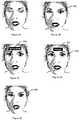
- Figures 3A-3E illustrate a user of a device according to example embodiments. While the user device is not visible in the illustrations, it will be appreciated that the user of Figures 3A-3D wears data glasses or another wearable device, and information provided via the user interface of the data glasses is described below with respect to the illustrations.
- Figure 3A shows the user prior to making eye contact with another user.
- apparatus 20 may include means, such as processor 24 and/or user interface 28, for providing a confirmation of eye contact.
- the lit or colored circles 300 around the user's eyes may indicate to the user and/or another user that eye contact between the two users is confirmed.
- the circles or other indication may be provided on both respective user devices when eye contact is made.
- apparatus 20 may include means, such as processor 24 and/or user interface 28, for prompting the user with a type of action, such as a predefined action or user configured action that should be performed by the user for the user to join a group.
- a type of action such as a predefined action or user configured action that should be performed by the user for the user to join a group.
- the prompt 302, "nod to group" may be provided on user interface 28 such that it may be perceived by the user.
- the prompt 302 faces outward in Figure 3C
- the prompt may be provided on an inner facing portion of the user interface 28 (e.g., lenses of the data glasses) such that user may view the message.
- a user may be prompted by audio indications of an action to be performed.
- User prompts and types of actions are described in further detail with regard to Figures 4A and 4B below.
- apparatus 20 may include means, such as processor 24 and/or user interface 28, for providing confirmation of inclusion in the group.
- a message 304 "grouped" is provided to indicate to one or more users that the wearer of the device emitting the message is included in the group.
- the message may be displayed facing inward toward the user.
- Figure 3E illustrates a lit indicator 308 for other users to see as confirmation that the user has been included in the group.
- multiple indicators (not shown), which may be illuminated in different colors or flashing patterns, may indicate inclusion in different groups.
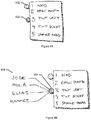
- Figures 4A and 4B are example user interfaces that may be displayed to a user according to example embodiments.
- a group leader or another user may configure a new group.
- the user may select from a listing of predefined actions 1-5 such as, but not limited to, 1 - nod, 2 - open mouth, 3 - tilt left, 4 - tilt right, and 5 - shake head.
- Other users need to make eye contact with a group member, such as the group leader or another user, and perform the selected action to join the group.
- Indicator 402 indicates to a user that action 1 is associated with one group, and indicator 404 indicates to a user that action 3 is assigned to another group.
- the user should select one of the available actions 2, 4, or 5.
- apparatus 20 may comprise means, such as processor 24 and/or user interface 28, for causing display or provision of users currently included in a group.
- the apparatus 20 may cause display of the names of users 408 that are a part of the associated group.
- a user viewing the list of users need not be included in the group, but the list may include actions being utilized in a close proximity to the user, so that a user does not configure a new group associated with a same action already associated with another group in the area.
- a user can see current group members to determine whether or not they would like to join the group.
- the group members may be indicated on a map, timeline, or in other format.
- another example action that may be associated with a group is a "mirror image" action.
- a user wanting to join a group must make eye contact with a group member and mimic or mirror an action the group member performs.
- the mirroring occurs while eye contact is maintained for the new member to join.
- the mirroring of the action may occur within a threshold amount of time from when eye contact is established.
- a mirror image action of another user may comprise a similar movement but in the opposite direction of the user.
- the action may be mimicked in the same direction for a user to join a group.
- the mirror image action and/or mimicked action may allow for ad hoc group creation.
- a user may need not pre-configure a group, nor select an action with which to associate a group. Rather two users may establish eye contact, and one user performs a mirror image action and/or mimicked action of the other user to establish connectivity between two devices.
- the group and/or associated action is created on the fly, or ad hoc.
- the created action may be reused for other members to join, or other users may join the group in a similar manner by subsequent ad hoc actions, such as the mirror image action and/or mimicked action, which may differ each time a member joins.
- the particular mirror image action and/or mimicked action may become associated with the group such that other users must perform the mirror image and/or mimicked image to join.
- apparatus 20 comprises means, such as processor 24, memory 26, and/or the like, for ungrouping an entire group, or removing individual users from the group. For example, removal may occur for an individual user by performing the eye contact and action associated with the group again, similar to as performed when joining the group. As yet another example, the user may perform the action while not making eye contact with another user, to be ungrouped from the group, or perform a reverse or opposite action of the associated action of the group so as to "undo" the joining operation.
- a user may ungroup via user interface 28, even if group members are not near. For example, a user may select an indication on a user interface, such as by selecting the dot 308 in Figure 3E , and selecting "ungroup" or a similar command from a menu.
- a user can add themself to a group, or another user, without establishing eye contact or being near other group members, such as by selection via user interface 28.
- a group member may dismantle an entire group such that the group can no longer communicate. In some embodiments, such a feature may only be exposed to the group leader.
- Apparatus 20 may be further configured, such as with processor 24, memory 26, and/or user interface 28, such that when the action associated with a particular group occurs without an indication of eye contact occurring within a predefined threshold amount of time, information related to the group (e.g., member listing, group leader, start time, number of members, group name, purpose, etc.), may be provided.
- information related to the group e.g., member listing, group leader, start time, number of members, group name, purpose, etc.
- Example embodiments provide for an easy, efficient and intuitive group formation. Enabling communication and device binding based on eye contact provides a natural method for users to interact. According to human nature, establishing eye contact with another individual is often a first step in starting a conversation or other communication. Example embodiments therefore adhere to the natural habits of users by also initiating communication between devices in response to an indication of eye contact between users.
- embodiments are particularly advantageous for multi-user and multi-group scenarios.
- Users may initiate ad hoc group binding according to example embodiments provided herein such that group members may be added without tediously configuring a group and the group members.
- embodiments provided herein allow for efficient ad hoc group creation. Users who are actively working in a particular area (e.g., accident scene), can continue working on urgent tasks and allow other users to join without being interrupted. Enabling creation of multiple groups further allows users to selectively allow other individuals to access only the information the user is authorized to access.
- Alternative implementations may otherwise require users to be interrupted in their activities to bump devices, or provide precise spatial device alignment to initiate a connection.
- Example embodiments allow users to enable device communication without interrupting a task at hand.
- the method, apparatus and computer program product provide numerous technical advantages including the conservation of processing resources and the associated power consumption otherwise expended to support the display of information needed for a user to otherwise configure the apparatus 20 for group configuration and maintenance.
- alternative implementations may rely on a centralized work station or web service to be accessed in order to add and remove group members and to configure permissions for particular users and devices. Enabling ad hoc group creation based on eye contact and performance of actions may limit the additional computational resources required, such as databases storing group information and user or device permission information.
- Figure 2 illustrates a flowchart of operations of an apparatus 20, method and computer program product according to example embodiments of the invention. It will be understood that each block of the flowchart, and combinations of blocks in the flowchart, may be implemented by various means, such as hardware, firmware, processor, circuitry, and/or other communication devices associated with execution of software including one or more computer program instructions. For example, one or more of the procedures described above may be embodied by computer program instructions. In this regard, the computer program instructions which embody the procedures described above may be stored by a memory 26 of an apparatus employing an embodiment of the present invention and executed by a processor 24 of the apparatus.
- any such computer program instructions may be loaded onto a computer or other programmable apparatus (for example, hardware) to produce a machine, such that the resulting computer or other programmable apparatus implements the functions specified in the flowchart blocks.
- These computer program instructions may also be stored in a computer-readable memory that may direct a computer or other programmable apparatus to function in a particular manner, such that the instructions stored in the computer-readable memory produce an article of manufacture the execution of which implements the function specified in the flowchart blocks.
- the computer program instructions may also be loaded onto a computer or other programmable apparatus to cause a series of operations to be performed on the computer or other programmable apparatus to produce a computer-implemented process such that the instructions which execute on the computer or other programmable apparatus provide operations for implementing the functions specified in the flowchart blocks.
- blocks of the flowchart support combinations of means for performing the specified functions and combinations of operations for performing the specified functions. It will also be understood that one or more blocks of the flowchart, and combinations of blocks in the flowchart, can be implemented by special purpose hardware-based computer systems which perform the specified functions, or combinations of special purpose hardware and computer instructions.
- certain ones of the operations above may be modified or further amplified. Furthermore, in some embodiments, additional optional operations may be included, some of which have been described above. Modifications, additions, or amplifications to the operations above may be performed in any order and in any combination.
Landscapes
- Engineering & Computer Science (AREA)
- Theoretical Computer Science (AREA)
- General Engineering & Computer Science (AREA)
- General Physics & Mathematics (AREA)
- Physics & Mathematics (AREA)
- Computer Security & Cryptography (AREA)
- Human Computer Interaction (AREA)
- Computer Hardware Design (AREA)
- Software Systems (AREA)
- General Health & Medical Sciences (AREA)
- Health & Medical Sciences (AREA)
- Bioethics (AREA)
- User Interface Of Digital Computer (AREA)
Claims (11)
- Computerimplementiertes Verfahren, umfassend:(200) Empfangen einer Anzeige eines Augenkontakts zwischen zwei Benutzern von zwei Kommunikationsgeräten (20) ;(210) Empfangen einer Anzeige einer Aktion, die von den zwei Benutzern ausgeführt wird, wobei die Aktion eine erste Bewegung umfasst, die von einem ersten der zwei Benutzer ausgeführt wird, und eine zweite Bewegung, die von dem zweiten der zwei Benutzer ausgeführt wird; wobei das Verfahren dadurch gekennzeichnet ist, dass:(220) als Antwort auf die Anzeige des Augenkontakts und die Anzeige der Aktion die zwei Benutzer in eine Gruppe aufgenommen werden und die Kommunikation zwischen den jeweiligen Geräten von mindestens den zwei Benutzern in der Gruppe ermöglicht wird; unddie zweite Bewegung mindestens ein Spiegelbild oder ein nachgeahmtes Bild der ersten Bewegung umfasst.
- Verfahren nach Anspruch 1, wobei die Aktion eine vordefinierte Aktion ist, die der Gruppe zugeordnet ist.
- Verfahren nach einem der Ansprüche 1 oder 2, darüber hinaus Folgendes umfassend:
Empfangen einer Anzeige eines ausgewählten Aktionstyps, der der Gruppe zugeordnet werden soll. - Verfahren nach einem der Ansprüche 1 bis 3, darüber hinaus Folgendes umfassend:als Antwort auf die Anzeige des Augenkontakts die Bereitstellung einer Bestätigung des Augenkontakts über mindestens eine Benutzerschnittstelle; undals Antwort auf die Anzeige der Aktion die Bereitstellung einer Bestätigung der Aufnahme in die Gruppe.
- Verfahren nach einem der Ansprüche 1 bis 4, wobei mindestens einer der zwei Benutzer zu einer anderen Gruppe gehört, wobei die andere Gruppe einer anderen Aktion zugeordnet ist.
- Verfahren nach einem der Ansprüche 1 bis 5, wobei die Gruppe ad-hoc erstellt wird und die Aktion eine ad-hoc-Aktion ist.
- Verfahren nach einem der Ansprüche 1 bis 6, darüber hinaus Folgendes umfassend:Empfangen einer Anzeige einer nachfolgenden Durchführung der Aktion; undals Antwort auf die Anzeige der nachfolgenden Durchführung der Aktion, dass mindestens ein Benutzer aus der Gruppe entfernt wird.
- Verfahren nach einem der Ansprüche 1 bis 7, wobei mindestens eines der Geräte ein am Kopf getragenes Gerät ist.
- Verfahren nach einem der vorhergehenden Ansprüche, wobei die erste und zweite Bewegung mindestens ein Nicken des Kopfes, ein Neigen des Kopfes oder ein Augenzwinkern umfasst.
- Computerprogrammprodukt, das mindestens ein nicht flüchtiges computerlesbares Speichermedium umfasst, in dem computerausführbare Programmcodeanweisungen gespeichert sind, wobei die computerausführbaren Programmcodeanweisungen Programmcodeanweisungen umfassen, um das Verfahren nach einem der vorhergehenden Ansprüche auszuführen.
- Gerät (20), umfassend Mittel (22, 24, 26, 28) zum Durchführen des Verfahrens nach einem der Ansprüche 1 bis 9.
Priority Applications (1)
| Application Number | Priority Date | Filing Date | Title |
|---|---|---|---|
| EP15151214.2A EP3046007B1 (de) | 2015-01-15 | 2015-01-15 | Verfahren, Vorrichtung und Computerprogrammprodukt zur Ermöglichung von Kommunikation zwischen Vorrichtungen auf Basis von Blickkontakt |
Applications Claiming Priority (1)
| Application Number | Priority Date | Filing Date | Title |
|---|---|---|---|
| EP15151214.2A EP3046007B1 (de) | 2015-01-15 | 2015-01-15 | Verfahren, Vorrichtung und Computerprogrammprodukt zur Ermöglichung von Kommunikation zwischen Vorrichtungen auf Basis von Blickkontakt |
Publications (2)
| Publication Number | Publication Date |
|---|---|
| EP3046007A1 EP3046007A1 (de) | 2016-07-20 |
| EP3046007B1 true EP3046007B1 (de) | 2019-03-27 |
Family
ID=52354794
Family Applications (1)
| Application Number | Title | Priority Date | Filing Date |
|---|---|---|---|
| EP15151214.2A Active EP3046007B1 (de) | 2015-01-15 | 2015-01-15 | Verfahren, Vorrichtung und Computerprogrammprodukt zur Ermöglichung von Kommunikation zwischen Vorrichtungen auf Basis von Blickkontakt |
Country Status (1)
| Country | Link |
|---|---|
| EP (1) | EP3046007B1 (de) |
Families Citing this family (1)
| Publication number | Priority date | Publication date | Assignee | Title |
|---|---|---|---|---|
| US10678116B1 (en) * | 2017-11-09 | 2020-06-09 | Facebook Technologies, Llc | Active multi-color PBP elements |
Family Cites Families (4)
| Publication number | Priority date | Publication date | Assignee | Title |
|---|---|---|---|---|
| US8463182B2 (en) * | 2009-12-24 | 2013-06-11 | Sony Computer Entertainment Inc. | Wireless device pairing and grouping methods |
| WO2012037290A2 (en) * | 2010-09-14 | 2012-03-22 | Osterhout Group, Inc. | Eyepiece with uniformly illuminated reflective display |
| AU2011205223C1 (en) * | 2011-08-09 | 2013-03-28 | Microsoft Technology Licensing, Llc | Physical interaction with virtual objects for DRM |
| US9014681B2 (en) * | 2011-12-27 | 2015-04-21 | Sony Corporation | Establishing a communication connection between two devices based on device displacement information |
-
2015
- 2015-01-15 EP EP15151214.2A patent/EP3046007B1/de active Active
Also Published As
| Publication number | Publication date |
|---|---|
| EP3046007A1 (de) | 2016-07-20 |
Similar Documents
| Publication | Publication Date | Title |
|---|---|---|
| KR102067325B1 (ko) | 이종 디스플레이 스크린을 갖는 웨어러블 전자 장치 | |
| US10599862B2 (en) | Wearable device multi-mode system | |
| US11023090B2 (en) | Method and smart watch for displaying schedule tags | |
| CN107113354B (zh) | 包括头戴式设备的通信系统 | |
| US9954857B2 (en) | Digital charms system and method | |
| EP2759922B1 (de) | Verfahren zur Durchführung einer Vorrichtungsfunktion auf Basis von einer Vorrichtungsbewegung und Vorrichtung zur Durchführung des Verfahrens | |
| US9986086B2 (en) | Mobile terminal and method of operating the same | |
| US9665124B2 (en) | Wearable device and method of controlling the same | |
| US10489046B2 (en) | Watch-type mobile terminal and method for controlling the same | |
| EP2987269B1 (de) | Verfahren und system zur steuerung einer externen vorrichtung | |
| CN104270532A (zh) | 通信终端及其处理事件提醒的方法和装置 | |
| US20190182374A1 (en) | Charging device, method for controlling charging device, and mobile terminal connected to same | |
| KR20160015972A (ko) | 웨어러블 디바이스 및 그 제어 방법 | |
| KR20160064853A (ko) | 전자 장치들 간에 기능을 공유하는 방법 및 장치 | |
| KR20150086944A (ko) | 포터블 디바이스, 스마트 와치 및 제어 방법 | |
| EP3054372B1 (de) | Verfahren zur bereitstellung einer benachrichtigung und elektronische vorrichtung zur durchführung davon | |
| JP2017084100A (ja) | 情報通信端末、共有管理装置、情報共有方法、コンピュータプログラム | |
| US11481108B2 (en) | Wearable device and non-transitory computer readable medium | |
| EP3046007A1 (de) | Verfahren, Vorrichtung und Computerprogrammprodukt zur Ermöglichung von Kommunikation zwischen Vorrichtungen auf Basis von Blickkontakt | |
| CN106533478B (zh) | 可穿戴终端及其通信方法 | |
| TW201617791A (zh) | 可穿戴式裝置、產生編碼密鑰的方法以及非暫時性電腦可讀紀錄媒體 | |
| AU2014213152B2 (en) | Method of performing function of device and device for performing the method | |
| KR20190138467A (ko) | 인체 통신을 이용한 전자명함 교환 시스템 |
Legal Events
| Date | Code | Title | Description |
|---|---|---|---|
| PUAI | Public reference made under article 153(3) epc to a published international application that has entered the european phase |
Free format text: ORIGINAL CODE: 0009012 |
|
| AK | Designated contracting states |
Kind code of ref document: A1 Designated state(s): AL AT BE BG CH CY CZ DE DK EE ES FI FR GB GR HR HU IE IS IT LI LT LU LV MC MK MT NL NO PL PT RO RS SE SI SK SM TR |
|
| AX | Request for extension of the european patent |
Extension state: BA ME |
|
| STAA | Information on the status of an ep patent application or granted ep patent |
Free format text: STATUS: REQUEST FOR EXAMINATION WAS MADE |
|
| 17P | Request for examination filed |
Effective date: 20170120 |
|
| RBV | Designated contracting states (corrected) |
Designated state(s): AL AT BE BG CH CY CZ DE DK EE ES FI FR GB GR HR HU IE IS IT LI LT LU LV MC MK MT NL NO PL PT RO RS SE SI SK SM TR |
|
| GRAP | Despatch of communication of intention to grant a patent |
Free format text: ORIGINAL CODE: EPIDOSNIGR1 |
|
| STAA | Information on the status of an ep patent application or granted ep patent |
Free format text: STATUS: GRANT OF PATENT IS INTENDED |
|
| RIC1 | Information provided on ipc code assigned before grant |
Ipc: G06F 3/01 20060101AFI20180928BHEP Ipc: G06F 21/31 20130101ALI20180928BHEP Ipc: H04M 1/725 20060101ALI20180928BHEP Ipc: G06F 21/60 20130101ALI20180928BHEP |
|
| INTG | Intention to grant announced |
Effective date: 20181024 |
|
| GRAS | Grant fee paid |
Free format text: ORIGINAL CODE: EPIDOSNIGR3 |
|
| GRAA | (expected) grant |
Free format text: ORIGINAL CODE: 0009210 |
|
| STAA | Information on the status of an ep patent application or granted ep patent |
Free format text: STATUS: THE PATENT HAS BEEN GRANTED |
|
| AK | Designated contracting states |
Kind code of ref document: B1 Designated state(s): AL AT BE BG CH CY CZ DE DK EE ES FI FR GB GR HR HU IE IS IT LI LT LU LV MC MK MT NL NO PL PT RO RS SE SI SK SM TR |
|
| REG | Reference to a national code |
Ref country code: GB Ref legal event code: FG4D |
|
| REG | Reference to a national code |
Ref country code: CH Ref legal event code: EP |
|
| REG | Reference to a national code |
Ref country code: AT Ref legal event code: REF Ref document number: 1113828 Country of ref document: AT Kind code of ref document: T Effective date: 20190415 |
|
| REG | Reference to a national code |
Ref country code: IE Ref legal event code: FG4D |
|
| REG | Reference to a national code |
Ref country code: DE Ref legal event code: R096 Ref document number: 602015026980 Country of ref document: DE |
|
| REG | Reference to a national code |
Ref country code: NL Ref legal event code: FP |
|
| PG25 | Lapsed in a contracting state [announced via postgrant information from national office to epo] |
Ref country code: SE Free format text: LAPSE BECAUSE OF FAILURE TO SUBMIT A TRANSLATION OF THE DESCRIPTION OR TO PAY THE FEE WITHIN THE PRESCRIBED TIME-LIMIT Effective date: 20190327 Ref country code: NO Free format text: LAPSE BECAUSE OF FAILURE TO SUBMIT A TRANSLATION OF THE DESCRIPTION OR TO PAY THE FEE WITHIN THE PRESCRIBED TIME-LIMIT Effective date: 20190627 Ref country code: LT Free format text: LAPSE BECAUSE OF FAILURE TO SUBMIT A TRANSLATION OF THE DESCRIPTION OR TO PAY THE FEE WITHIN THE PRESCRIBED TIME-LIMIT Effective date: 20190327 |
|
| PG25 | Lapsed in a contracting state [announced via postgrant information from national office to epo] |
Ref country code: BG Free format text: LAPSE BECAUSE OF FAILURE TO SUBMIT A TRANSLATION OF THE DESCRIPTION OR TO PAY THE FEE WITHIN THE PRESCRIBED TIME-LIMIT Effective date: 20190627 Ref country code: GR Free format text: LAPSE BECAUSE OF FAILURE TO SUBMIT A TRANSLATION OF THE DESCRIPTION OR TO PAY THE FEE WITHIN THE PRESCRIBED TIME-LIMIT Effective date: 20190628 Ref country code: HR Free format text: LAPSE BECAUSE OF FAILURE TO SUBMIT A TRANSLATION OF THE DESCRIPTION OR TO PAY THE FEE WITHIN THE PRESCRIBED TIME-LIMIT Effective date: 20190327 Ref country code: LV Free format text: LAPSE BECAUSE OF FAILURE TO SUBMIT A TRANSLATION OF THE DESCRIPTION OR TO PAY THE FEE WITHIN THE PRESCRIBED TIME-LIMIT Effective date: 20190327 Ref country code: RS Free format text: LAPSE BECAUSE OF FAILURE TO SUBMIT A TRANSLATION OF THE DESCRIPTION OR TO PAY THE FEE WITHIN THE PRESCRIBED TIME-LIMIT Effective date: 20190327 |
|
| RAP2 | Party data changed (patent owner data changed or rights of a patent transferred) |
Owner name: NOKIA TECHNOLOGIES OY |
|
| REG | Reference to a national code |
Ref country code: AT Ref legal event code: MK05 Ref document number: 1113828 Country of ref document: AT Kind code of ref document: T Effective date: 20190327 |
|
| PG25 | Lapsed in a contracting state [announced via postgrant information from national office to epo] |
Ref country code: RO Free format text: LAPSE BECAUSE OF FAILURE TO SUBMIT A TRANSLATION OF THE DESCRIPTION OR TO PAY THE FEE WITHIN THE PRESCRIBED TIME-LIMIT Effective date: 20190327 Ref country code: SK Free format text: LAPSE BECAUSE OF FAILURE TO SUBMIT A TRANSLATION OF THE DESCRIPTION OR TO PAY THE FEE WITHIN THE PRESCRIBED TIME-LIMIT Effective date: 20190327 Ref country code: CZ Free format text: LAPSE BECAUSE OF FAILURE TO SUBMIT A TRANSLATION OF THE DESCRIPTION OR TO PAY THE FEE WITHIN THE PRESCRIBED TIME-LIMIT Effective date: 20190327 Ref country code: EE Free format text: LAPSE BECAUSE OF FAILURE TO SUBMIT A TRANSLATION OF THE DESCRIPTION OR TO PAY THE FEE WITHIN THE PRESCRIBED TIME-LIMIT Effective date: 20190327 Ref country code: PT Free format text: LAPSE BECAUSE OF FAILURE TO SUBMIT A TRANSLATION OF THE DESCRIPTION OR TO PAY THE FEE WITHIN THE PRESCRIBED TIME-LIMIT Effective date: 20190727 Ref country code: ES Free format text: LAPSE BECAUSE OF FAILURE TO SUBMIT A TRANSLATION OF THE DESCRIPTION OR TO PAY THE FEE WITHIN THE PRESCRIBED TIME-LIMIT Effective date: 20190327 Ref country code: AL Free format text: LAPSE BECAUSE OF FAILURE TO SUBMIT A TRANSLATION OF THE DESCRIPTION OR TO PAY THE FEE WITHIN THE PRESCRIBED TIME-LIMIT Effective date: 20190327 |
|
| PG25 | Lapsed in a contracting state [announced via postgrant information from national office to epo] |
Ref country code: SM Free format text: LAPSE BECAUSE OF FAILURE TO SUBMIT A TRANSLATION OF THE DESCRIPTION OR TO PAY THE FEE WITHIN THE PRESCRIBED TIME-LIMIT Effective date: 20190327 Ref country code: PL Free format text: LAPSE BECAUSE OF FAILURE TO SUBMIT A TRANSLATION OF THE DESCRIPTION OR TO PAY THE FEE WITHIN THE PRESCRIBED TIME-LIMIT Effective date: 20190327 |
|
| PG25 | Lapsed in a contracting state [announced via postgrant information from national office to epo] |
Ref country code: AT Free format text: LAPSE BECAUSE OF FAILURE TO SUBMIT A TRANSLATION OF THE DESCRIPTION OR TO PAY THE FEE WITHIN THE PRESCRIBED TIME-LIMIT Effective date: 20190327 Ref country code: IS Free format text: LAPSE BECAUSE OF FAILURE TO SUBMIT A TRANSLATION OF THE DESCRIPTION OR TO PAY THE FEE WITHIN THE PRESCRIBED TIME-LIMIT Effective date: 20190727 |
|
| REG | Reference to a national code |
Ref country code: DE Ref legal event code: R097 Ref document number: 602015026980 Country of ref document: DE |
|
| PG25 | Lapsed in a contracting state [announced via postgrant information from national office to epo] |
Ref country code: DK Free format text: LAPSE BECAUSE OF FAILURE TO SUBMIT A TRANSLATION OF THE DESCRIPTION OR TO PAY THE FEE WITHIN THE PRESCRIBED TIME-LIMIT Effective date: 20190327 |
|
| PLBE | No opposition filed within time limit |
Free format text: ORIGINAL CODE: 0009261 |
|
| STAA | Information on the status of an ep patent application or granted ep patent |
Free format text: STATUS: NO OPPOSITION FILED WITHIN TIME LIMIT |
|
| PG25 | Lapsed in a contracting state [announced via postgrant information from national office to epo] |
Ref country code: SI Free format text: LAPSE BECAUSE OF FAILURE TO SUBMIT A TRANSLATION OF THE DESCRIPTION OR TO PAY THE FEE WITHIN THE PRESCRIBED TIME-LIMIT Effective date: 20190327 |
|
| 26N | No opposition filed |
Effective date: 20200103 |
|
| PG25 | Lapsed in a contracting state [announced via postgrant information from national office to epo] |
Ref country code: TR Free format text: LAPSE BECAUSE OF FAILURE TO SUBMIT A TRANSLATION OF THE DESCRIPTION OR TO PAY THE FEE WITHIN THE PRESCRIBED TIME-LIMIT Effective date: 20190327 |
|
| PG25 | Lapsed in a contracting state [announced via postgrant information from national office to epo] |
Ref country code: MC Free format text: LAPSE BECAUSE OF FAILURE TO SUBMIT A TRANSLATION OF THE DESCRIPTION OR TO PAY THE FEE WITHIN THE PRESCRIBED TIME-LIMIT Effective date: 20190327 |
|
| REG | Reference to a national code |
Ref country code: CH Ref legal event code: PL |
|
| GBPC | Gb: european patent ceased through non-payment of renewal fee |
Effective date: 20200115 |
|
| REG | Reference to a national code |
Ref country code: BE Ref legal event code: MM Effective date: 20200131 |
|
| PG25 | Lapsed in a contracting state [announced via postgrant information from national office to epo] |
Ref country code: FR Free format text: LAPSE BECAUSE OF NON-PAYMENT OF DUE FEES Effective date: 20200131 Ref country code: LU Free format text: LAPSE BECAUSE OF NON-PAYMENT OF DUE FEES Effective date: 20200115 Ref country code: GB Free format text: LAPSE BECAUSE OF NON-PAYMENT OF DUE FEES Effective date: 20200115 |
|
| PG25 | Lapsed in a contracting state [announced via postgrant information from national office to epo] |
Ref country code: CH Free format text: LAPSE BECAUSE OF NON-PAYMENT OF DUE FEES Effective date: 20200131 Ref country code: LI Free format text: LAPSE BECAUSE OF NON-PAYMENT OF DUE FEES Effective date: 20200131 Ref country code: BE Free format text: LAPSE BECAUSE OF NON-PAYMENT OF DUE FEES Effective date: 20200131 |
|
| PG25 | Lapsed in a contracting state [announced via postgrant information from national office to epo] |
Ref country code: IE Free format text: LAPSE BECAUSE OF NON-PAYMENT OF DUE FEES Effective date: 20200115 |
|
| PG25 | Lapsed in a contracting state [announced via postgrant information from national office to epo] |
Ref country code: MT Free format text: LAPSE BECAUSE OF FAILURE TO SUBMIT A TRANSLATION OF THE DESCRIPTION OR TO PAY THE FEE WITHIN THE PRESCRIBED TIME-LIMIT Effective date: 20190327 Ref country code: CY Free format text: LAPSE BECAUSE OF FAILURE TO SUBMIT A TRANSLATION OF THE DESCRIPTION OR TO PAY THE FEE WITHIN THE PRESCRIBED TIME-LIMIT Effective date: 20190327 |
|
| PG25 | Lapsed in a contracting state [announced via postgrant information from national office to epo] |
Ref country code: MK Free format text: LAPSE BECAUSE OF FAILURE TO SUBMIT A TRANSLATION OF THE DESCRIPTION OR TO PAY THE FEE WITHIN THE PRESCRIBED TIME-LIMIT Effective date: 20190327 |
|
| P01 | Opt-out of the competence of the unified patent court (upc) registered |
Effective date: 20230527 |
|
| PGFP | Annual fee paid to national office [announced via postgrant information from national office to epo] |
Ref country code: FI Payment date: 20251230 Year of fee payment: 12 |
|
| PGFP | Annual fee paid to national office [announced via postgrant information from national office to epo] |
Ref country code: NL Payment date: 20251215 Year of fee payment: 12 |
|
| PGFP | Annual fee paid to national office [announced via postgrant information from national office to epo] |
Ref country code: DE Payment date: 20251203 Year of fee payment: 12 |
|
| PGFP | Annual fee paid to national office [announced via postgrant information from national office to epo] |
Ref country code: IT Payment date: 20251219 Year of fee payment: 12 |