EP3045426A1 - Granules or powder of disulfonylamide salt, and method for producing same - Google Patents
Granules or powder of disulfonylamide salt, and method for producing same Download PDFInfo
- Publication number
- EP3045426A1 EP3045426A1 EP14861940.6A EP14861940A EP3045426A1 EP 3045426 A1 EP3045426 A1 EP 3045426A1 EP 14861940 A EP14861940 A EP 14861940A EP 3045426 A1 EP3045426 A1 EP 3045426A1
- Authority
- EP
- European Patent Office
- Prior art keywords
- granules
- mass
- formula
- powders
- compound
- Prior art date
- Legal status (The legal status is an assumption and is not a legal conclusion. Google has not performed a legal analysis and makes no representation as to the accuracy of the status listed.)
- Granted
Links
Classifications
-
- C—CHEMISTRY; METALLURGY
- C01—INORGANIC CHEMISTRY
- C01B—NON-METALLIC ELEMENTS; COMPOUNDS THEREOF; METALLOIDS OR COMPOUNDS THEREOF NOT COVERED BY SUBCLASS C01C
- C01B21/00—Nitrogen; Compounds thereof
- C01B21/082—Compounds containing nitrogen and non-metals and optionally metals
- C01B21/086—Compounds containing nitrogen and non-metals and optionally metals containing one or more sulfur atoms
-
- C—CHEMISTRY; METALLURGY
- C01—INORGANIC CHEMISTRY
- C01B—NON-METALLIC ELEMENTS; COMPOUNDS THEREOF; METALLOIDS OR COMPOUNDS THEREOF NOT COVERED BY SUBCLASS C01C
- C01B21/00—Nitrogen; Compounds thereof
- C01B21/082—Compounds containing nitrogen and non-metals and optionally metals
- C01B21/087—Compounds containing nitrogen and non-metals and optionally metals containing one or more hydrogen atoms
- C01B21/093—Compounds containing nitrogen and non-metals and optionally metals containing one or more hydrogen atoms containing also one or more sulfur atoms
-
- C—CHEMISTRY; METALLURGY
- C07—ORGANIC CHEMISTRY
- C07C—ACYCLIC OR CARBOCYCLIC COMPOUNDS
- C07C311/00—Amides of sulfonic acids, i.e. compounds having singly-bound oxygen atoms of sulfo groups replaced by nitrogen atoms, not being part of nitro or nitroso groups
- C07C311/48—Amides of sulfonic acids, i.e. compounds having singly-bound oxygen atoms of sulfo groups replaced by nitrogen atoms, not being part of nitro or nitroso groups having nitrogen atoms of sulfonamide groups further bound to another hetero atom
-
- H—ELECTRICITY
- H01—ELECTRIC ELEMENTS
- H01M—PROCESSES OR MEANS, e.g. BATTERIES, FOR THE DIRECT CONVERSION OF CHEMICAL ENERGY INTO ELECTRICAL ENERGY
- H01M10/00—Secondary cells; Manufacture thereof
- H01M10/05—Accumulators with non-aqueous electrolyte
- H01M10/056—Accumulators with non-aqueous electrolyte characterised by the materials used as electrolytes, e.g. mixed inorganic/organic electrolytes
- H01M10/0564—Accumulators with non-aqueous electrolyte characterised by the materials used as electrolytes, e.g. mixed inorganic/organic electrolytes the electrolyte being constituted of organic materials only
- H01M10/0566—Liquid materials
- H01M10/0568—Liquid materials characterised by the solutes
-
- C—CHEMISTRY; METALLURGY
- C01—INORGANIC CHEMISTRY
- C01P—INDEXING SCHEME RELATING TO STRUCTURAL AND PHYSICAL ASPECTS OF SOLID INORGANIC COMPOUNDS
- C01P2004/00—Particle morphology
- C01P2004/60—Particles characterised by their size
- C01P2004/61—Micrometer sized, i.e. from 1-100 micrometer
-
- C—CHEMISTRY; METALLURGY
- C01—INORGANIC CHEMISTRY
- C01P—INDEXING SCHEME RELATING TO STRUCTURAL AND PHYSICAL ASPECTS OF SOLID INORGANIC COMPOUNDS
- C01P2006/00—Physical properties of inorganic compounds
- C01P2006/40—Electric properties
-
- H—ELECTRICITY
- H01—ELECTRIC ELEMENTS
- H01M—PROCESSES OR MEANS, e.g. BATTERIES, FOR THE DIRECT CONVERSION OF CHEMICAL ENERGY INTO ELECTRICAL ENERGY
- H01M10/00—Secondary cells; Manufacture thereof
- H01M10/05—Accumulators with non-aqueous electrolyte
- H01M10/056—Accumulators with non-aqueous electrolyte characterised by the materials used as electrolytes, e.g. mixed inorganic/organic electrolytes
- H01M10/0561—Accumulators with non-aqueous electrolyte characterised by the materials used as electrolytes, e.g. mixed inorganic/organic electrolytes the electrolyte being constituted of inorganic materials only
- H01M10/0563—Liquid materials, e.g. for Li-SOCl2 cells
-
- Y—GENERAL TAGGING OF NEW TECHNOLOGICAL DEVELOPMENTS; GENERAL TAGGING OF CROSS-SECTIONAL TECHNOLOGIES SPANNING OVER SEVERAL SECTIONS OF THE IPC; TECHNICAL SUBJECTS COVERED BY FORMER USPC CROSS-REFERENCE ART COLLECTIONS [XRACs] AND DIGESTS
- Y02—TECHNOLOGIES OR APPLICATIONS FOR MITIGATION OR ADAPTATION AGAINST CLIMATE CHANGE
- Y02E—REDUCTION OF GREENHOUSE GAS [GHG] EMISSIONS, RELATED TO ENERGY GENERATION, TRANSMISSION OR DISTRIBUTION
- Y02E60/00—Enabling technologies; Technologies with a potential or indirect contribution to GHG emissions mitigation
- Y02E60/10—Energy storage using batteries
Definitions
- the present invention relates to granules or powders of a di(sulfonylamide) salt, and a method for producing the same.
- the present invention relates to granules or powders of a di(sulfonylamide) salt, such as a di(sulfonylamide) alkali metal salt, or a di(sulfonylamide) ammonium salt, suitable for an electrolyte or the like, and to a method for producing the same.
- Di(sulfonylamide) salts such as bis(fluorosulfonyl)amide alkali metal salts (M + [(FSO 2 ) 2 N] - ) are useful as ionic conducting materials or electrolytes or additives available in secondary cells (Patent Document 1, Patent Document 2).
- Patent Document 1 In the case where the compounds are used as electrolytes, it has been reported that the smaller amount of impurities, such as water, ash, SO 4 2- , or residual solvents, in the compounds, is more preferable (Non-Patent Document 1, Patent Document 3).
- a bis(fluorosulfonyl)amide potassium salt is obtained by reacting a compound with potassium fluoride, the compound being obtained by reacting sulfamic acid, thionyl chloride, and chlorosulfonic acid.
- a bis(fluorosulfonyl)amide potassium salt is obtained by conducting filtration to separate crystals precipitated by adding dropwise methylene chloride into a concentrated solution obtained by separating a reaction liquid obtained by the above-mentioned reaction.
- An object of the present invention is to provide granules or powders of a di(sulfonylamide) salt that can meet such a requirement and that are suitable for an electrolyte or the like, and a method for producing the same.
- the present invention includes the following aspects.
- Granules or powders according to the present invention can be quickly and uniformly dissolved in a solvent, and contribute to increase in efficiency of manufacturing an electrolytic solution available in a secondary cell, a solar cell, or the like.
- the content of impurities such as solvents, or metal ions is low, and therefore, it is difficult to cause deterioration of cell characteristics.
- Granules or powders according to the present invention consist of a compound of formula [I].
- R 1 and R 2 each independently represents a fluoroalkyl group having 1 to 6 carbon atoms, or a fluorine atom, and Y + represents an alkali metal cation or an ammonium cation.
- Examples of a fluoroalkyl group having 1 to 6 carbon atoms for R 1 and R 2 include a trifluoromethyl group, a perfluoroethyl group, and a perfluoropropyl group. It is preferable that all hydrogen atoms of an alkyl group in the fluoroalkyl group be substituted with fluorine atoms. Among these, it is preferable that both R 1 and R 2 be fluorine atoms.
- Examples of an alkali metal cation for Y + include a lithium cation, a sodium cation, and a potassium cation.
- the compound of formula [I] may be prepared using a known method.
- Examples of the method for preparing the compound of formula [I] include: a method in which a sulfamic acid, a thionyl chloride, and a chlorosulfonic acid are reacted, and then the resultant compound is reacted with a potassium fluoride; a method in which a bis(fluorosulfonyl)amine ammonium salt is subjected to a cation exchange reaction in an organic solvent to convert to a bis (fluorosulfonyl)amine lithium sal; and a method in which a bis (chlorosulfonyl)amine ammonium salt is reacted with a hydrogen fluoride.
- the modal diameter thereof is preferably 80 ⁇ m or less, and more preferably 5 ⁇ m to 80 ⁇ m.
- the modal diameter is the particle diameter at the peak of the number-based particle size distribution.
- the modal diameter in the present invention is determined using a laser diffractometry. Specifically, target granules or powders are dispersed in dichloromethane, and the resultant dispersion is placed on a laser diffraction particle size distribution measurement device (manufactured by Shimazu Corporation, SALD-2200) to conduct a measurement.
- SALD-2200 laser diffraction particle size distribution measurement device
- the median diameter thereof is preferably 45 ⁇ m or less, and more preferably 5 ⁇ m to 45 ⁇ m.
- the median diameter is 50% particle diameter in the number-based cumulative particle size distribution.
- the median diameter in the present invention is determined using a laser diffractometry. Specifically, target granules or powders are dispersed in dichloromethane, and the resultant dispersion is placed on a laser diffraction particle size distribution measurement device (manufactured by Shimazu Corporation, SALD-2200) to conduct a measurement. In the case where the median diameter is excessively large, the amount of impurities such as a solvent that may cause deterioration of cell properties tends to increase.
- the ratio of (modal diameter) / (median diameter) thereof is preferably 1.7 or less, and more preferably 1.5 or less.
- the ratio of (modal diameter) / (median diameter) closer to 1 means that the particle distribution is narrower.
- the smaller ratio of (modal diameter) / (median diameter) means that there are many fine granules or powders.
- the modal diameter and the median diameter can be determined using the above-mentioned method. In the case where the ratio of (modal diameter) / (median diameter) increases, it becomes easy to remain impurities such as a solvent without being completely removed from granules or powders in a large particle diameter area.
- the concentration of the residual solvent is preferably 1500 ppm or less, and more preferably 800 ppm or less.
- the concentration of the residual solvent is the total concentration of the ester-based solvent and the halogenated hydrocarbon-based solvent. In the case where the concentration of the residual solvent is excessively high, the probability of deterioration of the cell properties increases.
- the concentration of the residual solvent can be determined by analyzing a sample solution using a headspace gas chromatography mass spectrometry system under the following conditions, the sample solution being obtained by adding 50 mg of the target granules or powders to 5 mL of water and 1 ⁇ L of methanol and then sealing the resultant.
- Granules or powders according to the present invention are not particularly limited by the production method thereof.
- the production method include: a method containing precipitation or crystallization; a method containing spray-drying; a method containing freeze-drying; a method containing pulverizing, granulating, and/or classifying.
- examples of the method containing precipitation or crystallization include an evaporation crystallization method, a cooling crystallization method, and a poor solvent crystallization method, a poor solvent crystallization method is preferable.
- the preferable method for producing the granules or powders according to the present invention includes a crystallization step in which an ester-based solvent solution containing a compound of formula [I] is added to a halogenated hydrocarbon-based solvent.
- the ester-based solvent is not particularly limited, provided that the compound of formula [I] exhibits high solubility therein.
- Examples of the ester-based solvent available in the present invention include an ethyl acetate, a methyl acetate, a butyl acetate, a methoxybutyl acetate, a cellosolve acetate, an amyl acetate, a n-propyl acetate, an isopropyl acetate, a methyl lactate, an ethyl lactate, and a butyl lactate, and an butyl acetate is preferably used.
- the ester-based solvent solution containing the compound of formula [I] is obtained by adding and dissolving the compound of formula [I] in the ester-based solvent.
- the ester-based solvent solution containing the compound of formula [I] is obtained by synthesizing the compound of formula [I] by allowing the above-mentioned reaction to occur in an ester-based solvent.
- the concentration of the compound of formula [I] in the ester-based solvent solution is preferably 20% by mass to 90% by mass, more preferably 30% by mass to 75% by mass, and even more preferably 30% by mass to 50% by mass. In the case where the concentration is extremely low, the productivity tends to decrease, while in the case where the concentration is extremely high, the viscosity of the solution tends to increase, which is inconvenient.
- the halogenated hydrocarbon-based solvent is not particularly limited, provided that the compound of formula [I] exhibits low solubility therein, that is, the halogenated hydrocarbon-based solvent is a poor solvent.
- the halogenated hydrocarbon-based solvent available in the present invention include a dichloromethane, a trichloroethylene, a perchloroethylene, a 1, 1-dichloro-1-fluoroethane, a 3, 3-dichloro-1, 1, 1, 2, 2-pentafluoropropane, a 1,3-dichloro-1,1,2,2,3-pentafluoropropane, a bromopropane, and a chloroform, and a dichloromethane is preferably used.
- the amount (volume) of the halogenated hydrocarbon-based solvent to be used is not particularly limited, it is preferably larger than the volume of the ester-based solvent solution.
- Conditions for adding the halogenated hydrocarbon-based solvent are not particularly limited. Temperature during crystallization is not particularly limited. For example, crystallization may be conducted at about room temperature, preferably from 0°C to 50°C.
- the granules or powders obtained by crystallization are separated from the mother liquid.
- a solid-liquid separation operation ordinary in chemical engineering may be adopted. Examples thereof include a precipitation method, and a centrifuge separation method.
- the separated mother liquid is subjected to liquid-liquid separation to obtain an ester-based solvent and a halogenated hydrocarbon-based solvent, which may be reused in the synthesis step of the compound of formula [I], a crystallization step of the compound of formula [I], or the like.
- the liquid-liquid separation may be conducted by a known method such as a distillation method.
- the granules or powders separated from the mother liquid are dried by a known method. Drying may be conducted by a vacuum drying method, a hot-air drying method, an infrared drying method, a microwave drying method, or the like. Among them, a vacuum drying method is preferable, and a vacuum drying method in which an inert gas is circulated is more preferable.
- the drying temperature is preferably 20°C to 70°C, and more preferably 30°C to 65°C. If the drying temperature is extremely high, there is a case where the decomposition reaction of the compound of the formula [I] occurs. If the drying temperature is extremely low, there is a case where the concentration of the residual solvent increases.
- the thus obtained granules or powders according to the present invention are suitable for an electrolyte available in a secondary cell.
- An electrolytic solution according to an aspect of the present invention is obtained by dissolving the granules or powders according to the present invention.
- a solvent to be used in the electrolytic solution may be appropriately selected depending on the intended purpose.
- the solvent include an ethylene carbonate, a diethyl carbonate, a dimethyl carbonate, a methylethyl carbonate, a propylene carbonate, a butylene carbonate, a ⁇ - butyrolactone, a vinylene carbonate; imidazolium salt ionic liquids, pyrrolidinium salt ionic liquids, piperidinium salt ionic liquids, pyridinium salt ionic liquid, aliphatic ionic liquids, phosphonium salt ionic liquids, sulfonium salt ionic liquids, ammonium salt ionic liquids, non-aqueous solvents such as iodine-based ionic liquids.
- An electrolytic solution available in a lithium-ion cell may contain a lithium salt other than the granules or powders according to the present invention.
- the lithium salt include LiClO 4 , LiPF 6 , LiAsF 6 , LiBF 4 , LiSO 3 CF 3 , CH 3 SO 3 Li, and CF 3 SO 3 Li.
- the granules had a median diameter of 34.563 ⁇ m and a modal diameter of 26.121 ⁇ m, and the concentration of the residual solvent therein was 370 ppm (dichloromethane 210 ppm, butyl acetate 160 ppm).
- the yield was 98% with respect to the charged amount of di(fluorosulfonyl)amide potassium salt.
- the granules had a median diameter of 35.313 ⁇ m, and a modal diameter of 39.619 ⁇ m, and the concentration of the residual solvent therein was 640 ppm (dichloromethane 550 ppm, butyl acetate 90 ppm).
- the granules had a median diameter of 39.658 ⁇ m, and a modal diameter of 39.619 ⁇ m, and the concentration of the residual solvent therein was 790 ppm (dichloromethane 430 ppm, butyl acetate 360 ppm).
- the granules had a median diameter of 34.420 ⁇ m, and a modal diameter of 39.619 ⁇ m, and the concentration of the residual solvent therein was 1160 ppm (dichloromethane 800 ppm, butyl acetate 360 ppm).
- the yield was 98% with respect to the charged amount of di(fluorosulfonyl)imide potassium salt.
- the granules had a median diameter of 51.796 ⁇ m, and a modal diameter of 91.146 ⁇ m, and the concentration of the residual solvent therein was 5100 ppm (dichloromethane 2300 ppm, butyl acetate 2800 ppm).
- the concentration of the residual solvent in the granules having a median diameter larger than 45 ⁇ m, a modal diameter larger than 80 ⁇ m, and a modal diameter / median diameter ratio larger than 1.7, did not decrease even after a long time drying.
- the concentration of the residual solvent is low in granules or powders in which the median diameter is adjusted to 45 ⁇ m or less, the modal diameter is adjusted to 80 ⁇ m or less, and/or, the ratio of modal diameter / median diameter is adjusted to 1.7 or less, in accordance with the present invention, and therefore the granules or powders are useful as an electrolyte for an electrolytic solution available in a secondary battery, a solar cell, or the like.
- Granules or powders according to the present invention can be quickly and uniformly dissolved in a solvent, and contribute to increase in efficiency of manufacturing an electrolytic solution available in a secondary cell, a solar cell, or the like.
- the content of impurities such as solvents, or metal ions is low, and therefore, it is difficult to cause deterioration of cell characteristics.
Landscapes
- Chemical & Material Sciences (AREA)
- Organic Chemistry (AREA)
- Inorganic Chemistry (AREA)
- Manufacturing & Machinery (AREA)
- General Physics & Mathematics (AREA)
- Engineering & Computer Science (AREA)
- Physics & Mathematics (AREA)
- Chemical Kinetics & Catalysis (AREA)
- Electrochemistry (AREA)
- General Chemical & Material Sciences (AREA)
- Condensed Matter Physics & Semiconductors (AREA)
- Secondary Cells (AREA)
- Organic Low-Molecular-Weight Compounds And Preparation Thereof (AREA)
Abstract
Description
- The present invention relates to granules or powders of a di(sulfonylamide) salt, and a method for producing the same. In more detail, the present invention relates to granules or powders of a di(sulfonylamide) salt, such as a di(sulfonylamide) alkali metal salt, or a di(sulfonylamide) ammonium salt, suitable for an electrolyte or the like, and to a method for producing the same.
- The present invention claims priority on the basis of Japanese Patent Application No.
2013-237991 - Di(sulfonylamide) salts such as bis(fluorosulfonyl)amide alkali metal salts (M+[(FSO2)2N]-) are useful as ionic conducting materials or electrolytes or additives available in secondary cells (Patent Document 1, Patent Document 2). In the case where the compounds are used as electrolytes, it has been reported that the smaller amount of impurities, such as water, ash, SO4 2-, or residual solvents, in the compounds, is more preferable (Non-Patent Document 1, Patent Document 3).
- Various methods are known as a method for producing a bis(fluorosulfonyl)amide salt. For example, according to Non-Patent Document 2, a bis(fluorosulfonyl)amide potassium salt is obtained by reacting a compound with potassium fluoride, the compound being obtained by reacting sulfamic acid, thionyl chloride, and chlorosulfonic acid. According to Non-Patent Document 2, a bis(fluorosulfonyl)amide potassium salt is obtained by conducting filtration to separate crystals precipitated by adding dropwise methylene chloride into a concentrated solution obtained by separating a reaction liquid obtained by the above-mentioned reaction.
-
- Patent Document 1: Japanese Laid-open Patent Application No.
2006-210331 - Patent Document 2: Japanese Translation of
PCT International Application Publication No. 2001-527505 - Patent Document 3:
WO 2011 / 149095 -
- Non-patent Document 1: Matsuda Yoshiharu, et al., "Effects of Imide Salt Purity on Negative Electrode Charge-Discharge Characteristics in Lithium Secondary Cells", PROCEEDINGS OF THE 68TH CONFERENCE OF THE ELECTROCHEMICAL SOCIETY OF JAPAN, 25 March 2001, pages 232
- Non-patent Document 2: Z. Anorg. Allg. Chem. 2005, 631, 55-59
- It is required to provide a di(sulfonylamide) salt in which the content of impurities, such as a solvent that causes deterioration of cell characteristics, is low.
- An object of the present invention is to provide granules or powders of a di(sulfonylamide) salt that can meet such a requirement and that are suitable for an electrolyte or the like, and a method for producing the same.
- The present invention includes the following aspects.
- [1] Granules or powders consisting of a compound of formula [I], wherein a modal diameter is 80 µm or less.

] In formula [I], R1 and R2 each independently represents a fluoroalkyl group having 1 to 6 carbon atoms, or a fluorine atom, and Y+ represents an alkali metal cation or an ammonium cation. - [2] The granules or the powders according to [1], wherein the modal diameter is 5 µm to 80 µm.
- [3] Granules or powders consisting of a compound of formula [I], wherein a median diameter is 45 µm or less.
- [4] The granules or the powders according to [3], wherein the median diameter is 5 µm to 45 µm.
- [5] Granules or powders consisting of a compound of formula [I], wherein a ratio of (modal diameter) / (median diameter) is 1.7 or less.
- [6] The granules or the powders according to any one of [1] to [5], wherein a concentration of a residual solvent is 1500 ppm or less.
- [7] The granules or the powders according to any one of [1] to [5], wherein a concentration of a residual solvent is 800 ppm or less.
- [8] The granules or the powders according to any one of [1] to [7], wherein R1 and R2 represent fluorine atoms.
- [9] An electrolytic solution containing the granules or the powders of any one of [1] to [8] dissolved therein.
- [10] A method for producing granules or powders of any one of [1] to [8], including a crystallization step wherein an ester-based solvent solution containing a compound of the formula [I] is added to a halogenated hydrocarbon-based solvent.
- [11] The method according to [10], wherein a concentration of the compound of the formula [I] in the ester-based solvent solution is 20% by mass to 90% by mass.
- Granules or powders according to the present invention can be quickly and uniformly dissolved in a solvent, and contribute to increase in efficiency of manufacturing an electrolytic solution available in a secondary cell, a solar cell, or the like. In addition, in the granules or powder according to the present invention, the content of impurities such as solvents, or metal ions, is low, and therefore, it is difficult to cause deterioration of cell characteristics.
- Granules or powders according to the present invention consist of a compound of formula [I].
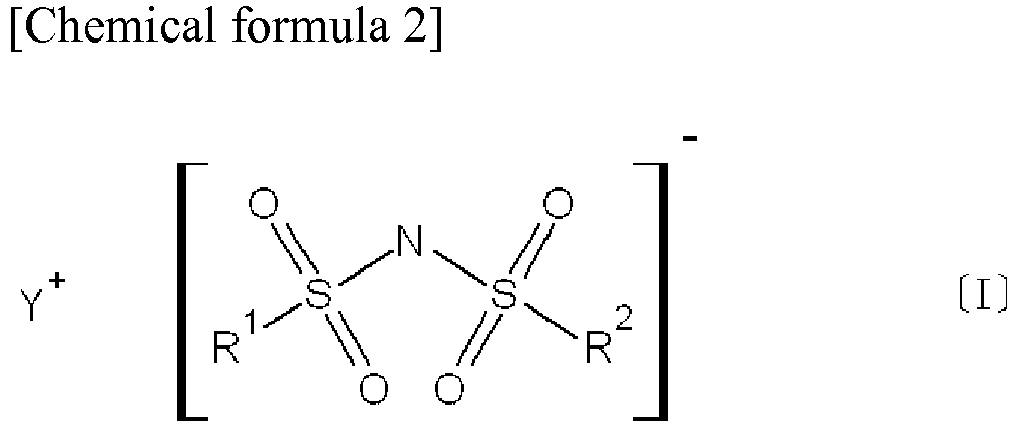
- In formula [I], R1 and R2 each independently represents a fluoroalkyl group having 1 to 6 carbon atoms, or a fluorine atom, and Y+ represents an alkali metal cation or an ammonium cation.
- Examples of a fluoroalkyl group having 1 to 6 carbon atoms for R1 and R2 include a trifluoromethyl group, a perfluoroethyl group, and a perfluoropropyl group. It is preferable that all hydrogen atoms of an alkyl group in the fluoroalkyl group be substituted with fluorine atoms. Among these, it is preferable that both R1 and R2 be fluorine atoms.
- Examples of an alkali metal cation for Y+ include a lithium cation, a sodium cation, and a potassium cation.
- The compound of formula [I] may be prepared using a known method. Examples of the method for preparing the compound of formula [I] include: a method in which a sulfamic acid, a thionyl chloride, and a chlorosulfonic acid are reacted, and then the resultant compound is reacted with a potassium fluoride; a method in which a bis(fluorosulfonyl)amine ammonium salt is subjected to a cation exchange reaction in an organic solvent to convert to a bis (fluorosulfonyl)amine lithium sal; and a method in which a bis (chlorosulfonyl)amine ammonium salt is reacted with a hydrogen fluoride.
- In an aspect of granules or powders according to the present invention, the modal diameter thereof is preferably 80 µm or less, and more preferably 5 µm to 80 µm. The modal diameter is the particle diameter at the peak of the number-based particle size distribution. The modal diameter in the present invention is determined using a laser diffractometry. Specifically, target granules or powders are dispersed in dichloromethane, and the resultant dispersion is placed on a laser diffraction particle size distribution measurement device (manufactured by Shimazu Corporation, SALD-2200) to conduct a measurement. In the case where the modal diameter is excessively large, the amount of impurities such as a solvent that may cause deterioration of cell properties tends to increase.
- In an aspect of granules or powders according to the present invention, the median diameter thereof is preferably 45 µm or less, and more preferably 5 µm to 45 µm. The median diameter is 50% particle diameter in the number-based cumulative particle size distribution. The median diameter in the present invention is determined using a laser diffractometry. Specifically, target granules or powders are dispersed in dichloromethane, and the resultant dispersion is placed on a laser diffraction particle size distribution measurement device (manufactured by Shimazu Corporation, SALD-2200) to conduct a measurement. In the case where the median diameter is excessively large, the amount of impurities such as a solvent that may cause deterioration of cell properties tends to increase.
- In an aspect of granules or powders according to the present invention, the ratio of (modal diameter) / (median diameter) thereof is preferably 1.7 or less, and more preferably 1.5 or less. The ratio of (modal diameter) / (median diameter) closer to 1 means that the particle distribution is narrower. The smaller ratio of (modal diameter) / (median diameter) means that there are many fine granules or powders. The modal diameter and the median diameter can be determined using the above-mentioned method. In the case where the ratio of (modal diameter) / (median diameter) increases, it becomes easy to remain impurities such as a solvent without being completely removed from granules or powders in a large particle diameter area.
- In a preferable aspect of the granules or powders according to the present invention, the concentration of the residual solvent is preferably 1500 ppm or less, and more preferably 800 ppm or less. The concentration of the residual solvent is the total concentration of the ester-based solvent and the halogenated hydrocarbon-based solvent. In the case where the concentration of the residual solvent is excessively high, the probability of deterioration of the cell properties increases. The concentration of the residual solvent can be determined by analyzing a sample solution using a headspace gas chromatography mass spectrometry system under the following conditions, the sample solution being obtained by adding 50 mg of the target granules or powders to 5 mL of water and 1 µL of methanol and then sealing the resultant.
-
- Apparatus: GCMS-QP2010 plus, GC-2010 manufactured by Shimazu Corporation, Turbo Matrix 40 manufactured by PerkinElmer Co., Ltd.
- Column: HP-5 (length: 30 m, column inner diameter: 0.53 mm, film thickness: 0.25µm) (manufactured by Agilent Technologies)
- Column temperature condition: 50°C (held for 0 minute), rising temperature at 5°C/minute up to 100°C (held for 0 minute)
- Headspace condition: vial temperature 70°C (held for 20 minutes), needle temperature 100°C, transfer line temperature 150°C
- Carrier gas: helium 80 kPa
- Interface temperature: 230°C
- Ion source: EI
- Ion source temperature: 200°C
- Measurement mode: SIM (target ion m/z 72, confirmation ion m/z 71)
- Granules or powders according to the present invention are not particularly limited by the production method thereof. Examples of the production method include: a method containing precipitation or crystallization; a method containing spray-drying; a method containing freeze-drying; a method containing pulverizing, granulating, and/or classifying. Among these, it is preferable to prepare granules or powders by the method containing precipitation or crystallization in the present invention. Although examples of the method containing precipitation or crystallization include an evaporation crystallization method, a cooling crystallization method, and a poor solvent crystallization method, a poor solvent crystallization method is preferable.
- Although there are, as a poor solvent crystallization, a method in which a poor solvent is added to a solution and a method in which a solution is added to a poor solvent, the latter method is preferable in the present invention. In the former method, there is a case where conditions for adding a poor solvent (addition rate, addition position, or the like) tend to affect the state of crystallization, which results in, for example, the increased proportion of granules or powders having large particle sizes.
- The preferable method for producing the granules or powders according to the present invention includes a crystallization step in which an ester-based solvent solution containing a compound of formula [I] is added to a halogenated hydrocarbon-based solvent.
- The ester-based solvent is not particularly limited, provided that the compound of formula [I] exhibits high solubility therein. Examples of the ester-based solvent available in the present invention include an ethyl acetate, a methyl acetate, a butyl acetate, a methoxybutyl acetate, a cellosolve acetate, an amyl acetate, a n-propyl acetate, an isopropyl acetate, a methyl lactate, an ethyl lactate, and a butyl lactate, and an butyl acetate is preferably used.
- The ester-based solvent solution containing the compound of formula [I] is obtained by adding and dissolving the compound of formula [I] in the ester-based solvent. Alternatively, the ester-based solvent solution containing the compound of formula [I] is obtained by synthesizing the compound of formula [I] by allowing the above-mentioned reaction to occur in an ester-based solvent. The concentration of the compound of formula [I] in the ester-based solvent solution is preferably 20% by mass to 90% by mass, more preferably 30% by mass to 75% by mass, and even more preferably 30% by mass to 50% by mass. In the case where the concentration is extremely low, the productivity tends to decrease, while in the case where the concentration is extremely high, the viscosity of the solution tends to increase, which is inconvenient.
- The halogenated hydrocarbon-based solvent is not particularly limited, provided that the compound of formula [I] exhibits low solubility therein, that is, the halogenated hydrocarbon-based solvent is a poor solvent. Examples of the halogenated hydrocarbon-based solvent available in the present invention include a dichloromethane, a trichloroethylene, a perchloroethylene, a 1, 1-dichloro-1-fluoroethane, a 3, 3-dichloro-1, 1, 1, 2, 2-pentafluoropropane, a 1,3-dichloro-1,1,2,2,3-pentafluoropropane, a bromopropane, and a chloroform, and a dichloromethane is preferably used. Although the amount (volume) of the halogenated hydrocarbon-based solvent to be used is not particularly limited, it is preferably larger than the volume of the ester-based solvent solution.
- Conditions for adding the halogenated hydrocarbon-based solvent are not particularly limited. Temperature during crystallization is not particularly limited. For example, crystallization may be conducted at about room temperature, preferably from 0°C to 50°C.
- Then, the granules or powders obtained by crystallization are separated from the mother liquid. As the separation method, a solid-liquid separation operation ordinary in chemical engineering may be adopted. Examples thereof include a precipitation method, and a centrifuge separation method. The separated mother liquid is subjected to liquid-liquid separation to obtain an ester-based solvent and a halogenated hydrocarbon-based solvent, which may be reused in the synthesis step of the compound of formula [I], a crystallization step of the compound of formula [I], or the like. The liquid-liquid separation may be conducted by a known method such as a distillation method.
- The granules or powders separated from the mother liquid are dried by a known method. Drying may be conducted by a vacuum drying method, a hot-air drying method, an infrared drying method, a microwave drying method, or the like. Among them, a vacuum drying method is preferable, and a vacuum drying method in which an inert gas is circulated is more preferable. The drying temperature is preferably 20°C to 70°C, and more preferably 30°C to 65°C. If the drying temperature is extremely high, there is a case where the decomposition reaction of the compound of the formula [I] occurs. If the drying temperature is extremely low, there is a case where the concentration of the residual solvent increases.
- The thus obtained granules or powders according to the present invention are suitable for an electrolyte available in a secondary cell.
- An electrolytic solution according to an aspect of the present invention is obtained by dissolving the granules or powders according to the present invention. A solvent to be used in the electrolytic solution may be appropriately selected depending on the intended purpose. Examples of the solvent include an ethylene carbonate, a diethyl carbonate, a dimethyl carbonate, a methylethyl carbonate, a propylene carbonate, a butylene carbonate, a γ- butyrolactone, a vinylene carbonate; imidazolium salt ionic liquids, pyrrolidinium salt ionic liquids, piperidinium salt ionic liquids, pyridinium salt ionic liquid, aliphatic ionic liquids, phosphonium salt ionic liquids, sulfonium salt ionic liquids, ammonium salt ionic liquids, non-aqueous solvents such as iodine-based ionic liquids. An electrolytic solution available in a lithium-ion cell may contain a lithium salt other than the granules or powders according to the present invention. Examples of the lithium salt include LiClO4, LiPF6, LiAsF6, LiBF4, LiSO3CF3, CH3SO3Li, and CF3SO3Li.
- The present invention is described below in further detail using a series of examples. The present invention is in no way limited by these examples, and can, of course, be practiced with modification as appropriate within a range that can be adaptable to the purposes of the present invention, and those are all encompassed in the technical scope of the present invention.
- 123.9 parts by mass of chlorosulfonic acid and 98.1 parts by mass of chlorosulfonyl isocyanate were put in a reaction vessel equipped with a stirrer, a thermometer and a reflux condenser. While stirring the mixture, the temperature thereof was raised to 130°C over a period of 2.5 hours, then the mixture was reacted for 9 hours at 130°C. Then, the resultant was distilled under reduced pressure to collect a fraction between 98.5°C and 101°C at 4.2 torr. 77.9 parts by mass of di(chlorosulfonyl)amide was obtained as a colorless transparent liquid.
- 1.07 parts by mass of di (chlorosulfonyl) amide obtained in Synthesis Example 1 was put in a fluorine resin reaction vessel. 7.9 parts by mass of acetonitrile and 0.89 parts by mass of ammonium fluoride were added thereto, and then reacted with refluxing the mixture for 4 hours at 80°C to 84°C. Then, the resultant was cooled to room temperature, and the insoluble materials were filtered off, and then the resultant was washed with 7.9 parts by mass of acetonitrile. The solvent was then removed under reduced pressure to obtain 0.95 parts by mass of di (fluorosulfonyl) amide ammonium salt.
- 33.4 parts by mass of di(fluorosulfonyl) amide ammonium salt, 69.5 parts by mass butyl acetate, and 102.5 parts by mass of 20% aqueous solution of potassium hydroxide were put in a reaction vessel, and then stirred for 1 hour at 40°C under a reduced pressure at 100 torr. The reaction mixture was cooled to 25 °C. Then, the reaction mixture was separated to obtain an aqueous phase, and then the aqueous phase was extracted twice with 81.1 parts by mass of butyl acetate. The resultant organic phases obtained in the extraction steps were mixed together, and then washed twice with 4.6 parts by mass of water. The solvent in the obtained organic phase was removed under reduced pressure to obtain 91.2 parts by mass of 39.1% by mass of di (fluorosulfonyl) amide potassium salt / butyl acetate solution. The yield was 97%.
- 91.2 parts by mass of 39.1% by mass of di (fluorosulfonyl) amide potassium salt / butyl acetate solution was added dropwise into 244.1 parts by mass of dichloromethane over a period of 52 minutes at 16 to 24°C. The resultant was cooled to 10°C over a period of 1 hour. Then, the resultant was stirred at 7 to 10°C for 42 minutes. The obtained slurry liquid was filtered and washed with 74.0 parts by mass of dichloromethane. The obtained solid was vacuum dried at 6 torr for 13.4 hours at 60°C to yield 35.1 parts by mass of granules. The yield was 98% with respect to the charged amount of di(fluorosulfonyl)amide potassium salt. The granules had a median diameter of 34.563 µm and a modal diameter of 26.121 µm, and the concentration of the residual solvent therein was 370 ppm (dichloromethane 210 ppm, butyl acetate 160 ppm).
- 71.7 parts by mass of 38.0% by mass of di(fluorosulfonyl)amide potassium salt / butyl acetate solution was obtained in the same manner as that of Example 1.
- 71.7 parts by mass of 38.0% by mass of di(fluorosulfonyl)amide potassium salt / butyl acetate solution was added dropwise into 167.6 parts by mass of dichloromethane over a period of 30 minutes at 19 to 20°C. The resultant was cooled to 10°C over a period of 1 hour. Then, the resultant was stirred at 10°C for 30 minutes. The obtained slurry liquid was filtered and washed with 50.3 parts by mass of dichloromethane. The obtained solid was vacuum dried at 2 torr for 1 hour at 40°C, and then vacuum dried at 0.5 torr for 2 hours at 60°C, to obtain 25.8 parts by mass of granules. The yield was 98% with respect to the charged amount of di(fluorosulfonyl)amide potassium salt. The granules had a median diameter of 35.313 µm, and a modal diameter of 39.619 µm, and the concentration of the residual solvent therein was 640 ppm (dichloromethane 550 ppm, butyl acetate 90 ppm).
- 73.2 parts by mass of 36.5% by mass of di(fluorosulfonyl)amide potassium salt / butyl acetate solution was obtained in the same manner as that of Example 1.
- 73.2 parts by mass of 36.5% by mass of di(fluorosulfonyl)amide potassium salt / butyl acetate solution was added dropwise into 162.4 parts by mass of dichloromethane over a period of 29 minutes at 24 to 32°C. The resultant was cooled to 12°C over a period of 2.1 hours. The obtained slurry liquid was filtered and washed with 48.8 parts by mass of dichloromethane. The obtained solid was vacuum dried at 8 to 10 torr for 18.1 hours at 60°C to obtain 25.3 parts by mass of granules. The yield was 95% with respect to the charged amount of di(fluorosulfonyl)amide potassium salt. The granules had a median diameter of 39.658 µm, and a modal diameter of 39.619 µm, and the concentration of the residual solvent therein was 790 ppm (dichloromethane 430 ppm, butyl acetate 360 ppm).
- 82.0 parts by mass of 37.3% by mass of di(fluorosulfonyl)amide potassium salt / butyl acetate solution was obtained in the same manner as that of Example 1.
- 82.0 parts by mass of 37.3% by mass of di(fluorosulfonyl)amide potassium salt / butyl acetate solution was added dropwise into 188.1 parts by mass of dichloromethane over a period of 30 minutes at 17 to 19°C. The resultant was cooled to 10°C over a period of 32 minutes. Then, the resultant was stirred at 5 to 10°C for 1.2 hours. The obtained slurry liquid was filtered and washed with 56.1 parts by mass of dichloromethane. The obtained solid was vacuum dried at 11 torr for 18.1 hours at 60°C to obtain 15.5 parts by mass of granules. The yield was 98% with respect to the charged amount of di(fluorosulfonyl)amide potassium salt. The granules had a median diameter of 34.420 µm, and a modal diameter of 39.619 µm, and the concentration of the residual solvent therein was 1160 ppm (dichloromethane 800 ppm, butyl acetate 360 ppm).
- 81.5 parts by mass of 38.8% by mass of di(fluorosulfonyl)amide potassium salt / butyl acetate solution was obtained in the same manner as that of Example 1.
- 194.2 parts by mass of dichloromethane was added dropwise into 81.5 parts by mass of 38.8% by mass of di(fluorosulfonyl)amide potassium salt / butyl acetate solution over a period of 39 minutes at 4 to 5°C. After the completion of the addition dropwise, the resultant was stirred at 4 to 5°C for 1.4 hours. The obtained slurry liquid was filtered and washed with 57.9 parts by mass of dichloromethane. The obtained solid was vacuum dried at 5 torr for 12.3 hours at 60°C, vacuum dried at 4 torr for 20.5 hours at 60°C, and then vacuum dried at 6 torr for 18.9 hours at 60°C, to obtain 30.9 parts by mass of granules. The yield was 98% with respect to the charged amount of di(fluorosulfonyl)imide potassium salt. The granules had a median diameter of 51.796 µm, and a modal diameter of 91.146 µm, and the concentration of the residual solvent therein was 5100 ppm (dichloromethane 2300 ppm, butyl acetate 2800 ppm). The concentration of the residual solvent in the granules having a median diameter larger than 45µm, a modal diameter larger than 80µm, and a modal diameter / median diameter ratio larger than 1.7, did not decrease even after a long time drying.
- The above results shows that the concentration of the residual solvent is low in granules or powders in which the median diameter is adjusted to 45µm or less, the modal diameter is adjusted to 80µm or less, and/or, the ratio of modal diameter / median diameter is adjusted to 1.7 or less, in accordance with the present invention, and therefore the granules or powders are useful as an electrolyte for an electrolytic solution available in a secondary battery, a solar cell, or the like.
- Granules or powders according to the present invention can be quickly and uniformly dissolved in a solvent, and contribute to increase in efficiency of manufacturing an electrolytic solution available in a secondary cell, a solar cell, or the like. In addition, in the granules or powder according to the present invention, the content of impurities such as solvents, or metal ions, is low, and therefore, it is difficult to cause deterioration of cell characteristics.
Claims (11)
- Granules or powders consisting of a compound of formula [I], wherein a modal diameter thereof is 80 µm or less:

- The granules or the powders according to Claim 1, wherein the modal diameter is 5 µm to 80 µm.
- Granules or powders consisting of a compound of formula [I], wherein a median diameter thereof is 45 µm or less:

- The granules or the powders according to Claim 3, wherein the median diameter is 5 µm to 45 µm.
- Granules or powders consisting of a compound of formula [I], wherein a ratio of (modal diameter) / (median diameter) is 1.7 or less:

- The granules or the powders according to any one of Claims 1 to 5, wherein a concentration of a residual solvent is 1500 ppm or less.
- The granules or the powders according to any one of Claims 1 to 5, wherein a concentration of a residual solvent is 800 ppm or less.
- The granules or the powders according to any one of Claims 1 to 7, wherein R1 and R2 represent fluorine atoms.
- An electrolytic solution comprising granules or powders of any one of Claims 1 to 8 dissolved therein.
- A method for producing granules or powders of any one of Claims 1 to 8, comprising a crystallization step wherein an ester-based solvent solution comprising a compound of formula [I] is added to a halogenated hydrocarbon-based solvent:


- The method according to Claim 10, wherein a concentration of the compound of the formula [I] in the ester-based solvent solution is 20% by mass to 90% by mass.
Applications Claiming Priority (2)
| Application Number | Priority Date | Filing Date | Title |
|---|---|---|---|
| JP2013237991 | 2013-11-18 | ||
| PCT/JP2014/079054 WO2015072353A1 (en) | 2013-11-18 | 2014-10-31 | Granules or powder of disulfonylamide salt, and method for producing same |
Publications (4)
| Publication Number | Publication Date |
|---|---|
| EP3045426A1 true EP3045426A1 (en) | 2016-07-20 |
| EP3045426A4 EP3045426A4 (en) | 2017-06-21 |
| EP3045426B1 EP3045426B1 (en) | 2018-11-14 |
| EP3045426B2 EP3045426B2 (en) | 2021-11-10 |
Family
ID=53057289
Family Applications (1)
| Application Number | Title | Priority Date | Filing Date |
|---|---|---|---|
| EP14861940.6A Active EP3045426B2 (en) | 2013-11-18 | 2014-10-31 | Granules or powder of disulfonylamide salt, and method for producing same |
Country Status (10)
| Country | Link |
|---|---|
| US (1) | US10214419B2 (en) |
| EP (1) | EP3045426B2 (en) |
| JP (3) | JP6034981B2 (en) |
| KR (2) | KR101880416B1 (en) |
| CN (1) | CN105658572B (en) |
| CA (1) | CA2924432C (en) |
| ES (1) | ES2707742T5 (en) |
| SG (1) | SG11201601554SA (en) |
| TW (1) | TWI555724B (en) |
| WO (1) | WO2015072353A1 (en) |
Cited By (1)
| Publication number | Priority date | Publication date | Assignee | Title |
|---|---|---|---|---|
| EP3476800A4 (en) * | 2017-02-08 | 2020-03-11 | Nippon Shokubai Co., Ltd. | BIS (FLUORSULFONYL) IMID METAL SALT AND METHOD FOR THE PRODUCTION THEREOF |
Families Citing this family (7)
| Publication number | Priority date | Publication date | Assignee | Title |
|---|---|---|---|---|
| JP6709686B2 (en) * | 2016-06-02 | 2020-06-17 | 株式会社日本触媒 | Method for producing bis(fluorosulfonyl)imide alkali metal salt |
| JP6792394B2 (en) * | 2016-09-27 | 2020-11-25 | 株式会社日本触媒 | A method for producing an electrolytic solution material containing an alkali metal salt of bis (fluorosulfonyl) imide and an organic solvent. |
| US20190157721A1 (en) * | 2017-02-14 | 2019-05-23 | Arkema France | Lithium bis(fluorosulfonyl)imide Salt and Uses Thereof |
| JP6375463B1 (en) | 2018-02-28 | 2018-08-15 | 日本曹達株式会社 | Method for producing bis (fluorosulfonyl) amide alkali metal salt powder |
| CN112978690B (en) * | 2019-12-18 | 2022-12-09 | 浙江蓝天环保高科技股份有限公司 | Water removal and screening method for powdery lithium bis (fluorosulfonyl) imide |
| CN113851713B (en) * | 2021-09-17 | 2022-05-17 | 珠海市赛纬电子材料股份有限公司 | Electrolyte additive, electrolyte containing additive and lithium ion battery |
| EP4433418B1 (en) | 2021-11-19 | 2025-08-27 | Specialty Operations France | Dry dispersion of ammonium bis(fluorosulfonyl)imide (nh4fsi) salt with an at least bimodal particle size distribution |
Family Cites Families (22)
| Publication number | Priority date | Publication date | Assignee | Title |
|---|---|---|---|---|
| DE3527070A1 (en) | 1985-07-29 | 1987-01-29 | Hoechst Ag | METHOD FOR PRODUCING 6-METHYL-3,4-DIHYDRO-1,2,3-OXATHIAZINE-4-ON-2,2-DIOXIDE |
| EP0699349B1 (en) | 1994-03-21 | 2007-10-10 | Centre National De La Recherche Scientifique (Cnrs) | Ionic conducting material having good anticorrosive properties |
| US5874616A (en) | 1995-03-06 | 1999-02-23 | Minnesota Mining And Manufacturing Company | Preparation of bis (fluoroalkylenesulfonyl) imides and (fluoroalkysulfony) (fluorosulfonyl) imides |
| CA2283670C (en) | 1998-02-03 | 2011-06-07 | Acep Inc. | Materials useful as electrolytic solutes |
| JP2004269491A (en) * | 2003-02-21 | 2004-09-30 | Kanto Denka Kogyo Co Ltd | Method for producing perfluoroalkylimide compound |
| JP4705476B2 (en) * | 2006-01-10 | 2011-06-22 | 第一工業製薬株式会社 | Method for producing fluorine compound |
| WO2009025246A1 (en) | 2007-08-17 | 2009-02-26 | Asahi Glass Company, Limited | Method for production of purified ammonium salt of fluorinated bis-sulfonylimide |
| CN102786451A (en) * | 2008-11-28 | 2012-11-21 | 华中科技大学 | Preparation method of bis(sulfonyl fluoride) imine and (perfluoroalkyl sulfonyl fluorine sulfonyl) imine alkali metal salt |
| JP5563282B2 (en) | 2009-12-04 | 2014-07-30 | 株式会社Adeka | Method for producing crystal nucleating agent for polyester resin |
| EP2484725B1 (en) | 2009-09-30 | 2017-07-19 | Adeka Corporation | Polyester resin composition, polyester fiber, polyester resin molded article, and process for production of nucleating agent for polyester resin |
| HUE055375T2 (en) | 2010-05-28 | 2021-11-29 | Nippon Catalytic Chem Ind | Alkali metal salt of fluorosulfonylimide |
| JP5729885B2 (en) * | 2011-02-10 | 2015-06-03 | 日本曹達株式会社 | Method for producing fluorosulfonylimide salt |
| US9233849B2 (en) | 2011-03-03 | 2016-01-12 | Nippon Soda Co., Ltd. | Process for producing fluorine-containing sulfonylimide salt |
| CA2826547C (en) | 2011-03-03 | 2016-03-22 | Nippon Soda Co., Ltd. | Production process for fluorosulfonylimide ammonium salt |
| JP5726707B2 (en) | 2011-10-14 | 2015-06-03 | エレクセル株式会社 | Lithium secondary battery |
| JP5899789B2 (en) * | 2011-10-18 | 2016-04-06 | 住友電気工業株式会社 | Method for producing imide salt |
| JP5928149B2 (en) * | 2012-05-18 | 2016-06-01 | セントラル硝子株式会社 | Method for producing imido acid compound |
| JP6276778B2 (en) * | 2012-11-16 | 2018-02-07 | トリナプコ インコーポレイテッド | Method for producing a salt of a bis (fluorosulfonyl) imide anion |
| JP6147523B2 (en) | 2013-02-25 | 2017-06-14 | 株式会社日本触媒 | Method for producing fluorosulfonylimide salt |
| JP6303177B2 (en) | 2013-03-18 | 2018-04-04 | 日本曹達株式会社 | Method for producing disulfonylamine alkali metal salt |
| JP6139944B2 (en) | 2013-04-01 | 2017-05-31 | 株式会社日本触媒 | Process for producing alkali metal salt of fluorosulfonylimide |
| JP6714111B2 (en) | 2017-02-08 | 2020-06-24 | 株式会社日本触媒 | Bis(fluorosulfonyl)imide metal salt and method for producing the metal salt |
-
2014
- 2014-10-31 ES ES14861940T patent/ES2707742T5/en active Active
- 2014-10-31 WO PCT/JP2014/079054 patent/WO2015072353A1/en not_active Ceased
- 2014-10-31 KR KR1020187003206A patent/KR101880416B1/en active Active
- 2014-10-31 CN CN201480056583.8A patent/CN105658572B/en active Active
- 2014-10-31 KR KR1020167009816A patent/KR101830016B1/en active Active
- 2014-10-31 EP EP14861940.6A patent/EP3045426B2/en active Active
- 2014-10-31 SG SG11201601554SA patent/SG11201601554SA/en unknown
- 2014-10-31 JP JP2015547730A patent/JP6034981B2/en active Active
- 2014-10-31 CA CA2924432A patent/CA2924432C/en active Active
- 2014-10-31 US US15/035,011 patent/US10214419B2/en active Active
- 2014-11-04 TW TW103138126A patent/TWI555724B/en active
-
2016
- 2016-09-20 JP JP2016183498A patent/JP6370852B2/en active Active
-
2018
- 2018-07-10 JP JP2018130826A patent/JP6910324B2/en active Active
Cited By (2)
| Publication number | Priority date | Publication date | Assignee | Title |
|---|---|---|---|---|
| EP3476800A4 (en) * | 2017-02-08 | 2020-03-11 | Nippon Shokubai Co., Ltd. | BIS (FLUORSULFONYL) IMID METAL SALT AND METHOD FOR THE PRODUCTION THEREOF |
| US11097949B2 (en) | 2017-02-08 | 2021-08-24 | Morita Chemical Industries Co., Ltd. | Bis(fluorosulfonyl) imide metal salt and method for preparing same |
Also Published As
| Publication number | Publication date |
|---|---|
| CA2924432C (en) | 2018-07-10 |
| SG11201601554SA (en) | 2016-04-28 |
| TWI555724B (en) | 2016-11-01 |
| JP6370852B2 (en) | 2018-08-08 |
| KR101830016B1 (en) | 2018-02-19 |
| KR101880416B1 (en) | 2018-07-19 |
| EP3045426A4 (en) | 2017-06-21 |
| EP3045426B1 (en) | 2018-11-14 |
| JP2017052689A (en) | 2017-03-16 |
| CN105658572B (en) | 2017-09-19 |
| CN105658572A (en) | 2016-06-08 |
| US10214419B2 (en) | 2019-02-26 |
| TW201527268A (en) | 2015-07-16 |
| WO2015072353A1 (en) | 2015-05-21 |
| EP3045426B2 (en) | 2021-11-10 |
| ES2707742T3 (en) | 2019-04-04 |
| JP6910324B2 (en) | 2021-07-28 |
| JPWO2015072353A1 (en) | 2017-03-16 |
| JP2018188359A (en) | 2018-11-29 |
| KR20180015295A (en) | 2018-02-12 |
| KR20160055899A (en) | 2016-05-18 |
| ES2707742T5 (en) | 2022-04-04 |
| JP6034981B2 (en) | 2016-11-30 |
| CA2924432A1 (en) | 2015-05-21 |
| US20160289074A1 (en) | 2016-10-06 |
Similar Documents
| Publication | Publication Date | Title |
|---|---|---|
| EP3045426B2 (en) | Granules or powder of disulfonylamide salt, and method for producing same | |
| EP3466871B1 (en) | Method for producing bis(fluorosulfonyl)imide alkali metal salt and bis(fluorosulfonyl)imide alkali metal salt composition | |
| EP2660196B1 (en) | Manufacturing method for fluorosulfonylimide ammonium salt | |
| JP5447866B2 (en) | Lithium bis (oxalato) borate (LiBOB) that is crystalline and completely soluble | |
| KR102208181B1 (en) | Method for producing bis(fluorosulfonyl)imide alkali metal salt | |
| WO2016081525A1 (en) | Concentrated electrolyte solution | |
| CN105175452B (en) | A kind of preparation method of phosphonitrile oroalkane sulfonyl imine alkali metal salt | |
| CN108432026B (en) | Electrolyte composition, secondary battery and method for using secondary battery | |
| US9567217B2 (en) | Method for producing difluorophosphate | |
| JP5402634B2 (en) | Process for producing purified ammonium salt of fluorine-containing bissulfonylimide | |
| KR101955096B1 (en) | Novel preparing method of very efficient and simple lithium bis(fluorosulfonyl)imide | |
| US20190027785A1 (en) | Electrolyte solvents and additives for advanced battery chemistries | |
| US6248883B1 (en) | Methods of purifying lithium salts | |
| CN111138464A (en) | Preparation method of lithium oxalato borate | |
| Carnes-Mason | Compatiblitity of hydrophobic ionic liquids with high performance cathode materials for lithium ion batteries |
Legal Events
| Date | Code | Title | Description |
|---|---|---|---|
| TPAC | Observations filed by third parties |
Free format text: ORIGINAL CODE: EPIDOSNTIPA |
|
| PUAI | Public reference made under article 153(3) epc to a published international application that has entered the european phase |
Free format text: ORIGINAL CODE: 0009012 |
|
| 17P | Request for examination filed |
Effective date: 20160412 |
|
| AK | Designated contracting states |
Kind code of ref document: A1 Designated state(s): AL AT BE BG CH CY CZ DE DK EE ES FI FR GB GR HR HU IE IS IT LI LT LU LV MC MK MT NL NO PL PT RO RS SE SI SK SM TR |
|
| AX | Request for extension of the european patent |
Extension state: BA ME |
|
| RIC1 | Information provided on ipc code assigned before grant |
Ipc: H01B 13/00 20060101ALI20170110BHEP Ipc: C01B 21/086 20060101AFI20170110BHEP Ipc: H01M 10/0568 20100101ALI20170110BHEP Ipc: C01B 21/093 20060101ALI20170110BHEP Ipc: C07C 311/48 20060101ALI20170110BHEP |
|
| DAX | Request for extension of the european patent (deleted) | ||
| A4 | Supplementary search report drawn up and despatched |
Effective date: 20170524 |
|
| RIC1 | Information provided on ipc code assigned before grant |
Ipc: C01B 21/093 20060101ALI20170518BHEP Ipc: H01B 13/00 20060101ALI20170518BHEP Ipc: C01B 21/086 20060101AFI20170518BHEP Ipc: C07C 311/48 20060101ALI20170518BHEP Ipc: H01M 10/0568 20100101ALI20170518BHEP |
|
| STAA | Information on the status of an ep patent application or granted ep patent |
Free format text: STATUS: EXAMINATION IS IN PROGRESS |
|
| 17Q | First examination report despatched |
Effective date: 20180117 |
|
| GRAP | Despatch of communication of intention to grant a patent |
Free format text: ORIGINAL CODE: EPIDOSNIGR1 |
|
| STAA | Information on the status of an ep patent application or granted ep patent |
Free format text: STATUS: GRANT OF PATENT IS INTENDED |
|
| TPAC | Observations filed by third parties |
Free format text: ORIGINAL CODE: EPIDOSNTIPA |
|
| TPAB | Information related to observations by third parties deleted |
Free format text: ORIGINAL CODE: EPIDOSDTIPA |
|
| TPAC | Observations filed by third parties |
Free format text: ORIGINAL CODE: EPIDOSNTIPA |
|
| INTG | Intention to grant announced |
Effective date: 20180801 |
|
| RIN1 | Information on inventor provided before grant (corrected) |
Inventor name: TSUBOKURA, SHIRO Inventor name: AIURA, YASUYUKI |
|
| GRAS | Grant fee paid |
Free format text: ORIGINAL CODE: EPIDOSNIGR3 |
|
| GRAA | (expected) grant |
Free format text: ORIGINAL CODE: 0009210 |
|
| STAA | Information on the status of an ep patent application or granted ep patent |
Free format text: STATUS: THE PATENT HAS BEEN GRANTED |
|
| AK | Designated contracting states |
Kind code of ref document: B1 Designated state(s): AL AT BE BG CH CY CZ DE DK EE ES FI FR GB GR HR HU IE IS IT LI LT LU LV MC MK MT NL NO PL PT RO RS SE SI SK SM TR |
|
| REG | Reference to a national code |
Ref country code: CH Ref legal event code: EP Ref country code: AT Ref legal event code: REF Ref document number: 1064557 Country of ref document: AT Kind code of ref document: T Effective date: 20181115 |
|
| REG | Reference to a national code |
Ref country code: DE Ref legal event code: R096 Ref document number: 602014036237 Country of ref document: DE |
|
| REG | Reference to a national code |
Ref country code: IE Ref legal event code: FG4D |
|
| REG | Reference to a national code |
Ref country code: CH Ref legal event code: NV Representative=s name: VALIPAT S.A. GEVERS SA, CH |
|
| REG | Reference to a national code |
Ref country code: SE Ref legal event code: TRGR |
|
| REG | Reference to a national code |
Ref country code: NL Ref legal event code: FP |
|
| REG | Reference to a national code |
Ref country code: LT Ref legal event code: MG4D |
|
| REG | Reference to a national code |
Ref country code: CH Ref legal event code: PCAR Free format text: NEW ADDRESS: RUE DES NOYERS 11, 2000 NEUCHATEL (CH) |
|
| REG | Reference to a national code |
Ref country code: ES Ref legal event code: FG2A Ref document number: 2707742 Country of ref document: ES Kind code of ref document: T3 Effective date: 20190404 |
|
| REG | Reference to a national code |
Ref country code: AT Ref legal event code: MK05 Ref document number: 1064557 Country of ref document: AT Kind code of ref document: T Effective date: 20181114 |
|
| PG25 | Lapsed in a contracting state [announced via postgrant information from national office to epo] |
Ref country code: HR Free format text: LAPSE BECAUSE OF FAILURE TO SUBMIT A TRANSLATION OF THE DESCRIPTION OR TO PAY THE FEE WITHIN THE PRESCRIBED TIME-LIMIT Effective date: 20181114 Ref country code: LT Free format text: LAPSE BECAUSE OF FAILURE TO SUBMIT A TRANSLATION OF THE DESCRIPTION OR TO PAY THE FEE WITHIN THE PRESCRIBED TIME-LIMIT Effective date: 20181114 Ref country code: BG Free format text: LAPSE BECAUSE OF FAILURE TO SUBMIT A TRANSLATION OF THE DESCRIPTION OR TO PAY THE FEE WITHIN THE PRESCRIBED TIME-LIMIT Effective date: 20190214 Ref country code: AT Free format text: LAPSE BECAUSE OF FAILURE TO SUBMIT A TRANSLATION OF THE DESCRIPTION OR TO PAY THE FEE WITHIN THE PRESCRIBED TIME-LIMIT Effective date: 20181114 Ref country code: FI Free format text: LAPSE BECAUSE OF FAILURE TO SUBMIT A TRANSLATION OF THE DESCRIPTION OR TO PAY THE FEE WITHIN THE PRESCRIBED TIME-LIMIT Effective date: 20181114 Ref country code: LV Free format text: LAPSE BECAUSE OF FAILURE TO SUBMIT A TRANSLATION OF THE DESCRIPTION OR TO PAY THE FEE WITHIN THE PRESCRIBED TIME-LIMIT Effective date: 20181114 Ref country code: NO Free format text: LAPSE BECAUSE OF FAILURE TO SUBMIT A TRANSLATION OF THE DESCRIPTION OR TO PAY THE FEE WITHIN THE PRESCRIBED TIME-LIMIT Effective date: 20190214 Ref country code: IS Free format text: LAPSE BECAUSE OF FAILURE TO SUBMIT A TRANSLATION OF THE DESCRIPTION OR TO PAY THE FEE WITHIN THE PRESCRIBED TIME-LIMIT Effective date: 20190314 |
|
| PG25 | Lapsed in a contracting state [announced via postgrant information from national office to epo] |
Ref country code: GR Free format text: LAPSE BECAUSE OF FAILURE TO SUBMIT A TRANSLATION OF THE DESCRIPTION OR TO PAY THE FEE WITHIN THE PRESCRIBED TIME-LIMIT Effective date: 20190215 Ref country code: PT Free format text: LAPSE BECAUSE OF FAILURE TO SUBMIT A TRANSLATION OF THE DESCRIPTION OR TO PAY THE FEE WITHIN THE PRESCRIBED TIME-LIMIT Effective date: 20190314 Ref country code: RS Free format text: LAPSE BECAUSE OF FAILURE TO SUBMIT A TRANSLATION OF THE DESCRIPTION OR TO PAY THE FEE WITHIN THE PRESCRIBED TIME-LIMIT Effective date: 20181114 Ref country code: AL Free format text: LAPSE BECAUSE OF FAILURE TO SUBMIT A TRANSLATION OF THE DESCRIPTION OR TO PAY THE FEE WITHIN THE PRESCRIBED TIME-LIMIT Effective date: 20181114 |
|
| PG25 | Lapsed in a contracting state [announced via postgrant information from national office to epo] |
Ref country code: DK Free format text: LAPSE BECAUSE OF FAILURE TO SUBMIT A TRANSLATION OF THE DESCRIPTION OR TO PAY THE FEE WITHIN THE PRESCRIBED TIME-LIMIT Effective date: 20181114 Ref country code: PL Free format text: LAPSE BECAUSE OF FAILURE TO SUBMIT A TRANSLATION OF THE DESCRIPTION OR TO PAY THE FEE WITHIN THE PRESCRIBED TIME-LIMIT Effective date: 20181114 Ref country code: CZ Free format text: LAPSE BECAUSE OF FAILURE TO SUBMIT A TRANSLATION OF THE DESCRIPTION OR TO PAY THE FEE WITHIN THE PRESCRIBED TIME-LIMIT Effective date: 20181114 |
|
| REG | Reference to a national code |
Ref country code: DE Ref legal event code: R026 Ref document number: 602014036237 Country of ref document: DE |
|
| PLBI | Opposition filed |
Free format text: ORIGINAL CODE: 0009260 |
|
| PLAX | Notice of opposition and request to file observation + time limit sent |
Free format text: ORIGINAL CODE: EPIDOSNOBS2 |
|
| PG25 | Lapsed in a contracting state [announced via postgrant information from national office to epo] |
Ref country code: SK Free format text: LAPSE BECAUSE OF FAILURE TO SUBMIT A TRANSLATION OF THE DESCRIPTION OR TO PAY THE FEE WITHIN THE PRESCRIBED TIME-LIMIT Effective date: 20181114 Ref country code: SM Free format text: LAPSE BECAUSE OF FAILURE TO SUBMIT A TRANSLATION OF THE DESCRIPTION OR TO PAY THE FEE WITHIN THE PRESCRIBED TIME-LIMIT Effective date: 20181114 Ref country code: EE Free format text: LAPSE BECAUSE OF FAILURE TO SUBMIT A TRANSLATION OF THE DESCRIPTION OR TO PAY THE FEE WITHIN THE PRESCRIBED TIME-LIMIT Effective date: 20181114 Ref country code: RO Free format text: LAPSE BECAUSE OF FAILURE TO SUBMIT A TRANSLATION OF THE DESCRIPTION OR TO PAY THE FEE WITHIN THE PRESCRIBED TIME-LIMIT Effective date: 20181114 |
|
| 26 | Opposition filed |
Opponent name: ARKEMA FRANCE Effective date: 20190813 |
|
| PG25 | Lapsed in a contracting state [announced via postgrant information from national office to epo] |
Ref country code: SI Free format text: LAPSE BECAUSE OF FAILURE TO SUBMIT A TRANSLATION OF THE DESCRIPTION OR TO PAY THE FEE WITHIN THE PRESCRIBED TIME-LIMIT Effective date: 20181114 |
|
| PLBB | Reply of patent proprietor to notice(s) of opposition received |
Free format text: ORIGINAL CODE: EPIDOSNOBS3 |
|
| PG25 | Lapsed in a contracting state [announced via postgrant information from national office to epo] |
Ref country code: TR Free format text: LAPSE BECAUSE OF FAILURE TO SUBMIT A TRANSLATION OF THE DESCRIPTION OR TO PAY THE FEE WITHIN THE PRESCRIBED TIME-LIMIT Effective date: 20181114 |
|
| PG25 | Lapsed in a contracting state [announced via postgrant information from national office to epo] |
Ref country code: MC Free format text: LAPSE BECAUSE OF FAILURE TO SUBMIT A TRANSLATION OF THE DESCRIPTION OR TO PAY THE FEE WITHIN THE PRESCRIBED TIME-LIMIT Effective date: 20181114 |
|
| PLAB | Opposition data, opponent's data or that of the opponent's representative modified |
Free format text: ORIGINAL CODE: 0009299OPPO |
|
| PG25 | Lapsed in a contracting state [announced via postgrant information from national office to epo] |
Ref country code: LU Free format text: LAPSE BECAUSE OF NON-PAYMENT OF DUE FEES Effective date: 20191031 |
|
| REG | Reference to a national code |
Ref country code: BE Ref legal event code: MM Effective date: 20191031 |
|
| R26 | Opposition filed (corrected) |
Opponent name: ARKEMA FRANCE Effective date: 20190813 |
|
| PG25 | Lapsed in a contracting state [announced via postgrant information from national office to epo] |
Ref country code: BE Free format text: LAPSE BECAUSE OF NON-PAYMENT OF DUE FEES Effective date: 20191031 |
|
| PG25 | Lapsed in a contracting state [announced via postgrant information from national office to epo] |
Ref country code: IE Free format text: LAPSE BECAUSE OF NON-PAYMENT OF DUE FEES Effective date: 20191031 |
|
| PG25 | Lapsed in a contracting state [announced via postgrant information from national office to epo] |
Ref country code: CY Free format text: LAPSE BECAUSE OF FAILURE TO SUBMIT A TRANSLATION OF THE DESCRIPTION OR TO PAY THE FEE WITHIN THE PRESCRIBED TIME-LIMIT Effective date: 20181114 |
|
| APAH | Appeal reference modified |
Free format text: ORIGINAL CODE: EPIDOSCREFNO |
|
| APBM | Appeal reference recorded |
Free format text: ORIGINAL CODE: EPIDOSNREFNO |
|
| APBP | Date of receipt of notice of appeal recorded |
Free format text: ORIGINAL CODE: EPIDOSNNOA2O |
|
| APAH | Appeal reference modified |
Free format text: ORIGINAL CODE: EPIDOSCREFNO |
|
| APBU | Appeal procedure closed |
Free format text: ORIGINAL CODE: EPIDOSNNOA9O |
|
| PG25 | Lapsed in a contracting state [announced via postgrant information from national office to epo] |
Ref country code: HU Free format text: LAPSE BECAUSE OF FAILURE TO SUBMIT A TRANSLATION OF THE DESCRIPTION OR TO PAY THE FEE WITHIN THE PRESCRIBED TIME-LIMIT; INVALID AB INITIO Effective date: 20141031 Ref country code: MT Free format text: LAPSE BECAUSE OF FAILURE TO SUBMIT A TRANSLATION OF THE DESCRIPTION OR TO PAY THE FEE WITHIN THE PRESCRIBED TIME-LIMIT Effective date: 20181114 |
|
| REG | Reference to a national code |
Ref country code: CH Ref legal event code: PK Free format text: BERICHTIGUNGEN |
|
| RIC2 | Information provided on ipc code assigned after grant |
Ipc: C01B 21/086 20060101AFI20210714BHEP Ipc: C07C 311/48 20060101ALI20210714BHEP Ipc: H01M 10/0568 20100101ALI20210714BHEP Ipc: C01B 21/093 20060101ALI20210714BHEP |
|
| PUAH | Patent maintained in amended form |
Free format text: ORIGINAL CODE: 0009272 |
|
| STAA | Information on the status of an ep patent application or granted ep patent |
Free format text: STATUS: PATENT MAINTAINED AS AMENDED |
|
| 27A | Patent maintained in amended form |
Effective date: 20211110 |
|
| AK | Designated contracting states |
Kind code of ref document: B2 Designated state(s): AL AT BE BG CH CY CZ DE DK EE ES FI FR GB GR HR HU IE IS IT LI LT LU LV MC MK MT NL NO PL PT RO RS SE SI SK SM TR |
|
| REG | Reference to a national code |
Ref country code: DE Ref legal event code: R102 Ref document number: 602014036237 Country of ref document: DE |
|
| PGFP | Annual fee paid to national office [announced via postgrant information from national office to epo] |
Ref country code: NL Payment date: 20211020 Year of fee payment: 8 |
|
| PGFP | Annual fee paid to national office [announced via postgrant information from national office to epo] |
Ref country code: SE Payment date: 20211020 Year of fee payment: 8 Ref country code: GB Payment date: 20211022 Year of fee payment: 8 Ref country code: ES Payment date: 20211224 Year of fee payment: 8 |
|
| REG | Reference to a national code |
Ref country code: SE Ref legal event code: RPEO |
|
| REG | Reference to a national code |
Ref country code: NL Ref legal event code: FP |
|
| PGFP | Annual fee paid to national office [announced via postgrant information from national office to epo] |
Ref country code: CH Payment date: 20211020 Year of fee payment: 8 |
|
| REG | Reference to a national code |
Ref country code: ES Ref legal event code: DC2A Ref document number: 2707742 Country of ref document: ES Kind code of ref document: T5 Effective date: 20220404 |
|
| PG25 | Lapsed in a contracting state [announced via postgrant information from national office to epo] |
Ref country code: MK Free format text: LAPSE BECAUSE OF FAILURE TO SUBMIT A TRANSLATION OF THE DESCRIPTION OR TO PAY THE FEE WITHIN THE PRESCRIBED TIME-LIMIT Effective date: 20181114 |
|
| REG | Reference to a national code |
Ref country code: CH Ref legal event code: PL |
|
| REG | Reference to a national code |
Ref country code: NL Ref legal event code: MM Effective date: 20221101 |
|
| P01 | Opt-out of the competence of the unified patent court (upc) registered |
Effective date: 20230509 |
|
| GBPC | Gb: european patent ceased through non-payment of renewal fee |
Effective date: 20221031 |
|
| REG | Reference to a national code |
Ref country code: SE Ref legal event code: EUG |
|
| PG25 | Lapsed in a contracting state [announced via postgrant information from national office to epo] |
Ref country code: NL Free format text: LAPSE BECAUSE OF NON-PAYMENT OF DUE FEES Effective date: 20221101 Ref country code: LI Free format text: LAPSE BECAUSE OF NON-PAYMENT OF DUE FEES Effective date: 20221031 Ref country code: CH Free format text: LAPSE BECAUSE OF NON-PAYMENT OF DUE FEES Effective date: 20221031 |
|
| PG25 | Lapsed in a contracting state [announced via postgrant information from national office to epo] |
Ref country code: SE Free format text: LAPSE BECAUSE OF NON-PAYMENT OF DUE FEES Effective date: 20221101 |
|
| PG25 | Lapsed in a contracting state [announced via postgrant information from national office to epo] |
Ref country code: GB Free format text: LAPSE BECAUSE OF NON-PAYMENT OF DUE FEES Effective date: 20221031 |
|
| REG | Reference to a national code |
Ref country code: ES Ref legal event code: FD2A Effective date: 20231204 |
|
| PG25 | Lapsed in a contracting state [announced via postgrant information from national office to epo] |
Ref country code: ES Free format text: LAPSE BECAUSE OF NON-PAYMENT OF DUE FEES Effective date: 20221101 |
|
| PG25 | Lapsed in a contracting state [announced via postgrant information from national office to epo] |
Ref country code: ES Free format text: LAPSE BECAUSE OF NON-PAYMENT OF DUE FEES Effective date: 20221101 |
|
| PGFP | Annual fee paid to national office [announced via postgrant information from national office to epo] |
Ref country code: DE Payment date: 20251021 Year of fee payment: 12 |
|
| PGFP | Annual fee paid to national office [announced via postgrant information from national office to epo] |
Ref country code: IT Payment date: 20251024 Year of fee payment: 12 |
|
| PGFP | Annual fee paid to national office [announced via postgrant information from national office to epo] |
Ref country code: FR Payment date: 20251030 Year of fee payment: 12 |