EP3045225A2 - Water vapor adsorption-desorption material and method for measuring lcst behavior - Google Patents
Water vapor adsorption-desorption material and method for measuring lcst behavior Download PDFInfo
- Publication number
- EP3045225A2 EP3045225A2 EP15183524.6A EP15183524A EP3045225A2 EP 3045225 A2 EP3045225 A2 EP 3045225A2 EP 15183524 A EP15183524 A EP 15183524A EP 3045225 A2 EP3045225 A2 EP 3045225A2
- Authority
- EP
- European Patent Office
- Prior art keywords
- lcst
- ionic liquid
- water vapor
- vapor adsorption
- measuring
- Prior art date
- Legal status (The legal status is an assumption and is not a legal conclusion. Google has not performed a legal analysis and makes no representation as to the accuracy of the status listed.)
- Withdrawn
Links
- XLYOFNOQVPJJNP-UHFFFAOYSA-N water Chemical compound O XLYOFNOQVPJJNP-UHFFFAOYSA-N 0.000 title claims abstract description 69
- 239000000463 material Substances 0.000 title claims abstract description 36
- 238000002336 sorption--desorption measurement Methods 0.000 title claims abstract description 33
- 238000000034 method Methods 0.000 title claims abstract description 22
- 239000002608 ionic liquid Substances 0.000 claims abstract description 69
- 239000011148 porous material Substances 0.000 claims abstract description 38
- 239000000203 mixture Substances 0.000 claims abstract description 14
- 230000000717 retained effect Effects 0.000 claims abstract description 14
- 230000018044 dehydration Effects 0.000 claims abstract description 11
- 238000006297 dehydration reaction Methods 0.000 claims abstract description 11
- 230000036571 hydration Effects 0.000 claims abstract description 11
- 238000006703 hydration reaction Methods 0.000 claims abstract description 11
- 238000002847 impedance measurement Methods 0.000 claims abstract description 11
- 230000001747 exhibiting effect Effects 0.000 claims abstract description 8
- BGSUDDILQRFOKZ-UHFFFAOYSA-M 1-hexyl-3-methylimidazol-3-ium;bromide Chemical compound [Br-].CCCCCCN1C=C[N+](C)=C1 BGSUDDILQRFOKZ-UHFFFAOYSA-M 0.000 claims description 17
- 230000008929 regeneration Effects 0.000 abstract description 9
- 238000011069 regeneration method Methods 0.000 abstract description 9
- 239000000126 substance Substances 0.000 abstract description 6
- 238000005259 measurement Methods 0.000 description 33
- 229920000642 polymer Polymers 0.000 description 18
- 238000001179 sorption measurement Methods 0.000 description 12
- 239000000741 silica gel Substances 0.000 description 11
- 229910002027 silica gel Inorganic materials 0.000 description 11
- VYPSYNLAJGMNEJ-UHFFFAOYSA-N Silicium dioxide Chemical compound O=[Si]=O VYPSYNLAJGMNEJ-UHFFFAOYSA-N 0.000 description 8
- 150000001450 anions Chemical class 0.000 description 6
- 230000000052 comparative effect Effects 0.000 description 6
- 230000007423 decrease Effects 0.000 description 6
- 239000007788 liquid Substances 0.000 description 6
- -1 acrylate ion Chemical class 0.000 description 5
- 125000000217 alkyl group Chemical group 0.000 description 5
- 238000002834 transmittance Methods 0.000 description 5
- 239000007864 aqueous solution Substances 0.000 description 4
- 238000011156 evaluation Methods 0.000 description 4
- 238000005191 phase separation Methods 0.000 description 4
- BASFCYQUMIYNBI-UHFFFAOYSA-N platinum Chemical compound [Pt] BASFCYQUMIYNBI-UHFFFAOYSA-N 0.000 description 4
- CPELXLSAUQHCOX-UHFFFAOYSA-M Bromide Chemical compound [Br-] CPELXLSAUQHCOX-UHFFFAOYSA-M 0.000 description 3
- 229940006460 bromide ion Drugs 0.000 description 3
- 239000011557 critical solution Substances 0.000 description 3
- 239000000499 gel Substances 0.000 description 3
- 125000004051 hexyl group Chemical group [H]C([H])([H])C([H])([H])C([H])([H])C([H])([H])C([H])([H])C([H])([H])* 0.000 description 3
- 150000003839 salts Chemical class 0.000 description 3
- LXFQSRIDYRFTJW-UHFFFAOYSA-M 2,4,6-trimethylbenzenesulfonate Chemical compound CC1=CC(C)=C(S([O-])(=O)=O)C(C)=C1 LXFQSRIDYRFTJW-UHFFFAOYSA-M 0.000 description 2
- 230000002776 aggregation Effects 0.000 description 2
- 238000004220 aggregation Methods 0.000 description 2
- 230000015572 biosynthetic process Effects 0.000 description 2
- 239000002131 composite material Substances 0.000 description 2
- 238000003795 desorption Methods 0.000 description 2
- 230000000694 effects Effects 0.000 description 2
- 150000002500 ions Chemical class 0.000 description 2
- 238000002844 melting Methods 0.000 description 2
- 230000008018 melting Effects 0.000 description 2
- 238000003786 synthesis reaction Methods 0.000 description 2
- RNFJDJUURJAICM-UHFFFAOYSA-N 2,2,4,4,6,6-hexaphenoxy-1,3,5-triaza-2$l^{5},4$l^{5},6$l^{5}-triphosphacyclohexa-1,3,5-triene Chemical compound N=1P(OC=2C=CC=CC=2)(OC=2C=CC=CC=2)=NP(OC=2C=CC=CC=2)(OC=2C=CC=CC=2)=NP=1(OC=1C=CC=CC=1)OC1=CC=CC=C1 RNFJDJUURJAICM-UHFFFAOYSA-N 0.000 description 1
- FBYJOCBDWDVDOJ-UHFFFAOYSA-M 4-methylbenzenesulfonate;tetrabutylphosphanium Chemical compound CC1=CC=C(S([O-])(=O)=O)C=C1.CCCC[P+](CCCC)(CCCC)CCCC FBYJOCBDWDVDOJ-UHFFFAOYSA-M 0.000 description 1
- KZERZGUMFAAXEH-UHFFFAOYSA-M CC1=C(C=CC(=C1)C)S(=O)(=O)[O-].C(CCC)[P+](CCCC)(CCCC)CCCC Chemical compound CC1=C(C=CC(=C1)C)S(=O)(=O)[O-].C(CCC)[P+](CCCC)(CCCC)CCCC KZERZGUMFAAXEH-UHFFFAOYSA-M 0.000 description 1
- 229910021607 Silver chloride Inorganic materials 0.000 description 1
- 238000002441 X-ray diffraction Methods 0.000 description 1
- 230000015556 catabolic process Effects 0.000 description 1
- 150000001768 cations Chemical class 0.000 description 1
- 239000003638 chemical reducing agent Substances 0.000 description 1
- 238000007796 conventional method Methods 0.000 description 1
- 238000006731 degradation reaction Methods 0.000 description 1
- 239000002274 desiccant Substances 0.000 description 1
- 125000003438 dodecyl group Chemical group [H]C([H])([H])C([H])([H])C([H])([H])C([H])([H])C([H])([H])C([H])([H])C([H])([H])C([H])([H])C([H])([H])C([H])([H])C([H])([H])C([H])([H])* 0.000 description 1
- 238000001035 drying Methods 0.000 description 1
- 238000002474 experimental method Methods 0.000 description 1
- 239000003063 flame retardant Substances 0.000 description 1
- 238000010438 heat treatment Methods 0.000 description 1
- 230000002209 hydrophobic effect Effects 0.000 description 1
- 230000002401 inhibitory effect Effects 0.000 description 1
- 125000002347 octyl group Chemical group [H]C([*])([H])C([H])([H])C([H])([H])C([H])([H])C([H])([H])C([H])([H])C([H])([H])C([H])([H])[H] 0.000 description 1
- 239000002245 particle Substances 0.000 description 1
- 229910052697 platinum Inorganic materials 0.000 description 1
- 238000011084 recovery Methods 0.000 description 1
- 238000000926 separation method Methods 0.000 description 1
- HKZLPVFGJNLROG-UHFFFAOYSA-M silver monochloride Chemical compound [Cl-].[Ag+] HKZLPVFGJNLROG-UHFFFAOYSA-M 0.000 description 1
- 239000000243 solution Substances 0.000 description 1
- 239000006228 supernatant Substances 0.000 description 1
- 230000002194 synthesizing effect Effects 0.000 description 1
- DZLFLBLQUQXARW-UHFFFAOYSA-N tetrabutylammonium Chemical compound CCCC[N+](CCCC)(CCCC)CCCC DZLFLBLQUQXARW-UHFFFAOYSA-N 0.000 description 1
- UJMLRSWRUXXZEW-UHFFFAOYSA-M tributyl(octyl)phosphanium;bromide Chemical compound [Br-].CCCCCCCC[P+](CCCC)(CCCC)CCCC UJMLRSWRUXXZEW-UHFFFAOYSA-M 0.000 description 1
Images



Classifications
-
- B—PERFORMING OPERATIONS; TRANSPORTING
- B01—PHYSICAL OR CHEMICAL PROCESSES OR APPARATUS IN GENERAL
- B01J—CHEMICAL OR PHYSICAL PROCESSES, e.g. CATALYSIS OR COLLOID CHEMISTRY; THEIR RELEVANT APPARATUS
- B01J20/00—Solid sorbent compositions or filter aid compositions; Sorbents for chromatography; Processes for preparing, regenerating or reactivating thereof
- B01J20/28—Solid sorbent compositions or filter aid compositions; Sorbents for chromatography; Processes for preparing, regenerating or reactivating thereof characterised by their form or physical properties
- B01J20/28014—Solid sorbent compositions or filter aid compositions; Sorbents for chromatography; Processes for preparing, regenerating or reactivating thereof characterised by their form or physical properties characterised by their form
- B01J20/2805—Sorbents inside a permeable or porous casing, e.g. inside a container, bag or membrane
-
- B—PERFORMING OPERATIONS; TRANSPORTING
- B01—PHYSICAL OR CHEMICAL PROCESSES OR APPARATUS IN GENERAL
- B01D—SEPARATION
- B01D53/00—Separation of gases or vapours; Recovering vapours of volatile solvents from gases; Chemical or biological purification of waste gases, e.g. engine exhaust gases, smoke, fumes, flue gases, aerosols
- B01D53/26—Drying gases or vapours
- B01D53/28—Selection of materials for use as drying agents
-
- B—PERFORMING OPERATIONS; TRANSPORTING
- B01—PHYSICAL OR CHEMICAL PROCESSES OR APPARATUS IN GENERAL
- B01J—CHEMICAL OR PHYSICAL PROCESSES, e.g. CATALYSIS OR COLLOID CHEMISTRY; THEIR RELEVANT APPARATUS
- B01J20/00—Solid sorbent compositions or filter aid compositions; Sorbents for chromatography; Processes for preparing, regenerating or reactivating thereof
- B01J20/22—Solid sorbent compositions or filter aid compositions; Sorbents for chromatography; Processes for preparing, regenerating or reactivating thereof comprising organic material
-
- B—PERFORMING OPERATIONS; TRANSPORTING
- B01—PHYSICAL OR CHEMICAL PROCESSES OR APPARATUS IN GENERAL
- B01J—CHEMICAL OR PHYSICAL PROCESSES, e.g. CATALYSIS OR COLLOID CHEMISTRY; THEIR RELEVANT APPARATUS
- B01J20/00—Solid sorbent compositions or filter aid compositions; Sorbents for chromatography; Processes for preparing, regenerating or reactivating thereof
- B01J20/28—Solid sorbent compositions or filter aid compositions; Sorbents for chromatography; Processes for preparing, regenerating or reactivating thereof characterised by their form or physical properties
- B01J20/28002—Solid sorbent compositions or filter aid compositions; Sorbents for chromatography; Processes for preparing, regenerating or reactivating thereof characterised by their form or physical properties characterised by their physical properties
- B01J20/28011—Other properties, e.g. density, crush strength
-
- B—PERFORMING OPERATIONS; TRANSPORTING
- B01—PHYSICAL OR CHEMICAL PROCESSES OR APPARATUS IN GENERAL
- B01J—CHEMICAL OR PHYSICAL PROCESSES, e.g. CATALYSIS OR COLLOID CHEMISTRY; THEIR RELEVANT APPARATUS
- B01J20/00—Solid sorbent compositions or filter aid compositions; Sorbents for chromatography; Processes for preparing, regenerating or reactivating thereof
- B01J20/28—Solid sorbent compositions or filter aid compositions; Sorbents for chromatography; Processes for preparing, regenerating or reactivating thereof characterised by their form or physical properties
- B01J20/28054—Solid sorbent compositions or filter aid compositions; Sorbents for chromatography; Processes for preparing, regenerating or reactivating thereof characterised by their form or physical properties characterised by their surface properties or porosity
- B01J20/28078—Pore diameter
- B01J20/28083—Pore diameter being in the range 2-50 nm, i.e. mesopores
-
- B—PERFORMING OPERATIONS; TRANSPORTING
- B01—PHYSICAL OR CHEMICAL PROCESSES OR APPARATUS IN GENERAL
- B01J—CHEMICAL OR PHYSICAL PROCESSES, e.g. CATALYSIS OR COLLOID CHEMISTRY; THEIR RELEVANT APPARATUS
- B01J20/00—Solid sorbent compositions or filter aid compositions; Sorbents for chromatography; Processes for preparing, regenerating or reactivating thereof
- B01J20/28—Solid sorbent compositions or filter aid compositions; Sorbents for chromatography; Processes for preparing, regenerating or reactivating thereof characterised by their form or physical properties
- B01J20/28054—Solid sorbent compositions or filter aid compositions; Sorbents for chromatography; Processes for preparing, regenerating or reactivating thereof characterised by their form or physical properties characterised by their surface properties or porosity
- B01J20/28095—Shape or type of pores, voids, channels, ducts
- B01J20/28097—Shape or type of pores, voids, channels, ducts being coated, filled or plugged with specific compounds
-
- B—PERFORMING OPERATIONS; TRANSPORTING
- B01—PHYSICAL OR CHEMICAL PROCESSES OR APPARATUS IN GENERAL
- B01J—CHEMICAL OR PHYSICAL PROCESSES, e.g. CATALYSIS OR COLLOID CHEMISTRY; THEIR RELEVANT APPARATUS
- B01J20/00—Solid sorbent compositions or filter aid compositions; Sorbents for chromatography; Processes for preparing, regenerating or reactivating thereof
- B01J20/30—Processes for preparing, regenerating, or reactivating
- B01J20/32—Impregnating or coating ; Solid sorbent compositions obtained from processes involving impregnating or coating
- B01J20/3231—Impregnating or coating ; Solid sorbent compositions obtained from processes involving impregnating or coating characterised by the coating or impregnating layer
- B01J20/3242—Layers with a functional group, e.g. an affinity material, a ligand, a reactant or a complexing group
- B01J20/3244—Non-macromolecular compounds
- B01J20/3246—Non-macromolecular compounds having a well defined chemical structure
- B01J20/3248—Non-macromolecular compounds having a well defined chemical structure the functional group or the linking, spacer or anchoring group as a whole comprising at least one type of heteroatom selected from a nitrogen, oxygen or sulfur, these atoms not being part of the carrier as such
- B01J20/3255—Non-macromolecular compounds having a well defined chemical structure the functional group or the linking, spacer or anchoring group as a whole comprising at least one type of heteroatom selected from a nitrogen, oxygen or sulfur, these atoms not being part of the carrier as such comprising a cyclic structure containing at least one of the heteroatoms nitrogen, oxygen or sulfur, e.g. heterocyclic or heteroaromatic structures
-
- B—PERFORMING OPERATIONS; TRANSPORTING
- B01—PHYSICAL OR CHEMICAL PROCESSES OR APPARATUS IN GENERAL
- B01J—CHEMICAL OR PHYSICAL PROCESSES, e.g. CATALYSIS OR COLLOID CHEMISTRY; THEIR RELEVANT APPARATUS
- B01J20/00—Solid sorbent compositions or filter aid compositions; Sorbents for chromatography; Processes for preparing, regenerating or reactivating thereof
- B01J20/30—Processes for preparing, regenerating, or reactivating
- B01J20/32—Impregnating or coating ; Solid sorbent compositions obtained from processes involving impregnating or coating
- B01J20/3231—Impregnating or coating ; Solid sorbent compositions obtained from processes involving impregnating or coating characterised by the coating or impregnating layer
- B01J20/3287—Layers in the form of a liquid
-
- B—PERFORMING OPERATIONS; TRANSPORTING
- B01—PHYSICAL OR CHEMICAL PROCESSES OR APPARATUS IN GENERAL
- B01D—SEPARATION
- B01D2252/00—Absorbents, i.e. solvents and liquid materials for gas absorption
- B01D2252/30—Ionic liquids and zwitter-ions
-
- B—PERFORMING OPERATIONS; TRANSPORTING
- B01—PHYSICAL OR CHEMICAL PROCESSES OR APPARATUS IN GENERAL
- B01D—SEPARATION
- B01D2253/00—Adsorbents used in seperation treatment of gases and vapours
- B01D2253/10—Inorganic adsorbents
- B01D2253/106—Silica or silicates
-
- B—PERFORMING OPERATIONS; TRANSPORTING
- B01—PHYSICAL OR CHEMICAL PROCESSES OR APPARATUS IN GENERAL
- B01D—SEPARATION
- B01D2253/00—Adsorbents used in seperation treatment of gases and vapours
- B01D2253/20—Organic adsorbents
-
- B—PERFORMING OPERATIONS; TRANSPORTING
- B01—PHYSICAL OR CHEMICAL PROCESSES OR APPARATUS IN GENERAL
- B01D—SEPARATION
- B01D2253/00—Adsorbents used in seperation treatment of gases and vapours
- B01D2253/25—Coated, impregnated or composite adsorbents
-
- B—PERFORMING OPERATIONS; TRANSPORTING
- B01—PHYSICAL OR CHEMICAL PROCESSES OR APPARATUS IN GENERAL
- B01D—SEPARATION
- B01D2253/00—Adsorbents used in seperation treatment of gases and vapours
- B01D2253/30—Physical properties of adsorbents
- B01D2253/302—Dimensions
- B01D2253/304—Linear dimensions, e.g. particle shape, diameter
-
- B—PERFORMING OPERATIONS; TRANSPORTING
- B01—PHYSICAL OR CHEMICAL PROCESSES OR APPARATUS IN GENERAL
- B01D—SEPARATION
- B01D2253/00—Adsorbents used in seperation treatment of gases and vapours
- B01D2253/30—Physical properties of adsorbents
- B01D2253/302—Dimensions
- B01D2253/308—Pore size
-
- B—PERFORMING OPERATIONS; TRANSPORTING
- B01—PHYSICAL OR CHEMICAL PROCESSES OR APPARATUS IN GENERAL
- B01D—SEPARATION
- B01D2257/00—Components to be removed
- B01D2257/80—Water
-
- B—PERFORMING OPERATIONS; TRANSPORTING
- B01—PHYSICAL OR CHEMICAL PROCESSES OR APPARATUS IN GENERAL
- B01D—SEPARATION
- B01D2259/00—Type of treatment
- B01D2259/40—Further details for adsorption processes and devices
- B01D2259/40083—Regeneration of adsorbents in processes other than pressure or temperature swing adsorption
- B01D2259/40088—Regeneration of adsorbents in processes other than pressure or temperature swing adsorption by heating
-
- B—PERFORMING OPERATIONS; TRANSPORTING
- B01—PHYSICAL OR CHEMICAL PROCESSES OR APPARATUS IN GENERAL
- B01D—SEPARATION
- B01D53/00—Separation of gases or vapours; Recovering vapours of volatile solvents from gases; Chemical or biological purification of waste gases, e.g. engine exhaust gases, smoke, fumes, flue gases, aerosols
- B01D53/02—Separation of gases or vapours; Recovering vapours of volatile solvents from gases; Chemical or biological purification of waste gases, e.g. engine exhaust gases, smoke, fumes, flue gases, aerosols by adsorption, e.g. preparative gas chromatography
-
- B—PERFORMING OPERATIONS; TRANSPORTING
- B01—PHYSICAL OR CHEMICAL PROCESSES OR APPARATUS IN GENERAL
- B01D—SEPARATION
- B01D53/00—Separation of gases or vapours; Recovering vapours of volatile solvents from gases; Chemical or biological purification of waste gases, e.g. engine exhaust gases, smoke, fumes, flue gases, aerosols
- B01D53/26—Drying gases or vapours
- B01D53/261—Drying gases or vapours by adsorption
-
- F—MECHANICAL ENGINEERING; LIGHTING; HEATING; WEAPONS; BLASTING
- F24—HEATING; RANGES; VENTILATING
- F24F—AIR-CONDITIONING; AIR-HUMIDIFICATION; VENTILATION; USE OF AIR CURRENTS FOR SCREENING
- F24F3/00—Air-conditioning systems in which conditioned primary air is supplied from one or more central stations to distributing units in the rooms or spaces where it may receive secondary treatment; Apparatus specially designed for such systems
- F24F3/12—Air-conditioning systems in which conditioned primary air is supplied from one or more central stations to distributing units in the rooms or spaces where it may receive secondary treatment; Apparatus specially designed for such systems characterised by the treatment of the air otherwise than by heating and cooling
- F24F3/14—Air-conditioning systems in which conditioned primary air is supplied from one or more central stations to distributing units in the rooms or spaces where it may receive secondary treatment; Apparatus specially designed for such systems characterised by the treatment of the air otherwise than by heating and cooling by humidification; by dehumidification
- F24F3/1411—Air-conditioning systems in which conditioned primary air is supplied from one or more central stations to distributing units in the rooms or spaces where it may receive secondary treatment; Apparatus specially designed for such systems characterised by the treatment of the air otherwise than by heating and cooling by humidification; by dehumidification by absorbing or adsorbing water, e.g. using an hygroscopic desiccant
Definitions
- the present invention relates to a water vapor adsorption-desorption material and a method for measuring LCST behavior of an ionic liquid used for the water vapor adsorption-desorption material.
- a water vapor adsorption-desorption material which has a characteristic of absorbing and releasing water vapor in the air, has been conventionally used in desiccant type dehumidifiers and air conditioners.
- the water vapor adsorption-desorption material has a characteristic of absorbing and releasing water vapor according to difference in temperature or relative moisture. Therefore, even if the water vapor adsorption-desorption material degrades its hygroscopicity by absorbing water vapor, it can recover the hygroscopicity by releasing water vapor under predetermined conditions. Therefore, the water vapor adsorption-desorption material is repeatedly used as a recyclable hygroscopic material.
- JPH11-114410 A discloses a steam adsorption-desorption material formed by a mesoporous body having pores each having a diameter within a range of 1 to 10 nm, in which a pressure reducing agent which decreases vapor pressure of liquid is attached inside the pores, wherein the mesoporous body shows an X-ray diffraction pattern having at least one peak at a diffraction angle corresponding to 1 nm or more of d value.
- Hydrophobic bond in the polymer or between the polymers gets strong at a temperature higher than the LCST, to aggregate the polymer chain(s). Conversely, the polymer chain(s) bond(s) water molecules at a temperature lower than the LCST, to be hydrated.
- the adsorption amount of water vapor increases at a temperature lower than the LCST of the temperature sensitive polymer, and decreases at a temperature higher than the LCST. Therefore it is possible to decrease the regeneration temperature and to reduce energy required for the regeneration.
- the temperature sensitive polymer is generally bulky due to its molecular weight of several tens of thousands, it is difficult to uniformly retain the temperature sensitive polymer into pores of the mesoporous silica gel whose pore diameters are several nanometers or less.
- the inventors of the present invention have thought that it is possible to enlarge the difference in hygroscopic characteristic according to temperature to make the regeneration temperature lower, by making the mesoporous body retain a substance exhibiting LCST behavior more uniformly inside pores.
- some ionic liquid are known to have a LCST, similarly to temperature sensitive polymers.
- the LCST of the ionic liquid changes the hygroscopicity of the mesoporous body according to temperature, similarly to temperature sensitive polymers, since ionic liquids do not get composited with a mesoporous body as temperature sensitive polymers do.
- methods for correctly measuring LCSTs of ionic liquids have not been sufficiently established.
- the LCST of an ionic liquid is measured by measuring changes in light transmittance with respect to temperatures of a mixture of the ionic liquid and water to identify the temperature at which a phase separation (state change from hydration to dehydration or from dehydration to hydration) occurs in the mixture.
- the phenomenon of the phase separation (hydration/dehydration) occurring at the molecular level requires time to be "observable” as a macroscopic phenomenon of difference in light transmittance, thereby creates a time lag (for example in a case of dehydration, a time lag between the resolution of bond of the solute with water molecule and aggregation of the solute molecules to form molecular groups, to change the light transmittance).
- the time lag causes errors when the measurement is carried out with the temperatures continuously changed.
- an object of the present invention is to provide a water vapor adsorption-desorption material in which a substance which exhibits LCST behavior is uniformly retained inside pores of a mesoporous body, with which energy required for regeneration can be reduced, and a method for measuring LCST behavior of an ionic liquid used for the water vapor adsorption-desorption material without errors.
- the inventors of the present invention have found the followings: with an ionic liquid having a LCST and retained inside pores of a mesoporous body, it is possible to widely change hygroscopicity around the LCST, due to LCST behavior of the ionic liquid; it is also possible to measure LCST behavior of the ionic liquid without errors, by detecting change of hydration/dehydration state of a mixture of the ionic liquid and water, as electrical signals by means of AC impedance measurement.
- the present invention has been made based on the above findings.
- a first aspect of the present invention is a water vapor adsorption-desorption material including a mesoporous body and an ionic liquid retained inside pores of the mesoporous body, the ionic liquid exhibiting LCST behavior.
- the term "(ionic liquid) exhibits LCST behavior” means the ionic liquid has a lower critical solution temperature (LCST) in water, and exhibits behavior of being compatible with water (hydration) at a temperature lower than the LCST and behavior of phase separation with water (dehydration) at a temperature higher than the LCST.
- LCST critical solution temperature
- the term "ionic liquid retained inside pores” means that the ionic liquid is introduced into pores of the mesoporous body and fixated (carried) on the surfaces of the pores, by electric charges of the ionic liquid and mesoporous body.
- the "mesoporous body” represents a porous body having meso pores each having a pore diameter of no less than 2 nm and no more than 50 nm.
- the ionic liquid may be 1-hexyl-3-methylimidazolium bromide.
- a second aspect of the present invention is a method for measuring LCST behavior of an ionic liquid used for a water vapor adsorption-desorption material, the method including detecting a change of hydration/dehydration state of a mixture of the ionic liquid and water as electric signals, by means of AC impedance measurement.
- the AC impedance measurement is carried out at a constant current mode, at least in a range from 1 Hz to 1 MHz in every 3°C to 10°C, at least in a temperature range from -5°C to 100°C and in a case where a phase change which is not monotonic is found with respect to temperature change at a specific frequency, LCST is measured by measuring impedance or phase while the temperature of the mixture is finely changed at the specific frequency.
- the term "a case where a phase change which is not monotonic is found with respect to temperature” means a case where the rate of change in the phase per unit temperature, or signs (plus and minus) of the rate of change changes, for example a case where the monotonously increasing inclination of the phase has changed and a case where the phase has turned from a monotonic increase to a monotonic decrease with respect to temperature change.
- the water vapor adsorption-desorption material of the present invention it is possible to provide a water vapor adsorption-desorption material in which a substance which exhibits LCST behavior is uniformly retained inside pores of a mesoporous body, the material being able to reduce energy required for regeneration, and a method for measuring LCST behavior with which LCST behavior of the ionic liquid used for the water vapor adsorption-desorption material can be measured without errors.
- the first aspect of the present invention is a water vapor adsorption-desorption material including a mesoporous body and an ionic liquid retained inside pores of the mesoporous body, the ionic liquid exhibiting LCST behavior.
- Ionic liquid is a collective term for salts existing in a liquid form, specifically, salts which become liquid near normal temperature. Ionic liquid is also called an ion liquid or low melting point molten salt. An ionic liquid is a liquid consisting of only ions (anion, cation). Therefore, ionic liquids are easy to be introduced into pores of a mesoporous body, and can easily be uniformly retained inside pores of the mesoporous body, which is difficult to be done with temperature sensitive polymers.
- ionic liquids are nonvolatile (or having nearly no steam pressure), they have an incombustible or flame-retardant property, and have characteristics such as a high heat resistance, of being liquid at a wide range of temperature and of being chemically stable. Therefore, the ionic liquid is difficult to be lost from pores of the mesoporous body, even if the water vapor adsorption-desorption material is heated to a high temperature.
- the ionic liquid used in the present invention exhibits LCST behavior. That is, the ionic liquid has a lower critical solution temperature (LCST) in water, and exhibits behavior of being compatible with water (hydration) at a temperature lower than the LCST, and behavior of phase separation with water (dehydration) at a temperature higher than the LCST.
- LCST critical solution temperature
- the inventors of the present invention have confirmed the followings; the mesoporous body in which an ionic liquid exhibiting LCST behavior is retained inside pores increases hydrophilicity inside the pores to increase hygroscopic characteristic at a temperature lower than the LCST, and increases hydrophobicity inside the pores to decrease hygroscopic characteristic at a temperature higher than the LCST, according to LCST behavior of the ionic liquid.
- the present invention which employs an ionic liquid as a substance which exhibits LCST behavior, it is possible to more uniformly retain the substance which exhibits LCST behavior inside pores of the mesoporous body than before, to make hydrophilicity/hydrophobicity inside the pores uniform and increase each characteristic. Therefore, it is considered that the hygrosopic characteristic of the mesoporous body can be rapidly changed at temperatures lower and higher than the LCST, compared to the conventional techniques, whereby it is possible to decrease the regeneration temperature more than before.
- Examples of the ionic liquid exhibiting LCST behavior which can be used in the present invention include 1-hexyl-3-methylimidazolium bromide, tributyl-n-octylphosphonium bromide, tetrabutylphosphonium p-toluenesulfonate, tetrabutylphosphonium 2,4-dimethylbenzenesulfonate, tetrabutylphosphoniumtrifluoroacetate, tetrabuthylphosphonium 2,4,6-trimethylbenzenesulfonate and tetrabuthylammonium 2,4,6-trimethylbenzenesulfonate.
- the mesoporous body is a porous body having pores (meso pores) each having a pore diameter of 2 to 50 nm.
- the mesoporous body which can be employed in the present invention is not particularly limited as long as it has such pores (meso pores), and the mesoporous body described in Patent Document 1 can be used.
- the hygroscopic characteristic does not change at temperatures higher and lower than the LCST, depending on the pore radius of the mesoporous body.
- the present invention can employ mesoporous body having wide ranges of pore diameter.
- the method for retaining the ionic liquid inside the pores of the mesoporous body is not particularly limited.
- a method of immersing the mesoporous body with a mixture of the ionic liquid and water thereafter drying them, a method of immersing the mesoporous body directly with the ionic liquid thereafter immersing with water at a temperature higher than the LCST to separate and remove the excessive ionic liquid, and the like can be given.
- the ionic liquid can be retained on a surface area other than the pores of the mesoporous body.
- the second aspect of the present invention is a method for measuring LCST behavior of an ionic liquid used for a water vapor adsorption-desorption material, the method including detecting a change of hydration/dehydration state of a mixture of the ionic liquid and water as electric signals, by means of AC impedance measurement.
- the measurement of AC impedance is carried out by:
- the current value in measuring at a constant current mode is not particularly limited as long as the phase change can be detected. In view of inhibiting degradation of the electrodes, it is preferable to apply a constant current of 0 mA to 500 mA.
- the temperature needs to be constant, since one measurement at a specific frequency takes several minutes to several tens of minutes.
- Fig. 1 shows results of measurements of the aqueous solution of 1-hexyl-3-methylimidazolium bromide (1.2 M) at a constant current (galvanostat) mode, at each temperature of 2°C, 5°C, 11°C and 14°C.
- the graph on the left in Fig. 1 is a graph showing phase angles at 1 mHz to 1 MHz.
- the graph on the right in Fig. 1 is an enlarged view of the graph on the left, which shows the phase angles at 10 kHz to 1 MHz.
- phase angles at 5°C, 11°C and 14°C monotonously increased with respect to frequencies at 10 kHz to 1 MHz.
- only the phase angle at 2°C showed different behavior from others around 1 MHz.
- Fig. 2 shows results of measurements of the aqueous solution of 1-buthyl-3-methylimidazolium chloride (1.2 M) at a constant current (galvanostat, set current value: 500 mA) mode (1 mHz to 1 MHz), at each temperature of 2°C, 5°C, 11°C, 14°C and 17°C.
- the graph on the left in Fig. 2 is a graph showing phase angles at 1 mHz to 1 MHz.
- the graph on the right in Fig. 2 is an enlarged view of the graph on the left, which shows the phase angles at 10 kHz to 1 MHz. As shown in the graph on the right in Fig. 2 , phase angles monotonously increased with respect to frequencies at 10 kHz to 1 MHz at every temperature. Therefore, it is considered that 1-buthyl-3-methylimidazolium chloride does not show LCST at least in a range of 2°C to 17°C.
- ionic liquid having LCST was carried out by examining alkyl chain lengths of 1-aklyl-3-methylimidazolium salt which generally has low melting points and is generally easy to be an ionic liquid, and anion species. Synthesizing schemes of ionic liquids are shown below.
- the alkyl chains examined are three kinds of a hexyl group (-C 6 H 13 -n), octyl group (-C 8 H 17 -n) and dodecyl group (-C 12 H 25 -n).
- the anion species examined are three kinds of a bromide ion (Br - ), acrylate ion (CH 2 CHCOO - ) and vinylphosphonate ion (CH 2 CHPO 3 - ).
- a bromide ion (Br - )
- acrylate ion (CH 2 CHCOO - )
- vinylphosphonate ion (CH 2 CHPO 3 - ).
- a mesoporous body As a mesoporous body, 0.2 g of commercially available aminopropyl silica gel (manufactured by GL Sciences Inc. , particle diameter 10 ⁇ m, average pore diameter 10 nm), and as an ionic liquid, 0.05 g of 1-hexyl-3-methylimidazolium bromide (HMImBr) were stirred in water for 24 hours, then kept still. After the supernatant was removed, the resulting material was dried in vacuum, whereby a water vapor adsorption-desorption material was synthesized.
- HMImBr 1-hexyl-3-methylimidazolium bromide
- the water vapor adsorption-desorption material synthesized in (1) was dried at 60°C for 6 hours in vacuum. Thereafter, equilibrium values of its water vapor adsorption amount with respect to given relative moistures at 1.5°C and 20°C were measured by means of a gas adsorption evaluation instrument (BELSORP-MAX, manufactured by BEL Japan, Inc.). Measurement results of water vapor adsorption isotherms are shown in Fig. 4A .
- Example 2 The water vapor adsorption amount of the aminopropyl silica gel used in Example 2 by which nothing is retained was measured in the same manner as in Example 2. Measurement results of water vapor adsorption isotherms are shown in Fig. 4B .
- Example 2 in which HMImBr was retained by the mesoporous body had a large difference in the hygroscopic characteristic between 1. 5°C and 20°C.
- Fig. 4B the water vapor adsorption isotherm of Comparative Example 2 in which the measurement is carried out only on the mesoporous body (aminopropyl silica gel) did not have a large difference between 1.5°C and 20°C.
- HMImBr has a LSCT in a range of 2 to 11°C, it can be considered that this is because: at 1.5°C or below, HMImBr has a property of hydration then the hygroscopic characteristic increases with the inside of the pores showing hydrosphilicity, and at 20°C, HMImBr has a property of separation from water then the inside of the pores can be considered as being hydrophobized; the above difference shows up as the difference in water vapor hygroscopic characteristic.
Landscapes
- Chemical & Material Sciences (AREA)
- Chemical Kinetics & Catalysis (AREA)
- Analytical Chemistry (AREA)
- Organic Chemistry (AREA)
- Engineering & Computer Science (AREA)
- Nanotechnology (AREA)
- Oil, Petroleum & Natural Gas (AREA)
- General Chemical & Material Sciences (AREA)
- Solid-Sorbent Or Filter-Aiding Compositions (AREA)
- Investigating Or Analyzing Materials By The Use Of Electric Means (AREA)
- Drying Of Gases (AREA)
- Gas Separation By Absorption (AREA)
- Life Sciences & Earth Sciences (AREA)
- Pathology (AREA)
- Immunology (AREA)
- General Physics & Mathematics (AREA)
- General Health & Medical Sciences (AREA)
- Biochemistry (AREA)
- Health & Medical Sciences (AREA)
- Physics & Mathematics (AREA)
- Electrochemistry (AREA)
Abstract
Description
- The present invention relates to a water vapor adsorption-desorption material and a method for measuring LCST behavior of an ionic liquid used for the water vapor adsorption-desorption material.
- A water vapor adsorption-desorption material, which has a characteristic of absorbing and releasing water vapor in the air, has been conventionally used in desiccant type dehumidifiers and air conditioners. The water vapor adsorption-desorption material has a characteristic of absorbing and releasing water vapor according to difference in temperature or relative moisture. Therefore, even if the water vapor adsorption-desorption material degrades its hygroscopicity by absorbing water vapor, it can recover the hygroscopicity by releasing water vapor under predetermined conditions. Therefore, the water vapor adsorption-desorption material is repeatedly used as a recyclable hygroscopic material.
- As an example of such a water vapor adsorption-desorption material,
JPH11-114410 A - According to the steam adsorption-desorption material disclosed in
JPH11-114410 A - The inventors of the present invention have thought that it is possible to enlarge the difference in hygroscopic characteristic according to temperature to make the regeneration temperature lower, by making the mesoporous body retain a substance exhibiting LCST behavior more uniformly inside pores. Recently, some ionic liquid are known to have a LCST, similarly to temperature sensitive polymers. However, in a case where an ionic liquid is applied to a mesoporous body, it was unknown whether or not the LCST of the ionic liquid changes the hygroscopicity of the mesoporous body according to temperature, similarly to temperature sensitive polymers, since ionic liquids do not get composited with a mesoporous body as temperature sensitive polymers do. In addition, methods for correctly measuring LCSTs of ionic liquids have not been sufficiently established.
- Conventionally, the LCST of an ionic liquid is measured by measuring changes in light transmittance with respect to temperatures of a mixture of the ionic liquid and water to identify the temperature at which a phase separation (state change from hydration to dehydration or from dehydration to hydration) occurs in the mixture. However, the phenomenon of the phase separation (hydration/dehydration) occurring at the molecular level requires time to be "observable" as a macroscopic phenomenon of difference in light transmittance, thereby creates a time lag (for example in a case of dehydration, a time lag between the resolution of bond of the solute with water molecule and aggregation of the solute molecules to form molecular groups, to change the light transmittance). The time lag causes errors when the measurement is carried out with the temperatures continuously changed.
- Accordingly, an object of the present invention is to provide a water vapor adsorption-desorption material in which a substance which exhibits LCST behavior is uniformly retained inside pores of a mesoporous body, with which energy required for regeneration can be reduced, and a method for measuring LCST behavior of an ionic liquid used for the water vapor adsorption-desorption material without errors.
- As a result of intensive studies, the inventors of the present invention have found the followings: with an ionic liquid having a LCST and retained inside pores of a mesoporous body, it is possible to widely change hygroscopicity around the LCST, due to LCST behavior of the ionic liquid; it is also possible to measure LCST behavior of the ionic liquid without errors, by detecting change of hydration/dehydration state of a mixture of the ionic liquid and water, as electrical signals by means of AC impedance measurement. The present invention has been made based on the above findings.
- In order to solve the above problems, the present invention takes the following means, that is, a first aspect of the present invention is a water vapor adsorption-desorption material including a mesoporous body and an ionic liquid retained inside pores of the mesoporous body, the ionic liquid exhibiting LCST behavior.
- In the present invention, the term "(ionic liquid) exhibits LCST behavior" means the ionic liquid has a lower critical solution temperature (LCST) in water, and exhibits behavior of being compatible with water (hydration) at a temperature lower than the LCST and behavior of phase separation with water (dehydration) at a temperature higher than the LCST.
- In the present invention, the term "ionic liquid retained inside pores" means that the ionic liquid is introduced into pores of the mesoporous body and fixated (carried) on the surfaces of the pores, by electric charges of the ionic liquid and mesoporous body.
- In the present invention, the "mesoporous body" represents a porous body having meso pores each having a pore diameter of no less than 2 nm and no more than 50 nm.
- In the first aspect of the present invention, the ionic liquid may be 1-hexyl-3-methylimidazolium bromide.
- A second aspect of the present invention is a method for measuring LCST behavior of an ionic liquid used for a water vapor adsorption-desorption material, the method including detecting a change of hydration/dehydration state of a mixture of the ionic liquid and water as electric signals, by means of AC impedance measurement.
- In the second aspect of the present invention, it is preferable that the AC impedance measurement is carried out at a constant current mode, at least in a range from 1 Hz to 1 MHz in every 3°C to 10°C, at least in a temperature range from -5°C to 100°C and in a case where a phase change which is not monotonic is found with respect to temperature change at a specific frequency, LCST is measured by measuring impedance or phase while the temperature of the mixture is finely changed at the specific frequency.
- In the present invention, the term "a case where a phase change which is not monotonic is found with respect to temperature" means a case where the rate of change in the phase per unit temperature, or signs (plus and minus) of the rate of change changes, for example a case where the monotonously increasing inclination of the phase has changed and a case where the phase has turned from a monotonic increase to a monotonic decrease with respect to temperature change.
- According to the water vapor adsorption-desorption material of the present invention, it is possible to provide a water vapor adsorption-desorption material in which a substance which exhibits LCST behavior is uniformly retained inside pores of a mesoporous body, the material being able to reduce energy required for regeneration, and a method for measuring LCST behavior with which LCST behavior of the ionic liquid used for the water vapor adsorption-desorption material can be measured without errors.
-
-
Fig. 1 is a graph showing measurement results of Example 1 at a constant current mode; -
Fig. 2 is a graph showing measurement results of Comparative Example 1 at a constant current mode; -
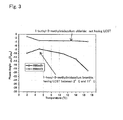
Fig. 3 is a graph showing temperature dependency of phase angles of Example 1 and Comparative Example 1 at 1 MHz of frequency; -
Fig. 4A is a graph showing measurement results of water vapor adsorption isotherms of Example 2; and -
Fig. 4B is a graph showing measurement results of water vapor adsorption isotherms of Comparative Example 2. - Hereinafter the present invention will be described. It should be noted that the embodiments shown below are examples of the present invention, and the present invention is not limited to the embodiments.
- The first aspect of the present invention is a water vapor adsorption-desorption material including a mesoporous body and an ionic liquid retained inside pores of the mesoporous body, the ionic liquid exhibiting LCST behavior.
- Ionic liquid is a collective term for salts existing in a liquid form, specifically, salts which become liquid near normal temperature. Ionic liquid is also called an ion liquid or low melting point molten salt. An ionic liquid is a liquid consisting of only ions (anion, cation). Therefore, ionic liquids are easy to be introduced into pores of a mesoporous body, and can easily be uniformly retained inside pores of the mesoporous body, which is difficult to be done with temperature sensitive polymers. Further, since ionic liquids are nonvolatile (or having nearly no steam pressure), they have an incombustible or flame-retardant property, and have characteristics such as a high heat resistance, of being liquid at a wide range of temperature and of being chemically stable. Therefore, the ionic liquid is difficult to be lost from pores of the mesoporous body, even if the water vapor adsorption-desorption material is heated to a high temperature.
- The ionic liquid used in the present invention exhibits LCST behavior. That is, the ionic liquid has a lower critical solution temperature (LCST) in water, and exhibits behavior of being compatible with water (hydration) at a temperature lower than the LCST, and behavior of phase separation with water (dehydration) at a temperature higher than the LCST.
- As a result of experiments, the inventors of the present invention have confirmed the followings; the mesoporous body in which an ionic liquid exhibiting LCST behavior is retained inside pores increases hydrophilicity inside the pores to increase hygroscopic characteristic at a temperature lower than the LCST, and increases hydrophobicity inside the pores to decrease hygroscopic characteristic at a temperature higher than the LCST, according to LCST behavior of the ionic liquid. In the present invention which employs an ionic liquid as a substance which exhibits LCST behavior, it is possible to more uniformly retain the substance which exhibits LCST behavior inside pores of the mesoporous body than before, to make hydrophilicity/hydrophobicity inside the pores uniform and increase each characteristic. Therefore, it is considered that the hygrosopic characteristic of the mesoporous body can be rapidly changed at temperatures lower and higher than the LCST, compared to the conventional techniques, whereby it is possible to decrease the regeneration temperature more than before.
- Examples of the ionic liquid exhibiting LCST behavior which can be used in the present invention include 1-hexyl-3-methylimidazolium bromide, tributyl-n-octylphosphonium bromide, tetrabutylphosphonium p-toluenesulfonate,
tetrabutylphosphonium 2,4-dimethylbenzenesulfonate, tetrabutylphosphoniumtrifluoroacetate,tetrabuthylphosphonium tetrabuthylammonium - The mesoporous body is a porous body having pores (meso pores) each having a pore diameter of 2 to 50 nm. The mesoporous body which can be employed in the present invention is not particularly limited as long as it has such pores (meso pores), and the mesoporous body described in
Patent Document 1 can be used. - In a case where a temperature sensitive polymer is introduced and composited to a mesoporous silica gel, the hygroscopic characteristic does not change at temperatures higher and lower than the LCST, depending on the pore radius of the mesoporous body. In contrast, the present invention can employ mesoporous body having wide ranges of pore diameter.
- The method for retaining the ionic liquid inside the pores of the mesoporous body is not particularly limited. For example, a method of immersing the mesoporous body with a mixture of the ionic liquid and water thereafter drying them, a method of immersing the mesoporous body directly with the ionic liquid thereafter immersing with water at a temperature higher than the LCST to separate and remove the excessive ionic liquid, and the like can be given.
- The ionic liquid can be retained on a surface area other than the pores of the mesoporous body.
- The second aspect of the present invention is a method for measuring LCST behavior of an ionic liquid used for a water vapor adsorption-desorption material, the method including detecting a change of hydration/dehydration state of a mixture of the ionic liquid and water as electric signals, by means of AC impedance measurement.
- In the present invention, the measurement of AC impedance is carried out by:
- in a container filled with a mixture of the ionic liquid and water, providing two platinum plate electrodes facing each other;
- connecting each electrode to an impedance measurement apparatus;
- then, the measurement is carrying out as the following steps (1) to (3).
- (1) at a constant current (galvanostat) mode and at least in a range of -5°C to 100°C, carrying out AC impedance measurement at every 3 to 10°C at least in a range of 1 Hz to 1 MHz.
- (2) in a case where a phase change which is not monotonic is found with respect to temperature change at a specific frequency, where it can be considered that a state change is occurring, carrying out the following way for measurement in more detail.
- (3) at the specific frequency of (2), measuring impedances or phases while the temperature of the mixture is changed more finely than (1), to measure in more detail the temperature at which the state change occurs (LCST).
- In the above (1), the current value in measuring at a constant current mode is not particularly limited as long as the phase change can be detected. In view of inhibiting degradation of the electrodes, it is preferable to apply a constant current of 0 mA to 500 mA.
- By carrying out AC impedance measurement at the constant current, in a range of 1 Hz to 1 MHz in every 3 to 10°C at least in a range of -5°C to 100°C, it is possible to prevent oversight of the phase change which is not monotonic in the above (2), even if the method for measuring LCST behavior of the present invention is employed for measuring various ionic liquids.
- In the measurement of (1), the temperature needs to be constant, since one measurement at a specific frequency takes several minutes to several tens of minutes. On the other hand, it is possible to carry out the measurement of (3) while the temperature is continuously changed, since the measurement at a specific temperature finishes in several seconds.
- In the conventional measurement of LCST behavior by means of difference in light transmittance, there is a time lag between the start of appearance of the solute molecules and aggregations of the solute molecules to change the light transmittance. Thus, there occur measurement errors in the LCST. However, with the AC impedance measurement, it is possible to obtain a correct LCST since no time lag occurs because of seeing electronic signals.
- 1. Measurement of LCST behavior
- A measurement of LCST behavior of an aqueous solution of 1-hexyl-3-methylimidazolium bromide (1.2 M) was carried out with the structure of electrode shown in Table 1.
[Table 1] Working electrode Platinum foil 1 cm2 Counter electrode Platinum foil 4 cm2 Reference electrode Ag/AgCl -
Fig. 1 shows results of measurements of the aqueous solution of 1-hexyl-3-methylimidazolium bromide (1.2 M) at a constant current (galvanostat) mode, at each temperature of 2°C, 5°C, 11°C and 14°C. The graph on the left inFig. 1 is a graph showing phase angles at 1 mHz to 1 MHz. The graph on the right inFig. 1 is an enlarged view of the graph on the left, which shows the phase angles at 10 kHz to 1 MHz. As shown in the graph on the right inFig. 1 , phase angles at 5°C, 11°C and 14°C monotonously increased with respect to frequencies at 10 kHz to 1 MHz. However, only the phase angle at 2°C showed different behavior from others around 1 MHz. - Since a change in behavior of phase angle was detected at 2°C around 1 MHz from (1), the frequency was fixated to 1 MHz and temperatures at which the behavior of the phase angle changed were evaluated in detail. Results are shown in
Fig. 3 (noted as "HMImBR" inFig. 3 ). - A measurement of LCST behavior of an aqueous solution of 1-buthyl-3-methylimidazolium chloride (1.2 M) was carried out in the same manner as in Example 1.
-
Fig. 2 shows results of measurements of the aqueous solution of 1-buthyl-3-methylimidazolium chloride (1.2 M) at a constant current (galvanostat, set current value: 500 mA) mode (1 mHz to 1 MHz), at each temperature of 2°C, 5°C, 11°C, 14°C and 17°C. The graph on the left inFig. 2 is a graph showing phase angles at 1 mHz to 1 MHz. The graph on the right inFig. 2 is an enlarged view of the graph on the left, which shows the phase angles at 10 kHz to 1 MHz. As shown in the graph on the right inFig. 2 , phase angles monotonously increased with respect to frequencies at 10 kHz to 1 MHz at every temperature. Therefore, it is considered that 1-buthyl-3-methylimidazolium chloride does not show LCST at least in a range of 2°C to 17°C. - In the method for measuring LCST behavior of the present invention, precise measurement at a specific frequency is not carried out in a case where the behavior of phase angles does not change in the measurement at a constant current (galvanostat) mode. However, in order to compare with Example 1, the behavior of the phase angles is precisely measured at the frequency fixated to 1 MHz. Results are shown in
Fig. 3 (noted as "BMImCl" inFig. 3 ). - From
Fig. 3 , it was found that 1-hexyl-3-methylimidazolium bromide has a LCST from 2°C to 11°C, since a large difference was detected in behavior of phase angles of 1-hexyl-3-methylimidazolium bromide (HMImBr) at 2°C, 5°C and 11°C. On the other hand, it was found that 1-buthyl-3-methylimidazolium chloride does not have a LCST at least in a range of 2°C to 17°C, since a large difference was not detected in behavior of phase angles of 1-buthyl-3-methylimidazolium chloride (BMImCl). - Search of ionic liquid having LCST was carried out by examining alkyl chain lengths of 1-aklyl-3-methylimidazolium salt which generally has low melting points and is generally easy to be an ionic liquid, and anion species. Synthesizing schemes of ionic liquids are shown below. The alkyl chains examined are three kinds of a hexyl group (-C6H13-n), octyl group (-C8H17-n) and dodecyl group (-C12H25-n). The anion species examined are three kinds of a bromide ion (Br-), acrylate ion (CH2CHCOO-) and vinylphosphonate ion (CH2CHPO3 -). By combining the alkyl chains and anion species, nine kinds of ionic liquids were synthesized.

- Measurements of LCST were carried out on the nine kinds of ionic liquids synthesized in (1), in the same manner as in Example 1. The measurement in a case where the alkyl chain is a hexyl group (-C6H13-n) and the anion species is a bromide ion (Br-) (1-hexyl-3-methylimidazolium bromide) corresponds to Example 1. Results are shown in Table 2. In Table 2, "LCST" means that the mixture of the ionic liquid and water exhibited LCST behavior, and "hydrophilic" means that the ionic liquid and water were always compatible to each other (hydrated) during the measurement.

- As shown in Table 2, only 1-hexyl-3-methylimidazolium bromide whose alkyl chain was a hexyl group (-C6H13-n) and anion species was a bromide ion (Br-) exhibited LCST behavior. Other ionic liquids did not exhibit LCST behavior. As shown in Example 1, 1-hexyl-3-methylimidazolium bromide had a LSCT between 2°C and 11°C.
- As a mesoporous body, 0.2 g of commercially available aminopropyl silica gel (manufactured by GL Sciences Inc. ,
particle diameter 10 µm,average pore diameter 10 nm), and as an ionic liquid, 0.05 g of 1-hexyl-3-methylimidazolium bromide (HMImBr) were stirred in water for 24 hours, then kept still. After the supernatant was removed, the resulting material was dried in vacuum, whereby a water vapor adsorption-desorption material was synthesized. - The water vapor adsorption-desorption material synthesized in (1) was dried at 60°C for 6 hours in vacuum. Thereafter, equilibrium values of its water vapor adsorption amount with respect to given relative moistures at 1.5°C and 20°C were measured by means of a gas adsorption evaluation instrument (BELSORP-MAX, manufactured by BEL Japan, Inc.). Measurement results of water vapor adsorption isotherms are shown in
Fig. 4A . - The water vapor adsorption amount of the aminopropyl silica gel used in Example 2 by which nothing is retained was measured in the same manner as in Example 2. Measurement results of water vapor adsorption isotherms are shown in
Fig. 4B . - As shown in
Fig. 4A , it was confirmed that Example 2 in which HMImBr was retained by the mesoporous body had a large difference in the hygroscopic characteristic between 1. 5°C and 20°C. On the other hand, as shown inFig. 4B , the water vapor adsorption isotherm of Comparative Example 2 in which the measurement is carried out only on the mesoporous body (aminopropyl silica gel) did not have a large difference between 1.5°C and 20°C. Since HMImBr has a LSCT in a range of 2 to 11°C, it can be considered that this is because: at 1.5°C or below, HMImBr has a property of hydration then the hygroscopic characteristic increases with the inside of the pores showing hydrosphilicity, and at 20°C, HMImBr has a property of separation from water then the inside of the pores can be considered as being hydrophobized; the above difference shows up as the difference in water vapor hygroscopic characteristic.
Claims (5)
- A water vapor adsorption-desorption material comprising:a mesoporous body; and characterized in thatan ionic liquid is retained inside pores of the mesoporous body, the ionic liquid exhibiting LCST behavior.
- The water vapor adsorption-desorption material according to claim 1, wherein the ionic liquid is 1-hexyl-3-methylimidazolium bromide.
- A method for measuring LCST behavior of an ionic liquid used for a water vapor adsorption-desorption material, the method being characterized in that it comprises a step of detecting a change of hydration/dehydration state of a mixture of the ionic liquid and water as electric signals, by means of AC impedance measurement.
- The method for measuring LCST behavior according to claim 3, wherein:the AC impedance measurement is carried out at a constant current mode, at least in a range from 1 Hz to 1 MHz in every 3°C to 10°C, at least in a temperature range from -5°C to 100°C; andin a case where a phase change which is not monotonic is found with respect to temperature change at a specific frequency, LCST is measured by measuring impedance or phase while the temperature of the mixture is finely changed at the specific frequency.
- The method for measuring LCST behavior according to claim 4,
wherein
LCST is measured by measuring the phase while the temperature of the mixture is finely changed at the specific frequency.
Applications Claiming Priority (1)
| Application Number | Priority Date | Filing Date | Title |
|---|---|---|---|
| JP2014178542A JP6059187B2 (en) | 2014-09-02 | 2014-09-02 | Water vapor absorption / release material and LCST behavior measurement method |
Publications (2)
| Publication Number | Publication Date |
|---|---|
| EP3045225A2 true EP3045225A2 (en) | 2016-07-20 |
| EP3045225A3 EP3045225A3 (en) | 2016-11-02 |
Family
ID=54145558
Family Applications (1)
| Application Number | Title | Priority Date | Filing Date |
|---|---|---|---|
| EP15183524.6A Withdrawn EP3045225A3 (en) | 2014-09-02 | 2015-09-02 | Water vapor adsorption-desorption material and method for measuring lcst behavior |
Country Status (3)
| Country | Link |
|---|---|
| US (1) | US20160059212A1 (en) |
| EP (1) | EP3045225A3 (en) |
| JP (1) | JP6059187B2 (en) |
Families Citing this family (4)
| Publication number | Priority date | Publication date | Assignee | Title |
|---|---|---|---|---|
| CA3018937A1 (en) * | 2016-03-30 | 2017-10-05 | Osaka Gas Co., Ltd. | Gas sorbent and carbon dioxide separation and recovery system and method |
| JP2020006677A (en) * | 2018-06-28 | 2020-01-16 | 国立大学法人九州大学 | Agent for controlling wood shape and/or wood humidity |
| JP7186961B2 (en) * | 2018-07-12 | 2022-12-12 | 中部電力株式会社 | Absorbent material |
| JP2020127929A (en) * | 2019-02-12 | 2020-08-27 | パナソニックIpマネジメント株式会社 | Humidity conditioning system and air-conditioning system using the same |
Citations (1)
| Publication number | Priority date | Publication date | Assignee | Title |
|---|---|---|---|---|
| JPH11114410A (en) | 1997-10-17 | 1999-04-27 | Toyota Central Res & Dev Lab Inc | Vapor absorption / release material |
Family Cites Families (18)
| Publication number | Priority date | Publication date | Assignee | Title |
|---|---|---|---|---|
| JP2005009703A (en) * | 2003-06-17 | 2005-01-13 | Matsushita Electric Ind Co Ltd | Absorption and emission body and cooling / heating system using the same |
| JP2006040853A (en) * | 2004-06-25 | 2006-02-09 | Tokyo Institute Of Technology | Ion conductive filler and ion conductive polymer composition |
| JP2006142121A (en) * | 2004-11-16 | 2006-06-08 | Daikin Ind Ltd | Air treatment equipment |
| JP4997465B2 (en) * | 2005-03-31 | 2012-08-08 | 独立行政法人産業技術総合研究所 | Control method of ionic liquid using nanopore |
| GB0525251D0 (en) * | 2005-12-12 | 2006-01-18 | Univ Belfast | Oligomerisation |
| US8506839B2 (en) * | 2005-12-14 | 2013-08-13 | E I Du Pont De Nemours And Company | Absorption cycle utilizing ionic liquids and water as working fluids |
| JP4858870B2 (en) * | 2006-02-16 | 2012-01-18 | 財団法人生産技術研究奨励会 | Electrical signal measurement device for cultured cells and electrical signal measurement method using the device |
| KR100864313B1 (en) * | 2007-05-21 | 2008-10-20 | 한국화학연구원 | Surface functionalization and application of porous organic-inorganic hybrids or mesoporous bodies having unsaturated metal sites |
| JP5136979B2 (en) * | 2007-10-31 | 2013-02-06 | 独立行政法人産業技術総合研究所 | Adsorbent for selective separation and purification of carbon dioxide |
| JP2009178617A (en) * | 2008-01-29 | 2009-08-13 | Sanyo Chem Ind Ltd | Heat responsible liquid composition |
| EP2087930A1 (en) * | 2008-02-05 | 2009-08-12 | Evonik Degussa GmbH | Method for the absorption of volatile material in a fluid absorption agent |
| US9038409B2 (en) * | 2009-09-21 | 2015-05-26 | Korea Research Institute Of Chemical Technology | Apparatus for treating air by using porous organic-inorganic hybrid materials as an absorbent |
| JP5585873B2 (en) * | 2010-09-03 | 2014-09-10 | 独立行政法人産業技術総合研究所 | Environmental purification method and apparatus using ionic liquid |
| JP5580243B2 (en) * | 2011-03-31 | 2014-08-27 | Jx日鉱日石エネルギー株式会社 | Water contamination detection device and water contamination detection method |
| DE202011106028U1 (en) * | 2011-08-14 | 2012-08-17 | BLüCHER GMBH | New concepts for gas treatment and gas purification |
| CN104080524B (en) * | 2011-11-29 | 2017-03-08 | 丹麦技术大学 | Absorption and Oxidation of NO in Ionic Liquids |
| CN102513064A (en) * | 2011-12-23 | 2012-06-27 | 广东工业大学 | Preparation method and application of ionic liquid bonded silica adsorbent |
| CN103691400B (en) * | 2013-12-20 | 2015-09-16 | 华南理工大学 | Hybrid mesoporous MCM-48 composite of functionalized ion liquid and preparation method thereof and application |
-
2014
- 2014-09-02 JP JP2014178542A patent/JP6059187B2/en not_active Expired - Fee Related
-
2015
- 2015-09-01 US US14/842,490 patent/US20160059212A1/en not_active Abandoned
- 2015-09-02 EP EP15183524.6A patent/EP3045225A3/en not_active Withdrawn
Patent Citations (1)
| Publication number | Priority date | Publication date | Assignee | Title |
|---|---|---|---|---|
| JPH11114410A (en) | 1997-10-17 | 1999-04-27 | Toyota Central Res & Dev Lab Inc | Vapor absorption / release material |
Non-Patent Citations (1)
| Title |
|---|
| ICHIHASHI TOSHIO; NAKANO YOSHIO: "Characteristics of Water Vapor Adsorption and Desorption in Thermo-Sensitive Mesoporous Silica Gel/Polymer Gel", vol. 34, 2008, KAGAKU KOGAKU RONBUNSHU, pages: 471 - 476 |
Also Published As
| Publication number | Publication date |
|---|---|
| JP6059187B2 (en) | 2017-01-11 |
| JP2016052614A (en) | 2016-04-14 |
| US20160059212A1 (en) | 2016-03-03 |
| EP3045225A3 (en) | 2016-11-02 |
Similar Documents
| Publication | Publication Date | Title |
|---|---|---|
| EP3045225A2 (en) | Water vapor adsorption-desorption material and method for measuring lcst behavior | |
| Sander et al. | Investigations of selectivity in RPLC of polycyclic aromatic hydrocarbons | |
| Wei et al. | Molecularly imprinted solid phase extraction coupled to high performance liquid chromatography for determination of aflatoxin M 1 and B 1 in foods and feeds | |
| Joyner et al. | Surface area measurements of activated carbons, silica gel and other adsorbents | |
| CN103706341B (en) | Ionic liquid bonding polysiloxane stationary phase and preparation method thereof | |
| Jaroniec et al. | Comparative studies of structural and surface properties of porous inorganic oxides used in liquid chromatography | |
| CN102924645A (en) | Preparation method and application of molecularly imprinted polymer of penicillin antibiotics and intermediate of penicillin antibiotics | |
| CN102879510A (en) | Method for detecting migration quantity of nipagin ester substances in plastic food package bag | |
| Pefferkorn et al. | Helix–coil transition of poly (α, l‐glutamic acid) at an interface: Correlation with static and dynamic membrane properties | |
| Jaćkowska et al. | Dendrimer modified silica gel for anion exchange chromatography: synthesis, characterization and application | |
| Lermontov et al. | Methyltrimethoxysilane-based elastic aerogels: Effects of the supercritical medium on structure-sensitive properties | |
| Yu et al. | Automated analysis of non-steroidal anti-inflammatory drugs in human plasma and water samples by in-tube solid-phase microextraction coupled to liquid chromatography-mass spectrometry based on a poly (4-vinylpyridine-co-ethylene dimethacrylate) monolith | |
| Aydoğan et al. | Molecularly imprinted cryogel for L‐glutamic acid separation | |
| JP2016097359A (en) | Temperature-responsive moisture absorption material and its manufacturing method | |
| Barrande et al. | Characterisation of porous materials for bioseparation | |
| Hsieh et al. | Single‐step approach to β‐cyclodextrin‐bonded silica as monolithic stationary phases for CEC | |
| Maciejewska et al. | Investigation of the surface area and polarity of porous copolymers of maleic anhydride and divinylbezene | |
| JP2017154076A (en) | Water vapor absorption and release material | |
| Malewitz et al. | Multicomponent absorption of anions in commercial anion-exchange membranes | |
| US20140096628A1 (en) | Method for determining wettability | |
| Xiao et al. | Synthesis of the hydrophobic–hydrophilic macroporous poly divinylbenzene/poly (sodium acrylate) IPN resin and adsorption performance for berberine | |
| Huang et al. | Analyses of preservatives by capillary electrochromatography using methacrylate ester‐based monolithic columns | |
| Lin et al. | Poly (triallyl isocyanurate–co-ethylene dimethacrylate–co-alkyl methacrylate) stationary phases in the chromatographic separation of hydrophilic solutes | |
| Lin et al. | Construction and application of molecularly imprinted film sensor on determination of chlorpyrifos in water | |
| Wang et al. | Preconcentration of bisphenols by using calix [4] arene derivatives modified porous polymer monolith coupled with HPLC |
Legal Events
| Date | Code | Title | Description |
|---|---|---|---|
| PUAI | Public reference made under article 153(3) epc to a published international application that has entered the european phase |
Free format text: ORIGINAL CODE: 0009012 |
|
| 17P | Request for examination filed |
Effective date: 20150902 |
|
| AK | Designated contracting states |
Kind code of ref document: A2 Designated state(s): AL AT BE BG CH CY CZ DE DK EE ES FI FR GB GR HR HU IE IS IT LI LT LU LV MC MK MT NL NO PL PT RO RS SE SI SK SM TR |
|
| AX | Request for extension of the european patent |
Extension state: BA ME |
|
| PUAL | Search report despatched |
Free format text: ORIGINAL CODE: 0009013 |
|
| AK | Designated contracting states |
Kind code of ref document: A3 Designated state(s): AL AT BE BG CH CY CZ DE DK EE ES FI FR GB GR HR HU IE IS IT LI LT LU LV MC MK MT NL NO PL PT RO RS SE SI SK SM TR |
|
| AX | Request for extension of the european patent |
Extension state: BA ME |
|
| RIC1 | Information provided on ipc code assigned before grant |
Ipc: F24F 3/14 20060101ALI20160927BHEP Ipc: G01N 27/02 20060101ALI20160927BHEP Ipc: F25B 17/00 20060101ALI20160927BHEP Ipc: B01J 20/32 20060101ALI20160927BHEP Ipc: B01J 20/28 20060101AFI20160927BHEP Ipc: B01D 53/28 20060101ALI20160927BHEP Ipc: B01D 53/26 20060101ALI20160927BHEP Ipc: B01J 20/22 20060101ALI20160927BHEP |
|
| STAA | Information on the status of an ep patent application or granted ep patent |
Free format text: STATUS: THE APPLICATION HAS BEEN WITHDRAWN |
|
| 18W | Application withdrawn |
Effective date: 20171205 |