EP3045144A2 - Hybride bioadaptive selbstligierende klammer - Google Patents
Hybride bioadaptive selbstligierende klammer Download PDFInfo
- Publication number
- EP3045144A2 EP3045144A2 EP16151932.7A EP16151932A EP3045144A2 EP 3045144 A2 EP3045144 A2 EP 3045144A2 EP 16151932 A EP16151932 A EP 16151932A EP 3045144 A2 EP3045144 A2 EP 3045144A2
- Authority
- EP
- European Patent Office
- Prior art keywords
- bracket
- self
- hybrid
- bioadaptative
- ligating
- Prior art date
- Legal status (The legal status is an assumption and is not a legal conclusion. Google has not performed a legal analysis and makes no representation as to the accuracy of the status listed.)
- Withdrawn
Links
- 210000003205 muscle Anatomy 0.000 claims abstract description 34
- 230000000399 orthopedic effect Effects 0.000 claims abstract description 24
- 230000004913 activation Effects 0.000 claims abstract description 19
- 230000014759 maintenance of location Effects 0.000 claims description 7
- 230000002146 bilateral effect Effects 0.000 claims description 4
- 238000011282 treatment Methods 0.000 abstract description 25
- 210000003298 dental enamel Anatomy 0.000 abstract description 15
- 206010061274 Malocclusion Diseases 0.000 abstract description 11
- 238000012937 correction Methods 0.000 abstract description 11
- 238000000605 extraction Methods 0.000 abstract description 10
- 230000000694 effects Effects 0.000 description 13
- 210000001847 jaw Anatomy 0.000 description 10
- 210000002455 dental arch Anatomy 0.000 description 8
- 210000000214 mouth Anatomy 0.000 description 5
- TWNQGVIAIRXVLR-UHFFFAOYSA-N oxo(oxoalumanyloxy)alumane Chemical compound O=[Al]O[Al]=O TWNQGVIAIRXVLR-UHFFFAOYSA-N 0.000 description 5
- 230000006978 adaptation Effects 0.000 description 3
- 238000003780 insertion Methods 0.000 description 3
- 230000037431 insertion Effects 0.000 description 3
- 239000011347 resin Substances 0.000 description 3
- 229920005989 resin Polymers 0.000 description 3
- 230000009471 action Effects 0.000 description 2
- 239000002131 composite material Substances 0.000 description 2
- 238000006073 displacement reaction Methods 0.000 description 2
- 230000036541 health Effects 0.000 description 2
- 230000003993 interaction Effects 0.000 description 2
- 230000003387 muscular Effects 0.000 description 2
- 239000004925 Acrylic resin Substances 0.000 description 1
- 229920000178 Acrylic resin Polymers 0.000 description 1
- 208000006558 Dental Calculus Diseases 0.000 description 1
- 239000000853 adhesive Substances 0.000 description 1
- 230000001070 adhesive effect Effects 0.000 description 1
- 230000008901 benefit Effects 0.000 description 1
- 230000001055 chewing effect Effects 0.000 description 1
- 239000000805 composite resin Substances 0.000 description 1
- 238000010276 construction Methods 0.000 description 1
- 238000011109 contamination Methods 0.000 description 1
- 239000002537 cosmetic Substances 0.000 description 1
- 238000012864 cross contamination Methods 0.000 description 1
- 230000001815 facial effect Effects 0.000 description 1
- 239000003292 glue Substances 0.000 description 1
- 230000000642 iatrogenic effect Effects 0.000 description 1
- 208000026762 inability to speak Diseases 0.000 description 1
- 230000002427 irreversible effect Effects 0.000 description 1
- 238000004519 manufacturing process Methods 0.000 description 1
- 238000000034 method Methods 0.000 description 1
- 238000003032 molecular docking Methods 0.000 description 1
- 230000003239 periodontal effect Effects 0.000 description 1
- 230000009467 reduction Effects 0.000 description 1
- 229910001220 stainless steel Inorganic materials 0.000 description 1
- 239000000126 substance Substances 0.000 description 1
- 238000001356 surgical procedure Methods 0.000 description 1
- 210000001738 temporomandibular joint Anatomy 0.000 description 1
Images

Classifications
-
- A—HUMAN NECESSITIES
- A61—MEDICAL OR VETERINARY SCIENCE; HYGIENE
- A61C—DENTISTRY; APPARATUS OR METHODS FOR ORAL OR DENTAL HYGIENE
- A61C7/00—Orthodontics, i.e. obtaining or maintaining the desired position of teeth, e.g. by straightening, evening, regulating, separating, or by correcting malocclusions
- A61C7/12—Brackets; Arch wires; Combinations thereof; Accessories therefor
- A61C7/14—Brackets; Fixing brackets to teeth
- A61C7/146—Positioning or placement of brackets; Tools therefor
-
- A—HUMAN NECESSITIES
- A61—MEDICAL OR VETERINARY SCIENCE; HYGIENE
- A61C—DENTISTRY; APPARATUS OR METHODS FOR ORAL OR DENTAL HYGIENE
- A61C7/00—Orthodontics, i.e. obtaining or maintaining the desired position of teeth, e.g. by straightening, evening, regulating, separating, or by correcting malocclusions
- A61C7/12—Brackets; Arch wires; Combinations thereof; Accessories therefor
- A61C7/28—Securing arch wire to bracket
- A61C7/287—Sliding locks
-
- A—HUMAN NECESSITIES
- A61—MEDICAL OR VETERINARY SCIENCE; HYGIENE
- A61C—DENTISTRY; APPARATUS OR METHODS FOR ORAL OR DENTAL HYGIENE
- A61C7/00—Orthodontics, i.e. obtaining or maintaining the desired position of teeth, e.g. by straightening, evening, regulating, separating, or by correcting malocclusions
- A61C7/12—Brackets; Arch wires; Combinations thereof; Accessories therefor
-
- A—HUMAN NECESSITIES
- A61—MEDICAL OR VETERINARY SCIENCE; HYGIENE
- A61C—DENTISTRY; APPARATUS OR METHODS FOR ORAL OR DENTAL HYGIENE
- A61C7/00—Orthodontics, i.e. obtaining or maintaining the desired position of teeth, e.g. by straightening, evening, regulating, separating, or by correcting malocclusions
- A61C7/12—Brackets; Arch wires; Combinations thereof; Accessories therefor
- A61C7/14—Brackets; Fixing brackets to teeth
-
- A—HUMAN NECESSITIES
- A61—MEDICAL OR VETERINARY SCIENCE; HYGIENE
- A61C—DENTISTRY; APPARATUS OR METHODS FOR ORAL OR DENTAL HYGIENE
- A61C7/00—Orthodontics, i.e. obtaining or maintaining the desired position of teeth, e.g. by straightening, evening, regulating, separating, or by correcting malocclusions
- A61C7/12—Brackets; Arch wires; Combinations thereof; Accessories therefor
- A61C7/14—Brackets; Fixing brackets to teeth
- A61C7/143—Brackets with two or more recesses for arch wires
-
- A—HUMAN NECESSITIES
- A61—MEDICAL OR VETERINARY SCIENCE; HYGIENE
- A61C—DENTISTRY; APPARATUS OR METHODS FOR ORAL OR DENTAL HYGIENE
- A61C7/00—Orthodontics, i.e. obtaining or maintaining the desired position of teeth, e.g. by straightening, evening, regulating, separating, or by correcting malocclusions
- A61C7/12—Brackets; Arch wires; Combinations thereof; Accessories therefor
- A61C7/14—Brackets; Fixing brackets to teeth
- A61C7/16—Brackets; Fixing brackets to teeth specially adapted to be cemented to teeth
Definitions
- the present application relates to a hybrid bioadaptative self-ligating bracket with constructive arrangement which interacts with the teeth and the muscles of the oral cavity, allowing orthodontic and orthopedic movements, showing also a base channels with conical grooves trapezoidal profile which increases the mechanical retention of adhesion strength to the enamel while facilitating removal of the bracket from the tooth without causing damage to tooth enamel and a double sliding door safety device and that provides a greater surface contact with the orthodontic wire.
- Orthodontics and Functional Orthopedics of the jaws are specialties of dentistry that aims to treat the dentoalveolar malocclusions, returning to the patients a functional occlusion providing periodontal health, functional stability, health of Temporomandibular Joints, cosmetic dental and facial aesthetics.
- Orthodontics uses for this a device called a bracket that is attached to the tooth using a specific system of membership and does not cause any damage to the surface of tooth enamel.
- the bracket has a slot in its body that enables the insertion of an orthodontic wire, which after being inserted in each bracket already joined in all teeth of the dental arch, will provide specific features of this deflection orthodontic wire generating a force sufficient magnitude to move the dentoalveolar structures.
- the Brackets are thus the main components for the connection between the teeth, supporting structures, muscles of the mouth and the forces applied by the deflection of orthodontic wires.
- Functional Orthopedics of the jaws makes use of removable appliances that work on teeth and supporting structures, moving the muscles of the mouth to release the dentoalveolar movement. They are bulky removable appliances, primarily made of acrylic resin and stainless steel wire and should be used throughout the day to get the necessary corrections of the dental arches, and have to be modified several times during treatment the different types of bad occlusions that affect the dental arches.
- brackets with small sized body Another problem of self-ligating brackets with small sized body, is that the bracket cannot make an active orthopedic interaction with muscle clearance when in contact with this perioral muscles, which make great pressure on the jaws (a) enable dentoalveolar movement in the transverse direction causing the jaws atresia and consequent mandibular retroposing, significantly increasing both the need of dental extractions and the orthodontic treatment time.
- brackets as described above, such as US20070134612 , US20070224568 , US4496317 and US7131836 .
- the self-ligating brackets currently on the market do not have a bracket size that allows the activation of the muscles of the lips in the anterior region.
- By increasing size we eliminate the force of the buccinator muscles that compress the posterior teeth, causing palatal atresiating the jaw and causing the narrowing of the dental arch. This is other han will cause crowding and anterior tooth inclination and mandibular retropositioning.
- Self-ligating brackets that have characteristics as a small body that do not interact with the perioral muscles to obtain the dentoalveolar orthopedic effects sorely needed in the correction of malocclusion in the transverse direction.
- the base of the hybrid bioadaptative self-ligating bracket has its adhesion systhem to the tooth with mechanical retention characteristics with a unique format conical channels with trapezoidal profile that provide excellent adhesion to the tooth.
- This innovative format allows what none of other self-ligatingligating bracket allow, to remove adhered resin in the ligating base of the bracket by pressuring both ends of the base using just the tip of a medical instrument without the need for application of aluminum oxide, thereby enabling immediate resealing of the bracket on the tooth.
- the conical base of mechanical retention increases the adhesion strength to the enamel at the same time facilitates removal of the bracket from the tooth without causing damage to tooth enamel.
- the hybrid bioadaptative self-ligating bracket has the ideal characteristics that unite the functional orthodontic and orthopedic needs necessary for the treatment of various types of malocclusions in half the time held with other brackets and without extractions.
- the Hybrid Bioadaptative Self-Ligating Bracket is a completely new device, which with its specific characteristics, allows for the first time to combine the orthodontic tooth movement and orthopedic dentoalveolar transverse effects in one unit, providing a dentoalveolar movement in the transverse direction without causing any side effects very common in conventional orthodontic treatment.
- Hybrid Biodaptative Self-ligating Bracket is in the construction in an ideal size, length (X axis) of 4.5 mm, height (Z axis) of 3.0 mm and width (Y axis) of 3.6mm, which provides the orthopedic activation of muscles of the lips (c) to prevent forces applied to the orthodontic arch cause labial inclination of anterior teeth, thus preventing the teeth flaring effect, which is undesirable and yet it is very common in all orthodontic treatments.
- Another object of the application is to provide a sliding door that favors a larger contact surface with the orthodontic wire. This door ensures, through two security locks incorporated into the body of the sliding door, full security to secure the wire inside slot.Further two stability supports at both ends of the slinding door allow full stability for dental speed control. The greatest door has a significant action in the mesial distal direction of dental correction.
- Yet another objective of the proposed application is the manufacturing of a base endowed with conical grooves with trapezoidal profile for better grip and greater strength of the bracket to the tooth. But, as important as the glue of the bracket to the tooth enamel, is to have a bracket that can be taken off the enamel without damage to the tooth.
- bracket It is a self-ligating bracket with specific bioadaptative features that turn the bracket in a hybrid system. Hybrid because it transforms the body of the bracket and the bracket door in important interaction elements with teeth, orthodontic wires and the muscles of the mouth, allowing the bracket to provide orthodontic movements along with the orthopedic jaw effects, which previously were obtained by combining various types of fixed and orthopedic devices.
- bioadaptative feature facilitates dentoalveolar movement without generating unwanted side effects on the teeth and/or support structures, very common in treatments performed during many years of use of dental appliances.
- bioadaptative and hybrid inserted in this new self-ligating bracket, it was eliminated definitively in orthodontic treatment, the need for both dental extractions and the use of accessory devices and/or removable orthopedic braces during treatment for the correction of various types of malocclusions.
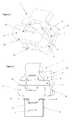
- the present application discloses a hybrid self-ligating bracket (1), which connects the tooth movement together with the functional orthopedic effects jaw as it has a unique feature of inter-relationship with the oral musculature.
- This interrelationship is provided by constructive provision of the bracket that has a muscle activation bar (10) in one of their front portions.
- the hybrid bioadaptative self-ligating brackets it is moved away from the posterior dentoalveolar contact with the buccinator muscles that are primarily responsible for the maxillary atresia (A) of the arches, thereby helping to reach the transverse orthopedic dentoalveolar effects needed to correct the malocclusion without the need of dental extractions, as is normally done with orthodontic appliances.
- the hybrid bioadaptative self-ligating bracket (1) is constructed with preferred dimensions of length (X axis) of 4.0 mm to 5.0 mm, height (Z-axis) of 2.5 to 4.0 mm and width (Y axis) of 3.3 to 4.0 mm, more preferably length (X axis) of 4.5 mm, height (Z axis) of 3.0 mm and width (Y axis) of 3.6 mm to provide orthopedic activation of the orbicular muscle of the mouth to prevent the orthodontic forces applied on the dental arches do not cause inclination of anterior teeth, avoiding the effect of the buccal teeth.
- the said bracket (1) is equipped with a sliding door (2) that favors a larger contact surface with the orthodontic wire (15).
- This door (2) has a constructive arrangement which ensures through two safety catches (3) incorporated in the body of said sliding door safely to avoid unwanted opening of the door, holding the wire into the slot (7) and provide stability for control of dental rotation.
- the door (2) has a stability support (6).
- the adaptation of stability supports (6) of the door (2) sliding in engagement slots (8) located in the gingival part (4) of the body of said bracket (1) provides, when closed, a cover fully closed and firmly and safe of the slot (7) of the bracket.
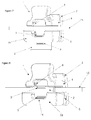
- the sliding door (2) is lodged in a specific slot within the enhanced protection (12), which comprises the major part of the functional orthopedic activation of the hybrid bioadaptative self-ligating bracket, which is muscle activation bar (10), slides to the other side of the body of the bracket in bilateral clefts (8) that receive the stability support (6).
- the Muscular Activation Bar (10) where the door (2) slides is part of the body of the bracket, increasing length, width and height of the hybrid bioadaptative self-ligating bracket (1), just to offer the functional orthopedic features previously explained; however, this protection also prevents tartar from building up between the sliding door (2) and the body of the said bracket, which would hinder the opening and/or closing of the sliding door (2).
- the door (2) has its opening and closing stage limited by the recess (16) provided in the body of muscle activation bar.
- the said door (2) slides on the slot (7) from the incisal side (5) to be supported with full stability and safety in a slot (8) in gingival specific part of the body of the bracket (4).
- It has preferred dimensions of length (X axis) of 2.7 mm to 3.5 mm, more preferably, length (X axis) of 3.0 mm, forming a fourth part that closes enabling greater contact with the orthodontic wire providing better correcting conditions (15) in the distal mesial meaning of this important feature of malocclusion, bringing the advantage of a significant reduction in orthodontic treatment time.
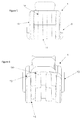
- the hybrid bioadaptative self-ligating bracket has a base (13) with trapezoidal profile and conical grooves (14) which increases the mechanical retention and adhesion strength to enamel and at the same time facilitates removal of the bracket attached to the tooth by the dentist without causing damage to the tooth enamel.
- brackets In most orthodontic treatments, it is normal during the progress of treatment the repositioning of brackets for better and faster results with less iatrogenic forces to the teeth and supporting structure, most of the brackets do not provide easy removal of the adhesive system of the base (13) of the bracket, which leads to the need for the application of aluminum oxide jet on the bracket base, making this a more complicated clinical procedures and with a high possibility of causing cross contamination, as well as result in contamination of the environment when this substance is discarded.
- the base (13) with conical grooves and trapezoidal profile (14) of the hybrid bioadaptative self-ligating bracket was designed to allow through a simple pressure of the tip of a clinical instrument on the remaining adhesion composite of the base of the bracket (13) can be easily removed without the need for an aluminum oxide jet is immediately ready for resealing.
- the hybrid bioadaptative self-ligating bracket (1) proposed enables the professional to perform orthodontic treatment with excellent alignment of all dental contact points, providing, of course, correct occlusal-functional relationship (D) due to the association of orthodontic movement (size of the sliding door with greater contact with the orthodontic wire) together with the functional orthopedic effects (bracket size that interacts with the muscles), with a base (13) having conical grooves and trapezoidal profile (14) provides excellent retention to the enamel, but is also easy to remove the bracket attached to the tooth by professional without causing any damage to the tooth enamel and easy removal of the remaining composite resin adhered to the bracket base for immediate resealing, whose characteristics were only obtained with the use of various fixed and removable devices associated with a long period of orthodontic treatment (36 months) and it was often necessary to perform extraction of 4 teeth.
- the figures 5 and 6 illustrate the base (13) of the brackets, with conical grooves and trapezoidal profile (14) that were created to allow through a simple pressure of the tip of a clinical instrument on the remaining adhesion composite of the base of the bracket (13) being easily removed without the need for an aluminum oxide jet, being immediately ready for resealing.
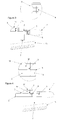
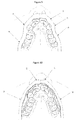
- muscle activation bar (10) illustrating an example of the upper maxillary arch, simulating activation of the orbicularis muscle of the lip and the distance from the buccinator muscles on posterior dentoalveolar structures, which are primarily responsible for atresia (A) of the maxillary arches
- Figure 9 shows an example of atresia (A) of the maxillary arch and how the buccinator muscles push the posterior region for palatine.
- Figure 10 illustrates an example of the upper maxillary arch with the hybrid self-ligating bracket properly working, demonstrating the activation of the orbicular muscle on anterior brackets (C) preventing the dental vestibularization and being removed from the posterior dentoalveolar contact the buccinator muscles (B) that are primarily responsible for atresia of the maxillary arches.
- Figure 11 illustrates an example of the upper maxillary arch showing the effects achieved by using the hybrid self-ligating bracket, showing excellent leveling and alignment of the dental arch (D) due to the association of orthodontic movement in conjunction with transversal orthopedic effects in the jaws.
Landscapes
- Health & Medical Sciences (AREA)
- Oral & Maxillofacial Surgery (AREA)
- Dentistry (AREA)
- Epidemiology (AREA)
- Life Sciences & Earth Sciences (AREA)
- Animal Behavior & Ethology (AREA)
- General Health & Medical Sciences (AREA)
- Public Health (AREA)
- Veterinary Medicine (AREA)
- Dental Tools And Instruments Or Auxiliary Dental Instruments (AREA)
Applications Claiming Priority (1)
| Application Number | Priority Date | Filing Date | Title |
|---|---|---|---|
| BR102015001220A BR102015001220A2 (pt) | 2015-01-19 | 2015-01-19 | bráquete autoligável bioadaptativo híbrido |
Publications (2)
| Publication Number | Publication Date |
|---|---|
| EP3045144A2 true EP3045144A2 (de) | 2016-07-20 |
| EP3045144A3 EP3045144A3 (de) | 2016-07-27 |
Family
ID=55304834
Family Applications (1)
| Application Number | Title | Priority Date | Filing Date |
|---|---|---|---|
| EP16151932.7A Withdrawn EP3045144A3 (de) | 2015-01-19 | 2016-01-19 | Hybride bioadaptive selbstligierende klammer |
Country Status (3)
| Country | Link |
|---|---|
| US (1) | US20160206404A1 (de) |
| EP (1) | EP3045144A3 (de) |
| BR (1) | BR102015001220A2 (de) |
Cited By (2)
| Publication number | Priority date | Publication date | Assignee | Title |
|---|---|---|---|---|
| CN115399903A (zh) * | 2022-10-14 | 2022-11-29 | 杭州西湖生物材料有限公司 | 一种弧形金属自锁矫治器 |
| US11540905B2 (en) * | 2017-05-19 | 2023-01-03 | Guangzhou Oo Medical Scientific Limited | Self-ligating orthodontic bracket and opening method thereof |
Families Citing this family (4)
| Publication number | Priority date | Publication date | Assignee | Title |
|---|---|---|---|---|
| US20240108441A1 (en) * | 2018-04-25 | 2024-04-04 | Lightforce Orthodontics, Inc. | Retentive structure for orthodontic appliance |
| US11872101B2 (en) | 2018-04-25 | 2024-01-16 | Lightforce Orthodontics, Inc. | Manufacture of patient-specific orthodontic brackets with improved base and retentive features |
| US10786334B2 (en) | 2018-06-12 | 2020-09-29 | Lightforce Orthodontics, Inc. | Ceramic processing and design for the direct manufacture of customized labial and lingual orthodontic clear aligner attachments |
| US20220110721A1 (en) * | 2020-10-14 | 2022-04-14 | Braces On Demand Inc. | Orthodontic devices and methods of use |
Citations (4)
| Publication number | Priority date | Publication date | Assignee | Title |
|---|---|---|---|---|
| US4496317A (en) | 1983-06-27 | 1985-01-29 | Hulsey Charles M | Adjustable orthodontic appliance |
| US7131836B1 (en) | 2002-11-01 | 2006-11-07 | Tp Orthodontics, Inc. | Bracket with bilayer base configured to produce a control value |
| US20070134612A1 (en) | 2005-12-09 | 2007-06-14 | Bernard Contencin | Dento-facial orthopedic treatment and orthodontic arch wire for implementing the same |
| US20070224568A1 (en) | 2006-03-27 | 2007-09-27 | Fu-Yi Lin | Tooth orthopedic appliance |
Family Cites Families (7)
| Publication number | Priority date | Publication date | Assignee | Title |
|---|---|---|---|---|
| US5322435A (en) * | 1992-07-23 | 1994-06-21 | Pletcher Erwin Carroll | Orthodontic bracket |
| US6071118A (en) * | 1998-02-17 | 2000-06-06 | Damon Family Limited Partnership | Self-ligating orthodontic bracket |
| US5906486A (en) * | 1998-05-07 | 1999-05-25 | Hanson; G. Herbert | Self-ligating orthodontic brackets |
| US20060166159A1 (en) * | 2005-01-25 | 2006-07-27 | Norbert Abels | Laser shaping of green metal body used in manufacturing an orthodontic bracket |
| DE102008060820A1 (de) * | 2008-12-05 | 2010-06-10 | Bernhard Förster Gmbh | Selbstligierendes Bracket für die Orthodontie |
| US8414292B2 (en) * | 2010-08-02 | 2013-04-09 | Alexandre Gallo Lopes | Self ligating bracket system |
| BR202013028685U2 (pt) * | 2013-11-07 | 2015-10-20 | Tecnident Equipamentos Ortodônticos Ltda | disposição construtiva aplicada em bráquete autoligado |
-
2015
- 2015-01-19 BR BR102015001220A patent/BR102015001220A2/pt not_active Application Discontinuation
- 2015-04-16 US US14/688,729 patent/US20160206404A1/en not_active Abandoned
-
2016
- 2016-01-19 EP EP16151932.7A patent/EP3045144A3/de not_active Withdrawn
Patent Citations (4)
| Publication number | Priority date | Publication date | Assignee | Title |
|---|---|---|---|---|
| US4496317A (en) | 1983-06-27 | 1985-01-29 | Hulsey Charles M | Adjustable orthodontic appliance |
| US7131836B1 (en) | 2002-11-01 | 2006-11-07 | Tp Orthodontics, Inc. | Bracket with bilayer base configured to produce a control value |
| US20070134612A1 (en) | 2005-12-09 | 2007-06-14 | Bernard Contencin | Dento-facial orthopedic treatment and orthodontic arch wire for implementing the same |
| US20070224568A1 (en) | 2006-03-27 | 2007-09-27 | Fu-Yi Lin | Tooth orthopedic appliance |
Cited By (2)
| Publication number | Priority date | Publication date | Assignee | Title |
|---|---|---|---|---|
| US11540905B2 (en) * | 2017-05-19 | 2023-01-03 | Guangzhou Oo Medical Scientific Limited | Self-ligating orthodontic bracket and opening method thereof |
| CN115399903A (zh) * | 2022-10-14 | 2022-11-29 | 杭州西湖生物材料有限公司 | 一种弧形金属自锁矫治器 |
Also Published As
| Publication number | Publication date |
|---|---|
| BR102015001220A2 (pt) | 2016-08-23 |
| US20160206404A1 (en) | 2016-07-21 |
| EP3045144A3 (de) | 2016-07-27 |
Similar Documents
| Publication | Publication Date | Title |
|---|---|---|
| EP3045144A2 (de) | Hybride bioadaptive selbstligierende klammer | |
| US9615898B2 (en) | Tube for orthodontics | |
| US20080268398A1 (en) | Differential Archwire | |
| Impellizzeri et al. | Dental monitoring application: it is a valid innovation in the orthodontics practice? | |
| CN104144655A (zh) | 利用托槽来容纳渐增和连续牙齿移动的壳型矫正器、系统和方法 | |
| US20180193111A1 (en) | Molar appliance for an orthodontic brace | |
| Jee et al. | En-masse retraction with a preformed nickel-titanium and stainless steel archwire assembly and temporary skeletal anchorage devices without posterior bonding | |
| Wilmes et al. | Protocols for combining the Beneslider with lingual appliances in Class II treatment | |
| Kravitz | The Maryland bridge retainer: A modification of a Maryland bridge | |
| US7226287B2 (en) | Kits comprising a plurality of bite ramps having different angles for orthodontic treatment | |
| Fleming et al. | How to… mechanically erupt a palatal canine | |
| Anh et al. | Closure of first molar extraction spaces and correction of class II malocclusion using anterior bite turbo and class II elastics: a case report | |
| Pithon | Nonsurgical treatment of severe Class II malocclusion with anterior open bite using mini-implants and maxillary lateral incisor and mandibular first molar extractions | |
| Wahl | Orthodontics in 3 millennia. Chapter 12: Two controversies: early treatment and occlusion | |
| Musilli | The Bracketless Fixed Orthodontics: nine years of clinical experimentation | |
| WO2017111716A1 (en) | Self-ligating bracket | |
| Zachrisson | Orthodontic Treatment in a Group of Elderly Adults. | |
| Peng et al. | Unilateral horizontally impacted maxillary canine and first premolar treated with a double archwire technique | |
| dos Santos et al. | Traction of an impacted maxillary canine with corticotomy in a 53-year-old patient: Case report | |
| Giancotti et al. | The use of bonded acrylic expander in patient with open-bite and oral breathing | |
| Miller | Adult Orthodontics as an Adjunct to Restorative Care. | |
| Alhaizaey et al. | Management of Ectopically Erupted Maxillary Canine by Segmented T-Loop and Orthodontic Mini-screw: A Case Report | |
| Tal et al. | Orthodontic alignment of permanent incisors following previous trauma of a primary tooth | |
| Carano et al. | Noncompliance Class II treatment with the distal jet | |
| Nahidh | Reham Ali Abd Al-Ridha |
Legal Events
| Date | Code | Title | Description |
|---|---|---|---|
| PUAI | Public reference made under article 153(3) epc to a published international application that has entered the european phase |
Free format text: ORIGINAL CODE: 0009012 |
|
| PUAL | Search report despatched |
Free format text: ORIGINAL CODE: 0009013 |
|
| AK | Designated contracting states |
Kind code of ref document: A2 Designated state(s): AL AT BE BG CH CY CZ DE DK EE ES FI FR GB GR HR HU IE IS IT LI LT LU LV MC MK MT NL NO PL PT RO RS SE SI SK SM TR |
|
| AX | Request for extension of the european patent |
Extension state: BA ME |
|
| AK | Designated contracting states |
Kind code of ref document: A3 Designated state(s): AL AT BE BG CH CY CZ DE DK EE ES FI FR GB GR HR HU IE IS IT LI LT LU LV MC MK MT NL NO PL PT RO RS SE SI SK SM TR |
|
| AX | Request for extension of the european patent |
Extension state: BA ME |
|
| RIC1 | Information provided on ipc code assigned before grant |
Ipc: A61C 7/16 20060101ALI20160617BHEP Ipc: A61C 7/28 20060101ALI20160617BHEP Ipc: A61C 7/14 20060101AFI20160617BHEP |
|
| STAA | Information on the status of an ep patent application or granted ep patent |
Free format text: STATUS: THE APPLICATION IS DEEMED TO BE WITHDRAWN |
|
| 18D | Application deemed to be withdrawn |
Effective date: 20170128 |