EP3045003B1 - Funkrufkontrolle - Google Patents
Funkrufkontrolle Download PDFInfo
- Publication number
- EP3045003B1 EP3045003B1 EP13762466.4A EP13762466A EP3045003B1 EP 3045003 B1 EP3045003 B1 EP 3045003B1 EP 13762466 A EP13762466 A EP 13762466A EP 3045003 B1 EP3045003 B1 EP 3045003B1
- Authority
- EP
- European Patent Office
- Prior art keywords
- paging
- paging response
- user equipment
- control node
- received
- Prior art date
- Legal status (The legal status is an assumption and is not a legal conclusion. Google has not performed a legal analysis and makes no representation as to the accuracy of the status listed.)
- Active
Links
Images

Classifications
-
- H—ELECTRICITY
- H04—ELECTRIC COMMUNICATION TECHNIQUE
- H04W—WIRELESS COMMUNICATION NETWORKS
- H04W68/00—User notification, e.g. alerting and paging, for incoming communication, change of service or the like
- H04W68/005—Transmission of information for alerting of incoming communication
-
- H—ELECTRICITY
- H04—ELECTRIC COMMUNICATION TECHNIQUE
- H04L—TRANSMISSION OF DIGITAL INFORMATION, e.g. TELEGRAPHIC COMMUNICATION
- H04L63/00—Network architectures or network communication protocols for network security
- H04L63/14—Network architectures or network communication protocols for network security for detecting or protecting against malicious traffic
- H04L63/1441—Countermeasures against malicious traffic
- H04L63/1458—Denial of Service
-
- H—ELECTRICITY
- H04—ELECTRIC COMMUNICATION TECHNIQUE
- H04W—WIRELESS COMMUNICATION NETWORKS
- H04W12/00—Security arrangements; Authentication; Protecting privacy or anonymity
- H04W12/06—Authentication
-
- H—ELECTRICITY
- H04—ELECTRIC COMMUNICATION TECHNIQUE
- H04W—WIRELESS COMMUNICATION NETWORKS
- H04W12/00—Security arrangements; Authentication; Protecting privacy or anonymity
- H04W12/12—Detection or prevention of fraud
-
- H—ELECTRICITY
- H04—ELECTRIC COMMUNICATION TECHNIQUE
- H04W—WIRELESS COMMUNICATION NETWORKS
- H04W12/00—Security arrangements; Authentication; Protecting privacy or anonymity
- H04W12/12—Detection or prevention of fraud
- H04W12/121—Wireless intrusion detection systems [WIDS]; Wireless intrusion prevention systems [WIPS]
- H04W12/122—Counter-measures against attacks; Protection against rogue devices
-
- H—ELECTRICITY
- H04—ELECTRIC COMMUNICATION TECHNIQUE
- H04W—WIRELESS COMMUNICATION NETWORKS
- H04W12/00—Security arrangements; Authentication; Protecting privacy or anonymity
- H04W12/12—Detection or prevention of fraud
- H04W12/126—Anti-theft arrangements, e.g. protection against subscriber identity module [SIM] cloning
Definitions
- the present invention relates to telecommunications and in particular to a system, method, node and computer program for handling paging of a user equipment for delivery of a terminating transaction.
- GSM Global System for Mobile communications
- the attack involves modifying a phone's embedded software so that it can trick the network out of delivering incoming calls or SMS messages to the intended recipients.
- one phone could block service to all subscribers served by radio base stations within a radio network coverage area e.g. known as a location area.
- the patched firmware of the modified phones can block mobile terminating traffic because it simply responds to paging requests much faster than a standard phone ever could.
- the modified UE responds immediately, leaving no chance for the victim's UE to respond.
- the paging attack is possible due to a race condition when a UE responds to a paging request on the paging channel.
- the paging request initiated by the MSC Mobile Switching Center
- MSC Mobile Switching Center
- the terminating transaction will be delivered to the fraudulent terminal instead.
- the delivery of the terminating transaction to the fraudulent terminal will eventually fail, if authentication or ciphering is used for this terminating transaction. However, still this prevents the intended subscriber to receive the terminating transaction.
- the attack is possible due the time gap between paging request and the paging response and the authentication of the UE that has answered the paging.
- Patent application CN1972512A discloses a method for detecting a same wireless terminal, including a network side that receives wireless terminal messages or cell value carried in messages sent by a wireless terminal, if conflicting messages or the cell value is received, it indicates the presence of the same wireless terminal as said wireless terminal.
- the messages sent by the wireless terminal can be paging response messages, originating call access call request messages, call setup request messages or location registration messages, and the cell value can be call meter value.
- the disclosed method can detect same wireless terminal, reduce harm from clone cards, and decrease fraudulent conducts in wireless communications.
- the solution proposes a countermeasure that works with legacy UEs and does not increase the number of authentications for the normal terminating traffic cases, so where no Denial-of-Service attack is applied. Additionally the solution provides a notification such as an alarm to the network operator that an attack situation has been detected and provide an indication which geographical location of the radio network is affected.
- a method in a control node for handling paging of a user equipment for delivery of a terminating transaction comprises initiating a paging request broadcast in the radio coverage area and opening, triggered by the initiating of the paging request broadcast, a paging response reception window.
- the method further comprises storing, while the paging response reception window is open, all received paging responses.
- the method further comprises authenticating, if more than one paging response has been received, at least one user equipment which has provided a paging response, and continuing delivery of the terminating transaction to the user equipment which could be successfully authenticated.
- the method may further comprise that closing of the paging response reception window is triggered after a time interval.
- the method may further comprise that closing of the paging response reception window is triggered, if more than one paging response has been received and one user equipment, that provided a paging response, could successfully be authenticated.
- the method may further comprise that if more than one paging response has been received, the operator of the control node is notified.
- the method may further comprise that the control node maintains parallel radio connections to all user equipment that provided a paging response.
- a control node for handling paging of a user equipment for delivery of a terminating transaction.
- the control node is capable of controlling a radio coverage area in which the user equipment is located and initiating a paging request broadcast in the radio coverage area.
- the control node is further capable of opening, triggered by the initiating of the paging request broadcast, a paging response reception window.
- the control node is further capable of storing, while the paging response reception window is open, all received paging responses.
- the control node is further capable of authenticating, if more than one paging response has been received, at least one user equipment which has provided a paging response, and continue delivery of the terminating transaction to the user equipment which could be successfully authenticated.
- a system for handling paging of a user equipment for delivery of a terminating transaction comprises a control node, controlling a radio coverage area, a user equipment, being located in the radio coverage area, and a radio access network.
- the term "communication network” may particularly denote a collection of nodes or entities, related transport links, and associated management needed for running a service, for example a telephony service or a packet transport service. Depending on the service, different node types or entities may be utilized to realize the service.
- a network operator owns the communication network and offers the implemented services to its subscribers.
- Typical examples of a communication network are radio access network (such as GSM, 3G, WCDMA, CDMA, LTE, WLAN, Wi-Fi), mobile backhaul network, or core network (such as IMS (IP Multimedia System), Circuit Core, Packet Core).
- control node refers to a node of the communication network primarily performing control procedures for sessions or calls and services of a subscriber of the communication network.
- the term typically refers to those entities of the communication network handling control plane, subscriber data, services, or signaling traffic associated with user traffic in the communication network.
- a control node may be a MSC, MME (Mobility Management Entity), SGSN (Serving Gateway Support Node), P-CSCF (Proxy Call State Control Function), S-CSCF (Serving-CSCF), or TAS (Telephony Application Server) nodes.
- the term "user equipment” refers to a device for instance used by a person for his or her personal communication. It can be a telephone type of device, for example a fixed telephone or a SIP phone, cellular telephone, a mobile station, cordless phone, or a personal digital assistant type of device like laptop, notebook, notepad equipped with a wireless data connection.
- the UE may also be associated with non-humans like animals, plants, or even machines.
- a UE may be equipped with a SIM (Subscriber Identity Module) comprising unique identities such as IMSI (International Mobile Subscriber Identity) and/or TMSI (Temporary Mobile Subscriber Identity) associated with a subscriber using the UE.
- SIM Subscriber Identity Module
- IMSI International Mobile Subscriber Identity
- TMSI Temporal Mobile Subscriber Identity
- MSC refers to a control node of the circuit switched communication network.
- the MSC may be combined with a VLR (Visited Location Register) and be therefore also called MSC/VLR.
- the MSC node may also be enabled to control a remote MGW (Media Gateway) and therefore act as a server and may therefore be also called MSC Server or short MSC-S.
- MSC Mobility Management Entity
- MSC/VLR and MSC-S are functional equivalent.
- authentication refers to an act of confirming the authenticity of an entity. This might involve confirming the identity of an entity, so ensuring that an entity actually is what it claims to be. Authentication involves verifying the validity of identifications.
- a GSM based communication network authenticates the identity of the subscriber through the use of a challenge-response mechanism.
- a random number (RAND) is sent to the UE.
- the UE computes a signed response (SRES) based on the encryption of the random number (RAND) with a secret authentication algorithm using the individual subscriber authentication key (Ki).
- the calculation of the signed response (SRES) is processed within the SIM of the UE.
- the GSM based communication network repeats the calculation to confirm the authenticity of the entity.
- the term "paging" refers to broadcasting of a message in a limited radio coverage area to all UEs located in that radio coverage area.
- the paging message is sent on a paging control channel to alert a UE that there is a terminating transaction to be delivered from the network to the UE.
- UEs listen for paging messages with their identification code (IMSI number or TMSI number) on the paging control channel. Due to the broadcasting nature of the paging, a paging message is received by all UEs in the radio coverage area, but the paging message is ignored by a UE if it does not contain the own identification code.
- terminating transaction refers in a CS (circuit switched) context to any one of a terminating call request, a terminating short message request, a terminating location request, or a terminating unstructured supplementary service request.
- CS circuit switched
- terminating transaction refers to the delivery of a data packet destined to the UE.
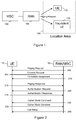
- this figure shows a diagram illustrating a system for handling of paging of a UE in a control node according to an embodiment.
- An MSC 100 controls via a RAN 102 (Radio Access Network) a location area 104. So the MSC 100 may correspond to a control node and the location area 104 may correspond to a radio coverage area.
- One or more UEs 110, 120 may be located within the location area 104, wherein the UE 110 is assumed to be a normal, unmodified UE, while the UE 120 is assumed to be a fraudulent UE, which has been modified in order to be able to respond much faster to paging requests than any normal UE.
- FIG 1 shows a MSC 100 for handling paging of a UE 110 for delivery of a terminating transaction, the UE 110 being located in a location area 104, wherein the location area 104 is controlled by MSC 100.
- the MSC 100 determines, that a mobile terminating transaction has to be delivered to the subscriber using the UE 110, the MSC 100 initiates a paging request broadcast in the location area 104.
- the MSC 100 initiates a paging request broadcast by sending a corresponding paging request signaling message to the RAN 102, which, when receiving this paging request signaling message, performs the paging broadcast in the location area 104.
- the MSC 100 then opens, triggered by the initiating of the paging request broadcast, a paging response reception window. So right after sending the paging request signaling message to the RAN 102, the MSC 100 enters a state in which the MSC 100 is prepared to receive paging response messages. Within the context of the present application, this state of the MSC 100 is called paging response reception window.
- the MSC 100 While the MSC 100 is in this state, so while the paging response reception window is open, the MSC 100 stores all received paging responses received from UEs.
- a next step received paging responses are handled. If more than one paging response has been received, the MSC 100 authenticates the UEs 110, 120, which have provided a paging response. The MSC 100 then continues the delivery of the terminating transaction to the UE 110 which could be successfully authenticated. After having broadcast the paging request, all UEs in the location area 104 receive the paging request.
- the paging request comprises an identification code of the UE 110 that is paged.
- the standard compliant behavior is that only the UE 110 with that identification code responds to the paging request. However, in this embodiment it is assumed that also a fraudulent UE 120 is present in the location area 104. This fraudulent UE 120 is modified to respond to any paging request very quickly, regardless of the identification code comprised in the paging request.
- the MSC 100 By authenticating the UEs that provided a paging response, it is possible for the MSC 100 to identify the correct UE, as only an authorized UE can pass the authentication successfully.
- the closing of the paging response reception window may be triggered after a time interval.
- the time interval may be longer than or equal to the maximum paging response time of the UE 110. Since the maximum paging response time of UEs may change over time when new UE models become available, the time interval may be configurable by the operator of the MSC 100. So the operator may perform measurements on the maximum paging response time of UEs and configure the time interval in the MSC 100 accordingly. This ensures that all possible paging responses from all UE can be captured by the MSC 100 within the paging response reception window.
- the paging response reception window may be closed already before the time interval elapses.
- the closing of the paging response reception window may be triggered if more than one paging response has been received and one UE 110, that provided a paging response, could successfully be authenticated. So right after reception of a second paging response, the MSC 100 may start to authenticate the UEs. And if a UE, which provided a paging response, could be successfully authenticated, the authorized UE 110 has been found and there is no further need to wait for more paging responses, and the paging response reception window may be closed even before the time interval elapses.
- authentication is a capacity consuming process and every authentication consumes one fresh authentication vector. Also the generation of authentication vectors is capacity consuming. In addition, authentication loads the radio network and the air interface in the location area. Therefore authentication today is optional and is not done (according to operator configuration in the MSC 100) for every terminating transaction. This principle is retained by the present application, if a single paging response is received, so for all normal cases where no paging response denial-of-service attack is encountered.
- the step of authentication may be triggered after closing of the paging response reception window.
- the closing of the paging response reception window is triggered by the lapse of the time interval.
- the operator has a choice between very quickly identifying the paging response of the correct UE and continue delivering the terminating transaction, or saving of network and node capacity and wait until all UEs have responded and the time interval elapses, and by that accept some delay compared to today's delivery time of terminating transactions.
- This notification to the operator of the MSC 100 may comprise positioning information of at least one UE 120 which could not be successfully authenticated.
- the RAN 102 provides information on the radio cell, in which the paging response was received from a UE, to the signaling message informing the MSC 100 on the paging response.
- the radio cell information may be comprised in the BSSMAP (Base Station Subsystem Mobile Application Part) Complete Layer 3 message carrying the paging response message.
- BSSMAP Base Station Subsystem Mobile Application Part
- the paging response message from a UE 110, 120 to the MSC 100 opens a radio channel between the UE 110, 120 and the MSC 100. So when collecting paging responses from UEs 110, 120 from the location area 104, the MSC 100 maintains parallel radio connections to all UEs 110, 120 that provided a paging response. If authentication of a UE 110 is successful, this radio connection is maintained for the delivery of the terminating transaction. If authentication of a UE 120 fails, the corresponding radio connection is released immediately.
- the MSC 100 buffers any further messages received after a paging response via the parallel radio connections while the paging response reception window is open. If authentication of a UE 110 is successful, any buffered message is handled. If authentication of a UE 120 fails, any buffered message is ignored and discarded. This is of importance for the handling of an IMSI Detach message from a UE 120 to the MSC 100 since according to the standard the sending UE of a IMSI Detach message is not authenticated (due to time constraints, e.g. at power off).
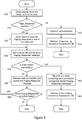
- this figure shows a procedure flow diagram illustrating a procedure according to 3GPP TS 23.108 for setting up a terminating mobile call according to prior art.
- This procedure flow is presented in order to provide background on how to deliver a terminating transaction to a UE 110, using as example the case of a terminating CS call and GSM radio access.
- the procedure flow shows the signaling procedure interaction between a UE 110 and the network 150, which in this case is a combination of the RAN 102 and the MSC 100.
- the procedure flow starts when the MSC determines that it has to deliver a terminating call to a UE 110. After having identified the radio coverage area 104 in which the target UE 110 is located, the MSC 100 determines the RAN 102 nodes being responsible for this radio coverage area 104. Note that in case of GSM radio coverage, the radio coverage area is also called location area 104.
- the MSC 100 then initiates paging of the UE 110 by sending a Paging Request message 200 via the RAN 102 to the UE 110.
- This Paging Request message 200 is broadcast on a common paging channel to all UEs 110 in the location area 104.
- the UE 110 detects a Paging Request message 200 for its own identity on the paging channel, and triggered by this the UE 110 requests a dedicated channel from the network 150 by sending Channel Request message 205. The network 150 then assigns this dedicated channel and responds with Immediate Assignment message 210.
- the UE 110 opens a radio connection to the network 150 and sends Paging Response to the network 150 via this established radio connection.
- the network 150 may then authenticate the UE 110 in order to determine that the UE 110 is authorized to receive the terminating call.
- the authentication is done with the Authentication Request message 220 and the corresponding response Authentication Response message 225.
- the network 150 may then start to cipher the communication between the network 150 and the UE 110. This is done with the Cipher Mode Command message 230 and the corresponding response Cipher Mode Complete message 235.
- the network 150 delivers the terminating call to the UE 110 by sending Setup message 240 to the UE 110.
- this figure shows a flow diagram in a control node for handling of paging of a UE according to an embodiment.
- the control node may correspond to an MSC 100.
- the procedure flow starts with the determination 300 that a paging of a UE 110 is required.
- a counter counting received paging responses is reset 310 to an initial value indicating that no paging response has been received.
- the MSC 100 initiates 320 the broadcasting of a paging request in the radio coverage area 104.
- the MSC 100 initiates this via the RAN 102.
- this figure shows a flow diagram in a control node for handling of paging of a UE according to an embodiment.
- the control node may correspond to an MSC 100.
- the procedure flow starts with the reception 400 of a paging response message from a UE 110, 120 via the RAN 102
- the page response counter is stepped 410.
- the received paging response message is stored 420 in the MSC 100.
- the MSC 100 then establishes 430 a radio connection to the UE that provided the paging response. Then the procedure flow ends.
- the procedure flow according to figure 4 is triggered for each received paging response message received while the paging response reception window is open. Each time the page response counter is stepped, resulting in that the counter indicates the number of received paging responses. For each paging response the MSC 100 establishes a radio connection to the UE that provided the paging response. If multiple paging responses are received for a single paging request, the MSC 100 maintains multiple parallel radio connections.
- this figure shows a flow diagram in a control node for handling of paging of a UE according to an embodiment.
- the control node may correspond to an MSC 100.
- the procedure flow starts with the closing 500 of the paging response reception time window.
- This embodiment assumes that the closing of the paging response reception window is time supervised and is triggered in step 500 by the elapsing of the time interval.
- step 510 the page response counter is checked. If the counter indicates that there has been only a single paging response received, the procedure flow continues with step 570. If more than one paging response has been received, the procedure flow continues with step 520.
- step 570 optionally the responding UE is authenticated. This step may depend on operator configuration of the MSC 100. Then in step 575 the normal delivery of the terminating transaction takes place. As there has been no second paging response, this is the normal case without attack of a fraudulent UE 120. Then the procedure flow ends.
- step 520 the MSC 100 issues a report/alarm or a notification to the operator that a possible paging response attack has been detected.
- This report/alarm or a notification may contain an indication of the radio cell where the fraudulent UE 120 is located.
- step 530 a UE, having provided a paging response, is authenticated.
- step 540 the result of the authentication is checked. If the authentication was successful, the procedure flow continues with step 580. If the authentication was not successful, the procedure flow continues with step 550.
- step 580 If the authentication was successful in step 540, in step 580 the correct UE 110 has been identified. This means that all other received paging responses are ignored and are discarded. Also the related radio connections to those UEs are released immediately. Then in step 585 the normal delivery of the terminating transaction takes place. Then the procedure flow ends.
- step 540 If the authentication was not successful in step 540, the procedure flow continues with step 550 where the received paging response is ignored and discarded. Also the related radio connection to this UE is released immediately.
- step 560 it is checked whether there have been more paging responses received. If the answer is no, so no more paging responses have been received, the flow ends.
- step 530 If more paging responses have been received, a jump back to the beginning of the loop is done and the procedure flow is continued with step 530.
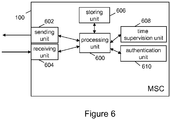
- FIG. 6 shows block diagram illustrating a control node according to an embodiment.
- the illustrated entity may correspond to the MSC 100.
- the MSC 100 may be adapted to perform one or more steps of the above described methods shown in Figure 3 to 5 .
- the MSC 100 may comprise a number of functional units, which are described in further detail below and which are adapted to perform respective method steps.
- a processing unit 600 of the MSC 100 may be adapted to control a radio coverage area 104 in which the UE 110 is located.
- the processing unit 600 may further be adapted to initiate a paging request broadcast in the radio coverage area 104.
- the processing unit 600 may also be adapted to open, triggered by the initiating of the paging request broadcast, a paging response reception window.
- the processing unit 600 may further be adapted to store, while the paging response reception window is open, all received paging responses.
- the processing unit 600 may also be adapted to authenticate, if more than one paging response has been received, at least one UE 110, 120 which has provided a paging response, and continue delivery of the terminating transaction to the UE 110 which could be successfully authenticated.
- the processing unit 600 may be one processor taking care of all the above functions, or may also be distributed over more than one processor, wherein the functions are distributed over the available processors.
- the MSC 100 may further comprise a sending unit 602 and a receiving unit 604 via which the MSC 100 can communicate with other entities such as the UE 110, 120, or other nodes of the network.
- the sending unit 602 may send out signaling messages composed by the processing unit 600.
- the receiving unit 604 may receive signaling messages originating from the UE 110, 120, or other nodes of the network, and forward the received signaling messages to the processing unit 600 for handling.
- the MSC 100 may comprise more than one sending unit and receiving unit for signaling capacity and redundancy reasons.
- the MSC 100 may also comprise a storing unit 606 for storing information related to the paging of UEs and subscriber data.
- the storing unit 606 may comprise various types of memory such as volatile memory, non-volatile memory, hard disk drives, solid state drives, a network interface to a database or a data center, secure digital cards, or hardware such as smart cards, non-reversible chips, security chips, security modules, or trusted platform module devices.
- the storing unit 606 may be used by the processing unit 600 to store information such as received paging response messages, or program code.
- the MSC 100 may further comprise a time supervision unit 608 for handling time supervision tasks.
- the time supervision unit 608 may implement the paging response reception window interval timer used to time supervise the reception of paging response messages from a UE 110, 120.
- a timer may for example be implemented by a periodic interrupt signal from a system clock and a counter, or by a processor clock of the procession unit 600 and a shift register.
- a timer in the time supervision unit 608 may be instantiated, started, stopped, reset, and removed by instructions from the procession unit 600.
- the MSC 100 may further comprise an authentication unit 610 for handling the authentication of UEs 110, 120.
- the authentication unit 610 may verify the validity of identifications. It may authenticate the identity of the UE through the use of a challenge-response mechanism.
- a random number (RAND) is sent to the UE.
- the UE computes a signed response (SRES) based on the encryption of the random number (RAND) with a secret authentication algorithm using the individual subscriber authentication key (Ki).
- the calculation of the signed response (SRES) is processed within the SIM of the UE.
- the authentication unit 610 may repeat the calculation to confirm the authenticity of the entity.
- a computer program is provided.
- the computer program may be executed by the processing unit 600 of the above mentioned MSC 100 such that a method for handling paging of a UE 110 for delivery of a terminating transaction as described above with reference to figures 3-5 may be carried out or be controlled.
- the MSC 100 may be caused to operate in accordance with the above described method by executing the computer program.
- the computer program may be embodied as computer code, for example of a computer program product.
- the computer program product may be stored on a computer readable medium, for example a disk or the storing unit 606 of the MSC 100, or may be configured as downloadable information.
Landscapes
- Engineering & Computer Science (AREA)
- Computer Security & Cryptography (AREA)
- Computer Networks & Wireless Communication (AREA)
- Signal Processing (AREA)
- Computer Hardware Design (AREA)
- Computing Systems (AREA)
- General Engineering & Computer Science (AREA)
- Mobile Radio Communication Systems (AREA)
Claims (15)
- Verfahren in einem Steuerknoten (100) zur Handhabung von Funkruf einer Benutzereinrichtung (110) zur Zustellung einer Abschlusstransaktion, wobei sich die Benutzereinrichtung (110) in einem Funkversorgungsgebiet (104) befindet, wobei das Funkversorgungsgebiet (104) vom Steuerknoten (100) kontrolliert wird, und das Verfahren umfasst:• Einleiten (320) einer Funkrufanforderungs-Rundsendung (104) im Funkversorgungsgebiet;• Öffnen (330), ausgelöst durch das Einleiten der Funkrufanforderungs-Rundsendung, eines Funkrufantwort-Empfangsfensters;• Speichern (420) aller empfangener Funkrufantworten, während das Funkrufantwort-Empfangsfenster offen ist; und• Authentifizieren (530), wenn mehr als eine Funkrufantwort empfangen wird, mindestens einer Benutzereinrichtung (110, 120), die eine Funkrufantwort bereitgestellt hat, und Fortfahren mit der Zustellung (585) der Abschlusstransaktion an die Benutzereinrichtung (110), die erfolgreich authentifiziert werden konnte;dadurch gekennzeichnet, dass die Benutzereinrichtung (110), welche die zweite Funkrufantwort bereitstellte, zuerst authentifiziert wird.
- Verfahren nach Anspruch 1, wobei, während das Funkrufantwort-Empfangsfenster offen ist, ein Schließen des Funkrufantwort-Empfangsfensters nach einem Zeitintervall ausgelöst wird.
- Verfahren nach Anspruch 2, wobei das Zeitintervall von einem Betreiber des Steuerknotens (100) konfiguriert werden kann.
- Verfahren nach einem der Ansprüche 1 bis 3, wobei, während das Funkrufantwort-Empfangsfenster offen ist, das Schließen des Funkrufantwort-Empfangsfensters ausgelöst wird, wenn mehr als eine Funkrufantwort empfangen wurde, und eine Benutzereinrichtung (110), die eine Funkrufantwort bereitstellte, erfolgreich authentifiziert werden konnte.
- Verfahren nach einem der Ansprüche 1 bis 3, wobei der Schritt des Authentifizierens (530) nach dem Schließen des Funkrufantwort-Empfangsfensters ausgelöst wird.
- Verfahren nach einem der vorhergehenden Ansprüche, wobei, wenn mehr als eine Funkrufantwort empfangen wurde, ein Betreiber des Steuerknotens (100) benachrichtigt wird.
- Verfahren nach vorherigem Anspruch, wobei die Benachrichtigung des Betreibers des Steuerknotens (100) Positionsinformationen mindestens einer Benutzereinrichtung (120) umfasst, die nicht erfolgreich authentifiziert werden konnte.
- Verfahren nach einem der vorhergehenden Ansprüche, wobei der Steuerknoten (100) parallele Funkverbindungen zu allen Benutzereinrichtungen (110, 120) aufrechterhält, die eine Funkrufantwort bereitstellten.
- Verfahren nach vorherigem Anspruch, wobei der Steuerknoten (100) alle weiteren Nachrichten puffert, die nach einer Funkrufantwort über die parallelen Funkverbindungen empfangen werden, während das Funkrufantwort-Empfangsfenster offen ist.
- Steuerknoten (100) zum Handhaben von Funkruf einer Benutzereinrichtung (110) zur Zustellung einer Abschlusstransaktion, wobei der Steuerknoten (100) in der Lage ist zum:• Kontrollieren eines Funkversorgungsgebiets (104), in dem sich die Benutzereinrichtung (110) befindet;• Einleiten (320) einer Funkrufanforderungs-Rundsendung (104) im Funkversorgungsgebiet;• Öffnen (330), ausgelöst durch das Einleiten der Funkrufanforderungs-Rundsendung, eines Funkrufantwort-Empfangsfensters;• Speichern (420) aller empfangener Funkrufantworten, während das Funkrufantwort-Empfangsfenster offen ist; und• Authentifizieren (530), wenn mehr als eine Funkrufantwort empfangen wird, mindestens einer Benutzereinrichtung (110, 120), die eine Funkrufantwort bereitgestellt hat, und Fortfahren mit der Zustellung (580) der Abschlusstransaktion an die Benutzereinrichtung (110), die erfolgreich authentifiziert werden konnte;dadurch gekennzeichnet, dass der Steuerknoten (100) ferner in der Lage ist, die Benutzereinrichtung (11), welche die zweite Funkrufantwort bereitstellte, zuerst zu authentifizieren.
- Steuerknoten (100) nach Anspruch 10, wobei der Steuerknoten (100) so ausgelegt ist, dass er ein Verfahren nach einem der Ansprüche 1 bis 9 durchführt.
- System zum Handhaben von Funkruf einer Benutzereinrichtung (110) zur Zustellung einer Abschlusstransaktion, wobei das System umfasst:• einen Steuerknoten nach Anspruch 10 oder 11, der ein Funkversorgungsgebiet (104) kontrolliert;• eine Benutzereinrichtung (110), die sich in dem Funkversorgungsgebiet (104) befindet; und• ein Funkzugangsnetz (102).
- Computerprogramm, umfassend Anweisungen, welche bei Ausführung auf mindestens einem Prozessor den mindestens einen Prozessor veranlassen, das Verfahren nach einem der Ansprüche 1 bis 9 auszuführen.
- Computerprogrammprodukt, umfassend ein Computerprogramm nach Anspruch 13.
- Träger, der das Computerprogrammprodukt nach Anspruch 14 enthält, wobei der Träger eines von einem elektrischen Signal, einem optischen Signal, einem Funksignal, einem Magnetband oder einer Magnetplatte, einer optischen Plate, einem Memorystick oder Papier ist.
Applications Claiming Priority (1)
| Application Number | Priority Date | Filing Date | Title |
|---|---|---|---|
| PCT/EP2013/068899 WO2015036022A1 (en) | 2013-09-12 | 2013-09-12 | Paging procedure in a control node |
Publications (2)
| Publication Number | Publication Date |
|---|---|
| EP3045003A1 EP3045003A1 (de) | 2016-07-20 |
| EP3045003B1 true EP3045003B1 (de) | 2017-04-05 |
Family
ID=49170692
Family Applications (1)
| Application Number | Title | Priority Date | Filing Date |
|---|---|---|---|
| EP13762466.4A Active EP3045003B1 (de) | 2013-09-12 | 2013-09-12 | Funkrufkontrolle |
Country Status (3)
| Country | Link |
|---|---|
| US (1) | US9642113B2 (de) |
| EP (1) | EP3045003B1 (de) |
| WO (1) | WO2015036022A1 (de) |
Cited By (1)
| Publication number | Priority date | Publication date | Assignee | Title |
|---|---|---|---|---|
| EP4470299A4 (de) * | 2022-07-06 | 2025-03-05 | ZTE Corporation | Systeme und verfahren zur kommunikation in passivem/halbpassivem internet-der-dinge |
Families Citing this family (4)
| Publication number | Priority date | Publication date | Assignee | Title |
|---|---|---|---|---|
| US10701667B2 (en) * | 2018-04-09 | 2020-06-30 | Qualcomm Incorporated | Paging techniques in a wireless backhaul network |
| US11265700B2 (en) * | 2018-11-30 | 2022-03-01 | Qualcomm Incorporated | Methods and systems for detecting and responding to paging channel attacks |
| CN109831327B (zh) * | 2019-01-28 | 2021-11-19 | 国家电网有限公司信息通信分公司 | 基于大数据分析的ims全业务网络监视智能化运维支撑系统 |
| WO2024234725A1 (en) * | 2024-01-25 | 2024-11-21 | Lenovo (Beijing) Limited | Devices and methods of communication |
Family Cites Families (5)
| Publication number | Priority date | Publication date | Assignee | Title |
|---|---|---|---|---|
| US20020061756A1 (en) * | 2000-11-17 | 2002-05-23 | Bleckert Peter Nils Olov | Paging co-ordination in telecommunication networks |
| US7277735B1 (en) * | 2004-04-22 | 2007-10-02 | Sprint Spectrum L.P. | Method and system for invoking simultaneous ringing |
| US8027693B2 (en) * | 2006-06-19 | 2011-09-27 | Alcatel Lucent | Conservation of paging resources in a mobile switching center |
| CN100546406C (zh) | 2006-11-03 | 2009-09-30 | 华为技术有限公司 | 检测相同无线终端的方法及装置 |
| US8565792B1 (en) * | 2010-02-03 | 2013-10-22 | Sprint Spectrum L.P. | Dynamic paging concatenation |
-
2013
- 2013-09-12 EP EP13762466.4A patent/EP3045003B1/de active Active
- 2013-09-12 WO PCT/EP2013/068899 patent/WO2015036022A1/en not_active Ceased
- 2013-09-12 US US14/917,228 patent/US9642113B2/en active Active
Non-Patent Citations (1)
| Title |
|---|
| None * |
Cited By (2)
| Publication number | Priority date | Publication date | Assignee | Title |
|---|---|---|---|---|
| EP4470299A4 (de) * | 2022-07-06 | 2025-03-05 | ZTE Corporation | Systeme und verfahren zur kommunikation in passivem/halbpassivem internet-der-dinge |
| AU2022468200B2 (en) * | 2022-07-06 | 2025-12-04 | Zte Corporation | Systems and methods for communication in passive/semi-passive internet-of-things |
Also Published As
| Publication number | Publication date |
|---|---|
| US20160198432A1 (en) | 2016-07-07 |
| WO2015036022A1 (en) | 2015-03-19 |
| EP3045003A1 (de) | 2016-07-20 |
| US9642113B2 (en) | 2017-05-02 |
Similar Documents
| Publication | Publication Date | Title |
|---|---|---|
| Kim et al. | Touching the untouchables: Dynamic security analysis of the LTE control plane | |
| US11863982B2 (en) | Subscriber identity privacy protection against fake base stations | |
| US12069078B2 (en) | Method and system for user plane traffic characteristics and network security | |
| US11785447B2 (en) | Identifier-based access control in mobile networks | |
| Shaik et al. | Practical attacks against privacy and availability in 4G/LTE mobile communication systems | |
| EP2932676B1 (de) | Authentifizierung von öffentlichen landfunknetzen für mobilstationen | |
| US11044276B2 (en) | Cellular security framework | |
| EP3045003B1 (de) | Funkrufkontrolle | |
| KR20130073850A (ko) | 페이크 네트워크의 식별을 위한 방법 및 장치 | |
| CN110754101B (zh) | 用于保护与用户设备相关联的订户信息的方法、系统和计算机可读存储介质 | |
| Khan et al. | Vulnerabilities of UMTS access domain security architecture | |
| US12464349B2 (en) | Enhanced user equipment security against attacks in a 4g or 5g network | |
| US8611859B2 (en) | System and method for providing secure network access in fixed mobile converged telecommunications networks | |
| WO2016020012A1 (en) | Authentication procedure in a control node | |
| Xenakis et al. | An advanced persistent threat in 3G networks: Attacking the home network from roaming networks | |
| EP3228108B1 (de) | Verfahren, computerprogramm und netzwerkknoten zur sicherheitsgewährleistung von dienstanfragen | |
| Zheng et al. | Ghost telephonist impersonates you: Vulnerability in 4G LTE CS fallback | |
| Paci et al. | FlashCatch: Minimizing Disruption in IMSI Catcher Operations | |
| WO2014083724A1 (ja) | 緊急呼確立システム、通信装置、緊急呼確立方法及び非一時的なコンピュータ可読媒体 | |
| US11991190B2 (en) | Counteractions against suspected identity imposture |
Legal Events
| Date | Code | Title | Description |
|---|---|---|---|
| PUAI | Public reference made under article 153(3) epc to a published international application that has entered the european phase |
Free format text: ORIGINAL CODE: 0009012 |
|
| 17P | Request for examination filed |
Effective date: 20160211 |
|
| AK | Designated contracting states |
Kind code of ref document: A1 Designated state(s): AL AT BE BG CH CY CZ DE DK EE ES FI FR GB GR HR HU IE IS IT LI LT LU LV MC MK MT NL NO PL PT RO RS SE SI SK SM TR |
|
| AX | Request for extension of the european patent |
Extension state: BA ME |
|
| DAX | Request for extension of the european patent (deleted) | ||
| GRAP | Despatch of communication of intention to grant a patent |
Free format text: ORIGINAL CODE: EPIDOSNIGR1 |
|
| INTG | Intention to grant announced |
Effective date: 20170117 |
|
| GRAS | Grant fee paid |
Free format text: ORIGINAL CODE: EPIDOSNIGR3 |
|
| GRAA | (expected) grant |
Free format text: ORIGINAL CODE: 0009210 |
|
| AK | Designated contracting states |
Kind code of ref document: B1 Designated state(s): AL AT BE BG CH CY CZ DE DK EE ES FI FR GB GR HR HU IE IS IT LI LT LU LV MC MK MT NL NO PL PT RO RS SE SI SK SM TR |
|
| REG | Reference to a national code |
Ref country code: GB Ref legal event code: FG4D |
|
| REG | Reference to a national code |
Ref country code: CH Ref legal event code: EP |
|
| REG | Reference to a national code |
Ref country code: AT Ref legal event code: REF Ref document number: 882877 Country of ref document: AT Kind code of ref document: T Effective date: 20170415 |
|
| REG | Reference to a national code |
Ref country code: IE Ref legal event code: FG4D |
|
| REG | Reference to a national code |
Ref country code: DE Ref legal event code: R096 Ref document number: 602013019495 Country of ref document: DE |
|
| REG | Reference to a national code |
Ref country code: NL Ref legal event code: FP |
|
| REG | Reference to a national code |
Ref country code: LT Ref legal event code: MG4D |
|
| REG | Reference to a national code |
Ref country code: AT Ref legal event code: MK05 Ref document number: 882877 Country of ref document: AT Kind code of ref document: T Effective date: 20170405 |
|
| PG25 | Lapsed in a contracting state [announced via postgrant information from national office to epo] |
Ref country code: HR Free format text: LAPSE BECAUSE OF FAILURE TO SUBMIT A TRANSLATION OF THE DESCRIPTION OR TO PAY THE FEE WITHIN THE PRESCRIBED TIME-LIMIT Effective date: 20170405 Ref country code: NO Free format text: LAPSE BECAUSE OF FAILURE TO SUBMIT A TRANSLATION OF THE DESCRIPTION OR TO PAY THE FEE WITHIN THE PRESCRIBED TIME-LIMIT Effective date: 20170705 Ref country code: AT Free format text: LAPSE BECAUSE OF FAILURE TO SUBMIT A TRANSLATION OF THE DESCRIPTION OR TO PAY THE FEE WITHIN THE PRESCRIBED TIME-LIMIT Effective date: 20170405 Ref country code: GR Free format text: LAPSE BECAUSE OF FAILURE TO SUBMIT A TRANSLATION OF THE DESCRIPTION OR TO PAY THE FEE WITHIN THE PRESCRIBED TIME-LIMIT Effective date: 20170706 Ref country code: FI Free format text: LAPSE BECAUSE OF FAILURE TO SUBMIT A TRANSLATION OF THE DESCRIPTION OR TO PAY THE FEE WITHIN THE PRESCRIBED TIME-LIMIT Effective date: 20170405 Ref country code: ES Free format text: LAPSE BECAUSE OF FAILURE TO SUBMIT A TRANSLATION OF THE DESCRIPTION OR TO PAY THE FEE WITHIN THE PRESCRIBED TIME-LIMIT Effective date: 20170405 Ref country code: LT Free format text: LAPSE BECAUSE OF FAILURE TO SUBMIT A TRANSLATION OF THE DESCRIPTION OR TO PAY THE FEE WITHIN THE PRESCRIBED TIME-LIMIT Effective date: 20170405 |
|
| PG25 | Lapsed in a contracting state [announced via postgrant information from national office to epo] |
Ref country code: PL Free format text: LAPSE BECAUSE OF FAILURE TO SUBMIT A TRANSLATION OF THE DESCRIPTION OR TO PAY THE FEE WITHIN THE PRESCRIBED TIME-LIMIT Effective date: 20170405 Ref country code: RS Free format text: LAPSE BECAUSE OF FAILURE TO SUBMIT A TRANSLATION OF THE DESCRIPTION OR TO PAY THE FEE WITHIN THE PRESCRIBED TIME-LIMIT Effective date: 20170405 Ref country code: BG Free format text: LAPSE BECAUSE OF FAILURE TO SUBMIT A TRANSLATION OF THE DESCRIPTION OR TO PAY THE FEE WITHIN THE PRESCRIBED TIME-LIMIT Effective date: 20170705 Ref country code: IS Free format text: LAPSE BECAUSE OF FAILURE TO SUBMIT A TRANSLATION OF THE DESCRIPTION OR TO PAY THE FEE WITHIN THE PRESCRIBED TIME-LIMIT Effective date: 20170805 Ref country code: SE Free format text: LAPSE BECAUSE OF FAILURE TO SUBMIT A TRANSLATION OF THE DESCRIPTION OR TO PAY THE FEE WITHIN THE PRESCRIBED TIME-LIMIT Effective date: 20170405 Ref country code: LV Free format text: LAPSE BECAUSE OF FAILURE TO SUBMIT A TRANSLATION OF THE DESCRIPTION OR TO PAY THE FEE WITHIN THE PRESCRIBED TIME-LIMIT Effective date: 20170405 |
|
| REG | Reference to a national code |
Ref country code: DE Ref legal event code: R097 Ref document number: 602013019495 Country of ref document: DE |
|
| PG25 | Lapsed in a contracting state [announced via postgrant information from national office to epo] |
Ref country code: RO Free format text: LAPSE BECAUSE OF FAILURE TO SUBMIT A TRANSLATION OF THE DESCRIPTION OR TO PAY THE FEE WITHIN THE PRESCRIBED TIME-LIMIT Effective date: 20170405 Ref country code: DK Free format text: LAPSE BECAUSE OF FAILURE TO SUBMIT A TRANSLATION OF THE DESCRIPTION OR TO PAY THE FEE WITHIN THE PRESCRIBED TIME-LIMIT Effective date: 20170405 Ref country code: EE Free format text: LAPSE BECAUSE OF FAILURE TO SUBMIT A TRANSLATION OF THE DESCRIPTION OR TO PAY THE FEE WITHIN THE PRESCRIBED TIME-LIMIT Effective date: 20170405 Ref country code: CZ Free format text: LAPSE BECAUSE OF FAILURE TO SUBMIT A TRANSLATION OF THE DESCRIPTION OR TO PAY THE FEE WITHIN THE PRESCRIBED TIME-LIMIT Effective date: 20170405 Ref country code: SK Free format text: LAPSE BECAUSE OF FAILURE TO SUBMIT A TRANSLATION OF THE DESCRIPTION OR TO PAY THE FEE WITHIN THE PRESCRIBED TIME-LIMIT Effective date: 20170405 |
|
| PLBE | No opposition filed within time limit |
Free format text: ORIGINAL CODE: 0009261 |
|
| STAA | Information on the status of an ep patent application or granted ep patent |
Free format text: STATUS: NO OPPOSITION FILED WITHIN TIME LIMIT |
|
| PG25 | Lapsed in a contracting state [announced via postgrant information from national office to epo] |
Ref country code: SM Free format text: LAPSE BECAUSE OF FAILURE TO SUBMIT A TRANSLATION OF THE DESCRIPTION OR TO PAY THE FEE WITHIN THE PRESCRIBED TIME-LIMIT Effective date: 20170405 Ref country code: IT Free format text: LAPSE BECAUSE OF FAILURE TO SUBMIT A TRANSLATION OF THE DESCRIPTION OR TO PAY THE FEE WITHIN THE PRESCRIBED TIME-LIMIT Effective date: 20170405 |
|
| 26N | No opposition filed |
Effective date: 20180108 |
|
| REG | Reference to a national code |
Ref country code: CH Ref legal event code: PL |
|
| PG25 | Lapsed in a contracting state [announced via postgrant information from national office to epo] |
Ref country code: MC Free format text: LAPSE BECAUSE OF FAILURE TO SUBMIT A TRANSLATION OF THE DESCRIPTION OR TO PAY THE FEE WITHIN THE PRESCRIBED TIME-LIMIT Effective date: 20170405 |
|
| REG | Reference to a national code |
Ref country code: IE Ref legal event code: MM4A |
|
| REG | Reference to a national code |
Ref country code: BE Ref legal event code: MM Effective date: 20170930 |
|
| PG25 | Lapsed in a contracting state [announced via postgrant information from national office to epo] |
Ref country code: LU Free format text: LAPSE BECAUSE OF NON-PAYMENT OF DUE FEES Effective date: 20170912 |
|
| REG | Reference to a national code |
Ref country code: FR Ref legal event code: ST Effective date: 20180531 |
|
| PG25 | Lapsed in a contracting state [announced via postgrant information from national office to epo] |
Ref country code: LI Free format text: LAPSE BECAUSE OF NON-PAYMENT OF DUE FEES Effective date: 20170930 Ref country code: CH Free format text: LAPSE BECAUSE OF NON-PAYMENT OF DUE FEES Effective date: 20170930 Ref country code: IE Free format text: LAPSE BECAUSE OF NON-PAYMENT OF DUE FEES Effective date: 20170912 |
|
| PG25 | Lapsed in a contracting state [announced via postgrant information from national office to epo] |
Ref country code: FR Free format text: LAPSE BECAUSE OF NON-PAYMENT OF DUE FEES Effective date: 20171002 Ref country code: BE Free format text: LAPSE BECAUSE OF NON-PAYMENT OF DUE FEES Effective date: 20170930 |
|
| PG25 | Lapsed in a contracting state [announced via postgrant information from national office to epo] |
Ref country code: MT Free format text: LAPSE BECAUSE OF NON-PAYMENT OF DUE FEES Effective date: 20170912 |
|
| PG25 | Lapsed in a contracting state [announced via postgrant information from national office to epo] |
Ref country code: HU Free format text: LAPSE BECAUSE OF FAILURE TO SUBMIT A TRANSLATION OF THE DESCRIPTION OR TO PAY THE FEE WITHIN THE PRESCRIBED TIME-LIMIT; INVALID AB INITIO Effective date: 20130912 |
|
| PG25 | Lapsed in a contracting state [announced via postgrant information from national office to epo] |
Ref country code: SI Free format text: LAPSE BECAUSE OF FAILURE TO SUBMIT A TRANSLATION OF THE DESCRIPTION OR TO PAY THE FEE WITHIN THE PRESCRIBED TIME-LIMIT Effective date: 20170405 |
|
| PG25 | Lapsed in a contracting state [announced via postgrant information from national office to epo] |
Ref country code: CY Free format text: LAPSE BECAUSE OF FAILURE TO SUBMIT A TRANSLATION OF THE DESCRIPTION OR TO PAY THE FEE WITHIN THE PRESCRIBED TIME-LIMIT Effective date: 20170405 |
|
| PG25 | Lapsed in a contracting state [announced via postgrant information from national office to epo] |
Ref country code: MK Free format text: LAPSE BECAUSE OF FAILURE TO SUBMIT A TRANSLATION OF THE DESCRIPTION OR TO PAY THE FEE WITHIN THE PRESCRIBED TIME-LIMIT Effective date: 20170405 |
|
| PG25 | Lapsed in a contracting state [announced via postgrant information from national office to epo] |
Ref country code: TR Free format text: LAPSE BECAUSE OF FAILURE TO SUBMIT A TRANSLATION OF THE DESCRIPTION OR TO PAY THE FEE WITHIN THE PRESCRIBED TIME-LIMIT Effective date: 20170405 |
|
| PG25 | Lapsed in a contracting state [announced via postgrant information from national office to epo] |
Ref country code: PT Free format text: LAPSE BECAUSE OF FAILURE TO SUBMIT A TRANSLATION OF THE DESCRIPTION OR TO PAY THE FEE WITHIN THE PRESCRIBED TIME-LIMIT Effective date: 20170405 |
|
| PG25 | Lapsed in a contracting state [announced via postgrant information from national office to epo] |
Ref country code: AL Free format text: LAPSE BECAUSE OF FAILURE TO SUBMIT A TRANSLATION OF THE DESCRIPTION OR TO PAY THE FEE WITHIN THE PRESCRIBED TIME-LIMIT Effective date: 20170405 |
|
| PGFP | Annual fee paid to national office [announced via postgrant information from national office to epo] |
Ref country code: GB Payment date: 20210927 Year of fee payment: 9 |
|
| GBPC | Gb: european patent ceased through non-payment of renewal fee |
Effective date: 20220912 |
|
| PG25 | Lapsed in a contracting state [announced via postgrant information from national office to epo] |
Ref country code: GB Free format text: LAPSE BECAUSE OF NON-PAYMENT OF DUE FEES Effective date: 20220912 |
|
| PGFP | Annual fee paid to national office [announced via postgrant information from national office to epo] |
Ref country code: DE Payment date: 20250929 Year of fee payment: 13 |
|
| PGFP | Annual fee paid to national office [announced via postgrant information from national office to epo] |
Ref country code: NL Payment date: 20250926 Year of fee payment: 13 |