EP3044881B1 - Method for compressed sensing of streaming data and apparatus for performing the same - Google Patents
Method for compressed sensing of streaming data and apparatus for performing the same Download PDFInfo
- Publication number
- EP3044881B1 EP3044881B1 EP14776776.8A EP14776776A EP3044881B1 EP 3044881 B1 EP3044881 B1 EP 3044881B1 EP 14776776 A EP14776776 A EP 14776776A EP 3044881 B1 EP3044881 B1 EP 3044881B1
- Authority
- EP
- European Patent Office
- Prior art keywords
- data
- streaming data
- compressed sensing
- sensing
- window
- Prior art date
- Legal status (The legal status is an assumption and is not a legal conclusion. Google has not performed a legal analysis and makes no representation as to the accuracy of the status listed.)
- Active
Links
Images

Classifications
-
- H—ELECTRICITY
- H03—ELECTRONIC CIRCUITRY
- H03M—CODING; DECODING; CODE CONVERSION IN GENERAL
- H03M7/00—Conversion of a code where information is represented by a given sequence or number of digits to a code where the same, similar or subset of information is represented by a different sequence or number of digits
- H03M7/30—Compression; Expansion; Suppression of unnecessary data, e.g. redundancy reduction
- H03M7/3059—Digital compression and data reduction techniques where the original information is represented by a subset or similar information, e.g. lossy compression
- H03M7/3062—Compressive sampling or sensing
-
- H—ELECTRICITY
- H04—ELECTRIC COMMUNICATION TECHNIQUE
- H04L—TRANSMISSION OF DIGITAL INFORMATION, e.g. TELEGRAPHIC COMMUNICATION
- H04L65/00—Network arrangements, protocols or services for supporting real-time applications in data packet communication
- H04L65/60—Network streaming of media packets
-
- H—ELECTRICITY
- H03—ELECTRONIC CIRCUITRY
- H03M—CODING; DECODING; CODE CONVERSION IN GENERAL
- H03M7/00—Conversion of a code where information is represented by a given sequence or number of digits to a code where the same, similar or subset of information is represented by a different sequence or number of digits
- H03M7/30—Compression; Expansion; Suppression of unnecessary data, e.g. redundancy reduction
- H03M7/3059—Digital compression and data reduction techniques where the original information is represented by a subset or similar information, e.g. lossy compression
- H03M7/3064—Segmenting
-
- H—ELECTRICITY
- H04—ELECTRIC COMMUNICATION TECHNIQUE
- H04L—TRANSMISSION OF DIGITAL INFORMATION, e.g. TELEGRAPHIC COMMUNICATION
- H04L43/00—Arrangements for monitoring or testing data switching networks
- H04L43/08—Monitoring or testing based on specific metrics, e.g. QoS, energy consumption or environmental parameters
- H04L43/0876—Network utilisation, e.g. volume of load or congestion level
Definitions
- the present invention is directed to a method for compressed sensing of streaming data and to the means for performing the same. More specifically, some embodiments include a method of compressed sensing of streaming data that employs a recursive algorithm for performing compressed sensing on streaming data, and an apparatus or system or computer program product capable of performing the method for compressed sensing of streaming data.
- the signals of interest can be represented sparsely by using few coefficients in an appropriately selected orthonormal basis.
- the Fourier basis is used for bandlimited signals or wavelet bases for piecewise continuous signals, such as images. While a small number of coefficients in the respective bases are enough to represent such signals, the Nyquist/Shannon sampling theorem suggests a sampling rate that is at least twice the signal bandwidth. Such a sampling rate is known in the art as the Nyquist rate. In many cases, the indicated sampling rate is much higher than the sufficient number of coefficients.
- CS Compressed Sensing
- aspects of the present invention may be embodied as a system, method or computer program product. Accordingly, aspects of the present invention may take the form of an entirely hardware embodiment, an entirely software embodiment (including firmware, resident software, micro-code, etc.) or an embodiment combining software and hardware aspects that may all generally be referred to herein as a "circuit," "module” or “system.” Furthermore, aspects of the present invention may take the form of a computer program product embodied in one or more computer readable medium/media (i.e., data storage medium/media) having computer readable program code recorded thereon.
- computer readable medium/media i.e., data storage medium/media
- the computer readable medium may be a computer readable signal medium or a computer readable storage medium.
- a computer readable storage medium may be, for example, but not limited to, an electronic, magnetic, optical, electromagnetic, infrared, or semiconductor system, apparatus, or device, or any suitable combination of the foregoing.
- a computer readable storage medium i.e., data storage medium, may be any tangible medium that can contain, or store a program for use by or in connection with an instruction execution system, apparatus, or device.
- a computer readable signal medium may include a propagated data signal with computer readable program code embodied therein, for example, in baseband or as part of a carrier wave. Such a propagated signal may take any of a variety of forms, including, but not limited to, electro-magnetic, optical, or any suitable combination thereof.
- a computer readable signal medium may be any computer readable medium that is not a computer readable storage medium and that can communicate, propagate, or transport a program for use by or in connection with an instruction execution system, apparatus, or device.
- Program code embodied on a computer readable medium may be transmitted using any appropriate medium, including but not limited to wireless, wireline, optical fiber cable, RF, etc., or any suitable combination of the foregoing.
- Computer program code for carrying out operations for aspects of the present invention may be written in any combination of one or more programming languages, including an object oriented programming language such as Java, Smalltalk, C++ or the likes and conventional procedural programming languages, such as the "C" programming language or similar programming languages.
- the program code may be executed entirely on the user's computer, partly on the user's computer, as a stand-alone software package, partly on the user's computer and partly on a remote computer or entirely on the remote computer or server.
- the remote computer may be connected to the user's computer through any type of network, including a local area network (LAN) or a wide area network (WAN), or the connection may be made to an external computer (for example, through the Internet using an Internet Service Provider).
- LAN local area network
- WAN wide area network
- Internet Service Provider for example, AT&T, MCI, Sprint, EarthLink, MSN, GTE, etc.
- These computer program instructions may also be stored in a computer readable medium that can direct a computer, other programmable data processing apparatus, or other devices to function in a particular manner.
- the computer program instructions may also be loaded onto a computer, other programmable data processing apparatus, or other devices to cause a series of operational steps to be performed on the computer, other programmable apparatus or other devices to produce a computer implemented process such that the instructions which execute on the computer or other programmable apparatus provide processes for implementing the functions/acts specified in the flowchart and/or block diagram block or blocks.
- x i is used to denote the i th entry of vector x
- a i is used to denote the i th column of matrix A.
- the i th sample vector such as the i th window of the input stream, or the i th sampling matrix is denoted by superscript (e.g., x ( i ) or A ( i ) .
- S is indicative for the cardinality of a set S.
- a vector x is sparse if and only if ⁇ x ⁇ 0 ⁇ k .
- n being the number of columns of matrix A.
- ⁇ A : max 1 ⁇ i , j ⁇ n , i ⁇ j ⁇ a i , a j ⁇ ⁇ a i ⁇ 2 ⁇ ⁇ a j ⁇ 2 .
- the matrix A is said to satisfy the restricted isometry property (RIP) if there exists ⁇ k ⁇ [0,1] such that: 1 ⁇ ⁇ k ⁇ x ⁇ 2 2 ⁇ ⁇ Ax ⁇ 2 2 ⁇ 1 + ⁇ k ⁇ x ⁇ 2 2 .
- Random matrices such as Gaussian, Bernoulli, randomly selected rows from DFT matrices are known to have been used as matrices for compressed sensing in the literature, since they satisfy the restricted isometry property with high probability.
- Examples of matrices satisfying the restricted isometry property are:
- matrix A satisfies a prescribed ⁇ k for any k ⁇ c 1 m /log( n / k ) with a probability larger or equal than 1-2 e - c 2 m , where c 1 and c 2 are constants that only depend on ⁇ k .
- Recursively is employed to indicate that the procedure is performed by repeating items in a self-similar way.
- the term refers to a method of defining functions in which the function being defined is applied within its own definition. Specifically, this defines an infinite number of instances (function values), using a finite expression that for some instances may refer to other instances, but in such a way that no loop or infinite chain of references can occur.
- the term is also used more generally to describe a process of repeating objects in a self-similar way. Recursion is the process a procedure goes through when one of the steps of the procedure involves invoking the procedure itself. A procedure that goes through recursion is said to be "recursive".
- a window function (also known as an apodization function or tapering function) is a mathematical function that is zero-valued outside of some chosen interval. For instance, a function that is constant inside the interval and zero elsewhere is called a rectangular window, which describes the shape of its graphical representation. When another function or waveform/data-sequence is multiplied by a window function, the product is also zero-valued outside the interval: all that is left is the part where they overlap, the "view through the window”.
- window functions include spectral analysis, filter design, and beamforming. In typical applications, the window functions used are non-negative smooth "bell-shaped" curves, though rectangle, triangle, and other functions can be used.
- window functions does not require them to be identically zero outside an interval, as long as the product of the window multiplied by its argument is square integrable, and, more specifically, that the function goes sufficiently rapidly toward zero.
- a common practice is to subdivide it into smaller sets and window them individually. To mitigate the "loss" at the edges of the window, the individual sets may overlap in time.
- the present invention proposes a method and means to recover x when m ⁇ n.
- the system denoted with equation (1) is an underdetermined linear system.
- the main result is that if x is k-sparse and k ⁇ c m / log( n / k ) , a solution to this undetermined linear system is possible.
- Problem P 0 stated bellow should be solved in order to find the sparsest vector x that leads to the measurement y.
- This problem is, Non-deterministic Polynomial-time hard or NP-hard, requiring search over all subsets of columns of A.
- NP-hard if and only if there is an NP-complete problem L that is polynomial time Turing-reducible to H (i.e., L ⁇ T H).
- L can be solved in polynomial time by an oracle machine with an oracle for H.
- the optimization problem (BP) is called Basis Pursuit. Since (BP) can be recast as a linear program, solving (BP) is more computationally efficient, e.g., via interior point methods, as opposed to solving problem (P 0 ) which is generally intractable for large instances.
- a second optimization problem is referred to as the Least Absolute Selection and Shrinkage Operator (LASSO).
- LASSO Least Absolute Selection and Shrinkage Operator
- Basis Pursuit may be applied, namely the Basis Pursuit Denoising (BPDN), best known as LASSO in the statistics literature, as: minimize ⁇ x ⁇ 1 subject to ⁇ Ax ⁇ y ⁇ 2 ⁇ ⁇ ⁇ where ⁇ ⁇ R + is chosen appropriately to account for the additive noise in the measurements.
- BPDN Basis Pursuit Denoising
- the problem can be posed equivalently as an unconstrained optimization problem: minimize ⁇ Ax ⁇ y ⁇ 2 2 + ⁇ ⁇ x ⁇ 1 where ⁇ is the regularization parameter that controls the trade-off between sparsity and reconstruction error.
- a theorem useful in developing the recursive scheme for performing compressed sensing on streaming data is the theorem regarding error of LASSO that states that if A satisfies the restricted isometry property (RIP) with ⁇ 2 ⁇ k ⁇ 2 ⁇ 1 the solution x ⁇ to equation (3) abides by the formula of: ⁇ x ⁇ ⁇ x ⁇ 2 ⁇ C 0 ⁇ ⁇ x ⁇ x k ⁇ 1 / k + C 1 ⁇ ⁇ ⁇ wherein C 0 ⁇ ⁇ x ⁇ x k ⁇ 1 / k is indicative of model mismatch and C 1 ⁇ ⁇ is indicative of noise.
- C 0 and C 1 are constants, where x k is the vector x with all but the largest k components set to 0. In other words, x k is the vector obtained by preserving k-many elements of x having highest magnitude.
- the theorem states that the reconstruction error is upper bounded by the sum of two terms: the first is the error due to model mismatch, and the second is proportional to the measurement noise variance.
- the key is that the assumption on the isometry constant is satisfied with high probability by matrices obtained from random vectors sampled from unit sphere, random Gaussian matrices and random Bernoulli matrices if m ⁇ C k log n / k where C is a constant depending on each instance.
- the support set of the k-sparse signal may be detected as follows:
- x is generated from a generic k-sparse model and k ⁇ c 2 n ⁇ A ⁇ 2 2 log n for a constant c2.
- the operator norm is ⁇ A ⁇ 2 ⁇ n / m , thus the sparsity condition in the theorem becomes k ⁇ c 1 m log ⁇ n .
- the algorithm outputs a subset of columns of A, by iteratively selecting the column minimizing the residual error of approximating y by projecting to the linear span of already selected columns. It is shown that OMP recovers k-sparse signals from noiseless measurements if the mutual coherence of the measurement matrix A satisfies ⁇ A ⁇ 1 2 ⁇ k ⁇ 1 .
- ISTA is a proximal gradient method
- FISTA is an accelerated proximal gradient method
- SALSA is an application of the alternative direction method of multipliers.
- a method for efficiently sampling and recovering streaming data is proposed.
- Such a method is a recursive compressed sensing method, and it will be described in detail bellow.
- the method of the invention exhibits low complexity in both the sampling and estimation parts, which makes its algorithms suitable for an efficient online implementation.
- the design of a robust low-complexity sliding-window algorithm is possible if ⁇ x i ⁇ is sufficiently sparse in each window, namely if ⁇ x ( i ) ⁇ 0 ⁇ k for each i, where k ⁇ n or if this condition is respected with sufficiently high probability.
- the signal overlap between successive windows is leveraged, consisting of recursive sampling (an encoding step) and recursive estimation (a decoding step) as follows:
- A(i) is designed such that y(i) can be reused in computing y(i+1) with minimal computation overhead, :
- y i + 1 f y i x i + n x i .
- z (i) w (i) - w ( i -1)
- z (i) and z (i+1) are independent if ⁇ w (i) ⁇ is an independent increment process.
- x (i) With the particular structure of x (i) given in equation (6), all of the entries of v (i) and v (i-1) are equal except v i ⁇ 1 i .
- convergence speed depends on the distance of the starting point to the optimal solution.
- a ( i ) ⁇ needs to satisfy the restricted isometry property.
- the restricted isometry property is satisfied with high probability for the product of a random matrix A (i) and any fixed matrix.
- the problem that needs to be solved is how to find a recursive update for ⁇ ( i +1) based on ⁇ (i) so as to have a good initial estimate for accelerated convergence in recursive estimation, as E [ ⁇ ( i +1)
- ⁇ : P T is the permutation matrix given in equation (9)
- ⁇ 0 T T and ⁇ n ⁇ 1 T T are the first and the last rows of the orthonormal basis ⁇ , respectively.
- the Fourier basis is of particular interest for ⁇ since an efficient update rule can be derived for such basis.
- the Recursive Sampling for Fourier Basis is as follows:
- IDFT Discrete Fourier Transform
- the least absolute selection and shrinkage operator yields a biased estimator as it maps R m ⁇ R n where m ⁇ n. If the overlaps between windows are utilized by averaging the LASSO estimates directly, the reconstruction error does not go to zero due to bias.
- least squares estimation LSE is an unbiased estimator for an overdetermined system; as shown above in this document, LASSO can be used for estimating the support set of the signal on which LSE can be subsequently applied. Based on these observations, a two-step estimation procedure is proposed for recovering the sampled signal to reduce the estimation error. First, the LASSO estimates x ⁇ ( i ) are obtained, which are then used as input to a debiasing algorithm.
- the LSE is performed on the support set of the LASSO estimate to obtain x ⁇ ( i ) , which gives an unbiased estimator of the true non-zeroes of the signal when ⁇ x ( i ) ⁇ 0 ⁇ m and support is identified correctly. Subsequently the de-biassed estimates obtained over successive windows are averaged.
- the block diagram of the method and the pseudocode for the algorithm can be seen in the adjoined figures and Algorithm 1 below, respectively.
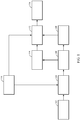
- a block diagram of the method for sensing streaming data in accordance with one embodiment of the present invention is represented in figure 1 .
- a method according to this embodiment comprises the step of recursively sampling an input stream of data using the steps of overlapping windowing to obtain at least a previous measurement, and employing said previous measurement for obtaining a subsequent measurement. More precisely, the method comprises the step of recursive sampling 102 of an input stream of data. The data sampled during the step of recursive sampling 102 is processed via a recursive estimation step 104. Information regarding a previous estimate, obtained during a previous estimate obtention step 116 previous to the recursive sampling is as well imputed during the step of recursive estimation 104.
- the data obtained during the step of recursive estimation 104 is utilized during the step of support detection 106, as described above in connection with step 6 of the recursive sampling algorithm.
- the information processed as the result of the support detection step may be used for count estimation, as shown in step 110 of figure 1 and as corresponding to step 7 of the recursive sampling algorithm.
- the information obtained in step 106 is utilized during the step 108 of calculating the LSE on the support set, as described above in connection with step 8 of the recursive sampling algorithm.
- the LSE on the support set and the estimation count are averaged in step 112, as described above in connection with step 9 of the recursive sampling algorithm.
- the previous estimate obtained during the step 116 is as well averaged in step 112.
- a new estimate is obtained in step 114, as described above in connection with step 10 of the recursive sampling algorithm.
- the method according to one such embodiment is as well capable of analyzing the computational complexity and estimation error of the method.
- FIG. 1 representing one embodiment of the method may be extended to a method comprising variable overlap between successive windows.
- a ⁇ R mxn denotes the sampling matrix
- i denotes the window index
- ⁇ i is the sampling efficiency, that is the ratio of total samples taken until time (n + i) to the number of entries sensed.
- the sampling efficiency is m/n since sampling matrix is A ⁇ R mxn .
- n + ( i - 1) ⁇ elements have been recovered while having taken im samples.
- the recursive sampling approach is asymptotically equivalent to taking one sample for each time instance.
- the benefit of such approach lies in noise suppression.
- the obtained two step algorithm with voting may be represented within the support detection block 106 in Figure 1 .
- the sequence containing the votes is defined as ⁇ v i ⁇ and the number of times an index i is used in the least squares estimation (LSE) as ⁇ L 1 ⁇ .
- LSE least squares estimation
- the ⁇ v i ⁇ and the ⁇ L 1 ⁇ are set to zero.
- votes on the positions that are in the set are added, the set being indicated by S t i as v S t i + 1 ⁇ v S t i + 1 + 1 , where the subscript S t i + i is used to translate the indices within the window to global indices on the streaming data.
- the threshold ⁇ 2 is chosen so that S g i ⁇ m , hence yielding an overdetermined system for the LSE.
- a S g i i is the matrix obtained by extracting columns of A (i) indexed by the set S g i . Then in order to perform averaging of the least squares estimates, the number of recoveries is incremented for the entries used in LSE procedure as L S g i + i ⁇ L S g i + i + 1 .
- the estimation error variance and the computational complexity of the method according to one embodiment is analyzed in the following.
- the first condition is: Given m, and k where k ⁇ m, for mxk matrix A where A i, j ⁇ N (0,1/m), the singular values s 1 ( A ) ⁇ ... ⁇ s k ( A ) satisfy the condition: max P s 1 A ⁇ 1 + k / m + t , P s k A ⁇ 1 ⁇ k / m ⁇ t ⁇ exp ⁇ mt 2 / 2
- the second condition is: P A i ⁇ 1 ⁇ 2 n 1 2 ⁇ ⁇ ⁇ log ⁇ n + I x n ⁇ O c n 2 log 2 .
- v ⁇ ( i ) is defined as the Lasso estimate. It is obtained by least squares applied on the support of Lasso, v ⁇ ( i ) .
- the matrix A I i T A I i is invertible since the singular values of A I ( i ) are nonzero with high probability.
- a 0 n ⁇ 1 1 n 2 ⁇
- i is the window index
- a ( i ) ⁇ R mxn is the sampling matrix
- ⁇ is indicative of the sliding step the number of sliding slots between successive windows, by the end of the ith window n+(i-1) ⁇ entries have been recovered.
- the first window is sampled by A (0) x (0) .
- the total complexity of sampling is O ( mn ) + O ( m ⁇ ) i, for an average complexity of O ( m ⁇ ) for recursive sampling.
- the other contribution to computational complexity stems from the iterative solver.
- the expected complexity attributes to the iterative solver which can be calculated as the number of operations in each iteration times the expected number of iterations for convergence. While the former depends on the particular algorithm the later is a function of the distance of the starting point to the optimal solution, which is bound to the case of using recursive estimation as follows:
- the average complexity is O ( m ⁇ ) for recursive sampling and O(mn) for optimization algorithm (minimally).
- O(mn) for optimization algorithm (minimally).
- and a false positive rate
- the first method is by solving LASSO and taking the non-zero positions as the support, and the second is by taking the positions where the absolute magnitude of the estimate is greater than a threshold.
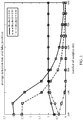
- Figure 3 shows the resulting curves for the two methods, obtained by randomly generating the input signal 20 times for each value of m and averaging the resulting detection rates and false positives. As can be seen from the figure, although the detection rate behaves similarly in both methods, the false positives can be reduced significantly by properly adjusting the threshold on the resulting LASSO estimates.
- ⁇ 3.34, threshold ⁇ 1 0.01, 0.10, and 1.00.
- the circle markers depict detection rate, and square markers depict false positive rate.
- the LASSO method can be used together with a voting strategy and least squares estimation to yield an unbiased estimator.
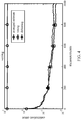
- Figure 4 shows the comparison of performance of a) single LASSO estimates, b) averaged estimates, c) voting strategy, and d) debiasing and averaging.
- Fig. 4 is a representation of error plots for a) averaged estimates, b) debiased and averaged estimates and c) estimates obtained by voting and averaging.
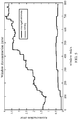
- FIG. 5 the figure illustrates error plots for averaged LASSO estimate and 'voting and averaging' on streaming data.
- Figure 5 shows a comparison between the window reconstruction error obtained with averaged LASSO estimates and 'voting and averaging' algorithm on streaming data.
- voting gives a reconstruction error that shows jumps due to waiting for ⁇ 2 votes to be collected to use an entry in LSE.
- the error drops instantly to lower values than simply averaging the LASSO estimates.
- what is proposed in accordance with one embodiment is an efficient method for recursive sampling and iterative recovery pertinent to compressed sensing on streaming data.
- the method leverages signal overlaps between successive processing windows in obtaining a faster convergence speed for the estimates of the signal while achieving estimation variance reduction in the presence of noise.
- a two step estimation procedure to approximate an unbiased estimator of the signal based on LASSO where a) support detection is performed by solving LASSO, and b) signal estimation is obtained by solving ordinary least squares on the estimated support set.
- the computational complexity of the algorithm is O(mn) where m is the number of samples taken and n is the window length. The convergence time is shown by experiments to be appropriate for online implementation on streaming data.
- embodiments include a method for compressed sensing of streaming data that involves performing a recursive scheme for performing compressed sensing on streaming data, that is as well capable of analyzing the computational complexity and estimation error of the method.
- the input stream of data is sampled recursively via overlapping windowing while making use of the previous measurement in obtaining the next one.
- the signal estimate from the previous window is utilized, in order to achieve faster convergence in an iterative optimization algorithm, to decode the new window.
- the estimation accuracy is enhanced by averaging signal estimates obtained from multiple windows.
- a two step estimation procedure is proposed in accordance with one embodiment comprising support set detection and signal amplitude estimation.
- one embodiment includes a voting scheme for robust support estimation in the presence of high measurement noise.
- simulation results obtained while employing the means according to one embodiment for compressed sensing of streaming data show a speed up of ten times with respect to applying traditional compressed sensing on a stream of data, while obtaining significantly lower reconstruction error under mild conditions on the signal magnitudes and the noise level.
- means for sensing streaming data are as well proposed.
- Said means for sensing streaming data comprise means for recursively sampling an input stream of data, and means for employing previous measurements for obtaining a subsequent measurement.
- the means for recursively sampling an input stream of data are capable of using the steps of overlapping windowing to obtain at least a previous measurement.
- One embodiment includes ranging with ultra wideband signals. For example, a device may continuously monitor return pulses to regularly transmitted spikes (the signal emitted is periodic). Generally, the device receives a main echo, plus added multiple echoes. If the device is moving, the main echo just slightly changes from one period to another period, as do the multiple echoes. This is not a periodic signal, just an almost periodic signal, and a sliding window algorithm will naturally track these shifting echoes. In such embodiments, echo data from an acoustic sensor is thereby transformed into range data.
- biomedical sample data may be transformed according to methods and systems described above.
- samples from one or more electrical sensors configured to receive electrical signals from a human body may be processed according to embodiments disclose herein to reconstruct electrocardiographic or electroencephalographic signals.
- the reconstructed signal may be matched to signatures characteristic of one or more diagnostic conditions.
- sample data from a camera, photoelectric, or other pixel array sensor may be processed as described herein.
- an apparatus may be able to improve power efficiency or increase effective sensitivity of the sensor.
- environmental sensor data such as temperature, wind speed, wind direction, precipitation may be processed as described herein.
- the means of the present invention may be implemented as software means, hardware means or a combination thereof.
- the systems and methods described above can be embodied, for example, in a wireless modem or wireless device integrating such a modem.
- embodiments disclosed herein may be implemented or performed with an electronic device or circuit such as a general purpose processor, a digital signal processor (DSP), an application specific integrated circuit (ASIC), a field programmable gate array (FPGA) or other programmable logic device, discrete gate or transistor logic, discrete hardware components, or any combination thereof designed to perform the functions described herein.
- a general purpose processor may be a microprocessor, but in the alternative, the processor may be any conventional processor, controller, microcontroller, or state machine.
- a processor may also be implemented as a combination of computing devices, e.g., a combination of a DSP and a microprocessor, a plurality of microprocessors, one or more microprocessors in conjunction with a DSP core, or any other such configuration.
- a software module may reside in RAM memory, flash memory, ROM memory, EPROM memory, EEPROM memory, registers, hard disk, a removable disk, a CD-ROM, or any other form of storage medium known in the art.
- An exemplary storage medium is coupled to the processor such the processor can read information from, and write information to, the storage medium.
- the storage medium may be integral to the processor.
- the processor and the storage medium may reside in an ASIC.
- the ASIC may reside in a user terminal.
- the processor and the storage medium may reside as discrete components in a user terminal.
- an apparatus for performing compressed sensing of streaming data comprises a recursive sampler arranged for recursively sampling an input stream of data using overlapping windowing to obtain at least one previous measurement regarding the input data stream, and a unit employing the at least one previous measurement for obtaining a subsequent measurement.
- the apparatus proposed in accordance with one embodiment of the present invention comprises a recursive sampler that is based on a recursive scheme for performing sensing.
- the apparatus for performing compressed sensing of streaming data of the present invention also comprises a processing unit for processing she input stream of data sampled during the step of recursive sampling via recursive estimation.
- the apparatus for performing compressed sensing of streaming data also comprises storing means for delivering the inputting information regarding the data stream of a previous estimate obtained during a previous estimate obtention step.
- the apparatus for performing compressed sensing of streaming data of the present invention comprises a counter arranged for performing count estimation based on information obtained during a data stream support detection step.
- the apparatus of the present invention may also comprise a calculator for calculating a least squares estimation (LSE) value for a data stream support set based on data obtained during said recursive estimation step.
- LSE least squares estimation
- a processing unit for averaging the calculated least squares estimation value, the count estimation value, and the previous estimate to calculate an averaged value to obtain an averaged value is as well comprised by the apparatus proposed in accordance with one embodiment of the present invention.
- An estimator for estimating an error degree of the method for sensing streaming data is as well envisioned to be comprised by the apparatus proposed in accordance with the present invention.
- a processing unit for averaging signal estimates obtained from a plurality of windows may be as well comprised by the apparatus proposed by the present invention.
Landscapes
- Engineering & Computer Science (AREA)
- Theoretical Computer Science (AREA)
- Multimedia (AREA)
- Computer Networks & Wireless Communication (AREA)
- Signal Processing (AREA)
- Environmental & Geological Engineering (AREA)
- Complex Calculations (AREA)
- Compression, Expansion, Code Conversion, And Decoders (AREA)
Applications Claiming Priority (3)
| Application Number | Priority Date | Filing Date | Title |
|---|---|---|---|
| US201361877162P | 2013-09-12 | 2013-09-12 | |
| US14/481,581 US10728298B2 (en) | 2013-09-12 | 2014-09-09 | Method for compressed sensing of streaming data and apparatus for performing the same |
| PCT/US2014/054993 WO2015038648A1 (en) | 2013-09-12 | 2014-09-10 | Method for compressed sensing of streaming data and apparatus for performing the same |
Publications (2)
| Publication Number | Publication Date |
|---|---|
| EP3044881A1 EP3044881A1 (en) | 2016-07-20 |
| EP3044881B1 true EP3044881B1 (en) | 2020-01-01 |
Family
ID=52626646
Family Applications (1)
| Application Number | Title | Priority Date | Filing Date |
|---|---|---|---|
| EP14776776.8A Active EP3044881B1 (en) | 2013-09-12 | 2014-09-10 | Method for compressed sensing of streaming data and apparatus for performing the same |
Country Status (8)
| Country | Link |
|---|---|
| US (1) | US10728298B2 (enExample) |
| EP (1) | EP3044881B1 (enExample) |
| JP (1) | JP6495292B2 (enExample) |
| KR (1) | KR102170342B1 (enExample) |
| CN (1) | CN105531934B (enExample) |
| ES (1) | ES2782830T3 (enExample) |
| HU (1) | HUE047132T2 (enExample) |
| WO (1) | WO2015038648A1 (enExample) |
Families Citing this family (8)
| Publication number | Priority date | Publication date | Assignee | Title |
|---|---|---|---|---|
| US7646924B2 (en) * | 2004-08-09 | 2010-01-12 | David Leigh Donoho | Method and apparatus for compressed sensing |
| KR102246461B1 (ko) * | 2019-06-27 | 2021-04-30 | 한화시스템 주식회사 | Mwc 기반의 레이더 전자 감시 시스템 |
| KR102246472B1 (ko) * | 2019-06-27 | 2021-04-30 | 한화시스템 주식회사 | Mwc 기반의 레이더 전자 감시 방법 |
| CN111272274B (zh) * | 2020-02-22 | 2022-07-19 | 西北工业大学 | 基于传声器随机采样的封闭空间低频声场再现方法 |
| CN111830465B (zh) * | 2020-07-27 | 2023-07-07 | 重庆大学 | 二维牛顿正交匹配追踪压缩波束形成方法 |
| US12153560B1 (en) * | 2021-07-07 | 2024-11-26 | Tableau Software, LLC | Database normalization using statistical analysis |
| CN115586323A (zh) * | 2022-10-20 | 2023-01-10 | 四川省纤维检验局 | 一种基于压缩感知的纺织品安全检测方法 |
| CN119315996B (zh) * | 2024-09-30 | 2026-04-14 | 中国人民解放军国防科技大学 | 一种基于压缩感知的稀疏恢复方法、设备及存储介质 |
Family Cites Families (17)
| Publication number | Priority date | Publication date | Assignee | Title |
|---|---|---|---|---|
| WO1998037701A1 (en) | 1997-02-12 | 1998-08-27 | Sarnoff Corporation | Apparatus and method for optimizing the rate control in a coding system |
| US6243467B1 (en) * | 1998-07-23 | 2001-06-05 | The United States Of America As Represented By The National Security Agency | Method of elliptic curve cryptographic digital signature generation and verification using reduced base tau expansion in non-adjacent form |
| WO2010042486A1 (en) | 2008-10-07 | 2010-04-15 | Euclid Discoveries, Llc | Feature-based video compression |
| CN101120399B (zh) * | 2005-01-31 | 2011-07-06 | 斯凯普有限公司 | 加权叠加方法 |
| US8086655B2 (en) * | 2007-09-14 | 2011-12-27 | International Business Machines Corporation | Methods and apparatus for perturbing an evolving data stream for time series compressibility and privacy |
| US8121222B2 (en) * | 2008-06-23 | 2012-02-21 | L-3 Communications Integrated Systems L.P. | Systems and methods for construction of time-frequency surfaces and detection of signals |
| WO2009156896A1 (en) | 2008-06-25 | 2009-12-30 | Koninklijke Philips Electronics N.V. | Radiation therapy system with real time magnetic resonance monitoring |
| US20100246920A1 (en) * | 2009-03-31 | 2010-09-30 | Iowa State University Research Foundation, Inc. | Recursive sparse reconstruction |
| KR101137652B1 (ko) * | 2009-10-14 | 2012-04-23 | 광운대학교 산학협력단 | 천이 구간에 기초하여 윈도우의 오버랩 영역을 조절하는 통합 음성/오디오 부호화/복호화 장치 및 방법 |
| US8219360B2 (en) | 2009-10-30 | 2012-07-10 | Mitsubishi Electric Research Laboratories, Inc. | Method for reconstructing sparse signals from sign measurements using greedy search |
| US8862206B2 (en) | 2009-11-12 | 2014-10-14 | Virginia Tech Intellectual Properties, Inc. | Extended interior methods and systems for spectral, optical, and photoacoustic imaging |
| US8582674B2 (en) | 2009-11-24 | 2013-11-12 | Qualcomm Incorporated | Apparatus and method for channel estimation using compressive sensing based on Taylor series expansion |
| US8204718B2 (en) | 2009-12-29 | 2012-06-19 | Mitsubishi Electric Research Laboratories, Inc. | Method for reconstructing sparse streaming signals using greedy search |
| US8675942B2 (en) | 2010-11-05 | 2014-03-18 | Siemens Aktiengesellschaft | Prior enhanced compressed sensing (PRINCE-CS) reconstruction for dynamic 2D-radial cardiac MRI |
| US9007260B2 (en) * | 2010-11-22 | 2015-04-14 | The Charles Stark Draper Laboratory, Inc. | Coded filter |
| WO2012094804A1 (en) | 2011-01-10 | 2012-07-19 | Alcatel-Lucent Shanghai Bell Co., Ltd. | Method and apparatus for measuring and recovering sparse signals |
| CN102722896B (zh) | 2012-05-22 | 2014-08-06 | 西安电子科技大学 | 基于自适应压缩感知的自然图像非局部重构方法 |
-
2014
- 2014-09-09 US US14/481,581 patent/US10728298B2/en active Active
- 2014-09-10 KR KR1020167009561A patent/KR102170342B1/ko not_active Expired - Fee Related
- 2014-09-10 EP EP14776776.8A patent/EP3044881B1/en active Active
- 2014-09-10 JP JP2016542071A patent/JP6495292B2/ja active Active
- 2014-09-10 ES ES14776776T patent/ES2782830T3/es active Active
- 2014-09-10 WO PCT/US2014/054993 patent/WO2015038648A1/en not_active Ceased
- 2014-09-10 CN CN201480049618.5A patent/CN105531934B/zh active Active
- 2014-09-10 HU HUE14776776A patent/HUE047132T2/hu unknown
Non-Patent Citations (1)
| Title |
|---|
| None * |
Also Published As
| Publication number | Publication date |
|---|---|
| KR20160055245A (ko) | 2016-05-17 |
| US10728298B2 (en) | 2020-07-28 |
| US20150074238A1 (en) | 2015-03-12 |
| WO2015038648A1 (en) | 2015-03-19 |
| CN105531934B (zh) | 2019-06-07 |
| JP2016535962A (ja) | 2016-11-17 |
| KR102170342B1 (ko) | 2020-10-27 |
| ES2782830T3 (es) | 2020-09-16 |
| HUE047132T2 (hu) | 2020-04-28 |
| JP6495292B2 (ja) | 2019-04-10 |
| EP3044881A1 (en) | 2016-07-20 |
| CN105531934A (zh) | 2016-04-27 |
Similar Documents
| Publication | Publication Date | Title |
|---|---|---|
| US10728298B2 (en) | Method for compressed sensing of streaming data and apparatus for performing the same | |
| Fang et al. | Two-dimensional pattern-coupled sparse Bayesian learning via generalized approximate message passing | |
| Selesnick et al. | Sparse signal estimation by maximally sparse convex optimization | |
| US9613439B1 (en) | System and method for a hierarchical Bayesian-map approach for solving inverse problems | |
| Lee | MAP support detection for greedy sparse signal recovery algorithms in compressive sensing | |
| Selesnick | L1-norm penalized least squares with SALSA | |
| Narayanamurthy et al. | Provable subspace tracking from missing data and matrix completion | |
| Meenakshi | A survey of compressive sensing based greedy pursuit reconstruction algorithms | |
| Suliman et al. | Mathematical theory of atomic norm denoising in blind two-dimensional super-resolution | |
| Bioucas-Dias et al. | Covalsa: Covariance estimation from compressive measurements using alternating minimization | |
| Razaviyayn et al. | Dictionary learning for sparse representation: Complexity and algorithms | |
| US11907326B1 (en) | Systems and method for determining frequency coefficients of signals | |
| Freris et al. | Compressed sensing of streaming data | |
| US7706478B2 (en) | Method and apparatus of source separation | |
| CN112106069A (zh) | 使用盲源分离的流传输数据张量分析 | |
| Tan et al. | Compressive imaging via approximate message passing with wavelet-based image denoising | |
| Marnissi et al. | An auxiliary variable method for Langevin based MCMC algorithms | |
| Adler | Covariance-assisted matching pursuit | |
| Tan et al. | Efficient sparse Bayesian learning via Gibbs sampling | |
| Mourad et al. | Automatic threshold estimation for iterative shrinkage algorithms used with compressed sensing | |
| Kang et al. | Bayesian hypothesis test using nonparametric belief propagation for noisy sparse recovery | |
| Budhiraja | Compressive Sensing based Image Reconstruction Using Generalized Adaptive OMP with Forward-Backward Movement | |
| Sun et al. | Nonnegative Sparse Blind Source Separation for NMR Spectroscopy by Data Clustering, Model Reduction, and \ell_1 Minimization | |
| Zhong et al. | Radar signal reconstruction algorithm based on complex block sparse Bayesian learning | |
| Xie et al. | Compressive distributed adaptive filtering |
Legal Events
| Date | Code | Title | Description |
|---|---|---|---|
| PUAI | Public reference made under article 153(3) epc to a published international application that has entered the european phase |
Free format text: ORIGINAL CODE: 0009012 |
|
| 17P | Request for examination filed |
Effective date: 20160210 |
|
| AK | Designated contracting states |
Kind code of ref document: A1 Designated state(s): AL AT BE BG CH CY CZ DE DK EE ES FI FR GB GR HR HU IE IS IT LI LT LU LV MC MK MT NL NO PL PT RO RS SE SI SK SM TR |
|
| AX | Request for extension of the european patent |
Extension state: BA ME |
|
| DAX | Request for extension of the european patent (deleted) | ||
| GRAP | Despatch of communication of intention to grant a patent |
Free format text: ORIGINAL CODE: EPIDOSNIGR1 |
|
| STAA | Information on the status of an ep patent application or granted ep patent |
Free format text: STATUS: GRANT OF PATENT IS INTENDED |
|
| INTG | Intention to grant announced |
Effective date: 20190729 |
|
| RIN1 | Information on inventor provided before grant (corrected) |
Inventor name: FRERIS, NIKOLAOS Inventor name: OCAL, ORHAN Inventor name: VETTERLI, MARTIN |
|
| GRAS | Grant fee paid |
Free format text: ORIGINAL CODE: EPIDOSNIGR3 |
|
| GRAA | (expected) grant |
Free format text: ORIGINAL CODE: 0009210 |
|
| STAA | Information on the status of an ep patent application or granted ep patent |
Free format text: STATUS: THE PATENT HAS BEEN GRANTED |
|
| AK | Designated contracting states |
Kind code of ref document: B1 Designated state(s): AL AT BE BG CH CY CZ DE DK EE ES FI FR GB GR HR HU IE IS IT LI LT LU LV MC MK MT NL NO PL PT RO RS SE SI SK SM TR |
|
| REG | Reference to a national code |
Ref country code: GB Ref legal event code: FG4D |
|
| REG | Reference to a national code |
Ref country code: AT Ref legal event code: REF Ref document number: 1221076 Country of ref document: AT Kind code of ref document: T Effective date: 20200115 Ref country code: CH Ref legal event code: EP |
|
| REG | Reference to a national code |
Ref country code: IE Ref legal event code: FG4D |
|
| REG | Reference to a national code |
Ref country code: DE Ref legal event code: R096 Ref document number: 602014059351 Country of ref document: DE |
|
| REG | Reference to a national code |
Ref country code: CH Ref legal event code: NV Representative=s name: MAUCHER JENKINS PATENTANWAELTE AND RECHTSANWAE, DE |
|
| REG | Reference to a national code |
Ref country code: FI Ref legal event code: FGE |
|
| REG | Reference to a national code |
Ref country code: NL Ref legal event code: FP |
|
| REG | Reference to a national code |
Ref country code: HU Ref legal event code: AG4A Ref document number: E047132 Country of ref document: HU |
|
| REG | Reference to a national code |
Ref country code: LT Ref legal event code: MG4D |
|
| PG25 | Lapsed in a contracting state [announced via postgrant information from national office to epo] |
Ref country code: CZ Free format text: LAPSE BECAUSE OF FAILURE TO SUBMIT A TRANSLATION OF THE DESCRIPTION OR TO PAY THE FEE WITHIN THE PRESCRIBED TIME-LIMIT Effective date: 20200101 Ref country code: LT Free format text: LAPSE BECAUSE OF FAILURE TO SUBMIT A TRANSLATION OF THE DESCRIPTION OR TO PAY THE FEE WITHIN THE PRESCRIBED TIME-LIMIT Effective date: 20200101 Ref country code: PT Free format text: LAPSE BECAUSE OF FAILURE TO SUBMIT A TRANSLATION OF THE DESCRIPTION OR TO PAY THE FEE WITHIN THE PRESCRIBED TIME-LIMIT Effective date: 20200527 Ref country code: NO Free format text: LAPSE BECAUSE OF FAILURE TO SUBMIT A TRANSLATION OF THE DESCRIPTION OR TO PAY THE FEE WITHIN THE PRESCRIBED TIME-LIMIT Effective date: 20200401 Ref country code: RS Free format text: LAPSE BECAUSE OF FAILURE TO SUBMIT A TRANSLATION OF THE DESCRIPTION OR TO PAY THE FEE WITHIN THE PRESCRIBED TIME-LIMIT Effective date: 20200101 |
|
| PG25 | Lapsed in a contracting state [announced via postgrant information from national office to epo] |
Ref country code: BG Free format text: LAPSE BECAUSE OF FAILURE TO SUBMIT A TRANSLATION OF THE DESCRIPTION OR TO PAY THE FEE WITHIN THE PRESCRIBED TIME-LIMIT Effective date: 20200401 Ref country code: GR Free format text: LAPSE BECAUSE OF FAILURE TO SUBMIT A TRANSLATION OF THE DESCRIPTION OR TO PAY THE FEE WITHIN THE PRESCRIBED TIME-LIMIT Effective date: 20200402 Ref country code: IS Free format text: LAPSE BECAUSE OF FAILURE TO SUBMIT A TRANSLATION OF THE DESCRIPTION OR TO PAY THE FEE WITHIN THE PRESCRIBED TIME-LIMIT Effective date: 20200501 Ref country code: LV Free format text: LAPSE BECAUSE OF FAILURE TO SUBMIT A TRANSLATION OF THE DESCRIPTION OR TO PAY THE FEE WITHIN THE PRESCRIBED TIME-LIMIT Effective date: 20200101 Ref country code: SE Free format text: LAPSE BECAUSE OF FAILURE TO SUBMIT A TRANSLATION OF THE DESCRIPTION OR TO PAY THE FEE WITHIN THE PRESCRIBED TIME-LIMIT Effective date: 20200101 Ref country code: HR Free format text: LAPSE BECAUSE OF FAILURE TO SUBMIT A TRANSLATION OF THE DESCRIPTION OR TO PAY THE FEE WITHIN THE PRESCRIBED TIME-LIMIT Effective date: 20200101 |
|
| REG | Reference to a national code |
Ref country code: ES Ref legal event code: FG2A Ref document number: 2782830 Country of ref document: ES Kind code of ref document: T3 Effective date: 20200916 |
|
| REG | Reference to a national code |
Ref country code: DE Ref legal event code: R097 Ref document number: 602014059351 Country of ref document: DE |
|
| PG25 | Lapsed in a contracting state [announced via postgrant information from national office to epo] |
Ref country code: SM Free format text: LAPSE BECAUSE OF FAILURE TO SUBMIT A TRANSLATION OF THE DESCRIPTION OR TO PAY THE FEE WITHIN THE PRESCRIBED TIME-LIMIT Effective date: 20200101 Ref country code: EE Free format text: LAPSE BECAUSE OF FAILURE TO SUBMIT A TRANSLATION OF THE DESCRIPTION OR TO PAY THE FEE WITHIN THE PRESCRIBED TIME-LIMIT Effective date: 20200101 Ref country code: RO Free format text: LAPSE BECAUSE OF FAILURE TO SUBMIT A TRANSLATION OF THE DESCRIPTION OR TO PAY THE FEE WITHIN THE PRESCRIBED TIME-LIMIT Effective date: 20200101 Ref country code: DK Free format text: LAPSE BECAUSE OF FAILURE TO SUBMIT A TRANSLATION OF THE DESCRIPTION OR TO PAY THE FEE WITHIN THE PRESCRIBED TIME-LIMIT Effective date: 20200101 Ref country code: SK Free format text: LAPSE BECAUSE OF FAILURE TO SUBMIT A TRANSLATION OF THE DESCRIPTION OR TO PAY THE FEE WITHIN THE PRESCRIBED TIME-LIMIT Effective date: 20200101 |
|
| PLBE | No opposition filed within time limit |
Free format text: ORIGINAL CODE: 0009261 |
|
| STAA | Information on the status of an ep patent application or granted ep patent |
Free format text: STATUS: NO OPPOSITION FILED WITHIN TIME LIMIT |
|
| REG | Reference to a national code |
Ref country code: AT Ref legal event code: MK05 Ref document number: 1221076 Country of ref document: AT Kind code of ref document: T Effective date: 20200101 |
|
| 26N | No opposition filed |
Effective date: 20201002 |
|
| PG25 | Lapsed in a contracting state [announced via postgrant information from national office to epo] |
Ref country code: IT Free format text: LAPSE BECAUSE OF FAILURE TO SUBMIT A TRANSLATION OF THE DESCRIPTION OR TO PAY THE FEE WITHIN THE PRESCRIBED TIME-LIMIT Effective date: 20200101 Ref country code: AT Free format text: LAPSE BECAUSE OF FAILURE TO SUBMIT A TRANSLATION OF THE DESCRIPTION OR TO PAY THE FEE WITHIN THE PRESCRIBED TIME-LIMIT Effective date: 20200101 |
|
| PG25 | Lapsed in a contracting state [announced via postgrant information from national office to epo] |
Ref country code: PL Free format text: LAPSE BECAUSE OF FAILURE TO SUBMIT A TRANSLATION OF THE DESCRIPTION OR TO PAY THE FEE WITHIN THE PRESCRIBED TIME-LIMIT Effective date: 20200101 Ref country code: SI Free format text: LAPSE BECAUSE OF FAILURE TO SUBMIT A TRANSLATION OF THE DESCRIPTION OR TO PAY THE FEE WITHIN THE PRESCRIBED TIME-LIMIT Effective date: 20200101 |
|
| PG25 | Lapsed in a contracting state [announced via postgrant information from national office to epo] |
Ref country code: MC Free format text: LAPSE BECAUSE OF FAILURE TO SUBMIT A TRANSLATION OF THE DESCRIPTION OR TO PAY THE FEE WITHIN THE PRESCRIBED TIME-LIMIT Effective date: 20200101 |
|
| REG | Reference to a national code |
Ref country code: BE Ref legal event code: MM Effective date: 20200930 |
|
| PG25 | Lapsed in a contracting state [announced via postgrant information from national office to epo] |
Ref country code: LU Free format text: LAPSE BECAUSE OF NON-PAYMENT OF DUE FEES Effective date: 20200910 |
|
| PG25 | Lapsed in a contracting state [announced via postgrant information from national office to epo] |
Ref country code: BE Free format text: LAPSE BECAUSE OF NON-PAYMENT OF DUE FEES Effective date: 20200930 Ref country code: IE Free format text: LAPSE BECAUSE OF NON-PAYMENT OF DUE FEES Effective date: 20200910 |
|
| PG25 | Lapsed in a contracting state [announced via postgrant information from national office to epo] |
Ref country code: TR Free format text: LAPSE BECAUSE OF FAILURE TO SUBMIT A TRANSLATION OF THE DESCRIPTION OR TO PAY THE FEE WITHIN THE PRESCRIBED TIME-LIMIT Effective date: 20200101 Ref country code: MT Free format text: LAPSE BECAUSE OF FAILURE TO SUBMIT A TRANSLATION OF THE DESCRIPTION OR TO PAY THE FEE WITHIN THE PRESCRIBED TIME-LIMIT Effective date: 20200101 Ref country code: CY Free format text: LAPSE BECAUSE OF FAILURE TO SUBMIT A TRANSLATION OF THE DESCRIPTION OR TO PAY THE FEE WITHIN THE PRESCRIBED TIME-LIMIT Effective date: 20200101 |
|
| PG25 | Lapsed in a contracting state [announced via postgrant information from national office to epo] |
Ref country code: MK Free format text: LAPSE BECAUSE OF FAILURE TO SUBMIT A TRANSLATION OF THE DESCRIPTION OR TO PAY THE FEE WITHIN THE PRESCRIBED TIME-LIMIT Effective date: 20200101 Ref country code: AL Free format text: LAPSE BECAUSE OF FAILURE TO SUBMIT A TRANSLATION OF THE DESCRIPTION OR TO PAY THE FEE WITHIN THE PRESCRIBED TIME-LIMIT Effective date: 20200101 |
|
| PGFP | Annual fee paid to national office [announced via postgrant information from national office to epo] |
Ref country code: NL Payment date: 20250812 Year of fee payment: 12 |
|
| REG | Reference to a national code |
Ref country code: CH Ref legal event code: U11 Free format text: ST27 STATUS EVENT CODE: U-0-0-U10-U11 (AS PROVIDED BY THE NATIONAL OFFICE) Effective date: 20251001 |
|
| PGFP | Annual fee paid to national office [announced via postgrant information from national office to epo] |
Ref country code: FI Payment date: 20250828 Year of fee payment: 12 |
|
| PGFP | Annual fee paid to national office [announced via postgrant information from national office to epo] |
Ref country code: DE Payment date: 20250808 Year of fee payment: 12 |
|
| PGFP | Annual fee paid to national office [announced via postgrant information from national office to epo] |
Ref country code: HU Payment date: 20250904 Year of fee payment: 12 Ref country code: GB Payment date: 20250814 Year of fee payment: 12 |
|
| PGFP | Annual fee paid to national office [announced via postgrant information from national office to epo] |
Ref country code: FR Payment date: 20250808 Year of fee payment: 12 |
|
| PGFP | Annual fee paid to national office [announced via postgrant information from national office to epo] |
Ref country code: CH Payment date: 20251001 Year of fee payment: 12 |
|
| PGFP | Annual fee paid to national office [announced via postgrant information from national office to epo] |
Ref country code: ES Payment date: 20251003 Year of fee payment: 12 |