EP3043209A1 - Dynamic multi-purpose composition for the removal of photoresists and method for its use - Google Patents
Dynamic multi-purpose composition for the removal of photoresists and method for its use Download PDFInfo
- Publication number
- EP3043209A1 EP3043209A1 EP16000417.2A EP16000417A EP3043209A1 EP 3043209 A1 EP3043209 A1 EP 3043209A1 EP 16000417 A EP16000417 A EP 16000417A EP 3043209 A1 EP3043209 A1 EP 3043209A1
- Authority
- EP
- European Patent Office
- Prior art keywords
- solution
- stripper
- photoresist
- substrate
- water
- Prior art date
- Legal status (The legal status is an assumption and is not a legal conclusion. Google has not performed a legal analysis and makes no representation as to the accuracy of the status listed.)
- Granted
Links
Classifications
-
- G—PHYSICS
- G03—PHOTOGRAPHY; CINEMATOGRAPHY; ANALOGOUS TECHNIQUES USING WAVES OTHER THAN OPTICAL WAVES; ELECTROGRAPHY; HOLOGRAPHY
- G03F—PHOTOMECHANICAL PRODUCTION OF TEXTURED OR PATTERNED SURFACES, e.g. FOR PRINTING, FOR PROCESSING OF SEMICONDUCTOR DEVICES; MATERIALS THEREFOR; ORIGINALS THEREFOR; APPARATUS SPECIALLY ADAPTED THEREFOR
- G03F7/00—Photomechanical, e.g. photolithographic, production of textured or patterned surfaces, e.g. printing surfaces; Materials therefor, e.g. comprising photoresists; Apparatus specially adapted therefor
- G03F7/26—Processing photosensitive materials; Apparatus therefor
- G03F7/30—Imagewise removal using liquid means
- G03F7/32—Liquid compositions therefor, e.g. developers
-
- G—PHYSICS
- G03—PHOTOGRAPHY; CINEMATOGRAPHY; ANALOGOUS TECHNIQUES USING WAVES OTHER THAN OPTICAL WAVES; ELECTROGRAPHY; HOLOGRAPHY
- G03F—PHOTOMECHANICAL PRODUCTION OF TEXTURED OR PATTERNED SURFACES, e.g. FOR PRINTING, FOR PROCESSING OF SEMICONDUCTOR DEVICES; MATERIALS THEREFOR; ORIGINALS THEREFOR; APPARATUS SPECIALLY ADAPTED THEREFOR
- G03F7/00—Photomechanical, e.g. photolithographic, production of textured or patterned surfaces, e.g. printing surfaces; Materials therefor, e.g. comprising photoresists; Apparatus specially adapted therefor
- G03F7/26—Processing photosensitive materials; Apparatus therefor
- G03F7/42—Stripping or agents therefor
- G03F7/422—Stripping or agents therefor using liquids only
- G03F7/426—Stripping or agents therefor using liquids only containing organic halogen compounds; containing organic sulfonic acids or salts thereof; containing sulfoxides
-
- C—CHEMISTRY; METALLURGY
- C11—ANIMAL OR VEGETABLE OILS, FATS, FATTY SUBSTANCES OR WAXES; FATTY ACIDS THEREFROM; DETERGENTS; CANDLES
- C11D—DETERGENT COMPOSITIONS; USE OF SINGLE SUBSTANCES AS DETERGENTS; SOAP OR SOAP-MAKING; RESIN SOAPS; RECOVERY OF GLYCEROL
- C11D1/00—Detergent compositions based essentially on surface-active compounds; Use of these compounds as a detergent
- C11D1/004—Surface-active compounds containing F
-
- C—CHEMISTRY; METALLURGY
- C11—ANIMAL OR VEGETABLE OILS, FATS, FATTY SUBSTANCES OR WAXES; FATTY ACIDS THEREFROM; DETERGENTS; CANDLES
- C11D—DETERGENT COMPOSITIONS; USE OF SINGLE SUBSTANCES AS DETERGENTS; SOAP OR SOAP-MAKING; RESIN SOAPS; RECOVERY OF GLYCEROL
- C11D3/00—Other compounding ingredients of detergent compositions covered in group C11D1/00
- C11D3/16—Organic compounds
- C11D3/26—Organic compounds containing nitrogen
-
- C—CHEMISTRY; METALLURGY
- C11—ANIMAL OR VEGETABLE OILS, FATS, FATTY SUBSTANCES OR WAXES; FATTY ACIDS THEREFROM; DETERGENTS; CANDLES
- C11D—DETERGENT COMPOSITIONS; USE OF SINGLE SUBSTANCES AS DETERGENTS; SOAP OR SOAP-MAKING; RESIN SOAPS; RECOVERY OF GLYCEROL
- C11D3/00—Other compounding ingredients of detergent compositions covered in group C11D1/00
- C11D3/16—Organic compounds
- C11D3/26—Organic compounds containing nitrogen
- C11D3/30—Amines; Substituted amines ; Quaternized amines
-
- C—CHEMISTRY; METALLURGY
- C11—ANIMAL OR VEGETABLE OILS, FATS, FATTY SUBSTANCES OR WAXES; FATTY ACIDS THEREFROM; DETERGENTS; CANDLES
- C11D—DETERGENT COMPOSITIONS; USE OF SINGLE SUBSTANCES AS DETERGENTS; SOAP OR SOAP-MAKING; RESIN SOAPS; RECOVERY OF GLYCEROL
- C11D3/00—Other compounding ingredients of detergent compositions covered in group C11D1/00
- C11D3/43—Solvents
-
- C—CHEMISTRY; METALLURGY
- C11—ANIMAL OR VEGETABLE OILS, FATS, FATTY SUBSTANCES OR WAXES; FATTY ACIDS THEREFROM; DETERGENTS; CANDLES
- C11D—DETERGENT COMPOSITIONS; USE OF SINGLE SUBSTANCES AS DETERGENTS; SOAP OR SOAP-MAKING; RESIN SOAPS; RECOVERY OF GLYCEROL
- C11D7/00—Compositions of detergents based essentially on non-surface-active compounds
- C11D7/22—Organic compounds
- C11D7/32—Organic compounds containing nitrogen
-
- C—CHEMISTRY; METALLURGY
- C11—ANIMAL OR VEGETABLE OILS, FATS, FATTY SUBSTANCES OR WAXES; FATTY ACIDS THEREFROM; DETERGENTS; CANDLES
- C11D—DETERGENT COMPOSITIONS; USE OF SINGLE SUBSTANCES AS DETERGENTS; SOAP OR SOAP-MAKING; RESIN SOAPS; RECOVERY OF GLYCEROL
- C11D7/00—Compositions of detergents based essentially on non-surface-active compounds
- C11D7/22—Organic compounds
- C11D7/32—Organic compounds containing nitrogen
- C11D7/3218—Alkanolamines or alkanolimines
-
- C—CHEMISTRY; METALLURGY
- C11—ANIMAL OR VEGETABLE OILS, FATS, FATTY SUBSTANCES OR WAXES; FATTY ACIDS THEREFROM; DETERGENTS; CANDLES
- C11D—DETERGENT COMPOSITIONS; USE OF SINGLE SUBSTANCES AS DETERGENTS; SOAP OR SOAP-MAKING; RESIN SOAPS; RECOVERY OF GLYCEROL
- C11D7/00—Compositions of detergents based essentially on non-surface-active compounds
- C11D7/50—Solvents
- C11D7/5004—Organic solvents
- C11D7/5009—Organic solvents containing phosphorus, sulfur or silicon, e.g. dimethylsulfoxide
-
- G—PHYSICS
- G03—PHOTOGRAPHY; CINEMATOGRAPHY; ANALOGOUS TECHNIQUES USING WAVES OTHER THAN OPTICAL WAVES; ELECTROGRAPHY; HOLOGRAPHY
- G03F—PHOTOMECHANICAL PRODUCTION OF TEXTURED OR PATTERNED SURFACES, e.g. FOR PRINTING, FOR PROCESSING OF SEMICONDUCTOR DEVICES; MATERIALS THEREFOR; ORIGINALS THEREFOR; APPARATUS SPECIALLY ADAPTED THEREFOR
- G03F7/00—Photomechanical, e.g. photolithographic, production of textured or patterned surfaces, e.g. printing surfaces; Materials therefor, e.g. comprising photoresists; Apparatus specially adapted therefor
- G03F7/26—Processing photosensitive materials; Apparatus therefor
- G03F7/42—Stripping or agents therefor
- G03F7/422—Stripping or agents therefor using liquids only
- G03F7/425—Stripping or agents therefor using liquids only containing mineral alkaline compounds; containing organic basic compounds, e.g. quaternary ammonium compounds; containing heterocyclic basic compounds containing nitrogen
-
- C—CHEMISTRY; METALLURGY
- C11—ANIMAL OR VEGETABLE OILS, FATS, FATTY SUBSTANCES OR WAXES; FATTY ACIDS THEREFROM; DETERGENTS; CANDLES
- C11D—DETERGENT COMPOSITIONS; USE OF SINGLE SUBSTANCES AS DETERGENTS; SOAP OR SOAP-MAKING; RESIN SOAPS; RECOVERY OF GLYCEROL
- C11D2111/00—Cleaning compositions characterised by the objects to be cleaned; Cleaning compositions characterised by non-standard cleaning or washing processes
- C11D2111/10—Objects to be cleaned
- C11D2111/14—Hard surfaces
- C11D2111/22—Electronic devices, e.g. PCBs or semiconductors
Definitions
- the present disclosure relates generally to compositions having the ability to effectively remove photoresists from substrates and methods for their use.
- the compositions disclosed are stripper solutions for the removal of photoresists that have the ability to remain liquid at temperatures below normal room temperature and temperatures frequently encountered in transit and warehousing and additionally have advantageous loading capacities for the photoresist materials that are removed.
- Stripper solutions having reduced water content have proven particularly effective in cleanly removing photoresists, providing low copper etch rates, and increasing the solubility of photoresists in the stripper solution as evidenced by lower particle counts.
- a first aspect of the present disclosure provides for a photoresist stripper solution for effectively removing or stripping a photoresist from a substrate, having particularly high loading capacities for the resist material, and the ability to remain a liquid when subjected to temperatures below normal room temperature that are typically encountered in transit, warehousing and in use in some manufacturing facilities.
- the compositions according to this present disclosure typically remain liquid to temperatures as low as about -20°C to about +15°C.
- the compositions according to the present disclosure typically contain dimethyl sulfoxide (DMSO), a quaternary ammonium hydroxide, and an alkanolamine.
- One preferred embodiment contains from about 20% to about 90% dimethyl sulfoxide, from about 1% to about 7% of a quaternary ammonium hydroxide, and from about 1% to about 75% of an alkanolamine having at least two carbon atoms, at least one amino substituent and at least one hydroxyl substituent, the amino and hydroxyl substituents attached to two different carbon atoms.
- the preferred quaternary groups are (C 1 -C 8 ) alkyl, arylalkyl and combinations thereof.
- a particularly preferred quaternary ammonium hydroxide is tetramethyammonium hydroxide.
- Particularly preferred 1,2-alkanolamines include compounds of the formula: where R 1 can be H, C 1 -C 4 alkyl, or C 1 -C 4 alkylamino.
- R 1 is H or CH 2 CH 2 NH 2 .
- a further embodiment according to this present disclosure contains an additional or secondary solvent.
- Preferred secondary solvents include glycols, glycol ethers and the like.
- a second aspect of the present disclosure provides for methods of using the novel stripper solutions described above to remove photoresist and related polymeric materials from a substrate.
- a photoresist can be removed from a selected substrate having a photoresist thereon by contacting the substrate with a stripping solution for a time sufficient to remove the desired amount of photoresist, by removing the substrate from the stripping solution, rinsing the stripping solution from the substrate with a solvent and drying the substrate.
- a third aspect of the present disclosure includes electronic devices manufactured by the novel method disclosed.
- a fourth aspect of the present disclosure includes preferred stripper solutions containing dimethyl sulfoxide, a quaternary ammonium hydroxide, an alkanolamine, an optional secondary solvent with reduced amounts of water.
- a fifth aspect of the present disclosure includes a method for removing a photoresist from a substrate with the new dry stripper solution.
- the method involves selecting a substrate having a photoresist deposited on it, contacting the substrate including the photoresist with a stripper solution that contains dimethyl sulfoxide, a quaternary ammonium hydroxide, an alkanolamine, an optional secondary solvent wherein the stripper solution has a dryness coefficient of at least about 1, removing the substrate from contact with the stripper solution and rinsing the stripper solution from the substrate.
- a sixth aspect of the present disclosure includes an electronic device prepared in part by the method described above.
- a seventh aspect of the present disclosure includes a method for providing a dry composition that includes dimethyl sulfoxide, a quaternary ammonium hydroxide, an alkanolamine, an optional secondary solvent wherein the solution has a dryness coefficient of at least about 1.
- An eighth aspect of the present disclosure includes a method for obtaining a quaternary ammonium hydroxide having reduced water content by forming a solution of the quaternary ammonium hydroxide, unwanted water and a sacrificial solvent and subjecting the solution to reduced pressure with slight warming. During the treatment a portion of sacrificial solvent and water are removed. During the process excessive heating should be avoided to prevent decomposition of the hydroxide. The addition and removal of the sacrificial solvent with water can be repeated as necessary until the water content is sufficiently reduced.
- a ninth aspect of the present disclosure includes a method for maintaining a low water content for a stripper solution.
- the method involves selecting a dry stripper solution, establishing contact between the stripper solution and molecular sieves, and maintaining contact with the sieves until the stripper solution is utilized. This method is particularly useful in maintaining the stripper solutions in a dry form following manufacture, during storage and/or shipping and after the solution's container has been opened.
- compositions according to this present disclosure include dimethyl sulfoxide (DMSO), a quaternary ammonium hydroxide, and an alkanolamine.
- DMSO dimethyl sulfoxide
- alkanol amines having at least two carbon atoms, at least one amino substituent and at least one hydroxyl substituent, the amino and hydroxyl substituents attached to two different carbon atoms.
- Preferred quaternary substituents include (C 1 -C 8 ) alkyl, benzyl and combinations thereof.
- Preferred compositions have a freezing point of less than about -20°C up to about + 15°C and a loading capacity of from about 15 cm 3 /liter up to about 90 cm 3 /liter.
- preferred quaternary substituents include C 1 -C 4 alkyl, arylalkyl or combinations thereof.
- Formulations having increased levels of an alkanolamine are particularly noncorrosive to carbon steel are less injurious to typical waste treatments systems and auxiliary equipment than other stripper solutions.
- Particularly preferred compositions contain 1,2-alkanolamines having the formula: where R 1 is hydrogen, (C 1 -C 4 ) alkyl, or (C 1 -C 4 ) alkylamino.
- Some preferred formulations additionally contain a secondary solvent.
- Particularly preferred formulations contain from about 2% to about 75% of a secondary solvent.
- Particularly useful secondary solvents include glycols and their alkyl or aryl ethers described in more detail below.
- the preferred formulations have freezing points sufficiently below 25°C to minimize solidification during transportation and warehousing. More preferred formulations have freezing points below about 15°C.
- compositions according to the present disclosure display high loading capacities enabling the composition to remove higher levels of photoresists without the precipitation of solids.
- compositions typically contain about 55 % to about 95% solvent, all or most of which is DMSO and from about 2% to about 10% of the quaternary ammonium hydroxide.
- Preferred quaternary substituents include (C 1 -C 8 )alkyl, benzyl and combinations thereof.
- a secondary solvent typically comprises from about 2% to about 35% of the composition.
- the stripping formulations can also contain an optional surfactant, typically at levels in the range of about 0.01% to about 3%. Suitable levels of the required alkanolamine can range from about 2% to about 75% of the composition. Because some of the stripper solution's components can be provided as aqueous solutions, the composition can optionally contain small amounts of water. All %'s provided herein are weight per cents.
- Preferred alkanolamines have at least two carbon atoms and have the amino and hydroxyl substituents on different carbon atoms.
- Suitable alkanolamines include, but are not limited to, ethanolamine, N-methylethanolamine, N-ethylethanolamine, N-propylethanolamine, N-butylethanolamine, diethanolamine, triethanolamine, N-methyldiethanolamine, N-ethyldiethanolamine, isopropanolamine, diisopropanolamine, triisopropanolamine, N-methylisopropanolamine, N-ethylisopropanolamine, N-propylisopropanolamine, 2-aminopropane-1-ol, N-methyl-2-aminopropane-1-ol, N-ethyl-2-aminopropane-1-ol, 1-aminopropane-3-ol, N-methyl-1-aminopropane-3-ol, N
- glycol ether solvents include, but are not limited to, ethylene glycol monomethyl ether, ethylene glycol monoethyl ether, ethylene glycol monobutyl ether, ethylene glycol dimethyl ether, ethylene glycol diethyl ether, diethylene glycol monomethyl ether, diethylene glycol monoethyl ether, diethylene glycol monopropyl ether, diethylene glycol monoisopropyl ether, diethylene glycol monobutyl ether, diethylene glycol monoisobutyl ether, diethylene glycol monobenzyl ether, diethylene glycol diethyl ether, triethylene glycol monomethyl ether, triethylene glycol dimethyl ether, polyethylene glycol monomethyl ether, diethylene glycol methyl ethyl ether, triethylene glycol, ethylene glycol monomethyl ether acetate, ethylene glycol monoethyl acetate, propylene glycol monomethyl ether, propylene glycol dimethyl ether, propylene glycol di
- compositions can also optionally contain one or more corrosion inhibitors.
- Suitable corrosion inhibitors include, but are not limited to, aromatic hydroxyl compounds such as catechol; alkylcatechols such as methylcatechol, ethylcatechol and t-butylcatechol, phenols and pyrogallol; aromatic triazoles such as benzotriazole; alkylbenzotriazoles; carboxylic acids such as formic acid, acetic acid, propionic acid, butyric acid, isobutyric acid, oxalic acid, malonic acid, succinic acid, glutaric acid, maleic acid, fumaric acid, benzoic acid, phtahlic acid, 1,2,3-benzenetricarboxylic acid, glycolic acid, lactic acid, malic acid, citric acid, acetic anhydride, phthalic anhydride, maleic anhydride, succinic anhydride, salicylic acid, gallic acid, and gallic acid esters such as methyl gall
- Preferred optional surfactants have included fluorosurfactants.
- fluorosurfactants include DuPont FSO (fluorinated telomere B monoether with polyethylene glycol (50%), ethylene glycol (25%), 1,4-dioxane ( ⁇ 0.1%), water 25%).
- temperatures of at least 50°C are preferred for contacting the substrate whereas for a majority of applications, temperatures of from about 50°C to about 75°C are more preferred.
- lower contacting temperatures are appropriate.
- agitation of the composition When immersing a substrate, agitation of the composition additionally facilitates photoresist removal. Agitation can be effected by mechanical stirring, circulating, or by bubbling an inert gas through the composition.
- the substrate Upon removal of the desired amount of photoresist, the substrate is removed from contact with the stripper solution and rinsed with water or an alcohol. DI water is a preferred form of water and isopropanol is a preferred alcohol.
- rinsing is preferably done under an inert atmosphere.
- the preferred stripper solutions according to the present disclosure have improved loading capacities for photoresist materials compared to current commercial products and are able to process a larger number of substrates with a given volume of stripper solution.
- the stripper solutions provided in this disclosure can be used to remove polymeric resist materials present in a single layer or certain types of bilayer resists.
- bilayer resists typically have either a first inorganic layer covered by a second polymeric layer or can have two polymeric layers.
- a single layer of polymeric resist can be effectively removed from a standard wafer having a single polymer layer.
- the same methods can also be used to remove a single polymer layer from a wafer having a bilayer composed of a first inorganic layer and a second or outer polymer layer.
- two polymer layers can be effectively removed from a wafer having a bilayer composed of two polymeric layers.
- the new dry stripper solutions can be used to remove one, two or more resist layers.
- the preferred dry stripper solutions contain dimethyl sulfoxide, a quaternary ammonium hydroxide, an alkanolamine, an optional secondary solvent and less than about 3 wt.% of water.
- Preferred secondary solvents are glycol ethers.
- More preferred dry stripper solutions contain dimethyl sulfoxide, a quaternary ammonium hydroxide, an alkanolamine, a glycol ether solvent and a dryness coefficient of at least about 1.8
- stripper solutions Use of the dry photoresist stripper solution is similar to that described above for stripper solutions having a low freezing point. However, it is helpful to maintain the stripper solution in a dry form prior to use and to minimize water uptake during its use by maintaining a generally dry environment in the area involved with resist removal. Stripper solutions can be maintained in a dry state by maintaining contact between the stripper solution and active molecular sieves during storage, transit and after opening a container prior to its use.
- the dry stripper solutions described herein should be prepared from dry components to the extent possible. Because quaternary ammonium hydroxides are hygroscopic and are generally available as aqueous solutions or their hydrates, water contained in the solution or associated with the hydrate must generally be removed to provide a dry stripper solution having a dryness coefficient of at least about 1. Efforts to dry quaternary ammonium hydroxides at elevated temperatures and to a dry state generally results in decomposition of the hydroxide. It has surprisingly been found that quaternary ammonium hydroxides in a volatile solvent can be pre-dried to give a solvent wet,paste having reduced water content without decomposition.
- a dry stripper solution containing a quaternary ammonium hydroxide can be prepared by pre-drying the quaternary ammonium hydroxide and combining it with other substantially dry components to maintain a low water content or by subsequently drying an initially formed wet stripper solution formed from water-containing components.
- a pre-dried form of a quaternary ammonium hydroxide can be obtained by subjecting a hydrated or otherwise wet form of a quaternary ammonium hydroxide to a reduced pressure with very slight warming. Water removal may be facilitated by dissolving the quaternary ammonium hydroxide in a solvent such as an alcohol prior to subjecting the hydroxide to reduced pressure. Based on work carried out thus far, a preferred alcohol is methanol. During this treatment a substantial portion of the water and alcohol are removed to provide an alcohol wet paste of the quaternary ammonium hydroxide. Depending on the level of dryness desired, additional dry alcohol can be added to the initially treated hydroxide and the treatment at reduced pressure repeated one or more times.
- Treatments can be carried out at pressures of from about 0.001 to about 30 mmhg and at temperatures of up to at least about 35°C without substantial decomposition of the quaternary ammonium hydroxide. More preferred treatments can be carried out at pressures of from about 0.01 to about 10 mmhg.
- drying can be carried out on the stripper solution after the addition of all components by contacting the stripper solution with a solid drying agent, such as for example, molecular sieves, calcium hydride, calcium sulfate or a combination of drying agents.
- a solid drying agent such as for example, molecular sieves, calcium hydride, calcium sulfate or a combination of drying agents.
- a preferred drying agent is an activated 3A or 4A molecular sieve.
- an active drying agent such as molecular sieves
- Contact with the molecular sieves or other solid drying agent can be by any known method, such as slurrying the solution with drying agent and filtering the dry slurry.
- any of the wet solutions described above can be dried by passing the wet solution through pelletized activated molecular sieves or other drying agent in a column.
- Suitable molecular sieves include type 3A, 4A and 5A sieves.
- Molecular sieves are also a preferred drying agent or desiccant to maintain the stripper solution in a dry state.
- the pellet form is most preferred because it allows removal of the dry stripper solution by simple decantation. However, for applications in which decantation does not provide an adequate separation, molecular sieve, whether powder or pellets can be incorporated into a "tea bag” arrangement that will allow equilibrium with the solution, but not allow any sieve particles to contaminate the solution. Dry stripper solutions containing molecular sieves can be maintained in a dry state for extended periods of time after a container has been opened, depending on the amount of molecular sieves included with the stripper solution, the surrounding humidity and the amount of time the container is open.
- compositions of Examples 1-13 can optionally be formulated without a surfactant and formulated to include a corrosion inhibitor.
- a silicon wafer having a photoresist thereon is immersed in the stripping solution from Example 1, maintained at a temperature of about 70°C with stirring for from about 30 to about 60 minutes.
- the wafer is removed, rinsed with DI water and dried. Examination of the wafer will demonstrate removal of substantially all of the photoresist. For some applications, superior results may be obtained by immersing the wafer in the stripping solution without stirring and/or immersing the wafer for up to 150 minutes.
- the preferred manner of removing the photoresist from a wafer can readily be determined without undue experimentation. This method can be used to remove a single layer of polymeric photoresist or two polymeric layers present in bilayer resists having two polymer layers.
- a silicon wafer having a photoresist thereon is mounted in a standard spray device and sprayed with the stripper solution from Example 2, maintained at about 50°C.
- the spraying can optionally be carried out under an inert atmosphere or optionally in the presence of an active gas such as, for example, oxygen, fluorine or silane.
- the wafer can be removed periodically and inspected to determine when sufficient photoresist has been removed. When sufficient photoresist has been removed, the wafer can be rinsed with isopropanol and dried. This method can be used to remove a single layer of polymeric photoresist or two polymeric layers present in bilayer resists having two polymer layers.
- Examples 14 and 15 can be used with the stripper solutions of this disclosure to remove photoresists from wafers constructed of a variety of materials, including GaAs. Additionally, both positive and negative resists can be removed by both of these methods.
- Example 14 The method described in Example 14 was used to remove photoresist from the wafers described below in Table II. Twenty liter volumes of three stripper solutions were used until either a residue of photoresist polymer remained on the wafer or until re-deposition of the polymer or its degradation products onto the wafer occurred, at which point the solutions loading capacity was reached. With this method the loading capacity was determined for the two stripper solutions described in Examples 1 and 2 above and for a comparative example that is generally typical of current commercial stripper solutions.
- Dimethylsulfoxide (85.5 g), diethyleneglycol monomethyl ether (6.0g), aminoethylethanolamine (2.7 g) and tetramethylammonium hydroxide pentahydrate (5.5g) were combined to provide a stripper solution containing about 3 wt.% water and a dryness coefficient of about 0.9. Dissolution of the hydroxide pentahydrate was facilitated by slightly agitating the mixture. The about 3 wt.% water in the solution came substantially from the pentahydrate.
- a 25 wt% solution of tetramethylammonium hydroxide pentahydrate in methanol was prepared and 40.8 grams of the solution was warmed to about 30°C in a water bath and maintained at a pressure of about 0.01 mmhg for about 75 minutes. Condensate was collected in a Dewar flask cooled with liquid nitrogen. After about 75 minutes, the temperature of the water bath was raised to about 35°C and maintained at that temperature for an additional 105 minutes. A white paste resulted.
- the vacuum was broken and 85.8 g of dry DMSO was added to dissolve the white solid after which were added 6.0 g of diethyleneglycol monomethyl ether and 2.7 g of aminoethylethanolamine to provide a substantially dry version of the stripper solution described in Example 1, Table I.
- the dry stripper solution's water content was found to be 0.71% by the Karl Fischer method and the solution contained less than 1% methanol. Lower levels of water can be obtained by adding additional methanol to the white paste and maintaining the resulting solution at reduced pressure for an additional 2 to 5 hours.
- Appropriate quantities of dry stripper solutions of the type described in Example 18 are packaged with active molecular sieves to maintain the stripper solutions in a dry condition for longer periods of time. About 5 to about 10 grams of active sieves are added for each 100 g of stripper solution maintained in a closed and sealed container. Molecular sieves in the form of pellets are preferred. However, powdered sieves can be used if removed by filtration prior to use or if small amounts of particulate matter do not interfere with use of the dry stripper solution.
- the invention further extends to the following items 1 to 15:
Landscapes
- Chemical & Material Sciences (AREA)
- Life Sciences & Earth Sciences (AREA)
- Engineering & Computer Science (AREA)
- Chemical Kinetics & Catalysis (AREA)
- Oil, Petroleum & Natural Gas (AREA)
- Wood Science & Technology (AREA)
- Organic Chemistry (AREA)
- Physics & Mathematics (AREA)
- General Physics & Mathematics (AREA)
- Cleaning Or Drying Semiconductors (AREA)
- Photosensitive Polymer And Photoresist Processing (AREA)
- Exposure Of Semiconductors, Excluding Electron Or Ion Beam Exposure (AREA)
Abstract
Description
- This application is a continuation-in-part of
U.S. Application No. 11/260,912, filed on October 28, 2005 - The present disclosure relates generally to compositions having the ability to effectively remove photoresists from substrates and methods for their use. The compositions disclosed are stripper solutions for the removal of photoresists that have the ability to remain liquid at temperatures below normal room temperature and temperatures frequently encountered in transit and warehousing and additionally have advantageous loading capacities for the photoresist materials that are removed. Stripper solutions having reduced water content have proven particularly effective in cleanly removing photoresists, providing low copper etch rates, and increasing the solubility of photoresists in the stripper solution as evidenced by lower particle counts.
- In broad terms, a first aspect of the present disclosure provides for a photoresist stripper solution for effectively removing or stripping a photoresist from a substrate, having particularly high loading capacities for the resist material, and the ability to remain a liquid when subjected to temperatures below normal room temperature that are typically encountered in transit, warehousing and in use in some manufacturing facilities. The compositions according to this present disclosure typically remain liquid to temperatures as low as about -20°C to about +15°C. The compositions according to the present disclosure typically contain dimethyl sulfoxide (DMSO), a quaternary ammonium hydroxide, and an alkanolamine. One preferred embodiment contains from about 20% to about 90% dimethyl sulfoxide, from about 1% to about 7% of a quaternary ammonium hydroxide, and from about 1% to about 75% of an alkanolamine having at least two carbon atoms, at least one amino substituent and at least one hydroxyl substituent, the amino and hydroxyl substituents attached to two different carbon atoms. The preferred quaternary groups are (C1-C8) alkyl, arylalkyl and combinations thereof. A particularly preferred quaternary ammonium hydroxide is tetramethyammonium hydroxide. Particularly preferred 1,2-alkanolamines include compounds of the formula:

- A second aspect of the present disclosure provides for methods of using the novel stripper solutions described above to remove photoresist and related polymeric materials from a substrate. A photoresist can be removed from a selected substrate having a photoresist thereon by contacting the substrate with a stripping solution for a time sufficient to remove the desired amount of photoresist, by removing the substrate from the stripping solution, rinsing the stripping solution from the substrate with a solvent and drying the substrate.
- A third aspect of the present disclosure includes electronic devices manufactured by the novel method disclosed.
- A fourth aspect of the present disclosure includes preferred stripper solutions containing dimethyl sulfoxide, a quaternary ammonium hydroxide, an alkanolamine, an optional secondary solvent with reduced amounts of water. The preferred solutions have a dryness coefficient of at least about 1 and more preferred solutions having a dryness coefficient of at least about 1.8, where the dryness coefficient (DC) is defined by the following equation:

- A fifth aspect of the present disclosure includes a method for removing a photoresist from a substrate with the new dry stripper solution. The method involves selecting a substrate having a photoresist deposited on it, contacting the substrate including the photoresist with a stripper solution that contains dimethyl sulfoxide, a quaternary ammonium hydroxide, an alkanolamine, an optional secondary solvent wherein the stripper solution has a dryness coefficient of at least about 1, removing the substrate from contact with the stripper solution and rinsing the stripper solution from the substrate.
- A sixth aspect of the present disclosure includes an electronic device prepared in part by the method described above.
- A seventh aspect of the present disclosure includes a method for providing a dry composition that includes dimethyl sulfoxide, a quaternary ammonium hydroxide, an alkanolamine, an optional secondary solvent wherein the solution has a dryness coefficient of at least about 1.
- An eighth aspect of the present disclosure includes a method for obtaining a quaternary ammonium hydroxide having reduced water content by forming a solution of the quaternary ammonium hydroxide, unwanted water and a sacrificial solvent and subjecting the solution to reduced pressure with slight warming. During the treatment a portion of sacrificial solvent and water are removed. During the process excessive heating should be avoided to prevent decomposition of the hydroxide. The addition and removal of the sacrificial solvent with water can be repeated as necessary until the water content is sufficiently reduced.
- A ninth aspect of the present disclosure includes a method for maintaining a low water content for a stripper solution. The method involves selecting a dry stripper solution, establishing contact between the stripper solution and molecular sieves, and maintaining contact with the sieves until the stripper solution is utilized. This method is particularly useful in maintaining the stripper solutions in a dry form following manufacture, during storage and/or shipping and after the solution's container has been opened.
- For the purposes of promoting an understanding of what is claimed, references will now be made to the embodiments illustrated and specific language will be used to describe the same. It will nevertheless be understood that no limitation of the scope of what is claimed is thereby intended, such alterations and further modifications and such further applications of the principles thereof as illustrated therein being contemplated as would normally occur to one skilled in the art to which the disclosure relates.
- The compositions according to this present disclosure include dimethyl sulfoxide (DMSO), a quaternary ammonium hydroxide, and an alkanolamine. Preferred alkanol amines having at least two carbon atoms, at least one amino substituent and at least one hydroxyl substituent, the amino and hydroxyl substituents attached to two different carbon atoms. Preferred quaternary substituents include (C1-C8) alkyl, benzyl and combinations thereof. Preferred compositions have a freezing point of less than about -20°C up to about + 15°C and a loading capacity of from about 15 cm3/liter up to about 90 cm3/liter. For the dry stripper solutions, preferred quaternary substituents include C1-C4 alkyl, arylalkyl or combinations thereof.
- Formulations having increased levels of an alkanolamine are particularly noncorrosive to carbon steel are less injurious to typical waste treatments systems and auxiliary equipment than other stripper solutions. Particularly preferred compositions contain 1,2-alkanolamines having the formula:

- Additionally, compositions according to the present disclosure display high loading capacities enabling the composition to remove higher levels of photoresists without the precipitation of solids. The loading capacity is defined as the number of cm3 of photoresist or bilayer material that can be removed for each liter of stripper solution before material is re-deposited on the wafer or before residue remains on the wafer. For example, if 20 liters of a stripper solution can remove 300 cm3 of photoresist before either redepositon occurs or residue remains on the wafer, the loading capacity is 300 cm3/20 liters = 15 cm3/liter
- The compositions typically contain about 55 % to about 95% solvent, all or most of which is DMSO and from about 2% to about 10% of the quaternary ammonium hydroxide. Preferred quaternary substituents include (C1-C8)alkyl, benzyl and combinations thereof. When used, a secondary solvent typically comprises from about 2% to about 35% of the composition. The stripping formulations can also contain an optional surfactant, typically at levels in the range of about 0.01% to about 3%. Suitable levels of the required alkanolamine can range from about 2% to about 75% of the composition. Because some of the stripper solution's components can be provided as aqueous solutions, the composition can optionally contain small amounts of water. All %'s provided herein are weight per cents.
- Preferred alkanolamines have at least two carbon atoms and have the amino and hydroxyl substituents on different carbon atoms. Suitable alkanolamines include, but are not limited to, ethanolamine, N-methylethanolamine, N-ethylethanolamine, N-propylethanolamine, N-butylethanolamine, diethanolamine, triethanolamine, N-methyldiethanolamine, N-ethyldiethanolamine, isopropanolamine, diisopropanolamine, triisopropanolamine, N-methylisopropanolamine, N-ethylisopropanolamine, N-propylisopropanolamine, 2-aminopropane-1-ol, N-methyl-2-aminopropane-1-ol, N-ethyl-2-aminopropane-1-ol, 1-aminopropane-3-ol, N-methyl-1-aminopropane-3-ol, N-ethyl-1-aminopropane-3-ol, 1-aminobutane-2-ol, N-methyl-1-aminobutane-2-ol, N-ethyl-1-aminobutane-2-ol, 2-aminobutane-1-ol, N-methyl-2-aminobutane-1-ol, N-ethyl-2-aminobutane-1-ol, 3-aminobutane-1-ol, N-methyl-3-aminobutane-1-ol, N-ethyl-3-aminobutane-1-ol, 1-aminobutane-4-ol, N-methyl-1-aminobutane-4-ol, N-ethyl-1-aminobutane-4-ol, 1-amino-2-methylpropane-2-ol, 2-amino-2-methylpropane-1-ol, 1-aminopentane-4-ol, 2-amino-4-methylpentane-1-ol, 2-aminohexane-1-ol, 3-aminoheptane-4-ol, 1-aminooctane-2-ol, 5-aminooctane-4-ol, 1-aminopropane-2,3-diol, 2-aminopropane-1,3-diol, tris(oxymethyl)aminomethane, 1,2-diaminopropane-3-ol, 1,3-diaminopropane-2-ol, and 2-(2-aminoethoxy)ethanol.
- Appropriate glycol ether solvents include, but are not limited to, ethylene glycol monomethyl ether, ethylene glycol monoethyl ether, ethylene glycol monobutyl ether, ethylene glycol dimethyl ether, ethylene glycol diethyl ether, diethylene glycol monomethyl ether, diethylene glycol monoethyl ether, diethylene glycol monopropyl ether, diethylene glycol monoisopropyl ether, diethylene glycol monobutyl ether, diethylene glycol monoisobutyl ether, diethylene glycol monobenzyl ether, diethylene glycol diethyl ether, triethylene glycol monomethyl ether, triethylene glycol dimethyl ether, polyethylene glycol monomethyl ether, diethylene glycol methyl ethyl ether, triethylene glycol, ethylene glycol monomethyl ether acetate, ethylene glycol monoethyl acetate, propylene glycol monomethyl ether, propylene glycol dimethyl ether, propylene glycol monobutyl ether, dipropyelene glycol monomethyl ether, dipropylene glycol monopropyl ether, dipropylene glycol monoisopropyl ether, dipropylene glycol monobutyl ether, dipropylene glycol dimethyl ether, dipropylene glycol dipropyl ether, dipropylene glycol diisopropyl ether, tripropylene glycol and tripropylene glycol monomethyl ether, 1-methoxy-2-butanol, 2-methoxy-1-butanol, 2-methoxy-2-methyl-2-butanol, 3-methoxy-3-methyl-1-butanol, dioxane, trioxane, 1,1-dimethoxyethane, tetrahydrofuran, crown ethers and the like.
- The compositions can also optionally contain one or more corrosion inhibitors. Suitable corrosion inhibitors include, but are not limited to, aromatic hydroxyl compounds such as catechol; alkylcatechols such as methylcatechol, ethylcatechol and t-butylcatechol, phenols and pyrogallol; aromatic triazoles such as benzotriazole; alkylbenzotriazoles; carboxylic acids such as formic acid, acetic acid, propionic acid, butyric acid, isobutyric acid, oxalic acid, malonic acid, succinic acid, glutaric acid, maleic acid, fumaric acid, benzoic acid, phtahlic acid, 1,2,3-benzenetricarboxylic acid, glycolic acid, lactic acid, malic acid, citric acid, acetic anhydride, phthalic anhydride, maleic anhydride, succinic anhydride, salicylic acid, gallic acid, and gallic acid esters such as methyl gallate and propyl gallate; organic salts of carboxyl containing organic containing compounds described above, basic substances such as ethanolamine, trimethylamine, diethylamine and pyridines, such as 2-aminopyridine, and the like, and chelate compounds such as phosphoric acid-based chelate compounds including 1,2-propanediaminetetramethylene phosphonic acid and hydroxyethane phosphonic acid, carboxylic acid-based chelate compounds such as ethylenediaminetetraacetic acid and its sodium and ammonium salts, dihydroxyethylglycine and nitrilotriacetic acid, amine-based chelate compounds such as bipyridine, tetraphenylporphyrin and phenanthroline, and oxime-based chelate compounds such as dimethylglyoxime and diphenylglyoxime. A single corrosion inhibitor may be used or a combination of corrosion inhibitors may be used. Corrosion inhibitors have proven useful at levels ranging from about 1 ppm to about 10%.
- Preferred optional surfactants have included fluorosurfactants. One example of a preferred fluorosurfactant is DuPont FSO (fluorinated telomere B monoether with polyethylene glycol (50%), ethylene glycol (25%), 1,4-dioxane (<0.1%), water 25%).
- Preferred temperatures of at least 50°C are preferred for contacting the substrate whereas for a majority of applications, temperatures of from about 50°C to about 75°C are more preferred. For particular applications where the substrate is either sensitive or longer removal times are required, lower contacting temperatures are appropriate. For example, when reworking substrates, it may be appropriate to maintain the stripper solution at a temperature of at least 20°C for a longer time to remove the photoresist and avoid damaging to the substrate. If longer contact times are required for complete resist removal, placing a blanket of dry nitrogen over the stripper solution can reduce water uptake from the atmosphere and maintain the dry stripper solution's improved performance.
- When immersing a substrate, agitation of the composition additionally facilitates photoresist removal. Agitation can be effected by mechanical stirring, circulating, or by bubbling an inert gas through the composition. Upon removal of the desired amount of photoresist, the substrate is removed from contact with the stripper solution and rinsed with water or an alcohol. DI water is a preferred form of water and isopropanol is a preferred alcohol. For substrates having components subject to oxidation, rinsing is preferably done under an inert atmosphere. The preferred stripper solutions according to the present disclosure have improved loading capacities for photoresist materials compared to current commercial products and are able to process a larger number of substrates with a given volume of stripper solution.
- The stripper solutions provided in this disclosure can be used to remove polymeric resist materials present in a single layer or certain types of bilayer resists. For example, bilayer resists typically have either a first inorganic layer covered by a second polymeric layer or can have two polymeric layers. Utilizing the methods taught below, a single layer of polymeric resist can be effectively removed from a standard wafer having a single polymer layer. The same methods can also be used to remove a single polymer layer from a wafer having a bilayer composed of a first inorganic layer and a second or outer polymer layer. Finally, two polymer layers can be effectively removed from a wafer having a bilayer composed of two polymeric layers. The new dry stripper solutions can be used to remove one, two or more resist layers.
- The preferred dry stripper solutions contain dimethyl sulfoxide, a quaternary ammonium hydroxide, an alkanolamine, an optional secondary solvent and less than about 3 wt.% of water. Preferred secondary solvents are glycol ethers. More preferred dry stripper solutions contain dimethyl sulfoxide, a quaternary ammonium hydroxide, an alkanolamine, a glycol ether solvent and a dryness coefficient of at least about 1.8
- Use of the dry photoresist stripper solution is similar to that described above for stripper solutions having a low freezing point. However, it is helpful to maintain the stripper solution in a dry form prior to use and to minimize water uptake during its use by maintaining a generally dry environment in the area involved with resist removal. Stripper solutions can be maintained in a dry state by maintaining contact between the stripper solution and active molecular sieves during storage, transit and after opening a container prior to its use.
- The dry stripper solutions described herein should be prepared from dry components to the extent possible. Because quaternary ammonium hydroxides are hygroscopic and are generally available as aqueous solutions or their hydrates, water contained in the solution or associated with the hydrate must generally be removed to provide a dry stripper solution having a dryness coefficient of at least about 1. Efforts to dry quaternary ammonium hydroxides at elevated temperatures and to a dry state generally results in decomposition of the hydroxide. It has surprisingly been found that quaternary ammonium hydroxides in a volatile solvent can be pre-dried to give a solvent wet,paste having reduced water content without decomposition. A dry stripper solution containing a quaternary ammonium hydroxide can be prepared by pre-drying the quaternary ammonium hydroxide and combining it with other substantially dry components to maintain a low water content or by subsequently drying an initially formed wet stripper solution formed from water-containing components.
- A pre-dried form of a quaternary ammonium hydroxide can be obtained by subjecting a hydrated or otherwise wet form of a quaternary ammonium hydroxide to a reduced pressure with very slight warming. Water removal may be facilitated by dissolving the quaternary ammonium hydroxide in a solvent such as an alcohol prior to subjecting the hydroxide to reduced pressure. Based on work carried out thus far, a preferred alcohol is methanol. During this treatment a substantial portion of the water and alcohol are removed to provide an alcohol wet paste of the quaternary ammonium hydroxide. Depending on the level of dryness desired, additional dry alcohol can be added to the initially treated hydroxide and the treatment at reduced pressure repeated one or more times. Treatments can be carried out at pressures of from about 0.001 to about 30 mmhg and at temperatures of up to at least about 35°C without substantial decomposition of the quaternary ammonium hydroxide. More preferred treatments can be carried out at pressures of from about 0.01 to about 10 mmhg.
- For wet formulations with or without a secondary solvent, drying can be carried out on the stripper solution after the addition of all components by contacting the stripper solution with a solid drying agent, such as for example, molecular sieves, calcium hydride, calcium sulfate or a combination of drying agents. A preferred drying agent is an activated 3A or 4A molecular sieve. For dry stripper solutions containing a secondary solvent, it is preferred to combine the quaternary ammonium hydroxide (and any other wet components), contact the resulting solution with an active drying agent such as molecular sieves, separate the dry solution from the spent drying agent and add any remaining dry components to the dry solution. Contact with the molecular sieves or other solid drying agent can be by any known method, such as slurrying the solution with drying agent and filtering the dry slurry. Similarly, any of the wet solutions described above can be dried by passing the wet solution through pelletized activated molecular sieves or other drying agent in a column. Suitable molecular sieves include type 3A, 4A and 5A sieves.
- Molecular sieves are also a preferred drying agent or desiccant to maintain the stripper solution in a dry state. The pellet form is most preferred because it allows removal of the dry stripper solution by simple decantation. However, for applications in which decantation does not provide an adequate separation, molecular sieve, whether powder or pellets can be incorporated into a "tea bag" arrangement that will allow equilibrium with the solution, but not allow any sieve particles to contaminate the solution. Dry stripper solutions containing molecular sieves can be maintained in a dry state for extended periods of time after a container has been opened, depending on the amount of molecular sieves included with the stripper solution, the surrounding humidity and the amount of time the container is open.
- The reactants listed in Table I were separately combined with stirring to give each of the 13 homogeneous stripper solutions. The freezing points were determined and are also provided in Table I. The compositions of Examples 1-13 can optionally be formulated without a surfactant and formulated to include a corrosion inhibitor.
TABLE I Example Formulation* Freezing Point, °C Dryness Coefficient 1 85.8g DMSO (85.8%) 6.0 g Diethyleneglycol monomethyl ether (6.0%) +13.2 1 2.7 g Aminoethylethanolamine (2.7%) 2.75 g Tetramethylammonium hydroxide (2.75%) 2.75 g water (2.75%) 2 61 g DMSO (61%) 35 g Monoethanolamine (35%) -2.5 1 2 g Tetramethylammonium hydroxide (2%) 2 g water (2%) 3 51.5 g DMSO(51.5%) 35 g Diethylene glycol monomethyl ether (35%) -7.4 1 11.3 g Aminoethylethanolamine (11.3%) 1.1. g Tetramethylammonium hydroxide (1.1%) 1.1 g water (1.1%) 4 71 g DMSO (71%) 27.4 g Monoethanolamine (27.4%) +53 1 0.8 g Tetramethylammonium hydroxide (0.8%) 0.8g water (0.8%) 5 27.4 g DMSO (27.4%) 71 g Monoethanolamine (71%) +0.4 1 0.8 g Tetramethylammonium hydroxide (0.8%) 0.8 g water (0.8%) 6 86 g DMSO (86.4%) 6 g Diethylene glycol monomethyl ether (6%) +7.7 0.7 2.7 g Aminoethylethanolamine (2.7%) 2 g Benzyltrimethylammonium hydroxide (2%) 3 g water (3%) 7 86 g DMSO (82.1%) 6 g Diethylene glycol monomethyl ether (5.7%) -4.6 0.25 2.7 g Aminoethylethanolamine (2.6%) 2 g Diethyldimethylammonium hydroxide (1.9%) 8 g water (7.7%) 8 86 g DMSO (82.1%) 6 g Diethylene glycol monomethyl ether (5.7%) -5.5 0.25 2.7 Aminoethylethanolamine (2.6%) 2 g Methyltriethylammonium hydroxide (1.9%) 8 g water (7.7%) 9 86 g DMSO (87.5%) 6 g Diethylene glycol monomethyl ether (6.1%) +8.4 0.8 2.7 g Aminoethylethanolamine (2.8%) 1.6 g Tetrabutylammonium hydroxide (1.6%) 2g water (2%) 10 63 g DMSO (61.2%) 35 g Monoethanolamine (34%) -6.3 0.7 2 g Benzyltrimethylammonium hydroxide (1.9%) 3 g water (2.9%) 11 63 g DMSO (58.3%) 35 g Monoethanolamine (32.4%) <-20 0.25 2 g Diethyldimethylammonium hydroxide (1.9%) 8g water (7.4%) 12 63 g DMSO (58.3%) 35 g Monoethanolamine (32.4%) <-20 0.25 2 g Methyltriethylammonium hydroxide (1.9%) 8g water (7.4%) 13 63 g DMSO (62.0%) 35 g Monoethanolamine (34.4%) -6.2 0.8 1.6 g Tetrabutylammonium hydroxide (1.6%) 2 g water (2%) *Each formulation additionally contained an optional 0.03 g of DuPont FSO (fluorinated telomere B monoether with polyethylene glycol (50%), ethylene glycol (25%), 1,4-dioxane (<0.1%), water 25%) - A silicon wafer having a photoresist thereon is immersed in the stripping solution from Example 1, maintained at a temperature of about 70°C with stirring for from about 30 to about 60 minutes. The wafer is removed, rinsed with DI water and dried. Examination of the wafer will demonstrate removal of substantially all of the photoresist. For some applications, superior results may be obtained by immersing the wafer in the stripping solution without stirring and/or immersing the wafer for up to 150 minutes. The preferred manner of removing the photoresist from a wafer can readily be determined without undue experimentation. This method can be used to remove a single layer of polymeric photoresist or two polymeric layers present in bilayer resists having two polymer layers.
- A silicon wafer having a photoresist thereon is mounted in a standard spray device and sprayed with the stripper solution from Example 2, maintained at about 50°C. The spraying can optionally be carried out under an inert atmosphere or optionally in the presence of an active gas such as, for example, oxygen, fluorine or silane. The wafer can be removed periodically and inspected to determine when sufficient photoresist has been removed. When sufficient photoresist has been removed, the wafer can be rinsed with isopropanol and dried. This method can be used to remove a single layer of polymeric photoresist or two polymeric layers present in bilayer resists having two polymer layers.
- The methods described in Examples 14 and 15 can be used with the stripper solutions of this disclosure to remove photoresists from wafers constructed of a variety of materials, including GaAs. Additionally, both positive and negative resists can be removed by both of these methods.
- The methods described in Examples 14, 15 and 16 can similarly be used with the dry stripper solution described herein.
- The method described in Example 14 was used to remove photoresist from the wafers described below in Table II. Twenty liter volumes of three stripper solutions were used until either a residue of photoresist polymer remained on the wafer or until re-deposition of the polymer or its degradation products onto the wafer occurred, at which point the solutions loading capacity was reached. With this method the loading capacity was determined for the two stripper solutions described in Examples 1 and 2 above and for a comparative example that is generally typical of current commercial stripper solutions.
Table II Stripping Formulation Composition Wafers Stripped with 20L of Stripper Solution Resist Loading Capacity cm3/L From Example 1 85.5 g DMSO 150 x 200 mm wafers with 80µm photoresist 6 g Diethylene glycol monomethyl ether 18.8 2.7 g Aminoethylethanolamine 2.75 g Tetramethylammonium hydroxide 2.75 g water 0.03 g DuPont FSO surfactant From Example 2 61 g DMSO 200 x 300 mm wafers with 120µm photoresist 35 g Monoethanolamine 84.8 2 g Tetramethylammonium hydroxide 2 g water 0.03g DuPont FSO surfactant Comparative Example 74 g n-methylpyrrolidone 25 x 300 mm wafers with 120µm photoresist 24 g 1,2-propanediol 10.6 1 g Tetramethylammonium hydroxide 1 g water - Dimethylsulfoxide (85.5 g), diethyleneglycol monomethyl ether (6.0g), aminoethylethanolamine (2.7 g) and tetramethylammonium hydroxide pentahydrate (5.5g) were combined to provide a stripper solution containing about 3 wt.% water and a dryness coefficient of about 0.9. Dissolution of the hydroxide pentahydrate was facilitated by slightly agitating the mixture. The about 3 wt.% water in the solution came substantially from the pentahydrate.
- Active 3A molecular sieves were added to three different samples of the stripper solution prepared according to the method of Example 17 and maintained in contact with the stripper solutions for 72 hours at ambient temperature. The sieves were removed by filtration and the moisture content of the initial and dried solutions determined by the Karl Fischer method. The dried stripper solutions were stored in closed container. The spent sieves could be dried for reuse or disposed of. The specific details for this experiment are tabulated below in Table III.
Table III Example Stripper Solution (g) Sieves (g) % Water Remaining Dryness Coefficient 18 (a) 11.4 15.16 2.37 1.13 18 (b) 126.4 25 1.36 1.99 18 (c) 135.48 45.25 0.78 3.46 - Three silicon wafers having a negative acrylate polymer-based dry film photoresist (120 µm) placed thereon over a copper region were separately immersed in the three dried stripper solutions prepared in Example 18 and maintained at 70°C for 60 minutes. The samples were removed and rinsed with deionized water for one minute. The resulting stripper solutions were analyzed for the number of particles of photoresist suspended therein utilizing a LiQuilaz SO5 particle analyzer and the copper etch rate determined for each wafer. The results are tabulated in Table IV provided below. LiQuilaz is a registered trademark of Particle Measuring Systems, Inc., 5475 Airport Blvd., Boulder, Colorado, 80301.
Table IV Stripper Solution Source Stripper Solution (g) Number of Suspended Particles Mass of Removed Photoresist (g) Particles/g photoresist removed/g solution Copper Etch Rate Å/minute 18 (a) 114.5 12444.4 0.2428 447.63 <1.0 18 (b) 126.4 9088.4 0.2914 246.74 <1.0 18 (c) 135.8 186.8 0.2523 5.46 <1.0 - A 25 wt% solution of tetramethylammonium hydroxide pentahydrate in methanol was prepared and 40.8 grams of the solution was warmed to about 30°C in a water bath and maintained at a pressure of about 0.01 mmhg for about 75 minutes. Condensate was collected in a Dewar flask cooled with liquid nitrogen. After about 75 minutes, the temperature of the water bath was raised to about 35°C and maintained at that temperature for an additional 105 minutes. A white paste resulted. The vacuum was broken and 85.8 g of dry DMSO was added to dissolve the white solid after which were added 6.0 g of diethyleneglycol monomethyl ether and 2.7 g of aminoethylethanolamine to provide a substantially dry version of the stripper solution described in Example 1, Table I. The dry stripper solution's water content was found to be 0.71% by the Karl Fischer method and the solution contained less than 1% methanol. Lower levels of water can be obtained by adding additional methanol to the white paste and maintaining the resulting solution at reduced pressure for an additional 2 to 5 hours.
- Appropriate quantities of dry stripper solutions of the type described in Example 18 are packaged with active molecular sieves to maintain the stripper solutions in a dry condition for longer periods of time. About 5 to about 10 grams of active sieves are added for each 100 g of stripper solution maintained in a closed and sealed container. Molecular sieves in the form of pellets are preferred. However, powdered sieves can be used if removed by filtration prior to use or if small amounts of particulate matter do not interfere with use of the dry stripper solution.
- While applicant's disclosure has been provided with reference to specific embodiments above, it will be understood that modifications and alterations in the embodiments disclosed may be made by those practiced in the art without departing from the spirit and scope of the invention. All such modifications and alterations are intended to be covered.
- The invention further extends to the following items 1 to 15:
- 1. A method for removing a photoresist from a substrate comprising:
- (a) selecting a substrate having a photoresist thereon;
- (b) contacting the substrate with a stripper solution for a time sufficient to remove a desired amount of photoresist;
- (c) removing the substrate from the stripping solution; and
- (d) rinsing the stripper solution from the substrate with a solvent, wherein the stripping solution: (i) comprises dimethyl sulfoxide, a quaternary ammonium hydroxide, and an alkanolamine having at least two carbon atoms, at least one amino substituent and at least one hydroxyl substituent, the amino and hydroxyl substituents attached to different carbon atoms.
- 2. The method of item 1, wherein the quaternary ammonium hydroxide has substituents that are (C1-C8)alkyl, arylalkyl or combinations thereof.
- 3. The method of item 2, wherein the dimethyl sulfoxide comprises from about 20 % to about 90 % of the composition; the quaternary ammonium hydroxide comprises from about 1 % to about 7 % of the composition; the alkanolamine comprises from about 1 % to about 75 % of the composition.
- 4. The method of item 3, wherein the alkanolamine is a compound of the formula:

- 5. The method of item 4, wherein R1 is CH2CH2NH2.
- 6. The method of item 3, wherein the contacting further comprises immersing the substrate in the stripping solution.
- 7. The method of item 3, wherein the contacting includes spraying the stripping solution onto the substrate.
- 8. The method of item 3, wherein the rinsing is with water.
- 9. The method of item 3, wherein the rinsing is with a lower alcohol.
- 10. The method of item 9, wherein the lower alcohol is isopropanol.
- 11. The method of item 4, wherein the quaternary ammonium hydroxide is tetramethylammonium hydroxide.
- 12. The method of item 11, wherein the solution further comprises a surfactant.
- 13. The method of item 12, wherein R1 is hydrogen.
- 14. The method of item 12, wherein R1 is CH2CH2NH2.
- 15. The method of item 1, wherein the photoresist is a bilayer resist having two polymer layers, or wherein the photoresist is a bilayer resist having one inorganic layer and one polymer layer.
Claims (9)
- A method for removing a photoresist from a substrate comprising:(a) selecting a substrate having a photoresist thereon;(b) contacting the substrate with a stripper solution for a time sufficient to remove a desired amount of photoresist;(c) removing the substrate from the stripping solution; and(d) rinsing the stripper solution from the substrate with a solvent, wherein the stripping solution:the dimethyl sulfoxide comprises from 20 % to 90 % of the composition; the quaternary ammonium hydroxide comprises from 1 % to 7 % of the composition; the alkanolamine comprises from 1 % to 75 % of the composition;(i) comprises dimethyl sulfoxide, a quaternary ammonium hydroxide, and an alkanolamine having at least two carbon atoms, at least one amino substituent and at least one hydroxyl substituent, the amino and hydroxyl substituents attached to different carbon atoms;
the alkanolamine is a compound of the formula: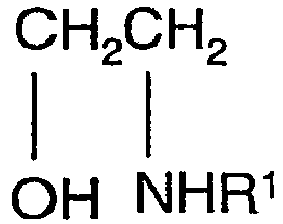
the quaternary ammonium hydroxide is tetramethylammonium hydroxide; and the solution further comprises a surfactant. - The method of claim 1, wherein R1 is CH2CH2NH2.
- The method of claim 1, wherein the contacting further comprises immersing the substrate in the stripping solution.
- The method of claim 1, wherein the contacting includes spraying the stripping solution onto the substrate.
- The method of claim 1, wherein the rinsing is with water.
- The method of claim 1, wherein the rinsing is with a lower alcohol.
- The method of claim 6, wherein the lower alcohol is isopropanol.
- The method of claim 1, wherein R1 is hydrogen.
- The method of claim 1, wherein the photoresist is a bilayer resist having two polymer layers.
Applications Claiming Priority (5)
| Application Number | Priority Date | Filing Date | Title |
|---|---|---|---|
| US11/260,912 US7632796B2 (en) | 2005-10-28 | 2005-10-28 | Dynamic multi-purpose composition for the removal of photoresists and method for its use |
| US11/551,826 US8263539B2 (en) | 2005-10-28 | 2006-10-23 | Dynamic multi-purpose composition for the removal of photoresists and methods for its use |
| EP06826524.8A EP1941018B1 (en) | 2005-10-28 | 2006-10-24 | Dynamic multi-purpose composition for the removal of photoresists and method for its use |
| PCT/US2006/041394 WO2007053363A2 (en) | 2005-10-28 | 2006-10-24 | Dynamic multi-purpose composition for the removal of photoresists and method for its use |
| EP13003729.4A EP2657770B1 (en) | 2005-10-28 | 2006-10-24 | Dynamic multi-purpose composition for the removal of photoresists and method for its use |
Related Parent Applications (3)
| Application Number | Title | Priority Date | Filing Date |
|---|---|---|---|
| EP06826524.8A Division EP1941018B1 (en) | 2005-10-28 | 2006-10-24 | Dynamic multi-purpose composition for the removal of photoresists and method for its use |
| EP13003729.4A Division-Into EP2657770B1 (en) | 2005-10-28 | 2006-10-24 | Dynamic multi-purpose composition for the removal of photoresists and method for its use |
| EP13003729.4A Division EP2657770B1 (en) | 2005-10-28 | 2006-10-24 | Dynamic multi-purpose composition for the removal of photoresists and method for its use |
Publications (2)
| Publication Number | Publication Date |
|---|---|
| EP3043209A1 true EP3043209A1 (en) | 2016-07-13 |
| EP3043209B1 EP3043209B1 (en) | 2020-04-29 |
Family
ID=38006380
Family Applications (4)
| Application Number | Title | Priority Date | Filing Date |
|---|---|---|---|
| EP06826524.8A Active EP1941018B1 (en) | 2005-10-28 | 2006-10-24 | Dynamic multi-purpose composition for the removal of photoresists and method for its use |
| EP13003729.4A Active EP2657770B1 (en) | 2005-10-28 | 2006-10-24 | Dynamic multi-purpose composition for the removal of photoresists and method for its use |
| EP16000417.2A Active EP3043209B1 (en) | 2005-10-28 | 2006-10-24 | Dynamic multi-purpose composition for the removal of photoresists and method for its use |
| EP13003730.2A Ceased EP2657771A1 (en) | 2005-10-28 | 2006-10-24 | Dynamic multi-purpose composition for the removal of photoresists |
Family Applications Before (2)
| Application Number | Title | Priority Date | Filing Date |
|---|---|---|---|
| EP06826524.8A Active EP1941018B1 (en) | 2005-10-28 | 2006-10-24 | Dynamic multi-purpose composition for the removal of photoresists and method for its use |
| EP13003729.4A Active EP2657770B1 (en) | 2005-10-28 | 2006-10-24 | Dynamic multi-purpose composition for the removal of photoresists and method for its use |
Family Applications After (1)
| Application Number | Title | Priority Date | Filing Date |
|---|---|---|---|
| EP13003730.2A Ceased EP2657771A1 (en) | 2005-10-28 | 2006-10-24 | Dynamic multi-purpose composition for the removal of photoresists |
Country Status (8)
| Country | Link |
|---|---|
| US (3) | US8263539B2 (en) |
| EP (4) | EP1941018B1 (en) |
| JP (1) | JP5306817B2 (en) |
| KR (1) | KR101362527B1 (en) |
| MY (1) | MY180725A (en) |
| SG (3) | SG180047A1 (en) |
| TW (2) | TWI486727B (en) |
| WO (1) | WO2007053363A2 (en) |
Families Citing this family (29)
| Publication number | Priority date | Publication date | Assignee | Title |
|---|---|---|---|---|
| US7365045B2 (en) * | 2005-03-30 | 2008-04-29 | Advanced Tehnology Materials, Inc. | Aqueous cleaner with low metal etch rate comprising alkanolamine and tetraalkylammonium hydroxide |
| US8263539B2 (en) | 2005-10-28 | 2012-09-11 | Dynaloy, Llc | Dynamic multi-purpose composition for the removal of photoresists and methods for its use |
| US7632796B2 (en) | 2005-10-28 | 2009-12-15 | Dynaloy, Llc | Dynamic multi-purpose composition for the removal of photoresists and method for its use |
| US9329486B2 (en) | 2005-10-28 | 2016-05-03 | Dynaloy, Llc | Dynamic multi-purpose composition for the removal of photoresists and method for its use |
| JP4906516B2 (en) * | 2006-01-11 | 2012-03-28 | 東進セミケム株式会社 | Color resist stripping composition for TFT-LCD |
| TWI450052B (en) * | 2008-06-24 | 2014-08-21 | 黛納羅伊有限責任公司 | Stripping solution for efficient post-stage process |
| JP2010111795A (en) * | 2008-11-07 | 2010-05-20 | Chisso Corp | Releasing fluid |
| CN101910109B (en) * | 2008-12-26 | 2014-08-27 | 神户天然物化学株式会社 | Process for the production of concentrated solutions of photoresist-strippers with low water content |
| US8444768B2 (en) | 2009-03-27 | 2013-05-21 | Eastman Chemical Company | Compositions and methods for removing organic substances |
| US8614053B2 (en) | 2009-03-27 | 2013-12-24 | Eastman Chemical Company | Processess and compositions for removing substances from substrates |
| US8309502B2 (en) * | 2009-03-27 | 2012-11-13 | Eastman Chemical Company | Compositions and methods for removing organic substances |
| KR101746879B1 (en) * | 2009-07-30 | 2017-06-14 | 바스프 에스이 | Post ion implant stripper for advanced semiconductor application |
| CN102043356B (en) * | 2009-10-13 | 2012-09-26 | 奇美实业股份有限公司 | Cleaning solution composition for cleaning substrate |
| TWI539493B (en) | 2010-03-08 | 2016-06-21 | 黛納羅伊有限責任公司 | Method and composition for doping a germanium substrate having a molecular monolayer |
| US8987181B2 (en) | 2011-11-08 | 2015-03-24 | Dynaloy, Llc | Photoresist and post etch residue cleaning solution |
| US9029268B2 (en) | 2012-11-21 | 2015-05-12 | Dynaloy, Llc | Process for etching metals |
| US9158202B2 (en) | 2012-11-21 | 2015-10-13 | Dynaloy, Llc | Process and composition for removing substances from substrates |
| WO2014104192A1 (en) * | 2012-12-27 | 2014-07-03 | 富士フイルム株式会社 | Resist-removing liquid and resist-stripping method |
| JP6040089B2 (en) * | 2013-04-17 | 2016-12-07 | 富士フイルム株式会社 | Resist removing liquid, resist removing method using the same, and photomask manufacturing method |
| JP6165665B2 (en) * | 2013-05-30 | 2017-07-19 | 信越化学工業株式会社 | Substrate cleaning method |
| TWI690780B (en) | 2014-12-30 | 2020-04-11 | 美商富士軟片電子材料美國股份有限公司 | Stripping compositions for removing photoresists from semiconductor substrates |
| JP6808714B2 (en) * | 2015-08-03 | 2021-01-06 | フジフイルム エレクトロニック マテリアルズ ユー.エス.エー., インコーポレイテッド | Cleaning composition |
| US10072237B2 (en) | 2015-08-05 | 2018-09-11 | Versum Materials Us, Llc | Photoresist cleaning composition used in photolithography and a method for treating substrate therewith |
| TWI783640B (en) * | 2016-03-01 | 2022-11-11 | 日商東京應化工業股份有限公司 | Cleaning solution for semiconductor substrates or devices |
| WO2019026868A1 (en) * | 2017-08-02 | 2019-02-07 | 株式会社クラレ | Method for recovering dimethyl sulfoxide from recovered resist remover |
| KR102038056B1 (en) * | 2018-01-19 | 2019-10-30 | 주식회사 엠티아이 | peeling material for stripping protected coating material for dicing process |
| KR101928830B1 (en) | 2018-01-19 | 2018-12-13 | (주)엠티아이 | peeling material for stripping protected coating material for processing wafer |
| KR20200053096A (en) * | 2018-11-08 | 2020-05-18 | 삼성전자주식회사 | Method of cleaning a semiconductor chip and apparatus for performing the same |
| JP7541014B2 (en) * | 2019-09-18 | 2024-08-27 | 富士フイルム株式会社 | Cleaning solution and cleaning method |
Citations (2)
| Publication number | Priority date | Publication date | Assignee | Title |
|---|---|---|---|---|
| US20030181344A1 (en) * | 2002-03-12 | 2003-09-25 | Kazuto Ikemoto | Photoresist stripping composition and cleaning composition |
| US20040256358A1 (en) * | 2001-11-02 | 2004-12-23 | Hidetaka Shimizu | Method for releasing resist |
Family Cites Families (131)
| Publication number | Priority date | Publication date | Assignee | Title |
|---|---|---|---|---|
| US3562038A (en) * | 1968-05-15 | 1971-02-09 | Shipley Co | Metallizing a substrate in a selective pattern utilizing a noble metal colloid catalytic to the metal to be deposited |
| US3673099A (en) * | 1970-10-19 | 1972-06-27 | Bell Telephone Labor Inc | Process and composition for stripping cured resins from substrates |
| US3920695A (en) * | 1972-07-26 | 1975-11-18 | Minnesota Mining & Mfg | Silicone-compatible indigo dyestuffs |
| US3888891A (en) * | 1972-07-26 | 1975-06-10 | Minnesota Mining & Mfg | Silicone-compatible dyestuffs |
| US3981859A (en) * | 1972-07-26 | 1976-09-21 | Minnesota Mining And Manufacturing Company | Silicone-compatible azo dyestuffs |
| US4038293A (en) * | 1972-07-26 | 1977-07-26 | Minnesota Mining And Manufacturing Company | Silicone-compatible tris(trimethylsilyloxy)silylalkylamino-substituted quinoncid dyestuffs |
| US3873668A (en) * | 1973-03-27 | 1975-03-25 | Du Pont | Cupric, nickelous and argentous ion-selective chelating resins |
| US3963744A (en) * | 1974-08-28 | 1976-06-15 | Minnesota Mining And Manufacturing Company | Silicone-compatible phthalocyanine dyestuffs |
| JPS58139430A (en) * | 1982-02-15 | 1983-08-18 | Toray Ind Inc | Exfoliation of resist |
| US4547271A (en) * | 1984-09-12 | 1985-10-15 | Canada Packers Inc. | Process for the electrochemical reduction of 7-ketolithocholic acid to ursodeoxycholic acid |
| DE3529960A1 (en) * | 1985-08-22 | 1987-03-05 | Boehringer Ingelheim Kg | AMINO ACID DERIVATIVES, METHOD FOR THE PRODUCTION AND USE THEREOF |
| JPS62188785A (en) | 1986-02-14 | 1987-08-18 | Mitsubishi Electric Corp | Bright pickling solution for copper and copper alloy |
| JPS63215041A (en) * | 1987-03-04 | 1988-09-07 | Toshiba Corp | Etching liquid for crystal defect evaluation |
| US4830641A (en) * | 1987-04-13 | 1989-05-16 | Pall Corporation | Sorbing apparatus |
| JP2553872B2 (en) | 1987-07-21 | 1996-11-13 | 東京応化工業株式会社 | Stripping solution for photoresist |
| JPH0728254B2 (en) | 1989-09-14 | 1995-03-29 | 日本電気株式会社 | Satellite line monitoring system |
| EP0461224B1 (en) * | 1989-12-29 | 1996-09-11 | Lucky Ltd. | A process for the preparation of heat resistant and transparent acrylic resin |
| US6187730B1 (en) * | 1990-11-05 | 2001-02-13 | Ekc Technology, Inc. | Hydroxylamine-gallic compound composition and process |
| JP3160344B2 (en) * | 1991-01-25 | 2001-04-25 | アシュランド インコーポレーテッド | Organic stripping composition |
| US5928430A (en) * | 1991-01-25 | 1999-07-27 | Advanced Scientific Concepts, Inc. | Aqueous stripping and cleaning compositions containing hydroxylamine and use thereof |
| US5117063A (en) * | 1991-06-21 | 1992-05-26 | Monsanto Company | Method of preparing 4-aminodiphenylamine |
| US5304284A (en) * | 1991-10-18 | 1994-04-19 | International Business Machines Corporation | Methods for etching a less reactive material in the presence of a more reactive material |
| US5468423A (en) * | 1992-02-07 | 1995-11-21 | The Clorox Company | Reduced residue hard surface cleaner |
| US5252737A (en) * | 1992-05-22 | 1993-10-12 | Monsanto Company | Process for preparing N-aliphatic substituted p-phenylenediamines |
| US6825156B2 (en) * | 2002-06-06 | 2004-11-30 | Ekc Technology, Inc. | Semiconductor process residue removal composition and process |
| US7144848B2 (en) * | 1992-07-09 | 2006-12-05 | Ekc Technology, Inc. | Cleaning compositions containing hydroxylamine derivatives and processes using same for residue removal |
| US5233010A (en) * | 1992-10-15 | 1993-08-03 | Monsanto Company | Process for preparing isocyanate and carbamate ester products |
| US5308745A (en) * | 1992-11-06 | 1994-05-03 | J. T. Baker Inc. | Alkaline-containing photoresist stripping compositions producing reduced metal corrosion with cross-linked or hardened resist resins |
| EP0609496B1 (en) * | 1993-01-19 | 1998-04-15 | Siemens Aktiengesellschaft | Process of making a metallization stage comprising contacts and runners which canneet these contacts |
| JP3302120B2 (en) | 1993-07-08 | 2002-07-15 | 関東化学株式会社 | Stripper for resist |
| JP2951215B2 (en) * | 1993-09-10 | 1999-09-20 | レイセオン・カンパニー | Method of manufacturing fine pattern electronic interconnect structure by phase mask laser |
| US5419779A (en) * | 1993-12-02 | 1995-05-30 | Ashland Inc. | Stripping with aqueous composition containing hydroxylamine and an alkanolamine |
| US5597678A (en) * | 1994-04-18 | 1997-01-28 | Ocg Microelectronic Materials, Inc. | Non-corrosive photoresist stripper composition |
| US5466389A (en) | 1994-04-20 | 1995-11-14 | J. T. Baker Inc. | PH adjusted nonionic surfactant-containing alkaline cleaner composition for cleaning microelectronics substrates |
| GB9425031D0 (en) * | 1994-12-09 | 1995-02-08 | Alpha Metals Ltd | Printed circuit board manufacture |
| US5567574A (en) | 1995-01-10 | 1996-10-22 | Mitsubishi Gas Chemical Company, Inc. | Removing agent composition for photoresist and method of removing |
| US5847172A (en) * | 1995-06-07 | 1998-12-08 | Magainin Pharmaceuticals Inc. | Certain aminosterol compounds and pharmaceutical compositions including these compounds |
| US5612304A (en) * | 1995-07-07 | 1997-03-18 | Olin Microelectronic Chemicals, Inc. | Redox reagent-containing post-etch residue cleaning composition |
| JP2911792B2 (en) * | 1995-09-29 | 1999-06-23 | 東京応化工業株式会社 | Stripper composition for resist |
| US5648324A (en) * | 1996-01-23 | 1997-07-15 | Ocg Microelectronic Materials, Inc. | Photoresist stripping composition |
| US6900193B1 (en) * | 1996-05-01 | 2005-05-31 | The United States Of America As Represented By The Department Of Health And Human Services | Structural modification of 19-norprogesterone I: 17-α-substituted-11-β-substituted-4-aryl and 21-substituted 19-norpregnadienedione as new antiprogestational agents |
| US20040134873A1 (en) * | 1996-07-25 | 2004-07-15 | Li Yao | Abrasive-free chemical mechanical polishing composition and polishing process containing same |
| US5798323A (en) * | 1997-05-05 | 1998-08-25 | Olin Microelectronic Chemicals, Inc. | Non-corrosive stripping and cleaning composition |
| JP2001520267A (en) | 1997-10-14 | 2001-10-30 | アドバンスド・ケミカル・システムズ・インターナショナル・インコーポレーテッド | Ammonium borate-containing compositions for stripping residues from semiconductor substrates |
| US6033996A (en) * | 1997-11-13 | 2000-03-07 | International Business Machines Corporation | Process for removing etching residues, etching mask and silicon nitride and/or silicon dioxide |
| US6225030B1 (en) | 1998-03-03 | 2001-05-01 | Tokyo Ohka Kogyo Co., Ltd. | Post-ashing treating method for substrates |
| US6063522A (en) * | 1998-03-24 | 2000-05-16 | 3M Innovative Properties Company | Electrolytes containing mixed fluorochemical/hydrocarbon imide and methide salts |
| ES2328309T3 (en) | 1998-05-18 | 2009-11-11 | Mallinckrodt Baker, Inc. | ALKALINE COMPOSITIONS CONTAINING SILICATE TO CLEAN MICROELECTRONIC SUBSTRATES. |
| US7579308B2 (en) * | 1998-07-06 | 2009-08-25 | Ekc/Dupont Electronics Technologies | Compositions and processes for photoresist stripping and residue removal in wafer level packaging |
| US6200891B1 (en) * | 1998-08-13 | 2001-03-13 | International Business Machines Corporation | Removal of dielectric oxides |
| JP4224651B2 (en) * | 1999-02-25 | 2009-02-18 | 三菱瓦斯化学株式会社 | Resist stripper and method for manufacturing semiconductor device using the same |
| US6566322B1 (en) * | 1999-05-27 | 2003-05-20 | Mcmaster University | Chelating silicone polymers |
| WO2001013179A1 (en) * | 1999-08-13 | 2001-02-22 | Board Of Regents, University Of Texas System | Water-processable photoresist compositions |
| KR100298572B1 (en) * | 1999-08-19 | 2001-09-22 | 박찬구 | The method for preparing 4-nitrodiphenylamine and 4-nitrosodiphenylamine from carbanilide |
| KR100335011B1 (en) * | 1999-08-19 | 2002-05-02 | 주식회사 동진쎄미켐 | Resist removing composition |
| JP2001100436A (en) * | 1999-09-28 | 2001-04-13 | Mitsubishi Gas Chem Co Inc | Resist stripper composition |
| KR100771294B1 (en) | 1999-12-14 | 2007-10-29 | 써모 바이오스타, 인크. | Polypeptide and Antigen Stabilizing Diluents |
| KR100378552B1 (en) * | 2000-01-14 | 2003-03-29 | 주식회사 동진쎄미켐 | Resist remover composition |
| JP3339575B2 (en) * | 2000-01-25 | 2002-10-28 | 日本電気株式会社 | Release agent composition and release method |
| GB0003961D0 (en) * | 2000-02-21 | 2000-04-12 | Ici Plc | Catalysts |
| US6319835B1 (en) * | 2000-02-25 | 2001-11-20 | Shipley Company, L.L.C. | Stripping method |
| US6475966B1 (en) | 2000-02-25 | 2002-11-05 | Shipley Company, L.L.C. | Plasma etching residue removal |
| US6531436B1 (en) | 2000-02-25 | 2003-03-11 | Shipley Company, L.L.C. | Polymer removal |
| JP2001244258A (en) | 2000-02-29 | 2001-09-07 | Sumitomo Bakelite Co Ltd | Method of forming organic insulating film for semiconductor |
| US6777380B2 (en) * | 2000-07-10 | 2004-08-17 | Ekc Technology, Inc. | Compositions for cleaning organic and plasma etched residues for semiconductor devices |
| US7456140B2 (en) * | 2000-07-10 | 2008-11-25 | Ekc Technology, Inc. | Compositions for cleaning organic and plasma etched residues for semiconductor devices |
| US6455479B1 (en) * | 2000-08-03 | 2002-09-24 | Shipley Company, L.L.C. | Stripping composition |
| JP3738996B2 (en) * | 2002-10-10 | 2006-01-25 | 東京応化工業株式会社 | Cleaning liquid for photolithography and substrate processing method |
| KR100822236B1 (en) * | 2000-11-30 | 2008-04-16 | 토소가부시키가이샤 | Resist stripper |
| US7084080B2 (en) * | 2001-03-30 | 2006-08-01 | Advanced Technology Materials, Inc. | Silicon source reagent compositions, and method of making and using same for microelectronic device structure |
| US6861210B2 (en) * | 2001-05-21 | 2005-03-01 | Dongjin Semichen Co., Ltd. | Resist remover composition |
| US6482656B1 (en) * | 2001-06-04 | 2002-11-19 | Advanced Micro Devices, Inc. | Method of electrochemical formation of high Tc superconducting damascene interconnect for integrated circuit |
| JP4810764B2 (en) * | 2001-06-29 | 2011-11-09 | 三菱瓦斯化学株式会社 | Resist stripper composition |
| MY139607A (en) | 2001-07-09 | 2009-10-30 | Avantor Performance Mat Inc | Ammonia-free alkaline microelectronic cleaning compositions with improved substrate compatibility |
| MY131912A (en) | 2001-07-09 | 2007-09-28 | Avantor Performance Mat Inc | Ammonia-free alkaline microelectronic cleaning compositions with improved substrate compatibility |
| US6916772B2 (en) * | 2001-07-13 | 2005-07-12 | Ekc Technology, Inc. | Sulfoxide pyrolid(in)one alkanolamine cleaner composition |
| US6683219B2 (en) * | 2001-07-30 | 2004-01-27 | Wisconsin Alumni Research Foundation | Synthesis of A-ring synthon of 19-nor-1α,25-dihydroxyvitamin D3 from (D)-glucose |
| JP3403187B2 (en) | 2001-08-03 | 2003-05-06 | 東京応化工業株式会社 | Stripping solution for photoresist |
| US7064087B1 (en) * | 2001-11-15 | 2006-06-20 | Novellus Systems, Inc. | Phosphorous-doped silicon dioxide process to customize contact etch profiles |
| US7543592B2 (en) * | 2001-12-04 | 2009-06-09 | Ekc Technology, Inc. | Compositions and processes for photoresist stripping and residue removal in wafer level packaging |
| US20030138737A1 (en) * | 2001-12-27 | 2003-07-24 | Kazumasa Wakiya | Photoresist stripping solution and a method of stripping photoresists using the same |
| JP3738992B2 (en) * | 2001-12-27 | 2006-01-25 | 東京応化工業株式会社 | Photoresist stripping solution |
| EP1490897B1 (en) | 2002-03-25 | 2007-01-31 | Rohm and Haas Electronic Materials CMP Holdings, Inc. | Tantalum barrier removal solution |
| US6878500B2 (en) * | 2002-04-06 | 2005-04-12 | Marlborough, | Stripping method |
| US6911293B2 (en) * | 2002-04-11 | 2005-06-28 | Clariant Finance (Bvi) Limited | Photoresist compositions comprising acetals and ketals as solvents |
| US20040038840A1 (en) * | 2002-04-24 | 2004-02-26 | Shihying Lee | Oxalic acid as a semiaqueous cleaning product for copper and dielectrics |
| JP3516446B2 (en) * | 2002-04-26 | 2004-04-05 | 東京応化工業株式会社 | Photoresist stripping method |
| US6872633B2 (en) | 2002-05-31 | 2005-03-29 | Chartered Semiconductor Manufacturing Ltd. | Deposition and sputter etch approach to extend the gap fill capability of HDP CVD process to ≦0.10 microns |
| EP1536291A4 (en) | 2002-08-22 | 2008-08-06 | Daikin Ind Ltd | DISTANCE SOLUTION |
| JP2004093678A (en) * | 2002-08-29 | 2004-03-25 | Jsr Corp | Stripper composition for photoresist |
| JP2004101849A (en) * | 2002-09-09 | 2004-04-02 | Mitsubishi Gas Chem Co Inc | Detergent composition |
| US7700532B2 (en) | 2002-11-08 | 2010-04-20 | Wako Pure Chemical Industries, Ltd. | Cleaning composition and method of cleaning therewith |
| US6872663B1 (en) * | 2002-11-22 | 2005-03-29 | Advanced Micro Devices, Inc. | Method for reworking a multi-layer photoresist following an underlayer development |
| US7166362B2 (en) * | 2003-03-25 | 2007-01-23 | Fuji Photo Film Co., Ltd. | Film-forming composition, production process therefor, and porous insulating film |
| WO2004094581A1 (en) | 2003-04-18 | 2004-11-04 | Ekc Technology, Inc. | Aqueous fluoride compositions for cleaning semiconductor devices |
| US20040220066A1 (en) | 2003-05-01 | 2004-11-04 | Rohm And Haas Electronic Materials, L.L.C. | Stripper |
| US6846748B2 (en) * | 2003-05-01 | 2005-01-25 | United Microeletronics Corp. | Method for removing photoresist |
| DE602004030188D1 (en) * | 2003-06-27 | 2011-01-05 | Toyo Ink Mfg Co | Non-aqueous inkjet printer ink |
| TWI282377B (en) * | 2003-07-25 | 2007-06-11 | Mec Co Ltd | Etchant, replenishment solution and method for producing copper wiring using the same |
| US7615377B2 (en) * | 2003-09-05 | 2009-11-10 | Massachusetts Institute Of Technology | Fluorescein-based metal sensors |
| US7834043B2 (en) * | 2003-12-11 | 2010-11-16 | Abbott Laboratories | HIV protease inhibiting compounds |
| US20060003910A1 (en) * | 2004-06-15 | 2006-01-05 | Hsu Jiun Y | Composition and method comprising same for removing residue from a substrate |
| US8030263B2 (en) * | 2004-07-01 | 2011-10-04 | Air Products And Chemicals, Inc. | Composition for stripping and cleaning and use thereof |
| JP4718145B2 (en) * | 2004-08-31 | 2011-07-06 | 富士通株式会社 | Semiconductor device and method for manufacturing gate electrode |
| US20060073997A1 (en) * | 2004-09-30 | 2006-04-06 | Lam Research Corporation | Solutions for cleaning silicon semiconductors or silicon oxides |
| US20060094613A1 (en) * | 2004-10-29 | 2006-05-04 | Lee Wai M | Compositions and processes for photoresist stripping and residue removal in wafer level packaging |
| JP4541873B2 (en) * | 2004-12-24 | 2010-09-08 | 株式会社Pfu | Ink recording device |
| TWI538033B (en) * | 2005-01-27 | 2016-06-11 | 安堤格里斯公司 | Semiconductor substrate processing composition |
| CN101228481B (en) | 2005-02-25 | 2012-12-05 | Ekc技术公司 | Method to remove resist, etch residue, and copper oxide from substrates having copper and low-K dielectric |
| KR100621310B1 (en) * | 2005-05-16 | 2006-09-06 | 금호석유화학 주식회사 | Method for preparing 4-aminodiphenylamine |
| US7700533B2 (en) | 2005-06-23 | 2010-04-20 | Air Products And Chemicals, Inc. | Composition for removal of residue comprising cationic salts and methods using same |
| TWI339780B (en) | 2005-07-28 | 2011-04-01 | Rohm & Haas Elect Mat | Stripper |
| US7632796B2 (en) * | 2005-10-28 | 2009-12-15 | Dynaloy, Llc | Dynamic multi-purpose composition for the removal of photoresists and method for its use |
| US8263539B2 (en) * | 2005-10-28 | 2012-09-11 | Dynaloy, Llc | Dynamic multi-purpose composition for the removal of photoresists and methods for its use |
| US20070243773A1 (en) * | 2005-10-28 | 2007-10-18 | Phenis Michael T | Dynamic multi-purpose composition for the removal of photoresists and method for its use |
| CN101356629B (en) * | 2005-11-09 | 2012-06-06 | 高级技术材料公司 | Composition and method for recycling semiconductor wafers having low-K dielectric materials thereon |
| US7674755B2 (en) * | 2005-12-22 | 2010-03-09 | Air Products And Chemicals, Inc. | Formulation for removal of photoresist, etch residue and BARC |
| US20080139436A1 (en) | 2006-09-18 | 2008-06-12 | Chris Reid | Two step cleaning process to remove resist, etch residue, and copper oxide from substrates having copper and low-K dielectric material |
| US8093150B2 (en) * | 2006-09-19 | 2012-01-10 | Infineon Technologies Ag | Methods of manufacturing semiconductor devices and structures thereof |
| US20080076688A1 (en) * | 2006-09-21 | 2008-03-27 | Barnes Jeffrey A | Copper passivating post-chemical mechanical polishing cleaning composition and method of use |
| US20100104824A1 (en) * | 2006-10-23 | 2010-04-29 | Phenis Michael T | Dynamic multi-purpose composition for the removal of photoresists |
| US20100112728A1 (en) * | 2007-03-31 | 2010-05-06 | Advanced Technology Materials, Inc. | Methods for stripping material for wafer reclamation |
| US7655608B2 (en) * | 2007-08-03 | 2010-02-02 | Dynaloy, Llc | Reduced metal etch rates using stripper solutions containing a copper salt |
| US8551682B2 (en) * | 2007-08-15 | 2013-10-08 | Dynaloy, Llc | Metal conservation with stripper solutions containing resorcinol |
| US20090119979A1 (en) * | 2007-11-08 | 2009-05-14 | Imperial Petroleum, Inc. | Catalysts for production of biodiesel fuel and glycerol |
| TWI450052B (en) | 2008-06-24 | 2014-08-21 | 黛納羅伊有限責任公司 | Stripping solution for efficient post-stage process |
| US8361237B2 (en) | 2008-12-17 | 2013-01-29 | Air Products And Chemicals, Inc. | Wet clean compositions for CoWP and porous dielectrics |
| CN101910109B (en) * | 2008-12-26 | 2014-08-27 | 神户天然物化学株式会社 | Process for the production of concentrated solutions of photoresist-strippers with low water content |
| US8444768B2 (en) | 2009-03-27 | 2013-05-21 | Eastman Chemical Company | Compositions and methods for removing organic substances |
| US8518865B2 (en) | 2009-08-31 | 2013-08-27 | Air Products And Chemicals, Inc. | Water-rich stripping and cleaning formulation and method for using same |
| JP6066552B2 (en) | 2011-12-06 | 2017-01-25 | 関東化學株式会社 | Cleaning composition for electronic devices |
-
2006
- 2006-10-23 US US11/551,826 patent/US8263539B2/en active Active
- 2006-10-24 EP EP06826524.8A patent/EP1941018B1/en active Active
- 2006-10-24 KR KR1020087010205A patent/KR101362527B1/en active Active
- 2006-10-24 SG SG2010079036A patent/SG180047A1/en unknown
- 2006-10-24 JP JP2008537862A patent/JP5306817B2/en active Active
- 2006-10-24 EP EP13003729.4A patent/EP2657770B1/en active Active
- 2006-10-24 EP EP16000417.2A patent/EP3043209B1/en active Active
- 2006-10-24 SG SG2013081401A patent/SG2013081401A/en unknown
- 2006-10-24 US US12/091,808 patent/US20090186793A1/en not_active Abandoned
- 2006-10-24 SG SG2013081419A patent/SG2013081419A/en unknown
- 2006-10-24 MY MYPI20081195A patent/MY180725A/en unknown
- 2006-10-24 WO PCT/US2006/041394 patent/WO2007053363A2/en not_active Ceased
- 2006-10-24 EP EP13003730.2A patent/EP2657771A1/en not_active Ceased
- 2006-10-27 TW TW101133536A patent/TWI486727B/en active
- 2006-10-27 TW TW095139695A patent/TWI386765B/en active
-
2013
- 2013-02-05 US US13/759,237 patent/US9069259B2/en not_active Expired - Lifetime
Patent Citations (2)
| Publication number | Priority date | Publication date | Assignee | Title |
|---|---|---|---|---|
| US20040256358A1 (en) * | 2001-11-02 | 2004-12-23 | Hidetaka Shimizu | Method for releasing resist |
| US20030181344A1 (en) * | 2002-03-12 | 2003-09-25 | Kazuto Ikemoto | Photoresist stripping composition and cleaning composition |
Also Published As
| Publication number | Publication date |
|---|---|
| US20070111912A1 (en) | 2007-05-17 |
| JP5306817B2 (en) | 2013-10-02 |
| MY180725A (en) | 2020-12-07 |
| TWI386765B (en) | 2013-02-21 |
| US9069259B2 (en) | 2015-06-30 |
| EP2657770A1 (en) | 2013-10-30 |
| TW200736856A (en) | 2007-10-01 |
| EP1941018A4 (en) | 2010-09-29 |
| EP1941018B1 (en) | 2013-09-11 |
| KR101362527B1 (en) | 2014-02-13 |
| SG180047A1 (en) | 2012-05-30 |
| SG2013081401A (en) | 2015-05-28 |
| KR20080080280A (en) | 2008-09-03 |
| EP2657770B1 (en) | 2016-03-30 |
| SG2013081419A (en) | 2015-05-28 |
| EP2657771A1 (en) | 2013-10-30 |
| WO2007053363A2 (en) | 2007-05-10 |
| US8263539B2 (en) | 2012-09-11 |
| TW201305747A (en) | 2013-02-01 |
| US20090186793A1 (en) | 2009-07-23 |
| WO2007053363A3 (en) | 2009-04-30 |
| EP3043209B1 (en) | 2020-04-29 |
| EP1941018A2 (en) | 2008-07-09 |
| TWI486727B (en) | 2015-06-01 |
| US20130172225A1 (en) | 2013-07-04 |
| JP2009514026A (en) | 2009-04-02 |
Similar Documents
| Publication | Publication Date | Title |
|---|---|---|
| US9069259B2 (en) | Dynamic multi-purpose compositions for the removal of photoresists and method for its use | |
| US20070243773A1 (en) | Dynamic multi-purpose composition for the removal of photoresists and method for its use | |
| US9243218B2 (en) | Dynamic multipurpose composition for the removal of photoresists and method for its use | |
| US9329486B2 (en) | Dynamic multi-purpose composition for the removal of photoresists and method for its use | |
| US20100104824A1 (en) | Dynamic multi-purpose composition for the removal of photoresists | |
| EP1023129B1 (en) | Improvement in aqueous stripping and cleaning compositions | |
| US9201308B2 (en) | Water-rich stripping and cleaning formulation and method for using same | |
| JP6909251B2 (en) | Photoresist stripper | |
| US11353794B2 (en) | Photoresist stripper | |
| EP1334408B1 (en) | Photoresist stripper/cleaner compositions containing aromatic acid inhibitors | |
| KR102238062B1 (en) | Photoresist stripper | |
| EP3502225A1 (en) | Photoresist stripper | |
| US20020068684A1 (en) | Stripping and cleaning compositions | |
| KR101858750B1 (en) | Resist stripper composition and method of stripping resist using the same | |
| TW201539158A (en) | Dynamic multi-purpose composition for the removal of photoresists and method for its use | |
| MXPA00003609A (en) | Improvement in aqueous stripping and cleaning compositions |
Legal Events
| Date | Code | Title | Description |
|---|---|---|---|
| PUAI | Public reference made under article 153(3) epc to a published international application that has entered the european phase |
Free format text: ORIGINAL CODE: 0009012 |
|
| AC | Divisional application: reference to earlier application |
Ref document number: 2657770 Country of ref document: EP Kind code of ref document: P Ref document number: 1941018 Country of ref document: EP Kind code of ref document: P |
|
| AK | Designated contracting states |
Kind code of ref document: A1 Designated state(s): AT BE BG CH CY CZ DE DK EE ES FI FR GB GR HU IE IS IT LI LT LU LV MC NL PL PT RO SE SI SK TR |
|
| STAA | Information on the status of an ep patent application or granted ep patent |
Free format text: STATUS: REQUEST FOR EXAMINATION WAS MADE |
|
| 17P | Request for examination filed |
Effective date: 20170110 |
|
| RBV | Designated contracting states (corrected) |
Designated state(s): AT BE BG CH CY CZ DE DK EE ES FI FR GB GR HU IE IS IT LI LT LU LV MC NL PL PT RO SE SI SK TR |
|
| STAA | Information on the status of an ep patent application or granted ep patent |
Free format text: STATUS: EXAMINATION IS IN PROGRESS |
|
| 17Q | First examination report despatched |
Effective date: 20171204 |
|
| RAP1 | Party data changed (applicant data changed or rights of an application transferred) |
Owner name: VERSUM MATERIALS US, LLC |
|
| GRAP | Despatch of communication of intention to grant a patent |
Free format text: ORIGINAL CODE: EPIDOSNIGR1 |
|
| STAA | Information on the status of an ep patent application or granted ep patent |
Free format text: STATUS: GRANT OF PATENT IS INTENDED |
|
| INTG | Intention to grant announced |
Effective date: 20191128 |
|
| GRAS | Grant fee paid |
Free format text: ORIGINAL CODE: EPIDOSNIGR3 |
|
| GRAA | (expected) grant |
Free format text: ORIGINAL CODE: 0009210 |
|
| STAA | Information on the status of an ep patent application or granted ep patent |
Free format text: STATUS: THE PATENT HAS BEEN GRANTED |
|
| AC | Divisional application: reference to earlier application |
Ref document number: 2657770 Country of ref document: EP Kind code of ref document: P Ref document number: 1941018 Country of ref document: EP Kind code of ref document: P |
|
| AK | Designated contracting states |
Kind code of ref document: B1 Designated state(s): AT BE BG CH CY CZ DE DK EE ES FI FR GB GR HU IE IS IT LI LT LU LV MC NL PL PT RO SE SI SK TR |
|
| REG | Reference to a national code |
Ref country code: GB Ref legal event code: FG4D |
|
| REG | Reference to a national code |
Ref country code: CH Ref legal event code: EP |
|
| REG | Reference to a national code |
Ref country code: DE Ref legal event code: R096 Ref document number: 602006059378 Country of ref document: DE |
|
| REG | Reference to a national code |
Ref country code: AT Ref legal event code: REF Ref document number: 1264226 Country of ref document: AT Kind code of ref document: T Effective date: 20200515 |
|
| REG | Reference to a national code |
Ref country code: IE Ref legal event code: FG4D |
|
| REG | Reference to a national code |
Ref country code: NL Ref legal event code: MP Effective date: 20200429 |
|
| REG | Reference to a national code |
Ref country code: LT Ref legal event code: MG4D |
|
| PG25 | Lapsed in a contracting state [announced via postgrant information from national office to epo] |
Ref country code: FI Free format text: LAPSE BECAUSE OF FAILURE TO SUBMIT A TRANSLATION OF THE DESCRIPTION OR TO PAY THE FEE WITHIN THE PRESCRIBED TIME-LIMIT Effective date: 20200429 Ref country code: IS Free format text: LAPSE BECAUSE OF FAILURE TO SUBMIT A TRANSLATION OF THE DESCRIPTION OR TO PAY THE FEE WITHIN THE PRESCRIBED TIME-LIMIT Effective date: 20200829 Ref country code: GR Free format text: LAPSE BECAUSE OF FAILURE TO SUBMIT A TRANSLATION OF THE DESCRIPTION OR TO PAY THE FEE WITHIN THE PRESCRIBED TIME-LIMIT Effective date: 20200730 Ref country code: SE Free format text: LAPSE BECAUSE OF FAILURE TO SUBMIT A TRANSLATION OF THE DESCRIPTION OR TO PAY THE FEE WITHIN THE PRESCRIBED TIME-LIMIT Effective date: 20200429 Ref country code: PT Free format text: LAPSE BECAUSE OF FAILURE TO SUBMIT A TRANSLATION OF THE DESCRIPTION OR TO PAY THE FEE WITHIN THE PRESCRIBED TIME-LIMIT Effective date: 20200831 Ref country code: LT Free format text: LAPSE BECAUSE OF FAILURE TO SUBMIT A TRANSLATION OF THE DESCRIPTION OR TO PAY THE FEE WITHIN THE PRESCRIBED TIME-LIMIT Effective date: 20200429 |
|
| REG | Reference to a national code |
Ref country code: AT Ref legal event code: MK05 Ref document number: 1264226 Country of ref document: AT Kind code of ref document: T Effective date: 20200429 |
|
| PG25 | Lapsed in a contracting state [announced via postgrant information from national office to epo] |
Ref country code: LV Free format text: LAPSE BECAUSE OF FAILURE TO SUBMIT A TRANSLATION OF THE DESCRIPTION OR TO PAY THE FEE WITHIN THE PRESCRIBED TIME-LIMIT Effective date: 20200429 Ref country code: BG Free format text: LAPSE BECAUSE OF FAILURE TO SUBMIT A TRANSLATION OF THE DESCRIPTION OR TO PAY THE FEE WITHIN THE PRESCRIBED TIME-LIMIT Effective date: 20200729 |
|
| PG25 | Lapsed in a contracting state [announced via postgrant information from national office to epo] |
Ref country code: NL Free format text: LAPSE BECAUSE OF FAILURE TO SUBMIT A TRANSLATION OF THE DESCRIPTION OR TO PAY THE FEE WITHIN THE PRESCRIBED TIME-LIMIT Effective date: 20200429 |
|
| PG25 | Lapsed in a contracting state [announced via postgrant information from national office to epo] |
Ref country code: ES Free format text: LAPSE BECAUSE OF FAILURE TO SUBMIT A TRANSLATION OF THE DESCRIPTION OR TO PAY THE FEE WITHIN THE PRESCRIBED TIME-LIMIT Effective date: 20200429 Ref country code: DK Free format text: LAPSE BECAUSE OF FAILURE TO SUBMIT A TRANSLATION OF THE DESCRIPTION OR TO PAY THE FEE WITHIN THE PRESCRIBED TIME-LIMIT Effective date: 20200429 Ref country code: AT Free format text: LAPSE BECAUSE OF FAILURE TO SUBMIT A TRANSLATION OF THE DESCRIPTION OR TO PAY THE FEE WITHIN THE PRESCRIBED TIME-LIMIT Effective date: 20200429 Ref country code: EE Free format text: LAPSE BECAUSE OF FAILURE TO SUBMIT A TRANSLATION OF THE DESCRIPTION OR TO PAY THE FEE WITHIN THE PRESCRIBED TIME-LIMIT Effective date: 20200429 Ref country code: IT Free format text: LAPSE BECAUSE OF FAILURE TO SUBMIT A TRANSLATION OF THE DESCRIPTION OR TO PAY THE FEE WITHIN THE PRESCRIBED TIME-LIMIT Effective date: 20200429 Ref country code: RO Free format text: LAPSE BECAUSE OF FAILURE TO SUBMIT A TRANSLATION OF THE DESCRIPTION OR TO PAY THE FEE WITHIN THE PRESCRIBED TIME-LIMIT Effective date: 20200429 Ref country code: CZ Free format text: LAPSE BECAUSE OF FAILURE TO SUBMIT A TRANSLATION OF THE DESCRIPTION OR TO PAY THE FEE WITHIN THE PRESCRIBED TIME-LIMIT Effective date: 20200429 |
|
| REG | Reference to a national code |
Ref country code: DE Ref legal event code: R097 Ref document number: 602006059378 Country of ref document: DE |
|
| PG25 | Lapsed in a contracting state [announced via postgrant information from national office to epo] |
Ref country code: SK Free format text: LAPSE BECAUSE OF FAILURE TO SUBMIT A TRANSLATION OF THE DESCRIPTION OR TO PAY THE FEE WITHIN THE PRESCRIBED TIME-LIMIT Effective date: 20200429 Ref country code: PL Free format text: LAPSE BECAUSE OF FAILURE TO SUBMIT A TRANSLATION OF THE DESCRIPTION OR TO PAY THE FEE WITHIN THE PRESCRIBED TIME-LIMIT Effective date: 20200429 |
|
| PLBE | No opposition filed within time limit |
Free format text: ORIGINAL CODE: 0009261 |
|
| STAA | Information on the status of an ep patent application or granted ep patent |
Free format text: STATUS: NO OPPOSITION FILED WITHIN TIME LIMIT |
|
| 26N | No opposition filed |
Effective date: 20210201 |
|
| PG25 | Lapsed in a contracting state [announced via postgrant information from national office to epo] |
Ref country code: SI Free format text: LAPSE BECAUSE OF FAILURE TO SUBMIT A TRANSLATION OF THE DESCRIPTION OR TO PAY THE FEE WITHIN THE PRESCRIBED TIME-LIMIT Effective date: 20200429 |
|
| REG | Reference to a national code |
Ref country code: CH Ref legal event code: PL |
|
| GBPC | Gb: european patent ceased through non-payment of renewal fee |
Effective date: 20201024 |
|
| PG25 | Lapsed in a contracting state [announced via postgrant information from national office to epo] |
Ref country code: MC Free format text: LAPSE BECAUSE OF FAILURE TO SUBMIT A TRANSLATION OF THE DESCRIPTION OR TO PAY THE FEE WITHIN THE PRESCRIBED TIME-LIMIT Effective date: 20200429 Ref country code: LU Free format text: LAPSE BECAUSE OF NON-PAYMENT OF DUE FEES Effective date: 20201024 |
|
| REG | Reference to a national code |
Ref country code: BE Ref legal event code: MM Effective date: 20201031 |
|
| PG25 | Lapsed in a contracting state [announced via postgrant information from national office to epo] |
Ref country code: LI Free format text: LAPSE BECAUSE OF NON-PAYMENT OF DUE FEES Effective date: 20201031 Ref country code: GB Free format text: LAPSE BECAUSE OF NON-PAYMENT OF DUE FEES Effective date: 20201024 Ref country code: BE Free format text: LAPSE BECAUSE OF NON-PAYMENT OF DUE FEES Effective date: 20201031 Ref country code: CH Free format text: LAPSE BECAUSE OF NON-PAYMENT OF DUE FEES Effective date: 20201031 |
|
| PG25 | Lapsed in a contracting state [announced via postgrant information from national office to epo] |
Ref country code: TR Free format text: LAPSE BECAUSE OF FAILURE TO SUBMIT A TRANSLATION OF THE DESCRIPTION OR TO PAY THE FEE WITHIN THE PRESCRIBED TIME-LIMIT Effective date: 20200429 Ref country code: CY Free format text: LAPSE BECAUSE OF FAILURE TO SUBMIT A TRANSLATION OF THE DESCRIPTION OR TO PAY THE FEE WITHIN THE PRESCRIBED TIME-LIMIT Effective date: 20200429 |
|
| P01 | Opt-out of the competence of the unified patent court (upc) registered |
Effective date: 20230602 |
|
| PGFP | Annual fee paid to national office [announced via postgrant information from national office to epo] |
Ref country code: FR Payment date: 20250924 Year of fee payment: 20 |
|
| PGFP | Annual fee paid to national office [announced via postgrant information from national office to epo] |
Ref country code: IE Payment date: 20250925 Year of fee payment: 20 |
|
| PGFP | Annual fee paid to national office [announced via postgrant information from national office to epo] |
Ref country code: DE Payment date: 20250923 Year of fee payment: 20 |