EP3040339A1 - Monovinylgermasilsesquioxanes - Google Patents
Monovinylgermasilsesquioxanes Download PDFInfo
- Publication number
- EP3040339A1 EP3040339A1 EP15461520.7A EP15461520A EP3040339A1 EP 3040339 A1 EP3040339 A1 EP 3040339A1 EP 15461520 A EP15461520 A EP 15461520A EP 3040339 A1 EP3040339 A1 EP 3040339A1
- Authority
- EP
- European Patent Office
- Prior art keywords
- reaction
- nmr
- group
- amine
- monovinylgermasilsesquioxanes
- Prior art date
- Legal status (The legal status is an assumption and is not a legal conclusion. Google has not performed a legal analysis and makes no representation as to the accuracy of the status listed.)
- Granted
Links
- 0 C*(NC)N(OC)OC Chemical compound C*(NC)N(OC)OC 0.000 description 1
Classifications
-
- C—CHEMISTRY; METALLURGY
- C07—ORGANIC CHEMISTRY
- C07F—ACYCLIC, CARBOCYCLIC OR HETEROCYCLIC COMPOUNDS CONTAINING ELEMENTS OTHER THAN CARBON, HYDROGEN, HALOGEN, OXYGEN, NITROGEN, SULFUR, SELENIUM OR TELLURIUM
- C07F7/00—Compounds containing elements of Groups 4 or 14 of the Periodic Table
- C07F7/30—Germanium compounds
Definitions
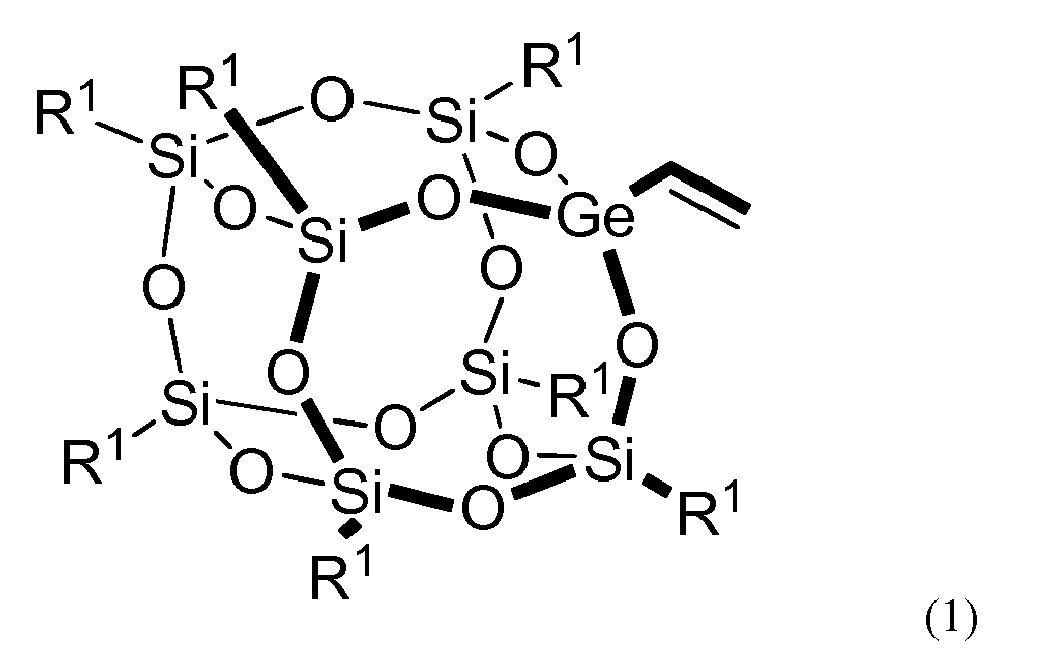
- the invention relates to monovinylgermasilsesquioxanes and the method of their synthesis.
- Monovinylgermasilsesquioxanes can be classified into the group of so-called heterosilsesquioxanes, i.e. silsesquioxanes which in addition to silicon atoms also contain other heteroatoms in their skeleton.
- heterosilsesquioxanes i.e. silsesquioxanes which in addition to silicon atoms also contain other heteroatoms in their skeleton.
- the germanium atom is substituted with an organic group, namely a methyl group, and there are seven cyclohexyl groups at the silicon atoms.
- the compound has been synthesized by Feher et al., and is characterized only on the basis of 1 H and 13 C NMR spectra ( F. J. Feher, D. A. Newman, J. F. Walzer J. Am. Chem. Soc. 1989, 111 (5), 1741-1748 .
- Silsesquioxanes containing vinyl groups have an application as substrates for the synthesis of functionalized unsaturated macromolecular compounds which can contain as substituents ⁇ -conjugated olefins as well as groups containing silicon and other metalloids.
- the compounds are used as photophysically active components in composite materials for applications in optoelectronics or, alternatively, they can perform the function of nanofillers with diverse properties.
- An appropriate selection of substituents makes it possible to selectively modify the POSS over a broad range of their properties including solubility (in solvents and composite materials), photoactivity, possibility of combining with a polymer or a composite via chemical bonds in cross-linking reactions, etc.
- the purpose of the invention was to synthesize a silsesquioxane molecule containing an atom of germanium and a vinyl group in the silsesquioxane skeleton.
- the invention relates to new cage monovinylgermasilsesquioxanes of the general formula 1, in which R 1 are the same and represent:
- the invention relates to the method of synthesis of cage monovinylgermasilsesquioxanes of the general formula 1, in which R 1 are the same and represent:
- the reactions are carried out in an organic solvent selected from the group consisting of ethers, saturated hydrocarbons and aromatic hydrocarbons. It is advantageous to use solvents selected from the group consisting of THF, hexane, pentane, diethyl ether and benzene.
- the reaction of synthesis of vinylgermasilsesquioxanes should preferably be carried out in anhydrous conditions. Conducting the reaction in the presence of water leads to a major decrease in the yield of the process due to the high reactivity of vinyltrichlorogermane in reaction with water, producing not clearly identified germoxanes.
- the reaction can be carried out in an air atmosphere, however in order to achieve the highest reaction yields, the reaction should preferably be carried out in an atmosphere of an inert gas, e.g. argon or nitrogen.
- an inert gas e.g. argon or nitrogen.
- the reagents and solvents should be dried so as to avoid the formation of by-products which can be very difficult or even impossible to separate from the product proper.
- the reaction can be carried out over a broad temperature range, however it is advantageously carried out at room temperature, since higher temperatures do not have a significant effect on increasing the yield, whereas reducing the temperature has a substantial effect on decreasing the yield of the reaction.
- the amine can be selected from trialkyl- or dialkylamines, and it is particularly advantageous to use triethylamine.
- the amine plays the role of a reagent initiating the reaction between trisilanol POSS and vinyltrichlorogermane. At the same time, the amine can perform the function of a compound binding hydrogen chloride which is a product of the condensation reaction.
- the agent binding hydrogen chloride can be any compound dissolving in the reaction environment and forming a stable salt with chloride anions.
- the synthesis reaction takes place at the molar ratio of the reagents [vinyltrichlorogermane] : [trisilanol POSS] of 1:1. It is advantageous to use a slight excess of vinyltrichlorogermane.
- the reaction involves the use of an amine in an amount not less than one equivalent relative to trisilanol POSS, however when the amine is also used as an agent binding hydrogen chloride, it is used in an amount not less than 3.6 equivalents relative to vinyltrichlorogermane.
- Known cubic vinylsubstituted silsesquioxanes are compounds used as precursors for functionalized unsaturated POSS containing ⁇ -conjugated olefins as substituents; such compounds have an application as well-defined stable chromophores and photoactive nanofillers ( B. Marciniec, P. ⁇ ak, M. Majchrzak, C. Pietraszuk, J.Organomet.Chem., 2011, 696, 887 ).
- germasiloxanes Due to the presence of a Ge-O-Si group in their structure germasiloxanes are characterized by higher values of the refractive index than siloxanes, which is why oligo- and polymeric germasiloxanes are applied in the manufacture of specialized spin glasses, glass films, microlenses, lasers and adhesive layers.
- the compounds according to the invention contain Ge-O-Si bonds in their structure, and hence combine the characteristics of known silsesquioxanes with properties of compounds containing a GeO-Si group, which makes them suitable for application in composite optical materials or a substrate in the synthesis of functionalized oligomers with specific electron properties determined both by substituents bound to the germasilsesquioxane core and through the Ge-O-Si bond itself.
- the introduction of a germanium atom into the POSS cage structure produces compounds exhibiting similar characteristics as POSS containing only silicon and, at the same time, due to the introduction of a germanium atom into the silsesquioxane cage and different properties and reactivity of the vinyl group at the germanium atom, makes it possible to synthesize compounds of diverse properties, having the characteristics of nanofillers and compounds with specific optical properties, which can have an application for the manufacture of optical materials with specific parameters.
- Identification data of acquired compounds are listed in a table.
- vinyltrichlorogermane (0.95 mL, 7.58 mmol) was added drop by drop into the reaction mixture, at room temperature, resulting in the formation of white precipitate of ammonia salt.
Landscapes
- Chemical & Material Sciences (AREA)
- Organic Chemistry (AREA)
- Organic Low-Molecular-Weight Compounds And Preparation Thereof (AREA)
- Acyclic And Carbocyclic Compounds In Medicinal Compositions (AREA)
Abstract
Description
- The invention relates to monovinylgermasilsesquioxanes and the method of their synthesis.
- Monovinylgermasilsesquioxanes can be classified into the group of so-called heterosilsesquioxanes, i.e. silsesquioxanes which in addition to silicon atoms also contain other heteroatoms in their skeleton. To date, there was only one known compound containing a germanium atom in its silsesquioxane skeleton. Therefore, the germanium atom is substituted with an organic group, namely a methyl group, and there are seven cyclohexyl groups at the silicon atoms. The compound has been synthesized by Feher et al., and is characterized only on the basis of 1H and 13C NMR spectra (F. J. Feher, D. A. Newman, J. F. Walzer J. Am. Chem. Soc. 1989, 111 (5), 1741-1748.
- Silsesquioxanes containing vinyl groups have an application as substrates for the synthesis of functionalized unsaturated macromolecular compounds which can contain as substituents π-conjugated olefins as well as groups containing silicon and other metalloids. The compounds are used as photophysically active components in composite materials for applications in optoelectronics or, alternatively, they can perform the function of nanofillers with diverse properties. An appropriate selection of substituents makes it possible to selectively modify the POSS over a broad range of their properties including solubility (in solvents and composite materials), photoactivity, possibility of combining with a polymer or a composite via chemical bonds in cross-linking reactions, etc.
- The purpose of the invention was to synthesize a silsesquioxane molecule containing an atom of germanium and a vinyl group in the silsesquioxane skeleton.
- The invention relates to new cage monovinylgermasilsesquioxanes of the general formula 1,

- a C1 to C6 alkyl group
or - a cyclopentyl or cyclohexyl group
or - a phenyl group
- In the second aspect, the invention relates to the method of synthesis of cage monovinylgermasilsesquioxanes of the general formula 1,

- a C1 to C6 alkyl group
or - a cyclopentyl or cyclohexyl group
or - a phenyl group,
- The reactions are carried out in an organic solvent selected from the group consisting of ethers, saturated hydrocarbons and aromatic hydrocarbons. It is advantageous to use solvents selected from the group consisting of THF, hexane, pentane, diethyl ether and benzene.
- Due to the properties of vinyltrichlorogermane, the reaction of synthesis of vinylgermasilsesquioxanes should preferably be carried out in anhydrous conditions. Conducting the reaction in the presence of water leads to a major decrease in the yield of the process due to the high reactivity of vinyltrichlorogermane in reaction with water, producing not clearly identified germoxanes.
- The reaction can be carried out in an air atmosphere, however in order to achieve the highest reaction yields, the reaction should preferably be carried out in an atmosphere of an inert gas, e.g. argon or nitrogen.
- The reagents and solvents should be dried so as to avoid the formation of by-products which can be very difficult or even impossible to separate from the product proper.
- The reaction can be carried out over a broad temperature range, however it is advantageously carried out at room temperature, since higher temperatures do not have a significant effect on increasing the yield, whereas reducing the temperature has a substantial effect on decreasing the yield of the reaction.
- The amine can be selected from trialkyl- or dialkylamines, and it is particularly advantageous to use triethylamine. The amine plays the role of a reagent initiating the reaction between trisilanol POSS and vinyltrichlorogermane. At the same time, the amine can perform the function of a compound binding hydrogen chloride which is a product of the condensation reaction.
- The agent binding hydrogen chloride can be any compound dissolving in the reaction environment and forming a stable salt with chloride anions.
- The synthesis reaction takes place at the molar ratio of the reagents [vinyltrichlorogermane] : [trisilanol POSS] of 1:1. It is advantageous to use a slight excess of vinyltrichlorogermane. The reaction involves the use of an amine in an amount not less than one equivalent relative to trisilanol POSS, however when the amine is also used as an agent binding hydrogen chloride, it is used in an amount not less than 3.6 equivalents relative to vinyltrichlorogermane.
- It is advantageous to carry out the reaction by applying the following sequence of adding reagents: first, dissolve trisilanol POSS in a selected solvent, then add an amine and mix the entire contents intensively for several minutes, and afterwards add vinyltrichlorogermane, advantageously in small portions. A change in the sequence of adding reagents may result in reduced reaction yield or the formation of a large quantity of by-products, e.g. as a result of incomplete condensation of the germasilsesquioxane cage or side reactions related to the ineffective binding of released hydrogen chloride which can initiate self-condensation or significant structural changes in trisilanol POSS.
- The products are purified in the following manner:
- a) if the reaction is carried out in saturated hydrocarbons (e.g. pentane, hexane) or aromatic hydrocarbons (e.g. benzene, toluene), upon its completion the formed ammonium salt is filtered off, and the solvent is evaporated under reduced pressure. The dry residue is combined with a solution of methanol in water, advantageously at a concentration between 75 and 80%, in order to wash away soluble residues of substrates and by-products. The products, which have the form of powders, are filtered off and finally dried under reduced pressure. Depending on its intended application, the product is purified further using known methods.
- b) if the reaction is carried out in ethers, the solvent should be evaporated under reduced pressure and then the residue should be combined with a small amount of a light saturated hydrocarbon (e.g. pentane, hexane or petroleum ether), in which the reaction product is dissolved for the purpose of separation from residues of the ammonium salt whose solubility in ether solvents is slightly higher than in hydrocarbons. The ammonium salt precipitate is then filtered off, and the solvent is removed from the filtrate under reduced pressure. The dry residue is combined with a solution of methanol in water, advantageously at a concentration between 75 and 80%, in order to wash away soluble residues of substrates and by-products. The products, which have the form of powders, are filtered off and finally dried under reduced pressure. Depending on its intended application, the product is purified further using known methods.
- Known cubic vinylsubstituted silsesquioxanes are compounds used as precursors for functionalized unsaturated POSS containing π-conjugated olefins as substituents; such compounds have an application as well-defined stable chromophores and photoactive nanofillers (B. Marciniec, P. Żak, M. Majchrzak, C. Pietraszuk, J.Organomet.Chem., 2011, 696, 887). Due to the presence of a Ge-O-Si group in their structure germasiloxanes are characterized by higher values of the refractive index than siloxanes, which is why oligo- and polymeric germasiloxanes are applied in the manufacture of specialized spin glasses, glass films, microlenses, lasers and adhesive layers.
- The compounds according to the invention contain Ge-O-Si bonds in their structure, and hence combine the characteristics of known silsesquioxanes with properties of compounds containing a GeO-Si group, which makes them suitable for application in composite optical materials or a substrate in the synthesis of functionalized oligomers with specific electron properties determined both by substituents bound to the germasilsesquioxane core and through the Ge-O-Si bond itself.
- The introduction of a germanium atom into the POSS cage structure produces compounds exhibiting similar characteristics as POSS containing only silicon and, at the same time, due to the introduction of a germanium atom into the silsesquioxane cage and different properties and reactivity of the vinyl group at the germanium atom, makes it possible to synthesize compounds of diverse properties, having the characteristics of nanofillers and compounds with specific optical properties, which can have an application for the manufacture of optical materials with specific parameters.
- The method according to the invention is presented in examples given below which do not limit the applications of the invention.
- Identification data of acquired compounds are listed in a table.
- The analysis of products was performed with:
- the 1H and 13C-NMR spectra were recorded on a Varian Gemini 300 spectrometer at 300 and 75 MHz,
- the 29Si NMR spectra were recorded on a Varian Avance 600 spectrometer at 119.203 MHz,
- the mass spectra were recorded on a 4000 Q TRAP system from Applied Biosystems.
- A two-necked flask with a volume of 500 mL, equipped with a reflux condenser and an adapter for introducing inert gas, was loaded in an argon atmosphere with trisilanolisobutyl POSS (5 g, 6.32 mmol), deoxygenated and dried tetrahydrofuran (200 mL), and triethylamine (3.17 mL, 22.75 mmol). Next, vinyltrichlorogermane (0.95 mL, 7.58 mmol) was added drop by drop into the reaction mixture, at room temperature, resulting in the formation of white precipitate of ammonia salt. The suspension was mixed for 24 h at room temperature, and then filtered in air on a glass sinter connected to a membrane pump. The precipitate was washed with tetrahydrofuran (3 × 10 mL), and the resulting filtrate was evaporated until dryness. The residues were then combined with a cold aqueous solution of methanol, which led to the formation of white precipitate that was filtered on a glass sinter funnel. Monovinylheptaisobutylgermasilsesquioxane in the form of white powder was obtained with a yield of 89%.
- Following the procedure set out in Example I, a reaction was carried out between trisilanolethyl POSS (5 g, 7.22 mmol), triethylamine (3.62 mL, 25.99 mmol) and vinyltrichlorogermane (1.08 mL, 8.66 mmol). Monovinylheptaethylgermasilsesquioxane in the form of white powder was obtained with a yield of 92%.
- Following the procedure set out in Example I, a reaction was carried out between trisilanolphenyl POSS (5 g, 4.86 mmol), triethylamine (2.44 mL, 17.51 mmol) and vinyltrichlorogermane (0.73 mL, 5.83 mmol). Monovinylheptaphenylgermasilsesquioxane in the form of white powder was obtained with a yield of 90%.
- Following the procedure set out in Example I, a reaction was carried out between trisilanolcyclopentyl POSS (5 g, 5.14 mmol), triethylamine (2.60 mL, 18.50 mmol) and vinyltrichlorogermane (0.77 mL, 6.17 mmol). Monovinylheptacyclopentylgermasilsesquioxane in the form of white powder was obtained with a yield of 87%.
- Following the procedure set out in Example I, a reaction was carried out between trisilanolcyclohexyl POSS (5 g, 4.67 mmol), triethylamine (2.34 mL, 16.82 mmol) and trichlorovinyl-germanane (0.7 mL, 5.6 mmol). Monovinylheptacyclohexylgermasilsesquioxane in the form of white powder was obtained with a yield of 84%.
Table EXAMPLE I Name of chemical compound Monovinylheptaisobutylgermasilsesquioxane Formula of chemical compound 
NMR analysis + HRMS analysis 1H NMR (CDCl3, δ, ppm): 0.58-0.64 (m, 14H, CH2), 0.92-0.97 (m, 42H, CH3), 1.80-1.91 (m, 7H, CH), 6.01 (dd, 1H, JHH = 19.9, 12.6 Hz, CH=CH2), 6.11 (dd, 1H, JHH = 19.9, 3.1 Hz, CH=CH 2), 6.19 (dd, 1H, JHH = 12.6, 3.1 Hz, CH=CH 2); 13C NMR (CDCl3, δ, ppm): 22.60, 22.92 (CH2), 23.86, 23.97 (CH), 25.68, 25.72 (CH3), 126.50 (=CH-Ge), 137.12 (=CH2) 29Si NMR (CDCl3, δ, ppm): - 65.7, -67.6, -68.15 MS (ASAP): m/z (%): 885.23 (40), 887.22 (68), 889.22 (100), 890.22 (66), 891.22 (54), 892.22 (28), 893.22 (13) HRMS (ASAP) for C30H67GeO12Si7: calcd 889.2229; found 1889.2236 EXAMPLE II Name of chemical compound Monovinylheptaethylgermasilsesquioxane Formula of chemical compound 
NMR analysis + HRMS analysis 1H NMR (CDCl3, δ, ppm): 0.56-0.66 (m, 21H, CH3), 0.96-1.03 (m, 14H, CH 2), 6.03 (dd, 1H, JHH = 19.9, 12.6 Hz, CH=CH2), 6.14 (dd, 1H, JHH = 19.9, 3.1 Hz, CH=CH 2), 6.21 (dd, 1H, JHH = 12.6, 3.1 Hz, CH=CH 2) 13C NMR (CDCl3, δ, ppm): 4.12, 4.49 (CH2), 6.51, 6.73 (CH3), 126.39 (=CH-Ge), 137.23 (=CH2) 19Si NMR: (CDCl3, δ, ppm): -63.62, -65.11, -65.68 MS (ASAP): m/z (%): 660.96 (12), 662.96 (21), 664.96 (11), 678.97 (28), 682.98 (17), 689 (31), 691 (60), 693 (100), 694 (48), 695 (39), 701.98 (13), 702.98 (11), 703.99 (22), 704.98 (13) HRMS (ASAP) for C16H39GeO12Si7: calcd 693.0038; found 693.0032; EXAMPLE III Name of chemical compound Monovinylheptaphenylgermasilsesquioxane Formula of chemical compound 
NMR analysis + HRMS analysis 1H NMR (CDCl3, δ, ppm): 6.16 (dd, 1H, JHH = 19.8, 12.3 Hz, CH=CH2), 6.25 (dd, 1H, JHH = 17.1, 2.7 Hz, CH=CH2 ), 6.30 (dd, 1H, JHH = 9.7, 2.7 Hz, CH=CH 2), 7.30-7.81 (m, 35H, Ph) 13C NMR (CDCl3, δ, ppm): 127.78 (=CH-Ge), 130.44, 130.52, 130.63, 131.19 (ipso-C with C6H5), 134.17 (=CH2) 29Si NMR: (CDCl3, δ, ppm):- 76.99, - 78.12, - 78.58 MS (ASAP): m/z (%): 889.22 (25), 1025.01 (36), 1027.01 (62), 1029.01 (100), 1030.01 (72), 1031.01 (58), 1032.01 (30) HRMS (ASAP) for C44H39GeO12Si7: calcd 1029.0038; found 1029.0056 EXAMPLE IV Name of chemical compound Monovinylheptacyclopentylgermasilsesquioxane Formula of chemical compound 
NMR analysis + HRMS analysis 1H NMR (CDCl3, δ, ppm): 0.88-1.27 (m, 7H, cyclopentyl-CH), 1.36-1.90 (m, 56H, cyclopentyl-CH 2), 6.02 (dd, 1H, JHH = 19.8, 11.8 Hz, CH=CH2), 6.12 (dd, 1H, JHH = 20.8, 5.0 Hz, CH=CH2), 6.20 (dd, 1H, JHH = 8.4, 3.4 Hz, CH=CH 2) 13C NMR (CDCl3, δ, ppm): 22.34, 22.81 (cyclopentyl-CH), 26.97, 27.02, 27.30, 27.53 (cyclopentyl-CH2), 126.76 (=CH-Ge), 136.89 (=CH2) 29Si NMR: (CDCl3, δ, ppm): -64.26, -65.76, -66.35 MS (ASAP): m/z (%): 835.08 (49), 903.14 (17), 921.15 (100), 944.17 (76), 973.22 (80) HRMS (ASAP) for C37H67GeO12Si7: calcd 973.2209; found 973.2229 EXAMPLE V Name of chemical compound Monovinylheptacyclohexylgermasilsesquioxane Formula of chemical compound 
NMR analysis + HRMS analysis 1H NMR (CDCl3, δ, ppm): 0.55-0.68 (m, 7H, cyclohexyl-CH), 0.99-1.19 (m, 35H, cyclohexyl-CH 2), 1.47-1.68 (m, 35H, cyclohexyl-CH 2), 5.87 (dd, 1H, JHH = 19.9, 12.9 Hz, CH=CH2), 5.98 (dd, 1H, JHH = 19.9, 2.9 Hz, CH=CH 2), 6.06 (dd, 1H, JHH = 12.9, 2.8 Hz, CH=CH 2) 13C NMR (CDCl3, δ, ppm): 21.77, 22.74 (cyclohexyl-CH), 25.19, 25.42, 25.45, 26.05, 26.10 (cyclohexyl-CH2), 125.78 (=CH-Ge), 136.29 (=CH2) 29Si NMR: (CDCl3, δ, ppm): -68.56, -70.00, -70.52 MS (ASAP): m/z (%): 905.16 (39), 987.24 (15), 1005.25 (100), 1028.27 (72), 1071.33 (49) HRMS (ASAP) for C44H81GeO12Si7: calcd 1071.3319; found 1071.3325


Claims (5)
- Cage monovinylgermasilsesquioxanes of the general formula 1,
 - a C1 to C6 alkyl group
or- a cyclopentyl or cyclohexyl group
or- a phenyl group. - The method of synthesis of monovinylgermasilsesquioxanes of the general formula 1,
 - a C1 to C6 alkyl group
or- a cyclopentyl or cyclohexyl group
or- a phenyl groupwherein it comprises the reaction between incompletely condensed trisilanols of the general ) formula 2,

- The method, as claimed in Claim 2, wherein the amine can be selected from trialkyl- or dialkylamines.
- The method, as claimed in Claim 3, wherein the amine is triethylamine.
- The method, as claimed in Claims 2 or 3, wherein the amine is used in an amount not less than ) one equivalent relative to trisilanol.
Priority Applications (1)
| Application Number | Priority Date | Filing Date | Title |
|---|---|---|---|
| PL15461520T PL3040339T3 (en) | 2014-12-31 | 2015-03-26 | Monovinylgermasilsesquioxanes |
Applications Claiming Priority (1)
| Application Number | Priority Date | Filing Date | Title |
|---|---|---|---|
| PL410690A PL228646B1 (en) | 2014-12-31 | 2014-12-31 | Monovinyl germasilsesquioxanes |
Publications (2)
| Publication Number | Publication Date |
|---|---|
| EP3040339A1 true EP3040339A1 (en) | 2016-07-06 |
| EP3040339B1 EP3040339B1 (en) | 2017-08-02 |
Family
ID=52737041
Family Applications (1)
| Application Number | Title | Priority Date | Filing Date |
|---|---|---|---|
| EP15461520.7A Not-in-force EP3040339B1 (en) | 2014-12-31 | 2015-03-26 | Monovinylgermasilsesquioxanes |
Country Status (4)
| Country | Link |
|---|---|
| US (1) | US9249167B1 (en) |
| EP (1) | EP3040339B1 (en) |
| CN (1) | CN106146547A (en) |
| PL (2) | PL228646B1 (en) |
Families Citing this family (1)
| Publication number | Priority date | Publication date | Assignee | Title |
|---|---|---|---|---|
| EP4251631A1 (en) * | 2020-11-27 | 2023-10-04 | Johann Wolfgang Goethe-Universität | Polycyclic silicon-germanium compounds, process of preparing same and their use for producing a si- and ge-containing solid |
-
2014
- 2014-12-31 PL PL410690A patent/PL228646B1/en unknown
-
2015
- 2015-03-26 EP EP15461520.7A patent/EP3040339B1/en not_active Not-in-force
- 2015-03-26 PL PL15461520T patent/PL3040339T3/en unknown
- 2015-03-30 CN CN201510144737.5A patent/CN106146547A/en active Pending
- 2015-04-02 US US14/677,125 patent/US9249167B1/en not_active Expired - Fee Related
Non-Patent Citations (3)
| Title |
|---|
| B. MARCINIEC; P. ZAK; M. MAJCHRZAK; C. PIETRASZUK, J. ORGANOMET. CHERN., vol. 696, 2011, pages 887 |
| F. J. FEHER; D. A. NEWMAN; J. F. WALZER, J. AM. CHEM. SOC., vol. 111, no. 5, 1989, pages 1741 - 1748 |
| FEHER F J ET AL: "SILSESQUIOXANES AS MODELS FOR SILICA SURFACES", JOURNAL OF THE AMERICAN CHEMICAL SOCIETY, [NOT]AMERICAN CHEMICAL SOCIETY|, vol. 111, 1 March 1989 (1989-03-01), pages 1741 - 1748, XP001037318, ISSN: 0002-7863, DOI: 10.1021/JA00187A028 * |
Also Published As
| Publication number | Publication date |
|---|---|
| PL410690A1 (en) | 2016-07-04 |
| CN106146547A (en) | 2016-11-23 |
| EP3040339B1 (en) | 2017-08-02 |
| PL3040339T3 (en) | 2018-05-30 |
| PL228646B1 (en) | 2018-04-30 |
| US9249167B1 (en) | 2016-02-02 |
Similar Documents
| Publication | Publication Date | Title |
|---|---|---|
| JP2002503640A (en) | Schiff base derivatives of ruthenium and osmium metathesis catalysts | |
| Singh et al. | Synthesis of novel 1, 2, 3-triazole based silatranes via “click silylation” | |
| EP3177751A1 (en) | Process for the generation of thin inorganic films | |
| JP5702403B2 (en) | Process for the production of carbene in solution, in particular a new stable form of carbene obtained by said process and its use in catalytic reactions | |
| CN110062655B (en) | Organometallic complex catalyst | |
| US9255112B1 (en) | (Dimethylvinylgermoxy)heptasubstituted silsesquioxanes and the method of their synthesis | |
| Dutkiewicz et al. | Functionalization of polyhedral oligomeric silsesquioxane (POSS) via nucleophilic substitution | |
| Jones et al. | Photochemical treatment of transition metal substituted disilanes,(. eta. 5-C5H5) Fe (CO) 2Si2Me4 (C6H4X)(X= Cl, CF3, NMe2, OMe, H), including trapping of expelled silylene | |
| EP3040339B1 (en) | Monovinylgermasilsesquioxanes | |
| JP6332682B2 (en) | Method for producing hydrosilane compound | |
| KR102320689B1 (en) | Isocyanuric acid derivative having an alkoxyalkyl group and method for producing the same | |
| Buerger et al. | Novel (fluoromethyl) silicon derivatives from (fluorodibromomethyl) silane precursors | |
| TWI433871B (en) | Process for assembly of poss monomers | |
| TW202214663A (en) | Novel perchlorinated disilenes and germasilenes and also neopentatetrelanes, a method for the preparation thereof and use thereof | |
| Antiñolo et al. | Studies on the reactivity of Nb (η5-C5H4SiMe3) 2 (X)(L), X= H, Cl; L= CNXylyl, CNCy, CO and Nb (η5-C5H4SiMe3) 2 (H) 3 complexes toward the Lewis acids B (C6F5) 3 and BF3 | |
| JP2019094314A (en) | Triazine-2,4-dione derivative and manufacturing method therefor | |
| JPWO2017154846A1 (en) | Method for producing silyl compound by hydrosilylation of allyl compound using iridium complex, etc. | |
| RU2592061C2 (en) | Sodium oxide(aminopropyl)dialkoxysilanes and methods for production thereof | |
| EP4406647B1 (en) | Organic metal complex catalyst for olefin metathesis reaction | |
| JP6286755B2 (en) | Novel diamine compound and metal complex, and method for producing optically active compound | |
| Arink et al. | A recyclable nanosize aminoarenethiolato copper (I) catalyst for C–C coupling reactions | |
| Campos-Dominguez et al. | Synthesis of transition metal complexes bearing bis-NHC ligands bridged by a thioether group | |
| JP2010235596A (en) | Method for producing pyrroles alkylated at β-position | |
| KR101017143B1 (en) | Catalyst, preparation method thereof and norbornene-ester compound prepared therefrom | |
| Lo et al. | Synthesis and reactivity of ruthenium tetrazolate complexes containing a tris (pyrazolyl) borato (Tp) ligand |
Legal Events
| Date | Code | Title | Description |
|---|---|---|---|
| PUAI | Public reference made under article 153(3) epc to a published international application that has entered the european phase |
Free format text: ORIGINAL CODE: 0009012 |
|
| 17P | Request for examination filed |
Effective date: 20150601 |
|
| AK | Designated contracting states |
Kind code of ref document: A1 Designated state(s): AL AT BE BG CH CY CZ DE DK EE ES FI FR GB GR HR HU IE IS IT LI LT LU LV MC MK MT NL NO PL PT RO RS SE SI SK SM TR |
|
| AX | Request for extension of the european patent |
Extension state: BA ME |
|
| 17Q | First examination report despatched |
Effective date: 20160927 |
|
| GRAP | Despatch of communication of intention to grant a patent |
Free format text: ORIGINAL CODE: EPIDOSNIGR1 |
|
| INTG | Intention to grant announced |
Effective date: 20170426 |
|
| GRAS | Grant fee paid |
Free format text: ORIGINAL CODE: EPIDOSNIGR3 |
|
| GRAA | (expected) grant |
Free format text: ORIGINAL CODE: 0009210 |
|
| AK | Designated contracting states |
Kind code of ref document: B1 Designated state(s): AL AT BE BG CH CY CZ DE DK EE ES FI FR GB GR HR HU IE IS IT LI LT LU LV MC MK MT NL NO PL PT RO RS SE SI SK SM TR |
|
| REG | Reference to a national code |
Ref country code: CH Ref legal event code: EP Ref country code: AT Ref legal event code: REF Ref document number: 914336 Country of ref document: AT Kind code of ref document: T Effective date: 20170815 |
|
| REG | Reference to a national code |
Ref country code: IE Ref legal event code: FG4D |
|
| REG | Reference to a national code |
Ref country code: DE Ref legal event code: R096 Ref document number: 602015003898 Country of ref document: DE |
|
| REG | Reference to a national code |
Ref country code: NL Ref legal event code: MP Effective date: 20170802 |
|
| REG | Reference to a national code |
Ref country code: AT Ref legal event code: MK05 Ref document number: 914336 Country of ref document: AT Kind code of ref document: T Effective date: 20170802 |
|
| REG | Reference to a national code |
Ref country code: LT Ref legal event code: MG4D |
|
| PG25 | Lapsed in a contracting state [announced via postgrant information from national office to epo] |
Ref country code: HR Free format text: LAPSE BECAUSE OF FAILURE TO SUBMIT A TRANSLATION OF THE DESCRIPTION OR TO PAY THE FEE WITHIN THE PRESCRIBED TIME-LIMIT Effective date: 20170802 Ref country code: NO Free format text: LAPSE BECAUSE OF FAILURE TO SUBMIT A TRANSLATION OF THE DESCRIPTION OR TO PAY THE FEE WITHIN THE PRESCRIBED TIME-LIMIT Effective date: 20171102 Ref country code: NL Free format text: LAPSE BECAUSE OF FAILURE TO SUBMIT A TRANSLATION OF THE DESCRIPTION OR TO PAY THE FEE WITHIN THE PRESCRIBED TIME-LIMIT Effective date: 20170802 Ref country code: AT Free format text: LAPSE BECAUSE OF FAILURE TO SUBMIT A TRANSLATION OF THE DESCRIPTION OR TO PAY THE FEE WITHIN THE PRESCRIBED TIME-LIMIT Effective date: 20170802 Ref country code: SE Free format text: LAPSE BECAUSE OF FAILURE TO SUBMIT A TRANSLATION OF THE DESCRIPTION OR TO PAY THE FEE WITHIN THE PRESCRIBED TIME-LIMIT Effective date: 20170802 Ref country code: LT Free format text: LAPSE BECAUSE OF FAILURE TO SUBMIT A TRANSLATION OF THE DESCRIPTION OR TO PAY THE FEE WITHIN THE PRESCRIBED TIME-LIMIT Effective date: 20170802 Ref country code: FI Free format text: LAPSE BECAUSE OF FAILURE TO SUBMIT A TRANSLATION OF THE DESCRIPTION OR TO PAY THE FEE WITHIN THE PRESCRIBED TIME-LIMIT Effective date: 20170802 |
|
| PG25 | Lapsed in a contracting state [announced via postgrant information from national office to epo] |
Ref country code: BG Free format text: LAPSE BECAUSE OF FAILURE TO SUBMIT A TRANSLATION OF THE DESCRIPTION OR TO PAY THE FEE WITHIN THE PRESCRIBED TIME-LIMIT Effective date: 20171102 Ref country code: RS Free format text: LAPSE BECAUSE OF FAILURE TO SUBMIT A TRANSLATION OF THE DESCRIPTION OR TO PAY THE FEE WITHIN THE PRESCRIBED TIME-LIMIT Effective date: 20170802 Ref country code: GR Free format text: LAPSE BECAUSE OF FAILURE TO SUBMIT A TRANSLATION OF THE DESCRIPTION OR TO PAY THE FEE WITHIN THE PRESCRIBED TIME-LIMIT Effective date: 20171103 Ref country code: LV Free format text: LAPSE BECAUSE OF FAILURE TO SUBMIT A TRANSLATION OF THE DESCRIPTION OR TO PAY THE FEE WITHIN THE PRESCRIBED TIME-LIMIT Effective date: 20170802 Ref country code: IS Free format text: LAPSE BECAUSE OF FAILURE TO SUBMIT A TRANSLATION OF THE DESCRIPTION OR TO PAY THE FEE WITHIN THE PRESCRIBED TIME-LIMIT Effective date: 20171202 Ref country code: ES Free format text: LAPSE BECAUSE OF FAILURE TO SUBMIT A TRANSLATION OF THE DESCRIPTION OR TO PAY THE FEE WITHIN THE PRESCRIBED TIME-LIMIT Effective date: 20170802 |
|
| REG | Reference to a national code |
Ref country code: FR Ref legal event code: PLFP Year of fee payment: 4 |
|
| PG25 | Lapsed in a contracting state [announced via postgrant information from national office to epo] |
Ref country code: DK Free format text: LAPSE BECAUSE OF FAILURE TO SUBMIT A TRANSLATION OF THE DESCRIPTION OR TO PAY THE FEE WITHIN THE PRESCRIBED TIME-LIMIT Effective date: 20170802 Ref country code: RO Free format text: LAPSE BECAUSE OF FAILURE TO SUBMIT A TRANSLATION OF THE DESCRIPTION OR TO PAY THE FEE WITHIN THE PRESCRIBED TIME-LIMIT Effective date: 20170802 Ref country code: CZ Free format text: LAPSE BECAUSE OF FAILURE TO SUBMIT A TRANSLATION OF THE DESCRIPTION OR TO PAY THE FEE WITHIN THE PRESCRIBED TIME-LIMIT Effective date: 20170802 |
|
| REG | Reference to a national code |
Ref country code: DE Ref legal event code: R097 Ref document number: 602015003898 Country of ref document: DE |
|
| PG25 | Lapsed in a contracting state [announced via postgrant information from national office to epo] |
Ref country code: SM Free format text: LAPSE BECAUSE OF FAILURE TO SUBMIT A TRANSLATION OF THE DESCRIPTION OR TO PAY THE FEE WITHIN THE PRESCRIBED TIME-LIMIT Effective date: 20170802 Ref country code: IT Free format text: LAPSE BECAUSE OF FAILURE TO SUBMIT A TRANSLATION OF THE DESCRIPTION OR TO PAY THE FEE WITHIN THE PRESCRIBED TIME-LIMIT Effective date: 20170802 Ref country code: EE Free format text: LAPSE BECAUSE OF FAILURE TO SUBMIT A TRANSLATION OF THE DESCRIPTION OR TO PAY THE FEE WITHIN THE PRESCRIBED TIME-LIMIT Effective date: 20170802 Ref country code: SK Free format text: LAPSE BECAUSE OF FAILURE TO SUBMIT A TRANSLATION OF THE DESCRIPTION OR TO PAY THE FEE WITHIN THE PRESCRIBED TIME-LIMIT Effective date: 20170802 |
|
| PLBE | No opposition filed within time limit |
Free format text: ORIGINAL CODE: 0009261 |
|
| STAA | Information on the status of an ep patent application or granted ep patent |
Free format text: STATUS: NO OPPOSITION FILED WITHIN TIME LIMIT |
|
| 26N | No opposition filed |
Effective date: 20180503 |
|
| PG25 | Lapsed in a contracting state [announced via postgrant information from national office to epo] |
Ref country code: SI Free format text: LAPSE BECAUSE OF FAILURE TO SUBMIT A TRANSLATION OF THE DESCRIPTION OR TO PAY THE FEE WITHIN THE PRESCRIBED TIME-LIMIT Effective date: 20170802 |
|
| REG | Reference to a national code |
Ref country code: CH Ref legal event code: PL |
|
| PG25 | Lapsed in a contracting state [announced via postgrant information from national office to epo] |
Ref country code: MC Free format text: LAPSE BECAUSE OF FAILURE TO SUBMIT A TRANSLATION OF THE DESCRIPTION OR TO PAY THE FEE WITHIN THE PRESCRIBED TIME-LIMIT Effective date: 20170802 |
|
| REG | Reference to a national code |
Ref country code: BE Ref legal event code: MM Effective date: 20180331 |
|
| REG | Reference to a national code |
Ref country code: IE Ref legal event code: MM4A |
|
| PG25 | Lapsed in a contracting state [announced via postgrant information from national office to epo] |
Ref country code: LU Free format text: LAPSE BECAUSE OF NON-PAYMENT OF DUE FEES Effective date: 20180326 |
|
| PG25 | Lapsed in a contracting state [announced via postgrant information from national office to epo] |
Ref country code: IE Free format text: LAPSE BECAUSE OF NON-PAYMENT OF DUE FEES Effective date: 20180326 |
|
| PG25 | Lapsed in a contracting state [announced via postgrant information from national office to epo] |
Ref country code: BE Free format text: LAPSE BECAUSE OF NON-PAYMENT OF DUE FEES Effective date: 20180331 Ref country code: CH Free format text: LAPSE BECAUSE OF NON-PAYMENT OF DUE FEES Effective date: 20180331 Ref country code: LI Free format text: LAPSE BECAUSE OF NON-PAYMENT OF DUE FEES Effective date: 20180331 |
|
| PGFP | Annual fee paid to national office [announced via postgrant information from national office to epo] |
Ref country code: FR Payment date: 20190212 Year of fee payment: 5 |
|
| PG25 | Lapsed in a contracting state [announced via postgrant information from national office to epo] |
Ref country code: MT Free format text: LAPSE BECAUSE OF NON-PAYMENT OF DUE FEES Effective date: 20180326 |
|
| PG25 | Lapsed in a contracting state [announced via postgrant information from national office to epo] |
Ref country code: TR Free format text: LAPSE BECAUSE OF FAILURE TO SUBMIT A TRANSLATION OF THE DESCRIPTION OR TO PAY THE FEE WITHIN THE PRESCRIBED TIME-LIMIT Effective date: 20170802 |
|
| PG25 | Lapsed in a contracting state [announced via postgrant information from national office to epo] |
Ref country code: PT Free format text: LAPSE BECAUSE OF FAILURE TO SUBMIT A TRANSLATION OF THE DESCRIPTION OR TO PAY THE FEE WITHIN THE PRESCRIBED TIME-LIMIT Effective date: 20170802 |
|
| PG25 | Lapsed in a contracting state [announced via postgrant information from national office to epo] |
Ref country code: HU Free format text: LAPSE BECAUSE OF FAILURE TO SUBMIT A TRANSLATION OF THE DESCRIPTION OR TO PAY THE FEE WITHIN THE PRESCRIBED TIME-LIMIT; INVALID AB INITIO Effective date: 20150326 Ref country code: MK Free format text: LAPSE BECAUSE OF NON-PAYMENT OF DUE FEES Effective date: 20170802 Ref country code: CY Free format text: LAPSE BECAUSE OF FAILURE TO SUBMIT A TRANSLATION OF THE DESCRIPTION OR TO PAY THE FEE WITHIN THE PRESCRIBED TIME-LIMIT Effective date: 20170802 |
|
| PG25 | Lapsed in a contracting state [announced via postgrant information from national office to epo] |
Ref country code: AL Free format text: LAPSE BECAUSE OF FAILURE TO SUBMIT A TRANSLATION OF THE DESCRIPTION OR TO PAY THE FEE WITHIN THE PRESCRIBED TIME-LIMIT Effective date: 20170802 |
|
| PG25 | Lapsed in a contracting state [announced via postgrant information from national office to epo] |
Ref country code: FR Free format text: LAPSE BECAUSE OF NON-PAYMENT OF DUE FEES Effective date: 20200331 |
|
| PGFP | Annual fee paid to national office [announced via postgrant information from national office to epo] |
Ref country code: GB Payment date: 20230330 Year of fee payment: 9 Ref country code: DE Payment date: 20230329 Year of fee payment: 9 |
|
| PGFP | Annual fee paid to national office [announced via postgrant information from national office to epo] |
Ref country code: PL Payment date: 20230328 Year of fee payment: 9 |
|
| REG | Reference to a national code |
Ref country code: DE Ref legal event code: R119 Ref document number: 602015003898 Country of ref document: DE |
|
| GBPC | Gb: european patent ceased through non-payment of renewal fee |
Effective date: 20240326 |
|
| PG25 | Lapsed in a contracting state [announced via postgrant information from national office to epo] |
Ref country code: DE Free format text: LAPSE BECAUSE OF NON-PAYMENT OF DUE FEES Effective date: 20241001 |
|
| PG25 | Lapsed in a contracting state [announced via postgrant information from national office to epo] |
Ref country code: GB Free format text: LAPSE BECAUSE OF NON-PAYMENT OF DUE FEES Effective date: 20240326 |
|
| PG25 | Lapsed in a contracting state [announced via postgrant information from national office to epo] |
Ref country code: GB Free format text: LAPSE BECAUSE OF NON-PAYMENT OF DUE FEES Effective date: 20240326 Ref country code: DE Free format text: LAPSE BECAUSE OF NON-PAYMENT OF DUE FEES Effective date: 20241001 |
|
| PG25 | Lapsed in a contracting state [announced via postgrant information from national office to epo] |
Ref country code: PL Free format text: LAPSE BECAUSE OF NON-PAYMENT OF DUE FEES Effective date: 20240326 |