EP3039016B1 - Process for preparing dronedarone and salts thereof - Google Patents
Process for preparing dronedarone and salts thereof Download PDFInfo
- Publication number
- EP3039016B1 EP3039016B1 EP14759436.0A EP14759436A EP3039016B1 EP 3039016 B1 EP3039016 B1 EP 3039016B1 EP 14759436 A EP14759436 A EP 14759436A EP 3039016 B1 EP3039016 B1 EP 3039016B1
- Authority
- EP
- European Patent Office
- Prior art keywords
- compound
- formula
- reacting
- shown below
- suitable solvent
- Prior art date
- Legal status (The legal status is an assumption and is not a legal conclusion. Google has not performed a legal analysis and makes no representation as to the accuracy of the status listed.)
- Not-in-force
Links
- 150000003839 salts Chemical class 0.000 title claims description 17
- ZQTNQVWKHCQYLQ-UHFFFAOYSA-N dronedarone Chemical compound C1=CC(OCCCN(CCCC)CCCC)=CC=C1C(=O)C1=C(CCCC)OC2=CC=C(NS(C)(=O)=O)C=C12 ZQTNQVWKHCQYLQ-UHFFFAOYSA-N 0.000 title claims description 16
- 229960002084 dronedarone Drugs 0.000 title claims description 15
- 238000004519 manufacturing process Methods 0.000 title description 3
- 150000001875 compounds Chemical class 0.000 claims description 121
- 239000002904 solvent Substances 0.000 claims description 34
- 238000006243 chemical reaction Methods 0.000 claims description 27
- 238000000034 method Methods 0.000 claims description 25
- 239000002253 acid Substances 0.000 claims description 21
- 239000003054 catalyst Substances 0.000 claims description 20
- 230000008569 process Effects 0.000 claims description 16
- KDLHZDBZIXYQEI-UHFFFAOYSA-N Palladium Chemical compound [Pd] KDLHZDBZIXYQEI-UHFFFAOYSA-N 0.000 claims description 15
- 239000002841 Lewis acid Substances 0.000 claims description 7
- 150000007517 lewis acids Chemical class 0.000 claims description 7
- 239000012351 deprotecting agent Substances 0.000 claims description 5
- JPZKJABGOSPYDD-UHFFFAOYSA-N n-benzylmethanesulfonamide Chemical compound CS(=O)(=O)NCC1=CC=CC=C1 JPZKJABGOSPYDD-UHFFFAOYSA-N 0.000 claims description 5
- 229910052763 palladium Inorganic materials 0.000 claims description 5
- HNQIVZYLYMDVSB-UHFFFAOYSA-N methanesulfonimidic acid Chemical compound CS(N)(=O)=O HNQIVZYLYMDVSB-UHFFFAOYSA-N 0.000 claims description 4
- WEVYAHXRMPXWCK-UHFFFAOYSA-N Acetonitrile Chemical compound CC#N WEVYAHXRMPXWCK-UHFFFAOYSA-N 0.000 description 21
- SECXISVLQFMRJM-UHFFFAOYSA-N N-Methylpyrrolidone Chemical compound CN1CCCC1=O SECXISVLQFMRJM-UHFFFAOYSA-N 0.000 description 18
- 239000002585 base Substances 0.000 description 15
- BWHMMNNQKKPAPP-UHFFFAOYSA-L potassium carbonate Chemical compound [K+].[K+].[O-]C([O-])=O BWHMMNNQKKPAPP-UHFFFAOYSA-L 0.000 description 10
- YMWUJEATGCHHMB-UHFFFAOYSA-N Dichloromethane Chemical compound ClCCl YMWUJEATGCHHMB-UHFFFAOYSA-N 0.000 description 9
- VYPSYNLAJGMNEJ-UHFFFAOYSA-N Silicium dioxide Chemical compound O=[Si]=O VYPSYNLAJGMNEJ-UHFFFAOYSA-N 0.000 description 8
- 239000011541 reaction mixture Substances 0.000 description 8
- 239000000203 mixture Substances 0.000 description 7
- MFRIHAYPQRLWNB-UHFFFAOYSA-N sodium tert-butoxide Chemical compound [Na+].CC(C)(C)[O-] MFRIHAYPQRLWNB-UHFFFAOYSA-N 0.000 description 7
- 206010003658 Atrial Fibrillation Diseases 0.000 description 6
- -1 Boc Chemical class 0.000 description 6
- YXFVVABEGXRONW-UHFFFAOYSA-N Toluene Chemical compound CC1=CC=CC=C1 YXFVVABEGXRONW-UHFFFAOYSA-N 0.000 description 6
- 238000010168 coupling process Methods 0.000 description 6
- 239000003446 ligand Substances 0.000 description 6
- 238000002360 preparation method Methods 0.000 description 6
- 125000006239 protecting group Chemical group 0.000 description 6
- MEKOFIRRDATTAG-UHFFFAOYSA-N 2,2,5,8-tetramethyl-3,4-dihydrochromen-6-ol Chemical compound C1CC(C)(C)OC2=C1C(C)=C(O)C=C2C MEKOFIRRDATTAG-UHFFFAOYSA-N 0.000 description 5
- 150000007513 acids Chemical class 0.000 description 5
- 125000001797 benzyl group Chemical group [H]C1=C([H])C([H])=C(C([H])=C1[H])C([H])([H])* 0.000 description 5
- 239000003153 chemical reaction reagent Substances 0.000 description 5
- 238000005859 coupling reaction Methods 0.000 description 5
- 229910000027 potassium carbonate Inorganic materials 0.000 description 5
- 0 CCCCc1c(C(c(cc2)ccc2OCCC**)=O)c2cc(N(Cc3ccccc3)S(C)(=O)=O)ccc2[o]1 Chemical compound CCCCc1c(C(c(cc2)ccc2OCCC**)=O)c2cc(N(Cc3ccccc3)S(C)(=O)=O)ccc2[o]1 0.000 description 4
- IAZDPXIOMUYVGZ-WFGJKAKNSA-N Dimethyl sulfoxide Chemical compound [2H]C([2H])([2H])S(=O)C([2H])([2H])[2H] IAZDPXIOMUYVGZ-WFGJKAKNSA-N 0.000 description 4
- KFZMGEQAYNKOFK-UHFFFAOYSA-N Isopropanol Chemical compound CC(C)O KFZMGEQAYNKOFK-UHFFFAOYSA-N 0.000 description 4
- 239000007832 Na2SO4 Substances 0.000 description 4
- PMZURENOXWZQFD-UHFFFAOYSA-L Sodium Sulfate Chemical compound [Na+].[Na+].[O-]S([O-])(=O)=O PMZURENOXWZQFD-UHFFFAOYSA-L 0.000 description 4
- FAPWRFPIFSIZLT-UHFFFAOYSA-M Sodium chloride Chemical compound [Na+].[Cl-] FAPWRFPIFSIZLT-UHFFFAOYSA-M 0.000 description 4
- VSCWAEJMTAWNJL-UHFFFAOYSA-K aluminium trichloride Chemical compound Cl[Al](Cl)Cl VSCWAEJMTAWNJL-UHFFFAOYSA-K 0.000 description 4
- 238000004587 chromatography analysis Methods 0.000 description 4
- 230000008878 coupling Effects 0.000 description 4
- 239000000741 silica gel Substances 0.000 description 4
- 229910002027 silica gel Inorganic materials 0.000 description 4
- 229910052938 sodium sulfate Inorganic materials 0.000 description 4
- UFHFLCQGNIYNRP-UHFFFAOYSA-N Hydrogen Chemical compound [H][H] UFHFLCQGNIYNRP-UHFFFAOYSA-N 0.000 description 3
- 230000000694 effects Effects 0.000 description 3
- JMMWKPVZQRWMSS-UHFFFAOYSA-N isopropanol acetate Natural products CC(C)OC(C)=O JMMWKPVZQRWMSS-UHFFFAOYSA-N 0.000 description 3
- 229940011051 isopropyl acetate Drugs 0.000 description 3
- GWYFCOCPABKNJV-UHFFFAOYSA-N isovaleric acid Chemical compound CC(C)CC(O)=O GWYFCOCPABKNJV-UHFFFAOYSA-N 0.000 description 3
- DTQVDTLACAAQTR-UHFFFAOYSA-N trifluoroacetic acid Substances OC(=O)C(F)(F)F DTQVDTLACAAQTR-UHFFFAOYSA-N 0.000 description 3
- FCEHBMOGCRZNNI-UHFFFAOYSA-N 1-benzothiophene Chemical compound C1=CC=C2SC=CC2=C1 FCEHBMOGCRZNNI-UHFFFAOYSA-N 0.000 description 2
- ARIQADLUCGCDEU-UHFFFAOYSA-N CCCCNc1c(C(c(cc2)ccc2F)=O)c(cc(cc2)Br)c2[o]1 Chemical compound CCCCNc1c(C(c(cc2)ccc2F)=O)c(cc(cc2)Br)c2[o]1 ARIQADLUCGCDEU-UHFFFAOYSA-N 0.000 description 2
- 238000005863 Friedel-Crafts acylation reaction Methods 0.000 description 2
- 206010019280 Heart failures Diseases 0.000 description 2
- SIKJAQJRHWYJAI-UHFFFAOYSA-N Indole Chemical compound C1=CC=C2NC=CC2=C1 SIKJAQJRHWYJAI-UHFFFAOYSA-N 0.000 description 2
- IMNFDUFMRHMDMM-UHFFFAOYSA-N N-Heptane Chemical compound CCCCCCC IMNFDUFMRHMDMM-UHFFFAOYSA-N 0.000 description 2
- XLOMVQKBTHCTTD-UHFFFAOYSA-N Zinc monoxide Chemical compound [Zn]=O XLOMVQKBTHCTTD-UHFFFAOYSA-N 0.000 description 2
- 150000001412 amines Chemical class 0.000 description 2
- 230000008901 benefit Effects 0.000 description 2
- FJDQFPXHSGXQBY-UHFFFAOYSA-L caesium carbonate Chemical compound [Cs+].[Cs+].[O-]C([O-])=O FJDQFPXHSGXQBY-UHFFFAOYSA-L 0.000 description 2
- 229910000024 caesium carbonate Inorganic materials 0.000 description 2
- 230000000747 cardiac effect Effects 0.000 description 2
- 238000006555 catalytic reaction Methods 0.000 description 2
- 239000003937 drug carrier Substances 0.000 description 2
- 239000000706 filtrate Substances 0.000 description 2
- 238000001914 filtration Methods 0.000 description 2
- 239000001257 hydrogen Substances 0.000 description 2
- 229910052739 hydrogen Inorganic materials 0.000 description 2
- 238000005984 hydrogenation reaction Methods 0.000 description 2
- 238000007327 hydrogenolysis reaction Methods 0.000 description 2
- KVKFRMCSXWQSNT-UHFFFAOYSA-N n,n'-dimethylethane-1,2-diamine Chemical compound CNCCNC KVKFRMCSXWQSNT-UHFFFAOYSA-N 0.000 description 2
- 238000007339 nucleophilic aromatic substitution reaction Methods 0.000 description 2
- 230000009467 reduction Effects 0.000 description 2
- 230000033764 rhythmic process Effects 0.000 description 2
- 239000011780 sodium chloride Substances 0.000 description 2
- 239000007787 solid Substances 0.000 description 2
- 229940124530 sulfonamide Drugs 0.000 description 2
- 150000003456 sulfonamides Chemical class 0.000 description 2
- GAIZFMKSOHADOV-UHFFFAOYSA-N tert-butyl n-methylsulfonylcarbamate Chemical compound CC(C)(C)OC(=O)NS(C)(=O)=O GAIZFMKSOHADOV-UHFFFAOYSA-N 0.000 description 2
- RIOQSEWOXXDEQQ-UHFFFAOYSA-N triphenylphosphine Chemical compound C1=CC=CC=C1P(C=1C=CC=CC=1)C1=CC=CC=C1 RIOQSEWOXXDEQQ-UHFFFAOYSA-N 0.000 description 2
- XLYOFNOQVPJJNP-UHFFFAOYSA-N water Substances O XLYOFNOQVPJJNP-UHFFFAOYSA-N 0.000 description 2
- 238000004293 19F NMR spectroscopy Methods 0.000 description 1
- 238000005160 1H NMR spectroscopy Methods 0.000 description 1
- DMPODMBXLRMZSP-UHFFFAOYSA-N 3-(dibutylamino)propan-1-ol Chemical compound CCCCN(CCCC)CCCO DMPODMBXLRMZSP-UHFFFAOYSA-N 0.000 description 1
- IBOFVQJTBBUKMU-UHFFFAOYSA-N 4,4'-methylene-bis-(2-chloroaniline) Chemical compound C1=C(Cl)C(N)=CC=C1CC1=CC=C(N)C(Cl)=C1 IBOFVQJTBBUKMU-UHFFFAOYSA-N 0.000 description 1
- CZKLEJHVLCMVQR-UHFFFAOYSA-N 4-fluorobenzoyl chloride Chemical compound FC1=CC=C(C(Cl)=O)C=C1 CZKLEJHVLCMVQR-UHFFFAOYSA-N 0.000 description 1
- MRARSUHDVQMVGR-UHFFFAOYSA-N CCCCNc1c(C(c(cc2)ccc2F)=O)c2cc(N(Cc3ccccc3)S(C)(=O)=O)ccc2[o]1 Chemical compound CCCCNc1c(C(c(cc2)ccc2F)=O)c2cc(N(Cc3ccccc3)S(C)(=O)=O)ccc2[o]1 MRARSUHDVQMVGR-UHFFFAOYSA-N 0.000 description 1
- AZWSGVNTYNJTHM-UHFFFAOYSA-N CCCCNc1cc2cc(Br)ccc2[o]1 Chemical compound CCCCNc1cc2cc(Br)ccc2[o]1 AZWSGVNTYNJTHM-UHFFFAOYSA-N 0.000 description 1
- SRPCJHDGFXMKTA-UHFFFAOYSA-N CCCCNc1cc2cc(C)ccc2[o]1 Chemical compound CCCCNc1cc2cc(C)ccc2[o]1 SRPCJHDGFXMKTA-UHFFFAOYSA-N 0.000 description 1
- DQWRDMXWLFZKBP-UHFFFAOYSA-N CCCCc1oc2ccc(cc2c1C(=O)c1ccc(F)cc1)N(Cc1ccccc1)S(C)(=O)=O Chemical compound CCCCc1oc2ccc(cc2c1C(=O)c1ccc(F)cc1)N(Cc1ccccc1)S(C)(=O)=O DQWRDMXWLFZKBP-UHFFFAOYSA-N 0.000 description 1
- 206010007559 Cardiac failure congestive Diseases 0.000 description 1
- 206010008479 Chest Pain Diseases 0.000 description 1
- RYGMFSIKBFXOCR-UHFFFAOYSA-N Copper Chemical compound [Cu] RYGMFSIKBFXOCR-UHFFFAOYSA-N 0.000 description 1
- 238000005727 Friedel-Crafts reaction Methods 0.000 description 1
- 238000005618 Fries rearrangement reaction Methods 0.000 description 1
- JLTDJTHDQAWBAV-UHFFFAOYSA-N N,N-dimethylaniline Chemical compound CN(C)C1=CC=CC=C1 JLTDJTHDQAWBAV-UHFFFAOYSA-N 0.000 description 1
- 206010033557 Palpitations Diseases 0.000 description 1
- HCHKCACWOHOZIP-UHFFFAOYSA-N Zinc Chemical compound [Zn] HCHKCACWOHOZIP-UHFFFAOYSA-N 0.000 description 1
- 230000002159 abnormal effect Effects 0.000 description 1
- 230000002378 acidificating effect Effects 0.000 description 1
- 230000009471 action Effects 0.000 description 1
- 239000000654 additive Substances 0.000 description 1
- 125000000278 alkyl amino alkyl group Chemical group 0.000 description 1
- 206010003119 arrhythmia Diseases 0.000 description 1
- 230000006793 arrhythmia Effects 0.000 description 1
- 239000012298 atmosphere Substances 0.000 description 1
- IANQTJSKSUMEQM-UHFFFAOYSA-N benzofuran Natural products C1=CC=C2OC=CC2=C1 IANQTJSKSUMEQM-UHFFFAOYSA-N 0.000 description 1
- 230000015572 biosynthetic process Effects 0.000 description 1
- 239000008280 blood Substances 0.000 description 1
- 210000004369 blood Anatomy 0.000 description 1
- 210000004556 brain Anatomy 0.000 description 1
- 150000004657 carbamic acid derivatives Chemical class 0.000 description 1
- 239000003638 chemical reducing agent Substances 0.000 description 1
- 229910052802 copper Inorganic materials 0.000 description 1
- 239000010949 copper Substances 0.000 description 1
- 239000012043 crude product Substances 0.000 description 1
- 210000002837 heart atrium Anatomy 0.000 description 1
- 238000010438 heat treatment Methods 0.000 description 1
- 238000004128 high performance liquid chromatography Methods 0.000 description 1
- 239000012535 impurity Substances 0.000 description 1
- PZOUSPYUWWUPPK-UHFFFAOYSA-N indole Natural products CC1=CC=CC2=C1C=CN2 PZOUSPYUWWUPPK-UHFFFAOYSA-N 0.000 description 1
- RKJUIXBNRJVNHR-UHFFFAOYSA-N indolenine Natural products C1=CC=C2CC=NC2=C1 RKJUIXBNRJVNHR-UHFFFAOYSA-N 0.000 description 1
- HOBCFUWDNJPFHB-UHFFFAOYSA-N indolizine Chemical compound C1=CC=CN2C=CC=C21 HOBCFUWDNJPFHB-UHFFFAOYSA-N 0.000 description 1
- 150000007529 inorganic bases Chemical class 0.000 description 1
- 239000012035 limiting reagent Substances 0.000 description 1
- 238000004895 liquid chromatography mass spectrometry Methods 0.000 description 1
- 230000001404 mediated effect Effects 0.000 description 1
- 229910052751 metal Inorganic materials 0.000 description 1
- 239000002184 metal Substances 0.000 description 1
- 150000007522 mineralic acids Chemical class 0.000 description 1
- 231100000219 mutagenic Toxicity 0.000 description 1
- 230000003505 mutagenic effect Effects 0.000 description 1
- AGUODSZYAHKPCT-UHFFFAOYSA-N n-(2-butyl-1-benzofuran-5-yl)-n-methylsulfonylmethanesulfonamide Chemical compound CS(=O)(=O)N(S(C)(=O)=O)C1=CC=C2OC(CCCC)=CC2=C1 AGUODSZYAHKPCT-UHFFFAOYSA-N 0.000 description 1
- UURRECHSOADBEG-UHFFFAOYSA-N n-butyl-n-(3-chloropropyl)butan-1-amine;hydrochloride Chemical compound Cl.CCCCN(CCCC)CCCCl UURRECHSOADBEG-UHFFFAOYSA-N 0.000 description 1
- 150000007524 organic acids Chemical class 0.000 description 1
- 150000007530 organic bases Chemical class 0.000 description 1
- 239000012044 organic layer Substances 0.000 description 1
- 239000012074 organic phase Substances 0.000 description 1
- 239000012071 phase Substances 0.000 description 1
- 238000005191 phase separation Methods 0.000 description 1
- 239000003880 polar aprotic solvent Substances 0.000 description 1
- 239000000047 product Substances 0.000 description 1
- 230000002035 prolonged effect Effects 0.000 description 1
- 239000003586 protic polar solvent Substances 0.000 description 1
- 230000002685 pulmonary effect Effects 0.000 description 1
- 238000010992 reflux Methods 0.000 description 1
- 238000000926 separation method Methods 0.000 description 1
- 239000007858 starting material Substances 0.000 description 1
- 239000000126 substance Substances 0.000 description 1
- 238000003786 synthesis reaction Methods 0.000 description 1
- 229910052725 zinc Inorganic materials 0.000 description 1
- 239000011701 zinc Substances 0.000 description 1
- 239000011787 zinc oxide Substances 0.000 description 1
Classifications
-
- C—CHEMISTRY; METALLURGY
- C07—ORGANIC CHEMISTRY
- C07D—HETEROCYCLIC COMPOUNDS
- C07D307/00—Heterocyclic compounds containing five-membered rings having one oxygen atom as the only ring hetero atom
- C07D307/77—Heterocyclic compounds containing five-membered rings having one oxygen atom as the only ring hetero atom ortho- or peri-condensed with carbocyclic rings or ring systems
- C07D307/78—Benzo [b] furans; Hydrogenated benzo [b] furans
- C07D307/79—Benzo [b] furans; Hydrogenated benzo [b] furans with only hydrogen atoms, hydrocarbon or substituted hydrocarbon radicals, directly attached to carbon atoms of the hetero ring
- C07D307/80—Radicals substituted by oxygen atoms
-
- A—HUMAN NECESSITIES
- A61—MEDICAL OR VETERINARY SCIENCE; HYGIENE
- A61P—SPECIFIC THERAPEUTIC ACTIVITY OF CHEMICAL COMPOUNDS OR MEDICINAL PREPARATIONS
- A61P9/00—Drugs for disorders of the cardiovascular system
-
- A—HUMAN NECESSITIES
- A61—MEDICAL OR VETERINARY SCIENCE; HYGIENE
- A61P—SPECIFIC THERAPEUTIC ACTIVITY OF CHEMICAL COMPOUNDS OR MEDICINAL PREPARATIONS
- A61P9/00—Drugs for disorders of the cardiovascular system
- A61P9/06—Antiarrhythmics
-
- C—CHEMISTRY; METALLURGY
- C07—ORGANIC CHEMISTRY
- C07D—HETEROCYCLIC COMPOUNDS
- C07D307/00—Heterocyclic compounds containing five-membered rings having one oxygen atom as the only ring hetero atom
- C07D307/77—Heterocyclic compounds containing five-membered rings having one oxygen atom as the only ring hetero atom ortho- or peri-condensed with carbocyclic rings or ring systems
- C07D307/78—Benzo [b] furans; Hydrogenated benzo [b] furans
- C07D307/79—Benzo [b] furans; Hydrogenated benzo [b] furans with only hydrogen atoms, hydrocarbon or substituted hydrocarbon radicals, directly attached to carbon atoms of the hetero ring
- C07D307/81—Radicals substituted by nitrogen atoms not forming part of a nitro radical
-
- C—CHEMISTRY; METALLURGY
- C07—ORGANIC CHEMISTRY
- C07D—HETEROCYCLIC COMPOUNDS
- C07D307/00—Heterocyclic compounds containing five-membered rings having one oxygen atom as the only ring hetero atom
- C07D307/77—Heterocyclic compounds containing five-membered rings having one oxygen atom as the only ring hetero atom ortho- or peri-condensed with carbocyclic rings or ring systems
- C07D307/78—Benzo [b] furans; Hydrogenated benzo [b] furans
- C07D307/82—Benzo [b] furans; Hydrogenated benzo [b] furans with hetero atoms or with carbon atoms having three bonds to hetero atoms with at the most one bond to halogen, e.g. ester or nitrile radicals, directly attached to carbon atoms of the hetero ring
- C07D307/83—Oxygen atoms
-
- C—CHEMISTRY; METALLURGY
- C07—ORGANIC CHEMISTRY
- C07D—HETEROCYCLIC COMPOUNDS
- C07D307/00—Heterocyclic compounds containing five-membered rings having one oxygen atom as the only ring hetero atom
- C07D307/77—Heterocyclic compounds containing five-membered rings having one oxygen atom as the only ring hetero atom ortho- or peri-condensed with carbocyclic rings or ring systems
- C07D307/78—Benzo [b] furans; Hydrogenated benzo [b] furans
- C07D307/82—Benzo [b] furans; Hydrogenated benzo [b] furans with hetero atoms or with carbon atoms having three bonds to hetero atoms with at the most one bond to halogen, e.g. ester or nitrile radicals, directly attached to carbon atoms of the hetero ring
- C07D307/84—Carbon atoms having three bonds to hetero atoms with at the most one bond to halogen
- C07D307/85—Carbon atoms having three bonds to hetero atoms with at the most one bond to halogen attached in position 2
Definitions
- Atrial fibrillation is the most prevalent arrhythmia, the incidence of which increases with age. It is estimated that 8% of all people over the age of 80 experience this type of abnormal heart rhythm and AF accounts for one-third of hospital admissions for cardiac rhythm disturbances. Over 2.2 million people are believed to have AF in the Unites States alone. Fuster, et al Circulation 2006 114 (7): e257-354. Although atrial fibrillation is often asymptomatic it may cause palpitations or chest pain. Prolonged atrial fibrillation often results in the development of congestive heart failure and/or stroke. Heart failure develops as the heart attempts to compensate for the reduced cardiac efficiency while stroke may occur when thrombi form in the atria, pass into the blood stream and lodge in the brain. Pulmonary emboli may also develop in this manner.
- U.S. Patent No. 5,223,510 discloses alkylaminoalkyl derivatives of benzofuran, benzothiophene, indole and indolizine, processes for their preparation and compositions containing them.
- WO 2013/014480 discloses a process for manufacturing dronedarone comprising reduction of the compound of formula (II) to the compound of formula (I) as shown below:
- WO 2012/127174 discloses a process involving a Fries rearrangement converting, for example, the compound of formula (8) to the compound of formula (9) followed by coupling of the compound of formula (9) and dibutylamino propyl chloride to afford the compound of formula (I).
- EP2617718A1 discloses processes for preparing dronedarone comprising reacting the intermediate where L is a leaving group with dibutylaminopropanol.
- WO2011/099010 discloses the N-(2-butylbenzofuran-5-yl)-N-(methylsulfonyl)methanesulfonamide as an intermediate in the preparation of dronedarone of formula (I).
- the present disclosure provides a process for making dronedarone of formula I or a pharmaceutically acceptable salt thereof, comprising the steps of:
- the present disclosure also provides a process for making dronedarone acid addition salt comprising the steps of:
- the present disclosure also provides a process for making dronedarone of formula (I) or a pharmaceutically acceptable salt thereof, comprising the steps of:
- One advantage of the present disclosure is that it obviates certain mutagenic impurities observed with the process disclosed in United States patent No. 5,223,510 .
- One of skill in the art is aware by virtue of the present disclosure that other protecting groups may be used in place of the protecting groups (benzyl or Boc) disclosed herein.
- An object of the present disclosure is also the provision of intermediate compounds useful for making the compound of formula (I) or salts thereof.
- the present disclosure provides a compound of formula (4)
- the present disclosure provides a compound of formula (5) or a salt thereof.
- the present disclosure provides a compound of formula (7) or a salt thereof.
- Dronedarone is described in U.S. Patent 5,223,510 . Dronedarone refers to the chemical compound, N-(2-butyl-3-(4-(3-(dibutylamino)propoxy)benzoyl)benzofuran-5-yl)methanesulfonamide.
- the base form of dronedarone has the following chemical formula:
- deprotecting agent refers to a reagent or reagent system (reagent(s), and solvent) useful for removing a protecting group.
- Deprotecting agents are acids, bases or reducing agents.
- removal of the benzyl (Bn) group is generally accomplished by reduction (hydrogenolysis), while removal of carbamates (e.g. Boc group) is generally effected by use of acids (e.g. HCl, TFA, etc.) optionally with mild heating.
- suitable solvent means a solvent that is useful for effecting the subject reaction.
- One of skill in the art is aware of the many solvents regarded as useful in the art for the purpose of the particular reaction. Suitable solvents are also exemplified by the solvents disclosed herein for the specific reaction.
- suitable base means a base that is useful for effecting the subject reaction.
- bases organic and inorganic bases
- Suitable bases are also exemplified by the bases disclosed herein for the specific reaction.
- suitable catalyst means a catalyst that is useful for effecting the subject reaction.
- One of skill in the art is aware of the many catalysts regarded as useful in the art for the purpose of the particular reaction. Hydrogenation may be performed in the presence of palladium on carbon catalyst. Suitable catalysts are also exemplified by the catalysts disclosed herein for the specific reaction.
- suitable catalyst as used herein includes an appropriate ligand that may be necessary to effect or accelerate the action of the catalyst.
- certain catalytic reactions e.g. palladium catalyzed coupling reactions may require a ligand, e.g. triphenyl phosphine. Examples of ligands useful for catalytic reactions disclosed herein are provided in the experimental section below.
- suitable acid means an acid that is useful for effecting the subject reaction.
- One of skill in the art is aware of the many acids (organic and inorganic acids) regarded as useful in the art for the purpose of the particular reaction. Suitable acids are also exemplified by the acids disclosed herein for the specific reaction.
- a method for preparing the compound of formula (1) has been disclosed (see Polish Journal of Applied Chemistry 2002, 46, 21-29 ).
- the compound of formula (1) may also be prepared following additional procedures known to one of ordinary skill in the art.
- the compound of formula (2) is available commercially.
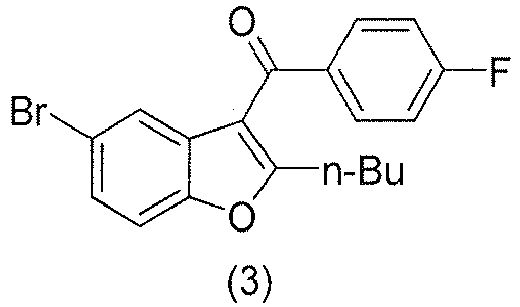
- the compound of formula (3) is prepared by reacting the compound of formula (1) with 4-fluorobenzoyl halide (2) in a Friedel-Crafts acylation procedure.
- a Lewis acid such as aluminum trichloride (AlCl 3 ) is required to facilitate the reaction in polar aprotic solvents such as, for example, dichloromethane.
- the reaction may also be performed with catalysts such as zinc oxide or under microwave conditions without solvent ( M. H. Sarvari, H. Sharghi, See Zinc Mediated Friedel-Crafts Acylation in Solvent-Free Conditions under Microwave Irradiation, J. Org. Chem. 2004, 69, 6953-6956 ).
- catalysts such as zinc oxide or under microwave conditions without solvent ( M. H. Sarvari, H. Sharghi, See Zinc Mediated Friedel-Crafts Acylation in Solvent-Free Conditions under Microwave Irradiation, J. Org. Chem. 2004, 69, 6953-6956 ).
- the compound of formula (4) is prepared by reacting the compound of formula (3) with N -benzylmethanesulfonamide in the presence of a copper catalyst (e.g., CuI with an amine or a bis-amine ligand) under basic conditions.
- a copper catalyst e.g., CuI with an amine or a bis-amine ligand
- approximately 5 mol% of CuI is sufficient to effect the reaction under basic conditions (e.g. in the presence of potassium carbonate or cesium carbonate in a solvent such as acetonitrile).
- the reaction may also be accomplished using palladium coupling methods known to one of ordinary skill in the art. Other bases, solvents and ligands may be used.
- use of acetonitrile and potassium carbonate is preferred to achieve better yields of the coupled product (4).
- the compound of formula (4) is a novel and useful intermediate for the preparation of the compound of formula (I) as disclosed herein.
- another aspect of the invention is the provision of the compound of formula (4).
- the compound of formula (5) is prepared by reacting the compound of formula (4) with dibutylamino propanol using a suitable base and solvent.
- Dibutylaminopropanol is available commercially or may be prepared following procedures known to one of ordinary skill in the art.
- An example of a suitable base and solvent for the preparation of compound (5) is sodium t-butoxide and 1-methyl-2-pyrrolidinone (NMP).
- the compound of formula (I) is prepared from the compound of formula (5) by, for example, hydrogenolysis in the presence of palladium on carbon and hydrogen gas or another appropriate hydrogen source and metal catalyst.
- hydrogenolysis in the presence of palladium on carbon and hydrogen gas or another appropriate hydrogen source and metal catalyst.
- One of skill in the art is aware of other procedures to remove benzyl protecting groups. For example, hydrogenation reactions to remove benzyl protecting groups are also commonly carried out with acidic additives and in protic solvents. Further, benzyl groups can also be removed by treatment with Lewis Acids and amines (e.g. AlCl 3 /dimethyl-aniline).
- the compound of formula (6) is formed by reacting the compound of formula (3) with Boc-protected methansulfonamide.
- Boc-protected methanesulfonamide (CH 3 SO 2 NHBoc) is commercially available.
- the reaction to form compound (6) is shown below:
- the reaction of compound (3) with N -boc-methansulfonamide may also be accomplished using a suitable catalyst.
- a suitable catalyst For example, approximately 5 mol% of CuI is typically sufficient to effect the reaction under basic conditions (e.g. in the presence of potassium carbonate or cesium carbonate in a solvent such as acetonitrile).
- the reaction may also be accomplished using palladium coupling methods known to one of ordinary skill in the art.
- Other bases, solvents, and ligands may be employed following procedures known to one of ordinary skill in the art.
- the compound of formula (6) is believed to be a novel and useful intermediate for the preparation of the compound of formula (I) as disclosed herein.
- another aspect of the invention is the provision of the compound of formula (6).
- the compound of formula (7) is prepared by reacting the compound of formula (6) with dibutylaminopropanol under basic conditions as shown below:
- a suitable base and solvent for the preparation of compound (7) is sodium tert-butoxide and 1-methyl-2-pyrrolidinone (NMP).
- NMP 1-methyl-2-pyrrolidinone
- Other reagents and reaction conditions are known to one of ordinary skill in the art.
- the compound of formula (7) is converted to the compound of formula (I) by removal of the Boc group using, for example, trifluoroacetic acid or aqueous HCl.
- the compound of formula (I) may be converted to a pharmaceutically acceptable salt by reaction with about a 1:1 molar equivalent of acid e.g. HCl (aqueous or gaseous) in a suitable solvent to afford the corresponding acid salt.
- acid salts of the compound of formula (I) may be formed by reaction with about a 1:1 molar equivalent of acid e.g. HCl (aqueous or gaseous) in a suitable solvent.
- Dronedarone as used in this disclosure is well known in the art and may be prepared by following any one of many processes known to one of skill in the art including as disclosed in U.S. Patent No. 5,223,510 . Additionally, the abbreviations used throughout have the following meanings:
Landscapes
- Chemical & Material Sciences (AREA)
- Organic Chemistry (AREA)
- Health & Medical Sciences (AREA)
- Engineering & Computer Science (AREA)
- Chemical Kinetics & Catalysis (AREA)
- Life Sciences & Earth Sciences (AREA)
- Animal Behavior & Ethology (AREA)
- Veterinary Medicine (AREA)
- Medicinal Chemistry (AREA)
- Public Health (AREA)
- General Health & Medical Sciences (AREA)
- Pharmacology & Pharmacy (AREA)
- Cardiology (AREA)
- Bioinformatics & Cheminformatics (AREA)
- Heart & Thoracic Surgery (AREA)
- Nuclear Medicine, Radiotherapy & Molecular Imaging (AREA)
- General Chemical & Material Sciences (AREA)
- Organic Low-Molecular-Weight Compounds And Preparation Thereof (AREA)
- Low-Molecular Organic Synthesis Reactions Using Catalysts (AREA)
- Pharmaceuticals Containing Other Organic And Inorganic Compounds (AREA)
- Steroid Compounds (AREA)
- Materials Engineering (AREA)
- Furan Compounds (AREA)
- Epidemiology (AREA)
Description
- This application claims the benefit under 35 U.S.C. § 119(e) to
U.S. Provisional Application Serial Number 61/870,632, filed on August 27, 2013 U.S. Provisional Application Serial Number 61/903,285, filed November 12, 2013 - Atrial fibrillation (AF) is the most prevalent arrhythmia, the incidence of which increases with age. It is estimated that 8% of all people over the age of 80 experience this type of abnormal heart rhythm and AF accounts for one-third of hospital admissions for cardiac rhythm disturbances. Over 2.2 million people are believed to have AF in the Unites States alone. Fuster, et al Circulation 2006 114 (7): e257-354. Although atrial fibrillation is often asymptomatic it may cause palpitations or chest pain. Prolonged atrial fibrillation often results in the development of congestive heart failure and/or stroke. Heart failure develops as the heart attempts to compensate for the reduced cardiac efficiency while stroke may occur when thrombi form in the atria, pass into the blood stream and lodge in the brain. Pulmonary emboli may also develop in this manner.
-
U.S. Patent No. 5,223,510 discloses alkylaminoalkyl derivatives of benzofuran, benzothiophene, indole and indolizine, processes for their preparation and compositions containing them.WO 2013/014480 discloses a process for manufacturing dronedarone comprising reduction of the compound of formula (II) to the compound of formula (I) as shown below:
-
WO 2012/127174 discloses a process involving a Fries rearrangement converting, for example, the compound of formula (8) to the compound of formula (9) followed by coupling of the compound of formula (9) and dibutylamino propyl chloride to afford the compound of formula (I).
- European patent application
EP2617718A1 discloses processes for preparing dronedarone comprising reacting the intermediate
WO2011/099010 discloses the N-(2-butylbenzofuran-5-yl)-N-(methylsulfonyl)methanesulfonamide as an intermediate in the preparation of dronedarone of formula (I). - The above disclosures notwithstanding, there remains a need for alternate or improved processes for preparing dronedarone.
- The present disclosure provides a process for making dronedarone of formula I

- a. reacting the compound of formula (1) with the compound of formula (2) in the presence of a Lewis acid and a suitable solvent to form the compound of formula (3) as shown below:

- b. reacting the compound of formula (3) with N-benzylmethanesulfonamide (MeSO2NHBn) in the presence of a suitable catalyst and a suitable solvent to form the compound of formula (4) as shown below:

- c. reacting the compound of formula (4) with dibutylaminopropanol in the presence of a suitable base and a suitable solvent to form the compound of formula (5) as shown below:

- d. reacting the compound of formula (5) with a suitable deprotecting agent to form the compound of formula (I) as shown below:

- The present disclosure also provides a process for making dronedarone acid addition salt

- a. reacting the compound of formula (1) with the compound of formula (2) in the presence of a Lewis acid and a suitable solvent to form the compound of formula (3) as shown below:
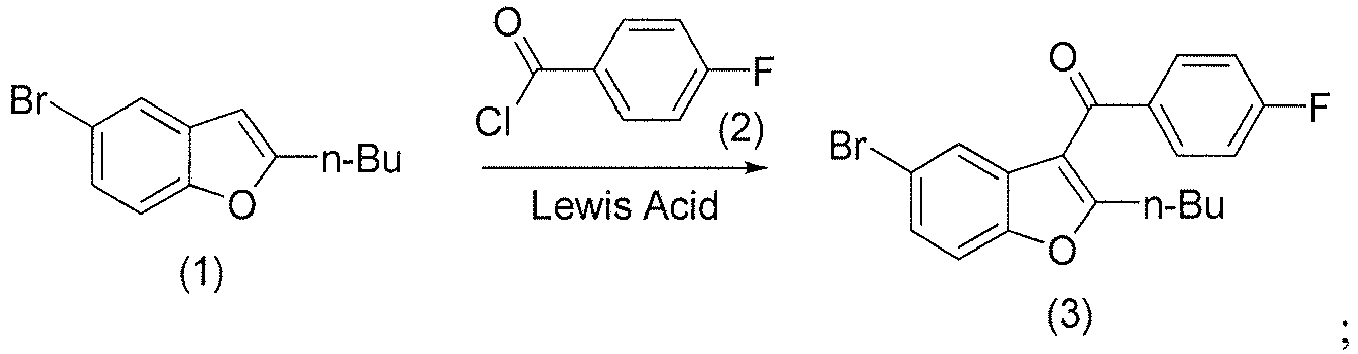
- b. reacting the compound of formula (3) with N-benzylmethanesulfonamide (CH3SO2NHBn) in the presence of a suitable catalyst and a suitable solvent to form the compound of formula (4) as shown below:

- c. reacting the compound of formula (4) with dibutylaminopropanol in the presence of a suitable base and a suitable solvent to form the compound of formula (5) as shown below:

- d. reacting the compound of formula (5) with a suitable deprotecting agent to form the compound of formula (I) as shown below:

- e. reacting the compound of formula (I) with a suitable acid (HA) and a suitable solvent to afford the acid salt of the compound of formula (I) as shown below:

- The present disclosure also provides a process for making dronedarone of formula (I)

- a. reacting the compound of formula (1) with the compound of formula (2) in the presence of a Lewis acid and a suitable solvent to form the compound of formula (3) as shown below

- b. reacting the compound of formula (3) with Boc-protected methanesulfonamide and a suitable catalyst and a suitable solvent to afford the Boc-protected compound of formula (6) as shown below:

- c. reacting compound of formula (6) with dibutylaminopropanol, a suitable base and a suitable solvent to afford the compound of formula (7) as shown below:

- d. reacting the compound of formula (7) with a suitable acid and a suitable solvent to afford the compound of formula (I) as shown below:

- e. optionally reacting the compound of formula (7) with a sufficient amount of a suitable acid to form the acid salt of the compound of formula (I) as shown below:

- One advantage of the present disclosure is that it obviates certain mutagenic impurities observed with the process disclosed in
United States patent No. 5,223,510 . One of skill in the art is aware by virtue of the present disclosure that other protecting groups may be used in place of the protecting groups (benzyl or Boc) disclosed herein. - An object of the present disclosure is also the provision of intermediate compounds useful for making the compound of formula (I) or salts thereof. Thus, in one embodiment the present disclosure provides a compound of formula (4)

- In another embodiment, the present disclosure provides a compound of formula (5)

- In another embodiment the present disclosure provides a compound of formula (6)

- In yet another embodiment, the present disclosure provides a compound of formula (7)

- As used in the present specification, the following words and phrases are generally intended to have the meanings as set forth below, except to the extent that the context in which they are used indicates otherwise.
- It is to be noted that as used herein and in the claims, the singular forms "a," "an" and "the" include plural referents unless the context clearly dictates otherwise. Thus, for example, reference to "a pharmaceutically acceptable carrier" in a composition includes two or more pharmaceutically acceptable carriers, and so forth.
- "Dronedarone" is described in
U.S. Patent 5,223,510 . Dronedarone refers to the chemical compound, N-(2-butyl-3-(4-(3-(dibutylamino)propoxy)benzoyl)benzofuran-5-yl)methanesulfonamide. The base form of dronedarone has the following chemical formula:
- The term "deprotecting agent" as used herein refers to a reagent or reagent system (reagent(s), and solvent) useful for removing a protecting group. Deprotecting agents are acids, bases or reducing agents. For example, removal of the benzyl (Bn) group is generally accomplished by reduction (hydrogenolysis), while removal of carbamates (e.g. Boc group) is generally effected by use of acids (e.g. HCl, TFA, etc.) optionally with mild heating.
- The term "suitable solvent" as used herein means a solvent that is useful for effecting the subject reaction. One of skill in the art is aware of the many solvents regarded as useful in the art for the purpose of the particular reaction. Suitable solvents are also exemplified by the solvents disclosed herein for the specific reaction.
- The term "suitable base" as used means a base that is useful for effecting the subject reaction. One of skill in the art is aware of the many bases (organic and inorganic bases) regarded as useful in the art for the purpose of the particular reaction. Suitable bases are also exemplified by the bases disclosed herein for the specific reaction.
- The term "suitable catalyst" as used means a catalyst that is useful for effecting the subject reaction. One of skill in the art is aware of the many catalysts regarded as useful in the art for the purpose of the particular reaction. Hydrogenation may be performed in the presence of palladium on carbon catalyst. Suitable catalysts are also exemplified by the catalysts disclosed herein for the specific reaction. The term suitable catalyst as used herein includes an appropriate ligand that may be necessary to effect or accelerate the action of the catalyst. One of ordinary skill in the art is aware that certain catalytic reactions, e.g. palladium catalyzed coupling reactions may require a ligand, e.g. triphenyl phosphine. Examples of ligands useful for catalytic reactions disclosed herein are provided in the experimental section below.
- The term "suitable acid" as used means an acid that is useful for effecting the subject reaction. One of skill in the art is aware of the many acids (organic and inorganic acids) regarded as useful in the art for the purpose of the particular reaction. Suitable acids are also exemplified by the acids disclosed herein for the specific reaction.
- A method for preparing the compound of formula (1)

- The compound of formula (2)

- The compound of formula (3)
- The compound of formula (4)
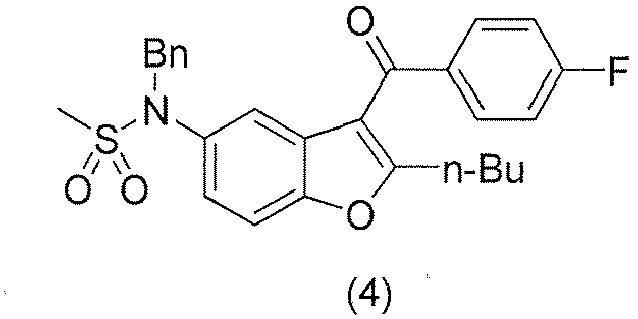
- The compound of formula (5)

- The compound of formula (I)

- The compound of formula (6)


- The reaction of compound (3) with N-boc-methansulfonamide may also be accomplished using a suitable catalyst. For example, approximately 5 mol% of CuI is typically sufficient to effect the reaction under basic conditions (e.g. in the presence of potassium carbonate or cesium carbonate in a solvent such as acetonitrile). The reaction may also be accomplished using palladium coupling methods known to one of ordinary skill in the art. Other bases, solvents, and ligands may be employed following procedures known to one of ordinary skill in the art. The compound of formula (6) is believed to be a novel and useful intermediate for the preparation of the compound of formula (I) as disclosed herein. Thus, another aspect of the invention is the provision of the compound of formula (6).
- The compound of formula (7)
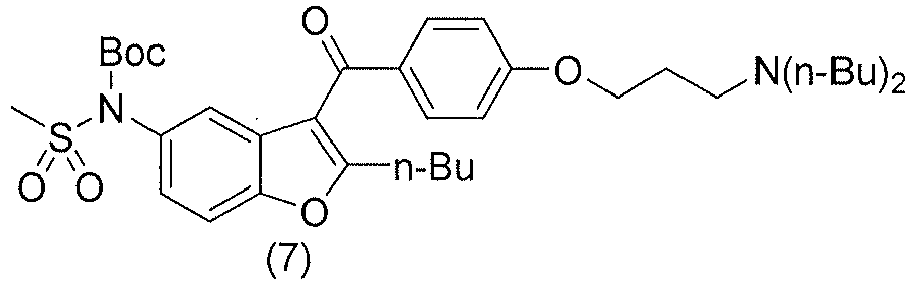

- An example of a suitable base and solvent for the preparation of compound (7) is sodium tert-butoxide and 1-methyl-2-pyrrolidinone (NMP). Other reagents and reaction conditions are known to one of ordinary skill in the art. The compound of formula (7) is converted to the compound of formula (I) by removal of the Boc group using, for example, trifluoroacetic acid or aqueous HCl.

- One of ordinary skill in the art is aware of procedures for removing protective groups. For example, reagents and procedures for adding or removing protecting groups are disclosed in Protective Groups in Organic Synthesis, Peter M. Wuts and Theodora W. Greene, 4th Edition, John Wiley Publishers.
- The compound of formula (I) may be converted to a pharmaceutically acceptable salt by reaction with about a 1:1 molar equivalent of acid e.g. HCl (aqueous or gaseous) in a suitable solvent to afford the corresponding acid salt. One of ordinary skill in the art is able to form various acid salts of the compound of formula (I).
- Dronedarone as used in this disclosure is well known in the art and may be prepared by following any one of many processes known to one of skill in the art including as disclosed in
U.S. Patent No. 5,223,510 . Additionally, the abbreviations used throughout have the following meanings: - µM =
- micromolar
- cm =
- centimeter
- kg =
- kilogram
- mA =
- milliamp
- min =
- minute
- mm =
- millimeter
- mM =
- millimolar
- Ms =
- Millisecond
- I vol =
- 1 liter/Kg of limiting reagent
-

- To a solution of compound (1) (1 equiv) and 4-fluorobenzoyl chloride (1.2 equiv) in CH2Cl2 (10 volumes) at ambient temperature is added AlCl3 (0.5 equiv). The reaction is stirred at ambient temperature and then heated under reflux. The reaction mixture is diluted with CH2Cl2 (20 volumes) and quenched by the addition of ice-cold water (30 volumes). Following phase separation, the organic phase is dried over Na2SO4, filtered and concentrated under reduced pressure. The crude residue is purified by chromatography on silica gel (10 to 50% CH2Cl2 in heptane) to provide compound (3). 1H NMR (400 MHz, DMSO-d6) δ ppm 7.82 (dd, J = 8.6, 5.6 Hz, 2H), 7.62 (d, J = 8.6 Hz, 1H) 7.43 - 7.53 (m, 2H), 7.37 (t, J = 8.8 Hz, 2H), 2.72 (t, J = 7.5 Hz, 2H), 1.71 - 1.49 (m, 2H), 1.29 - 1.09 (m, 2H), 0.74 (t, J = 7.3 Hz, 3H); 19F NMR (376 MHz, DMSO-d6) δ -106.39.
-

- Compound (3) (1 equiv), N-benzylmethane sulfonamide (3 equiv), K2CO3 (3 equiv), CuI (0.5 equiv), acetonitrile (7 volumes) and toluene (7 volumes) are combined and the resulting mixture is sparged with N2. N,N'-Dimethylethane-1,2-diamine (10 equiv.) is then added, and the reaction mixture is heated at about 80 °C for about 3 hours. The reaction mixture is cooled to ambient temperature and filtered through a pad of celite. The celite cake is rinsed with acetonitrile (13 volumes) and the filtrate is concentrated under reduced pressure. The residue is dissolved in isopropyl acetate (33 volumes), washed with aqueous HCl and 20% aqueous NaCl, dried over Na2SO4, filtered, and concentrated under reduced pressure. The crude residue is purified by chromatography on silica gel to afford compound (4).
-

- N-benzyl-N-(2-butyl-3-(4-fluorobenzoyl)benzofuran-5-yl)methanesulfonamide (4, 29.0 mg, 0.06 mmol) was dissolved in NMP (0.5 ml) and the solution was added to a pre-warmed mixture of 3-(dibutylamino)propan-1-ol (33.7 mg, 0.18 mmol) and NaOt-Bu (17.3 mg, 0.18 mmol) in NMP (0.5 ml) at about n60 °C. The resulting reaction mixture was stirred at about 60 °C and the most of starting material (4) was converted by HPLC after 1.5 hours. The in-process sample at about 1.5 hour indicated target molecule (5) formation: LCMS [MH+]: m/z = 647.40, tR = 7.80 min.
-

- An isopropanol solution of compound (5) (1 equiv) and Pd-C (10 weight %) are agitated under a hydrogen atmosphere (20-45 psig). The catalyst is filtered, and the solution is treated with aqueous HCl (1.2 equiv). The resulting solids are isolated by filtration to afford compound (I).
-

- Compound (3) (1 equiv.), N-boc-methanesulfonamide (3 equiv.), K2CO3 (3 equiv), CuI (0.5 equiv), acetonitrile (7 volumes) and toluene (7 volumes) are combined and the resulting mixture is sparged with N2. N,N'-dimethylethane-1,2-diamine (10 equiv.) is then added, and the reaction mixture is heated at about 80 °C for about 3 hours. The reaction mixture is cooled to ambient temperature and filtered through a pad of celite. The celite cake is rinsed with acetonitrile (13 volumes) and the filtrate is concentrated under reduced pressure. The residue is dissolved in isopropyl acetate (33 volumes), washed with aqueous HCl and 20% aqueous NaCl, dried over Na2SO4, filtered, and concentrated under reduced pressure. The crude residue is purified by chromatography on silica gel to afford compound (6).
-

- A mixture of dibutylamino propanol (3 equiv), sodium tert-butoxide (3 equiv) and NMP (10 volumes) is heated at about 60 °C under N2 for about 10 minutes. A solution of compound (6) (1 equiv) in NMP (6 volumes) is added dropwise to the reaction mixture over about 3 minutes. The transfer is completed with additional NMP. The reaction mixture is heated at about 60 °C for about 25 minutes, then cooled to about 0 °C and diluted with isopropyl acetate. To the mixture is then added aqueous HCl. Following separation of the phases, the organic layer is washed with water, dried over Na2SO4, filtered and concentrated. The crude product is purified by chromatography on silica gel to afford compound (7).
-

- An isopropanol solution of compound (7) (1 equiv) is treated with concentrated aqueous HCl (2.2 equiv). The resulting solids are isolated by filtration to afford compound (I).

Claims (7)
- A process for making dronedarone of formula I
 a. reacting the compound of formula (1) with the compound of formula (2) in the presence of a Lewis acid and a suitable solvent to form the compound of formula (3) as shown below:
 b. reacting the compound of formula (3) with N-benzylmethanesulfonamide (MeSO2NHBn) in the presence of a suitable catalyst and a suitable solvent to form the compound of formula (4) as shown below:
 c. reacting the compound of formula (4) with dibutylaminopropanol in the presence of a suitable base and a suitable solvent to form the compound of formula (5) as shown below:
 d. reacting the compound of formula (5) with a suitable deprotecting agent to form the compound of formula (I) as shown below:
- The process according to claim 1 wherein the reaction to prepare compound of formula (4) comprises use of Cu or palladium catalysts.
- The process according to claim 1, wherein the process further comprises a stepe. reacting the compound of formula (I) with a suitable acid (HA) and a suitable solvent to afford the acid salt of the compound of formula (I) as shown below:

- The process according to Claim 3 wherein the reaction to prepare compound of formula (6) comprises use of Cu or palladium catalysts.
- A process for making dronedarone of formula (I)
 a. reacting the compound of formula (1) with the compound of formula (2) in the presence of a Lewis acid and a suitable solvent to form the compound of formula (3) as shown below
 b. reacting the compound of formula (3) with Boc-protected methanesulfonamide and a suitable catalyst and a suitable solvent to afford the Boc-protected compound of formula (6) as shown below:
 c. reacting compound of formula (6) with dibutylaminopropanol, a suitable base and a suitable solvent to afford the compound of formula (7) as shown below:
 d. reacting the compound of formula (7) with a suitable acid (HA) and a suitable solvent to afford the compound of formula (I) as shown below:
 e. optionally reacting the compound of formula (7) with sufficient amount of a suitable acid to form the acid salt of the compound of formula (I) as shown below:
- A compound of the formula (4) and/or formula (6)

- A compound of formula (5) and/or formula (7)


Applications Claiming Priority (3)
| Application Number | Priority Date | Filing Date | Title |
|---|---|---|---|
| US201361870632P | 2013-08-27 | 2013-08-27 | |
| US201361903285P | 2013-11-12 | 2013-11-12 | |
| PCT/US2014/052692 WO2015031352A1 (en) | 2013-08-27 | 2014-08-26 | Process for preparing dronedarone and salts thereof |
Publications (2)
| Publication Number | Publication Date |
|---|---|
| EP3039016A1 EP3039016A1 (en) | 2016-07-06 |
| EP3039016B1 true EP3039016B1 (en) | 2017-08-02 |
Family
ID=51492497
Family Applications (1)
| Application Number | Title | Priority Date | Filing Date |
|---|---|---|---|
| EP14759436.0A Not-in-force EP3039016B1 (en) | 2013-08-27 | 2014-08-26 | Process for preparing dronedarone and salts thereof |
Country Status (15)
| Country | Link |
|---|---|
| US (1) | US9242953B2 (en) |
| EP (1) | EP3039016B1 (en) |
| JP (1) | JP2016534120A (en) |
| KR (1) | KR20160045880A (en) |
| CN (1) | CN105452232A (en) |
| AU (1) | AU2014311399B2 (en) |
| CA (1) | CA2921201A1 (en) |
| EA (1) | EA201690229A1 (en) |
| HK (2) | HK1217194A1 (en) |
| IL (1) | IL243886A0 (en) |
| MX (1) | MX2016002186A (en) |
| SG (1) | SG11201600763TA (en) |
| TW (1) | TW201536763A (en) |
| UY (1) | UY35715A (en) |
| WO (1) | WO2015031352A1 (en) |
Families Citing this family (1)
| Publication number | Priority date | Publication date | Assignee | Title |
|---|---|---|---|---|
| CN114456135B (en) * | 2022-03-18 | 2024-09-10 | 江苏慧聚药业股份有限公司 | Preparation of dronedarone |
Family Cites Families (11)
| Publication number | Priority date | Publication date | Assignee | Title |
|---|---|---|---|---|
| FR2665444B1 (en) * | 1990-08-06 | 1992-11-27 | Sanofi Sa | AMINO-BENZOFURAN, BENZOTHIOPHENE OR INDOLE DERIVATIVES, THEIR PREPARATION PROCESS AND THE COMPOSITIONS CONTAINING THEM. |
| FR2817864B1 (en) * | 2000-12-11 | 2003-02-21 | Sanofi Synthelabo | METHANESULFONAMIDO-BENZOFURANE DERIVATIVE, ITS PREPARATION METHOD AND ITS USE AS A SYNTHESIS INTERMEDIATE |
| US8108698B2 (en) * | 2008-06-04 | 2012-01-31 | Broadcom Corporation | Computer storage components that provide external and internal access |
| EP2533636A4 (en) * | 2010-02-10 | 2013-06-19 | Mapi Pharma Ltd | Preparation of benzofurans and use thereof as synthetic intermediates |
| FR2957079B1 (en) * | 2010-03-02 | 2012-07-27 | Sanofi Aventis | PROCESS FOR THE SYNTHESIS OF CETOBENZOFURAN DERIVATIVES |
| FR2958289B1 (en) * | 2010-03-30 | 2012-06-15 | Sanofi Aventis | PROCESS FOR THE PREPARATION OF 3-KETO-BENZOFURAN DERIVATIVES |
| HUP1000330A2 (en) * | 2010-06-18 | 2011-12-28 | Sanofi Sa | Process for the preparation of dronedarone and the novel intermediates |
| HUP1000386A2 (en) * | 2010-07-22 | 2012-05-29 | Sanofi Sa | Novel process for producing dronedarone |
| FR2973027A1 (en) | 2011-03-24 | 2012-09-28 | Sanofi Aventis | PROCESS FOR THE SYNTHESIS OF CETOBENZOFURAN DERIVATIVES |
| WO2013014480A1 (en) | 2011-07-26 | 2013-01-31 | Sanofi | Process for preparation of dronedarone using amide intermediary compound |
| EP2617718A1 (en) * | 2012-01-20 | 2013-07-24 | Sanofi | Process for preparation of dronedarone by the use of dibutylaminopropanol reagent |
-
2014
- 2014-08-14 TW TW103127860A patent/TW201536763A/en unknown
- 2014-08-26 KR KR1020167007661A patent/KR20160045880A/en not_active Ceased
- 2014-08-26 WO PCT/US2014/052692 patent/WO2015031352A1/en not_active Ceased
- 2014-08-26 HK HK16105140.0A patent/HK1217194A1/en unknown
- 2014-08-26 UY UY35715A patent/UY35715A/en not_active Application Discontinuation
- 2014-08-26 EP EP14759436.0A patent/EP3039016B1/en not_active Not-in-force
- 2014-08-26 HK HK16107937.3A patent/HK1219949A1/en unknown
- 2014-08-26 MX MX2016002186A patent/MX2016002186A/en unknown
- 2014-08-26 CA CA2921201A patent/CA2921201A1/en not_active Abandoned
- 2014-08-26 CN CN201480045745.8A patent/CN105452232A/en active Pending
- 2014-08-26 JP JP2016537765A patent/JP2016534120A/en active Pending
- 2014-08-26 US US14/468,993 patent/US9242953B2/en active Active
- 2014-08-26 EA EA201690229A patent/EA201690229A1/en unknown
- 2014-08-26 SG SG11201600763TA patent/SG11201600763TA/en unknown
- 2014-08-26 AU AU2014311399A patent/AU2014311399B2/en not_active Ceased
-
2016
- 2016-02-01 IL IL243886A patent/IL243886A0/en unknown
Non-Patent Citations (1)
| Title |
|---|
| None * |
Also Published As
| Publication number | Publication date |
|---|---|
| HK1217194A1 (en) | 2016-12-30 |
| US9242953B2 (en) | 2016-01-26 |
| AU2014311399A1 (en) | 2016-02-25 |
| UY35715A (en) | 2015-02-27 |
| CA2921201A1 (en) | 2015-03-05 |
| EA201690229A1 (en) | 2016-07-29 |
| SG11201600763TA (en) | 2016-02-26 |
| WO2015031352A1 (en) | 2015-03-05 |
| MX2016002186A (en) | 2016-06-06 |
| AU2014311399B2 (en) | 2017-06-15 |
| EP3039016A1 (en) | 2016-07-06 |
| HK1219949A1 (en) | 2017-04-21 |
| KR20160045880A (en) | 2016-04-27 |
| TW201536763A (en) | 2015-10-01 |
| JP2016534120A (en) | 2016-11-04 |
| IL243886A0 (en) | 2016-04-21 |
| US20150065734A1 (en) | 2015-03-05 |
| CN105452232A (en) | 2016-03-30 |
Similar Documents
| Publication | Publication Date | Title |
|---|---|---|
| EP3642210B1 (en) | Methods for the preparation of 1,3-benzodioxole heterocyclic compounds | |
| JP6574474B2 (en) | Process for producing chiral dipeptidyl peptidase-IV inhibitor | |
| IL315005B1 (en) | Synthesis of condensed gamma-carbolines and converted heterocycles | |
| AU2011213921A1 (en) | Preparation of benzofurans and use thereof as synthetic intermediates | |
| EA019860B1 (en) | Novel process for the manufacture of dronedarone | |
| AU2014311399B2 (en) | Process for preparing dronedarone and salts thereof | |
| CN107266457A (en) | Ketone compounds of two indoline of a kind of 2,3 ' spiral shell 2 and preparation method thereof | |
| CN117247371B (en) | Preparation method of CYP11B2 inhibitor BAXDROSTAT | |
| KR20180116371A (en) | Process for producing 4-alkoxy-3-hydroxypicolic acid | |
| US4697024A (en) | Medroxalol intermediates | |
| EP2303855B1 (en) | Catalytic process for asymmetric hydrogenation | |
| KR102526439B1 (en) | Process for preparing perlindole enantiomers and salts thereof | |
| WO2015038022A1 (en) | Processes for preparing medicaments for the treatment of cardiovascular diseases and intermediates for use therein | |
| EP2943468B1 (en) | A novel process for the preparation of n-(4-nitro-2-sulfamoyl-phenyl)-malonamic acid methyl ester and n-(4-amino-2-sulfamoyl-phenyl)-malonamic acid methyl ester | |
| US4701541A (en) | Medroxalol intermediates | |
| BR112021011854B1 (en) | METHODS FOR PREPARING SUBSTITUTED FUSED HETEROCYCLIC GAMMA-CARBOLINE COMPOUNDS AND ACTIVE PHARMACEUTICAL COMPOSITION | |
| RS62667B1 (en) | Process for the preparation of pirlindole enantiomers and its salts | |
| HK1177873A (en) | Preparation of benzofurans and use thereof as synthetic intermediates | |
| JPWO2005116044A1 (en) | Method for producing indolopyrrolocarbazole derivatives | |
| JPWO2001004092A1 (en) | Method for producing tricyclic amino alcohol derivatives |
Legal Events
| Date | Code | Title | Description |
|---|---|---|---|
| PUAI | Public reference made under article 153(3) epc to a published international application that has entered the european phase |
Free format text: ORIGINAL CODE: 0009012 |
|
| 17P | Request for examination filed |
Effective date: 20160225 |
|
| AK | Designated contracting states |
Kind code of ref document: A1 Designated state(s): AL AT BE BG CH CY CZ DE DK EE ES FI FR GB GR HR HU IE IS IT LI LT LU LV MC MK MT NL NO PL PT RO RS SE SI SK SM TR |
|
| AX | Request for extension of the european patent |
Extension state: BA ME |
|
| DAX | Request for extension of the european patent (deleted) | ||
| GRAP | Despatch of communication of intention to grant a patent |
Free format text: ORIGINAL CODE: EPIDOSNIGR1 |
|
| INTG | Intention to grant announced |
Effective date: 20170203 |
|
| REG | Reference to a national code |
Ref country code: HK Ref legal event code: DE Ref document number: 1219949 Country of ref document: HK |
|
| GRAS | Grant fee paid |
Free format text: ORIGINAL CODE: EPIDOSNIGR3 |
|
| GRAA | (expected) grant |
Free format text: ORIGINAL CODE: 0009210 |
|
| AK | Designated contracting states |
Kind code of ref document: B1 Designated state(s): AL AT BE BG CH CY CZ DE DK EE ES FI FR GB GR HR HU IE IS IT LI LT LU LV MC MK MT NL NO PL PT RO RS SE SI SK SM TR |
|
| REG | Reference to a national code |
Ref country code: CH Ref legal event code: EP Ref country code: AT Ref legal event code: REF Ref document number: 914294 Country of ref document: AT Kind code of ref document: T Effective date: 20170815 |
|
| REG | Reference to a national code |
Ref country code: IE Ref legal event code: FG4D |
|
| REG | Reference to a national code |
Ref country code: DE Ref legal event code: R096 Ref document number: 602014012634 Country of ref document: DE |
|
| REG | Reference to a national code |
Ref country code: NL Ref legal event code: MP Effective date: 20170802 |
|
| REG | Reference to a national code |
Ref country code: AT Ref legal event code: MK05 Ref document number: 914294 Country of ref document: AT Kind code of ref document: T Effective date: 20170802 |
|
| REG | Reference to a national code |
Ref country code: LT Ref legal event code: MG4D |
|
| PG25 | Lapsed in a contracting state [announced via postgrant information from national office to epo] |
Ref country code: AT Free format text: LAPSE BECAUSE OF FAILURE TO SUBMIT A TRANSLATION OF THE DESCRIPTION OR TO PAY THE FEE WITHIN THE PRESCRIBED TIME-LIMIT Effective date: 20170802 Ref country code: NL Free format text: LAPSE BECAUSE OF FAILURE TO SUBMIT A TRANSLATION OF THE DESCRIPTION OR TO PAY THE FEE WITHIN THE PRESCRIBED TIME-LIMIT Effective date: 20170802 Ref country code: LT Free format text: LAPSE BECAUSE OF FAILURE TO SUBMIT A TRANSLATION OF THE DESCRIPTION OR TO PAY THE FEE WITHIN THE PRESCRIBED TIME-LIMIT Effective date: 20170802 Ref country code: SE Free format text: LAPSE BECAUSE OF FAILURE TO SUBMIT A TRANSLATION OF THE DESCRIPTION OR TO PAY THE FEE WITHIN THE PRESCRIBED TIME-LIMIT Effective date: 20170802 Ref country code: FI Free format text: LAPSE BECAUSE OF FAILURE TO SUBMIT A TRANSLATION OF THE DESCRIPTION OR TO PAY THE FEE WITHIN THE PRESCRIBED TIME-LIMIT Effective date: 20170802 Ref country code: HR Free format text: LAPSE BECAUSE OF FAILURE TO SUBMIT A TRANSLATION OF THE DESCRIPTION OR TO PAY THE FEE WITHIN THE PRESCRIBED TIME-LIMIT Effective date: 20170802 Ref country code: NO Free format text: LAPSE BECAUSE OF FAILURE TO SUBMIT A TRANSLATION OF THE DESCRIPTION OR TO PAY THE FEE WITHIN THE PRESCRIBED TIME-LIMIT Effective date: 20171102 |
|
| PG25 | Lapsed in a contracting state [announced via postgrant information from national office to epo] |
Ref country code: LV Free format text: LAPSE BECAUSE OF FAILURE TO SUBMIT A TRANSLATION OF THE DESCRIPTION OR TO PAY THE FEE WITHIN THE PRESCRIBED TIME-LIMIT Effective date: 20170802 Ref country code: BG Free format text: LAPSE BECAUSE OF FAILURE TO SUBMIT A TRANSLATION OF THE DESCRIPTION OR TO PAY THE FEE WITHIN THE PRESCRIBED TIME-LIMIT Effective date: 20171102 Ref country code: ES Free format text: LAPSE BECAUSE OF FAILURE TO SUBMIT A TRANSLATION OF THE DESCRIPTION OR TO PAY THE FEE WITHIN THE PRESCRIBED TIME-LIMIT Effective date: 20170802 Ref country code: IS Free format text: LAPSE BECAUSE OF FAILURE TO SUBMIT A TRANSLATION OF THE DESCRIPTION OR TO PAY THE FEE WITHIN THE PRESCRIBED TIME-LIMIT Effective date: 20171202 Ref country code: RS Free format text: LAPSE BECAUSE OF FAILURE TO SUBMIT A TRANSLATION OF THE DESCRIPTION OR TO PAY THE FEE WITHIN THE PRESCRIBED TIME-LIMIT Effective date: 20170802 Ref country code: GR Free format text: LAPSE BECAUSE OF FAILURE TO SUBMIT A TRANSLATION OF THE DESCRIPTION OR TO PAY THE FEE WITHIN THE PRESCRIBED TIME-LIMIT Effective date: 20171103 Ref country code: PL Free format text: LAPSE BECAUSE OF FAILURE TO SUBMIT A TRANSLATION OF THE DESCRIPTION OR TO PAY THE FEE WITHIN THE PRESCRIBED TIME-LIMIT Effective date: 20170802 |
|
| REG | Reference to a national code |
Ref country code: DE Ref legal event code: R119 Ref document number: 602014012634 Country of ref document: DE |
|
| REG | Reference to a national code |
Ref country code: CH Ref legal event code: PL |
|
| PG25 | Lapsed in a contracting state [announced via postgrant information from national office to epo] |
Ref country code: RO Free format text: LAPSE BECAUSE OF FAILURE TO SUBMIT A TRANSLATION OF THE DESCRIPTION OR TO PAY THE FEE WITHIN THE PRESCRIBED TIME-LIMIT Effective date: 20170802 Ref country code: CH Free format text: LAPSE BECAUSE OF NON-PAYMENT OF DUE FEES Effective date: 20170831 Ref country code: CZ Free format text: LAPSE BECAUSE OF FAILURE TO SUBMIT A TRANSLATION OF THE DESCRIPTION OR TO PAY THE FEE WITHIN THE PRESCRIBED TIME-LIMIT Effective date: 20170802 Ref country code: DK Free format text: LAPSE BECAUSE OF FAILURE TO SUBMIT A TRANSLATION OF THE DESCRIPTION OR TO PAY THE FEE WITHIN THE PRESCRIBED TIME-LIMIT Effective date: 20170802 Ref country code: LI Free format text: LAPSE BECAUSE OF NON-PAYMENT OF DUE FEES Effective date: 20170831 |
|
| REG | Reference to a national code |
Ref country code: IE Ref legal event code: MM4A |
|
| PG25 | Lapsed in a contracting state [announced via postgrant information from national office to epo] |
Ref country code: EE Free format text: LAPSE BECAUSE OF FAILURE TO SUBMIT A TRANSLATION OF THE DESCRIPTION OR TO PAY THE FEE WITHIN THE PRESCRIBED TIME-LIMIT Effective date: 20170802 Ref country code: MC Free format text: LAPSE BECAUSE OF FAILURE TO SUBMIT A TRANSLATION OF THE DESCRIPTION OR TO PAY THE FEE WITHIN THE PRESCRIBED TIME-LIMIT Effective date: 20170802 Ref country code: SK Free format text: LAPSE BECAUSE OF FAILURE TO SUBMIT A TRANSLATION OF THE DESCRIPTION OR TO PAY THE FEE WITHIN THE PRESCRIBED TIME-LIMIT Effective date: 20170802 Ref country code: SM Free format text: LAPSE BECAUSE OF FAILURE TO SUBMIT A TRANSLATION OF THE DESCRIPTION OR TO PAY THE FEE WITHIN THE PRESCRIBED TIME-LIMIT Effective date: 20170802 Ref country code: IT Free format text: LAPSE BECAUSE OF FAILURE TO SUBMIT A TRANSLATION OF THE DESCRIPTION OR TO PAY THE FEE WITHIN THE PRESCRIBED TIME-LIMIT Effective date: 20170802 |
|
| PLBE | No opposition filed within time limit |
Free format text: ORIGINAL CODE: 0009261 |
|
| STAA | Information on the status of an ep patent application or granted ep patent |
Free format text: STATUS: NO OPPOSITION FILED WITHIN TIME LIMIT |
|
| REG | Reference to a national code |
Ref country code: BE Ref legal event code: MM Effective date: 20170831 |
|
| PG25 | Lapsed in a contracting state [announced via postgrant information from national office to epo] |
Ref country code: LU Free format text: LAPSE BECAUSE OF NON-PAYMENT OF DUE FEES Effective date: 20170826 |
|
| REG | Reference to a national code |
Ref country code: FR Ref legal event code: ST Effective date: 20180531 |
|
| 26N | No opposition filed |
Effective date: 20180503 |
|
| PG25 | Lapsed in a contracting state [announced via postgrant information from national office to epo] |
Ref country code: IE Free format text: LAPSE BECAUSE OF NON-PAYMENT OF DUE FEES Effective date: 20170826 Ref country code: DE Free format text: LAPSE BECAUSE OF NON-PAYMENT OF DUE FEES Effective date: 20180301 |
|
| PG25 | Lapsed in a contracting state [announced via postgrant information from national office to epo] |
Ref country code: BE Free format text: LAPSE BECAUSE OF NON-PAYMENT OF DUE FEES Effective date: 20170831 Ref country code: FR Free format text: LAPSE BECAUSE OF NON-PAYMENT OF DUE FEES Effective date: 20171002 Ref country code: SI Free format text: LAPSE BECAUSE OF FAILURE TO SUBMIT A TRANSLATION OF THE DESCRIPTION OR TO PAY THE FEE WITHIN THE PRESCRIBED TIME-LIMIT Effective date: 20170802 |
|
| PG25 | Lapsed in a contracting state [announced via postgrant information from national office to epo] |
Ref country code: MT Free format text: LAPSE BECAUSE OF NON-PAYMENT OF DUE FEES Effective date: 20170826 |
|
| GBPC | Gb: european patent ceased through non-payment of renewal fee |
Effective date: 20180826 |
|
| PG25 | Lapsed in a contracting state [announced via postgrant information from national office to epo] |
Ref country code: HU Free format text: LAPSE BECAUSE OF FAILURE TO SUBMIT A TRANSLATION OF THE DESCRIPTION OR TO PAY THE FEE WITHIN THE PRESCRIBED TIME-LIMIT; INVALID AB INITIO Effective date: 20140826 |
|
| PG25 | Lapsed in a contracting state [announced via postgrant information from national office to epo] |
Ref country code: GB Free format text: LAPSE BECAUSE OF NON-PAYMENT OF DUE FEES Effective date: 20180826 Ref country code: CY Free format text: LAPSE BECAUSE OF FAILURE TO SUBMIT A TRANSLATION OF THE DESCRIPTION OR TO PAY THE FEE WITHIN THE PRESCRIBED TIME-LIMIT Effective date: 20170802 |
|
| PG25 | Lapsed in a contracting state [announced via postgrant information from national office to epo] |
Ref country code: MK Free format text: LAPSE BECAUSE OF FAILURE TO SUBMIT A TRANSLATION OF THE DESCRIPTION OR TO PAY THE FEE WITHIN THE PRESCRIBED TIME-LIMIT Effective date: 20170802 |
|
| PG25 | Lapsed in a contracting state [announced via postgrant information from national office to epo] |
Ref country code: TR Free format text: LAPSE BECAUSE OF FAILURE TO SUBMIT A TRANSLATION OF THE DESCRIPTION OR TO PAY THE FEE WITHIN THE PRESCRIBED TIME-LIMIT Effective date: 20170802 |
|
| PG25 | Lapsed in a contracting state [announced via postgrant information from national office to epo] |
Ref country code: PT Free format text: LAPSE BECAUSE OF FAILURE TO SUBMIT A TRANSLATION OF THE DESCRIPTION OR TO PAY THE FEE WITHIN THE PRESCRIBED TIME-LIMIT Effective date: 20170802 |
|
| PG25 | Lapsed in a contracting state [announced via postgrant information from national office to epo] |
Ref country code: AL Free format text: LAPSE BECAUSE OF FAILURE TO SUBMIT A TRANSLATION OF THE DESCRIPTION OR TO PAY THE FEE WITHIN THE PRESCRIBED TIME-LIMIT Effective date: 20170802 |
|
| REG | Reference to a national code |
Ref country code: HK Ref legal event code: WD Ref document number: 1219949 Country of ref document: HK |