WO2013014480A1 - Process for preparation of dronedarone using amide intermediary compound - Google Patents
Process for preparation of dronedarone using amide intermediary compound Download PDFInfo
- Publication number
- WO2013014480A1 WO2013014480A1 PCT/HU2012/000065 HU2012000065W WO2013014480A1 WO 2013014480 A1 WO2013014480 A1 WO 2013014480A1 HU 2012000065 W HU2012000065 W HU 2012000065W WO 2013014480 A1 WO2013014480 A1 WO 2013014480A1
- Authority
- WO
- WIPO (PCT)
- Prior art keywords
- formula
- compound
- salts
- preparation
- pharmaceutically acceptable
- Prior art date
- Legal status (The legal status is an assumption and is not a legal conclusion. Google has not performed a legal analysis and makes no representation as to the accuracy of the status listed.)
- Ceased
Links
- 0 C*(C)(C#N)Oc(cc1)ccc1C(c(c1c2)c(*)[o]c1ccc2N)=O Chemical compound C*(C)(C#N)Oc(cc1)ccc1C(c(c1c2)c(*)[o]c1ccc2N)=O 0.000 description 10
- KPXVXTPTBDUVTL-UHFFFAOYSA-N CCCCc1cc2cc(N)ccc2[o]1 Chemical compound CCCCc1cc2cc(N)ccc2[o]1 KPXVXTPTBDUVTL-UHFFFAOYSA-N 0.000 description 1
Classifications
-
- C—CHEMISTRY; METALLURGY
- C07—ORGANIC CHEMISTRY
- C07D—HETEROCYCLIC COMPOUNDS
- C07D307/00—Heterocyclic compounds containing five-membered rings having one oxygen atom as the only ring hetero atom
- C07D307/77—Heterocyclic compounds containing five-membered rings having one oxygen atom as the only ring hetero atom ortho- or peri-condensed with carbocyclic rings or ring systems
- C07D307/78—Benzo [b] furans; Hydrogenated benzo [b] furans
- C07D307/79—Benzo [b] furans; Hydrogenated benzo [b] furans with only hydrogen atoms, hydrocarbon or substituted hydrocarbon radicals, directly attached to carbon atoms of the hetero ring
- C07D307/80—Radicals substituted by oxygen atoms
-
- A—HUMAN NECESSITIES
- A61—MEDICAL OR VETERINARY SCIENCE; HYGIENE
- A61P—SPECIFIC THERAPEUTIC ACTIVITY OF CHEMICAL COMPOUNDS OR MEDICINAL PREPARATIONS
- A61P9/00—Drugs for disorders of the cardiovascular system
- A61P9/06—Antiarrhythmics
Definitions
- This invention relates to a novel process for the preparation of dronedarone and pharmaceutically acceptable salts thereof, to novel intermediary compounds used in this process and their preparation.
- Dronedarone is a known drug for the treatment of arrhythmia and has the chemical name of N-[2-n-butyl-3-[4-[3-(di-n-butylamino)propoxy]benzoyl]benzofuran-5- yl]methanesulfon-amide [see also formula (I) below].
- There are some known processes for the preparation of dronedarone as follows:
- the novelty of the process is based on the adaptation of the Friedel-Crafts reaction in the first step.
- the process and the intermediary compounds used for the preparation of the benzoylchloride compound of the first step are also disclosed in this document.
- the further steps of the process are identical with the final steps of the synthetic route disclosed in EP 0471609 [Process A], but in the claims the whole synthetic route is claimed, up to
- the first one [Process A] is the so called linear synthesis.
- the different parts of the dronedarone are stepwise built up on the starting compound.
- This method is the least economical because the step by step building of the chemical groups is performed where more and more complicated and expensive molecules are applied which rises the costs of preparation.
- it comprises complicated and dangerous reaction step because aluminium chloride is used in the cleaving reaction of the methoxy group which makes the industrial feasibility more complicated.
- process C is simpler and more economical taken into consideration the number of the reaction steps.
- HCl hydrochloride
- the crude dronedarone hydrochloride salt is prepared with a yield of 90% which was further purified and finally the crude dronedarone base was produced with a yield of 86%.
- This base is reacted with hydrogen chloride gas dissolved in isopropanol which results in pure dronedarone hydrochloride salt. No yield was given for this reaction step.
- the main aspect of the invention is a process for preparation of dronedarone (I) and larmaceutically acceptable salts thereof
- the present invention avoids the drawbacks of the procedures mentioned before, because formation of dronedarone in the final step is completed by reducing the carbonyl group in the amide.
- This type of reaction is advantageous because only small amount of byproducts are formed during the reduction process.
- the last step of the synthetic route can be performed with good yield using this type of reduction and the purity of the product is also satisfactory.
- the reactants of this reaction are not expensive and are widely used in the chemical laboratory praxis. We found that the new compound of formula (II) can be reduced effectively with the invented method.
- the compound of formula (X) is known form patent WO 02/48132 (Sanofi).
- the other intermediary compounds used in synthesis of dronedarone are new. Further aspects of the invention are the novel intermediary compounds and the methods for the preparation thereof (see below in the "Detailed description of the invention” part).
- the present invention relates to a process for the preparation of dronedarone and pharmaceutically acceptable salts thereof.
- the whole process - starting from compounds available commercial sources - reads as follows:
- Compound (X) is known from EP 0 471 609 (Sanofi).
- the reaction can be carried out in presence or absence of solvent.
- solvent which can be e.g. a Ci -4 alcohol, typically methanol or ethanol.
- a basic catalyst which can be selected from the group of of alkali alkoxydes and quaternary ammonium hydroxides, and it can be e.g. benzyltrimethylammonium hydroxide.
- reaction is carried out in the excess of acrylonitrile as solvent at the boiling point of the solvent, e.g. about 70 to 90 °C .
- solvent e.g. about 70 to 90 °C .
- strong water free ammonium quaternary hydroxides or alkali alkoxydes can be applied as catalyst.
- the hydrogenation is carried out in the presence of catalyst, e.g. palladium catalyst.
- the hydrogenation process is carried out in a solvent typically, e.g. the solvent is selected from the group of Ci -4 alcohols, ethyl acetate and cyclohexane, e.g. the solvent is methanol or ethanol.
- a solvent typically, e.g. the solvent is selected from the group of Ci -4 alcohols, ethyl acetate and cyclohexane, e.g. the solvent is methanol or ethanol.
- the reaction is carried out in an indifferent solvent, typically in the presence of an acid binding agent.
- the solvent is selected from the group of dichloromethane, dichloroethane and chlorobenzene.
- the acid binding agent is a tertiary nitrogen base, for example pyridine or triethylamine.
- a mesylating reagent should be applied. It can be any reagent which can be used for inserting a CH3SO2- group into the free amino group of compound of general formula ( VIII ) It is practical to use methanesulfonic anhydride or methanesulfonyl halogenide, e.g. methanesulfonyl chloride.
- the hydrolysis is carried out in the presence of acid.
- the acid can be an inorganic acid, e.g. hydrochloric acid.
- the hydrolysis is carried out in water in presence of a phase transfer catalyst, e.g. triethyl-benzyl-ammonium chloride.
- Compound (X) is known from EP 0 471 609 (Sanofi).
- the hydrogenation process is carried out similarly like in above step B).
- the hydrogenation is carried out in the presence of catalyst, e.g. palladium catalyst.
- the above compound of formula (XII) is acylated with a compound of formula Pg-X (XIII), where Pg is a usual protecting group, typically an A-CO- group, where A is alkyl, alkoxy, aryl or aryloxy group, e.g. benzoyl, and X is a usual leaving group which typically stands for halogen, hydroxyl, RS0 2 0- , wherein R is alkyl, optionally substituted with one or more halogen(s), or aryl, typically phenyl optionally substituted with one or more substituent selected from the group of alkyls, halogens and nitro, where X is typically a halogen, e.g. chlorine.
- Pg is a usual protecting group, typically an A-CO- group, where A is alkyl, alkoxy, aryl or aryloxy group, e.g. benzoyl
- X is a usual leaving group which typically stands for halogen, hydroxy
- reaction is carried out in inert solvent in presence acid binding agent, e.g. pyridine.
- acid binding agent e.g. pyridine.
- Pg is a usual protecting group, typically an A-CO- group, where A is alkyl, alkoxy, aryl or aryloxy group, e.g. benzoyl, protecting group, is alkylated with a compound of formula (VI)
- X is a usual leaving group which typically stands for halogen, hydroxyl,
- RSO2O- wherein R is alkyl, optionally substituted with one or more halogen(s) or phenyl optionally substituted with one or more substituent selected from the group of alkyl, halogens and nitro, where X is typically a halogen, e.g. chlorine.
- the reaction can be carried out in indifferent solvent or solvent mixture.
- solvent is selected from the group of dichloromethane,
- dichloroethane chlorobenzene, toluene, tetrahydrofuran.
- the reaction is performed at temperature between 10 to 130°C , Typically reaction is carried out at the boiling point of the solvent.
- a) contains a further step where the compound of formula (III) is reacted with a halogenating agent (typically with thionyl chloride) at first and the obtained acid chloride derivative is reacted with dibutylamine of formula (IV).
- a halogenating agent typically with thionyl chloride
- the solvent can be selected from halogenated solvents, and the temperature is typically between 10 to 50°C .
- the reaction can be carried out in a solvent in presence of acid binding agent.
- the solvent is selected from the group of acetone, methylethyl keton, acetonitrile and dimethylformamide.
- the acid binding agent is sodium or potassium carbonate.
- a catalyst should be applied, e.g. dicyclohexyl carbodiimide.
- the reductive agent can be selected from the group of LiAlH 4 , borane, sodium dimethylamino borohydrate, chloroplatinic acid combined with hydrosilanes, sodium borohydride combined with methanesulfonic acid and with CoCl 2 .
- the reduction is carried out using a) borane in THF as solvent or b) sodium borohydride and methanesulfonic acid.
- reaction is carried out in dimethylsulfoxyde as solvent.
- the temperature applied in the reaction is typically between 0 °C and the boiling point of the solvent (which can be a solvent mixture, as it was mentioned above), e.g. between 60- 120°C.
- the applicable acid for the preparation of pharmaceutically acceptable salts can be any inorganic or organic acid which forms an acid addition salt with the compound of general formula (I).
- Exemplary acids which can form an acid addition salt are as follows: acetic acid, adipic acid, alginic acid, ascorbic acid, aspartic acid, benzoic acid, benzenesulfonic acid, methansulfonic acid, ethansulfonic acid, boric acid, butyric acid, citric acid, fumaric acid, hydrogen chloride, hydrogen bromide, hydrogen iodide, 2-hydroxyethanesulfonic acid, maleic acid, oxalic acid, nitric acid, salicylic acid, tartaric acid, sulfuric acid (forming sulfate or bisulfate anion), sulfonic acid (such as those mentioned herein), succinic acid, toluenesulfonic acid and the like.
- the hydrogen halogenide salts are typical, especially the hydrogen chloride salt.
- the further starting materials are commercially available or can be prepared by applying known synthetic ways.
- Pg is an A-CO- protecting group, group where A is alkyl, alkoxy, aryl or aryloxy group.
- the mesylation can be carried out as it was disclosed above in point C).
- the product is isolated as a base typically (if the compound has a free amino or an alkylated amino group). If desired, the isolated base can be converted into a salt (acid adition salt) thereof, which is typically a pharmaceutically acceptable salt [the possible acids are mentioned under point I)].
- the acid addition salt can be prepared directly if the relating acid is in the final reaction mixture from which the solid product is made (however, this way is not applied in case of these compounds where the base type form has practical importance).
- the temperature is chosen according to the general practice of a person skilled in organic chemistry. Typically the temperature is between 10 °C and the boiling point of the applied solvent (which can be the mixture of the mentioned solvents in a specific embodiment ). Applicable temperature values can be found in the examples.
- alkyl includes straight or branched aliphatic hydrocarbon chains of 1 to 6 carbon atoms, e.g., methyl, ethyl, isopropyl and t-butyl.
- alkoxy includes alkyl-O- groups.
- suitable alkoxy groups include methoxy, ethoxy, n-propoxy, isopropoxy and n-butoxy.
- aryl includes aromatic monocyclic or multicyclic ring systems comprising 6 to about 14 carbon atoms, preferably 6 to about 10 carbon atoms.
- suitable aryl groups include phenyl and naphthyl.
- aryloxy includes aryl-O- groups.
- the term includes fluoro, chloro, bromo and iodo atoms.
- the reaction mixture was cooled down to 20 °C, 8 ml of 10 % aq NaOH solution and 10 ml of dichloromethane were added to the mixture.
- the aqueous phase was washed with 2 x 10 ml of dichloromethane.
- the dichloromethane phases were combined and washed with 10 ml of aq. 0.1 M sodium hydroxide solution and extracted with 2 x 10 ml of aq. 10 % HC1 solution.
- the acidic phase was neutralized with aq. NaOH solution, extracted with 2 x 5 ml of dichloromethane and the dichloromethane was evaporated.
- the product is purified by forming its oxalate salt as follows: to the residue 4 ml of methylethyl ketone is added and the mixture heated to70 °C . To this solution 0.24 g of oxalic acid dissolved inl .5 ml of methylethyl ketone is added at 70° C. After cooling to 20 °C in 6 hours the mixture is stirred at 10 °C for 1 hour and filtered. To the obtained oxalate salt 2.5 ml of water and 4 ml of dichloromethane and 0.63g of potassium carbonate are added. After stirring for 30 minutes the separated potassium oxalate is filtered and washed with 2 ml of dichloromethane and the solvent is evaporated.
- dichloromethane solution was washed with 2 x 20 ml of water, 1 x 20 ml of 5% sodium hydrocarbonate and with 20 ml of water. The solvent was evaporated.
- the dark solution was stirred at this temperature for 30 mins and was washed with 1 x 60 ml of water, 1 x 60 ml of 5 % aqueous hydrochloric acid, with 1 x 60 ml of water and with 1 x 60 ml of 5 % aqueous sodium hydrocarbonate solution.
- the dichloromethane solution crystallized after standing over several hours. The crystals were filtered and died at 20 °C.
- the crude material was dissolved in 300 ml of abs ethanol and heated to 80°C. It was cooled to 10°C and the separated crystals filtered.
Landscapes
- Chemical & Material Sciences (AREA)
- Organic Chemistry (AREA)
- Health & Medical Sciences (AREA)
- Engineering & Computer Science (AREA)
- Bioinformatics & Cheminformatics (AREA)
- Cardiology (AREA)
- Heart & Thoracic Surgery (AREA)
- Chemical Kinetics & Catalysis (AREA)
- General Chemical & Material Sciences (AREA)
- Medicinal Chemistry (AREA)
- Nuclear Medicine, Radiotherapy & Molecular Imaging (AREA)
- Pharmacology & Pharmacy (AREA)
- Life Sciences & Earth Sciences (AREA)
- Animal Behavior & Ethology (AREA)
- General Health & Medical Sciences (AREA)
- Public Health (AREA)
- Veterinary Medicine (AREA)
- Pharmaceuticals Containing Other Organic And Inorganic Compounds (AREA)
Abstract
The invention relates to a novel process for preparation of dronedarone of formula (I) and pharmaceutically acceptable salts thereof characterized in that the compound of formula (II) is reduced, and the obtained product is isolated and, if desired, converted into a pharmaceutically acceptable salt thereof. The invention also relates to some novel intermediary compounds and the preparation thereof.
Description
Process for preparation of dronedarone using amide intermediary compound
FIELD OF THE INVENTION
This invention relates to a novel process for the preparation of dronedarone and pharmaceutically acceptable salts thereof, to novel intermediary compounds used in this process and their preparation.
TECHNICAL BACKGROUND
Dronedarone is a known drug for the treatment of arrhythmia and has the chemical name of N-[2-n-butyl-3-[4-[3-(di-n-butylamino)propoxy]benzoyl]benzofuran-5- yl]methanesulfon-amide [see also formula (I) below]. There are some known processes for the preparation of dronedarone as follows:
In EP 0471609 the following scheme is disclosed for the preparation of dronedarone [Process A]


The above mentioned patent description discloses some new intermediary compounds, too.
In WO 02/48078 the following scheme is disclosed for the preparation of dronedarone [Process B]:

dronedarone.
In WO 02/48132 (Sanofi) the following reaction route is disclosed [Process C]. This method is the so called superconvergent route. In the first step of it 5-amino-2-butyl- benzofuran

is mesylated and the obtained 2-butyl-5-methanesulfonamido-benzofuran (in HC1 salt form) is further reacted in the next ste as follows:

In this process the order of reaction steps are altered, the reduction and the
methansulfonylation steps are performed at the beginning of the procedure. Besides the reaction route for preparation of dronedarone, the starting material 2-butyl-5- methansulfonamido-benzofuran and its preparation is also claimed.
From among the mentioned procedures the first one [Process A] is the so called linear synthesis. In this way of procedure the different parts of the dronedarone are stepwise built up on the starting compound. This method is the least economical because the step by step building of the chemical groups is performed where more and more complicated and expensive molecules are applied which rises the costs of preparation. Furthermore, it comprises complicated and dangerous reaction step because aluminium chloride is used in the cleaving reaction of the methoxy group which makes the industrial feasibility more complicated.
In WO 02/48078 (Process B) a shorter synthetic route is disclosed which makes this process more economical, but its last reaction step remained the methansulfonylation reaction
of the amino group. This reaction step (see the method described in example 6 of of WO 02/48078) is complicated and give a low yield, only 61.6%. Pure product can be obtained after purification using chromatographic column purification, which method is necessary because of the separation difficulties of the bis-methanesulfonylated product.
The process disclosed in WO 02/48132 (process C) is simpler and more economical taken into consideration the number of the reaction steps. Unfortunately, in the last reaction step rather impure dronedarone.HCl (hydrochloride) is formed which is the obvious consequence of the presence of dibutylamino group in the Friedel-Crafts reaction. According to Examples 3 and 4, the crude dronedarone hydrochloride salt is prepared with a yield of 90% which was further purified and finally the crude dronedarone base was produced with a yield of 86%. This base is reacted with hydrogen chloride gas dissolved in isopropanol which results in pure dronedarone hydrochloride salt. No yield was given for this reaction step. According to example 5 crude dronedarone hydrochloride salt was prepared with a yield of 90%, which was washed with water and reacted with hydrogen chloride gas dissolved in isopropanol, resulting dronedarone hydrochloride salt again. The quality of this product is not known. However, neither the components used in the Friedel-Crafts reaction nor the resulted products and by-products are soluble in water, the washing step with water cannot result any purification apart from the removal of inorganic salts.
It is an object of present invention to provide a novel process for the preparation of dronedarone of formula (I). Starting with known and commercially available materials, applying simple and environmentally compatible reagents and solvents to afford high overall yields and good purity of the product.
SUMMARY OF THE INVENTION
The main aspect of the invention is a process for preparation of dronedarone (I) and larmaceutically acceptable salts thereof

nButyl
(I)
characterized in that the compound of formula (II)

(II)
is reduced,
and the obtained product is isolated and, if desired, converted into a pharmaceutically acceptable salt thereof.
The present invention avoids the drawbacks of the procedures mentioned before, because formation of dronedarone in the final step is completed by reducing the carbonyl group in the amide. This type of reaction is advantageous because only small amount of byproducts are formed during the reduction process. The last step of the synthetic route can be performed with good yield using this type of reduction and the purity of the product is also satisfactory. The reactants of this reaction are not expensive and are widely used in the chemical laboratory praxis. We found that the new compound of formula (II) can be reduced effectively with the invented method.
The compound of formula (X) is known form patent WO 02/48132 (Sanofi). The other intermediary compounds used in synthesis of dronedarone are new. Further aspects of the invention are the novel intermediary compounds and the methods for the preparation thereof (see below in the "Detailed description of the invention" part).
DETAILED DESCRIPTION OF THE INVENTION
Therefore the present invention relates to a process for the preparation of dronedarone and pharmaceutically acceptable salts thereof. The whole process - starting from compounds available commercial sources - reads as follows:
A) For the preparation of compound of formula (IX)

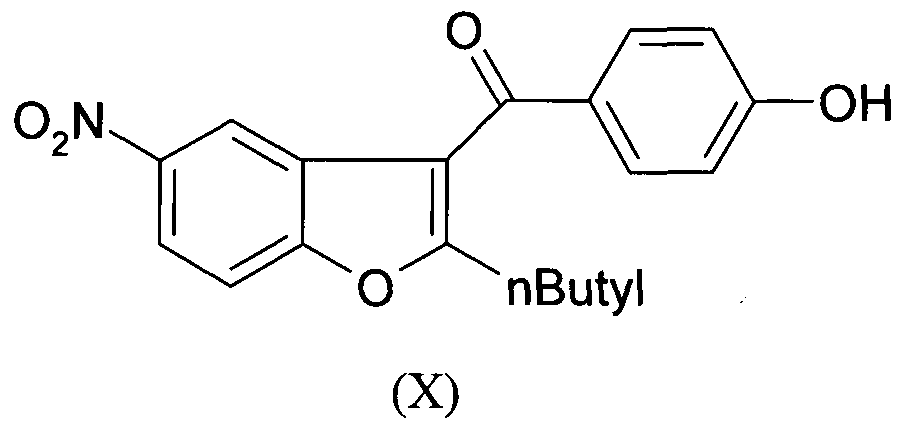
is reacted with acrylonitrile of formula CH2=CH-CN.
Compound (X) is known from EP 0 471 609 (Sanofi).
The reaction can be carried out in presence or absence of solvent. Typically the reaction can be carried out in presence of solvent, which can be e.g. a Ci-4 alcohol, typically methanol or ethanol. Moreover, the reaction is carried out in the presence of a basic catalyst which can be selected from the group of of alkali alkoxydes and quaternary ammonium hydroxides, and it can be e.g. benzyltrimethylammonium hydroxide.
Typically the reaction is carried out in the excess of acrylonitrile as solvent at the boiling point of the solvent, e.g. about 70 to 90 °C . Typically strong water free ammonium quaternary hydroxides or alkali alkoxydes can be applied as catalyst.
B For the preparation of compound of formula (VIII)
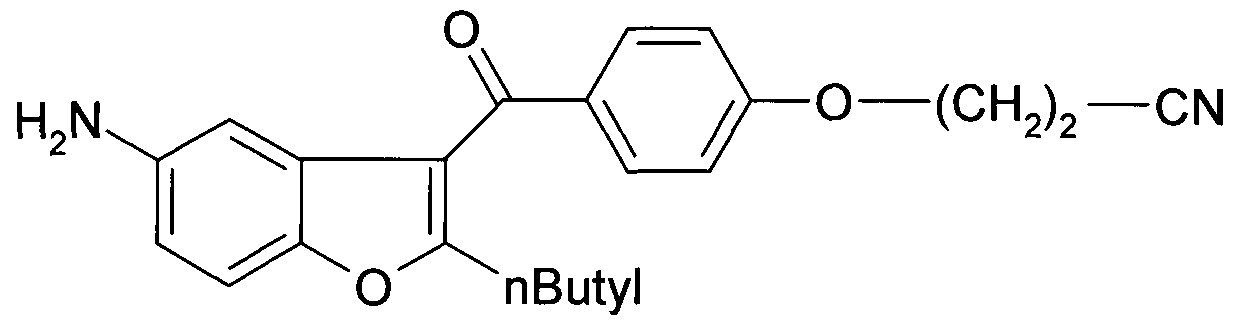
(VIII)
the above compound of formula (IX) is hydrogenated.
Typically the hydrogenation is carried out in the presence of catalyst, e.g. palladium catalyst. The hydrogenation process is carried out in a solvent typically, e.g. the solvent is selected from the group of Ci-4 alcohols, ethyl acetate and cyclohexane, e.g. the solvent is methanol or ethanol.
C For the preparation of compound of formula (VII)

(VII)
the above compound of formula (VIII) is mesylated.
Typically the reaction is carried out in an indifferent solvent, typically in the presence of an acid binding agent. In another embodiment the solvent is selected from the group of dichloromethane, dichloroethane and chlorobenzene. Typically the acid binding agent is a tertiary nitrogen base, for example pyridine or triethylamine.
In the process a mesylating reagent should be applied. It can be any reagent which can be used for inserting a CH3SO2- group into the free amino group of compound of general formula ( VIII ) It is practical to use methanesulfonic anhydride or methanesulfonyl halogenide, e.g. methanesulfonyl chloride.
D For the preparation of compound of formula (III)

the above compound of formula (VII) is hydrolysed.
Typically the hydrolysis is carried out in the presence of acid. The acid can be an inorganic acid, e.g. hydrochloric acid. Typically the hydrolysis is carried out in water in presence of a phase transfer catalyst, e.g. triethyl-benzyl-ammonium chloride.
Compound of formula (II) - which is a key intermediary compound in the preparation of dronedarone - can be prepared from compound (III) [see below in step H)].
Compound of formula (II) can be prepared on another synthetic way as follows: E) For the preparation of compound of formula (XI)

the compound of formula X)

nButyl
(X)
is hydrogenated. Compound (X) is known from EP 0 471 609 (Sanofi). The hydrogenation process is carried out similarly like in above step B). Typically the hydrogenation is carried out in the presence of catalyst, e.g. palladium catalyst.
F) For the preparation of compound of formula (XII)

(XII)
the above compound of formula (XI) is mesylated. The mesylation process is carried out similarly like in above step C).
G) For the preparation of compounds of formula (V)

Typically the reaction is carried out in inert solvent in presence acid binding agent, e.g. pyridine.
H) For the preparation of compound of formula of formula (II)

a) the compound of formula (III)

amidated with the amine of formula
nButyl
HN
'nButyl
or
b) the compound of formula (V)


where X is a usual leaving group which typically stands for halogen, hydroxyl,
RSO2O- , wherein R is alkyl, optionally substituted with one or more halogen(s) or phenyl optionally substituted with one or more substituent selected from the group of alkyl, halogens and nitro, where X is typically a halogen, e.g. chlorine.
In above procedure a) the reaction can be carried out in indifferent solvent or solvent mixture. Typically the solvent is selected from the group of dichloromethane,
dichloroethane , chlorobenzene, toluene, tetrahydrofuran. The reaction is performed at temperature between 10 to 130°C , Typically reaction is carried out at the boiling point of the solvent.
In a practical embodiment of above procedure a) contains a further step where the compound of formula (III) is reacted with a halogenating agent (typically with thionyl chloride) at first and the obtained acid chloride derivative is reacted with dibutylamine of formula (IV). The solvent can be selected from halogenated solvents, and the temperature is typically between 10 to 50°C .
In above procedure b) the reaction can be carried out in a solvent in presence of acid binding agent. Typically the solvent is selected from the group of acetone, methylethyl keton, acetonitrile and dimethylformamide. Typically the acid binding agent is sodium or potassium carbonate.
If X stands for hydroxyl, then a catalyst should be applied, e.g. dicyclohexyl carbodiimide.
Compounds of formula (VI) can be prepared according to known procedures (Anal. Chem. 50, No. 9, 1978; J. Am. Chem. Soc, 73, 3168-71, 1951 ; and Synthesis (4), 319-22, 1983).
I) Finally, for the preparation of dronedarone (I) and pharmaceutically acceptable salts thereof

(I)
npound of formula (II)

(II)
is reduced.
In the reduction process the reductive agent can be selected from the group of LiAlH4, borane, sodium dimethylamino borohydrate, chloroplatinic acid combined with hydrosilanes, sodium borohydride combined with methanesulfonic acid and with CoCl2.
In some practical embodiments the reduction is carried out using a) borane in THF as solvent or b) sodium borohydride and methanesulfonic acid.
Typically the reaction is carried out in dimethylsulfoxyde as solvent.
The temperature applied in the reaction is typically between 0 °C and the boiling point of the solvent (which can be a solvent mixture, as it was mentioned above), e.g. between 60- 120°C.
The applicable acid for the preparation of pharmaceutically acceptable salts can be any inorganic or organic acid which forms an acid addition salt with the compound of general formula (I). Exemplary acids which can form an acid addition salt are as follows: acetic acid, adipic acid, alginic acid, ascorbic acid, aspartic acid, benzoic acid, benzenesulfonic acid, methansulfonic acid, ethansulfonic acid, boric acid, butyric acid, citric acid, fumaric acid, hydrogen chloride, hydrogen bromide, hydrogen iodide, 2-hydroxyethanesulfonic acid, maleic acid, oxalic acid, nitric acid, salicylic acid, tartaric acid, sulfuric acid (forming sulfate or bisulfate anion), sulfonic acid (such as those mentioned herein), succinic acid, toluenesulfonic acid and the like. The hydrogen halogenide salts are typical, especially the hydrogen chloride salt.
Here it is mentioned that on the mesylate group of compound of general formula (I) (see the "left side" of the molecules) a salt formation can be carried out (on the amide part of
it) by a strong base, e.g. an alkaline hydroxide, typically by sodium hydroxide. However, these salts have less practical importance, but they are within the scope of salts which can be prepared by the claimed process. It means that the phrase "salts" embraces both the acid addition salts and the salts formed by bases (basic salts) in case of compounds of general formula (I).
The further starting materials are commercially available or can be prepared by applying known synthetic ways.
Other objects of the invention are the novel intermediary compounds applied in the processes, namely the following compounds:
- Compound of formula (II) and salts thereof

(Π)
- . Com ound of formula (III) and salts thereof

(III)
Compounds of formula (V)

(V)
where Pg is an A-CO- protecting group, group where A is alkyl, alkoxy, aryl or aryloxy group.
Com ound of formula (VII) and salts thereof

(VII)
Com ound of formula (VIII) and salts thereof

(VIII)
Compound of formula (IX)

(IX)
- Com ound of formula (XI) and salts thereof

(XI)
Com ound of formula (XII) and salts thereof

(XII)
Other objects of the invention are the processes for the preparation of the novel intermediary compounds, namely the following ones:

(Π)
where
a the compound of formula (III)

O nButyl
(III)
is amidated with the amine of formula (IV)
nButyl
HN
nButyl
or
compound of formula (V)

nButyl
(V)
where Pg is protecting group, is alkylated with a compound of formula (VI)

where X is a leaving group,
and from the obtained alkylated product the protecting group is removed.
The typical reaction conditions are disclosed above in point H).
- Process for preparation of compound of formula (III) and salts thereof, where the compound of formula (VII)

(VII)
is hydrolysed.
The typical reaction conditions are disclosed above in point D).
- Process for preparation of compounds of formula (V) where Pg is an A-CO- protecting group, where A is alkyl, alkoxy, aryl or aryloxy group,
where the compound of formula XII)

The typical reaction conditions are disclosed above in point G).
- Process for preparation of compound of formula (XII) and salts thereof where the compound of formula XI)

(XI)
is mesylated.
The mesylation can be carried out as it is disclosed above in point C).
- Process for preparation of compound of formula (XI) and salts thereof where the compound of formula (X)

nButyl
(X)
is hydrogenated.
The typical reaction conditions are disclosed above in point B).
- Process for preparation of compound of formula (VII) and salts thereof, characterized in that the compound of formula (VIII)

(VIII)
is mesylated.
The mesylation can be carried out as it was disclosed above in point C).
- Process for preparation of compound of formula (VIII) and salts thereof,
characterized in that the com ound of formula (IX)

(IX)
is hydrogenated.
The typical reaction conditions are disclosed above in point B).
- Process for preparation of compound of formula (IX) where the compound of formula (X)

is reacted with acrylonitrile of formula CH2-CH-CN.
The typical reaction conditions are disclosed above in point A).
In the processes for the preparation of the intermediary compounds the product is isolated as a base typically (if the compound has a free amino or an alkylated amino group). If desired, the isolated base can be converted into a salt (acid adition salt) thereof, which is typically a pharmaceutically acceptable salt [the possible acids are mentioned under point I)]. Theoretically the acid addition salt can be prepared directly if the relating acid is in the final reaction mixture from which the solid product is made (however, this way is not applied in case of these compounds where the base type form has practical importance).
Here it is mentioned that some of the above intermediary compounds have a mesylate group (see the "left side" of the molecules) where a salt formation can be carried out (on the amide part of it) by a strong base, e.g. an alkaline hydroxide, typically by sodium hydroxide. However, these salts have less practical importance, but they are within the scope of salts which can be prepared by the claimed process, i.e. the phrase "salts" embraces the salts formed by bases (basic salts) in such cases (where the molecule has a mesylate group).
In the above reactions the temperature is chosen according to the general practice of a person skilled in organic chemistry. Typically the temperature is between 10 °C and the boiling point of the applied solvent (which can be the mixture of the mentioned solvents in a specific embodiment ). Applicable temperature values can be found in the examples.
All the above reactions are carried out under atmospheric pressure with the exception of the hydrogenation steps where higher pressure also can be applied, typically up to 20 bar, e.g. 5 to 10 bar.
As used herein, the term alkyl includes straight or branched aliphatic hydrocarbon chains of 1 to 6 carbon atoms, e.g., methyl, ethyl, isopropyl and t-butyl.
As used herein, the term "alkoxy" includes alkyl-O- groups. Non-limiting examples of suitable alkoxy groups include methoxy, ethoxy, n-propoxy, isopropoxy and n-butoxy.
As used herein, the term "aryl" includes aromatic monocyclic or multicyclic ring systems comprising 6 to about 14 carbon atoms, preferably 6 to about 10 carbon atoms. Non- limiting examples of suitable aryl groups include phenyl and naphthyl.
As used herein, the term "aryloxy" includes aryl-O- groups.
As used herein, the term„halogen" includes fluoro, chloro, bromo and iodo atoms.

yl]methanesulfonamide (I)
1 g of N.N-dibutyl-3-[4-({2-butyl-5-[(methylsulfonyl])amino]-l-benzofuran-3- yl}carbonyl)-phenoxy]propanamide (II), 0.16 g of NaBH4 and 4 ml of dimethyl sulfoxide were added and under stirring 0.34 ml of methanesulfonic acid dissolved in 2 ml of dimethyl sulfoxide was added in 30 minutes at 20-25°C. The mixture was heated to 70 °C and stirred at this temperature for 2 hours. The reaction mixture was cooled down to 20 °C, 8 ml of 10 % aq NaOH solution and 10 ml of dichloromethane were added to the mixture. The aqueous phase was washed with 2 x 10 ml of dichloromethane. The dichloromethane phases were combined and washed with 10 ml of aq. 0.1 M sodium hydroxide solution and extracted with 2 x 10 ml of aq. 10 % HC1 solution. The acidic phase was neutralized with aq. NaOH solution, extracted with 2 x 5 ml of dichloromethane and the dichloromethane was evaporated.
Yield: 1.02 g. The product is purified by forming its oxalate salt as follows: to the residue 4 ml of methylethyl ketone is added and the mixture heated to70 °C . To this solution 0.24 g of oxalic acid dissolved inl .5 ml of methylethyl ketone is added at 70° C. After cooling to 20 °C in 6 hours the mixture is stirred at 10 °C for 1 hour and filtered. To the obtained oxalate salt 2.5 ml of water and 4 ml of dichloromethane and 0.63g of potassium carbonate are added. After stirring for 30 minutes the separated potassium oxalate is filtered and washed with 2 ml of dichloromethane and the solvent is evaporated.
Yield of purified product: 0.91 g (91%)
Purity : 99.2% (HPLC)
1H NMR(DMSO): 0.8-0.9ppm (m, 9H); 1.2-1.5ppm (m, 10H); 1.67ppm (5\ 2H);
1.87ppm (5', 2H); 2.38ppm (t, J=7.2 Hz, 4H); 2.57ppm (m, 2H); 2.88ppm (t, J=7.5Hz, 2H); 2.91ppm (s, 3H); 9.51ppm (t, J=6.2Hz, 2H); 7.09ppm (d, J=8.8Hz, 2H); 7.24ppm (dd, J=8.9, 2.2Hz, 1H); 7.38ppm (d, J=2.1Hz, 1H); 7.65ppm(d, J=8.8Hz, 1H); 7.81ppm (d, J=8.8Hz, 2H)
Example 2
N- [2-butyl-3 - { 4 - [(3 -dibutylamino)propoxy] benzoyl } - 1 -benzofuran- 5 - yljmethanesulfonamide (I)
The process was performed according to example 1 with the difference that instead of oxalate salt forming chromatography was used for purifying the product (silica gel; ethyl acetate/hexane; 1 :3 v/v).
Yield of purified product: 0.89 g (89%)
Purity: 100% (HPLC)
The product was identical with the compound produced in example 1.
Example 3
N- [2-butyl-3 - {4- [(3 -dibutylamino)propoxy] benzoyl } - 1 -benzofuran-5 - yl]methanesulfonamide (I)
1 g of N.N-dibutyl-3-[4-({2-butyl-5-[(methylsulfonyl])amino]-l-benzofuran-3- yl}carbonyl)-phenoxy]propanamide (II) was dissolved in 5 ml of THF and was added at 0 °C over 15 minutes to 3 ml of 1.67 M borane solution in THF. The mixture was warmed to boiling point and maintained there for 1 hour. The mixture was cooled down to room temperature and 3 ml of 1 M aq hydrochloric acid was added slowly. The THF was removed by evaporation at atmospheric pressure. NaOH pellets were added to make basic the mixture. The aqueous mixture was extracted with 3 x 5 ml of dichloromethane. The dichloromethane phase was washed with 1 x 5 ml of water and evaporated.
Yield 0.96 g. The product was purified by chromatography (silica gel; ethyl acetate/hexane; 1 :3 v/v).
Yield of purified product: 0.92 g (92%)
Purity: 100% (HPLC)
The product was identical with the compound prepared in example 1.
Example 4
N.N-dibutyl-3 - [4-( {2-butyl-5- [(methylsulfonyl)amino] - 1 -benzofuran-3 -yl } carbonyl)- phenoxyjpropanamide (II)
0.43 g of 3-[4-({2-butyl-5-[(methylsulfonyl])amino]-l-benzofuran-3-yl}carbonyl)- phenoxy] -propanoic acid (III) was added into 5 ml of dichloromethane and 0.2 g of thionyl chloride dissolved in 1 ml of dichloromethane was added in 30 minutes, the mixture was warmed to boiling point and stirred at this temperature for 1 hour. The solvent was evaporated. To the residue 10 ml of dichloromethane and 0.17 g of dibutylamine were added. The mixture was stirred at room temperature for 2 hours and cooled to 20°C and washed with 2 x 10 ml of 5% HC1 solution and with 1 x 10 ml of water. The solvent was evaporated.
Yield : 0.57 g (101%). The product was purified by chromatography (silica gel; ethyl acetate/hexane; 1 :3 v/v).
Yield of purified product: 0.46 g (86.8%).
Purity (HPLC) : 98.7%
1H NMR(DMSO): 0.81ppm (t, J=7.44Hz, 3H); 0.85-0.93(m, 6H); 1.20-1.32 (m, 6H); 1.44 (quin, J=7.44Hz, 2H); 1.52(quin, J=7.80Hz, 2H); 1.66(quin, J=7.44Hz, 2H); 2.77-2.83 (m, 4H); 2.89 (s, 3H); 3.23-3.30 (m, 4H); 4.32 (t, J=6.07 Hz, 2H); 7.06 (d, J=8,70Hz, 2H); 7.21 (dd, J=8.81, 2.17 Hz, 1H); 7.29 (d, J=2.06 Hz, 1H); 7.62 (d, J=8.70 Hz, 1H); 7.78 (d, J=8.93 Hz, 2H)
[M+H]+ measured : 571.3 Da , [M+H]+ calculated : 571.3 Da
Example 5
N.N-dibutyl-3 - [4-( { 2-butyl-5- [(methylsulfonyl)amino] - 1 -benzofuran-3 -yl } carbonyl)- phenoxyjpropanamide (II)
1 g of N{[2-butyl-3-[(4-hydroxyphenyl)carbonyl]-l-benzofuran-5-yl}-N- (methylsulfonyl)-benzamide (V) was dissolved in 15 ml of methylethyl ketone, 0.3 g of sodium iodide and 0.9 g of potassium carbonate were added. The reaction mixture was stirred at room temperature for 10 minutes and 0.45 g of N,N-dibutyl-3-chloropropanamide (VI) [prepared according to Anal.Chem. 50, No. 9, 1978] was added. The reaction mixture was stirred at 80-90°C for 5 hours. After cooling to room temperature the inorganic salts were filtered off and the solvent was evaporated. To the residue 10 ml of methanol was added and stirred until dissolution. 0.6 g of solid sodium hydroxide was added and the mixture was
boiled for 1 hour. The solvent was evaporated, dissolved in 15 ml of dichloromethane. The dichloromethane solution was washed with 2 x 15 ml of water 1 x 15 ml of 5% aq.
hydrochloric acid and 1 x 15 ml of water. The solvent was evaporated.
Yield : 0.84 g. The product was purified by chromatography (silica gel; ethyl acetate/hexane; 1 :3 v/v).
Yield of purified product: 0.72 g (92.3%).
Purity (HPLC) : 98.1%
The product is identical with compound produced example 4. Example 6
3 - [4-(- { {2-butyl-5 - [(methansulfonyl)-amino] - 1 -benzofuran-3 -yl} carbonyl } phenoxy)- propanoic acid (III)
1.1 g of N- [2-butyl-3 - { 4- [(2-cyanoethoxy)-benzoyl } - 1 -benzofuran-5 - yl]methanesulfon-amide (VII) and 0.2 g of triethyl-benzyl-ammonium chloride were added to 15 ml of concentrated hydrochloric acid and warmed at 80-90°C for 6 hours. The mixture was cooled to room temperature and the precipitated solid material was filtered and washed with 2 x 10 ml of water. The solid was dried in vacuum at 60°C.
Yield 1.09 g (94.7%). Mp.: 128.7-131.8°C.
1H NMR(DMSO): 0.81ppm (t, J=7.32 Hz, 3H); 1.24 (sxt, J=7.60 Hz, 2H); 1.66 (quin, J=7.50 Hz, 2H) ; 2.57 (t, J=5.95Hz, 2H); 2.81 (t, J=7.44Hz, 2H); 2.89 (s, 3H); 4.28 (t, J=5.95Hz, 2H); 7.09 (d, J=8.93 Hz, 2H); 7.21(dd, J=8.81 ; 2.17 Hz, 1H); 7.27 (d, J=2.06 Hz, 1H); 7.62 (d, J=8.70 Hz, 1H) 7.78 (d, J= 8.93 Hz, 2H)
Purity:98% (HPLC)
Example 7
N-[2-butyl-3-{4-[2-cyanoethoxy]benzoyl}-l -benzofuran-5-yl]methanesulfonamide
(VII)
4.0 g (5-amino-2-butyl-benzofur-3-yl)-[4-(2-cyanoethoxy)phenyl]methanon (VIII) was dissolved in 40 ml of dichloromethane. The mixture was warmed to 30-35°C and 1.05 g of pyridine was added at this temperature over 5 minutes. At this temperature 1.5 g of methanesulfochloride was added in 5 minutes and the mixture was stirred at 30-35°C for 3 hours. The mixture was cooled to 20°C and washed with 2 x 15 ml of water, 2 x 15 ml of
NaHC03 of 5% and lx 15 ml of water. The phases were separated and the dichloromethane was evaporated.
Yield: 4.81 g (100%)
Purity: 94.8% (HPLC) Mp.: 120.9-121.7°C
IH NMR(DMSO): 9.6ppm(s, IH); 7.79 ppm(d, J=8.93 Hz, 2H); 7.62ppm(d, J=8.93
Hz, IH); 7.27ppm (d, J=2.06 Hz, IH); 7.21ppm(dd, J=8.70, 2.06 Hz, IH); 7.13ppm(d, J=8.93 Hz, 2H); 4.31ppm(t, J=5.84 Hz, 2H); 3.07ppm(t, J=5.84 Hz, 2H); 2.88ppm(s, 3H); 2.80ppm(t, J=7.44 Hz, 2H); 1.65ppm(quin, J=7.44 Hz, 2H); 1.24ppm(sxt, J=7.37 Hz, 2H); 0.80ppm(t, J=7.44 Hz 3H)
Example 8
(5 -amino-2-butyl-benzofur-3 -yl)- [4-(2-cyanoethoxy)phenyl]methanon (VIII)
1 g of (5-nitro-2-butyl-benzofur-3-yl)-[4-(2-cyanoethoxy)phenyl]methanon (IX) was dissolved in 15 ml of methanol and 0.1 g of 10 w/w % wet Pd/C catalyst was added and the reaction mixture was heated to 50°C at a stirring speed of 800 rpm. Hydrogen pressure of 5 bar was set to the reactor and the mixture was stirred at this temperature for 2 hours. After cooling to room temperature the catalyst was filtered and the solvent was evaporated.
Yield: 0.92 g (100%). Purity(HPLC): 97.3%.
lH NMR(DMSO): 7.76ppm (d, J=8,93Hz, 2H); 7.26ppm (d, J=8.70Hz, IH); 7.12ppm (d, J=8.70Hz, 2H); 6.57ppm (dd, J=8.70, 2.29Hz, IH); 6.49ppm (d, J=2.29Hz, IH); 4.30ppm (t, J=5.84Hz, 2H); 3.06ppm (t, J=5.84Hz, 2H); 2.73ppm (t, J=7.55Hz, 2H); 1.62ppm (quin, J=7.50Hz, 2H); 1.23ppm (sxt, J=7.28Hz, 3H); 0.80ppm (t, J=7.32Hz, 4H)
[M+H]+ measured = 363.171 IDa, [M+H]+ counted = 363.1709Da Example 9
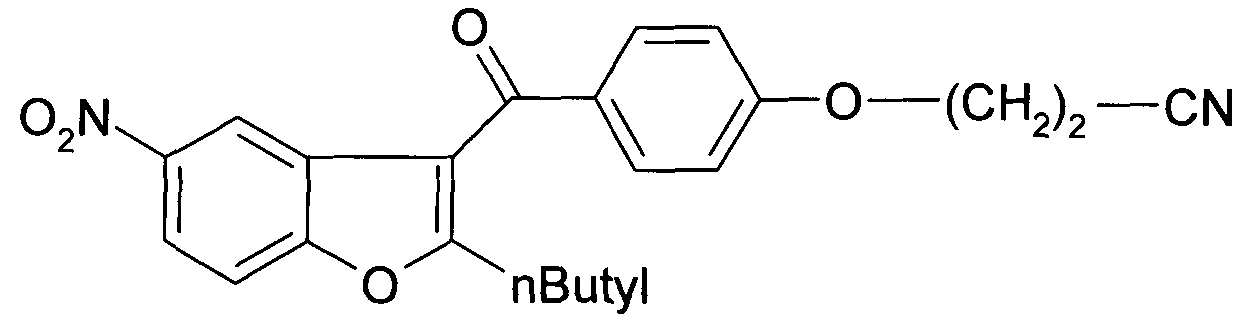
(2-butyl-5-nitro-benzofur-3-yl)-[4-(2-cyanoethoxy)phenyl]methanon (IX)
27.8 g of (2-butyl-5-nitro-l-benzofur-3-yl)-(4-hydroxyphenyl)methanon,(X) 43.5 g of acrylonitrile and 3.8 g Triton B (benzyltrimethylammonium hydroxide) were added and heated under stirring to 80-85°C and stirred at this temperature for 48 hours. After cooling to room temperature the reaction mixture was evaporated and the acrylonitrile was recovered for the next batch. To the residue 150 ml of dichloromethane was added and washed with 3 x 80 ml of 5 % sodium hydroxide. From the sodium hydroxide solution 16.2 g of starting (2-butyl- 5-nitro- 1 -benzofur-3-yl)-(4-hydroxyphenyl)methanon was recovered.
The dichloromethane solution was evaporated.
Yield of product: 12.07 g (94.2% for the consumed starting material).
Purity: 97.6% (HPLC). Mp.: 108.6-108.9°C.
IH NMR(DMSO): 0.80ppm (t, J=7.44Hz, 3H); 1.24ppm (sxt, J=7.37Hz, 2H);
1.68ppm (quin, J=7.50Hz, 2H); 2.84ppm (t, J=7.55Hz, 2H); 3.07ppm (t, J=5.95Hz, 2H); 4.33ppm (t, J=5.95Hz, 2H); 7.15ppm (d, J=8,70Hz, 2H); 7.84ppm (d, J=8.70Hz, 2H);
7.92ppm (d, 9.84Hz, IH); 8.22-8.28ppm (m,2H)
Example 10
N- { -2-butyl-3 -[(4-hydroxyphenyl)carbonyl] - 1 -benzofuran-5-yl } -N-(methy lsulfonyl)- benzamide (V)
2 g of N- [2-buty 1-3 -(4-hydroxybenzoyl)- 1 -benzofuran-5-yl] methanesulfonamide (XII) was dissolved in 10 ml of dichloromethane. 0.61 g of pyridine was added over 10 minutes. The mixture was cooled to 10-12°C and 1.08 g of benzoyl chloride was added at this temperature over 15 minutes. The mixture was stirred at 10-12°C for 2 hours. The
dichloromethane solution was washed with 2 x 20 ml of water, 1 x 20 ml of 5% sodium hydrocarbonate and with 20 ml of water. The solvent was evaporated.
Yield : 2.9 g (1 15%). To this material 15 ml of isopropanol was added and heated until dissolution. Cooling to room temperature and stirring at 5 °C for 1 hour the precipitate was filtered and washed with 2 x 5 ml of cold isopropanol.
Yield : 2.24 g (88.2%).
Purity (HPLC) : 100%. Mp.: 209.7°C.
IH NMR(DMSO): 9.66 ppm (s, IH); 8.22 (dd, J=1.3, 6.9 Hz, 2H); 7.94 (d, J=8.4 Hz, 2H); 7.82 (t, J=7.0 Hz IH); 7.67 (m, 3H); 7.55 (d, J=8.6 Hz, 2H); 7.39 (d, J=1.9 Hz, IH); 7.27 (dd, J=2.2, 8.9 Hz, IH); 2.93 (s, 3H); 2.85 (t, J=7.6 Hz, 2H); 1.70 (5\ J=7,6 Hz, 2H); 1.29 (6', J=7.5 Hz, 2H); 0.86 (t, J=7.3 Hz, 3H)
Example 11
N [2-butyl-3 -(4 -hydroxybenzoy 1)- 1 -benzofuran- 5 -y 1] methanesulfonamide
monohydrate (XII)
10 g of (5-amino-2-butyl-l-benzofuran-3-yl)(4-hydroxyphenyl)methanone was dissolved in 100 ml of dichloromethane. The mixture was warmed under stirring to 30-35°C and 2.8 g of pyridine was added at a rate at which the temperature could be stabilized. 4.07 g
of methanesulfonyl chloride was added at this temperature in 30 mins. The dark solution was stirred at this temperature for 30 mins and was washed with 1 x 60 ml of water, 1 x 60 ml of 5 % aqueous hydrochloric acid, with 1 x 60 ml of water and with 1 x 60 ml of 5 % aqueous sodium hydrocarbonate solution. The dichloromethane solution crystallized after standing over several hours. The crystals were filtered and died at 20 °C.
Yield : 11.2 g (86.4%)
HPLC purity : 100% . Mp : 96.6-97.3°C. Water content : 5.42 w/w %
(monohydrate)
1HNMR : 7.73(J=8.6,2H); 7.64(d,lH);7.32(dd,J=2.1Hz,lH); 7.24(dd,J=8.8Hz,lH); 6.93(2H); 2.92(s, 3H); 2.83(t, J=7.5Hz , 2H);1.69(5',2H); 1.27(6', 2H); 0.84(t, J=7.3 Hz ,3H)
Example 12
(5 -amino-2-butyl- 1 -benzofuran-3 -yl)(4-hydroxyphenyl)methanone (XI)
33.9 g of (2-butyl-5-nitro-l-benzofuran-3-yl)(4-hydroxyphenyl)methanone (X) was placed in a reactor and 150 ml of abs ethanol was added. After stirring at 20-25°C for 5 minutes 1.5 g of wet Pd/C catalyst of 10 w/w% was added. The reactor was closed and under stirring was flushed 3 times with nitrogen, 3 times with hydrogen and 3 times with nitrogen. The reactor was set under hydrogen pressure of 5 bar and the temperature was raised to 50°C. Hydrogenation was carried out for 6 hours then the reaction mixture was cooled to room temperature. At a pressure of 1 bar 75 ml of acetone was added and the mixture was stirred until complete dissolution. The catalyst was filtered out, the solvent was evaporated. Mass of residual material: 29.8 g
The crude material was dissolved in 300 ml of abs ethanol and heated to 80°C. It was cooled to 10°C and the separated crystals filtered.
Yield of the pure compound: 23.36 g (78.3%). Purity (HPLC: 100%).
Mp.: 209.1-210.0°C
1H NMR : 10.4(s, 1H); 7.70(d, J=8.7 Hz, 2H); 7.28(d, J=8.7Hz ,1H); 6.9 l(d, J=8.7 Hz, 2H); 6.60(dd, J=8.7, 2.5Hz, 1H) ; 6.54(d, J=2.5 Hz, 1H); 4.92(s, 2H); 2.76(t, J=7.5 Hz, 2H); 1.65 (5', J=7.5 Hz, 2H); 1.26(6', J=7.5Hz, 2H); 0.84(t, J=7.5Hz, 3H).
Claims
1. Process for preparation of dronedarone (I) and pharmaceutically acceptable salts thereof

nButyl
(I)
characterized in that the compound of formula (II)

O' nButyl
(Π)
is reduced,
and the obtained product is isolated and, if desired, converted into a pharmaceutically acceptable salt thereof.
2. Process according to claim 1, wherein the reductive agent applied in the reduction is selected from the group of LiAlH4, borane, sodium dimethylamino borohydrate,
chloroplatinic acid combined with hydrosilanes, sodium borohydride combined with methanesulfonic acid and with CoCl2.
3. The compound of formula (II) and salts thereof

(II)
4. Process for preparation of compound of formula (II) and salts thereof, 
Ό nButyl
(Π)
characterized in that
a the compound of formula (III)

0 nButyl
(III)
is amidated with the amine of formula (IV)
,nButyl
HN
"nButyl
or
b) the compound of formula (V)

(V)
where Pg is protecting group, is alkylated with a compound of formula (VI)

where X is a leaving group,
and from the obtained alkylated product the protecting group is removed, and the obtained product is isolated and, if desired, converted into a pharmaceutically acceptable salt thereof.
5. Process according to claim 4, procedure a), characterized in that containing a further step where the compound of formula (III) is reacted with a halogenating agent and the obtained acid halogenide derivative is reacted with di(n-butyl)amine of formula (IV).
6. The compound of formula (III) and salts thereof

(III)
7. Process for preparation of compound of formula (III) and salts thereof,

(III)
characterized in that compound of formula (VII)

(VII)
is hydrolysed,
and the obtained product is isolated and, if desired, converted into a pharmaceutically acceptable salt thereof.
8. The compounds of formula (V)

(V)
where Pg is an A-CO- protecting group, group where A is alkyl, alkoxy, aryl or aryloxy group.
9. Process for preparation of compounds of formula (V)

(V)
where Pg is an A-CO- protecting group where A is alkyl, alkoxy, aryl or aryloxy group,
characterized in that the compound of formula (XII)

O nButyl
(XII)
is acylated with a compound of formula Pg-X (XIII) where Pg is a protecting group as defined above and X is a leaving group,
and the obtained product is isolated and, if desired, converted into a pharmaceutically acceptable salt thereof.
10. The compound of formula (XII) and salts thereof 
Ό nButyl
(XII)
11. Process for preparation of compound of formula (XII) and salts thereof

O nButyl
(XII)
characterized in that the com ound of formula (XI)

O nButyl
(XI)
is mesylated,
and the obtained product is isolated and, if desired, converted into a pharmaceutically acceptable salt thereof.
12. The com ound of formula (XI) and salts thereof

nButyl
(XI)
13. Process for reparation of compound of formula (XI) and salts thereof

(XI) characterized in that the compound of formula (X)

(X)
is hydrogenated,
and the obtained product is isolated and, if desired, converted into a pharmaceutically acceptable salt thereof.
14. The compound of formula (VII) and salts thereof

(VII)
15. Process for preparation of compound of formula (VII) and salts thereof, characterized in that the compound of formula (VIII)

(VIII)
is mesylated,
and the obtained product is isolated and, if desired, converted into a pharmaceutically acceptable salt thereof.
16. The compound of formula (VIII) and salts thereof

17. Process for preparation of compound of formula (VIII) and salts thereof, characterized in that the com ound of formula (IX)

(IX)
is hydrogenated,
and the obtained product is isolated and, if desired, converted into a pharmaceutically acceptable salt thereof.
18. The compound of formula (IX)
(IX)
19. Process for preparation of compound of formula (IX)

(IX)
characterized in that the com ound of formula (X)

(X)
is reacted with acrylonitrile of formula CH2=CH-CN.
20. Process for the preparation of dronedarone (I)

(I)
and pharmaceutically acceptable salts thereof, characterized in that
a) the compound of the formula (X) is reacted with acrylonitrile of formula
CH2 = CH-CN according to claim 19,
the obtained compound of formula (IX) is hydrogenated according to claim 17, the obtained compound of the formula (VIII) is mesylated according to claim 15, the obtained compound of the formula (VII) is hydrolysed according to claim 7, the obtained compound of formula (III) is amidated with the amine of formula (IV) according to claim 4a,
the obtained compound of the formula (II) is reduced according to claim 1 and the obtained dronedarone of the formula (I) is isolated and, if desired, converted into a pharmaceutically acceptable salt thereof; or
b) the compound of formula (X) is hydrogenated according to claim 13,
the obtained compound of formula (XI) is mesylated according to claim 1 1 , the obtained compound of the formula (XII) is acylated with a compound of formula Pg - X (XIII) where Pg is a protecting group defined above and X is a leaving group according to claim 9,
the obtained compound of formula (V) - where Pg is an A-CO-protecting group where A is alkyl, alkoxy, aryl or aryloxy group - is alkylated with a compound of formula (VI) - where X is a leaving group -, according to claim 4b and from the obtained alkylated product the Pg protecting group is removed,
the obtained compound of formula (II) is reduced according to claim 1 and
the obtained dronedarone of formula (I) is isolated and, if desired, converted into a pharmaceutically acceptable salt thereof.
Applications Claiming Priority (2)
| Application Number | Priority Date | Filing Date | Title |
|---|---|---|---|
| EPEP11462011.5 | 2011-07-26 | ||
| EP11462011 | 2011-07-26 |
Publications (1)
| Publication Number | Publication Date |
|---|---|
| WO2013014480A1 true WO2013014480A1 (en) | 2013-01-31 |
Family
ID=46704962
Family Applications (1)
| Application Number | Title | Priority Date | Filing Date |
|---|---|---|---|
| PCT/HU2012/000065 Ceased WO2013014480A1 (en) | 2011-07-26 | 2012-07-23 | Process for preparation of dronedarone using amide intermediary compound |
Country Status (1)
| Country | Link |
|---|---|
| WO (1) | WO2013014480A1 (en) |
Cited By (13)
| Publication number | Priority date | Publication date | Assignee | Title |
|---|---|---|---|---|
| US8686180B2 (en) | 2010-04-01 | 2014-04-01 | Sanofi | Process for preparing aminobenzofuran derivatives |
| US8796489B2 (en) | 2010-03-02 | 2014-08-05 | Sanofi | Ketobenzofuran derivatives, method for synthesizing same, and intermediates |
| WO2015031352A1 (en) | 2013-08-27 | 2015-03-05 | Gilead Sciences, Inc. | Process for preparing dronedarone and salts thereof |
| US9174958B2 (en) | 2010-06-18 | 2015-11-03 | Sanofi | Process for the preparation of dronedarone |
| US9174959B2 (en) | 2011-03-29 | 2015-11-03 | Sanofi | Process for preparation of dronedarone by N-butylation |
| US9193703B2 (en) | 2011-03-29 | 2015-11-24 | Sanofi | Process for preparation of dronedarone by mesylation |
| US9221777B2 (en) | 2012-01-20 | 2015-12-29 | Sanofi | Process for preparation of dronedarone by the use of dibutylaminopropanol reagent |
| US9221778B2 (en) | 2012-02-13 | 2015-12-29 | Sanofi | Process for preparation of dronedarone by removal of hydroxyl group |
| US9238636B2 (en) | 2012-05-31 | 2016-01-19 | Sanofi | Process for preparation of dronedarone by Grignard reaction |
| US9249119B2 (en) | 2012-02-14 | 2016-02-02 | Sanofi | Process for the preparation of dronedarone by oxidation of a sulphenyl group |
| US9334254B2 (en) | 2010-03-30 | 2016-05-10 | Sanofi | Process for preparing sulfonamidobenzofuran derivatives |
| US9382223B2 (en) | 2012-02-22 | 2016-07-05 | Sanofi | Process for preparation of dronedarone by oxidation of a hydroxyl group |
| US9499507B2 (en) | 2011-11-29 | 2016-11-22 | Sanofi | Method for preparing 5-amino-benzoyl-benzofuran derivatives |
Citations (4)
| Publication number | Priority date | Publication date | Assignee | Title |
|---|---|---|---|---|
| EP0471609A1 (en) | 1990-08-06 | 1992-02-19 | Sanofi | Benzofuran Derivatives, Benzothiophenes, Indoles or Indolizines, Process for Production and Compositions containing them |
| WO2002048078A1 (en) | 2000-12-11 | 2002-06-20 | Sanofi-Synthelabo | 2-butyl-3-(4-[3(dibutylamino)propoxy]benzoyl)-5-nitro-benzofuran hydrochloride and preparation thereof |
| WO2002048132A1 (en) | 2000-12-11 | 2002-06-20 | Sanofi-Synthelabo | Methanesulphonamido-benzofuran, preparation method and use thereof as synthesis intermediate |
| WO2009044143A2 (en) * | 2007-10-02 | 2009-04-09 | Cambrex Karlskoga Ab | Process for preparing benzofurans |
-
2012
- 2012-07-23 WO PCT/HU2012/000065 patent/WO2013014480A1/en not_active Ceased
Patent Citations (4)
| Publication number | Priority date | Publication date | Assignee | Title |
|---|---|---|---|---|
| EP0471609A1 (en) | 1990-08-06 | 1992-02-19 | Sanofi | Benzofuran Derivatives, Benzothiophenes, Indoles or Indolizines, Process for Production and Compositions containing them |
| WO2002048078A1 (en) | 2000-12-11 | 2002-06-20 | Sanofi-Synthelabo | 2-butyl-3-(4-[3(dibutylamino)propoxy]benzoyl)-5-nitro-benzofuran hydrochloride and preparation thereof |
| WO2002048132A1 (en) | 2000-12-11 | 2002-06-20 | Sanofi-Synthelabo | Methanesulphonamido-benzofuran, preparation method and use thereof as synthesis intermediate |
| WO2009044143A2 (en) * | 2007-10-02 | 2009-04-09 | Cambrex Karlskoga Ab | Process for preparing benzofurans |
Non-Patent Citations (4)
| Title |
|---|
| ANAL. CHEM., vol. 50, no. 9, 1978 |
| ANAL.CHEM., vol. 50, no. 9, 1978 |
| J. AM. CHEM. SOC, vol. 73, 1951, pages 3168 - 71 |
| SYNTHESIS, 1983, pages 319 - 22 |
Cited By (16)
| Publication number | Priority date | Publication date | Assignee | Title |
|---|---|---|---|---|
| US8796489B2 (en) | 2010-03-02 | 2014-08-05 | Sanofi | Ketobenzofuran derivatives, method for synthesizing same, and intermediates |
| US9334254B2 (en) | 2010-03-30 | 2016-05-10 | Sanofi | Process for preparing sulfonamidobenzofuran derivatives |
| US8686180B2 (en) | 2010-04-01 | 2014-04-01 | Sanofi | Process for preparing aminobenzofuran derivatives |
| US9174958B2 (en) | 2010-06-18 | 2015-11-03 | Sanofi | Process for the preparation of dronedarone |
| US9611242B2 (en) | 2011-03-29 | 2017-04-04 | Sanofi | Process for preparation of dronedarone by N-butylation |
| US9174959B2 (en) | 2011-03-29 | 2015-11-03 | Sanofi | Process for preparation of dronedarone by N-butylation |
| US9193703B2 (en) | 2011-03-29 | 2015-11-24 | Sanofi | Process for preparation of dronedarone by mesylation |
| US9499507B2 (en) | 2011-11-29 | 2016-11-22 | Sanofi | Method for preparing 5-amino-benzoyl-benzofuran derivatives |
| US9221777B2 (en) | 2012-01-20 | 2015-12-29 | Sanofi | Process for preparation of dronedarone by the use of dibutylaminopropanol reagent |
| US9708281B2 (en) | 2012-01-20 | 2017-07-18 | Sanofi | Process for preparation of dronedarone by the use of dibutylaminopropanol reagent |
| US9221778B2 (en) | 2012-02-13 | 2015-12-29 | Sanofi | Process for preparation of dronedarone by removal of hydroxyl group |
| US9701654B2 (en) | 2012-02-13 | 2017-07-11 | Sanofi | Process for preparation of dronedarone by removal of hydroxyl group |
| US9249119B2 (en) | 2012-02-14 | 2016-02-02 | Sanofi | Process for the preparation of dronedarone by oxidation of a sulphenyl group |
| US9382223B2 (en) | 2012-02-22 | 2016-07-05 | Sanofi | Process for preparation of dronedarone by oxidation of a hydroxyl group |
| US9238636B2 (en) | 2012-05-31 | 2016-01-19 | Sanofi | Process for preparation of dronedarone by Grignard reaction |
| WO2015031352A1 (en) | 2013-08-27 | 2015-03-05 | Gilead Sciences, Inc. | Process for preparing dronedarone and salts thereof |
Similar Documents
| Publication | Publication Date | Title |
|---|---|---|
| AU2012235911A1 (en) | Reductive amination process for preparation of dronedarone using amine intermediary compound | |
| AU2010329655B2 (en) | New process for the preparation of dronedarone | |
| WO2012131409A1 (en) | Process for preparation of dronedarone by n-butylation | |
| WO2013014479A1 (en) | Reductive animation process for preparation of dronedarone using aldehyde intermediary compound | |
| JP4236926B2 (en) | Methanesulfonamide-benzofuran, its production method and use as a synthetic intermediate. | |
| WO2013014478A1 (en) | Reductive amination process for preparation of dronedarone using carboxyl intermediary compound | |
| CA2831503A1 (en) | Process for preparation of dronedarone by mesylation | |
| CN103068810A (en) | Process for the preparation of dronedarone | |
| CN102770420B (en) | Novel process for the manufacture of dronedarone | |
| WO2013121235A2 (en) | Process for preparation of dronedarone by removal of hydroxyl group | |
| WO2013128294A2 (en) | Process for preparation of dronedarone by the use of dibutylaminoethanol reagent | |
| EP2212286A1 (en) | Synthesis of quaternary salt compounds | |
| KR20140022852A (en) | Reductive amination process for preparation of dronedarone using amine intermediary compound | |
| KR20120094090A (en) | New process for the preparation of dronedarone | |
| KR20140020981A (en) | Process for preparation of dronedarone by mesylation |
Legal Events
| Date | Code | Title | Description |
|---|---|---|---|
| 121 | Ep: the epo has been informed by wipo that ep was designated in this application |
Ref document number: 12748522 Country of ref document: EP Kind code of ref document: A1 |
|
| NENP | Non-entry into the national phase |
Ref country code: DE |
|
| 122 | Ep: pct application non-entry in european phase |
Ref document number: 12748522 Country of ref document: EP Kind code of ref document: A1 |