EP3037426A1 - Phosphorus-containing compound, and curable epoxy resin composition containing same - Google Patents
Phosphorus-containing compound, and curable epoxy resin composition containing same Download PDFInfo
- Publication number
- EP3037426A1 EP3037426A1 EP14837177.6A EP14837177A EP3037426A1 EP 3037426 A1 EP3037426 A1 EP 3037426A1 EP 14837177 A EP14837177 A EP 14837177A EP 3037426 A1 EP3037426 A1 EP 3037426A1
- Authority
- EP
- European Patent Office
- Prior art keywords
- group
- phosphorus
- containing compound
- alkyl group
- epoxy resin
- Prior art date
- Legal status (The legal status is an assumption and is not a legal conclusion. Google has not performed a legal analysis and makes no representation as to the accuracy of the status listed.)
- Granted
Links
- 0 CP(*)(Sc1ccccc1)=S Chemical compound CP(*)(Sc1ccccc1)=S 0.000 description 3
- ZWAWVIDZQLHHEL-UHFFFAOYSA-N CCP(CC)(Oc1ccccc1)=O Chemical compound CCP(CC)(Oc1ccccc1)=O ZWAWVIDZQLHHEL-UHFFFAOYSA-N 0.000 description 1
Images


Classifications
-
- C—CHEMISTRY; METALLURGY
- C07—ORGANIC CHEMISTRY
- C07F—ACYCLIC, CARBOCYCLIC OR HETEROCYCLIC COMPOUNDS CONTAINING ELEMENTS OTHER THAN CARBON, HYDROGEN, HALOGEN, OXYGEN, NITROGEN, SULFUR, SELENIUM OR TELLURIUM
- C07F9/00—Compounds containing elements of Groups 5 or 15 of the Periodic Table
- C07F9/02—Phosphorus compounds
- C07F9/28—Phosphorus compounds with one or more P—C bonds
- C07F9/30—Phosphinic acids [R2P(=O)(OH)]; Thiophosphinic acids ; [R2P(=X1)(X2H) (X1, X2 are each independently O, S or Se)]
- C07F9/32—Esters thereof
- C07F9/3258—Esters thereof the ester moiety containing a substituent or a structure which is considered as characteristic
- C07F9/3282—Esters with hydroxyaryl compounds
-
- C—CHEMISTRY; METALLURGY
- C07—ORGANIC CHEMISTRY
- C07F—ACYCLIC, CARBOCYCLIC OR HETEROCYCLIC COMPOUNDS CONTAINING ELEMENTS OTHER THAN CARBON, HYDROGEN, HALOGEN, OXYGEN, NITROGEN, SULFUR, SELENIUM OR TELLURIUM
- C07F9/00—Compounds containing elements of Groups 5 or 15 of the Periodic Table
- C07F9/02—Phosphorus compounds
- C07F9/28—Phosphorus compounds with one or more P—C bonds
- C07F9/30—Phosphinic acids [R2P(=O)(OH)]; Thiophosphinic acids ; [R2P(=X1)(X2H) (X1, X2 are each independently O, S or Se)]
- C07F9/32—Esters thereof
- C07F9/3258—Esters thereof the ester moiety containing a substituent or a structure which is considered as characteristic
- C07F9/3264—Esters with hydroxyalkyl compounds
-
- C—CHEMISTRY; METALLURGY
- C07—ORGANIC CHEMISTRY
- C07F—ACYCLIC, CARBOCYCLIC OR HETEROCYCLIC COMPOUNDS CONTAINING ELEMENTS OTHER THAN CARBON, HYDROGEN, HALOGEN, OXYGEN, NITROGEN, SULFUR, SELENIUM OR TELLURIUM
- C07F9/00—Compounds containing elements of Groups 5 or 15 of the Periodic Table
- C07F9/02—Phosphorus compounds
- C07F9/28—Phosphorus compounds with one or more P—C bonds
- C07F9/30—Phosphinic acids [R2P(=O)(OH)]; Thiophosphinic acids ; [R2P(=X1)(X2H) (X1, X2 are each independently O, S or Se)]
- C07F9/36—Amides thereof
-
- C—CHEMISTRY; METALLURGY
- C08—ORGANIC MACROMOLECULAR COMPOUNDS; THEIR PREPARATION OR CHEMICAL WORKING-UP; COMPOSITIONS BASED THEREON
- C08K—Use of inorganic or non-macromolecular organic substances as compounding ingredients
- C08K5/00—Use of organic ingredients
- C08K5/49—Phosphorus-containing compounds
- C08K5/51—Phosphorus bound to oxygen
- C08K5/53—Phosphorus bound to oxygen bound to oxygen and to carbon only
- C08K5/5313—Phosphinic compounds, e.g. R2=P(:O)OR'
-
- C—CHEMISTRY; METALLURGY
- C08—ORGANIC MACROMOLECULAR COMPOUNDS; THEIR PREPARATION OR CHEMICAL WORKING-UP; COMPOSITIONS BASED THEREON
- C08L—COMPOSITIONS OF MACROMOLECULAR COMPOUNDS
- C08L63/00—Compositions of epoxy resins; Compositions of derivatives of epoxy resins
-
- C—CHEMISTRY; METALLURGY
- C09—DYES; PAINTS; POLISHES; NATURAL RESINS; ADHESIVES; COMPOSITIONS NOT OTHERWISE PROVIDED FOR; APPLICATIONS OF MATERIALS NOT OTHERWISE PROVIDED FOR
- C09K—MATERIALS FOR MISCELLANEOUS APPLICATIONS, NOT PROVIDED FOR ELSEWHERE
- C09K21/00—Fireproofing materials
- C09K21/06—Organic materials
- C09K21/12—Organic materials containing phosphorus
-
- C—CHEMISTRY; METALLURGY
- C09—DYES; PAINTS; POLISHES; NATURAL RESINS; ADHESIVES; COMPOSITIONS NOT OTHERWISE PROVIDED FOR; APPLICATIONS OF MATERIALS NOT OTHERWISE PROVIDED FOR
- C09K—MATERIALS FOR MISCELLANEOUS APPLICATIONS, NOT PROVIDED FOR ELSEWHERE
- C09K21/00—Fireproofing materials
- C09K21/14—Macromolecular materials
Definitions
- This invention relates to a phosphorus-containing compound, particularly a reactive phosphorus-containing compound that can be combined with a polyepoxy compound to provide a curing epoxy resin composition expected to provide flame retardation, reduced dielectric constant, and the like.
- Patent Literature 1 proposes adding a phosphorus-containing flame retardant composed of a high-molecular-weight divalent phenol and a phenol to an epoxy resin. Nevertheless, the proposed flame retardant should be used in a large quantity in order to impart sufficient flame retardancy to an epoxy resin. Adding a sufficient amount of the flame retardant to realize satisfactory flame retardation causes reduction in glass transition temperature, whereas an increase in glass transition temperature results in insufficient flame retardancy.
- Patent Literature 2 below proposes using a reactive phosphoric ester compound.
- An object of the invention is to provide a phosphorus-containing compound having reactivity with a glycidyl group, particularly a phosphorus-containing compound capable of providing a curing epoxy resin composition with flame retardancy and a low dielectric constant.
- the present invention provides a phosphorus-containing compound represented by following general formula (I).
- m represents a number of 1 to 10
- R 1 and R 2 each independently represent a hydrogen atom, an alkyl group, or an aryl group
- R 3 represents an alkyl group, an alkanediyl group, an alkanetriyl group, an alkanetetrayl group, or an aromatic group
- X represents an oxygen atom or a sulfur atom
- Y represents an oxygen atom, a sulfur atom, or -NR 4 -
- R 4 represents a hydrogen atom, an alkyl group, or an aryl group.
- the invention provides a phosphorus-containing compound having excellent reactivity with an epoxy resin and promising to impart flame retardation to the epoxy resin and to reduce the dielectric constant of the epoxy resin.
- Examples of the alkyl group as represented by R 1 and R 2 in general formula (I) include methyl, ethyl, propyl, isopropyl, butyl, isobutyl, tert-butyl, amyl, isoamyl, tert-amyl, hexyl, isohexyl, octyl, 2-ethylhexyl, tert-octyl, nonyl, and decyl.
- Examples of the aryl group as represented by R 1 and R 2 are phenyl and naphthyl.
- Examples of the alkyl group as represented by R 3 include methyl, ethyl, propyl, isopropyl, butyl, isobutyl, tert-butyl, amyl, isoamyl, tert-amyl, hexyl, isohexyl, octyl, 2-ethylhexyl, tert-octyl, nonyl, and decyl.
- Examples of the aryl group as represented by R 3 include phenyl and naphthyl.
- Examples of the alkanediyl group as R 3 include methylene, ethylene, propylene, butylene, and octylene.
- alkanetriyl group as R 3 examples are methylenetriyl and 1,1,3-ethylenetriyl.
- the alkanetetrayl as R 3 is exemplified by 1,1,2,2-ethylenetriyl.
- aromatic group as represented by R 3 include those derived from mononuclear polyhydric phenol compounds, such as hydroquinone, resorcin, pyrocatechol, and phloroglucinol, and polynuclear polyhydric phenol compounds, such as dihydroxynaphthalene, biphenol, methylenebisphenol (bisphenol F), methylenebis(o-cresol), ethylidenebisphenol, isopropylidenebisphenol (bisphenol A), isopropylidenebis(o-cresol), tetrabromobisphenol A, 1,3-bis(4-hydroxycumylbenzene), 1,4-bis(4-hydroxycumylbenzene), 1,1,3-tris(4-hydroxyphenyl)butan
- the phosphorus-containing compounds of the invention are preferably those of general formula (I) in which R 1 is C1-C5 alkyl, R 2 is C1-C5 alkyl, R 3 is an aromatic group; and X and Y are each oxygen.
- phosphorus-containing compound of the invention include those represented by formulae (I-1) through (I-8) described below.
- the phosphorus-containing compound of the invention can be prepared by a method shown by the following reaction scheme. wherein m, R 1 , R 2 , R 3 , X, and Y are same as m, R 1 , R 2 , R 3 , X, and Y defined above.
- Examples of the base that can be used in the above reaction include tertiary amines, such as triethylamine, tributylamine, diazabicycloundecene, diazabicyclononene, and 1,4-diazabicyclo[2.2.2]octane; pyridines, such as pyridine and N,N-dimethylaminopyridine; imidazoles, such as 1-methylimidazole; and phosphines, such as triphenylphosphine, tributylphosphine, and tricyclohexylphosphine.
- tertiary amines such as triethylamine, tributylamine, diazabicycloundecene, diazabicyclononene, and 1,4-diazabicyclo[2.2.2]octane
- pyridines such as pyridine and N,N-dimethylaminopyridine
- Examples of the solvent that can be used in the above reaction include ketones, such as methyl ethyl ketone, methyl amyl ketone, diethyl ketone, acetone, methyl isopropyl ketone, propylene glycol monomethyl ether acetate, and cyclohexanone; ethers, such as tetrahydrofuran, 1,2-dimethoxyethane, 1,2-diethoxyethane, and propylene glycol monomethyl ether; esters, such as ethyl acetate and n-butyl acetate; aromatic hydrocarbons, such as benzene, toluene, and xylene; halogenated aliphatic hydrocarbons, such as carbon tetrachloride, chloroform, trichloroethylene, and methylene chloride; and halogenated aromatic hydrocarbons, such as chlorobenzene.
- ketones such as methyl ethyl ketone, methyl
- the reaction is carried out at a temperature of -80° to 100°C, preferably room temperature to 50°C, for a period of 0.5 to 72 hours, preferably 1 to 24 hours.
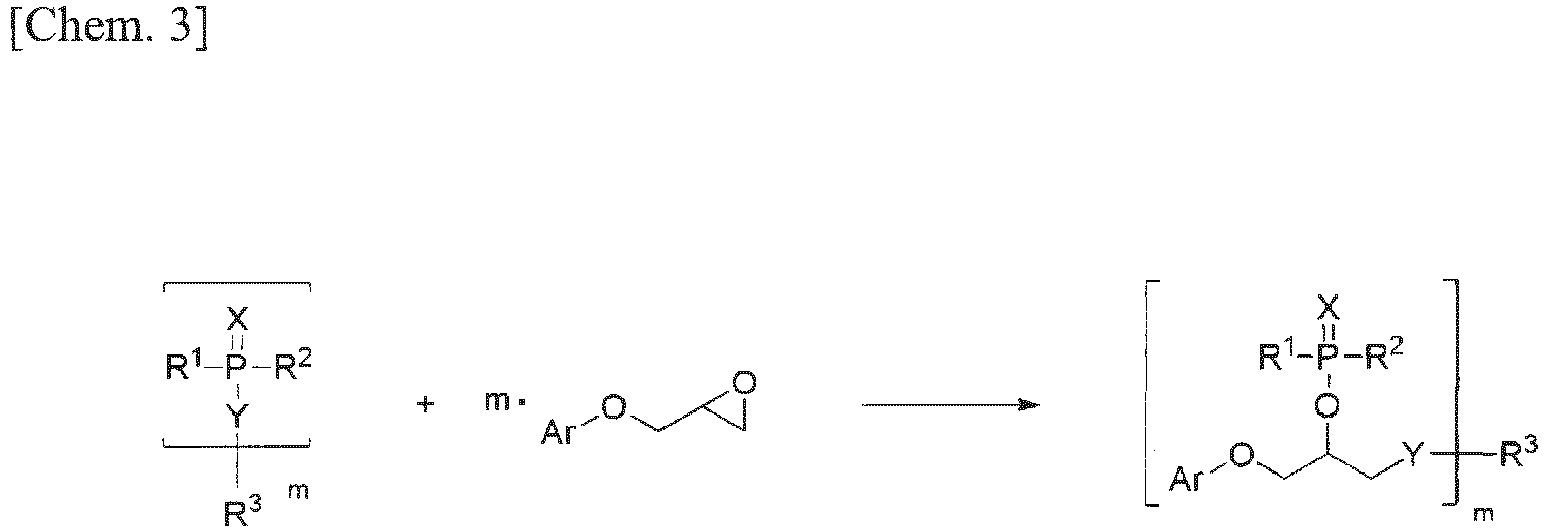
- the invention also provides a reaction process including causing the above-described phosphorus-containing compound to react with an epoxy compound according to the following reaction scheme.
- m represents a number of 1 to 10
- R 1 and R 2 each independently represent a hydrogen atom, an alkyl group, or an aryl group
- R 3 represents an alkyl group, an alkanediyl group, an alkanetriyl group, an alkanetetrayl group, or an aromatic group
- X represents an oxygen atom or a sulfur atom
- Y represents an oxygen atom, a sulfur atom, or -NR 4 -
- R 4 represents a hydrogen atom, an alkyl group, or an aryl group.
- the phosphorus-containing compound of the invention is combined with a polyepoxy compound to provide a curing epoxy resin composition.
- polyepoxy compound examples include polyglycidyl ether compounds of mononuclear polyhydric phenol compounds, such as hydroquinone, resorcinol, pyrocatechol, and phloroglucinol; polyglycidyl ether compounds of polynuclear polyhydric phenol compounds, such as dihydroxynaphthalene, biphenol, methylenebisphenol (bisphenol F), methylenebis(o-cresol), ethylidene bisphenol, isopropylidene bisphenol (bisphenol A), isopropylidene bis(o-cresol), tetrabromobisphenol A, 1,3-bis(4-hydroxycumylbenzene), 1,4-bis(4-hydroxycumylbenzene), 1,1,3-tris(4-hydroxyphenyl)butane, 1,1,2,2-tetra(4-hydroxyphenyl)ethane, thiobisphenol, sulfonylbisphenol,
- epoxy resins may be internally crosslinked by a prepolymer of the terminal isocyanate or may have their molecular weight increased by a polyvalent active hydrogen compound (e.g., polyhydric phenols, polyamines, carbonyl-containing compounds, and polyphosphoric esters).
- a polyvalent active hydrogen compound e.g., polyhydric phenols, polyamines, carbonyl-containing compounds, and polyphosphoric esters.
- the polyepoxy compound preferably has an epoxy equivalent of from 70 to 3,000, more preferably 90 to 2,000. With an epoxy equivalent less than 70, the physical properties of the cured product can reduce. With an epoxy equivalent larger than 3,000, curability can be insufficient.
- the curing epoxy resin composition of the invention is preferably combined with a curing catalyst, such as p- dimethylaminopyridine, triphenylphosphine, imidazole, tertiary amines, phosphines, quaternary ammonium salts, and quaternary phosphonium salts.
- a curing catalyst such as p- dimethylaminopyridine, triphenylphosphine, imidazole, tertiary amines, phosphines, quaternary ammonium salts, and quaternary phosphonium salts.
- the curing epoxy resin composition of the invention is preferably combined with a general-purpose epoxy resin curing agent.
- Suitable epoxy resin curing agents include imidazoles, such as 2-ethyl-4-methylimidazole, 1,2-dimethylimidazole, and 1-(2-methylimidazol-1-ylmethyl)naphthalen-2-ol; polyalkylpolyamines, such as diethylenetriamine, triethylenetriamine, and tetraethylenepentamine; alicyclic polyamines, such as 1,2-diaminocyclohexane, 1,4-diamino-3,6-diethylcyclohexane, and isophoronediamine; and aromatic polyamines, such as m-xylylenediamine, diaminodiphenylmethane, and diaminodiphenyl sulfone.
- polyepoxy adducts of these polyamines obtained by the reaction with various epoxy resins such as glycidyl ethers (e.g., phenyl glycidyl ether, butyl glycidyl ether, bisphenol A diglycidyl ether, and bisphenol F glycidyl ether) or carboxylic acid glycidyl esters in a usual manner; amide-modified products of the organic polyamines obtained by the reaction with carboxylic acids (e.g., phthalic acid, isophthalic acid, and dimer acid) in a usual manner; and Mannich-modified products of the polyamines obtained by the reaction with aldehydes (e.g., formaldehyde) and phenols having at least one aldehyde-reactive site on their nucleus (e.g., phenol, cresol, xylenol, tert-butylphenol, and resorcinol) in
- the curing epoxy resin composition may contain commonly used additives, including reactive or nonreactive diluents (plasticizers), such as monoglycidyl ethers, dioctyl phthalate, dibutyl phthalate, benzyl alcohol, and coal tar; fillers or pigments, such as glass fiber, carbon fiber, cellulose, silica sand, cement, kaolin, clay, aluminum hydroxide, bentonite, talc, silica, finely divided silica, titanium dioxide, carbon black, graphite, iron oxide, and bituminous materials; silane coupling agents, such as ⁇ -aminopropyltriethoxysilane, N- ⁇ -(aminoethyl)- ⁇ -aminopropyltriethoxysilane, N- ⁇ -(aminoethyl)-N'- ⁇ -(aminoethyl)- ⁇ -aminopropyltriethoxysilane, ⁇ -an
- the curing epoxy resin composition of the invention can be used for a wide range of applications, such as coatings or adhesives for concrete, cement mortar, various metals, leather, glass, rubber, plastics, wood, cloth, and paper; pressure-sensitive adhesives for packaging adhesive tape, adhesive labels, labels for frozen foods, removable labels, labels for POS system, adhesive wallpaper, and adhesive flooring; processed paper, such as art paper, light-weight coated paper, cast-coated paper, coated paperboard, carbonless copy paper, and impregnated paper; textile processing agents, such as sizing agents, anti-fray agents, and processing agents for natural fibers, synthetic fibers, glass fiber, carbon fiber, and metal fibers; building materials, such as sealants, cement admixtures, and waterproof materials; and sealants for electronic/electric devices.
- applications such as coatings or adhesives for concrete, cement mortar, various metals, leather, glass, rubber, plastics, wood, cloth, and paper; pressure-sensitive adhesives for packaging adhesive tape, adhesive labels, labels for frozen foods, removable labels, labels for POS system, adhesive
- a 100 ml three-necked flask equipped with a rotor, a reflux tube, and a rubber septum was thoroughly dried, purged with nitrogen, and charged with 0.75 g (8.8 mmol) of phenol, 0.89 g (8.8 mmol) of triethylamine, and 3 ml of ultra-dehydrated tetrahydrofuran using a syringe.
- 0.90 g (8 mmol) of dimethyl phosphinic chloride and 3 ml of ultra-dehydrated tetrahydrofuran to prepare a dimethyl phosphinic chloride solution.
- the dimethyl phosphinic chloride solution was added dropwise using a syringe taking care so that the reaction temperature did not exceed 30°C. After completion of the addition, the reaction system was stirred overnight. To the reaction solution were added 5 ml of a saturated ammonium chloride aqueous solution and 5 ml of water, followed by stirring well. The solution was transferred to a separatory funnel, extracted 3 times with 10 ml portions of ethyl acetate to obtain an organic layer. The organic layer was washed with 10 ml of water and dried over anhydrous magnesium sulfate. The solvent was removed using an evaporator to give pale yellow liquid (crude yield: 60.3%, GC purity: 87.1%).
- the 1 H-NMR, 31 P-NMR, and GC-MS spectra of the resulting phosphorus-containing compound are shown in Figs. 1 to 3 , respectively.
- Example of the invention proved that the phosphorus-containing compound of the invention has reactivity with a glycidyl group.
- Incorporation of the phosphorus-containing compound of the invention into an epoxy resin provides an epoxy resin cured product that is expected to have flame retardancy and a reduced dielectric constant without causing reduction in physical properties of the cured product.
Landscapes
- Chemical & Material Sciences (AREA)
- Organic Chemistry (AREA)
- Health & Medical Sciences (AREA)
- Molecular Biology (AREA)
- Life Sciences & Earth Sciences (AREA)
- Biochemistry (AREA)
- General Health & Medical Sciences (AREA)
- Polymers & Plastics (AREA)
- Medicinal Chemistry (AREA)
- Chemical Kinetics & Catalysis (AREA)
- Engineering & Computer Science (AREA)
- Materials Engineering (AREA)
- Epoxy Resins (AREA)
- Compositions Of Macromolecular Compounds (AREA)
- Fireproofing Substances (AREA)
Abstract

Description
- This invention relates to a phosphorus-containing compound, particularly a reactive phosphorus-containing compound that can be combined with a polyepoxy compound to provide a curing epoxy resin composition expected to provide flame retardation, reduced dielectric constant, and the like.
- The recent increase in concern with global environmental problem and safety of the human body has boosted the demand for less hazard and more safety, as well as flame retardancy, of electric/electronic products. That is, reduction of harmful gas and smoke generation has been demanded.
- Use of a bromine-containing flame retardant, which provides good flame retardancy, has been being limited on account of generation of toxic hydrogen halide gas (hydrogen bromide) on combustion. Therefore, studies have been directed to compositions containing an ordinary epoxy resin and a halogen-free flame retardant, such as a nitrogen compound, a phosphorus compound, or an inorganic compound. However, these additives for imparting flame retardancy are disadvantageous in that their flame retardant effect is insufficient or they adversely affect curing of the epoxy resin or are accompanied by reduction of physical properties, such as a glass transition temperature, of a cured product.
- For example, triphenyl phosphate is widely used as a phosphorous-containing flame retardant for various resins.
Patent Literature 1 described below proposes adding a phosphorus-containing flame retardant composed of a high-molecular-weight divalent phenol and a phenol to an epoxy resin. Nevertheless, the proposed flame retardant should be used in a large quantity in order to impart sufficient flame retardancy to an epoxy resin. Adding a sufficient amount of the flame retardant to realize satisfactory flame retardation causes reduction in glass transition temperature, whereas an increase in glass transition temperature results in insufficient flame retardancy. Patent Literature 2 below proposes using a reactive phosphoric ester compound. The proposal has turned out to be impractical because incorporating the phosphoric ester compound into an epoxy resin makes the resin hygroscopic or makes part of the resin take on a three-dimensional structure, which increases the viscosity and thereby greatly reduces the workability of the resin composition. -
- Patent Literature 1:
US 5,739,187(A ) - Patent Literature 2:
JP 10-195178A - An object of the invention is to provide a phosphorus-containing compound having reactivity with a glycidyl group, particularly a phosphorus-containing compound capable of providing a curing epoxy resin composition with flame retardancy and a low dielectric constant.
- As a result of extensive investigations, the inventors have found that a specific phosphorus-containing compound accomplishes the above object and reached the present invention.
- The present invention provides a phosphorus-containing compound represented by following general formula (I).

- The invention provides a phosphorus-containing compound having excellent reactivity with an epoxy resin and promising to impart flame retardation to the epoxy resin and to reduce the dielectric constant of the epoxy resin.
-
- [
Fig. 1] Fig. 1 is a 1H-NMR spectrum of the phosphorus-containing compound obtained in Example 1. - [
Fig. 2] Fig. 2 is a 31P-NMR spectrum of the phosphorus-containing compound obtained in Example 1. - [
Fig. 3] Fig. 3 is a GC-MS spectrum of the phosphorus-containing compound obtained in Example 1. - [
Fig. 4] Fig. 4 is a 1H-NMR spectrum of P2 obtained in Example 2. - [
Fig. 5] Fig. 5 is a 31P-NMR spectrum of P2 obtained in Example 2. - [
Fig. 6] Fig. 6 is a GC-MS spectrum of P2 obtained in Example 2. - The phosphorus-containing compound according to the invention will be described in detail.
- Examples of the alkyl group as represented by R1 and R2 in general formula (I) include methyl, ethyl, propyl, isopropyl, butyl, isobutyl, tert-butyl, amyl, isoamyl, tert-amyl, hexyl, isohexyl, octyl, 2-ethylhexyl, tert-octyl, nonyl, and decyl. Examples of the aryl group as represented by R1 and R2 are phenyl and naphthyl. Examples of the alkyl group as represented by R3 include methyl, ethyl, propyl, isopropyl, butyl, isobutyl, tert-butyl, amyl, isoamyl, tert-amyl, hexyl, isohexyl, octyl, 2-ethylhexyl, tert-octyl, nonyl, and decyl. Examples of the aryl group as represented by R3 include phenyl and naphthyl. Examples of the alkanediyl group as R3 include methylene, ethylene, propylene, butylene, and octylene. Examples of the alkanetriyl group as R3 are methylenetriyl and 1,1,3-ethylenetriyl. The alkanetetrayl as R3 is exemplified by 1,1,2,2-ethylenetriyl. Examples of the aromatic group as represented by R3 include those derived from mononuclear polyhydric phenol compounds, such as hydroquinone, resorcin, pyrocatechol, and phloroglucinol, and polynuclear polyhydric phenol compounds, such as dihydroxynaphthalene, biphenol, methylenebisphenol (bisphenol F), methylenebis(o-cresol), ethylidenebisphenol, isopropylidenebisphenol (bisphenol A), isopropylidenebis(o-cresol), tetrabromobisphenol A, 1,3-bis(4-hydroxycumylbenzene), 1,4-bis(4-hydroxycumylbenzene), 1,1,3-tris(4-hydroxyphenyl)butane, 1,1,2,2-tetra(4-hydroxyphenyl)ethane, thiobisphenol, sulfonylbisphenol, oxybisphenol, phenol novolak, o-cresol novolak, ethylphenol novolak, butylphenol novolak, octylphenol novolak, resorcin novolak, and terpene phenol. Preferred of them are groups represented by the formulae shown below.

- The phosphorus-containing compounds of the invention are preferably those of general formula (I) in which R1 is C1-C5 alkyl, R2 is C1-C5 alkyl, R3 is an aromatic group; and X and Y are each oxygen.
- Specific examples of the phosphorus-containing compound of the invention include those represented by formulae (I-1) through (I-8) described below.


- The phosphorus-containing compound of the invention can be prepared by a method shown by the following reaction scheme.

- Examples of the base that can be used in the above reaction include tertiary amines, such as triethylamine, tributylamine, diazabicycloundecene, diazabicyclononene, and 1,4-diazabicyclo[2.2.2]octane; pyridines, such as pyridine and N,N-dimethylaminopyridine; imidazoles, such as 1-methylimidazole; and phosphines, such as triphenylphosphine, tributylphosphine, and tricyclohexylphosphine.
- Examples of the solvent that can be used in the above reaction include ketones, such as methyl ethyl ketone, methyl amyl ketone, diethyl ketone, acetone, methyl isopropyl ketone, propylene glycol monomethyl ether acetate, and cyclohexanone; ethers, such as tetrahydrofuran, 1,2-dimethoxyethane, 1,2-diethoxyethane, and propylene glycol monomethyl ether; esters, such as ethyl acetate and n-butyl acetate; aromatic hydrocarbons, such as benzene, toluene, and xylene; halogenated aliphatic hydrocarbons, such as carbon tetrachloride, chloroform, trichloroethylene, and methylene chloride; and halogenated aromatic hydrocarbons, such as chlorobenzene.
- The reaction is carried out at a temperature of -80° to 100°C, preferably room temperature to 50°C, for a period of 0.5 to 72 hours, preferably 1 to 24 hours.
- The invention also provides a reaction process including causing the above-described phosphorus-containing compound to react with an epoxy compound according to the following reaction scheme.

- The phosphorus-containing compound of the invention is combined with a polyepoxy compound to provide a curing epoxy resin composition.
- Examples of the polyepoxy compound that can be used in the invention include polyglycidyl ether compounds of mononuclear polyhydric phenol compounds, such as hydroquinone, resorcinol, pyrocatechol, and phloroglucinol; polyglycidyl ether compounds of polynuclear polyhydric phenol compounds, such as dihydroxynaphthalene, biphenol, methylenebisphenol (bisphenol F), methylenebis(o-cresol), ethylidene bisphenol, isopropylidene bisphenol (bisphenol A), isopropylidene bis(o-cresol), tetrabromobisphenol A, 1,3-bis(4-hydroxycumylbenzene), 1,4-bis(4-hydroxycumylbenzene), 1,1,3-tris(4-hydroxyphenyl)butane, 1,1,2,2-tetra(4-hydroxyphenyl)ethane, thiobisphenol, sulfonylbisphenol, oxybisphenol, phenol novolak, o-cresol novolak, ethylphenol novolak, butylphenol novolak, octylphenol novolak, resorcin novolak, terpene phenol; polyglycidyl ethers of polyhydric alcohols, such as ethylene glycol, propylene glycol, butylene glycol, hexanediol, polyethylene glycol, thiodiglycol, glycerol, trimethylolpropane, pentaerythritol, sorbitol, and bisphenol A-ethylene oxide adduct; homopolymers or copolymers of glycidyl methacrylate or a glycidyl ester of an aliphatic, aromatic or alicyclic polybasic acid, such as maleic acid, fumaric acid, itaconic acid, succinic acid, glutaric acid, suberic acid , adipic acid, azelaic acid, sebacic acid, dimer acid, trimer acid, phthalic acid, isophthalic acid, terephthalic acid, trimellitic acid, trimesic acid, pyromellitic acid, tetrahydrophthalic acid, hexahydrophthalic acid, or endomethylene tetrahydrophthalic acid; epoxy compounds having a glycidylamino group, such as N, N-diglycidylaniline, bis (4-(N-methyl-N-glycidylamino)phenyl)methane and diglycidyl o-toluidine; epoxidized cyclic olefins, such as vinylcyclohexene diepoxide, dicyclopentanediene diepoxide, 3,4-epoxycyclohexylmethyl-3,4-epoxycyclohexane carboxylate, 3,4-epoxy-6-methylcyclohexylmethyl-6-methylcyclohexane carboxylate, and bis(3,4-epoxy-6-methylcyclohexylmethyl) adipate; epoxidized conjugated diene polymers, such as epoxidized polybutadiene and an epoxidized styrene-butadiene copolymer; and heterocyclic compounds, such as triglycidyl isocyanurate. These epoxy resins may be internally crosslinked by a prepolymer of the terminal isocyanate or may have their molecular weight increased by a polyvalent active hydrogen compound (e.g., polyhydric phenols, polyamines, carbonyl-containing compounds, and polyphosphoric esters).
- The polyepoxy compound preferably has an epoxy equivalent of from 70 to 3,000, more preferably 90 to 2,000. With an epoxy equivalent less than 70, the physical properties of the cured product can reduce. With an epoxy equivalent larger than 3,000, curability can be insufficient.
- The curing epoxy resin composition of the invention is preferably combined with a curing catalyst, such as p- dimethylaminopyridine, triphenylphosphine, imidazole, tertiary amines, phosphines, quaternary ammonium salts, and quaternary phosphonium salts.
- The curing epoxy resin composition of the invention is preferably combined with a general-purpose epoxy resin curing agent. Suitable epoxy resin curing agents include imidazoles, such as 2-ethyl-4-methylimidazole, 1,2-dimethylimidazole, and 1-(2-methylimidazol-1-ylmethyl)naphthalen-2-ol; polyalkylpolyamines, such as diethylenetriamine, triethylenetriamine, and tetraethylenepentamine; alicyclic polyamines, such as 1,2-diaminocyclohexane, 1,4-diamino-3,6-diethylcyclohexane, and isophoronediamine; and aromatic polyamines, such as m-xylylenediamine, diaminodiphenylmethane, and diaminodiphenyl sulfone. Further included are polyepoxy adducts of these polyamines obtained by the reaction with various epoxy resins, such as glycidyl ethers (e.g., phenyl glycidyl ether, butyl glycidyl ether, bisphenol A diglycidyl ether, and bisphenol F glycidyl ether) or carboxylic acid glycidyl esters in a usual manner; amide-modified products of the organic polyamines obtained by the reaction with carboxylic acids (e.g., phthalic acid, isophthalic acid, and dimer acid) in a usual manner; and Mannich-modified products of the polyamines obtained by the reaction with aldehydes (e.g., formaldehyde) and phenols having at least one aldehyde-reactive site on their nucleus (e.g., phenol, cresol, xylenol, tert-butylphenol, and resorcinol) in a usual manner. Furthermore, latent curing agents, such as dicyandiamides, acid anhydrides, and imidazoles, are also useful.
- If necessary, the curing epoxy resin composition may contain commonly used additives, including reactive or nonreactive diluents (plasticizers), such as monoglycidyl ethers, dioctyl phthalate, dibutyl phthalate, benzyl alcohol, and coal tar; fillers or pigments, such as glass fiber, carbon fiber, cellulose, silica sand, cement, kaolin, clay, aluminum hydroxide, bentonite, talc, silica, finely divided silica, titanium dioxide, carbon black, graphite, iron oxide, and bituminous materials; silane coupling agents, such as γ-aminopropyltriethoxysilane, N-β-(aminoethyl)-γ-aminopropyltriethoxysilane, N-β-(aminoethyl)-N'-β-(aminoethyl)-γ-aminopropyltriethoxysilane, γ-anilinopropyltriethoxysilane, γ-glycidoxypropyltriethoxysilane, β-(3,4-epoxycyclohexyl)ethyltriethoxysilane, vinyl triethoxysilane, N-β-(N-vinylbenzylaminoethyl)-γ-aminopropyltriethoxysilane, γ-methacryloxypropyltrimethoxysilane, γ-chloropropyltrimethoxy silane, and γ-mercaptopropyltrimethoxysilane; lubricants, such as candelilla wax, carnauba wax, Japan wax, insect wax, beeswax, lanolin, spermaceti wax, montan wax, petroleum wax, aliphatic acid wax, aliphatic esters, aliphatic ethers, aromatic esters, and aromatic ethers; thickeners; thixotropic agents; antioxidants; light stabilizers; UV absorbers; flame retardants; defoamers; rust inhibitors; colloidal silica, and colloidal alumina. Adhesive resins, such as xylene resin and petroleum resins, may be used in combination.
- The curing epoxy resin composition of the invention can be used for a wide range of applications, such as coatings or adhesives for concrete, cement mortar, various metals, leather, glass, rubber, plastics, wood, cloth, and paper; pressure-sensitive adhesives for packaging adhesive tape, adhesive labels, labels for frozen foods, removable labels, labels for POS system, adhesive wallpaper, and adhesive flooring; processed paper, such as art paper, light-weight coated paper, cast-coated paper, coated paperboard, carbonless copy paper, and impregnated paper; textile processing agents, such as sizing agents, anti-fray agents, and processing agents for natural fibers, synthetic fibers, glass fiber, carbon fiber, and metal fibers; building materials, such as sealants, cement admixtures, and waterproof materials; and sealants for electronic/electric devices.
- The invention will now be illustrated in greater detail, but it should be understood that the invention is not deemed to be limited thereto.
- A 100 ml three-necked flask equipped with a rotor, a reflux tube, and a rubber septum was thoroughly dried, purged with nitrogen, and charged with 0.75 g (8.8 mmol) of phenol, 0.89 g (8.8 mmol) of triethylamine, and 3 ml of ultra-dehydrated tetrahydrofuran using a syringe. In another vessel were put 0.90 g (8 mmol) of dimethyl phosphinic chloride and 3 ml of ultra-dehydrated tetrahydrofuran to prepare a dimethyl phosphinic chloride solution. The dimethyl phosphinic chloride solution was added dropwise using a syringe taking care so that the reaction temperature did not exceed 30°C. After completion of the addition, the reaction system was stirred overnight. To the reaction solution were added 5 ml of a saturated ammonium chloride aqueous solution and 5 ml of water, followed by stirring well. The solution was transferred to a separatory funnel, extracted 3 times with 10 ml portions of ethyl acetate to obtain an organic layer. The organic layer was washed with 10 ml of water and dried over anhydrous magnesium sulfate. The solvent was removed using an evaporator to give pale yellow liquid (crude yield: 60.3%, GC purity: 87.1%). The crude product was purified by column chromatography (stationary phase: silica gel, mobile phase: ethyl acetate, Rf = 0.07) to give the desired phosphorus-containing compound [I-1] as white crystals (overall yield: 45.8%, GC purity: >99%, 31P-NMR: 52.44 ppm). The 1H-NMR, 31P-NMR, and GC-MS spectra of the resulting phosphorus-containing compound are shown in
Figs. 1 to 3 , respectively. - The phosphorus-containing compound [I-1] weighing 17.0 mg (0.25 mmol) and 20.6 mg (0.25 mmol) of Adeka Glycirol ED-509S were allowed to react with each other in the presence of 0.9 mg (7.5 mol%) of DMAP as a catalyst in a nitrogen stream at 160°C for 2 hours. P2 shown in [Chem. 13] described below was obtained with high selectivity according to the reaction mechanism shown in [Chem. 13] described below. The 1H-NMR, 31P-NMR, and GC-MS spectra of the resulting P2 are shown in
Figs. 4 to 6 , respectively.
- Example of the invention proved that the phosphorus-containing compound of the invention has reactivity with a glycidyl group. Incorporation of the phosphorus-containing compound of the invention into an epoxy resin provides an epoxy resin cured product that is expected to have flame retardancy and a reduced dielectric constant without causing reduction in physical properties of the cured product.
Claims (5)
- A phosphorus-containing compound represented by following general formula (I):

- The phosphorus-containing compound according to claim 1, wherein the aromatic group as R3 is represented by any one of formulae described below:

- The phosphorus-containing compound according to claim 1 or 2, wherein R1 is an alkyl group having 1 to 5 carbon atoms, R2 is an alkyl group having 1 to 5 carbon atoms, R3 is the aromatic group, and X and Y are each an oxygen atom.
- A process comprising causing the phosphorus-containing compound according to any one of claims 1 to 3 to react with an epoxy compound in accordance with reaction scheme:
- A curing epoxy resin composition comprising the phosphorus-containing compound according to any one of claims 1 to 3.
Applications Claiming Priority (2)
| Application Number | Priority Date | Filing Date | Title |
|---|---|---|---|
| JP2013171940 | 2013-08-22 | ||
| PCT/JP2014/071825 WO2015025904A1 (en) | 2013-08-22 | 2014-08-21 | Phosphorus-containing compound, and curable epoxy resin composition containing same |
Publications (3)
| Publication Number | Publication Date |
|---|---|
| EP3037426A1 true EP3037426A1 (en) | 2016-06-29 |
| EP3037426A4 EP3037426A4 (en) | 2017-05-03 |
| EP3037426B1 EP3037426B1 (en) | 2021-06-23 |
Family
ID=52483675
Family Applications (1)
| Application Number | Title | Priority Date | Filing Date |
|---|---|---|---|
| EP14837177.6A Active EP3037426B1 (en) | 2013-08-22 | 2014-08-21 | Phosphorus-containing compound, and curable epoxy resin composition containing same |
Country Status (10)
| Country | Link |
|---|---|
| US (1) | US10562924B2 (en) |
| EP (1) | EP3037426B1 (en) |
| JP (1) | JP6618049B2 (en) |
| KR (1) | KR102301768B1 (en) |
| CN (2) | CN111057104A (en) |
| BR (1) | BR112016000802B1 (en) |
| DK (1) | DK3037426T3 (en) |
| ES (1) | ES2878126T3 (en) |
| TW (1) | TWI623546B (en) |
| WO (1) | WO2015025904A1 (en) |
Cited By (1)
| Publication number | Priority date | Publication date | Assignee | Title |
|---|---|---|---|---|
| EP3252102A4 (en) * | 2015-01-29 | 2018-09-05 | Adeka Corporation | Flame-retardant epoxy resin composition, prepreg formed using this, and laminate plate |
Families Citing this family (1)
| Publication number | Priority date | Publication date | Assignee | Title |
|---|---|---|---|---|
| US11905404B2 (en) | 2018-07-04 | 2024-02-20 | Adeka Corporation | Resin composition, cured product thereof, fibre-reinforced plastic, and fibre-reinforced plastic flameproofing method |
Family Cites Families (22)
| Publication number | Priority date | Publication date | Assignee | Title |
|---|---|---|---|---|
| DE251134C (en) | ||||
| NL259583A (en) | 1959-12-31 | |||
| GB991590A (en) | 1963-08-01 | 1965-05-12 | Shell Res Ltd | Phosphinothionate insecticides |
| US3371046A (en) * | 1963-12-30 | 1968-02-27 | Douglas Aircraft Co Inc | Inhibition of corrosion of hydraulic fluids |
| ES315900A1 (en) * | 1964-07-28 | 1966-04-16 | Nippon Kokan Kk | PROCEDURE FOR THE MANUFACTURE OF STAMPED OR LAMINATED STEEL SHEET BY CONTINUOUS ALLOY AND APPARATUS FOR THE REALIZATION OF SAME |
| DE1252680B (en) * | 1964-07-29 | 1967-10-26 | Monsanto Company, St. Louis, Mo. (V. St. A.) | Process for the preparation of phosphinic acid esters |
| US3383318A (en) * | 1965-03-31 | 1968-05-14 | Monsanto Co | Fire resistant hydraulic fluids and lubricants |
| DE1956187A1 (en) | 1969-11-07 | 1971-05-13 | Vnii Fitopatologii | Organophosphorus fungicides |
| DE2542009A1 (en) | 1975-09-20 | 1977-03-24 | Hoechst Ag | BROMINOUS PHOSPHIC ACID ESTERS |
| SU584008A1 (en) * | 1976-07-07 | 1977-12-15 | Казанский Химико-Технологический Институт Имени С.М.Кирова | Method of preparing phenyl esters of phosphinic acids |
| DD251134A1 (en) * | 1986-07-09 | 1987-11-04 | Univ Halle Wittenberg | PROCESS FOR PREPARING ORGANOSILYLMETHYLPHOSPHINIC ACID ESTERS |
| EP0742261B1 (en) | 1995-04-10 | 2000-08-02 | Shin-Etsu Chemical Co., Ltd. | Semiconductor encapsulating epoxy resin compositions suitable for semiconductor encapsulation, their manufacture and use, semiconductor devices encapsulated therewith |
| JPH10195178A (en) | 1997-01-06 | 1998-07-28 | Toshiba Chem Corp | Flame-retardant epoxy resin composition, prepreg, laminate and copper-clad printed circuit board |
| JPH10265487A (en) | 1997-03-21 | 1998-10-06 | Kanagawa Univ | Production of phosphonic acid ester and polyphosphonate and curable composition |
| WO2000017268A1 (en) | 1998-09-18 | 2000-03-30 | Albemarle Corporation | Halogen-free flame retardant thermoplastic polymer compositions |
| DE19917070A1 (en) * | 1999-04-15 | 2000-10-19 | Basf Ag | Composition containing stabilized phosphorus compounds |
| KR20090073474A (en) * | 2007-12-31 | 2009-07-03 | 제일모직주식회사 | New phosphorus flame retardant, method for producing the same and flame retardant thermoplastic resin composition containing same |
| TW201002729A (en) * | 2008-03-28 | 2010-01-16 | Nippon Kayaku Kk | Aqueous dispersions of organic phosphorous compounds and flame retarding modification method using the dispersions |
| KR20090122819A (en) * | 2008-05-26 | 2009-12-01 | 강원대학교산학협력단 | Novel catalyst for intramolecular hydroamination reaction and method for producing cyclic imine compound using this catalyst |
| DE102008063640A1 (en) * | 2008-12-18 | 2010-06-24 | Clariant International Limited | Process for the preparation of mixed-substituted dialkylphosphinic acids, esters and salts and their use |
| KR101344792B1 (en) * | 2010-12-17 | 2013-12-24 | 제일모직주식회사 | Hardmask composition and method of forming patterns and semiconductor integrated circuit device including the patterns |
| WO2014206487A1 (en) * | 2013-06-28 | 2014-12-31 | Fundacion Imdea Materiales | A halogen free flame retardant epoxy resin composition |
-
2014
- 2014-08-21 TW TW103128852A patent/TWI623546B/en active
- 2014-08-21 KR KR1020167002688A patent/KR102301768B1/en active Active
- 2014-08-21 WO PCT/JP2014/071825 patent/WO2015025904A1/en not_active Ceased
- 2014-08-21 BR BR112016000802-2A patent/BR112016000802B1/en not_active IP Right Cessation
- 2014-08-21 ES ES14837177T patent/ES2878126T3/en active Active
- 2014-08-21 CN CN201911290765.2A patent/CN111057104A/en active Pending
- 2014-08-21 US US14/900,844 patent/US10562924B2/en active Active
- 2014-08-21 DK DK14837177.6T patent/DK3037426T3/en active
- 2014-08-21 EP EP14837177.6A patent/EP3037426B1/en active Active
- 2014-08-21 CN CN201480043901.7A patent/CN105452263A/en active Pending
- 2014-08-21 JP JP2015532887A patent/JP6618049B2/en active Active
Cited By (2)
| Publication number | Priority date | Publication date | Assignee | Title |
|---|---|---|---|---|
| EP3252102A4 (en) * | 2015-01-29 | 2018-09-05 | Adeka Corporation | Flame-retardant epoxy resin composition, prepreg formed using this, and laminate plate |
| US10421261B2 (en) | 2015-01-29 | 2019-09-24 | Adeka Corporation | Flame-retardant epoxy resin composition, prepreg and laminated plate using the same |
Also Published As
| Publication number | Publication date |
|---|---|
| JP6618049B2 (en) | 2019-12-11 |
| US10562924B2 (en) | 2020-02-18 |
| CN105452263A (en) | 2016-03-30 |
| TW201512213A (en) | 2015-04-01 |
| TWI623546B (en) | 2018-05-11 |
| JPWO2015025904A1 (en) | 2017-04-27 |
| EP3037426A4 (en) | 2017-05-03 |
| CN111057104A (en) | 2020-04-24 |
| DK3037426T3 (en) | 2021-07-19 |
| KR20160046795A (en) | 2016-04-29 |
| ES2878126T3 (en) | 2021-11-18 |
| EP3037426B1 (en) | 2021-06-23 |
| US20160152643A1 (en) | 2016-06-02 |
| WO2015025904A1 (en) | 2015-02-26 |
| BR112016000802B1 (en) | 2021-05-18 |
| KR102301768B1 (en) | 2021-09-14 |
Similar Documents
| Publication | Publication Date | Title |
|---|---|---|
| JP3642403B2 (en) | Flame retardant epoxy resin composition and method for producing flame retardant epoxy resin | |
| US20110263754A1 (en) | Metallic compounds in non-brominated flame retardant epoxy resins | |
| CN107343380A (en) | Flame-retardant epoxy resin omposition, the prepreg and laminate formed with said composition | |
| US9738667B2 (en) | Phosphorus-containing compound and curing epoxy resin composition containing same | |
| JP6161340B2 (en) | Bisimidazole compound, epoxy resin curing agent containing the bisimidazole compound, and one-component curable epoxy resin composition containing the epoxy resin curing agent | |
| KR102311142B1 (en) | Novel compound and epoxy resin composition containing same | |
| US10562924B2 (en) | Phosphorus-containing compound, and curable epoxy resin composition containing same | |
| JP5996977B2 (en) | Polythiourethane compound, epoxy resin curing agent containing the compound, and one-part curable epoxy resin composition comprising the epoxy resin curing agent | |
| JP6240940B2 (en) | Epoxy resin composition | |
| JP2013139527A (en) | Isocyanurate compound | |
| JP6307245B2 (en) | Epoxy resin composition | |
| JP2002088138A (en) | Epoxy resin composition | |
| JP4605855B2 (en) | Epoxy resin composition | |
| WO2023074450A1 (en) | Clathrate compound, epoxy resin curing agent, and curable resin composition | |
| JP6161464B2 (en) | One-part curable resin composition | |
| JP6300608B2 (en) | Novel compound and epoxy resin composition containing the same |
Legal Events
| Date | Code | Title | Description |
|---|---|---|---|
| PUAI | Public reference made under article 153(3) epc to a published international application that has entered the european phase |
Free format text: ORIGINAL CODE: 0009012 |
|
| 17P | Request for examination filed |
Effective date: 20160203 |
|
| AK | Designated contracting states |
Kind code of ref document: A1 Designated state(s): AL AT BE BG CH CY CZ DE DK EE ES FI FR GB GR HR HU IE IS IT LI LT LU LV MC MK MT NL NO PL PT RO RS SE SI SK SM TR |
|
| AX | Request for extension of the european patent |
Extension state: BA ME |
|
| RIN1 | Information on inventor provided before grant (corrected) |
Inventor name: TAMASO, KEN-ICHI Inventor name: ENDO, TAKESHI Inventor name: MATSUMOTO, KOZO Inventor name: OGAWA, RYO |
|
| DAX | Request for extension of the european patent (deleted) | ||
| RIC1 | Information provided on ipc code assigned before grant |
Ipc: C07F 9/36 20060101ALI20170323BHEP Ipc: C08L 63/00 20060101ALI20170323BHEP Ipc: C08K 5/5313 20060101ALI20170323BHEP Ipc: C09K 21/14 20060101ALI20170323BHEP Ipc: C07F 9/32 20060101AFI20170323BHEP Ipc: C09K 21/12 20060101ALI20170323BHEP |
|
| A4 | Supplementary search report drawn up and despatched |
Effective date: 20170331 |
|
| STAA | Information on the status of an ep patent application or granted ep patent |
Free format text: STATUS: EXAMINATION IS IN PROGRESS |
|
| 17Q | First examination report despatched |
Effective date: 20190829 |
|
| GRAP | Despatch of communication of intention to grant a patent |
Free format text: ORIGINAL CODE: EPIDOSNIGR1 |
|
| STAA | Information on the status of an ep patent application or granted ep patent |
Free format text: STATUS: GRANT OF PATENT IS INTENDED |
|
| INTG | Intention to grant announced |
Effective date: 20210115 |
|
| GRAS | Grant fee paid |
Free format text: ORIGINAL CODE: EPIDOSNIGR3 |
|
| GRAA | (expected) grant |
Free format text: ORIGINAL CODE: 0009210 |
|
| STAA | Information on the status of an ep patent application or granted ep patent |
Free format text: STATUS: THE PATENT HAS BEEN GRANTED |
|
| AK | Designated contracting states |
Kind code of ref document: B1 Designated state(s): AL AT BE BG CH CY CZ DE DK EE ES FI FR GB GR HR HU IE IS IT LI LT LU LV MC MK MT NL NO PL PT RO RS SE SI SK SM TR |
|
| REG | Reference to a national code |
Ref country code: GB Ref legal event code: FG4D |
|
| REG | Reference to a national code |
Ref country code: CH Ref legal event code: EP |
|
| REG | Reference to a national code |
Ref country code: AT Ref legal event code: REF Ref document number: 1404227 Country of ref document: AT Kind code of ref document: T Effective date: 20210715 Ref country code: DE Ref legal event code: R096 Ref document number: 602014078340 Country of ref document: DE |
|
| REG | Reference to a national code |
Ref country code: DK Ref legal event code: T3 Effective date: 20210713 |
|
| REG | Reference to a national code |
Ref country code: IE Ref legal event code: FG4D |
|
| REG | Reference to a national code |
Ref country code: NL Ref legal event code: FP |
|
| REG | Reference to a national code |
Ref country code: NO Ref legal event code: T2 Effective date: 20210623 |
|
| REG | Reference to a national code |
Ref country code: LT Ref legal event code: MG9D |
|
| PG25 | Lapsed in a contracting state [announced via postgrant information from national office to epo] |
Ref country code: FI Free format text: LAPSE BECAUSE OF FAILURE TO SUBMIT A TRANSLATION OF THE DESCRIPTION OR TO PAY THE FEE WITHIN THE PRESCRIBED TIME-LIMIT Effective date: 20210623 Ref country code: LT Free format text: LAPSE BECAUSE OF FAILURE TO SUBMIT A TRANSLATION OF THE DESCRIPTION OR TO PAY THE FEE WITHIN THE PRESCRIBED TIME-LIMIT Effective date: 20210623 Ref country code: BG Free format text: LAPSE BECAUSE OF FAILURE TO SUBMIT A TRANSLATION OF THE DESCRIPTION OR TO PAY THE FEE WITHIN THE PRESCRIBED TIME-LIMIT Effective date: 20210923 Ref country code: HR Free format text: LAPSE BECAUSE OF FAILURE TO SUBMIT A TRANSLATION OF THE DESCRIPTION OR TO PAY THE FEE WITHIN THE PRESCRIBED TIME-LIMIT Effective date: 20210623 |
|
| REG | Reference to a national code |
Ref country code: AT Ref legal event code: MK05 Ref document number: 1404227 Country of ref document: AT Kind code of ref document: T Effective date: 20210623 |
|
| REG | Reference to a national code |
Ref country code: ES Ref legal event code: FG2A Ref document number: 2878126 Country of ref document: ES Kind code of ref document: T3 Effective date: 20211118 |
|
| PG25 | Lapsed in a contracting state [announced via postgrant information from national office to epo] |
Ref country code: LV Free format text: LAPSE BECAUSE OF FAILURE TO SUBMIT A TRANSLATION OF THE DESCRIPTION OR TO PAY THE FEE WITHIN THE PRESCRIBED TIME-LIMIT Effective date: 20210623 Ref country code: GR Free format text: LAPSE BECAUSE OF FAILURE TO SUBMIT A TRANSLATION OF THE DESCRIPTION OR TO PAY THE FEE WITHIN THE PRESCRIBED TIME-LIMIT Effective date: 20210924 Ref country code: RS Free format text: LAPSE BECAUSE OF FAILURE TO SUBMIT A TRANSLATION OF THE DESCRIPTION OR TO PAY THE FEE WITHIN THE PRESCRIBED TIME-LIMIT Effective date: 20210623 Ref country code: SE Free format text: LAPSE BECAUSE OF FAILURE TO SUBMIT A TRANSLATION OF THE DESCRIPTION OR TO PAY THE FEE WITHIN THE PRESCRIBED TIME-LIMIT Effective date: 20210623 |
|
| PG25 | Lapsed in a contracting state [announced via postgrant information from national office to epo] |
Ref country code: AT Free format text: LAPSE BECAUSE OF FAILURE TO SUBMIT A TRANSLATION OF THE DESCRIPTION OR TO PAY THE FEE WITHIN THE PRESCRIBED TIME-LIMIT Effective date: 20210623 Ref country code: PT Free format text: LAPSE BECAUSE OF FAILURE TO SUBMIT A TRANSLATION OF THE DESCRIPTION OR TO PAY THE FEE WITHIN THE PRESCRIBED TIME-LIMIT Effective date: 20211025 Ref country code: RO Free format text: LAPSE BECAUSE OF FAILURE TO SUBMIT A TRANSLATION OF THE DESCRIPTION OR TO PAY THE FEE WITHIN THE PRESCRIBED TIME-LIMIT Effective date: 20210623 Ref country code: SK Free format text: LAPSE BECAUSE OF FAILURE TO SUBMIT A TRANSLATION OF THE DESCRIPTION OR TO PAY THE FEE WITHIN THE PRESCRIBED TIME-LIMIT Effective date: 20210623 Ref country code: SM Free format text: LAPSE BECAUSE OF FAILURE TO SUBMIT A TRANSLATION OF THE DESCRIPTION OR TO PAY THE FEE WITHIN THE PRESCRIBED TIME-LIMIT Effective date: 20210623 Ref country code: CZ Free format text: LAPSE BECAUSE OF FAILURE TO SUBMIT A TRANSLATION OF THE DESCRIPTION OR TO PAY THE FEE WITHIN THE PRESCRIBED TIME-LIMIT Effective date: 20210623 Ref country code: EE Free format text: LAPSE BECAUSE OF FAILURE TO SUBMIT A TRANSLATION OF THE DESCRIPTION OR TO PAY THE FEE WITHIN THE PRESCRIBED TIME-LIMIT Effective date: 20210623 |
|
| PG25 | Lapsed in a contracting state [announced via postgrant information from national office to epo] |
Ref country code: PL Free format text: LAPSE BECAUSE OF FAILURE TO SUBMIT A TRANSLATION OF THE DESCRIPTION OR TO PAY THE FEE WITHIN THE PRESCRIBED TIME-LIMIT Effective date: 20210623 |
|
| REG | Reference to a national code |
Ref country code: DE Ref legal event code: R097 Ref document number: 602014078340 Country of ref document: DE |
|
| PG25 | Lapsed in a contracting state [announced via postgrant information from national office to epo] |
Ref country code: MC Free format text: LAPSE BECAUSE OF FAILURE TO SUBMIT A TRANSLATION OF THE DESCRIPTION OR TO PAY THE FEE WITHIN THE PRESCRIBED TIME-LIMIT Effective date: 20210623 |
|
| PLBE | No opposition filed within time limit |
Free format text: ORIGINAL CODE: 0009261 |
|
| STAA | Information on the status of an ep patent application or granted ep patent |
Free format text: STATUS: NO OPPOSITION FILED WITHIN TIME LIMIT |
|
| 26N | No opposition filed |
Effective date: 20220324 |
|
| PG25 | Lapsed in a contracting state [announced via postgrant information from national office to epo] |
Ref country code: LU Free format text: LAPSE BECAUSE OF NON-PAYMENT OF DUE FEES Effective date: 20210821 Ref country code: AL Free format text: LAPSE BECAUSE OF FAILURE TO SUBMIT A TRANSLATION OF THE DESCRIPTION OR TO PAY THE FEE WITHIN THE PRESCRIBED TIME-LIMIT Effective date: 20210623 |
|
| PG25 | Lapsed in a contracting state [announced via postgrant information from national office to epo] |
Ref country code: IE Free format text: LAPSE BECAUSE OF NON-PAYMENT OF DUE FEES Effective date: 20210821 |
|
| PG25 | Lapsed in a contracting state [announced via postgrant information from national office to epo] |
Ref country code: HU Free format text: LAPSE BECAUSE OF FAILURE TO SUBMIT A TRANSLATION OF THE DESCRIPTION OR TO PAY THE FEE WITHIN THE PRESCRIBED TIME-LIMIT; INVALID AB INITIO Effective date: 20140821 |
|
| P01 | Opt-out of the competence of the unified patent court (upc) registered |
Effective date: 20230522 |
|
| PG25 | Lapsed in a contracting state [announced via postgrant information from national office to epo] |
Ref country code: CY Free format text: LAPSE BECAUSE OF FAILURE TO SUBMIT A TRANSLATION OF THE DESCRIPTION OR TO PAY THE FEE WITHIN THE PRESCRIBED TIME-LIMIT Effective date: 20210623 |
|
| PGFP | Annual fee paid to national office [announced via postgrant information from national office to epo] |
Ref country code: NL Payment date: 20230821 Year of fee payment: 10 |
|
| PGFP | Annual fee paid to national office [announced via postgrant information from national office to epo] |
Ref country code: NO Payment date: 20230824 Year of fee payment: 10 Ref country code: IT Payment date: 20230825 Year of fee payment: 10 Ref country code: GB Payment date: 20230822 Year of fee payment: 10 |
|
| PGFP | Annual fee paid to national office [announced via postgrant information from national office to epo] |
Ref country code: FR Payment date: 20230825 Year of fee payment: 10 Ref country code: DK Payment date: 20230823 Year of fee payment: 10 Ref country code: BE Payment date: 20230821 Year of fee payment: 10 |
|
| PGFP | Annual fee paid to national office [announced via postgrant information from national office to epo] |
Ref country code: ES Payment date: 20231027 Year of fee payment: 10 |
|
| PG25 | Lapsed in a contracting state [announced via postgrant information from national office to epo] |
Ref country code: MK Free format text: LAPSE BECAUSE OF FAILURE TO SUBMIT A TRANSLATION OF THE DESCRIPTION OR TO PAY THE FEE WITHIN THE PRESCRIBED TIME-LIMIT Effective date: 20210623 |
|
| PG25 | Lapsed in a contracting state [announced via postgrant information from national office to epo] |
Ref country code: MT Free format text: LAPSE BECAUSE OF FAILURE TO SUBMIT A TRANSLATION OF THE DESCRIPTION OR TO PAY THE FEE WITHIN THE PRESCRIBED TIME-LIMIT Effective date: 20210623 |
|
| REG | Reference to a national code |
Ref country code: DK Ref legal event code: EBP Effective date: 20240831 |
|
| REG | Reference to a national code |
Ref country code: NL Ref legal event code: MM Effective date: 20240901 |
|
| GBPC | Gb: european patent ceased through non-payment of renewal fee |
Effective date: 20240821 |
|
| PG25 | Lapsed in a contracting state [announced via postgrant information from national office to epo] |
Ref country code: NO Free format text: LAPSE BECAUSE OF NON-PAYMENT OF DUE FEES Effective date: 20240831 |
|
| PG25 | Lapsed in a contracting state [announced via postgrant information from national office to epo] |
Ref country code: NL Free format text: LAPSE BECAUSE OF NON-PAYMENT OF DUE FEES Effective date: 20240901 |
|
| REG | Reference to a national code |
Ref country code: BE Ref legal event code: MM Effective date: 20240831 |
|
| PG25 | Lapsed in a contracting state [announced via postgrant information from national office to epo] |
Ref country code: GB Free format text: LAPSE BECAUSE OF NON-PAYMENT OF DUE FEES Effective date: 20240821 Ref country code: DK Free format text: LAPSE BECAUSE OF NON-PAYMENT OF DUE FEES Effective date: 20240831 |
|
| PG25 | Lapsed in a contracting state [announced via postgrant information from national office to epo] |
Ref country code: BE Free format text: LAPSE BECAUSE OF NON-PAYMENT OF DUE FEES Effective date: 20240831 Ref country code: IT Free format text: LAPSE BECAUSE OF NON-PAYMENT OF DUE FEES Effective date: 20240821 |
|
| PG25 | Lapsed in a contracting state [announced via postgrant information from national office to epo] |
Ref country code: FR Free format text: LAPSE BECAUSE OF NON-PAYMENT OF DUE FEES Effective date: 20240831 |
|
| REG | Reference to a national code |
Ref country code: ES Ref legal event code: FD2A Effective date: 20251001 |
|
| PG25 | Lapsed in a contracting state [announced via postgrant information from national office to epo] |
Ref country code: ES Free format text: LAPSE BECAUSE OF NON-PAYMENT OF DUE FEES Effective date: 20240822 |
|
| PGFP | Annual fee paid to national office [announced via postgrant information from national office to epo] |
Ref country code: DE Payment date: 20250820 Year of fee payment: 12 |
|
| PGFP | Annual fee paid to national office [announced via postgrant information from national office to epo] |
Ref country code: CH Payment date: 20250901 Year of fee payment: 12 |
|
| PG25 | Lapsed in a contracting state [announced via postgrant information from national office to epo] |
Ref country code: TR Free format text: LAPSE BECAUSE OF FAILURE TO SUBMIT A TRANSLATION OF THE DESCRIPTION OR TO PAY THE FEE WITHIN THE PRESCRIBED TIME-LIMIT Effective date: 20210623 |